Satellite Mapping of 30 m Time-Series Forest Distribution in Hunan, China, Based on a 25-Year Multispectral Imagery and Environmental Features

Highlights
- A 25-year (1999–2023) forest mapping at 30 m resolution using multi-source Landsat series, DEM, and climate data.
- A deep learning framework integrates multi-temporal imagery and environmental factors for forest cover dynamics.
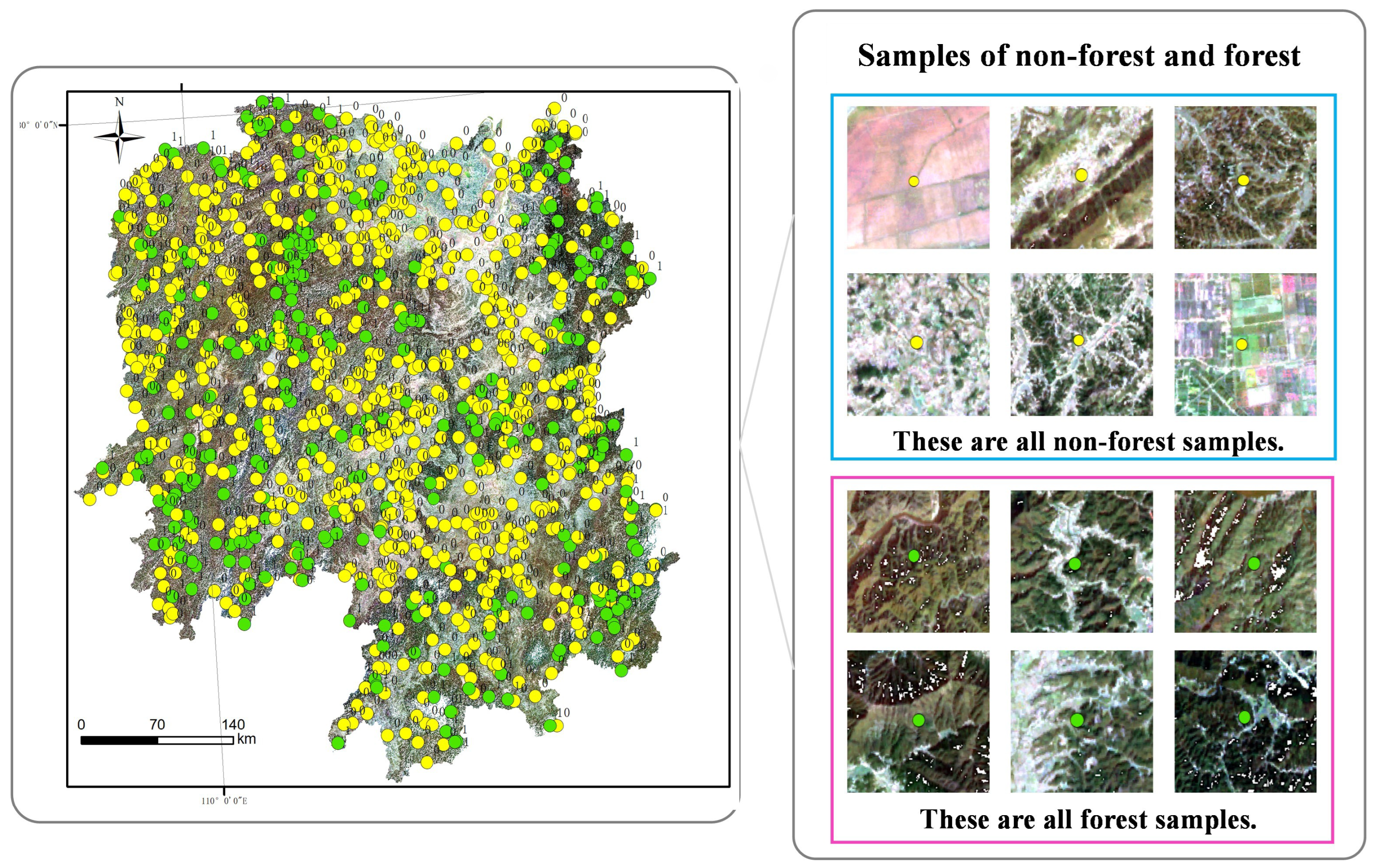
- Validation with 9000 manual samples and official statistics confirms high accuracy (OA > 92%) and reliability.
- Superior to existing products in capturing fine-scale spatial patterns and complex forest boundaries.
Abstract
1. Introduction
2. Materials and Methods
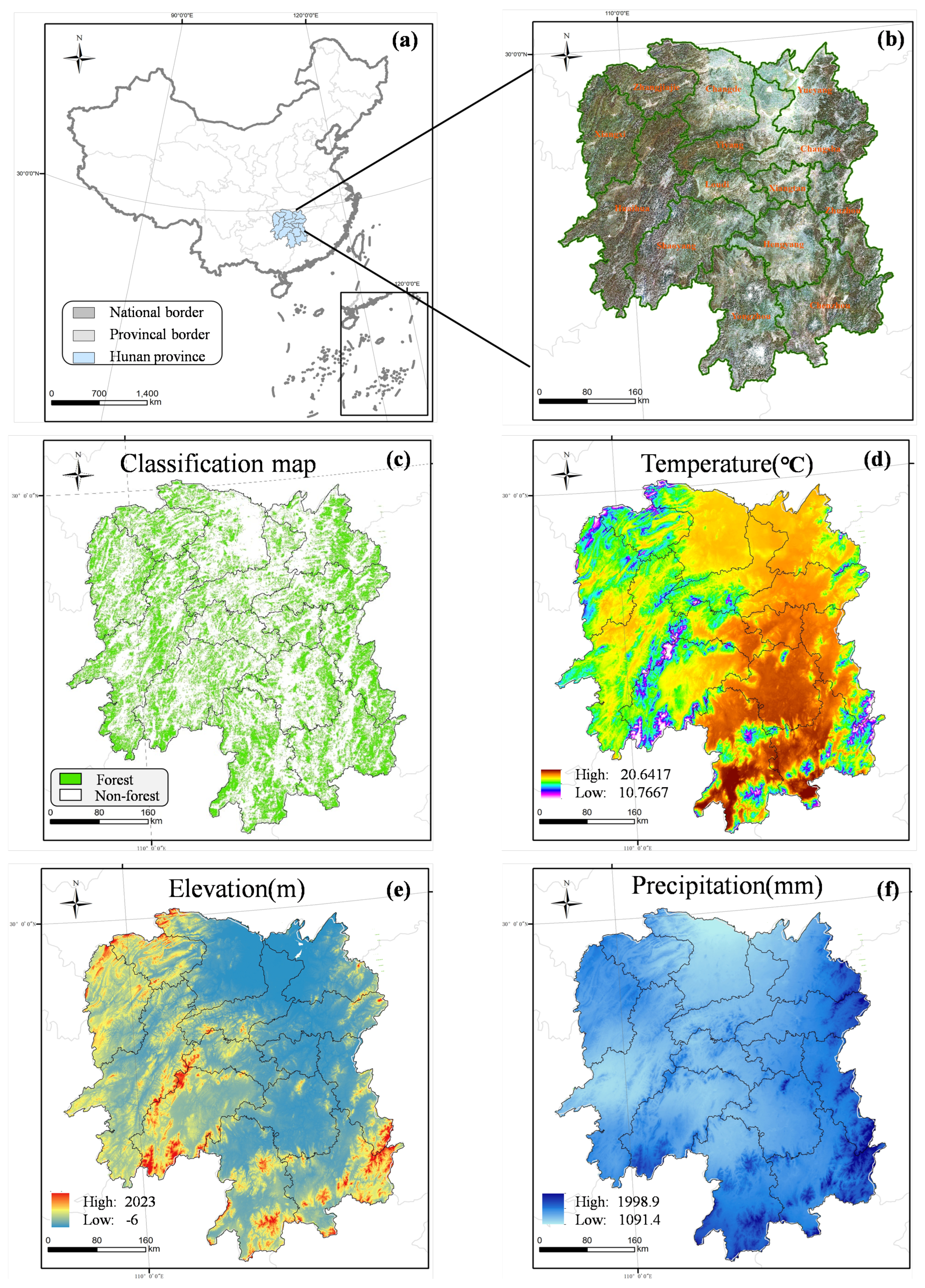
2.1. Study Area and Data
2.1.1. Study Area
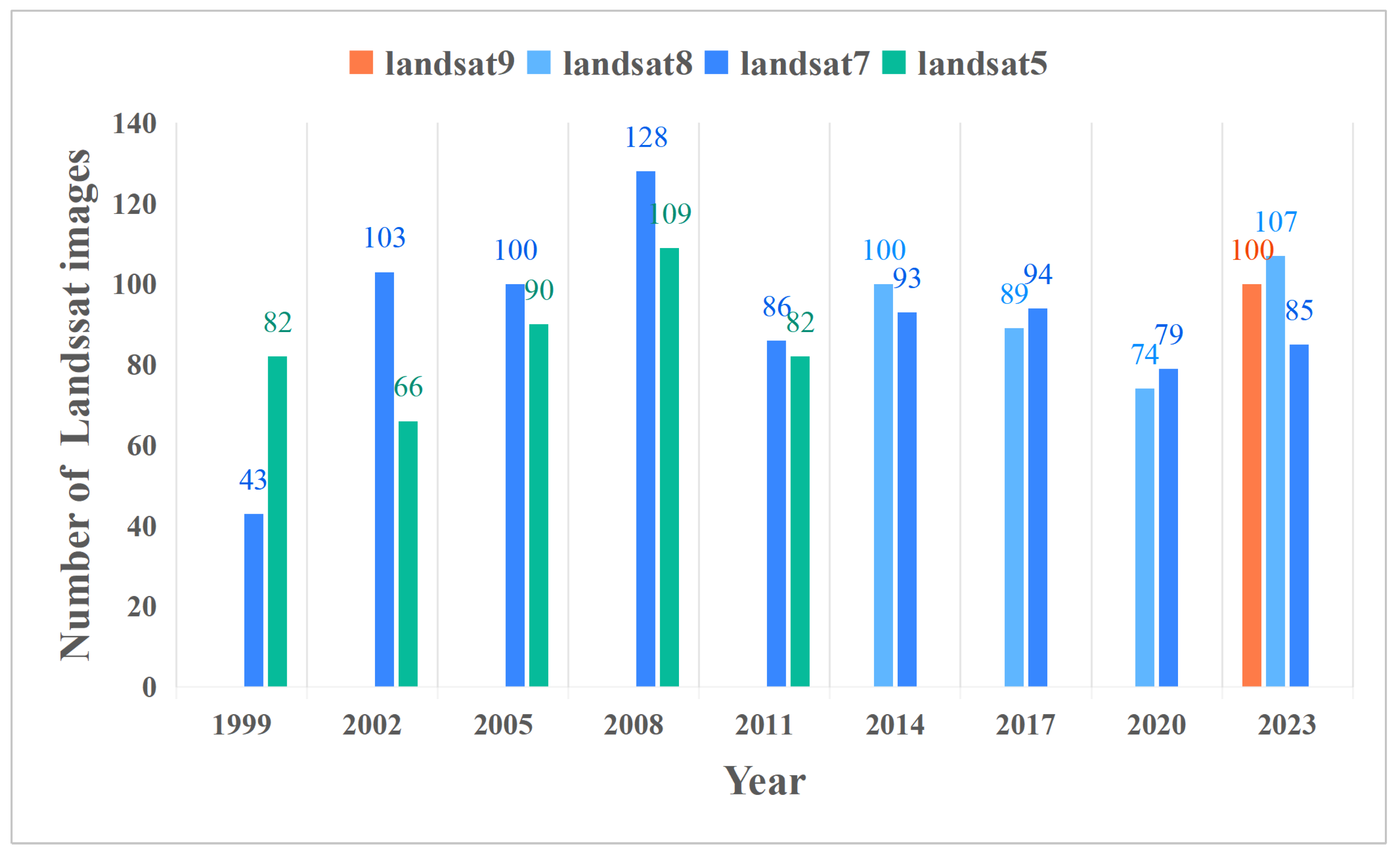
2.1.2. Landsat Images
2.1.3. Environment Factors
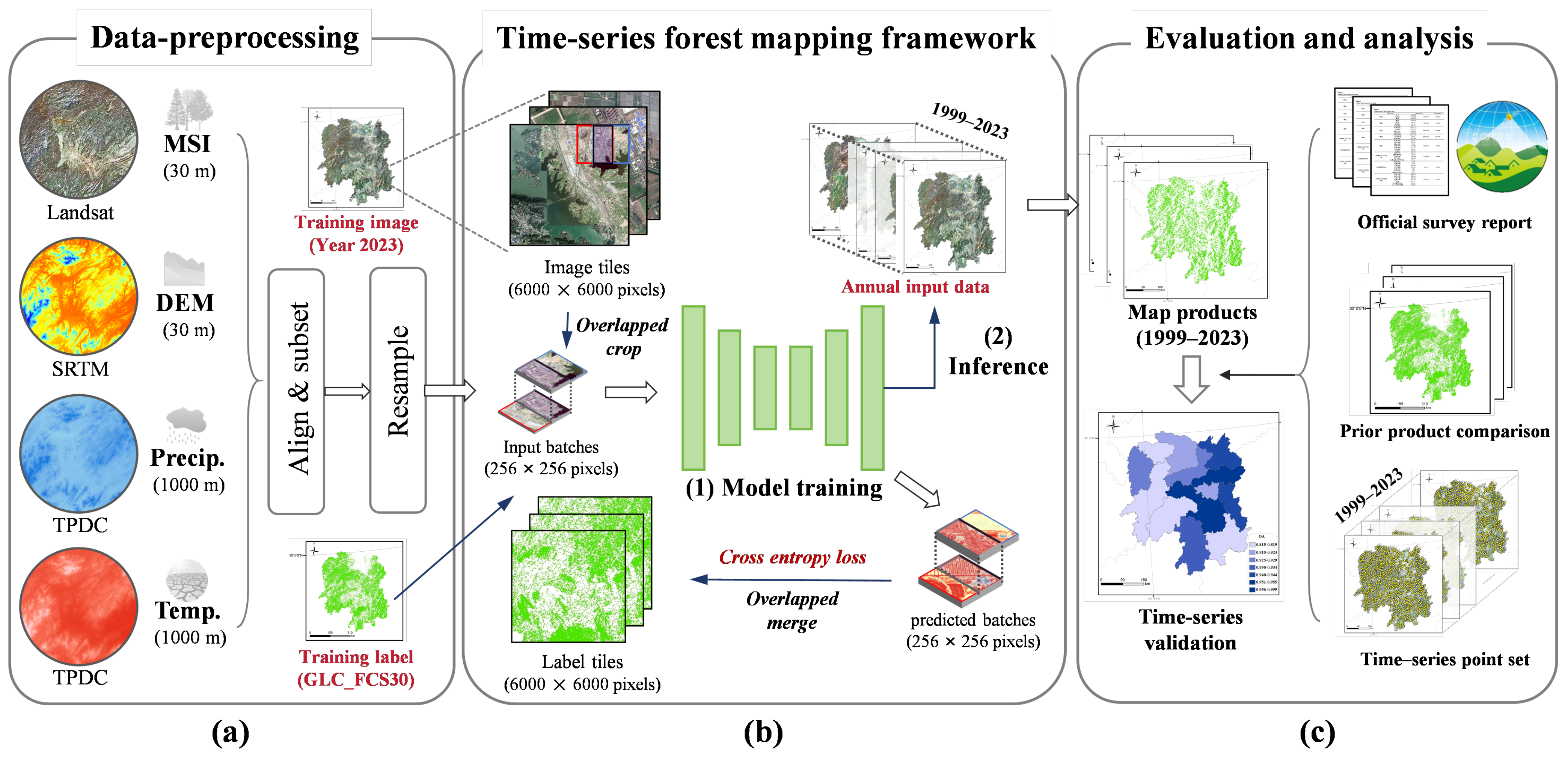
2.2. Data Pre-Processing
2.3. Time-Series Forest Mapping Framework
2.4. Evaluation Setting
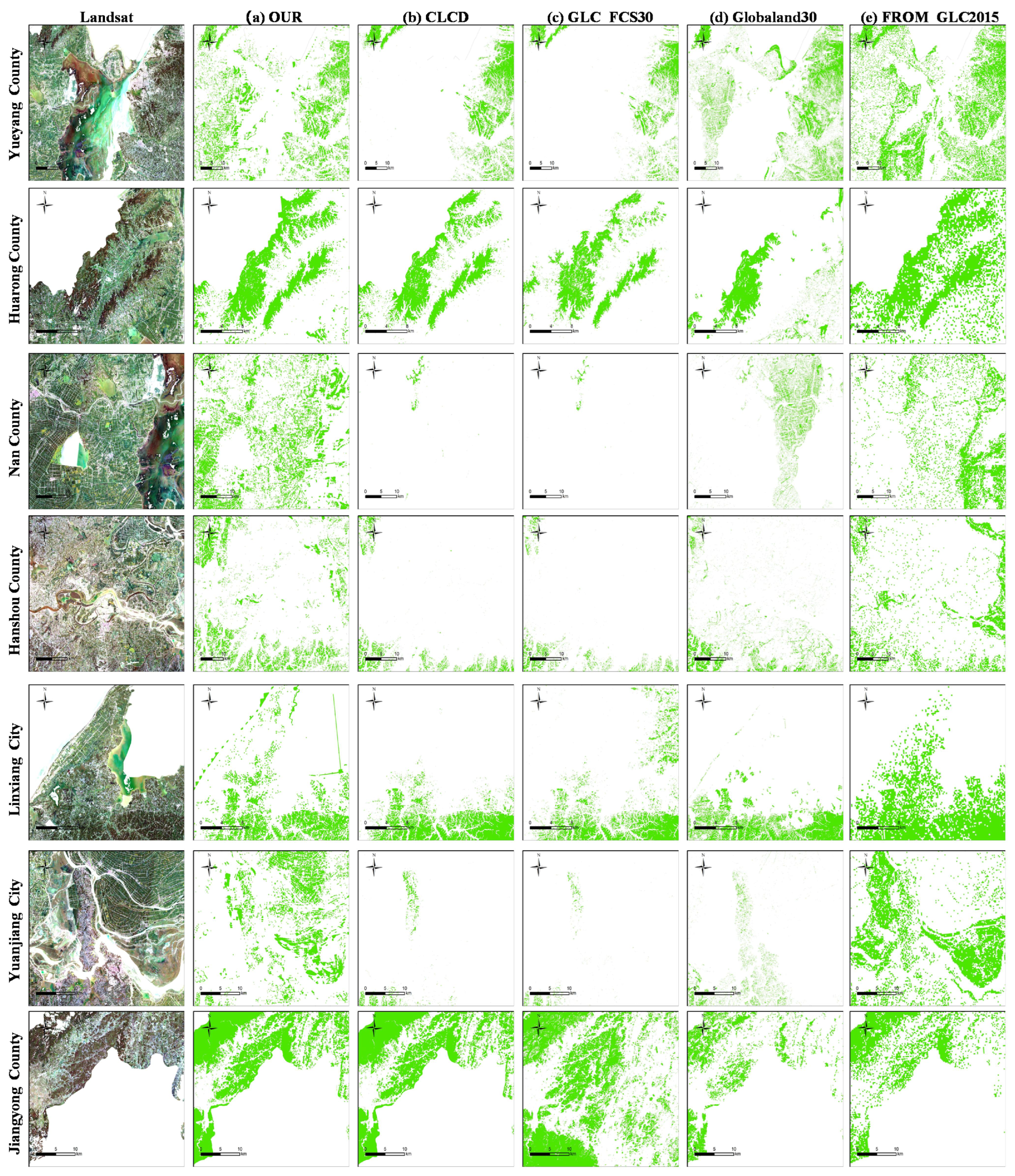
2.4.1. Qualitative Comparison Setting
- (1)
- Comparison with forest extraction results from four land cover products
- (2)
- Comparison with the other three forest mapping products
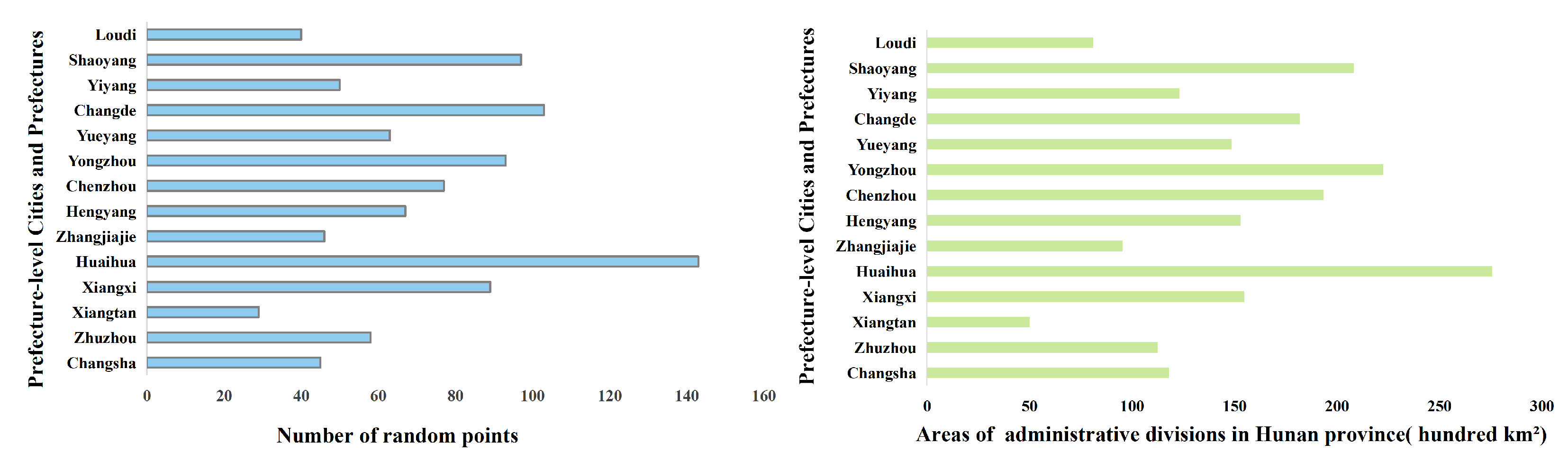
2.4.2. Generating Long-Term Pixel-Level Validation Set
2.4.3. Statistical Data from the Local Government
3. Results
3.1. Qualitative Comparison with Well-Established Map Products
3.1.1. Comparing with Four Land-Cover Products
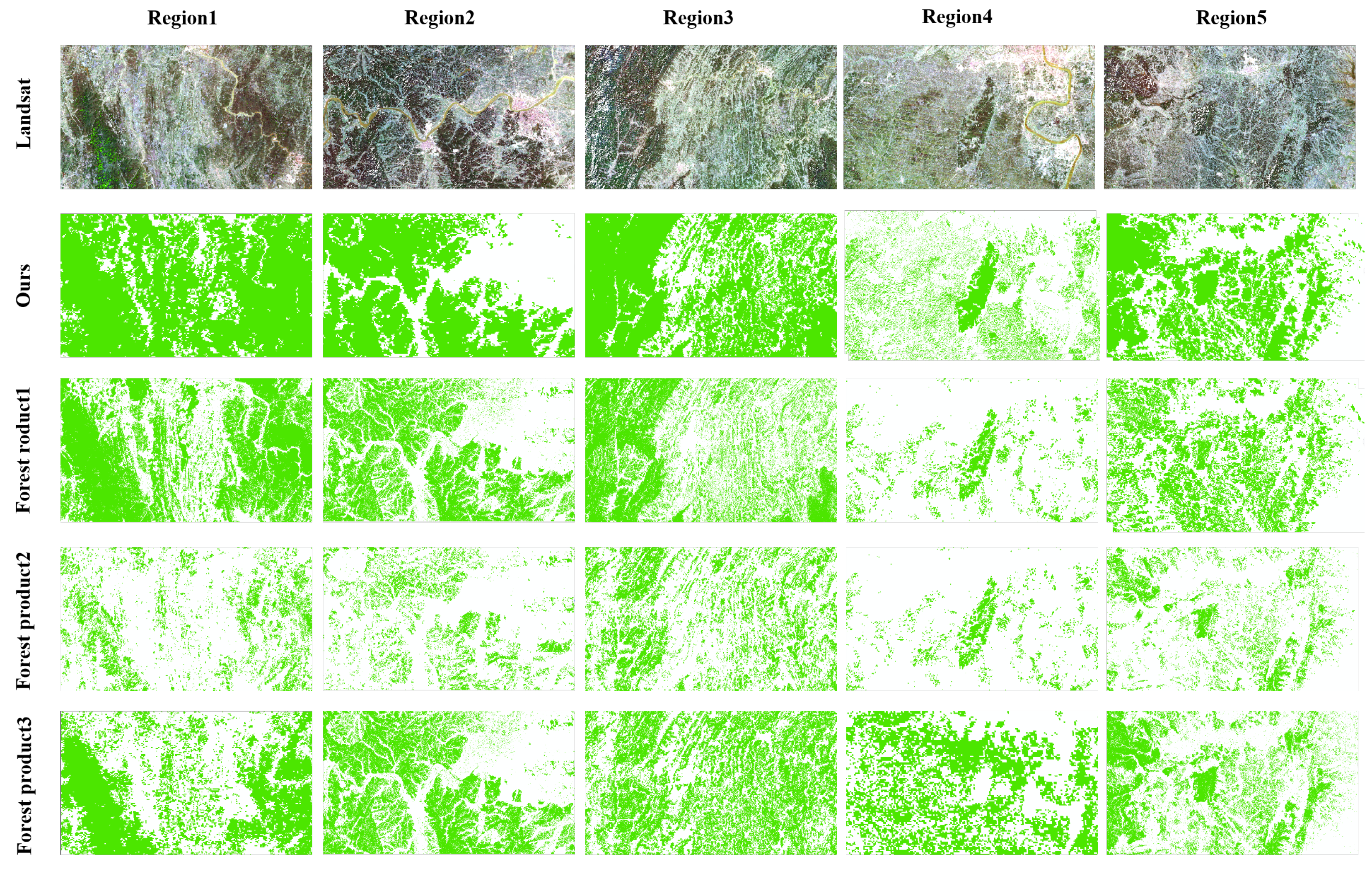
3.1.2. Comparing with Three Forest Products
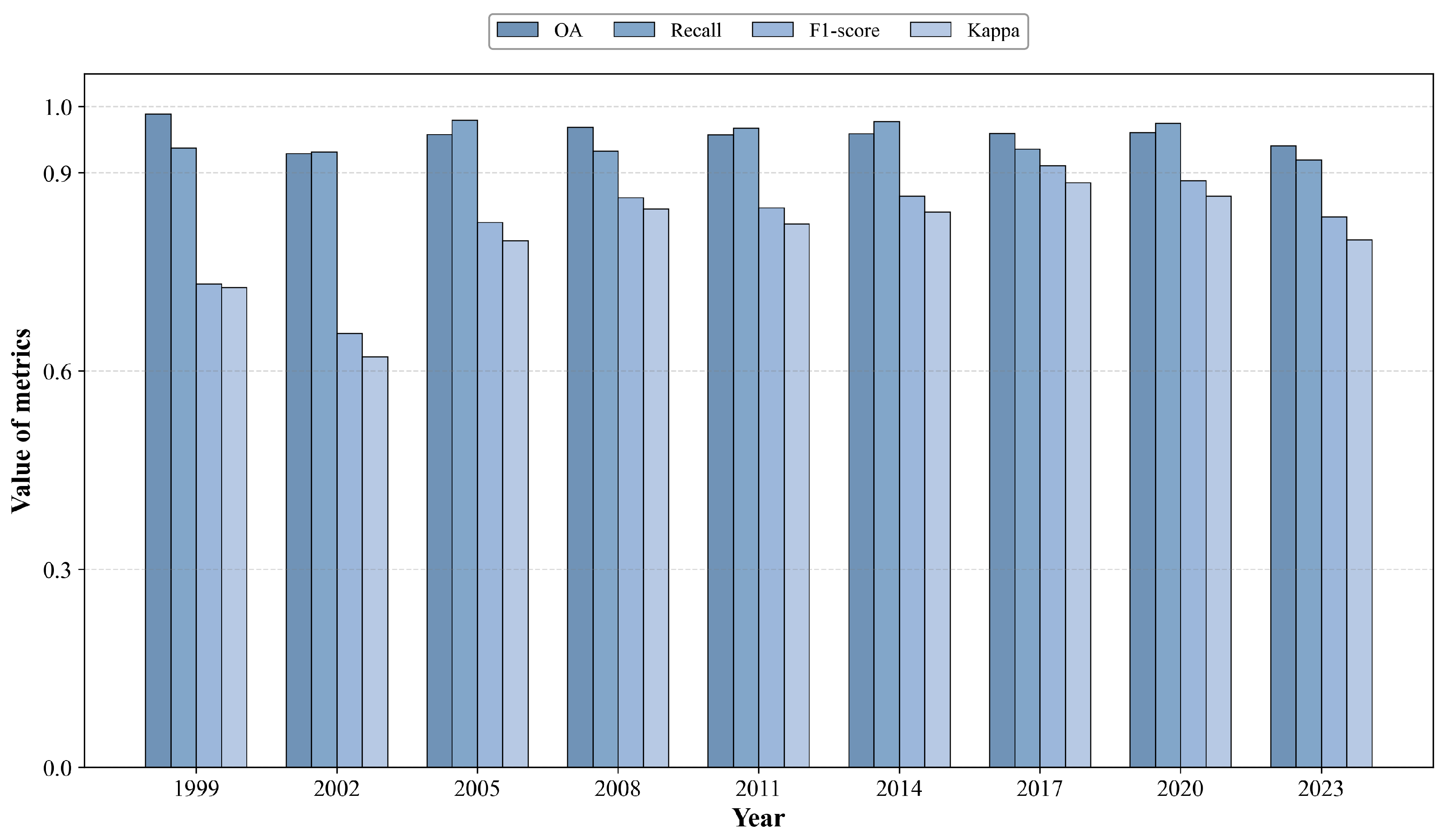
3.2. Pixel-Level Evaluation Based Manual Annotation Point-Set
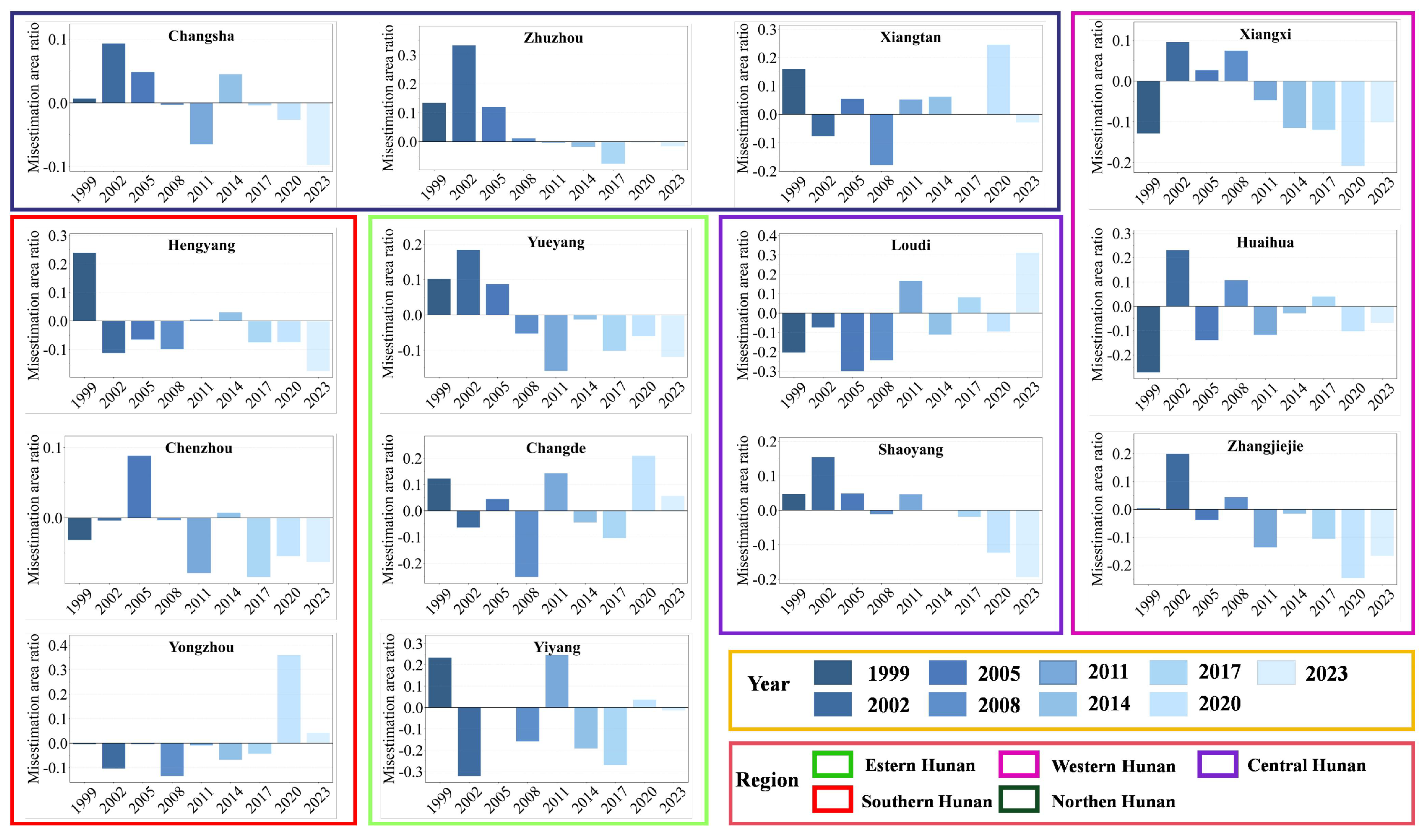
3.3. Statistical Assessment Based on Official Government Survey
3.4. Regulatory Effects of Environmental Factor Coupling Mechanisms on Dominant Tree Species Distribution
3.4.1. Water-Nutrient Regulatory Mechanism of Precipitation
3.4.2. Energy-Phenology Driving Mechanism of Temperature
3.4.3. Hydrothermal Spatial Reconstruction Mechanism of DEM
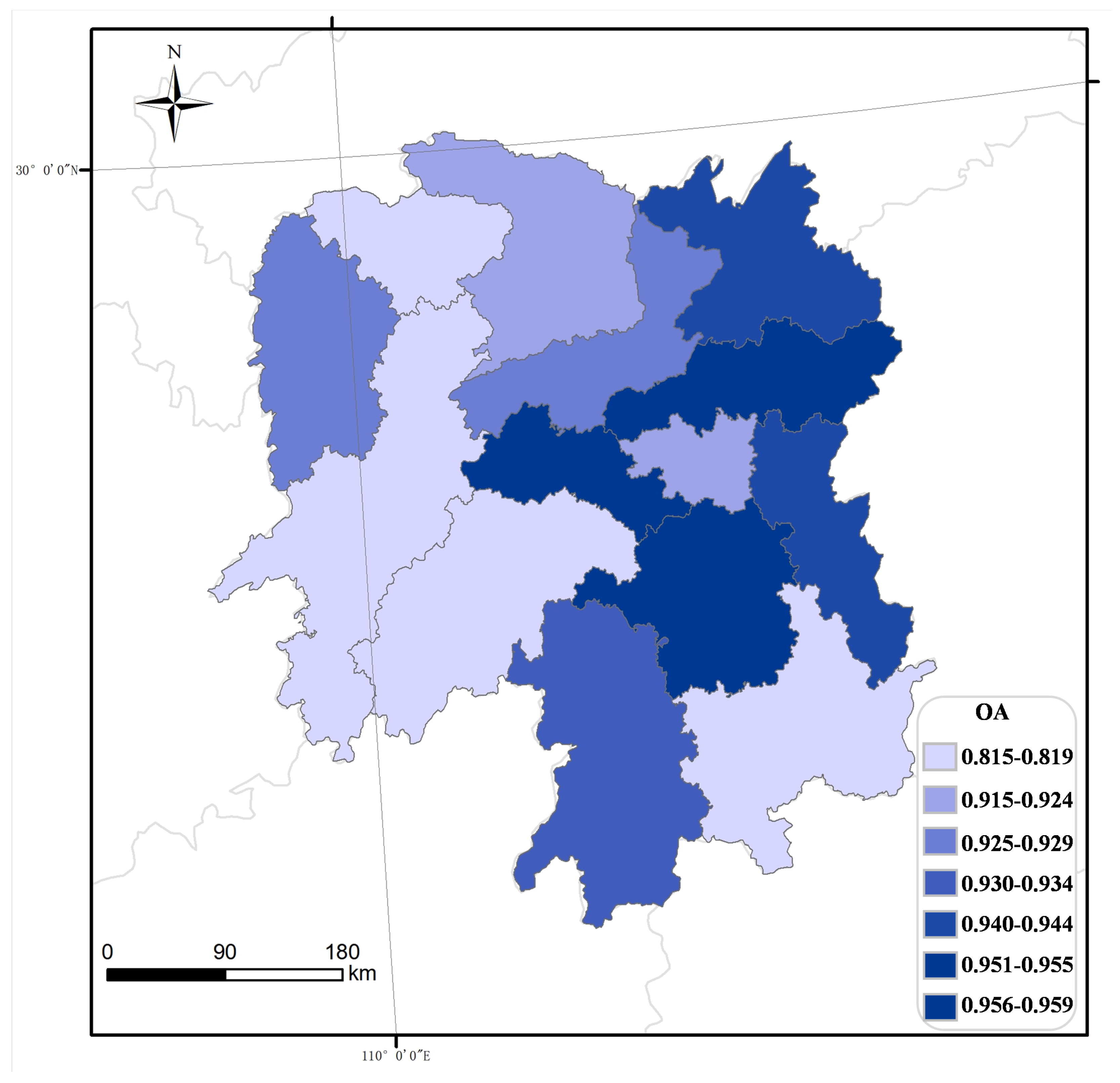
3.5. Environmental Drivers of Classification Accuracy Heterogeneity
4. Discussion
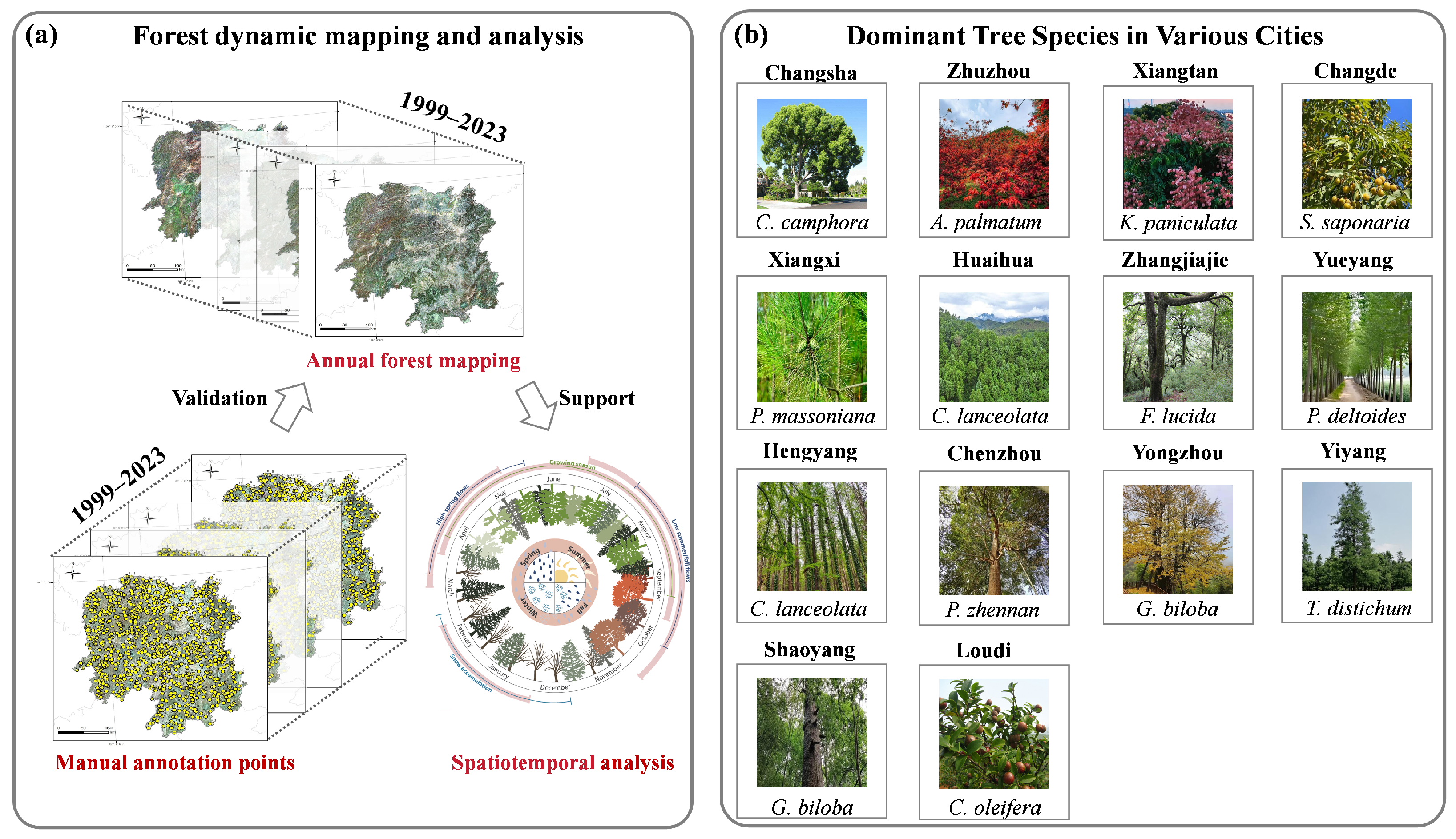
4.1. Forest Distribution in Hunan Province
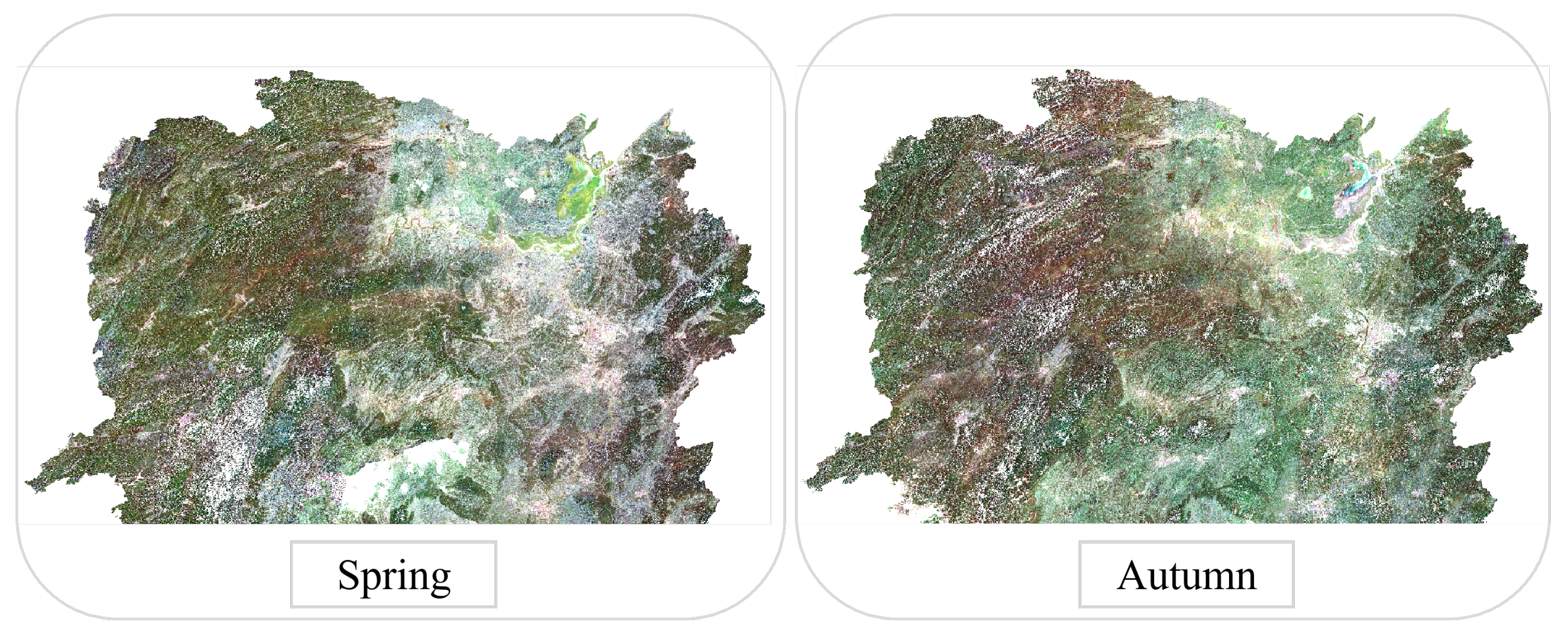
4.2. Seasonal Phenological Effects on Forest Classification Variability
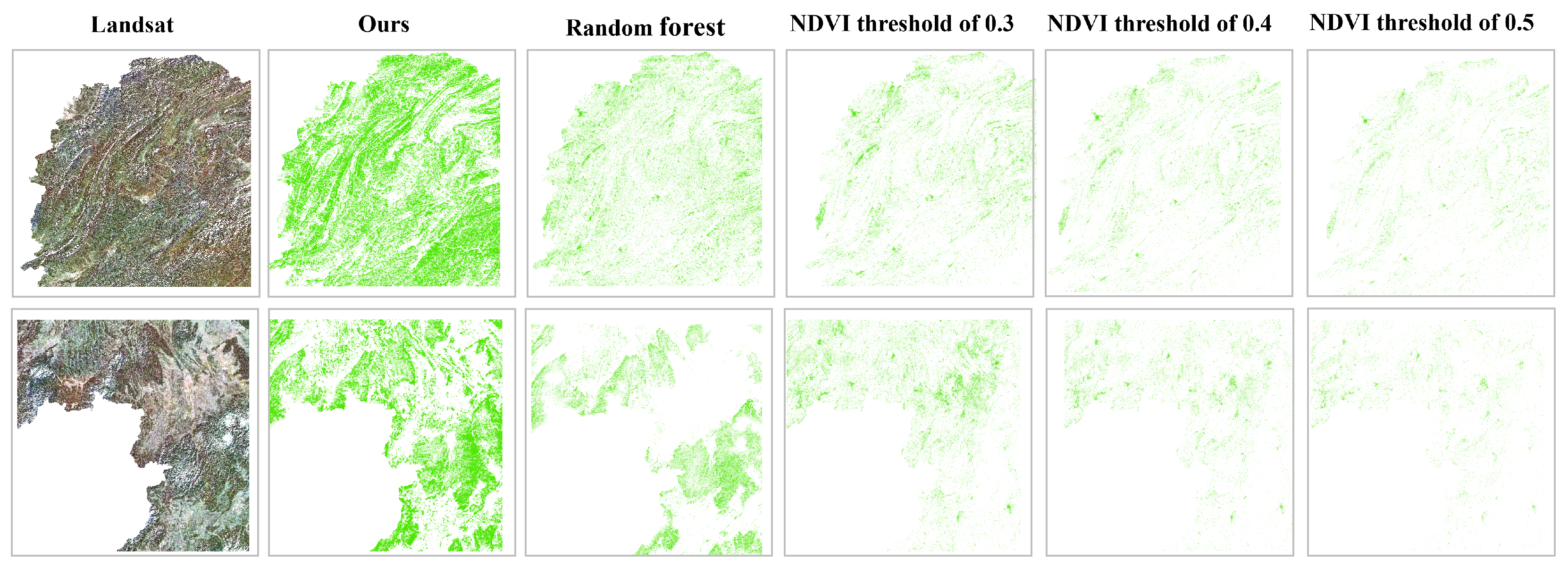
4.3. Performance Benchmarking Against Random Rorest and NDVI Thresholding Methods
4.4. Driving Mechanisms of Forest Resource Dynamics in Hunan Province (1999–2023)
4.5. Strengthening Forest Model Performance Evaluation Based on the Coupling of Field Observations and Remote Sensing
4.6. Limitations and Future Plans
- (1)
- The prevailing approach to deep learning-based forest extraction has been largely centered around the U-Net architecture. A recognized challenge with this framework is its constrained capacity for modeling long-range contextual relationships, such as continuous ecological boundaries, and for effectively fusing diverse, multi-source features. To address this, future work will focus on constructing hybrid deep learning frameworks that integrate U-Net with Vision Transformer (ViT) and traditional machine learning features. Framework Design, Embed the local feature extraction capability of U-Net (via encoder-decoder skip connections) with the global context modeling of ViT (via multi-head self-attention), and further incorporate hand-crafted features (e.g., GLCM texture features, NDVI time-series trends, and topographic attributes from DEM) as auxiliary input channels. Comparative Validation, Conduct systematic comparisons among the proposed hybrid framework, baseline models (U-Net, SegFormer, ResUNet), and traditional machine learning methods (RF, SVM) across multiple independent datasets—covering diverse forest types (coniferous, broadleaf, mixed forests) and complex terrains (mountainous, plain, and riparian zones). Evaluation Metrics: Assess performance using metrics such as overall accuracy (OA), weighted F1-score, Kappa coefficient, and intersection over union (IoU) for forest patches; additionally, quantify model robustness in small-sample scenarios (e.g., sparse forest areas). This work is expected to improve the IoU of forest extraction by 5–8% and enhance the generalization ability of the model across heterogeneous landscapes.
- (2)
- The current analysis is constrained to 30 m Landsat imagery, which lacks sufficient spatial detail for fine-grained forest mapping (e.g., small forest patches or edge zones). Future research will focus on spatiotemporal fusion and synergistic utilization of multi-source remote sensing data: Employ advanced spatiotemporal fusion algorithms to integrate long-term Landsat time-series (1985–present) with 10-m Sentinel-2 optical imagery, generating continuous, high-spatiotemporal-resolution (10 m, 16-day) surface reflectance datasets. Meanwhile, incorporate Sentinel-1 C-band SAR data (VV/VH polarization features) to compensate for optical data gaps caused by clouds/rain (e.g., rainy seasons in the Dongting Lake basin), and fuse SRTM DEM-derived topographic features (slope, aspect) to distinguish terrain-driven forest type variations (e.g., sun-facing vs. shade-facing slope vegetation). Evaluate the fused data in scenarios including fine-scale forest boundary extraction, sub-compartment-level forest classification, and disturbance detection (e.g., small-scale deforestation). Compare the performance of different fusion strategies (single-temporal vs. time-series fusion) in improving classification accuracy. This effort aims to refine the spatial granularity of long-term forest mapping from 30 m to 10 m, while enhancing classification stability in cloud-prone or topographically complex regions.
- (3)
- The current framework primarily addresses forest/non-forest extraction and broad forest type mapping, yet accurate discrimination of fine-grained stand types—such as evergreen broadleaf, deciduous broadleaf, coniferous forests, and their closed-canopy subtypes—remains a significant challenge. This limitation stems from the high spectral similarity among tree species, seasonal phenological variations, and complex canopy structures. Future research will prioritize developing a dedicated classification branch within the hybrid deep learning framework to address this. The methodology will involve: Feature Enrichment, integrating multi-temporal spectral indices, textural features from VHR imagery (e.g., GLCM from fused 10-m data), and vertical structure information (where available, from GEDI or terrain-corrected metrics). Hierarchical Classification Strategy, implementing a cascaded model that first separates forest/non-forest, then discriminates between major life forms (coniferous vs. broadleaf), and finally classifies subordinate stand types (evergreen/deciduous, closed/open) using targeted feature sets and potentially multi-task learning. Physically Guided Modeling, incorporating species distribution constraints based on bioclimatic variables (temperature, precipitation) and topographic factors (elevation, slope, aspect) as prior knowledge or auxiliary inputs to refine ecologically implausible predictions. Validation will be conducted using carefully compiled ground-truth datasets from forest inventories and field surveys, with performance assessed via class-specific precision, recall, F1-score, and overall accuracy. This targeted effort aims to achieve a stand-type classification accuracy exceeding 85% for major classes, providing a more ecologically meaningful product for biodiversity assessment, carbon stock modeling, and precision forestry management.
5. Conclusions
Author Contributions
Funding
Data Availability Statement
Acknowledgments
Conflicts of Interest
References
- Liu, Y.; Gong, W.; Hu, X.; Gong, J. Forest type identification with random forest using Sentinel-1A, Sentinel-2A, multi-temporal Landsat-8 and DEM data. Remote Sens. 2018, 10, 946. [Google Scholar] [CrossRef] [Scilit]
- Artaxo, P.; Hansson, H.C.; Machado, L.A.T.; Rizzo, L.V. Tropical forests are crucial in regulating the climate on Earth. PLoS Clim. 2022, 1, e0000054. [Google Scholar] [CrossRef] [Scilit]
- Dai, L.; Li, S.; Zhou, W.; Qi, L.; Zhou, L.; Wei, Y.; Li, J.; Shao, G.; Yu, D. Opportunities and challenges for the protection and ecological functions promotion of natural forests in China. For. Ecol. Manag. 2018, 410, 187–192. [Google Scholar] [CrossRef] [Scilit]
- Kellomäki, S. Global Forests, with a Focus on Boreal Forests. In Forest Management for Timber Production and Climate Change Mitigation: Linking Dynamics of Carbon Cycle in Ecosystem Management; Springer: Berlin/Heidelberg, Germany, 2024; pp. 9–29. [Google Scholar] [CrossRef] [Scilit]
- FAO. Global Forest Resources Assessment 2020; FAO: Rome, Italy, 2020. [Google Scholar] [CrossRef] [Scilit]
- Hansen, M.C.; Potapov, P.V.; Moore, R.; Hancher, M.; Turubanova, S.A.; Tyukavina, A.; Thau, D.; Stehman, S.V.; Goetz, S.J.; Loveland, T.R.; et al. High-resolution global maps of 21st-century forest cover change. Science 2013, 342, 850–853. [Google Scholar] [CrossRef] [Scilit] [PubMed]
- Bhatt, R.P. Impact on Forest and vegetation due to human interventions. In Vegetation Dynamics, Changing Ecosystems and Human Responsibility; IntechOpen: London, UK, 2022. [Google Scholar] [CrossRef] [Scilit]
- Wahelo, T.T.; Mengistu, D.A.; Merawi, T.M. Spatiotemporal trends and drivers of forest cover change in Metekel Zone forest areas, Northwest Ethiopia. Environ. Monit. Assess. 2024, 196, 1170. [Google Scholar] [CrossRef] [Scilit]
- Chen, C.; Park, T.; Wang, X.; Piao, S.; Xu, B.; Chaturvedi, R.K.; Fuchs, R.; Brovkin, V.; Ciais, P.; Fensholt, R.; et al. China and India lead in greening of the world through land-use management. Nat. Sustain. 2019, 2, 122–129. [Google Scholar] [CrossRef] [Scilit]
- Brunel, A.; Fernandez de Larrinoa, Y.; Innecken Zuñiga, P.; Sadeghi, S.; Way, M. Food and Agriculture Organization of the United Nations (FAO) and Indigenous Peoples. In Indigenous World, 1st ed.; International Work Group for Indigenous Affairs (IWGIA): Copenhagen, Denmark, 2025; ISBN 1024-0217. [Google Scholar]
- Sui, Y.; Wei, M.; Liu, B. Biophysical Impacts of Global Deforestation on Near-Surface Air Temperature in China: Results from Land Use Model Intercomparison Project Simulations. Adv. Atmos. Sci. 2024, 42, 1141. [Google Scholar] [CrossRef] [Scilit]
- Chang, S.; He, H.S.; Huang, F.; Krohn, J. Spring temperature and snow cover co-regulate variations of forest phenology in Changbai Mountains, Northeast China. Eur. J. For. Res. 2024, 143, 1642. [Google Scholar] [CrossRef] [Scilit]
- Rotich, B.; Ojwang, D. Trends and drivers of forest cover change in the Cherangany hills forest ecosystem, western Kenya. Glob. Ecol. Conserv. 2021, 30, e01755. [Google Scholar] [CrossRef] [Scilit]
- Rotich, B.; Ahmed, A.; Kinyili, B.; Kipkulei, H. Historical and projected forest cover changes in the Mount Kenya Ecosystem: Implications for sustainable forest management. Environ. Sustain. Indic. 2025, 26, 100628. [Google Scholar] [CrossRef] [Scilit]
- Pan, Y.; Birdsey, R.A.; Phillips, O.L.; Houghton, R.A.; Fang, J.; Kauppi, P.E.; Keith, H.; Kurz, W.A.; Ito, A.; Lewis, S.L.; et al. The enduring world forest carbon sink. Nature 2024, 631, 563–569. [Google Scholar] [CrossRef] [Scilit]
- Blickensdörfer, L.; Oehmichen, K.; Pflugmacher, D.; Kleinschmit, B.; Hostert, P. National tree species mapping using Sentinel-1/2 time series and German National Forest Inventory data. Remote Sens. Environ. 2024, 304, 114069. [Google Scholar] [CrossRef] [Scilit]
- Hościło, A.; Lewandowska, A. Mapping forest type and tree species on a regional scale using multi-temporal Sentinel-2 data. Remote Sens. 2019, 11, 929. [Google Scholar] [CrossRef] [Scilit]
- Wu, W.-B.; Ma, J.; Banzhaf, E.; Meadows, M.E.; Yu, Z.-W.; Guo, F.-X.; Sengupta, D.; Cai, X.-X.; Zhao, B. A first Chinese building height estimate at 10 m resolution (CNBH-10 m) using multi-source earth observations and machine learning. Remote Sens. Environ. 2023, 291, 113578. [Google Scholar] [CrossRef] [Scilit]
- Zhan, J.-Y.; Wang, C.; Wang, H.-H.; Zhang, F.; Li, Z.-H. Pathways to achieve carbon emission peak and carbon neutrality by 2060: A case study in the Beijing-Tianjin-Hebei region, China. Renew. Sustain. Energy Rev. 2024, 189, 113955. [Google Scholar] [CrossRef] [Scilit]
- Guan, F.J.; Liu, L.H.; Liu, J.W.; Fu, Y.; Wang, L.Y.; Wang, F.; Li, Y.; Yu, X.D.; Che, N.; Xiao, Y. Systematically promoting the construction of natural ecological protection and governance capacity: Experts comments on Master Plan for Major Projects of National Important Ecosystem Protection and Restoration (2021–2035). J. Nat. Resour. 2021, 36, 290–299. [Google Scholar] [CrossRef] [Scilit]
- Fassnacht, F.E.; Latifi, H.; Stereńczak, K.; Modzelewska, A.; Lefsky, M.; Waser, L.T.; Straub, C.; Ghosh, A. Review of studies on tree species classification from remotely sensed data. Remote Sens. Environ. 2016, 186, 64–87. [Google Scholar] [CrossRef] [Scilit]
- Hermosilla, T.; Bastyr, A.; Coops, N.C.; White, J.C.; Wulder, M.A. Mapping the presence and distribution of tree species in Canada’s forested ecosystems. Remote Sens. Environ. 2022, 282, 113276. [Google Scholar] [CrossRef] [Scilit]
- Immitzer, M.; Atzberger, C.; Koukal, T. Tree species classification with random forest using very high spatial resolution 8-band WorldView-2 satellite data. Remote Sens. 2012, 4, 2661–2693. [Google Scholar] [CrossRef] [Scilit]
- Deng, X.; Carvajal, D.E.; Urrutia-Jalabert, R.; Machida, W.S.; Rosen, A.; Zhang-Zheng, H.; Galbraith, D.; Díaz, S.; Malhi, Y.; Aguirre-Gutiérrez, J. Quantifying the functional composition and potential resilience hotspots across a large latitudinal and environmental gradient in South American forests. Int. J. Appl. Earth Obs. Geoinf. 2025, 142, 104704. [Google Scholar] [CrossRef] [Scilit]
- Pilli, R.; Runge, A.; Chirici, G.; Vangi, E.; Collalti, A.; Herold, M. Integrated analysis of harvest statistics provided by remote sensing, national forest inventories and administrative survey systems: An example from Italy. Int. J. Appl. Earth Obs. Geoinf. 2025, 144, 104871. [Google Scholar] [CrossRef] [Scilit]
- Li, Z.; Zhang, H.; Lu, F.; Xue, R.; Yang, G.; Zhang, L. Breaking the resolution barrier: A low-to-high network for large-scale high-resolution land-cover mapping using low-resolution labels. ISPRS J. Photogramm. Remote Sens. 2022, 192, 244–267. [Google Scholar] [CrossRef] [Scilit]
- Li, Z.; He, W.; Cheng, M.; Hu, J.; Yang, G.; Zhang, H. SinoLC-1: The first 1 m resolution national-scale land-cover map of China created with a deep learning framework and open-access data. Earth Syst. Sci. Data 2023, 15, 4749–4780. [Google Scholar] [CrossRef] [Scilit]
- Li, Z.; He, W.; Li, J.; Lu, F.; Zhang, H. Learning without exact guidance: Updating large-scale high-resolution land cover maps from low-resolution historical labels. In Proceedings of the IEEE/CVF Conference on Computer Vision and Pattern Recognition, Seattle, WA, USA, 16–22 June 2024; IEEE: Piscataway, NJ, USA, 2024; pp. 27717–27727. [Google Scholar] [CrossRef] [Scilit]
- Yang, J.; Huang, X. The 30 m annual land cover and its dynamics in China from 1990 to 2019. Earth Syst. Sci. Data 2021, 13, 3907–3925. [Google Scholar] [CrossRef] [Scilit]
- Zhang, X.; Liu, L.; Chen, X.; Gao, Y.; Xie, S.; Mi, J. GLC_FCS30: Global land-cover product with fine classification system at 30 m using time-series Landsat imagery. Earth Syst. Sci. Data 2020, 13, 2753–2776. [Google Scholar] [CrossRef] [Scilit]
- Chen, J.; Chen, J.; Liao, A.; Cao, X.; Chen, L.; Chen, X.; He, C.; Han, G.; Peng, S.; Lu, M.; et al. Global land cover mapping at 30 m resolution: A POK-based operational approach. ISPRS J. Photogramm. Remote Sens. 2015, 103, 7–27. [Google Scholar] [CrossRef] [Scilit]
- Li, C.; Gong, P.; Wang, J.; Zhu, Z.; Biging, G.S.; Yuan, C.; Hu, T.; Zhang, H.; Wang, Q.; Li, X.; et al. The first all-season sample set for mapping global land cover with Landsat-8 data. Sci. Bull. 2017, 62, 508–515. [Google Scholar] [CrossRef] [Scilit]
- Kingsford, C.; Salzberg, S.L. What are decision trees? Nat. Biotechnol. 2008, 26, 1011–1013. [Google Scholar] [CrossRef] [Scilit]
- Samadzadegan, F.; Hasani, H.; Schenk, T. Simultaneous feature selection and SVM parameter determination in classification of hyperspectral imagery using ant colony optimization. Can. J. Remote Sens. 2012, 38, 139–156. [Google Scholar] [CrossRef] [Scilit]
- Cheng, K.; Su, Y.-J.; Guan, H.-C.; Tao, S.-L.; Ren, Y.; Hu, T.-Y.; Ma, K.-P.; Tang, Y.-H.; Guo, Q.-H. Mapping China’s planted forests using high resolution imagery and massive amounts of crowdsourced samples. ISPRS J. Photogramm. Remote Sens. 2023, 196, 356–371. [Google Scholar] [CrossRef] [Scilit]
- Lv, J.; Liu, Y.; Jin, R.; Zhu, W. Forested Swamp Classification Based on Multi-Source Remote Sensing Data: A Case Study of Changbai Mountain Ecological Function Protection Area. Forests 2025, 16, 794. [Google Scholar] [CrossRef] [Scilit]
- Huang, Z.-H.; Li, X.-J.; Du, H.-Q.; Zou, W.-M.; Zhou, G.-M.; Mao, F.-J.; Fan, W.-L.; Xu, Y.-X.; Ni, C.; Zhang, B.; et al. An algorithm of forest age estimation based on the forest disturbance and recovery detection. IEEE Trans. Geosci. Remote Sens. 2023, 61, 4409018. [Google Scholar] [CrossRef] [Scilit]
- Xu, L.; Wu, Z.-C.; Zhang, Z.; Wang, X. Forest classification using synthetic GF-1/WFV time series and phenological parameters. J. Appl. Remote Sens. 2021, 15, 42413. [Google Scholar] [CrossRef] [Scilit]
- Aziz, G.; Minallah, N.; Saeed, A.; Frnda, J.; Khan, W. Remote sensing based forest cover classification using machine learning. Sci. Rep. 2024, 14, 17. [Google Scholar] [CrossRef] [Scilit]
- Cheng, M.; He, W.; Li, Z.; Yang, G.; Zhang, H. Harmony in diversity: Content cleansing change detection framework for very-high-resolution remote-sensing images. ISPRS J. Photogramm. Remote Sens. 2024, 218, 1–19. [Google Scholar] [CrossRef] [Scilit]
- Xu, K.; Han, H.; Wang, S.; Zhao, P.; Geng, J.; Jiang, H.; Ding, A. TS2GNet: A temporal–spatial–spectral multidomain guided network for classifying hyperspectral tree species using multiseason satellite imagery. Int. J. Appl. Earth Obs. Geoinf. 2025, 142, 104715. [Google Scholar] [CrossRef] [Scilit]
- Lei, G.B.; Li, A.N.; Bian, J.H.; Zhang, Z.J.; Zhang, W.; Wu, B.F. An practical method for automatically identifying the evergreen and deciduous characteristic of forests at mountainous areas: A case study in Mt. Gongga Region. Acta Ecol. Sin 2014, 34, 7210–7221. [Google Scholar] [CrossRef] [Scilit]
- Rezaee, M.; Mahdianpari, M.; Zhang, Y.; Salehi, B. Deep convolutional neural network for complex wetland classification using optical remote sensing imagery. IEEE J. Sel. Top. Appl. Earth Obs. Remote Sens. 2018, 11, 3030–3039. [Google Scholar] [CrossRef] [Scilit]
- Li, Z.; He, W.; Li, J.; Zhang, H. Identifying every building’s function in large-scale urban areas with multi-modality remote-sensing data. In Proceedings of the IGARSS 2024–2024 IEEE International Geoscience and Remote Sensing Symposium, Athens, Greece, 7–12 July 2024; IEEE: Piscataway, NJ, USA, 2024; pp. 310–314. [Google Scholar] [CrossRef] [Scilit]
- Li, Z.; Lu, F.; Zhang, H.; Tu, L.; Li, J.; Huang, X.; Robinson, C.; Malkin, N.; Jojic, N.; Ghamisi, P.; et al. The outcome of the 2021 ieee grss data fusion contest—Track msd: Multitemporal semantic change detection. IEEE J. Sel. Top. Appl. Earth Obs. Remote Sens. 2022, 15, 1643–1655. [Google Scholar] [CrossRef] [Scilit]
- Li, R.; Fang, P.; Xu, W.; Wang, L.; Ou, G.; Zhang, W.; Huang, X. Classifying forest types over a mountainous area in southwest China with Landsat data composites and multiple environmental factors. Forests 2022, 13, 135. [Google Scholar] [CrossRef] [Scilit]
- Zhang, B.; Zhang, L.; Yan, M.; Zuo, J.; Dong, Y.; Chen, B. High-resolution mapping of forest parameters in tropical rainforests through AutoML integration of GEDI with Sentinel-1/2, Landsat 8 and ALOS-2 data. IEEE J. Sel. Top. Appl. Earth Obs. Remote Sens. 2025, 18, 9084–9118. [Google Scholar] [CrossRef] [Scilit]
- Zhang, R.; Zhao, X.; Dong, X.; Dai, K.; Deng, J.; Zhuo, G.; Yu, B.; Wu, T.; Xiang, J. Potential landslide identification in Baihetan Reservoir area based on C-/L-band synthetic aperture radar data and applicability analysis. Remote Sens. 2024, 16, 1591. [Google Scholar] [CrossRef] [Scilit]
- Takhtkeshha, N.; Mandlburger, G.; Remondino, F.; Hyyppä, J. Multispectral light detection and ranging technology and applications: A review. Sensors 2024, 24, 1669. [Google Scholar] [CrossRef] [Scilit] [PubMed]
- Lai, X.; Tang, X.; Ren, Z.; Li, Y.; Huang, R.; Chen, J.; You, H. Study on the Influencing Factors of Forest Tree-Species Classification Based on Landsat and Sentinel-2 Imagery. Forests 2024, 15, 1511. [Google Scholar] [CrossRef] [Scilit]
- Potapov, P.; Li, X.-Y.; Hernandez-Serna, A.; Tyukavina, A.; Hansen, M.C.; Kommareddy, A.; Pickens, A.; Turubanova, S.; Tang, H.; Silva, C.E.; et al. Mapping global forest canopy height through integration of GEDI and Landsat data. Remote Sens. Environ. 2021, 253, 112165. [Google Scholar] [CrossRef] [Scilit]
- Bourgoin, C.; Verhegghen, A.; Carboni, S.; Degreve, L.; Ameztoy Aramendi, I.; Ceccherini, G.; Colditz, R.; Achard, F. Global Forest Maps for the Year 2020 to Support the EU Regulation on Deforestation-free Supply Chains. Joint Research Centre (JRC), European Commission: Publications Office of the European Union, 2025; Report No. JRC141702. Available online: https://publications.jrc.ec.europa.eu/repository/handle/JRC141702 (accessed on 18 August 2025).
- Grabska, E.; Frantz, D.; Ostapowicz, K. Evaluation of machine learning algorithms for forest stand species mapping using Sentinel-2 imagery and environmental data in the Polish Carpathians. Remote Sens. Environ. 2020, 251, 112102. [Google Scholar] [CrossRef] [Scilit]
- Fu, B.; Liang, Y.; Lao, Z.; Sun, X.; Li, S.; He, H.; Sun, W.; Fan, D. Quantifying scattering characteristics of mangrove species from Optuna-based optimal machine learning classification using multi-scale feature selection and SAR image time series. Int. J. Appl. Earth Obs. Geoinf. 2023, 122, 103489. [Google Scholar] [CrossRef] [Scilit]
- Liu, X.; Frey, J.; Munteanu, C.; Still, N.; Koch, B. Mapping tree species diversity in temperate montane forests using Sentinel-1 and Sentinel-2 imagery and topography data. Remote Sens. Environ. 2023, 292, 113576. [Google Scholar] [CrossRef] [Scilit]
- Zhao, L.; Ge, Y.; Guo, S.; Li, H.; Li, X.; Sun, L.; Chen, J. Forest fire susceptibility mapping based on precipitation-constrained cumulative dryness status information in Southeast China: A novel machine learning modeling approach. For. Ecol. Manag. 2024, 558, 121787. [Google Scholar] [CrossRef] [Scilit]
- Zhu, X.; Liu, D. Accurate mapping of forest types using dense seasonal Landsat time-series. ISPRS J. Photogramm. Remote Sens. 2014, 96, 1–11. [Google Scholar] [CrossRef] [Scilit]
- Liu, M.; Liu, J.; Atzberger, C.; Jiang, Y.; Ma, M.; Wang, X. Zanthoxylum bungeanum Maxim mapping with multi-temporal Sentinel-2 images: The importance of different features and consistency of results. ISPRS J. Photogramm. Remote Sens. 2021, 174, 68–86. [Google Scholar] [CrossRef] [Scilit]
- Gong, P.; Wang, J.; Yu, L.; Zhao, Y.; Zhao, Y.; Liang, L.; Niu, Z.; Huang, X.; Fu, H.; Liu, S.; et al. Finer resolution observation and monitoring of global land cover: First mapping results with Landsat TM and ETM+ data. Int. J. Remote Sens. 2013, 34, 2607–2654. [Google Scholar] [CrossRef] [Scilit]
- Ni, Y.-Y.; Xiao, W.-F.; Liu, J.-F.; Jian, Z.-J.; Li, M.-H.; Xu, J.; Lei, L.; Zhu, J.-H.; Li, Q.; Zeng, L.-X.; et al. Radial growth-climate correlations of Pinus massoniana in natural and planted forest stands along a latitudinal gradient in subtropical central China. Agric. For. Meteorol. 2023, 334, 109422. [Google Scholar] [CrossRef] [Scilit]
- Huang, Y.; Bao, Y.; Petropoulos, G.P.; Lu, Q.; Huo, Y.; Wang, F. Precipitation estimation using FY-4B/AGRI satellite data based on random forest. Remote Sens. 2024, 16, 1267. [Google Scholar] [CrossRef] [Scilit]
- Asadi, H.; Jalilv, H.; Tafazoli, M.; Hosseini, S.F. Modeling habitat suitability of Quercus castaneifolia in the Hyrcanian forest: A comprehensive integration of environmental factors for conservation insights. Biodivers. Conserv. 2025, 34, 315–334. [Google Scholar] [CrossRef] [Scilit]
- Xiao, Y.; Wang, Q.; Zhang, H.K. Global Natural and Planted Forests Mapping at Fine Spatial Resolution of 30 m. J. Remote Sens. 2024, 4, 204. [Google Scholar] [CrossRef] [Scilit]
- Chen, Y.; Yang, H.; Yang, Z.; Yang, Q.; Liu, W.; Huang, G.; Ren, Y.; Cheng, K.; Xiang, T.; Chen, M.; et al. Enhancing high-resolution forest stand mean height mapping in China through an individual tree-based approach with close-range lidar data. Earth Syst. Sci. Data 2024, 16, 5267–5285. [Google Scholar] [CrossRef] [Scilit]
- Xu, H.; He, B.; Guo, L.; Yan, X.; Dong, J.; Yuan, W.; Hao, X.; Lv, A.; He, X.; Li, T. Changes in the Fine Composition of Global Forests from 2001 to 2020. J. Remote Sens. 2024, 4, 119. [Google Scholar] [CrossRef] [Scilit]
- Liu, Y.; Liang, T.; Cheng, J. A Study on the Influence Factors of Agricultural Carbon Emissions in Hunan Province Based on Random Forest Model. E3S Web Conf. 2024, 520, 5. [Google Scholar] [CrossRef] [Scilit]








| Satellites | Sensors | Time | Number of Image Frames | Spatial Resolution |
|---|---|---|---|---|
| Landsat 9 | OLI-2 | 2021–2024 | 353 | 30 m |
| Landsat 8 | OLI | 2013–2024 | 413 | 30 m |
| Landsat 7 | ETM+ | 1999–2023 | 2378 | 30 m |
| Landsat 5 | TM | 1999–2011 | 1113 | 30 m |
| Product | Input Feature | Classifier | Time Series Coverage |
|---|---|---|---|
| Ours | DEM Precipitation Temperature Landsat-5,7,8,9 | U-Net | 1999–2023 |
| CLCD | Elevation Slope and aspect Landsat-4,5,7,8 | RF | 1990–2019 |
| GLC_FCS30 | Landsat-4,5,7,8 | RF | 1985–2020 |
| Globaland30 | Landsat-5,7,8 | Multi-Label Classifier | 2000–2020 |
| FROM GLC2015 | Landsat-8 | RF | 2015 |
| Product | Resolution | Data Source | Scope | Method | Category |
|---|---|---|---|---|---|
| Ours | 30 m | Landsat-5,7,8,9 | Hunan Province | Deep learning RF | Forest, Non-forest |
| Product 1 | 30 m | Landsat-4,8 Sentinel-1 | Global | RF, Time-series change detection (CCDC) | Global plantation Natural forest mapping |
| Product 2 | 30 m | Sentinel-1 Landsat | China | Machine learning mixed-effects model LightGBM/XGBoost/CatBoost | Forest stand mean height mapping |
| Product 3 | 250 m | MOD13Q1 ALOS PALSAR | Global | RF, Change Detection (CCDC, SCBP) | Natural forest Plantation Oil Palm Plantation Agroforestry System |
| Geographical Region | Municipal and Prefectural Region | Number of Samples | Proportion of Forest Coverage Area of Hunan | OA (%) | Recall (%) | F1-Score (%) | Kappa (%) |
|---|---|---|---|---|---|---|---|
| East | changsha | 45 | 3.78 | 95.45 | 98.96 | 84.85 | 73.06 |
| Zhuzhou | 58 | 6.84 | 94.25 | 95.12 | 86.5 | 82.79 | |
| Xiangtan | 29 | 1.82 | 91.95 | 76.98 | 63.45 | 46.2 | |
| West | Xiangxi | 89 | 8.44 | 92.76 | 89.56 | 74.82 | 62.61 |
| Huaihua | 143 | 15.5 | 91.3 | 91.89 | 77.49 | 64.12 | |
| Zhangjiajie | 46 | 4.37 | 91.3 | 94.05 | 69.3 | 58.08 | |
| Central | Loudi | 40 | 3.35 | 95.28 | 94.23 | 80.89 | 78.34 |
| Shaoyang | 97 | 13.3 | 91.18 | 87.28 | 75.6 | 70.61 | |
| South | Hengyang | 67 | 3.57 | 96.02 | 98.21 | 71.96 | 54.73 |
| Yongzhou | 93 | 7.8 | 93.16 | 93.84 | 74.14 | 70.21 | |
| Chenzhou | 77 | 7.85 | 81.67 | 91.96 | 79.63 | 74.36 | |
| North | Yueyang | 63 | 6.65 | 94 | 94.71 | 79.74 | 76.06 |
| Changde | 103 | 8.43 | 92.34 | 87.47 | 68.03 | 56.43 | |
| Yiyang | 50 | 9.25 | 92.86 | 92.75 | 80.63 | 76.56 |
Disclaimer/Publisher’s Note: The statements, opinions and data contained in all publications are solely those of the individual author(s) and contributor(s) and not of MDPI and/or the editor(s). MDPI and/or the editor(s) disclaim responsibility for any injury to people or property resulting from any ideas, methods, instructions or products referred to in the content. |
© 2026 by the authors. Licensee MDPI, Basel, Switzerland. This article is an open access article distributed under the terms and conditions of the Creative Commons Attribution (CC BY) license.
Share and Cite
Liu, R.; Zhang, G.; Chen, A.; Yi, J. Satellite Mapping of 30 m Time-Series Forest Distribution in Hunan, China, Based on a 25-Year Multispectral Imagery and Environmental Features. Remote Sens. 2026, 18, 426. https://doi.org/10.3390/rs18030426
Liu R, Zhang G, Chen A, Yi J. Satellite Mapping of 30 m Time-Series Forest Distribution in Hunan, China, Based on a 25-Year Multispectral Imagery and Environmental Features. Remote Sensing. 2026; 18(3):426. https://doi.org/10.3390/rs18030426
Chicago/Turabian StyleLiu, Rong, Gui Zhang, Aibin Chen, and Jizheng Yi. 2026. "Satellite Mapping of 30 m Time-Series Forest Distribution in Hunan, China, Based on a 25-Year Multispectral Imagery and Environmental Features" Remote Sensing 18, no. 3: 426. https://doi.org/10.3390/rs18030426
APA StyleLiu, R., Zhang, G., Chen, A., & Yi, J. (2026). Satellite Mapping of 30 m Time-Series Forest Distribution in Hunan, China, Based on a 25-Year Multispectral Imagery and Environmental Features. Remote Sensing, 18(3), 426. https://doi.org/10.3390/rs18030426