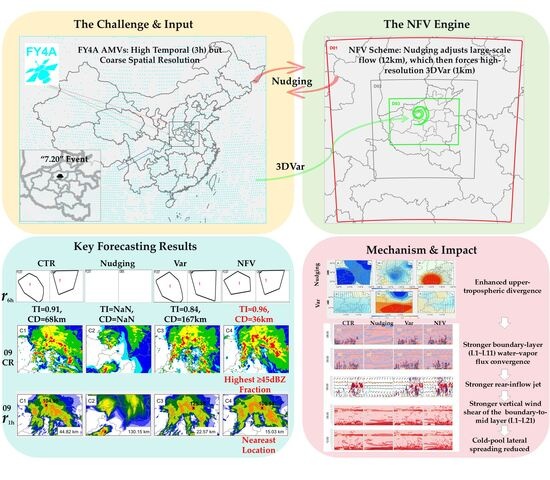
Assimilating FY4A AMV Winds with the Nudging–Forced–3DVar Method for Promoting the Numerical Nowcasting of “7.20” Rainstorm over Zhengzhou


Abstract
Share and Cite
Guo, Y.; Su, A.; Shao, C.; Niu, G.; Xu, D.; Gao, Y. Assimilating FY4A AMV Winds with the Nudging–Forced–3DVar Method for Promoting the Numerical Nowcasting of “7.20” Rainstorm over Zhengzhou. Remote Sens. 2026, 18, 379. https://doi.org/10.3390/rs18030379
Guo Y, Su A, Shao C, Niu G, Xu D, Gao Y. Assimilating FY4A AMV Winds with the Nudging–Forced–3DVar Method for Promoting the Numerical Nowcasting of “7.20” Rainstorm over Zhengzhou. Remote Sensing. 2026; 18(3):379. https://doi.org/10.3390/rs18030379
Chicago/Turabian StyleGuo, Yakai, Aifang Su, Changliang Shao, Guanjun Niu, Dongmei Xu, and Yanna Gao. 2026. "Assimilating FY4A AMV Winds with the Nudging–Forced–3DVar Method for Promoting the Numerical Nowcasting of “7.20” Rainstorm over Zhengzhou" Remote Sensing 18, no. 3: 379. https://doi.org/10.3390/rs18030379
APA StyleGuo, Y., Su, A., Shao, C., Niu, G., Xu, D., & Gao, Y. (2026). Assimilating FY4A AMV Winds with the Nudging–Forced–3DVar Method for Promoting the Numerical Nowcasting of “7.20” Rainstorm over Zhengzhou. Remote Sensing, 18(3), 379. https://doi.org/10.3390/rs18030379