Article

Trajectory Association for Moving Targets of GNSS-S Radar Based on Statistical and Polarimetric Characteristics Under Low SNR Conditions

1
State Key Laboratory of Space Information System and Integrated Application, Beijing 100095, China
2
Beijing Institute of Satellite Information Engineering, Beijing 100095, China
3
National Ocean Technology Center, Tianjin 300112, China
*
Author to whom correspondence should be addressed.
Remote Sens. 2026, 18(2), 367; https://doi.org/10.3390/rs18020367
Submission received: 11 November 2025 / Revised: 4 January 2026 / Accepted: 13 January 2026 / Published: 21 January 2026

Highlights

What are the main findings?
  • This study achieves multi-moving target track association by integrating amplitude statistical characteristics with polarization scattering characteristics of GNSS-S Radar’s echoes.
  • Shore-based experiments conducted near the coast validated the study’s ability to effectively distinguish between ship targets of different structures, as well as the efficacy of low-resolution radar in extracting moving target trajectories within complex ocean environments.
What are the implications of the main findings?
  • This paper addresses the challenges of low signal power and susceptibility to sea clutter interference in GNSS-S radar signals. By leveraging differences in the multidimensional feature distributions of targets, it effectively resolves the difficulty in distinguishing multiple targets from clutter under low SNR conditions.
  • This research significantly reduces processing complexity and application barriers while maintaining performance. The workflow requires no complex imaging processing; multi-target trajectory association is achieved solely through signal-level processing, resulting in lower computational costs and greater ease of engineering deployment.

Abstract

The Global Navigation Satellite System-Scattering (GNSS-S) radar has a wide coverage and strong concealment, enabling large-scale and long-term monitoring of sea surface targets. However, its signal power is extremely low and susceptible to sea clutter interference. To address the challenge of detecting and tracking moving targets in complex maritime environments using low-resolution radar, this paper proposes a method for extracting moving target trajectories from GNSS-S radar under low signal-to-noise ratio (SNR) conditions. The method constructs a feature plane consisting of statistical and polarization characteristics, based on the unique distribution of different motion targets in this plane, the distinction between sea clutter and multi-motion targets is carried out using machine learning algorithms, and finally the trajectory association of the targets is achieved by the Kalman filter, and the tracking correctness can reach more than 93.89%. Compared with the tracking method based on high-resolution imaging targets, this technique does not require complex imaging operations, and only requires certain processing on the radar echo, which has the advantages of easy operation and high reliability.

1. Introduction

With the deepening application of GNSS-S radar in maritime target surveillance, the continuous detection of surface moving targets under low SNR conditions has become critical technical bottlenecks requiring urgent breakthroughs. Leveraging the backscatter characteristics of navigation satellite signals, GNSS-S radar offers unique advantages such as wide-area coverage and high stealth capability. However, its extremely low signal power and severe susceptibility to sea clutter result in discontinuous target tracks, leading to cumulative errors in trajectory association [1,2]. Furthermore, the random scintillation effects and phase disturbances in the target’s radar cross-section (RCS) further exacerbate the technical complexity of trajectory tracking [3].
Compared to conventional synthetic aperture radar (SAR), polarimetric SAR has garnered significant attention in radar target feature extraction due to its capacity to provide richer target scattering information. Early polarimetric classification approaches primarily relied on single-type polarimetric features extracted from canonical scattering decompositions. For instance, Freeman decomposition [4] and Cloude decomposition [5] decompose the polarimetric covariance matrix into surface, double-bounce, and volume scattering components; Biondi and Clemente [6] employed eigenvalue distribution analysis of covariance matrices to identify dominant scattering mechanisms for distinguishing man-made structures from natural features. While these methods provide physically interpretable features, their discriminative power is limited by the relatively low dimensionality of feature representations.
To enhance classification performance, researchers have progressively incorporated multi-scale feature fusion strategies that exploit complementary information across spatial scales and polarimetric channels. Xue et al. [7] proposed an unsupervised classification method for full-polarimetric SAR images integrating polarimetric and spatial texture features, employing K-means clustering for terrain classification; Yang et al. [8] demonstrated that integrating spatial neighborhood information with polarimetric scatterer characteristics effectively improves classification accuracy while preserving terrain contours; Chen et al. [9] combined Freeman and Cloude decompositions with iterative class boundary optimization, achieving 5–15% improvement over single-decomposition methods; Xie et al. [10] fused dual-polarization information with multi-scale features for vessel classification; Zhao et al. [11] introduced wavelet transform-based multi-scale fusion integrated with Freeman-Yamaguchi decomposition [12], demonstrating synergistic improvements; Sun et al. [13] employed sparse representation to capture refined object characteristics across multiple scales. These multi-scale fusion approaches have substantially improved classification performance by exploiting richer feature representations.
Existing techniques predominantly focus on feature extraction from targets processed by single-station SAR imaging, where the target SNR is favorable [14,15,16,17]. The image-based processing paradigm is rather complex and exhibits poor real-time performance. These limitations motivate the exploration of signal-level feature extraction approaches that bypass the imaging stage entirely, enabling more efficient and flexible target discrimination directly from raw or minimally processed radar returns.
For externally sourced radars utilizing GNSS signals, target detection proves more challenging due to constraints imposed by sea clutter interference, system power limitations and geometric configurations. The traditional Delay-Doppler Map (DDM) method serves as the core technique for feature inversion and target monitoring in Global Navigation Satellite System-Reflection (GNSS-R) technology. However, the low resolution of the DDM method results in poor positioning accuracy [18]. Various enhancements have been proposed to improve DDM-based performance. Chen et al. [19] proposed an target detection algorithm based on DDM symmetry, coupled with a positioning method incorporating geometric-semantic constraints. This approach improved the average absolute accuracy by 2.73 km and the relative accuracy by 32.32% during offshore platform positioning. Southwell et al. [20] designed a 3D matched filter in the Delay-Doppler-Time (DDT) domain to enhance signal-to-clutter ratio (SCR); Zhao et al. [21] proposed an integrated system combining SAR with GNSS-R for vessel detection. However, DDM-based approaches suffer from coarse delay-Doppler resolution, making it difficult to resolve closely spaced targets. Moreover, DDM provides only kinematic information without target-specific scattering characteristics, limiting its capability for target classification and robust data association in multi-target scenarios.
To overcome these limitations, this paper proposes a GNSS-S radar moving target tracking framework that integrates statistical and polarization characteristics. This method achieves the distinction between targets and clutter, as well as among targets themselves, by analyzing the amplitude statistical characteristics (kurtosis and skewness) and polarimetric scattering characteristics (helix scattering power ratio) of targets in dual-frequency and dual-polarization channels, thereby accomplishing trajectory association for each target. This signal-level, multi-feature approach can directly extract rich target characteristics from simply pre-processed signals, providing a practical solution for continuous multi-target trajectory association in complex sea conditions.
The structure of this paper is as follows: Section 2 introduces the components and operating principles of the GNSS-S radar system; Section 3 details the methods for extracting moving target characteristics and the radar signal processing workflow; Section 4 presents the results of the maritime experiments and related discussions; Section 5 provides the conclusions.

2. Overview of GNSS-S Radar System

This study employs a self-developed GNSS-S radar system to detect information on moving targets on the sea surface. Utilizing navigation satellites as an external radiation source, the system achieves target detection based on the scattering characteristics of GNSS-S signals by the targets.

2.1. System Composition

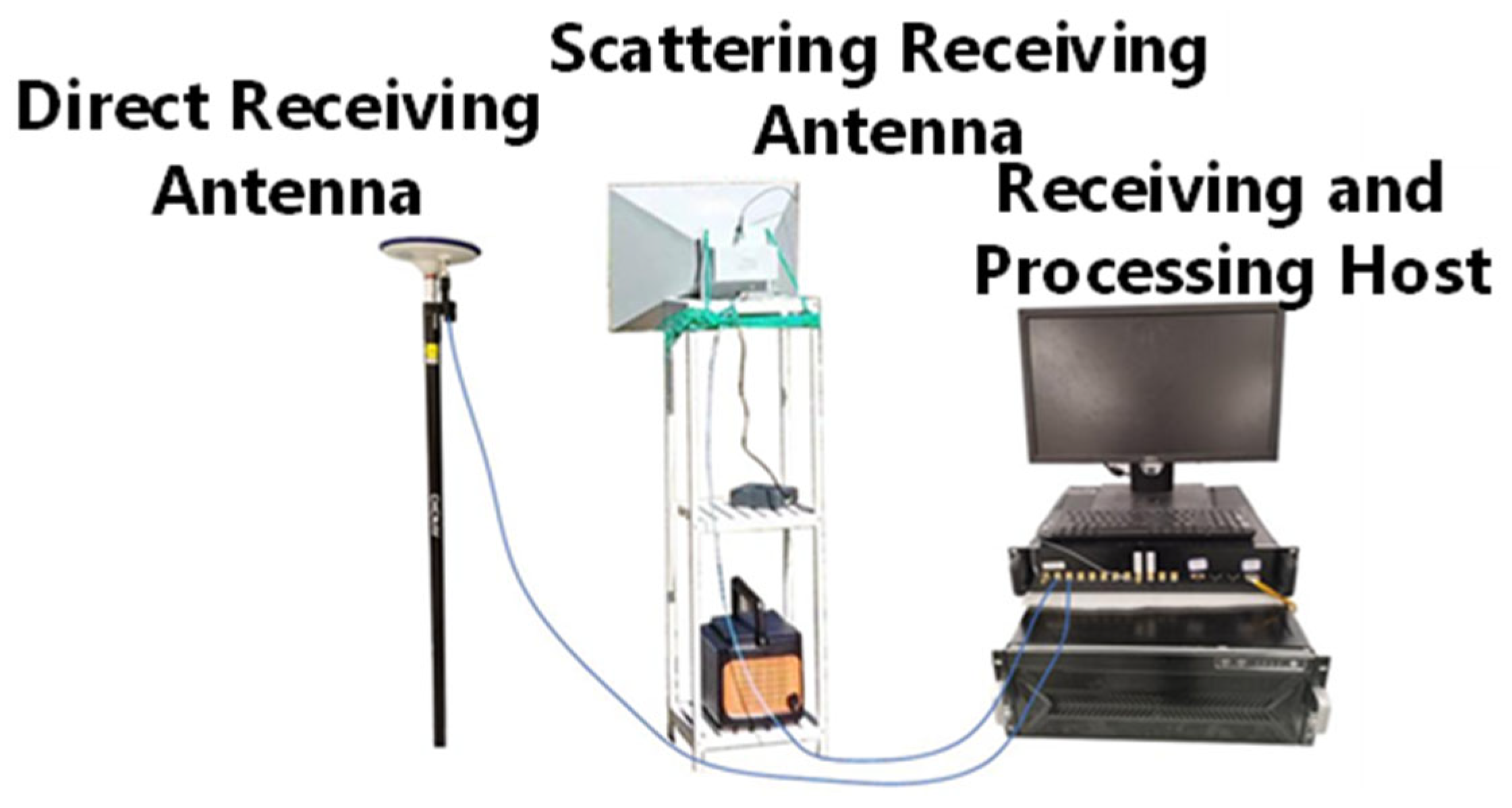
As illustrated in Figure 1, the radar system comprises four functional modules: antenna, radio frequency (RF), sampling, and information processing. The antenna module incorporates dual-frequency antennas capable of simultaneously receiving signals from the BeiDou Navigation Satellite (BDS) System’s B1 and B3 bands. The direct signal receiving antenna is a Right-Hand Circular Polarization (RHCP) omnidirectional antenna that acquires direct GNSS signals, providing precise carrier phase, code phase, and positioning information for signal synchronization. The backscatter signal receiving antenna is a high-gain Left-Hand Circular Polarization (LHCP) antenna that synchronously acquires vertically and horizontally polarized signals scattered by maritime targets, enabling dual-frequency, dual-polarization data acquisition. The RF module performs amplification, filtering, and down-conversion, followed by analog-to-digital conversion in the sampling module. The digitized signals are then transmitted to the information processing module for target feature extraction and trajectory association. Key system parameters are detailed in Table 1.

2.2. Geometry Configuration

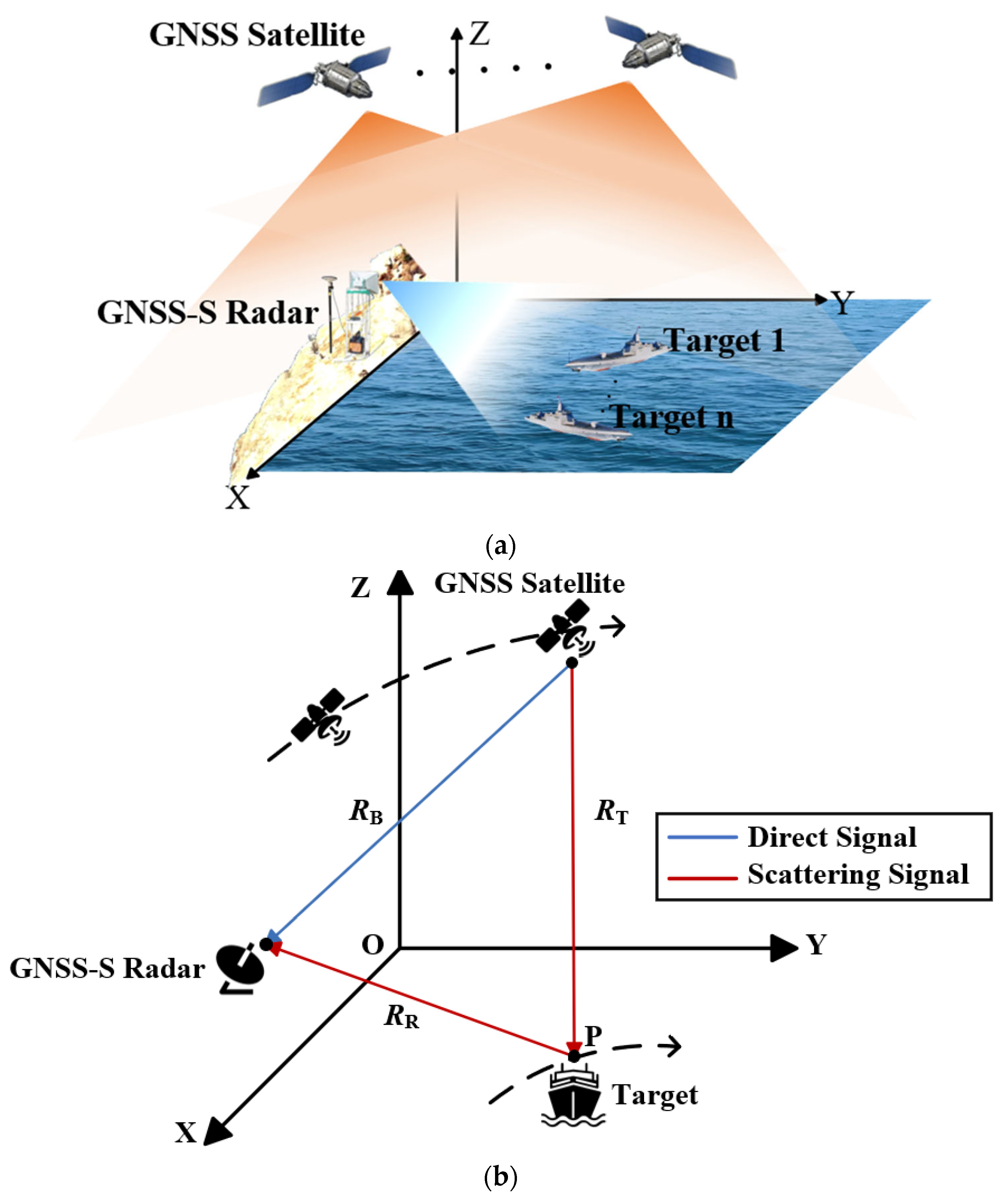
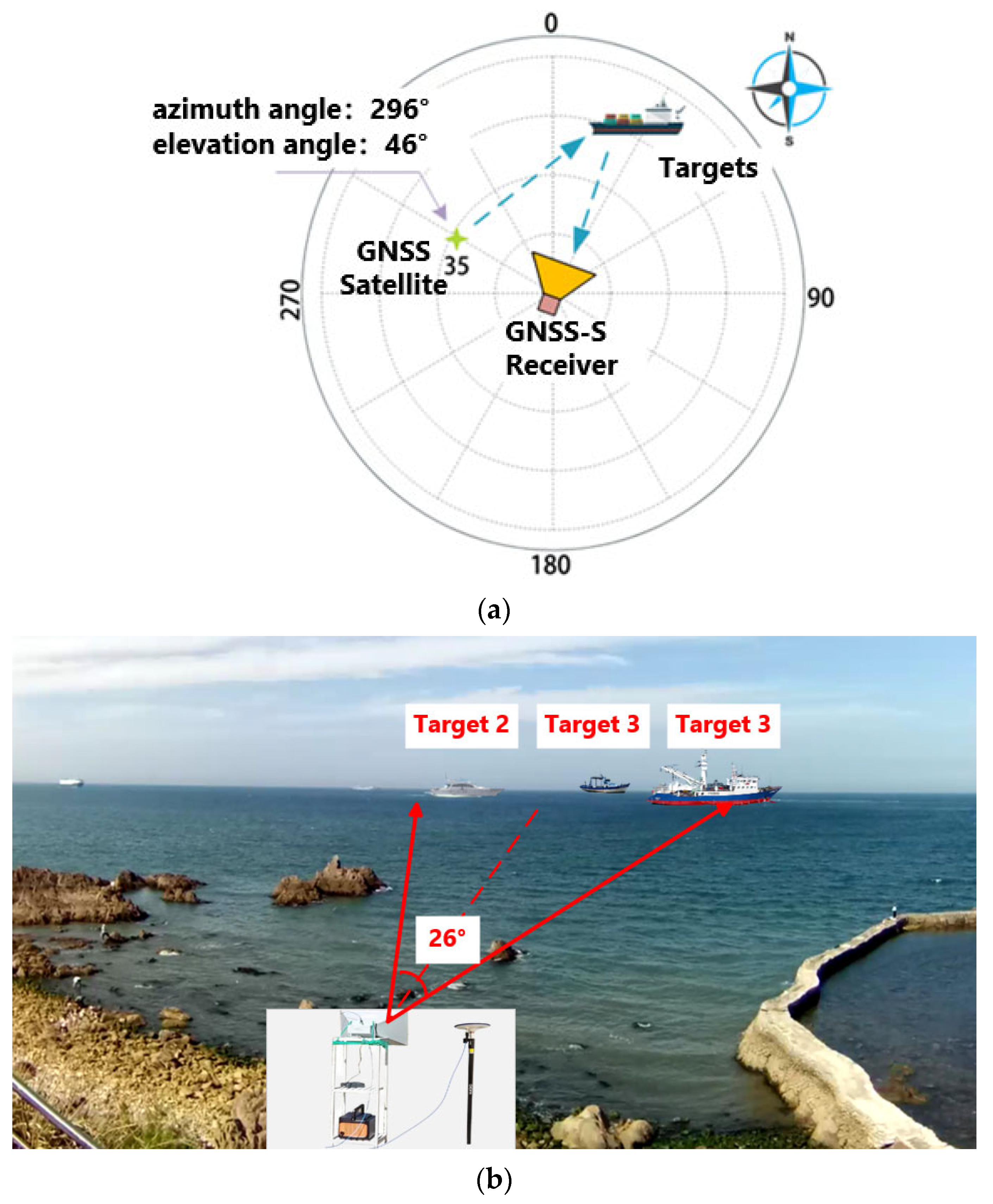
The operating principle of the GNSS-S radar system is illustrated in Figure 2a. The direct and backscatter signal receiving antennas, respectively, capture signals from navigation satellites and backscattered signals from ship targets. Figure 2b depicts the geometric configuration of the GNSS-S shore-based mode, where the dotted lines represent the movement trajectories of the navigation satellite and the target, P denotes the point of the ship target within the target area, t represents the time of the experiment, RT(t) denotes the instantaneous distance from the navigation satellite to the target area, RB(t) denotes the instantaneous distance from the navigation satellite to the receiver, RR(t) denotes the instantaneous distance from the receiver to the target area, ΔR(t) denotes the propagation path difference between the direct and echo channels, and R(t) denotes the total slant range. The relationships between the various slant ranges are expressed by the following equations:
Δ R ( t ) = R T ( t ) + R R ( t ) R B ( t ) ,
R ( t ) = R T ( t ) + R R ( t ) ,

2.3. Signal Model

GNSS signals comprise two components, I and Q, each modulated with a pseudorandom code and navigation message [22]. As the pseudorandom codes in the I and Q channels are mutually orthogonal, for the sake of simplifying analysis, only a single signal channel will be examined here:
s d ( t ) = A D ( t ) C ( t ) exp ( j 2 π f c t ) ,
where A, C, and D denote the signal amplitude, pseudorandom code, and navigation message, respectively, while fc represents the carrier frequency of the direct signal received by the GNSS-S radar. The time difference between the scattered signal and the direct signal can be calculated using the path difference ΔR(t), as shown in Equation (4), where c denotes the propagation speed of electromagnetic waves.
Δ t = Δ R ( t ) c = R T ( t ) + R R ( t ) R B ( t ) c ,
The GNSS signal scattered by the target experiences both time delay Δt and Doppler frequency shift fd due to target motion. The scattered signal can be expressed as:
s s ( t ) = A D ( t Δ t ) C ( t Δ t ) exp ( j 2 π f s ( t Δ t ) ) ,
where fs = fc + fd represents the carrier frequency of the scattered signal, with fc being the original carrier frequency and fd being the Doppler frequency shift induced by the relative motion between the satellite, target, and receiver.

3. GNSS-S Radar Moving Target Track Association

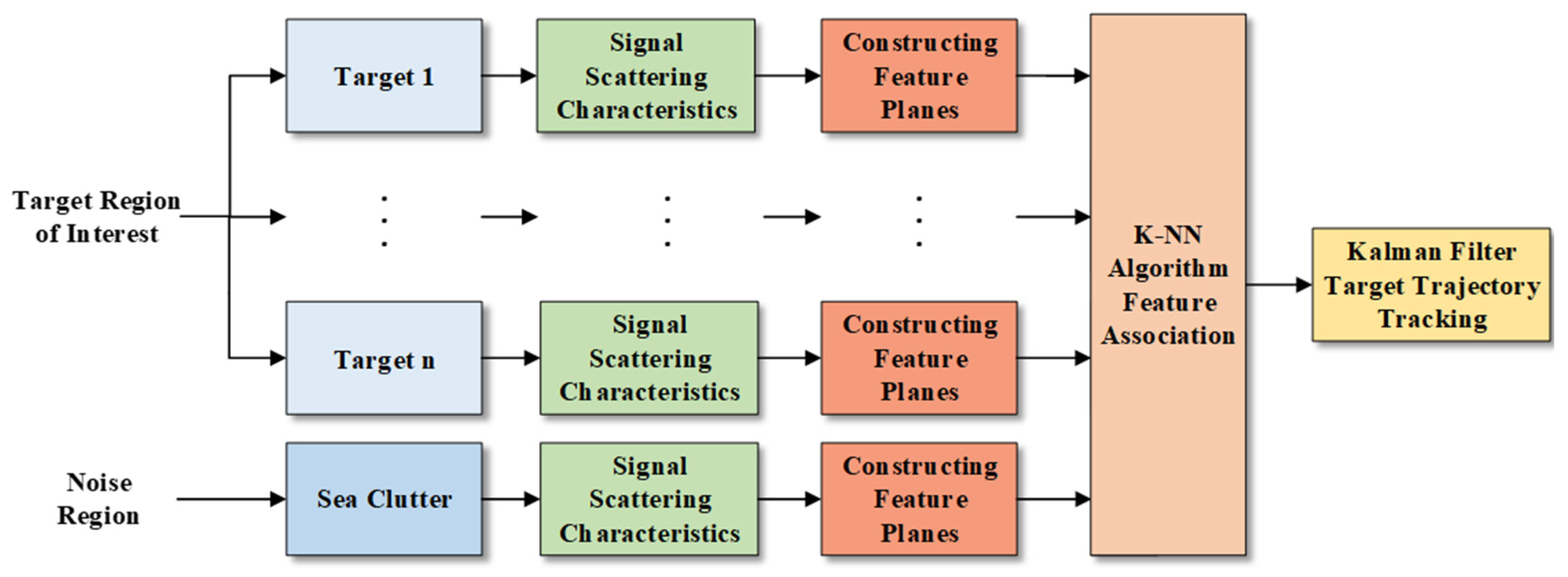
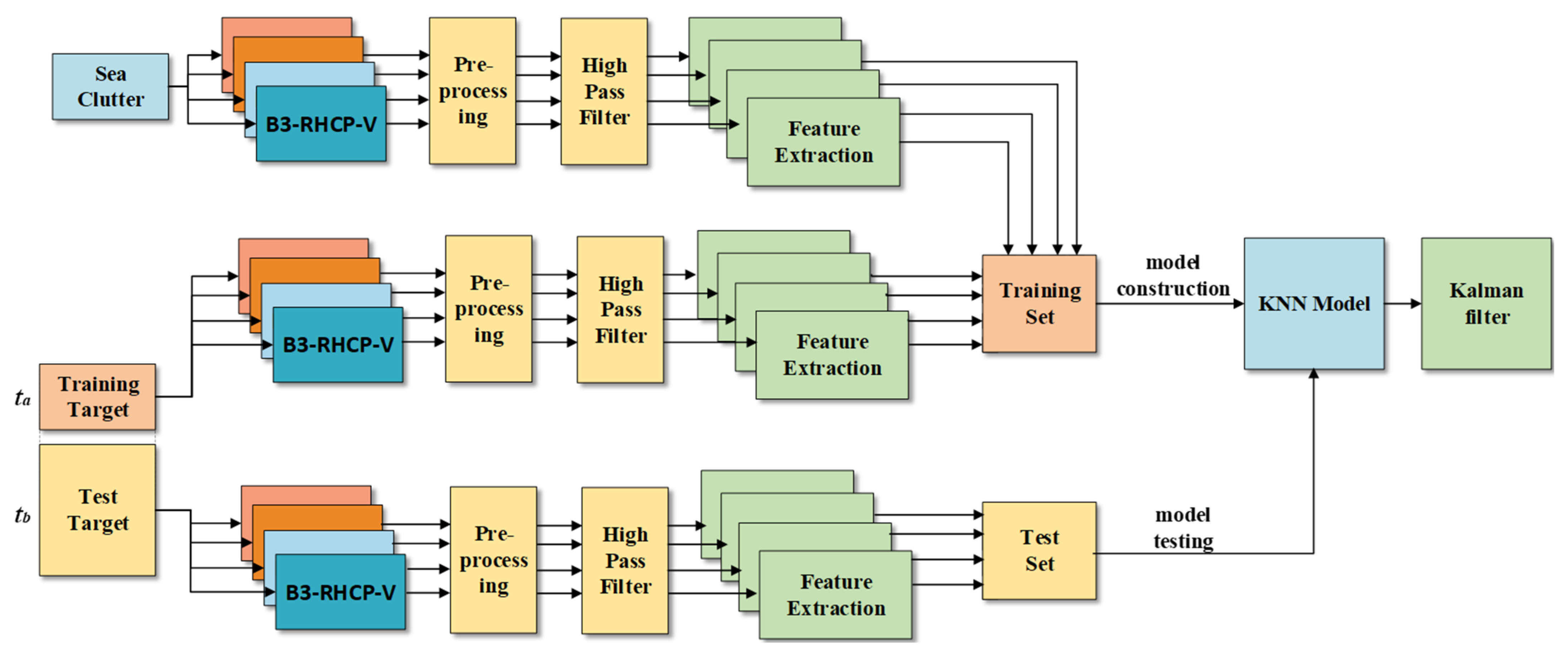
Figure 3 illustrates the flowchart for associating moving target trajectories from GNSS-S dual-frequency dual-polarization radar data. Firstly, based on the region of interest derived from pre-processing, the amplitude statistical characteristics and polarization scattering characteristic of sea clutter and individual moving targets are extracted across the four dual-frequency, dual-polarization channels. These form the basis for constructing the feature plane. Secondly, a training set is formed using selected amplitude and polarization characteristics from sea clutter and early-stage target motion. The K-Nearest Neighbors (KNN) algorithm is then employed to distinguish between sea clutter and targets, as well as between individual targets. Finally, Kalman filtering is applied to track the trajectories of each target.

3.1. Statistical Characteristics of Moving Targets

In order to compare the statistical characteristics of different types of targets, the echo signals are energy normalized before the central moments are calculated:
x ^ = x E x 2 ,
where x is the amplitude of the echo signal, x  is the absolute value of x, x ^ is the normalized echo signal, and E x 2 is the expected value of x 2 .
The formulae for the n-th order central moments are given below:
M n = E x ^ μ n σ n ,
where µ and σ are the mean and standard deviation of the echo signal amplitude, respectively.
When n = 3, M3 is the third-order center distance of the probability density distribution function of the echo signal amplitude, also known as skewness, which is used to measure the degree of skewness of the probability density distribution. The formula for the third-order center distance is:
M 3 = E x ^ μ 3 σ 3 ,
Similarly, when n = 4, M4 is the fourth-order center distance of the probability density distribution function of the echo signal amplitude, also known as kurtosis, which is used as a measure of how steep the probability density distribution pattern is. The formula for the fourth-order center distance is:
M 4 = E x ^ μ 4 σ 4 ,
For moving targets, as their position and orientation change, the echo amplitude also varies over time. Different observation angles produce different echo intensities, exhibiting distinct statistical patterns [23]. Skewness reflects the asymmetry of these amplitude fluctuations. Moving vessels often generate asymmetric distributions because their RCS variations are directional rather than random. Different skewness values indicate distinct motion and structural characteristics. Kurtosis measures the tail characteristics of the distribution. Ships with complex structures occasionally produce very strong echoes when certain surfaces align favorably with the radar geometry, resulting in higher kurtosis. In contrast, ships with simpler structures tend to generate more uniform amplitudes and exhibit lower kurtosis.
In comparison, sea clutter generated by random wave motion typically exhibits relatively symmetric amplitude distributions and moderate kurtosis values. These unique statistical characteristics of moving targets provide a basis for distinguishing targets from clutter. Since different frequency bands and polarization modes interact with target structures in distinct ways, calculating the skewness and kurtosis for each frequency-polarization channel allows us to derive multi-dimensional statistical characteristics of the target. This multi-channel approach similarly enhances classification capability.
However, relying solely on skewness and kurtosis may be insufficient for finer classification, as they primarily reflect temporal dynamics induced by motion rather than structural features. The amplitude characteristics of two targets with similar motion patterns may partially overlap. This motivates the incorporation of polarimetric features to provide more detailed structural information.

3.2. Polarization Characteristic of Moving Targets

The circularly polarized waves transmitted by navigation satellites undergo polarization transformation upon interacting with targets, generating circularly polarization components and linear polarization components in varying proportions and orientations. Stokes decomposition can effectively analyze this polarization transformation process [24]. Therefore, in this paper, Stokes decomposition is utilized to extract the polarization characteristics of the received signals. The four resulting Stokes parameters are as follows:
S 0 = E R H 2 + E R V 2 ( T o t a l   P o w e r ) S 1 = E R H 2 E R V 2 ( H / V   l i n e   p o l a r i s a t i o n   d i f f e r e n c e ) S 2 = 2 Re E R H E R V * ( 45 °   l i n e   p o l a r i s a t i o n   c o m p o n e n t ) S 3 = 2 Im E R H E R V * ( c i r c u l a r l y   p o l a r i s e d   c o m p o n e n t ) ,
In order to adapt to the asymmetric scattering of the characterized target, ref. [25] extracted the helical scattering power of the ship target based on the Yamaguchi model. When a target possesses a helical or rotating structure, its scattering simultaneously generates both linear and circular polarization components. The energy corresponds directly to the cross-polarization component of the off-diagonal terms of the polarization covariance matrix. The covariance matrix is shown below:
C = 1 2 S 0 + S 1 S 2 j S 3 S 2 + j S 3 S 0 S 1 ,
Therefore, the spiral scattering power of the ship target can be expressed as:
h e l i x = 1 4 S 2 j S 3 · S 2 + j S 3 = 1 4 S 2 j S 3 2 ,
In order to eliminate the differences in target intensities, the spiral scattering power ratio Phelix is calculated as follows, using the total power as the denominator:
P h e l i x = 1 4 S 2 j S 3 2 S 0 ,
Phelix is able to quantify the degree of perturbation of incident circularly polarized waves by the asymmetric structure of the target. Influenced by the structure of the target, ships with more complex shapes may have multiple sets of masts, angles and other structures, which will generate more intense spiral scattered energy, while small cargo ships, fishing boats and other ships with flat decks and symmetrical structures will have less spiral scattered energy. Therefore, this characteristic quantity can be used to distinguish different kinds of ships.
The combination of Phelix with the amplitude statistical characteristics provides complementary discrimination capability. Kurtosis and skewness capture the temporal dynamics of amplitude fluctuations caused by target motion and aspect angle changes, while Phelix reflects the intrinsic structural characteristics of the target. This multi-dimensional feature space enables more robust target discrimination by exploiting both temporal and spatial-polarimetric information. Under low SNR conditions, the inclusion of polarimetric features offers additional advantages: The polarization characteristics reflect the intrinsic ability of a target to alter the polarization state of electromagnetic waves. Ship targets with complex metallic structures can maintain distinct polarization features even when the signal strength is weak. Compared to purely amplitude-based characteristics, this structural property is less susceptible to environmental noise.

3.3. Signal Preprocessing

Unlike the linear frequency-modulated signals employed by conventional synthetic aperture radars, GNSS signals constitute a code division multiple access continuous wave signal, utilizing Pseudo-Random Noise (PRN) codes modulated and encoded with navigation messages. This paper employs the Block Expanded Compression (BEC) algorithm to transform the one-dimensional time-series signal—namely the GNSS signal—into a two-dimensional range-azimuth signal. This process simultaneously eliminates the effects of Doppler shift and navigation messages to enhance coherent accumulation gain [3].
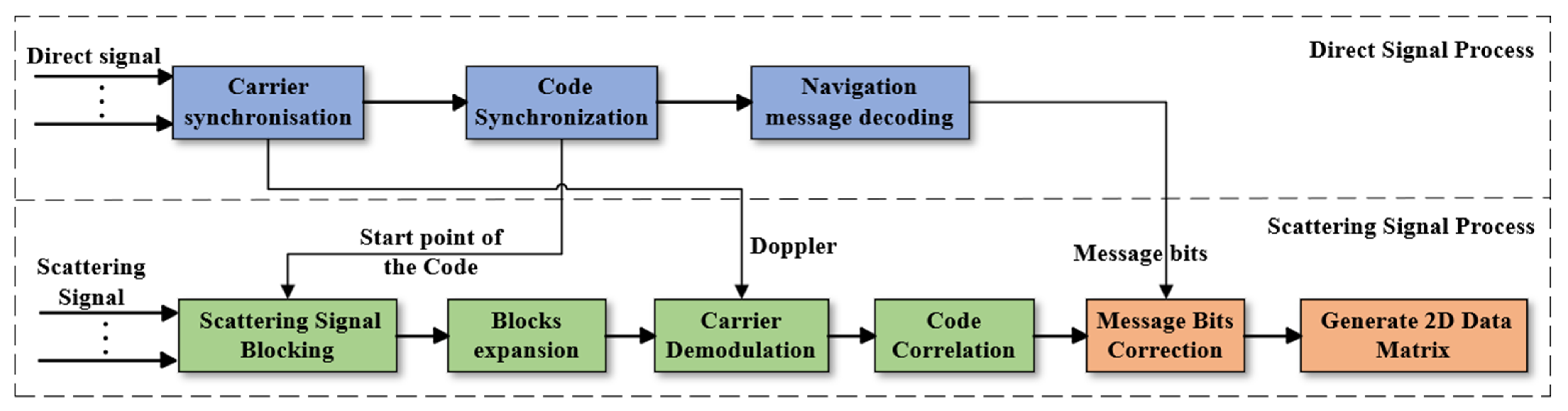
The acquired B1-H, B1-V, B3-H, and B3-V dual-frequency dual-polarization signals undergo separate BEC processing, with the workflow illustrated in Figure 4. The BEC algorithm achieves the conversion from one-dimensional to two-dimensional signals and interference cancelation through three steps: signal block division, expansion operations, and data compression. First, using the start time of the direct signal’s PRN code cycle as the reference, the one-dimensional time-series signal is divided into equal-length data blocks, with scattered signals grouped by matching cycles. Second, due to the longer propagation paths of scattered signals, code phase deviations occur relative to direct signals, and Doppler shifts from target motion disrupt the periodicity of PRN codes. Therefore, the BEC algorithm concatenates adjacent sub-blocks to enhance PRN code correlation gain. Finally, the carrier is demodulated via mixing, followed by PRN code correlation processing to compress the signal. Subsequently, phase jumps are corrected based on decoded navigation message information, generating a two-dimensional data matrix.

3.4. Method for Associating Features with Trajectories

The KNN algorithm is a straightforward yet effective supervised learning method. Its core principle involves: for an unknown sample, first calculating its distance from all samples in the training set to identify the k nearest neighbors; subsequently, determining the predicted outcome for the unknown sample by majority vote based on the labels of these k neighbors [26]. This study employs Euclidean distance for the metric calculation.
As shown in Figure 5, B3-RHCP-V and the three differently colored boxes below it respectively represent the echo data of four channels. For each target, during the initial experimental phase at time ta, the corresponding target region within its four-channel dual-frequency dual-polarization frequency-polarization components is first selected. The amplitude statistical characteristics and polarization decomposition characteristics are then calculated separately for each component. These feature vectors constitute the fundamental units of the training set. For sea clutter, the scattering characteristics of the four-channel dual-frequency dual-polarization frequency-polarization components are similarly calculated and input as the fundamental units of the training set. All target features extracted at time ta are employed as training samples, with a classification model constructed using the KNN algorithm. Subsequent targets at time tb undergo identical feature extraction to form the test sample set. Inputting these test samples into the trained classification model yields the target classification results.
The Kalman filter is capable of recursively estimating and predicting the state vector of a moving target at the next instant, thereby determining its trajectory [27]. Based on the target feature correlation results achieved through the KNN algorithm, Kalman filtering is employed to track the paths of each target. The target feature association results derived from the KNN algorithm are employed to track the paths of individual targets using Kalman filtering. Should the KNN algorithm correctly associate a target position, this location is employed as the state variable correction prediction, balancing model and observation reliability. Should the KNN algorithm misassociate at any moment, the prediction value is directly adopted as the current state to prevent trajectory discontinuity. This ensures only observations classified as ‘valid targets’ contribute to updates, mitigating trajectory divergence caused by sea clutter interference.

4. Field Experiment and Results

To implement the proposed method on the experimental data, the signal processing workflow follows the framework illustrated in Figure 5. In the signal preprocessing stage, the direct and scattered signals are processed using the BEC algorithm to obtain the two-dimensional echo data. In the feature extraction stage, sliding windows are applied to cover the sea clutter region and the target regions, moving through the echo data at regular intervals to extract statistical and polarimetric characteristics from the four dual-frequency dual-polarization channels. In the classification stage, a KNN classifier trained on labeled samples from sea clutter and target regions performs target discrimination. In the trajectory association stage, Kalman filtering processes the classified detections to generate continuous trajectories for each target.

4.1. Experimental Scene Setting

To validate the effectiveness of the method described herein, the field experiment was conducted at Dongjiao Harbor, Zhifu District, Yantai City, Shandong Province, China, along the Bohai Sea coastline. The observation station was located at a coastal vantage point with unobstructed line-of-sight to both maritime traffic and the GNSS satellite constellation. And this configuration provided favorable bistatic geometry for target detection while minimizing land clutter interference from coastal structures. Among the visible BDSs at the test site, the satellite No. 35, which was used to establish the backscattering relationship, was selected as the illuminator for target detection. The direct signal receiving antenna was oriented vertically upwards to capture direct signals from GNSS satellites; The backscatter signal receiving antenna was directed towards the sea surface target area to receive GNSS-S signals scattered from targets, with a beam width of ±13°. Figure 6 illustrates the actual experimental setup. The vessel target navigated along the coastline within a sea area ranging from 1 km to 10 km from the radar system, maintaining a speed of 5 to 20 knots, with a detection duration of 60 s.

4.2. Pre-Processing Results

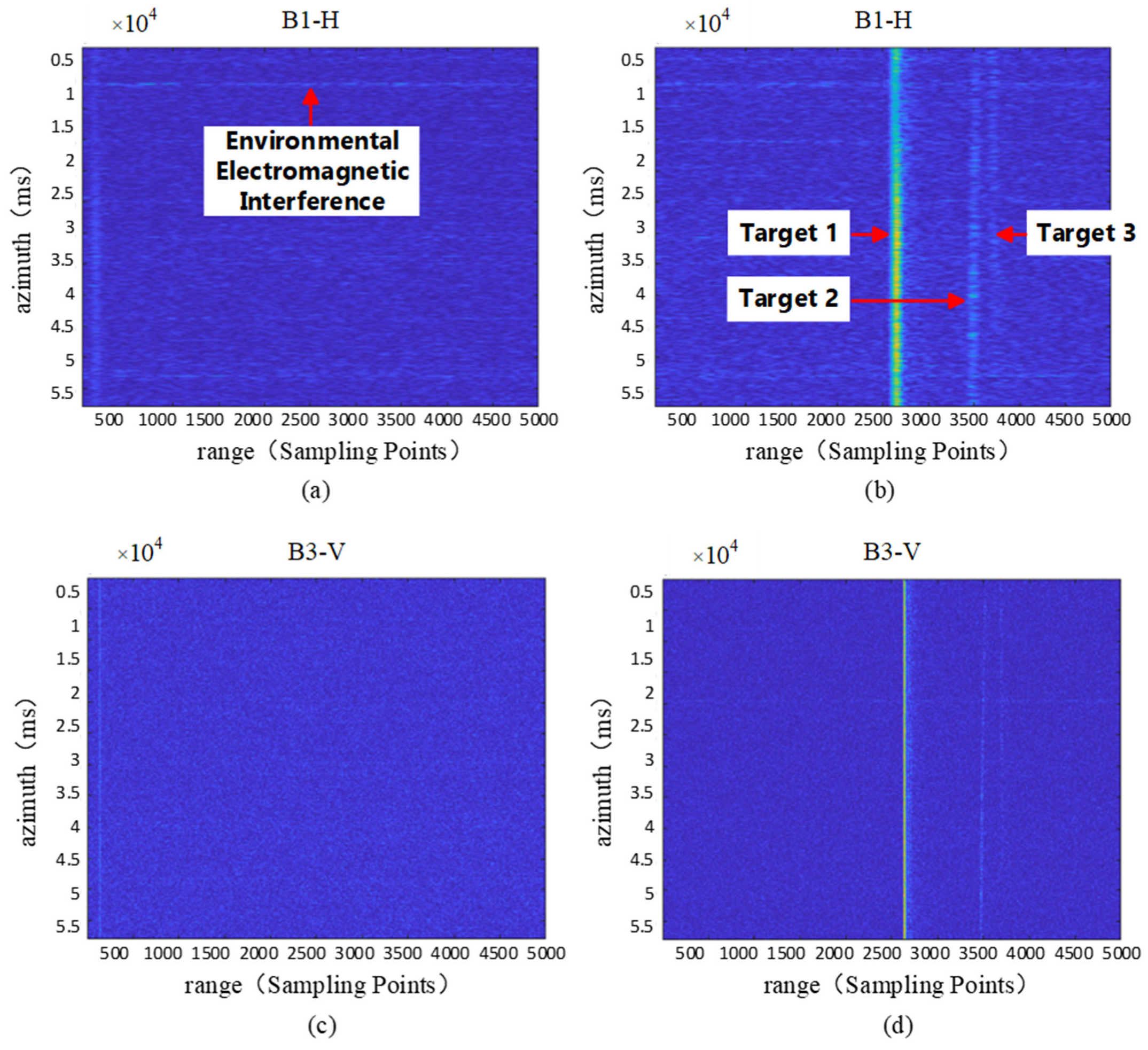
Taking B1-H and B3-V as examples, the echo signals pre-processed by the BEC algorithm are shown in Figure 7a,c, where the horizontal axis and vertical axis represent the number of sampling points in the range direction and the sampling time in the azimuth direction, respectively. The figure reveals that the echoes from moving vessel targets within the detection zone are entirely obscured by sea clutter, with only relatively strong echoes discernible near the coastline adjacent to the radar system. The horizontal lines appearing in the echo represent electromagnetic interference in the environment. Figure 7b,d present the processed echo signal following high-pass filtering in the frequency domain, The bright lines in the figures represent the target signals. After filtering out slow-moving sea clutter and stationary object echoes with low Doppler frequency characteristics, the tracks of three moving vessel targets have been detected. As the temporal resolution of the signal is inversely proportional to its frequency bandwidth, and the B3 band’s bandwidth is approximately 20.46 MHz—five times that of the B1 band—the main peaks in the image appear sharper and more pronounced.

4.3. Target Feature Extraction Results

As shown in Figure 7, following pre-processing, the target signals within the radar echoes remain extremely faint, certain regions of Targets 2 and 3 are entirely obscured by clutter. Should the target detection results be directly employed as state variables for Kalman filtering, this would carry a high risk of trajectory divergence. Consequently, adopting a feature extraction approach to distinguish between sea clutter and individual targets—processing the signals from a characteristic perspective—enables the effective differentiation and localization of target signals even under extremely weak SNR conditions. This approach thereby achieves trajectory convergence.
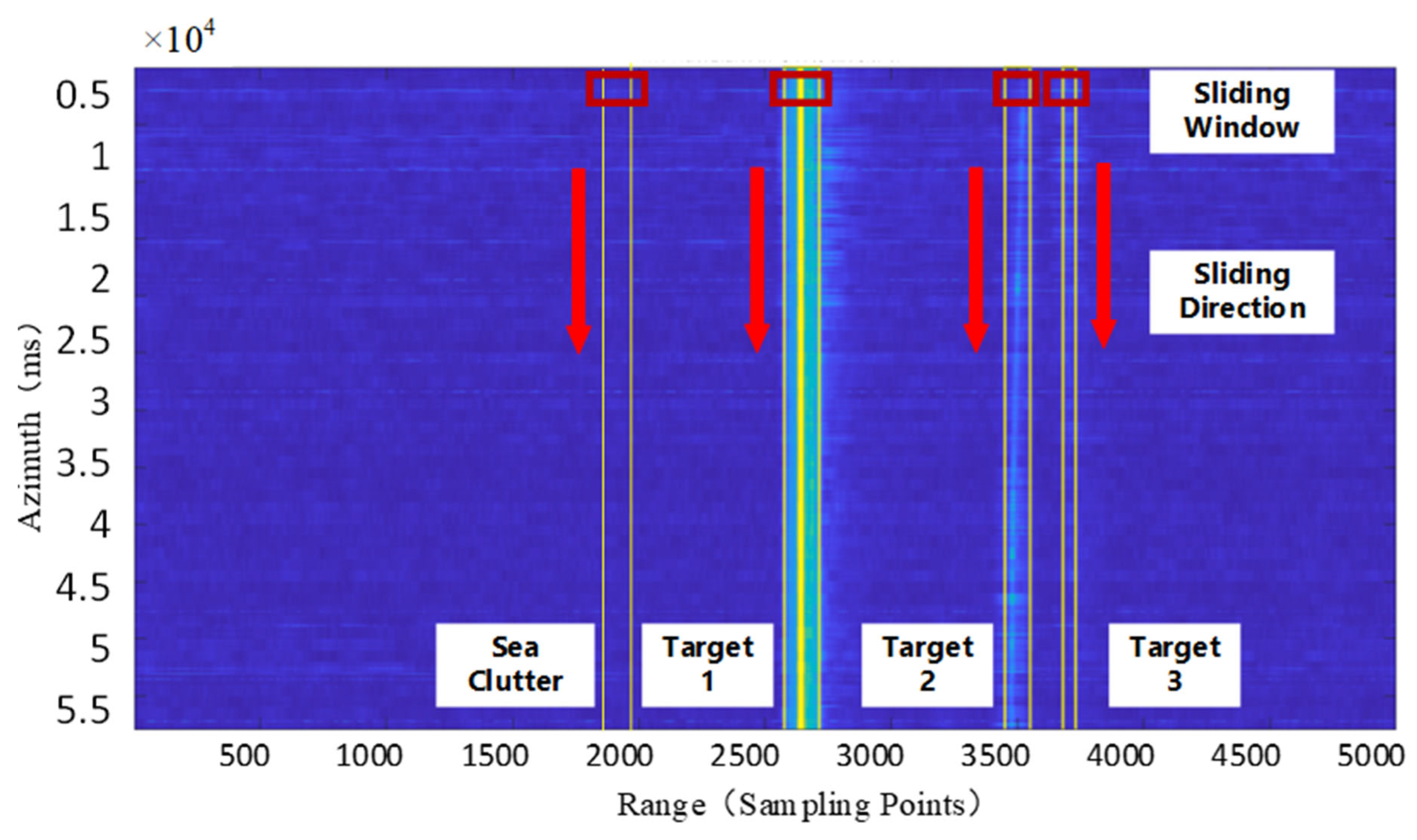
In the echo data, each azimuth row spanning 1000 lines represents one second of detection duration. Combining the target signal width with the target detection results, and following repeated testing, this experiment employs four 100 × 150 sliding windows moving downward to cover portions of the sea clutter region and the entirety of three target regions, respectively, extracting the scattering characteristics of the echo within the sliding window area every 0.1 s. Following echo data screening, 580 sets of valid target characteristics were computable for both sea clutter and the three targets across all four dual-frequency, dual-polarization components. These were utilized for associating characteristics with trajectories. The sliding window coverage is illustrated in Figure 8, where the red box represents the sliding window and the red arrow indicates the sliding direction.
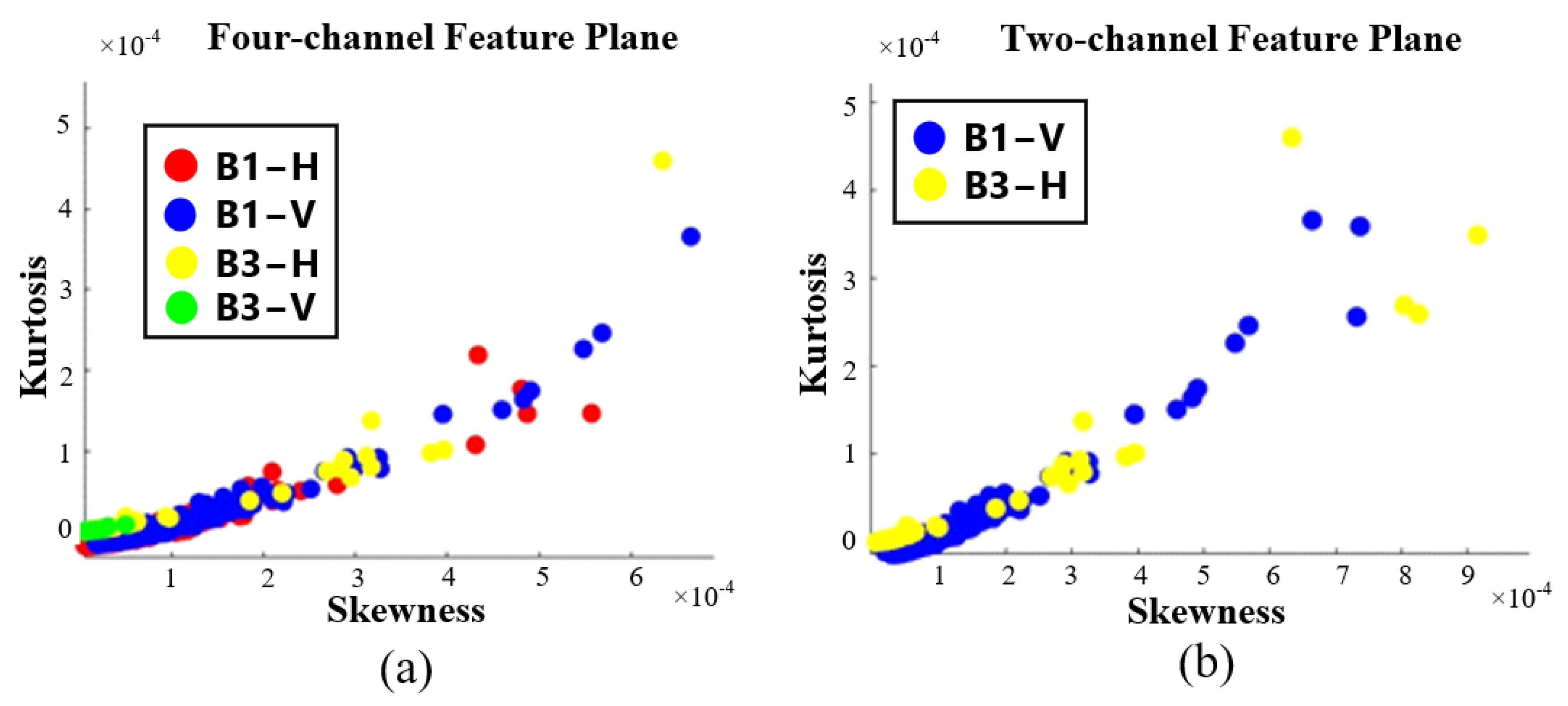
To better illustrate the distinctions in amplitude statistical characteristics between various targets, all computed results were input to plot a feature plane with skewness on the horizontal axis and kurtosis on the vertical axis. The amplitude statistical feature plane for sea clutter is depicted in Figure 9. It can be observed that the statistical characteristics of four-channel and two-channel sea clutter overlap on the feature plane, exhibiting no discernible differences.
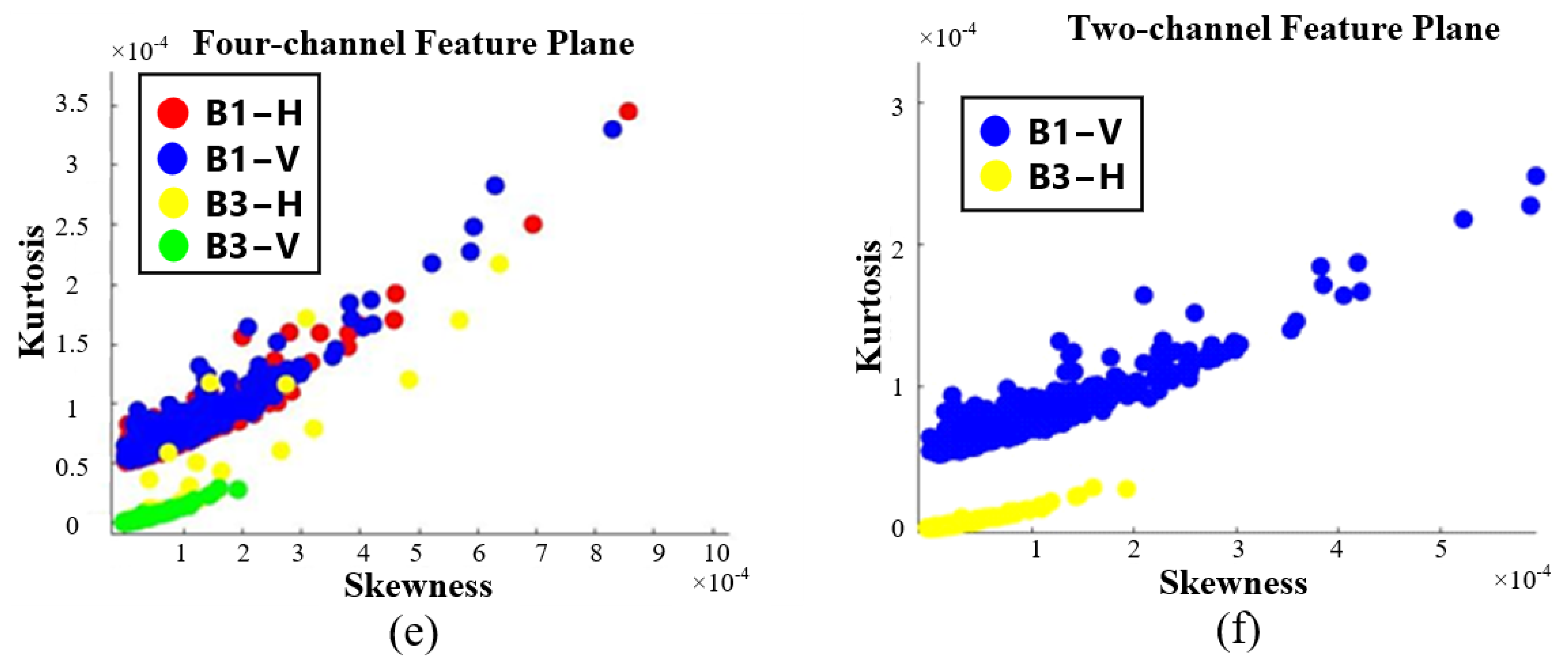
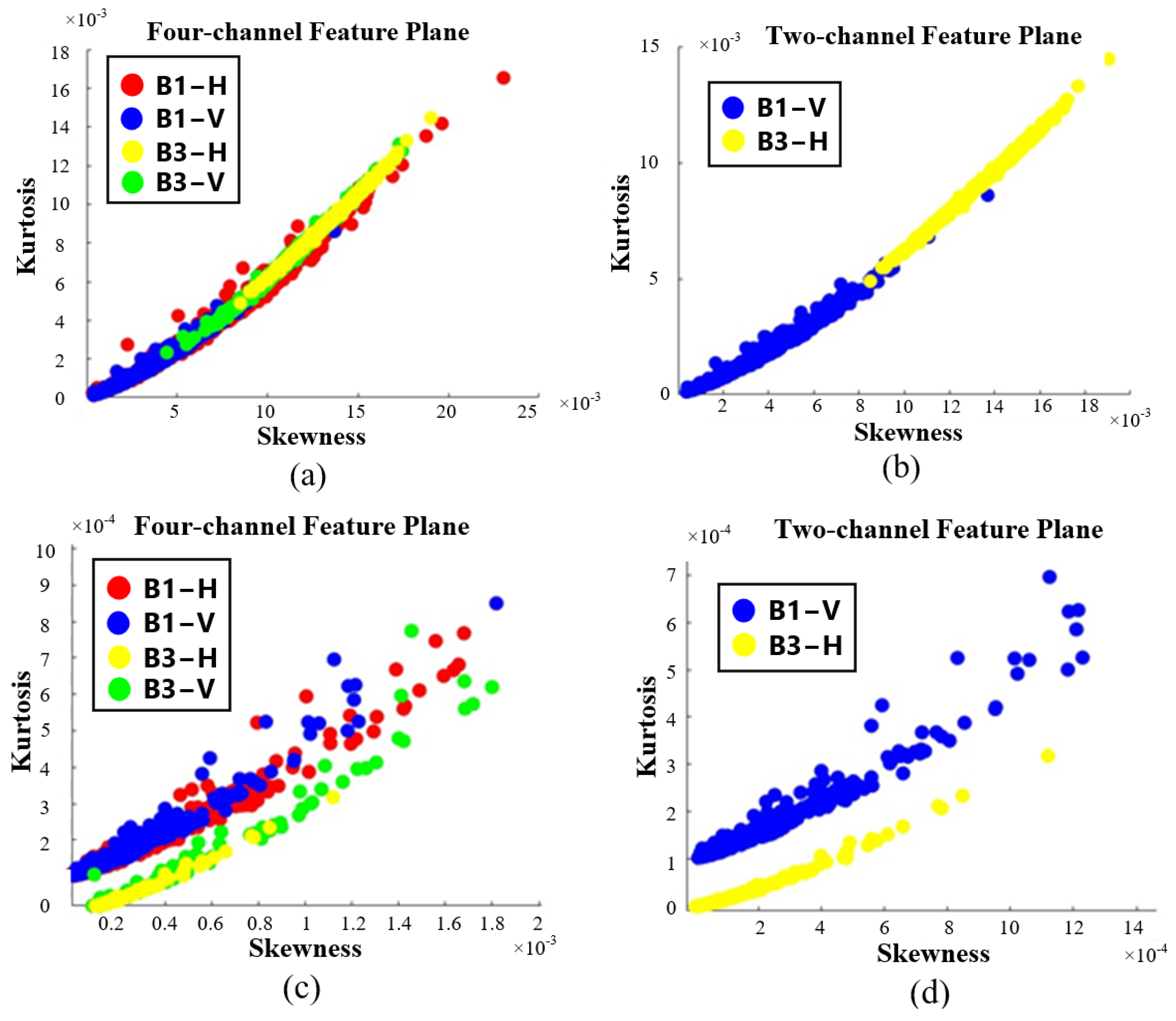
Figure 10 depicts the amplitude statistical feature plane for the three targets. The figure reveals that Target 1 exhibits greater kurtosis and skewness under B3-H than under B1-V. On the feature plane, it occupies distinct regions in the lower-left and upper-right quadrants, presenting a markedly different distribution pattern from Targets 2 and 3. Target 2 and Target 3 both exhibit higher kurtosis values in the B1-V channel than in B3-H, appearing in an upper-lower distribution on the feature plane. However, the kurtosis and skewness values for Target 2 are approximately double those of Target 3.
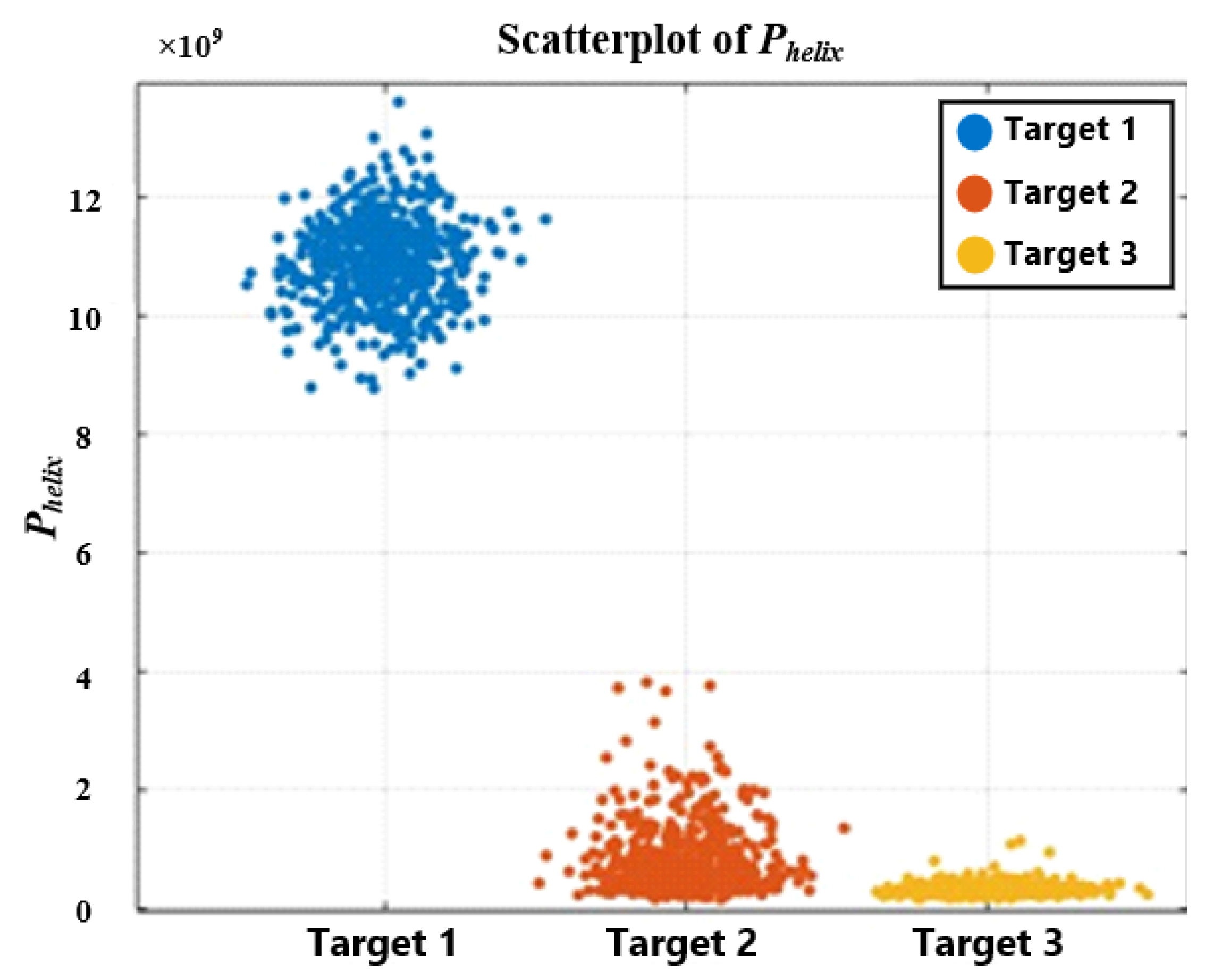
Figure 11 illustrates the polarization scattering characteristics of three targets. It can be observed that although the helical scattering energy ratios of Target 2 and Target 3 exhibit minor numerical overlap, substantial differences persist between the three targets overall. Integrating these polarization characteristics with statistical properties can effectively enhance the accuracy of target characteristic correlation.

4.4. Target Characteristics and Trajectory Correlation Results

Table 2 provides the parameter settings for the KNN classifier and Kalman filter used in this study. The Kalman filter adopts a constant velocity model. In the table, r denotes the range cell position, and v represents the velocity, measured in rows/frame (one frame corresponds to 0.1 s). The initial range r0 of the filter is the target position in the first row of the echo data, while the initial velocity v0 is set to 100 rows/frame.
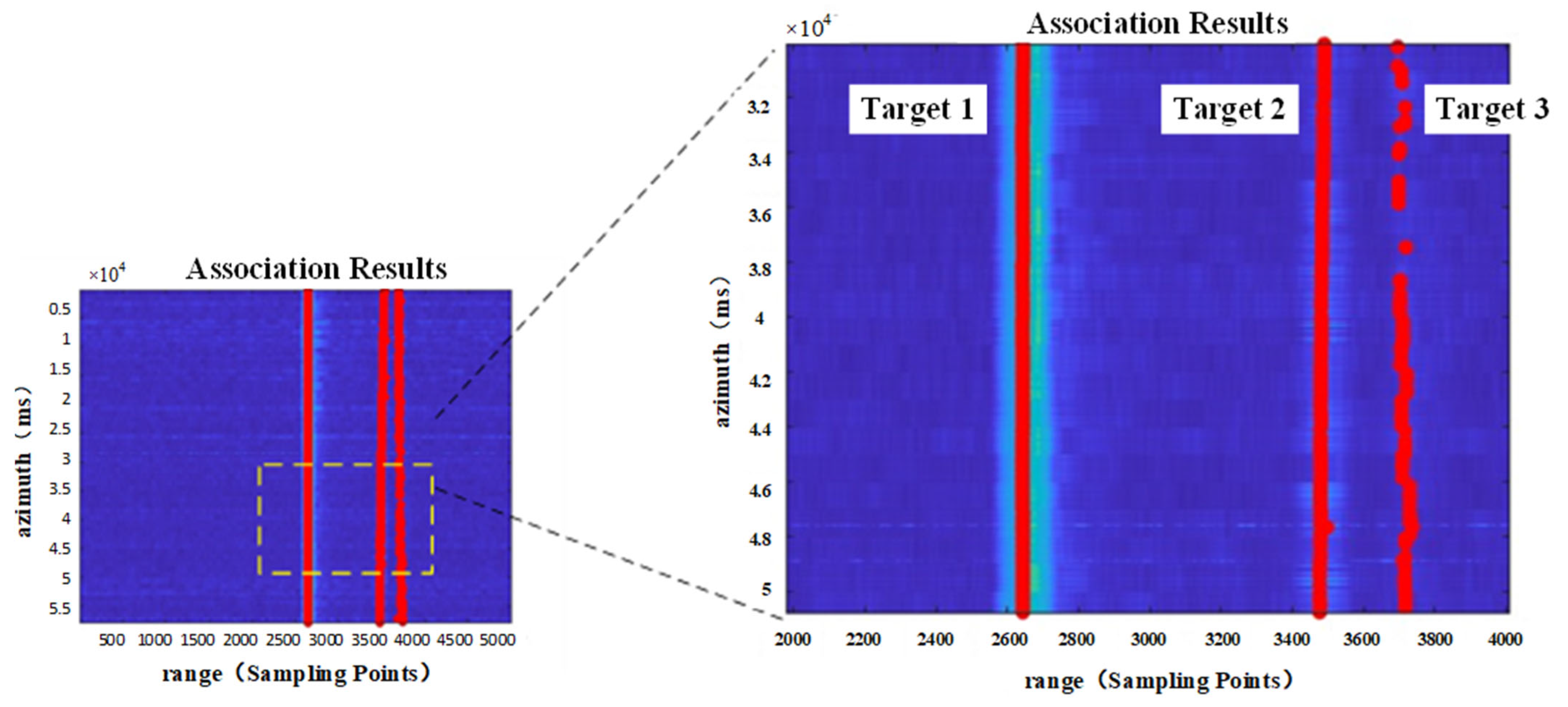
The scattering characteristics of the echo signals from the first 40% of this experiment were employed as the training set to construct a KNN classification model, with the scattering characteristics from the remaining duration serving as the validation set for computation. Figure 12 illustrates the association results of target characteristics, where red dots represent association outputs generated at 0.1 s intervals. The interrupted regions in the figure denote sections where association errors occurred. A portion of the classification errors arises because Targets 2 and 3 are located at a relatively long distance, resulting in weak echo energy. Under such conditions, the target signals are easily overwhelmed by sea clutter. Consequently, the extracted features occasionally cause the KNN classifier to misclassify the targets as sea clutter. Additionally, both Targets 2 and 3 are small boats with symmetrical structures, possessing similar physical dimensions and scattering characteristics. This leads to partial overlap in their feature spaces. When signal fluctuations occur, the decision boundary becomes blurred, resulting in occasional misclassifications where Target 2 is mistaken for Target 3, and vice versa.
To validate the effectiveness and significance of the feature extraction in this study, ablation experiments were conducted by removing two sets of features, respectively. The comparison results are presented in Table 3. From Figure 10 and Figure 11, and Table 3, it can be seen that Target 1, due to its large size and proximity to the shore, has a complete association between signals and features. The echo signals of target 2 and target 3 are weak, and both have slight overlap in features. The fusion of the three features used in this study has improved the success rate of target association, which proves the effectiveness of this method in distinguishing moving ship targets.
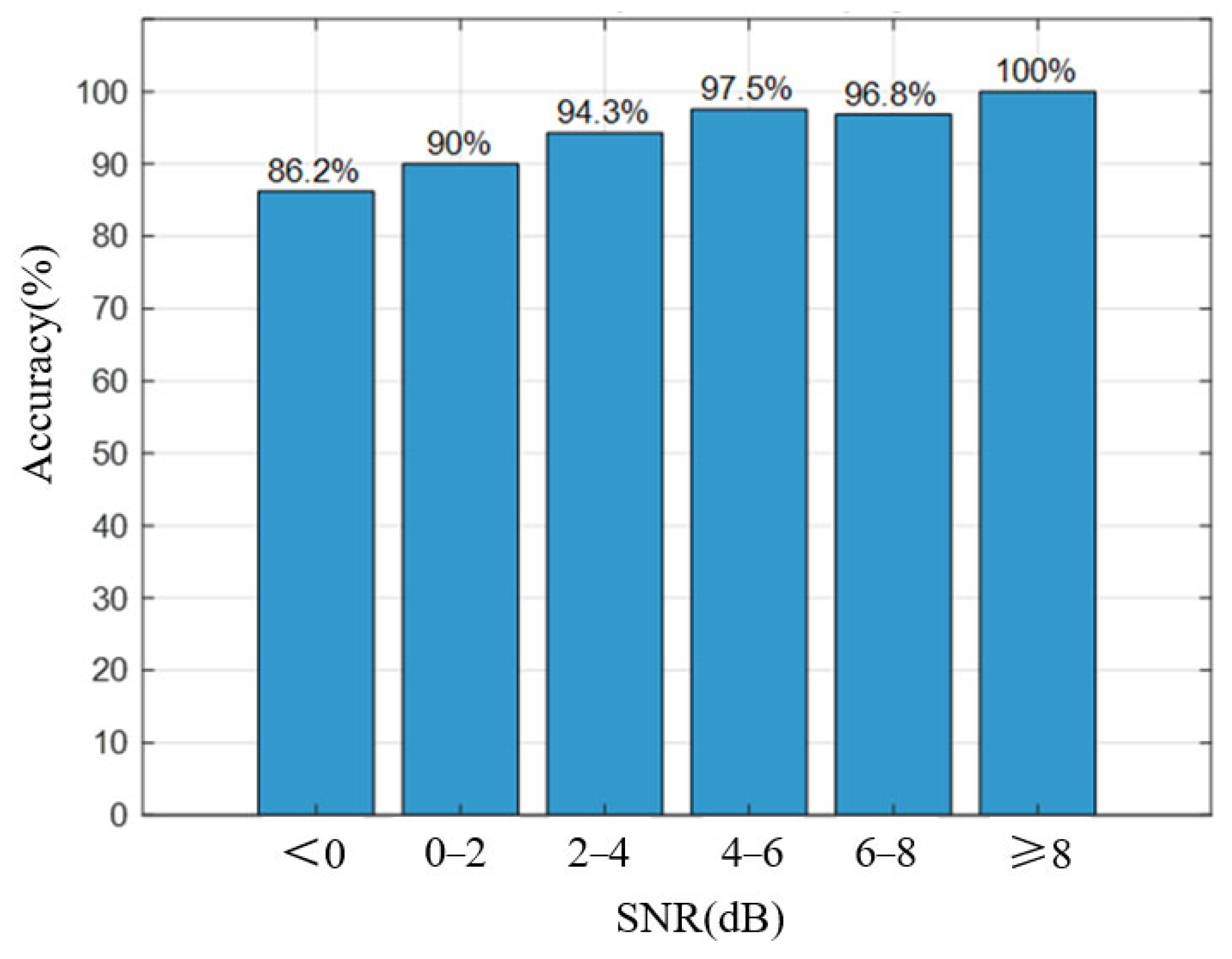
To further evaluate the robustness of the proposed KNN classifier against noise variations, we performed a SNR analysis on the test dataset. Table 4 presents the SNR ranges of the targets. This data spans a wide dynamic range of SNR values, facilitating a comprehensive stress test of this study.
Figure 13 presents the classification accuracy stratified by SNR intervals of 2 dB. As can be seen from the figure, in high SNR regions (>8 dB), the classification accuracy remains stable at 100%. Even under low SNR conditions below 0 dB, this method maintains an accuracy rate exceeding 86.2%. In conclusion, this research is not only effective for strong targets but also demonstrates strong robustness in low SNR conditions.
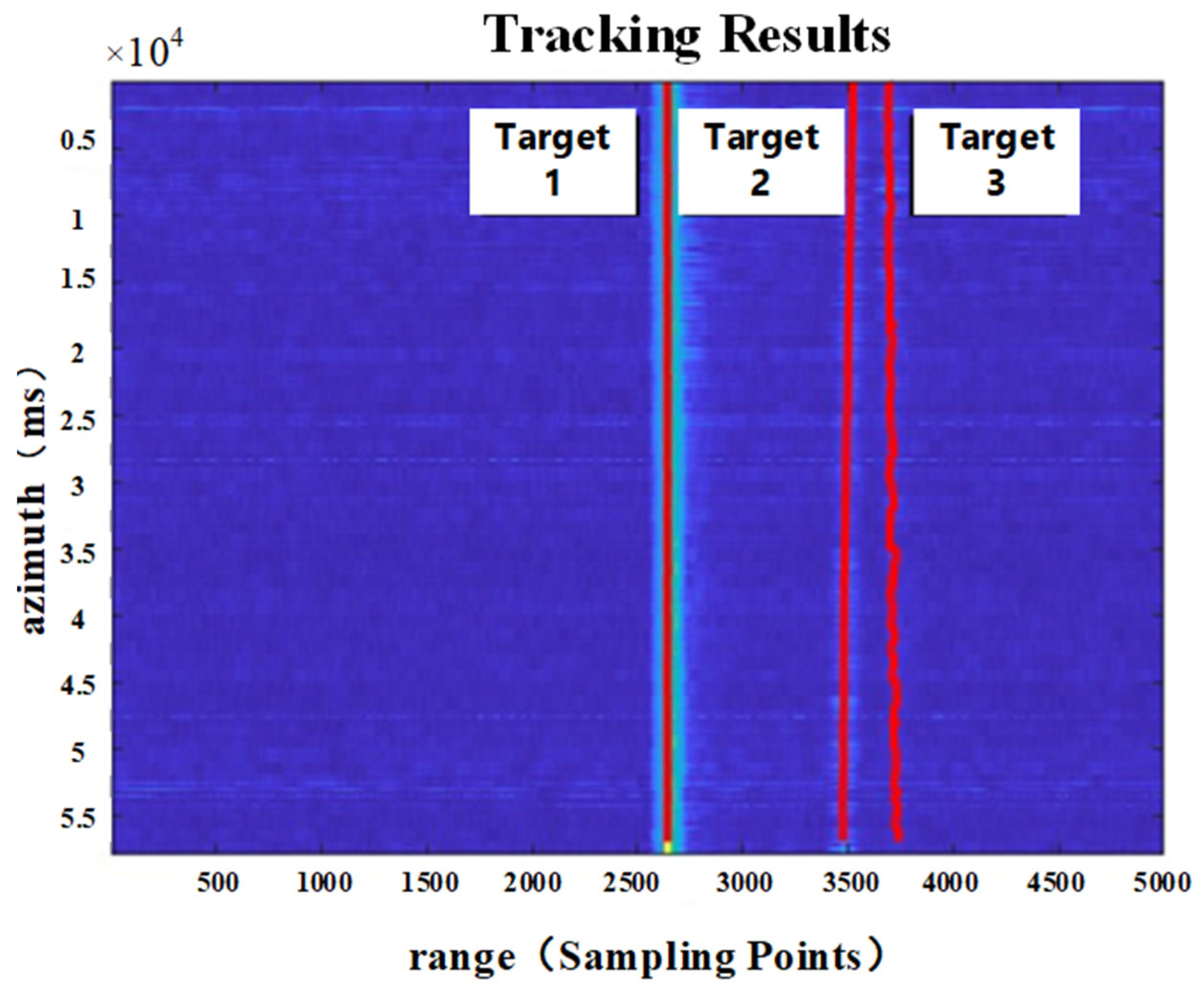
The association results are input into the Kalman filter for target tracking, with the tracking results shown in Figure 14, where the red line represents the target movement trajectory. Target 1, being relatively large in volume, positioned close to the radar system, and featuring a complex shape with numerous asymmetrical structures, yields optimal association results. This provides the Kalman filter with accurate state estimates, enabling precise prediction. Targets 2 and 3 are located at greater distances, exhibiting weak scattered echo signals from the GNSS-S signal. They possess smaller volumes, symmetrical shapes, and flat surfaces. However, following characteristic association used in this study, even with minor discontinuities in the association results, sufficient constraint information is still provided to the filter, preventing trajectory divergence.
To validate the effectiveness of the proposed fusion method based on statistical and polarimetric characteristics, it is compared with the DDM-based tracking method. The DDM method is widely used for target detection and localization in GNSS-S technology. Its core principle involves performing Fast Fourier Transform (FFT) on the preprocessed echo signals to obtain a Doppler-delay two-dimensional power spectrum, followed by target detection to extract positions.
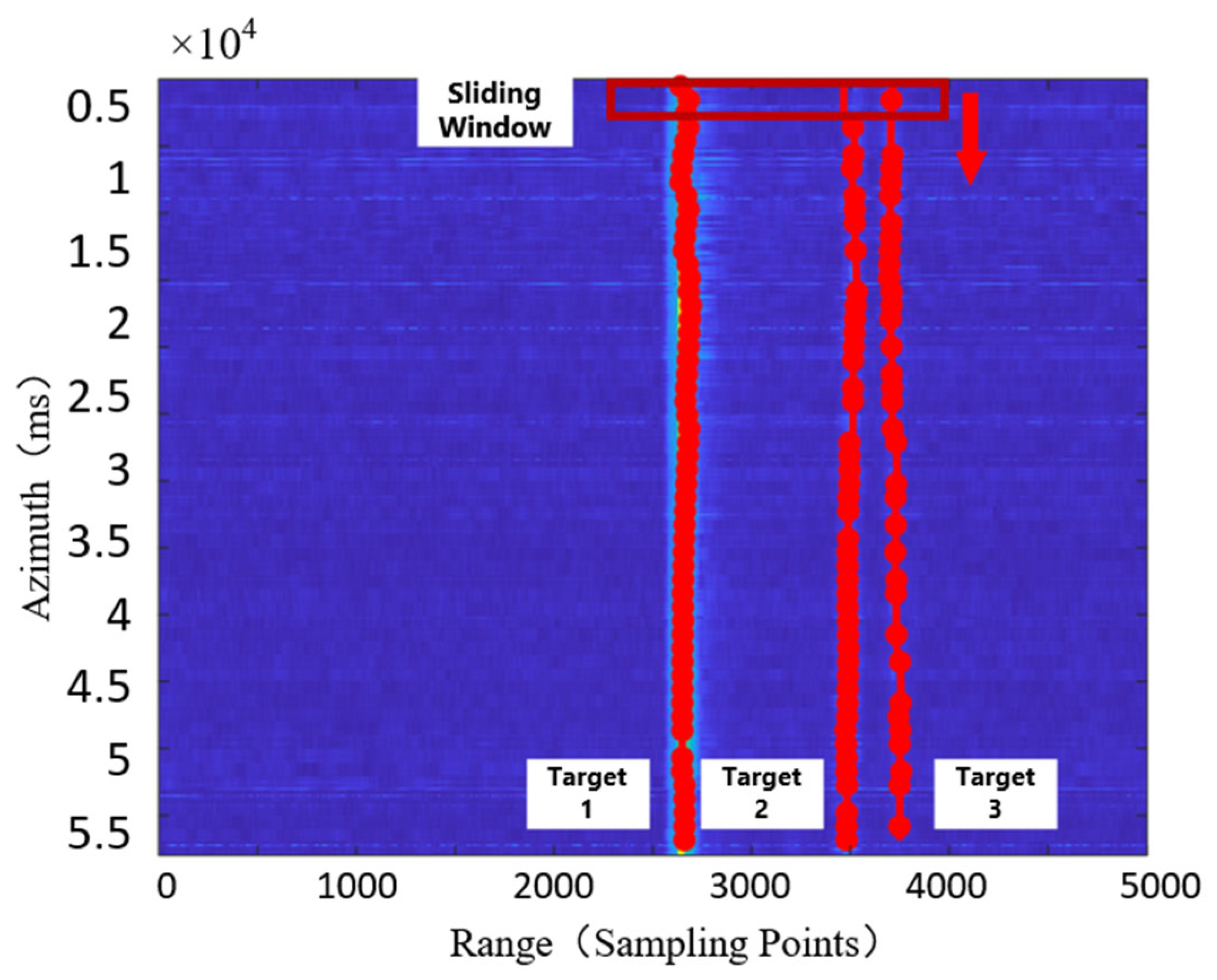
In this experiment, a sliding window capable of encompassing three targets is used to segment the echo data. The window length and sliding step size are both set to 1024 points, with a window width range of [2300, 4000]. For the data within each window, a FFT is performed along the azimuth dimension to generate a two-dimensional power spectrum. Subsequently, the actual target ranges are used for labeling. If the detected position falls within the specified range, it is selected as the observed position for the corresponding target and input into the Kalman filter for trajectory tracking. The process noise covariance matrix and the observation noise covariance matrix are set to 0.1 and 5, respectively. Table 5 presents the detection rates of the DDM method for the three targets.
Figure 15 shows the tracking results of the DDM method, where the red box represents the sliding window, the red arrow indicates the sliding direction, red dots represent the detection results and red lines indicate the trajectories. It can be observed that, due to the large size and close proximity of Target 1 to the radar, the DDM method consistently detects this target, and the tracking trajectory is largely accurate. In the early stages of the experiment, slight fluctuations in the trajectory occurred due to environmental interference. The echo intensities of Target 2 and Target 3 were relatively weak, with certain regions being overwhelmed by sea clutter, leading to a significant decline in detection rates. As a result of the high number of missed detections, the trajectories became heavily reliant on predicted values, causing the associated trajectories to remain nearly linear. Furthermore, the DDM method fundamentally relies only on the kinematic information of the targets. This implies that for two targets with similar motion states, their distinction can only be based solely on spatial information. When the two targets are in close proximity or their trajectories intersect, it becomes potentially impossible to differentiate between them.

5. Discussion

5.1. The Effectiveness of Feature Fusion in Target Characteristics Association

This study constructs a feature plane by fusing amplitude statistical characteristics (skewness and kurtosis) and polarization scattering characteristics (helical scattering power ratio, Phelix) of dual-frequency dual-polarization (B1-H, B1-V, B3-H, B3-V) signals, which addresses the challenge of target trajectory tracking under low SNR in GNSS-S radar. Experimental results indicate that as a uniformly scattering medium, sea clutter exhibits significant statistical overlap across both four-channel and dual-channel characteristic planes (Figure 8), with no discernible spatial differentiation. This is because sea clutter demonstrates negligible variation in polarization and frequency, maintaining a relatively uniform amplitude distribution pattern across different polarization channels.
By contrast, the three ship targets exhibit markedly different distribution characteristics on the feature plane (Figure 9). Target 1, being structurally complex with a large RCS, exhibits higher kurtosis and skewness in the B3-V channel than in the B1-V channel, and its Phelix value is substantially greater than those of Targets 2 and 3. This arises from Target 1’s multiple masts and angular structures, which induce strong helical scattering of the incident circularly polarized wave, significantly amplifying polarization differences. Targets 2 and 3 are smaller with flatter decks, exhibiting lower Phelix values. However, Target 2’s skewness and kurtosis are nearly double those of Target 3. This discrepancy stems from variations in hull material and superstructure layout, which influence the scattering characteristics of the echo signal.
It is noteworthy that the fusion of these two features compensates for the limitations of distinguishing targets using a single feature alone. For instance, relying solely on amplitude statistics may lead to partial overlap in the indicators between Target 2 and Target 3, resulting in misclassification. However, the introduction of Phelix enables effective differentiation between these two targets by exploiting structural differences in helical scattering. This confirms that the combination of amplitude statistics (reflecting signal intensity distribution) and polarized scattering characteristics (reflecting target structural properties) forms a complementary feature system. This complementary approach is the core reason for achieving effective differentiation between distinct targets.

5.2. Advantages of the Method in Low-Resolution Radar Applications

Against the backdrop of existing studies mostly focusing on high-resolution imaging radars (such as polarimetric SAR), this method demonstrates unique advantages in low-resolution GNSS-S radar applications.
Firstly, it circumvents complex high-resolution imaging processing, thereby reducing algorithmic complexity. Conventional target tracking methods based on high-resolution imaging require steps such as range-Doppler imaging and refocusing to capture target details, entailing substantial data computation and demanding stringent hardware performance requirements. By contrast, this approach directly extracts amplitude statistical features and polarization characteristics from low-resolution GNSS-S signals, employing the KNN algorithm and Kalman filter for tracking. The entire process involves no imaging-related operations, substantially reducing computational demands and making it suitable for deployment on low-power coastal monitoring equipment.
Secondly, this method demonstrates strong adaptability in low SNR environments. Low-resolution GNSS-S radar signals exhibit low power levels and are susceptible to severe sea clutter interference, leading to discontinuities in target points. The feature fusion system employed in this study—particularly Phelix—reduces sensitivity to noise. Even with faint echo signals, it distinguishes structural differences between sea clutter and targets through polarimetric characteristics, thereby enabling effective target localisation.

5.3. Limitations and Future Work

The scope of the experimental validation was limited. The experiment only involved three types of ship targets, lasted for a relatively short period of time, and was conducted under conditions of relatively low wind speed. It remains unclear whether this method can maintain effective association and tracking for larger, more complex targets or non-vessel objects (such as buoys with RCS comparable to small vessels). Furthermore, the experiment only validated the performance of a single radar receiving station without exploring the effectiveness of multi-station combinations, thereby limiting the method’s generalisability in complex maritime scenarios. Future work will expand the experimental scope by incorporating additional target types and harsher sea conditions. A multi-station GNSS-S radar experimental platform will be established to validate the method’s performance in multi-satellite scenarios, thereby enhancing its practical utility for maritime surveillance.

6. Conclusions

This study achieved motion target trajectory association for GNSS-S radar by integrating amplitude statistical characteristics with polarization scattering characteristics. Field experiments validated its effectiveness and reliability in tracking multiple moving vessels under low signal-to-noise ratio conditions. First, the paper outlines the system architecture and operational principles of GNSS-S radar. Subsequently, amplitude and polarization characteristics are extracted from target echo signals. Utilizing machine learning algorithms, target signals are associated with these features. Finally, a Kalman filter is successfully employed to track target trajectories. Compared to conventional image processing feature extraction methods, this approach requires only basic preprocessing of echo signals, offering greater simplicity and reliability. Suitable for low-resolution radar data with minimal system requirements, it provides an innovative technical pathway for challenges such as vessel tracking and maritime surveillance in complex ocean environments.
Future research will focus on multi-station GNSS-S systems, integrating multistation data to achieve three-dimensional trajectory tracking of moving vessels.


Author Contributions

Conceptualization, J.Y., Z.X. and Y.P.; methodology, J.Y. and C.Z.; software, X.L.; K.X. and Z.C.; validation, F.Y., S.J. and Z.Z.; formal analysis, L.D.; investigation, J.Y. and Z.L. All authors have read and agreed to the published version of the manuscript.

Funding

This work was supported in part by the Beijing Nova Program under Grant 20250484779, in part by the National Key Research and Development Program of China under Grant 2024YFB3909801, in part by the Young Elite Scientists Sponsorship Program by CAST under Grant YESS20230407.

Data Availability Statement

The original contributions presented in this study are included in the article. Further inquiries can be directed to the corresponding author.

Conflicts of Interest

The authors declare no conflicts of interest.

Abbreviations

The following abbreviations are used in this manuscript:
GNSS-SGlobal Navigation Satellite System-Scattering
SNRSignal-to-Noise Ratio
RCSRadar Cross Section
SARSynthetic Aperture Radar
GNSS-RGlobal Navigation Satellite System-Reflection
DDMDelay-Doppler Map
DDTDelay-Doppler-Time
SCRSignal-to-Clutter Ratio
BDSBeiDou Navigation Satellite
RHCPRight-Hand Circular Polarization
LHCPLeft-Hand Circular Polarization
KNNK-Nearest-Neighbors
PRNPseudo-Random Noise
BECBlock Expanded Compression
FFTFast Fourier Transform

References

  1. Antoniou, M.; Cherniakov, M. GNSS-Based Passive Radar; IET: London, UK, 2017. [Google Scholar]
  2. Gong, J.; Zhang, C.; Shi, S. A review of moving target detection techniques using GNSS passive remote sensing system. Geomat. Inf. Sci. Wuhan Univ. 2024, 49, 1053–1069. [Google Scholar]
  3. Gao, W.; Yue, F.; Xia, Z.; Liu, X.; Zhang, C.; Liu, Z.; Jin, S.; Zhang, Y.; Zhao, Z.; Zhang, T. Weak signal processing method for moving target of GNSS-S radar based on amplitude and phase self-correction. Remote Sens. 2023, 15, 969. [Google Scholar] [CrossRef]
  4. Freeman, A.; Durden, S.L. A three-component scattering model for polarimetric SAR data. IEEE Trans. Geosci. Remote Sens. 2002, 36, 963–973. [Google Scholar] [CrossRef]
  5. Cloude, S.R.; Pottier, E. An entropy based classification scheme for land applications of polarimetric SAR. IEEE Trans. Geosci. Remote Sens. 2002, 35, 68–78. [Google Scholar] [CrossRef]
  6. Biondi, F.; Clemente, C.; Orlando, D. An eigenvalue-based approach for structure classification in polarimetric SAR images. IEEE Geosci. Remote Sens. Lett. 2019, 17, 1003–1007. [Google Scholar] [CrossRef]
  7. Xue, X.; Di, L.; Guo, L.; Lin, L. An efficient classification method of fully polarimetric SAR image based on polarimetric features and spatial features. In 2015 Fourth International Conference on Agro-Geoinformatics (Agro-Geoinformatics), Istanbul, Turkey, 20–24 July 2015; IEEE: New York, NY, USA, 2015; pp. 327–331. [Google Scholar]
  8. Yang, R.; Hu, Z.; Liu, Y.; Xu, Z. A novel polarimetric SAR classification method integrating pixel-based and patch-based classification. IEEE Geosci. Remote Sens. Lett. 2019, 17, 431–435. [Google Scholar] [CrossRef]
  9. Yang, Z.; Chen, Y.; Chen, Y.; Lu, Y. Unsupervised classification of polarimetric SAR images based on scattering mechanism. In IGARSS 2022–2022 IEEE International Geoscience and Remote Sensing Symposium, Kuala Lumpur, Malaysia, 17–22 July 2022; IEEE: New York, NY, USA, 2022; pp. 2702–2705. [Google Scholar]
  10. Xie, N.; Zhang, T.; Wei, F.; Yu, W. Pfdn: A polarimetric feature-guided deep network for dual-polarized sar ship classification. IEEE Geosci. Remote Sens. Lett. 2024, 21, 1–5. [Google Scholar] [CrossRef]
  11. Zhao, W.H.; Yu, X.; Yang, Z.A.; Yin, Z.P.; Zhang, Q.Y. Polarimetric SAR deep learning classification using multi-scale features. Mod. Radar 2023, 45, 48–54. [Google Scholar]
  12. Yamaguchi, Y.; Moriyama, T.; Ishido, M.; Yamada, H. Four-component scattering model for polarimetric SAR image decomposition. IEEE Trans. Geosci. Remote Sens. 2005, 43, 1699–1706. [Google Scholar] [CrossRef]
  13. Zhang, L.; Sun, L.; Zou, B.; Moon, W.M. Fully polarimetric SAR image classification via sparse representation and polarimetric features. IEEE J. Sel. Top. Appl. Earth Obs. Remote Sens. 2014, 8, 3923–3932. [Google Scholar] [CrossRef]
  14. Su, M.; Ni, P.; Pei, H.; Kou, X.; Xu, G. Graph feature representation for shadow assisted moving target tracking in video SAR. IEEE Geosci. Remote Sens. Lett. 2025, 22, 1–5. [Google Scholar] [CrossRef]
  15. Bao, J.; Zhang, X.; Zhang, T.; Zeng, T.; Yang, Z.; Zhan, X.; Shi, J.; Wei, S. Shadow-enhanced self-attention and anchor-adaptive network for video SAR moving target tracking. IEEE Trans. Geosci. Remote Sens. 2023, 61, 1–13. [Google Scholar] [CrossRef]
  16. Chen, H.; Zhao, W.; Zhang, R.; Li, N.; Li, D. Multiple object tracking in video SAR: A Benchmark and Tracking Baseline. arXiv 2025, arXiv:2506.12105. [Google Scholar] [CrossRef]
  17. Zhong, C.; Ding, J.; Zhang, Y. Video SAR moving target tracking using joint kernelized correlation filter. IEEE J. Sel. Top. Appl. Earth Obs. Remote Sens. 2022, 15, 1481–1493. [Google Scholar] [CrossRef]
  18. Elfouhaily, T.; Thompson, D.R.; Linstrom, L. Delay-Doppler analysis of bistatically reflected signals from the ocean surface: Theory and application. IEEE Trans. Geosci. Remote Sens. 2002, 40, 560–573. [Google Scholar] [CrossRef]
  19. Chen, C.; Yan, S.; Mei, J. A maritime target location method using geometric semantic constraints based on spaceborne GNSS-R. IEEE Geosci. Remote Sens. Lett. 2023, 21, 1–5. [Google Scholar] [CrossRef]
  20. Southwell, B.J.; Cheong, J.W.; Dempster, A.G. A matched filter for spaceborne GNSS-R based sea-target detection. IEEE Trans. Geosci. Remote Sens. 2020, 58, 5922–5931. [Google Scholar] [CrossRef]
  21. Zhao, Z.; Xia, Z.; Xu, Z.; Zhang, T.; Liu, D.; Shi, H.; Yue, F.; Peng, T. A novel method of ship detection by combining space-borne SAR and GNSS-R. In IET International Radar Conference (IET IRC 2020), Online, 4–6 November 2020; IET: London, UK, 2020; pp. 1045–1051. [Google Scholar]
  22. Gao, W.; Yue, F.; Xue, C.; Zhao, Z.; Xia, Z. Multi-source joint imaging method for shipborne GNSS-S radar. In IET International Radar Conference (IRC 2023), Chongqing, China, 3–5 December 2023; IET: London, UK, 2023; pp. 2081–2087. [Google Scholar]
  23. Zhang, C.; Mu, Y.; Xia, Z.; Jin, S.; Yue, F.; Liu, X.; Zhang, L.; Tian, Z.; Liu, Z.; Zhang, Y. Feature extraction for moving targets based on the statistical characteristics of echo amplitude with the L-band fully polarimetric radar. Remote Sens. 2022, 15, 80. [Google Scholar] [CrossRef]
  24. Zhang, L.; Gao, G.; Duan, D.; Zhang, X.; Yao, L.; Liu, J. A novel detector for adaptive detection of weak and small ships in compact polarimetric SAR. IEEE J. Miniaturization Air Space Syst. 2022, 3, 153–160. [Google Scholar] [CrossRef]
  25. Yin, J.; Yang, J.; Zhang, X. On the ship detection performance with compact polarimetry. In 2011 IEEE RadarCon (RADAR), Chengdu, China, 24–27 October 2011; IEEE: New York, NY, USA, 2011; pp. 675–680. [Google Scholar]
  26. Manjunathan, N.; Prabhu, R.V.; Sudha, K.; Lekha, D.; Ezhilvendan, M. K-nearest neighbors in machine learning: Theory, practice, and advances. In 2024 International Conference on Smart Technologies for Sustainable Development Goals (ICSTSDG), Tamil Nadu, India, 6–8 November 2024; IEEE: New York, NY, USA, 2024; pp. 1–5. [Google Scholar]
  27. Yang, K.; Zuo, Y.; Li, T.; Chen, P.C. A review of target tracking based on deep learning. In 2023 13th International Conference on Information Science and Technology (ICIST), Cairo, Egypt, 8–14 December 2023; IEEE: New York, NY, USA, 2023; pp. 504–511. [Google Scholar]
Figure 1. Diagram of GNSS-S Radar System.
Remotesensing 18 00367 g001
Figure 2. GNSS-S radar system (a) working principle diagram and (b) Geometric configuration.
Remotesensing 18 00367 g002
Figure 3. Flowchart of GNSS-S radar moving target trajectory extraction.
Remotesensing 18 00367 g003
Figure 4. BEC algorithm flow chart.
Remotesensing 18 00367 g004
Figure 5. Characteristic-Trajectory Association Flowchart.
Remotesensing 18 00367 g005
Figure 6. Experimental Scenario for Moving Sea Targets. (a) Satellite position. (b) Experimental site.
Remotesensing 18 00367 g006
Figure 7. Pre-processed echo signal. (a) B1-H after BEC algorithm. (b) B1-H after high-pass filter. (c) B3-V after BEC algorithm. (d) B3-V after high-pass filter.
Remotesensing 18 00367 g007
Figure 8. Schematic of Sliding Window Coverage.
Remotesensing 18 00367 g008
Figure 9. Feature Plane of Sea Clutter. (a) Four-channel. (b) Two-channel.
Remotesensing 18 00367 g009
Figure 10. Amplitude Statistical Characteristics Diagram of Movement Target. (a) Four-channel of target 1. (b) Two-channel of target 1. (c) Four-channel of target 2. (d) Two-channel of target 2. (e) Four-channel of target 3. (f) Two-channel of target 3.
Remotesensing 18 00367 g010aRemotesensing 18 00367 g010b
Figure 11. Polarization Scattering Characteristic Diagram of Movement Targe.
Remotesensing 18 00367 g011
Figure 12. Association Results for Target Characteristics.
Remotesensing 18 00367 g012
Figure 13. Figure of Classification Accuracy at Different SNR Levels.
Remotesensing 18 00367 g013
Figure 14. Target Trajectory Tracking Results.
Remotesensing 18 00367 g014
Figure 15. Tracking Results of the DDM Method.
Remotesensing 18 00367 g015
Table 1. Main parameters of the system.
ItemParameter
Gain of direct receiving antenna3 dB
Gain of scattering receiving antenna≥12 dB
Working frequency1575.42 MHz
1268.52 MHz
Beamwidth of the scatter receiving antenna±13°
Sampling rate200 MSPS
Table 2. Parameter settings for the KNN classifier and Kalman filter.
ParameterSymbolValue
Number of neighborsK31
Distance metric-Euclidean
Distance weighting-Inverse distance
Feature scaling-Z-score standardization
State vectorx r , v T
State transition matrixA 1 1 0 1
Observation matrixH 1 , 0
Process noise covarianceQ 0.1 0 0 0.1
Measurement noise covarianceR1
Table 3. Feature Extraction and Ablation Experiment Results.
CharacteristicsAccuracy
Target 1Target 2Target 3
Skewness + Kurtosis100%86.38%62.24%
Phelix100%93.67%88.18%
Skewness + Kurtosis + Phelix100%96.11%93.89%
Table 4. SNR range of each target.
TargetMinimum SNRMaximum SNRAverage SNR
12.2 dB12.84 dB8.65 dB
2−1.15 dB11.76 dB6.14 dB
3−2.18 dB7.48 dB4.07 dB
Table 5. Detection results of the DDM-based tracking method.
TargetAccuracy
198.21%
276.79%
360.36%
Disclaimer/Publisher’s Note: The statements, opinions and data contained in all publications are solely those of the individual author(s) and contributor(s) and not of MDPI and/or the editor(s). MDPI and/or the editor(s) disclaim responsibility for any injury to people or property resulting from any ideas, methods, instructions or products referred to in the content.