

GRACE-FO Real-Time Precise Orbit Determination Using Onboard GPS and Inter-Satellite Ranging Measurements with Quality Control Strategy
 , ,
, ,
Highlights
- Robustness of the quality control strategy: The adopted iterative quality control method based on post-fit residuals effectively suppresses GNSS observation noise and outliers, thereby significantly improving the stability of the filter and the orbit accuracy.
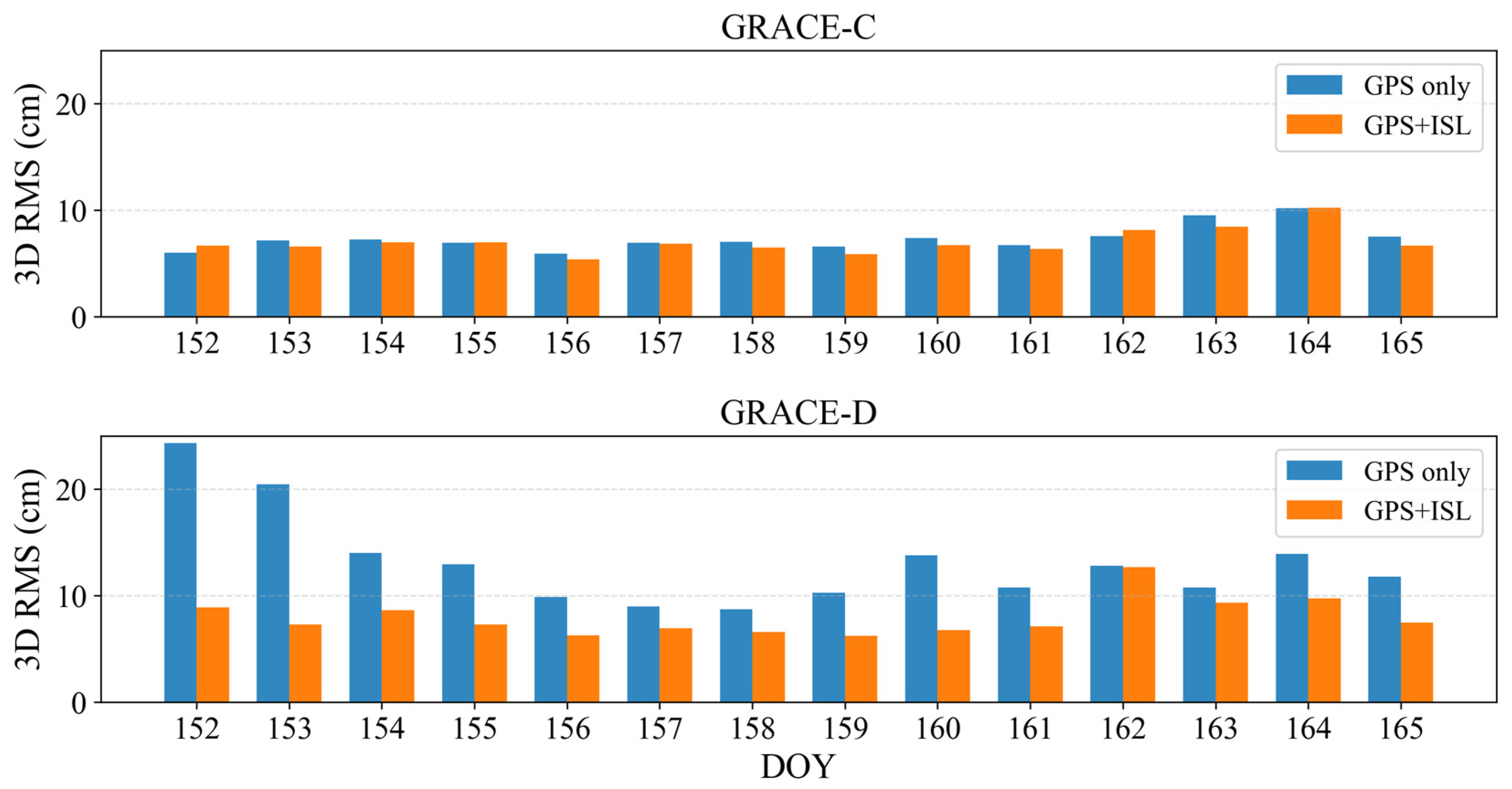
- Efficacy of inter-satellite range measurements in asymmetric conditions: The experiment verifies that the inclusion of inter-satellite range measurements yields substantial accuracy improvements for GRACE-FO under asymmetric observation conditions. This is particularly decisive for the satellite with poor data quality (GRACE-D), where orbit accuracy was improved by 39%, effectively recovering its performance to the level of GRACE-C.
- Stabilization of constellation geometry: The integration of inter-satellite range measurements effectively compensates for geometric deficiencies in LEO satellite observations, thereby guaranteeing the structural stability of formation flying or large-scale constellations even when individual nodes are degraded.
- Spatiotemporal reference transfer and formation stability: High-precision ISLs serve as a critical conduit for transferring spatiotemporal references within the constellation. By establishing rigid geometric constraints, precise state information from satellites with normal data quality is effectively propagated to constrain degraded satellites.
Abstract
1. Introduction
2. Mathematical Models for the RTPOD Based on EKF
2.1. Observation Models
2.2. EKF Model Used in RTPOD
- (1)
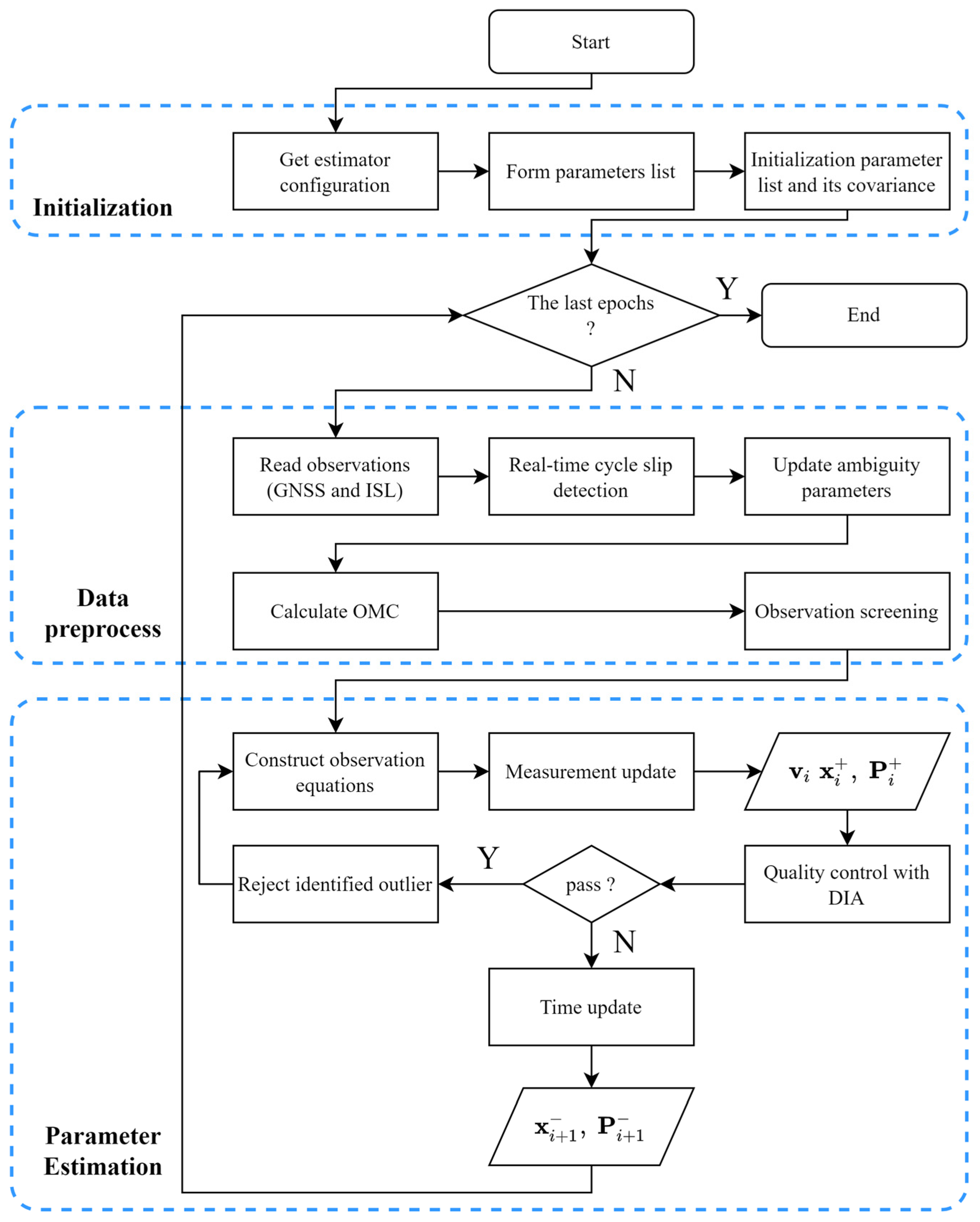
- The Time Update (Prediction) step, which uses the linearized dynamic model (Equation (10)) to propagate the state vector and its covariance from the reference epoch to the current epoch.
- (2)
- The Measurement Update (Correction) step, which uses the linearized observation equation (Equation (8)) to correct the predicted state with new measurements.
2.2.1. RTPOD Procedure Based on EKF
2.2.2. Estimator Formulation and Stochastic Modeling
- Filter Structure
- 2.
- State Vector and Dynamic Compensation
- 3.
- Stochastic Modeling
2.2.3. Real-Time Quality Control Strategy
- Standardization
- 2.
- Detection (Global Test)
- 3.
- Identification (Local Test)
- 4.
- Adaptation (Iterative Rejection)
- (1)
- Global Anomaly: The detection step failed (), indicating overall inconsistency.
- (2)
- Local Anomaly: The candidate’s standardized residual exceeds the empirical threshold (e.g., ), indicating a significant single-point outlier.
3. Dataset and Processing Strategy
3.1. Experimental Data
- Onboard GNSS Observations:
- ISL Range Measurements:
- Real-time Orbit and Clock Products:
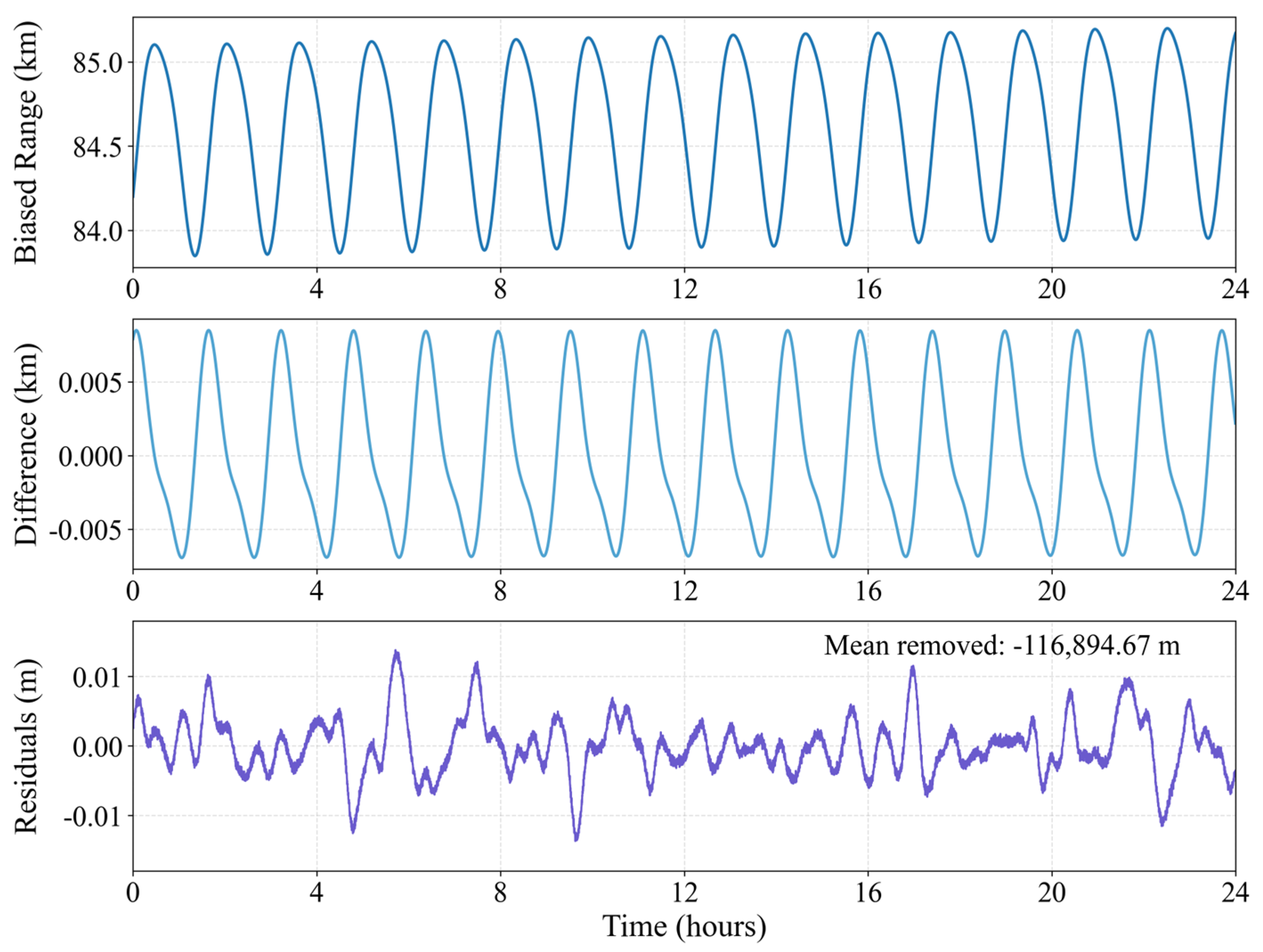
3.2. ISL Range Data Pre-Processing and Bias Calibration
- Break Detection
- 2.
- Bias Estimation
- 3.
- Observation Calibration
3.3. Models and Estimation Strategy
4. Experiment and Results Analysis
4.1. Experimental Design
- Scheme A (GPS-only): The orbits of GRACE-C and GRACE-D are estimated using only onboard GPS observations. This configuration is designed not only to verify the fundamental capability of the RTPOD strategy, but also to serve as a rigorous control group. By comparing against this baseline, the specific contributions of inter-satellite range observations can be isolated and assessed.
- Scheme B (GPS + ISL): The orbits are estimated using both onboard GPS and inter-satellite range observations. In this scheme, the inter-satellite range measurements are ingested as absolute geometric ranges with a weighting sigma of 1.0 cm, serving as a strong geometric constraint to tightly couple the relative states of the satellite formation.
4.2. Assessment of GPS Observation Quality
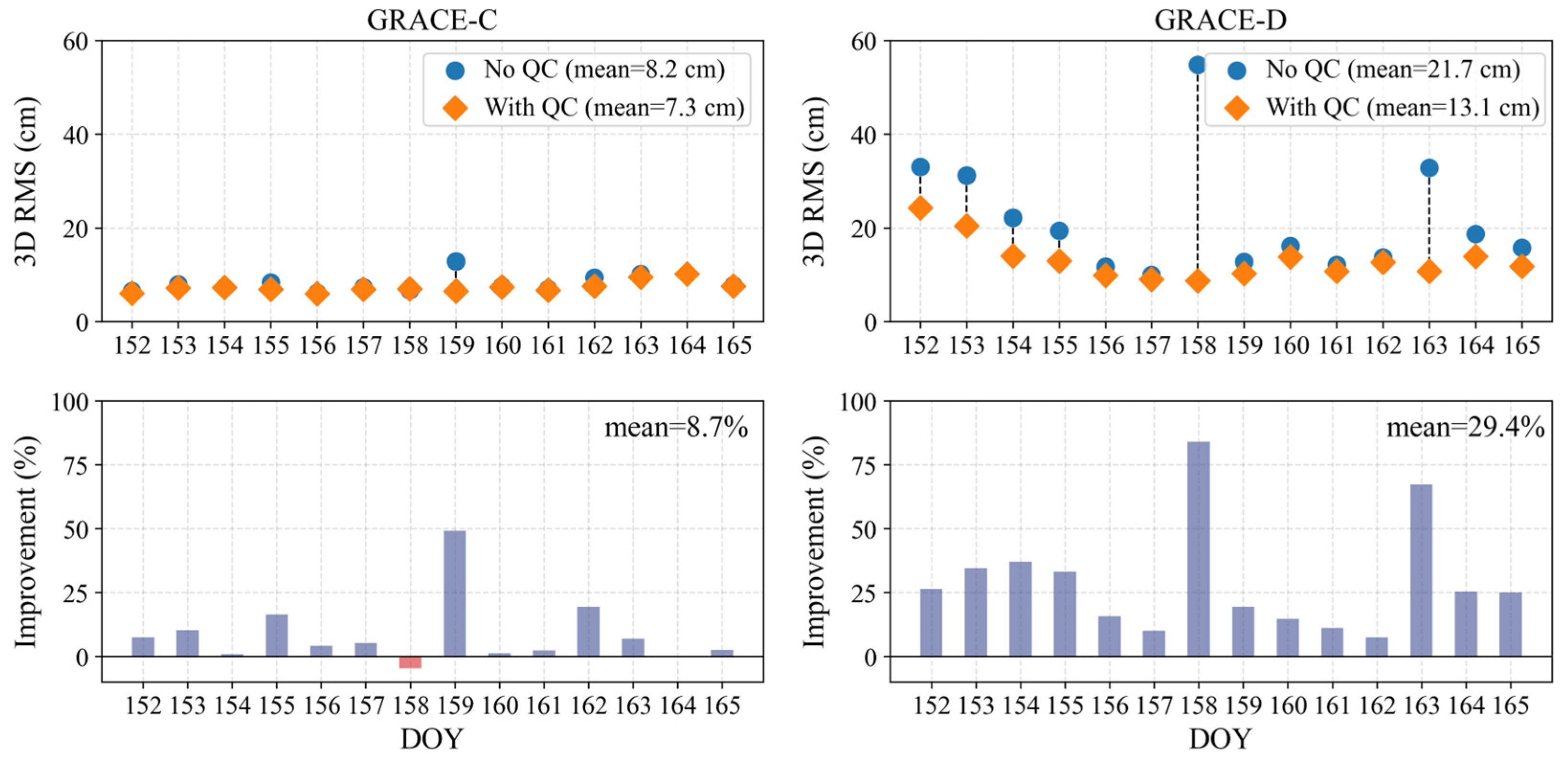
4.3. Impact of QC-with-DIA on RTPOD
4.4. Analysis of Inter-Satellite Range Enhancement Mechanism
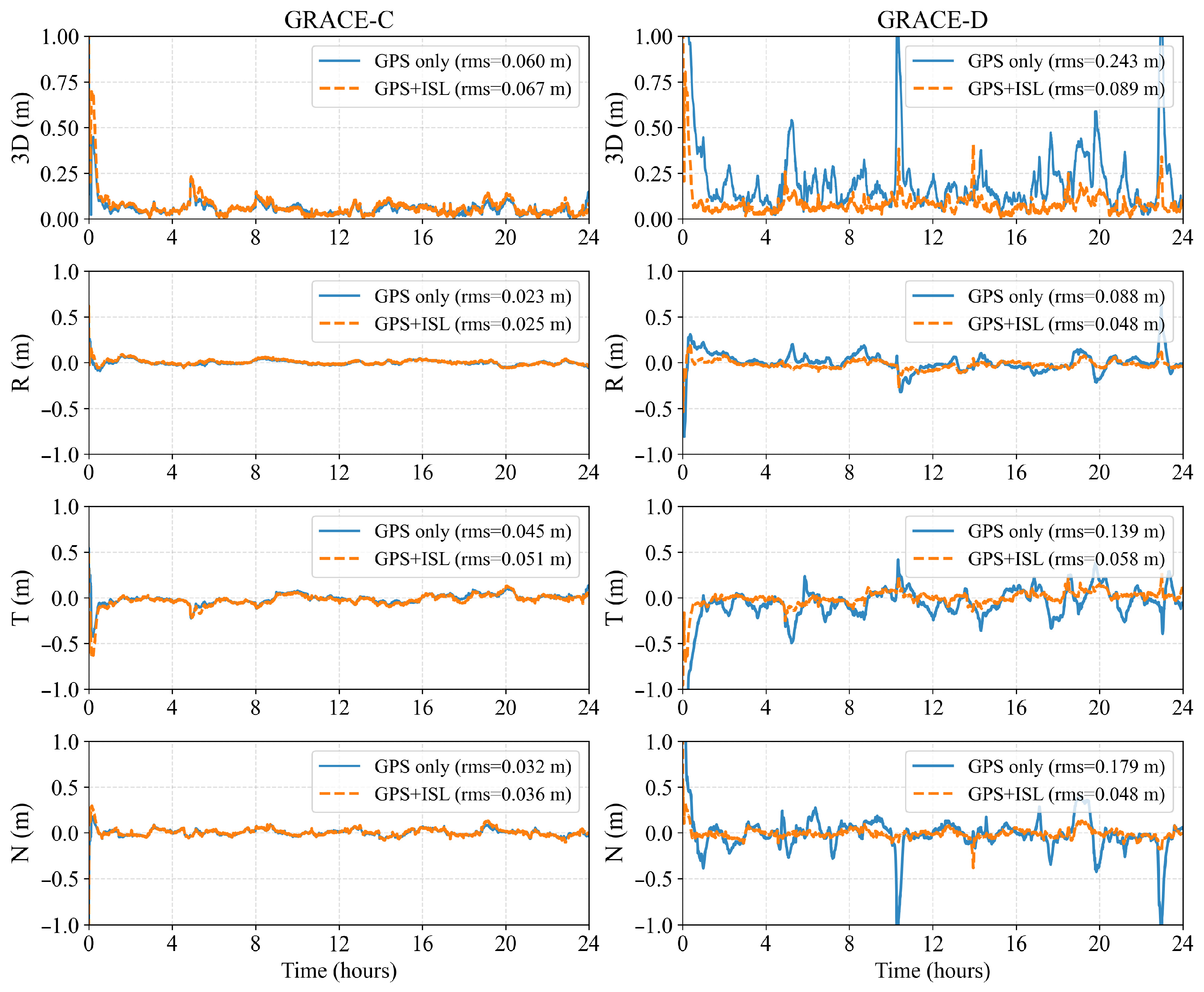
4.5. RTPOD Improvements Contributed by Inter-Satellite Range Measurements
5. Discussion
5.1. Cooperative Stabilization Mechanism Enabled by ISL Ranging
5.2. Interaction Between Iterative Quality Control and ISL Range Constraints
5.3. Limitations and Future Perspectives
6. Conclusions
Author Contributions
Funding
Data Availability Statement
Acknowledgments
Conflicts of Interest
Abbreviations
| CNES | Centre National d’Etudes Spatiales |
| DIA | Detection, Identification, and Adaptation |
| DOY | Day of Year |
| EKF | Extended Kalman Filter |
| GNSS | Global Navigation Satellite Systems |
| GPS | Global Position System |
| GRACE-FO | Gravity Recovery and Climate Experiment Follow-On |
| IF | ionosphere-free |
| ISL | Inter-Satellite Link |
| KBR | K-Band Ranging System |
| LAPACK | Linear Algebra PACKage |
| LRI | Laser Ranging Interferometer |
| LEO | Low Earth Orbit |
| OMC | observed minus computed |
| PCO/PCV | phase center offset/phase center variation |
| PDOP | Position Dilution of Precision |
| PANDA | Positioning And Navigation Data Analyst |
| PSO | Precise Science Orbits |
| QC | Quality Control |
| RINGO | RINEX pre-processing tool using GO |
| RKF | Runge–Kutta–Fehlberg 7(8) integrator |
| RMS | Root Mean Square |
| RTPOD | Real-Time Precise Orbit Determination |
| SRIF | Square Root Information Filter |
| SSR | state-space representation |
| TASS | TDRSS Augmentation Service for Satellites |
References
- Kang, Z.; Bettadpur, S.; Nagel, P.; Save, H.; Poole, S.; Pie, N. GRACE-FO Precise Orbit Determination and Gravity Recovery. J. Geod. 2020, 94, 85. [Google Scholar] [CrossRef]
- Leben, R.R.; Born, G.H.; Engebreth, B.R. Operational Altimeter Data Processing for Mesoscale Monitoring. Mar. Geod. 2002, 25, 3–18. [Google Scholar] [CrossRef]
- Li, X.; Ma, F.; Li, X.; Lv, H.; Bian, L.; Jiang, Z.; Zhang, X. LEO Constellation-Augmented Multi-GNSS for Rapid PPP Convergence. J. Geod. 2019, 93, 749–764. [Google Scholar] [CrossRef]
- Yang, Y.; Mao, Y.; Sun, B. Basic Performance and Future Developments of BeiDou Global Navigation Satellite System. Satell. Navig. 2020, 1, 1. [Google Scholar] [CrossRef]
- Song, X.; Yang, Y.; Mao, Y.; Ruan, R.; Wang, L. Schmidt Kalman filter in autonomous orbit determination of navigation satellites. Acta Geod. Cartogr. Sin. 2024, 53, 879–888. [Google Scholar] [CrossRef]
- Selvan, K.; Siemuri, A.; Prol, F.S.; Välisuo, P.; Bhuiyan, M.Z.H.; Kuusniemi, H. Precise Orbit Determination of LEO Satellites: A Systematic Review. GPS Solut. 2023, 27, 178. [Google Scholar] [CrossRef]
- Mao, X.; Wang, W.; Gao, Y. Precise Orbit Determination for Low Earth Orbit Satellites Using GNSS: Observations, Models, and Methods. Astrodynamics 2024, 8, 349–374. [Google Scholar] [CrossRef]
- Mao, X.; Arnold, D.; Girardin, V.; Villiger, A.; Jäggi, A. Dynamic GPS-Based LEO Orbit Determination with 1 Cm Precision Using the Bernese GNSS Software. Adv. Space Res. 2021, 67, 788–805. [Google Scholar] [CrossRef]
- Montenbruck, O.; Ramos-Bosch, P. Precision Real-Time Navigation of LEO Satellites Using Global Positioning System Measurements. GPS Solut. 2008, 12, 187–198. [Google Scholar] [CrossRef]
- Montenbruck, O.; Kunzi, F.; Hauschild, A. Performance Assessment of GNSS-Based Real-Time Navigation for the Sentinel-6 Spacecraft. GPS Solut. 2021, 26, 12. [Google Scholar] [CrossRef]
- Shi, Y.; Xu, T.; Li, M.; Wei, K.; Wang, S.; Wang, D. Real-Time Precise Orbit Determination of Low Earth Orbit Satellites Based on GPS and BDS-3 PPP B2b Service. Remote Sens. 2024, 16, 833. [Google Scholar] [CrossRef]
- Li, X.; Zhao, Y.; Zhang, K.; Wu, J.; Zheng, H.; Zhang, W. LEO Real-Time Ambiguity-Fixed Precise Orbit Determination with Onboard GPS/Galileo Observations. GPS Solut. 2024, 28, 188. [Google Scholar] [CrossRef]
- Meng, X.; Yi, Q.; Xie, S.; Zhang, G. A Spatial Self-Interference Cancellation Algorithm of LEO Navigation Augmentation System Based on WIMUSIC and LCMV. In Proceedings of the 2022 IEEE International Conference on Unmanned Systems (ICUS), Guangzhou, China, 28–30 October 2022; IEEE: New York, NY, USA, 2022; pp. 92–97. [Google Scholar]
- Su, Q.; Zhang, L.; Bian, L.; Yan, T.; Wang, Y. Correlation Domain Self-Interference Cancellation Method for LEO Navigation Augmentation Based on Least Squares. In Proceedings of the 2024 4th International Symposium on Computer Technology and Information Science (ISCTIS), Xi’an, China, 12–14 July 2024; IEEE: New York, NY, USA, 2024; pp. 707–712. [Google Scholar]
- Tang, C.; Hu, X.; Zhou, S.; Liu, L.; Pan, J.; Chen, L.; Guo, R.; Zhu, L.; Hu, G.; Li, X.; et al. Initial Results of Centralized Autonomous Orbit Determination of the New-Generation BDS Satellites with Inter-Satellite Link Measurements. J. Geod. 2018, 92, 1155–1169. [Google Scholar] [CrossRef]
- Yang, Y.; Yang, Y.; Hu, X.; Chen, J.; Guo, R.; Tang, C.; Zhou, S.; Zhao, L.; Xu, J. Inter-Satellite Link Enhanced Orbit Determination for BeiDou-3. J. Navig. 2020, 73, 115–130. [Google Scholar] [CrossRef]
- Li, X.; Hu, X.; Guo, R.; Tang, C.; Liu, S.; Xin, J.; Guo, J.; Tian, Y.; Yang, Y.; Yang, J.; et al. Precise Orbit Determination for BDS-3 GEO Satellites Enhanced by Intersatellite Links. GPS Solut. 2023, 27, 8. [Google Scholar] [CrossRef]
- Wang, L.; Song, D.; Lai, W.; Cui, B.; Huang, G. LEO ISL-Assisted BDS-3 and LEO Rapid Joint Precise Orbit Determination. Remote Sens. 2025, 17, 3204. [Google Scholar] [CrossRef]
- Deprez, C.; Giorgi, G. Operational Envelope and Link Scheduling for Inter-Satellite Links in Next-Generation GNSSs. In Proceedings of the 2021 IEEE Aerospace Conference (50100), Big Sky, MT, USA, 6–13 March 2021; IEEE: New York, NY, USA, 2021; pp. 1–13. [Google Scholar]
- Glaser, S.; Michalak, G.; Männel, B.; König, R.; Neumayer, K.H.; Schuh, H. Reference System Origin and Scale Realization within the Future GNSS Constellation “Kepler”. J. Geod. 2020, 94, 117. [Google Scholar] [CrossRef]
- Klipstein, W.M.; Arnold, B.W.; Enzer, D.G.; Ruiz, A.A.; Tien, J.Y.; Wang, R.T.; Dunn, C.E. The Lunar Gravity Ranging System for the Gravity Recovery and Interior Laboratory (GRAIL) Mission. Space Sci. Rev. 2013, 178, 57–76. [Google Scholar] [CrossRef]
- Kornfeld, R.P.; Arnold, B.W.; Gross, M.A.; Dahya, N.T.; Klipstein, W.M.; Gath, P.F.; Bettadpur, S. GRACE-FO: The Gravity Recovery and Climate Experiment Follow-On Mission. J. Spacecr. Rocket. 2019, 56, 931–951. [Google Scholar] [CrossRef]
- Yang, Z.; Liu, X.; Guo, J.; Guo, H.; Li, G.; Kong, Q.; Chang, X. Relative Kinematic Orbit Determination for GRACE-FO Satellite by Jointing GPS and LRI. Remote Sens. 2022, 14, 993. [Google Scholar] [CrossRef]
- Shi, Y.; Li, M.; Xu, T.; He, B.; Yang, X.; Wang, D. Precise Autonomous Navigation of LEO Constellations Based on PPP-B2b Signals and Inter-Satellite Ranging Measurements. GPS Solut. 2025, 29, 150. [Google Scholar] [CrossRef]
- Chen, X.; Tang, C.; Dai, W.; Zhou, S.; Pan, L.; Zhu, J.; Li, K.; Li, Z. Orbit Determination of GNSS-Denied LEO Satellites Using Single Inter-Satellite Link Measurements. Adv. Space Res. 2025, 76, 6330–6346. [Google Scholar] [CrossRef]
- Yang, Y.; Song, X. Stepwise Autonomous Orbit Determination of Large LEO Constellations by GNSS Observations with Partial Inter-Satellite Ranging. Satell. Navig. 2025, 6, 5. [Google Scholar] [CrossRef]
- Teunissen, P.J.G.; Montenbruck, O. (Eds.) Springer Handbook of Global Navigation Satellite Systems; Springer International Publishing: Cham, Switzerland, 2017. [Google Scholar]
- Wen, H.Y.; Kruizinga, G.; Paik, M.; Landerer, F.; Bertiger, W.; Sakumura, C.; Bandikova, T.; Mccullough, C. GRACE-FO Level-1 Data Product User Handbook; NASA Jet Propulsion Laboratory (JPL): Pasadena, CA, USA, 2019. [Google Scholar]
- Müller, V.; Hauk, M.; Misfeldt, M.; Müller, L.; Wegener, H.; Yan, Y.; Heinzel, G. Comparing GRACE-FO KBR and LRI Ranging Data with Focus on Carrier Frequency Variations. Remote Sens. 2022, 14, 4335. [Google Scholar] [CrossRef]
- Kawate, K.; Igarashi, Y.; Yamada, H.; Akiyama, K.; Okeya, M.; Takiguchi, H.; Murata, M.; Sasaki, T.; Matsushita, S.; Miyoshi, S.; et al. MADOCA: Japanese Precise Orbit and Clock Determination Tool for GNSS. Adv. Space Res. 2023, 71, 3927–3950. [Google Scholar] [CrossRef]
- Tapley, B.D.; Schutz, B.E.; Born, G.H. Statistical Orbit Determination; Elsevier Academic Press: Amsterdam, The Netherlands; London, UK, 2004. [Google Scholar]
- Liu, J.; Ge, M. PANDA Software and Its Preliminary Result of Positioning and Orbit Determination. Wuhan Univ. J. Nat. Sci. 2003, 8, 603–609. [Google Scholar] [CrossRef]
- Pan, L.; Cai, C.; Santerre, R.; Zhang, X. Performance Evaluation of Single-Frequency Point Positioning with GPS, GLONASS, BeiDou and Galileo. Surv. Rev. 2017, 49, 197–205. [Google Scholar] [CrossRef]
- Fehlberg, E. New High-Order Runge-Kutta Formulas with Step Size Control for Systems of First-and Second-Order Differential Equations. Z. Angew. Math. Mech. 1964, 44, T17–T29. [Google Scholar] [CrossRef]
- Bierman, G.J. Factorization Methods for Discrete Sequential Estimation; Mathematics in Science and Engineering; Elsevier: Amsterdam, The Netherlands, 1977; Volume 128. [Google Scholar]
- Montenbruck, O.; Gill, E. Satellite Orbits; Springer: Berlin/Heidelberg, Germany, 2000. [Google Scholar]
- Teunissen, P.J.G. Quality Control in Integrated Navigation Systems. IEEE Aerosp. Electron. Syst. Mag. 1990, 5, 35–41. [Google Scholar] [CrossRef]
- Teunissen, P.J.G. Distributional Theory for the DIA Method. J. Geod. 2018, 92, 59–80. [Google Scholar] [CrossRef]
- Zuo, X.; Jiang, X.; Li, P.; Wang, J.; Ge, M.; Schuh, H. A Square Root Information Filter for Multi-GNSS Real-Time Precise Clock Estimation. Satell. Navig. 2021, 2, 28. [Google Scholar] [CrossRef]
- Teunissen, P.J.G. On the Optimality of DIA-Estimators: Theory and Applications. J. Geod. 2024, 98, 43. [Google Scholar] [CrossRef]
- Rebischung, P.; Schmid, R. IGS14/Igs14.Atx: A New Framework for the IGS Products. In Proceedings of the AGU Fall Meeting Abstracts, San Francisco, CA, USA, 12–16 December 2016; Volume 2016, p. G41A-0998. [Google Scholar]
- Förste, C.; Flechtner, F.; Schmidt, R.; König, R.; Meyer, U.; Stubenvoll, R.; Rothacher, M.; Barthelmes, F.; Neumayer, K.H.; Biancale, R.; et al. A Mean Global Gravity Field Model from the Combination of Satellite Mission and Altimetry/Gravimetry Surface Gravity Data. In Proceedings of the European Geosciences Union General Assembly, Vienna, Austria, 2 April 2006; p. 03462. [Google Scholar]
- Petit, G.; Luzum, B. IERS Conventions; Technical Reports; Defense Technical Information Center: Fort Belvoir, VA, USA, 2010; Volume 36, p. 180. [Google Scholar]
- Lyard, F.; Lefevre, F.; Letellier, T.; Francis, O. Modelling the Global Ocean Tides: Modern Insights from FES2004. Ocean Dyn. 2006, 56, 394–415. [Google Scholar] [CrossRef]
- Montenbruck, O.; Steigenberger, P.; Hugentobler, U. Enhanced Solar Radiation Pressure Modeling for Galileo Satellites. J. Geod. 2015, 89, 283–297. [Google Scholar] [CrossRef]
- Picone, J.M.; Hedin, A.E.; Drob, D.P.; Aikin, A.C. NRLMSISE-00 Empirical Model of the Atmosphere: Statistical Comparisons and Scientific Issues. J. Geophys. Res. 2002, 107, SIA-15. [Google Scholar] [CrossRef]
- Kawamoto, S.; Takamatsu, N.; Abe, S. RINGO: A RINEX Pre-Processing Software for Multi-GNSS Data. Earth Planets Space 2023, 75, 54. [Google Scholar] [CrossRef]







| Parameter | Initial Uncertainty () | Process Noise ()/Epoch |
|---|---|---|
| Position | ||
| Velocity | ||
| Atmospheric drag factor | 1.0 | |
| Solar radiation factor | 1.0 | |
| Empirical accelerations | ||
| Receiver Clock | ||
| Ambiguity |
| Category | Item | Models/Strategies |
|---|---|---|
| Measurement Model | GPS observations | Dual-frequency IF combination; Elevation mask is 1°. |
| Sampling interval | 10 s. | |
| GPS observation weight | A priori precision of 0.02 cycles and 1.0 m for raw phase and code, respectively. | |
| ISL range observations | KBR, resample to 10 s. | |
| GPS orbit and clocks | CNES RTS products. | |
| GPS satellite biases | Real-time OSB products from PPP-WIZARD project of CNES. | |
| GPS satellite antenna | igs14.atx [41] | |
| Receiver antenna | PCO + PCV | |
| LEO satellite attitude | Quaternions (measured), LEVEL-B SCA1B files. | |
| Carrier phase wind-up | Applied | |
| Dynamic Models | Earth orientation parameters | IERS Bulletin A |
| Gravitational forces | EIGEN-6c (80 × 80) [42]; N-body gravity | |
| Solid Earth tide | IERS conventions 2010 [43] | |
| Ocean tide | FES2004 20 × 20 [44] | |
| Pole tides | IERS conventions 2010 [43] | |
| General relativity | IERS conventions 2010 [43] | |
| Solar radiation pressure | Macro-model [45] | |
| Atmospheric drag | NRLMSIS-00 [46] | |
| Empirical accelerations | Consider the parameters of Ca, Sa, Cc, Sc, Cr and Sr for the along-, cross-rack and radial | |
| Estimation | Parameter estimator | EKF |
| Integrator | (Runge–Kutta-Fehlberg) RKF 7(8) | |
| Integral step | 5 s | |
| Ambiguity-fixed | Ambiguity-float solutions |
| Scheme | GRACE-C | GRACE-D | ||||||||
|---|---|---|---|---|---|---|---|---|---|---|
| R | T | N | 3D | Convergence Time | R | T | N | 3D | Convergence Time | |
| GPS-only | 4.6 | 4.3 | 4.0 | 7.3 | 46.9 | 8.3 | 7.4 | 7.8 | 13.1 | 77.8 |
| GPS + ISL | 4.6 | 3.7 | 3.7 | 7.0 | 46.3 | 4.8 | 4.8 | 4.1 | 8.0 | 43.4 |
Disclaimer/Publisher’s Note: The statements, opinions and data contained in all publications are solely those of the individual author(s) and contributor(s) and not of MDPI and/or the editor(s). MDPI and/or the editor(s) disclaim responsibility for any injury to people or property resulting from any ideas, methods, instructions or products referred to in the content. |
© 2026 by the authors. Licensee MDPI, Basel, Switzerland. This article is an open access article distributed under the terms and conditions of the Creative Commons Attribution (CC BY) license.
Share and Cite
Zhong, S.; Wang, X.; Li, M.; Wang, J.; Luo, P.; Li, Y.; Zhou, H. GRACE-FO Real-Time Precise Orbit Determination Using Onboard GPS and Inter-Satellite Ranging Measurements with Quality Control Strategy. Remote Sens. 2026, 18, 351. https://doi.org/10.3390/rs18020351
Zhong S, Wang X, Li M, Wang J, Luo P, Li Y, Zhou H. GRACE-FO Real-Time Precise Orbit Determination Using Onboard GPS and Inter-Satellite Ranging Measurements with Quality Control Strategy. Remote Sensing. 2026; 18(2):351. https://doi.org/10.3390/rs18020351
Chicago/Turabian StyleZhong, Shengjian, Xiaoya Wang, Min Li, Jungang Wang, Peng Luo, Yabo Li, and Houxiang Zhou. 2026. "GRACE-FO Real-Time Precise Orbit Determination Using Onboard GPS and Inter-Satellite Ranging Measurements with Quality Control Strategy" Remote Sensing 18, no. 2: 351. https://doi.org/10.3390/rs18020351
APA StyleZhong, S., Wang, X., Li, M., Wang, J., Luo, P., Li, Y., & Zhou, H. (2026). GRACE-FO Real-Time Precise Orbit Determination Using Onboard GPS and Inter-Satellite Ranging Measurements with Quality Control Strategy. Remote Sensing, 18(2), 351. https://doi.org/10.3390/rs18020351