Article

The Surface Is Not Superficial: Utilizing Hyper-Local Thermal Photogrammetry for Pedestrian Thermal Comfort Inquiry

1
Department of Forest Resources Management, Faculty of Forestry, The University of British Columbia, Vancouver, BC V6T 1Z4, Canada
2
Geosciences and Environmental Change Science Center, U.S. Geological Survey, Denver, CO 80225, USA
3
Department of Urban and Regional Planning, College of Architecture and Planning, University of Colorado, Denver, CO 80202, USA
*
Author to whom correspondence should be addressed.
Remote Sens. 2026, 18(2), 348; https://doi.org/10.3390/rs18020348
Submission received: 29 September 2025 / Revised: 16 December 2025 / Accepted: 19 December 2025 / Published: 20 January 2026

Highlights

What are the main findings?
  • Landsat 8 and 9 Satellite-Derived Land Surface Temperatures (SD-LSTs) were, on average, 10.7 °C hotter than measurements captured with Forward Looking Infrared (FLIR) thermal imagery.
  • FLIR measurements were strongly correlated with biometeorological metrics, with models explaining 50–66% of the variance.
What are the implications of the main findings?
  • Landsat SD-LST is too coarse for pedestrian thermal comfort analysis.
  • Low-cost, FLIR thermography offers practical, fine-scale heat data for public transport research and heat-resilient design.

Abstract

The scale and magnitude of urban heating are often assessed using Satellite-Derived Land Surface Temperature (SD-LST). Yet, discrepancies in spatial resolution limit SD-LST’s ability to reflect pedestrian thermal experience, potentially leading to ineffective mitigation strategies. Hyper-local measurements of urban heat, defined as surface temperatures (TS) at the scale of pedestrian activity (e.g., bus stops or street segments), may provide more accurate insights into thermal comfort. This study compares hyper-local ~0.01 m resolution TS collected via consumer-grade Forward-Looking Infrared (FLIR) thermography with resampled 30 m resolution SD-LST from Landsat 8 and 9 images to evaluate their utility in predicting thermal comfort indices across 60 bus stops in Denver, Colorado. During the summer of 2023, 270 FLIR measurements were collected over 19 dates, with a four-day subset (n = 33) coinciding with Landsat imagery. FLIR TS averaged 25.12 ± 5.39 °C, while SD-LST averaged 35.90 ± 12.56 °C, a significant 10.77 °C difference (95% CI: 6.81–14.73; p < 0.001). FLIR TS strongly correlated with biometeorological metrics such as air temperature and mean radiant temperature (r > 0.8; p < 0.001), while SD-LST correlations were weak (r < 0.3). Linear mixed-effects models using FLIR TS explained 50–66% of the variance in thermal comfort indices and met ISO 7726 standards. Each 1 °C increase in FLIR TS predicted a 0.75 °C rise in mean radiant temperature. These results highlight hyper-local thermography as a reliable, low-cost tool for urban heat resilience planning.

1. Introduction

The Urban Heat Island (UHI) is commonly evaluated using Satellite Derived Land Surface Temperature (SD-LST), which estimates Earth’s surface temperature from thermal infrared satellite bands [1,2]. The satellite’s image resolution, land cover type, albedo, climate, time of image capture, and other factors drive SD-LST estimation [3]. However, SD-LST quantification and Surface UHI classification face several challenges. Cloud cover can obscure satellite-based SD-LST estimation, and there can be unavoidable trade-offs between spatial and temporal resolution of the satellites used in their capture [4,5,6]. Moreover, SD-LST is a two-dimensional representation of surface temperature (TS), which oversimplifies the complexity of three-dimensional thermal environments [7]. For all of these reasons, SD-LST provides a limited portrait of the thermal environment, especially when used for urban heat mitigation inquiry [8].
Despite these challenges, urban heat studies often rely on quantifying the thermal environment through these coarse SD-LST measurements, largely because these metrics are easy to access and are global in scope. A systematic literature review of land use and land cover’s impacts on SD-LST identified the Landsat satellites as the most commonly used satellite for the computation of both land cover composition and SD-LST, accounting for a majority of studies [9], with the resampled 30 m resolution metric being used in the majority of recent papers investigating urban cooling [10]. Thus, while SD-LST is valuable for assessing macro and meso-scale UHI impacts, such as in the creation of Local Climatic Zones (LCZs) to monitor neighborhood-level conditions [11], its utility diminishes at hyper-local scales that capture site-specific variability within just a few meters. For biometeorologists, this often necessitates moving beyond SD-LST toward hyper-local measurements that more accurately reflect the thermal environment and pedestrian thermal comfort [12,13].
Recognizing this scale mismatch, urban climatologists and remote sensing scientists have developed methods for downscaling SD-LST to finer spatial resolutions using statistical, machine-learning, and multi-sensor fusion techniques. These efforts underscore that the gap between coarse satellite-derived and fine-scale thermal environments is known [14]. Yet even when these methods successfully refine the spatial resolution of SD-LST, they still yield a metric that represents only one component of the thermal environment and does not directly capture the radiative load or convective conditions experienced by pedestrians. Thus, even when downscaled, SD-LST alone cannot represent the drivers of pedestrian thermal comfort and must ultimately be validated against micrometeorological conditions [15].
The American Society of Heating, Refrigerating and Air-Conditioning Engineers (ASHRAE) defines thermal comfort as “the condition of the mind that expresses satisfaction with the thermal environment.” [16]. It is often derived from micrometeorological data, such as TAir, and Mean Radiant Temperature (TMRT) [17]. TMRT is defined as the radiant heat exchange between two surfaces, specifically a person and their environment [18]. Despite the challenges of its measurement, including variations in time, instruments, and settings of capture [19], TMRT is often considered the most important measurement for assessing human thermal comfort within biometeorological studies [20]. These micrometeorological measurements are further used in the calculation of thermal comfort indices, such as the Wet Bulb Globe Temperature (WBGT), the Physiological Equivalent Temperature (PET) [21], and the Universal Thermal Climate Index (UTCI) [22].
While SD-LST provides useful information at broad spatial scales, it is a poor proxy for thermal comfort indices such as UTCI or PET [23,24]. Nevertheless, Landsat SD-LST continues to be widely used as a coarse proxy for outdoor thermal comfort or pedestrian heat exposure in urban heat studies [25,26,27,28], largely because physiologically meaningful variables often cannot be obtained remotely or are not acquired at hyper-local scales [29]. This emphasis on remotely sensed and/or macro-scale measurements often produces unintended consequences. For instance, increasing surface albedo through reflective building materials can reduce SD-LST and even TAir [30]. Yet, in some instances, these materials often intensify shortwave radiation and raise TMRT, ultimately exacerbating heat stress and thermal discomfort [31,32].
Therefore, outdoor thermal comfort is largely determined by TMRT, which in turn is directly influenced by the hyper-local thermal environment, including surface temperatures (Ts), the infrared energy of surrounding materials [33,34,35], and shade, often the most effective way to reduce pedestrian thermal stress [36]. Advances in thermal imaging cameras, whose costs have declined in recent decades, have made it possible to obtain finer-scale resolution and hyper-local estimates of TS [37], potentially overcoming the challenges still posed by using SD-LST as a measure of thermal comfort. One widely used instrument is the Forward-looking Infrared (FLIR), which measures the longwave infrared radiation that objects self-emit [38]. While this measurement remains a brightness temperature, FLIRs provide an approximate TS, which has allowed for higher fidelity radiometric measurements of urban heat fluxes and provided a better understanding of TS on specific patterns of neighborhood-scale urban morphology, such as differences in cooling rates between roofs and walls, as well as underneath tree canopy and shade structures [39,40]. While shade has also been found to be a better predictor than SD-LST in models estimating TMRT [12], studies that examine individual thermal comfort alongside TS often occur indoors in climate-controlled chambers; there is a clear need for the use of infrared thermal imaging for outdoor thermal comfort studies [41].
Therefore, while TS serves as a crucial metric for evaluating both increased urban heat and thermal comfort—particularly in relation to the cooling effects of shade—a disconnect remains within measurement methodologies and urban heat mitigation strategies [42]. Moreover, shade from different sources often has differing effects on TS, with built structures typically providing greater TS reduction than tree shade in arid systems [43], yet this pattern does not hold for all climates, with differing types of shade structures sometimes demonstrating synergistic effects [44].
A pressing need remains to study outdoor spaces through the lens of human thermal experience, as this directly shapes how such spaces are used [45]. Bus stops represent a critical setting in which to examine the intersection of pedestrian thermal comfort and thermal dynamics. Extreme heat events can reduce transit ridership, with only the most transit-dependent individuals continuing to ride [46]. While shade remains a key mitigation strategy for urban heat at bus stops [47], bus stops and associated shelter designs understudied facets of transit user experience [48]. Designing thermally comfortable transit stops is challenging, as several factors influence thermal comfort. Local micrometeorology, surface materials, and shade availability via shelters and/or vegetation all shape transit user comfort [49]. Given the complexities between shade, heterogeneous transit infrastructure, and surface material in shaping thermal environments at bus stops, there is a growing need for hyper-local, multi-scalar methods to assess surface temperature and inform more effective interventions. This study explores whether hyper-local thermography offers a practical and cost-effective approach to meeting that need.
Amid calls from urban climatologists to integrate in situ measurements with SD-LST for more accurate assessment of UHI phenomena [6], and from urban ecologists to examine emerging data collection tools into multi-scale urban systems research [50], we ask the following: do simplified, low-cost hyper-local measurements of TS provide more meaningful spatial and temporal information of pedestrian thermal comfort at bus stops? Our aim is not merely to show that FLIR is more spatially precise than SD-LST, but to examine whether hyper-local Ts can serve as an adequate predictor for thermal comfort in pedestrian-relevant microenvironments. We sought to (1) examine the differences in TS as measured from Landsat 8 and 9 and from hyper-local FLIR photogrammetry, (2) test how strongly these TS measurements were correlated with human biometeorology, including metrics such as air temperature (TAir), and other commonly used indicators of thermal comfort, including TMRT, WBGT, PET, and the UTCI, and (3) assessed how well FLIR thermography can predict these indices of thermal comfort and highlighted a simple and cost-effective way for cities to analyze TS at a hyper-local scale.

2. Materials

2.1. Study Locations and Data Sources

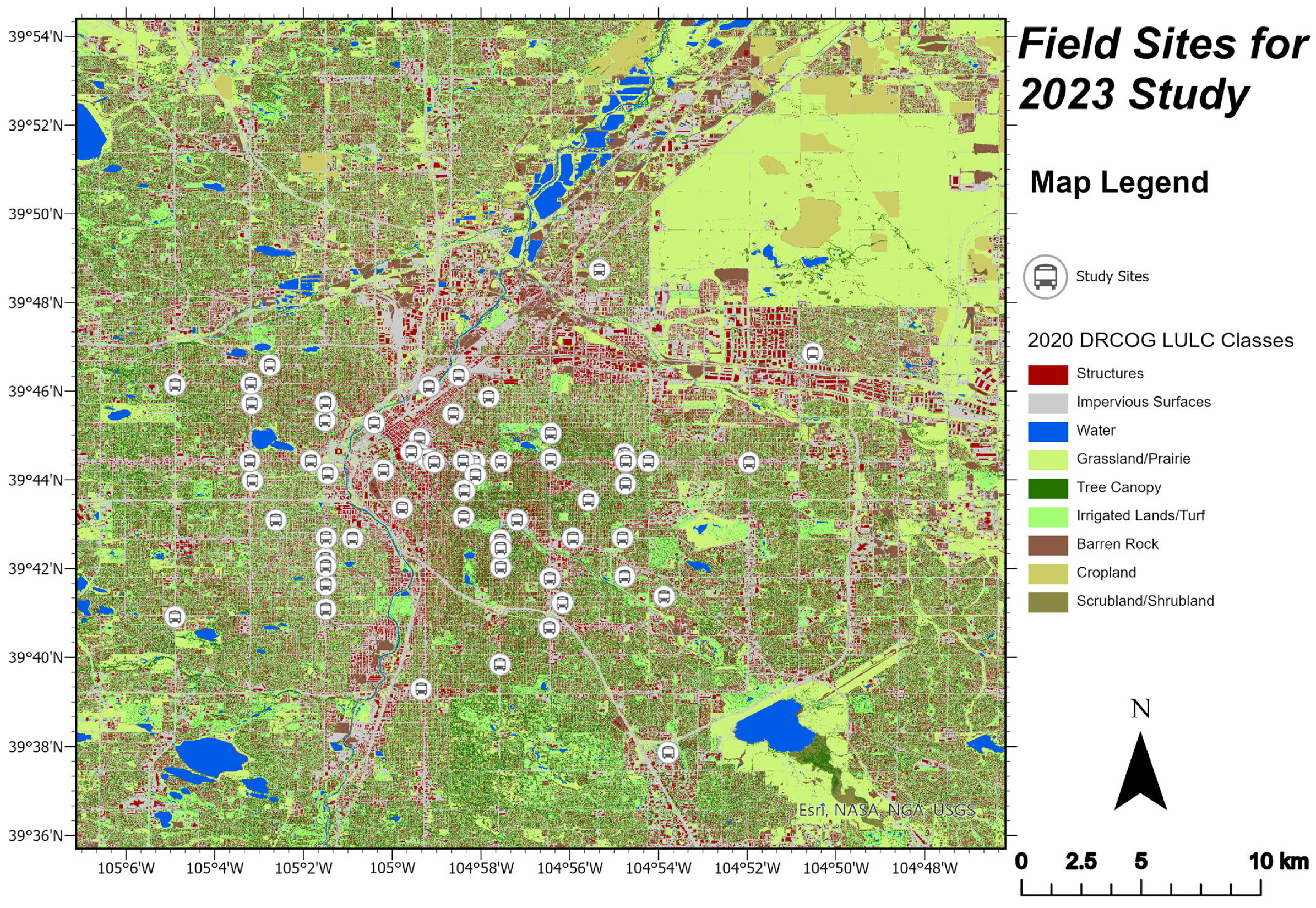
Biometeorological and surface temperature data collection occurred across 60 bus stops in the Denver metropolitan area, located in the Colorado Front Range, USA. Denver is a semi-arid city (Köppen Climate Classification: BSk; cold semi-arid climate) situated ~1600 m above sea level. The Regional Transportation District (RTD) manages the metropolitan public transit system, serving approximately 3.08 million residents and recording over 41 million bus boardings in 2023 alone [51]. To examine TS at bus stops, sites were selected from bus stops with above-average daily ridership for 2022 within the Denver metropolitan area and a 30 m buffer around each site representing a range of land cover, including impervious surfaces, vegetation, canopy cover, and building structure. Land cover data originated from the 2020 Land Use Land Cover dataset from the Denver Regional Council of Governments [52]. In total, 60 bus stops were identified as study sites in the Denver metropolitan region (Figure 1).
Three primary data sources were collected: (1) SD-LST calculated from the thermal bands of Landsat 8 and 9 satellite imagery, (2) biometeorological measurements of the thermal environment collected with a series of Kestrel 5400 sensors (Nielsen-Kellerman Co., Chester Springs, PA, USA), and (3) hyper-local FLIR thermographic images to measure TS captured using the FLIR C5 compact camera (Teledyne Inc., Thousand Oaks, CA, USA). Sources for satellite data are detailed in the following section, while field sampling is described in the methods section.

2.2. Satellite Derived Land Surface Temperature from Landsat

SD-LST were derived from the thermal band (Band 10) of the Landsat 8 and 9 images. Images were obtained from the United States Geological Survey (USGS) Earth Explorer Collection 2 Level 2 products. Because Landsat 8 and 9 have an ~eight-day revisit coverage, only four usable images were available for the Denver metropolitan area that coincided with the field campaign. Dates, satellite image titles, and percent cloud cover are documented below (Table 1).
SD-LST was calculated using the multiplicative scaling factor and additive offset from the Landsat Collection 2 Level 2 product guide [53] with the following equation:
S D L S T = ( ( B a n d   10   S T 0.00341802 ) + 149 ) 273.15
where Band 10 ST is the thermal measurement taken with Landsat’s Thermal Infrared Sensor (TIRS), 0.00341802 is the multiplicative scaling factor, 149 is the additive offset, and 273.15 converts the measurement from Kelvin to Celsius. Calculations were conducted using the Raster Calculator tool (Esri, Inc., Redlands, CA, USA) in ArcGIS Pro (Version 3.5). Thirty-meter buffers were drawn around each bus stop in the study. Using the Zonal Statistics tool, SD-LST was then extracted for these buffers. Thus, 30 m resolution SD-LST measurements were extracted for each bus stop on the four dates that coincided with FLIR image collection.

3. Methods

3.1. Sampling Design and Methodology

Data were collected during an extensive five-week field campaign during the hottest summer months, July and August 2023. Measurements were made twice each weekday—once in the morning and once in the afternoon—during peak commute hours (7:30–10:30, 14:00–18:00). Bus stops were randomly selected for each day of the week, with the goal of obtaining a total of six replications per study site: three in the morning and three in the afternoon.
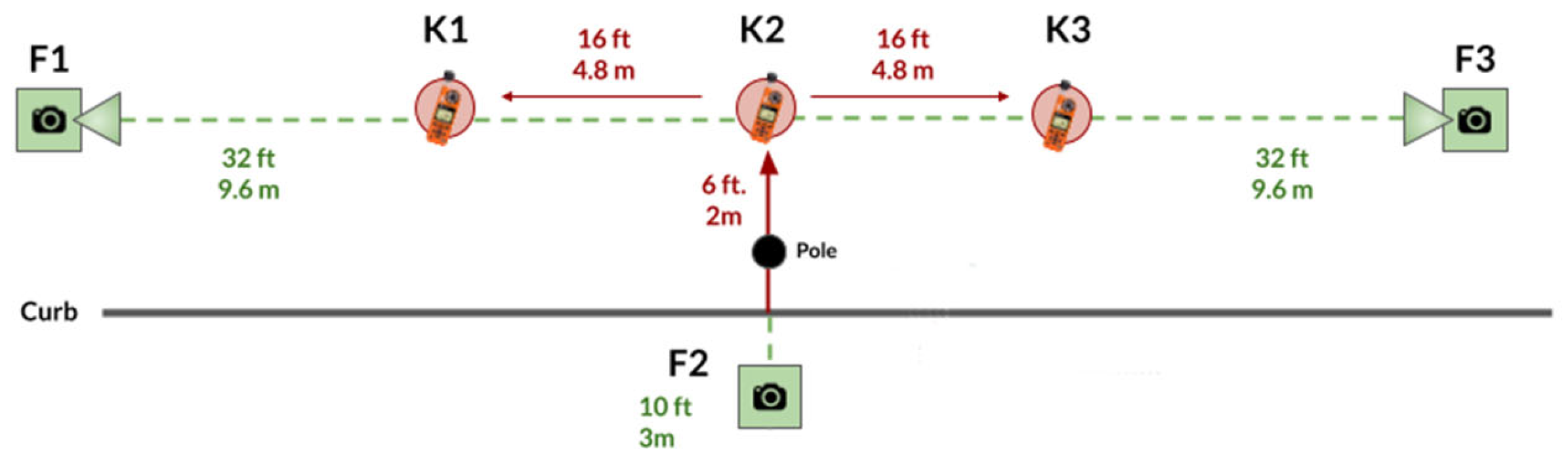
Hyper-local thermal dynamics of each bus stop were captured with thermographic images and biometeorological measurements. FLIR images were captured from three positions at the bus stop, forming a surface area of approximately 48 m2. FLIR image capture coincided with biometeorological measurements using a series of three Kestrel 5400 sensors (Figure 2).

3.2. Biometeorological Measurements

Biometeorological measurements taken with the three Kestrel sensors included air temperature (TAir), wind speed (Va), relative humidity (RelHum), Dry Bulb Globe Temperature (TGlobe), and Wet Bulb Globe Temperature (WBGT). The three sensors were calibrated to metric units and positioned 4.8 m apart on tripods at 1.1 m above ground level at each site, following methods designed by Dzyuban et al. [49], to capture the micrometeorology of the bus stop. Sensors were set up to acclimate for five minutes prior to recording. Sensors recorded for two minutes, with their measurements averaged.
Thermal comfort indices, including TMRT, were then calculated from these Kestrel measurements. TMRT was calculated using a modified method of the ISO black globe thermometer equation found in Ouyang et al. [54]. This modified method was specifically calibrated for the Kestrel sensor with a different convection coefficient and has the following equation:
T MRT = T Globe + 273.15 4 + 0.678 × 10 8 V a 0.019 0.95 150 0.4 T Globe T Air 0.25 273.15
where TGlobe and TAir are the globe temperature and air temperature in Celsius, respectively, and Va is the wind velocity in meters per second. The thermal comfort index Physiological Equivalent Temperature (PET) was calculated using the software RayMan Pro (Version 0.1) [55,56], and used inputs from the Kestrel sensors, TMRT, and self-reported personal and biometric factors from transit users who were willing to report these metrics while waiting for their bus. These inputs included weight, height, and sex, and clothing insulation as calculated by the clothing metric (clo), a metric that assigns values for different articles of clothing. The collection of these data was reviewed and approved by The University of British Columbia’s Behavioural Research Ethics Board under identification code H23-01399. Another thermal comfort index, the Universal Thermal Climate Index (UTCI), was calculated using the R package ‘comf’ (Version 0.1.12) [57] using TAir, TMRT, relative humidity, and wind velocity as inputs. A final thermal comfort index, WBGT, was obtained directly via the Kestrel sensors.

3.3. FLIR Image Capture, Segmentation, and TS Measurements

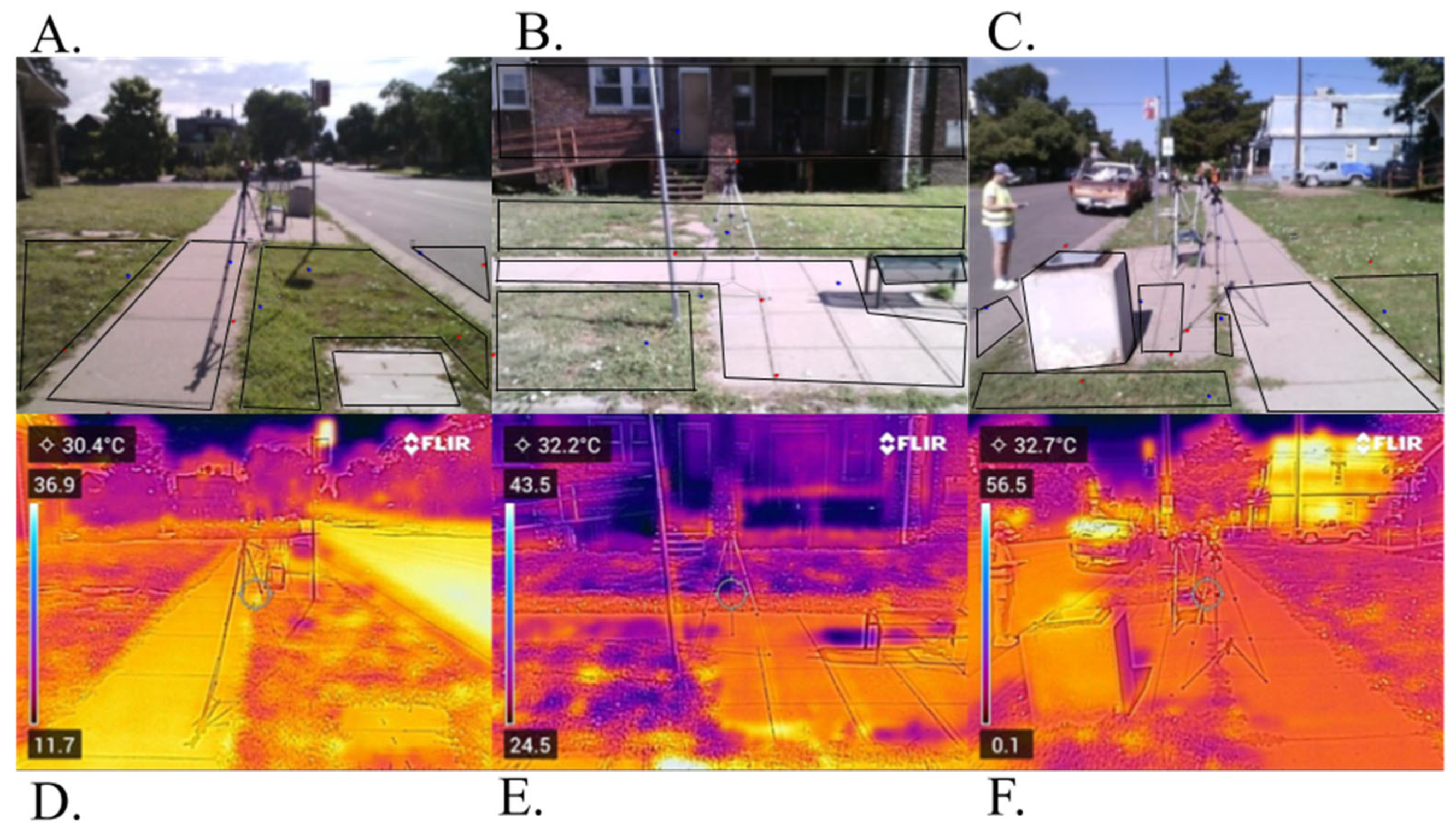
All three FLIR images were captured facing the bus stop to capture the TS of the ground and horizontal surfaces, including buildings and bus stop infrastructure. The FLIR C5 thermal camera was set to the standard emissivity of 0.95. Camera positions were standardized as follows: FLIR 1 (F1), oriented to the left of the bus stop; FLIR 2 (F2) positioned in the street facing the bus stop; and FLIR 3 (F3), oriented to the right of the bus stop. F1 and F3 were taken 9.6 m from the stop’s center point (defined as the pole displaying the unique bus stop identification number), while F2 was captured 3 m from this pole (Figure 2). These distances were chosen to approximate areas where most transit users wait. Images were then segmented into polygons using the proprietary software FLIR Thermal Studio Suite (Version 2.0). Segmentation was based on both surface type and camera placement. For F1 and F3, segments encompassed all surface types between the camera position and the central Kestrel (K2). For F2, segmentation included all surface types. Seven surface categories were defined: asphalt, concrete, fine vegetation (herbaceous surfaces such as grass), coarse vegetation (woody tissue of street trees), bare soil, building (walls or fences), and bus stop infrastructure (shelters, poles, benches, and other street furniture). An example of the images and their segmentation can be seen below (Figure 3).
Due to the heterogeneous composition of each bus stop and its associated surfaces, the segmented polygon size was not standardized. From each segmented polygon, an average TS was determined from the software and was recorded within each image position and for each replicate. If multiple polygons of the same surface types were present within a single FLIR image (e.g., several polygons classified as grass), their TS values were averaged. This value was defined as FLIR image segment TS.
From these FLIR image segment (polygon) TS measurements, a grand mean was calculated for each of the three FLIR images to produce a FLIR image average for a given bus stop. If a surface category was absent from an image (e.g., no coarse vegetation or bare soil at that stop), it was assigned a null value and excluded from the grand mean. Thus, three averages were generated per replicate, one for each FLIR image. Importantly, this grand mean was not the overall pixel-based TS mean of each FLIR image, provided by the FLIR Thermal Studio, but the average of the defined surface-type segments within a given FLIR image. This approach allowed for comparison across camera positions and assessment of how consistently they measured TS from their position across bus stops. This value was defined as the FLIR image TS.
Finally, the average for TS for each surface type was calculated across all three images. As with the FLIR image TS, a grand mean of bus stop TS was then derived by TS values across all surface types at a given bus stop, with the surface averages representing the mean across the three camera positions. Importantly, this grand mean was not the overall mean of the three FLIR images, but rather an aggregate of surface type averages. This approach allowed assessment of the consistency of TS measurements across surface types. This value was defined as FLIR bus stop TS.

3.4. Analysis of FLIR Camera Position and Surface Type for TS Measurement Consistency, Variable Selection

With multiple FLIR images taken from different camera positions, and numerous thermographic images segmented, we wanted to ensure our method for calculating the TS of all surface types was consistent over the range of camera positions and segmented polygons at each bus stop. We first examined summary statistics (mean, median, standard deviation, coefficients of variation, and interquartile range) of our TS sample for each surface type, as well as the average TS for all FLIR images taken at a stop, to examine the relative variation between mean surface TS and mean image TS.
To determine whether we were measuring the TS of shared surfaces consistently, we calculated intraclass correlations using the two-way random effects model for the mean of k raters (ICC2k). ICC2k treats raters as a random sample from a larger population and estimates the reliability of their average rating. In our case, the “raters” were delineated FLIR image segments (polygons), which varied in size and spatial shading patterns across bus stops. Because these polygons can be considered randomly sampled subdivisions of a heterogeneous surface, ICC2k was appropriate for evaluating the consistency of FLIR camera position across surface types (FLIR image segment TS). We then calculated ICC3k, a two-way mixed-effects model for the mean of k raters, which assumes that the set of raters is fixed. Here, the raters were the three FLIR camera positions, which were held constant across all bus stops (same distances, same orientations). ICC3k was therefore used to examine the consistency of surface temperature measures across camera positions and to test how reliably the average of these three camera-derived values (one per image) represented the overall bus stop TS, relative to the grand average of all segmented polygons. Across all cases, we used ICC estimates of consistency rather than absolute agreement, as our focus was on whether FLIR-derived measures covaried reliably across positions and image segments, rather than whether they produced identical values in a heterogeneous thermal environment.
ICCs were run using the package ‘psych’ in R [58]. Assessment of the ICC correlation coefficients, Cohen’s kappa, followed criteria with values less than 0.5 indicating poor consistency, between 0.5 and 0.75 indicating moderate consistency, between 0.75 and 0.9 indicating good consistency, and greater than 0.9 indicating excellent consistency [59]. The metric with the greatest consistency, or the highest Cohen’s kappa correlation coefficient, was selected as our representative variable of TS values captured by FLIR. The ICC coefficients of this analysis are found in Appendix A. Ultimately, FLIR bus stop TS was determined to be consistently measured across camera positions and was approved for use in this study.

3.5. Statistical Analyses

A linear mixed effect model was fit using the R package ‘lme4’ [60] to examine differences in Landsat’s TS (SD-LST) and FLIR TS. As Landsat captures photos in the morning only, a smaller subset of the data was used: FLIR images captured in the morning that coincided with Landsat’s orbital cycle. Both methods of measurement, FLIR TS and Landsat SD-LST, were placed as categorical fixed effects predicting bus stop TS. To account for repeated measurements and clustering, random effects included the date of image capture for both FLIR and Landsat, as well as the unique bus stop ID (BSID) for each study site location [61]. The equation for this model was thus as follows:
T S i j = β 0 + β 1 M e t h o d i j + b D a t e j + b B S I D i + ε i j
where TSij is the bus stop surface temperature for BSID i on j date, Methodij is the measurement method (0 = FLIR, 1 = Landsat), β0 is the mean TS for FLIR, the reference category, β1 is the fixed effect of method, bDatej and bBSIDi are the random effects for date and bus stop, respectively, and εij is the residual error.
To better understand the sources of variability in surface temperature measurements, we additionally examined the contribution of each component of the mixed-effects model separately. Specifically, we fit FLIR-only and Landsat-only models, including the same random effects for Date and BSID. This allowed us to quantify how much of the total variance was attributable to site-specific differences (BSID), day-to-day variation (Date), and residual measurement error, independently for each measurement method.
FLIR measurements and Landsat measurements were then compared to hyper-local Kestrel measurements and thermal comfort indices with a Pearson product-moment correlation matrix to examine correlations between these two methods and biometeorological measurements. Pearson correlations were assessed first for a significant linear correlation at an alpha of 0.05. Correlations above alpha were said not to be linearly correlated. Pearson correlation coefficients were then assessed for strength. Strongly correlated measurements were determined to be a Pearson correlation coefficient of 0.8 or higher.
We then examined how well the average TS, as captured by the FLIR, predicted hyper-local measurements of the bus stop, including TAir and indices of thermal comfort: WBGT, TMRT, UTCI, and PET. Another series of five linear mixed-effects models was generated, this time predicting these metrics.
Y i j = β 0 Y + β 1 F L I R T S i j + b D a t e j + b B S I D i + ε i j
where Yij represents one of the five biometeorological metrics (TAir, WBGT, TMRT, UTCI, or PET), β0 is the model intercept, β1 is the fixed effect of FLIR TS, and bDatej and bBSIDi are the random effects of date and bus stop, and εij is the residual error.
As we were not limited by Landsat’s orbital rotation, the larger data set that coincided with the field campaign was used, with the exception being the model predicting PET, which required biometric information from willing transit users as inputs for the calculation of PET. As not all transit users were willing to report this, the sample size for PET remained lower. Random effects also included study site (BSID) and date; however, after likelihood ratio testing of nesting models, BSID was ultimately dropped as a random effect to avoid issues of singular fit that would occur if left as a random effect in the model: the random effect was too complex for these data, resulting in an overfitted model. Lastly, Root Mean Squared Error (RMSE) values were calculated for each model, both for fixed effects within the model only and for the full mixed-effects model, to see if these models were reasonable for use under ISO 7726 standards for thermal comfort methods, for which an error of less than five degrees Celsius indicates adequate model fit [62]. Significance within all models was evaluated at an alpha (a) of 0.05, and model diagnostics were visualized to check their performance and assumptions.

4. Results

4.1. Description of Collected Data and Bus Stop Structure

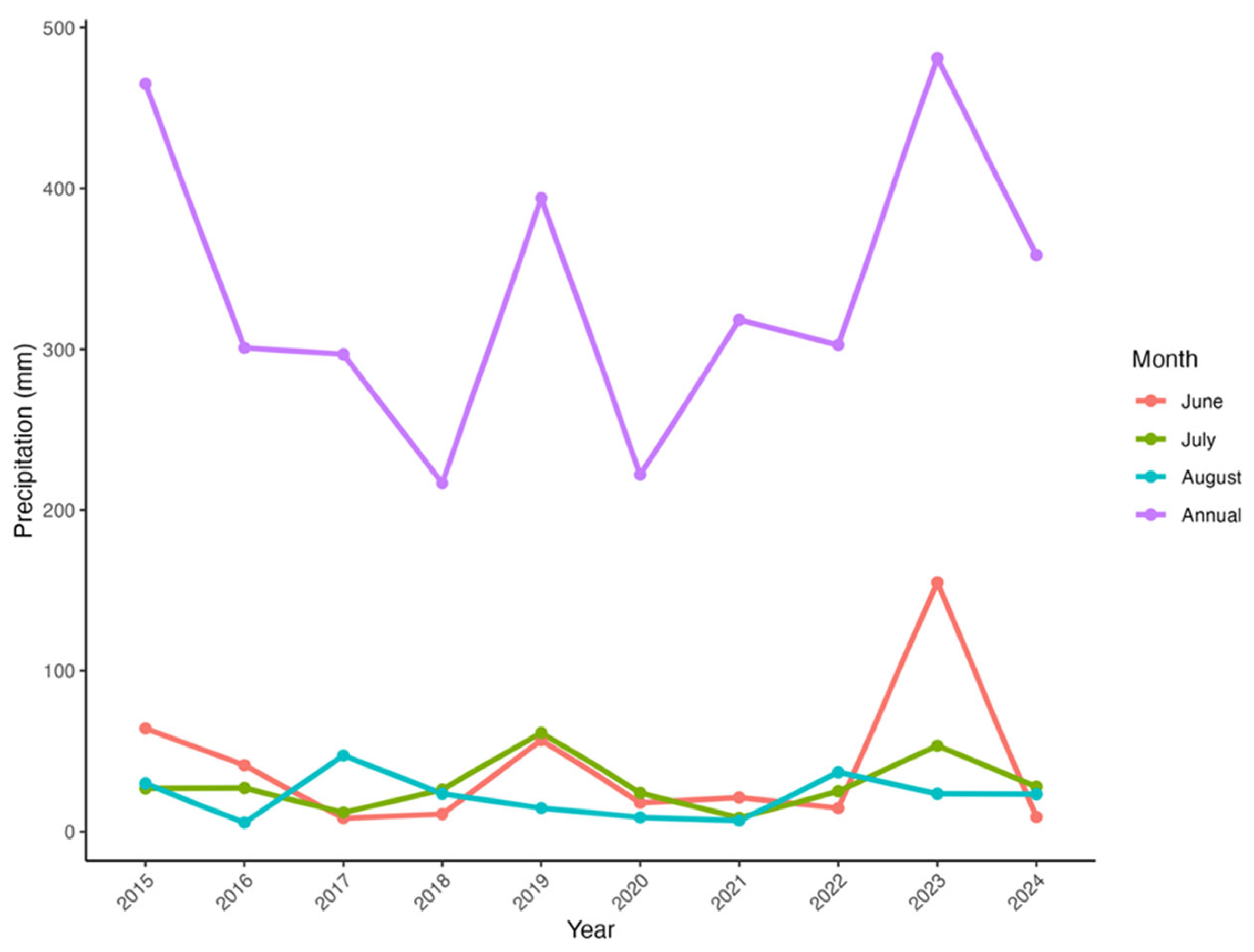
The study originally aimed to collect 360 replicates of the 60 study sites (bus stops), 180 each for both the morning and afternoon. However, during summer of 2023, the Denver metropolitan area received increased afternoon precipitation. Compared with the previous decade, it was a historically wet summer and year (Appendix B, Figure A3). Data were not collected during this period of active rainfall, as wet surfaces would confound our FLIR TS measurements. While all sites saw at least one replicate for both the morning and the afternoon, only 43% of all 60 study sites had a full three replicates in the morning and the afternoon. A total of 93% of all 60 sites had at least two replicates in the morning and the afternoon. After accounting for this, the representative sample of bus stop FLIR thermographic image capture was n = 270 across 19 unique dates. Additionally, only a subset of FLIR data coincided with Landsat’s image capture, as Landsat is limited by its orbital cycles. The representative subsample is n = 66, with 33 measurements of each of Landsat and FLIR across 4 days at 19 unique bus stops, after removing sites obstructed by clouds.
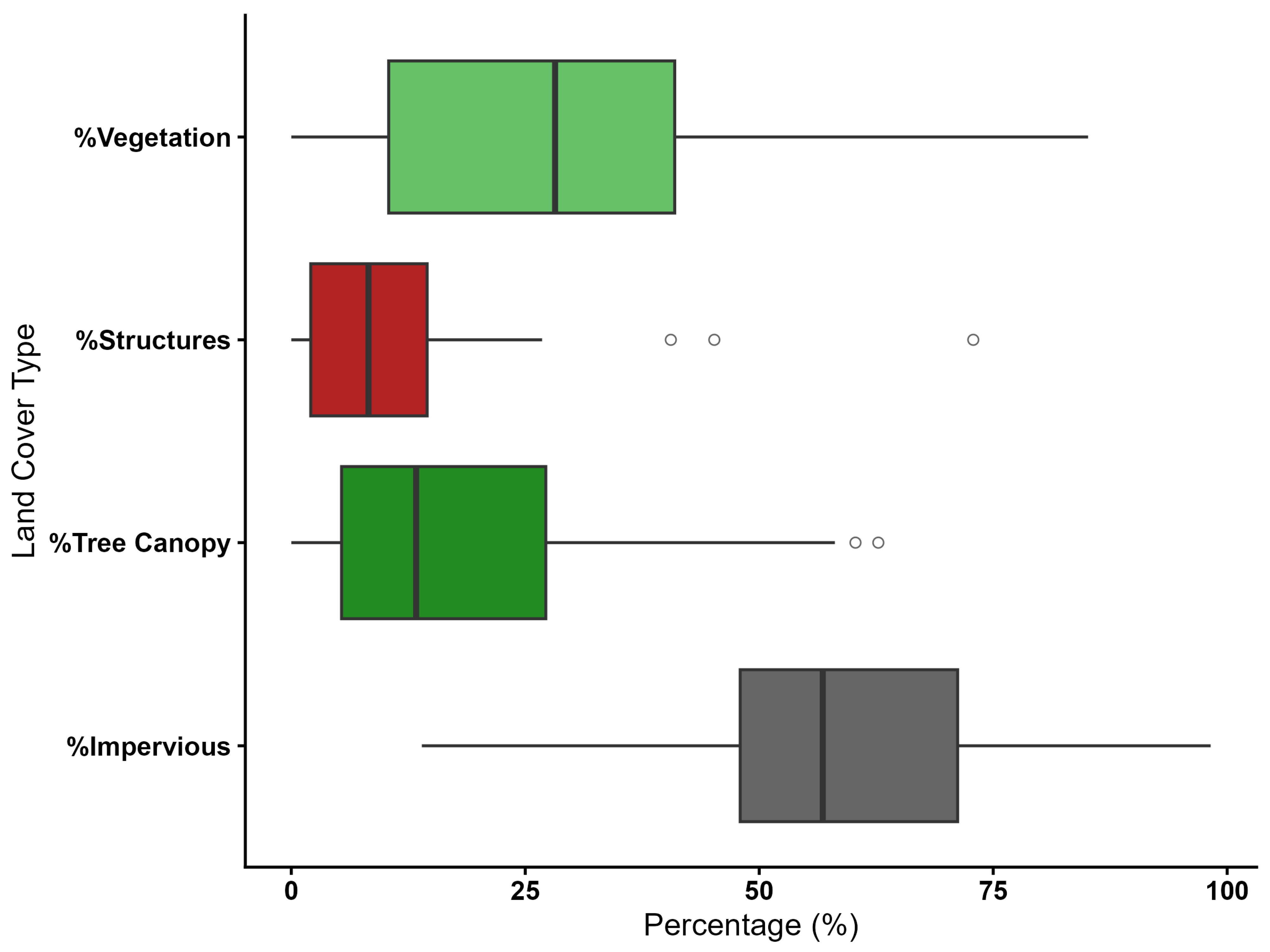
Descriptive statistics for the percentages of land cover composition, captured from 30 m buffers of each bus stop, are presented below (Table 2 and Figure 4). On average, bus stops were predominantly surrounded by impervious surfaces (Mean = 57.26%, SD = 20.26%), followed by softscapes/vegetation (Mean = 29.84%, SD = 22.57%). In terms of obstruction, the tree canopy was greater (Mean = 18.55%, SD = 17.66%) than built structures (Mean = 10.60%, SD = 12.26%).

4.2. Differences Between Landsat SD-LST and FLIR TS

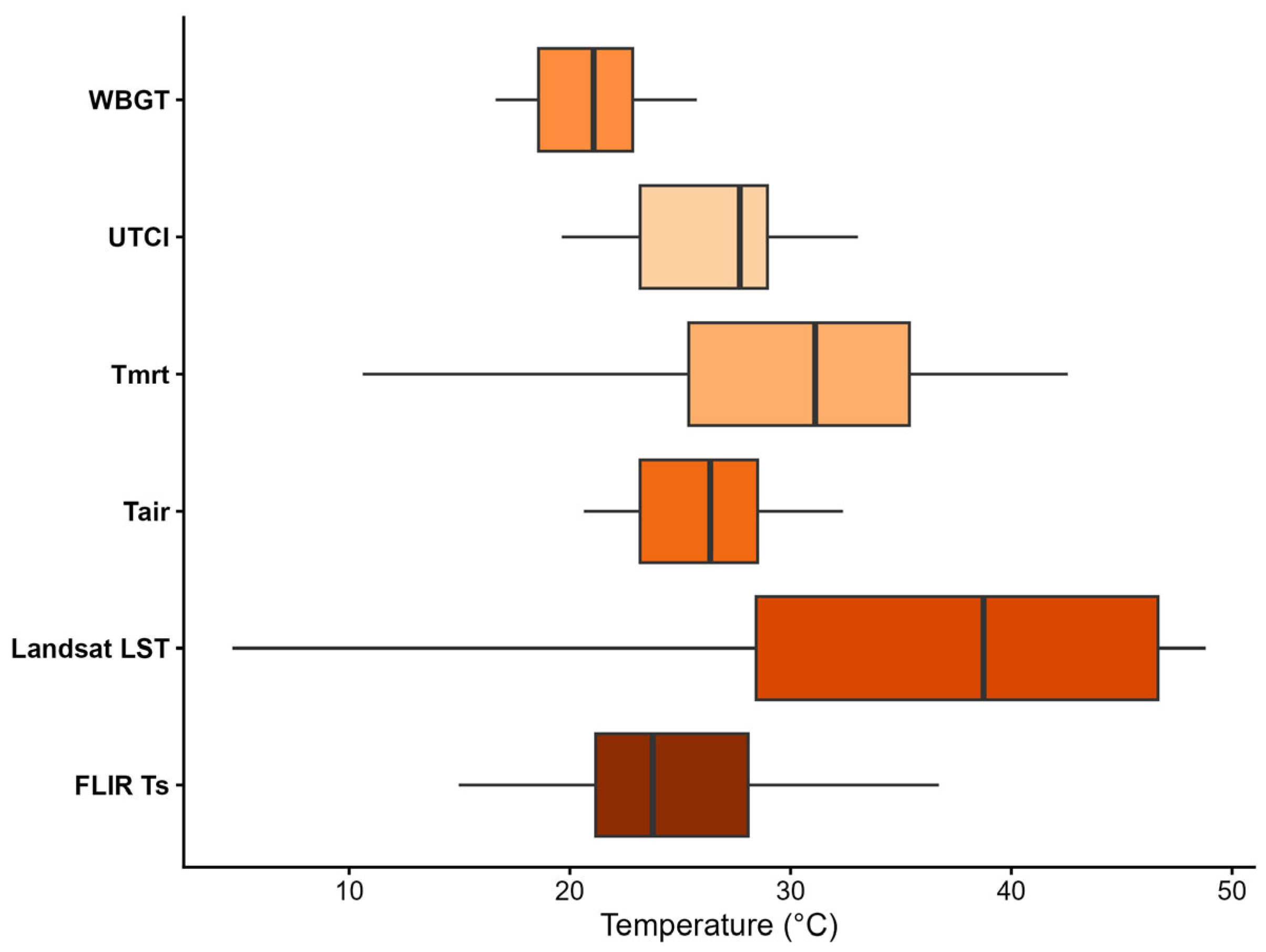
Descriptive statistics for differences between TS as measured by FLIR and Landsat were detailed (Table 3). On average, Landsat recorded higher surface temperatures (Mean = 35.8 °C) compared to FLIR (Mean = 25.0 °C), with a notably wider spread in values. The interquartile range (IQR) for Landsat 8 was 18.2 °C—nearly three times that of FLIR (6.91 °C)—indicating greater variability. The standard deviation and coefficient of variation were also higher for Landsat (SD = 12.4 °C, CV = 0.35) than for FLIR (SD = 5.36 °C, CV = 0.21). Furthermore, the minimum and maximum temperatures recorded by Landsat 8 spanned a broader range (4.71 °C to 48.8 °C) than those recorded by FLIR (15.0 °C to 36.7 °C), suggesting Landsat captured more extreme values.
For the biometeorological variables, TAir had a mean of 26.1 °C with moderate variability (SD = 3.27 °C, CV = 0.13). WBGT averaged 20.8 °C (SD = 2.59 °C, CV = 0.13), while TMRT exhibited higher variation (Mean = 30.4 °C, SD = 7.44 °C, CV = 0.24), reflecting microclimatic differences at bus stops. UTCI averaged 26.6 °C (SD = 3.82 °C, CV = 0.14), indicating moderate thermal stress.
These results are further visualized (Figure 5). The boxplots show a clear difference between SD-LST as measured by the Landsat satellites and bus stop average TS as measured by the FLIR. The FLIR displays less variation and tends to be cooler, while Landsat tends to be hotter with greater variance (Figure 5). In addition, median FLIR TS is closer to other biometeorological metrics, including TAir, WBGT, TMRT, and UTCI (Figure 5).
We then further quantified these differences by accounting for date and bus stop as random effects in a linear mixed-effects model (Table 4). Landsat 8 is on average 10.77 degrees Celsius hotter than the average bus stop TS measured by the FLIR (Table 4, β). Measurements display a poor intraclass correlation (ICC = 0.35). Additionally, surface temperature varies more by date (τ00 Date = 28.04) than by study site (τ00 BSID = 7.59). Overall, this model explains a moderate amount of variation (Conditional R2 = 0.5) in surface temperature between the two methods. Differences in variance in these measurements did not affect the model’s residual variance, with model diagnostics suggesting homoscedasticity.
To examine the variability of our random effects, we then fit linear mixed-effects models to FLIR-only and Landsat-only TS measurements, including random intercepts for BSID and Date to account for repeated observations (Appendix B, Table A6). FLIR measurements had a mean TS of 26.1 °C (95% CI: 23.4–28.9 °C), with most variation occurring at the site level (SDBSID = 4.32 °C) and relatively low day-to-day variation (SDDate = 1.47 °C). In contrast, Landsat measurements were higher on average (36.2 °C, 95% CI: 24.2–48.1 °C) and dominated by day-to-day variability (SDDate = 11.28 °C), with smaller site-to-site differences (SDBSID = 3.43 °C). Residual variation was greater for Landsat (SD = 6.81 °C) than FLIR (SD = 3.14 °C), and the ICC was higher for Landsat (0.73) than FLIR (0.37), indicating that a larger proportion of Landsat variance was explained by clustering, particularly by Date. These results indicate that FLIR captures fine-scale, site-specific variation more effectively, whereas Landsat reflects broader temporal variability.
We then sought to see how closely these measurements were correlated to hyper-local biometeorological measurements, namely TAir, WBGT, TMRT, and UTCI. A Pearson correlation matrix was generated using a Pearson product-moment correlation. Significant linear correlations are denoted with asterisks (Table 5).
Landsat’s Ts measurements are more poorly correlated than the hyper-local measurements taken with the Kestrel (Table 5, All r < 0.8, bottom row). Additionally, with insignificant Pearson correlation coefficients, we fail to reject the null hypothesis that Landsat’s correlation to the micrometeorological measurements is equal to zero, thus failing to demonstrate a linear correlation between Landsat’s SD-LST measurements and biometeorological metrics. The FLIR measurements remain much more strongly correlated with these biometeorological measurements, especially thermal comfort indices including TMRT, UTCI, and WBGT (Table 5, All r > 0.8, top row). With all metrics having significant Pearson correlation coefficients, we can reject the null hypothesis that these correlations are equal to zero. We conclude that the TS measured by the FLIR is significantly correlated with the human biometeorology at bus stops in a semi-arid system, while the TS measured by Landsat is not.

4.3. FLIR TS and Thermal Comfort

We then wanted to determine how well the average bus stop TS, as measured by the FLIR, could predict hyper-local measurements, particularly indices of thermal comfort for use in future urban heat studies. The results of five linear mixed-effects models predicting TAir, WBGT, UTCI, PET, and TMRT are displayed below (Table 6). Representative sample for TAir, WBGT, UTCI, and TMRT was n = 270, while for PET it was n = 47.
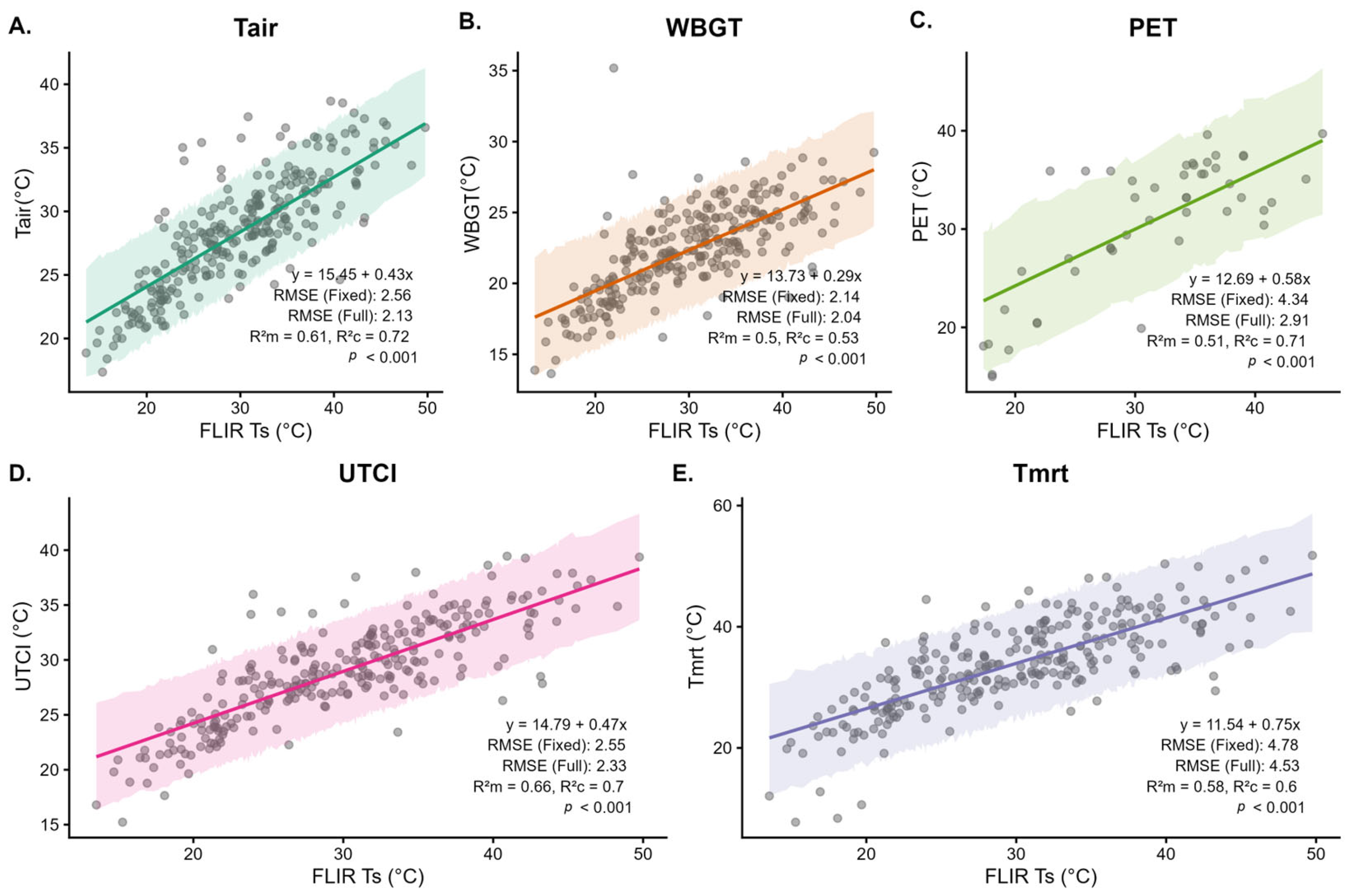
All hyper-local measurements showed significant positive correlations with the bus stop average TS as measured by the FLIR (Table 6, p-values). The strongest relationship was between TS and TMRT, for which a per-unit increase in TS results in a 0.75 increase in TMRT (Table 5, β). In addition, this model is notable for being the only one out of the five for which the study sites contributed the most variance as a random effect instead of date (τ00 BSID). Other indices of thermal comfort, including UTCI and PET, also showed significant relationships with bus stop average TS, 0.47 for UTCI and 0.58 for PET (Table 6, β). In addition, both UTCI and TAir explained the largest amounts of variance as fixed effects, 0.66 for UTCI and 0.61 for TAir (Table 6, Marginal R2).
RMSE values for assessment under ISO 7726 were then calculated for both fixed effects and for the entire mixed-effect models. Regression results are further visualized below (Figure 6). All models display RMSE values under 5 degrees Celsius, for both fixed effects (blue) and full effects (red), indicating adequate fit for thermal comfort studies under ISO 7726.

5. Discussion and Limitations

5.1. Landsat SD-LST as a Hotter and Weak Thermal Comfort Correlate

This study demonstrated that the TS, as measured from the Landsat 8 and 9 orbitals (SD-LST), is on average 10.7 degrees Celsius hotter than the TS measured from the FLIR C5, and that it is not significantly correlated with other hyper-local measurements, including indices of human thermal comfort. This corroborates recent calls for urban heat studies to move beyond SD-LST for accurate accounting of pedestrian thermal comfort [12,23,24,28]. It seems that ground-based, hyper-local investigations of urban heat remain crucial to our understanding of human biometeorology.
This study utilized the method outlined by the USGS Level 2 Science Products Guide [53] for SD-LST calculation; however, it is worth noting that other satellites, methods, product levels, and equations exist for its quantification [1,2]. We are not precluding the potential usefulness of these alternatives in assessing pedestrian thermal comfort. However, with a majority of UHI studies utilizing Landsat [9], it seems that the USGS Level 2 Science Product 30 m SD-LST metric is not useful for hyper-local pedestrian thermal comfort analysis. Future studies could compare these alternatives to FLIR photogrammetry and other biometeorological measurements to see how they differ. For now, this calculation method seems incongruous with the current needs of outdoor pedestrian thermal comfort inquiry.
Critically, we did not examine why there are differences in TS measured from Landsat and the FLIR C5. There are two notable inconsistencies between the methods of measurement. The first is temporal. Landsat’s image capture occurs between 10:00 and 10:30 a.m., with our FLIR images being captured between 7:30 and 10:30 a.m., resulting in slight incongruities at the time of image capture. The other notable difference between the two methods is resolution; Landsat is resampled to 30 m, and our FLIR area is roughly 10 m. While investigating reasons for the difference in TS measurements was not a question posed in this study, we wish to highlight these limitations and speculate on some sources of these differences.
Most importantly, the size of a Landsat thermal pixel relative to a bus stop introduces substantial spectral mixing, where multiple surface types (e.g., roadway, sidewalk, vegetation, built structures, shade) are aggregated into a single 30 m pixel. This mixed-pixel effect likely produced regression attenuation simply due to the scale mismatch between Landsat and FLIR. Namely, given the propensity of bus stops to be located near major vehicle roadways, these impervious surfaces were likely partially located within Landsat pixels, which could result in higher SD-LST temperatures. Future studies examining factors that make up this difference, including land cover metrics [63], as well as different compositions of shade may yield helpful insight into microclimatic variability [43].
Additional contributors to the mismatch may include differences in emissivity assumptions between Landsat and the FLIR sensors, as well as the presence or absence of shade structures at the time of image capture, both of which can shift TS estimates. More explicit examination of these factors would help explain if the divergence between FLIR and Landsat is largely a scale- and physics-driven issue rather than purely methodological. Although methods exist to refine the resolution of Landsat’s coarse computation of SD-LST [64], Landsat still remains limited by its orbital cycle and often obstructive cloud cover [4,5]. Furthermore, the SD-LST from Landsat is increasingly recognized as being a poor proxy for measures of thermal comfort [28], such as UTCI and PET [23,24], and may need to be validated with in-situ measurements when used for this application [15].
Therefore, despite the uncertainty in differences between these measures of surface temperature, we ultimately conclude that TS captured by the FLIR offers greater insights into the micrometeorology, shade, and vertical representations of a hyper-local thermal environment. Coupled with its ability to measure the TS of outdoor spaces as they are being actively used, we conclude that FLIR has more utility than Landsat for analyzing the TS of hyper-local thermal environments, particularly semi-arid transit systems.

5.2. FLIR Photogrammetry and Pedestrian Thermal Comfort

This study yielded significant results in hyper-local FLIR thermal imagery’s ability to predict both modeled indices of thermal comfort, such as TMRT and UTCI, and demonstrates the ability of consumer-grade FLIR technology to be effective in the needs for thermal comfort studies under ISO 7726. Conversely, SD-LST measurements taken with the Landsat were weakly correlated with these hyper-local FLIR measurements, and, therefore, solely relying on SD-LST continues to be ineffective at portraying human thermal experience [12,13,65].
Previous studies have demonstrated this relationship with more complex methods. Middel et al. [65] utilized a “PanoMRT” system, by which TS recorded alongside the MaRTy mobile weather station, documenting both shortwave and longwave radiation from six directions. It was found that the six-directional FLIR imagery from the PanoMRT system predicted UTCI best, with the lowest RMSE, but that PET and TMRT are also well-predicted, with their models also falling under the five-degree threshold put forth by ISO standards for thermal comfort studies. The system’s ability to predict these metrics outperformed RayMan, a conventional method, ultimately postulating that its ability to measure longwave radiation fluxes is a key to its success.
Our study yielded similar results with simpler methods and instruments. Three-directional FLIR photogrammetry predicted both TMRT, PET, and UTCI with similarly adequate RMSE values (4.53 for TMRT, 2.94 for PET, and 2.33 for UTCI). While [65]’s methods utilized the MaRTy mobile weather station, measuring both longwave and shortwave radiation for more accurate measurements of TMRT, we still achieved significant results with the less costly use of a black globe thermometer. While we contend that the MaRTy mobile weather station and its ability to measure radiation directly are likely superior to black globe thermometers and their ever-expanding list of TMRT equations, we still posit that simpler methods are adequate for use under ISO standards. Both instruments used in this study, the Kestrel 5400 and FLIR C5 thermal camera, are consumer-grade products and adequate for non-research applications. It seems that the FLIR C5 camera, which only captures longwave radiation, can also predict human thermal comfort indices with adequate accuracy.
Stewart et al. [12] also highlighted the need for hyper-local TS measurements of multiple surfaces, namely those that cannot be captured by the 2-D photography on a satellite, such as walls and other vertical surfaces. Proposing a method called Tped, they outlined a need for weighted averages of these surfaces to capture human thermal experience. While this study largely took this approach, the surface types were still averaged, resulting in a loss of variance among surface types. Future studies could consider controlling for this loss of variance and select study sites based on the composition of surface materials to see which surfaces provide lower TS as well as lower indices of thermal comfort, especially since different surface and ground cover types are known to influence TMRT [33,34,35,66], which in turn has implications for the calculations of thermal comfort indices.
In further terms of variance, Date continued to account for more variance than BSID in nearly all thermal comfort models, the notable exception being when FLIR TS predicted TMRT (Table 4 τ00 BSID). While this speaks to the possibility of daily meteorological conditions and extreme heat events driving thermal comfort over bus stop structural heterogeneity, it was noteworthy that this pattern did not hold for all thermal comfort indices, namely one that is difficult to quantify [19]. While a different formulation than the modified equation used in this study might yield different results, the variance captured by this site-level random effect warrants further exploration, especially given that past urban heat mitigation strategies have overlooked this variable and prioritized the use of SD-LST to inform interventions [31].
Similar approaches are also found in the use of ENVI-met (Version 4.4.4), which creates 3-D simulations to determine surface temperatures based on various urban materials [67]. However, it too faces challenges when representing vertical mixing of radiative heat transfer [68]. With inaccurate measures of longwave radiation from the ground suspected as a contributor to these challenges [69], perhaps this simpler method could provide useful measurements for ground-based surface temperatures used in ENVI-met simulations.
Lastly, in the systematic literature review outlined by Wu et al. [41], there is scant literature linking outdoor TS from thermal imagery to subjective thermal perception. When it does occur, participants’ facial TS is measured rather than the TS of the surrounding environment. Given the linkages among FLIR TS and indices of thermal comfort, future research could consider measuring TS with the FLIR alongside subjective thermal perception, i.e., thermal comfort surveys, to see if FLIR technology can also predict the subjective experience of the thermal environment.

5.3. Limitations

A limitation in this study’s use of FLIR thermal cameras is the potential uncertainty introduced by radiometric assumptions inherent to infrared thermography. Thermal cameras measure upwelling longwave radiation and convert this to a radiometric temperature using an assumed surface emissivity (a constant 0.95 in this study). Spatially heterogeneous emissivity assignments (for example, across different materials or coatings) can bias derived brightness temperatures and flux estimates if not explicitly measured or corrected [70]. Although we accounted for different bus stop surface heterogeneity by segmenting our FLIR images, specific corrections to emissivity values for certain materials could be made in future studies.
In addition to emissivity uncertainty, urban surfaces exhibit directional (anisotropic) thermal emission, meaning that apparent radiometric temperature varies with sensor viewing angle because of the three-dimensional geometry and orientation of surface facets. This anisotropy arises from differences in the proportion of sunlit and shaded surfaces within the sensor’s field of view, compounded by variable emissivities across materials and orientations [71,72]. While we hope we accounted for some anisotropic bias by positioning three FLIR cameras at different directions towards the center of the bus stop, this method cannot eliminate anisotropic uncertainty in its entirety. Continuing to document and test emissivity assumptions for each material, quantifying residual anisotropy after multi-view averaging, and incorporating geometric or radiative modeling to correct for directional effects are needed to refine similar temperature studies in complex urban environments.

6. Conclusions

This study examined the differences in TS at bus stops from two measurement methods: macroscale SD-LST from the Landsat 8 satellite and hyper-local, FLIR thermography. In addition, it linked TS derived from FLIR photogrammetry to some commonly used thermal comfort indices to examine its use in predicting human thermal experience, including TMRT, PET, and UTCI.
We demonstrated that TS, as measured by Landsat, is on average 10.7 degrees hotter than FLIR measurements. Additionally, FLIR measurements are strong and significantly correlated to the micrometeorological measurements of the bus stop (r > 0.8, p < 0.001), while Landsat measurements have no significant correlations. Lastly, the average TS measured by the FLIR was able to explain over 50% of the variation in TAir, WBGT, UTCI, PET, and TMRT. With these models having RMSE values below five degrees Celsius, segmented FLIR image averages are adequate for use in thermal comfort studies under standards put forth by the ISO.
Ultimately, we find that this novel method of utilizing thermal image photogrammetry is sufficient as a simple method and low-cost alternative for analyzing the TS of bus stops, overcoming some of the challenges of scale posed by the Landsat satellites, which were demonstrated to be insignificantly correlated to hyper-local biometeorological measurements. Continuing to examine why these differences exist, along with other measurement methodologies for capturing SD-LST, would be helpful for advancing analyses derived from satellite imagery. In sum, hyper-local thermographic images are effective at predicting indices of human thermal comfort at bus stops, offering potential solutions for prioritizing heat-resilient transit design in semi-arid transit systems.


Author Contributions

Conceptualization, M.R.M., P.C.I. and P.d.; methodology, L.S., M.R.M. and P.C.I.; formal analysis, L.S.; investigation, L.S. and M.R.M.; data curation, L.S. and P.C.I.; writing—original draft preparation, L.S.; writing—L.S., P.C.I. and P.d.; visualization, L.S.; supervision, M.R.M. and P.C.I.; project administration, M.R.M., P.C.I. and P.d.; funding acquisition, M.R.M., P.C.I. and P.d. All authors have read and agreed to the published version of the manuscript.

Funding

This work was supported by the National Science and Engineering Research Council of Canada (NSERC) under a “Ufor” CREATE scholarship and a NASA Research Opportunities in Space and Earth Science (ROSES) grant 21-EEJ21-0064.

Data Availability Statement

Data for this article are available at the following link: https://doi.org/10.5683/SP3/37PJNM (accessed on 18 December 2025).

Acknowledgments

The authors wish to thank and acknowledge the United States Forest Service Denver Urban Field Station, including members Benjamin Crawford, Austin Troy, and Travis Warziniak. In addition, we wish to thank the numerous field technicians who helped collect data for this study, including student contractors of the United States Geological Survey, who collected biophysical data. We further wish to thank Cody Bingham and Thomas Gao for helping process thermographic images. Any use of trade, firm, or product names is for descriptive purposes only and does not imply endorsement by the U.S. Government. The survey described in this report was organized and implemented by The University of British Columbia and was not conducted on behalf of the United States Geological Survey.

Conflicts of Interest

The authors declare no financial/personal interests that may be considered as competing interests in this study.

Abbreviations

The following abbreviations are used in this manuscript:
BSIDBus stop identification number
DRCOGDenver Regional Council of Governments
FLIRForward-Looking Infrared
ICCIntraclass correlation coefficient
ISOInternational Organization for Standardization
LCZLocal climatic zone
LULCLand use land cover
PETPhysiological equivalent temperature
RMSERoot mean squared error
RTDRegional Transportation District
SD-LSTSatellite-Derived Land Surface Temperature
TIRSThermal infrared sensor
UHIUrban Heat Island
USGSUnited States Geological Survey
UTCIUniversal thermal climate index
WBGTWet bulb globe temperature

Appendix A. TS of Surface Types, Camera Position, and Bus Stops—Analysis for Dependent Variable Selection

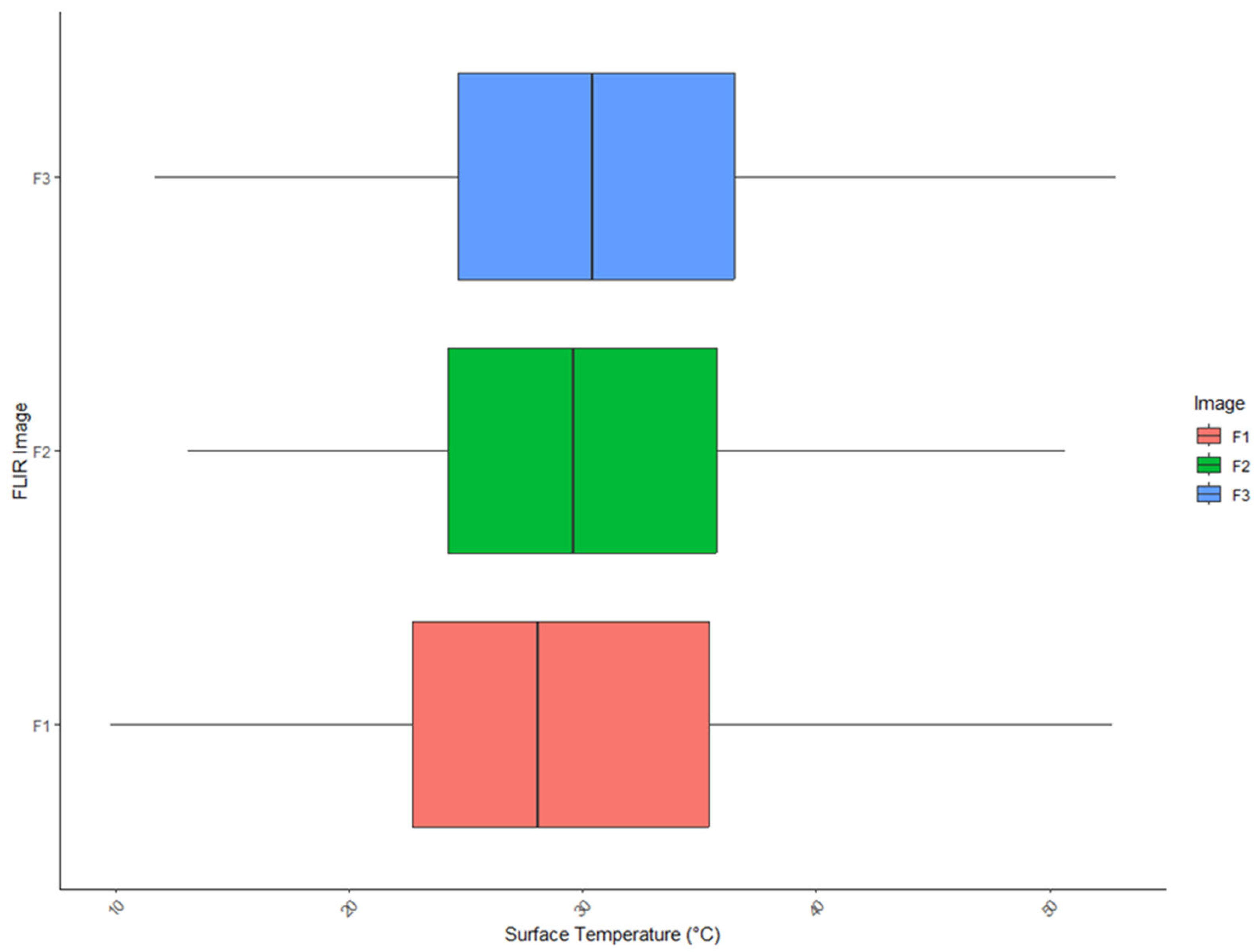
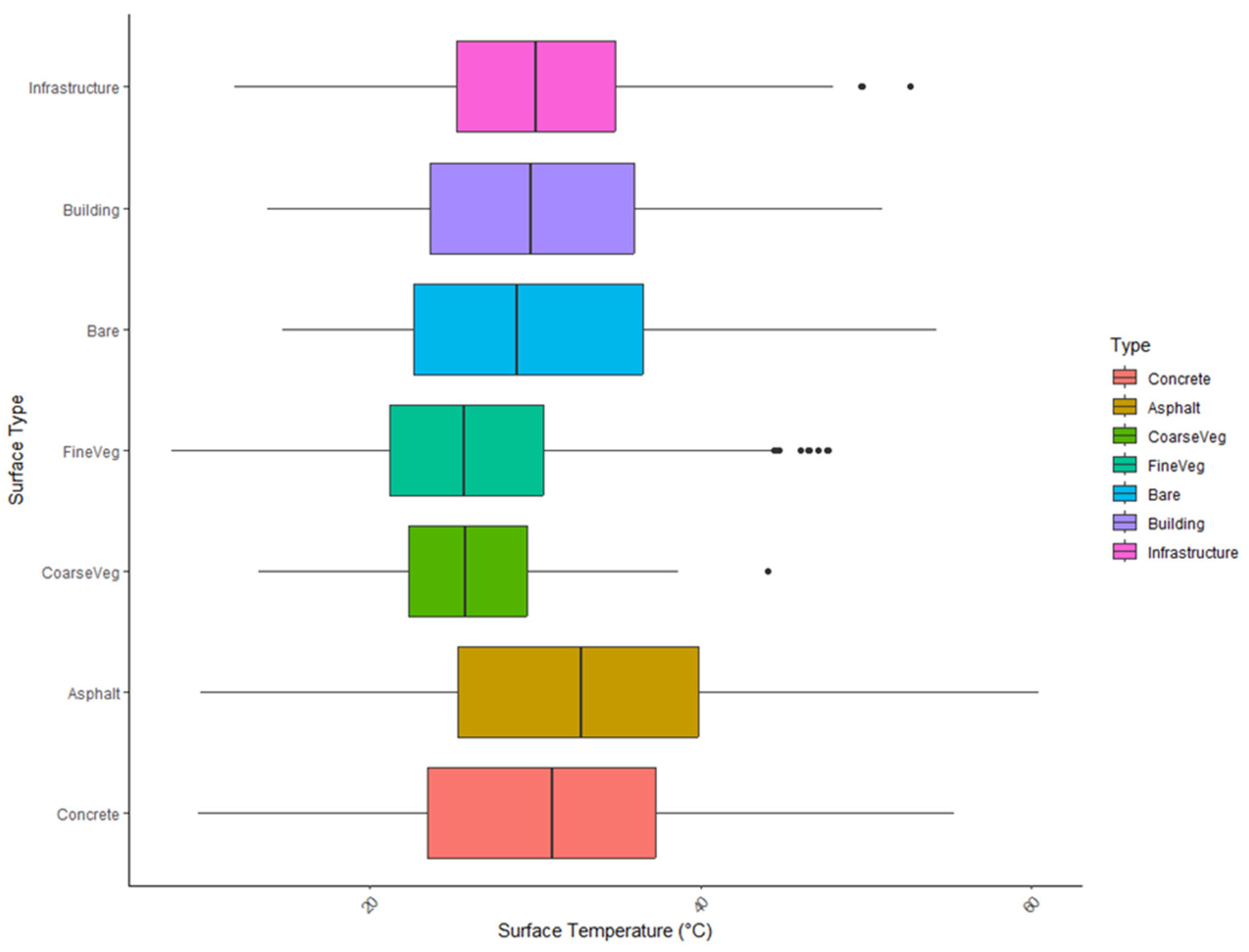
To examine the differences in variation between the TS of different surface types and the mean TS of FLIR image positions, the standard deviation (SD), coefficient of variation (%CV), median, and interquartile range (IQR) were calculated across these methods. The following tables compare and contrast these differences (Table A1 and Table A2). Additionally, box plots visualizing these tables can be found within this section (Figure A1 and Figure A2).
Table A1. TS averages, standard deviations, coefficients of variation, medians, and interquartile ranges across all FLIR image segment surfaces: FLIR image segment TS.
SegmentMean TS
(°C)
SD%CVMedian TS
(°C)
IQR
Concrete31.729.0128.3932.1213.45
Asphalt33.169.6229.0132.8314.83
Fine Veg.27.547.4226.9426.799.93
Coarse Veg.26.535.3220.0526.587.32
Bare30.009.3030.9929.3413.66
Building31.278.1526.0830.9911.44
Infrastructure30.606.9422.6730.859.46
Table A2. TS averages, standard deviations, coefficients of variation, medians, and interquartile ranges across all FLIR image positions and bus stops: FLIR image TS.
Image PositionMean TSSD%CVMedian TSIQR
F129.038.2728.4728.1112.70
F230.017.7225.7329.6311.53
F330.847.9125.6630.4211.81
Figure A1. Distribution of mean TS for all surface types (polygons) across all bus stops. The boxes represent the interquartile range (IQR) of values, and the horizontal line within each box indicates the median. Outliers are shown as individual points outside the whiskers, which extend to the value nor further than 1.5 times the IQR from the box.
Remotesensing 18 00348 g0a1
Figure A2. Distribution of image average TS for FLIR positions across all bus stops. The boxes represent the interquartile range (IQR) of values, and the horizontal line within each box indicates the median.
Remotesensing 18 00348 g0a2
Expectedly, the mean and median of TS are different across surface types (FLIR image segment TS). Impermeable surfaces such as concrete and asphalt tend to be hotter on average than impermeable surfaces such as fine and coarse vegetation (Table A1). There is also noticeable variation among different image segments, with concrete, asphalt, and bare surfaces showing the highest standard deviations and coefficients of variation. In contrast, coarse vegetation exhibits the lowest variation (SD, %CV, Table A1). The FLIR image TS values demonstrate less variation, with mean TS differing by about 1 degree across image positions, and the range of variation being smaller than that demonstrated by surface type (Table A2).
However, given that the TS of each surface was an average of a polygon, and the amount of shade or polygon size is accounted for, we wanted to examine how each camera position (FLIR 1, 2, and 3) measured the FLIR image segment TS to ensure consistency of measurement among the polygons. We also wanted to see how consistently FLIR image TS was measured among camera positions, as well as how consistently FLIR bus stop TS (derived from the mean of all surface types) was measured, before deciding on which metric(s) to use in our analysis.
Table A3 demonstrates the ICC2k for surface types, Table A4 demonstrates the ICC3k of the image averages for each camera position, and Table A5 demonstrates the grand mean of FLIR image TS.
Table A3. ICC for TS among surface types: FLIR image segment TS across image positions.
Surface TypeICC2kLower BoundUpper Boundp-Value
Concrete0.760.700.812.7 × 10−43
Asphalt0.800.760.841.1 × 10−55
Fine Veg.0.620.530.695.0 × 10−21
Coarse Veg.0.710.640.773.8 × 10−33
Bare0.710.650.777.4 × 10−34
Building0.900.870.925.1 × 10−105
Infrastructure0.680.610.746.7 × 10−29
FLIR Bus Stop TS0.960.940.970
Table A4. ICC for TS among the averaged image segments: FLIR image TS across camera positions.
Image PositionICC3kLower BoundUpper Boundp-Value
F10.960.950.970
F20.950.930.970
F30.960.950.970
Table A5. ICC for TS among FLIR image averages, and the total bus stop average.
TypeICC3kLower BoundUpper Boundp-Value
Grand FLIR Image TS0.720.660.781.3 × 10−35
The three camera positions demonstrated excellent consistency across different polygons (ICC3k, Table A4). This indicates that each of the three camera positions reliably measured TS across their corresponding image segmentations, or polygons. This indicates that there is little error between the camera positions and between how they measured different polygons and surface types. The three different segmented images indicated moderate to good consistency across different surface types (ICC2k, Table A3). Fine vegetation, bus stop infrastructure, coarse vegetation, and bare soil demonstrated moderate consistency (ICC2k = 0.61–0.71, respectively), while asphalt, concrete, and building surfaces demonstrated good consistency (ICC2k = 0.76–0.89, respectively) (Table A3). The consistency of the grand FLIR image TS (ICC3k = 0.72, Table A5) was moderate, while the FLIR bus stop TS, calculated across all image segments (ICC2k = 0.96, Table A3), demonstrated excellent consistency.
While these metrics did not indicate poor consistency, they do indicate that there are some differences in how the TS of different surface types is measured, and those inconsistencies impact how reliable the mean image TS is calculated. This is likely a result of shade within these different surface types, along with differing sizes of polygons. Therefore, without a reliable means of accounting for this from these results, it seems that FLIR bus stop TS is the most consistent measurement for our study, expressed as the average measures of different surfaces across a given bus stop. It also demonstrates the highest Cohen’s kappa correlation coefficient among image and surface types, our key criterion for selection (Table A3).

Appendix B. Miscellaneous Figures and Tables

Figure A3. Annual and summer month precipitation in Denver, 2015–2024. The summer of 2023 saw Denver receive above-average rainfall.
Remotesensing 18 00348 g0a3
Table A6. Comparison of FLIR-only and Landsat-only surface temperature (TS) measurements using linear mixed-effects models. The table reports the mean TS (β) with 95% confidence intervals (CI), random-effect standard deviations for bus stop (BSID) and date, residual standard deviation (σ), and intraclass correlation coefficient (ICC) for each method. FLIR measurements capture more site-specific variation with lower day-to-day variability, while Landsat measurements exhibit higher day-to-day variability and a higher ICC, indicating that most variance is attributable to clustering by date.
ComponentFLIRLandsat
Mean TS (β, °C)26.1336.15
95% CI23.39–28.8724.24–48.06
Residual SD (σ)3.146.81
BSID SD (τ00)4.323.43
Date SD (τ00)1.4711.28
ICC0.370.73

References

  1. Li, Z.-L.; Tang, B.-H.; Wu, H.; Ren, H.; Yan, G.; Wan, Z.; Trigo, I.F.; Sobrino, J.A. Satellite-Derived Land Surface Temperature: Current Status and Perspectives. Remote Sens. Environ. 2013, 131, 14–37. [Google Scholar] [CrossRef]
  2. Li, Z.-L.; Wu, H.; Duan, S.-B.; Zhao, W.; Ren, H.; Liu, X.; Leng, P.; Tang, R.; Ye, X.; Zhu, J.; et al. Satellite Remote Sensing of Global Land Surface Temperature: Definition, Methods, Products, and Applications. Rev. Geophys. 2023, 61, e2022RG000777. [Google Scholar] [CrossRef]
  3. Peng, S.; Piao, S.; Ciais, P.; Friedlingstein, P.; Ottle, C.; Bréon, F.-M.; Nan, H.; Zhou, L.; Myneni, R.B. Surface Urban Heat Island Across 419 Global Big Cities. Environ. Sci. Technol. 2012, 46, 696–703. [Google Scholar] [CrossRef]
  4. Mathew, A.; Khandelwal, S.; Kaul, N.; Chauhan, S. Analyzing the Diurnal Variations of Land Surface Temperatures for Surface Urban Heat Island Studies: Is Time of Observation of Remote Sensing Data Important? Sustain. Cities Soc. 2018, 40, 194–213. [Google Scholar] [CrossRef]
  5. Weng, Q.; Fu, P. Modeling Annual Parameters of Clear-Sky Land Surface Temperature Variations and Evaluating the Impact of Cloud Cover Using Time Series of Landsat TIR Data. Remote Sens. Environ. 2014, 140, 267–278. [Google Scholar] [CrossRef]
  6. Zhou, D.; Xiao, J.; Bonafoni, S.; Berger, C.; Deilami, K.; Zhou, Y.; Frolking, S.; Yao, R.; Qiao, Z.; Sobrino, J.A. Satellite Remote Sensing of Surface Urban Heat Islands: Progress, Challenges, and Perspectives. Remote Sens. 2019, 11, 48. [Google Scholar] [CrossRef]
  7. Voogt, J.A.; Oke, T.R. Thermal Remote Sensing of Urban Climates. Remote Sens. Environ. 2003, 86, 370–384. [Google Scholar] [CrossRef]
  8. Martilli, A.; Krayenhoff, E.S.; Nazarian, N. Is the Urban Heat Island Intensity Relevant for Heat Mitigation Studies? Urban Clim. 2020, 31, 100541. [Google Scholar] [CrossRef]
  9. Patel, S.; Indraganti, M.; Jawarneh, R.N. A Comprehensive Systematic Review: Impact of Land Use/ Land Cover (LULC) on Land Surface Temperatures (LST) and Outdoor Thermal Comfort. Build. Environ. 2024, 249, 111130. [Google Scholar] [CrossRef]
  10. Alonzo, M.; Ibsen, P.C.; Locke, D.H. Urban Trees and Cooling: A Review of the Recent Literature (2018 to 2024). Arboric. Urban For. 2025, 51, 420–444. [Google Scholar] [CrossRef]
  11. Stewart, I.D.; Oke, T.R. Local Climate Zones for Urban Temperature Studies. Bull. Am. Meteorol. Soc. 2012, 93, 1879–1900. [Google Scholar] [CrossRef]
  12. Kelly Turner, V.; Rogers, M.L.; Zhang, Y.; Middel, A.; Schneider, F.A.; Ocón, J.P.; Seeley, M.; Dialesandro, J. More than Surface Temperature: Mitigating Thermal Exposure in Hyper-Local Land System. J. Land Use Sci. 2022, 17, 79–99. [Google Scholar] [CrossRef]
  13. Stewart, I.D.; Krayenhoff, E.S.; Voogt, J.A.; Lachapelle, J.A.; Allen, M.A.; Broadbent, A.M. Time Evolution of the Surface Urban Heat Island. Earths Future 2021, 9, e2021EF002178. [Google Scholar] [CrossRef]
  14. Desai, A.R.; Khan, A.M.; Zheng, T.; Paleri, S.; Butterworth, B.; Lee, T.R.; Fisher, J.B.; Hulley, G.; Kleynhans, T.; Gerace, A.; et al. Multi-Sensor Approach for High Space and Time Resolution Land Surface Temperature. Earth Space Sci. 2021, 8, e2021EA001842. [Google Scholar] [CrossRef]
  15. Mondanelli, L.; Francini, S.; Passarino, L.; Salbitano, F.; Speak, A.; Chirici, G.; Cocozza, C. Coupling Remote Sensing Data and Local Meteorological Measurements to Predict Thermal Stress and Its Potential Mitigation by Urban Forests. Urban For. Urban Green. 2025, 113, 129113. [Google Scholar] [CrossRef]
  16. ASHRAE-55; ASHRAE Standard Thermal Environmental Conditions for Human Occupancy. ASHRAE: Atlanta, GA, USA, 1992.
  17. Chen, L.; Ng, E. Outdoor Thermal Comfort and Outdoor Activities: A Review of Research in the Past Decade. Cities 2012, 29, 118–125. [Google Scholar] [CrossRef]
  18. Guo, H.; Aviv, D.; Loyola, M.; Teitelbaum, E.; Houchois, N.; Meggers, F. On the Understanding of the Mean Radiant Temperature within Both the Indoor and Outdoor Environment, a Critical Review. Renew. Sustain. Energy Rev. 2020, 117, 109207. [Google Scholar] [CrossRef]
  19. Kántor, N.; Unger, J. The Most Problematic Variable in the Course of Human-Biometeorological Comfort Assessment—The Mean Radiant Temperature. Cent. Eur. J. Geosci. 2011, 3, 90–100. [Google Scholar] [CrossRef]
  20. Krüger, E.L.; Minella, F.O.; Matzarakis, A. Comparison of Different Methods of Estimating the Mean Radiant Temperature in Outdoor Thermal Comfort Studies. Int. J. Biometeorol. 2014, 58, 1727–1737. [Google Scholar] [CrossRef] [PubMed]
  21. Höppe, P. The Physiological Equivalent Temperature—A Universal Index for the Biometeorological Assessment of the Thermal Environment. Int. J. Biometeorol. 1999, 43, 71–75. [Google Scholar] [CrossRef]
  22. Błażejczyk, K.; Jendritzky, G.; Bröde, P.; Fiala, D.; Havenith, G.; Epstein, Y.; Psikuta, A.; Kampmann, B. An Introduction to the Universal Thermal Climate Index (UTCI). Geogr. Pol. 2013, 86, 5–10. [Google Scholar] [CrossRef]
  23. Briegel, F.; Pinto, J.G.; Christen, A. Is Satellite Land Surface Temperature an Appropriate Proxy for Intra-Urban Variability of Daytime Heat Stress? Remote Sens. Environ. 2025, 331, 115045. [Google Scholar] [CrossRef]
  24. Fahy, J.C.; Bachofen, C.; Camponovo, R.; Gallinelli, P.; Schlaepfer, M.A. Beyond Land Surface Temperature: Identifying Areas of Daytime Thermal Discomfort in Cities by Combining Remote Sensing and Field Measurements. Urban Clim. 2025, 61, 102460. [Google Scholar] [CrossRef]
  25. Najafzadeh, F.; Mohammadzadeh, A.; Ghorbanian, A.; Jamali, S. Spatial and Temporal Analysis of Surface Urban Heat Island and Thermal Comfort Using Landsat Satellite Images between 1989 and 2019: A Case Study in Tehran. Remote Sens. 2021, 13, 4469. [Google Scholar] [CrossRef]
  26. Goldblatt, R.; Addas, A.; Crull, D.; Maghrabi, A.; Levin, G.G.; Rubinyi, S. Remotely Sensed Derived Land Surface Temperature (LST) as a Proxy for Air Temperature and Thermal Comfort at a Small Geographical Scale. Land 2021, 10, 410. [Google Scholar] [CrossRef]
  27. Prasad, P.S.H.; Satyanarayana, A.N.V. Assessment of Outdoor Thermal Comfort Using Landsat 8 Imageries with Machine Learning Tools over a Metropolitan City of India. Pure Appl. Geophys. 2023, 180, 3621–3637. [Google Scholar] [CrossRef]
  28. Li, X.; Chakraborty, T.; Wang, G. Comparing Land Surface Temperature and Mean Radiant Temperature for Urban Heat Mapping in Philadelphia. Urban Clim. 2023, 51, 101615. [Google Scholar] [CrossRef]
  29. Feng, L.; Zhao, M.; Zhou, Y.; Zhu, L.; Tian, H. The Seasonal and Annual Impacts of Landscape Patterns on the Urban Thermal Comfort Using Landsat. Ecol. Indic. 2020, 110, 105798. [Google Scholar] [CrossRef]
  30. Morini, E.; Touchaei, A.G.; Rossi, F.; Cotana, F.; Akbari, H. Evaluation of Albedo Enhancement to Mitigate Impacts of Urban Heat Island in Rome (Italy) Using WRF Meteorological Model. Urban Clim. 2018, 24, 551–566. [Google Scholar] [CrossRef]
  31. Taleghani, M. Outdoor Thermal Comfort by Different Heat Mitigation Strategies—A Review. Renew. Sustain. Energy Rev. 2018, 81, 2011–2018. [Google Scholar] [CrossRef]
  32. Taleghani, M. The Impact of Increasing Urban Surface Albedo on Outdoor Summer Thermal Comfort within a University Campus. Urban Clim. 2018, 24, 175–184. [Google Scholar] [CrossRef]
  33. Lindberg, F.; Onomura, S.; Grimmond, C.S.B. Influence of Ground Surface Characteristics on the Mean Radiant Temperature in Urban Areas. Int. J. Biometeorol. 2016, 60, 1439–1452. [Google Scholar] [CrossRef]
  34. Middel, A.; Krayenhoff, E.S. Micrometeorological Determinants of Pedestrian Thermal Exposure during Record-Breaking Heat in Tempe, Arizona: Introducing the MaRTy Observational Platform. Sci. Total Environ. 2019, 687, 137–151. [Google Scholar] [CrossRef]
  35. Snir, K.; Pearlmutter, D.; Erell, E. The Moderating Effect of Water-Efficient Ground Cover Vegetation on Pedestrian Thermal Stress. Landsc. Urban Plan. 2016, 152, 1–12. [Google Scholar] [CrossRef]
  36. Middel, A.; Selover, N.; Hagen, B.; Chhetri, N. Impact of Shade on Outdoor Thermal Comfort—A Seasonal Field Study in Tempe, Arizona. Int. J. Biometeorol. 2016, 60, 1849–1861. [Google Scholar] [CrossRef] [PubMed]
  37. Gade, R.; Moeslund, T.B. Thermal Cameras and Applications: A Survey. Mach. Vis. Appl. 2014, 25, 245–262. [Google Scholar] [CrossRef]
  38. Krapels, K.; Driggers, R.G. IMAGING|Infrared Imaging. In Encyclopedia of Modern Optics; Guenther, R.D., Ed.; Elsevier: Oxford, UK, 2005; pp. 152–163. ISBN 978-0-12-369395-2. [Google Scholar]
  39. Martin, M.; Ramani, V.; Miller, C. InfraRed Investigation in Singapore (IRIS) Observatory: Urban Heat Island Contributors and Mitigators Analysis Using Neighborhood-Scale Thermal Imaging. Energy Build. 2024, 307, 113973. [Google Scholar] [CrossRef]
  40. Morrison, W.; Kotthaus, S.; Grimmond, S. Urban Surface Temperature Observations from Ground-Based Thermography: Intra- and Inter-Facet Variability. Urban Clim. 2021, 35, 100748. [Google Scholar] [CrossRef]
  41. Wu, Y.; Zhao, J.; Cao, B. A Systematic Review of Research on Personal Thermal Comfort Using Infrared Technology. Energy Build. 2023, 301, 113666. [Google Scholar] [CrossRef]
  42. Krayenhoff, E.S.; Broadbent, A.M.; Zhao, L.; Georgescu, M.; Middel, A.; Voogt, J.A.; Martilli, A.; Sailor, D.J.; Erell, E. Cooling Hot Cities: A Systematic and Critical Review of the Numerical Modelling Literature. Environ. Res. Lett. 2021, 16, 053007. [Google Scholar] [CrossRef]
  43. Middel, A.; AlKhaled, S.; Schneider, F.A.; Hagen, B.; Coseo, P. 50 Grades of Shade. Bull. Am. Meteorol. Soc. 2021, 102, E1805–E1820. [Google Scholar] [CrossRef]
  44. Gai, Z.; Yin, H.; Kong, F.; Su, J.; Shen, Z.; Sun, H.; Yang, S.; Liu, H.; Middel, A. How Does Shade Infrastructure Affect Outdoor Thermal Comfort during Hot, Humid Summers? Evidence from Nanjing, China. Build. Environ. 2025, 267, 112320. [Google Scholar] [CrossRef]
  45. Nikolopoulou, M.; Baker, N.; Steemers, K. Thermal Comfort in Outdoor Urban Spaces: Understanding the Human Parameter. Sol. Energy 2001, 70, 227–235. [Google Scholar] [CrossRef]
  46. Jain, D.; Singh, S. Adaptation of Trips by Metro Rail Users at Two Stations in Extreme Weather Conditions: Delhi. Urban Clim. 2021, 36, 100766. [Google Scholar] [CrossRef]
  47. Turner, V.K.; Middel, A.; Vanos, J.K. Shade Is an Essential Solution for Hotter Cities. Nature 2023, 619, 694–697. [Google Scholar] [CrossRef]
  48. Briant, S.; Cushing, D.; Washington, T.; Swart, M. Small but Significant: A Review of Research on the Potential of Bus Shelters as Resilient Infrastructure. Appl. Sci. 2025, 15, 6724. [Google Scholar] [CrossRef]
  49. Dzyuban, Y.; Hondula, D.M.; Coseo, P.J.; Redman, C.L. Public Transit Infrastructure and Heat Perceptions in Hot and Dry Climates. Int. J. Biometeorol. 2022, 66, 345–356. [Google Scholar] [CrossRef]
  50. McPhearson, T.; Pickett, S.T.A.; Grimm, N.B.; Niemelä, J.; Alberti, M.; Elmqvist, T.; Weber, C.; Haase, D.; Breuste, J.; Qureshi, S. Advancing Urban Ecology toward a Science of Cities. BioScience 2016, 66, 198–212. [Google Scholar] [CrossRef]
  51. RTD Facts and Figures. Available online: https://www.rtd-denver.com/open-records/reports-and-policies/facts-figures (accessed on 24 June 2024).
  52. DRCOG. Denver Regional Council of Governments Land Use Land Cover Dataset. 2020. Available online: https://planetarycomputer.microsoft.com/dataset/drcog-lulc (accessed on 15 September 2022).
  53. Sayler, K. Landsat 8-9 Collection 2 Level 2 Science Product Guide; United States Geological Survey: Reston, VA, USA, 2023.
  54. Ouyang, W.; Liu, Z.; Lau, K.; Shi, Y.; Ng, E. Comparing Different Recalibrated Methods for Estimating Mean Radiant Temperature in Outdoor Environment. Build. Environ. 2022, 216, 109004. [Google Scholar] [CrossRef]
  55. Matzarakis, A.; Rutz, F.; Mayer, H. Modelling Radiation Fluxes in Simple and Complex Environments—Application of the RayMan Model. Int. J. Biometeorol. 2007, 51, 323–334. [Google Scholar] [CrossRef] [PubMed]
  56. Matzarakis, A.; Rutz, F.; Mayer, H. Modelling Radiation Fluxes in Simple and Complex Environments: Basics of the RayMan Model. Int. J. Biometeorol. 2010, 54, 131–139. [Google Scholar] [CrossRef]
  57. Schweiker, M.; Mueller, S.; Kleber, M.; Kingma, B.; Shukuya, M.; Rahman, S.; Sarwar, S. Comf: Models and Equations for Human Comfort Research 2024; Version 0.1.12; CRAN: Windhoek, Namibia, 2024. [Google Scholar]
  58. Revelle, W. Psych: Procedures for Psychological, Psychometric, and Personality Research 2024; Version 2.5.6; CRAN: Windhoek, Namibia, 2024. [Google Scholar]
  59. Koo, T.K.; Li, M.Y. A Guideline of Selecting and Reporting Intraclass Correlation Coefficients for Reliability Research. J. Chiropr. Med. 2016, 15, 155–163. [Google Scholar] [CrossRef] [PubMed]
  60. Bates, D.; Maechler, M.; Bolker, B.; Walker, S. Lme4: Linear Mixed-Effects Models Using “Eigen” and S4; Version 1.1-38; CRAN: Windhoek, Namibia, 2003. [Google Scholar]
  61. Gelman, A.; Hill, J. Data Analysis Using Regression and Multilevel/Hierarchical Models. Available online: https://www.cambridge.org/highereducation/books/data-analysis-using-regression-and-multilevel-hierarchical-models/32A29531C7FD730C3A68951A17C9D983 (accessed on 13 November 2025).
  62. ISO 7726:1998; Ergonomics of the Thermal Environment. International Organization for Standardization: Geneva, Switzerland, 1998.
  63. Faisal, A.-A.; Kafy, A.-A.; Al Rakib, A.; Akter, K.S.; Jahir, D.M.d.A.; Sikdar, M.d.S.; Ashrafi, T.J.; Mallik, S.; Rahman, M.d.M. Assessing and Predicting Land Use/Land Cover, Land Surface Temperature and Urban Thermal Field Variance Index Using Landsat Imagery for Dhaka Metropolitan Area. Environ. Chall. 2021, 4, 100192. [Google Scholar] [CrossRef]
  64. Feng, X.; Foody, G.; Aplin, P.; Gosling, S.N. Enhancing the Spatial Resolution of Satellite-Derived Land Surface Temperature Mapping for Urban Areas. Sustain. Cities Soc. 2015, 19, 341–348. [Google Scholar] [CrossRef]
  65. Middel, A.; Huff, M.; Krayenhoff, E.S.; Udupa, A.; Schneider, F.A. PanoMRT: Panoramic Infrared Thermography to Model Human Thermal Exposure and Comfort. Sci. Total Environ. 2023, 859, 160301. [Google Scholar] [CrossRef]
  66. Benson, A.; Eskelson, B.N.I.; Warziniack, T.; McHale, M.R. From Canopy to Comfort: The Impact of Residential Landscape Choices on Thermal Dynamics in a Semi-Arid City. Urban For. Urban Green. 2025, 112, 128992. [Google Scholar] [CrossRef]
  67. Forouzandeh, A. Prediction of Surface Temperature of Building Surrounding Envelopes Using Holistic Microclimate ENVI-Met Model. Sustain. Cities Soc. 2021, 70, 102878. [Google Scholar] [CrossRef]
  68. Crank, P.J.; Sailor, D.J.; Ban-Weiss, G.; Taleghani, M. Evaluating the ENVI-Met Microscale Model for Suitability in Analysis of Targeted Urban Heat Mitigation Strategies. Urban Clim. 2018, 26, 188–197. [Google Scholar] [CrossRef]
  69. Aleksandrowicz, O.; Saroglou, T.; Pearlmutter, D. Evaluation of Summer Mean Radiant Temperature Simulation in ENVI-Met in a Hot Mediterranean Climate. Build. Environ. 2023, 245, 110881. [Google Scholar] [CrossRef]
  70. Barreira, E.; Almeida, R.M.S.F.; Simões, M.L. Emissivity of Building Materials for Infrared Measurements. Sensors 2021, 21, 1961. [Google Scholar] [CrossRef]
  71. Voogt, J.A. Assessment of an Urban Sensor View Model for Thermal Anisotropy. Remote Sens. Environ. 2008, 112, 482–495. [Google Scholar] [CrossRef]
  72. Krayenhoff, E.S.; Voogt, J.A. Daytime Thermal Anisotropy of Urban Neighbourhoods: Morphological Causation. Remote Sens. 2016, 8, 108. [Google Scholar] [CrossRef]
Figure 1. Sixty bus stops above average daily ridership and a gradient of land cover composition from the 2020 Denver Regional Council of Governments (DRCOG) Land Use Land Cover (LULC) Dataset were selected as study sites.
Remotesensing 18 00348 g001
Figure 2. Field sampling design depicting FLIR camera and Kestrel placement within each bus stop (study site).
Remotesensing 18 00348 g002
Figure 3. Example of FLIR image capture: FLIR 1 (A,D), FLIR 2 (B,E), and FLIR 3 (C,F). Images were segmented by surface type, with dots and lines depicting the polygons within the non-thermal images (AC). These segments yielded an average surface temperature within the polygon from the thermal images (DF).
Remotesensing 18 00348 g003
Figure 4. Boxplots show percent land cover composition for all bus stops in the study. The boxes represent the interquartile range (IQR) of values, and the horizontal line within each box indicates the median. Outliers are shown as individual points outside the whiskers, which extend 1.5 times the IQR from the box.
Remotesensing 18 00348 g004
Figure 5. Boxplots comparing surface temperature as captured by the FLIR and the Landsat satellites, and the biometeorological metrics air temperature (TAir), Mean Radiant Temperature (TMRT), Universal Thermal Climate Index (UTCI), and Wet Bulb Globe Temperature (WBGT). The boxplots represent the interquartile range (IQR) of values, and the horizontal line within each box indicates the median.
Remotesensing 18 00348 g005
Figure 6. Visualization of linear mixed-effect models for hyper-local measurement, including TAir (panel (A)), WBGT (panel (B)), PET (panel (C)), UTCI (panel (D)), and TMRT (panel (E)). The bottom right corner of each panel depicts the model’s equation with the Root Mean Squared Error (RMSE) for both the single fixed effects and the full model with random effects. Both the marginal R2 (R2m) and conditional R2 (R2c) are further depicted, along with p-values for all models.
Remotesensing 18 00348 g006
Table 1. Landsat images taken from the United States Geological Survey’s EarthExplorer. Satellite-Derived Land Surface Temperature was calculated from these images.
DateImage Name in Database% Cloud Cover (Scene)
19 July 2023LC09_L2SP_034033_20230719_20230802_02_T136.37
27 July 2023LC08_L2SP_034032_20230727_20230805_02_T124.03
28 July 2023LC09_L2SP_033033_20230728_20230804_02_T110.25
4 August 2023LC09_L2SP_034032_20230804_20230806_02_T118.16
Table 2. Descriptive statistics for percent land cover composition at each bus stop.
Land CoverMeanStand Dev.MedianIQRMin.Max.
%Impervious57.2620.2656.8023.2313.9598.23
%Tree Canopy18.5517.6613.3421.82062.72
%Structures10.6012.268.2512.44072.87
%Vegetation29.8422.5728.1930.56085.14
Table 3. Descriptive statistics for bus stop surface temperatures (TS) measured by FLIR thermal imagery and Landsat, as well as biometeorological metrics. Summary statistics include mean, median, standard deviation (SD), standard error (SE), 95% confidence interval (CI), interquartile range (IQR), minimum, maximum, range, and coefficient of variation (CV) for each variable. FLIR and Landsat represent remote sensing surface temperature measurements, while air temperature (TAir), Wet Bulb Globe Temperature (WBGT), Mean Radiant Temperature (TMRT), and Universal Thermal Climate Index (UTCI) capture local biometeorological conditions at bus stops.
MethodMeanMedianSDSECIIQRMin.Max.RangeCV
FLIR25.023.85.360.911.776.9115.036.721.80.21
Landsat 35.838.712.42.094.1018.24.7148.844.10.35
TAir26.126.43.270.551.085.3220.632.411.70.13
WBGT20.821.12.590.440.864.2716.625.89.120.13
TMRT30.431.17.441.262.4610.0010.642.631.90.24
UTCI26.627.73.820.651.275.7719.633.013.40.14
Table 4. Linear mixed-effects regression model parameters comparing TS as measured by FLIR and Landsat. On average, Landsat measurements are 10.77 degrees Celsius hotter than FLIR measurements, while the date of capture (τ00 Date) influences variance more than study sites (τ00 BSID). Asterisks (***) indicate significant fixed effects.
PredictorsβCIp-Value
FLIR (Intercept)25.5119.36–31.67<0.001 ***
Landsat 10.776.81–14.73<0.001 ***
Random Effects
σ264.74
τ00 BSID7.59
τ00 Date28.04
ICC0.35
Marginal R2/Conditional R20.227/0.501
Table 5. Pearson product-moment correlation coefficients (r) between surface temperature (Ts) and hyper-local biometeorological measurements Air Temperature (TAir), Wet Bulb Globe Temperature (WBGT), Mean Radiant Temperature (TMRT), and the Universal Thermal Climate Index (UTCI). The top row displays correlations derived from the Forward-Looking Infrared (FLIR) method, while the bottom panel shows correlations from the Landsat method. Landsat Ts exhibits weak and non-significant correlations with biometeorological measurements, whereas FLIR Ts demonstrates strong and significant correlations with these variables. Asterisks (***) indicate levels of statistical significance: p < 0.001.
Surface TemperatureTAir (r, Significance)WBGT (r, Significance)TMRT (r, Significance)UTCI (R, Significance)
TS FLIR0.84 ***0.84 ***0.91 ***0.92 ***
Landsat SD-LST0.160.200.260.24
Table 6. Linear mixed-effects regression model parameters for FLIR TS predicting biometeorological metrics. Asterisks (***) indicate levels of statistical significance: p < 0.001.
Response VariableIntercept (β [CI])TS FLIR (β [CI])p-Valueσ2τ00 (Random Effect)ICCMarginal R2Conditional R2
TAir15.45 [14.12, 16.79]0.43 [0.39, 0.47]<0.001 ***4.821.87 (Date)0.280.610.72
WBGT13.73 [12.63, 14.83][0.29 [0.25, 0.32]<0.001 ***4.310.29 (Date)0.060.500.53
UTCI14.79 [13.47, 16.12]0.47 [0.43, 0.51]<0.001 ***5.730.82 (Date)0.130.660.70
PET12.69 [7.24, 18.14]0.58 [0.41, 0.74]<0.001 ***10.917.56 (Date)0.410.510.71
TMRT11.54 [9.17, 13.92]0.75 [0.67, 0.82]<0.001 ***21.731.32 (BSID)0.060.580.60
Disclaimer/Publisher’s Note: The statements, opinions and data contained in all publications are solely those of the individual author(s) and contributor(s) and not of MDPI and/or the editor(s). MDPI and/or the editor(s) disclaim responsibility for any injury to people or property resulting from any ideas, methods, instructions or products referred to in the content.