Article

GCOM-C/SGLI-Based Optical-Water-Type Classification with Emphasis on Discriminating Phytoplankton Bloom Types


1
Research Institute for Global Change (RIGC), Japan Agency for Marine-Earth Science and Technology (JAMSTEC), Yokohama 236-0001, Japan
2
Advanced Institute for Marine Ecosystem Change (WPI-AIMEC), Yokohama 236-0001, Japan
Remote Sens. 2026, 18(2), 334; https://doi.org/10.3390/rs18020334 (registering DOI)
Submission received: 14 December 2025 / Revised: 12 January 2026 / Accepted: 16 January 2026 / Published: 19 January 2026
(This article belongs to the Special Issue Recent Advances in Water Quality Monitoring)

Highlights

What are the main findings?
  • Rrs spectral shapes within 443–530 nm effectively distinguish dinoflagellate K. selliformis from diatom blooms using SGLI data.
  • A method was developed to discriminate dinoflagellate K. selliformis and diatom blooms at different bloom intensities.
What are the implications of the main findings?
  • By implementing the proposed optical water type classification method, the Earth-observation-based red tide detection and monitoring become possible.
  • Red tide detection and monitoring are possible to reduce and mitigate red-tide-induced socioeconomic adverse impacts.

Abstract

Classifying optical water types (OWTs), particularly concerning different phytoplankton bloom types, is critically important because dominant phytoplankton groups govern key marine ecosystem functions and biogeochemical processes, including nutrient cycling and carbon export. This study refines a recent OWT classification method developed for the Second-Generation Global Imager (SGLI), which was originally proposed to discriminate dinoflagellate and diatom blooms. By employing binary logistic regression (bLR) with independent in situ data from Karenia selliformis (dinoflagellate) blooms off the Kamchatka Peninsula and Skeletonema spp. (diatom) blooms in Tokyo Bay, this study establishes more robust and statistically meaningful boundaries between OWTs. The analysis confirms the diagnostic spectral shapes from SGLI data: a trough at 490 nm for K. selliformis blooms and a peak at 490 nm for diatom blooms, validating the consistency of this spectral criterion. The updated method reliably identifies waters dominated by coloured dissolved organic matter and different phytoplankton functional types in mesotrophic waters, and successfully detected a Karenia mikimotoi bloom in the Gulf St. Vincent, South Australia, demonstrating its potential for the global monitoring of red tides. By providing a reliable, satellite-based tool to distinguish between ecologically distinct phytoplankton groups, this refined OWT classification offers a valuable data product to improve the accuracy of marine ecosystem and carbon cycle models, moving beyond bulk chlorophyll-a parameterizations.

1. Introduction

Optical water types (OWTs) are traditionally classified into Case 1 and Case 2 waters. Case 1 waters are primarily influenced by phytoplankton abundance and covarying in-water substances, whereas Case 2 waters are also affected by suspended and/or dissolved substances such as total suspended solids (TSSs) and coloured dissolved organic matter (CDOM) [1]. More recently, these categories have been further subdivided to reflect gradual optical changes from open ocean to coastal and inland waters [2,3].
To better capture the impacts of human activities, climate change, and global warming on coastal biogeochemical processes, Siswanto (2025) [4] classified OWTs based on the dominant in-water substances determining the apparent optical property of remote sensing reflectance (Rrs). Specifically, mesotrophic and eutrophic Case 1 waters were further divided into phytoplankton bloom types—normal diatom, red-tide-causing dinoflagellate Karenia selliformis, and coccolithophore blooms—while also considering water trophic status, which is relevant to human-induced eutrophication. This classification approach was designed for the Second-Generation Global Imager (SGLI) onboard the Global Change Observation Mission–Climate (GCOM-C) satellite.
In separating OWTs, Siswanto (2025) [4] relied on the boundaries derived heuristically from ocean color variables such as Rrs spectral slope, Rrs spectral slope difference, and linear regression derived from ocean color variable relationships. Such boundary determination lacks statistical rigor and is therefore prone to uncertainty. Therefore, the validity and robustness of the method [4] have to be verified and improved using independent in situ data, particularly the boundaries used to distinguish bloom-forming phytoplankton types, as these are closely linked to marine ecosystem functioning, marine biogeochemical processes, and ocean carbon flux [5,6,7,8].
This linkage is critical because different phytoplankton types play fundamentally different roles in the marine carbon cycle. Diatom-dominated blooms, for example, produce higher particulate organic carbon (POC), release more dissolved organic carbon, and sequester approximately twice as much carbon as dinoflagellate-dominated blooms [6]. Diatoms account for about 40% of global marine primary production and are a key driver of the biological carbon pump [7]. Satellite-based estimates of phytoplankton biomass, typically derived from chlorophyll-a concentration (Chl-a) is widely used to estimate ocean net primary production [9,10] and to assess coastal ocean eutrophication [11]. However, satellite-derived Chl-a is often unreliable in optically complex coastal (Case 2) waters due to contamination by TSSs and CDOM [12,13], leading to systematic overestimation unless regionally tuned products are applied.
The information on OWTs (turbid waters, CDOM-dominated waters), including phytoplankton bloom types, is thus essential and serves as guidance for researchers and end-users in interpreting the spatiotemporal variations in primary production and eutrophication status in the coastal oceans. It also helps in understanding the variation in POC flux into the deep ocean, which is greatly associated with phytoplankton types. The capability to identify phytoplankton types will lead to phytoplankton-type- or size-based marine ecosystem model improvements, as different phytoplankton types have different growth rates, nutrient uptake, and light utilization strategies.
Previously developed method [4], however, did not classify the OWTs in the so-called mesotrophic waters, where the SGLI-retrieved Chl-a ranges from 1 to 5 mg m−3, even though the OWTs in these waters are often non-trivially influenced by the TSS, CDOM, and moderate phytoplankton blooms, albeit with lower intensity or reduced cell density [4,14]. Particularly, during the phytoplankton bloom of dinoflagellates that contain less cellular Chl-a pigment than diatoms [15], the dinoflagellate blooms are often associated with moderate Chl-a compared to high Chl-a during diatom blooms [16]. Accordingly, by incorporating statistical analysis, this study primarily aims to verify the validity and enhance the robustness of OWT separating boundaries using independent in situ data collected during K. selliformis (dinoflagellate) and Skeletonema spp. (diatom) blooms, as well as to investigate their capability for classifying OWTs in mesotrophic waters.

2. Methodology

2.1. Satellite and In Situ Data

This study utilised the GCOM-C/SGLI Level 2 data obtained from the Japan Aerospace Exploration Agency (JAXA) via G-Portal (https://gportal.jaxa.jp/gpr/) (accessed on 6 October 2025). The data includes remote sensing reflectance (Rrs) and Chl-a, processed with the latest (version 3) atmospheric correction [17,18]. SGLI standard Chl-a product was used in this study. Quality assurance (QA) flags—DATAMISS, LAND, ATMFAIL, CLDICE, STRAYLIGHT, and HIGLINT—were applied to ensure data quality. Detailed descriptions of these QA flags are available at: https://suzaku.eorc.jaxa.jp/GCOM_C/data/update/Algorithm_IWPR_en.html (accessed on 4 August 2025).
Dinoflagellate blooms caused by K. selliformis on 12 October 2020 in the waters southeast of the Kamchatka Peninsula (SeaKam) were confirmed through in situ observations conducted by Alexanin et al. (2023) [19]. In situ data, including the location of K. selliformis blooms, cell density, and dominance within the phytoplankton community, are available in Alexanin et al. (2023) [19]. Diatom blooms in Tokyo Bay (TokBay), primarily caused by Skeletonema spp. on 1 June 2020, were reported by Tokyo Bureau of Environment (https://www.kankyo.metro.tokyo.lg.jp/) (accessed on 14 July 2025). In situ data, including phytoplankton cell density and dominance within the phytoplankton community in TokBay, can be obtained from the Bureau’s marine plankton survey and reports site (https://www.kankyo.metro.tokyo.lg.jp/water/tokyo_bay/red_tide/download/) (accessed on 14 July 2025). Details of the in situ data available for both SeaKam and TokBay are summarised in Table 1. In this paper, K. selliformis and dinoflagellates, as well as Skeletonema spp. and diatoms, are used interchangeably, depending on the context and the regions under discussion.
Table 1. Details of the study sites in Tokyo Bay (TokBay), the waters southeast of the Kamchatka Peninsula (SeaKam), and the waters south of Hokkaido (SoHok), from which GCOM-C/SGLI-retrieved remote sensing reflectance (Rrs) data were extracted. Data of dominant phytoplankton types and their cell densities are also shown. In SeaKam, in situ data collected on 13 October 2020 (indicated by ) had no corresponding SGLI data. Therefore, Rrs data from 12 October 2020 were used, assuming no drastic changes occurred between the two dates. The symbols are also used in Figure 1 and Figure 2a,b. The subscript (<5) indicates chlorophyll-a concentrations of less than 5 mg m−3. Double asterisks (**) indicate locations where no in situ observations were conducted, but dominant phytoplankton groups are highly expected to be diatoms in SeaHok and dinoflagellates in SeaKam, respectively.
Sub-
Region
Site NameLatitude
(°N)
Longitude
(°E)
Location
Symbol
Observation
Date
Dominant
Phytoplankton (%)
Cell
Density
(103 Cells L−1)
TokBaySt. 2535.56139.821 June 2021Diatom (83%)
Skeletonema sp. (77%)
44,147
St. 3535.51139.85Diatom (86%)
Skeletonema sp. (78%)
43,227
St. 2235.58139.89Diatom (42%)
Dinoflagellate (46%)
11,144
SeaKam-50.85156.68<512 October 2020Dinoflagellate (100%)
K. selliformis (100%)
162
51.10157.07Dinoflagellate (100%)
K. selliformis (100%)
482
51.51157.74<5Dinoflagellate (100%)
K. selliformis (99%)
254
52.73158.5413 October 2020Dinoflagellate (100%)
K. selliformis (99%)
622
52.50159.80+12 October 2020Expected to be dinoflagellate K. selliformis ****
51.11158.10
SoHok-40.20146.20+1 April 2023Expected to be diatom ****
40.10145.00
42.00143.90
41.50143.80
42.00141.48
41.00144.00
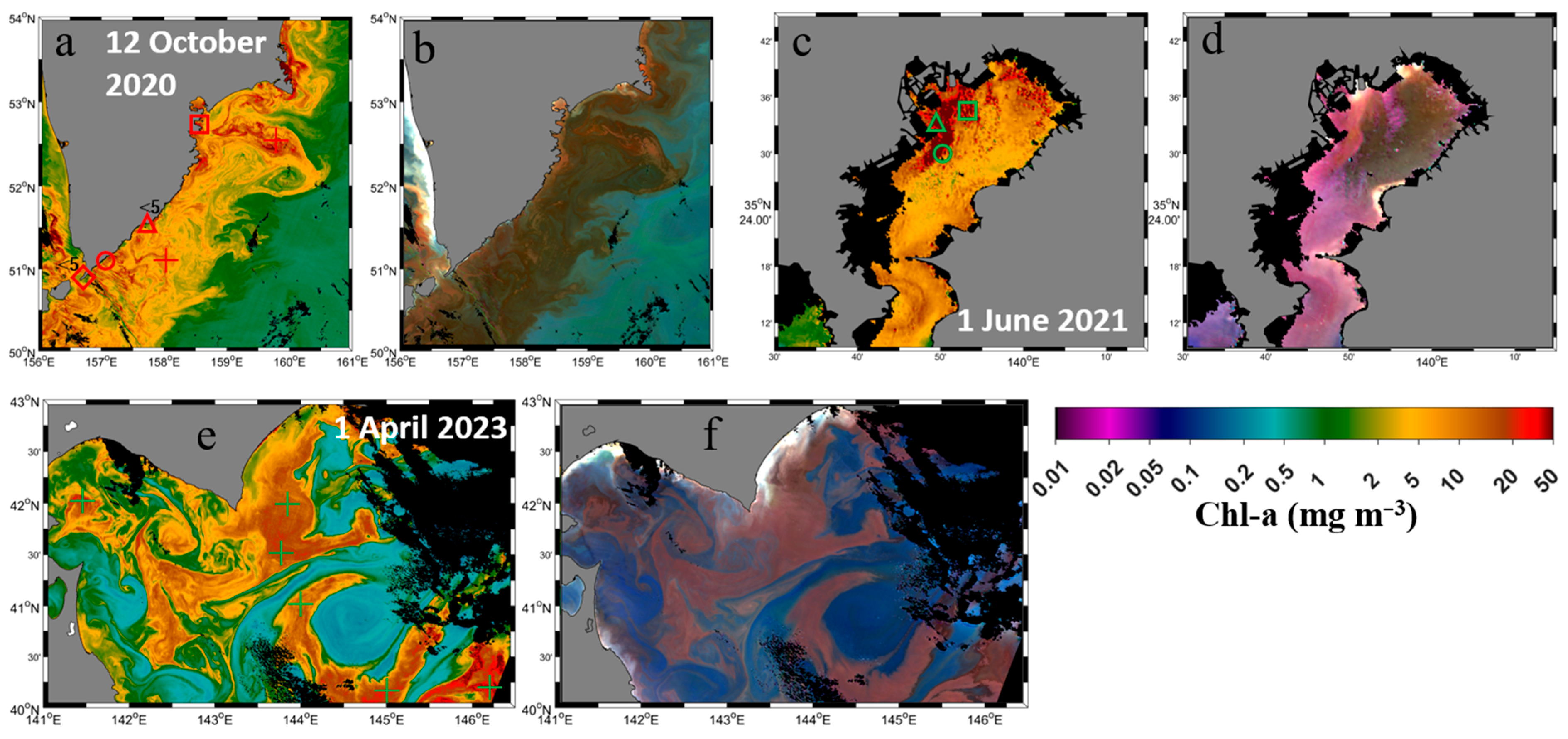
Figure 1. Panels (a) and (b) show, respectively, the GCOM-C/SGLI-derived chlorophyll-a concentration (Chl-a) and its corresponding enhanced red–green–blue composite (eRGB) in the waters southeast of the Kamchatka Peninsula (SeaKam). Panels (c,d) and (e,f) are the same as (a,b), but for Tokyo Bay (TokBay) and the waters south of Hokkaido (SoHok), respectively. Various symbols shown in (a,c,e) indicate the locations of sites from which SGLI-retrieved Chl-a and remote sensing reflectance data were extracted (see also Table 1). The + symbols in panels (a,e) denote sites where in situ data are unavailable. The label “<5” in (a) indicates SGLI-derived Chl-a of less than 5 mg m−3.
Remotesensing 18 00334 g001
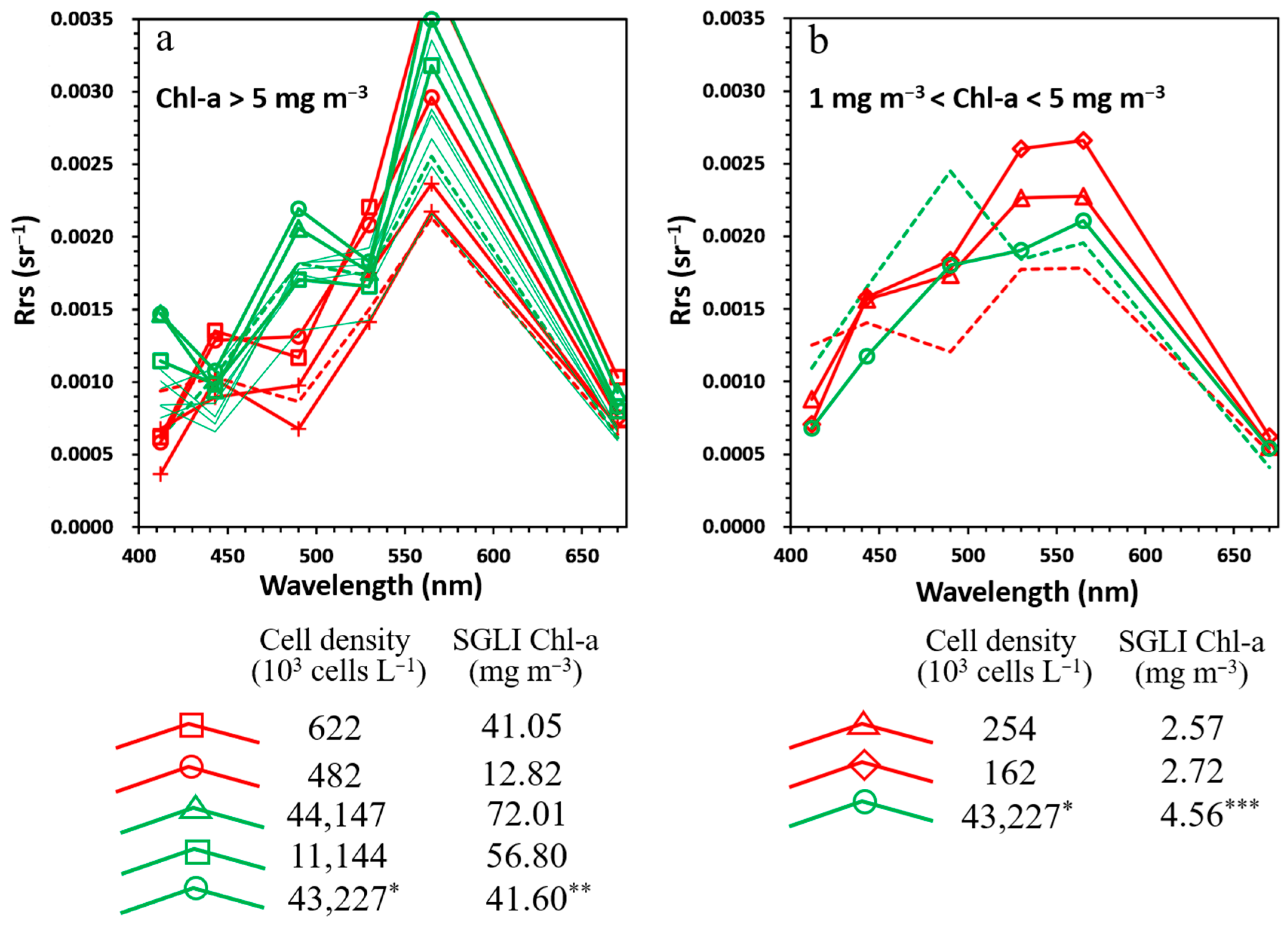
Figure 2. (a) Mean remote sensing reflectance (Rrs, sr−1) spectral shapes for waters dominated by diatom or Skeletonema spp. (green) and dinoflagellate K. selliformis (red), when SGLI-retrieved chlorophyll-a concentration (Chl-a) exceeds 5 mg m−3. Dashed lines indicate data from the waters southeast of SeaHok [4]. Solid red lines with symbols represent data from this study during K. selliformis blooms in the SeaKam. Solid green lines with symbols represent data during a diatom bloom (mainly Skeletonema spp.) in TokBay, while solid green lines without symbols show data from SoHok. (b) Same as (a), but for SGLI-retrieved Chl-a ranging from 1 to 5 mg m−3. K. selliformis blooms in SeaKam and Skeletonema spp. blooms in TokBay were confirmed by in situ observations. The observed cell densities and corresponding SGLI Chl-a are shown below the spectral shape graphs. The symbol * indicates data from a single site (St. 35 in TokBay). Symbols ** and *** denote Chl-a values averaged from 8 pixels and 1 pixel, respectively. Note that for each in situ observation site, Chl-a and Rrs data were extracted from a 3 × 3 pixel area.
Remotesensing 18 00334 g002
The SGLI-retrieved Rrs and Chl-a data were extracted from the locations where in situ data are available, indicated by red symbols in SeaKam (Figure 1a) and green symbols in TokBay (Figure 1c). In addition, SGLI data were extracted from the sites south of Hokkaido (SoHok), marked with + symbols (Figure 1e), during the spring phytoplankton bloom on 1 April 2023. Although in situ data were not available for SoHok, the spring bloom in this region is typically dominated by diatoms [20].

2.2. Previous Approach and Binary Logistic Regression

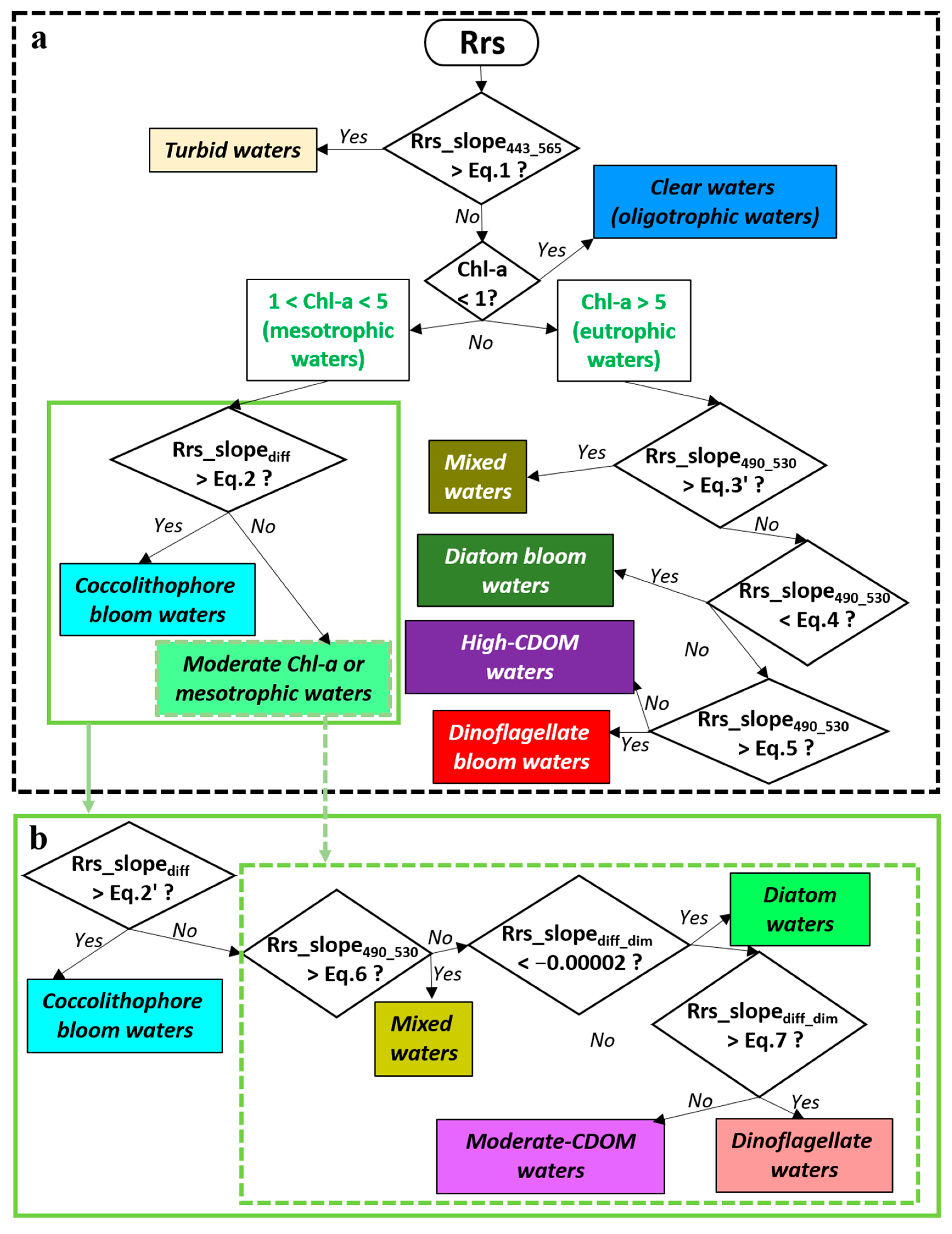
Siswanto’s (2025) [4] OWT classification method consists of the following steps:
  • Turbid water classification: Turbid waters (high TSSs) were separated from other OWTs using Equation (1):
    Rrs_slope443_565 = (2.00 × 10⁻⁵) × ln(Chl-a) + (2.00 × 10⁻⁵)
    where Rrs_slope443_565 is the slope of Rrs between 443 nm and 565 nm.
  • Trophic state classification: Non-turbid waters were categorised into three trophic states based on Chl-a: oligotrophic (low Chl-a < 1 mg m−3), mesotrophic (moderate Chl-a, 1–5 mg m−3), and eutrophic (high Chl-a > 5 mg m−3). Threshold of Chl-a > 5 mg m−3 to classify eutrophic waters, as previous works defined waters with satellite Chl-a > 5 mg m−3 are susceptible to eutrophication and red tide outbreaks [11,21].
  • Mesotrophic water classification: Mesotrophic waters were divided into phytoplankton coccolithophore blooms and general mesotrophic waters using Equation (2):
    Rrs_slopediff = −0.097 × Rrs412 + (5.00 × 10⁻⁴)
  • Eutrophic mixed water classification: Mixed waters in eutrophic environments were identified using Equation (3):
    Rrs_slope490_530 = −0.03 × Rrs490 + (8.00 × 10⁻⁵)
  • Phytoplankton bloom types and high-CDOM water classification in eutrophic waters: The waters were classified as diatom blooms when Rrs_slope490_530 < 0.000003, as dinoflagellate blooms when Rrs490 < 0.0013, and high-CDOM waters for all remaining cases.
Many studies define boundary lines for separating OWTs through visual inspection [4,16,22,23]. Although these non-statistical methods are straightforward, the resulting boundary lines are subject to substantial uncertainty. To establish more robust boundaries, this study applied binary logistic regression (bLR) [24,25,26] in a sequential splitting process (i.e., one OWT versus the remaining unclassified OWTs) to progressively define statistically supported boundaries.
The bLR is an extension of logistic regression designed to determine the combination of independent variables that optimally classifies observations into two dichotomous dependent categories. In the context of this study, the independent variables are two ocean-color features (e.g., Rrs slope and Rrs), while the dichotomous dependent variables correspond to OWTs, such as coccolithophore bloom waters and mixed waters. The classification boundary is defined by a logit function (z), which is expressed as a bilinear combination of constants and independent variables. In a scatter plot of the two ocean-color variables, the boundary separating the two OWTs is given by the condition z = 0. Data points with z ≥ 0 are assigned to one OWT, while those with z < 0 are assigned to the other.
The Wald test [24] was used to assess the significance of the bLR coefficients underlying the boundary lines. Each scatter plot involved two variables, and thus, two bLR coefficients, to evaluate the potential for OWT separation. When these coefficients were statistically significant (p < 0.05), the corresponding variables—and, by extension, the derived boundary line—were considered statistically meaningful for separating OWTs.

3. Results

3.1. SGLI-Retrieved Chlorophyll-a and Enhanced Red–Green–Blue Composite

The SGLI data captured elevated Chl-a in SeaKam on 12 October 2020, attributed to K. selliformis blooms (Figure 1a). Alexanin et al. (2023) [19] reported K. selliformis cell densities exceeding 160 × 103 cells L−1 (Table 1) at four coastal sites (, , , and in Figure 1a) on 12 and 13 October 2020. A brownish dark enhanced red–green–blue (eRGB) composite was observed over the high Chl-a waters (Figure 1b). The eRGB composite was generated using normalised water-leaving radiance (nLw) at 565 nm, 490 nm, and 443 nm, following the method of Hu et al. (2005) [27]. Diatom blooms at three sites (, , and in Figure 1c) in TokBay, associated with Skeletonema spp., were confirmed by Tokyo Bureau of Environment, with cell densities exceeding 11 × 106 cells L−1 (Table 1). These bloom areas exhibited Chl-a greater than 20 mg m−3 and a purplish eRGB composite (Figure 1d). The SGLI also detected seasonal spring blooms in SoHok, characterised by elevated Chl-a (Figure 1e) and a brown eRGB composite (Figure 1f). At the sites marked with + symbols, Chl-a exceeded 10 mg m−3. These spring blooms in SoHok are primarily associated with diatom proliferation [20].
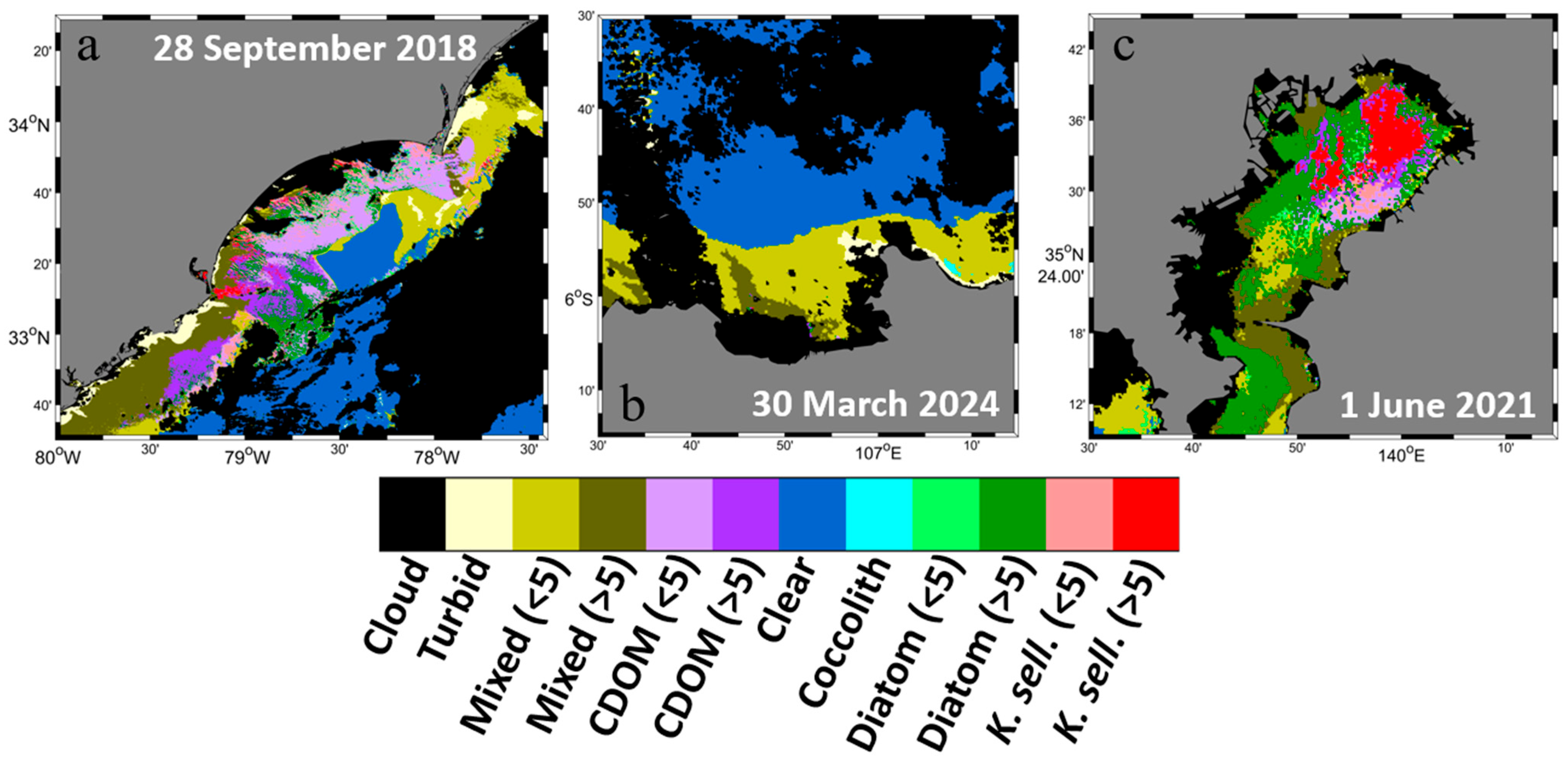
Siswanto (2025) [4] noted that moderate-to-high Chl-a (Figure 3a), along with a corresponding dark brown eRGB composite (Figure 3b) in the waters south of North and South Carolina (NSCar), were associated with CDOM-rich waters following Hurricane Florence [28]. However, Siswanto’s (2025) [4] OWT classification method failed to classify the northern part of the dark eRGB area as CDOM-dominated (Figure 3c). This was because the dark eRGB region exhibited moderate Chl-a (1–5 mg m−3), a range within which the method was not designed to provide further classification, or was simply treated as mesotrophic waters with moderate Chl-a. Such simplification applied to mesotrophic waters (Figure 3d) resulted in inconsistent classification in Jakarta Bay (JakBay), where vivid eRGB composite areas (Figure 3e) were nonetheless classified as mesotrophic (Figure 3f). Moreover, Equation (2) erroneously classified large portions of the coastal waters east of JakBay as coccolithophore blooms (Figure 3f), despite coccolithophores typically favouring subpolar and temperate waters [29,30,31].

3.2. Apparent Optical Properties of Waters During K. selliformis and Diatom Blooms

Siswanto (2025) [4] reported that in the waters with Chl-a exceeding 5 mg m−3, the Rrs spectral shape between 443 and 530 nm during K. selliformis blooms in autumn 2021 southeast of Hokkaido (SeaHok) exhibited a trough at 490 nm (red dashed line in Figure 2a). In contrast, during diatom blooms in the same waters with similarly high Chl-a, the Rrs spectral shape displayed a peak at 490 nm (green dashed line).
Within the same wavelength range (443–530 nm), interestingly, SGLI during K. selliformis blooms in SeaKam (red solid lines with data symbols in Figure 2a) also exhibited spectral shapes similar to those during SeaHok’s K. selliformis blooms (i.e., featuring a trough at 490 nm). Spectral shapes similar to those during SeaHok’s diatom bloom (i.e., featuring a peak at 490 nm were also observed during Skeletonema spp. blooms in TokBay (green solid lines with data symbols). This further confirms that the Rrs spectral shapes peaking at 490 nm (green thin lines in Figure 2a), extracted from SoHok during the spring bloom on 1 April 2023, were also associated with diatom blooms.
Spectral shapes displaying a trough at 490 nm during K. selliformis blooms, and a peak at 490 nm during diatom blooms, were also observed even in the waters with Chl-a ranging from 1 to 5 mg m−3 (Figure 2b). The red dashed line and green dashed line represent K. selliformis and diatom bloom data, respectively, from the SeaHok. Solid red and green lines with data symbols in Figure 2b correspond to K. selliformis blooms in SeaKam and Skeletonema spp. blooms in TokBay, respectively.

3.3. Robustness and Refinement of Classification Criteria

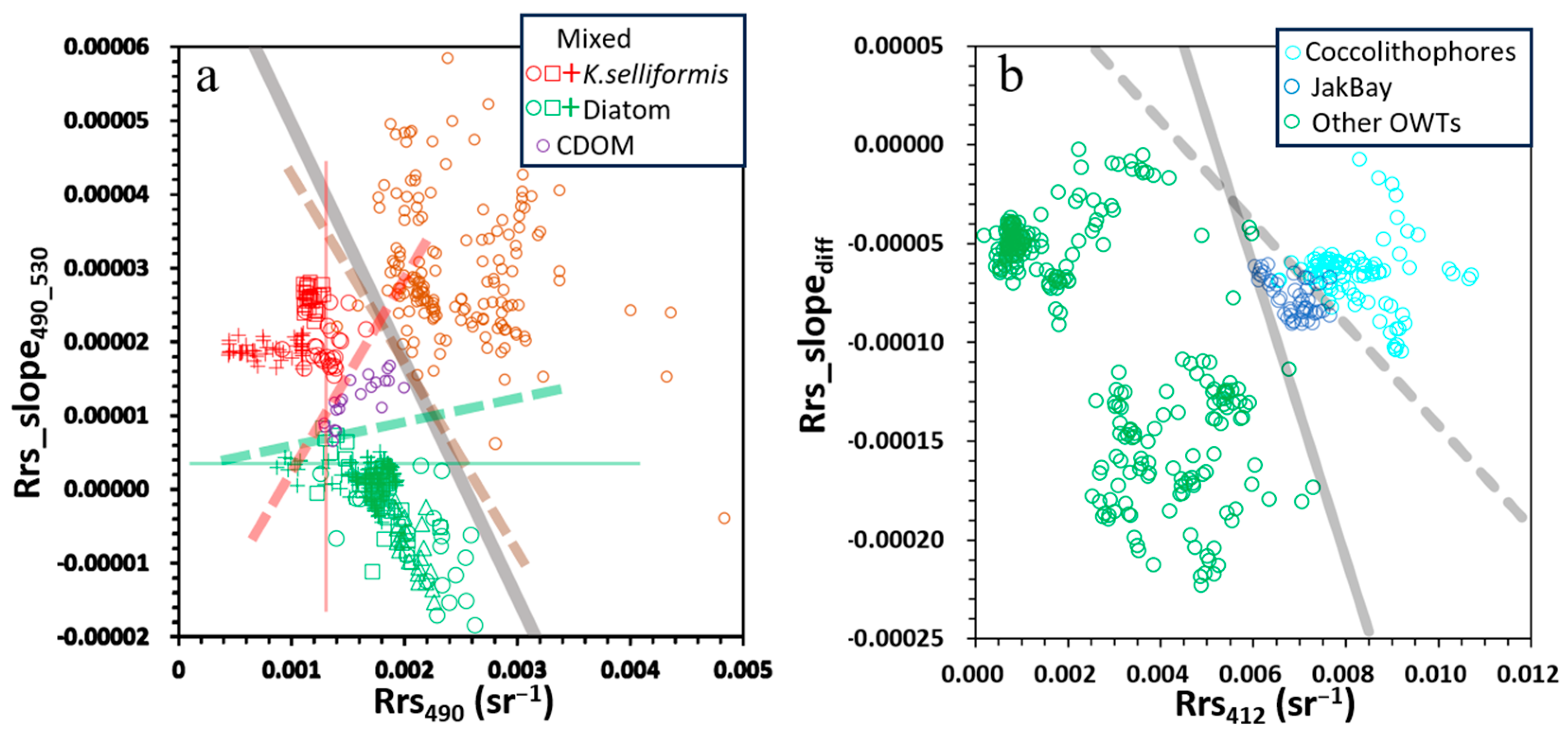
The OWT boundary lines in Siswanto (2025) [4] were defined heuristically without statistical testing and therefore carried uncertainty. To address this limitation, bLR was applied together with the Wald test [24,25] to define statistically meaningful and robust boundary lines. In Figure 4a, the grey solid line (Equation (3)) represents the original boundary line from Siswanto (2025) [4], which separates mixed waters (N = 161) from other OWTs (N = 535). The bLR analysis determined that the coefficients for both Rrs490 and Rrs_slope490_530 were statistically significant (p < 0.001), indicating that the bLR-derived boundary line (brown dashed line) is statistically meaningful. This updated boundary line is expressed by Equation (3’) below.
Rrs_slope490_530 = (−2.81 × 10⁻²) × Rrs490 + (7.27 × 10⁻⁵)
The threshold of Rrs_slope490_530 < 0.000003 (green solid line in Figure 4a) for classifying diatom blooms and the threshold of Rrs490 < 0.0013 (red solid line) for classifying dinoflagellate blooms, as proposed by Siswanto (2025) [4], proved to be relatively consistent, although slight misclassifications were observed in identifying Skeletonema spp. blooms in TokBay and K. selliformis blooms in SeaKam. To establish statistically meaningful boundaries, the datasets from this study (K. selliformis and Skeletonema spp. blooms) were combined with those of Siswanto (2025) [4]. Applying bLR to the combined datasets yielded statistically significant coefficients (p < 0.05) for the boundary between diatom blooms (N = 341) and other groups (high-CDOM and K. selliformis blooms, N = 194). This boundary (green dashed line in Figure 4a) is expressed by Equation (4) below.
Rrs_slope490_530 = (4.42 × 10⁻³) × Rrs490 + (8.52 × 10⁻⁷)
The bLR coefficients were also statistically significant (p < 0.01) for the boundary (red dashed line in Figure 4a) separating K. selliformis blooms (N = 173) from other groups (high-CDOM and diatom blooms, N = 362). This boundary line is expressed by Equation (5) below.
Rrs_slope490_530 = (1.93 × 10⁻²) × Rrs490 − (1.40 × 10⁻⁵)
The grey solid line in Figure 4b, expressed by Equation (2), incorrectly classified the JakBay data () as coccolithophore blooms. The new boundary line (grey dashed line in Figure 4b), derived from statistically significant bLR coefficients (p < 0.05), reduced the misclassification of coccolithophore bloom waters near JakBay. This updated boundary, obtained using coccolithophore data (N = 93) and other group data (N = 327), is expressed by Equation (2’) below.
Rrs_slopediff = −0.02 × Rrs412 + (1.15 × 10⁻⁴)
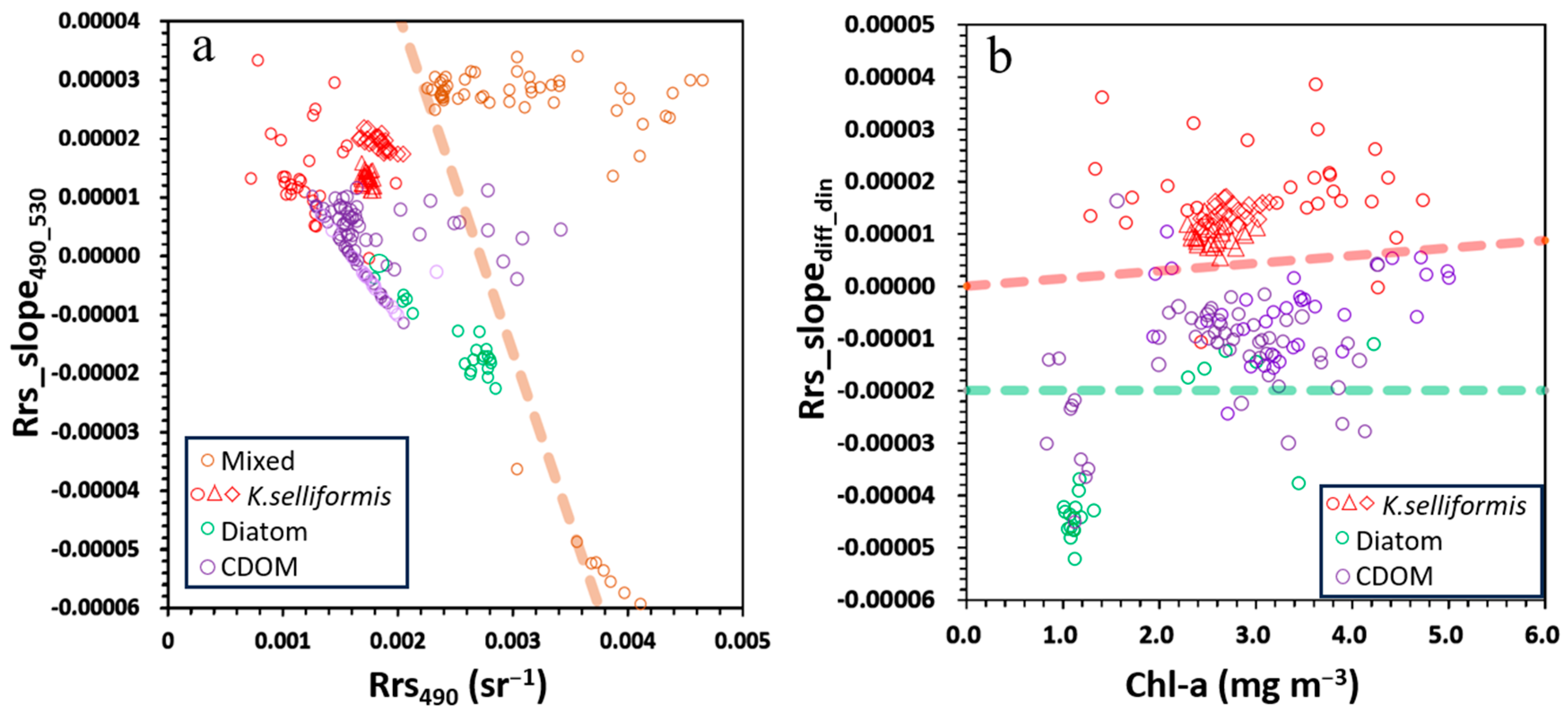
Figure 5a shows a scatter plot of Rrs_slope490_530 versus Rrs490 for data with a Chl-a range of 1–5 mg m−3. The bLR-defined boundary line (brown dashed line) separates mixed waters (N = 61) from other OWTs (N = 186). This boundary line is statistically meaningful, as it was derived from statistically significant bLR coefficients (p < 0.001), and is expressed by Equation (6) below.
Rrs_slope490_530 = −0.06 × Rrs490 + (1.57 × 10⁻⁴)
Still within the moderate Chl-a waters, rather than relying on Rrs_slope490_530, K. selliformis-, diatom-, and CDOM-dominated data are better separated in the scatter plot of Rrs_slopediff_dim versus Chl-a (Figure 5b), where Rrs_slopediff_dim is defined as Rrs_slope490_530 minus Rrs_slope443_490. However, bLR produced insignificant coefficients for Chl-a (p > 0.05), indicating that only Rrs_slopediff_dim is important for separating the three OWTs. Accordingly, a red dashed line (Figure 5b), expressed by Equation (7) below, is practically meaningful to separate K. selliformis (N = 78) from other OWTs (N = 108). It is also practically meaningful to use Rrs_slopediff_dim = −2.0 × 10⁻⁵ as a boundary between the diatom group (N = 23) and other OWTs (N = 165).
Rrs_slopediff_dim = (1.47 × 10⁻⁶) × Chl-a − (2.50 × 10⁻⁸)

3.4. Improved Optical Water Type Classification

The updated OWT classification method (Figure 6a), incorporating bLR-derived criteria and extended classification within mesotrophic waters (Figure 6b), is summarized overall in Figure 6. This updated method enabled more reliable identification of CDOM-dominated waters in NSCar, with coastal waters now classified as CDOM-dominated (Figure 7a, compared to Figure 3c), consistent with their dark brown appearance in the eRGB composite (Figure 3b). It also substantially reduced misclassification of coccolithophore blooms and correctly identified mesotrophic waters in JakBay as mixed waters (Figure 7b, compared to Figure 3f). A large portion of Skeletonema spp. bloom areas in TokBay was successfully classified (Figure 7c) using the updated method (Equation (4)).
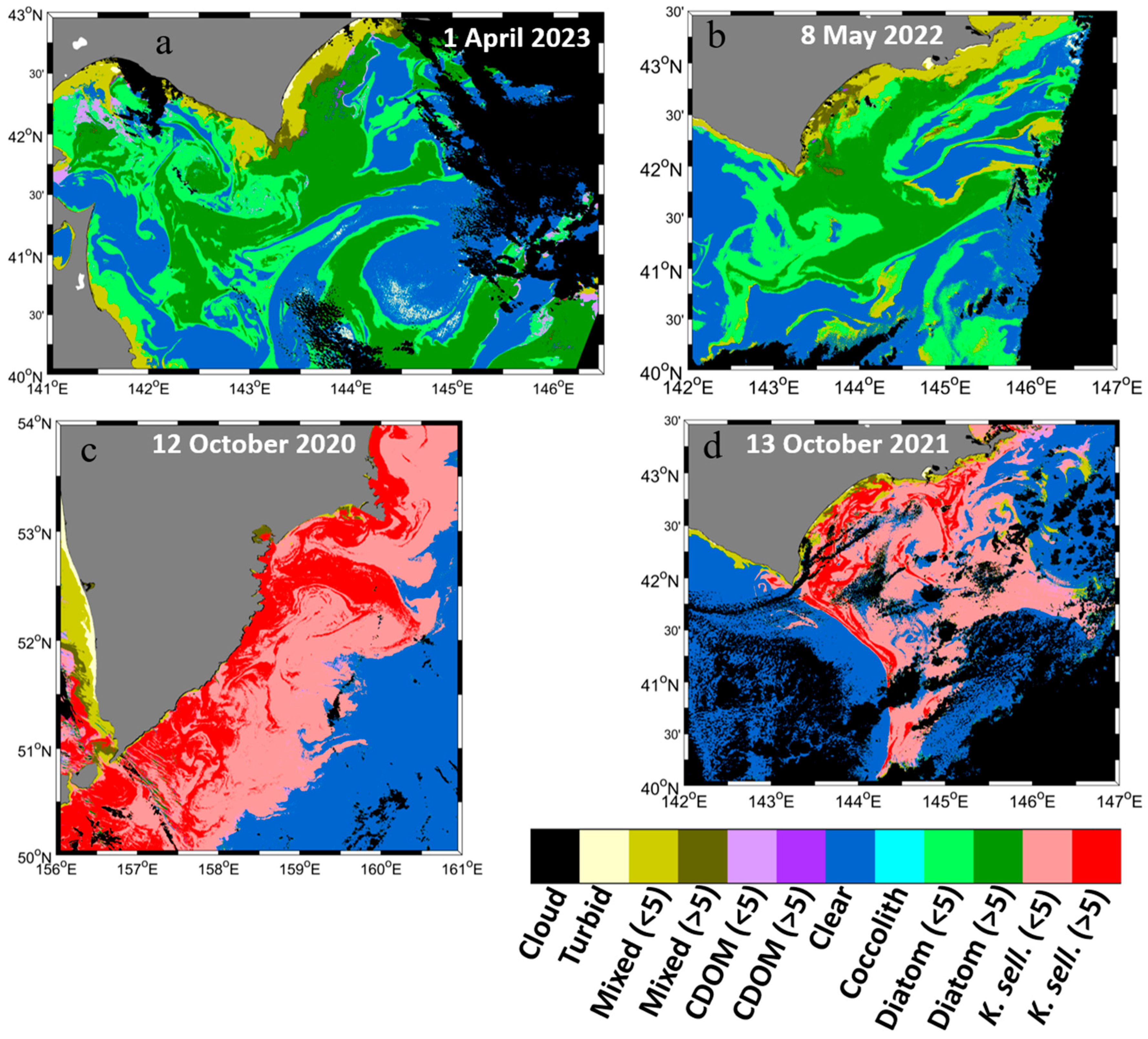
The updated OWT classification method not only successfully identifies the main diatom blooms but also detects diatom-dominated waters with less intense blooms in both SoHok and SeaHok regions (Figure 8a,b). The bLR-derived boundary line (Equation (5)) reliably identifies the main bloom waters of K. selliformis in SeaKam (Figure 8c), particularly at sites where high cell densities of K. selliformis exceeded 480 ×103 cells L−1 ( and in Figure 1a; see Table 1). These high cell densities corresponded with SGLI Chl-a exceeding 5 mg m−3 (Figure 1a and Figure 2a).
The boundary expressed by Equation (7) also performed well in classifying K. selliformis-dominated waters with less intense blooms, especially at sites ( and in Figure 1a and Figure 2b; see Table 1) where cell densities were moderate (162–254 × 103 cells L−1). These moderate cell densities corresponded well with moderate Chl-a (<5 mg m−3) (Figure 1a and Figure 2b). Using the criteria described above, the updated OWT classification method is now able to identify both the main and moderate blooms of K. selliformis in SeaHok (Figure 8d).

4. Discussion

The robustness of the criteria for distinguishing K. selliformis from diatom blooms suggests that waters affected by K. selliformis and diatom blooms exhibit distinct Rrs spectral shapes—specifically, a trough at 490 nm during K. selliformis blooms (both in SeaHok and SeaKam) and a peak at the same wavelength during diatom blooms (both in SeaHok and TokBay). These distinct spectral features are retained even during moderate blooms. Notably, the moderate blooms of K. selliformis in SeaHok also corresponded well with the moderate cell densities reported by Kuroda et al. (2022) [14].
In situ Rrs data collected during specific phytoplankton bloom events were not available. However, previous studies have demonstrated that SGLI-derived Rrs products from G-Portal (used in this study) are generally consistent with global in situ Rrs measurements, except for the 412 nm band [32]. Therefore, the use of satellite-derived Rrs spectra for distinguishing spectral features at 490 nm can be reasonably justified, as explained below.
Previous in situ studies have shown that the absorption spectral shapes of dinoflagellates and diatoms are very similar in the blue spectral region [21,33]. However, Rrs is determined not only by absorption but also by backscattering. In situ observations have demonstrated that backscattering by dinoflagellates is significantly lower than that by diatoms in the blue bands [21]. Consequently, the lower (higher) Rrs values observed at 490 nm during K. selliformis (diatom) blooms are most likely attributable to the lower (higher) backscattering of dinoflagellates (diatoms).
Mesotrophic waters with moderate Chl-a (1–5 mg m−3) in JakBay (Figure 3f), previously classified using Siswanto’s (2025) [4] OWT classification method, are now identified as mixed waters (Figure 7b). This refinement is explainable, as during the late rainy season (30 March 2024), JakBay receives substantial freshwater inflow from 13 major rivers. This freshwater input carries a great amount of CDOM and TSS [34], contributing to the JakBay’s optically complex conditions. The updated OWT classification method for mesotrophic waters also significantly reduced the misclassification of coccolithophore blooms in waters to the west and east of JakBay (Figure 7b).
The method identified dinoflagellate blooms in the northern areas of TokBay (Figure 7c). A dinoflagellate bloom was also detected near the northern site (St. 22; symbol in Figure 1c). Given that diatom and dinoflagellate dominance were comparable at St. 22 (Table 1), it is possible that both diatom and dinoflagellate blooms coexisted in northern TokBay. The dominant dinoflagellate species at St. 22 was Scrippsiella spp. Whether waters affected by Scrippsiella spp. and K. selliformis blooms share similar Rrs spectral shapes remains to be investigated.
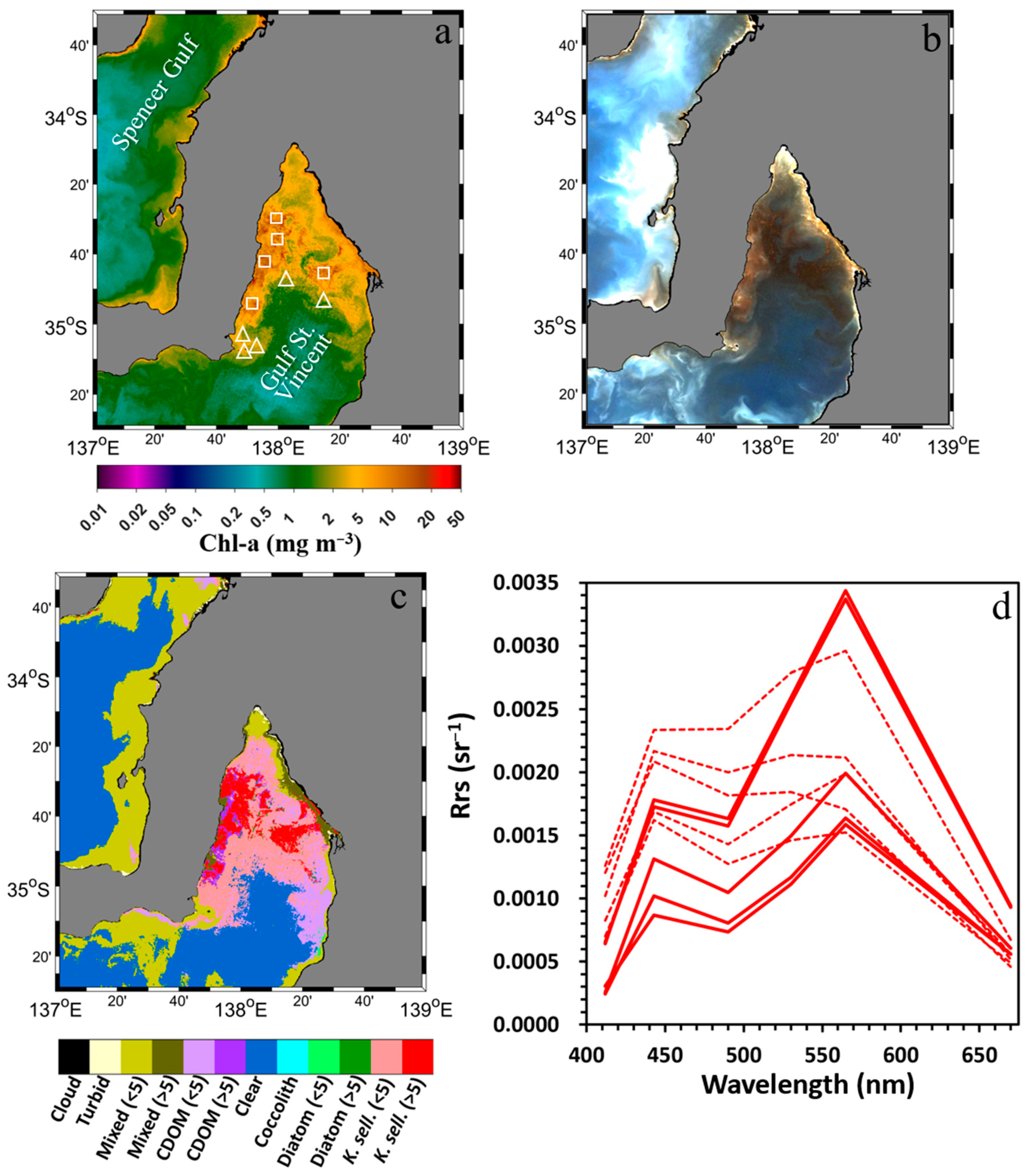
The updated OWT method was tested to detect red tide outbreaks that occurred from March to summer 2025 and caused massive kills of crustaceans, fish, and other marine life in the Gulf St. Vincent (GV), South Australia. While red tides in SeaHok and SeaKam were caused by dinoflagellate K. selliformis, the recent red tide in the Gulf St. Vincent was caused by dinoflagellate K. mikimotoi [35]. High Chl-a areas in the GV (Figure 9a) corresponded to brownish dark areas in the eRGB composite (Figure 9b). This eRGB composite color is similar to that during K. selliformis blooms in SeaKam (Figure 1b) and SeaHok [4].
The updated OWT method reasonably detected the main red tide areas (Chl-a > 5 mg m−3) and moderate red tide areas (Chl-a: 1 − 5 mg m−3) in the GV (Figure 9c). The applicability of the method in detecting red tide in the GV was attributed to the Rrs spectral shapes characterized by a trough shape at wavelength 490 nm. These Rrs spectral shapes (Figure 9d) extracted from 5 locations within the high Chl-a area (white squares in Figure 9a) resembled those observed during red tide events in SeaHok and SeaKam (Figure 2a). A trough shape at 490 nm was also observed in the Rrs spectra (Figure 9d) extracted from the waters with moderate Chl-a (1 mg m−3 < Chl-a < 5 mg m−3, white triangles in Figure 9a). The resemblance of Rrs spectra during the blooms of K. mikimotoi in the GV and the blooms of K. selliformis in SeaKam and SeaHok provides a potential application of the updated method with the use of SGLI-derived Rrs to detect red tide caused by Karenia spp. over the global coastal ocean coverage. This is worth expecting because all Karenia spp. share morphological, ecological, and cellular pigment content similarities.
Phytoplankton types, particularly during bloom conditions, are essential inputs for marine ecosystem and biogeochemical models because they influence primary production, nutrient cycling, and carbon export [36,37]. However, many existing models represent all phytoplankton as a single functional group, which fails to capture key differences in physiological traits such as nutrient uptake, light utilization, calcification, and sinking behavior among major phytoplankton groups [36,38]. As a result, important biogeochemical processes, including carbon sequestration, are inadequately represented.
Functionally distinct phytoplankton groups such as diatoms, dinoflagellates, and coccolithophores play markedly different roles in the marine carbon cycle. Diatom-dominated blooms, for example, are associated with higher POC export, while coccolithophores uniquely influence carbon cycling through calcification and exhibit climate-sensitive biogeographic shifts [6,7,39,40].
This study demonstrates the feasibility of classifying optical water types, including major phytoplankton bloom types, from satellite observations. Such capability enables near-real-time monitoring of harmful algal blooms and provides spatially explicit phytoplankton type information that can improve ecosystem and biogeochemical models beyond bulk Chl-a–based parameterizations. In addition, the approach contributes to establishing long-term observational records needed to assess climate-driven changes in phytoplankton distribution and ecosystem response.
The updated algorithm proposed in this study was not compared with previously developed algorithms [16,22,29,41] because those algorithms were specifically developed for different ocean color sensors, primarily SeaWiFS and MODIS. Direct application to SGLI data would be inappropriate, as ocean color sensors differ in spectral band configurations, atmospheric correction schemes, and radiometric calibration. These sensor-dependent differences can significantly affect the derived reflectance spectra. Consequently, any discrepancies in results would more likely reflect sensor-specific characteristics rather than true algorithm performance.
Updating algorithms is a common practice in ocean colour research. This study addresses the uncertainty of the OWT boundaries in Siswanto (2025) [4] by incorporating bLR with statistical rigor to assess the significance of variables and, consequently, the boundaries used for OWT separation. The boundaries proposed here may still require refinement to improve classification accuracy, particularly in optically complex Case 2 waters. Furthermore, the dominant phytoplankton species responsible for red tides vary across coastal regions. Developing region-specific OWT classification methods tailored to the phytoplankton groups or species most commonly associated with red tide events in a given area would therefore be beneficial.
Focusing on a specific coastal region would also enable the establishment of a more comprehensive Rrs spectral database, with broad spatial and temporal coverage, thereby facilitating verification and validation efforts. Additionally, rather than relying solely on classification based on apparent optical properties (Rrs, as used in this study), an alternative analytical approach—based on inherent optical properties, such as deriving absorption and backscattering from Rrs—warrants further investigation.

5. Conclusions

Using available independent in situ data collected during K. selliformis blooms in SeaKam and Skeletonema spp. blooms in TokBay, the validity and robustness of the published OWT classification method—particularly in classifying phytoplankton bloom types—were evaluated. The spectral shapes observed during K. selliformis blooms in both SeaHok and SeaKam exhibit similar features, characterised by a trough at 490 nm, whereas those observed during diatom blooms in both SeaHok and TokBay exhibit a peak at 490 nm. These observations demonstrate the consistency of the SGLI-derived Rrs spectral shapes in distinguishing K. selliformis blooms from diatom blooms. The major improvement in this study is the incorporation of bLR with statistical analysis to derive more robust and statistically meaningful OWT separating boundaries. The updated OWT classification method can now reliably identify waters optically dominated by CDOM, as well as by different phytoplankton types in mesotrophic waters with Chl-a ranging from 1 to 5 mg m−3. The updated OWT classification method can detect red tide events caused by K. mikimotoi in the GV both in the main and moderate bloom waters, suggesting the potential for global detection of Karenia spp. red tides using GCOM-C/SGLI. This ability to routinely map distinct phytoplankton functional types from space provides essential data for marine ecosystem models, helping to improve simulations of nutrient drawdown, primary production, and carbon flux by moving beyond bulk Chl-a parameterizations.

Funding

This research was supported by the Japan Aerospace Exploration Agency–3rd Research Announcement on the Earth Observations [JAXA–4th EORA, 25RT000201], the Asia-Pacific Network for Global Change Research [APN, CRRP2024-05MY-Siswanto], and Grants-in-Aid for Scientific Research [KAKENHI JP21H05317] from the Ministry of Education, Culture, Sports, Science, and Technology-Japan (MEXT).

Data Availability Statement

The original GCOM-C/SGLI data used for this study are openly accessible through https://gportal.jaxa.jp/gpr/ (accessed on 6 October 2025). Inquiries regarding the in situ data use in this study can be directed to the author.

Acknowledgments

The author would like to thank the Journal Editor and all the reviewers for their valuable comments, which significantly improved the manuscript.

Conflicts of Interest

The author declares no conflicts of interest.

References

  1. Morel, A.; Prieur, L. Analysis of variations in ocean color1. Limnol. Oceanogr. 1977, 22, 709–722. [Google Scholar] [CrossRef]
  2. Moore, T.S.; Campbell, J.W.; Dowell, M.D. A class-based approach to characterizing and mapping the uncertainty of the MODIS ocean chlorophyll product. Remote Sens. Environ. 2009, 113, 2424–2430. [Google Scholar] [CrossRef]
  3. Wei, J.; Wang, M.; Mikelsons, K.; Jiang, L.; Kratzer, S.; Lee, Z.; Moore, T.; Sosik, H.M.; Van der Zande, D. Global satellite water classification data products over oceanic, coastal, and inland waters. Remote Sens. Environ. 2022, 282, 113233. [Google Scholar] [CrossRef]
  4. Siswanto, E. Assessing optical water types in Asian coastal ocean waters from space using GCOM-C/SGLI observations. Int. J. Remote Sens. 2025, 46, 2337–2357. [Google Scholar] [CrossRef]
  5. Ziveri, P.; de Bernardi, B.; Baumann, K.H.; Stoll, H.M.; Mortyn, P.G. Sinking of coccolith carbonate and potential contribution to organic carbon ballasting in the deep ocean. Deep. Sea Res. Part II Top. Stud. Oceanogr. 2007, 54, 659–675. [Google Scholar] [CrossRef]
  6. Spilling, K.; Kremp, A.; Klais, R.; Olli, K.; Tamminen, T. Spring bloom community change modifies carbon pathways and C:N:P: Chl a stoichiometry of coastal material fluxes. Biogeosciences 2014, 11, 7275–7289. [Google Scholar] [CrossRef]
  7. Tréguer, P.; Bowler, C.; Moriceau, B.; Dutkiewicz, S.; Gehlen, M.; Aumont, O.; Bittner, L.; Dugdale, R.; Finkel, Z.; Iudicone, D.; et al. Influence of diatom diversity on the ocean biological carbon pump. Nat. Geosci. 2017, 11, 27–37. [Google Scholar] [CrossRef]
  8. Lin, S.; Li, T.; Yuan, H.; Li, H.; Yu, L.; Zhuang, Y.; Li, L.; Huang, B.; Liu, G. Sediment Trap Study Reveals Dominant Contribution of Metazoans and Dinoflagellates to Carbon Export and Dynamic Impacts of Microbes in a Subtropical Marginal Sea. J. Geophys. Res. Biogeosci. 2022, 127, e2021JG006695. [Google Scholar] [CrossRef]
  9. Behrenfeld, M.J.; Falkowski, P.G. Photosynthetic rates derived from satellite-based chlorophyll concentration. Limnol. Oceanogr. 1997, 42, 1–20. [Google Scholar] [CrossRef]
  10. Kameda, T.; Ishizaka, J. Size-fractionated primary production estimated by a two-phytoplankton community model applicable to ocean color remote sensing. J. Oceanogr. 2005, 61, 663–672. [Google Scholar] [CrossRef]
  11. de Raús Maúre, E.; Terauchi, G.; Ishizaka, J.; Clinton, N.; DeWitt, M. Globally consistent assessment of coastal eutrophication. Nat. Commun. 2021, 12, 6142. [Google Scholar] [CrossRef]
  12. Siswanto, E.; Tang, J.; Yamaguchi, H.; Ahn, Y.H.; Ishizaka, J.; Yoo, S.; Kim, S.W.; Kiyomoto, Y.; Yamada, K.; Chiang, C.; et al. Empirical ocean-color algorithms to retrieve chlorophyll-a, total suspended matter, and colored dissolved organic matter absorption coefficient in the Yellow and East China Seas. J. Oceanogr. 2011, 67, 627–650. [Google Scholar] [CrossRef]
  13. Tan, J.C.H.; Peters, D.M.; Kaufman, P.L. Seasonal variability of SeaWiFS chlorophyll a in the Malacca Straits in relation to Asian monsoon. Cont. Shelf Res. 2006, 26, 168–178. [Google Scholar] [CrossRef]
  14. Kuroda, H.; Taniuchi, Y.; Watanabe, T.; Azumaya, T.; Hasegawa, N. Distribution of Harmful Algae (Karenia spp.) in October 2021 Off Southeast Hokkaido, Japan. Front. Mar. Sci. 2022, 9, 841364. [Google Scholar] [CrossRef]
  15. Geider, R.J. Light and Temperature Dependence of the Carbon to Chlorophyll a Ratio in Microalgae and Cyanobacteria: Implications for Physiology and Growth of Phytoplankton. New Phytol. 1987, 106, 1–34. Available online: https://www.jstor.org/stable/2434683 (accessed on 7 December 2025). [CrossRef]
  16. Siswanto, E.; Ishizaka, J.; Tripathy, S.C.; Miyamura, K. Detection of harmful algal blooms of Karenia mikimotoi using MODIS measurements: A case study of Seto-Inland Sea, Japan. Remote Sens. Environ. 2013, 129, 185–196. [Google Scholar] [CrossRef]
  17. Toratani, M.; Ogata, K.; Fukushima, H. SGLI Algorithm Theoretical Basis Document Atmospheric Correction Algorithm for Ocean Color; Tokai University: Tokyo, Japan, 2021. [Google Scholar]
  18. Murakami, H.; Antoine, D.; Vellucci, V.; Frouin, R. System vicarious calibration of GCOM-C/SGLI visible and near-infrared channels. J. Oceanogr. 2022, 78, 245–261. [Google Scholar] [CrossRef]
  19. Alexanin, A.; Kachur, V.; Khramtsova, A.; Orlova, T. Methodology and Results of Satellite Monitoring of Karenia Microalgae Blooms, That Caused the Ecological Disaster off Kamchatka Peninsula. Remote Sens. 2023, 15, 1197. [Google Scholar] [CrossRef]
  20. Kuroda, H.; Toya, Y.; Watanabe, T.; Nishioka, J.; Hasegawa, D.; Taniuchi, Y.; Kuwata, A. Influence of Coastal Oyashio water on massive spring diatom blooms in the Oyashio area of the North Pacific Ocean. Prog. Oceanogr. 2019, 175, 328–344. [Google Scholar] [CrossRef]
  21. Shang, S.; Wu, J.; Huang, B.; Lin, G.; Lee, Z.; Liu, J.; Shang, S. A new approach to discriminate dinoflagellate from diatom blooms from space in the East China Sea. J. Geophys. Res. Oceans 2014, 119, 4653–4668. [Google Scholar] [CrossRef]
  22. Luang-on, J.; Ishizaka, J.; Buranapratheprat, A.; Phaksopa, J.; Goes, J.I.; Maúre, E.d.R.; Siswanto, E.; Zhu, Y.; Xu, Q.; Nakornsantiphap, P.; et al. MODIS-derived green Noctiluca blooms in the upper Gulf of Thailand: Algorithm development and seasonal variation mapping. Front. Mar. Sci. 2023, 10, 1031901. [Google Scholar] [CrossRef]
  23. Luang-on, J.; Siswanto, E.; Ogata, K.; Toratani, M.; Buranapratheprat, A.; Leenawarat, D.; Ishizaka, J. Enhancing the reliability of GCOM-C/SGLI data for red tide detection in the upper Gulf of Thailand. Remote Sens. Lett. 2024, 15, 1096–1106. [Google Scholar] [CrossRef]
  24. Osborne, J.; King, J.E. Binary Logistic Regression. In Best Practices in Quantitative Methods; SAGE Publications: Thousand Oaks, CA, USA, 2008; pp. 358–384. [Google Scholar] [CrossRef]
  25. Çokluk, Ö. Logistic Regression: Concept and Application; SAGE Publications, Inc.: Thousand Oaks, CA, USA, 2010. [Google Scholar]
  26. Mallinis, G.; Koutsias, N. Spectral and Spatial-Based Classification for Broad-Scale Land Cover Mapping Based on Logistic Regression. Sensors 2008, 8, 8067–8085. [Google Scholar] [CrossRef]
  27. Hu, C.; Muller-Karger, F.E.; Taylor, C.; Carder, K.L.; Kelble, C.; Johns, E.; Heil, C.A. Red tide detection and tracing using MODIS fluorescence data: A regional example in SW Florida coastal waters. Remote Sens. Environ. 2005, 97, 311–321. [Google Scholar] [CrossRef]
  28. Paerl, R.W.; Venezia, R.E.; Sanchez, J.J.; Paerl, H.W. Picophytoplankton dynamics in a large temperate estuary and impacts of extreme storm events. Sci. Rep. 2020, 10, 22026. [Google Scholar] [CrossRef] [PubMed]
  29. Moore, T.S.; Dowell, M.D.; Franz, B.A. Detection of coccolithophore blooms in ocean color satellite imagery: A generalized approach for use with multiple sensors. Remote Sens. Environ. 2012, 117, 249–263. [Google Scholar] [CrossRef]
  30. Iida, T.; Mizobata, K.; Saitoh, S.I. Interannual variability of coccolithophore Emiliania huxleyi blooms in response to changes in water column stability in the eastern Bering Sea. Cont. Shelf Res. 2012, 34, 7–17. [Google Scholar] [CrossRef]
  31. Schiebel, R.; Brupbacher, U.; Schmidtko, S.; Nausch, G.; Waniek, J.J.; Thierstein, H.-R. Spring coccolithophore production and dispersion in the temperate eastern North Atlantic Ocean. J. Geophys. Res. 2011, 116, 8030. [Google Scholar] [CrossRef]
  32. Salem, S.I.; Toratani, M.; Higa, H.; Son, S.H.; Siswanto, E.; Ishizaka, J. Long-Term Evaluation of GCOM-C/SGLI Reflectance and Water Quality Products: Variability Among JAXA G-Portal and JASMES. Remote Sens. 2025, 17, 221. [Google Scholar] [CrossRef]
  33. Zhang, Y.; Shen, F.; Zhao, H.; Sun, X.; Zhu, Q.; Li, M. Optical distinguishability of phytoplankton species and its implications for hyperspectral remote sensing discrimination potential. J. Sea Res. 2024, 202, 102540. [Google Scholar] [CrossRef]
  34. Wouthuyzen, S. Measuring Sea SURFACE Salinity of the Jakarta Bay Using Remotely Sensed of Ocean Color Data Acquired by Modis Sensor. Mar. Res. Indones. 2015, 36, 51–70. [Google Scholar] [CrossRef]
  35. Kaempf, J. Prediction of the Spreading of an Unprecedented Karenia Mikimotoi Bloom in South Australian Gulfs. SSRN 2025. [Google Scholar] [CrossRef]
  36. Sasai, Y.; Smith, S.L.; Siswanto, E.; Sasaki, H.; Nonaka, M. Physiological flexibility of phytoplankton impacts modelled chlorophyll and primary production across the North Pacific Ocean. Biogeosciences 2022, 19, 4865–4882. [Google Scholar] [CrossRef]
  37. Ciavatta, S.; Brewin, R.J.W.; Skákala, J.; Polimene, L.; de Mora, L.; Artioli, Y.; Allen, J.I. Assimilation of Ocean-Color Plankton Functional Types to Improve Marine Ecosystem Simulations. J. Geophys. Res. Oceans 2018, 123, 834–854. [Google Scholar] [CrossRef]
  38. Honda, M.C.; Sasai, Y.; Siswanto, E.; Kuwano-Yoshida, A.; Aiki, H.; Cronin, M.F. Impact of cyclonic eddies and typhoons on biogeochemistry in the oligotrophic ocean based on biogeochemical/physical/meteorological time-series at station KEO. Prog. Earth Planet. Sci. 2018, 5, 42. [Google Scholar] [CrossRef]
  39. Iglesias-Rodríguez, M.D.; Brown, C.W.; Doney, S.C.; Kleypas, J.; Kolber, D.; Kolber, Z.; Hayes, P.K.; Falkowski, P.G. Representing key phytoplankton functional groups in ocean carbon cycle models: Coccolithophorids. Glob. Biogeochem. Cycles 2002, 16, 47-1–47-20. [Google Scholar] [CrossRef]
  40. Rivero-Calle, S.; Gnanadesikan, A.; Del Castillo, C.E.; Balch, W.M.; Guikema, S.D. Multidecadal increase in North Atlantic coccolithophores and the potential role of rising CO2. Science 2015, 350, 1533–1537. [Google Scholar] [CrossRef]
  41. Mouw, C.B.; Yoder, J.A. Optical determination of phytoplankton size composition from global SeaWiFS imagery. J. Geophys. Res. 2010, 115, 12018. [Google Scholar] [CrossRef]
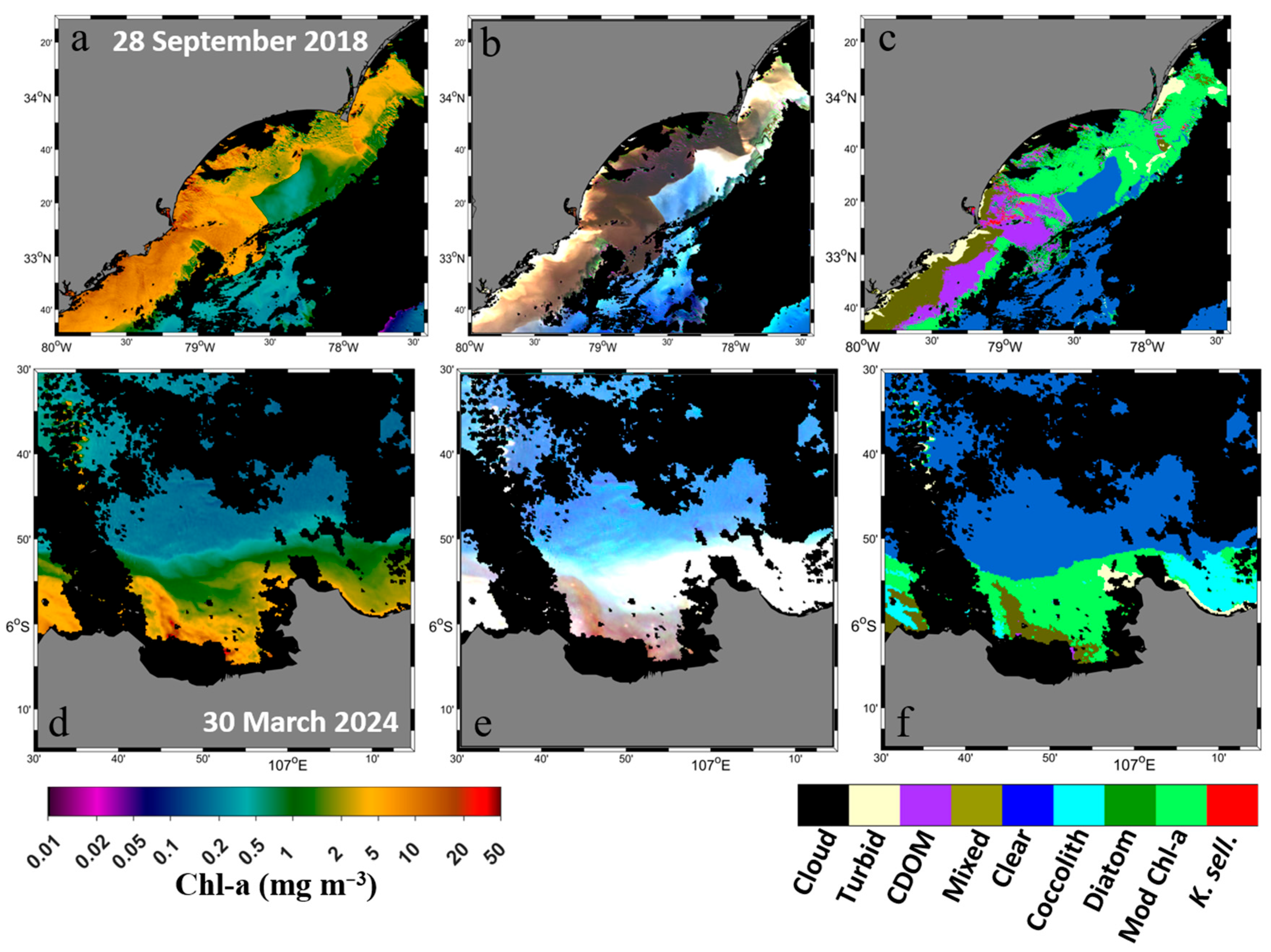
Figure 3. Panels (a), (b), and (c) show the chlorophyll-a concentration, enhanced red–green–blue composite, and optical water types (OWTs), respectively, in the waters south of North/South Carolina. The OWTs were classified using Siswanto’s (2025) method [4]. Panels (d), (e), and (f) are the same as (a), (b), and (c), respectively, but for Jakarta Bay.
Remotesensing 18 00334 g003
Figure 4. (a) Scatter plot of Rrs_slope490_530 versus Rrs490 for chlorophyll-a concentration (Chl-a) > 5 mg m−3, where Rrs_slope490_530 is the spectral slope of remote sensing reflectance (Rrs) between wavelengths 490 and 530 nm, and Rrs490 is Rrs at 490 nm. Colored dissolved organic matter (CDOM)-dominated () and mixed () waters represent original data from Siswanto (2025) [4]. Red and green symbols indicate K. selliformis and diatom data from this study, respectively. The grey solid line (Equation (3): Rrs_slope490_530 = −0.03 × Rrs490 + (8.00 × 10⁻⁵)) represents Siswanto’s (2025) [4] boundary between mixed waters and other optical water types (OWTs). The brown dashed line (Equation (3’): Rrs_slope490_530 = (−2.81 × 10⁻²) × Rrs490 + (7.27 × 10⁻⁵)) is an updated boundary derived from the binary logistic regression (bLR). The green dashed line (Equation (4): Rrs_slope490_530 = (4.42 × 10⁻³) × Rrs490 + (8.52 × 10⁻⁷)) and red dashed line (Equation (5): Rrs_slope490_530 = (1.93 × 10⁻²) × Rrs490 − (1.40 × 10⁻⁵)) are bLR-derived boundaries separating diatom bloom waters and K. selliformis bloom waters, respectively, from high-CDOM waters. (b) Scatter plot of Rrs_slopediff versus Rrs412, where Rrs_slopediff = Rrs_slope490_530 − Rrs_slope412_443. The grey solid line represents Siswanto’s (2025) [4] original regression (Equation (2): Rrs_slopediff = −0.097 × Rrs412 + (5.00 × 10⁻⁴)), which distinguishes coccolithophore bloom waters () from other OWTs () within mesotrophic waters (Chl-a < 5 mg m−3). The bLR-derived grey dashed line indicates an updated proposed boundary (Equation (2’): Rrs_slopediff = −0.02 × Rrs412 + (1.15 × 10⁻⁴)), introduced to correct misclassification of coccolithophore blooms in the waters west and east of JakBay, where the relevant data points are shown as .
Remotesensing 18 00334 g004
Figure 5. (a) Scatter plot of Rrs_slope490_530 versus Rrs490 within mesotrophic waters (1 mg m−3 < chlorophyll-a concentration (Chl-a) < 5 mg m−3), where Rrs_slope490_530 is the spectral slope of remote sensing reflectance (Rrs) between wavelengths 490 and 530 nm, and Rrs490 is the Rrs at 490 nm. The brown dashed line represents the binary logistic regression (bLR)-derived boundary (Equation (6): Rrs_slope490_530 = −0.06 × Rrs490 + (1.57 × 10⁻⁴)) between mixed waters () and other optical water types. The symbols , , , and are data from Siswanto (2025) [4] and represent mixed, diatom-dominated, K. selliformis-dominated, and colored dissolved-organic-matter-dominated waters, respectively. The symbols and represent K. selliformis-dominated data from the waters southeast of the Kamchatka Peninsula. The bloom of K. selliformis was confirmed by Alexanin et al. (2023) [19]. (b) Scatter plot of Rrs_slopediff_dim versus Chl-a, where Rrs_slopediff_dim = Rrs_slope490_530 − Rrs_slope443_490. The bLR-derived red dashed line (Equation (7): Rrs_slopediff_dim = (1.47 × 10⁻⁶) × Chl-a − (2.50 × 10⁻⁸)) serves as the boundary for classifying waters dominated by K. selliformis, whereas the green dashed line (Rrs_slopediff_dim = –2.0 × 10⁻⁵) defines the boundary for classifying waters dominated by diatoms.
Remotesensing 18 00334 g005
Figure 6. (a) Original flowchart (within black dashed box) of the optical water type classification method proposed by Siswanto (2025) [4], with Equation (3’), Equations (4) and (5) derived in this study. (b) Sub-flowchart (within green solid box) illustrating the method used to classify mesotrophic waters (chlorophyll-a concentration (Chl-a): 1–5 mg m−3) into mixed, coccolithophore-, diatom-, K. selliformis-, and colored dissolved organic matter-dominated waters. In Siswanto’s (2025) [4] original method (a), these waters were classified as moderate Chl-a or mesotrophic waters.
Remotesensing 18 00334 g006
Figure 7. Maps of optical water types (OWTs) in the waters off North and South Carolina (a), Jakarta Bay (b), and Tokyo Bay (c). These OWTs were mapped using the improved classification method. Except for turbid, clear, and coccolithophore-dominated waters, each OWT is now divided into two sub-classes based on Chl-a: >5 mg m−3 and <5 mg m−3 (or 1 mg m−3 < Chl-a < 5 mg m−3).
Remotesensing 18 00334 g007
Figure 8. Maps of optical water types (OWTs) in the waters south of Hokkaido (a), southeast of Hokkaido (b,d), and southeast of the Kamchatka Peninsula (c). These OWTs were mapped using the improved classification method. The blooms of diatom (a,b) and dinoflagellate K. selliformis (c,d) are now divided into two sub-classes, i.e., main blooms and moderate blooms, corresponding with chlorophyll-a concentration (Chl-a) >5 mg m−3 and <5 mg m−3 (or 1 mg m−3 < Chl-a < 5 mg m−3), respectively.
Remotesensing 18 00334 g008
Figure 9. Maps of chlorophyll-a concentration (Chl-a) (a), enhanced red–green–blue composite (b), and optical water types (OWTs) (c) in the Spencer Gulf and Gulf St. Vincent, South Australia, generated by using the updated OWT method. White squares in (a) are five locations within Chl-a > 5 mg m−3 areas where the SGLI-derived remote sensing reflectance (Rrs) were extracted. White triangles in (a) are five locations within 1 mg m−3 < Chl-a < 5 mg m−3 areas where the SGLI-derived Rrs were extracted. Solid lines and dashed lines in panel (d) denote Rrs spectra extracted from five locations indicated by white squares (Chl-a > 5 mg m−3) and white triangles (1 mg m−3 < Chl-a < 5 mg m−3), respectively.
Remotesensing 18 00334 g009
Disclaimer/Publisher’s Note: The statements, opinions and data contained in all publications are solely those of the individual author(s) and contributor(s) and not of MDPI and/or the editor(s). MDPI and/or the editor(s) disclaim responsibility for any injury to people or property resulting from any ideas, methods, instructions or products referred to in the content.