


Highlights
What are the main findings?
- The study introduces a lightweight YOLOv11–MUNet encoder–decoder network that performs accurate wildfire damage detection using only post-event satellite imagery, eliminating dependence on pre-disaster data.
- The proposed model achieves high accuracy on the US and Canada 2023 wildfire datasets (OA up to 97.47 and Kappa up to 0.96), enabling reliable multilabel mapping of burnt buildings, trees, and ground.
What are the implications of the main findings?
- Eliminating the dependency on pre-event imagery and reducing model complexity enables faster and more scalable post-disaster assessments, particularly in regions lacking a baseline.
- The accurate multilabel damage maps produced by the YOLOv11–MUNet framework can directly support rapid rescue planning, resource allocation, and post-wildfire recovery operations.
Abstract
Natural disasters occur worldwide and cause significant financial and human losses. Wildfires are among the most important natural disasters, occurring more frequently in recent years due to global warming. Fast and accurate post-disaster damage detection could play an essential role in swift rescue planning and operations. Remote sensing (RS) data is an important source for tracking damage detection. Deep learning (DL) methods, as efficient tools, can extract valuable information from RS data to generate an accurate damage map for future operations. The present study proposes an encoder–decoder architecture composed of pre-trained Yolov11 blocks as the encoder path and Modified UNet (MUNet) blocks as the decoder path. The proposed network includes three main steps: (1) pre-processing, (2) network training, (3) prediction multilabel damage map and accuracy evaluation. To evaluate the network’s performance, the US and Canada datasets were considered. The datasets are satellite images of the 2023 wildfires in the US and Canada. The proposed method reaches the Overall Accuracy (OA) of 97.36, 97.47, and Kappa Coefficient (KC) of 0.96, 0.87 for the US and Canada 2023 wildfire datasets, respectively. Regarding the high OA and KC, an accurate final burnt map can be generated to assist in rescue and recovery efforts after the wildfire. The proposed YOLOv11–MUNet framework introduces an efficient and accurate post-event-only approach for wildfire damage detection. By overcoming the dependency on pre-event imagery and reducing model complexity, this method enhances the applicability of DL in rapid post-disaster assessment and management.
1. Introduction
In 2023, natural disasters such as the US wildfire (8 August), the Canada wildfire (15 August), the Turkey earthquake (06 February), the Morocco earthquake (09 September), and the Libya flood (12 September) occurred worldwide and caused significant human and financial losses. The availability of maps of the damaged regions for rapid rescue and recovery was one of the most critical challenges during these natural disasters [1,2,3]. Developments in remote sensing (RS) technology have currently made it possible to collect diverse and extensive data from the regions affected by natural disasters. Nonetheless, a basic challenge is finding methods to extract effective information within a reasonable time accurately [4,5].
As reported in the state-of-the-art research in this field, light detection and ranging (LiDAR) data, point clouds [6,7], synthetic-aperture radar (SAR) images [8,9,10], very-high-resolution (VHR) satellite images [11,12,13], unmanned aerial vehicle (UAV) images [14,15], multimodal data such as VHR together with LiDAR [16], and various types of satellite images [17] have been exploited to assess the severity of damages after natural event.
Overall, the procedures adopted for damage mapping using RS dataset have been split into two main categories: (1) damage detection through two-event (namely, pre-event and post-event) data, and (2) damage detection via single-event (i.e., post-event) data. Extracting the changes from two-time data typically encounters some challenges, such as registration error, atmospheric conditions, noise, etc. [14,18].
The SAR data can be captured in all weather conditions, even in the presence of clouds. Such data seem to be suitable for real-time analysis, although their interpretations are difficult and are easily influenced by speckle noise [19]. Ferrentino et al. [20] investigated the damage from the August 2016 Central Italy earthquake using the dual-polarization SAR data captured by Sentinel-1. In their proposed method, a convolutional single polarization feature was initially analyzed based on the correlation between the polarized images of pre- and post-event. Then the same analysis was performed through the cross-polarized channel, which shows that the simultaneous use of the co-polarized and cross-polarized channels reaches better results. Finally, a coherent dual-feature method was suggested based on the inter-channel coherence (ICC) technique. They indicated that the ICC method results are superior to those obtained with techniques that use only two SAR images for earthquake damage detection. Li et al. [21] studied the damage of the L’Aquila earthquake in 2009, Italy, utilizing the SAR images of Envisat. Using the basic components of the improved principal component analysis (PCA) method and multi-texturing technique, they achieved favorable results for building damage detection. ElGharbawi and Zarzoura [9] attempted to assess the damage following the massive Beirut explosion in Lebanon using SAR data and a correlation technique. In their proposed method, a spatial-phase frequency filter was applied to improve the correlation estimates. Namely, this filtering enhanced the damage detection results by 44%.
The LiDAR system can be similarly utilized to collect the data in all weather conditions and in the presence of clouds. It also provides the necessary information about ground elevation, enabling more precise building damage detection. However, capturing the LiDAR data seems to be costly and time-consuming and it cannot be immediately provided after events [22]. Zhou et al. [5] investigated damage caused by Hurricane Sandy using the pre- and post-event LiDAR data. In their proposed method, building clusters were first extracted by a density-based method. Then, a new cluster-matching method was proposed to match the buildings before and after the event. Finally, features such as the roof area, orientation, and building shape were considered to identify damaged buildings. Janalipour and Mohammadzadeh [18] exploited the post-earthquake LiDAR data to assess the damage to buildings. For this purpose, three spectral features, viz., Haralick feature, Gabor filter, and Laws’ mask were used and then the buildings were extracted with a fuzzy system. Axel and Aardt [23] suggested a supervised technique for LiDAR-based data segmentation for building damage detection. In their method, the local surface features were first extracted, and then the damaged buildings were estimated using rooftop inclination.
Satellite images are more available than other RS data, so they are employed more than other sources for damage detection purposes. Unlike the LiDAR and SAR data, such images are much easier to interpret and process, so they are mostly used to detect damage [22,24]. Merlin and Jiji [25] used pre- and post-event satellite images for building damage detection. In their proposed method, buildings were extracted using thresholding and color invariance, and building changes were detected via image differencing. Afterward, the spectral and spatial features were considered for a feature-ranking method and, finally, the classification was executed using the mean ratio feature selection (MRFS). Ji et al. [26] made use of the Visual Geometry Group (VGG) network to detect the damage of the 2010 Haiti earthquake with the pre- and post-event satellite images. They also studied the effects of data augmentation and layer freezing on the final results of the given network. Li et al. [27] analyzed the damage of Hurricane Sandy impacting the Caribbean in 2012 using post-satellite images. For this purpose, an encoder–decoder network based on the VGG16 network was utilized. Different data augmentation techniques, such as mirroring, rotation, Gaussian blur, and Gaussian noise, were used to improve results. Wu et al. [28] benefited from the pre- and post-event satellite images of the xBD dataset to detect the damaged buildings based on different U-Net architectures with the attention mechanism. Shen et al. [29] used the same dataset for building damage detection based on a dual-branch U-Net architecture. Zheng et al. [30] investigated the damage of buildings within the xBD dataset. They executed an object-based method in combination with a deep learning (DL)-based network. Employing both pre- and post-event data of the xBD dataset for damage detection, Chen et al. [31] examined the encoder–decoder and transformer-based networks. Initially, non-local deep features were extracted from both data using the transformer-based encoder. Then the fuse module integrated these features and ultimately the dual-task decoder combined the hierarchical features to map the damage in buildings. Virtriana et al. [32] used the satellite images of the Anak Krakatau Volcano tsunami in Indonesia for building damage detection and their proposed method consisted of a RF classification algorithm with different predictors.
Multimodal data are also sometimes exploited to detect damage and improve the results. Such data needs registration and a high processing time [22]. Gupta et al. [33] used both the UAV data and satellite images for building damage detection. Their proposed network combined ResNet-50 and Atrous Spatial Pyramid Pooling (ASPP), which could extract multi-scale features and simultaneously segment buildings into damage types. Li et al. [16] combined the LiDAR data and satellite images to detect damaged buildings. In their developed method, a three-dimensional (3D) model of the buildings was first reconstructed with pre-event data and then the damage was detected by the rooftop patch-oriented 3D estimation. Moreover, Adrianoet al. [17] quickly assessed damage by fusing the Sentinel-1, Sentinel-2, and ALOS-2 satellite data.
The previous research on damage detection methods and their advantages and limitations is presented briefly in Table 1.
Table 1.
Summary of the literature on damage detection approaches.
Given the advantages and limitations of the damage detection methods outlined in Table 1, it would be ideal to find a technique that leverages features in RS datasets to overcome these methods’ drawbacks.
Most of the methods mentioned above have generally benefited from both pre- and post-event data for damage detection, but sometimes the pre-event data have not been available. Furthermore, extracting changes from two-time data typically encounters challenges, such as registration errors, atmospheric conditions, and noise. In the present study, a new encoder–decoder architecture based on Yolov11 is proposed, which uses only post-event data for damage detection after wildfire. The proposed method makes use of only post-event data for damage detection as one of its advantages. Also, most previous methods presented complex models with weaknesses in boundary detection, whereas the proposed method has fewer parameters and performs well in damage detection. Moreover, most of the Yolo families’ networks are used for road damage detection [34,35,36,37], and for damage detection with bounding boxes [38,39], but in the current study, we employed the Yolov11 blocks for multilabel damage detection as burnt buildings, burnt trees and burnt ground with segmented boundaries. The main contributions and objectives of this study are:
- Introduce a new encoder–decoder architecture that includes Yolov11 blocks as encoder and Modified UNet as decoder for wildfire damage detection with only post-disaster datasets.
- Propose a multilabel damage detection which includes the classes: burnt building, burnt tree and burnt ground.
- The Yolov11 blocks are employed in the form of an encoder–decoder architecture, which helps to reduce its parameters compared to the original network and increase its speed and efficiency; in other words, the network was lightened.
- Obtain the advantages of the semi-transfer learning technique in the encoder path (the Yolov11 blocks pre-trained by a computer vision dataset are modified for RS tasks).
2. Materials and Datasets
2.1. US Dataset (2023 Maui Wildfire)
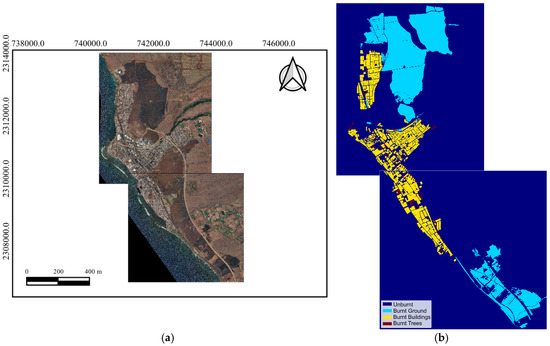
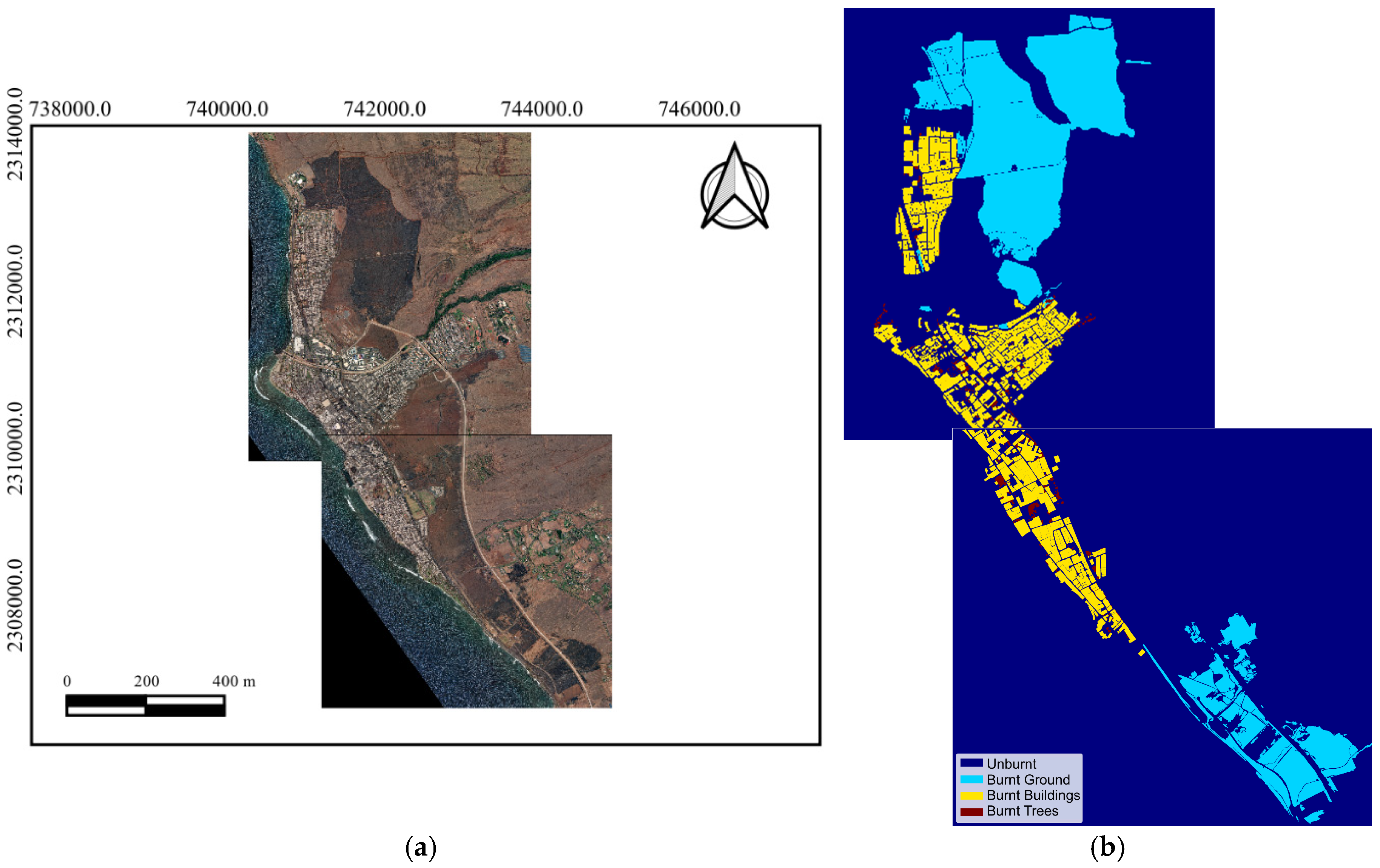
In August 2023, a series of wildfires broke out in the US state of Hawaii, predominantly on the island of Maui. Figure 1 displays a WorldViewII image of the Talat Lahaina region and the corresponding ground truth (GT). Four classes are considered: burnt ground, burnt trees, burnt buildings, and unburnt area. Additional information about this dataset is provided in Table 2.
Figure 1.
US wildfire dataset: (a) RGB (Red, Green, Blue) post image and (b) ground truth (GT).
Table 2.
Information on the datasets used in this study.
2.2. Canada Dataset (2023 Black Mountain Wildfire)
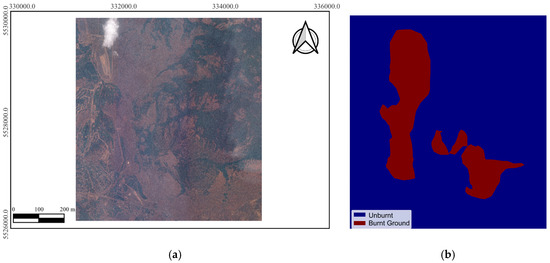
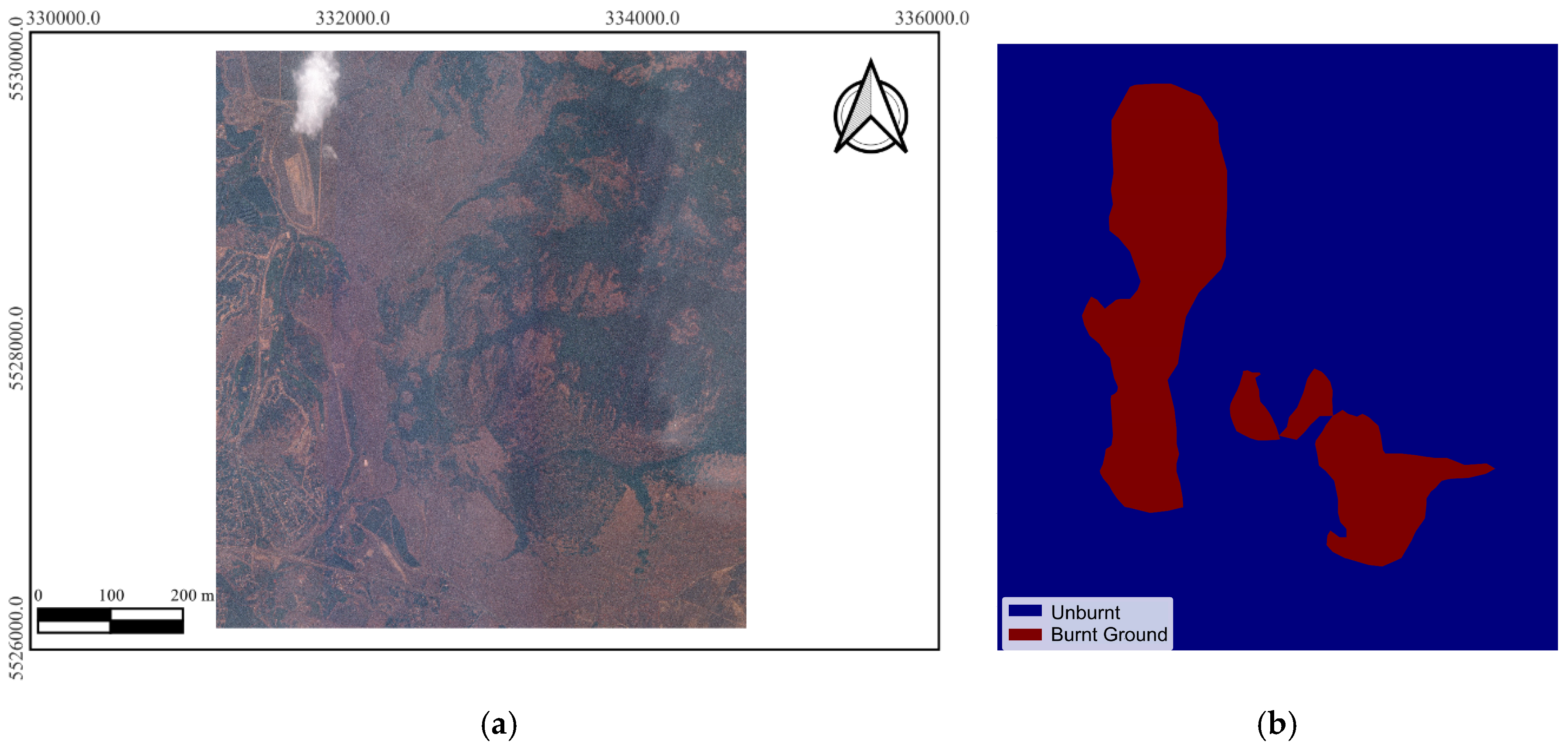
In August 2023, the Black Mountain wildfire was significantly impacted by the McDougall Creek wildfire, which was a part of the Grouse Complex Okanagan wildfire in British Columbia. Figure 2 displays a WorldViewIII satellite image of a part of the Black Mountain and the corresponding GT. Two classes were considered: burnt ground and unburnt area. Additional information regarding this dataset is outlined in Table 2.
Figure 2.
Canada wildfire dataset: (a) RGB (Red, Green, Blue) post image and (b) ground truth (GT).
A brief description of the datasets is mentioned in Table 2. All the satellite images have been made available to the public by Vantor Technologies Inc. (https://vantor.com/, (accessed on 30 December 2025)).
3. Proposed Method
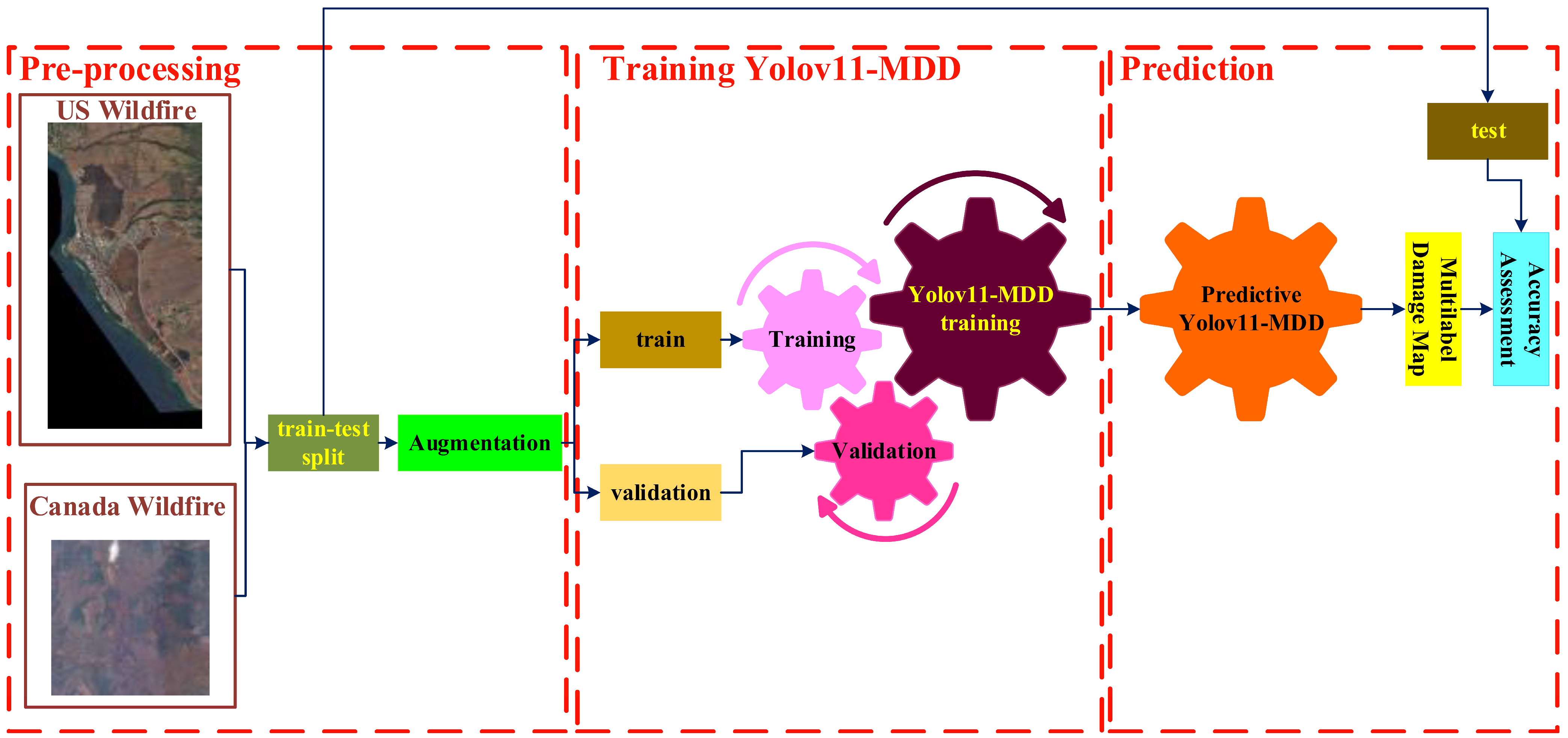
The proposed approach for detecting post-wildfire damage includes three main steps: (1) data preprocessing, (2) training the Yolov11 Multilabel Damage Detection network, and (3) prediction and accuracy evaluation according to the trained network.
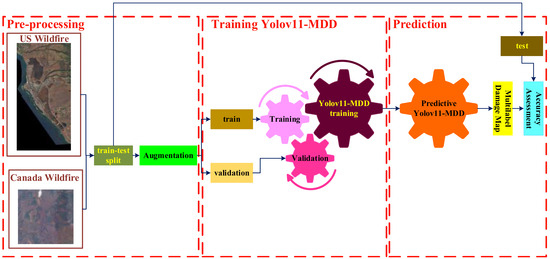
In the preprocessing step, the post-event RGB (Red, Green, Blue) images were split into 128 × 128 patches. The US dataset contained 18,012 patches, and the Canada dataset contained 9393 patches. A total of 60% of these patches were used for training and validation, and the remaining 40% were used for testing. After the train-validation and the test sets were separated, data augmentation was performed through the rotations of 90°, 180°, and 270° [40] on the train-validation set. To train the Yolov11-MDD network (the Yolov11 as the encoder path and the MUNet network [41] as the decoder path), the network was trained with the training data and evaluated with the validation data. The training procedure continued until the network achieved optimal performance. In the last step, the trained network was applied for prediction on the test dataset to evaluate the performance of the proposed method. Finally, the multilabel damage detection map was obtained. Figure 3 shows the overall workflow of the proposed method.
Figure 3.
Flowchart of the established method.
3.1. The Yolov11 Architecture Blocks
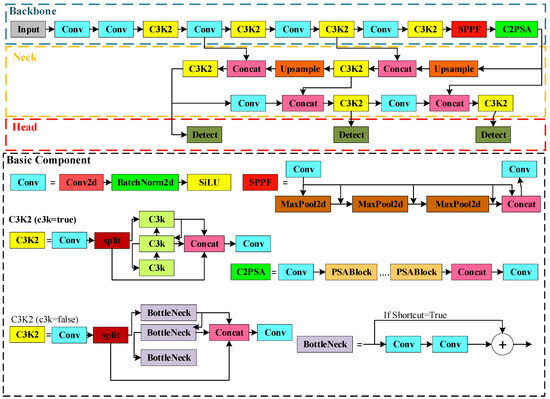
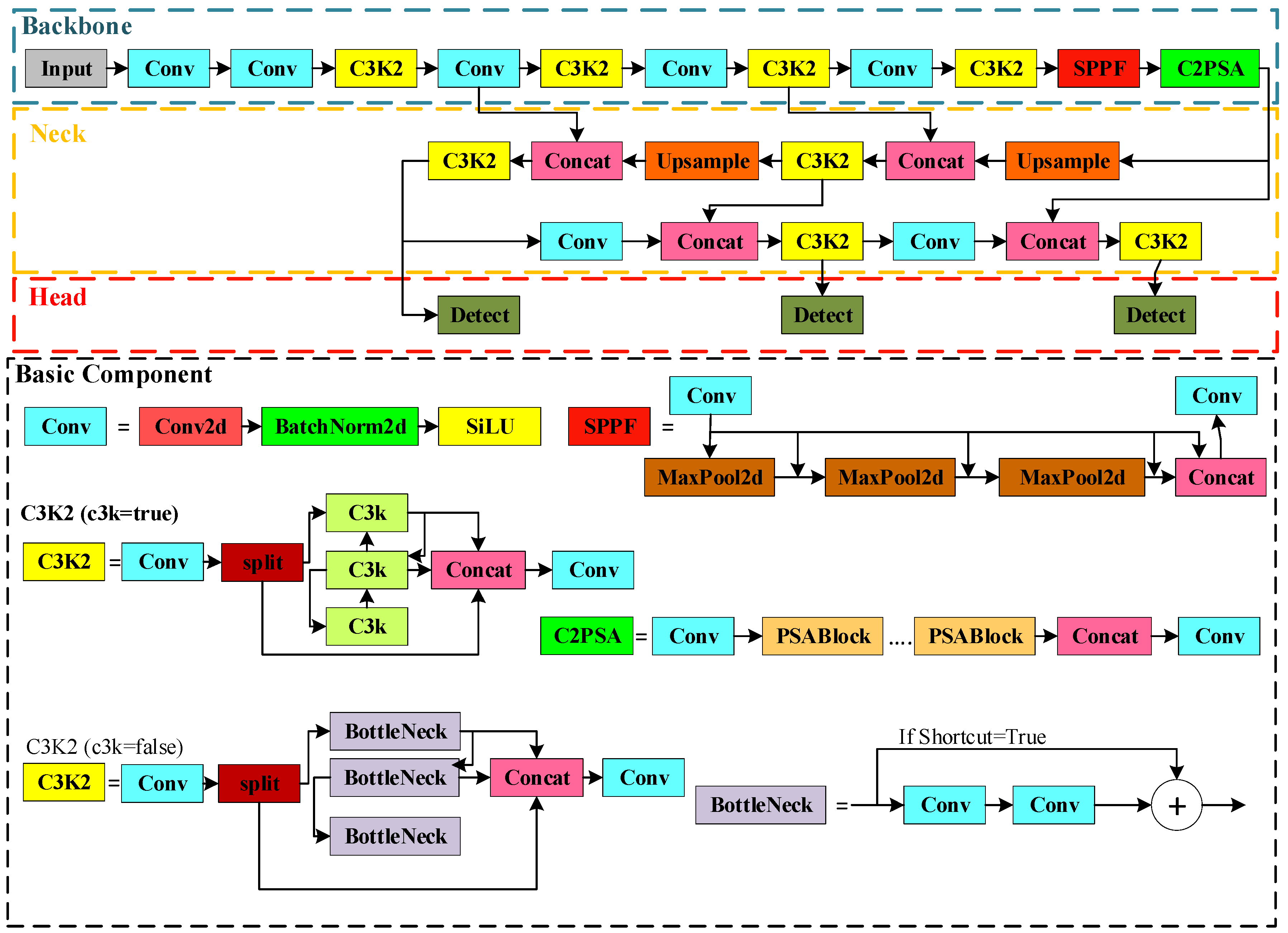
Yolo networks have been very popular in different computer vision applications. Since its inception, the Yolov11 has attracted significant interest due to its very effective, robust detection system with high accuracy [42,43,44]. Like all other Yolo networks, the Yolov11 comprises three main parts: backbone, neck and head. The input data is first processed by the backbone, which is the main part of feature extraction. In this module, input features are extracted using several layers such as convolutional layers (conv), C3K2 modules, SPPF module, and C2PSA module [42]. The Conv module does the first processing of the features. The C3K2 module is able to jointly learn deep hierarchical semantics and fine-grained details. The SPPF module combines multiscale contextual information with pyramid pooling, and the C2PSA module is used to enrich the representation of extracted features [42]. The neck is used for refining and pooling the features extracted from the backbone. It integrates local details and global semantic context by upsampling and concatenation operations. Also, when using the C2K2 module, features are integrated to obtain higher quality features [42]. Finally, the head performs object classification and bounding box regression [42,43]. Figure 4 shows the overall architecture of the Yolov11 network and its basic components.
Figure 4.
Network architecture diagram of Yolov11 consists of three parts: Backbone, Neck and Head. These parts include four basic components of Conv, C3K2, SPPF and C2PSA.
3.2. The Encoder–Decoder Framework Training for Multilabel Damage Detection
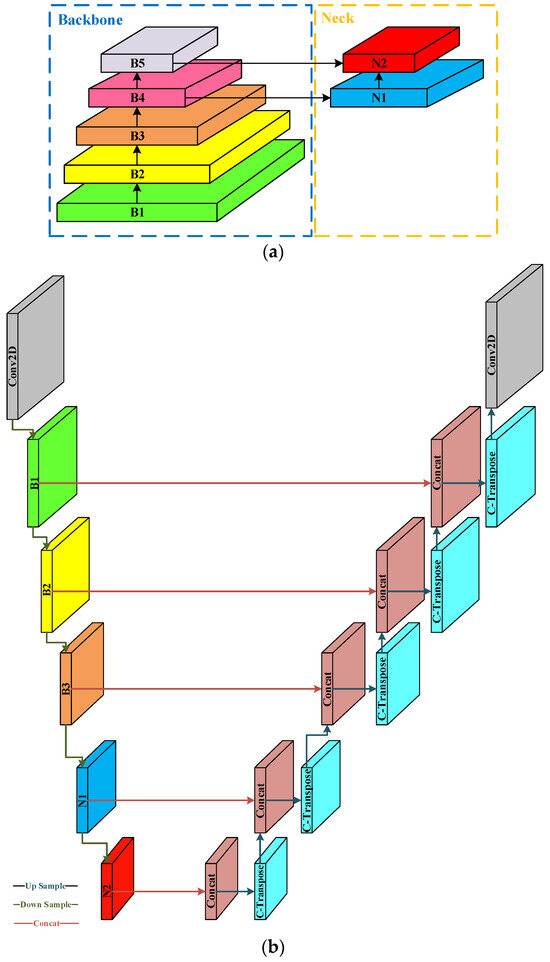
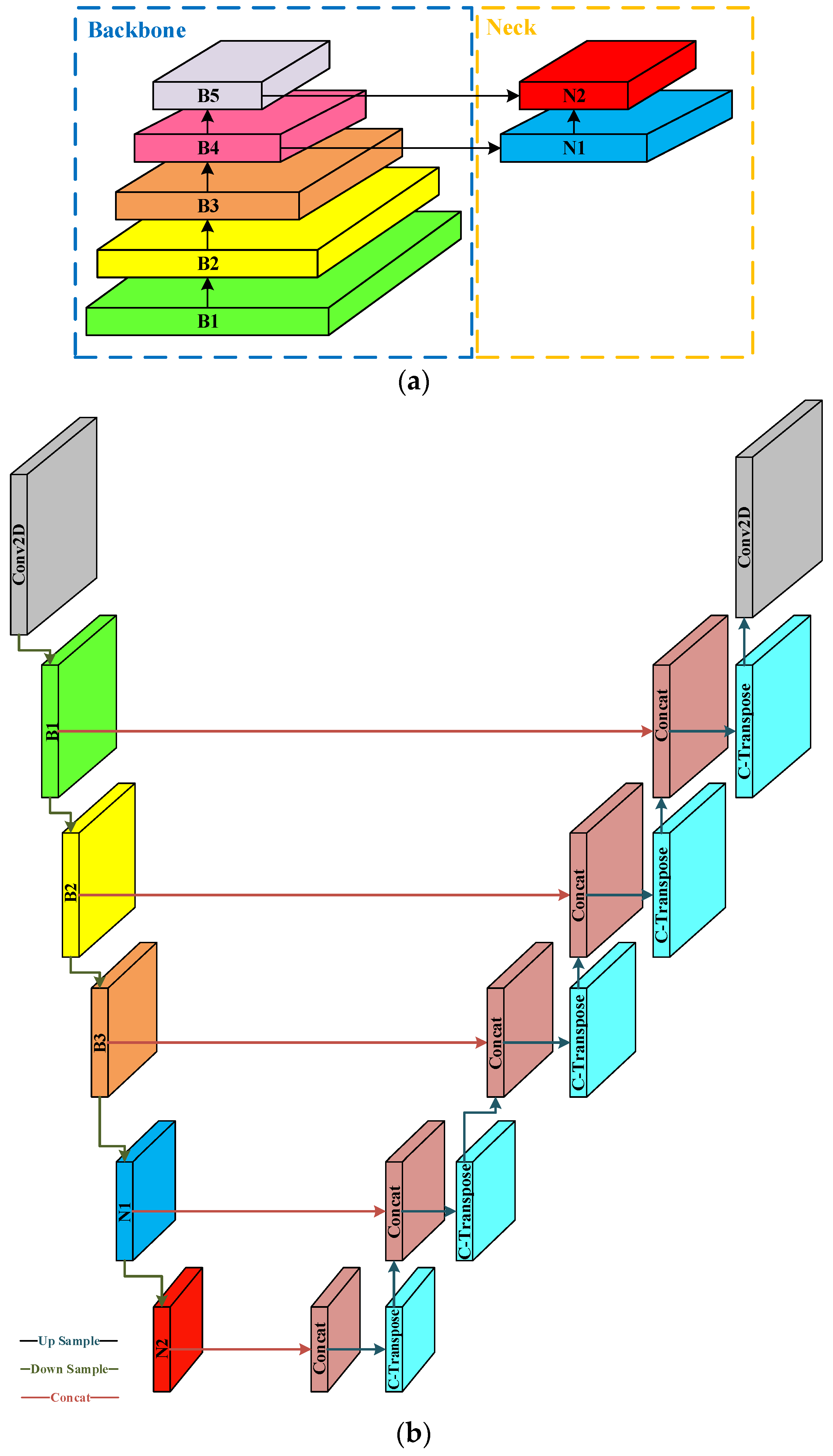
As stated above, the proposed network uses the encoder–decoder architecture. The encoder path consists of blocks from the Yolov11 network pre-trained on the COCO (Common Objects in Context dataset, comprising 80 object categories including common objects like cars, bicycles, animals, etc., as well as more specific categories such as umbrellas, hand bags, and sports equipment), and the decoder path consists of blocks from the MUNet network [41,45]. Since only the encoder is pre-trained, the model inherits the benefits of the Semi-Transfer Learning technique [46,47]. As shown in Figure 5, the Yolov11 network has five backbone blocks (b1–b5) and two neck blocks (n1 and n2). The backbone and the neck blocks of the Yolov11 are used for the encoder at five levels of the feature pyramid, which are concatenated with Conv2D transpose blocks with five different sizes to create the Yolov11-MDD network.
Figure 5.
(a) The structure of the Yolov11 backbone and neck (each block of the backbone and the neck represented with a different color); (b) the structure of the proposed encoder–decoder network using the Yolov11 as the encoder path and the MUnet as the decoder path. The encoder is concatenated with the decoder at five different resolutions (B1 backbone, B2 backbone, B3 backbone, N1 neck, N2 neck).
3.3. State of the Art Methods
In order to verify the effectiveness of the proposed method, a comparison with other Yolo-based networks embedded in encoder–decoder architectures was conducted. The Yolo networks to be benchmarked were Yolov7 [48], Yolov8, Yolox [49], and YoloR [50]. Therefore, these networks were all incorporated into an encoder–decoder structure for multilabel damage detection after wildfire events.
4. Experimental Results
This section evaluates the performance of the proposed method and compares it with other networks. It consists of three parts: Experimental Parameter Settings, Accuracy Assessment Metrics, and Comparison of Experimental Results.
4.1. Experimental Parameters Settings
The Yolov11-MDD network and the other networks that it was compared to were implemented using TensorFlow version 2.10.1 and Python version 3.9.21. The experiments were carried out on a system with an NVIDIA GeForce RTX 4070GPU, an Intel(R) Core i7-14700 processor and 64 GB RAM. The US dataset had 18,012 patches (128 × 128), and the Canada dataset had 9393 patches (128 × 128). A total of 60% of the data was used to train the validation set, and 40% of the data was used for the test set. After dividing the train validation dataset from the test, data augmentation was used with rotation angles of 90, 180, and 270 degrees. All the networks were trained for 100 epochs with a batch size of 20. Because of multilabel damage detection, a multiple focal loss function (Equation (1)) was used [51,52].
In this equation, is the predicted probability distribution, is the true probability distribution, and is the number of labels (i.e., classes). The hyperparameters was the class weights, and = 2. Both Adam and SGD optimizers were tested, and Adam showed better performance. The learning rate and the learning decay were set to and , respectively, for the Adam optimizer.
4.2. Evaluation Metrics
The evaluation metrics used in this study include Overall Accuracy (OA), Precision, Kappa Coefficient (KC), F1-score, and Intersection over Union (IoU), as shown in Table 3. In the following table, , , , and stand for true positive, true negative, false positive, and false negative, respectively.
Table 3.
Information Formulas for Accuracy Assessment.
4.3. Comparison of Experimental Results
The performance of the proposed method is compared with other networks using the evaluation metrics in Table 3, as shown in Table 4. As shown, when networks are converted to encoder–decoder architectures, the number of parameters decreases, making the networks lighter. A reduced number of parameters compared to the original version leads to faster training and greater flexibility in handling the GPU’s hardware limitations. Although the proposed network has slightly more parameters than the other models, it takes less time to train (1 h 50 min 10 s), demonstrating that it is efficient at creating multilabel damage maps after wildfires in the minimum time. The proposed method achieved the highest OA (97.36) and KC (0.96), which showed that the proposed network is superior to other networks. In addition, for other evaluation parameters, such as Precision, F1-score, and IoU, the proposed network achieved 98.28, 98.33, and 96.72, respectively, which outperformed all other methods. The results of the evaluations of all compared networks are presented in Table 4.
Table 4.
Quantitative Evaluation of the Results.
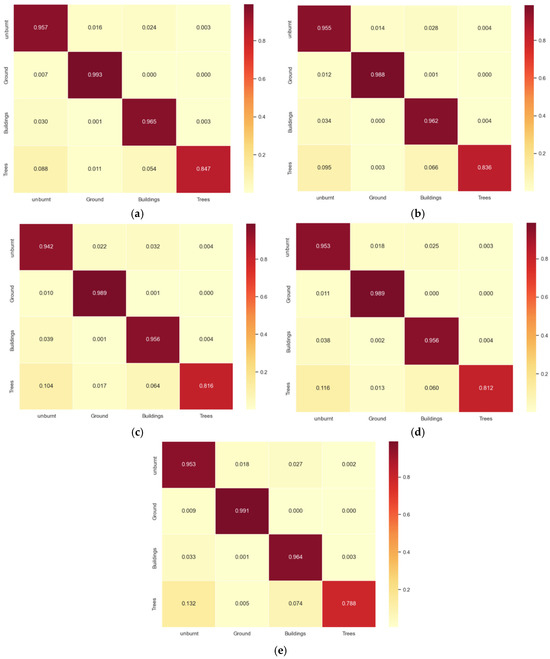
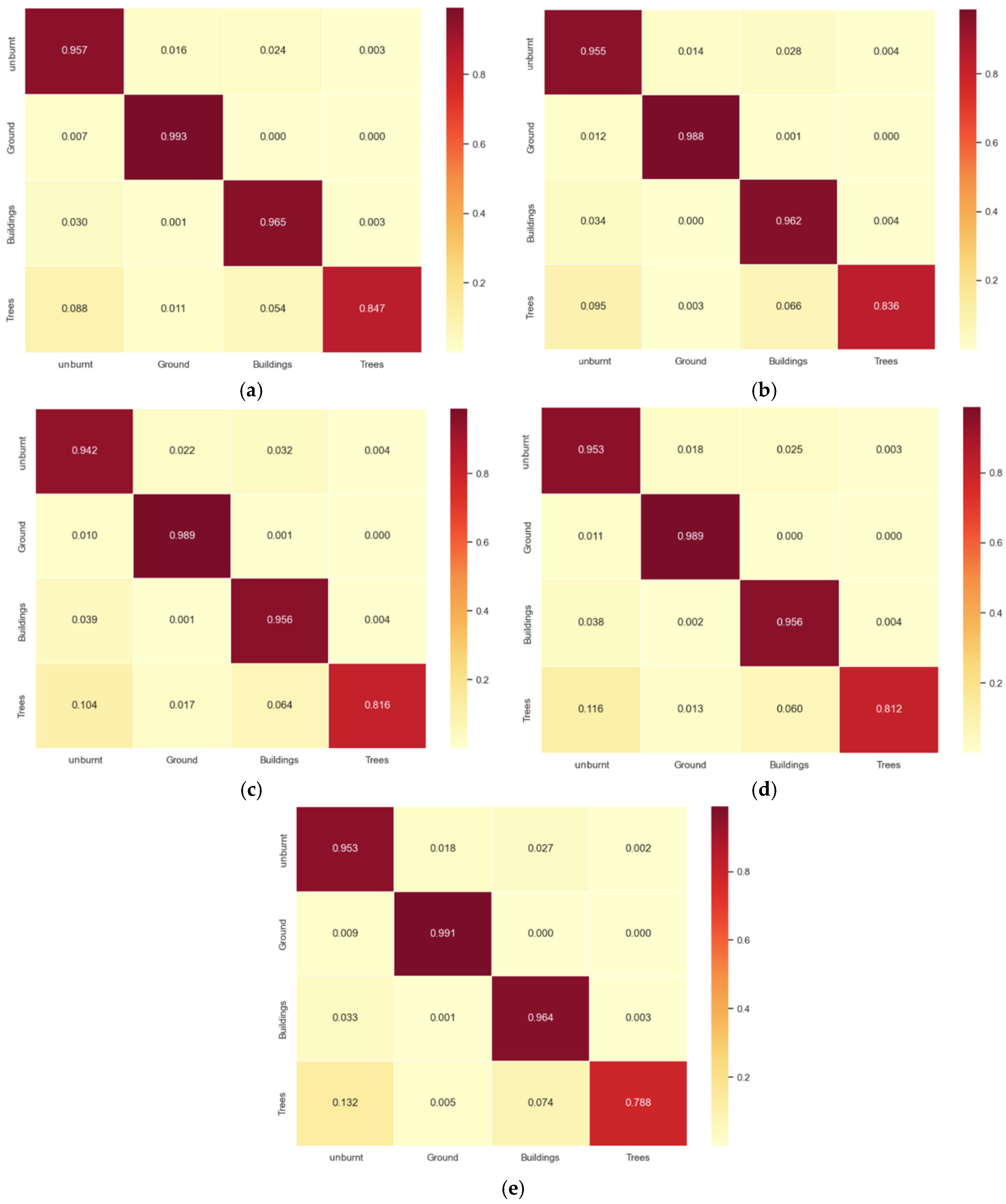
Given that the studied data in this research include burnt trees, burnt buildings, and burnt ground (for the US dataset), and knowing that one of the main contributions of this work is multilabel damage detection, the confusion matrices for the proposed and comparative methods are shown in Figure 6. Using the confusion matrix, the performance of each method in detecting individual classes can be analyzed separately. The “burnt ground” and “burnt buildings” classes achieve more than 90% accuracy in detection, but the “burnt trees” class remains challenging for all networks.
Figure 6.
Confusion Matrix of: (a) the proposed method, (b) Yolov8, (c) Yolov7, (d) YoloR and (e)Yolox. The x-axis indicates predicted labels, and the y-axis shows true labels.
5. Discussion
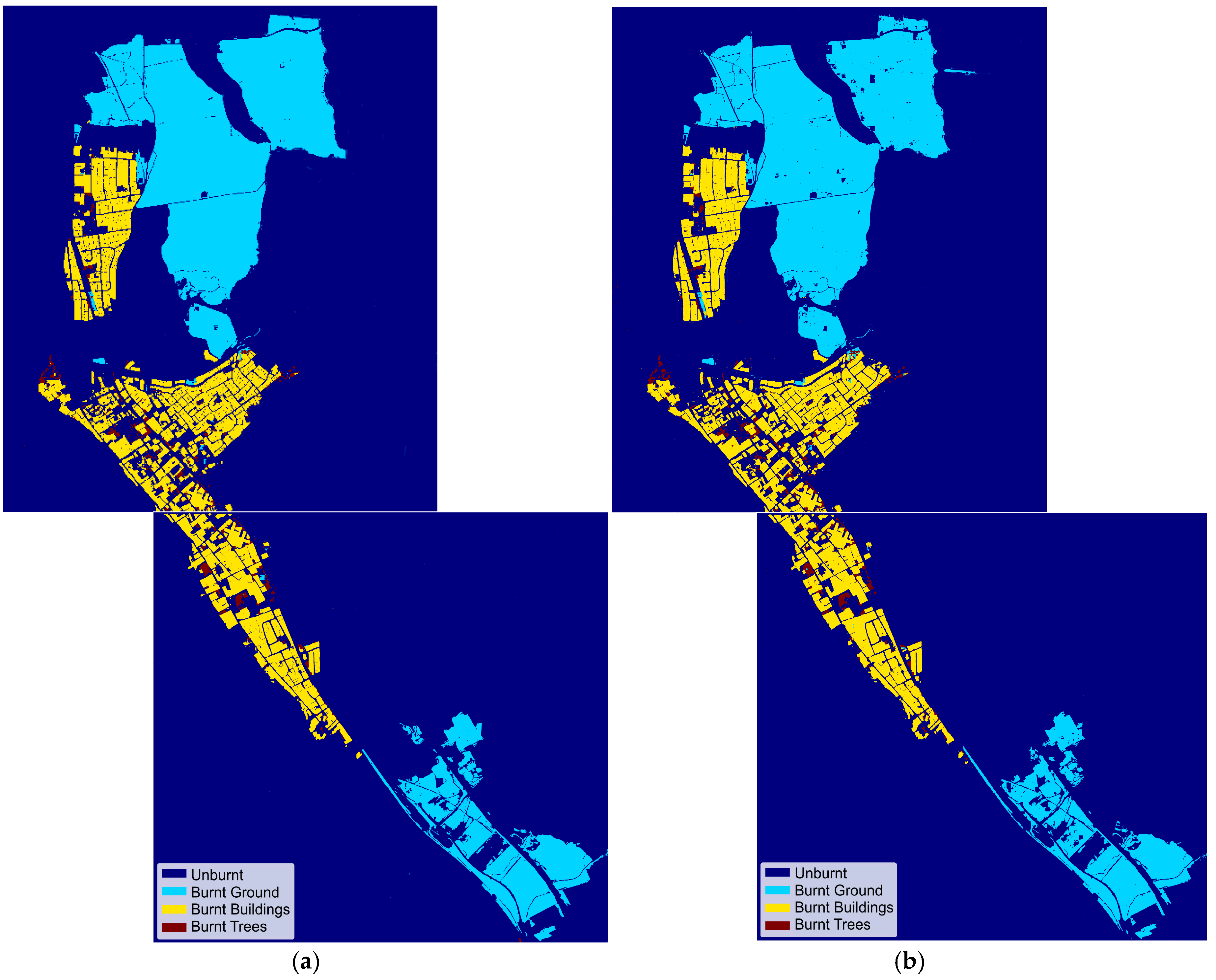
The performance of the proposed wildfire damage detection method was evaluated by performing qualitative, quantitative, and observational analyses. Figure 7 compares the results of the proposed approach with those of other networks on the US dataset. In this dataset, we performed multilabel wildfire damage detection, which consisted of the classes burnt ground (light blue), burnt buildings (yellow), burnt trees (dark red), and unburnt (dark blue). As illustrated in Figure 7, the proposed method was able to detect burnt ground, burnt buildings, and burnt trees with little error and yielded a valid final wildfire damage map. It is worthwhile mentioning that in post-event RGB damage detection tasks, identifying the boundaries of the ground, buildings, and trees prior to the fire is particularly challenging. Nevertheless, the proposed network in this study successfully detected and reconstructed these boundaries.
Figure 7.
Comparison between the various networks for the US dataset: (a) Yolv8, (b) Yolov7, (c) YoloR, (d) Yolox, (e) proposed method and (f) ground truth.
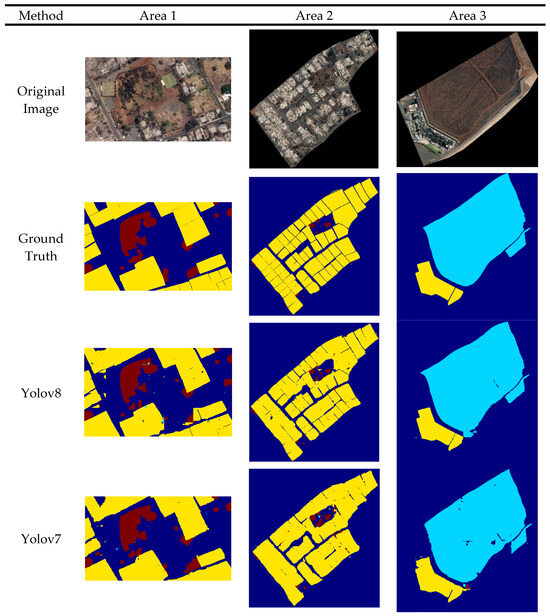
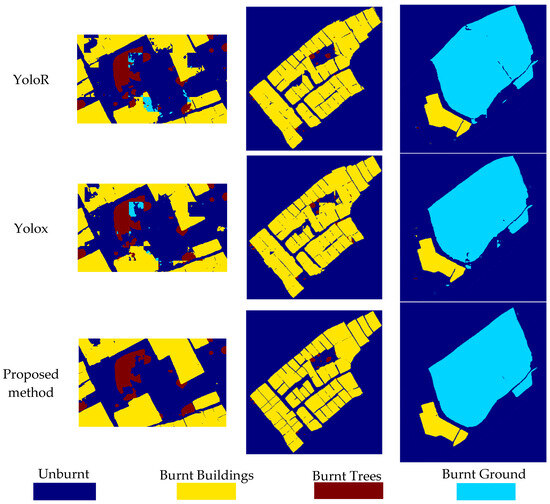
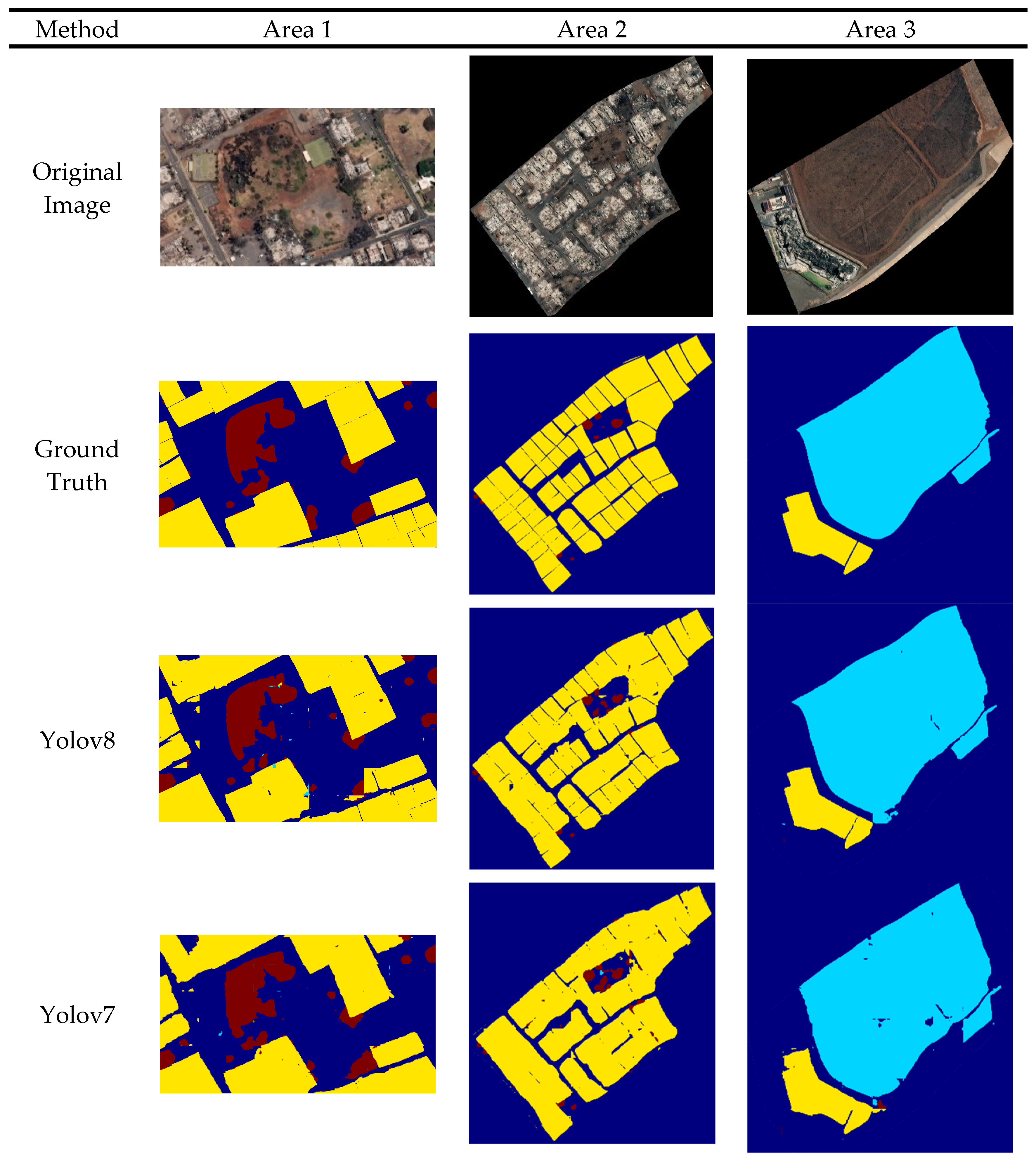
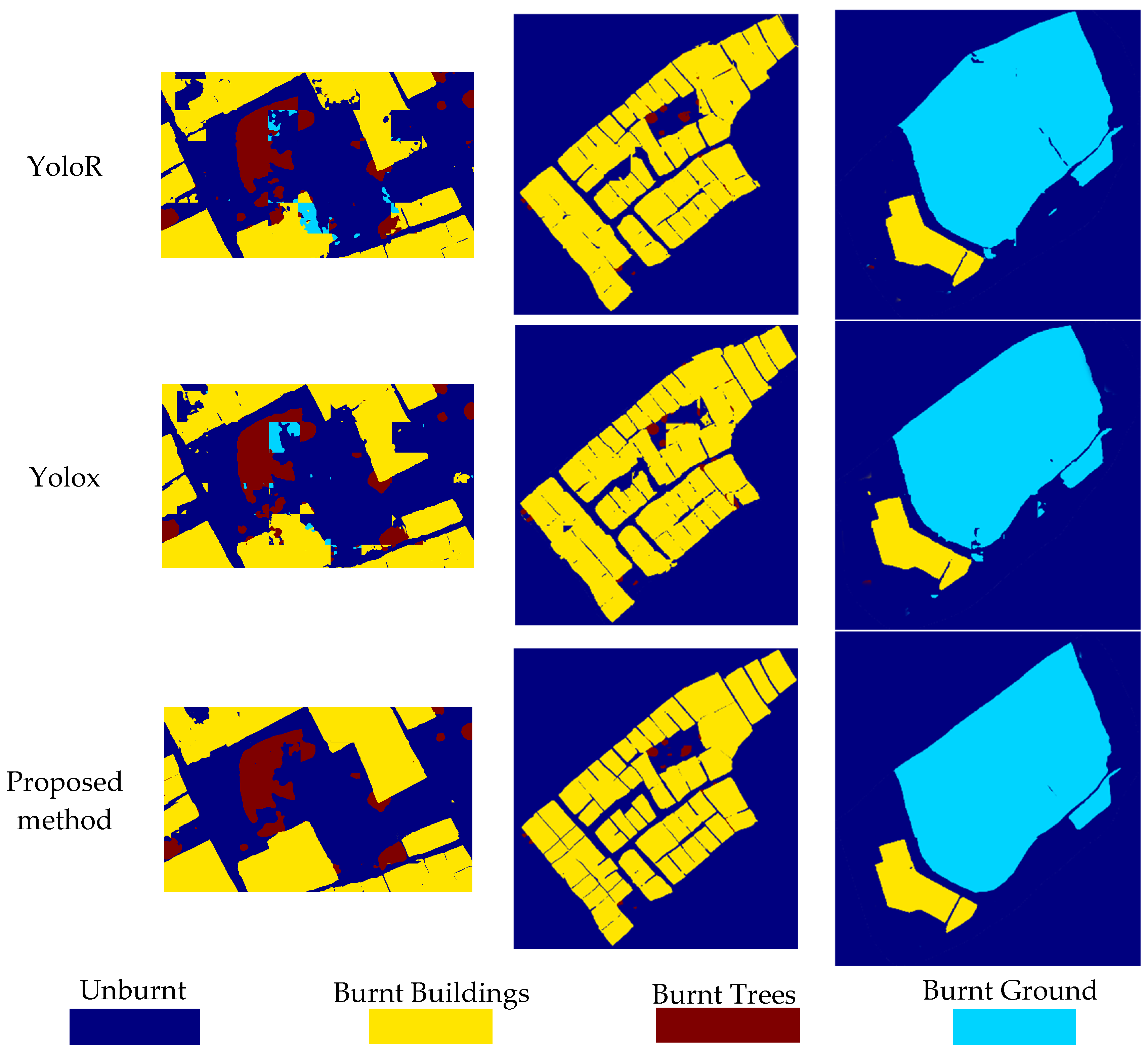
To evaluate the performance of the proposed method and compare it with other networks, three areas (see Figure 8) were selected. In Figure 8, Area 1 has burnt buildings and burnt trees with complex boundaries, which make their detection very challenging. The proposed network categorized burnt buildings into clusters with the highest similarity to the GT and showed good performance in reconstructing the boundaries of burnt buildings. The Yolov8, on the other hand, subtracted noise in some areas of Area 1 and overestimated the area of burnt zones. The Yolov7 performed well overall but misclassified damage in a few areas. The YoloR did not detect the burnt tree clusters, and the performance of burnt building boundaries was poor. In addition, it did not correctly identify some burnt trees and burnt buildings as burnt ground. Similarly, the Yolox, like the YoloR, failed to detect the damage classes and showed poor boundary reconstruction for burnt buildings and trees.
Figure 8.
Comparison of the results of the proposed method by different networks for the US dataset.
Area 2 (Figure 8) is a developed area where the building density is high. Because all of these structures were destroyed by fire, reconstructing their boundaries and splitting them from each other using only post-disaster data is very difficult. The proposed method achieved good boundary detection of these buildings and nearly reconstructed the burnt structures. It also correctly identified the damaged trees near building boundaries. In fact, the Yolov7 was unable to recompose the boundaries between neighboring buildings and attempted to merge them into a single block. The Yolov8 performed somewhat better than the Yolov7, but it committed mistakes in burnt tree detection that were located among the building clusters. It was, however, able to separate and distinguish the burnt building blocks reasonably. The YoloR was similar to the Yolov8 but had difficulty in reconstructing the boundaries of some burnt buildings. The Yolox was found to be highly prone to errors in detecting burnt trees, mistakenly classifying them as burnt buildings, and also exhibited poor performance in reconstructing building boundaries.
Area 3 (Figure 8) consists of both burnt ground and burnt buildings. The proposed method for burnt ground classification and the reconstructed boundaries of the adjacent burnt buildings was accurate. It identified the burnt ground as a homogeneous, continuous region with the highest similarity to the GT. Some burnt areas were incorrectly detected by the Yolov7, and it was unable to generate a 100% homogeneous burnt ground area. The Yolov8 performed relatively well at detecting both burnt ground and burnt buildings, with few errors in reconstructing ground boundaries. The YoloR also had good results but had misclassifications and errors in some border areas. The Yolox incorrectly labeled some undamaged areas as burnt and committed errors in reconstructing the outlines of burnt buildings.
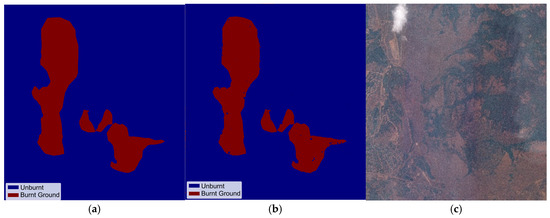
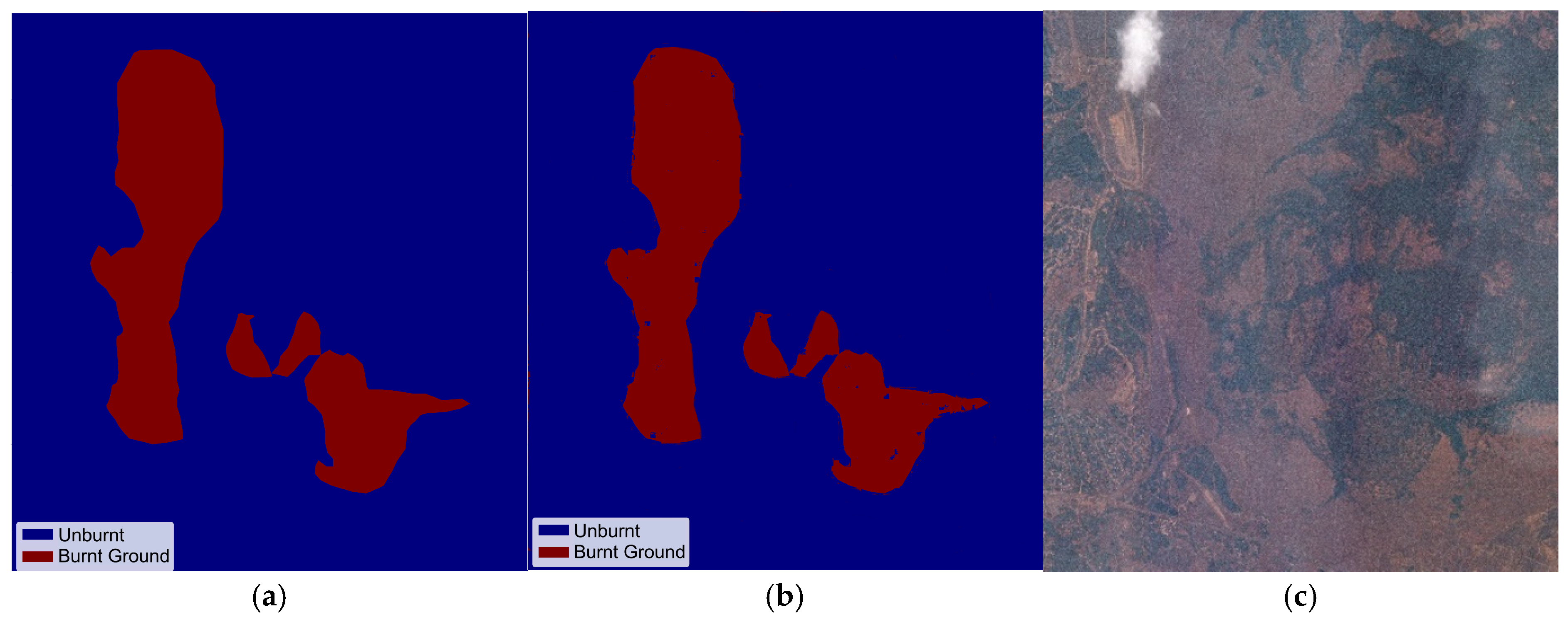
The next dataset analyzed in this study is the Canadian wildfire data. As shown in Figure 9, the proposed method correctly identified the burnt ground and reconstructed its boundaries. The satellite data for the Canadian wildfire (Figure 9) had low resolution due to atmospheric conditions at the time the images were acquired, and some areas were partially cloudy. Despite these difficulties, the proposed method successfully addressed the low-resolution issue. Also, the image showed high spectral similarity between burnt and unburnt areas in the RGB bands, making damage detection very difficult. However, the proposed method remedied this problem and clearly distinguished burnt ground from unburnt areas.
Figure 9.
Proposed method results for Canada dataset: (a) GT, (b) Yolov11-MDD results, (c) RGB post-event image.
As the results show, the Yolov11-MDD network is an efficient and fast architecture for accurate multilabel damage detection. The proposed network only uses post-event datasets, making it useful when pre-event data is unavailable or when challenges such as registration errors, atmospheric conditions, and noise are present [14,18]. The Yolov11-MDD can reconstruct the boundaries of burnt buildings, burnt trees, and burnt ground, which is typically challenging.
Additionally, the Yolov11-MDD is a lightweight extension of the Yolov11 architecture, making it more GPU-friendly. It can generate multilabel maps of burnt areas in a short time, thereby addressing the need for rapid mapping of damaged regions for rescue and recovery efforts [1,2,3]. Based on its efficiency in multilabel damage detection, it is recommended to retrain and apply the Yolov11-MDD to other disaster scenarios such as earthquakes and floods.
6. Conclusions
This research proposed an encoder–decoder network in which the encoder path used blocks of the Yolov11 and the decoder path used blocks of the MUNet, with the objective of multilabel damage detection from post-fire disasters. The encoder used the Yolov11 blocks, which had been pretrained, and the network benefited from Semi-Transfer Learning. Two datasets, the US and Canada, were used; both datasets were post-event satellite images. The US dataset included four classes (burnt ground, burnt trees, burnt buildings, and unburnt area) captured from WorldView-II imagery after August 2023, and the Canada dataset included burnt and unburnt ground areas captured from WorldView-III imagery after August 2023. The proposed network achieved an OA of 97.36 and 97.47, and KC of 0.96 and 0.87, on the US and Canadian datasets, respectively. This shows that the proposed method demonstrated strong performance in multilabel wildfire damage detection, and that the fast training speed of the Yolov11-MDD provided the potential for rapid, expedient post-disaster decision-making for damage maps in a short period of time.
Given the impressive performance of the Yolov11-MDD model, it is advisable to retrain this network for multilabel damage detection across other natural disasters, such as floods and earthquakes. Future work could also address data fusion with UAV imagery and other remote sensing data sources to improve detection accuracy or implement it for different remote sensing sensor datasets separately.
Author Contributions
Conceptualization, M.G. and H.A.-N.; methodology, M.G.; software, M.G., N.Z.; validation, M.G., M.J. and H.A.-N.; formal analysis, M.G.; investigation, M.G. and H.A.-N.; resources, M.G., M.J. and N.Z.; writing—original draft preparation, M.G.; writing—review and editing, H.A.-N., B.K. and M.J.; visualization, M.G. and M.J.; supervision, H.A.-N. and B.K.; project administration, M.G. and H.A.-N.; funding acquisition, H.A.-N. and B.K. All authors have read and agreed to the published version of the manuscript.
Funding
This research received no external funding.
Data Availability Statement
Derived data supporting the findings of this study are available from project administration on request.
Acknowledgments
The authors would like to thank the Faculty of Agricultural and Food Sciences, Department of Plant Science, the University of Manitoba, Winnipeg, Manitoba, Canada, the School of Computer Science, Faculty of Engineering and Information Technology, the University of Technology Sydney, and the RIKEN Centre for Advanced Intelligence Project (AIP), Tokyo, Japan, for providing all facilities during this research.
Conflicts of Interest
The authors declare no conflicts of interest.
References
- Dell’Acqua, F.; Gamba, P. Remote sensing and earthquake damage assessment: Experiences, limits, and perspectives. Proc. IEEE 2012, 100, 2876–2890. [Google Scholar] [CrossRef] [Scilit]
- Eguchi, R.T.; Huyck, C.K.; Ghosh, S.; Adams, B.J.; McMillan, A. Utilizing new technologies in managing hazards and disasters. In Geospatial Techniques in Urban Hazard and Disaster Analysis; Springer: Dordrecht, The Netherlands, 2010; pp. 295–323. [Google Scholar]
- Nex, F.; Duarte, D.; Tonolo, F.G.; Kerle, N. Structural building damage detection with deep learning: Assessment of a state-of-the-art CNN in operational conditions. Remote Sens. 2019, 11, 2765. [Google Scholar] [CrossRef] [Scilit]
- Hong, D.; Zhang, B.; Li, X.; Li, Y.; Li, C.; Yao, J.; Yokoya, N.; Li, H.; Ghamisi, P.; Jia, X. SpectralGPT: Spectral remote sensing foundation model. IEEE Trans. Pattern Anal. Mach. Intell. 2024, 46, 5227–5244. [Google Scholar] [CrossRef] [Scilit] [PubMed]
- Zhou, Z.; Gong, J.; Hu, X. Community-scale multi-level post-hurricane damage assessment of residential buildings using multi-temporal airborne LiDAR data. Autom. Constr. 2019, 98, 30–45. [Google Scholar] [CrossRef] [Scilit]
- Hong, Z.; Zhang, H.; Gao, J.; Tong, X.; Zhou, R.; Pan, H.; Zhang, Y.; Han, Y.; Wang, J.; Yang, S. Building damage assessment using improved combined adjustment and automatic building corners extraction method. Int. J. Remote Sens. 2023, 44, 7464–7491. [Google Scholar] [CrossRef] [Scilit]
- Talreja, P.; Durbha, S.S.; Shinde, R.C.; Potnis, A.V. Real-time embedded HPC based earthquake damage mapping using 3D LiDAR point clouds. In Proceedings of the 2021 IEEE International Geoscience and Remote Sensing Symposium IGARSS, Brussels, Belgium, 11–16 July 2021; pp. 8241–8244. [Google Scholar]
- Boloorani, A.D.; Darvishi, M.; Weng, Q.; Liu, X. Post-war urban damage mapping using InSAR: The case of Mosul City in Iraq. ISPRS Int. J. Geo-Inf. 2021, 10, 140. [Google Scholar] [CrossRef] [Scilit]
- ElGharbawi, T.; Zarzoura, F. Damage detection using SAR coherence statistical analysis, application to Beirut, Lebanon. ISPRS J. Photogramm. Remote Sens. 2021, 173, 1–9. [Google Scholar] [CrossRef] [Scilit]
- Wang, C.; Zhang, Y.; Xie, T.; Guo, L.; Chen, S.; Li, J.; Shi, F. A Detection Method for Collapsed Buildings Combining Post-Earthquake High-Resolution Optical and Synthetic Aperture Radar Images. Remote Sens. 2022, 14, 1100. [Google Scholar] [CrossRef] [Scilit]
- D’Addabbo, A.; Pasquariello, G.; Amodio, A. Urban change detection from vhr images via deep-features exploitation. In Proceedings of Sixth International Congress on Information and Communication Technology: ICICT 2021, London, Volume 2; Springer: Singapore, 2021; pp. 487–500. [Google Scholar]
- Mohammadian, A.; Ghaderi, F. SiamixFormer: A fully-transformer Siamese network with temporal Fusion for accurate building detection and change detection in bi-temporal remote sensing images. Int. J. Remote Sens. 2023, 44, 3660–3678. [Google Scholar] [CrossRef] [Scilit]
- Yeom, J.; Jung, M.; Kim, Y. Detecting damaged building parts in earthquake-damaged areas using differential seeded region growing. Int. J. Remote Sens. 2017, 38, 985–1005. [Google Scholar] [CrossRef] [Scilit]
- Khankeshizadeh, E.; Mohammadzadeh, A.; Arefi, H.; Mohsenifar, A.; Pirasteh, S.; Fan, E.; Li, H.; Li, J. A Novel Weighted Ensemble Transferred U-Net based Model (WETUM) for Post-Earthquake Building Damage Assessment from UAV Data: A Comparison of Deep Learning-and Machine Learning-based Approaches. IEEE Trans. Geosci. Remote Sens. 2024, 62, 4701317. [Google Scholar] [CrossRef] [Scilit]
- Naito, S.; Tomozawa, H.; Mori, Y.; Nagata, T.; Monma, N.; Nakamura, H.; Fujiwara, H.; Shoji, G. Building-damage detection method based on machine learning utilizing aerial photographs of the Kumamoto earthquake. Earthq. Spectra 2020, 36, 1166–1187. [Google Scholar] [CrossRef] [Scilit]
- Li, M.; Cheng, L.; Gong, J.; Liu, Y.; Chen, Z.; Li, F.; Chen, G.; Chen, D.; Song, X. Post-earthquake assessment of building damage degree using LiDAR data and imagery. Sci. China Ser. E Technol. Sci. 2008, 51, 133–143. [Google Scholar] [CrossRef] [Scilit]
- Adriano, B.; Xia, J.; Baier, G.; Yokoya, N.; Koshimura, S. Multi-source data fusion based on ensemble learning for rapid building damage mapping during the 2018 sulawesi earthquake and tsunami in Palu, Indonesia. Remote Sens. 2019, 11, 886. [Google Scholar] [CrossRef] [Scilit]
- Janalipour, M.; Mohammadzadeh, A. A novel and automatic framework for producing building damage map using post-event LiDAR data. Int. J. Disaster Risk Reduct. 2019, 39, 101238. [Google Scholar] [CrossRef] [Scilit]
- Ge, P.; Gokon, H.; Meguro, K. A review on synthetic aperture radar-based building damage assessment in disasters. Remote Sens. Environ. 2020, 240, 111693. [Google Scholar]
- Ferrentino, E.; Nunziata, F.; Migliaccio, M.; Vicari, A. A sensitivity analysis of dual-polarization features to damage due to the 2016 Central-Italy earthquake. Int. J. Remote Sens. 2018, 39, 6846–6863. [Google Scholar]
- Li, Q.; Gong, L.; Zhang, J. A correlation change detection method integrating PCA and multi-texture features of SAR image for building damage detection. Eur. J. Remote Sens. 2019, 52, 435–447. [Google Scholar] [CrossRef] [Scilit]
- Gomroki, M.; Hasanlou, M.; Chanussot, J.; Hong, D. Emynet-bdd: Efficientvitb meets yolov8 in the encoder-decoder architecture for building damage detection using post-event remote sensing images. IEEE J. Sel. Top. Appl. Earth Obs. Remote Sens. 2024, 17, 13120–13134. [Google Scholar] [CrossRef] [Scilit]
- Axel, C.; van Aardt, J. Building damage assessment using airborne lidar. J. Appl. Remote Sens. 2017, 11, 046024. [Google Scholar] [CrossRef] [Scilit]
- Gomroki, M.; Hasanlou, M.; Chanussot, J.; Hong, D. UNet-GCViT: A UNet-based framework with global context vision transformer blocks for building damage detection. Int. J. Remote Sens. 2025, 46, 2587–2610. [Google Scholar]
- Merlin, G.S.; Jiji, G.W. Building Damage Detection of the 2004 Nagapattinam, India, Tsunami Using the Texture and Spectral Features from IKONOS Images. J. Indian Soc. Remote Sens. 2019, 47, 13–24. [Google Scholar] [CrossRef] [Scilit]
- Ji, M.; Liu, L.; Du, R.; Buchroithner, M.F. A comparative study of texture and convolutional neural network features for detecting collapsed buildings after earthquakes using pre-and post-event satellite imagery. Remote Sens. 2019, 11, 1202. [Google Scholar] [CrossRef] [Scilit]
- Li, Y.; Hu, W.; Dong, H.; Zhang, X. Building damage detection from post-event aerial imagery using single shot multibox detector. Appl. Sci. 2019, 9, 1128. [Google Scholar] [CrossRef] [Scilit]
- Wu, C.; Zhang, F.; Xia, J.; Xu, Y.; Li, G.; Xie, J.; Du, Z.; Liu, R. Building damage detection using U-Net with attention mechanism from pre-and post-disaster remote sensing datasets. Remote Sens. 2021, 13, 905. [Google Scholar] [CrossRef] [Scilit]
- Shen, Y.; Zhu, S.; Yang, T.; Chen, C.; Pan, D.; Chen, J.; Xiao, L.; Du, Q. Bdanet: Multiscale convolutional neural network with cross-directional attention for building damage assessment from satellite images. IEEE Trans. Geosci. Remote Sens. 2021, 60, 5402114. [Google Scholar] [CrossRef] [Scilit]
- Zheng, Z.; Zhong, Y.; Wang, J.; Ma, A.; Zhang, L. Building damage assessment for rapid disaster response with a deep object-based semantic change detection framework: From natural disasters to man-made disasters. Remote Sens. Environ. 2021, 265, 112636. [Google Scholar] [CrossRef] [Scilit]
- Chen, H.; Nemni, E.; Vallecorsa, S.; Li, X.; Wu, C.; Bromley, L. Dual-tasks siamese transformer framework for building damage assessment. In Proceedings of the IGARSS 2022—2022 IEEE International Geoscience and Remote Sensing Symposium, Kuala Lumpur, Malaysia, 17–22 July 2022; pp. 1600–1603. [Google Scholar]
- Virtriana, R.; Harto, A.B.; Atmaja, F.W.; Meilano, I.; Fauzan, K.N.; Anggraini, T.S.; Ihsan, K.T.N.; Mustika, F.C.; Suminar, W. Machine learning remote sensing using the random forest classifier to detect the building damage caused by the Anak Krakatau Volcano tsunami. Geomat. Nat. Hazards Risk 2023, 14, 28–51. [Google Scholar] [CrossRef] [Scilit]
- Gupta, R.; Shah, M. Rescuenet: Joint building segmentation and damage assessment from satellite imagery. In Proceedings of the 2020 25th International Conference on Pattern Recognition (ICPR), Milan, Italy, 10–15 January 2021; pp. 4405–4411. [Google Scholar]
- Jeong, D. Road damage detection using YOLO with smartphone images. In Proceedings of the 2020 IEEE International Conference on Big Data (Big Data), Atlanta, GA, USA, 10–13 December 2020; pp. 5559–5562. [Google Scholar]
- Li, Y.; Yin, C.; Lei, Y.; Zhang, J.; Yan, Y. Rdd-yolo: Road damage detection algorithm based on improved you only look once version 8. Appl. Sci. 2024, 14, 3360. [Google Scholar] [CrossRef] [Scilit]
- Wan, F.; Sun, C.; He, H.; Lei, G.; Xu, L.; Xiao, T. YOLO-LRDD: A lightweight method for road damage detection based on improved YOLOv5s. EURASIP J. Adv. Signal Process. 2022, 2022, 98. [Google Scholar] [CrossRef] [Scilit]
- Wang, W.; Yu, X.; Jing, B.; Tang, Z.; Zhang, W.; Wang, S.; Xiao, Y.; Li, S.; Yang, L. YOLO-RD: A Road Damage Detection Method for Effective Pavement Maintenance. Sensors 2025, 25, 1442. [Google Scholar] [CrossRef] [Scilit] [PubMed]
- Zou, L.; Chen, A.; Yang, X.; Sun, Y. An improved method of AUD-YOLO for surface damage detection of wind turbine blades. Sci. Rep. 2025, 15, 5833. [Google Scholar] [CrossRef] [Scilit] [PubMed]
- Zhao, Z.; Pan, Y.; Guo, G.; Zhai, Y.; Liu, G. YOLO-AFPN: Marrying YOLO and AFPN for external damage detection of transmission lines. IET Gener. Transm. Distrib. 2024, 18, 1935–1946. [Google Scholar] [CrossRef] [Scilit]
- Deigele, W. Wind Throw Detection Using Deep Learning on PlanetScope and High-Resolution Aerial Images. Master’s Thesis, Technical University of Munich, Munich, Germany, 2020. [Google Scholar]
- Gomroki, M.; Hasanlou, M.; Chanussot, J. Automatic 3D Multiple Building Change Detection Model based on Encoder-Decoder Network using Highly Unbalanced Remote Sensing Datasets. IEEE J. Sel. Top. Appl. Earth Obs. Remote Sens. 2023, 16, 10311–10325. [Google Scholar] [CrossRef] [Scilit]
- He, L.; Zhou, Y.; Liu, L.; Cao, W.; Ma, J. Research on object detection and recognition in remote sensing images based on YOLOv11. Sci. Rep. 2025, 15, 14032. [Google Scholar] [CrossRef] [Scilit]
- Tang, X.; Sun, Z.; Yang, L.; Chen, Q.; Liu, Z.; Wang, P.; Zhang, Y. YOLOv11-AIU: A lightweight detection model for the grading detection of early blight disease in tomatoes. Plant Methods 2025, 21, 118. [Google Scholar] [CrossRef] [Scilit]
- Zhang, M.; Ye, S.; Zhao, S.; Wang, W.; Xie, C. Pear object detection in complex orchard environment based on improved YOLO11. Symmetry 2025, 17, 255. [Google Scholar] [CrossRef] [Scilit]
- Ronneberger, O.; Fischer, P.; Brox, T. U-net: Convolutional networks for biomedical image segmentation. In Medical Image Computing and Computer-Assisted Intervention–MICCAI 2015: 18th International Conference, Munich, Germany, October 5–9, 2015, Proceedings, Part III; Springer: Cham, Switzerland, 2015; pp. 234–241. [Google Scholar]
- Bozinovski, S.; Fulgosi, A. The influence of pattern similarity and transfer learning on the base perceptron training. In Proceedings of the Symposium Informatica, New York, NY, USA, 20–22 April 1976; p. 19. [Google Scholar]
- Gomroki, M.; Hasanlou, M.; Reinartz, P. STCD-EffV2T Unet: Semi Transfer Learning EfficientNetV2 T-Unet Network for Urban/Land Cover Change Detection Using Sentinel-2 Satellite Images. Remote Sens. 2023, 15, 1232. [Google Scholar] [CrossRef] [Scilit]
- Wang, C.-Y.; Bochkovskiy, A.; Liao, H.-Y.M. YOLOv7: Trainable bag-of-freebies sets new state-of-the-art for real-time object detectors. arXiv 2022, arXiv:2207.02696. [Google Scholar]
- Ge, Z.; Liu, S.; Wang, F.; Li, Z.; Sun, J. Yolox: Exceeding yolo series in 2021. arXiv 2021, arXiv:2107.08430. [Google Scholar] [CrossRef] [Scilit]
- Wang, C.-Y.; Yeh, I.-H.; Liao, H.-Y.M. You only learn one representation: Unified network for multiple tasks. arXiv 2021, arXiv:2105.04206. [Google Scholar] [CrossRef] [Scilit]
- Gomroki, M.; Benaragama, D.; Henry, C.J.; Badreldin, N.; Gulden, R. CWRepViT-Net: An Encoder-Decoder Deep Learning Framework with RepViT Blocks for Crop Weed Semantic Segmentation in Soybean Fields thorough their Life Journey. Smart Agric. Technol. 2025, 12, 101472. [Google Scholar] [CrossRef] [Scilit]
- Liu, W.; Chen, L.; Chen, Y. Age classification using convolutional neural networks with the multi-class focal loss. IOP Conf. Ser. Mater. Sci. Eng. 2018, 428, 012043. [Google Scholar] [CrossRef] [Scilit]

Disclaimer/Publisher’s Note: The statements, opinions and data contained in all publications are solely those of the individual author(s) and contributor(s) and not of MDPI and/or the editor(s). MDPI and/or the editor(s) disclaim responsibility for any injury to people or property resulting from any ideas, methods, instructions or products referred to in the content. |
© 2026 by the authors. Licensee MDPI, Basel, Switzerland. This article is an open access article distributed under the terms and conditions of the Creative Commons Attribution (CC BY) license.