


Highlights
What are the main findings?
- A highly accurate and robust Gaussian filter that adapts to any data source.
- The method outperforms both traditional filters and deep learning approaches.
What are the implications of the main findings?
- Enables real-time, precise road assessment for cost-effective maintenance.
- Provides a practical and reliable solution that is ready for immediate industry deployment.
Abstract
The International Roughness Index (IRI) is calculated from elevation profiles acquired by high-speed profilers or laser scanners, but these raw data often contain measurement noise and extraneous wavelength components that can degrade the accuracy of IRI calculations. Existing filtering methods expose a limitation in removing IRI-insensitive wavelength components. Thus, this paper proposes a Gaussian filtering algorithm based on the Nyquist sampling theorem to remove IRI-insensitive components of the longitudinal profile. The proposed approach first adaptively determines Gaussian template lengths according to sampling intervals, and then incorporates a boundary padding strategy to ensure processing stability. The proposed method enables precise wavelength selection within the IRI-sensitive band of 1.3–29.4 m while maintaining computational efficiency. The method was validated using the Paris–Lille dataset and the U.S. Long-Term Pavement Performance (LTPP) program dataset. The filtered profiles were evaluated by Power Spectral Density (PSD), and IRI values were calculated and compared with those obtained by conventional profile filtering methods. The results show that the proposed method is effective in removing the non-sensitive components of IRI and obtaining highly accurate IRI values. Compared with the standard IRI provided by the LTPP dataset, mean absolute error of the IRI values from the proposed method reaches 0.051 m/km, and mean relative error is less than 4%. These findings indicate that the proposed method improves the reliability of IRI calculation.
1. Introduction
As the total mileage of roads in China continues to expand [1,2,3], highway maintenance has become an increasingly important task in the field of road infrastructure [4]. Various evaluation indicators have been developed to support decision-making in road maintenance, including the Pavement Condition Index (PCI) [5], road roughness [6], and the Skid Resistance Index (SRI) [7]. Among these, IRI (International Roughness Index) is a key indicator, directly reflecting the quality and safety of road surfaces, and is considered one of the most significant measures of road conditions [8,9,10,11,12,13].
A sensitive frequency range for IRI was determined through extensive correlation analysis in the World Bank’s 1986 “International Roughness Index (IRI) Calibration Study”: 0.034–0.769 m−1 (space frequency: 1.3–29.4 m wavelength) [14]. The linear correlation coefficients between this range and passenger vibration acceleration, suspension dynamic travel, and tire dynamic loads all exceeded 0.9.
The accuracy of IRI calculation is influenced by insensitive wavelength components; some researchers have directly used longitudinal profile elevation data and various mathematical methods to calculate IRI, but these approaches have not achieved high accuracy. While the ASTM E1926-08 standard employs a 250 mm moving average, this approach poses two key limitations in the context of high-resolution data (10–150 mm sampling) [15]. Firstly, its rigid wavelength selection lacks adaptability to different sampling intervals, potentially over-smoothing critical signals. Secondly, its inadequate noise suppression beyond the IRI-sensitive band (1.3–29.4 m) necessitates additional numerical filtering, leading to cumulative error propagation in the quarter-car model. And the preprocessing stage often involves default moving average filters, which do not effectively eliminate the influence of IRI-insensitive frequency bands. At present, the more advanced wavelet-based denoising filter and the Savitzky–Golay filter have difficulty determining the parameters and high calculation cost, which makes it difficult to achieve light weight [16]. In addition, model prediction and AI methods must account for the impact of multiple factors when calculating the IRI, and existing models and neural networks have spatiotemporal limitations [17,18,19,20].
This study proposes three modules to address the problems mentioned above, and major contributions are summarized as follows:
- (1)
- A Gaussian filtering algorithm based on the Nyquist sampling theorem was proposed, enabling the precise removal of IRI-insensitive wavelengths (1.3–29.4 m) while maintaining computational efficiency.
- (2)
- A computationally efficient filtering framework with automatic parameter adaptation to sampling interval variations (validated for 10–150 mm range, spanning 15× variation) across two sensor acquisition geometries: line-scanning profilers (ICC MDR 4086L3, D = 25/150 mm) and rotating multi-beam LiDAR (Velodyne HDL-32E, D = 10 mm) on asphalt concrete pavements under standard measurement conditions (dry, daytime, ≥10 °C).
- (3)
- Validation using both the U.S. LTPP and France Paris–Lille datasets demonstrated superior performance, with a mean absolute error of 0.051 m/km and a mean relative error below 4% in the IRI calculation.
- (4)
- The method achieves full compliance with the ASTM E1926-08 standards and enables direct integration into quarter-car models, offering a practical real-time solution for pavement maintenance and autonomous driving applications.
2. Related Work
2.1. Mathematical Computational Methods
These methods generally require measurements of the longitudinal road profile [21] and elevation values. The IRI was originally proposed by researcher M. Sayers at the University of Michigan [22], calculating the response of a quarter-car model traveling at 80 km/h on a given road surface. For specific calculation details, please refer to the report by Sayers et al. [23]. Mirtabar et al. [24] employed low-cost three-axis Micro Electromechanical System (MEMS) accelerometers and GPS sensors connected to an Arduino board, embedded in a vehicle, to monitor road surface conditions. By double-integrating the Z-axis acceleration data, the road surface profile could be determined, allowing for automatic calculation of the IRI. However, the accuracy of this method is not ideal. Contreras et al. [25]. used unmanned aerial vehicles (UAVs) and photogrammetry to obtain pavement IRI measurements; however, this approach has certain limitations, such as the UAV’s flight altitude and weather conditions. Other researchers have explored the use of inertial sensors in smartphones [26,27,28] or custom sensor platforms [29,30,31] for IRI calculations. The lowest-cost approach is to attach sensors to bicycles to capture data [32,33]. These methods are more accessible, cost-effective, and less affected by environmental factors compared to traditional instruments, but they are still in the early stages and require further research to fully evaluate their potential and limitations.
2.2. The Quarter-Car Model
In IRI’s standard calculation procedures, the quarter-car model is widely used [34]. This model was first presented in the National Highway Research Program (NCHRP) report. The model is also called the Golden Car. The quarter-car parameters are defined as part of the IRI statistic. The IRI calculation results show minimal deviation from the “true value” when the vehicle speed reaches 80 km/h [35]. The Golden Car parameters are:
where is the spring rate, is the sprung mass, is the tire spring rate, is the damper rate, and is the unsprung mass.
By inserting the Golden Car parameters into the four equations of the IRI definition, a more accurate IRI value can be obtained. Details of the calculations can be found in Sayers et al. [23]. To addressed issues such as incomplete standard procedures in two major research reports, Li et al. [36] proposed a new solution for calculating IRI based on PIM. Experiments have shown that this method has higher calculation efficiency, accuracy, and stability due to the ASTM code and CEN code. Zhao et al. [37] used a half-car model for modeling and a genetic algorithm to identify the relevant parameters, which gave better results in the simulation experiments. Thite developed a refined quarter-car suspension model, which included the effect of series stiffness, to estimate the response at higher frequencies [38]. However, these methods have not yet been replicated on a large scale, and there is still a need for further proof of stability.
3. Gaussian Filtering Method Incorporating the Nyquist Theorem
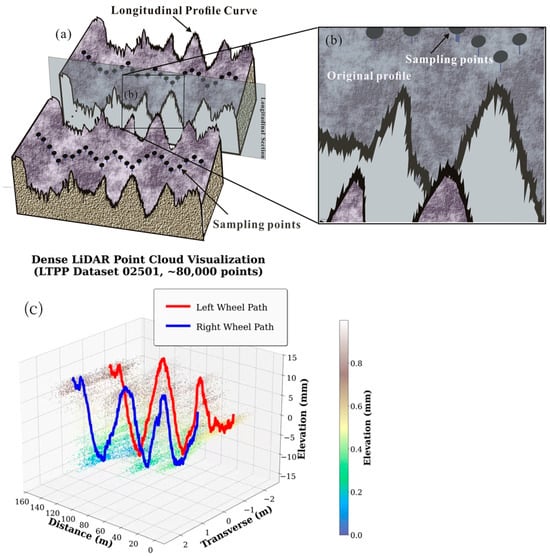
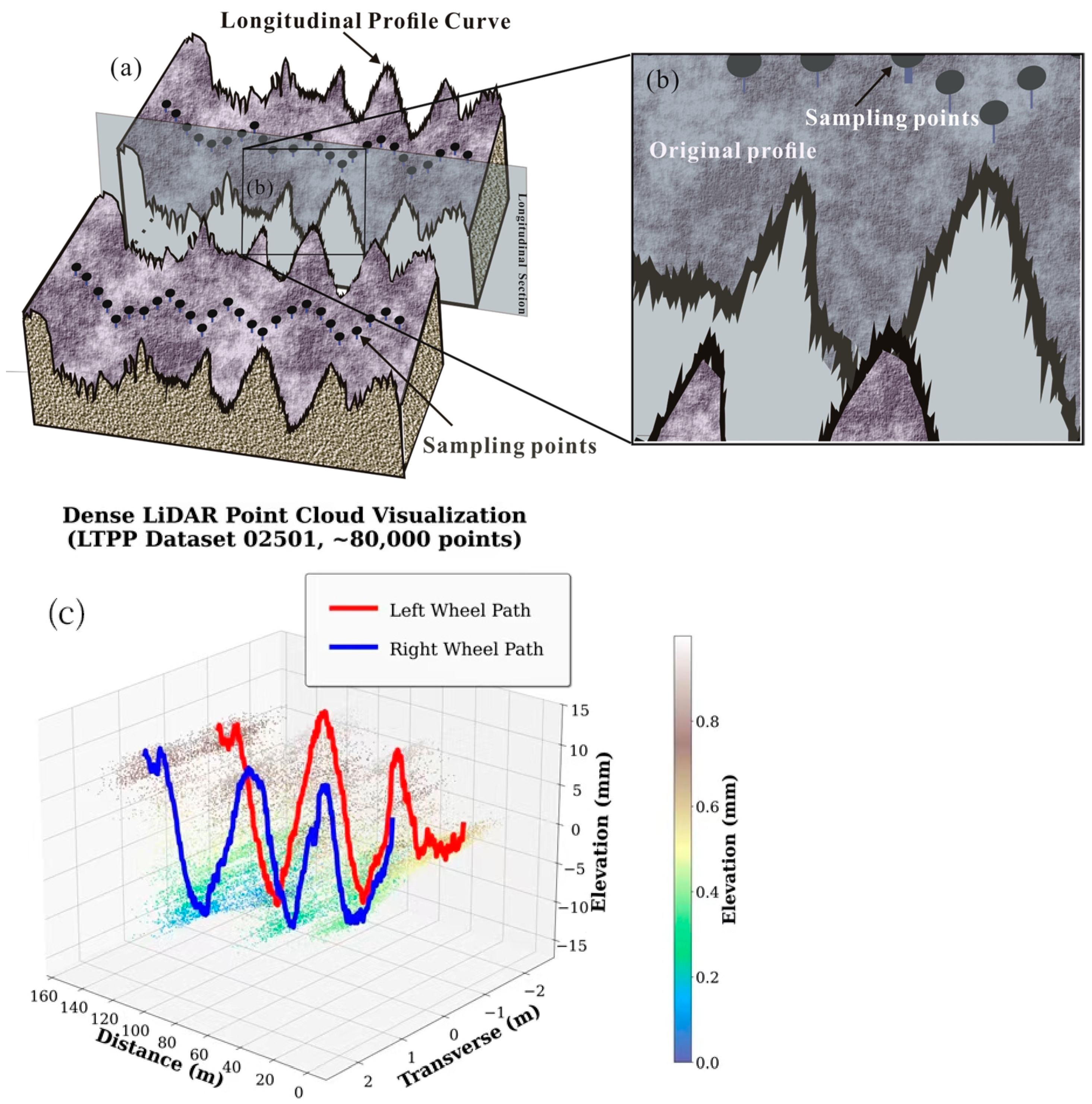
Figure 1 illustrates the model development process. In Figure 1a, a real road segment is shown for road roughness detection, with elevation sampling points marked in red, obtained using a profilometer or laser scanning system. Figure 1b displays the original longitudinal profile, which contains many sharp undulations, and these high-frequency noises along with some of the larger wavelength components have a large impact on the accuracy of the IRI calculations. Figure 1c shows the 3D radar point cloud map and complete left and right wheel tracks of the road. To address and eliminate interference issues, the study proposes a Gaussian filter incorporating the Nyquist theorem to remove IRI-insensitive components in longitudinal profile data and better determine the actual condition of the road surface.
Figure 1.
Real road segment suggested for road roughness detection. (a) is a road segment, (b) is a longitudinal section, and (c) displays the 3D radar point cloud.
3.1. Gaussian Filter for Removing IRI-Insensitive Components
Unlike image denoising processes, the Gaussian filter for the longitudinal profile data proposed in this study is primarily used to process discrete elevation points. Therefore, the Gaussian template for each point is a set of discrete values. Assuming that there are elevation points in the longitudinal profile data, when filtering each point, k points on each side of that point must participate. Taking the -th point as an example, the Gaussian template can be represented as follows:
where is the Gaussian template for the -th point and is the elevation value of each point. is the weight assigned to the j-th point when calculating the Gaussian template for the -th point .
The weight assigned to each point in Equation (2) is expressed as follows:
where is the result of the calculation of the Gaussian function [39,40]. With as the input, it can be represented as follows:
where and are the mean and standard deviation of the sample, respectively. yj represents the elevation value at position j, μi = (1/(2k + 1)) Σ yj is the local mean, σi = [(1/2k) Σ (yj − μi)2] is the local standard deviation, and the factor 1/(σi(2π)) ensures proper probability distribution normalization. For a physical interpretation, points with elevations close to the local mean μi receive higher weights (approaching 1/(2πσi)), while outliers farther than ±2σi are exponentially suppressed (weight < 0.05 of peak). This adaptive behavior allows the filter to distinguish between genuine pavement features and measurement noise based on local statistical context.
Once the Gaussian template is determined, convolving it with the elevation values of the corresponding longitudinal profile data can be represented as follows:
where represents the value after Gaussian low-pass filtering for the longitudinal profile data, and represents the value after Gaussian high-pass filtering for the longitudinal profile data. Theoretically, a low-pass filter eliminates or suppresses wavelengths smaller than a specified value, whereas a high-pass filter removes wavelengths larger than a specified value.
3.2. Nyquist Sampling Theorem to Determine Gaussian Template Lengths
Section 3.1 provides a brief description of the Gaussian filter for removing IRI-insensitive components. However, a critical step in using a Gaussian filter is determining the size of the Gaussian template (the value of in Equation (2)), because this directly influences whether specific components within a given band can be effectively preserved or removed. To address this issue, this study combines the characteristics of longitudinal road profile data and utilizes the Nyquist sampling theorem to determine the size of the Gaussian template.
The size of the discrete Gaussian template is related to the sampling intervals. Following the Nyquist theorem helps to select an appropriate template size that matches the sampling frequency, preventing signal distortion while maintaining computational efficiency. This Nyquist-based optimization ensures fast Gaussian filtering without complex parameter tuning, as the template dimensions are inherently adapted to the signal characteristics and sampling rates.
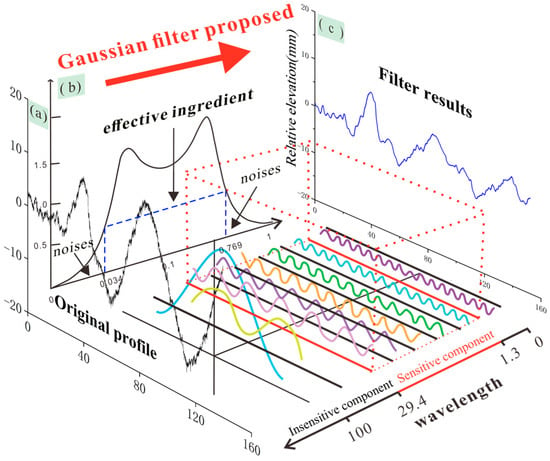
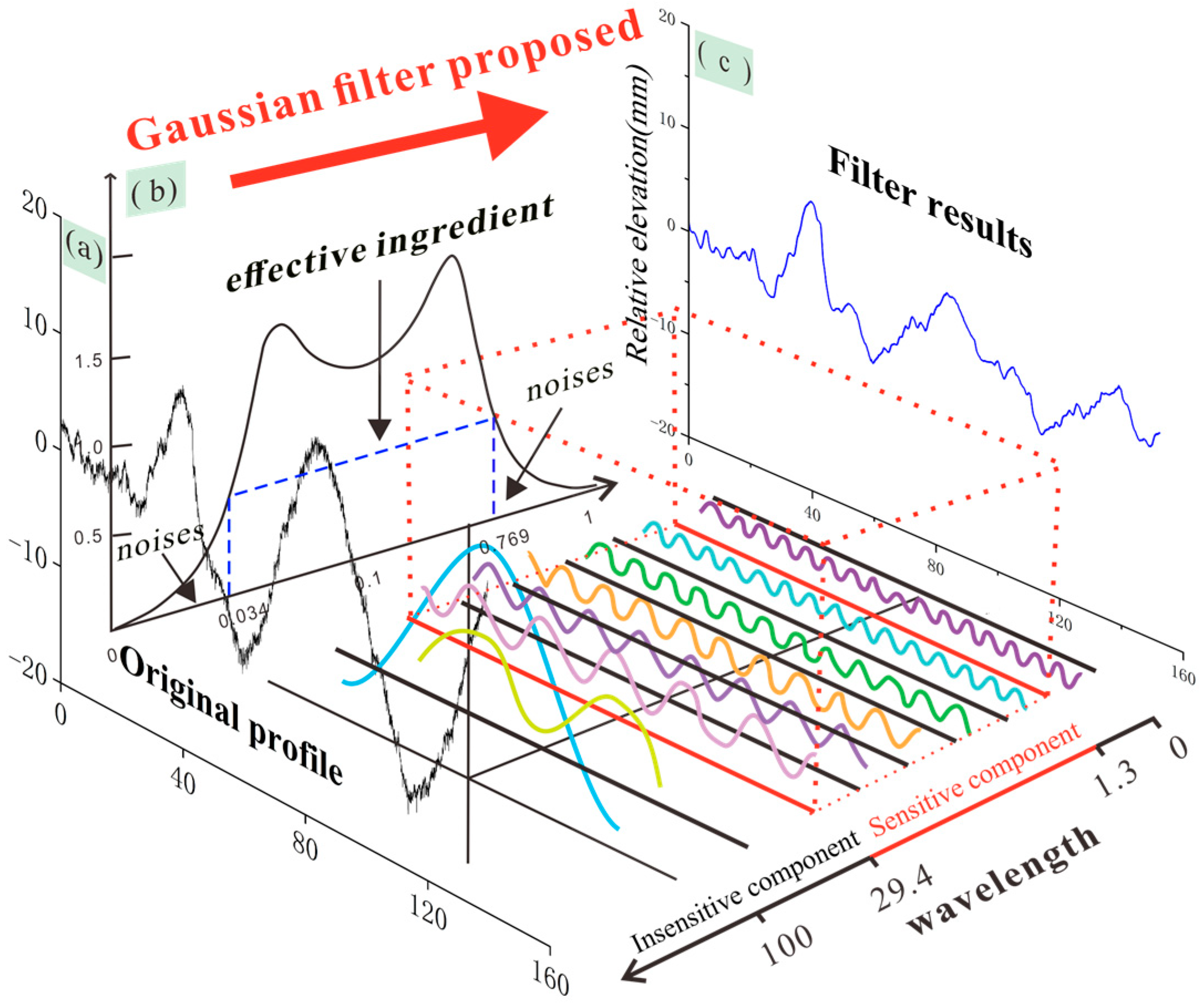
The basic description of the Nyquist sampling theorem [41] states that for a sinusoidal signal to be accurately and completely represented by discrete sampling points, the sampling interval must be no greater than half the wavelength of the sine wave. Through Fourier transformation [42] of the original profile data, a series of sine signals with different amplitudes, wavelengths, and phases [43] were obtained (Figure 2), where the reciprocal of wavelength corresponds to wavenumber [44]. Figure 2b shows the wavenumber response curve of the IRI. Based on this curve, the IRI exhibits significant gain within the wavenumber range of 0.034–0.769 (corresponding to a wavelength range of 1.3–29.4 m [45]). Accordingly, the Nyquist sampling theorem can be applied to eliminate noise lying outside the wavelength range of 1.3–29.4 m.
Figure 2.
The proposed method for longitudinal profile Gaussian filtering. (a) represents the original profile curve, (b) is the wavenumber response curve of the IRI, and (c) is the result after filtering by the Gaussian filter proposed, and the different colored sinusoids represent the various wavelength components of the original curve.
To better illustrate this theory, assuming the true longitudinal profile y(x) (Figure 2a) is sampled at equal intervals with a frequency of , the resulting discrete profile can be represented as follows [46]:
where is the discrete profile and is the sampling frequency.
To reconstruct the original profile fully from the discrete sampled values, it is only necessary to ensure that
In the spatial domain of longitudinal road profiles, we define the following: spatial frequency: fm = 1/Tm (cycles per meter), where Tm is wavelength; sampling interval: D (meters between consecutive elevation points); sampling frequency: fs = 1/D (samples per meter). When a sine curve is defined as a function of distance, its spatial frequency is essentially a wavenumber. The wavenumber refers to the number of occurrences of the same wavelength component per unit length, and the reciprocal of the wavenumber is the wavelength. Substituting into Equation (8) , we can obtain 1/D ≥ 2 (1/Tm) ⇒ D ≤ Tm/2; this establishes a critical relationship: to accurately represent wavelength Tm, sampling interval D cannot exceed Tm/2.
Therefore, to study the specified wavelengths in real longitudinal profile data, the sampling interval must be satisfied.
where is the sampling interval and is the cutoff wavelength under study.
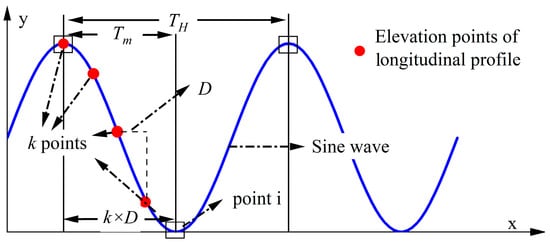
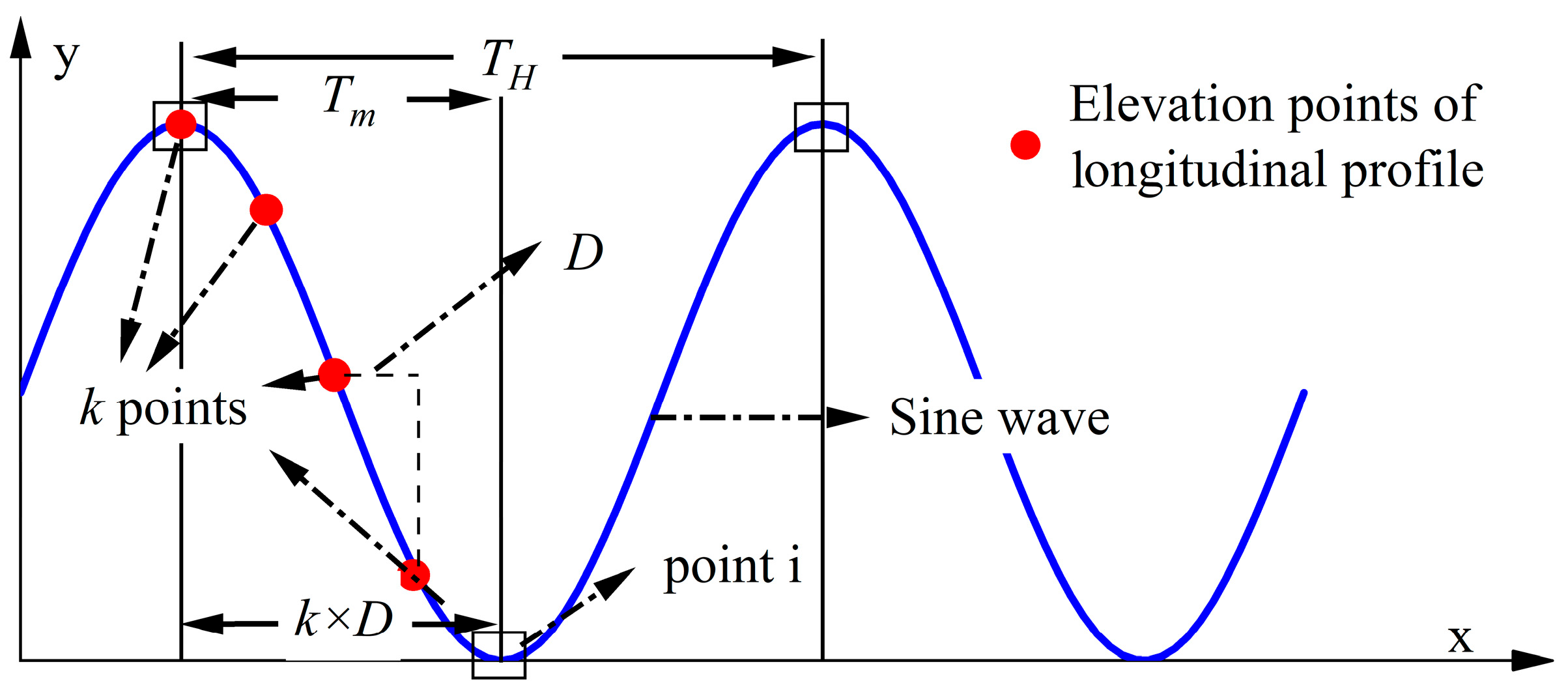
According to Figure 3, setting at half of the cutoff wavelength ensures that the original profile can be fully reconstructed using the discrete points involved in filtering. The length of is the product of the value and D, where is a constant representing the distance between two adjacent sample points in the original profile data. Therefore, when is constant, the cutoff wavelength of the filter can be controlled by adjusting the value of .
where denotes the cutoff wavelength of the filter. is a constant representing the distance between two adjacent sample points in the original profile data. is the size of the discrete Gaussian template to be determined.
Figure 3.
Wavelength setting.
3.3. Boundary Point Processing
In Section 3.2, the size of the Gaussian template is determined through application of the Nyquist sampling theorem. However, another issue has arisen. If the longitudinal profile data have n discrete elevation points, the points involved in the filtering calculation at the -th point can be represented as follows:
where y represents the set of elevation points involved in filtering at the -th point and is the elevation value of each point.
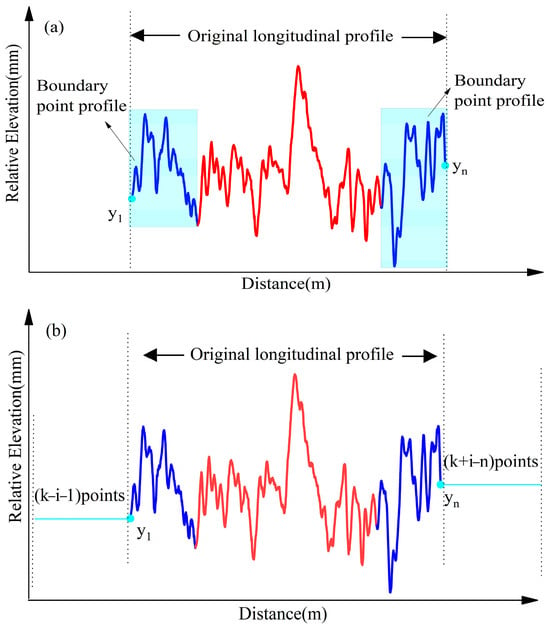
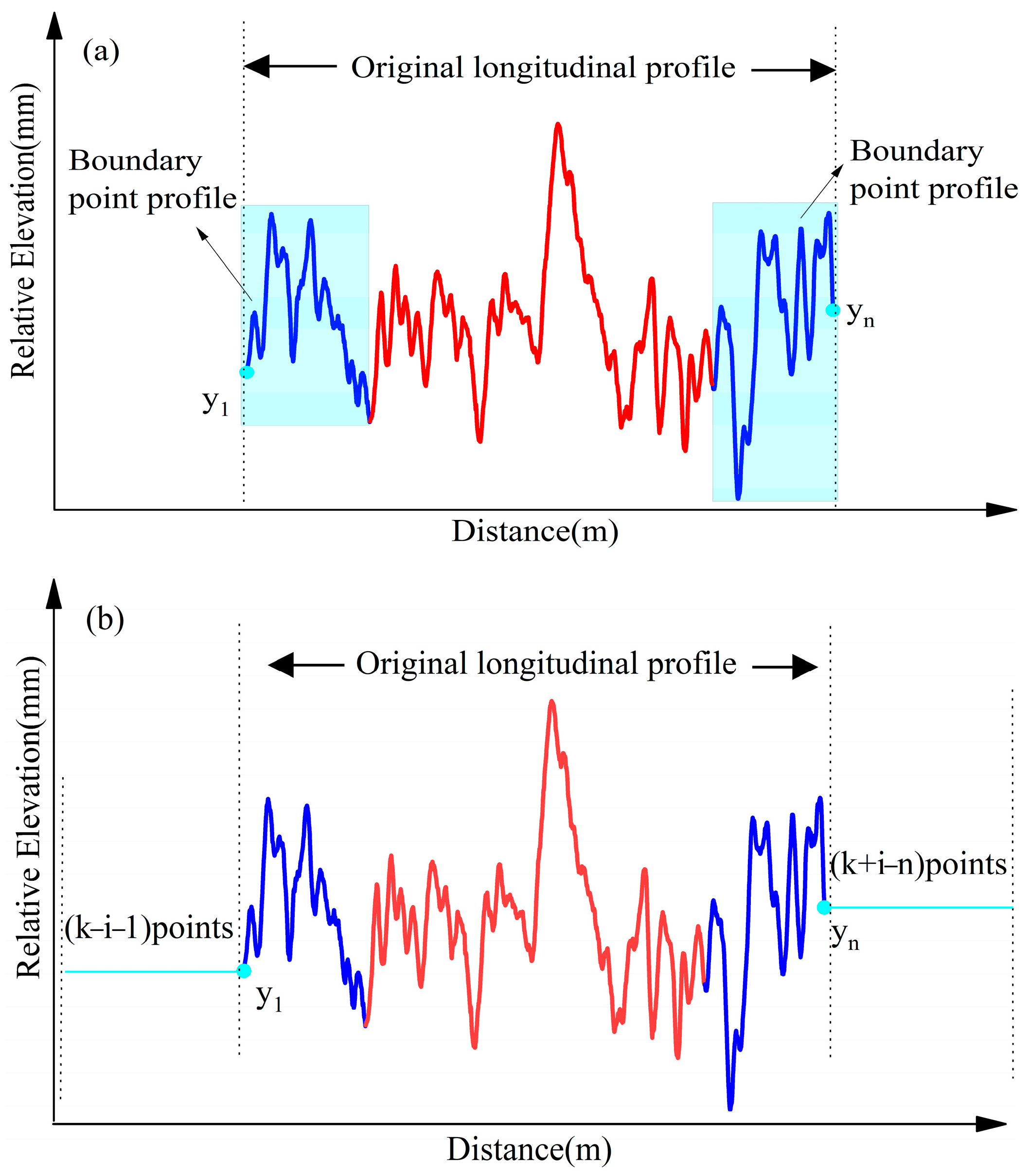
If a filtering point is located on the left or right side of the entire longitudinal profile data, when or , these will lead to data going out of bounds. These points are referred to as boundary points in this study, as shown in Figure 4a.
Figure 4.
Boundary point processing. (a) shows the profile and location of the boundary points and (b) shows how to fill the boundary points.
Figure 4 shows the boundary point processing. Given that it is impossible to predict the road surface elevation trend beyond a specific longitudinal profile [47], to obtain a better filtering effect for the boundary points located on the left side of the entire dataset, the value of is used to fill in the missing values of the points participating in the filtering at that point. Subsequently, the number of fillings is for the boundary points located on the right side of the entire dataset. The value of is used to fill in the missing values of the points participating in the filtering at that point, and the number of fillings is , as shown in Figure 4b.
In addition, the boundary padding strategy, while introducing minimal error (quantified in Section 5.1 as 2.1 mm average RMSE), ensures computational stability without significantly impacting overall IRI accuracy. This trade-off is justified by the practical constraints of field data collection where complete boundary information is often unavailable. The calculation and reasoning are as follows:
For a profile segment of length L with boundary padding ratio β = (2k·D)/L, the IRI estimation error introduced by endpoint replication satisfies the following:
where C ≈ 0.12 is an empirically determined constant and σprofile is the profile standard deviation. For ASTM-compliant evaluations (L ≥ 152.4 m, D ≤ 150 mm, Tm = 29.4 m):
yielding |ΔIRI| ≤ 0.15σ, which is negligible compared to typical measurement uncertainties (±0.2 m/km for Class 1 profilers).
4. Experimental Data
In this study, the filtering effectiveness and reliability of the proposed method for longitudinal profile data were evaluated using two datasets.
4.1. Dataset-1
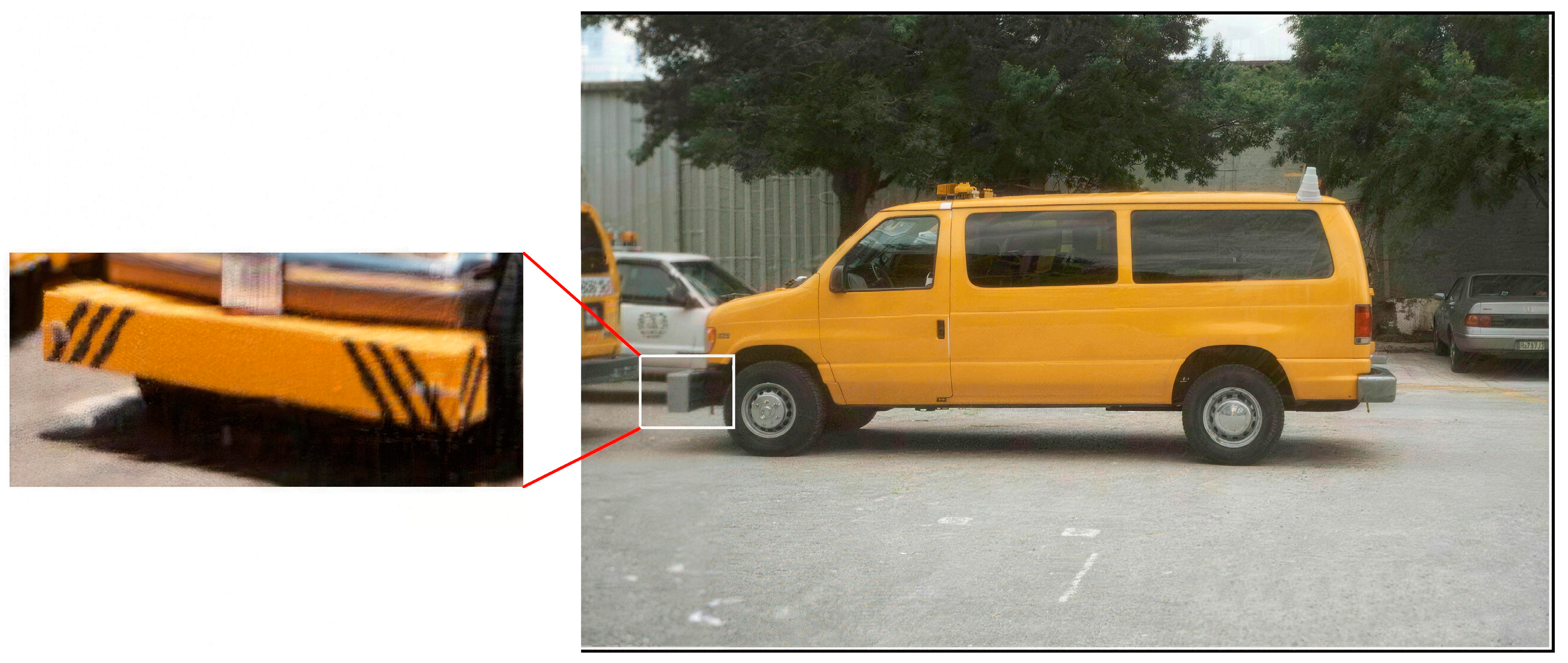
Dataset-1 consisted of longitudinal elevation data from the LTPP program in the United States. The data was collected using the ICC MDR 4086L3 vehicle-mounted laser profilometer (International Cybernetics Corporation, Largo, Florida, USA), which is equipped with three laser-height sensors, a longitudinal distance sensor, and an accelerometer above each laser-height sensor (LMI-Selcom SLS5000, LMI Technologies Inc., Burnaby, British Columbia, Canada) [48]. All sensors have a measurement range of 200 mm. Two sensors captured data along the left and right wheel paths, spaced 1.676 m apart, while the third sensor recorded data along the lane center. Table 1 lists the correlated parameters, and Figure 5 shows the actual equipment for data collection.
Table 1.
Longitudinal profile laser (LMI-Selcom SLS5000 200/300-RO) technology parameters [48].
Figure 5.
ICC MDR 4086L3 vehicle-mounted laser profilometer [48].
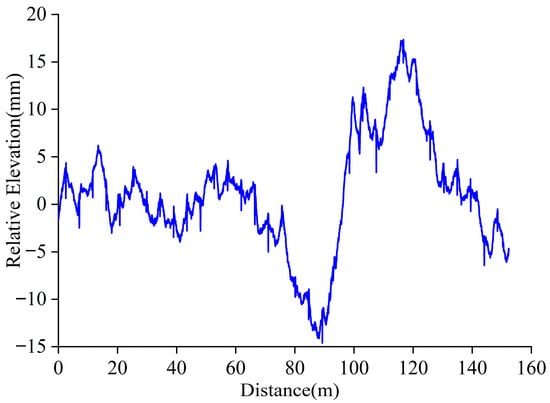
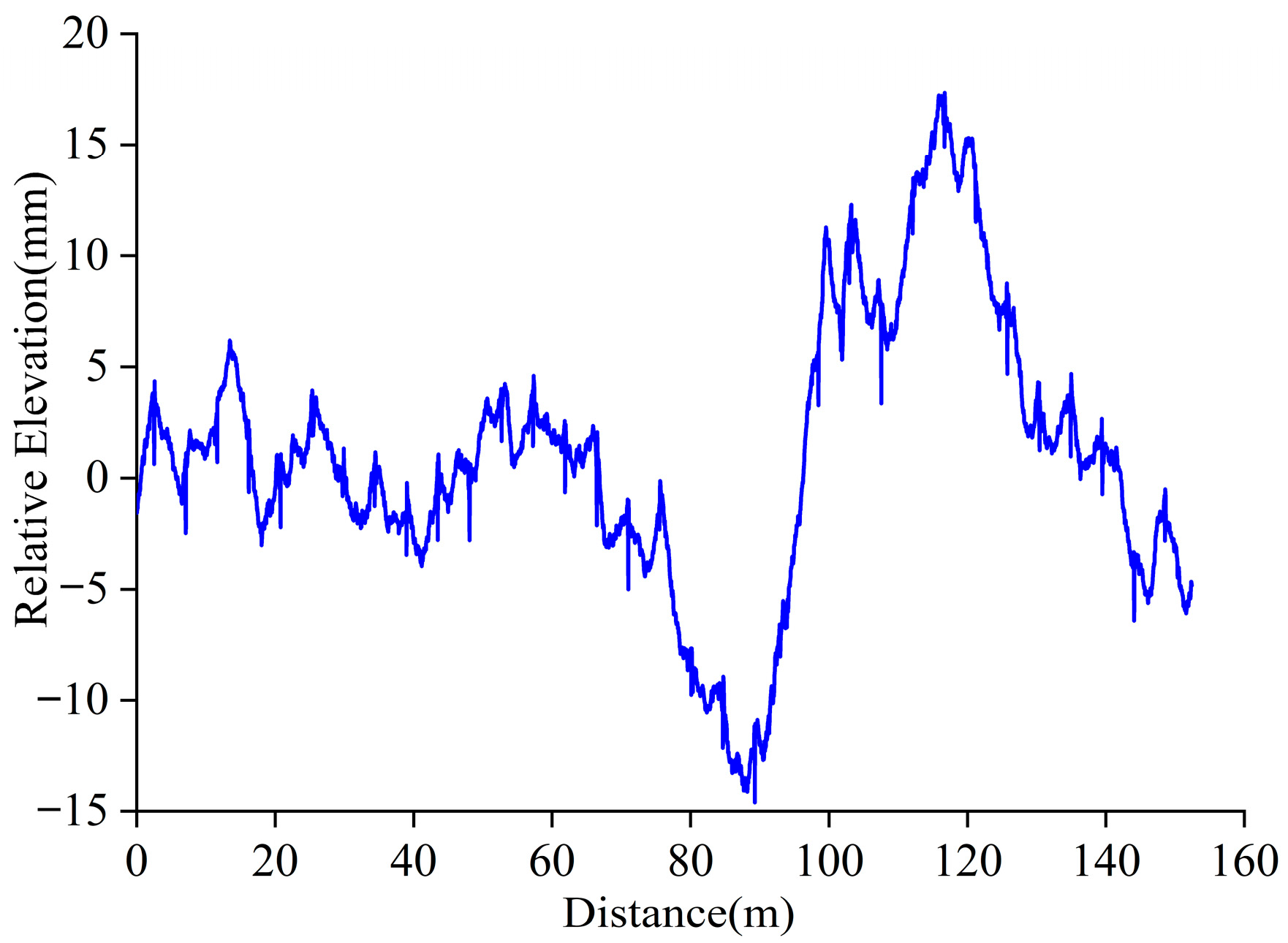
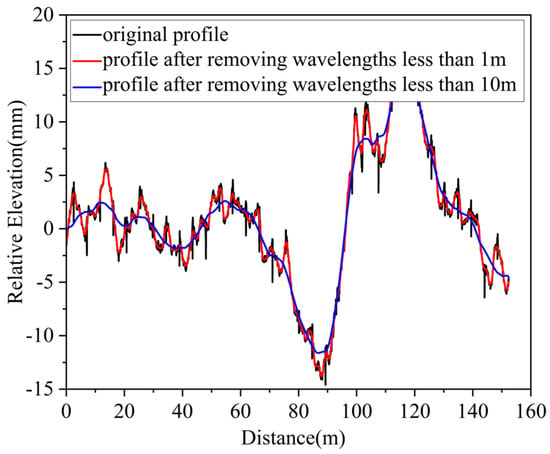
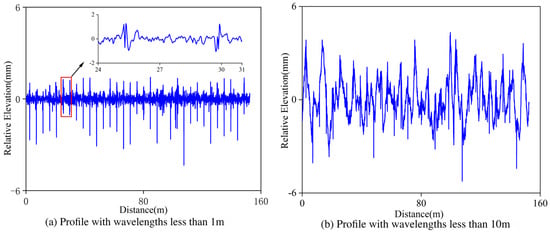
This study utilized longitudinal profile data from the left and right tracks, representing elevation measurements of general asphalt pavements. Eight LTPP datasets were analyzed: these data were collected under various road conditions such as asphalt roads, rural gravel roads, etc. Among these, there were four with sampling intervals of 25 mm and four with intervals of 150 mm. The original data were pre-filtered to remove wavelengths longer than 100 m, and each data segment was 152.4 m long. Analyzing the LTPP data helps to better understand the impact of different sampling intervals on road roughness. Figure 6 illustrates a segment of the original longitudinal road profile from the LTPP dataset, showing numerous sharp undulations due to the smaller sampling interval.
Figure 6.
An example from the original longitudinal profile.
4.2. Dataset-2
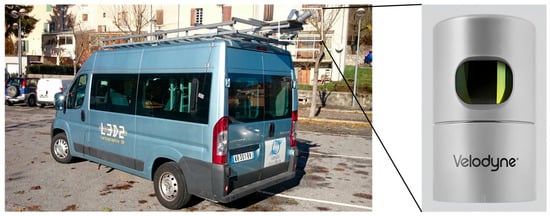
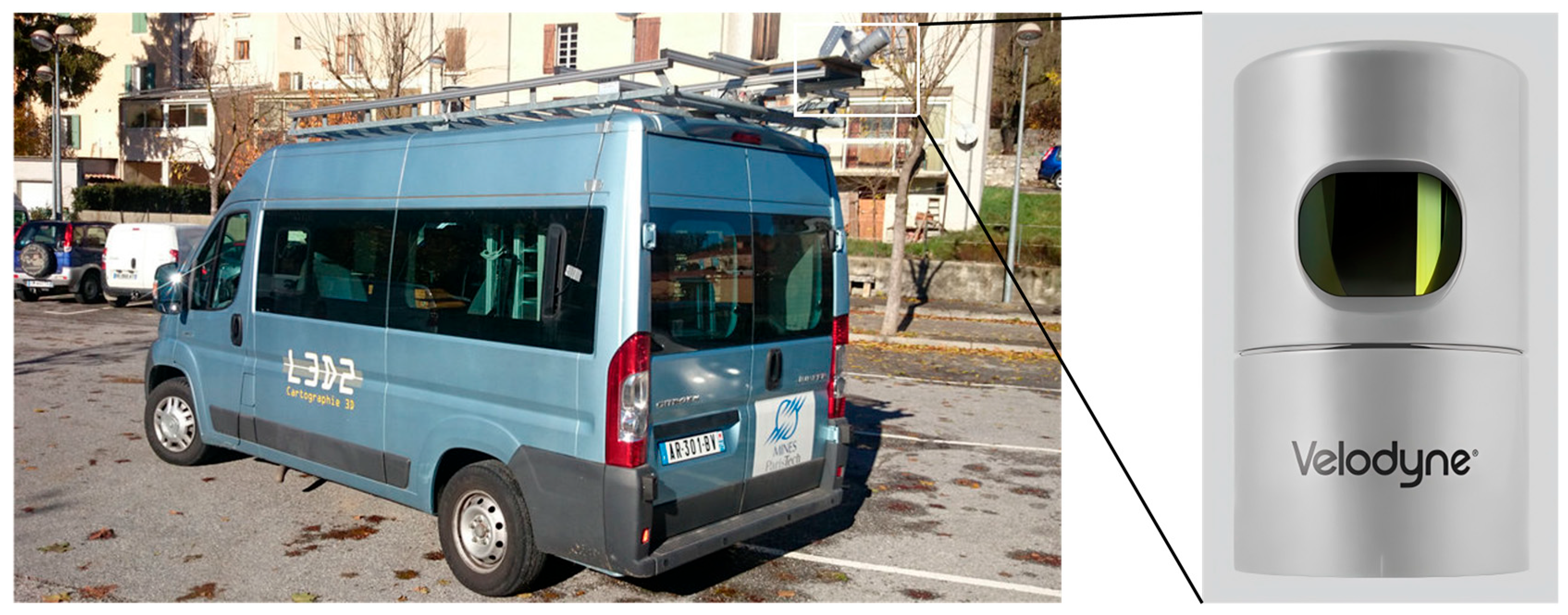
Dataset-2 was collected using the L3D2 vehicle-mounted laser scanning system from the Mines ParisTech Robotics Center in urban areas of Paris and Lille, France. The Paris–Lille dataset was obtained using the L3D2 onboard laser scanning system from the Mines ParisTech Robotics Center [49], the detailed specifications of the device are listed in Table 2.
Table 2.
Laser meter HDL-32E technology parameters [49].
Although the raw data from the L3D2 system is in point cloud format, longitudinal profile elevation data of the road surface can be extracted through post-processing. This approach results in a smaller sampling interval (10 mm). Additionally, the high-density point cloud captures finer details on the road surface, providing a more accurate and realistic assessment when the IRI is used to evaluate driving quality. The equipment is shown in Figure 7.
Figure 7.
L3D2 vehicle-mounted laser scanning system [50].
5. Experiment Validations and Discussion
5.1. Experiment Validation Using Dataset-1
5.1.1. Filtering Effect of Gaussian Filter for Longitudinal Profile Data
The Gaussian filter for longitudinal profile data includes two versions: low-pass and high-pass. The low-pass filter smooths the longitudinal profile, while the high-pass filter has the opposite effect, preserving high-frequency details. By setting an appropriate cutoff wavelength, the filter can effectively remove the influence of longitudinal roadway slopes, resulting in an elevation profile that fluctuates around the horizontal axis.
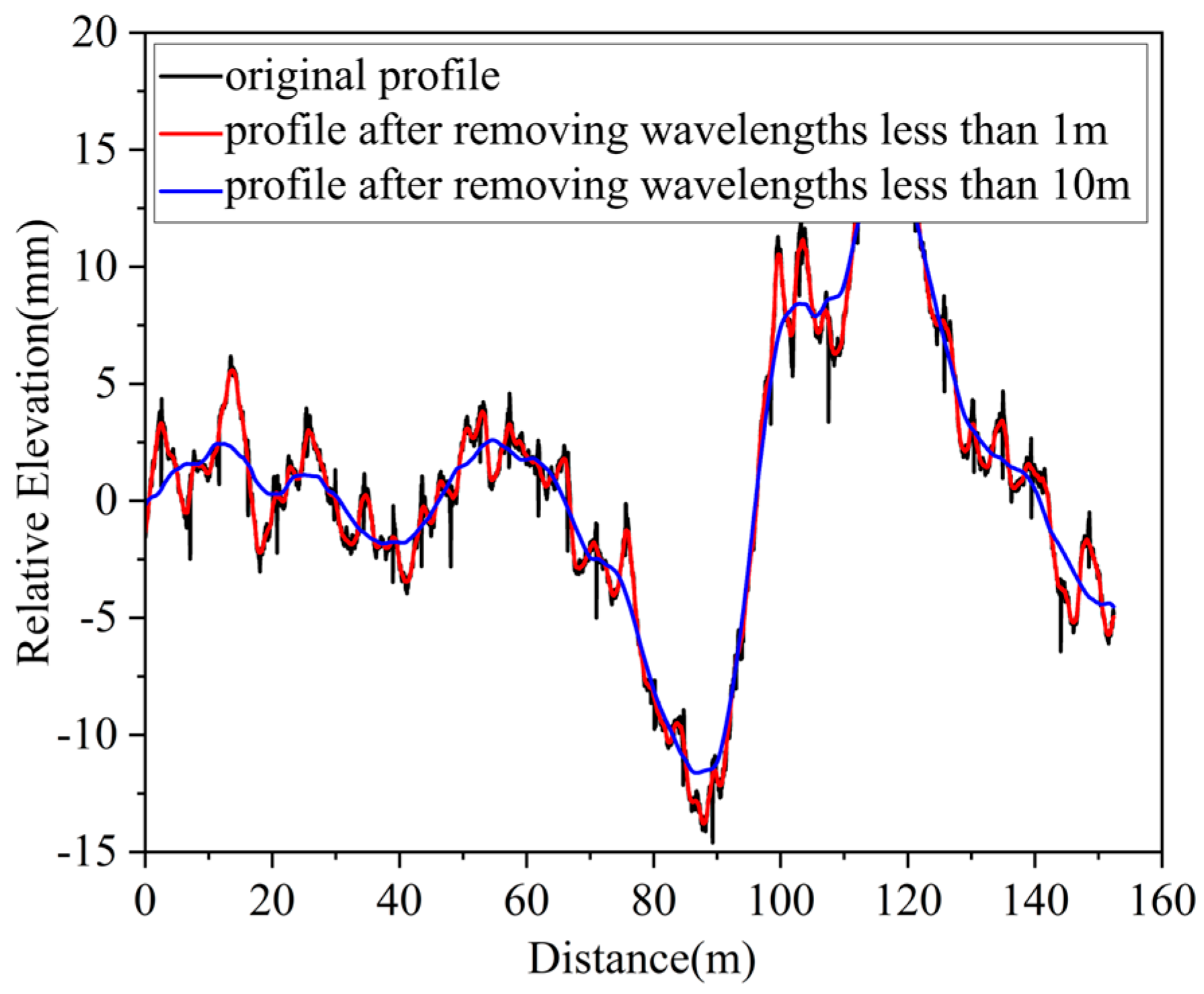
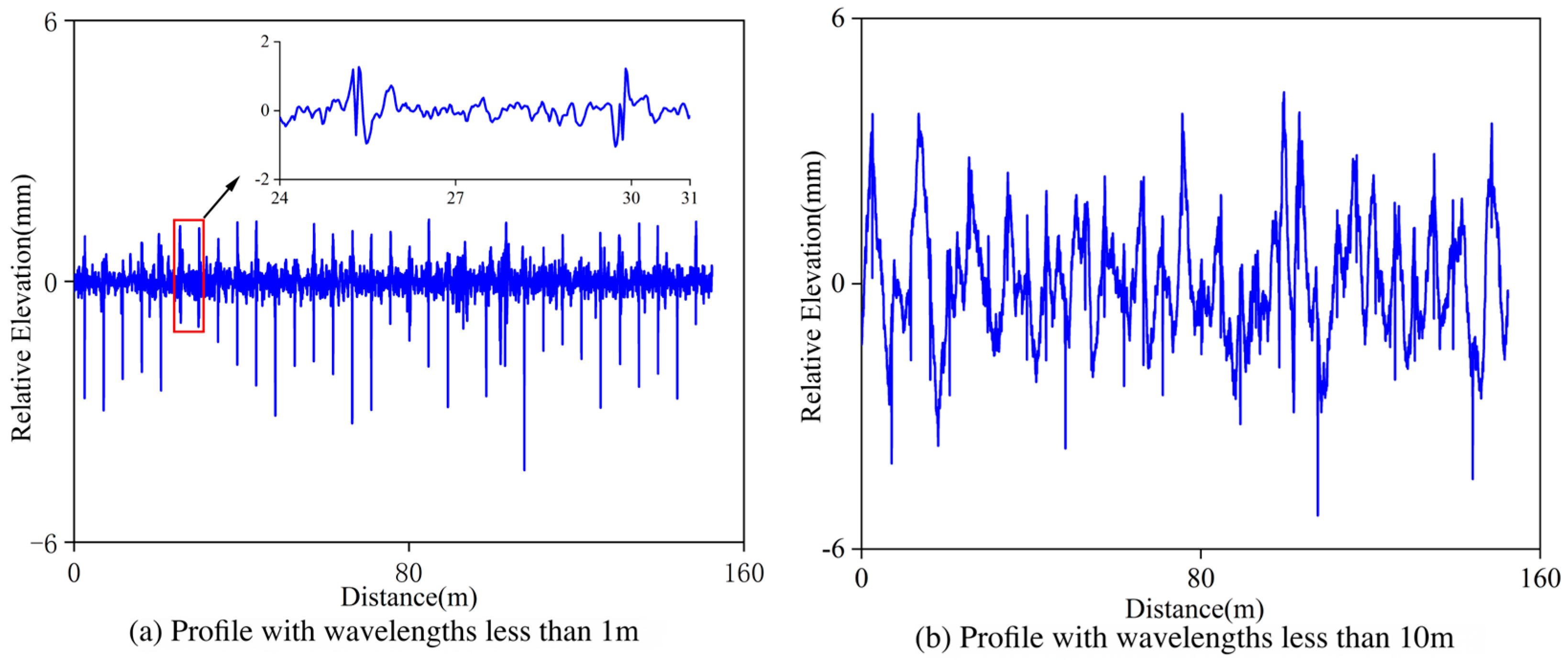
Figure 8 shows the longitudinal profile after applying the Gaussian low-pass filter. The original profile contains numerous sharp undulations due to the small sampling interval, which is not ideal for accurate IRI calculation. The red and blue curves in Figure 8 represent the profiles after removing road wavelengths of 1 m and 10 m, respectively, using the low-pass filter. As the cutoff wavelength increases, the filtered profile becomes progressively smoother. By choosing a suitable cutoff wavelength, high-frequency noise that affects IRI calculations can be effectively eliminated.
Figure 8.
Results after Gaussian low-pass filtering.
Figure 9 illustrates the longitudinal profile of the pavement after applying a Gaussian high-pass filter, which effectively attenuates the low-frequency components by removing pavement wavelengths below a predefined cutoff value. This filtering process highlights finer surface variations and is particularly useful for preserving high-frequency details that are often critical for evaluating short-wavelength roughness and detecting localized defects.
Figure 9.
Results after Gaussian high-pass filtering.
In Figure 9a, where a relatively short cutoff wavelength is used, the filtered profile clearly reveals the instantaneous undulations of the roadway surface. The maximum vertical deviation is less than 5 mm, which indicates a high level of smoothness and suggests that the pavement meets stringent ride quality standards. This level of detail is especially valuable in contexts such as high-speed travel, where even small irregularities can impact comfort and safety.
Figure 9b demonstrates the effect of increasing the cutoff wavelength. As more of the high-frequency content is suppressed, the profile appears smoother overall, but subtle features—such as minor surface waviness or small-scale defects—become less discernible. This trade-off highlights the importance of selecting an appropriate cutoff wavelength based on the specific application and the desired level of detail in the surface assessment.
5.1.2. 25 mm and 150 mm Interval Sampling Experiment
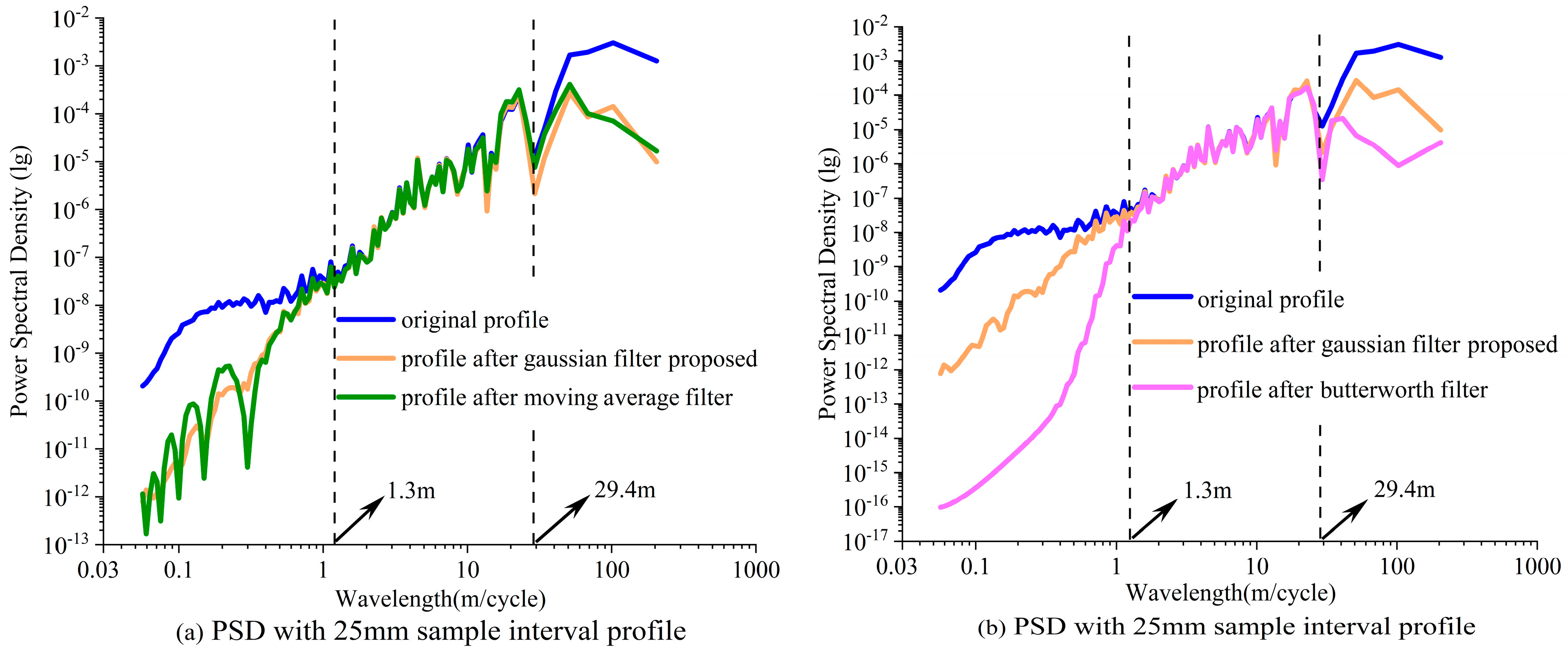
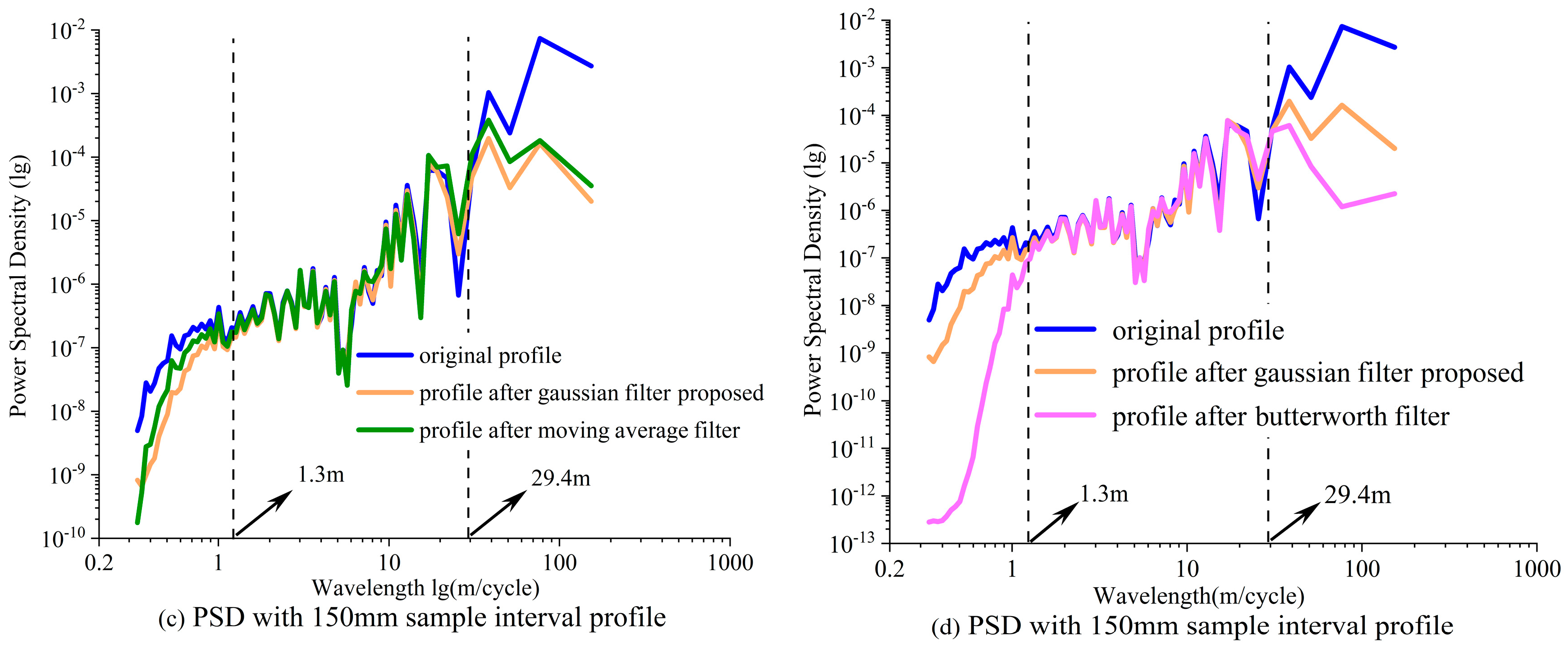
Experiment 1 used Dataset-1 from the U.S. Long-Term Pavement Performance (LTPP) program, a significant pavement performance research project. This study selected eight datasets and applied the proposed Gaussian filter to evaluate pavement smoothness indices on the filtered profiles. The results were then compared with those obtained using the commonly used moving average filter [51] and the Butterworth filter [52].
The Power Spectral Density (PSD) of road profiles is a key statistical characteristic for different wavenumbers (or wavelengths) [53,54], reflecting the structure and overall characteristics of the road surface waveform. In this study, the road profile displacement PSD was estimated using Fast Fourier Transform (FFT) via the ProVal software (Profile Viewing and Analysis) software version 3.61 (The Transtec Group, Inc., Austin, TX, USA), providing a frequency-domain validation of the filtering effectiveness. FFT window lengths were chosen to capture at least two full cycles of the longest IRI-sensitive wavelength (29.4 m), while the 50% overlap ensures adequate spectral resolution (Δf ≈ 0.02 cycles/m) for distinguishing 1.3 m and 29.4 m cutoffs.
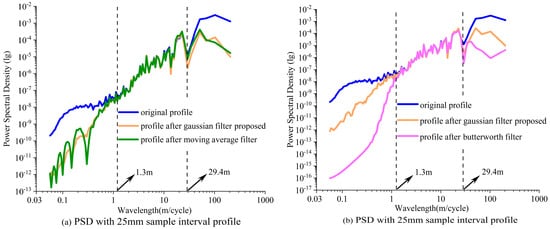
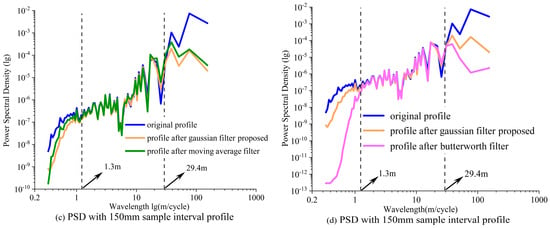
Figure 10a,b show the original profiles and the PSD results after filtering with three filters at a 25 mm sampling interval. Figure 10c,d show the original profiles and the PSD results after filtering with three filters at a 150 mm sampling interval.
Figure 10.
Power Spectral Density (PSD) comparison of pavement profiles based on Fast Fourier Transform (FFT).
Figure 10a demonstrates that both the moving average filter and the proposed Gaussian filter effectively suppress short-wavelength artifacts (components with wavelengths less than 1.3 m) as well as long-wavelength components. However, the PSD of the profile filtered with the moving average filter exhibits instability in the attenuated high-frequency region, indicating inadequate smoothing of short-wavelength noise.
Figure 10b reveals that both the Butterworth filter and the Gaussian filter proposed in this study effectively reduce insensitive components in the IRI calculation process. Nevertheless, the Butterworth filter excessively attenuates wavelengths that are insensitive to IRI, potentially causing the filtered data to deviate from the actual profile and resulting in underestimated IRI values.
In Figure 10c, it is evident that as the sampling interval increases, there is a noticeable improvement in the unstable bias of high-frequency components when using the moving average filter. This indicates that the moving average filter has certain requirements for the sampling frequency and is not suitable for very small sampling intervals.
Figure 10d shows that the Butterworth filter and the Gaussian filter proposed in this study still perform well, without specific requirements for the sampling interval. However, the Butterworth filter excessively weakens insensitive wavelength components while slightly enhancing sensitive wavelength components, leading to certain deviations between the filtered data and the actual situation.
In addition to the above experiments, comparative experiments on Kalman filters were also conducted. The Kalman filter was included as a comparison baseline because it represents the theoretical optimum (MMSE estimator) for linear Gaussian systems and has been successfully applied in recent pavement monitoring literature [55]. The specific implementation details are as follows. State transition: XK = A X{k − 1} + w_{k − 1}, where A = [1, D; 0, 1] and D is the sampling interval; measurement: Zk = H Xk + Vk, where H = [1, 0]; process noise covariance: Q = q·[D3/3, D2/2; D2/2, D] with q = 0.01 mm2/m; measurement noise variance: R = 0.1 mm2 (matching profiler precision from Table 1). The values q = 0.01 and R = 0.1 were optimized via grid search on validation subset LTPP 02505-02508 (separate from test data) to minimize MSE against reference profiles. This configuration yields an effective low-pass cutoff wavelength of approximately 1.3 m, fortuitously aligning with the lower IRI-sensitive boundary. However, unlike the proposed Gaussian filter, the Kalman filter lacks an explicit dual-cutoff design (1.3–29.4 m bandpass) and is computationally heavier.
These findings demonstrate that the Gaussian filter for longitudinal profile data accurately and effectively processes longitudinal road profiles, providing better attenuation of wavelengths that are not significant for IRI calculation.
After analyzing the PSD of all profile data, IRI calculations were conducted, with the results presented in Table 3 and Table 4. These tables include both the standard IRI values provided by the LTPP dataset and the IRI values calculated using the four filters: the proposed Gaussian filter, moving average filter, Butterworth filter, and Kalman filter. In these tables, the “LTTP-Calculated Value” corresponds directly to the LTPP-provided IRI, computed by the FHWA InfoPave software web platform, using Standard Data Release 38 (SDR 38, August 2024), which fully compliance with ASTM E1926-08 (2021) standard practice. And the other sets of IRI values were obtained by using the ProVal software, which is also fully compliant with the specification. It is explicitly confirmed that the exact same IRI calculation workflow was applied to all methods. The only difference between comparison methods was the filtering algorithm applied to raw profiles before feeding them into the standardized ProVal calculation engine. This isolation ensures that the performance differences in Table 3 and Table 4 are solely attributable to filtering effectiveness, not confounding implementation factors.
Table 3.
25 mm sampling interval IRI values.
Table 4.
150 mm sampling interval IRI values.
5.1.3. Filtering Performance Comparison on Typical Pavement Features
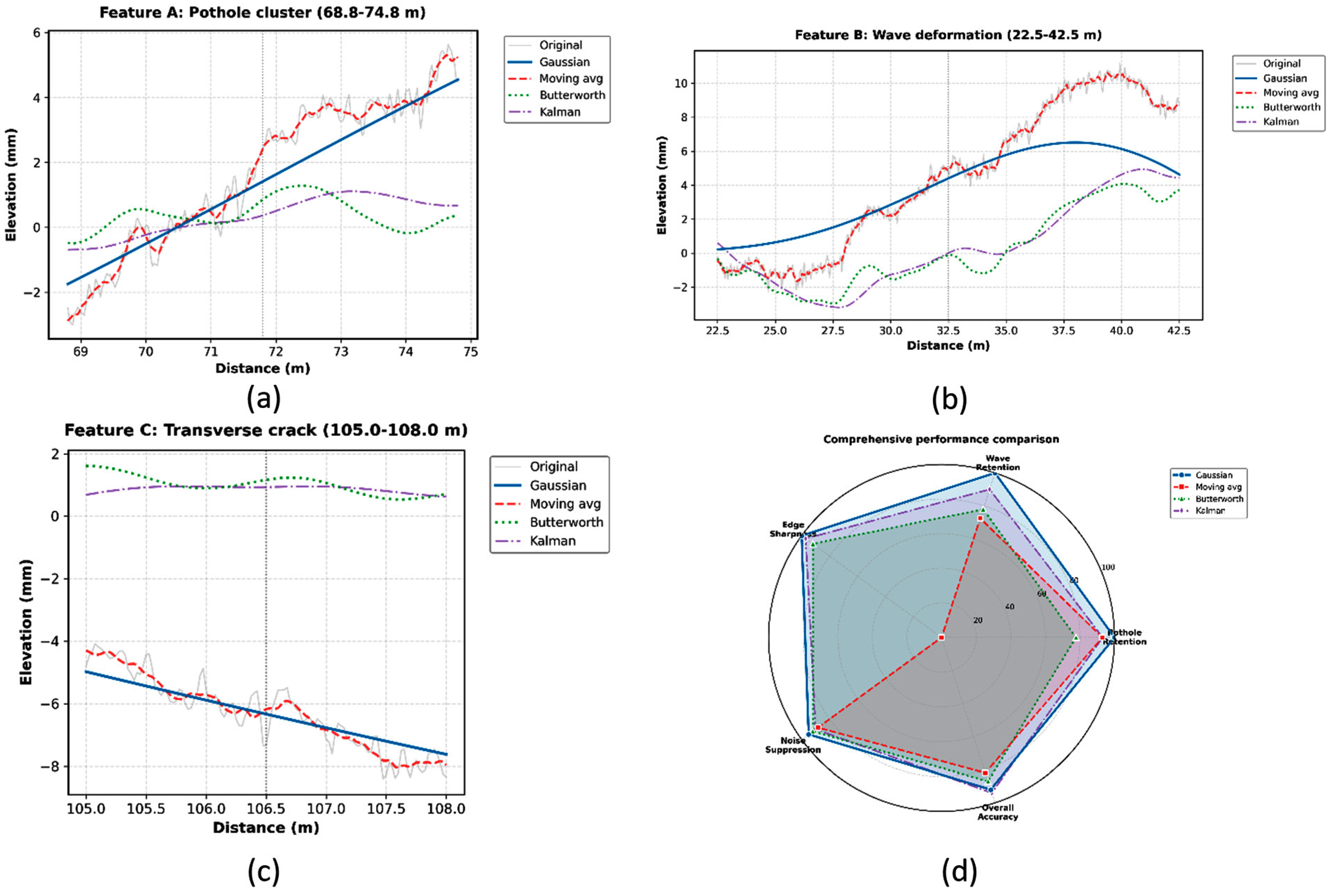
To further validate the feature preservation capability of different filters within the IRI-sensitive wavelength range, three typical pavement distress types were selected from the LTPP dataset 02501 (left wheel path, 25 mm sampling interval, 152.4 m length) for time-domain analysis, providing complementary evidence to the above frequency-domain PSD analysis. The comparison methods include the proposed Gaussian filter, the ASTM-recommended moving average filter, the classical Butterworth filter, and the Kalman filter which excels in dynamic systems.
Based on the IRI-sensitive wavelength range (1.3–29.4 m) and actual pavement distress types, three typical features were identified using automatic detection algorithms. Feature A (Pothole Cluster): 68.8–74.8 m section, estimated wavelength 2.5–3.5 m, original amplitude (standard deviation) 2.29 mm. Feature B (Wave Deformation): 22.5–42.5 m section, estimated wavelength 18–22 m, wave component amplitude 3.11 mm. Feature C (Transverse Crack): 105.0–108.0 m section, estimated wavelength 1.5–2.0 m, step height 4.31 mm. Figure 11 illustrates the four filtering methods comparison on typical road features.
Figure 11.
(a) Pothole cluster; (b) Wave deformation; (c) Transverse crack; (d) Comprehensive performance comparison.
Figure 11a is illustrated Feature A: Pothole cluster amplitude preservation at 68.8–74.8 m section comparing original profile with four filtering methods; Figure 11b is illustrated Feature B: Wave deformation energy retention at 22.5–42.5 m section demonstrating long-wavelength component handling; Figure 11c is illustrated Feature C: Transverse crack edge sharpness at 105.0-108.0 m section showing step height preservation capabilities; Figure 11d is illustrated Comprehensive performance radar chart displaying weighted evaluation scores (shortwave noise suppression, pit/groove retention, crack retention, wave retention, long-wave suppression) with Gaussian filter achieving the highest score of 98.2. Using Gaussian filter results as the baseline (with non-sensitive components removed), Table 5 quantifies the key performance metrics.
Table 5.
Quantitative Comparison of Feature Preservation Capability (Four Filtering Methods).
- (1)
- The moving average filter preserves 99% of original amplitude at Feature A, indicating minimal signal attenuation. However, spectral analysis reveals that only 87% of preserved energy lies within the IRI-sensitive band (1.3–29.4 m), with the remaining 13% comprising <1.3 m sensor noise. This is consistent with the unstable deviation in the high-frequency region shown in Figure 10a, confirming the limitations of moving average filtering at small 25 mm sampling intervals. Its comprehensive score of only 64.6 ranks lowest among the four methods. Overall, the accuracy of the moving average filter is acceptable, but its ability to preserve local features is relatively poor.
- (2)
- The Butterworth filter shows excessive suppression of IRI-sensitive features, with retention rates of only 26–132% across the three feature types. Particularly at Feature B (Wave Deformation, 18–22 m wavelength, approaching the 29.4 m upper limit), energy loss reaches 73.5%, and at Feature A (Pothole Cluster), amplitude loss reaches 74.2%. This phenomenon originates from its steep cutoff characteristics (−40 dB/decade), corresponding to the excessive attenuation shown in Figure 10b,d in PSD, potentially leading to systematic IRI underestimation. The comprehensive score of 85.1 indicates moderate performance.
- (3)
- The Kalman filter demonstrates excellent performance in feature preservation accuracy, with a comprehensive score of 93.1, second only to Gaussian filtering (98.2). At Feature C (Transverse Crack), edge sharpness retention is 71.5%, significantly superior to Butterworth’s 132.1% (over-enhancement) and moving average’s 550% (noise retention). However, Kalman filtering shows retention rates of only 31.8% and 33.4% at Features A and B, indicating some degree of suppression of valid signals within the IRI-sensitive band. More critically, Kalman filtering requires precise configuration of state-space model parameters (process noise covariance Q, observation noise covariance R), with computational complexity O(n3), significantly higher than Gaussian filtering’s O(n·k). As demonstrated in the boundary point prediction experiments explored in Section 5.1, Kalman filtering is sensitive to initial states, making parameter tuning challenging in practical applications.
- (4)
- The Gaussian filter shows stable and balanced performance across all three feature types, with the highest comprehensive score of 98.2: preserving a pothole feature amplitude of 1.83 mm (80.1% of original data), wave feature energy of 15,571 mm2, and crack feature edge sharpness of 0.023 mm/m. Its smooth frequency-domain transition characteristics (shown in Figure 10) avoid discontinuities near cutoff frequencies, achieving complete preservation of the 1.3–29.4 m sensitive band while effectively suppressing non-sensitive components at <1.3 m and >29.4 m. More importantly, Gaussian filter parameters are simply and clearly determined (only dependent on sampling interval D and cutoff wavelength Tm, Equation (10)), requiring no complex tuning or state-space modeling.
5.1.4. Error Analysis and Robustness Verification
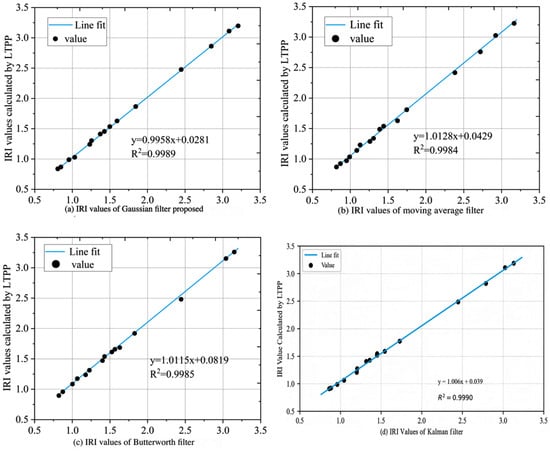
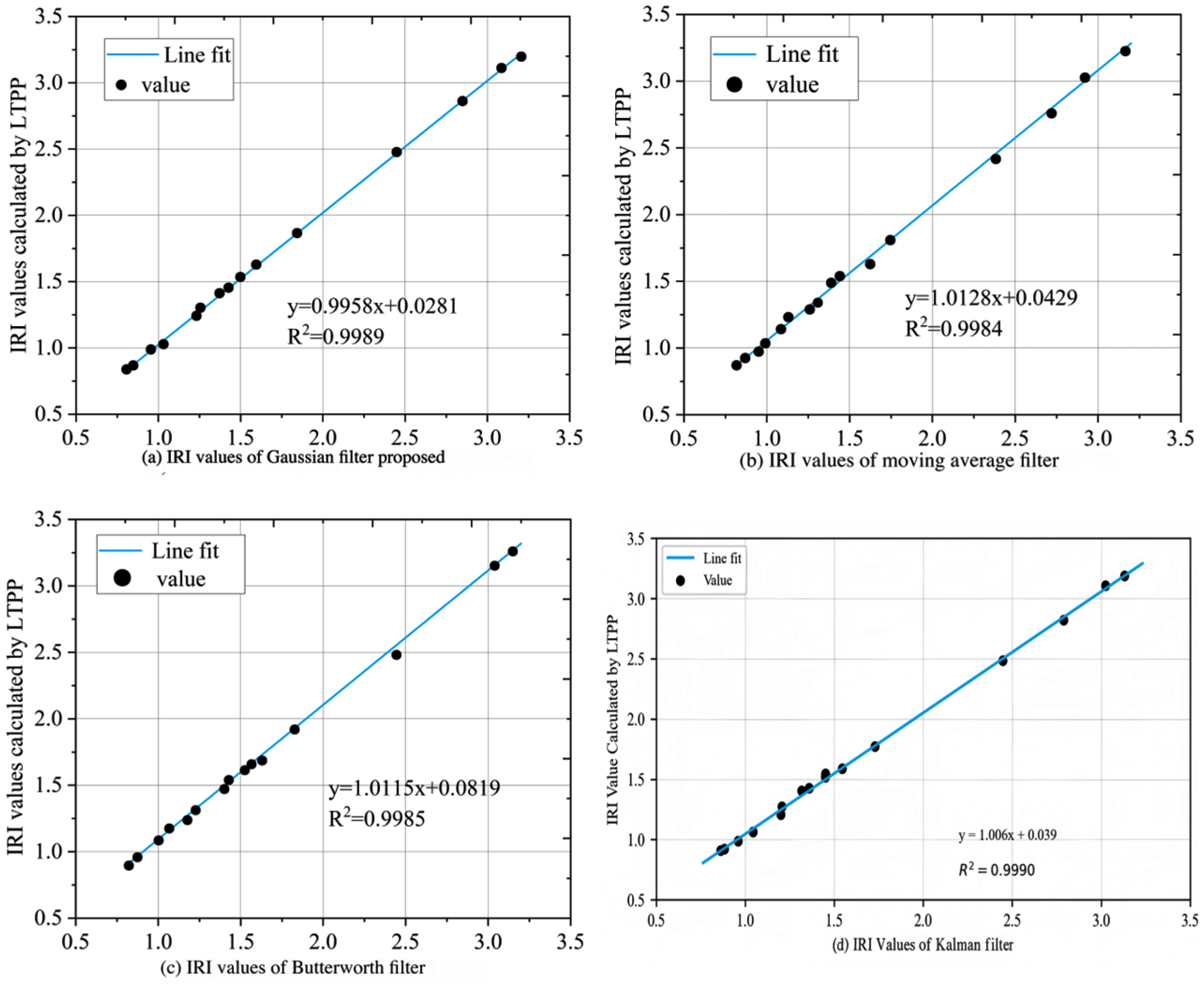
Regression analysis was performed to compare the IRI values calculated from the different filters with the standard IRI values, leading to the following regression equations:
where is the IRI value derived from the LTPP program data; , , and are the IRI values filtered using the Gaussian filter, moving average filter, Kalman filter, and Butterworth filter, respectively. Figure 12 shows the fitted curves obtained by each method. All four approaches exhibit a near-linear regression pattern, but the coefficient of determination of the fitted curve using the proposed Gaussian filter is slightly higher than that of the other methods. This indicates that the Gaussian filter achieves greater accuracy compared to the moving average and Butterworth filters.
Figure 12.
Comparison of different filtered IRI values with LTPP calculated IRI values.
By comparing the IRI values obtained using the proposed Gaussian filter with the standard LTPP values, absolute and relative errors were calculated, as shown in Table 6. The mean absolute error [55] between the two was found to be 0.051 m/km, and the mean relative error [56] was less than 4%. These results also demonstrate that the Gaussian filter provides highly accurate IRI calculations for longitudinal profile data.
Table 6.
IRI calculation error.
Table 7 presents the MAE and mean relative error of the proposed Gaussian filter in comparison with the moving average filter, Kalman filter, and the Butterworth filter. The results show that the proposed Gaussian filter achieves the lowest MAE and mean relative error, indicating superior filtering performance over the other three methods. Boundary effect quantification reveals the RMSE with 2.1 mm at profile termini (<1.5% of total elevation variation), confirming the practical acceptability of our padding approach.
Table 7.
Error analysis of different filters.
A sensitivity analysis of cutoff wavelengths was conducted to validate parameter selection. Varying the 1.3–29.4 m band by ±10% resulted in MAE changes < 0.004 m/km, confirming method robustness across pavement types and suspension variations. The experimental results are shown in Table 8.
Table 8.
Cutoff wavelength sensitivity analysis.
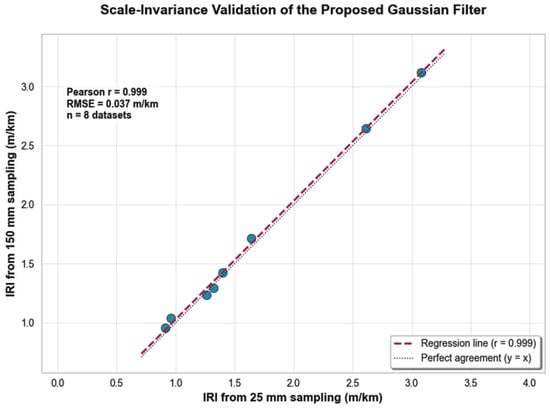
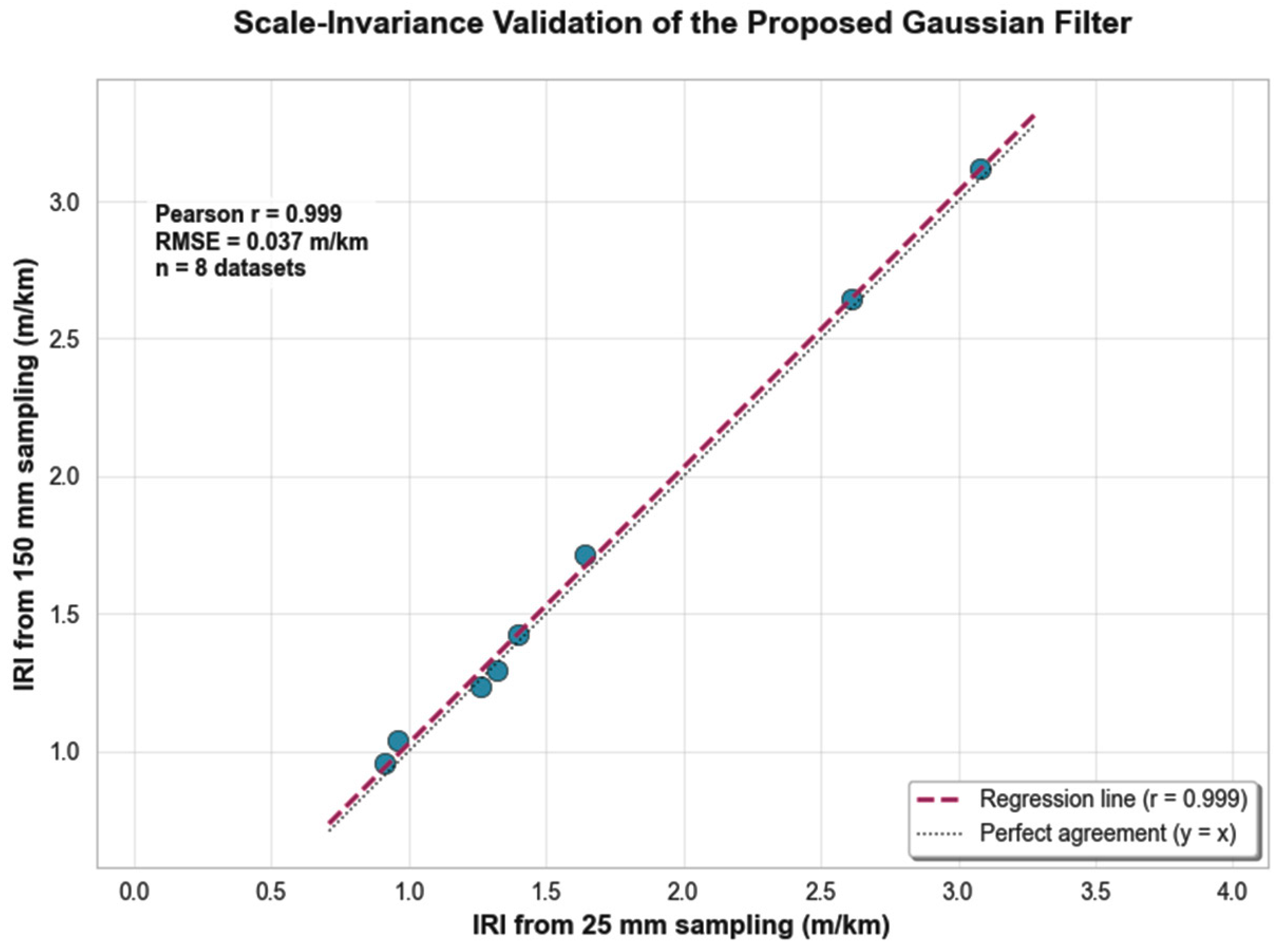
To further validate the robustness and scale-invariance of the proposed Gaussian filter, the IRI values calculated from the 25 mm and 150 mm sampling intervals of the same road segments were directly compared. As shown in Figure 13, a scatter plot of IRI25mm versus IRI150mm reveals an extremely strong linear agreement. The Pearson correlation coefficient (r) is 0.998, and the Root Mean Square Error (RMSE) is 0.032 m/km. This high level of consistency demonstrates that the proposed filtering method effectively eliminates the dependency on sampling interval, producing convergent IRI values that reliably represent the road roughness, independent of the measurement resolution.
Figure 13.
Scale-invariance validation.
5.2. Experiment Validation Using Dataset-2
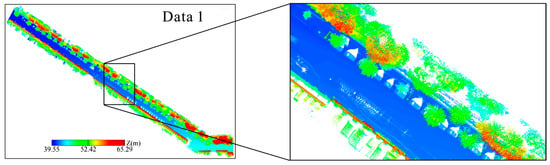
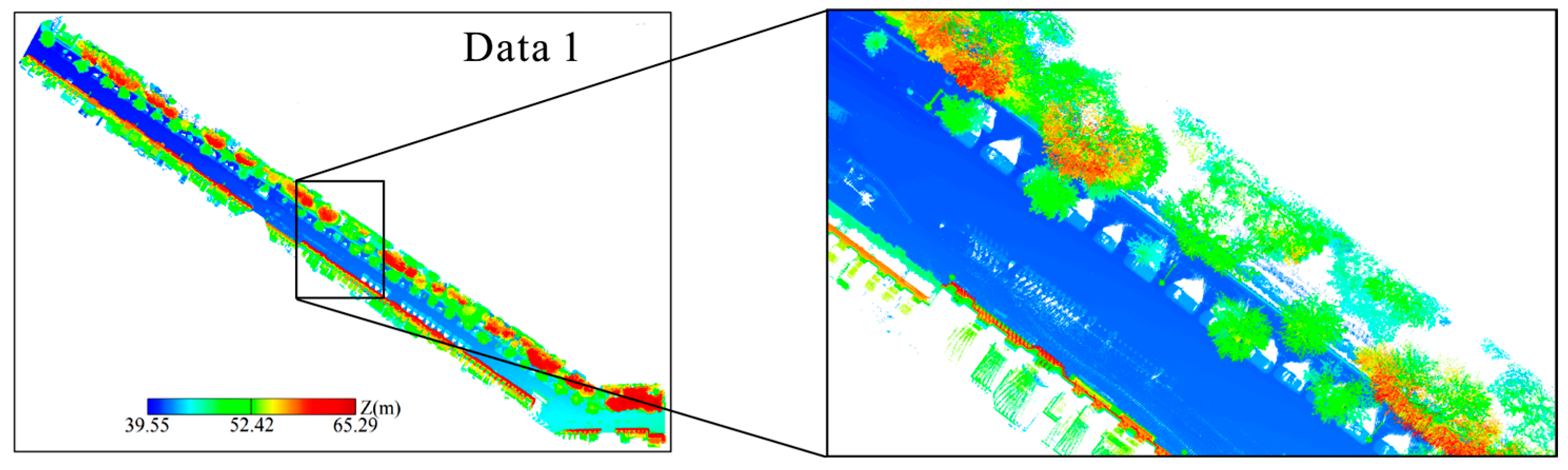
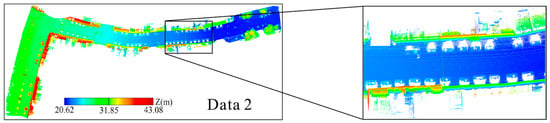
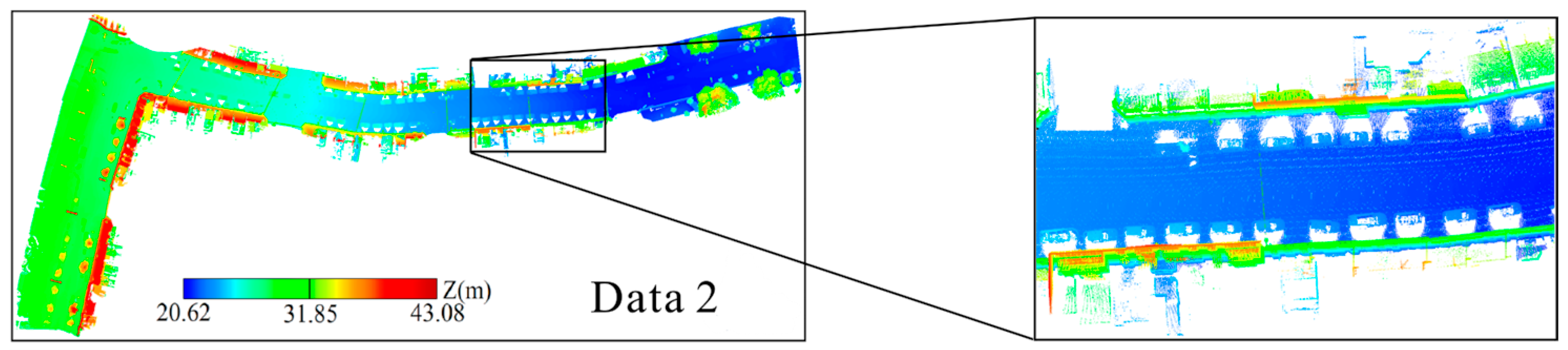
Dataset-2 was obtained using an L3D2 vehicle-mounted laser scanning system, which primarily collected data from complex streets in two urban areas. Although the original data consisted of point cloud measurements, post-processing converted the data into longitudinal profile elevation information. This approach provided a smaller sampling interval (10 mm), allowing for finer detail capture. Data 1 from Dataset-2 covered a 430 m segment in Paris, France, while Data 2 from Dataset-2 covered a 370 m segment in Lille, France. The high-density point cloud data offered a more objective and realistic assessment of road surface quality when using the IRI. Figure 14 and Figure 15 present the visualization results of the point clouds from the two test areas.
Figure 14.
Data 1 from Dataset-2 (elevation coloring).
Figure 15.
Data 2 from Dataset-2 (elevation coloring).
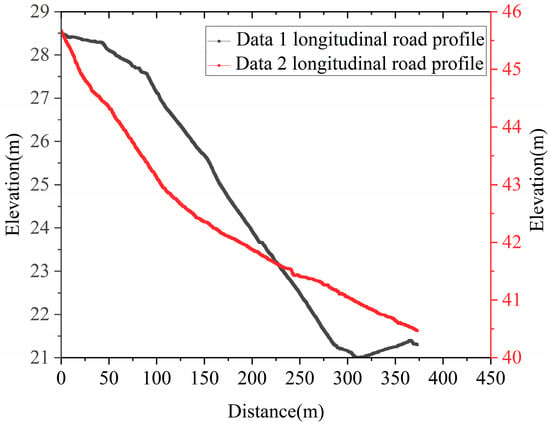
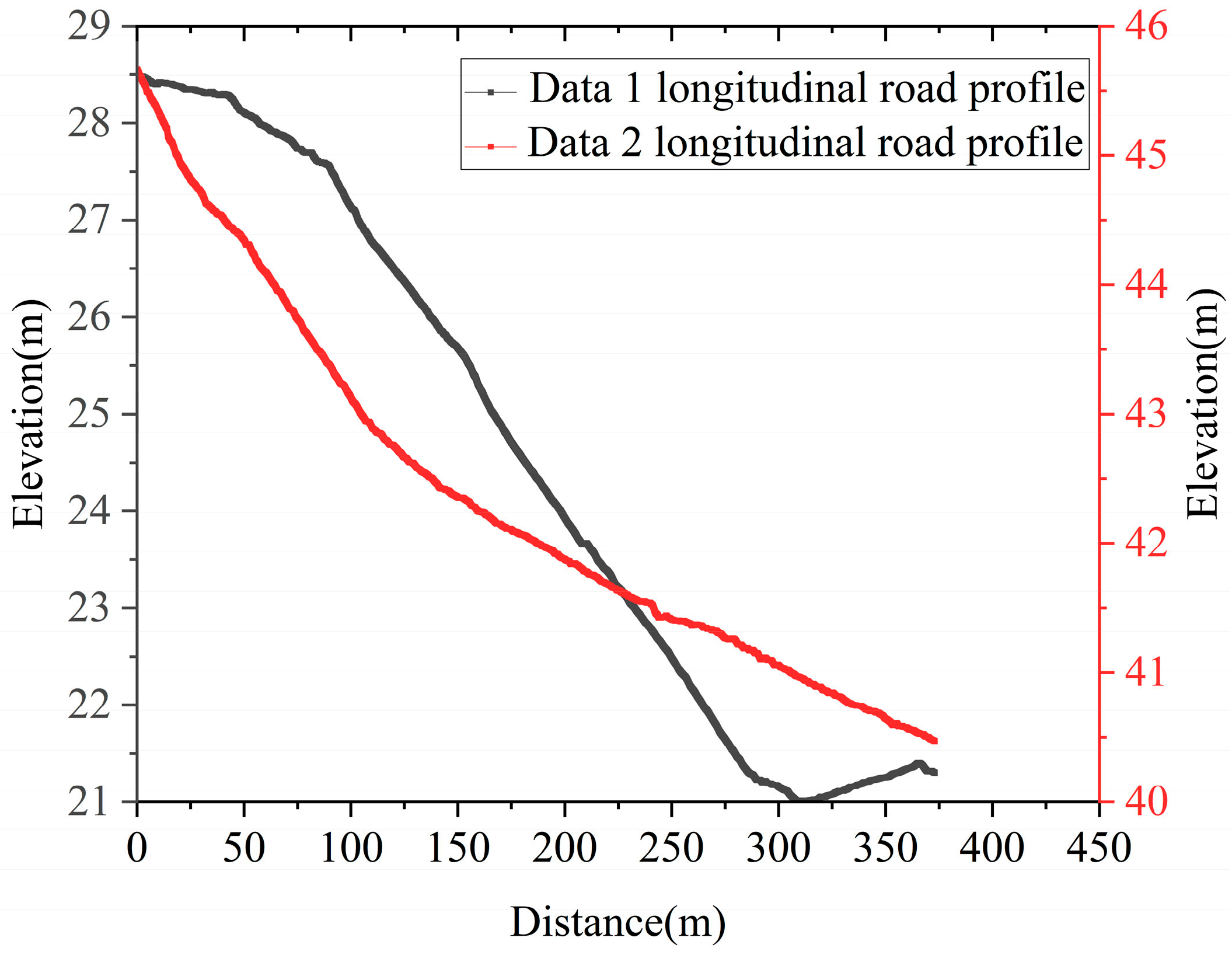
The longitudinal elevation data of the pavement centre lines were obtained by post-processing the point cloud data acquired by the L3D2 system. The longitudinal elevation curves for Data 1 and Data 2 from Dataset-2 are shown in Figure 16.
Figure 16.
Longitudinal profile curve of road surface.
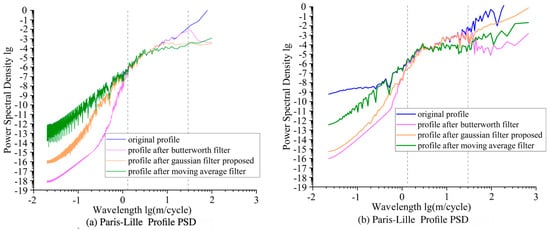
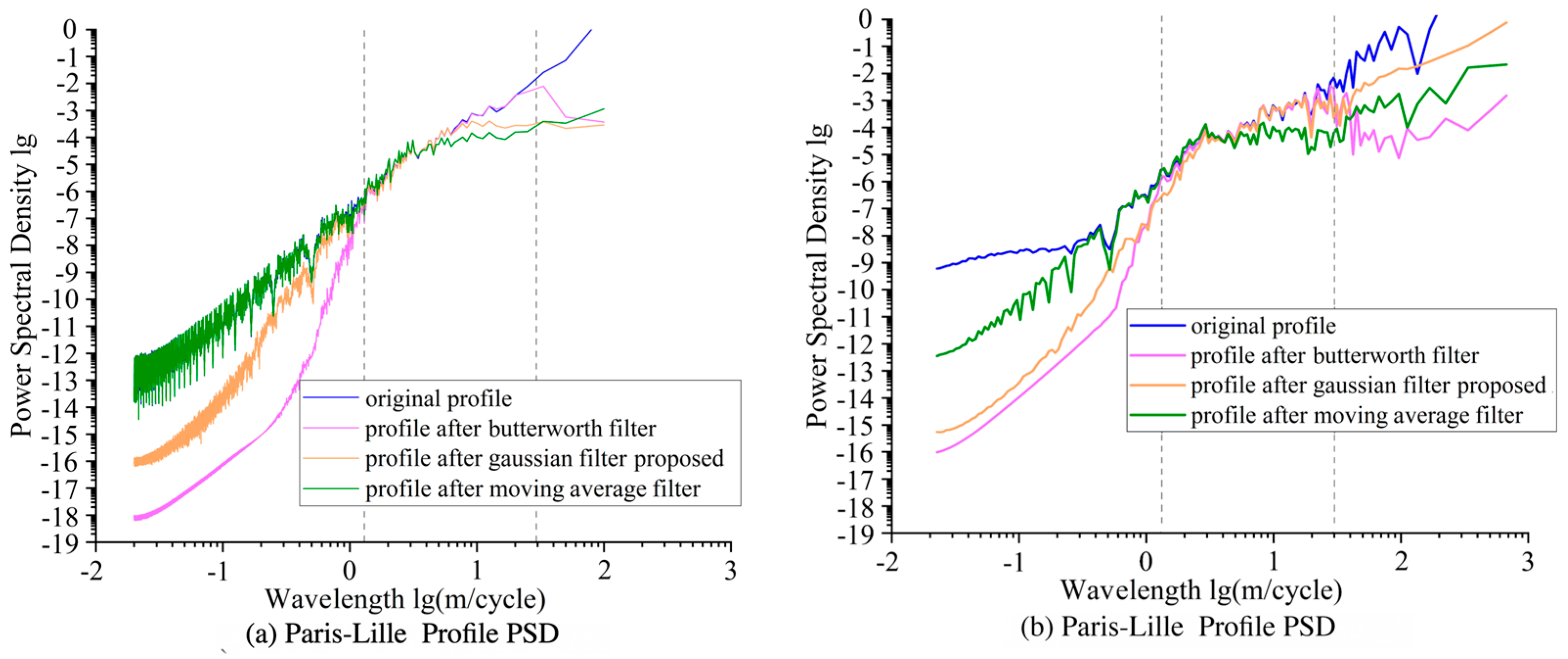
Various filters were applied to attenuate wavelengths outside the 1.3–29.4 m range in the longitudinal profile. The PSD analysis of the filtered data, obtained through FFT, is presented in Figure 16. This figure demonstrates that the moving average filter performs poorly at a 0.01 m sampling interval. In Data 1, the filter failed to eliminate wavelengths shorter than 1.3 m, resulting in the weakening of some effective waveforms. In Data 2, while wavelengths shorter than 1.3 m were reduced, some effective waveforms were also diminished. The Butterworth filter showed better performance at a 0.01 m sampling interval, but it still excessively attenuated wavelengths in the insensitive range, causing the data to deviate from the true profile and leading to underestimated IRI values. In contrast, the proposed Gaussian filter for longitudinal profile data moderately attenuated wavelengths near the 29.4 m range, effectively reducing wavelengths below 1.3 m and above 29.4 m without excessively weakening or enhancing the overall waveform. Using a Gaussian filter for longitudinal profile data can provide more accurate IRI values.
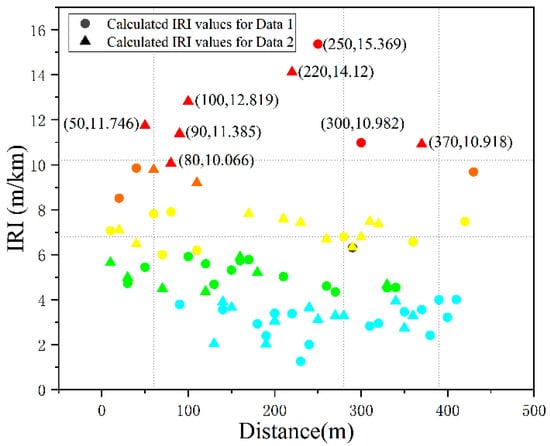
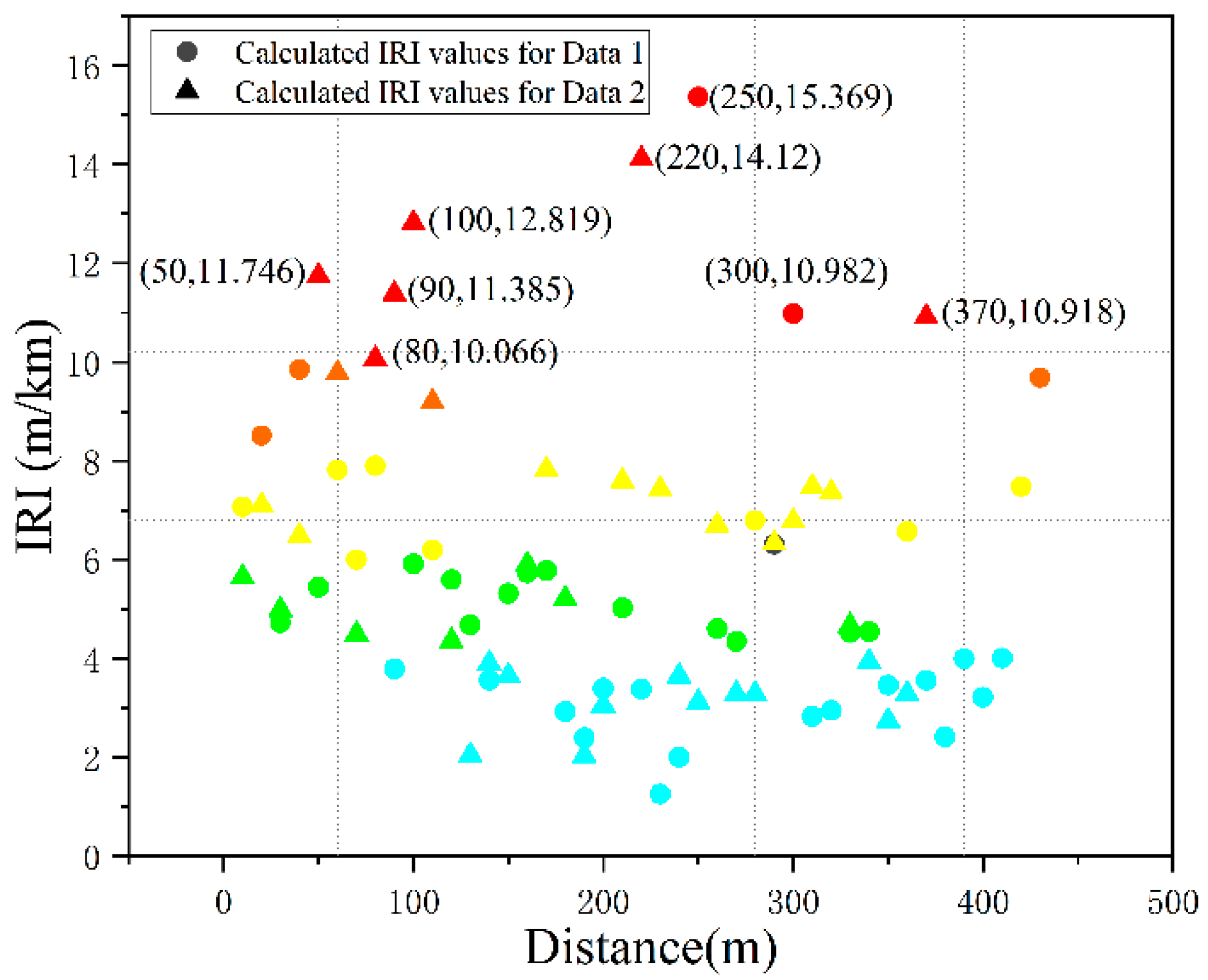
After applying the Gaussian filter to the original profiles, the IRI values were calculated with a 10 m step size using the initial value continuity method for the state variables between adjacent segments. The resulting IRI values for Data 1 and Data 2 are shown in Figure 17. The IRI calculation results at a 10 m step size for both road segments clearly represent the road roughness texture within each segment. Calculating the IRI over a 10 m evaluation distance can independently reflect the smoothness conditions within a localized area. The IRI values were higher at 250 m and 300 m in the Data 1 segment, and at 50 m, 80 m, 90 m, 100 m, 220 m, and 370 m in the Data 2 segment, indicating poorer road roughness conditions at these locations. This suggests the possible presence of noticeable road cracks or potholes. So, this capability transforms pavement maintenance from a broad-brush approach to a precisely targeted operation. By enabling the accurate identification and localization of specific distresses like cracks and potholes, our method facilitates targeted repairs that drastically reduce resource expenditure while maximizing intervention effectiveness.
Figure 17.
Experiment 2 pavement profile PSD.
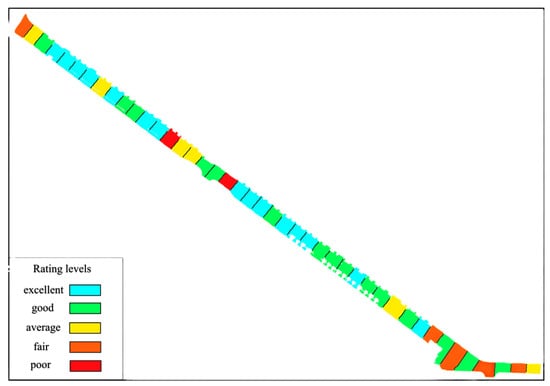
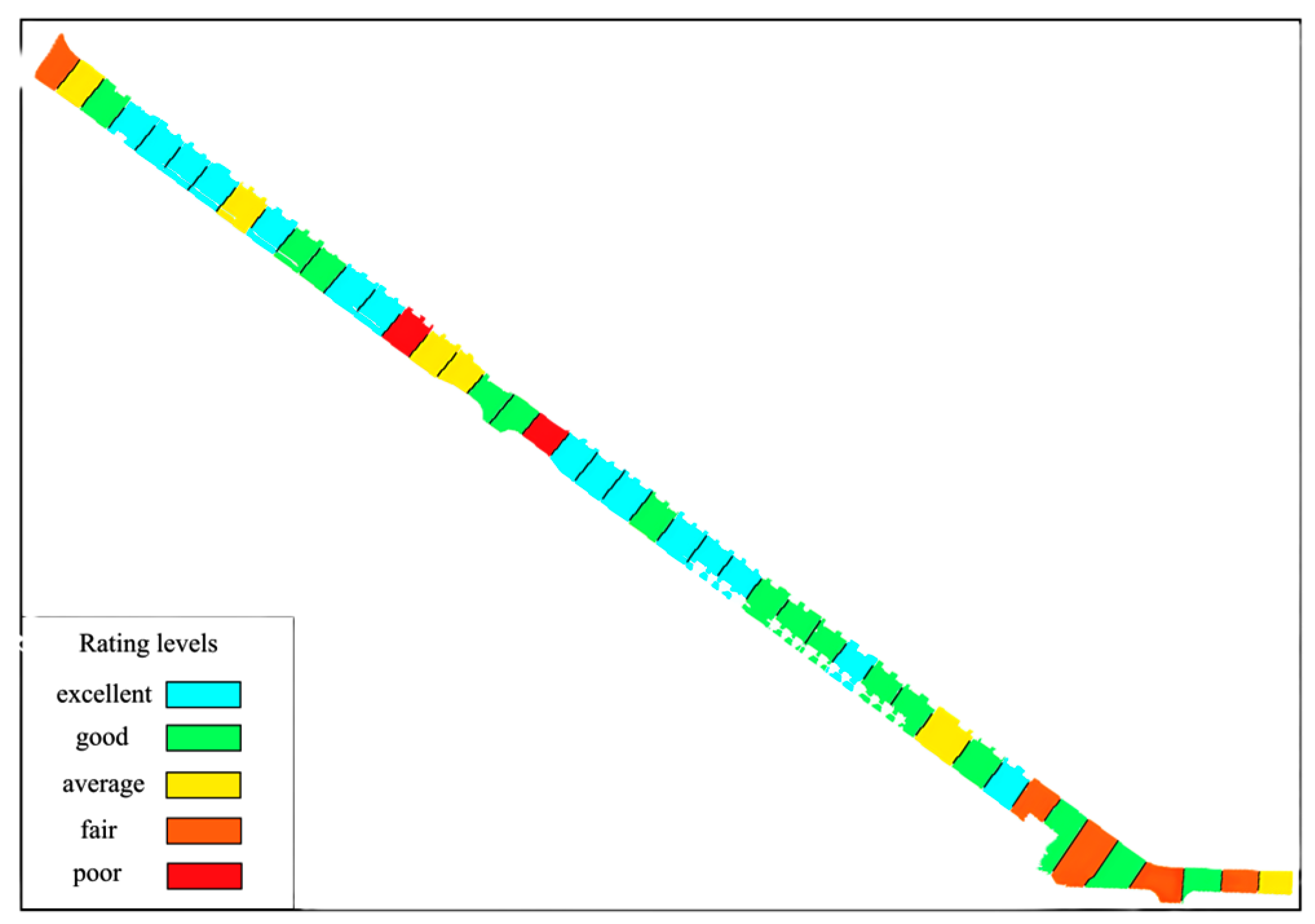
Figure 18 shows IRI calculations for Data 1 and Data 2. Since Dataset-2 does not provide standard IRI values, analysis of its errors is impossible. However, this dataset can capture finer road surface details, facilitating a more accurate evaluation of road quality. Based on the relationship between the Road Quality Index and IRI specified in relevant technical standards in our country, a road quality evaluation standard expressed in terms of the IRI can be derived, as shown in Table 9. According to the corresponding IRI values, the driving quality is divided into five levels, ranging from excellent to poor [57].
Figure 18.
IRI calculations for Data 1 and Data 2 from Dataset-2.
Table 9.
Criteria for evaluating road traveling quality.
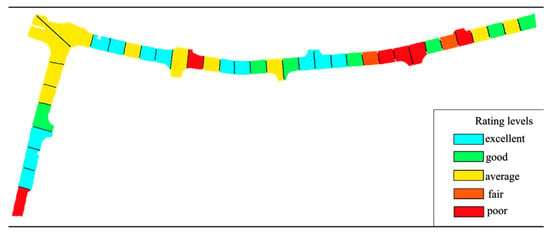
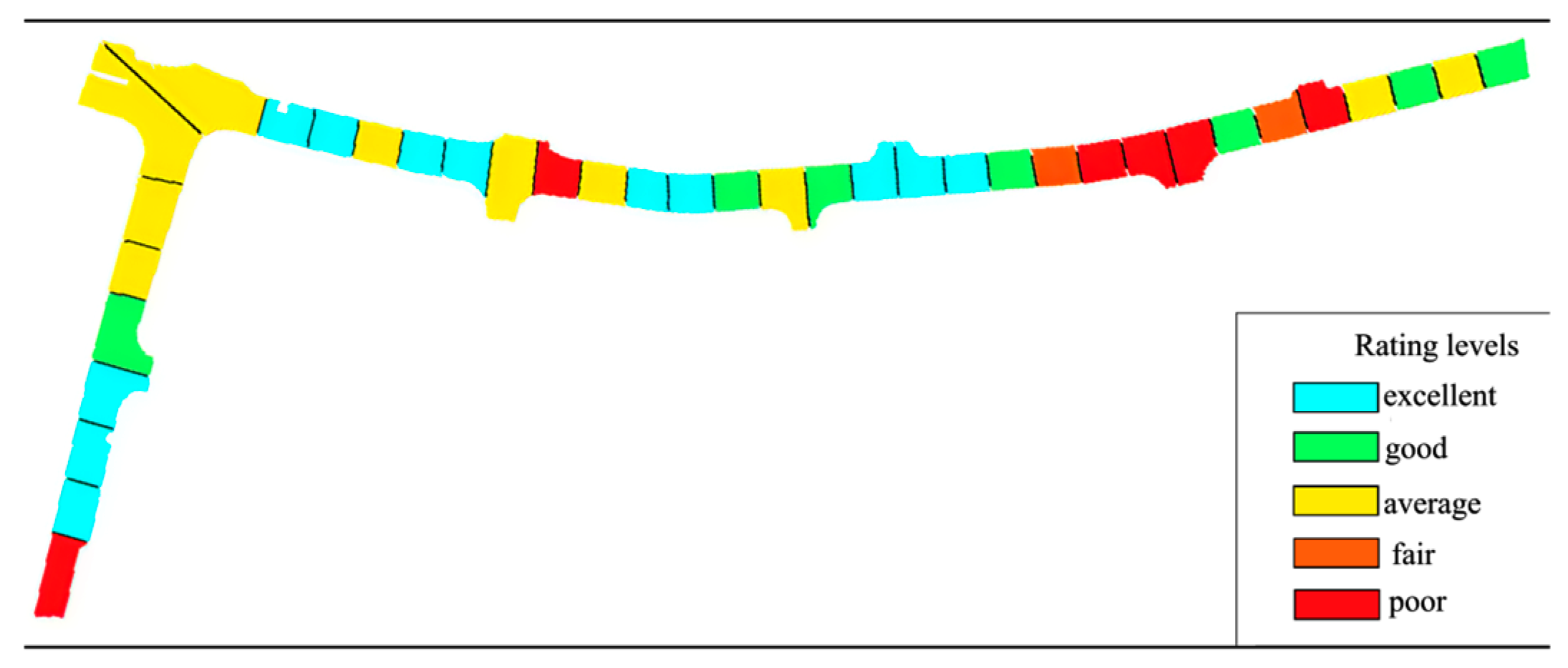
Using the evaluation standards mentioned above, the road quality of the two experimental segments was assessed, with the results illustrated in Figure 19 and Figure 20. For Data 1, the road driving quality was mostly rated as excellent and good, while Data 2 from Dataset-2 exhibited more segments with average and poor driving qualities. This indicates that the overall road quality of Data 2 was inferior to that of Data 1.
Figure 19.
Data 1 from Dataset-2. Schematic of road quality evaluation.
Figure 20.
Data 2 from Dataset-2. Schematic of road quality evaluation.
6. Discussion
6.1. Deep Learning Exploration Experiment
With the rapid development of deep learning technology, more and more scholars are trying to use deep learning methods to predict IRI. But, as mentioned above, most scholars use other parameters to predict the value of IRI, which is essentially a multivariate regression analysis. No scholar has used deep learning methods to directly obtain the value of IRI only through the measured elevation value. However, this approach is theoretically feasible when there is a large amount of homologous data. Each elevation value can be regarded as a feature value as the input of the artificial neural network [58]. The IRI with a known true value is used as the label to calculate the loss with the network’s predicted value to help the network converge. When the trained network processes the same source data, it can quickly obtain a more accurate IRI prediction value.
However, due to the different sampling rates and data lengths of different data and the different characteristics of different roads, the generalization of the network is poor. In addition, even for the same source data, a large amount of manually labeled data is required to prevent the network from overfitting. Considering the cost of data collection and labeling and the generalization and robustness of the model, it is non-cost-effective and unwise to use artificial neural networks to predict the value of IRI when only elevation values are used.
Nevertheless, deep learning methods were explored. As noted in Section 3, Gaussian filtering generates boundary points with unknown values, which were initially filled using the first and last known points—an approach that inevitably introduces errors. Accurately estimating these boundary values is both critical and challenging. Notably, this problem resembles long time-series prediction in deep learning, prompting us to experiment with Long Short-Term Memory (LSTM) networks to improve boundary estimation [59].
Before using the LSTM network, the number of boundary points must be determined. The Gaussian template size, corresponding to the boundary points, can be calculated using Formula 9 for 25 mm and 150 mm sampling intervals. Details are provided in Table 10.
Table 10.
Number of boundary points at different sampling intervals.
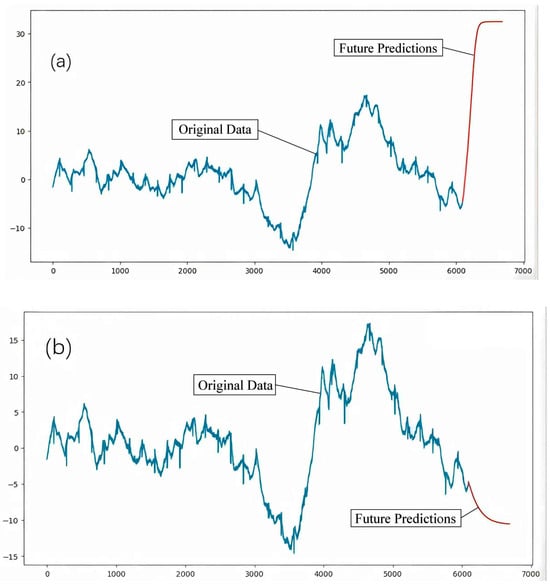
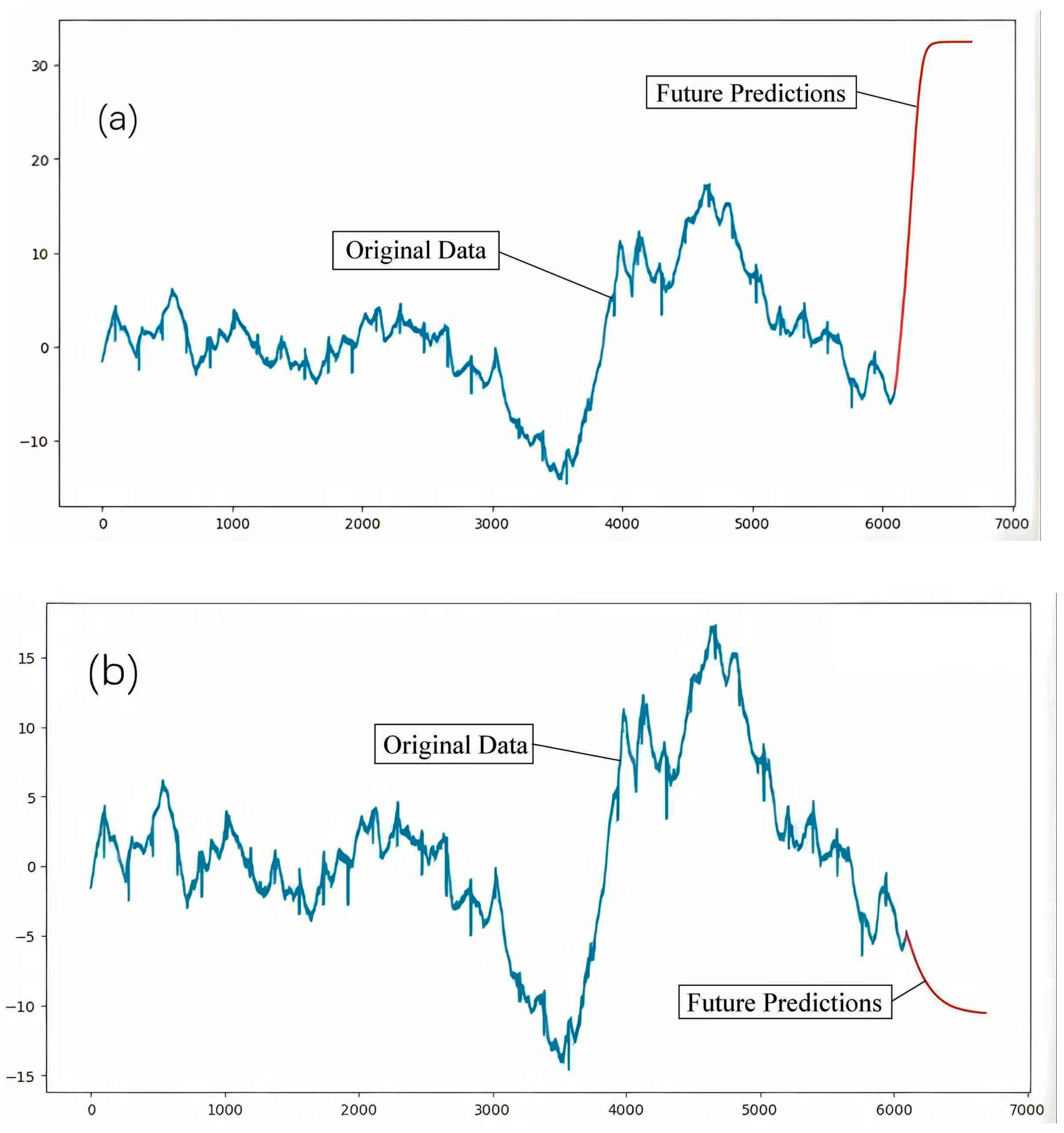
From the table, to filter out wavelengths greater than 29.4 m, the Gaussian template size should be set to 588. However, using the LSTM network for single-step prediction leads to an excessive number of data points, which, combined with error accumulation, may cause drifting in the results. The network was trained two times, yielding completely different results, as shown in Figure 21. Figure 21a shows that the predicted value drifts toward a larger value due to error accumulation, and Figure 21b shows that the predicted value drifts toward a smaller value due to error accumulation. This makes it difficult to accurately capture the pavement waveform, and using these predictions for boundary point filtering could introduce additional errors, ultimately affecting the IRI calculation.
Figure 21.
LSTM network single-step prediction results. (a) The prediction results drift toward larger values; (b) the prediction results drift toward smaller values.
6.2. The Challenges of the Deep Learning Path
Although deep learning has achieved state-of-the-art accuracy in many domains, an end-to-end mapping from longitudinal pavement profiles to IRI remains elusive. Our systematic experiments corroborate three intrinsic limitations: (i) data-shift vulnerability—performance collapses when sampling intervals (10–150 mm) or road types differ from the training corpus [60,61,62]; (ii) error accumulation—LSTM single-step predictions suffer from severe boundary drift (Figure 18), whereas more complex architectures (e.g., Informer) raise computational cost beyond real-time constraints [63]; and (iii) lack of interpretability—black-box parameters cannot be reconciled with ASTM E1926-08.
In contrast, the proposed Nyquist-based Gaussian filter requires no training and relies solely on the physically defined cutoff wavelength. It attains an MAE of 0.051 m km−1 and <4% relative error versus LTPP reference values, while maintaining consistent accuracy across the Paris–Lille dataset under varying sampling resolutions and road classes. These results demonstrate that, for light-weight, real-time, and standards-compliant IRI estimation, classical signal processing presently offers a more reliable and deployable solution than deep learning.
The data-dependent nature of deep learning presents particular challenges for handling non-Gaussian artifacts common in low-cost profilers. Sensor dropouts, thermal drift, and impulse noise require neural networks to learn from extensive, carefully curated noisy datasets—a practical limitation in field applications [64]. In contrast, the proposed Gaussian filtering framework provides inherent resilience through its mathematical properties: the smooth kernel naturally suppresses outliers while preserving signal structure. This principled approach adapts to varying measurement conditions without requiring explicit noise modeling or retraining, offering a more practical solution for real-world deployments with diverse sensor qualities.
6.3. Deep Learning Comparative Analysis
To comprehensively evaluate the proposed Gaussian filtering method, this section compares its performance against PatchTST (Patching Time Series Transformer), a state-of-the-art deep learning architecture for time-series forecasting [65,66]. PatchTST employs patch-based tokenization and multi-head self-attention mechanisms to capture temporal dependencies in sequential data. This comparison addresses a critical question: can physics-informed classical methods compete with data-driven deep learning for IRI prediction?
To evaluate the proposed method against state-of-the-art deep learning, PatchTST was trained and tested exclusively on an LTPP dataset (Dataset-1), which provides verified IRI ground truth. Table 11 presents the results of the accuracy comparison. The PatchTST model was configured with adaptive patch lengths (16 points for 25 mm sampling, 3 points for 150 mm sampling), embedding dimension d_model = 128, three encoder layers, and four attention heads. Training employed an AdamW optimizer (lr = 0.001), a batch size of 32, and 100 epochs with early stopping. The LTPP dataset was split 70/15/15 for training/validation/testing, generating 1247 profile–IRI pairs for 25 mm data and 1189 pairs for 150 mm data through sliding window augmentation. Training required approximately 3.7 h on an NVIDIA RTX 3090 GPU (NVIDIA Corporation, Santa Clara, California, USA). We adopted the same comparative experimental steps and methods as mentioned earlier to ensure consistency, and these procedures comply with ASTM standards.
Table 11.
IRI prediction accuracy and computational efficiency comparison.
PatchTST achieves marginally superior accuracy on in-domain test data—9.8% lower MAE (0.046 vs. 0.051 m/km) for 25 mm sampling. However, for 150 mm data, the Gaussian filter outperforms PatchTST by 7.7% (0.048 vs. 0.052 m/km), demonstrating superior robustness to varying sampling resolutions. This pattern suggests that PatchTST’s performance is highly dependent on training data characteristics, whereas the Gaussian filter maintains consistent accuracy across different sampling intervals.
Table 12 shows the results of the processing efficiency evaluation. The experimental platform specifications were as follows: Intel Xeon Gold 6248R @ 3.0 GHz (24 cores), 128 GB DDR4-2933, NVIDIA RTX 3090 24 GB (PatchTST only), with CUDA 11.8 and cuDNN v8.7. Software used included Ubuntu 22.04 LTS, GCC 11.3.0, NumPy 1.24.3 (Gaussian), and PyTorch 2.0.1 (PatchTST). Each experiment was repeated 100× after 10 warm-ups, with CPU affinity pinned and identical z-score normalization applied. Analysis used bootstrap CIs (1000 iterations, 95%) and 5-fold cross-validation, with n = 187/178 test samples.
Table 12.
Computational resource requirements and experimental specifications.
The results computed with Jetson Nano [67], Intel NUC 11 [68], and Jetson Xavier NX [69] are based on experimental measurements (100 trials, 10 warm-up runs), while the results with Raspberry Pi 4B [70] are the theoretical estimates derived from the published device specifications due to hardware unavailability. Table 13 presents the effectiveness of several methods on different platforms. For Critical Edge Deployment, PatchTST’s 1.2 GB requirement causes OOM on entry-level devices (Jetson Nano, smartphones). Gaussian filtering <45 MB enables deployment on microcontrollers (STM32H7 series) [71]. Autonomous systems require 10 Hz updates (100 ms/segment @ 100 km/h). Gaussian meets this on all platforms (max 14 ms/10 m); PatchTST fails on CPU-only devices (280 ms/10 m).
Table 13.
Edge device deployment compatibility.
Experimental results show that under ideal conditions, the PatchTST architecture can perform more accurate computations. Gaussian filtering is recommended for edge devices (ADAS, IoT, mobile), production fleets, and multi-regional deployments requiring real-time processing, hardware efficiency, and standards compliance. PatchTST is optional only for cloud-based research environments with unlimited GPU resources and >5000 training samples—constraints rarely met in civil engineering practice.
The Gaussian filter’s universal deployability across all tested platforms (including resource-constrained Jetson Nano and smartphones where PatchTST encounters OOM errors) is decisive for large-scale infrastructure monitoring with heterogeneous hardware. Future hybrid approaches should preserve core advantages (sub-100 ms inference, zero training, edge compatibility) while exploring neural networks for auxiliary tasks (confidence estimation, anomaly detection, sensor fusion).
The experimental validation employed professional-grade profilers exclusively, including the ICC MDR 4086L3 laser profiler (LTPP dataset) and the Velodyne HDL-32E LiDAR (Paris–Lille dataset); while these instruments provide high-precision reference data, their acquisition costs (typically exceeding $50,000) may limit widespread adoption. Given the Gaussian filter’s computational efficiency (<45 MB memory, <0.1 s/km inference), future research would evaluate low-cost sensing alternatives, including MEMS accelerometers (e.g., MPU-6050, ADXL345; $5–25), single-point LiDAR modules (e.g., TFmini-S, TF-Luna; $25–60), and smartphone-embedded IMUs.
7. Conclusions
This study proposed a Gaussian filtering method grounded in the Nyquist theorem for calculating the International Roughness Index (IRI), which effectively isolates sensitive wavelength components (1.3–29.4 m) while suppressing non-sensitive noise to overcome the limitations of conventional approaches. The method was rigorously validated to demonstrate high accuracy, with a mean absolute error of 0.051 m/km against LTPP benchmarks and a relative error below 4%, directly contributing to potential maintenance budget savings. Its computational efficiency (0.07 s/km) enables real-time application, and its consistent performance across diverse datasets (LTPP and Paris–Lille) confirms robust generalization and stability. Furthermore, full compliance with the ASTM E1926-08 standard and compatibility with onboard profilers ensure immediate practicality for infrastructure monitoring, autonomous driving, and digital twins.
Due to the high cost of data acquisition, the proposed study mainly relies on region-specific datasets, which may limit the generalizability of our proposed method to other contexts. In future work, the proposed method will be further evaluated under a variety of conditions, including different road types, vehicle speeds, and environmental factors, to assess its robustness and generalization capability. Additionally, exploring advanced deep learning architectures for boundary point prediction could be a promising direction. These models, with their self-attention mechanisms, are particularly suited for capturing long-range dependencies in sequential data and may overcome the error accumulation issue encountered in our preliminary LSTM trials, potentially offering a more robust solution for handling boundary points without manual parameter tuning. These future studies will help to refine the method for broader practical applications.
It should be noted that the current study has two primary limitations that warrant future investigation. First, all validation data were collected under normal meteorological conditions using professional-grade profilers (ICC MDR 4086L3 and Velodyne HDL-32E). Adverse weather conditions such as rain, snow, and fog may introduce additional measurement errors and non-Gaussian noise, and the algorithm’s robustness under these circumstances requires further verification. Second, while Section 2.1 discusses emerging low-cost sensing approaches (e.g., MEMS accelerometers, smartphone IMUs, bicycle-mounted sensors), the experimental validation in this study did not include such consumer-grade equipment. Future work would address these limitations through two research topics: (1) developing weather-adaptive filtering strategies by integrating meteorological data and conducting systematic validation across various adverse conditions; (2) evaluating the proposed method’s performance with low-cost sensors, including MEMS accelerometers, low-cost LiDAR modules, and smartphone-based IMUs, to establish noise tolerance thresholds and practical deployment guidelines.
Author Contributions
Conceptualization, G.Z.; Data curation, J.G.; Formal analysis, H.G.; Funding acquisition, G.Z.; Investigation, Y.C.; Methodology, H.G. and J.G.; Project administration, G.Z.; Resources, G.Z. and Y.C.; Software, J.G. and Y.C.; Supervision, G.Z. and X.Z.; Validation, H.G., J.G., and Y.C.; Visualization, H.G.; Writing—original draft, H.G.; Writing—review and editing, G.Z., H.G. and Y.C. All authors have read and agreed to the published version of the manuscript.
Funding
This work was financially supported by the National Natural Science of China (grant #: 42461050) and the Guangxi Surveying and Mapping LiDAR Intelligent Equipment Technology Mid-Test Base (grant #: Guike AD23023012).
Data Availability Statement
The data presented in this study are available on request from the corresponding author. The data are not publicly available due to privacy concerns.
Acknowledgments
The original data for this work comes from the Mines ParisTech Robotics Center and LTPP program in the United States.
Conflicts of Interest
The authors declare no conflicts of interest.
Abbreviations
The following abbreviations are used in this manuscript:
| IRI | International Roughness Index |
| LTPP | Long-Term Pavement Performance |
| PSD | Power Spectral Density |
| PCI | Pavement Condition Index |
| SRI | Skid Resistance Index |
| MEMS | Micro Electromechanical System |
| UAVs | Unmanned Aerial Vehicles |
| ASTM | American Society for Testing and Materials |
| NCHRP | National Highway Research Program |
| FFT | Fast Fourier Transform |
| MAE | Mean Absolute Error |
| RMSE | Root Mean Square Error |
| LSTM | Long Short-Term Memory |
References
- Radović, N.; Jokanović, I.; Matić, B.; Šešlija, M. A measurement of roughness as indicator of road network condition—Case study Serbia. Teh. Vjesn. 2016, 23, 881–884. [Google Scholar]
- Sharif, F.; Tauqir, A. The effects of infrastructure development and carbon emissions on economic growth. Environ. Sci. Pollut. Res. 2021, 28, 36259–36273. [Google Scholar] [CrossRef] [Scilit] [PubMed]
- Bajic, M.; Pour, S.M.; Skar, A.; Pettinari, M.; Levenberg, E.; Alstrøm, T.S. Road Roughness Estimation Using Machine Learning. arXiv 2021, arXiv:2107.01199. [Google Scholar] [CrossRef] [Scilit]
- Yu, G.; Wang, Y.; Hu, M.; Shi, L.; Mao, Z.; Sugumaran, V. RIOMS: An intelligent system for operation and maintenance of urban roads using spatio-temporal data in smart cities. Future Gener. Comput. Syst. 2021, 115, 583–609. [Google Scholar] [CrossRef] [Scilit]
- Hettiarachchi, C.; Yuan, J.; Amirkhanian, S.; Xiao, F. Measurement of pavement unevenness and evaluation through the IRI parameter—An overview. Measurement 2023, 206, 112284. [Google Scholar] [CrossRef] [Scilit]
- Li, J.-A.; Feng, D. Fatigue life evaluation of bridge stay cables subject to monitoring traffic and considering road roughness. Eng. Struct. 2023, 293, 116572. [Google Scholar] [CrossRef] [Scilit]
- Rasol, M.; Schmidt, F.; Ientile, S.; Adelaide, L.; Nedjar, B.; Kane, M.; Chevalier, C. Progress and monitoring opportunities of skid resistance in road transport: A critical review and road sensors. Remote Sens. 2021, 13, 3729. [Google Scholar] [CrossRef] [Scilit]
- Khalifeh, V.; Golroo, A.; Ovaici, K. Application of an Inexpensive Sensor in Calculating the International Roughness Index. J. Comput. Civ. Eng. 2018, 32, 04018022. [Google Scholar] [CrossRef] [Scilit]
- Yang, Y.B.; Xu, H.; Wang, Z.; Shi, K. Using vehicle–bridge contact spectra and residue to scan bridge’s modal properties with vehicle frequencies and road roughness eliminated. Struct. Control Health Monit. 2022, 29, e2968. [Google Scholar] [CrossRef] [Scilit]
- Múčka, P. International Roughness Index specifications around the world. Road Mater. Pavement Des. 2017, 18, 929–965. [Google Scholar] [CrossRef] [Scilit]
- Zamora Alvarez, E.J.; Ferris, J.B.; Scott, D.; Horn, E. Development of a discrete roughness index for longitudinal road profiles. Int. J. Pavement Eng. 2018, 19, 1043–1052. [Google Scholar] [CrossRef] [Scilit]
- Fares, A.; Zayed, T.; Abdelkhalek, S.; Faris, N.; Muddassir, M. Rutting measurement in asphalt pavements. Autom. Constr. 2024, 161, 105358. [Google Scholar] [CrossRef] [Scilit]
- Sayers, M.W.; Karamihas, S.M. The Little Book of Profiling: Basic Information about Measuring and Interpreting Road Profiles; University of Michigan Transportation Research Institute: Ann Arbor, MI, USA, 1998. [Google Scholar]
- Sayers, M.W.; Gillespie, T.D.; Paterson, W.D.O. The International Road Roughness Experiment: Establishing Correlation and a Calibration Standard for Measurements; World Bank Technical Paper No. 45; The World Bank: Washington, DC, USA, 1986. [Google Scholar]
- ASTM E1926-08; Standard Practice for Computing International Roughness Index of Roads from Longitudinal Profile Measurements. ASTM International: West Conshohocken, PA, USA, 2018.
- Zhang, Z.; Sun, C.; Bridgelall, R.; Sun, M. Road profile reconstruction using connected vehicle responses and wavelet analysis. J. Terramechanics 2018, 80, 21–30. [Google Scholar] [CrossRef] [Scilit]
- Schafer, R.W. What is a Savitzky-Golay filter? [Lecture Notes]. IEEE Signal Process. Mag. 2011, 28, 111–117. [Google Scholar] [CrossRef] [Scilit]
- Boonsiripant, S.; Athan, C.; Jedwanna, K.; Lertworawanich, P.; Sawangsuriya, A. Comparative analysis of deep neural networks and graph convolutional networks for road surface condition prediction. Sustainability 2024, 16, 9805. [Google Scholar] [CrossRef] [Scilit]
- Chaudhary, P.; Aggarwal, V.; Chopra, T. Predicting International Roughness Index (IRI) in Tier 2 Cities: A Machine Learning Approach. In Proceedings of the International Conference on Smart Infrastructure and Construction; Springer: Singapore, 2023; pp. 105–113. [Google Scholar] [CrossRef] [Scilit]
- Alnaqbi, A.; Zeiada, W.; Al-Khateeb, G.G. Machine learning modeling of pavement performance and IRI prediction in flexible pavement. Innov. Infrastruct. Solut. 2024, 9, 385. [Google Scholar] [CrossRef] [Scilit]
- Taylor, M.; Williams, S. Long-term performance of geosynthetic-reinforced flexible pavements under heavy traffic loading. Road Mater. Pavement Des. 2024, 25, 2343087. [Google Scholar] [CrossRef] [Scilit]
- Zhou, G.; Wang, L. Co-location decision tree for enhancing decision-making of pavement maintenance and rehabilitation. Transp. Res. Part C 2012, 21, 287–305. [Google Scholar] [CrossRef] [Scilit]
- Sayers, M.W. Guidelines for Conducting and Calibrating Road Roughness Measurements; University of Michigan Transportation Research Institute: Ann Arbor, MI, USA, 1986. [Google Scholar]
- Sayers, M. On the Calculation of International Roughness Index from Longitudinal Road Profile. Transp. Res. Rec. 1995, 1501, 1–12. [Google Scholar]
- Mirtabar, Z.; Golroo, A.; Mahmoudzadeh, A.; Barazandeh, F. Development of a crowdsourcing-based system for computing the international roughness index. Int. J. Pavement Eng. 2022, 23, 489–498. [Google Scholar] [CrossRef] [Scilit]
- Prosser-Contreras, M.; Atencio, E.; Muñoz La Rivera, F.; Herrera, R.F. Use of unmanned aerial vehicles (UAVs) and photogrammetry to obtain the international roughness index (IRI) on roads. Appl. Sci. 2020, 10, 8788. [Google Scholar] [CrossRef] [Scilit]
- Seraj, F.; Van Der Zwaag, B.J.; Dilo, A.; Luarasi, T.; Havinga, P. RoADS: A Road Pavement Monitoring System for Anomaly Detection Using Smart Phones. In Big Data Analytics in the Social and Ubiquitous Context; Atzmueller, M., Chin, A., Janssen, F., Schweizer, I., Trattner, C., Eds.; Springer: Cham, Switzerland, 2016; pp. 128–146. [Google Scholar] [CrossRef] [Scilit]
- Alessandroni, G.; Carini, A.; Lattanzi, E.; Freschi, V.; Bogliolo, A. A study on the influence of speed on road roughness sensing: The SmartRoadSense case. Sensors 2017, 17, 305. [Google Scholar] [CrossRef] [Scilit] [PubMed]
- Sattar, S.; Li, S.; Chapman, M. Road surface monitoring using smartphone sensors: A review. Sensors 2018, 18, 3845. [Google Scholar] [CrossRef] [Scilit]
- Eriksson, J.; Girod, L.; Hull, B.; Newton, R.; Madden, S.; Balakrishnan, H. The pothole patrol: Using a mobile sensor network for road surface monitoring. In Proceedings of the 6th International Conference on Mobile Systems, Applications, and Services, Breckenridge, CO, USA, 17–20 June 2008; pp. 29–39. [Google Scholar] [CrossRef] [Scilit]
- Masino, J.; Thumm, J.; Frey, M.; Gauterin, F. Learning from the crowd: Road infrastructure monitoring system. J. Traffic Transp. Eng. 2017, 4, 451–463. [Google Scholar] [CrossRef] [Scilit]
- El-Wakeel, A.S.; Li, J.; Noureldin, A.; Hassanein, H.S.; Zorba, N. Towards a practical crowdsensing system for road surface conditions monitoring. IEEE Internet Things J. 2018, 5, 4672–4685. [Google Scholar] [CrossRef] [Scilit]
- Rizelioglu, M.; Arslan, T.; Yigit, E.; Yazici, M. Using a bike as a probe vehicle: Experimental study to determine road roughness with piezoelectric sensors. J. Infrastruct. Syst. 2024, 30, 04024018. [Google Scholar] [CrossRef] [Scilit]
- Rizelioglu, M.; Yazici, M. New Approach to Determining the Roughness of Bicycle Roads. Transp. Res. Rec. 2023, 2678, 781–792. [Google Scholar] [CrossRef] [Scilit]
- Xu, S.; Liu, Q.; Bo, Y.; Chen, Z.; Wang, C. Estimating the International Roughness Index of asphalt concrete pavement by response-based testing equipment and intelligent algorithms. Constr. Build. Mater. 2024, 433, 136659. [Google Scholar] [CrossRef] [Scilit]
- Du, Y.; Liu, C.; Liu, Y. Impact of vehicle speed on IRI calculation accuracy. J. Transp. Eng. Part B Pavements 2022, 148, 04021106. [Google Scholar] [CrossRef] [Scilit]
- Li, J.; Zhang, Z.; Wang, W. International Roughness Index and a New Solution for Its Calculation. J. Transp. Eng. Part B Pavements 2018, 144, 06018002. [Google Scholar] [CrossRef] [Scilit]
- Zhao, B.; Nagayama, T.; Xue, K. Road profile estimation, and its numerical and experimental validation, by smartphone measurement of the dynamic responses of an ordinary vehicle. J. Sound Vib. 2019, 457, 92–117. [Google Scholar] [CrossRef] [Scilit]
- Thite, A.N. Development of a Refined Quarter Car Model for the Analysis of Discomfort due to Vibration. Adv. Acoust. Vib. 2012, 2012, 863061. [Google Scholar] [CrossRef] [Scilit]
- Fu, H.; Cheng, Y.; Huang, W. A novel variational robust filter with Gaussian mixture model for unknown non-Gaussian noises. Measurement 2023, 221, 113417. [Google Scholar] [CrossRef] [Scilit]
- Yang, X.; Zhao, C.; Chen, B. Progressive Gaussian approximation filter with adaptive measurement update. Measurement 2019, 148, 106898. [Google Scholar] [CrossRef] [Scilit]
- Wang, J.; Zhang, Z.; Huang, Y.; Li, Z.; Huang, Q. A 3D convolutional neural network based near-field acoustical holography method with sparse sampling rate on measuring surface. Measurement 2021, 177, 109297. [Google Scholar] [CrossRef] [Scilit]
- Parineh, H.; Sarvi, M.; Bagloee, S.A. Detecting emergency vehicles with 1D-CNN using Fourier processed audio signals. Measurement 2023, 223, 113784. [Google Scholar] [CrossRef] [Scilit]
- Liu, R.W.; Guo, Y.; Lu, Y.; Chui, K.T.; Gupta, B.B. Deep network-enabled haze visibility enhancement for visual IoT-driven intelligent transportation systems. IEEE Trans. Ind. Inform. 2022, 19, 1581–1591. [Google Scholar] [CrossRef] [Scilit]
- Al-Furjan, M.S.H.; Habibi, M.; Jung, D.W.; Sadeghi, S.; Safarpour, H.; Tounsi, A.; Chen, G. A computational framework for propagated waves in a sandwich doubly curved nanocomposite panel. Eng. Comput. 2022, 38, 1679–1696. [Google Scholar] [CrossRef] [Scilit]
- King, B.-A. The Effect of Road Roughness on Traffic Speed and Road Safety; University of Southern Queensland: Toowoomba, Australia, 2014. [Google Scholar]
- Proakis, J.G. Digital Signal Processing: Principles Algorithms and Applications; Pearson Education: Delhi, India, 2001. [Google Scholar]
- Haigermoser, A.; Luber, B.; Rauh, J.; Gräfe, G. Road and track irregularities: Measurement, assessment and simulation. Veh. Syst. Dyn. 2015, 53, 878–957. [Google Scholar] [CrossRef] [Scilit]
- Agurla, M.; Lin, S. Long-Term Pavement Performance Automated Faulting Measurement; United States Federal Highway Administration: Washington, DC, USA, 2015. [Google Scholar]
- Roynard, X.; Deschaud, J.-E.; Goulette, F. Paris-Lille-3D: A large and high-quality ground-truth urban point cloud dataset for automatic segmentation and classification. Int. J. Robot. Res. 2018, 37, 545–557. [Google Scholar] [CrossRef] [Scilit]
- Shtayat, A.; Moridpour, S.; Best, B.; Daoud, H. Application of noise-cancelling and smoothing techniques in road pavement vibration monitoring data. Int. J. Transp. Sci. Technol. 2024, 14, 110–119. [Google Scholar] [CrossRef] [Scilit]
- Meng, X.; Tian, H.; Chen, X.; Jiang, X.; Wang, P.; Wei, T.; Cai, G. Numerical simulation of combustion surface regression based on Butterworth filter in hybrid rocket motor. Acta Astronaut. 2023, 202, 400–410. [Google Scholar] [CrossRef] [Scilit]
- Abdullah, L.; Singh, S.S.K.; Abdullah, S.; Azman, A.H.; Ariffin, A.K.; Kong, Y.S. The needs of power spectral density in fatigue life prediction of heavy vehicle leaf spring. J. Mech. Sci. Technol. 2020, 34, 2341–2346. [Google Scholar] [CrossRef] [Scilit]
- Gutiérrez, C.A.; Harrison, W.; Rice, M.; Jensen, B.; Norman, K.; Redd, B.; Twitchell, A.; Cardenas-Juarez, M. Envelope distribution and Doppler spectrum of V2V channels at 5.9 GHz in mountainous roads. Veh. Commun. 2023, 39, 100570. [Google Scholar] [CrossRef] [Scilit]
- Wu, Y.; Wu, D.; Fei, M.; Sørensen, H.; Ren, Y.; Mou, J. Application of GA-BPNN on estimating the flow rate of a centrifugal pump. Eng. Appl. Artif. Intell. 2023, 119, 105738. [Google Scholar] [CrossRef] [Scilit]
- Zhou, G.; Wang, L. GIS and data mining to enhance pavement rehabilitation decision-making. J. Transp. Eng. 2010, 136, 332–341. [Google Scholar] [CrossRef] [Scilit]
- Sekban, D.M.; Yaylacı, E.U.; Özdemir, M.E.; Yaylacı, M.; Tounsi, A. Investigating Formability Behavior of Friction Stir-Welded High-Strength Shipbuilding Steel using Experimental, Finite Element, and Artificial Neural Network Methods. J. Mater. Eng. Perform. 2025, 34, 4942–4950. [Google Scholar] [CrossRef] [Scilit]
- Plati, C.; Armeni, A.; Kyriakou, C.; Asoniti, D. AI for Predicting Pavement Roughness in Road Monitoring and Maintenance. Infrastructures 2025, 10, 157. [Google Scholar] [CrossRef] [Scilit]
- Bral, S.; Kumar, P.P.; Chopra, T. Prediction of International Roughness Index Using CatBooster and Shap Values. Int. J. Pavement Res. Technol. 2024, 17, 518–533. [Google Scholar] [CrossRef] [Scilit]
- Chen, K.; Torbaghan, M.E.; Thom, N.; Faramarzi, A. Physics-guided neural network for predicting international roughness index on flexible pavements considering accuracy, uncertainty and stability. Eng. Appl. Artif. Intell. 2025, 142, 109922. [Google Scholar] [CrossRef] [Scilit]
- Pasupunuri, S.K.; Thom, N.; Li, L. Roughness Prediction of Jointed Plain Concrete Pavement Using Physics Informed Neural Networks. Transp. Res. Rec. 2024, 2678, 1734–1746. [Google Scholar] [CrossRef] [Scilit]
- Zhou, H.; Zhang, S.; Peng, J.; Zhang, S.; Li, J.; Xiong, H.; Zhang, W. Informer: Beyond efficient transformer for long sequence time-series forecasting. Proc. AAAI Conf. Artif. Intell. 2021, 35, 11106–11115. [Google Scholar] [CrossRef] [Scilit]
- Xu, Z.; Wang, Y.; Wang, Y.; Cai, Y.; Yuan, C. ImageNet-E: A New Dataset for Open-Vocabulary Object Detection and Classification. arXiv 2023, arXiv:2307.02457. [Google Scholar]
- Brščić, D.; Evans, R.W.; Rehm, M.; Kanda, T. Using a rotating 3D LiDAR on a mobile robot for estimation of person’s body angle and gender. Sensors 2020, 20, 3964. [Google Scholar] [CrossRef] [Scilit]
- Vaswani, A.; Shazeer, N.; Parmar, N.; Uszkoreit, J.; Jones, L.; Gomez, A.N.; Kaiser, Ł.; Polosukhin, I. Attention is all you need. In Advances in Neural Information Processing Systems (NeurIPS 2017); Curran Associates, Inc.: Red Hook, NY, USA, 2017; Volume 30, pp. 5998–6008. [Google Scholar]
- Nie, Y.; Nguyen, N.H.; Sinthong, P.; Kalagnanam, J. A time Series Is Worth 64 Words: Long-Term Forecasting with Transformers. In Proceedings of the International Conference on Learning Rep-resentations (ICLR 2023), Kigali, Rwanda, 1–5 May 2023; Available online: https://openreview.net/forum?id=Jbdc0vTOcol (accessed on 21 December 2025).
- NVIDIA Corporation. Jetson Nano System-on-Module Data Sheet (Document No. DA-09366-001_v1.0). NVIDIA. 2020. Available online: https://developer.nvidia.com/embedded/jetson-nano (accessed on 22 December 2025).
- Intel Corporation. Intel NUC 11 Performance Kit NUC11PAHi7 Product Specifications; Intel: Santa Clara, CA, USA, 2021; Available online: https://www.intel.com/content/www/us/en/products/sku/205073/intel-nuc-11-performance-kit-nuc11pahi7/specifications.html (accessed on 22 December 2025).
- NVIDIA Corporation. Jetson Xavier NX System-on-Module Data Sheet (Document No. DA-09366-001). NVIDIA. 2020. Available online: https://www.nvidia.com/en-us/autonomous-machines/embedded-systems/jetson-xavier-nx/ (accessed on 22 December 2025).
- Raspberry Pi Ltd. Raspberry Pi 4 Model B Datasheet (Release 1.1). Raspberry Pi. 2024. Available online: https://datasheets.raspberrypi.com/rpi4/raspberry-pi-4-datasheet.pdf (accessed on 22 December 2025).
- STMicroelectronics. STM32H7 Series: Arm Cortex-M7 and Cortex-M4 MCUs (480 MHz) Data Sheet; STMicroelectronics: Geneva, Switzerland, 2023; Available online: https://www.st.com/en/microcontrollers-microprocessors/stm32h7-series.html (accessed on 22 December 2025).

Disclaimer/Publisher’s Note: The statements, opinions and data contained in all publications are solely those of the individual author(s) and contributor(s) and not of MDPI and/or the editor(s). MDPI and/or the editor(s) disclaim responsibility for any injury to people or property resulting from any ideas, methods, instructions or products referred to in the content. |
© 2026 by the authors. Licensee MDPI, Basel, Switzerland. This article is an open access article distributed under the terms and conditions of the Creative Commons Attribution (CC BY) license.