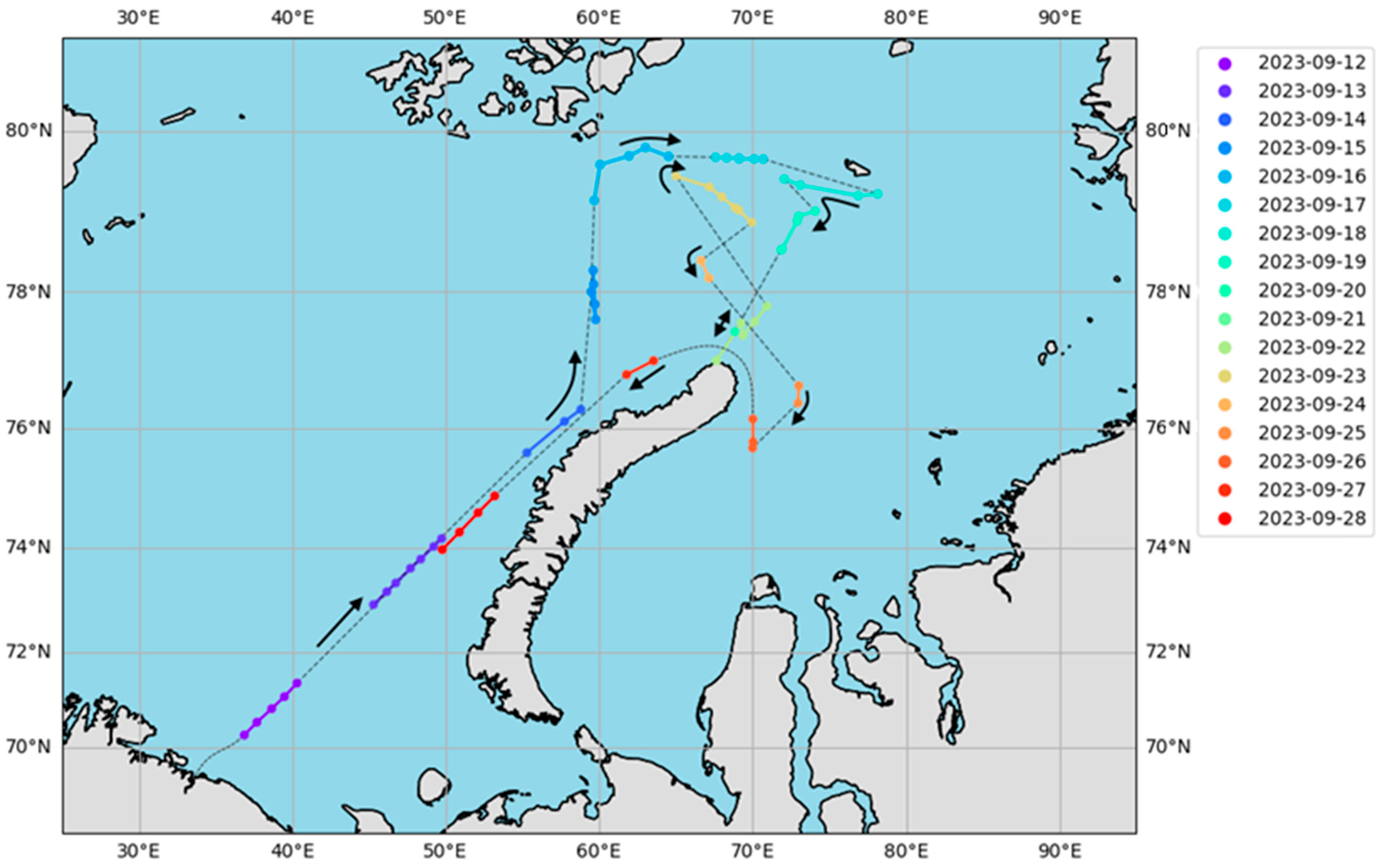
Figure 1.
Route of the expedition vessel “Dalnie Zelentsy” from which the obtained video material was captured.
Figure 1.
Route of the expedition vessel “Dalnie Zelentsy” from which the obtained video material was captured.
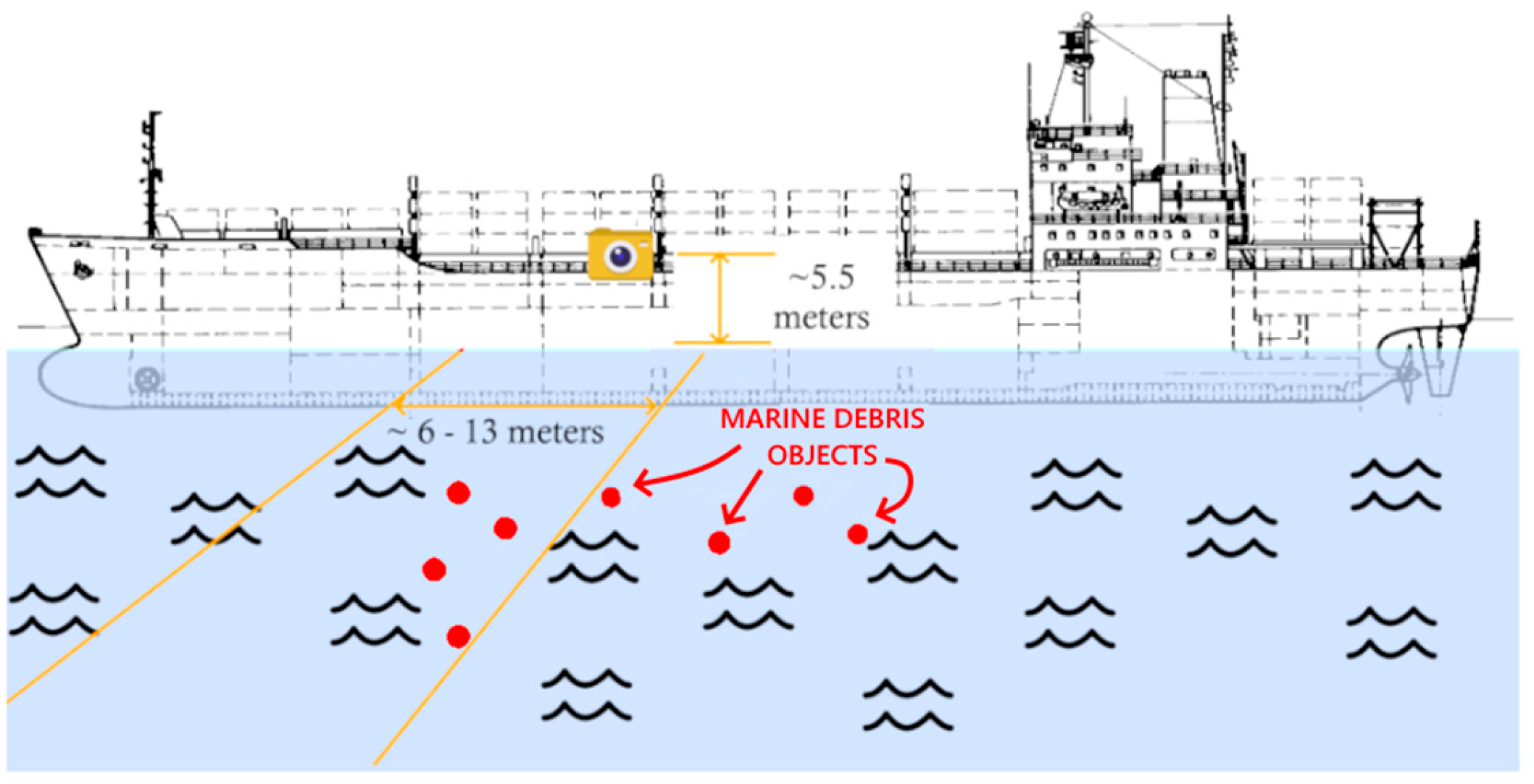
Figure 2.
Camera installation scheme on the vessel. Red dots symbolize floating marine litter objects.
Figure 2.
Camera installation scheme on the vessel. Red dots symbolize floating marine litter objects.
Figure 3.
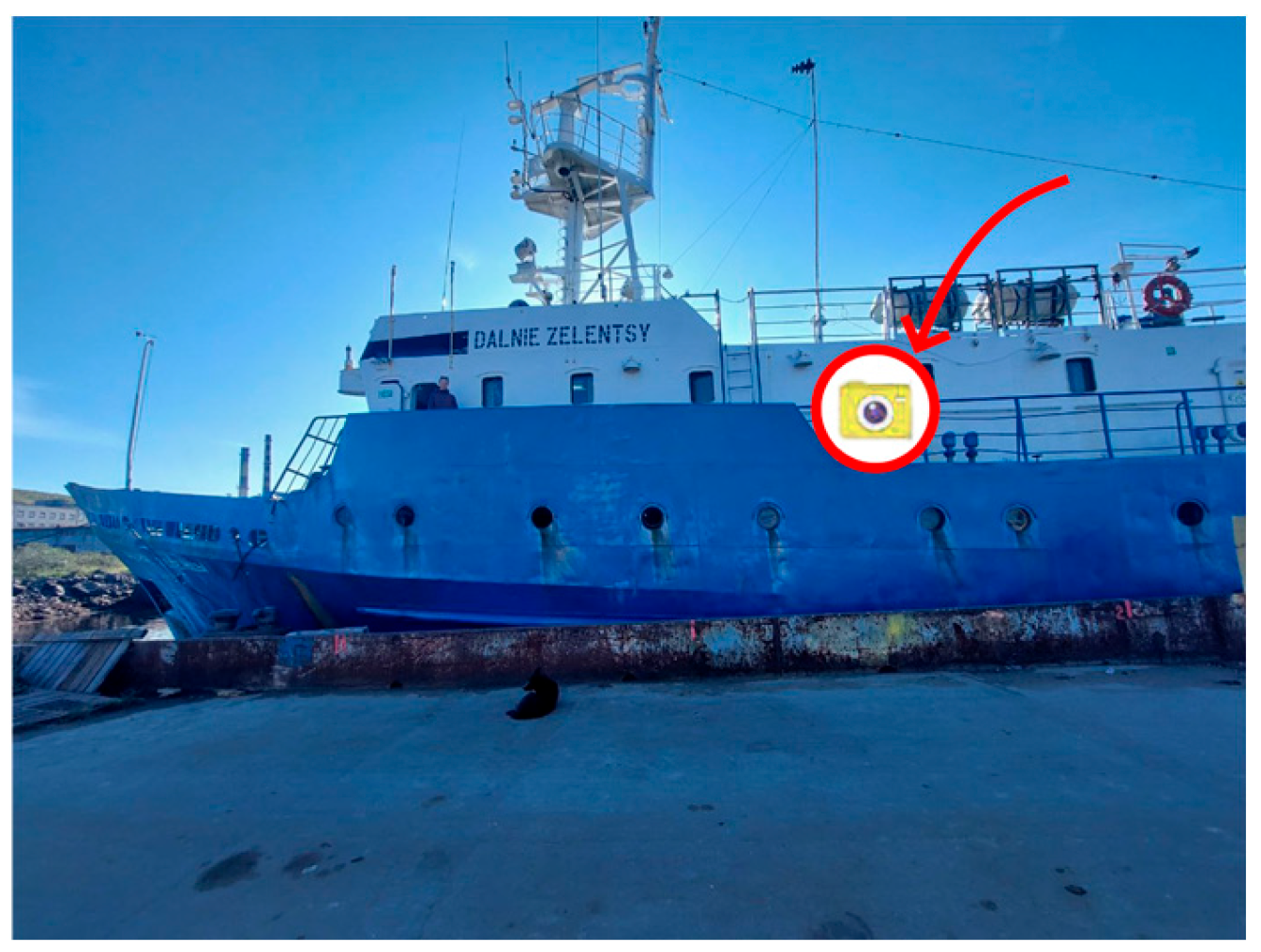
Photo of the scientific vessel and the board where a camera was attached.
Figure 3.
Photo of the scientific vessel and the board where a camera was attached.
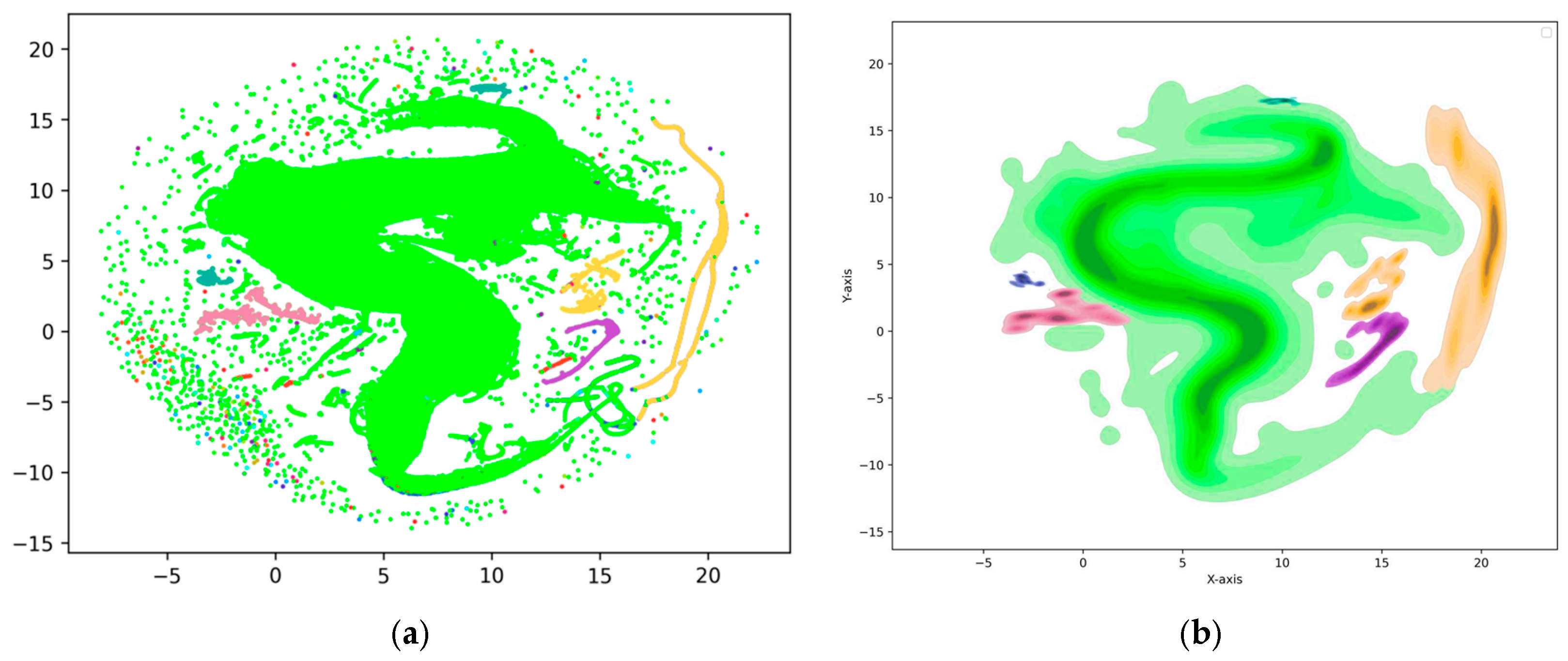
Figure 4.
Clustering using two different methods method on the full data set in embedding vectors space: (a) DBSCAN; (b) kdeplot.
Figure 4.
Clustering using two different methods method on the full data set in embedding vectors space: (a) DBSCAN; (b) kdeplot.
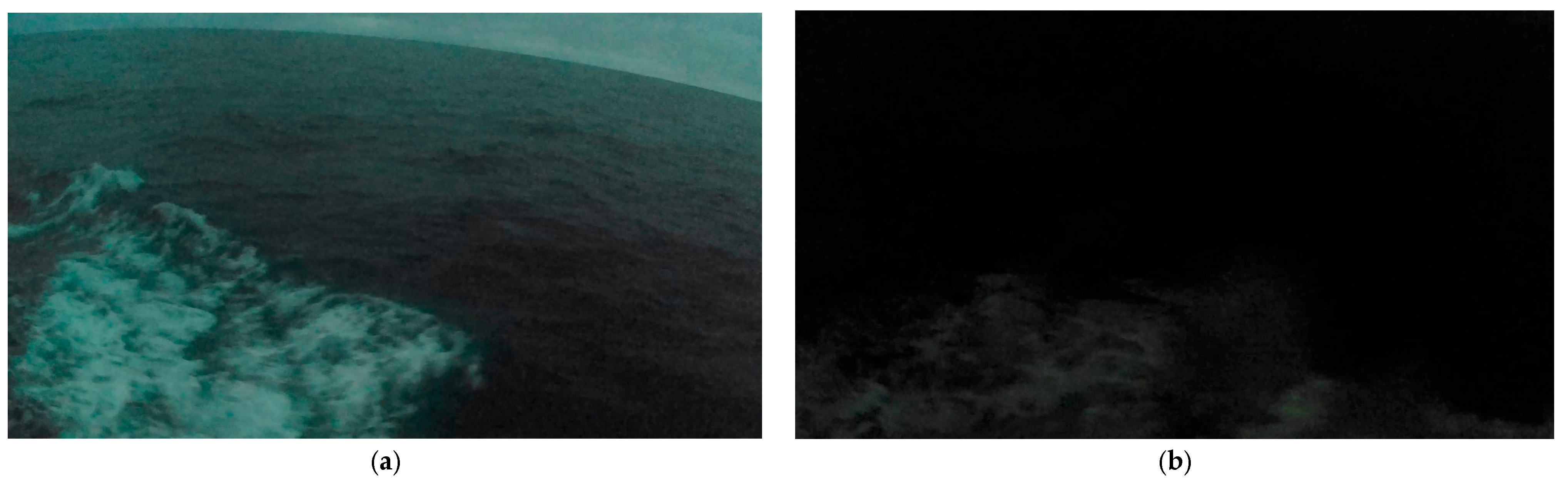
Figure 5.
(a,b) Two examples of frames taken at night and recognized as “anomaly” objects by us, as they belong to the minor class separate from the main one.
Figure 5.
(a,b) Two examples of frames taken at night and recognized as “anomaly” objects by us, as they belong to the minor class separate from the main one.
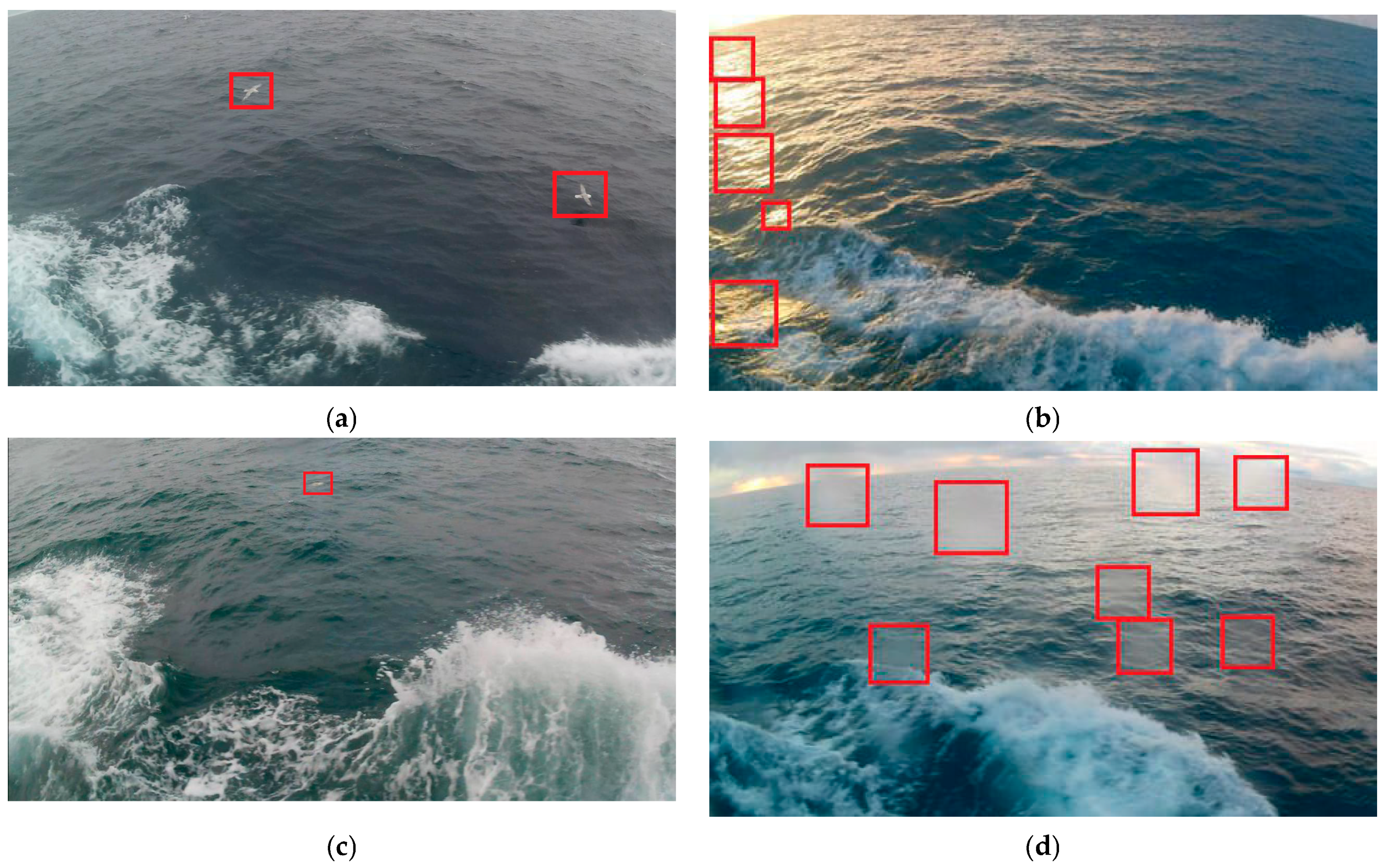
Figure 6.
Examples of images containing various types of anomalies in red rectangles on photos from the dataset. (a) birds (b) glares (c) marine litter (d) droplets on camera.
Figure 6.
Examples of images containing various types of anomalies in red rectangles on photos from the dataset. (a) birds (b) glares (c) marine litter (d) droplets on camera.
Figure 7.
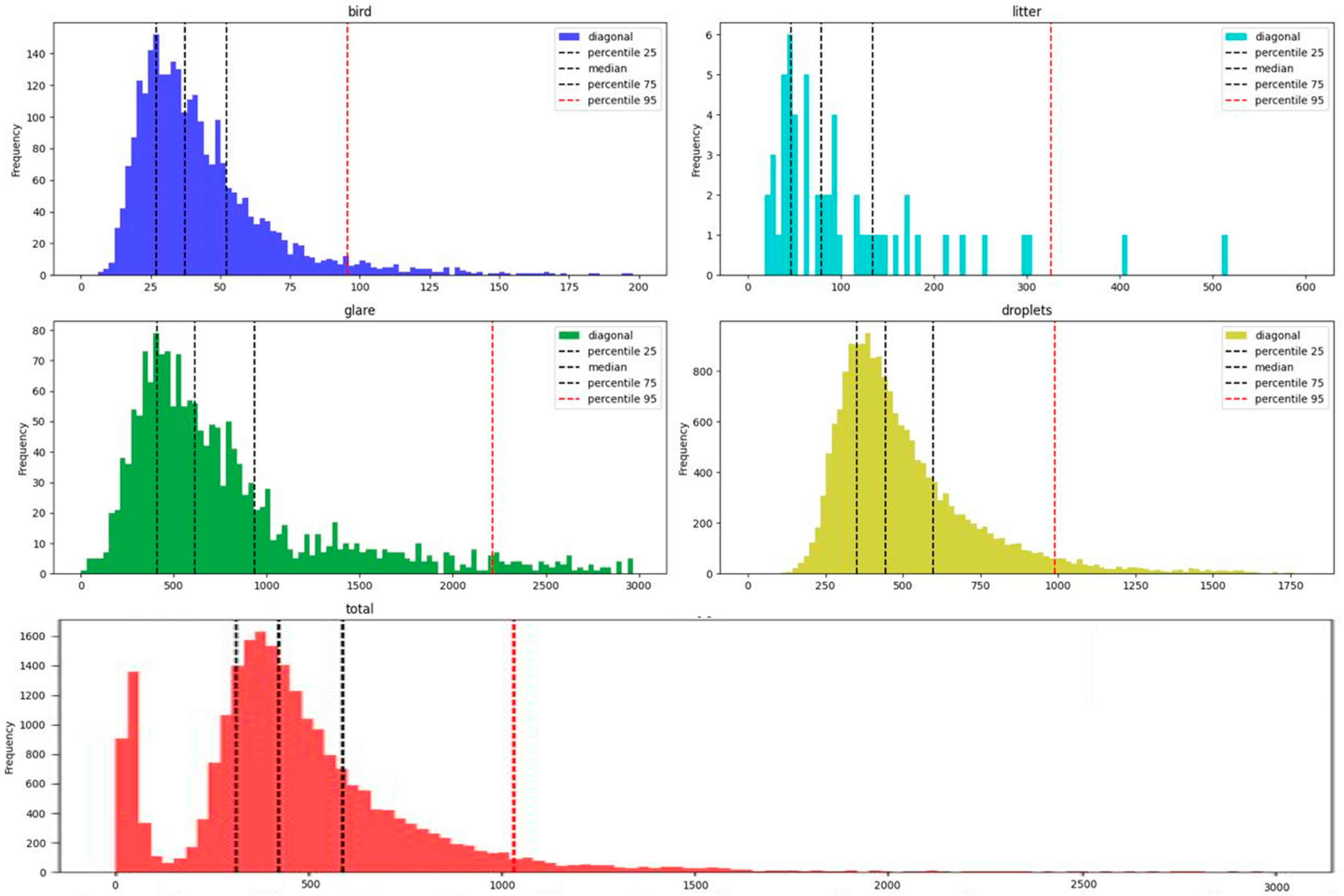
Histograms of size distribution for objects of four different classes—birds (blue), litter (cyan), glare (green), droplets (yellow)—as well as all the classes combined (red).
Figure 7.
Histograms of size distribution for objects of four different classes—birds (blue), litter (cyan), glare (green), droplets (yellow)—as well as all the classes combined (red).
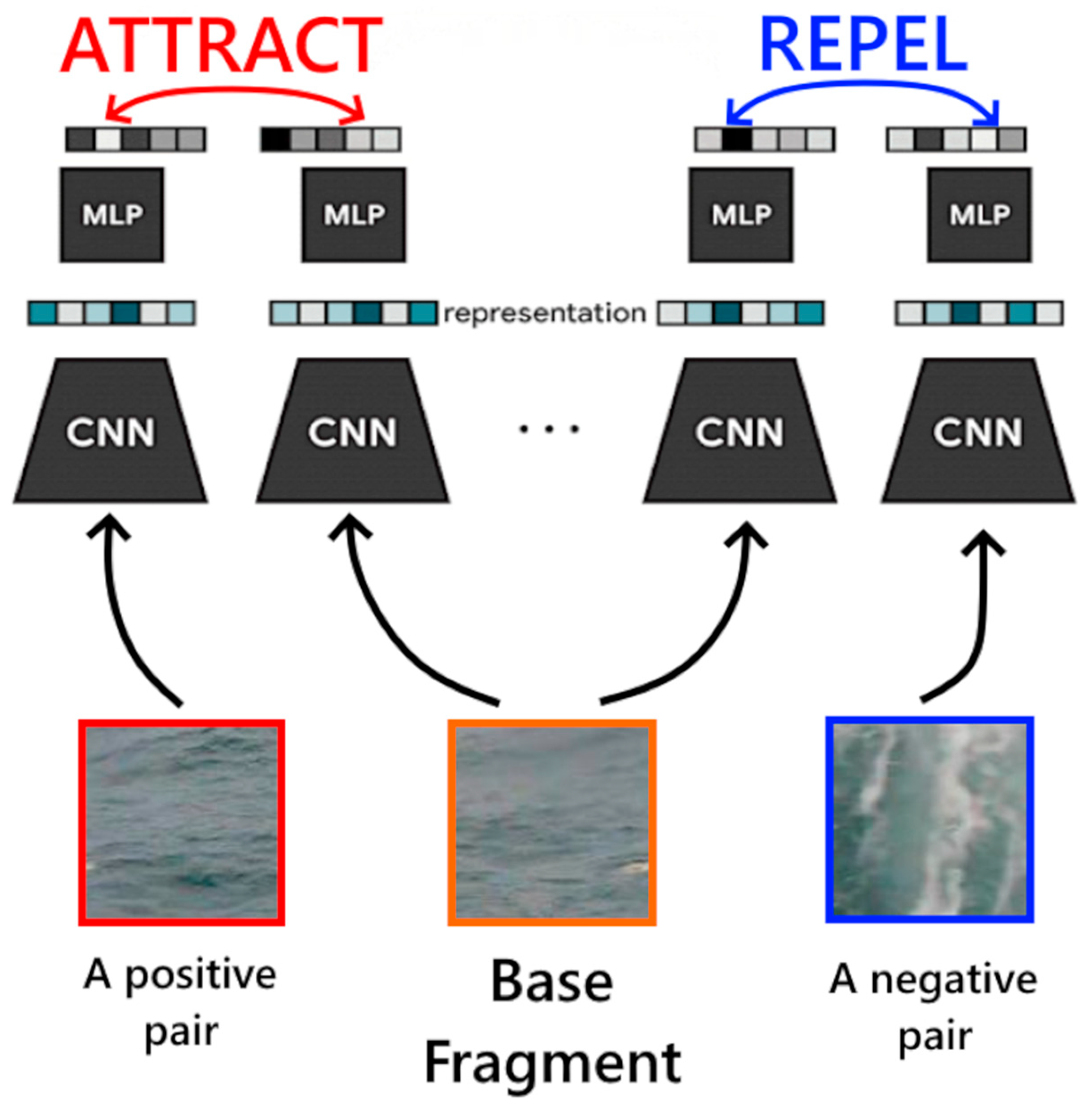
Figure 8.
The principle of processing positive and negative pairs in contrast learning.
Figure 8.
The principle of processing positive and negative pairs in contrast learning.
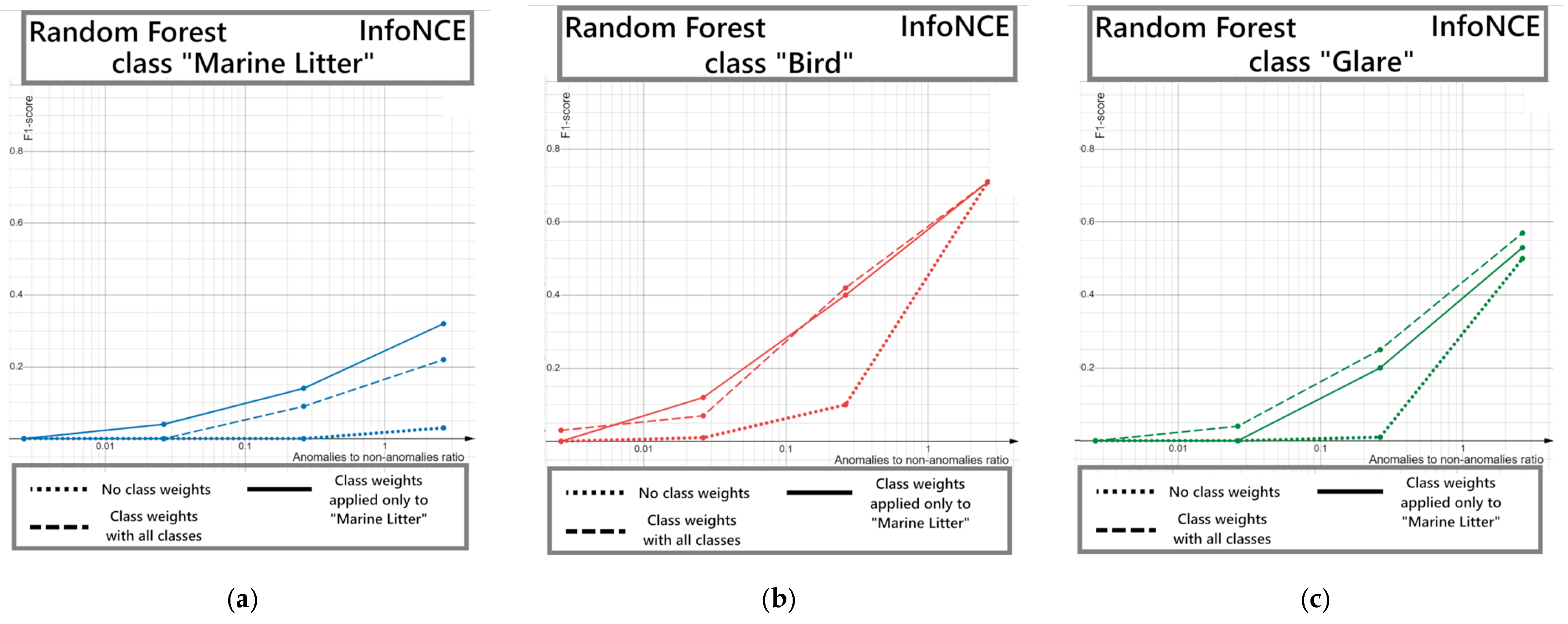
Figure 9.
(a–c) Graph of average F1-score dependence in the InfoNCE-based subtask, with division into calculations without class weights (dashed), with weights (dotted), and with weights only for the “marine litter” class (solid line). Random Forest classifier. (a) “Marine Litter” class; (b) “Birds” class; (c) “Glare” class.
Figure 9.
(a–c) Graph of average F1-score dependence in the InfoNCE-based subtask, with division into calculations without class weights (dashed), with weights (dotted), and with weights only for the “marine litter” class (solid line). Random Forest classifier. (a) “Marine Litter” class; (b) “Birds” class; (c) “Glare” class.
Figure 10.
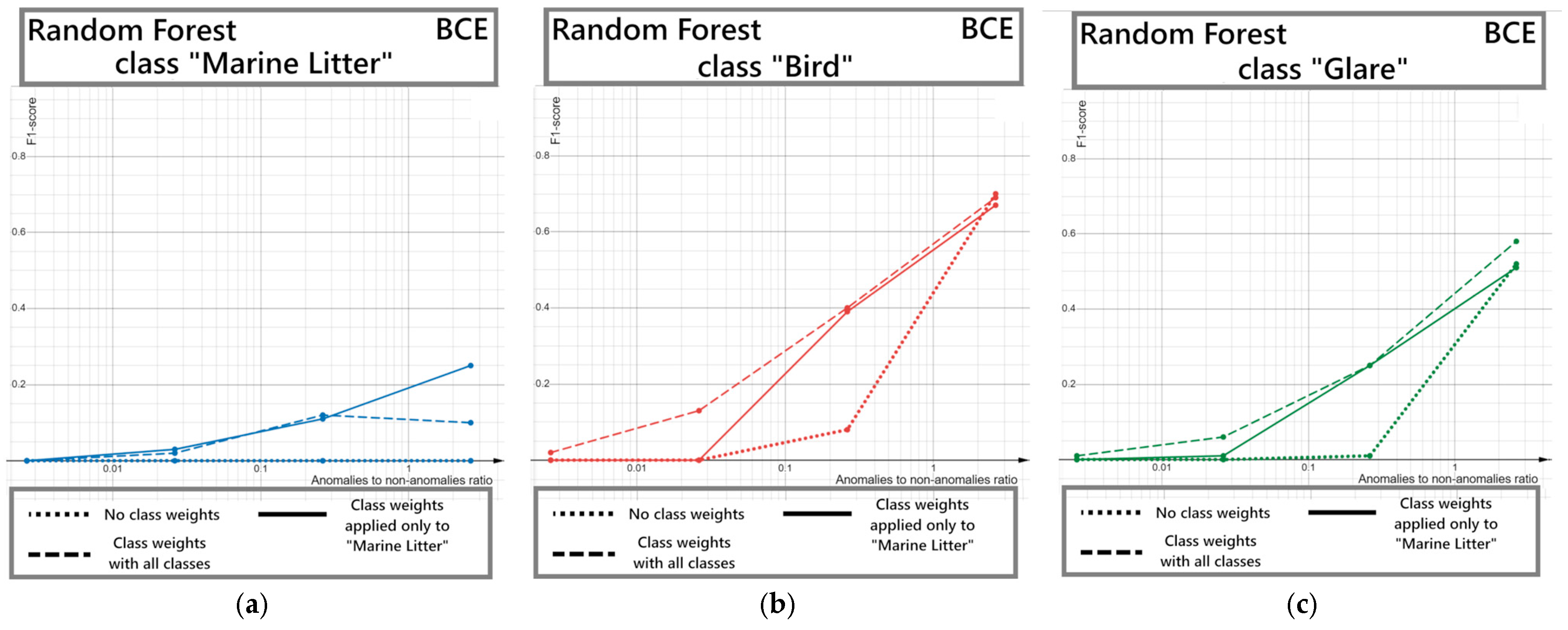
(a–c) Graph of average F1-score dependence in the BCE-based subtask, with division into calculations without class weights (dashed), with weights (dotted), and with weights only for the “marine litter” class (solid line). Random Forest classifier. (a) “Marine Litter” class; (b) “Birds” class; (c) “Glare” class.
Figure 10.
(a–c) Graph of average F1-score dependence in the BCE-based subtask, with division into calculations without class weights (dashed), with weights (dotted), and with weights only for the “marine litter” class (solid line). Random Forest classifier. (a) “Marine Litter” class; (b) “Birds” class; (c) “Glare” class.
Figure 11.
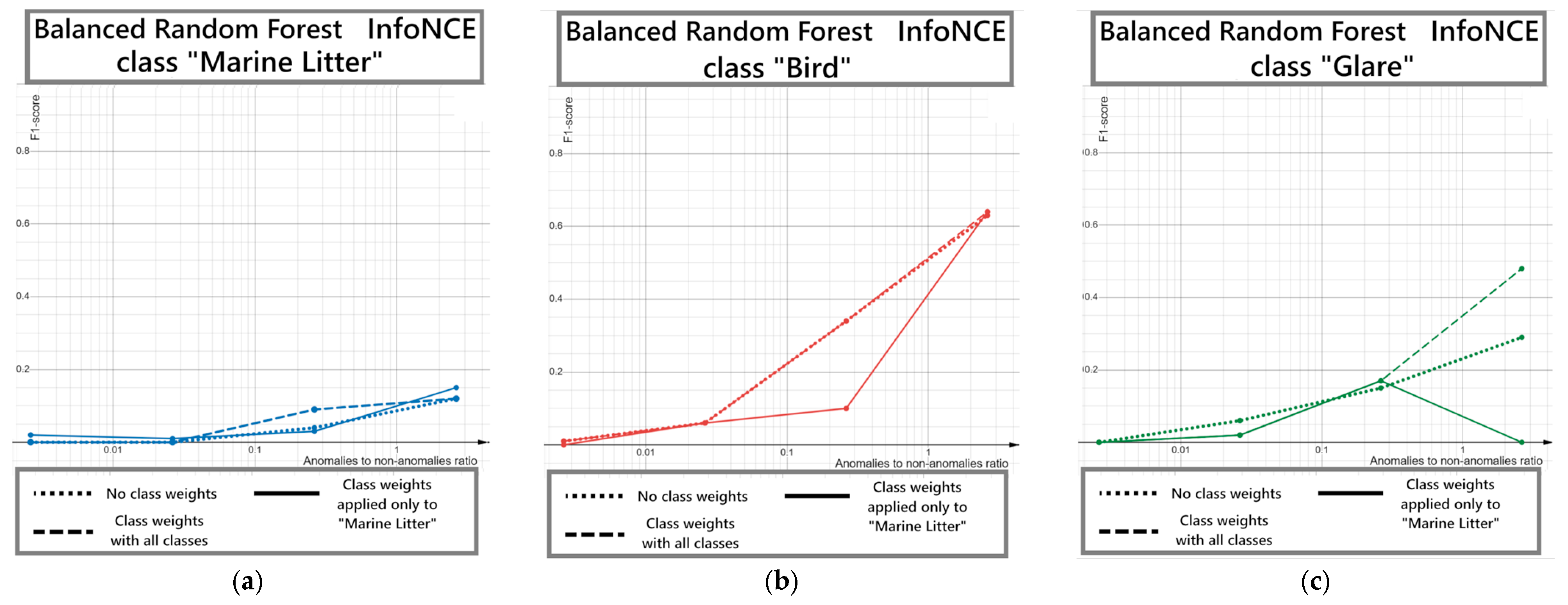
(a–c) Graph of average F1-score dependence in the InfoNCE-based subtask, with division into calculations without class weights (dashed), with weights (dotted), and with weights only for the “marine litter” class (solid line). Balanced Random Forest classifier. (a) “Marine Litter” class; (b) “Birds” class; (c) “Glare” class.
Figure 11.
(a–c) Graph of average F1-score dependence in the InfoNCE-based subtask, with division into calculations without class weights (dashed), with weights (dotted), and with weights only for the “marine litter” class (solid line). Balanced Random Forest classifier. (a) “Marine Litter” class; (b) “Birds” class; (c) “Glare” class.
Figure 12.
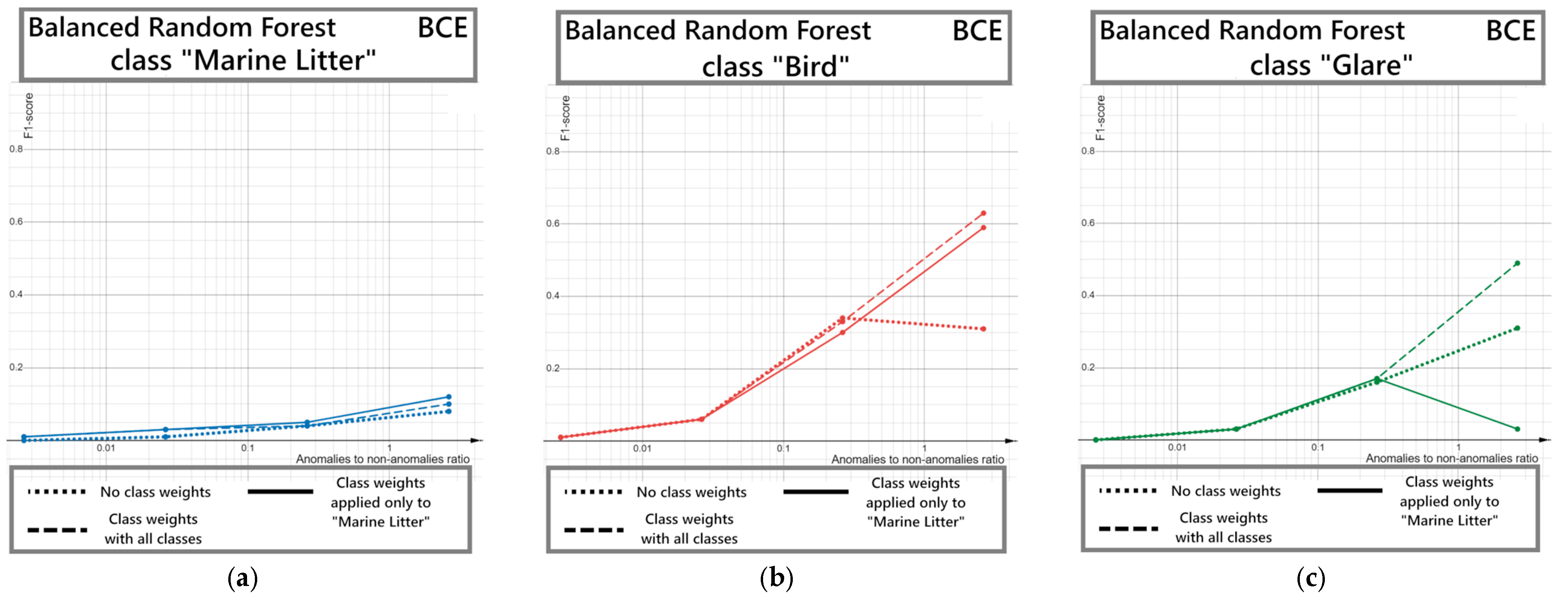
(a–c) Graph of average F1-score dependence in the BCE-based subtask, with division into calculations without class weights (dashed), with weights (dotted), and with weights only for the “marine litter” class (solid line). Balanced Random Forest classifier. (a) “Marine Litter” class; (b) “Birds” class; (c) “Glare” class.
Figure 12.
(a–c) Graph of average F1-score dependence in the BCE-based subtask, with division into calculations without class weights (dashed), with weights (dotted), and with weights only for the “marine litter” class (solid line). Balanced Random Forest classifier. (a) “Marine Litter” class; (b) “Birds” class; (c) “Glare” class.
Figure 13.
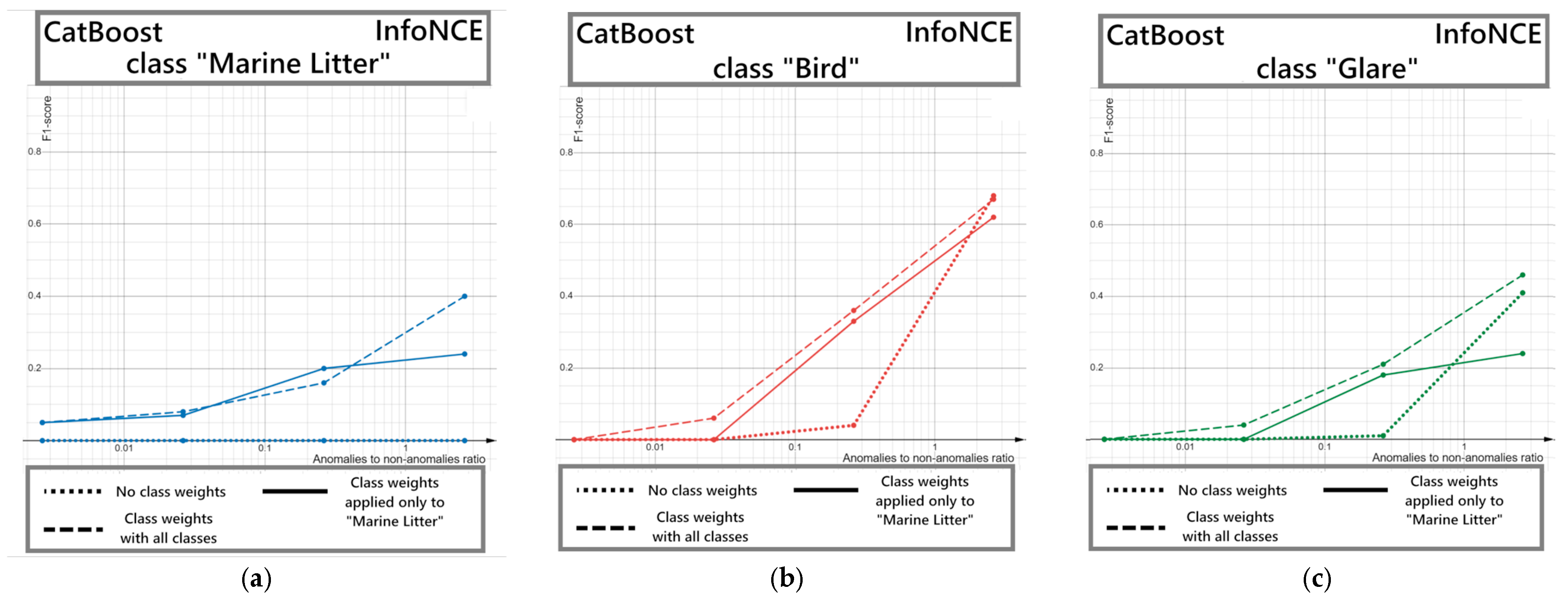
(a–c) Graph of average F1-score dependence in the InfoNCE-based subtask, with division into calculations without class weights (dashed), with weights (dotted), and with weights only for the “marine litter” class (solid line). Catboost classifier. (a) “Marine Litter” class; (b) “Birds” class; (c) “Glare” class.
Figure 13.
(a–c) Graph of average F1-score dependence in the InfoNCE-based subtask, with division into calculations without class weights (dashed), with weights (dotted), and with weights only for the “marine litter” class (solid line). Catboost classifier. (a) “Marine Litter” class; (b) “Birds” class; (c) “Glare” class.
Figure 14.
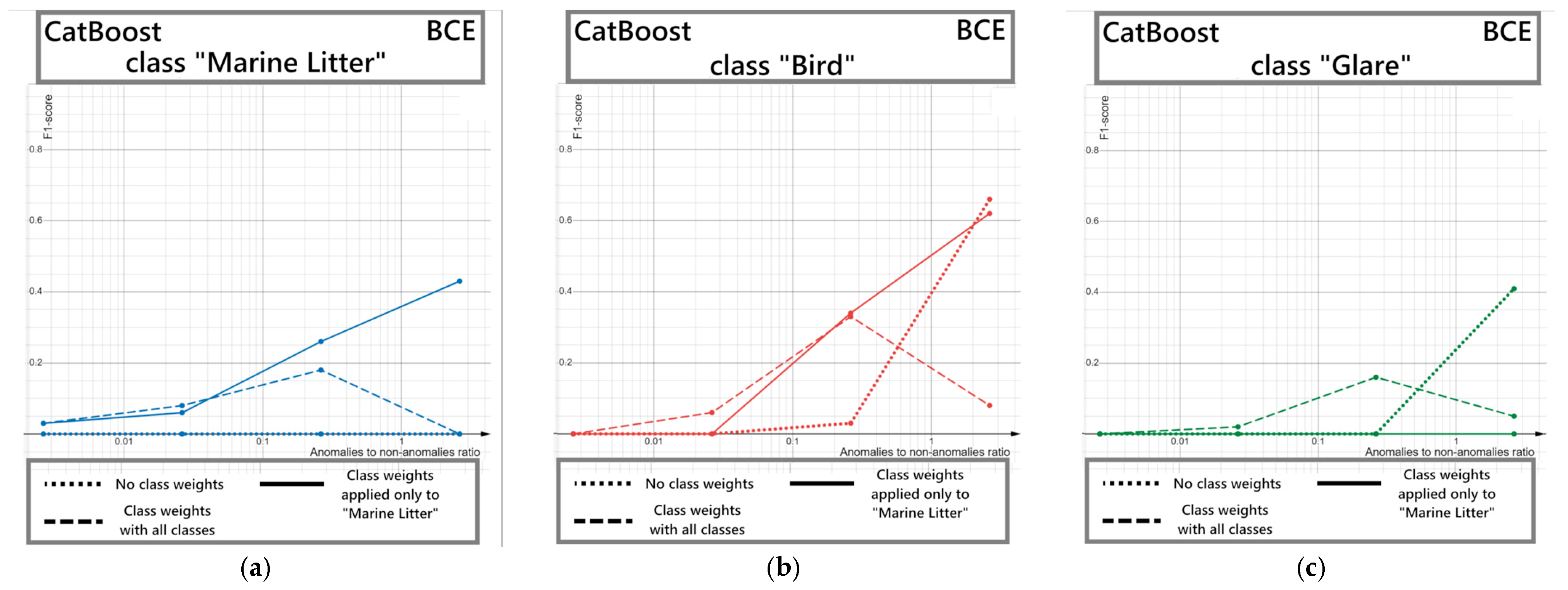
(a–c) Graph of average F1-score dependence in the BCE-based subtask, with division into calculations without class weights (dashed), with weights (dotted), and with weights only for the “marine litter” class (solid line). Catboost classifier. (a) “Marine Litter” class; (b) “Birds” class; (c) “Glare” class.
Figure 14.
(a–c) Graph of average F1-score dependence in the BCE-based subtask, with division into calculations without class weights (dashed), with weights (dotted), and with weights only for the “marine litter” class (solid line). Catboost classifier. (a) “Marine Litter” class; (b) “Birds” class; (c) “Glare” class.
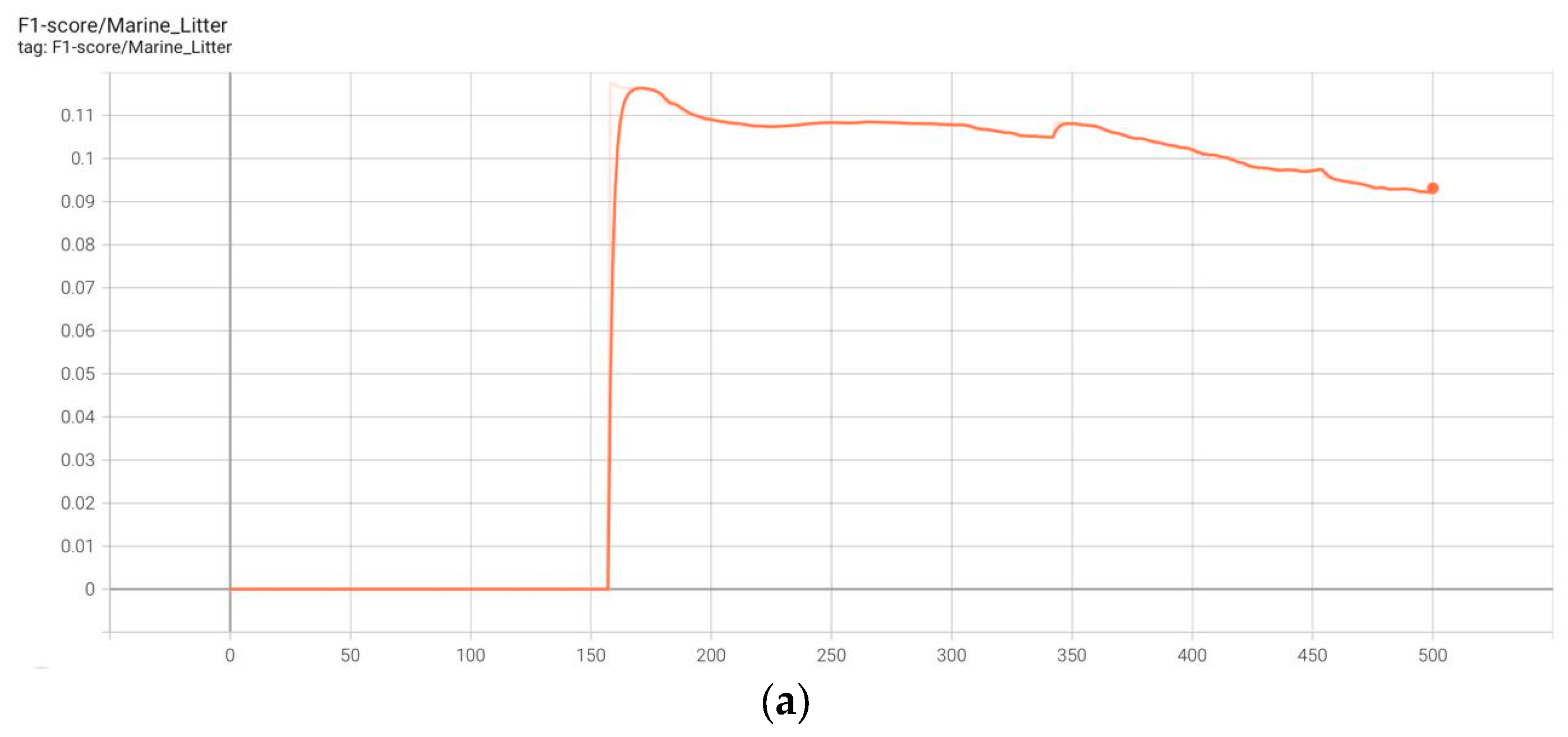
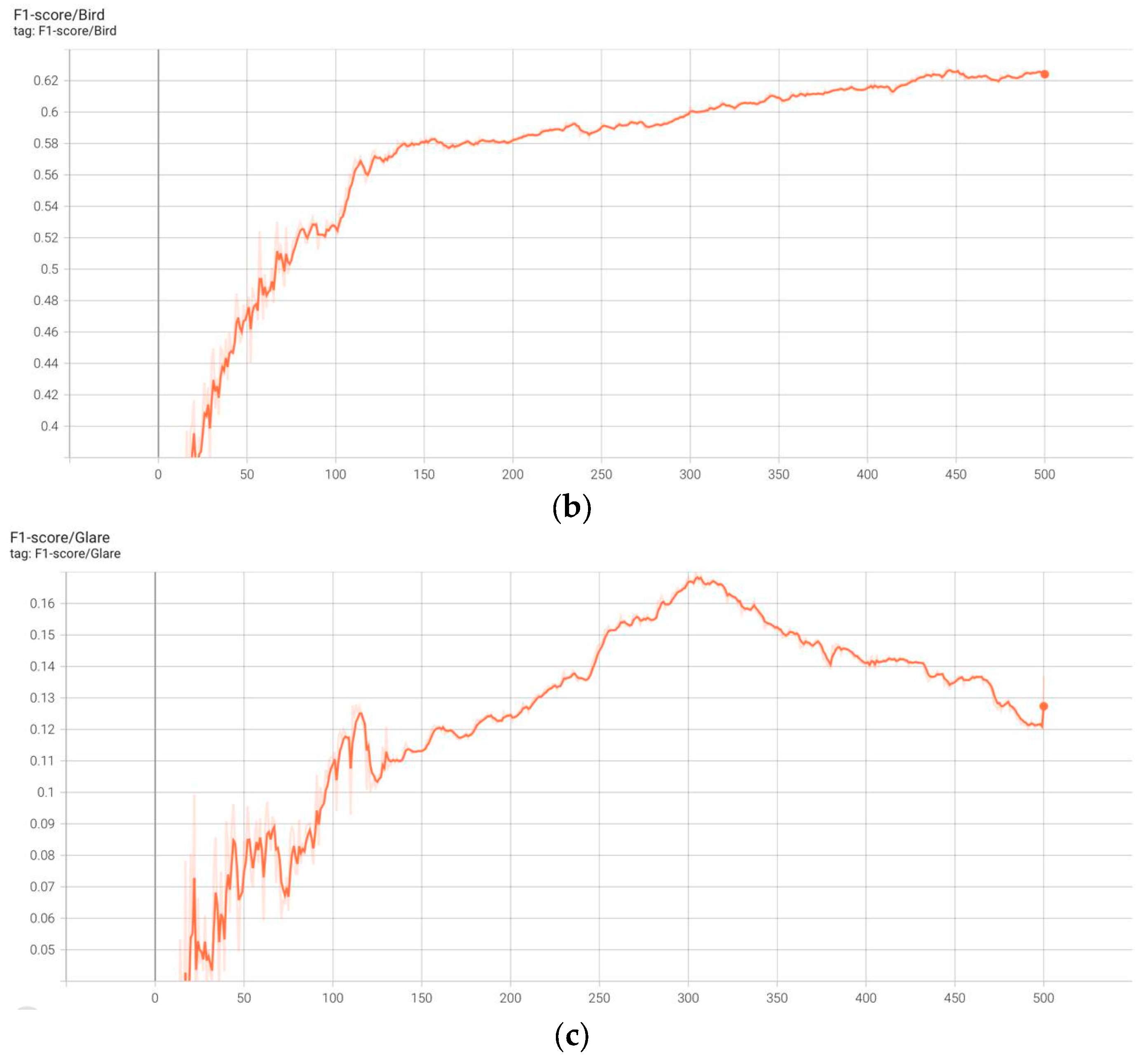
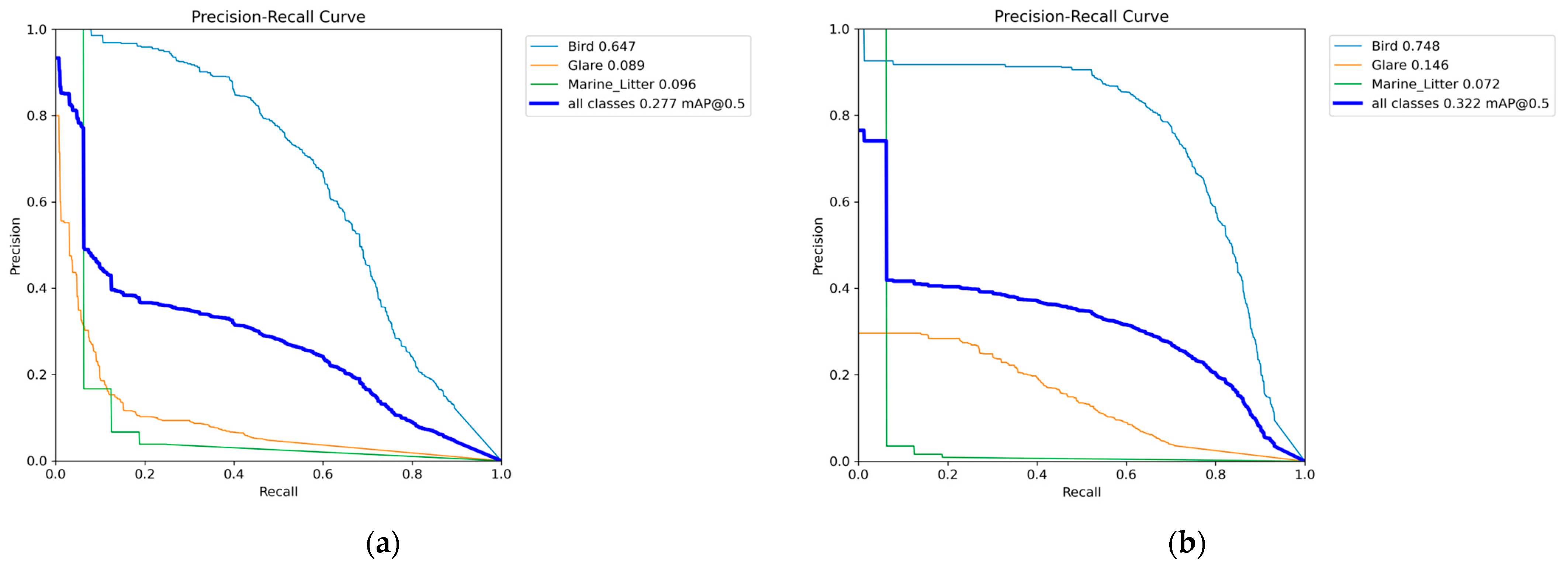
Figure 15.
(a–c) Evolution of the F1-score quality metric for each of the three anomaly classes ((a) Marine Litter, (b) Birds, (c) Glare) during training of the YOLO model using the full dataset.
Figure 15.
(a–c) Evolution of the F1-score quality metric for each of the three anomaly classes ((a) Marine Litter, (b) Birds, (c) Glare) during training of the YOLO model using the full dataset.
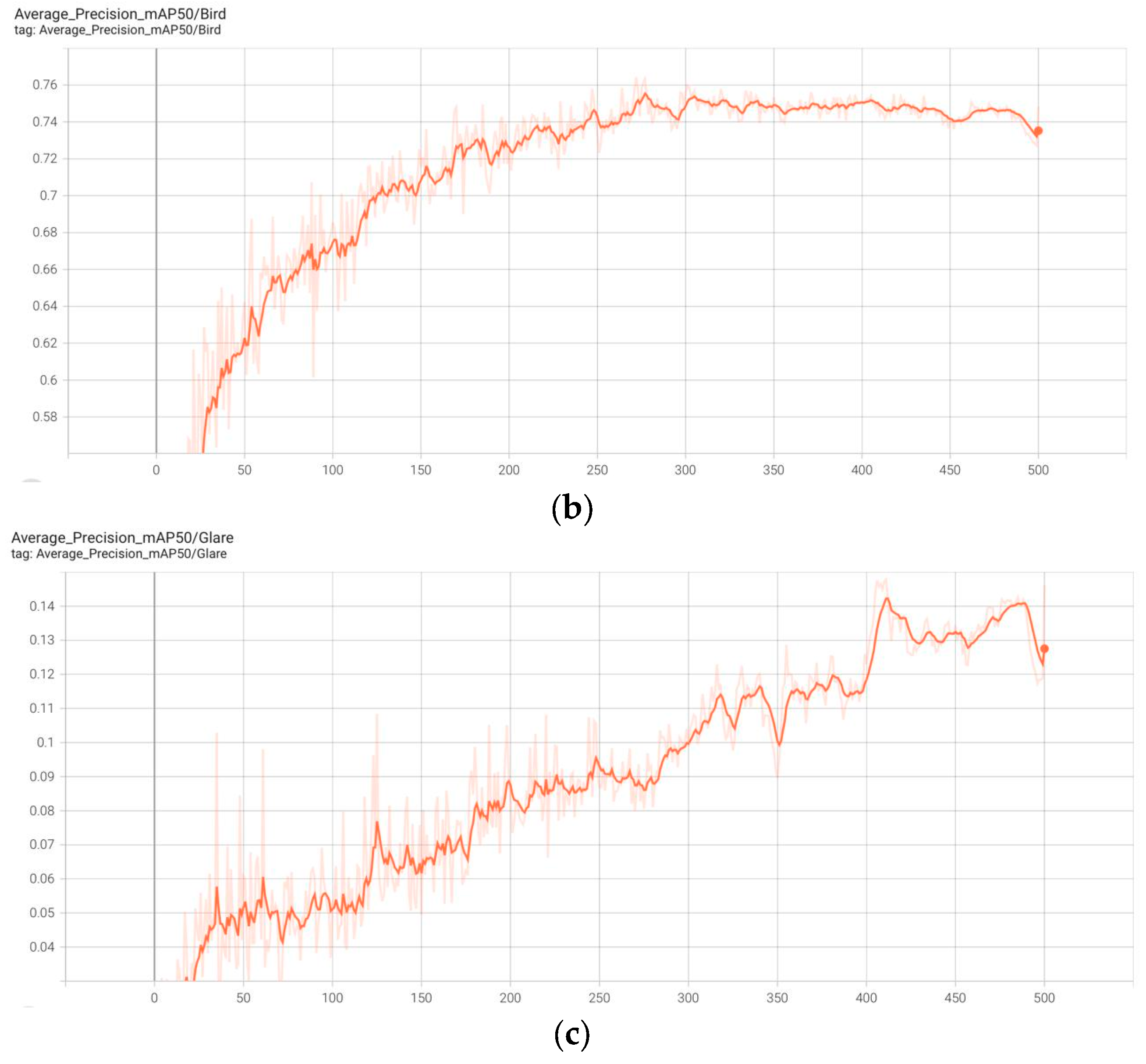
Figure 16.
(a–c) Evolution of the F1-score quality metric for each of the three anomaly classes during training of the YOLO model using a dataset consisting only of anomalies.
Figure 16.
(a–c) Evolution of the F1-score quality metric for each of the three anomaly classes during training of the YOLO model using a dataset consisting only of anomalies.
Table 1.
Weather observation log from the vessel during the expedition. Dash line denotes absence of weather or sea state information on this particular day.
Table 1.
Weather observation log from the vessel during the expedition. Dash line denotes absence of weather or sea state information on this particular day.
| Date | Weather | Sea State |
|---|
| 12 September 2023 | Cloudy, wind direction 145 | At the beginning of the day, it was calm, the waves were small; by the evening, the height of the waves increased a little |
| 13 September 2023 | Morning: strong winds,
temperature lower than yesterday | — |
| 14 September 2023 | Partly cloudy, light rain, good visibility, temperature higher than yesterday | — |
| 15 September 2023 | Cold; partly cloudy; snowing, after the turn in the afternoon the wind died down | High waves, about 5–6 points of storm |
| 16 September 2023 | Cloudy, light wind, cold | Small waves, calm, glaciers on the horizon |
| 17 September 2023 | Clear, calm, snowing | Small waves, ice floes on the horizon |
| 18 September 2023 | Bad weather conditions, cold, ice crust on the cover | — |
| 19 September 2023 | Cloudy, light wind | Small waves |
| 20 September 2023 | Cloudy | Strong waves |
| 21 September 2023 | Storm | — |
| 22 September 2023 | Strong wind, snow in the morning, drizzle and rain later; cold | Strong waves with temporary calm |
| 23 September 2023 | Cloudy, cold, thin crust of ice | — |
| 24 September 2023 | Cloudy, strong wind, cold, ice crust on the deck | Strong wind, storm warning |
| 25 September 2023 | Warm, no wind | Pitching |
| 26 September 2023 | Cloudy, snowy, changeable weather, heavy snowfall at times | — |
| 27 September 2023 | Storm | Strong pitching |
| 28 September 2023 | — | — |
Table 2.
Information about video recordings for each day of the expedition—time and GPS coordinates of the start and end of filming and the duration of filming in minutes.
Table 2.
Information about video recordings for each day of the expedition—time and GPS coordinates of the start and end of filming and the duration of filming in minutes.
| Date | Video Start Time | Video Start Coordinate (Latitude) | Video Start Coordinate (Longitude) | Duration in Minutes |
|---|
| 12 September 2023 | 07:07 | 70 16.080 | 36 52.5 | 125 |
| 09:24 | 70 32.82 | 37 41.63 | 141 |
| 11:50 | 70 50.310 | 38 39.420 | 130 |
| 14:10 | 71 05.705 | 39 29.150 | 135 |
| 16:30 | 71 22.667 | 40 18.365 | 70 |
| 13 September 2023 | 06:02 | 72 56.817 | 45 17.595 | 131 |
| 08:20 | 73 11.475 | 46 09.753 | 150 |
| 09:52 | 73 21.315 | 46 44.810 | 135 |
| 12:20 | 73 37.618 | 47 42.211 | 145 |
| 14 September 2023 | 06:00 | 75 37.15 | 55 17.32 | 110 |
| 12:00 | 76 06.99 | 57 44.39 | 135 |
| 14:18 | 76 18.14 | 58 48.45 | 102 |
| 15 September 2023 | 06:40 | 77 37.353 | 59 46.32 | 85 |
| 08:10 | 77 50.013 | 59 43.612 | 135 |
| 10:30 | 78 00.3213 | 59 28.5298 | 118 |
| 13:17 | 78 06.2857 | 59 38.4241 | 118 |
| 16:20 | 78 17.3858 | 59 36.7700 | 100 |
| 16 September 2023 | 05:55 | 79 10.7446 | 59 40.7852 | 175 |
| 09:15 | 79 36.4586 | 60 03.5846 | 155 |
| 11:57 | 79 42.569 | 61 56.462 | 143 |
| 14:50 | 79 48.3607 | 63 00.9514 | 150 |
| 17:50 | 79 42.238 | 64 31.098 | 142 |
| 17 September 2023 | 06:30 | 79 41.6299 | 67 34.9835 | 130 |
| 08:45 | 79 41.2746 | 68 18.6514 | 80 |
| 10:10 | 79 41.004 | 69 06.568 | 123 |
| 12:19 | 79 40.490 | 69 07.510 | 49 |
| 14:25 | 79 40.4855 | 70 06.1465 | 90 |
| 15:58 | 79 40.3615 | 70 41.7312 | 116 |
| 18 September 2023 | 06:48 | 79 26.2455 | 72 03.7967 | 82 |
| 09:50 | 79 21.8364 | 73 07.0075 | 140 |
| 16:17 | 79 14.2580 | 76 53.2420 | 89 |
| 17:50 | 79 15.4395 | 78 09.401 | 110 |
| 19 September 2023 | 07:30 | 79 02.8804 | 74 04.3837 | 145 |
| 09:00 | 78 59.1033 | 72 59.7819 | 185 |
| 12:09 | 78 55.3820 | 72 54.0020 | 159 |
| 14:53 | 78 34.0059 | 71 55.2759 | 62 |
| 20 September 2023 | 05:25 | 77 27.1030 | 68 50.2099 | 115 |
| 21 September 2023 | 15:00 | 77 02.1310 | 67 38.4386 | 120 |
| 22 September 2023 | 04:40 | 77 02.1310 | 67 38.4386 | 160 |
| 07:25 | | | 80 |
| 08:50 | 77 34.399 | 68 75.139 | 175 |
| 11:50 | 77 23.8620 | 69 23.0397 | 100 |
| 13:40 | 77 35.555 | 70 07.878 | 120 |
| 15:45 | 77 48.5310 | 70 55.8168 | 105 |
| 23 September 2023 | 05:25 | 78 54.4381 | 69 56.740 | 125 |
| 07:40 | 79 03.518 | 69 06.128 | 115 |
| 09:40 | 79 05.5052 | 68 50.5778 | 132 |
| 11:55 | 79 13.326 | 67 59.090 | 95 |
| 13:35 | 79 20.602 | 67 10.2569,5 | 150 |
| 16:10 | 79 28.363 | 65 00.677 | 102 |
| 24 September 2023 | 04:26 | 78 25.1809 | 66 38.7908 | 44 |
| 07:15 | 78 11.190 | 67 09.491 | 186 |
| 25 September 2023 | 12:20 | 76 39.850 | 73 00.489 | 95 |
| 14:05 | 76 24.034 | 72 57.5612 | 140 |
| 26 September 2023 | 05:10 | 75 41.7768 | 70 00.1976 | 160 |
| 10:15 | 75 47.6183 | 70 01.5719 | 90 |
| 14:45 | 76 09.3151 | 70 01.0760 | 98 |
| 27 September 2023 | 11:35 | 77 02.0505 | 63 32.7308 | 205 |
| 14:40 | 76 49.819 | 61 47.338 | 140 |
| 28 September 2023 | 07:35 | 74 54.2312 | 53 11.6773 | 132 |
| 09:52 | 74 37.0298 | 52 06.5156 | 158 |
| 12:35 | 74 16.630 | 50 53.678 | 152 |
| 15:12 | 73 57.9836 | 49 46.4342 | 142 |
Table 3.
Values of mean, standard deviation, 25th percentile, median, 75th percentile, 95th percentile for each class and the total amount of the annotated boxes’ sizes.
Table 3.
Values of mean, standard deviation, 25th percentile, median, 75th percentile, 95th percentile for each class and the total amount of the annotated boxes’ sizes.
| | Mean | STD | p25 | Median (p50) | p75 | p95 |
|---|
| Bird | 45.89 | 47.41 | 26.97 | 37.24 | 52.15 | 95.62 |
| Litter | 116.89 | 117.43 | 46.52 | 78.66 | 134.01 | 326.29 |
| Glare | 800.31 | 597.10 | 410.11 | 611.07 | 934.21 | 2212.74 |
| Droplets | 516.10 | 278.75 | 350.29 | 444.06 | 597.15 | 989.66 |
| Total | 480.89 | 348.16 | 312.09 | 422.73 | 585.5 | 1032.03 |
Table 4.
Final hyperparameter values for classifier models. “Not Available” (N/A) symbolizes that this parameter is not applicable to this particular classifier.
Table 4.
Final hyperparameter values for classifier models. “Not Available” (N/A) symbolizes that this parameter is not applicable to this particular classifier.
| Parameter | Random Forest | Balanced Random Forest | CatBoost |
|---|
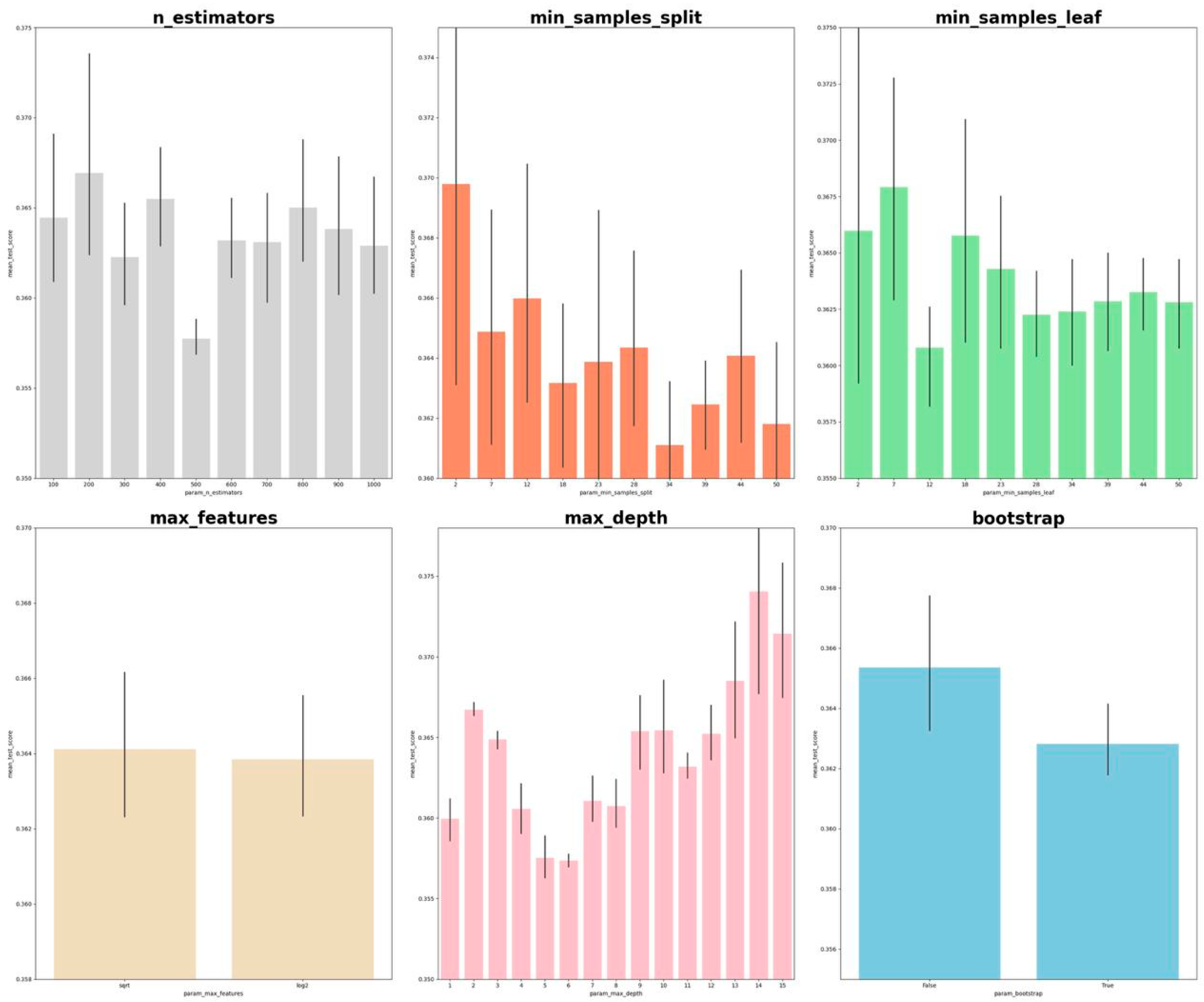
| n_estimators/iterations | 200 | 600 | 1000 |
| max_depth/depth | 14 | 7 | 12 |
| min_samples_split | 2 | 7 | N/A |
| min_samples_leaf | 2 | 2 | N/A |
| max_features | sqrt | log2 | N/A |
| bootstrap | False | True | N/A |
| learning_rate | N/A | N/A | 0.0001 |
| loss_function | N/A | N/A | MultiClass |
Table 5.
Quality metrics values after training the YOLO model on the full dataset.
Table 5.
Quality metrics values after training the YOLO model on the full dataset.
| Object Class | Precision | Recall | F1-Score |
|---|
| Marine Litter | 0.19418 | 0.0625 | 0.094564 |
| Bird | 0.72491 | 0.54591 | 0.6228 |
| Glare | 0.11373 | 0.17202 | 0.13693 |
Table 6.
Quality metrics values after training the YOLO model on a dataset consisting only of anomalies.
Table 6.
Quality metrics values after training the YOLO model on a dataset consisting only of anomalies.
| Object Class | Precision | Recall | F1-Score |
|---|
| Marine Litter | 0.23353 | 0.0625 | 0.09861 |
| Bird | 0.79807 | 0.67757 | 0.73290 |
| Glare | 0.22871 | 0.32325 | 0.26788 |
Table 7.
Best metric values in the classification approach.
Table 7.
Best metric values in the classification approach.
| Object Class | Precision | Recall | F1-Score |
|---|
| Marine Litter | 0.36 | 0.45 | 0.40 |
| Bird | 0.54 | 0.90 | 0.67 |
| Glare | 0.46 | 0.47 | 0.46 |
Table 8.
Best metric values in the VOD approach.
Table 8.
Best metric values in the VOD approach.
| Object Class | Precision | Recall | F1-Score |
|---|
| Marine Litter | 0.23353 | 0.0625 | 0.09861 |
| Bird | 0.79807 | 0.67757 | 0.73290 |
| Glare | 0.22871 | 0.32325 | 0.26788 |



 ,
,