3.2. Theoretical Intercept Calculation
This subsection proposes a theoretical method for calculating the number of theoretical intercepts, which depends only on scene heights and ambiguity heights. The original phase group [, ] is illustrated here as an example.
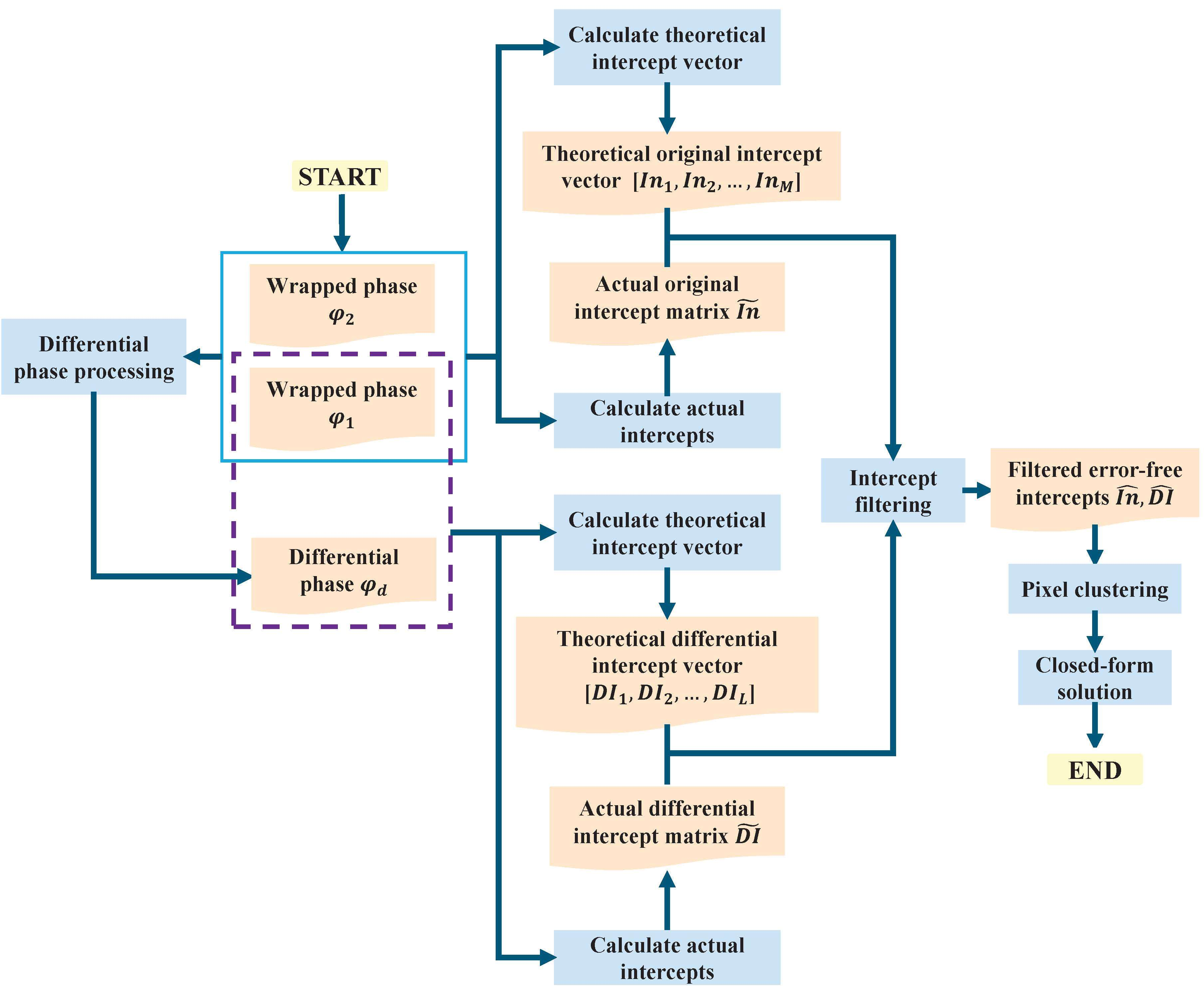
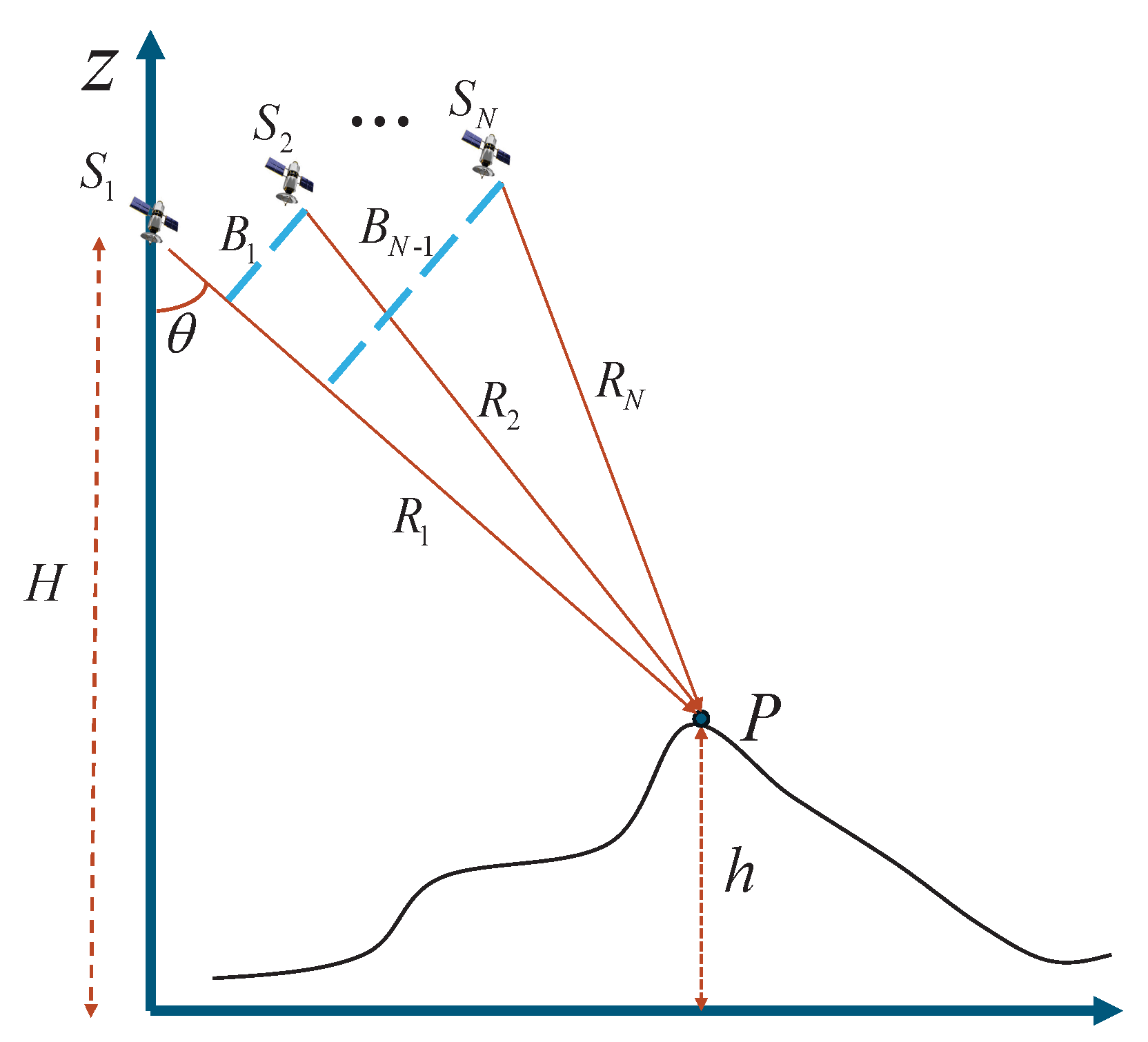
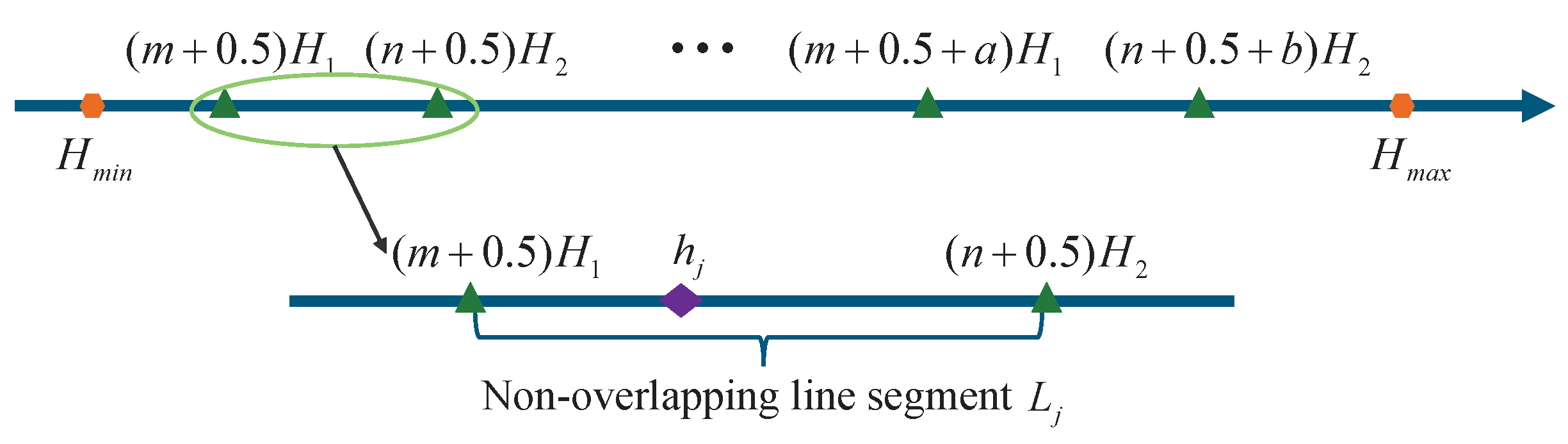
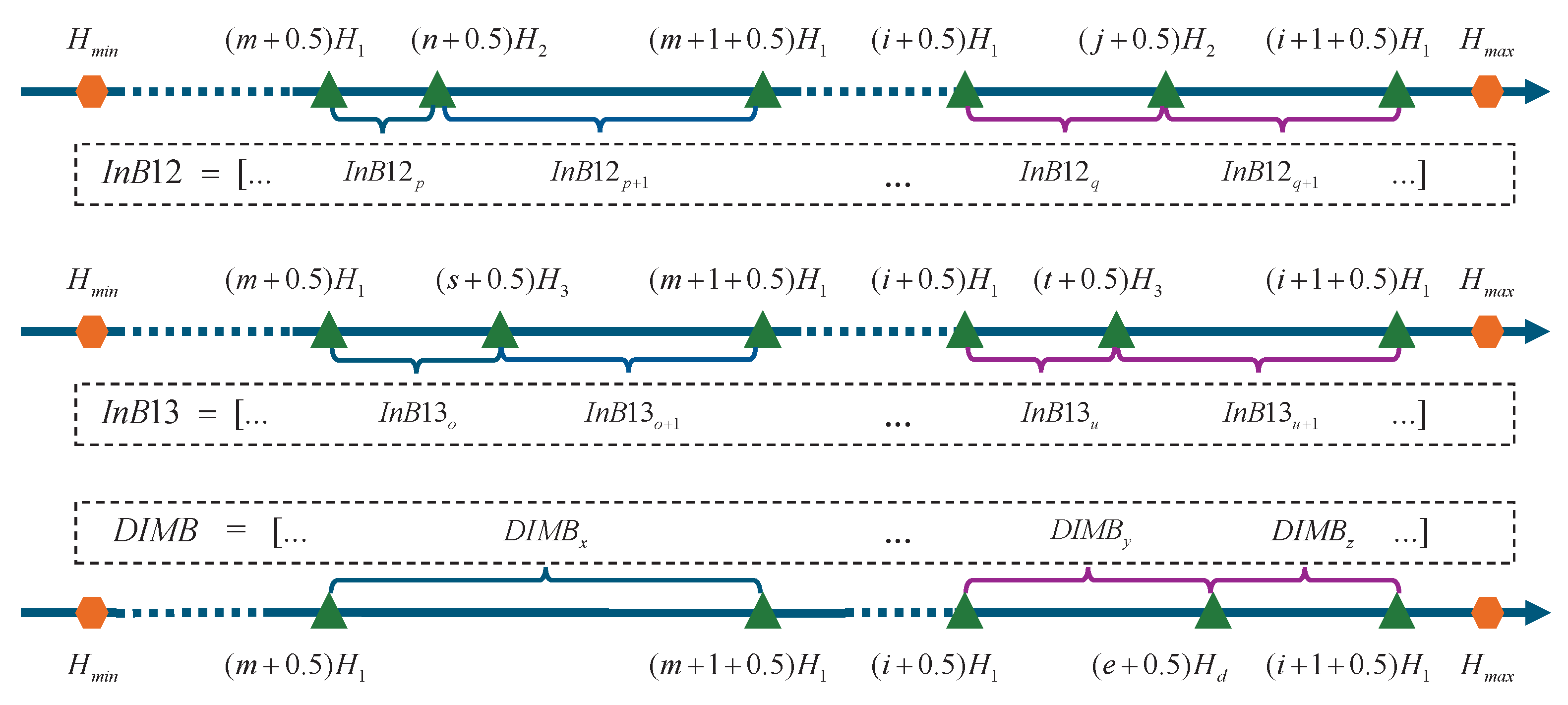
First, the relationship between the distribution of cluster groups and the height of the observation area is presented. As shown in
Figure 3, the arrowed line at the top of the
Figure 3 represents the height line, where
and
are the minimum and maximum heights of observation area, respectively.
,
,
and
are half-integer multiples of the ambiguity height
. Points
(
) are endpoints on the height line that intersect the height line to form multiple non-overlapping line segments. In the following, the
non-overlapping line segment
in the lower part of
Figure 3 is used as an example for explanation. Under error-free conditions, all pixels within the non-overlapping line segment
have the same ambiguity number vector
. According to (
5), if the ambiguity number vector is identical, intercepts of pixels within
will be the same. This means that these pixels form a cluster group. This gives the theoretical relationship: the number of non-overlapping line segments on the height line
, the number of cluster groups
, and the number of theoretical intercepts
M are identical:
Consequently,
M can be determined by calculating
:
represents the ceiling operation, which rounds a number up to the nearest integer.
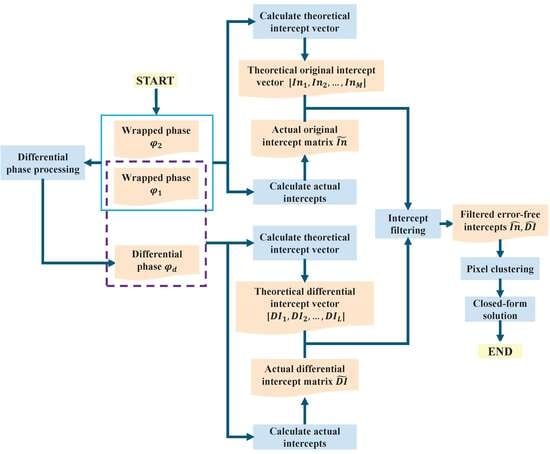
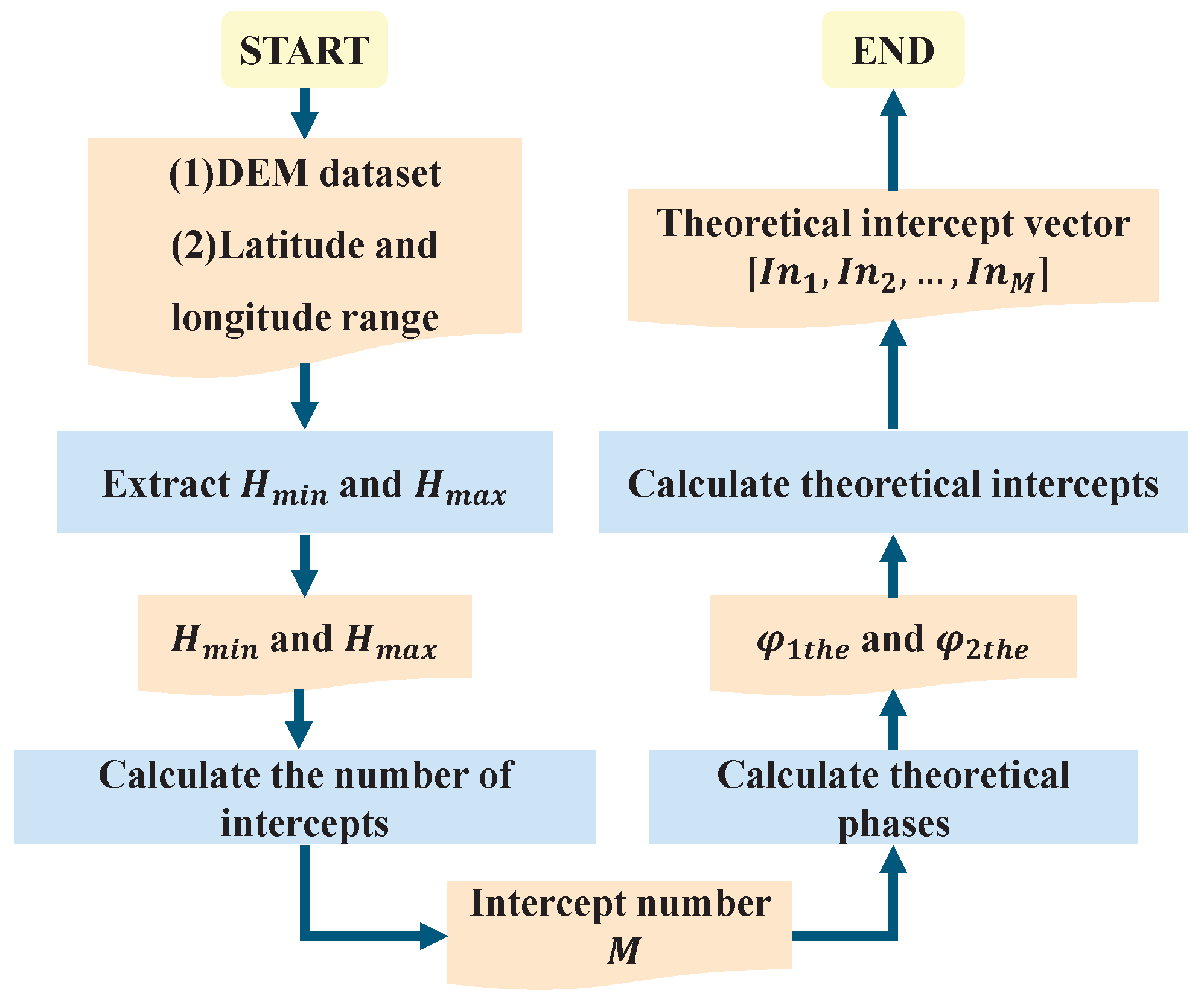
The detailed steps for theoretical intercept calculation are described below, as shown in
Figure 4.
Step 1: Extraction of the minimum height and the maximum height for the observation area.
The latitude and longitude range of the image can be obtained from the image parameters. Based on this information, the corresponding DEM data are extracted from the reference DEM database to identify the minimum and maximum heights. Given the potential for terrain changes and the accuracy of the reference DEM, the minimum height and the maximum height of the observation area are determined by appropriately extending the reference DEM’s minimum and maximum heights.
Step 2: Calculation of the number of theoretical intercepts M.
Calculate the ambiguity height
and then determine the number of theoretical intercepts
M by (
15).
Step 3: Calculation of the theoretical interferometric phases.
Within each non-overlapping line segment
on the height line, the theoretical intercept corresponding to any height point is identical. Therefore, by selecting any height point
within
, the theoretical interferometric phase can be determined as follows:
Therefore, the theoretical interferometric phases corresponding to
are
= [
,
, …,
] and that corresponding to
are
= [
,
, …,
].
Step 4: Determination of the theoretical intercept vector.
The theoretical intercept vector [
] can be derived by substituting theoretical interferometric phase vectors
and
obtained in step 3 into (
6). For example, the
of the observation area is 424 m; the
is 317 m;
is 43.5 m; and
is 32.3 m. According to Step 2, the number of theoretical intercepts
M is 7. According to Step 3, select any one height point
from each non-overlapping line segment
. The height point vector selected here is [319, 329, 344, 370, 379, 409, 423]. Substituting the height point vector into Step 3 and Step 4 yields the theoretical intercept vector [0.4199, −0.5799, 0.1620, −0.8380, −0.0959, 0.6459, −0.3540].
3.3. Intercept Filtering
In the descriptions from
Section 3.3,
Section 3.4,
Section 3.5 and
Section 3.6, all explanations regarding intercept symbols follow a consistent convention: an intercept with no mark above its letter represents the theoretical intercept, an intercept in the form of
denotes the actual intercept, and an intercept in the form of
indicates the filtered intercept.
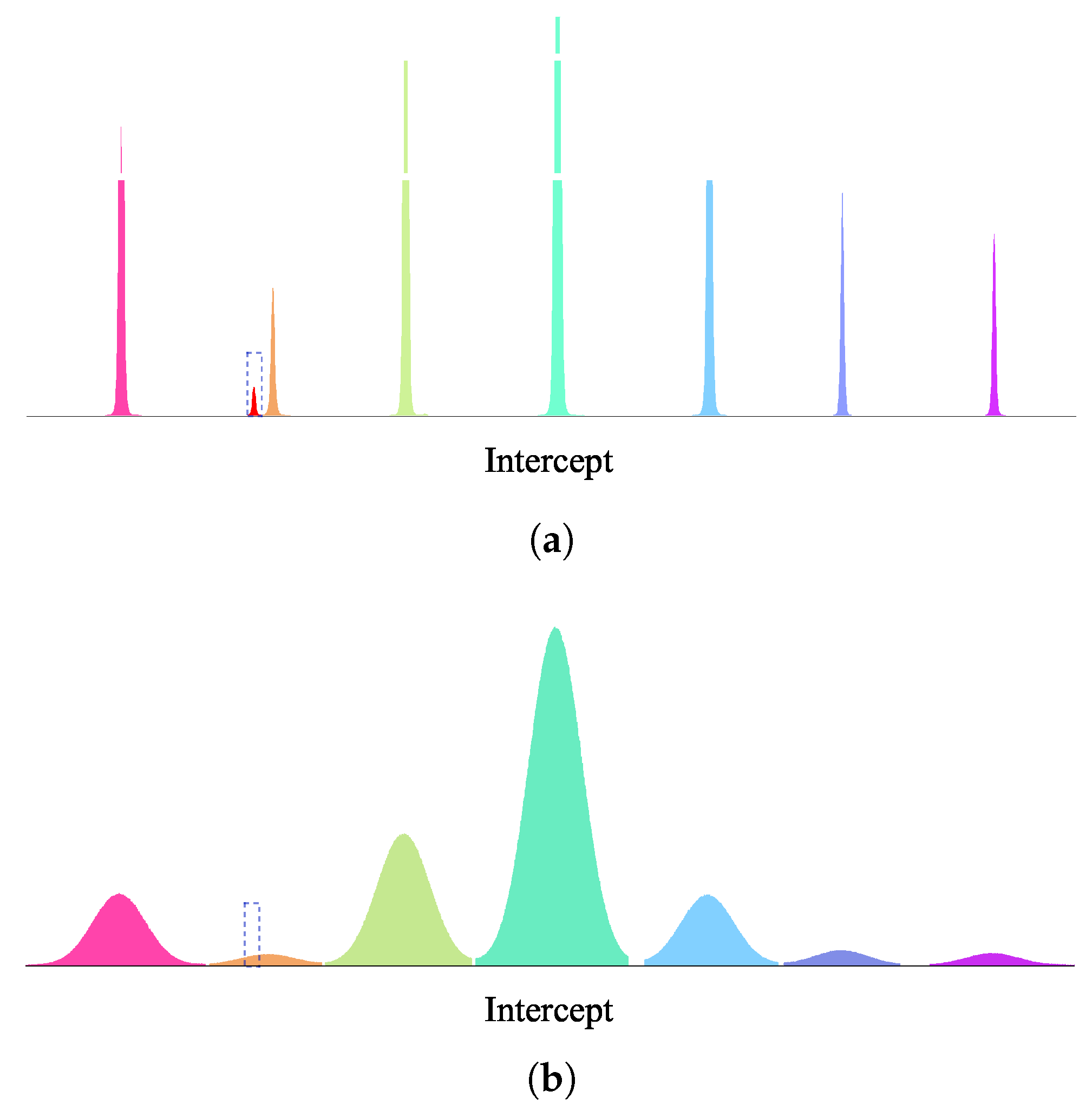
Noise is unavoidable in practice. It is therefore necessary to filter actual intercepts, since they are inevitably different from theoretical intercepts. The filter process described below is based on the theoretical intercept vector of
Section 3.2.
Next,
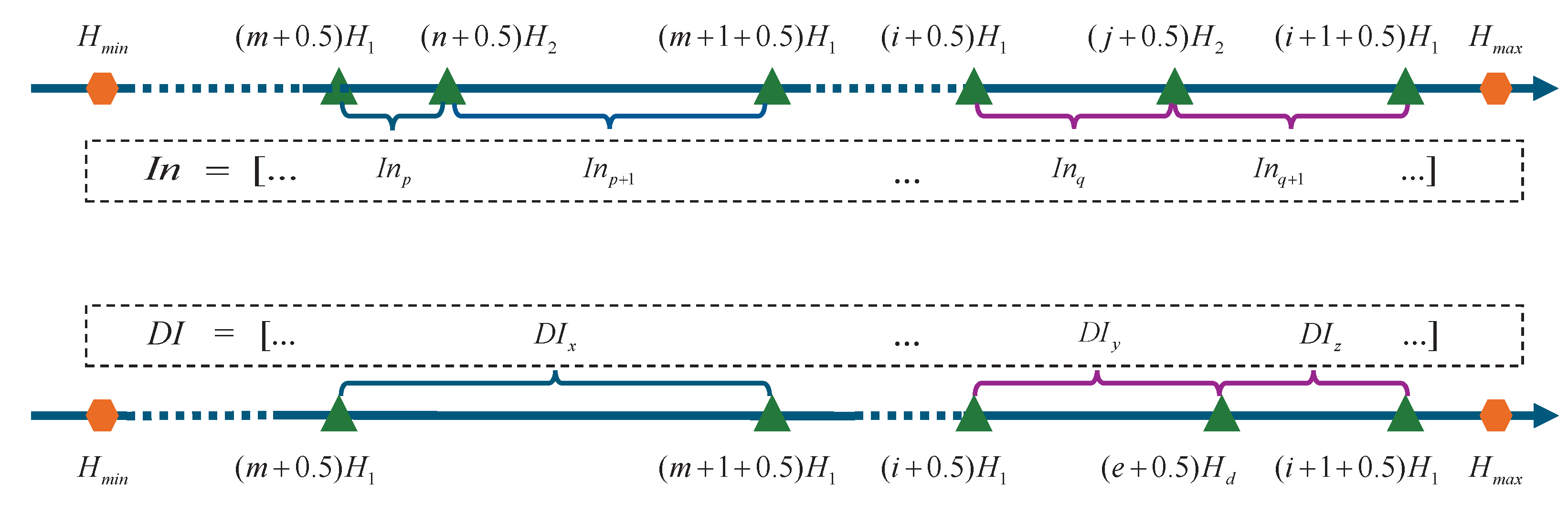
Figure 5 is used as an example to introduce the process. The cluster distribution of the original phase group [
,
] is shown at the top of
Figure 5. The cluster distribution of the differential phase group [
,
] is shown at the bottom of
Figure 5. As shown in
Figure 5:
= […,
,
, …,
,
, …] is the theoretical original intercept vector of the original phase group, and
= […,
, …,
,
, …] is the theoretical differential intercept vector of [
,
] derived from (
13). The intersection of endpoints [
, …,
,
, …,
,
, …,
] with the height line can yield multiple non-overlapping line segments, which are defined as
height spaces. The theoretical original intercept vector and the theoretical differential intercept vector corresponding to an
height space are defined as
and
, respectively. For example,
,
in
Figure 5 corresponds to
= [
,
],
= [
].
Set
as the original intercept distance threshold and
as the differential intercept distance threshold.
Based on practical experience, the value of intercept distance threshold coefficient
typically falls within the range of 0.3 to 0.5.
The
pixel represents a pixel in an interferogram, with the horizontal coordinate represented by
a and the vertical coordinate represented by
b. The actual original intercept and actual differential intercept of the
pixel are denoted by
and
, respectively. The actual original intercept distance of the
pixel is given as follows:
The actual differential intercept distance of the
pixel is given as follows:
The intercept filtering is illustrated below in four scenarios. The filtered original intercept and filtered differential intercept of the pixel are denoted by and , respectively.
Scenario 1: and .
Filter
and
according to (
21) and (
22), then replace actual values with filtered results.
Scenario 2: and .
Since
, therefore
can be obtained according to (
22). Then, the
height space which
belongs to is determined. The
of the
height space is founded and the intercept filtering process is performed according to (
23). For example, the
pixel satisfies
=
, which means that it is in the
,
height space, hence the
= [
,
] used in solving for
according to (
23).
Scenario 3: and .
Since
, therefore
can be obtained according to (
21). Then, a
height space which
belonging to is determined. The
of the
height space is founded and the intercept filtering process is performed according to (
24). For example, the
pixel satisfies
=
, which means that it is in the
,
height space, hence the
= [
,
] used in solving for
according to (
24).
Scenario 4: and .
According to (
21) and (
22),
and
can be obtained. If
and
belong to the same
height space,
and
are considered reliable. If
and
do not belong to the same
height space,
and
are considered unreliable. These pixels with unreliable intercepts are marked with flag bits, indicating that these pixels are too affected by noise to be processed efficiently.
The proposed intercept filtering method effectively addresses two critical challenges: (1) phase noise-induced errors in intercept determination, and (2) computational inefficiency in intercept search. This method guarantees intercept accuracy while eliminating the need for search procedures. After the intercept filtering process is complete, all pixels except those flagged as anomalous will have error-free intercept values that should lie within the theoretical intercept vector. The pixels are then grouped into clusters after the intercept filtering. The cluster groups are formed of pixels that have identical intercept values and have not been marked as anomalous. The filtered original intercepts and filtered differential intercepts of these cluster groups are denoted by […, , , …, , , …] and […, , …, , , …], respectively.
3.4. Closed-Form Ambiguity Number Solution
Filtered error-free intercept vectors can be obtained after the process described in the previous three subsections. In this subsection, the closed-form ambiguity number is derived by constructing and solving CRT equation groups whose error-free intercepts are used as remainders. It mitigates the effect of phase noise on ambiguity number determination and avoids ambiguity number search.
Each
height space corresponds to one CRT equation group. Each CRT equation group consists of an original phase group CRT Equation (
5) and a differential phase group CRT Equation (
12). The number of the ambiguity number
is
N:
This means that there are
N CRT equation groups to be solved.
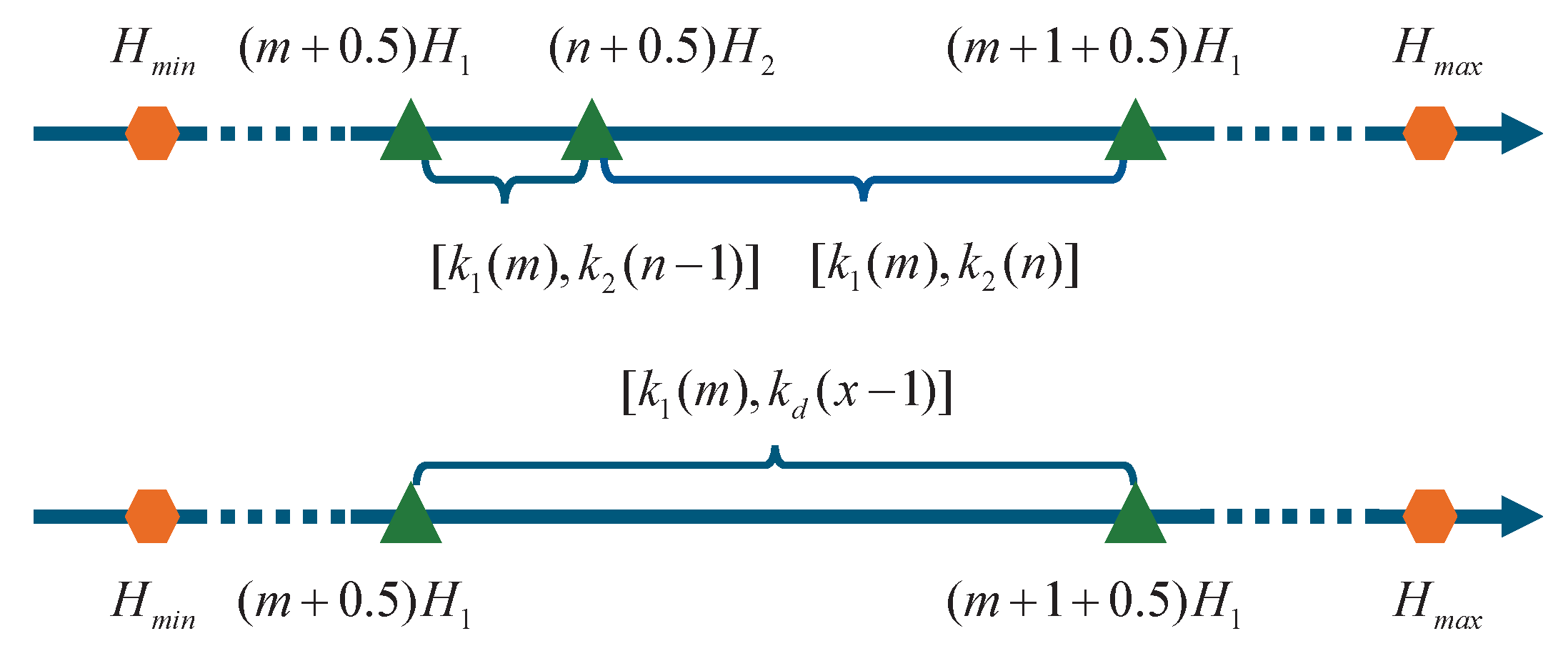
An example is given below to illustrate the detailed solution process. The cluster distribution of the original phase group is shown at the top of
Figure 6. The cluster distribution of the differential phase group is shown at the bottom of
Figure 6. For the
height space in
Figure 6, the original phase group has two cluster groups, while the differential phase group has one cluster group.
corresponds to
and
, which can form (
26) and (
27):
and
are the filtered original intercepts of the corresponding cluster groups.
corresponds to
which can form (
28):
is the filtered differential intercept of the corresponding cluster group.
A CRT equation group is formed by selecting an equation from (
26) or (
27) and combining it with (
28). (
26) and (
28) are used as an illustrative example in the following demonstration.
To satisfy the solvability conditions of the CRT equation group, a primary decomposition must be performed first:
C is the common multiplicative factor, while
and
are a pair of coprime integers. Then define the following:
where symbol
is the floor operation. Since remainders
and
are filtered error-free intercepts,
and
in (
30) are accurate. (
26) and (
28) are rewritten to yield the following equations:
Consequently, the closed-form solution is as follows [
21]:
is the modular multiplicative inverse of
modulo
. Combining (
26), (
31) and (
32) yields the following:
The ambiguity number vector [
,
] corresponds to the
cluster group in the original phase group in
Figure 5, thus establishing the equivalence [
,
] = [
,
]. According to the closed-form solution principle above, the ambiguity number vector [
,
] for each cluster group can be derived. For pixels marked as having both unreliable original and differential intercepts, we temporarily exclude them from the closed-form ambiguity number calculation. This avoids the propagation of intercept unreliability to the ambiguity number solution. Subsequently, the phase gaps corresponding to the marked pixels are filled via spatial interpolation on the unwrapped phase map.
3.6. Generalization to Multi-Baseline Mode
The main difference between dual-baseline and multi-baseline modes is the number of baselines, which increases from two to three or more. Expanding to multiple baselines introduces several differences from the dual-baseline mode. The following section details the similarities and differences when extending dual-baseline to multi-baseline modes. It specifically addresses differential phase processing, theoretical intercept calculation, intercept filtering, and closed-form ambiguity number solution.
Differential phase processing: In dual-baseline mode, differential phase processing is essential for constructing a new cluster Equation (
12). In multi-baseline mode, however, it is optional. Nevertheless, when certain interferograms in multi-baseline mode are unusable due to excessive noise, differential phase processing can provide an alternative input. Therefore, differential phase processing should be retained for the multi-baseline mode.
Theoretical intercept calculation: The calculation method for the number of theoretical intercepts and the theoretical intercept vector in the multi-baseline mode is identical to that of the dual-baseline mode, both employing the approach detailed in
Section 3.2.
Intercept filtering:
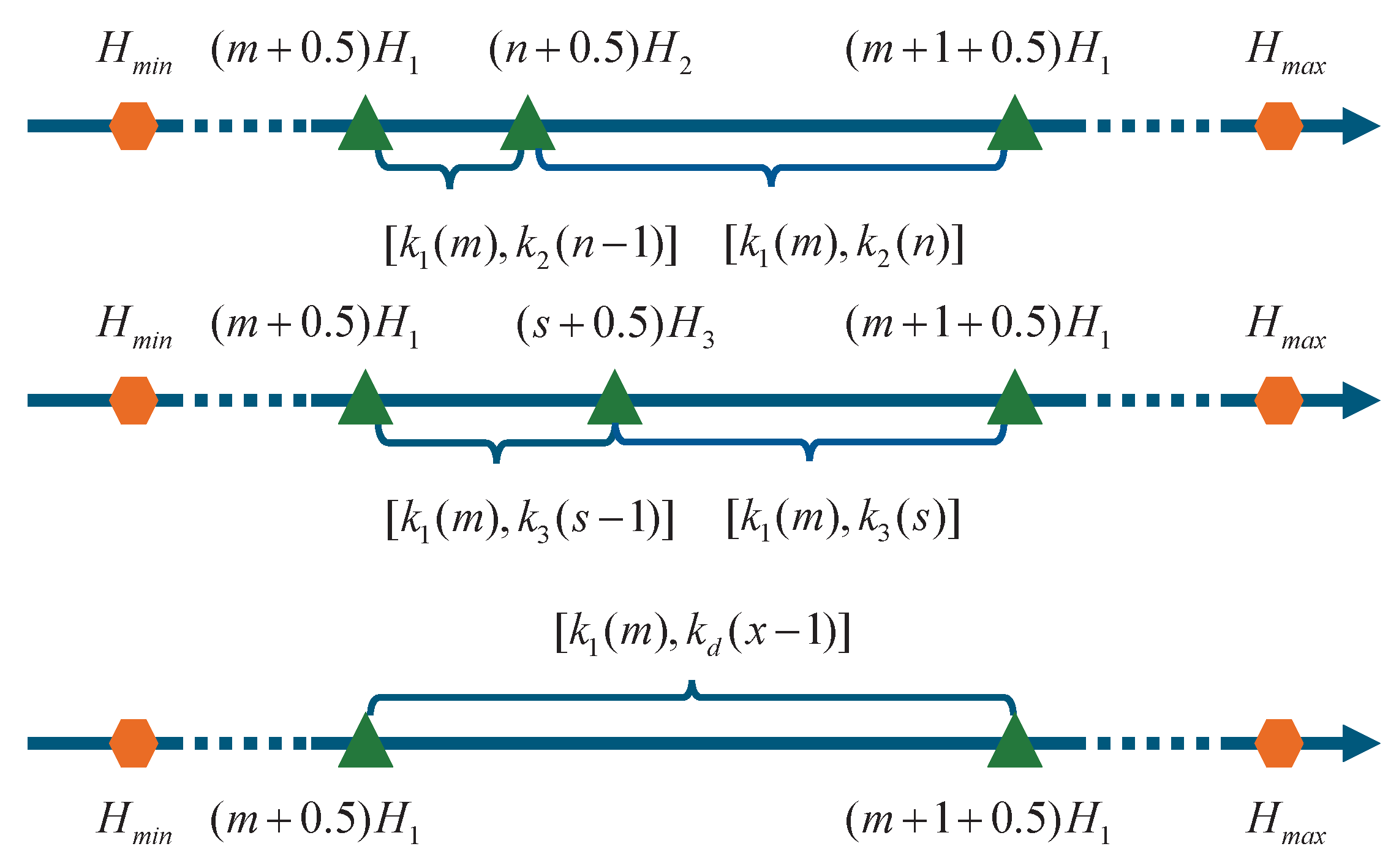
Next, the process of intercept filtering in triple-baseline mode will be explained by referring to
Figure 7. The cluster distribution of the Baseline 1 and Baseline 2 group is shown at the top of
Figure 7. The cluster distribution of the Baseline 1 and Baseline 3 group is shown at the middle of
Figure 7. The cluster distribution of the differential phase group is shown at the bottom of
Figure 7. As shown in
Figure 7:
= […,
,
, …,
,
, …] is the theoretical original intercept vector of Baseline 1 and Baseline 2 group,
= […,
,
, …,
,
, …] is the theoretical original intercept vector of Baseline 1 and Baseline 3 group, and
= […,
, …,
,
, …] is the theoretical differential intercept vector. The intersection of endpoints [
, …,
,
, …,
,
, …,
] with the height line can yield multiple non-overlapping line segments, which are defined as
height spaces. The theoretical intercept vectors corresponding to the
height space for the Baseline 1 and Baseline 2 group, the Baseline 1 and Baseline 3 group, and the differential phase group are
,
, and
respectively. For example,
,
in
Figure 7 corresponds to
= [
,
],
= [
,
],
= [
].
Set
as Baseline 1 and Baseline 2 group distance threshold,
as Baseline 1 and Baseline 3 group distance threshold, and
as the differential intercept distance threshold.
Based on practical experience, the value of
typically falls within the range of 0.3 to 0.5.
,
,
represent the actual intercept of the Baseline 1 and Baseline 2 group, the Baseline 1 and Baseline 3 group, and the differential phase group for the
pixel, respectively. The actual intercept distance of the Baseline 1 and Baseline 2 groups of the
pixel is given as follows:
The actual intercept distance of the Baseline 1 and Baseline 3 groups of the
pixel is given as follows:
The actual differential intercept distance of the
pixel is given as follows:
The intercept filtering is illustrated below in three scenarios. , , represent the filtered intercept of the Baseline 1 and Baseline 2 group, the Baseline 1 and Baseline 3 group, and the differential phase group for the pixel, respectively.
Scenario 1: All of , and are satisfied.
Filter
,
,
according to (
43), (
44), and (
45), respectively. Then replace actual values with filtered results.
Scenario 2: At least one of , or is satisfied, but not all of them are satisfied. Below is a detailed explanation with an example where is satisfied, but conditions and are not.
Since
, therefore
can be obtained according to (
45). Then, a
height space which
belonging to is determined. The
and The
of the
height space are founded and the intercept filtering process is performed according to (
46) and (
47). For example, the
pixel satisfies
=
, which means that it is in the
,
height space, hence
= [
,
] and
= [
,
] used in solving for
and
according to (
46) and (
47), respectively.
Scenario 3: Neither , , nor is satisfied.
According to (
43)–(
45),
,
and
can be obtained. If
,
and
belong to the same
height space,
,
and
are considered reliable. If
,
and
do not belong to the same
height space,
,
and
are considered unreliable. These pixels with unreliable intercepts are marked with flag bits, indicating that these pixels are too affected by noise to be processed efficiently.
The pixels are then grouped into clusters after the intercept filtering. The cluster groups are formed of pixels that have identical intercept values and have not been marked as anomalous. The filtered intercepts of the Baseline 1 and Baseline 2 group, the Baseline 1 and Baseline 3 group, and the differential phase group of these cluster groups are denoted by […, , , …, , , …], […, , , …, , , …], and […, , …, , , …], respectively. If the number of baselines exceeds three, intercept filtering could be implemented by making appropriate modifications to the triple-baseline mode.
Closed-form ambiguity number solution:
Each
height space corresponds to one CRT equation group. The number of ambiguity number
is
N by (
25).
An example is given below to illustrate the detailed solution process for triple-baseline mode by combining
Figure 7 and
Figure 8. The cluster distribution of the Baseline 1 and Baseline 2 group is shown at the top of
Figure 8. The cluster distribution of the Baseline 1 and Baseline 3 group is shown at the middle of
Figure 8. The cluster distribution of the differential phase group is shown at the bottom of
Figure 8. For the
height space illustrated in
Figure 8, the Baseline 1 and Baseline 2 group has two cluster groups, and the Baseline 1 and Baseline 3 group also has two cluster groups, while the differential phase group has only a single cluster group. In the Baseline 1 and Baseline 2 groups,
corresponds to
and
, which can form (
48) and (
49):
and
are the filtered original intercepts of the corresponding cluster groups in the Baseline 1 and Baseline 2 groups.
In the Baseline 1 and Baseline 3 group,
corresponds to
and
, which can form (
50) and (
51):
and
are the filtered original intercepts of the corresponding cluster groups in the Baseline 1 and Baseline 3 groups.
In the differential phase group,
corresponds to
which can form (
52):
is the filtered intercept of the corresponding cluster group in the differential phase group.
(
48), (
50) and (
52) are used as an illustrative example in the following demonstration.
To satisfy the solvability conditions of the CRT equation group, a primary decomposition must be performed first:
C is the common multiplicative factor, while
,
, and
are coprime integers. Then define:
Since remainders
,
and
are filtered error-free intercepts,
,
and
in (
54) are accurate. (
48), (
50) and (
52) are rewritten to yield the following equations:
Consequently, the closed-form solution is [
21]:
is modular multiplicative inverse of
modulo
. Therefore, the following results can be obtained:
According to the closed-form solution principle above, the ambiguity number vector [, ] or [, ] for each cluster group can be derived. If the number of baselines exceeds three, a closed-form ambiguity number solution could be implemented by making appropriate modifications to the triple-baseline mode.