1. Introduction
In recent years, Synthetic Aperture Radar (SAR) technology has demonstrated substantial progress in imaging scale and system performance, emerging as a key research focus for target detection across national and industrial sectors. Traditional SAR target detection methodologies frequently employ direct adaptations of visible-spectrum detection algorithms—such as Fast R-CNN, YOLO, and DETR—to process SAR imagery, thereby neglecting fundamental disparities in imaging mechanisms and physical properties between SAR and optical domains. To overcome the limitations of purely data-driven approaches, current research increasingly focuses on physics-driven methodologies, which can be methodologically categorized into physics-based features and physics-embedded models. Physics-based features are derived directly from raw SAR complex data or amplitude domains by leveraging electromagnetic scattering principles and imaging geometries to translate target attributes such as structure and material into distinctive representations. For instance, Li et al. [
1] modeled extracted scattering centers as graph nodes and employed Graph Convolutional Networks to capture topological structure information effectively, demonstrating that structural characteristics are remarkably beneficial for recognition. Li et al. [
2] designed a multiscale network based on geometric scattering types of Attributed Scattering Centers, which comprehensively utilizes component information to enhance the physical interpretability of the extracted feature maps. Extending the concept of deriving physical representations, the HDEC-TFA method innovatively combines time-frequency analysis with unsupervised deep embedding clustering to discover and categorize inherent physical scattering patterns directly from single-polarized complex SAR data, demonstrating that valuable scattering properties can be extracted even without full polarimetric information [
3]. These approaches demonstrate that transforming abstract signal properties into explicit physical features significantly improves the representation capability of detection models compared to methods relying solely on pixel intensity.
Distinct from feature-level extraction, physics-embedded models integrate physical principles or constraints directly into the deep learning architecture, loss functions, or training mechanisms to govern the internal learning process. This paradigm aims to internalize physical knowledge to constrain the model search space and reduce dependence on massive annotated datasets. The Lightweight Dual-Stream Framework developed by Xiong et al. [
4] exemplifies this strategy by coupling local electromagnetic scattering features extracted via graph neural networks with global visual features through a specialized fusion subnetwork and a graph distance-based loss function. Addressing the oversight of inherent electromagnetic characteristics in standard networks, the MASFF-Net proposed by Zhang et al. [
5] utilizes a scattering-guided feature fusion module to integrate multi-azimuth scattering information with image domain features, thereby maintaining high recognition performance with clear physical significance. Furthermore, the EFMM-Net introduces a scattering-guided manifold multiscale backbone that exploits phase information in complex-valued SAR imagery to enhance feature alignment and focus the network on critical scattering characteristics through location-aware fusion [
6]. By embedding deterministic physical laws into the non-linear optimization of deep networks, these models effectively reconcile the powerful feature extraction capability of data-driven methods with the robust generalization performance provided by physical priors.
To enhance the robustness and interpretability of SAR target detection systems, this paper establishes polarization characteristics, scattering mechanisms, signal-domain properties, and system resolution as four core dimensions for constructing a comprehensive physical constraint framework. We analyze their respective constraint principles and application advantages for target detection, while summarizing current challenges and future technological development directions. The selection of these dimensions is grounded in the complete physical process of electromagnetic wave–target interaction: polarization characteristics quantify the modulation of electromagnetic wave vector states by target structures; scattering mechanisms describe spatial distribution patterns of echo energy; signal-domain properties reveal dynamic features in time-frequency representations; and system resolution defines the observational limits of these physical characteristics—collectively forming an interconnected physical constraint system.
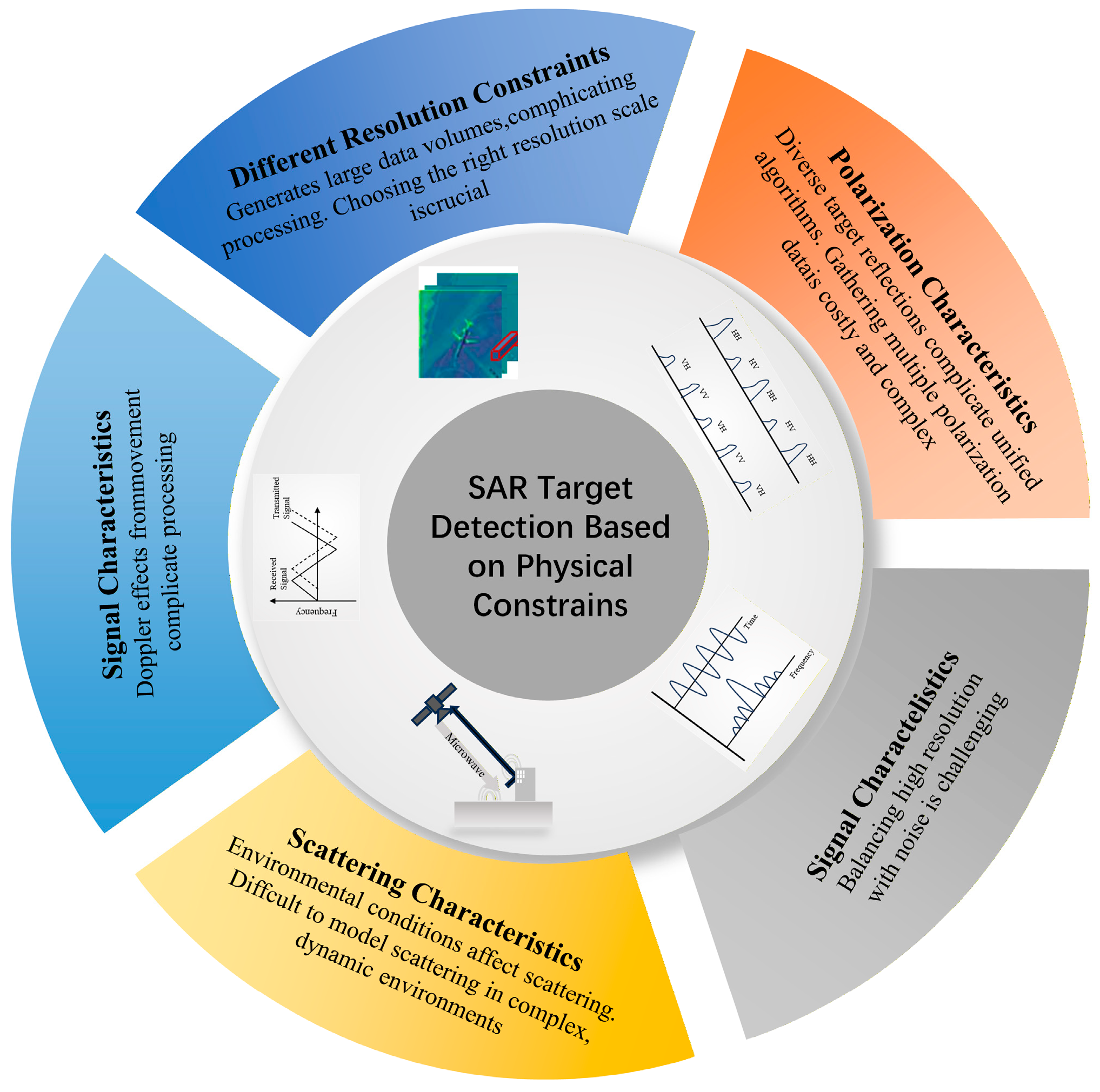
Figure 1 schematically illustrates the multi-dimensional operational challenges inherent in SAR target detection, fundamentally stemming from the complex coherent interaction between electromagnetic waves and scene constituents. For instance, clutter interference in the polarization domain arises because natural distributed scatterers often exhibit high-entropy random scattering, obscuring the stable, low-entropy returns typical of man-made targets. Similarly, feature masking phenomena are often a consequence of resolution limitations, where the coherent superposition of multiple elementary scattering centers within a single resolution cell degrades distinctive geometric scattering topologies. Such complex interactions necessitate that effective detection methods undergo comprehensive analysis and investigation under multi-dimensional physical constraints.
The remainder of this paper is organized as follows.
Section 1 reviews the historical evolution of SAR target detection methods under physical constraints.
Section 2 briefly introduces commonly used datasets and evaluation protocols.
Section 3,
Section 4,
Section 5 and
Section 6 systematically analyze and summarize SAR target recognition algorithms constrained by polarization, scattering, signal-domain properties, and resolution characteristics, respectively.
Section 7 establishes a unified analytical framework to systematically compare the applicable scenarios, complementarity, and fusion potential of the four types of constraints.
Section 8 addresses the prevailing limitation of single-physical-constraint optimization in current SAR target detection, investigating task-oriented physical property selection through Mixture of Experts (MoE) modeling to propose reference methodologies for future research.
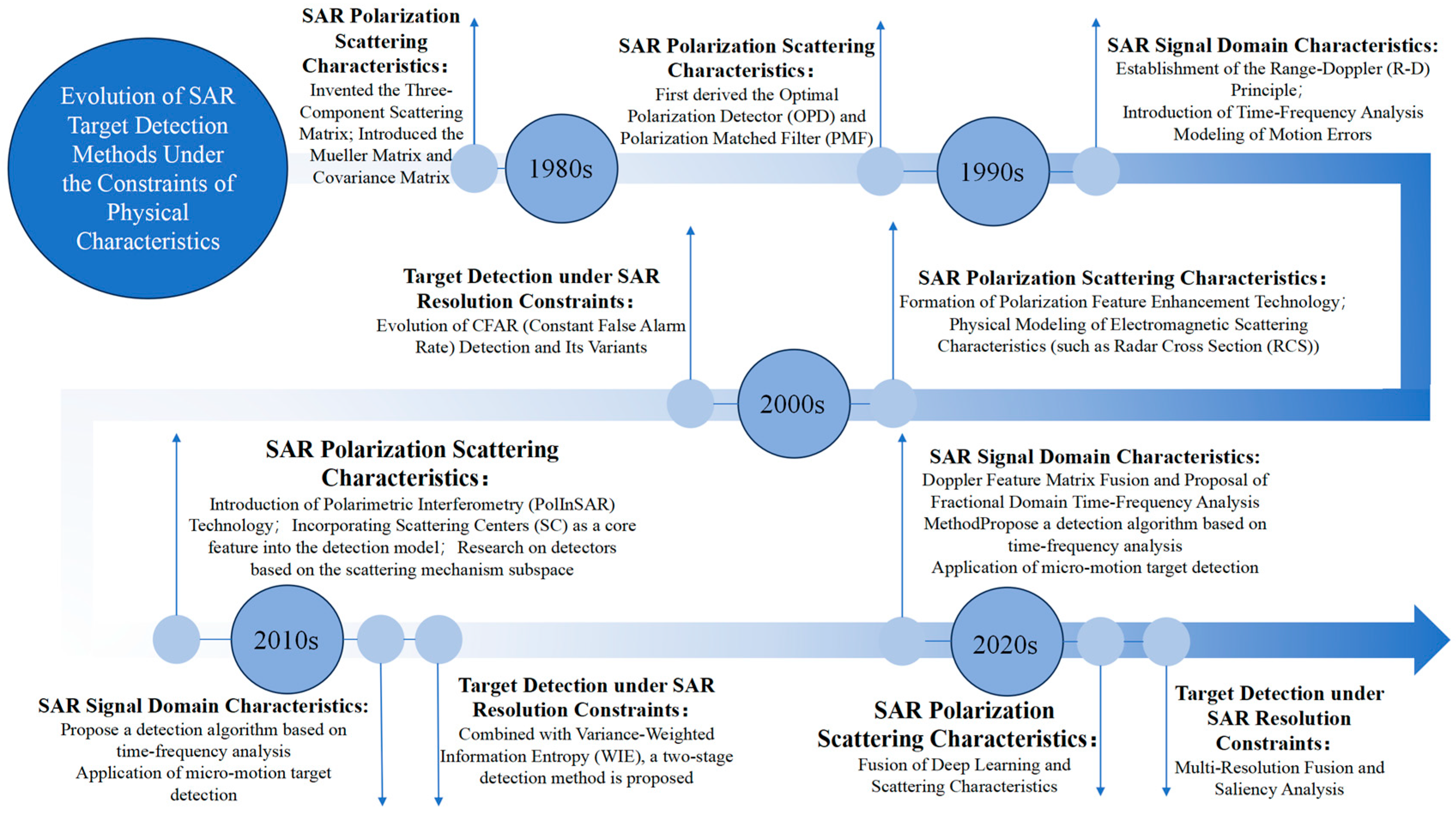
Figure 2 depicts the evolution of physics-driven SAR target detection. Early methods relied primarily on the statistical modeling of scattering intensity; however, these approaches often fail in the presence of heterogeneous clutter with complex scattering textures. The subsequent emergence of data-driven deep learning architectures has markedly enhanced feature representation capability, yet such methods typically treat SAR data as grayscale images, neglecting critical phase information and inherent coherent scattering mechanisms. Current physics-driven detection methods aim to reconcile the powerful nonlinear feature extraction capability of deep networks with the deterministic constraints imposed by electromagnetic scattering laws, thereby pursuing models with superior generalization performance and physical interpretability.
2. Standard Datasets and Performance Evaluation Protocols
To ensure rigorous performance assessment and methodological comparability across studies, standardized benchmark datasets and uniform evaluation protocols are indispensable in SAR target detection research. In the domain of ground vehicle recognition, the Moving and Stationary Target Acquisition and Recognition (MSTAR) dataset serves as a primary benchmark, providing extensive X-band data collected under varying depression and azimuth angles to evaluate model robustness against pose variations. For maritime surveillance tasks, the SAR Ship Detection Dataset (SSDD) offers diverse operational scenarios spanning open seas and complex coastal regions with varying sea states. Furthermore, datasets such as the High-Resolution SAR Images Dataset (HRSID) and the SAR Rotated Ship Detection Dataset (SRSD) have been developed to address specific challenges related to high-resolution imagery and arbitrary target orientations, respectively.
The quantitative evaluation of detection performance typically relies on established metrics derived from confusion matrix elements. Precision measures the proportion of true positive detections among all positive predictions, while Recall quantifies the ability to identify all relevant ground truth targets within the scene. The F1-Score provides a harmonic mean of Precision and Recall, offering a balanced assessment, particularly in datasets with class imbalance. For comprehensive evaluation across varying confidence thresholds and localization accuracies, mean Average Precision (mAP), calculated based on the Precision-Recall curve and Intersection over Union (IoU) criteria, is widely adopted as the standard metric for overall detection accuracy.
It is crucial to note that while this review compiles performance metrics into comparative tables to illustrate algorithmic advancements, direct cross-study comparisons must be interpreted with caution regarding absolute performance values. Variations in experimental setups employed by different works—including specific dataset subsets utilized, data partitioning strategies for training and testing, data augmentation techniques, and differing hardware computational platforms—can influence reported results. The performance gains highlighted in subsequent sections primarily reflect improvements reported within the respective original studies under their specific controlled experimental conditions, rather than represent universal benchmarks under identical settings.
3. SAR Target Detection Method Based on Polarization Characteristics Constraints
Polarization characteristics constitute the fundamental vector basis for analyzing the interaction between electromagnetic waves and targets. Unlike single-channel intensity data that only records the amplitude of the backscattered signal, polarimetric information describes the oscillation orientation and vector modulation of the electric field. The rationale for selecting polarization as a primary physical constraint lies in its ability to reveal intrinsic physical properties of the target such as dielectric constant, surface roughness, and geometric orientation. This vector information provides a rigorous physical mechanism to distinguish man-made targets from natural clutter backgrounds. Artificial targets typically exhibit stable scattering mechanisms characterized by double-bounce or specular reflection, whereas natural backgrounds such as sea clutter or vegetation often demonstrate random scattering behaviors with high entropy. Therefore, incorporating polarization constraints enables the detection model to utilize the complete scattering matrix and significantly enhances target–background separability in complex electromagnetic environments.
3.1. Polarization Characteristics Constraints and Their Mathematical Formulations
Polarization describes the vector nature of electromagnetic waves, specifically the orientation and oscillation pattern of the electric field vector in the plane perpendicular to the direction of propagation. Unlike conventional single-channel SAR which relies solely on backscatter intensity, full-polarimetric SAR systems acquire a complete scattering matrix by utilizing orthogonal transmit and receive antenna configurations, typically horizontal () and vertical () linear polarizations. Under the monostatic backscattering reciprocity principle, the off-diagonal elements are equal, meaning , which simplifies the characterization of coherent scattering centers.
For distributed targets exhibiting temporal variations or scenarios contaminated by speckle noise, physical constraints are more appropriately formulated through second-order statistical descriptors. The polarimetric coherency matrix is constructed using the Pauli scattering vector basis. This matrix formulation is essential because its diagonal elements directly map to the energy contributions of fundamental physical scattering mechanisms: specifically represents surface scattering power suitable for characterizing planar targets like the sea surface, corresponds to double-bounce scattering power typical of dihedral structures in man-made objects, and relates to volume scattering power often associated with complex canopy structures.
To extract interpretable physical properties from these matrix representations for target detection, polarimetric target decomposition techniques are employed. These techniques interpret the complex radar return as a combination of elemental scattering mechanisms. The Freeman-Durden decomposition models the coherency matrix as a linear combination of three physically defined scattering types:
where
and
denote the power contributions for surface, double-bounce, and volume scattering mechanisms, respectively, while
and
represent their corresponding canonical scattering models. This framework enables the transformation from abstract matrix data into physically interpretable quantitative features.
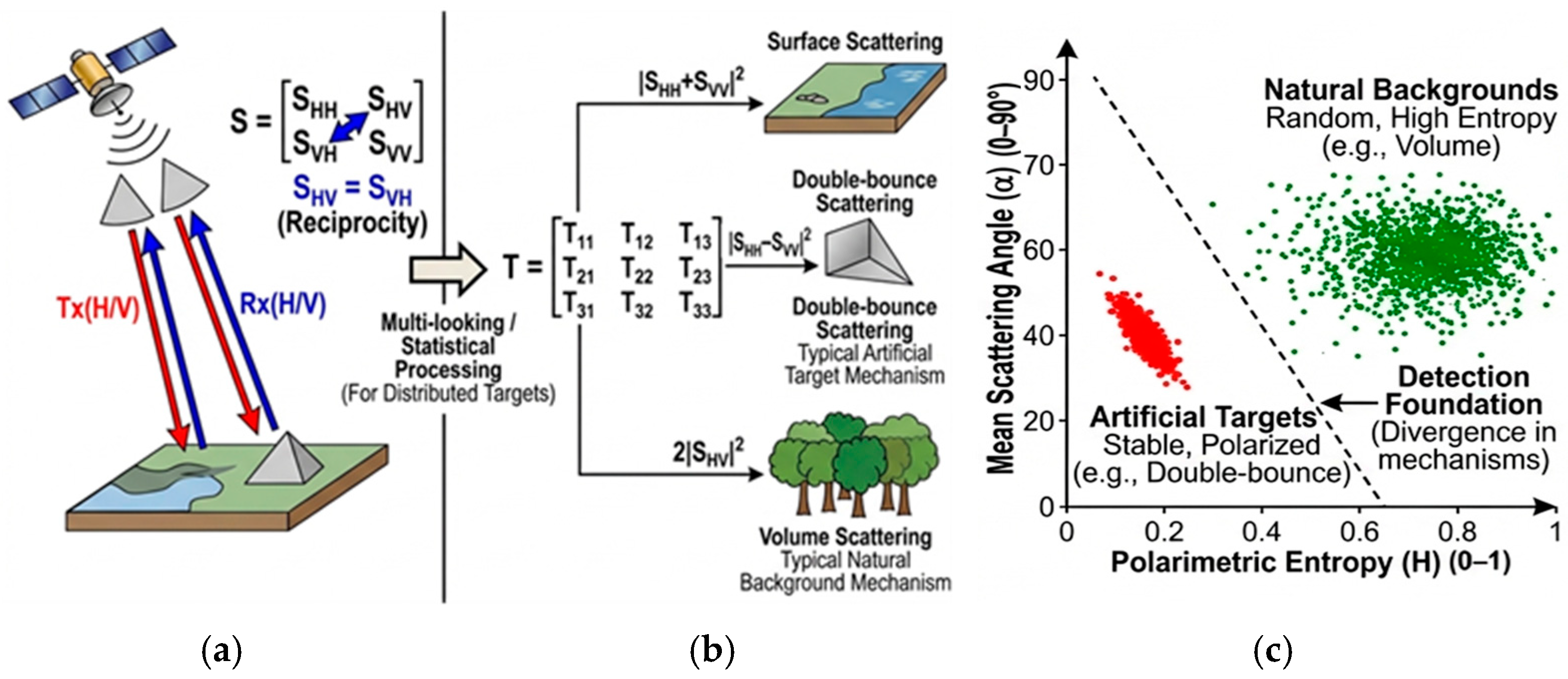
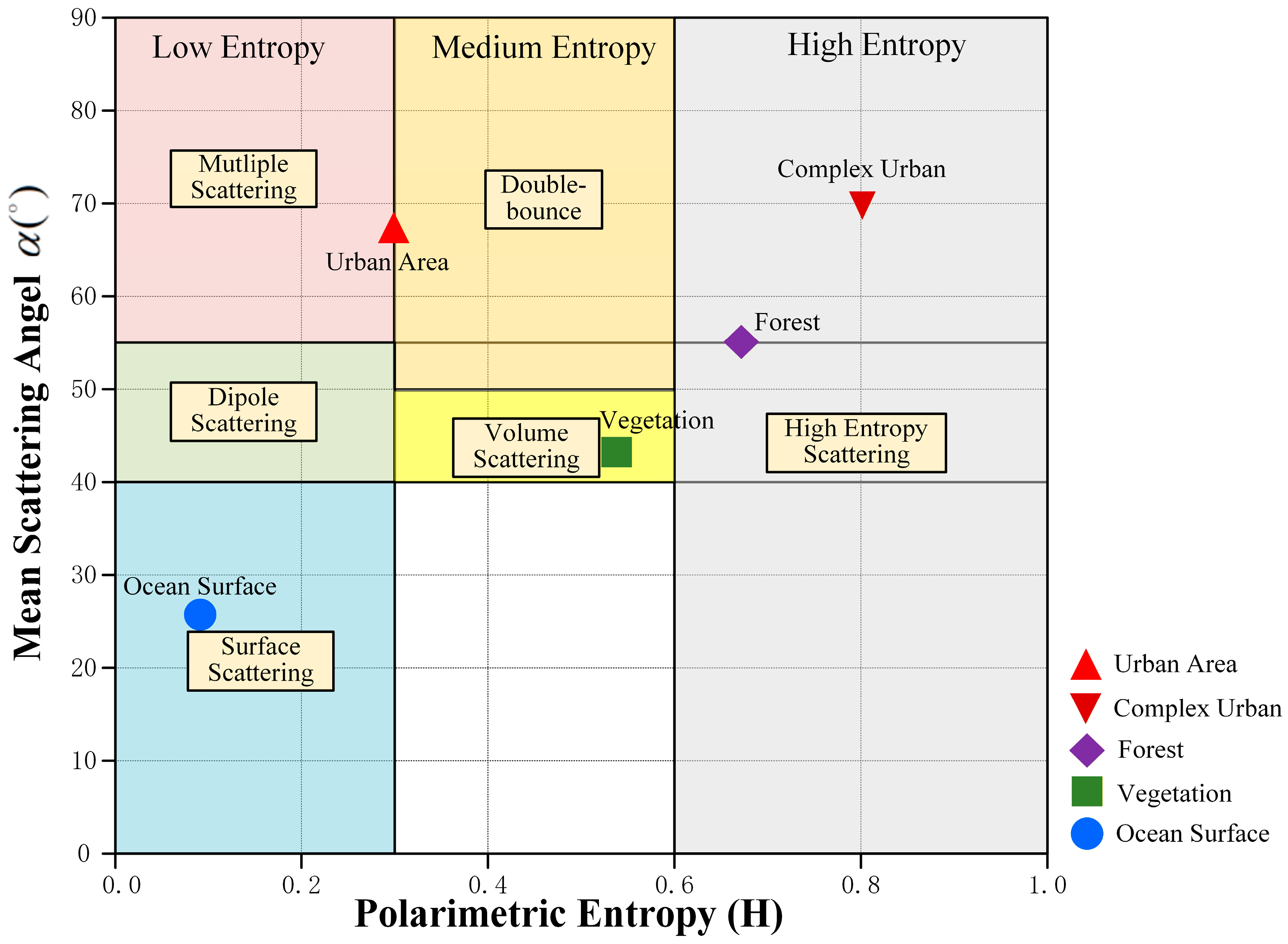
Alternatively, eigenvalue-based methods such as the Cloude–Pottier decomposition analyze the eigenstructure of the coherency matrix to define parameters that characterize the dominant scattering mechanism and the randomness of the scattering process. The polarimetric entropy quantifies the degree of randomness in the scattering environment, ranging from 0 for a single deterministic scatterer to 1 for completely random noise. The mean scattering angle identifies the dominant scattering mechanism, ranging from surface scattering to double-bounce scattering.
These mathematical formulations provide a robust physical basis for target detection. Artificial targets such as ships or vehicles typically exhibit stable, strongly polarized scattering behavior characterized by low polarimetric entropy and pronounced double-bounce or specular scattering components. Conversely, natural backgrounds like sea clutter or vegetation generally display high-entropy random scattering characteristics. This fundamental divergence in physical scattering mechanisms captured by polarimetric formulations establishes the theoretical foundation for separating targets from complex backgrounds.
Figure 3 illustrates the physical interpretation process from data acquisition to the coherency matrix and subsequent decomposition, clarifying the fundamental scattering differences between man-made targets for detection and natural backgrounds.
3.2. Algorithm Evolution and Implementation
3.2.1. Constant False Alarm Rate (CFAR) Algorithm
Target detection in single-polarization SAR imagery typically employs detection models based on statistical discrepancies between target backscatter intensity and clutter background characteristics. Among these approaches, the Constant False Alarm Rate (CFAR) algorithm represents a classical methodology that maintains constant false alarm probability through adaptive threshold determination [
7].
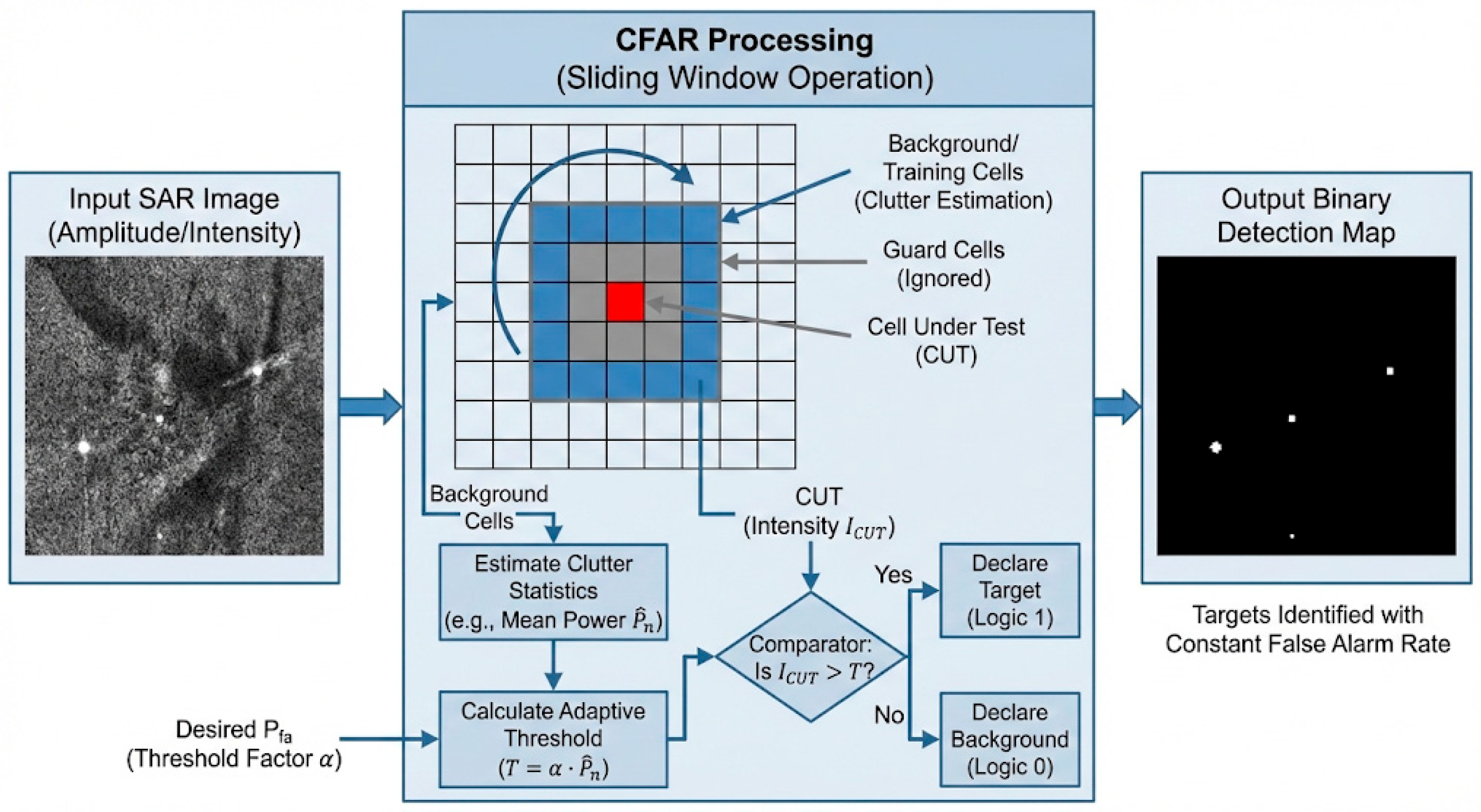
Figure 4 illustrates the processing pipeline of the CFAR detector. The core mechanism employs a sliding window architecture to traverse the SAR image. This window is structurally divided into three concentric regions: the central Cell Under Test (CUT), which is the pixel currently being evaluated; the Guard Cells, which serve as a buffer to prevent target energy leakage into the background estimation; and the outer Reference Window (Background Cells).
During operation, the detector estimates the local clutter statistics (e.g., mean and variance) exclusively from the Reference Window data. Based on a predefined probability of false alarm , an adaptive threshold is calculated. The decision logic is then applied: if the intensity of the CUT exceeds , the pixel is declared as a target; otherwise, it is classified as background. This adaptive approach ensures that the detection performance remains robust even in non-homogeneous clutter environments.
In HH/VV co-polarization channels, clutter backgrounds generally demonstrate relatively homogeneous statistical properties, frequently conforming to either Rayleigh or Weibull distributions. These single-parameter statistical models exhibit distribution shapes primarily governed by mean clutter power while displaying low spatial correlation, thereby creating relatively stable background environments. Under such homogeneous clutter conditions, the power distinction between targets and clutter manifests mainly as localized energy spikes rather than alterations in distribution shape. Consequently, the Cell-Averaging CFAR (CA-CFAR) algorithm becomes necessary to adaptively estimate background power levels. Its fundamental principle involves estimating background clutter power using a sliding reference window. By leveraging the assumption of clutter distribution homogeneity, it directly computes the reference cell average as the background power estimate:
where
represents the estimated background noise power,
is the total number of reference cells used in the estimation, and
denotes the power value of the
-th reference cell. The detection threshold
is calculated as:
, where the threshold factor
is determined based on the desired probability of false alarm
as
.
In HV cross-polarization channels, where transmit and receive polarization directions are orthogonal, scattering energy from distributed targets (e.g., vegetation and soil) is significantly suppressed. This suppression leads to more complex statistical characteristics in the clutter background. When localized strong scatterers or heterogeneous media are present, the clutter power distribution often deviates from single-parameter models, instead following a log-normal distribution. The corresponding probability density function exhibits heavy-tailed behavior with strengthened correlation between mean and variance, thereby invalidating the homogeneous background assumption.
The threshold is , where the threshold factor must be determined through iterative solution of complex high-order equations.
Under these conditions, the Cell-Averaging CFAR (CA-CFAR) algorithm—which relies on environmental uniformity—suffers from biased clutter power estimation within its reference window, resulting in degraded detection performance for weak targets. Consequently, the Greatest-of CFAR (GO-CFAR) algorithm, based on log-normal distribution assumptions, is often employed in such scenarios. This algorithm partitions the reference window into left and right sub-windows, computes the mean noise power within each, and selects the greater value as the background power estimate. This approach effectively mitigates interference from localized strong clutter on background estimation. By adapting to the heavy-tailed characteristics of log-normal distributions in cross-polarization channels for low-scatter energy target detection, it enhances detection probability for weak targets while maintaining robustness [
8].
Table 1 evaluates and compares the merits and limitations of the three aforementioned CFAR algorithms.
The core advantages of traditional CFAR algorithms lie in their computational efficiency and theoretical completeness. Through local statistical estimation, they achieve a detection signal-to-noise ratio (SNR) threshold of approximately 3 dB, with detection rates exceeding 90% in homogeneous environments such as open seas [
9]. However, CFAR algorithms exhibit increased false alarm rates and performance degradation in complex terrains, primarily due to the limited representational capacity of handcrafted features for complex scattering characteristics. Convolutional Neural Networks (CNNs) address this limitation through enhanced nonlinear representation capabilities, overcoming the constrained adaptability of traditional features to complex backgrounds. The statistical model of conventional CFAR can be replaced by a CNN-driven adaptive threshold learning framework. For small sample sizes and complex background interference, transfer learning strategies alleviate data scarcity issues, while attention mechanisms enhance focus on weak targets and suppress interference from sea clutter and building shadows [
10,
11].
3.2.2. Polarization Covariance Matrix Optimization Algorithm
In multi-polarimetric SAR target detection, the polarimetric covariance matrix serves as the mathematical foundation for representing multi-polarization information, enabling target–clutter separation through statistical analysis and feature extraction. While detection algorithms based on this matrix comprehensively characterize target scattering properties, they remain vulnerable to statistical estimation errors in complex clutter environments.
For instance, Polarization Whitening Filter (PWF) estimates the background clutter covariance matrix
. The whitening process applied to the received scattering vector
using its inverse matrix is mathematically expressed as:
Here,
denotes the scattering vector and
represents the clutter covariance matrix. This operation enhances target–background contrast through eigenvalue-based weighting. Although it effectively decouples correlations between polarization channels and remains applicable in heterogeneous clutter environments, its performance heavily depends on accurate estimation of the clutter covariance matrix. Inaccurate estimation substantially degrades clutter suppression effectiveness [
12,
13].
Alternatively, Optimal Polarization Contrast Enhancement (OPCE) addresses the generalized Rayleigh quotient maximization problem:
where
and
represent the covariance matrices of target and clutter, respectively, while the optimal weight vector
is derived through generalized eigenvalue decomposition. Although this method maximizes target detectability via linear combinations of polarization channels, its performance critically depends on the separability between target and clutter polarimetric characteristics. Insufficient separability leads to significant detection performance degradation [
14,
15].
To mitigate these limitations, current approaches enhance detection performance by exploiting complementary information across multiple polarimetric domains. To specifically address the dependency on accurate statistical estimation in non-homogeneous clutter, iterative fusion strategies have been developed. An et al. [
16] proposed a Polarimetric Iterative Detector (PID) that sequentially fuses Power Maximization Synthesis (PMS), PWF, and the Optimal Polarimetric Detector (OPD). By utilizing the detection results of one stage to refine the target and clutter covariance matrix estimates for the subsequent stage, this method iteratively enhances statistical separability. Experimental results demonstrate that under identical false alarm conditions, this iterative optimization significantly increases the detection rate compared to individual PWF or PMS detectors, particularly in low signal-to-noise ratio environments. Such integration effectively compensates for individual algorithm limitations, thereby improving target detection reliability in complex operational scenarios.
3.2.3. Physical Model Embedded in Deep Networks
Although polarization covariance matrix-based methods demonstrate theoretical soundness they remain inadequate for comprehensively extracting multi-dimensional polarimetric features. Consequently research focus has shifted toward detection strategies that integrate information from multiple polarimetric channels by embedding physical dependencies directly into the network architecture. Current methodologies move beyond simple channel stacking by employing physical principles to govern feature selection and weighting thereby driving the network to focus on scattering mechanisms with high discriminative power. Wang et al. [
17] developed a polarimetric channel attention mechanism that utilizes mutual information entropy between channels as a physical metric to quantify information content. This mechanism effectively drives the network to adaptively suppress noise-dominated channels while enhancing those containing significant target scattering information. Furthermore leveraging spatio-temporal correlation characteristics among polarimetric channels permits the incorporation of recurrent neural networks to establish a joint modeling framework that achieves superior detection accuracy. The weighted feature fusion (WFF) method proposed by Mahmoud et al. [
18] exemplifies this approach. By adaptively integrating multi-dimensional polarimetric features—including Pauli decomposition, coherence matrix, and scattering components
—with attention maps, the F1-score is elevated to 95%.
To further enhance the physical interpretability of deep networks recent studies utilize theoretical decomposition models to construct the input feature space. In this paradigm the physically derived components from polarimetric decomposition serve as deterministic priors that constrain the learning process of the network. Zhang et al. [
19] proposed a deep learning framework based on reflection symmetry decomposition which extracts non-negative polarimetric features including surface scattering power, double-bounce scattering power, and volume scattering power. By utilizing these physically explicit powers as inputs rather than raw complex data the algorithm forces the convolutional neural network to learn decision boundaries based on fundamental scattering topologies rather than abstract statistical patterns. This physics-embedded strategy effectively resolves the incomplete utilization of polarimetric information inherent in conventional methods and ensures that the detection results align with the electromagnetic scattering laws of man-made targets.
To elucidate the contrast between classical and modern methodologies regarding robustness, data requirements, and physical interpretability,
Table 2 summarizes the comparative advantages and limitations of multi-polarization approaches.
3.3. Application Scenarios and Comparative Analysis
The distinct divergence in scattering mechanisms between artificial metallic targets and sea clutter backgrounds establishes polarimetric SAR as the predominant technique for maritime vessel detection. By leveraging this inherent physical property disparity, cross-polarization channels (HV/VH) and Pauli decomposition-based features effectively suppress sea clutter while maintaining high signal-to-noise ratios even under rough sea conditions, consequently achieving significant false alarm rate reduction.
In homogeneous environments such as calm sea surfaces, CA-CFAR and basic polarization whiteners generally achieve desirable detection rates thanks to the statistical stability of background clutter. However, in heterogeneous scenarios with high sea states or varying observation geometries, the performance of these traditional statistical methods degrades. To address the sensitivity of target scattering to radar grazing angles, where the target-to-clutter ratio (TCR) typically diminishes significantly at large grazing angles, recent research by Li et al. [
20] has demonstrated the efficacy of Polarimetric Roll-Invariant Features. By utilizing features such as the correlation pattern of the polarimetric rotation domain, which remains stable regardless of the target’s orientation along the radar line of sight, this approach maintains a high TCR even at steep grazing angles, thereby resolving the instability issues inherent in traditional single-polarization intensity methods. Furthermore, to overcome the limitations of single-domain features in distinguishing targets from strong non-stationary clutter, the General Polarimetric Correlation Pattern (GPCP) [
21] introduces a high-dimensional tensor representation, achieving robust detection by exploiting the unique roll-variant and non-stationary scattering diversity of man-made targets in the joint frequency-spatial-temporal domain.
In the context of electronic countermeasures where passive interference poses a significant challenge, distinguishing between genuine targets and false decoys like polyhedral corner reflectors is critical. The General Co-Polarization Correlation Pattern (GCPCP) proposed by Li and Chen [
22] utilizes a high-dimensional joint characterization approach, exploiting distinctive features such as correlation fluctuation and maximum Gaussian curvature to effectively discriminate the stable, frequency-independent scattering of decoys from the complex, dispersive responses of real targets even under varying sea states. This technical evolution from single-parameter thresholding to multi-dimensional physical feature fusion clearly demonstrates the developmental trajectory of SAR target detection technology.
Polarimetric information also provides irreplaceable advantages for ship wake identification and azimuth ambiguity suppression. When bearing ambiguity occurs, conventional unsupervised classification methods exhibit high misclassification susceptibility. Zhou et al. [
23] developed an enhanced unsupervised classification approach incorporating
distance iteration into the classical
methodology, substantially improving ship target clustering accuracy within the polarimetric feature space. This refinement yielded a markedly higher concentration of targets in the low-entropy multiple-scatter region compared to bearing ambiguity zones. For ship wake detection, different polarization modes demonstrate characteristic responses to wake features. Sun et al. [
24] proposed the MSDFF-Net architecture, which augments geometric and directional feature extraction of ship hulls and wakes through multiscale large kernel convolution (MSLK-Block) and dynamic feature fusion (DFF-Block) modules, enabling precise orientation-agnostic hull detection. The hierarchical processing mechanism introduced by Goodfellow et al. [
25] effectively resolves feature combinatorial explosion in traditional polarimetric decomposition algorithms, establishing a reliable physical foundation for dynamic ship detection while demonstrating potential for robust wake detection under complex maritime conditions.
To systematically evaluate technical approach performance,
Table 3 and
Table 4 provide comparative analyses from methodological evolution and quantitative metric perspectives, respectively.
Table 3 summarizes the developmental trajectory of polarimetric SAR target detection methods. Classical statistical approaches including CFAR and PWF demonstrate high computational efficiency in scenarios satisfying statistical assumptions (e.g., open seas), yet exhibit performance degradation in coastal regions with complex interference. Conversely, physics-aware deep learning methods compensate for statistical model limitations through data-driven frameworks while maintaining sensitivity to polarimetric physical principles. Quantitative results in
Table 4 confirm that incorporating polarimetric decomposition features significantly enhances both F1-scores and detection probabilities in challenging operational environments.
4. SAR Target Detection Method Based on Scattering Characteristics Constraints
Scattering characteristics describe the physical essence of electromagnetic wave interaction with target geometric structures. While polarization focuses on the vector state of the wave, scattering mechanisms elucidate how the electromagnetic energy is spatially distributed and reflected by the target topology. The selection of scattering characteristics as a core constraint is grounded in the high-frequency approximation theory and the concept of scattering centers. This physical constraint transforms the abstract radar echoes into interpretable geometric primitives such as dihedrals, trihedrals, and cylinders. By modeling the target as a coherent superposition of localized scattering centers rather than a collection of independent pixels, this approach provides the detection algorithm with structural discriminability. This is particularly critical for recognizing targets with specific geometric configurations and ensuring that the decision-making process of the deep neural network aligns with the deterministic laws of electromagnetic physics.
4.1. Scattering Characteristics Constraints and Their Mathematical Formulations
While polarization characteristics describe the vector modulation of signals by the target, scattering characteristics constraints focus on modeling the fundamental physical mechanisms governing electromagnetic wave–target interactions in terms of geometric structure, dielectric properties, and spatial orientation. In synthetic aperture radar imagery, the macroscopic backscattered signal manifests as a coherent or incoherent superposition of various localized scattering sources on the target. The theoretical characterization of these mechanisms for detection purposes generally falls into two methodological frameworks: mechanistic parameterization based on polarimetric decomposition and geometric parameterization via high-frequency approximation models.
The mechanistic parameterization framework interprets the radar return by decomposing it into fundamental physical scattering behaviors. As detailed in the mathematical formulations of
Section 3.1, techniques like the Freeman–Durden and Cloude–Pottier decompositions resolve complex target responses into elemental components such as surface, double-bounce, and volume scattering. By quantifying the proportion of energy attributed to these distinct physical processes, detection algorithms can constrain the search space based on prior knowledge of target physical properties. For instance, man-made metallic targets often exhibit dominant double-bounce scattering structures distinct from the surrounding natural environment.
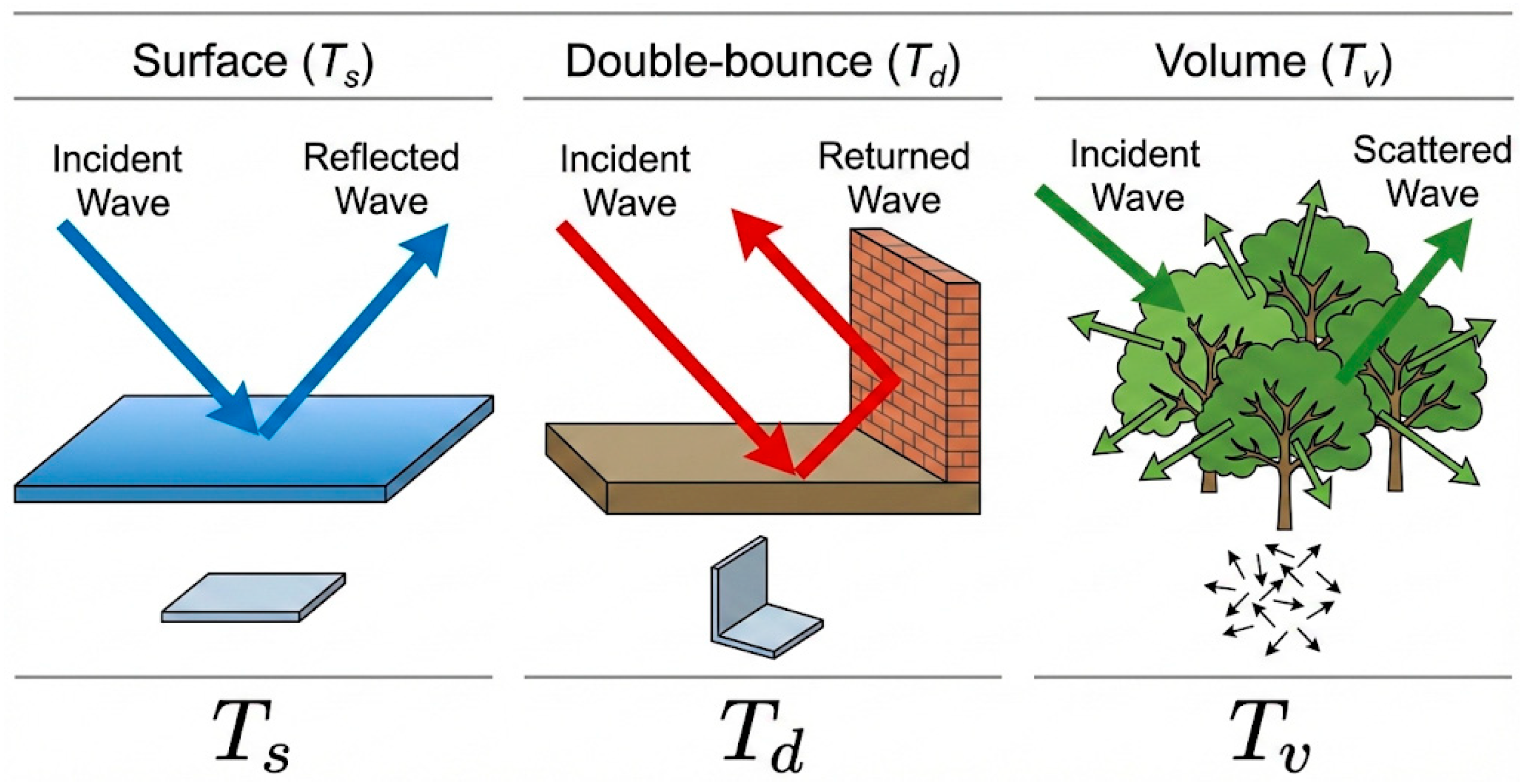
Figure 5 illustrates three basic scattering types.
Figure 6 illustrates the characteristic distributions of surface, double-bounce, and volume scattering components within this parameter space.
Conversely, geometric parameterization builds upon high-frequency electromagnetic theory, such as the Geometrical Theory of Diffraction (GTD) and Physical Optics (PO). Under this theoretical framework, the total scattering field from an electrically large complex target can be accurately approximated as the coherent superposition of a finite number of discrete, localized scattering centers. The Attribute Scattering Center (ASC) model mathematically characterizes the frequency
and azimuth
response of the
-th individual scattering center as:
In this formulation, constitutes a comprehensive parameter set characterizing the local micro-geometry of the scatterer. It includes amplitude , two-dimensional spatial position , frequency dependence factor (which relates to the curvature type of the scattering structure), physical length , dominant scattering direction , and local geometric dependencies.
This geometric parameterization model establishes a direct mathematical mapping between radar signal measurements and target microstructure. It moves beyond treating the target as a point source with a single Radar Cross Section (RCS) value and instead models it as a spatially distributed constellation of physical features. This provides a rigorous mathematical foundation for physics-based fine-grained identification and detection, allowing algorithms to discriminate targets based on the spatial arrangement and specific attributes of their component scattering centers.
4.2. Algorithm Evolution and Implementation
4.2.1. Scattering Difference Enhancement
Scattering characteristics-constrained SAR target detection methods primarily discriminate targets from background based on electromagnetic scattering property disparities. Natural and artificial targets exhibit distinct scattering signatures in polarimetric SAR data. For instance, sea clutter typically exhibits random scattering behavior, whereas ship hulls demonstrate pronounced surface or double-bounce scattering characteristics. This distinction can be quantitatively characterized through cross-polarization components of the polarimetric coherence matrix. The fundamental concept involves contrast enhancement to amplify polarimetric feature differences between targets and background, thereby improving signal-to-noise ratio.
Pan et al. [
26] introduced this methodology in their SAR ship detection research, explicitly generating scattering difference maps to highlight target signals through polarimetric coherence matrix differential processing
, where
represents the polarimetric coherence matrix. Liu et al. [
27] amplified ship-sea surface scattering differences in polarimetric parameters (
,
) by constructing a specialized detector
, achieving target detection via sliding window and Two-Parameter CFAR (TP-CFAR) processing without complex clutter modeling.
Furthermore, Aghababaei et al. [
28] incorporated transmit–receive polarization optimization into their detection framework by extending the Generalized Likelihood Ratio Test (GLRT). This approach determines scatterer presence through polarization basis-optimized eigenvalue ratio maximization, further discriminating between single and multiple scatterer structures. Experimental results demonstrate that compared to conventional fully polarimetric detection, this strategy significantly enhances weak scatterer detection probability at equivalent false alarm rates, effectively increasing Permanent Scatterer (PS) extraction density. The method successfully identifies weaker scatterers undetectable by traditional approaches.
Although polarimetric coherence difference-based methods reduce prior model dependency through direct scattering mechanism quantification, their performance remains constrained by speckle noise and inter-channel interference in low signal-to-noise ratio scenarios. Additionally, polarimetric difference accuracy depends on high-quality fully polarimetric data, leading to performance degradation in partially polarized systems.
4.2.2. Scattering Center Extraction
Scattering centers, as localized electromagnetic wave scattering sources, directly reflect target structural characteristics through spatial distribution and attributes, offering superior physical interpretability compared to traditional grayscale features [
29]. The ASC model characterizes local target geometry through parameters including position, scattering type, and frequency dependence [
30], enabling offline construction of 3D scattering center databases and significantly reducing data requirements.
Building upon the ASC model, Chen et al. [
31] developed a sequential optimization approach for ASC parameter estimation. First, the Orthogonal Matching Pursuit (OMP) algorithm extracts scattering center location parameters
to reduce computational complexity. Subsequently, geometric parameters are estimated based on determined locations. Finally, frequency dependence parameters
are derived using phase characteristics. This sequential strategy avoids estimation errors inherent in traditional simultaneous parameter optimization methods, enabling more accurate scattering center extraction for complex targets.
4.2.3. Physical Model Embedded in Deep Networks
Recent research has successfully integrated SAR physical scattering models with deep learning by utilizing target scattering center parameters to drive the feature learning and decision-making processes of neural networks. This integration typically operates by employing the discrete and sparse nature of scattering centers to guide the network in identifying stable geometric structures amidst speckle noise.
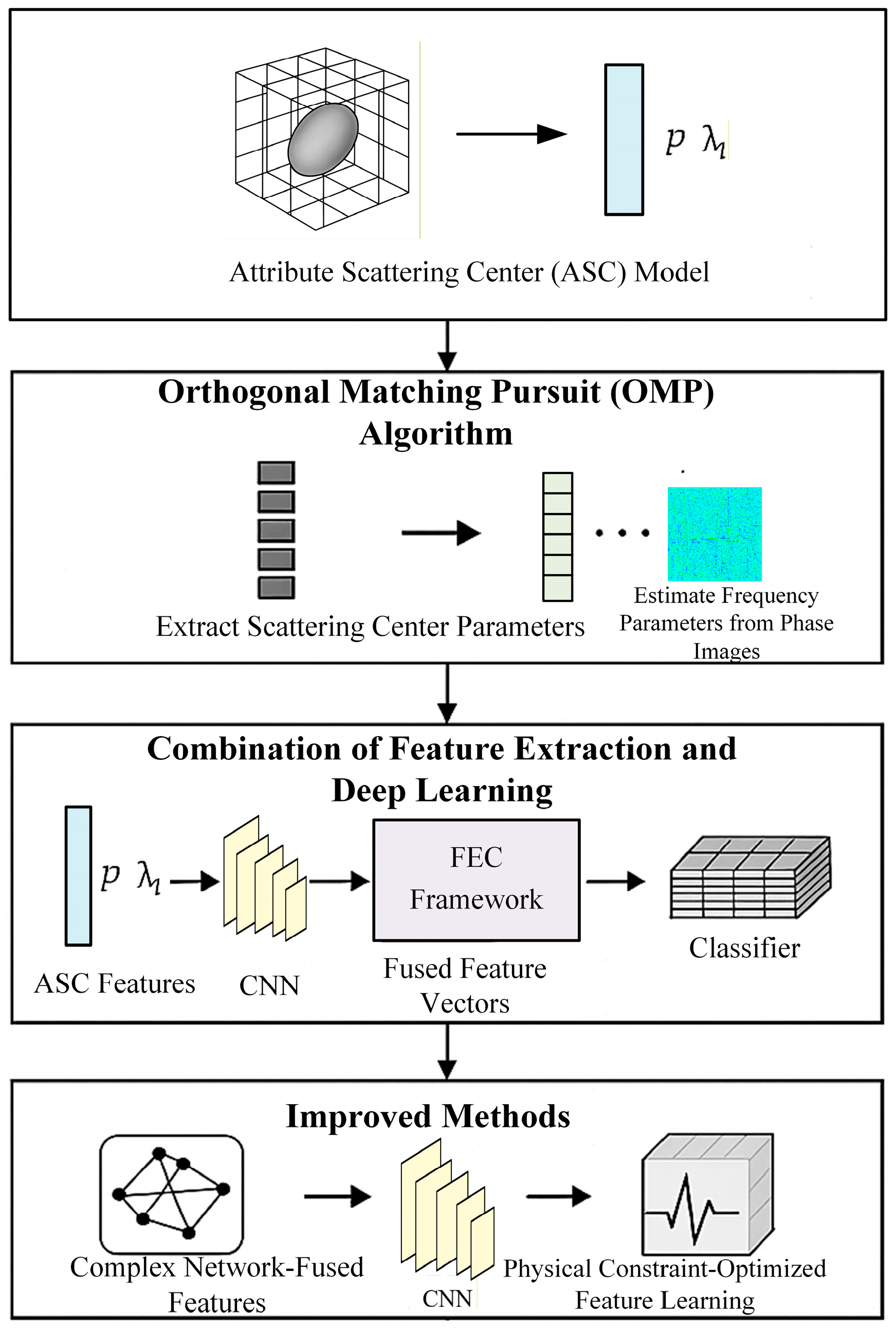
Figure 7 illustrates a typical framework for this methodology, delineating the workflow from raw radar echoes to scattering center extraction and subsequent feature fusion within the neural architecture. For instance the Feature Enhancement and Concatenation framework proposed by Zhang et al. [
32] converts Attributed Scattering Center parameters into feature vectors and concatenates them with CNN-extracted deep features. In this architecture the explicit geometric information provided by scattering centers compensates for the loss of high-frequency structural details in deep convolutional layers thereby driving the classifier to maintain robustness in complex operating conditions.
To address the limitation of geometric information degradation in feature vectorization Zhang et al. [
33] developed a complex-valued network architecture that directly fuses two-dimensional spatial features of scattering centers with CNN features at the feature map level. This approach preserves the precise positional topology of scattering centers and utilizes their spatial distribution to constrain the visual attention of the network to target-like regions. This deep integration strategy allows the deterministic laws of electromagnetic scattering to actively correct the data-driven bias of neural networks significantly improving recognition accuracy on the MSTAR dataset. To systematically review the developmental trajectory of these algorithms,
Table 5 summarizes the key evolutionary nodes, core principles, as well as the advantages and limitations of the representative methods discussed above.
Despite significant progress in scattering-based methodologies, current research continues to face challenges including physical characteristic adaptation to specific mission scenarios and accurate parameter estimation for complex targets. A crucial future research direction involves deep integration of multi-source, multiscale scattering features. This ensemble learning strategy promises enhanced model generalization capabilities while maintaining physical interpretability foundations.
4.3. Application Scenarios and Comparative Analysis
Methods based on scattering characteristics demonstrate superior performance in MSTAR vehicle recognition and fine-grained ship classification tasks. Compared to conventional CNNs relying exclusively on pixel intensity, the integration of ASC modeling enables maintained high recognition accuracy under low signal-to-noise conditions while acquiring target component inference capability. Quantitative evidence supporting these observations is presented in
Table 6, which contrasts the performance metrics of physics-constrained methods against baseline approaches, highlighting improvements in Signal-to-Clutter Ratio (SCR) and recognition accuracy. This evidence indicates that incorporating geometric-physical priors into network architectures represents a crucial pathway for enhancing interpretability in SAR target detection systems.
5. SAR Target Detection Method Based on Signal Domain Constraints
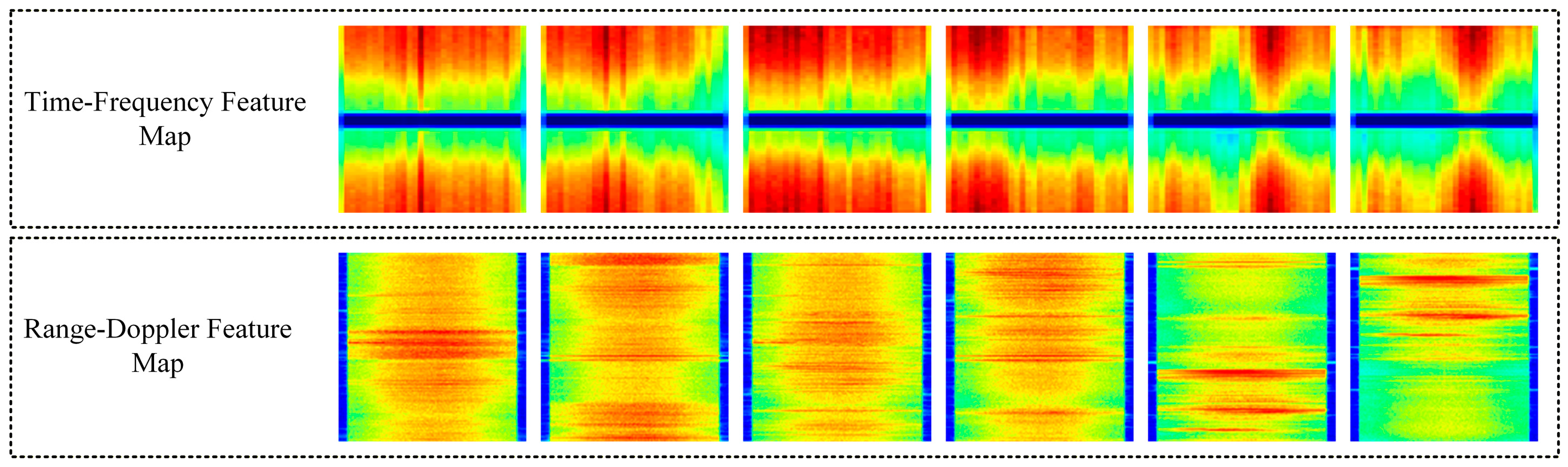
Signal domain characteristics capture the coherent nature and dynamic evolution of Synthetic Aperture Radar data. SAR imaging is fundamentally a computational process based on signal processing, and the final amplitude image often involves a loss of critical phase information and time-frequency history. The rationale for integrating signal domain constraints is to recover and utilize the dynamic physical information that is attenuated or aliased in the image domain. As illustrated in
Figure 8, features in the time-frequency domain and range–Doppler domain reveal the spectral properties and micro-motion signatures of the target. Features in the time-frequency domain and range–Doppler domain reveal the spectral properties and micro-motion signatures of the target. These dynamic features are essential for detecting non-stationary targets and distinguishing moving vessels from sea clutter. By analyzing the raw echo data or complex-valued signals, detection methods can exploit differences in Doppler modulation rates and spectral energy distribution, thereby addressing challenges such as motion-induced defocusing and signal occlusion that traditional image-based methods fail to resolve.
5.1. Signal Domain Constraints and Mathematical Formulation
5.1.1. Time-Frequency Characteristics
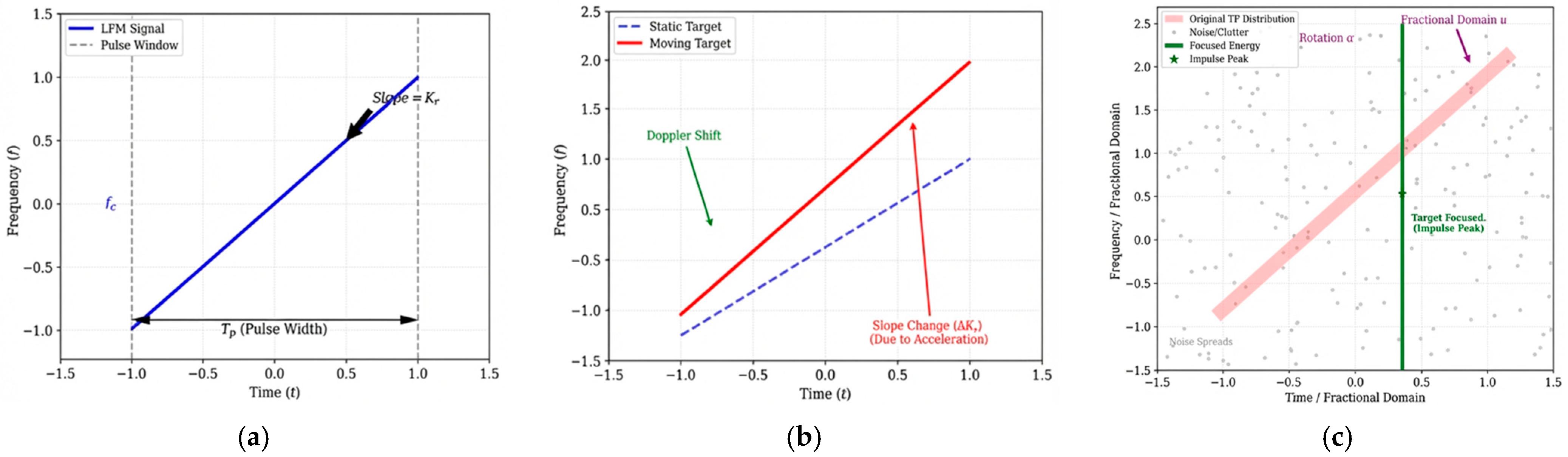
SAR transmitters typically employ Linear Frequency Modulated (LFM) pulses characterized by linear frequency variation over time. Stationary target echoes preserve the transmitter’s frequency modulation characteristics, whereas moving targets exhibit Doppler center frequency shifts and frequency modulation rate variations induced by radial velocity and acceleration. The mathematical representation of SAR echo signals is expressed as:
where
denotes the carrier frequency and
represents the modulation rate. To capture local dynamics of non-stationary signals, the Fractional Fourier Transform (FRFT) serves as a primary analytical tool. The FRFT provides a linear signal representation after
-rotation in the time-frequency plane, with its
-th order transform defined as:
where
is the transformation kernel function. When the rotation angle
aligns orthogonally to the target echo’s frequency modulation slope, the signal demonstrates impulse-like energy concentration in the fractional Fourier domain, while Gaussian white noise and clutter maintain uniform distributions. This LFM-matched physical constraint establishes time-frequency analysis as a powerful methodology for moving target signal extraction in noisy environments.
Figure 9 illustrates the time-frequency characteristics of LFM signals in the SAR system, as well as the focusing analysis of FRFT on moving target signals, (a) Illustrates the time-frequency distribution of the linear frequency modulated (LFM) transmitted signal, highlighting its linear frequency variation trend (slope = modulation rate
) and pulse width
; (b) Compares the time-frequency characteristics of static and moving target echoes, where the moving target exhibits Doppler center frequency shift and modulation rate change induced by radial velocity/acceleration; (c) Demonstrates the focusing effect of the Fractional Fourier Transform (FRFT), after rotating the time-frequency plane by angle
, the moving target signal is concentrated into an impulse-like peak, while Gaussian white noise and clutter maintain a uniform distribution.
5.1.2. Range–Doppler Characteristics
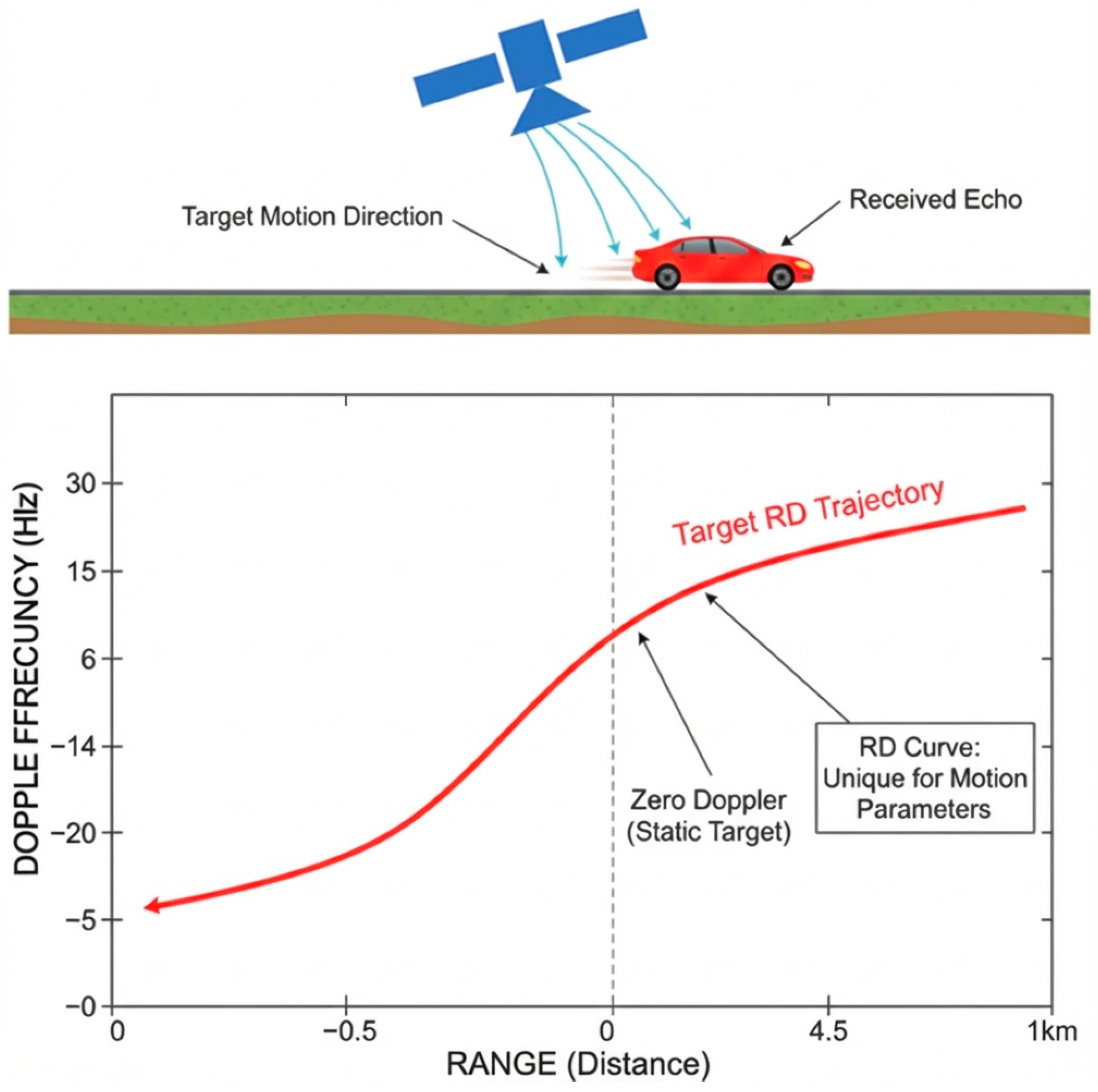
The Range–Doppler (RD) domain characterizes target delay in range direction and Doppler shift in azimuth direction. Relative motion between SAR platform and target induces Doppler effects, with the relationship between instantaneous Doppler frequency
and azimuth time
determined by target radial velocity
:
where
represents the radar wavelength,
represents instantaneous slant range,
denotes the initial slant range and
denotes platform velocity. Stationary clutter typically exhibits Doppler spectrum centers near zero frequency, while moving targets demonstrate significant spectral center shifts due to radial velocity.
Figure 10 demonstrates how these target range migration trajectories form characteristic curves in the RD domain and illustrates the associated imaging mechanisms. By exploiting these spectral separation characteristics and trajectory patterns, moving target detection and parameter estimation can be accomplished prior to image formation, fundamentally circumventing energy loss from azimuth defocusing.
5.2. Algorithm Evolution and Implementation
5.2.1. Time-Frequency Analysis and Transform Domain Methods
Time-frequency characteristics serve as a critical physical constraint for discriminating non-stationary targets from stationary clutter, driving the evolution of detection algorithms from static intensity thresholding to dynamic spectral analysis. The fundamental physical mechanism guiding these methods is that man-made moving targets induce specific, deterministic modulations in the signal phase history, such as chirp rate variations and Doppler centroid shifts, whereas clutter typically manifests as random, wide-sense stationary noise. Algorithms in this category explicitly model these dynamic signatures to separate targets in the joint time-frequency domain.
For instance, High-Resolution Range Profile (HRRP) sequences capture the temporal evolution of scatterer energy distribution but are highly sensitive to aspect angle variations. To overcome this, Zhang et al. [
34] constructed a physics-driven feature extraction framework integrating Adaptive Gaussian Representation (AGR) with Non-negative Matrix Factorization (NMF). By transforming raw HRRP sequences into time-frequency matrices, the AGR mechanism explicitly maps the scattering centers’ transient energy fluctuations onto a high-dimensional manifold. NMF then decomposes this manifold into basis vectors that represent stable spectral properties and temporal dynamic patterns. This process forces the subsequent Hidden Markov Models (HMMs) to learn state transitions governed by the target’s physical pose evolution rather than arbitrary statistical textures, achieving 95.62% accuracy on the MSTAR dataset.
Furthermore, Fractional Fourier Transform (FRFT) methods exploit the chirp-stationarity of radar signals. Since SAR echoes from moving targets can be modeled as LFM signals with unknown modulation rates, they typically appear defocused or smeared in the conventional Fourier domain. The FRFT drives target detection by rotating the time-frequency plane by an optimal angle
, which aligns with the target’s specific frequency modulation slope [
35]. At this optimal angle, the dispersed target energy converges into a compact impulse function, while clutter energy remains uniformly distributed. For LFM signals, FRFT achieves optimal energy concentration in specific fractional domains, thereby simplifying signal analysis and parameter estimation [
36].
In SAR target detection, FRFT primarily facilitates moving target detection. SAR-received moving target echoes typically approximate LFM signals. FRFT processing of SAR echoes achieves high energy concentration in optimal fractional domains, effectively detecting and extracting moving target signals. Simultaneously, FRFT fundamentally avoids cross-term interference inherent in conventional time-frequency analysis methods. Through fractional-domain filtering, it enables multi-moving-target detection and parameter estimation, ultimately achieving high-precision SAR target identification [
37,
38].
The AGR + NMF and FRFT frameworks represent distinct technical approaches. The AGR+NMF methodology primarily processes HRRP sequence data, extracting attitude-invariant features through time-frequency analysis. Its advantage lies in capturing dynamic evolution of target scattering centers during attitude variations, though it exhibits sensitivity to target motion and involves substantial computational complexity. Conversely, the FRFT approach directly processes raw echo signals, making it particularly suitable for detecting moving targets with LFM characteristics. It offers superior computational efficiency while effectively avoiding fractional-domain cross-term interference, demonstrating robust performance for both uniformly moving and accelerating targets.
Time-frequency characteristics emerge as a critical dimension for SAR target detection by revealing target–clutter differences in frequency modulation, temporal dynamics, and energy distribution. Particularly in moving target detection and complex scenarios, time-frequency domain methods effectively mitigate coherent speckle noise and geometric distortion effects, achieving enhanced performance. To illustrate the tangible benefits of these constraints,
Table 7 provides a quantitative performance comparison between baseline approaches and physics-driven time-frequency methods, emphasizing improvements in recognition accuracy and computational efficiency.
5.2.2. Range–Doppler Domain Processing
The RD domain provides a direct observational space for analyzing target motion dynamics before image formation. The physical mechanism driving detection in this domain is the decoupling of spatial position and velocity information. Target radial velocity induces a deterministic linear shift in the Doppler spectrum, while cross-range motion generates characteristic range migration trajectories. Unlike image-based methods that treat motion-induced defocusing as an artifact to be corrected, RD-domain algorithms utilize these spectral shifts and trajectory curvatures as primary discriminatory features.
Single-channel approaches, such as the method proposed by Yu et al. [
39], capitalize on the fact that moving targets often exceed the Doppler bandwidth allocated for stationary scene imaging. By extending the processing window to the full Pulse Repetition Frequency (PRF) range, this method detects spectral energy that has spilled over into the clutter-free region due to high radial velocities. This mechanism effectively converts the detection problem into a spectral anomaly search, reducing false alarms by 20% compared to image-domain CFAR.
In multi-channel systems, the physical correlation between channels drives clutter suppression. Joshi et al. [
40] utilized the interferometric phase differences inherent in multi-channel data to distinguish surface vessels from ionospheric clutter. Here, the algorithm exploits the deterministic phase relationship imposed by the target’s non-zero Doppler centroid, allowing for the precise isolation of moving targets even when their spectral signatures overlap with strong stationary clutter. Lu et al. [
41] directly extracted target features from raw echoes to enable non-imaging mode detection, maintaining over 90% detection probability. Similarly, Lan-ling et al. [
42] addressed weak target detection by leveraging the inter-frame coherence of target signals versus the incoherence of noise. By integrating signals along physically predicted motion trajectories in the RD domain, the algorithm accumulates target energy coherently over time. This trajectory-matched filtering improves the SNR by approximately 6 dB, enabling the detection of dim targets that are statistically indistinguishable in single-frame images.
Moreover, Shen et al. [
43] derived analytic functions describing the unique morphological curvature of target trajectories in Circular SAR (CSAR) RD data. Instead of relying on learned image features, this method fits the raw data to a physics-based trajectory model. The detection logic is thus driven by the geometric consistency between the observed signal path and the theoretical equations of motion, significantly enhancing detection confidence in high-noise environments.
In summary, detection strategies across different system architectures exhibit substantial variations. Single-channel systems primarily rely on time-frequency analysis tools (e.g., Wigner–Ville distributions) for target signal separation in the range–Doppler domain, achieving detection through Doppler shift and range migration modeling of moving targets. Multi-channel systems effectively suppress sea clutter via spatial filtering techniques, significantly enhancing signal-to-noise ratios. Non-imaging methods enable rapid response through direct raw echo processing while reducing computational complexity.
Table 8 systematically compares the core characteristics of each approach. Building on this methodological categorization,
Table 9 further details the quantitative performance gains achieved by integrating range–Doppler constraints. This comparison highlights specific improvements in detection probability and clutter suppression capabilities relative to traditional image-domain baselines.
5.3. Application Scenarios and Comparative Analysis
Signal-domain constrained detection methods demonstrate particular efficacy for weak target detection and Ground Moving Target Indication/Maritime Moving Target Indication (GMTI/MMTI) under high sea-state conditions. Conventional image-domain approaches fundamentally rely on amplitude-based detection assuming target stationarity. When targets exhibit motion or experience strong clutter interference, image features inevitably degrade or alias. In contrast, signal-domain methodologies offer two distinct advantages. First, they provide superior energy focusing and coherent integration capabilities. For weak targets, non-coherent averaging in the image domain struggles to suppress strongly correlated clutter, whereas signal-domain processing achieves significantly higher SNR gains through coherent integration utilizing target echo phase history. Second, they enable effective spectral separation mechanisms. While velocity-induced phase errors manifest as destructive azimuth blurring and positional shifts in the image domain, these effects transform into predictable Doppler shifts in the RD domain, becoming crucial discriminative features for moving target identification.
Table 10 offers a consolidated overview of these signal-domain constraints, summarizing the representative methods, core principles, and the specific operational trade-offs associated with each category.
Despite substantial progress, current signal-domain detection still confronts challenges in detecting weak targets amid high-dynamic motion blur and strong interference. Future research should explore deep integration between SAR signal-domain physical models and neural network architectures to develop motion feature extraction frameworks combining physical interpretability with adaptive learning capabilities. Concurrently, optimizing multi-channel data processing workflows represents a critical direction for meeting real-time detection requirements in complex operational scenarios.
6. SAR Target Detection Methods Under Resolution Constraints
Resolution constraints define the fundamental observational limit and the spatial scale of target representation in SAR imagery. The rationale for considering resolution as a critical physical constraint stems from the direct dependency of target scattering topology on the system bandwidth. Variations in resolution lead to significant changes in the visual manifestation of targets, causing discrete scattering centers to merge or distinct geometric structures to degrade into isotropic blobs. This scale-dependent phenomenon challenges the generalization capability of detection models across different platforms and operating modes. By explicitly modeling the relationship between system impulse response and target reflectivity, resolution-constrained methods ensure feature consistency across varying scales. This approach allows algorithms to adaptively align features from high-resolution and low-resolution domains and enables the reconstruction of fine-grained scattering details through super-resolution techniques, thereby guaranteeing detection reliability under diverse imaging conditions.
6.1. Resolution Constraints and Mathematical Formulations
From a signal processing perspective, SAR imaging systems function as finite-bandwidth bandpass filters. The system’s range resolution
and azimuth resolution
are determined by transmitted signal bandwidth
and Doppler bandwidth
, respectively:
where
represents the speed of light and
denotes platform velocity. Physical constraints manifest through the modulation effect of the system’s impulse response function on target RCS. For a target with scattering distribution
, the resulting image
constitutes the convolution of original scattering characteristics with the two-dimensional point spread function
:
Resolution variations not only alter the main lobe width of
but also affect target visual representation through coherent speckle noise
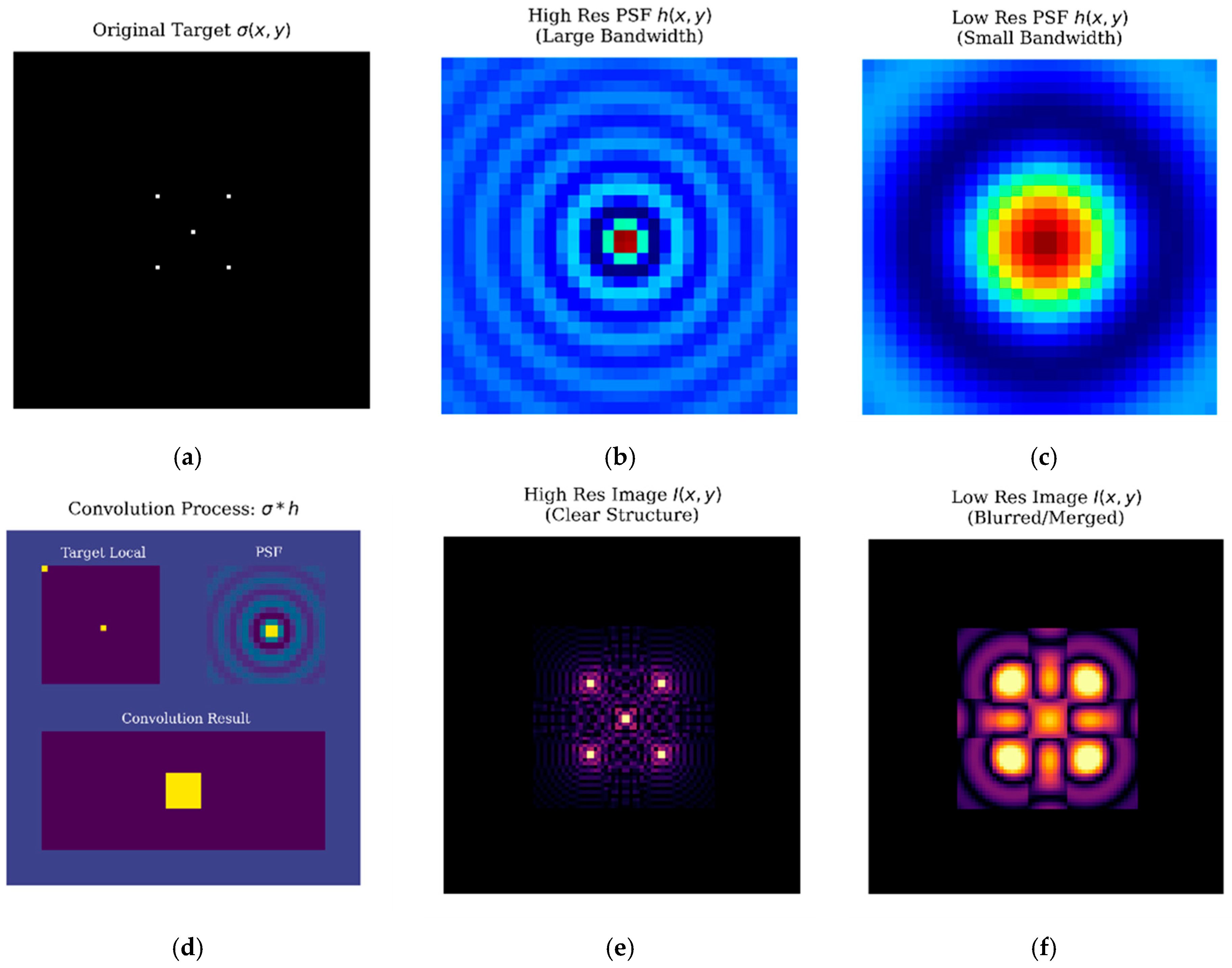
statistical properties. As resolution decreases, discrete scattering centers undergo coherent superposition and aliasing, resulting in high-frequency texture loss and target appearance as isotropic point features. Conversely, high-resolution conditions reveal clear geometric contours and component structures. This scale-dependent scattering topology evolution constitutes the fundamental physical constraint for multi-resolution target detection. As illustrated in
Figure 11, the imaging process can be modeled as a convolution between the target reflectivity
and the system’s impulse response
. Comparing
Figure 11e and
Figure 11f, it is evident that a limited bandwidth results in a broadened PSF, which causes closely spaced scatterers to merge, thereby degrading the system’s ability to resolve fine geometric details.
6.2. Algorithm Evolution and Implementation
6.2.1. Resolution Adaptation and Domain Adaptation
Feature distribution shifts induced by resolution differences present significant challenges for cross-platform SAR target detection. High-resolution imagery contains abundant texture and structural information while low-resolution data degrades into primary scattering point collections. To address single-model adaptation to multiscale inputs, resolution-adaptive methods exploit the physical stability of target scattering structures to construct feature alignment mechanisms. This approach treats the geometric topology of strong scattering centers as a physics-based feature that remains relatively invariant across resolutions compared to unstable speckle textures.
Qin et al. [
44] proposed quantifying structural similarity across resolutions using Scattering Structure Distance (SSD). This methodology employs Earth Mover’s Distance (EMD) to compute distribution differences between scattering point sets, establishing structure-aware similarity metrics. Building upon this foundation, they developed the Structure-induced Hierarchical Feature Adaptation (SHFA) module, which identifies structural anchor points through clustering and performs hierarchical feature alignment across domains based on structural similarity weights. This approach maintains target physical scattering structure consistency in feature space, avoiding structural distortion from conventional adversarial training. For meter-scale cross-resolution tasks, explicit scattering structure modeling improves recall and mAP by approximately 40% over baseline models, achieving F1-scores around 0.68 and significantly enhancing model adaptability to resolution variations.
Complementarily, Cui et al. [
45,
46] employed a Resolution Semantic Compensation Module (RSCM) to construct multivariate Gaussian distributions between source and target domain features. This simulates high-to-low frequency semantic information conversion processes, compensating for semantic loss due to resolution reduction. Essentially, this methodology reconstructs high-frequency semantic features lost through scattering center overlap in low-resolution imagery, enabling detection networks to restore key target component perception at the feature level.
Additionally, Chen et al. [
47] proposed a Multiscale Adaptive Recalibration (MSAR) module from a multiscale feature fusion perspective. By integrating self-attention features across different scales, this approach enhances model representation capability for multi-resolution targets, consequently improving detection accuracy across varying resolutions. Experimental results on the SRSD for rotated object detection demonstrate superior performance in AP@0.35 metrics compared to baseline Faster R-CNN and other domain adaptation methods. This adaptive fusion mechanism proves particularly effective in dense object scenarios, successfully resolving false detections caused by inter-object boundary blurring under low-resolution conditions.
Sun et al. proposed two complementary methods for high-resolution SAR ship detection, which is challenged by significant scale variations and arbitrary orientations. Bi-FA-YOLO [
48] introduces a Bi-directional Feature Fusion Module into the YOLO framework, aggregating multiscale features through top-down and bottom-up interaction to improve detection across large size differences. An enhanced anchor-free detector based on FCOS replaces predefined anchor boxes with pixel-by-pixel prediction, better matching diverse scattering geometries [
49]. Its Category-Position module uses semantic features from the classification branch to refine regression, boosting localization accuracy. The method also redefines sample strategies and regression targets to reduce ambiguity in dense port scenes, adapting effectively to multiscale SAR targets.
6.2.2. Super-Resolution Enhancement Algorithms
In wide-area maritime surveillance applications, the requirement for extensive coverage often necessitates low-resolution operational modes such as ScanSAR and leads to frequent missed detections of small ship targets due to feature degradation. Under these conditions, adaptive detection algorithm adjustments alone prove insufficient to compensate for inherent information loss. Super-Resolution technology must therefore be implemented to recover target high-frequency scattering characteristics at the physical level. Unlike optical image enhancement, physics-driven SAR super-resolution focuses on reconstructing the complex electromagnetic response and maintaining the phase coherence of scattering centers.
Conventional SR methodologies often employ interpolation or frequency-domain extrapolation techniques, which risk corrupting polarimetric phase information. Shen et al. [
50] developed a residual convolutional neural network super-resolution framework specifically designed for PolSAR imagery. This architecture utilizes deconvolution layers for upsampling, incorporates Parametric Rectified Linear Unit (PReLU) activation functions to preserve negative values, and implements complex-valued structural blocks accommodating PolSAR data characteristics. The fundamental innovation lies in maintaining polarimetric scattering integrity during super-resolution reconstruction. Consequently, the reconstructed high-resolution images demonstrate not only enhanced spatial detail clarity but also preserved target polarimetric scattering properties. Experimental results indicate this approach significantly improves spatial resolution while maintaining polarimetric information fidelity, achieving over 12% Peak Signal-to-Noise Ratio (PSNR) improvement compared to conventional methods. This advancement provides superior input features for subsequent detection tasks, where polarimetric information authenticity ensures detection networks base decisions on genuine scattering mechanisms rather than interpolated pseudo-texture artifacts.
Furthermore, Wang et al. [
51] introduced a Generative Adversarial Network (GAN) variant, proposing an Attention-based GAN architecture for multi-frame super-resolution. This methodology integrates spatial attention mechanisms within the generator to optimize multi-frame alignment and feature fusion processes. In detection applications, the multi-frame fusion mechanism effectively suppresses SAR coherent speckle noise while enhancing target edge definition. This directly reduces boundary regression uncertainty in detection networks, consequently improving target localization precision. Additionally, the attention module enables prioritized reconstruction of potential target regions, emphasizing high-frequency detail recovery in critical areas. This selective reconstruction strategy particularly benefits target detection in complex background environments.
From a detection performance perspective, super-resolution enhancement algorithms contribute through three primary mechanisms. First, SR reconstruction separates overlapping scattering centers, reducing both missed detections and false alarms in dense target scenarios. Second, fine texture restoration enhances target discriminative features, particularly for classification tasks relying on local structural characteristics. Third, edge sharpening improves detection network localization accuracy, especially in applications requiring precise bounding box regression. Collectively, these enhancements demonstrate that high-quality SR reconstruction provides detection networks with inputs approximating true high-resolution imagery, consequently improving performance across feature extraction, target localization, and classification stages. To synthesize these technical advancements,
Table 11 systematically compares the core principles, key advantages, and operational limitations of the representative resolution adaptation and enhancement methodologies discussed above.
6.3. Application Scenarios and Comparative Analysis
Given the inherent coverage-resolution trade-off in SAR observation missions, resolution-constrained detection methods maintain irreplaceable value in cross-platform collaborative observation and wide-area search-to-precision detection scenarios.
In cross-platform observation contexts, models trained on high-resolution airborne data typically fail to generalize directly to low-resolution satellite data. As quantified in
Table 12, baseline Faster R-CNN achieves merely 0.207 mAP in cross-resolution testing, whereas incorporating structural consistency constraints (e.g., CR-Net) elevates mAP to 0.677. This demonstrates that enforcing scale-invariant scattering structure learning through physical constraints constitutes the crucial solution to cross-domain generalization challenges.
In wide-area search scenarios, conventional feature extraction often fails for small targets embedded in low-resolution wide-swath imagery. Super-resolution reconstruction not only separates overlapping dense targets but also restores fine-scale structures essential for target classification, significantly enhancing system recognition capability without hardware modifications.
7. Comprehensive Analysis of Multi-Dimensional Physical Constraint Mechanisms
The preceding sections have independently elaborated on the detection methodologies associated with polarization, scattering, signal domain, and resolution constraints. However, in practical SAR applications, these physical attributes do not exist in isolation but rather interact to form a coupled electromagnetic information space. A systematic comparison of their applicable scenarios, complementarity, and integration potential is essential for constructing a unified and robust detection framework.
7.1. Comparative Analysis of Applicable Scenarios
The four physical constraints exhibit distinct advantages depending on the observational environment and target characteristics. Polarization constraints demonstrate superior efficacy in complex clutter suppression and weak target detection. By utilizing the vector modulation differences between man-made targets and natural backgrounds, polarimetric methods maintain high detectability in heterogeneous scenarios such as high sea states or complex terrain where intensity-based features often fail. Scattering characteristics constraints are most effective for fine-grained recognition and interpretation tasks. They rely on the geometric stability of target components, making them ideal for identifying targets with distinct topological structures, such as vehicles or ships, particularly when visual features are degraded by noise. Signal domain constraints are indispensable for non-stationary target detection. When targets exhibit motion relative to the radar platform, signal domain analysis effectively resolves issues like defocusing and azimuth displacement that severely impair image domain methods. Resolution constraints are critical in cross-platform and multiscale detection tasks. They address the variations in target representation caused by bandwidth differences, ensuring feature consistency across data acquired from different sensors or operational modes.
7.2. Complementarity and Synergistic Mechanisms
The limitation of a single physical constraint can often be mitigated by the strengths of others, creating a synergistic effect that enhances overall performance. There exists a strong complementarity between polarization and scattering characteristics. While scattering centers describe the spatial location and geometric structure of target components, polarimetric information reveals their physical scattering mechanism, such as whether a component acts as a dihedral or trihedral reflector. This combination significantly reduces false alarms caused by clutter that may spatially resemble a target but lacks the requisite polarimetric signature. Furthermore, the interaction between resolution and scattering is fundamental. High resolution capabilities allow for the precise separation of dense scattering centers, which in turn facilitates more accurate geometric parameter estimation. Conversely, scattering models can guide super-resolution reconstruction in low-resolution imagery by providing prior knowledge of point scatterer distributions. Additionally, the integration of signal domain analysis with spatial features bridges the gap between dynamic and static information. Signal domain processing focuses energy and corrects geometric distortions for moving targets, thereby recovering the spatial structural integrity required for effective scattering-based or polarization-based recognition.
7.3. Integration Potential and Fusion Strategies
The construction of a high-performance detection system requires the organic integration of these multi-dimensional constraints. Current research trends indicate a shift from simple feature concatenation toward deep physical embedding. A viable integration strategy involves using signal domain analysis as a preprocessing stage to focus target energy, followed by the joint extraction of polarimetric and scattering features to construct a physically interpretable representation vector. Resolution constraints can function as a domain adaptation mechanism to align these features across different scales. In deep learning architectures, this integration can be realized through multi-stream networks where each branch specializes in a specific physical domain, coupled with an attention mechanism to dynamically weight the contributions based on scene complexity. For instance, in a static scene with heavy clutter, the network would prioritize polarimetric and scattering branches, whereas in a moving target scenario, the signal domain branch would be accorded higher significance. This multi-view fusion approach not only improves detection accuracy but also ensures that the decision-making process of the model remains consistent with electromagnetic physical principles.
8. Summary and Outlook
The field of SAR target detection has witnessed continuous advancements in artificial intelligence, leading to the emergence of increasingly sophisticated algorithms and models. However, most existing methods primarily focus on fitting statistical patterns in imagery, often neglecting the underlying electromagnetic coherent imaging mechanisms. This limitation severely compromises their generalization capability in the presence of non-stationary clutter interference and cross-domain scene variations. Conversely, physics-driven constraints mitigate this issue by embedding fundamental scattering principles into the detection framework, thereby significantly enhancing generalization and robustness [
52,
53].
The integration of multi-dimensional physical constraints uncovers intrinsic target characteristics across different levels, yielding synergistic benefits. Polarimetric characteristics provide essential scattering mechanism information that helps distinguish artificial targets from natural backgrounds by analyzing their modulation responses to electromagnetic waves. Scattering characteristics localize scattering processes to specific geometric structures, substantially improving the physical interpretability of models. Time-frequency characteristics capture transient behaviors and micro-motion features of dynamic targets, effectively compensating for limitations in static scattering descriptions. Meanwhile, resolution characteristics ensure feature consistency across varying scales. Collectively, this multi-constraint integration framework facilitates the construction of a more universal and discriminative target representation space. Even within often opaque deep learning models, multi-dimensional physical constraints provide explicit physical explanations for decision-making, while maintaining model adaptability across diverse scenarios and operating conditions.
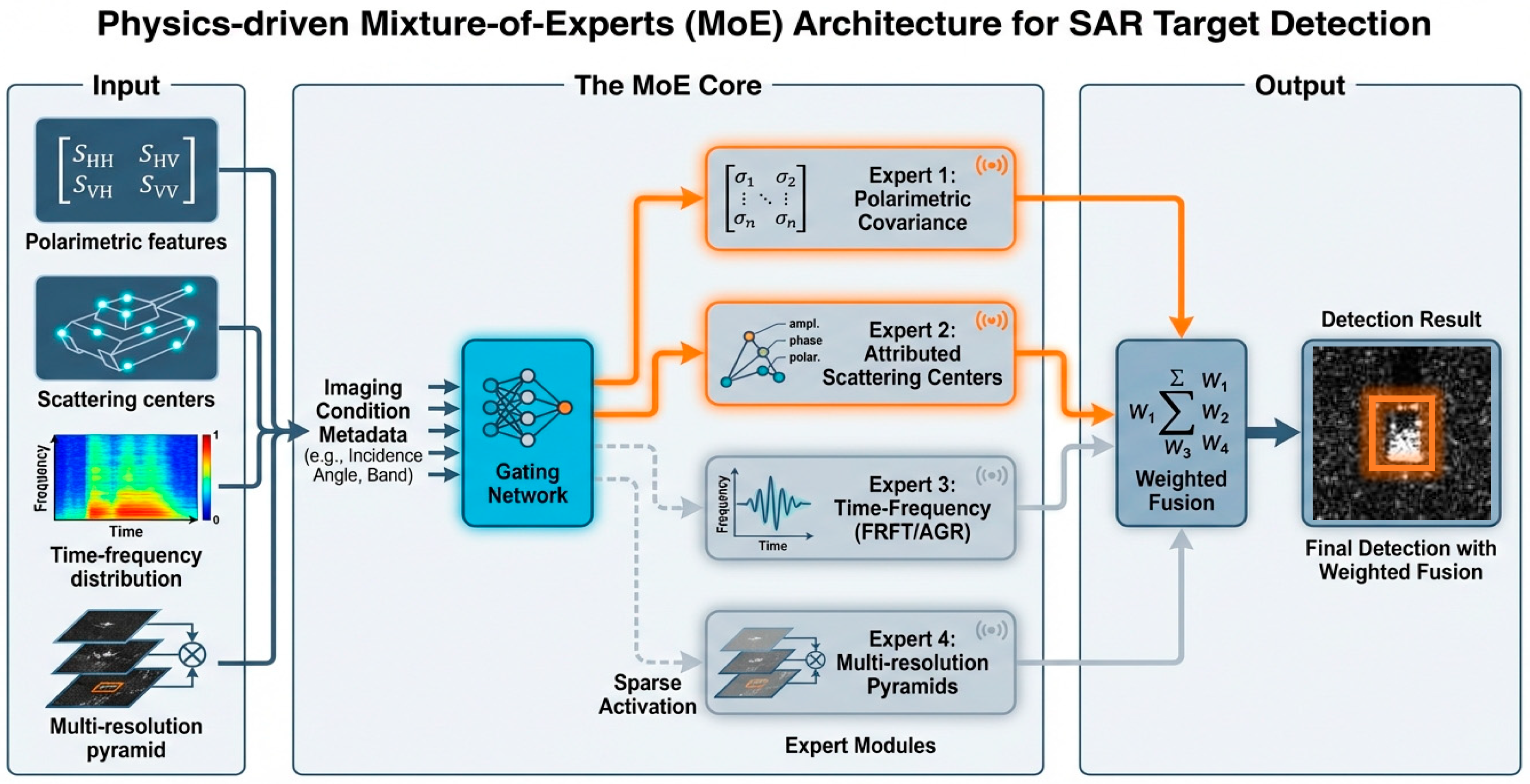
Nevertheless, current research seldom comprehensively accounts for multi-dimensional physical conditions when selecting or designing algorithms suitable for SAR target detection under varying imaging configurations. To address these challenges, the MoE architecture offers a promising solution. MoE achieves dynamic decision-making through modular design and conditional computation. Its core concept involves partitioning input data into multiple subspaces through task routing and sparse activation mechanisms, where a gating network dynamically selects the most relevant experts for processing based on input features [
54,
55]. The exploration of adaptive fusion under multiple physical constraints represents a viable research direction where MoE can be fruitfully applied. Feasibility studies can be conducted through the following steps:
Physical Feature Extraction: Extracting polarimetric, scattering, signal-domain, and multi-resolution features to construct physically interpretable feature vectors [
56].
Expert Module Design: Developing four core experts specialized in: (i) polarimetric covariance matrices and decomposition features, (ii) attributed scattering centers, (iii) time-frequency distributions (e.g., FRFT, AGR), and (iv) multi-resolution feature pyramids.
Gating Network Strategy: Designing a gating network that utilizes imaging condition metadata (e.g., resolution, band, incidence angle) for context-aware and task-specific routing.
Computational Efficiency: Investigating sparse activation mechanisms to maintain computational tractability while leveraging multiple experts.
Validation and Evaluation: Constructing comprehensive benchmarks with cross-scenario data to quantitatively evaluate the generalization and interpretability of physics-guided MoE models.
As illustrated in
Figure 12, the MoE framework balances the trade-off between generalization capability and physical interpretability by conditionally activating specialized processing units. The left panel depicts the multi-dimensional physical feature input process, where raw SAR data is converted into four distinct physical representations (polarimetric features, scattering centers, time-frequency distributions, and multi-resolution pyramids) to fully capture complementary target attributes including vector modulation, geometric topology, micro-motion dynamics, and scale-dependent scattering. The middle panel presents the MoE core module: a context-aware gating network leverages imaging condition metadata (e.g., incidence angle, resolution) to dynamically evaluate the relevance of each physical domain and generate sparse gating scores for selectively activating the most suitable expert modules. These expert modules comprise multiple parallel sub-networks, each dedicated to extracting specific physical features (e.g., polarimetric covariance, time-frequency spectra). The right panel illustrates the weighted adaptive fusion process, where outputs from the activated expert sub-networks are integrated via a weighted fusion mechanism modulated by gating scores. This ensures the final detection decision is dominated by the most reliable physical constraints under specific operating conditions; the design not only enhances the algorithm’s robustness against non-stationary clutter and cross-domain variations but also guarantees computational efficiency through the sparse activation mechanism.
In summary, the integration of deep learning with multi-dimensional physical constraints, combined with adaptive architectures like MoE, enables SAR target detection models to accommodate the diverse conditions inherent in real-world data from different sensor operational modes. This approach reduces false alarms caused by noise and interference while incorporating physical priors to alleviate the high costs of data acquisition and annotation under specific physical conditions. It also enhances engineering utility when sensor parameters or environmental conditions change, while ensuring detection results align with physical logic—thereby maintaining reliability and interpretability through adherence to physical laws. Ultimately, this strategy leads to more dependable and practical SAR target detection. It is anticipated that these developments will propel SAR image target detection toward greater success and continuous advancement in the near future.
Author Contributions
Conceptualization, X.L. (Xinyi Li) and G.W.; methodology, X.L. (Xinyi Li) and F.Z.; validation, X.L. (Xinyi Li), S.G. and G.S.; formal analysis, Z.W. and X.L. (Xiaoxuan Liu); investigation, X.L. (Xinyi Li) and F.Z.; resources, G.W.; data curation, X.L. (Xinyi Li) and S.G.; writing—original draft preparation, X.L. (Xinyi Li) and L.L.; writing—review and editing, X.L. (Xinyi Li) and L.L.; visualization, X.L. (Xinyi Li); supervision, G.W.; project administration, G.W., L.L. and F.Z.; funding acquisition, G.W. All authors have read and agreed to the published version of the manuscript.
Funding
This research received no external funding.
Data Availability Statement
No new data were created or analyzed in this study. Data sharing is not applicable to this article.
Conflicts of Interest
The authors declare no conflict of interest.
Abbreviations
The following abbreviations are used in this manuscript:
| SAR | Synthetic Aperture Radar |
| MoE | Mixture of Experts |
| FPN | Feature Pyramid Network |
| CFAR | Constant False Alarm Rate |
| CUT | Cell Under Test |
| SNR | Signal-to-noise ratio |
| CNN | Convolutional Neural Networks |
| PWF | Polarization Whitening Filter |
| OPCE | Optimal Polarization Contrast Enhancement |
| WFF | Weighted feature fusion |
| ASC | Attribute Scattering Center |
| GLRT | Generalized Likelihood Ratio Test |
| OMP | Orthogonal Matching Pursuit |
| LFM | Linear Frequency Modulated |
| FRFT | Fractional Fourier Transform |
| RD | Range–Doppler |
| HRRP | High-Resolution Range Profile |
| AGR | Adaptive Gaussian Representation |
| NMF | Non-negative Matrix Factorization |
| HMMs | Hidden Markov Models |
| GMTI/MMTI | Ground Moving Target Indication/Maritime Moving Target Indication |
| PSF | Point Spread Function |
| SSD | Scattering Structure Distance |
| EMD | Earth Mover’s Distance |
| SHFA | Structure-induced Hierarchical Feature Adaptation |
| mAP | mean Average Precision |
| RSCM | Resolution Semantic Compensation Module |
| MSAR | Multiscale Adaptive Recalibration |
| SR | Super-Resolution |
| PolSAR | Polarimetric SAR |
| PSNR | Peak Signal-to-Noise Ratio |
| GAN | Generative Adversarial Network |
References
- Li, C.; Du, L.; Li, Y.; Song, J. A Novel SAR Target Recognition Method Combining Electromagnetic Scattering Information and GCN. IEEE Geosci. Remote Sens. Lett. 2022, 19, 4508705. [Google Scholar] [CrossRef]
- Li, Y.; Du, L. Design of the Physically Interpretable Sar Target Recognition Network Combined with Electromagnetic Scattering Characteristics. In Proceedings of the IGARSS 2022—2022 IEEE International Geoscience and Remote Sensing Symposium, Kuala Lumpur, Malaysia, 17–22 July 2022; pp. 4988–4991. [Google Scholar]
- Huang, Z.; Datcu, M.; Pan, Z.; Qiu, X.; Lei, B. HDEC-TFA: An Unsupervised Learning Approach for Discovering Physical Scattering Properties of Single-Polarized SAR Image. IEEE Trans. Geosci. Remote Sens. 2021, 59, 3054–3071. [Google Scholar] [CrossRef]
- Xiong, X.; Zhang, X.; Jiang, W.; Liu, T. LDSF: Lightweight Dual-Stream Framework for SAR Target Recognition by Coupling Local Electromagnetic Scattering Features and Global Visual Features. arXiv 2025, arXiv:2403.03527. [Google Scholar] [CrossRef]
- Zhang, H.; Wang, W.; Deng, J.; Guo, Y.; Liu, S.; Zhang, J. MASFF-Net: Multiazimuth Scattering Feature Fusion Network for SAR Target Recognition. IEEE J. Sel. Top. Appl. Earth Obs. Remote Sens. 2025, 18, 19425–19440. [Google Scholar] [CrossRef]
- Ni, P.; Xu, G.; Pei, H.; Qiao, Y.; Yu, H.; Hong, W. Dual-Stream Manifold Multiscale Network for Target Recognition in Complex-Valued SAR Image With Electromagnetic Feature Fusion. IEEE Trans. Geosci. Remote Sens. 2025, 63, 5217215. [Google Scholar] [CrossRef]
- Zeng, Z.; Barros, A.; Coit, D. Dependent failure behavior modeling for risk and reliability: A systematic and critical literature review. Reliab. Eng. Syst. Saf. 2023, 239, 109515. [Google Scholar] [CrossRef]
- Huang, Q.; Zhu, W.; Li, Y.; Zhu, B.; Gao, T.; Wang, P. Survey of Target Detection Algorithms in SAR Images. In Proceedings of the 2021 IEEE 5th Advanced Information Technology, Electronic and Automation Control Conference (IAEAC), Chongqing, China, 12–14 March 2021; pp. 1756–1765. [Google Scholar] [CrossRef]
- Richards, M.A. Fundamentals of Radar Signal Processing; McGraw-Hill: New York, NY, USA, 2014. [Google Scholar]
- Cumming, I.G.; Wong, F.H. Synthetic Aperture Radar: Algorithms and Implementation; Publishing House of Electronics Industry: Beijing, China, 2005. [Google Scholar]
- Zhang, L.; Zheng, J.; Li, C.; Xu, Z.; Yang, J.; Wei, Q.; Wu, X. CCDN-DETR: A Detection Transformer Based on Constrained Contrast Denoising for Multi-Class Synthetic Aperture Radar Object Detection. Sensors 2024, 24, 1793. [Google Scholar] [CrossRef]
- Yu, L.; Wu, H.; Liu, L.; Hu, H.; Deng, Q. TWC-AWT-Net: A transformer-based method for detecting ships in noisy SAR images. Remote Sens. Lett. 2023, 14, 512–521. [Google Scholar] [CrossRef]
- Zhao, W.; Jin, M.; Wang, J. Geometric Method based Covariance Matrix Estimator with Application to Radar Target Detection. In Proceedings of the 2019 IEEE Radar Conference (RadarConf), Boston, MA, USA, 22–26 April 2019; pp. 1–6. [Google Scholar] [CrossRef]
- Wang, J.; Wang, Y.; Wu, H.; Wang, Z.; Li, J. Covariance Matrix Estimation With Kronecker Structure Constraint For Polarimetric Detection. In Proceedings of the 2023 IEEE Radar Conference (RadarConf23), San Antonia, NY, USA, 1–5 May 2023; pp. 1–6. [Google Scholar] [CrossRef]
- Bhattacharya, A.; Surendar, M. Enhanced target characterization and improved scattering power decompositions using the optimized coherency matrix from full-polarimetric SAR data. Remote Sens. Lett. 2016, 7, 1073–1082. [Google Scholar] [CrossRef]
- Wentao, A.; Changshuai, C.; Jian, Y. Manmade-target Detection Algorithm for Polarimetric SAR. J. Tsinghua Univ. (Sci. Technol.) 2010, 50, 1193–1196. [Google Scholar]
- Wang, Q.; Xu, C.; Du, H.; Liu, Y.; Liu, Y.; Fu, Y.; Li, K.; Shi, H. Research on target detection method based on attention mechanism and reinforcement learning. In International Conference on Artificial Intelligence, Virtual Reality, and Visualization (AIVRV 2022); Zhong, Y., Zhao, C., Eds.; SPIE: Bellingham, WA, USA, 2023; p. 58. [Google Scholar] [CrossRef]
- Ahmed, M.; El-Sheimy, N.; Leung, H. A Novel Detection Transformer Framework for Ship Detection in Synthetic Aperture Radar Imagery Using Advanced Feature Fusion and Polarimetric Techniques. Remote Sens. 2024, 16, 3877. [Google Scholar] [CrossRef]
- Zhang, S.; Cui, L.; Dong, Z.; An, W. A Deep Learning Classification Scheme for PolSAR Image Based on Polarimetric Features. Remote Sens. 2024, 16, 1676. [Google Scholar] [CrossRef]
- Li, H.; Liu, S.; Chen, S. PolSAR Ship Characterization and Robust Detection at Different Grazing Angles with Polarimetric Roll-Invariant Features. IEEE Trans. Geosci. Remote Sens. 2024, 62, 5225818. [Google Scholar] [CrossRef]
- Li, H.; Chen, S. General Polarimetric Correlation Pattern: A Visualization and Characterization Tool for Target Joint-Domain Scattering Mechanisms Investigation. IEEE Trans. Geosci. Remote Sens. 2025, 63, 1–19. [Google Scholar] [CrossRef]
- Li, H.; Chen, S. Polyhedral Corner Reflectors Multidomain Joint Characterization with Fully Polarimetric Radar. IEEE Trans. Antennas Propag. 2025, 73, 10679–10693. [Google Scholar] [CrossRef]
- Zhou, W.; Sun, Y.L.; Xu, C.B.; Guan, J. A Method for Discrimination of Ship Targets and Azimuth Ambiguities in Multi-Polarization SAR. J. Radars 2015, 4, 84–92. [Google Scholar] [CrossRef]
- Sun, Z.; Leng, X.; Zhang, X.; Zhou, Z.; Xiong, B.; Ji, K.; Kuang, G. Arbitrary-Direction SAR Ship Detection Method for Multiscale Imbalance. IEEE Trans. Geosci. Remote Sens. 2025, 63, 5208921. [Google Scholar] [CrossRef]
- Goodfellow, I.; Bengio, Y.; Courville, A. Deep Learning. Das Umfassende Handbuch: Grundlagen, Aktuelle Verfahren und Algorithmen, neue Forschungsansätze; MITP-Verlags GmbH & Co. KG: Frechen, Germany, 2018. [Google Scholar]
- Pan, X.; Liao, G.; Yang, Z. PolSAR ship detection based on the contrast enhancement of polarimetric scattering differences. Int. J. Remote Sens. 2019, 40, 7071–7083. [Google Scholar] [CrossRef]
- Liu, G.; Zhang, X.; Meng, J. A Small Ship Target Detection Method Based on Polarimetric SAR. Remote Sens. 2019, 11, 2938. [Google Scholar] [CrossRef]
- Aghababaei, H.; Ferraioli, G.; Stein, A.; Déniz, L.G. Polarization Optimization for the Detection of Multiple Persistent Scatterers Using SAR Tomography. Remote Sens. 2022, 14, 1960. [Google Scholar] [CrossRef]
- Liao, L.; Du, L. Physics-Driven Interpretable SAR Target Recognition Network Based on Scattering Center Feature Extraction. In Proceedings of the IGARSS 2024—2024 IEEE International Geoscience and Remote Sensing Symposium, Athens, Greece, 7–12 July 2024; pp. 9412–9415. [Google Scholar] [CrossRef]
- Ding, B.; Wen, G.; Huang, X.; Ma, C.; Yang, X. Target Recognition in Synthetic Aperture Radar Images via Matching of Attributed Scattering Centers. IEEE J. Sel. Top. Appl. Earth Obs. Remote Sens. 2017, 10, 3334–3347. [Google Scholar] [CrossRef]
- Chen, Y.; Zhang, L.; Zou, B.; Qin, J.; Qiu, Y. A Hierarchical Attribute Scattering Center Extraction Method for SAR Image. In Proceedings of the IGARSS 2024—2024 IEEE International Geoscience and Remote Sensing Symposium, Athens, Greece, 7–12 July 2024; pp. 10620–10624. [Google Scholar] [CrossRef]
- Zhang, J.; Xing, M.; Xie, Y. FEC: A Feature Fusion Framework for SAR Target Recognition Based on Electromagnetic Scattering Features and Deep CNN Features. IEEE Trans. Geosci. Remote Sens. 2021, 59, 2174–2187. [Google Scholar] [CrossRef]
- Zhang, J.; Xing, M.; Sun, G.-C.; Bao, Z. Integrating the Reconstructed Scattering Center Feature Maps With Deep CNN Feature Maps for Automatic SAR Target Recognition. IEEE Geosci. Remote Sens. Lett. 2022, 19, 4009605. [Google Scholar] [CrossRef]
- Zhang, X.; Liu, Z.; Liu, S.; Li, G. Time-Frequency Feature Extraction of HRRP Using AGR and NMF for SAR ATR. J. Electr. Comput. Eng. 2015, 2015, 1–10. [Google Scholar] [CrossRef]
- Deguang, X.; Xianda, Z. Radar Target Recognition Based on Fractional Fourier Transform. J. Tsinghua Univ. (Sci. Technol.) 2010, 50, 1197–1200. [Google Scholar]
- Guo, Y.; Yang, L.-D. LFM signal optimization time-fractional-frequency analysis: Principles, method and application. Digit. Signal Process. 2022, 126, 103505. [Google Scholar] [CrossRef]
- Yanping, L.; Mengdao, X.; Zheng, B. SAR Multiple Moving Targets Detection and Parameter Estimation Based on Filtering in Fractional Fourier Domain. Telem. Telecontrol 2005, 26, 1–5. [Google Scholar]
- Zhang, M.; Diao, M.; Gao, L.; Liu, L. Neural Networks for Radar Waveform Recognition. Symmetry 2017, 9, 75. [Google Scholar] [CrossRef]
- Yu, Z.; Jia, X.; Yingning, P.; Xiutan, W. Extended Hybrid Integration for SAR Moving Target Detection in Range-Doppler Domains. J. Tsinghua Univ. (Sci. Technol.) 2010, 50, 1201–1204. [Google Scholar]
- Joshi, S.K.; Baumgartner, S.V.; da Silva, A.B.C.; Krieger, G. Range-Doppler Based CFAR Ship Detection with Automatic Training Data Selection. Remote Sens. 2019, 11, 1270. [Google Scholar] [CrossRef]
- Lu, L.; Wang, R.; Li, W. A target detection method in range-Doppler domain from SAR echo data. In Proceedings of the 16th International Conference on Pattern Recognition, Quebec City, QC, Canada, 11–15 August 2002; Volume 1, pp. 91–94. [Google Scholar] [CrossRef]
- Lan-ling, W.; Xiao-ling, Z. New Inter-Frame Accumulation Method in Range-Doppler Domain for Dim Target Detection. J. Aer. Ordn. 2010, 3, 12–16. [Google Scholar]
- Shen, W.; Wang, Y.; Lin, Y.; Li, Y.; Jiang, W.; Hong, W. Range-Doppler Based Moving Target Image Trace Analysis Method in Circular SAR. Remote Sens. 2023, 15, 2073. [Google Scholar] [CrossRef]
- Qin, J.; Zou, B.; Li, H.; Zhang, L. Cross-Resolution SAR Target Detection Using Structural Hierarchy Adaptation and Reliable Adjacency Alignment (Version 1). arXiv 2025, arXiv:2507.08290. [Google Scholar] [CrossRef]
- Cui, Z.; Tang, K.; Zhou, Z.; Yang, Z.; Mou, L.; Cao, Z.; Yang, J. Feature aggregation and compensation-based domain adaptation framework for cross-resolution target recognition in sar imagery. IEEE Trans. Geosci. Remote Sens. 2024, 62, 5214416. [Google Scholar] [CrossRef]
- Tang, K.; Cui, Z.; Zhou, Z.; Gan, Q.; Cao, Z. A Transformer-Based Cross-Resolution Target Recognition Method for SAR Images Based on Feature Alignment and Aggregation. In Proceedings of the IGARSS 2024—2024 IEEE International Geoscience and Remote Sensing Symposium, Athens, Greece, 7–12 July 2024; pp. 10350–10353. [Google Scholar] [CrossRef]
- Chen, C.; He, C.; Hu, C.; Pei, H.; Jiao, L. MSARN: A Deep Neural Network Based on an Adaptive Recalibration Mechanism for Multiscale and Arbitrary-Oriented SAR Ship Detection. IEEE Access. 2019, 7, 159262–159283. [Google Scholar] [CrossRef]
- Sun, Z.; Leng, X.; Lei, Y.; Xiong, B.; Ji, K.; Kuang, G. BiFA-YOLO: A Novel YOLO-Based Method for Arbitrary-Oriented Ship Detection in High-Resolution SAR Images. Remote Sens. 2021, 13, 4209. [Google Scholar] [CrossRef]
- Sun, Z.; Dai, M.; Leng, X.; Lei, Y.; Xiong, B.; Ji, K. An Anchor-Free Detection Method for Ship Targets in High-Resolution SAR Images. IEEE J. Sel. Top. Appl. Earth Obs. Remote Sens. 2021, 14, 7799–7816. [Google Scholar] [CrossRef]
- Shen, H.; Lin, L.; Li, J.; Yuan, Q.; Zhao, L. A residual convolutional neural network for polarimetric SAR image super-resolution. ISPRS J. Photogramm. Remote Sens. 2020, 161, 90–108. [Google Scholar] [CrossRef]
- Wang, P.; Sertel, E. Multi-frame super-resolution of remote sensing images using attention-based GAN models. Knowl.-Based Syst. 2023, 266, 110387. [Google Scholar] [CrossRef]
- Huang, Z.; Wu, C.; Yao, X.; Zhao, Z.; Huang, X.; Han, J. Physics inspired hybrid attention for SAR target recognition. ISPRS J. Photogramm. Remote Sens. 2024, 207, 164–174. [Google Scholar] [CrossRef]
- Liu, Z.; Wang, L.; Wen, Z.; Li, K.; Pan, Q. Multilevel Scattering Center and Deep Feature Fusion Learning Framework for SAR Target Recognition. IEEE Trans. Geosci. Remote Sens. 2022, 60, 5227914. [Google Scholar] [CrossRef]
- Daruvuri, V. Understanding Mixture of Experts (MoE): A Deep Dive into Scalable AI Architecture. Int. J. Sci. Res. Comput. Sci. Eng. Inf. Technol. 2025, 11, 1544–1552. [Google Scholar] [CrossRef]
- Gan, W.; Ning, Z.; Qi, Z.; Yu, P. Mixture of Experts (MoE): A Big Data Perspective. arXiv 2025, arXiv:2501.16352. [Google Scholar] [CrossRef]
- Deng, J.; Wang, W.; Zhang, H.; Zhang, T.; Zhang, J. PolSAR Ship Detection Based on Superpixel-Level Contrast Enhancement. IEEE Geosci. Remote Sens. Lett. 2024, 21, 4008805. [Google Scholar] [CrossRef]
Figure 1.
Multi-dimensional Challenges of Physical Constraints in SAR Target Detection.
Figure 1.
Multi-dimensional Challenges of Physical Constraints in SAR Target Detection.
Figure 2.
Evolution of Physics-Driven SAR Target Detection.
Figure 2.
Evolution of Physics-Driven SAR Target Detection.
Figure 3.
Schematic representation of polarimetric SAR formulation. (a) Data Acquisition & Scattering Matrix . (b) Coherence Matrix & Physical Mechanisms. (c) Foundation for Target Detection.
Figure 3.
Schematic representation of polarimetric SAR formulation. (a) Data Acquisition & Scattering Matrix . (b) Coherence Matrix & Physical Mechanisms. (c) Foundation for Target Detection.
Figure 4.
Flow Chart of the CFAR Detection Algorithm.
Figure 4.
Flow Chart of the CFAR Detection Algorithm.
Figure 5.
Physical Scattering Models.
Figure 5.
Physical Scattering Models.
Figure 6.
Cloude–Pottier Decomposition: Classification Plane.
Figure 6.
Cloude–Pottier Decomposition: Classification Plane.
Figure 7.
SAR Target Detection Method Based on Scatter Center Characteristics.
Figure 7.
SAR Target Detection Method Based on Scatter Center Characteristics.
Figure 8.
Example Visualization of Time-Frequency Features and Range–Doppler Features.
Figure 8.
Example Visualization of Time-Frequency Features and Range–Doppler Features.
Figure 9.
Time-frequency characteristics of LFM signals and FRFT focusing analysis for SAR echo processing. (a) Time-Frequency Characteristics of LFM Transmitted Signal. (b) Time-Frequency Difference Comparison of Static/Moving Target Echoes. (c) Rotation and Focusing Effect Demonstration of FRFT.
Figure 9.
Time-frequency characteristics of LFM signals and FRFT focusing analysis for SAR echo processing. (a) Time-Frequency Characteristics of LFM Transmitted Signal. (b) Time-Frequency Difference Comparison of Static/Moving Target Echoes. (c) Rotation and Focusing Effect Demonstration of FRFT.
Figure 10.
Application of Range–Doppler Characteristics in SAR Imaging.
Figure 10.
Application of Range–Doppler Characteristics in SAR Imaging.
Figure 11.
Visualization of the SAR imaging convolution model and the impact of bandwidth on resolution. (a) The ideal discrete target scene consisting of five point scatterers representing a geometric structure. (b) The high-resolution Point Spread Function (PSF) , corresponding to a large signal bandwidth, characterized by a narrow main lobe. (c) The low-resolution PSF, corresponding to a small signal bandwidth, exhibiting a significantly wider main lobe. (d) Schematic illustration of the linear convolution process, where the output image is formed by convolving the target reflectivity with the system’s PSF (). (e) The resulting high-resolution image . The sharp PSF allows for the distinct separation of adjacent scatterers, preserving the geometric topology. (f) The resulting low-resolution image. Due to the wider PSF, adjacent scatterers merge into isotropic blobs, leading to the loss of high-frequency details and structural blurring.
Figure 11.
Visualization of the SAR imaging convolution model and the impact of bandwidth on resolution. (a) The ideal discrete target scene consisting of five point scatterers representing a geometric structure. (b) The high-resolution Point Spread Function (PSF) , corresponding to a large signal bandwidth, characterized by a narrow main lobe. (c) The low-resolution PSF, corresponding to a small signal bandwidth, exhibiting a significantly wider main lobe. (d) Schematic illustration of the linear convolution process, where the output image is formed by convolving the target reflectivity with the system’s PSF (). (e) The resulting high-resolution image . The sharp PSF allows for the distinct separation of adjacent scatterers, preserving the geometric topology. (f) The resulting low-resolution image. Due to the wider PSF, adjacent scatterers merge into isotropic blobs, leading to the loss of high-frequency details and structural blurring.
Figure 12.
Physics-driven MoE Architecture for SAR Target Detection.
Figure 12.
Physics-driven MoE Architecture for SAR Target Detection.
Table 1.
Comparison of SAR Target Detection Methods Based on Polarization Constraints.
Table 1.
Comparison of SAR Target Detection Methods Based on Polarization Constraints.
| Algorithm | Advantages | Disadvantages |
|---|
| CFAR | Stable false alarm rate; scene-adaptive; simple implementation | Performance depends on window design in heterogeneous clutter |
| CA-CFAR | High accuracy in homogeneous clutter; computationally efficient | Prone to missed detection in multi-target/edge regions |
| GO-CFAR | Robust in multi-target scenarios; strong false alarm control | Lower detection probability in homogeneous background |
Table 2.
Comparison of Characteristics of Polarimetric SAR Target Detection Methods.
Table 2.
Comparison of Characteristics of Polarimetric SAR Target Detection Methods.
| Method Category | Representative Method | Robustness | Data Requirements | Physical Interpretability | Core Characteristics |
|---|
| Classical Methods | OPCE | Low | Low | High | Theoretically optimal, but strongly model-dependent, with good scene adaptability. |
| PWF | Medium | Low | High | Effectively suppresses correlated clutter, but sensitive to sample estimation errors. |
| Modern Methods | CRNN | High | High | Relatively Low | Excels at modeling spatio-temporal contextual features; model is complex with high training costs. |
| CNN-Attention | High | High | Medium | Data-driven, highly adaptive; interpretability remains a challenge. |
| RSD+CNN | High | High | Relatively High | Combines physics and learning: uses interpretable scattering power as input, balancing robustness and physical significance. |
Table 3.
Evolution of Multi-polarization SAR Target Detection Methods.
Table 3.
Evolution of Multi-polarization SAR Target Detection Methods.
| Method Type | Representative Work | Core Innovation | Advantages | Limitations |
|---|
| Covariance Matrix Methods |
| PWF | Early methods | Clutter covariance matrix inversion | 1. Decouples channels
2. Adapts to non-uniform clutter | 1. Matrix estimation sensitivity
2. Performance drop if inaccurate |
| OPCE | Early methods | Generalized Rayleigh quotient optimization | 1. Max target–clutter contrast
2. Enhances detectability | 1. Strong separability dependency
2. Fails under low separability |
| Multi-dimensional Joint Detection | Recent development | PWF/OPCE + spatial/temporal fusion | 1. Complementary strengths
2. Robustness boost | 1. Complex architecture
2. High computation |
| Polarization Fusion Methods |
| Traditional Fusion | Basic approach | Arithmetic channel fusion (e.g., HV + VH) | 1. Information complementarity
2. Simple & efficient | 1. Incomplete scattering representation
2. Weak feature discrimination |
| Polarimetric Attention | Wanget al. (2023) [17] | Mutual information entropy weighting | 1. Adaptive feature focus
2. Enhanced discriminability | 1. Channel correlation dependency
2. Weak physical interpretability |
| Polarimetric Decomposition Methods |
| Reflection Symmetry Decomposition (RSD) + CNN | Zhang et al. (2024) [19] | Non-negative physical features + DL classification | 1. Eliminates negative power
2. Full polarimetric retention | 1. Complex feature engineering
2. Needs heavy annotation |
| Traditional Cloude Decomposition | Zhou et al. [23] | Empirical plane partitioning | 1. Scattering randomness characterization
2. Clear physics | 1. Fails with azimuth ambiguities
2. Disorganized classification |
| Wishart Iterative Optimization | Improved by Zhou et al. [23] | Wishart distance + Bayes classification | 1. Suppresses azimuth ambiguities
2. Improved classification robustness | 1. Slow iteration
2. Distribution assumption limits |
| Hierarchical Polarimetric Representation | Goodfellow et al. (2018) [25] | CNN spatial features + RNN polarization mapping | 1. Solves feature combination explosion
2. Non-linear relationship mining | 1. Complex model design
2. Hard end-to-end training |
Table 4.
Performance Comparison Before and After Introducing Polarimetric Constraints.
Table 4.
Performance Comparison Before and After Introducing Polarimetric Constraints.
| Baseline Method (Without Polarimetric Constraints) | Method with Polarimetric Constraints | Core Polarimetric Feature/Mechanism | Key Metrics & Improvements |
|---|
| Sample Covariance Matrix (SCM) Estimation | KMLE Estimation [14] | Kronecker structure constraint & Maximum Likelihood criterion | NMSE: Significantly lower estimation error than SCM and MLE with limited samples. |
| Span Detector (Total Polarimetric Power) | Polarimetric Iterative Detector (PID) [16] | Multi-detector fusion & Iterative Optimization (PMS, PWF, OPD) | Detected Targets/False Alarms: Improved from 1/20 (SD) to 7/1 at = 0.9%. |
| DETR (Based on Intensity Features) | FEDETR + WFF [18] | Pauli decomposition, Coherency Matrix, scattering component & Attention map fusion | F1-Score: Improved from 84% (VV Pol) to 95% in the Onshore1 region. |
| Limited Polarimetric Feature Input (e.g., basic RSD powers) | Physics-Interpretable Channel Power Features + CNN [19] | Integration of non-negative RSD powers (, , ) with explicit co-pol/cross-pol/circular channel powers | Overall Accuracy: Improved significantly (e.g., from ~70% to over 78% on AlexNet) in complex coastal environments. |
| Single-Pol Intensity Detection (Sensitive to Grazing Angle) | Roll-Invariant Feature Detector [20] | Polarimetric features stable across 20–70° grazing angles | TCR: Maintained > 20 dB even at 65° grazing angle; FoM: >94% in diverse grazing scenarios. |
| Intensity-based Detection | Improved Classification [23] | Polarimetric Entropy & Mean Scattering Angle | Low-Entropy Multiple Scattering Region Ratio: 23–49% for ships vs. 0–3% for azimuth ambiguities, enabling effective discrimination. |
Table 5.
Evolution of SAR Target Detection Methods Based on Scattering Constraints.
Table 5.
Evolution of SAR Target Detection Methods Based on Scattering Constraints.
| Method Category | Development and Evolution Nodes | Core Principle | Advantages | Limitations |
|---|
| Methods Based on Polarization Scattering Differences | Pan/Liu et al. (2019) [26,27] | Polarization coherence matrix difference | 1. Enhance contrast using scattering differences;
2. No need for complex modeling | 1. Sensitive to speckle noise;
2. Dependent on full-polarization data |
| Aghababaei et al. (2022) [28] | Two-stage GLRT with polarization optimization | 1. Polarization optimization improves multi-scatterer detection;
2. Two-stage process distinguishes scatterer types | 1. Dependent on full-polarization data;
2. Relatively high computational complexity |
| Methods Based on Scattering Center Features | Basic Theory and ASC Model Construction | ASC-based geometric parameterization | 1. Strong physical interpretability;
2. Offline library construction reduces data demand | 1. Large errors in traditional parameter estimation;
2. Accuracy degrades in low-SNR scenarios |
| Chen et al. (2024) [31] | Stepwise ASC parameter optimization | 1. Stepwise parameter optimization improves extraction accuracy | 1. Scattering centers are easily disturbed in complex scenarios |
| Deep Learning Fusion Stage | ASC-CNN feature fusion | 1. Fusion improves accuracy;
2. Enhances interpretability;
3. Retains position information | 1. Early geometric information degradation;
2. Dependent on data quality |
Table 6.
Performance Comparison Before and After Introducing Scattering Characteristic Constraints.
Table 6.
Performance Comparison Before and After Introducing Scattering Characteristic Constraints.
| Type | Baseline Method (Without Physical Constraints) | Method with Scattering Characteristic Constraints | Core Physical Feature/Mechanism | Key Metrics & Improvements |
|---|
| Polarimetric Scattering Difference Methods | HV-K CFAR (Single Pol) | Detector + TP-CFAR (Liu et al.) [27] | Scattering difference based on & sliding window enhances SCR | SCR Improvement: <20 dB; Small Boat Detection Probability: Increase > 16%; False Alarm Rate: Significantly decreased |
| Physics-Driven Network Methods | Standard CNN (Black-Box Model) | Physics-Driven Network (Liao et al.) [29] | Embeds SC model; end-to-end learning of scattering coefficients | Noise Robustness: Strong, >90% recognition rate even at −10 dB SNR; Interpretability: Significantly enhanced |
| Scattering Center Feature Methods | AML/OMP for ASC Extraction | Hierarchical ASC Extraction (Chen et al.) [31] | Stepwise extraction of position, geometric, and frequency parameters | Extraction Accuracy: Improved; more complete extraction for complex structural targets (e.g., dihedrals) |
| Scattering Center Feature Methods | VGGNet/A-ConvNet (Amplitude-only) | FEC Framework (Zhang et al.) [32] | ASC + CNN feature fusion; BOVW encoding | MSTAR SOC Recognition Rate: 99.59%; EOC Performance: Maintains high robustness |
Table 7.
Performance Comparison Before and After Introducing Time-Frequency Characteristic Constraints.
Table 7.
Performance Comparison Before and After Introducing Time-Frequency Characteristic Constraints.
| Baseline Method (Without Time-Frequency Constraints) | Method with Time-Frequency Constraints | Core Time-Frequency Feature/Mechanism | Key Metrics & Improvements |
|---|
| Relax Features | AGR + NMF [34] | AGR to obtain time-frequency matrix + NMF to extract spectral and temporal features | Recognition Rate: 92.0%→95.62%
Improvement: +3.62%
Note: Does not require target pose estimation |
| Traditional Time-Frequency Methods (e.g., WVD) | FRFT [35,36,37] | FRFT achieves LFM signal energy concentration in the optimal fractional domain | SNR Gain: +8–12 dB [36]
Detection Probability (Pd): Increased by ~20% at a 10−3 false alarm rate [37]
Computational Efficiency: Processing speed increased by an order of magnitude compared to iterative time-frequency decomposition methods |
Table 8.
Comparison of Detection Methods Based on Range–Doppler Characteristics.
Table 8.
Comparison of Detection Methods Based on Range–Doppler Characteristics.
| Method Type | Core Advantage | Typical Application Scenario |
|---|
| Single-Channel Time-Frequency Analysis | Requires no additional hardware; simple implementation, low complexity | Platforms with limited resources; detection of constant velocity targets |
| Multi-Channel Space-Time Processing | Strong clutter suppression capability via spatial filtering; high detection probability | Maritime surveillance; strong clutter environments |
| Non-Imaging Detection | High computational efficiency, fast response | Real-time early warning; large-area surveillance |
Table 9.
Performance Comparison Before and After Introducing Range–Doppler Characteristic Constraints.
Table 9.
Performance Comparison Before and After Introducing Range–Doppler Characteristic Constraints.
| Method Category | Baseline (Without Range–Doppler Constraints) | Method Example (With Range–Doppler Constraints) | Metric Performance & Improvement |
|---|
| Single-Channel Time-Frequency Analysis | Detection in image domain, sensitive to moving targets, susceptible to clutter, low detection probability | Yu et al. [39]: Extends target Doppler extent & corrects range fluctuation in the Range–Doppler domain | Detection Probability: Increased by ~15%
False Alarm Rate: Reduced by 20% |
| Multi-Channel CFAR Detection | CFAR not using Doppler information; struggles to distinguish moving targets from sea clutter | Joshi et al. [40]: Utilizes Doppler shift in Range–Doppler domain to separate ships into clutter-free regions | False Alarm Rate Error (X-band): Reduced from 60–1.2 (K-distribution) to 1.3–2.1 (~98% relative improvement) |
| Non-Imaging Detection | Detection based on formed imagery; high computational complexity, poor real-time performance | Lu et al. [41]: Extracts Range–Doppler features directly from raw echoes, avoiding image formation | Processing Time: Reduced by ~70%
Detection Rate: Maintained above 90% |
| Inter-Frame Integration | Single-frame detection; low SNR, high miss rate for weak targets | Lan-ling et al. [42]: Performs multi-frame integration in Range–Doppler domain, leveraging target correlation & noise incoherence | SNR Gain: ~6 dB
Weak Target Detection Probability: Increased from 40% to 85% |
| Trajectory Morphology Analysis | Analyzes target trajectory in image domain; suffers from model mismatch | Shen et al. [43]: Derives analytic function for target image trajectory in Circular SAR based on range–Doppler equations | Trajectory Prediction Error: Reduced from >50 m to <10 m
Detection Confidence: Increased by 30% |
Table 10.
Comparison of SAR Target Detection Methods Based on Signal Domain Feature Constraints.
Table 10.
Comparison of SAR Target Detection Methods Based on Signal Domain Feature Constraints.
| Method Category | Representative Method & Year | Core Principle | Advantages | Limitations |
|---|
| Time-Frequency Based Methods |
| HRRP Time-Frequency Analysis | Zhang et al. (2015)—AGR + NMF Feature Extraction [34] | AGR-NMF decomposition with HMM modeling | 1. Detail energy distribution
2. Robust to pose | 1. High computation
2. Needs training data |
| Fractional Domain Analysis | Multiple studies (2010s–2020s)—FRFT Applications | FRFT-based LFM energy concentration | 1. No cross-terms
2. Multi-target estimation | 1. Prior-dependent order
2. Limited to LFM |
| Range–Doppler Based Methods |
| Single-Channel Time-Frequency Transform | Yu et al. (2010)—Range Migration Correction [39] | Doppler extension for migration correction | 1. No multi-channel
2. Pre-imaging processing | 1. Clutter-sensitive
2. Overlap issues |
| Multi-Channel CFAR Detection | Joshi et al. (2019)—RD Domain CFAR Ship Detection [40] | Doppler-based CFAR with adaptive training | 1. Real-time
2. Low false alarms | 1. Motion-dependent
2. Misses slow targets |
| Non-imaging Domain Detection | Lu et al. (2022)—RD Feature Extraction from Raw Echoes [41] | Direct RD feature extraction from raw echoes | 1. Fast processing
2. No imaging errors | 1. Weak feature clarity
2. Dim target limit |
| Inter-frame Integration | Lan-ling et al. (2010)—RD Domain Inter-frame Integration [42] | Multi-frame correlation for SNR enhancement | 1. Boosts dim targets
2. Noise suppression | 1. Motion consistency needed
2. High resources |
| Trajectory Morphology Analysis | Shen et al. (2023)—RD Trajectory Analysis in Circular SAR [43] | RD trajectory morphology analysis | 1. Complex trajectory fit
2. High noise immunity | 1. Model-dependent
2. Linear SAR incompatible |
Table 11.
Comparison of SAR Target Detection Methods Based on Resolution Characteristics Constraints.
Table 11.
Comparison of SAR Target Detection Methods Based on Resolution Characteristics Constraints.
| Method Category | Representative Method & Year | Core Principle | Advantages | Limitations |
|---|
| Resolution Adaptation Methods |
| Unsupervised Domain Adaptation | CR-Net (Qin et al.) [44] | Structure-guided cross-resolution adaptation | 1. No target domain labels required
2. Strong preservation of physical scattering characteristics | 1. Performance depends on source domain data quality
2. Structural distance computation increases overhead |
| Integrated Detection Framework | MSARN (Chen et al.) [47] | Multiscale adaptive recalibration | 1. Effective for arbitrary-oriented target detection
2. Excellent performance in complex scenes and dense targets | 1. Relatively complex network structure
2. Anchor design depends on dataset statistics |
| Integrated Detection Framework | BiFA-YOLO (Sun et al., 2021) [48] | Bi-directional feature fusion and angular classification | 1. Efficient multiscale feature aggregation
2. Resolves angular boundary discontinuities | 1. Slight increase in model parameter complexity
2. Relies on specific data augmentation to balance angle categories |
| Anchor-Free Multiscale Detection | CP-FCOS (Sun et al., 2021) [49] | Anchor-free pixel-level prediction with category-position feature guidance | 1. Eliminates hyperparameter dependence on anchors suitable for varying aspect ratios
2. Effective for multiscale and densely clustered high-resolution targets | 1. May struggle with extremely small targets compared to anchor-based methods with specific priors
2. Performance relies heavily on the quality of feature pyramid construction |
| Resolution Enhancement Methods |
| Single-Image Super-Resolution | Residual CNN for PolSAR SR (Shen et al., 2020) [50] | Complex-valued SR with phase preservation | 1. Significant spatial resolution improvement
2. Excellent polarimetric information retention | 1. Reconstruction limited by single-frame information
2. May generate artificial textures
3. Limited generalization to unknown degradation models |
| Multi-Frame Super-Resolution | Attention-Based GAN for MFSR (Wang & Sertel, 2023) [51] | Attention-based multi-temporal fusion | 1. Enhanced detail recovery using temporal information
2. Attention mechanism focuses on critical regions | 1. Requires high registration accuracy
2. High computational and storage costs
3. Difficult to apply to non-sequential data |
Table 12.
Performance Comparison Before and After Introducing Resolution Constraints.
Table 12.
Performance Comparison Before and After Introducing Resolution Constraints.
| Method Category | Method Name | Baseline (Without Resolution Constraints) | Method Example (With Resolution Constraints) | Metric Performance & Improvement |
|---|
| Resolution Adaptive Methods | CR-Net [44] | Faster R-CNN (mAP: 0.207, F1: 0.214) | CR-Net with SHFA + RSAA (mAP: 0.677, F1: 0.688) | mAP: +0.47
F1-Score: +0.474 |
| Transformer-based [45] | ViT Source Only (Accuracy: 52.03%) | FAC Framework (Accuracy: 65.13%) | Accuracy: +13.1% |
| Cross-Resolution Recognition [46] | TVT (H→L: 47.7%, L→H: 38.1%) | Proposed Method (H→L: 49.1%, L→H: 41.2%) | H→L: +1.4%
L→H: +3.1% |
| MSARN [47] | Baseline Faster R-CNN | MSARN with MSAR Module | Achieves optimal performance on the AP@0.35 metric |
| BiFA-YOLO [48] | YOLOv5s-CSL (AP: 86.66%, F1: 0.9024 on SSDD) | BiFA-YOLO (AP: 93.90%, F1: 0.9441 on SSDD) | AP: +7.24%
F1-Score: +0.0417 |
| CP-FCOS [49] | FCOS (mAP: 89.56% on HRSID) | CP-FCOS (mAP: 96.01% on HRSID) | mAP: +6.45% |
| Resolution Enhancement Algorithms | Residual CNN for PolSAR SR [51] | Traditional Methods (PSNR Baseline) | Shen et al. Method (PSNR gain > 12%) | PSNR: Improvement > 12% over traditional methods |
| Disclaimer/Publisher’s Note: The statements, opinions and data contained in all publications are solely those of the individual author(s) and contributor(s) and not of MDPI and/or the editor(s). MDPI and/or the editor(s) disclaim responsibility for any injury to people or property resulting from any ideas, methods, instructions or products referred to in the content. |




 ,
,