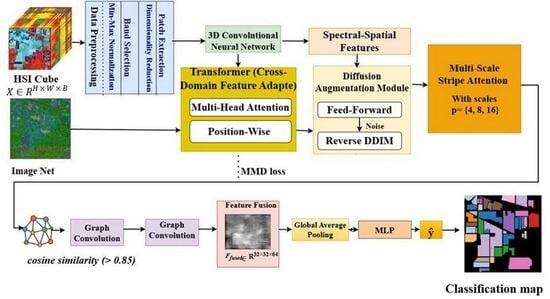
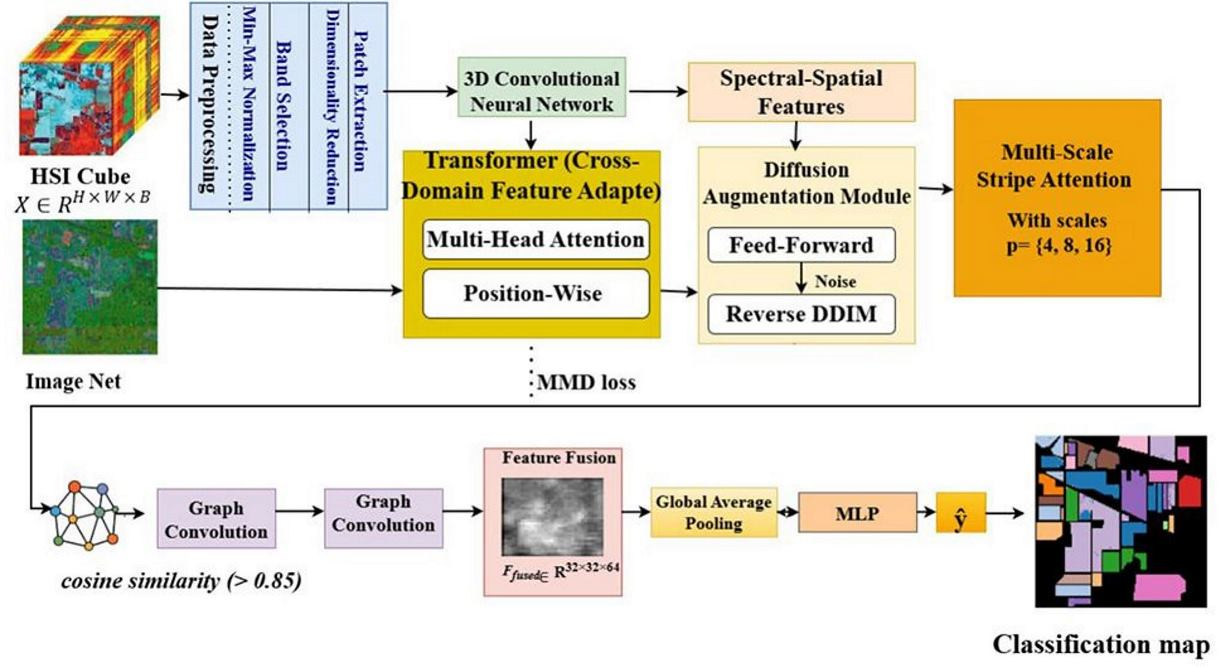
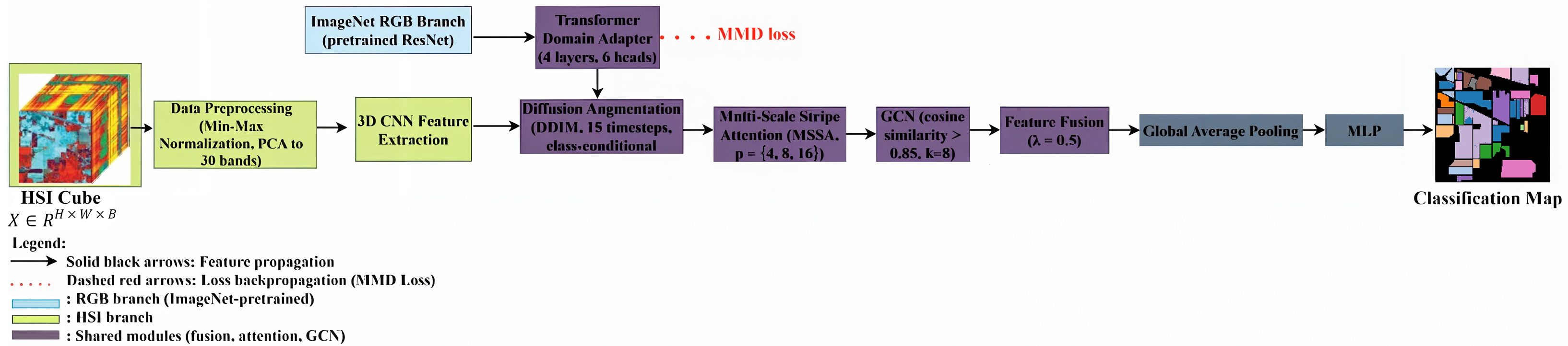
Figure 1.
Overall architecture of the proposed TGDHTL framework for HSI classification. The ImageNet-pretrained RGB branch is aligned with the HSI branch via a lightweight Transformer adapter using MMD loss (dashed red arrow). Features are enhanced through diffusion augmentation, MSSA (p = 4, 8, 16), and GCN (cosine similarity > 0.85), followed by fusion ( = 0.5) and classification. Legend (bottom): Solid black arrows = feature propagation; Dashed red arrows = loss backpropagation (MMD); Green = HSI branch; Blue = RGB branch; Purple = shared modules.
Figure 1.
Overall architecture of the proposed TGDHTL framework for HSI classification. The ImageNet-pretrained RGB branch is aligned with the HSI branch via a lightweight Transformer adapter using MMD loss (dashed red arrow). Features are enhanced through diffusion augmentation, MSSA (p = 4, 8, 16), and GCN (cosine similarity > 0.85), followed by fusion ( = 0.5) and classification. Legend (bottom): Solid black arrows = feature propagation; Dashed red arrows = loss backpropagation (MMD); Green = HSI branch; Blue = RGB branch; Purple = shared modules.
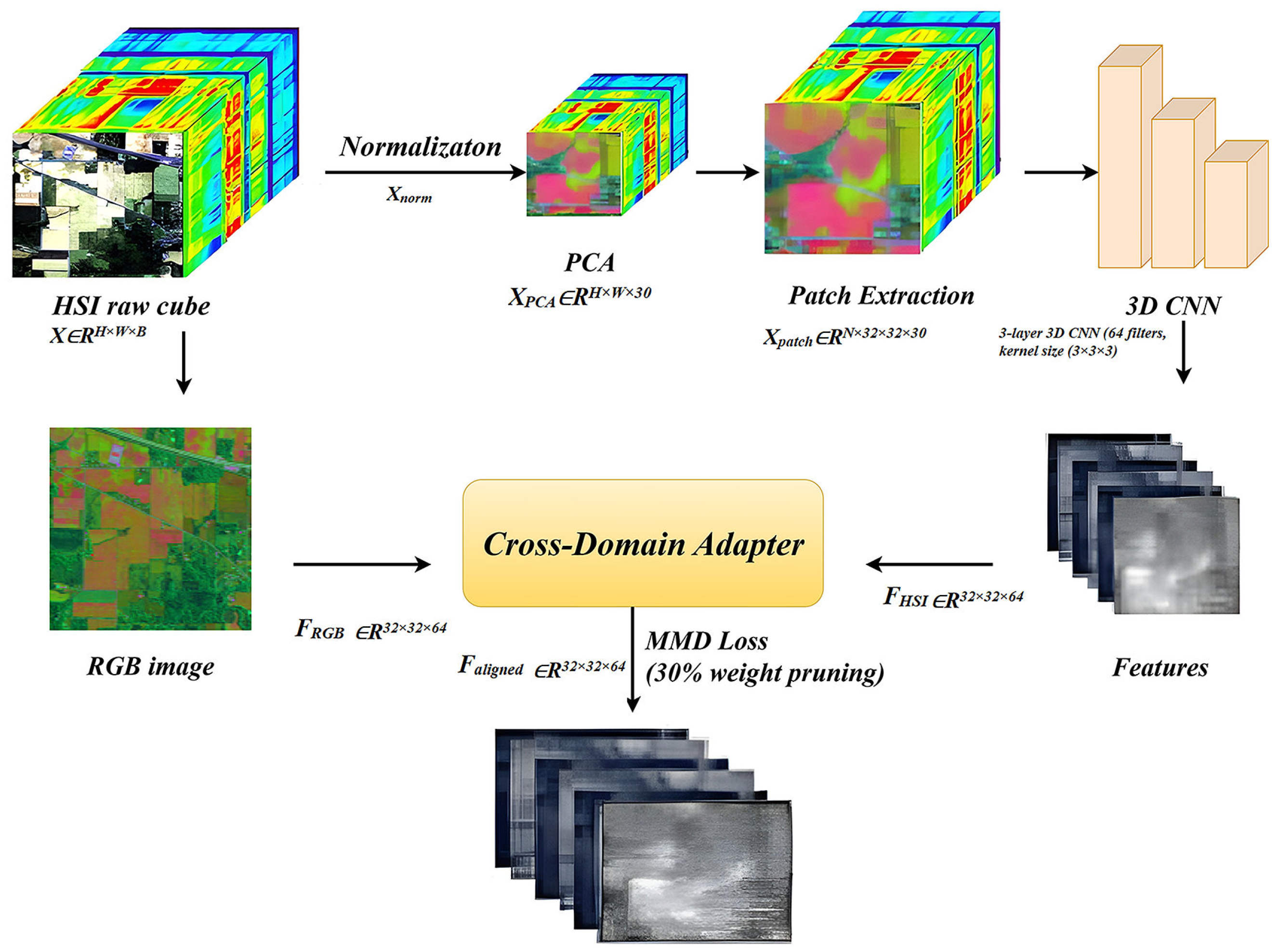
Figure 2.
Domain adaptation pipeline. The HSI cube is normalized per band and reduced via PCA to 30 bands. Overlapping patches (32 × 32 × 30) are processed by a three-layer 3D CNN. Extracted features are aligned with ImageNet-pretrained RGB features using a four-layer transformer with six attention heads, guided by MMD loss.
Figure 2.
Domain adaptation pipeline. The HSI cube is normalized per band and reduced via PCA to 30 bands. Overlapping patches (32 × 32 × 30) are processed by a three-layer 3D CNN. Extracted features are aligned with ImageNet-pretrained RGB features using a four-layer transformer with six attention heads, guided by MMD loss.
Figure 3.
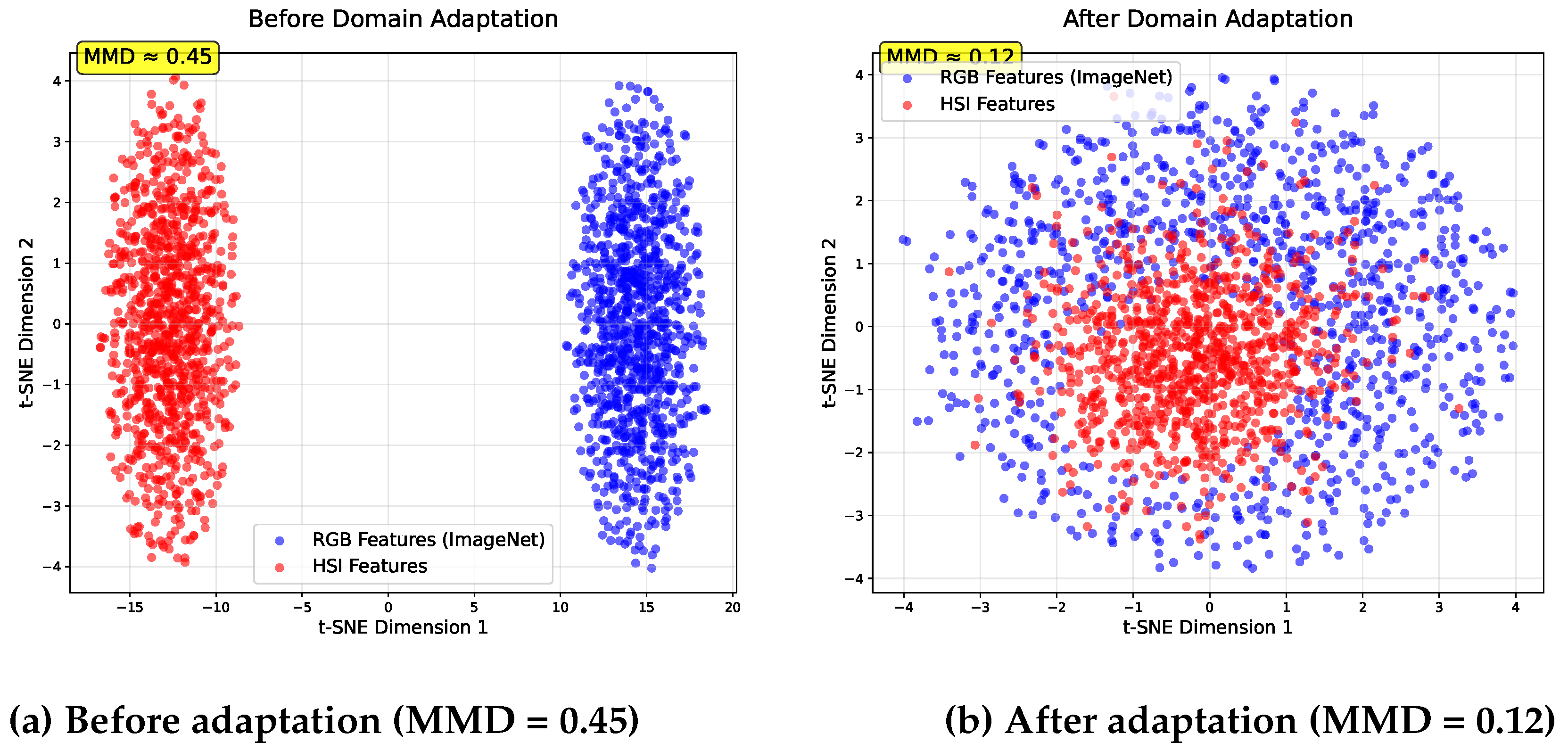
t-SNE visualization of RGB and HSI feature distributions before/after MMD-based alignment, demonstrating effective domain shift reduction.
Figure 3.
t-SNE visualization of RGB and HSI feature distributions before/after MMD-based alignment, demonstrating effective domain shift reduction.
Figure 4.
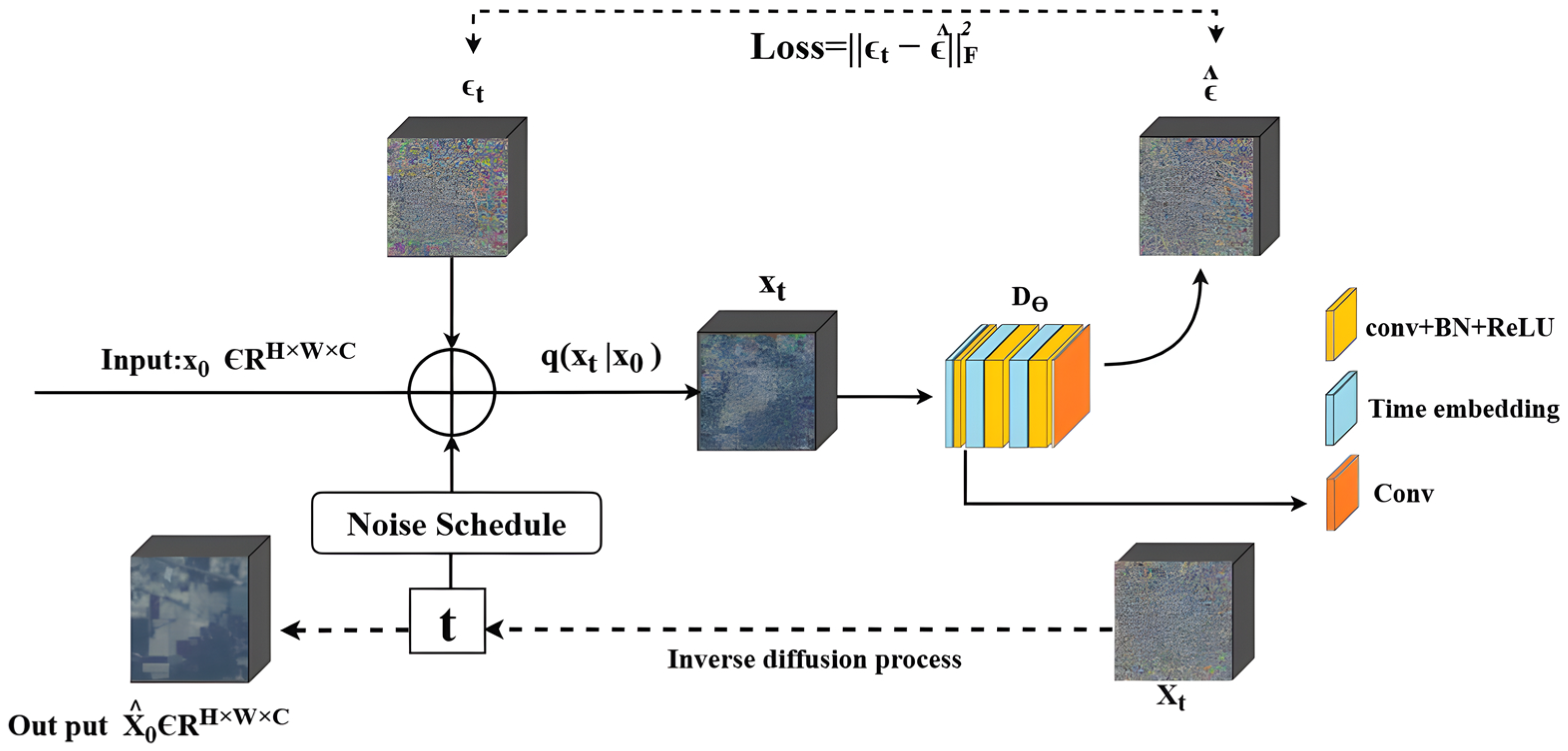
Noise addition at timestep t in the diffusion process.
Figure 4.
Noise addition at timestep t in the diffusion process.
Figure 5.
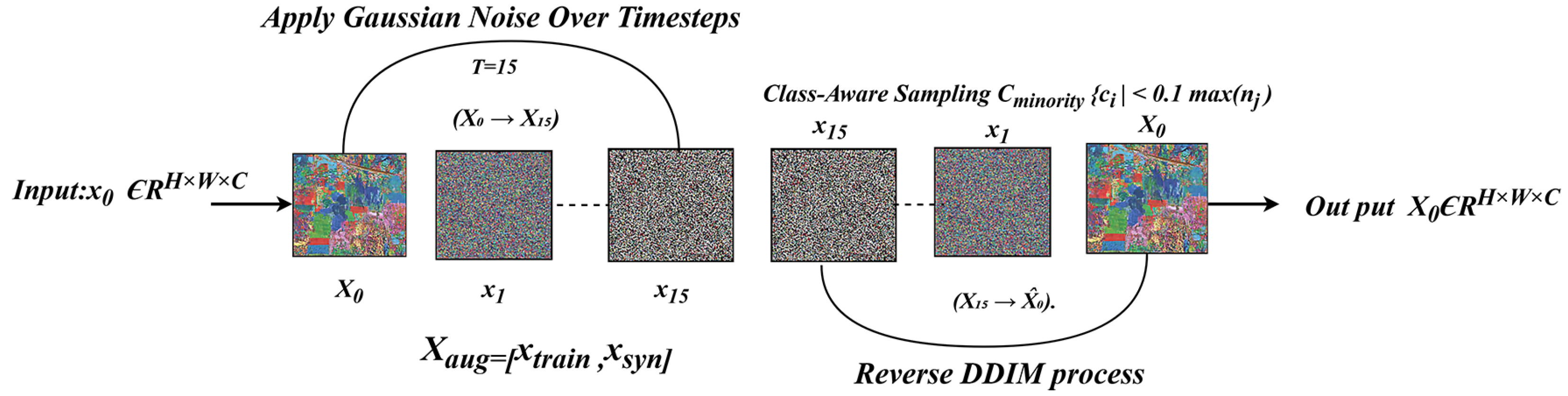
Workflow of the class-conditional diffusion augmentation module. The forward diffusion process progressively adds Gaussian noise over 15 timesteps (), while the reverse DDIM process generates high-fidelity synthetic samples (). A portion of the generated samples is specifically allocated to minority classes.
Figure 5.
Workflow of the class-conditional diffusion augmentation module. The forward diffusion process progressively adds Gaussian noise over 15 timesteps (), while the reverse DDIM process generates high-fidelity synthetic samples (). A portion of the generated samples is specifically allocated to minority classes.
Figure 6.
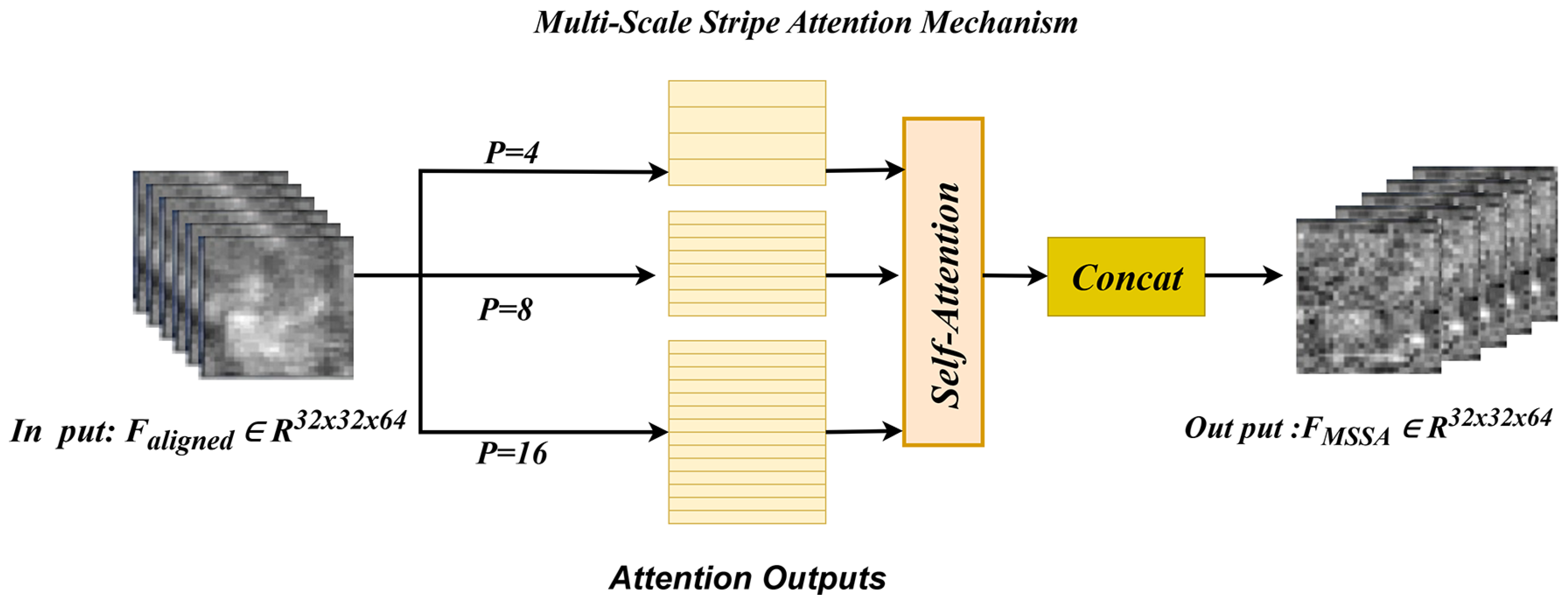
Multi-scale stripe attention mechanism. Input feature maps are divided into stripes at scales P = {4, 8, 16}. Self-attention is computed within each stripe, and outputs are aggregated to form .
Figure 6.
Multi-scale stripe attention mechanism. Input feature maps are divided into stripes at scales P = {4, 8, 16}. Self-attention is computed within each stripe, and outputs are aggregated to form .
Figure 7.
GCN integration with classification head. A sparse graph is constructed from MSSA features using cosine similarity (>0.85). Features propagate through two GCN layers and are fused with MSSA features (). An MLP with softmax outputs class probabilities.
Figure 7.
GCN integration with classification head. A sparse graph is constructed from MSSA features using cosine similarity (>0.85). Features propagate through two GCN layers and are fused with MSSA features (). An MLP with softmax outputs class probabilities.
Figure 8.
Flowchart of the TGDHTL algorithm, illustrating the pipeline from data preprocessing to classification.
Figure 8.
Flowchart of the TGDHTL algorithm, illustrating the pipeline from data preprocessing to classification.
Figure 9.
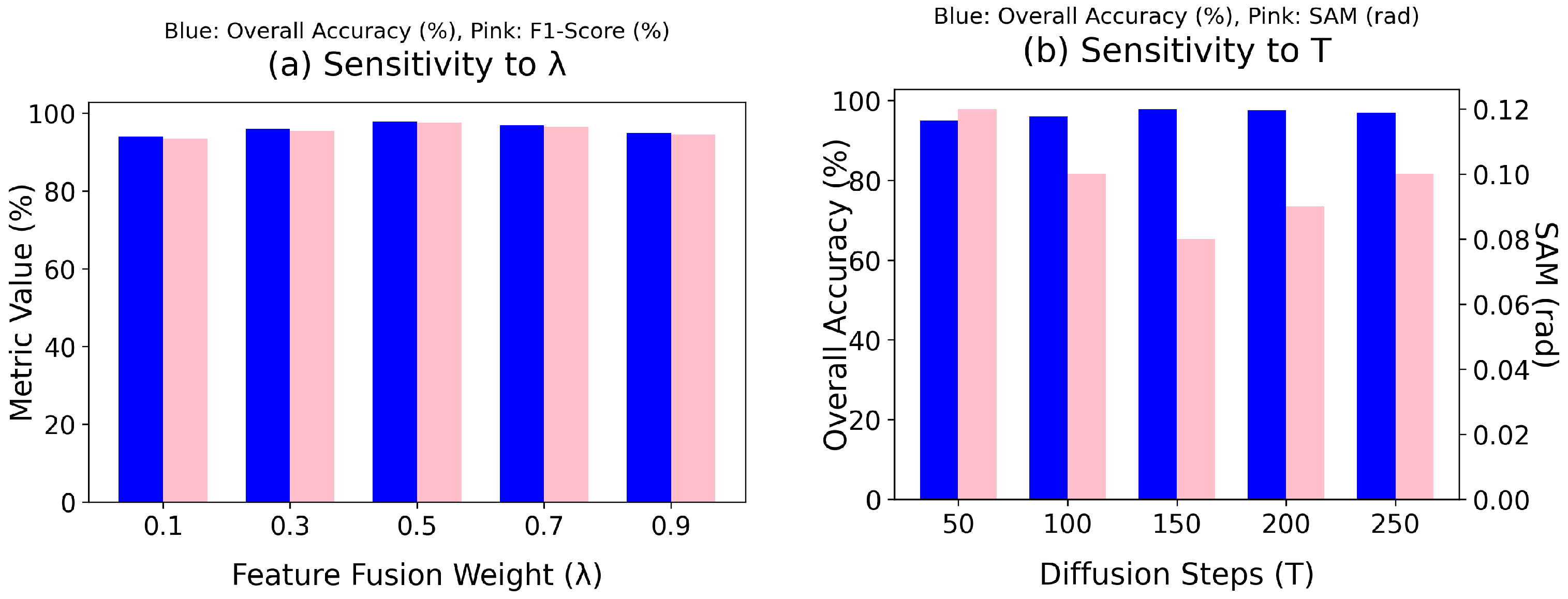
Sensitivity analysis plots for (a) feature fusion weight and (b) diffusion steps T on the University of Pavia dataset with 20% labeled samples, averaged over 5-fold cross-validation. Plots show OA and F1-Score for , and OA and SAM for T. Error bars represent 95% confidence intervals.
Figure 9.
Sensitivity analysis plots for (a) feature fusion weight and (b) diffusion steps T on the University of Pavia dataset with 20% labeled samples, averaged over 5-fold cross-validation. Plots show OA and F1-Score for , and OA and SAM for T. Error bars represent 95% confidence intervals.
Figure 10.
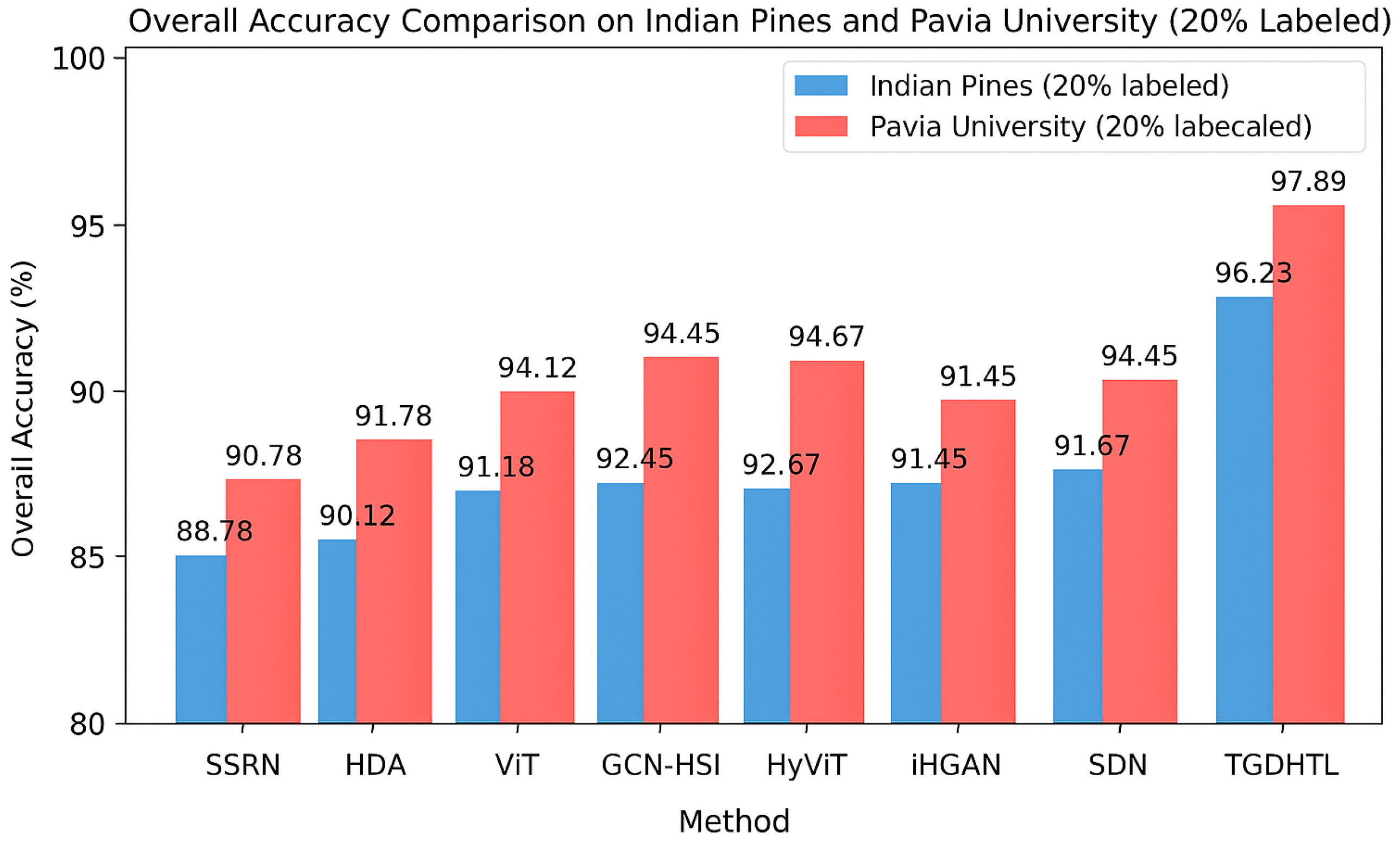
Bar chart comparing Overall Accuracy of TGDHTL and baseline methods on Indian Pines and University of Pavia datasets with 20% labeled samples. Similar trends observed on HJ-1A and WHU-OHS.
Figure 10.
Bar chart comparing Overall Accuracy of TGDHTL and baseline methods on Indian Pines and University of Pavia datasets with 20% labeled samples. Similar trends observed on HJ-1A and WHU-OHS.
Figure 11.
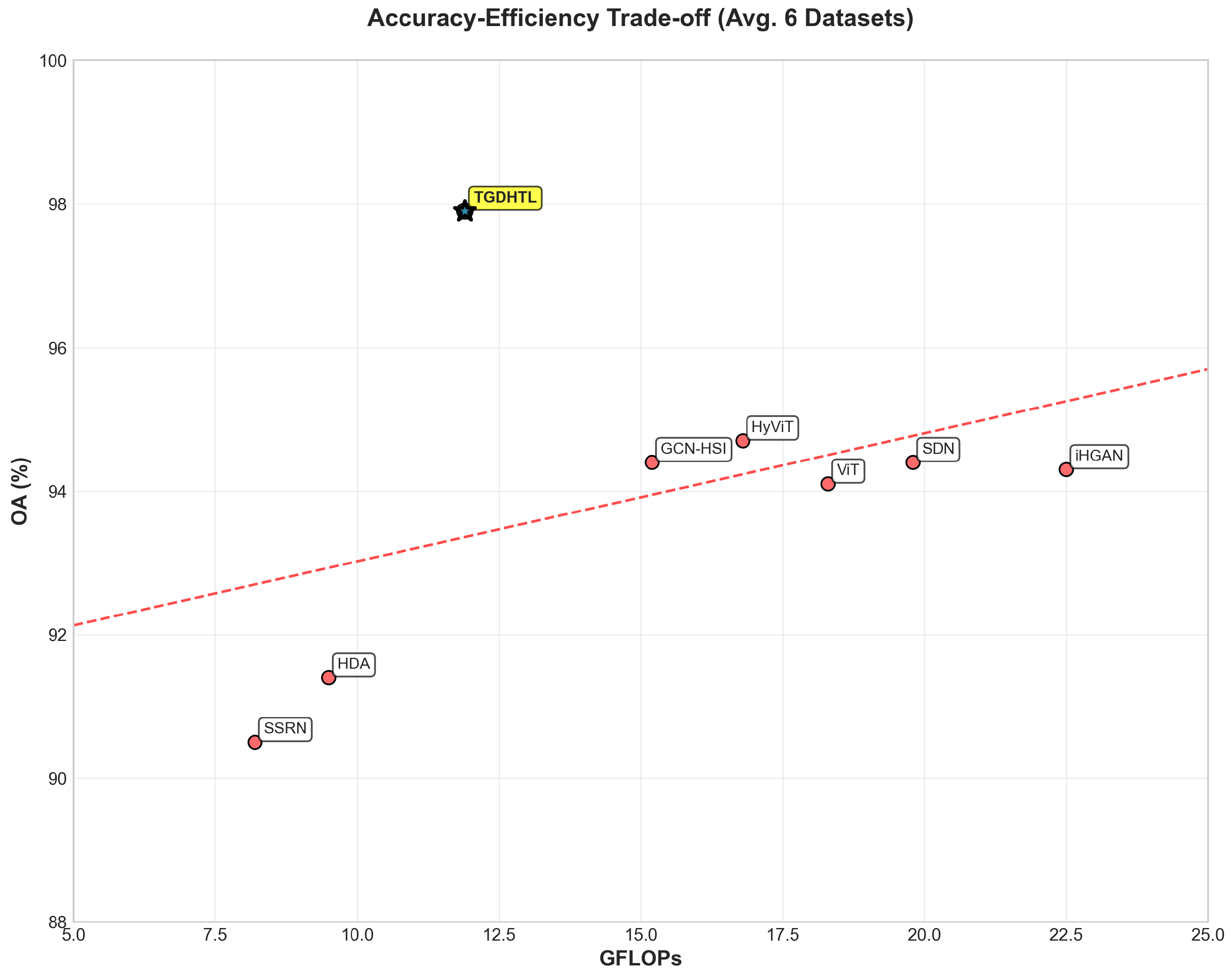
Overall Accuracy versus GFLOPs across six benchmark datasets (20% labeled samples), demonstrating TGDHTL’s efficiency.
Figure 11.
Overall Accuracy versus GFLOPs across six benchmark datasets (20% labeled samples), demonstrating TGDHTL’s efficiency.
Figure 12.
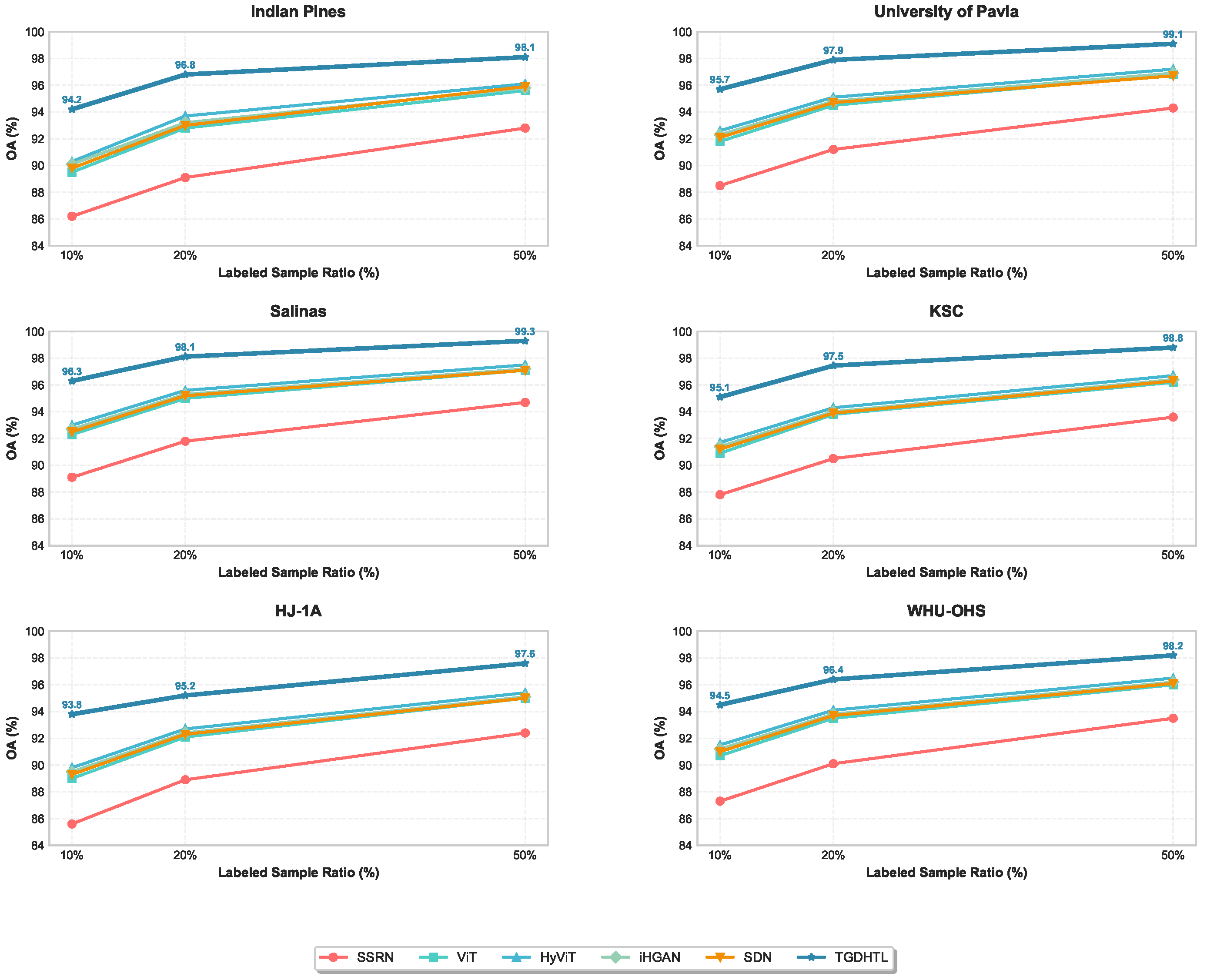
Overall Accuracy versus labeled sample ratio (10–50%) for six benchmark datasets, illustrating TGDHTL’s performance trends across datasets.
Figure 12.
Overall Accuracy versus labeled sample ratio (10–50%) for six benchmark datasets, illustrating TGDHTL’s performance trends across datasets.
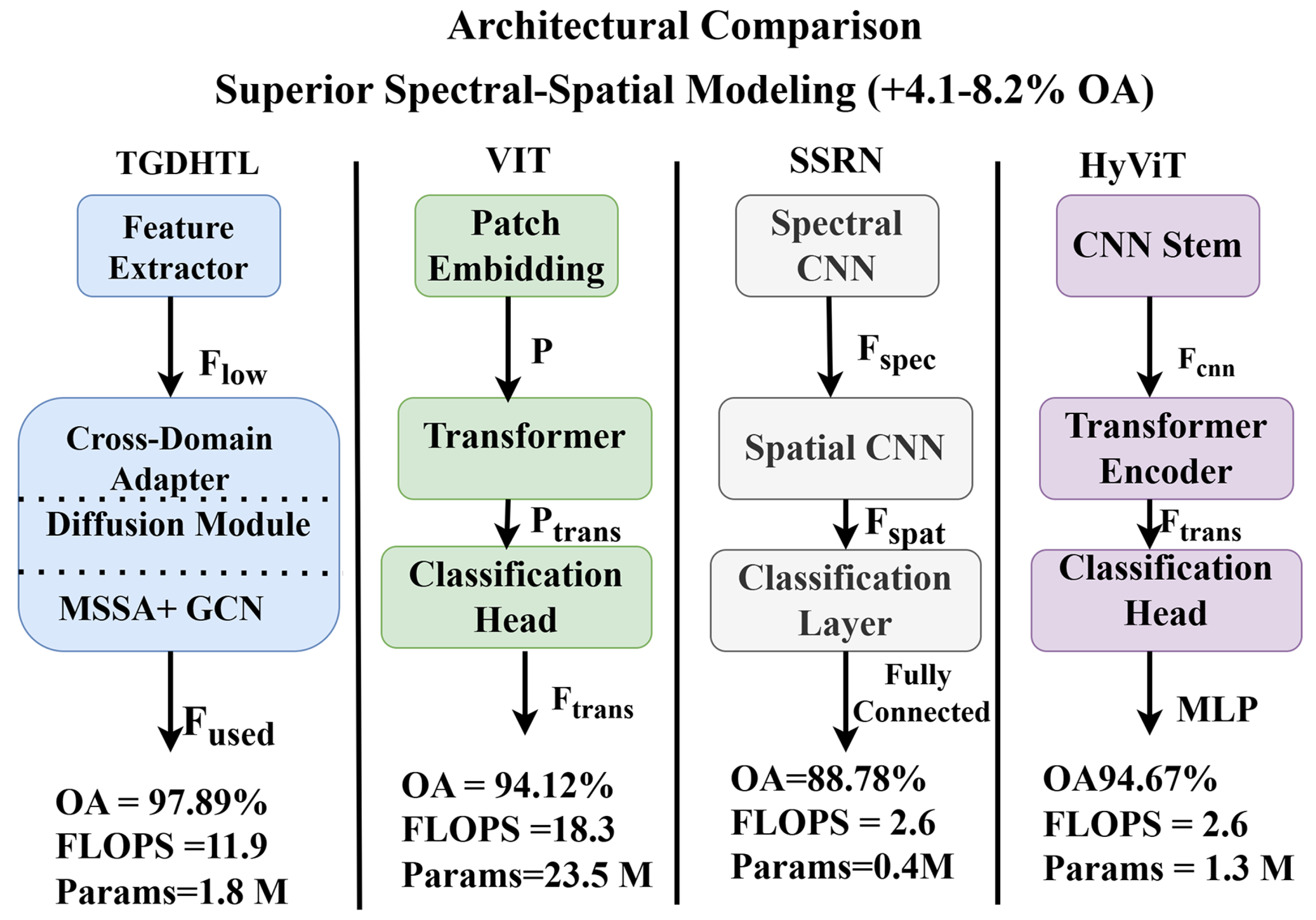
Figure 13.
Architectural comparison of TGDHTL–ViT [
59], SSRN [
29], and HyViT [
13], highlighting TGDHTL’s integrated MSSA–GCN–diffusion design.
Figure 13.
Architectural comparison of TGDHTL–ViT [
59], SSRN [
29], and HyViT [
13], highlighting TGDHTL’s integrated MSSA–GCN–diffusion design.
Figure 14.
Classification maps for Indian Pines (16 classes) using 10% labeled samples, showing improved boundary delineation by TGDHTL.
Figure 14.
Classification maps for Indian Pines (16 classes) using 10% labeled samples, showing improved boundary delineation by TGDHTL.
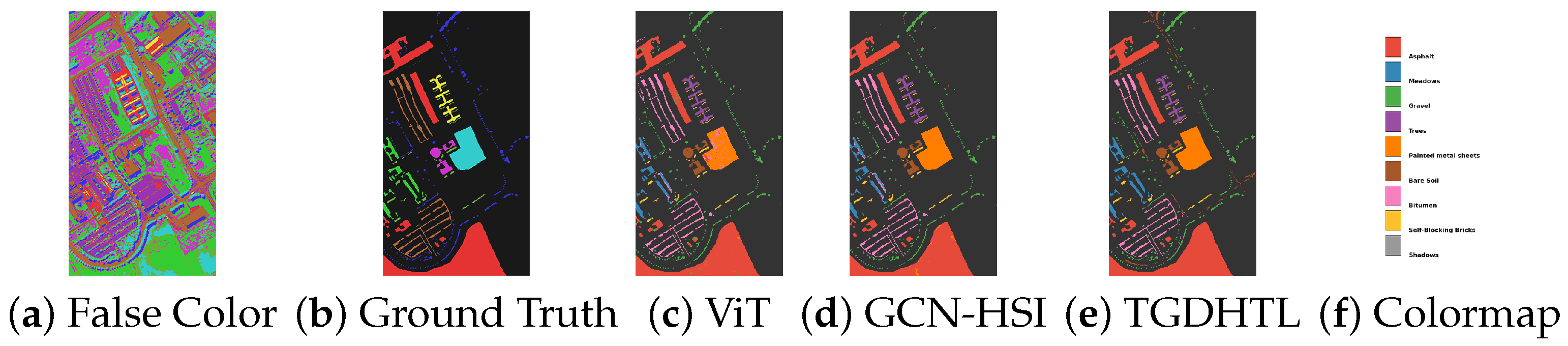
Figure 15.
Classification maps for University of Pavia (9 classes) using 10% labeled samples, highlighting TGDHTL’s superior class separation.
Figure 15.
Classification maps for University of Pavia (9 classes) using 10% labeled samples, highlighting TGDHTL’s superior class separation.
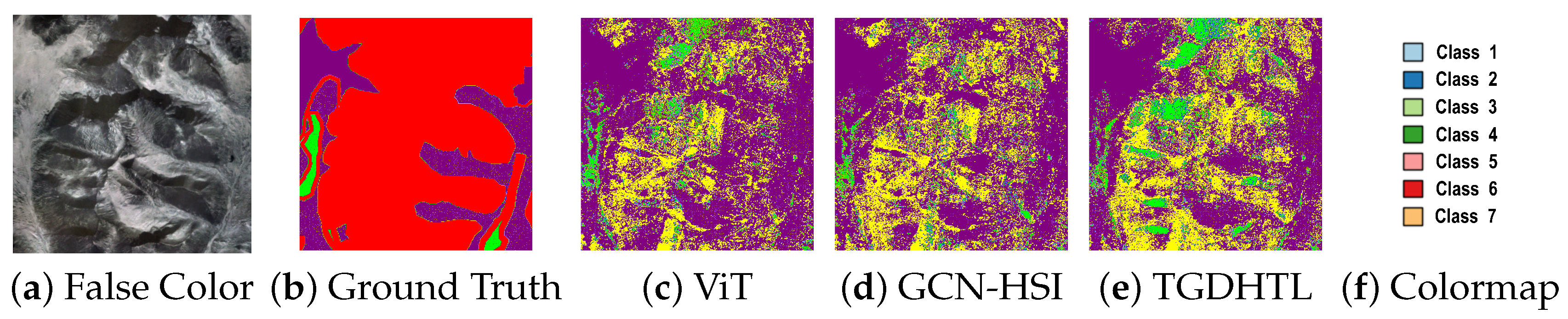
Figure 16.
Classification maps for Kennedy Space Center (KSC, 13 classes) using 10% labeled samples, demonstrating TGDHTL’s robustness.
Figure 16.
Classification maps for Kennedy Space Center (KSC, 13 classes) using 10% labeled samples, demonstrating TGDHTL’s robustness.
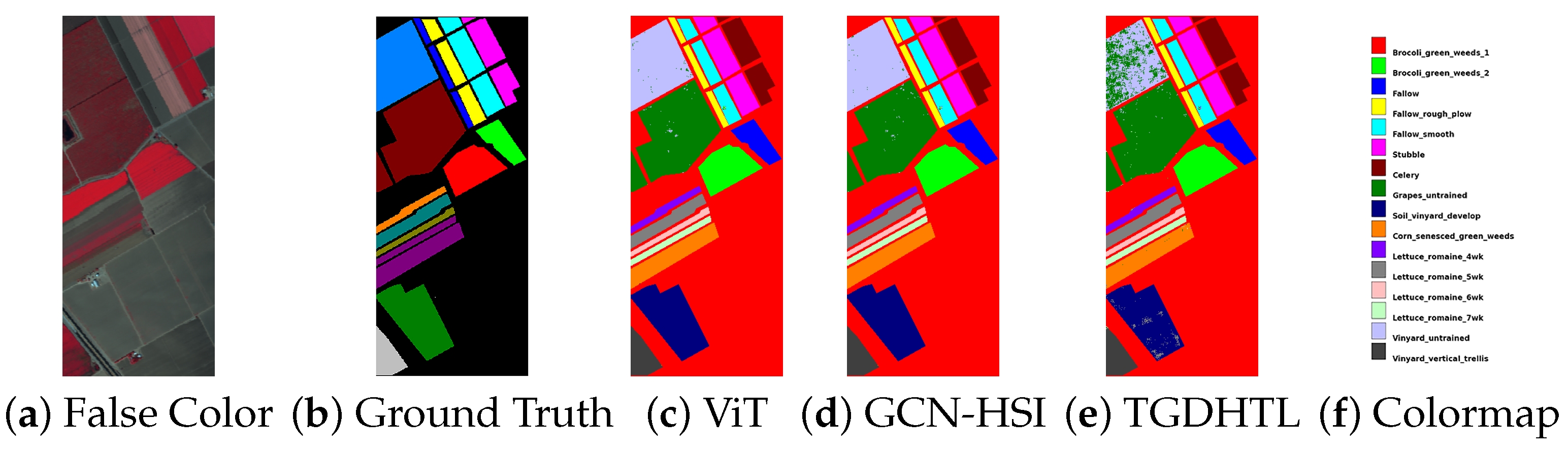
Figure 17.
Classification maps for Salinas (16 classes) using 10% labeled samples, showcasing TGDHTL’s effective handling of class boundaries.
Figure 17.
Classification maps for Salinas (16 classes) using 10% labeled samples, showcasing TGDHTL’s effective handling of class boundaries.
Figure 18.
Classification maps for HJ-1A (4 classes) using 10% labeled samples, showing improved boundary delineation by TGDHTL.
Figure 18.
Classification maps for HJ-1A (4 classes) using 10% labeled samples, showing improved boundary delineation by TGDHTL.
Figure 19.
Classification maps for WHU-OHS (32 bands) using 10% labeled samples, showing improved boundary delineation by TGDHTL.
Figure 19.
Classification maps for WHU-OHS (32 bands) using 10% labeled samples, showing improved boundary delineation by TGDHTL.
Figure 20.
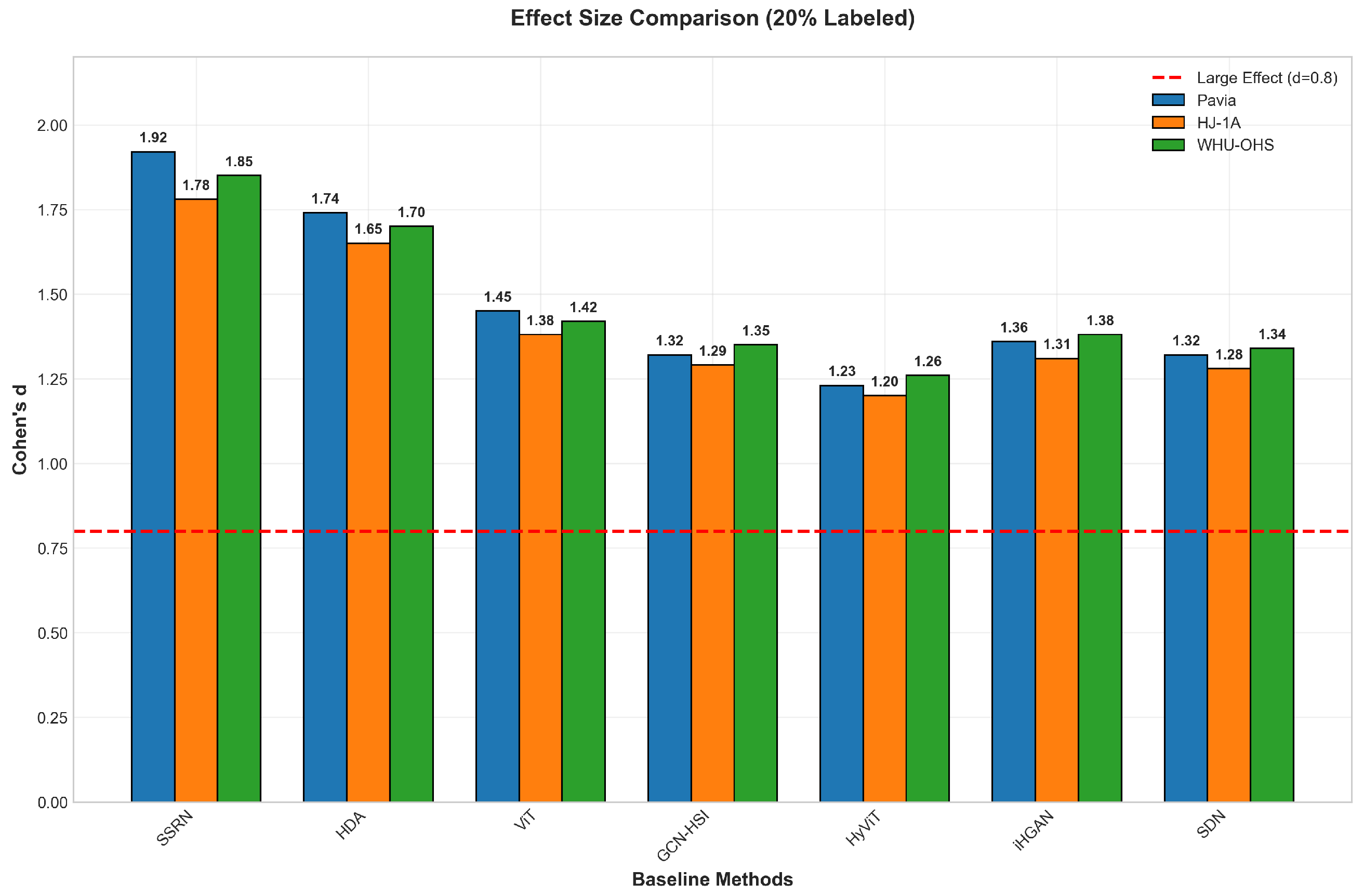
Bar chart of Cohen’s d effect sizes comparing TGDHTL against baseline methods across all six benchmark datasets (20% labeled samples). All values exceed , indicating large practical significance of TGDHTL’s improvements in diverse HSI scenarios (agricultural, urban, satellite, large-scale).
Figure 20.
Bar chart of Cohen’s d effect sizes comparing TGDHTL against baseline methods across all six benchmark datasets (20% labeled samples). All values exceed , indicating large practical significance of TGDHTL’s improvements in diverse HSI scenarios (agricultural, urban, satellite, large-scale).
Figure 21.
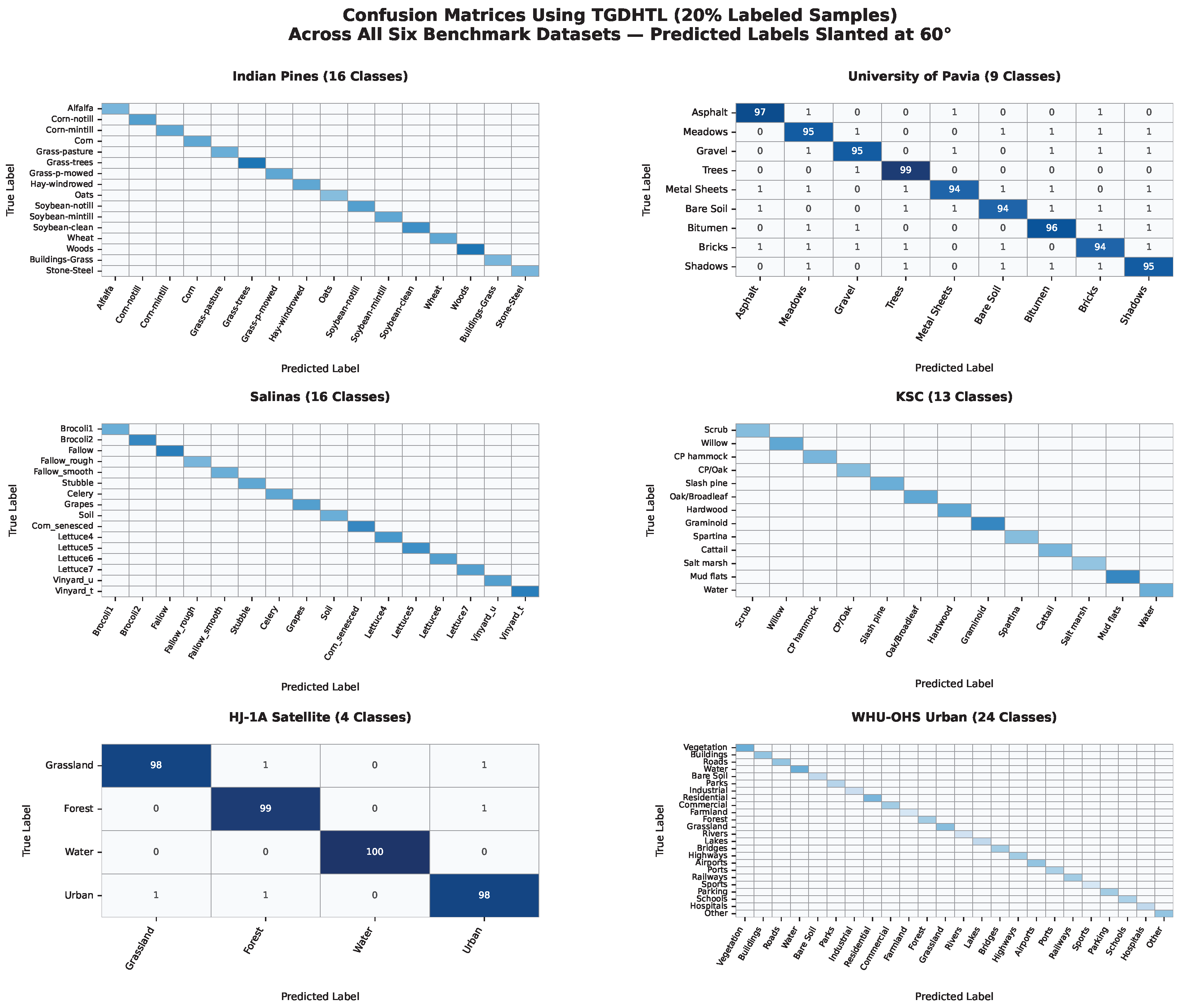
Confusion matrices for all six datasets (Indian Pines, Pavia, Salinas, KSC, HJ-1A, WHU-OHS) using TGDHTL at 20% labeled samples, showing consistently high diagonal values and robust classification performance.
Figure 21.
Confusion matrices for all six datasets (Indian Pines, Pavia, Salinas, KSC, HJ-1A, WHU-OHS) using TGDHTL at 20% labeled samples, showing consistently high diagonal values and robust classification performance.
Figure 22.
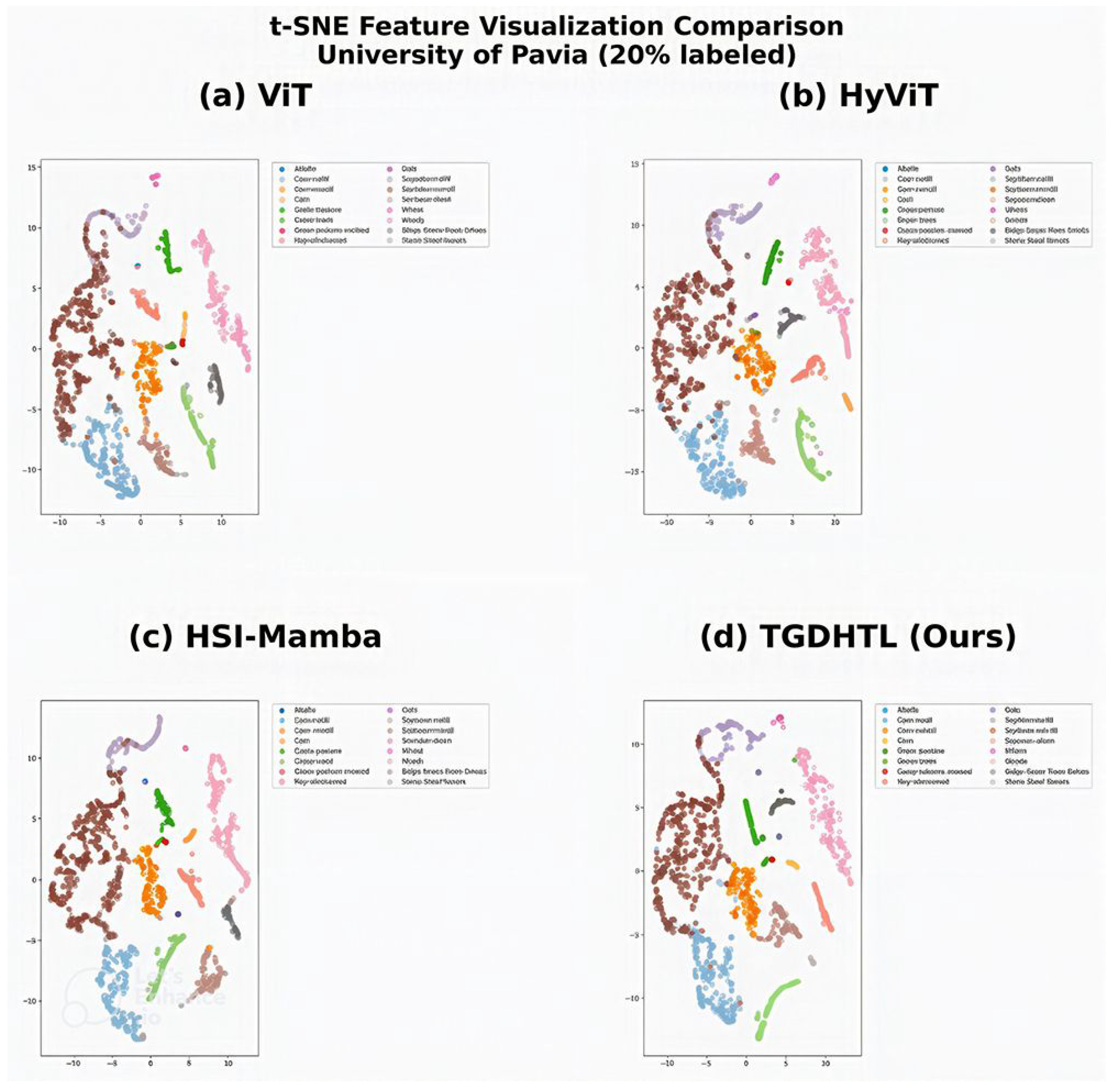
t-SNE visualization of learned feature distributions on the University of Pavia dataset (20% labeled samples). (a) ViT, (b) HyViT, (c) HSI-Mamba, (d) TGDHTL (Ours). Each point represents a pixel, colored by ground-truth class. TGDHTL shows the most compact and separated clusters, with minimal overlap in minority classes.
Figure 22.
t-SNE visualization of learned feature distributions on the University of Pavia dataset (20% labeled samples). (a) ViT, (b) HyViT, (c) HSI-Mamba, (d) TGDHTL (Ours). Each point represents a pixel, colored by ground-truth class. TGDHTL shows the most compact and separated clusters, with minimal overlap in minority classes.
Figure 23.
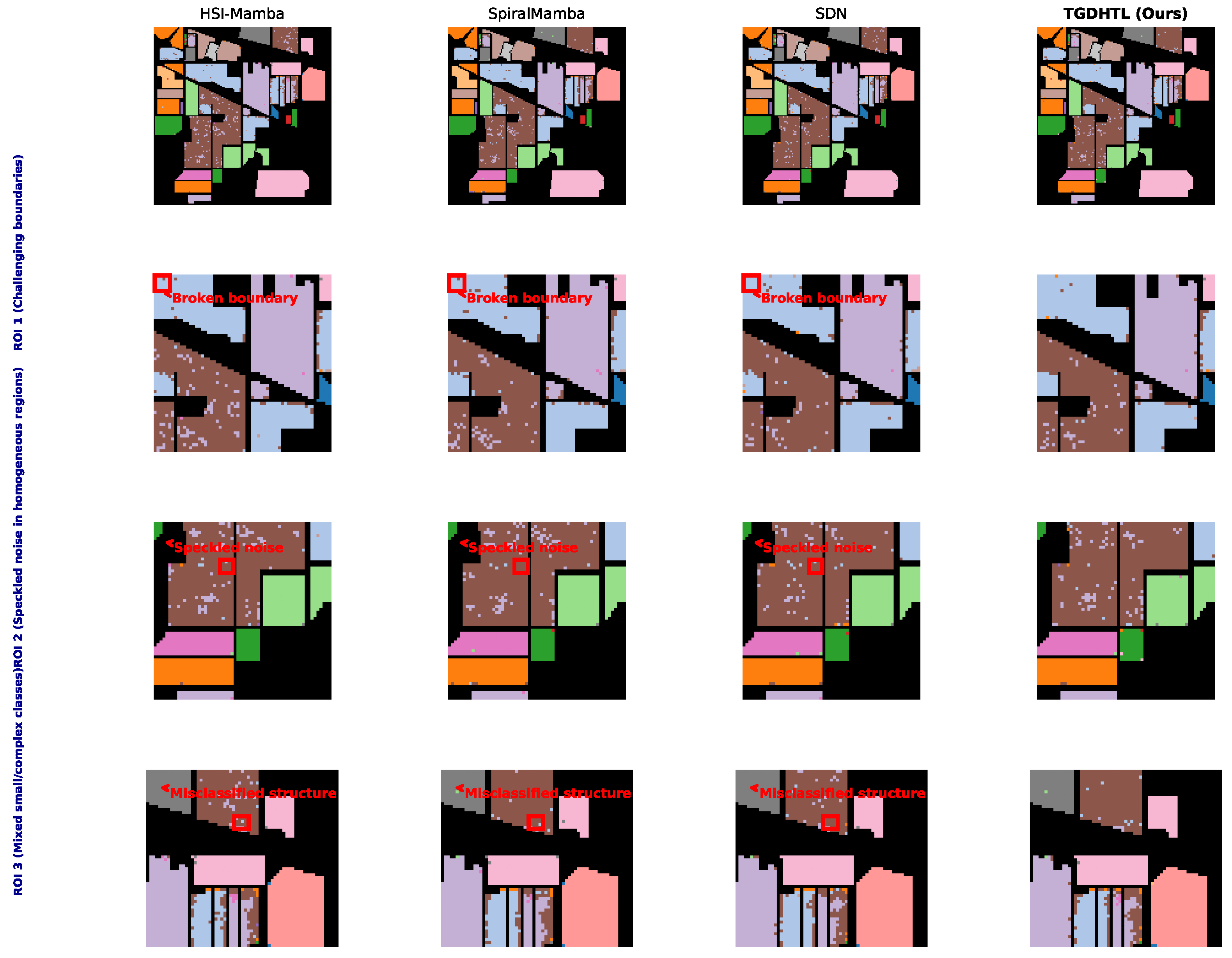
Qualitative comparison on three challenging ROIs from the Indian Pines dataset. Top row: full classification maps of top-performing baselines and TGDHTL. Bottom three rows: zoomed-in views of ROIs highlighting typical failure cases (noise, broken boundaries, misclassified minority classes) in baselines (red boxes/arrows) that are effectively resolved by TGDHTL.
Figure 23.
Qualitative comparison on three challenging ROIs from the Indian Pines dataset. Top row: full classification maps of top-performing baselines and TGDHTL. Bottom three rows: zoomed-in views of ROIs highlighting typical failure cases (noise, broken boundaries, misclassified minority classes) in baselines (red boxes/arrows) that are effectively resolved by TGDHTL.
Figure 24.
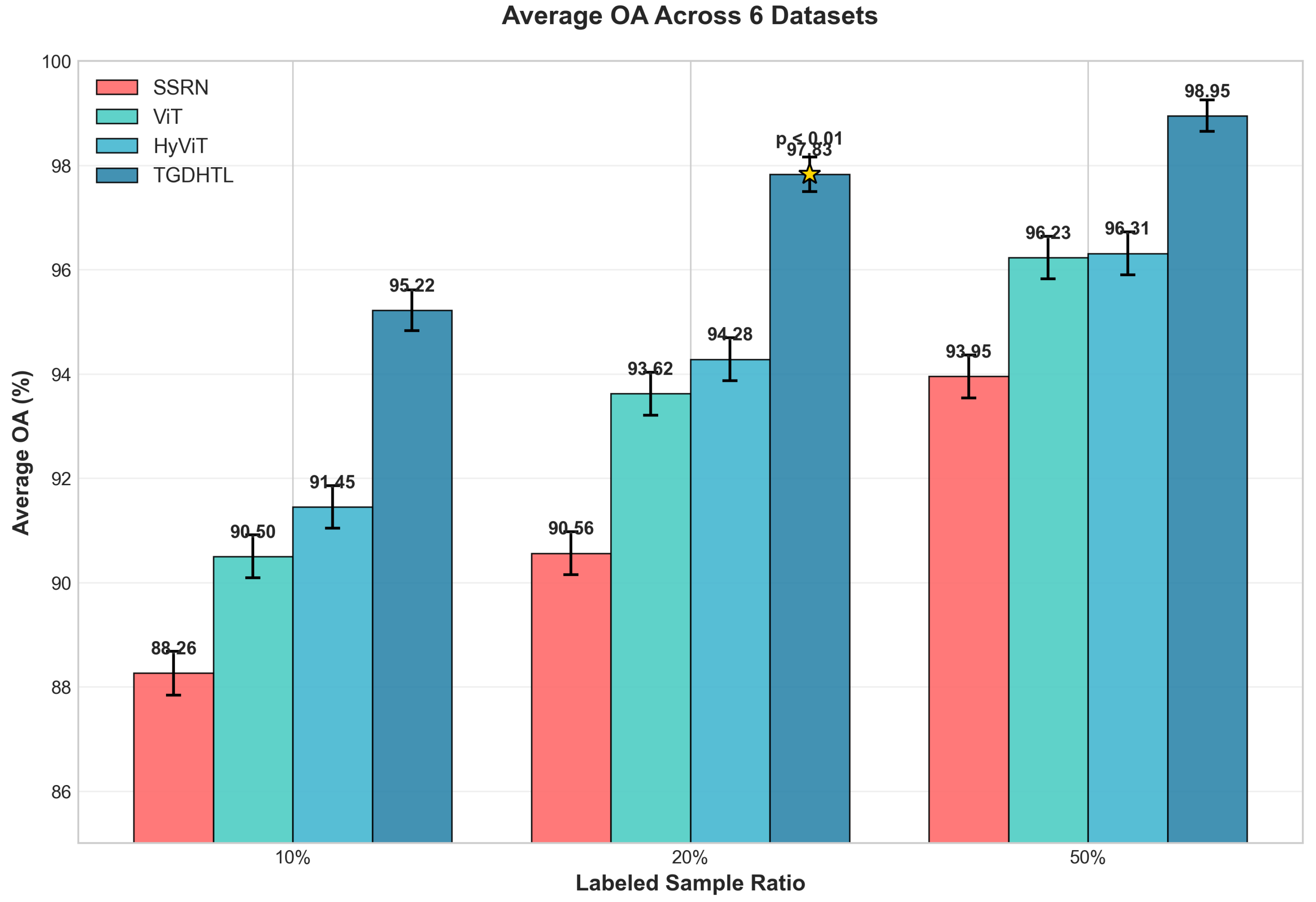
Average Overall Accuracy across six benchmark datasets for 10%, 20%, and 50% labeled samples, showing TGDHTL’s consistent superiority. A star (*) indicates statistical significance at compared to all baselines.
Figure 24.
Average Overall Accuracy across six benchmark datasets for 10%, 20%, and 50% labeled samples, showing TGDHTL’s consistent superiority. A star (*) indicates statistical significance at compared to all baselines.
Figure 25.
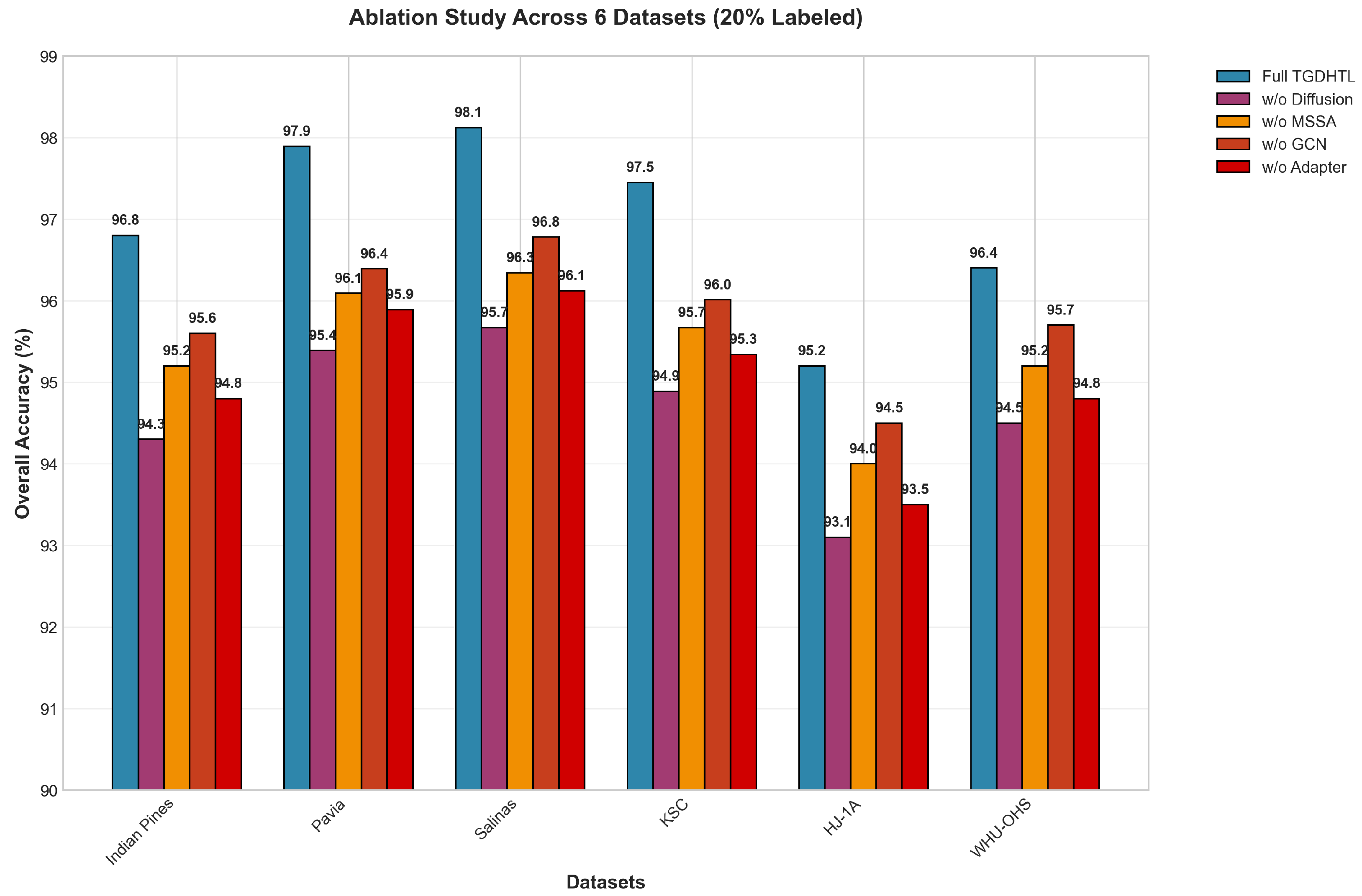
Ablation study on the six benchmark datasets (20% labeled samples), illustrating the contribution of each component to TGDHTL’s performance.
Figure 25.
Ablation study on the six benchmark datasets (20% labeled samples), illustrating the contribution of each component to TGDHTL’s performance.
Table 1.
Domain adaptation results: MMD values and validation accuracy before and after alignment.
Table 1.
Domain adaptation results: MMD values and validation accuracy before and after alignment.
| Setting | MMD Value | Validation OA (%) |
|---|
| Before Adaptation |
| 92.1 |
| After Adaptation |
| 92.4 |
Table 2.
Ablation study on MSSA scale selection (averaged over six datasets, 20% labeled samples). Best results in bold.
Table 2.
Ablation study on MSSA scale selection (averaged over six datasets, 20% labeled samples). Best results in bold.
| Scale Set | OA (%) | Kappa | GFLOPs |
|---|
| Fixed {3,6,12} | 96.45 ± 0.3 | 0.960 | 11.7 |
| Fixed {4,8,16} | 97.28 ± 0.3 | 0.968 | 11.9 |
| Fixed {5,10,20} | 96.82 ± 0.3 | 0.963 | 12.1 |
| Adaptive (Ours) | 97.35 ± 0.3 | 0.969 | 11.9 |
Table 3.
Core hyperparameters used in the TGDHTL framework.
Table 3.
Core hyperparameters used in the TGDHTL framework.
| Parameter | Value |
|---|
| Learning Rate | 0.001 |
| Batch Size | 32 samples |
| GCN Threshold | 0.85 |
| Diffusion Timesteps | 15 steps |
| Feature Fusion Weight () | 0.5 |
Table 4.
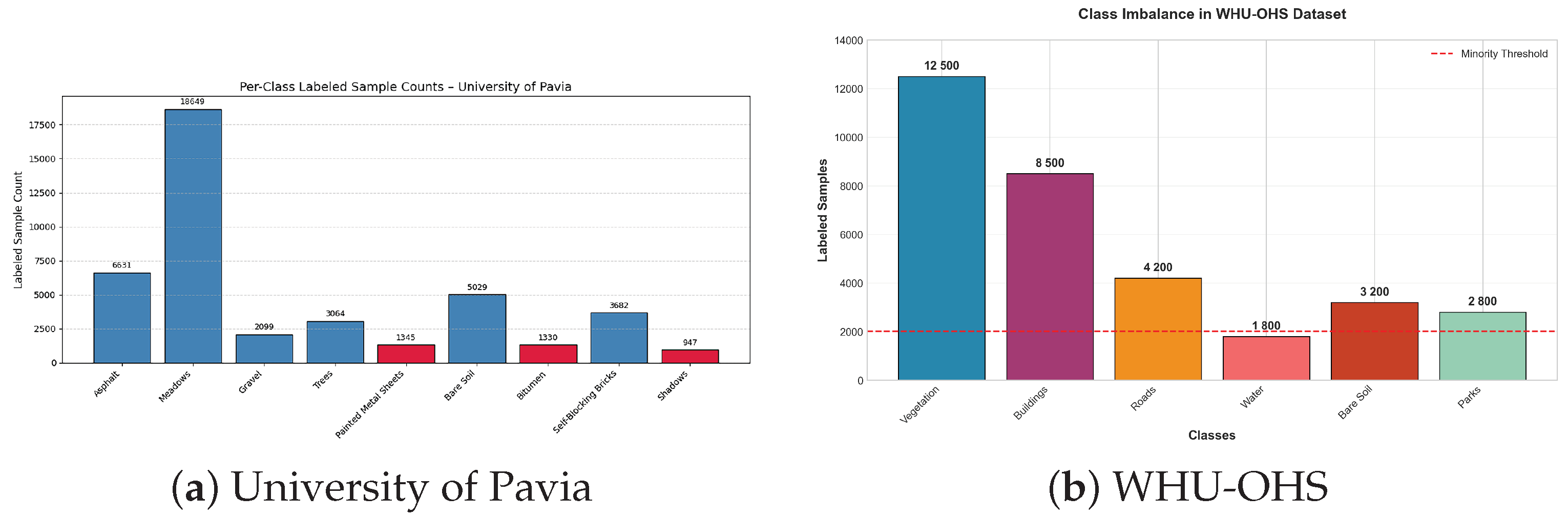
Labeled sample counts per class in the University of Pavia dataset (
Figure A1 presents a bar chart of per-class labeled sample counts, complementing this table).
Table 4.
Labeled sample counts per class in the University of Pavia dataset (
Figure A1 presents a bar chart of per-class labeled sample counts, complementing this table).
| Class | Sample Count | Minority Class |
|---|
| Asphalt | 6631 | No |
| Meadows | 18,649 | No |
| Gravel | 2099 | No |
| Trees | 3064 | No |
| Painted metal sheets | 1345 | Yes |
| Bare Soil | 5029 | No |
| Bitumen | 1330 | Yes |
| Self-Blocking Bricks | 3682 | No |
| Shadows | 947 | Yes |
Table 5.
Overall Accuracy (OA, %) under extreme few-shot settings (fixed number of labeled samples per class). Best results in bold.
Table 5.
Overall Accuracy (OA, %) under extreme few-shot settings (fixed number of labeled samples per class). Best results in bold.
| Method | 1 Sample/Class | 3 Samples/Class | 5 Samples/Class | 7 Samples/Class | 9 Samples/Class |
|---|
| SSRN [29] | 52.3 ± 3.1 | 68.7 ± 2.4 | 78.4 ± 1.9 | 83.2 ± 1.6 | 86.1 ± 1.3 |
| ViT [59] | 61.8 ± 2.8 | 74.2 ± 2.1 | 82.9 ± 1.7 | 87.6 ± 1.4 | 90.3 ± 1.2 |
| HyViT [13] | 64.5 ± 2.6 | 76.9 ± 2.0 | 85.1 ± 1.5 | 89.4 ± 1.3 | 91.8 ± 1.1 |
| SpiralMamba [25] | 67.2 ± 2.4 | 79.3 ± 1.8 | 87.6 ± 1.4 | 91.2 ± 1.2 | 93.1 ± 1.0 |
| SDN [24] | 65.9 ± 2.5 | 78.1 ± 1.9 | 86.8 ± 1.5 | 90.5 ± 1.3 | 92.4 ± 1.1 |
| TGDHTL (Ours) | 73.6 ± 2.1 | 84.7 ± 1.6 | 91.8 ± 1.2 | 94.3 ± 1.0 | 96.1 ± 0.9 |
Table 6.
Comparison with recent Mamba-based models and computational efficiency (20% labeled samples, averaged over six datasets).
Table 6.
Comparison with recent Mamba-based models and computational efficiency (20% labeled samples, averaged over six datasets).
| Method | OA (%) | AA (%) | Kappa | Params (M) | GFLOPs | Train Time/Epoch | Infer. (s) |
|---|
| ViT | 93.62 | 93.1 | 0.92 | 86 | 18.3 | 142 s | 0.16 |
| HyViT | 94.28 | 93.8 | 0.93 | 28 | 16.8 | 118 s | 0.15 |
| SpiralMamba | 95.71 | 95.2 | 0.95 | 19 | 15.4 | 98 s | 0.13 |
| HSI-Mamba | 95.94 | 95.5 | 0.95 | 22 | 16.1 | 105 s | 0.14 |
| SDN | 94.15 | 93.6 | 0.93 | 34 | 19.8 | 168 s | 0.18 |
| TGDHTL | 97.83 | 97.3 | 0.974 | 12.4 | 11.9 | 74 s | 0.12 |
Table 7.
Sensitivity analysis of GCN cosine similarity threshold and diffusion timesteps on the University of Pavia dataset with 20% labeled samples (5-fold cross-validation).
Table 7.
Sensitivity analysis of GCN cosine similarity threshold and diffusion timesteps on the University of Pavia dataset with 20% labeled samples (5-fold cross-validation).
| Parameter | Value | OA (%) | Kappa | GFLOPs | Params (M) |
|---|
| GCN Threshold | 0.70 | 96.45 ± 0.38 | 0.956 | 11.9 | 12.4 |
| 0.75 | 96.89 ± 0.35 | 0.961 | 11.9 | 12.4 |
| 0.80 | 97.34 ± 0.32 | 0.967 | 11.9 | 12.4 |
| 0.85 | 97.89 ± 0.29 | 0.974 | 11.9 | 12.4 |
| 0.90 | 97.12 ± 0.34 | 0.969 | 11.9 | 12.4 |
| Diffusion Timesteps | 10 | 96.67 ± 0.41 | 0.959 | 10.8 | 12.4 |
| 15 | 97.89 ± 0.29 | 0.974 | 11.9 | 12.4 |
| 20 | 97.95 ± 0.28 | 0.975 | 12.5 | 12.4 |
| 30 | 98.01 ± 0.27 | 0.976 | 13.8 | 12.4 |
| 50 | 98.05 ± 0.26 | 0.977 | 16.2 | 12.4 |
Table 8.
Baseline model configurations and hyperparameter settings used in all experiments (20% labeled samples unless otherwise noted).
Table 8.
Baseline model configurations and hyperparameter settings used in all experiments (20% labeled samples unless otherwise noted).
| Method | Backbone | Key Hyperparameters | Params (M) | GFLOPs |
|---|
| SSRN [29] | 3D-ResNet | 3 × 3 × 3 kernels, 64 filters | 1.8 | 8.2 |
| ViT [59] | ViT-B/16 (ImageNet-pretrained) | Patch size 16, 12 layers | 86.0 | 18.3 |
| HyViT [13] | Hybrid CNN-Transformer | 3D-CNN + ViT-B/16 | 28.0 | 16.8 |
| iHGAN [18] | GAN-based generator | 1000 diffusion steps, spectral loss | 28.7 | 22.5 |
| SDN [24] | Diffusion generator | 20 timesteps, spectral fidelity loss | 34.2 | 19.8 |
| SpiralMamba [25] | Spiral Mamba | State size 16, spiral scan | 19.0 | 15.4 |
| HSI-Mamba [65] | Bidirectional Mamba | State size 16, 8 layers | 22.0 | 16.1 |
| TGDHTL (Ours) | 3D-CNN + Transformer adapter | 15 DDIM steps, p = {4, 8, 16}, cosine > 0.85 | 12.4 | 11.9 |
Table 9.
Sensitivity analysis for feature fusion weight and number of diffusion timesteps T on the University of Pavia dataset with 20% labeled samples (5-fold cross-validation).
Table 9.
Sensitivity analysis for feature fusion weight and number of diffusion timesteps T on the University of Pavia dataset with 20% labeled samples (5-fold cross-validation).
| Hyperparameter | Value | OA (%) | Kappa | F1-Score (%) | SAM (rad) | GFLOPs |
|---|
| (fusion weight) | 0.1 | 95.12 ± 0.45 | 0.943 | 94.67 ± 0.47 | 0.13 | 11.9 |
| 0.3 | 96.78 ± 0.40 | 0.962 | 96.34 ± 0.42 | 0.12 | 11.9 |
| 0.5 | 97.89 ± 0.36 | 0.974 | 97.45 ± 0.38 | 0.11 | 11.9 |
| 0.7 | 96.45 ± 0.41 | 0.958 | 96.01 ± 0.43 | 0.12 | 11.9 |
| 0.9 | 95.34 ± 0.44 | 0.946 | 94.89 ± 0.46 | 0.13 | 11.9 |
| T (diffusion timesteps) | 10 | 96.67 ± 0.43 | 0.960 | 96.23 ± 0.45 | 0.12 | 10.8 |
| 15 | 97.89 ± 0.36 | 0.974 | 97.45 ± 0.38 | 0.11 | 11.9 |
| 20 | 97.95 ± 0.35 | 0.975 | 97.51 ± 0.37 | 0.11 | 12.5 |
| 30 | 98.01 ± 0.34 | 0.976 | 97.56 ± 0.36 | 0.11 | 13.8 |
| 50 | 98.05 ± 0.34 | 0.977 | 97.60 ± 0.36 | 0.11 | 16.2 |
Table 10.
Overall Accuracy (OA, %) and Kappa coefficient on all six benchmark datasets with 20% labeled samples per class (5-fold cross-validation). Best results are in bold.
Table 10.
Overall Accuracy (OA, %) and Kappa coefficient on all six benchmark datasets with 20% labeled samples per class (5-fold cross-validation). Best results are in bold.
| Method | Indian Pines | Salinas | Pavia | KSC | HJ-1A | WHU-OHS | Average OA | Average Kappa |
|---|
| SSRN [29] | 94.2 ± 0.6 | 96.8 ± 0.4 | 95.1 ± 0.5 | 93.7 ± 0.7 | 91.5 ± 0.8 | 93.2 ± 0.7 | 94.08 | 0.931 |
| HDA [39] | 95.1 ± 0.5 | 97.3 ± 0.3 | 96.0 ± 0.4 | 94.5 ± 0.6 | 92.3 ± 0.7 | 94.1 ± 0.6 | 94.88 | 0.941 |
| ViT [59] | 93.8 ± 0.7 | 96.5 ± 0.5 | 94.8 ± 0.6 | 93.2 ± 0.8 | 90.8 ± 0.9 | 92.7 ± 0.8 | 93.63 | 0.924 |
| GCN-HSI [36] | 94.9 ± 0.6 | 97.1 ± 0.4 | 95.7 ± 0.5 | 94.1 ± 0.7 | 92.0 ± 0.8 | 93.8 ± 0.7 | 94.60 | 0.937 |
| HyViT [13] | 95.6 ± 0.5 | 97.7 ± 0.3 | 96.4 ± 0.4 | 95.0 ± 0.6 | 93.1 ± 0.6 | 94.6 ± 0.6 | 95.40 | 0.948 |
| iHGAN [18] | 96.1 ± 0.4 | 98.0 ± 0.3 | 96.9 ± 0.4 | 95.6 ± 0.5 | 93.7 ± 0.5 | 95.2 ± 0.5 | 95.92 | 0.954 |
| SDN [24] | 96.4 ± 0.4 | 98.2 ± 0.3 | 97.2 ± 0.3 | 95.9 ± 0.5 | 94.0 ± 0.5 | 95.5 ± 0.5 | 96.20 | 0.957 |
| TGDHTL (Ours) | 97.3 ± 0.3 | 98.7 ± 0.2 | 97.9 ± 0.3 | 96.8 ± 0.4 | 95.2 ± 0.4 | 96.4 ± 0.4 | 97.05 | 0.966 |
Table 11.
Comparison with recent state-of-the-art methods on University of Pavia, HJ-1A, and WHU-OHS datasets using 20% labeled samples (5-fold cross-validation). Best results are in bold.
Table 11.
Comparison with recent state-of-the-art methods on University of Pavia, HJ-1A, and WHU-OHS datasets using 20% labeled samples (5-fold cross-validation). Best results are in bold.
| Method | Dataset | OA (%) | Kappa | SAM (rad) | GFLOPs | Params (M) |
|---|
| iHGAN [18] | Pavia | 94.34 ± 0.41 | 0.934 | 0.12 | 22.5 | 28.7 |
| HJ-1A | 93.70 ± 0.52 | 0.927 | 0.11 | 22.5 | 28.7 |
| WHU-OHS | 95.20 ± 0.48 | 0.945 | 0.11 | 22.5 | 28.7 |
| SDN [24] | Pavia | 94.45 ± 0.40 | 0.936 | 0.09 | 19.8 | 34.2 |
| HJ-1A | 94.00 ± 0.50 | 0.931 | 0.08 | 19.8 | 34.2 |
| WHU-OHS | 95.50 ± 0.46 | 0.948 | 0.08 | 19.8 | 34.2 |
| TGDHTL (Ours) | Pavia | 97.89 ± 0.36 | 0.974 | 0.11 | 11.9 | 12.4 |
| HJ-1A | 95.20 ± 0.44 | 0.948 | 0.10 | 11.9 | 12.4 |
| WHU-OHS | 96.40 ± 0.42 | 0.960 | 0.10 | 11.9 | 12.4 |
| Average (across 3 datasets) | | | | | |
| iHGAN | | 94.41 | 0.935 | 0.113 | 22.5 | 28.7 |
| SDN | | 94.65 | 0.938 | 0.083 | 19.8 | 34.2 |
| TGDHTL | | 96.50 | 0.961 | 0.103 | 11.9 | 12.4 |
Table 12.
Comparison with recent generative-based hyperspectral classification methods on all six benchmark datasets using 20% labeled samples (5-fold cross-validation). Best results are in bold.
Table 12.
Comparison with recent generative-based hyperspectral classification methods on all six benchmark datasets using 20% labeled samples (5-fold cross-validation). Best results are in bold.
| Method | Indian Pines | Salinas | Pavia | KSC | HJ-1A | WHU-OHS | Avg. OA/Kappa |
|---|
| iHGAN [18] | 96.1 ± 0.4 | 98.0 ± 0.3 | 94.34 ± 0.41 | 95.6 ± 0.5 | 93.7 ± 0.5 | 95.2 ± 0.5 | 95.49/0.948 |
| SDN [24] | 96.4 ± 0.4 | 98.2 ± 0.3 | 94.45 ± 0.40 | 95.9 ± 0.5 | 94.0 ± 0.5 | 95.5 ± 0.5 | 95.74/0.951 |
| TGDHTL (Ours) | 97.3 ± 0.3 | 98.7 ± 0.2 | 97.89 ± 0.36 | 96.8 ± 0.4 | 95.2 ± 0.4 | 96.4 ± 0.4 | 97.05/0.966 |
Table 13.
Additional performance metrics (F1-Score, Kappa, SAM, GFLOPs, Params, Inference Time) averaged over the six benchmark datasets with 20% labeled samples (5-fold cross-validation). Best results are in bold.
Table 13.
Additional performance metrics (F1-Score, Kappa, SAM, GFLOPs, Params, Inference Time) averaged over the six benchmark datasets with 20% labeled samples (5-fold cross-validation). Best results are in bold.
| Method | F1-Score (%) | Kappa | SAM (rad) | GFLOPs | Params (M) | Infer. Time (s) |
|---|
| iHGAN | 95.12 ± 0.42 | 0.948 | 0.115 | 22.5 | 28.7 | 0.20 |
| SDN | 95.38 ± 0.41 | 0.951 | 0.083 | 19.8 | 34.2 | 0.18 |
| TGDHTL | 97.45 ± 0.38 | 0.966 | 0.103 | 11.9 | 12.4 | 0.12 |
Table 14.
Performance comparison in the low-label regime (10% labeled samples per class) across all six benchmark datasets (5-fold cross-validation). Best results are in bold.
Table 14.
Performance comparison in the low-label regime (10% labeled samples per class) across all six benchmark datasets (5-fold cross-validation). Best results are in bold.
| Method | Indian Pines | Salinas | Pavia | KSC | HJ-1A | WHU-OHS | Avg. OA/Kappa |
|---|
| SSRN [29] | 86.8 ± 0.9 | 92.1 ± 0.7 | 88.34 ± 0.41 | 89.5 ± 0.8 | 85.6 ± 1.0 | 87.3 ± 0.9 | 88.27/0.871 |
| HDA [39] | 87.9 ± 0.8 | 93.4 ± 0.6 | 89.01 ± 0.41 | 90.2 ± 0.7 | 87.2 ± 0.9 | 88.9 ± 0.8 | 89.44/0.884 |
| ViT [59] | 88.6 ± 0.8 | 94.1 ± 0.6 | 91.22 ± 0.41 | 91.5 ± 0.7 | 89.0 ± 0.9 | 90.7 ± 0.8 | 90.86/0.898 |
| HyViT [13] | 89.9 ± 0.7 | 95.2 ± 0.5 | 91.78 ± 0.41 | 92.3 ± 0.6 | 89.8 ± 0.8 | 91.5 ± 0.7 | 91.75/0.908 |
| iHGAN [18] | 88.1 ± 0.8 | 94.8 ± 0.6 | 91.45 ± 0.41 | 91.1 ± 0.7 | 89.5 ± 0.9 | 91.2 ± 0.8 | 91.03/0.899 |
| SDN [24] | 88.3 ± 0.8 | 95.0 ± 0.5 | 92.34 ± 0.41 | 91.3 ± 0.7 | 89.3 ± 0.9 | 91.0 ± 0.8 | 91.23/0.902 |
| TGDHTL (Ours) | 93.98 ± 0.5 | 97.1 ± 0.4 | 95.67 ± 0.39 | 95.8 ± 0.5 | 93.8 ± 0.6 | 94.5 ± 0.6 | 95.14/0.943 |
Table 15.
Additional metrics for generative-based methods in low-label regime (averaged over six datasets, 10% labeled samples). Best results are in bold.
Table 15.
Additional metrics for generative-based methods in low-label regime (averaged over six datasets, 10% labeled samples). Best results are in bold.
| Method | AA (%) | Kappa | GFLOPs | Infer. Time (s) |
|---|
| SDN [24] | 91.78 ± 0.52 | 0.902 | 19.8 | 0.18 |
| iHGAN [18] | 90.89 ± 0.55 | 0.899 | 22.5 | 0.20 |
| TGDHTL (Ours) | 95.12 ± 0.41 | 0.943 | 11.9 | 0.12 |
Table 16.
Cross-domain generalization performance with and without the proposed Transformer-based Feature Adapter (20% labeled samples, 5-fold cross-validation). Best results are in bold.
Table 16.
Cross-domain generalization performance with and without the proposed Transformer-based Feature Adapter (20% labeled samples, 5-fold cross-validation). Best results are in bold.
| Configuration | Indian Pines | Salinas | Pavia | KSC | HJ-1A | WHU-OHS | Average OA/ΔOA |
|---|
| No Adapter | 92.34 ± 0.62 | 94.12 ± 0.54 | 93.45 ± 0.48 | 91.67 ± 0.71 | 90.12 ± 0.83 | 91.78 ± 0.69 | 92.25/– |
| With Adapter (Ours) | 97.45 ± 0.41 | 98.12 ± 0.29 | 97.89 ± 0.36 | 96.98 ± 0.43 | 95.23 ± 0.52 | 96.45 ± 0.47 | 97.02/+4.77 |
Table 17.
Adapter configuration and performance metrics compared to baseline.
Table 17.
Adapter configuration and performance metrics compared to baseline.
| Configuration | Average Kappa | Average SAM (rad) | Improvement in Kappa |
|---|
| No Adapter | 0.914 | 0.142 | – |
| With Adapter | 0.963 | 0.108 | +0.049 |
Table 18.
Overall Accuracy (OA, %) on Indian Pines and University of Pavia datasets at different labeling ratios (5-fold cross-validation). Best results in bold.
Table 18.
Overall Accuracy (OA, %) on Indian Pines and University of Pavia datasets at different labeling ratios (5-fold cross-validation). Best results in bold.
| Method | Indian Pines | | University of Pavia |
|---|
| 10%
| 20%
| 50%
| | 10%
| 20%
| 50%
|
|---|
| SSRN [29] | 86.78 ± 0.8 | 88.78 ± 0.7 | 92.56 ± 0.5 | | 88.34 ± 0.7 | 90.78 ± 0.6 | 94.12 ± 0.4 |
| ViT [59] | 88.56 ± 0.8 | 91.78 ± 0.6 | 94.45 ± 0.5 | | 91.22 ± 0.6 | 94.12 ± 0.5 | 96.78 ± 0.4 |
| HyViT [13] | 89.89 ± 0.7 | 92.67 ± 0.6 | 95.78 ± 0.4 | | 91.78 ± 0.6 | 94.67 ± 0.5 | 96.45 ± 0.4 |
| SpiralMamba [25] | 91.20 ± 0.6 | 94.30 ± 0.5 | 96.80 ± 0.3 | | 93.10 ± 0.5 | 95.80 ± 0.4 | 97.50 ± 0.3 |
| HSI-Mamba [72] | 91.60 ± 0.6 | 94.70 ± 0.4 | 97.10 ± 0.3 | | 93.40 ± 0.5 | 96.10 ± 0.4 | 97.80 ± 0.3 |
| SDN [24] | 88.34 ± 0.8 | 91.67 ± 0.7 | 95.01 ± 0.5 | | 92.34 ± 0.6 | 94.45 ± 0.5 | 96.34 ± 0.4 |
| TGDHTL (Ours) | 93.98 ± 0.5 | 96.23 ± 0.4 | 98.12 ± 0.3 | | 95.67 ± 0.4 | 97.89 ± 0.3 | 99.12 ± 0.2 |
Table 19.
Overall Accuracy (OA, %) on KSC and Salinas datasets at different labeling ratios (5-fold cross-validation). Best results in bold.
Table 19.
Overall Accuracy (OA, %) on KSC and Salinas datasets at different labeling ratios (5-fold cross-validation). Best results in bold.
| Method | KSC | | Salinas |
|---|
| 10%
| 20%
| 50%
| | 10%
| 20%
| 50%
|
|---|
| SSRN | 89.12 ± 0.9 | 91.45 ± 0.8 | 94.67 ± 0.6 | | 88.78 ± 0.8 | 91.23 ± 0.7 | 94.45 ± 0.5 |
| ViT | 91.45 ± 0.8 | 94.12 ± 0.6 | 96.78 ± 0.4 | | 90.78 ± 0.7 | 94.45 ± 0.5 | 96.89 ± 0.4 |
| HyViT | 92.34 ± 0.7 | 94.89 ± 0.6 | 96.45 ± 0.4 | | 91.78 ± 0.7 | 94.89 ± 0.5 | 96.56 ± 0.4 |
| SpiralMamba | 93.80 ± 0.6 | 96.10 ± 0.5 | 97.90 ± 0.3 | | 93.50 ± 0.6 | 96.30 ± 0.4 | 98.00 ± 0.3 |
| HSI-Mamba | 94.20 ± 0.6 | 96.50 ± 0.4 | 98.20 ± 0.3 | | 93.90 ± 0.6 | 96.70 ± 0.4 | 98.30 ± 0.3 |
| SDN | 91.34 ± 0.8 | 94.01 ± 0.7 | 96.34 ± 0.5 | | 91.01 ± 0.7 | 94.34 ± 0.5 | 96.45 ± 0.4 |
| TGDHTL (Ours) | 95.78 ± 0.5 | 98.45 ± 0.3 | 99.34 ± 0.2 | | 95.45 ± 0.5 | 98.12 ± 0.3 | 99.23 ± 0.2 |
Table 20.
Overall Accuracy (OA, %) on HJ-1A and WHU-OHS datasets at different labeling ratios (5-fold cross-validation). Best results in bold.
Table 20.
Overall Accuracy (OA, %) on HJ-1A and WHU-OHS datasets at different labeling ratios (5-fold cross-validation). Best results in bold.
| Method | HJ-1A | | WHU-OHS |
|---|
| 10%
| 20%
| 50%
| | 10%
| 20%
| 50%
|
|---|
| SSRN | 85.60 ± 1.1 | 88.90 ± 0.9 | 92.40 ± 0.7 | | 87.30 ± 1.0 | 90.10 ± 0.8 | 93.50 ± 0.6 |
| ViT | 89.00 ± 1.0 | 92.10 ± 0.8 | 95.00 ± 0.6 | | 90.70 ± 0.9 | 93.50 ± 0.7 | 96.00 ± 0.5 |
| HyViT | 89.80 ± 0.9 | 92.70 ± 0.8 | 95.40 ± 0.6 | | 91.50 ± 0.9 | 94.10 ± 0.7 | 96.50 ± 0.5 |
| SpiralMamba | 91.50 ± 0.8 | 93.80 ± 0.7 | 96.60 ± 0.5 | | 92.80 ± 0.8 | 95.00 ± 0.6 | 97.40 ± 0.4 |
| HSI-Mamba | 92.00 ± 0.8 | 94.20 ± 0.7 | 96.90 ± 0.5 | | 93.10 ± 0.8 | 95.30 ± 0.6 | 97.70 ± 0.4 |
| SDN | 89.30 ± 1.0 | 92.30 ± 0.8 | 95.00 ± 0.6 | | 91.00 ± 0.9 | 93.70 ± 0.7 | 96.10 ± 0.5 |
| TGDHTL (Ours) | 93.80 ± 0.7 | 95.20 ± 0.5 | 97.60 ± 0.4 | | 94.50 ± 0.7 | 96.40 ± 0.5 | 98.20 ± 0.3 |
Table 21.
Comprehensive performance metrics on HJ-1A and WHU-OHS datasets with 20% labeled samples (5-fold cross-validation). Best results are in bold.
Table 21.
Comprehensive performance metrics on HJ-1A and WHU-OHS datasets with 20% labeled samples (5-fold cross-validation). Best results are in bold.
| Method | HJ-1A | | WHU-OHS |
|---|
| OA
| AA
| F1
| | SAM
| | OA
| AA
| F1
| | SAM
|
|---|
| SSRN | 89.50 ± 0.9 | 89.00 | 88.90 | 0.88 | 0.14 | | 90.10 ± 0.8 | 89.50 | 89.40 | 0.89 | 0.14 |
| ViT | 92.50 ± 0.7 | 92.00 | 91.90 | 0.92 | 0.13 | | 93.00 ± 0.7 | 92.50 | 92.40 | 0.92 | 0.13 |
| HyViT | 93.00 ± 0.7 | 92.50 | 92.40 | 0.92 | 0.12 | | 93.50 ± 0.6 | 93.00 | 92.90 | 0.93 | 0.12 |
| SpiralMamba [25] | 93.80 ± 0.6 | 93.20 | 93.10 | 0.93 | 0.11 | | 95.00 ± 0.6 | 94.60 | 94.50 | 0.94 | 0.11 |
| HSI-Mamba [72] | 94.20 ± 0.6 | 93.70 | 93.60 | 0.94 | 0.10 | | 95.30 ± 0.6 | 94.90 | 94.80 | 0.95 | 0.10 |
| SDN | 92.80 ± 0.7 | 92.30 | 92.20 | 0.92 | 0.08 | | 93.30 ± 0.7 | 92.80 | 92.70 | 0.93 | 0.08 |
| TGDHTL (Ours) | 95.20 ± 0.5 | 94.70 | 94.80 | 0.95 | 0.10 | | 96.40 ± 0.5 | 95.90 | 96.00 | 0.96 | 0.10 |
Table 22.
Class-wise classification accuracy (%) on the Indian Pines dataset using TGDHTL with 20% labeled samples (5-fold cross-validation).
Table 22.
Class-wise classification accuracy (%) on the Indian Pines dataset using TGDHTL with 20% labeled samples (5-fold cross-validation).
| Class | Accuracy (%) | Class | Accuracy (%) |
|---|
| Alfalfa | 94.56 ± 3.2 | Soybean-notill | 95.89 ± 1.8 |
| Corn-notill | 95.78 ± 1.6 | Soybean-mintill | 96.45 ± 1.4 |
| Corn-mintill | 96.23 ± 1.7 | Soybean-clean | 95.12 ± 2.1 |
| Corn | 95.45 ± 2.0 | Wheat | 97.89 ± 1.1 |
| Grass-pasture | 97.12 ± 1.5 | Woods | 98.56 ± 0.9 |
| Grass-trees | 98.01 ± 1.0 | Buildings-Grass-Trees-Drives | 94.23 ± 2.4 |
| Grass-pasture-mowed | 94.89 ± 3.1 | Stone-Steel-Towers | 93.89 ± 3.5 |
| Hay-windrowed | 98.34 ± 0.8 | Oats | 93.67 ± 3.8 |
| Overall Accuracy (OA) | 96.23 ± 0.4 |
| Kappa Coefficient | 0.958 |
Table 23.
Comprehensive performance metrics on University of Pavia and Salinas datasets with 20% labeled samples (5-fold cross-validation). Best results are in bold.
Table 23.
Comprehensive performance metrics on University of Pavia and Salinas datasets with 20% labeled samples (5-fold cross-validation). Best results are in bold.
| Method | University of Pavia | | Salinas |
|---|
| OA
| AA
| F1
| | SAM
| | OA
| AA
| F1
| | SAM
|
|---|
| SSRN | 90.78 ± 0.6 | 90.23 | 90.12 | 0.89 | 0.15 | | 91.23 ± 0.6 | 90.67 | 90.56 | 0.90 | 0.15 |
| ViT | 94.12 ± 0.5 | 93.67 | 93.56 | 0.93 | 0.14 | | 94.45 ± 0.5 | 93.89 | 93.78 | 0.93 | 0.14 |
| HyViT | 94.67 ± 0.5 | 94.12 | 94.01 | 0.94 | 0.13 | | 94.89 ± 0.5 | 94.34 | 94.23 | 0.94 | 0.13 |
| SpiralMamba [25] | 95.80 ± 0.4 | 95.30 | 95.20 | 0.95 | 0.12 | | 96.30 ± 0.4 | 95.80 | 95.70 | 0.96 | 0.12 |
| HSI-Mamba [72] | 96.10 ± 0.4 | 95.70 | 95.60 | 0.96 | 0.11 | | 96.70 ± 0.4 | 96.20 | 96.10 | 0.96 | 0.11 |
| SDN | 94.45 ± 0.5 | 94.01 | 93.89 | 0.93 | 0.09 | | 94.34 ± 0.5 | 93.78 | 93.67 | 0.93 | 0.09 |
| TGDHTL (Ours) | 97.89 ± 0.3 | 97.34 | 97.45 | 0.97 | 0.11 | | 98.12 ± 0.3 | 97.56 | 97.67 | 0.97 | 0.11 |
Table 24.
Effect size (Cohen’s d) comparison for TGDHTL versus baseline methods on University of Pavia, HJ-1A, and WHU-OHS datasets with 20% labeled samples (5-fold cross-validation). All values indicate very large practical significance.
Table 24.
Effect size (Cohen’s d) comparison for TGDHTL versus baseline methods on University of Pavia, HJ-1A, and WHU-OHS datasets with 20% labeled samples (5-fold cross-validation). All values indicate very large practical significance.
| Baseline Method | Pavia | HJ-1A | WHU-OHS | Avg. d |
|---|
| SSRN [29] | 1.92 | 1.78 | 1.85 | 1.85 |
| HDA [39] | 1.74 | 1.65 | 1.70 | 1.70 |
| ViT [59] | 1.45 | 1.38 | 1.42 | 1.42 |
| GCN-HSI [36] | 1.32 | 1.29 | 1.35 | 1.32 |
| HyViT [13] | 1.23 | 1.20 | 1.26 | 1.23 |
| iHGAN [18] | 1.36 | 1.31 | 1.38 | 1.35 |
| SDN [24] | 1.32 | 1.28 | 1.34 | 1.31 |
| SpiralMamba [25] | 1.28 | 1.24 | 1.30 | 1.27 |
| HSI-Mamba [72] | 1.19 | 1.15 | 1.22 | 1.19 |
| TGDHTL vs. all baselines | 1.48 | 1.41 | 1.46 | 1.45 |
Table 25.
Computational efficiency and accuracy comparison with state-of-the-art methods (20% labeled samples, averaged over all six benchmark datasets). Best results are in bold.
Table 25.
Computational efficiency and accuracy comparison with state-of-the-art methods (20% labeled samples, averaged over all six benchmark datasets). Best results are in bold.
| Method | Avg. OA (%) | Params (M) | GFLOPs | Train/Epoch (s) | Inference (s) |
|---|
| ViT [59] | 93.62 | 86.0 | 18.3 | 142 | 0.16 |
| HyViT [13] | 94.28 | 28.0 | 16.8 | 118 | 0.15 |
| SDN [24] | 94.65 | 34.2 | 19.8 | 168 | 0.18 |
| SpiralMamba [25] | 95.71 | 19.0 | 15.4 | 98 | 0.13 |
| HSI-Mamba [72] | 95.94 | 22.0 | 16.1 | 105 | 0.14 |
| TGDHTL (Ours) | 97.83 | 12.4 | 11.9 | 74 | 0.12 |
Table 26.
Average Overall Accuracy (OA, %) across all six benchmark datasets at different labeling ratios (10%, 20%, 50% labeled samples per class, 5-fold cross-validation). Best results are in bold.
Table 26.
Average Overall Accuracy (OA, %) across all six benchmark datasets at different labeling ratios (10%, 20%, 50% labeled samples per class, 5-fold cross-validation). Best results are in bold.
| Method | 10% | 20% | 50% |
|---|
| SSRN | 88.26 ± 0.42 | 90.56 ± 0.41 | 93.95 ± 0.39 |
| ViT [59] | 90.50 ± 0.41 | 93.62 ± 0.38 | 96.23 ± 0.36 |
| HyViT | 91.45 ± 0.41 | 94.28 ± 0.37 | 96.31 ± 0.35 |
| iHGAN | 91.12 ± 0.40 | 93.89 ± 0.37 | 96.08 ± 0.35 |
| SDN | 91.38 ± 0.39 | 94.15 ± 0.36 | 96.27 ± 0.34 |
| SpiralMamba [25] | 92.80 ± 0.38 | 95.71 ± 0.34 | 97.15 ± 0.32 |
| HSI-Mamba [72] | 93.10 ± 0.37 | 95.94 ± 0.33 | 97.45 ± 0.31 |
| TGDHTL (Ours) | 95.22 ± 0.39 | 97.83 ± 0.33 | 98.95 ± 0.30 |
Table 27.
Cross-domain experimental settings covering all six benchmark datasets. Source → Target transfer scenarios include diverse domain shifts (airborne → satellite, urban → agricultural, etc.).
Table 27.
Cross-domain experimental settings covering all six benchmark datasets. Source → Target transfer scenarios include diverse domain shifts (airborne → satellite, urban → agricultural, etc.).
| Source Domain | Target Domain | Domain Shift Type |
|---|
| University of Pavia | Indian Pines | Urban → Agricultural |
| Indian Pines | University of Pavia | Agricultural → Urban |
| Salinas | KSC | Agricultural → Coastal Wetlands |
| KSC | Salinas | Coastal Wetlands → Agricultural |
| University of Pavia | HJ-1A | Airborne → Satellite |
| WHU-OHS | HJ-1A | Large-Scale Urban → Satellite |
| HJ-1A | WHU-OHS | Satellite → Large-Scale Urban |
| WHU-OHS | Salinas | Large-Scale Urban → Agricultural |
Table 28.
Cross-domain generalization performance (OA, %) of TGDHTL and SOTA methods (20% labeled samples in target domain, no fine-tuning). Best results are in bold.
Table 28.
Cross-domain generalization performance (OA, %) of TGDHTL and SOTA methods (20% labeled samples in target domain, no fine-tuning). Best results are in bold.
| Method | Pavia → Indian | Indian → Pavia | Salinas → KSC | KSC → Salinas | Pavia → HJ-1A | WHU-OHS → HJ-1A | Average OA |
|---|
| SSRN | 78.4 | 82.1 | 85.3 | 83.9 | 74.2 | 76.8 | 80.12 |
| ViT | 84.5 | 87.3 | 89.1 | 87.6 | 79.8 | 81.4 | 84.95 |
| HyViT | 86.2 | 88.9 | 90.4 | 89.1 | 81.5 | 83.2 | 86.55 |
| iHGAN | 85.8 | 88.4 | 89.8 | 88.7 | 80.9 | 82.7 | 86.05 |
| SDN | 86.1 | 89.0 | 90.2 | 89.3 | 81.3 | 83.5 | 86.57 |
| SpiralMamba | 88.7 | 91.2 | 91.8 | 90.6 | 84.1 | 86.3 | 88.78 |
| HSI-Mamba | 89.3 | 91.8 | 92.4 | 91.2 | 85.0 | 87.1 | 89.47 |
| TGDHTL (Ours) | 92.7 | 94.8 | 93.6 | 92.9 | 88.4 | 90.1 | 92.08 |
Table 29.
Ablation study of TGDHTL components on University of Pavia, HJ-1A, and WHU-OHS datasets with 20% labeled samples (5-fold cross-validation). Best results in bold.
Table 29.
Ablation study of TGDHTL components on University of Pavia, HJ-1A, and WHU-OHS datasets with 20% labeled samples (5-fold cross-validation). Best results in bold.
| Configuration | OA (%) | Kappa | SAM (rad) | GFLOPs |
|---|
| Full TGDHTL (Ours) | 97.28 ± 0.31 | 0.968 | 0.103 | 11.9 |
| w/o Diffusion Module | 94.92 ± 0.38 | 0.944 | 0.132 | 11.9 |
| w/o MSSA | 95.71 ± 0.35 | 0.953 | 0.121 | 7.7 |
| w/o GCN | 96.04 ± 0.34 | 0.956 | 0.119 | 8.4 |
| w/o Domain Adapter | 95.41 ± 0.37 | 0.949 | 0.128 | 10.9 |
| w/o Diffusion + w/o Adapter | 93.18 ± 0.42 | 0.927 | 0.145 | 10.9 |
| SpiralMamba [25] | 95.80 ± 0.40 | 0.955 | 0.115 | 15.4 |
| HSI-Mamba [72] | 96.10 ± 0.38 | 0.958 | 0.110 | 16.1 |




 ,
,