Article

HR2SIOD-CL: A Compressed Learning Framework for Object Detection in High-Resolution Remote Sensing Images

1
School of Computer and Information Engineering, Henan University, Kaifeng 475004, China
2
School of Mathematics and Statistics, Henan University, Kaifeng 475004, China
3
School of Software, Henan University, Kaifeng 475004, China
4
College of Computer Science and Artificial Intelligence, Fudan University, Shanghai 200433, China
*
Author to whom correspondence should be addressed.
Remote Sens. 2026, 18(17), 2851; https://doi.org/10.3390/rs18172851
Submission received: 4 May 2026 / Revised: 7 August 2026 / Accepted: 20 August 2026 / Published: 22 August 2026

Highlights

What are the main findings?
  • We introduce an end-to-end compressed learning framework named HR2SIOD-CL, which enables direct object detection from compressed measurements of high-resolution remote sensing images without explicit image reconstruction.
  • Compared with conventional “reconstruct-then-infer” pipelines, the proposed measurement-domain object detection paradigm drastically reduces computational and memory overheads while achieving comparable or higher detection accuracy.
What are the implications of the main findings?
  • This work challenges the traditional “reconstruct-then-infer” paradigm, revealing that explicit pixel-level reconstruction is not a prerequisite for achieving competitive performance in high-resolution remote sensing object detection.
  • The proposed reconstruction-free detection method offers a promising alternative for high-resolution remote sensing object detection under resource-constrained scenarios.

Abstract

High-resolution remote sensing object detection is a fundamental task in Earth observation. However, the storage, transmission, and downstream processing of high-resolution images impose substantial bandwidth, memory, and computational burdens. Compressed sensing (CS) samples and compresses the signals simultaneously, thereby reducing data transmission and storage overhead. Unfortunately, most existing CS-based pipelines require explicit image reconstruction before downstream inference, leading to heavy computational overheads and poor scalability for high-resolution remote sensing images (RSIs). This work focuses on post-acquisition image compression and explores algorithmically, rather than from a physical hardware implementation perspective, whether explicit image reconstruction is an indispensable intermediate step prior to object detection. To this end, we propose HR2SIOD-CL, an end-to-end compressed learning (CL) framework that performs object detection directly on CS measurements of high-resolution RSIs without explicit image reconstruction. HR2SIOD-CL integrates an entropy-driven content-aware adaptive sampling strategy and a measurement-domain detection backbone for multi-scale feature extraction. Although jointly optimized during training, the adaptive sampling and detection modules can be decoupled for flexible deployment. For fair comparison, an extra lightweight reconstruction network equipped with a single-step data-consistency correction is constructed as the baseline. Extensive experiments on the NWPU VHR-10 and DIOR datasets show that across various sampling ratios, HR2SIOD-CL surpasses the reconstruction-based detection method when integrated into two-stage detectors, and achieves comparable or superior detection performance to the reconstruction-based counterparts when integrated into single-stage detectors. Meanwhile, its computational overhead and GPU memory consumption are merely 6.97% and 35.74% of those of the reconstruction-based counterpart, respectively. These results indicate that CS measurements can function as an effective intermediate representation for object detection, and explicit image reconstruction is not a prerequisite when detection is the primary objective.

1. Introduction

Remote sensing object detection is a fundamental component of Earth observation systems, supporting a wide range of applications including urban planning [1], environmental monitoring [2], disaster assessment [3], and military surveillance [4]. Recent advances in satellite and aerial imaging platforms have enabled the routine acquisition of high-resolution remote sensing images (RSIs), making it possible to analyze fine-grained structures over large geographic areas. Compared with natural scene images (NSIs), RSIs are characterized by high spatial resolution, complex backgrounds, and drastic object scale variations, all of which pose great challenges to efficient and accurate object detection [5,6].
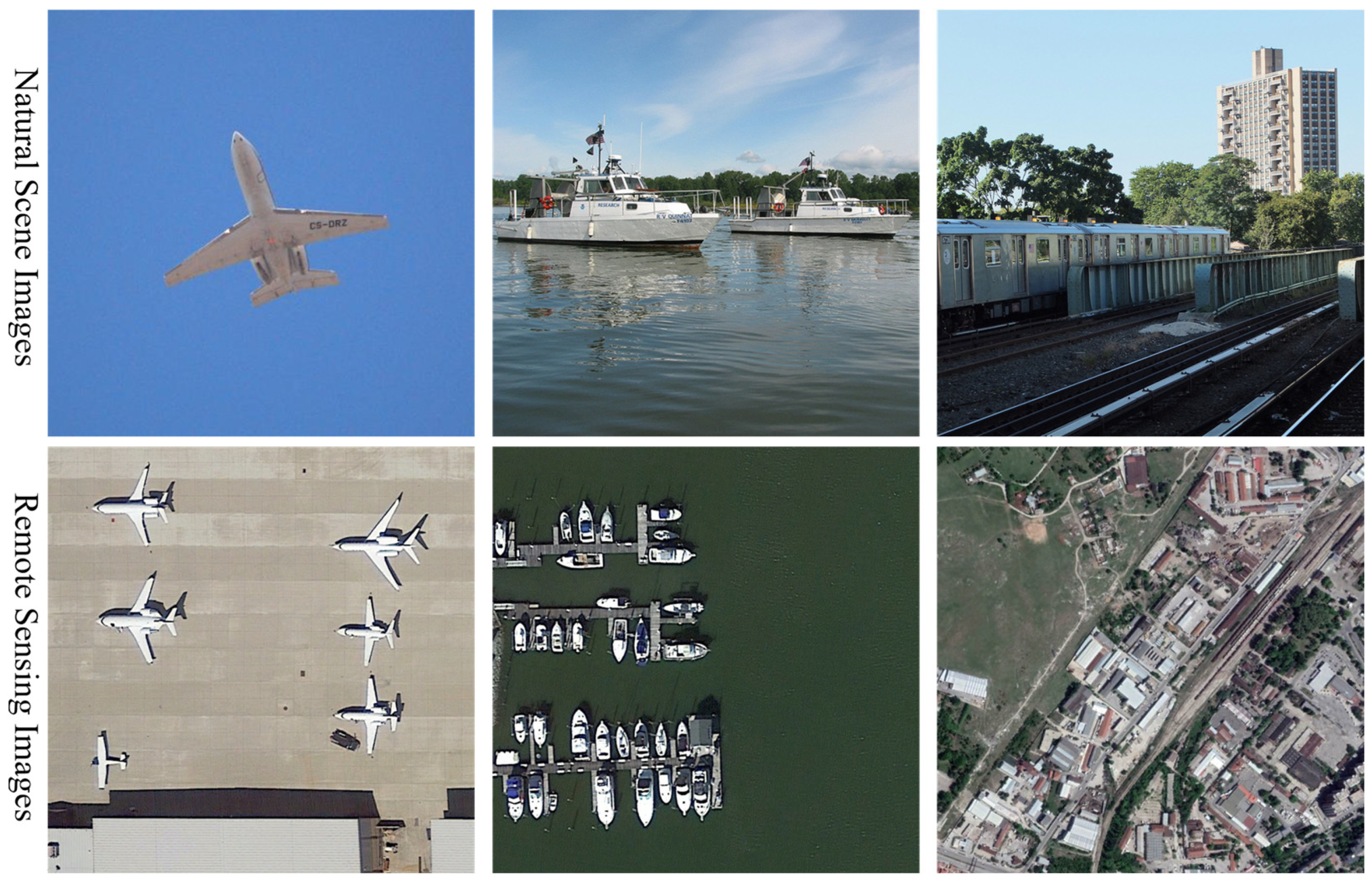
An essential distinction between RSIs and NSIs lies in both spatial scale and information distribution. As shown in Figure 1, NSIs from the COCO2017 dataset [7] are generally captured from ground-level perspectives and contain a limited number of foreground objects within relatively small spatial extents. In comparison, RSIs from the NWPU VHR-10 [8] and DIOR [9] datasets are acquired from overhead platforms, covering wide geographic regions with fine spatial resolutions. Consequently, a single RSI can accommodate densely distributed objects within complex spatial layouts, yielding resolutions far higher than those commonly used in computer vision tasks. While high-resolution RSIs provide rich scene information, they also impose substantial burdens on data acquisition, transmission, storage, and processing [10]. This hinders their practical applications in resource-constrained scenarios, including onboard satellite systems, unmanned aerial vehicles (UAVs), and edge remote sensing platforms, where sensing, communication, and computational resources are inherently restricted.
To alleviate resource constraints during data acquisition, compressed sensing (CS) [11] has emerged as a paradigm that enables simultaneous signal sampling and compression. By exploiting the inherent sparsity of signals, CS allows high-dimensional signals to be represented with fewer compressed measurements, thereby significantly reducing data transmission and storage costs. Benefiting from these advantages, CS has been extensively explored for remote sensing data acquisition, transmission and processing [12,13,14]. However, most existing CS-based remote sensing pipelines adopt the reconstruction-based paradigm, in which CS measurements are initially employed to reconstruct the original image, followed by conventional image-domain inference. While deep learning (DL)-based CS reconstruction methods have achieved outstanding improvements in visual fidelity, image reconstruction remains computationally expensive and memory-intensive, especially for high-resolution RSIs [15]. Many state-of-the-art reconstruction networks [16,17,18] are developed for small or medium-sized images, yet their computational and memory overheads will grow rapidly with spatial resolution, rendering them infeasible for high-resolution remote sensing scenarios. On the other hand, in many sensing applications, the main concern is to perform some inference tasks, e.g., estimation, classification and detection, directly on CS measurements, but not an accurate signal reconstruction [19,20,21]. For example, what is more interesting in radar applications is to discern the anomaly patterns in the sensed signal instead of signal recovery [19]. In compressed hyperspectral image analysis, the primary goal is to obtain the high classification accuracy in the measurement domain, thereby bypassing the computation-heavy and time-consuming reconstruction [20]. In some privacy-protection scenarios such as medical image segmentation and military image detection, signal reconstruction is not recommended due to the potential leakage of sensitive and confidential information [21]. Additionally, direct inference from CS measurements also provides built-in data encryption during training and inference stages, given that the original signal cannot be properly recovered without precise access to the measurements.
Compressed learning (CL) provides an alternative paradigm by performing inference directly on CS measurements without explicit image reconstruction [22,23]. Early theoretical and empirical studies [24,25] have provided some theoretical proofs and guarantees for CL. Meanwhile, CL has evolved into a practical methodology, fostering various applications including compressed acquisition of dynamic scenes [19], compressed hyperspectral image analysis [20], compressed image classification [26,27], compressed domain semantic segmentation [28], and object recognition based on CL [29]. These studies suggest that CS measurements can preserve task-relevant information when appropriately acquired and processed. However, most existing CL methods have been developed for NSIs or relatively small-scale benchmarks, and their applicability to large-scale, high-resolution remote sensing object detection remains insufficiently explored. In addition, the interactions among the sensing strategies, measurement-domain feature extraction, and detection performance under high-resolution constraints has not been systematically investigated.
In this paper, only considering the compression scenario after image acquisition, we focus on the following research question from an algorithmic rather than physical implementation perspective: Is explicit image reconstruction a necessary intermediate step for high-resolution remote sensing object detection? To address this question, we develop an end-to-end CL framework named HR2SIOD-CL for high-resolution remote sensing object detection. HR2SIOD-CL incorporates an entropy-driven, content-aware adaptive sampling strategy with a measurement-domain detection backbone that extracts multi-scale features from CS measurements. The adaptive sampling module functions as a purely software-domain compressive encoding layer, rather than a physically realizable optical sampling hardware system such as coded apertures, spatial light modulators, and multiplexed detector arrays. The proposed framework supports joint optimization of sampling and detection during training, while allowing the sampling and detection modules to be decoupled for flexible deployment. For controlled and fair comparisons between reconstruction-based detection and direct measurement-domain detection, an extra lightweight reconstruction network is built as a reconstruction-based baseline under high-resolution settings. Extensive experiments conducted on public remote sensing datasets demonstrate that direct detection in the measurement domain outperforms the reconstruction-based detection methods when integrating HR2SIOD-CL into two-stage detectors, and obtains comparable or superior detection accuracy to the reconstruction-based pipelines when integrating HR2SIOD-CL into single-stage detectors, while substantially reducing computational complexity and GPU memory consumption. These results provide empirical evidence that CS measurements, when adaptively acquired and properly encoded, can act as an effective representation for high-resolution remote sensing object detection, and that explicit reconstruction is not a prerequisite when detection is the primary objective. All source codes and models are available at https://github.com/acrlife/HR2SIOD-CL (accessed on 19 August 2026).
The main contributions of this paper are summarized as follows:
  • From an algorithmic rather than physical implementation perspective, a systematic study is conducted on direct object detection from CS measurements of high-resolution RSIs, focusing on whether explicit image reconstruction is indispensable when detection is the primary goal in the image post-acquisition compression scenario.
  • We propose an end-to-end CL framework dubbed HR2SIOD-CL for high-resolution remote sensing object detection, which enables direct object detection from CS measurements via joint optimization of the adaptive sampling module and measurement-domain detection backbone.
  • An entropy-driven and content-aware adaptive sampling strategy is introduced to allocate sensing resources by local information distribution, enhancing the robustness of detection under a limited measurement budget. A measurement-domain detection backbone is designed by incorporating a Measurement-to-Embedding (M2E) stem, four hierarchical Stages, and downsampling to capture multi-scale discriminative semantic features from CS measurements while maintaining scalability to high-resolution RSIs.
  • We provide comprehensive evaluations for various methods like the image-domain, CS reconstruction-based and measurement-domain detection schemes on public remote sensing benchmarks in terms of detection accuracy as well as computational and memory costs, demonstrating the excellent trade-off between efficiency and accuracy of direct measurement-domain detection.
The remainder of this paper is organized as follows. Section 2 reviews related work on remote sensing object detection, compressed sensing, and compressed learning. Section 3 describes the proposed HR2SIOD-CL framework in detail. Experimental results are reported in Section 4. Section 5 provides a discussion of the results, and Section 6 concludes the paper.

2. Related Work

To highlight the motivations, this section briefly reviews the closely relevant work, i.e., remote sensing object detection, compressed sensing (CS), and compressed learning (CL).

2.1. Object Detection in Remote Sensing Images

Object detection methods can be broadly categorized into two-stage and single-stage paradigms, distinguished by their respective organization approaches to object localization and classification. Two-stage detectors first generate candidate regions and then refine their categories and spatial locations, while single-stage detectors conduct dense or set-based prediction within a unified pipeline. These two categories of detectors have been extensively studied to tackle the challenges in high-resolution remote sensing object detection, including dense object distributions, large-scale variations, and complex scene layouts [30,31,32].
Two-stage detection approaches are still widely adopted in remote sensing object detection, especially in high-resolution and multi-category scenarios where accurate localization and robustness to scale variation are crucial. Representative two-stage frameworks exemplified by Faster R-CNN [33] and Mask R-CNN [34] decoupled region proposal generation and region-wise classification, rendering them highly adaptable to the complex spatial layouts and dense object distributions prevalent in RSIs. Following this paradigm, Huang et al. [35] proposed DConvTrans-LGA as an extended two-stage framework for remote sensing detection. By integrating dynamic convolution with a local-global attention mechanism, this method achieved enhanced feature representation while effectively mitigating the overwriting of local features during self-attention modeling. Li et al. [36] developed a pyramid convolutional vision Transformer architecture (dubbed PCViT) tailored for remote sensing detection that leverages parallel convolution branches and multi-perspective pre-training to strengthen multi-scale feature representation.
As another major branch of object detection, single-stage detectors have been intensively investigated thanks to their streamlined inference pipelines and low computational overhead. The YOLO series [37,38,39] are iconic single-stage detectors. By reformulating object detection as dense prediction, they demonstrated competitive performance on the RSI datasets while achieving a favorable accuracy–efficiency trade-off. To enhance multi-scale representations in YOLO-based detectors, Zhang et al. [30] designed a feature fusion module called TriNeXt, which incorporates local, nested, and global feature pathways to improve spatial-detail preservation and semantic representation, achieving a significant boost in small-object detection performance. Comparing with convolution-oriented frameworks, Transformer-based single-stage detectors adopt a fundamentally different modeling scheme. DETR [40] cast object detection as a direct set prediction problem via a Transformer encoder–decoder architecture with bipartite matching, eliminating the requirement for anchor design and non-maximum suppression (NMS). RT-DETR [41] further boosted detection efficiency by introducing lightweight encoders and optimized attention mechanisms, enabling real-time inference while preserving the end-to-end set-based formulation. In [7], a dynamic attention mechanism based on Deformable DETR was introduced to effectively capture complex structured objects and small targets in road or strip environments. Li et al. [6,32] presented a texture-semantic collaboration network (TSCNet) and a lightweight frequency and mutual assistance attention network (FreMaNet) for salient object detection in optical RSIs. Owing to their efficiency-oriented designs, the YOLO series and RT-DETR are widely utilized as mainstream single-stage baselines for performance comparisons on remote sensing object detection benchmarks.

2.2. Compressed Sensing

CS [11] is a promising signal acquisition paradigm that enables signal reconstruction from far fewer measurements than required by the Nyquist sampling theorem, leveraging the inherent sparsity of signals in a certain transform domain. CS accomplishes sampling and compression simultaneously, which substantially eases the stringent requirements on transmission bandwidth and data storage. Mathematically, in the sampling process, an original signal x R N is projected into a lower-dimensional measurement vector y R M through a sampling matrix Φ R M × N , i.e., y = Φ x , where M N . The ratio M / N , referred to as the sampling rate (SR), quantifies the degree of dimensionality reduction and governs the trade-off between measurement efficiency and signal fidelity. In the reconstruction process, the core task is to recover x from observed measurements y . Such an inverse problem is generally ill-posed without additional regularization constraints due to M N . To address this issue, many signal reconstruction schemes have been developed [42,43,44]. Although these approaches possess theoretical guarantees and interpretability, they suffer from substantial computational overhead.
Inspired by the powerful learning capability of deep neural networks (DNNs), numerous DL-based CS schemes have been put forward to perform joint optimization over the sampling matrix and nonlinear reconstruction operator [16,17,18]. Against conventional optimization-based methods, these DL-based CS schemes achieve competitive reconstruction quality with drastically lowered time complexity. Based on the adaptability of measurement-allocation strategies to signal content, current CS approaches fall into two categories: non-adaptive and adaptive sampling. In the following, we provide a concise literature review.

2.2.1. Non-Adaptive Sampling

Non-adaptive CS methods generally adopt a fixed or globally learned sampling matrix shared across all image blocks, with their core design centered on boosting reconstruction performance via elaborately designed network architectures. CSNet+ [16], one of the earlier DL-based CS frameworks, introduced the joint sampling–reconstruction optimization paradigm based on convolutional neural networks (CNNs). To incorporate domain knowledge, the optimization-inspired unrolling model OPINE-Net [45] embedded iterative priors into deep network architectures, significantly improving interpretability and performance. Recently, research efforts have turned to Transformer-based architectures for capturing long-range dependencies. For instance, OCTUF [17] exploited the cross-attention modules to integrate global and local contextual information, whereas TransCS [46] combined the convolutional and Transformer blocks to strike a favorable balance between computational cost and modeling capability. Other representative frameworks including MTC-CSNet [18] and MAPUN [47] employed the hybrid operations or memory-aware mechanisms to better preserve fine-grained structural details. Nonetheless, applying the aforementioned models to remote sensing scenarios brings about prominent difficulties. Specifically, uniform measurement allocation remains a fundamental limitation, since this strategy neglects the intricate spatial variations inherent in heterogeneous RSIs [9,10].

2.2.2. Adaptive Sampling

Adaptive sampling methods aim to improve sensing efficiency via allocating measurements according to image content. By exploiting spatial, frequency, or saliency information, these approaches prioritize informative regions while reducing redundancy in smooth areas. AMS-Net [48] adopted a multi-scale strategy to distribute adaptive sampling ratios across different frequency sub-bands in the wavelet domain. CASNet [49] introduced saliency-driven block-wise sampling and supported flexible sampling ratios. UFormer-ICS [50] further explored block-sparsity-aware adaptive sampling within a U-shaped Transformer architecture. AdaCS [51] incorporated an error-clamping mechanism inspired by the restricted isometry property to enhance the stability of adaptive sampling. Adaptive sampling indeed mitigates the inefficiency incurred by global uniform sampling through dynamic allocation of sampling resources, yet these techniques are still intrinsically oriented toward post hoc reconstruction because of their optimization objectives for pixel-level fidelity. When handling high-resolution images, the reconstruction procedure commonly brings significant computational burdens and memory usage. For applications centered on downstream inference instead of high-fidelity recovered images, explicit reconstruction becomes both unnecessary and computationally costly. This motivates us to explore the measurement-domain learning paradigm using adaptive sampling for high-resolution RSIs.

2.3. Compressed Learning

CL, pioneered by Calderbank and Davenport et al. [22,23], establishes a single-stage paradigm that leverages machine learning (ML) and CS techniques to perform downstream inference tasks such as classification and recognition directly on compressed measurements, rather than reconstructing full signals beforehand. Subsequent studies further offered solid theoretical proofs and performance bounds for CL [24,25]. Stimulated by these excellent work and the merits of CNN, some CL frameworks leveraging CNNs to construct end-to-end classification models have achieved encouraging results in the measurement domain [26,27,28]. Unfortunately, their classification performance suffers severe degradation caused by proxy images, particularly under extremely low SRs [52]. Unlike most CL systems that ignore tensor representation of raw signals, Tran et al. [53] innovatively proposed the multilinear CL (MCL) framework. It comprehensively exploits the intrinsic multi-dimensional structure of signals and they developed an end-to-end inference model over the structurally CS measurements. Nonetheless, these CL methods are mostly confined to the classification or recognition of small-scale images and are only applicable to small datasets such as CIFAR [23] and MNIST [27], rendering them ineffective for processing complex high-resolution images in real-world scenarios. Recently, a flexible Transformer-based CL framework named TransCL [54] was developed for large-scale images. Benefiting from Transformer architectures, TransCL achieves state-of-the-art performance across multiple CL tasks and showcases the great potential of Transformer-based CL models. Despite their promising performance, these CL approaches are primarily verified on NSI benchmarks and generally work under relatively modest spatial resolutions. Thus, how these CL models perform under high-resolution RSIs remains insufficiently explored.
More recently, CL has been extended from image recognition to object detection tasks, which directly predicts object locations from CS measurements. For example, CSDet [55] jointly optimizes a learnable multi-channel sampling operator with a lightweight detector, enabling bounding-box regression in the measurement domain for NSIs. For remote sensing applications, CS-CenterNet [15] adapts a CenterNet-style detector to operate on CS measurements for ship detection, demonstrating that competitive detection accuracy can be obtained in the absence of full reconstruction. Nevertheless, existing research on measurement-domain detectors mainly focuses on single-category detection and moderate input resolutions (e.g., 640 × 640 for CSDet and 512 × 512 for CS-CenterNet). Unlike these simplified settings, high-resolution multi-category remote sensing detection faces more complex challenges, including larger scenes, stronger scale variation, and higher reliance on fine spatial details. The scalability of measurement-domain detection to such challenging conditions has not been well characterized. Furthermore, few systematic studies have been conducted to reveal the role of explicit reconstruction and the impact of sampling design on detection performance in high-resolution RSIs.

3. Methodology

3.1. Problem Formulation and Design Requirements

Throughout this paper, we concentrate on the measurement-domain object detection paradigm for high-resolution RSIs from an algorithm perspective instead of hardware implementation, considering only post-acquisition image compression. The sampling module acts as a purely software-domain compression layer for remote sampling data processing, rather than a physically implementable optical sampling system (e.g., coded apertures, spatial light modulators, or learned optical masks). Specifically, our method targets the image post-acquisition compression scenario: complete raw remote sensing frames are first captured by standard imaging sensors, and compressed measurements are then generated digitally via the learned projection within the onboard computing unit. This setup corresponds to digital compressed sampling after image acquisition, instead of optical-domain analog compression. In the following, the raw measurements are further processed without image reconstruction for downstream object detection tasks.
Unlike conventional image-domain methods, the measurement-domain detection directly performs object detection on the compressed measurements rather than the reconstructed images. Under this paradigm, a fundamental question arises: How can we effectively integrate sampling design with measurement-domain feature extraction for accurate object detection while bypassing computationally expensive explicit image reconstruction?
Let X R C × H × W represent a high-resolution RSI captured by standard imaging sensors, where the spatial dimensions H and W generally span thousands of pixels, and C denotes the number of channels. The measurement tensor Y can be acquired by applying a linear projection operation to the source image X . In high-resolution scenarios, the dimensionality of both the raw signal X and its corresponding measurements Y increases substantially, which imposes heavy burdens on computation, memory, and data transmission. Against this backdrop, several core design requirements are listed as follows:
  • Scalability under high spatial resolution. The detection framework should sustain high computational efficiency across varying image spatial sizes. Although various DL-based reconstruction methods [16,17,18] achieve promising performance on small and medium-sized images, they encounter severe resource bottlenecks when processing high-resolution inputs. Traditional reconstruction-based pipelines exhibit weak scalability on high-resolution images due to heavy overhead in both computation and memory consumption. Accordingly, a practical detection framework should avoid intermediate representations that incur heavy computational overhead proportional to spatial dimensions.
  • Task-oriented representations over pixel fidelity. For scenarios that prioritize final detection outputs without concern with high-quality reconstruction, extracting semantic features for object recognition and localization is of vital importance. Meanwhile mandatory image reconstruction introduces a redundant intermediate process that incurs extra computational costs and may even trigger privacy leakage.
  • Constrained and structured encoding. In real-world remote sensing systems, the measurement budget is restricted by transmission bandwidth and terminal processing power. To ensure scalability and parallelism, the block-wise sampling mechanism is generally adopted for high-resolution images. As a result, the detection framework should perform efficiently under a limited measurement budget while effectively managing non-uniform information distribution across different image regions.
  • Decoupled sampling and detection. In practical applications, the sampling module and the detection module may run on distinct platforms or terminals. Therefore, although these two modules are jointly optimized during training, they should be decoupled in the inference stage to enable flexible deployment.
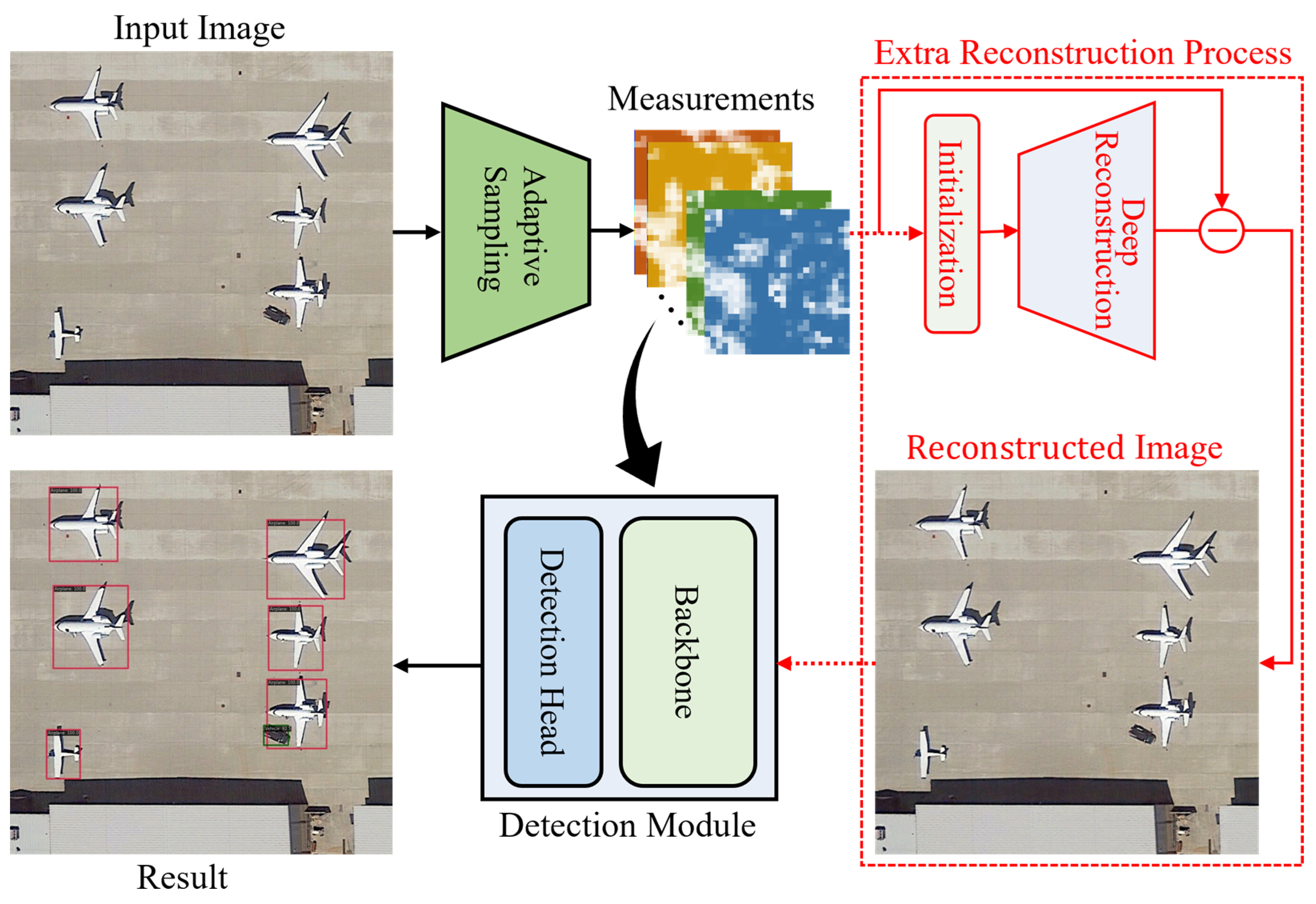
Motivated by the above considerations, we develop a high-resolution RSI CL framework dubbed HR2SIOD-CL that performs object detection directly on CS measurements. The proposed approach effectively integrates the adaptive sampling and measurement-domain feature extraction for object detection, bypassing explicit image recovery.

3.2. Overview of the HR2SIOD-CL Framework

Figure 2 illustrates the overall architecture of the proposed HR2SIOD-CL. This CL framework comprises two core functional components, i.e., an adaptive sampling module and a detection module, and an extra branch for validation and comparisons. Specifically, in the sampling stage, an entropy-driven content-aware adaptive sampling module is introduced to address limited measurement budget and non-uniform information distribution. An input image is decomposed into non-overlapping blocks and the measurement allocation for each block is dynamically adjusted based on the local information content. This strategy assigns more active measurement channels to informative regions while enforcing a lower bound on the per-block allocation to guarantee minimum measurement coverage across the entire image. The resulting CS measurements are then fed into a measurement-domain detection backbone. The backbone transforms the unstructured raw measurements into structured feature representations, thereby extracting hierarchical, multi-scale, and discriminative semantic features for remote sensing object detection. By operating directly in the measurement domain, the proposed model learns task-aligned feature representations and eliminates the computational and memory overhead caused by explicit image reconstruction, thus achieving scalability to high-resolution inputs. Additionally, we incorporate an extra lightweight reconstruction module to construct a baseline, enabling controlled and fair comparisons between reconstruction-based detection and measurement-domain detection with identical measurements. During training, the adaptive sampling module and the detection backbone are jointly optimized to align sampling strategies with inference objectives. In the inference stage, the sampling and detection processes of the proposed framework can be completely decoupled, facilitating flexible deployment in practical remote sensing environments.

3.3. Entropy-Driven Content-Aware Adaptive Sampling

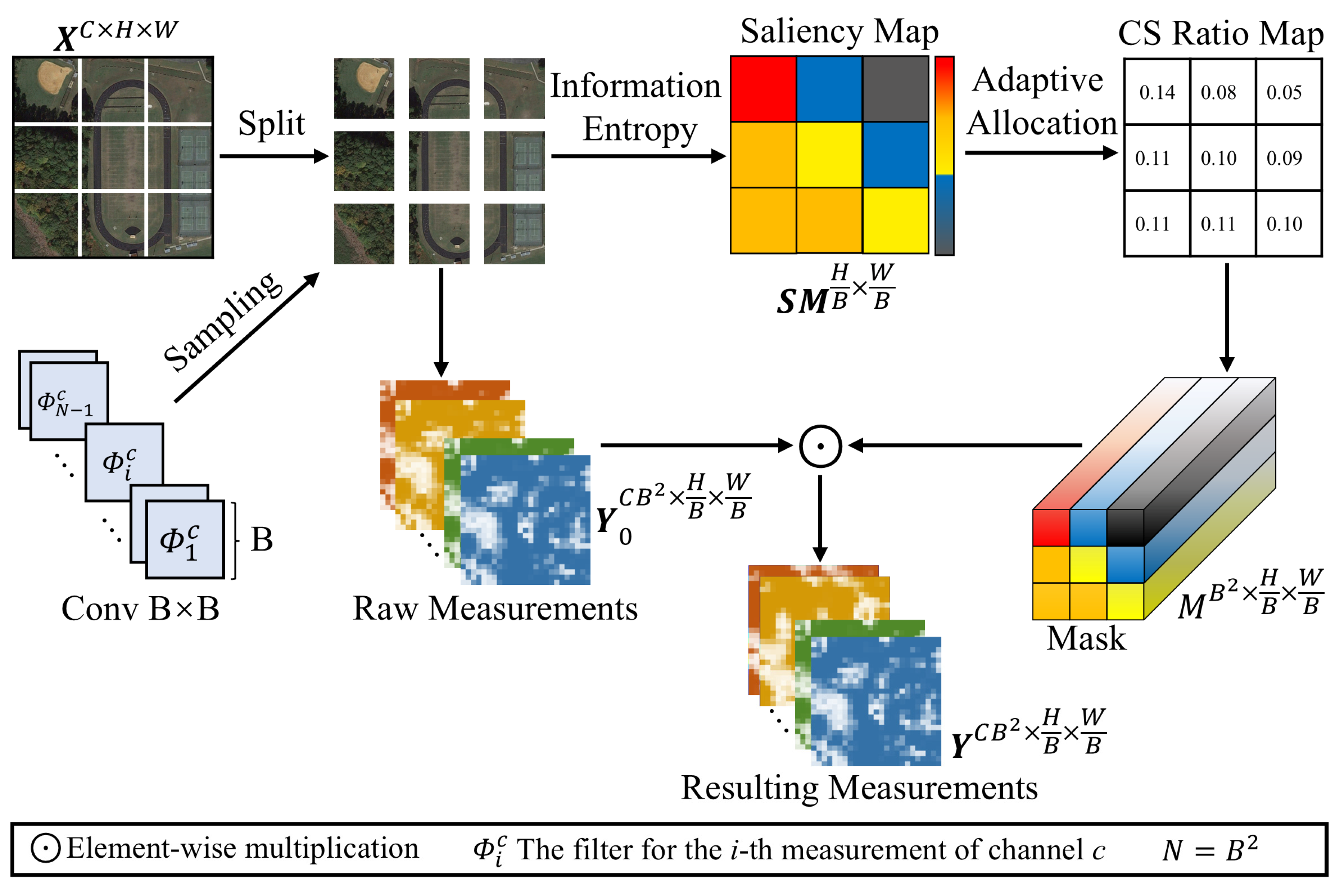
In high-resolution remote sensing scenarios, CS operates under a limited measurement budget that needs to be allocated across large spatial extents. Uniform sampling suffers from low efficiency and loss of saliency-rich features, as it treats homogeneous background regions and structurally complex areas indiscriminately [48,49]. To mitigate this drawback, our HR2SIOD-CL adopts an entropy-driven content-aware adaptive sampling strategy to dynamically distribute measurements according to local information content. Taking information entropy as an efficient, parameter-free proxy for structural complexity, this block-wise sampling strategy enhances detection robustness under limited sampling resources. Specifically, the proposed adaptive sampling process consists of three distinct phases: saliency estimation, measurement allocation, and differentiable mask sampling.
Saliency Estimation. Given a high-resolution RSI input X R C × H × W , HR2SIOD-CL first partitions it into non-overlapping B × B blocks. Figure 3 shows the processing of the proposed adaptive sampling, where information entropy is adopted as the saliency metric to estimate local structural complexity and guide measurement allocation. For each block x i j , the local information entropy is computed by
E i j = k = 1 L p k log 2 p k ,
where p k denotes the normalized histogram probability of the k-th pixel intensity level within block x i j , and L represents the total number of intensity levels. For RGB inputs, the entropy is calculated using the grayscale intensity to capture local structural complexity. To quantify the relative importance of different blocks, the block-wise entropy map is linearly normalized to generate a saliency map S M :
S M i j = E i j E min E max E min + ϵ ,
where E min and E max denote the minimum and maximum entropy values across all blocks, respectively. ϵ indicates a small constant to ensure numerical stability. Linear normalization preserves the relative ordering of block importance without excessively amplifying extreme values, which is beneficial for maintaining balanced sampling coverage. Subsequently, a global normalization is applied to convert these values into a spatial probability distribution mapping:
S M ^ i j = S M i j u , v S M u v + ϵ ,
where u and v iterate over the spatial indices of all blocks across the image. This global normalization is mandatory to guarantee that the sum of the saliency map across the entire image equals 1, a property essential for exact allocation of the remaining measurement budget in the next phase.
Measurement Allocation. Under a global sampling ratio SR, the total number of available measurements is defined as N total = S R × H × W . Purely entropy-driven allocation risks overly suppressing low-saliency regions where small targets may reside. To prevent such omissions and ensure minimum measurement coverage, a guaranteed baseline measurement quota n base is imposed for each block prior to adaptive allocation of the residual budget as follows:
n base = S R × α × B 2 ,
where α denotes the minimum guaranteed measurement ratio controlling the trade-off between baseline measurement coverage and adaptive allocation flexibility, which is dynamically tuned based on the target sampling ratio SR to maintain sufficient baseline coverage. In our work, α is empirically set to 0.5 when S R < 0.2 , and 0.3333 otherwise. The remaining number of measurements n res is then computed as below:
n res = m a x ( 0 , N total n base × H B × W B ) .
To prevent the excessive concentration of the measurement budget in highly complex regions, an allowable upper limit n max = 2 × S R × B 2 is introduced for each block. Consequently, the normalized saliency values S M ^ i j are capped at a dynamically calculated upper threshold τ = ( n max n base ) / n res . Any excess allocation ratio exceeding this threshold τ is iteratively redistributed among the remaining unsaturated blocks. Specifically, in each iteration, saliency values exceeding τ are clamped to the threshold, and the resulting surplus is redistributed by proportional rescaling of the remaining unsaturated blocks. This iterative process ensures strict conservation of the total measurement budget while adhering to the individual block capacity. Ultimately, the final allocated measurement count n i j for each block is computed and bounded by the per-block measurement-channel capacity B 2 :
n i j = min ( n base + S M ^ i j * × n res , B 2 ) ,
where S M ^ i j * denotes the adjusted saliency value for the ( i , j ) -th block after the iterative redistribution process.
Differentiable Mask Sampling. The allocated measurement count for each block is imposed on the convolutional projection through a binary measurement mask M 0 , 1 B 2 × H B × W B , defined by
M k , i , j = 1 ,   i f   k n i j     0 ,   o t h e r w i s e ,
where k 1 , 2 , , B 2 denotes the measurement-channel index within each image block. For a block assigned n i j measurements, the mask preserves the first n i j measurement channels and masks the remaining channels. This fixed-order selection rule enables the measurement allocation of each block to be uniquely determined by n i j , eliminating the need for an additional block-specific set of selected channel indices. No importance ranking is predefined for the measurement channels prior to training. Nevertheless, during joint optimization, lower-indexed channels are retained under a broader range of block-wise measurement allocations and thus receive gradients from a larger set of image blocks. By contrast, higher-indexed channels are activated only for blocks with larger measurement budgets, and are primarily optimized to deliver complementary information. Such asymmetric activation encourages the first n base measurement channels to encode information useful across a broader range of measurement budgets and higher-indexed channels to encode complementary cues for larger-budget blocks. However, this training mechanism does not theoretically guarantee a globally optimal ordering of the learned measurement channels. Since the discrete indicator function (7) is inherently non-differentiable, the Straight-Through Estimator (STE) [56] is employed for approximation in the forward pass, enabling end-to-end joint optimization of the sampling module and detection backbone. Mathematically, the differentiable mask M ~ is formulated with a stop-gradient operator [57] as follows:
M ~ k , i , j = M k , i , j +   ϵ ( n i j   sg ( n i j ) )
where sg ( · ) denotes the stop-gradient operation. It evaluates the input in the forward pass yet yields zero gradients in the backward pass. In the practical tensor implementation, the binary mask M is instantiated using a combination of the ReLU and sign functions. This formulation ensures that the forward output remains strictly binary, while the gradients bypass the discrete step and flow directly into the underlying continuous variables for computing the allocation count n i j .
The image block x i j c is projected via a learnable channel-specific sampling matrix Φ c R B 2 × B 2 to generate a local measurement vector y 0 , i j c , which can be formulated as y 0 , i j c = Φ c x i j c . The raw measurement tensor Y 0 R C B 2 × H B × W B can be obtained by aggregating all local measurements spatially. Subsequently, the differentiable mask is applied to these raw measurements to yield the final block measurements, formulated by:
y i j c = M ~ i j y 0 , i j c ,
where c 1 , 2 , , C indicates the color channel index, M ~ i j R B 2 denotes the mask vector for the ( i , j ) -th block, and represents element-wise multiplication. Notably, the mask M ~ i j is shared across all color channels, whereas all image blocks within a specific channel share a dedicated sampling matrix Φ c . This design avoids redundant projection weights for individual spatial regions while permitting independent projection weights for each color channel. Instead of modifying the sampling matrices for individual spatial regions, the convolutional layer generates the complete set of B 2 measurement values for each block. Then the binary mask retains the first n i j measurement channels and sets the remaining measurement values to zero, thereby enforcing the allocated effective measurement budget without reducing the computation of the convolutional projection itself. Finally, the masked measurement vectors of all blocks within each channel are assembled into the channel-wise measurement Y c . The measurements from all channels are concatenated along the channel dimension to yield the global measurement Y R C B 2 × H B × W B for the whole image, serving as the input for the subsequent detection backbone.
The proposed strategy aligns the sampling encoding with the downstream detection objective by utilizing entropy as a parameter-free proxy for structural complexity and jointly optimizing the sampling module with the downstream detector. For controlled comparisons, the following reconstruction-based baseline utilizes the same measurements produced by the proposed adaptive sampling module, ensuring that the following research focuses on the necessity of explicit reconstruction rather than the optimality of the measurement-allocation strategy.

3.4. Measurement-Domain Detection Backbone

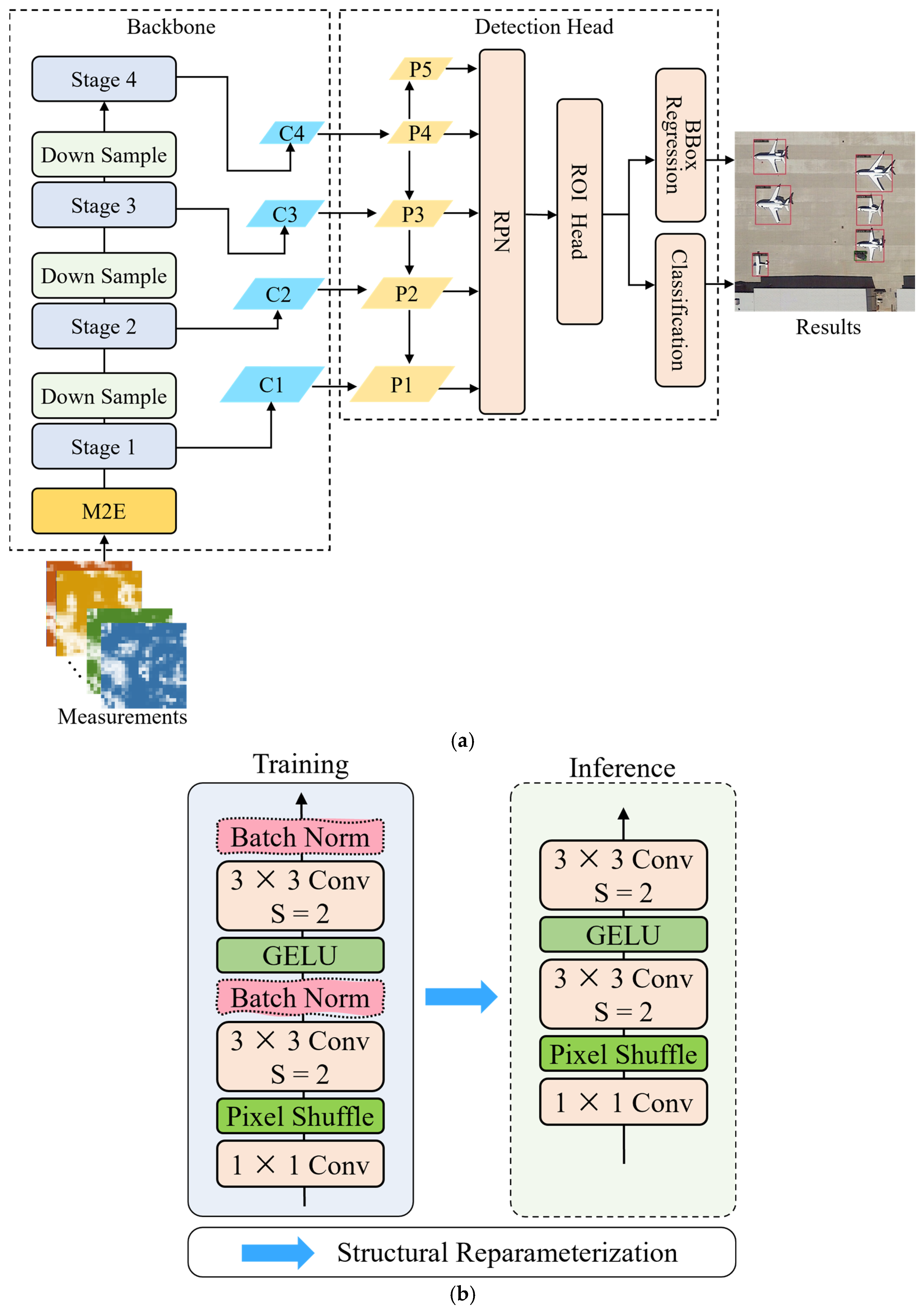
Direct inference from CS measurements will introduce prominent statistical disparities in feature extraction compared to a conventional image-domain paradigm, since the compressed measurements exhibit statistical properties significantly different from those of NSIs. Consequently, directly applying the image-oriented detection backbones in the standard detectors (e.g., Faster R-CNN, YOLO12, and RT-DETR) to the compressed measurements usually leads to suboptimal detection performance. To bridge this semantic gap, we construct a plug-and-play measurement-domain detection backbone to extract hierarchical multi-scale discriminative features from CS measurements. As a modular feature extractor, the proposed backbone can flexibly adapt to various mainstream detection frameworks such as Faster R-CNN, Mask R-CNN, YOLO-series, and RT-DETR. For ease of illustration, we take vanilla Faster R-CNN as an example. Figure 4a showcases the structure of the proposed measurement-domain backbone, which seamlessly integrates with the detection head of Faster R-CNN. As illustrated in Figure 4a, the proposed backbone is composed of a Measurement-to-Embedding (M2E) stem, four Stage blocks, and three Down Sample modules following the Stage blocks. Note that downsampling is not required for the last Stage block. The hierarchical multi-scale feature outputs derived from these four sequential Stage blocks are fed into the detection head for object detection. Given CS measurements Y , we elaborate on the structure of the proposed backbone in what follows.
The backbone begins with the M2E stem shown in Figure 4b, which converts block-wise measurements into an image-aligned measurement representation amenable to local convolutions. Concretely, the M2E stem employs a pointwise convolution to implement per-location channel mixing, followed by a deterministic Pixel-Shuffle operator [58] for channel-to-space reorganization. This operation serves as a representation lifting step that restores spatial alignment for downstream translation-equivariant modeling. Importantly, it is not intended as an image reconstruction initializer, since it does not optimize any pixel-level fidelity objective. After spatial alignment, two 3 × 3 convolutions with stride 2 are utilized to generate a compact embedding for the subsequent hierarchical stages. The first convolution is followed by batch normalization and a nonlinear GELU activation function, and the second by batch normalization only. For efficient deployment, we adopt a RepVGG-style [59,60] structural re-parameterization, which fuses each 3 × 3 convolution and its batch normalization into an equivalent single convolution during inference. Finally, the M2E stem outputs a measurement-domain embedding E R 64 × H 4 × W 4 , thereby providing an efficient interface bridging measurements and a conventional multi-scale detection backbone.
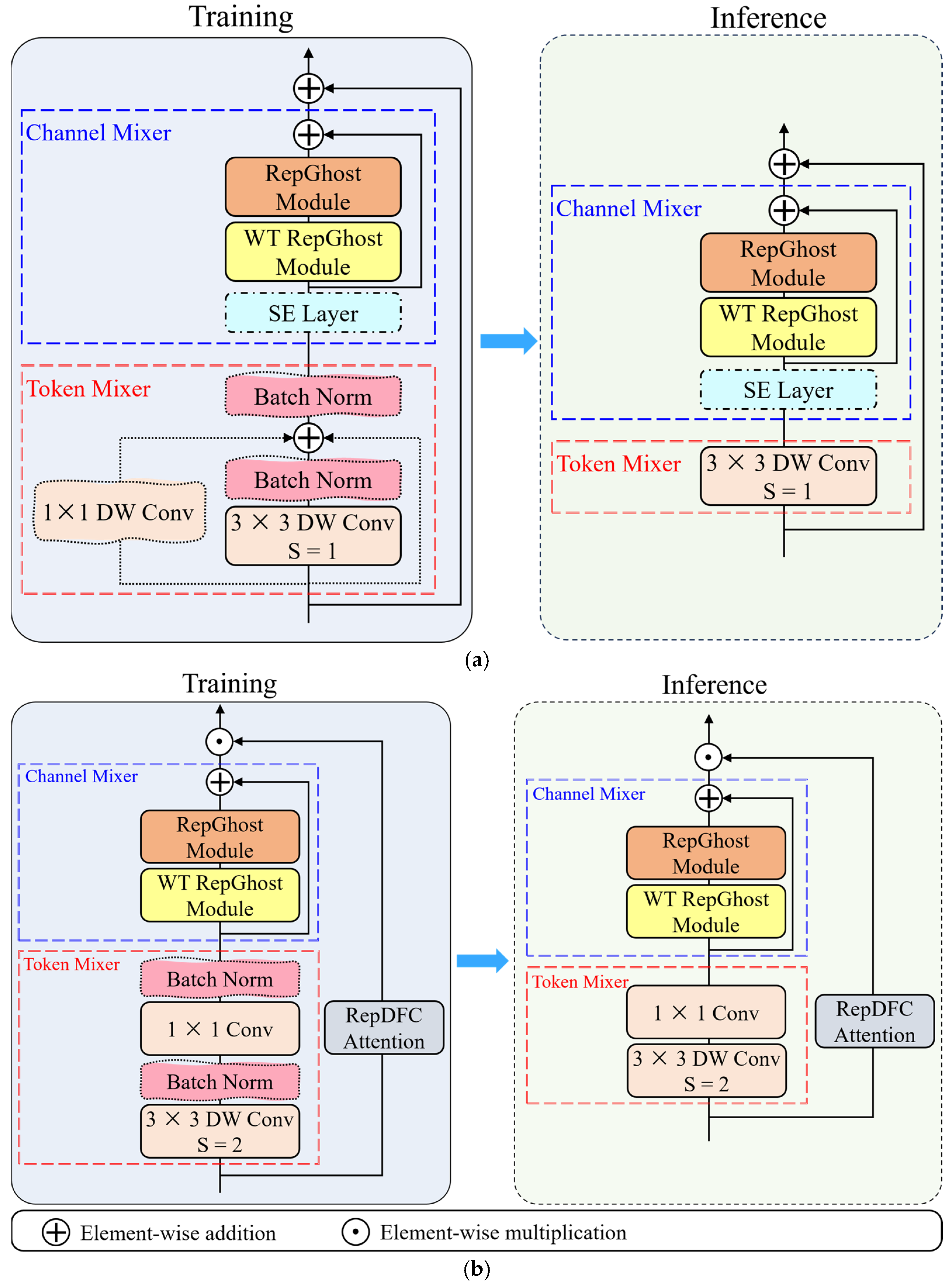
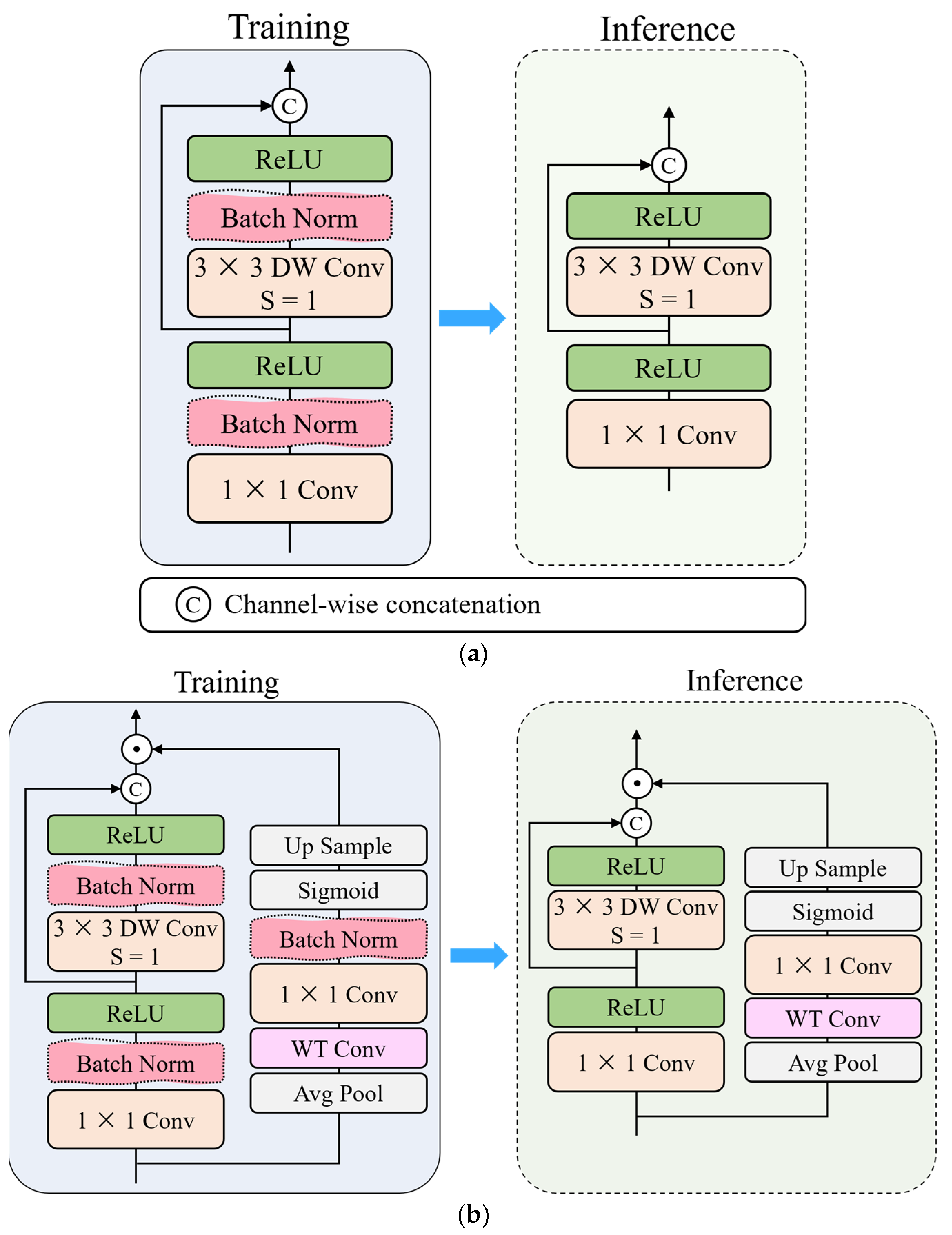
Inspired by recent Vision Transformer formulations [61,62,63], which attribute much of their capacity to the decoupling of token mixing and channel mixing, we adopt a convolutional realization of these two components to better align with high-resolution measurement-domain inputs. Figure 5a shows the structure of the Stage block. Within each Stage block, token mixing is implemented via a depthwise 3 × 3 convolution, where each local spatial neighborhood is regarded as a token. This local aggregation strategy captures short-range spatial dependencies while maintaining linear computational complexity with respect to spatial resolution. To improve optimization without increasing inference-time cost, the depthwise token mixer is structurally re-parameterized during training and fused into a single depthwise convolution at inference. Specifically, during training, we augment the main depthwise 3 × 3 branch with parallel auxiliary branches, i.e., a pointwise branch and an identity branch. During inference, all branches are algebraically fused into one equivalent depthwise convolution. This preserves the efficiency of a single-branch architecture while inheriting the strong representational capacity brought by multi-branch structures in the training phase. While local token mixing aggregates spatial cues, effective channel interaction is crucial for extracting discriminative representations from CS measurements. To this end, the channel mixer is realized by sequentially stacking a WT RepGhost module and a RepGhost module, both built upon GhostNet-style designs [64,65]. The RepGhost module displayed in Figure 6a performs efficient channel expansion and reduction through low-cost linear operations. Structural re-parameterization is also employed to fold convolution and normalization layers into a single operator for inference. Figure 6b illustrates the WT RepGhost module, which extends the vanilla RepGhost by introducing a wavelet-convolution branch to enlarge the effective receptive field and capture multi-scale contextual information with minimal extra overhead. In the wavelet-convolution branch, spatially pooled features are processed by a wavelet transform convolution (WT Conv) [66], followed by a pointwise convolution and a Sigmoid activation function to generate channel-wise modulation weights. Derived from the wavelet-processed pooled context, these weights re-weight the main-branch responses through element-wise multiplication, enabling adaptive highlight on informative channels. Additionally, to further strengthen channel communication, a squeeze-and-excitation (SE) layer [67] is only inserted into the odd-numbered Stage block, striking a balance between accuracy gains and inference efficiency.
The Down Sample module depicted in Figure 5b is responsible for reducing spatial resolution and expanding channel dimensionality between successive Stages. Concretely, downsampling is performed by a depthwise 3 × 3 convolution with stride 2, followed by a pointwise convolution to adjust channel width. For channel mixing, the Down Sample module adopts the same design as the Stage block, employing the WT RepGhost and RepGhost modules to enable efficient channel interaction and multi-scale contextual modeling. Furthermore, a re-parameterized decoupled fully connected (DFC) attention [65] module is integrated into each Down Sample module to introduce lightweight global mixing across spatial locations, which is particularly effective at resolution-transition points. By alternately stacking the Stage blocks and the Down Sample modules, the backbone yields hierarchical multi-scale feature representations with progressively reduced spatial resolution and enriched semantics, which is essential for detecting objects with varying sizes in high-resolution RSIs. Collectively, starting from the measurement-domain embedding E , the four Stages and the three interleaved Down Sample modules build a four-level feature pyramid F 1 , F 2 , F 3 , F 4 , where F 1 R 64 × H 4 × W 4 , F 2 R 128 × H 8 × W 8 , F 3 R 256 × H 16 × W 16 , and F 4 R 512 × H 32 × W 32 . These multi-scale features are fed into the detection head of the chosen pipeline (e.g., RPN and ROI heads in Faster R-CNN, or the YOLO detection head) to produce the final classification scores and bounding-box predictions.

3.5. Reconstruction-Based Detection Baseline

In this section, we build a reconstruction-based pipeline as a comparative baseline. This baseline is not intended to introduce a novel CS reconstruction method, but to enable controlled and fair evaluation of whether explicit reconstruction is an indispensable intermediate step for high-resolution remote sensing object detection under identical sampling conditions. Within this baseline, the same CS measurements as HR2SIOD-CL are first employed to reconstruct an image X r e c R C × H × W , which is then fed into the same detection backbone and head adopted by our HR2SIOD-CL. Most existing CS reconstruction networks were developed and evaluated on small or medium-sized images. When applied to high-resolution RSIs, e.g., resolutions of 1024 × 1024 or larger, many reconstruction models become computationally intractable owing to excessive memory consumption and soaring computational overhead. For instance, some state-of-the-art methods such as OCTUF [17], TransCS [46], and CASNet [49] triggered out-of-memory errors on our 32 GB GPU even with a batch size of 1, rendering them inapplicable as baselines for high-resolution RSIs. To tackle this issue, we develop a lightweight convolution-driven reconstruction module, which is solely utilized to build a feasible reconstruction-based baseline for comparison.
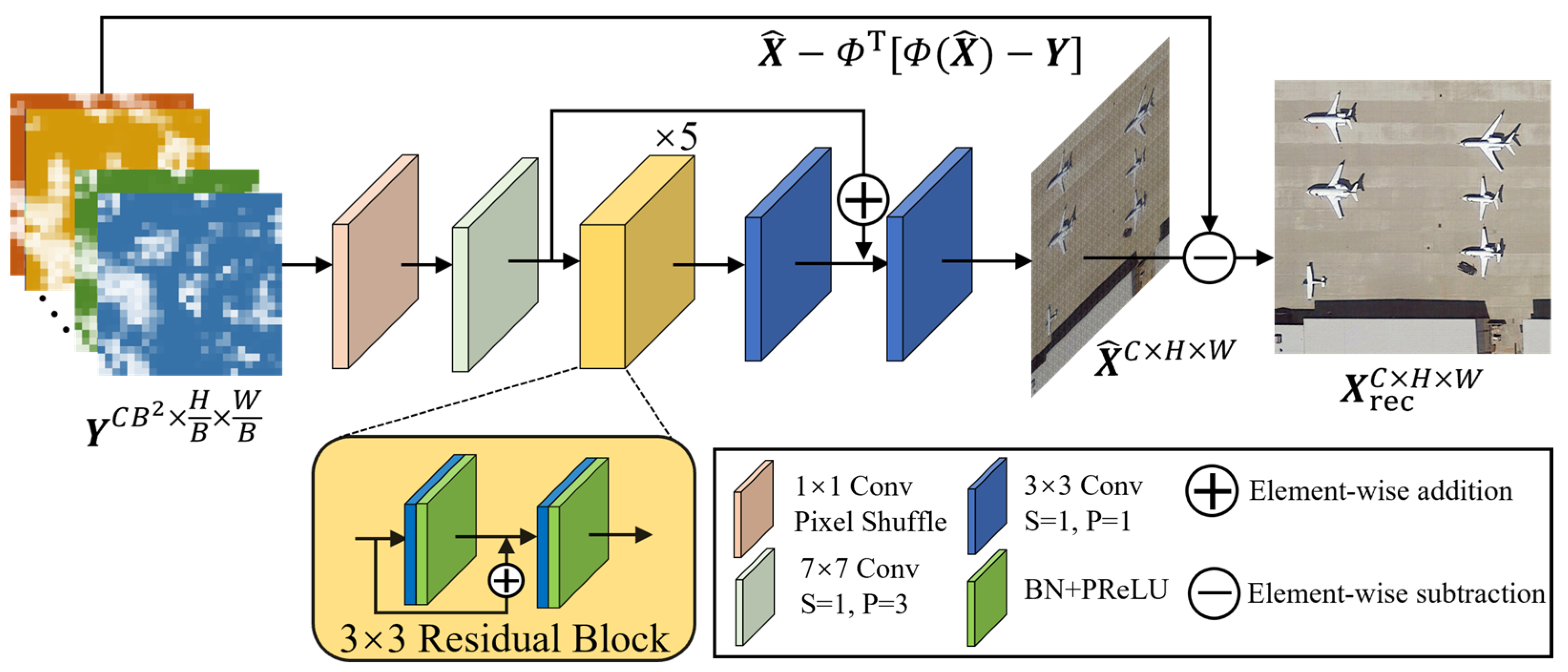
As illustrated in Figure 7, the reconstruction module takes CS measurements Y as input and first generates an initial image estimate X 0 R C × H × W . This initialization is implemented using a 1 × 1 convolution followed by Pixel-Shuffle, enabling an efficient and memory-friendly transformation from the measurement domain to the image domain. The initial estimate X 0 is then refined through a pure convolution-based network composed of a 7 × 7 convolution, a sequence of residual blocks, and two 3 × 3 convolution layers. The 7 × 7 convolution enlarges the receptive field, thereby facilitating the aggregation of contextual information in RSIs. Compared with those reconstruction networks that rely on iterative unrolling or Transformer-based global modeling, the proposed architecture maintains stable memory usage and computational cost when processing high-resolution inputs. To further boost reconstruction fidelity while preserving efficiency, a single-step data-consistency correction is performed on the network output X ^ R C × H × W , yielding the final reconstruction X rec as follows:
X rec = X ^ Φ T Φ X ^ Y ,
where Φ T denotes the transpose of the sampling matrix Φ . This single-step correction enforces data consistency by correcting the measurement-domain mismatch, without iterative refinement or extra memory consumption. The reconstruction module is merely adopted as a reference component for reconstruction-based detection pipelines. In all experiments, the reconstruction-based baseline utilizes identical CS measurements with HR2SIOD-CL. This guarantees that performance discrepancies stem from whether a reconstruction step is introduced, instead of variations in input measurements.

4. Experimental Results

4.1. Datasets

To validate the effectiveness of the proposed method in this paper, two publicly available datasets, NWPU VHR-10 and DIOR, both annotated with horizontal bounding boxes (HBB), are chosen as the experimental datasets. The NWPU VHR-10 dataset contains 800 high-resolution RSIs collected from Google Earth and the Vaihingen dataset, including 650 positive images with 3896 object instances across 10 categories and 150 negative images without objects. Following the common protocol, the positive subset is split into training and test sets with an 8:2 ratio. For further generalization validation on a larger and more diverse benchmark, we additionally adopt the DIOR dataset, which contains 23,463 aerial images with 192,472 annotated instances spanning 20 categories. DIOR exhibits large variations in object scales and complex imaging conditions (e.g., weather, season, and image quality changes), leading to substantial intra-class diversity and inter-class similarity. The training, validation, and test sets contain 5862, 5863, and 11,738 images, respectively. Furthermore, to assess the efficacy of the proposed reconstruction network, we build a remote sensing compressed sensing dataset termed RSCS. Specifically, the reconstruction training set consists of 2500 randomly selected images from the DIOR training set and 500 arbitrarily chosen positive samples from NWPU VHR-10. The remaining positive samples of NWPU VHR-10, together with 100 arbitrarily selected images from the DIOR validation set, are used for validation. Notably, RSCS is only utilized for reconstruction experiments and does not modify the detection training and evaluation protocols on NWPU VHR-10 and DIOR.

4.2. Experimental Settings

All experiments are implemented in PyTorch 1.12 and conducted on NVIDIA RTX 4080 SUPER GPU with 32 GB memory. In what follows, we consider two tasks with different roles in our framework: image reconstruction is used as an extra component to establish reconstruction-based baselines, while object detection is the primary task.
For the image reconstruction task, all input images are resized to 128 × 128 . In preliminary trials, we found that many representative CS reconstruction approaches struggle to be integrated into a reconstruction-based detection pipeline at high resolution (e.g., 1024 × 1024 ) due to excessive memory consumption and poor scalability. Among all evaluated competitors, CSNet+ [16] is one of the few typical CS reconstruction models that can be reliably incorporated into our reconstruction-based detection framework. Accordingly, CSNet+ is adopted as a reconstruction-level baseline for comparison with the proposed reconstruction network, to validate the effectiveness of our design for RSI reconstruction. Although both the proposed reconstruction network and CSNet+ are in principle applicable to higher-resolution inputs, our reconstruction experiments aim for controlled quality benchmarking rather than evaluating high-resolution reconstruction performance. For this reason, we conduct reconstruction training at a standard resolution of 128 × 128 , which enables a substantially larger batch size and more stable optimization. Under this setting, the reconstruction network is trained on a single GPU with a batch size of 64, an initial learning rate of 5 × 10 4 , and a total of 100 epochs.
For the object detection task, our HR2SIOD-CL is trained on two GPUs, each with 32 GB memory. All images in the DIOR dataset are resized to 1024 × 1024 . For rectangular images in the NWPU VHR-10 dataset, the longer side is resized to 1024, while the shorter side is scaled proportionally to preserve the aspect ratio. The batch size is set to 4 per GPU, and the initial learning rate is 2 × 10 4 . Following the training strategy adopted in [36], we train the model for 72 epochs and decay the learning rate by a factor of 10 at epochs 48 and 66. For fair comparison, data augmentation is limited to random horizontal flipping with a probability of 0.5, and no additional augmentation techniques are employed. In our work, the image-domain detection pipelines take original images as input and adopt the same backbone and detection head as HR2SIOD-CL for object detection. Training configurations for image-domain detection are consistent with those of the measurement-domain detection pipeline to guarantee fair evaluation. For reconstruction-based detection pipelines, the proposed reconstruction network recovers images from CS measurements. The reconstructed outputs are subsequently fed into the same backbone and detection head adopted by HR2SIOD-CL. Due to the additional memory consumption incurred by the reconstruction step, the batch size per GPU is reduced to 2, while all other training settings, including image resolution, learning rate schedule, number of epochs, and data augmentation, are kept identical to those of HR2SIOD-CL. Furthermore, the backbones adopted in the image-domain, reconstruction-based and measurement-domain detection frameworks are all initialized with pre-trained weights from ImageNet-1K. All competing detection methods compared in Section 4.7 employ their publicly available official pre-trained weights for evaluation.
For evaluation, PSNR and SSIM are used to assess reconstruction quality; object detection performance is evaluated by m A P 50 and m A P 50 : 95 , where m A P 50 denotes mean Average Precision at an IoU threshold of 0.5, and m A P 50 : 95 represents the average mAP over IoU thresholds from 0.5 to 0.95 with a step size of 0.05.

4.3. Effects of Different Block Size

As described in Section 3.3, the image block size directly governs the measurement granularity as well as the computational overhead of the sampling module. So we further explore the effects of different block sizes on the detection performance of our HR2SIOD-CL. We conduct experiments on the public remote sensing datasets introduced in Section 4.1 across different sampling ratios. Owing to space constraints, only partial experimental results are presented herein. Table 1 lists the detection results on the NWPU VHR-10 dataset with diverse block sizes at four sampling ratios, where the best and second best are marked in bold font and with underline, respectively. As can be seen, at the sampling ratios of 1.8% and 5%, our HR2SIOD-CL achieves optimal detection performance with the minimal parameter count and computational overhead for the sampling module when adopting a 8 × 8 block size. At the sampling ratios of 10% and 25%, HR2SIOD-CL obtains comparable detection performance with block sizes of 8 × 8 and 16 × 16 , and both configurations surpass the detection results obtained with 32 × 32 and 64 × 64 blocks. Additionally, when the block size is 8 × 8 , the parameter count and computational overhead of the sampling module are approximately 6.25% and 25.10% of those for 16 × 16 , 0.39% and 6.25% of those for 32 × 32 , and 0.02% and 1.56% of those for 64 × 64 , respectively. Accordingly, we adopt 8 × 8 as the default block size in subsequent experiments to balance detection accuracy and computational cost.

4.4. Reconstruction Performance Validation for the Proposed Baseline

We first evaluate image reconstruction performance to validate that the proposed lightweight reconstruction network can provide sufficiently reliable reconstructions and thus be a credible reconstruction-based baseline for subsequent detection comparisons. As described in Section 4.2, we compare the proposed reconstruction network with CSNet+, a representative CS reconstruction method that can also be integrated into our reconstruction-based object detection pipeline. Both models are trained on the RSCS training set under the same reconstruction settings.
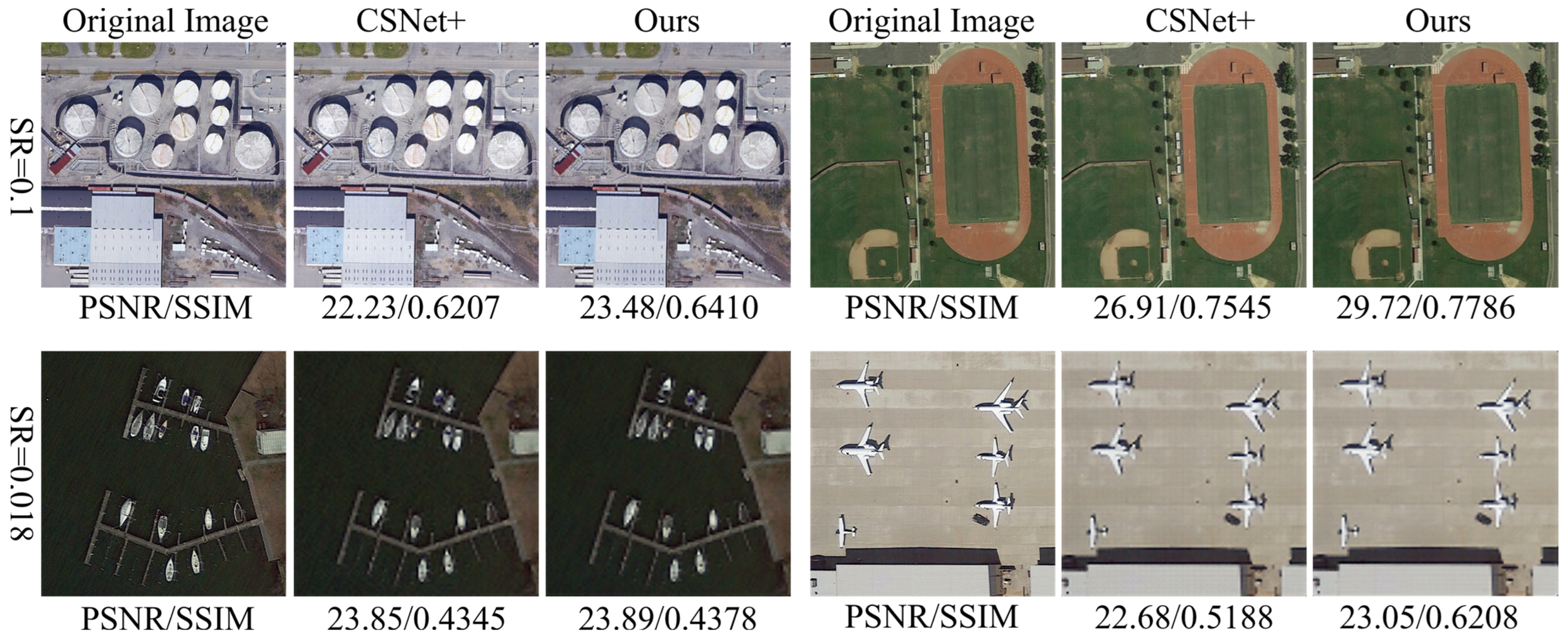
Quantitative comparison results are listed in Table 2. Obviously, the proposed reconstruction network achieves higher PSNR and SSIM than CSNet+ across various sampling ratios, except for nearly matching SSIM at the 10% sampling ratio. At a sampling ratio of 1.8%, our method achieves an SSIM of 0.5466 compared to 0.5290 obtained by CSNet+. At the 25% sampling ratio, it attains 0.9110 versus 0.8339 for CSNet+. Averaged across all sampling ratios, our reconstruction network improves the average PSNR from 26.15 dB to 27.69 dB and the average SSIM from 0.6796 to 0.7150. These results indicate that the proposed reconstruction design, together with the single-step data-consistency correction, yields reconstructions with better structural similarity. Figure 8 provides visual quality comparisons. Across diverse remote sensing scenes including dense building regions, sports fields and aircraft areas, our proposed method obtains superior reconstruction quality compared to CSNet+ at both the moderate sampling ratio of 10% and the extremely low sampling ratio of 1.8%. The reconstruction results demonstrate that our lightweight reconstruction network can serve as a reliable baseline for reconstruction-based detection, ensuring that performance differences between reconstruction-based detection and direct measurement-domain detection do not arise from an inferior reconstruction stage.

4.5. Object Detection Based on Original Images, Reconstructed Images, and CS Measurements

In this section, we investigate whether explicit reconstruction is indispensable for high-resolution remote sensing object detection through three groups of detection experiments conducted on original images, reconstructed outputs, and CS measurements. Two widely used two-stage detection frameworks, i.e., Faster R-CNN and Mask R-CNN, are employed for a controlled and systematic evaluation. Concretely, we integrate HR2SIOD-CL into Faster R-CNN for object detection on the DIOR dataset, and into Mask R-CNN for object detection on NWPU VHR-10, respectively.
Table 3 provides the performance comparison for three groups of detection experiments. As can be seen, object detection on the original images (without the sampling procedure) achieves the highest detection accuracy over both datasets because the pipeline has access to complete visual information without information loss caused by compressive sampling. Under compressed sensing, the performance of reconstruction-based detection deteriorates as the sampling ratio decreases, demonstrating that reconstruction artifacts and information loss increasingly affect downstream localization and classification. In contrast, direct detection in the measurement domain achieves superior accuracy relative to reconstruction-based detection. For instance, at a sampling ratio of 25%, measurement-domain detection obtains m A P 50 gains of 1.7 on NWPU VHR-10 and 1.3 on DIOR compared to reconstruction-based detection, respectively. Measurement-domain detection consistently retains its performance advantage over reconstruction-based detection as the sampling ratio declines. Even at an extremely low sampling ratio of 1.8%, measurement-domain detection obtains higher m A P 50 and m A P 50 : 95 values than reconstruction-based detection on both datasets. This validates that bypassing the reconstruction stage brings prominent benefits under sparse measurements. Moreover, resource consumption statistics for the three detection pipelines are evaluated on a single 3 × 1024 × 1024 input, excluding the detection head. As seen in Table 3, comparing with the reconstruction-based detection method, the measurement-domain detection pipeline reduces computational cost and memory consumption by approximately 93.03% and 64.26%, respectively. Although object detection on original images achieves the highest accuracy, this corresponds to an idealized scenario where full-resolution images are accessible at the processing terminal. For real-world remote sensing applications, the transmission and storage of high-resolution raw images impose considerable overhead and even become infeasible for the resource-limited edge devices. It can be observed that, at a sampling ratio of 25%, measurement-domain detection achieves 97.1% of m A P 50 attained by image-domain detection on NWPU VHR-10 and 98.9% on DIOR, with comparable parameter counts and resource consumption.
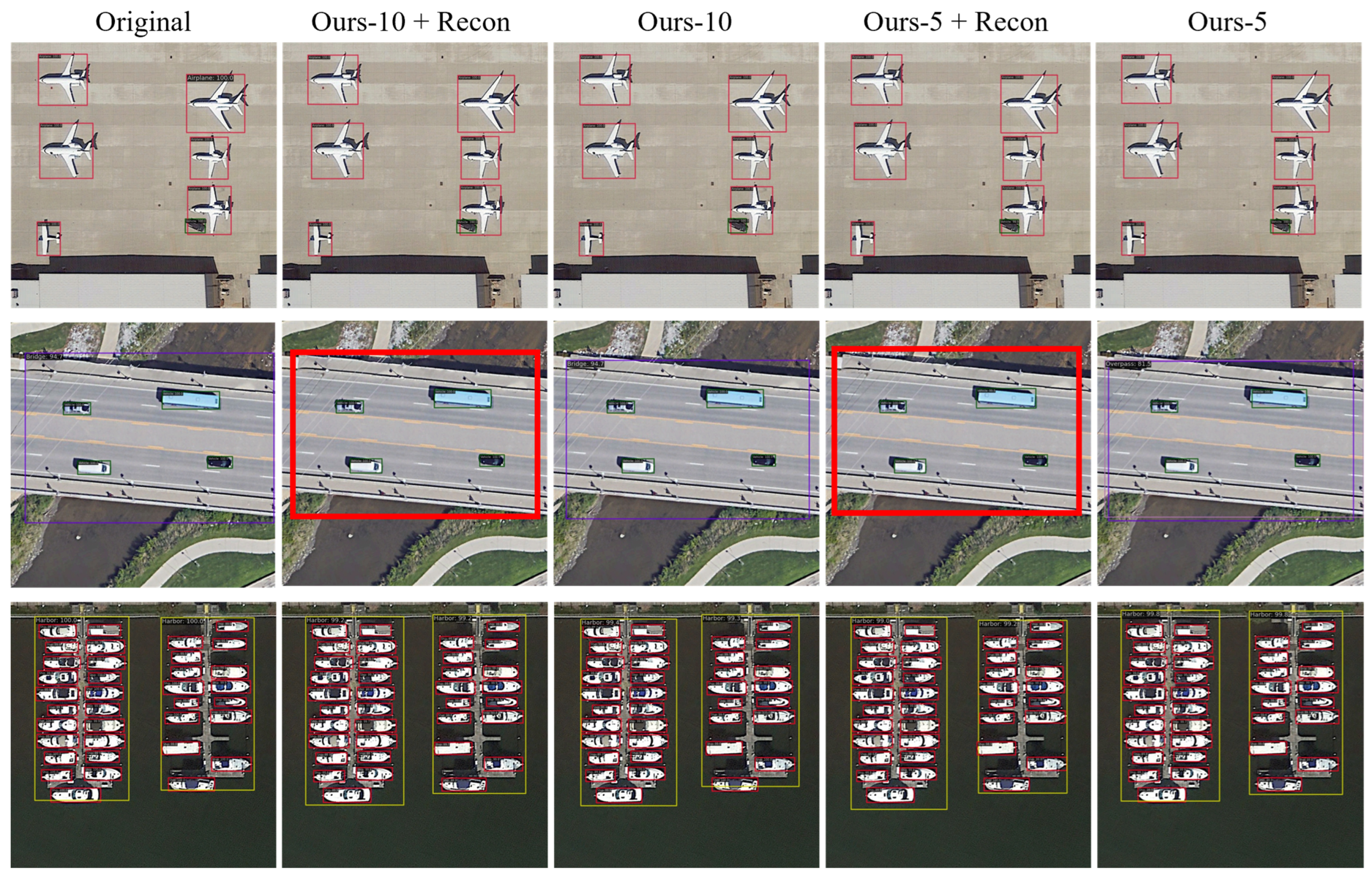
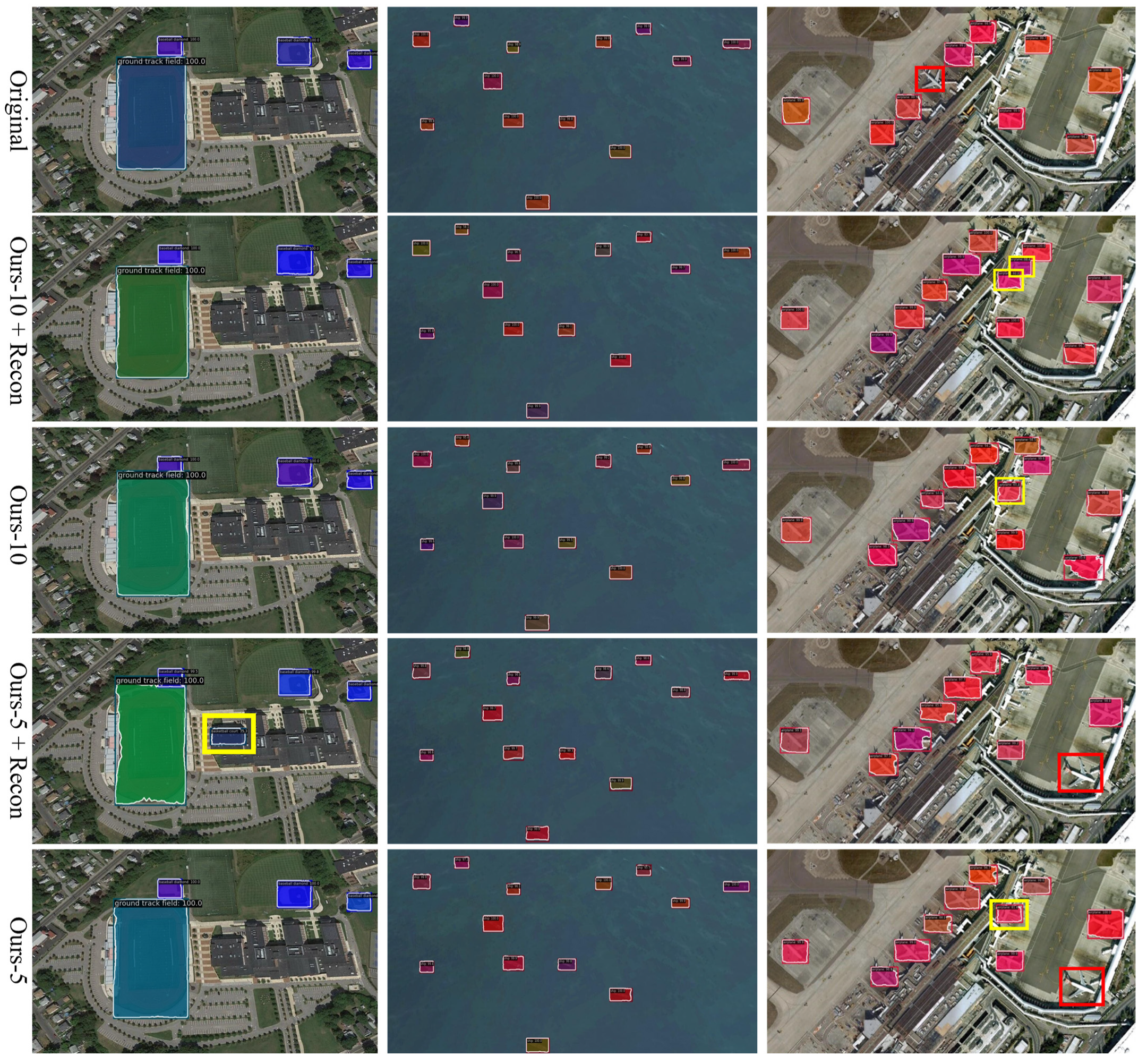
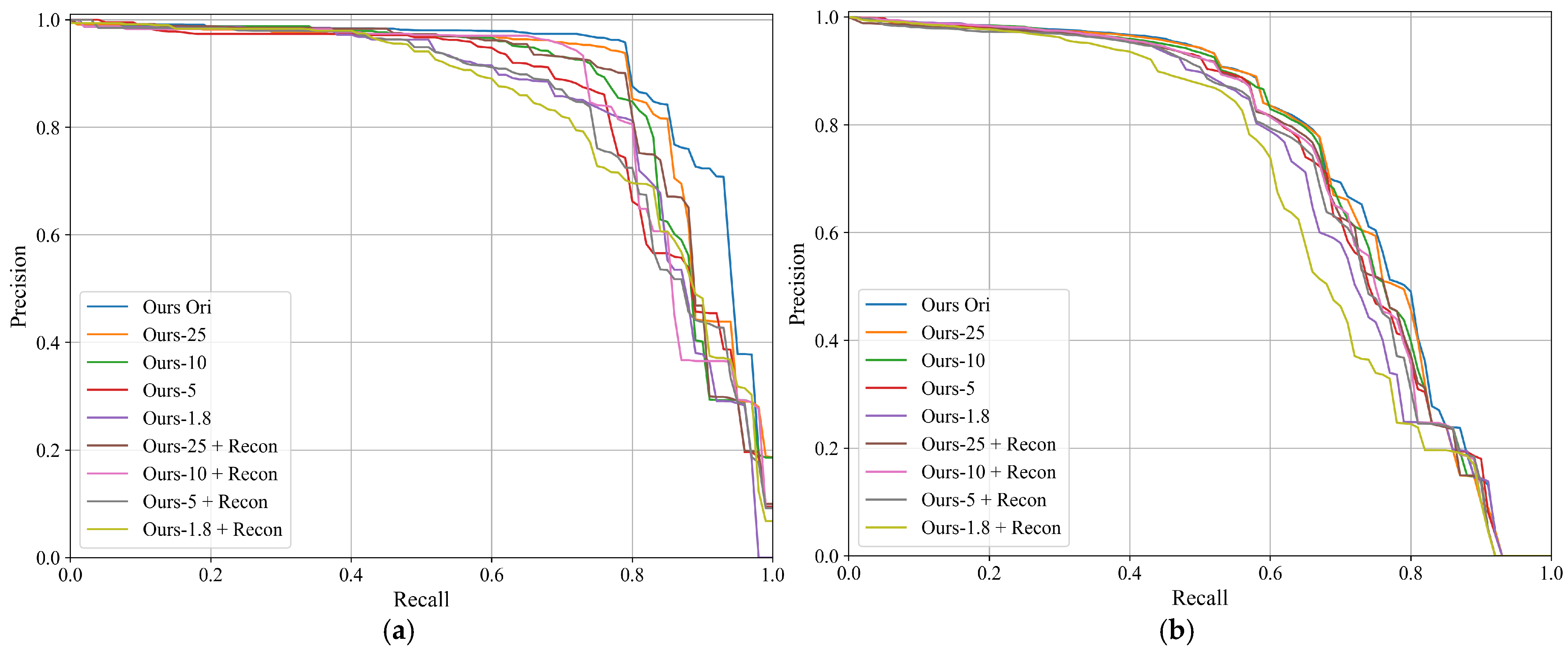
Figure 9 and Figure 10 show the visual detection results at sampling ratios of 10% and 5%. In these figures, “Ours-x” and “Ours-x + Recon” denote measurement-domain detection and reconstruction-based detection at a sampling ratio of x % , respectively. Missed objects and false positives are marked with red and yellow thick boxes, respectively. Figure 9 plots the detection results on three representative scenes from NWPU VHR-10. For the scenes in the left column, the reconstruction-based detection pipeline generates a false positive at a sampling ratio of 5%. In contrast, both the measurement-domain and image-domain detection pipelines accurately identify all objects without false alarms. For the scenes in the middle column, three detection methods successfully identify all targets without missed objects or false positives. For the scenes in the right column, the image-domain detection method fails to detect one target, leading to a missed detection. The reconstruction-based detection pipeline produces two false positives at the 10% sampling ratio and one missed detection at 5%. Comparatively, the measurement-domain detection scheme yields one false positive at the 10% sampling ratio, and one missed detection along with one false positive at 5%. Figure 10 visualizes the detection results on DIOR. As can be seen, for the scenes in the first row, the three detection paradigms successfully detect all targets without missed detection or false positives. For the scenes in the second row, the reconstruction-based detection pipeline does not detect a prominent “Bridge” object at the 10% and 5% sampling ratios, completely omitting its bounding box. In contrast, the measurement-domain detection approach precisely localizes the ‘’Bridge’’ target at the 10% sampling ratio. However, it misclassifies “Bridge” as “Overpass” at the 5% sampling ratio owing to severe semantic blurriness under extremely low sampling ratios. For the scenes in the last row, all detection pipelines accurately detect the dense ship instances. Corresponding precision–recall curves are depicted in Figure 11. One can observe that measurement-domain detection achieves precision–recall performance generally comparable to, and superior in several regions to, reconstruction-based detection, while the image-domain detection paradigm remains the upper performance envelope.

4.6. Cross-Architecture Generalization

To investigate whether the conclusions in Section 4.5 depend on a specific detector, we further integrate HR2SIOD-CL into two other representative detectors, i.e., the single-stage detector YOLO12s [39] and the Transformer-based detector RT-DETR-L [41], following the identical experimental protocol. The results for the image-domain, reconstruction-based and measurement-domain detection schemes are reported in Table 4. Clearly, under the condition of no sampling process and the same parameter count and resource consumption as listed in Table 4, image-domain detection achieves the best detection performance, and measurement-domain detection attains comparable or higher detection accuracy than its reconstruction-based counterpart. When HR2SIOD-CL is incorporated into YOLO12s, the performance gains of measurement-domain detection over reconstruction-based detection at sampling ratios of 25%, 10%, 5% and 1.8% are summarized as follows. On the NWPU VHR-10 dataset, the mAP50 gains are −0.3, 1.2, −0.5 and 0.4, and the mAP50:95 gains are 0.1, 0.5, 0.2 and −0.7. On the DIOR dataset, the mAP50 gains are 0.1, 0.3, −0.1 and −0.2, and the mAP50:95 gains are 1.0, 0.6, 0.7 and 0.1. When integrating HR2SIOD-CL into RT-DETR-L, measurement-domain detection achieves the following performance improvements relative to its reconstruction-based counterpart across the four sampling ratios: for NWPU VHR-10, mAP50 improvements of −0.3, −1.1, 0.4 and −0.1, and mAP50:95 improvements of 1.0, −0.6, 0.2 and 1.5, and for DIOR, mAP50 improvements of 1.5, 0.1, −0.1 and 0.4, and mAP50:95 improvements of 1.8, 0.0, −0.3 and 0.1. As can be concluded, the efficiency gap between the reconstruction-based and measurement-domain pipelines keeps consistent across diverse detectors, since it mainly arises from the explicit reconstruction step. Experimental results in Section 4.5 and Section 4.6 demonstrate that our HR2SIOD-CL has favorable generalization and can be integrated into various detectors rather than being limited to a specific one.

4.7. Comparison with State-of-the-Art Detection Methods

In this section, we further compare HR2SIOD-CL with several state-of-the-art image-domain models and detectors to quantify the performance gap between measurement-domain detection and conventional inference on original images. Our measurement-domain model is constructed by integrating HR2SIOD-CL into RT-DETR-L. We directly employ existing standard detection models for object detection on original full-resolution images without further modifications. For a fair comparison, all representative detection models are trained under the same protocol as ours. The detection results of different methods are provided in Table 5. As can be seen, YOLO12s is consistently superior to other detection schemes. Our measurement-domain method outperforms RT-DETR-L on DIOR at the 25% sampling ratio, and is superior to GhostNetV2, FastViT-S12, SwiftFormer-S and EfficientFormer V2 S1 on NWPU VHR-10 and DIOR at the 10% and 25% sampling ratios. At a sampling ratio of 5%, the measurement-domain detection paradigm obtains higher detection accuracy than GhostNetV2, FastViT-S12 and SwiftFormer-S on both datasets, and EfficientFormer V2 S1 on DIOR. Even at a tiny sampling ratio of 1.8%, the proposed measurement-domain scheme surpasses GhostNetV2 and SwiftFormer-S, and achieves a competitive performance compared to FastViT-S12. These results show that HR2SIOD-CL effectively narrows the performance gap between measurement-domain detection and conventional detection on full-resolution images, providing a promising candidate for resource-restricted remote sensing computing platforms.

4.8. Ablation Studies

4.8.1. Effect of the Saliency Metrics

In the adaptive sampling module of our HR2SIOD-CL, a saliency metric is employed to estimate local information richness, enabling adaptive allocation of measurements across distinct image blocks. A variety of heuristic indicators are available as candidate saliency metrics, including maximum value, mean value, variance, and information entropy. To justify our choice of information entropy, we conduct comparative ablation experiments on these metrics at sampling ratios of 10% and 5%. Table 6 lists the ablation results for our method using diverse saliency metrics on the NWPU VHR-10 dataset. Our measurement-domain detection model with the information entropy metric outperforms the variants adopting the mean and variance metrics. Although the measurement-domain detection model using the information entropy metric obtains slightly lower mAP50 values than the variant with the maximum metric (e.g., 86.3 vs. 86.6 at S R = 0.1 and 84.3 vs. 84.5 at S R = 0.05 ), the former achieves substantially higher mAP50:95 values (e.g., 51.7 vs. 50.5 at S R = 0.1 and 50.4 vs. 49.5 at S R = 0.05 ). These empirical results verify that information entropy acts as a reliable saliency metric for characterizing structural complexity. It enables the sampling module to preferentially allocate measurements to regions containing intricate object details, thereby improving fine-grained localization accuracy.

4.8.2. Sensitivity Analysis of Minimum Guaranteed Ratio α

The minimum guaranteed measurement ratio α in Equation (4) sets a lower bound on the measurements allocated to each image block and balances baseline measurement coverage and content-aware dynamic allocation. To further analyze the measurement-allocation behavior regulated by the hyperparameter α , the ablation experiments with different α are implemented on the NWPU VHR-10 dataset at sampling ratios of 10%, 5% and 1.8%. As shown in Table 7, at S R = 0.1 , our measurement-domain detection model with α = 0.5 obtains almost the same mAP50 as the variant with α = 0.3 . At S R = 0.05 , it is slightly inferior to the variants adopting α = 0.3 and α = 0.7 in terms of mAP50. However, our measurement-domain detection model with α = 0.5 achieves the highest mAP50:95 across the three sampling ratios. The performance advantage is especially evident at the extremely low sampling ratios, e.g., S R = 0.018 . The results reveal that an appropriate α is beneficial for maintaining adequate baseline coverage to prevent missing inconspicuous background targets while preserving sufficient measurement budget for high-saliency target regions. Therefore, we set α = 0.5 in our work.

4.8.3. Ablation Study on the Sampling Strategy and Detection Backbone

To evaluate the influences of the sampling strategy and detection backbone, we compare the measurement-domain detection model integrated with our proposed sampling strategy and backbone against its ablated variants. In the ablation experiments, we train and evaluate all variants under identical settings with our measurement-domain detection model. Table 8 presents the ablation results on the NWPU VHR-10 and DIOR datasets at the sampling ratios of 25% and 10%.
For validating the effectiveness and sensitivity of the sampling strategy, we provide comparisons between our detection model and its variant generated by replacing adaptive sampling with non-adaptive sampling. As seen in Table 8, at a sampling ratio of 25%, the variant suffers m A P 50 / m A P 50 : 95 drops of 0.5/1.1 on NWPU VHR-10 and 1.6/0.9 on DIOR, respectively. At the 10% sampling ratio, the corresponding drops reach 2.4/3.6 on NWPU VHR-10 and 2.4/1.8 on DIOR for m A P 50 / m A P 50 : 95 . The results suggest that adaptive allocation of measurements facilitates the preservation of detection-relevant feature information. Thus, the proposed adaptive sampling method plays a vital role in our detection model.
To further assess the impact of the backbone on the detection performance of our model, we substitute our backbone with the prevalent lightweight architecture GhostNetV2 1.0× to construct a variant for comparisons. It is motivated by the fact that our design draws partial inspiration from GhostNet-style efficiency principles, including lightweight feature generation and computationally efficient modules. To ensure a fair comparison under measurement-domain inputs, we combine the original M2E stem and GhostNetV2 as the backbone of the variant. As can be seen from the table, the variant undergoes dramatic performance degradation compared to our measurement-domain detection model on both datasets across different sampling ratios, highlighting the significant importance for aggregating the multi-scale discriminative semantics features.

4.9. Analysis of Failure Cases and Model Limitations

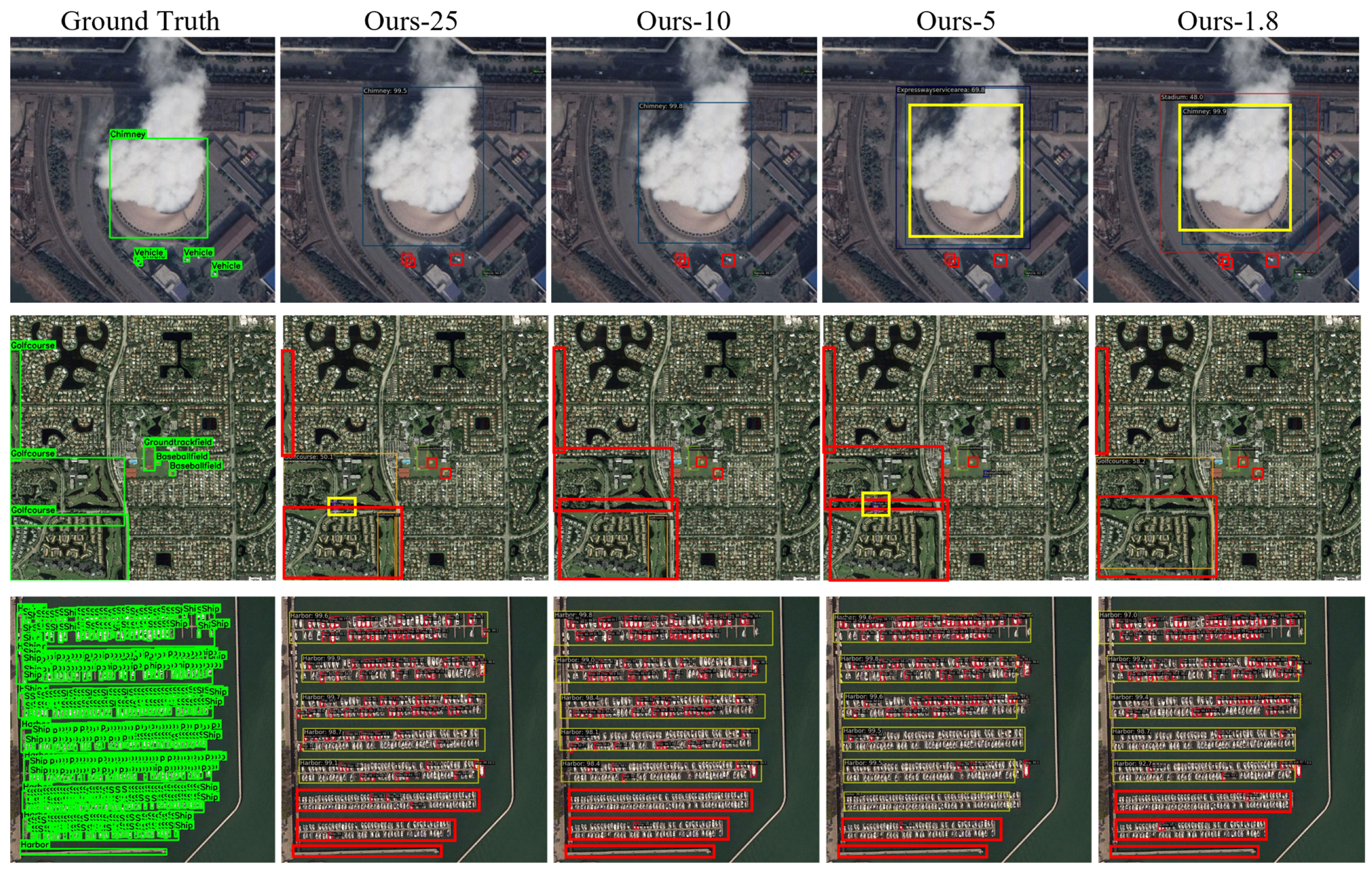
Despite the encouraging detection performance of HR2SIOD-CL, certain limitations still exist under challenging conditions. In the following, we discuss these limitations in light of three aspects: generalization capability, robustness, and computational efficiency. Figure 12 provides qualitative detection results that compare ground-truth annotations with the predictions generated by our method at sampling ratios of 25%, 10%, 5%, and 1.8%. Missed detections and false positives are separately highlighted with red and yellow thick boxes.
The scenes in the first row showcase the adverse effects of atmospheric occlusion and extremely small objects. Thick smoke emitted by a chimney partially obscures its main structure, together with several extremely small vehicles in the field of view. Although our measurement-domain detection method can reliably locate the chimney under occlusion at sampling ratios of 10% and 25%, severe category confusion emerges at lower sampling ratios of 5% and 1.8%. Concretely, at the 5% sampling ratio, our detection method falsely identifies the chimney-covered region as an expressway service area, and further misclassifies the same region as a stadium when the sampling ratio drops to 1.8%. Moreover, the three tiny vehicles are not detected at any sampling ratio due to the irreversible loss of high-frequency spatial details. The scenes in the second row illustrate the detection challenges brought by extreme scale variations in complex urban environments. Large-area golf courses and tiny baseball fields embedded in complex urban backgrounds consistently remain undetected across all sampling ratios. In addition, internal pathways inside golf courses are misidentified as bridges at sampling ratios of 25% and 5%. This observation exposes the vulnerability of the proposed HR2SIOD-CL to structural background clutter when handling extreme scale variations. The scenes in the last row contain densely packed ship targets, representing one of the most challenging scenarios for object detection. A large number of densely packed ships and harbor regions are not detected across all sampling ratios. To avoid excessive visual clutter in Figure 12, we do not explicitly annotate every individual missed ship; instead, the broadly undetected harbor areas are highlighted.
Furthermore, we quantitatively compare the parameter count, MACs, and inference time across three detection paradigms: direct object detection on raw images with the representative detectors (e.g., YOLO12s and RT-DETR-L), the reconstruction-based detection method and the measurement-domain detection scheme. As reported in Table 9, the measurement-domain detection pipelines, which bypass the reconstruction process, drastically reduce MACs and inference time compared to their reconstruction-based counterparts. Nevertheless, measurement-domain detection still lags behind state-of-the-art detectors in terms of inference latency. This efficiency gap originates from the sampling process and more elaborate feature-extraction backbone in our measurement-domain detection model.
According to the results in Figure 12 and Table 9, the main limitations of our HR2SIOD-CL can be summarized as follows. First, at lower sampling ratios, the loss of high-frequency information degrades semantic discriminability, leading to category confusion and frequent missed detections for tiny, occluded, and densely clustered remote sensing targets. Second, both the adaptive sampling module and measurement-domain backbone of HR2SIOD-CL bring non-trivial computational overhead. Although measurement-domain detection avoids reconstruction-related computational cost, its inference latency remains higher than that of existing lightweight image-domain detectors. Finally, this work focuses on algorithm-level design and validation using software-simulated CS measurements. The feasibility and effectiveness of hardware implementation for real-world remote sensing systems still requires further investigation.

5. Discussion

This section comprehensively interprets the experimental results, analyzes the core mechanisms of our HR2SIOD-CL, and discusses its advantages and bottlenecks, inherent trade-offs, and practical limitations.

5.1. Necessity of Explicit Image Reconstruction

Traditional CS remote sensing pipelines follow the “reconstruct-then-infer” paradigm, treating pixel-level recovery as an indispensable intermediate step before downstream detection. Extensive experiments on the NWPU VHR-10 and DIOR datasets draw a counterintuitive yet convincing conclusion: when object detection is the primary task, full image reconstruction brings unnecessary computational overhead and memory consumption without consistent performance benefits. At all tested sampling ratios (e.g., 25%, 10%, 5%, and 1.8%), our HR2SIOD-CL achieves comparable or superior detection performance to the reconstruction-based detection counterpart with identical CS measurements. This fundamental reason lies in the mismatch between reconstruction optimization objectives and detection requirements.

5.2. Mechanism Analysis of Core Modules

Ablations verify information entropy as a more effective saliency metric for block-wise adaptive measurement allocation compared to simple statistical indicators (e.g., mean value, maximum value, variance). The hyperparameter α sets a minimum guaranteed measurement ratio for every block, preventing information loss in smooth backgrounds that may contain tiny targets. An 8 × 8 block partition balances the computational overhead of the sampling module and detection performance. Unlike non-adaptive uniform sampling, our adaptive strategy dynamically concentrates measurement budgets on high-entropy blocks. Replacing adaptive sampling with uniform fixed sampling in ablations causes serious performance degradation. It confirms that content-aware adaptive sampling allocation is a core contributor to the robust detection performance of HR2SIOD-CL under limited measurement budgets.
The proposed measurement-domain backbone resolves the statistical mismatch between unstructured CS measurements and standard convolution pipelines. The M2E stem converts raw compressed measurements into spatially aligned embeddings, and the Stage blocks and Down Sample modules extract multi-scale semantic features via lightweight wavelet-enhanced channel modulation. Substituting this tailored backbone with vanilla GhostNetV2 leads to severe performance drops, confirming its necessity for measurement-domain feature learning. Benefiting from structural reparameterization, all multi-branch training branches are fused for efficient inference, and the backbone is fully compatible with the mainstream detectors.

5.3. Trade-Off Between Detection Accuracy and Computational Efficiency

Quantitative resource statistics in Table 9 reveal clear efficiency boundaries of the three detection paradigms. Existing image-domain detectors operating on uncompressed full-resolution images achieve the highest detection accuracy with minimal inference latency. The reconstruction-based detection pipelines incur substantial MAC costs and memory consumption due to high-resolution image recovery, with their inference time nearly 1.5× that of the measurement-domain counterpart. The results in Table 3, Table 4 and Table 9 show that the measurement-domain detection method avoids reconstruction overhead entirely, cutting MAC consumption by up to 93.03% and GPU memory usage by 64.26% relative to reconstruction-based detection. Still, an inference latency gap exists between the measurement-domain detection paradigm and existing state-of-the-art detectors such as YOLO12s. This gap arises from block-wise sampling projection and the elaborate multi-scale backbone for compensating compressed information loss. Such a trade-off is acceptable for certain practical scenarios, for instance, resource-constrained edge computing platforms, the main concern being object detection rather than image reconstruction, and reconstruction being inadvisable due to privacy protection.

5.4. Model Limitations

Qualitative failure cases in Figure 12 reveal performance bottlenecks originating from irreversible high-frequency information loss at low sampling ratios. For example, occluded large targets suffer severe category confusion due to missing distinctive structural features. Tiny vehicles and miniature land objects are consistently missed across all sampling ratios. Densely packed ship targets yield widespread missed detections under compressed representations. Practical constraints include two aspects. First, all CS measurements are digitally simulated after capturing the full image, without implementation and validation on physical optical sampling hardware. Second, the current framework only supports horizontal bounding boxes, limiting localization accuracy for arbitrarily oriented remote sensing targets.

5.5. Comparison with Existing CL-Based Methods

Most existing CL-based methods focus on NSI classification and semantic segmentation, while CSDet and CS-CenterNet only support single-category detection at moderate resolutions (e.g., 640 × 640 and 512 × 512). In contrast, our HR2SIOD-CL is tailored for multi-category object detection on high-resolution RSIs. It achieves competitive detection accuracy compared to existing mainstream image-domain detection models at moderate sampling ratios, providing an encouraging alternative for resource-constrained practical scenarios.

6. Conclusions

This paper systematically investigates a critical research question for compressed sensing remote sensing: whether explicit pixel-level image reconstruction is a mandatory intermediate step before high-resolution remote sensing object detection. To resolve this problem, we develop an end-to-end CL framework named HR2SIOD-CL, which directly performs object detection on CS measurements without full image recovery. The framework integrates an entropy-driven content-aware adaptive sampling module for task-oriented measurement allocation, and a measurement-domain detection backbone for extracting multi-scale discriminative features from compressed measurements. To enable controlled and fair comparisons, we further propose a lightweight reconstruction module to build a reconstruction-based detection baseline. Extensive experiments on the NWPU VHR-10 and DIOR datasets at diverse sampling ratios demonstrate that our measurement-domain detection model HR2SIOD-CL achieves comparable or superior detection performance to the reconstruction-based counterparts using identical CS measurements, while drastically reducing the computational and memory costs. The experimental results validate that explicit pixel-level reconstruction is not a prerequisite for high-resolution remote sensing object detection, and CS measurements can function as an efficient and effective intermediate representation. In resource-constrained remote sensing scenarios with restricted bandwidth, insufficient storage and limited computing capacity, our HR2SIOD-CL offers an efficient CL-based alternative to conventional full-resolution image detection pipelines.
Future research will pursue three key directions. First, we will develop advanced feature enrichment and local representation enhancement modules to strengthen the discriminability of semantic features under severe occlusion, cluttered backgrounds, and dense tiny-object distributions. Second, we will design the lightweight measurement-domain feature-extraction architectures by streamlining hierarchical representations and optimizing feature mapping modules, to reduce inference latency while maintaining competitive detection accuracy. We will also explore hardware-aware optimization and co-simulation with physical optical sampling hardware to promote the practical deployment on real-world remote sensing platforms.

Author Contributions

Conceptualization, X.W. and Y.J.; Methodology, Y.J. and D.Y.; Validation, Y.J. and H.W.; Data curation, H.W. and K.W.; Formal analysis, Y.J. and D.Y.; Resources, X.W.; Supervision, X.W. and D.Y.; Visualization, Y.J. and K.W.; Writing—Original Draft Preparation, Y.J.; Writing—Review and Editing, X.W.; Project administration, X.W. and H.K.; Funding Acquisition, X.W. All authors have read and agreed to the published version of the manuscript.

Funding

This work was supported by the National Natural Science Foundation of China under Grant No. 61872125.

Data Availability Statement

Publicly available datasets were analyzed in this study. The NWPU VHR-10 and DIOR datasets can be found at: https://gcheng-nwpu.github.io/#Datasets (accessed on 4 May 2026). These are open-source datasets used for model training and evaluation, rather than datasets constructed by our research team.

Conflicts of Interest

The authors declare no conflicts of interest.

References

  1. Lin, A.; Sun, X.; Wu, H.; Luo, W.; Wang, D.; Zhong, D.; Wang, Z.; Zhao, L.; Zhu, J. Identifying urban building function by integrating remote sensing imagery and POI data. IEEE J. Sel. Top. Appl. Earth Obs. Remote Sens. 2021, 14, 8864–8875. [Google Scholar] [CrossRef] [Scilit]
  2. Wang, B.; Xu, Y.; Wu, Z.; Zhan, T.; Wei, Z. Spatial-spectral local domain adaption for cross domain few shot hyperspectral images classification. IEEE Trans. Geosci. Remote Sens. 2022, 60, 5539515. [Google Scholar] [CrossRef] [Scilit]
  3. Hatić, D.; Polushko, V.; Rauhut, M.; Hagen, H. Post-disaster building damage assessment: Multi-class object detection vs. Object localization and classification. Remote Sens. 2025, 17, 3957. [Google Scholar] [CrossRef] [Scilit]
  4. Shimoni, M.; Haelterman, R.; Perneel, C.J.I.G.; Magazine, R.S. Hypersectral imaging for military and security applications: Combining myriad processing and sensing techniques. IEEE Geosci. Remote Sens. Mag. 2019, 7, 101–117. [Google Scholar] [CrossRef] [Scilit]
  5. Ding, J.; Xue, N.; Xia, G.S.; Bai, X.; Yang, W.; Yang, M.Y.; Belongie, S.; Luo, J.; Datcu, M.; Pelillo, M.; et al. Object detection in aerial images: A large-scale benchmark and challenges. IEEE Trans. Pattern Anal. Mach. Intell. 2021, 44, 7778–7796. [Google Scholar] [CrossRef] [Scilit] [PubMed]
  6. Li, G.; Bai, Z.; Liu, Z. Texture-semantic collaboration network for ORSI salient object detection. IEEE Trans. Circuits Syst. II Express Briefs 2024, 71, 2464–2468. [Google Scholar] [CrossRef] [Scilit]
  7. Zhang, G.; Zhang, W.; Li, W.; Wang, L.; Cui, H. A dynamic attention mechanism for object detection in road or strip environments. Vis. Comput. 2025, 41, 4171–4181. [Google Scholar] [CrossRef] [Scilit]
  8. Cheng, G.; Zhou, P.; Han, J. Learning rotation-invariant convolutional neural networks for object detection in VHR optical remote sensing images. IEEE Trans. Geosci. Remote Sens. 2016, 54, 7405–7415. [Google Scholar] [CrossRef] [Scilit]
  9. Li, K.; Wan, G.; Cheng, G.; Meng, L.; Han, J. Object detection in optical remote sensing images: A survey and a new benchmark. ISPRS J. Photogramm. Remote Sens. 2020, 159, 296–307. [Google Scholar] [CrossRef] [Scilit]
  10. Lunga, D.; Gerrand, J.; Yang, L.; Layton, C.; Stewart, R. Apache spark accelerated deep learning inference for large scale satellite image analytics. IEEE J. Sel. Top. Appl. Earth Obs. Remote Sens. 2020, 13, 271–283. [Google Scholar] [CrossRef] [Scilit]
  11. Donoho, D.L. Compressed sensing. IEEE Trans. Inf. Theory 2006, 52, 1289–1306. [Google Scholar] [CrossRef] [Scilit]
  12. Li, S.L.; Li, K.; Zhang, F.; Zhang, L.; Xiao, L.L.; Huang, D.P. Innovative remote sensing imaging method based on compressed sensing. Opt. Laser Technol. 2014, 63, 83–89. [Google Scholar] [CrossRef] [Scilit]
  13. Li, F.; Xin, L.; Liu, Y.; Fu, J.; Liu, Y.; Guo, Y. High efficient optical remote sensing images acquisition for nano-satellite framework. In Proceedings of the Sensors, Systems, and Next-Generation Satellites XXI, Warsaw, Poland, 11–14 September 2017; SPIE: Bellingham, WA, USA, 2017; Volume 10423, pp. 341–347. [Google Scholar]
  14. Ghahremani, M.; Liu, Y.; Yuen, P.; Behera, A. Remote sensing image fusion via compressive sensing. ISPRS J. Photogramm. Remote Sens. 2019, 152, 34–48. [Google Scholar] [CrossRef] [Scilit]
  15. Xiao, S.; Zhang, Y.; Chang, X. Ship detection based on compressive sensing measurements of optical remote sensing scenes. IEEE J. Sel. Top. Appl. Earth Obs. Remote Sens. 2022, 15, 8632–8649. [Google Scholar] [CrossRef] [Scilit]
  16. Shi, W.; Jiang, F.; Liu, S.; Zhao, D. Image compressed sensing using convolutional neural network. IEEE Trans. Image Process. 2020, 29, 375–388. [Google Scholar] [CrossRef] [Scilit] [PubMed]
  17. Song, J.; Mou, C.; Wang, S.; Ma, S.; Zhang, J. Optimization-inspired cross-attention Transformer for compressive sensing. In Proceedings of the 2023 IEEE/CVF Conference on Computer Vision and Pattern Recognition (CVPR), Vancouver, BC, Canada, 17–24 June 2023; pp. 6174–6184. [Google Scholar]
  18. Shen, M.; Gan, H.; Ma, C.; Ning, C.; Li, H.; Liu, F. MTC-CSNet: Marrying Transformer and convolution for image compressed sensing. IEEE Trans. Cybern. 2024, 54, 4949–4961. [Google Scholar] [CrossRef] [Scilit] [PubMed]
  19. Sankaranarayanan, A.C.; Turaga, P.K.; Baraniuk, R.G.; Chellappa, R. Compressive acquisition of dynamic scenes. In Proceedings of the 11th European Conference on Computer Vision (ECCV), Heraklion, Greece, 5–11 September 2010; pp. 129–142. [Google Scholar]
  20. Hahn, J.; Rosenkranz, S.; Zoubir, A.M. Adaptive compressed classification for hyperspectral imagery. In Proceedings of the 2014 IEEE International Conference on Acoustics, Speech and Signal Processing (ICASSP), Florence, Italy, 4–9 May 2014; pp. 1020–1024. [Google Scholar]
  21. Tang, S.; Cheang, C.F.; Yu, X.; Liang, Y.; Feng, Q.; Chen, Z. TransCS-Net: A hybrid transformer-based privacy-protecting network using compressed sensing for medical image segmentation. Biomed. Signal Process. Control 2023, 86, 105131. [Google Scholar] [CrossRef] [Scilit]
  22. Calderbank, R.; Jafarpour, S.; Schapire, R. Compressed Learning: Universal Sparse Dimensionality Reduction and Learning in the Measurement Domain. Preprint, 2009. Available online: http://citeseerx.ist.psu.edu/viewdoc/download?doi=10.1.1.481.8129&rep=rep1&type=pdf (accessed on 4 May 2026).
  23. Davenport, M.A.; Duarte, M.F.; Wakin, M.B.; Laska, J.N.; Takhar, D.; Kelly, K.F.; Baraniuk, R.G. The smashed filter for compressive classification and target recognition. In Proceedings of the SPIE Computational Imaging, San Jose, CA, USA, 29–31 January 2007; pp. 142–153. [Google Scholar]
  24. Cui, Y.; Xu, W.; Wang, Y.; Lin, J.; Lu, L. Performance bounds of compressive classification under perturbation. Signal Process. 2021, 180, 107855. [Google Scholar] [CrossRef] [Scilit]
  25. Wimalajeewa, T.; Chen, H.; Varshney, P.K. Performance limits of compressive sensing-based signal classification. IEEE Trans. Signal Process. 2012, 60, 2758–2770. [Google Scholar] [CrossRef] [Scilit]
  26. Lohit, S.; Kulkarni, K.; Turaga, P. Direct inference on compressive measurements using convolutional neural networks. In Proceedings of the IEEE International Conference on Image Processing (ICIP), Phoenix, AZ, USA, 25–28 September 2016; pp. 1913–1917. [Google Scholar]
  27. Zisselman, E.; Adler, A.; Elad, M. Compressed learning for image classification: A deep neural network approach. In Handbook of Numerical Analysis; Elsevier: Amsterdam, The Netherlands, 2018; Volume 19, pp. 3–17. [Google Scholar]
  28. Duan, Z.; Ma, Z.; Zhu, F. Unified architecture adaptation for compressed domain semantic inference. IEEE Trans. Circuits Syst. Video Technol. 2023, 33, 4108–4121. [Google Scholar] [CrossRef] [Scilit] [PubMed]
  29. Xiao, D.; Zhang, M.; Zhang, M.; Chen, L. CFMVOR: Federated multi-view 3D object recognition based on compressed learning. In Proceedings of the 7th Chinese Conference on Pattern Recognition and Computer Vision (PRCV), Urumqi, China, 18–20 October 2024; Springer: Singapore, 2025; pp. 280–293. [Google Scholar]
  30. Zhang, X.; Yu, X.; Feng, J.; Chen, W.; Li, Y. TriNeXt: An efficient three-path fusion module for multi-scale feature enhancement in object detection. Sci. Prog. 2025, 108, 00368504251395116. [Google Scholar] [CrossRef] [Scilit] [PubMed]
  31. Wang, J.; Yu, Y.; Cheng, J.; Li, J.; Tang, J. PillarBAPI: Enhancing pillar-based 3D object detection through attentive pseudo-image feature extraction. Multimed. Syst. 2025, 31, 263. [Google Scholar] [CrossRef] [Scilit]
  32. Li, G.; Shi, S.; Wu, Y.; Lin, W.; Bai, Z. Lightweight ORSI salient object detection via frequency and mutual assistance attention. IEEE Trans. Geosci. Remote Sens. 2026, 64, 5617112. [Google Scholar] [CrossRef] [Scilit]
  33. Ren, S.; He, K.; Girshick, R.; Sun, J. Faster R-CNN: Towards real-time object detection with region proposal networks. IEEE Trans. Pattern Anal. Mach. Intell. 2017, 39, 1137–1149. [Google Scholar] [CrossRef] [Scilit] [PubMed]
  34. He, K.; Gkioxari, G.; Dollár, P.; Girshick, R. Mask R-CNN. In Proceedings of the 2017 IEEE International Conference on Computer Vision (ICCV), Venice, Italy, 22–29 October 2017; pp. 2980–2988. [Google Scholar]
  35. Huang, Y.; Jiao, D.; Huang, X.; Tang, T.; Gui, G. A hybrid CNN-Transformer network for object detection in optical remote sensing images: Integrating local and global feature fusion. IEEE J. Sel. Top. Appl. Earth Obs. Remote Sens. 2025, 18, 241–254. [Google Scholar] [CrossRef] [Scilit]
  36. Li, J.; Tian, P.; Song, R.; Xu, H.; Li, Y.; Du, Q. PCViT: A pyramid convolutional vision Transformer detector for object detection in remote-sensing imagery. IEEE Trans. Geosci. Remote Sens. 2024, 62, 5608115. [Google Scholar] [CrossRef] [Scilit]
  37. Redmon, J.; Divvala, S.; Girshick, R.; Farhadi, A. You Only Look Once: Unified, real-Time object detection. In Proceedings of the 2016 IEEE Conference on Computer Vision and Pattern Recognition (CVPR), Las Vegas, NV, USA, 27–30 June 2016; pp. 779–788. [Google Scholar]
  38. Wang, A.; Chen, H.; Liu, L.; Chen, K.; Lin, Z.; Han, J.; Ding, G. YOLOv10: Real-time end-to-end object detection. In Proceedings of the 38th Conference on Neural Information Processing Systems (NeurIPS 2024), Vancouver, BC, Canada, 10–15 December 2024. [Google Scholar]
  39. Tian, Y.; Ye, Q.; Doermann, D. Yolov12: Attention-centric real-time object detectors. arXiv 2025, arXiv:2502.12524. [Google Scholar]
  40. Carion, N.; Massa, F.; Synnaeve, G.; Usunier, N.; Kirillov, A.; Zagoruyko, S. End-to-end object detection with Transformers. In Proceedings of the European Conference on Computer Vision (ECCV), Cham, Switzerland, 23–28 August 2020; pp. 213–229. [Google Scholar]
  41. Zhao, Y.; Lv, W.; Xu, S.; Wei, J.; Wang, G.; Dang, Q.; Liu, Y.; Chen, J. DETRs beat YOLOs on real-time object detection. In Proceedings of the IEEE/CVF Conference on Computer Vision and Pattern Recognition (CVPR), Seattle, WA, USA, 16–22 June 2024; pp. 16965–16974. [Google Scholar]
  42. Tropp, J.A.; Gilbert, A.C. Signal recovery from random measurements via orthogonal matching pursuit. IEEE Trans. Inform. Theory 2007, 53, 4655–4666. [Google Scholar] [CrossRef] [Scilit]
  43. Blumensath, T. Accelerated iterative hard thresholding. Signal Process. 2012, 92, 752–756. [Google Scholar] [CrossRef] [Scilit]
  44. Zhang, Z.; Rao, B.D. Extension of SBL algorithms for the recovery of block sparse signals with intra-block correlation. IEEE Trans. Signal Process. 2013, 61, 2009–2015. [Google Scholar] [CrossRef] [Scilit]
  45. Zhang, J.; Zhao, C.; Gao, W. Optimization-Inspired Compact Deep Compressive Sensing. IEEE J. Sel. Top. Signal Process. 2020, 14, 765–774. [Google Scholar] [CrossRef] [Scilit]
  46. Shen, M.; Gan, H.; Ning, C.; Hua, Y.; Zhang, T. TransCS: A Transformer-based hybrid architecture for image compressed sensing. IEEE Trans. Image Process. 2022, 31, 6991–7005. [Google Scholar] [CrossRef] [Scilit] [PubMed]
  47. Song, J.; Chen, B.; Zhang, J. Deep memory-augmented proximal unrolling network for compressive sensing. Int. J. Comput. Vis. 2023, 131, 1477–1496. [Google Scholar] [CrossRef] [Scilit]
  48. Zhang, K.; Hua, Z.; Li, Y.; Chen, Y.; Zhou, Y. AMS-Net: Adaptive multi-scale network for image compressive sensing. IEEE Trans. Multimed. 2023, 25, 5676–5689. [Google Scholar] [CrossRef] [Scilit]
  49. Chen, B.; Zhang, J. Content-aware scalable deep compressed sensing. IEEE Trans. Image Process. 2022, 31, 5412–5426. [Google Scholar] [CrossRef] [Scilit] [PubMed]
  50. Zhang, K.; Hua, Z.; Li, Y.; Zhang, Y.; Zhou, Y. Uformer-ICS: A U-shaped Transformer for image compressive sensing service. IEEE Trans. Serv. Comput. 2024, 17, 2974–2988. [Google Scholar] [CrossRef] [Scilit]
  51. Qiu, C.; Hu, X. AdaCS: Adaptive compressive sensing with restricted isometry property-based error-clamping. IEEE Trans. Pattern Anal. Mach. Intell. 2024, 46, 4702–4719. [Google Scholar] [CrossRef] [Scilit] [PubMed]
  52. Mdrafi, R.; Gurbuz, A.C. Compressed classification from learned measurements. In Proceedings of the 2021 IEEE/CVF International Conference on Computer Vision (ICCV), Montreal, BC, Canada, 11–17 October 2021; pp. 4038–4047. [Google Scholar]
  53. Tran, D.T.; Yamaç, M.; Degerli, A.; Gabbouj, M.; Iosifidis, A. Multilinear compressive learning. IEEE Trans. Neural Netw. Learn. Syst. 2021, 32, 1512–1524. [Google Scholar] [CrossRef] [Scilit] [PubMed]
  54. Mou, C.; Zhang, J. TransCL: Transformer Makes Strong and Flexible Compressive Learning. IEEE Trans. Pattern Anal. Mach. Intell. 2023, 45, 5236–5251. [Google Scholar] [CrossRef] [Scilit] [PubMed]
  55. Huang, X.; Gong, Y.; Wu, W.; Zhu, S.; Zhao, Y. CSDet: A compressed sensing object detection architecture with lightweight networks. IEEE Trans. Circuits Syst. Video Technol. 2025, 35, 2355–2368. [Google Scholar] [CrossRef] [Scilit]
  56. van den Oord, A.; Vinyals, O.; Kavukcuoglu, K. Neural discrete representation learning. In Proceedings of the 31st Conference on Neural Information Processing Systems (NIPS 2017), Long Beach, CA, USA, 4–9 December 2017. [Google Scholar]
  57. Bengio, Y.; Léonard, N.; Courville, A. Estimating or propagating gradients through stochastic neurons for conditional computation. arXiv 2013, arXiv:1308.3432. [Google Scholar]
  58. Shi, W.; Caballero, J.; Huszár, F.; Totz, J.; Aitken, A.P.; Bishop, R.; Rueckert, D.; Wang, Z. Real-time single image and video super-resolution using an efficient sub-pixel convolutional neural network. In Proceedings of the 2016 IEEE Conference on Computer Vision and Pattern Recognition (CVPR), Las Vegas, NV, USA, 27–30 June 2016; pp. 1874–1883. [Google Scholar]
  59. Ding, X.; Zhang, X.; Ma, N.; Han, J.; Ding, G.; Sun, J. RepVGG: Making VGG-style convnets great again. In Proceedings of the IEEE/CVF Conference on Computer Vision and Pattern Recognition (CVPR), Nashville, TN, USA, 20–25 June 2021; pp. 13733–13742. [Google Scholar]
  60. Chu, X.; Li, L.; Zhang, B. Make RepVGG greater again: A quantization-aware approach. arXiv 2022, arXiv:2212.01593. [Google Scholar]
  61. Yu, W.; Luo, M.; Zhou, P.; Si, C.; Zhou, Y.; Wang, X.; Feng, J.; Yan, S. Metaformer is actually what you need for vision. In Proceedings of the IEEE/CVF Conference on Computer Vision and Pattern Recognition (CVPR), New Orleans, LA, USA, 18–24 June 2022; pp. 10819–10829. [Google Scholar]
  62. Li, Y.; Hu, J.; Wen, Y.; Evangelidis, G.; Salahi, K.; Wang, Y.; Tulyakov, S.; Ren, J. Rethinking vision Transformers for MobileNet size and speed. arXiv 2022, arXiv:2212.08059. [Google Scholar]
  63. Mehta, S.; Rastegari, M. Separable self-attention for mobile vision transformers. arXiv 2022, arXiv:2206.02680. [Google Scholar]
  64. Han, K.; Wang, Y.; Tian, Q.; Guo, J.; Xu, C.; Xu, C. GhostNet: More features from cheap operations. In Proceedings of the IEEE/CVF Conference on Computer Vision and Pattern Recognition (CVPR), Seattle, WA, USA, 13–19 June 2020; pp. 1580–1589. [Google Scholar]
  65. Tang, Y.; Han, K.; Guo, J.; Xu, C.; Xu, C.; Wang, Y. GhostNetv2: Enhance cheap operation with long-range attention. In Proceedings of the 36th Conference on Neural Information Processing Systems (NeurIPS 2022), New Orleans, LA, USA, 28 November–9 December 2022. [Google Scholar]
  66. Finder, S.E.; Amoyal, R.; Treister, E.; Freifeld, O. Wavelet convolutions for large receptive fields. In Proceedings of the European Conference on Computer Vision (ECCV), Milan, Italy, 29 September–4 October 2024; pp. 363–380. [Google Scholar]
  67. Hu, J.; Shen, L.; Albanie, S.; Sun, G.; Wu, E. Squeeze-and-excitation networks. IEEE Trans. Pattern Anal. Mach. Intell. 2020, 42, 2011–2023. [Google Scholar] [CrossRef] [Scilit] [PubMed]
  68. Vasu, P.K.A.; Gabriel, J.; Zhu, J.; Tuzel, O.; Ranjan, A. FastViT: A fast hybrid vision Transformer using structural reparameterization. In Proceedings of the 2023 IEEE/CVF International Conference on Computer Vision (ICCV), Paris, France, 1–6 October 2023; pp. 5785–5795. [Google Scholar]
  69. Shaker, A.; Maaz, M.; Rasheed, H.; Khan, S.; Yang, M.H.; Khan, F.S. SwiftFormer: Efficient additive attention for Transformer-based real-time mobile vision applications. In Proceedings of the 2023 IEEE/CVF International Conference on Computer Vision (ICCV), Paris, France, 1–6 October 2023; pp. 17425–17436. [Google Scholar]
Figure 1. Visual comparisons between natural scene images (NSIs) and remote sensing images (RSIs). All images are resized for display, while their original resolution differences are preserved in the datasets.
Remotesensing 18 02851 g001
Figure 2. The overall architecture of the proposed HR2SIOD-CL. Our HR2SIOD-CL consists of an adaptive sampling module and a detection module. The dashed box indicates the extra reconstruction process for comparison. The symbol “ ” denotes element-wise subtraction.
Remotesensing 18 02851 g002
Figure 3. The processing of the entropy-driven content-aware adaptive sampling module.
Remotesensing 18 02851 g003
Figure 4. The architectures of (a) the measurement-domain detection backbone integrated into a representative detector (e.g., Faster R-CNN), and (b) the Measurement-to-Embedding (M2E) module for both training and inference. Batch Norm layers with dotted outlines are fused into their preceding convolutional layers to streamline the inference architecture and reduce computational overhead.
Remotesensing 18 02851 g004
Figure 5. The structures of (a) the Stage block for both training and inference, and (b) the Down Sample module for both training and inference.
Remotesensing 18 02851 g005
Figure 6. The structures of (a) the RepGhost module for training and (b) the WT RepGhost module for inference.
Remotesensing 18 02851 g006
Figure 7. The structure of the reconstruction module for the reconstruction-based detection baseline.
Remotesensing 18 02851 g007
Figure 8. Visual comparisons of the reconstruction results produced by CSNet+ and the proposed reconstruction baseline across different sampling ratios.
Remotesensing 18 02851 g008
Figure 9. Visual detection results on NWPU VHR-10 for the image-domain, reconstruction-based, and measurement-domain detection pipelines. Missed objects and false positives are marked with red and yellow thick boxes, respectively.
Remotesensing 18 02851 g009
Figure 10. Visual detection results on DIOR for the image-domain, reconstruction-based, and measurement-domain detection pipelines. Missed objects and false positives are marked with red and yellow thick boxes, respectively.
Remotesensing 18 02851 g010
Figure 11. Precision–recall curves on (a) NWPU VHR-10 and (b) DIOR for the image-domain, reconstruction-based, and measurement-domain detection pipelines across diverse sampling ratios.
Remotesensing 18 02851 g011
Figure 12. Visual detection results for failure cases by our HR2SIOD-CL under challenging scenarios. Missed objects and false positives are highlighted with bold red and yellow thick boxes, respectively.
Remotesensing 18 02851 g012
Table 1. Quantitative results of the proposed detection method on the NWPU VHR-10 dataset with different block sizes. Params and MACs represent the parameter count and computational overhead of the sampling module, respectively. Both are measured using a single 3 × 1024 × 1024 input image.
Block SizeParams.MACs.SR
0.250.10.050.018
mAP 50 / mAP 50 : 95
8 × 812.29 K402.65 M88.2/53.286.3/51.784.3/50.483.3/49.1
16 × 16196.61 K1.61 G88.9/53.886.5/51.079.8/46.779.9/45.6
32 × 323.15 M6.44 G86.3/51.684.2/49.779.0/46.881.0/45.7
64 × 6450.33 M25.77 G77.4/44.078.9/44.276.4/43.376.5/42.6
Bold values indicate the best performance, and underlined values denote the second-best performance for each evaluation metric.
Table 2. Performance comparison of CSNet+ and the proposed reconstruction network on the RSCS dataset.
SRCSNet+Ours
PSNRSSIMPSNRSSIM
0.01823.780.529023.940.5466
0.0525.820.628626.250.6758
0.125.420.726727.470.7266
0.2529.590.833933.090.9110
Average26.150.679627.690.7150
Table 3. Performance comparison of different detection paradigms based on Faster R-CNN and Mask R-CNN on the NWPU VHR-10 and DIOR datasets.
GroupSRParams.MACs.MemoryNWPU VHR-10DIOR
m A P 50 m A P 50 : 95 m A P 50 m A P 50 : 95
Image domain/14.87 M32.34 G4.7 G90.857.174.351.3
Reconstruction-based0.2515.31 M470.02 G13.29 G86.553.072.249.6
0.185.151.572.249.4
0.0583.447.571.148.6
0.01882.945.567.244.6
Measurement domain0.2514.89 M
(−0.42)
32.74 G
(−437.28)
4.75 G
(−8.54)
88.253.273.551.2
0.186.351.773.050.2
0.0584.350.472.149.5
0.01883.349.170.347.2
Table 4. Performance comparison of different detection paradigms based on YOLO12s and RT-DETR-L on the NWPU VHR-10 and DIOR datasets.
GroupDetectorSRParams.MACs.MemoryNWPU VHR-10DIOR
m A P 50 m A P 50 : 95 m A P 50 m A P 50 : 95
Image domainYOLO12s/14.87 M32.34 G4.7 G93.562.283.064.4
RT-DETR-L95.764.382.664.7
Reconstruction-basedYOLO12s0.2515.31 M470.02 G13.29 G86.953.981.662.4
0.184.853.580.761.7
0.0585.252.979.560.2
0.01881.149.578.359.0
RT-DETR-L0.2515.31 M470.02 G13.29 G92.060.080.261.9
0.191.860.481.062.9
0.0589.457.379.961.6
0.01887.255.077.358.8
Measurement domainYOLO12s0.2514.89 M32.74 G4.75 G86.654.081.763.4
0.186.054.081.062.3
0.0584.753.179.460.9
0.01881.548.878.159.1
RT-DETR-L0.2514.89 M32.74 G4.75 G91.761.081.763.7
0.190.759.881.162.9
0.0589.857.579.861.3
0.01887.156.577.758.9
Table 5. Performance comparison of our measurement-domain detection method and existing standard detection models on the NWPU VHR-10 and DIOR datasets.
MethodNWPU VHR-10DIOR
m A P 50 m A P 50 : 95 m A P 50 m A P 50 : 95
GhostNetV2 1.0× (NeurIPS 2022) [65]84.746.372.748.4
FastViT-S12 (ICCV 2023) [68]87.949.473.848.1
SwiftFormer-S (ICCV2023) [69]70.942.474.552.3
EfficientFormer V2 S1 (ICCV 2023) [62]91.358.075.252.9
RT-DETR-L (CVPR 2024) [41]92.263.481.363.3
YOLO12s (NeurIPS 2025) [39]94.766.682.564.4
Ours-2591.761.081.763.7
Ours-1090.759.881.162.9
Ours-589.857.579.861.3
Ours-1.887.156.577.758.9
Table 6. Ablation results for our HR2SIOD-CL using different saliency metrics on the NWPU VHR-10 dataset.
MetricSR = 0.1SR = 0.05
m A P 50 m A P 50 : 95 m A P 50 m A P 50 : 95
Mean86.150.083.948.3
Max86.650.584.549.5
Variance85.051.684.049.6
Entropy (Ours)86.351.784.350.4
Table 7. Sensitivity analysis of the minimum guaranteed measurement ratio α on the NWPU VHR-10 dataset at different sampling ratios.
α SR = 0.1SR = 0.05SR = 0.018
mAP 50 mAP 50 : 95 mAP 50 mAP 50 : 95 mAP 50 mAP 50 : 95
0.386.450.785.049.582.347.4
0.785.850.484.746.582.847.8
0.5 (Ours)86.351.784.350.483.349.1
Table 8. Ablation studies for the sampling strategy and backbone on the NWPU VHR-10 and DIOR datasets.
SRAdaptive SamplingNon-Adaptive SamplingOur BackboneGhostNetV2NWPU VHR-10DIOR
m A P 50 m A P 50 : 95 m A P 50 m A P 50 : 95
0.25 88.253.273.551.2
87.752.171.950.3
80.242.768.644.7
79.341.467.743.9
0.1 86.351.773.050.2
83.948.170.648.4
78.540.366.742.1
77.140.065.941.6
The checkmark (√) indicates that the corresponding item is retained.
Table 9. Quantitative comparison of the parameter count, MACs, and inference time across three detection paradigms: full-resolution image detection with existing state-of-the-art detectors, reconstruction-based detection and measurement-domain detection. All experiments are evaluated on an NVIDIA RTX 4080 SUPER GPU with an input size of 3 × 1024 × 1024 .
MethodDomainParams (M)MACs (G)Inference Time (ms)
YOLO12sImage9.2834.0111.82
RT-DETR-L32.97137.1629.93
Ours + YOLO12sReconstruction-based19.78480.80107.13
Measurement19.3642.1872.02
Ours + RT-DETR-LReconstruction-based35.52551.22119.78
Measurement35.11112.6082.40
Disclaimer/Publisher’s Note: The statements, opinions and data contained in all publications are solely those of the individual author(s) and contributor(s) and not of MDPI and/or the editor(s). MDPI and/or the editor(s) disclaim responsibility for any injury to people or property resulting from any ideas, methods, instructions or products referred to in the content.