Landslide Susceptibility Assessment in a Complex Mountain Basin Transition Zone by Integrating Mamba and SBAS-InSAR Deformation Evidence: A Case Study of the Xining Basin, China


Highlights
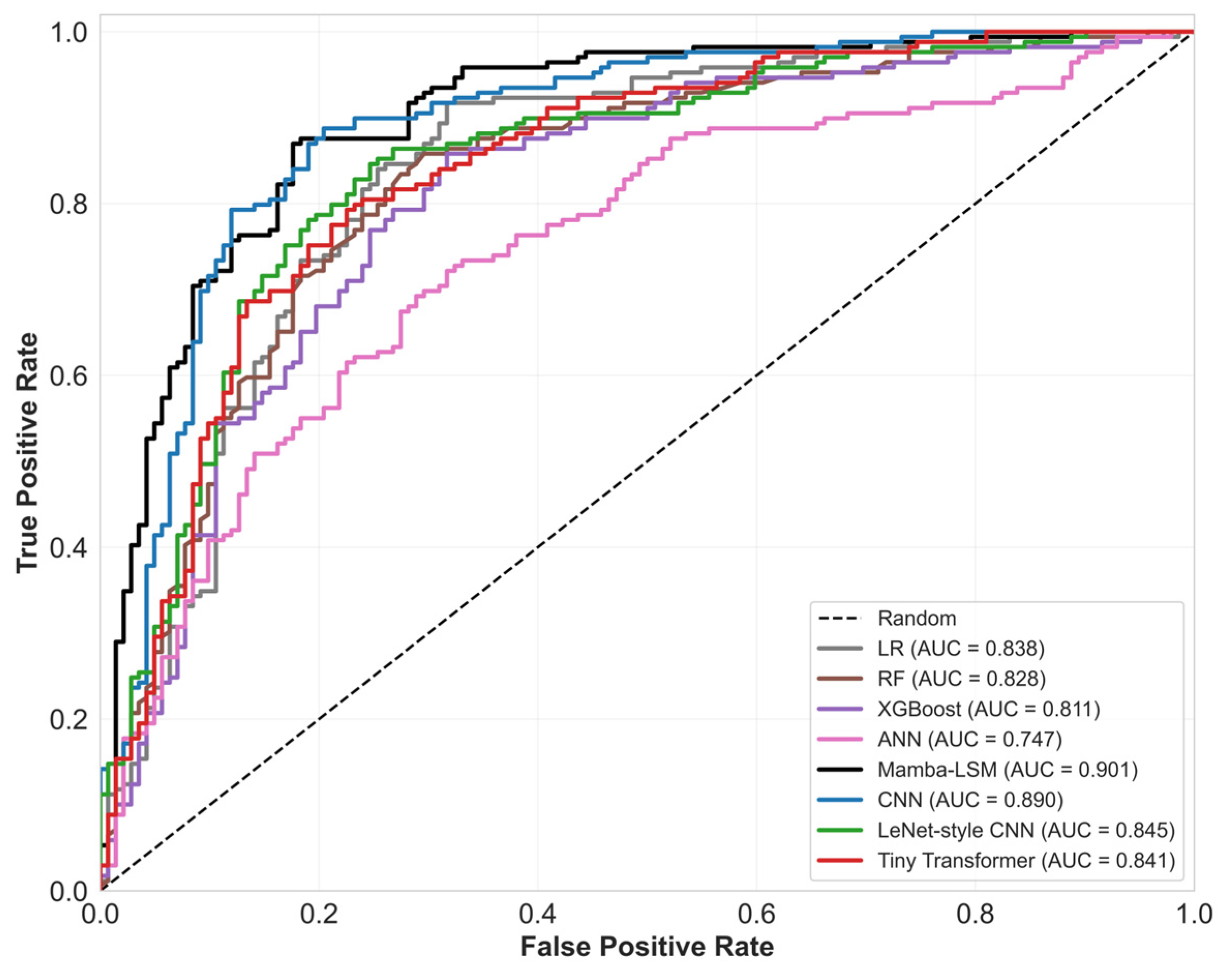
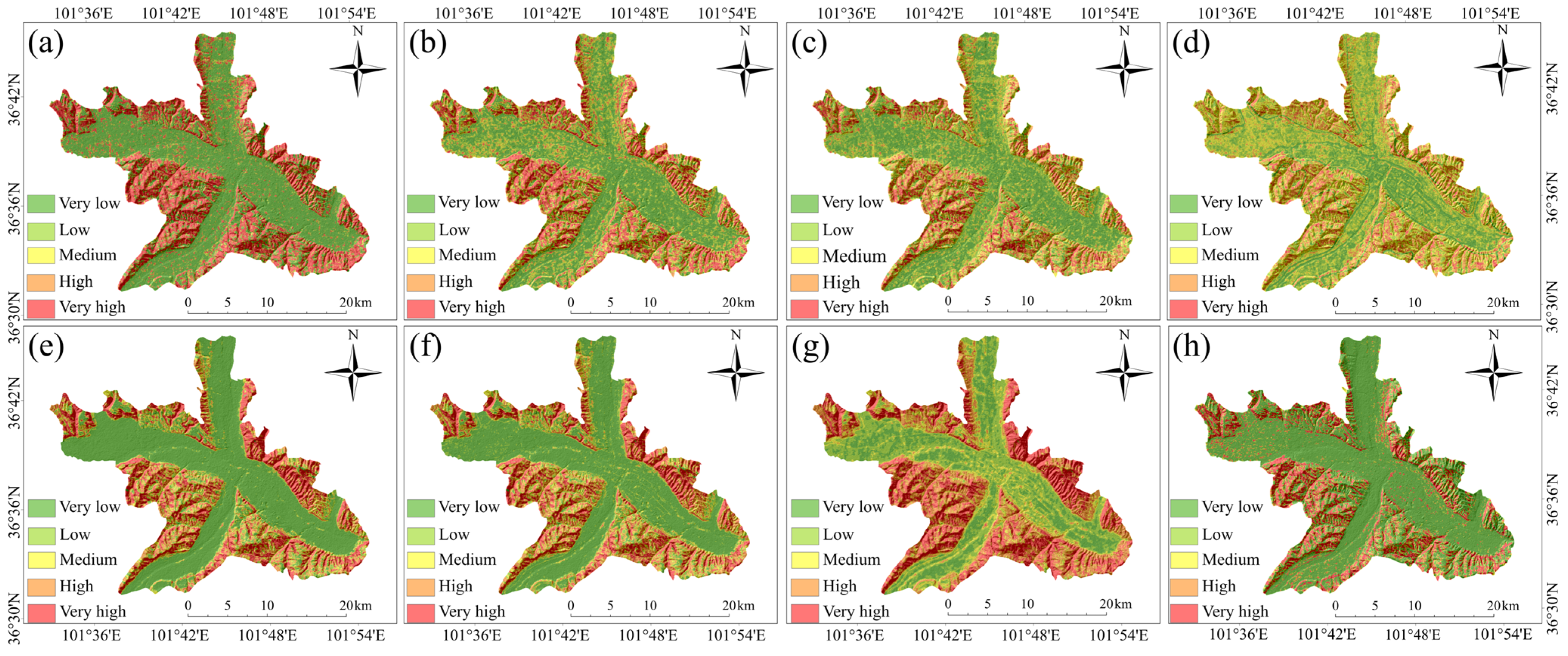
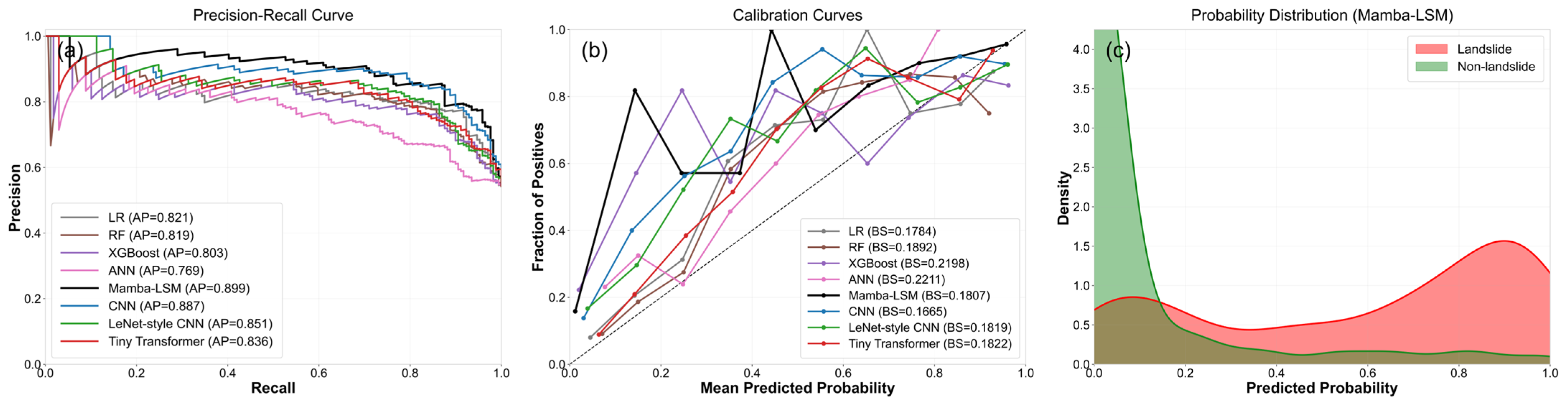
- A Mamba-based landslide susceptibility mapping framework was developed for the Xining Basin and achieved the highest AUC under region-based spatial hold-out validation, with an AUC of 0.9011 and an F1-score of 0.7431.
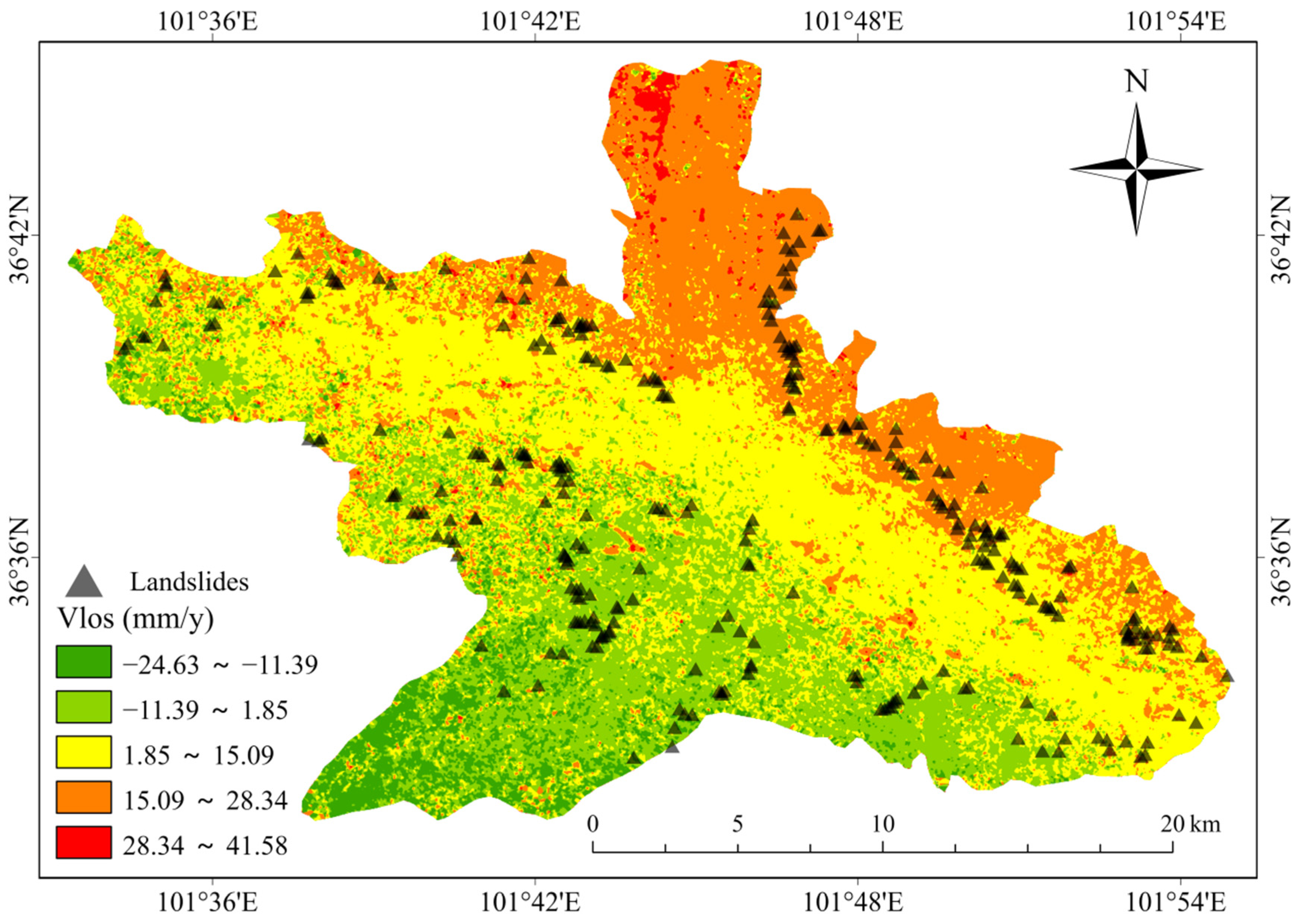
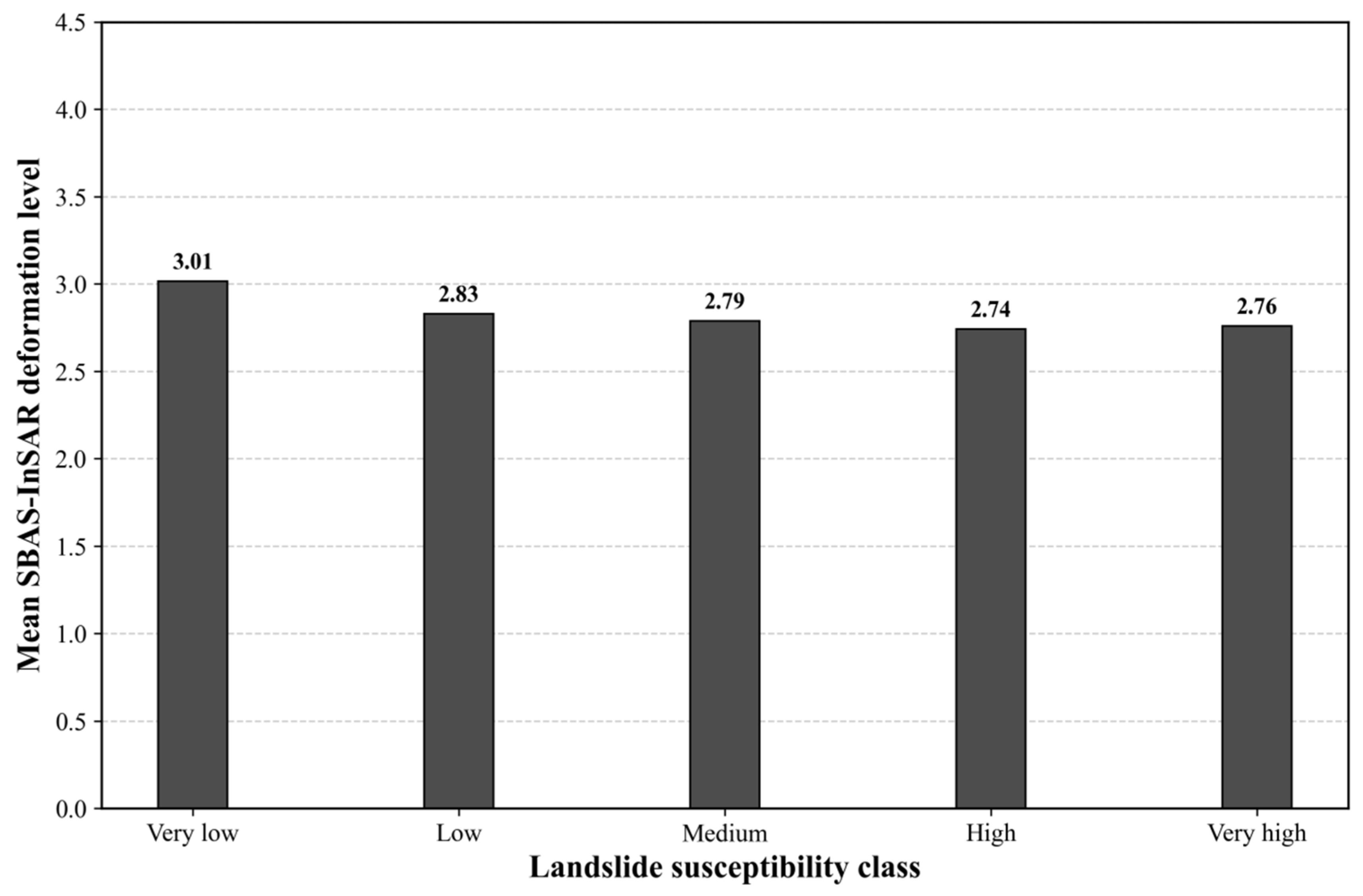
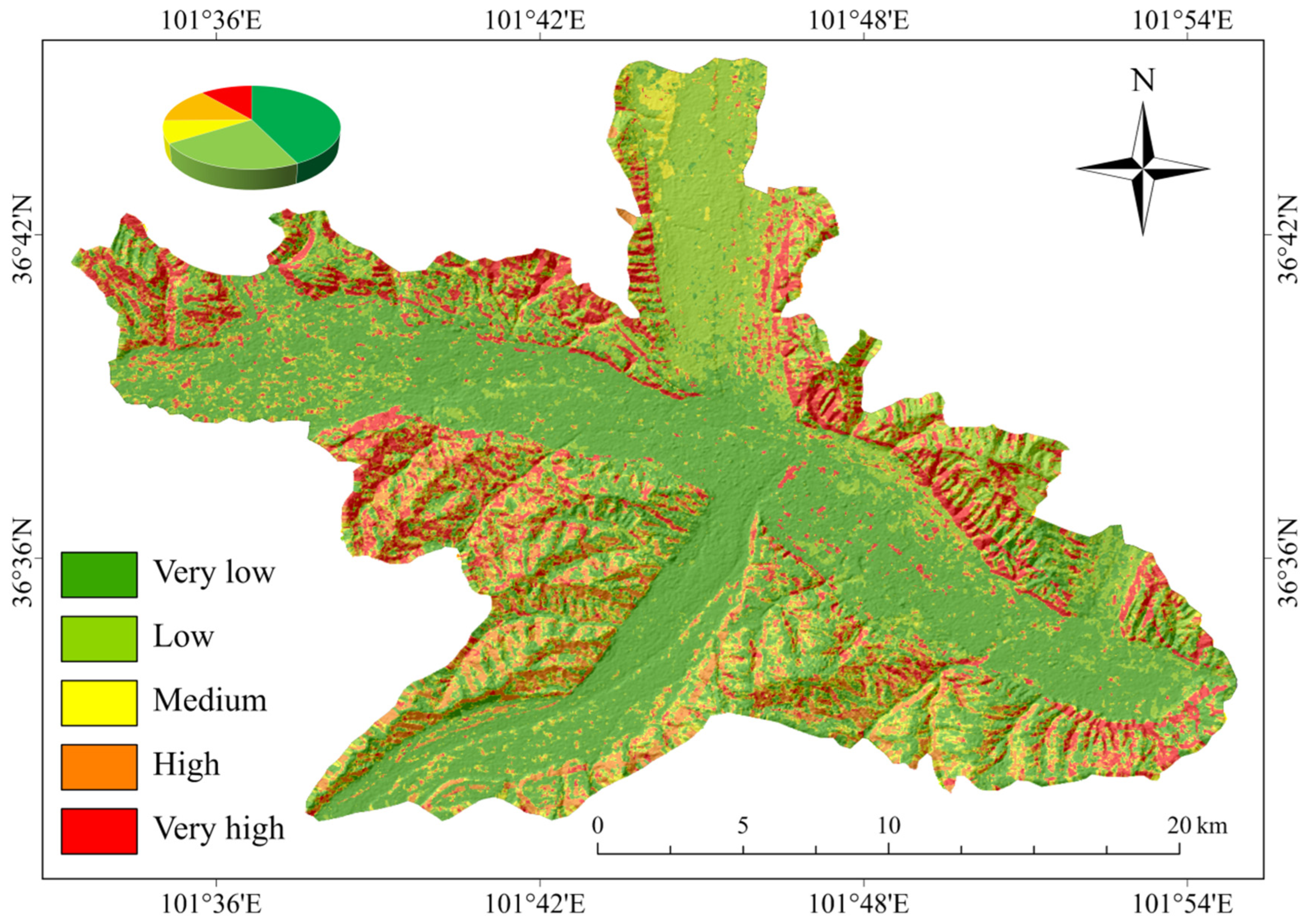
- SBAS-InSAR deformation evidence was incorporated as an independent post-model bidirectional reclassification layer, and the refined high- and very-high-susceptibility classes occupied 25.31% of the study area while containing 69.84% of mapped landslides.
- Integrating deformation information after model prediction improves the physical interpretability of susceptibility zonation without introducing InSAR data into model training.
- The refined susceptibility map can support priority monitoring and risk mitigation in valley–mountain transition belts, river-incised slopes, and engineering-disturbed sectors.
Abstract
1. Introduction
2. Materials and Methods
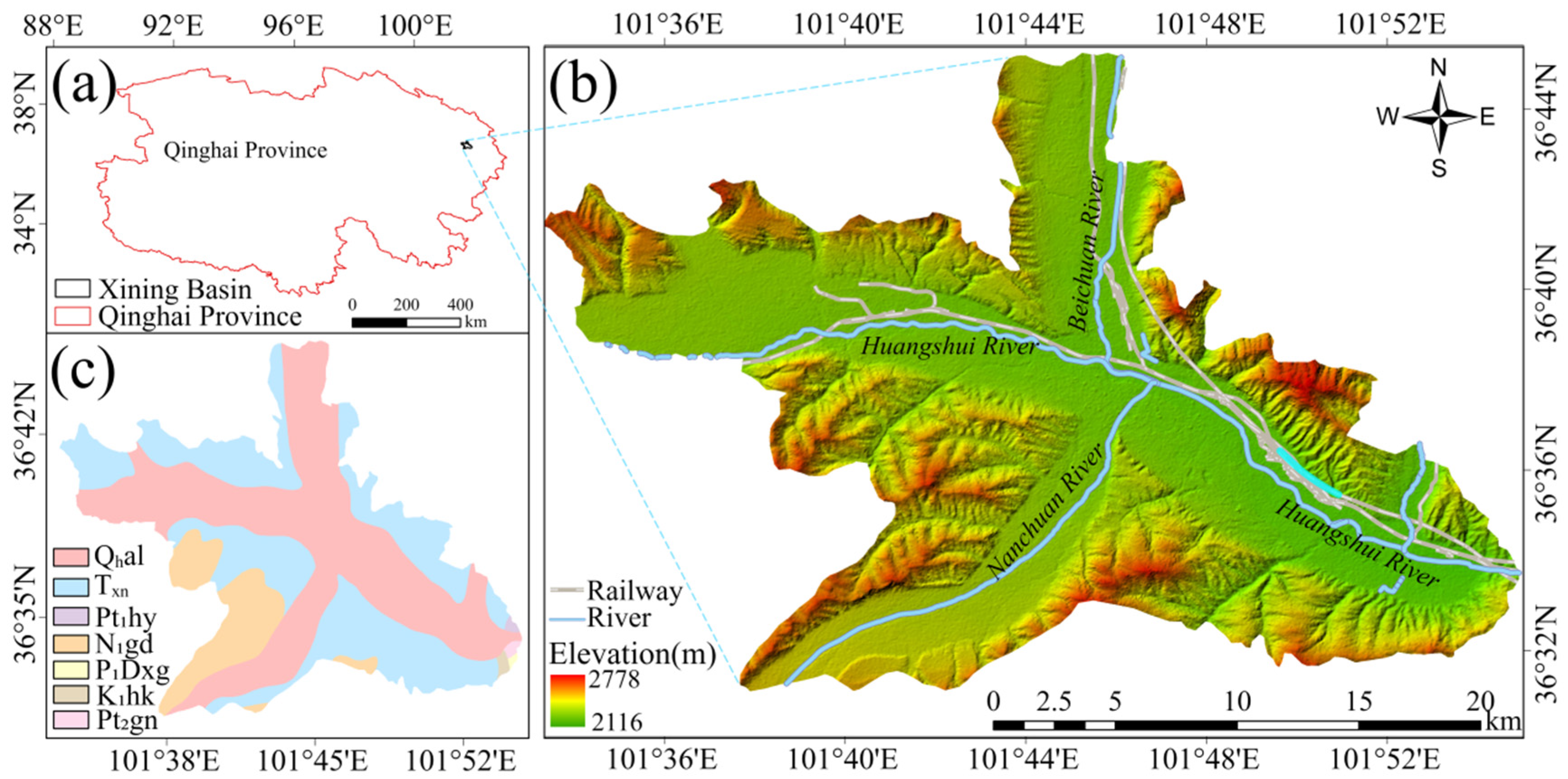
2.1. Study Area
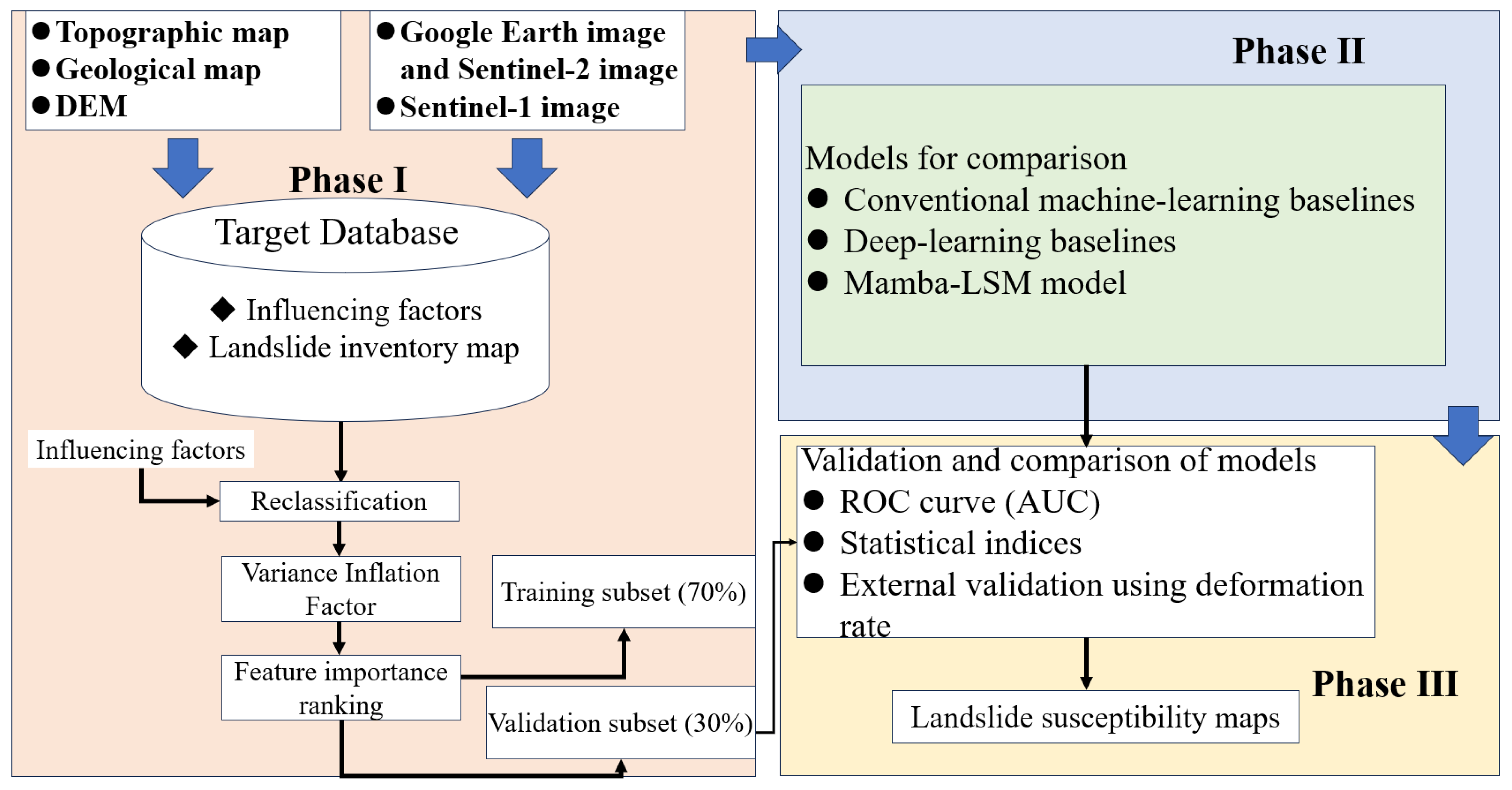
2.2. Overall Workflow
2.3. Landslide Inventory and Sampling
2.4. Conditioning Factor Selection
2.4.1. Multicollinearity Diagnosis
2.4.2. Importance Ranking
2.5. Mamba-LSM Model and Training Protocol
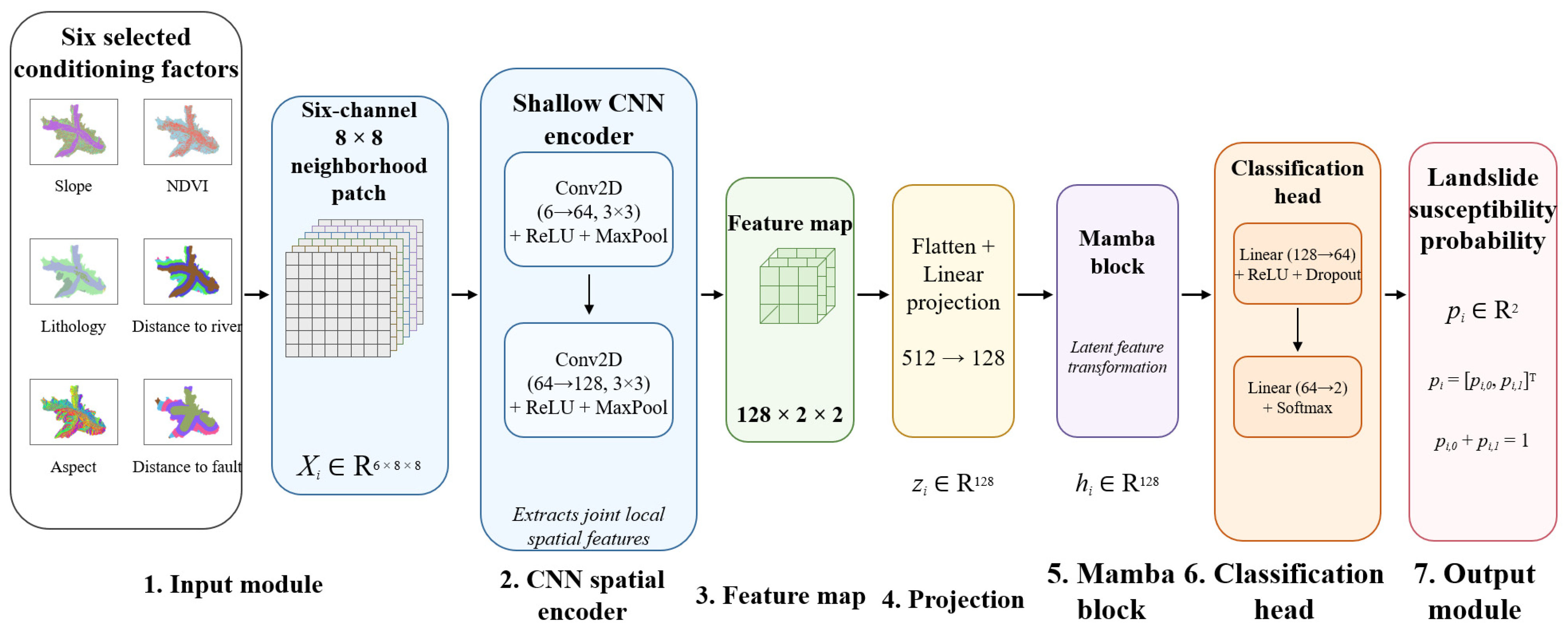
2.5.1. Model Architecture
2.5.2. Training Strategy and Evaluation
2.6. Evaluation Metrics
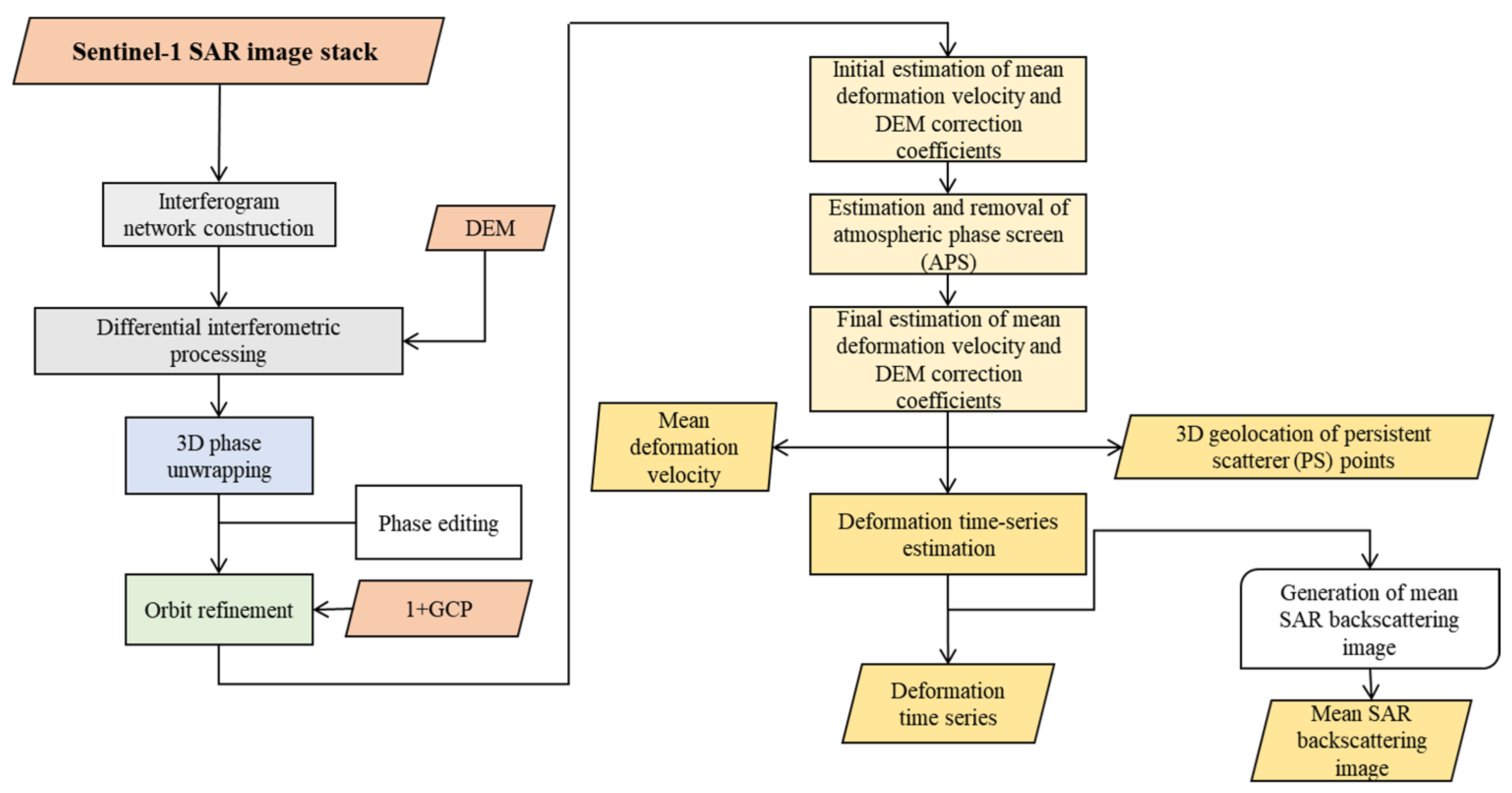
2.7. SBAS-InSAR-Based External Examination and Deformation-Informed Bidirectional Reclassification
3. Results
3.1. Factor Screening by VIF
3.2. Feature Importance
3.3. Overall Model Performance
3.4. Spatial Pattern of Susceptibility
3.5. SBAS-InSAR LOS Deformation and Consistency with Susceptibility Zonation
4. Discussion
4.1. Dominant Controls on Landslide Susceptibility in the Xining Basin
4.2. Contribution of Mamba-LSM and Neighborhood-Based Representation
4.3. Role of SBAS-InSAR Deformation Evidence in Post-Model Correction
4.4. Limitations and Future Work
5. Conclusions
Author Contributions
Funding
Data Availability Statement
Acknowledgments
Conflicts of Interest
Abbreviations
| LSM | Landslide susceptibility mapping |
| Mamba-LSM | Mamba-based landslide susceptibility mapping model |
| SBAS | Small baseline subset |
| InSAR | Interferometric Synthetic Aperture Radar |
| SBAS-InSAR | Small baseline subset interferometric synthetic aperture radar |
| LOS | Line of sight |
| VLOS | Line-of-sight velocity |
| SAR | Synthetic aperture radar |
| DEM | Digital elevation model |
| NDVI | Normalized difference vegetation index |
| OSM | OpenStreetMap |
| VIF | Variance inflation factor |
| LR | Logistic regression |
| RF | Random forest |
| ANN | Artificial neural network |
| ROC | Receiver operating characteristic |
| AUC | Area under the receiver operating characteristic curve |
| MCC | Matthews correlation coefficient |
| AP | Average precision |
| BS | Brier score |
| UAV | Unmanned aerial vehicle |
References
- Kirschbaum, D.B.; Adler, R.; Hong, Y.; Hill, S.; Lerner-Lam, A. A global landslide catalog for hazard applications: Method, results, and limitations. Nat. Hazards 2010, 52, 561–575. [Google Scholar] [CrossRef]
- Nadim, F.; Kjekstad, O.; Peduzzi, P.; Herold, C.; Jaedicke, C. Global landslide and avalanche hotspots. Landslides 2006, 3, 159–173. [Google Scholar] [CrossRef]
- Salvati, P.; Petrucci, O.; Rossi, M.; Bianchi, C.; Pasqua, A.A.; Guzzetti, F. Gender, age and circumstances analysis of flood and landslide fatalities in Italy. Sci. Total Environ. 2018, 610–611, 867–879. [Google Scholar] [CrossRef] [PubMed]
- Haque, U.; Blum, P.; da Silva, P.F.; Andersen, P.; Pilz, J.; Chalov, S.R.; Malet, J.P.; Auflič, M.J.; Andres, N.; Poyiadji, E.; et al. Fatal landslides in Europe. Landslides 2016, 13, 1545–1554. [Google Scholar] [CrossRef]
- Kirschbaum, D.; Stanley, T.; Zhou, Y. Spatial and temporal analysis of a global landslide catalog. Geomorphology 2015, 249, 4–15. [Google Scholar] [CrossRef]
- He, L.; Wu, X.; He, Z.; Xue, D.; Bai, W.; Kang, G.; Chen, X.; Zhang, Y. Landslide identification and deformation monitoring analysis in Xining City based on the time-series InSAR of Sentinel-1A with ascending and descending orbits. Bull. Eng. Geol. Environ. 2024, 83, 255. [Google Scholar] [CrossRef]
- Chen, D.; Wu, Q.; Sun, Z.; Shi, X.; Zhang, S.; Zhang, Y.; Wu, Y. Semi-automatic detection of ground displacement from multi-temporal Sentinel-1 SAR interferometry analysis and DBSCAN in Xining City, China. Remote Sens. 2024, 16, 3066. [Google Scholar] [CrossRef]
- Wang, F.W.; Chen, Y.; Yan, K.M. A destructive mudstone landslide hit a high-speed railway on 15 September 2022 in Xining City, Qinghai Province, China. Landslides 2023, 20, 871–874. [Google Scholar] [CrossRef]
- Feizizadeh, B.; Roodposhti, M.S.; Jankowski, P.; Blaschke, T. A GIS-based extended fuzzy multi-criteria evaluation for landslide susceptibility mapping. Comput. Geosci. 2014, 73, 208–221. [Google Scholar] [CrossRef] [PubMed]
- Reichenbach, P.; Rossi, M.; Malamud, B.D.; Mihir, M.; Guzzetti, F. A review of statistically-based landslide susceptibility models. Earth-Sci. Rev. 2018, 180, 60–91. [Google Scholar] [CrossRef]
- Dikau, R.; Cavallin, A.; Jäger, S. Databases and GIS for landslide research in Europe. Geomorphology 1996, 15, 227–237. [Google Scholar] [CrossRef]
- Azarafza, M.; Azarafza, M.; Akgün, H.; Atkinson, P.M. Deep learning-based landslide susceptibility mapping. Sci. Rep. 2021, 11, 24112. [Google Scholar] [CrossRef] [PubMed]
- Nikoobakht, S.; Azarafza, M.; Akgün, H.; Atkinson, P.M. Landslide susceptibility assessment by using convolutional neural network. Appl. Sci. 2022, 12, 5992. [Google Scholar] [CrossRef]
- Li, Y.; Yang, J.; Han, Z.; Li, J.; Wang, W.; Chen, N.; Hu, G.; Huang, J. An ensemble deep-learning framework for landslide susceptibility assessment using multiple blocks: A case study of Wenchuan area, China. Geomat. Nat. Hazards Risk 2023, 14, 2221771. [Google Scholar] [CrossRef]
- Dou, H.; He, J.; Huang, S.; Jian, W.; Guo, C. Influences of non-landslide sample selection strategies on landslide susceptibility mapping by machine learning. Geomat. Nat. Hazards Risk 2023, 14, 2285719. [Google Scholar] [CrossRef]
- Song, Y.; Song, Y.; Wang, C.; Wu, L.; Wu, W.; Li, Y.; Li, S.; Chen, A. Landslide susceptibility assessment through multi-model stacking and meta-learning in Poyang County, China. Geomat. Nat. Hazards Risk 2024, 15, 2354499. [Google Scholar] [CrossRef]
- Zhu, Y.; Zhu, Z.; Guo, Y.; Nie, S. Considering the effect of non-landslide sample selection on landslide susceptibility assessment. Geomat. Nat. Hazards Risk 2024, 15, 2392778. [Google Scholar] [CrossRef]
- Liu, L.; Wang, P.; Su, L.; Feng, L. Optimization study on the selection method for non-landslide points based on landslide susceptibility zoning. Geomat. Nat. Hazards Risk 2025, 16, 2555728. [Google Scholar] [CrossRef]
- Lu, J.; He, Y.; Zhang, L.; Zhang, Q.; Gao, B.; Chen, H.; Fang, Y. Ensemble learning landslide susceptibility assessment with optimized non-landslide samples selection. Geomat. Nat. Hazards Risk 2024, 15, 2378176. [Google Scholar] [CrossRef]
- Fu, Q.; Chen, D.; Zhang, X.; Zhao, X.; Wang, Y. Impact of non-landslide sample selection on landslide susceptibility assessment and model interpretability. Land 2025, 14, 722. [Google Scholar] [CrossRef]
- Zhang, L.; Xie, W.; Li, X.; Chen, Y. Integrating InSAR deformation and machine learning for dynamic landslide susceptibility mapping. Front. Earth Sci. 2022, 10, 901889. [Google Scholar] [CrossRef]
- Zhu, Z.; Gan, S.; Yuan, X.; Zhang, J. Landslide susceptibility mapping with integrated SBAS-InSAR technique: A case study of Dongchuan District, Yunnan (China). Sensors 2022, 22, 5587. [Google Scholar] [CrossRef] [PubMed]
- Wei, Y.; Wu, Y.; Sun, Z.; Chen, D.; Zhang, S.; Wu, Q. Refined and dynamic susceptibility assessment of landslides using InSAR and machine learning models. Geosci. Front. 2024, 15, 101890. [Google Scholar] [CrossRef]
- Yao, J.; Yao, X.; Zhao, Z.; Liu, X. Performance comparison of landslide susceptibility mapping under multiple machine-learning based models considering InSAR deformation: A case study of the upper Jinsha River. Geomat. Nat. Hazards Risk 2023, 14, 2212833. [Google Scholar] [CrossRef]
- Dong, J.; Niu, R.; Li, B.; Xu, H.; Wang, S. Potential landslides identification based on temporal and spatial filtering of SBAS-InSAR results. Geomat. Nat. Hazards Risk 2023, 14, 52–75. [Google Scholar] [CrossRef]
- He, Y.; Wang, W.; Zhang, L.; Chen, Y.; Chen, Y.; Chen, B.; He, X.; Zhao, Z. An identification method of potential landslide zones using InSAR data and landslide susceptibility. Geomat. Nat. Hazards Risk 2023, 14, 2185120. [Google Scholar] [CrossRef]
- Yang, H.; Zhang, S.; Hu, K.; Jia, Y.; Wang, X.; Song, J.; Tian, H. Evaluation of different factor assignment methods for slope unit-based landslide susceptibility assessment: A case study in Fengjie County, China. Geomat. Nat. Hazards Risk 2025, 16, 2535531. [Google Scholar] [CrossRef]
- Guan, X.; Sun, W.; Kong, X.; Zhang, F.; Huang, J.; He, Y. Response of fatal landslides to precipitation over the Chinese Loess Plateau under global warming. Front. Earth Sci. 2023, 11, 1146724. [Google Scholar] [CrossRef]
- Wei, G.; Yan, J.; Xia, Z.; Li, B.; Qi, H. Research on the instability mechanism of loess landslides based on preferential infiltration of rainfall. Front. Earth Sci. 2025, 13, 1586275. [Google Scholar] [CrossRef]
- Sun, Y. Development Characteristics and Stability Analysis of Xining Loess Landslides: A Case Study of the Xiaoyoushan Landslide. Master’s Thesis, Chang’an University, Xi’an, China, 2013. [Google Scholar]
- Drusch, M.; Del Bello, U.; Carlier, S.; Colin, O.; Fernandez, V.; Gascon, F.; Hoersch, B.; Isola, C.; Laberinti, P.; Martimort, P.; et al. Sentinel-2: ESA’s Optical High-Resolution Mission for GMES Operational Services. Remote Sens. Environ. 2012, 120, 25–36. [Google Scholar] [CrossRef]
- OpenStreetMap Contributors. OpenStreetMap. Available online: https://www.openstreetmap.org/ (accessed on 1 October 2025).
- O’Brien, R.M. A caution regarding rules of thumb for variance inflation factors. Qual. Quant. 2007, 41, 673–690. [Google Scholar] [CrossRef]
- Dormann, C.F.; Elith, J.; Bacher, S.; Buchmann, C.; Carl, G.; Carré, G.; Marquéz, J.R.G.; Gruber, B.; Lafourcade, B.; Leitão, P.J.; et al. Collinearity: A review of methods to deal with it and a simulation study evaluating their performance. Ecography 2013, 36, 27–46. [Google Scholar] [CrossRef]
- Chen, T.; Guestrin, C. XGBoost: A Scalable Tree Boosting System. In Proceedings of the 22nd ACM SIGKDD International Conference on Knowledge Discovery and Data Mining, San Francisco, CA, USA, 13–17 August 2016; pp. 785–794. [Google Scholar] [CrossRef]
- Altmann, A.; Toloşi, L.; Sander, O.; Lengauer, T. Permutation importance: A corrected feature importance measure. Bioinformatics 2010, 26, 1340–1347. [Google Scholar] [CrossRef] [PubMed]
- Strobl, C.; Boulesteix, A.-L.; Zeileis, A.; Hothorn, T. Bias in random forest variable importance measures: Illustrations, sources and a solution. BMC Bioinform. 2008, 9, 307. [Google Scholar] [CrossRef] [PubMed]
- Gu, A.; Dao, T. Mamba: Linear-Time Sequence Modeling with Selective State Spaces. arXiv 2023, arXiv:2312.00752. [Google Scholar] [CrossRef]
- Cox, D.R. The regression analysis of binary sequences. J. R. Stat. Soc. Ser. B Stat. Methodol. 1958, 20, 215–242. [Google Scholar] [CrossRef]
- Breiman, L. Random forests. Mach. Learn. 2001, 45, 5–32. [Google Scholar] [CrossRef]
- Rumelhart, D.E.; Hinton, G.E.; Williams, R.J. Learning representations by back-propagating errors. Nature 1986, 323, 533–536. [Google Scholar] [CrossRef]
- Fawcett, T. An introduction to ROC analysis. Pattern Recognit. Lett. 2006, 27, 861–874. [Google Scholar] [CrossRef]
- Bradley, A.P. The use of the area under the ROC curve in the evaluation of machine learning algorithms. Pattern Recognit. 1997, 30, 1145–1159. [Google Scholar] [CrossRef]
- Torres, R.; Snoeij, P.; Geudtner, D.; Bibby, D.; Davidson, M.; Attema, E.; Potin, P.; Rommen, B.; Floury, N.; Brown, M.; et al. GMES Sentinel-1 mission. Remote Sens. Environ. 2012, 120, 9–24. [Google Scholar] [CrossRef]
- Berardino, P.; Fornaro, G.; Lanari, R.; Sansosti, E. A new algorithm for surface deformation monitoring based on small baseline differential SAR interferograms. IEEE Trans. Geosci. Remote Sens. 2002, 40, 2375–2383. [Google Scholar] [CrossRef]
- Yi, Y.; Xu, X.; Xu, G.; Gao, H. Landslide detection using time-series InSAR along the Kangding–Batang section of the Shanghai–Nyalam Road. Remote Sens. 2023, 15, 1452. [Google Scholar] [CrossRef]





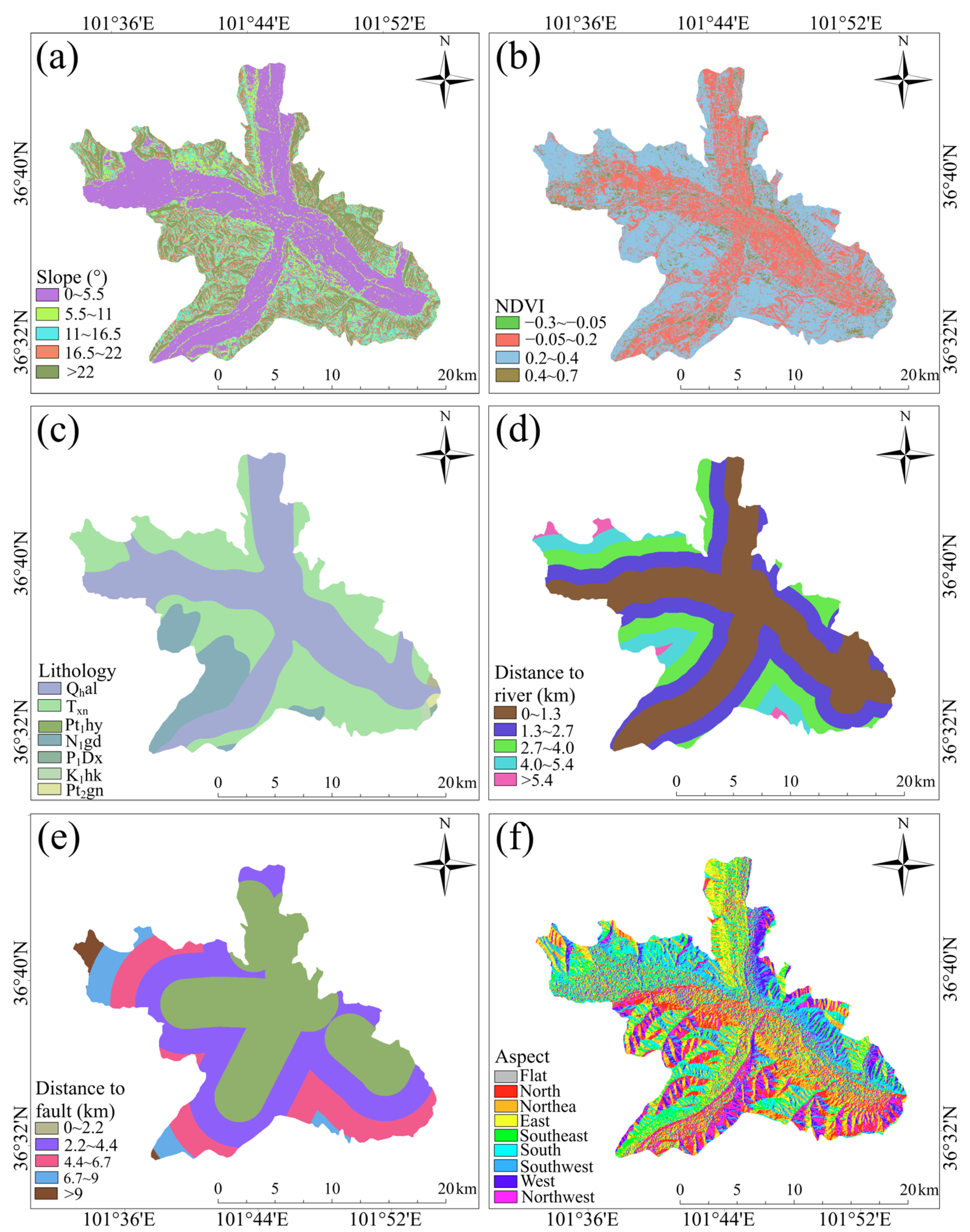
| Factor | Category | Data Source | Time | Original Resolution | Final Resolution |
|---|---|---|---|---|---|
| Slope | Topographic | SRTM DEM | - | 30 m | 30 m |
| Aspect | Topographic | SRTM DEM | - | 30 m | 30 m |
| Profile curvature | Topographic | SRTM DEM | - | 30 m | 30 m |
| NDVI | Environmental | Sentinel-2 image | 5 June 2024 | 10 m | 30 m |
| Distance to river | Hydrological | OpenStreetMap (OSM) [32] | 2021 | Vector | 30 m |
| Distance to railway | Engineering-disturbance | OpenStreetMap (OSM) [32] | 2021 | Vector | 30 m |
| Distance to fault | Geological | Previous study [30] | Sun (2013) [30] | Vector fault data interpreted with reference to [30] | 30 m |
| Lithology | Geological | National Geological Archives of China | - | 1:500,000 | 30 m |
| Initial Susceptibility Class | Initial Value | Active Deformation Classes (D = 1, 4, 5) | Low-Activity Deformation Classes (D = 2, 3) |
|---|---|---|---|
| Very low | 1 | Low | Very low |
| Low | 2 | Medium | Very low |
| Medium | 3 | High | Low |
| High | 4 | Very high | Medium |
| Very high | 5 | Very high | High |
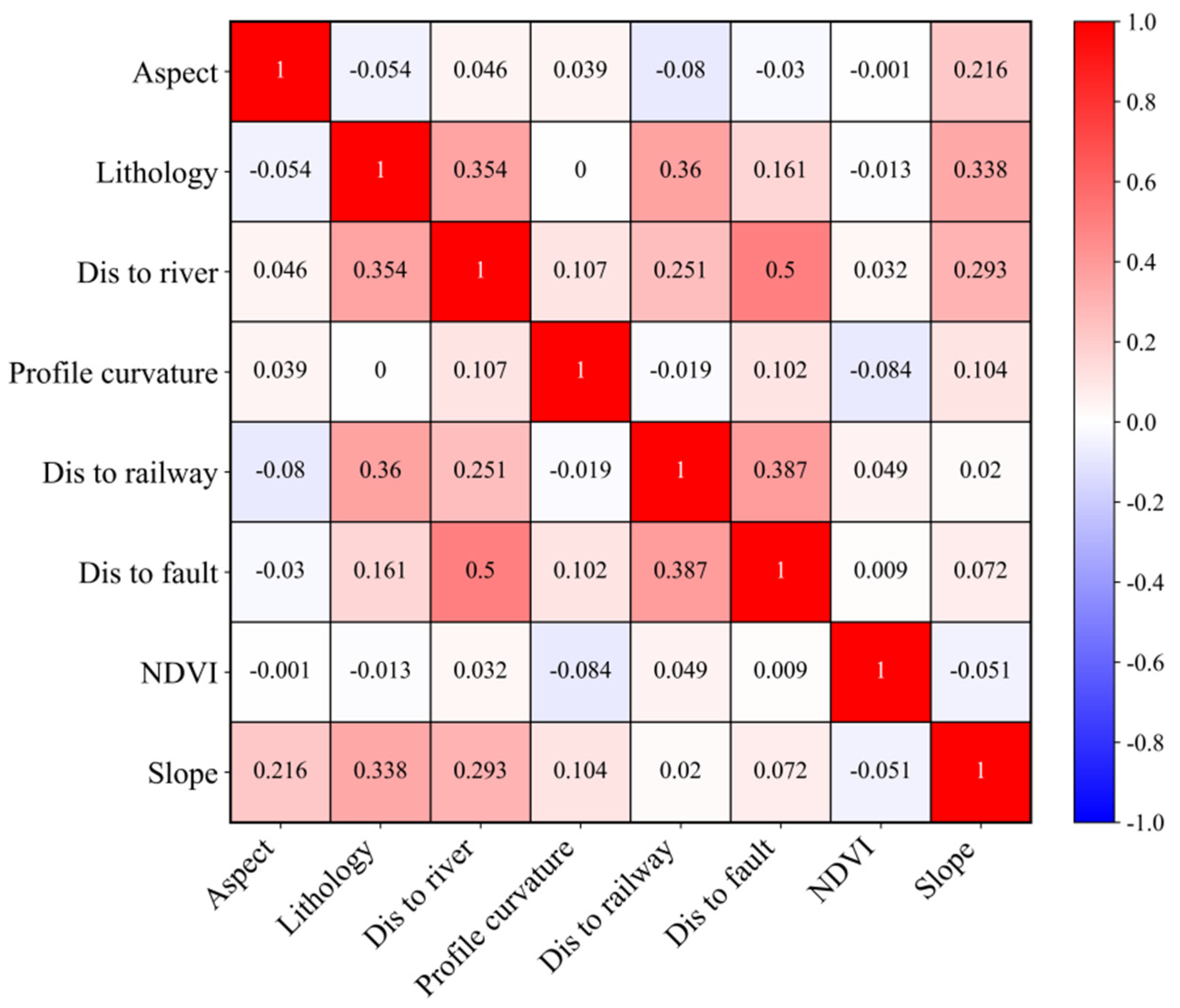
| Factor | VIF | Decision |
|---|---|---|
| Slope | 5.49 | Remain |
| Distance to river | 7.53 | Remain |
| Distance to railway | 6.03 | Remain |
| Distance to fault | 7.14 | Remain |
| Lithology | 4.96 | Remain |
| Profile curvature | 8.14 | Remain |
| NDVI | 10.88 | Remain |
| Aspect | 7.92 | Remain |
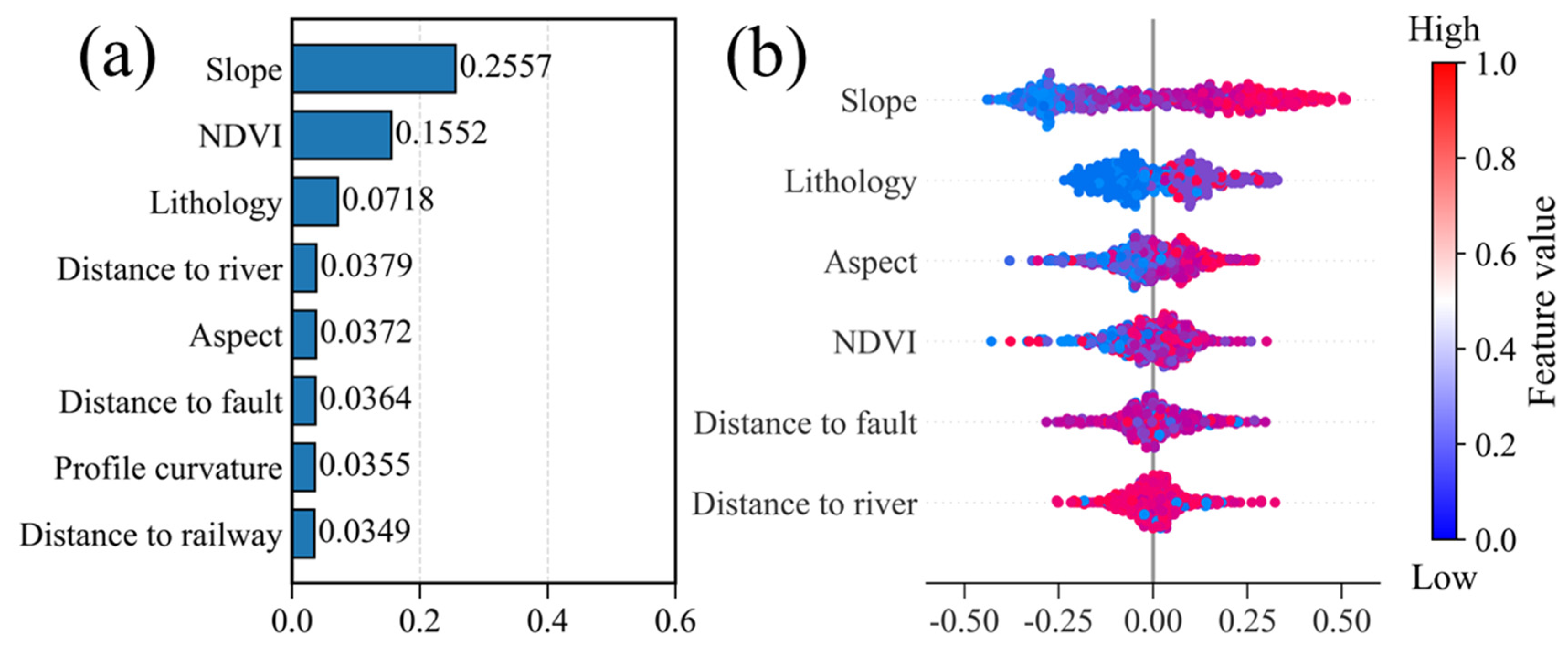
| Ranking | Factor | Gain | Proportion (%) | Selected |
|---|---|---|---|---|
| 1 | Slope | 0.2557 | 38.48 | Yes |
| 2 | NDVI | 0.1552 | 23.35 | Yes |
| 3 | Lithology | 0.0718 | 10.80 | Yes |
| 4 | Distance to river | 0.0379 | 5.70 | Yes |
| 5 | Aspect | 0.0372 | 5.59 | Yes |
| 6 | Distance to fault | 0.0364 | 5.48 | Yes |
| 7 | Profile curvature | 0.0355 | 5.34 | No |
| 8 | Distance to railway | 0.0349 | 5.25 | No |
| Model | AUC (%) | F1 (%) | Pre (%) | ACC (%) | Recall (%) | MCC (%) |
|---|---|---|---|---|---|---|
| LR | 83.77 | 70.95 | 82.68 | 72.35 | 62.13 | 47.26 |
| RF | 82.75 | 67.84 | 84.21 | 70.74 | 56.80 | 45.62 |
| XGBoost | 81.08 | 70.00 | 80.15 | 71.06 | 62.13 | 44.21 |
| Mamba-LSM | 90.11 | 74.31 | 89.92 | 76.21 | 63.31 | 56.23 |
| ANN | 74.75 | 62.86 | 79.28 | 66.56 | 52.07 | 37.30 |
| CNN | 89.03 | 75.77 | 89.52 | 77.17 | 65.68 | 57.50 |
| LeNet-style CNN | 84.47 | 74.50 | 86.05 | 75.56 | 65.68 | 53.59 |
| Tiny Transformer | 84.10 | 69.26 | 85.96 | 72.03 | 57.99 | 48.30 |
| Model | Class | Area (km2) | Areal Percentage (%) | Points | Share of Points (%) | Points/100 km2 |
|---|---|---|---|---|---|---|
| LR | Very low | 115.0254 | 28.88 | 12 | 3.81 | 10.43 |
| Low | 77.6538 | 19.5 | 40 | 12.7 | 51.51 | |
| Medium | 63.7434 | 16.01 | 56 | 17.78 | 87.85 | |
| High | 68.3937 | 17.17 | 93 | 29.52 | 135.98 | |
| Very high | 73.4463 | 18.44 | 114 | 36.19 | 155.22 | |
| XGBoost | Very low | 190.9782 | 47.95 | 44 | 13.97 | 23.04 |
| Low | 28.9638 | 7.27 | 14 | 4.44 | 48.34 | |
| Medium | 24.2433 | 6.09 | 14 | 4.44 | 57.75 | |
| High | 28.8909 | 7.25 | 26 | 8.25 | 89.99 | |
| Very high | 125.1864 | 31.43 | 217 | 68.89 | 173.34 | |
| RF | Very low | 101.8026 | 25.56 | 13 | 4.13 | 12.77 |
| Low | 102.6342 | 25.77 | 35 | 11.11 | 34.1 | |
| Medium | 72.5868 | 18.23 | 61 | 19.37 | 84.04 | |
| High | 82.8432 | 20.8 | 77 | 24.44 | 92.95 | |
| Very high | 38.3958 | 9.64 | 129 | 40.95 | 335.97 | |
| ANN | Very low | 53.0667 | 13.32 | 18 | 5.71 | 33.92 |
| Low | 104.6646 | 26.28 | 33 | 10.48 | 31.53 | |
| Medium | 137.0016 | 34.4 | 105 | 33.33 | 76.64 | |
| High | 90.63 | 22.76 | 142 | 45.08 | 156.68 | |
| Very high | 12.8997 | 3.24 | 17 | 5.4 | 131.79 | |
| Mamba-LSM | Very low | 235.0062 | 59.01 | 40 | 12.7 | 17.02 |
| Low | 29.754 | 7.47 | 22 | 6.98 | 73.94 | |
| Medium | 25.2135 | 6.33 | 24 | 7.62 | 95.19 | |
| High | 34.3251 | 8.62 | 41 | 13.02 | 119.45 | |
| Very high | 73.9638 | 18.57 | 188 | 59.68 | 254.18 | |
| CNN | Very low | 242.8920 | 60.99 | 19 | 6.03 | 7.82 |
| Low | 27.0819 | 6.80 | 29 | 9.21 | 107.08 | |
| Medium | 23.0337 | 5.78 | 20 | 6.35 | 86.83 | |
| High | 27.1143 | 6.81 | 38 | 12.06 | 140.15 | |
| Very high | 78.1407 | 19.62 | 209 | 66.35 | 267.47 | |
| LeNet-styleCNN | Very low | 249.2586 | 62.59 | 27 | 8.57 | 10.83 |
| Low | 30.7017 | 7.71 | 27 | 8.57 | 87.94 | |
| Medium | 21.1518 | 5.31 | 34 | 10.79 | 160.74 | |
| High | 27.3762 | 6.87 | 39 | 12.38 | 142.46 | |
| Very high | 69.7743 | 17.52 | 188 | 59.68 | 269.44 | |
| Tiny Transformer | Very low | 178.1586 | 44.73 | 1 | 0.32 | 0.56 |
| Low | 38.6172 | 9.70 | 6 | 1.90 | 15.54 | |
| Medium | 38.7540 | 9.73 | 32 | 10.16 | 82.57 | |
| High | 51.5421 | 12.94 | 85 | 26.98 | 164.91 | |
| Very high | 91.1907 | 22.90 | 191 | 60.63 | 209.45 |
| Model | Class | Area (km2) | Areal Percentage (%) | Points | Share of Points (%) | Points/100 km2 |
|---|---|---|---|---|---|---|
| Deformation-corrected Mamba-LSM | Very low | 170.451 | 42.82 | 22 | 6.98 | 12.91 |
| Low | 92.533 | 23.25 | 38 | 12.06 | 41.07 | |
| Medium | 34.303 | 8.62 | 35 | 11.11 | 102.03 | |
| High | 68.3937 | 14.07 | 99 | 31.43 | 176.75 | |
| Very high | 56.012 | 11.24 | 121 | 38.41 | 270.34 |
Disclaimer/Publisher’s Note: The statements, opinions and data contained in all publications are solely those of the individual author(s) and contributor(s) and not of MDPI and/or the editor(s). MDPI and/or the editor(s) disclaim responsibility for any injury to people or property resulting from any ideas, methods, instructions or products referred to in the content. |
© 2026 by the authors. Licensee MDPI, Basel, Switzerland. This article is an open access article distributed under the terms and conditions of the Creative Commons Attribution (CC BY) license.
Share and Cite
Yang, H.; Liu, W.; Liu, Y. Landslide Susceptibility Assessment in a Complex Mountain Basin Transition Zone by Integrating Mamba and SBAS-InSAR Deformation Evidence: A Case Study of the Xining Basin, China. Remote Sens. 2026, 18, 2170. https://doi.org/10.3390/rs18132170
Yang H, Liu W, Liu Y. Landslide Susceptibility Assessment in a Complex Mountain Basin Transition Zone by Integrating Mamba and SBAS-InSAR Deformation Evidence: A Case Study of the Xining Basin, China. Remote Sensing. 2026; 18(13):2170. https://doi.org/10.3390/rs18132170
Chicago/Turabian StyleYang, Heming, Wenhui Liu, and Yabin Liu. 2026. "Landslide Susceptibility Assessment in a Complex Mountain Basin Transition Zone by Integrating Mamba and SBAS-InSAR Deformation Evidence: A Case Study of the Xining Basin, China" Remote Sensing 18, no. 13: 2170. https://doi.org/10.3390/rs18132170
APA StyleYang, H., Liu, W., & Liu, Y. (2026). Landslide Susceptibility Assessment in a Complex Mountain Basin Transition Zone by Integrating Mamba and SBAS-InSAR Deformation Evidence: A Case Study of the Xining Basin, China. Remote Sensing, 18(13), 2170. https://doi.org/10.3390/rs18132170