Improving Assimilation of Polar-Orbiting Satellite Microwave Radiances over the Tibetan Plateau Using a Gaussian–Flat Variational Quality Control

Highlights
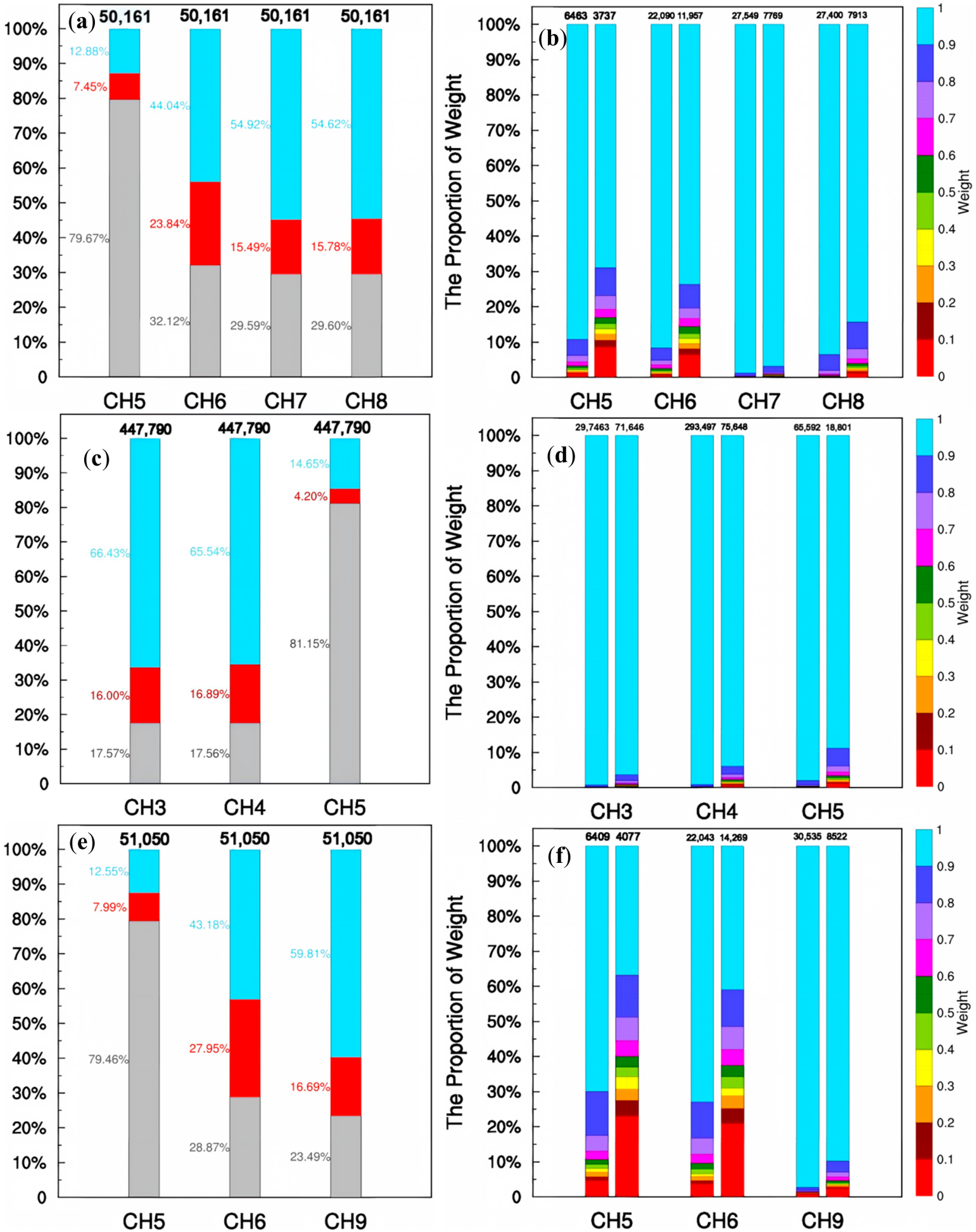
- The Flat-VarQC significantly increases the effective assimilation rate of polar-orbiting satellite microwave observations over the Tibetan Plateau (by approximately 4–28%) by recovering observations rejected by conventional quality control.
- The differences in the analysis weights of the temperature channel and the humidity channel in Flat-VarQC are revealed.
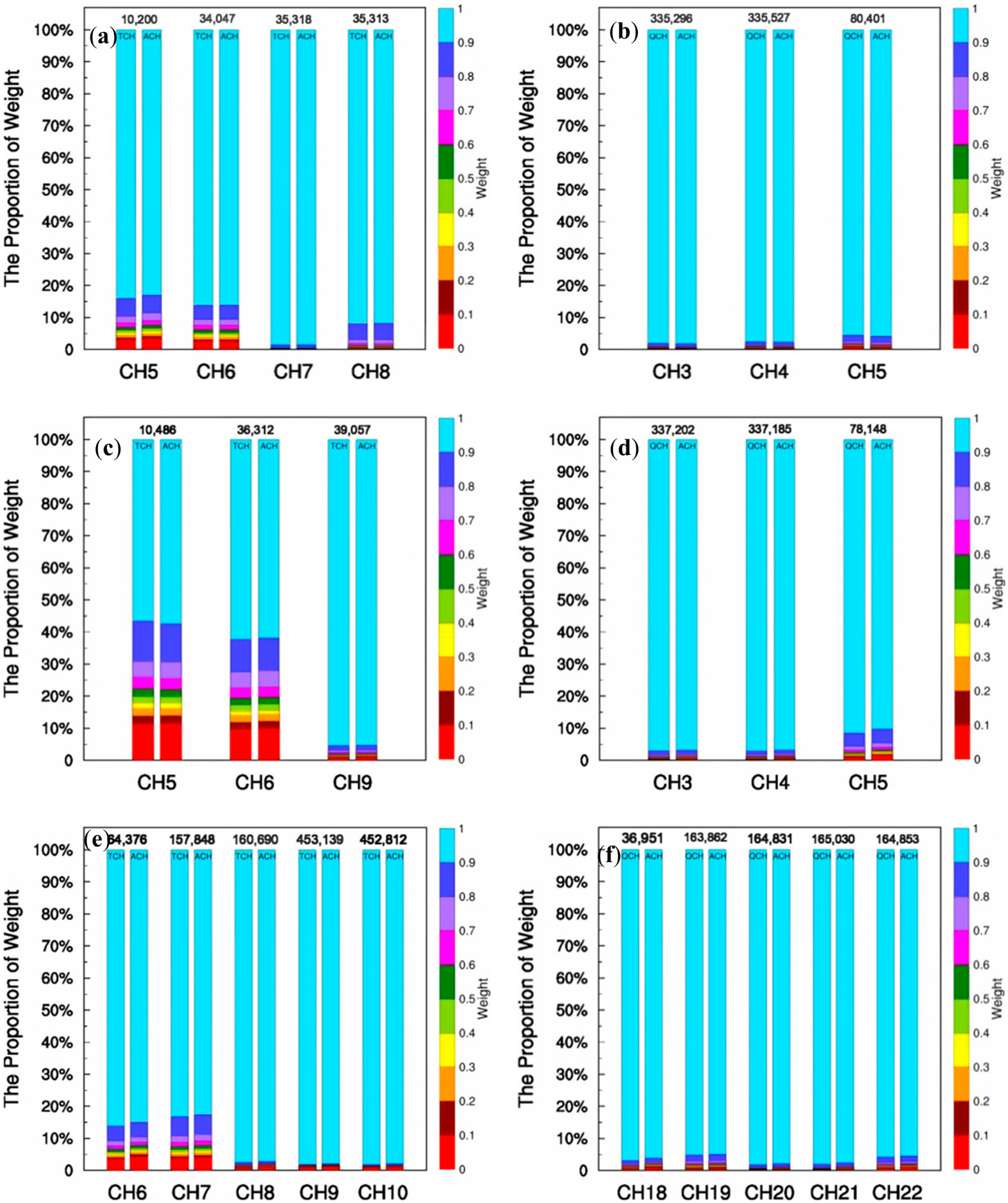
- The scheme shows better applicability and effectiveness for microwave temperature sounders than for microwave humidity sounders, with more reasonable weights for temperature observations.
- A Gaussian–Flat variational quality control suitable for improving the assimilation of satellite data over the Tibetan Plateau is developed.
- Optimizing the key parameters enables more effective use of multi-channel microwave observations from multiple polar-orbiting satellites under complex terrain conditions over the Tibetan Plateau, providing reference parameter schemes in operational assimilation systems.
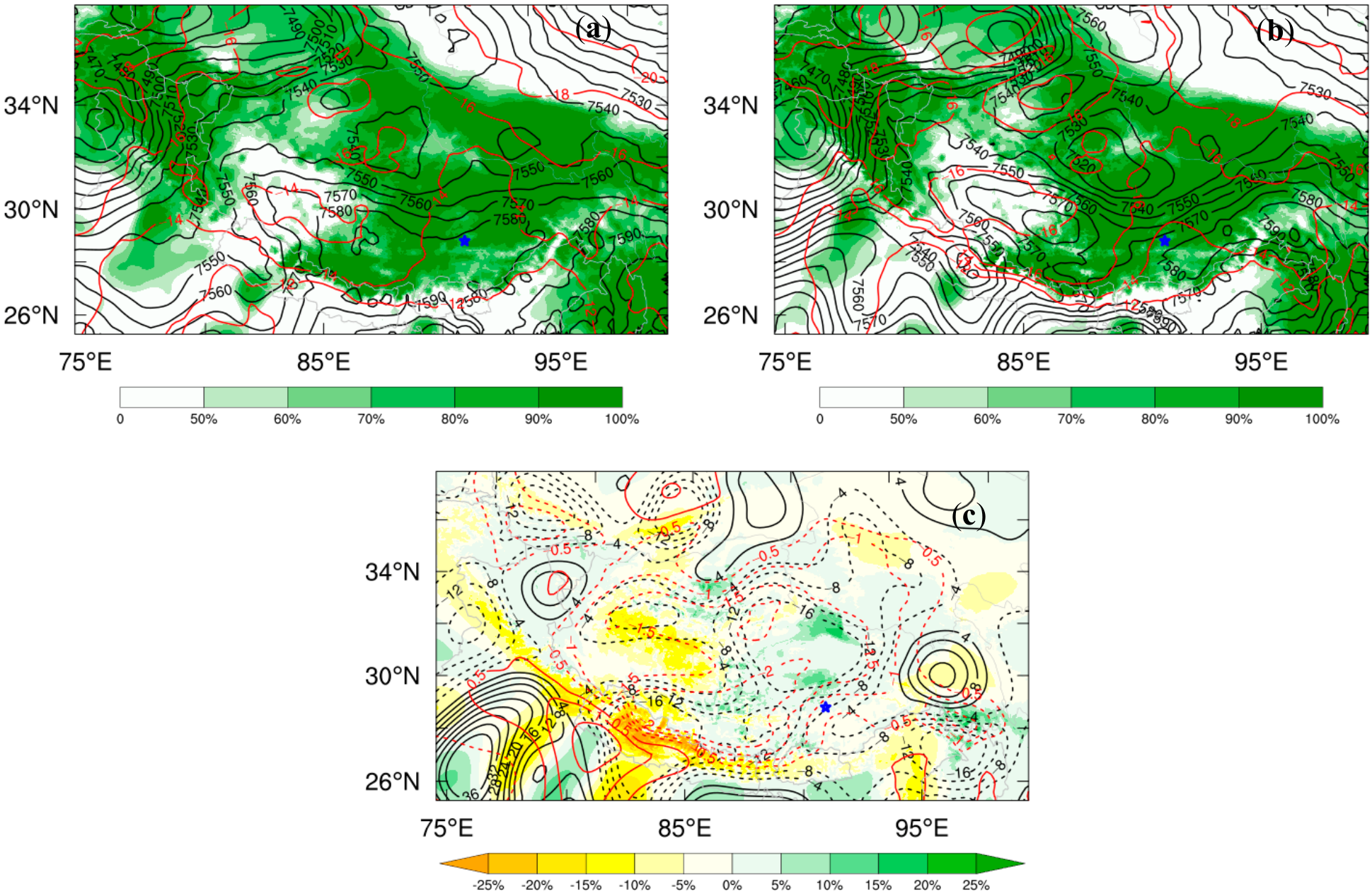
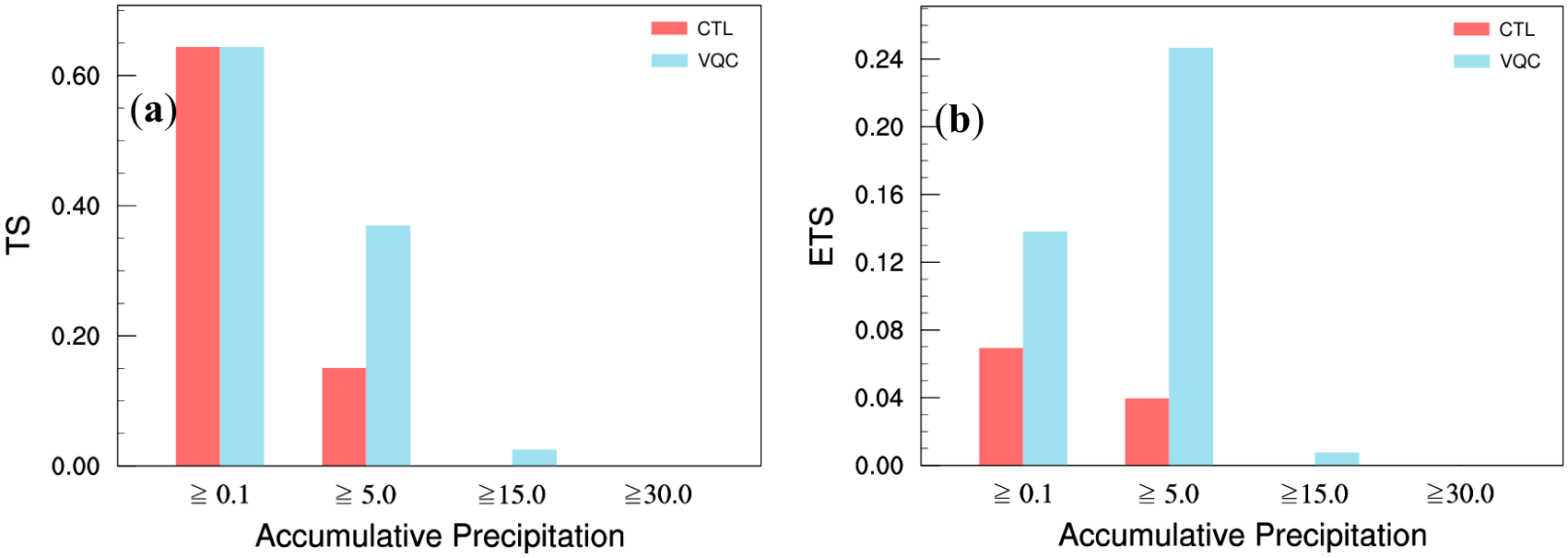
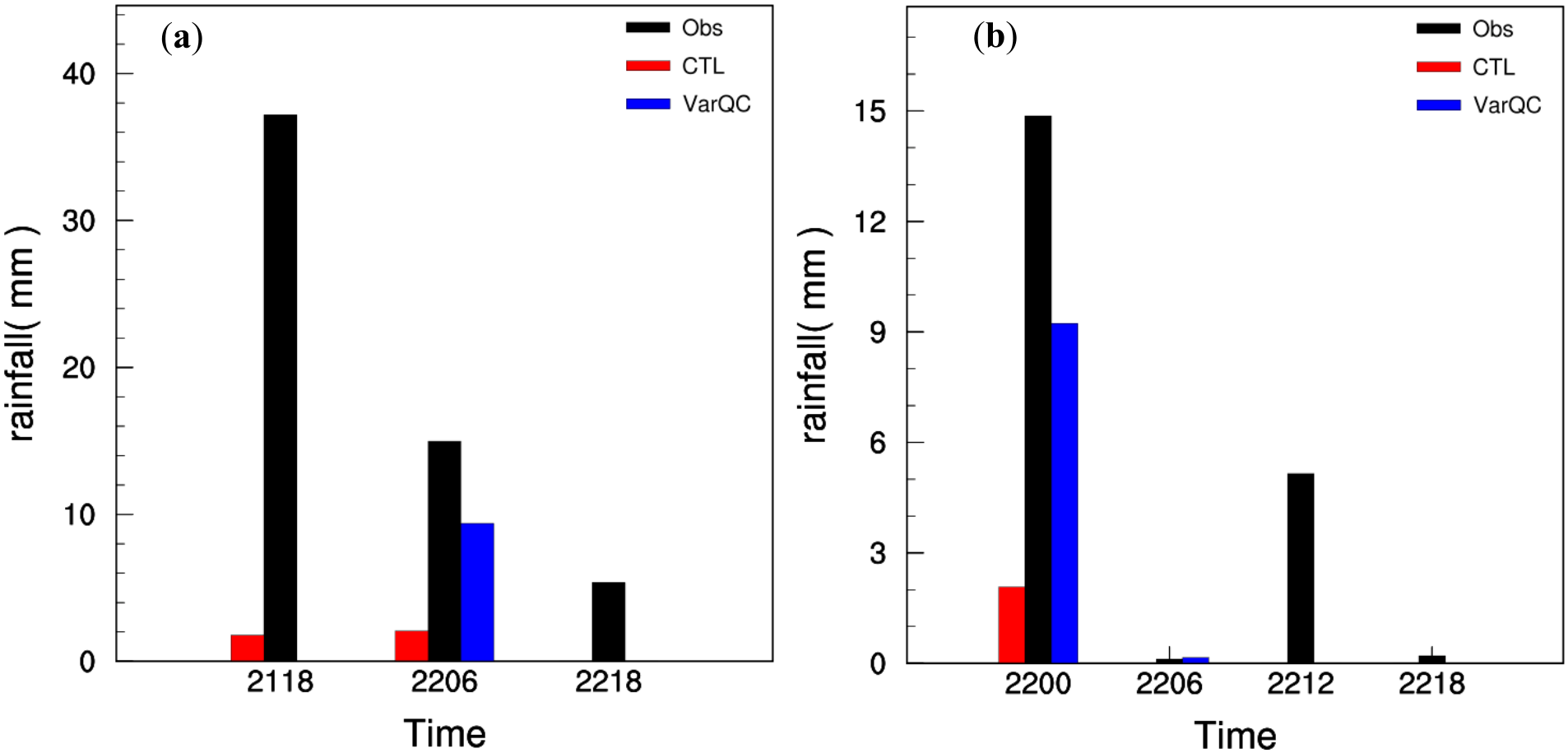
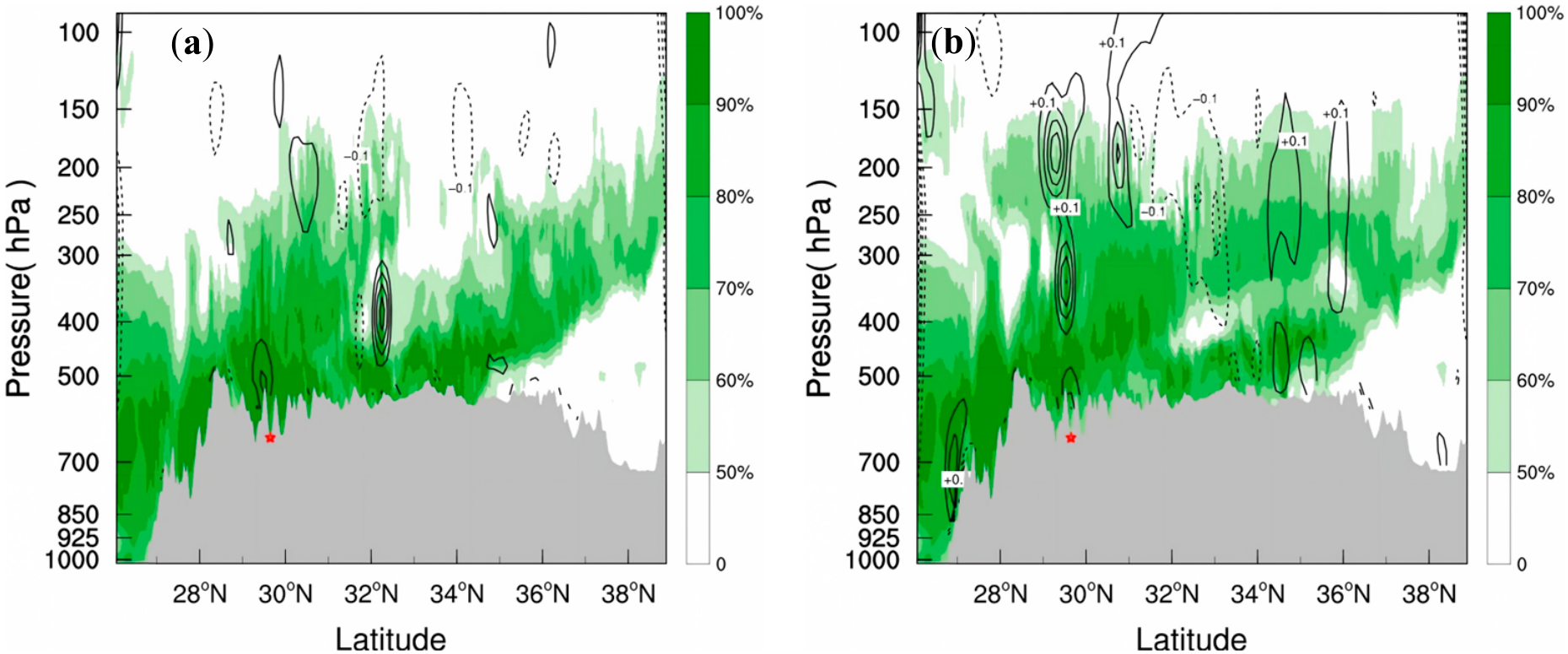
- The improved assimilation of satellite observations enhances the analysis of key dynamic and moisture fields, thereby improving forecasts of heavy precipitation over the Tibetan Plateau.
- The parameter optimization for Flat-VarQC provides a practical reference for assimilating satellite observations over data-sparse regions with complex terrain.
Abstract
1. Introduction
2. Flat-VarQC for Polar-Orbiting Satellites over the Plateau
2.1. Theoretical Formulation of Flat-VarQC
2.2. Applicability of Flat-VarQC to Satellite Observations over the Plateau
3. Data and Experimental Design
3.1. Model Configuration and Data
3.2. Experiment Setup
4. Effectiveness of Flat-VarQC for Satellite Observations over the Plateau
4.1. Optimization of Key Parameters in the Flat-VarQC for Satellite Observations over the Plateau
4.2. Error Characteristics of Polar-Orbiting Satellite Microwave Observations
4.3. Improvement in the Effective Assimilation Rate of Satellite Observations over the Plateau
4.4. Optimization of Analysis Weights
5. Assimilation and Forecast Performance of Satellite Observations over the Plateau
5.1. Effective Adjustment of the Background by Flat-VarQC
5.2. Improving the Quality of the Analysis
5.3. Improvement in Forecasting Skill
6. Conclusions and Discussion
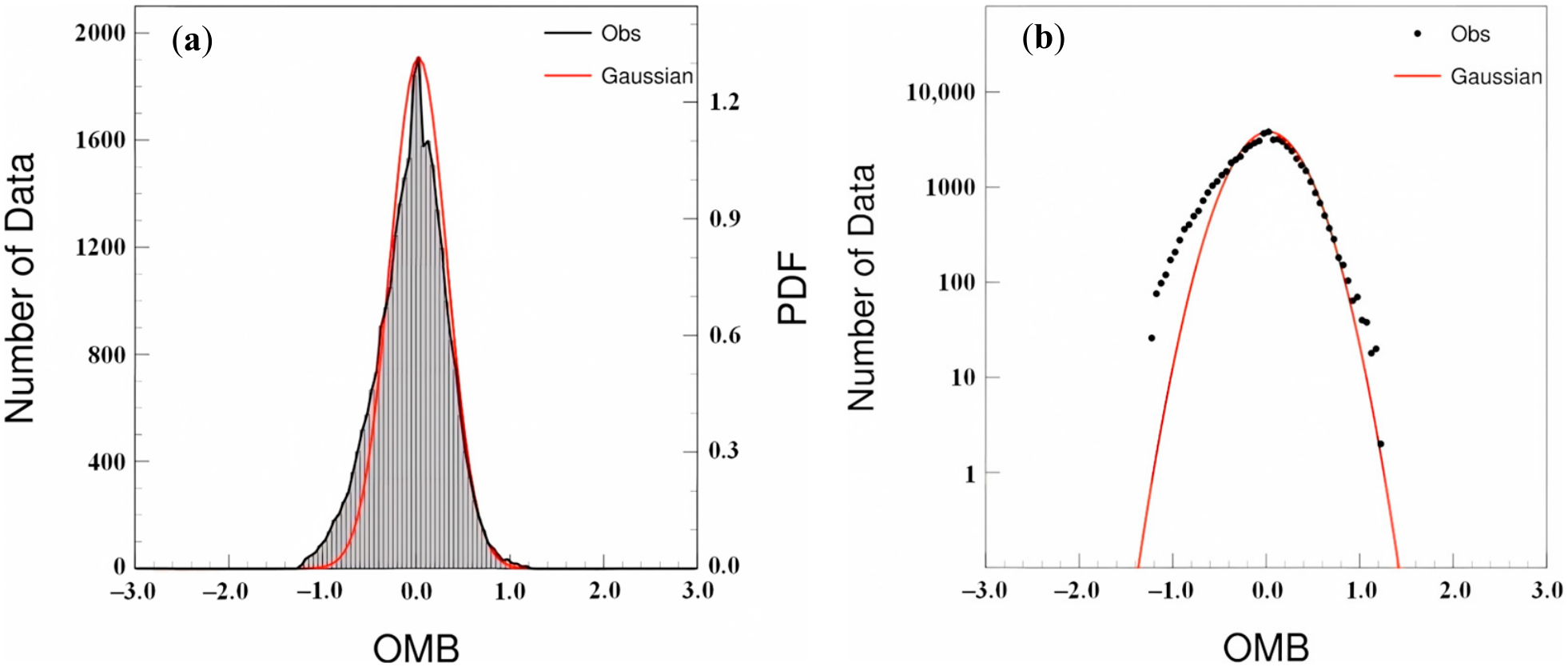
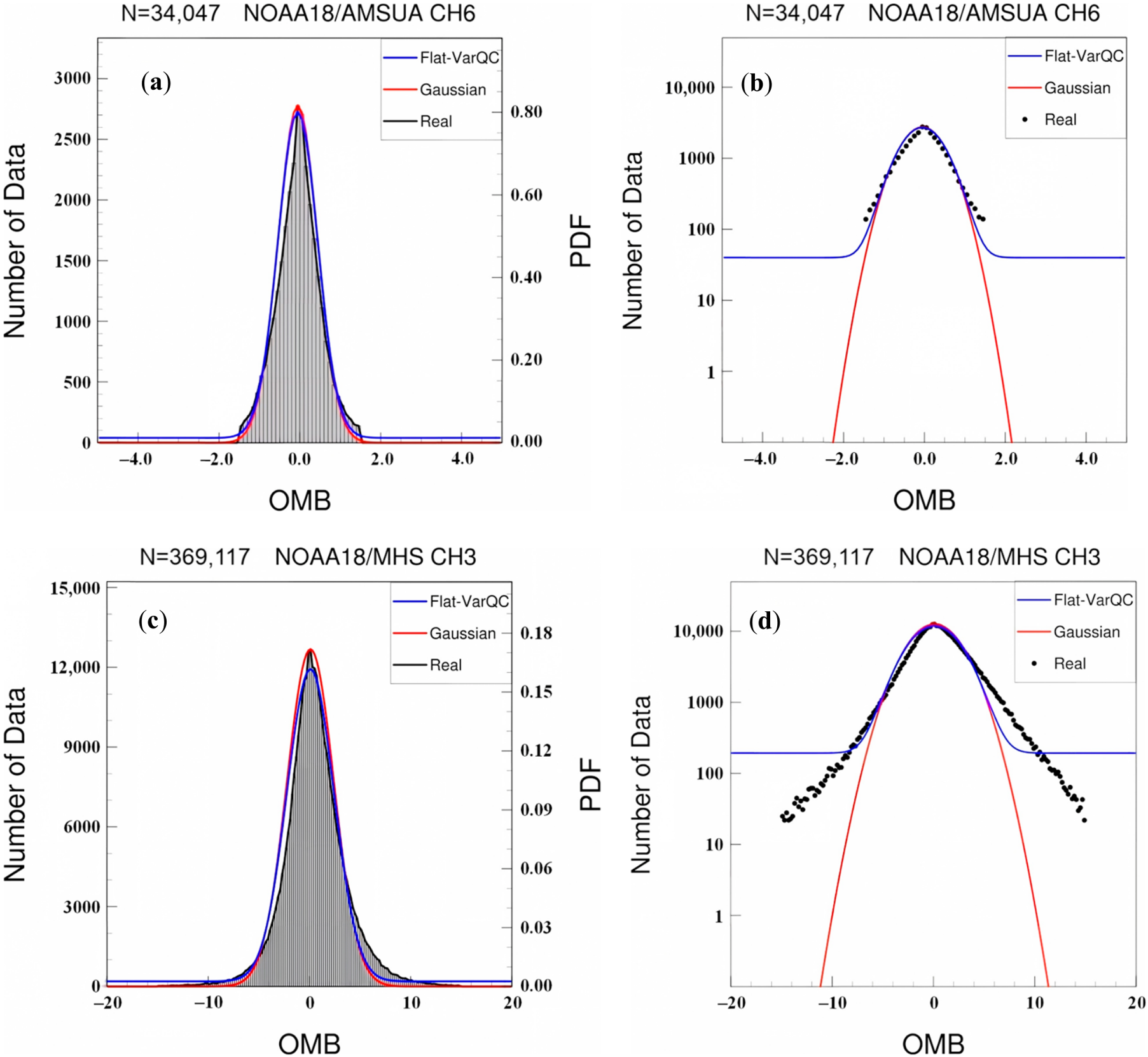
- The Flat-VarQC with optimized parameters can improve the effective assimilation rate of polar-orbiting satellite microwave observations and the quality of analyses over the Plateau. The innovations of satellite observations over the Plateau exhibit pronounced fat-tailed distribution characteristics. A large number of available observations are rejected by conventional QC and cannot be effectively assimilated. As a result, the actual assimilation rate of polar-orbiting satellite microwave observations over the Plateau remains low.
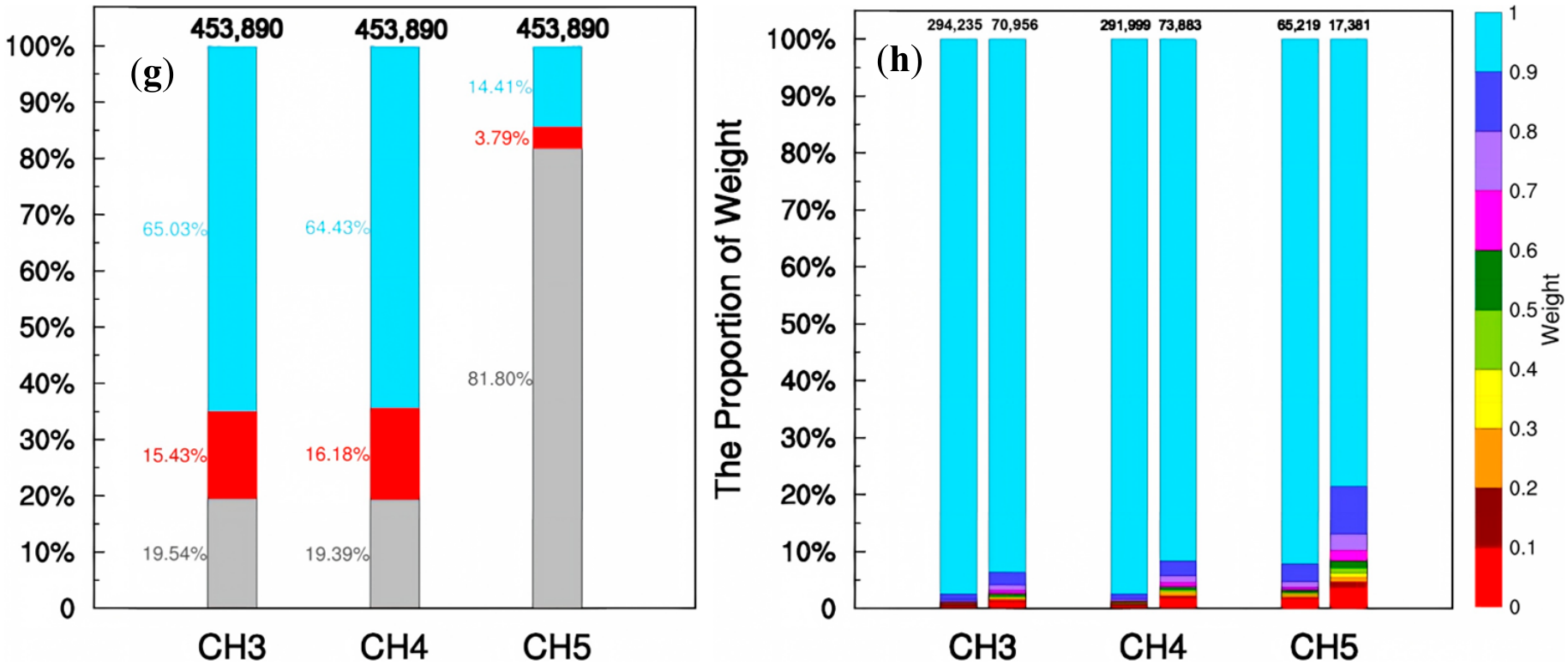
- The applicability and effectiveness of the Flat-VarQC are better for microwave temperature sounders than for microwave humidity sounders over the Plateau. During the analysis process, the Flat-VarQC assigns more reasonable weights to microwave temperature sounder observations. This allows the positive contribution of these observations to be more fully realized. In contrast, the improvement in weights for microwave humidity sounders is less evident.
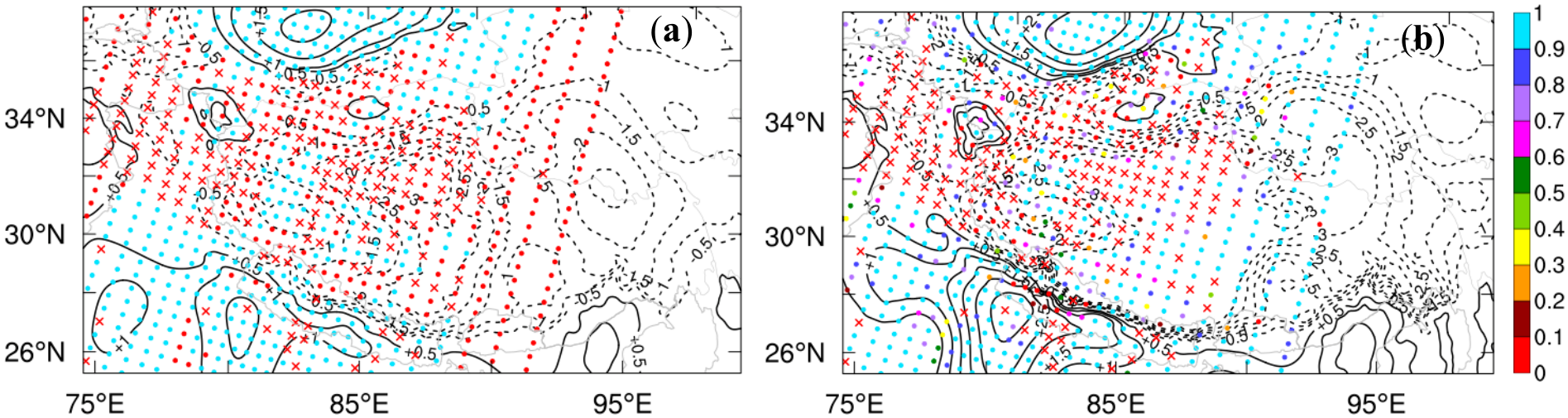
- The Flat-VarQC can absorb more useful information from satellite observations over the Plateau. Compared with conventional quality control, it also effectively reduces the negative impact of harmful information from observations during assimilation. As a result, it enhances the positive contribution of polar-orbiting satellite microwave observations to analyses and improves the quality of forecasts. This scheme has great application potential for the analyses and precipitation forecasts of meso- and micro-scale weather systems over the Plateau.
Author Contributions
Funding
Data Availability Statement
Acknowledgments
Conflicts of Interest
References
- Eyre, J.R.; English, S.J.; Forsythe, M. Assimilation of satellite observations in numerical weather prediction. Part I: The early years. Q. J. R. Meteorol. Soc. 2020, 146, 49–68. [Google Scholar] [CrossRef]
- Eyre, J.R.; Bell, W.; Cotton, J.; English, S.J.; Forsythe, M.; Healy, S.B.; Pavelin, E.G. Assimilation of satellite observations in numerical weather prediction. Part II: Recent years. Q. J. R. Meteorol. Soc. 2022, 148, 521–556. [Google Scholar] [CrossRef]
- McNally, A.P.; Derber, J.C.; Wu, W.; Katz, B.B. The use of TOVS level-1b radiances in the NCEP SSI analysis system. Q. J. R. Meteorol. Soc. 2000, 126, 689–724. [Google Scholar] [CrossRef]
- Liu, Q.; Weng, F. Detecting the warm core of a hurricane from the special sensor microwave imager sounder. Geophys. Res. Lett. 2006, 33, 863–883. [Google Scholar] [CrossRef]
- Pan, X.D.; Li, X.; Cheng, G.D.; Hong, Y. Effects of 4D-Var Data Assimilation Using Remote Sensing Precipitation Products in a WRF Model over the Complex Terrain of an Arid Region River Basin. Remote Sens. 2017, 9, 963. [Google Scholar] [CrossRef]
- He, J.; Ma, X.L.; Chen, X. Benefit of Assimilating Satellite All-Sky Infrared Radiances on the Cloud and Precipitation Prediction of a Long-Lasting Mesoscale Convective System over the Tibetan Plateau. Q. J. R. Meteorol. Soc. 2023, 149, 2742–2760. [Google Scholar] [CrossRef]
- Andersson, E.; Hollingsworth, A.; Kelly, G.; Lönnberg, P.; Pailleux, J.; Zhang, Z. Global Observing System Experiments on Operational Statistical Retrievals of Satellite Sounding Data. Mon. Weather Rev. 1991, 119, 1851–1865. [Google Scholar] [CrossRef]
- Dee, D.P. Bias and data assimilation. Q. J. R. Meteorol. Soc. 2005, 131, 3323–3343. [Google Scholar] [CrossRef]
- Kelly, G.; Andersson, E.; Hollingsworth, A.; Lönnberg, P.; Pailleux, J.; Zhang, Z. Quality Control of Operational Physical Retrievals of Satellite Sounding Data. Mon. Weather Rev. 1991, 119, 1866–1880. [Google Scholar] [CrossRef]
- Yang, J.R.; He, J.; Ma, X.L.; Hao, B.J.; Zhang, T.T. Study on variational quality control of data assimilation in Tibetan Plateau: Parameters optimization and effective assimilation. Acta Meteorol. Sin. 2024, 82, 443–458. (In Chinese) [Google Scholar] [CrossRef]
- Järvinen, H.; Undén, P. Observation Screening and Background Quality Control in the ECMWF 3D-Var Data Assimilation System. In ECMWF Technical Memorandum No. 236; ECMWF: Reading, UK, 1997; pp. 1–33. [Google Scholar]
- Geer, A.J.; Lonitz, K.; Weston, P.; Kazumori, M.; Okamoto, K.; Zhu, Y.Q.; Liu, E.H.; Collard, A.; Bell, W.; Migliorini, S.; et al. All-sky satellite data assimilation at operational weather forecasting centres. Q. J. R. Meteorol. Soc. 2018, 144, 1191–1217. [Google Scholar] [CrossRef]
- Niu, Z.Y.; Wang, L.W.; Kumar, P. Scale Analysis of Typhoon In-Fa (2021) Based on FY-4A Geostationary Interferometric Infrared Sounder (GIIRS) Observed and All-Sky-Simulated Brightness Temperature. Remote Sens. 2023, 15, 4035. [Google Scholar] [CrossRef]
- Li, Z.T.; Han, W. Impact of Implementing All-Sky Radiance Assimilation for FY-3E MWHS-2 in the CMA-GFS. Mon. Weather Rev. 2025, 153, 847–863. [Google Scholar] [CrossRef]
- Wang, T.H.; Sun, W.; Ping, F. Impact of All-Sky Assimilation of Multichannel Observations from Fengyun-3F MWHS-II on Typhoon Forecasting. Remote Sens. 2025, 17, 2056. [Google Scholar] [CrossRef]
- He, J.; Ding, W.Y.; Wang, H.; Xiao, H.; Chen, S.Q.; Zhang, H.L.; Deng, H.; Ma, X.L. Pilot EnKF Assimilation of FY-4A AGRI All-Sky Upper-Tropospheric Water Vapor Radiances for a Warm-Sector Heavy Rainfall Case in South China. Atmos. Res. 2026, 337, 108934. [Google Scholar] [CrossRef]
- English, S.J.; Renshaw, R.J.; Dibben, P.C.; Smith, A.J.; Rayer, P.J.; Poulsen, C.; Saunders, F.W.; Eyre, J.R. A comparison of the impact of TOVS and ATOVS satellite sounding data on the accuracy of numerical weather forecasts. Q. J. R. Meteorol. Soc. 2000, 126, 2911–2931. [Google Scholar] [CrossRef]
- Niu, Z.Y.; Zhang, L.; Dong, P.M.; Weng, F.Z.; Huang, W.; Zhu, J. Effects of Direct Assimilation of FY-4A AGRI Water Vapor Channels on the Meiyu Heavy-Rainfall Quantitative Precipitation Forecasts. Remote Sens. 2022, 14, 3484. [Google Scholar] [CrossRef]
- Zhong, T.T.; Yang, C.; Min, J.Z.; Shi, B.Y.; Sun, Q.B. Added Value of Assimilating FY-4B AGRI Water Vapor Radiances on Analyses and Forecasts for “23 · 7” Heavy Rainfall. Remote Sens. 2025, 17, 3808. [Google Scholar] [CrossRef]
- Fang, L.; Zhan, X.W.; Hain, C.R.; Yin, J.F.; Liu, J.C.; Schull, M.A. An Assessment of the Impact of Land Thermal Infrared Observation on Regional Weather Forecasts Using Two Different Data Assimilation Approaches. Remote Sens. 2018, 10, 625. [Google Scholar] [CrossRef] [PubMed]
- Bormann, N. Accounting for Lambertian reflection in the assimilation of microwave sounding radiances over land and sea-ice. Q. J. R. Meteorol. Soc. 2022, 148, 2796–2813. [Google Scholar] [CrossRef]
- Duan, B.H.; Zhang, W.M.; Yang, X.F.; Dai, H.J.; Yu, Y. Assimilation of Typhoon Wind Field Retrieved from Scatterometer and SAR Based on the Huber Norm Quality Control. Remote Sens. 2017, 9, 987. [Google Scholar] [CrossRef]
- Geer, A.J.; Bauer, P. Observation errors in all-sky data assimilation. Q. J. R. Meteorol. Soc. 2011, 137, 2024–2037. [Google Scholar] [CrossRef]
- Geer, A.J. Correlated observation errors models for assimilating all-sky infrared radiances. Atmos. Meas. Tech. 2019, 12, 3629–3657. [Google Scholar] [CrossRef]
- Lorenc, A.C.; Hammon, O. Objective quality control of observations using Bayesian methods, Theory, and a practical implementation. Q. J. R. Meteorol. Soc. 1988, 114, 515–543. [Google Scholar] [CrossRef]
- Dharssi, I.; Lorenc, A.C.; Ingleby, N.B. Treatment of gross errors using maximum probability theory. Q. J. R. Meteorol. Soc. 1992, 118, 1017–1036. [Google Scholar] [CrossRef]
- Ingleby, N.B.; Lorenc, A.C. Bayesian quality control using multivariate normal distributions. Q. J. R. Meteorol. Soc. 1993, 119, 1195–1225. [Google Scholar] [CrossRef]
- Andersson, E.; Järvinen, H. Variational quality control. Q. J. R. Meteorol. Soc. 1999, 125, 697–722. [Google Scholar] [CrossRef]
- Ma, X.L.; He, J.; Zhou, B.Y.; Li, L.L.; Ji, Y.X.; Guo, H. Effect of variational quality control of Non-Gaussian distribution observation errors on heavy rainfall prediction. Trans. Atmos. Sci. 2017, 40, 170–180. (In Chinese) [Google Scholar] [CrossRef]
- He, J.; Ma, X.L.; Ge, X.Y.; Liu, J.J.; Cheng, W.; Chan, M.Y.; Xiao, Z.N. Variational Quality Control of Non-Gaussian Innovations in the GRAPES m3DVAR System: Mass Field Evaluation of Assimilation Experiments. Adv. Atmos. Sci. 2021, 38, 1510–1524. [Google Scholar] [CrossRef]
- Lopez, P. Direct 4D-Var Assimilation of NCEP Stage IV Radar and Gauge Precipitation Data at ECMWF. Mon. Weather Rev. 2011, 139, 2098–2116. [Google Scholar] [CrossRef]
- Auligné, T. Multivariate Minimum Residual Method for Cloud Retrieval. Part II: Real Observations Experiments. Mon. Weather Rev. 2014, 142, 4399–4415. [Google Scholar] [CrossRef]
- Geer, A.J.; Migliorini, S.; Matricardi, M. All-sky assimilation of infrared radiances sensitive to mid- and upper-tropospheric moisture and cloud. Atmos. Meas. Tech. 2019, 12, 4903–4929. [Google Scholar] [CrossRef]
- He, J.; Ma, X.L.; Han, W.; Deng, H.; Shi, Y.; Wang, H.; Ding, W.Y.; Chen, S.Q. Assimilating satellite clear-sky infrared radiances in the CMA-MESO model using variational quality control. Q. J. R. Meteorol. Soc. 2026, 152, e70142. [Google Scholar] [CrossRef]
- Hao, B.J.; Yang, J.R.; Zhang, T.T.; Chen, H.; Hao, X.J.; He, J.; Ma, X.L. Huber norm variational quality control based on channel errors characteristics of microwave thermometer and hygrometer from NOAA19 satellite observations. Acta Meteorol. Sin. 2025, 84, 87–105. (In Chinese) [Google Scholar] [CrossRef]
- Huber, J.P. The 1972 Wald Lecture Robust statistics: A review. Ann. Math. Stat. 1972, 43, 1041–1067. [Google Scholar] [CrossRef]
- Hampel, F.R. Robust estimation: A condensed partial survey. Probab. Theory Relat. Fields 1973, 27, 87–104. [Google Scholar] [CrossRef]
- Mitchell, D.G.; David, S.C.; Zhou, L.H. The Limb Adjustmet of AMSU-A Observations: Methodology and Validation. J. Appl. Meteorol. 2001, 40, 70–83. [Google Scholar] [CrossRef]
- Sun, S.; Shi, C.X.; Pan, Y.; Bai, L.; Xu, B.; Zhang, T.; Han, S.; Jiang, L.P. Applicability Assessment of the 1998-2018 CLDAS Multi-Source Precipitation Fusion Dataset over China. J. Meteorol. Res. 2020, 34, 879–892. [Google Scholar] [CrossRef]
- Auligné, T.; McNally, A.P.; Dee, D.P. Adaptive bias correction for satellite data in a numerical weather prediction system. Q. J. R. Meteorol. Soc. 2007, 133, 631–642. [Google Scholar] [CrossRef]
- Fisher, M.; Nocedal, J.; Trémolet, Y.; Wright, S.J. Data assimilation in weather forecasting: A case study in PDE-constrained optimization. Optim. Eng. 2009, 10, 409–426. [Google Scholar] [CrossRef]
- He, J.; Shi, Y.; Zhou, B.Y.; Wang, Q.P.; Ma, X.L. Variational Quality Control of Non-Gaussian Innovations and Its Parametric Optimizations for the GRAPES m3DVAR System. Front. Earth Sci. 2023, 17, 620–631. [Google Scholar] [CrossRef]
- Tavolato, C.; Isaksen, L. On the use of a Huber norm for observation quality control in the ECMWF 4D-Var. In ECMWF Technical Memorandum No. 744; ECMWF: Reading, UK, 2015; pp. 1–26. [Google Scholar]
- Karina, A.; Lidia, C.; Iliana, G.; Purser, R.J.; Su, X.J. Assessing the benefit of variational quality control for assimilating Aeolus Mie and Rayleigh wind profiles in NOAA’s global forecast system during tropical cyclones. Q. J. R. Meteorol. Soc. 2023, 149, 2761–2783. [Google Scholar] [CrossRef]



| Conventional Observations | NOAA18/AMSUA | NOAA18/MHS | METOP2/AMSUA | METOP2/MHS | Suomi-NPP/ATMS | |
|---|---|---|---|---|---|---|
| ACH | SYNOP, SOUND, Airep, Geoamv | Channel 5, 6, 7, 8 | Channel 3, 4, 5 | Channel 5, 6, 9 | Channel 3, 4, 5 | Channel 6, 7, 8, 9, 10, 18, 19, 20, 21, 22 |
| TCH | Channel 5, 6, 7, 8 | — | Channel 5, 6, 9 | — | Channel 6, 7, 8, 9, 10 | |
| QCH | — | Channel 3, 4, 5 | — | Channel 3, 4, 5 | Channel 18, 19, 20, 21, 22 |
| Satellite | Sensor | Channel | A | d |
|---|---|---|---|---|
| NOAA18 | AMSUA | 5 | 0.0388 | 2.7008 |
| 6 | 0.0341 | 2.9677 | ||
| 7 | 0.0359 | 4.5466 | ||
| 8 | 0.0985 | 3.9423 | ||
| MHS | 3 | 0.0748 | 6.1486 | |
| 4 | 0.0498 | 5.2349 | ||
| 5 | 0.0714 | 4.1036 | ||
| METOP2 | AMSUA | 5 | 0.0885 | 2.8398 |
| 6 | 0.0733 | 2.6770 | ||
| 9 | 0.0280 | 4.9905 | ||
| MHS | 3 | 0.0734 | 6.6279 | |
| 4 | 0.0439 | 5.4887 | ||
| 5 | 0.1019 | 4.5597 | ||
| Suomi-NPP | ATMS | 6 | 0.0793 | 3.9769 |
| 7 | 0.1048 | 4.0765 | ||
| 8 | 0.0272 | 5.7670 | ||
| 9 | 0.0346 | 7.1073 | ||
| 10 | 0.0800 | 5.0967 | ||
| 18 | 0.0252 | 4.6316 | ||
| 19 | 0.0544 | 4.5886 | ||
| 20 | 0.0425 | 5.7203 | ||
| 21 | 0.0514 | 6.4249 | ||
| 22 | 0.0785 | 6.4720 |
Disclaimer/Publisher’s Note: The statements, opinions and data contained in all publications are solely those of the individual author(s) and contributor(s) and not of MDPI and/or the editor(s). MDPI and/or the editor(s) disclaim responsibility for any injury to people or property resulting from any ideas, methods, instructions or products referred to in the content. |
© 2026 by the authors. Licensee MDPI, Basel, Switzerland. This article is an open access article distributed under the terms and conditions of the Creative Commons Attribution (CC BY) license.
Share and Cite
Yang, J.; Hao, B.; He, J.; Deng, H.; Chen, H.; Ma, X. Improving Assimilation of Polar-Orbiting Satellite Microwave Radiances over the Tibetan Plateau Using a Gaussian–Flat Variational Quality Control. Remote Sens. 2026, 18, 2029. https://doi.org/10.3390/rs18122029
Yang J, Hao B, He J, Deng H, Chen H, Ma X. Improving Assimilation of Polar-Orbiting Satellite Microwave Radiances over the Tibetan Plateau Using a Gaussian–Flat Variational Quality Control. Remote Sensing. 2026; 18(12):2029. https://doi.org/10.3390/rs18122029
Chicago/Turabian StyleYang, Jiarui, Bingjie Hao, Jie He, Hua Deng, Hua Chen, and Xulin Ma. 2026. "Improving Assimilation of Polar-Orbiting Satellite Microwave Radiances over the Tibetan Plateau Using a Gaussian–Flat Variational Quality Control" Remote Sensing 18, no. 12: 2029. https://doi.org/10.3390/rs18122029
APA StyleYang, J., Hao, B., He, J., Deng, H., Chen, H., & Ma, X. (2026). Improving Assimilation of Polar-Orbiting Satellite Microwave Radiances over the Tibetan Plateau Using a Gaussian–Flat Variational Quality Control. Remote Sensing, 18(12), 2029. https://doi.org/10.3390/rs18122029