Article

LE-DETR: A Lightweight and Efficient Model for Small-Object Detection in Remote Sensing Images

1
School of Computer Science, School of Software, Nanjing University of Information Science and Technology, Nanjing 210044, China
2
School of Data Science and Big Data Technology, Nanjing University of Information Science and Technology, Nanjing 210044, China
3
School of Data Science and Big Data Technology, University of Reading, Reading RG6 6DX, UK
*
Author to whom correspondence should be addressed.
Remote Sens. 2026, 18(12), 2018; https://doi.org/10.3390/rs18122018
Submission received: 3 April 2026 / Revised: 2 June 2026 / Accepted: 11 June 2026 / Published: 17 June 2026
(This article belongs to the Topic Computer Vision and Image Processing, 3rd Edition)

Highlights

What are the main findings?
  • This paper proposes a lightweight and efficient detection model, LE-DETR, designed to balance accuracy and computational efficiency in order to effectively detect small targets in remote sensing images.
  • By introducing the LFEM, ESFFM and EFAM-FPN modules, the model’s detection accuracy for small objects has been improved whilst suppressing complex background noise.
What are the implications of the main findings?
  • Extensive experiments on the VisDrone2019, NWPU VHR-10 and DIOR datasets have confirmed the model’s leading position in terms of overall performance, demonstrating strong robustness and generalisation capabilities.
  • LE-DETR provides an effective, lightweight solution for small-object detection in remote sensing scenarios and demonstrates significant potential in practical Earth observation applications such as agricultural monitoring and urban planning.

Abstract

Object detection in remote sensing imagery plays an irreplaceable role in critical fields such as military reconnaissance and disaster monitoring. However, when dealing with minute targets characterised by an extremely low pixel proportion, a lack of textural information, and severe background interference, existing algorithms still face the challenge of balancing detection accuracy with computational efficiency. To address this, this paper proposes a lightweight frequency-domain-aware end-to-end detection model, LE-DETR, based on an improved version of RT-DETR. Firstly, a Lightweight Feature Extraction Module (LFEM) is designed. Through a heterogeneous dual-path architecture and reparameterisation techniques, it significantly reduces computational complexity whilst enhancing the capture of fine-grained spatial features. Secondly, an Efficient Spatio-Frequency Fusion Module (ESFFM) is introduced. This utilises a multi-head self-attention mechanism to construct a global view whilst combining the Fourier transform to reconstruct target features from a frequency-domain perspective, thereby effectively suppressing background noise and enhancing the target’s edge signals. Finally, we propose the Efficient Frequency-Aware Fusion Feature Pyramid Network (EFAM-FPN), which utilises SPD Conv to mitigate the loss of key features during downsampling and introduces a frequency-domain attention mechanism to suppress complex background noise, thereby improving the model’s detection accuracy for extremely small objects. The experimental results show that, whilst reducing the number of parameters by 41.7% compared to the baseline model, LE-DETR achieved improvements of 2.6%, 1.7% and 2.4%, respectively, in the mAP50 metric across the three mainstream remote sensing datasets—VisDrone2019, NWPU VHR-10 and DIOR. This demonstrates an effective balance between detection accuracy and inference efficiency, fully validating its robustness and practical value in complex remote sensing application scenarios.

1. Introduction

With the synergistic development of remote sensing imaging technology [1] and object detection algorithms, small-object detection techniques based on high-resolution remote sensing imagery have played a pivotal role in fields such as agriculture [2], urban planning [3], disaster monitoring [4] and resource surveys [5]. Satellite and aerial remote sensing, with their large-scale, high-efficiency ground observation capabilities, enable continuous monitoring of vast areas of the Earth’s surface, providing an irreplaceable aerial perspective for a wide range of macro- and micro-scale applications. However, the detection of small targets in remote sensing imagery still faces significant challenges. Constrained by imaging altitude and sensor spatial resolution, targets in images—such as vehicles, vessels or small buildings—typically appear as extremely small pixel-sized features lacking rich textural information. This results in extremely weak feature expressiveness, making it difficult for traditional algorithms to extract discriminative depth features. Furthermore, complex background interference, drastic changes in illumination, and the dense arrangement of small targets within remote sensing scenes further undermine detection accuracy and stability, making false negatives and false positives highly likely. To address these challenges, researchers are dedicated to developing lightweight, highly robust and high-precision algorithms for small-target detection in remote sensing imagery, thereby enhancing the practical value of remote sensing interpretation systems in complex real-world scenarios.
Object detection methods based on deep learning, owing to their powerful feature learning and representation capabilities, have gradually replaced traditional methods reliant on manually crafted features, becoming the mainstream approach in current technological development. Object detection models can be categorised into two main types: two-stage detectors and one-stage detectors. Two-stage methods, represented by Faster R-CNN [6], Mask R-CNN [7] and Cascade R-CNN [8], demonstrate excellent detection accuracy; however, their complex candidate region generation process incurs significant computational overhead, limiting their application in real-time scenarios. In contrast, one-stage detectors, exemplified by the SSD [9] RetinaNet [10] and YOLO [11,12,13,14,15,16,17,18,19] series, employ an end-to-end regression strategy. They predict the bounding box coordinates and class confidence of an object directly through a single forward pass of the network, without the need for a separate region proposal stage. This end-to-end design greatly simplifies the process, endowing single-stage methods with faster inference speeds and higher computational efficiency. However, whilst single-stage detectors such as YOLO prioritise speed, they also face certain challenges: typically based on convolutional neural networks, they suffer from limited receptive fields, making it difficult to effectively model long-range dependencies or complex relationships between objects. Furthermore, when confronted with real-world challenges such as complex backgrounds, variable lighting, object occlusion, drastic scale variations, and the coexistence of multiple objects, there remains room for improvement in detection accuracy. Consequently, for object detection scenarios from a drone’s perspective, striking a balance between detection accuracy and computational speed remains a key focus of current research. Following the significant success of Transformers [20] in the field of Natural Language Processing (NLP), researchers have begun to apply them to computer vision. In 2020, Carion et al. proposed DETR [21], marking the first application of the Transformer architecture to object detection. By modelling global relationships through self-attention mechanisms and treating the object detection task as a set prediction problem, it eliminated the need for predefined anchor boxes and non-maximum suppression; however, it suffered from issues such as slow convergence and high computational overhead. In 2023, Zhao et al. built upon DETR to design the Real-Time Detection Transformer [22] (RT-DETR). By employing an efficient hybrid encoding module to decouple intra-scale interactions from cross-scale fusion, the model rapidly processes multi-scale features, enhances global modelling capabilities, and effectively reduces computational redundancy. This demonstrated the superiority of the Transformer architecture and garnered widespread attention in the field of real-time object detection.
In response to issues such as limited detection accuracy caused by drastic variations in target scale, redundant background environments, and uneven class distribution in remote sensing imagery, researchers both domestically and internationally have conducted extensive and in-depth studies on the optimisation of the RT-DETR model to enhance its robustness and detection accuracy in complex geographical scenarios. HPS-DETR [23] proposes a lightweight multi-scale feature extraction module (Faster-CGSU), which enhances feature extraction capabilities through a three-layer residual structure, reduces computational redundancy via gated selection units, and preserves fine-grained features critical for small-target detection, thereby improving real-time detection accuracy whilst reducing the number of parameters. SAFF-DETR [24] combines Cross-Scale Spatio-Frequency Attention (CSFA) with Cross-Scale Channel-Frequency Attention (CCFA), achieving efficient interaction of frequency characteristics across multi-scale features and enhancing the ability to represent targets of varying sizes. GSINet [25] designs a novel dual-attention mechanism that optimises feature representations by fusing multi-scale contextual information and adaptive channel weighting, thereby reducing background noise interference and improving feature discriminability to enhance the detection of small targets in remote sensing images. S2Net [26] designs a Grouped Spatial Attention (GSA) mechanism within the main block, utilising different receptive fields to extract multi-scale features with a dual-branch structure, and introduces PConv modules to enhance local structural awareness, thereby addressing the challenge of feature fusion from scale-diverse features. Hybrid-DETR [27] proposes a backbone network named HybridNet. In the shallow layers, the lightweight RGCSPELAN module ensures efficient feature extraction whilst minimising computational complexity. The integration of a CSP module simultaneously enhances global information capture capabilities whilst maintaining local feature extraction capabilities.
For remote sensing images featuring a wide range of object sizes, this paper proposes a lightweight, frequency-domain-aware fusion-based end-to-end object detection algorithm, improved upon RT-DETR, to construct a lightweight and efficient end-to-end object detection model. This approach not only overcomes common challenges in remote sensing images—such as occlusion and overlap, ambiguous object features, and variations in lighting—but also achieves lightweight object detection with enhanced generalisation capabilities. The main contributions of this study are as follows:
  • To address the difficulty standard convolutional modules face in capturing multi-scale feature information of objects, a multi-branch architecture is constructed and a lightweight feature extraction module (LFEM) is introduced. This module is designed to extract rich object features across multiple scales, thereby preventing the loss of feature information during downsampling of feature maps and improving detection accuracy.
  • Addressing the limitation of traditional object detection methods in remote sensing imagery, which rely excessively on spatial domain features whilst neglecting frequency domain information, this study proposes an Efficient Spatio-Frequency Fusion Module (ESFFM). This module aims to fully exploit the frequency information contained within shallow-level features and minimise the loss of useful information, thereby significantly enhancing the ability of lightweight detectors to detect small objects against complex backgrounds.
  • To address the challenge faced by traditional Feature Pyramid Networks (FPNs) in integrating fine-grained information from shallow layers with semantic information from deep layers, an efficient Frequency-Aware Merge Feature Pyramid Network (EFAM-FPN) has been designed. By combining large-scale kernel awareness with small-scale kernel aggregation, the method simulates the dynamic multi-scale visual capabilities of the human visual system. Furthermore, by utilising a frequency-domain attention mechanism to filter out high-frequency noise, the model’s ability to understand complex visual scenes is enhanced, significantly improving the detection accuracy of minute objects in remote sensing images.
The remainder of this paper is structured as follows: Section 2 provides a detailed discussion of the LE-DETR lightweight object detection algorithm. Section 3 introduces three remote sensing datasets and outlines the experimental methodology, presenting a series of experiments to evaluate the model’s performance and generalisation capabilities. Section 4 concludes this paper and outlines future research directions.

2. Materials and Methods

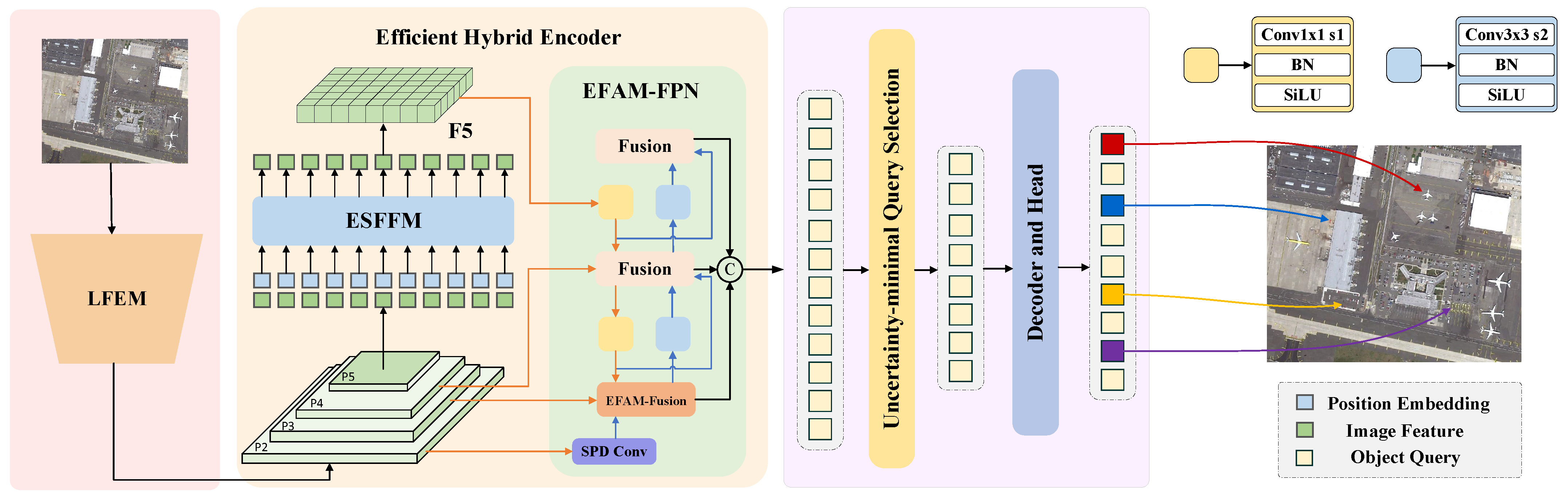
This study proposes LE-DETR, a lightweight and efficient small-object detection model for remote sensing aerial imagery. To address the challenges posed by remote sensing targets—such as significant variations in scale, weak textural characteristics, severe occlusion, and susceptibility to background interference—the LE-DETR model comprises four main components: it employs an LFEM-Net as the backbone network to extract shallow-level features, utilises an ESFFM module to facilitate intra-scale feature interaction, employs an EFAM-FPN architecture for cross-scale feature fusion, and incorporates a Transformer decoder equipped with an auxiliary prediction head. The structure of the LE-DETR model is shown in Figure 1 below.

2.1. Lightweight Feature Extraction Module

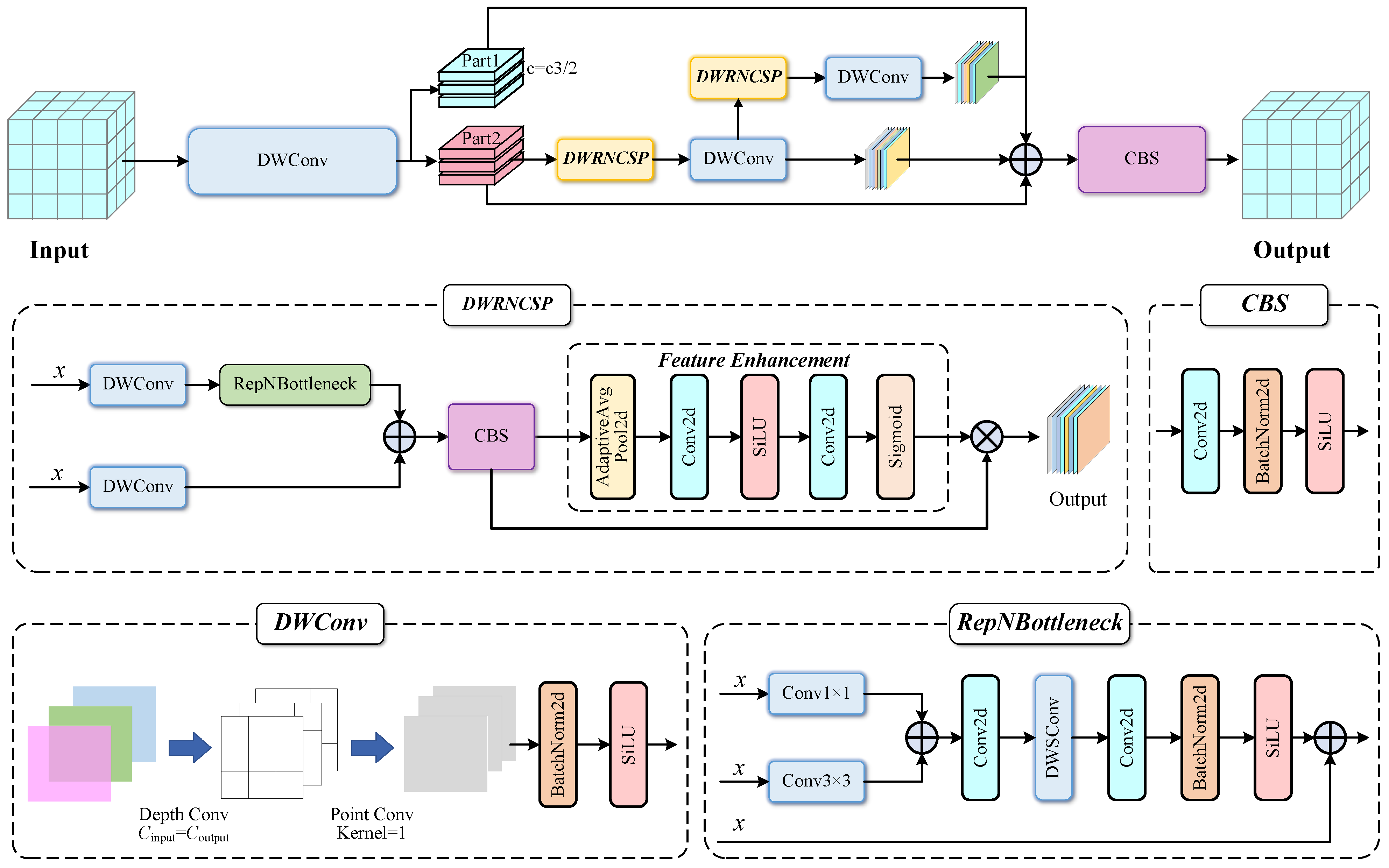
In remote sensing imagery, the presence of a large number of small objects and densely occluded targets significantly increases the difficulty of accurate detection, making it essential to enhance the feature extraction capabilities of object detection models. Small-object detection in remote sensing imagery faces two key challenges: firstly, pixel information is easily lost during the process of layer-by-layer downsampling; and secondly, the complex background (such as farmland, buildings and shadows) results in an extremely low signal-to-noise ratio. To enhance the detection performance of small targets in remote sensing images whilst maintaining real-time inference speeds, this study has designed a lightweight feature extraction module (LFEM). The LFEM is designed to combine ‘low-loss downsampling’ with ‘high-gain feature extraction’ to maximise the preservation of spatial salience of weak and small targets whilst maintaining extremely low computational costs, thereby enhancing non-linearity and the ability to extract spatial features. As shown in Figure 2 below, this module adopts a cross-stage local structure design approach. It achieves efficient feature extraction and fusion through a multi-path collaborative mechanism, deeply integrating re-parameterisation techniques with cross-scale feature aggregation, with the aim of reducing computational redundancy by optimising feature flow paths. Unlike traditional simple feature stacking, LFEM adopts a heterogeneous dual-path design, with Part 1 and Part 2 sharing the tasks of basic feature preservation and higher-order semantic extraction, thereby enhancing the original feature extraction capabilities and reducing redundant parameters. In DWRNCSP, we introduce RepNBottleneck, utilising a multi-branch topology (1 × 1, 3 × 3, residual connections) to learn rich multi-scale representations, thereby strengthening the model’s ability to process fine-grained features. To address severe background interference in remote sensing scenarios, we utilise a globally-aware feature enhancement branch. This captures global statistical characteristics via Global Average Pooling (GAP) and learns inter-channel dependencies through two-stage convolutional layers, significantly enhancing the model’s robustness against complex ground surfaces.

2.2. Efficient Spatial-Frequency Fusion Module

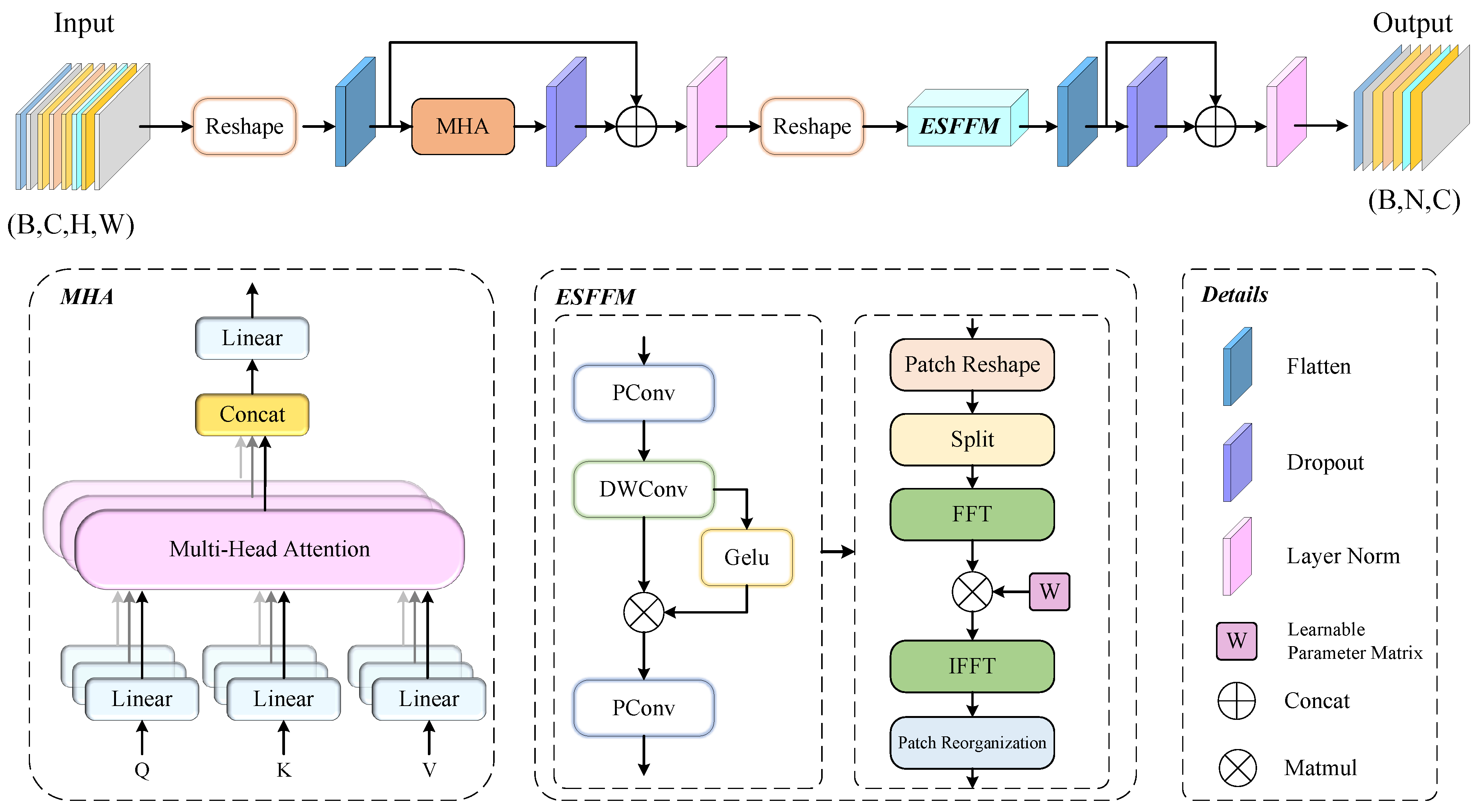
Addressing the limitation of traditional remote sensing image object detection methods, which rely excessively on spatial domain features whilst neglecting frequency domain information, this study proposes an Efficient Spatio-Frequency Fusion Module (ESFFM). As shown in Figure 3, this module aims to fully exploit the frequency information contained within shallow-level features and minimise the loss of useful information, thereby significantly enhancing the ability of lightweight detectors to detect small objects against complex backgrounds. The design philosophy of this module follows a progressive logic of ‘global modelling-guided, multi-domain refined characterisation’. It primarily consists of a multi-head self-attention module (MHA) and a spatial-frequency fusion branch, designed to address the challenges posed by extremely small and sparsely distributed targets in remote sensing scenarios.
Given that remote sensing targets are small and frequently obscured, and considering that the detection of small targets relies heavily on their geographical context, the module first utilises MHA to establish long-range dependencies. By capturing cross-regional semantic relationships, it compensates for the feature scarcity caused by pixel sparsity in small targets, thereby enabling the model to construct a macro-level global perspective. Guided by the semantic information from the global perception features, ESFFM further extracts features, with the spatial domain branch focusing on mining the morphological characteristics and subtle textural details of small targets, aiming to enhance the spatial salience of targets against complex ground-object backgrounds. To ensure detection accuracy whilst maintaining inference speed, this branch integrates PConv [28] and DWConv [29]; by reducing parameter redundancy between channels, the model is able to focus precisely on the most distinctive local structures. Concurrently, the frequency-domain branch introduces the fast Fourier transform (FFT) to map feature maps into the frequency domain, reconstructing target features from a signal processing perspective. In remote sensing imaging mechanisms, large-area background structures typically manifest as low-frequency features, whilst small targets and their detailed edges correspond to specific frequency components. By introducing a learnable spectral weight matrix, the model can automatically construct adaptive bandpass filters for small targets during end-to-end training, thereby significantly enhancing the structured signal of the target whilst suppressing complex background noise. This mechanism of spatial-frequency dual-path collaboration effectively overcomes the bottleneck in long-range modelling capabilities inherent in traditional spatial convolution. It achieves deep coupling between local fine-scale features and global contextual information at extremely low computational cost, fundamentally resolving the challenge of inadequate feature representation in remote sensing small-target detection caused by high background complexity and extremely small target scales. This provides a more robust feature enhancement solution for lightweight remote sensing detection tasks.

2.3. Efficent Frequency Domain Awareness Fusion Module

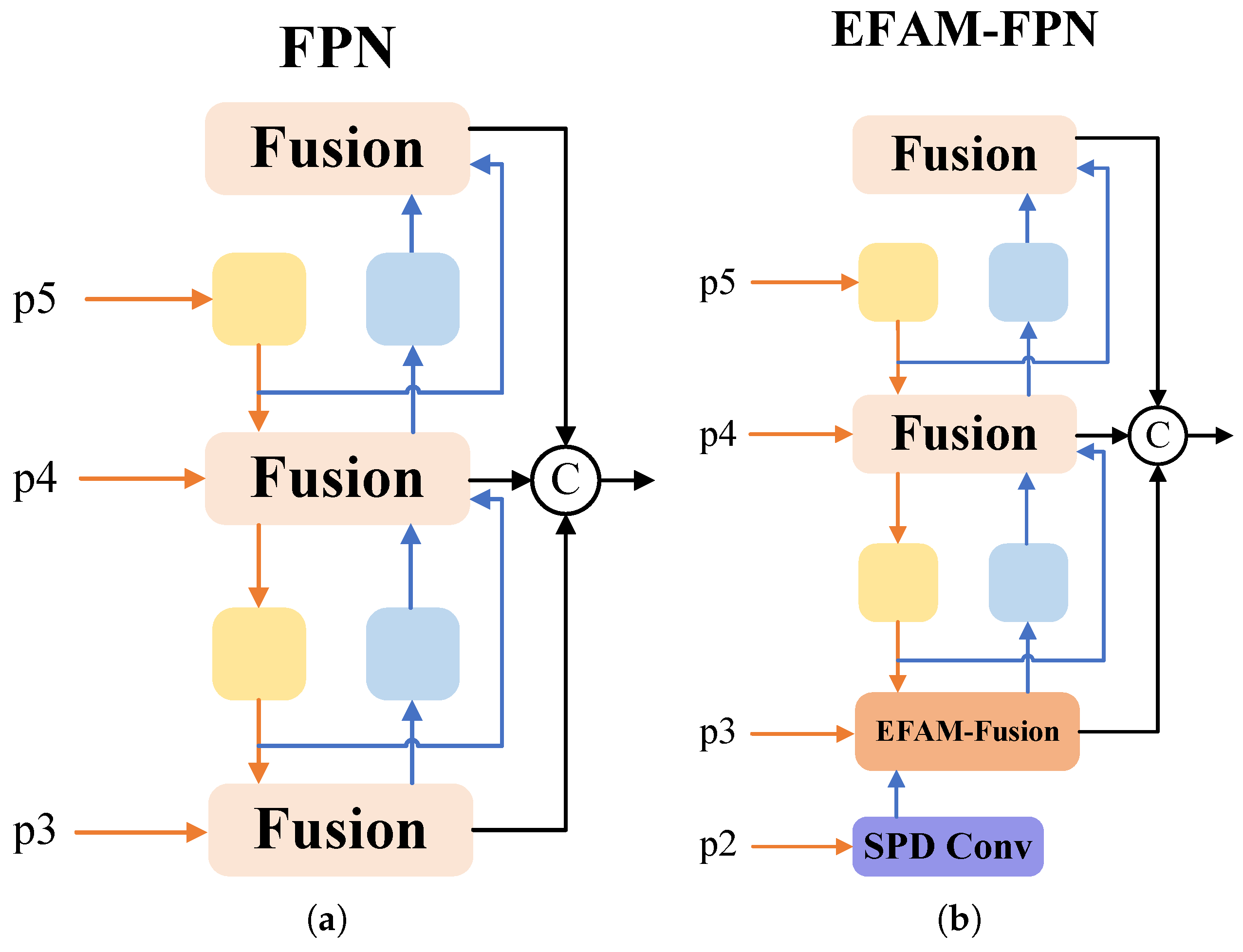
During the feature fusion stage, the neck network first processes high-level features using the ESFFM module, with the aim of enhancing their discriminative power and semantic richness. Subsequently, features from different levels are fed into the cross-scale fusion network; through the fusion of multi-scale features, the model’s adaptability to representing targets of varying sizes is significantly improved, thereby yielding more comprehensive and accurate detection results. Traditional hybrid encoders employ Feature Pyramid Networks [30] (FPNs) to transmit deep semantic information to shallower layers via a top–down approach, thereby achieving multi-scale feature fusion. However, FPNs only fuse features from the final three layers (P3, P4, P5) shown in the figure below, neglecting the rich information about small objects present in lower layers. This oversight leads to false positives and false negatives in small-object detection within complex scenes, thereby reducing the model’s detection accuracy. This paper introduces the EFAM-FPN architecture for multi-scale feature fusion. Figure 4 below compares the network architectures of the traditional FPN and the EFAM-FPN; the yellow arrows indicate upsampling, whilst the blue arrows indicate downsampling.
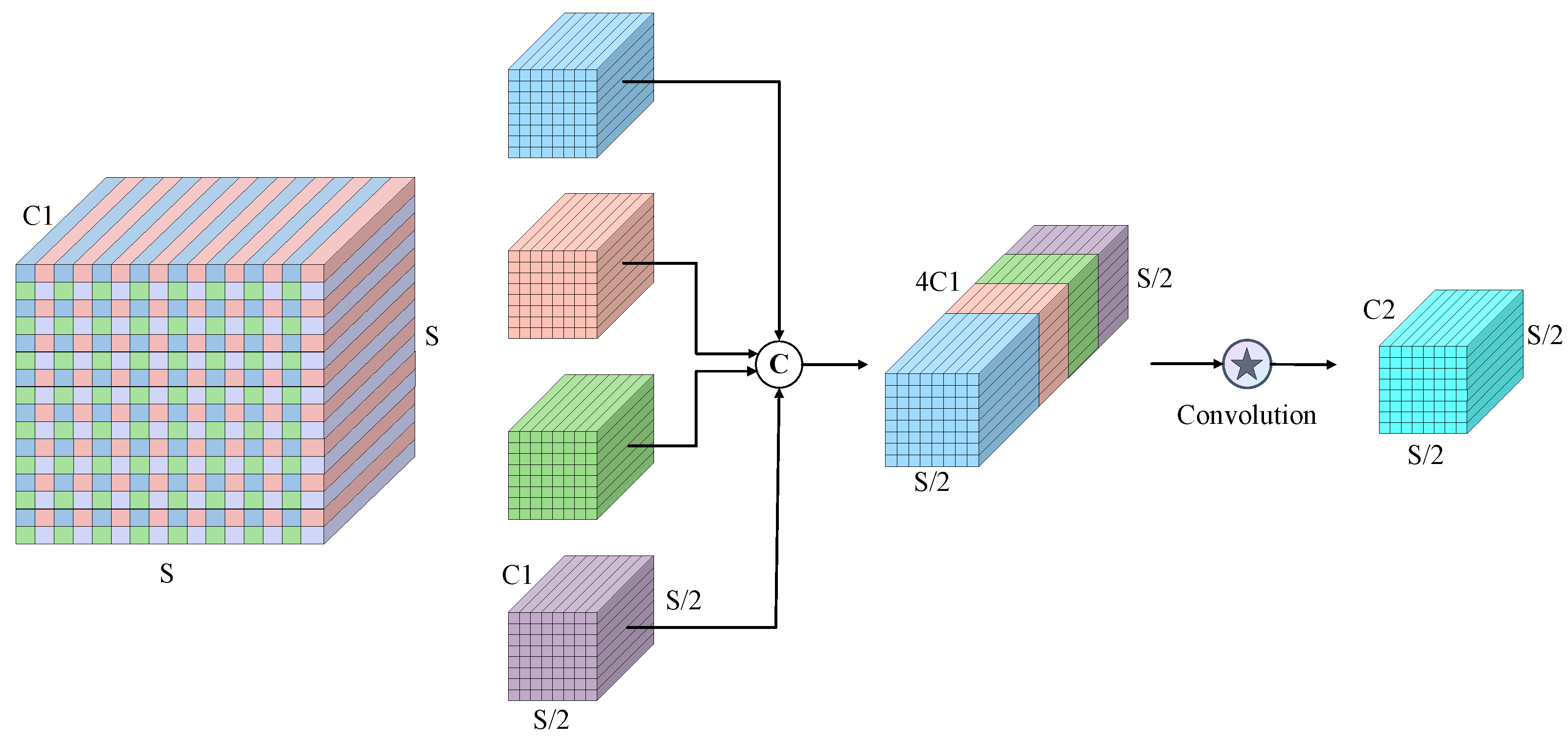
In traditional feature extraction frameworks for convolutional neural networks, researchers typically employ stride convolution or pooling operations to downsample feature maps; however, this method of spatial dimension reduction is highly prone to causing irreversible loss of key features. For small-scale objects with inherently weak features, the information loss resulting from such conventional downsampling leads to a significant decline in the model’s feature representation capabilities, becoming an inherent bottleneck that limits improvements in detection performance. The SPD Conv [31] module introduces a ‘space-to-depth’ mechanism, which reconstructs two-dimensional spatial information into the depth dimension, thereby increasing the number of feature channels whilst precisely preserving the complete spatial topology. Subsequently, channel dimension calibration is performed via non-strided convolution, enabling efficient feature integration whilst preserving underlying image details. This fundamentally alleviates the challenge of fine-grained feature loss, significantly enhancing the model’s accuracy and detection performance for small targets. The structure of the SPDConv module is shown in Figure 5.
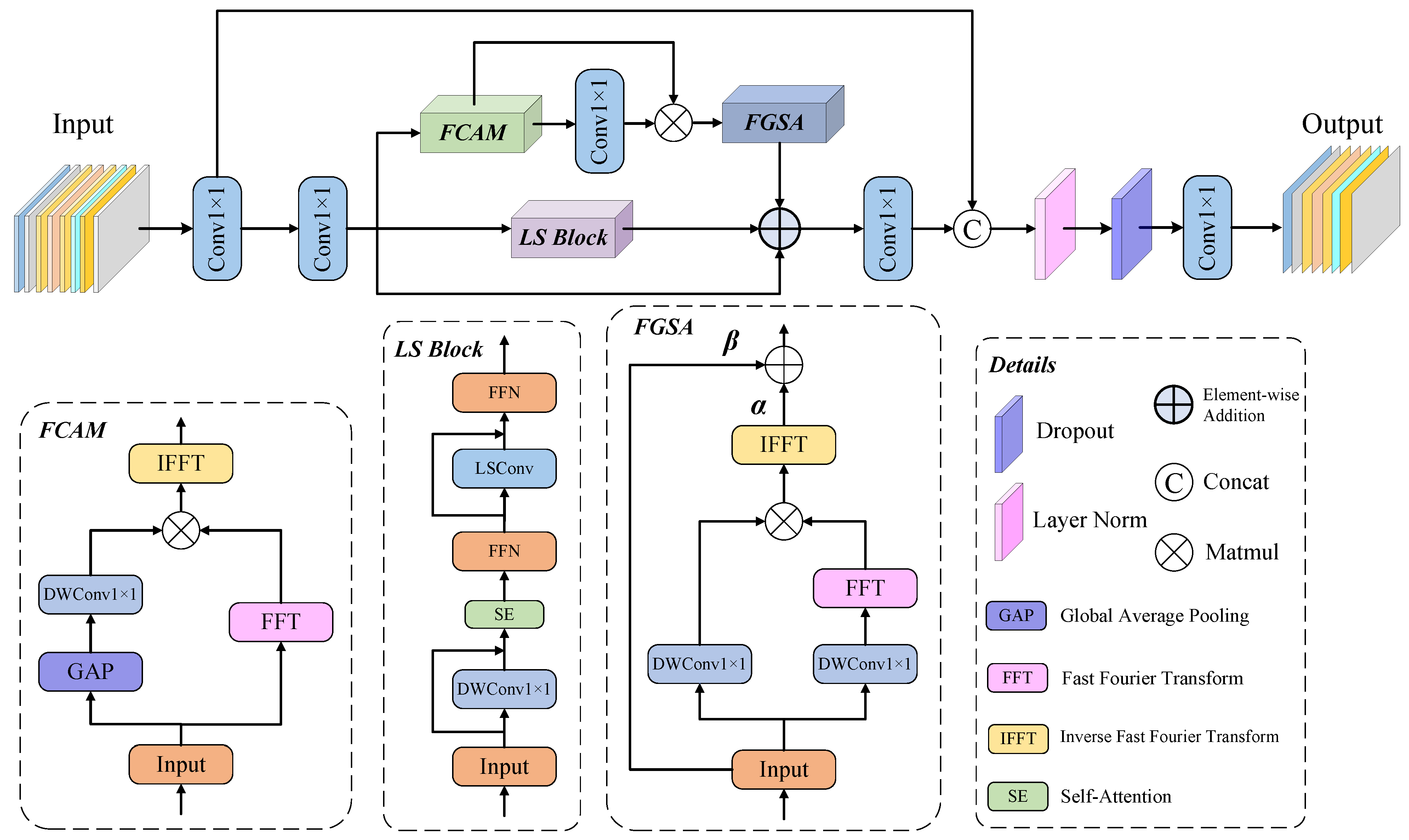
To address the challenges posed by small targets in remote sensing imagery—namely their extremely low pixel proportion, lack of textural features, and susceptibility to interference from complex environmental noise—this study has designed and introduced an Efficient Frequency Domain Awareness Fusion Module (EFAM). By emulating biological visual mechanisms, this module enhances the model’s accuracy in detecting extremely small targets whilst ensuring real-time deployment capability on edge devices. The structure of the EFAM module is shown in Figure 6 below. In the detection of small targets in remote sensing, the targets themselves consist of very few pixels and lack textural information. If one considers only the target itself, it is difficult to distinguish it from noise. Although the use of multiple large-kernel convolutions and multi-scale small-kernel convolution modules can significantly improve the detection accuracy of small targets, this also leads to a substantial increase in the number of model parameters and computational load, thereby reducing detection speed. To address this issue, this study introduces the LS Block [32] module, comprising LSConv, a feedforward neural network (FFN), and an embedded self-attention mechanism (SE). LSConv is the core operation of the LS Block; by combining large-kernel perception with small-kernel aggregation, it simulates the dynamic, multi-scale visual capabilities of the human visual system. Large-Kernel Perception (LKP) utilises a 7 × 7 deep separable convolution with a large kernel to capture extensive contextual information, enabling the model to examine a larger area surrounding the object and understand the background environment to infer the likelihood of the object’s presence whilst simultaneously generating context-adaptive weights. For each position (token) on the feature map, the weights w i generated by the large kernel are calculated as follows:
w i = P s x i , N K L ( x i ) = PW DW K L × K L PW N K L ( x i )
where K L denotes the kernel size, P W denotes pointwise convolution, D W denotes depth-separable convolution, and w i denotes the generated context-adaptive weights.
After acquiring information about the target’s surrounding environment, small-kernel aggregation (SKA) utilises this information to accurately extract features of small targets. Unlike conventional convolution, SKA performs fine-grained aggregation of target features within small regions through grouped dynamic convolution and weights generated by LKP. This mechanism enables pixel-level feature reconstruction of the edges and textures of minute targets, effectively mitigating the issue of feature loss in traditional convolution when processing weak response signals. First, the channels of the input feature X are divided into G groups, with each group containing C / G channels; channels within the same group share the aggregated weight information. Next, for the feature x i c of the cth channel in the gth group, the aggregated output y i c is calculated as follows:
y i c = A s w i g * , N K S x i c = w i g * N K S x i c
Here, K s denotes the kernel size, w i g * represents the dynamic convolutional kernel weights generated by LKP and assigned to the gth group, N K S x i c comprises local neighbourhood features centred at x i c , and ⊗ denotes the dynamic convolution operation.
Small-object detection is prone to interference from complex background noise during spatial feature extraction, whereas frequency-domain analysis offers a new perspective for addressing this issue. From the perspective of two-dimensional signal processing, remote sensing images or feature maps at intermediate levels can be decomposed into a superposition of various spatial frequency components. For the input feature map X R C × H × W in the feature space, here, C, H, and W represent the number of channels, height, and width, respectively. The two-dimensional discrete Fourier transform (2D DFT) F maps X from the spatial domain to the frequency domain across the channel dimension:
F ( X ) ( u , v ) = x = 0 H 1 y = 0 W 1 X ( x , y ) e j 2 π ( u x H + v y W )
Here, ( x , y ) represents spatial coordinates, and ( u , v ) represents frequency-domain coordinates. According to the classic Convolution Theorem, global convolution with a large kernel in the spatial domain is mathematically equivalent to element-wise multiplication in the frequency domain:
f g F ( f ) F ( g )
In terms of capturing long-range dependencies and fine-grained features, frequency-domain features demonstrate greater representational capability than their spatial counterparts; low-frequency components carry the overall background information of the image, whilst high-frequency components contain detailed features such as the edge textures of small objects. Key frequency components are enhanced using a learnable frequency-domain filter, after which an inverse fast Fourier transform (IFFT) is employed to reconstruct the features back into the spatial domain. The Frequency-Domain Channel Attention Module (FCAM) applies a fast Fourier transform (FFT) to map spatial feature maps to the frequency domain, decomposing them into amplitude and phase components for feature extraction. Key frequency components are enhanced using learnable frequency-domain filters, after which the features are reconstructed back into the spatial domain using the inverse fast Fourier transform (IFFT). This process can be summarised by the following formula:
X F C A M = IFFT FFT ( X ) DWConv 1 × 1 ( G A P ( X ) )
The enhanced features are fed into a frequency-domain-based global spatial attention module (FGSA) for processing; the core idea is to utilise global frequency characteristics to enhance and optimise spatial features. Two parallel 1×1 deep convolutional layers are designed to integrate information and expand the dimensionality of the input features. These are mapped to the frequency domain via the fast Fourier transform (FFT) for global modulation in the frequency space whilst simultaneously fine-tuning the spectral information through a spatial attention mechanism. After the modulated enhanced spectrum is remapped back to the spatial domain via an inverse fast Fourier transform (IFFT), it is connected to the original features via a parametric residual connection. Finally, through an adaptive weighted fusion strategy, a feature representation with significant joint spatial-frequency enhancement is formed. This process can be formally represented as follows:
X FGSA = α · IFFT FFT DWConv 1 × 1 ( X ) DWConv 1 × 1 ( X ) + β · X
α and β represent learnable parameters. This module preserves the integrity of the original spatial features whilst capturing channel attention in the frequency domain, thereby enabling better integration of frequency and spatial information. Remote sensing images are often subject to variations in illumination and interference from complex background noise, and the EFAM module utilises a dynamic aggregation mechanism to enhance the model’s ability to adapt to context. It can dynamically adjust convolution weights based on the local environment whilst combining this with the filtering effect of the frequency-domain attention mechanism on high-frequency noise. This improves the model’s ability to understand complex visual scenes, enabling it to maintain extremely high sensitivity to very small-scale targets without relying on substantial computational resources whilst retaining efficient computational performance and significantly enhancing the model’s robustness under complex conditions.

3. Result

3.1. Datasets

To evaluate the effectiveness and superiority of the model architecture described in this paper, simulation experiments were conducted using small-scale remote sensing image datasets, including the VisDrone2019 dataset, the NWPU VHR-10 dataset and the DOTA-v1.0 dataset. Additionally, ablation experiments were performed on the VisDrone2019 dataset. Detailed descriptions of each dataset are provided below.
1.
VisDrone2019 [33]: This dataset was constructed and released by the AISKYEYE research team at Tianjin University, and is primarily designed for small-object detection tasks from a drone’s perspective. It comprises 288 aerial video clips (totalling 261,908 frames) and 10,209 static images, covering complex scenes such as urban roads and transport hubs, and is characterised by a high density of small and minute objects. The dataset is divided into a training set (6471 images), a validation set (548 images) and a test set (1610 images). Annotated objects include 10 target categories such as pedestrians, crowds, bicycles and cars (“pedestrian”, “people”, “bicycle”, “car”, “van”, “truck”, “tricycle”, “awning-tricycle”, “bus”, “motor”).
2.
NWPU VHR-10 [34]: This dataset was compiled by Northwestern Polytechnical University and comprises a total of 800 high-resolution remote sensing images, with image dimensions ranging from 500 × 500 pixels to 1100 × 1100 pixels. Of these, 650 images contain targets to be detected, whilst the remaining 150 are background images without targets. The dataset features annotations for 10 typical object classes, namely: aeroplane (AP), ship (SP), storage tank (SK), baseball diamond (BD), tennis court (TC), basketball court (BC), ground track field (GTF), harbour (HB), bridge (BR) and vehicle (VE).
3.
DIOR [35]: This dataset is a large-scale benchmark for object detection in optical remote sensing images, comprising 23,463 images and 192,472 object instances annotated with horizontal bounding boxes. The images in this dataset are split into a training set (16,424 images), a validation set (2346 images) and a test set (4693 images) in a 7:1:2 ratio. It covers 20 object classes: airplane (AP), airport (AT), baseball field (BF), basketball court (BC), bridge (BG), chimney (CM), dam (DM), expressway service area (EA), expressway toll station (ES), golf field (GF), ground track field (GD), harbour (HB), overpass (OP), ship (SP), stadium (SD), storage tank (ST), tennis court (TC), train station (TS), vehicle (VE), and windmill (WM). The images in the dataset are sourced from Google Earth, with a resolution of 800 × 800 and a spatial resolution ranging from 0.5 m to 30 m.

3.2. Test Environment and Evaluation Criteria

To ensure the scientific validity and reproducibility of the experimental results, all experiments were conducted on a standardised hardware and software platform with consistent parameter settings. The experimental hardware consisted of a computing platform equipped with an NVIDIA RTX 4090 GPU, whilst the software environment was based on Python 3.10, the PyTorch 2.3.0 deep learning framework, and the CUDA 12.4 computing architecture. Regarding the training strategy, the AdamW optimiser was used to optimise the network, with a learning rate set to 0.0001 and a momentum parameter of 0.9. The input image dimensions were uniformly adjusted to 640 × 640 pixels, the total number of training epochs was set to 300, and the batch size was set to 8.
To comprehensively evaluate the model’s performance, this study selected the following standard evaluation metrics: precision (P), recall (R), mean average precision (mAP), number of parameters (Params), and floating-point operations (FLOPs, measured in gigaflops). Among these, precision (P) measures the proportion of samples correctly classified as positive by the model, reflecting its predictive accuracy; recall (R) indicates the proportion of all true positive samples correctly identified by the model, demonstrating its coverage of positive samples. Mean Average Precision (mAP) is further categorised into mAP50 and mAP50:95 based on the Intersection over Union (IoU) threshold: mAP50 represents the average precision at an IoU threshold of 0.5, whilst mAP50:95 represents the average precision across IoU thresholds ranging from 0.5 to 0.95 (in 0.05 increments). Furthermore, the number of parameters (Params) and FLOPs are used to quantify the computational complexity and resource requirements of the model.

3.3. Analysis of Ablation Experiment Results

To validate the effectiveness of the proposed improvements on the model’s detection accuracy, we designed a series of ablation experiments to assess the impact of these improvements on model performance. Using the data from these experiments, we were able to determine the contribution of each module to model performance and quantitatively evaluate the impact of each module on detection accuracy, parameters and computational complexity. Finally, we conducted a comprehensive evaluation of the model’s performance on the VisDrone2019 dataset.
As shown in Table 1, the ablation study results indicate that on the VisDrone2019 test set, the introduction of the lightweight backbone network LFEM significantly reduced the model’s parameter count from 19.9 million to 10.5 million (a reduction of 47.2%), whilst computational complexity fell from 57.0 GFLOPs to 33.5 GFLOPs (a reduction of approximately 41.2%). Although the lightweight design caused slight fluctuations in mAP50, it significantly reduced computational complexity, reserving ample computational resources for the subsequent feature enhancement and fusion module, thereby achieving a better trade-off between detection accuracy and inference speed. Furthermore, a comparison of Experiments B and E reveals that integrating the ESFFM module onto the LFEM framework resulted in a 1.6% improvement in mAP50 on the VisDrone2019 test set. This indicates that ESFFM, through its spatio-frequency collaborative fusion mechanism, can effectively capture high-frequency details and deeply embed them into high-level semantic features, thereby enhancing the model’s ability to focus on the textures of small targets in complex backgrounds. Finally, introducing EFAM-FPN on top of Experiment E formed the final model of this paper (Experiment F). The results show that mAP50 and mAP50:95 increased by a further 1.5% and 0.9% respectively. This module achieves deep fusion of deep and shallow-layer features through a dynamic aggregation mechanism and extracts rich edge feature information, effectively compensating for the loss of small-target edge information that is prone to be lost in deep networks. Combined with a frequency-domain attention mechanism, it suppresses background noise interference and enhances the robustness of the model’s overall performance.

3.4. Visual Analysis of the Le-Detr Performance

3.4.1. Heatmap Comparison Analysis

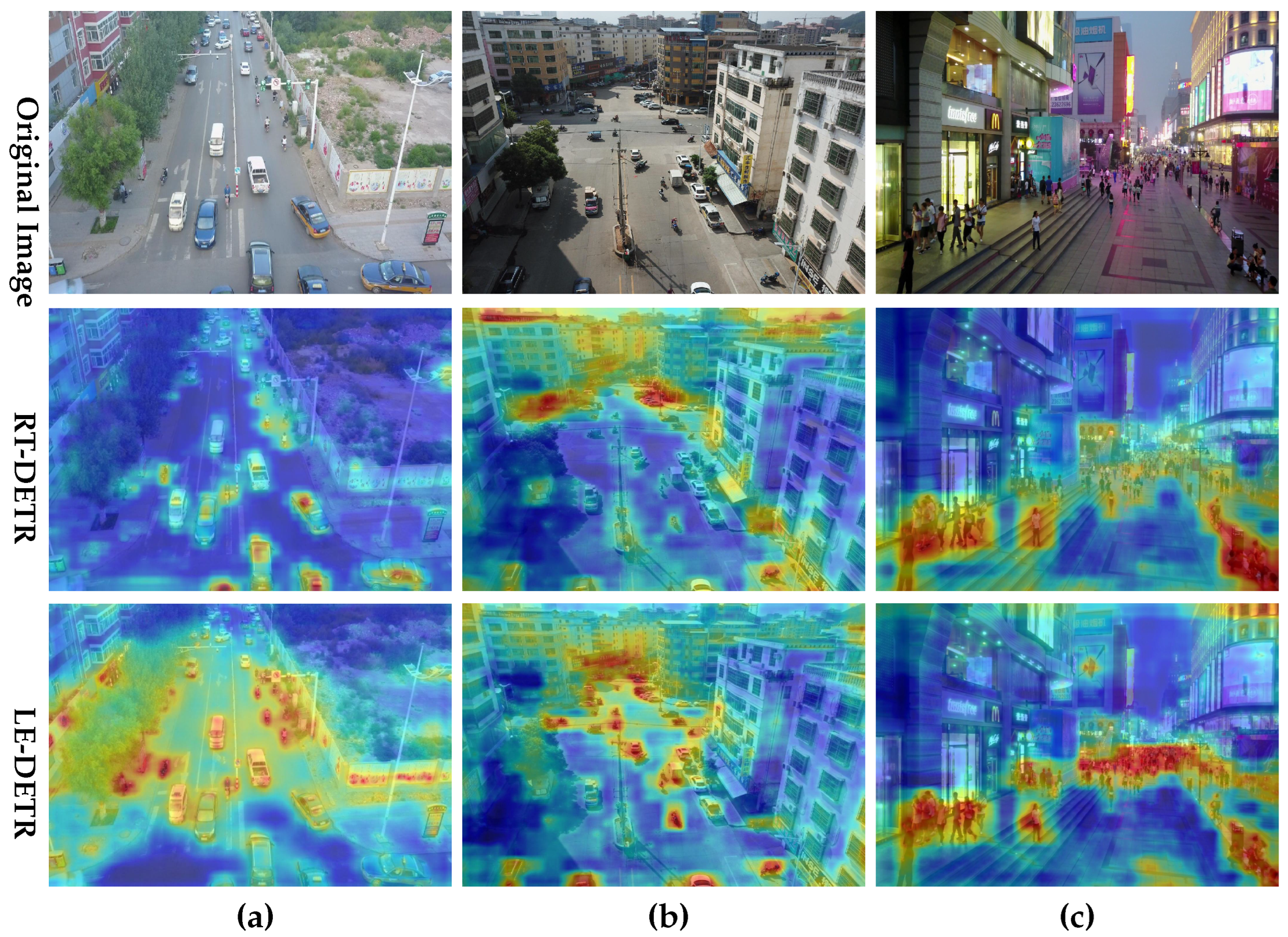
To further demonstrate the effectiveness of the LE-DETR model proposed in this paper for small-object detection in remote sensing and complex scenarios, we have introduced the Grad-CAM++ [36] technique to generate visual heatmaps. The heatmap uses varying shades of colour to reflect the model’s level of attention to different regions within the image, with red areas indicating regions of high interest to the model and blue areas indicating lower levels of interest. Figure 7 presents a comparison of the results from the original image, the baseline model RT-DETR, and the improved LE-DETR model proposed in this paper across three typical complex scenarios.
As can be seen from Figure 7a, the traditional RT-DETR model exhibits relatively scattered distribution in road traffic scenes, concentrating primarily on larger targets or areas with distinct local image features, and demonstrating weaker performance in detecting distant, small-scale targets. In contrast, the heatmap generated by LE-DETR exhibits a more dense distribution of vehicles on the road, indicating that LE-DETR is capable of providing more comprehensive coverage of small targets within the scene, thereby effectively reducing the probability of missing small targets. In Figure 7b, the environmental background is relatively cluttered, containing buildings, vegetation and various closely arranged vehicles. The RT-DETR model exhibits significant background noise interference and insufficient discrimination of compact targets, whereas the LE-DETR model focuses highly on the target objects themselves, with the hotspots’ centres closely coinciding with the objects’ actual geometric centres. This demonstrates that our model, through its improved feature enhancement module, can focus more precisely on the key features of small targets and exhibits greater robustness against complex background noise. Finally, Figure 7c shows a night-time scene with pedestrians and a commercial street. In this extreme scenario where minute targets are highly dense, the RT-DETR heatmap appears rather blurred, making it difficult to distinguish individual features. In contrast, LE-DETR forms clear response peaks in densely populated areas, with the distribution of the red-highlighted regions perfectly aligning with the density of pedestrian flow. This demonstrates that LE-DETR possesses exceptional spatial resolution capabilities and is able to capture subtle semantic features.

3.4.2. Comparison of Detection Results in Different Scenarios

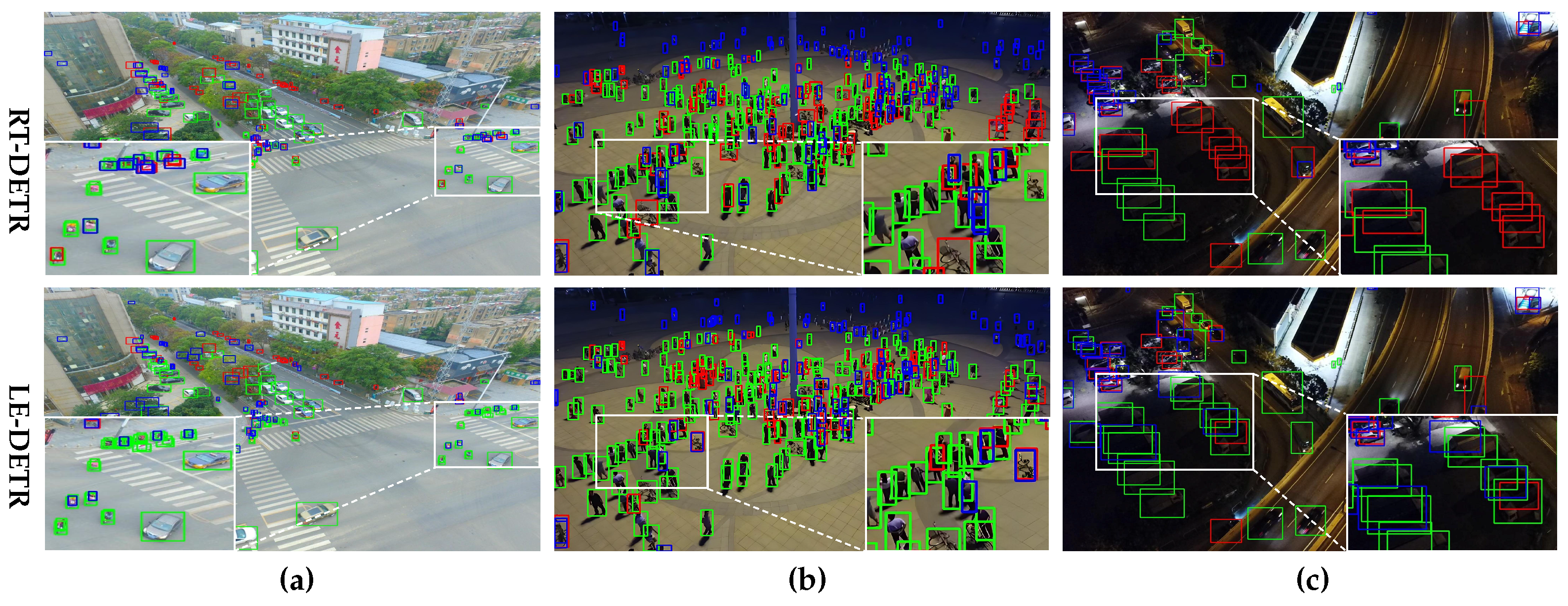
To verify the superiority of the LE-DETR algorithm in small-object detection tasks using remote sensing images through visual analysis, this paper selected representative test set scenes for visual experiments. Figure 8 shows the comparison results between the baseline model RT-DETR and the improved model LE-DETR proposed in this paper. In the figure, green boxes indicate correctly detected objects, red boxes indicate false positives, and blue boxes indicate missed detections. The baseline model RT-DETR exhibits a clear detection bottleneck when dealing with extremely small and densely distributed objects, as evidenced by the large number of blue missed detection boxes and red false-positive boxes in the figure. Its detection capability declines significantly, particularly at image edges and in areas with severe background interference. In contrast, the LE-DETR algorithm developed in this paper significantly enhances the perception of fine-scale targets by optimising a lightweight feature extraction architecture and a multi-scale fusion strategy. Even in extremely challenging detection scenarios—such as those with poor lighting conditions or highly overlapping targets at night—it maintains exceptionally high recall and precision. These comparative results strongly demonstrate that the LE-DETR algorithm can effectively overcome the identification challenges posed by the scarcity of features in small targets within remote sensing images whilst maintaining the model’s efficiency and lightweight nature, thereby exhibiting outstanding robustness and practical engineering value.

3.4.3. Comparison of Feature Map Visualisation Results

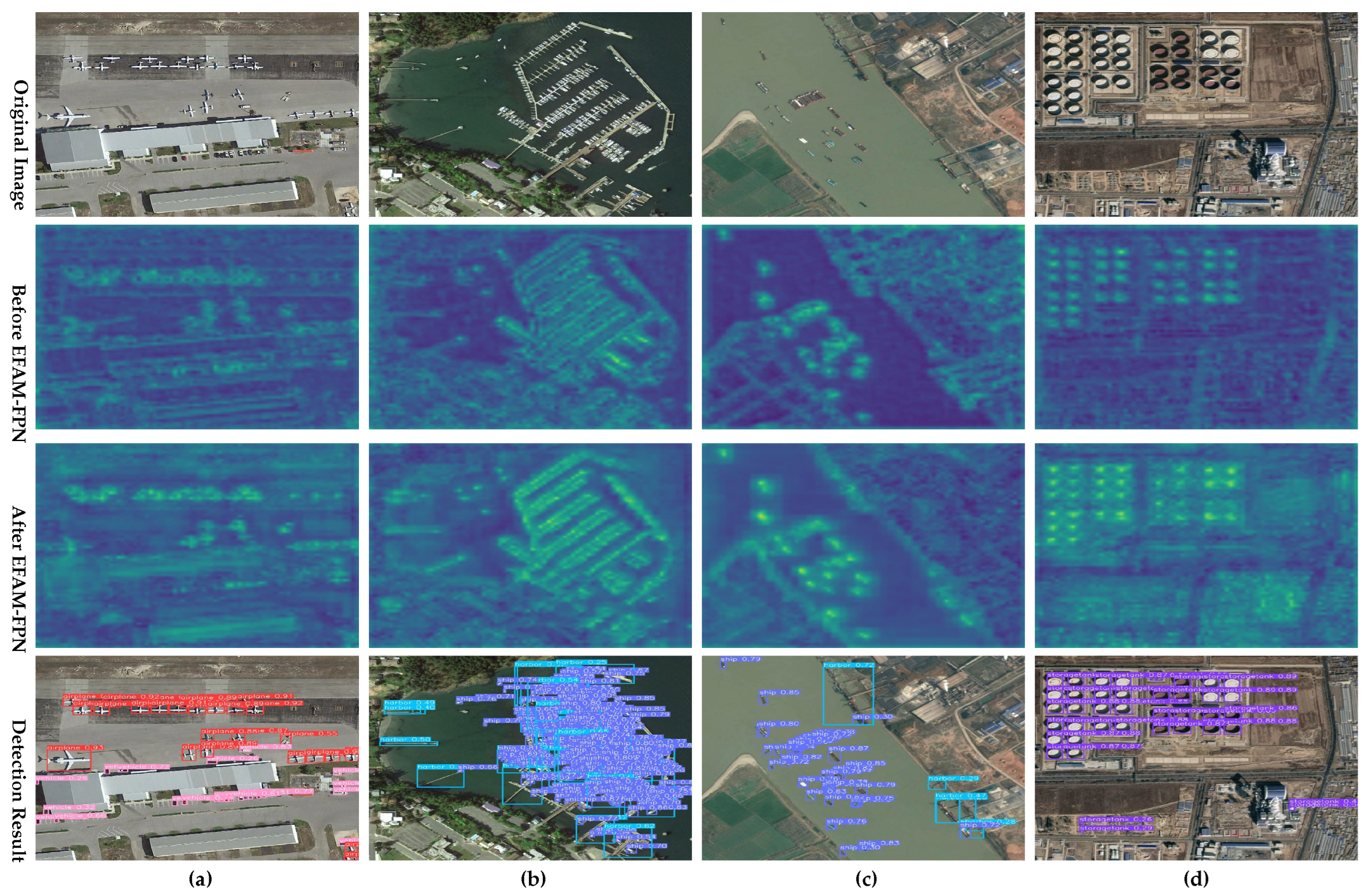
To visually demonstrate the effectiveness of the proposed EFAM-FPN module, Figure 9 shows a visual comparison of the feature maps before and after the module was incorporated into the network. For the qualitative analysis, four typical complex remote sensing image scenes were selected: an aircraft on an apron (a), densely arranged ships at a dock (b), ships scattered across a water surface (c), and oil storage tanks in an industrial area (d).
Analysis shows that brighter regions in the feature maps indicate that the model pays more attention to those areas. Through the deep fusion of multiscale features and the enhancement in frequency-domain perception, the method effectively balances shallow-level spatial details with deep-level abstract semantic information, effectively suppressing background noise in complex remote sensing environments, thereby improving detection performance. When remote sensing images face drastic changes in illumination or severe background interference, traditional spatial-domain convolution struggles to accurately separate these noise components. Our learnable spectral weight matrix, by combining the filtering effect of a frequency-domain attention mechanism, amplifies the signals of weak targets at the fundamental level of signal processing, effectively eliminating complex background interference and significantly improving the model’s robustness and accuracy in remote sensing image object detection tasks.

3.5. Experimental Results and Analysis Comparing LE-DETR with Other Models

3.5.1. Quantitative Analysis of Tiny Object Detection

To validate the effectiveness of the LE-DETR model, we compared it with RT-DETR and YOLOv12-s on three mainstream public datasets. As shown in Table 2, the experimental results demonstrate that LE-DETR achieves outstanding performance across all evaluation metrics.
In particular, LE-DETR achieves a significant improvement in accuracy for the most challenging task of small-object detection. On the NWPU VHR-10 and DIOR datasets, which feature more complex backgrounds, A P s reached 29.0% and 28.0% respectively, representing substantial improvements of 6.1% and 2.9% over the baseline model RT-DETR. This demonstrates that the model is capable of capturing and preserving fine-grained features more efficiently, significantly mitigating the issue of missed small objects in complex remote sensing scenarios or from a drone’s perspective. Concurrently, LE-DETR demonstrates equally impressive improvements in medium-scale object detection, effectively raising the upper bound of overall accuracy, with A P m values reaching 37.9%, 62.1% and 45.6% respectively. In summary, LE-DETR has not only successfully overcome the performance bottleneck of conventional networks in detecting extremely small objects, but has also demonstrated exceptional robustness and strong generalisation capabilities across multi-scale objects.

3.5.2. Comparison on the Visdrone2019 Dataset

This paper presents a comprehensive comparative analysis of the model against current mainstream single-stage, two-stage and end-to-end detection models on the VisDrone2019 test dataset. As shown in Table 3, LE-DETR demonstrates a significant advantage in detection accuracy, achieving an mAP50 of 39.7%. This not only far exceeds high-performance single-stage models such as YOLOv12-s (32.9%), but also outperforms the traditional Faster-R-CNN and the typical end-to-end model Deformable-DETR. When compared with advanced algorithms that also employ end-to-end architectures, LE-DETR outperformed both RFHS-DETR and UAV-DETR in terms of mAP50 and mAP50:95, demonstrating superior feature extraction and small-target localisation capabilities. Overall, LE-DETR successfully achieves an efficient balance between detection accuracy and computational efficiency on the VisDrone2019 dataset, fully demonstrating the algorithm’s strong practicality and competitiveness in remote sensing applications with limited computational resources.

3.5.3. Comparison on the Nwpu Vhr-10 Dataset

To validate the effectiveness of the proposed algorithm, we conducted comparative experiments on the NWPU VHR-10 dataset, pitting LE-DETR against current mainstream object detection models (including SSD, the YOLO series, and various DETR-class models). The experimental results on the NWPU VHR-10 dataset (as shown in Table 4) indicate that the proposed LE-DETR achieves the optimal balance between detection accuracy and model efficiency. In terms of accuracy, LE-DETR achieved 93.5% and 63.1% for detection accuracy and precision, respectively. This not only significantly outperforms the baseline model RT-DETR-R18 (by 1.7% and 3.9%, respectively), but also comprehensively surpasses the latest YOLOv12s model. Looking at specific categories, LE-DETR performs excellently across multiple categories including aircraft (AP), tennis courts (TC), bridges (BR) and vehicles (VE). Particularly in the category of small objects typical of remote sensing imagery—vehicles (VE)—the accuracy reached 92.7%, demonstrating the model’s powerful feature capture capability. This demonstrates that by incorporating modules such as LFEM and ESFFM, LE-DETR is capable of achieving higher accuracy in object detection with a more lightweight architecture, making it highly valuable for practical applications.
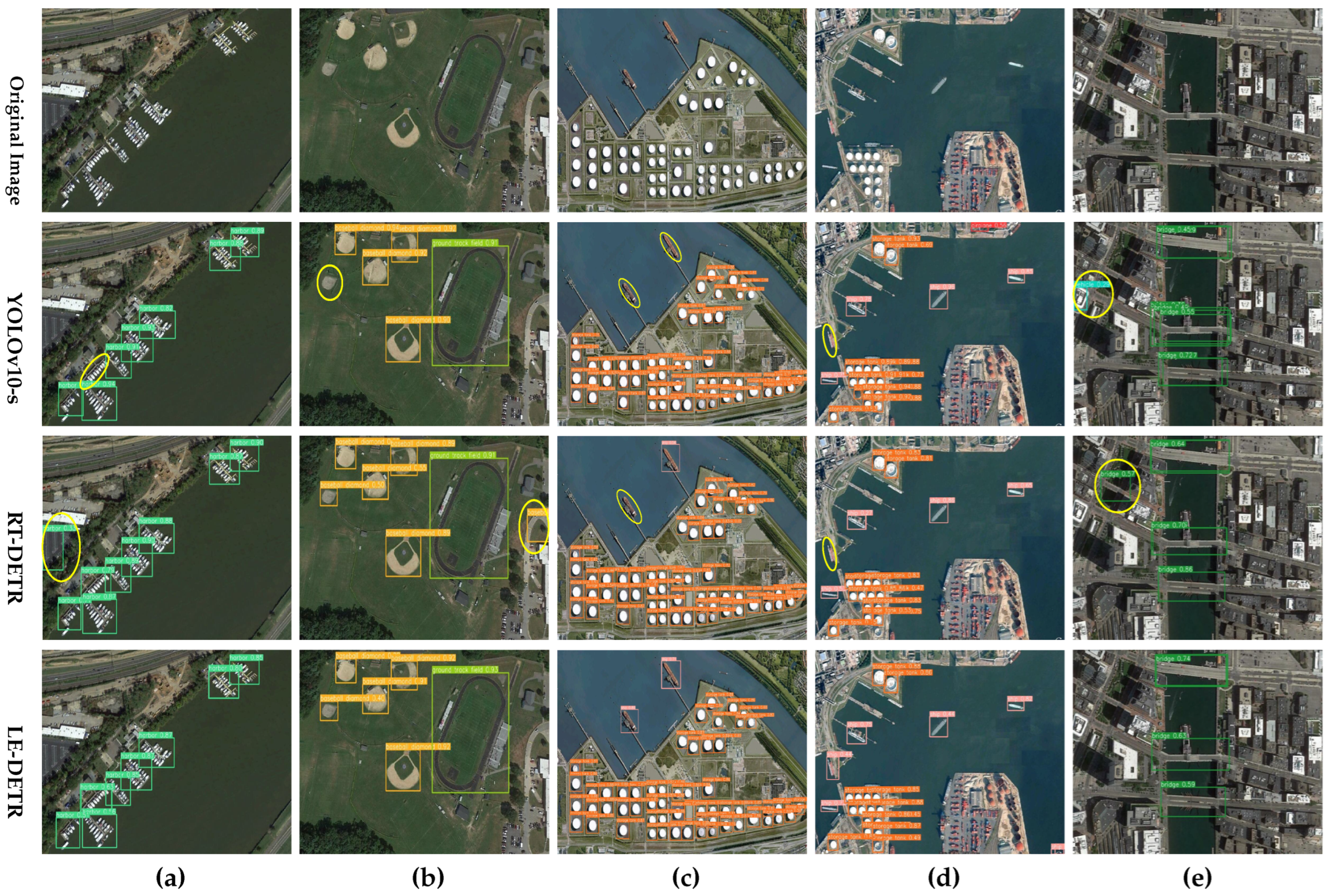
To visually demonstrate the superiority of the LE-DETR algorithm proposed in this paper for the task of detecting small objects in remote sensing images, Figure 10 presents a comparison of the visual detection results obtained using this algorithm against those of the current mainstream models, YOLOv10-s and RT-DETR, across five typical scenes (a–e) in the NWPU VHR-10 dataset. An examination of the comparison results reveals that, although existing mainstream algorithms possess a certain level of detection capability, they still exhibit significant instances of missed and false detections when processing remote sensing images with complex backgrounds and extremely small targets. Specifically, in the dock and port areas of scenes (a) and (d), YOLOv10-s and RT-DETR demonstrate insufficient detection capability for small vessels on the water surface, resulting in varying degrees of missed detections, whereas in the sports stadium of scene (b) and the complex urban background of scene (e), the baseline models exhibit weak capture capabilities for minute features and densely arranged targets. In contrast, the LE-DETR algorithm proposed in this paper accurately detects all targets across all test scenes, intuitively demonstrating its significant advantage in reducing false negatives. This performance improvement is primarily attributed to the LE-DETR’s lightweight and efficient feature extraction and fusion mechanism, which enables it to more effectively extract fine-grained spatial features amidst strong background interference. Consequently, whilst maintaining the algorithm’s operational efficiency, it significantly enhances the detection accuracy and robustness for multi-scale targets, particularly small-sized remote sensing targets.

3.5.4. Comparison on the Dior Dataset

On the larger and more complex DIOR dataset, LE-DETR once again demonstrated its outstanding performance. As shown in Table 5, LE-DETR achieved a detection accuracy of 87.8%, significantly outperforming the baseline model RT-DETR-R18 (85.4%) and surpassing the latest models such as YOLOv12s (86.6%) and DART (79.5%). Across the 20 target categories covered by DIOR, LE-DETR achieved the highest accuracy in 15 categories, including aircraft (AP), baseball fields (BC), storage tanks (ST) and vehicles (VE), fully demonstrating the model’s generalisation capability in multi-class remote sensing object detection. In terms of efficiency, LE-DETR achieves high performance with only 11.6 million parameters whilst also offering a significant advantage in computational cost (48.4 GFLOPs). This further validates that the LFEM and ESFFM modules can effectively enhance feature representation capabilities whilst maintaining a lightweight model, enabling the model to deliver both high accuracy and high efficiency on large-scale remote sensing datasets.
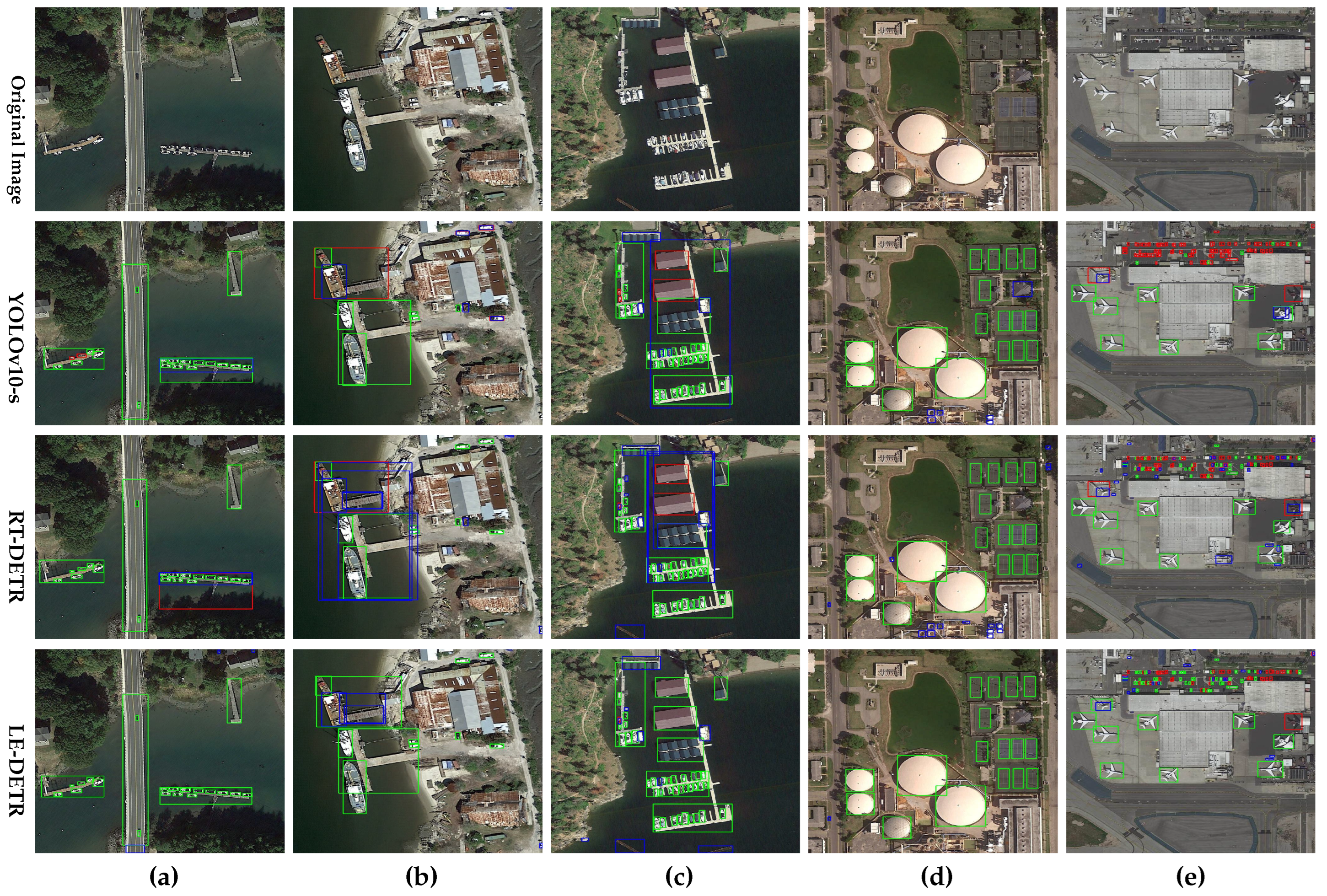
As can be seen from the visualisation results in Figure 11, the baseline model exhibits varying degrees of limitations when dealing with diverse backgrounds involving bridges, ports, industrial storage tanks and densely arranged aircraft: YOLOv10-s exhibits relatively pronounced false positives (red) and false negatives (blue) when processing densely packed small objects, as shown in scenes (b) and (e), reflecting a loss of features in the extraction of very small objects. Although RT-DETR achieves some improvement in detection accuracy, it still fails to detect minute targets subject to severe occlusion or background interference in scenes (c) and (d). In contrast, the LE-DETR algorithm proposed in this paper demonstrates significant superiority across all test cases. Not only does it accurately cover the vast majority of targets with dense green bounding boxes, but it also virtually eliminates red boxes (indicating false positives) and blue boxes (indicating false negatives). Notably, even in highly complex airport environments such as scene (e), it maintains extremely high detection completeness and localisation accuracy. These comparative results fully demonstrate that, through its lightweight and efficient feature fusion mechanism, LE-DETR is capable of capturing fine-grained features more effectively and suppressing background noise, thereby possessing a clear competitive advantage in enhancing the detection accuracy of small targets in remote sensing images.

4. Discussion

Furthermore, although the present experiments on LE-DETR have primarily been validated using visible-light remote sensing datasets, the proposed frequency-domain-aware mechanisms (ESFFM and EFAM-FPN) demonstrate significant potential for extension to other imaging modalities. However, visible-light remote sensing imagery has an inherent physical limit in its ability to characterise small targets when faced with extreme lighting conditions, dense fog, or complex surface occlusions. Based on this, we believe that relying solely on a single modality—even SAR or multispectral imagery—to improve the detection performance of small targets still has limited potential for further enhancement. In complex real-world engineering applications, single-modality visible-light imagery often faces the risk of complete loss of object features. Therefore, our future research will extend the LE-DETR framework to the field of multimodal remote sensing object detection. By utilising the frequency-domain module as a bridge for cross-modal feature alignment, we aim to explore multimodal fusion strategies—such as visible light + infrared (IR) and visible light + synthetic aperture radar (SAR)—to fundamentally overcome performance bottlenecks in small-object detection within complex and extreme geographical scenarios.

5. Conclusions

In response to the challenges posed by remote sensing images—such as the extremely low pixel proportion of small objects, weak feature representation capabilities, and severe background interference—this paper proposes a lightweight end-to-end detection model, LE-DETR, based on an improved version of RT-DETR. By designing a lightweight feature extraction module (LFEM), the model significantly reduces computational costs whilst utilising heterogeneous dual-path and reparameterisation techniques to enhance the capture of multi-scale features. This paper innovatively introduces an efficient space-frequency fusion module (ESFFM) and a frequency-domain-aware fusion module (EFAM). This mechanism effectively overcomes the bottleneck of traditional spatial-domain convolution in long-range modelling; by utilising the Fourier transform, it enhances the structured signals of targets and suppresses complex background noise, significantly improving the model’s ability to capture small targets. Future research will take into account the arbitrary orientation of target distribution in remote sensing images, and plans are in place to extend the LE-DETR model to the Oriented Bounding Box (OBB) detection task in order to more accurately characterise significantly directional targets such as ships and vehicles.

Author Contributions

Conceptualisation, Q.W., H.A. and Y.C.; methodology, H.A. and Y.C.; validation, H.A.; formal analysis, Q.W., H.A. and Y.C.; writing—original draft, H.A. and Y.C.; writing—review and editing, Q.W., H.A. and Y.C.; visualisation, H.A.; supervision, Q.W.; funding acquisition, Q.W.; All authors have read and agreed to the published version of the manuscript.

Funding

This research is funded by Postgraduate Research & Practice Innovation Program of Jiangsu Province (SJCX25_0525).

Data Availability Statement

Remote sensing image data sources can be accessed via the following links: https://github.com/VisDrone/VisDrone-Dataset (accessed on 10 June 2026) and https://gcheng-nwpu.github.io (accessed on 10 June 2026). The source code will be available at: https://github.com/xiaoanstu/LE-DETR (accessed on 10 June 2026).

Conflicts of Interest

The authors declare no conflicts of interest.

References

  1. Aasen, H.; Honkavaara, E.; Lucieer, A.; Zarco-Tejada, P.J. Quantitative Remote Sensing at Ultra-High Resolution with UAV Spectroscopy: A Review of Sensor Technology, Measurement Procedures, and Data Correction Workflows. Remote Sens. 2018, 10, 1091. [Google Scholar] [CrossRef]
  2. Khanal, S.; KC, K.; Fulton, J.P.; Shearer, S.; Ozkan, E. Remote Sensing in Agriculture—Accomplishments, Limitations, and Opportunities. Remote Sens. 2020, 12, 3783. [Google Scholar] [CrossRef]
  3. Halder, B.; Bandyopadhyay, J.; Banik, P. Monitoring the effect of urban development on urban heat island based on remote sensing and geo-spatial approach in Kolkata and adjacent areas, India. Sustain. Cities Soc. 2021, 74, 103186. [Google Scholar] [CrossRef]
  4. Casagli, N.; Intrieri, E.; Tofani, V.; Gigli, G.; Raspini, F. Landslide detection, monitoring and prediction with remote-sensing techniques. Nat. Rev. Earth Environ. 2023, 4, 51–64. [Google Scholar] [CrossRef]
  5. Sun, Y.; Wang, D.; Li, L.; Ning, R.; Yu, S.; Gao, N. Application of remote sensing technology in water quality monitoring: From traditional approaches to artificial intelligence. Water Res. 2024, 267, 122546. [Google Scholar] [CrossRef] [PubMed]
  6. Ren, S.; He, K.; Girshick, R.; Sun, J. Faster R-CNN: Towards real-time object detection with region proposal networks. IEEE Trans. Pattern Anal. Mach. Intell. 2016, 39, 1137–1149. [Google Scholar] [CrossRef] [PubMed]
  7. He, K.; Gkioxari, G.; Dollár, P.; Girshick, R. Mask r-cnn. In Proceedings of the IEEE International Conference on Computer Vision (ICCV), Venice, Italy, 22–29 October 2017; pp. 2961–2969. [Google Scholar] [CrossRef]
  8. Cai, Z.; Vasconcelos, N. Cascade r-cnn: Delving into high quality object detection. In Proceedings of the IEEE Conference on Computer Vision and Pattern Recognition (CVPR), Salt Lake City, UT, USA, 18–22 June 2018; pp. 6154–6162. [Google Scholar] [CrossRef]
  9. Liu, W.; Anguelov, D.; Erhan, D.; Szegedy, C.; Reed, S.; Fu, C.Y.; Berg, A.C. Ssd: Single shot multibox detector. In Proceedings of the Computer Vision—ECCV 2016, Amsterdam, The Netherlands, 11–14 October 2016; pp. 21–37. [Google Scholar] [CrossRef]
  10. Lin, T.Y.; Goyal, P.; Girshick, R.; He, K.; Dollár, P. Focal loss for dense object detection. In Proceedings of the IEEE International Conference on Computer Vision (ICCV), Venice, Italy, 22–29 October 2017; pp. 2980–2988. [Google Scholar] [CrossRef]
  11. Jocher, G.; Chaurasia, A.; Stoken, A.; Borovec, J.; Kwon, Y.; Michael, K.; Fang, J.; Yifu, Z.; Wong, C.; Montes, D.; et al. ultralytics/yolov5: v7.0—YOLOv5 SOTA Realtime Instance Segmentation. Zenodo 2022. [Google Scholar] [CrossRef]
  12. Li, C.; Li, L.; Jiang, H.; Weng, K.; Geng, Y.; Li, L.; Ke, Z.; Li, Q.; Cheng, M.; Nie, W.; et al. YOLOv6: A single-stage object detection framework for industrial applications. arXiv 2022, arXiv:2209.02976. [Google Scholar] [CrossRef]
  13. Wang, C.Y.; Bochkovskiy, A.; Liao, H.Y.M. YOLOv7: Trainable bag-of-freebies sets new state-of-the-art for real-time object detectors. In Proceedings of the IEEE/CVF Conference on Computer Vision and Pattern Recognition (CVPR), Vancouver, BC, Canada, 18–22 June 2023; pp. 7464–7475. [Google Scholar] [CrossRef]
  14. Jocher, G.; Chaurasia, A.; Qiu, J. YOLO by Ultralytics. 2023. Available online: https://github.com/ultralytics/ultralytics (accessed on 2 April 2026).
  15. Wang, C.Y.; Yeh, I.H.; Liao, H.Y.M. Yolov9: Learning what you want to learn using programmable gradient information. In Proceedings of the European Conference on Computer Vision (ECCV), Milan, Italy, 29 September–4 October 2024; pp. 1–21. [Google Scholar] [CrossRef]
  16. Wang, A.; Chen, H.; Liu, L.; Chen, K.; Lin, Z.; Han, J.; Ding, G. Yolov10: Real-time end-to-end object detection. arXiv 2024, arXiv:2405.14458. [Google Scholar] [CrossRef]
  17. Khanam, R.; Hussain, M. Yolov11: An overview of the key architectural enhancements. arXiv 2024, arXiv:2410.17725. [Google Scholar] [CrossRef]
  18. Tian, Y.; Ye, Q.; Doermann, D. Yolov12: Attention-centric real-time object detectors. arXiv 2025, arXiv:2502.12524. [Google Scholar] [CrossRef]
  19. Ge, Z.; Liu, S.; Wang, F.; Li, Z.; Sun, J. Yolox: Exceeding yolo series in 2021. arXiv 2021, arXiv:2107.08430. [Google Scholar] [CrossRef]
  20. Vaswani, A.; Shazeer, N.; Parmar, N.; Uszkoreit, J.; Jones, L.; Gomez, A.N.; Kaiser, L.; Polosukhin, I. Attention is all you need. In Proceedings of the Advances in Neural Information Processing Systems (NeurIPS), Long Beach, CA, USA, 4–9 December 2017; pp. 5998–6008. [Google Scholar] [CrossRef]
  21. Carion, N.; Massa, F.; Synnaeve, G.; Usunier, N.; Kirillov, A.; Zagoruyko, S. End-to-end object detection with transformers. In Proceedings of the European Conference on Computer Vision (ECCV), Glasgow, UK, 23–28 August 2020; pp. 213–229. [Google Scholar] [CrossRef]
  22. Zhao, Y.; Lv, W.; Xu, S.; Wei, J.; Wang, G.; Dang, Q.; Liu, Y.; Chen, J. Detrs beat yolos on real-time object detection. In Proceedings of the IEEE/CVF Conference on Computer Vision and Pattern Recognition (CVPR), Seattle, WA, USA, 17–21 June 2024; pp. 16965–16974. [Google Scholar] [CrossRef]
  23. Wang, X.; Chen, H. HPS-DETR: Enhancing small object detection with lightweight feature extraction and transformer integration. IEEE Trans. Geosci. Remote Sens. 2025, 63, 5602115. [Google Scholar] [CrossRef]
  24. Zhi, Y.; Zhao, J.; Song, C.; Ma, M.; Mei, S. SAFF-DETR: An End-to-End Object Detection Network for Remote Sensing Images With Targets of Varying Sizes Based on Scale Adaptation and Frequency Fusion. IEEE Trans. Geosci. Remote Sens. 2025, 63, 5601216. [Google Scholar] [CrossRef]
  25. Xu, Y.; Qi, Q.; He, W.; Zhang, G.; Chen, S.; Tu, B. GSINet: Gradual semantic interaction network for remote sensing object detection based on dual attention mechanism. IEEE J. Sel. Top. Appl. Earth Obs. Remote Sens. 2025, 18, 2500045. [Google Scholar] [CrossRef]
  26. Liao, P.; Zhang, X.; Chen, G.; Wang, T.; Li, X.; Yang, H.; Zhou, W.; He, C.; Wang, Q. S 2 Net: A multitask learning network for semantic stereo of satellite image pairs. IEEE Trans. Geosci. Remote Sens. 2023, 62, 5601313. [Google Scholar] [CrossRef]
  27. Yang, M.; Xu, R.; Yang, C.; Wu, H.; Wang, A. Hybrid-DETR: A differentiated module-based model for object detection in remote sensing images. Electronics 2024, 13, 5014. [Google Scholar] [CrossRef]
  28. Chen, J.; Kao, S.H.; He, H.; Zhuo, W.; Wen, S.; Lee, C.H.; Chan, S.H.G. Run, don’t walk: Chasing higher FLOPS for faster neural networks. In Proceedings of the IEEE/CVF Conference on Computer Vision and Pattern Recognition (CVPR), Vancouver, BC, Canada, 18–22 June 2023; pp. 12021–12031. [Google Scholar]
  29. Chollet, F. Xception: Deep learning with depthwise separable convolutions. In Proceedings of the IEEE Conference on Computer Vision and Pattern Recognition (CVPR), Honolulu, HI, USA, 21–26 July 2017; pp. 1251–1258. [Google Scholar] [CrossRef]
  30. Lin, T.Y.; Dollár, P.; Girshick, R.; He, K.; Hariharan, B.; Belongie, S. Feature pyramid networks for object detection. In Proceedings of the IEEE Conference on Computer Vision and Pattern Recognition (CVPR), Honolulu, HI, USA, 21–26 July 2017; pp. 2117–2125. [Google Scholar] [CrossRef]
  31. Sunkara, R.; Luo, T. No more strided convolutions or pooling: A new CNN building block for low-resolution images and small objects. In Proceedings of the Joint European Conference on Machine Learning and Knowledge Discovery in Databases (ECML PKDD), Grenoble, France, 19–23 September 2022; pp. 443–459. [Google Scholar] [CrossRef]
  32. Wang, A.; Chen, H.; Lin, Z.; Han, J.; Ding, G. Lsnet: See large, focus small. In Proceedings of the IEEE/CVF Conference on Computer Vision and Pattern Recognition (CVPR), Nashville, TN, USA, 11–15 June 2025; pp. 9718–9729. [Google Scholar] [CrossRef]
  33. Du, D.; Zhu, P.; Wen, L.; Bian, X.; Lin, H.; Hu, Q.; Peng, T.; Zheng, J.; Wang, X.; Zhang, Y.; et al. VisDrone-DET2019: The vision meets drone object detection in image challenge results. In Proceedings of the IEEE/CVF International Conference on Computer Vision (ICCV) Workshops, Seoul, Republic of Korea, 27 October–2 November 2019; pp. 213–226. [Google Scholar] [CrossRef]
  34. Cheng, G.; Zhou, P.; Han, J. Learning Rotation-Invariant Convolutional Neural Networks for Object Detection in VHR Optical Remote Sensing Images. IEEE Trans. Geosci. Remote Sens. 2016, 54, 7405–7415. [Google Scholar] [CrossRef]
  35. Li, K.; Wan, G.; Cheng, G.; Meng, L.; Han, J. Object detection in optical remote sensing images: A survey and a new benchmark. ISPRS J. Photogramm. Remote Sens. 2020, 159, 296–307. [Google Scholar] [CrossRef]
  36. Chattopadhay, A.; Sarkar, A.; Howlader, P.; Balasubramanian, V.N. Grad-cam++: Generalized gradient-based visual explanations for deep convolutional networks. In Proceedings of the 2018 IEEE Winter Conference on Applications of Computer Vision (WACV), Lake Tahoe, NV, USA, 12–15 March 2018; pp. 839–847. [Google Scholar] [CrossRef]
  37. Feng, C.; Zhong, Y.; Gao, Y.; Scott, M.R.; Huang, W. Tood: Task-aligned one-stage object detection. In Proceedings of the IEEE/CVF International Conference on Computer Vision (ICCV), Montreal, QC, Canada, 11–17 October 2021; pp. 3490–3499. [Google Scholar] [CrossRef]
  38. Zhu, X.; Su, W.; Lu, L.; Li, B.; Wang, X.; Dai, J. Deformable detr: Deformable transformers for end-to-end object detection. arXiv 2020, arXiv:2010.04159. [Google Scholar] [CrossRef]
  39. Tang, S.; Zhang, L.; Liu, X.; Lv, R.; Qin, R. RFHS-RTDETR: Multi-Domain Collaborative Network with Hierarchical Feature Integration for UAV-Based Object Detection. IEEE Access 2025, 13, 12450–12465. [Google Scholar] [CrossRef]
  40. Zhang, H.; Zhang, H.; Liu, K.; Gan, Z.; Zhu, G.N. UAV-DETR: Efficient end-to-end object detection for unmanned aerial vehicle imagery. In Proceedings of the 2025 IEEE/RSJ International Conference on Intelligent Robots and Systems (IROS), Hangzhou, China, 19–23 October 2025; pp. 15143–15149. [Google Scholar] [CrossRef]
  41. Xu, S.; Wu, Z.; Ke, Z.; Xue, Z.; Shen, M.; Xiao, W. SUPERLIGHT-DETR: A Lightweight DETR Model for Small Object Detection in Remote Sensing. In Proceedings of the 2025 International Conference on Virtual Reality and Visualization (ICVRV), Bogota, Colombia, 19–21 December 2025; pp. 661–666. [Google Scholar]
  42. Yang, H.; Chen, J.; Li, Z. CSD-DETR: Efficient Prompt-Aware Representation and High-Resolution Fusion Pyramid for Aerial Small Object Detection. In Proceedings of the 2025 6th International Conference on Computer Science and Management Technology, Xiamen, China, 26–28 December 2025; pp. 810–815. [Google Scholar]
  43. Wang, A.; Xu, Y.; Wang, H.; Wu, Z.; Wei, Z. CDE-DETR: A Real-Time End-To-End High-Resolution Remote Sensing Object Detection Method Based on RT-DETR. In Proceedings of the IGARSS 2024—2024 IEEE International Geoscience and Remote Sensing Symposium, Athens, Greece, 7–12 July 2024; pp. 8090–8094. [Google Scholar] [CrossRef]
  44. Shi, Y.; Li, J.; Jia, Y.; Hong, Q. LDA-DETR: A lightweight dynamic attention-enhanced DETR for small object detection. PLoS ONE 2026, 21, e0340977. [Google Scholar] [CrossRef] [PubMed]
  45. Zhang, H.; Li, F.; Liu, S.; Zhang, L.; Su, H.; Zhu, J.; Ni, L.M.; Shum, H.Y. Dino: Detr with improved denoising anchor boxes for end-to-end object detection. arXiv 2022, arXiv:2203.03605. [Google Scholar] [CrossRef]
  46. Huang, Y.X.; Liu, H.I.; Shuai, H.H.; Cheng, W.H. Dq-detr: Detr with dynamic query for tiny object detection. In Proceedings of the European Conference on Computer Vision (ECCV), Milan, Italy, 29 September–4 October 2024; pp. 290–305. [Google Scholar] [CrossRef]
  47. Siddique, A.; Azeem, A.; Yuting, Z.; Li, Y. Dynamic Adaptive Region Transformer for Tiny Object Detection in Remote Sensing. IEEE Trans. Geosci. Remote Sens. 2025, 63, 5602410. [Google Scholar] [CrossRef]
Figure 1. Structural diagram of the LE-DETR network model.
Remotesensing 18 02018 g001
Figure 2. Structural diagram of the LFEM module.
Remotesensing 18 02018 g002
Figure 3. Structural diagram of the ESFFM module.
Remotesensing 18 02018 g003
Figure 4. Figure (a) illustrates the architecture of a typical feature pyramid network, whilst Figure (b) illustrates the architecture of the EFAM-FPN network.
Remotesensing 18 02018 g004
Figure 5. Structural diagram of the SPD Conv module.
Remotesensing 18 02018 g005
Figure 6. Structural diagram of the EFAM module.
Remotesensing 18 02018 g006
Figure 7. A comparison of the heat maps for LE-DETR and RT-DETR is presented. The subplots (ac) illustrate the heat map results under various conditions.
Remotesensing 18 02018 g007
Figure 8. Visualisation of detection performance across different models under dense object conditions in the Visdrone2019 dataset. (a) Daytime traffic scene; (b) Dense crowd scene; (c) Night-time traffic scene.
Remotesensing 18 02018 g008
Figure 9. Visual comparison of feature maps before and after incorporating the EFAM-FPN module. (a) Airplanes in an airport; (b) densely packed ships in a harbour; (c) scattered ships in a river; (d) storage tanks in an industrial area.
Remotesensing 18 02018 g009
Figure 10. Compare the detection performance of different models on various targets within the NWPU VHR-10 dataset. False negatives or false positives in different methods are marked with yellow circles. (a) Ships; (b) Baseball grounds and athletics tracks; (c) Storage tanks; (d) Ships in a harbour; (e) Bridges.
Remotesensing 18 02018 g010
Figure 11. Comparison of the detection performance of different models on various targets within the DIOR dataset. (a) Bridges; (b) Ships in a harbour; (c) Ships at a pier; (d) Storage tanks; (e) Airplanes at an airport.
Remotesensing 18 02018 g011
Table 1. Performance comparison of LE-DETR ablation experiments with different modules on VisDrone2019 (test-dev,Val).
DatasetExperimentsLFEMESFFMEFAM-FPNP
(%)
R
(%)
mAP 50
(%)
mAP 50 : 95
(%)
Params
(M)
Gflops
(G)
TestA.Baseline 54.738.437.121.619.957.0
B 55.837.836.620.910.533.5
C 55.138.937.621.619.756.9
D 55.340.338.722.120.464.2
E 55.939.338.221.810.333.4
F56.741.039.722.711.648.4
ValA.Baseline 61.846.147.428.619.957.0
B 61.645.147.228.610.533.5
C 62.446.448.129.119.756.9
D 62.848.049.430.120.464.2
E 62.647.348.828.910.333.4
F63.848.150.531.011.648.4
Table 2. Comparison of detection accuracy for targets of different sizes across multiple datasets.
DatasetModel AP s (%) AP m (%) AP l (%)Params (M)Gflops (G) FPS
VisDrone2019-val [33]RT-DETR19.036.541.419.957.0114
YOLOv12-s12.533.542.09.221.2268
LE-DETR20.937.942.311.648.4149
NWPU VHR-10-val [34]RT-DETR22.959.256.919.957.042
YOLOv12-s27.858.957.19.221.232
LE-DETR29.062.162.311.648.449
DIOR-test [35]RT-DETR25.144.477.919.957.0160
YOLOv12-s22.643.379.29.221.2175
LE-DETR28.045.679.811.648.4179
Table 3. Performance was benchmarked across various detection models using the VisDrone2019 test dataset.
Models P test (%) R test (%) mAP 50 test (%) mAP 50 : 95 test (%) Params (M) Gflops (G) FPS
One-stage models
SSD [9]21.335.424.110.713.322.8-
RetinaNet [10]31.326.529.619.036.117.257
TOOD [37]45.833.434.820.532.0199.044
YOLOv6-s [12]43.133.030.918.016.344.2357
YOLOv8-s [14]45.033.832.018.611.128.8371
YOLOv10-s [16]44.833.732.218.78.0724.8329
YOLOv11-s [17]44.934.432.618.99.421.6304
YOLOv12-s [18]44.834.332.919.29.221.2268
YOLOvX [19]42.133.133.919.89.026.8249
Two-stage models
Faster-R-CNN [6]54.633.933.412.217.328.026
End-to-end models
RT-DETR-R18 [22]54.738.437.121.619.957.0114
RT-DETR-R34 [22]56.840.138.522.331.490.3103
RT-DETR-R50 [22]57.740.33922.441.912959
Deformable-DETR [38]54.941.034.920.240.0173.187
RFHS-RTDETR [39]56.539.839.122.913.048.076
UAV-DETR [40]57.040.839.522.921.2672.562
SUPERLIGHT-DETR [41]46.836.134.7-7.515.2-
CSD-DETR [42]--40.724.014.8265.865.8
LE-DETR(Ours)56.741.039.722.711.648.4149
Table 4. Performance was benchmarked across various detection models using the NWPU VHR-10 dataset.
ModelsAP (%) mAP 50 val (%) mAP 50 : 95 val (%) Params (M) Gflops (G) FPS
AP SP ST BD TC BC GTF HB BR VE
SSD [9]98.171.380.388.689.170.999.585.863.754.980.349.713.322.8-
YOLOv6-s [12]99.375.496.599.099.577.099.294.699.588.092.860.516.344.241
YOLOv8-s [14]98.477.798.597.898.580.498.592.998.389.092.961.011.128.833
YOLOv10-s [16]98.577.199.196.699.182.893.983.999.591.092.160.48.0724.838
YOLOv11-s [17]99.379.298.999.099.587.299.587.156.392.089.957.99.421.629
YOLOv12-s [18]99.275.096.598.399.481.299.286.175.289.790.058.89.221.232
SAFF-DETR [24]99.381.992.298.996.094.399.487.398.688.193.361.520.678.5-
CDE-DETR [43]99.292.572.599.394.691.599.592.287.291.092.0-18.149.269.2
LDA-DETR [44]99.584.198.999.190.498.010070.285.588.391.4-16.9349.765.6
DINO [45]99.278.392.995.689.892.199.985.494.688.592.259.147.5265-
RT-DETR-R18 [22]98.475.895.497.299.478.696.591.199.586.491.859.219.957.042
LE-DETR(Ours)99.573.197.998.299.585.899.589.699.592.793.563.111.648.449
Table 5. Performance was benchmarked across various detection models using the DIOR dataset.
ModelsAP (%) mAP 50 test (%) Params (M) Gflops (G) FPS
AP AT BF BC BG CM DM EA ES GF GD HB OP SP SD ST TC TS VE WM
RetinaNet [10]61.570.376.086.540.075.661.675.868.277.478.136.154.373.059.161.887.439.343.386.264.736.117.2-
Faster-RCNN [6]54.981.470.188.539.379.360.677.859.878.283.152.957.168.474.552.684.659.736.078.968.917.127.8-
YOLOv6-s [12]96.991.693.788.457.284.385.895.881.685.988.776.169.192.295.488.996.772.265.591.484.916.344.1133
YOLOv8-s [14]96.691.594.489.259.887.883.795.783.784.589.476.172.192.695.790.995.971.468.292.885.611.128.5137
YOLOv10-s [16]96.491.693.988.859.186.688.395.684.685.988.773.270.291.994.790.495.568.467.990.385.18.124.5236
YOLOv11-s [17]97.993.394.890.260.787.885.897.383.286.590.275.671.193.297.191.396.968.569.092.986.29.421.3144
YOLOv12-s [18]97.793.095.089.561.286.989.596.983.488.290.076.672.293.096.791.196.872.768.892.586.69.221.3175
S 2 Net [26]92.789.990.191.058.582.176.393.184.484.687.567.668.679.183.478.592.974.561.093.381.419.659.1-
DQ-DETR [46]82.481.390.479.749.387.266.978.369.873.476.767.958.587.480.880.786.463.872.475.375.444.9--
DART [47]93.386.493.485.251.291.170.583.172.378.882.669.664.085.984.386.491.664.275.180.679.513.068.0-
RT-DETR-R18 [22]96.693.494.189.159.185.587.194.788.979.588.770.169.191.493.190.495.574.473.893.585.419.957.0160
LE-DETR(Ours)98.595.095.491.462.288.686.898.191.688.591.373.372.093.692.492.897.075.076.795.587.811.648.4179
Disclaimer/Publisher’s Note: The statements, opinions and data contained in all publications are solely those of the individual author(s) and contributor(s) and not of MDPI and/or the editor(s). MDPI and/or the editor(s) disclaim responsibility for any injury to people or property resulting from any ideas, methods, instructions or products referred to in the content.