Weaving Together Ecological Data with Indigenous Knowledge to Model Environmental Factors Impacting Rubus chamaemorus Productivity in Southwest Alaska

 , , , , ,
  ,
,
Highlights
- Indigenous Knowledge revealed environmental factors previously not explored in the literature including elevation change due to microtopographic differences in the tundra and an earlier harvest season.
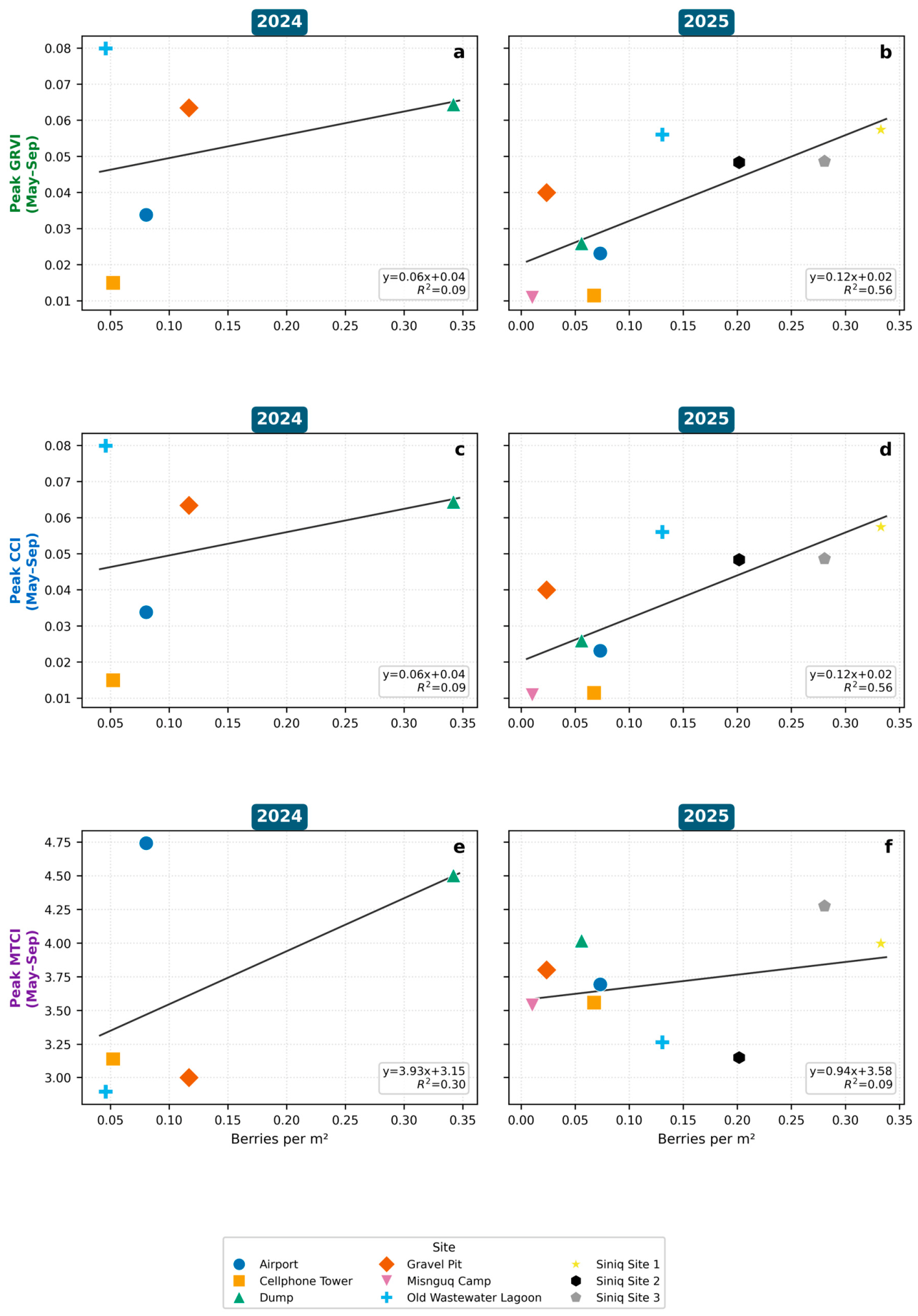
- Multiple chlorophyll-based vegetation indices, MERIS terrestrial chlorophyll index, green–red vegetation index, and chlorophyll carotenoid index, were predictive of berry harvest metrics in southwest Alaska.
- Indigenous Knowledge was critical to establishing parameters of the ecological variables of the subsistence harvest metrics.
- Transdisciplinary research is a necessary element to incorporate years of observations from community experience with predictive models for difficult to access subsistence.
Abstract
1. Introduction
2. Materials and Methods
2.1. Co-Produced Research Practices and Procedures
2.2. Study Site Description and Attributes of Participatory Research Methods
2.3. Qualitative Data Collection Methods
2.4. Weavnig Indigenous Knowledge and Western Science for Data Acquisition
2.5. Ground Sampling Methods—2024
2.6. Ground Sampling Methods—2025
2.7. Remote Sensing Data Attributes and Processing

| Vegetation Index | Equation | Reference |
|---|---|---|
| Greenness/Chlorophyll | ||
| Blue Normalized Difference Vegetation Index (BNDVI) | [83] | |
| Chlorophyll Carotenoid Index (CCI) | [86] | |
| Chlorophyll Red Edge (CI-RE) | [87] | |
| Green Chlorophyll Index (Clg) | [87] | |
| Enhanced Vegetation Index (EVI) | [88] | |
| Green Chromatic Coordinate (GCC) | [89] | |
| Green Leaf Index (GLI) | [90] | |
| Green Normalized Difference Vegetation Index (GNDVI) | [91] | |
| Green–Red Vegetation Index (GRVI) | [87] | |
| MERIS Terrestrial Chlorophyll Index (MTCI) | [92] | |
| Modified Chlorophyll Absorption Ratio Index (MCARI) | [93] | |
| Normalized Difference Vegetation Index (NDVI) | [94] | |
| NIR Green Difference Vegetation Index (GDVI) | ρN2 − ρG | [95] |
| Optimized Soil Adjusted Vegetation Index (OSAVI) | [93] | |
| Photochemical Reflectance Index (PRI) | [96] | |
| Pan Normalized Difference Vegetation Index (PNDVI) | [83] | |
| Red-Edge Triangulated Vegetation Index (RTVICore) | [97] | |
| Red Chromatic Coordinate (RCC) | [89] | |
| Red Normalized Difference Vegetation Index (RDVI) | [83] | |
| Sentinel-2 Lai Green Index (SeLI) | [98] | |
| Blooming | ||
| Enhanced Bloom Index White (EBI_White) | [99] | |
| Enhanced Bloom Index Red (EBI_Red) | [99] | |
| Enhanced Bloom Index Yellow (EBI_Yellow) | [99] | |
| Normalized Difference Yellowness Ratio (NDYI) | [83] | |
| Plant Senescence Reflectance Index (PSRI) | [100] | |
| Moisture | ||
| Canopy Moisture (NDMI) | [101] | |
| Normalized Difference Water Index (NDWI) | [102] | |
| Near-Infrared Reflectance of Vegetation (NIRv) | [103] | |
| Water Band Index (WBI) | [104] | |
| Urban/Wetlands Moisture Index (MNDWI) | [105] | |
| Structure | ||
| Modified Triangular Vegetation Index 1 (MTVI1-G1) | [82] | |
| Modified Triangular Vegetation Index 2 (MTVI2) | [82] | |
2.8. Variable Selection Methodolgies
2.9. Statistical Analysis
3. Results
3.1. Indigenous Knowledge of Environmental Drivers of Berry Harvest Variability
3.2. Variable Selection and Statistical Analysis
3.3. Site Characteristics and Correlations to Berry Density
4. Discussion
4.1. Co-Production Methodology Development
4.2. Ground-Based Data Collection and Utility
4.3. Model Performance, Indicator Selection, and Implications for the Development of Robust Prognostic Models
4.4. Usefulness of Remote Sensing Data for Monitoring Tasks of Subsistence Plant Resources
5. Conclusions
Supplementary Materials
Author Contributions
Funding
Data Availability Statement
Acknowledgments
Conflicts of Interest
References
- Barnhardt, R.; Oscar Kawagley, A. Indigenous Knowledge Systems and Alaska Native Ways of Knowing. Anthropol. Ed. Q. 2005, 36, 8–23. [Google Scholar] [CrossRef]
- Svanberg, I.; Karlholm, A.; Ståhlberg, S. Gold from Nature’s Pantry: A Diachronic Study of Rubus chamaemorus L. (Rosaceae) in Swedish Gastronomy and Economy. J. Ethnobiol. Ethnomed. 2025, 22, 7. [Google Scholar] [CrossRef] [PubMed]
- Fall, J. Subsistence in Alaska: A Year 2017 Update; Alaska Department of Fish and Game Division of Subsistence: Anchorage, Alaksa, 2018.
- Johnson, J.S.; Nobmann, E.D.; Asay, E.; Lanier, A.P. Dietary Intake of Alaska Native People in Two Regions and Implications for Health: The Alaska Native Dietary and Subsistence Food Assessment Project. Int. J. Circumpolar Health 2009, 68, 109–122. [Google Scholar] [CrossRef] [PubMed]
- Oberndorfer, E.; Winters, N.; Gear, C.; Ljubicic, G.; Lundholm, J. Plants in a “Sea of Relationships”: Networks of Plants and Fishing in Makkovik, Nunatsiavut (Labrador, Canada). J. Ethnobiol. 2017, 37, 458. [Google Scholar] [CrossRef]
- Lim, J.S.; Gleason, S.; Strehlau, H.; Church, L.; Nicolai, C.; Church, W.; Jones, W. Alaska Native Allotments at Risk: Technological Strategies for Monitoring Erosion and Informing Solutions in Southwest Alaska. Land 2023, 12, 248. [Google Scholar] [CrossRef]
- Herman-Mercer, N.M.; Laituri, M.; Massey, M.; Matkin, E.; Toohey, R.; Elder, K.; Schuster, P.F.; Mutter, E. Vulnerability of Subsistence Systems Due to Social and Environmental Change: A Case Study in the Yukon-Kuskokwim Delta, Alaska. ARCTIC 2019, 72, 258–272. [Google Scholar] [CrossRef]
- Sedinger, J.S.; Newbury, T.; Jardine, K.; Molnia, B.; Paul, S.; Ely, C.; Bodenhorn, B.; Broadbent, N.; Divoky, G.; Larson, M.A.; et al. Coastal Ecosystems. In Implications of Global Change in Alaska and the Bering Sea Region; University of Alaska Fairbanks: Fairbanks, AK, USA, 1998; pp. 105–113. [Google Scholar]
- Brown, D.R.N.; Brinkman, T.J.; Neufeld, G.P.; Navarro, L.S.; Brown, C.L.; Cold, H.S.; Woods, B.L.; Ervin, B.L. Geospatial Patterns and Models of Subsistence Land Use in Rural Interior Alaska. Ecol. Soc. 2022, 27, art23. [Google Scholar] [CrossRef]
- Spellman, K.V.; Swenson, N.Y. Assessing the Vulnerability of Western Alaska Ecosystems and Subsistence Resources to Nonnative Plant Invasion; Resilience and Adaptation Program; University of Alaska Fairbanks: Fairbanks, AK, USA, 2012. [Google Scholar] [CrossRef]
- Taylor, K. Biological Flora of the British Isles. Rubus chamaemorus L. J. Ecol. 1971, 59, 293–306. [Google Scholar]
- Damman, A.W.H. Hydrology, Development, and Biogeochemistry of Ombrogenous Peat Bogs with Special Reference to Nutrient Relocation in a Western Newfoundland Bog. Can. J. Bot. 1986, 64, 384–394. [Google Scholar] [CrossRef]
- Thiem, B. Rubus chamaemorus L.—A Boreal Plant Rich in Biologically Active Metabolites: A Review. Biol. Lett. 2003, 40, 3–13. [Google Scholar]
- Li, J.; Percival, D.; Hoyle, J.; White, J.; Head, K.; Pruski, K. Phenology and Yield of Native Fruits Cloudberry/Bakeapple (Rubus chamaemorus L.) and Lingonberry/Partridgeberry (Vaccinium vitis-idaea L.) Grown in Southern Labrador, Canada. Can. J. Plant Sci. 2016, 96, 329–338. [Google Scholar] [CrossRef]
- Beaulieu, J.; Otrysko et Line Lapointe, B. Note Sur l’Histoire Naturelle de La Chicoute (Rubus chamemorus L.). Nat. Can. 2001, 125, 17–21. [Google Scholar]
- Brown, A.O.; McNeil, J.N. Pollination Ecology of the High Latitude, Dioecious Cloudberry (Rubus chamaemorus; Rosaceae). Am. J. Bot. 2009, 96, 1096–1107. [Google Scholar] [CrossRef]
- Zurba, M.; Petriello, M.A.; Madge, C.; McCarney, P.; Bishop, B.; McBeth, S.; Denniston, M.; Bodwitch, H.; Bailey, M. Learning from Knowledge Co-Production Research and Practice in the Twenty-First Century: Global Lessons and What They Mean for Collaborative Research in Nunatsiavut. Sustain. Sci. 2022, 17, 449–467. [Google Scholar] [CrossRef]
- Latulippe, N.; Klenk, N. Making Room and Moving over: Knowledge Co-Production, Indigenous Knowledge Sovereignty and the Politics of Global Environmental Change Decision-Making. Curr. Opin. Environ. Sustain. 2020, 42, 7–14. [Google Scholar] [CrossRef]
- Gleason, S.; Lim, J.; Church, L.M.; Jones, W.; Nicolai, C.; Pleasant, J.; Church, W.; Watterson, A.; Strunk, L.A.; Knecht, R.; et al. Nalaquq (“It Is Found”): A Knowledge Co-Production Framework for Environmental Sensing and Communication in Indigenous Arctic Communities. J. Comput. Mediat. Commun. 2023, 28, zmad030. [Google Scholar] [CrossRef]
- Fienup-Riordan, A. Yuungnaqpiallerput/The Way We Genuinely Live: Masterworks of Yup’ik Science and Survival; University of Alaska Press: Fairbanks, AK, USA, 2007. [Google Scholar]
- Jernigan, K. A Guide to the Ethnobotany of the Yukon-Kuskokwim Region; Kuskokwim Campus, University of Alaska Fairbanks: Bethel, AK, USA, 2014. [Google Scholar]
- Fienup-Riordan, A.; Rearden, A.; Meade, M. Yungcautnguuq Nunam Qainga Tamarmi: All the Land’s Surface Is Medicine—Edible and Medicinal Plants of Southwest Alaska; University of Alaska Press: Fairbanks, AK, USA, 2020. [Google Scholar]
- Kaurin, Å.; Stushnoff, C.; Junttila, O. Vegetative Growth and Frost Hardiness of Cloudberry (Rubus chamaemorus) as Affected by Temperature and Photoperiod. Physiol. Plant. 1982, 55, 76–81. [Google Scholar] [CrossRef]
- Shevtsova, A.; Haukioja, E.; Ojala, A. Growth Response of Subarctic Dwarf Shrubs, Empetrum nigrum and Vaccinium vitis-idaea, to Manipulated Environmental Conditions and Species Removal. Oikos 1997, 78, 440. [Google Scholar] [CrossRef]
- Friedrichsen, C.; Church, L.; Cleveland, J.; Gleason, S.; Kassama, S.; Church, M.; Church, W.; Mathew, F.; Bavilla, M.; Hill, G.; et al. Atsalugpiaq Awareness: Food Agency of Cloudberry Subsistence to Support Indigenous Food Sovereignty. J. Agric. Food Syst. Community Dev. 2026, 15, 1–22. [Google Scholar] [CrossRef]
- Kortesharju, J. Ecological Factors Affecting the Ripening Time of Cloudberry (Rubus chamaemorus) Fruit under Cultivation Conditions. Ann. Bot. Finl. 1993, 30, 263–274. [Google Scholar]
- Martinussen, I.; Rapp, K.; Bhuvaneswari, T.V.; Junttila, O. Flower Development in Cloudberry (Rubus chamaemorus L.). Acta Hortic. 2002, 585, 143–147. [Google Scholar] [CrossRef]
- O’Donnell, J.A.; Jorgenson, M.T.; Harden, J.W.; McGuire, A.D.; Kanevskiy, M.Z.; Wickland, K.P. The Effects of Permafrost Thaw on Soil Hydrologic, Thermal, and Carbon Dynamics in an Alaskan Peatland. Ecosystems 2012, 15, 213–229. [Google Scholar] [CrossRef]
- Passeri, D.; Hagen, S.; Medeiros, S.C.; Bilskie, M.V.; Alizad, K.; Wang, D. The Dynamic Effects of Sea Level Rise on Low-Gradient Coastal Landscapes: A Review. Earth’s Future 2015, 3, 159–181. [Google Scholar] [CrossRef]
- Wallenstein, M.D.; Mcmahon, S.K.; Schimel, J.P. Seasonal Variation in Enzyme Activities and Temperature Sensitivities in Arctic Tundra Soils. Glob. Change Biol. 2009, 15, 1631–1639. [Google Scholar] [CrossRef]
- Pearson, R.G.; Phillips, S.J.; Loranty, M.M.; Beck, P.S.A.; Damoulas, T.; Knight, S.J.; Goetz, S.J. Shifts in Arctic Vegetation and Associated Feedbacks under Climate Change. Nat. Clim. Change 2013, 3, 673–677. [Google Scholar] [CrossRef]
- Prevéy, J.S.; Parker, L.E.; Harrington, C.A. Projected Impacts of Climate Change on the Range and Phenology of Three Culturally-Important Shrub Species. PLoS ONE 2020, 15, e0232537. [Google Scholar] [CrossRef]
- Wolff, F.; Kolari, T.H.M.; Räsänen, A.; Tahvanainen, T.; Korpelainen, P.; Villoslada, M.; Verdonen, M.; Lotsari, E.; Pang, Y.; Kumpula, T. Interannual Spectral Consistency and Spatial Uncertainties in UAV-based Detection of Boreal and Subarctic Mire Plant Communities. Remote Sens. Ecol. Conserv. 2025, 11, 719–739. [Google Scholar] [CrossRef]
- Rastogi, A.; Antala, M.; Gąbka, M.; Rosadziński, S.; Stróżecki, M.; Brestic, M.; Juszczak, R. Impact of Warming and Reduced Precipitation on Morphology and Chlorophyll Concentration in Peat Mosses (Sphagnum angustifolium and S. fallax). Sci. Rep. 2020, 10, 8592. [Google Scholar] [CrossRef]
- Vanneste, T.; Michelsen, O.; Graae, B.J.; Kyrkjeeide, M.O.; Holien, H.; Hassel, K.; Lindmo, S.; Kapás, R.E.; De Frenne, P. Impact of Climate Change on Alpine Vegetation of Mountain Summits in Norway. Ecol. Res. 2017, 32, 579–593. [Google Scholar] [CrossRef]
- Macander, M.J.; Palm, E.C.; Frost, G.V.; Herriges, J.D.; Nelson, P.R.; Roland, C.; Russell, K.L.M.; Suitor, M.J.; Bentzen, T.W.; Joly, K.; et al. Lichen Cover Mapping for Caribou Ranges in Interior Alaska and Yukon. Environ. Res. Lett. 2020, 15, 055001. [Google Scholar] [CrossRef]
- Siemens, L.D.; Dennert, A.M.; Obrist, D.S.; Reynolds, J.D. Spawning Salmon Density Influences Fruit Production of Salmonberry (Rubus spectabilis). Ecosphere 2020, 11, e03282. [Google Scholar] [CrossRef]
- Brinkman, T.J.; Hansen, W.D.; Chapin, F.S.; Kofinas, G.; BurnSilver, S.; Rupp, T.S. Arctic Communities Perceive Climate Impacts on Access as a Critical Challenge to Availability of Subsistence Resources. Clim. Change 2016, 139, 413–427. [Google Scholar] [CrossRef]
- Davidson, S.; Santos, M.; Sloan, V.; Watts, J.; Phoenix, G.; Oechel, W.; Zona, D. Mapping Arctic Tundra Vegetation Communities Using Field Spectroscopy and Multispectral Satellite Data in North Alaska, USA. Remote Sens. 2016, 8, 978. [Google Scholar] [CrossRef]
- Macander, M.; Frost, G.; Nelson, P.; Swingley, C. Regional Quantitative Cover Mapping of Tundra Plant Functional Types in Arctic Alaska. Remote Sens. 2017, 9, 1024. [Google Scholar] [CrossRef]
- Macander, M.J.; Nelson, P.R.; Nawrocki, T.W.; Frost, G.V.; Orndahl, K.M.; Palm, E.C.; Wells, A.F.; Goetz, S.J. Time-Series Maps Reveal Widespread Change in Plant Functional Type Cover across Arctic and Boreal Alaska and Yukon. Environ. Res. Lett. 2022, 17, 054042. [Google Scholar] [CrossRef]
- Jorgenson, M.T.; Sedinger, J.; Ely, C.; Fienup-Riordan, A.; Atkinson, D.E.; Ayuluk, J.; Brown, D.; Frost, G.V.; Jones, B.M.; Jorgenson, J.; et al. Interacting Sea-Level Rise, Sea-Ice Loss, Storm Flooding, Erosion, and Permafrost Thaw Threaten Ecosystems, Wildlife, and Communities on the Yukon-Kuskokwim Delta. Earth’s Future 2025, 13, e2025EF006015. [Google Scholar] [CrossRef]
- Verbyla, D. The Greening and Browning of Alaska Based on 1982–2003 Satellite Data. Glob. Ecol. Biogeogr. 2008, 17, 547–555. [Google Scholar] [CrossRef]
- Salko, S.-S.; Hovi, A.; Burdun, I.; Juola, J.; Karlqvist, S.; Rautiainen, M. Assessing Species Fractional Cover and α-Diversity in Boreal Peatlands Across Trophic Levels Using Hyperspectral Data. Ecol. Evol. 2025, 15, e71941. [Google Scholar] [CrossRef]
- Zagajewski, B.; Tømmervik, H.; Bjerke, J.; Raczko, E.; Bochenek, Z.; Kłos, A.; Jarocińska, A.; Lavender, S.; Ziółkowski, D. Intraspecific Differences in Spectral Reflectance Curves as Indicators of Reduced Vitality in High-Arctic Plants. Remote Sens. 2017, 9, 1289. [Google Scholar] [CrossRef]
- Fay, G.; Schwoerer, T.; Guettabi, M.; Armagost, J. How Do Higher Fuel Prices Affect Alaska’s Transportation System and Economy? University of Alaska Anchorage: Anchorage, AK, USA, 2013. [Google Scholar]
- Guettabi, M.; Greenberg, J.; Little, J.; Joly, K. Evaluating Potential Economic Effects of an Industrial Road on Subsistence in North-Central Alaska. ARCTIC 2016, 69, 305. [Google Scholar] [CrossRef]
- Helman, D.; Bahat, I.; Netzer, Y.; Ben-Gal, A.; Alchanatis, V.; Peeters, A.; Cohen, Y. Using Time Series of High-Resolution Planet Satellite Images to Monitor Grapevine Stem Water Potential in Commercial Vineyards. Remote Sens. 2018, 10, 1615. [Google Scholar] [CrossRef]
- Kureel, N.; Sarup, J.; Matin, S.; Goswami, S.; Kureel, K. Modelling Vegetation Health and Stress Using Hypersepctral Remote Sensing Data. Model. Earth Syst. Environ. 2022, 8, 733–748. [Google Scholar] [CrossRef]
- Hussain, S.; Qin, S.; Nasim, W.; Bukhari, M.A.; Mubeen, M.; Fahad, S.; Raza, A.; Abdo, H.G.; Tariq, A.; Mousa, B.G.; et al. Monitoring the Dynamic Changes in Vegetation Cover Using Spatio-Temporal Remote Sensing Data from 1984 to 2020. Atmosphere 2022, 13, 1609. [Google Scholar] [CrossRef]
- Jaime, X.A.; Angerer, J.P.; Yang, C.; Walker, J.; Mata, J.; Tolleson, D.R.; Wu, X.B. Exploring Effective Detection and Spatial Pattern of Prickly Pear Cactus (Opuntia genus) from Airborne Imagery before and after Prescribed Fires in the Edwards Plateau. Remote Sens. 2023, 15, 4033. [Google Scholar] [CrossRef]
- Dashpurev, B.; Wesche, K.; Jäschke, Y.; Oyundelger, K.; Phan, T.N.; Bendix, J.; Lehnert, L.W. A Cost-Effective Method to Monitor Vegetation Changes in Steppes Ecosystems: A Case Study on Remote Sensing of Fire and Infrastructure Effects in Eastern Mongolia. Ecol. Indic. 2021, 132, 108331. [Google Scholar] [CrossRef]
- Baer, K.C. Local Berry Plant Abundance but Not Regional Occupancy May Decline under Climate Change: Predicting Future Conditions and Promoting Resilience in Southeast Alaskan Forests. Landsc. Ecol. 2025, 40, 192. [Google Scholar] [CrossRef]
- Hamilton, C.W.; Smithwick, E.A.H.; Spellman, K.V.; Baltensperger, A.P.; Spellman, B.T.; Chi, G. Predicting the Suitable Habitat Distribution of Berry Plants under Climate Change. Landsc. Ecol. 2024, 39, 18. [Google Scholar] [CrossRef]
- Hirabayashi, K.; Murch, S.J.; Erland, L.A.E. Predicted Impacts of Climate Change on Wild and Commercial Berry Habitats Will Have Food Security, Conservation and Agricultural Implications. Sci. Total Environ. 2022, 845, 157341. [Google Scholar] [CrossRef] [PubMed]
- Rhodes, K.T. Modeling the Future Distribution of Rubus chamaemorus (Cloudberry) in Alaska. Master’s Thesis, University of Nevada, Reno, NV, USA, 2024. [Google Scholar]
- Taylor, A.; Sigona, A.; Kelly, M. Modeling Spatial Distributions of Amah Mutsun Priority Cultural Plants to Support Indigenous Cultural Revitalization. Ecosphere 2023, 14, e4374. [Google Scholar] [CrossRef]
- Ko, D.W.; Kim, D.; Narantsetseg, A.; Kang, S. Comparison of Field- and Satellite-Based Vegetation Cover Estimation Methods. J. Ecol. Environ. 2017, 41, 5. [Google Scholar] [CrossRef]
- Miranda, J.D.R.; Alves, M.D.C.; Pozza, E.A.; Santos Neto, H. Detection of Coffee Berry Necrosis by Digital Image Processing of Landsat 8 Oli Satellite Imagery. Int. J. Appl. Earth Obs. Geoinf. 2020, 85, 101983. [Google Scholar] [CrossRef]
- Zheng, C.; Abd-Elrahman, A.; Whitaker, V.; Dalid, C. Prediction of Strawberry Dry Biomass from UAV Multispectral Imagery Using Multiple Machine Learning Methods. Remote Sens. 2022, 14, 4511. [Google Scholar] [CrossRef]
- Yua, E.; Raymond-Yakoubian, J.; Daniel, R.A.; Behe, C. A Framework for Co-Production of Knowledge in the Context of Arctic Research. Ecol. Soc. 2022, 27, 34. [Google Scholar] [CrossRef]
- Hillerdal, C.; Knecht, R.; Jones, W.; Church, L.M.; Mossolova, A. In It for the Long Haul: Community-Based Archaeology and Heritage in Quinhagak, Alaska. In Collaborative and Community-Engaged Archaeology; Dillian, C.D., Clary, K.S., Bello, C.A., Eds.; University Press of Florida: Gainesville, FL, USA, 2025; pp. 46–66. [Google Scholar]
- Fienup-Riordan, A. (Ed.) Erinaput Unguvaniartut: So Our Voices Will Live (Quinhagak History and Oral Traditions); Calista Elders Council and the Alaska Native Language Center, University of Alaska Fairbanks: Fairbanks, AK, USA, 2013. [Google Scholar]
- Gleason, S.; Lim, J.; Marsden, D.; Pleasant, J.; Jones, W.; Church, W. Yuuyaraq Today, Yuuyaraq Tomorrow: Modeling Erosion Threats to Yup’ik Traditional Land Use Areas. J. Maps 2023, 19, 2146539. [Google Scholar] [CrossRef]
- Hillerdal, C.; Knecht, R.; Jones, W. Nunalleq: Archaeology, Climate Change, and Community Engagement in a Yup’ik Village. Arct. Anthropol. 2019, 56, 4–17. [Google Scholar] [CrossRef]
- Knecht, R.; Jones, W. “The Old Village”: Yup’ik Precontact Archaeology and Community-Based Research at the Nunalleq Site, Quinhagak, Alaska. Études Inuit Stud. 2020, 43, 25–52. [Google Scholar] [CrossRef]
- Hillerdal, C.; Mossolova, A.; Knecht, R.; Jones, W. Honouring Ancestry, Celebrating Presence—The Grand Opening of the Nunalleq Culture and Archaeology Center. J. Community Archaeol. Herit. 2023, 10, 184–199. [Google Scholar] [CrossRef]
- Lim, J.S.; Gleason, S.; Jones, W.; Church, W. Nuna Nalluyuituq (The Land Remembers): Remembering Landscapes and Refining Methodologies through Community-based Remote Sensing in the Yukon-Kuskokwim Delta, Southwest Alaska. Archaeol. Prospect. 2021, 28, 339–355. [Google Scholar] [CrossRef]
- Lim, J.S.; Gleason, S.; Williams, M.; Linares Matás, G.J.; Marsden, D.; Jones, W. UAV-Based Remote Sensing for Managing Alaskan Native Heritage Landscapes in the Yukon-Kuskokwim Delta. Remote Sens. 2022, 14, 728. [Google Scholar] [CrossRef]
- Jones, B.M.; Schaeffer Tessier, S.; Tessier, T.; Brubaker, M.; Brook, M.; Schaeffer, J.; Ward Jones, M.K.; Grosse, G.; Nitze, I.; Rettelbach, T.; et al. Integrating Local Environmental Observations and Remote Sensing to Better Understand the Life Cycle of a Thermokarst Lake in Arctic Alaska. Arct. Antarct. Alp. Res. 2023, 55, 2195518. [Google Scholar] [CrossRef]
- Charmaz, K. Constructing Grounded Theory, 2nd ed.; SAGE: Los Angeles, CA, USA, 2014. [Google Scholar]
- Bernard, H.R. Social Research Methods: Qualitative and Quantitative Approaches; SAGE Publications: Thousand Oaks, CA, USA, 2002. [Google Scholar]
- Bernard, H.R. Research Methods in Anthropology: Qualitative and Quantitative Approaches, 3rd ed.; Altamira Press: Walnut Creek, CA, USA, 2002. [Google Scholar]
- Stackhouse, P.W.; Zhang, T.; Westberg, D.; Barnett, A.J.; Bristow, T.; MacPherson, B.; Hoell, J.M. POWER Release 8 (with GIS Applications) Methodology (Data Parameters, Sources, & Validation) Documentation Date May 1, 2018; National Aeronautics and Space Administration. 2018. Available online: https://power.larc.nasa.gov/docs/methodology/ (accessed on 19 November 2025).
- Schindelin, J.; Arganda-Carreras, I.; Frise, E.; Kaynig, V.; Longair, M.; Pietzsch, T.; Preibisch, S.; Rueden, C.; Saalfeld, S.; Schmid, B.; et al. Fiji: An Open-Source Platform for Biological-Image Analysis. Nat. Methods 2012, 9, 676–682. [Google Scholar] [CrossRef]
- Wada, K. Labelme: Image Polygonal Annotation with Python. Int. J. Geosci. 2021, 10. [Google Scholar]
- Abatzoglou, J.T.; Dobrowski, S.Z.; Parks, S.A.; Hegewisch, K.C. TerraClimate, a High-Resolution Global Dataset of Monthly Climate and Climatic Water Balance from 1958–2015. Sci. Data 2018, 5, 170191. [Google Scholar] [CrossRef] [PubMed]
- Office for Coastal Management 2024 NOAA Lidar DEM: AK Coastal Communities (Eek, Goodnews Bay, Nelson Lagoon, Quinhagak, Togiak). 2026. Available online: https://www.fisheries.noaa.gov/inport/item/77599 (accessed on 2 February 2026).
- Porter, C.; Howat, I.; Noh, M.-J.; Husby, E.; Khuvis, S.; Danish, E.; Tomko, K.; Gardiner, J.; Negrete, A.; Yadav, B.; et al. ArcticDEM—Mosaics; Version 4.1; University of Minnesota: Minneapolis, MN, USA, 2022. [Google Scholar]
- Planet Labs PBC Planet Application Program Interface: In Space for Life. 2024. Available online: https://api.planet.com (accessed on 19 September 2025).
- Wallenius, T. Yield Variations of Some Common Wild Berries in Finland in 1956–1996. Ann. Bot. Fenn. 1999, 36, 299–314. [Google Scholar]
- Haboudane, D. Hyperspectral Vegetation Indices and Novel Algorithms for Predicting Green LAI of Crop Canopies: Modeling and Validation in the Context of Precision Agriculture. Remote Sens. Environ. 2004, 90, 337–352. [Google Scholar] [CrossRef]
- Wang, F.; Huang, J.; Tang, Y.; Wang, X. New Vegetation Index and Its Application in Estimating Leaf Area Index of Rice. Rice Sci. 2007, 14, 195–203. [Google Scholar] [CrossRef]
- Diamond, J.S.; McLaughlin, D.L.; Slesak, R.A.; Stovall, A. Microtopography Is a Fundamental Organizing Structure of Vegetation and Soil Chemistry in Black Ash Wetlands. Biogeosciences 2020, 17, 901–915. [Google Scholar] [CrossRef]
- Dai, C.; Howat, I.M.; Van Der Sluijs, J.; Liljedahl, A.K.; Higman, B.; Freymueller, J.T.; Ward Jones, M.K.; Kokelj, S.V.; Boike, J.; Walker, B.; et al. Applications of ArcticDEM for Measuring Volcanic Dynamics, Landslides, Retrogressive Thaw Slumps, Snowdrifts, and Vegetation Heights. Sci. Remote Sens. 2024, 9, 100130. [Google Scholar] [CrossRef]
- Gamon, J.A.; Huemmrich, K.F.; Wong, C.Y.S.; Ensminger, I.; Garrity, S.; Hollinger, D.Y.; Noormets, A.; Peñuelas, J. A Remotely Sensed Pigment Index Reveals Photosynthetic Phenology in Evergreen Conifers. Proc. Natl. Acad. Sci. USA 2016, 113, 13087–13092. [Google Scholar] [CrossRef] [PubMed]
- Gitelson, A.A.; Gritz, Y.; Merzlyak, M.N. Relationships between Leaf Chlorophyll Content and Spectral Reflectance and Algorithms for Non-Destructive Chlorophyll Assessment in Higher Plant Leaves. J. Plant Physiol. 2003, 160, 271–282. [Google Scholar] [CrossRef]
- Huete, A.; Didan, K.; Miura, T.; Rodriguez, E.P.; Gao, X.; Ferreira, L.G. Overview of the Radiometric and Biophysical Performance of the MODIS Vegetation Indices. Remote Sens. Environ. 2002, 83, 195–213. [Google Scholar] [CrossRef]
- Woebbecke, D.M.; Meyer, G.E.; Von Bargen, K.; Mortensen, D.A. Color Indices for Weed Identification Under Various Soil, Residue, and Lighting Conditions. Trans. ASAE 1995, 38, 259–269. [Google Scholar] [CrossRef]
- Hunt, E.R.; Daughtry, C.S.T.; Eitel, J.U.H.; Long, D.S. Remote Sensing Leaf Chlorophyll Content Using a Visible Band Index. Agron. J. 2011, 103, 1090–1099. [Google Scholar] [CrossRef]
- Buschmann, C.; Nagel, E. In Vivo Spectroscopy and Internal Optics of Leaves as Basis for Remote Sensing of Vegetation. Int. J. Remote Sens. 1993, 14, 711–722. [Google Scholar] [CrossRef]
- Dash, J.; Curran, P.J. MTCI: The meris terrestrial chlorophyll index. Int. J. Remote Sens. 2004, 25, 5403–5413. [Google Scholar] [CrossRef]
- Wu, C.; Niu, Z.; Tang, Q.; Huang, W. Estimating Chlorophyll Content from Hyperspectral Vegetation Indices: Modeling and Validation. Agric. For. Meteorol. 2008, 148, 1230–1241. [Google Scholar] [CrossRef]
- Carlson, T.N.; Ripley, D.A. On the Relation between NDVI, Fractional Vegetation Cover, and Leaf Area Index. Remote Sens. Environ. 1997, 62, 241–252. [Google Scholar] [CrossRef]
- Tucker, C.J. Red and Photographic Infrared Linear Combinations for Monitoring Vegetation. Remote Sens. Environ. 1979, 8, 127–150. [Google Scholar] [CrossRef]
- Gamon, J.A.; Peñuelas, J.; Field, C.B. A Narrow-Waveband Spectral Index That Tracks Diurnal Changes in Photosynthetic Efficiency. Remote Sens. Environ. 1992, 41, 35–44. [Google Scholar] [CrossRef]
- Poudel, A. Unmanned Aerial Vehicles (UAVs) in Vegetation Monitoring; State University of New York: Syracuse, NY, USA, 2025. [Google Scholar]
- Pasqualotto, N.; Delegido, J.; Van Wittenberghe, S.; Rinaldi, M.; Moreno, J. Multi-Crop Green LAI Estimation with a New Simple Sentinel-2 LAI Index (SeLI). Sensors 2019, 19, 904. [Google Scholar] [CrossRef] [PubMed]
- Chen, B.; Jin, Y.; Brown, P. An Enhanced Bloom Index for Quantifying Floral Phenology Using Multi-Scale Remote Sensing Observations. ISPRS J. Photogramm. Remote Sens. 2019, 156, 108–120. [Google Scholar] [CrossRef]
- Sims, D.A.; Gamon, J.A. Relationships between Leaf Pigment Content and Spectral Reflectance across a Wide Range of Species, Leaf Structures and Developmental Stages. Remote Sens. Environ. 2002, 81, 337–354. [Google Scholar] [CrossRef]
- Wilson, E.H.; Sader, S.A. Detection of Forest Harvest Type Using Multiple Dates of Landsat TM Imagery. Remote Sens. Environ. 2002, 80, 385–396. [Google Scholar] [CrossRef]
- Gao, B. NDWI—A Normalized Difference Water Index for Remote Sensing of Vegetation Liquid Water from Space. Remote Sens. Environ. 1996, 58, 257–266. [Google Scholar] [CrossRef]
- Zeng, Y.; Hao, D.; Badgley, G.; Damm, A.; Rascher, U.; Ryu, Y.; Johnson, J.; Krieger, V.; Wu, S.; Qiu, H.; et al. Estimating Near-Infrared Reflectance of Vegetation from Hyperspectral Data. Remote Sens. Environ. 2021, 267, 112723. [Google Scholar] [CrossRef]
- Claudio, H.; Cheng, Y.; Fuentes, D.; Gamon, J.; Luo, H.; Oechel, W.; Qiu, H.; Rahman, A.; Sims, D. Monitoring Drought Effects on Vegetation Water Content and Fluxes in Chaparral with the 970 Nm Water Band Index. Remote Sens. Environ. 2006, 103, 304–311. [Google Scholar] [CrossRef]
- Xu, H. Modification of Normalised Difference Water Index (NDWI) to Enhance Open Water Features in Remotely Sensed Imagery. Int. J. Remote Sens. 2006, 27, 3025–3033. [Google Scholar] [CrossRef]
- Kuhn, M. Building Predictive Models in R Using the Caret Package. J. Stat. Soft. 2008, 28, 1–26. [Google Scholar] [CrossRef]
- Kursa, M.B.; Rudnicki, W.R. Boruta: Wrapper Algorithm for All Relevant Feature Selection; Version 9.0.0; University of Warsaw: Warsaw, Poland, 2009. [Google Scholar]
- Subhashree, S.N.; Igathinathane, C.; Hendrickson, J.; Archer, D.; Liebig, M.; Halvorson, J.; Kronberg, S.; Toledo, D.; Sedivec, K. Evaluating Remote Sensing Resolutions and Machine Learning Methods for Biomass Yield Prediction in Northern Great Plains Pastures. Agriculture 2025, 15, 505. [Google Scholar] [CrossRef]
- Friedman, J.; Hastie, T.; Tibshirani, R. Regularization Paths for Generalized Linear Models via Coordinate Descent. J. Stat. Soft. 2010, 33, 1–22. [Google Scholar] [CrossRef]
- R Core Team R. A Language and Environment for Statistical Computing; R Foundation for Statistical Computing: Vienna, Austria, 2024. [Google Scholar]
- Zawadzki, Z.; Kosinski, M. FSelectorRcpp: “Rcpp” Implementation of “FSelector” Entropy-Based Feature Selection Algorithms with a Sparse Matrix Support; Comprehensive R Archive Network: Vienna, Austria, 2024. [Google Scholar]
- Bates, D.; Mächler, M.; Bolker, B.; Walker, S. Fitting Linear Mixed-Effects Models Using Lme4. J. Stat. Soft. 2015, 67, 1–48. [Google Scholar] [CrossRef]
- Dinno, A. Nonparametric Pairwise Multiple Comparisons in Independent Groups Using Dunn’s Test. Stata J. Promot. Commun. Stat. Stata 2015, 15, 292–300. [Google Scholar] [CrossRef]
- Friedman, J.H. Multivariate Adaptive Regression Splines. Ann. Stat. 1991, 19, 1–67. [Google Scholar] [CrossRef]
- Pazmiño, Y.; De Felipe, J.J.; Vallbé, M.; Cargua, F.; Quevedo, L. Identification of a Set of Variables for the Classification of Páramo Soils Using a Nonparametric Model, Remote Sensing, and Organic Carbon. Sustainability 2021, 13, 9462. [Google Scholar] [CrossRef]
- York, T.P.; Eaves, L.J.; Van Den Oord, E.J.C.G. Multivariate Adaptive Regression Splines: A Powerful Method for Detecting Disease–Risk Relationship Differences among Subgroups. Stat. Med. 2006, 25, 1355–1367. [Google Scholar] [CrossRef]
- Liu, C.; Zhang, X.; Wang, T.; Chen, G.; Zhu, K.; Wang, Q.; Wang, J. Detection of Vegetation Coverage Changes in the Yellow River Basin from 2003 to 2020. Ecol. Indic. 2022, 138, 108818. [Google Scholar] [CrossRef]
- Pisani, O.; Klick, S.A.; Strickland, T.C.; Pisarello, K.L.; Coffin, A.W. Chemical Composition of the Aboveground Tissues of Miscanthus × Giganteus and Relationships to Soil Characteristics. Bioenerg. Res. 2024, 17, 1436–1448. [Google Scholar] [CrossRef]
- Milborrow, S. Notes on the Earth Package; Comprehensive R Archive Network: Vienna, Austria, 2014. [Google Scholar]
- Anderson, D.; Ford, J.D.; Way, R.G. The Impacts of Climate and Social Changes on Cloudberry (Bakeapple) Picking: A Case Study from Southeastern Labrador. Hum. Ecol. 2018, 46, 849–863. [Google Scholar] [CrossRef] [PubMed]
- Limberger, R.; Wickham, S.A. Disturbance and Diversity at Two Spatial Scales. Oecologia 2012, 168, 785–795. [Google Scholar] [CrossRef]
- Vanbergen, A.J.; Watt, A.D.; Mitchell, R.; Truscott, A.-M.; Palmer, S.C.F.; Ivits, E.; Eggleton, P.; Jones, T.H.; Sousa, J.P. Scale-Specific Correlations between Habitat Heterogeneity and Soil Fauna Diversity along a Landscape Structure Gradient. Oecologia 2007, 153, 713–725. [Google Scholar] [CrossRef]
- Deák, B.; Kovács, B.; Rádai, Z.; Apostolova, I.; Kelemen, A.; Kiss, R.; Lukács, K.; Palpurina, S.; Sopotlieva, D.; Báthori, F.; et al. Linking Environmental Heterogeneity and Plant Diversity: The Ecological Role of Small Natural Features in Homogeneous Landscapes. Sci. Total Environ. 2021, 763, 144199. [Google Scholar] [CrossRef]
- Krebs, C.J.; Boonstra, R.; Cowcill, K.; Kenney, A.J. Climatic Determinants of Berry Crops in the Boreal Forest of the Southwestern Yukon. Botany 2009, 87, 401–408. [Google Scholar] [CrossRef]
- Agren, J. Sexual Differences in Biomass and Nutrient Allocation in the Dioecious Rubus chamaemorus. Ecology 1988, 69, 962–973. [Google Scholar] [CrossRef]
- Hébert-Gentile, V.; Naess, S.K.; Parent, L.-É.; Lapointe, L. Organo-Mineral Fertilization in Natural Peatlands of the Quebec North-Shore, Canada: Dispersion in Soil and Effects on Cloudberry Growth and Fruit Yield. Acta Agric. Scand. Sect. B Soil Plant Sci. 2011, 61, 8–17. [Google Scholar] [CrossRef]
- Boulanger-Lapointe, N.; Henry, G.H.R.; Lévesque, E.; Cuerrier, A.; Desrosiers, S.; Gérin-Lajoie, J.; Hermanutz, L.; Collier, L.S. Climate and Environmental Drivers of Berry Productivity from the Forest–Tundra Ecotone to the High Arctic in Canada. Arct. Sci. 2020, 6, 529–544. [Google Scholar] [CrossRef]
- Pelletier, L.; Brown, A.; Otrysko, B.; McNeil, J.N. Entomophily of the Cloudberry (Rubus chamaemorus). Entomol. Exp. Appl. 2001, 101, 219–224. [Google Scholar] [CrossRef]
- Agren, J. Seed Size and Number in Rubus chamaemorus: Between-Habitat Variation, and Effects of Defoliation and Supplemental Pollination. J. Ecol. 1989, 77, 1080. [Google Scholar] [CrossRef]
- Martinussen, I.; Uleberg, E.; McDougall, G.J.; Stewart, D.; Junttila, O. Development and Quality of Cloudberry (Rubus chamaemorus L.) as Affected by Female Parent, Male Parent and Temperature. J. Berry Res. 2010, 1, 91–101. [Google Scholar] [CrossRef]
- Cade, B.S. Model Averaging and Muddled Multimodel Inferences. Ecology 2015, 96, 2370–2382. [Google Scholar] [CrossRef]
- Murray, K.; Conner, M.M. Methods to Quantify Variable Importance: Implications for the Analysis of Noisy Ecological Data. Ecology 2009, 90, 348–355. [Google Scholar] [CrossRef] [PubMed]
- Goodenough, A.E.; Hart, A.G.; Stafford, R. Regression with Empirical Variable Selection: Description of a New Method and Application to Ecological Datasets. PLoS ONE 2012, 7, e34338. [Google Scholar] [CrossRef]
- Cateni, S.; Colla, V.; Vannucci, M. Improving the Stability of the Variable Selection with Small Datasets in Classification and Regression Tasks. Neural Process Lett. 2023, 55, 5331–5356. [Google Scholar] [CrossRef]
- Mulder, C.P.H.; Putman, L.V.; Schroder, K.; Foss, H.; Putman, M.; Spellman, K.V.; Ruggles, A.; Diggle, P.K. Cloudberry in a Changing Climate: Threats and Opportunities; Berries in Alaska’s Changing Environment Series: Rubus Chamaemorus; University of Alaska Fairbanks: Fairbanks, AK, USA, 2023. [Google Scholar]
- Flint, C.G.; Robinson, E.S.; Kellogg, J.; Ferguson, G.; BouFajreldin, L.; Dolan, M.; Raskin, I.; Lila, M.A. Promoting Wellness in Alaskan Villages: Integrating Traditional Knowledge and Science of Wild Berries. EcoHealth 2011, 8, 199–209. [Google Scholar] [CrossRef] [PubMed]
- Ma, Z.; Liu, H.; Mi, Z.; Zhang, Z.; Wang, Y.; Xu, W.; Jiang, L.; He, J.-S. Climate Warming Reduces the Temporal Stability of Plant Community Biomass Production. Nat. Commun. 2017, 8, 15378. [Google Scholar] [CrossRef] [PubMed]
- Baumflek, M.; DeGloria, S.; Kassam, K.-A. Habitat Modeling for Health Sovereignty: Increasing Indigenous Access to Medicinal Plants in Northern Maine, USA. Appl. Geogr. 2015, 56, 83–94. [Google Scholar] [CrossRef]



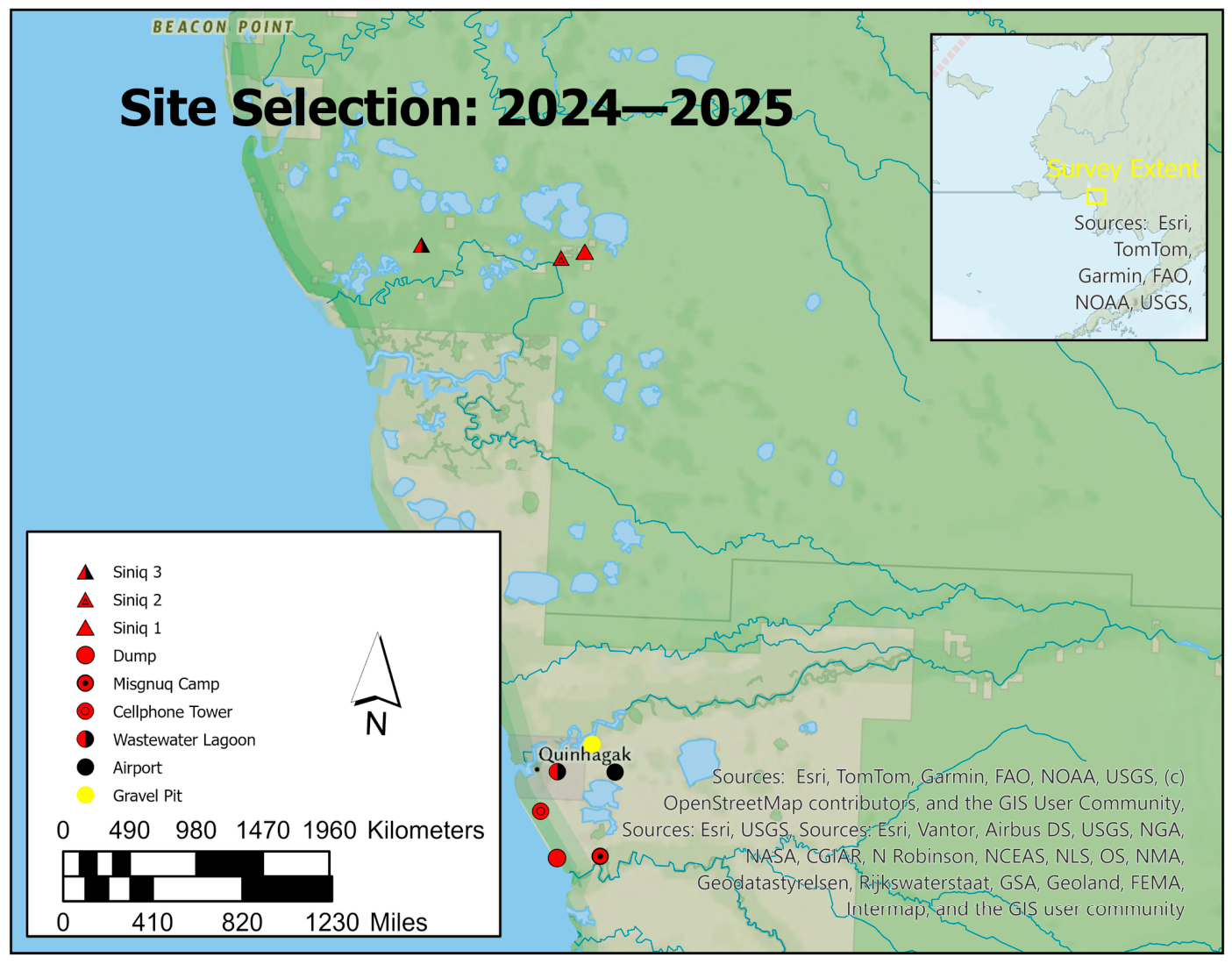
| 2024 Sites | ||||
|---|---|---|---|---|
| Site | Centroid Longitude | Centroid Latitude | Number of Quadrats | Size (Hectare) |
| Airport | 161°52′16.31″W | 59°45′23.09″N | 6 | 1.44 |
| Cellphone Tower | 161°54′24.94″W | 59°44′01.63″N | 6 | 3.99 |
| Dump | 161°53′20.10″W | 59°42′30.90″N | 6 | 0.11 |
| Gravel Pit | 161°51′39.28″W | 59°45′44.17″N | 6 | 0.49 |
| Old Wastewater Lagoon | 161°53′25.46″W | 59°44′55.84″N | 6 | 0.70 |
| 2025 Sites | ||||
| Airport | 161°50′14.64″W | 59°44′58.08″N | 12 | 2.12 |
| Dump | 161°53′16.42″W | 59°42′29.92″N | 16 | 3.82 |
| Old Wastewater Lagoon | 161°53′27.61″W | 59°44′55.59″N | 12 | 1.84 |
| Cellphone Tower | 161°54′17.47″W | 59°43′48.18″N | 16 | 3.42 |
| Misnuq Camp | 161°50′51.60″W | 59°42′37.34″N | 10 | 4.04 |
| Gravel Pit | 161°51′35.40″W | 59°45′44.12″N | 10 | 2.91 |
| Siniq Site 1 | 161°53′12.16″W | 59°59′35.67″N | 10 | 0.89 |
| Siniq Site 2 | 161°54′30.61″W | 59°59′23.19″N | 10 | 1.10 |
| Siniq Site 3 | 162°02′22.25″W | 59°59′34.67″N | 8 | 0.36 |
| Category | Codes |
|---|---|
| Topography | Bigger berries on sides of hill, berry quality size and density dependent on topography, cliffs protect berries from sun, berries found on banks/cliffs, reading landscape, topography impacts plant composition, grow on slopes |
| Weather | Sun burns berries, ripening depends on weather, too cold then no berries, berries dependent on weather, if no snow then no berries, thunderstorms |
| Plant ecology | Codependent plants, one edible species linked to all other edible species, moss provides water for berries, reading and understanding interaction between landscape and species |
| Indicators of harvest | Ecological indicators of harvest potential, cottongrass, predictable environmental indicators of harvest, grass holds snow and protects berries from weather, if cottongrass then there will be berries, snow cover is protection, predictability |
| Knowledge of ecosystem dynamics and change | Knowledge of observed changes, changes in ecosystem also linked to changes in animal behavior, knowledge of environmental change, indicators of change |
| Plant physiology | Berry physiology, 7-year growth cycle, knowing best growing conditions |
| Nutrient cycling | Snow carries nutrients |
| Geography | Ripening depends on geography (inland vs. coastal vs. north vs. south), north not as impacted by environmental change, Quinhagak is on edge of ecosystem boundary and most vulnerable, different geographies more plentiful, have to pick inland due to coastal erosion, knowledge of desirable berry picking locations, berry distribution varies with geography |
| Seasonality | Specific subsistence calendar and each berry has its time, environmental change is impacting seasonality |
| Insects | Pollination is important |
| Soil knowledge | Different words for different types of tundra, salmonberries depend on soil type, when there was permafrost use to use it for stage of berries, knowledge of different types of tundra |
| Wildlife | Follow geese to find preserved berries (mostly cranberries) under snow from last year, close relationship with wildlife |
| Variable | Interviews | Literature Review |
|---|---|---|
| Berry Size | [46] | |
| Vegetation Cover | [46] | [44] |
| Elevation | [25] | [42] |
| Winter Snowfall | [46] | |
| Spring Snowfall | [44] | |
| Cottongrass | [21] | [22] |
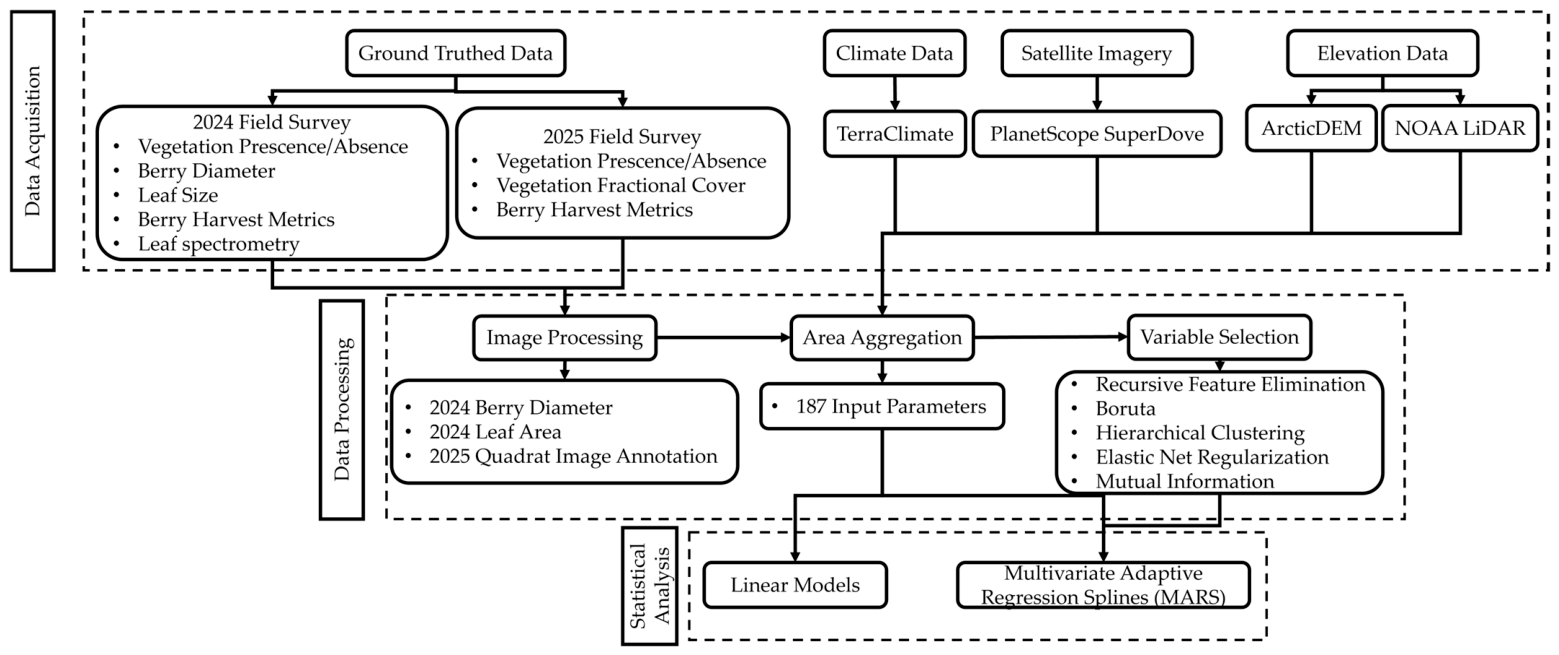
| Data Type | Spatial Resolution | Temporal Resolution | Source |
|---|---|---|---|
| Weather | 5 km | Monthly, October 2022 to October 2025 | [77] |
| Elevation—LiDAR | 0.05 m | Yearly, 2024 | [78] |
| Elevation—ArcticDEM | 2 m | Sporadic, 2011 to 2021 | [79] |
| 8-band satellite imagery | 3 m | Sporadic, January 2024 to October 2025 | [80] |
Disclaimer/Publisher’s Note: The statements, opinions and data contained in all publications are solely those of the individual author(s) and contributor(s) and not of MDPI and/or the editor(s). MDPI and/or the editor(s) disclaim responsibility for any injury to people or property resulting from any ideas, methods, instructions or products referred to in the content. |
© 2026 by the authors. Licensee MDPI, Basel, Switzerland. This article is an open access article distributed under the terms and conditions of the Creative Commons Attribution (CC BY) license.
Share and Cite
Kassama, S.; Hunter, G.; Friedrichsen, C.N.; Gleason, S.; Whippo, C.W.; Gyeabour, G.K.; Church, L.M.; Fischel, M.H.H.; Pisarello, K.; Igathinathane, C.; et al. Weaving Together Ecological Data with Indigenous Knowledge to Model Environmental Factors Impacting Rubus chamaemorus Productivity in Southwest Alaska. Remote Sens. 2026, 18, 1939. https://doi.org/10.3390/rs18121939
Kassama S, Hunter G, Friedrichsen CN, Gleason S, Whippo CW, Gyeabour GK, Church LM, Fischel MHH, Pisarello K, Igathinathane C, et al. Weaving Together Ecological Data with Indigenous Knowledge to Model Environmental Factors Impacting Rubus chamaemorus Productivity in Southwest Alaska. Remote Sensing. 2026; 18(12):1939. https://doi.org/10.3390/rs18121939
Chicago/Turabian StyleKassama, Sire, Grace Hunter, Claire N. Friedrichsen, Sean Gleason, Craig W. Whippo, Gyabaah Kyere Gyeabour, Lynn Marie Church, Matthew H. H. Fischel, Kathryn Pisarello, C. Igathinathane, and et al. 2026. "Weaving Together Ecological Data with Indigenous Knowledge to Model Environmental Factors Impacting Rubus chamaemorus Productivity in Southwest Alaska" Remote Sensing 18, no. 12: 1939. https://doi.org/10.3390/rs18121939
APA StyleKassama, S., Hunter, G., Friedrichsen, C. N., Gleason, S., Whippo, C. W., Gyeabour, G. K., Church, L. M., Fischel, M. H. H., Pisarello, K., Igathinathane, C., Beebe, C., Mathews, F., White, M., Church, M., Church, W., Mark, D., & Mark, J. (2026). Weaving Together Ecological Data with Indigenous Knowledge to Model Environmental Factors Impacting Rubus chamaemorus Productivity in Southwest Alaska. Remote Sensing, 18(12), 1939. https://doi.org/10.3390/rs18121939