Article

VRPF: A Fine-Grained 3D Radar Power-Density Computation Framework Based on Photogrammetric City Models for Urban Observation


College of Electronic Science, National University of Defense Technology, Changsha 410073, China
*
Author to whom correspondence should be addressed.
Remote Sens. 2026, 18(12), 1936; https://doi.org/10.3390/rs18121936
Submission received: 13 April 2026 / Revised: 3 June 2026 / Accepted: 7 June 2026 / Published: 11 June 2026

Highlights

What are the main findings?
  • VRPF couples 3D mesh visibility with radar parameters to compute direct-path power density under urban blockage.
  • It uses reusable spatial indexing, AABB pruning, ray-triangle tests, and multi-baseline validation to improve accuracy and efficiency.
What are the implications of the main findings?
  • VRPF enables fine-grained assessment of direct-path radar power-density distributions in complex urban environments.
  • The method supports sensor-deployment assessment for the low-altitude economy and contributes to urban observation and counter-UAV planning.

Abstract

Radar is critical for urban security against Unmanned Aerial Vehicles (UAVs), yet signal occlusion caused by dense buildings and complex urban structures remains a major challenge for coverage assessment. Existing approaches commonly rely on 2D maps or 2.5D Digital Surface Models (DSMs), which have difficulty representing vertical facades, vegetation, bridges, overhanging structures, and void spaces. These geometric limitations can introduce errors in radar occlusion determination and direct-path power-density estimation. Full 3D ray-tracing methods offer high fidelity, but their multi-path modeling and material-parameter requirements can be costly for large oblique photogrammetric city meshes. To address this problem, this paper proposes the Visible Radar Power-Density Field (VRPF), a 3D radar power-density field computation framework based on high-resolution oblique photogrammetric models. The method constructs a reusable spatial index for large numbers of triangular facets and performs two-stage occlusion queries: rapid Axis-Aligned Bounding Box (AABB) pruning followed by ray-triangle intersection tests. Together, these components enable efficient direct-path power-density calculation while accounting for line-of-sight occlusion in complex urban scenes. Qualitative and quantitative experiments show that VRPF better preserves occlusion boundaries around building edges, vegetation, and elevated structures than DSM-based baselines. VRPF also requires less time for repeated occlusion queries than a conventional 3D BVH ray-casting baseline while maintaining highly consistent radar-signal occlusion determinations. With 32 threads, VRPF computes power density for 10 8 target points in 5.92 s, about 2.66 × faster than the 1 m DSM method. These results indicate that VRPF provides a practical balance between geometric fidelity and computational efficiency for direct-path radar power-density assessment with urban geometric occlusion.

1. Introduction

The rapid emergence of Urban Air Mobility (UAM) has transformed urban logistics and management, while also introducing new challenges to airspace security. Unauthorized UAVs, characterized by their Low–Slow–Small (LSS) nature, high maneuverability, and low Radar Cross-Section (RCS), pose significant threats to critical infrastructure and public safety [1,2]. Among various counter-UAV technologies, radar systems remain a key component of wide-area surveillance networks because of their all-weather operation, long-range detection capability, and precise velocity measurement [3]. However, radar deployment in morphologically complex urban environments is fundamentally different from deployment over open terrain. To detect small and low-RCS targets, urban radars typically operate in high-frequency bands, such as Ku or Ka band, where propagation exhibits quasi-optical characteristics [4]. Since these wavelengths are much smaller than typical building-scale obstacles, geometric occlusion becomes a dominant factor for direct-path transmitted power density. Therefore, in dense urban canyons where simple open-space assumptions become inadequate, accurately modeling fine-grained line-of-sight blockage is important for effective radar network planning [5].
In complex urban spaces, the fidelity of direct-path radar power-density simulation is strongly constrained by the topological fidelity of the environmental data. Existing workflows commonly rely on simplified representations, such as 2D urban footprints, 2.5D raster models, or digital maps, to approximate urban geometry. For example, Ma et al. [6] used 2D data to estimate signal blockage; however, restricting the analysis to a planar representation can introduce power-density errors in complex urban settings. Similarly, although Tema et al. [7] employed Digital Elevation Models (DEMs) to evaluate terrain occlusion, their focus remained on natural terrain rather than detailed urban architectural structures. Existing studies have only limited discussion of radar power-density assessment in dense urban environments, and related workflows often rely on Digital Surface Models (DSMs). However, a DSM is essentially a regular 2D elevation grid that represents geometry as a single-valued function z = f ( x , y ) . This data structure has an inherent topological limitation: it cannot explicitly represent vertical superposition, such as overhangs, bridges, elevated structures, hollow spaces, and vegetation geometry. As a result, DSM-based occlusion determination can miss or distort true blind zones, leading to errors in the spatial distribution of direct-path radar power density.
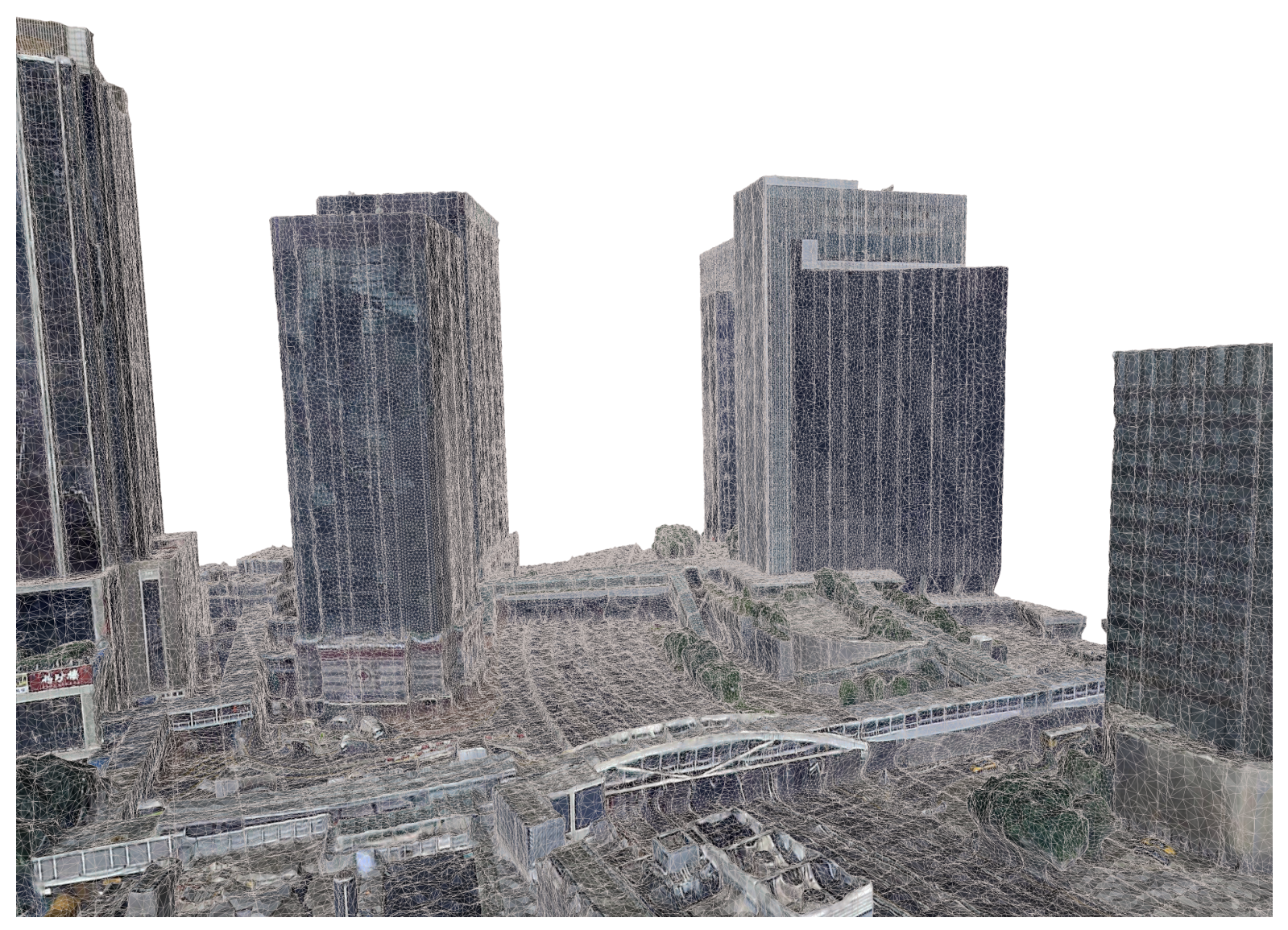
To reduce the systematic errors introduced by 2.5D approximations, high-resolution 3D models, such as oblique photogrammetric meshes shown in Figure 1, provide a more suitable geometric basis for direct-path radar occlusion analysis. Mature 3D ray-tracing and ray-launching methods have been widely used for high-fidelity radio propagation, multi-path analysis, and radio-map reconstruction in urban scenes [8,9,10]. However, full ray-tracing simulation usually requires material-dependent propagation parameters, interaction-order settings, and repeated searches for reflected, diffracted, and multi-interaction paths. These requirements lead to high modeling complexity and computational cost, especially for large oblique photogrammetric city meshes. For the high-frequency radar considered in this study, reflection and diffraction effects are relatively weak compared with direct-path geometric blockage.
Based on this positioning, this paper proposes the Visible Radar Power-Density Field (VRPF), a lightweight direct-path radar power-density screening framework based on fine-grained oblique photogrammetric city models. Under a geometric-optics assumption, VRPF uses the 3D mesh as the explicit occluding geometry and evaluates whether the direct radar-target path is blocked by buildings, vegetation, bridges, or elevated structures. For visible target points, the framework computes transmit-side power density using the specified antenna gain, scanning geometry, propagation distance, and atmospheric-loss setting. To support repeated large-scale queries on massive triangular meshes, VRPF constructs a reusable spatial-indexing structure that combines AABB-based coarse pruning, exact ray-triangle intersection tests, and OpenMP parallel execution. To evaluate the effect of geometric representation, multi-resolution DSMs are reconstructed from the same oblique photogrammetric model and used as raster baselines, so that the comparison mainly reflects the errors introduced by converting full 3D mesh geometry into 2.5D raster surfaces. Additional BVH-based ray-casting comparisons and multi-scale experiments are further used to examine visibility-decision consistency and computational efficiency.
The main contributions of this paper are summarized as follows:
  • Spatial-indexed occlusion query for large-scale mesh data: A reusable spatial-indexed query method is developed for repeated radar-target occlusion determination on massive oblique photogrammetric triangular meshes. By combining AABB-based coarse pruning, exact ray-triangle intersection testing, and OpenMP parallel execution, the method reduces the number of triangular facets entering exact intersection tests and supports efficient fine-grained occlusion queries in large urban scenes.
  • Direct-path radar power-density computation with fine urban occlusion: A direct-path radar power-density computation framework is established by coupling mesh-based visibility with antenna gain, scanning geometry, propagation distance, and geometric blockage. By directly using oblique photogrammetric mesh surfaces, the framework preserves facades, bridges, overhangs, vegetation, and hollow spaces, and converts binary line-of-sight information into a quantitative 3D direct-path radar power-density field for urban direct-path power-density assessment.
  • Multi-baseline validation of accuracy and efficiency: Same-source DSMs, public DSM comparisons, BVH ray-casting tests, and multi-scene experiments are used to evaluate geometric accuracy, visibility consistency, and computational efficiency.

2. Related Works

Computing radar power density in urban spaces relies on two main technical areas: electromagnetic propagation modeling and geometric occlusion analysis.

2.1. Radar Propagation Modeling: From Natural Terrain to Urban

Early radar propagation models focused on natural landscapes rather than cities. Physical models, such as the Parabolic Equation (TEMPER) by Donohue and Kuttler [11] and the boundary integral method by Awadallah et al. [12], are effective for simulating wave propagation over oceans or rolling terrain. These methods handle atmospheric refraction and macro-scale multi-path effects effectively. However, applying these continuum models to the sharp, high-frequency discontinuities of urban environments introduces substantial computational and modeling challenges. As Chen et al. [13] noted with their APM-based approach, this adaptation causes significant computational lag and often ignores localized signal blocking.
Radar beam blockage and terrain masking have also been studied in operational radar coverage research. Krajewski et al. [14] developed a GIS-based DEM method for assessing weather-radar beam blockage in mountainous regions, showing that terrain shielding can directly degrade radar-derived observations. More recently, Nie et al. [15] proposed a tensor-grid dilation operator to calculate three-dimensional radar terrain masking while preserving internal features of the detection volume. These studies are valuable for radar coverage assessment; however, their environmental representations are still mainly DEMs or regular grids, which are suitable for continuous terrain but cannot fully describe multi-layer urban structures such as facades, overpasses, pilotis, and narrow gaps.
To handle the complex multi-path effects in urban canyons, researchers have extensively studied deterministic approaches, specifically ray launching and ray tracing. These approaches are commonly regarded as standard methods for generating high-fidelity Radio Environment Maps (REMs) that define signal quality in space [16]. Yun and Iskander [8], for example, reviewed these techniques and showed that they can rigorously trace reflection and diffraction paths. More recently, Gómez et al. [9] proposed an accelerated ray-launching method for efficient field-coverage studies in wide urban areas. Related high-fidelity radio-map studies also confirm that detailed 3D city geometry is important for electromagnetic coverage modeling [10]. While these approaches approximate Maxwell’s equations with high physical fidelity, their computational cost is high and increases rapidly with the number of interactions, such as reflection orders. This complexity can make them computationally prohibitive for city-wide security planning, which requires continuous volumetric analysis and the iterative evaluation of millions of ray paths [8]. Moreover, many radio-map studies are primarily communication-oriented and depend on empirical or semi-physical propagation assumptions, whereas VRPF focuses on deterministic radar power-density computation under explicit geometric occlusion.
Because full-wave simulations are computationally expensive, the geospatial literature often uses DSMs as a practical alternative. This raster-based approach is suitable for evaluating terrain occlusion in mountainous regions [5,7]. Yet, adapting it directly to modern "urban canyons" has geometric limitations. Standard raster data treats the world as a set of solid vertical columns (2.5D). This structure cannot capture complex vertical features like overhangs, bridges, and pilotis. Consequently, the few studies using these datasets for urban analysis usually rely on statistical approximations, such as pixel counts [17]. This geometric simplification leads to systematic false-positive errors in dense building environments. This indicates a need for a methodology that combines the geometric precision of 3D meshes with the efficiency of geospatial algorithms.

2.2. Viewshed Analysis: Evolution from 2.5D to 3D

Viewshed analysis is the core algorithm for determining signal accessibility. The history of these algorithms reflects a constant trade-off: geometric accuracy versus computational speed. Early methods relied heavily on algorithms using 2.5D raster grids, such as R2, R3, and Xdraw. Later work optimized this using parallel computing on CPUs and GPUs. Li et al. reported substantial acceleration for multiple-observer siting, while Axell and Fridén compared GPU and parallel-CPU implementations for viewshed analysis [18,19]. Yet, these methods still inherit the topological limits of the underlying data structure. To address this limitation, researchers explored multi-level decomposition strategies [20] and specialized indexing like view-trees [21]. These improvements, however, mainly focus on speeding up processing for massive terrain data. They do not resolve the geometric deficits (e.g., the lack of vertical structures) inherent in representing urban environments as elevation grids.
Recent DEM-based viewshed studies have further improved dynamic field-of-view handling and observation-point selection. Tang et al. [22] proposed a dynamic range proximity–direction–elevation reference-line method for DEM viewshed analysis, while Wang et al. [23] formulated multi-observation-point siting as a stepwise maximum viewshed problem. These methods are useful for large-area terrain surveillance and sensor siting, but they still operate on single-valued elevation fields. Thus, their results inherit the difficulty of representing vertical superposition and hollow urban structures.
Because 2.5D models have limits, a significant portion of research shifted to full 3D viewshed analysis. This typically leverages the graphics pipeline for real-time performance. Feng et al. [24] and Chen et al. [25] used GPU stencil buffers and depth testing to render occlusions rapidly in digital earth environments. But a distinction must be made between visualization and quantitative analysis. As Zhang et al. [26] emphasized, GPU-based methods are designed primarily for visual perception. They generally fail to yield the explicit volumetric data required for rigorous power-density calculations.
To enable more granular analysis, other approaches have explored data structures like Triangulated Irregular Networks (TIN) [27] and point clouds [28,29]. These methods improve geometric fidelity for applications like driver line-of-sight analysis. Recent point-cloud and voxel-based studies have extended this direction. Orlof et al. [30] compared DSM and LiDAR point-cloud-based viewsheds and showed that point clouds can preserve small objects and fine visibility details that are generalized in DSMs. Zhao et al. [31] mapped street-level 3D visibility from mobile LiDAR point clouds through voxelized visible-volume analysis. Hirt et al. [32] used voxel-based ray tracing with detailed 3D models and MLS vegetation point clouds to detect traffic-sign occlusion, and Zhao et al. [33] improved point-cloud LOS analysis using depth-map projection and KNN depth optimization. These methods improve local geometric realism, especially for street-level objects and vegetation. Nevertheless, point clouds are discrete samples rather than continuous surfaces, and their visibility results are sensitive to point density, scanning occlusion, registration errors, voxel or depth-map resolution, and neighborhood-search parameters. However, they can face substantial computational bottlenecks because brute-force ray-intersection testing on unstructured data scales poorly as scene complexity increases. This scaling problem highlights the need for spatial-indexing structures. In computational geometry and ray tracing, hierarchical acceleration structures—such as R-Trees, Bounding Volume Hierarchies (BVH), and Octrees—are standard solutions for accelerating intersection queries [34]. Yet, the application of these efficient indexing mechanisms to city-scale computation of radar power density is rare in the current GIS literature. Most existing studies [35] still suffer from prohibitive costs or rely on strictly limited analysis scales. This indicates a methodological gap for a high-performance framework that integrates precise 3D meshes with efficient spatial pruning algorithms.

2.3. Sensor Deployment and Coverage Optimization

In sensor placement applications, researchers widely use visibility or effective coverage as a proxy for sensing performance. Related optimization studies formulate deployment as sparse multi-viewshed siting, coverage-based location planning, or radar deployment scheduling problems [36,37]. Zhou et al. [36], for instance, showed that explicitly characterizing building occlusion significantly improves equipment utilization. Parajuli and Feng [37] formulated the strategic deployment of a single mobile weather radar as a continuous coverage-based location problem for improving meteorological observation. Similarly, Ding et al. [38] used DEM-based analysis to optimize UAV swarm defense. Radar-specific deployment studies also show that coverage optimization requires reliable visibility and obstruction models. Li et al. [39] optimized multistatic radar deployment for circular barrier coverage using Cassini-oval-based coverage models and integer programming. Xing et al. [40] incorporated Fresnel-zone clearance and complex terrain into multi-sensor dynamic scheduling for UAV swarm defense. These works are valuable for deployment and resource allocation, but their coverage constraints are commonly expressed through abstract coverage geometries, DEM-based terrain, or precomputed visibility conditions. They therefore still depend on the fidelity of the underlying environmental model. The reliability of these optimizations, however, depends entirely on the accuracy of the input occlusion model. Existing strategies often use simplified geometric data. Gemmi et al. [41] utilized 3D digital maps and LoS constraints for cost-effective wireless coverage planning in urban areas. However, such communication-coverage models are mainly designed for access-link availability rather than fine-grained volumetric radar power-density computation. Xing et al. [42] performed Monte Carlo-based coverage analysis for 142 GHz sub-terahertz wireless channels in an urban microcell scenario. Although these studies are theoretically informative for high-frequency coverage analysis, they are limited by the granularity of their environmental representations when applied to per-voxel radar power-density assessment. Consequently, they cannot account for the fine-grained “hard” occlusion caused by complex urban structures (e.g., bridges, overhangs) or calculate per-voxel power density. This gap between sophisticated optimization algorithms and low-fidelity environmental representations leads to deployment plans that often deviate from reality in complex urban settings.

2.4. Summary

To summarize, existing methodologies show clear progress but still have limitations when applied to dense urban radar coverage assessment. First, studies on radar propagation and terrain masking have shown that radar coverage is affected by atmospheric conditions, terrain blockage, Fresnel-zone clearance, and the assumed detection range [14,15,40]. These studies are useful for practical radar assessment, but many of them still rely on DEMs, regular grids, or idealized coverage geometries. Second, DEM/DSM-based viewshed algorithms have become increasingly efficient for terrain visibility and viewpoint optimization [22,23], but they still inherit the 2.5D topological constraint of single-valued elevation surfaces. Third, LiDAR point-cloud and voxel-based visibility methods provide higher local geometric detail [30,31,32,33]; nevertheless, their results can be sensitive to point density, occlusion gaps, voxel or depth-map resolution, and neighborhood-search parameters, and their computational burden becomes significant for repeated large-scale spatial queries. Most importantly, many existing studies stop at binary visibility, visual exposure, or deployment coverage rather than computing a quantitative radar power-density field. VRPF addresses this gap by combining high-fidelity oblique photogrammetric meshes, reusable spatial indexing, deterministic ray-triangle occlusion tests, and radar power-density computation. The methodological differences and remaining research gap are summarized in Table 1, which compares representative propagation, visibility, and deployment studies with the proposed VRPF framework.

3. Methodology

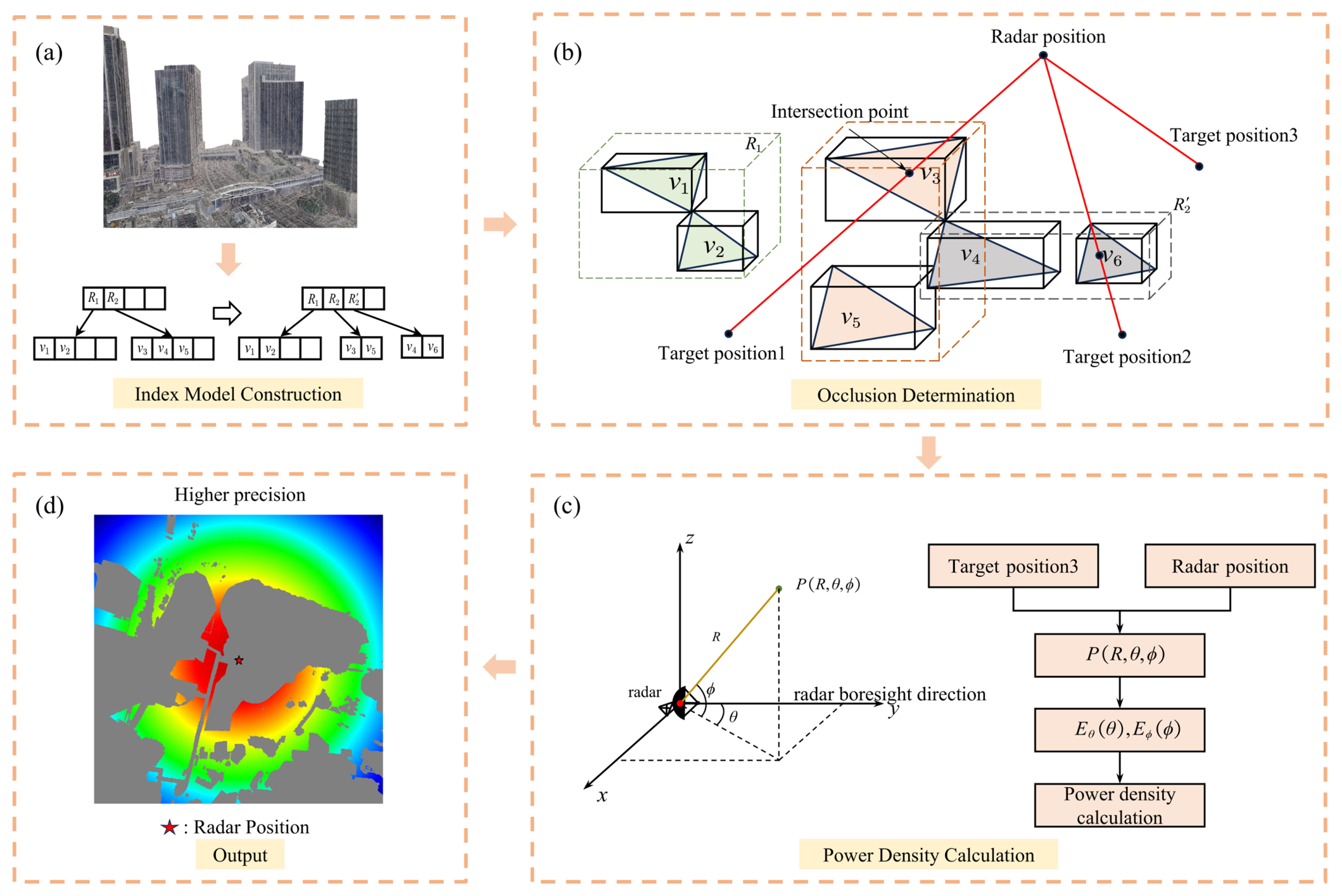
The computational workflow of the VRPF method is shown in Figure 2. To compute the transmitted power density of the direct radar-target path in 3D urban environments, the framework is divided into three main phases:
(1)
Index Model Construction: We organize massive, unstructured triangular meshes into a hierarchical spatial index. This pre-processing step converts raw geometric data into an optimized structure for efficient spatial queries.
(2)
Mesh-based Occlusion Determination: We determine the blockage state of the direct radar-target path using a two-stage intersection test. First, the spatial index performs rapid coarse pruning. Then, exact ray-triangle intersection tests are applied to detect fine-grained geometric blockages.
(3)
Radar Power-Density Computation: For target points whose direct radar-target path is not blocked, the one-way transmitted power density is computed in a radar-centric spherical coordinate system. For occluded target points, the direct-path contribution is set to zero, while reflected, diffracted, and penetrated components are outside the scope of the current model.
By combining these pointwise computation results, the framework obtains an estimated direct-path radar transmitted-power-density field. Finally, the accuracy and efficiency of the system are validated in the following sections.

3.1. Mesh-Based Occlusion Determination

Fine-grained oblique photogrammetry models often contain billions of triangles, and this scale makes exhaustive occlusion evaluation at O ( M · N ) computationally impractical. Therefore, exhaustive traversal is replaced by a spatial-query strategy. The proposed spatial-indexing framework divides occlusion analysis into two stages. First, the index performs coarse filtering and prunes irrelevant geometry through Axis-Aligned Bounding Box (AABB) checks. Second, exact geometric intersection tests are applied only to elements that pass the coarse filtering stage, thereby improving occlusion-determination efficiency.

3.1.1. Index Model Construction

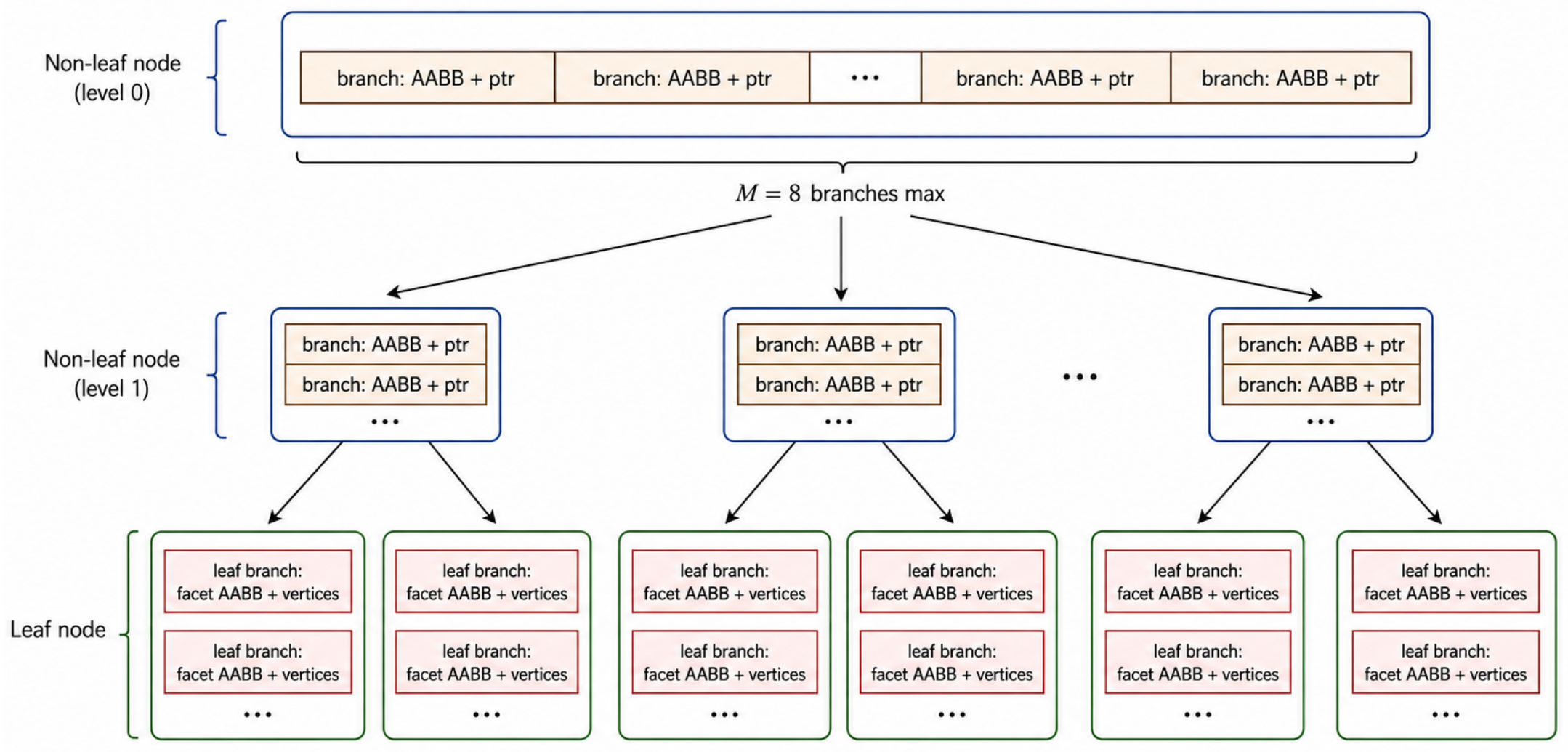
The spatial index is constructed to organize massive unstructured triangular meshes loaded from raw .obj files. The objective is to build an efficient hierarchical structure for spatial queries. The core structure is a 3D R-tree, which extends the original R-tree proposed by Guttman in 1984 [34] to support efficient organization and retrieval of three-dimensional spatial data. More specifically, the node capacity in our implementation is defined at the branch-entry level, as illustrated in Figure 3. Each R-tree node contains at most M = 8 branches. For a non-leaf node, each branch stores the AABB of one child node and a pointer to that child node. For a leaf node, each branch corresponds to one triangular-facet record, storing the facet AABB and the coordinates of its three vertices. Therefore, a leaf node is not equivalent to a single triangle; rather, it can contain up to M = 8 triangular-facet records, and each leaf-level branch corresponds to one triangle.
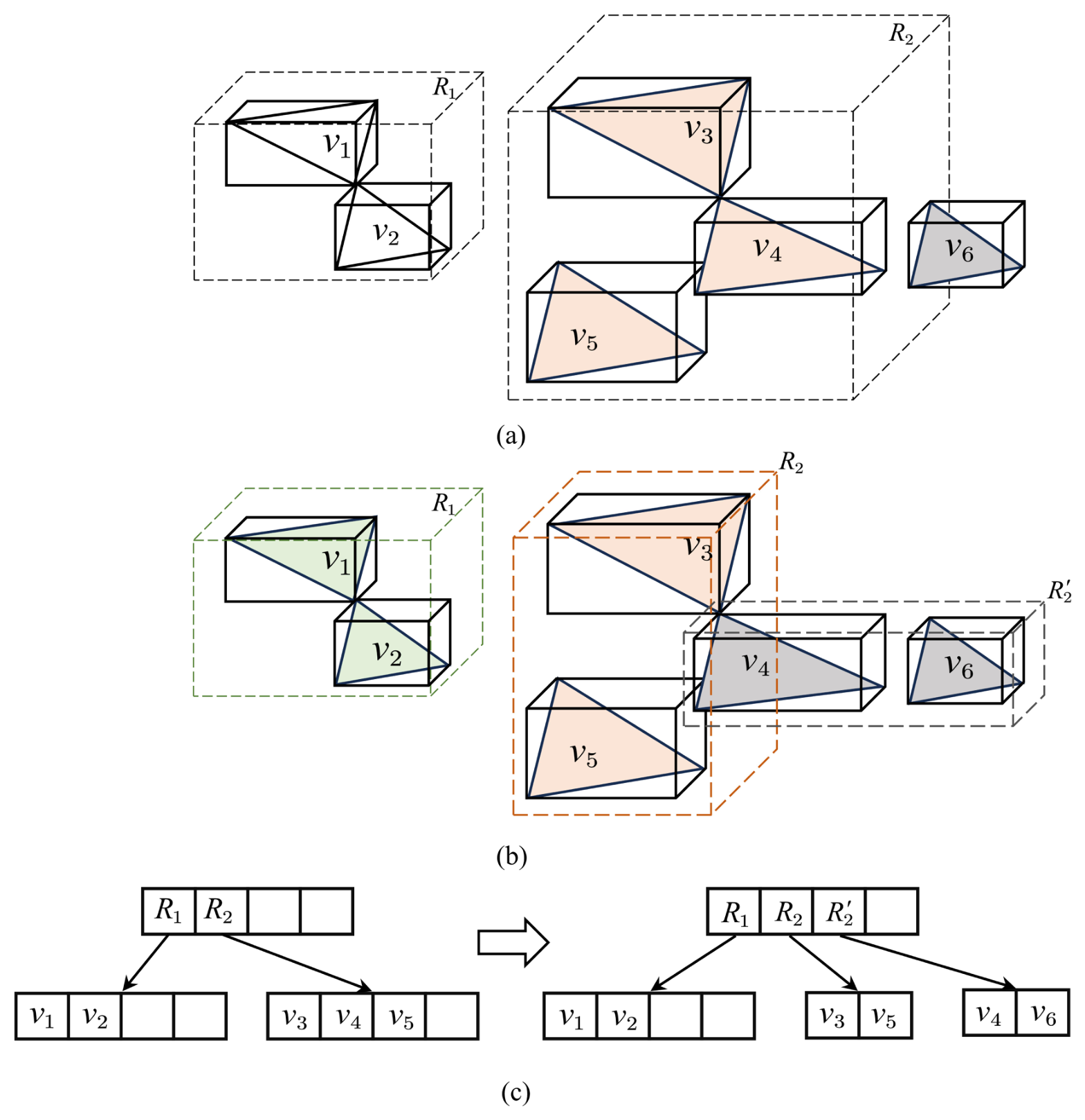
The construction of a 3D R-tree is a dynamic process that grows and adjusts as new geometric primitives are inserted. Figure 4a,b schematically illustrate the insertion process. When a new object, such as v 6 , is inserted, it should not be assigned to an arbitrary node. The insertion starts from the root and follows the path that causes the smallest enlargement of the AABBs. This usually requires evaluating candidate child nodes and comparing how much their bounding boxes would expand. Keeping the AABBs compact improves later query efficiency because oversized boxes tend to introduce unnecessary intersection checks. In this example, R 2 is selected because its bounding box expands the least after accepting v 6 .
However, if the target node exceeds its capacity upon insertion—for instance, R 2 holding { v 3 , v 4 , v 5 , v 6 } —a split operation is triggered. The node is divided into R 2 and R 2 , with elements redistributed to minimize sibling overlap and ensure AABB compactness. This structural change propagates upward: the parent node updates its child list to include R 1 , R 2 , and the newly created R 2 . Provided the parent remains within its capacity limits, the propagation ceases, requiring only an update to its AABB to encompass the new children. This process results in the balanced structure illustrated in Figure 4c. In the actual implementation, this overflow handling is controlled by the fixed node-capacity and minimum-fill values reported in Table 2. When inserting a new branch causes a node to exceed M = 8 , the existing branches and the newly inserted branch are reassigned into two nodes using the quadratic split rule. This rule first selects two seed branches that would cause the largest wasted covering AABB volume if placed in the same node; the remaining branches are then assigned to the group that requires the smaller AABB enlargement, while satisfying the minimum fill requirement m = 4 for non-root nodes. After all insertions are completed, the final index uses the root node as the common entry point for all subsequent queries. The AABB checks allow the algorithm to prune large irrelevant regions immediately. Only triangular facets whose bounding boxes intersect the query segment are passed to the exact intersection stage.

3.1.2. Two-Stage Occlusion Analysis

The intersection test between the line segment connecting the radar and the target and the AABB employs the Slab method [43]. Given the radar position P r a d a r and the target position P t a r g e t , this propagation path is formulated as a parametric ray:
P = P r a d a r + t D , ( 0 t 1 ) D = P t a r g e t P r a d a r
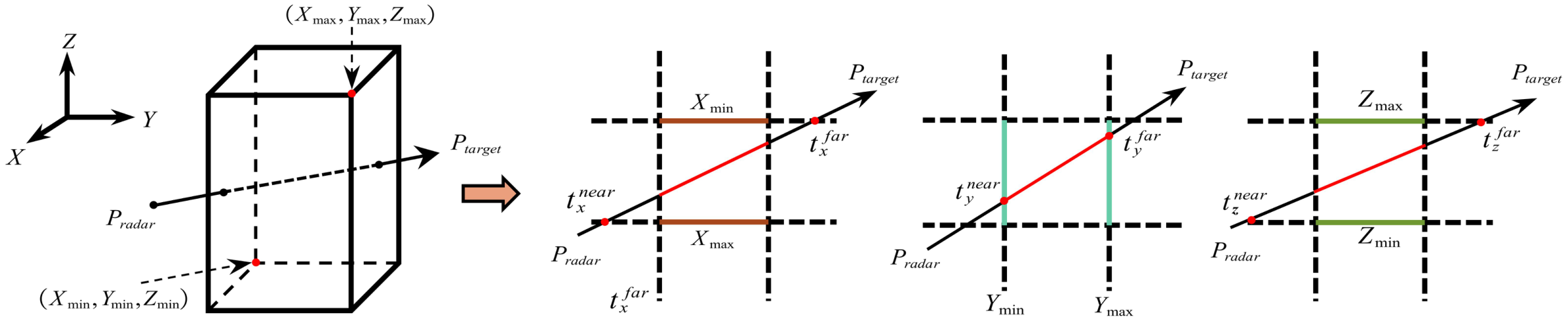
According to the Slab method, the AABB is defined as the intersection of three orthogonal coordinate planes (X, Y, and Z). As illustrated in Figure 5, the entry ( t n e a r ) and exit ( t f a r ) parameters of the ray along the three axes are calculated to determine the intersection with the three slabs. For the X-axis plane, the parameters t x n e a r and t x f a r are derived via Equation (2):
t x near = ( X min P r a d a r _ x ) / D x t x far = ( X max P r a d a r _ x ) / D x
Here, P r a d a r _ x and D x represent the X-axis components of P r a d a r and D , respectively. Analogous computations apply to the Y and Z axes. Consequently, the total entry parameter t e n t e r and exit parameter t e x i t of the ray are defined as Equation (3):
t e n t e r = max t x n e a r , t y n e a r , t z n e a r t e x i t = min t x f a r , t y f a r , t z f a r
The ray intersects the current node’s AABB if and only if max ( t e n t e r , 0 ) min ( t e x i t , 1 ) . Should this condition fail, the node and its sub-tree are pruned immediately. Otherwise, the algorithm recursively traverses the child nodes. This process terminates at leaf nodes intercepted by the ray; their constituent triangular facets are aggregated into a candidate set for the subsequent precise geometric testing. In the implementation, the AABB test is used only as a coarse pruning step; triangular facets that pass this stage are further checked by the exact ray-triangle intersection test.
For occlusion checks, we use the Möller–Trumbore intersection method [44]. The algorithm is efficient and lightweight because it performs ray-triangle intersection tests directly without storing additional plane equations. This property is suitable for the present application, where a large number of candidate triangles must be tested. The method solves the intersection in barycentric coordinates without explicitly constructing the triangle plane equation. A triangular facet is described by its three vertices, V 0 , V 1 , and V 2 . Any point P on the facet can be represented by two barycentric coordinates ( u , v ) . Equation (4) shows this relation:
P = ( 1 u v ) V 0 + u V 1 + v V 2
where u 0 , v 0 , and u + v 1 . The edge vectors and intermediate variables are given by Equation (5):
E 1 = V 1 V 0 E 2 = V 2 V 0 S 1 = D × E 2 S = P r a d a r V 0 S 2 = S × E 1 Δ = E 1 · S 1
When | Δ | < ε , the ray is deemed approximately parallel to the triangle, and the computation is bypassed. Otherwise, the parameters t , u , and v are computed via Equation (6):
t u v = 1 Δ S 2 · E 2 S 1 · S S 2 · D
The validity of the intersection is verified by checking whether u 0 , v 0 , u + v 1 , and t ( ε , 1 ε ) , where ε is a fixed segment-intersection tolerance. If these conditions are satisfied, the radar-target segment intersects the triangular facet, and the target point is classified as direct-path occluded. The query then terminates for this target because a single valid blocking facet is sufficient to determine occlusion. Otherwise, the algorithm proceeds to the next candidate triangle. A distinct advantage of this vector formulation is the simultaneous computation of ( t , u , v ) , which reduces computational overhead when processing large sets of candidate facets.

3.1.3. Numerical Parameters and Boundary Handling

The main numerical parameters used in spatial index construction and occlusion query are summarized in Table 2.
In the coarse AABB stage, no additional box expansion is applied, so δ AABB = 0 . In the exact intersection stage, candidate triangles are skipped when the determinant is smaller than τ Δ , which removes nearly parallel rays and degenerate or nearly degenerate facets from the blocking decision. A valid blocking intersection must also satisfy the segment-intersection tolerance ε . Radar and target samples are selected in free space; samples located inside opaque mesh volumes are excluded from the power-density evaluation. Once the first valid blocking facet is found, the query for that target is terminated because one intersection is sufficient to determine occlusion.
Although BVH-based ray casting and VRPF both use bounding volumes, their index construction objectives are different. A BVH is typically built as a ray-tracing primitive hierarchy to reduce generic ray traversal cost in rendering or propagation-simulation pipelines. In contrast, VRPF inserts the AABBs of triangular facets into a multi-branch 3D R-tree. Internal branches store child-node AABBs and pointers, while leaf-level branches store facet AABBs and triangle records. Node insertion and splitting are guided by AABB enlargement, overlap control, and node-capacity constraints, so the resulting structure functions as a GIS-style spatial access index for massive irregular urban mesh facets.
This organization also changes the visibility-query mode. Grid and voxel methods depend on predefined resolution, and Octree performance depends on subdivision depth, which can be inefficient for highly nonuniform city meshes. BVH ray casting can be used for line-of-sight testing, but it remains part of a more general ray-tracing framework. VRPF instead formulates visibility as a bounded radar-target segment query: the constructed spatial index first prunes irrelevant mesh regions through segment-AABB tests, exact segment-triangle intersection is applied only to candidate facets, and the query stops once the first valid blocking triangle is found. Once built or loaded, the same index can be reused for dense target grids, height slices, scan sectors, and radar-target query sets as long as the source mesh remains unchanged.

3.2. Computational Framework for Radar Power Density in 3D Space

In this study, we investigate direct-path radar transmitted-power-density field by analyzing the spatial distribution of power density. A key advantage of this approach is that the electromagnetic field calculation is required only once. If a subsequent received-power or SNR model is introduced, target RCS can then be incorporated without recomputing the geometric visibility and transmitted-power-density field.
To quantify the 3D power-density field, a spherical coordinate system centered at the radar origin O is established. The power density Q t at point P ( R , θ , ϕ ) is calculated as
Q t ( θ , ϕ , R ) = P t G ( θ , ϕ ) 4 π R 2 L a ( R )
where P t denotes the transmission power, R is the radar-to-point radial distance in meters, and L a ( R ) represents the atmospheric attenuation. Equation (7) is a one-way direct-path transmitted-power-density expression incident at a spatial point. For occluded points, a zero value means that the direct radar-target path is blocked; it does not imply that all reflected, diffracted, or penetrated components are physically absent. It does not include target RCS, receiver noise, waveform processing, or detection thresholds, and therefore should not be interpreted as a received-power, SNR, or detection-probability model. The transmit power gain G ( θ , ϕ ) is formed by multiplying the linear peak boresight gain G m a x lin by the squared normalized field-amplitude patterns E θ 2 ( θ ) and E ϕ 2 ( ϕ ) :
G ( θ , ϕ ) = G m a x lin × E θ 2 ( θ ) × E ϕ 2 ( ϕ )
Here, G m a x lin = 10 G m a x dB / 10 is the peak gain in linear power scale; thus the 25 dB value listed in Table 3 is used as 316.23 in the computation. The normalized terms E θ ( θ ) and E ϕ ( ϕ ) are field-amplitude patterns, so their squared values are used as normalized power-directional coefficients.
For the phased array antenna, the normalized azimuth field-amplitude pattern E θ ( θ ) is modeled as
E θ ( θ ) = sin [ N ( π d / λ ) sin θ ] N sin [ ( π d / λ ) sin θ ]
where N represents the number of array elements, d is the element spacing, and λ is the wavelength. The elevation field-amplitude pattern E ϕ ( ϕ ) follows an analogous formulation. Because Equation (9) is an amplitude pattern, its squared magnitude is used in Equation (8) as the normalized power-directional coefficient. Finally, the atmospheric path loss is modeled as Equation (10):
L a ( R ) = 10 γ tot R / 10 4
where γ tot is the total one-way specific attenuation in dB/km, and R is measured in meters. The denominator 10 4 accounts for both the conversion from meters to kilometers and the conversion from decibels to a linear power-loss factor. When meteorological attenuation is considered, this coefficient can be decomposed as
γ tot = γ g + γ R + γ c , γ R = k R η , γ c = K l M c ,
where γ g is the gaseous attenuation due to oxygen and water vapor [45], γ R is the rain specific attenuation, R is the rain rate, and k and η are frequency- and polarization-dependent coefficients. The term γ c is the cloud/fog attenuation, where K l is the liquid-water specific attenuation coefficient and M c is the liquid-water density. In the clear-weather/free-space experiments of this study, meteorological and gaseous attenuation are not included in the numerical computation; equivalently, γ tot = 0 and L a ( R ) = 1 unless otherwise stated.
The computation of antenna gain necessitates converting the target’s spatial position into a radar-centric spherical coordinate system ( R , θ , ϕ ) . This is achieved by first mapping the target’s geodetic position to the local East–North–Up (ENU) Cartesian frame, followed by a coordinate rotation defined by the antenna’s mechanical azimuth and elevation. This step ensures the coordinate frame is strictly aligned with the radar boresight, providing a unified geometric basis for diverse target scenarios.
Radar beam steering can be implemented mechanically or electronically, and both mechanisms can be represented as angular steering in azimuth and elevation. In this study, the radar platform is assumed to be stationary with a fixed attitude, while the antenna beam scans within the specified angular range. For each target point, the algorithm evaluates the maximum direct-path transmitted power density attainable during the scan. This formulation records the peak transmit-side illumination of the target and supports repeated computation over large target grids and different scanning configurations.
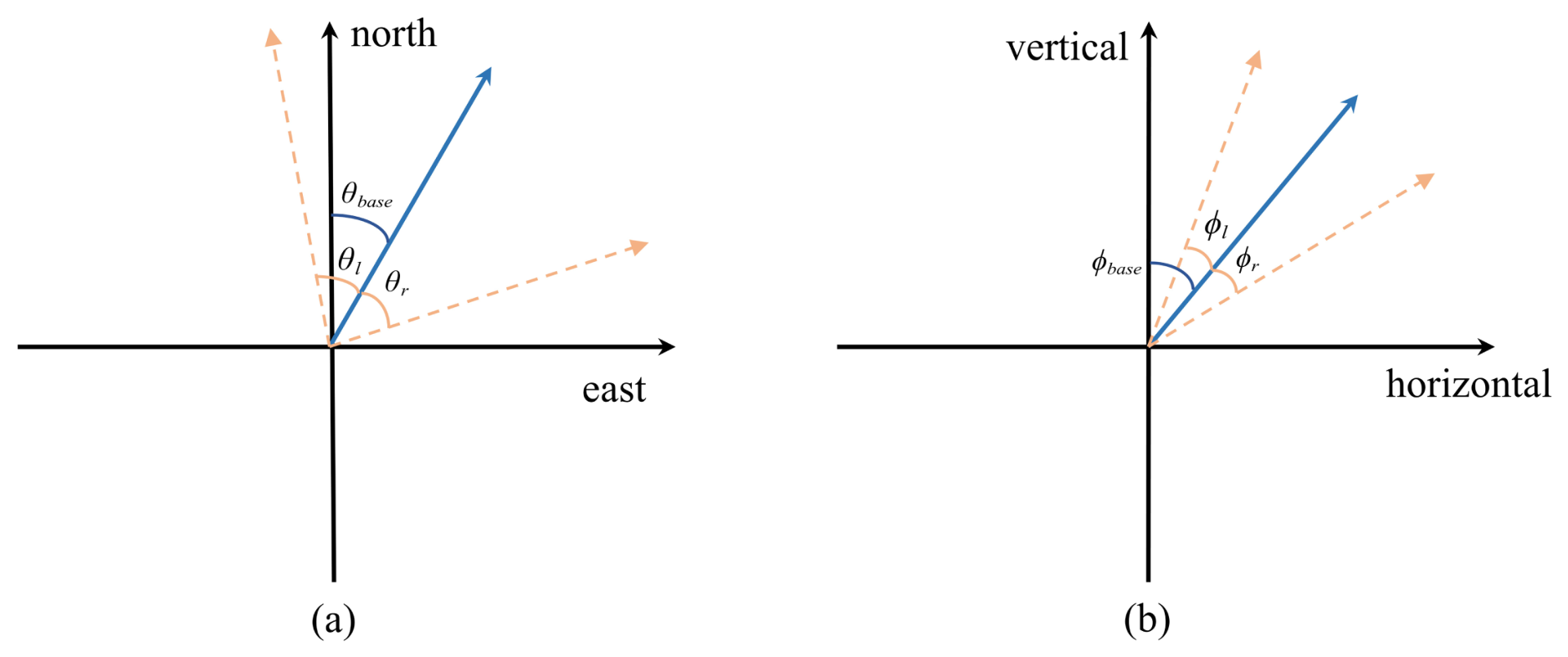
We denote θ base and ϕ base as the reference azimuth and elevation angles of the radar beam. The azimuth is measured relative to True North, while the elevation is taken with respect to the horizontal plane. According to the transmit-side power-density expression in Equation (7), the antenna gain reaches its peak along the boresight direction. Therefore, we define the maximum gain as G max = G ( 0 , 0 ) , which corresponds to the antenna pointing straight ahead. Using this definition, we can consistently evaluate the gain across different target directions. Figure 6a illustrates the horizontal scanning range. We define this range as [ θ l , θ r ] . Here, negative values represent counter-clockwise rotation and positive values represent clockwise rotation. Similarly, the vertical scanning range is [ ϕ l , ϕ r ] , as shown in Figure 6b. Negative values mean the beam points downward, while positive values mean upward. This separation of scanning ranges facilitates a clearer delineation of the antenna’s mechanical constraints and provides a rigorous definition of its direct-illumination sector.
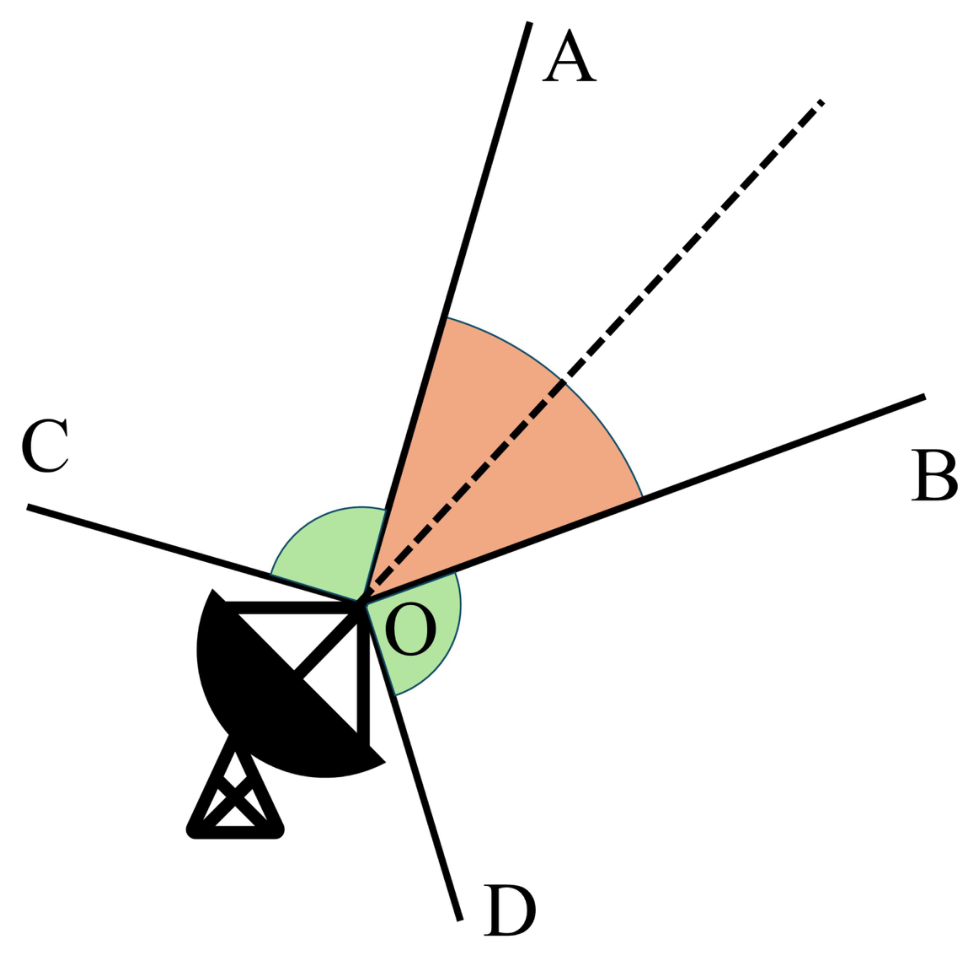
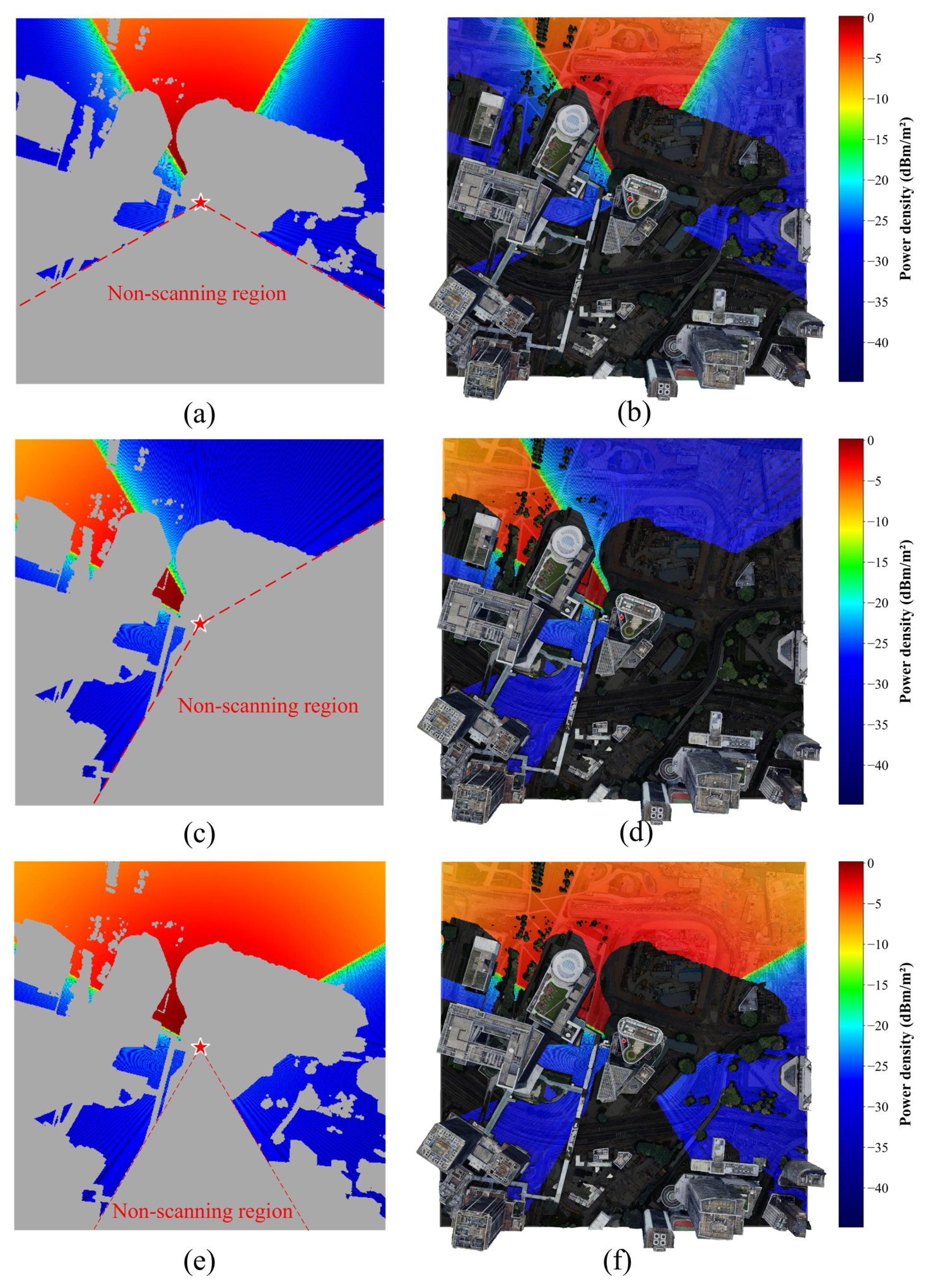
Figure 7 presents a 2D schematic of the radar power density in the horizontal plane. The dashed line indicates the reference direction of the antenna beam. The sector formed by A O B represents the region directly illuminated by the main beam, where the transmitted power density is highest. This schematic illustrates the relationship between beam steering and spatial power-density distribution, and provides a basis for evaluating multiple target positions under the same scanning configuration.
The maximum transmitted power density within the sectors subtended by A O C and B O D corresponds to the antenna gain associated with the minimum angular deviation. This power density is quantified using Equation (11):
Q tmax = P t G ( θ min , ϕ min ) 4 π R 2 L a ( R )
Here, θ min and ϕ min represent the minimum angular deviations between the target position and the instantaneous radar beam direction. This applies to the azimuth and elevation planes, respectively, during the scanning process. We determine these parameters via Equation (12):
θ min = min | θ i ( θ base + θ l ) | , | θ i ( θ base + θ r ) | ϕ min = min | ϕ i ( ϕ base + ϕ l ) | , | ϕ i ( ϕ base + ϕ r ) |
In this context, θ i denotes the azimuth of the i-th target relative to True North. Similarly, ϕ i denotes the elevation of the i-th target relative to the horizontal plane. Under the specified scanning configuration, target points located outside the radar direct-illumination sector are regarded as not being covered by the direct radar beam. Therefore, no direct-path transmitted-power-density contribution is assigned to these points, and their power-density value is set to zero. In Figure 7, this corresponds to the spatial sector formed by C O D . Section 4.3 further verifies that the computed power-density distributions follow the prescribed scanning-sector constraints.
The proposed VRPF implementation should be interpreted as a direct-path geometric-optics power-density model. This assumption is used for outdoor, clear-weather, short-range K-band direct-path power-density screening, where the wavelength at 24 GHz is about 1.25 cm and is much smaller than typical building-scale obstacles. Under such conditions, line-of-sight blockage is a dominant first-order factor for planning-level direct-path power-density assessment [46].
The simplification also defines the model boundary. Specular reflection and edge diffraction may produce weak indirect-path signal components or smooth the transition near shadow boundaries; these effects require additional ray interactions and material-dependent parameters [8]. Vegetation attenuation depends on foliage structure and path depth, while building reflection and penetration depend on material and structural properties. The photogrammetric mesh used in this study provides detailed geometry but not calibrated electromagnetic material labels. Therefore, the present experiments only consider radar power density under direct-path propagation, and the modeling of reflection, diffraction, vegetation attenuation, and penetration is left as an important direction for future work.

3.3. Parallel Processing Architecture

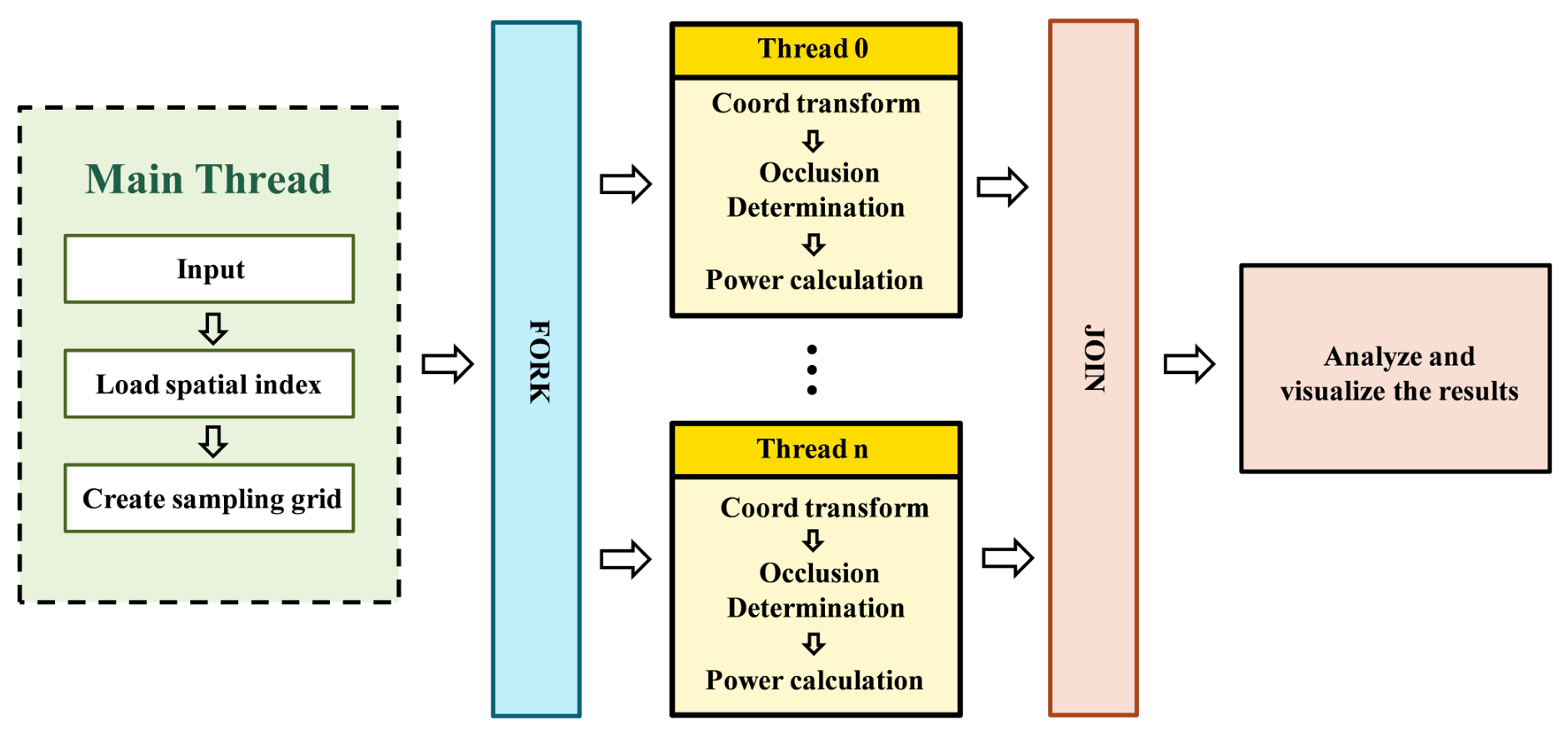
The evaluation of dense 3D target grids consists of many independent direct-path occlusion and transmitted-power-density queries. VRPF therefore adopts an OpenMP Fork–Join model, as shown in Figure 8. Before repeated computation, the spatial index is loaded once and bound to the radar computation module. The outer loop is then parallelized over target-point indices; each iteration performs coordinate projection, spatial-index-based occlusion determination, and transmitted-power-density computation for one target point. During querying, the spatial index is shared as a read-only structure by all OpenMP threads. Traversal reads node bounding boxes, child pointers, and triangle records, but does not update the index; therefore, no locks are required and no read–write or write–write conflicts occur on index nodes. Thread-local variables are used for projection, candidate counting, and segment-triangle testing, while output values are written independently by target index and aggregate counts are merged through OpenMP reduction. The benchmark implementation uses OpenMP dynamic scheduling for the target-point loop because radar-target segments can traverse different spatial-index paths and produce different candidate counts. This reduces load imbalance while preserving independent target-index writes. The DSM baseline uses the same target points and comparable OpenMP scheduling settings.

4. Results and Analysis

The experiments utilized Hong Kong oblique photogrammetric urban mesh datasets with varying spatial extents, sourced from the CSDI portal: https://portal.csdi.gov.hk/csdi-webpage/ (accessed on 20 October 2025). Detailed scene extents and radar deployment locations are introduced in the corresponding validation sections to avoid mixing dataset-specific deployment parameters with common radar system settings.
We used an oblique photogrammetric 3D model in .obj format to represent the urban geometry. It includes ground surfaces, building facades, bridges and elevated structures, and vegetation that are explicitly represented in the source mesh. These objects are therefore treated as potential occluding geometry in the visibility and power-density computation. The OBJ vertices used in computation are represented in a local metric coordinate system. For spatial reporting and radar placement, the horizontal coordinates can be transformed to Hong Kong 1980 Grid (EPSG:2326) and further to WGS84 geographic coordinates (EPSG:4326). The height coordinate is kept unchanged across the local, EPSG:2326, and EPSG:4326 representations. Unless otherwise specified, the radar positions and sampled target-point positions discussed in the subsequent experiments are reported in EPSG:4326. We simulated a K-band phased-array radar for low-altitude direct-path power-density assessment. To avoid conflating radar hardware settings with scene-specific deployment locations, Table 3 reports only the common radar system parameters used throughout the simulations.
The azimuth and elevation scan ranges in Table 3 are idealized and are not intended to represent the mechanical limits of a specific radar product. This setting is used to evaluate the computational behavior of the proposed framework over a broad spatial domain. Accordingly, the power density Q t calculated at a target point P i should be interpreted as the maximum direct-path transmitted power density attainable under the specified scan configuration.
The parameters in Table 3 define the common radar system configuration used by all validation experiments. All experiments were conducted on a unified hardware and software platform to ensure a fair performance comparison. The specific configurations are detailed in Table 4. The experimental code was predominantly written in C++.
Table 3. Common radar system parameters used in the simulations.
ParameterValue
Element spacing d 0.006 m
Carrier frequency f 24 GHz
Transmit power P t 1 W
Maximum antenna gain G max 25 dB ( 316.23 linear)
Number of array elements N256
Baseline elevation scan range 90 ° to 0 °
Baseline azimuth scan range 180 ° to 180 °
Table 4. Experimental platform configuration.
ItemDescription
CPU modelAMD EPYC 9T95 192-Core Processor
Logical CPUs64
Physical cores64
Memory128 GB RAM
Operating SystemUbuntu 22.04 LTS

4.1. Spatial Index Performance Evaluation

We selected three urban regions in Hong Kong with different spatial extents and conducted an implementation-level experiment to quantify spatial index construction and radar-signal occlusion determination. This supplementary experiment was performed on a local workstation equipped with an Intel Core i7-14650HX CPU with 24 logical cores, 32 GB RAM, and Ubuntu 22.04 running under WSL. The selected datasets cover square urban regions of 500 m × 500 m , 1000 m × 1000 m , and 2000 m × 2000 m , respectively. All three datasets were extracted from the same type of oblique photogrammetric mesh data and were indexed using the same R-tree parameters described in Section 3.1, namely the maximum branch capacity M = 8 , the minimum fill m = 4 , and the node-splitting strategy.
For each dataset, we first recorded the number of triangular facets, spatial-index construction time, final tree depth, and index-file size. The construction time includes OBJ file reading as well as R-tree insertion and node splitting. The index-file size in Table 5 refers to the storage size after serialization on disk. The statistics are summarized in Table 5.
Table 5 reflects how the spatial index scales as the spatial extent and the number of triangular facets increase. Under the fixed M and m settings, the tree depth provides a direct indicator of the generated hierarchy because it describes the actual index structure used during radar-signal occlusion determination, rather than only giving the theoretical R-tree parameters. The serialized index-file size further shows the disk storage cost of the constructed spatial index for each dataset.
We then evaluated the two-stage radar-signal occlusion-determination process on the same three datasets. For each dataset, 10 6 random three-dimensional target points were generated within the corresponding spatial extent, forming radar-target segments from the fixed radar position. Samples located inside buildings were excluded from the test set. The occlusion determination for these one million points was performed using eight OpenMP threads with dynamic scheduling over target points, consistent with the scheduling strategy described in Section 3.3. The time listed in Table 6 represents the core occlusion-determination time, including R-tree traversal, AABB coarse filtering, and exact segment-triangle testing. Random-point generation, coordinate-projection pre-processing, file I/O, and index construction are not included in this core time.
Table 6 reports three complementary indicators. The AABB candidate columns describe the number of triangular facets that remain after R-tree traversal and AABB coarse filtering and are then submitted to the exact segment-triangle intersection test. Without spatial indexing, each radar-target segment would need to be tested against all triangular facets; after spatial-index/AABB pruning, the average candidate counts are reduced to 0.827389, 2.031719, and 2.148659 for dataset1, dataset2, and dataset3, respectively. The minimum value is 0 for all datasets, indicating that many target points require no exact intersection test, while the maximum values remain limited to 44, 48, and 54 candidates. This shows that even for larger indexed scenes, only a small number of triangular facets enter the exact intersection stage for each radar-signal occlusion determination.
The core time column gives the total time required to complete 10 6 radar-signal occlusion determinations using eight OpenMP threads, while the core throughput column gives the corresponding number of determinations completed per second. As the data scale increases from dataset1 to dataset3, the core time increases from 0.152427 s to 0.518531 s, and the throughput decreases from 6.56 × 10 6 to 1.93 × 10 6 tests/s. This trend is consistent with the increasing number of indexed triangular facets and the slightly larger mean candidate count, while still demonstrating that the spatial-index/AABB stage keeps the exact-intersection workload small.
To further benchmark the proposed method against a full 3D acceleration structure, we implemented an additional BVH-based occlusion-determination baseline using the Open3D library. The BVH baseline and VRPF used the same source OBJ mesh, the same radar position, and the same randomly generated three-dimensional target points. The target-point altitudes were randomly sampled within 0–100 m. In both methods, eight threads were used for parallel processing. For a fair comparison of the algorithmic core, the reported runtime excludes OBJ file reading, acceleration-structure construction or loading, random target-point generation, and result output; it only includes the repeated core occlusion-determination stage. For the BVH runs in Table 7, rays were submitted in batches of 1.0 × 10 6 .
As shown in Table 7, VRPF consistently outperforms the Open3D BVH baseline in the core occlusion-determination stage. For 10 6 , 10 7 , and 10 8 target points, the BVH baseline is 11.16 × , 2.27 × , and 1.31 × slower than VRPF, respectively. To verify whether this trend is related to the batch-query behavior of the BVH baseline, we added a controlled experiment in which the total number of target points was fixed at 10 8 , the number of OpenMP threads was fixed at eight, and only the BVH batch size was varied.
For each batch-size setting, the experiment was repeated five times, and the BVH core time is reported as mean ± standard deviation.
The results in Table 8 show that BVH runtime is sensitive to batch configuration. A single 10 8 -ray batch requires 23.78 ± 2.07 s, indicating that very large tensor construction and memory pressure can reduce throughput. In contrast, intermediate batch sizes from 5.0 × 10 6 to 1.0 × 10 5 produce stable runtimes of approximately 18.4–18.7 s. When the batch size is reduced to 1.0 × 10 4 , the runtime increases to 20.17 ± 0.10 s because 10,000 separate BVH ray-casting calls introduce repeated invocation and scheduling overhead.
These controlled results support the interpretation that the decreasing BVH/VRPF runtime ratio in Table 7 is related to the amortization of fixed BVH invocation, tensor construction, and memory-allocation overhead over larger workloads. In the 10 6 -point test, these fixed costs are amortized over a relatively small number of rays, whereas in the 10 7 - and 10 8 -point tests they are distributed over many more rays, leading to more stable BVH throughput. Therefore, the change in runtime ratio should be interpreted as a batch-processing and throughput-stabilization effect rather than a change in occlusion-decision quality. The agreement rate remains above 99.81% for all three workload sizes, indicating that VRPF maintains nearly identical radar-signal occlusion determinations while providing lower runtime.

4.2. Limitations of 2.5D DSM-Based Occlusion Modeling

Before presenting the DSM comparison, we clarify the roles of the raster datasets. The public 5 m DTM and public 0.5 m DSM are used only for qualitative illustration and local error diagnosis, because they may differ from the oblique photogrammetric mesh in acquisition time and scene content. The controlled quantitative statistics are instead based on multi-resolution DSMs reconstructed from the same OBJ model as VRPF, which removes acquisition-time inconsistencies and isolates the effect of converting 3D geometry into 2.5D raster surfaces. Therefore, the public and same-source raster datasets are not interchangeable baselines.
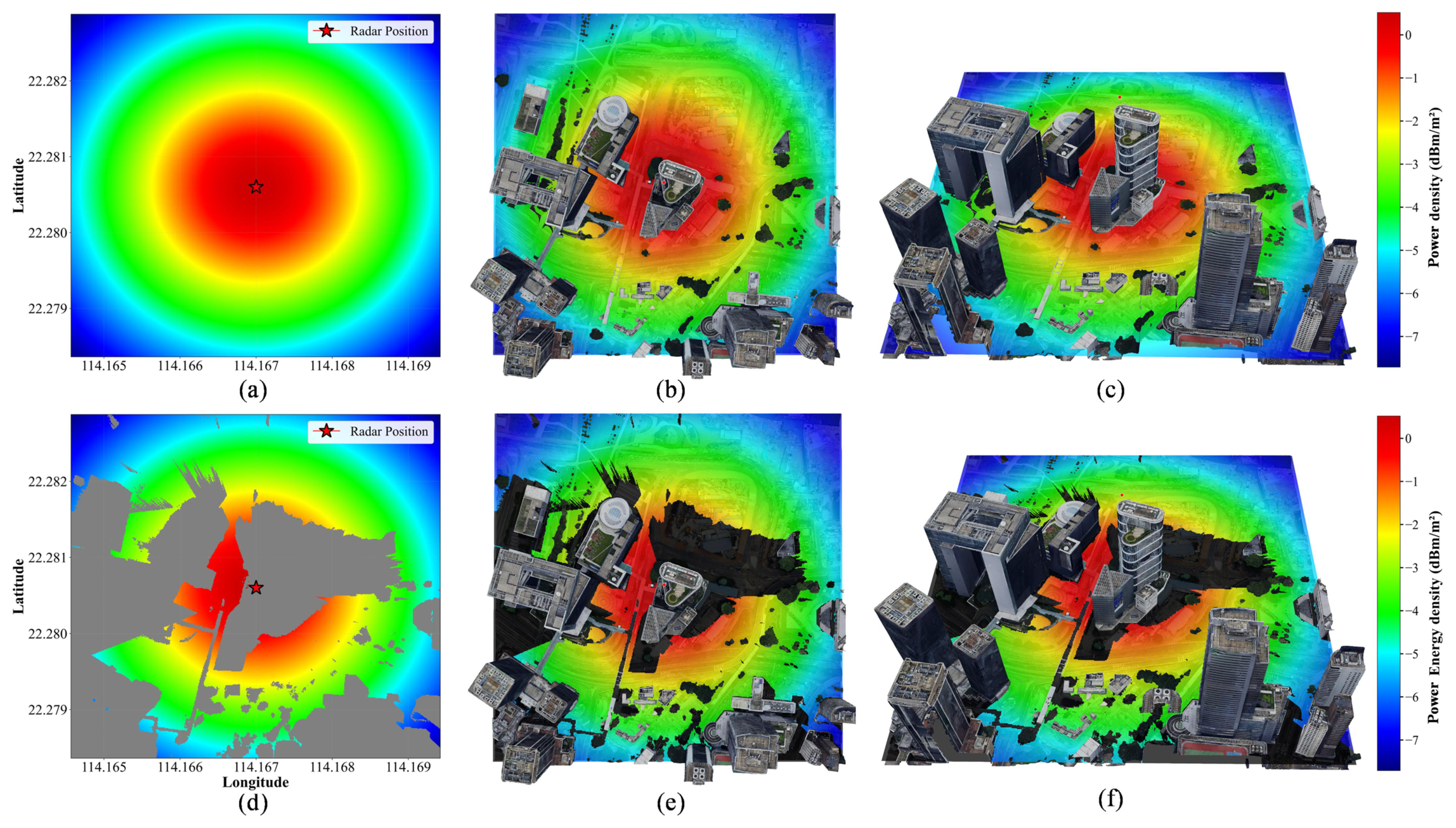
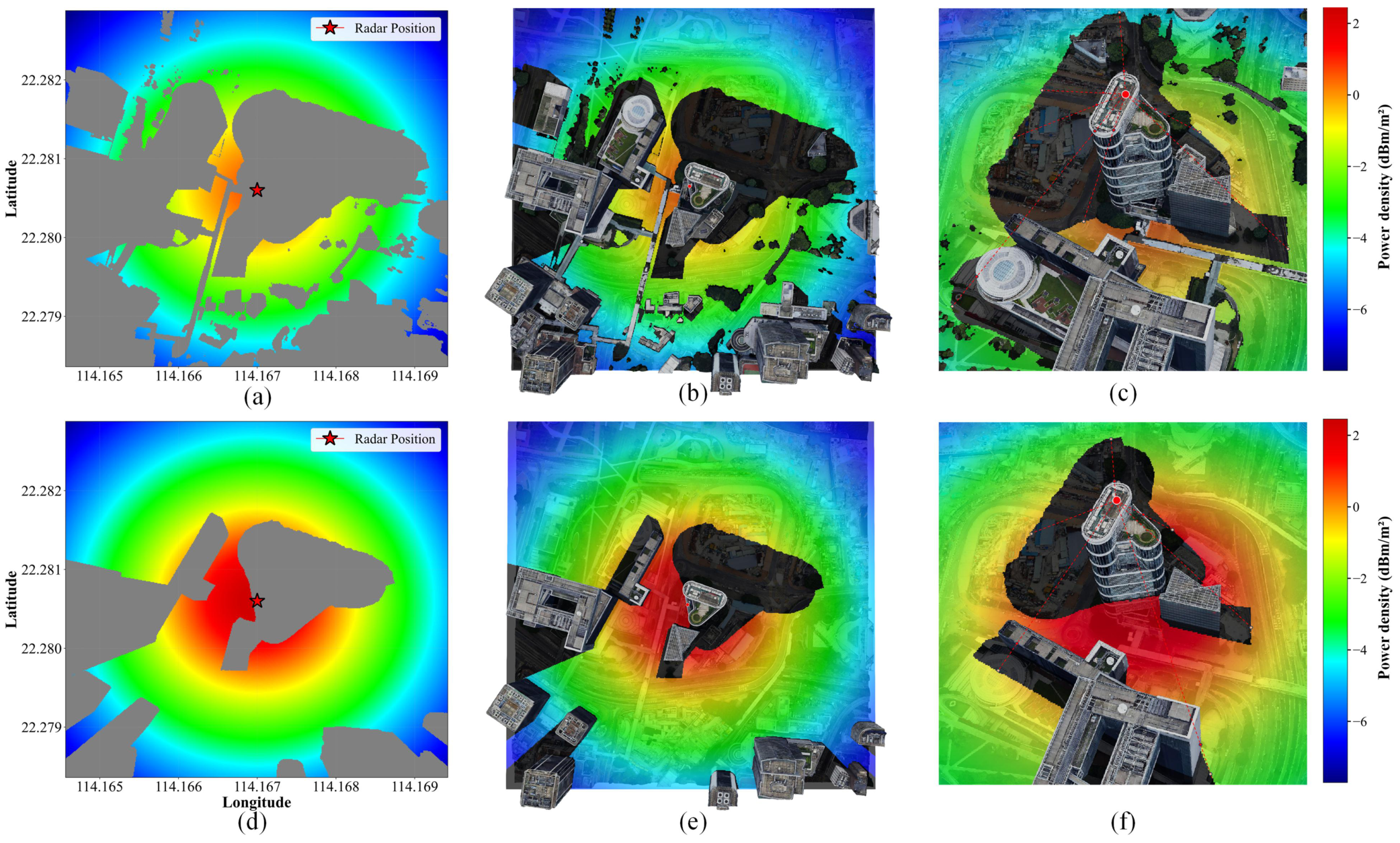
Accordingly, this subsection uses the public DTM and 0.5 m DSM only for qualitative visual comparison. The public Hong Kong datasets include a 5 m-resolution DTM from https://portal.csdi.gov.hk/csdi-webpage/ (accessed on 20 October 2025) and a 0.5 m-resolution DSM from https://sdportal.cedd.gov.hk/#/en/lidar (accessed on 20 October 2025), which were selected as standard terrain-based inputs. The computation used the common radar system parameters in Table 3 and the original Dataset 1 radar placement at 114.1670 ° E, 22.2806 ° N with a height of 164.20 m. The analysis calculated power density within a 500 m × 500 m area centered on the radar, focusing on a 15 m altitude slice to generate visual comparison maps. Finally, Figure 9 presents a qualitative comparison of these maps against the 3D real-world reference scene.
Figure 9a–c shows the results derived from the DTM data. The radar power-density field exhibits a large-scale, nearly continuous distribution because the DTM model does not include detailed building information, whereas buildings are the primary cause of radar-signal blockage in dense urban settings. Therefore, omitting such critical data becomes a major source of systematic error in practical direct-path radar power-density assessment. Figure 9d–f illustrates limitations of the publicly available DSM dataset. Despite its high resolution, the model frequently produces power-density misclassification near building edges and vegetation, where these regions are inconsistently classified as reachable or occluded. Such errors create significant aliasing artifacts at the boundaries of radar blind zones. These artifacts appear as gray areas in Figure 9d and black regions in Figure 9e,f within the 2D power field slice at 15 m altitude. This pattern is inconsistent with the expected geometry of sharp 3D structural boundaries and does not reproduce the sharp, continuous silhouettes of actual 3D structures. This limitation arises from the 2.5D DSM data structure itself; it is inherently unable to represent complex geometric boundary contours precisely.
Our analysis confirms a substantial limitation: both conventional DTM and DSM datasets introduce considerable errors in urban direct-path power-density assessment. For this reason, precise determination of geometric occlusion based on detailed 3D structural information is essential for accurate results. The systematic overestimation inherent to these traditional terrain models directly undermines the reliability of practical radar deployment siting and operational risk assessment.
The public DTM and 0.5 m DSM results above are therefore qualitative diagnostics only. For quantitative benchmarking, we generated multi-resolution DSMs from the same OBJ model used in Section 4.1, so that VRPF and DSM-based methods share the same source geometry and the remaining differences mainly reflect the conversion from a full 3D mesh to a 2.5D raster surface.
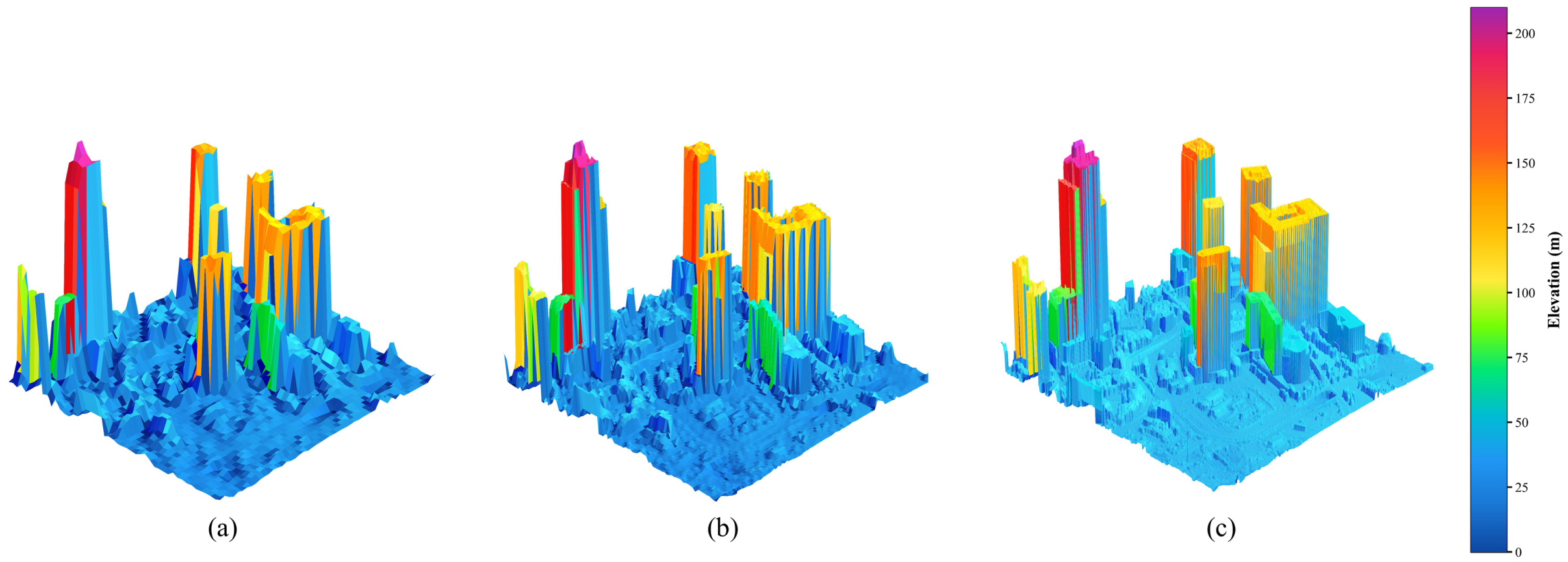
The DSM reconstruction was performed by orthogonal ray casting. For every raster grid cell, a vertical ray was cast along the Z-axis in the same local coordinate system as the OBJ mesh, and the maximum elevation among the ray–mesh intersections was assigned to that cell. This procedure produced DSMs at resolutions of 1, 5, 10, 15, and 20 m (Figure 10). Because these DSMs are reconstructed from the same 3D mesh, there is no temporal gap between the VRPF input and the DSM baselines used for quantitative benchmarking.

4.3. Quantitative Comparison with Multi-Resolution DSMs

4.3.1. Qualitative Analysis of Representative Error Regions

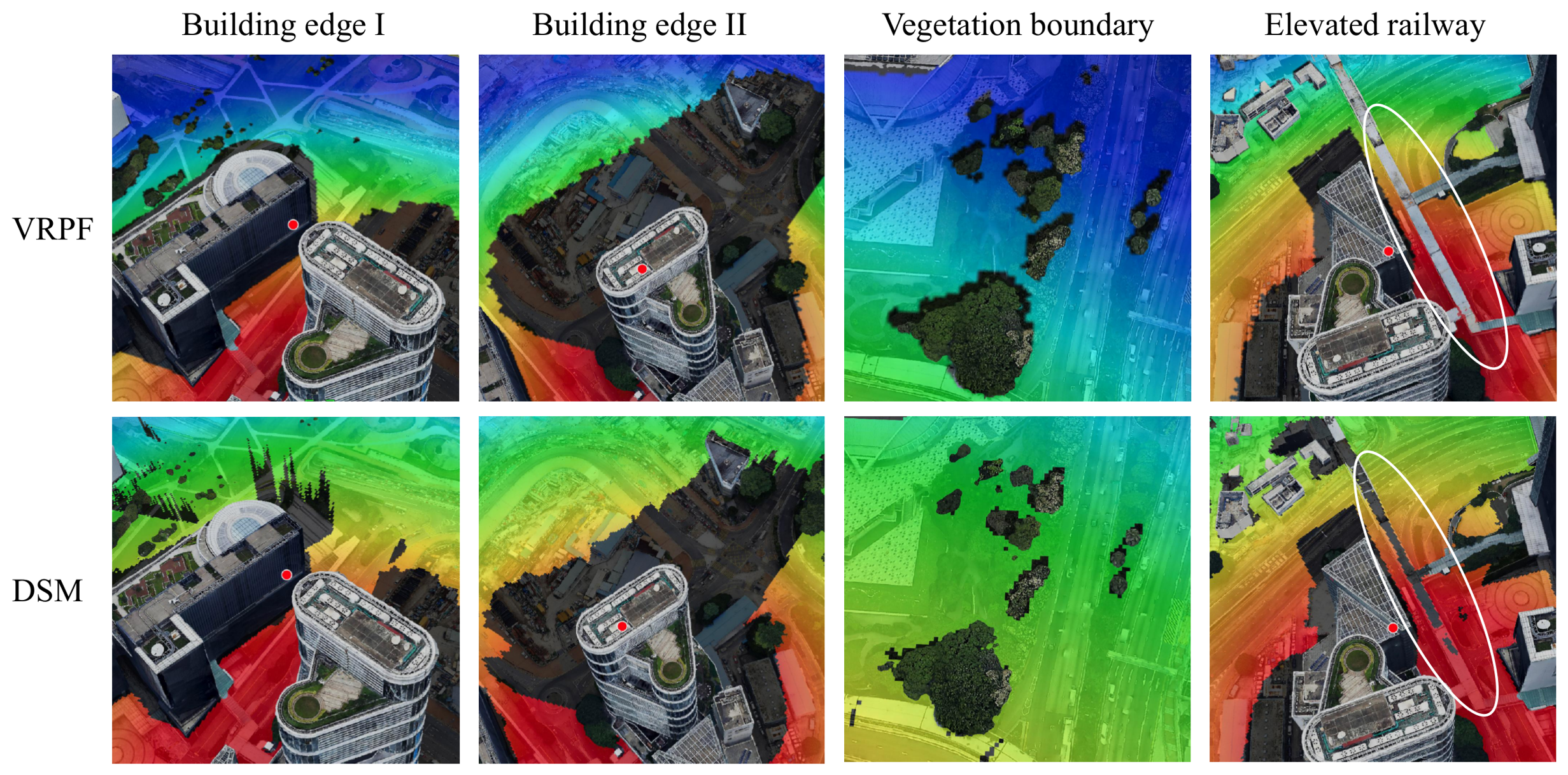
To explain where DSM-based occlusion errors occur, we use the publicly available 0.5 m DSM only for local qualitative diagnosis of representative mismatch regions.
Figure 11 compares representative local regions in Dataset 1. The top row shows VRPF results, and the bottom row shows public-DSM-based results. Columns 1–2 show building-edge cases, column 3 shows vegetation, and column 4 shows an elevated railway structure. In the last column, the elevated-roadway comparison further demonstrates the advantage of the mesh-based representation. VRPF preserves the continuous geometry and recognizable outline of the elevated bridge, whereas the DSM-based result produces an incomplete bridge shape due to the single-valued raster representation. This indicates that VRPF better maintains the geometric integrity of elevated urban structures and yields occlusion results that are more consistent with the real scene. These examples are used to explain the local geometric causes of the FPR and FNR reported below.
The local errors are concentrated around complex geometry rather than randomly distributed. At building edges, the true facade is a sharp vertical surface, but the DSM represents it only through horizontal grid cells. As a result, the building outline is approximated by cell boundaries, and the corresponding radar shadow boundary becomes blocky or shifted. Around vegetation, the public DSM generally does not preserve the full height and shape of tree crowns. This omission creates large differences from the mesh-based VRPF result, where vegetation present in the OBJ model is treated as potential geometric blockage. For elevated railways, bridges, and suspended structures, the key limitation is topological: a DSM is a single-valued 2.5D surface z = f ( x , y ) , so it cannot represent both the upper deck and the open space underneath.
These representative local observations are summarized in Table 9, which links each geometric condition to the corresponding DSM limitation and dominant error tendency.

4.3.2. Quantitative Comparison with Same-Source DSMs

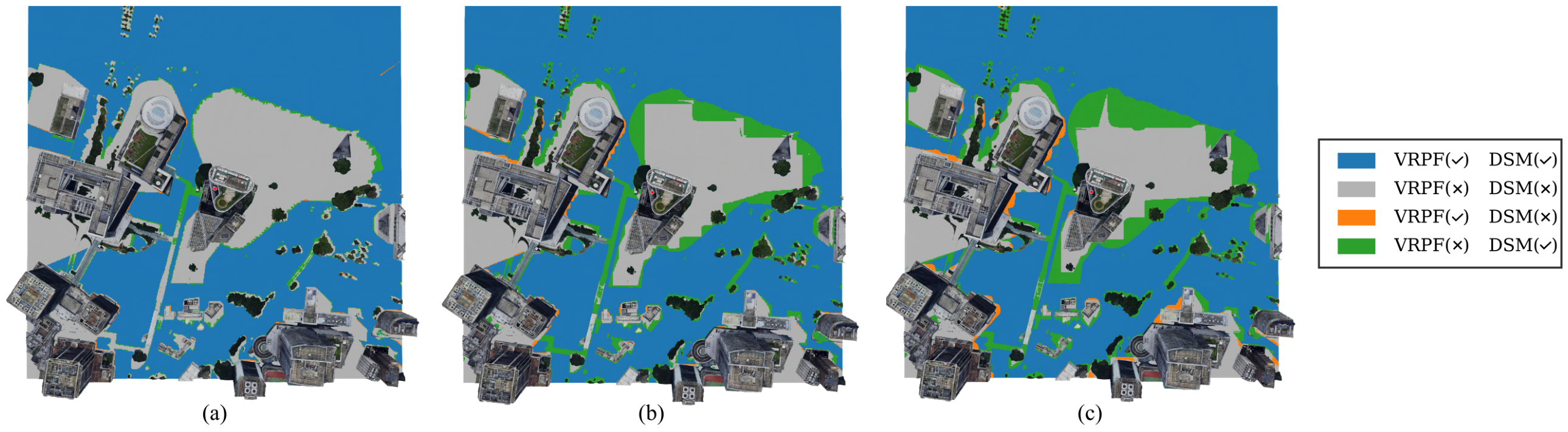
To further quantify the effect of DSM resolution under controlled geometry, we generated DSM datasets at different resolutions from the same OBJ model used by VRPF. These DSMs were processed using a traditional raster analysis workflow to determine radar-target occlusion and compute radar power density. For visualization, a four-color scheme is used to differentiate the results, as shown in Figure 12.
To further evaluate the discrepancies between the VRPF method and conventional methods as a function of DSM resolution, a quantitative analysis was performed. Because the same-source DSMs are reconstructed from the same OBJ model used by VRPF, the mesh-based VRPF result is adopted as the full-3D reference classification in this controlled comparison. The following accuracy metrics were calculated for each DSM resolution:
  • Agreement Rate (AR): The proportion of target points corresponding to the deep-blue and light-gray regions in Figure 12.
  • False-Negative Rate (FNR): The proportion of target points corresponding to the orange regions in Figure 12.
  • False-Positive Rate (FPR): The proportion of target points corresponding to the green regions in Figure 12.
The computational results are summarized in Table 10.
The counts in Table 10 are obtained from paired classification results on the same 251,500 target points, with VRPF used as the reference result. Therefore, the false-positive and false-negative counts can be used directly for paired statistical testing. In this setting, a false positive denotes a target point classified as visible by the DSM-based method but occluded by VRPF, whereas a false negative denotes a target point classified as occluded by the DSM-based method but visible by VRPF. Based on the counts in Table 10, we calculated Wilson 95% confidence intervals for AR, FNR, and FPR, and applied McNemar’s test with continuity correction to the discordant pairs, namely FP and FN. No additional sampling was introduced for this statistical analysis. The results are summarized in Table 11.
Table 10 and Table 11 show that the DSM–VRPF agreement decreases as DSM resolution becomes coarser. AR decreases from 97.49% at 1 m to 80.50% at 20 m, while FPR increases from 2.19% to 16.90%. The Wilson confidence intervals are narrow because each proportion is estimated from 251,500 paired target points, indicating stable estimates. McNemar’s tests show that the two types of DSM–VRPF disagreement are significantly imbalanced at all DSM resolutions ( p < 0.001 ). This imbalance indicates that DSM-based classification is not merely randomly different from VRPF, but has a directional bias toward false-positive visibility.
The statistical results also identify the direction of the DSM-induced bias. Across all DSM resolutions, FPR is consistently higher than FNR, with FP/FN ratios ranging from 6.49 to 18.34. This indicates that the DSM-based workflow more frequently classifies VRPF-occluded points as visible than it classifies VRPF-visible points as occluded, leading to an overestimation of direct-path visibility. This FPR-dominant pattern is consistent with the geometric mechanisms in Table 9: rasterized building edges shift blind-zone boundaries, under-represented vegetation weakens tree-crown blockage, and overhanging or hollow structures may introduce mixed FPR/FNR errors because a DSM can store only one elevation at each horizontal location. Therefore, the quantitative error values in Table 10 and the local mechanisms in Table 9 jointly show that DSM errors are caused not only by raster resolution, but also by the 2.5D data structure itself.
Together, the public-DSM local examples and the same-source quantitative results indicate that increasing DSM resolution can reduce horizontal sampling errors, but it cannot recover the missing vertical topology of the original 3D mesh.

4.4. Validation of VRPF Effectiveness

The preceding experiments isolate the geometric limitations of DSM-based representations and quantify the computational behavior of the proposed spatial-indexing framework. This section further evaluates the physical plausibility and deployment generality of the direct-path power-density fields computed by VRPF. Because the validation involves multiple datasets and radar placements, Table 12 first summarizes the spatial extent of each dataset and the radar points used in the corresponding experiments. Dataset 1 is the original 500 m × 500 m high-rise scene and uses one reference radar point, whereas Dataset 2 and Dataset 3 extend the validation to 1000 m × 1000 m and 2000 m × 2000 m regions with three radar points each.
We first examine Dataset 1 in detail because it contains dense high-rise buildings, narrow streets, elevated structures, and vegetation, making it a representative case for fine-grained urban blockage. Using the common radar system parameters in Table 3 and the Dataset 1 radar point in Table 12, VRPF computes horizontal direct-path power-density fields at 15 m and 45 m target-height slices over the 500 m × 500 m region.
Figure 13 provides visual evidence for the geometric consistency of VRPF under the direct-path assumption. The top-down and local detail views show that the shadow regions follow the silhouettes of buildings, elevated structures, and vegetation represented in the mesh. In unobstructed regions, the transmitted power density decreases radially with distance from the radar, following the expected inverse-square trend. Compared with the DSM-derived fields in Figure 9, the mesh-based result preserves sharper and more continuous shadow boundaries near complex urban geometry and substantially reduces aliasing artifacts.
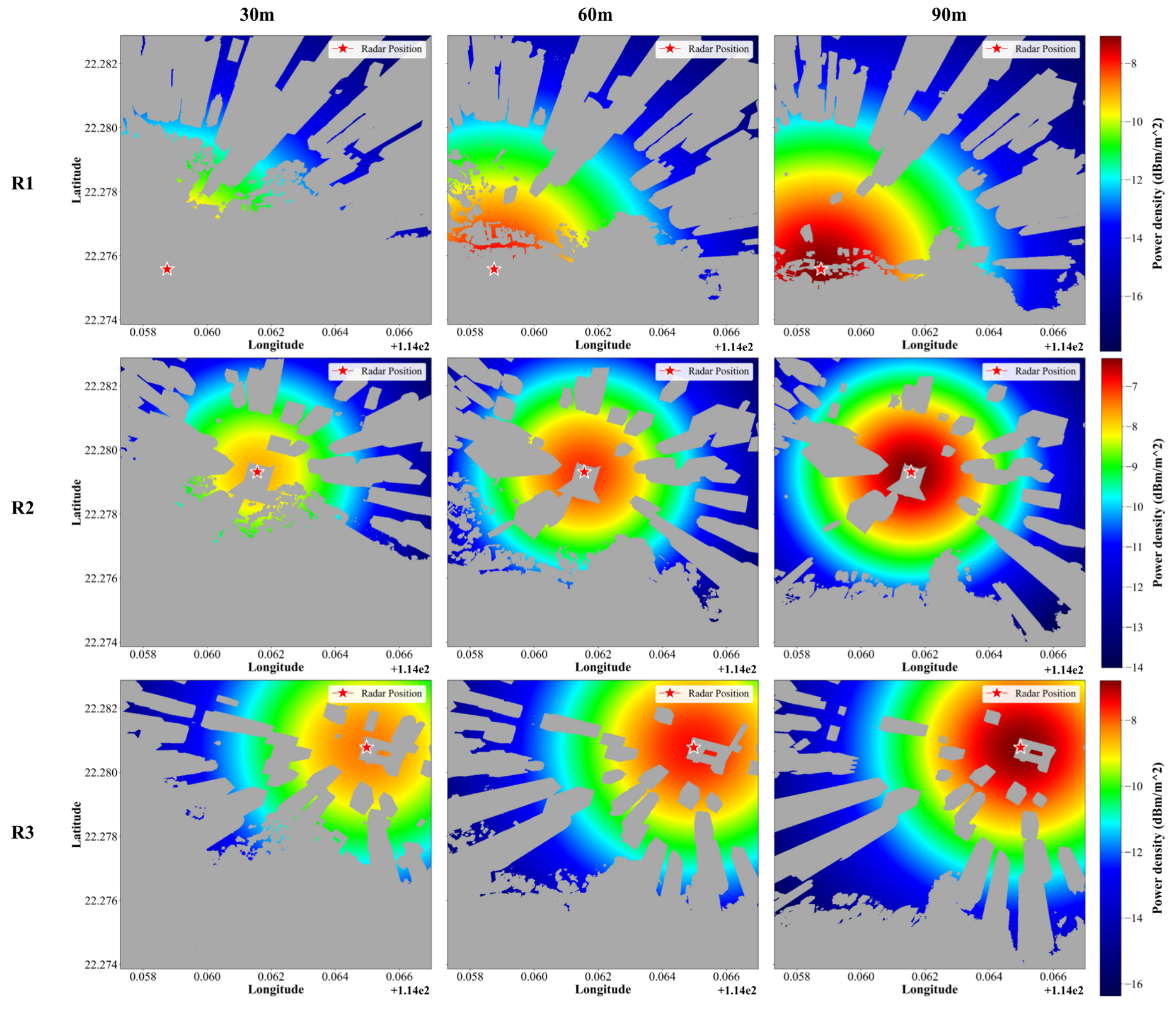
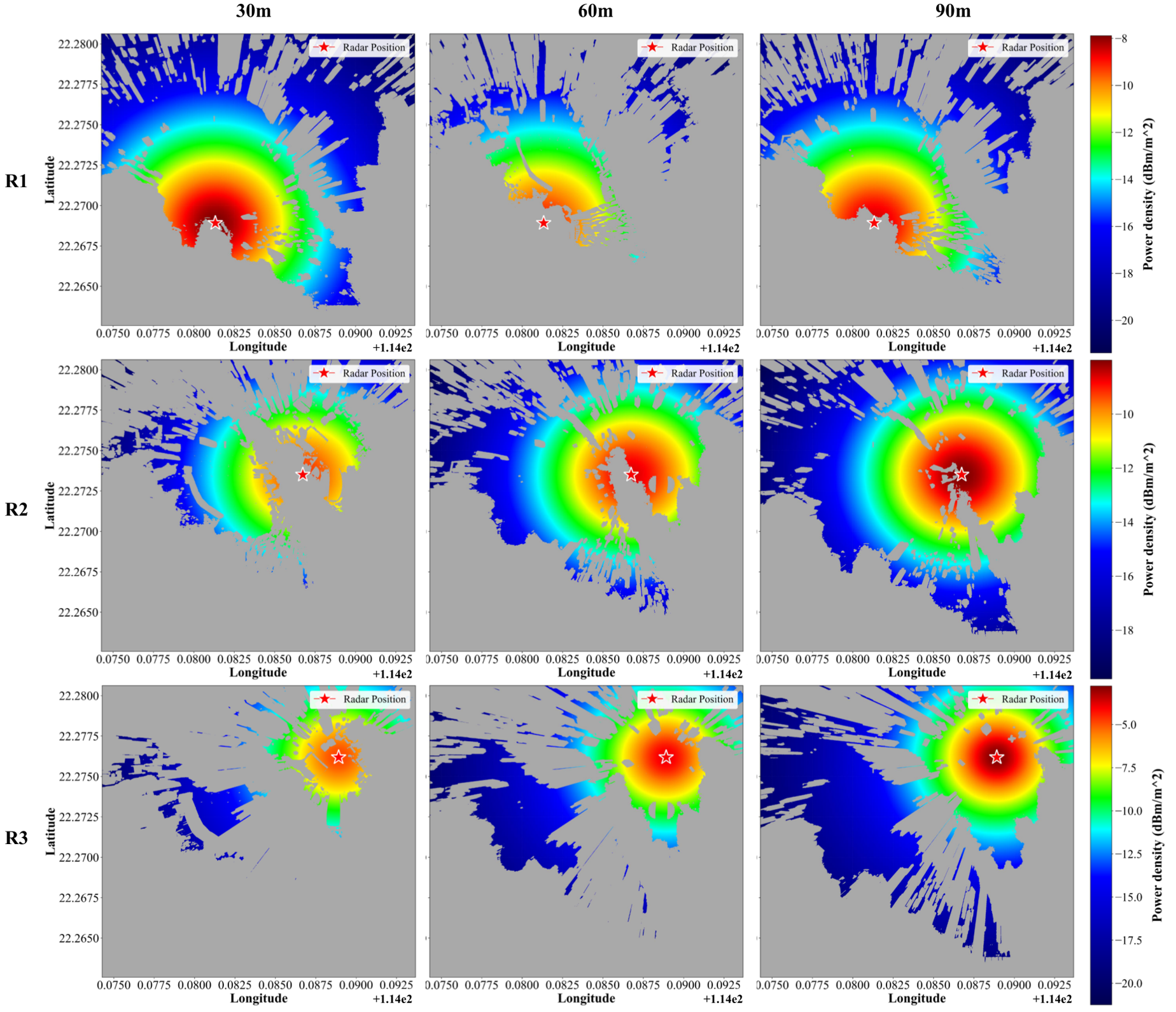
We next extend the validation to Dataset 2 and Dataset 3. For each larger scene, three radar positions in Table 12 were tested at 30 m, 60 m, and 90 m horizontal target-height slices. This setup evaluates VRPF across different scenes, radar locations, installation heights, and sectional heights.
Dataset 2 and Dataset 3 were selected to represent different urban morphologies rather than only larger spatial extents. Dataset 2 contains low-rise building blocks, road corridors, and locally dense buildings, while Dataset 3 includes built-up areas, high-relief mountainous terrain, and mountain vegetation. Together with the original high-rise scene, these datasets provide additional validation for low-rise built-up and mountainous-vegetation urban scenarios.
As shown in Figure 14, the high-power regions remain centered around the radar and decay outward, while the blind-zone boundaries vary with radar position and slice height. This confirms that VRPF is not tied to a single radar point or horizontal section.
Figure 15 further tests VRPF in a larger scene with both buildings and high-relief terrain. In the southwestern mountainous area, the average elevation is about 300–400 m; therefore, the 30 m, 60 m, and 90 m slices are below the terrain surface or fully terrain-blocked, leading to zero direct-path power density. Outside the fully terrain-blocked southwestern area, the maps show the expected direct-path pattern: transmitted power density decays radially in unobstructed regions, while blind-zone boundaries follow the surrounding buildings and terrain relief.
The radar heights in these extended cases are selected to make the direct-path radar power-density distribution on each horizontal slice more interpretable, rather than for deployment optimization. Low radar heights are dominated by near-field blockage and produce less interpretable sectional maps, whereas elevated viewpoints reveal broader shadow boundaries and make the effects of scene geometry, radar position, and slice height easier to observe.
Finally, we test the response of VRPF to scanning-angle changes using the original Dataset 1 radar point. All common radar parameters remain those in Table 3; only the angular scanning configuration is changed. As shown in Figure 16, the simulated distributions follow the theoretical beam sectors in Figure 7, while the shadow boundaries remain constrained by the 3D urban geometry.

4.5. Parallel Performance of the VRPF Method

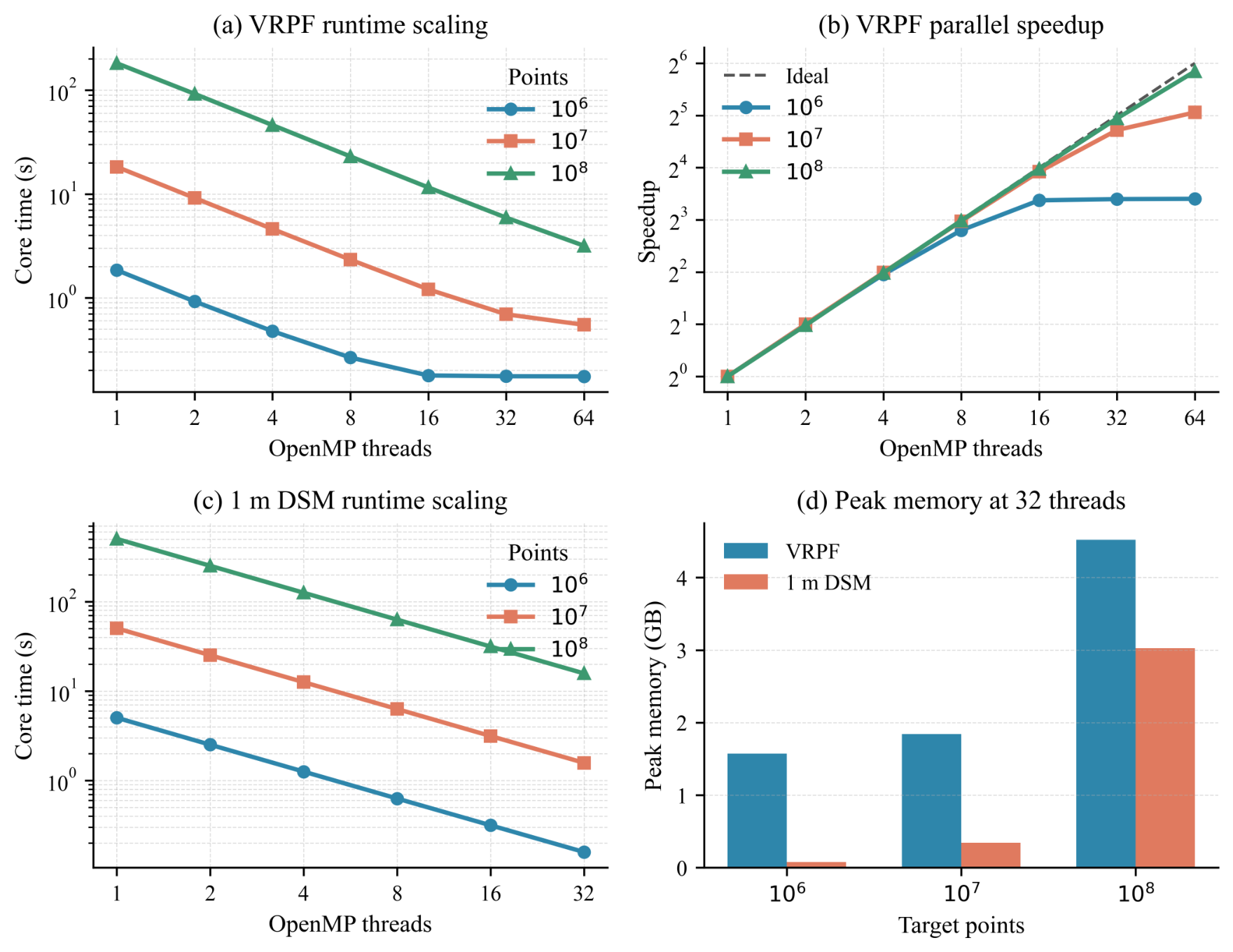
For practical, large-scale urban applications, computational efficiency is as critical as accuracy. The VRPF method is centered on occlusion determination between the radar and target points, followed by radar power-density computation. Because the computations for each target point are mutually independent, the problem is inherently amenable to parallel processing. This section focuses on evaluating the speedup achieved by parallel computation relative to serial computation. In this experiment, the computational task was the analysis of radar power density on horizontal cross-sectional slices within a 500 m × 500 m area. The runtimes in this section measure only the repeated computation stage. For VRPF, OBJ reading, spatial index construction, index loading, file I/O, and visualization are excluded. For DSM-based methods, DSM generation, file I/O, and visualization are excluded. For fairness, VRPF and DSM-based methods use the same target points, radar parameters, hardware platform listed in Table 4, common OpenMP thread counts, and the dynamic scheduling strategy described in Section 3.3. The common thread counts are 1, 2, 4, 8, 16, and 32; VRPF is additionally tested with 64 threads to show the saturation trend. The parallel computation time for each thread count was measured, and the speedup η was calculated, as defined by Equation (13):
η = T p = 1 T p = n , n = 1 , 2 , 4 , 8 , 16 , 32 , 64
where T p = 1 and T p = n represent the execution times for a single-threaded computation and a parallel computation using n threads, respectively. The experimental results are presented in Figure 17.
Figure 17a,b shows the runtime and speedup of VRPF for 10 6 , 10 7 , and 10 8 target points. The 10 6 -point case saturates early, whereas the 10 7 - and 10 8 -point cases continue to benefit from additional threads; at 32 threads, their speedups reach 26.35 × and 30.75 × , respectively.
Figure 17c reports the runtime of the 1 m DSM method. For the same 10 8 target points under 32 threads, the 1 m DSM method requires 15.754354 s, whereas VRPF requires 5.918491 s. This direct comparison shows that VRPF remains faster for large repeated occlusion-determination workloads.
Because file I/O and pre-processing are excluded, these timings primarily reflect the runtime of the algorithmic core. Minor variability may still arise from thread scheduling and memory-bandwidth effects on the shared platform.
Table 13 further reports the complete runtime measurements within the dataset1 region. The workloads are produced by computing radar power density on multiple cross-sectional slices, covering 10 6 to 10 8 target points. Peak memory is shown separately in Figure 17d, where it refers to the maximum resident memory during the repeated computation stage; pre-processing memory for R-tree construction or DSM generation is not included.
At 32 common threads, the regular 1 m DSM baseline is slightly faster for 10 6 points. However, when the workload increases to 10 7 and 10 8 points, VRPF reduces the runtime from 1.577096 s to 0.693072 s and from 15.754354 s to 5.918491 s, respectively. For 10 8 points, the 1 m DSM method is therefore about 2.66 × slower than VRPF. Together with the candidate statistics in Table 6 and Table 13 and Figure 17, they show that spatial-index/AABB pruning makes VRPF more advantageous for large repeated occlusion-determination workloads.
The sublinear scaling at high thread counts is mainly attributed to memory-system constraints rather than R-tree synchronization overhead. During repeated queries, the R-tree is shared as a read-only index; its nodes are not updated, so traversal requires no locks and introduces no read–write or write–write conflicts on index nodes. Because the shared index is only read, it is not expected to cause strong cache-coherence invalidation; the remaining coherence traffic mainly comes from shared read access, cache-line loading, and aggregate reductions.
The current R-tree is a pointer-based hierarchy rather than a cache-optimized contiguous layout. Concurrent queries may therefore access scattered nodes and triangle records, reducing cache locality and increasing last-level-cache and memory-bandwidth pressure, especially at 64 threads. The current implementation does not include explicit thread binding, NUMA-aware allocation, or cache-aware memory-layout optimization. Therefore, the 64-thread result should be viewed as the performance of a general OpenMP implementation rather than a fully architecture-tuned one. Future work will investigate thread affinity, NUMA-aware allocation, spatial partitioning, and compact node layouts to improve many-core scalability.

5. Conclusions

This study proposed VRPF, a mesh-based framework for computing one-way direct-path radar transmitted-power-density fields in complex urban environments. The framework addresses the limited ability of conventional 2D and 2.5D workflows to represent fine-grained 3D geometric blockage. By integrating oblique photogrammetric meshes, spatial-index/AABB spatial pruning, exact segment-triangle intersection testing, and OpenMP parallelization, VRPF enables efficient estimation of direct-path radar transmitted power density while explicitly accounting for fine-grained urban geometric blockage.
The experimental results show that the computed direct-path power-density fields follow the expected radial decay in unobstructed regions, and that the boundaries of occluded regions conform to the geometry of buildings and other blocking structures. Tests on three Hong Kong urban datasets further indicate that VRPF produces geometrically interpretable results across different scene types, radar locations, target heights, and scanning sectors.
The spatial-indexing experiment shows that the proposed spatial-indexing method can efficiently organize massive triangular facets. Across the three datasets, the index organizes 6.78 million, 26.21 million, and 102.14 million triangular facets, while the average number of candidate facets entering exact intersection testing remains low. The BVH baseline comparison shows more than 99.81% agreement in binary occlusion decisions with lower runtime, indicating the correctness and efficiency of the constructed index.
The comparative experiments show that true 3D meshes can reduce geometric occlusion errors introduced by 2.5D DSM representations. DSM-based results are prone to boundary displacement and visibility misclassification near building edges, vegetation, and elevated structures. Same-source DSM comparisons further indicate that these errors are related not only to acquisition differences or raster resolution, but also to the single-valued elevation structure of DSMs. The DSM false-positive rate increases from 2.19% at 1 m resolution to 16.90% at 20 m resolution, confirming the advantage of using oblique photogrammetric models to represent 3D urban structures for radar-signal occlusion detection. In the large-scale repeated computation experiment, VRPF computes 10 8 target points in 5.92 s using 32 OpenMP threads, whereas the 1 m DSM baseline requires 15.75 s. These results indicate that VRPF is effective for large-scale direct-path radar power-density computation in complex urban scenes.
Accordingly, VRPF should be interpreted as a transmit-side direct-path power-density model under geometric blockage, not as a complete radar detection-performance or electromagnetic-propagation model including reflection, diffraction, transmission, target RCS, SNR, or detection probability. Future work will couple the VRPF with material-aware propagation, multi-path, and SNR- or detection-probability models. Topology-aware mesh simplification is also needed to reduce index storage and repeated-query costs, enabling application to larger urban regions.

Author Contributions

Conceptualization, L.J. and A.Y.; methodology, L.J. and A.Y.; software, L.J. and M.M.; validation, L.J., Q.J. and Y.Z.; formal analysis, L.J. and A.Y.; investigation, L.J., L.W. and J.L.; resources, A.Y.; data curation, L.J. and Q.J.; writing—original draft preparation, L.J.; writing—review and editing, A.Y. and J.L.; visualization, L.J. and M.M.; supervision, A.Y.; project administration, A.Y.; funding acquisition, A.Y. All authors have read and agreed to the published version of the manuscript.

Funding

This research received no external funding.

Institutional Review Board Statement

Not applicable.

Informed Consent Statement

Not applicable.

Data Availability Statement

All datasets and source code employed in this study are publicly available. These resources can be accessed at the following: 5 m-resolution DTM: https://portal.csdi.gov.hk/csdi-webpage/ (accessed on 20 October 2025); 0.5 m-resolution DSM: https://sdportal.cedd.gov.hk/#/en/lidar (accessed on 20 October 2025); the VRPF source code: https://github.com/Lin-Hui-Jiao/Radar-Project (accessed on 2 June 2026); and the index-construction code: https://github.com/Lin-Hui-Jiao/buildindex (accessed on 2 June 2026).

Conflicts of Interest

The authors declare no conflicts of interest.

Abbreviations

The following abbreviations are used in this manuscript:
DSMDigital Surface Model
DTMDigital Terrain Model
DEMDigital Elevation Model
AABBAxis-Aligned Bounding Box
FNRFalse-Negative Rate
FPRFalse-Positive Rate

References

  1. Yan, X.; Fu, T.; Lin, H.; Xuan, F.; Huang, Y.; Cao, Y.; Hu, H.; Liu, P. UAV detection and tracking in urban environments using passive sensors: A survey. Appl. Sci. 2023, 13, 11320. [Google Scholar] [CrossRef]
  2. Besada, J.A.; Campaña, I.; Carramiñana, D.; Bergesio, L.; de Miguel, G. Review and simulation of counter-UAS sensors for unmanned traffic management. Sensors 2021, 22, 189. [Google Scholar] [CrossRef]
  3. Khawaja, W.; Ezuma, M.; Semkin, V.; Erden, F.; Ozdemir, O.; Guvenc, I. A survey on detection, classification, and tracking of UAVs using radar and communications systems. IEEE Commun. Surv. Tutor. 2025, 28, 3272–3310. [Google Scholar] [CrossRef]
  4. Griffiths, D.; Jahangir, M.; Kannanthara, J.; Donlan, G.; Baker, C.J.; Antoniou, M.; Singh, Y. Fully digital, urban networked staring radar: Simulation and experimentation. IET Radar Sonar Navig. 2024, 18, 657–673. [Google Scholar] [CrossRef]
  5. Kostic, A.; Rancic, D. Radar coverage analysis in virtual GIS environment. In Proceedings of the 6th International Conference on Telecommunications in Modern Satellite, Cable and Broadcasting Service, 2003. TELSIKS 2003; IEEE: New York, NY, USA, 2003; Volume 2, pp. 721–724. [Google Scholar]
  6. Ma, X.; Zhang, X.; Zhao, X. Service coverage optimization for facility location: Considering line-of-sight coverage in continuous demand space. Int. J. Geogr. Inf. Sci. 2023, 37, 1496–1519. [Google Scholar] [CrossRef]
  7. Tema, E.Y.; Sahmoud, S.; Kiraz, B. Radar placement optimization based on adaptive multi-objective meta-heuristics. Expert Syst. Appl. 2024, 239, 122568. [Google Scholar] [CrossRef]
  8. Yun, Z.; Iskander, M.F. Ray tracing for radio propagation modeling: Principles and applications. IEEE Access 2015, 3, 1089–1100. [Google Scholar] [CrossRef]
  9. Gómez, J.; Tayebi, A.; Hellín, C.J.; Valledor, A.; Barranquero, M.; Cuadrado-Gallego, J.J. Accelerated ray launching method for efficient field coverage studies in wide urban areas. Sensors 2023, 23, 6412. [Google Scholar] [CrossRef]
  10. Liao, K.; Ma, M.; Chen, L.; Zhang, Y.; Jing, N. HiFiRadio: High-Fidelity Radio Map Reconstruction for 3D Real-World Scenes. Technologies 2026, 14, 58. [Google Scholar] [CrossRef]
  11. Donohue, D.J.; Kuttler, J.R. Modeling radar propagation over terrain. Johns Hopkins APL Tech. Dig. 1997, 18, 279–287. [Google Scholar]
  12. Awadallah, R.S.; Lamar, M.T.; Kuttler, J.R. An accelerated boundary integral equation scheme for propagation over the ocean surface. Radio Sci. 2002, 37, 8-1–8-16. [Google Scholar] [CrossRef]
  13. Chen, P.; Wu, L. 3D representation of radar coverage in complicated environment. Simul. Model. Pract. Theory 2008, 16, 1190–1199. [Google Scholar] [CrossRef]
  14. Krajewski, W.F.; Ntelekos, A.A.; Goska, R. A GIS-based methodology for the assessment of weather radar beam blockage in mountainous regions: Two examples from the US NEXRAD network. Comput. Geosci. 2006, 32, 283–302. [Google Scholar] [CrossRef]
  15. Nie, K.; Fang, S.; Liu, H.; Wei, X.; Zhang, Y.; Yang, J.; Kong, Q.; Chen, B. Calculation Model of Radar Terrain Masking Based on Tensor Grid Dilation Operator. Remote Sens. 2024, 16, 1432. [Google Scholar] [CrossRef]
  16. Yilmaz, H.B.; Tugcu, T.; Alagoz, F.; Bayhan, S. Radio environment map as enabler for practical cognitive radio networks. IEEE Commun. Mag. 2013, 51, 162–169. [Google Scholar] [CrossRef]
  17. Inggs, M.; Lange, G.; Paichard, Y. A quantitative method for mono-and multistatic radar coverage area prediction. In Proceedings of the 2010 IEEE Radar Conference, Arlington, VA, USA, 10–14 May 2010; pp. 707–711. [Google Scholar]
  18. Li, W.; Franklin, W.R.; de Magalhães, S.V.G.; Andrade, M.V. Gpu-accelerated multiple observer siting. Photogramm. Eng. Remote Sens. 2017, 83, 439–446. [Google Scholar] [CrossRef]
  19. Axell, T.; Fridén, M. Comparison Between GPU and Parallel CPU Optimizations in Viewshed Analysis. Master’s Thesis, Chalmers University of Technology, Gothenburg, Sweden, 2015. [Google Scholar]
  20. Zhao, Y.; Padmanabhan, A.; Wang, S. A parallel computing approach to viewshed analysis of large terrain data using graphics processing units. Int. J. Geogr. Inf. Sci. 2013, 27, 363–384. [Google Scholar] [CrossRef]
  21. Wang, Z.; Xiong, L.; Guo, Z.; Zhang, W.; Tang, G. A view-tree method to compute viewsheds from digital elevation models. Int. J. Geogr. Inf. Sci. 2023, 37, 68–87. [Google Scholar] [CrossRef]
  22. Tang, G.; Yan, F.; Dai, J.; Zhang, G.; Chen, P.; Mu, Z.; Zhao, Q. Dynamic viewshed analysis based on the digital elevation model: Dynamic range proximity-direction-elevation reference line. Int. J. Geogr. Inf. Sci. 2024, 38, 2627–2647. [Google Scholar] [CrossRef]
  23. Wang, P.; Ma, J.; Li, F. Multi-observation points setting problem based on stepwise maximum viewshed approach. Int. J. Geogr. Inf. Sci. 2024, 38, 1780–1799. [Google Scholar] [CrossRef]
  24. Feng, W.; Gang, W.; Deji, P.; Yuan, L.; Liuzhong, Y.; Hongbo, W. A parallel algorithm for viewshed analysis in three-dimensional Digital Earth. Comput. Geosci. 2015, 75, 57–65. [Google Scholar] [CrossRef]
  25. Chen, Y.; Chen, J. A parallel multipoint viewshed analysis method for urban 3D building scenes. Trans. GIS 2021, 25, 2010–2028. [Google Scholar] [CrossRef]
  26. Zhang, Y.; Ma, M.; Li, J.; Yang, A.; Jia, Q.; Liu, Z. Efficient and fine-grained viewshed analysis in a three-dimensional urban complex environment. Environ. Model. Softw. 2025, 188, 106359. [Google Scholar] [CrossRef]
  27. Orlof, J.; Ozimek, P. TIN surface and radial viewshed determination algorithm parallelisation on multiple computing machines. Symmetry 2021, 13, 424. [Google Scholar] [CrossRef]
  28. Jung, J.; Olsen, M.J.; Hurwitz, D.S.; Kashani, A.G.; Buker, K. 3D virtual intersection sight distance analysis using lidar data. Transp. Res. Part Emerg. Technol. 2018, 86, 563–579. [Google Scholar] [CrossRef]
  29. Anderson, C.C.; Rex, A. Preserving the scenic views from North Carolina’s Blue Ridge Parkway: A decision support system for strategic land conservation planning. Appl. Geogr. 2019, 104, 75–82. [Google Scholar] [CrossRef]
  30. Orlof, J.; Ozimek, P.; Łabędź, P.; Widłak, A.; Ozimek, A. Generating viewsheds based on the Digital Surface Model (DSM) and point cloud. PLoS ONE 2024, 19, e0312146. [Google Scholar] [CrossRef]
  31. Zhao, Y.; Wu, B.; Wu, J.; Shu, S.; Liang, H.; Liu, M.; Badenko, V.; Fedotov, A.; Yao, S.; Yu, B. Mapping 3D visibility in an urban street environment from mobile LiDAR point clouds. GIScience Remote Sens. 2020, 57, 797–812. [Google Scholar] [CrossRef]
  32. Hirt, P.R.; Holtkamp, J.; Hoegner, L.; Xu, Y.; Stilla, U. Occlusion detection of traffic signs by voxel-based ray tracing using highly detailed models and MLS point clouds of vegetation. Int. J. Appl. Earth Obs. Geoinf. 2022, 114, 103017. [Google Scholar] [CrossRef]
  33. Zhao, J.; Zhang, Y.; Xu, A.; Zhang, X.; Zhang, Y.; Guo, S. DMP-KDO-PCLoSA: A LiDAR point cloud visibility analysis method for urban remote sensing using depth map projection and KNN optimization. Geocarto Int. 2025, 40, 2540948. [Google Scholar] [CrossRef]
  34. Guttman, A. R-trees: A dynamic index structure for spatial searching. In Proceedings of the 1984 ACM SIGMOD International Conference on Management of Data, Boston, MA, USA, 18–21 June 1984; pp. 47–57. [Google Scholar]
  35. Parent, J.R.; Lei-Parent, Q. Rapid viewshed analyses: A case study with visibilities limited by trees and buildings. Appl. Geogr. 2023, 154, 102942. [Google Scholar] [CrossRef]
  36. Zhou, X.; Wang, W.; Huang, Q.; Feng, N.; Han, P.; Wu, C. Sparse Multi-viewshed Analysis for Assisting Video Surveillance Network Location Optimization. In Proceedings of the 2024 36th Chinese Control and Decision Conference (CCDC), Xi’an, China, 25–27 May 2024; pp. 1687–1694. [Google Scholar]
  37. Parajuli, B.; Feng, X. Strategic Deployment of a Single Mobile Weather Radar for the Enhancement of Meteorological Observation: A Coverage-Based Location Problem. Remote Sens. 2025, 17, 870. [Google Scholar] [CrossRef]
  38. Ding, R.; Hu, S.; Xing, Z.; Yan, T. Multi-type radar deployment for UAV swarms defense coverage using Firework Algorithm with Determinantal Point Processes under complex terrain. Appl. Soft Comput. 2025, 170, 112681. [Google Scholar] [CrossRef]
  39. Li, H.P.; Feng, D.Z.; Chen, S.F.; Zhou, Y.P. Deployment optimization method of multistatic radar for constructing circular barrier coverage. Sensors 2021, 21, 6573. [Google Scholar] [CrossRef]
  40. Xing, Z.; Hu, S.; Ding, R.; Yan, T.; Xiong, X.; Wei, X. Multi-sensor dynamic scheduling for defending UAV swarms with Fresnel zone under complex terrain. ISA Trans. 2024, 153, 57–69. [Google Scholar] [CrossRef]
  41. Gemmi, G.; Cigno, R.L.; Maccari, L. On cost-effective, reliable coverage for los communications in urban areas. IEEE Trans. Netw. Serv. Manag. 2022, 19, 2767–2779. [Google Scholar] [CrossRef]
  42. Xing, Y.; Kanhere, O.; Ju, S.; Rappaport, T.S. Sub-terahertz wireless coverage analysis at 142 GHz in urban microcell. In Proceedings of the ICC 2022-IEEE International Conference on Communications, Seoul, Republic of Korea, 16–20 May 2022; pp. 3942–3947. [Google Scholar]
  43. Preparata, F.P.; Shamos, M.I. Computational Geometry: An Introduction; Springer Science & Business Media: Berlin/Heidelberg, Germany, 2012. [Google Scholar]
  44. Möller, T.; Trumbore, B. Fast, minimum storage ray-triangle intersection. J. Graph. Tools 1997, 2, 21–28. [Google Scholar] [CrossRef]
  45. International Telecommunication Union. Recommendation ITU-R P.676-13; Attenuation by Atmospheric Gases and Related Effects; International Telecommunication Union: Geneva, Switzerland, 2022; Available online: https://www.itu.int/dms_pubrec/itu-r/rec/p/R-REC-P.676-13-202208-I!!PDF-E.pdf (accessed on 2 June 2026).
  46. International Telecommunication Union. Recommendation ITU-R P.1411-9; Propagation Data and Prediction Methods for the Planning of Short-Range Outdoor Radiocommunication Systems and Radio Local Area Networks in the Frequency Range 300 MHz to 100 GHz; International Telecommunication Union: Geneva, Switzerland, 2017; Available online: https://www.itu.int/dms_pubrec/itu-r/rec/p/R-REC-P.1411-9-201706-I!!PDF-E.pdf (accessed on 2 June 2026).
Figure 1. Example of fine-grained triangular facets in the oblique photogrammetric city mesh.
Remotesensing 18 01936 g001
Figure 2. Workflow of VRPF: (a) mesh indexing, (b) direct-path occlusion determination, (c) transmitted-power-density computation, and (d) field output. The visualization example uses a radar at 114.1670 ° E, 22.2806 ° N with a height of 164 m and a horizontal slice at 15 m.
Remotesensing 18 01936 g002
Figure 3. R-tree branch-entry organization for triangular-facet indexing.
Remotesensing 18 01936 g003
Figure 4. Index construction process. (a) Based on index model and AABB for triangular meshes. (b) Node insertion and splitting. (c) Post-insertion node configuration.
Remotesensing 18 01936 g004
Figure 5. Schematic of the intersection test between the radar-target ray and an AABB.
Remotesensing 18 01936 g005
Figure 6. Schematic of the radar antenna scanning range: (a) azimuth direction; (b) elevation direction.
Remotesensing 18 01936 g006
Figure 7. Two-dimensional schematic of maximum direct-path transmitted power density within the scan sector.
Remotesensing 18 01936 g007
Figure 8. Fork–Join parallel execution model.
Remotesensing 18 01936 g008
Figure 9. Overall comparison of DTM- and DSM-derived direct-path radar power-density fields at 15 m altitude. The top row (ac) shows DTM-based results, and the bottom row (df) shows DSM-based results; columns show the slicing schematic, 2D top-down slice, and 3D perspective view, respectively. Gray areas in the 2D schematics and black regions in the 3D views indicate direct-path radar-signal occlusion.
Remotesensing 18 01936 g009
Figure 10. DSM reconstruction from the oblique photogrammetric model: (a) 10 m resolution; (b) 5 m resolution; (c) 1 m resolution.
Remotesensing 18 01936 g010
Figure 11. Local detailed analysis of DSM-induced occlusion errors in Dataset 1. Representative regions compare VRPF with the publicly available 0.5 m DSM near building edges, vegetation, and elevated structures.
Remotesensing 18 01936 g011
Figure 12. Comparative analysis results of occlusion determination between the VRPF method and DSM-based methods at different resolutions: (a) 1 m resolution, (b) 5 m resolution, and (c) 10 m resolution. In the legend, the check mark (✓) denotes that the target is determined to be visible (signal not blocked), while the cross mark (×) denotes that the target is determined to be occluded (signal blocked).
Remotesensing 18 01936 g012
Figure 13. VRPF-derived direct-path radar power-density slices at 15 and 45 m altitudes. Rows show the 15 m results (ac) and 45 m results (df), while columns show the cross-section schematic, top-down view, and local detail view. Gray and black regions indicate direct-path radar-signal occlusion.
Remotesensing 18 01936 g013
Figure 14. Extended VRPF validation in Dataset 2 ( 1000 m × 1000 m ). Rows correspond to radar points (R1R3), and columns correspond to 30 m, 60 m, and 90 m target-height slices. The star denotes the radar position; gray areas denote geometric blockage or building interiors.
Remotesensing 18 01936 g014
Figure 15. Extended VRPF validation in Dataset 3 ( 2000 m × 2000 m ). Rows correspond to radar points (R1R3), and columns correspond to 30 m, 60 m, and 90 m target-height slices. The star denotes the radar position; gray areas denote geometric blockage or building interiors.
Remotesensing 18 01936 g015
Figure 16. Two-dimensional cross-sections of the radar power-density field at an altitude of 15 m under varying azimuth scanning configurations: (a,b) [ 30 ° , 30 ° ] ; (c,d) [ 30 ° , 60 ° ] ; and (e,f) [ 60 ° , 60 ° ] . The right column illustrates the top-down view superimposed on the 3D urban model. The star denotes the radar position.
Remotesensing 18 01936 g016
Figure 17. Parallel scaling and memory comparison. (a) VRPF runtime under different target-point counts. (b) VRPF parallel speedup compared with the ideal linear trend. (c) Runtime of the 1 m DSM baseline. (d) Peak memory comparison under 32 OpenMP threads.
Remotesensing 18 01936 g017
Table 1. Comparison between representative related studies and the proposed VRPF framework.
Representative StudiesMethod CategoryMain StrengthLimitation and VRPF Advantage
Yun and Iskander [8];
Gómez et al. [9];
Liao et al. [10]
Ray tracing, ray launching, and radio-map modelingHigh physical fidelity for multi-path or radio-field estimation in urban scenesHigh repeated-query cost; VRPF is more lightweight
Krajewski et al. [14];
Nie et al. [15];
Li et al. [39]
Radar blockage, terrain masking, and deployment coveragePhysically interpretable radar-coverage assessment and deployment optimizationGrid simplification; VRPF uses 3D meshes
Tang et al. [22];
Wang et al. [23]
DEM/DSM viewshed and viewpoint optimizationEfficient for large-area terrain visibility and sensor siting2.5D constraint; VRPF uses 3D facets
Feng et al. [24];
Chen and Chen [25];
Zhang et al. [26]
GPU or indexed 3D viewshed analysisDemonstrates efficient 3D visibility analysis in complex scenesVisibility-focused; VRPF estimates power density
Orlof et al. [30];
Zhao et al. [31]
DSM/point-cloud 3D visibility mappingCaptures finer street-level geometry than DEM/DSM dataSampling effects; VRPF uses continuous triangles
Hirt et al. [32];
Zhao et al. [33]
Voxel ray tracing and depth-map/KNN point-cloud LOSImproves local occlusion handling for vegetation, sparse points, and depth gapsParameter-sensitive; VRPF reuses spatial indexing
Table 2. Key implementation parameters used in spatial index construction and occlusion query.
SymbolParameterValue
MMaximum branches per R-tree node8
mMinimum branches in a non-root node after splitting4
δ AABB AABB expansion used in coarse filtering0
ε Segment-triangle intersection tolerance 10 6
τ Δ Parallel or degenerate-triangle rejection threshold 10 6
Table 5. R-tree construction statistics and serialized index-file sizes for datasets with different spatial extents.
DatasetSpatial ExtentTriangular FacetsBuild Time (s)Tree DepthIndex-File Size (MB)
dataset1 500 m × 500 m 6,776,76133.379857.55
dataset2 1000 m × 1000 m 26,214,179136.55103316.96
dataset3 2000 m × 2000 m 102,138,513606.041112,904.4
Table 6. Eight-thread radar-signal occlusion-determination statistics for 10 6 randomly sampled three-dimensional target points per dataset.
DatasetMean CandidatesMin AABB CandidatesMax AABB CandidatesCore Time (s)Core Throughput (Tests/s)
dataset10.8273890440.152427 6.56 × 10 6
dataset22.0317190480.316222 3.16 × 10 6
dataset32.1486590540.518531 1.93 × 10 6
Table 7. Comparison between the Open3D BVH baseline and VRPF for 3D radar-signal occlusion determination.
Target Points NAltitude SettingBVH Core Time (s)VRPF Core Time (s)BVH/VRPF Runtime RatioSame DecisionsAgreement Rate
1.0 × 10 6 Random 0–100 m1.6970.15211.16998,18999.8189%
1.0 × 10 7 Random 0–100 m3.2611.4372.279,982,15299.8215%
1.0 × 10 8 Random 0–100 m18.54914.1531.3199,821,38399.8214%
Table 8. Controlled BVH batch-size experiment for a fixed workload of 10 8 target points using eight threads.
BVH Batch SizeNumber of BatchesBVH Core Time (s)Time per 10 6 Points (s)BVH/VRPF Ratio
1.0 × 10 8 1 23.78 ± 2.07 0.2381.68
1.0 × 10 7 10 20.26 ± 2.67 0.2031.43
5.0 × 10 6 20 18.72 ± 0.45 0.1871.32
1.0 × 10 6 100 18.54 ± 0.06 0.1851.31
5.0 × 10 5 200 18.52 ± 0.04 0.1851.31
1.0 × 10 5 1000 18.55 ± 0.07 0.1861.31
1.0 × 10 4 10,000 20.17 ± 0.10 0.2021.42
Table 9. Representative geometric mechanisms causing DSM-based occlusion errors.
RegionGeometryDSM LimitationDominant Error Tendency
Building edgesSharp facadesRasterized, stair-stepped boundariesBoundary-shift errors; mainly FPR when blocked edge areas are classified as visible
VegetationTree crowns and canopy boundariesVegetation height is often absent or weakly representedMainly FPR when tree-crown blockage is under-represented by the DSM
Overhang/hollow structuresMultiple surfaces or voids at one planimetric locationOnly one elevation can be storedMixed FPR/FNR depending on whether the upper deck or the open space is retained
Table 10. Accuracy metrics for different DSM resolutions.
Resolution (m)MatchesARFalse NegativesFNRFalse PositivesFPR
1 m245,17397.49%8190.33%55082.19%
5 m228,81590.98%11730.47%21,5128.55%
10 m219,37287.23%21460.85%29,98211.92%
15 m206,78782.22%41971.67%40,51616.11%
20 m202,45080.50%65522.61%42,49816.90%
Table 11. Statistical significance analysis of DSM–VRPF paired classification results.
ResolutionAR with 95% CIFNR with 95% CIFPR with 95% CIFP/FNMcNemar Test
1 m97.4843%
[97.4224, 97.5448]
0.3256%
[0.3041, 0.3487]
2.1901%
[2.1336, 2.2480]
6.73 χ 2 = 3473.58
p < 0.001
5 m90.9801%
[90.8675, 91.0915]
0.4664%
[0.4405, 0.4938]
8.5535%
[8.4448, 8.6634]
18.34 χ 2 = 18,233.82
p < 0.001
10 m87.2254%
[87.0944, 87.3553]
0.8533%
[0.8181, 0.8900]
11.9213%
[11.7952, 12.0485]
13.97 χ 2 = 24,115.64
p < 0.001
15 m82.2215%
[82.0716, 82.3704]
1.6688%
[1.6195, 1.7196]
16.1097%
[15.9666, 16.2539]
9.65 χ 2 = 29,499.19
p < 0.001
20 m80.4970%
[80.3417, 80.6514]
2.6052%
[2.5436, 2.6682]
16.8978%
[16.7519, 17.0448]
6.49 χ 2 = 26,341.35
p < 0.001
Table 12. Datasets and radar configurations used for VRPF validation.
Dataset InformationRadar Deployment
DatasetExtentLon. Range (°)Lat. Range (°)IDRadar Lon. (°)Radar Lat. (°)Height (m)
Dataset 1 500 m × 500 m [ 114.16457 , 114.16942 ] [ 22.278365 , 22.28288 ] R0 114.1670 22.2806 164.20
Dataset 2 1000 m × 1000 m [ 114.15729 , 114.16699 ] [ 22.27384 , 22.28287 ] R1 114.15874 22.27558 447.61
R2 114.16156 22.27931 417.22
R3 114.16497 22.28077 382.62
Dataset 3 2000 m × 2000 m [ 114.17427 , 114.19368 ] [ 22.26256 , 22.28062 ] R1 114.18132 22.26891 483.44
R2 114.18674 22.27350 488.35
R3 114.18891 22.27618 308.09
Table 13. Runtime comparison between VRPF and the 1 m DSM method under different OpenMP thread counts.
Target PointsMethodRuntime (s) Under OpenMP Threads
1248163264
1.0 × 10 6 VRPF1.8461110.9214630.4765620.2653620.1782000.1752510.174721
1.0 × 10 6 1 m DSM5.0320442.5140281.2581860.6291760.3158580.158708
1.0 × 10 7 VRPF18.2623479.1480834.5963072.3275721.2053760.6930720.548365
1.0 × 10 7 1 m DSM50.28212825.18389012.5737426.2991923.1447061.577096
1.0 × 10 8 VRPF182.02279092.26465646.10028823.01412111.5689625.9184913.170047
1.0 × 10 8 1 m DSM502.749978251.322680125.63754462.87125431.46441415.754354
Disclaimer/Publisher’s Note: The statements, opinions and data contained in all publications are solely those of the individual author(s) and contributor(s) and not of MDPI and/or the editor(s). MDPI and/or the editor(s) disclaim responsibility for any injury to people or property resulting from any ideas, methods, instructions or products referred to in the content.