VRPF: A Fine-Grained 3D Radar Power-Density Computation Framework Based on Photogrammetric City Models for Urban Observation


Highlights
- VRPF couples 3D mesh visibility with radar parameters to compute direct-path power density under urban blockage.
- It uses reusable spatial indexing, AABB pruning, ray-triangle tests, and multi-baseline validation to improve accuracy and efficiency.
- VRPF enables fine-grained assessment of direct-path radar power-density distributions in complex urban environments.
- The method supports sensor-deployment assessment for the low-altitude economy and contributes to urban observation and counter-UAV planning.
Abstract
1. Introduction
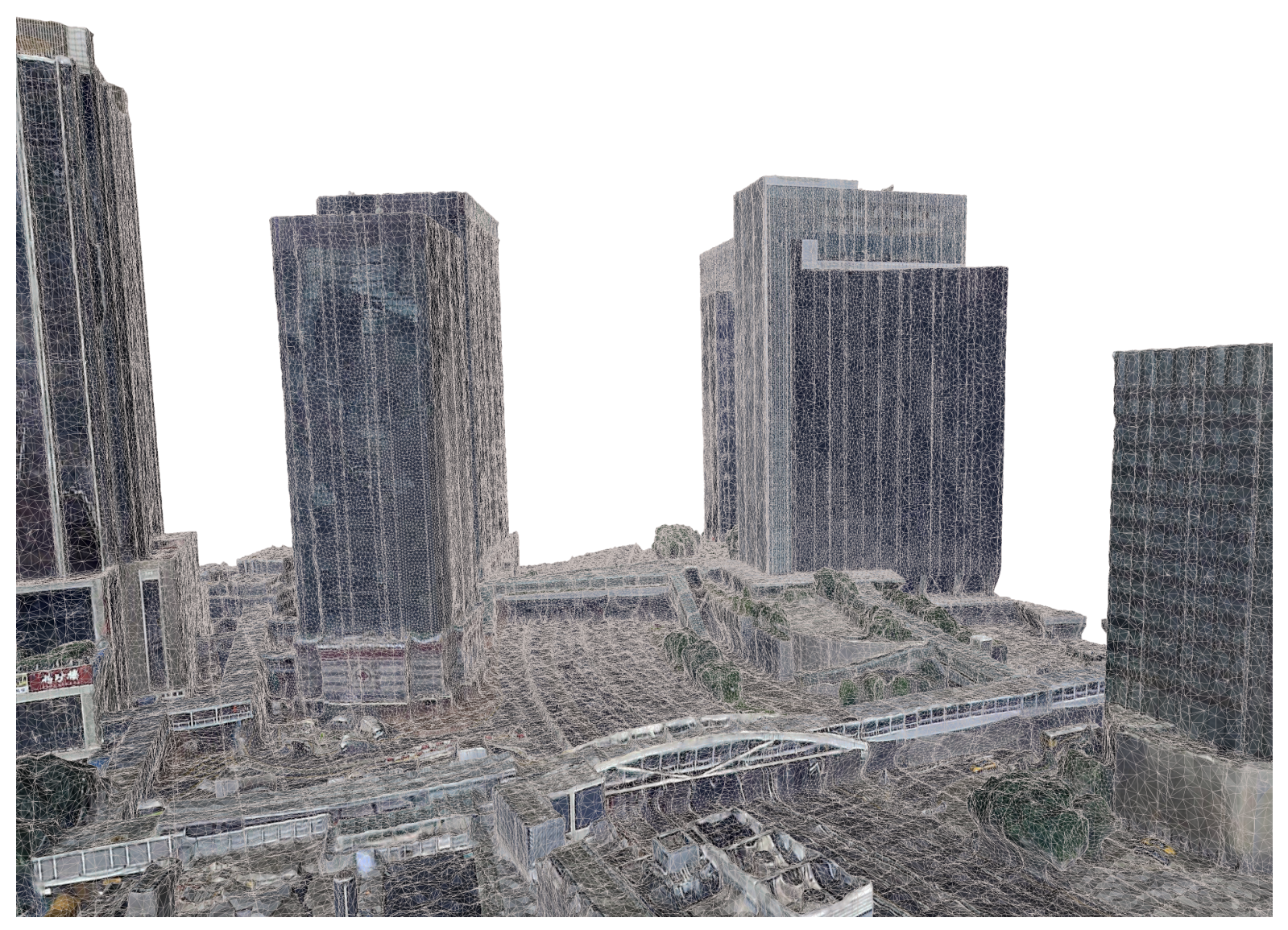
- Spatial-indexed occlusion query for large-scale mesh data: A reusable spatial-indexed query method is developed for repeated radar-target occlusion determination on massive oblique photogrammetric triangular meshes. By combining AABB-based coarse pruning, exact ray-triangle intersection testing, and OpenMP parallel execution, the method reduces the number of triangular facets entering exact intersection tests and supports efficient fine-grained occlusion queries in large urban scenes.
- Direct-path radar power-density computation with fine urban occlusion: A direct-path radar power-density computation framework is established by coupling mesh-based visibility with antenna gain, scanning geometry, propagation distance, and geometric blockage. By directly using oblique photogrammetric mesh surfaces, the framework preserves facades, bridges, overhangs, vegetation, and hollow spaces, and converts binary line-of-sight information into a quantitative 3D direct-path radar power-density field for urban direct-path power-density assessment.
- Multi-baseline validation of accuracy and efficiency: Same-source DSMs, public DSM comparisons, BVH ray-casting tests, and multi-scene experiments are used to evaluate geometric accuracy, visibility consistency, and computational efficiency.
2. Related Works
2.1. Radar Propagation Modeling: From Natural Terrain to Urban
2.2. Viewshed Analysis: Evolution from 2.5D to 3D
2.3. Sensor Deployment and Coverage Optimization
2.4. Summary
3. Methodology
- (1)
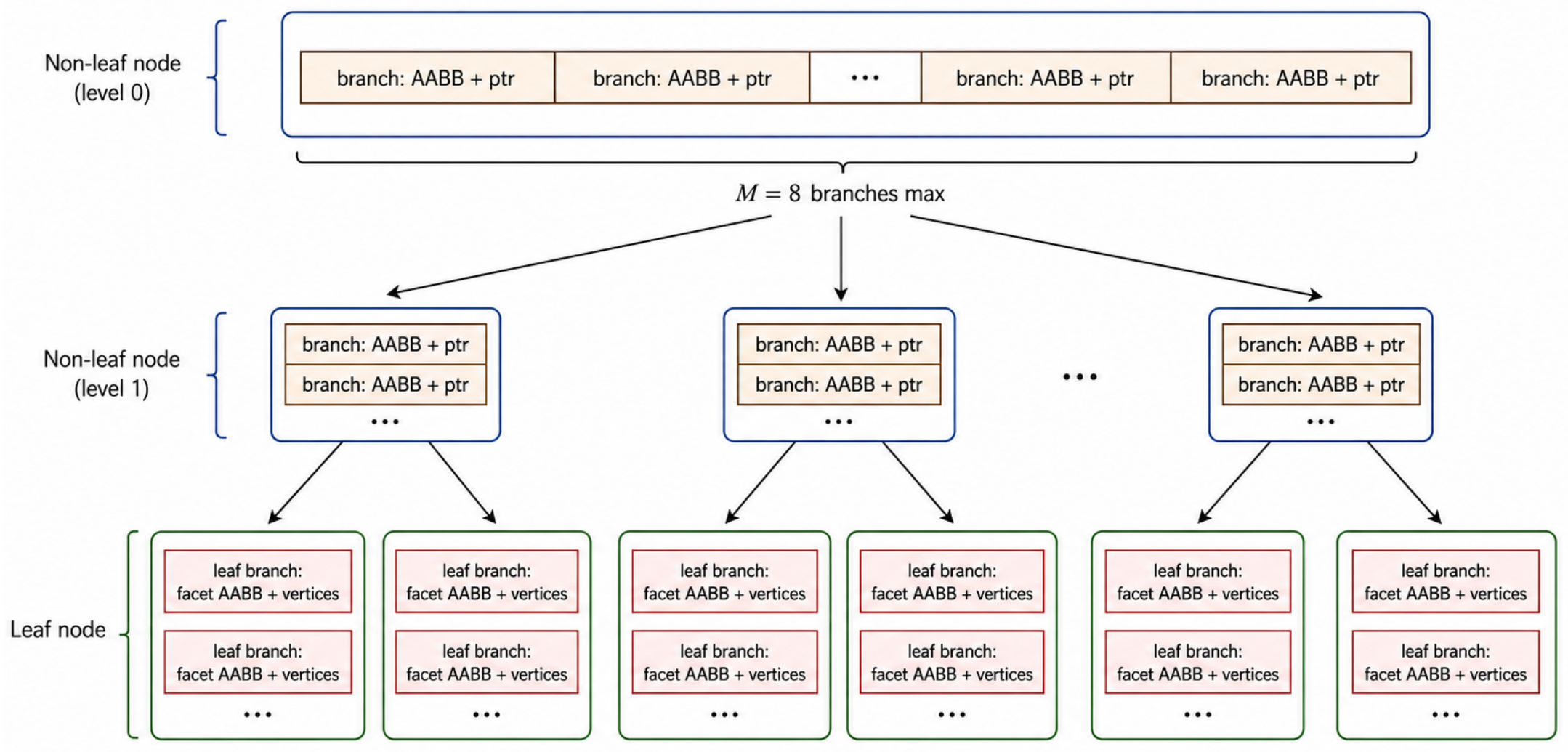
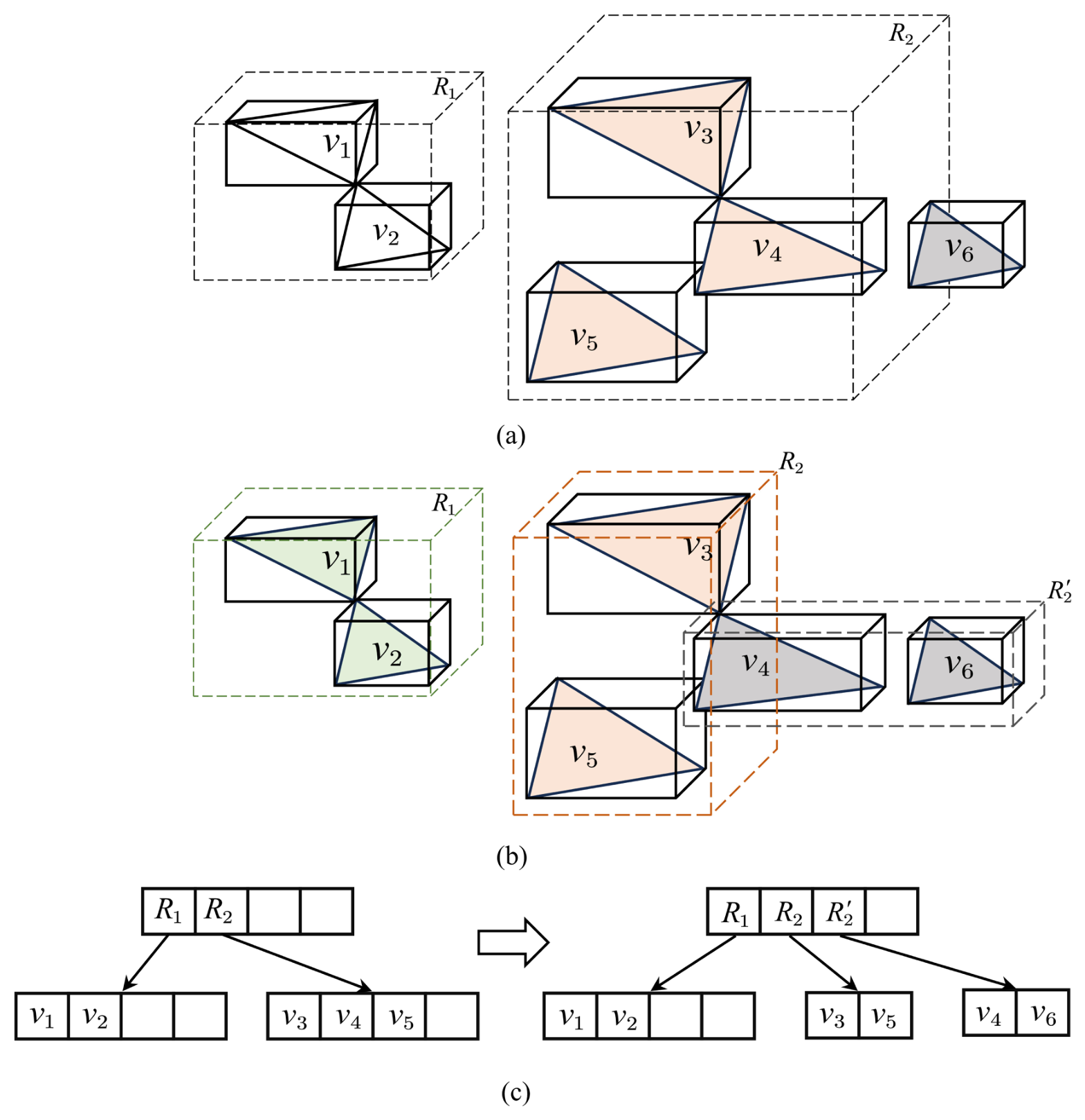
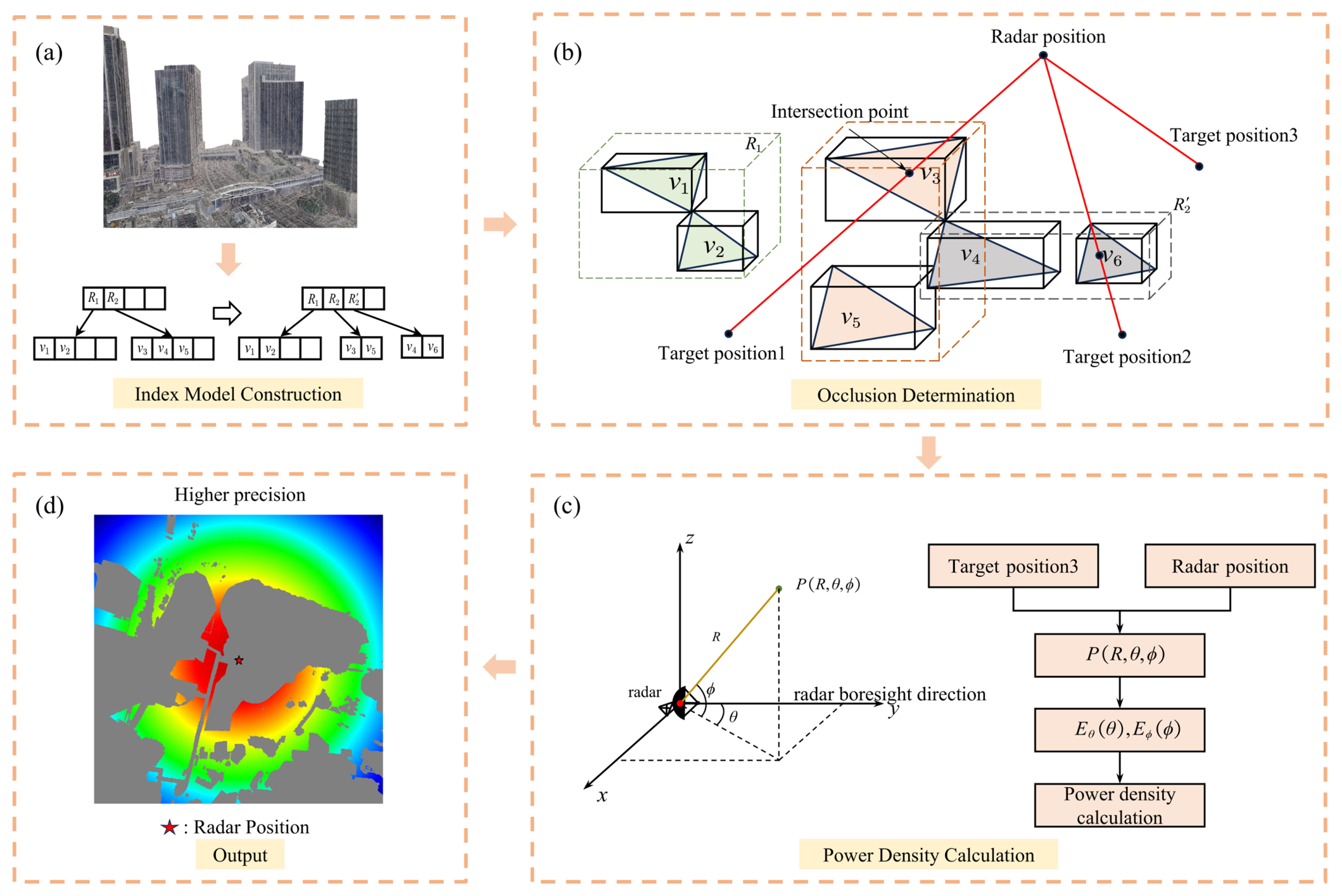
- Index Model Construction: We organize massive, unstructured triangular meshes into a hierarchical spatial index. This pre-processing step converts raw geometric data into an optimized structure for efficient spatial queries.
- (2)
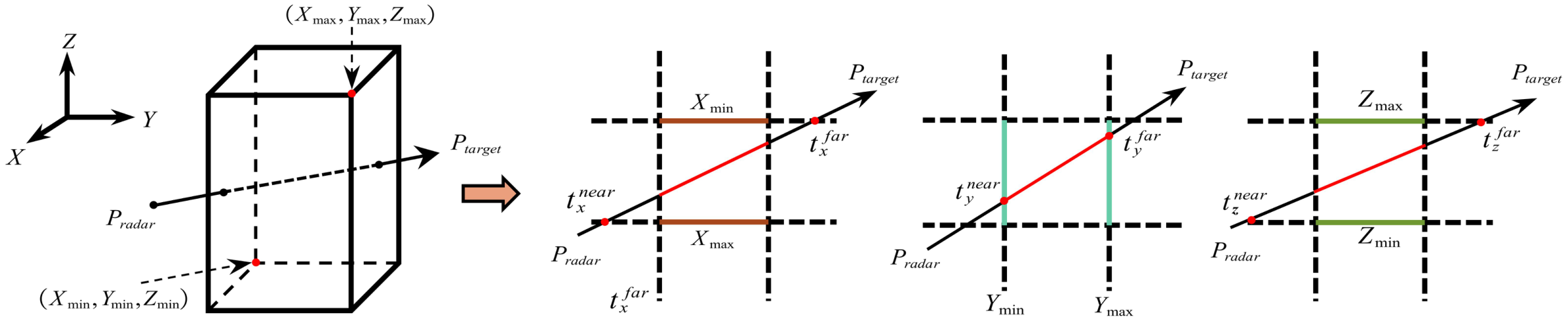
- Mesh-based Occlusion Determination: We determine the blockage state of the direct radar-target path using a two-stage intersection test. First, the spatial index performs rapid coarse pruning. Then, exact ray-triangle intersection tests are applied to detect fine-grained geometric blockages.
- (3)
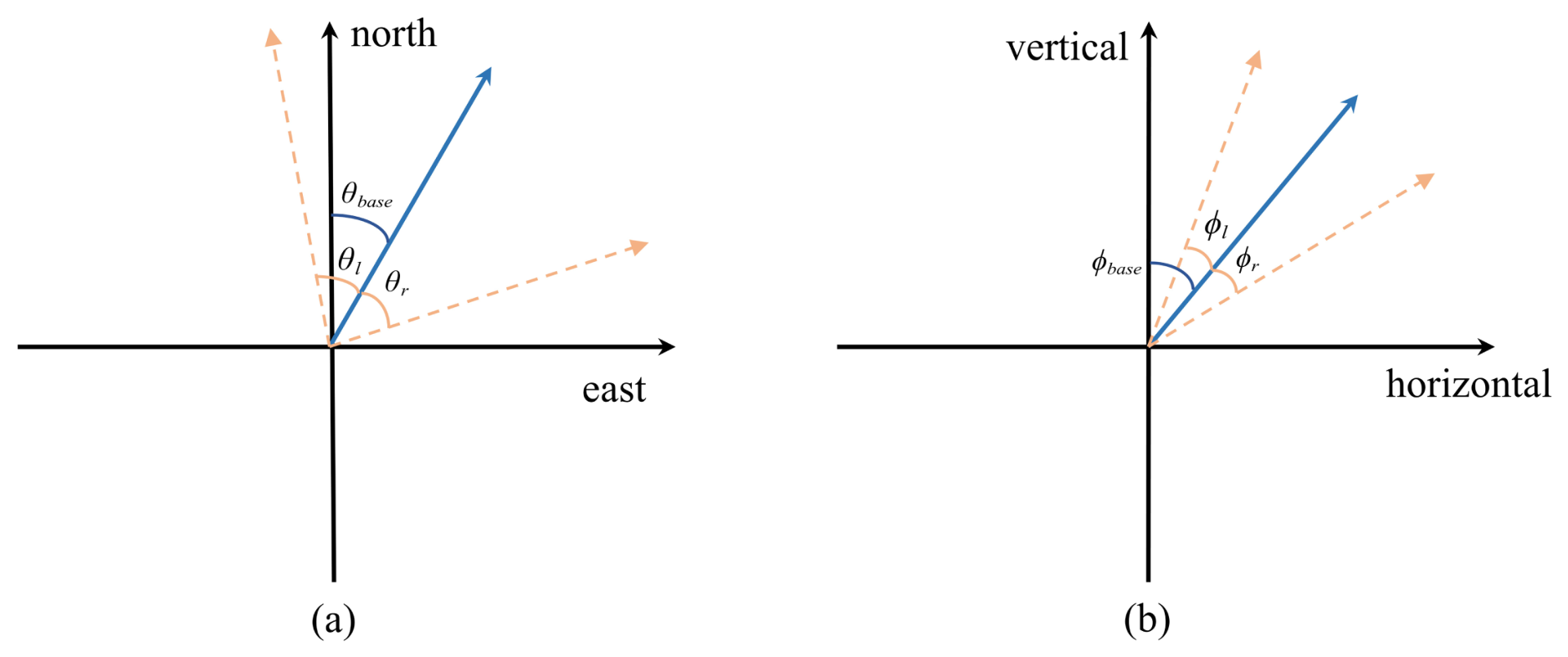
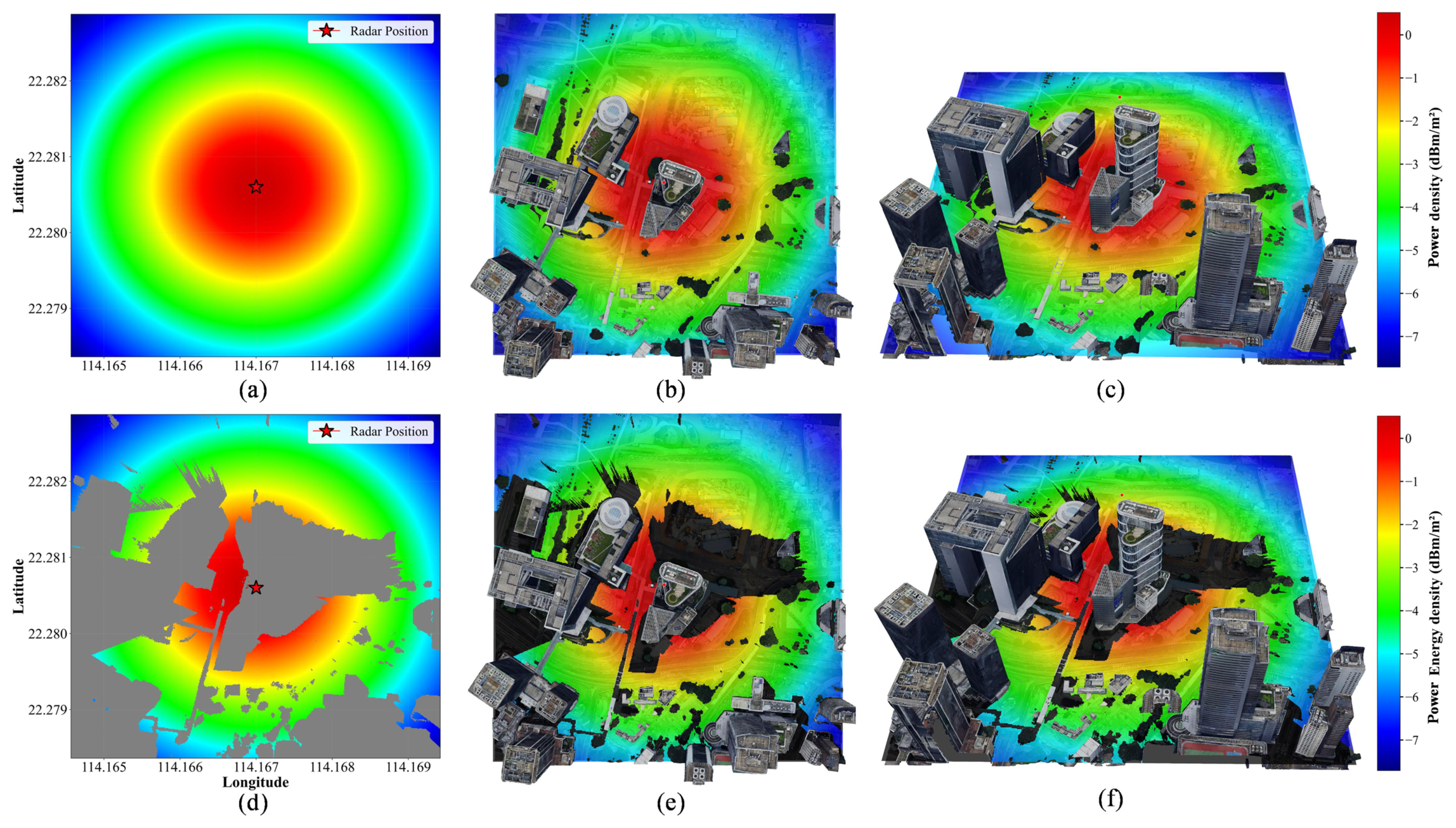
- Radar Power-Density Computation: For target points whose direct radar-target path is not blocked, the one-way transmitted power density is computed in a radar-centric spherical coordinate system. For occluded target points, the direct-path contribution is set to zero, while reflected, diffracted, and penetrated components are outside the scope of the current model.
3.1. Mesh-Based Occlusion Determination
3.1.1. Index Model Construction
3.1.2. Two-Stage Occlusion Analysis
3.1.3. Numerical Parameters and Boundary Handling
3.2. Computational Framework for Radar Power Density in 3D Space
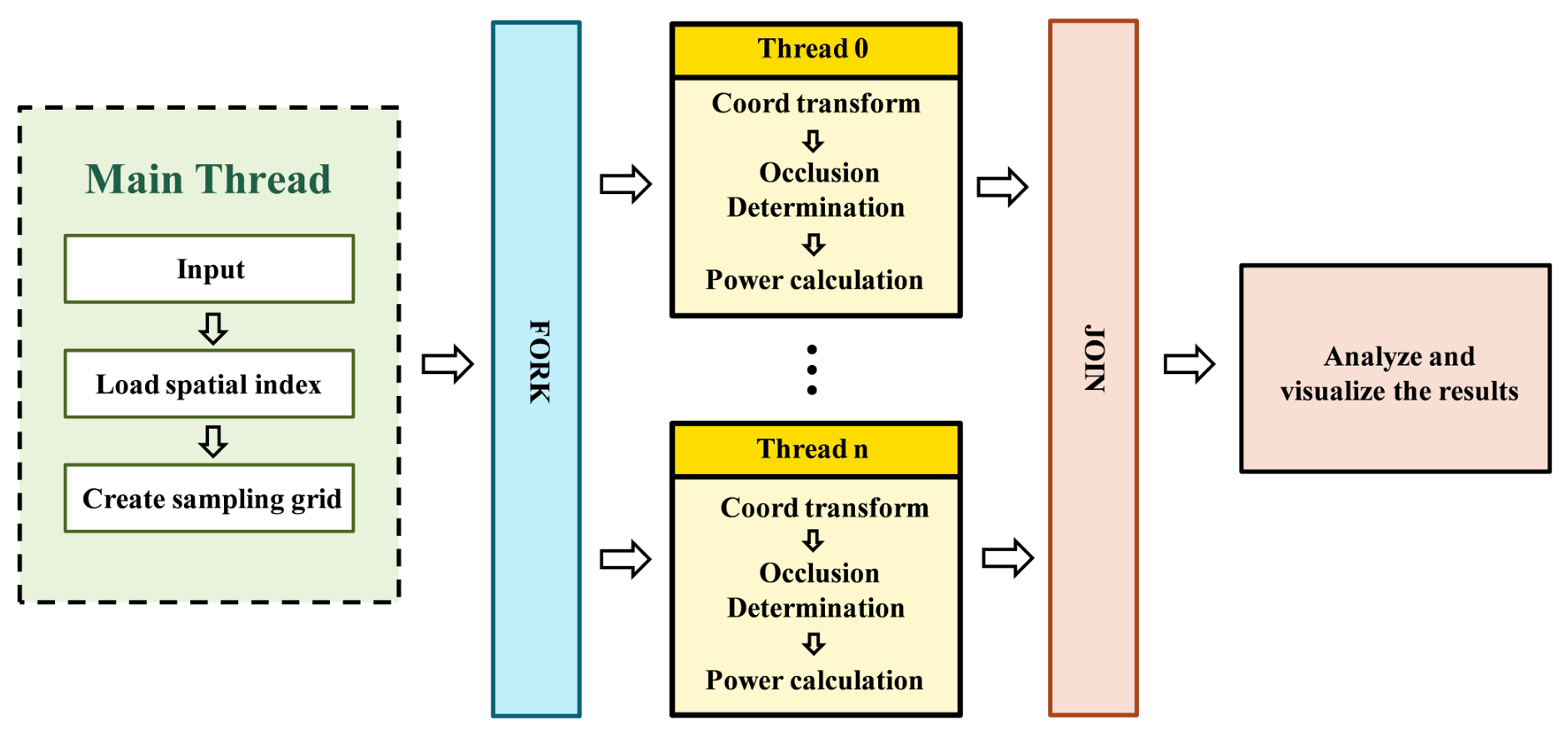
3.3. Parallel Processing Architecture
4. Results and Analysis

| Parameter | Value |
|---|---|
| Element spacing d | |
| Carrier frequency f | |
| Transmit power | |
| Maximum antenna gain | ( linear) |
| Number of array elements N | 256 |
| Baseline elevation scan range | to |
| Baseline azimuth scan range | to |
| Item | Description |
|---|---|
| CPU model | AMD EPYC 9T95 192-Core Processor |
| Logical CPUs | 64 |
| Physical cores | 64 |
| Memory | 128 GB RAM |
| Operating System | Ubuntu 22.04 LTS |
4.1. Spatial Index Performance Evaluation
4.2. Limitations of 2.5D DSM-Based Occlusion Modeling
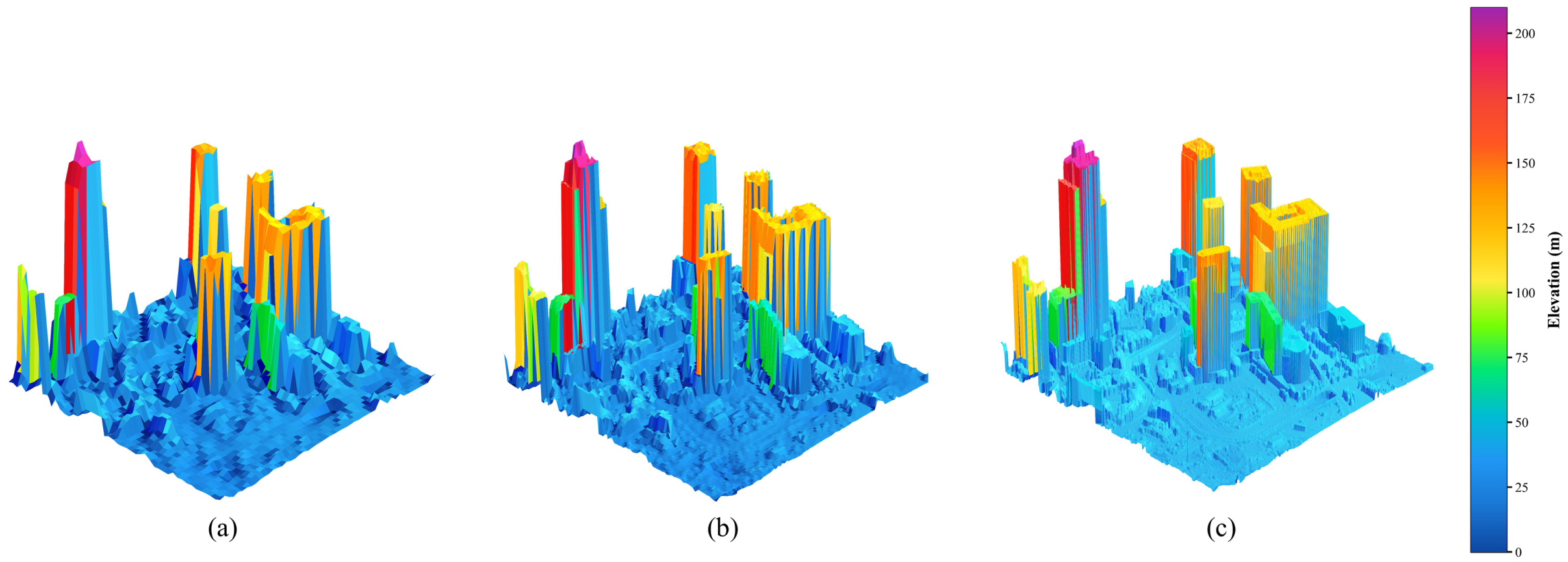
4.3. Quantitative Comparison with Multi-Resolution DSMs
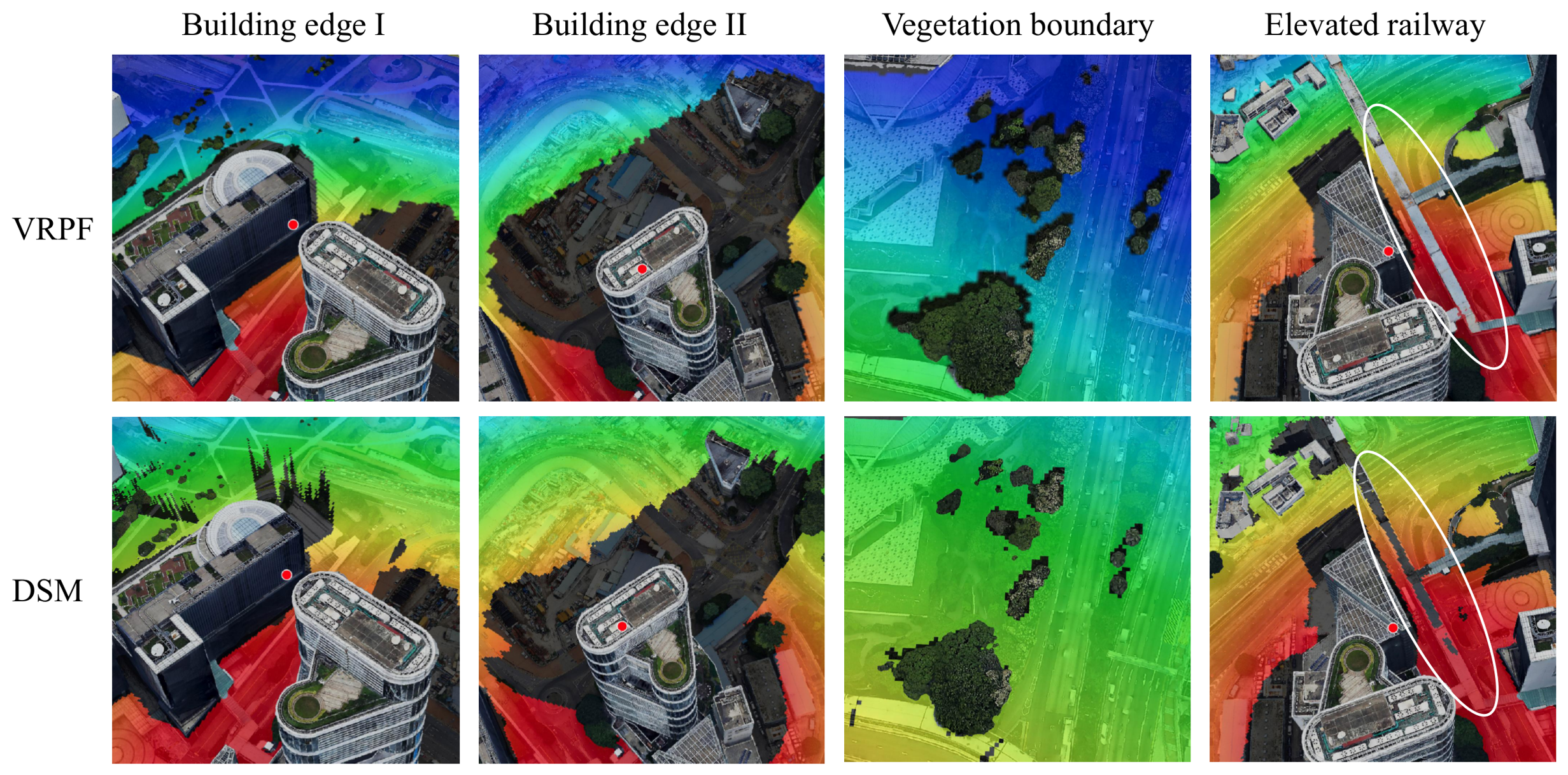
4.3.1. Qualitative Analysis of Representative Error Regions
4.3.2. Quantitative Comparison with Same-Source DSMs
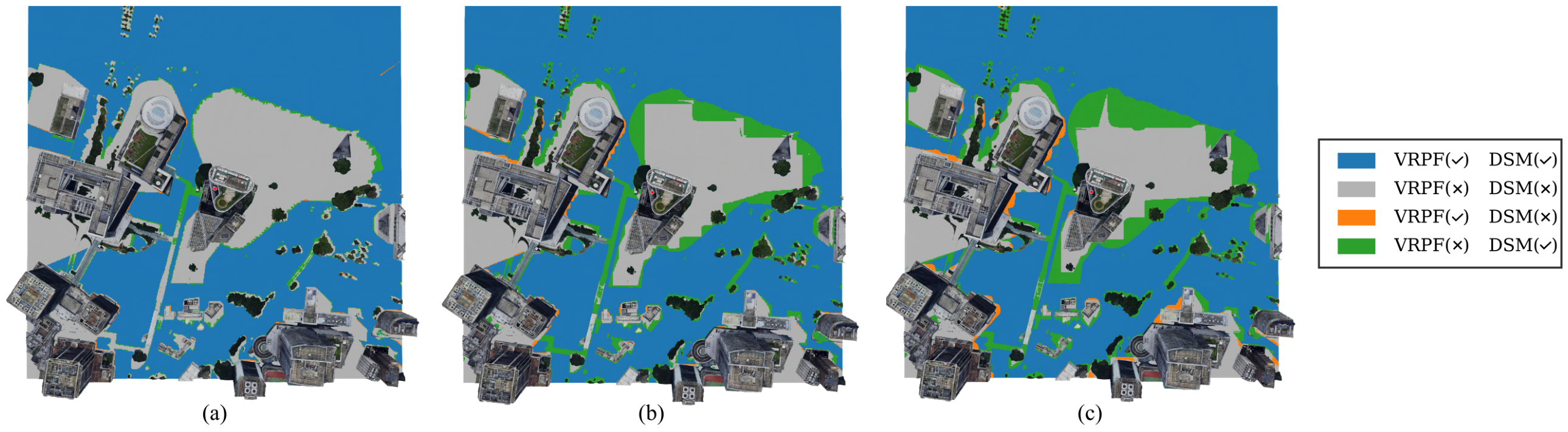
- Agreement Rate (AR): The proportion of target points corresponding to the deep-blue and light-gray regions in Figure 12.
- False-Negative Rate (FNR): The proportion of target points corresponding to the orange regions in Figure 12.
- False-Positive Rate (FPR): The proportion of target points corresponding to the green regions in Figure 12.
4.4. Validation of VRPF Effectiveness
4.5. Parallel Performance of the VRPF Method
5. Conclusions
Author Contributions
Funding
Institutional Review Board Statement
Informed Consent Statement
Data Availability Statement
Conflicts of Interest
Abbreviations
| DSM | Digital Surface Model |
| DTM | Digital Terrain Model |
| DEM | Digital Elevation Model |
| AABB | Axis-Aligned Bounding Box |
| FNR | False-Negative Rate |
| FPR | False-Positive Rate |
References
- Yan, X.; Fu, T.; Lin, H.; Xuan, F.; Huang, Y.; Cao, Y.; Hu, H.; Liu, P. UAV detection and tracking in urban environments using passive sensors: A survey. Appl. Sci. 2023, 13, 11320. [Google Scholar] [CrossRef]
- Besada, J.A.; Campaña, I.; Carramiñana, D.; Bergesio, L.; de Miguel, G. Review and simulation of counter-UAS sensors for unmanned traffic management. Sensors 2021, 22, 189. [Google Scholar] [CrossRef]
- Khawaja, W.; Ezuma, M.; Semkin, V.; Erden, F.; Ozdemir, O.; Guvenc, I. A survey on detection, classification, and tracking of UAVs using radar and communications systems. IEEE Commun. Surv. Tutor. 2025, 28, 3272–3310. [Google Scholar] [CrossRef]
- Griffiths, D.; Jahangir, M.; Kannanthara, J.; Donlan, G.; Baker, C.J.; Antoniou, M.; Singh, Y. Fully digital, urban networked staring radar: Simulation and experimentation. IET Radar Sonar Navig. 2024, 18, 657–673. [Google Scholar] [CrossRef]
- Kostic, A.; Rancic, D. Radar coverage analysis in virtual GIS environment. In Proceedings of the 6th International Conference on Telecommunications in Modern Satellite, Cable and Broadcasting Service, 2003. TELSIKS 2003; IEEE: New York, NY, USA, 2003; Volume 2, pp. 721–724. [Google Scholar]
- Ma, X.; Zhang, X.; Zhao, X. Service coverage optimization for facility location: Considering line-of-sight coverage in continuous demand space. Int. J. Geogr. Inf. Sci. 2023, 37, 1496–1519. [Google Scholar] [CrossRef]
- Tema, E.Y.; Sahmoud, S.; Kiraz, B. Radar placement optimization based on adaptive multi-objective meta-heuristics. Expert Syst. Appl. 2024, 239, 122568. [Google Scholar] [CrossRef]
- Yun, Z.; Iskander, M.F. Ray tracing for radio propagation modeling: Principles and applications. IEEE Access 2015, 3, 1089–1100. [Google Scholar] [CrossRef]
- Gómez, J.; Tayebi, A.; Hellín, C.J.; Valledor, A.; Barranquero, M.; Cuadrado-Gallego, J.J. Accelerated ray launching method for efficient field coverage studies in wide urban areas. Sensors 2023, 23, 6412. [Google Scholar] [CrossRef]
- Liao, K.; Ma, M.; Chen, L.; Zhang, Y.; Jing, N. HiFiRadio: High-Fidelity Radio Map Reconstruction for 3D Real-World Scenes. Technologies 2026, 14, 58. [Google Scholar] [CrossRef]
- Donohue, D.J.; Kuttler, J.R. Modeling radar propagation over terrain. Johns Hopkins APL Tech. Dig. 1997, 18, 279–287. [Google Scholar]
- Awadallah, R.S.; Lamar, M.T.; Kuttler, J.R. An accelerated boundary integral equation scheme for propagation over the ocean surface. Radio Sci. 2002, 37, 8-1–8-16. [Google Scholar] [CrossRef]
- Chen, P.; Wu, L. 3D representation of radar coverage in complicated environment. Simul. Model. Pract. Theory 2008, 16, 1190–1199. [Google Scholar] [CrossRef]
- Krajewski, W.F.; Ntelekos, A.A.; Goska, R. A GIS-based methodology for the assessment of weather radar beam blockage in mountainous regions: Two examples from the US NEXRAD network. Comput. Geosci. 2006, 32, 283–302. [Google Scholar] [CrossRef]
- Nie, K.; Fang, S.; Liu, H.; Wei, X.; Zhang, Y.; Yang, J.; Kong, Q.; Chen, B. Calculation Model of Radar Terrain Masking Based on Tensor Grid Dilation Operator. Remote Sens. 2024, 16, 1432. [Google Scholar] [CrossRef]
- Yilmaz, H.B.; Tugcu, T.; Alagoz, F.; Bayhan, S. Radio environment map as enabler for practical cognitive radio networks. IEEE Commun. Mag. 2013, 51, 162–169. [Google Scholar] [CrossRef]
- Inggs, M.; Lange, G.; Paichard, Y. A quantitative method for mono-and multistatic radar coverage area prediction. In Proceedings of the 2010 IEEE Radar Conference, Arlington, VA, USA, 10–14 May 2010; pp. 707–711. [Google Scholar]
- Li, W.; Franklin, W.R.; de Magalhães, S.V.G.; Andrade, M.V. Gpu-accelerated multiple observer siting. Photogramm. Eng. Remote Sens. 2017, 83, 439–446. [Google Scholar] [CrossRef]
- Axell, T.; Fridén, M. Comparison Between GPU and Parallel CPU Optimizations in Viewshed Analysis. Master’s Thesis, Chalmers University of Technology, Gothenburg, Sweden, 2015. [Google Scholar]
- Zhao, Y.; Padmanabhan, A.; Wang, S. A parallel computing approach to viewshed analysis of large terrain data using graphics processing units. Int. J. Geogr. Inf. Sci. 2013, 27, 363–384. [Google Scholar] [CrossRef]
- Wang, Z.; Xiong, L.; Guo, Z.; Zhang, W.; Tang, G. A view-tree method to compute viewsheds from digital elevation models. Int. J. Geogr. Inf. Sci. 2023, 37, 68–87. [Google Scholar] [CrossRef]
- Tang, G.; Yan, F.; Dai, J.; Zhang, G.; Chen, P.; Mu, Z.; Zhao, Q. Dynamic viewshed analysis based on the digital elevation model: Dynamic range proximity-direction-elevation reference line. Int. J. Geogr. Inf. Sci. 2024, 38, 2627–2647. [Google Scholar] [CrossRef]
- Wang, P.; Ma, J.; Li, F. Multi-observation points setting problem based on stepwise maximum viewshed approach. Int. J. Geogr. Inf. Sci. 2024, 38, 1780–1799. [Google Scholar] [CrossRef]
- Feng, W.; Gang, W.; Deji, P.; Yuan, L.; Liuzhong, Y.; Hongbo, W. A parallel algorithm for viewshed analysis in three-dimensional Digital Earth. Comput. Geosci. 2015, 75, 57–65. [Google Scholar] [CrossRef]
- Chen, Y.; Chen, J. A parallel multipoint viewshed analysis method for urban 3D building scenes. Trans. GIS 2021, 25, 2010–2028. [Google Scholar] [CrossRef]
- Zhang, Y.; Ma, M.; Li, J.; Yang, A.; Jia, Q.; Liu, Z. Efficient and fine-grained viewshed analysis in a three-dimensional urban complex environment. Environ. Model. Softw. 2025, 188, 106359. [Google Scholar] [CrossRef]
- Orlof, J.; Ozimek, P. TIN surface and radial viewshed determination algorithm parallelisation on multiple computing machines. Symmetry 2021, 13, 424. [Google Scholar] [CrossRef]
- Jung, J.; Olsen, M.J.; Hurwitz, D.S.; Kashani, A.G.; Buker, K. 3D virtual intersection sight distance analysis using lidar data. Transp. Res. Part Emerg. Technol. 2018, 86, 563–579. [Google Scholar] [CrossRef]
- Anderson, C.C.; Rex, A. Preserving the scenic views from North Carolina’s Blue Ridge Parkway: A decision support system for strategic land conservation planning. Appl. Geogr. 2019, 104, 75–82. [Google Scholar] [CrossRef]
- Orlof, J.; Ozimek, P.; Łabędź, P.; Widłak, A.; Ozimek, A. Generating viewsheds based on the Digital Surface Model (DSM) and point cloud. PLoS ONE 2024, 19, e0312146. [Google Scholar] [CrossRef]
- Zhao, Y.; Wu, B.; Wu, J.; Shu, S.; Liang, H.; Liu, M.; Badenko, V.; Fedotov, A.; Yao, S.; Yu, B. Mapping 3D visibility in an urban street environment from mobile LiDAR point clouds. GIScience Remote Sens. 2020, 57, 797–812. [Google Scholar] [CrossRef]
- Hirt, P.R.; Holtkamp, J.; Hoegner, L.; Xu, Y.; Stilla, U. Occlusion detection of traffic signs by voxel-based ray tracing using highly detailed models and MLS point clouds of vegetation. Int. J. Appl. Earth Obs. Geoinf. 2022, 114, 103017. [Google Scholar] [CrossRef]
- Zhao, J.; Zhang, Y.; Xu, A.; Zhang, X.; Zhang, Y.; Guo, S. DMP-KDO-PCLoSA: A LiDAR point cloud visibility analysis method for urban remote sensing using depth map projection and KNN optimization. Geocarto Int. 2025, 40, 2540948. [Google Scholar] [CrossRef]
- Guttman, A. R-trees: A dynamic index structure for spatial searching. In Proceedings of the 1984 ACM SIGMOD International Conference on Management of Data, Boston, MA, USA, 18–21 June 1984; pp. 47–57. [Google Scholar]
- Parent, J.R.; Lei-Parent, Q. Rapid viewshed analyses: A case study with visibilities limited by trees and buildings. Appl. Geogr. 2023, 154, 102942. [Google Scholar] [CrossRef]
- Zhou, X.; Wang, W.; Huang, Q.; Feng, N.; Han, P.; Wu, C. Sparse Multi-viewshed Analysis for Assisting Video Surveillance Network Location Optimization. In Proceedings of the 2024 36th Chinese Control and Decision Conference (CCDC), Xi’an, China, 25–27 May 2024; pp. 1687–1694. [Google Scholar]
- Parajuli, B.; Feng, X. Strategic Deployment of a Single Mobile Weather Radar for the Enhancement of Meteorological Observation: A Coverage-Based Location Problem. Remote Sens. 2025, 17, 870. [Google Scholar] [CrossRef]
- Ding, R.; Hu, S.; Xing, Z.; Yan, T. Multi-type radar deployment for UAV swarms defense coverage using Firework Algorithm with Determinantal Point Processes under complex terrain. Appl. Soft Comput. 2025, 170, 112681. [Google Scholar] [CrossRef]
- Li, H.P.; Feng, D.Z.; Chen, S.F.; Zhou, Y.P. Deployment optimization method of multistatic radar for constructing circular barrier coverage. Sensors 2021, 21, 6573. [Google Scholar] [CrossRef]
- Xing, Z.; Hu, S.; Ding, R.; Yan, T.; Xiong, X.; Wei, X. Multi-sensor dynamic scheduling for defending UAV swarms with Fresnel zone under complex terrain. ISA Trans. 2024, 153, 57–69. [Google Scholar] [CrossRef]
- Gemmi, G.; Cigno, R.L.; Maccari, L. On cost-effective, reliable coverage for los communications in urban areas. IEEE Trans. Netw. Serv. Manag. 2022, 19, 2767–2779. [Google Scholar] [CrossRef]
- Xing, Y.; Kanhere, O.; Ju, S.; Rappaport, T.S. Sub-terahertz wireless coverage analysis at 142 GHz in urban microcell. In Proceedings of the ICC 2022-IEEE International Conference on Communications, Seoul, Republic of Korea, 16–20 May 2022; pp. 3942–3947. [Google Scholar]
- Preparata, F.P.; Shamos, M.I. Computational Geometry: An Introduction; Springer Science & Business Media: Berlin/Heidelberg, Germany, 2012. [Google Scholar]
- Möller, T.; Trumbore, B. Fast, minimum storage ray-triangle intersection. J. Graph. Tools 1997, 2, 21–28. [Google Scholar] [CrossRef]
- International Telecommunication Union. Recommendation ITU-R P.676-13; Attenuation by Atmospheric Gases and Related Effects; International Telecommunication Union: Geneva, Switzerland, 2022; Available online: https://www.itu.int/dms_pubrec/itu-r/rec/p/R-REC-P.676-13-202208-I!!PDF-E.pdf (accessed on 2 June 2026).
- International Telecommunication Union. Recommendation ITU-R P.1411-9; Propagation Data and Prediction Methods for the Planning of Short-Range Outdoor Radiocommunication Systems and Radio Local Area Networks in the Frequency Range 300 MHz to 100 GHz; International Telecommunication Union: Geneva, Switzerland, 2017; Available online: https://www.itu.int/dms_pubrec/itu-r/rec/p/R-REC-P.1411-9-201706-I!!PDF-E.pdf (accessed on 2 June 2026).








| Representative Studies | Method Category | Main Strength | Limitation and VRPF Advantage |
|---|---|---|---|
| Yun and Iskander [8]; Gómez et al. [9]; Liao et al. [10] | Ray tracing, ray launching, and radio-map modeling | High physical fidelity for multi-path or radio-field estimation in urban scenes | High repeated-query cost; VRPF is more lightweight |
| Krajewski et al. [14]; Nie et al. [15]; Li et al. [39] | Radar blockage, terrain masking, and deployment coverage | Physically interpretable radar-coverage assessment and deployment optimization | Grid simplification; VRPF uses 3D meshes |
| Tang et al. [22]; Wang et al. [23] | DEM/DSM viewshed and viewpoint optimization | Efficient for large-area terrain visibility and sensor siting | 2.5D constraint; VRPF uses 3D facets |
| Feng et al. [24]; Chen and Chen [25]; Zhang et al. [26] | GPU or indexed 3D viewshed analysis | Demonstrates efficient 3D visibility analysis in complex scenes | Visibility-focused; VRPF estimates power density |
| Orlof et al. [30]; Zhao et al. [31] | DSM/point-cloud 3D visibility mapping | Captures finer street-level geometry than DEM/DSM data | Sampling effects; VRPF uses continuous triangles |
| Hirt et al. [32]; Zhao et al. [33] | Voxel ray tracing and depth-map/KNN point-cloud LOS | Improves local occlusion handling for vegetation, sparse points, and depth gaps | Parameter-sensitive; VRPF reuses spatial indexing |
| Symbol | Parameter | Value |
|---|---|---|
| M | Maximum branches per R-tree node | 8 |
| m | Minimum branches in a non-root node after splitting | 4 |
| AABB expansion used in coarse filtering | 0 | |
| Segment-triangle intersection tolerance | ||
| Parallel or degenerate-triangle rejection threshold |
| Dataset | Spatial Extent | Triangular Facets | Build Time (s) | Tree Depth | Index-File Size (MB) |
|---|---|---|---|---|---|
| dataset1 | 6,776,761 | 33.37 | 9 | 857.55 | |
| dataset2 | 26,214,179 | 136.55 | 10 | 3316.96 | |
| dataset3 | 102,138,513 | 606.04 | 11 | 12,904.4 |
| Dataset | Mean Candidates | Min AABB Candidates | Max AABB Candidates | Core Time (s) | Core Throughput (Tests/s) |
|---|---|---|---|---|---|
| dataset1 | 0.827389 | 0 | 44 | 0.152427 | |
| dataset2 | 2.031719 | 0 | 48 | 0.316222 | |
| dataset3 | 2.148659 | 0 | 54 | 0.518531 |
| Target Points N | Altitude Setting | BVH Core Time (s) | VRPF Core Time (s) | BVH/VRPF Runtime Ratio | Same Decisions | Agreement Rate |
|---|---|---|---|---|---|---|
| Random 0–100 m | 1.697 | 0.152 | 11.16 | 998,189 | 99.8189% | |
| Random 0–100 m | 3.261 | 1.437 | 2.27 | 9,982,152 | 99.8215% | |
| Random 0–100 m | 18.549 | 14.153 | 1.31 | 99,821,383 | 99.8214% |
| BVH Batch Size | Number of Batches | BVH Core Time (s) | Time per Points (s) | BVH/VRPF Ratio |
|---|---|---|---|---|
| 1 | 0.238 | 1.68 | ||
| 10 | 0.203 | 1.43 | ||
| 20 | 0.187 | 1.32 | ||
| 100 | 0.185 | 1.31 | ||
| 200 | 0.185 | 1.31 | ||
| 1000 | 0.186 | 1.31 | ||
| 10,000 | 0.202 | 1.42 |
| Region | Geometry | DSM Limitation | Dominant Error Tendency |
|---|---|---|---|
| Building edges | Sharp facades | Rasterized, stair-stepped boundaries | Boundary-shift errors; mainly FPR when blocked edge areas are classified as visible |
| Vegetation | Tree crowns and canopy boundaries | Vegetation height is often absent or weakly represented | Mainly FPR when tree-crown blockage is under-represented by the DSM |
| Overhang/hollow structures | Multiple surfaces or voids at one planimetric location | Only one elevation can be stored | Mixed FPR/FNR depending on whether the upper deck or the open space is retained |
| Resolution (m) | Matches | AR | False Negatives | FNR | False Positives | FPR |
|---|---|---|---|---|---|---|
| 1 m | 245,173 | 97.49% | 819 | 0.33% | 5508 | 2.19% |
| 5 m | 228,815 | 90.98% | 1173 | 0.47% | 21,512 | 8.55% |
| 10 m | 219,372 | 87.23% | 2146 | 0.85% | 29,982 | 11.92% |
| 15 m | 206,787 | 82.22% | 4197 | 1.67% | 40,516 | 16.11% |
| 20 m | 202,450 | 80.50% | 6552 | 2.61% | 42,498 | 16.90% |
| Resolution | AR with 95% CI | FNR with 95% CI | FPR with 95% CI | FP/FN | McNemar Test |
|---|---|---|---|---|---|
| 1 m | 97.4843% [97.4224, 97.5448] | 0.3256% [0.3041, 0.3487] | 2.1901% [2.1336, 2.2480] | 6.73 | |
| 5 m | 90.9801% [90.8675, 91.0915] | 0.4664% [0.4405, 0.4938] | 8.5535% [8.4448, 8.6634] | 18.34 | |
| 10 m | 87.2254% [87.0944, 87.3553] | 0.8533% [0.8181, 0.8900] | 11.9213% [11.7952, 12.0485] | 13.97 | |
| 15 m | 82.2215% [82.0716, 82.3704] | 1.6688% [1.6195, 1.7196] | 16.1097% [15.9666, 16.2539] | 9.65 | |
| 20 m | 80.4970% [80.3417, 80.6514] | 2.6052% [2.5436, 2.6682] | 16.8978% [16.7519, 17.0448] | 6.49 |
| Dataset Information | Radar Deployment | ||||||
|---|---|---|---|---|---|---|---|
| Dataset | Extent | Lon. Range (°) | Lat. Range (°) | ID | Radar Lon. (°) | Radar Lat. (°) | Height (m) |
| Dataset 1 | R0 | ||||||
| Dataset 2 | R1 | ||||||
| R2 | |||||||
| R3 | |||||||
| Dataset 3 | R1 | ||||||
| R2 | |||||||
| R3 | |||||||
| Target Points | Method | Runtime (s) Under OpenMP Threads | ||||||
|---|---|---|---|---|---|---|---|---|
| 1 | 2 | 4 | 8 | 16 | 32 | 64 | ||
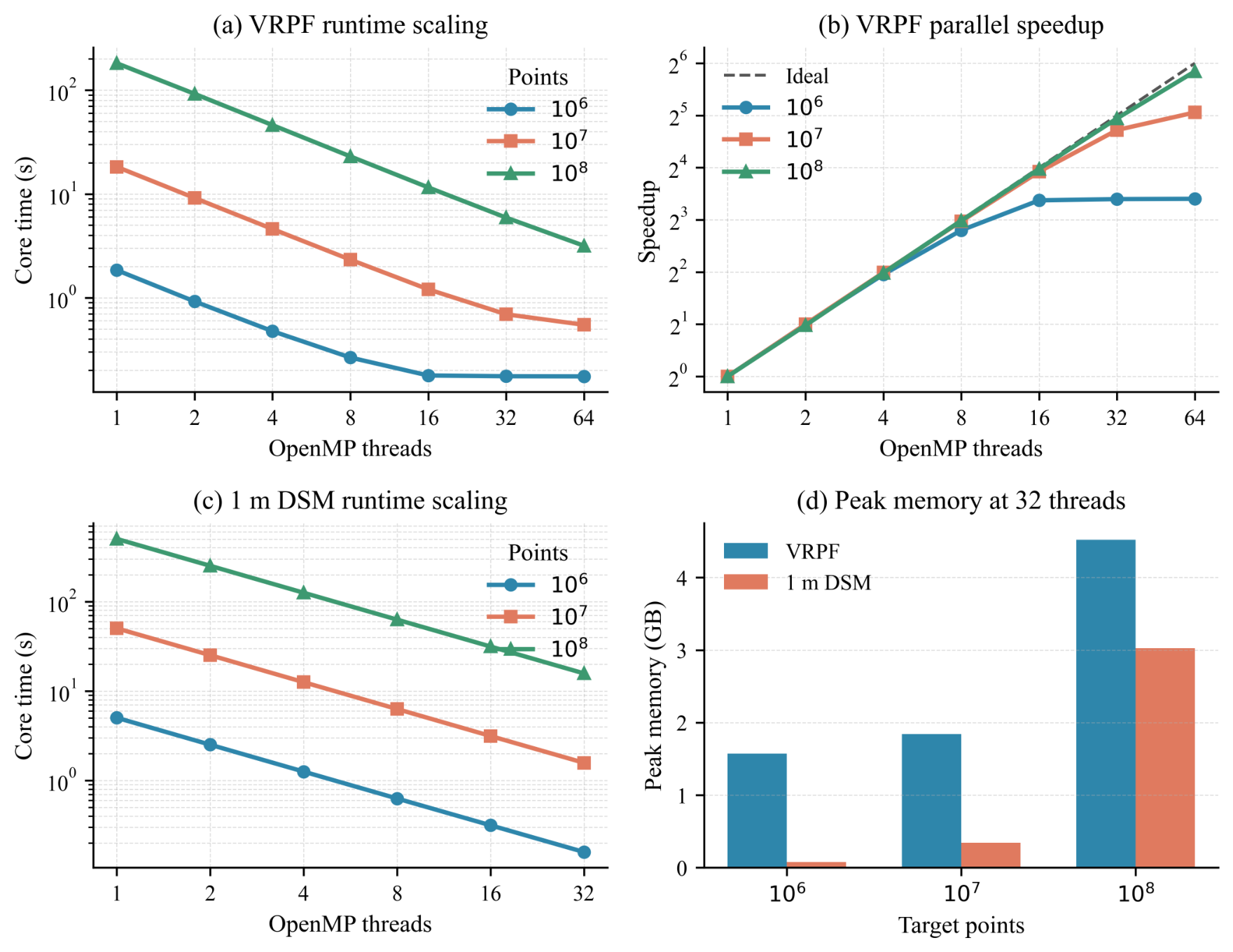
| VRPF | 1.846111 | 0.921463 | 0.476562 | 0.265362 | 0.178200 | 0.175251 | 0.174721 | |
| 1 m DSM | 5.032044 | 2.514028 | 1.258186 | 0.629176 | 0.315858 | 0.158708 | – | |
| VRPF | 18.262347 | 9.148083 | 4.596307 | 2.327572 | 1.205376 | 0.693072 | 0.548365 | |
| 1 m DSM | 50.282128 | 25.183890 | 12.573742 | 6.299192 | 3.144706 | 1.577096 | – | |
| VRPF | 182.022790 | 92.264656 | 46.100288 | 23.014121 | 11.568962 | 5.918491 | 3.170047 | |
| 1 m DSM | 502.749978 | 251.322680 | 125.637544 | 62.871254 | 31.464414 | 15.754354 | – | |
Disclaimer/Publisher’s Note: The statements, opinions and data contained in all publications are solely those of the individual author(s) and contributor(s) and not of MDPI and/or the editor(s). MDPI and/or the editor(s) disclaim responsibility for any injury to people or property resulting from any ideas, methods, instructions or products referred to in the content. |
© 2026 by the authors. Licensee MDPI, Basel, Switzerland. This article is an open access article distributed under the terms and conditions of the Creative Commons Attribution (CC BY) license.
Share and Cite
Jiao, L.; Yang, A.; Jia, Q.; Ma, M.; Zhang, Y.; Wang, L.; Li, J. VRPF: A Fine-Grained 3D Radar Power-Density Computation Framework Based on Photogrammetric City Models for Urban Observation. Remote Sens. 2026, 18, 1936. https://doi.org/10.3390/rs18121936
Jiao L, Yang A, Jia Q, Ma M, Zhang Y, Wang L, Li J. VRPF: A Fine-Grained 3D Radar Power-Density Computation Framework Based on Photogrammetric City Models for Urban Observation. Remote Sensing. 2026; 18(12):1936. https://doi.org/10.3390/rs18121936
Chicago/Turabian StyleJiao, Linhui, Anran Yang, Qingren Jia, Mengyu Ma, Yifan Zhang, Linyue Wang, and Jun Li. 2026. "VRPF: A Fine-Grained 3D Radar Power-Density Computation Framework Based on Photogrammetric City Models for Urban Observation" Remote Sensing 18, no. 12: 1936. https://doi.org/10.3390/rs18121936
APA StyleJiao, L., Yang, A., Jia, Q., Ma, M., Zhang, Y., Wang, L., & Li, J. (2026). VRPF: A Fine-Grained 3D Radar Power-Density Computation Framework Based on Photogrammetric City Models for Urban Observation. Remote Sensing, 18(12), 1936. https://doi.org/10.3390/rs18121936