Article

Contrasting Effects of Atmospheric and Soil Compound Extreme Events on NPP, RH, and NEE in the Dongting Lake Eco-Economic Zone Under Different Land Use Types

1
Hunan Provincial Key Laboratory of Remote Sensing Monitoring of Ecological Environment in Dongting Lake Area, Hunan Center of Natural Resources Affairs, Changsha 410004, China
2
Hubei Key Laboratory of Regional Ecology and Environmental Change, School of Geography and Information Engineering, China University of Geosciences, Wuhan 430074, China
3
College for Elite Engineers, China University of Geosciences, Wuhan 430074, China
*
Author to whom correspondence should be addressed.
Remote Sens. 2026, 18(12), 1909; https://doi.org/10.3390/rs18121909 (registering DOI)
Submission received: 27 April 2026 / Revised: 25 May 2026 / Accepted: 6 June 2026 / Published: 9 June 2026
(This article belongs to the Section Ecological Remote Sensing)

Highlights

What are the main findings?
  • Regional NPP increased significantly, RH decreased slightly, and NEE became more negative during 2003–2024, indicating strengthened net carbon uptake in the Dongting Lake Eco-Economic Zone.
  • ACHDs mainly suppressed NPP and weakened net carbon uptake, whereas SCHDs and DRWs were more strongly associated with reduced RH and more negative NEE.
What are the implications of the main findings?
  • Compound extreme events were associated with contrasting carbon flux responses through atmospheric and soil pathways.
  • Land cover background should be considered when assessing regional carbon sink stability under future compound climate extremes.

Abstract

Compound extreme climate events have become increasingly frequent under climate change and may alter terrestrial carbon cycling through different atmospheric and soil pathways. Focusing on the Dongting Lake Eco-Economic Zone, this study identified three types of compound extreme events during 2003–2024: atmospheric compound hot–dry events (ACHDs), soil compound hot–dry events (SCHDs), and drought-to-rewetting events (DRWs). We then examined their associations with monthly anomalies of net primary production (NPP), heterotrophic respiration (RH), and net ecosystem exchange (NEE) under different land cover backgrounds. The results showed that ACHDs and SCHDs both increased significantly, whereas DRWs exhibited a slight decreasing trend and a more scattered spatial distribution. During the same period, regional NPP increased significantly, RH decreased slightly, and NEE became more negative, indicating an overall strengthening of net carbon uptake. Different event types were associated with contrasting carbon flux response pathways: ACHDs were mainly associated with reduced NPP and slightly increased RH, thereby shifting NEE toward more positive values and weakening regional net carbon uptake, whereas SCHDs and DRWs were more strongly associated with reduced RH and more negative NEE. In addition, the event–carbon relationships differed among land cover types, with cropland, built-up land, and sparsely vegetated surfaces showing higher sensitivity to ACHDs, whereas the responses to SCHDs and DRWs varied markedly among forest, grassland, wetland, and open water classes. These results highlight that compound atmospheric and soil extremes influence regional carbon cycling through distinct component-specific pathways, and that land use background is an important factor associated with differences in carbon flux sensitivity in humid lake–floodplain systems.

1. Introduction

Climate change has increased the frequency, intensity, and persistence of many weather and climate extremes, including heat extremes, droughts, and compound events [1,2]. Compound weather and climate events have received growing attention because multiple drivers or hazards can interact to produce impacts that are stronger than those caused by isolated extremes [3,4]. The IPCC Sixth Assessment Report (AR6) further highlights that warming intensifies extremes across land regions, while compound events, including multivariate, preconditioned, temporally compounding, and spatially compounding forms, are increasingly recognized as a major source of ecological and societal risk [5,6,7,8].
Among the environmental consequences of compound extremes, disturbances to terrestrial carbon cycling are of particular concern [9,10,11]. Drought and heat extremes can strongly alter carbon uptake, respiration, and net ecosystem exchange (NEE), but the dominant pathway depends on the specific combination of climatic stressors [12,13,14,15]. Atmospheric hot–dry conditions, characterized by high temperature and elevated vapor pressure deficit (VPD), can rapidly suppress photosynthesis through stomatal closure, hydraulic stress, and reduced canopy activity [16,17,18,19,20]. By contrast, soil hot–dry conditions more directly regulate heterotrophic respiration (RH) by altering microbial activity, substrate diffusion, and decomposition efficiency [21,22,23]. These two types of stress do not necessarily coincide, because soil temperature and moisture are shaped by antecedent precipitation, soil water storage, vegetation cover, groundwater, irrigation, and hydrological buffering. This decoupling may be especially pronounced in humid lake–floodplain systems, where lake water, wetlands, shallow groundwater, and seasonal inundation can buffer or delay soil drought relative to atmospheric dryness [24,25,26]. Therefore, distinguishing atmospheric compound hot–dry events (ACHDs) from soil compound hot–dry events (SCHDs) is necessary for identifying whether carbon flux anomalies are more closely linked to atmospheric demand or soil hydrothermal stress. In addition, drought-to-rewetting events (DRWs) may trigger short-lived respiration pulses at fine temporal scales, whereas in wet or flood-prone environments their monthly net effect may differ because rewetting can also enhance saturation and oxygen limitation [27,28,29].
The Dongting Lake Eco-Economic Zone (DLEEZ) provides a suitable setting for such analysis. Located in the middle reaches of the Yangtze River, this region is a humid monsoon lake–floodplain system characterized by strong hydrological fluctuations, heterogeneous vegetation patterns, and diverse land cover types [30,31,32]. Previous studies have reported significant increases in wetland vegetation NPP during 2000–2019, with strong spatial heterogeneity linked to climate conditions and vegetation dynamics [33]. Field-based and eddy covariance studies further indicate that vegetation type and flood water level are dominant controls on carbon sequestration potential in the Dongting Lake floodplain [34]. Meanwhile, land use/land cover patterns in the broader Dongting Lake Basin have been shown to influence ecosystem carbon storage [35,36]. These features make the DLEEZ suitable for examining how compound extremes are associated with carbon flux anomalies under different hydrological, vegetation, and land cover backgrounds.
Despite these advances, few studies have simultaneously examined how different compound extreme events are associated with multiple carbon flux components in humid lake–floodplain systems. In particular, it remains unclear whether ACHDs, SCHDs, and DRWs influence NPP, RH, and NEE through similar or contrasting pathways, and how these relationships differ among land use/land cover types. To address these gaps, this study (1) identified ACHDs, SCHDs, and DRWs in the DLEEZ; (2) characterized their spatial and temporal patterns during 2003–2024; (3) quantified their associations with monthly anomalies of NPP, RH, and NEE; and (4) examined how carbon flux sensitivities to compound extremes differed among land use/land cover types. By linking compound extremes, carbon flux anomalies, and land cover background, this study aims to improve understanding of carbon sink stability in humid lake–floodplain systems under concurrent climate and land surface change.

2. Materials and Methods

2.1. Dongting Lake Eco-Economic Zone

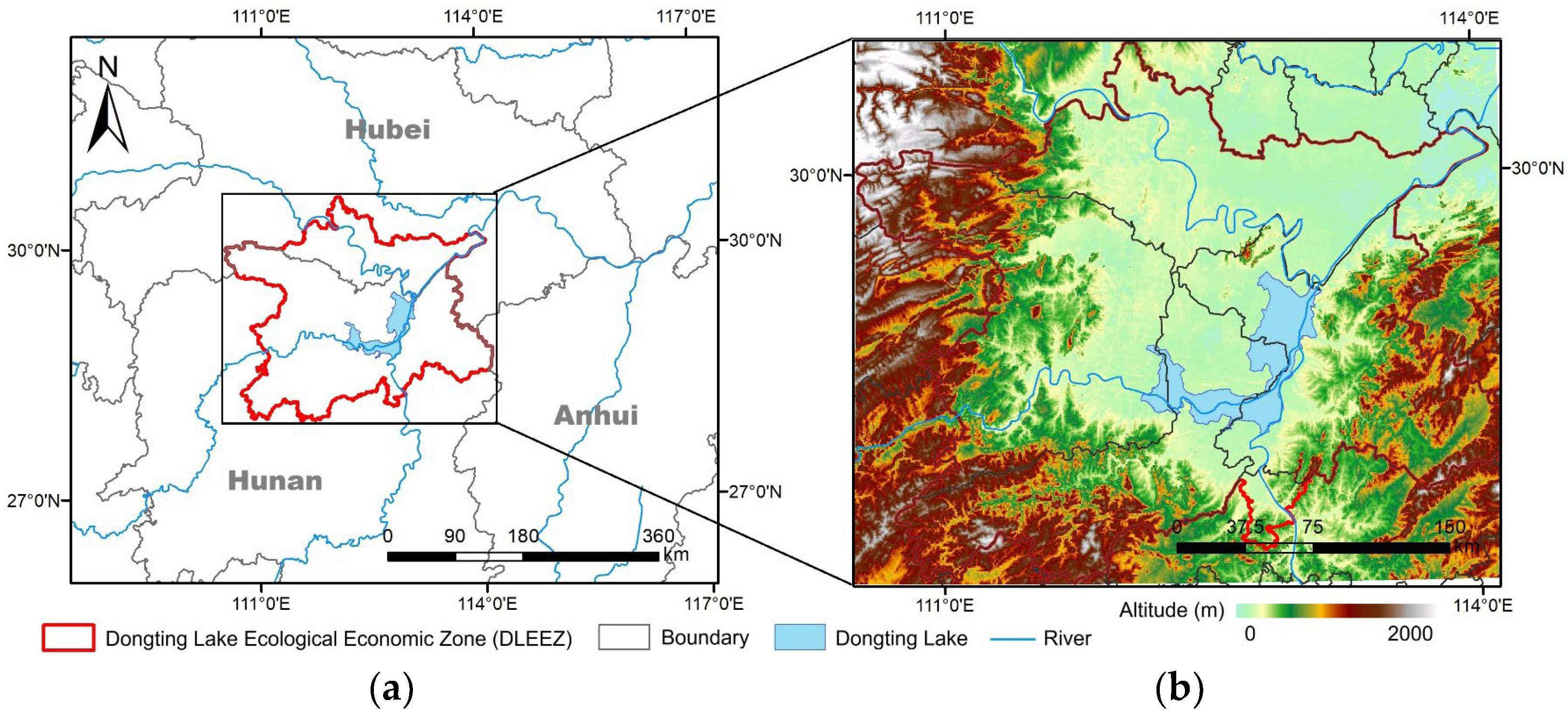
The DLEEZ is located in the middle reaches of the Yangtze River, China, and includes Yueyang, Changde, and Yiyang in Hunan Province, Wangcheng District of Changsha, and Jingzhou in Hubei Province, covering approximately 6.05 × 10⁴ km2 (Figure 1a) [35]. The region is centered on the Dongting Lake plain and bordered by surrounding hills and mountains, forming a clear topographic gradient from low-lying floodplain and lake areas to higher peripheral terrain (Figure 1b) [31,33]. This geomorphic setting creates strong spatial heterogeneity in land cover, surface water distribution, and hydrothermal conditions.
Climatically, the region is dominated by the East Asian subtropical monsoon, with hot and humid summers, mild winters, and strong seasonal contrasts in rainfall and water levels [37,38]. The Dongting Lake system receives inflow from both the Yangtze River and four major tributaries, namely the Xiang, Zi, Yuan, and Li rivers, forming a typical river–lake–floodplain system with pronounced hydrological fluctuations and increasing human regulation [39]. These climatic and hydrological conditions support high ecological productivity but also make the region sensitive to hot–dry stress, soil moisture anomalies, and drought-to-rewetting transitions [40,41,42].

2.2. Datasets and Preprocessing

All raster datasets were clipped to the DLEEZ and resampled to a common 1 km grid. The event–carbon analysis covered 2003–2024, constrained by the temporal overlap among meteorological, soil, and carbon flux datasets (Table 1). Compound extreme events were first identified at the daily pixel scale and then aggregated to monthly event indicators, whereas NPP, RH, and NEE were analyzed as monthly carbon flux variables.

2.2.1. Meteorological Data

Daily meteorological forcing data were obtained from the ChinaMet product provided by the National Cryosphere Desert Data Center. ChinaMet is a multisource integrated meteorological dataset for China with a native spatial resolution of 1 km and provides daily meteorological variables, including maximum air temperature and relative humidity [48,49]. In this study, daily maximum temperature and relative humidity were extracted for the DLEEZ during 2003–2024. The daily vapor pressure deficit (VPD) was calculated from air temperature and relative humidity using the standard saturation–vapor–pressure relationship.

2.2.2. Soil Temperature and Soil Moisture Data

Soil temperature was reconstructed by combining a temporally continuous coarse-resolution product with a fine-resolution reference dataset. The coarse background dataset was the GLDAS-2.1 Noah land surface model product, which provides soil temperature from 2000 onward at a 0.25° spatial resolution and 3-hourly temporal resolution. This product was used to preserve long-term temporal continuity in soil thermal conditions.
The 1 km daily multi-layer soil temperature dataset released by the Third Pole Environment Data Center (TPDC) was used as the high-resolution reference dataset for model training and validation during its available period of 2010–2020 [50]. An XGBoost-based downscaling model was trained during the overlap period between GLDAS and TPDC using GLDAS soil temperature and auxiliary predictors, including meteorological and topographic variables. The trained model was then applied to the full GLDAS sequence to generate daily 1 km soil temperature fields for 2003–2024. Thus, TPDC provided the fine-resolution spatial benchmark, whereas GLDAS provided the continuous temporal backbone.
To evaluate the reliability of the downscaled soil temperature dataset, we validated it against the TPDC 1 km soil temperature reference during 2010–2020 over the intersection pixels shared by TPDC, GLDAS, and the downscaled output. Validation metrics included bias, RMSE, correlation coefficient, and yearly mean daily spatial RMSE. Compared with the original GLDAS product, the downscaled soil temperature reduced the mean daily spatial RMSE from 3.049 °C to 0.986 °C and reduced the regional mean RMSE from 3.045 °C to 0.766 °C, while the correlation with TPDC increased to 0.996. Detailed validation results are provided in Table S4 and Figure S3.
Daily surface soil moisture was obtained from the TPDC all-weather surface soil moisture product [43]. This dataset provides daily 1 km surface soil moisture over China and was developed by downscaling passive microwave soil moisture observations with optical remote sensing and land surface temperature information. In this study, the product was clipped to the DLEEZ and used to characterize soil-moisture variability associated with SCHDs and DRWs. Because this study directly used the public TPDC soil moisture product rather than generating a new downscaled soil moisture dataset, no additional downscaling validation was conducted. Instead, quality control checks were performed after clipping and resampling, including invalid value screening, spatial coverage inspection, and temporal continuity checks.

2.2.3. Carbon Flux Data

The monthly NPP was derived from the 8-day 500 m NPP product used in this study, whose product specifications are consistent with the GLASS NPP dataset. For this study, the 8-day NPP composites were clipped to the study area, summed within each calendar month, and then aggregated to the common 1 km grid to obtain monthly NPP fields for 2003–2024.
Because no single high-resolution RH product is available for the full study period, the annual RH was reconstructed by integrating multiple complementary datasets. Three coarse-resolution global RH references were used: (1) the annual 0.5° RH dataset of Tang et al. [44], which was generated using a random forest model based on field observations and environmental drivers for 1980–2016; (2) the 0.5° climate-driven soil respiration dataset of Hashimoto et al. [45], which provides monthly respiration fields and partitioned heterotrophic respiration, together with associated temperature sensitivity information; and (3) the data-driven global RH dataset of Yao et al. [46], which was developed through random forest upscaling of SRDB observations for 1985–2013. These products were used jointly to constrain the magnitude, climatology, and interannual variability of annual RH at the coarse scale.
To obtain a spatially explicit 1 km RH dataset from 2003–2016, the coarse annual RH fields were further downscaled using the NASA SRDB V5 1 km soil heterotrophic respiration product as the spatial prior [47]. This dataset provides global 1 km annual RH and associated uncertainty information derived from SRDB-V5 using a quantile regression forest model. In our workflow, the 1 km SRDB-based RH climatology was used to define the within-grid spatial weighting pattern, and the annual coarse-grid RH total was redistributed to 1 km pixels while conserving the original annual total for each 0.5° grid cell. This procedure yielded a spatially refined annual RH field that preserved the interannual signal of the coarse products while inheriting the spatial detail of the 1 km prior.
For 2017–2024, the annual RH was extended using a Q10 and soil moisture-constrained adjustment [45]. Specifically, the most recent downscaled 1 km RH field was used as the baseline, and interannual RH changes were estimated from anomalies in downscaled soil temperature and soil moisture. The Hashimoto Q10 information was used to describe thermal sensitivity, while the soil moisture term represented the hydrological limitation on decomposition. Through this approach, a temporally continuous 1 km annual RH dataset for 2003–2024 was obtained.
Because the event response analysis was conducted at the monthly scale, the reconstructed annual RH fields were temporally allocated to monthly RH using a Q10- and soil moisture-constrained weighting scheme. This approach assumes that the intra-annual distribution of RH is jointly regulated by soil thermal conditions and soil moisture limitation, while the annual RH magnitude is constrained by the reconstructed annual RH product.
For each year y, month m, and pixel i, the temperature scalar was calculated as
f T ( m , i , y ) = Q 1 0 i ( S T m , i , y S T ¯ i , y ) / 10
where Q10i is the pixel-specific temperature sensitivity coefficient, STm,i,y is monthly soil temperature (ST), and STi,y is the annual mean soil temperature. The soil moisture scalar was calculated as
f W ( m , i , y ) = c l i p [ S M m , i , y / P 90 ( S M i , y ) , 0.05,1.00 ]
where SMm,i,y is monthly soil moisture (SM) and P90(SMi,y) is the 90th percentile of monthly soil moisture within the same year and pixel. The monthly RH allocation weight was then calculated as
w m , i , y = [ f T ( m , i , y ) × f W ( m , i , y ) ] / m = 1 12 [ f T ( m , i , y ) × f W ( m , i , y ) ]
Monthly RH was estimated as
R H m , i , y = w m , i , y × R H i , y
where RHi,y is the reconstructed annual RH. By construction, this procedure conserves the annual RH total. Monthly NEE was calculated as
N E E m , i , y = R H m , i , y N P P m , i , y
More negative NEE indicates stronger net carbon uptake, whereas more positive NEE indicates weaker net carbon uptake or net carbon release.

2.2.4. Land-Use Data

Land use/land cover data were obtained from the multi-period land use remote-sensing monitoring database of the Resource and Environment Science and Data Center (RESDC), Chinese Academy of Sciences (Table 1; [30,51]). The corresponding China land use/cover datasets are primarily based on Landsat imagery and human–computer interactive visual interpretation. Previous assessments reported overall accuracies higher than 94% for level 1 classes, indicating that the dataset is suitable for regional LUCC analysis.
In this study, eight time slices (2000, 2005, 2008, 2010, 2015, 2018, 2020, and 2023) were used to characterize land use dynamics in the Dongting Lake region. The original secondary land use classes were merged into eight first-level categories, including paddy land, dry cropland, forest, grassland, wetland, open water, built-up land, and other land, before being aggregated from 30 m to 1 km. The resulting land use/land cover dataset was used to characterize the spatial distribution and temporal changes of major land cover classes, and to stratify the event–carbon analysis by land cover type. In this study, the land-cover analysis was designed to compare differences in carbon flux sensitivity among land cover types, rather than to quantify the causal effect of land cover transitions on the event–carbon relationship.
Open water and wetlands were treated differently. Persistent open water pixels were not assigned saturated soil moisture values; instead, they were excluded from soil-based event identification and RH reconstruction because soil moisture, soil temperature, and terrestrial heterotrophic respiration are not physically meaningful over permanent water surfaces. Wetland pixels were retained when valid soil, vegetation, and carbon flux information was available because they represent vegetated or seasonally exposed land–water transition zones. For NPP, some open water or lake margin pixels retained valid values after aggregation, which may reflect aquatic vegetation, seasonally exposed wetlands, or mixed land–water pixels rather than purely phytoplankton production. Since RH was reconstructed as terrestrial heterotrophic respiration, persistent open water pixels without valid RH were masked, and the NEE mask followed the valid RH domain.
The resulting land use/land cover dataset was used to characterize the spatial distribution and temporal changes of major land cover classes, and to stratify the event–carbon analysis by land cover type. In this study, land use/land cover information was used to compare event–carbon relationships among land cover classes. Therefore, the results should be interpreted as land cover-type differences in carbon flux sensitivity rather than as a direct estimate of how land cover transitions changed the event–carbon relationship.

2.2.5. Software and Implementation

Data preprocessing, raster processing, statistical analysis, and XGBoost-based soil-temperature downscaling were performed using Python (v3.10) and the XGBoost Python package (v2.0.3). Spatial visualization and map production were conducted using R (v4.2.2). Additional graph preparation and figure editing were completed using OriginPro (v2024).

2.3. Analytical Methods

2.3.1. Identification of Compound Extreme Climate Events

Compound extreme events were identified at the daily pixel scale and then aggregated to monthly indicators for carbon flux analysis. Three event types were considered: ACHDs, SCHDs, and DRWs.
Percentile thresholds were calculated using a day-of-year (DOY)-based moving window method. For each calendar day d, a 15-day window centered on that day, from d − 7 to d + 7, was used across all years during 2003–2024. The DOY window was treated circularly at the beginning and end of the year. Basin-wide thresholds were calculated from regional mean daily series within each DOY window and then applied to each valid pixel. The 90th and 10th percentiles were used to represent unusually high and unusually low conditions, respectively.
ACHDs were defined using daily maximum air temperature (Tmax) and vapor pressure deficit (VPD). A pixel i on day t was identified as an ACHD day when
T m a x i , t T m a x 90 d   and   V P D ( i , t ) V P D 90 ( d )
where Tmax90 (d) and VPD90 (d) are the DOY-based 90th percentile thresholds. The monthly ACHD indicator was calculated as the number of ACHD days in each month.
SCHDs were defined using daily ST and SM. A pixel i on day t was identified as a SCHD day when
S T i , t S T 90 d   and   S M i , t S M 10 d
where ST90(d) is the DOY-based 90th percentile soil temperature threshold and SM10(d) is the DOY-based 10th percentile soil moisture threshold. The monthly SCHD indicator was calculated as the number of SCHD days in each month.
DRWs were used to describe rapid soil moisture recovery after persistent soil drought. A soil drought day was first identified when
S M ( i , t ) S M 10 ( d )
A persistent soil drought episode was defined as more than 10 consecutive drought days. A DRW event was then identified when soil moisture reached or exceeded the DOY-based 90th percentile threshold within the following 3 days after the end of the drought episode:
S M ( i , t + k ) S M 90 ( d ) , k = 1 , 2 , 3
Each drought-to-rewetting transition was counted once and assigned to the month in which the rewetting threshold was first reached.
No additional spatial extent or spatial contiguity constraint was imposed during event identification. ACHDs and SCHDs were expressed as monthly or annual event days, whereas DRWs were expressed as monthly or annual event counts.

2.3.2. Calculation and Statistical Analysis of Carbon Flux Changes

To evaluate the associations between compound extreme events and regional carbon dynamics, monthly anomalies of NPP, RH, and NEE were calculated by subtracting the long-term mean of each calendar month at the pixel level. This procedure removed the seasonal cycle and retained departures from normal monthly conditions.
Event–carbon relationships were analyzed in three steps. First, for each event type, months were classified as event months or non-event months according to whether the monthly event indicator was greater than zero. Event minus non-event differences in carbon flux anomalies were then calculated for NPP, RH, and NEE. Second, pixel-wise linear regressions were performed between monthly event indicators and monthly carbon flux anomalies to quantify the direction and strength of synchronous associations. Positive slopes indicate that the carbon variable increased with stronger event activity, whereas negative slopes indicate a decreasing response. Third, pixels were grouped by land use/land cover type to compare how event–carbon relationships differed among land-cover classes.
Because ACHDs and SCHDs were represented by monthly event days whereas DRWs were represented by monthly event counts, regression slopes were interpreted mainly within each event type. Cross-event comparisons therefore focused on response direction rather than absolute slope magnitude.

2.3.3. Sensitivity Analysis of Monthly RH Reconstruction

To evaluate uncertainty in the temporal allocation of annual RH to monthly RH, we compared three allocation schemes: the original Q10- and soil moisture-constrained scheme, an NPP fraction scheme, and a Q10-based temperature-only scheme. In all schemes, monthly weights were normalized within each pixel and year to conserve the reconstructed annual RH total. Monthly NEE was recalculated under each scheme, and the event month versus non-event month comparisons and pixel-wise regressions were repeated. Robustness was evaluated using annual closure error, pairwise correlation and RMSE among monthly RH estimates, and pixel-wise sign consistency of regression slopes relative to the original scheme (Figures S1 and S2; Tables S1 and S2).

2.3.4. Detrended and Fixed Effects Robustness Analysis

As an additional robustness test, we conducted detrended fixed effects panel regressions to reduce the influence of long-term trends, seasonal cycles, and spatially persistent background differences. Monthly anomalies of NPP, RH, NEE, ST, and SM were first calculated by removing the long-term calendar month mean at each pixel, and pixel-specific linear trends were then removed. The primary model regressed detrended carbon flux anomalies against ACHD, SCHD, and DRW indicators with pixel, calendar month, and year fixed effects:
Y i , t = β 1 A C H D i , t + β 2 S C H D i , t + β 3 D R W i , t + γ X i , t + α i + δ m + λ y + ε i , t
where Y’i,t is the detrended monthly anomaly of NPP, RH, or NEE; αi, δm and λy denote pixel, calendar month, and year fixed effects, respectively. A supplementary diagnostic model additionally included detrended ST and SM anomalies as climate state controls. Because ST and SM were also used to define SCHDs and DRWs, this diagnostic model was interpreted as a residual association test rather than as the total soil event response. Pixel-clustered standard errors were used, and detailed results are provided in Table S3.

3. Results

3.1. Spatiotemporal Characteristics of Compound Extreme Events and Carbon Fluxes

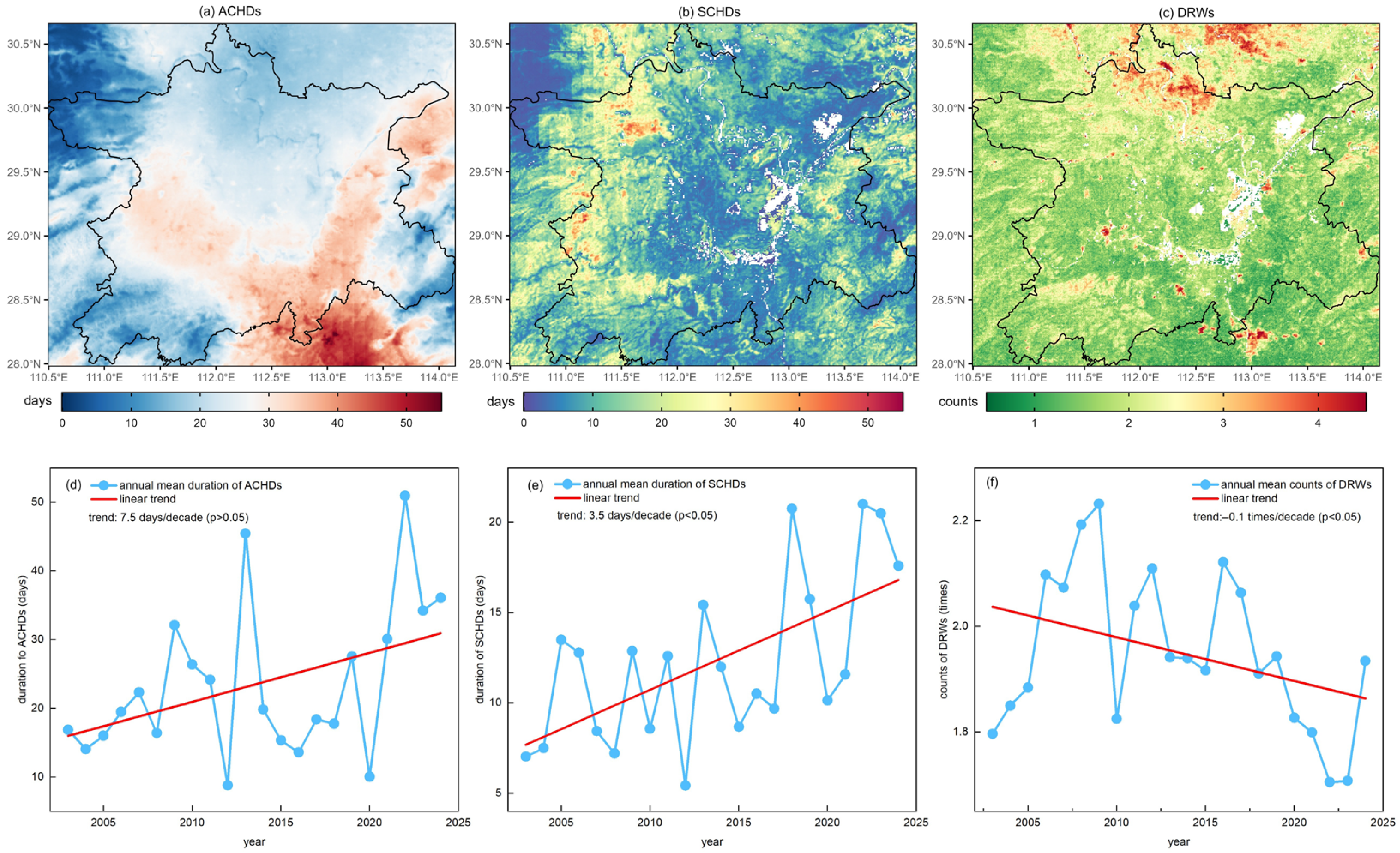
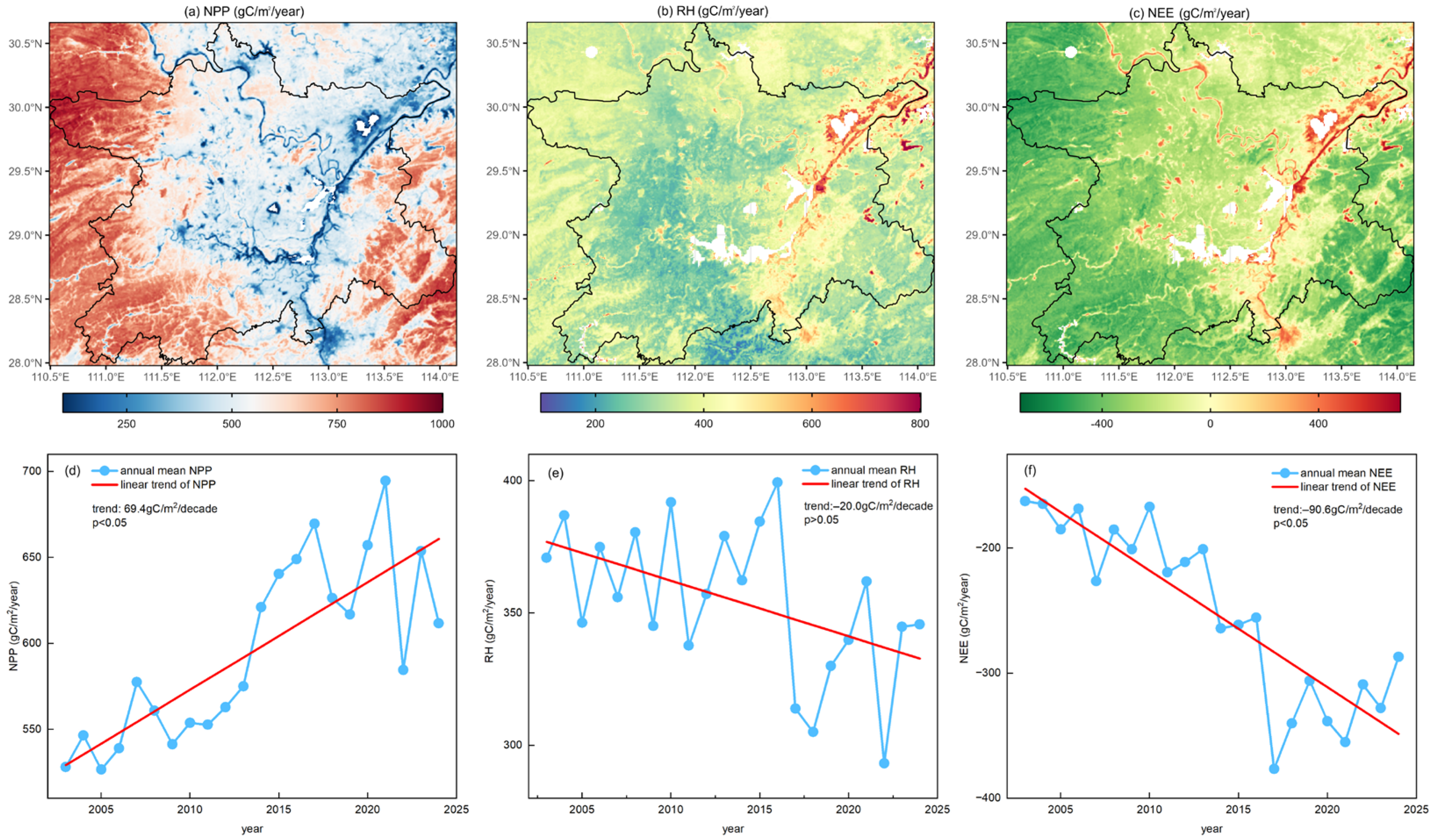
In this study, spatial maps of compound events and carbon fluxes are expressed as multi-year annual means, whereas regional temporal trends are reported per decade. Annual mean maps describe the average spatial intensity of events or carbon fluxes during 2003–2024, while decadal trends facilitate comparison with long-term climate and carbon cycle studies. ACHDs and SCHDs are quantified as event days and are therefore reported as days per year in spatial maps and days per decade in temporal trends. DRWs, however, represent discrete drought-to-rewetting transitions and are therefore expressed as event counts rather than days. Interannual trends in Figure 2 and Figure 3 were fitted to annual aggregated series, so seasonal cycles were removed through annual aggregation; monthly response analyses further removed seasonality using calendar month anomalies.
The three types of compound extreme events exhibited pronounced spatial heterogeneity across the DLEEZ, indicating that their occurrence was strongly shaped by local hydrothermal conditions and underlying surface characteristics. ACHDs were generally less frequent in the northwestern and central parts of the study area, whereas relatively high values were concentrated in the southern and southeastern sectors, with several hotspots exceeding 40–50 days in the multi-year mean (Figure 2a). At the regional scale, annual mean ACHD duration increased significantly during 2003–2024, with a linear trend of 7.5 days decade−1 (p < 0.05) (Figure 2d), indicating a clear intensification of atmospheric hot–dry stress.
The spatial distribution of SCHDs differed from that of ACHDs. Low SCHD values were mainly found over the central lake plain and water-dominated areas, whereas relatively high values occurred in surrounding terrestrial zones, especially along parts of the western, northern, and eastern margins (Figure 2b). This contrast suggests that soil compound hot–dry conditions were more likely to develop in exposed terrestrial areas where soil thermal accumulation and moisture depletion were stronger. SCHDs also increased significantly at the regional scale, with the regional mean duration rising by 3.5 days decade−1 (p < 0.05) during 2003–2024 (Figure 2e).
DRWs displayed a more scattered and localized pattern. Most pixels had low event frequencies, generally around 1–2 events in the multi-year mean, whereas relatively high values were limited to isolated hotspots, mainly in the north-central and southeastern parts of the study area (Figure 2c). The regional time series showed a weak but significant decreasing trend, with the annual mean frequency declining by 0.1 counts decade−1 (p < 0.05) (Figure 2f). Compared with ACHDs and SCHDs, DRWs were therefore less widespread and more spatially localized.
Differences in spatial coverage among event types mainly reflect the variables used for event identification. ACHDs were identified from atmospheric variables, including maximum air temperature and VPD, which were available over both terrestrial and lake-surface pixels after preprocessing. In contrast, SCHDs and DRWs were identified from soil temperature and soil moisture, which are physically meaningful only for terrestrial or seasonally exposed pixels and were masked over persistent open water areas. Consequently, SCHD and DRW maps contain blank areas over the main lake body and other water-dominated regions.
Carbon fluxes also showed clear spatial gradients and temporal changes. The multi-year mean NPP was generally higher in peripheral hilly and mountainous regions and lower in the central lake area and adjacent low-lying plains (Figure 3a). This pattern is consistent with the contrast between vegetated uplands and open water or seasonally inundated surfaces. At the regional scale, the annual mean NPP increased significantly during 2003–2024, with a trend of 69.4 g C m−2 decade−1 (p < 0.05) (Figure 3d), indicating an overall enhancement of vegetation carbon uptake.
The spatial pattern of RH was smoother than that of NPP but still exhibited evident heterogeneity. Higher RH values were mainly distributed in some eastern and northeastern parts of the study area, whereas lower values occurred in the central and southwestern regions (Figure 3b). The annual mean RH showed a slight decreasing trend, with a rate of −20.0 g C m−2 decade−1 (p > 0.05) (Figure 3e), suggesting a modest but statistically insignificant decline in heterotrophic respiration.
NEE also showed substantial spatial variability. Most of the study area was characterized by negative NEE values, whereas relatively high values were concentrated in limited areas, particularly along some eastern margins (Figure 3c). The regional annual mean NEE became significantly more negative during 2003–2024, with a linear trend of −90.0 g C m−2 decade−1 (p < 0.05) (Figure 3f), indicating an overall strengthening of net carbon uptake.
Differences in spatial coverage among carbon flux variables were mainly caused by their physical meanings and masks. The NPP product retained values over some lake margin and mixed water–vegetation pixels, partly reflecting aquatic vegetation, seasonally exposed wetlands, or mixed pixels after spatial aggregation. In contrast, RH represents terrestrial heterotrophic respiration and was reconstructed from soil respiration-related datasets; therefore, persistent open water pixels without valid soil respiration information were excluded. Since NEE was calculated as RH minus NPP, the NEE mask followed the valid RH domain. Blank areas in RH and NEE over the lake region should therefore be interpreted as masked persistent open water pixels rather than zero respiration or zero NEE.
Overall, the DLEEZ experienced significant intensification of atmospheric and soil compound hot–dry stress from 2003 to 2024, whereas DRWs declined slightly and remained spatially localized (Figure 2). During the same period, the regional carbon cycle was characterized by increasing NPP, slightly declining RH, and increasingly negative NEE, indicating enhanced net carbon uptake (Figure 3). These contrasting spatiotemporal patterns provide the basis for examining how different types of compound extreme events were associated with carbon flux anomalies.

3.2. Responses of Carbon Flux Anomalies to Compound Extreme Events

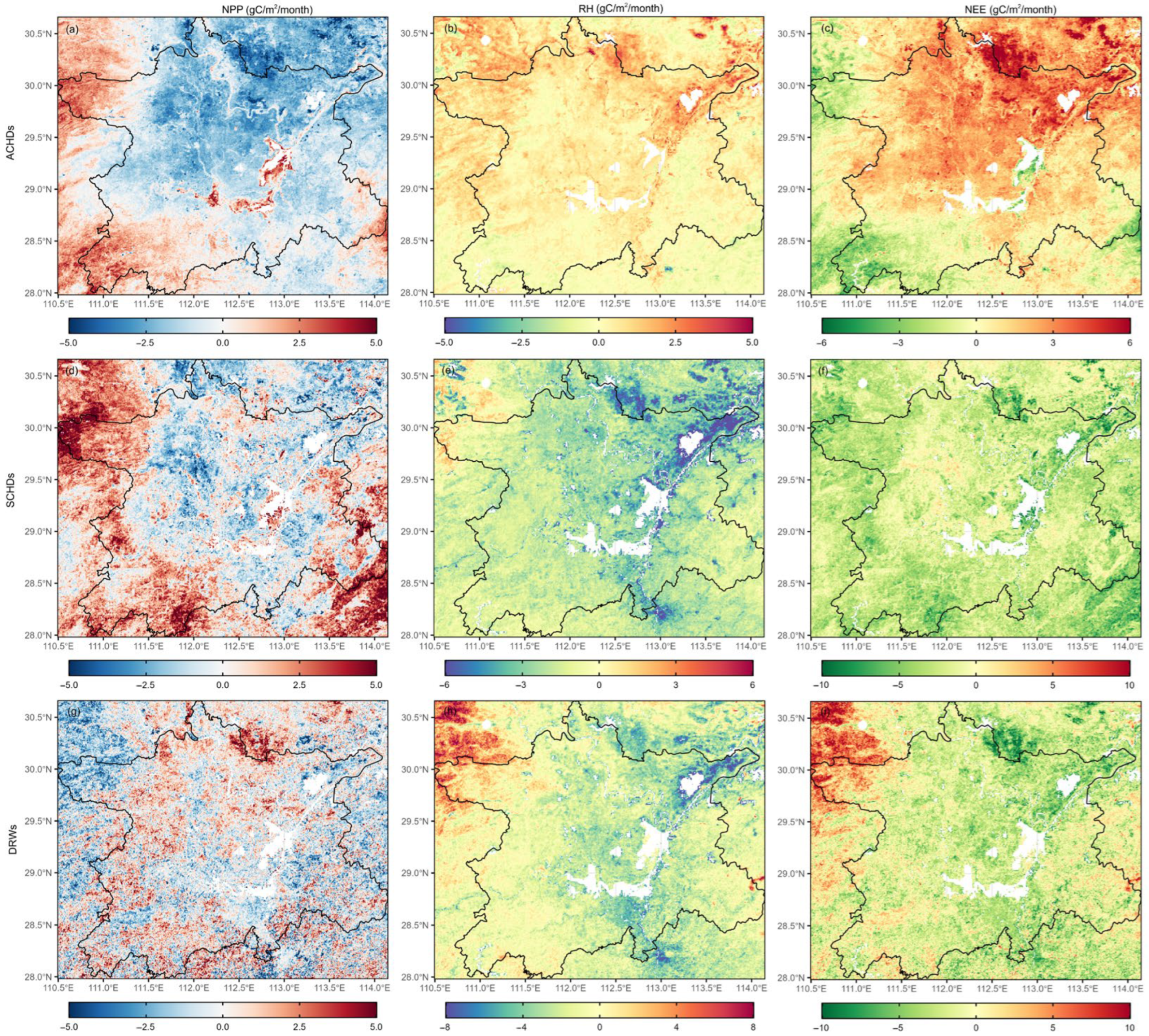
Clear contrasts were observed in the responses of carbon flux anomalies to the three compound event types. Event month versus non-event month comparisons, pixel-wise synchronous regressions, and regional summaries all showed generally consistent response patterns (Figure 4, Figure 5 and Figure 6). Overall, ACHDs were mainly associated with reduced NPP and more positive NEE, whereas SCHDs and DRWs were more strongly linked to reduced RH and more negative NEE.
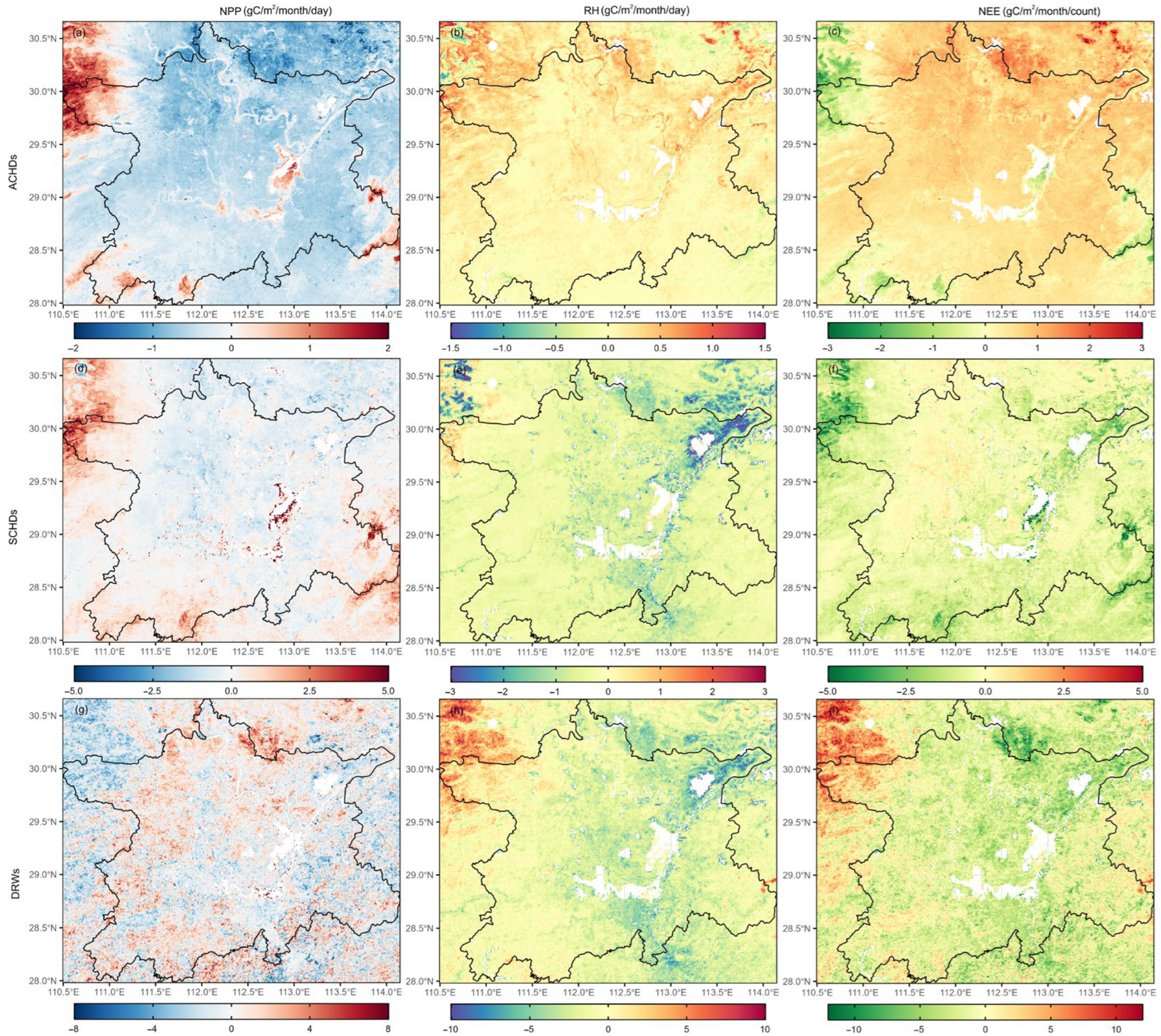
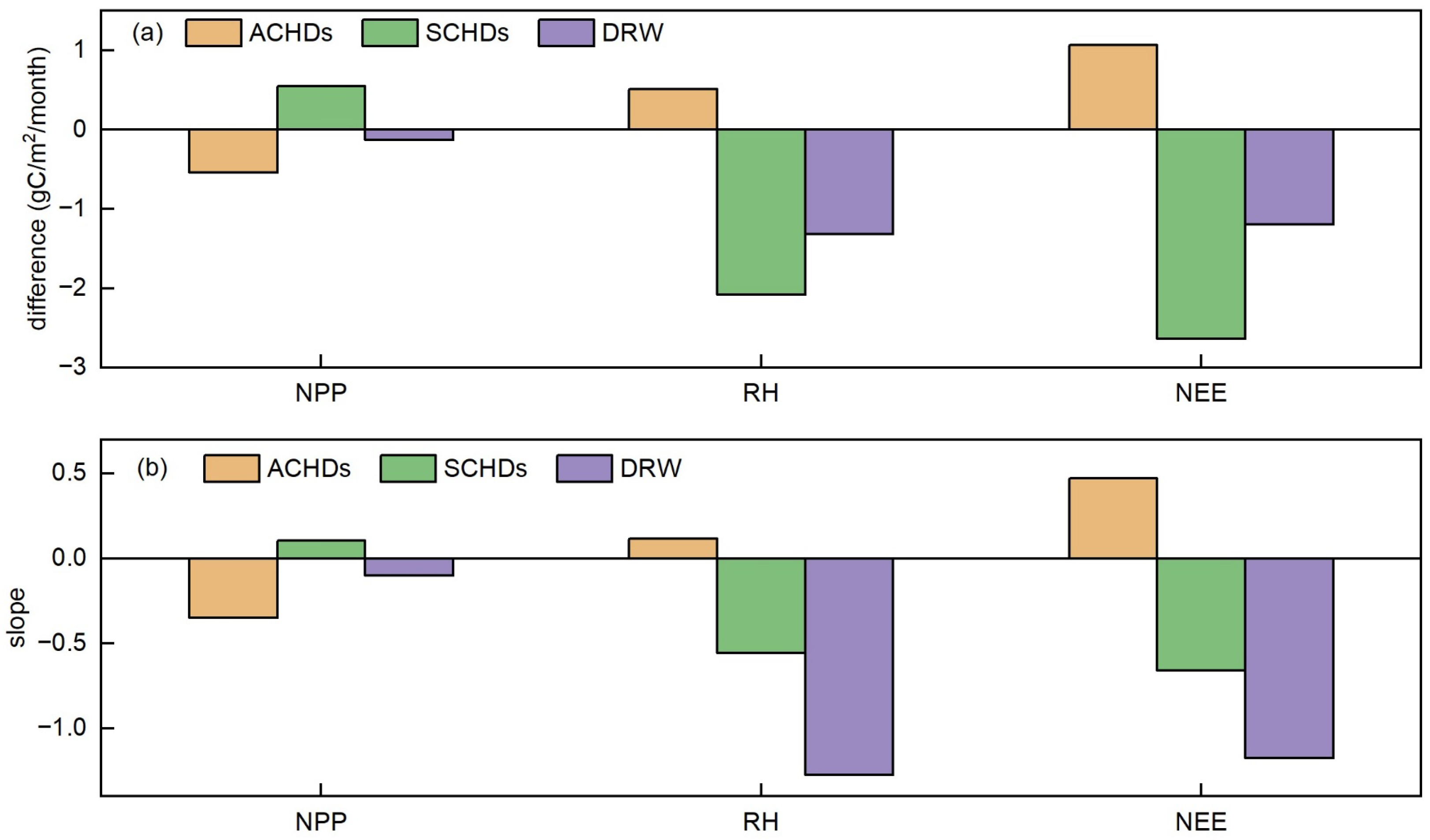
Among the three event types, ACHDs showed the clearest suppressive association with vegetation productivity. Negative NPP anomalies dominated most of the central and southern parts of the study area during ACHD months, with only limited positive patches in some peripheral uplands (Figure 4a). Pixel-wise regressions showed a similar pattern, with most pixels exhibiting negative slopes between ACHD occurrence and NPP anomalies (Figure 5a). At the regional scale, ACHD months were associated with an average NPP reduction of about 0.5 g C m−2 month−1, and the corresponding regression slope was also negative, at approximately −0.35 (Figure 6). In contrast, RH showed a slight positive response to ACHDs in many parts of the study area, especially across the central and eastern regions (Figure 4b and Figure 5b). As a result, NEE shifted toward more positive values during ACHD months, with positive responses widely distributed in the northern and eastern parts of the region (Figure 4c and Figure 5c). These results indicate that atmospheric compound hot–dry stress was associated with weakened regional net carbon uptake through reduced NPP and slightly elevated RH.
The response pattern under SCHDs differed substantially from that under ACHDs. The association between SCHDs and NPP was weaker and spatially more heterogeneous, with negative anomalies in parts of the central lowland but positive values in some western, southern, and eastern margins (Figure 4d). The corresponding regression slopes were generally close to zero (Figure 5d), suggesting that SCHDs did not systematically suppress productivity to the same extent as ACHDs. By contrast, RH exhibited a much clearer negative response. Strongly negative RH anomalies and slopes were concentrated around the northeastern lake margin zone and adjacent lowlands, while most other regions remained close to neutral (Figure 4e and Figure 5e). Regionally, RH decreased by about 2.1 g C m−2 month−1 during SCHD months, and the corresponding regression slope was approximately −0.6 (Figure 6). NEE shifted toward more negative values, with a mean anomaly difference of about −2.6 g C m−2 month−1 and a negative regression slope of about −0.65. These results suggest that SCHDs were more closely associated with reduced RH and more negative NEE than with widespread productivity losses.
DRWs produced the weakest and most spatially fragmented association with NPP, but they still generated clear signals in RH and NEE. The NPP anomaly pattern under DRWs was characterized by a fine-scale mosaic of positive and negative patches without an obvious regional structure (Figure 4g), and the regression slopes were likewise small and spatially mixed (Figure 5g). In comparison, RH responded more strongly to DRWs. Positive RH anomalies were mainly concentrated in parts of the northwestern uplands, whereas negative values were more common in the eastern and northeastern lake margin areas (Figure 4h). The regression results showed a similar spatial contrast (Figure 5h). At the regional scale, DRWs were associated with a reduction in RH of about 1.3 g C m−2 month−1, and the corresponding regression slope was approximately −1.25 (Figure 6). NEE also shifted toward more negative values during DRW months, with a mean anomaly difference of about −1.2 g C m−2 month−1. Therefore, DRWs had only a limited association with NPP but were closely linked to reduced RH and more negative NEE at the monthly scale.
Taken together, the three event types corresponded to distinct carbon response modes. ACHDs were primarily associated with reduced NPP and slightly enhanced RH, thereby shifting NEE toward more positive values and weakening net carbon uptake. SCHDs showed a relatively weak NPP response but a pronounced reduction in RH, corresponding to more negative NEE. DRWs showed the weakest productivity response but a clear negative RH response, which was also associated with more negative NEE. These results suggest that carbon flux responses to compound extremes in the DLEEZ depended on the relative balance between productivity and respiration responses under different atmospheric and soil hydroclimatic stresses.
To examine whether these RH and NEE response patterns were sensitive to the monthly RH allocation method, we further compared the original Q10- and soil moisture-constrained allocation with two alternative schemes based on NPP seasonality and Q10-based soil temperature alone. The RH allocation sensitivity analysis showed that the dominant response directions were generally robust. All allocation schemes preserved the reconstructed annual RH total, with mean relative closure errors on the order of 10−8 (Table S1). The original monthly RH estimates were highly consistent with the Q10 plus soil moisture allocation scheme, with a correlation of 0.99 and an RMSE of 1.11 g C m−2 month−1 (Table S1). The sign consistency of NEE regression slopes between these two schemes reached 98.9%, 98.0%, and 97.6% for ACHDs, SCHDs, and DRWs, respectively, while the corresponding RH sign consistency values were 94.8%, 99.1%, and 97.1% (Figure S2; Table S2). These results indicate that the dominant RH and NEE response patterns were not artifacts of a single monthly RH allocation method, although RH response magnitudes varied among allocation schemes.
The detrended fixed effects analysis further supported the main response directions. In the primary model controlling for pixel, calendar month, and year fixed effects, ACHDs were associated with reduced NPP and more positive NEE, whereas SCHDs and DRWs were associated with reduced RH and more negative NEE. When detrended ST and SM anomalies were further included as diagnostic controls, the SCHD and DRW coefficients for RH and NEE were attenuated or changed sign. This result suggests that soil hydrothermal conditions represent a major pathway linking soil compound events to respiration-related carbon responses, rather than merely acting as confounding factors. Detailed regression results are provided in Table S3.

3.3. Land Cover-Type Differences in Carbon Flux Responses to Compound Extreme Events

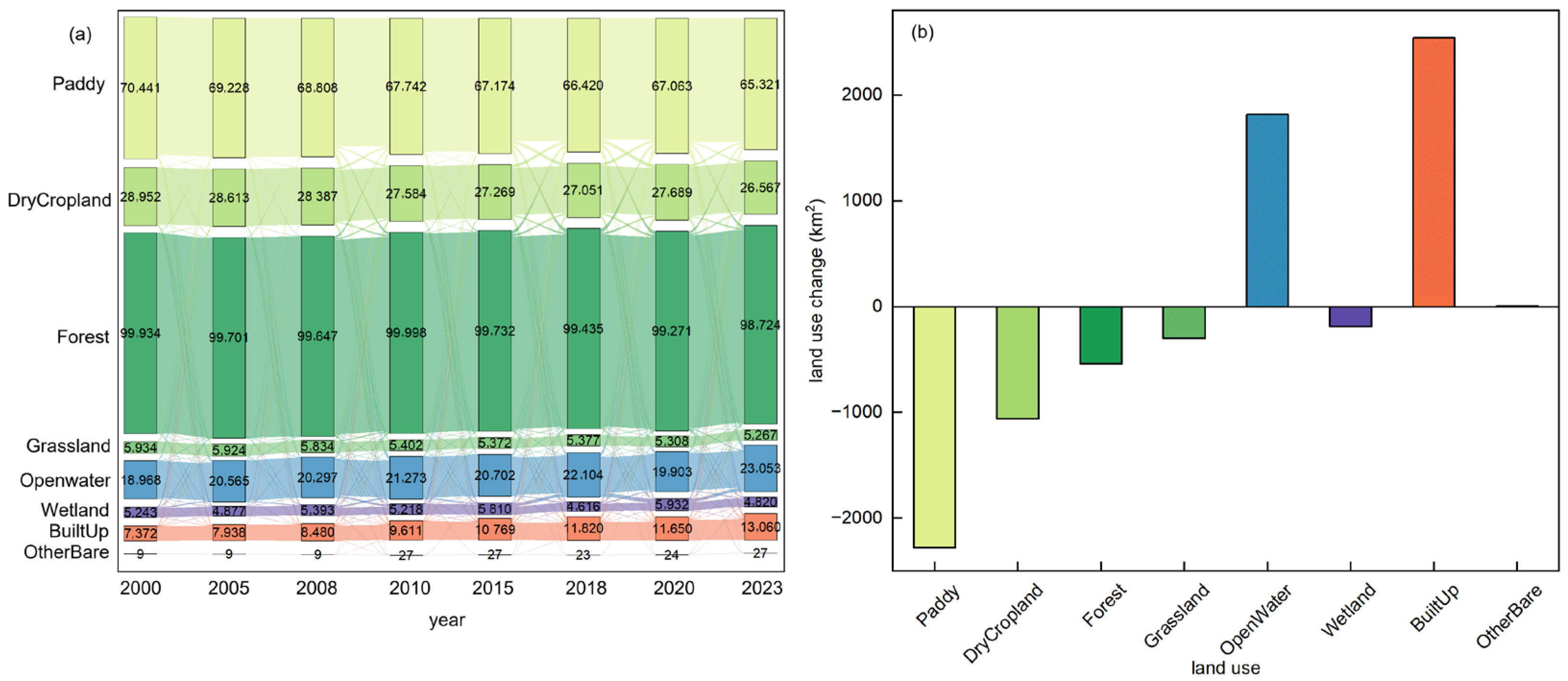
Land use/land cover patterns in the DLEEZ remained strongly structured during 2000–2023. Forest was mainly distributed in peripheral hilly and mountainous areas, paddy land and dry cropland were concentrated in the central and eastern plains, and open water and wetland were located in the core lake area and adjacent floodplain (Figure 7a). During this period, built-up land and open water showed net increases, whereas paddy land exhibited the largest net decrease, followed by dry cropland, forest, and grassland (Figure 7b). These patterns indicate urban expansion, cropland contraction, and hydrologically related landscape reorganization. The spatial context for these land use/land cover changes is provided in Figure S4.
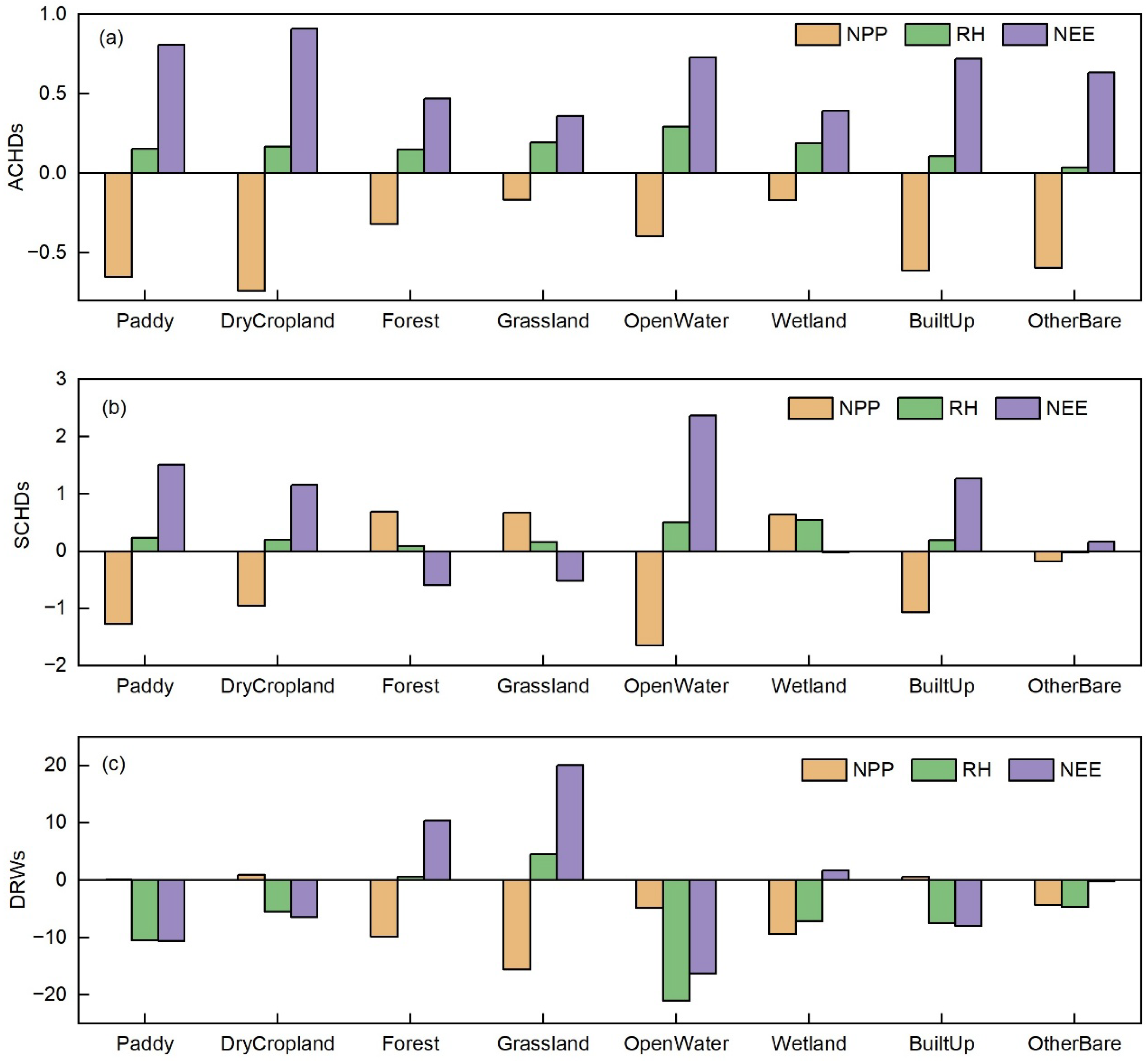
Clear differences in event–carbon relationships were observed among land cover types, indicating that carbon flux sensitivity to compound extremes depended on land cover background. Under ACHDs, all land cover categories showed negative NPP slopes, indicating a broadly suppressive association between atmospheric hot–dry stress and vegetation productivity (Figure 8a). This suppression was particularly strong in paddy land, dry cropland, built-up land, and other sparsely vegetated surfaces, whereas forest, grassland, and wetland showed relatively weaker negative responses. RH showed weakly positive slopes across most land cover types (Figure 8a). As a result, NEE responded positively under ACHDs in all categories, with stronger increases in dry cropland, paddy land, open water, and built-up land (Figure 8a), indicating weakened net carbon uptake.
Compared with ACHDs, SCHDs produced more heterogeneous land cover-dependent responses. In paddy land, dry cropland, open water, and built-up land, SCHDs were generally associated with negative NPP slopes and positive NEE slopes, indicating weakened net carbon uptake under soil compound hot–dry stress (Figure 8b). In contrast, forest and grassland exhibited positive NPP slopes but negative NEE slopes, implying that the net carbon response of these vegetated surfaces differed from that of cropland and water-dominated environments. Wetland showed an approximately neutral NEE response, suggesting that productivity and respiration responses partly offset each other under SCHDs. These results indicate that the carbon flux responses associated with soil compound hot–dry stress differed strongly among land cover types.
The strongest land cover differentiation was found under DRWs. In paddy land, dry cropland, open water, built-up land, and other sparsely vegetated surfaces, DRWs were generally associated with negative RH slopes and negative or near-neutral NEE slopes, indicating that their monthly carbon response was mainly linked to reduced respiration (Figure 8c). In contrast, forest and grassland showed negative NPP slopes but positive NEE slopes, suggesting that productivity losses outweighed the concurrent RH response under drought-to-rewetting conditions (Figure 8c). Wetland again occupied an intermediate position, with both NPP and RH decreasing and the overall NEE response remaining comparatively weak. Therefore, unlike ACHDs, which produced a relatively consistent sink weakening response across land cover types, DRWs generated strongly differentiated responses depending on underlying surface conditions.
Taken together, the stratified analysis indicates that land cover background was associated with substantial differences in carbon flux sensitivity to compound extreme events. Land cover types with relatively low vegetation buffering capacity or greater exposure to water-level fluctuations, inundation–drying cycles, and soil moisture variability generally showed larger responses to ACHDs and SCHDs, whereas responses to DRWs were more strongly differentiated among cropland, forest, wetland, and open water surfaces. These results suggest that regional assessments of carbon responses to compound extremes should account for land cover heterogeneity.

4. Discussion

4.1. Differential Effects of Compound Extreme Events on Carbon Fluxes

The three types of compound extreme events were associated with different carbon flux response pathways. ACHDs were mainly associated with reduced NPP and more positive NEE, indicating that atmospheric hot–dry stress was linked to weakened regional net carbon uptake primarily through the productivity pathway. This pattern is consistent with previous studies showing that compound heat and drought can substantially reduce terrestrial carbon uptake, and that high atmospheric dryness and elevated VPD can suppress photosynthesis and stomatal conductance even when soil moisture has not yet reached severe drought levels [9,10,18,19]. In the Dongting Lake region, ACHDs may therefore constrain canopy carbon assimilation rapidly through atmospheric demand, before severe soil drought fully develops.
In contrast, SCHDs and DRWs were more closely associated with reduced RH and more negative NEE than with widespread NPP decline, suggesting that soil hydrothermal stress in this humid lake–floodplain system was more directly linked to respiration-related processes. Soil moisture is a first-order control on microbial activity, substrate diffusion, and soil carbon mineralization, and severe drying can suppress heterotrophic respiration even under warm conditions [27,52]. For DRWs, previous studies have shown that rewetting after drought can trigger short-lived respiration pulses, known as the Birch effect [25]. However, such pulses are often transient and may be damped at the monthly scale. In wet or flood-prone ecosystems, rewetting may also increase saturation and oxygen limitation, thereby reducing soil respiration [53]. This provides a plausible explanation for why DRWs in this study were linked to lower reconstructed monthly RH and more negative NEE rather than to a sustained monthly respiration increase.
The detrended fixed effects analysis further supports the distinction between atmospheric and soil event pathways. After removing pixel-specific trends and controlling for pixel, calendar month, and year fixed effects, ACHDs remained associated with reduced NPP and more positive NEE, whereas SCHDs and DRWs remained associated with reduced RH and more negative NEE. This indicates that the observed RH responses were not solely driven by long-term drying or seasonal covariation [54,55]. Nevertheless, because soil drought can persist beyond a single month, the estimated event–RH relationships should be interpreted as reconstructed monthly associations that may include both contemporaneous and short-term antecedent soil moisture effects. The attenuation or sign changes of soil event coefficients after additionally controlling for ST and SM also suggest that soil hydrothermal conditions are not merely confounders but constitute a major pathway linking SCHDs and DRWs to RH and NEE responses.

4.2. Land Cover Dependence and Implications for Regional Carbon Sink Stability

Land cover background was associated with clear differences in carbon flux sensitivity to compound extreme events. Cropland, built-up land, and sparsely vegetated surfaces showed stronger sensitivity to ACHDs, whereas forest, wetland, and grassland were relatively less responsive. These differences may reflect variation in vegetation cover, rooting depth, canopy structure, soil exposure, and hydrological buffering. Irrigation may partly buffer soil moisture stress in cropland, especially in paddy fields. However, ACHDs were defined by atmospheric heat and VPD, and irrigation can alleviate soil water limitation but does not necessarily reduce high atmospheric demand or canopy heat stress. In addition, irrigation practices are spatially heterogeneous and were not explicitly represented in the gridded datasets used here. At the 1 km monthly scale, cropland pixels may also contain mixed crop types, management regimes, and phenological stages. Therefore, cropland sensitivity should be interpreted as the integrated response of managed agricultural landscapes to compound atmospheric stress rather than as evidence that irrigation has no buffering role.
The stratified land cover analysis provides useful context for interpreting spatial heterogeneity in event–carbon relationships but does not directly quantify the dynamic effect of land cover conversion. Built-up land and open water increased during 2000–2023, whereas paddy land and several vegetated classes declined; however, these observed changes were used to characterize land cover background rather than to infer causal transition effects. A more direct assessment of LUCC transition effects would require identifying converted pixels and comparing their pre- and post-transition responses under similar event intensities, for example using a difference-in-differences framework. This remains an important direction for future work.
Several uncertainties should also be acknowledged. First, monthly RH was reconstructed from annual RH rather than directly observed. Although the allocation scheme preserved annual RH totals and incorporated soil temperature and soil moisture constraints, it may smooth short-lived respiration pulses or transient suppression during extreme events. The sensitivity analysis showed that the dominant signs of RH and NEE responses were highly consistent between the original and Q10 plus soil moisture allocation schemes, especially for SCHDs and DRWs (Figures S1 and S2; Tables S1 and S2); nevertheless, RH response magnitudes varied among allocation schemes. Second, open water and wetland pixels involve specific interpretation challenges. Persistent open water pixels were excluded from soil-based event identification and RH reconstruction, whereas NPP values in lake margin or open water classes may partly reflect aquatic vegetation, seasonally exposed wetlands, or mixed pixels. Third, basin-wide thresholds may underrepresent local microclimatic extremes. Despite these limitations, the contrasts among ACHDs, SCHDs, and DRWs indicate that future assessments of carbon sink stability in humid lake–floodplain systems should consider both compound atmospheric and soil extremes and land cover heterogeneity.

5. Conclusions

This study examined the spatiotemporal patterns of three compound extreme events and their associations with NPP, RH, and NEE in the Dongting Lake Eco-Economic Zone during 2003–2024. ACHDs and SCHDs both increased significantly, indicating intensified atmospheric and soil hot–dry stress, whereas DRWs showed a slight decreasing trend and remained more spatially localized. During the same period, regional NPP increased significantly, RH decreased slightly, and NEE became more negative, indicating an overall strengthening of net carbon uptake.
The three event types were associated with contrasting carbon flux response pathways. ACHDs were mainly linked to reduced NPP, slightly increased RH, more positive NEE, and weakened net carbon uptake. In contrast, SCHDs and DRWs were more closely associated with reduced RH and more negative NEE, while their associations with NPP were weaker and more spatially heterogeneous. These results suggest that compound extremes in humid lake–floodplain systems should not be treated as a single uniform stressor, because atmospheric and soil hydroclimatic events may influence carbon fluxes through different production- and respiration-related pathways.
Carbon flux responses also differed markedly among land cover types. Cropland, built-up land, and sparsely vegetated surfaces were generally more sensitive to ACHDs, whereas responses to SCHDs and DRWs varied more strongly among forest, grassland, wetland, and open water classes. These findings indicate that event type, carbon component, and land cover background should be jointly considered when evaluating carbon-sink stability in humid lake–floodplain systems.

Supplementary Materials

The following supporting information can be downloaded at: https://www.mdpi.com/article/10.3390/rs18121909/s1, Figure S1: Sensitivity of RH and NEE anomaly differences in monthly RH allocation schemes. Bars show event month minus non-event month differences in monthly RH and NEE anomalies under different monthly RH allocation schemes. Original represents the Q10- and soil moisture-constrained allocation scheme used in the main analysis; NPP, Q10T, and Q10TW represent the NPP fraction, Q10-based temperature only, and Q10 plus soil moisture allocation schemes, respectively. The unit is g C m−2 month−1; Figure S2: Pixel-wise sign consistency of regression slopes across monthly RH allocation schemes. Bars show the percentage of valid pixels where the sign of the regression slope under each alternative monthly RH allocation scheme is consistent with that under the original scheme. NPP, Q10T, and Q10TW represent the NPP fraction, Q10-based temperature only, and Q10 plus soil moisture allocation schemes, respectively. The dashed line indicates 70% sign consistency as a reference level. Higher values indicate greater robustness of the response direction to the monthly RH allocation method; Figure S3: Annual summary of monthly soil temperature validation against the TPDC 1 km reference during 2010–2020. Points indicate the annual mean of monthly daily spatial RMSE values, and error bars indicate the standard deviation among months within each year. The downscaled 1 km soil temperature dataset consistently showed lower RMSE than the original GLDAS soil temperature product; Figure S4: Multi-year land use/land cover maps in the Dongting Lake Eco-Economic Zone. Maps show the spatial distribution of major land cover types in the years used for land cover analysis during 2000–2023. These maps provide supplementary spatial context for interpreting land cover-type differences in carbon flux sensitivity to compound extreme events; Table S1: Annual closure and pairwise consistency of monthly RH estimates under different temporal allocation schemes; Table S2: Sensitivity of RH and NEE responses to monthly RH allocation schemes; Table S3: Fixed effects panel regression results for detrended carbon flux anomalies. The FE only model includes pixel, calendar month, and year fixed effects. The diagnostic FE + ST/SM model additionally includes detrended soil temperature (ST) and soil moisture (SM) anomalies as climate state controls. Standard errors are clustered at the pixel level. Because ST and SM are part of the definitions and pathways of SCHDs and DRWs, the FE + ST/SM model should be interpreted as a residual association test rather than as the total soil event response. Positive NEE coefficients indicate weaker net carbon uptake, whereas negative NEE coefficients indicate stronger net carbon uptake; Table S4: Validation metrics for the downscaled 1 km soil temperature dataset and quality control summary for soil moisture.

Author Contributions

Z.N.: conceptualization, data curation, formal analysis, methodology, visualization, writing—original draft. S.F.: writing—original draft. Q.H.: funding acquisition. L.Y.: writing—review and editing. W.H.: resources, validation. All authors have read and agreed to the published version of the manuscript.

Funding

This work was financially supported by the National Natural Science Foundation of China (No. 42301029), and the Open Fund Project of the Hunan Provincial Key Laboratory of Eco-Environmental Remote Sensing Monitoring in the Dongting Lake Region (DTH Key Lab. 2021-31).

Data Availability Statement

The publicly available datasets used in this study can be obtained from the data sources listed in Table 1. The derived monthly RH dataset has been uploaded to Figshare (10.6084/m9.figshare.32613393).

Acknowledgments

The authors gratefully acknowledge the data providers and research teams who made the datasets used in this study publicly available. The ChinaMet meteorological forcing data were provided by the National Cryosphere Desert Data Center. The soil temperature and soil moisture datasets were provided by the National Tibetan Plateau/Third Pole Environment Data Center. The GLDAS-2.1 Noah product was provided by NASA. The GLASS NPP product was provided by the GLASS research team. The land use/land cover data were provided by the Resource and Environment Science Data Center, Chinese Academy of Sciences. The authors also thank the developers and data providers of the global heterotrophic respiration and SRDB-based soil respiration datasets used to support the RH reconstruction in this study.

Conflicts of Interest

The authors declare no conflicts of interest.

Abbreviations

The following abbreviations are used in this manuscript:
ACHDsAtmospheric compound hot–dry events
SCHDsSoil compound hot–dry events
DRWsDrought-to-rewetting events
NPPNet primary production
RHHeterotrophic respiration
NEENet ecosystem exchange
LUCCLand use/land cover change
DLEEZDongting Lake Eco-Economic Zone
VPDVapor pressure deficit

References

  1. Zscheischler, J.; Westra, S.; Van Den Hurk, B.J.; Seneviratne, S.I.; Ward, P.J.; Pitman, A.; AghaKouchak, A.; Bresch, D.N.; Leonard, M.; Wahl, T.; et al. Future climate risk from compound events. Nat. Clim. Chang. 2018, 8, 469–477. [Google Scholar]
  2. Zscheischler, J.; Martius, O.; Westra, S.; Bevacqua, E.; Raymond, C.; Horton, R.M.; van den Hurk, B.; AghaKouchak, A.; Jézéquel, A.; Mahecha, M.D.; et al. A typology of compound weather and climate events. Nat. Rev. Earth Environ. 2020, 1, 333–347. [Google Scholar] [CrossRef]
  3. Liu, X.; Sun, G.; Fu, Z.; Ciais, P.; Feng, X.; Li, J.; Fu, B. Compound droughts slow down the greening of the Earth. Glob. Change Biol. 2023, 29, 3072–3084. [Google Scholar] [CrossRef] [PubMed]
  4. Li, J.; Zhang, Y.; Bevacqua, E.; Zscheischler, J.; Keenan, T.F.; Lian, X.; Zhou, S.; Zhang, H.; He, M.; Piao, S. Future increase in compound soil drought-heat extremes exacerbated by vegetation greening. Nat. Commun. 2024, 15, 10875. [Google Scholar] [CrossRef]
  5. Ridder, N.N.; Pitman, A.J.; Westra, S.; Ukkola, A.; Do, H.X.; Bador, M.; Hirsch, A.L.; Evans, J.P.; Di Luca, A.; Zscheischler, J. Global hotspots for the occurrence of compound events. Nat. Commun. 2020, 11, 5956. [Google Scholar] [PubMed]
  6. Ridder, N.N.; Ukkola, A.M.; Pitman, A.J.; Perkins-Kirkpatrick, S.E. Increased occurrence of high impact compound events under climate change. npj Clim. Atmos. Sci. 2022, 5, 3. [Google Scholar]
  7. Zhang, B.; Wang, S.; Slater, L. Anthropogenic climate change doubled the frequency of compound drought and heatwaves in low-income regions. Commun. Earth Environ. 2024, 5, 715. [Google Scholar] [CrossRef]
  8. Zhou, S.; Williams, A.P.; Berg, A.M.; Cook, B.I.; Zhang, Y.; Hagemann, S.; Gentine, P. Land–atmosphere feedbacks exacerbate concurrent soil drought and atmospheric aridity. Proc. Natl. Acad. Sci. USA 2019, 116, 18848–18853. [Google Scholar] [CrossRef]
  9. Reichstein, M.; Bahn, M.; Ciais, P.; Frank, D.; Mahecha, M.D.; Seneviratne, S.I.; Zscheischler, J.; Beer, C.; Buchmann, N.; Frank, D.C.; et al. Climate extremes and the carbon cycle. Nature 2013, 500, 287–295. [Google Scholar] [CrossRef] [PubMed]
  10. Novick, K.A.; Ficklin, D.L.; Stoy, P.C.; Williams, C.A.; Bohrer, G.; Oishi, A.C.; Papuga, S.A.; Blanken, P.D.; Noormets, A.; Sulman, B.N.; et al. The increasing importance of atmospheric demand for ecosystem water and carbon fluxes. Nat. Clim. Chang. 2016, 6, 1023–1027. [Google Scholar] [CrossRef]
  11. Gu, L.; Schumacher, D.L.; Fischer, E.M.; Slater, L.J.; Yin, J.; Sippel, S.; Chen, J.; Liu, P.; Knutti, R. Flash drought impacts on global ecosystems amplified by extreme heat. Nat. Geosci. 2025, 18, 709–715. [Google Scholar]
  12. Frank, D.; Reichstein, M.; Bahn, M.; Thonicke, K.; Frank, D.; Mahecha, M.D.; Zscheischler, J. Effects of climate extremes on the terrestrial carbon cycle: Concepts, processes and potential future impacts. Glob. Change Biol. 2015, 21, 2861–2880. [Google Scholar] [CrossRef] [PubMed]
  13. Roy, J.; Picon-Cochard, C.; Augusti, A.; Benot, M.L.; Thiery, L.; Darsonville, O.; Soussana, J.F. Elevated CO2 maintains grassland net carbon uptake under a future heat and drought extreme. Proc. Natl. Acad. Sci. USA 2016, 113, 6224–6229. [Google Scholar] [PubMed]
  14. Li, J.; Bevacqua, E.; Wang, Z.; Sitch, S.; Arora, V.; Arneth, A.; Goll, D.; Tian, H.; Zscheischler, J. Hydroclimatic extremes contribute to asymmetric trends in ecosystem productivity loss. Commun. Earth Environ. 2023, 4, 197. [Google Scholar] [CrossRef]
  15. Wang, Z.; Chen, W.; Piao, J.; Cai, Q.; Chen, S.; Xue, X.; Ma, T. Synergistic effects of high atmospheric and soil dryness on record-breaking decreases in vegetation productivity over Southwest China in 2023. npj Clim. Atmos. Sci. 2025, 8, 6. [Google Scholar] [CrossRef]
  16. Anderegg, W.R.L.; Kane, J.M.; Anderegg, L.D.L. Consequences of widespread tree mortality triggered by drought and temperature stress. Nat. Clim. Chang. 2013, 3, 30–36. [Google Scholar]
  17. Yuan, W.; Cai, W.; Chen, Y.; Liu, S.; Dong, W.; Zhang, H.; Yu, G.; Chen, Z.; He, H.; Guo, W.; et al. Severe summer heatwave and drought strongly reduced carbon uptake in Southern China. Sci. Rep. 2016, 6, 18813. [Google Scholar] [CrossRef]
  18. Sippel, S.; Reichstein, M.; Ma, X.; Mahecha, M.D.; Lange, H.; Flach, M.; Frank, D. Drought, heat, and the carbon cycle: A review. Curr. Clim. Chang. Rep. 2018, 4, 266–286. [Google Scholar] [CrossRef]
  19. Fu, Z.; Ciais, P.; Prentice, I.C.; Gentine, P.; Makowski, D.; Bastos, A.; Luo, X.; Green, J.K.; Stoy, P.C.; Yang, H.; et al. Atmospheric dryness reduces photosynthesis along a large range of soil water deficits. Nat. Commun. 2022, 13, 989. [Google Scholar] [CrossRef]
  20. Lu, H.; Qin, Z.; Lin, S.; Chen, X.; Chen, B.; He, B.; Wei, J.; Yuan, W. Large influence of atmospheric vapor pressure deficit on ecosystem production efficiency. Nat. Commun. 2022, 13, 1653. [Google Scholar]
  21. Stocker, B.D.; Zscheischler, J.; Keenan, T.F.; Prentice, I.C.; Seneviratne, S.I.; Peñuelas, J. Drought impacts on terrestrial primary production underestimated by satellite monitoring. Nat. Geosci. 2019, 12, 264–270. [Google Scholar] [CrossRef]
  22. Liu, L.; Gudmundsson, L.; Hauser, M.; Qin, D.; Li, S.; Seneviratne, S.I. Soil moisture dominates dryness stress on ecosystem production globally. Nat. Commun. 2020, 11, 4892. [Google Scholar] [CrossRef]
  23. Deng, Y.; Wang, X.; Wang, K.; Ciais, P.; Tang, S.; Jin, L.; Li, L.; Piao, S. Responses of vegetation greenness and carbon cycle to extreme droughts in China. Agric. For. Meteorol. 2021, 298, 108307. [Google Scholar] [CrossRef]
  24. Vicca, S.; Bahn, M.; Estiarte, M.; Van Loon, E.E.; Vargas, R.; Alberti, G.; Janssens, I.A. Can current moisture responses predict soil CO2 efflux under altered precipitation regimes? A synthesis of manipulation experiments. Biogeosciences 2014, 11, 2991–3013. [Google Scholar]
  25. Manzoni, S.; Chakrawal, A.; Fischer, T.; Schimel, J.P.; Porporato, A.; Vico, G. Rainfall intensification increases the contribution of rewetting pulses to soil heterotrophic respiration. Biogeosciences 2020, 17, 4007–4023. [Google Scholar] [CrossRef]
  26. Li, X.; Pallandt, M.; Naidu, D.; Rousk, J.; Hugelius, G.; Manzoni, S. Validating laboratory predictions of soil rewetting respiration pulses using field data. Biogeosciences 2025, 22, 2691–2705. [Google Scholar] [CrossRef]
  27. Song, J.; Wan, S.; Piao, S.; Knapp, A.K.; Classen, A.T.; Vicca, S.; Zheng, M. A meta-analysis of 1,119 manipulative experiments on terrestrial carbon-cycling responses to global change. Nat. Ecol. Evol. 2019, 3, 1309–1320. [Google Scholar]
  28. Bastos, A.; Ciais, P.; Friedlingstein, P.; Sitch, S.; Pongratz, J.; Fan, L.; Wigneron, J.P.; Weber, U.; Reichstein, M.; Fu, Z.; et al. Direct and seasonal legacy effects of the 2018 heat wave and drought on European ecosystem productivity. Sci. Adv. 2020, 6, eaba2724. [Google Scholar] [CrossRef] [PubMed]
  29. Pohl, F.; Werban, U.; Kumar, R.; Hildebrandt, A.; Rebmann, C. Observational evidence of legacy effects of the 2018 drought on a mixed deciduous forest in Germany. Sci. Rep. 2023, 13, 10863. [Google Scholar] [CrossRef] [PubMed]
  30. Yang, H.; Zhong, X.; Deng, S.; Xu, H. Assessment of the impact of LUCC on NPP and its influencing factors in the Yangtze River basin, China. Catena 2021, 206, 105542. [Google Scholar] [CrossRef]
  31. Long, X.; Lin, H.; An, X.; Chen, S.; Qi, S.; Zhang, M. Evaluation and analysis of ecosystem service value based on land use/cover change in Dongting Lake wetland. Ecol. Indic. 2022, 136, 108619. [Google Scholar] [CrossRef]
  32. Xiong, S.; Yang, F. Ecological resilience in water-land transition zones: A case study of the Dongting Lake region, China. Ecol. Indic. 2024, 166, 112284. [Google Scholar] [CrossRef]
  33. Zhang, M.; Yuan, N.; Lin, H.; Liu, Y.; Zhang, H. Quantitative estimation of the factors impacting spatiotemporal variation in NPP in the Dongting Lake wetlands using Landsat time series data for the last two decades. Ecol. Indic. 2022, 135, 108544. [Google Scholar] [CrossRef]
  34. Zhu, L.; Deng, Z.; Xie, Y.; Zhang, C.; Chen, X.; Li, X.; Li, F.; Chen, X.; Zou, Y.; Wang, W. Effects of hydrological environment on litter carbon input into the surface soil organic carbon pool in the Dongting Lake floodplain. Catena 2022, 208, 105761. [Google Scholar] [CrossRef]
  35. Deng, C.; Shen, X.; Liu, C.; Liu, Y. Spatiotemporal characteristics and socio-ecological drivers of ecosystem service interactions in the Dongting Lake Ecological Economic Zone. Ecol. Indic. 2024, 167, 112734. [Google Scholar] [CrossRef]
  36. Hou, Y.; Wang, L.; Li, Z.; Ouyang, X.; Xiao, T.; Wang, H.; Li, W.; Nie, X. Landscape fragmentation and regularity lead to decreased carbon stocks in basins: Evidence from century-scale research. J. Environ. Manag. 2024, 367, 121937. [Google Scholar] [CrossRef] [PubMed]
  37. Wang, T.; Deng, Z.; Xie, Y.; Wang, B.; Wu, S.; Li, F.; Wang, W.; Zou, Y.; Li, X.; Hou, Z.; et al. Time-lag effects of flood stimulation on methane emissions in the Dongting lake floodplain, China. Agric. For. Meteorol. 2023, 341, 109677. [Google Scholar] [CrossRef]
  38. Long, Y.; Huang, C.; Jiang, C.; Huang, Z.; Wang, X.; Yan, S. Spatiotemporal Variability of Extreme Precipitation and Influence of Climate Factors and Topography in the Dongting Lake Basin, Southern China. Int. J. Climatol. 2025, 45, e70066. [Google Scholar]
  39. Zhou, W.; Sun, Z.; Yang, Z.; Guo, G. Confluence effects of Dongting Lake in the Middle Yangtze River: Discontinuous fluvial processes and their driving mechanisms. Water Resour. Res. 2025, 61, e2024WR039030. [Google Scholar] [CrossRef]
  40. Qi, S.; Chen, S.; Long, X.; An, X.; Zhang, M. Quantitative contribution of climate change and anthropological activities to vegetation carbon storage in the Dongting Lake basin in the last two decades. Adv. Space Res. 2023, 71, 845–868. [Google Scholar]
  41. Qi, S.; Zhang, H.; Zhang, M. Evolutionary characteristics of carbon sources/sinks in Chinese terrestrial ecosystems regarding to temporal effects and geographical partitioning. Ecol. Indic. 2024, 160, 111923. [Google Scholar] [CrossRef]
  42. Wang, T.; Deng, Z.; Zhang, C.; Zou, Y.; Xie, Y.; Li, F.; Xiao, F.; Peng, C. Vegetation types and flood water level are dominant factors controlling the carbon sequestration potential in Dongting Lake floodplain, China. Sci. Total Environ. 2024, 921, 171146. [Google Scholar]
  43. Song, P.; Zhang, Y.; Guo, J.; Shi, J.; Zhao, T.; Tong, B. A 1 km daily surface soil moisture dataset of enhanced coverage under all-weather conditions over China in 2003–2019. Earth Syst. Sci. Data 2022, 14, 2613–2637. [Google Scholar] [CrossRef]
  44. Tang, X.; Fan, S.; Du, M.; Zhang, W.; Gao, S.; Liu, S.; Chen, G.; Yu, Z.; Yang, W. Spatial and temporal patterns of global soil heterotrophic respiration in terrestrial ecosystems. Earth Syst. Sci. Data 2020, 12, 1037–1051. [Google Scholar] [CrossRef]
  45. Hashimoto, S.; Carvalhais, N.; Ito, A.; Migliavacca, M.; Nishina, K.; Reichstein, M. Global spatiotemporal distribution of soil respiration modeled using a global database. Biogeosciences 2015, 12, 4121–4132. [Google Scholar] [CrossRef]
  46. Yao, Y.; Ciais, P.; Viovy, N.; Li, W.; Cresto-Aleina, F.; Yang, H.; Joetzjer, E.; Bond-Lamberty, B. A data-driven global soil heterotrophic respiration dataset and the drivers of its inter-annual variability. Glob. Biogeochem. Cycles 2021, 35, e2020GB006918. [Google Scholar] [CrossRef]
  47. Jian, J.; Vargas, R.; Anderson-Teixeira, K.; Stell, E.; Herrmann, V.; Horn, M.; Kholod, N.; Manzon, J.; Marchesi, R.; Paredes, D.; et al. A restructured and updated global soil respiration database (SRDB-V5). Earth Syst. Sci. Data 2021, 13, 255–267. [Google Scholar] [CrossRef]
  48. Zhang, L.; Li, X.; Zheng, D.; Zhang, K.; Ma, Q.; Zhao, Y.; Ge, Y. Merging multiple satellite-based precipitation products and gauge observations using a novel double machine learning approach. J. Hydrol. 2021, 594, 125969. [Google Scholar] [CrossRef]
  49. Hu, Y.; Zhang, L. Added value of merging techniques in precipitation estimates relative to gauge-interpolation algorithms of varying complexity. J. Hydrol. 2024, 645, 132214. [Google Scholar] [CrossRef]
  50. Wang, X.; He, L.; Shi, H.; Yu, Q. Daily Multi-Layer Soil Temperature Dataset with 1 km Resolution in China from 2010 to 2020; National Tibetan Plateau/Third Pole Environment Data Center: Beijing, China, 2025. [Google Scholar] [CrossRef]
  51. Li, J.; Wang, Z.; Lai, C.; Wu, X.; Zeng, Z.; Chen, X.; Lian, Y. Response of net primary production to land use and land cover change in mainland China since the late 1980s. Sci. Total Environ. 2018, 639, 237–247. [Google Scholar] [PubMed]
  52. Borken, W.; Matzner, E. Reappraisal of drying and wetting effects on C and N mineralization and fluxes in soils. Glob. Change Biol. 2009, 15, 808–824. [Google Scholar] [CrossRef]
  53. Han, G.; Sun, B.; Chu, X.; Xing, Q.; Song, W.; Xia, J. Precipitation events reduce soil respiration in a coastal wetland based on four-year continuous field measurements. Agric. For. Meteorol. 2018, 256, 292–303. [Google Scholar] [CrossRef]
  54. Xiao, C.; Zaehle, S.; Yang, H.; Wigneron, J.P.; Schmullius, C.; Bastos, A. Land cover and management effects on ecosystem resistance to drought stress. Earth Syst. Dyn. 2023, 14, 1211–1237. [Google Scholar] [CrossRef]
  55. Zhou, W.; Wang, J.; Han, Y.; Yang, L.; Que, H.; Wang, R. Scenario simulation of the relationship between land-use changes and ecosystem carbon storage: A case study in Dongting lake basin, China. Int. J. Environ. Res. Public Health 2023, 20, 4835. [Google Scholar] [CrossRef] [PubMed]
Figure 1. Location and regional setting of the Dongting Lake Eco-Economic Zone. Panel (a) shows the location of the study area in the middle reaches of the Yangtze River, China. Panel (b) shows the main geographical units discussed in the text, including the Dongting Lake water body, surrounding floodplain, hilly peripheral areas, and major administrative regions. Elevation is shown with a logarithmic color scale to better visualize subtle variations in low-elevation lake plain areas.
Remotesensing 18 01909 g001
Figure 2. Spatiotemporal patterns of compound extreme events in the Dongting Lake Eco-Economic Zone during 2003–2024. (a) Multi-year mean annual atmospheric compound hot–dry event (ACHD) days; (b) multi-year mean annual soil compound hot–dry event (SCHD) days; (c) multi-year mean annual drought-to-rewetting event (DRW) counts; (d) regional annual ACHD days; (e) regional annual SCHD days; and (f) regional annual DRW counts. ACHDs and SCHDs are expressed as event days, whereas DRWs are expressed as event counts.
Remotesensing 18 01909 g002
Figure 3. Spatiotemporal patterns of carbon fluxes in the Dongting Lake Eco-Economic Zone during 2003–2024. (a) Multi-year mean annual net primary production (NPP); (b) multi-year mean annual heterotrophic respiration (RH); (c) multi-year mean annual net ecosystem exchange (NEE); (d) regional annual NPP; (e) regional annual RH; and (f) regional annual NEE. More negative NEE indicates stronger net carbon uptake. Temporal trends are reported per decade to facilitate interpretation of long-term changes. More negative NEE indicates stronger net carbon uptake.
Remotesensing 18 01909 g003
Figure 4. Differences in carbon lux anomalies between event and non-event months. Panels show event-month minus non-event-month differences in monthly carbon-flux anomalies for atmospheric compound hot–dry events (ACHDs), soil compound hot–dry events (SCHDs), and drought-to-rewetting events (DRWs): (a) ACHD-related NPP anomaly difference; (b) ACHD-related RH anomaly difference; (c) ACHD-related NEE anomaly difference; (d) SCHD-related NPP anomaly difference; (e) SCHD-related RH anomaly difference; (f) SCHD-related NEE anomaly difference; (g) DRW-related NPP anomaly difference; (h) DRW-related RH anomaly difference; and (i) DRW-related NEE anomaly difference. The unit is g C m−2 month−1.
Remotesensing 18 01909 g004
Figure 5. Pixel-wise synchronous regression between compound extreme event indicators and carbon flux anomalies. Panels show regression slopes between monthly event indicators and monthly anomalies of NPP, RH, and NEE: (a) ACHD–NPP regression slope; (b) ACHD–RH regression slope; (c) ACHD–NEE regression slope; (d) SCHD–NPP regression slope; (e) SCHD–RH regression slope; (f) SCHD–NEE regression slope; (g) DRW–NPP regression slope; (h) DRW–RH regression slope; and (i) DRW–NEE regression slope.
Remotesensing 18 01909 g005
Figure 6. Regional summary of carbon flux responses to compound extreme events. (a) Event-month minus non-event-month differences in monthly anomalies of NPP, RH, and NEE; (b) regional mean pixel-wise regression slopes between monthly compound-event indicators and monthly carbon-flux anomalies. Bars represent ACHDs, SCHDs, and DRWs.
Remotesensing 18 01909 g006
Figure 7. Land use/land cover patterns and area changes in the Dongting Lake Eco-Economic Zone. Panel (a) shows the spatial distribution and transition patterns of major land cover types, including paddy land, dry cropland, forest, grassland, wetland, open water, built-up land, and other land. Panel (b) shows the net area changes of each land cover type during 2000–2023. Positive values indicate land cover expansion, whereas negative values indicate area loss.
Remotesensing 18 01909 g007
Figure 8. Land cover-type differences in carbon flux responses to compound extreme events. Panels show regression slopes between monthly event indicators and carbon flux anomalies for different land cover types: (a) ACHDs; (b) SCHDs; and (c) DRWs.
Remotesensing 18 01909 g008
Table 1. Summary of the datasets used in this study.
Data CategoryDataset NameThe Spatiotemporal Resolution of the Original DataData Source
MeteorologyChinaMet meteorological forcing product1 km, daily, 1980–2024The dataset is provided by National Cryosphere Desert Data Center, Lanzhou, China. (http://www.ncdc.ac.cn)
SoilGLDAS-2.1 Noah soil temperature product0.25°, 3-hourly, 2000–2024NASA GLDAS-2.1 Noah land surface model product, Greenbelt, Maryland, USA
SoilDaily multi-layer soil temperature dataset1 km, daily, 2010–2020National Tibetan Plateau/Third Pole Environment Data Center (http://data.tpdc.ac.cn)
SoilDaily all-weather surface soil moisture dataset over China1 km, daily, 2003–2024National Tibetan Plateau/Third Pole Environment Data Center (http://data.tpdc.ac.cn); Song et al. [43]
CarbonGLASS NPP product500 m, 8-day, 2000–2024The dataset is provided by the Beijing Normal University, Beijing, China (https://glass.hku.hk/download.html)
CarbonGlobal RH dataset0.5°, annual, 1980–2016Tang et al. [44]
CarbonGlobal RH and Q10 dataset0.5°, annual, 1901–2012Hashimoto et al. [45]
CarbonData-driven global RH dataset0.5°, annual, 1985–2013Yao et al. [46]
CarbonGlobal gridded 1 km soil heterotrophic respiration derived from SRDB v51 km, one-time estimate (1961–2016)Jian et al. [47]
Land use/land coverChina Multi-Period Land Use/Land Cover Remote Sensing Monitoring Dataset (CNLUCC) 30 m, 2000, 2005, 2008, 2010, 2015, 2018, 2020, 2023Resource and Environment Science Data Center, Chinese Academy of Sciences (http://www.resdc.cn)
Disclaimer/Publisher’s Note: The statements, opinions and data contained in all publications are solely those of the individual author(s) and contributor(s) and not of MDPI and/or the editor(s). MDPI and/or the editor(s) disclaim responsibility for any injury to people or property resulting from any ideas, methods, instructions or products referred to in the content.