Article

Uncertainty Quantification and Global Sensitivity Analysis for Radio Wave Propagation in Evaporation Duct

College of Electronic Engineering, Naval University of Engineering, Wuhan 430033, China
*
Author to whom correspondence should be addressed.
Remote Sens. 2026, 18(11), 1808; https://doi.org/10.3390/rs18111808
Submission received: 11 March 2026 / Revised: 26 May 2026 / Accepted: 26 May 2026 / Published: 2 June 2026

Highlights

What are the main findings?
  • Kriging outperforms PCE (Polynomial Chaos Expansion) and PC-Kriging (Polynomial-Chaos Kriging) by capturing rapid multimode oscillations in evaporation ducts.
  • Kriging error falls as normalized frequency V rises, confirming its advantage for complex modal fields.
What are the implications of the main findings?
  • Duct height dominates short-range uncertainty; refractivity gradient gains importance at longer ranges.
  • The link between surrogate performance and modal complexity (V) guides physics-based metamodel selection.

Abstract

Accurate prediction of radio wave propagation in evaporation ducts is critical for radar systems but faces significant environmental uncertainties. This study presents an uncertainty quantification and global sensitivity analysis framework comparing three surrogate models: Polynomial Chaos Expansion, Ordinary Kriging, and Polynomial-Chaos Kriging. Using a parabolic equation solver, we quantify how five parameters—mean duct height, duct height slope, potential refractivity gradient, frequency, and root mean square (RMS) wave height—affect propagation loss. We assess predictive accuracy, perform Sobol-based sensitivity analysis, and explore how surrogate performance relates to the normalized frequency V, a parameter characterizing modal complexity. Results show that Kriging consistently outperforms the others: its local interpolation capability proves essential for capturing rapid spatial oscillations caused by multimode interference. We observe a statistically significant negative correlation between Kriging’s prediction error and V, suggesting that its local interpolation becomes increasingly advantageous as the modal complexity of the field (quantified by V) increases. This provides a physically interpretable, though not yet predictive, link between surrogate model choice and the underlying propagation physics. Sensitivity analysis reveals that mean duct height dominates uncertainty at short-to-medium ranges, while the potential refractivity gradient becomes increasingly influential at longer ranges. RMS wave height exhibits localized effects near multipath nulls, particularly at higher frequencies. These findings provide quantitative guidance for prioritizing environmental measurements and offer a physically interpretable basis for surrogate model selection in evaporation duct problems.

1. Introduction

The propagation of radio waves in marine environments is profoundly shaped by a series of atmospheric refraction effects. Among these, the evaporation duct—formed by the steep decrease in water vapor pressure near the air–sea interface—is the most persistent refractive structure in the marine atmospheric boundary layer [1]. By trapping electromagnetic energy, it allows signal propagation beyond the geometric horizon, which creates a dual-edged effect for maritime radar and communication systems: detection ranges may extend significantly, but unpredictable coverage holes and fading also arise from multipath interference [2,3,4].
Accurately predicting propagation loss within the evaporation duct is therefore essential for system evaluation and tactical planning. However, real marine environments introduce substantial uncertainties in key parameters such as wind speed, temperature, and humidity. The profile of an evaporation duct is directly characterized by parameters including mean duct height, duct slope, and refractivity gradient, which are inherently driven by these uncertain environmental variables and exhibit strong randomness in real scenarios. Meanwhile, system operating frequency and sea surface wave height also introduce non-negligible uncertainties to propagation loss. This makes it necessary to assess how these input uncertainties affect predictions—a task that belongs to uncertainty quantification (UQ) and global sensitivity analysis (GSA).
The most reliable propagation tool available is the parabolic equation (PE) method, a high-fidelity physics model that resolves complex multipath and range-dependent refractivity. Yet each PE evaluation is computationally expensive. Variance-based GSA methods (e.g., the extended Fourier amplitude sensitivity test (eFAST), and Monte Carlo-based methods for computing Sobol indices) and Monte Carlo (MC) sampling, which require thousands to millions of model runs to converge, become computationally prohibitive when coupled directly with the PE solver.
A solution is to replace the expensive PE model with a fast statistical surrogate (also called a metamodel). The surrogate is trained on a limited set of PE simulations and then used to emulate the input-output relationship at negligible cost. Once built, it can be sampled densely (e.g., with quasi-Monte Carlo) to propagate input uncertainties, and the resulting outputs are then post-processed by variance-based sensitivity analysis to quantify which input parameters drive the propagation loss. In this workflow, the PE model provides high-fidelity ground-truth data for surrogate training; the trained surrogate enables efficient dense sampling for uncertainty propagation; variance-based GSA is then performed to quantify the contribution of each input parameter to the variability of propagation loss.
Early sensitivity studies often rely on one-at-a-time (OAT) methods, which vary one parameter while holding others fixed, as introduced in [5] and applied to capture parameter effects in related contexts [6]. For evaporation ducts, although OAT is simple, it cannot capture parameter interactions. More advanced global methods, such as the extended Fourier amplitude sensitivity test (eFAST), have been applied directly to PE simulations by Lentini and Hackett [7] and Pastore and Hackett [8]. Those studies successfully quantified individual and interactive effects, but they performed eFAST directly on the expensive PE solver, which limited the feasible sample size and precluded extensive parametric exploration. They also did not examine surrogate-assisted UQ or how the surrogate choice relates to the underlying wave physics.
Several surrogate candidates have proven useful in electromagnetics: polynomial chaos expansion (PCE) projects the stochastic model response onto a set of orthogonal polynomials defined by the probability distributions of the input random variables [9]; Kriging (Gaussian process regression) offers exact interpolation and predictive variance [10]; and polynomial-chaos Kriging (PC-Kriging) combines a global PCE trend with local Kriging corrections [11]. Deep neural networks have also gained attention as surrogates in computational physics [12], but they typically require large training datasets and do not provide native uncertainty quantification unless paired with additional Bayesian inference frameworks [13], Monte Carlo dropout [14], or ensemble methods [15]. The PCE and Kriging frameworks adopted here are comparatively sample-efficient and provide native predictive variances, making them well suited for expensive PE-based simulations.
However, a systematic comparison of these surrogates for evaporation duct propagation is still lacking. Moreover, the connection between surrogate accuracy and the complexity of the guided wavefield—quantified by the normalized frequency V, a dimensionless parameter from classical waveguide theory that we extend to the evaporation duct scenario here [16]—has not been explored.
To fill this gap, the present work builds a surrogate-assisted UQ and GSA framework with three objectives: (1) compare the predictive accuracy of PCE, ordinary Kriging, and PC-Kriging against high-fidelity PE simulations; (2) perform variance-based sensitivity analysis (Sobol indices) to identify dominant uncertain parameters (mean duct height, slope, refractivity gradient, frequency, and wave height) across ranges and frequencies; and (3) examine whether the relative performance of these surrogates correlates with V, a dimensionless measure of modal complexity.
The remainder of this paper is organized as follows. Section 2 describes the evaporation duct model and the PE method. Section 3 details the UQ methodology, including sampling design, surrogate construction, and Sobol index computation. Section 4 presents numerical results, comparing surrogate accuracies and sensitivity indices. Section 5 discusses implications and limitations. Section 6 concludes with key insights and future work.

2. Propagation Model

2.1. Evaporation Duct Model

The evaporation duct is a ubiquitous feature of the marine atmospheric surface layer, resulting from the sharp decrease in water vapor pressure with height immediately above the sea surface. This gradient in humidity gives rise to a vertical structure in the modified refractivity M ( z ) that can trap electromagnetic energy, significantly extending propagation beyond the geometric horizon. To model this effect, a log-linear refractivity profile is employed, which captures both the logarithmic behavior in the surface layer and the linear gradient in the overlying mixed layer using a parsimonious set of parameters [17,18]. The profile is expressed as
M ( z ) = M 0 + c 0 z h d ln z + z 0 z 0
where M 0 is the surface refractivity. Following standard practice in evaporation duct modeling, M 0 is taken as a constant 333 M-units, a representative value for the marine surface layer that varies by less than 1.4% over typical sea surface temperature ranges [7,8]. The aerodynamic roughness length z 0 is set to 1.5 × 10 4 m, which is commonly used to characterize a smooth sea surface under low-to-moderate wind speeds [17,19].
The parameter c 0 (M-unitsm−1) is the potential refractivity gradient in the mixed layer above the duct, influencing the profile’s curvature [20,21]. It controls the strength of the duct and, together with the duct height, determines the trapping capability. The evaporation duct height, h d (m), defines the thickness of this trapping layer and is a critical factor in determining propagation characteristics. While the above formulation assumes horizontal homogeneity, range-dependent refractivity structures are frequently observed in coastal regions [22]. To capture this first-order effect, a linear variation of duct height with horizontal distance x is introduced [23]:
h d ( x ) = h d , mean + s d x 30
where h d , mean is the mean duct height over a 60 km propagation path—a domain length consistent with the sensitivity studies of Lentini and Hackett [7] and Pastore and Hackett [8], and representative of medium-to-long-range shipborne radar detection—and s d (m·km−1) is the slope of the duct height variation. This formulation ensures that the duct height at the path midpoint ( x = 30 km) equals h d , mean , providing a parsimonious representation of range dependence suitable for sensitivity analysis.
In the present framework, only the duct height h d varies linearly with range, while the potential refractivity gradient c 0 is held constant. This simplification is adopted because observational constraints on range-varying c 0 are lacking: studies such as Greenway et al. [22] have not established typical amplitude ranges or statistical thresholds for its spatial variation. A linear h d profile thus offers a practical first-order approximation consistent with practice [22,23], although real environments may exhibit nonlinear or abrupt transitions. The modified refractive index is given by m ( z ) = 1 + M ( z ) × 10 6 .

2.2. Parabolic Equation for Radio Wave Propagation

To model wave propagation within this refractivity structure, the parabolic equation (PE) method is employed, as it is well-suited for long-range, ducted propagation scenarios. In terms of the reduced function ψ ( x , z ) , related to the electric field by E ( x , z ) = ψ ( x , z ) e i k 0 x / x , the standard parabolic equation (SPE) is expressed as follows [24]:
2 ψ z 2 + 2 i k 0 ψ x + k 0 2 m 2 ( x , z ) 1 ψ = 0
where k 0 = 2 π / λ is the free-space wavenumber, and λ is the wavelength. The 1 / x factor accounts for cylindrical spreading in the horizontal plane. The SPE is derived under the assumption of paraxial (narrow-angle) propagation, which is valid for angles within about 15 of the horizontal. For the evaporation duct environment, where propagation paths are predominantly near-horizontal, the SPE is sufficient. However, for scenarios involving larger angles (e.g., high-elevation antennas or steep terrain), a wide-angle parabolic equation (WAPE) would be required [25]. Since the transmitter operates at a 0 elevation angle, propagation is confined to near-horizontal angles, and the SPE is adopted.
The SPE is solved numerically using the split-step Fourier (SSF) algorithm [24]. This method marches the field in range by alternating between phase-screen corrections due to refractive index variations and free-space diffraction steps performed in the spectral domain, providing an efficient and accurate solution that has been extensively validated for tropospheric propagation.
The sea surface is treated as a rough, conducting boundary. Rather than applying a computationally expensive impedance boundary condition at each step, the effect of surface roughness is incorporated through a mean reflection coefficient [26]. This study employs the Ament–Miller–Brown modification [27]. While more elaborate models such as the Donelan–Pierson–Banner (DPB) spectral model resolve interactions down to the capillary-wave scale [8], they require high-resolution facet discretization and substantial computational resources. The Miller–Brown formulation uses an analytic mean reflection coefficient that is computationally efficient and practical for the extensive Monte Carlo sampling required by the uncertainty quantification framework. The reflection coefficient is defined as follows [27]:
R rough ( θ ) = exp 2 k 0 σ h sin θ 2
where θ is the grazing angle and σ h (m) is the RMS wave height. This formulation captures the reduction in coherent specular reflection due to diffuse scattering. An absorbing layer is applied at the top of the computational domain to eliminate spurious reflections from the artificial boundary.

2.3. Quantity of Interest: Propagation Loss

To quantify the key sources of uncertainty affecting propagation, five parameters are selected. These parameters characterize the evaporation duct environment and the sea surface state. The mean duct height h d , mean determines the thickness of the trapping layer. The slope s d accounts for range-dependent variations in duct height, which are frequently observed in coastal regions [22]. The potential refractivity gradient c 0 influences the duct’s strength and curvature [20,21]. The operating frequency f is also considered uncertain due to the use of multi-frequency or frequency-agile radar systems. The root mean square (RMS) wave height σ h describes the sea surface roughness, which affects the reflection coefficient [26]. The physical meaning and typical ranges of these parameters are documented in the literature [17,21,23,28,29,30]; the specific numerical ranges adopted in this study are given in Section 4.1.
The numerical experiments are conducted for a maritime radar scenario with a fixed antenna height of z t = 5 m, a value representative of operational shipborne radar installations that ensures efficient coupling into the evaporation duct [31]. Because full two-dimensional (range–height) surrogate modeling of the propagation field would incur prohibitive computational and storage costs, the surrogate approximations developed in Section 3 target the one-dimensional propagation-loss sequence L ( x , z t ) evaluated at the transmitter height along the horizontal path. All subsequent accuracy metrics and sensitivity indices therefore pertain to this one-dimensional quantity of interest.
The quantity of interest (QoI) for this sensitivity analysis is the propagation loss, L ( x , z ) . Defined as the ratio (in dB) of the power density at a point to the power density that would exist in free space at the same distance, it is a direct measure of the environment’s impact on signal strength. Propagation loss is computed from the field amplitude obtained from the SSF solution:
L ( x , z ) = 20 log 10 4 π x λ 20 log 10 x | ψ ( x , z ) |
where the first term represents the free-space loss, and the second term accounts for the enhancement or reduction due to the refracting and reflecting environment. This metric is particularly relevant for radar performance assessment, as it directly quantifies the achievable detection range under given environmental conditions.

3. Uncertainty Quantification Methodology

Quantifying the influence of input uncertainties on wave propagation problems is computationally demanding, as it typically requires a large number of model evaluations. To circumvent this difficulty, a surrogate-based uncertainty quantification framework is adopted herein. The core idea is to replace the original, computationally expensive parabolic equation solver with an inexpensive-to-evaluate metamodel, constructed from a limited set of carefully chosen simulations. This section describes the three main ingredients of this framework: the sampling strategy used to explore the input space, the surrogate modeling techniques employed to approximate the propagation loss, and the variance-based sensitivity analysis used to apportion output uncertainty to input factors.

3.1. Sampling Design

Let u = ( u 1 , , u M ) denote the vector of M independent random variables characterizing the uncertain environment (see Section 2.3). The first step in surrogate modeling is to generate a set of N samples { u ( 1 ) , , u ( N ) } that adequately cover the input parameter space, together with the corresponding model outputs Y ( n ) = M ( u ( n ) ) .
Conventional Monte Carlo (MC) sampling, while straightforward, converges slowly at a rate O ( 1 / N ) , often requiring thousands to millions of runs to obtain statistically stable estimates—a prohibitive cost for computationally intensive wave propagation solvers. To accelerate convergence, quasi-Monte Carlo (QMC) methods are employed [32]. QMC replaces purely random sequences with low-discrepancy sequences that fill the M-dimensional unit hypercube more uniformly, leading to improved integration accuracy for a given sample size.
Specifically, Sobol sequences are used in this work [33]. These are deterministic, base-2 sequences designed to minimize the discrepancy between the empirical and uniform distributions. For input variables assumed to follow a uniform distribution—the maximum-entropy choice when only lower and upper bounds are available—the Sobol points u ˜ ( n ) = ( u ˜ 1 ( n ) , , u ˜ M ( n ) ) in the unit hypercube are mapped to their physical ranges via a linear transformation:
u m ( n ) = u m min + u ˜ m ( n ) ( u m max u m min ) , m = 1 , , M
where u m min and u m max are the prescribed lower and upper bounds of the m-th parameter.
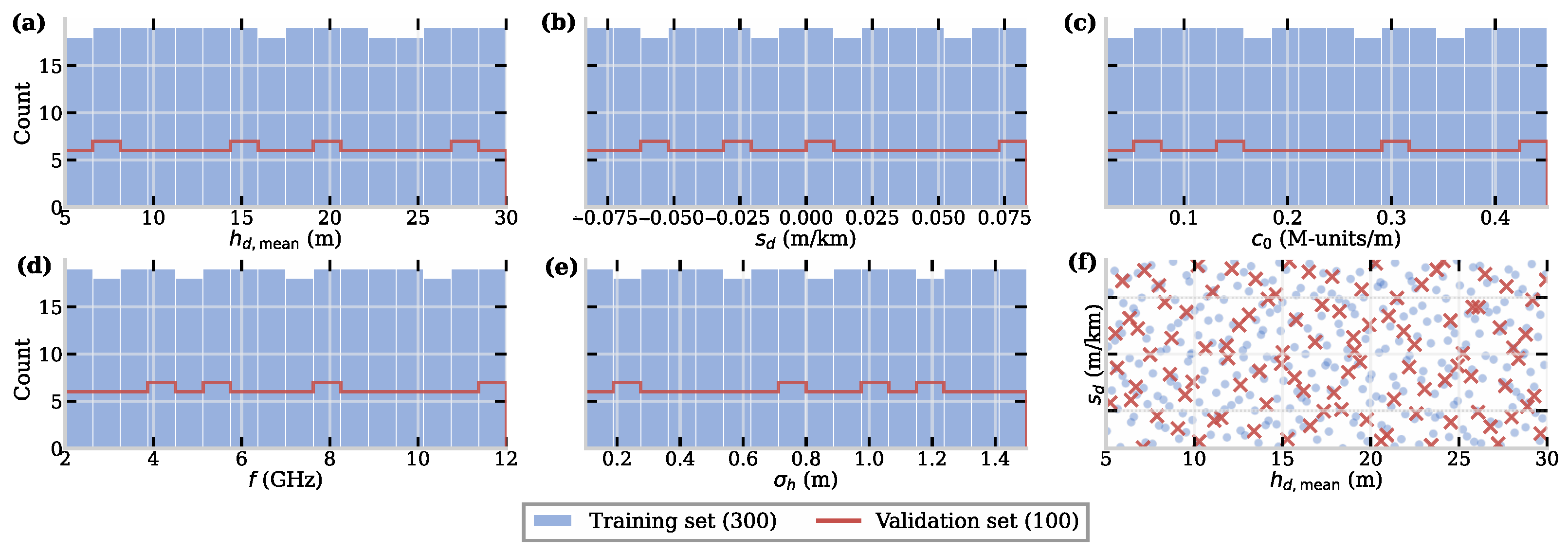
To ensure that the quasi-Monte Carlo design adequately covers the full input hypercube—and in particular, to verify that the sample set is not inadvertently dominated by homogeneous environments—we inspect the marginal and joint distributions of the generated samples. Figure 1 presents the histograms of the five input parameters for the training ( N train = 300 ) and validation ( N val = 100 ) ensembles. The flat, near-uniform histograms in panels (a–e) confirm that the Sobol sequence successfully fills the one-dimensional marginal spaces without pathological aggregation at central values. Panel (f) further displays the two-dimensional projection of the duct height slope s d versus the mean duct height h d , mean , revealing a regular, lattice-like coverage free of clustering.
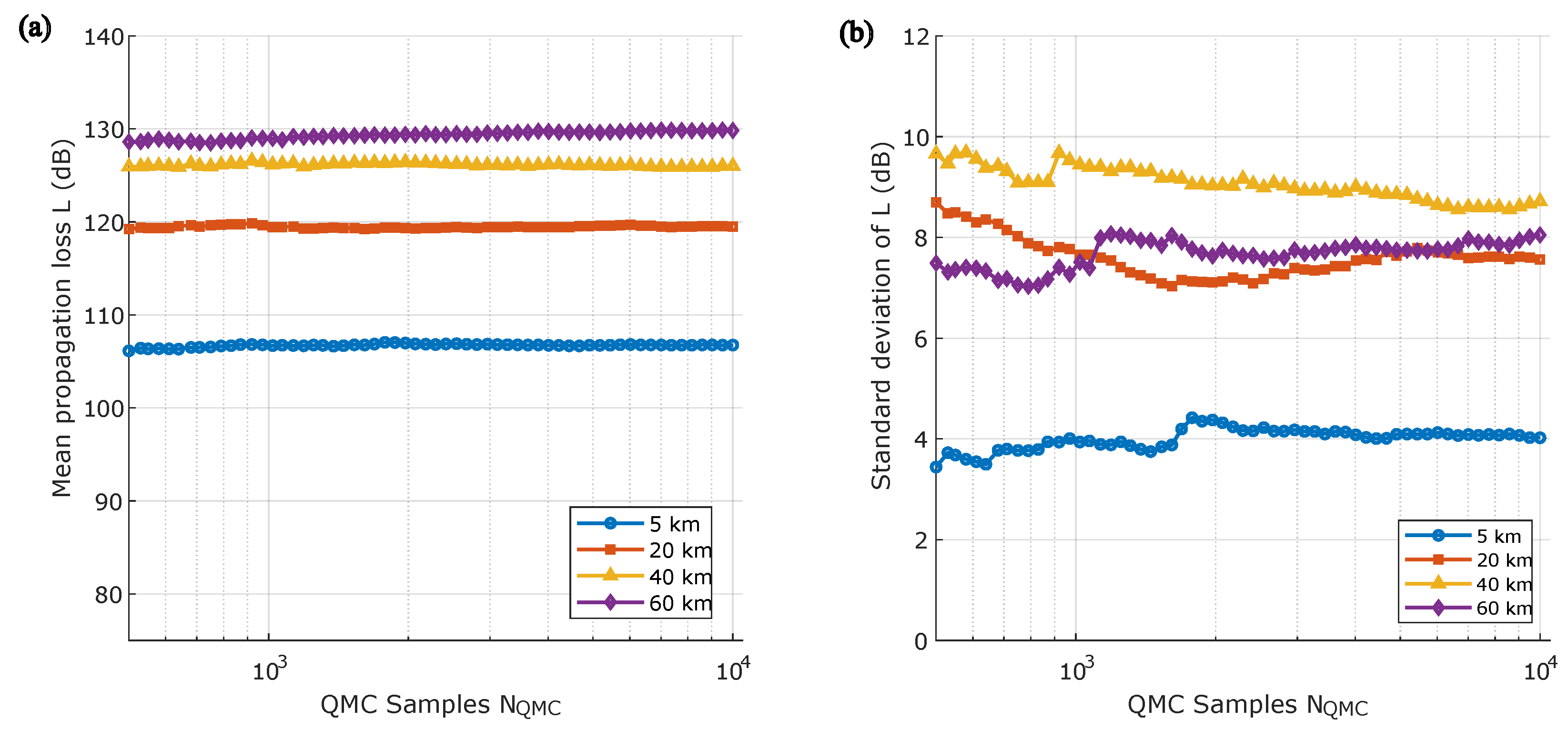
The stability of the QMC reference benchmark is assessed by examining the convergence of the sample mean and standard deviation of the propagation loss L as a function of the QMC ensemble size N MC . Figure 2 presents these statistics at representative ranges of 5, 20, 40, and 60 km. Both the mean (left panel) and the standard deviation (right panel) stabilize to within 1 % relative variation once N MC exceeds approximately 5000 samples; no systematic drift is observed beyond this threshold. Consequently, the adopted reference size of N MC = 10,000 lies well within the converged regime, ensuring that the statistical moments used for surrogate validation and sensitivity benchmarking are free from sampling noise.

3.2. Surrogate Modeling Techniques

Because full two-dimensional (range–height) surrogate modeling of the propagation field would incur prohibitive memory and computational costs, the metamodels constructed herein target the one-dimensional quantity of interest: the propagation loss L ( x , z ) evaluated at the antenna height z = 5 m along the 60 km propagation path. All subsequent accuracy metrics and sensitivity indices therefore pertain exclusively to this one-dimensional QoI.

3.2.1. Polynomial Chaos Expansion (PCE)

Polynomial Chaos Expansion is a spectral method [34,35] that represents the model output as an expansion onto a basis of orthogonal multivariate polynomials [36] with respect to the joint probability density function of the input random vector. For a second-order random variable (i.e., with finite variance), the expansion takes the following form:
Y M PCE ( u ) = α A y α Ψ α ( u )
where α = ( α 1 , , α M ) is a multi-index, Ψ α are the multivariate orthogonal polynomials, and y α are the corresponding coefficients. Orthogonality implies E [ Ψ α Ψ β ] = δ α β , where δ α β is the Kronecker delta. The choice of polynomial family is dictated by the input distribution; for uniformly distributed variables, Legendre polynomials are the natural basis. A key advantage of PCE is that once the coefficients are known, statistical moments (mean, variance) and Sobol sensitivity indices can be obtained analytically from the coefficients themselves.
For practical implementation, the infinite series must be truncated. A hyperbolic truncation scheme, also known as q-norm truncation, is adopted herein. The retained basis functions are those whose multi-indices satisfy:
A = α N M : m = 1 M α m q 1 / q p
where p is the maximum total polynomial degree and 0 < q 1 . Setting q = 1 recovers the classical total-degree truncation, while q < 1 favors basis functions with low-degree interactions, effectively controlling the basis size and mitigating the curse of dimensionality in high-dimensional settings.
The expansion coefficients { y α } are estimated non-intrusively using Least Angle Regression (LARS). LARS solves an l 1 -regularized least-squares problem, adaptively selecting a sparse set of polynomials from a large candidate pool. This sparsity-promoting property helps prevent overfitting, particularly when the sample size is limited. The optimal hyperparameters (e.g., p, q) are selected by minimizing the leave-one-out (LOO) cross-validation error.

3.2.2. Ordinary Kriging

Kriging (Gaussian process regression) models the output as a combination of a deterministic trend and a zero-mean stationary Gaussian process [37]. The universal Kriging formulation is:
Y M K ( u ) = f ( u ) β + σ Z ( u )
where f ( u ) β is the trend, σ is the process standard deviation, and Z ( u ) is a zero-mean, unit-variance stationary Gaussian process. The spatial correlation structure of Z ( u ) is governed by an auto-correlation function (ACF) R ( u , u ; θ ) , with hyperparameters θ . Kriging provides an exact interpolation of the training data and, crucially, yields a measure of prediction uncertainty—the Kriging variance—which is valuable for assessing surrogate reliability.
This study employs ordinary Kriging, a variant in which the trend is assumed to be an unknown constant, i.e., f ( u ) = 1 and β = β 0 . For the ACF, the Matérn family is chosen for its flexibility in representing different degrees of smoothness. With a shape parameter ν = 3 / 2 , the Matérn ACF takes the following relatively simple form:
R ( u u ; l , ν = 3 / 2 ) = m = 1 M 1 + 3 | u m u m | l m exp 3 | u m u m | l m
where l = { l 1 , , l M } are the correlation length scales. These parameters, along with σ 2 and β 0 , are estimated via Maximum Likelihood Estimation (MLE). Once the optimal parameters are obtained, the Kriging predictor and its variance at any new point u can be derived analytically.

3.2.3. Polynomial-Chaos Kriging (PC-Kriging)

Polynomial-Chaos Kriging is a hybrid surrogate that combines the global approximation capability of PCE with the local interpolation strength of Kriging [38,39]. This is achieved by using a PCE model as the trend function in a universal Kriging formulation:
Y M PCK ( u ) = α A y α Ψ α ( u ) + σ Z ( u )
The rationale is that the PCE part captures the global behavior and major nonlinearities, while the Gaussian process Z ( u ) accounts for localized deviations not captured by the PCE trend. This hybrid approach is particularly well-suited for responses that exhibit both large-scale trends and small-scale fluctuations.
A sequential construction strategy is adopted. First, a sparse PCE model is built using the methodology described in Section 3.2.1 (LARS with LOO cross-validation), yielding the optimal set of polynomials A and their coefficients y α . This PCE model is then fixed as the trend. Subsequently, a Kriging model (with the same Matérn ν = 3 / 2 correlation function) is fitted via MLE to the residuals—the differences between the original model outputs and the PCE trend predictions.

3.3. Accuracy Assessment

Before a surrogate model can be confidently used for UQ and GSA, its predictive accuracy must be rigorously assessed. This assessment is performed using an independent validation dataset, distinct from the training data used to build the model. For each validation point u val ( k ) , the surrogate’s prediction Y ^ ( u val ( k ) ) is compared to the true simulation output Y ( u val ( k ) ) . The Normalized Root Mean Square Error (NRMSE) serves as the primary accuracy metric, computed exclusively for the propagation loss L ( x , z ) :
ϵ ( x , z ) = 1 σ y val ( x , z ) 1 N val k = 1 N val Y ^ ( u val ( k ) ; x , z ) Y ( u val ( k ) ; x , z ) 2
where σ y val ( x , z ) is the standard deviation of the validation outputs at a given spatial location ( x , z ) . An NRMSE close to 0 indicates excellent predictive skill; an NRMSE of 1 implies that the surrogate performs no better than a trivial constant predictor equal to the mean of the validation data. While leave-one-out cross-validation is used for hyperparameter selection during model construction, a final evaluation on an independent validation set provides an unbiased and more robust assessment of the surrogate’s true generalization capability.
To complement the NRMSE, which provides a variance-scaled measure of predictive error, the Mean Absolute Error (MAE) is also employed to quantify the surrogate’s accuracy in the original physical units of the output (dB). The MAE offers a direct and interpretable average of the absolute discrepancies between the surrogate predictions and the true simulation results. It is defined as
MAE ( x , z ) = 1 N val k = 1 N val Y ^ ( u val ( k ) ; x , z ) Y ( u val ( k ) ; x , z )
Unlike the NRMSE, the MAE is not normalized and is expressed in the same units as Y ( x , z ) (i.e., dB), providing a clear sense of the typical error magnitude. While the NRMSE, by penalizing larger errors due to the squaring term, is sensitive to outliers, the MAE offers a more robust and linear perspective on the model’s performance. Together, these metrics—the scale-invariant NRMSE and the unit-wise MAE—provide a comprehensive view of the surrogate’s fidelity when evaluated against the independent validation set.
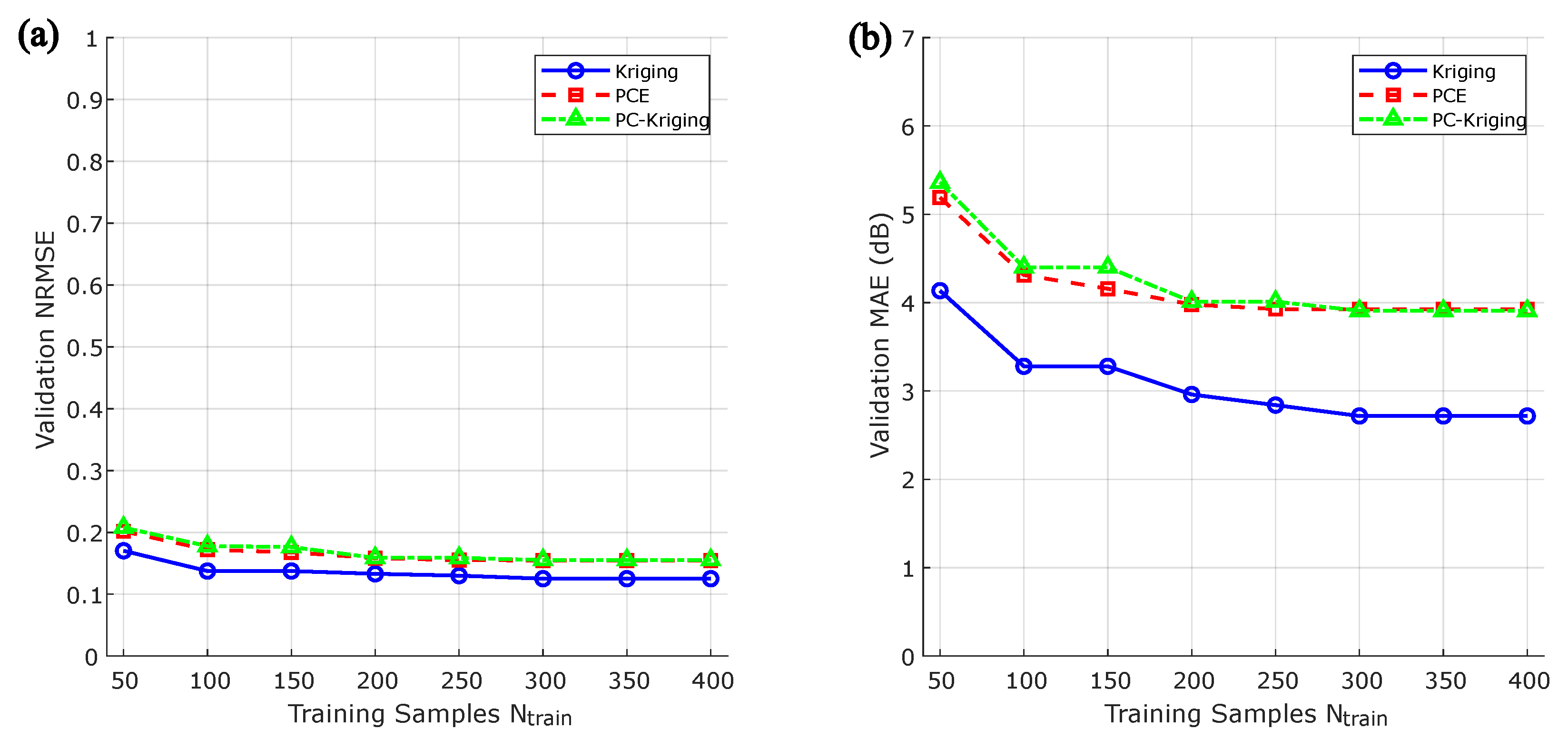
Finally, the sufficiency of the training set size N train is established via a convergence study in which the three surrogates are independently re-trained on nested subsets of the full experimental design. Figure 3 displays the validation NRMSE (left panel) and MAE (right panel)—both computed exclusively for the propagation loss L ( x , z ) at antenna height—as functions of N train ranging from 50 to 400. For Kriging, the NRMSE decays from approximately 0.17 at N train = 50 to a plateau near 0.12 beyond N train = 200 , while its MAE drops from roughly 4.1 dB to 2.7 dB over the same interval. The PCE and PC-Kriging models exhibit similar saturation behavior, with their NRMSE stabilizing near 0.16 and their MAE near 3.9 dB for N train 250 . The adopted size of N train = 300 therefore lies in the asymptotic region for all three methods, confirming that the reported accuracy metrics are not artifacts of insufficient training data.

3.4. Global Sensitivity Analysis

To quantify the contribution of each uncertain input parameter to the variance of the propagation loss, a variance-based global sensitivity analysis is performed using Sobol indices [33]. For a model output Y = M ( u ) , the total variance D = Var [ Y ] can be decomposed as
D = i = 1 M D i + 1 i < j M D i j + + D 12 M
where D i is the partial variance attributable to u i alone (the main effect), D i j is the variance due to the interaction between u i and u j (excluding their individual effects), and higher-order terms represent interactions among more variables. The first-order Sobol index S i = D i / D measures the main effect contribution of u i . The total Sobol index S T i = ( D i + j i D i j + ) / D captures the total contribution of u i , including all interactions with other variables [40].
Because the surrogate models are cheap to evaluate, Sobol indices can be estimated via Monte Carlo integration using a large number of samples drawn from the input distributions. For the PCE model, an even more efficient approach exists: the indices are obtained analytically from the expansion coefficients:
S i = 1 D α A i y α 2 , S T i = 1 D α A i tot y α 2
where A i is the set of multi-indices with non-zero entry only in the i-th component, and A i tot is the set of all multi-indices for which α i > 0 .
For the Kriging and PC-Kriging models, a QMC-based estimator employing Sobol sequences is used. The efficient estimators proposed by Homma and Saltelli [40] are implemented. Two independent Sobol sample matrices, A and B , of dimension N MC × M are generated. A third matrix, A B ( i ) , is constructed by replacing the i-th column of A with the i-th column of B . The first-order and total Sobol indices are then estimated as
S ^ i = 1 N MC D ^ j = 1 N MC Y ^ ( A j ) Y ^ ( A B j ( i ) ) Y ^ ( B j )
S ^ T i = 1 2 N MC D ^ j = 1 N MC Y ^ ( A B j ( i ) ) Y ^ ( A j ) 2
where D ^ is the estimated total variance computed from the surrogate predictions. The resulting indices provide a quantitative ranking of the input parameters according to their influence on the uncertainty of radio wave propagation loss in the evaporation duct environment.

4. Results and Analysis

4.1. Numerical Setup

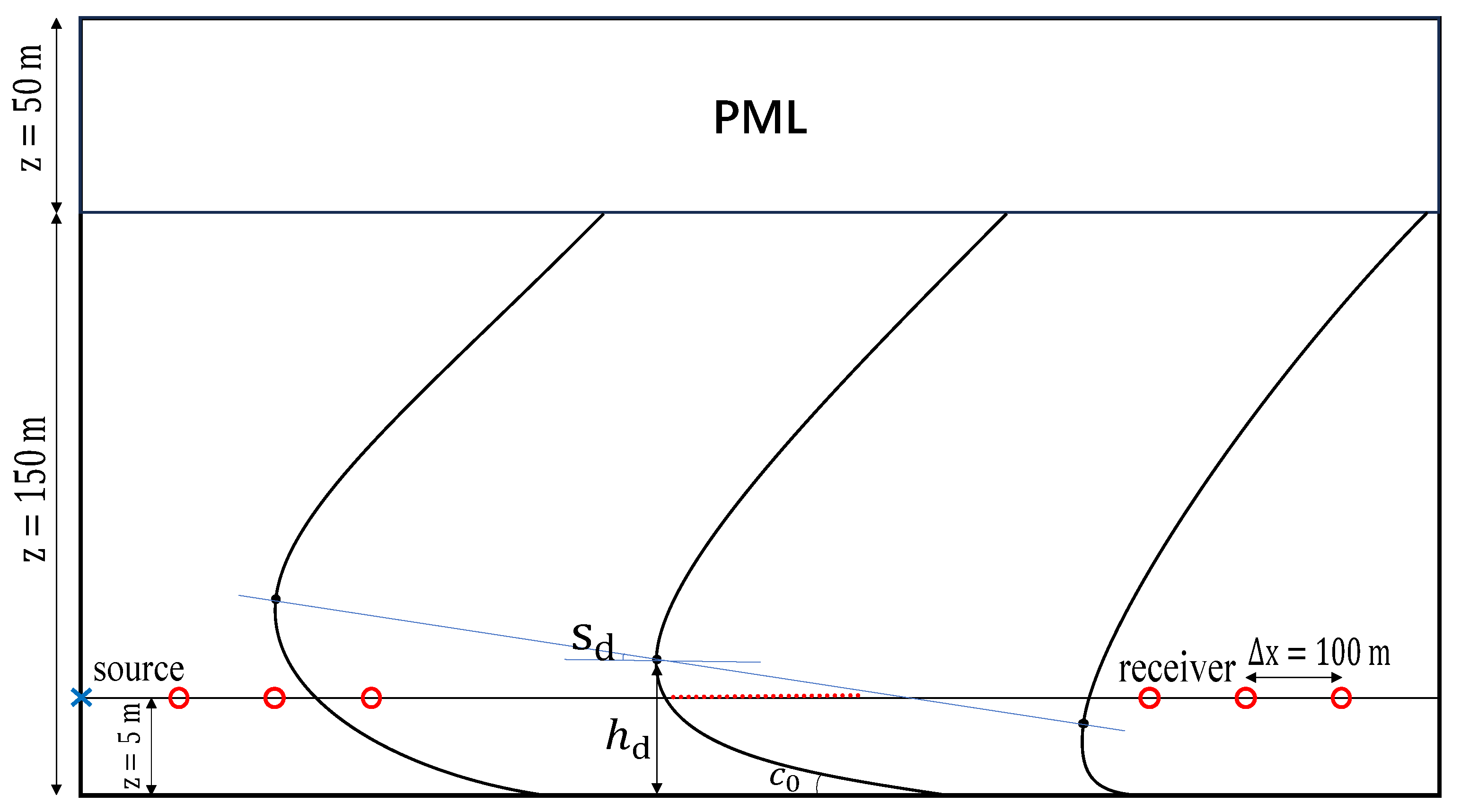
The numerical experiments are conducted for a maritime radar scenario with a fixed antenna height of z t = 5 m. The source–receiver configuration and computational domain are illustrated in Figure 4. The transmitter emits a Gaussian beam with a vertical beamwidth of 1 and an elevation angle of 0 . The initial field is constructed by coherently summing the direct and sea-surface reflected rays, where the reflection coefficient is computed using the Ament–Miller–Brown rough surface model under horizontal polarization. The reflected component accounts for the phase shift and roughness-induced attenuation based on the RMS wave height σ h .
The computational domain extends horizontally to R = 60 km, discretized into 6000 steps with uniform step size Δ x = 10 m. In the vertical direction, the maximum physical height is Z max = 150 m, above which an absorbing layer of thickness D = 50 m is added to suppress spurious reflections from the top boundary. This absorbing layer is implemented using a cosine-shaped window function, where the field is gradually attenuated by a factor 0.5 + 0.5 cos ( π t ) with t [ 0 , 1 ] representing the normalized distance from the base to the top of the layer. The total vertical grid comprises N = 200 points, yielding a resolution of Δ z = 1 m.
Following the description in Section 2.3, five independent random variables are considered: the mean duct height h d , mean , the duct height slope s d , the potential refractivity gradient c 0 , the operating frequency f, and the RMS wave height σ h . Their physical ranges, summarized in Table 1, are derived from the literature to encompass typical variability observed in maritime conditions [17,21,23,28,29,30]. Based on the principle of maximum entropy [41], they are assumed to follow uniform distributions within these bounds.
An experimental design of N train = 300 samples is generated using Sobol sequences [33] to explore the input space efficiently. An additional independent validation set of N val = 100 samples is generated for accuracy assessment. The training set size is chosen such that it is approximately three times the number of basis polynomials expected for a sparse PCE with maximum degree p max = 5 and hyperbolic truncation q = 0.75 , following the recommendations in [42].
Three surrogate models are constructed independently for the propagation loss L ( x , z ) at range intervals of 100 m at the antenna height ( z = 5 m). That is, the metamodels approximate a one-dimensional sequence of propagation loss values along the range direction. For PCE, Legendre polynomials are used (due to the uniform input distributions), and the coefficients are estimated via least-angle regression (LARS) with hyperbolic truncation ( q = 0.75 ) and maximum degree p max = 5 . The optimal hyperparameters are selected by minimizing the leave-one-out cross-validation error. For ordinary Kriging, a constant trend is assumed, and the Matérn correlation function with shape parameter ν = 3 / 2 [42] is employed. The correlation lengths l m are estimated by maximum likelihood using the BFGS optimizer. For PC-Kriging, we adopt the sequential construction approach: first, a PCE trend is built using the same settings as above; then, a Kriging model is fitted to the residuals using the same correlation function and estimation method. The uncertainty quantification analysis was performed using the UQLab framework [43].
The quantity of interest is the propagation loss L ( x , z ) defined in Equation (5). Surrogate models are built for the loss at all range points of interest along the antenna height. The predictive accuracy of each surrogate is evaluated on the validation set using the normalized root-mean-square error (NRMSE) defined in Equation (12) and mean absolute error (MAE) defined in Equation (13).

4.2. Result of the Surrogate Models

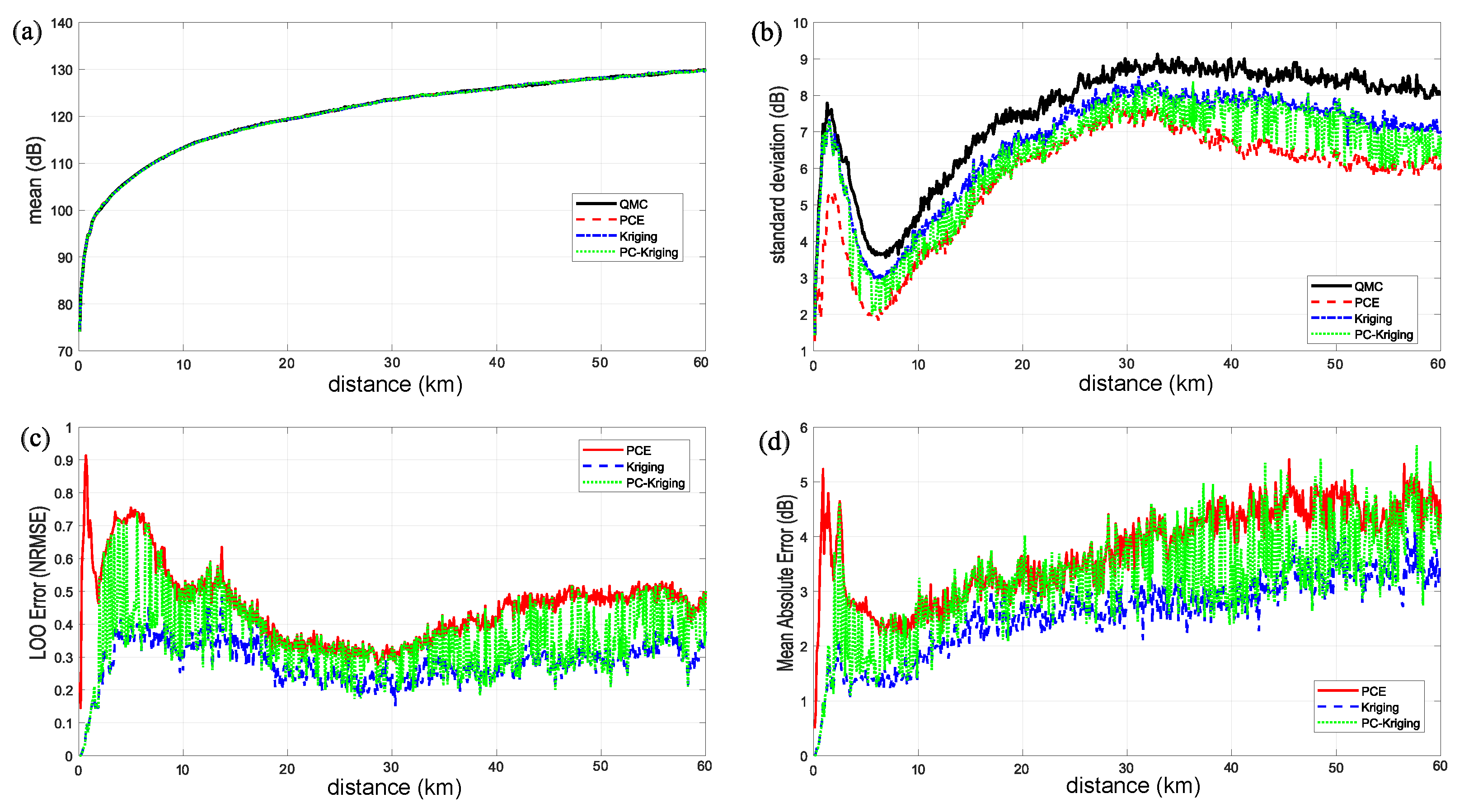
The predictive performance of the three surrogates is summarized in Figure 5. Panels (a) and (b) compare the predicted mean and standard deviation against the QMC benchmark; panels (c) and (d) show the leave-one-out cross-validation error and the validation-set MAE as functions of range, respectively.
The Kriging model exhibited the lowest prediction errors across all ranges, whereas the PCE model demonstrated the largest errors. The PC-Kriging model yielded errors intermediate between the two, though its error curves displayed pronounced oscillations. This behavior is attributed to a mismatch between the non-stationary residuals and the stationarity assumption of the Kriging component. The PCE trend does not fully capture the oscillatory nature of the propagation field, so the residuals retain structured, small-scale information from multimode interference with a correlation structure that varies across the domain.
Despite Kriging’s superior overall performance, Figure 5b reveals systematic deviations between its predicted standard deviation and the QMC benchmark (the predicted variability is consistently lower). These biases originate from (i) the smoothing property of the optimal linear predictor, which regresses toward the mean and compresses predicted variance, and (ii) the stationarity assumption in the global Matérn covariance, which does not adapt to range-dependent heteroscedasticity.
The consistent advantage of Kriging raises the question of what physical factors govern the relative performance of these surrogates. In waveguide propagation theory, the complexity of the field’s spatial structure is related to the number of propagating modes supported by the duct [44,45]. A dimensionless parameter characterizing this modal capacity is the normalized frequency V, which is proportional to the maximum mode count [16]. For the evaporation duct, V is derived from the refractivity profile parameters (see Appendix A):
V = 2 π h d , mean λ 2 c 0 h d , mean ln h d , mean z 0 1 × 10 6
where h d , mean is the mean duct height defined in Section 2.1, λ the wavelength, c 0 the potential refractivity gradient, and z 0 the sea surface roughness length. As V quantifies the number of supported modes (Appendix A), it directly reflects the mode excitation efficiency and the spatial complexity of the resulting interference pattern [16,45]. Larger V values indicate stronger ducting capable of supporting higher-order modes, resulting in more complex spatial field distributions.
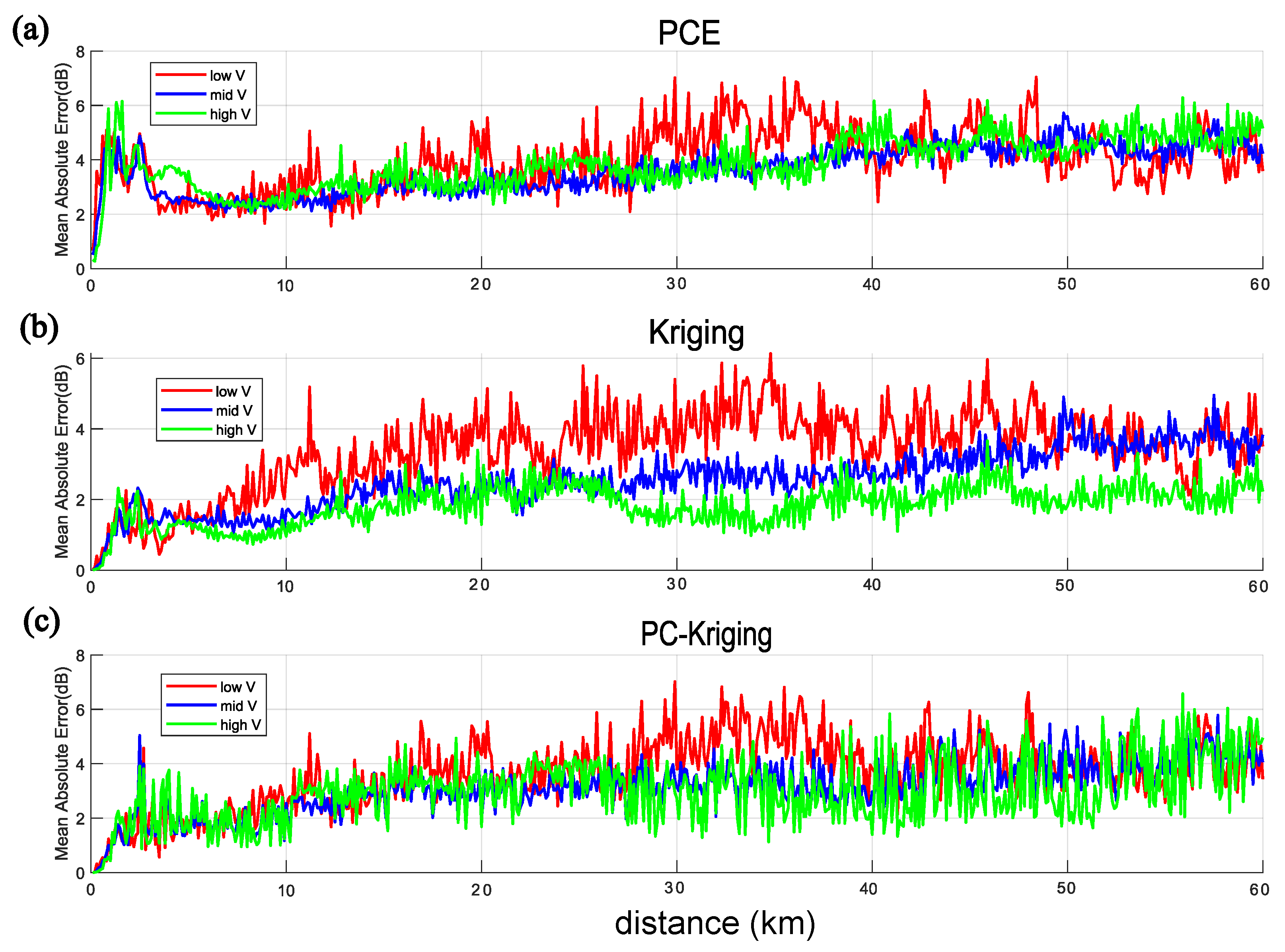
To investigate whether the observed performance differences correlate with this measure of field complexity, we stratified the samples into three equal-sized tertiles (low, medium, and high) based on their V values. The strong ducting condition is operationally defined as the upper tertile ( V V 67 , where V 67 is the 66.7th percentile of the validation sample V distribution), corresponding to the highest one-third of modal complexity. The lower and middle tertiles represent weak and moderate ducting, respectively. The MAE at each range was computed separately for each group. Figure 6 displays the results. For Kriging, the error curves exhibit a clear stratification: samples with higher V (strong ducting) are predicted with lower MAE. The errors for PCE and PC-Kriging show little variation across the V groups.
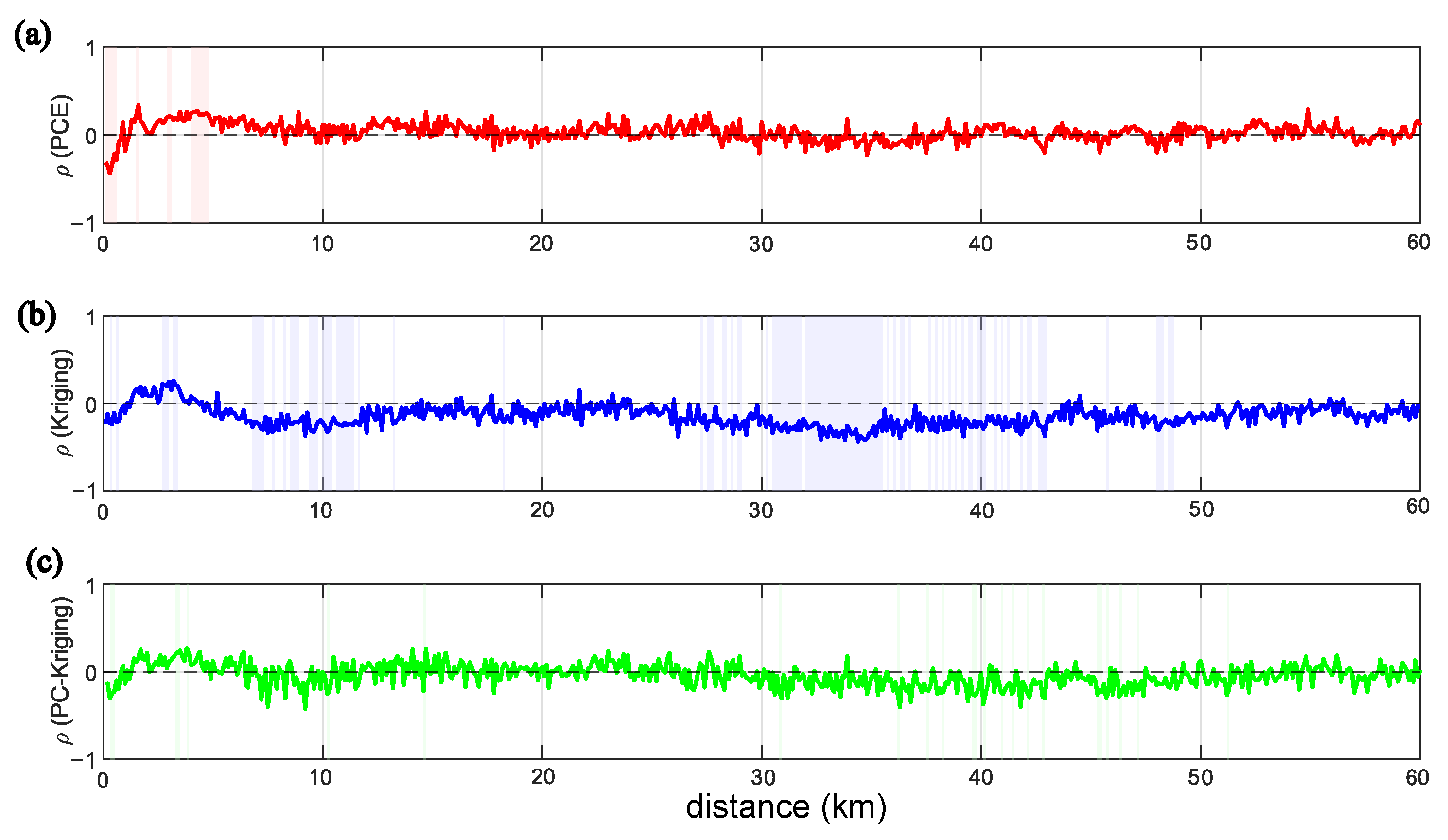
To quantify this relationship, we computed Spearman rank correlation coefficients between the prediction error of each model and V for every validation sample across all ranges. Figure 7 presents these coefficients as functions of range, with gray shaded regions indicating statistical significance ( p < 0.05 ).
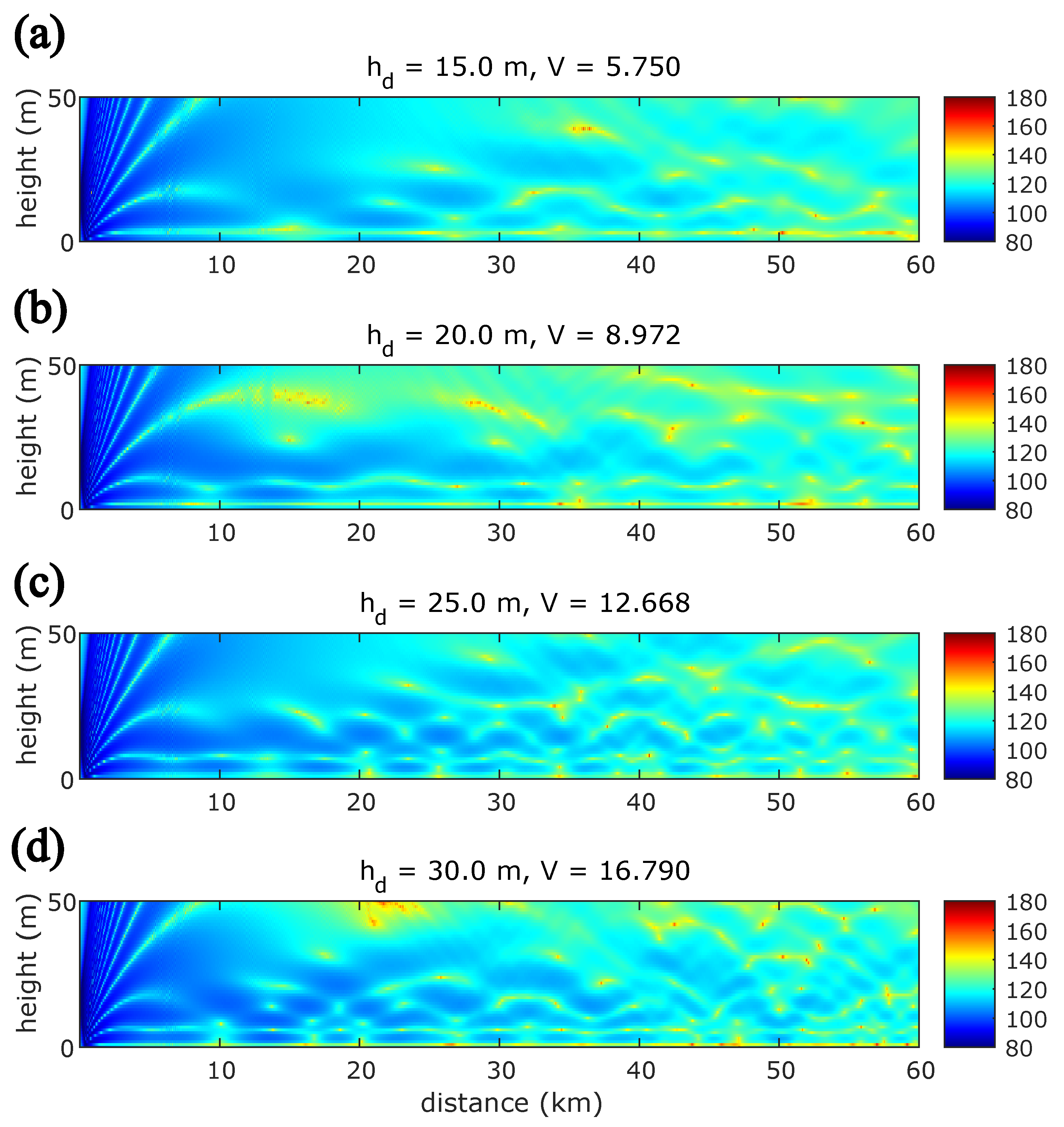
Kriging exhibited significant negative correlation between prediction error and V across multiple range segments, most prominently in the 30–40 km interval. Under strong ducting conditions (upper V tertile), multimode interference generates complex but coherent interference patterns in the range–height plane (Figure 8). These patterns exhibit a spatial correlation structure that can be captured by the Kriging covariance function. PCE approximates these oscillatory patterns with a global polynomial, an approach poorly suited for rapid spatial fluctuations.
The observed negative correlation manifests only within specific range intervals with moderate coefficients (approximately 0.4 to 0.5 ), indicating limited explanatory power. Future investigations may validate this through refined V parameter definitions. The link between model performance and V emerged from the data; its generality should be tested across different frequency bands and environmental conditions.

4.3. Sensitivity Analysis

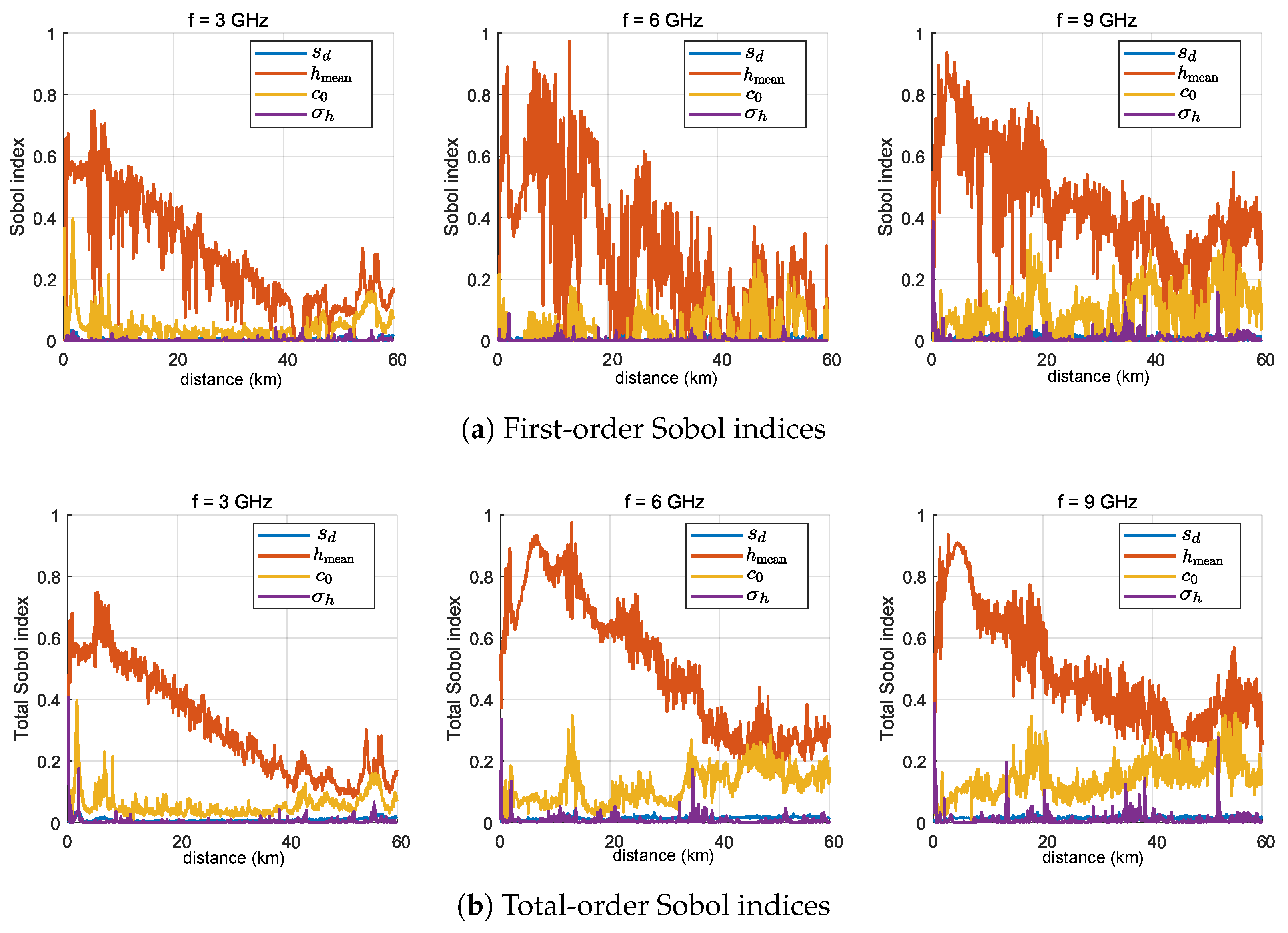
To quantify the relative contribution of each uncertain input parameter to the variability in propagation loss, a variance-based global sensitivity analysis was performed using Sobol indices. The analysis leverages the Ordinary Kriging surrogate model developed in Section 4.2. First-order ( S i ) and total-order ( S T i ) Sobol indices were computed for three representative frequencies—3 GHz, 6 GHz, and 9 GHz—using the quasi-Monte Carlo (QMC) estimator proposed by Saltelli et al. [40]. The operating frequency f is treated as a conditioning variable rather than an uncertain input in the sensitivity analysis. From a practical perspective, radar systems typically operate at a limited number of known frequency bands; performing the analysis conditionally on a few representative frequencies directly addresses the operational question: for a given frequency, which environmental uncertainties dominate the propagation loss variability? Moreover, preliminary tests showed that if f were included as a random variable together with the other four parameters, its first-order effect would dominate the total variance to such an extent that the Sobol indices of the environmental parameters would be compressed to near zero, obscuring meaningful comparisons among them. By fixing f at 3, 6, and 9 GHz and comparing results side by side, we are able to reveal how the sensitivity hierarchy changes with frequency—an insight that would be lost if f were simply aggregated into the global variance. Figure 9 presents the first-order and total sensitivity indices for the four input parameters as functions of range at the antenna height ( z = 5 m).
The mean evaporation duct height h d , mean is the most influential parameter across all frequencies and ranges, particularly at short to moderate ranges. This reflects the role of duct thickness in determining the trapping capability of the evaporation duct, as the duct height sets the top of the waveguide and directly influences the maximum trappable wavelength and mode structure [46,47].
From a mode excitation perspective, the near-range dominance of h d , mean is explained as follows: the duct height determines the cutoff frequencies and the number of propagating modes supported by the waveguide; near the source, uncertainty in how energy is coupled into these modes is controlled by h d , mean .
The sensitivity of h d , mean decreases with increasing range, and this decay is more pronounced at higher frequencies. At 9 GHz, the total-order sensitivity drops by more than 0.6, whereas at 3 GHz it decreases by about 0.4. This frequency-dependent behavior is consistent with higher leakage rates of lower-frequency waves from the duct [48].
This range-dependent decay is attributed to modal leakage: higher-order modes, which are more sensitive to the duct’s initial geometry, lose energy more rapidly with range. As these modes attenuate, the long-range field becomes dominated by low-order modes that are less sensitive to the exact duct height, thereby diminishing the influence of h d , mean .
The regional analysis of Lentini and Hackett [7] similarly found that evaporation duct height is most influential near the transmitter and at low altitudes, with its importance diminishing with range at a rate that increases with frequency.
In contrast to the duct height, the potential refractivity gradient c 0 exhibits a monotonic increase in sensitivity with range. This parameter controls the curvature and strength of the duct, and its increasing importance at long ranges indicates that the shape of the refractivity profile, rather than its vertical extent, governs far-field propagation variability [7,17]. While c 0 exhibits notable interaction effects, particularly at higher frequencies, its total-order Sobol index remains comparable to or below that of h d , mean at all examined ranges and frequencies.
From a mode interference perspective, this growing importance of c 0 is explained as follows: c 0 primarily influences the propagation constant (phase velocity) of each individual mode. As the signal propagates, phase differences between modes accumulate, shaping the long-range interference pattern. The uncertainty in these phase relationships is directly controlled by c 0 . Furthermore, after higher-order modes have leaked out, the remaining low-order modes—whose propagation characteristics are strongly influenced by c 0 —dominate the field. Thus, while duct size ( h d , mean ) dictates which modes are excited near the source, duct shape ( c 0 ) governs how they interfere at distance.
The duct height slope s d consistently shows negligible first-order sensitivity ( S i < 0.05 ) across all frequencies and ranges. This suggests that, within the linear range-dependence model adopted in this study, spatial heterogeneity of the evaporation duct has minimal direct impact on propagation loss. This conclusion is contingent on the assumption of slowly varying environments; in coastal zones with sharp transitions, s d may become significant [22].
The RMS wave height σ h displays negligible first-order sensitivity over most of the domain, consistent with the understanding that forward scattering from a rough sea surface primarily affects the interference pattern rather than the propagation loss [49]. However, intermittent spikes in sensitivity are observed at specific ranges, particularly at higher frequencies. These spikes correspond to regions where multipath nulls occur, and small changes in surface roughness alter the depth and location of these nulls [8,50]. At 9 GHz, the number and magnitude of these spikes increase, reflecting the narrower lobe structure and greater sensitivity of X-band signals to surface scattering [8]. Physically, these localized spikes arise from near-cancellation effects: at multipath nulls, the field results from destructive interference between coherent components; small perturbations in surface roughness alter the relative phase and amplitude of these components, causing disproportionately large variations in the net field. This effect is magnified at higher frequencies due to the shorter wavelength and narrower interference lobes.
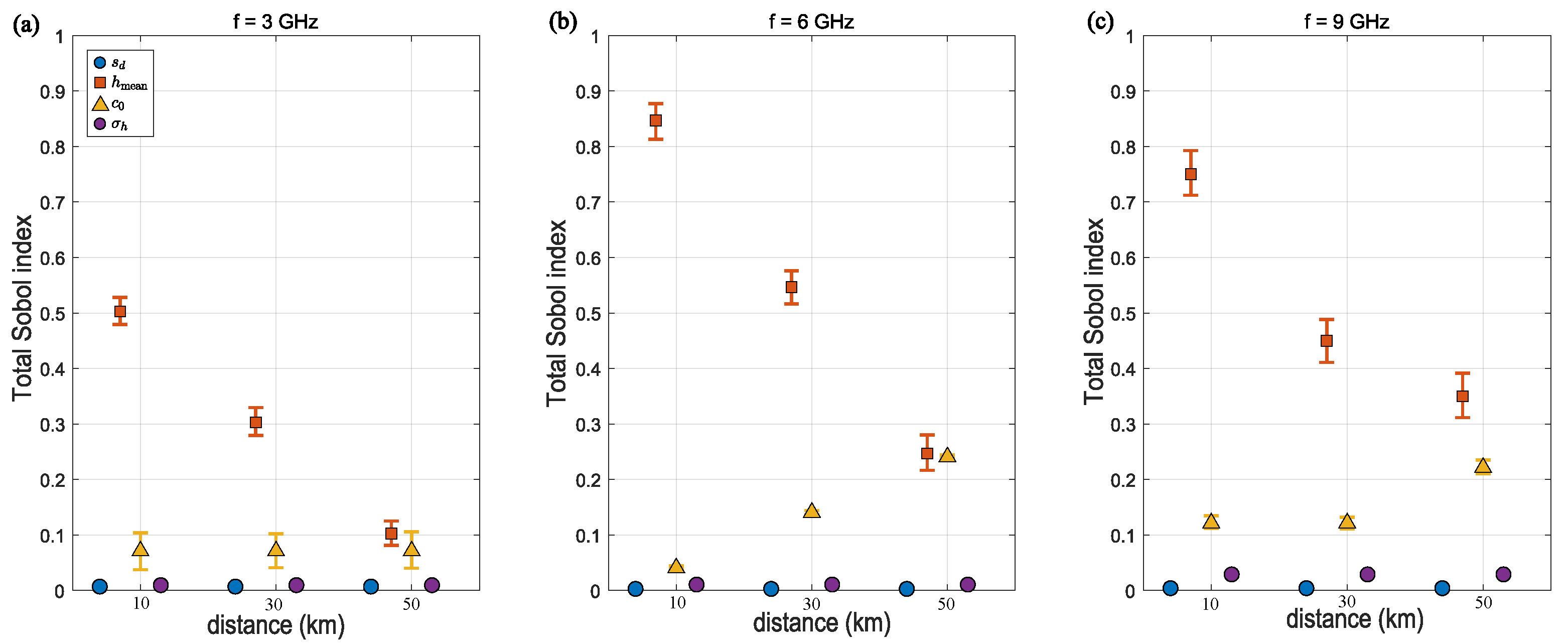
To assess the robustness of the Sobol index estimates derived from the Kriging surrogate, a Bootstrap resampling analysis was performed. From the QMC samples, 500 bootstrap replicates were generated by sampling with replacement; for each, the total-order Sobol indices S T i were recomputed. Figure 10 shows the bootstrap means and 95% confidence intervals at 10 km, 30 km, and 50 km for the three frequencies.
Two results are noted. First, despite Kriging’s systematic underestimation of the variance magnitude (Figure 5b), the parameter ranking remains stable. The mean duct height h d , mean consistently ranks first at 10 km and 30 km across all frequencies, with its lower 95% CI (confidence interval) above the upper CI of the second-ranked parameter. The slope s d and RMS wave height σ h maintain negligible indices ( S T i < 0.05 ) with tight intervals. This stability arises because Sobol indices are variance ratios; while the absolute variance is biased, its relative apportionment among inputs is preserved.
Second, the far-field transition between h d , mean and c 0 requires careful interpretation. At 3 GHz and 50 km, the two parameters have nearly equal means (≈0.10 vs. ≈0.09) with overlapping 95% CIs. At 6 GHz and 50 km, they are statistically tied ( S T 0.24 ) with overlapping CIs. Only at 9 GHz does h d , mean retain a clear lead at 50 km ( S T 0.35 vs. 0.22 ). Thus, c 0 ’s relative contribution rises with range, but in several frequency-distance regimes it is statistically indistinguishable from h d , mean . This cautions against asserting a dominance handover in the far field.
In summary, the global sensitivity analysis reveals that the mean evaporation duct height is the dominant parameter at short-to-medium ranges, but its influence decays with range, especially at higher frequencies. The potential refractivity gradient becomes increasingly important at long ranges, and in certain far-field regimes its total-order sensitivity becomes statistically comparable to that of h d , mean ; however, it does not unambiguously surpass the mean duct height across all frequency-distance combinations. The duct height slope has negligible direct influence, suggesting that range-independent models may suffice for many applications provided the mean duct height is well characterized. RMS wave height has localized but significant effects near multipath nulls, with greater impact at higher frequencies. These findings provide quantitative guidance for prioritizing environmental measurements and model parameterization in both numerical weather prediction and inversion-based refractivity estimation frameworks.

5. Discussion

The observed performance hierarchy—Kriging > PC-Kriging > PCE—may reflect a fundamental match (or mismatch) between each method’s mathematical structure and the wave physics of the evaporation duct. Kriging learns the spatial correlation of the response through a parametric covariance function. Multimode interference produces rapid yet coherent oscillations in the range–height plane; the Matérn kernel appears well-suited to capturing these characteristic length scales from limited training data, which could explain why local interpolation becomes highly effective. By contrast, PCE projects the response onto global polynomials, a spectral basis that might be ill-suited for high-frequency, non-separable oscillations. PC-Kriging’s relative weakness could arise from its PCE trend leaving residuals dominated by non-stationary small-scale interference. Fitting a stationary Gaussian process to these residuals might be statistically inconsistent: the residual variance and correlation structure likely vary with duct strength and range, potentially violating the homogeneity assumption required by ordinary Kriging.
The negative correlation between Kriging error and the normalized frequency V (Figure 7) offers further support for this interpretation. One possible explanation is that high V (strong ducting, operationally defined here as the upper tertile of the validation V distribution) supports more propagating modes, yielding complex but spatially coherent fringe patterns. Kriging’s covariance-based interpolator may exploit this coherence; hence its advantage could grow with modal complexity. The correlation is moderate ( 0.4 to 0.5 ) and range-localized, suggesting that V is an informative but incomplete explanatory variable.
Despite Kriging’s superior mean prediction, its second-moment estimates exhibit systematic biases relative to the QMC benchmark (Figure 5b). These biases might originate from two sources: (i) the smoothing property of the optimal linear predictor, which tends to regress toward the mean and compress predicted variance; and (ii) a possible stationarity mismatch, wherein the global Matérn covariance assumes statistical homogeneity while the true propagation-loss variance is range-dependent (high near-field variability from modal excitation versus reduced far-field fluctuations after leakage). Maximum likelihood estimation of the correlation lengths could further bias the fit toward large-scale trends, thereby underrepresenting small-scale oscillations.
Bootstrap resampling suggests that the ranking of parameter importance is relatively robust despite these absolute variance biases. The mean duct height h d , mean consistently ranks first, and s d and σ h remain negligible, across more than 95 % of bootstrap realizations. However, the apparent far-field “handover” between h d , mean and c 0 appears less decisive than the mean Sobol curves might imply. At 50 km, the 95 % confidence intervals for their total-order indices overlap at 3 and 6 GHz; only at 9 GHz does h d , mean retain a clear lead. Consequently, c 0 might be regarded as an increasingly important secondary contributor in the far field, though not necessarily as an unambiguous successor to h d , mean .
Physically, a plausible explanation for h d , mean dominating near-field uncertainty is that it controls the cutoff frequencies and the number of supported modes, thereby governing initial energy coupling. At longer ranges, higher-order modes may leak out, leaving low-order modes whose propagation constants (phase velocities) are strongly influenced by c 0 . The accumulated phase differences between surviving modes would then shape the far-field interference pattern, potentially making c 0 more influential—although, as noted above, not dominant—with increasing range. The localized spikes of σ h sensitivity at multipath nulls could be explained by near-cancellation physics: at these points, small roughness-induced phase perturbations might cause disproportionately large net-field variations, an effect that would be amplified at higher frequencies by narrower interference lobes.
Several limitations bound these conclusions. First, the training data are confined to the hyper-rectangular parameter ranges in Table 1; rare out-of-distribution environments are underrepresented, and extrapolation beyond these bounds is unreliable. Second, the linear range-dependence of h d and the assumption of horizontally uniform c 0 are simplifications. Real marine environments may exhibit nonlinear or abrupt refractivity transitions [22], and the absence of observational constraints on range-dependent c 0 variability precludes its inclusion here. Third, all surrogates target the one-dimensional propagation loss at antenna height; full two-dimensional range–height metamodeling remains computationally prohibitive.

6. Conclusions

This study compared Polynomial Chaos Expansion, Ordinary Kriging, and PC-Kriging for uncertainty quantification of radio-wave propagation in evaporation ducts. The key findings are:
1.
Kriging superiority: Kriging outperforms PCE and PC-Kriging because its covariance-based interpolation captures the coherent spatial structure of multimode interference. PCE’s global polynomial basis cannot resolve rapid oscillations, while PC-Kriging fails due to non-stationary residuals incompatible with the stationary Kriging component.
2.
Link to modal complexity: Kriging’s predictive accuracy improves with the normalized frequency V (a proxy for modal density), indicating that its local interpolation becomes increasingly advantageous as the field structure grows more complex.
3.
Sensitivity hierarchy: The mean duct height h d , mean is the primary uncertainty source at short-to-medium ranges, controlling mode excitation. The potential refractivity gradient c 0 gains relative importance in the far field by governing mode interference and leakage, yet bootstrap analysis shows its total-order sensitivity remains statistically comparable to, rather than clearly exceeding, that of h d , mean in several frequency-distance regimes. RMS wave height exerts localized effects near multipath nulls, while duct-height slope is negligible under the assumed linear range-dependence.
These conclusions are strictly limited to the present framework: log-linear refractivity profiles with range-dependent h d but uniform c 0 , standard parabolic equation (narrow-angle) propagation, and uniform input uncertainties over the ranges in Table 1. They may not generalize to nonlinear ducts, strong horizontal c 0 gradients, wide-angle scenarios, or out-of-distribution conditions.
Future work should pursue: (i) non-stationary or deep-kernel Kriging to correct second-moment biases; (ii) systematic validation of the V-parameter criterion across duct types and frequency bands; (iii) incorporation of range-dependent c 0 and nonlinear refractivity profiles; and (iv) spatial phase-shift analysis to evaluate surrogate accuracy in detection blind zones (nulls), specifically analyzing the positional accuracy of the interference minima.

Author Contributions

Conceptualization, M.L.; methodology, M.L.; software, M.L.; validation, M.L.; formal analysis, M.L.; investigation, M.L.; resources, L.L.; data curation, M.L.; writing—original draft preparation, M.L.; writing—review and editing, L.L.; visualization, M.L.; supervision, L.L.; project administration, L.L.; funding acquisition, L.L. All authors have read and agreed to the published version of the manuscript.

Funding

This research received no external funding.

Data Availability Statement

The MATLAB R2024b codes (based on the UQLab toolbox, v2.0) used to generate the results in this study are available from the corresponding author upon reasonable request. The UQLab toolbox is an open-source framework for uncertainty quantification available at www.uqlab.com.

Acknowledgments

The authors sincerely thank the editors and anonymous reviewers for their valuable time, insightful comments, and constructive suggestions. The authors gratefully acknowledge the developers of UQLab for providing the uncertainty quantification framework used in this study. During the preparation of this manuscript, the authors used DeepSeek (version as of March 2026) for language polishing and grammatical improvements.

Conflicts of Interest

The authors declare no conflicts of interest.

Abbreviations

The following abbreviations are used in this manuscript:
ACFauto-correlation function
CIconfidence interval
GSAglobal sensitivity analysis
LARSLeast Angle Regression
LOOleave-one-out
MAEMean Absolute Error
MCMonte Carlo
MLEMaximum Likelihood Estimation
NRMSENormalized Root Mean Square Error
OATone-at-a-time
PC-KrigingPolynomial-Chaos Kriging
PCEPolynomial Chaos Expansion
PEparabolic equation
QMCquasi-Monte Carlo
QoIquantity of interest
RMSroot mean square
SPEstandard parabolic equation
SSFsplit-step Fourier
UQuncertainty quantification
WAPEwide-angle parabolic equation

Appendix A

Consider a horizontally polarized electromagnetic wave with frequency f, and the wavenumber in vacuum is given by k 0 = 2 π λ . The refractive index squared profile varies linearly as
n 2 ( z ) = n 0 2 g z , 0 z h , g > 0
The electric field E ( z ) satisfies
d 2 E d z 2 + k 0 2 n 2 ( z ) β 2 E = 0
with boundary conditions E ( 0 ) = 0 and E ( h ) = 0 .
For waveguide modes, we have β 2 < k 0 2 n 0 2 . There exists a turning point z t such that k 0 2 n 2 ( z t ) = β 2 , which yields
z t = k 0 2 n 0 2 β 2 k 0 2 g
Within the WKB approximation, and considering the boundary conditions, we obtain
0 z t k 0 2 n 2 ( z ) β 2 d z = m + 3 4 π , m = 0 , 1 , 2 ,
Setting A = k 0 2 n 0 2 β 2 and B = k 0 2 g , the integrand becomes A B z . The integral then evaluates to
0 z t A B z d z = 0 A / B A B z d z = 2 3 B A 3 / 2
Substituting this result gives
2 3 k 0 2 g k 0 2 n 0 2 β 2 3 / 2 = m + 3 4 π
The maximum mode number M corresponds to the mode closest to cutoff, where β 2 k 0 2 n 2 ( h ) and z t h . Consequently,
k 0 2 n 0 2 β 2 k 0 2 n 0 2 n 2 ( h ) = k 0 2 g h
Inserting this into Equation (A6) and setting m = M yields
2 3 k 0 2 g k 0 2 g h 3 / 2 = M + 3 4 π
Simplifying the left-hand side,
2 3 k 0 2 g · k 0 3 g 3 / 2 h 3 / 2 = 2 3 k 0 g 1 / 2 h 3 / 2
Thus, we obtain
M + 3 4 = 2 3 π k 0 g 1 / 2 h 3 / 2
Neglecting the constant 3 / 4 (under the large M approximation), we find
M 2 3 π k 0 g 1 / 2 h 3 / 2
Defining the dimensionless parameter,
V = k 0 g 1 / 2 h 3 / 2
Equation (A11) simplifies to
M 2 3 π V
Introducing the refractive index difference Δ n = n 0 n ( h ) , and under the weak guidance approximation ( n 0 Δ n ), we have
Δ n = n 0 n ( h ) g h 2 n 0 g h 2
Substituting this into V gives
V = k 0 2 n 0 Δ n h 1 / 2 h 3 / 2 = 2 π h λ 2 Δ n
In the context of an evaporation duct,
Δ n = Δ M × 10 6 c 0 h d , mean ln h d , mean z 0 1 × 10 6
leading to
V = 2 π h d , mean λ 2 c 0 h d , mean ln h d , mean z 0 1 × 10 6 M
Thus, the maximum mode number M is proportional to the normalized frequency V.

References

  1. Qiu, Z.; Zhang, C.; Wang, B.; Hu, T.; Zou, J.; Li, Z.; Chen, S.; Wu, S. Analysis of the accuracy of using ERA5 reanalysis data for diagnosis of evaporation ducts in the East China Sea. Front. Mar. Sci. 2023, 9, 1108600. [Google Scholar] [CrossRef]
  2. Dinc, E.; Akan, O.B. Beyond-line-of-sight communications with ducting layer. IEEE Commun. Mag. 2014, 52, 37–43. [Google Scholar] [CrossRef]
  3. Zhang, H.; Zhou, T.; Xu, T.; Wang, Y.; Hu, H. Statistical modeling of evaporation duct channel for maritime broadband communications. IEEE Trans. Veh. Technol. 2022, 71, 10228–10240. [Google Scholar] [CrossRef]
  4. Ji, H.; Zhang, J.; Guo, L.; Wei, Y.; Guo, X.; Zhang, Y. RFCFormer: A Dual-Stream Transformer Architecture Integrating Gramian Angular Field Representations for Retrieving Evaporation Duct Refractivity From Radar Sea Clutter. IEEE Trans. Geosci. Remote Sens. 2025, 63, 2001718. [Google Scholar] [CrossRef]
  5. Turton, J.; Bennetts, D.; Farmer, S.G. An introduction to radio ducting. Meteorol. Mag. 1988, 117, 245–254. [Google Scholar]
  6. Cherrett, R.C. Capturing Characteristics of Atmospheric Refractivity Using Observation and Modeling Approaches. Ph.D. Thesis, Naval Postgraduate School, Monterey, CA, USA, 2015. [Google Scholar]
  7. Lentini, N.; Hackett, E. Global sensitivity of parabolic equation radar wave propagation simulation to sea state and atmospheric refractivity structure. Radio Sci. 2015, 50, 1027–1049. [Google Scholar] [CrossRef]
  8. Pastore, D.M.; Hackett, E.E. Relative influence of sea state and mean, turbulent, and heterogenous refractivity on X-Band propagation. IEEE Trans. Antennas Propag. 2024, 72, 5223–5234. [Google Scholar] [CrossRef]
  9. Enstedt, M.; Wellander, N. A spectral expansion-based Fourier split-step method for uncertainty quantification of the propagation factor in a stochastic environment. Radio Sci. 2016, 51, 1783–1791. [Google Scholar] [CrossRef]
  10. Kasdorf, S.; Harmon, J.J.; Notaroš, B.M. Kriging methodology for uncertainty quantification in computational electromagnetics. IEEE Open J. Antennas Propag. 2024, 5, 474–486. [Google Scholar] [CrossRef]
  11. Bonato, M.; Tognola, G.; Benini, M.; Gallucci, S.; Chiaramello, E.; Fiocchi, S.; Parazzini, M. Stochastic dosimetry assessment of human RF-EMF spatial exposure variability in 5G-V2X vehicular communication scenario. IEEE Access 2023, 11, 94962–94973. [Google Scholar] [CrossRef]
  12. Wang, S.; Yang, K.; Shi, Y.; Yang, F.; Zhang, H.; Ma, Y. Prediction of over-the-horizon electromagnetic wave propagation in evaporation ducts based on the gated recurrent unit network model. IEEE Trans. Antennas Propag. 2023, 71, 3485–3496. [Google Scholar] [CrossRef]
  13. Jospin, L.V.; Laga, H.; Boussaid, F.; Buntine, W.; Bennamoun, M. Hands-on Bayesian neural networks—A tutorial for deep learning users. IEEE Comput. Intell. Mag. 2022, 17, 29–48. [Google Scholar] [CrossRef]
  14. Serpell, C.; Araya, I.; Valle, C.; Allende, H. Probabilistic forecasting using Monte Carlo dropout neural networks. In Proceedings of the Iberoamerican Congress on Pattern Recognition; Springer: Berlin/Heidelberg, Germany, 2019; pp. 387–397. [Google Scholar]
  15. Kunapuli, G. Ensemble Methods for Machine Learning; Simon and Schuster: New York, NY, USA, 2023. [Google Scholar]
  16. Agrawal, G.P. Nonlinear Fiber Optics & Applications of Nonlinear Fiber Optics; Publishing House of Electronics Industry: Beijing, China, 2002; pp. 42–59. [Google Scholar]
  17. Paulus, R.A. Evaporation duct effects on sea clutter. IEEE Trans. Antennas Propag. 1990, 38, 1765–1771. [Google Scholar] [CrossRef]
  18. Shu, Y.; Wang, S.; Yang, K.; Yang, F.; Zhang, T.; Shi, Y.; Feng, C. Atmospheric Stability-Dependent Performance of Evaporation Duct Models: Experimental Validation through Over-the-Horizon Propagation in the South China Sea. IEEE Trans. Antennas Propag. 2025, 74, 873–884. [Google Scholar] [CrossRef]
  19. Mahrt, L.; Vickers, D.; Frederickson, P.; Davidson, K.; Smedman, A.S. Sea-surface aerodynamic roughness. J. Geophys. Res. Oceans 2003, 108, 3171. [Google Scholar] [CrossRef]
  20. Saeger, J.; Grimes, N.; Rickard, H.; Hackett, E. Evaluation of simplified evaporation duct refractivity models for inversion problems. Radio Sci. 2015, 50, 1110–1130. [Google Scholar] [CrossRef]
  21. Pastore, D.M.; Wessinger, S.E.; Greenway, D.P.; Stanek, M.J.; Burkholder, R.J.; Haack, T.; Wang, Q.; Hackett, E.E. Refractivity inversions from point-to-point X-band radar propagation measurements. Radio Sci. 2022, 57, 1–16. [Google Scholar] [CrossRef]
  22. Greenway, D.P.; Vaughan, A.E.; Kammerer, A.J.; Hackett, E.E. Characterizing range-dependent variations of the evaporation duct: A meteorological perspective. IEEE Trans. Antennas Propag. 2024, 72, 7239–7251. [Google Scholar] [CrossRef]
  23. Zhao, X.; Yardim, C.; Wang, D.; Howe, B.M. Estimating range-dependent evaporation duct height. J. Atmos. Ocean. Technol. 2017, 34, 1113–1123. [Google Scholar] [CrossRef]
  24. Levy, M. Parabolic Equation Methods for Electromagnetic Wave Propagation; IET: Singapore, 2000. [Google Scholar]
  25. Feit, M.; Fleck, J., Jr. Light propagation in graded-index optical fibers. Appl. Opt. 1978, 17, 3990–3998. [Google Scholar] [CrossRef]
  26. Freund, D.E.; Woods, N.E.; Ku, H.C.; Awadallah, R.S. Forward radar propagation over a rough sea surface: A numerical assessment of the Miller-Brown approximation using a horizontally polarized 3-GHz line source. IEEE Trans. Antennas Propag. 2006, 54, 1292–1304. [Google Scholar] [CrossRef]
  27. Miller, A.; Brown, R.; Vegh, E. New derivation for the rough-surface reflection coefficient and for the distribution of sea-wave elevations. In Proceedings of the IEE Proceedings H (Microwaves, Optics and Antennas); IET: Singapore, 1984; Volume 131, pp. 114–116. [Google Scholar]
  28. Kinsman, B. Wind Waves: Their Generation and Propagation on the Ocean Surface; Courier Corporation: North Chelmsford, MA, USA, 1984. [Google Scholar]
  29. Skolnik, M.I. Radar handbook. IEEE Aerosp. Electron. Syst. Mag. 2008, 23, 41. [Google Scholar] [CrossRef]
  30. Wang, Q.; Alappattu, D.P.; Billingsley, S.; Blomquist, B.; Burkholder, R.J.; Christman, A.J.; Creegan, E.D.; De Paolo, T.; Eleuterio, D.P.; Fernando, H.J.S.; et al. CASPER: Coupled air–sea processes and electromagnetic ducting research. Bull. Am. Meteorol. Soc. 2018, 99, 1449–1471. [Google Scholar] [CrossRef]
  31. Liu, A.; Cai, H.; Zhou, M. A study on antenna height of ship-borne microwave OTH radar. Modern. Radar 2009, 31, 11–14. (In Chinese) [Google Scholar]
  32. Robert, C.P.; Casella, G. Monte Carlo Statistical Methods; Springer: Berlin/Heidelberg, Germany, 2004; Volume 2. [Google Scholar]
  33. Sobol, I.M. Distribution of points in a cube and approximate evaluation of integrals. USSR Comput. Math. Math. Phys. 1967, 7, 86–112. [Google Scholar] [CrossRef]
  34. Ghanem, R.G.; Spanos, P.D. Stochastic finite element method: Response statistics. In Stochastic Finite Elements: A Spectral Approach; Springer: Berlin/Heidelberg, Germany, 1991; pp. 101–119. [Google Scholar]
  35. Le Maître, O.; Knio, O.M. Spectral Methods for Uncertainty Quantification: With Applications to Computational Fluid Dynamics; Springer Science & Business Media: Berlin/Heidelberg, Germany, 2010. [Google Scholar]
  36. Savin, É.; Faverjon, B. Computation of higher-order moments of generalized polynomial chaos expansions. Int. J. Numer. Methods Eng. 2017, 111, 1192–1200. [Google Scholar] [CrossRef]
  37. Santner, T.J.; Williams, B.J.; Notz, W.I. The Design and Analysis of Computer Experiments; Springer: Berlin/Heidelberg, Germany, 2003; Volume 1. [Google Scholar]
  38. Schöbi, R.; Sudret, B.; Wiart, J. Polynomial-chaos-based Kriging. Int. J. Uncertain. Quantif. 2015, 5, 171–193. [Google Scholar] [CrossRef]
  39. Schöbi, R.; Sudret, B.; Marelli, S. Rare event estimation using polynomial-chaos kriging. ASCE-ASME J. Risk Uncertain. Eng. Syst. Part A Civ. Eng. 2017, 3, D4016002. [Google Scholar] [CrossRef]
  40. Homma, T.; Saltelli, A. Importance measures in global sensitivity analysis of nonlinear models. Reliab. Eng. Syst. Saf. 1996, 52, 1–17. [Google Scholar] [CrossRef]
  41. Jaynes, E.T. Information theory and statistical mechanics. Phys. Rev. 1957, 106, 620. [Google Scholar] [CrossRef]
  42. Khazaie, S.; Wang, X.; Komatitsch, D.; Sagaut, P. Uncertainty quantification for acoustic wave propagation in a shallow water environment. Wave Motion 2019, 91, 102390. [Google Scholar] [CrossRef]
  43. Marelli, S.; Sudret, B. UQLab: A framework for uncertainty quantification in Matlab. In Vulnerability, Uncertainty, and Risk: Quantification, Mitigation, and Management; American Society of Civil Engineers: Reston, VA, USA, 2014; pp. 2554–2563. [Google Scholar]
  44. Gilles, M.A.; Earls, C.; Bindel, D. A subspace pursuit method to infer refractivity in the marine atmospheric boundary layer. IEEE Trans. Geosci. Remote Sens. 2019, 57, 5606–5617. [Google Scholar] [CrossRef]
  45. Jensen, F.B.; Kuperman, W.A.; Porter, M.B.; Schmidt, H.; Tolstoy, A. Computational Ocean Acoustics; Springer: Berlin/Heidelberg, Germany, 2011; Volume 2011. [Google Scholar]
  46. Hitney, H.V.; Hitney, L.R. Frequency diversity effects of evaporation duct propagation. IEEE Trans. Antennas Propag. 1990, 38, 1694–1700. [Google Scholar] [CrossRef]
  47. Hitney, H.; Vieth, R. Statistical assessment of evaporation duct propagation. IEEE Trans. Antennas Propag. 1990, 38, 794–799. [Google Scholar] [CrossRef] [PubMed]
  48. Hitney, H.; Pappert, R.; Hattan, C.; Goodhart, C. Evaporation duct influences on beyond-the-horizon high altitude signals. Radio Sci. 1978, 13, 669–675. [Google Scholar] [CrossRef]
  49. Craig, K.; Levy, M. Parabolic equation modelling of the effects of multipath and ducting on radar systems. In Proceedings of the IEE Proceedings F (Radar and Signal Processing); IET: Singapore, 1991; Volume 138, pp. 153–162. [Google Scholar]
  50. Penton, S.; Hackett, E. Rough ocean surface effects on evaporative duct atmospheric refractivity inversions using genetic algorithms. Radio Sci. 2018, 53, 804–819. [Google Scholar] [CrossRef]
Figure 1. Marginal histograms (ae) and two-dimensional projection (f) of the five uncertain input parameters for the training ( N train = 300 , blue bars) and validation ( N val = 100 , red steps) sample sets. (f) Two-dimensional projection of the duct height slope s d versus the mean duct height h d , mean ; light blue dots represent the training samples and red crosses (×) represent the validation samples.
Remotesensing 18 01808 g001
Figure 2. Convergence of the QMC sample mean (a) and standard deviation (b) of the propagation loss L with respect to N MC at 5, 20, 40, and 60 km.
Remotesensing 18 01808 g002
Figure 3. Validation NRMSE (a) and MAE (b) as functions of the training sample size N train for the three surrogate models.
Remotesensing 18 01808 g003
Figure 4. The transmitter (source) is denoted by a blue cross at height z t = 5 m above the sea surface. Receiver positions along the 60 km propagation path are indicated by red open circles with a sampling interval of Δ x = 100 m. The black curves illustrate the range-dependent evaporation duct profile, where h d denotes the local duct height, s d the linear slope of the duct height variation with range, and c 0 the potential refractivity gradient in the mixed layer. The upper 50 m is a perfectly matched layer (PML) to suppress spurious top-boundary reflections; the physical vertical domain below it extends to z = 150 m.
Remotesensing 18 01808 g004
Figure 5. Comparison of prediction errors and statistical characteristics of propagation loss at antenna height. (a) Mean; (b) standard deviation; (c) leave-one-out relative cross-validation error; (d) validation set mean absolute error. The black curve represents QMC benchmark results, while the red, blue, and green curves correspond to PCE, Kriging, and PC-Kriging models, respectively.
Remotesensing 18 01808 g005
Figure 6. Validation set Mean Absolute Error (MAE) as a function of range for different normalized frequency V value groupings. (a) PCE model; (b) Kriging model; (c) PC-Kriging model. In each panel, the red, blue, and green curves correspond to the lower tertile (weak ducting, low V), middle tertile (moderate ducting, mid V), and upper tertile (strong ducting, high V, V V 67 ) of the validation sample V distribution, respectively.
Remotesensing 18 01808 g006
Figure 7. Spearman rank correlation coefficient between prediction errors and normalized frequency V as a function of range. (a) PCE model (red curve); (b) Kriging model (blue curve); (c) PC-Kriging model (green curve). Shaded regions indicate statistically significant intervals with p < 0.05 .
Remotesensing 18 01808 g007
Figure 8. Two-dimensional path propagation loss maps in the range–height plane at 3 GHz for increasing normalized frequency V. (a) h d = 15.0 m, V = 5.750 ; (b) h d = 20.0 m, V = 8.972 ; (c) h d = 25.0 m, V = 12.668 ; (d) h d = 30.0 m, V = 16.790 . The color bar indicates propagation loss in dB.
Remotesensing 18 01808 g008
Figure 9. Range-dependent Sobol indices at antenna height ( z = 5 m) for three radar frequencies: 3 GHz, 6 GHz, and 9 GHz. (a) First-order Sobol indices S i representing the direct contribution of each parameter to propagation loss variance. (b) Total-order Sobol indices S T i accounting for both direct and interaction effects.
Remotesensing 18 01808 g009
Figure 10. Bootstrap distributions of total-order Sobol indices ( S T i ) at 10 km, 30 km, and 50 km. (a) 3 GHz; (b) 6 GHz; (c) 9 GHz. Filled squares denote bootstrap means for h d , mean , filled upward triangles for c 0 , filled blue circles for s d , and filled purple circles for σ h ; vertical error bars represent 95% confidence intervals over 500 resamples.
Remotesensing 18 01808 g010
Table 1. Lower and Upper Bounds of the Uncertain Input Parameters.
ParameterDescriptionMinMaxCitations
h d , mean (m)mean evaporation duct height530[30]
s d (m·km−1)duct height slope 5 / 60 5 / 60 [23,30]
c 0 (M-units·m−1)potential refractivity gradient0.0250.45[17,21,30]
f (GHz)operating frequency212[29]
σ h (m)RMS wave height0.11.5[28,29]
Disclaimer/Publisher’s Note: The statements, opinions and data contained in all publications are solely those of the individual author(s) and contributor(s) and not of MDPI and/or the editor(s). MDPI and/or the editor(s) disclaim responsibility for any injury to people or property resulting from any ideas, methods, instructions or products referred to in the content.