Article

Spectral Signatures and Target Discrimination in Underwater Multiwavelength Single-Photon LiDAR


1
Hangzhou Institute for Advanced Study, University of Chinese Academy of Sciences, Hangzhou 310024, China
2
University of Chinese Academy of Sciences, Beijing 100049, China
3
Shanghai Institute of Technical Physics, Chinese Academy of Sciences, Shanghai 200083, China
4
Advanced Laser Technology Lab of Anhui Province, Hefei 230037, China
*
Author to whom correspondence should be addressed.
These authors contributed equally to this work.
Remote Sens. 2026, 18(11), 1772; https://doi.org/10.3390/rs18111772
Submission received: 6 March 2026 / Revised: 2 May 2026 / Accepted: 27 May 2026 / Published: 1 June 2026

Highlights

What are the main findings?
  • Wavelength-dependent ranging bias in turbid water originates from forward-scattering-induced centroid shifts, rather than true spatial displacements.
  • Target discrimination capability is primarily influenced by the spectral contrast between target reflectance and water transmission windows, rather than by absolute photon counts.
What are the implications of the main findings?
  • Multidimensional spectral feature spaces enable underwater material classification that is robust to turbidity-induced signal variations, providing a theoretical basis for turbidity-robust target recognition.
  • The design principle for underwater spectral LiDAR should shift from merely maximizing signal strength to optimizing spectral matching, thereby guiding adaptive wavelength selection in next-generation systems.

Abstract

The spectral selectivity of underwater multiwavelength single-photon LiDAR offers a promising pathway to discriminate target materials beyond conventional geometric imaging. However, the complex interactions among wavelength-dependent water attenuation, target reflectance, and scattering-induced waveform distortion remain poorly quantified. This study establishes a comprehensive theoretical and experimental framework linking these factors, validated through controlled experiments across two water turbidity levels (attenuation coefficients of 0.1 m−1 and 2.0 m−1), six wavelengths (490–570 nm), and diverse target types. We demonstrate that target ranging bias exhibits a wavelength-dependent linear trend (8.3 ps/nm) in turbid waters. This phenomenon is fundamentally attributable to forward-scattering-induced centroid shifts rather than true spatial displacements, a mechanism we quantify through comparative peak-detection and Gaussian fitting analyses. Contrary to intuitive expectations, we reveal that spectral discrimination efficacy decouples from received photon counts. Principal component analysis confirms that a multidimensional spectral feature space enables accurate target clustering independent of absolute intensity, with specific bands (e.g., 510 nm and 550 nm) exhibiting heightened sensitivity to material signatures. These findings establish that underwater target recognition is primarily influenced by the spectral contrast between target reflectance and water transmission windows, rather than solely depending on received photon counts, providing a robust physical basis for next-generation underwater LiDAR optimization.

1. Introduction

With the escalating demand for marine resource development, environmental monitoring, and maritime security, high-precision, multidimensional underwater detection technologies have become indispensable [1,2,3]. However, the underwater environment presents significant challenges for sensing systems due to strong absorption and scattering effects, which severely degrade signal propagation and limit the acquisition of accurate structural and material information [4]. Existing underwater detection technologies mainly rely on acoustic and optical sensing approaches, yet both exhibit inherent limitations. Although sonar technology is predominant for long-range detection, its spatial resolution is strictly limited (typically at the decimeter to meter scale), rendering it inadequate for high-precision detection [5]. Conversely, passive space-based platforms employed for ocean color remote sensing [6,7] rely entirely on sunlight. Therefore, they mainly retrieve near-surface within a limited penetration depth, while lacking vertical resolution for deeper-water detection [8,9].
To overcome these limitations, light detection and ranging (LiDAR) has emerged as a promising technology for underwater detection [10,11,12]. Compared to conventional technologies, LiDAR provides centimeter-level spatial resolution and simultaneously records both distance and backscattered intensity information, enabling detailed three-dimensional reconstruction of underwater targets [13,14,15]. In recent years, the development of single-photon detection technology has significantly enhanced the sensitivity of LiDAR systems. By achieving photon-level detection with high temporal resolution, these systems can effectively capture extremely weak return signals in highly attenuating aquatic environments [16,17,18], thereby extending the detection depth [19,20,21].
Despite these advancements, most existing underwater LiDAR systems operate at a single, fixed wavelength [22]. Detection results obtained from single-wavelength LiDAR mainly rely on geometric structure and signal intensity, which provide limited capability for discriminating materials or identifying targets with similar shapes [23,24]. Moreover, the optical properties of water, including absorption and scattering coefficients, vary significantly with wavelength and environmental conditions [25]. Consequently, systems with fixed-wavelength configurations often exhibit limited adaptability to dynamic underwater environments [26]. Multiwavelength LiDAR offers a promising solution to address these challenges [27]. By exploiting spectral differences in target reflectance, multiwavelength systems capture unique material signatures that significantly improve target discrimination [28,29,30,31]. Furthermore, wavelength-dependent transmission characteristics enable optimal wavelength selection and parameter configuration under varying water conditions, facilitating the construction of multidimensional feature spaces that integrate spectral, temporal, and spatial information for enhanced target recognition.
Multiwavelength LiDAR technology has been widely applied in atmospheric and terrestrial remote sensing, where it has demonstrated significant advantages in aerosol characterization, vegetation monitoring, and surface material classification [32,33,34,35]. However, its application in underwater environments remains relatively limited [36,37]. While recent studies have explored the potential of active spectral information for target discrimination, such as the multispectral LiDAR system developed by Chen et al. [38] for underwater ore classification, these investigations have primarily focused on classification accuracy under relatively stable conditions. The complex interaction mechanisms involving multiwavelength laser propagation, dynamic water optical properties, and target reflection characteristics remain insufficiently explored [39]. Implementing multiwavelength LiDAR underwater introduces severe technical challenges, particularly the wavelength-dependent scattering effects and the complex physical interplay at the target-water boundary. Notably, existing studies have largely overlooked the phenomenon of wavelength-dependent ranging biases in turbid water [40]. Crucially, such ranging biases cause spatial misalignment among multiwavelength signals, thereby severely degrading the accuracy of multidimensional feature fusion and target discrimination. Furthermore, comprehensive physical models capable of describing the propagation behavior of multiwavelength single-photon signals are still lacking. Whether target discrimination efficacy is primarily influenced by the received photon counts or the spectral contrast between target reflectance and water transmission windows remains a critical question that has not been systematically investigated. Experimental datasets covering diverse water conditions and target types remain limited.
To address these challenges, this study establishes a comprehensive theoretical and experimental framework for multiwavelength underwater single-photon LiDAR detection. Specifically, a multiwavelength underwater laser transmission model is first developed to characterize the propagation behavior of photon-level LiDAR signals and elucidate the forward-scattering-induced ranging biases in turbid water. Based on this model, it is demonstrated that target discrimination efficacy is primarily influenced by the spectral contrast between target reflectance and water transmission windows, rather than mere received photon counts; furthermore, quantitative criteria are derived for optimal wavelength selection under varying water conditions. In addition, a spectral-temporal-spatial feature fusion method is proposed to enhance underwater target recognition accuracy by integrating multidimensional detection information. Finally, an experimental multiwavelength single-photon LiDAR platform is constructed to systematically validate the proposed theoretical models and signal processing algorithms across diverse water conditions and target types.
The structure of this paper is as follows: Section 2 presents the multiwavelength single-photon laser detection system, along with the theoretical framework and computational methodologies pertinent to single-photon detection, and outlines the data processing workflow for the multiwavelength LiDAR. Section 3 examines the impact of the detection range, signal-to-noise ratio, and full width at half maximum on the accuracy of multiwavelength underwater laser target detection. Additionally, it includes a cross-analysis of multi-target detection and identification using multiwavelength underwater detections. Section 4 synthesizes the principal points discussed throughout the text.

2. System and Methodology

2.1. Multiwavelength Single-Photon Laser Detection System

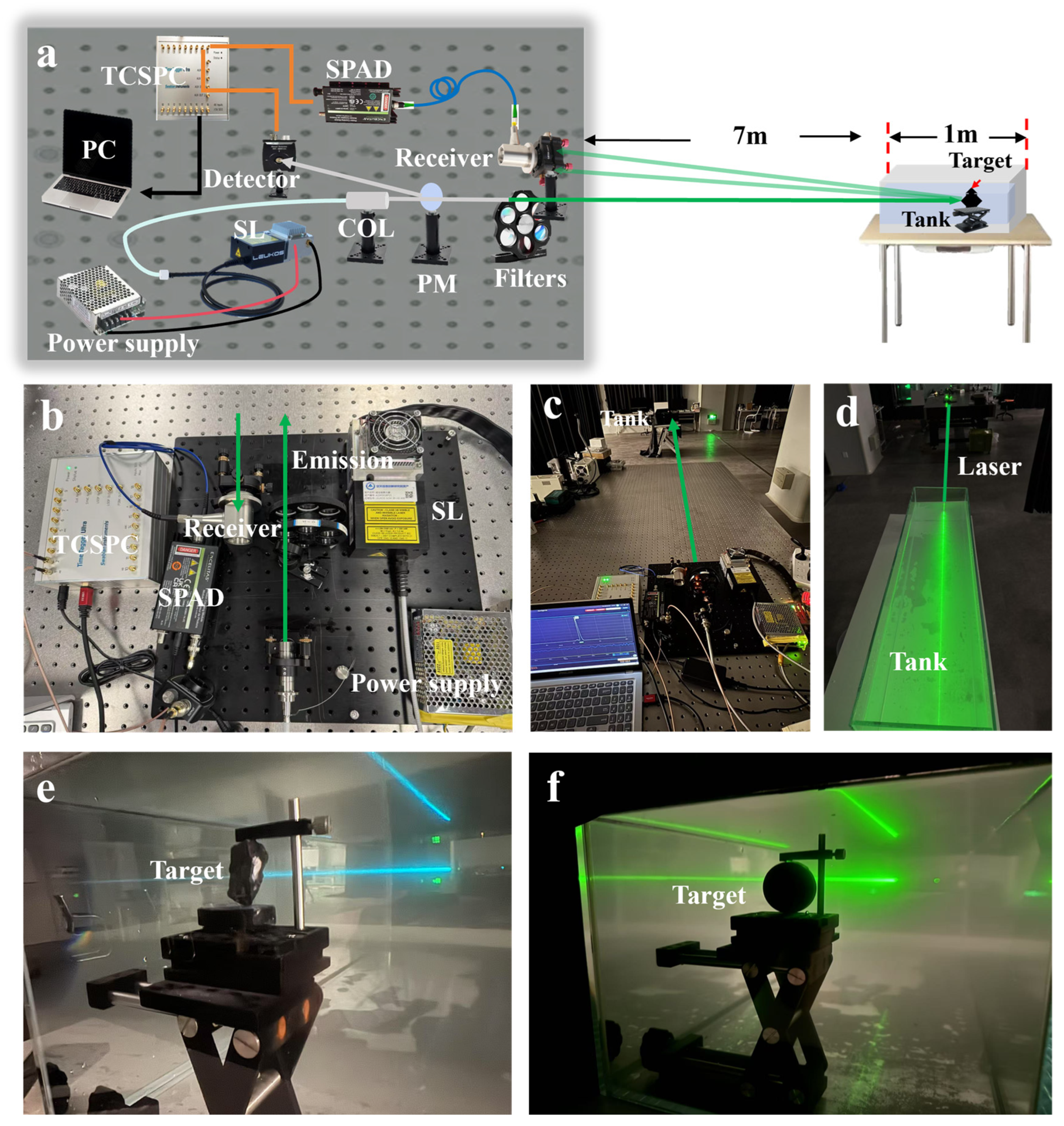
The configuration of the multiwavelength single-photon laser detection system is shown in Figure 1a. This system employed a supercontinuum laser source (LEUKOS SCM-30-HE-450, LEUKOS, Limoges, France, 200–2400 nm, power < 200 mW, pulse energy < 15 μJ, pulse width < 1.2 ns). The optical system consisted of a transmitting path and a receiving path. In the transmitting path, the output laser beam was first collimated and then incident on a plane window mirror used as a beam splitter. The reflected portion of the beam was directed to a PIN detector, whose electrical output served as the trigger signal for the time-correlated counter (Time Tagger Ultra, Swabian Instruments, Stuttgart, Germany). The transmitted portion then passed through a six-hole rotating filter wheel for wavelength selection. The filter bandwidth was 10 nm, and the corresponding wavelength settings are listed in Table 1. The selected laser beam was then projected toward a target placed in a 1 m-long water tank.
In the receiving path, returned photons from the target region, including reflections from the glass window and the target, were collected by an optical receiver. A reflective fiber-optic collimator (RFCAGA1, LBTEK, Shenzhen, China), with an effective receiving aperture of 22.4 mm and a focal length of 50.8 mm, was used to gather the return photons. The collected light was coupled into a 105 μm-core multimode fiber and guided to a single-photon avalanche photodetector (SPAD, SPCMAQRH-14-FC, Excelitas Technologies, Pittsburgh, PA, USA). The transmitter and receiver were arranged in a convergent near-biaxial geometry with a center-to-center separation of 4 cm. The receiver field of view was 2 mrad (full angle). The front wall of the 1 m-long water tank was located 7 m from the instrument head. The optical alignment was adjusted such that the tank section used for measurement lay within the full-overlap interval. Based on the system geometry, the transmit and receive axes intersected near the tank center (~7.5 m), corresponding to a full-overlap range of approximately 6.58–8.73 m. Therefore, the entire 7–8 m measurement region was located within the full-overlap interval. The photon arrival events detected by the SPAD were recorded by the TCSPC module, and the time interval between the PIN trigger pulse and the returned single-photon signal was stored on a PC for subsequent processing. The main system parameters are listed in Table 1. Figure 1 shows the experimental setup and observation scenes of the multiwavelength single-photon LiDAR system, including the schematic diagram of the optical system in Figure 1a, the system photograph in Figure 1b, the laboratory observation setup in Figure 1c, the laser propagation in the water tank in Figure 1d, and the target observation scenes in Figure 1e,f.

2.2. Water-Condition Preparation and Attenuation-Coefficient Measurement

Two water conditions were used in the experiments. The clear-water condition was used as the reference condition, while the turbid-water condition was prepared by adding milk to clear water, followed by thorough mixing before each measurement. Since milk forms an emulsion in water, the suspended scatterers are expected to have a broad particle-size distribution.
The attenuation coefficient for each water condition was measured at 550 nm using a laser source and a power meter. A collimated laser beam was transmitted through the water tank, and the optical power was measured at different propagation distances along the beam path. The attenuation coefficient was then calculated from the decrease in transmitted optical power according to the Beer–Lambert law, after correcting for the fixed optical losses of the measurement system [41]. The attenuation coefficient reported in this study corresponds to the beam attenuation coefficient determined from the direct transmitted beam. The measured attenuation coefficients were 0.1 m−1 for the clear-water condition and 2.0 m−1 for the turbid-water condition.

2.3. Target Samples and Observation Geometry

A total of 50 typical mineral and rock samples were used as targets in the experiments. The target set covered a spectral reflectance range of approximately 0.2–0.6. Each sample had a size of 2 cm × 2 cm. The targets were placed near the rear end of the water tank, approximately 6 cm from the rear wall. All samples were fixed at the same position during the measurements to maintain consistent geometric conditions. The target surface was adjusted to be as perpendicular as possible to the incident laser beam, as shown in Figure 1e,f.
The laser beam radius was approximately 2 mm at the system output, corresponding to a beam diameter of about 4 mm. This spot size was much smaller than the 2 cm × 2 cm target surface, ensuring that the laser spot was fully covered by the target during the measurements.
Among the 50 samples, six representative mineral and rock targets were selected for the subsequent principal component analysis (PCA), namely manganese ore, coal, graphite, basalt, limestone, and quartzite. These samples corresponded to Target 2, Target 14, Target 21, Target 28, Target 33, and Target 39, respectively, and their spectral reflectance values at 550 nm were 0.23, 0.25, 0.35, 0.29, 0.48, and 0.53, respectively.

2.4. Theory and Computational Methods for Single-Photon Detection

Single-photon LiDAR is fundamentally concerned with detecting the energy of light reflected from targets. Nonetheless, the transmission of light through water is subject to significant attenuation, which remains pronounced even in the clearest of water bodies. This attenuation of laser light in water is primarily attributed to the combined effects of absorption and scattering, leading to an exponential and rapid reduction in light energy within the medium. The degree of attenuation can be quantitatively described by the attenuation coefficient α based on the Beer-Lambert law applied to underwater optics [42].
ρ w = e α L w ,
where L w denotes the one-way propagation distance in water.
Based on the general photon-count LiDAR equation and the target LiDAR model [14], together with the photon-number conversion relation [43], the number of photons detected by the single-photon detector can be written as
N r = E t λ O L R r 2 ρ b η T η E ρ w 2 4 L 2 h c ,
Equation (2) assumes that the underwater targets can be approximated as Lambertian surfaces. Here, N r denotes the number of photons detected by the single-photon detector; E t is the laser pulse energy; λ is the laser wavelength; L is the total one-way physical distance from the LiDAR system to the target; O   ( L ) is the overlap factor of the LiDAR system at range L ; R r is the diameter of the receiving telescope aperture; ρ b is the reflectance of the underwater target; η T is the optical efficiency of the system; η E is the quantum efficiency of the detector; ρ w is the one-way transmittance of the water body; α is the attenuation coefficient of water; h is Planck’s constant; and c is the speed of light in vacuum. Therefore, ρ w 2   =   e 2 α L w represents the round-trip attenuation in water for the target return.
This study analyzed six laser wavelengths, each with distinct water attenuation coefficients and reflectance from multiple targets. Under multiwavelength laser illumination, the target reflectance and attenuation variations collectively influence the received photons. During computation, TCSPC technology was used to acquire the arrival time and intensity of the target return. The time axis represents the photon arrival time, defined as the duration from the excitation pulse initiation to the photon detection. This allows the deduction of the target distance relative to the system. The spatial axis denotes the two-dimensional coordinates of the target in the imaging system. The photon count axis indicates the photons detected at specific time and spatial positions, characterizing the reflectance signal of the target.
The estimation algorithm based on histogram statistics is a simple approach. This study employed the peak method and Gaussian fitting techniques to determine the arrival time and intensity of the target return. The peak method determines the timing based on the maximum value of the received signal strength. This involves locating the maximum value in the TCSPC histogram; the time at this position represents the round-trip duration of the light. Although simple to implement, it is susceptible to noise interference in low signal-to-noise environments, particularly with multipath interference, which may prevent accurate peak detection. The return-photon events were synchronized with the laser trigger signal. Multiple TCSPC histograms were statistically accumulated, and Gaussian fitting was applied to estimate the return profile. The fitted target arrival time and intensity were then extracted. Following the histogram peak estimator commonly used in TCSPC-based ranging [4], the target arrival time and the corresponding peak photon count can be determined by
[ L i , N r i ] = max ( m i n ) ,
min represents the photon-number distribution within the i-th bin, where n corresponds to the number of counting channel bins in the TCSPC. Li denotes the target arrival time, and Nri corresponds to the received peak photon number.
In addition, the application of a Gaussian fitting method to determine peak values and arrival times entails analyzing and modeling the LiDAR return signal using a Gaussian distribution. This method is appropriate when the received return signal can be approximated as a Gaussian shape. Compared with directly identifying the maximum value, fitting mitigates the influence of random noise on peak estimation. The fitted peak time can overcome the limitation imposed by the sampling interval, resulting in more precise time delays and, consequently, enhanced distance accuracy. Furthermore, the fitted amplitude and pulse width parameters allow for a more stable estimation of the return-signal energy. When the received return signal can be approximated by a Gaussian pulse, the return signal can be modeled using a Gaussian waveform model [44] as
f t , P G = N G exp ( t t l 2 2 σ 2 ) ,
Here, PG = (NG, σG, tl) denotes the set of parameters for this model, NG represents the amplitude of the Gaussian function pulse signal, σ denotes the echo pulse width parameter, and the half-width can be calculated by dividing this parameter by 2.35482. tl denotes the time corresponding to the peak of Gaussian function. The model parameters are estimated by minimizing the sum of squared residuals using a nonlinear least-squares criterion [45]:
min N G , t l , σ i N r i f ( t i , P G ) 2 ,
For each target, wavelength, and water-quality condition, the return signal was recorded using the time tagger for TCSPC acquisition, with a bin width of 50 ps and 1500 bins, corresponding to a temporal window of 75 ns. The integration time for each acquisition was 1000 ms, and 10 repeated acquisitions were performed under each condition. At a pulse repetition rate of 10 kHz, each 1000 ms acquisition corresponded to approximately 10,000 laser shots. The raw TCSPC histograms were then processed to extract the target arrival time using the peak-extraction and Gaussian-fitting methods described above.

2.5. Multiwavelength LiDAR Detection Data Processing Workflow

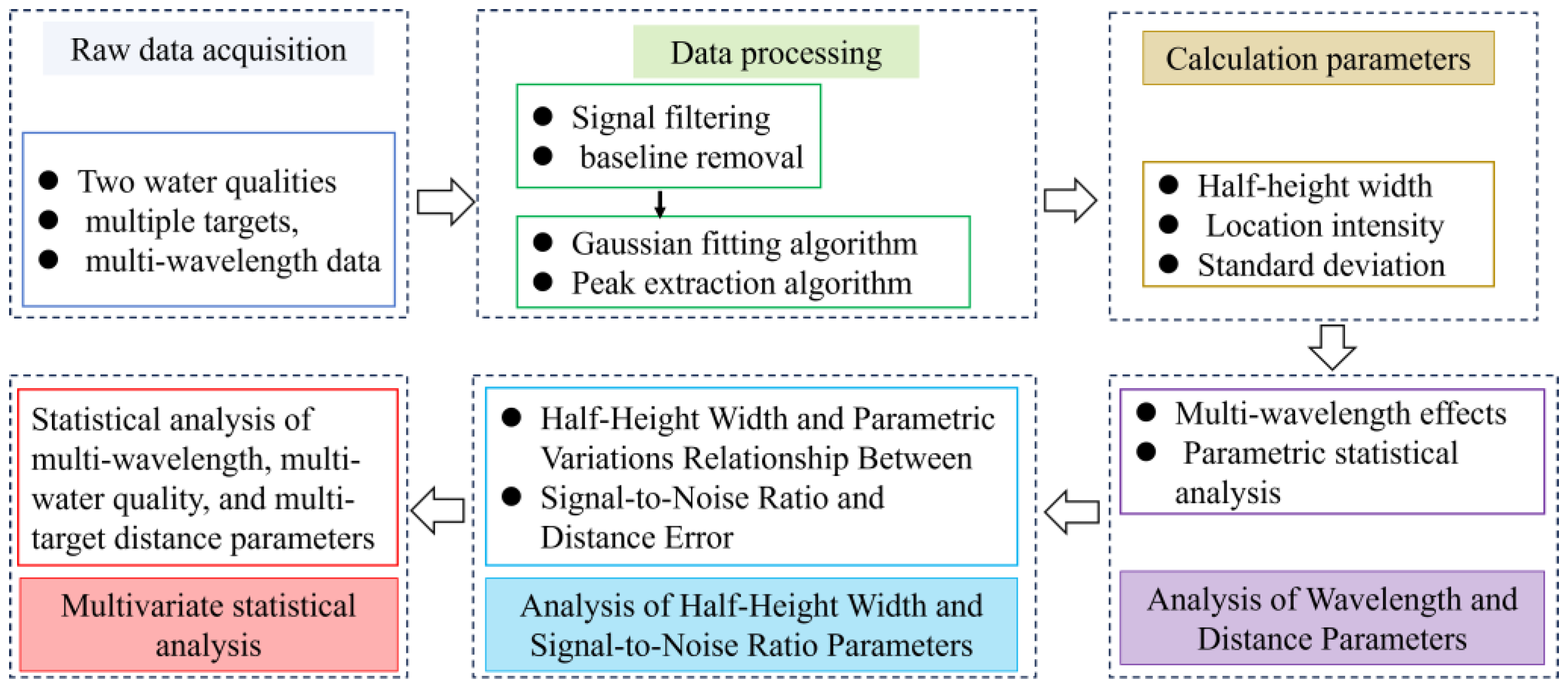
To analyze multi-target and multiwavelength data under different water conditions, underwater target detection signals from the single-photon LiDAR system were acquired for two water conditions, multiple targets, and different laser wavelengths. As shown in Figure 2, the collected data were then processed and analyzed. The single-photon signals from underwater targets were processed using signal filtering and baseline rejection. Gaussian fitting and peak-extraction algorithms were used to identify the target positions and extract the signal peaks. Statistical analysis of the detection signal parameters, including pulse width, detection time, and time standard deviation, was conducted to examine variations in target position and signal intensity. The detection performance for underwater targets at multiple laser wavelengths was then analyzed. The effects of the signal-to-noise ratio and half-height width on the detectable target range were examined. Finally, multiple parameters across wavelengths, water conditions, and targets were analyzed to evaluate the underwater multiwavelength laser target detection performance.

3. Results

3.1. Variation in Target Return Arrival Time with Wavelength

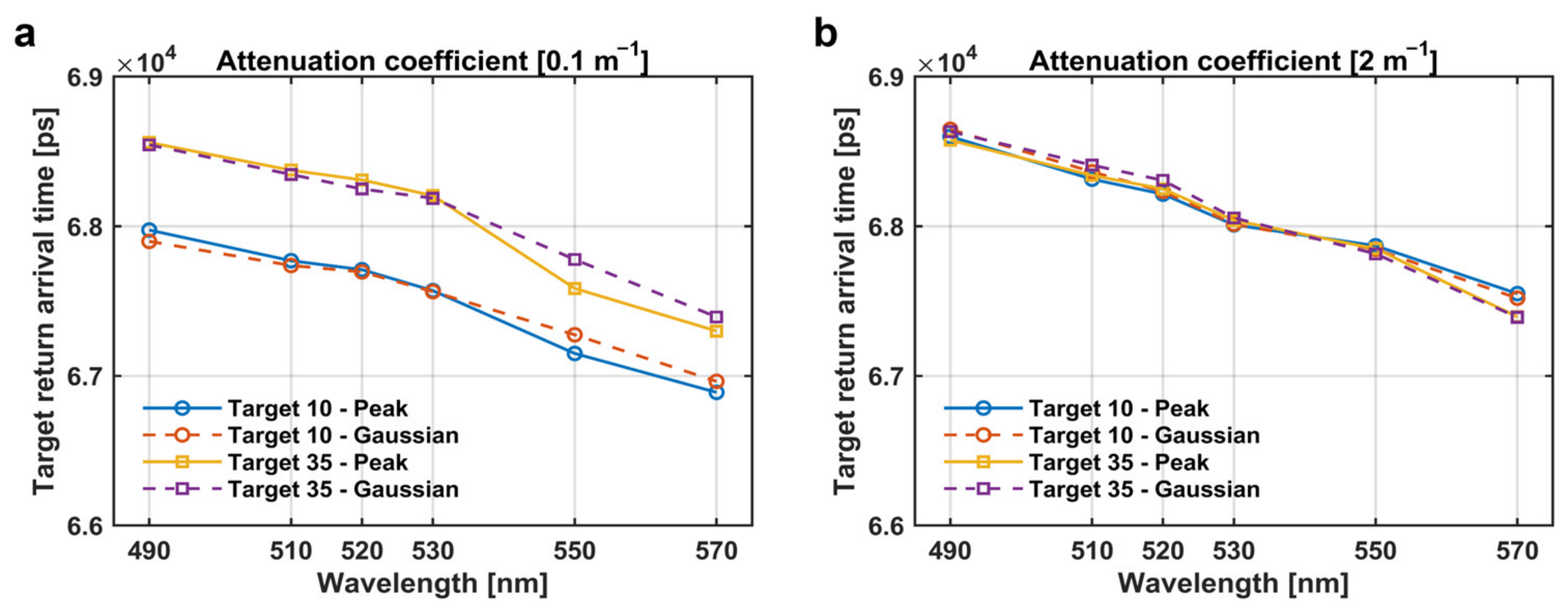
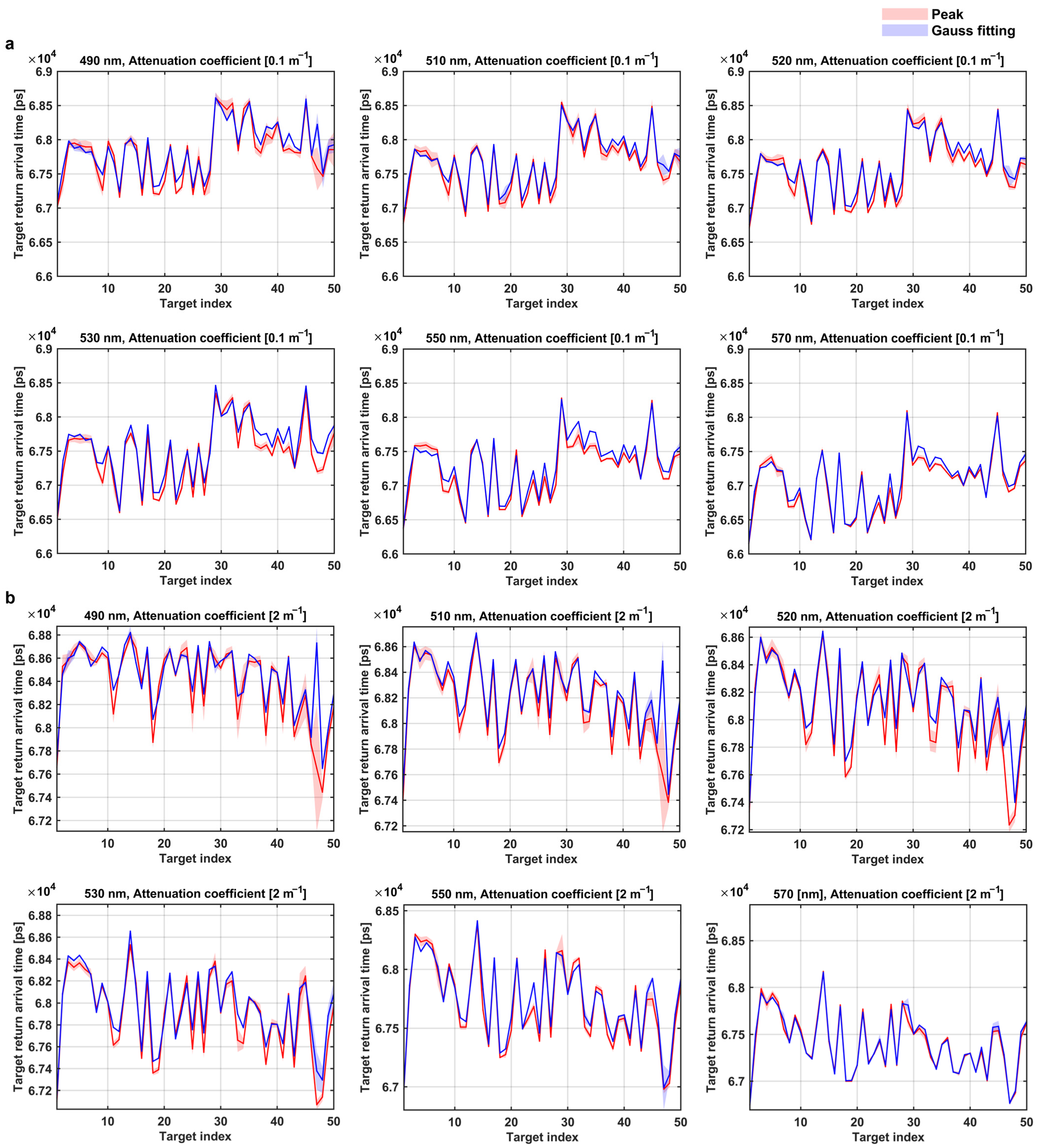
To investigate the variations in target return arrival time under different wavelengths, targets, water attenuation conditions, and retrieval methods, 50 different targets were sequentially placed at the same nominal position within the 1 m water tank, and the orientation of each target was adjusted to be as perpendicular to the incident laser beam as possible so as to minimize geometric effects on the temporal response. The complete results for all 50 targets at six wavelengths (490–570 nm) under the two water attenuation conditions (0.1 m−1 and 2 m−1) are provided in Appendix A (Figure A1), whereas Figure 3 focuses on two representative targets (Targets 10 and 35) to illustrate some representative variations in return arrival time. For each representative target, the return arrival time was retrieved using both the peak-detection method and the Gaussian-fitting method. In Figure 3, the y-axis represents the target return arrival time obtained from the photon arrival-time histogram recorded by the TCSPC system. In the peak detection method, this value corresponds to the time bin with the maximum photon count, whereas in the Gaussian fitting method it corresponds to the fitted pulse center. The TCSPC data bin width is 50 ps; assuming a refractive index of water of approximately 1.33, this corresponds to a one-way range resolution of about 5.6 mm.
As shown in Figure 3, the return arrival times of both representative targets tend to decrease with increasing wavelength under both water attenuation conditions. This trend may be related to wavelength-dependent changes in the detected photon-count distribution, which may be influenced by attenuation, scattering, and target optical properties, with scattering effects potentially causing centroid shifts in the detected photon-count distribution, rather than a true change in target position. Under the attenuation coefficient of 0.1 m−1, Target 35 generally exhibits a later return arrival time than Target 10. In contrast, under the attenuation coefficient of 2 m−1, the difference between the two targets becomes much smaller, which may suggest that target-dependent responses are more evident in clearer water. For Target 35, the peak-detection and Gaussian-fitting results are nearly identical at 490–530 nm, whereas the Gaussian-fitting results become slightly higher at 550–570 nm, which may indicate a slight increase in asymmetry of the photon-count distribution at longer wavelengths.
Under the attenuation coefficient of 2 m−1, the return arrival times of Targets 10 and 35 become very close, and the peak-detection and Gaussian-fitting results also agree closely. This may suggest that, in turbid water, the influence of the water medium becomes more pronounced, while target-dependent differences become less evident. As a result, different targets may show more similar wavelength-related variations in return arrival time, and the two retrieval methods also tend to give more consistent results. These results suggest that wavelength, water attenuation, target-dependent temporal responses, and retrieval-method differences should all be considered in multiwavelength underwater LiDAR ranging and subsequent target recognition analysis.
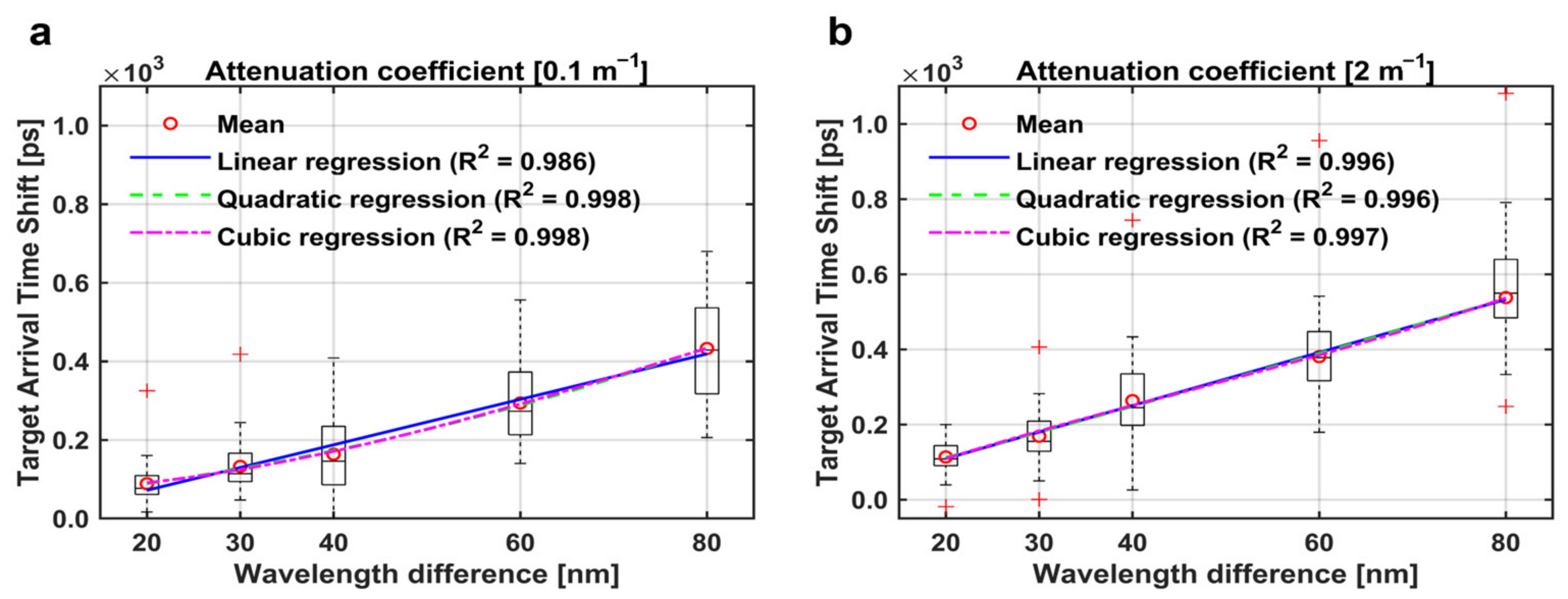
The fitting results of target return arrival-time shifts for different wavelength differences under different water attenuation coefficients are shown in Figure 4. The target return arrival time at each wavelength in the 490–570 nm range was first extracted from the processed photon-count histograms. For each target, the 490 nm result was taken as the reference, and the return arrival-time shifts at 510, 520, 530, 550, and 570 nm were calculated accordingly, corresponding to wavelength differences of 20, 30, 40, 60, and 80 nm. For each wavelength-difference group, 50 arrival-time-shift values were obtained from the 50 targets, and these values were used for statistical analysis. In Figure 4, the boxplots show the distributions of the arrival-time shifts for each wavelength-difference group.
At the same wavelength difference of 60 nm, the mean shift in turbid water is larger than that in clear water, corresponding to approximately 8.3 ps/nm in turbid water and 5 ps/nm in clear water. This result suggests that turbidity may enhance the wavelength-related temporal deviation and could therefore lead to larger range deviations after time-to-distance conversion.
The fitted curves show somewhat different variation patterns under the two water conditions. In clear water, the quadratic and cubic regressions appear to describe the mean trend slightly better than the linear regression, suggesting that the relationship between wavelength difference and return arrival-time shift may contain a weak nonlinear component. This weak nonlinearity may be related to target-dependent and system-related effects that remain more evident under better signal conditions. In contrast, in turbid water, the linear, quadratic, and cubic regressions give similar fits, suggesting that the relationship is closer to linear. This may indicate that, under stronger scattering conditions, the wavelength-related temporal shift changes more uniformly with increasing wavelength difference. Therefore, wavelength spacing may need to be selected more carefully in turbid water, because the same wavelength difference could introduce a larger potential ranging deviation.

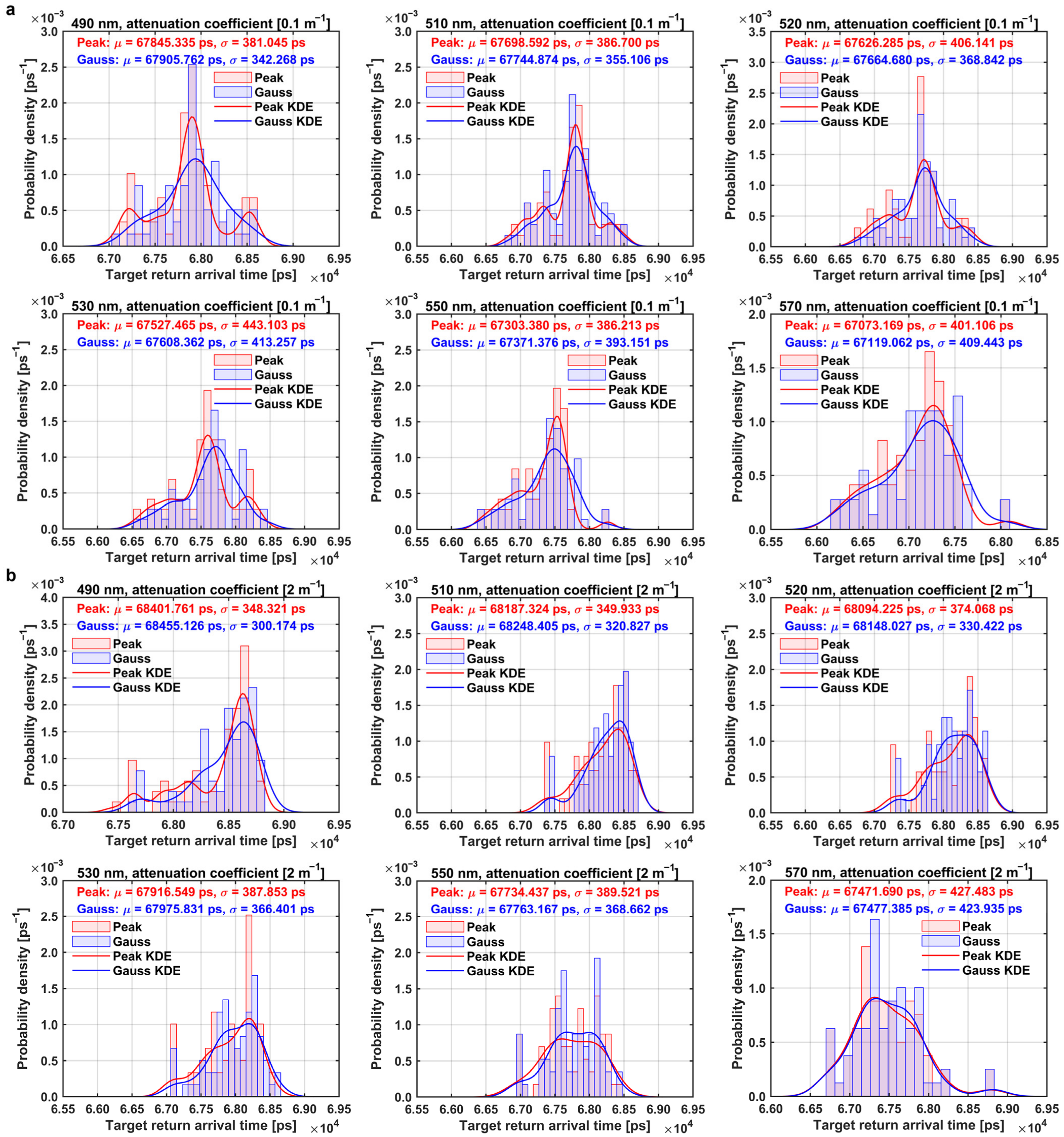
3.2. Statistical Analysis of Target Return Arrival Time and Standard Deviation

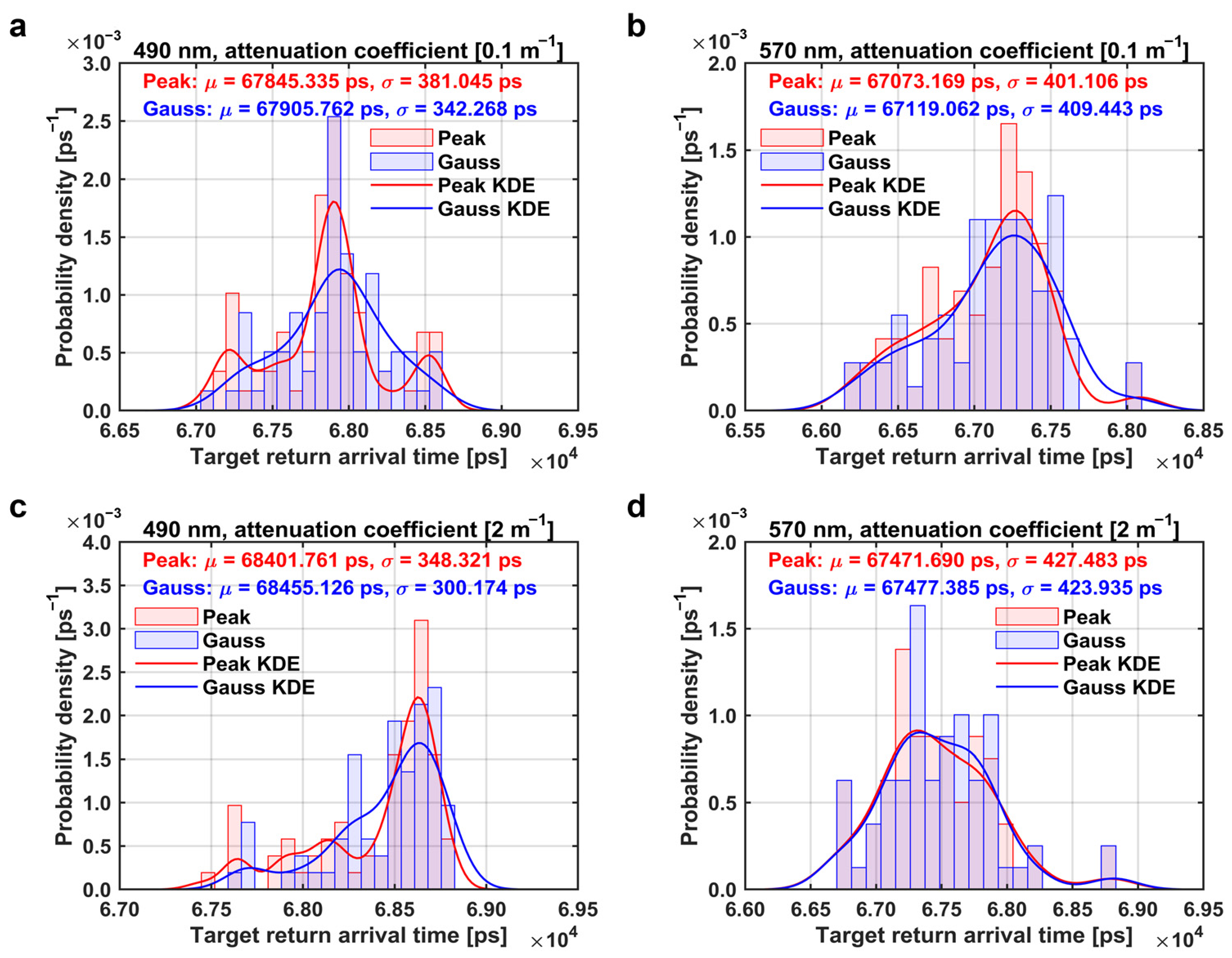
To illustrate the statistical characteristics of the target return arrival times, representative results at 490 and 570 nm under two water attenuation conditions are shown in Figure 5, while the corresponding results at the intermediate wavelengths are provided in Figure A2 in Appendix A. For each target, wavelength, and water condition, 10 repeated LiDAR measurements were first performed, and the target return arrival time was extracted from each measurement using both peak detection and Gaussian fitting. The mean of the 10 repeated measurements was taken as the final target return arrival time. The histograms shown in Figure 5 represent the distributions of the extracted target return arrival times across the 50 targets.
In clear water (0.1 m−1), the mean arrival time determined by the peak method decreases from 67,845.335 ps at 490 nm to 67,073.169 ps at 570 nm, while the corresponding mean obtained by Gaussian fitting decreases from 67,905.762 ps to 67,119.062 ps. This indicates that, as the wavelength increases from 490 to 570 nm, the arrival-time distributions shift toward earlier times. Figure A2 in Appendix A further shows that the intermediate wavelengths within the 490–570 nm range follow the same decreasing trend. Meanwhile, the distribution width also increases with wavelength. For the peak method, the standard deviation increases from 381.045 ps to 401.106 ps, corresponding to a one-way range in water from 4.3 to 4.5 cm. For Gaussian fitting, it increases from 342.268 ps to 409.443 ps, corresponding to a one-way range from 3.8 to 4.6 cm. These results indicate that the arrival-time distributions tend to become broader with increasing wavelength.
A more pronounced effect is observed in turbid water (2 m−1). The mean arrival time changes from 68,401.761 ps to 67,471.690 ps for the peak method and from 68,455.126 ps to 67,477.385 ps for Gaussian fitting between 490 and 570 nm, indicating a larger temporal shift than in clear water. At the same time, the distribution width increases from 348.321 ps to 427.483 ps for the peak method, corresponding to a one-way range in water from 3.9 to 4.8 cm, and from 300.174 ps to 423.935 ps for Gaussian fitting, corresponding to a one-way range from 3.4 to 4.8 cm. This shows that the broadening effect is more evident in turbid water. Compared with clear water, turbid water therefore tends to show both a larger wavelength-dependent shift in target return arrival time and a stronger broadening of the distributions.
The arrival times determined by Gaussian fitting are generally later than those obtained by the peak method, indicating a systematic difference between the two methods. This difference may arise because the peak method identifies the maximum-count bin and is therefore more susceptible to local fluctuations and noise, whereas Gaussian fitting is based on the overall distribution shape. In turbid water, the smaller distribution width obtained with Gaussian fitting further suggests that this method may provide a more stable estimate of target return arrival time under stronger scattering conditions. Overall, Figure 5 and Figure A2 show a consistent trend: as the wavelength increases, the arrival-time distributions shift toward earlier times and become broader, with both effects being more pronounced in turbid water.
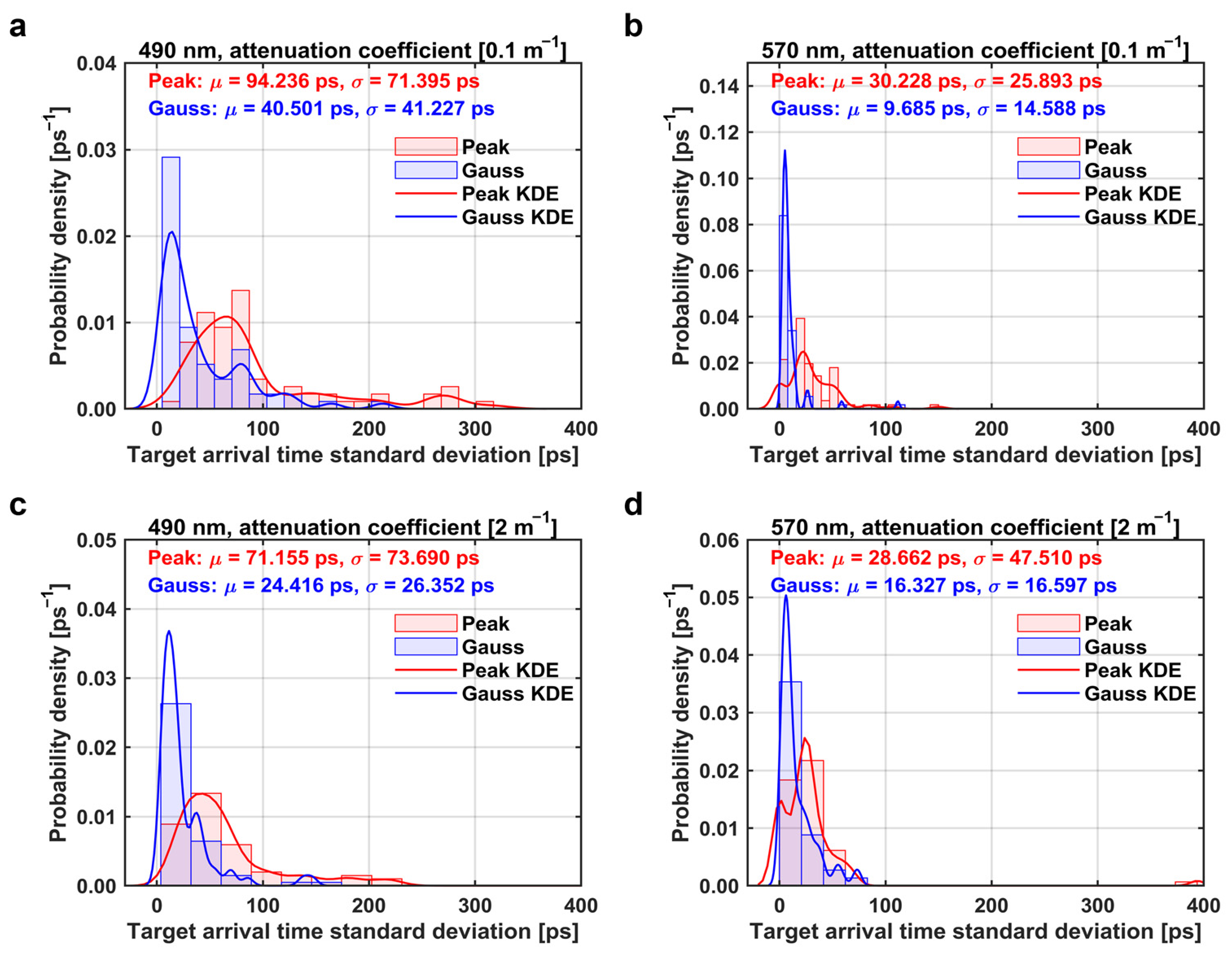
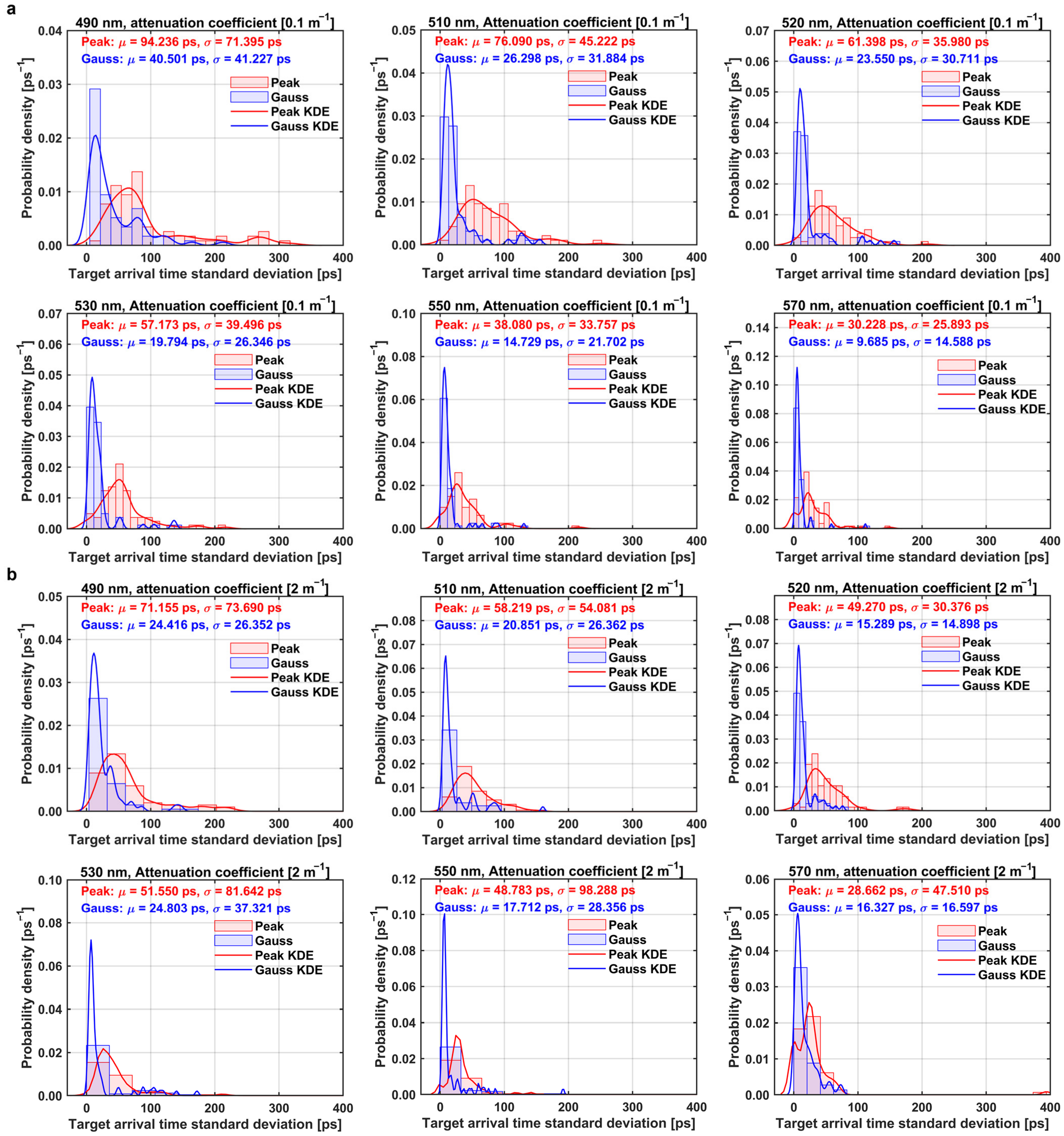
To illustrate the statistical characteristics of the target return arrival-time standard deviation, Figure 6 presents the standard deviation distributions of target return arrival time at two representative wavelengths, 490 and 570 nm, under the two water attenuation conditions, while the corresponding results at the intermediate wavelengths are given in Figure A3 in Appendix A. For each target, wavelength, and water condition, 10 repeated LiDAR measurements were processed using peak detection and Gaussian fitting to determine the target return arrival time, and the standard deviation of the retrieved arrival times was then calculated for each target. The histograms in Figure 6, therefore, represent the distributions of these target-level standard deviations across the 50 targets, with the x-axis denoting the target return arrival-time standard deviation (ps).
In clear water (0.1 m−1), the mean of the target-level standard deviation distribution is 94.236 ps at 490 nm and 30.228 ps at 570 nm for the peak method, while the corresponding values for Gaussian fitting are 40.501 ps and 9.685 ps, respectively. In turbid water (2 m−1), the mean is 71.155 ps at 490 nm and 28.662 ps at 570 nm for the peak method, while the corresponding values for Gaussian fitting are 24.416 ps and 16.327 ps, respectively. These results show that the target return arrival-time standard deviation generally decreases with increasing wavelength under both water attenuation conditions. In addition, Gaussian fitting yields lower standard deviations than the peak method. The intermediate wavelengths shown in Figure A3 in Appendix A exhibit the same trend.
These results suggest that Gaussian fitting provides better temporal precision and potentially better ranging precision. This advantage appears to remain evident in turbid water (2 m−1), where the standard deviation varies less with wavelength for Gaussian fitting, suggesting relatively greater robustness under stronger scattering conditions. In contrast, the standard deviation obtained by the peak method changes more markedly with wavelength, suggesting lower stability. This difference can be understood from the way the two methods determine the arrival time. Gaussian fitting assumes that the target return can be approximated by a Gaussian distribution and determines the arrival time by applying a least-squares fit to the overall photon-count distribution. Because it relies on the overall photon-count distribution rather than a single maximum-count bin, it is less sensitive to local fluctuations, broadening of the target-return distribution, and moderate distortion. Accordingly, even when the water attenuation changes from clear (0.1 m−1) to turbid (2 m−1) and scattering and backscatter interference become stronger, the target return may still retain an approximately Gaussian-like shape. Under such conditions, Gaussian fitting can still provide a relatively stable estimate of the arrival time, which may explain the smoother wavelength-dependent variation in its standard deviation. In contrast, the peak method is data-driven and depends directly on the location of the maximum-count bin. As a result, in turbid water, backscatter noise can introduce random spikes while making the main target return peak less distinct, which increases the sensitivity of the peak estimate to noise and leads to larger standard deviations. Therefore, in turbid water, Gaussian fitting shows a clearer advantage in both precision and robustness.

3.3. Effects of Signal-to-Noise Ratio on Target Return Arrival Time and Its Standard Deviation

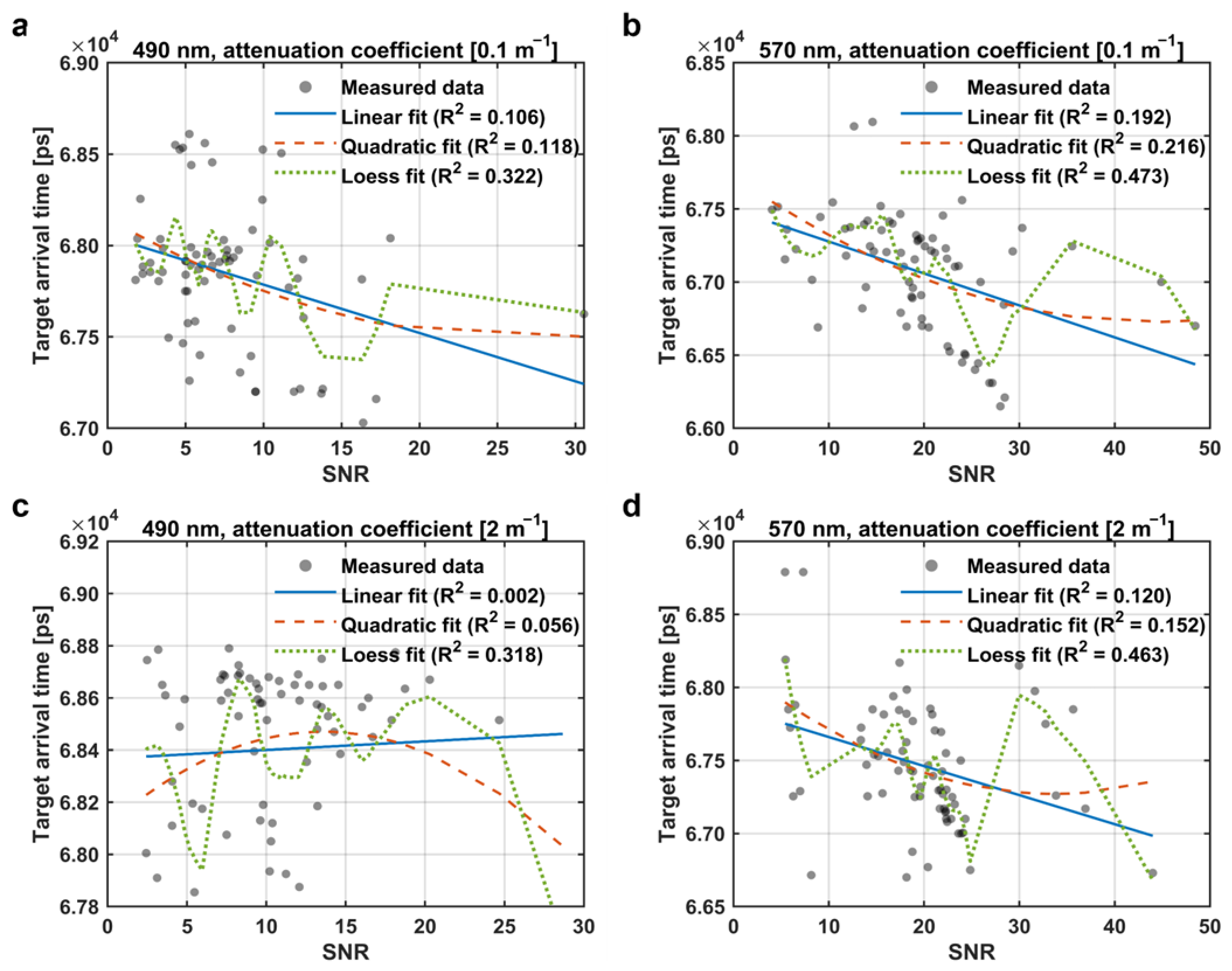
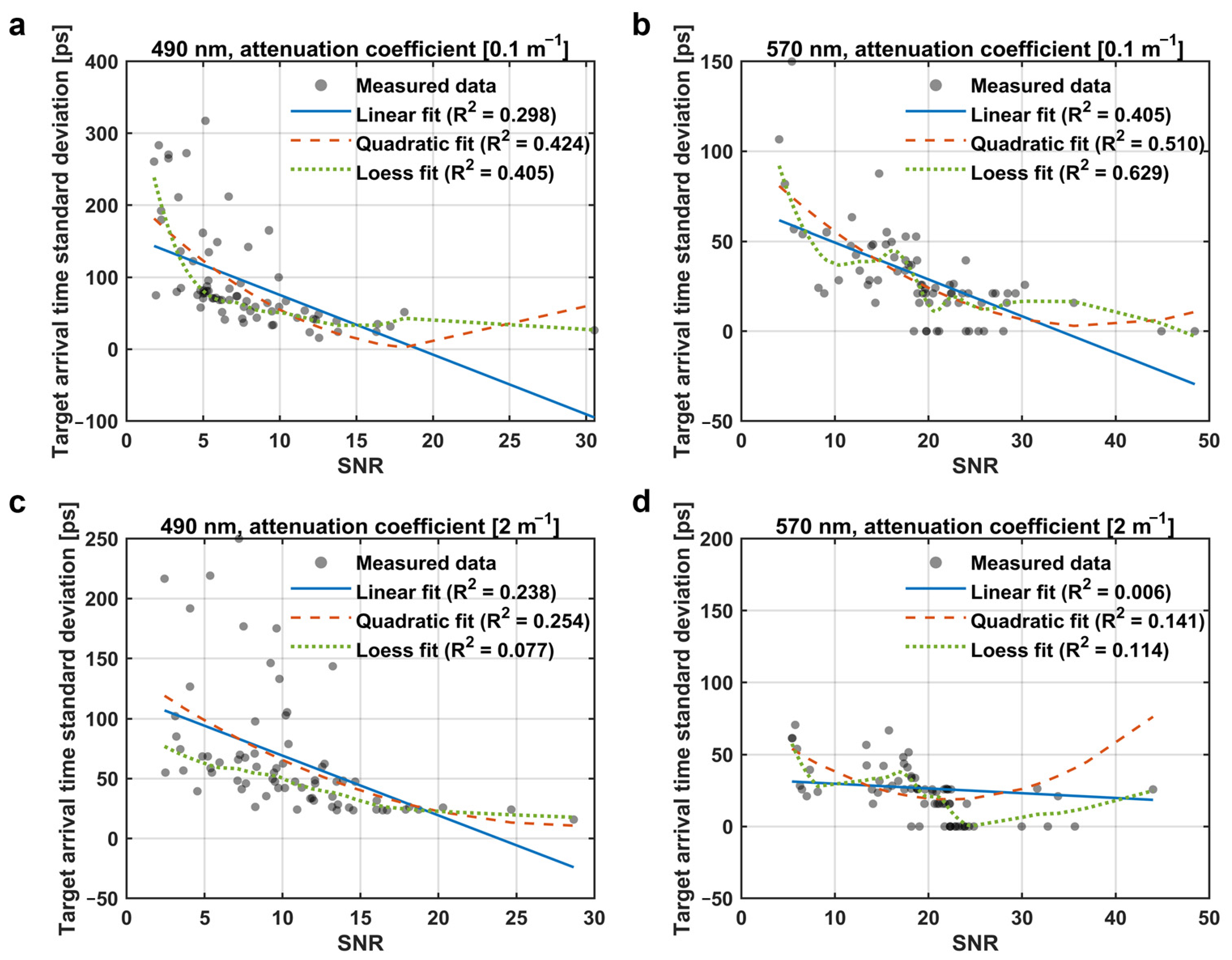
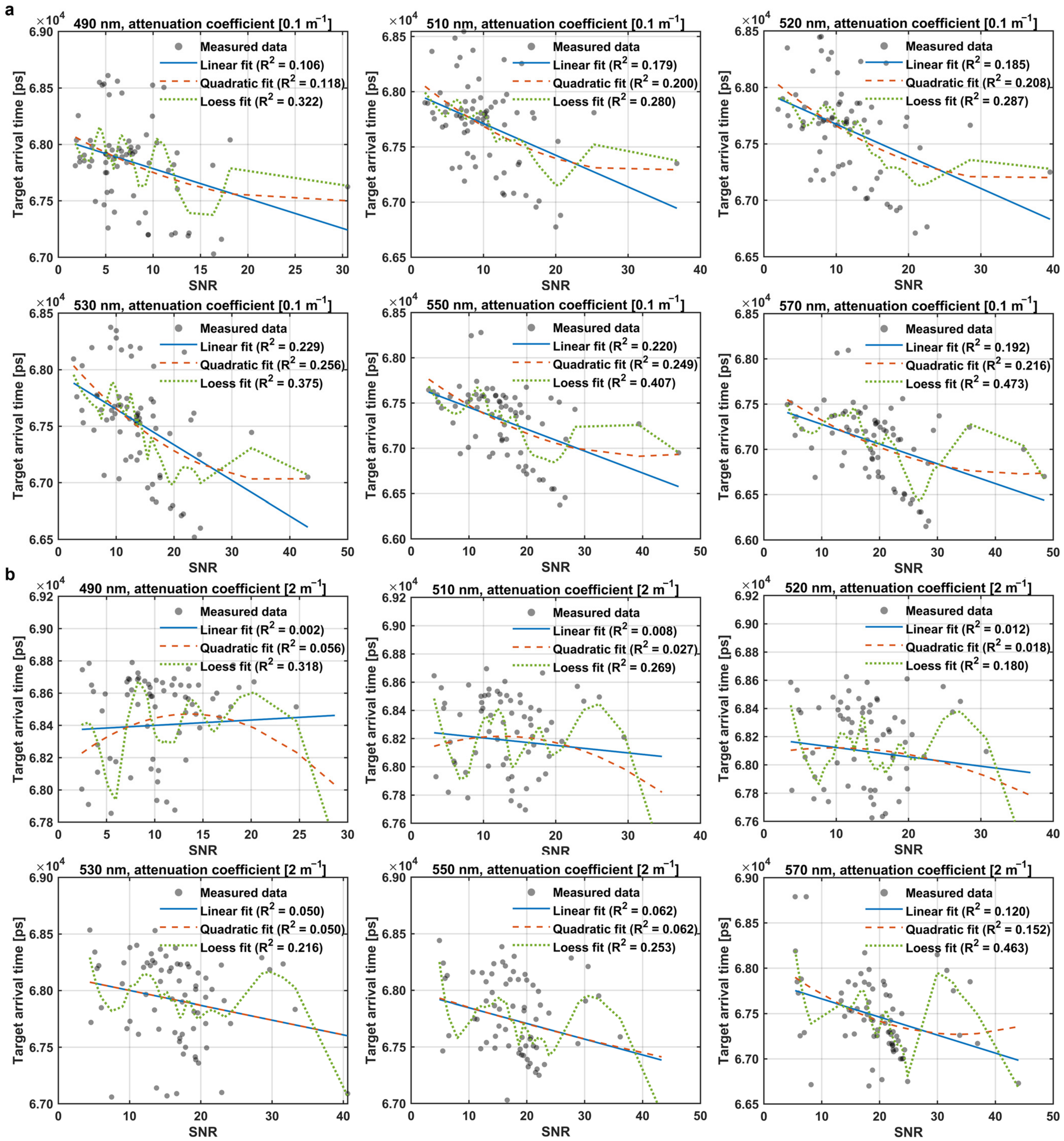
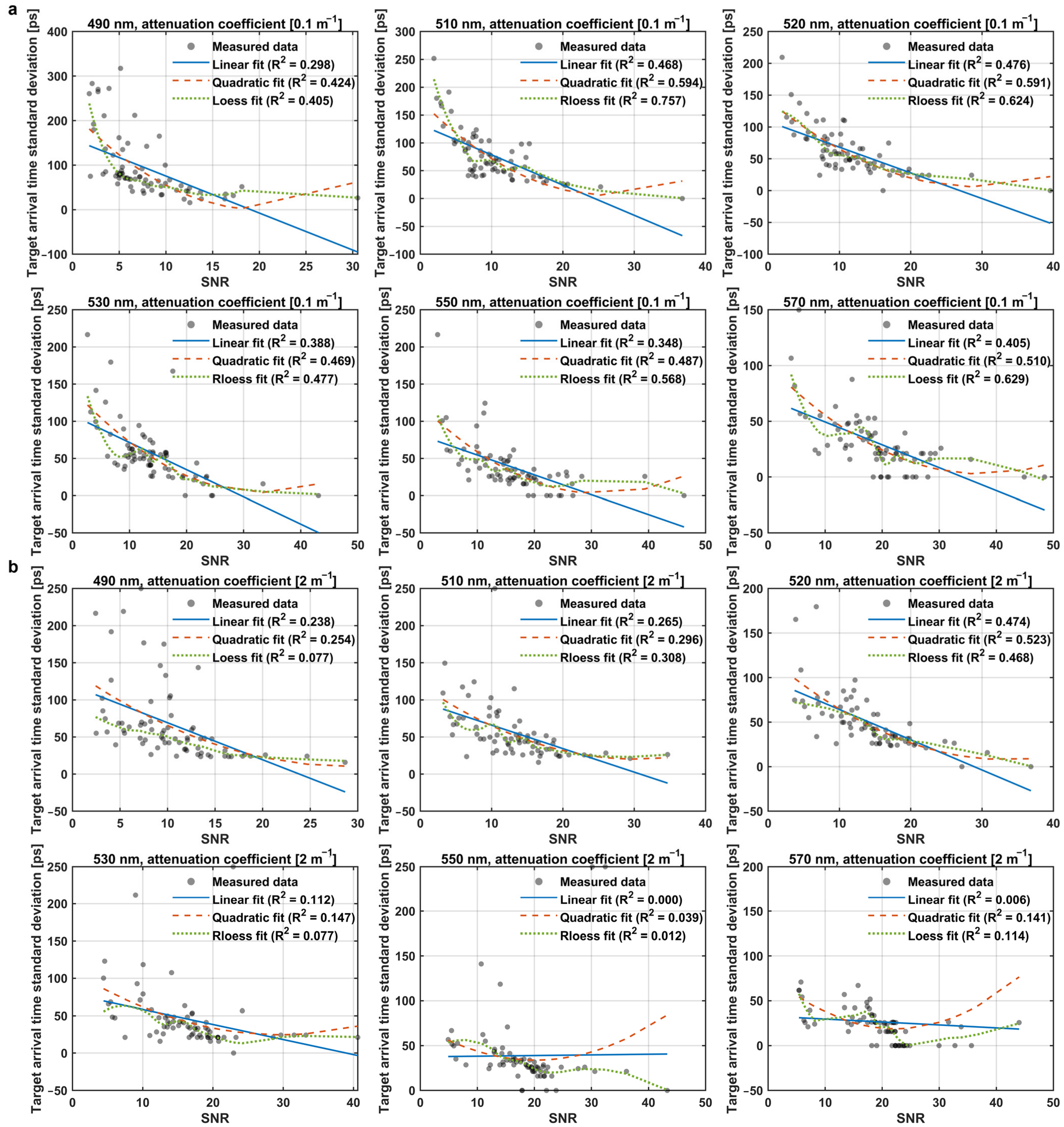
To investigate the influence of the signal-to-noise ratio (SNR) on target return arrival time and its standard deviation, representative results obtained by Gaussian fitting at 490 and 570 nm under two water attenuation conditions are shown in Figure 7 and Figure 8, where Figure 7 presents the target return arrival time and Figure 8 presents the target return arrival-time standard deviation. The corresponding intermediate-wavelength results are provided in Figure A4 and Figure A5 in Appendix A. For each wavelength and water attenuation condition, 50 targets were analyzed, with 10 repeated measurements performed for each target. The SNR was calculated from the time histogram. A background-noise baseline was estimated from the tail region of the histogram, where no target-return or backscatter contributions were negligible. The net signal photon count N s was obtained by subtracting the background count N bg from the total photon count N total within the target-signal window, and the SNR was then defined under Poisson statistics [46] as SNR   =   N s / N total .
Analysis of the results in Figure 7 and Figure 8 shows that, under both water attenuation conditions, the target return arrival-time standard deviation decreases as SNR increases. This decrease is more pronounced in the low-SNR range and becomes weaker at higher SNR, indicating that the benefit of increasing SNR is greatest when the target return is strongly affected by noise. In the low-SNR range, the target return is weak relative to the background fluctuations, so the detected peak position or fitted arrival time is more easily perturbed by random counts, resulting in larger timing fluctuations and hence larger standard deviations. As SNR increases, the target return becomes more distinguishable from the background, and the standard deviation decreases rapidly. Once SNR becomes sufficiently high, however, the influence of noise is substantially reduced, and further improvement in SNR yields only limited reduction in the standard deviation. By contrast, the dependence of the retrieved arrival time itself on SNR is much weaker. Under the attenuation coefficient of 2 m−1, the arrival-time data are more dispersed over the SNR range than those under 0.1 m−1. For example, at 490 nm the linear-fit R2 decreases from 0.106 under 0.1 m−1 to 0.002 under 2 m−1, indicating that the correlation between arrival time and SNR becomes very weak in turbid water. A similar weakening is observed at 570 nm, where the linear-fit R2 is 0.120 under 2 m−1, and the data still show noticeable scatter and occasional outliers over the SNR range. This behavior may be related to stronger backscatter and scattering-induced fluctuations in turbid water, which perturb the photon-count distribution and increase the variability of the estimated arrival time.

3.4. Variation in the Full Width at Half Maximum with Wavelength

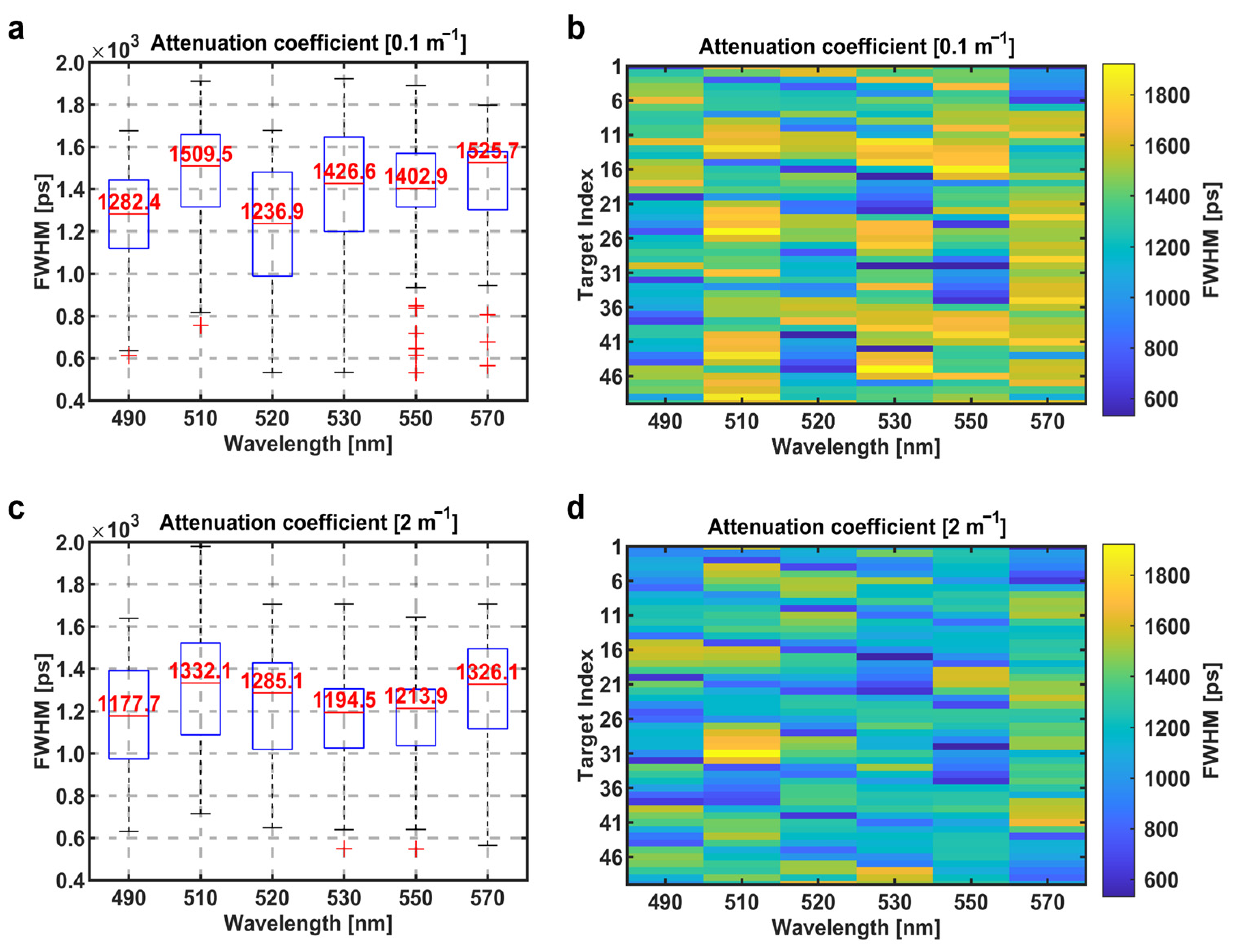
Figure 9 shows the distributions of the full width at half maximum (FWHM) of the Gaussian-fitted target returns across 50 targets at six wavelengths under two water attenuation conditions. The box plots in Figure 9a,c) show that the wavelength dependence of FWHM appears to be more pronounced in clear water (0.1 m−1) than in turbid water (2 m−1). In clear water, the median FWHM is relatively higher at 510 nm (1509.5 ps) and 570 nm (1525.7 ps), whereas it is lower at 520 nm (1236.9 ps). By contrast, in turbid water, the median FWHM remains within a narrower range of approximately 1177.7–1332.1 ps, suggesting a weaker dependence on wavelength.
Comparing the two attenuation conditions, the median FWHM values are closest at 520 nm, differing by only about 48.2 ps, whereas they differ the most at 530 nm, where the median FWHM is about 1426.6 ps in clear water and about 1194.5 ps in turbid water. At most wavelengths, the median FWHM is higher in clear water than in turbid water; however, 520 nm is an exception, and the magnitude of the difference varies with wavelength. A possible explanation is that, in clear water, the target return may overlap with water backscatter, which can broaden the Gaussian-fitted pulse and increase the estimated FWHM. In turbid water, stronger scattering and attenuation may suppress part of the delayed photon contribution, so the detected return becomes more temporally concentrated and the fitted FWHM becomes narrower.
This target-dependent behavior is also visible in the heat maps in Figure 9b,d. For example, the 510 nm band exhibits relatively elevated FWHM values, and targets 41–46 show noticeably broader fitted pulses in clear water than in turbid water. In contrast, targets 16–21 show relatively narrow FWHM values at 530 nm, whereas targets 26–31 exhibit relatively narrow FWHM values at 550 nm under both attenuation conditions, indicating that these targets appear to exhibit relatively stable temporal broadening characteristics at these wavelengths under both attenuation conditions. This behavior suggests that these targets may possess spectral–geometric robustness, likely associated with surface properties characterized by high reflectivity and scattering anisotropy. Such properties can produce more concentrated return signals that are less affected by water-column interference, thereby providing spectral-fingerprint characteristics for underwater target identification.
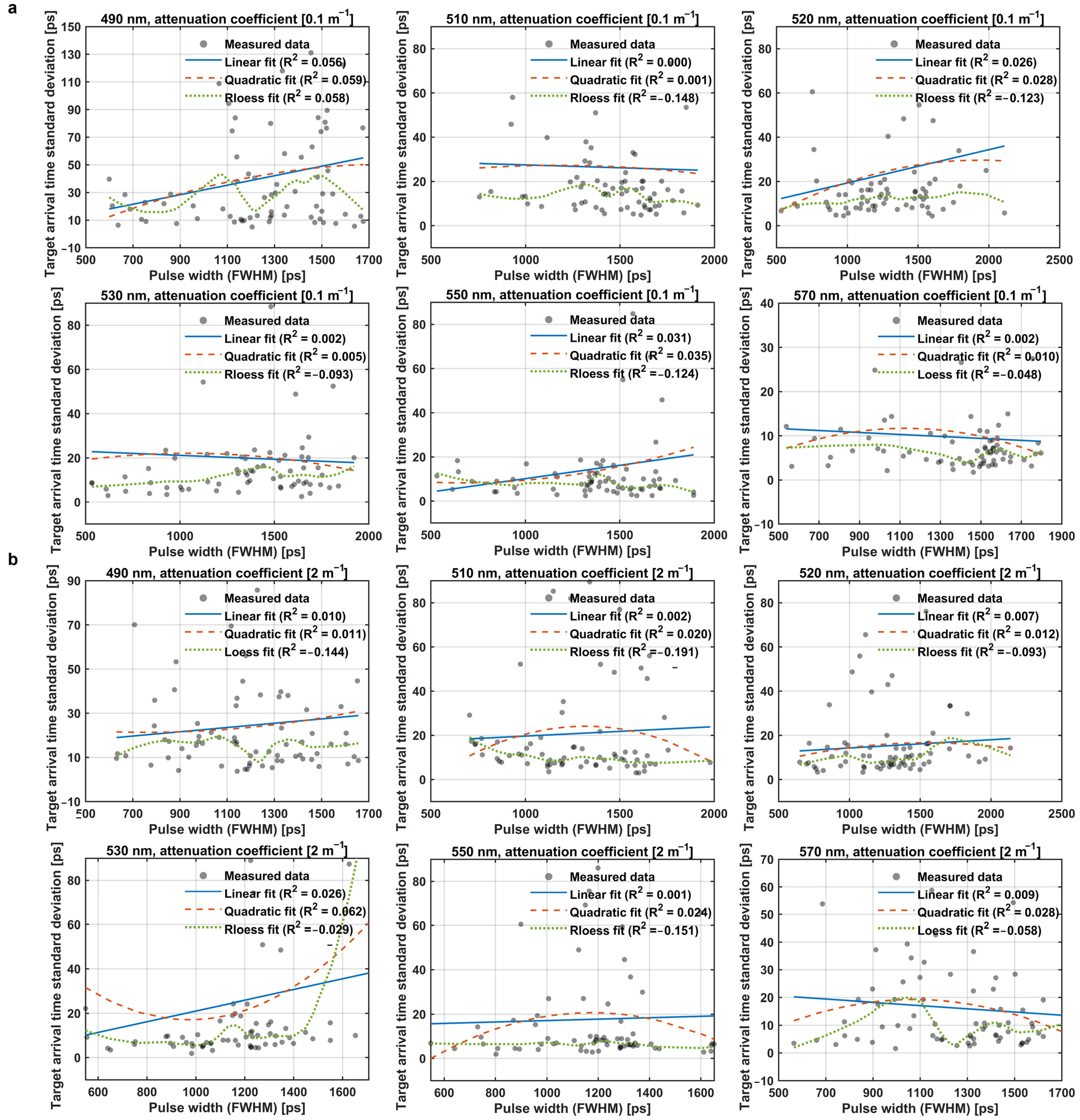
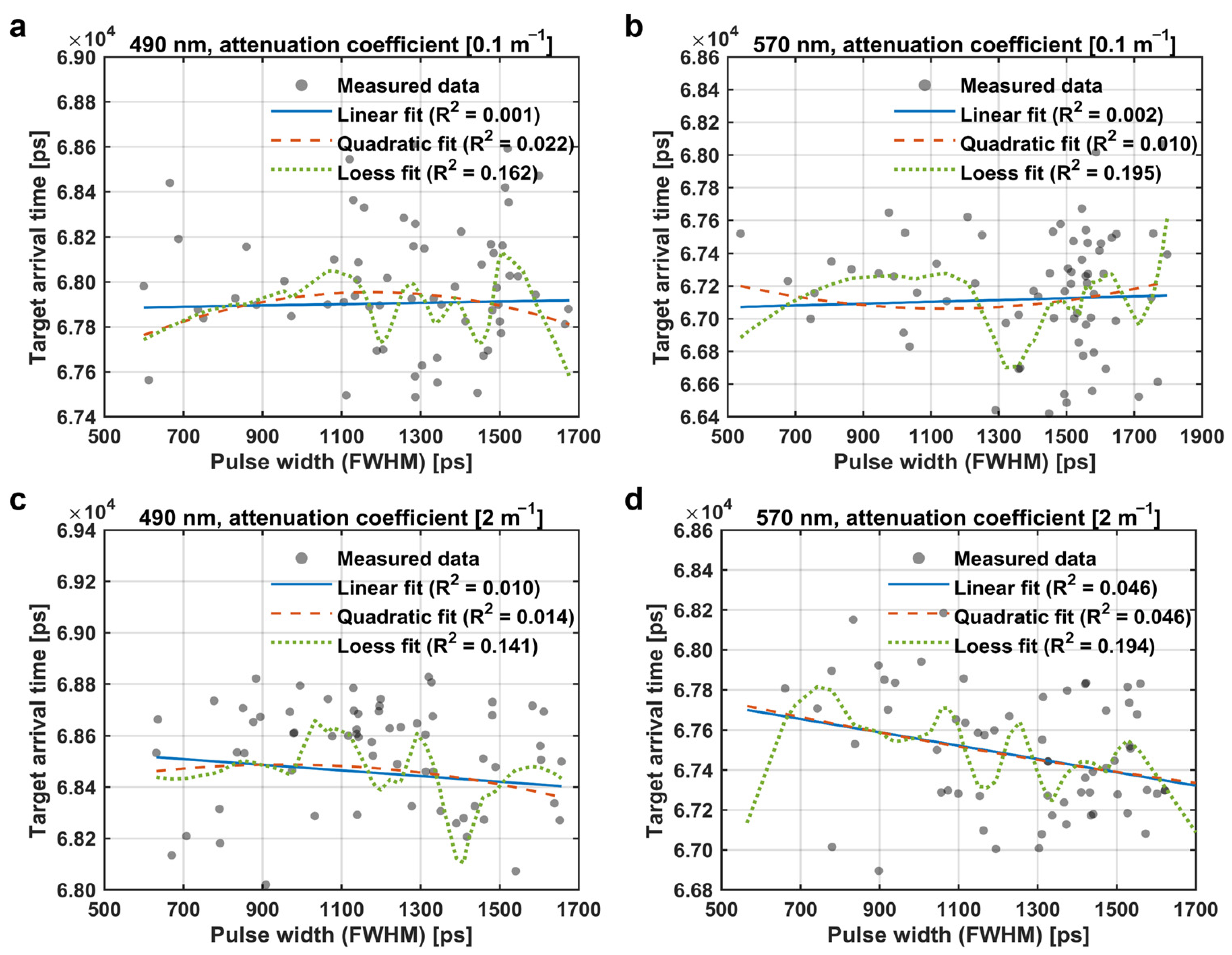
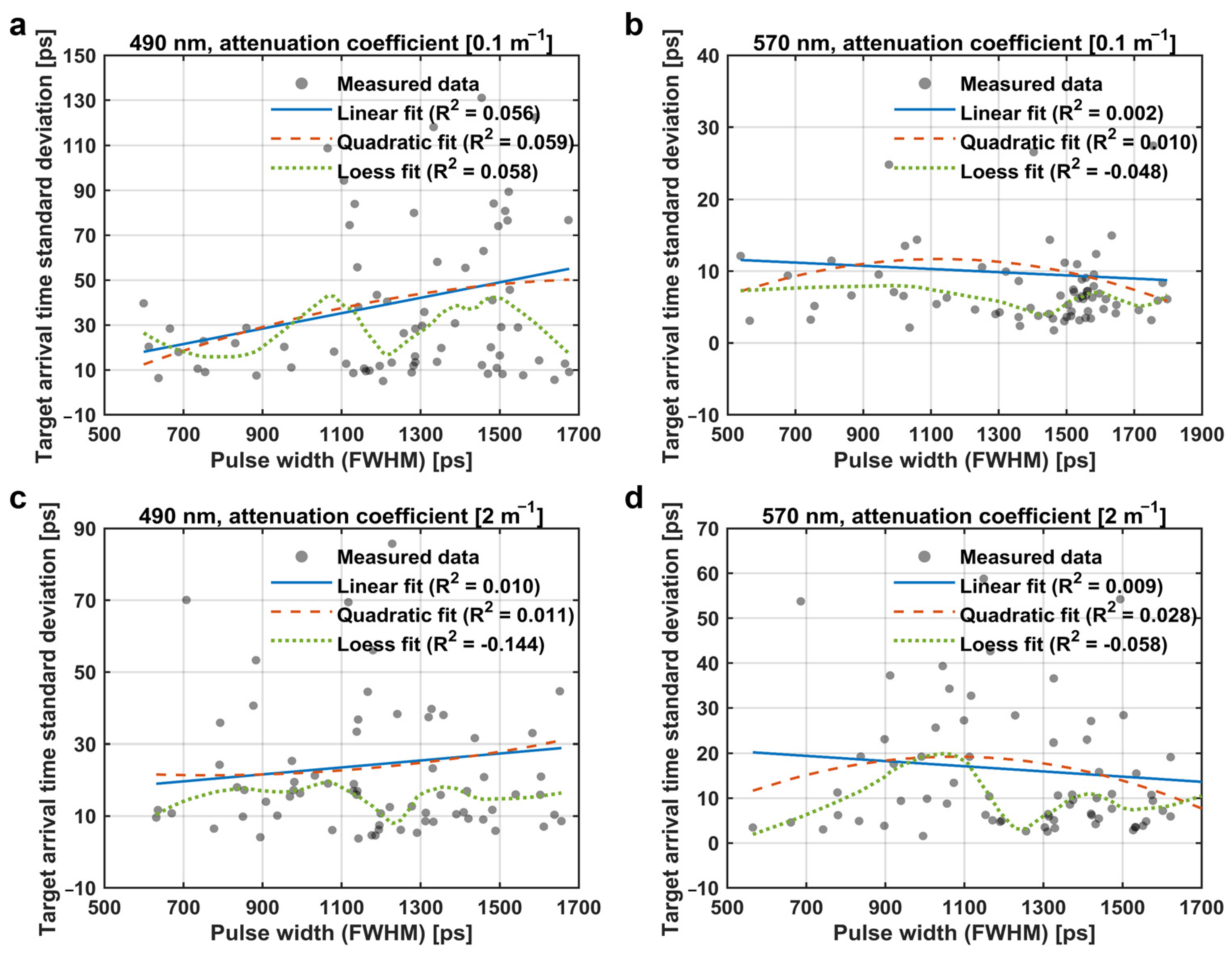
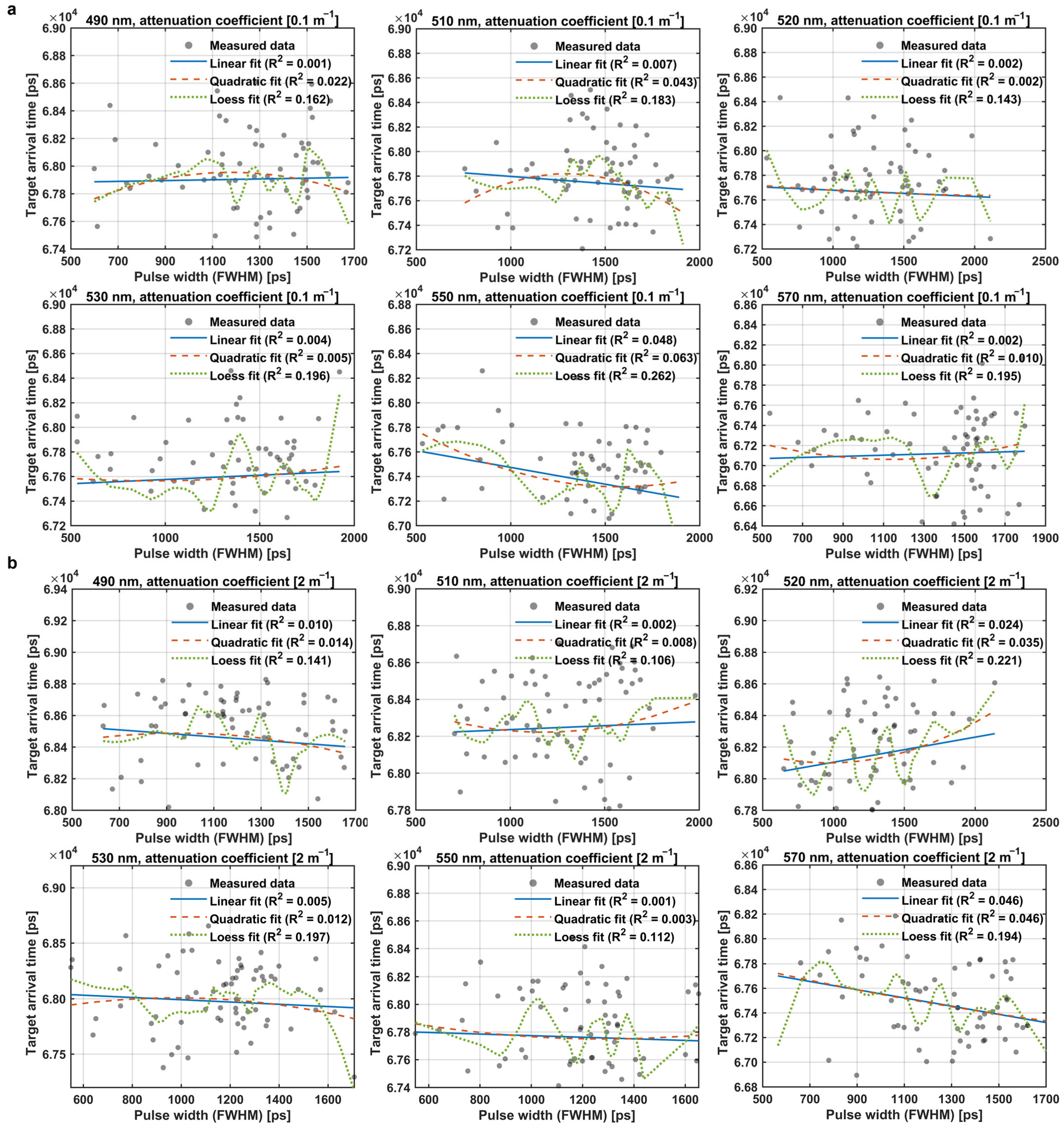
Figure 10 shows how target arrival time varies with FWHM at 490 nm and 570 nm under two water attenuation conditions, whereas Figure 11 shows how target arrival-time standard deviation varies with FWHM under the same wavelengths and attenuation conditions. Overall, the relationship between target arrival time and FWHM in Figure 10 remains weak under all four conditions. In clear water (0.1 m−1), the target arrival-time standard deviation at 490 nm tends to increase with FWHM, suggesting that pulse broadening may be associated with reduced arrival-time precision. At 570 nm, this trend becomes weaker, indicating that the relationship between pulse width and arrival-time precision is less evident at this wavelength. In turbid water (2 m−1), this pattern is no longer obvious, and the fitted relationships remain weak.
A possible explanation is that, in clear water, larger FWHM values correspond to a broader photon-count distribution in time, which may lead to greater uncertainty in arrival-time estimation. When the photon counts are distributed over a wider time range, the estimated arrival time may become more sensitive to statistical fluctuations in the histogram, thereby increasing the variability of the arrival-time estimate. This effect appears to be more noticeable at 490 nm than at 570 nm. In turbid water, however, the relationship between FWHM and arrival-time variability becomes less distinct, possibly because attenuation and scattering reduce the signal strength and introduce additional noise, thereby masking the influence of pulse broadening itself. Therefore, within the present dataset, FWHM appears to be more relevant to arrival-time precision in clear water, particularly at 490 nm, than in turbid water.

3.5. Variation in Signal Strength Across Wavelengths and Targets

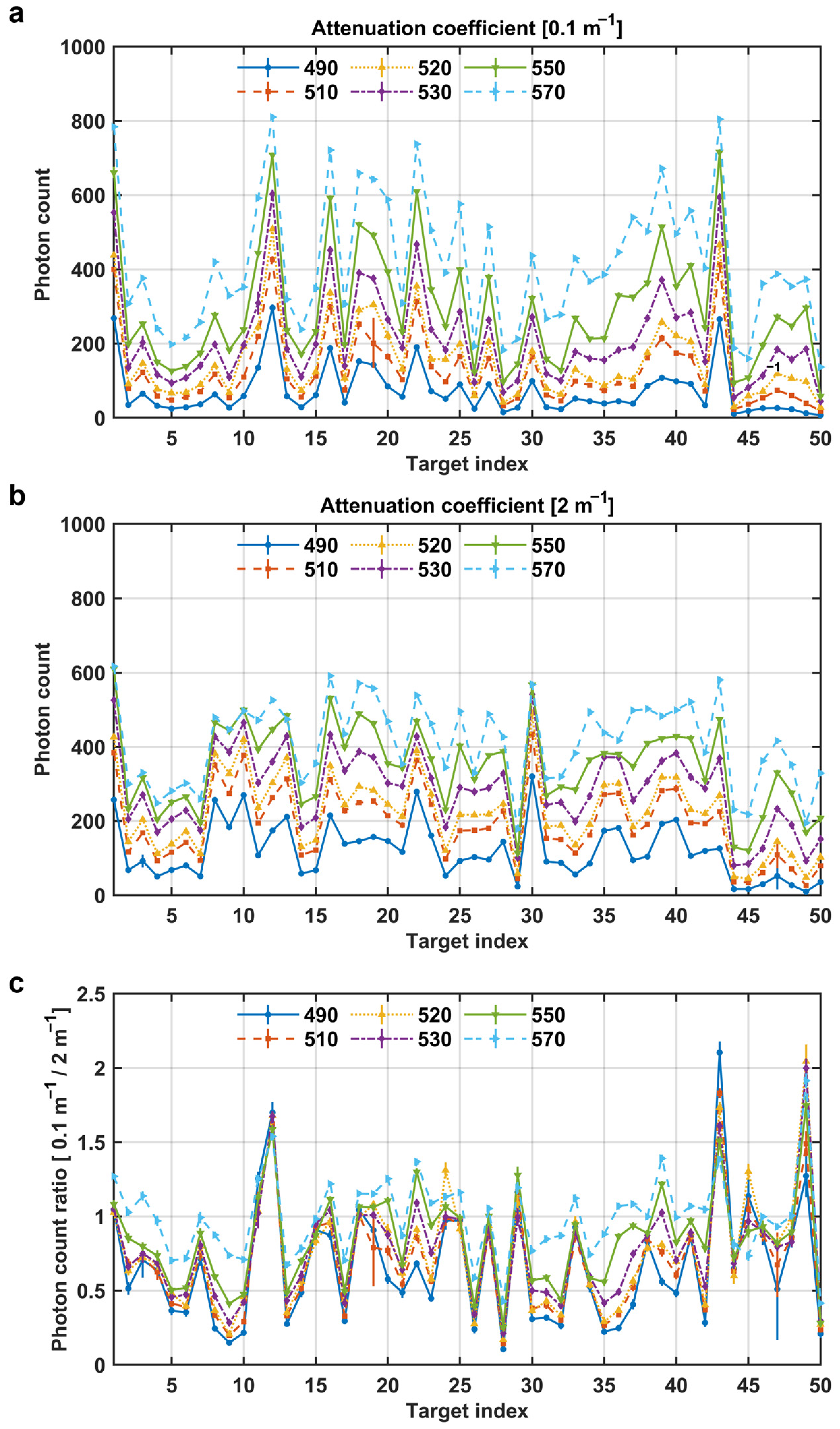
To investigate variations in signal strength across wavelengths and targets, photon counts from the target returns were extracted using the method described in Section 2.5. Here, photon count was used as a proxy for signal strength. Figure 12 shows the photon counts obtained from 50 targets at six wavelengths under clear-water (0.1 m−1) and turbid-water (2 m−1) conditions. The photon-count ratio between the clear- and turbid-water conditions was further calculated at each wavelength to evaluate the relative variation in target returns under increased water attenuation. In Figure 12c, a ratio greater than 1 indicates that the photon count is higher under clear-water conditions than under turbid-water conditions, whereas a ratio below 1 indicates a relatively stronger return under turbid-water conditions.
In general, increased water attenuation is expected to reduce the received target signal. However, the measured photon counts do not decrease uniformly across all targets and wavelengths. Instead, the photon-count ratio varies markedly among different targets and spectral bands, suggesting that the received signal is influenced by both the wavelength-dependent optical properties of the water column and the surface characteristics of the targets. For example, Targets 12, 44, and 49 exhibit ratio peaks above 1 at certain wavelengths, suggesting weaker returns under turbid-water conditions than under clear-water conditions. By contrast, Targets 7–10, 27–29, 35–36, and 50 show ratios below 1 at some wavelengths, indicating that their measured photon counts are higher in turbid water despite the stronger attenuation.
The higher photon counts observed for some targets under turbid-water conditions may be associated with the coupled effects of target reflection, water-column scattering, and possible particle–surface interactions. In turbid water, suspended particles enhance scattering along the optical path, and a portion of this scattered light may contribute to the measured return, thereby increasing the photon counts for certain targets. In addition, suspended particles may interact with some target surfaces, which could alter their apparent reflectance. These effects may vary with target surface properties and wavelength, contributing to the differences in photon-count distributions and curve shapes observed in Figure 12a,b. Therefore, the variations shown in Figure 12 may reflect the combined influence of water attenuation, wavelength-dependent water-column scattering, target-specific surface properties, and possible particle–surface interactions under clear- and turbid-water conditions.
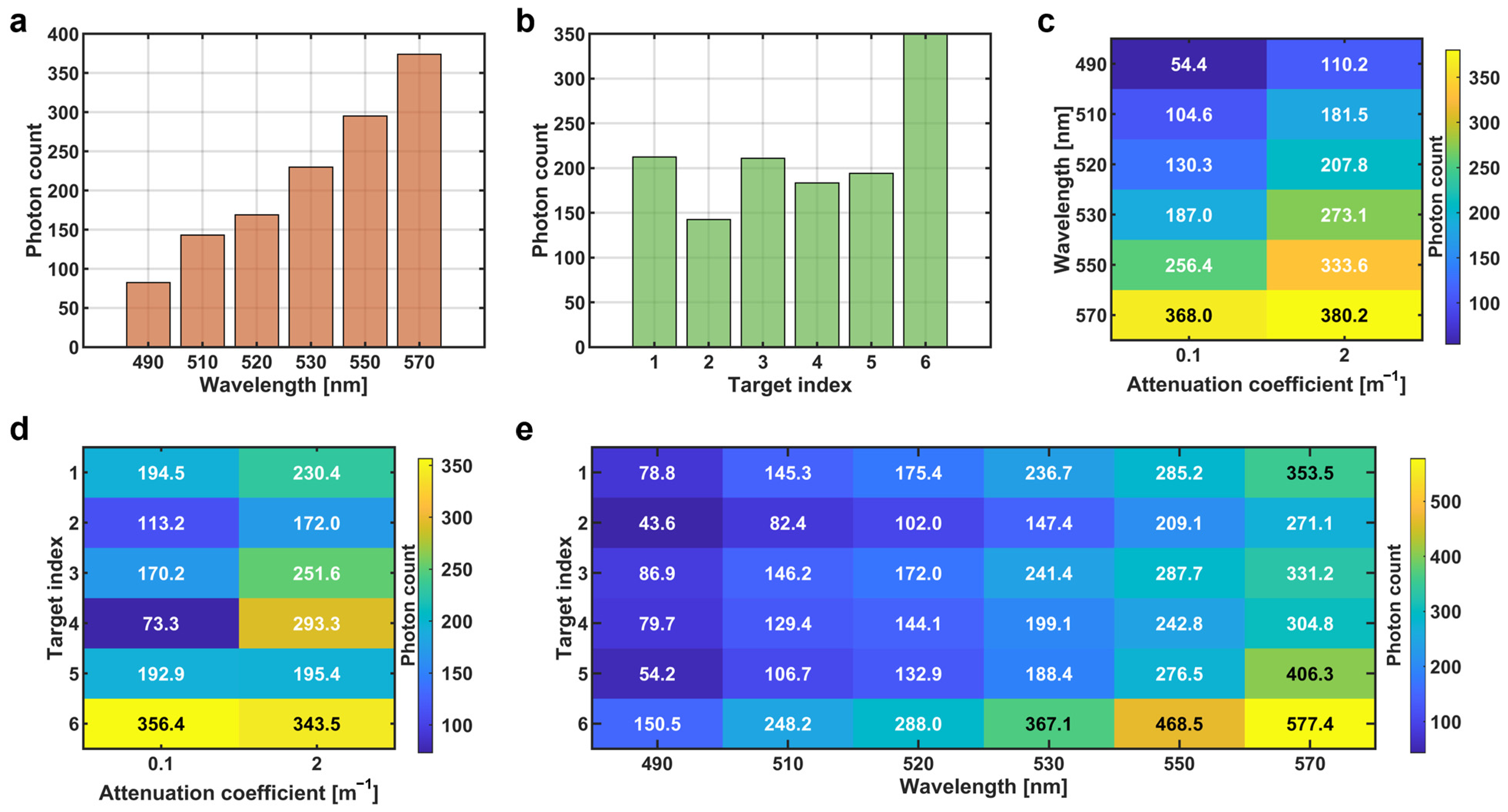
The results of the integrated analysis of wavelength, target, and water attenuation are presented in Figure 13. Figure 13a shows the variation in mean photon counts with wavelength, averaged over the six representative targets and the two water attenuation conditions. For these selected targets, the mean photon count generally increases from 490 to 570 nm. This trend may be related to the combined effects of wavelength-dependent laser output, detector response, target spectral reflectance, and water attenuation. Figure 13b shows the variation in mean photon counts with target index, averaged over the six wavelengths and the two attenuation conditions. The photon counts vary among targets, with Target 2 showing the lowest overall level and Target 6 the highest, suggesting target-dependent differences in return strength. Figure 13c compares the mean photon counts under the two attenuation coefficients, averaged over the six representative targets. For these selected targets, the mean photon counts at 2 m−1 are higher than those at 0.1 m−1. Figure 13d further shows the target-dependent influence of water attenuation based on photon counts averaged over all six wavelengths. Targets 5 and 6 exhibit relatively small differences between the two attenuation conditions, whereas Target 4 shows the largest deviation, suggesting a stronger sensitivity to water attenuation.
In the spectral dimension shown in Figure 13e, Target 6 shows the strongest wavelength dependence, whereas Targets 1 and 3 show relatively similar photon-count levels. For all six targets, the photon counts are relatively high at 570 nm, which may reflect the combined influence of source output, detector response, target spectral reflectance, and wavelength-dependent attenuation. Therefore, the photon-count differences across wavelengths should be interpreted with consideration of the wavelength-dependent system response, rather than as variations caused solely by target or water properties. Overall, the results indicate that wavelength, target properties, and water attenuation jointly affect the measured return photon counts and that these multidimensional differences may provide useful information for multiwavelength underwater target discrimination under varying water conditions.
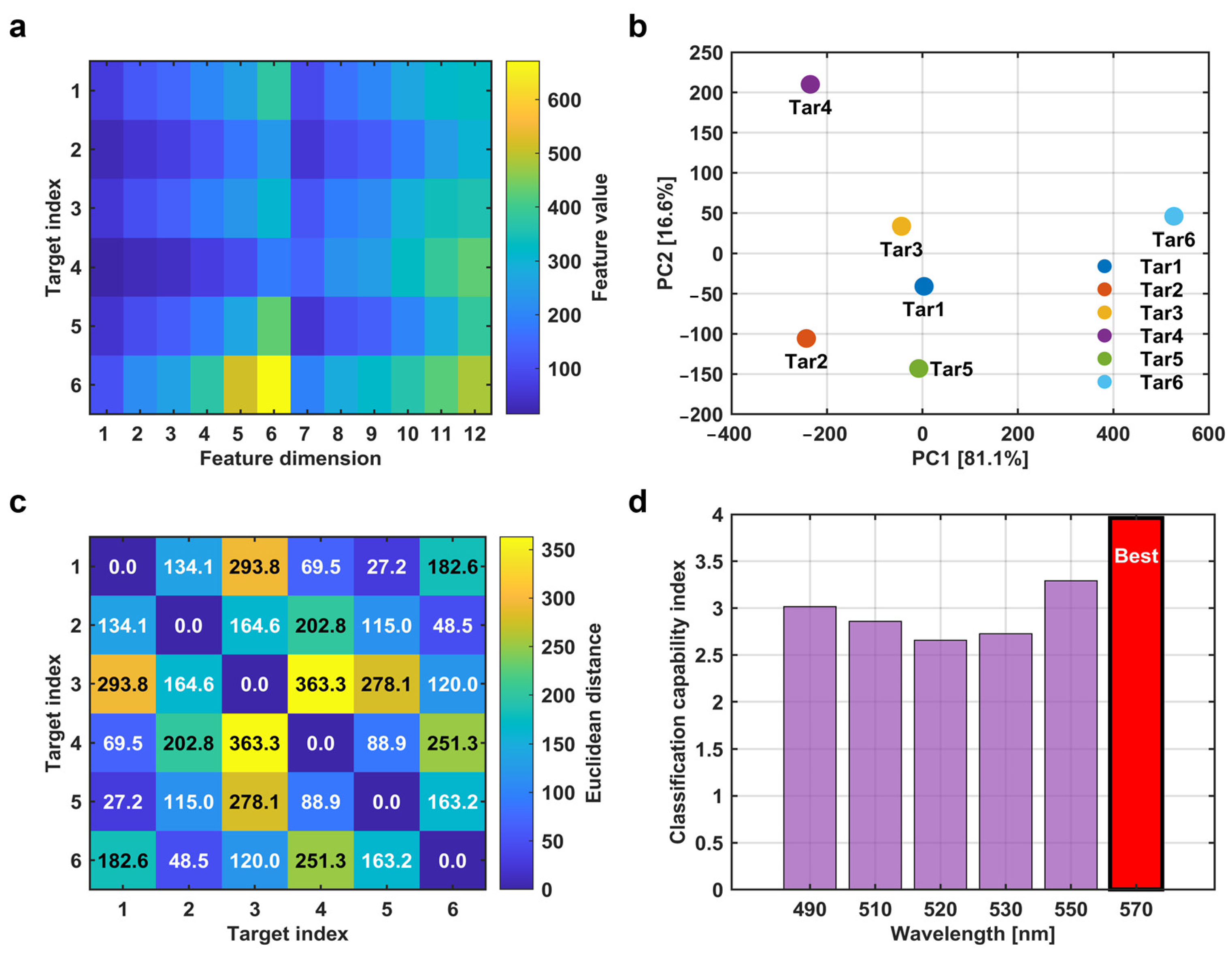
To examine the target-discrimination capability of the multispectral return signals, six representative targets were selected for further analysis. For each target, processed photon counts were obtained at six wavelengths (490, 510, 520, 530, 550, and 570 nm) under two water attenuation conditions (0.1 and 2.0 m−1). Figure 14a summarizes these multispectral photon-count data and serves as the input feature set for the subsequent analysis. In Figure 14a, the feature matrix is displayed with 12 columns and 6 rows, where the 12 columns correspond to the combinations of six wavelengths and two water attenuation conditions, and the 6 rows correspond to the six representative targets. Specifically, features 1–6 correspond to the clear-water condition with an attenuation coefficient of 0.1 m−1 at 490, 510, 520, 530, 550, and 570 nm, respectively, whereas Features 7–12 correspond to the turbid-water condition with an attenuation coefficient of 2.0 m−1 at the same wavelength sequence.
In the PCA, the six targets were treated as six samples, and each target was described by a 12-dimensional feature vector. Figure 14b shows the PCA projection of the six target samples onto the first two principal components. Each point represents one target described by a 12-dimensional photon-count feature vector, corresponding to six wavelengths under two water attenuation conditions. The percentages on the axes indicate the proportion of variance explained by each principal component. Before PCA, each photon-count feature was mean-centered across the six representative targets. The scores of PC1 and PC2 were calculated as linear combinations of the 12 mean-centered features
P C k = j = 1 12 a j , k F j μ j , k = 1 , 2 ,
where F j represents the photon-count feature corresponding to a specific wavelength and water-attenuation condition, μ j is the mean photon count of feature F j calculated across the six representative targets, and a j , k is the loading coefficient of feature j for principal component k . The corresponding feature means and loading coefficients are listed in Table 2. The loading magnitudes indicate the relative contribution of each feature under the present feature scaling. PC1 is mainly influenced by the long-wavelength features under the 0.1 m−1 condition, especially F 0.1 ,   570 , F 0.1 ,   550 , and F 0.1 ,   530 . By contrast, PC2 is mainly associated with the features under the 2 m−1 condition, particularly F 2 ,   530 , F 2 ,   550 , F 2 ,   510 , and F 2 ,   520 . The distribution of the targets in the PC1–PC2 plane therefore summarizes the dominant target-dependent variations in the multispectral return signals.
To further quantify the similarity among targets, pairwise Euclidean distances were calculated between the 12-dimensional feature vectors of the six targets, and the results are shown in Figure 14c. Figure 14c shows the pairwise Euclidean-distance matrix among the six targets in the 12-dimensional feature space, where smaller distances indicate greater similarity and larger distances indicate stronger separability. The matrix shows that Targets 3 and 4 show stronger separability, whereas Targets 1 and 5 are relatively close to each other and therefore show lower separability. This pattern is broadly consistent with the relative spacing observed in the PCA projection.
Figure 14d further evaluates the contribution of each wavelength to target discrimination using a discrimination capability index. For each wavelength λ , each target was represented by a two-dimensional photon-count vector formed under the two water-attenuation conditions:
x i , λ = F i , 0.1 , λ , F i , 2 , λ ,
where F i , 0.1 , λ and F i , 2 , λ denote the photon counts of target i at wavelength λ under attenuation coefficients of 0.1   m 1 and 2   m 1 , respectively. The between-target separation was calculated as the average pairwise Euclidean distance among the six targets:
S between λ = 2 M M 1 i = 1 M 1 j = i + 1 M x i , λ x j , λ 2 ,
where M   =   6 is the number of representative targets. The within-target variation was calculated as the average photon-count change in the same target between the two water-attenuation conditions:
S within λ = 1 M i = 1 M F i , 0.1 , λ F i , 2 , λ .
The discrimination capability index was then defined as
D λ = S between λ S within λ .
A larger D λ indicates that the separation among different targets is large relative to the variation in the same target caused by changing water attenuation and therefore represents stronger discrimination capability at that wavelength. The results show that 570 nm provides the strongest discrimination capability, followed by 550 nm and 490 nm, whereas 520 nm shows the weakest performance. This comparison suggests that target discrimination is not determined by photon-count magnitude alone. For example, although 520 nm does not correspond to the lowest photon-count level, its discrimination capability is weaker than that of 490 nm. Likewise, the stronger performance at 570 nm cannot be explained by higher single-photon energy, because photon energy follows E = hc / λ , and photons at 570 nm have lower energy than those at shorter wavelengths. Taken together, these results suggest that target discrimination depends more strongly on wavelength-dependent spectral contrast between target reflectance and water transmission characteristics than on signal level or photon energy alone.
Overall, the results in Figure 14 show that combining measurements from multiple wavelengths and water attenuation conditions forms a multidimensional feature space in which the six targets remain distinguishable. In this sense, the advantage of the multispectral approach lies not only in stronger returns at some wavelengths but also in its ability to capture target-dependent photon-count patterns across wavelengths under changing water conditions. This provides a richer basis for underwater target discrimination than single-wavelength measurements alone.

4. Discussion

The results of this study demonstrate that underwater multiwavelength single-photon LiDAR performance is influenced by interactions among water attenuation, target spectral reflectance, and scattering-induced changes in the detected photon-count distribution. The wavelength-dependent ranging bias observed in turbid water (8.3 ps/nm) may be related to wavelength-dependent shifts in the detected arrival-time distribution, rather than a simple measurement artifact. This interpretation is physically plausible for scattering media and is consistent with the general behavior expected in multiply scattering environments.
Rather than being governed solely by absolute signal strength, these findings suggest that target discrimination performance is strongly influenced by the spectral contrast between target reflectance and water transmission windows, as reflected by the enhanced discriminative contribution of the 570 nm band. Principal component analysis (PCA) further shows that the multidimensional spectral feature space preserves target differences beyond differences in absolute photon-count level. This suggests a more robust basis for turbidity-robust target discrimination than single-wavelength measurements.
However, several limitations should be acknowledged. The experiments were conducted under controlled laboratory conditions with only two discrete turbidity levels and a limited set of target materials. Consequently, the generalizability of these quantitative relationships to open-water environments, which feature spatially variable turbidity and ambient illumination, remains to be validated. Future work should focus on adaptive wavelength selection strategies informed by in situ water optical properties, the integration of learning-based waveform analysis with multidimensional feature fusion, and field validation across diverse aquatic environments. These efforts will further strengthen the physical foundations and operational applicability of next-generation underwater multiwavelength LiDAR systems.

5. Conclusions

This study contributes to the understanding of wavelength-dependent signal formation in underwater single-photon LiDAR by providing an experimental framework for examining the interactions among water attenuation, target reflectance, and scattering-induced changes in the detected photon-count distribution. Three principal findings emerge, with implications beyond the specific experimental conditions:
(1)
We show that the wavelength-dependent ranging bias observed in turbid water may reflect a physical effect associated with scattering-induced shifts in the detected arrival-time distribution, rather than a simple measurement artifact. The approximately linear increase observed in turbid water (8.3 ps/nm) suggests that multiwavelength LiDAR may provide information related to scattering behavior in addition to distance measurement.
(2)
We find that target discrimination does not depend on received photon-count level alone: wavelengths yielding lower absolute photon counts can still outperform those with higher counts in discrimination capability. The results suggest that discrimination is strongly influenced by spectral contrast, namely the relationship between target reflectance characteristics and water transmission windows, rather than by absolute photon counts alone. This finding suggests that wavelength selection for underwater spectral LiDAR should consider spectral matching in addition to signal strength.
(3)
We show that a multidimensional spectral feature space helps preserve target-dependent differences under changing water conditions, as indicated by the PCA-based separation of the representative targets despite turbidity-related signal variation. This suggests a useful basis for turbidity-robust underwater target discrimination.
From a practical perspective, these findings suggest that underwater LiDAR system designers should jointly consider wavelength selection, water attenuation conditions, target spectral characteristics, and signal-processing robustness, rather than relying only on increased pulse energy or strong return intensity. In particular, wavelengths with favorable spectral matching between target reflectance and water transmission characteristics, together with robust processing methods such as Gaussian fitting and multiwavelength feature fusion, can improve both ranging stability and target discrimination performance, especially in turbid environments.
Nevertheless, full wavelength-dependent radiometric calibration was not incorporated in the present study. Therefore, future work will further incorporate wavelength-dependent radiometric calibration, including correction for incident optical power, optical throughput, and SPAD photon detection efficiency, to improve the quantitative interpretation of multispectral photon-count measurements.
Overall, this study provides a more mechanism-oriented interpretation of multiwavelength underwater LiDAR observations and offers a basis for the development of adaptive sensing strategies for more reliable target discrimination in complex aquatic environments.

Author Contributions

Conceptualization, L.Y. and S.Z.; methodology, L.Y. and S.Z.; software, L.Y.; validation, S.Z., C.W., Y.Z. and W.Y.; formal analysis, L.Y. and S.Z.; investigation, S.Z.; resources, C.H., X.H., S.W., S.L., Z.C., C.L., J.W. and Y.C.; data curation, L.Y., X.L., Y.Z., W.Y. and S.Z.; writing—original draft preparation, L.Y. and S.Z.; writing—review and editing, L.Y., C.H. and S.Z.; visualization, L.Y. and S.Z.; supervision, C.H. and Y.C.; project administration, C.H.; funding acquisition, C.L., J.W. and Y.C. All authors have read and agreed to the published version of the manuscript.

Funding

This study was supported by the China Postdoctoral Science Foundation (2025M780773); the Research Funds of Hangzhou Institute for Advanced Study, University of Chinese Academy of Science (B02006C021026, B02006C021022); the Zhejiang Provincial “Jianbing Lingyan” Research and Development Program of China (2025C02039); the matching funds of Hangzhou Institute for Advanced Study, UCAS for Zhejiang Provincial “Jianbing Lingyan” Research and Development Program of China (B02006C021029); the Natural Science Foundation of Zhejiang province (QN26F030002); and the Academy of Finland project “Bright- Biotic Damage Mapping with Ultrawide Spectral Range LiDAR’s for Sustainable Forest Growth (353363).

Data Availability Statement

Data underlying the results presented in this paper are not publicly available at this time but may be obtained from the authors upon reasonable request.

Acknowledgments

During the preparation of this manuscript, the authors used ChatGPT (5.5) for the purposes of language polishing and improving the readability of the English text. The authors have reviewed and edited the output and take full responsibility for the content of this publication.

Conflicts of Interest

The authors declare no conflicts of interest.

Abbreviations

The following abbreviations are used in this manuscript:
LiDARLight Detection and Ranging
SPADSingle-Photon Avalanche Diode
TCSPCTime-Correlated Single-Photon Counting
PINPositive-Intrinsic-Negative
MMFMulti-Mode Fiber
SNRSignal-to-Noise Ratio
FWHMFull Width at Half Maximum
PCAPrincipal Component Analysis
PC1/PC2Principal Component 1/2
KDEKernel Density Estimation
COLCollimating Lens
PMPlate Mirror
SLSupercontinuum Laser

Appendix A

Figure A1. Target return arrival times of 50 targets at six wavelengths under two water attenuation conditions, retrieved by peak detection and Gaussian fitting. (a) Attenuation coefficient: 0.1 m−1. (b) Attenuation coefficient: 2 m−1. The red and blue curves represent the peak-detection and Gaussian-fitting results, respectively.
Remotesensing 18 01772 g0a1
Figure A2. Distributions of target return arrival times across 50 targets at six wavelengths under two water attenuation conditions, retrieved by peak detection and Gaussian fitting. (a) Attenuation coefficient: 0.1 m−1. (b) Attenuation coefficient: 2 m−1. The histograms and kernel density estimates (KDEs) correspond to the peak-detection and Gaussian-fitting results, respectively, and the annotated μ and σ values denote the mean and standard deviation of the distributions.
Remotesensing 18 01772 g0a2
Figure A3. Distributions of target return arrival-time standard deviation across 50 targets at six wavelengths under two water attenuation conditions, obtained using peak detection and Gaussian fitting. (a) Attenuation coefficient: 0.1 m−1. (b) Attenuation coefficient: 2 m−1. The histograms and kernel density estimates (KDEs) correspond to the peak-detection and Gaussian-fitting results, respectively, and the annotated μ and σ values denote the mean and standard deviation of each distribution.
Remotesensing 18 01772 g0a3
Figure A4. Scatter plots of target return arrival time versus signal-to-noise ratio (SNR) at six wavelengths under two water attenuation conditions. (a) Attenuation coefficient: 0.1 m−1. (b) Attenuation coefficient: 2 m−1. The gray dots represent the measured data, while the blue solid, orange dashed, and green dotted curves denote the linear, quadratic, and locally estimated scatterplot smoothing (Loess) fits, respectively.
Remotesensing 18 01772 g0a4
Figure A5. Scatter plots of target return arrival-time standard deviation versus signal-to-noise ratio (SNR) at six wavelengths under two water attenuation conditions. (a) Attenuation coefficient: 0.1 m−1. (b) Attenuation coefficient: 2 m−1. The gray dots represent the measured data, while the blue solid, orange dashed, and green dotted curves denote the linear, quadratic, and locally estimated scatterplot smoothing (Loess) fits, respectively.
Remotesensing 18 01772 g0a5
Figure A6. Scatter plots of target return arrival time versus full width at half maximum (FWHM) at six wavelengths under two water attenuation conditions. (a) Attenuation coefficient: 0.1 m−1. (b) Attenuation coefficient: 2 m−1. The gray dots represent the measured data, while the blue solid, orange dashed, and green dotted curves denote the linear, quadratic, and locally estimated scatterplot smoothing (Loess) fits, respectively.
Remotesensing 18 01772 g0a6
Figure A7. Scatter plots of target return arrival-time standard deviation versus full width at half maximum (FWHM) at six wavelengths under two water attenuation conditions. (a) Attenuation coefficient: 0.1 m−1. (b) Attenuation coefficient: 2 m−1. The gray dots represent the measured data, while the blue solid, orange dashed, and green dotted curves denote the linear, quadratic, and locally estimated scatterplot smoothing (Loess) fits, respectively.
Remotesensing 18 01772 g0a7

References

  1. Kong, H.; Zhang, Y.; Zhang, Y.; Xu, Y.; Zhou, G.; Wang, S. Exploring Integrated Ocean Management Policy in China: Evolution, Challenges, and Prospects. Water 2024, 16, 1673. [Google Scholar] [CrossRef]
  2. Wang, Q.; Xu, L.; Wu, J. Marine Intelligent Technology as a Strategic Tool for Sustainable Development: A Five-Year Systematic Analysis. J. Mar. Sci. Eng. 2025, 13, 855. [Google Scholar] [CrossRef]
  3. Jiang, X.; Yin, X.; Guan, L.; Wang, Z.; Lv, L.; Liu, M. Global Ocean Observations and Applications by China’s Ocean Satellite Constellation. Intell. Mar. Technol. Syst. 2023, 1, 6. [Google Scholar] [CrossRef]
  4. Maccarone, A.; McCarthy, A.; Ren, X.; Warburton, R.E.; Wallace, A.M.; Moffat, J.; Petillot, Y.; Buller, G.S. Underwater Depth Imaging Using Time-Correlated Single-Photon Counting. Opt. Express 2015, 23, 33911–33926. [Google Scholar] [CrossRef] [PubMed]
  5. Hayes, M.P.; Gough, P.T. Synthetic Aperture Sonar: A Review of Current Status. IEEE J. Ocean. Eng. 2009, 34, 207–224. [Google Scholar] [CrossRef]
  6. Sun, D.; Huan, Y.; Qiu, Z.; Hu, C.; Wang, S.; He, Y. Remote-Sensing Estimation of Phytoplankton Size Classes from GOCI Satellite Measurements in Bohai Sea and Yellow Sea. J. Geophys. Res. Ocean. 2017, 122, 8309–8325. [Google Scholar] [CrossRef]
  7. Yang, Y.; Wang, H.; Li, X. Deep Learning for Enhanced Ocean Color Remote Sensing: A Foundation Model Approach. IEEE Trans. Geosci. Remote Sens. 2025, 63, 4210718. [Google Scholar] [CrossRef]
  8. Hong, Z.; Long, D.; Li, X.; Wang, Y.; Zhang, J.; Hamouda, M.A.; Mohamed, M.M. A Global Daily Gap-Filled Chlorophyll-a Dataset in Open Oceans during 2001–2021 from Multisource Information Using Convolutional Neural Networks. Earth Syst. Sci. Data 2023, 15, 5281–5300. [Google Scholar] [CrossRef]
  9. Huot, Y.; Morel, A.; Twardowski, M.S.; Stramski, D.; Reynolds, R.A. Particle Optical Backscattering along a Chlorophyll Gradient in the Upper Layer of the Eastern South Pacific Ocean. Biogeosciences 2008, 5, 495–507. [Google Scholar] [CrossRef]
  10. Li, C.-F.; Wang, Z.; Liu, X.-Y.; Yang, S.-H.; Xu, Z.; Fan, C.-Y. Anti-Scattering Signal Processing Method of VMD-ICA Based Underwater Lidar. Acta Phys. Sin. 2024, 73, 094203. [Google Scholar] [CrossRef]
  11. Li, G.; Zhou, Q.; Xu, G.; Wang, X.; Han, W.; Wang, J.; Zhang, G.; Zhang, Y.; Yuan, Z.; Song, S.; et al. Lidar-Radar for Underwater Target Detection Using a Modulated Sub-Nanosecond Q-Switched Laser. Opt. Laser Technol. 2021, 142, 107234. [Google Scholar] [CrossRef]
  12. Zhao, H.; Shi, H.; Zhu, Z.; Qian, Z.; Xu, X.; Zhai, J.; Chen, X.; Li, X. Enhanced Underwater LiDAR via Dual-Comb Interferometer and Pulse Coding. IEEE Trans. Geosci. Remote Sens. 2024, 62, 4206211. [Google Scholar] [CrossRef]
  13. Chen, Q.; Yam, J.W.; Chua, S.Y.; Guo, N.; Wang, X. Characterizing the Performance Impacts of Target Surface on Underwater Pulse Laser Ranging System. J. Quant. Spectrosc. Radiat. Transf. 2020, 255, 107267. [Google Scholar] [CrossRef]
  14. Chen, Y.; Guo, S.; He, Y.; Luo, Y.; Chen, W.; Hu, S.; Huang, Y.; Hou, C.; Su, S. Simulation and Design of an Underwater Lidar System Using Non-Coaxial Optics and Multiple Detection Channels. Remote Sens. 2023, 15, 3618. [Google Scholar] [CrossRef]
  15. Hao, Y.; Yuan, Y.; Zhang, H.; Zhang, S.; Zhang, Z. A Low-Cost Modulated Laser-Based Imaging System Using Square Ring Laser Illumination for Depressing Underwater Backscatter. Photonics 2024, 11, 1070. [Google Scholar] [CrossRef]
  16. Yu, Y.; Wang, Z.; Li, H.; Yu, C.; Chen, C.; Wang, X.; Li, X.; Xue, B.; Pan, X.; Zhuang, Q.; et al. High-Precision 3D Imaging of Underwater Coaxial Scanning Photon Counting Lidar Based on Spatiotemporal Correlation. Measurement 2023, 219, 113248. [Google Scholar] [CrossRef]
  17. Wang, J.; Hao, W.; Chen, S.; Xie, M.; Li, X.; Shi, H.; Feng, X.; Su, X. Underwater Single-Photon Profiling Under Turbulence and High Attenuation Environment. IEEE Geosci. Remote Sens. Lett. 2024, 21, 6501605. [Google Scholar] [CrossRef]
  18. Plosz, S.; Maccarone, A.; McLaughlin, S.; Buller, G.S.; Halimi, A. Real-Time Reconstruction of 3D Videos from Single-Photon LiDaR Data in the Presence of Obscurants. IEEE Trans. Comput. Imaging 2023, 9, 106–119. [Google Scholar] [CrossRef]
  19. Liao, Y.; Shangguan, M.; Yang, Z.; Lin, Z.; Wang, Y.; Li, S. GPU-Accelerated Monte Carlo Simulation for a Single-Photon Underwater Lidar. Remote Sens. 2023, 15, 5245. [Google Scholar] [CrossRef]
  20. Lin, Z.; Shangguan, M.; Cao, F.; Yang, Z.; Qiu, Y.; Weng, Z. Underwater Single-Photon Lidar Equipped with High-Sampling-Rate Multi-Channel Data Acquisition System. Remote Sens. 2023, 15, 5216. [Google Scholar] [CrossRef]
  21. Shangguan, M.; Weng, Z.; Lin, Z.; Lee, Z.; Shangguan, M.; Yang, Z.; Sun, J.; Wu, T.; Zhang, Y.; Wen, C. Day and Night Continuous High-Resolution Shallow-Water Depth Detection with Single-Photon Underwater Lidar. Opt. Express 2023, 31, 43950–43962. [Google Scholar] [CrossRef]
  22. Zhang, Z.; Chen, P.; Mao, Z. SOLS: An Open-Source Spaceborne Oceanic Lidar Simulator. Remote Sens. 2022, 14, 1849. [Google Scholar] [CrossRef]
  23. Prieur, L.; Sathyendranath, S. An Optical Classification of Coastal and Oceanic Waters Based on the Specific Spectral Absorption Curves of Phytoplankton Pigments, Dissolved Organic Matter, and Other Particulate Materials. Limnol. Oceanogr. 1981, 26, 671–689. [Google Scholar] [CrossRef]
  24. Li, C.; Zhou, G.; Zhang, D. Analysis of Affecting Factors for Laser Underwater Transmission Echo Signals Based on Semi-Analytic Monte Carlo. Int. J. Remote Sens. 2024, 45, 7185–7211. [Google Scholar] [CrossRef]
  25. Liu, Q.; Liu, D.; Bai, J.; Zhang, Y.; Zhou, Y.; Xu, P.; Liu, Z.; Chen, S.; Che, H.; Wu, L.; et al. Relationship between the Effective Attenuation Coefficient of Spaceborne Lidar Signal and the IOPs of Seawater. Opt. Express 2018, 26, 30278–30291. [Google Scholar] [CrossRef]
  26. Liu, Q.; Liu, D.; Zhu, X.; Zhou, Y.; Le, C.; Mao, Z.; Bai, J.; Bi, D.; Chen, P.; Chen, W.; et al. Optimum Wavelength of Spaceborne Oceanic Lidar in Penetration Depth. J. Quant. Spectrosc. Radiat. Transf. 2020, 256, 107310. [Google Scholar] [CrossRef]
  27. Ma, Y.; Zhang, H.; Wang, R.; Li, F.; He, T.; Liu, B.; Wang, Y.; Han, F. Underwater Sphere Classification Using AOTF-Based Multispectral LiDAR. Photonics 2025, 12, 998. [Google Scholar] [CrossRef]
  28. Chen, P.; Jamet, C.; Zhang, Z.; He, Y.; Mao, Z.; Pan, D.; Wang, T.; Liu, D.; Yuan, D. Vertical Distribution of Subsurface Phytoplankton Layer in South China Sea Using Airborne Lidar. Remote Sens. Environ. 2021, 263, 112567. [Google Scholar] [CrossRef]
  29. Chen, P.; Mao, Z.; Zhang, Z.; Liu, H.; Pan, D. Detecting Subsurface Phytoplankton Layer in Qiandao Lake Using Shipborne Lidar. Opt. Express 2020, 28, 558–569. [Google Scholar] [CrossRef]
  30. Pershin, S.M.; Bunkin, A.F.; Zavozin, V.A.; Grishin, M.Y.; Makarov, V.S.; Titovets, P.A.; Fedyuk, M.O. Underwater Lidar: Remote Sensing in Strongly Scattering Media. Phys. Wave Phenom. 2023, 31, 406–411. [Google Scholar] [CrossRef]
  31. Shangguan, M.; Guo, Y.; Liao, Z. Shipborne Single-Photon Fluorescence Oceanic Lidar: Instrumentation and Inversion. Opt. Express 2024, 32, 10204–10218. [Google Scholar] [CrossRef]
  32. Bai, J.; Gao, S.; Niu, Z.; Zhang, C.; Bi, K.; Sun, G.; Huang, Y. A Novel Algorithm for Leaf Incidence Angle Effect Correction of Hyperspectral LiDAR. IEEE Trans. Geosci. Remote Sens. 2022, 60, 5700409. [Google Scholar] [CrossRef]
  33. Bai, J.; Niu, Z.; Huang, Y.; Bi, K.; Fu, Y.; Gao, S.; Wu, M.; Wang, L. Full-Waveform Hyperspectral LiDAR Data Decomposition via Ranking Central Locations of Natural Target Echoes (RCLONTE) at Different Wavelengths. Remote Sens. Environ. 2024, 310, 114227. [Google Scholar] [CrossRef]
  34. Sun, H.; Wang, Y.; Sun, Z.; Wang, S.; Sun, S.; Jia, J.; Jiang, C.; Hu, P.; Yang, H.; Yang, X.; et al. Miniaturizing Hyperspectral Lidar System Employing Integrated Optical Filters. Remote Sens. 2024, 16, 1642. [Google Scholar] [CrossRef]
  35. Zhang, H.; Chen, L.; Wu, H.; Zhou, M.; Chen, J.; Chen, Z.; Hu, J.; Chen, Y.; Wang, J.; Niu, Y.; et al. Hyperspectral LiDAR for Subsea Exploration: System Design and Performance Evaluation. Electronics 2025, 14, 1539. [Google Scholar] [CrossRef]
  36. Gray, D.J.; Anderson, J.; Nelson, J.; Edwards, J. Using a Multiwavelength LiDAR for Improved Remote Sensing of Natural Waters. Appl. Opt. 2015, 54, F232–F242. [Google Scholar] [CrossRef] [PubMed]
  37. Li, K.; He, Y.; Ma, J.; Jiang, Z.; Hou, C.; Chen, W.; Zhu, X.; Chen, P.; Tang, J.; Wu, S.; et al. A Dual-Wavelength Ocean Lidar for Vertical Profiling of Oceanic Backscatter and Attenuation. Remote Sens. 2020, 12, 2844. [Google Scholar] [CrossRef]
  38. Chen, Y.; Luo, Q.; Guo, S.; Chen, W.; Hu, S.; Ma, J.; He, Y.; Huang, Y. Multispectral LiDAR-Based Underwater Ore Classification Using a Tunable Laser Source. Opt. Commun. 2024, 551, 129903. [Google Scholar] [CrossRef]
  39. Stramski, D.; Joshi, I.; Reynolds, R.A. Ocean Color Algorithms to Estimate the Concentration of Particulate Organic Carbon in Surface Waters of the Global Ocean in Support of a Long-Term Data Record from Multiple Satellite Missions. Remote Sens. Environ. 2022, 269, 112776. [Google Scholar] [CrossRef]
  40. Yang, J.; Ma, Y.; Zheng, H.; Gu, Y.; Zhou, H.; Li, S. Analysis and Correction of Water Forward-Scattering-Induced Bathymetric Bias for Spaceborne Photon-Counting Lidar. Remote Sens. 2023, 15, 931. [Google Scholar] [CrossRef]
  41. Lodovisi, C.; Gerardi, F.; Moriconi, C.; Betti, S. Beam Attenuation Coefficient for Different Water Turbidities. Appl. Opt. 2024, 63, 6482–6494. [Google Scholar] [CrossRef]
  42. Churnside, J.H. Review of Profiling Oceanographic Lidar. Opt. Eng. 2014, 53, 051405. [Google Scholar] [CrossRef]
  43. Dai, J.; Li, S.; Gao, F.; Cao, H.; Guo, G.; Liu, X.; Wang, Q. Performance Analysis of the Photon-Counting LIDAR Based on the Statistical Property. In Signal and Information Processing, Networking and Computers; Sun, J., Wang, Y., Huo, M., Xu, L., Eds.; Lecture Notes in Electrical Engineering; Springer: Singapore, 2023; Volume 917, pp. 534–541. [Google Scholar] [CrossRef]
  44. Liu, J.; Zhang, X.; Lv, J.; Li, X.; Du, L. Gaussian Decomposition Method for Full Waveform Data of LiDAR Base on Neural Network. Sci. Rep. 2025, 15, 5639. [Google Scholar] [CrossRef] [PubMed]
  45. Marquardt, D.W. An Algorithm for Least-Squares Estimation of Nonlinear Parameters. J. Soc. Ind. Appl. Math. 1963, 11, 431–441. [Google Scholar] [CrossRef]
  46. Hayman, M.; Stillwell, R.A.; Carnes, J.; Kirchhoff, G.J.; Spuler, S.M.; Thayer, J.P. 2D Signal Estimation for Sparse Distributed Target Photon Counting Data. Sci. Rep. 2024, 14, 10325. [Google Scholar] [CrossRef] [PubMed]
Figure 1. Experimental setup and observation scenes. (a) Schematic diagram of the observation system. Abbreviations: COL, collimating lens; PM, plane mirror; SL, supercontinuum laser; TCSPC, time-correlated single-photon counting; and SPAD, single-photon avalanche diode. (b) Photograph of the system components. (c) Laboratory observation setup. (d) Laser propagation in the 1 m water tank. (e,f) Target observation scenes in the water tank. In (a), the orange lines indicate the electrical signal paths, the blue line denotes the fiber connection, the white lines represent the optical signal paths, the green lines illustrate the laser transmission and reception paths, the red lines indicate the power connections, and the black line represents the data transfer connection.
Remotesensing 18 01772 g001
Figure 2. Underwater multiwavelength single-photon laser data processing workflow.
Remotesensing 18 01772 g002
Figure 3. Target return arrival time versus wavelength for two representative targets (Targets 10 and 35) under different water attenuation conditions, retrieved using the peak detection and Gaussian fitting methods. (a) Attenuation coefficient: 0.1 m−1. (b) Attenuation coefficient: 2 m−1.
Remotesensing 18 01772 g003
Figure 4. Target return arrival-time shifts at different wavelengths relative to the 490 nm result under two water attenuation conditions across 50 targets. The boxplots show the distributions of target return arrival-time shifts for each wavelength-difference group, the red circles denote the mean values, and the fitted curves represent the linear, quadratic, and cubic regression results. The red plus signs indicate outliers. (a) Attenuation coefficient: 0.1 m−1. (b) Attenuation coefficient: 2 m−1.
Remotesensing 18 01772 g004
Figure 5. Statistical distributions of target return arrival times at 490 and 570 nm under two water attenuation conditions: (a) 490 nm, 0.1 m−1; (b) 570 nm, 0.1 m−1; (c) 490 nm, 2 m−1; and (d) 570 nm, 2 m−1. Each distribution is based on 50 target-level samples.
Remotesensing 18 01772 g005
Figure 6. Statistical distributions of the target return arrival-time standard deviation at 490 and 570 nm under two water attenuation conditions: (a) 490 nm, 0.1 m−1; (b) 570 nm, 0.1 m−1; (c) 490 nm, 2 m−1; and (d) 570 nm, 2 m−1. Each distribution is based on 50 targets, with the standard deviation for each target calculated from 10 repeated measurements.
Remotesensing 18 01772 g006
Figure 7. Scatter plots of target return arrival time versus SNR at the representative wavelengths of 490 and 570 nm under two water attenuation conditions: (a) 490 nm, 0.1 m−1; (b) 570 nm, 0.1 m−1; (c) 490 nm, 2 m−1; and (d) 570 nm, 2 m−1. The blue solid, orange dashed, and green dotted curves represent the linear, quadratic, and locally estimated scatterplot smoothing (Loess) fits, respectively. The R 2 values are provided in each panel to indicate fitting quality.
Remotesensing 18 01772 g007
Figure 8. Scatter plots of target return arrival-time standard deviation versus SNR at the representative wavelengths of 490 and 570 nm under two water attenuation conditions: (a) 490 nm, 0.1 m−1; (b) 570 nm, 0.1 m−1; (c) 490 nm, 2 m−1; and (d) 570 nm, 2 m−1. The blue solid, orange dashed, and green dotted curves represent the linear, quadratic, and Loess fits, respectively.
Remotesensing 18 01772 g008
Figure 9. FWHM of Gaussian-fitted pulse signals for 50 targets at six wavelengths under two water attenuation conditions. The red plus signs indicate outliers. The red values annotated indicate the median FWHM values in ps. (a) Box-and-whisker distributions of FWHM versus wavelength at a water attenuation coefficient of 0.1 m−1. (b) Heat map of FWHM for the 50 targets at 0.1 m−1. (c) Box-and-whisker distributions of FWHM versus wavelength at a water attenuation coefficient of 2 m−1. (d) Heat map of FWHM for the 50 targets at 2 m−1.
Remotesensing 18 01772 g009
Figure 10. Scatter plots of target arrival time versus FWHM at the representative wavelengths of 490 and 570 nm under two water attenuation conditions: (a) 490 nm, 0.1 m−1; (b) 570 nm, 0.1 m−1; (c) 490 nm, 2 m−1; and (d) 570 nm, 2 m−1. The blue solid, orange dashed, and green dotted curves represent the linear, quadratic, and Loess fits, respectively. The R 2 values are provided in each panel to indicate fitting quality.
Remotesensing 18 01772 g010
Figure 11. Scatter plots of target arrival-time standard deviation versus FWHM at the representative wavelengths of 490 and 570 nm under two water attenuation conditions: (a) 490 nm, 0.1 m−1; (b) 570 nm, 0.1 m−1; (c) 490 nm, 2 m−1; and (d) 570 nm, 2 m−1. The blue solid, orange dashed, and green dotted curves represent the linear, quadratic, and Loess fits, respectively.
Remotesensing 18 01772 g011
Figure 12. Photon counts of target returns for 50 targets at six wavelengths under two water attenuation conditions. (a) Attenuation coefficient of 0.1 m−1. (b) Attenuation coefficient of 2 m−1. (c) Photon-count ratio between the two attenuation conditions, calculated as the photon count at 0.1 m−1 divided by that at 2.0 m−1.
Remotesensing 18 01772 g012
Figure 13. Multi-factor integrated analysis results for wavelength, target, and water attenuation coefficient. (a) Effect of wavelength variation on photon count. (b) Effect of target variation on photon count. (c) Cross-effect analysis of attenuation coefficient and wavelength. (d) Cross-effect analysis of target and attenuation coefficient. (e) Cross-effect analysis of target and wavelength.
Remotesensing 18 01772 g013
Figure 14. Target discrimination analysis. (a) Target multispectral feature matrix, where Features 1–6 correspond to 490–570 nm under the 0.1 m−1 condition and Features 7–12 correspond to 490–570 nm under the 2.0 m−1 condition. (b) PCA-based target discrimination. (c) Target discrimination matrix based on pairwise Euclidean distance, with numerical distance values displayed in each cell. (d) Wavelength-wise discrimination capability. The y-axis in panel (d) represents the discrimination capability index, which is defined as the ratio of between-target separation to within-target variation across the two water attenuation conditions. A larger value indicates stronger target discrimination capability at that wavelength.
Remotesensing 18 01772 g014
Table 1. Primary parameters of the system.
ParametersValueUnit
Laser parameters
Wavelength490, 510, 520, 530, 550, 570nm
Single-wavelength spectral FWHM10nm
Pulse duration~1ns
Pulse energy<15μJ
Pulse repetition rate10kHz
Laser beam radius2mm
Divergence angle>0.5mrad
Receiver parameters
Focal length50.8mm
Mode-field diameter of the MMF105μm
Effective aperture22.4mm
Signal acquisition parameters
Dark count rate100cps
Dead time20ns
Data bin width50ps
Minimum signal bin width8ps
Table 2. Feature means and loading coefficients for PC1 and PC2.
FeatureSymbolMean (μj)PC1 Loading ( a j , 1 )PC2 Loading ( a j , 2 )
0.1 m−1, 490 nm F 0.1 ,   490 54.430.111−0.038
0.1 m−1, 510 nm F 0.1 ,   510 104.590.220−0.062
0.1 m−1, 520 nm F 0.1 ,   520 130.330.258−0.091
0.1 m−1, 530 nm F 0.1 ,   530 186.950.364−0.091
0.1 m−1, 550 nm F 0.1 ,   550 256.390.494−0.186
0.1 m−1, 570 nm F 0.1 ,   570 367.950.602−0.279
2.0 m−1, 490 nm F 2 ,   490 110.170.1220.311
2.0 m−1, 510 nm F 2 ,   510 181.460.1530.399
2.0 m−1, 520 nm F 2 ,   520 207.800.1730.397
2.0 m−1, 530 nm F 2 ,   530 273.080.1410.453
2.0 m−1, 550 nm F 2 ,   550 333.570.1400.405
2.0 m−1, 570 nm F 2 ,   570 380.160.1590.289
Disclaimer/Publisher’s Note: The statements, opinions and data contained in all publications are solely those of the individual author(s) and contributor(s) and not of MDPI and/or the editor(s). MDPI and/or the editor(s) disclaim responsibility for any injury to people or property resulting from any ideas, methods, instructions or products referred to in the content.