Spectral Signatures and Target Discrimination in Underwater Multiwavelength Single-Photon LiDAR

 , , , ,
  , , , and
Highlights
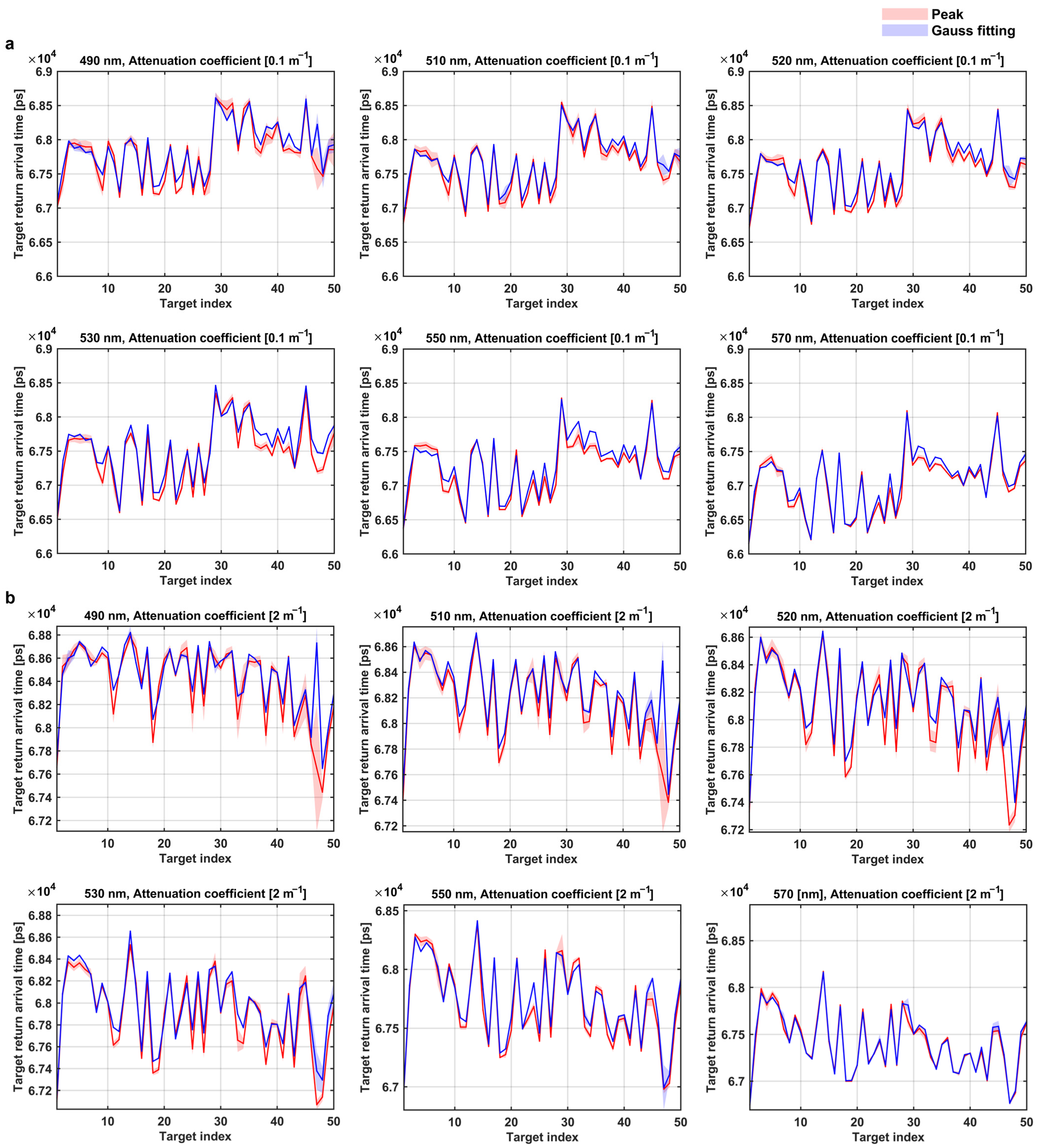
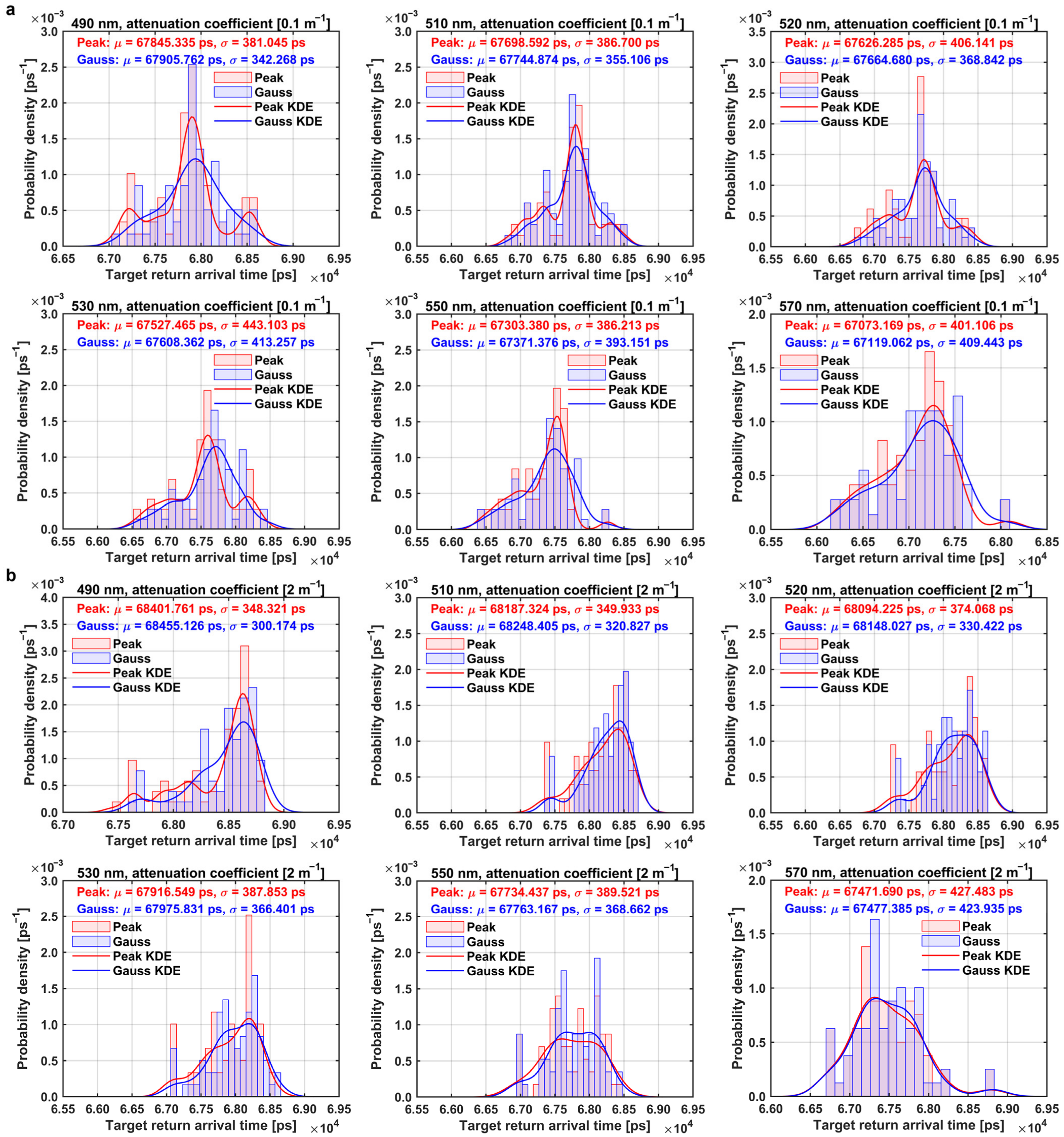
- Wavelength-dependent ranging bias in turbid water originates from forward-scattering-induced centroid shifts, rather than true spatial displacements.
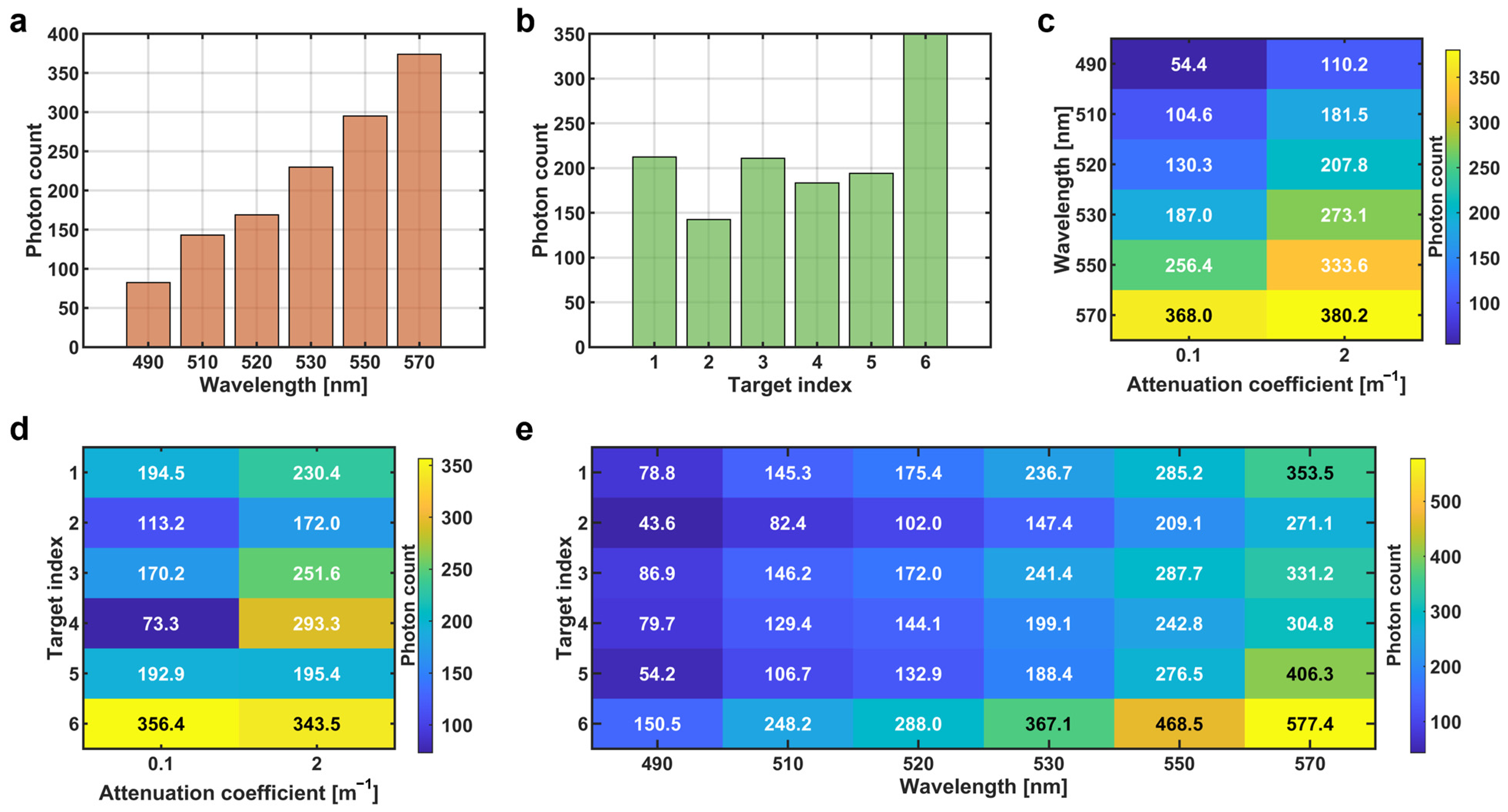
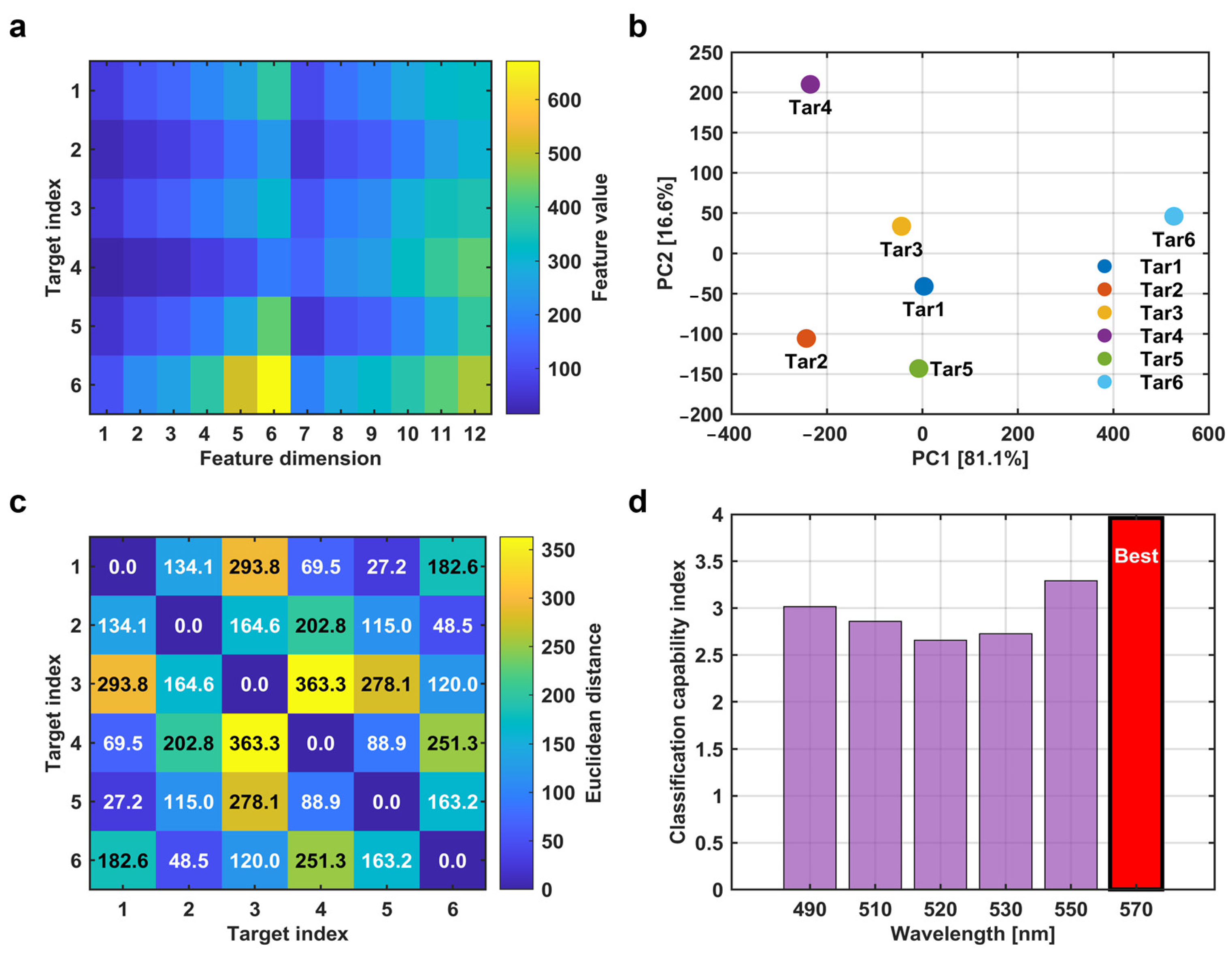
- Target discrimination capability is primarily influenced by the spectral contrast between target reflectance and water transmission windows, rather than by absolute photon counts.
- Multidimensional spectral feature spaces enable underwater material classification that is robust to turbidity-induced signal variations, providing a theoretical basis for turbidity-robust target recognition.
- The design principle for underwater spectral LiDAR should shift from merely maximizing signal strength to optimizing spectral matching, thereby guiding adaptive wavelength selection in next-generation systems.
Abstract
1. Introduction
2. System and Methodology
2.1. Multiwavelength Single-Photon Laser Detection System
2.2. Water-Condition Preparation and Attenuation-Coefficient Measurement
2.3. Target Samples and Observation Geometry
2.4. Theory and Computational Methods for Single-Photon Detection
2.5. Multiwavelength LiDAR Detection Data Processing Workflow
3. Results
3.1. Variation in Target Return Arrival Time with Wavelength
3.2. Statistical Analysis of Target Return Arrival Time and Standard Deviation
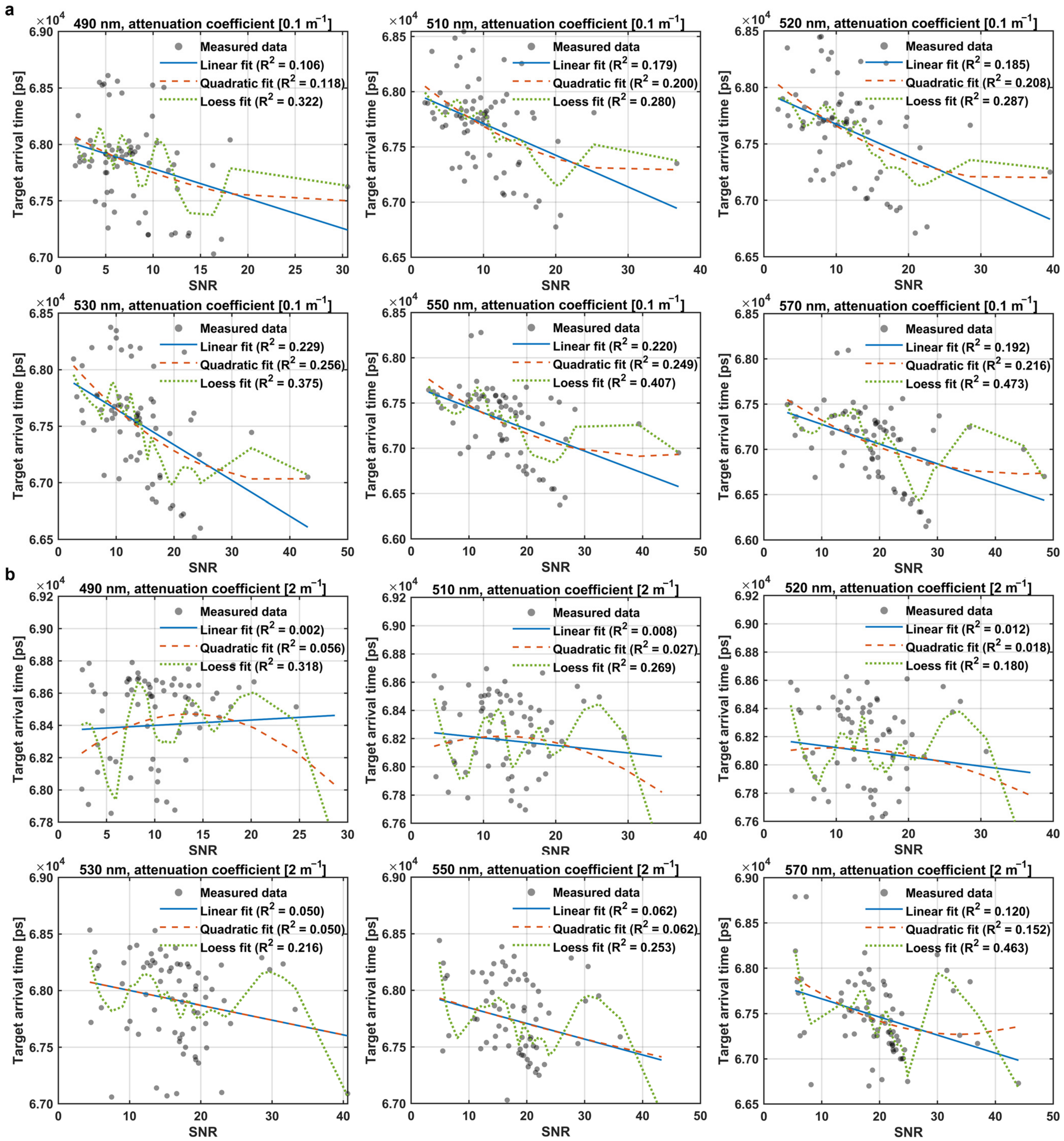
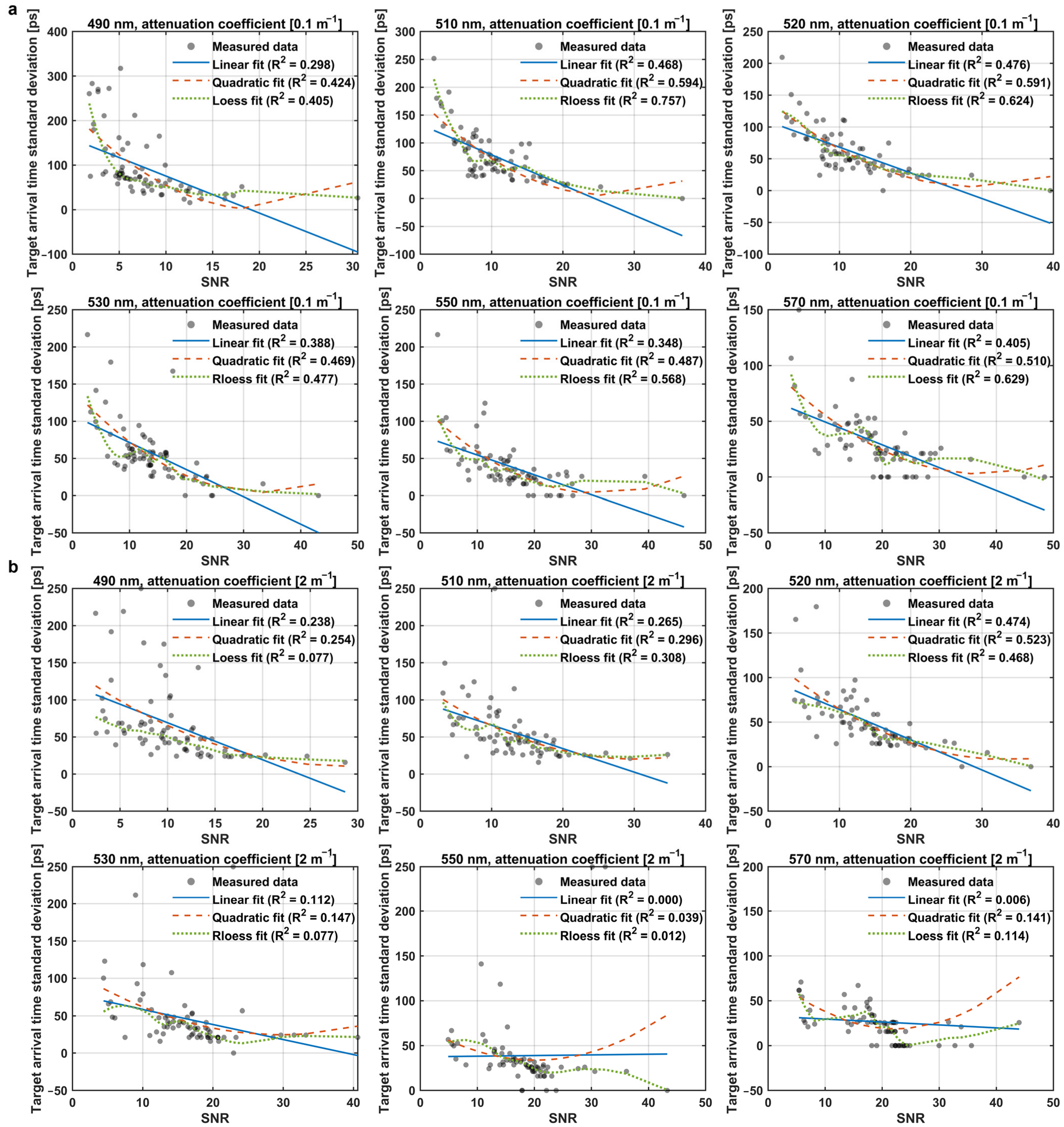
3.3. Effects of Signal-to-Noise Ratio on Target Return Arrival Time and Its Standard Deviation
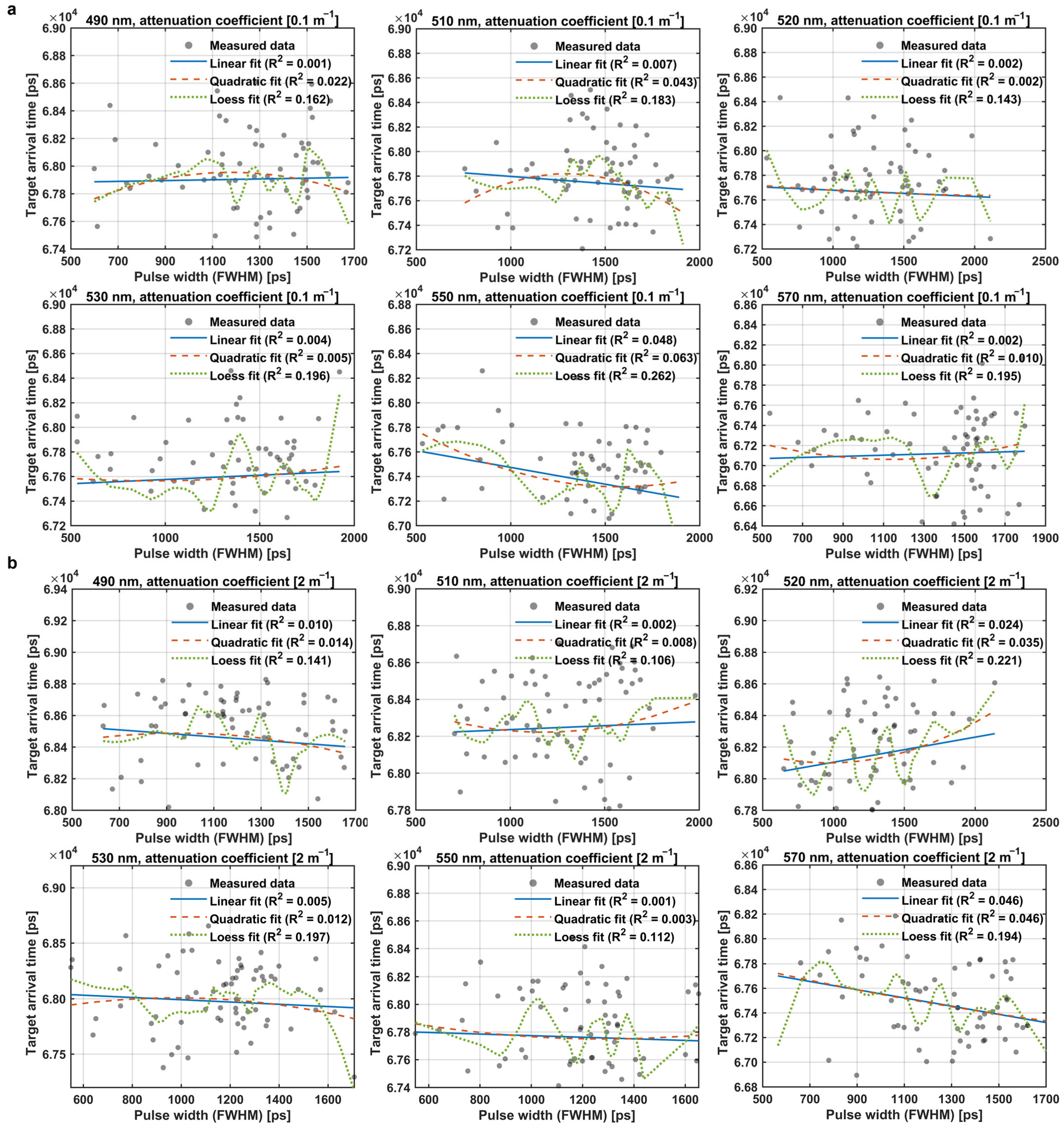
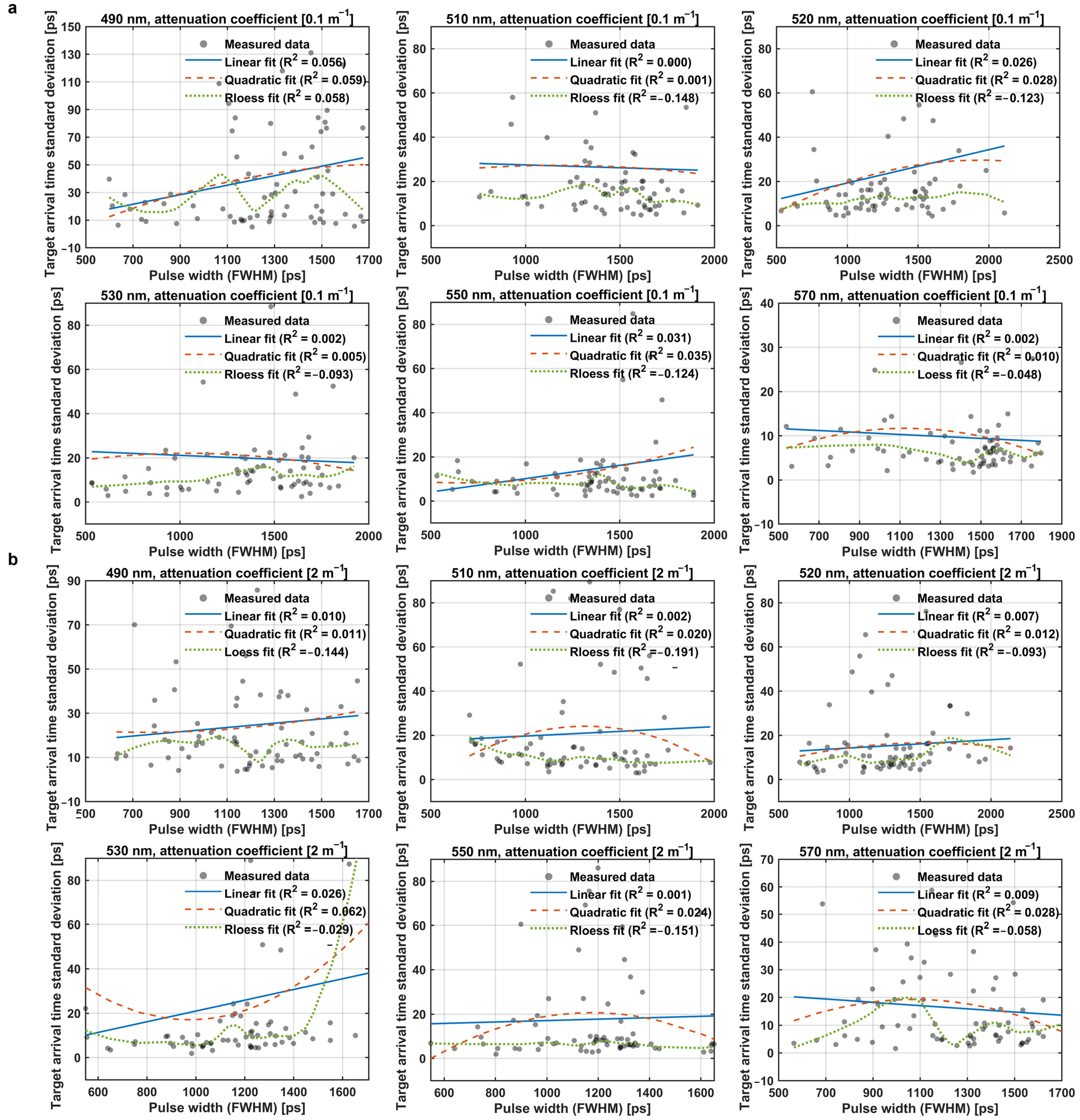
3.4. Variation in the Full Width at Half Maximum with Wavelength
3.5. Variation in Signal Strength Across Wavelengths and Targets
4. Discussion
5. Conclusions
- (1)
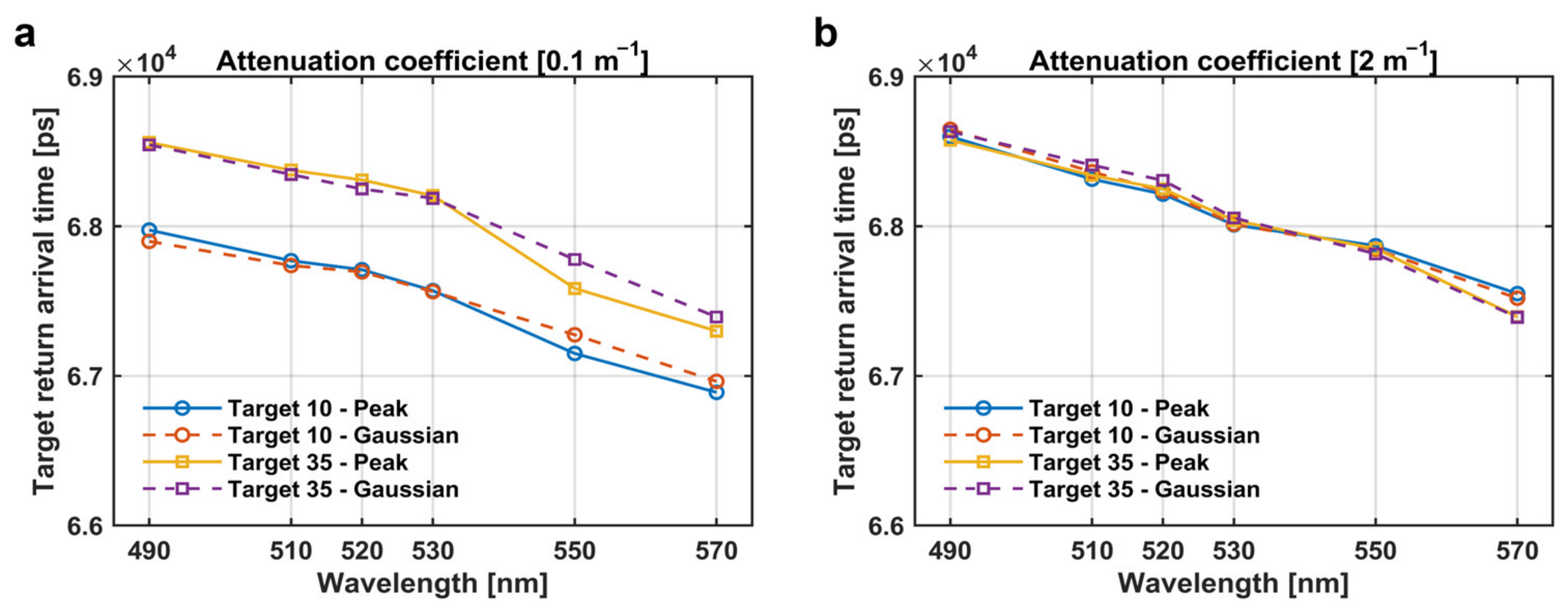
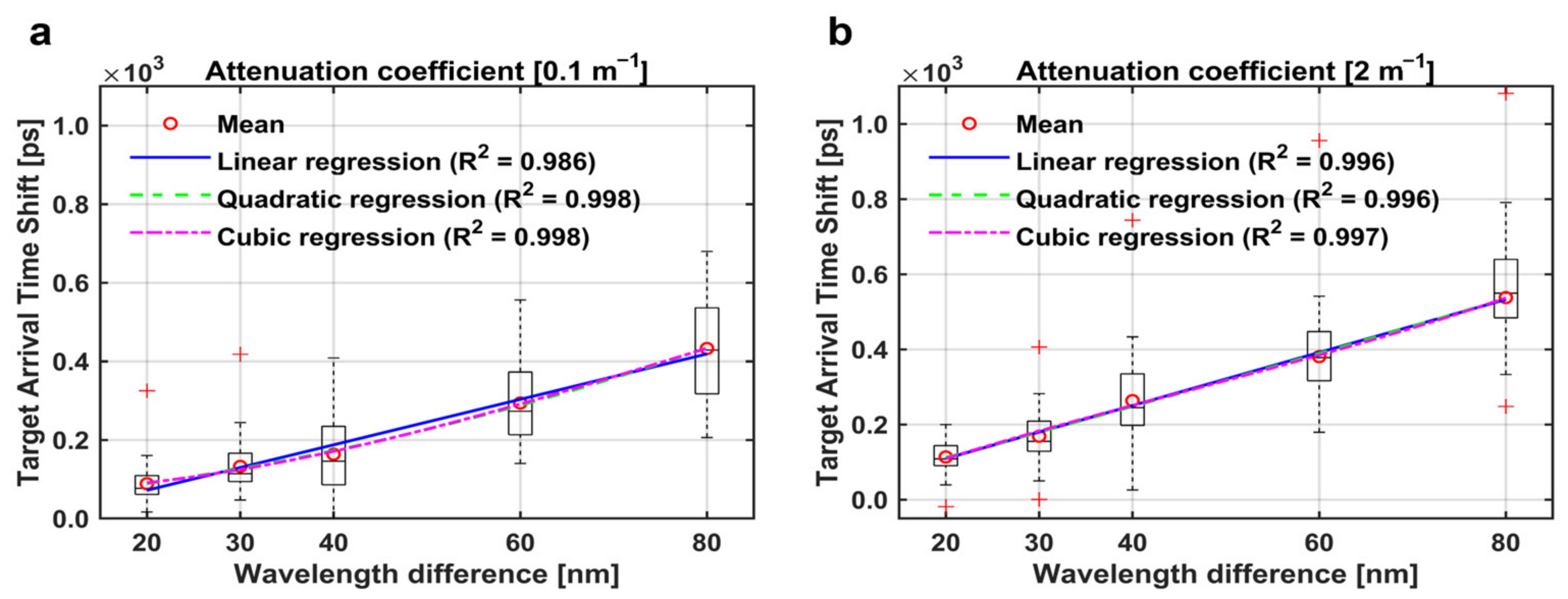
- We show that the wavelength-dependent ranging bias observed in turbid water may reflect a physical effect associated with scattering-induced shifts in the detected arrival-time distribution, rather than a simple measurement artifact. The approximately linear increase observed in turbid water (8.3 ps/nm) suggests that multiwavelength LiDAR may provide information related to scattering behavior in addition to distance measurement.
- (2)
- We find that target discrimination does not depend on received photon-count level alone: wavelengths yielding lower absolute photon counts can still outperform those with higher counts in discrimination capability. The results suggest that discrimination is strongly influenced by spectral contrast, namely the relationship between target reflectance characteristics and water transmission windows, rather than by absolute photon counts alone. This finding suggests that wavelength selection for underwater spectral LiDAR should consider spectral matching in addition to signal strength.
- (3)
- We show that a multidimensional spectral feature space helps preserve target-dependent differences under changing water conditions, as indicated by the PCA-based separation of the representative targets despite turbidity-related signal variation. This suggests a useful basis for turbidity-robust underwater target discrimination.
Author Contributions
Funding
Data Availability Statement
Acknowledgments
Conflicts of Interest
Abbreviations
| LiDAR | Light Detection and Ranging |
| SPAD | Single-Photon Avalanche Diode |
| TCSPC | Time-Correlated Single-Photon Counting |
| PIN | Positive-Intrinsic-Negative |
| MMF | Multi-Mode Fiber |
| SNR | Signal-to-Noise Ratio |
| FWHM | Full Width at Half Maximum |
| PCA | Principal Component Analysis |
| PC1/PC2 | Principal Component 1/2 |
| KDE | Kernel Density Estimation |
| COL | Collimating Lens |
| PM | Plate Mirror |
| SL | Supercontinuum Laser |
Appendix A


References
- Kong, H.; Zhang, Y.; Zhang, Y.; Xu, Y.; Zhou, G.; Wang, S. Exploring Integrated Ocean Management Policy in China: Evolution, Challenges, and Prospects. Water 2024, 16, 1673. [Google Scholar] [CrossRef]
- Wang, Q.; Xu, L.; Wu, J. Marine Intelligent Technology as a Strategic Tool for Sustainable Development: A Five-Year Systematic Analysis. J. Mar. Sci. Eng. 2025, 13, 855. [Google Scholar] [CrossRef]
- Jiang, X.; Yin, X.; Guan, L.; Wang, Z.; Lv, L.; Liu, M. Global Ocean Observations and Applications by China’s Ocean Satellite Constellation. Intell. Mar. Technol. Syst. 2023, 1, 6. [Google Scholar] [CrossRef]
- Maccarone, A.; McCarthy, A.; Ren, X.; Warburton, R.E.; Wallace, A.M.; Moffat, J.; Petillot, Y.; Buller, G.S. Underwater Depth Imaging Using Time-Correlated Single-Photon Counting. Opt. Express 2015, 23, 33911–33926. [Google Scholar] [CrossRef] [PubMed]
- Hayes, M.P.; Gough, P.T. Synthetic Aperture Sonar: A Review of Current Status. IEEE J. Ocean. Eng. 2009, 34, 207–224. [Google Scholar] [CrossRef]
- Sun, D.; Huan, Y.; Qiu, Z.; Hu, C.; Wang, S.; He, Y. Remote-Sensing Estimation of Phytoplankton Size Classes from GOCI Satellite Measurements in Bohai Sea and Yellow Sea. J. Geophys. Res. Ocean. 2017, 122, 8309–8325. [Google Scholar] [CrossRef]
- Yang, Y.; Wang, H.; Li, X. Deep Learning for Enhanced Ocean Color Remote Sensing: A Foundation Model Approach. IEEE Trans. Geosci. Remote Sens. 2025, 63, 4210718. [Google Scholar] [CrossRef]
- Hong, Z.; Long, D.; Li, X.; Wang, Y.; Zhang, J.; Hamouda, M.A.; Mohamed, M.M. A Global Daily Gap-Filled Chlorophyll-a Dataset in Open Oceans during 2001–2021 from Multisource Information Using Convolutional Neural Networks. Earth Syst. Sci. Data 2023, 15, 5281–5300. [Google Scholar] [CrossRef]
- Huot, Y.; Morel, A.; Twardowski, M.S.; Stramski, D.; Reynolds, R.A. Particle Optical Backscattering along a Chlorophyll Gradient in the Upper Layer of the Eastern South Pacific Ocean. Biogeosciences 2008, 5, 495–507. [Google Scholar] [CrossRef]
- Li, C.-F.; Wang, Z.; Liu, X.-Y.; Yang, S.-H.; Xu, Z.; Fan, C.-Y. Anti-Scattering Signal Processing Method of VMD-ICA Based Underwater Lidar. Acta Phys. Sin. 2024, 73, 094203. [Google Scholar] [CrossRef]
- Li, G.; Zhou, Q.; Xu, G.; Wang, X.; Han, W.; Wang, J.; Zhang, G.; Zhang, Y.; Yuan, Z.; Song, S.; et al. Lidar-Radar for Underwater Target Detection Using a Modulated Sub-Nanosecond Q-Switched Laser. Opt. Laser Technol. 2021, 142, 107234. [Google Scholar] [CrossRef]
- Zhao, H.; Shi, H.; Zhu, Z.; Qian, Z.; Xu, X.; Zhai, J.; Chen, X.; Li, X. Enhanced Underwater LiDAR via Dual-Comb Interferometer and Pulse Coding. IEEE Trans. Geosci. Remote Sens. 2024, 62, 4206211. [Google Scholar] [CrossRef]
- Chen, Q.; Yam, J.W.; Chua, S.Y.; Guo, N.; Wang, X. Characterizing the Performance Impacts of Target Surface on Underwater Pulse Laser Ranging System. J. Quant. Spectrosc. Radiat. Transf. 2020, 255, 107267. [Google Scholar] [CrossRef]
- Chen, Y.; Guo, S.; He, Y.; Luo, Y.; Chen, W.; Hu, S.; Huang, Y.; Hou, C.; Su, S. Simulation and Design of an Underwater Lidar System Using Non-Coaxial Optics and Multiple Detection Channels. Remote Sens. 2023, 15, 3618. [Google Scholar] [CrossRef]
- Hao, Y.; Yuan, Y.; Zhang, H.; Zhang, S.; Zhang, Z. A Low-Cost Modulated Laser-Based Imaging System Using Square Ring Laser Illumination for Depressing Underwater Backscatter. Photonics 2024, 11, 1070. [Google Scholar] [CrossRef]
- Yu, Y.; Wang, Z.; Li, H.; Yu, C.; Chen, C.; Wang, X.; Li, X.; Xue, B.; Pan, X.; Zhuang, Q.; et al. High-Precision 3D Imaging of Underwater Coaxial Scanning Photon Counting Lidar Based on Spatiotemporal Correlation. Measurement 2023, 219, 113248. [Google Scholar] [CrossRef]
- Wang, J.; Hao, W.; Chen, S.; Xie, M.; Li, X.; Shi, H.; Feng, X.; Su, X. Underwater Single-Photon Profiling Under Turbulence and High Attenuation Environment. IEEE Geosci. Remote Sens. Lett. 2024, 21, 6501605. [Google Scholar] [CrossRef]
- Plosz, S.; Maccarone, A.; McLaughlin, S.; Buller, G.S.; Halimi, A. Real-Time Reconstruction of 3D Videos from Single-Photon LiDaR Data in the Presence of Obscurants. IEEE Trans. Comput. Imaging 2023, 9, 106–119. [Google Scholar] [CrossRef]
- Liao, Y.; Shangguan, M.; Yang, Z.; Lin, Z.; Wang, Y.; Li, S. GPU-Accelerated Monte Carlo Simulation for a Single-Photon Underwater Lidar. Remote Sens. 2023, 15, 5245. [Google Scholar] [CrossRef]
- Lin, Z.; Shangguan, M.; Cao, F.; Yang, Z.; Qiu, Y.; Weng, Z. Underwater Single-Photon Lidar Equipped with High-Sampling-Rate Multi-Channel Data Acquisition System. Remote Sens. 2023, 15, 5216. [Google Scholar] [CrossRef]
- Shangguan, M.; Weng, Z.; Lin, Z.; Lee, Z.; Shangguan, M.; Yang, Z.; Sun, J.; Wu, T.; Zhang, Y.; Wen, C. Day and Night Continuous High-Resolution Shallow-Water Depth Detection with Single-Photon Underwater Lidar. Opt. Express 2023, 31, 43950–43962. [Google Scholar] [CrossRef]
- Zhang, Z.; Chen, P.; Mao, Z. SOLS: An Open-Source Spaceborne Oceanic Lidar Simulator. Remote Sens. 2022, 14, 1849. [Google Scholar] [CrossRef]
- Prieur, L.; Sathyendranath, S. An Optical Classification of Coastal and Oceanic Waters Based on the Specific Spectral Absorption Curves of Phytoplankton Pigments, Dissolved Organic Matter, and Other Particulate Materials. Limnol. Oceanogr. 1981, 26, 671–689. [Google Scholar] [CrossRef]
- Li, C.; Zhou, G.; Zhang, D. Analysis of Affecting Factors for Laser Underwater Transmission Echo Signals Based on Semi-Analytic Monte Carlo. Int. J. Remote Sens. 2024, 45, 7185–7211. [Google Scholar] [CrossRef]
- Liu, Q.; Liu, D.; Bai, J.; Zhang, Y.; Zhou, Y.; Xu, P.; Liu, Z.; Chen, S.; Che, H.; Wu, L.; et al. Relationship between the Effective Attenuation Coefficient of Spaceborne Lidar Signal and the IOPs of Seawater. Opt. Express 2018, 26, 30278–30291. [Google Scholar] [CrossRef]
- Liu, Q.; Liu, D.; Zhu, X.; Zhou, Y.; Le, C.; Mao, Z.; Bai, J.; Bi, D.; Chen, P.; Chen, W.; et al. Optimum Wavelength of Spaceborne Oceanic Lidar in Penetration Depth. J. Quant. Spectrosc. Radiat. Transf. 2020, 256, 107310. [Google Scholar] [CrossRef]
- Ma, Y.; Zhang, H.; Wang, R.; Li, F.; He, T.; Liu, B.; Wang, Y.; Han, F. Underwater Sphere Classification Using AOTF-Based Multispectral LiDAR. Photonics 2025, 12, 998. [Google Scholar] [CrossRef]
- Chen, P.; Jamet, C.; Zhang, Z.; He, Y.; Mao, Z.; Pan, D.; Wang, T.; Liu, D.; Yuan, D. Vertical Distribution of Subsurface Phytoplankton Layer in South China Sea Using Airborne Lidar. Remote Sens. Environ. 2021, 263, 112567. [Google Scholar] [CrossRef]
- Chen, P.; Mao, Z.; Zhang, Z.; Liu, H.; Pan, D. Detecting Subsurface Phytoplankton Layer in Qiandao Lake Using Shipborne Lidar. Opt. Express 2020, 28, 558–569. [Google Scholar] [CrossRef]
- Pershin, S.M.; Bunkin, A.F.; Zavozin, V.A.; Grishin, M.Y.; Makarov, V.S.; Titovets, P.A.; Fedyuk, M.O. Underwater Lidar: Remote Sensing in Strongly Scattering Media. Phys. Wave Phenom. 2023, 31, 406–411. [Google Scholar] [CrossRef]
- Shangguan, M.; Guo, Y.; Liao, Z. Shipborne Single-Photon Fluorescence Oceanic Lidar: Instrumentation and Inversion. Opt. Express 2024, 32, 10204–10218. [Google Scholar] [CrossRef]
- Bai, J.; Gao, S.; Niu, Z.; Zhang, C.; Bi, K.; Sun, G.; Huang, Y. A Novel Algorithm for Leaf Incidence Angle Effect Correction of Hyperspectral LiDAR. IEEE Trans. Geosci. Remote Sens. 2022, 60, 5700409. [Google Scholar] [CrossRef]
- Bai, J.; Niu, Z.; Huang, Y.; Bi, K.; Fu, Y.; Gao, S.; Wu, M.; Wang, L. Full-Waveform Hyperspectral LiDAR Data Decomposition via Ranking Central Locations of Natural Target Echoes (RCLONTE) at Different Wavelengths. Remote Sens. Environ. 2024, 310, 114227. [Google Scholar] [CrossRef]
- Sun, H.; Wang, Y.; Sun, Z.; Wang, S.; Sun, S.; Jia, J.; Jiang, C.; Hu, P.; Yang, H.; Yang, X.; et al. Miniaturizing Hyperspectral Lidar System Employing Integrated Optical Filters. Remote Sens. 2024, 16, 1642. [Google Scholar] [CrossRef]
- Zhang, H.; Chen, L.; Wu, H.; Zhou, M.; Chen, J.; Chen, Z.; Hu, J.; Chen, Y.; Wang, J.; Niu, Y.; et al. Hyperspectral LiDAR for Subsea Exploration: System Design and Performance Evaluation. Electronics 2025, 14, 1539. [Google Scholar] [CrossRef]
- Gray, D.J.; Anderson, J.; Nelson, J.; Edwards, J. Using a Multiwavelength LiDAR for Improved Remote Sensing of Natural Waters. Appl. Opt. 2015, 54, F232–F242. [Google Scholar] [CrossRef] [PubMed]
- Li, K.; He, Y.; Ma, J.; Jiang, Z.; Hou, C.; Chen, W.; Zhu, X.; Chen, P.; Tang, J.; Wu, S.; et al. A Dual-Wavelength Ocean Lidar for Vertical Profiling of Oceanic Backscatter and Attenuation. Remote Sens. 2020, 12, 2844. [Google Scholar] [CrossRef]
- Chen, Y.; Luo, Q.; Guo, S.; Chen, W.; Hu, S.; Ma, J.; He, Y.; Huang, Y. Multispectral LiDAR-Based Underwater Ore Classification Using a Tunable Laser Source. Opt. Commun. 2024, 551, 129903. [Google Scholar] [CrossRef]
- Stramski, D.; Joshi, I.; Reynolds, R.A. Ocean Color Algorithms to Estimate the Concentration of Particulate Organic Carbon in Surface Waters of the Global Ocean in Support of a Long-Term Data Record from Multiple Satellite Missions. Remote Sens. Environ. 2022, 269, 112776. [Google Scholar] [CrossRef]
- Yang, J.; Ma, Y.; Zheng, H.; Gu, Y.; Zhou, H.; Li, S. Analysis and Correction of Water Forward-Scattering-Induced Bathymetric Bias for Spaceborne Photon-Counting Lidar. Remote Sens. 2023, 15, 931. [Google Scholar] [CrossRef]
- Lodovisi, C.; Gerardi, F.; Moriconi, C.; Betti, S. Beam Attenuation Coefficient for Different Water Turbidities. Appl. Opt. 2024, 63, 6482–6494. [Google Scholar] [CrossRef]
- Churnside, J.H. Review of Profiling Oceanographic Lidar. Opt. Eng. 2014, 53, 051405. [Google Scholar] [CrossRef]
- Dai, J.; Li, S.; Gao, F.; Cao, H.; Guo, G.; Liu, X.; Wang, Q. Performance Analysis of the Photon-Counting LIDAR Based on the Statistical Property. In Signal and Information Processing, Networking and Computers; Sun, J., Wang, Y., Huo, M., Xu, L., Eds.; Lecture Notes in Electrical Engineering; Springer: Singapore, 2023; Volume 917, pp. 534–541. [Google Scholar] [CrossRef]
- Liu, J.; Zhang, X.; Lv, J.; Li, X.; Du, L. Gaussian Decomposition Method for Full Waveform Data of LiDAR Base on Neural Network. Sci. Rep. 2025, 15, 5639. [Google Scholar] [CrossRef] [PubMed]
- Marquardt, D.W. An Algorithm for Least-Squares Estimation of Nonlinear Parameters. J. Soc. Ind. Appl. Math. 1963, 11, 431–441. [Google Scholar] [CrossRef]
- Hayman, M.; Stillwell, R.A.; Carnes, J.; Kirchhoff, G.J.; Spuler, S.M.; Thayer, J.P. 2D Signal Estimation for Sparse Distributed Target Photon Counting Data. Sci. Rep. 2024, 14, 10325. [Google Scholar] [CrossRef] [PubMed]

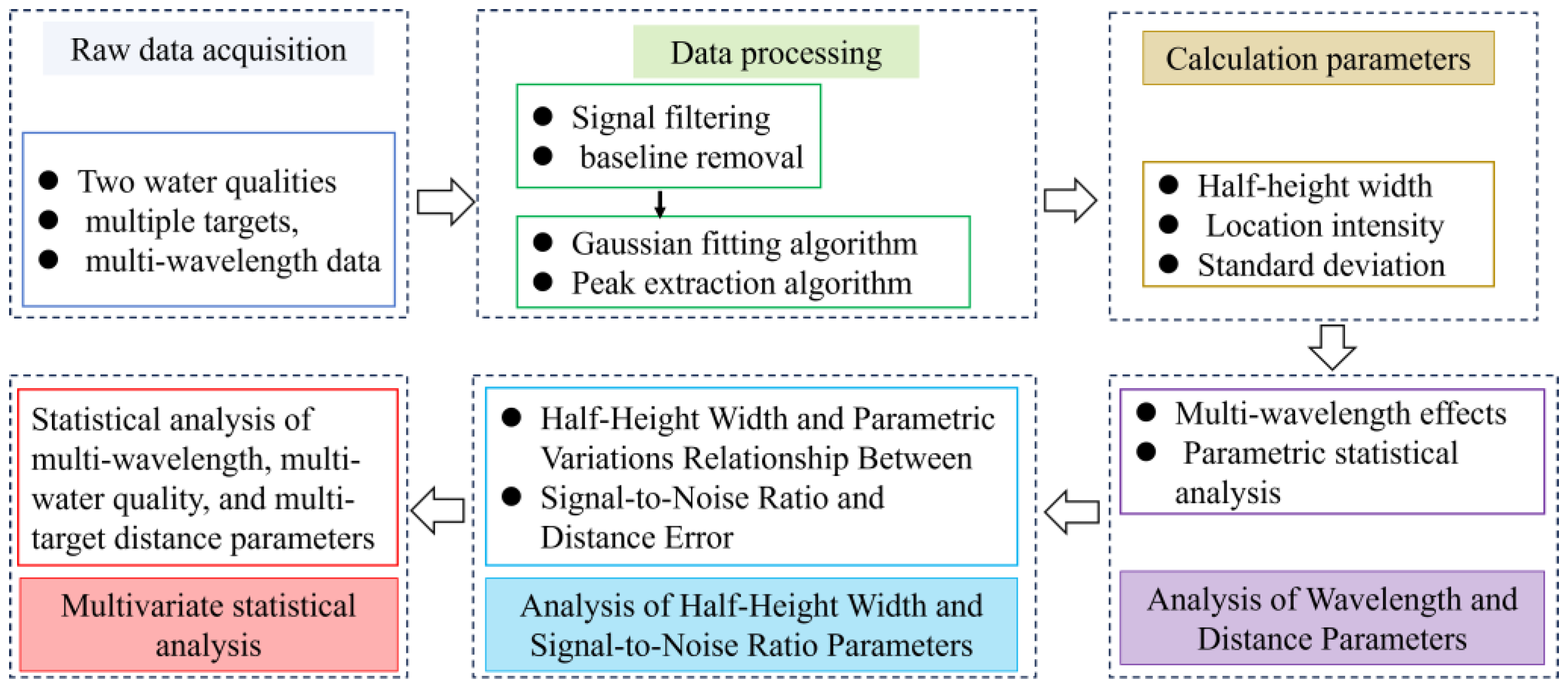


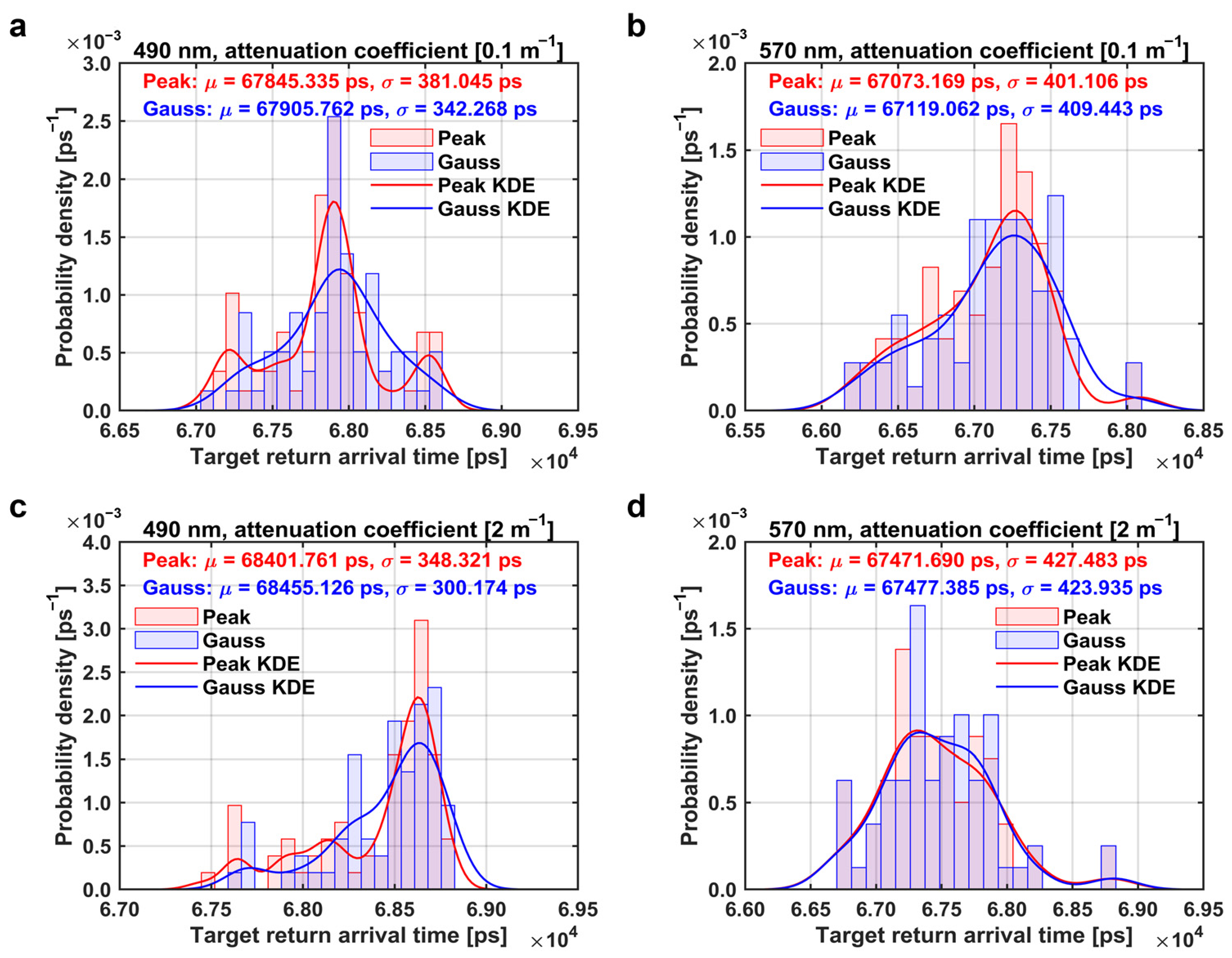

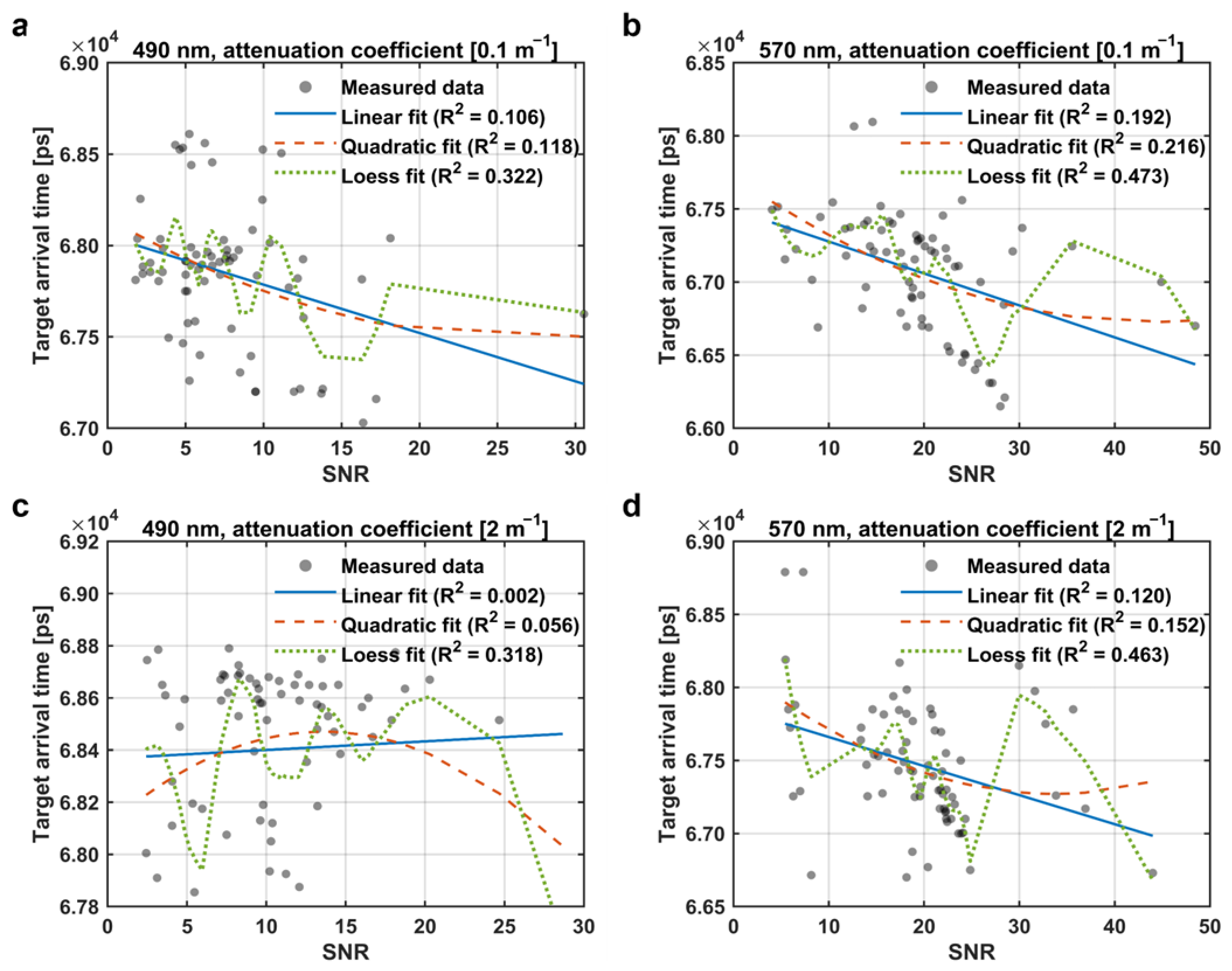
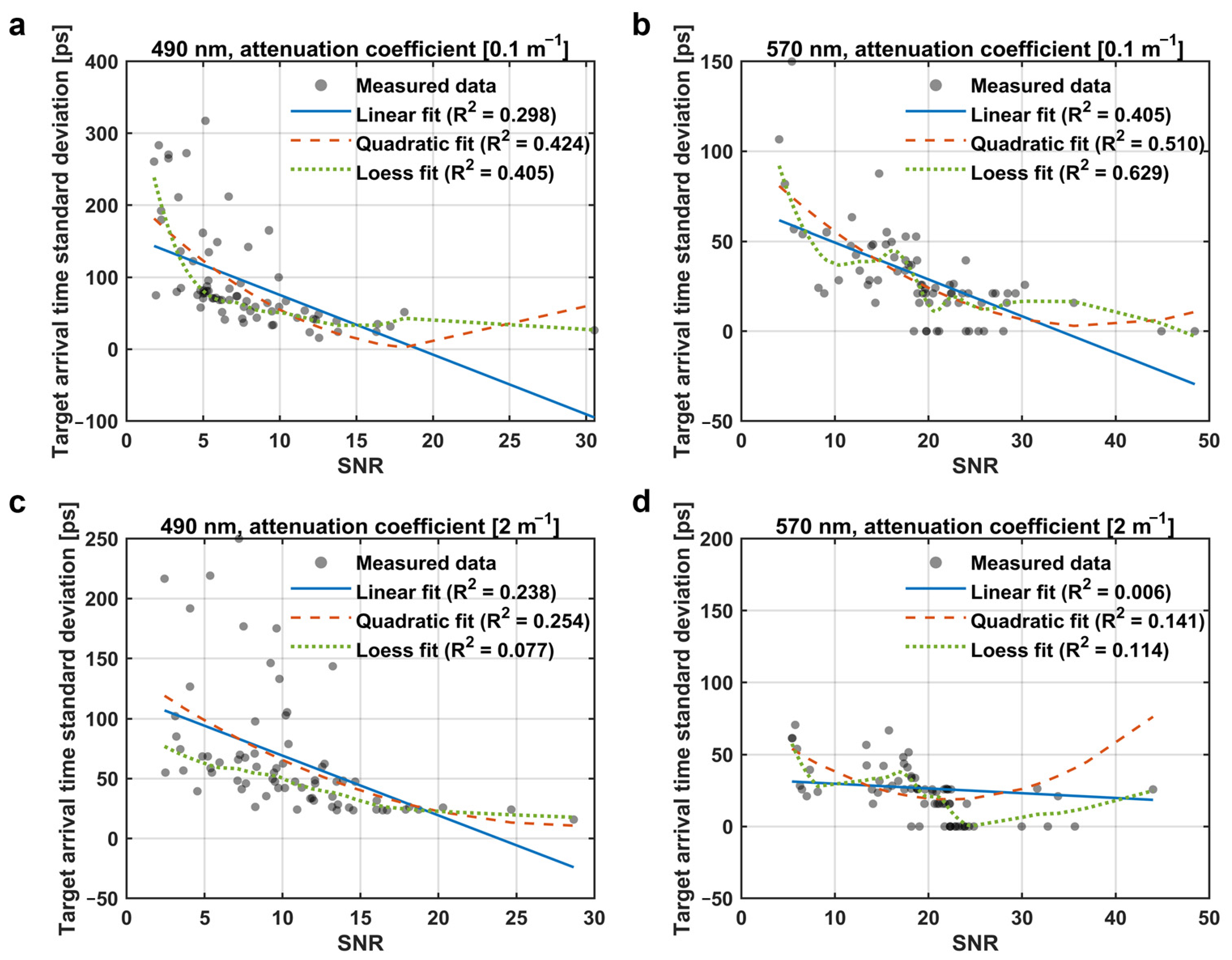



| Parameters | Value | Unit |
|---|---|---|
| Laser parameters | ||
| Wavelength | 490, 510, 520, 530, 550, 570 | nm |
| Single-wavelength spectral FWHM | 10 | nm |
| Pulse duration | ~1 | ns |
| Pulse energy | <15 | μJ |
| Pulse repetition rate | 10 | kHz |
| Laser beam radius | 2 | mm |
| Divergence angle | >0.5 | mrad |
| Receiver parameters | ||
| Focal length | 50.8 | mm |
| Mode-field diameter of the MMF | 105 | μm |
| Effective aperture | 22.4 | mm |
| Signal acquisition parameters | ||
| Dark count rate | 100 | cps |
| Dead time | 20 | ns |
| Data bin width | 50 | ps |
| Minimum signal bin width | 8 | ps |
| Feature | Symbol | Mean (μj) | PC1 Loading () | PC2 Loading () |
|---|---|---|---|---|
| 0.1 m−1, 490 nm | 54.43 | 0.111 | −0.038 | |
| 0.1 m−1, 510 nm | 104.59 | 0.220 | −0.062 | |
| 0.1 m−1, 520 nm | 130.33 | 0.258 | −0.091 | |
| 0.1 m−1, 530 nm | 186.95 | 0.364 | −0.091 | |
| 0.1 m−1, 550 nm | 256.39 | 0.494 | −0.186 | |
| 0.1 m−1, 570 nm | 367.95 | 0.602 | −0.279 | |
| 2.0 m−1, 490 nm | 110.17 | 0.122 | 0.311 | |
| 2.0 m−1, 510 nm | 181.46 | 0.153 | 0.399 | |
| 2.0 m−1, 520 nm | 207.80 | 0.173 | 0.397 | |
| 2.0 m−1, 530 nm | 273.08 | 0.141 | 0.453 | |
| 2.0 m−1, 550 nm | 333.57 | 0.140 | 0.405 | |
| 2.0 m−1, 570 nm | 380.16 | 0.159 | 0.289 |
Disclaimer/Publisher’s Note: The statements, opinions and data contained in all publications are solely those of the individual author(s) and contributor(s) and not of MDPI and/or the editor(s). MDPI and/or the editor(s) disclaim responsibility for any injury to people or property resulting from any ideas, methods, instructions or products referred to in the content. |
© 2026 by the authors. Licensee MDPI, Basel, Switzerland. This article is an open access article distributed under the terms and conditions of the Creative Commons Attribution (CC BY) license.
Share and Cite
Yang, L.; Zhu, S.; Wang, C.; Zhang, Y.; Yang, W.; Liu, X.; Hu, C.; He, X.; Wang, S.; Li, S.; et al. Spectral Signatures and Target Discrimination in Underwater Multiwavelength Single-Photon LiDAR. Remote Sens. 2026, 18, 1772. https://doi.org/10.3390/rs18111772
Yang L, Zhu S, Wang C, Zhang Y, Yang W, Liu X, Hu C, He X, Wang S, Li S, et al. Spectral Signatures and Target Discrimination in Underwater Multiwavelength Single-Photon LiDAR. Remote Sensing. 2026; 18(11):1772. https://doi.org/10.3390/rs18111772
Chicago/Turabian StyleYang, Liu, Shouzheng Zhu, Ceyuan Wang, Yangyang Zhang, Wenhang Yang, Xu Liu, Chenhui Hu, Xin He, Senyuan Wang, Siliang Li, and et al. 2026. "Spectral Signatures and Target Discrimination in Underwater Multiwavelength Single-Photon LiDAR" Remote Sensing 18, no. 11: 1772. https://doi.org/10.3390/rs18111772
APA StyleYang, L., Zhu, S., Wang, C., Zhang, Y., Yang, W., Liu, X., Hu, C., He, X., Wang, S., Li, S., Cui, Z., Li, C., Wang, J., & Chen, Y. (2026). Spectral Signatures and Target Discrimination in Underwater Multiwavelength Single-Photon LiDAR. Remote Sensing, 18(11), 1772. https://doi.org/10.3390/rs18111772