Article

What Makes the Lower Urban Land Coverage City a Deeper Ozone Trap: Implications from a Case Study in the Sichuan Basin, Southwest China

1
Sichuan Provincial Climate Centre, Sichuan Provincial Meteorological Service, Chengdu 610072, China
2
Key Laboratory of Land Surface Pattern and Simulation, Institute of Geographic Sciences and Natural Resources Research, Chinese Academy of Sciences, Beijing 100101, China
3
Sichuan Meteorological Observatory, Sichuan Provincial Meteorological Service, Chengdu 610072, China
4
CMA Earth System Modelling and Prediction Centre, China Meteorological Administration, Beijing 100081, China
5
College of Geography and Planning, Chengdu University of Technology, Chengdu 610059, China
6
Shanghai Key Laboratory of Ocean-Land-Atmosphere Boundary Dynamics and Climate Change, Fudan University, Shanghai 200438, China
*
Author to whom correspondence should be addressed.
Remote Sens. 2026, 18(10), 1657; https://doi.org/10.3390/rs18101657
Submission received: 14 April 2026 / Revised: 15 May 2026 / Accepted: 16 May 2026 / Published: 21 May 2026

Highlights

What are the main findings?
  • A dipole-like spatial pattern of near-surface ozone trapping across two megacities in the Sichuan Basin is demonstrated via air quality reanalysis during 2013–2019.
  • Chongqing exhibited a deeper ozone trap compared to Chengdu despite its lower urban land cover and nitrogen dioxide levels.
What are the implications of the main findings?
  • Severe wintertime ozone traps are highly localized phenomena fundamentally constrained by basin topography and boundary layer dynamics.
  • Topographically induced aerodynamic stagnation acts as a crucial physical modulator, synergistically exacerbating the chemical NO titration effect.

Abstract

The urban–rural gradient of surface ozone concentration is closely associated with urban scale and has been widely reported in megacities globally. However, in the Sichuan Basin of southwestern China, a paradoxical asymmetric pattern between the ozone gradient and the physical urban footprint has emerged. By integrating multi-source satellite observations (e.g., TROPOMI), reanalysis data (ERA5-Land), and a concentric-ring spatial gradient analysis, we quantify a dipole-like urban surface ozone trap pattern in two megacities (Chengdu and Chongqing) from 2013 to 2019. We found that the urban–rural ozone gradients in Chongqing were substantially steeper than those in Chengdu, despite Chongqing’s smaller physical urban footprint. Specifically, in winter, the maximum daily average 8 h ozone level in the urban core drops to 27.5 μg m−3 in Chongqing and 47.9 μg m−3 in Chengdu, with outward radial increasing rates of 6.49% and 1.88% per 10 km, respectively. Conversely, the absolute nitrogen dioxide level in Chengdu is higher, highlighting an asymmetric titration behavior between the two cities. Regarding the chemical regime, analysis of the ratio (β) of nitrogen dioxide to formaldehyde reveals that Chongqing’s core operates under a more severe VOC-limited environment (β is 2.53 and radial gradient is −6.77% per 10 km) compared to Chengdu (β is 2.43 and gradient is −5.34% per 10 km). Furthermore, vertical cross-section analyses indicate that Chongqing’s deep-valley topography induces severe boundary layer compression and aerodynamic stagnation. Thus, rather than acting independently, these localized meteorological constraints function as crucial physical modulators that trap precursor emissions and exacerbate the non-linear chemical titration. This study elucidates how synergistic interactions between basin topography, physical urban footprints, and atmospheric chemistry shape localized ozone traps, providing a referable perspective for assessing complex urban atmospheric environments.

1. Introduction

Ozone (O3) in the near-surface atmosphere is a secondary pollutant, formed from precursor emissions, primarily oxides of nitrogen (NOx) and volatile organic compounds (VOCs) as precursors [1]. Anthropogenic NOx emissions predominantly consist of nitrogen monoxide (NO) and nitrogen dioxide (NO2). In the ambient atmosphere, NO2 can produce O3 via photolysis with VOCs [2,3], whereas NO can deplete O3 through titration [4]. O3 is a major oxidant for the trace gases in the atmosphere, promoting a variety of free radical chain reactions, and serves as a pivotal greenhouse gas [5,6,7,8]. Further, elevated O3 exposure has damaging impacts on human health, terrestrial vegetation, and crops [9,10,11,12]. In China, near-surface O3 pollution has emerged as a severe environmental challenge. Site observations from 74 Chinese cities revealed that the daily max 8 h (MDA8) ozone has increased from 69.5 to 75.0 (ppbv) during 2013–2015 [13], with a continued enhancement observed through 2016–2017 in China [14]. Moreover, projected climate warming and reduced NOx emissions are expected to further exacerbate ozone pollution by 2050, and summer ozone levels over southwestern China are projected to increase by 10~15 ppbv [15]. Recent studies further underscore the complexity of these urban O3 dynamics. For instance, a study by Nelson and Drysdale [16] analyzed urban O3 trends across Europe and the USA during 2000–2021, revealing widespread increasing trends in baseline O3 levels coupled with decreasing extreme peaks, highlighting the need to monitor urban O3 under changing climate and emission scenarios. Moreover, recent advances in geospatial frameworks have explicitly linked urban expansion to tropospheric O3 dynamics. Yağcı et al. [17] demonstrated that in a mid-sized urban system in Turkey, integrating remote sensing data (e.g., Sentinel-5P) with urban expansion intensity indices provides a spatially coherent basis for understanding land–atmosphere interactions and their impacts on local air quality. Using observations from 1497 sites, surface O3 levels are found to be lower in urban areas than in rural areas across China [18]. Similar low to high discrepancies of O3 levels from urban to rural areas are also found in the U.S.A, Spain, the U.K, and Turkey. Specifically, O3 observations from urban sites showed values approximately 20 ppbv lower than those from rural sites in New York City [19]. In the city of Málaga, Spain, ozone concentrations at the urban station vary from 184 to 5 μg m−3 and the values at the rural site vary from 189 to 11 μg m−3 [20]. The highest daily urban and rural ozone concentrations were 199 μg m−3 in London and 222 μg m−3 in Yarner Wood in the southwest region of England [21]. The O3 levels in semi-rural and rural sites in Istanbul, Turkey, during the observation period were 64 ppbv at the urban site, 80 ppbv at the semi-rural site and 100 ppbv at the rural site [22]. O3 observations from Madrid, Spain, showed averaged hourly concentrations in the range of around 30~80 μg m−3 (urban sites) and 40~100 μg m−3 (rural sites) [23]. In Europe, urban O3 is increasing faster than in rural areas [24]. In the Sichuan Basin, satellite-based observations have demonstrated a basin-wide increasing long-term O3 trend during 2013–2020 [25]. While current studies have revealed spatial–temporal patterns through site-based observations [26,27,28], the spatial representativeness of direct monitoring sites is inherently limited by their heterogeneous distribution. Consequently, site-based observations alone cannot provide a continuous, high-resolution view of the ozone spatial pattern. Similarly, while model simulations have identified localized low O3 levels in the core areas of Chengdu and Chongqing in 2016 due to NO titration, these were often regarded as episodic events rather than stable climatological features [25,29].
To address these methodological gaps, our study presents the surface O3 spatial behavior based on a 7-year-long climatology, demonstrating that the trap pattern of surface ozone is a persistent regular situation under certain seasonality rather than a transient episode. To ensure scientific clarity, in this study, the ozone trap is formally defined as a localized meteorological and chemical phenomenon fundamentally constrained by basin topography. It occurs when severe aerodynamic stagnation and thermal stratification restrict atmospheric ventilation, thereby trapping precursor emissions within the urban canopy and triggering intense, localized non-linear photochemical depletion (such as severe NO titration in urban cores). We utilize a 1 km resolution air pollutants dataset (Section 2.3) to characterize the long-term averaged spatial behavior and explicitly investigate the relationship between pollutant gradients and urban land cover level using satellite-based high-resolution impervious surface data (Section 2.2). Our analysis of the urban–rural concentration discrepancy in the Sichuan Basin revealed the phenomenon of surface ozone trapping in the megacity cores. These results provide a referable framework to enhance our understanding of the topographical and chemical mechanisms affecting surface ozone levels, offering critical insights for future localized emission control strategies.

2. Materials and Methods

2.1. Study Area

The Sichuan Basin is the largest low-lying basin in China, located on the southeastern margin of the Tibetan Plateau, covering an area of approximately 2.6 × 10⁵ km2 and home to over 110 million people. The Chengdu–Chongqing urban agglomeration is surrounded by mountains around the Sichuan Basin. Chengdu and Chongqing, situated in the northwest and southeast of the Sichuan Basin, serve as vital transportation hubs and economic centers in western China. The topography of the Sichuan Basin often causes atmospheric stagnation in the near-surface layer, leading to severe pollution events due to pollutant accumulation [30,31]. Satellite-born datasets, including Global Multi-Resolution (30~225 m) Terrain Elevation Data 2010 (GMTED2010) [32] (https://www.usgs.gov/coastal-changes-and-impacts/gmted2010 (accessed on 10 September 2024)) and Moderate Resolution Imaging Spectroradiometer (MODIS) land cover data [33] (https://modis.gsfc.nasa.gov/data/dataprod/mod12.php (accessed on 10 September 2024)), were utilized to exhibit the geospatial pattern of the Sichuan Basin. Chengdu and Chongqing are situated in the northwest and southeast of the Sichuan Basin, respectively, with other minor cities evenly distributed between them. In terms of land cover type, Chengdu and Chongqing have the largest and most concentrated urban areas within the Sichuan Basin, with the plains surrounding the cities being mainly cropland, while the surrounding mountainous areas are mainly grassland and forest (Figure 1a,b). To define the study region, we resampled GMTED2010 data to 1 km × 1 km at a lower resolution. Then, we filtered out each pixel in cases where the averaged elevation within a 15 km radius centered on it exceeded 600 m, and finally we removed any pixels over 700 m. This process delineated the study area within the Sichuan Basin, encompassing its low-altitude regions (Figure 1a).

2.2. Evaluation of Urban Land Cover Level

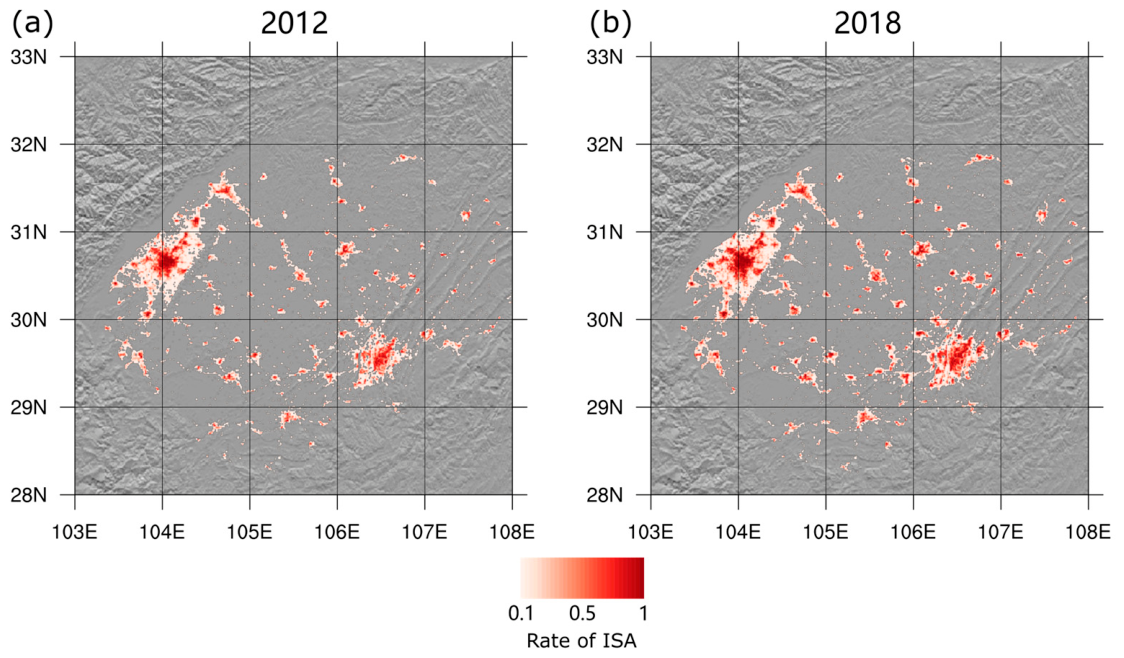
The global annual impervious area (GAIA) data [34] (https://developers.google.com/earth-engine/datasets/catalog/Tsinghua_FROM-GLC_GAIA_v10 (accessed on 18 May 2024)) are utilized to assess the urban land cover level of the cities. In the definition of GAIA data, the impervious areas include multiple artificial land surface objects, such as roofs, road surfaces, hardened grounds, etc. The satellite-based GAIA dataset has a raw horizontal resolution of 30 m and spans from 1985 to 2018. The process of urban land cover revealed by the GAIA dataset is generally consistent, showing an average overall accuracy exceeding 90% [35]. Based on the GAIA data (in 30 m resolution), we calculated the fraction of impervious surface area (ISA) in each 1 km pixel. Since the GAIA data represent the final ISA values for one year, it is preferable to assess the impact of urban land cover in the current year by using the data from the previous year. Therefore, we used the GAIA data during 2012–2018 in our study. Figure 2 displayed a comparison of ISA fraction spatial patterns between 2012 and 2018 in the study area. Generally, the urban land cover changes revealed by the GAIA data during this 7-year period are characterized by substantial increases in density rather than spatial expansions.

2.3. Datasets for Air Pollutants

The gridded ozone (O3) dataset named high resolution O3 concentration dataset for mainland China (ChinaHighO3, http://dx.doi.org/10.5281/zenodo.10477125 (accessed on 5 May 2024)), which uses hybrid numerical dynamic modeling and machine learning frameworks, produced 1 km horizontal resolution gridded data over China [36]. Moreover, the ChinaHighO3 belongs to a dataset series named CHAP (China High Air Pollutant, https://doi.org/10.5281/zenodo.4641542 (accessed on 3 May 2024)) [37], all of which are produced using similar methods as other high-resolution air pollutant datasets such as those for fine particulate matter and nitrogen dioxide (NO2) [38]. Regarding the accuracy benchmarking of this dataset series, the ChinaHighO3 has a sample-based cross-validation coefficient of determination of 0.89 and a root-mean-square error of 15.77 μg m−3. We used the 7-year-long (2013–2019) average for seasons: March–April–May for spring, June–July–August for summer, September–October–November for autumn, and December–January–February for winter. In terms of satellite-based pollutant and meteorology measurements, including ozone, nitrogen dioxide, formaldehyde, and ultraviolet absorbing aerosol index, we utilized Sentinel-5P offline level 3 data that was provided by the European Space Agency (https://dataspace.copernicus.eu/explore-data/data-collections/sentinel-data/sentinel-5p (accessed on 17 May 2024)) [39]. Data pixels with a Quality Assurance (QA) value < 0.75 (or 0.5 for specific trace gases) and cloud fractions > 0.3 were rigorously removed to eliminate cloud contamination and anomalous retrievals.

2.4. Meteorological Datasets

The atmospheric visibility and sunshine duration are derived from automatic meteorology stations around the urban regions of Chengdu and Chongqing. There are 7 sites around Chengdu city, including Wenjiang (30.74°N, 103.86°E), Chongzhou (30.68°N, 103.70°E), Pidu (30.81°N, 103.88°E), Xinjin (30.45°N, 103.81°E), Longquanyi (30.61°N, 104.26°E), Xindu (30.77°N, 104.18°E), and Jintang (30.81°N, 104.42°E). In addition, there are 5 sites around Chongqing city, including Yubei (29.73°N, 106.61°E), Bishan (29.58°N, 106.21°E), Shapingba (29.57°N, 106.46°E), Jiangjin (29.28°N, 106.25°E), and Banan (29.33°N, 106.50°E). Based on the average of multiple sites around each city, we derived 7-year-long (2013–2019) seasonal visibility (m) and sunshine duration (hours) in Chengdu and Chongqing. These visibility and sunshine duration observations can be used as a direct assessment for the visible light in the near-surface atmosphere. For the near-surface wind data, we used the 10 m wind speed from the ERA5-Land reanalysis dataset [40] (https://cds.climate.copernicus.eu/cdsapp#!/dataset/reanalysis-era5-land (accessed on 12 October 2025)). Although the Sichuan Basin features complex topography, previous validations against local observations have demonstrated that ERA5 robustly captures the long-term climatological background and seasonal spatial patterns of surface wind fields in this region [41]. Finally, we used satellite-based MODIS-Aqua data for the measurement of land surface temperature (LST) (https://modis.gsfc.nasa.gov/data/dataprod/mod11.php (accessed on 5 October 2025)).

2.5. Analysis of the Urban–Rural Gradients

First, we set up the core points of Chengdu and Chongqing, approximating the central squares (Tianfu Square and Jiefangbei Square) within 1 km × 1 km pixels. Then, we generated a radius-distance map centered on the city’s core area over our study region (Figure S1). Using this map, we determined the reference value by averaging values within a 5 km radius centered on the city core. Based on this reference value, we can derive the relative levels of ISA fraction, O3, and NO2 at each 1 km interval departing away from the city core. This spatial analysis method can be referred to in a previous study by Zhang et al. [42]. To rigorously assess the robustness of this spatial gradient analysis, a sensitivity evaluation was additionally conducted utilizing expanded core radii of 10 km and 15 km (detailed in the Supplementary Materials). Furthermore, spatial standard deviations (±1 SD) were calculated within each distance bin to capture the inherent spatial heterogeneity of the high-resolution pollutant fields.

3. Results

3.1. Response of Pollutant Concentration to Urban Land Cover Level

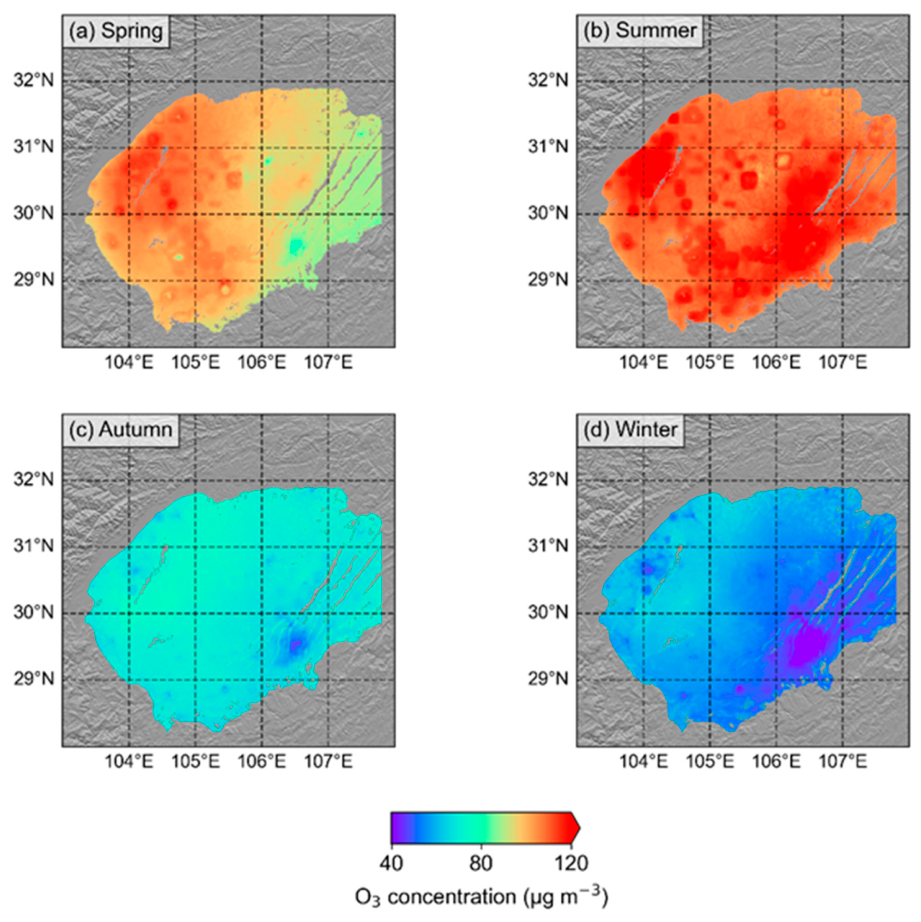
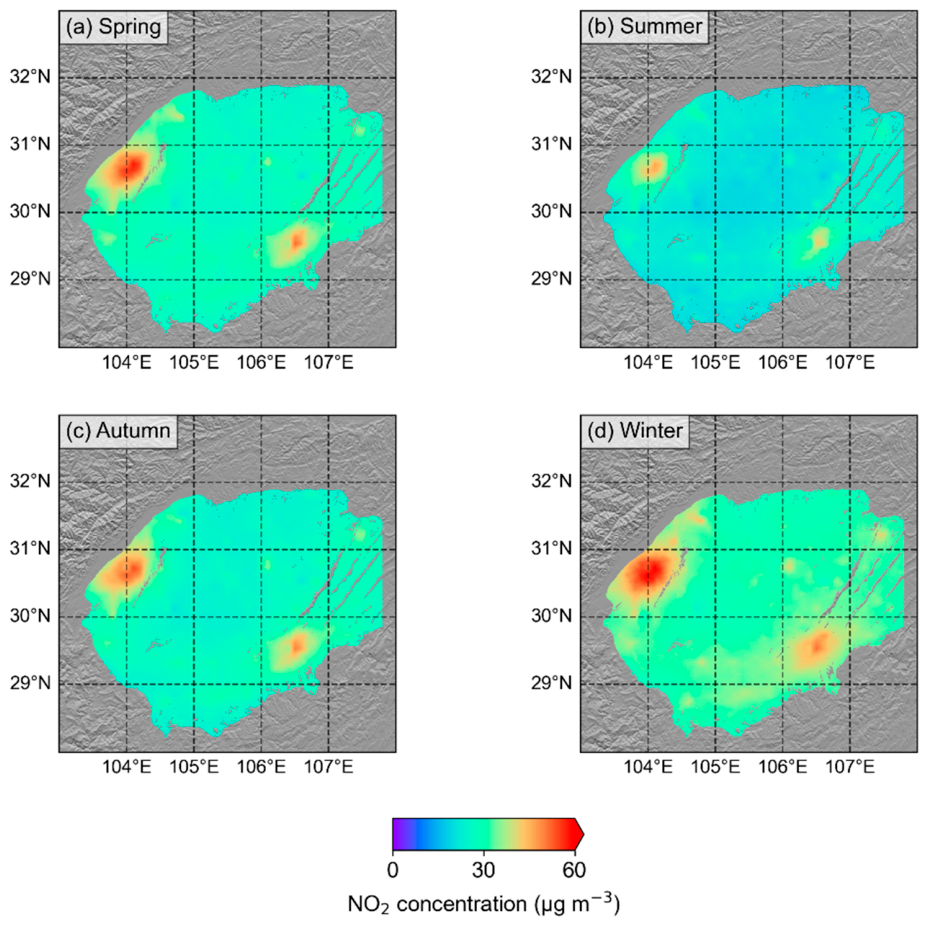
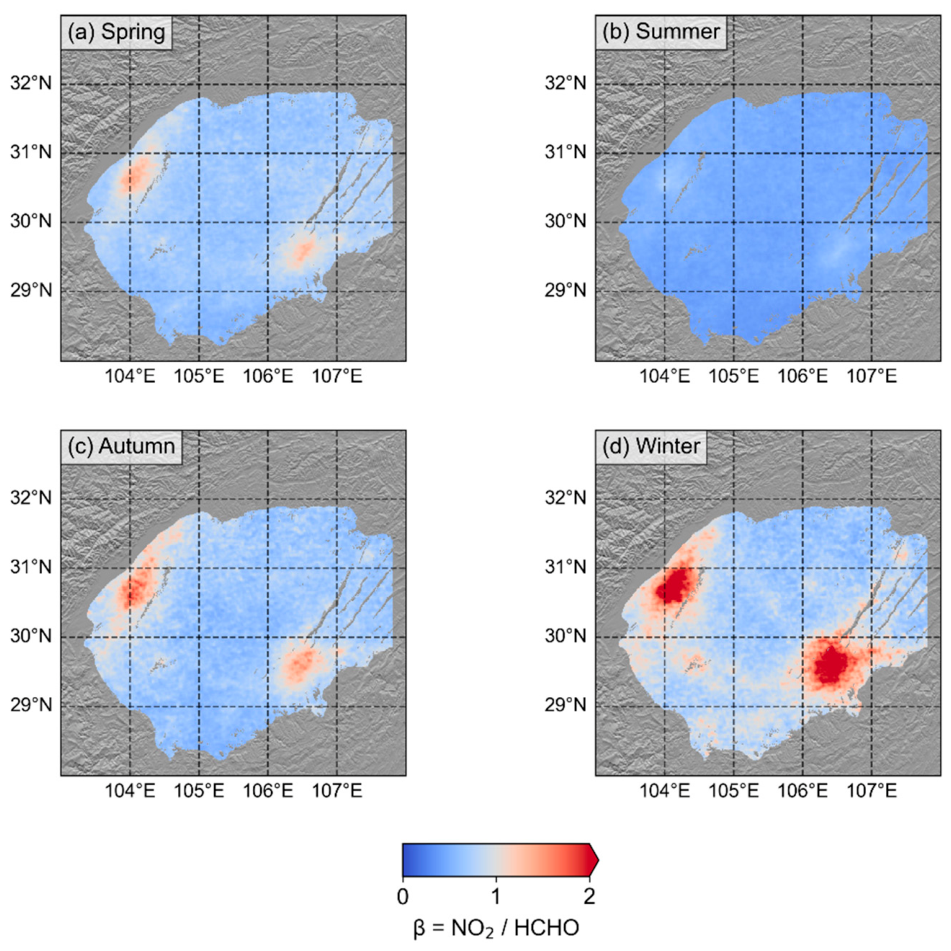
Throughout the study area, Chengdu exhibited the largest ISA fraction (83.1%), followed by Chongqing (64.9%). The other cities exhibited smaller ISA fractions, all below 50%, and were distributed dispersedly in the Sichuan Basin (Figure 2). The spatial patterns of near-surface O3 level varied considerably with the seasons. Averaged over the study region during 2013–2019, the maximum daily average 8 h (MDA8) O3 level showed its peak in summer (111.5 μg m−3), followed by spring (99.4 μg m−3), autumn (69.4 μg m−3), and winter (56.0 μg m−3). In terms of the spatial pattern, the O3 level exhibited two low centers located at Chengdu and Chongqing during autumn (62.3 and 47.9 μg m−3) and winter (48.0 and 27.5 μg m−3) (Figure 3, Table 1). Regarding NO2 level, the seasons in the study area followed a descending order from high to low: winter (33.0 μg m−3), spring (28.9 μg m−3), autumn (27.7 μg m−3), and summer (22.7 μg m−3). In addition, there were two high NO2 centers located at Chengdu and Chongqing during all seasons, with core area levels in the range of around 44.9~57.8 μg m−3 and 40.1~49.6 μg m−3 (Figure 4, Table 1). Further, we have analyzed the ratio changes in formaldehyde to NO2 from VOC-limited to NOx-limited conditions across the gradient for the two cities seasonally, and some new findings to explain the ozone trap discrepancy were obtained. Shown as β (ratio of NO2 to formaldehyde) over the basin (Figure 5), the concentration of NO2 is lower than formaldehyde in all areas during summer. But in winter, the two megacities exhibited concentration centers where NO2 was significantly higher than formaldehyde.
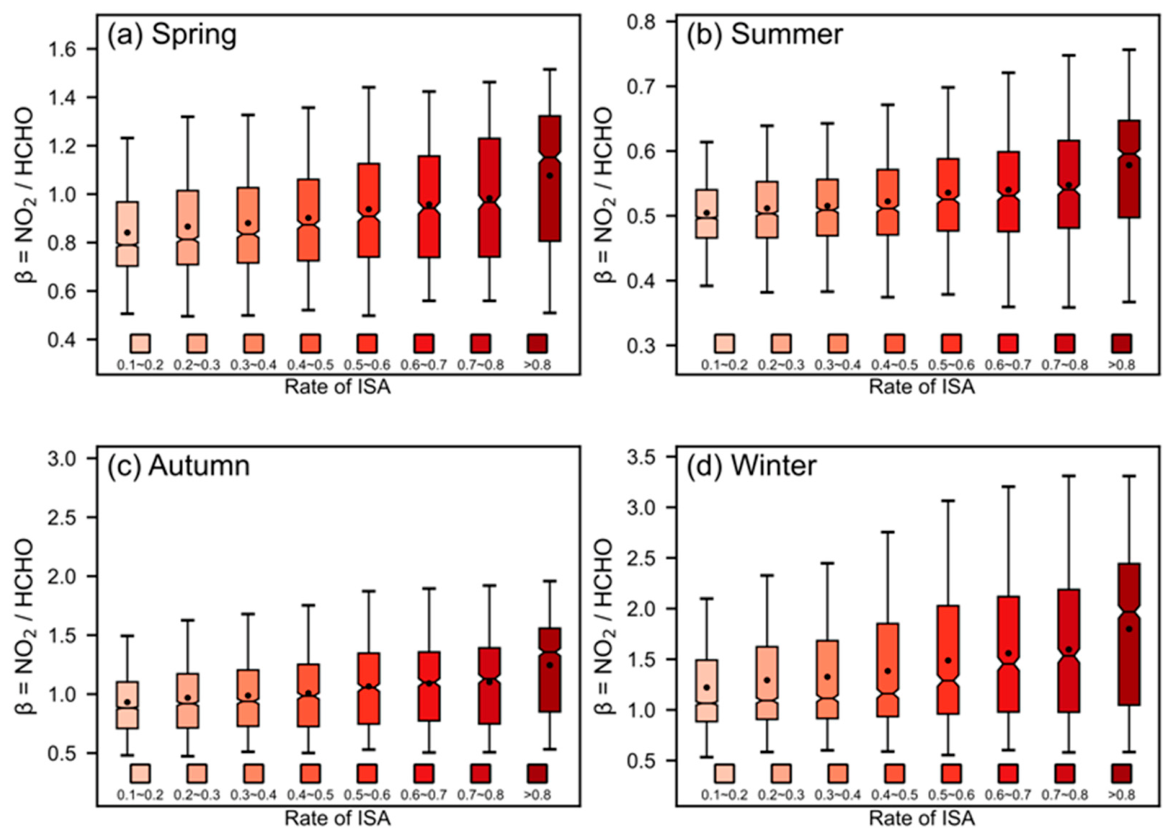
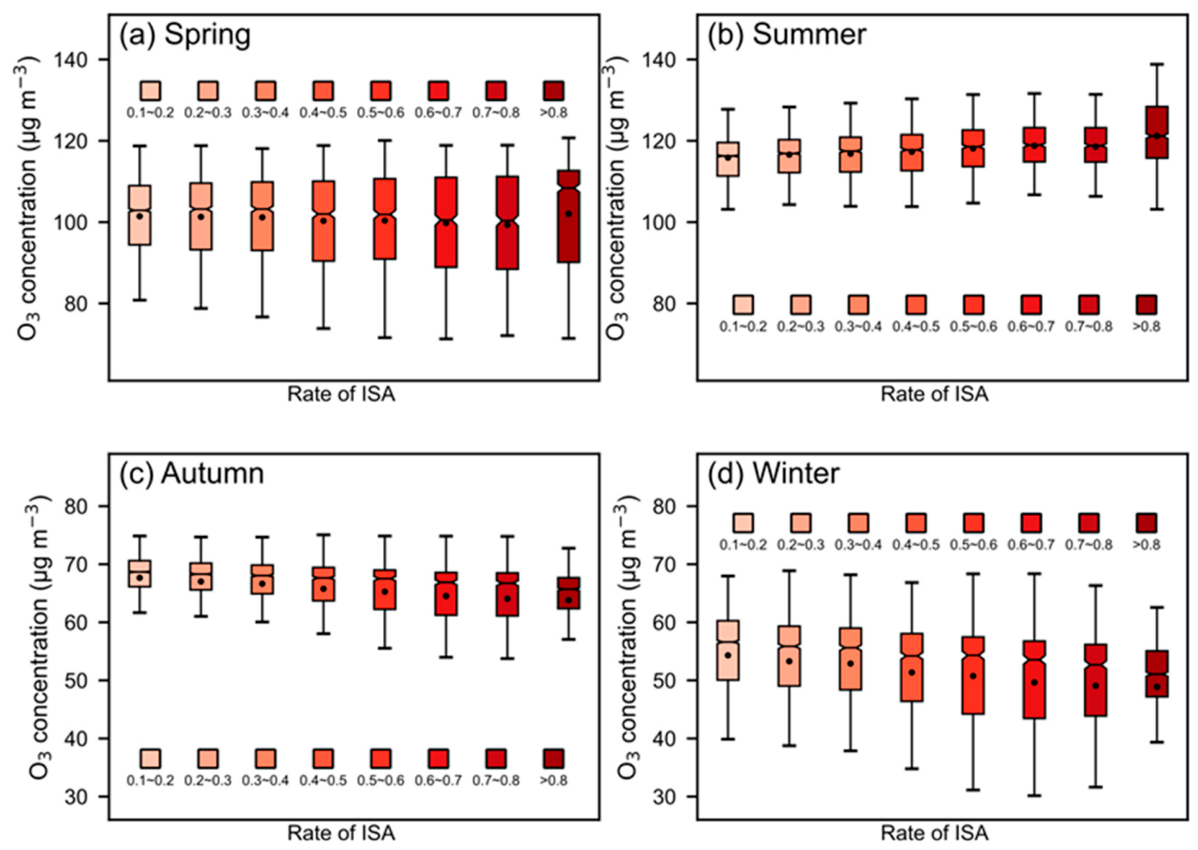
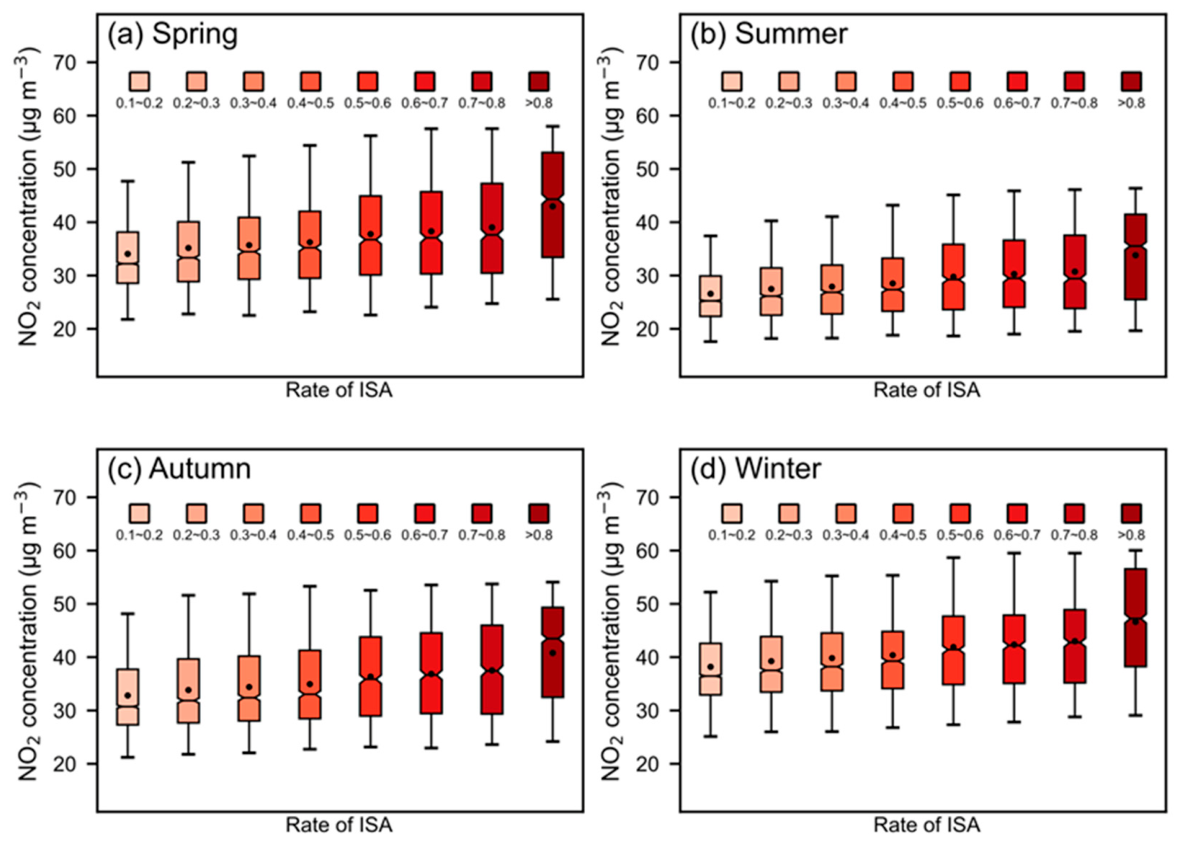
To illustrate the linkage between pollutant concentration and urban land cover level, we aggregated the mean concentrations across ISA fraction bins from 0.1~0.2 to >0.8 for both O3 (Figure 6), NO2 (Figure 7) and β (Figure 8). Generally, mean O3 levels decreased with increasing ISA fraction in most seasons, while NO2 levels exhibited the opposite trend. Specifically, from highest to lowest ISA bins, O3 levels ranged from 102.0 to 101.4 μg m−3 in spring, 121.1 to 115.8 μg m−3 in summer, 63.8 to 67.6 μg m−3 in autumn, and 48.8 to 54.3 μg m−3 in winter. Oppositely, the NO2 levels ranged from 42.9 to 34.0 μg m−3 in spring, 33.8 to 26.5 μg m−3 in summer, 40.7 to 32.8 μg m−3 in autumn, and 46.6 to 38.1 μg m−3 in winter. These results indicate that in cold seasons (autumn and winter), only a certain part of the highly urbanized areas experienced a significantly lower O3 level. Ranging among all ISA bins, the mean values of O3 level are more than twice as high in summer (115.8~121.1 μg m−3) as in winter (48.8~54.3 μg m−3). In contrast, the NO2 levels are higher in winter (38.1~46.6 μg m−3) than in summer (26.5~33.8 μg m−3). Throughout all seasons, the NO2 levels increased with the rise in the ISA fraction, and the concentration range became wider in higher ISA fraction bins (Figure 7). The widening concentration range implies that only specific high ISA fraction areas experience significantly higher NO2 levels. Hence, the divergent responses of O3 and NO2 to ISA fraction indicate that concentration changes are not solely aligned with the ISA level. Alternatively, prominent concentration variations occurred in regions where the high ISA areas were aggregated, such as Chengdu and Chongqing. Then, we calculated β across different ISA (impervious surface area) levels (Figure 8). With increasing ISA, the summer β steadily rose within the range of 0.5~0.6, while the winter values reached a level of 1.2~1.8. Combined with the spatial pattern maps mentioned above, it can be clearly observed that the spatial distribution characteristics of β are primarily determined by NO2.

3.2. Characterization of the Urban Ozone Trap

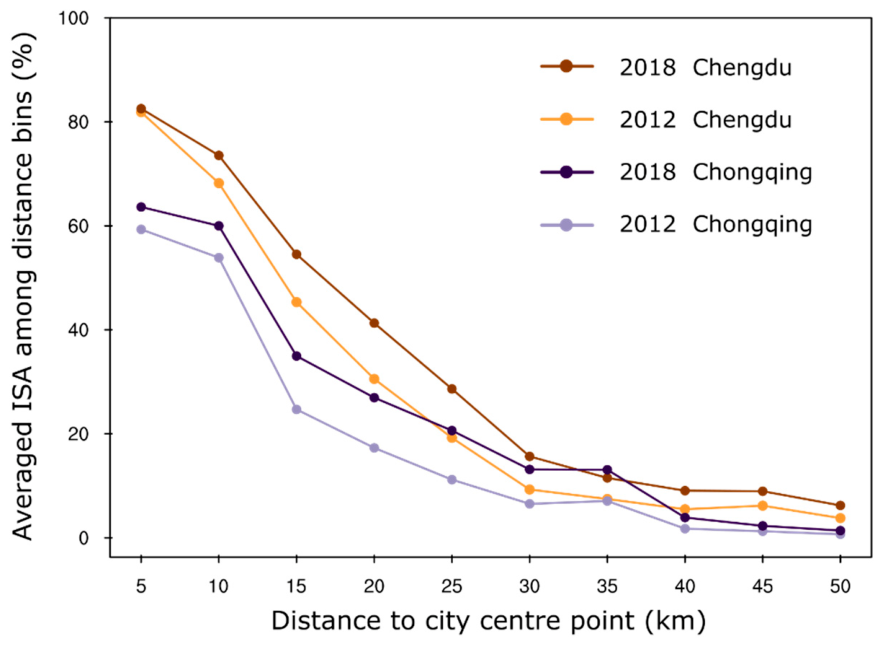
Low O3 levels in the urban core area can result from NO titration [25]. Here, we briefly illustrate a hypothetical mechanism of urban O3 trapping (Figure 9). Since we focus on the two megacities in the Sichuan Basin, we employ a more direct method to characterize the urban–rural gradient of O3 and NO2 levels. First, the urban land cover levels both in Chengdu and Chongqing are compared through the ISA proportions. Along with the distance bins from the city core areas to surrounding rural areas, the mean ISA proportions are shown (Figure 10). In an average within a 5 km radius centered on the core area, the ISA proportion of Chengdu is over 80%, while for Chongqing it is merely over 60%. This 20% difference in ISA persists along the core distance from 5 to 20 km. Beyond a distance of 30 km, ISA proportion decreases to 20% or lower for both Chengdu and Chongqing. In terms of the ISA change from 2012 to 2018, the enhancement is at least 5% within a distance of 10~30 km for Chengdu and 10~35 km for Chongqing. Both the old urban areas within a 10 km distance and the suburban areas within 30 km are relatively insignificant in terms of ISA increase. Therefore, averaged within a 30 km distance from the city core area, the urban land cover level of Chengdu (35.8%) is higher than Chongqing (25.9%) in terms of ISA fraction.
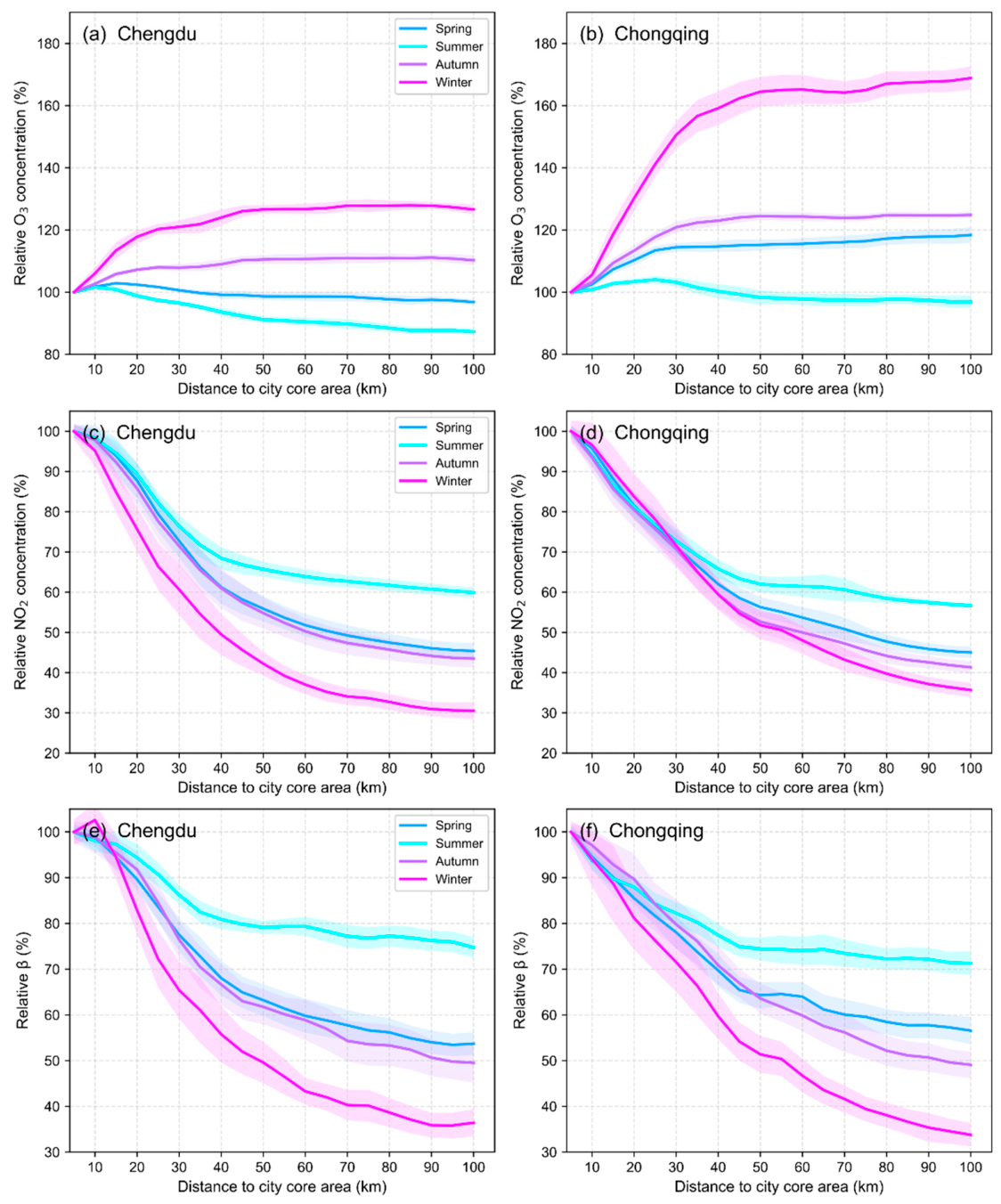
Regarding relative concentrations, O3 exhibits upward trends with increasing distance from the city core areas, while NO2 shows the opposite downward trends (Figure 11). To effectively capture the spatial heterogeneity and ensure statistical rigor, spatial standard deviations (±1 SD, shaded areas) are incorporated, confirming the high spatial robustness of these gradients. Among the seasons, O3 levels increase most rapidly with distance during winter, followed by autumn and spring, whereas NO2 levels decay most rapidly in summer. In terms of the urban–rural gradient during winter, the O3 concentration in Chengdu exceeds 130% at a distance of 40 km and further exceeds 140% at 80 km or beyond (Figure 11a). In Chongqing, the winter O3 gradient is more pronounced. O3 exceeds 140% at a distance of 40 km and approaches 180% at 100 km (Figure 11b). In contrast to O3, the urban–rural gradient of NO2 level is the opposite. NO2 decreases more rapidly with the increase in distance in Chengdu compared to Chongqing. At the distance of 100 km in summer, the relative NO2 concentration is 40% in Chengdu, and 50% in Chongqing (Figure 11c,d). To further validate the reliability of these spatial patterns, a sensitivity analysis was conducted utilizing expanded core radii of 10 km and 15 km (Figures S4 and S5). As expected, expanding the baseline core reference area incorporates less intensely urbanized peri-urban fringes, which slightly attenuates the relative gradient magnitudes (e.g., Chongqing’s maximum relative winter O3 drops to ~160% and ~150% under the 10 km and 15 km baselines, respectively). Nevertheless, considering the ±1 SD spatial variance ranges, the fundamental dipole structure, the seasonal divergences, and the overarching urban–rural gradient trends remain highly robust and statistically consistent across all three spatial scales. Specifically, Table 1 displays urban core area concentrations and urban–rural gradients for O3 and NO2. As reference values, O3 and NO2 levels within a 5 km radius centered on the city core area varied pronouncedly across seasons. The core area level of O3 in Chengdu’s summer is 60.7 μg m−3, while in winter is 22.1 μg m−3, representing a decrease of over 60%. In Chongqing, the O3 level drops over 70% from summer to winter (from 56 to 16.4 μg m−3). In addition, 16.4 μg m−3 is the lowest core area O3 level among all seasons as well as the whole study area. The discrepancy across seasons for the core area level of NO2 is relatively smaller compared to O3. From summer to winter, the range is 34.5~48.6 μg m−3 for Chengdu and 28.7~38.1 μg m−3 for Chongqing. Urban–rural gradients are presented as enhancement/decay rates (slopes) (Table 1). For every 10 km away from the city core area, the winter O3 level increased by 5.19% in Chengdu and 8.98% in Chongqing. In contrast, during summer, these rates were 0.61% (Chengdu) and 1.63% (Chongqing). Correspondingly, in winter, the slopes of NO2 levels were 5.48% (Chengdu) and 4.21% (Chongqing), while in summer they were 6.45% (Chengdu) and 5.56% (Chongqing). Since the urban traffic emits NOx with a substantial portion of NO [43,44], the urban NO titration played a key role in trapping the O3 [4]. Therefore, since these levels and gradients are ambient statuses based on a 7-year-long average (2013–2019), and considering the inversed spatial patterns in O3 and NO2 levels, the O3 trap patterns are related to the NO titration induced by urban vehicle emissions. However, Chongqing has a deeper O3 trap at lower NO2 levels compared to Chengdu. Further, we examined the urban–rural gradients of β across the two cities. It is found that although the gradient of NO2′s urban–rural decay curve in Chongqing is smaller than that in Chengdu, the decay curves of β are nearly identical. Notably in winter, the decay level at 100 km from the urban center even exceeds that of Chengdu (Figure 11e,f). Quantitatively, during winter, the core area level and urban–rural slope of NO2 are 57.8 μg m−3 and −5.34% in Chengdu, while they are 49.6 μg m−3 and −3.17% in Chongqing, respectively (Table 1). When we examine the β instead of solely examining the pattern of NO2, we find that while Chengdu demonstrates a steeper urban–rural decay rate in NO2 concentration compared to Chongqing, the β reveals an inverse pattern—both core area levels and decay rates are higher in Chongqing. Therefore, under the condition of ozone gradient 6.49% (Chongqing) versus 1.88% (Chengdu), although β does not play a decisive role, the spatial behavior of β likely contributes a certain portion to Chongqing’s more pronounced ozone sink effect relative to Chengdu. Since the NO is proportional to NO2 in traffic-related NOx emissions, β should be another chemical factor contributing to the disparity in strength of O3 trapping under NO titration.

3.3. Possible Causes for the Ozone Trap Disparity in Strength

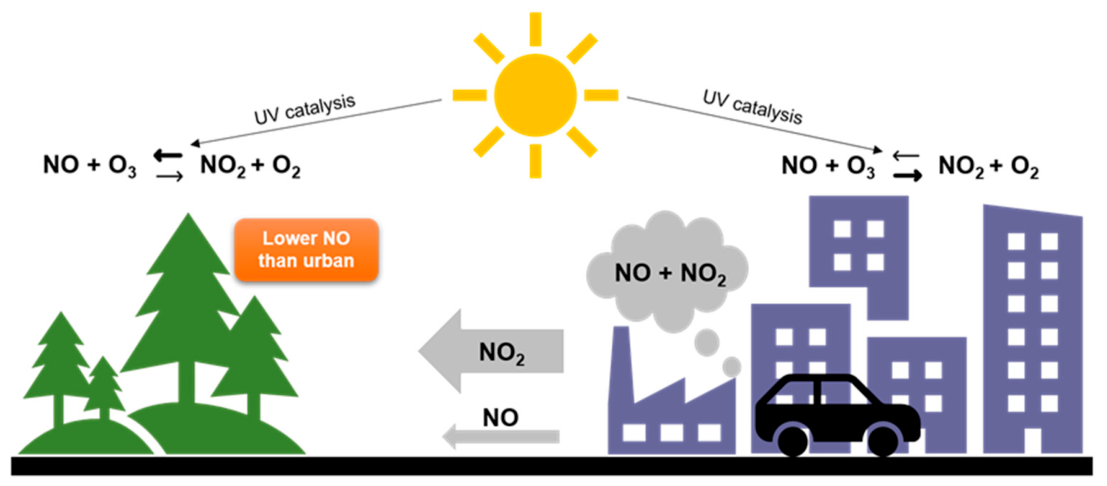
The NOx emissions in urban areas include NO2 and NO [43]. Upon initial NOx emission into the atmosphere, the abundant NO in NOx rapidly initiates NO titration, leading to O3 trapping. During transport to non-urban areas, the titration process depletes most of the NO in NOx, resulting in a higher proportion of NO2 and subsequently slowing down NO titration. Hence, due to persistent NOx emissions in highly urbanized regions, the spatial pattern of the urban O3 trap takes shape. Thus, we here illustrate a brief mechanism for the urban O3 trapping (Figure 9).
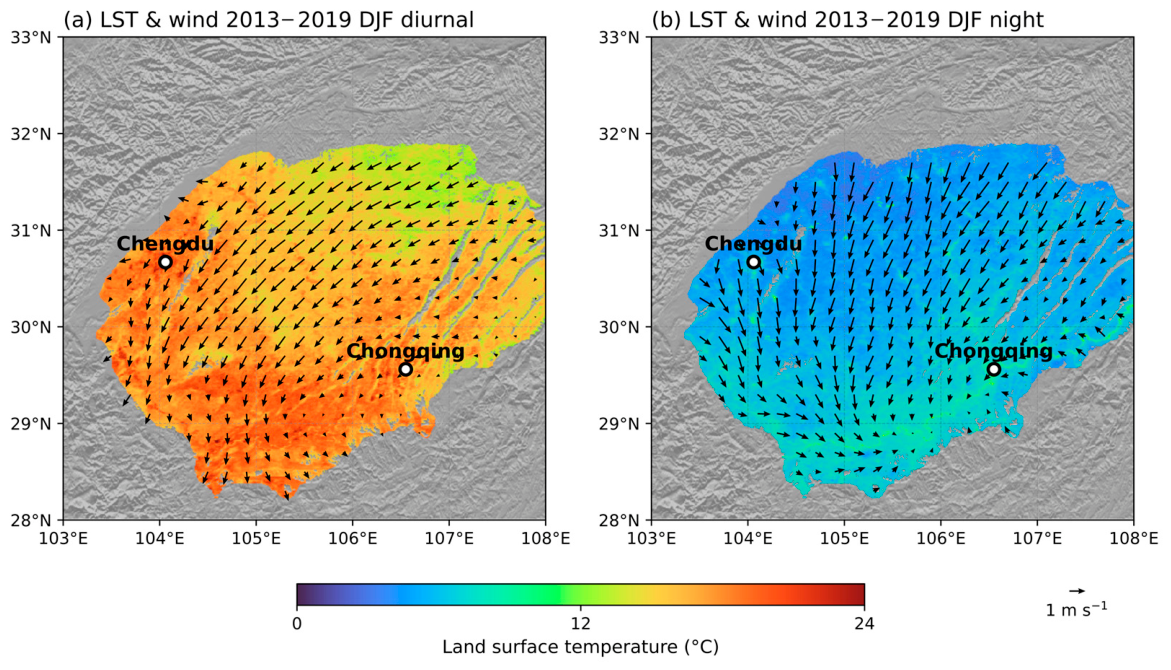
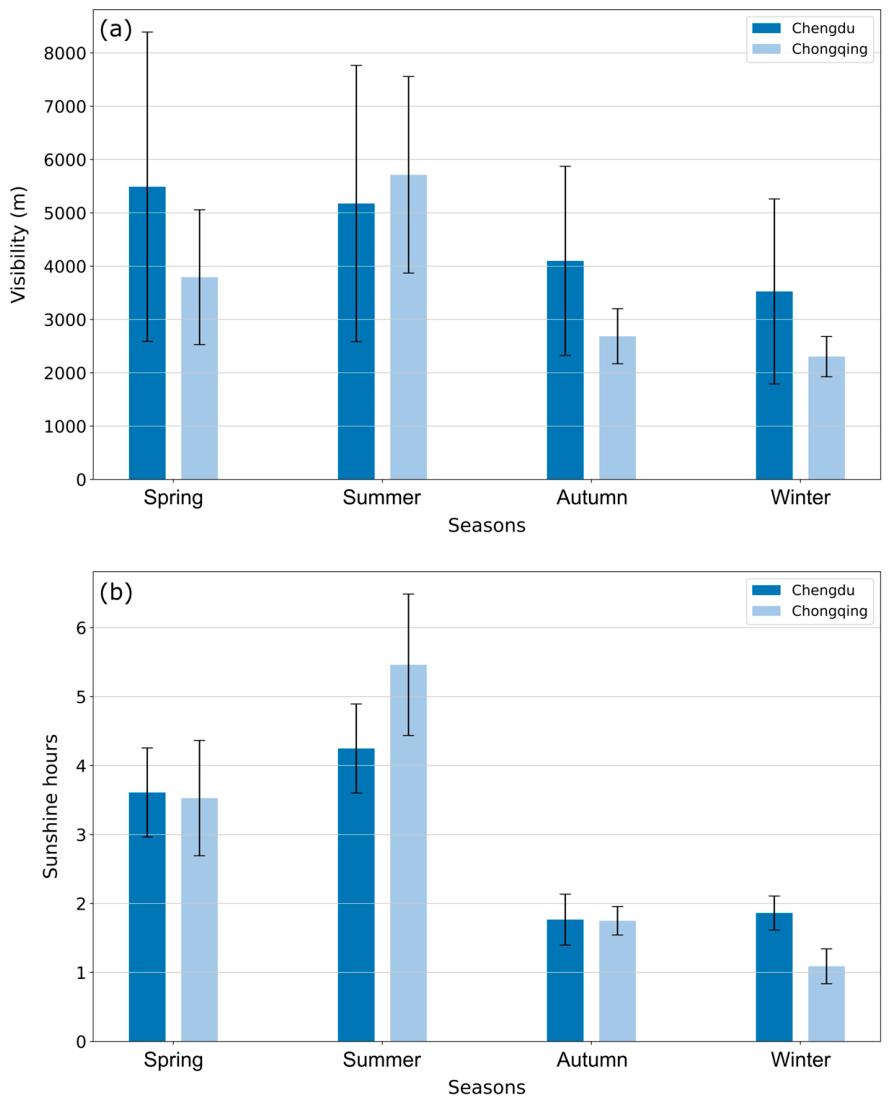
For the O3 levels among seasons, the photolysis of NOx-VOCs is ubiquitously stronger in summer due to the ultra-violet (UV) radiation being more available. However, Chongqing is a less urbanized city than Chengdu but has a deeper O3 trap. Beyond photolytic drivers, the localized thermodynamic and aerodynamic environments significantly modulate the spatial heterogeneity of the O3 trap. To provide a climatological perspective, we analyzed the multi-year (2013–2019) winter mean land surface temperature (LST) and 10 m wind fields in Chengdu and Chongqing (Figure 12). The coupled spatial distributions of surface heating and horizontal ventilation illustrate the distinct diurnal and nocturnal patterns that characterize the trapping intensity in these two megacities. During the study period, atmospheric visibility in Chongqing was at least 20% lower than in Chengdu in all seasons except for summer. It is worth noting that Chongqing is commonly referred to as the ‘fog city’, a name that has been rumored since ancient times across southwest China. The lowest winter atmospheric visibility in Chongqing (less than 2500 m) and the shortest winter sunshine duration (barely over 1 h) can contribute to the intense O3 trapping in winter in Chongqing.
Further, we presented the combination of land surface temperature (LST) and near-surface wind (Figure 13). The main difference between Chengdu and Chongqing appears at nighttime, where Chongqing exhibits prominently lower wind speed than Chengdu. In particular, nighttime wind speeds in Chengdu/Chongqing were 1.02/0.40 m s−1 and 0.46/0.18 m s−1 in 2018 and 2019, respectively. From the perspective of atmospheric circulation, the dominant circulation pattern over the Sichuan Basin is controlled by a larger-scale system instead of the in situ heat pattern of the urban area. Ultimately, the meteorological conditions align more closely with the ozone trap pattern rather than the chemical condition, which dominated land surface ozone behavior.
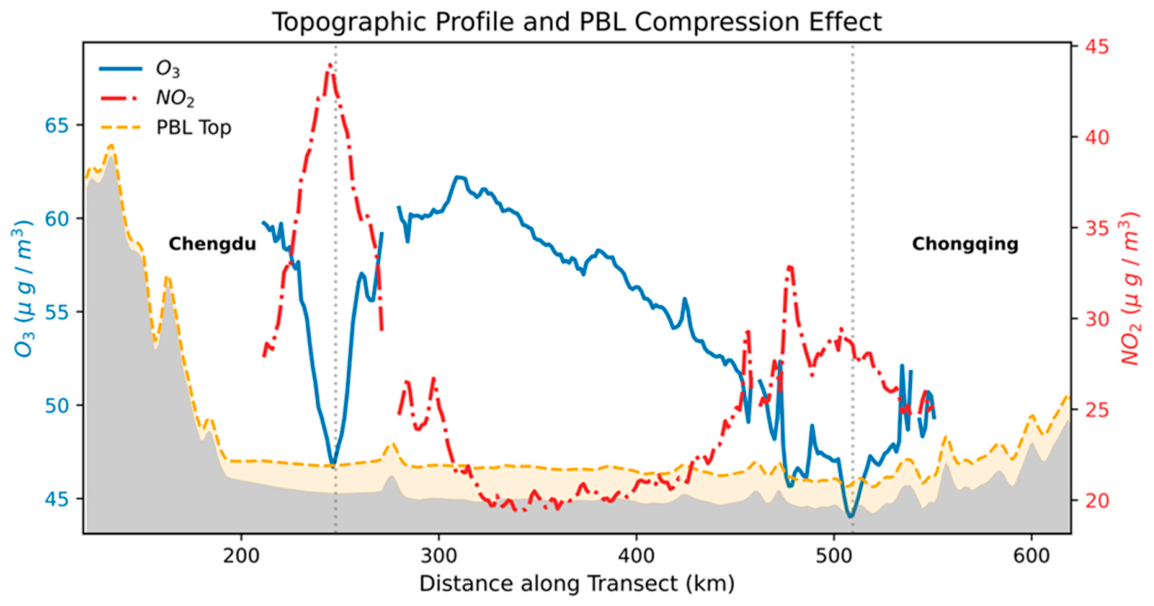
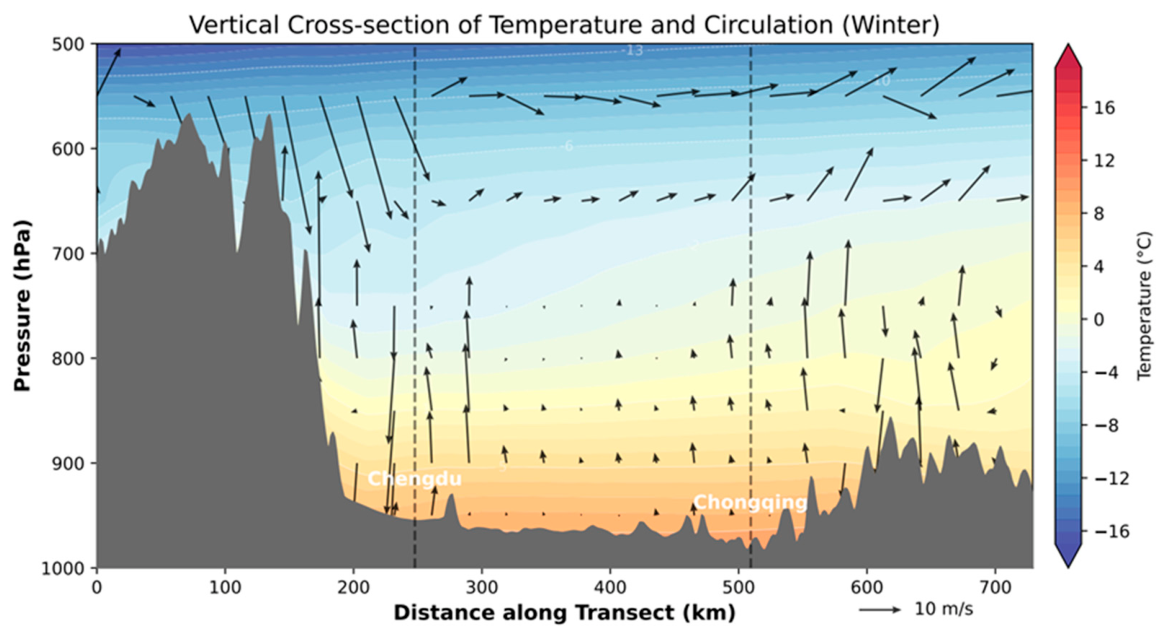
To further elucidate the physical mechanisms underlying this disparity, vertical atmospheric and topographic profiles across the basin were analyzed. The northwest–southeast transect reveals a pronounced boundary layer compression over Chongqing. Nestled within a multi-shielded sub-valley, Chongqing experiences a topographically induced deep-well effect, severely restricting its effective vertical mixing volume compared to the relatively flat Chengdu Plain (Figure 14). This topographic shielding is coupled with strong wintertime thermal inversions and exceptionally weak vertical velocities (Figure 15), which suppress mixing in the surface boundary layer. Importantly, these distinct aerodynamic constraints act as crucial physical modulators rather than independent drivers. By physically trapping precursor emissions (NOx) within a compressed urban canopy, this severe meteorological stagnation dynamically exacerbates the non-linear chemical NO titration. This synergistic coupling of restricted atmospheric ventilation and intensified chemical depletion quantitatively explains why Chongqing exhibits a deeper and more persistent ozone trap, despite its relatively lower urban land cover.

4. Discussion

Beyond the UV catalysis, many other factors could modulate the reaction balance between NO titration and O3 production such as the atmospheric concentration of particulate matter (PM) or volatile organic compounds (VOCs) [45]. Our exploration of the seasonal spatial patterns of PM2.5 (Figure S2) and PM10 (Figure S3) during the study period shows that the PM levels are notably higher in winter in the study area. From spring to winter, the averaged PM2.5/PM10 are 48.5/83.8 μg m−3, 32.1/55.4 μg m−3, 43.0/67.4 μg m−3, and 75.3/108.5 μg m−3, respectively. Further, PM2.5 and PM10 levels in the urban core area of Chongqing are lower than those in Chengdu. In Chengdu, PM2.5/PM10 levels in spring, summer, autumn, and winter are 61.0/109.5 μg m−3, 37.0/63.4 μg m−3, 51.1/82.2 μg m−3, and 95.0/141.9 μg m−3, respectively, whereas the corresponding levels in Chongqing are 47.8/81.1 μg m−3, 34.8/60.3 μg m−3, 50.2/77.7 μg m−3, and 81.1/110.9 μg m−3, respectively. Considering that the core area O3 levels in Chongqing are lower than those in Chengdu, it is unlikely that the high PMx played a primary role in enhancing the O3 trapping effect. Indeed, large-scale background atmospheric circulations also have an influence on ground O3. For instance, through altering the cloud-cover fraction and UV radiation, the Madden–Julian Oscillation macroscopically modulates surface O3 in a tropical city located on the east coast of the Pacific Ocean [46]. In Northern China, typical weather patterns related to temperature, humidity, and circulation are found to facilitate O3 pollution events; technically, a weather pattern index can capture nearly 80% of the observed events [47]. Crucially, the highly non-linear chemistry of O3 formation must be considered. While satellite-derived HCHO/NO2 ratios serve as practical spatial proxies, actual O3 sensitivity is governed by specific VOC reactivity and radical chemistry. Nevertheless, recent ground-based observational studies and box modeling specific to the Sichuan Basin confirm that the urban cores of Chengdu and Chongqing are fundamentally situated within a VOC-limited regime [48]. This localized ground-truth validation corroborates satellite-based diagnosis that intensified NO titration drives the urban O3 depletion [49]. In the Sichuan Basin, the observed average PM2.5 level in summer decreased by 39% during 2013–2017 [50]. Based on surface air mass trajectory analyses, a previous study revealed that the Tibetan Plateau could transmit O3 to adjacent cities near the western margin of the Sichuan Basin. This replenishment of O3 from the western highlands may weaken the urban–rural O3 gradient in Chengdu [51,52]. However, in our study, urban O3 trapping is characterized by a 7-year-long averaged estimation, providing a climatological spatial pattern. Hence, short-term in situ transportation perturbations are unlikely to have a pronounced impact on the multi-year mean gradients. A 6-year-long (2015–2020) study on O3 and PM2.5 across China’s main city clusters showed a decreasing trend in PM2.5 concurrent with an increase in O3 [53]. Specifically, PM2.5 decreased by −2.8 μg m−3 year−1, and O3 decreased by 2.1 μg m−3 year−1 [54]. In combination with the enhanced seasonality of O3 [55], the spatial inconsistency of surface O3 is more likely to intensify, suggesting that the urban–rural O3 gradient (or urban O3 trapping) in the Sichuan Basin has the potential to strengthen. Thus, when the ambient O3 level in rural regions continues to rise, O3 exposure will pose a more serious threat to crops and vegetation [56,57]. This is especially critical for the urban clusters in our study region, which are surrounded by large areas of croplands (Figure 1b).
In contrast to the response of O3 to sudden emission reductions [58], the spatial patterns of O3 levels in our study area exhibited a long-term stable state. Except for Chengdu and Chongqing, other smaller cities with lower urbanization levels did not exhibit comparable O3 traps in the study area. Theoretically, there should be a discernible urban–rural gradient in O3 levels due to the disparity in emissions between urban and rural regions [59]. Thus, it is likely that the O3 trapping in megacities offsets, and even overrides, the spatial pattern of the urban–rural gradient in these neighboring smaller cities. Using a 7-year climatological average, our analysis reveals O3 traps, rather than mere urban–rural gradients, in near-surface O3 levels within the two megacities of the Sichuan Basin. These findings enhance our understanding of the surface O3 pattern and its meteorological and chemical modulators, offering a foundation for assessing future O3 pollution threats.
Finally, several uncertainties and limitations in this study should be noted. First, TROPOMI observes tropospheric column densities rather than near-surface mixing ratios. Although column data are widely used as proxies for surface emissions, variations in planetary boundary layer dynamics can cause vertical decoupling. Second, while ERA5-Land offers high-resolution meteorological fields, reanalysis data inherently possess uncertainties in accurately simulating near-surface wind fields over complex basin topographies and within dense urban canopies. Furthermore, this study utilizes impervious surface area (ISA) primarily as an indicator of physical land cover; future investigations should incorporate multidimensional urban metrics (e.g., 3D building morphology and traffic intensity) to comprehensively disentangle the impacts of urban land cover on the O3 trap.

5. Conclusions

We used the satellite-based ISA data and a high-resolution gridded air pollutant dataset to evaluate the response of the ground surface O3 and NO2 to different physical urban footprints during 2013–2019 in the Sichuan Basin. Based on the multi-year climatological mean, O3 exhibits a negative spatial correlation with the ISA fraction, whereas NO2 shows the opposite trend. Spatial analysis revealed two prominent O3 depletion centers localized within the urban cores of Chengdu and Chongqing. Specifically, during winter, the maximum daily average 8 h O3 level in the urban cores of Chengdu and Chongqing and Chengdu drops to 27.5 and 47.9 μg m−3, respectively, and both are significantly lower than the regional background average of 54.3 μg m−3. By employing concentric radius bins to quantify the urban–rural gradients, we identified a paradoxically deeper O3 trap in Chongqing, despite its relatively smaller physical urban footprint compared to Chengdu. This is characterized by a remarkably steep outward positive gradient; from the minimum of 27.5 μg m−3 in the winter core of Chongqing, O3 levels increase by 6.49% (10 km)−1 radially.
To explain this disparity, we demonstrate that the spatial gradients of the O3 trap are profoundly modulated by a synergistic coupling of localized topographically driven meteorological constraints and non-linear photochemistry. Chemically, the urban core of Chongqing is deeply situated in a severe VOC-limited regime, intensifying the non-linear NO titration that heavily depletes O3. Meteorologically, Chongqing’s complex multi-mountain topography induces severe boundary layer compression and aerodynamic stagnation. This deep-well effect fundamentally restricts atmospheric ventilation (e.g., persistently lower wind speeds), locking massive NOx emissions within the urban canopy. Ultimately, it is this physical stagnation exacerbating the chemical titration that causes Chongqing to exhibit a much deeper and more persistent ozone trap.

Supplementary Materials

The following supporting information can be downloaded at: https://www.mdpi.com/article/10.3390/rs18101657/s1, Figure S1: Relative distance from the city core for Chengdu (a) and Chongqing (b) at a horizontal resolution of 1 km × 1 km.; Figure S2: Spatial patterns for PM2.5 concentrations across seasons during 2013–2019; Figure S3: Spatial patterns for PM10 concentrations across seasons during 2013–2019; Figure S4: Relative O3, NO2, and β levels along with the core area distance in Chengdu (a,c,e) and Chongqing (b,d,f) across seasons. The average value within a 10 km radius centered on the city core area is used as the reference value. The gradients are calculated within 10~100 km. The shaded areas represent standard deviation (±1 σ); Figure S5: Relative O3, NO2, and β levels along with the core area distance in Chengdu (a,c,e) and Chongqing (b,d,f) across seasons. The average value within a 15 km radius centered on the city core area is used as the reference value. The gradients are calculated within 15~100 km. The shaded areas represent standard deviation (±1 σ).

Author Contributions

Conceptualization, Z.J.; methodology, Z.J.; software, Y.L.; validation, Y.L., W.W. and X.S.; formal analysis, C.W.; investigation, Z.J.; resources, Y.L.; data curation, C.W., and W.W.; writing—original draft preparation, C.W.; writing—review and editing, Z.J.; visualization, C.W.; supervision, L.D., X.S., G.L., and H.S.; funding acquisition, Z.J. All authors have read and agreed to the published version of the manuscript.

Funding

This work was supported by the Sichuan Science and Technology Program (grant no. 2025ZNSFSC1135), the National Natural Science Foundation of China (grant no. 42505115), the Shanghai Key Laboratory of Ocean-Land-Atmosphere Boundary Dynamics and Climate Change (grant no. FDAOS-OP202411), the Youth Innovation Team of Sichuan Meteorological Bureau (SCQXQNCXTD202406), and the Everest Initiative Interdisciplinary Team Project of Chengdu University of Technology (grant no. 2024ZF11422).

Data Availability Statement

The raw data supporting the conclusions of this article will be made available by the authors on request.

Acknowledgments

Authors appreciate the Global Multi-resolution Terrain Elevation Data 2010 courtesy of the U.S. Geological Survey.

Conflicts of Interest

The authors declare no conflicts of interest.

Abbreviations

The following abbreviations are used in this manuscript:
VOCsVolatile organic compounds
GAIAGlobal annual impervious area GAIA
ISAImpervious surface area
LSTLand surface temperature
MDA8Maximum daily average 8 h

References

  1. Sillman, S. The relation between ozone, NOx and hydrocarbons in urban and polluted rural environments. Atmos. Environ. 1999, 33, 1821–1845. [Google Scholar] [CrossRef]
  2. Kleinman, L.I. Low and high NOx tropospheric photochemistry. J. Geophys. Res. Atmos. 1994, 99, 16831–16838. [Google Scholar] [CrossRef]
  3. Lelieveld, J.; Dentener, F.J. What controls tropospheric ozone? J. Geophys. Res. Atmos. 2000, 105, 3531–3551. [Google Scholar] [CrossRef]
  4. Murphy, J.G.; Day, D.A.; Cleary, P.A.; Wooldridge, P.J.; Millet, D.B.; Goldstein, A.H.; Cohen, R.C. The weekend effect within and downwind of Sacramento—Part 1: Observations of ozone, nitrogen oxides, and VOC reactivity. Atmos. Chem. Phys. 2007, 7, 5327–5339. [Google Scholar] [CrossRef]
  5. Mickley, L.J.; Murti, P.P.; Jacob, D.J.; Logan, J.A.; Koch, D.M.; Rind, D. Radiative forcing from tropospheric ozone calculated with a unified chemistry-climate model. J. Geophys. Res. Atmos. 1999, 104, 30153–30172. [Google Scholar] [CrossRef]
  6. Unger, N.; Shindell Drew, T.; Koch Dorothy, M.; Streets David, G. Cross influences of ozone and sulfate precursor emissions changes on air quality and climate. Proc. Natl. Acad. Sci. USA 2006, 103, 4377–4380. [Google Scholar] [CrossRef]
  7. Monks, P.S.; Archibald, A.T.; Colette, A.; Cooper, O.; Coyle, M.; Derwent, R.; Fowler, D.; Granier, C.; Law, K.S.; Mills, G.E.; et al. Tropospheric ozone and its precursors from the urban to the global scale from air quality to short-lived climate forcer. Atmos. Chem. Phys. 2015, 15, 8889–8973. [Google Scholar] [CrossRef]
  8. Liu, W.; Hegglin, M.I.; Checa-Garcia, R.; Li, S.; Gillett, N.P.; Lyu, K.; Zhang, X.; Swart, N.C. Stratospheric ozone depletion and tropospheric ozone increases drive Southern Ocean interior warming. Nat. Clim. Change 2022, 12, 365–372. [Google Scholar] [CrossRef]
  9. Anenberg Susan, C.; Schwartz, J.; Shindell, D.; Amann, M.; Faluvegi, G.; Klimont, Z.; Janssens-Maenhout, G.; Pozzoli, L.; Van Dingenen, R.; Vignati, E.; et al. Global Air Quality and Health Co-benefits of Mitigating Near-Term Climate Change through Methane and Black Carbon Emission Controls. Environ. Health Perspect. 2012, 120, 831–839. [Google Scholar] [CrossRef]
  10. Tai, A.P.K.; Martin, M.V.; Heald, C.L. Threat to future global food security from climate change and ozone air pollution. Nat. Clim. Change 2014, 4, 817–821. [Google Scholar] [CrossRef]
  11. Lelieveld, J.; Evans, J.S.; Fnais, M.; Giannadaki, D.; Pozzer, A. The contribution of outdoor air pollution sources to premature mortality on a global scale. Nature 2015, 525, 367–371. [Google Scholar] [CrossRef] [PubMed]
  12. Yue, X.; Unger, N.; Harper, K.; Xia, X.; Liao, H.; Zhu, T.; Xiao, J.; Feng, Z.; Li, J. Ozone and haze pollution weakens net primary productivity in China. Atmos. Chem. Phys. 2017, 17, 6073–6089. [Google Scholar] [CrossRef]
  13. Wang, T.; Xue, L.; Brimblecombe, P.; Lam, Y.F.; Li, L.; Zhang, L. Ozone pollution in China: A review of concentrations, meteorological influences, chemical precursors, and effects. Sci. Total Environ. 2017, 575, 1582–1596. [Google Scholar] [CrossRef]
  14. Lu, X.; Hong, J.; Zhang, L.; Cooper, O.R.; Schultz, M.G.; Xu, X.; Wang, T.; Gao, M.; Zhao, Y.; Zhang, Y. Severe Surface Ozone Pollution in China: A Global Perspective. Environ. Sci. Technol. Lett. 2018, 5, 487–494. [Google Scholar] [CrossRef]
  15. Wang, Y.; Shen, L.; Wu, S.; Mickley, L.; He, J.; Hao, J. Sensitivity of surface ozone over China to 2000–2050 global changes of climate and emissions. Atmos. Environ. 2013, 75, 374–382. [Google Scholar] [CrossRef]
  16. Nelson, B.S.; Drysdale, W.S. Urban ozone trends in Europe and the USA (2000–2021). Atmos. Chem. Phys. 2025, 25, 16009–16026. [Google Scholar] [CrossRef]
  17. Yağcı, C. Linking Urban Land Use Change and Tropospheric Ozone Dynamics in a Mid-Sized City. Land 2026, 15, 456. [Google Scholar] [CrossRef]
  18. Zhang, X.; Zhao, L.; Cheng, M.; Wu, X.; Chen, D. Urban ozone sink inferred from surface measurements in China. J. Clean. Prod. 2020, 253, 119881. [Google Scholar] [CrossRef]
  19. Stasiuk, W.N.; Coffey, P.E. Rural and Urban Ozone Relationships In New York State. J. Air Pollut. Control Assoc. 1974, 24, 564–568. [Google Scholar] [CrossRef] [PubMed]
  20. Dueñas, C.; Fernández, M.C.; Cañete, S.; Carretero, J.; Liger, E. Analyses of ozone in urban and rural sites in Málaga (Spain). Chemosphere 2004, 56, 631–639. [Google Scholar] [CrossRef] [PubMed]
  21. Atkinson Richard, W.; Yu, D.; Armstrong Ben, G.; Pattenden, S.; Wilkinson, P.; Doherty Ruth, M.; Heal Mathew, R.; Anderson, H.R. Concentration–Response Function for Ozone and Daily Mortality: Results from Five Urban and Five Rural U.K. Populations. Environ. Health Perspect. 2012, 120, 1411–1417. [Google Scholar] [CrossRef]
  22. Im, U.; Incecik, S.; Guler, M.; Tek, A.; Topcu, S.; Unal, Y.S.; Yenigun, O.; Kindap, T.; Odman, M.T.; Tayanc, M. Analysis of surface ozone and nitrogen oxides at urban, semi-rural and rural sites in Istanbul, Turkey. Sci. Total Environ. 2013, 443, 920–931. [Google Scholar] [CrossRef] [PubMed]
  23. Betancourt-Odio, A.; Valencia, D.; Soffritti, M.; Budría, S. An analysis of ozone pollution by using functional data: Rural and urban areas of the Community of Madrid. Environ. Monit. Assess. 2021, 193, 401. [Google Scholar] [CrossRef] [PubMed]
  24. Yan, Y.; Lin, J.; Pozzer, A.; Kong, S.; Lelieveld, J. Trend reversal from high-to-low and from rural-to-urban ozone concentrations over Europe. Atmos. Environ. 2019, 213, 25–36. [Google Scholar] [CrossRef]
  25. Wu, K.; Wang, Y.; Qiao, Y.; Liu, Y.; Wang, S.; Yang, X.; Wang, H.; Lu, Y.; Zhang, X.; Lei, Y. Drivers of 2013–2020 ozone trends in the Sichuan Basin, China: Impacts of meteorology and precursor emission changes. Environ. Pollut. 2022, 300, 118914. [Google Scholar] [CrossRef] [PubMed]
  26. Zhao, S.; Yu, Y.; Yin, D.; Qin, D.; He, J.; Dong, L. Spatial patterns and temporal variations of six criteria air pollutants during 2015 to 2017 in the city clusters of Sichuan Basin, China. Sci. Total Environ. 2018, 624, 540–557. [Google Scholar] [CrossRef]
  27. Zhao, S.; Yu, Y.; Qin, D.; Yin, D.; Dong, L.; He, J. Analyses of regional pollution and transportation of PM2.5 and ozone in the city clusters of Sichuan Basin, China. Atmos. Pollut. Res. 2019, 10, 374–385. [Google Scholar] [CrossRef]
  28. Fang, C.; Tan, X.; Zhong, Y.; Wang, J. Research on the Temporal and Spatial Characteristics of Air Pollutants in Sichuan Basin. Atmosphere 2021, 12, 1504. [Google Scholar] [CrossRef]
  29. Ning, G.; Yim, S.H.L.; Yang, Y.; Gu, Y.; Dong, G. Modulations of synoptic and climatic changes on ozone pollution and its health risks in mountain-basin areas. Atmos. Environ. 2020, 240, 117808. [Google Scholar] [CrossRef]
  30. Liao, T.; Gui, K.; Jiang, W.; Wang, S.; Wang, B.; Zeng, Z.; Che, H.; Wang, Y.; Sun, Y. Air stagnation and its impact on air quality during winter in Sichuan and Chongqing, southwestern China. Sci. Total Environ. 2018, 635, 576–585. [Google Scholar] [CrossRef]
  31. Cao, B.; Wang, X.; Ning, G.; Yuan, L.; Jiang, M.; Zhang, X.; Wang, S. Factors influencing the boundary layer height and their relationship with air quality in the Sichuan Basin, China. Sci. Total Environ. 2020, 727, 138584. [Google Scholar] [CrossRef] [PubMed]
  32. Danielson, J.J.; Gesch, D.B. Global Multi-Resolution Terrain Elevation Data 2010 (GMTED2010); U.S. Geological Survey: Reston, VA, USA, 2011; p. 26.
  33. Friedl, M.A.; Sulla-Menashe, D. MCD12Q1 MODIS/Terra+Aqua Land Cover Type Yearly L3 Global 500 m SIN Grid V006 Data Set; NASA Land Processes Distributed Active Archive Center: Sioux Falls, SD, USA, 2019. [CrossRef]
  34. Gong, P.; Li, X.; Wang, J.; Bai, Y.; Chen, B.; Hu, T.; Liu, X.; Xu, B.; Yang, J.; Zhang, W.; et al. Annual maps of global artificial impervious area (GAIA) between 1985 and 2018. Remote Sens. Environ. 2020, 236, 111510. [Google Scholar] [CrossRef]
  35. Li, X.; Gong, P.; Zhou, Y.; Wang, J.; Bai, Y.; Chen, B.; Hu, T.; Xiao, Y.; Xu, B.; Yang, J.; et al. Mapping global urban boundaries from the global artificial impervious area (GAIA) data. Environ. Res. Lett. 2020, 15, 094044. [Google Scholar] [CrossRef]
  36. Yang, Z.; Li, Z.; Cheng, F.; Lv, Q.; Li, K.; Zhang, T.; Zhou, Y.; Zhao, B.; Xue, W.; Wei, J. Two-decade surface ozone (O3) pollution in China: Enhanced fine-scale estimations and environmental health implications. Remote Sens. Environ. 2025, 317, 114459. [Google Scholar] [CrossRef]
  37. Wei, J.; Li, Z.; Wang, J.; Li, C.; Gupta, P.; Cribb, M. Ground-level gaseous pollutants (NO2, SO2, and CO) in China: Daily seamless mapping and spatiotemporal variations. Atmos. Chem. Phys. 2023, 23, 1511–1532. [Google Scholar] [CrossRef]
  38. Wei, J.; Liu, S.; Li, Z.; Liu, C.; Qin, K.; Liu, X.; Pinker, R.T.; Dickerson, R.R.; Lin, J.; Boersma, K.F.; et al. Ground-Level NO2 Surveillance from Space Across China for High Resolution Using Interpretable Spatiotemporally Weighted Artificial Intelligence. Environ. Sci. Technol. 2022, 56, 9988–9998. [Google Scholar] [CrossRef]
  39. Veefkind, J.P.; Aben, I.; McMullan, K.; Förster, H.; de Vries, J.; Otter, G.; Claas, J.; Eskes, H.J.; de Haan, J.F.; Kleipool, Q.; et al. TROPOMI on the ESA Sentinel-5 Precursor: A GMES mission for global observations of the atmospheric composition for climate, air quality and ozone layer applications. Remote Sens. Environ. 2012, 120, 70–83. [Google Scholar] [CrossRef]
  40. Muñoz-Sabater, J.; Dutra, E.; Agustí-Panareda, A.; Albergel, C.; Arduini, G.; Balsamo, G.; Boussetta, S.; Choulga, M.; Harrigan, S.; Hersbach, H.; et al. ERA5-Land: A state-of-the-art global reanalysis dataset for land applications. Earth Syst. Sci. Data 2021, 13, 4349–4383. [Google Scholar] [CrossRef]
  41. Hu, X.; Li, J.; Chen, H.; Yu, R. How well does ERA5 reanalysis depict low-level winds associated with nocturnal rainfall in Sichuan Basin. Atmos. Res. 2026, 330, 108600. [Google Scholar] [CrossRef]
  42. Zhang, Y.; Yin, P.; Li, X.; Niu, Q.; Wang, Y.; Cao, W.; Huang, J.; Chen, H.; Yao, X.; Yu, L.; et al. The divergent response of vegetation phenology to urbanization: A case study of Beijing city, China. Sci. Total Environ. 2022, 803, 150079. [Google Scholar] [CrossRef]
  43. Zhou, R.; Wang, S.; Shi, C.; Wang, W.; Zhao, H.; Liu, R.; Chen, L.; Zhou, B. Study on the Traffic Air Pollution inside and outside a Road Tunnel in Shanghai, China. PLoS ONE 2014, 9, e112195. [Google Scholar] [CrossRef]
  44. Hagenbjörk, A.; Malmqvist, E.; Mattisson, K.; Sommar, N.J.; Modig, L. The spatial variation of O3, NO, NO2 and NOx and the relation between them in two Swedish cities. Environ. Monit. Assess. 2017, 189, 161. [Google Scholar] [CrossRef]
  45. Jin, X.; Fiore, A.; Boersma, K.F.; Smedt, I.D.; Valin, L. Inferring Changes in Summertime Surface Ozone–NOx–VOC Chemistry over U.S. Urban Areas from Two Decades of Satellite and Ground-Based Observations. Environ. Sci. Technol. 2020, 54, 6518–6529. [Google Scholar] [CrossRef]
  46. Barrett, B.S.; Raga, G.B. Variability of winter and summer surface ozone in Mexico City on the intraseasonal timescale. Atmos. Chem. Phys. 2016, 16, 15359–15370. [Google Scholar] [CrossRef]
  47. Gong, C.; Liao, H. A typical weather pattern for ozone pollution events in North China. Atmos. Chem. Phys. 2019, 19, 13725–13740. [Google Scholar] [CrossRef]
  48. Ren, J.; Hao, Y.; Zheng, X.; Li, X.; Xie, S. Ozone response to precursors changes in the Chengdu-Chongqing economic circle, China, from satellite and ground-based observations. Sci. Total Environ. 2024, 953, 176037. [Google Scholar] [CrossRef] [PubMed]
  49. Jin, X.; Holloway, T. Spatial and temporal variability of ozone sensitivity over China observed from the Ozone Monitoring Instrument. J. Geophys. Res. Atmos. 2015, 120, 7229–7246. [Google Scholar] [CrossRef]
  50. Li, K.; Jacob Daniel, J.; Liao, H.; Shen, L.; Zhang, Q.; Bates Kelvin, H. Anthropogenic drivers of 2013–2017 trends in summer surface ozone in China. Proc. Natl. Acad. Sci. USA 2019, 116, 422–427. [Google Scholar] [CrossRef] [PubMed]
  51. Yang, X.; Wu, K.; Wang, H.; Liu, Y.; Gu, S.; Lu, Y.; Zhang, X.; Hu, Y.; Ou, Y.; Wang, S.; et al. Summertime ozone pollution in Sichuan Basin, China: Meteorological conditions, sources and process analysis. Atmos. Environ. 2020, 226, 117392. [Google Scholar] [CrossRef]
  52. Yang, X.; Wu, K.; Lu, Y.; Wang, S.; Qiao, Y.; Zhang, X.; Wang, Y.; Wang, H.; Liu, Z.; Liu, Y.; et al. Origin of regional springtime ozone episodes in the Sichuan Basin, China: Role of synoptic forcing and regional transport. Environ. Pollut. 2021, 278, 116845. [Google Scholar] [CrossRef]
  53. Liu, R.; Ma, Z.; Liu, Y.; Shao, Y.; Zhao, W.; Bi, J. Spatiotemporal distributions of surface ozone levels in China from 2005 to 2017: A machine learning approach. Environ. Int. 2020, 142, 105823. [Google Scholar] [CrossRef]
  54. Deng, C.; Tian, S.; Li, Z.; Li, K. Spatiotemporal characteristics of PM2.5 and ozone concentrations in Chinese urban clusters. Chemosphere 2022, 295, 133813. [Google Scholar] [CrossRef]
  55. Hayashida, S.; Kajino, M.; Deushi, M.; Sekiyama, T.T.; Liu, X. Seasonality of the lower tropospheric ozone over China observed by the Ozone Monitoring Instrument. Atmos. Environ. 2018, 184, 244–253. [Google Scholar] [CrossRef]
  56. Ashmore, M.R. Assessing the future global impacts of ozone on vegetation. Plant Cell Environ. 2005, 28, 949–964. [Google Scholar] [CrossRef]
  57. Grulke, N.E.; Heath, R.L. Ozone effects on plants in natural ecosystems. Plant Biol. 2020, 22, 12–37. [Google Scholar] [CrossRef]
  58. Deroubaix, A.; Brasseur, G.; Gaubert, B.; Labuhn, I.; Menut, L.; Siour, G.; Tuccella, P. Response of surface ozone concentration to emission reduction and meteorology during the COVID-19 lockdown in Europe. Meteorol. Appl. 2021, 28, e1990. [Google Scholar] [CrossRef]
  59. Munir, S.; Chen, H.; Ropkins, K. Quantifying temporal trends in ground level ozone concentration in the UK. Sci. Total Environ. 2013, 458–460, 217–227. [Google Scholar] [CrossRef]
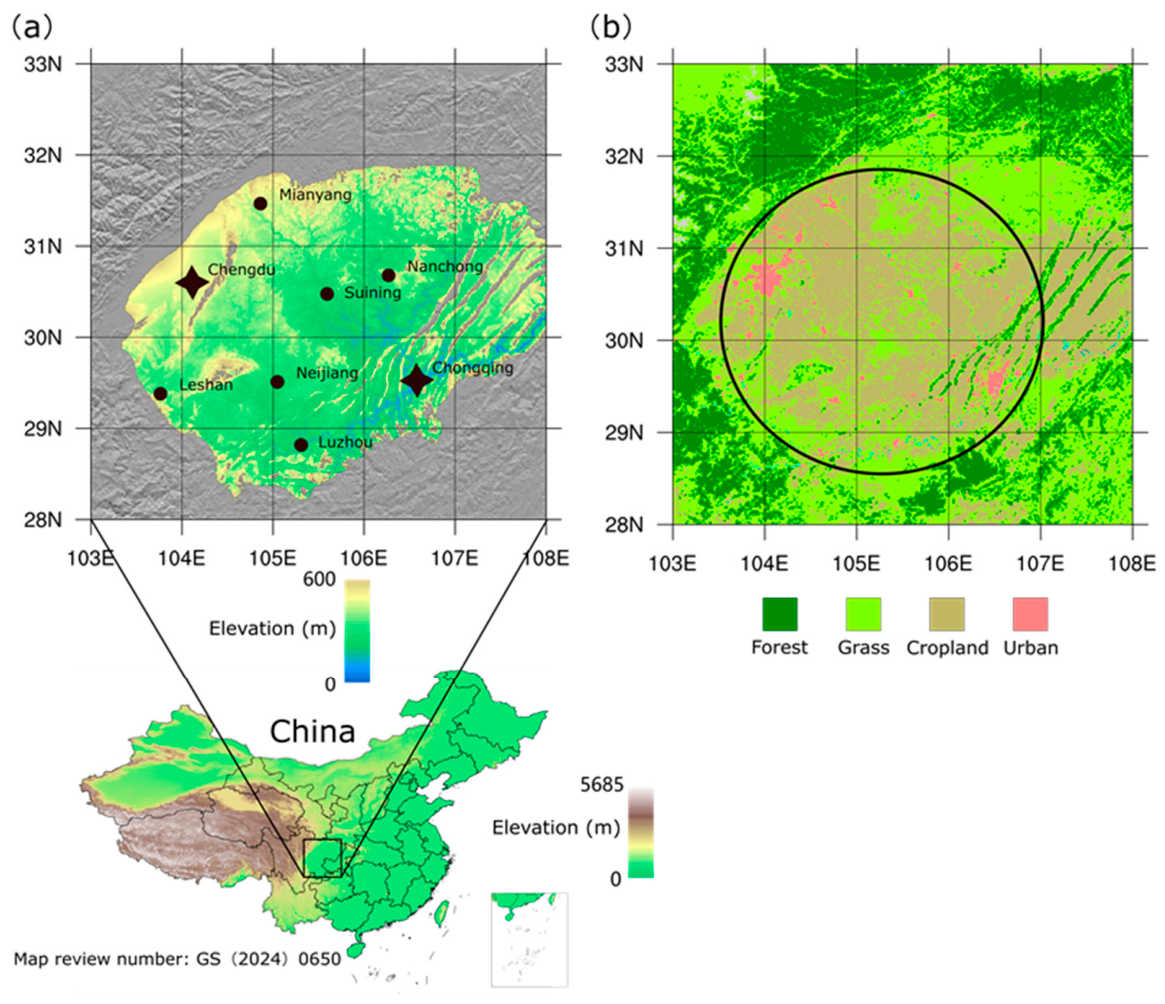
Figure 1. Geographical information of the study area. (a) Location of the Sichuan Basin with major cities. (b) Spatial pattern of land cover types.
Remotesensing 18 01657 g001
Figure 2. Spatial patterns for the rate of impervious surface area (ISA) in 2012 (a) and 2018 (b) in the study area of the Sichuan Basin.
Remotesensing 18 01657 g002
Figure 3. Spatial patterns for MDA8 ozone (O3) concentration across seasons during 2013–2019.
Remotesensing 18 01657 g003
Figure 4. Spatial patterns for nitrogen dioxide (NO2) concentration across seasons during 2013–2019.
Remotesensing 18 01657 g004
Figure 5. Spatial patterns for the concentration ratio of NO2 to formaldehyde across seasons during 2019–2023.
Remotesensing 18 01657 g005
Figure 6. Response of mean O3 concentration to rate of ISA across seasons during 2013–2019. The solid lines in the middle of the boxes are medians, the notches are the 95% confidence interval of the medians, the black dots are mean values, and the whiskers are interquartile ranges.
Remotesensing 18 01657 g006
Figure 7. Response of mean NO2 concentration to rate of ISA across seasons during 2013–2019. The solid lines in the middle of the boxes are medians, the notches are the 95% confidence interval of the medians, the black dots are mean values, and the whiskers are interquartile ranges.
Remotesensing 18 01657 g007
Figure 8. Response of β to rate of ISA across seasons during 2019–2023. The solid lines in the middle of the boxes are medians, the notches are the 95% confidence interval of the medians, the black dots are mean values, and the whiskers are interquartile ranges.
Remotesensing 18 01657 g008
Figure 9. Conceptional schema for the urban ozone trap phenomenon. The thicker arrow in the reaction formula indicates the dominating direction of the atmospheric chemical reaction. The thicker gray arrow indicates a higher proportion of atmospheric NO2 transported from urban to rural regions compared to NO.
Remotesensing 18 01657 g009
Figure 10. The average rates of ISA among distance bins for Chengdu and Chongqing in 2012 and 2018.
Remotesensing 18 01657 g010
Figure 11. Relative O3, NO2, and β levels along with the core area distance in Chengdu (a,c,e) and Chongqing (b,d,f) across seasons. The average value within a 5-km radius centered on the city core area is used as the reference value. The gradients are calculated within 5~100 km. The shaded areas represent standard deviation (±1 σ).
Remotesensing 18 01657 g011
Figure 12. Average land surface temperature (LST) and 10 m wind during winter (DJF) from MODIS Aqua and ERA5-Land.
Remotesensing 18 01657 g012
Figure 13. Meteorological conditions from ground-based automatic stations in Chengdu and Chongqing across seasons during 2013–2019. (a) Atmospheric minimum visibility. (b) Daily average sunshine duration. Error bars represent one standard deviation of the yearly series.
Remotesensing 18 01657 g013
Figure 14. Topographic profile, planetary boundary layer (PBL) compression, and spatial gradients of wintertime pollutants along a northwest–southeast transect across the Sichuan Basin. The solid blue line and dash-dotted red line represent the mass concentrations of surface O3 and NO2, corresponding to the left and right y-axes, respectively. The gray shaded area indicates the terrain elevation derived from DEM data. The dashed orange line represents the absolute altitude of the PBL top (terrain elevation plus PBL height), with the light orange shading visualizing the effective vertical atmospheric mixing volume.
Remotesensing 18 01657 g014
Figure 15. Vertical cross-section of temperature and atmospheric circulation along a northwest–southeast transect across the Sichuan Basin during winter. The color shading represents the vertical distribution of air temperature (°C) from the surface up to 500 hPa, with overlaid white contour lines indicating specific isotherms. The black arrows represent the two-dimensional wind vectors, comprising the along-transect horizontal wind and the scaled vertical velocity. The dark gray shaded area at the bottom denotes the terrain elevation profile converted to pressure coordinates (hPa).
Remotesensing 18 01657 g015
Table 1. Averaged concentrations within 5 km radius centered on the core area and the urban–rural gradients of relative O3 and NO2 levels and the NO2/HCHO ratio.
CityPollutantSeason
SpringSummerAutumnWinter
CoreSlopeCoreSlopeCoreSlopeCoreSlope
ChengduO3110.1−0.50127.8−1.6762.31.0247.91.88
NO255.7−5.2644.9−5.0751.0−5.4957.8−5.34
NO2/HCHO1.38−4.780.67−2.231.65−5.342.43−6.22
ChongqingO378.11.03117.3−0.5648.02.8027.56.49
NO249.3−3.4640.1−3.9147.8−3.8849.62−3.17
NO2/HCHO1.28−4.150.65−2.201.42−5.662.53−6.77
Values on the left side are core area concentrations of O3 and NO2 (μg m−3), while on the right side are concentration slopes (% (10 km)−1), representing the variability of O3 and NO2 concentrations for every incremental 10 km radius distance centered on the city’s core area. The NO2/HCHO indicates a ratio of between NO2 and HCHO during 2019–2023 from Sentinel-5P, and their core area concentration levels and slopes are calculated in the same way as above.
Disclaimer/Publisher’s Note: The statements, opinions and data contained in all publications are solely those of the individual author(s) and contributor(s) and not of MDPI and/or the editor(s). MDPI and/or the editor(s) disclaim responsibility for any injury to people or property resulting from any ideas, methods, instructions or products referred to in the content.