Space–Air–Ground Synergistic Approaches for Field Water Status Precision Monitoring: A Review



Highlights
- There are two core issues in space–air–ground field water status monitoring: unresolved scale mismatch and error propagation in multi-source data fusion, and a lack of reliable quantitative retrieval for root zone soil moisture and paddy field water depth.
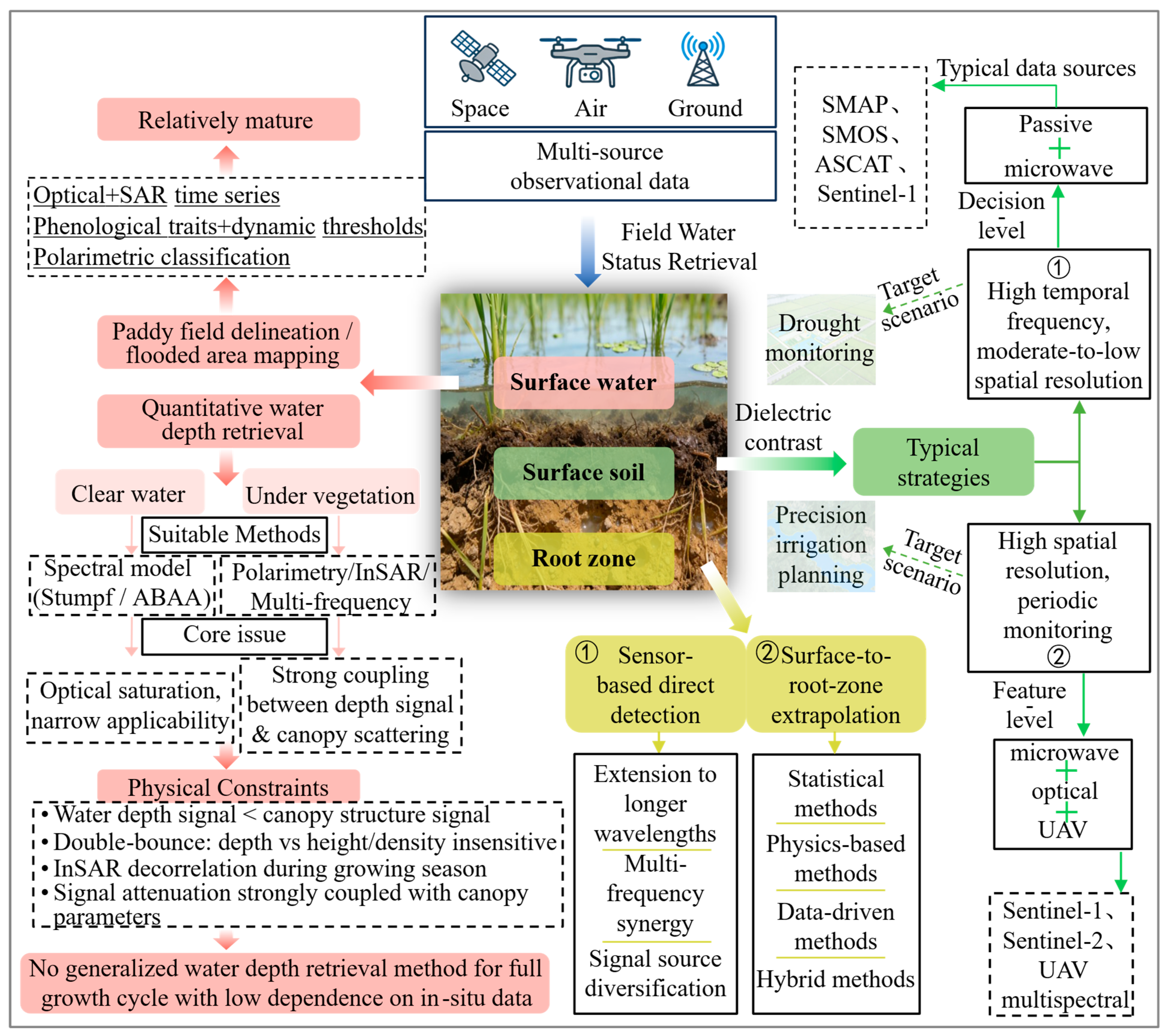
- This study provides a methodological reference framework for field water status monitoring tailored to different agricultural scenarios.
- Two major methodological challenges, scale transformation and error quantification, and two critical research gaps, root zone soil moisture retrieval and paddy field water depth retrieval, are identified.
Abstract
1. Introduction
2. Data Sources and Bibliometric Analysis
2.1. Data Retrieval and Screening
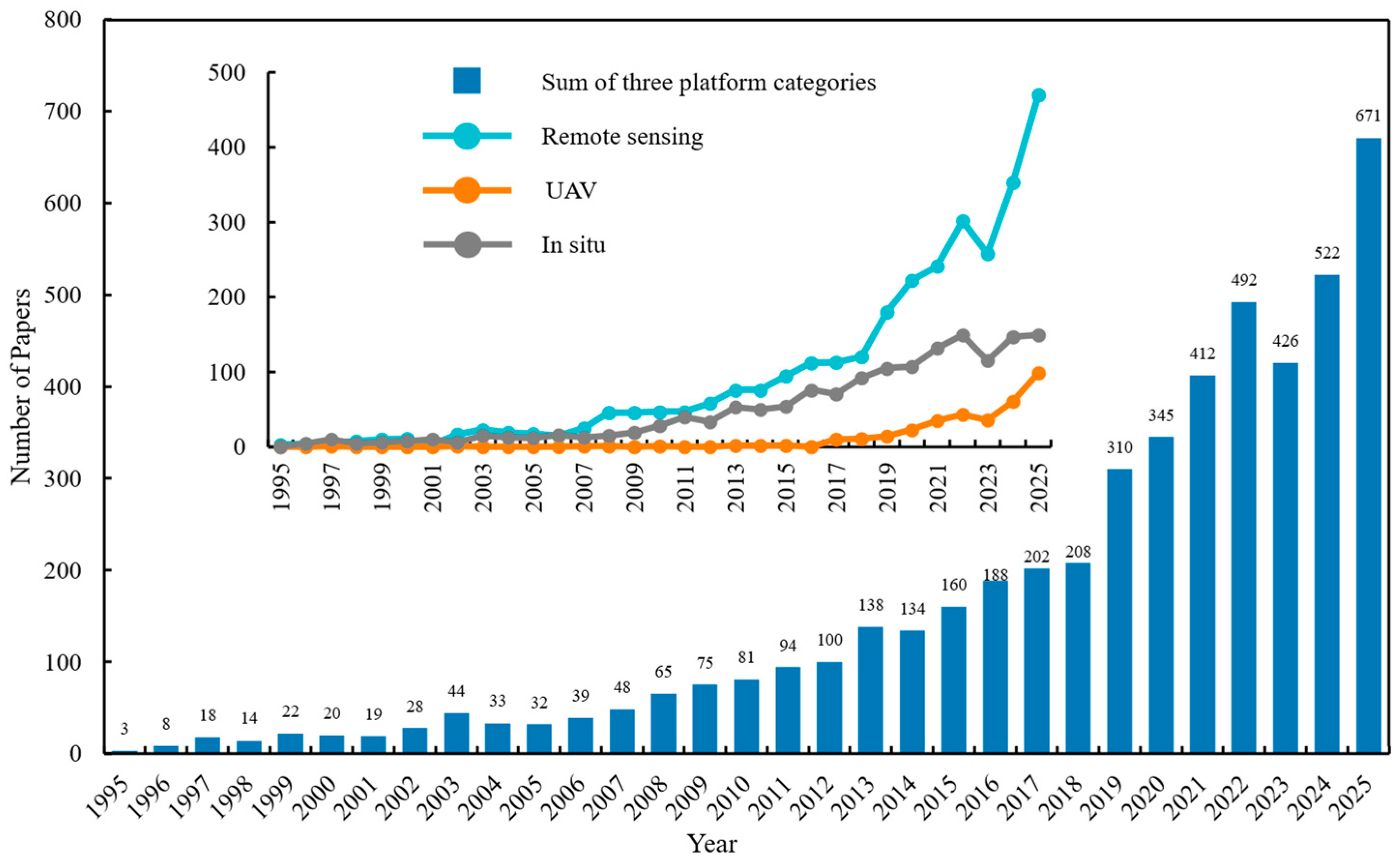
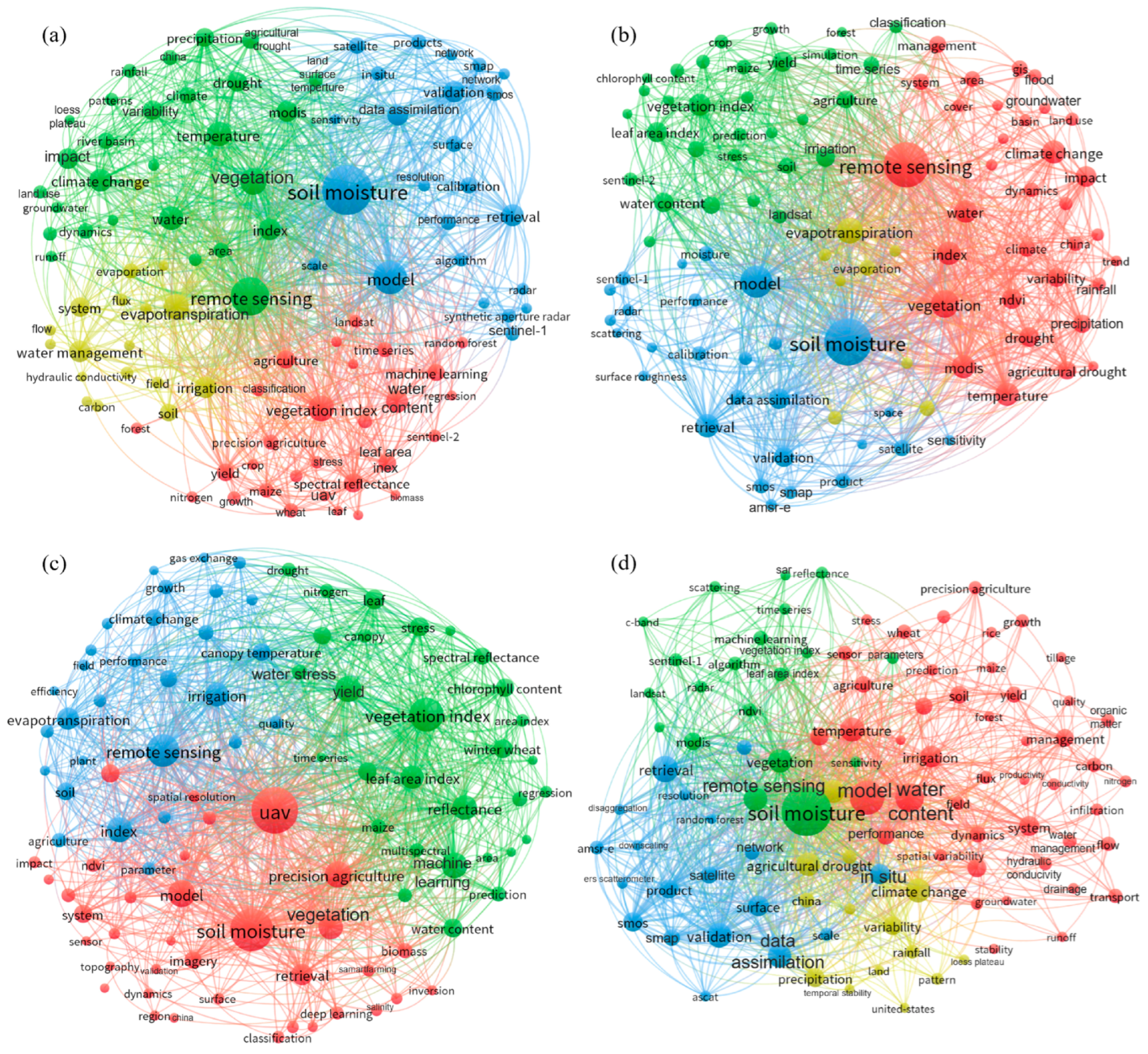
2.2. Bibliometric Analysis Results
3. Space–Air–Ground Integrated Technical System for Field Water Status Monitoring and Data Fusion Methods
3.1. Data Sources for Field Water Status Monitoring
3.1.1. Ground-Based Monitoring for Field Water Status Data Acquisition
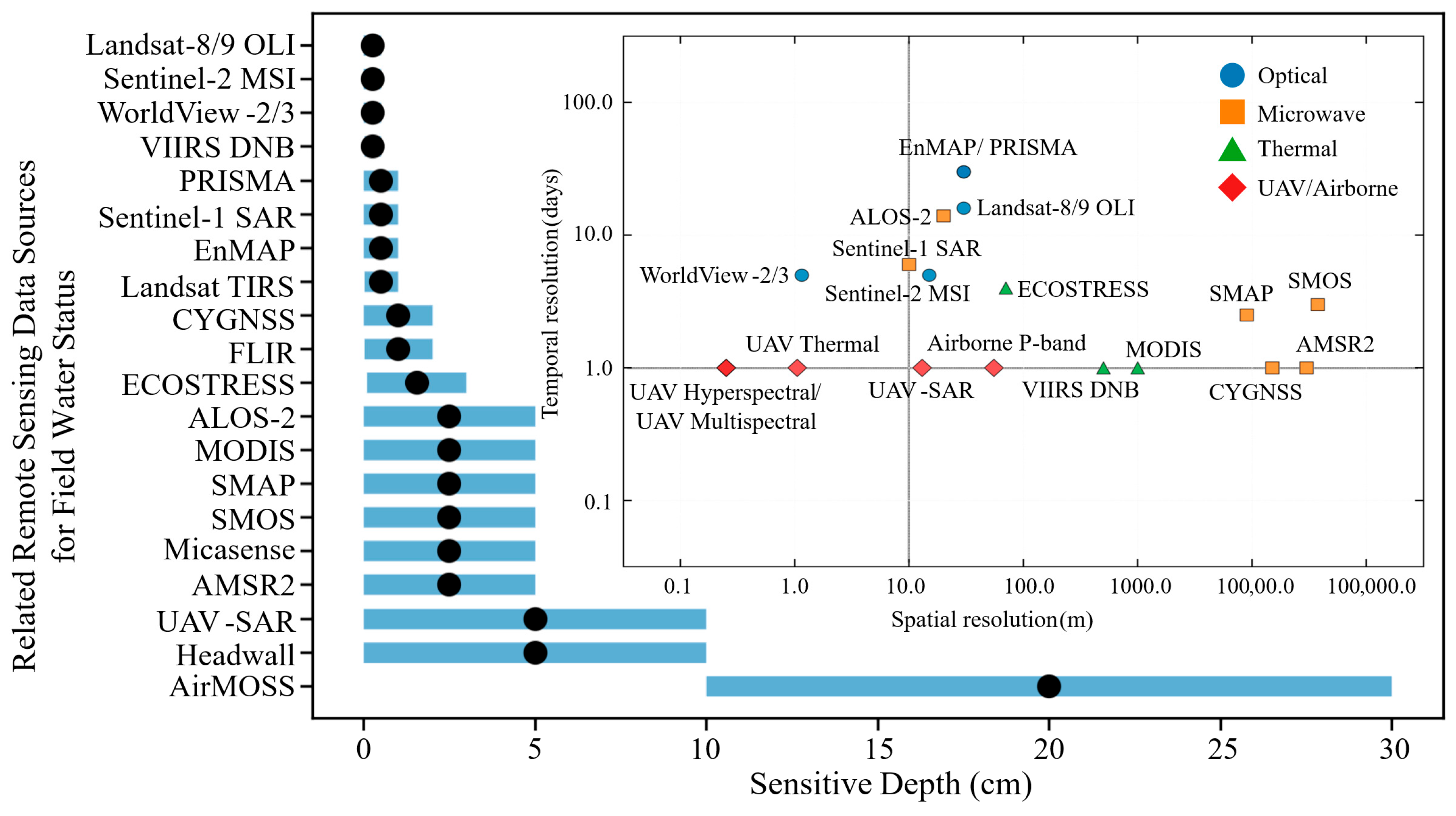
3.1.2. Remote-Sensing-Based Field Water Status Data Acquisition
Optical Remote Sensing
Thermal Infrared Remote Sensing
Microwave Remote Sensing
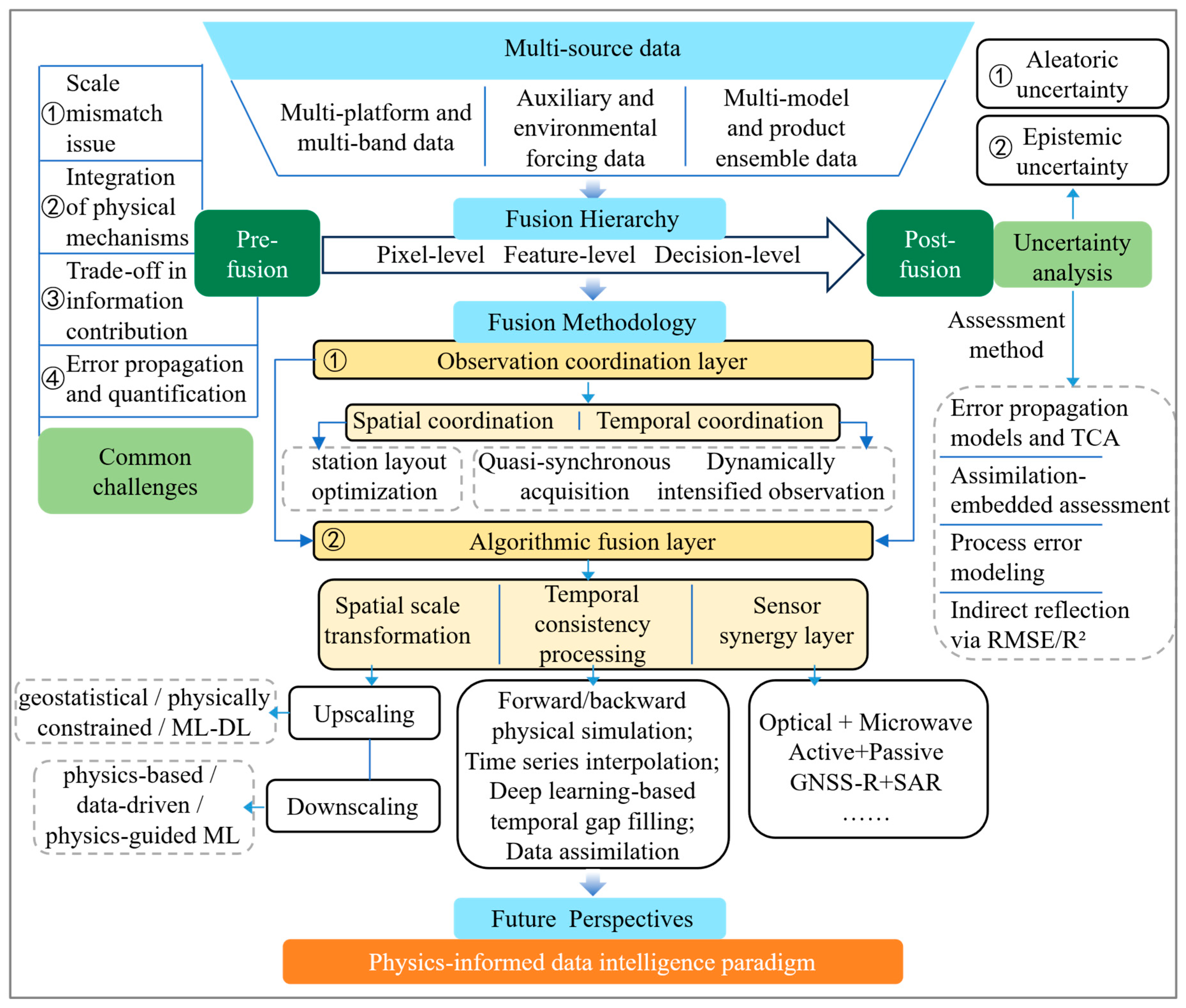
3.2. Multi-Source Data Fusion Methods: Hierarchies, Methodologies, and Scale Issues
3.2.1. Fusion Theoretical Framework and Hierarchy Classification
3.2.2. Main Fusion Technical Pathways
Spatiotemporal Coordination at the Observation Level
Methods for Spatial Scale Transformation
Methods for Temporal Consistency Processing
Synergistic Strategies Across Sensor Combinations
3.2.3. Uncertainty Quantification
4. Accurate Acquisition and Application of Field Water Status for Agricultural Irrigation and Drainage
4.1. Methods for Large-Scale Surface Soil Moisture Monitoring

| Fusion Platform Type | Data Combination | Final Temporal Resolution | Final Spatial Resolution | Crop Type | Validation Dataset | Performance Metric | Study |
|---|---|---|---|---|---|---|---|
| Space–Ground | SMAP +MODIS + topographic and soil factors | Daily | 1 km | Multi-crop farmland | ISMN | ubRMSE ≈ 0.041 m3·m−3; R ≈ 0.72 | Xu et al. [193] |
| Space–Ground | SMAP L4 + Sentinel-1 SAR + soil factors | Daily | 1 km | Rice, wheat, maize | 87 stations + oven drying | ubRMSE ≈ 0.040 m3·m−3; R > 0.6 for 60% of stations | Xu et al. [194] |
| Space–Ground | SMAP + ASCAT + Joint UK Land Environment Simulator (JULES) LSM | Daily | 50 km | Grassland, Cropland, Mixed cover | Ground stations | ΔR ≈ +0.05 | Seo et al. [195] |
| Air–Ground | UAV (multispectral + thermal) + GPR | Flight campaign | cm–m | Vineyard | GPR + oven drying | R2 = 0.879; RMSE = 0.066 m3·m−3 | Guan et al. [196] |
| Air–Ground | UAV (RGB + multispectral + thermal) + in situ | Flight campaign | 5–30 m | Maize | Layered oven drying + TDR | R2 = 0.61; RMSE ≈ 2% | Zhang et al. [197] |
| Air–Ground | GPR + UAV (RGB + thermal) | Flight campaign | Meter level | Maize/ wheat | GPR + oven drying/TDR | R2 = 0.83 (10 cm), 0.79 (30 cm); RMSE = 1.9% (10 cm), 3.2% (30 cm) | Vahidi et al. [198] |
| Space–Air–Ground | SAR, optical, and microwave + UAV + meteorological and soil factors | Daily–weekly | 0.1–1 km | Mixed farmland crops | Regional station network | R2 = 0.822; RMSE = 0.038 m3·m−3; RRMSE = 16.46% | Li et al. [199] |
| Space–Air–Ground | UAV multispectral + Sentinel-1/2 + in situ | Multi- temporal | 10 m | Winter wheat | 180 in situ samples | 0–20 cm: R2 = 0.901; 20–40 cm: R2 = 0.884 | Yu et al. [119] |
| Space–Air–Ground | UAV multispectral + Sentinel-1 + in situ | Single flight | 0.5 m | Soybean | Gravimetric samples | R2 = 0.82–0.87 | Zhao et al. [200] |
4.2. Methods for Crop Root Zone Soil Moisture Acquisition
| Fusion Platform Type | Depth (cm) | Data Combination | Method | Final Temporal Resolution | Final Spatial Resolution | Validation Dataset | Performance Metric | Study |
|---|---|---|---|---|---|---|---|---|
| Space–Ground | 0–100 | SMAP + ASCAT + LSM | Surface-driven + EnKF | Daily | 9 km | ISMN | ΔR ≈ 0.03 | Seo et al. [195] |
| 0–50 | SMAP + ASCAT + ground meteorological | Variable Infiltration Capacity model (VIC) model + EnKF | Daily | 25 km | Soil moisture stations | ubRMSE = 0.045 m3/m3 | Zhou et al. [217] | |
| 0–100 | SMAP + MODIS + ECOSTRESS + meteorological | Weak surface dependence + ML | Daily–3 h | 70 m– 1 km | ISMN | R = 0.76–0.86 | Sahaar et al. [220] | |
| Air–Ground | 0–28 | Tower-based L + P band brightness temperature | L/P band + Njoku and Kong layered coherent radiative transfer forward model + Particle Swarm Optimization (PSO) | Hour–Daily | Tower footprint | Profile probes | RMSE < 0.04 m3/m3 | Brakhasi et al. [204] |
| 0–50 | AirMOSS P-band | P-band + Richards equation + global optimization | Flight campaign | 30–50 m | AirMOSS | RMSE ≈ 0.06–0.10 m3/m3 | Sadeghi et al. [206] | |
| 10–40 | UAV-GPR + TDR | GPR full-wave + Lambot equation + Look-Up Table (LUT) + Topp | Flight campaign | Meter level | TDR | R > 0.7 | Wu et al. [207] | |
| Space–Air–Ground | 0–100 | Weather Research and Forecasting model (WRF) + GNSS Zenith Total Delay (ZTD) + meteodrones + in situ | 3DVAR + SPHY model | Daily | 2.5 km | In situ soil moisture sensors | Bias = 35% | Lagasio et al. [221] |
| 0–40 | UAV multispectral + Sentinel-1/2 + in situ | Partial Least Squares Regression (PLSR) + XGBoost + SHapley Additive exPlanations (SHAP) | 5 days | 10 m | Ground sampling | R2 increased by 9.53–10.52%, RMSE reduced by 11.11–31.25% | Yu et al. [119] |
4.3. Methods for Paddy Field Identification, Flooded Area Mapping, and Water Depth Estimation
4.3.1. Paddy Field Delineation and Flooded Area Mapping
4.3.2. Paddy Field Water Depth Estimation: From Clear Water to Vegetated Conditions
4.3.3. Challenges and Future Directions for Paddy Field Water Depth Quantification
5. Challenges and Future Directions in Field Water Status Monitoring
6. Conclusions
Author Contributions
Funding
Data Availability Statement
Conflicts of Interest
References
- Sun, M.; Su, K.; Tian, F. Monitoring Spatiotemporal Dynamics of Soil Moisture Under Water-Nitrogen Interactions in Arid Farmland Using UAV-Based Hyperspectral Sensing and Triple-Band Indices. Remote Sens. 2026, 18, 726. [Google Scholar] [CrossRef] [Scilit]
- Simeón, R.; Rubio, C.; Uris, A.; Coronado, J.; Agenjos-Moreno, A.; Bautista, A.S. Assessment of Water Depth Variability and Rice Farming Using Remote Sensing. Sensors 2025, 25, 4860. [Google Scholar] [CrossRef] [Scilit]
- Oğuztürk, G.E. AI-Driven Irrigation Systems for Sustainable Water Management: A Systematic Review and Meta-Analytical Insights. Smart Agric. Technol. 2025, 11, 100982. [Google Scholar] [CrossRef] [Scilit]
- Sharma, V.; Kaur, G.; Chhabra, V.; Kashyap, R. Smart Irrigation Systems in Agriculture: An Overview. Comput. Electron. Agric. 2025, 239, 111008. [Google Scholar] [CrossRef] [Scilit]
- Peña-Arancibia, J.L.; Ahmad, M.D.; Yu, Y. Remote Sensing Characterisation of Cropping Systems and Their Water Use to Assess Irrigation Management from Field to Canal Command Scale. Agric. Water Manag. 2025, 311, 109374. [Google Scholar] [CrossRef] [Scilit]
- Liu, R.; Chang, C.; Zhong, R.; Lu, S. Soil Moisture Monitoring Method and Data Products: Current Research Status and Future Development Trends. Remote Sens. 2025, 17, 3945. [Google Scholar] [CrossRef] [Scilit]
- Mu, T.; Liu, G.; Yang, X.; Yu, Y. Soil-Moisture Estimation Based on Multiple-Source Remote-Sensing Images. Remote Sens. 2022, 15, 139. [Google Scholar] [CrossRef] [Scilit]
- Liu, Q.; Wu, Z.; Cui, N.; Jin, X.; Zhu, S.; Jiang, S.; Zhao, L.; Gong, D. Estimation of Soil Moisture Using Multi-Source Remote Sensing and Machine Learning Algorithms in Farming Land of Northern China. Remote Sens. 2023, 15, 4214. [Google Scholar] [CrossRef] [Scilit]
- Sun, H.; Gao, J. A Pixel-Wise Calculation of Soil Evaporative Efficiency with Thermal/Optical Remote Sensing and Meteorological Reanalysis Data for Downscaling Microwave Soil Moisture. Agric. Water Manag. 2023, 276, 108063. [Google Scholar] [CrossRef] [Scilit]
- Wang, J.; Huang, H.; Ariyasena, H.H.S.; Zhao, J.; Zhang, X.; Gao, X.; Zhao, X.; Zhao, Y. A UAV-Based Method for Root Zone Soil Moisture Modeling of Different Farmland Scale with Grain and Economic Crops. Agric. Water Manag. 2025, 321, 109932. [Google Scholar] [CrossRef] [Scilit]
- Haokip, S.C.; Rajwade, Y.A.; Rao, K.V.R.; Kumar, S.P.; Marak, A.B.; Srivastava, A. Approaches for Assessment of Soil Moisture with Conventional Methods, Remote Sensing, UAV, and Machine Learning Methods—A Review. Water 2025, 17, 2388. [Google Scholar] [CrossRef] [Scilit]
- Jääskeläinen, E.; Luoto, M.; Putkiranta, P.; Aurela, M.; Virtanen, T. High-Resolution Soil Moisture Mapping in Northern Boreal Forests Using SMAP Data and Downscaling Techniques. Hydrol. Earth Syst. Sci. 2025, 29, 6237–6256. [Google Scholar] [CrossRef] [Scilit]
- Li, Z.-L.; Leng, P.; Zhou, C.; Chen, K.-S.; Zhou, F.-C.; Shang, G.-F. Soil Moisture Retrieval from Remote Sensing Measurements: Current Knowledge and Directions for the Future. Earth-Sci. Rev. 2021, 218, 103673. [Google Scholar] [CrossRef] [Scilit]
- Wang, J.; Zhang, S.; Lizaga, I.; Zhang, Y.; Ge, X.; Zhang, Z.; Zhang, W.; Huang, Q.; Hu, Z. UAS-Based Remote Sensing for Agricultural Monitoring: Current Status and Perspectives. Comput. Electron. Agric. 2024, 227, 109501. [Google Scholar] [CrossRef] [Scilit]
- Li, S.; Han, Y.; Li, C.; Wang, J. A Novel Framework for Multi-Layer Soil Moisture Estimation with High Spatio-Temporal Resolution Based on Data Fusion and Automated Machine Learning. Agric. Water Manag. 2024, 306, 109173. [Google Scholar] [CrossRef] [Scilit]
- Zhu, Y.; Yoshimura, K.; Liu, Y.; Fu, H. Global Flood Extent Monitoring Using SAR Satellite and Hydrological Data: A Multi-Scale and Multi-Source Approach. J. Hydrol. 2025, 663, 134074. [Google Scholar] [CrossRef] [Scilit]
- Li, X.; Dunkin, F.; Dezert, J. Multi-Source Information Fusion: Progress and Future. Chin. J. Aeronaut. 2024, 37, 24–58. [Google Scholar] [CrossRef] [Scilit]
- Brunelli, B.; De Giglio, M.; Magnani, E.; Dubbini, M. Surface Soil Moisture Estimate from Sentinel-1 and Sentinel-2 Data in Agricultural Fields in Areas of High Vulnerability to Climate Variations: The Marche Region (Italy) Case Study. Environ. Dev. Sustain. 2023, 26, 24083–24105. [Google Scholar] [CrossRef] [Scilit]
- Ma, H.; Zeng, J.; Zhang, X.; Peng, J.; Li, X.; Fu, P.; Cosh, M.H.; Letu, H.; Wang, S.; Chen, N.; et al. Surface Soil Moisture from Combined Active and Passive Microwave Observations: Integrating ASCAT and SMAP Observations Based on Machine Learning Approaches. Remote Sens. Environ. 2024, 308, 114197. [Google Scholar] [CrossRef] [Scilit]
- Zhu, S.; Zha, G.; Wang, Q.; Ma, S.; Qin, H. A High Performance Assimilation of Surface Soil Moisture Based on a Hybrid Framework of Machine Learning and Physical Hydrological Model. J. Hydrol. 2026, 664, 134513. [Google Scholar] [CrossRef] [Scilit]
- Abowarda, A.S.; Bai, L.; Zhang, C.; Long, D.; Li, X.; Huang, Q.; Sun, Z. Generating Surface Soil Moisture at 30 m Spatial Resolution Using Both Data Fusion and Machine Learning toward Better Water Resources Management at the Field Scale. Remote Sens. Environ. 2021, 255, 112301. [Google Scholar] [CrossRef] [Scilit]
- Teixeira, A.C.; Bakon, M.; Lopes, D.; Cunha, A.; Sousa, J.J. A Systematic Review on Soil Moisture Estimation Using Remote Sensing Data for Agricultural Applications. Sci. Remote Sens. 2025, 12, 100328. [Google Scholar] [CrossRef] [Scilit]
- Rahmati, M.; Balenzano, A.; Bechtold, M.; Brocca, L.; Fluhrer, A.; Jagdhuber, T.; Karamvasis, K.; Mengen, D.; Reichle, R.H.; Kim, S.; et al. Soil Moisture Retrieval from Sentinel-1: Lessons Learned after More than a Decade in Orbit. Remote Sens. Environ. 2026, 333, 115146. [Google Scholar] [CrossRef] [Scilit]
- Varghese, D.; Radulović, M.; Stojković, S.; Crnojević, V. Reviewing the Potential of Sentinel-2 in Assessing the Drought. Remote Sens. 2021, 13, 3355. [Google Scholar] [CrossRef] [Scilit]
- Saki, M.; Keshavarz, R.; Franklin, D.; Abolhasan, M.; Lipman, J.; Shariati, N. A Data-Driven Review of Remote Sensing-Based Data Fusion in Precision Agriculture From Foundational to Transformer-Based Techniques. IEEE Access 2025, 13, 166188–166209. [Google Scholar] [CrossRef] [Scilit]
- Duarte, E.; Hernandez, A. A Review on Soil Moisture Dynamics Monitoring in Semi-Arid Ecosystems: Methods, Techniques, and Tools Applied at Different Scales. Appl. Sci. 2024, 14, 7677. [Google Scholar] [CrossRef] [Scilit]
- Rabie, A.B.; Elhag, M.; Subyani, A. Remote Sensing, GIS, and Machine Learning in Water Resources Management for Arid Agricultural Regions: A Review. Water 2025, 17, 3125. [Google Scholar] [CrossRef] [Scilit]
- Zeng, J.; Peng, J.; Zhao, W.; Ma, C.; Ma, H. Microwave Remote Sensing of Soil Moisture. Remote Sens. 2023, 15, 4243. [Google Scholar] [CrossRef] [Scilit]
- Wang, C.; Gu, X.; Zhou, X.; Yang, J.; Yu, T.; Tao, Z.; Gao, H.; Liu, Q.; Zhan, Y.; Wei, X.; et al. Chinese Soil Moisture Observation Network and Time Series Data Set for High Resolution Satellite Applications. Sci. Data 2023, 10, 424. [Google Scholar] [CrossRef] [Scilit] [PubMed]
- Ortenzi, S.; Cencetti, C.; Mincu, F.-I.; Neculau, G.; Chendeş, V.; Ciabatta, L.; Massari, C.; Di Matteo, L. Comparing Satellite Soil Moisture Products Using In Situ Observations over an Instrumented Experimental Basin in Romania. Remote Sens. 2024, 16, 3283. [Google Scholar] [CrossRef] [Scilit]
- Zhang, R.; Song, C.; Zhang, Z.; Xie, J.; Chen, T.; Xu, T. Machine Learning for Soil Moisture Analysis: A Survey and Emerging Perspectives. Int. J. Data Sci. Anal. 2026, 21, 66. [Google Scholar] [CrossRef] [Scilit]
- Mukhlisin, M.; Astuti, H.W.; Wardihani, E.D.; Matlan, S.J. Techniques for Ground-Based Soil Moisture Measurement: A Detailed Overview. Arab. J. Geosci. 2021, 14, 2032. [Google Scholar] [CrossRef] [Scilit]
- Maya Moreshwar Meshram, S.; Adla, S.; Jourdin, L.; Pande, S. Review of Low-Cost, off-Grid, Biodegradable in Situ Autonomous Soil Moisture Sensing Systems: Is There a Perfect Solution? Comput. Electron. Agric. 2024, 225, 109289. [Google Scholar] [CrossRef] [Scilit]
- Rasheed, M.W.; Tang, J.; Sarwar, A.; Shah, S.; Saddique, N.; Khan, M.U.; Imran Khan, M.; Nawaz, S.; Shamshiri, R.R.; Aziz, M.; et al. Soil Moisture Measuring Techniques and Factors Affecting the Moisture Dynamics: A Comprehensive Review. Sustainability 2022, 14, 11538. [Google Scholar] [CrossRef] [Scilit]
- Singh, A.; Gaurav, K.; Sonkar, G.K.; Lee, C.-C. Strategies to Measure Soil Moisture Using Traditional Methods, Automated Sensors, Remote Sensing, and Machine Learning Techniques: Review, Bibliometric Analysis, Applications, Research Findings, and Future Directions. IEEE Access 2023, 11, 13605–13635. [Google Scholar] [CrossRef] [Scilit]
- Gorthi, S.; Chakraborty, S.; Li, B.; Weindorf, D.C. A Field-Portable Acoustic Sensing Device to Measure Soil Moisture. Comput. Electron. Agric. 2020, 174, 105517. [Google Scholar] [CrossRef] [Scilit]
- Fragkos, A.; Loukatos, D.; Kargas, G.; Arvanitis, K.G. Response of the TEROS 12 Soil Moisture Sensor under Different Soils and Variable Electrical Conductivity. Sensors 2024, 24, 2206. [Google Scholar] [CrossRef] [Scilit]
- Nandi, R.; Shrestha, D. Assessment of Low-Cost and Higher-End Soil Moisture Sensors across Various Moisture Ranges and Soil Textures. Sensors 2024, 24, 5886. [Google Scholar] [CrossRef] [Scilit]
- Loconsole, D.; Elia, M.; Conversa, G.; De Lucia, B.; Cristiano, G.; Elia, A. Soil Moisture Sensing Technologies: Principles, Applications, and Challenges in Agriculture. Agronomy 2025, 15, 2788. [Google Scholar] [CrossRef] [Scilit]
- Comegna, A.; Di Prima, S.; Hassan, S.B.M.; Coppola, A. A Novel Time Domain Reflectometry (TDR) System for Water Content Estimation in Soils: Development and Application. Sensors 2025, 25, 1099. [Google Scholar] [CrossRef] [Scilit]
- Datta, S.; Taghvaeian, S. Soil Water Sensors for Irrigation Scheduling in the United States: A Systematic Review of Literature. Agric. Water Manag. 2023, 278, 108148. [Google Scholar] [CrossRef] [Scilit]
- Yu, L.; Gao, W.; Shamshiri, R.R.; Tao, S.; Ren, Y.; Zhang, Y.; Su, G. Review of Research Progress on Soil Moisture Sensor Technology. Int. J. Agric. Biol. Eng. 2021, 14, 32–42. [Google Scholar] [CrossRef] [Scilit]
- Chen, X.; Song, W.; Shi, Y.; Liu, W.; Lu, Y.; Pang, Z.; Chen, X. Application of Cosmic-Ray Neutron Sensor Method to Calculate Field Water Use Efficiency. Water 2022, 14, 1518. [Google Scholar] [CrossRef] [Scilit]
- Köhli, M. Soil Moisture Measurements by Cosmic-Ray Neutron Sensing: A Critical Review. Geoderma 2026, 465, 117626. [Google Scholar] [CrossRef] [Scilit]
- Brogi, C.; Pisinaras, V.; Köhli, M.; Dombrowski, O.; Hendricks Franssen, H.-J.; Babakos, K.; Chatzi, A.; Panagopoulos, A.; Bogena, H.R. Monitoring Irrigation in Small Orchards with Cosmic-Ray Neutron Sensors. Sensors 2023, 23, 2378. [Google Scholar] [CrossRef] [Scilit]
- Adla, S.; Bruckmaier, F.; Arias-Rodriguez, L.F.; Tripathi, S.; Pande, S.; Disse, M. Impact of Calibrating a Low-Cost Capacitance-Based Soil Moisture Sensor on AquaCrop Model Performance. J. Environ. Manag. 2024, 353, 120248. [Google Scholar] [CrossRef] [Scilit]
- Ma, Y.; Liu, H.; Yu, Y.; Guo, L.; Zhao, W.; Yetemen, O. Revisiting Soil Water Potential: Towards a Better Understanding of Soil and Plant Interactions. Water 2022, 14, 3721. [Google Scholar] [CrossRef] [Scilit]
- Dorigo, W.; Himmelbauer, I.; Aberer, D.; Schremmer, L.; Petrakovic, I.; Zappa, L.; Preimesberger, W.; Xaver, A.; Annor, F.; Ardö, J.; et al. The International Soil Moisture Network: Serving Earth System Science for over a Decade. Hydrol. Earth Syst. Sci. 2021, 25, 5749–5804. [Google Scholar] [CrossRef] [Scilit]
- Zhang, Y.; Liang, S.; Ma, H.; He, T.; Tian, F.; Zhang, G.; Xu, J. A Seamless Global Daily 5 Km Soil Moisture Product from 1982 to 2021 Using AVHRR Satellite Data and an Attention-Based Deep Learning Model. Earth Syst. Sci. Data 2025, 17, 5181–5207. [Google Scholar] [CrossRef] [Scilit]
- Gao, H.; Gu, X.; Zhou, X.; Yu, T.; Wang, Y. Analysis of the Development Trend of Chinese Remote Sensing Valida-tion Sites and Infrastructure Construction. Natl. Remote Sens. Bull. 2023, 27, 1088–1098. [Google Scholar] [CrossRef] [Scilit]
- Xing, Y.; Liu, X.; Wang, X. Integrating UAVs, Satellite Remote Sensing, and Machine Learning in Precision Agriculture: Pathways to Sustainable Food Production, Resource Efficiency, and Scalable Innovation. Front. Agron. 2026, 7, 1670380. [Google Scholar] [CrossRef] [Scilit]
- Jambhali, K.V.; Koirala, B.; Bnoulkacem, Z.; Scheunders, P. Soil Moisture Content Estimation from Hyperspectral Remote Sensing Data. In 2023 13th Workshop on Hyperspectral Imaging and Signal Processing: Evolution in Remote Sensing (WHISPERS); IEEE: New York, NY, USA, 2023; pp. 1–5. [Google Scholar] [CrossRef] [Scilit]
- McGuirk, S.L.; Cairns, I.H. Relationships between Soil Moisture and Visible–NIR Soil Reflectance: A Review Presenting New Analyses and Data to Fill the Gaps. Geotechnics 2024, 4, 78–108. [Google Scholar] [CrossRef] [Scilit]
- Jacquemoud, S.; Baret, F.; Hanocq, J.F. Modeling Spectral and Bidirectional Soil Reflectance. Remote Sens. Environ. 1992, 41, 123–132. [Google Scholar] [CrossRef] [Scilit]
- Lobell, D.B.; Asner, G.P. Moisture Effects on Soil Reflectance. Soil Sci. Soc. Am. J. 2002, 66, 722–727. [Google Scholar] [CrossRef]
- Zhang, D.; Zhou, G. Estimation of Soil Moisture from Optical and Thermal Remote Sensing: A Review. Sensors 2016, 16, 1308. [Google Scholar] [CrossRef] [Scilit]
- Philpot, W. Spectral Reflectance of Wetted Soils. In Art, Science and Applications of Reflectance Spectroscopy (ASARS) Scientific Symposium; ASD Inc. & IEEE GRSS: Boulder, CO, USA, 2010; pp. 1–12. [Google Scholar] [CrossRef] [Scilit]
- Thomas, J.; Gupta, M.; Srivastava, P.K.; Pandey, D.K.; Bindlish, R. Development of High-Resolution Soil Hydraulic Parameters with Use of Earth Observations for Enhancing Root Zone Soil Moisture Product. Remote Sens. 2023, 15, 706. [Google Scholar] [CrossRef] [Scilit]
- Feng, S.; Gao, L.; Qiu, J.; Liu, X.; Crow, W.T.; Zhao, T.; Tan, C.; Wang, S.; Wigneron, J.-P. Can Real-Time NDVI Observations Better Constrain SMAP Soil Moisture Retrievals? Remote Sens. Environ. 2025, 318, 114569. [Google Scholar] [CrossRef] [Scilit]
- Holzman, M.; Srivastava, A.; Rivas, R.; Huete, A. Evaluating the Relationship Between Vegetation Status and Soil Moisture in Semi-Arid Woodlands, Central Australia, Using Daily Thermal, Vegetation Index, and Reflectance Data. Remote Sens. 2025, 17, 635. [Google Scholar] [CrossRef] [Scilit]
- Declaro, A.; Brown, Z.; Kanae, S. VAWIlog: A Log-Transformed LSWI–EVI Index for Improved Surface Water Mapping in Agricultural Environments. Remote Sens. 2025, 17, 2771. [Google Scholar] [CrossRef] [Scilit]
- Wang, W.; Zhang, X.; Zheng, H.; Ding, S.; Shang, K.; Xiao, Q. Predicting Soil Organic Matter with ZY1E Hyperspectral Images by Correcting Soil Spectrum and Expanding Sample Size. Soil Tillage Res. 2026, 255, 106815. [Google Scholar] [CrossRef] [Scilit]
- Abdelrahim, N.A.M.; Jin, S. Genetic Algorithm Optimized Multispectral Soil-Vegetation Drought Index (GA-MSVDI) for Precision Agriculture and Drought Monitoring in North Africa. Remote Sens. Appl. Soc. Environ. 2025, 38, 101603. [Google Scholar] [CrossRef] [Scilit]
- Du, R.; Xiang, Y.; Zhang, F.; Chen, J.; Shi, H.; Liu, H.; Yang, X.; Yang, N.; Yang, X.; Wang, T.; et al. Combing Transfer Learning with the OPtical TRApezoid Model (OPTRAM) to Diagnosis Small-Scale Field Soil Moisture from Hyperspectral Data. Agric. Water Manag. 2024, 298, 108856. [Google Scholar] [CrossRef] [Scilit]
- Carrasco-Benavides, M.; Gonzalez Viejo, C.; Tongson, E.; Baffico-Hernández, A.; Ávila-Sánchez, C.; Mora, M.; Fuentes, S. Water Status Estimation of Cherry Trees Using Infrared Thermal Imagery Coupled with Supervised Machine Learning Modeling. Comput. Electron. Agric. 2022, 200, 107256. [Google Scholar] [CrossRef] [Scilit]
- Liu, P.-W.; Bindlish, R.; O’Neill, P.; Fang, B.; Lakshmi, V.; Yang, Z.; Cosh, M.H.; Bongiovanni, T.; Collins, C.H.; Starks, P.J.; et al. Thermal Hydraulic Disaggregation of SMAP Soil Moisture Over the Continental United States. IEEE J. Sel. Top. Appl. Earth Obs. Remote Sens. 2022, 15, 4072–4092. [Google Scholar] [CrossRef] [Scilit]
- Gao, Y.; Lian, X.; Ge, L. Inversion Model of Surface Bare Soil Temperature and Water Content Based on UAV Thermal Infrared Remote Sensing. Infrared Phys. Technol. 2022, 125, 104289. [Google Scholar] [CrossRef] [Scilit]
- Gonzalez-Dugo, V.; Zarco-Tejada, P.J. Assessing the Impact of Measurement Errors in the Calculation of CWSI for Characterizing the Water Status of Several Crop Species. Irrig. Sci. 2024, 42, 431–443. [Google Scholar] [CrossRef] [Scilit]
- Shi, H.; Liu, Z.; Li, S.; Jin, M.; Tang, Z.; Sun, T.; Liu, X.; Li, Z.; Zhang, F.; Xiang, Y. Monitoring Soybean Soil Moisture Content Based on UAV Multispectral and Thermal-Infrared Remote-Sensing Information Fusion. Plants 2024, 13, 2417. [Google Scholar] [CrossRef] [Scilit]
- Neinavaz, E.; Schlerf, M.; Darvishzadeh, R.; Gerhards, M.; Skidmore, A.K. Thermal Infrared Remote Sensing of Vegetation: Current Status and Perspectives. Int. J. Appl. Earth Obs. Geoinf. 2021, 102, 102415. [Google Scholar] [CrossRef] [Scilit]
- Muhuri, A.; Goïta, K.; Magagi, R.; Wang, H. Soil Moisture Retrieval During Crop Growth Cycle Using Satellite SAR Time Series. IEEE J. Sel. Top. Appl. Earth Obs. Remote Sens. 2023, 16, 9302–9319. [Google Scholar] [CrossRef] [Scilit]
- Xu, N.; Daccache, A.; Ahmadi, A.; Houtz, D.; Perez-Barquero, F.P. Soil Moisture Estimation with Microwave Remote Sensing: A Systematic Review and Meta-Analysis. Int. J. Digit. Earth 2025, 18, 2468413. [Google Scholar] [CrossRef] [Scilit]
- Buma, W.; Abelev, A.; Merrick, T. Vegetation Spectra as an Integrated Measure to Explain Underlying Soil Characteristics: A Review of Recent Advances. Front. Environ. Sci. 2024, 12, 1430818. [Google Scholar] [CrossRef] [Scilit]
- Jing, R.; Cui, Q.; Zhao, T.; Xue, H.; Zheng, J.; Bai, Y.; Ni, W.; Peng, Z.; Hu, L.; Zhou, Y.; et al. Response of Vegetation Optical Depth across Multiple Microwave Frequencies to Global Vegetation Dynamics. GISci. Remote Sens. 2025, 63, 2606475. [Google Scholar] [CrossRef] [Scilit]
- Shen, X.; Fan, L.; Zuo, T.; Cui, T.; Wu, J.; Ye, N.; Brakhasi, F.; Wu, X.; Zhu, L.; Wigneron, J.-P.; et al. P-Band Radiometry for Enhanced Vegetation Optical Depth (VOD) and Soil Moisture Retrieval in Dense Crop canopies. Remote Sens. Environ. 2024, 313, 114353. [Google Scholar] [CrossRef] [Scilit]
- Garrison, J.L.; Nold, B.; Masters, D.; Brown, C.; Bridgeman, J.; Mansell, J.; Vega, M.; Bindlish, R.; Piepmeier, J.R.; Babu, S.R. A Spaceborne Demonstration of P-Band Signals-of-Opportunity (SoOp) Reflectometry. IEEE Geosci. Remote Sens. Lett. 2023, 20, 3507205. [Google Scholar] [CrossRef] [Scilit]
- Tong, C.; Deng, X.; Shangguan, Y.; Dong, B.; Chen, Y.; Huang, C.; Zhu, L.; Li, S.; Ye, Y.; Wang, H. The Passive Microwave Remote Sensing in Soil Moisture Retrieval: Products, Models, Applications and Challenges. Int. Soil Water Conserv. Res. 2025, 13, 843–859. [Google Scholar] [CrossRef] [Scilit]
- Meng, X.; Zeng, J.; Yang, Y.; Zhao, W.; Ma, H.; Letu, H.; Zhu, Q.; Liu, Y.; Wang, P.; Peng, J. High-Resolution Soil Moisture Mapping through Passive Microwave Remote Sensing Downscaling. Innov. Geosci. 2024, 2, 100105. [Google Scholar] [CrossRef] [Scilit]
- Srivastava, H.S.; Sivasankar, T.; Gavali, M.D.; Patel, P. Soil Moisture Estimation underneath Crop Cover Using High Incidence Angle C-Band Sentinel-1 SAR Data. Kuwait J. Sci. 2024, 51, 100101. [Google Scholar] [CrossRef] [Scilit]
- Feldman, A.F.; Short Gianotti, D.J.; Dong, J.; Akbar, R.; Crow, W.T.; McColl, K.A.; Konings, A.G.; Nippert, J.B.; Tumber-Dávila, S.J.; Holbrook, N.M.; et al. Remotely Sensed Soil Moisture Can Capture Dynamics Relevant to Plant Water Uptake. Water Resour. Res. 2023, 59, e2022WR033814. [Google Scholar] [CrossRef] [Scilit]
- Kim, H.; Parinussa, R.; Konings, A.G.; Wagner, W.; Cosh, M.H.; Lakshmi, V.; Zohaib, M.; Choi, M. Global-Scale Assessment and Combination of SMAP with ASCAT (Active) and AMSR2 (Passive) Soil Moisture Products. Remote Sens. Environ. 2018, 204, 260–275. [Google Scholar] [CrossRef] [Scilit]
- Das, N.N.; Entekhabi, D.; Dunbar, R.S.; Chaubell, M.J.; Colliander, A.; Yueh, S.; Jagdhuber, T.; Chen, F.; Crow, W.; O’Neill, P.E.; et al. The SMAP and Copernicus Sentinel 1A/B Microwave Active-Passive High Resolution Surface Soil Moisture product. Remote Sens. Environ. 2019, 233, 111380. [Google Scholar] [CrossRef] [Scilit]
- Edokossi, K.; Calabia, A.; Jin, S.; Molina, I. GNSS-Reflectometry and Remote Sensing of Soil Moisture: A Review of Measurement Techniques, Methods, and Applications. Remote Sens. 2020, 12, 614. [Google Scholar] [CrossRef] [Scilit]
- Veneri, A.; Suriani, V.; Troiani, A.; Bloisi, D.D.; Burghignoli, P.; Costarelli, D.; Mereu, I.; Natale, M.; Piconi, M.; Comite, D. Retrieval Methods for Microwave Remote Sensing of Soil Moisture, Above-Ground Biomass, and Freeze-Thaw Dynamics: A Review. IEEE Geosci. Remote Sens. Mag. 2026, 14, 151–204. [Google Scholar] [CrossRef] [Scilit]
- Maslanka, W.; Morrison, K.; White, K.; Verhoef, A.; Clark, J. Retrieval of Sub-Kilometric Relative Surface Soil Moisture with Sentinel-1 Utilizing Different Backscatter Normalization Factors. IEEE Trans. Geosci. Remote Sens. 2022, 60, 4410613. [Google Scholar] [CrossRef] [Scilit]
- Bao, X.; Zhang, R.; He, X.; Shama, A.; Yin, G.; Chen, J.; Zhang, H.; Liu, G. An Integrated Time-Series Relative Soil Moisture Monitoring Method Based on a SAR Backscattering Model. IEEE J. Sel. Top. Appl. Earth Obs. Remote Sens. 2025, 18, 2137–2156. [Google Scholar] [CrossRef] [Scilit]
- Hu, J.; Fan, D.; Tang, B.-H.; Zhu, X.-M. A New Model Incorporating Soil–Vegetation Interaction Scattering for Improving SAR-Based Soil Moisture Retrieval in Croplands. Remote Sens. 2026, 18, 673. [Google Scholar] [CrossRef] [Scilit]
- Inoubli, R.; Bennaceur, L.; Jarray, N.; Ben Abbes, A.; Farah, I.R. A Comparison between the Use of Machine Learning Techniques and the Water Cloud Model for the Retrieval of Soil Moisture from Sentinel-1A and Sentinel-2A Products. Remote Sens. Lett. 2022, 13, 980–990. [Google Scholar] [CrossRef] [Scilit]
- Yu, Y.; Filippi, P.; Bishop, T.F.A. Field-Scale Soil Moisture Estimated From Sentinel-1 SAR Data Using a Knowledge-Guided Deep Learning Approach. In IGARSS 2025—2025 IEEE International Geoscience and Remote Sensing Symposium; IEEE: New York, NY, USA, 2025; pp. 193–198. [Google Scholar] [CrossRef] [Scilit]
- Montzka, C.; Brocca, L.; Chen, H.; Das, N.N.; Dasgupta, A.; Rahmati, M.; Jagdhuber, T. AI in Soil Moisture Remote Sensing. Int. J. Appl. Earth Obs. Geoinf. 2026, 146, 105011. [Google Scholar] [CrossRef] [Scilit]
- Vittucci, C.; Picchiani, M. Satellite Microwave Radiometry for the Observation of Land Surfaces: A General Review. Sensors 2026, 26, 1638. [Google Scholar] [CrossRef] [Scilit]
- Li, L.; Liu, Y.; Zhu, Q.; Liao, K.; Lai, X. Evaluation of Nine Major Satellite Soil Moisture Products in a Typical Subtropical Monsoon Region with Complex Land Surface Characteristics. Int. Soil Water Conserv. Res. 2022, 10, 518–529. [Google Scholar] [CrossRef] [Scilit]
- Tong, C.; Wang, H.; Magagi, R.; Goïta, K.; Wang, K. Spatial Gap-Filling of SMAP Soil Moisture Pixels Over Tibetan Plateau via Machine Learning Versus Geostatistics. IEEE J. Sel. Top. Appl. Earth Obs. Remote Sens. 2021, 14, 9899–9912. [Google Scholar] [CrossRef] [Scilit]
- Li, X.; Tong, X.; Yan, Q. Land Surface Reflection Differences Observed by Spaceborne Multi-Satellite GNSS-R Systems. Remote Sens. 2025, 17, 3807. [Google Scholar] [CrossRef] [Scilit]
- Zhu, Y.; Guo, F.; Zhang, X. Spaceborne GNSS-R Soil Moisture Retrieval from GPS/BDS-3/Galileo Satellites. GPS Solut. 2025, 29, 10. [Google Scholar] [CrossRef] [Scilit]
- Roberts, T.M.; Colwell, I.; Chew, C.; Lowe, S.; Shah, R. A Deep-Learning Approach to Soil Moisture Estimation with GNSS-R. Remote Sens. 2022, 14, 3299. [Google Scholar] [CrossRef] [Scilit]
- Wernicke, L.J.; Chew, C.C.; Small, E.E. Spatially Interpolated CYGNSS Data Improve Downscaled 3 Km SMAP/CYGNSS Soil Moisture. Remote Sens. 2024, 16, 2924. [Google Scholar] [CrossRef] [Scilit]
- Dong, Z.; Jin, S.; Chen, G.; Wang, P. Enhancing GNSS-R Soil Moisture Accuracy with Vegetation and Roughness Correction. Atmosphere 2023, 14, 509. [Google Scholar] [CrossRef] [Scilit]
- Rahali, L.; Praticò, S.; Lanucara, S.; Modica, G. CubeSat Constellations: New Era for Precision Agriculture? Comput. Electron. Agric. 2025, 230, 109764. [Google Scholar] [CrossRef] [Scilit]
- Samadzadegan, F.; Toosi, A.; Dadrass Javan, F. A Critical Review on Multi-Sensor and Multi-Platform Remote Sensing Data Fusion Approaches: Current Status and Prospects. Int. J. Remote Sens. 2025, 46, 1327–1402. [Google Scholar] [CrossRef] [Scilit]
- Li, J.; Hong, D.; Gao, L.; Yao, J.; Zheng, K.; Zhang, B.; Chanussot, J. Deep Learning in Multimodal Remote Sensing Data Fusion: A Comprehensive Review. Int. J. Appl. Earth Obs. Geoinf. 2022, 112, 102926. [Google Scholar] [CrossRef] [Scilit]
- Meng, Q.; Chen, S.; Zhang, L.; Zhu, X.; Zhang, Y.; Atkinson, P.M. GLOSTFM: A Global Spatiotemporal Fusion Model Integrating Multi-Source Satellite Observations to Enhance Land Surface Temperature Resolution. Remote Sens. Environ. 2025, 319, 114640. [Google Scholar] [CrossRef] [Scilit]
- Swain, R.; Paul, A.; Behera, M.D. Spatio-Temporal Fusion Methods for Spectral Remote Sensing: A Comprehensive Technical Review and Comparative Analysis. Trop. Ecol. 2024, 65, 356–375. [Google Scholar] [CrossRef] [Scilit]
- Papadopoulos, S.; Anastassopoulos, V.; Koukiou, G. Pixel-Level Decision Fusion for Land Cover Classification Using PolSAR Data and Local Pattern Differences. Electronics 2024, 13, 3846. [Google Scholar] [CrossRef] [Scilit]
- Wang, H.; Wang, J.; Shen, Z.; Zhang, Z.; Li, J.; Zhao, L.; Jiao, S.; Li, S.; Lei, Y.; Kou, W.; et al. Parcel-Level Mapping of Apple Orchard in Smallholder Agriculture Areas Based on Feature-Level Fusion of VHR Image and Time-Series Images. Int. J. Remote Sens. 2022, 43, 6195–6220. [Google Scholar] [CrossRef] [Scilit]
- Lv, A.; Yang, X.; Zhang, W.; Han, Y. Integrated Soil Moisture Fusion for Enhanced Agricultural Drought Monitoring in China. Agric. Water Manag. 2025, 311, 109401. [Google Scholar] [CrossRef] [Scilit]
- Yuan, Q.; Shen, H.; Li, T.; Li, Z.; Li, S.; Jiang, Y.; Xu, H.; Tan, W.; Yang, Q.; Wang, J.; et al. Deep Learning in Environmental Remote Sensing: Achievements and Challenges. Remote Sens. Environ. 2020, 241, 111716. [Google Scholar] [CrossRef] [Scilit]
- Huang, S.; Zhang, X.; Wang, C.; Chen, N. Two-Step Fusion Method for Generating 1 Km Seamless Multi-Layer Soil Moisture with High Accuracy in the Qinghai-Tibet Plateau. ISPRS J. Photogramm. Remote Sens. 2023, 197, 346–363. [Google Scholar] [CrossRef] [Scilit]
- Tian, S.; Renzullo, L.J.; Pipunic, R.C.; Lerat, J.; Sharples, W.; Donnelly, C. Satellite Soil Moisture Data Assimilation for Improved Operational Continental Water Balance Prediction. Hydrol. Earth Syst. Sci. 2021, 25, 4567–4584. [Google Scholar] [CrossRef] [Scilit]
- Xiao, J.; Aggarwal, A.K.; Duc, N.H.; Arya, A.; Rage, U.K.; Avtar, R. A Review of Remote Sensing Image Spatiotemporal Fusion: Challenges, Applications and Recent Trends. Remote Sens. Appl. Soc. Environ. 2023, 32, 101005. [Google Scholar] [CrossRef] [Scilit]
- Ding, Z.; Yang, Y.; Zhang, Y.; Luo, X.; Huang, M.; Xiang, X. Cross-Modal Feature Calibration and Fusion Network for Remote Sensing Optical–SAR Joint Object Detection Under Cloud Occlusion. IEEE J. Sel. Top. Appl. Earth Obs. Remote Sens. 2025, 18, 27302–27319. [Google Scholar] [CrossRef] [Scilit]
- Cui, Z.; Zhang, Y.; Wang, A.; Wu, J.; Li, C. Uncertainty Analysis and Data Fusion of Multi-Source Land Evapotranspiration Products Based on the TCH Method. Remote Sens. 2023, 16, 28. [Google Scholar] [CrossRef] [Scilit]
- Zhou, K.; Lu, N.; Jiang, B.; Zeng, M.; Zhang, C. Uncertainty Quantification of Multi-Source Information Fusion Model. In 2024 China Automation Congress (CAC); IEEE: New York, NY, USA, 2024; pp. 2047–2052. [Google Scholar] [CrossRef] [Scilit]
- Mena, F.; Pathak, D.; Najjar, H.; Sanchez, C.; Helber, P.; Bischke, B.; Habelitz, P.; Miranda, M.; Siddamsetty, J.; Nuske, M.; et al. Adaptive Fusion of Multi-Modal Remote Sensing Data for Optimal Sub-Field Crop Yield Prediction. Remote Sens. Environ. 2025, 318, 114547. [Google Scholar] [CrossRef] [Scilit]
- Peng, C.; Zeng, J.; Chen, K.-S.; Ma, H.; Letu, H.; Zhang, X.; Shi, P.; Bi, H. Spatial Representativeness of Soil Moisture Stations and Its Influential Factors at a Global Scale. IEEE Trans. Geosci. Remote Sens. 2025, 63, 4402915. [Google Scholar] [CrossRef] [Scilit]
- Zhu, Z.; Feng, M.; Cornelis, W.; Miralles, D.G.; Zeng, Z.; Chen, Y.; Yang, Z.; Zou, S.; Liu, Y.; De Maeyer, P.; et al. Global Soil Moisture Dynamics since 1980: Datasets Biases, Trends, and Science-Informed Selection. Sci. Bull. 2025, 70, 4253–4262. [Google Scholar] [CrossRef] [Scilit]
- Zhuo, L.; Dai, Q.; Zhao, B.; Han, D. Soil Moisture Sensor Network Design for Hydrological Applications. Hydrol. Earth Syst. Sci. 2020, 24, 2577–2591. [Google Scholar] [CrossRef] [Scilit]
- Taylor, J.; Salvucci, G. Estimating Contrasting Soil Moisture-Precipitation Feedbacks across Global Landmass Using Data from the Soil Moisture Active Passive Satellite Mission. Sci. Remote Sens. 2025, 12, 100247. [Google Scholar] [CrossRef] [Scilit]
- Yu, X.; Yin, Q.; Qian, L.; Zhang, C.; Shao, L.; Ran, D.; Wang, W.; Zhang, B.; Hu, X. Cross-Scale Soil Moisture Content Monitoring of Winter Wheat by Integrating UAV and Sentinel-1/2 Data. Agric. Water Manag. 2025, 320, 109831. [Google Scholar] [CrossRef] [Scilit]
- Núñez-Ibarra, D.A.; Zambrano-Bigiarini, M.; Galleguillos, M. From Grid to Ground: How Well Do Gridded Products Represent Soil Moisture Dynamics in Natural Ecosystems during Precipitation Events? Hydrol. Earth Syst. Sci. 2026, 30, 1813–1847. [Google Scholar] [CrossRef] [Scilit]
- Shokati, H.; Mashal, M.; Noroozi, A.; Mirzaei, S.; Mohammadi-Doqozloo, Z.; Nabiollahi, K.; Taghizadeh-Mehrjardi, R.; Khosravani, P.; Adhikari, R.; Hu, L.; et al. Comparing UAV-Based Hyperspectral and Satellite-Based Multispectral Data for Soil Moisture Estimation Using Machine Learning. Water 2025, 17, 1715. [Google Scholar] [CrossRef] [Scilit]
- Alvarez-Vanhard, E.; Corpetti, T.; Houet, T. UAV & Satellite Synergies for Optical Remote Sensing Applications: A Literature Review. Sci. Remote Sens. 2021, 3, 100019. [Google Scholar] [CrossRef] [Scilit]
- McColl, K.A.; He, Q.; Lu, H.; Entekhabi, D. Short-Term and Long-Term Surface Soil Moisture Memory Time Scales Are Spatially Anticorrelated at Global Scales. J. Hydrometeorol. 2019, 20, 1165–1182. [Google Scholar] [CrossRef] [Scilit]
- Rahmati, M.; Amelung, W.; Brogi, C.; Dari, J.; Flammini, A.; Bogena, H.; Brocca, L.; Chen, H.; Groh, J.; Koster, R.D.; et al. Soil Moisture Memory: State-Of-The-Art and the Way Forward. Rev. Geophys. 2024, 62, e2023RG000828. [Google Scholar] [CrossRef] [Scilit]
- Qin, J.; Zhu, Z.; Wu, Q.; Ma, J.; Liu, S.; Chai, L.; Xu, Z. Upscaling of Soil Moisture over Highly Heterogeneous Surfaces and Validation of SMAP Product. Land 2025, 14, 2098. [Google Scholar] [CrossRef] [Scilit]
- Whitcomb, J.; Clewley, D.; Colliander, A.; Cosh, M.H.; Powers, J.; Friesen, M.; McNairn, H.; Berg, A.A.; Bosch, D.D.; Coffin, A.; et al. Evaluation of SMAP Core Validation Site Representativeness Errors Using Dense Networks of In Situ Sensors and Random Forests. IEEE J. Sel. Top. Appl. Earth Obs. Remote Sens. 2020, 13, 6457–6472. [Google Scholar] [CrossRef] [Scilit]
- Geng, Q.; Yan, S.; Li, Q.; Zhang, C. Enhancing Data-Driven Soil Moisture Modeling with Physically-Guided LSTM Networks. Front. For. Glob. Change 2024, 7, 1353011. [Google Scholar] [CrossRef] [Scilit]
- Xu, Y.; Cai, S.; Huang, J.; Liu, J.; Shang, J.; Yang, Z.; Zhang, Z. A Multimodal Deep Learning Approach for Soil Moisture Downscaling Using Remote Sensing and Weather Data. J. Geophys. Res. Mach. Learn. Comput. 2025, 2, e2025JH000639. [Google Scholar] [CrossRef] [Scilit]
- Yu, Y.; Malone, B.P.; Renzullo, L.J.; Burton, C.A.; Tian, S.; Searle, R.D.; Bishop, T.F.A.; Walker, J.P. Spatial Soil Moisture Prediction From In Situ Data Upscaled to Landsat Footprint: Assessing Area of Applicability of Machine Learning Models. IEEE Trans. Geosci. Remote Sens. 2025, 63, 4505019. [Google Scholar] [CrossRef] [Scilit]
- Poehls, J.; Alonso, L.; Koirala, S.; Reichstein, M.; Carvalhais, N. Downscaling Soil Moisture to Sub-Km Resolutions with Simple Machine Learning Ensembles. J. Hydrol. 2025, 652, 132624. [Google Scholar] [CrossRef] [Scilit]
- Raoult, N.; Douglas, N.; MacBean, N.; Kolassa, J.; Quaife, T.; Roberts, A.G.; Fisher, R.; Fer, I.; Bacour, C.; Dagon, K.; et al. Parameter Estimation in Land Surface Models: Challenges and Opportunities with Data Assimilation and Machine Learning. J. Adv. Model. Earth Syst. 2025, 17, e2024MS004733. [Google Scholar] [CrossRef] [Scilit]
- Cui, D.; Wang, S.; Zhao, C.; Zhang, H. A Novel Remote Sensing Spatiotemporal Data Fusion Framework Based on the Combination of Deep-Learning Downscaling and Traditional Fusion Algorithm. IEEE J. Sel. Top. Appl. Earth Obs. Remote Sens. 2024, 17, 7957–7970. [Google Scholar] [CrossRef] [Scilit]
- Hussain, M.; O’Nils, M.; Lundgren, J.; Mousavirad, S.J. A Comprehensive Review on Deep Learning-Based Data Fusion. IEEE Access 2024, 12, 180093–180124. [Google Scholar] [CrossRef] [Scilit]
- Zhang, D.; Zhang, M.; Chen, J.; Ge, Y. Soil Moisture Downscaling Using Machine Learning with Scale-Aware, Physically Informed Feature Constraints. Soil Adv. 2026, 5, 100096. [Google Scholar] [CrossRef] [Scilit]
- Jin, Y.; Fan, H.; Li, Z.; Liu, Y. Spatially Seamless Downscaling of a SMAP Soil Moisture Product Through a CNN-Based Approach with Integrated Multi-Source Remote Sensing Data. Proceedings 2024, 110, 8. [Google Scholar] [CrossRef] [Scilit]
- Teshome, F.T.; Bayabil, H.K.; Schaffer, B.; Ampatzidis, Y.; Hoogenboom, G. Improving Soil Moisture Prediction with Deep Learning and Machine Learning Models. Comput. Electron. Agric. 2024, 226, 109414. [Google Scholar] [CrossRef] [Scilit]
- Yeğin, M.N.; Amasyalı, M.F. Generative Diffusion Models: A Survey of Current Theoretical Developments. Neurocomputing 2024, 608, 128373. [Google Scholar] [CrossRef] [Scilit]
- Liu, Y.; Xin, Y.; Yin, C. A Transformer-Based Method to Simulate Multi-Scale Soil Moisture. J. Hydrol. 2025, 655, 132900. [Google Scholar] [CrossRef] [Scilit]
- Ryu, J.; Kim, H.; Wang, S.-Y.; Yoon, J.-H. Increasing Resolution and Accuracy in Sub-Seasonal Forecasting through 3D U-Net: The Western US. Geosci. Model Dev. 2026, 19, 27–39. [Google Scholar] [CrossRef] [Scilit]
- Xu, Z.; Sun, H.; Gao, J.; Wang, Y.; Wu, D.; Zhang, T.; Xu, H. PhySoilNet: A Deep Learning Downscaling Model for Microwave Satellite Soil Moisture with Physical Rule constraint. Int. J. Appl. Earth Obs. Geoinf. 2024, 135, 104290. [Google Scholar] [CrossRef] [Scilit]
- Ding, T.; Zhao, W.; Yang, Y.; Zhou, T. A Hierarchical Reconstruction Framework for the Gap Area of ESA CCI Soil Moisture Product Using Deep Learning Model. In 2024 Photonics & Electromagnetics Research Symposium (PIERS); IEEE: New York, NY, USA, 2024; pp. 1–7. [Google Scholar] [CrossRef] [Scilit]
- Jiang, M.; Qiu, T.; Wang, T.; Zeng, C.; Zhang, B.; Shen, H. Seamless Global Daily Soil Moisture Mapping Using Deep Learning Based Spatiotemporal Fusion. Int. J. Appl. Earth Obs. Geoinf. 2025, 139, 104517. [Google Scholar] [CrossRef] [Scilit]
- Cronin-Golomb, O.; Meyers, K.; Salls, W.; Schaeffer, B. Quantifying Temporal Mismatches in Satellite and in Situ Data for Aquatic Environments. Remote Sens. Lett. 2026, 17, 404–415. [Google Scholar] [CrossRef] [Scilit] [PubMed]
- Zha, X.; Zhu, W.; Han, Y.; Lv, A. Enhancing Root-Zone Soil Moisture Estimation Using Richards’ Equation and Dynamic Surface Soil Moisture Data. Agric. Water Manag. 2025, 312, 109460. [Google Scholar] [CrossRef] [Scilit]
- Atanasov, A.; Koleva, M.; Vulkov, L. Inverse Modeling of Soil Moisture Dynamics Using Data from an IoT-Based Agrometeorological Sensor Station. In 2025 6th International Conference on Communications, Information, Electronic and Energy Systems (CIEES); IEEE: New York, NY, USA, 2025; pp. 1–6. [Google Scholar] [CrossRef] [Scilit]
- Sakar, C.; Tsukanov, K.; Schwartz, N.; Moreno, Z. A Physics-Informed Neural Network Workflow for Forward and Inverse Modeling of Unsaturated Flow and Root Water Uptake from Hydrogeophysical Data. J. Hydrol. 2026, 665, 134675. [Google Scholar] [CrossRef] [Scilit]
- Singh, A.; Singh, V.; Gaurav, K. Leveraging Neural Operator and Sliding Window Technique for Enhanced Subsurface Soil Moisture Imputation Under Diverse Precipitation Scenarios. J. Geophys. Res. Mach. Learn. Comput. 2025, 2, e2025JH000730. [Google Scholar] [CrossRef] [Scilit]
- Zhang, M.; Zhang, D.; Jin, Y.; Wan, X.; Ge, Y. Evolution of Soil Moisture Mapping from Statistical Models to Integrated Mechanistic and Geoscience-Aware Approaches. Inf. Geogr. 2025, 1, 100005. [Google Scholar] [CrossRef] [Scilit]
- Yang, H.; Wang, Q. Reconstruction of a Spatially Seamless, Daily SMAP (SSD_SMAP) Surface Soil Moisture Dataset from 2015 to 2021. J. Hydrol. 2023, 621, 129579. [Google Scholar] [CrossRef] [Scilit]
- Park, J.; Müller, J.; Arora, B.; Faybishenko, B.; Pastorello, G.; Varadharajan, C.; Sahu, R.; Agarwal, D. Long-Term Missing Value Imputation for Time Series Data Using Deep Neural Networks. Neural Comput. Appl. 2023, 35, 9071–9091. [Google Scholar] [CrossRef] [Scilit]
- Wei, Z.; Miao, L.; Peng, J.; Zhao, T.; Meng, L.; Lu, H.; Peng, Z.; Cosh, M.H.; Fang, B.; Lakshmi, V.; et al. Bridging Spatio-Temporal Discontinuities in Global Soil Moisture Mapping by Coupling Physics in Deep Learning. Remote Sens. Environ. 2024, 313, 114371. [Google Scholar] [CrossRef] [Scilit]
- Zhang, Q.; Yuan, Q.; Li, J.; Wang, Y.; Sun, F.; Zhang, L. Generating Seamless Global Daily AMSR2 Soil Moisture (SGD-SM) Long-Term Products for the Years 2013–2019. Earth Syst. Sci. Data 2021, 13, 1385–1401. [Google Scholar] [CrossRef] [Scilit]
- Haik, W.; Maday, Y.; Chamoin, L. A Real-Time Variational Data Assimilation Method with Data-Driven Model Enrichment for Time-Dependent Problems. Comput. Methods Appl. Mech. Eng. 2023, 405, 115868. [Google Scholar] [CrossRef] [Scilit]
- Tai, S.-L.; Yang, Z.; Gaudet, B.; Sakaguchi, K.; Berg, L.; Kaul, C.; Qian, Y.; Liu, Y.; Fast, J. A 1 Km Soil Moisture Dataset over Eastern CONUS Generated by Assimilating SMAP Data into the Noah-MP Land Surface Model. Earth Syst. Sci. Data 2025, 17, 4587–4611. [Google Scholar] [CrossRef] [Scilit]
- Wang, W.; Rong, Y.; Zhang, C.; Wang, C.; Huo, Z. Data Assimilation of Soil Moisture and Leaf Area Index Effectively Improves the Simulation Accuracy of Water and Carbon Fluxes in Coupled Farmland Hydrological Model. Agric. Water Manag. 2024, 291, 108646. [Google Scholar] [CrossRef] [Scilit]
- Zhao, H.; Montzka, C.; Keller, J.; Li, F.; Vereecken, H.; Hendricks Franssen, H. How Does Assimilating SMAP Soil Moisture Improve Characterization of the Terrestrial Water Cycle in an Integrated Land Surface-Subsurface Model? Water Resour. Res. 2025, 61, e2024WR038647. [Google Scholar] [CrossRef] [Scilit]
- Buizza, C.; Quilodrán Casas, C.; Nadler, P.; Mack, J.; Marrone, S.; Titus, Z.; Le Cornec, C.; Heylen, E.; Dur, T.; Baca Ruiz, L.; et al. Data Learning: Integrating Data Assimilation and Machine Learning. J. Comput. Sci. 2022, 58, 101525. [Google Scholar] [CrossRef] [Scilit]
- Jing, H.; Chai, L.; Liu, S.; Chen, D.; Zhao, S.; Zhu, Z. Improve the Accuracy of SAR-Based Soil Moisture Retrieval by Coupling Bayesian Inference and Water Cloud Model. J. Hydrol. 2026, 666, 134826. [Google Scholar] [CrossRef] [Scilit]
- Wu, Y.; Sicard, B.; Gadsden, S.A. Physics-Informed Machine Learning: A Comprehensive Review on Applications in Anomaly Detection and Condition Monitoring. Expert Syst. Appl. 2024, 255, 124678. [Google Scholar] [CrossRef] [Scilit]
- Laluet, P.; Olivera-Guerra, L.E.; Altés, V.; Paolini, G.; Ouaadi, N.; Rivalland, V.; Jarlan, L.; Villar, J.M.; Merlin, O. Retrieving the Irrigation Actually Applied at District Scale: Assimilating High-Resolution Sentinel-1-Derived Soil Moisture Data into a FAO-56-Based Model. Agric. Water Manag. 2024, 293, 108704. [Google Scholar] [CrossRef] [Scilit]
- Kim, H.; Crow, W.T.; Wagner, W.; Li, X.; Lakshmi, V. A Bayesian Machine Learning Method to Explain the Error Characteristics of Global-Scale Soil Moisture Products. Remote Sens. Environ. 2023, 296, 113718. [Google Scholar] [CrossRef] [Scilit]
- Li, X.; Yan, Q.; Tong, X. Multi-Spaceborne GNSS-R Data Fusion Based on Machine Learning and Statistical Methods. GPS Solut. 2026, 30, 46. [Google Scholar] [CrossRef] [Scilit]
- Yang, T.; Wang, J.; Sun, Z.; Li, S. Daily Soil Moisture Retrieval by Fusing CYGNSS and Multi-Source Auxiliary Data Using Machine Learning Methods. Sensors 2023, 23, 9066. [Google Scholar] [CrossRef] [Scilit]
- Yang, W.; Guo, F.; Zhang, X.; Zhu, Y.; Li, Z.; Zhang, Z. First Quasi-Global Soil Moisture Retrieval Using Fengyun-3 GNSS-R Constellation Observations. Remote Sens. Environ. 2025, 321, 114653. [Google Scholar] [CrossRef] [Scilit]
- Ahmadi, S.; Alizadeh, H.; Mojaradi, B. Land Surface Temperature Assimilation into a Soil Moisture-Temperature Model for Retrieving Farm-Scale Root Zone Soil Moisture. Geoderma 2022, 421, 115923. [Google Scholar] [CrossRef] [Scilit]
- Bian, Z.; Roujean, J.L.; Fan, T.; Dong, Y.; Hu, T.; Cao, B.; Li, H.; Du, Y.; Xiao, Q.; Liu, Q. An Angular Normalization Method for Temperature Vegetation Dryness Index (TVDI) in Monitoring Agricultural Drought. Remote Sens. Environ. 2023, 284, 113330. [Google Scholar] [CrossRef] [Scilit]
- Przeździecki, K.; Zawadzki, J.J.; Urbaniak, M.; Ziemblińska, K.; Miatkowski, Z. Using Temporal Variability of Land Surface Temperature and Normalized Vegetation Index to Estimate Soil Moisture Condition on Forest Areas by Means of Remote Sensing. Ecol. Indic. 2023, 148, 110088. [Google Scholar] [CrossRef] [Scilit]
- Yang, X.; Gao, F.; Yuan, H.; Cao, X. Integrated UAV and Satellite Multi-Spectral for Agricultural Drought Monitoring of Winter Wheat in the Seedling Stage. Sensors 2024, 24, 5715. [Google Scholar] [CrossRef] [Scilit]
- Khose, S.B.; Mailapalli, D.R. Spatial Mapping of Soil Moisture Content Using Very-High Resolution UAV-Based Multispectral Image Analytics. Smart Agric. Technol. 2024, 8, 100467. [Google Scholar] [CrossRef] [Scilit]
- Gruber, A.; De Lannoy, G.; Albergel, C.; Al-Yaari, A.; Brocca, L.; Calvet, J.-C.; Colliander, A.; Cosh, M.; Crow, W.; Dorigo, W.; et al. Validation Practices for Satellite Soil Moisture Retrievals: What Are (the) Errors? Remote Sens. Environ. 2020, 244, 111806. [Google Scholar] [CrossRef] [Scilit]
- Wei, Z.; Meng, Y.; Zhang, W.; Peng, J.; Meng, L. Downscaling SMAP Soil Moisture Estimation with Gradient Boosting Decision Tree Regression over the Tibetan Plateau. Remote Sens. Environ. 2019, 225, 30–44. [Google Scholar] [CrossRef] [Scilit]
- Atun, R.; Gürsoy, Ö.; Koşaroğlu, S. Field Scale Soil Moisture Estimation with Ground Penetrating Radar and Sentinel 1 Data. Sustainability 2024, 16, 10995. [Google Scholar] [CrossRef] [Scilit]
- Chakhar, A.; Hernández-López, D.; Ballesteros, R.; Moreno, M.A. Improvement of the Soil Moisture Retrieval Procedure Based on the Integration of UAV Photogrammetry and Satellite Remote Sensing Information. Remote Sens. 2021, 13, 4968. [Google Scholar] [CrossRef] [Scilit]
- Batchu, V.; Nearing, G.; Gulshan, V. A Deep Learning Data Fusion Model Using Sentinel-1/2, SoilGrids, SMAP, and GLDAS for Soil Moisture Retrieval. J. Hydrometeorol. 2023, 24, 1789–1823. [Google Scholar] [CrossRef] [Scilit]
- Hüllermeier, E.; Waegeman, W. Aleatoric and Epistemic Uncertainty in Machine Learning: An Introduction to Concepts and Methods. Mach. Learn. 2021, 110, 457–506. [Google Scholar] [CrossRef] [Scilit]
- Wu, K.; Ryu, D.; Wagner, W.; Hu, Z. A Global-Scale Intercomparison of Triple Collocation Analysis- and Ground-Based Soil Moisture Time-Variant Errors Derived from Different Rescaling Techniques. Remote Sens. Environ. 2023, 285, 113387. [Google Scholar] [CrossRef] [Scilit]
- Kwon, Y.; Jun, S.; Kim, H.; Seol, K.-H.; Kwon, I.-H.; Kim, E.; Cho, S. Synergistic Impact of Simultaneously Assimilating Radar- and Radiometer-Based Soil Moisture Retrievals on the Performance of Numerical Weather Prediction Systems. Hydrol. Earth Syst. Sci. 2026, 30, 1261–1290. [Google Scholar] [CrossRef] [Scilit]
- Shawon, S.M.; Neha, N.I.; Jui, A.N.; Dey, N.; Zubair, H.T. Advances in Soil Moisture Measurement Techniques and Prediction Using Artificial Intelligence: An Extensive and Systematic Review. Smart Agric. Technol. 2025, 12, 101613. [Google Scholar] [CrossRef] [Scilit]
- Li, Y.; Yan, S.; Gong, J. Quantifying Uncertainty in Soil Moisture Retrieval Using a Bayesian Neural Network Framework. Comput. Electron. Agric. 2023, 215, 108414. [Google Scholar] [CrossRef] [Scilit]
- Otero, N.; Özer, A.; Ma, J. Deep Learning-Based Postprocessing to Enhance Subseasonal Soil Moisture Forecasts Over Europe. J. Geophys. Res. Mach. Learn. Comput. 2025, 2, e2025JH000695. [Google Scholar] [CrossRef] [Scilit]
- Liu, K.; Li, X.; Wang, S.; Zhang, H. A Robust Gap-Filling Approach for European Space Agency Climate Change Initiative (ESA CCI) Soil Moisture Integrating Satellite Observations, Model-Driven Knowledge, and Spatiotemporal Machine Learning. Hydrol. Earth Syst. Sci. 2023, 27, 577–598. [Google Scholar] [CrossRef] [Scilit]
- Panigrahi, B.; Razavi, S.; Doig, L.E.; Cordell, B.; Gupta, H.V.; Liber, K. On Robustness of the Explanatory Power of Machine Learning Models: Insights From a New Explainable AI Approach Using Sensitivity Analysis. Water Resour. Res. 2025, 61, e2024WR037398. [Google Scholar] [CrossRef] [Scilit]
- Kuang, X.; Xiang, S.; Guo, J. Soil Moisture Retrieval and Trend Prediction Using Multi-Temporal Remote Sensing Data: An Interpretable Deep Regression Approach. Expert Syst. Appl. 2025, 287, 128172. [Google Scholar] [CrossRef] [Scilit]
- Li, Z.; Yuan, Q.; Yang, Q.; Li, J.; Zhao, T. Differentiable Modeling for Soil Moisture Retrieval by Unifying Deep Neural Networks and Water Cloud Model. Remote Sens. Environ. 2024, 311, 114281. [Google Scholar] [CrossRef] [Scilit]
- Jiao, W.; Wang, L.; McCabe, M.F. Multi-Sensor Remote Sensing for Drought Characterization: Current Status, Opportunities and a Roadmap for the Future. Remote Sens. Environ. 2021, 256, 112313. [Google Scholar] [CrossRef] [Scilit]
- Zhao, B.; Sui, H.; Liu, J.; Shi, W.; Wang, W.; Xu, C.; Wang, J. Flood Inundation Monitoring Using Multi-Source Satellite Imagery: A Knowledge Transfer Strategy for Heterogeneous Image Change Detection. Remote Sens. Environ. 2024, 314, 114373. [Google Scholar] [CrossRef] [Scilit]
- Fang, B.; Lakshmi, V.; Hain, C.; Mishra, V. A Global 400-m High-Resolution Soil Moisture Dataset Derived from Multi-Sensor Remote Sensing Observations. Sci. Data 2025, 13, 65. [Google Scholar] [CrossRef] [Scilit]
- Valero, S.; Arnaud, L.; Planells, M.; Ceschia, E. Synergy of Sentinel-1 and Sentinel-2 Imagery for Early Seasonal Agricultural Crop Mapping. Remote Sens. 2021, 13, 4891. [Google Scholar] [CrossRef] [Scilit]
- Ignatenko, V.; Dogan, O.; Radius, A.; Nottingham, M.; Muff, D.; Lamentowski, L.; Vehmas, R.; Seilonen, T.; Vilja, P. ICEYE Microsatellite SAR Constellation: SAR Data Quality Improvements and New Dwell Imaging Mode. In Proceedings of the 15th European Conference on Synthetic Aperture Radar, Munich, Germany, 23–26 April 2024. [Google Scholar]
- Dong, Y.; Zhang, L.; Jiang, H.; Balz, T.; Liao, M. Cascaded Multi-Baseline Interferometry with Bistatic TerraSAR-X/TanDEM-X Observations for DEM Generation. ISPRS J. Photogramm. Remote Sens. 2021, 171, 224–237. [Google Scholar] [CrossRef] [Scilit]
- Zhang, Y.; Wang, X.; Jin, L.; Ni, J.; Zhu, Y.; Cao, W.; Jiang, X. Research and Development of an IoT Smart Irrigation System for Farmland Based on LoRa and Edge Computing. Agronomy 2025, 15, 366. [Google Scholar] [CrossRef] [Scilit]
- Oh, J.; Bartos, M. Model Predictive Control of Stormwater Basins Coupled with Real-Time Data Assimilation Enhances Flood and Pollution Control under Uncertainty. Water Res. 2023, 235, 119825. [Google Scholar] [CrossRef] [Scilit]
- Xu, M.; Yao, N.; Yang, H.; Xu, J.; Hu, A.; Gustavo Goncalves De Goncalves, L.; Liu, G. Downscaling SMAP Soil Moisture Using a Wide & Deep Learning Method over the Continental United States. J. Hydrol. 2022, 609, 127784. [Google Scholar] [CrossRef] [Scilit]
- Xu, J.; Su, Q.; Li, X.; Ma, J.; Song, W.; Zhang, L.; Su, X. A Spatial Downscaling Framework for SMAP Soil Moisture Based on Stacking Strategy. Remote Sens. 2024, 16, 200. [Google Scholar] [CrossRef] [Scilit]
- Seo, E.; Lee, M.-I.; Reichle, R.H. Assimilation of SMAP and ASCAT Soil Moisture Retrievals into the JULES Land Surface Model Using the Local Ensemble Transform Kalman Filter. Remote Sens. Environ. 2021, 253, 112222. [Google Scholar] [CrossRef] [Scilit]
- Guan, Y.; Grote, K. Assessing the Potential of UAV-Based Multispectral and Thermal Data to Estimate Soil Water Content Using Geophysical Methods. Remote Sens. 2023, 16, 61. [Google Scholar] [CrossRef] [Scilit]
- Zhang, Y.; Han, W.; Zhang, H.; Niu, X.; Shao, G. Evaluating Soil Moisture Content under Maize Coverage Using UAV Multimodal Data by Machine Learning Algorithms. J. Hydrol. 2023, 617, 129086. [Google Scholar] [CrossRef] [Scilit]
- Vahidi, M.; Shafian, S.; Frame, W.H. Multi-Modal Sensing for Soil Moisture Mapping: Integrating Drone-Based Ground Penetrating Radar and RGB-Thermal Imaging with Deep Learning. Comput. Electron. Agric. 2025, 236, 110423. [Google Scholar] [CrossRef] [Scilit]
- Li, S.; Zhu, P.; Song, N.; Li, C.; Wang, J. Regional Soil Moisture Estimation Leveraging Multi-Source Data Fusion and Automated Machine Learning. Remote Sens. 2025, 17, 837. [Google Scholar] [CrossRef] [Scilit]
- Zhao, Z.; Li, Y.; Liu, K.; Wu, C.; Yu, B.; Liu, G.; Wang, Y. Layered Soil Moisture Retrieval and Agricultural Application Based on Multi-Source Remote Sensing and Vegetation Suppression Technology: A Case Study of Youyi Farm, China. Remote Sens. 2025, 17, 2130. [Google Scholar] [CrossRef] [Scilit]
- Qin, A.; Ning, D.; Liu, Z.; Duan, A. Analysis of the Accuracy of an FDR Sensor in Soil Moisture Measurement under Laboratory and Field Conditions. J. Sens. 2021, 2021, 6665829. [Google Scholar] [CrossRef] [Scilit]
- Chen, X.; Yang, S.; Wen, X.; Wang, W. Regional Scale Multi-Crop Water Footprint Quantification Based on Improved WOFOST Model and Remote Sensing Data Assimilation. Agric. For. Meteorol. 2025, 372, 110691. [Google Scholar] [CrossRef] [Scilit]
- Abbes, A.B.; Jarray, N.; Farah, I.R. Advances in Remote Sensing Based Soil Moisture Retrieval: Applications, Techniques, Scales and Challenges for Combining Machine Learning and Physical Models. Artif. Intell. Rev. 2024, 57, 224. [Google Scholar] [CrossRef] [Scilit]
- Brakhasi, F.; Walker, J.P.; Ye, N.; Wu, X.; Shen, X.; Yeo, I.-Y.; Boopathi, N.; Kim, E.; Kerr, Y.; Jackson, T. Towards Soil Moisture Profile Estimation in the Root Zone Using L- and P-Band Radiometer Observations: A Coherent Modelling Approach. Sci. Remote Sens. 2023, 7, 100079. [Google Scholar] [CrossRef] [Scilit]
- Jiang, H.; Lv, S.; Hu, Y.; Wen, J. Contrasting Drydown Time Scales: SMAP L-Band vs. AMSR2 C-Band Brightness Temperatures Against Ground Observations and SMAP Products. Remote Sens. 2025, 17, 3307. [Google Scholar] [CrossRef] [Scilit]
- Sadeghi, M.; Tabatabaeenejad, A.; Tuller, M.; Moghaddam, M.; Jones, S. Advancing NASA’s AirMOSS P-Band Radar Root Zone Soil Moisture Retrieval Algorithm via Incorporation of Richards’ Equation. Remote Sens. 2016, 9, 17. [Google Scholar] [CrossRef] [Scilit]
- Wu, K.; Rodriguez, G.A.; Zajc, M.; Jacquemin, E.; Clément, M.; De Coster, A.; Lambot, S. A New Drone-Borne GPR for Soil Moisture Mapping. Remote Sens. Environ. 2019, 235, 111456. [Google Scholar] [CrossRef] [Scilit]
- Cai, S.; Xu, Y.; Yang, Z.; Crow, W.T.; Zhang, Z.; Shang, J.; Liu, J.; La Follette, P.; Reberg-Horton, C.; Schomberg, H.; et al. High-Resolution Surface and Rootzone Soil Moisture over US Cropland: A Novel Framework Assimilating Multi-Source Remote Sensing Data, Machine Learning, and the Layered Green and Ampt Infiltration with Redistribution Model. Remote Sens. Environ. 2026, 334, 115167. [Google Scholar] [CrossRef] [Scilit]
- Li, M.; Sun, H.; Zhao, R. A Review of Root Zone Soil Moisture Estimation Methods Based on Remote Sensing. Remote Sens. 2023, 15, 5361. [Google Scholar] [CrossRef] [Scilit]
- Pasik, A.; Gruber, A.; Preimesberger, W.; De Santis, D.; Dorigo, W. Uncertainty Estimation for a New Exponential-Filter-Based Long-Term Root-Zone Soil Moisture Dataset from Copernicus Climate Change Service (C3S) Surface Observations. Geosci. Model Dev. 2023, 16, 4957–4976. [Google Scholar] [CrossRef] [Scilit]
- Liu, E.; Zhu, Y.; Lü, H.; Horton, R.; Gou, Q.; Wang, X.; Ding, Z.; Xu, H.; Pan, Y. Estimation and Assessment of the Root Zone Soil Moisture from Near-Surface Measurements over Huai River Basin. Atmosphere 2023, 14, 124. [Google Scholar] [CrossRef] [Scilit]
- Liu, E.; Zhu, Y.; Calvet, J.-C.; Lü, H.; Bonan, B.; Zheng, J.; Gou, Q.; Wang, X.; Ding, Z.; Xu, H.; et al. Evaluation of Root Zone Soil Moisture Products over the Huai River Basin. Hydrol. Earth Syst. Sci. 2024, 28, 2375–2400. [Google Scholar] [CrossRef] [Scilit]
- Liu, Y. SMRFR: A Global Multilayer Soil Moisture Dataset Generated Using Random Forest from Multi-Source Data. Sci. Data 2025, 12, 1170. [Google Scholar] [CrossRef] [Scilit]
- Kasim, A.A.; Leng, P.; Li, Y.-X.; Liao, Q.-Y.; Geng, Y.-J.; Ma, J.; Sun, Y.; Song, X.; Duan, S.-B.; Li, Z.-L. Remote Sensing of Root Zone Soil Moisture: A Review of Methods and Products. J. Hydrol. 2025, 656, 133002. [Google Scholar] [CrossRef] [Scilit]
- Liu, Y.; Yang, Y. Advances in the Quality of Global Soil Moisture Products: A Review. Remote Sens. 2022, 14, 3741. [Google Scholar] [CrossRef] [Scilit]
- Yang, Y.; Bao, Z.; Wu, H.; Wang, G.; Liu, C.; Wang, J.; Zhang, J. An Exponential Filter Model-Based Root-Zone Soil Moisture Estimation Methodology from Multiple Datasets. Remote Sens. 2022, 14, 1785. [Google Scholar] [CrossRef] [Scilit]
- Zhou, J.; Crow, W.T.; Wu, Z.; Dong, J.; He, H.; Feng, H. Improving Soil Moisture Assimilation Efficiency via Model Calibration Using SMAP Surface Soil Moisture Climatology Information. Remote Sens. Environ. 2022, 280, 113161. [Google Scholar] [CrossRef] [Scilit]
- Massoud, E.C.; Collier, N.; Wang, Y.; Mao, J.; Harpold, A.; Kannenberg, S.A.; Koren, G.; Kumar, M.; Raghav, P.; Ray, P.; et al. Benchmarking Soil Moisture and Its Relationship to Ecohydrologic Variables in Earth System Models. Geosci. Model Dev. 2026, 19, 3427–3453. [Google Scholar] [CrossRef] [Scilit]
- Babaeian, E.; Paheding, S.; Siddique, N.; Devabhaktuni, V.K.; Tuller, M. Estimation of Root Zone Soil Moisture from Ground and Remotely Sensed Soil Information with Multisensor Data Fusion and Automated Machine Learning. Remote Sens. Environ. 2021, 260, 112434. [Google Scholar] [CrossRef] [Scilit]
- Sahaar, S.A.; Niemann, J.D. Estimating Rootzone Soil Moisture by Fusing Multiple Remote Sensing Products with Machine Learning. Remote Sens. 2024, 16, 3699. [Google Scholar] [CrossRef] [Scilit]
- Lagasio, M.; Barindelli, S.; Chitu, Z.; Contreras, S.; Fernández-Rodríguez, A.; De Klerk, M.; Fumagalli, A.; Gatti, A.; Hammerschmidt, L.; Haskovic, D.; et al. Integrating Advanced Sensor Technologies for Enhanced Agricultural Weather Forecasts and Irrigation Advisories: The MAGDA Project Approach. Remote Sens. 2025, 17, 1855. [Google Scholar] [CrossRef] [Scilit]
- Huang, X.; Runkle, B.R.K.; Isbell, M.; Moreno-García, B.; McNairn, H.; Reba, M.L.; Torbick, N. Rice Inundation Assessment Using Polarimetric UAVSAR Data. Earth Space Sci. 2021, 8, e2020EA001554. [Google Scholar] [CrossRef] [Scilit] [PubMed]
- Zhang, D.; Hu, B.; Chen, L.; Qi, P.; Wu, Y.; Liu, X.; Zhang, G.; Zhang, W. Spatiotemporal Variation of Water Level in Wetlands Based on Multi-Source Remote Sensing Data and Responses to Changing Environments. Sci. Total Environ. 2024, 955, 177060. [Google Scholar] [CrossRef] [Scilit]
- Hegde, A.; Umesh, P.; Tahiliani, M.P. Automated Rice Mapping Using Multitemporal Sentinel-1 SAR Imagery Using Dynamic Threshold and Slope-Based Index Methods. Remote Sens. Appl. Soc. Environ. 2025, 37, 101410. [Google Scholar] [CrossRef] [Scilit]
- Zhao, Z.; Dong, J.; Zhang, G.; Yang, J.; Liu, R.; Wu, B.; Xiao, X. Improved Phenology-Based Rice Mapping Algorithm by Integrating Optical and Radar Data. Remote Sens. Environ. 2024, 315, 114460. [Google Scholar] [CrossRef] [Scilit]
- Gao, Y.; Pan, Y.; Zhu, X.; Li, L.; Ren, S.; Zhao, C.; Zheng, X. FARM: A Fully Automated Rice Mapping Framework Combining Sentinel-1 SAR and Sentinel-2 Multi-Temporal Imagery. Comput. Electron. Agric. 2023, 213, 108262. [Google Scholar] [CrossRef] [Scilit]
- Zhan, P.; Zhu, W.; Li, N. An Automated Rice Mapping Method Based on Flooding Signals in Synthetic Aperture Radar Time Series. Remote Sens. Environ. 2021, 252, 112112. [Google Scholar] [CrossRef] [Scilit]
- He, Z.; Li, S. Research Progress on Radar Remote Sensing for Rice Growth Monitoring. Natl. Remote Sens. Bull. 2023, 27, 2363–2382. [Google Scholar] [CrossRef] [Scilit]
- Randriamihaja, M.; Randrianjatovo, T.M.; Evans, M.V.; Ihantamalala, F.A.; Herbreteau, V.; Révillion, C.; Delaitre, E.; Catry, T.; Garchitorena, A. Monitoring Individual Rice Field Flooding Dynamics over a Large Scale to Improve Mosquito Surveillance and Control. Malar. J. 2025, 24, 107. [Google Scholar] [CrossRef] [Scilit] [PubMed]
- Xu, S.; Zhu, X.; Chen, J.; Zhu, X.; Duan, M.; Qiu, B.; Wan, L.; Tan, X.; Xu, Y.N.; Cao, R. A Robust Index to Extract Paddy Fields in Cloudy Regions from SAR Time Series. Remote Sens. Environ. 2023, 285, 113374. [Google Scholar] [CrossRef] [Scilit]
- Zhang, B.; Wdowinski, S.; Gann, D.; Hong, S.-H.; Sah, J. Spatiotemporal Variations of Wetland Backscatter: The Role of Water Depth and Vegetation Characteristics in Sentinel-1 Dual-Polarization SAR Observations. Remote Sens. Environ. 2022, 270, 112864. [Google Scholar] [CrossRef] [Scilit]
- Liu, W.; Zeng, Y.; Zhang, M. Mapping Rice Paddy Distribution by Using Time Series HJ Blend Data and Phenological Parameters. Natl. Remote Sens. Bull. 2021, 22, 381–391. [Google Scholar] [CrossRef] [Scilit]
- Fatchurrachman; Rudiyanto; Soh, N.C.; Shah, R.M.; Giap, S.G.E.; Setiawan, B.I.; Minasny, B. High-Resolution Mapping of Paddy Rice Extent and Growth Stages across Peninsular Malaysia Using a Fusion of Sentinel-1 and 2 Time Series Data in Google Earth Engine. Remote Sens. 2022, 14, 1875. [Google Scholar] [CrossRef] [Scilit]
- Guo, S.; Du, P.; Meng, Y.; Wang, X.; Tang, P.; Lin, C.; Xia, J. Dynamic Monitoring on Flooding Situation in the Middle and Lower Reaches of the Yangtze River Region Using Sentinel-1A Time Series. Natl. Remote Sens. Bull. 2021, 25, 2127–2141. [Google Scholar] [CrossRef] [Scilit]
- Guan, H.; Huang, J.; Li, L.; Li, X.; Miao, S.; Su, W.; Ma, Y.; Niu, Q.; Huang, H. Improved Gaussian Mixture Model to Map the Flooded Crops of VV and VH Polarization Data. Remote Sens. Environ. 2023, 295, 113714. [Google Scholar] [CrossRef] [Scilit]
- Lei, L.; Wang, X.; Hu, X.; Zhang, L.; Zhong, Y. PhenoCropNet: A Phenology-Aware-Based SAR Crop Mapping Network for Cloudy and Rainy Areas. IEEE Trans. Geosci. Remote Sens. 2024, 62, 5649813. [Google Scholar] [CrossRef] [Scilit]
- Liang, Z.; Fu, Z.; Kiplagat, D.; Wang, W.; Yang, J.; Li, Z.; Cao, Q.; Tian, Y.; Zhu, Y.; Cao, W.; et al. Rice Yield Prediction Base on UAV Multispectral Imagery Using Machine Learning Methods. Smart Agric. Technol. 2025, 12, 101549. [Google Scholar] [CrossRef] [Scilit]
- Fan, X.; Wang, Z.; Zhang, H.; Liu, H.; Jiang, Z.; Liu, X. Large-Scale Rice Mapping Based on Google Earth Engine and Multi-Source Remote Sensing Images. J. Indian Soc. Remote Sens. 2023, 51, 93–102. [Google Scholar] [CrossRef] [Scilit]
- Ling, X.; Cui, T.; Sheng, Q.; Wang, B.; Li, J.; Liu, X.; Xu, X. Fine-Scale Mapping of Rice Distribution in Cloud-Prone Regions: A Multi-Scale Asymmetric Fusion Network Framework Based on Sentinel-1/2 Imagery. Int. J. Digit. Earth 2026, 19, 2625542. [Google Scholar] [CrossRef] [Scilit]
- Ge, J.; Zhang, H.; Huang, W.; Guo, Z.; Xu, L.; Xie, Y.; Song, M.; Ding, Y.; Wang, C. Plot-Rice v1.0: A Global Plot-Based Rice Benchmark Dataset with Spatiotemporal Heterogeneity for Scientific Deep Learning. Int. J. Appl. Earth Obs. Geoinf. 2025, 140, 104569. [Google Scholar] [CrossRef] [Scilit]
- Liu, Y.; Tang, D.; Deng, R.; Cao, B.; Chen, Q.; Zhang, R.; Qin, Y.; Zhang, S. An Adaptive Blended Algorithm Approach for Deriving Bathymetry from Multispectral Imagery. IEEE J. Sel. Top. Appl. Earth Obs. Remote Sens. 2021, 14, 801–817. [Google Scholar] [CrossRef] [Scilit]
- Duplančić Leder, T.; Baučić, M.; Leder, N.; Gilić, F. Optical Satellite-Derived Bathymetry: An Overview and WoS and Scopus Bibliometric Analysis. Remote Sens. 2023, 15, 1294. [Google Scholar] [CrossRef] [Scilit]
- Lambert, S.E.; Parrish, C.E. Refraction Correction for Spectrally Derived Bathymetry Using UAS Imagery. Remote Sens. 2023, 15, 3635. [Google Scholar] [CrossRef] [Scilit]
- Sefercik, U.G.; Nazar, M.; Aydin, I.; Büyüksalih, G.; Gazioglu, C.; Bayirhan, I. Comparative Analyses for Determining Shallow Water Bathymetry Potential of Multispectral UAVs: Case Study in Tavşan Island, Sea of Marmara. Front. Mar. Sci. 2024, 11, 1388704. [Google Scholar] [CrossRef] [Scilit]
- Qian, S.; Chen, Y.; Wang, W.; Zhang, G.; Li, L.; Hao, Z.; Wang, Y. Physics-Guided Deep Neural Networks for Bathymetric Mapping Using Sentinel-2 Multi-Spectral Imagery. Front. Mar. Sci. 2025, 12, 1636124. [Google Scholar] [CrossRef] [Scilit]
- Wu, Z.; Zhao, Y.; Wu, S.; Chen, H.; Song, C.; Mao, Z.; Shen, W. Satellite-Derived Bathymetry Using a Fast Feature Cascade Learning Model in Turbid Coastal Waters. J. Remote Sens. 2024, 4, 0272. [Google Scholar] [CrossRef] [Scilit]
- Viaña-Borja, S.P.; González-Villanueva, R.; Alejo, I.; Stumpf, R.P.; Navarro, G.; Caballero, I. Satellite-Derived Bathymetry Using Sentinel-2 in Mesotidal Coasts. Coast. Eng. 2025, 195, 104644. [Google Scholar] [CrossRef] [Scilit]
- Qin, X.; Wu, Z.; Luo, X.; Shang, J.; Zhao, D.; Zhou, J.; Cui, J.; Wan, H.; Xu, G. MuSRFM: Multiple Scale Resolution Fusion Based Precise and Robust Satellite Derived Bathymetry Model for Island Nearshore Shallow Water Regions Using Sentinel-2 Multi-Spectral Imagery. ISPRS J. Photogramm. Remote Sens. 2024, 218, 150–169. [Google Scholar] [CrossRef] [Scilit]
- Liu, Y.; Tang, S.; Deng, R.; Huang, Y.; Ye, H.; Xu, Z.; Zeng, K. Mapping Ultrahigh-Spatial-Resolution Bathymetry for a Wide Range of Coastal Optically Shallow Waters Without In Situ Bathymetric Data. IEEE Trans. Geosci. Remote Sens. 2023, 61, 4207716. [Google Scholar] [CrossRef] [Scilit]
- Liu, Y.; Zhao, J.; Deng, R.; Liang, Y.; Gao, Y.; Chen, Q.; Xiong, L.; Liu, Y.; Tang, Y.; Tang, D. A Downscaled Bathymetric Mapping Approach Combining Multitemporal Landsat-8 and High Spatial Resolution Imagery: Demonstrations from Clear to Turbid Waters. ISPRS J. Photogramm. Remote Sens. 2021, 180, 65–81. [Google Scholar] [CrossRef] [Scilit]
- Shi, J.; Yang, H.; Hou, X.; Zhang, H.; Tang, G.; Zhao, H.; Wang, F. Coupling SAR and Optical Remote Sensing Data for Soil Moisture Retrieval over Dense Vegetation Covered Areas. PLoS ONE 2025, 20, e0315971. [Google Scholar] [CrossRef] [Scilit] [PubMed]
- Segami, G.; Oyoshi, K.; Sobue, S.; Takeuchi, W. Characterizing L-Band Backscatter in Inundated and Non-Inundated Rice Paddies for Water Management Monitoring. Remote Sens. 2026, 18, 370. [Google Scholar] [CrossRef] [Scilit]
- Islam, M.R.; Oyoshi, K.; Takeuchi, W. Alternate Wetting and Drying Irrigated Rice Paddy Field Water Status Monitoring with ALOS-2 Three Components and IoT Sensors. Remote Sens. 2026, 18, 1183. [Google Scholar] [CrossRef] [Scilit]
- Wei, G.; Chen, H.; Lin, E.; Hu, X.; Xie, H.; Cui, Y.; Luo, Y. Identification of Water Layer Presence in Paddy Fields Using UAV-Based Visible and Thermal Infrared Imagery. Agronomy 2023, 13, 1932. [Google Scholar] [CrossRef] [Scilit]
- Kobayashi, D.; Suzuki, R.; Noborio, K. Separating Water-Level Variations and Phenological Changes in Rice Paddies: Integrating SAR with Ground-Based GNSS-IR Observations. Remote Sens. 2026, 18, 1055. [Google Scholar] [CrossRef] [Scilit]
- Fang, H.; Liang, S.; Chen, Y.; Ma, H.; Li, W.; He, T.; Tian, F.; Zhang, F. A Comprehensive Review of Rice Mapping from Satellite Data: Algorithms, Product Characteristics and Consistency Assessment. Sci. Remote Sens. 2024, 10, 100172. [Google Scholar] [CrossRef] [Scilit]
- Lin, Y.; Song, C. Monitoring Surface Water in Floodplains by Satellites: Progress, Challenges, and Perspectives. J. Hydrol. 2026, 664, 134458. [Google Scholar] [CrossRef] [Scilit]
- Tripathy, K.P.; Mishra, A.K. Deep Learning in Hydrology and Water Resources Disciplines: Concepts, Methods, Applications, and Research Directions. J. Hydrol. 2024, 628, 130458. [Google Scholar] [CrossRef] [Scilit]
- Prashnani, M.; Justice, C. Evaluating SAR-Derived Phenological Metrics for Monsoon (Kharif) Crop Monitoring in Diversified Agricultural Systems: Insights from Central India. Remote Sens. 2026, 18, 1238. [Google Scholar] [CrossRef] [Scilit]
- Novresiandi, D.A.; Rahmi, K.I.N.; Pratikasiwi, H.A.; Handika, R.; Oktavia, M.I.; Rarasati, A.; Sofan, P.; Arief, R.; Khomarudin, M.R.; Sobue, S.; et al. Evaluation of ALOS-2/PALSAR-2 L-Band SAR Polarimetric Parameters for Water-Level Estimation in Irrigated Rice Paddy Fields. Remote Sens. 2026, 18, 1313. [Google Scholar] [CrossRef] [Scilit]
- Adeli, S.; Salehi, B.; Mahdianpari, M.; Quackenbush, L.J.; Brisco, B.; Tamiminia, H.; Shaw, S. Wetland Monitoring Using SAR Data: A Meta-Analysis and Comprehensive Review. Remote Sens. 2020, 12, 2190. [Google Scholar] [CrossRef] [Scilit]
- Carreiras, J.M.B.; Higginbottom, T.; Godlee, J.L.; Harrison, S.; Benitez, L.; Mograbi, P.J.; Levesley, A.; Melgaço, K.; Milodowski, D.; Pickavance, G.; et al. Determinants of L-Band Backscatter in Dry Tropical Ecosystems: Implications for Biomass Mapping. Remote Sens. Environ. 2026, 334, 115213. [Google Scholar] [CrossRef] [Scilit]
- Devlin, K.R.; Lohman, R.B. Evaluation of Vegetation Bias in InSAR Time Series for Agricultural Areas Within the San Joaquin Valley, CA. Earth Space Sci. 2025, 12, e2024EA004062. [Google Scholar] [CrossRef] [Scilit]
- Liu, X.; Shao, Y.; Li, K.; Liu, Z.; Liu, L.; Xiao, X. Backscattering Statistics of Indoor Full-Polarization Scatterometric and Synthetic Aperture Radar Measurements of a Rice Field. Remote Sens. 2023, 15, 965. [Google Scholar] [CrossRef] [Scilit]
- Kushwaha, A.; Dave, R.; Kumar, G.; Saha, K.; Khan, A. Assessment of Rice Crop Biophysical Parameters Using Sentinel-1 C-Band SAR Data. Adv. Space Res. 2022, 70, 3833–3844. [Google Scholar] [CrossRef] [Scilit]
- Zeng, J.; Long, D.; Zhang, Y.; Ryu, D.; Wigneron, J.-P.; Huang, Q. Emerging Remote Sensing Techniques for Hydrological Applications. Remote Sens. Environ. 2026, 332, 115060. [Google Scholar] [CrossRef] [Scilit]
- Bonassies, Q.; Fatras, C.; Peña-Luque, S.; Dubois, P.; Piacentini, A.; Cassan, L.; Ricci, S.; Nguyen, T.H. A Comprehensive Study of Surface Water and Ocean Topography (SWOT) Pixel Cloud Data for Flood Extent Extraction. Remote Sens. Environ. 2026, 333, 115101. [Google Scholar] [CrossRef] [Scilit]
- Wan, W.; Guo, Z.; Karegar, M.A.; Tang, G.; Larson, K.M. GNSS Hydrology: Defining a New Interdiscipline Integrating GNSS Hydrogeodesy and Remote Sensing. Innovation 2025, 6, 100990. [Google Scholar] [CrossRef] [Scilit] [PubMed]
- Zounemat-Kermani, M.; Kheimi, M. Explainable Artificial Intelligence in Hydrology: A Review. Water Resour. Manag. 2026, 40, 106. [Google Scholar] [CrossRef] [Scilit]
- Wang, P.; Zou, S.; Li, J.; Ju, H.; Zhang, J. Advancing Water Quality Management: Harnessing the Synergy of Remote Sensing, Process-Based Models, and Machine Learning to Enhance Monitoring and Prediction. Remote Sens. 2025, 17, 3157. [Google Scholar] [CrossRef] [Scilit]


| Search Objective | Query Structure | Core Search Query (Topic Field in WoS) | Initial Results | Screened Results |
|---|---|---|---|---|
| Space-based (satellite) | (“soil moisture” OR “surface soil moisture” OR “root zone moisture” OR “water content” OR “water depth” OR “flooding” OR “ponding water”) AND (……) AND (“agricultur*” OR “farmland” OR “cropland” OR “irrigation” OR “drainage” OR “water management” OR “paddy” OR “rice field”) | (same prefix) AND (“remote sensing”) AND (same suffix) | 3623 | 3023 |
| Air-based (UAV) | (same prefix) AND (“UAV” OR “drone” OR “unmanned aerial vehicle”) AND (same suffix) | 413 | 343 | |
| Ground-based (in situ) | (same prefix) AND (“in situ” OR “sensor network” OR “ground-based” OR “point measurement”) AND (same suffix) | 3085 | 2537 | |
| Integrated search | (same prefix) AND (“remote sensing” OR “UAV” OR “drone” OR “unmanned aerial vehicle” OR “in situ” OR “sensor network” OR “ground-based” OR “point measurement”) AND (same suffix) | 6017 | 4951 |
| Category | Technology | Depth (cm) | Spatial Scale | Temporal Resolution | Accuracy | Main Advantages | Key Limitations |
|---|---|---|---|---|---|---|---|
| Direct Methods | Oven drying | Arbitrary | Point | Hour to day (discrete) | ±1–2 vol% (absolute) | Absolute benchmark | Destructive, non-real-time, labor-intensive |
| Volumetric Methods (Indirect) | TDR | 0–30 | Point | Second–minute (continuous) | ±1–3 vol% (RMSE) | High accuracy, fast response | High cost, sensitive to installation conditions |
| FDR | 0–30 | Point | Second–minute (continuous) | ±2–5 vol% (RMSE) | Low cost, easy to network | Susceptible to salinity, requires calibration | |
| ADR | 0–30 | Point | Second–minute (continuous) | ±2–5 vol% (RMSE) | Moderate cost, easy to integrate | Requires calibration, variable performance | |
| Time domain transmissometry (TDT) | 0–30 | Point | Second–minute (continuous) | ±1–3 vol% (RMSE) | Performance close to TDR, high stability | Requires calibration, variable implementation performance | |
| Electrical capacitance tomography (ECT) | 10–50 | Small-scale 3D | Second–minute (continuous) | ±2–6 vol% (RMSE) | 3D imaging, dynamic observation | Limited resolution, difficult to apply at field scale | |
| Neutron scattering | 0–60 | Point profile | Hour | ±2–5 vol% (RMSE) | Reliable profile measurement, high accuracy | Radioactive risk, cumbersome operation | |
| Gamma attenuation | 5–50 | Point 1D profile | Minute–hour | ±2–5 vol% (RMSE) | Non-destructive, continuous profile | Background interference, requires calibration | |
| Nuclear Magnetic Resonance | 0–30 | Point | Laboratory level | ±1–2 vol% (absolute) | Distinguishes water states, strong physical basis | Extremely high cost, not field-deployable | |
| CRNS | 0–70 | Mesoscale (130–240 m radius) | Minute–hour | ±3–5 vol% (RMSE) | Continuous mesoscale monitoring | Greatly affected by vegetation and environmental factors | |
| Potentiometric Methods (Indirect) | Tensiometer | 5–40 | Single point | Minute–hour | ±1–5 kPa (water potential) | Measures plant-available water, high sensitivity | Significant maintenance required, fails in arid areas |
| Thermal dissipation method | 5–30 | Single point | Minute–hour | ±1–10 kPa (water potential) | Fast response, suitable for irrigation monitoring | Requires calibration, non-linear deviation | |
| Gypsum resistance sensor | 5–50 | Single point | Hour–day | ±5–20 kPa (water potential) | Extremely low cost, easy to use | Low accuracy, slow response, susceptible to salinity | |
| Network Platforms | ISMN | 0–100 | Station network | 30 min–h | ±1–5 vol% (site-dependent RMSE) | Standardized ground truth | Limitations to station representativeness |
| China National Validation Field Network | 0–100 | Representative area | 10 min–h | ±1–5 vol% (site-dependent RMSE) | Supports domestic satellite validation | Significant station maintenance and deployment costs |
| Fusion Platform Type | Fusion Method | Fusion Data Type | Scale Processing Method | Depth (cm) | Main Uncertainty Sources | Uncertainty Mitigation | Performance Metrics | Study |
|---|---|---|---|---|---|---|---|---|
| Space–Air | Data-driven downscaling | Landsat + UAV multispectral | Point-pixel mapping | 0–20 | Canopy/ temporal mismatch | Synchronous sampling | R2 = 0.69 RMSE = 3.88% | Yang et al. [168] |
| Space–Air | Feature-level fusion (ML) | Sentinel-2 + UAV hyperspectral | Feature statistical resampling | 0–10 | Spectral saturation | Feature selection | R2 ≈ 0.80 | Khose et al. [169] |
| Space–Ground | Active–passive microwave synergy | SMAP Sentinel-1 SAR | Cross-resolution mapping | 0–4 | Vegetation/ scale mismatch | Vegetation correction | ubRMSE ≈ 0.035–0.045 cm3/cm3 | Gruber et al. [170] |
| Space–Ground | Statistical downscaling (ML) | SMAP + optical proxies | Pixel-scale mapping | 0–5 | Vegetation effect | Bias correction | Accuracy preservation | Wei et al. [171] |
| Air–Ground | Hierarchical data-driven retrieval | UAV multispectral + TIR + in situ | Field-scale modeling | 0–60 | Indirectness of root zone estimation | Hierarchical modeling | R2 = 0.78 (0–20 cm) | Shi et al. [69] |
| Air–Ground | Physically constrained collaborative retrieval | Ground Penetrating Radar (GPR) + Sentinel-1 | Point-pixel registration | 0–10 | Soil heterogeneity | Co-located calibration | R2 ≈ 0.74 | Atun et al. [172] |
| Space–Air–Ground | Integral Equation Model (IEM) + WCM + neural network | Sentinel-1/2 + UAV Digital Surface Model (DSM) + In situ | UAV roughness retrieval | 0–5 | Roughness, vegetation | UAV-based roughness + WCM calibration | R2 = 0.71–0.78 RMSE = 0.023 m3/m3 | Chakhar et al. [173] |
| Space–Air–Ground | Multi-source deep learning fusion | Sentinel-1/2 + UAV + in situ | Multi-scale feature representation | 0–10 | Sensor bias | Regularization | RMSE reduction | Batchu et al. [174] |
Disclaimer/Publisher’s Note: The statements, opinions and data contained in all publications are solely those of the individual author(s) and contributor(s) and not of MDPI and/or the editor(s). MDPI and/or the editor(s) disclaim responsibility for any injury to people or property resulting from any ideas, methods, instructions or products referred to in the content. |
© 2026 by the authors. Licensee MDPI, Basel, Switzerland. This article is an open access article distributed under the terms and conditions of the Creative Commons Attribution (CC BY) license.
Share and Cite
Li, T.; Li, J.; Jiang, H.; Jiang, L.; Jiao, X.; Luo, Y. Space–Air–Ground Synergistic Approaches for Field Water Status Precision Monitoring: A Review. Remote Sens. 2026, 18, 1542. https://doi.org/10.3390/rs18101542
Li T, Li J, Jiang H, Jiang L, Jiao X, Luo Y. Space–Air–Ground Synergistic Approaches for Field Water Status Precision Monitoring: A Review. Remote Sensing. 2026; 18(10):1542. https://doi.org/10.3390/rs18101542
Chicago/Turabian StyleLi, Tao, Jiang Li, Hongzhe Jiang, Lei Jiang, Xiyun Jiao, and Yue Luo. 2026. "Space–Air–Ground Synergistic Approaches for Field Water Status Precision Monitoring: A Review" Remote Sensing 18, no. 10: 1542. https://doi.org/10.3390/rs18101542
APA StyleLi, T., Li, J., Jiang, H., Jiang, L., Jiao, X., & Luo, Y. (2026). Space–Air–Ground Synergistic Approaches for Field Water Status Precision Monitoring: A Review. Remote Sensing, 18(10), 1542. https://doi.org/10.3390/rs18101542