

Article

Integrating In Situ Measurements and Satellite Imagery for Coastal Physical and Biological Analysis in the Cape Fear Coastal Region
by
Mitchell Torkelson
1,2,
Philip J. Bresnahan
1,2,*,
Sara Rivero-Calle
3,
Md Masud-Ul-Alam
3,
Robert J. W. Brewin
4 and
David Wells
2
1
Department of Earth and Ocean Sciences, University of North Carolina Wilmington, Wilmington, NC 28403, USA
2
Center for Marine Science, University of North Carolina Wilmington, Wilmington, NC 28409, USA
3
Skidaway Institute of Oceanography, University of Georgia, Savannah, GA 31411, USA
4
Centre for Geography and Environmental Science, Department of Earth and Environmental Sciences, University of Exeter, Penryn TR10 9FE, Cornwall, UK
*
Author to whom correspondence should be addressed.
Remote Sens. 2026, 18(10), 1524; https://doi.org/10.3390/rs18101524
Submission received: 10 March 2026 / Revised: 5 May 2026 / Accepted: 7 May 2026 / Published: 12 May 2026
(This article belongs to the Section Ocean Remote Sensing)

Highlights

What are the main findings?
  • Transects from shipboard tow-yo profiles and satellite imagery are used to characterize a small plume at the mouth of a coastal inlet.
  • The plume and shipboard sampling were in shallow (<10 m) and relatively clear waters, such that satellite imagery may be contaminated by benthic reflectance.
What are the implications of the main findings?
  • Cloud cover during in situ sampling prevented contemporaneous matchup analysis, but a comparison of multiple satellite and in situ datasets elucidates discoveries enabled by various sensors.
  • Matchups across multiple satellite and in situ datasets are poor in this region, suggesting the need for continued in situ sampling close to shore where ocean color remote sensing is known to suffer from challenges including land adjacency, bottom reflectance, and optical complexity.

Abstract

Monitoring coastal and estuarine dynamics is crucial for understanding coupled physical, biogeochemical, and human impacts on coastal waters. Motivated by the availability of high spatial resolution ocean color data from the proof-of-concept SeaHawk-HawkEye ocean color CubeSat, this study assesses the capabilities and limitations of satellite remote sensing in capturing shallow water (<10 m) coastal dynamics by integrating in situ measurements with satellite imagery. A Sea Sciences Acrobat collected detailed transects at the mouth of Masonboro Inlet (Wilmington, NC, USA), with “tow-yo” style profiles from the surface to 10 m. It measured conductivity, temperature, and depth (CTD), chlorophyll a (Chl a), turbidity, and dissolved oxygen. Satellite data from SeaHawk-HawkEye, Aqua-MODIS, and Sentinel 3A/3B-OLCI provided extensive spatial coverage, revealing surface-level physical/biological interactions, but were only available 48 h after in situ sampling due to cloud cover during field sampling. Tow-yo profiles elucidated a three-dimensional phytoplankton plume, the spatial extent of which we further characterize with satellite imagery, demonstrating the value of integrating in situ and satellite data. A spatial matchup comparison between data from each satellite and the in situ sensor package revealed significant discrepancies across all satellite sensors analyzed, attributed to differences in sensor resolution, atmospheric correction approaches, and proximity to land/benthos. This study emphasizes key challenges with study design and data interpretation in dynamic nearshore environments. In particular, results suggest that meaningful comparisons of satellite vs. in situ observations in such systems require near-synchronous sampling, careful consideration of spatial scale, and improved characterization of optical complexity.

1. Introduction

Coastal regions, comprising only 7% of the ocean’s surface area, disproportionately influence marine biogeochemical cycles [1]. These zones channel various forms of allochthonous carbon from land to ocean and are important sites for autochthonous carbon production by marine organisms [2]. Coastal zones often experience upwelling, bringing nutrient-rich deep waters to the surface, enhancing primary productivity, and supporting diverse marine ecosystems [3]. However, nutrient influx from rivers, agricultural runoff, and urban wastewater can exacerbate eutrophication, leading to oxygen-depleted waters and reduced biodiversity [2]. In particular, the Cape Fear River drains a substantial portion of North Carolina’s nutrient- and organic matter-rich surface water into the coastal ocean. Concentrated Animal Feeding Operations sprinkled across the Cape Fear River watershed introduce substantial nutrient loads to the river system [4] and the highly developed Wilmington region contributes additional surface water runoff with high nutrient concentrations. Furthermore, the Cape Fear River Estuary (CFRE), North Carolina, USA, supports diverse species such as the flounder, eastern oyster, blue crab, and migratory birds, serving as essential nursery grounds and habitats [5,6,7,8]. The combination of dense human settlement, coastal resources, and intensive livestock farming [4] highlights the complex relationship between human activity and environmental health in this region.
Of particular interest in this work is the ability to observe biogeochemical processes using a combination of in situ and remote sensing tools and to further evaluate the proof-of-concept SeaHawk-HawkEye mission—the first operational ocean color CubeSat mission [9]. The HawkEye sensor offers a best-in-class (among dedicated ocean color missions) spatial resolution of 130 m. While only a single SeaHawk satellite has been launched to date, CubeSats may offer distinct advantages in dynamic coastal settings due to the fact that their lower cost of design, build, and launch could facilitate their use in constellations. However, importantly, SeaHawk had a lengthy nominal 18-day revisit period at launch (growing even longer throughout its operational lifetime) and suffered “ghosting” issues in its NIR bands, resulting in its reliance on a single aerosol model for atmospheric correction [9] and likely complicating its use in optically complex waters.
The foundational principle of ocean color (OC) remote sensing lies in the relationship between the intensity and spectral distribution of visible light reflected from the sea surface and the underlying biogeochemical properties of the water column [10]. Chlorophyll a (Chl a), the primary photosynthetic pigment in phytoplankton, serves as a key proxy for marine productivity and as an indicator of ecosystem health. Suspended particulate matter (SPM) in coastal waters plays a critical role in modulating light penetration, directly influencing phytoplankton productivity [11]. Estimating particulate organic carbon (POC) concentrations is essential for understanding the oceanic carbon cycle [12].
This study also examines the light attenuation coefficient at the 490 nm wavelength, Kd,490, as an indicator of water turbidity [13]. Lower Kd,490 values indicate clearer water, while higher values indicate more turbid water; the parameter also varies with factors such as sun angle, sky conditions, sea surface roughness, and light absorption and scattering [14]. The inverse of Kd,490 provides a measure of the first optical depth, corresponding to the 37% light level [15,16]. If the estimated optical depth is deeper than the seafloor in that location, bottom reflectance may significantly contaminate remote sensing reflectances at the corresponding wavelength [15]. Conversely, if the first optical depth is shallower than the depth of in situ measurement, satellite data may not fully capture the water column’s vertical variability [16].
Although ocean color remote sensing excels in open ocean (i.e., “Case 1”) waters, accuracy declines in coastal and estuarine (“Case 2”) waters due to the increased presence of optically active substances like colored dissolved organic matter and suspended sediments that may not covary with Chl a concentration [17,18]. This variability complicates the application of standard bio-optical algorithms designed for open ocean conditions [19]. Integrating remote sensing with frequent in situ validation is crucial for advancing biogeochemical monitoring and addressing the unique challenges of coastal environments [19,20,21]. This study aims to evaluate the challenges of integrating vertically resolved in situ measurements with satellite observations in a dynamic coastal environment, with a particular focus on identifying limitations in study design, temporal alignment, and optical complexity that influence satellite–in situ comparisons. This work represents an initial observational effort to better understand the constraints of coastal ocean color validation and to inform the design of future studies in similarly dynamic nearshore environments.

2. Materials and Methods

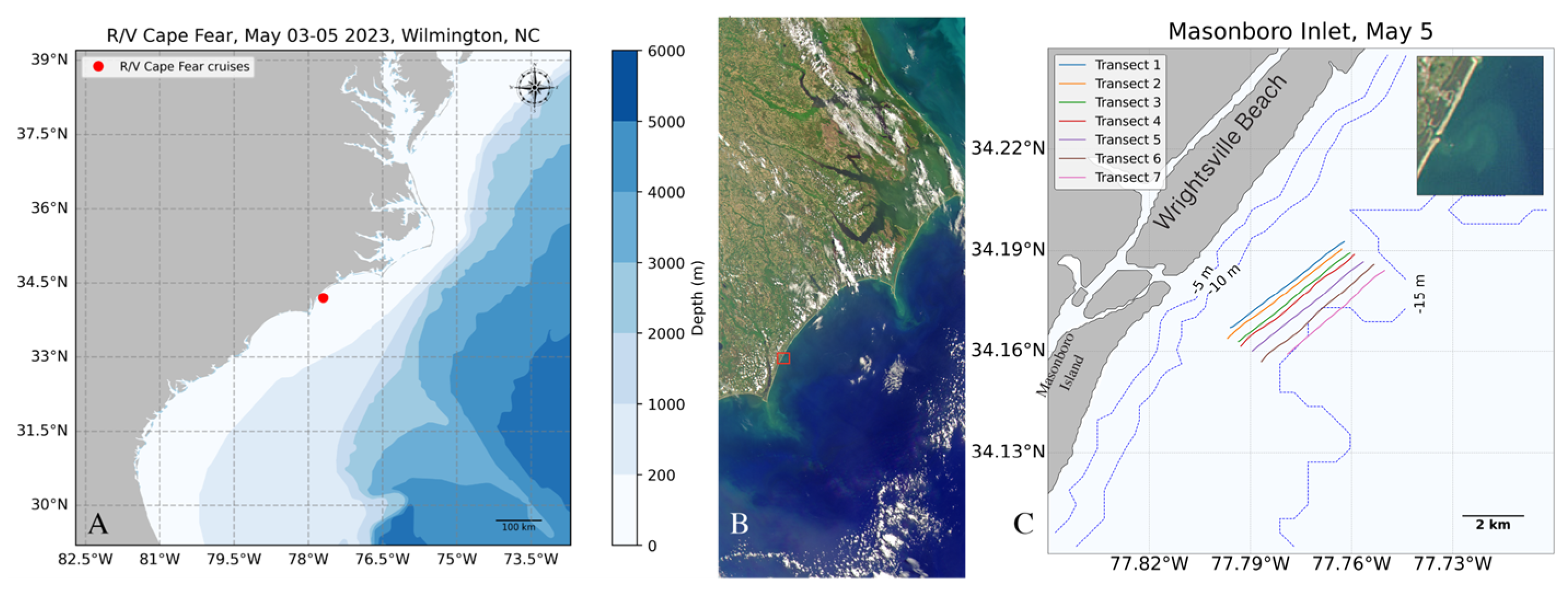
The study was conducted in the CFRE in southeastern North Carolina, USA, which connects inland water bodies to the Atlantic Ocean through the Cape Fear coastal region and Onslow Bay (Figure 1A,B). We focused on the discharge offshore of the Masonboro Inlet, which is ≈300 m wide, connects the Intracoastal Waterway to the Atlantic Ocean, and separates Masonboro Island from Wrightsville Beach, North Carolina (Figure 1C). Masonboro Inlet serves as an important federally maintained navigation channel for the region and is bounded by a jetty on both its north and south side [22]. The inlet’s tidal prism has been computed to be ~23 × 106 m3, representing substantial water flow and mixing potential on tidal timescales [23].
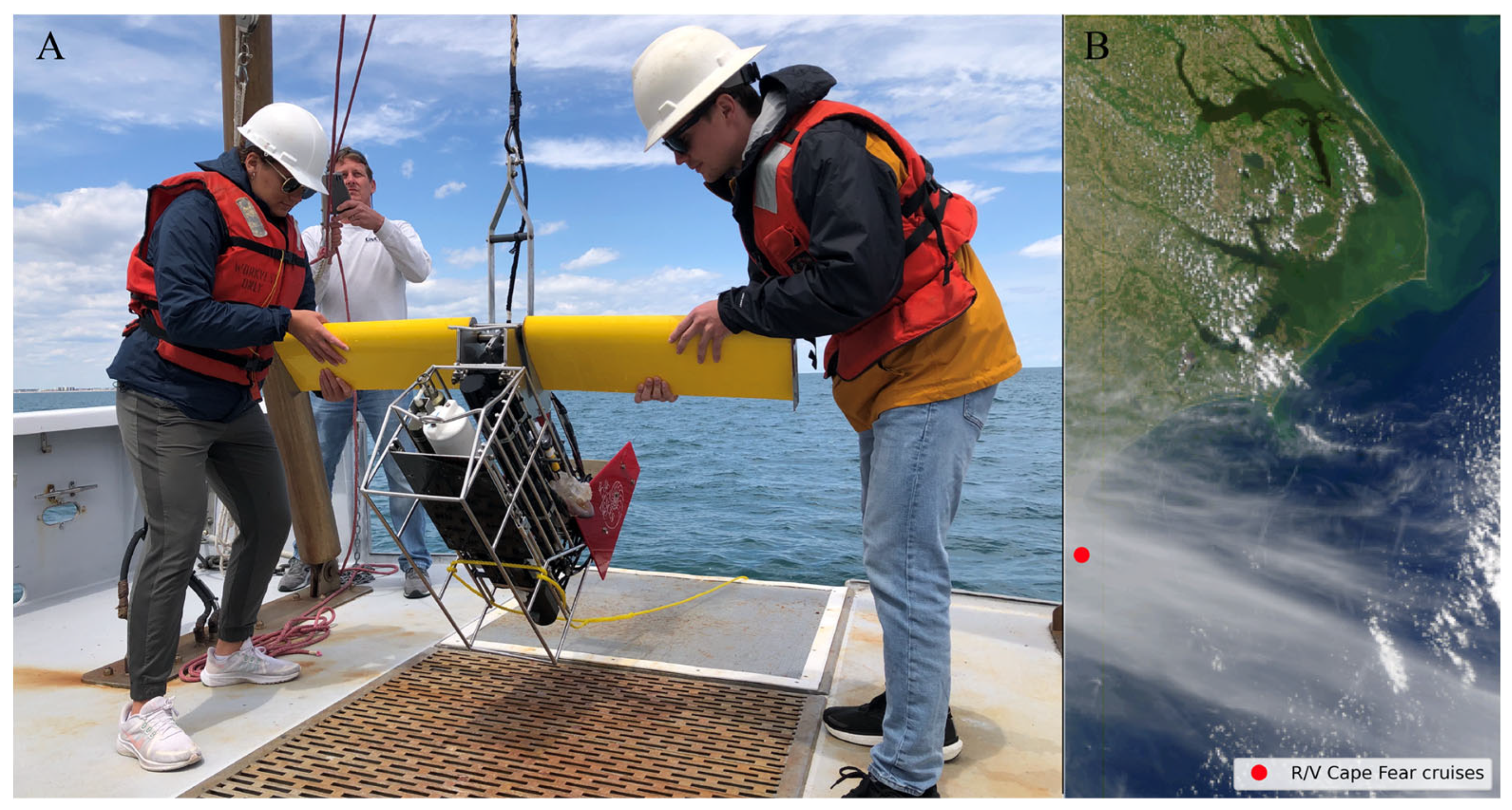
On 5 May 2023, we collected in situ measurements on board the R/V Cape Fear using the Acrobat platform (Sea Sciences Inc., Arlington, MA, USA; Figure 2A). The Acrobat is a versatile marine research tool, accommodating commercial sensors and real-time data acquisition. Most notably, the Acrobat is capable of conducting “tow-yo” profiles: that is, as the research vessel transits, the Acrobat zig-zags between user-defined depths, thus enabling multi-dimensional data collection. We integrated a comprehensive suite of sensors, including the Sea-Bird (Bellevue, WA, USA) SBE 25plus Sealogger CTD, SBE 4 Conductivity sensor, SBE 43 Oxygen sensor, Seapoint (Exeter, NH, USA) Chlorophyll Fluorometer, and Seapoint Turbidity Meter. All sensors were calibrated according to manufacturers’ protocols prior to deployment, with calibration dates as follows: CTD pressure sensor (6 September 2022), conductivity sensor (2 September 2022), oxygen sensor (7 September 2022), chlorophyll fluorometer (1 December 2022), and turbidity meter (26 September 2022) [24,25,26,27,28,29,30].
On 5 May 2023, we collected measurements along seven transects, each spanning ≈5 km alongshore and extending 2.5–4.5 km offshore (Figure 1C). The placement and orientation of the transects were selected to capture the primary physical and biogeochemical gradients associated with flow through the Masonboro Inlet and adjacent coastal waters. This region is characterized by strong tidal exchange and localized outflow from the estuary, which can generate variable plume structures and tracer transport patterns. Transects were oriented approximately parallel to the coastline and spanned both the deeper channelized regions associated with inlet outflow and adjacent shallower areas to assess how bathymetry and hydrodynamic forcing influence vertical structure and surface expressions detectable by satellite sensors. This design was intended to sample across expected gradients in turbidity, Chl a concentration, and water mass structure driven by tidal forcing and estuarine discharge.
CTD, chlorophyll a, turbidity, and dissolved oxygen data were continuously recorded from the surface to depths of ≈10 m. Following data collection, the datasets were downloaded using Sea-Bird Scientific Seasoft software (V2) and processed for initial quality control, including checks for timing consistency and value range validation according to NOAA’s Information Quality Guidelines [31]. A Seapoint Ultraviolet Fluorometer was also integrated for fluorescent dissolved organic matter data collection, but the sensor malfunctioned for unknown reasons and, as a result, these data are not reported here.
Data were visualized with contour plots that linearly interpolated each variable in two dimensions—across depth and along transect distance—using a custom Python script and the griddata function from Python’s scipy.interpolate. These contour plots represent variations in measured parameters both vertically and horizontally along each transect. To assess variability over depth, we also generated box plots for several depth intervals (0–4 m, 4–7 m, 7–10 m, and 0–10 m). Bathymetry data from GEBCO’s global gridded bathymetric datasets were incorporated to contextualize our observations [32].
We collected OC satellite data from Aqua-MODIS, Sentinel 3A and 3B-OLCI, and SeaHawk-HawkEye (V2018 data release, following [33]) for 5–7 May 2023, targeting the Lower CFRE and the vicinity of Masonboro Inlet. We downloaded all satellite datasets via NASA’s OB.DAAC Direct Data Access (DDA) interface (https://oceandata.sci.gsfc.nasa.gov/directdataaccess/, accessed on 10 August 2025). Landsat 8/9-OLI and Sentinel 2A/B-MSI were excluded because they did not acquire imagery over the study region during our sampling period.
Launched in 2018, the SeaHawk-HawkEye mission employs the HawkEye OC sensor on board a 3U CubeSat [9,33,34,35]. Despite its compact size, HawkEye’s performance has been shown to rival that of other OC radiometers [33] while achieving a spatial resolution of 130 m, significantly finer than the ~1000 m resolution of SeaWiFS or MODIS-Aqua and the 300 m resolution of Sentinel 3A/B-OLCI. HawkEye bridges the gap between high-spectral-quality sensors like SeaWiFS, MODIS, and OLCI, and high-spatial-resolution imagers like OLI and MSI. This balance was intended to enhance the detection of small-scale bio-optical gradients that are critical to nearshore OC research.
Custom processing began with downloading NASA’s Level-2 (L2) ocean color data, which include remote sensing reflectance (Rrs(λ)) and other geophysical products at the native spatial resolution of each sensor. Using SeaDAS v9.2.0, we applied quality control flags to ensure data reliability, removing pixels affected by failed atmospheric correction (ATMFAIL), land pixels (LAND), high or saturated radiance (HILT), excessive satellite sensor zenith angles (HISATZEN), potential stray light (STRAYLIGHT), cloud or ice contamination (CLDICE), presence of coccolithophores (COCCOLITH), low water-leaving radiance (LOWLW), Chl a algorithm failures (CHLFAIL), and navigation errors (NAVWARN). We used L2 products for quantitative analysis and Level-3 (L3) products—which consist of spatially binned and temporally composited data mapped onto a uniform grid—for visualizing broader spatial patterns in Chl a and Kd,490.
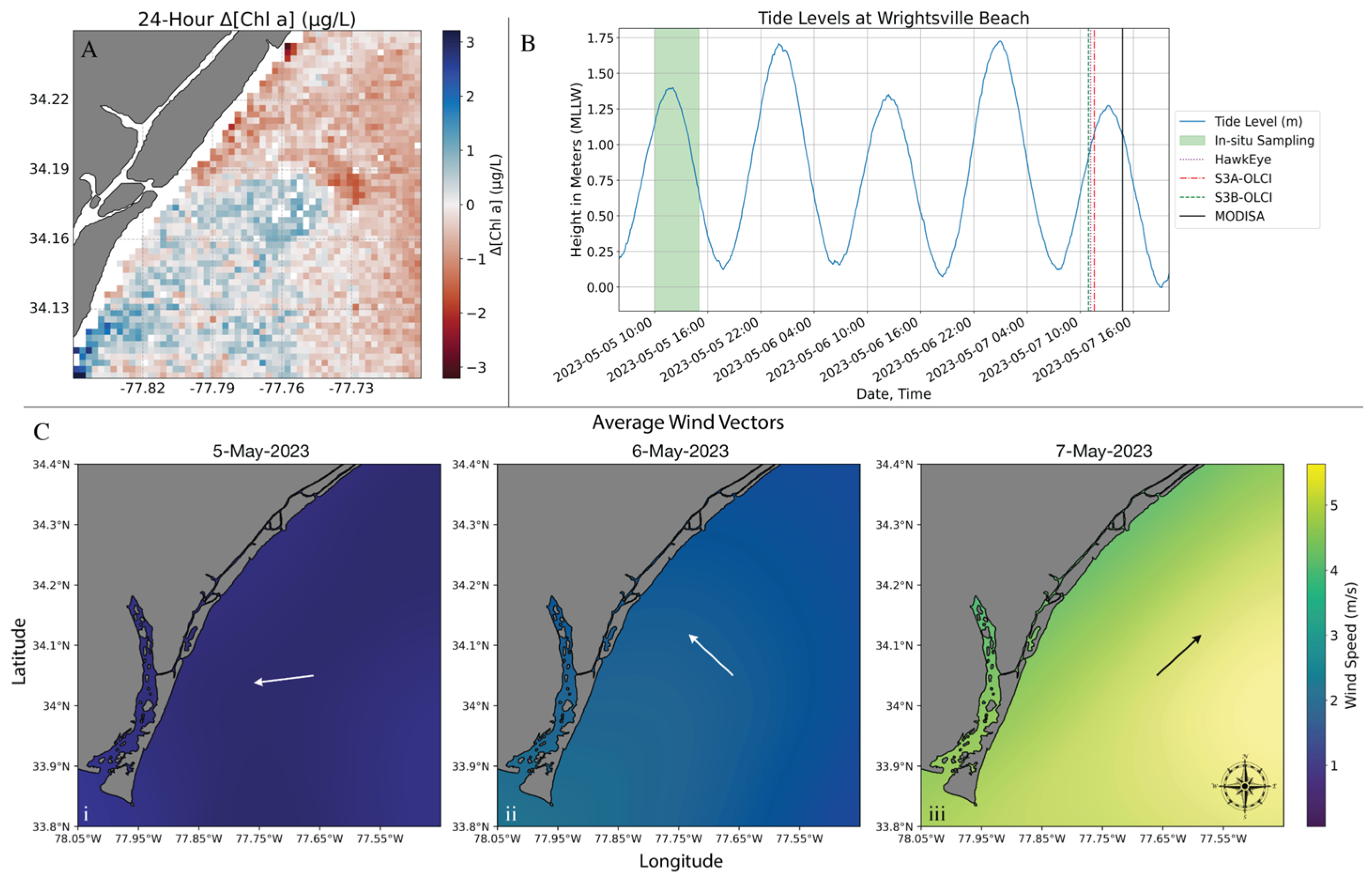
Unfortunately, cloud coverage on the day of in situ sampling, 5 May 2023, rendered that day’s satellite data unusable (Figure 2B). To enable an in situ vs. remotely sensed data comparison, we relaxed our ideal temporal constraint from same-hour matchups (e.g., [36] and references therein) to include imagery captured within 24–48 h of in situ sampling; satellite vs. in situ sampling times are described in Table 1. The especially dynamic nature of inlets—strongly influenced by tidal, river/creek outflow, and wind changes—necessitates testing temporal stability assumptions in our data. While past studies suggest satisfactory matchup analyses with modest temporal mismatch between satellite and in situ data collection [37], in dynamic tidal ecosystems, the window is likely shorter [20]. We benchmarked temporal variability in the vicinity of our mission by analyzing the 24 h Chl a change in Sentinel 3A-OLCI data from 6 to 7 May.
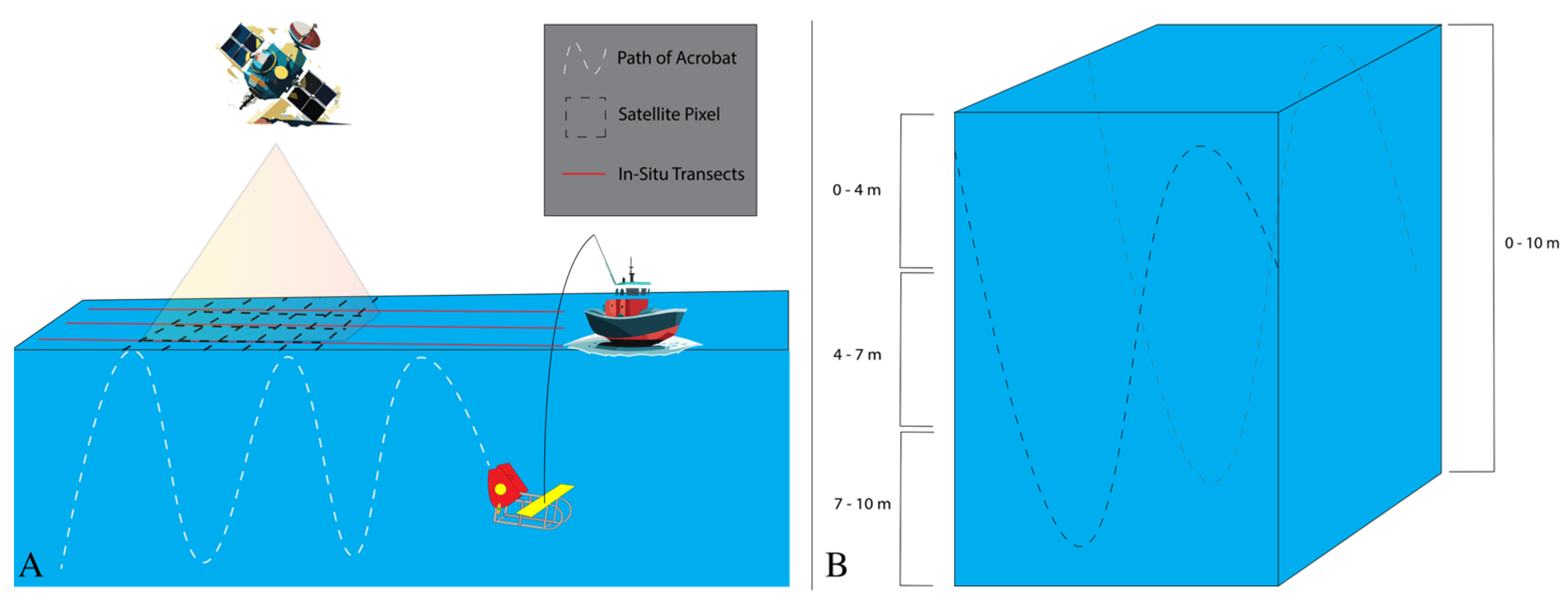
We contrasted in situ Chl a concentrations measured in the upper 10 m of the water column with satellite-derived Chl a estimates (Figure 3A). Ocean color radiometry inherently detects an integrated signal over primarily the first optical depth of the water column; that is, most photons that reach a satellite-borne radiometer are reflected from depths up to the point where light availability has markedly decreased. This weighted averaging process is influenced by the water’s vertically variable inherent optical properties (IOPs), which dictate how light is absorbed and scattered by substances within the water [16,38].
We performed satellite–in situ matchups using exact single-pixel comparisons by identifying the nearest Level-2 satellite pixel to each in situ sampling location based on geographic coordinates. We applied no spatial averaging (e.g., multi-pixel windows) and treated each sensor independently to preserve its native spatial resolution. Within this framework, we averaged in situ Chl a concentrations over depth intervals of 0–4 m, 4–7 m, 7–10 m, and the full 0–10 m range (Figure 3B) to assess depth dependence of the matchup quality.
To evaluate the accuracy of satellite sensors in measuring Chl a concentration, we applied five standard metrics: the coefficient of determination (R2), Root Mean Squared Error (RMSE), Mean Absolute Percentage Error (MAPE), Bias, and Mean Absolute Error (MAE) [39]. These metrics were calculated based on the differences between satellite-estimated (Qest,i) and in situ-measured (Qmea,i) Chl a values, according to the following formulas, where ‘N’ represents the total number of matched data points:
R 2 = 1 i = 1 N Q e s t , i Q m e a , i 2 i = 1 N Q m e a , i Q ¯ m e a 2 ,
R M S E = i = 1 N Q e s t , i Q m e a , i 2 N ,
M A P E = 1 N i = 1 N Q m e a , i Q e s t , i Q m e a , i × 100 % ,
B i a s = 1 N i = 1 N Q e s t , i Q m e a , i ,
M A E = 1 N i = 1 N Q m e a , i Q e s t , i .
We then compared these metrics across satellite sensors and depth ranges. Although statistical comparisons of Chl a are often performed using log10-transformed concentrations due to the typical log-normal distribution of oceanic chlorophyll [40,41], all metrics here were computed in linear space, considering the range of variation in these coastal waters is much smaller than the orders of magnitude observed in global ocean validations [41], to preserve absolute concentration differences and facilitate interpretation in this optically complex, shallow coastal environment. The routines used for processing and analyzing the satellite and in situ datasets are publicly available at https://github.com/COAST-Lab/HawkEye_Evaluation (accessed 31 January 2026) and are summarized in the workflow diagram presented in Figure S1. All analyses were conducted in Python 3.13.5, incorporating cmocean v4.0.3 for perceptually uniform oceanographic colormaps [42], and SciPy v1.16.0 [43] for interpolation and statistical operations. Satellite ocean color products were processed using SeaDAS v9.2.0 and the associated OCSSW (Ocean Color Scientific Software, V2024.5) processing system, maintained by NASA’s Ocean Biology Distributed Active Archive Center [44].

3. Results

The study site demonstrated temporal variability influenced by several environmental factors. Over the observation period from 5 to 7 May, wind speeds increased notably, ranging from 0.03 m/s to 9.46 m/s, indicating potential surface water mixing and variable distribution patterns (Figure 4C). Concurrently, there was a subtle decrease in Chl a concentration, with an overall average 24 h change within the study region from 6 to 7 May of −0.15 µg/L, but some pixels experienced more extreme swings up to ±3.21 µg/L (Figure 4A), reflecting advection of water masses and biological responses to changing environmental conditions. The tidal range also increased throughout the week. The recorded tidal ranges were 1.563 m on 5 May, 1.632 m on 6 May, and 1.729 m on 7 May (Figure 4B), which may contribute to the temporal and spatial variability of water quality due to the exchange of water masses.
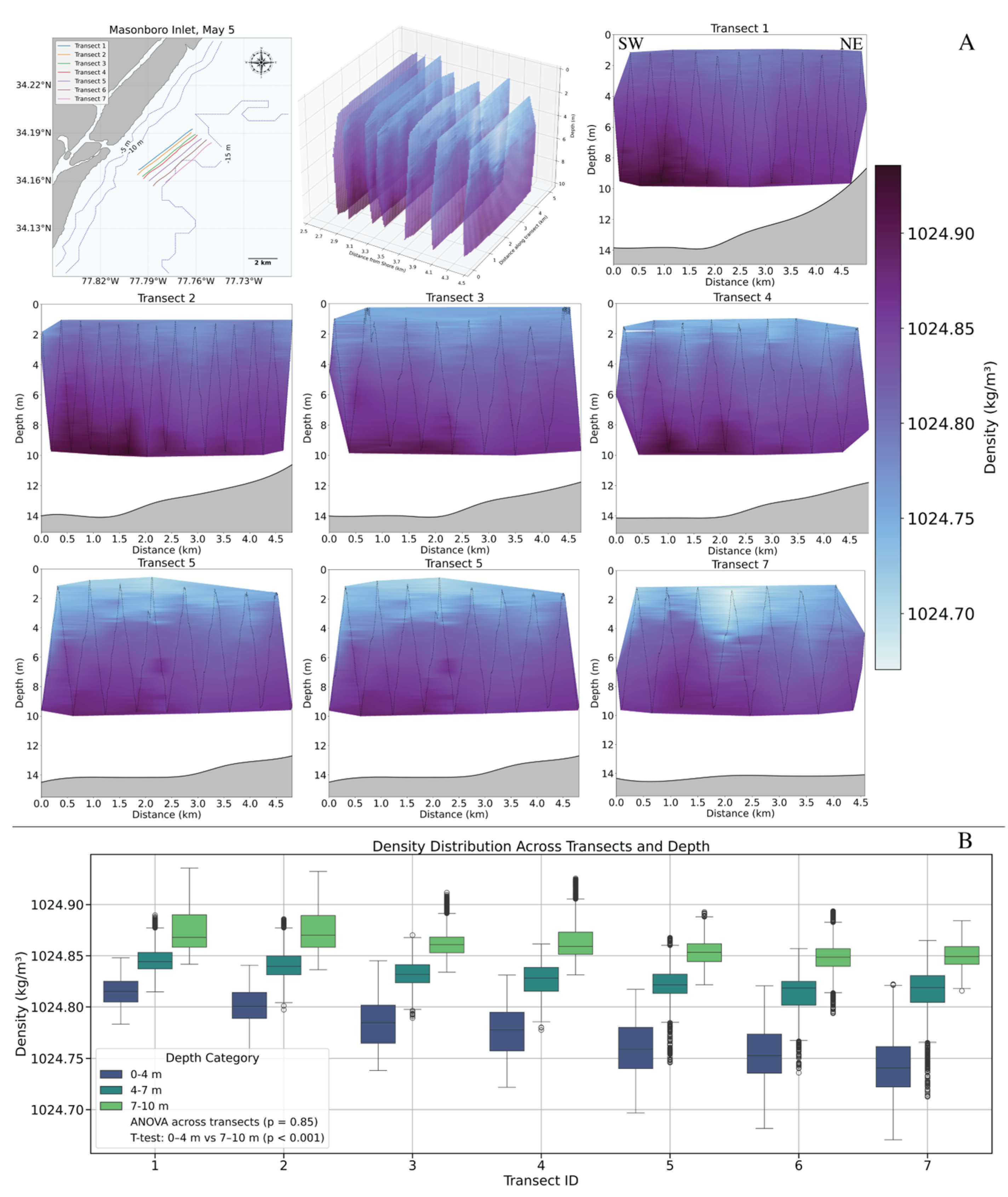
During Acrobat tow-yo profiling, Chl a concentration ranged from 0.0 to 2.02 µg/L, turbidity from 0.0 NTU to 10.99 NTU, salinity from 34.92 PSU to 35.05 PSU, density from 1024.7 kg/m3 to 1024.9 kg/m3, temperature from 19.55 °C to 20.22 °C, and dissolved oxygen from 7.37 mg/L to 7.46 mg/L. Contour plots provide visual representations of the spatial variations with depth for the oceanic parameters (see Supplementary Materials, Figures S2–S5, for contours of temperature, salinity, dissolved oxygen, and turbidity). Density (Figure 5) showed a subtle decline from transect 1 to transect 7, decreasing marginally from 1024.85 kg/m3 to 1024.81 kg/m3. A modest vertical gradation (i.e., slight stratification) was observed, with density rising very slightly from 1024.76 kg/m3 at the surface to 1024.87 kg/m3 in deeper waters. There are no significant differences in salinity as a function of depth (Figure S2), and the modest density gradients are primarily driven by slight surface water heating during this midday field study (temperature contours in Figure S3).
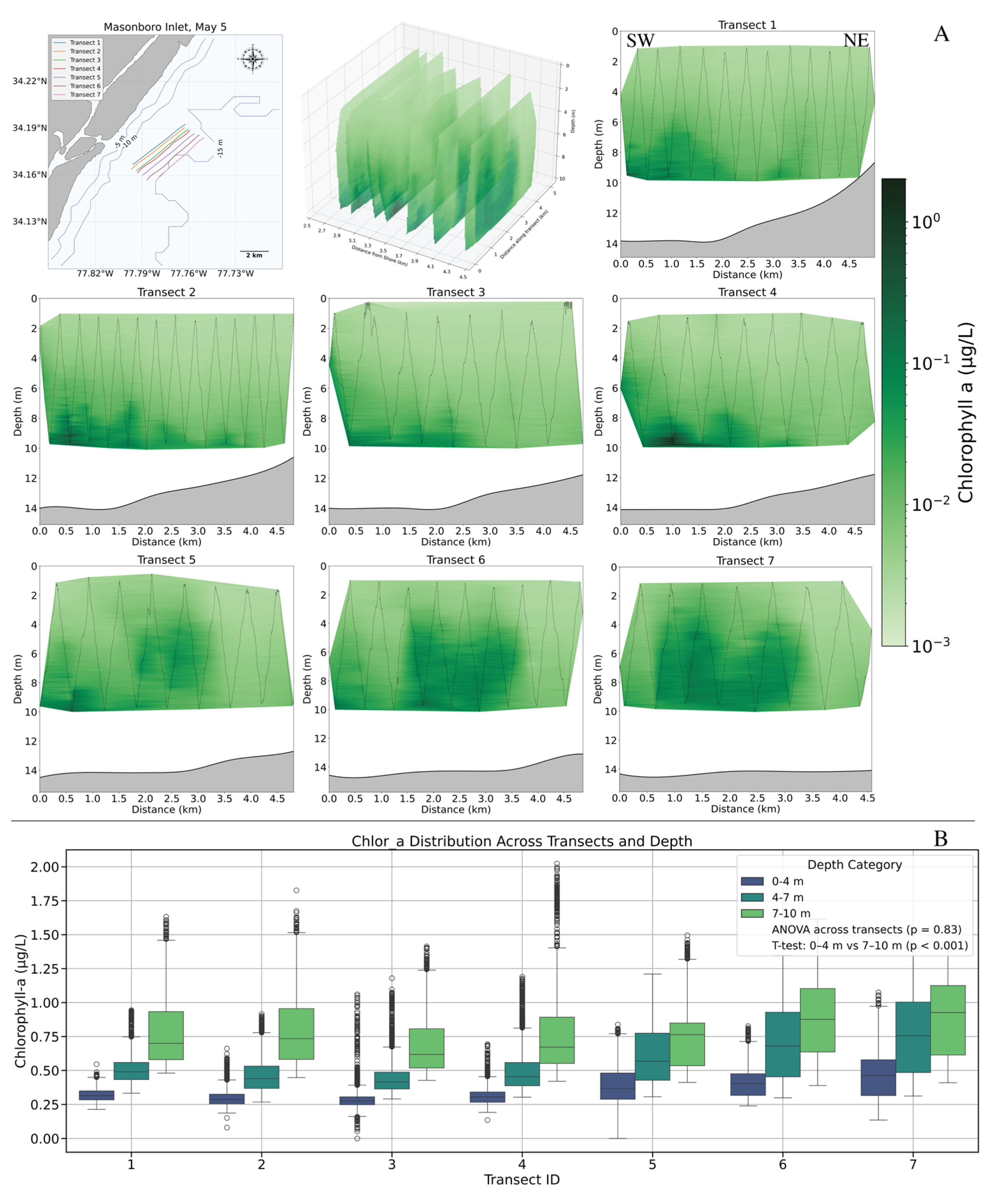
A pattern of increasing average Chl a concentration was noted from transect 1 (0.535 µg/L) to transect 7 (0.726 µg/L) as we moved offshore (Figure 6A). Additionally, Chl a concentration consistently increased with depth, averaging 0.577 µg/L between 0 and 4 m and 0.837 µg/L at a depth of 7–10 m (Figure 6B). In other words, a moderate phytoplankton patch is visible in the bottom depths of the Chl a transects, especially as distance from shore increases.
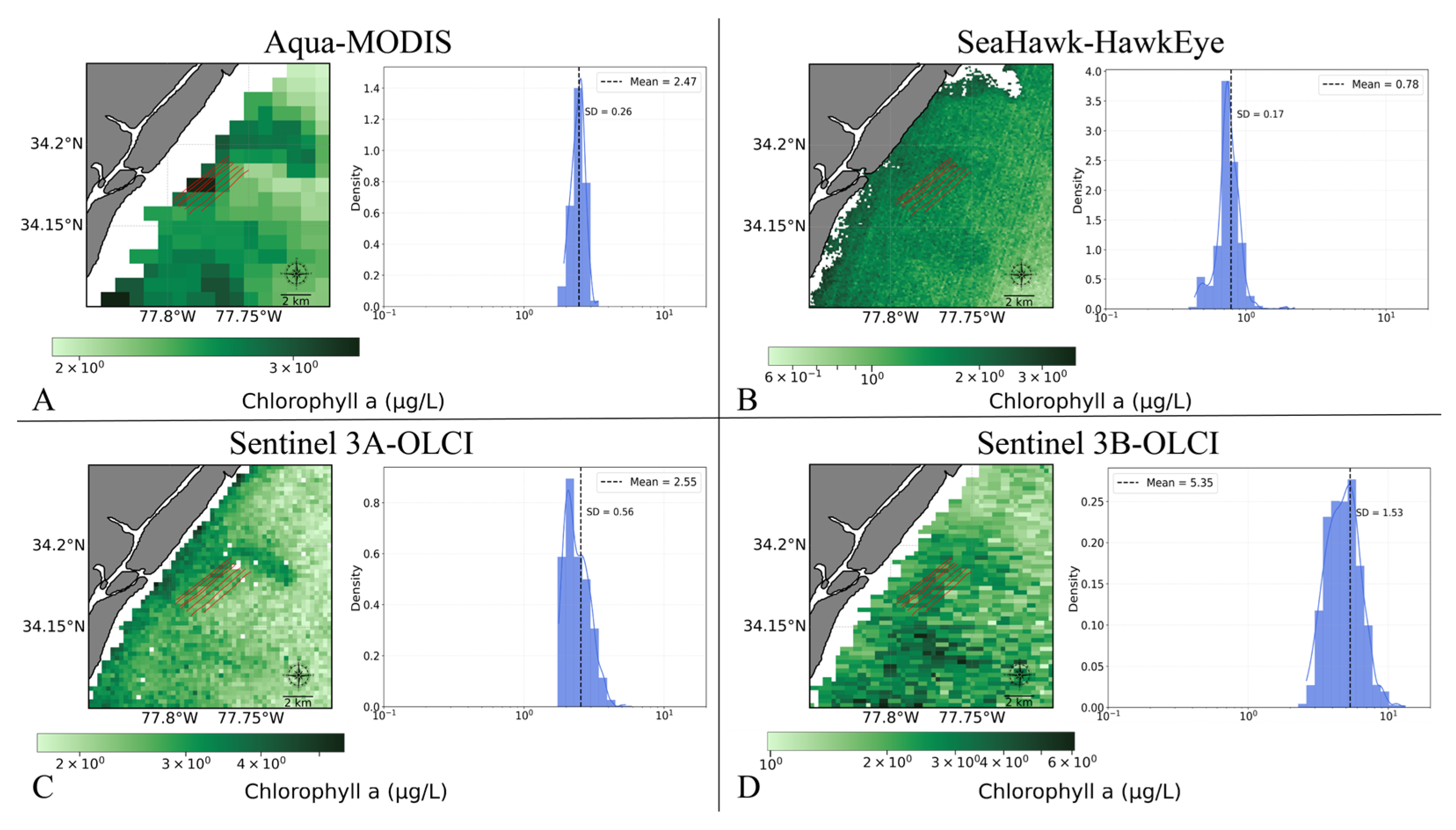
The analysis of satellite imagery data acquired on 7 May presents a wide range of detail across the suite of sensors. We generated a mosaic of the satellite imagery spanning the study site, covering coordinates 34.10–34.25°N and 77.85–77.70°W (Figure 7), illustrating a plume of elevated Chl a concentration near the coastline and extending offshore.
Within the spatially coincident region (Figure 7), Aqua-MODIS recorded an average Chl a concentration of 2.517 µg/L (range: 2.148–3.668 µg/L). SeaHawk-HawkEye reported an average concentration of 0.0983 µg/L (range: 0.028–0.458 µg/L). S3A-OLCI produced an average of 2.740 µg/L (range: 1.912–3.874 µg/L), while S3B-OLCI returned the highest values, averaging 5.926 µg/L (range: 3.176–7.941 µg/L) (Table 2).
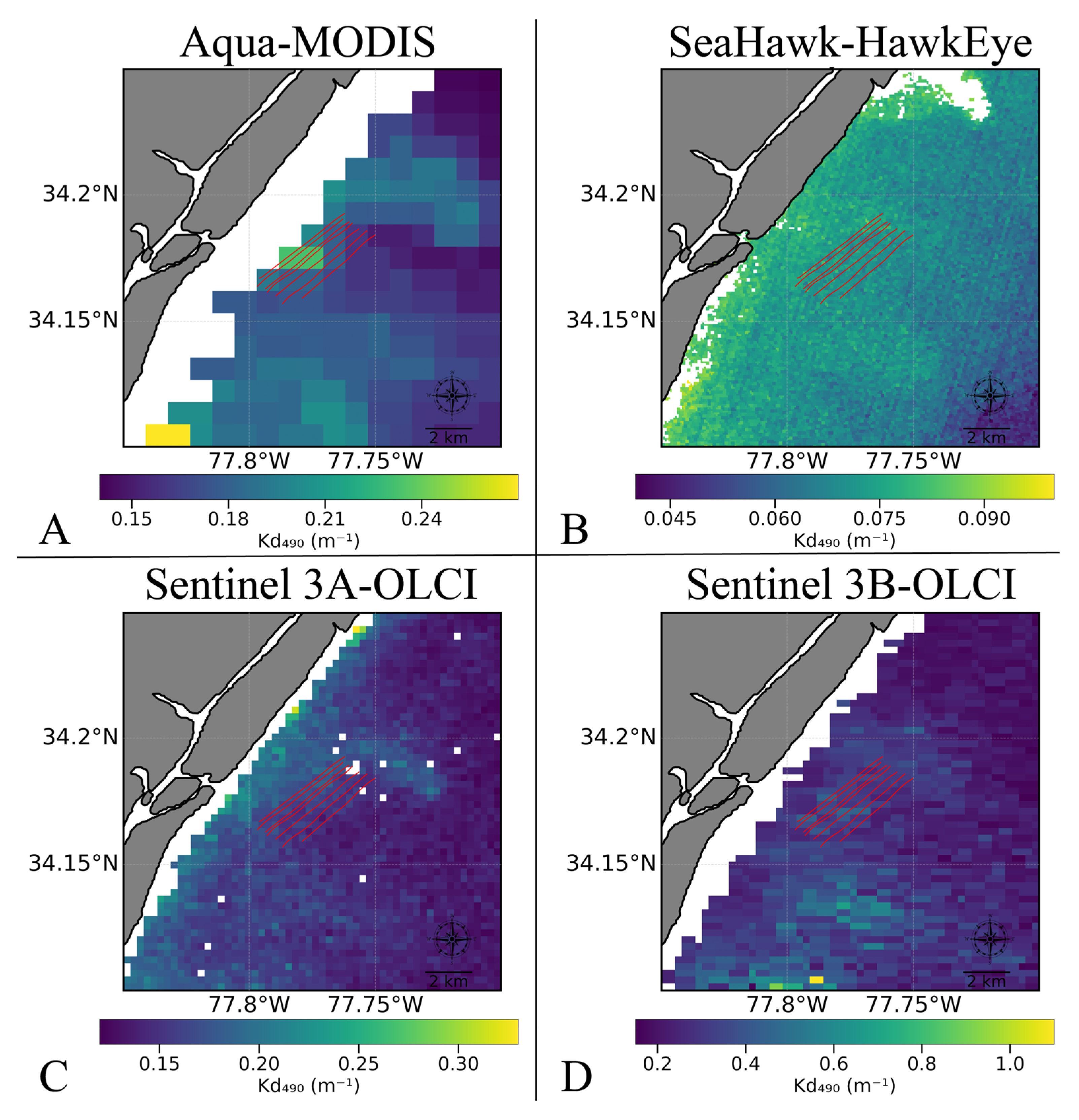
Average Kd,490 values were 0.187 m−1 for MODIS, 0.0252 m−1 for HawkEye, 0.163 m−1 for S3A-OLCI, and 0.324 m−1 for S3B-OLCI (Figure 8; Table 2). These correspond to the first optical depths of approximately 5.35 m (MODIS), 39.68 m (HawkEye), 6.13 m (S3A), and 3.09 m (S3B), indicating notable spatial differences in light attenuation. Critically, considering that in situ sampling occurred where water depth ranged from 10 to 15 m, these optical depth estimates suggest the likelihood of remotely sensed signal contamination by benthic reflectance (i.e., enough light likely penetrated through the full water column and reflected off the bottom to skew the signal).
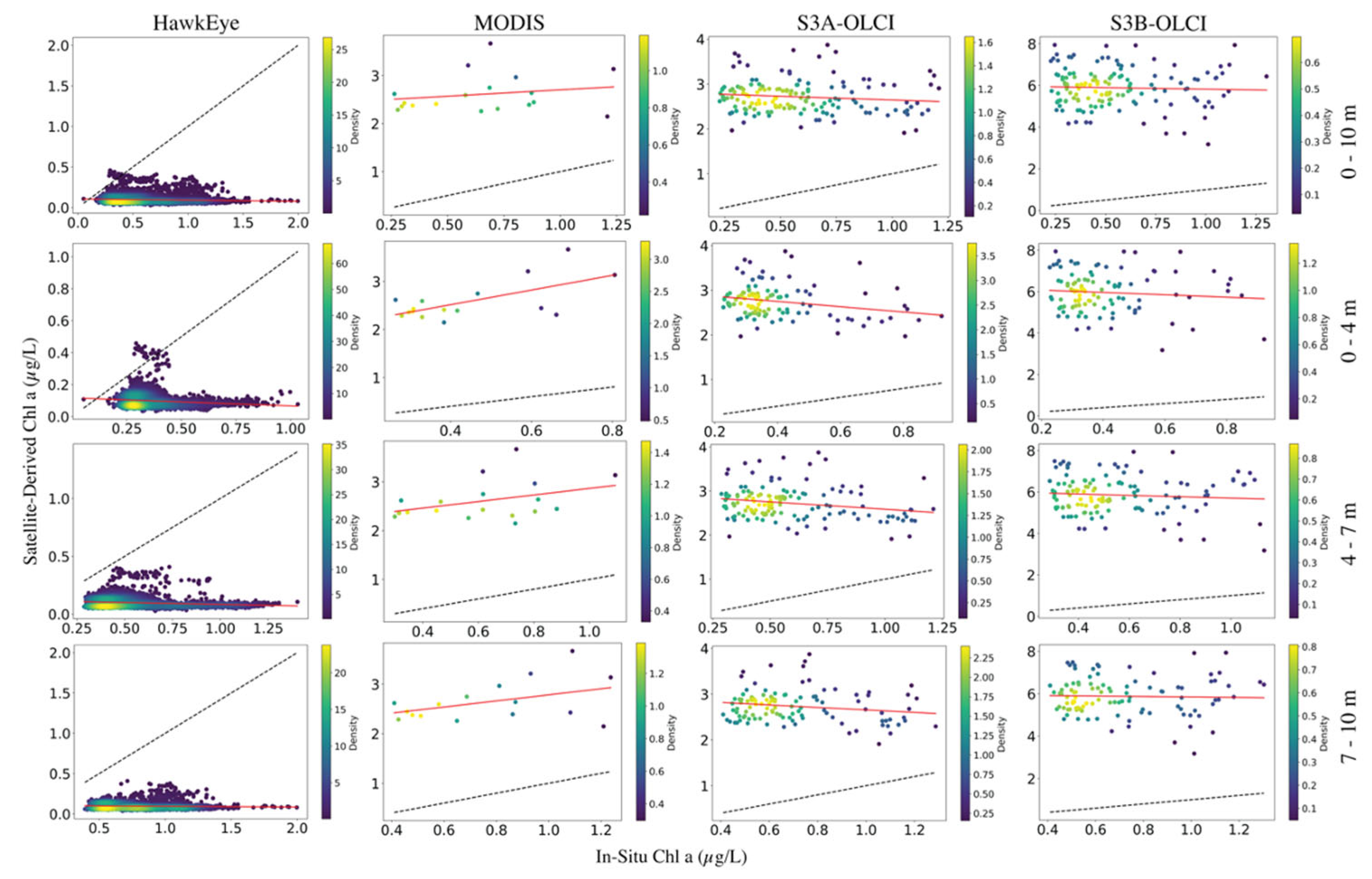
Finally, we compared the satellite-derived Chl a dataset to the in situ measurements collected by the Acrobat instrument across the full and binned depth ranges. Quantitative comparisons incorporated RMSE, MAPE, Bias, and R-squared to assess agreement between in situ and satellite observations for the full depth profile (0–10 m) as well as segmented intervals (0–4 m, 4–7 m, and 7–10 m). Across all depth ranges and statistical measures, no sensor showed strong agreement with in situ data (Table 3, Figure 9), further indicating that benthic reflectance, land adjacency effects, or atmospheric correction may have contaminated the remotely sensed aquatic data, that the standard ocean color algorithms were insufficient in optically complex waters, and/or that the time difference between in situ and remote sensing was simply too large for a meaningful comparison.

4. Discussion

The integration of in situ measurements with satellite-derived data in dynamic coastal environments presents significant challenges that are clearly illustrated in this study. While combining these data sources is often expected to provide a more comprehensive understanding of coastal bio-physical and biogeochemical dynamics and support robust monitoring of ecological dynamics across heterogenous coastal landscapes [45], our results demonstrate that meaningful agreement between datasets can be difficult to achieve in shallow, optically complex, and highly variable nearshore systems such as the CFRE.
The in situ measurements collected using the Acrobat instrument captured fine-scale vertical and horizontal variations in Chl a, temperature, salinity, and other parameters within the water column, essential for validating surface-level satellite-derived measurements, which often average (or depth-weighted-average) these dynamic properties [38]. The satellite data offered extensive spatial coverage, revealing broader patterns and trends in Chl a and Kd,490, but, due to cloud cover, were unavailable until approximately two days after in situ sampling. Our findings highlight both the potential and the challenges of using satellite sensors to monitor Chl a concentrations and other related parameters in complex coastal waters (Case 2), which are typically heterogenous and dynamic, and where the presence of optically active substances and reflectance from the shallow seafloor dramatically alter light absorption and scattering patterns [2,17,46,47].
The depth-dependent increase in Chl a supports the hypothesis that deeper light penetration promotes phytoplankton growth in offshore waters [48]. However, this trend is complex and can be influenced by several factors. Non-photochemical quenching (NPQ) effects, where excess light energy is dissipated as heat in phytoplankton to prevent damage, could explain some vertical variations in Chl a concentrations [49]. Additionally, the observed lateral increases in Chl a with distance from shore may seem counterintuitive, as nutrient-rich runoff would typically results in higher concentrations closer to shore [50]. This apparent contradiction suggests that other processes may play a meaningful role in determining the observed patterns.
Temperature variations, with warmer surface waters compared to deeper layers, indicated a slight temperature decrease with depth potentially influencing vertical nutrient mixing and biological productivity [51]. However, it is important to note the relatively small overall change of <1 °C across the entire Acrobat dataset. Additionally, the sampling was conducted across different spatial locations (i.e., increasing distance from shore) and at different times of the day. This temporal aspect is critical, as the gradual increase in temperature from morning to midafternoon demonstrates diurnal variations that affect ecological dynamics [52]. The observed decrease in salinity from the first to the last transect could reflect the impact of tidal cycles. The first half of the in situ sampling occurred during a rising tide, while the latter half took place during a falling tide. During a rising tide, seawater influx increases salinity near the shore, while a falling tide enhances freshwater influence, potentially lowering salinity further offshore [53].
The observed density trends, coupled with an analysis of buoyancy frequency squared (N2) values across the depth profile reveals an equilibrated water column, indicating dynamic mixing processes within the water column. These findings align with the observed vertical gradients in temperature and salinity, further emphasizing the complex interplay of physical processes affecting water column stability and mixing during the sampling period.
Lastly, the increase in in situ turbidity measurements from the shore towards the ocean may indicate heightened planktonic concentrations (noting turbidity and Chl a patterns are correlated), both of which can alter optical properties and influence heat retention and biological productivity [54]. Turbidity exhibited more modest spatial variability across most transects, with a pronounced increase observed primarily along transect 6 (Figure S5). Higher turbidity at greater depths suggests elevated sediment concentration near the benthos, potentially associated with particle settling and resuspension processes [55]. We also note that Chl a fluorescence and turbidity are not independent in complex coastal waters, as suspended particles and bubbles can bias fluorescence-based Chl a estimates through optical scattering and absorption [56].
One of the key questions addressed in this study was the identification of discrepancies between in situ and satellite-derived Chl a measurements and the factors contributing to these differences. The imagery collected on 7 May 2023 revealed noteworthy variability in Chl a concentrations across the CFRE, illustrating the capabilities and limitations of different sensors. MODIS-Aqua provided broader spatial coverage with moderate resolution, which is valuable for broad environmental assessments of Case 1 waters, but can be challenging to use in coastal regions [15]. Sentinel 3A and 3B-OLCI offered a middle ground in terms of resolution and coverage, with Sentinel 3B-OLCI showing higher Chl a values, indicating potential issues with using the standard, global ocean color algorithms and/or environmental variability during the full data collection period.
The matchup analysis between in situ and satellite-derived Chl a concentrations showed varying degrees of agreement across different sensors and depth ranges (acknowledging again the significant separation in time), consistently indicating lack of agreement between satellite sensors and in situ measurements from the Acrobat. Interestingly, we observe that HawkEye-derived Chl a exhibits the closest estimates to in situ Chl a (Table 3). The range of estimated Kd,490 values illustrates how variations in IOPs influenced by factors such as water turbidity, salinity, and temperature—which varied considerably within our study region—can significantly influence sensor performance [16,57,58,59]. Notably, the low estimated Kd,490 values suggest a potential contribution from bottom reflectance, illustrating another likely challenge with data accuracy and comparability amongst datasets, especially in dynamic, shallow coastal regions [38]. To confirm the hypothesis that benthic reflectance contaminated Rrs(λ), ideally, Kd would have been measured in situ with a photosynthetically active radiation (PAR) sensor or Kd,λ with spectral irradiance measurements, but these were not available during the study.
The analysis revealed significant variability among the sensors, with MODIS and Sentinel-3B OLCI showing higher Chl a values compared to in situ data, while SeaHawk-HawkEye generally underestimated Chl a concentrations. The SeaHawk-HawkEye sensor demonstrated the most favorable performance in terms of RMSE and MAPE, particularly at shallower depths (0–4 m), suggesting its higher spatial resolution may be beneficial for surface-level measurements, especially in optically complex coastal waters, and that its atmospheric correction and Chl a algorithm perform relatively well. However, its accuracy decreased with depth, highlighting the need for complementary in situ data for subsurface analysis, and a need for further calibration and validation efforts to enhance its reliability in varying depth conditions in regions where the first optical depth exceeds the total water depth. Recent related work [33] also provides a thorough characterization of HawkEye across the Rrs spectrum and a wide range of geographic and optical settings.
Additionally, the timing of data collection proved crucial, with in situ samples collected 48 h prior to satellite acquisition (noting again that fieldwork had been planned to coincide with multiple satellite overpasses, but cloud cover resulted in the loss of those contemporaneous datasets). The resulting temporal disparities between satellite overpasses and in situ sampling likely played a leading role in the noted discrepancies. Changes in wind speed, tidal currents and phase, and cloud cover during the study period influenced water mixing and light penetration, impacting Chl a distribution and detection, highlighting the need for tightly coordinated sampling efforts to minimize such mismatches [37]. In highly dynamic inlet systems such as the Masonboro Inlet [23], water mass properties can change substantially over tidal cycles, suggesting that a 24–48 h mismatch may result in comparisons between fundamentally different water masses. As a result, the satellite–in situ matchups presented here should be interpreted with caution, as they may not represent physically consistent observations of the same water body. That said, field expeditions are logistically difficult and financially costly, underscoring the value of satellite monitoring of coastal waters and the critical need for high-resolution, high-quality and low-cost missions that freely distribute their data, such as the SeaHawk-HawkEye CubeSat mission.

5. Conclusions

This study highlights the challenges of integrating in situ and satellite-derived observations in dynamic, shallow coastal environments. Our results emphasize key limitations that must be considered when designing and interpreting ocean color validation studies in nearshore systems. In particular, the results indicate that (1) temporal mismatches greater than a couple hours can significantly limit the physical validity of satellite–in situ comparisons in tidal ecosystems, (2) shallow water depths relative to optical penetration increase potential influence of benthic reflectance on satellite retrievals, and (3) spatial variability associated with inlet dynamics and plume structure can complicate comparisons across sensors with differing resolutions.
These findings suggest that future studies should prioritize near-synchronous sampling, improved characterization of local hydrodyamics, and the use of sensor-specific or regionally tuned algorithms for optically complex waters. Additionally, expanded in situ measurements (e.g., Kd,λ) would improve the ability to diagnose sources of uncertainty in satellite-derived products.
While the CubeSat utilized in this research, the proof-of-concept SeaHawk-HawkEye, demonstrated relatively low bias vs. in situ measurements in comparison with other satellites and offered significant advantages in spatial resolution, its long revisit period and difficulties with atmospheric correction due to a mechanical defect present challenges for its application in dynamic coastal settings. Future ocean color missions may be able to overcome the temporal challenge while taking advantage of spatial resolution improvements of SeaHawk-HawkEye by launching constellations of CubeSats.
Overall, this study provides practical insights into the constraints and considerations necessary for effective integration of in situ and satellite observations. The lessons learned from this work can inform the design of future coastal remote sensing studies and contribute to improved monitoring of complex nearshore environments.

Supplementary Materials

The following supporting information can be downloaded at https://www.mdpi.com/article/10.3390/rs18101524/s1, Figure S1: Flowchart of methodologies; Figure S2: Salinity transects; Figure S3: Temperature transects; Figure S4: Dissolved oxygen transects; Figure S5: Turbidity transects; Figure S6: Performance evaluation barcharts; Figure S7: Chl a estimates from remote sensors similar to Figure 7 in main text but plotted with uniform colorscale; Figure S8: Kd,490 estimates from remote sensors similar to Figure 8 in main text but plotted with uniform colorscale; Table S1: summary of Chl a across transects; Table S2: Summary of dissolved oxygen; Table S3: Summary of turbidity; Table S4: Summary of density.

Author Contributions

Conceptualization, M.T. and P.J.B.; methodology, M.T., P.J.B., D.W. and M.M.-U.-A.; software, M.T.; formal analysis, M.T. and P.J.B.; writing—original draft preparation, M.T. and P.J.B.; writing—review and editing, M.T., P.J.B., S.R.-C., M.M.-U.-A., R.J.W.B. and D.W.; supervision, P.J.B. and S.R.-C.; project administration, P.J.B. and S.R.-C.; funding acquisition, P.J.B. and S.R.-C. All authors have read and agreed to the published version of the manuscript.

Funding

This publication is funded by the Gordon and Betty Moore Foundation through Grant GBMF11171 to P.J.B. and S.R.C. NASA contributed substantially to the project’s success via the NASA Space Act Agreement. R.J.W.B is supported by a UKRI Future Leader Fellowship (MR/V022792/1).

Data Availability Statement

Remotely sensed data are available at https://search.earthdata.nasa.gov (accessed 31 January 2026). Data analysis routines are available at https://github.com/COAST-Lab/HawkEye_Evaluation (accessed 31 January 2026). In situ data are available upon request.

Acknowledgments

We thank the Marine Operations team at University of North Carolina Wilmington and Jessie Wynne for their support throughout this study. We give special thanks to Bruce Monger for his invaluable guidance during the ocean color remote sensing analysis. We also thank the SeaHawk-HawkEye development team, including John Morrison, Gene Feldman, Alan Holmes, Sean Bailey, Alicia Scott, and Liang Hong, and the rest of the NASA, Cloudland Instruments, and Clyde Space SeaHawk-HawkEye team. During the preparation of this manuscript, the authors used ChatGPT (GPT-4o and GPT-5) for the purpose of checking grammar and for proofreading. The authors have reviewed and edited the output and take full responsibility for the content of this publication.

Conflicts of Interest

The authors declare no conflicts of interest.

Abbreviations

CFRECape Fear River Estuary
Chl aChlorophyll a
NTUNephelometric Turbidity Unit
GDPgross domestic product
OCOcean Color
NASANational Atmospheric and Space Administration
OBPGOcean Biology Processing Group
MODISModerate Resolution Imaging Spectroradiometer
SeaWiFSSea-viewing Wide Field-of-view Sensor
OLIOperational Land Imager
MSIMultispectral Instrument
RrsRemote Sensing Reflectance
Kd,490Light Attenuation Coefficient at 490 nm
SNRSignal-to-Noise Ratio
POCParticulate Organic Carbon
SPMSuspended Particulate Matter
GEBCOThe General Bathymetric Chart of the Oceans
NOAANational Oceanic and Atmospheric Administration
GSFCGoddard Space Flight Center
IOCCGInternational Ocean Colour Coordinating Group
RMSERoot Mean Square Error
MAPEMean Absolute Percentage Error
PARPhotosynthetically Active Radiation

References

  1. Tran, T.K.; Duforêt-Gaurier, L.; Vantrepotte, V.; Jorge, D.S.F.; Mériaux, X.; Cauvin, A.; Fanton d’Andon, O.; Loisel, H. Deriving Particulate Organic Carbon in Coastal Waters from Remote Sensing: Inter-Comparison Exercise and Development of a Maximum Band-Ratio Approach. Remote Sens. 2019, 11, 2849. [Google Scholar] [CrossRef]
  2. Bauer, J.E.; Cai, W.-J.; Raymond, P.A.; Bianchi, T.S.; Hopkinson, C.S.; Regnier, P.A.G. The Changing Carbon Cycle of the Coastal Ocean. Nature 2013, 504, 61–70. [Google Scholar] [CrossRef]
  3. Kämpf, J.; Chapman, P. Upwelling Systems of the World; Springer International Publishing: Cham, Switzerland, 2016. [Google Scholar]
  4. Cape Fear River Watch. CAFOs. Available online: https://capefearriverwatch.org/cafos/ (accessed on 2 May 2024).
  5. Beck, M.W.; Heck, K.L.; Able, K.W.; Childers, D.L.; Eggleston, D.B.; Gillanders, B.M.; Halpern, B.; Hays, C.G.; Hoshino, K.; Minello, T.J.; et al. The Identification, Conservation, and Management of Estuarine and Marine Nurseries for Fish and Invertebrates. BioScience 2001, 51, 633–641. [Google Scholar] [CrossRef]
  6. Nagelkerken, I. Are Non-Estuarine Mangroves Connected to Coral Reefs through Fish Migration? Bull. Mar. Sci. 2007, 80, 595–607. [Google Scholar]
  7. Nagelkerken, I.; Sheaves, M.; Baker, R.; Connolly, R.M. The Seascape Nursery: A Novel Spatial Approach to Identify and Manage Nurseries for Coastal Marine Fauna. Fish Fish. 2015, 16, 362–371. [Google Scholar] [CrossRef]
  8. Sheaves, M.; Baker, R.; Nagelkerken, I.; Connolly, R.M. True Value of Estuarine and Coastal Nurseries for Fish: Incorporating Complexity and Dynamics. Estuaries Coasts 2015, 38, 401–414. [Google Scholar] [CrossRef]
  9. Bresnahan, P.J.; Rivero-Calle, S.; Morrison, J.; Feldman, G.; Holmes, A.; Bailey, S.; Scott, A.; Hong, L.; Patt, F.; Kuring, N.; et al. High-Resolution Ocean Color Imagery from the SeaHawk-HawkEye CubeSat Mission. Sci. Data 2024, 11, 1246. [Google Scholar] [CrossRef]
  10. Smith, R.C.; Baker, K.S. Optical Classification of Natural Waters 1. Limnol. Oceanogr. 1978, 23, 260–267. [Google Scholar] [CrossRef]
  11. Jiang, Z.-P.; Tong, Y.; Tong, M.; Yuan, J.; Cao, Q.; Pan, Y. The Effects of Suspended Particulate Matter, Nutrient, and Salinity on the Growth of Amphidinium carterae Under Estuary Environmental Conditions. Front. Mar. Sci. 2021, 8, 690764. [Google Scholar] [CrossRef]
  12. Liu, H.; Li, Q.; Bai, Y.; Yang, C.; Wang, J.; Zhou, Q.; Hu, S.; Shi, T.; Liao, X.; Wu, G. Improving Satellite Retrieval of Oceanic Particulate Organic Carbon Concentrations Using Machine Learning Methods. Remote Sens. Environ. 2021, 256, 112316. [Google Scholar] [CrossRef]
  13. Loisel, H.; Jorge, D.S.F.; Reynolds, R.A.; Stramski, D. A Synthetic Optical Database Generated by Radiative Transfer Simulations in Support of Studies in Ocean Optics and Optical Remote Sensing of the Global Ocean. Earth Syst. Sci. Data 2023, 15, 3711–3731. [Google Scholar] [CrossRef]
  14. Kirk, J.T.O. Light and Photosynthesis in Aquatic Ecosystems, 2nd ed.; Cambridge University Press: Cambridge, UK, 1994. [Google Scholar]
  15. Wang, M.; Son, S.; Harding, L.W. Retrieval of Diffuse Attenuation Coefficient in the Chesapeake Bay and Turbid Ocean Regions for Satellite Ocean Color Applications. J. Geophys. Res. Oceans 2009, 114, C10011. [Google Scholar] [CrossRef]
  16. Zaneveld, J.R.V.; Barnard, A.H.; Boss, E. Theoretical Derivation of the Depth Average of Remotely Sensed Optical Parameters. Opt. Express 2005, 13, 9052–9061. [Google Scholar] [CrossRef]
  17. Darecki, M.; Stramski, D. An Evaluation of MODIS and SeaWiFS Bio-Optical Algorithms in the Baltic Sea. Remote Sens. Environ. 2004, 89, 326–350. [Google Scholar] [CrossRef]
  18. Morel, A.; Prieur, L. Analysis of Variations in Ocean Color. Limnol. Oceanogr. 1977, 22, 709–722. [Google Scholar] [CrossRef]
  19. Ody, A.; Doxaran, D.; Vanhellemont, Q.; Nechad, B.; Novoa, S.; Many, G.; Bourrin, F.; Verney, R.; Pairaud, I.; Gentili, B. Potential of High Spatial and Temporal Ocean Color Satellite Data to Study the Dynamics of Suspended Particles in a Micro-Tidal River Plume. Remote Sens. 2016, 8, 245. [Google Scholar] [CrossRef]
  20. Brown, C.N. Multi-Decadal Assessments of Coastal Nutrient Pollution Using Field-Based, Statistical, and Machine Learning Approaches for Management. Ph.D. Thesis, The University of North Carolina at Wilmington, Wilmington, NC, USA, 2025. [Google Scholar]
  21. Vanhellemont, Q.; Ruddick, K. Turbid Wakes Associated with Offshore Wind Turbines Observed with Landsat 8. Remote Sens. Environ. 2014, 145, 105–115. [Google Scholar] [CrossRef]
  22. North Carolina Department of Environmental Quality. North Carolina Beach and Inlet Management Plan (BIMP): Section IX—Region 2; North Carolina Department of Environmental Quality: Raleigh, NC, USA, 2016.
  23. Erickson, K.M.; Kraus, N.C.; Carr, E.E. Circulation Change and Ebb Shoal Development Following Relocation of Mason Inlet, North Carolina. In Proceedings of the Proceedings of Coastal Sediments 2003; World Scientific Publishing Corporation: Corpus Christi, TX, USA, 2003. [Google Scholar]
  24. Sea-Bird Scientific. SBE 3 Temperature Calibration Data (Serial No. 5827); Sea-Bird Scientific: Bellevue, WA, USA, 2022. [Google Scholar]
  25. Sea-Bird Scientific. SBE 4 Conductivity Calibration Data (Serial No. 4363); Sea-Bird Scientific: Bellevue, WA, USA, 2022. [Google Scholar]
  26. Sea-Bird Scientific. SBE 25plus Pressure Calibration Data (Serial No. 1079); Sea-Bird Scientific: Bellevue, WA, USA, 2022. [Google Scholar]
  27. Sea-Bird Scientific. SBE 43 Oxygen Calibration Data (Serial No. 2937); Sea-Bird Scientific: Bellevue, WA, USA, 2022. [Google Scholar]
  28. Seapoint Sensors, Inc. Seapoint Chlorophyll Fluorometer Calibration Record (Serial No. 2826); Seapoint Sensors, Inc.: Exeter, NH, USA, 2022. [Google Scholar]
  29. Seapoint Sensors, Inc. Seapoint Turbidity Meter Calibration Record (Serial No. 10961); Seapoint Sensors, Inc.: Exeter, NH, USA, 2022. [Google Scholar]
  30. Seapoint Sensors, Inc. Seapoint Ultraviolet Fluorometer Calibration Record (Serial No. 6208); Seapoint Sensors, Inc.: Exeter, NH, USA, 2022. [Google Scholar]
  31. National Oceanic and Atmospheric Administration Information Quality Guidelines. Available online: https://www.noaa.gov/organization/information-technology/policy-oversight/information-quality/information-quality-guidelines (accessed on 2 May 2024).
  32. The GEBCO_2023 Grid|GEBCO. Available online: https://www.gebco.net/data-products/gridded-bathymetry-data/gebco2023-grid (accessed on 13 December 2025).
  33. Kolluru, S.; Rivero-Calle, S.; Bresnahan, P.J.; Kratzer, S.; Moore, T.S.; Schroeder, T.; Bailey, S.; Holmes, A.; Morrison, J.M.; Feldman, G.F.; et al. Accuracy of SeaHawk-HawkEye Ocean Color CubeSat Remote Sensing Reflectance Products in Globally Distributed Aquatic Sites. Remote Sens. Environ. 2026, 332, 115111. [Google Scholar] [CrossRef]
  34. Holmes, A.; Feldman, G.; Morrison, J.; Patt, F.; Lee, S. Hawkeye Ocean Color Instrument: Performance Summary. In Proceedings of the CubeSats and NanoSats for Remote Sensing II; Norton, C.D., Pagano, T.S., Eds.; SPIE: San Diego, CA, USA, 2018; p. 10. [Google Scholar]
  35. Jeffrey, H.; Gorter, H.; Gow, A.; Clark, C.; Holmes, A.; Herrin, C.; Sasaki, L.; Morrison, J. SEAHAWK: A Nanosatellite Mission for Sustained Ocean Observation. In Proceedings of the 13th Reinventing Space Conference; Hatton, S., Ed.; Springer International Publishing: Cham, Switzerland, 2018; pp. 83–93. [Google Scholar]
  36. Concha, J.A.; Bracaglia, M.; Brando, V.E. Assessing the Influence of Different Validation Protocols on Ocean Colour Match-up Analyses. Remote Sens. Environ. 2021, 259, 112415. [Google Scholar] [CrossRef]
  37. Baban, S.M.J. Environmental Monitoring of Estuaries; Estimating and Mapping Various Environmental Indicators in Breydon Water Estuary, U.K., Using Landsat TM Imagery. Estuar. Coast. Shelf Sci. 1997, 44, 589–598. [Google Scholar] [CrossRef]
  38. Sathyendranath, S.; Brewin, R.; Brockmann, C.; Brotas, V.; Calton, B.; Chuprin, A.; Cipollini, P.; Couto, A.; Dingle, J.; Doerffer, R.; et al. An Ocean-Colour Time Series for Use in Climate Studies: The Experience of the Ocean-Colour Climate Change Initiative (OC-CCI). Sensors 2019, 19, 4285. [Google Scholar] [CrossRef]
  39. Wang, J.; Wang, Y.; Lee, Z.; Wang, D.; Chen, S.; Lai, W. A Revision of NASA SeaDAS Atmospheric Correction Algorithm over Turbid Waters with Artificial Neural Networks Estimated Remote-Sensing Reflectance in the near-Infrared. ISPRS J. Photogramm. Remote Sens. 2022, 194, 235–249. [Google Scholar] [CrossRef]
  40. Campbell, J.W. The Lognormal Distribution as a Model for Bio-optical Variability in the Sea. J. Geophys. Res. Oceans 1995, 100, 13237–13254. [Google Scholar] [CrossRef]
  41. Brewin, R.J.W.; Sathyendranath, S.; Müller, D.; Brockmann, C.; Deschamps, P.-Y.; Devred, E.; Doerffer, R.; Fomferra, N.; Franz, B.; Grant, M.; et al. The Ocean Colour Climate Change Initiative: III. A Round-Robin Comparison on in-Water Bio-Optical Algorithms. Remote Sens. Environ. 2015, 162, 271–294. [Google Scholar] [CrossRef]
  42. Thyng, K.; Greene, C.; Hetland, R.; Zimmerle, H.; DiMarco, S. True Colors of Oceanography: Guidelines for Effective and Accurate Colormap Selection. Oceanography 2016, 29, 9–13. [Google Scholar] [CrossRef]
  43. Virtanen, P.; Gommers, R.; Oliphant, T.E.; Haberland, M.; Reddy, T.; Cournapeau, D.; Burovski, E.; Peterson, P.; Weckesser, W.; Bright, J.; et al. SciPy 1.0: Fundamental Algorithms for Scientific Computing in Python. Nat. Methods 2020, 17, 261–272. [Google Scholar] [CrossRef]
  44. Earth Science Data Systems, N. SeaDAS|NASA Earthdata. Available online: https://www.earthdata.nasa.gov/data/tools/seadas (accessed on 13 December 2025).
  45. Gohin, F.; Van Der Zande, D.; Tilstone, G.; Eleveld, M.A.; Lefebvre, A.; Andrieux-Loyer, F.; Blauw, A.N.; Bryère, P.; Devreker, D.; Garnesson, P.; et al. Twenty Years of Satellite and in Situ Observations of Surface Chlorophyll-a from the Northern Bay of Biscay to the Eastern English Channel. Is the Water Quality Improving? Remote Sens. Environ. 2019, 233, 111343. [Google Scholar] [CrossRef]
  46. Allison, D.B.; Stramski, D.; Mitchell, B.G. Seasonal and Interannual Variability of Particulate Organic Carbon within the Southern Ocean from Satellite Ocean Color Observations. J. Geophys. Res. Oceans 2010, 115, C06002. [Google Scholar] [CrossRef]
  47. Mejias-Rivera, C.L.; Ricaurte-Chica, M.; Carballeira-Martínez, J.; Hernández, W.J.; Armstrong, R.A.; Cruz-Motta, J.J.; Courtney, T.A. Assessment of Coral Reef Eutrophication Thresholds Across Puerto Rico Using In-Situ and Satellite-Derived Chlorophyll-a. Estuaries Coasts 2026, 49, 26. [Google Scholar] [CrossRef]
  48. Behrenfeld, M.J. Abandoning Sverdrup’s Critical Depth Hypothesis on Phytoplankton Blooms. Ecology 2010, 91, 977–989. [Google Scholar] [CrossRef]
  49. Ruban, A.V. Nonphotochemical Chlorophyll Fluorescence Quenching: Mechanism and Effectiveness in Protecting Plants from Photodamage. Plant Physiol. 2016, 170, 1903–1916. [Google Scholar] [CrossRef]
  50. Zhao, L.; Zhu, R.; Zhou, Q.; Jeppesen, E.; Yang, K. Trophic Status and Lake Depth Play Important Roles in Determining the Nutrient-Chlorophyll a Relationship: Evidence from Thousands of Lakes Globally. Water Res. 2023, 242, 120182. [Google Scholar] [CrossRef]
  51. Dory, F.; Nava, V.; Spreafico, M.; Orlandi, V.; Soler, V.; Leoni, B. Interaction between Temperature and Nutrients: How Does the Phytoplankton Community Cope with Climate Change? Sci. Total Environ. 2024, 906, 167566. [Google Scholar] [CrossRef]
  52. Behrenfeld, M.J.; O’Malley, R.T.; Boss, E.S.; Westberry, T.K.; Graff, J.R.; Halsey, K.H.; Milligan, A.J.; Siegel, D.A.; Brown, M.B. Revaluating Ocean Warming Impacts on Global Phytoplankton. Nat. Clim. Change 2016, 6, 323–330. [Google Scholar] [CrossRef]
  53. Bowen, M.M.; Geyer, W.R. Salt Transport and the Time-dependent Salt Balance of a Partially Stratified Estuary. J. Geophys. Res. Oceans 2003, 108, 3158. [Google Scholar] [CrossRef]
  54. Mehner, T.; Hölker, F.; Kasprzak, P. Spatial and Temporal Heterogeneity of Trophic Variables in a Deep Lake as Reflected by Repeated Singular Samplings. Oikos 2005, 108, 401–409. [Google Scholar] [CrossRef]
  55. Löptien, U.; Meier, H.E.M. The Influence of Increasing Water Turbidity on the Sea Surface Temperature in the Baltic Sea: A Model Sensitivity Study. J. Mar. Syst. 2011, 88, 323–331. [Google Scholar] [CrossRef]
  56. Omand, M.M.; Feddersen, F.; Clark, D.B.; Franks, P.J.S.; Leichter, J.J.; Guza, R.T. Influence of Bubbles and Sand on Chlorophyll-a Fluorescence Measurements in the Surfzone. Limnol. Oceanogr. Methods 2009, 7, 354–362. [Google Scholar] [CrossRef]
  57. Turner, R.E.; Milan, C.S.; Swenson, E.M.; Lee, J.M. Peak Chlorophyll a Concentrations in the Lower Mississippi River from 1997 to 2018. Limnol. Oceanogr. 2022, 67, 703–712. [Google Scholar] [CrossRef]
  58. McKee, K.L.; Cahoon, D.R.; Feller, I.C. Caribbean Mangroves Adjust to Rising Sea Level through Biotic Controls on Change in Soil Elevation. Glob. Ecol. Biogeogr. 2007, 16, 545–556. [Google Scholar] [CrossRef]
  59. Shi, W.; Wang, M. Characterization of Suspended Particle Size Distribution in Global Highly Turbid Waters from VIIRS Measurements. J. Geophys. Res. Oceans 2019, 124, 3796–3817. [Google Scholar] [CrossRef]
Figure 1. Bathymetric and sampling overview of the Cape Fear River Estuary (CFRE) and Masonboro Inlet area. (A) Bathymetric map showing the depth profile off the coast of Wilmington, NC, USA, with the CFRE study area marked by the red dot. The depth gradient from the coastline into the Atlantic Ocean is depicted in varying shades of blue, indicating depths from shallow waters near the shore to deeper waters offshore. (B) True-color HawkEye image from 6 May 2023. (C) Map of the Masonboro Inlet with transect lines showing the specific paths followed during the sampling on 5 May 2023. Seven transects are represented, each marked by a distinct color and number, detailing the in situ data collection points along the inlet’s water column. Inset, same as B, zoomed into the study region.
Remotesensing 18 01524 g001
Figure 2. (A) Deployment of the Sea Sciences Acrobat instrument with auxiliary sensors from the R/V Cape Fear during in situ profiling at the mouth of Masonboro Inlet. (B) HawkEye true-color imagery from 5 May 2023 showing modest but obstructive cloud cover during in situ sampling.
Remotesensing 18 01524 g002
Figure 3. Methodological overview of satellite and in situ data collection. (A) R/V Cape Fear’s transect routes are shown on the surface (red) with the Acrobat oscillatory tow (white undulating curve), spatially aligned with corresponding satellite imagery capture (black dashed grid). (B) Zoomed-in view of a single satellite pixel represented with in situ sampling path across depth.
Remotesensing 18 01524 g003
Figure 4. The environmental conditions during the 48 h period between in situ and satellite data collection: (A) 24 h change in Chl a concentration in the study region (S3A-OLCI on 6 and 7 May), (B) tides during in situ and satellite-derived data collection, (C) daily average wind vectors in the study region on 5, 6, and 7 May 2023 (subpanels (i), (ii), and (iii), respectively).
Remotesensing 18 01524 g004
Figure 5. Density (kg/m3) distribution in Masonboro Inlet across seven transects. (A) Top Left: Map showing the locations of the transects (1–7) conducted in the Masonboro Inlet. Top Middle: Three-dimensional composite view of the density along all transects. The remaining panels depict density profiles for each transect individually, derived from linear interpolations along the Acrobat’s zig-zag path (left-oriented southwestern (SW), right-oriented northeastern (NE)), illustrating the depth-wise and lateral distribution of density across distances up to 4.5 km from the shore. (B) Box plot analysis of density distribution across transects and by depth categories (0–4 m, 4–7 m, 7–10 m). A one-way ANOVA was conducted to assess differences in density among transects (Transects 1–7), while a two-sample t-test was used to evaluate differences between shallow (0–4 m) and deeper (7–10 m) depth intervals. Reported p-values correspond to these respective comparisons.
Remotesensing 18 01524 g005
Figure 6. In situ Chl a (µg/L) distribution across seven transects. (A) Top Left: Map showing the locations of the transects (1–7) conducted near Masonboro Inlet. Top Middle: Three-dimensional composite view of the Chl a concentrations along all transects. The remaining panels depict Chl a concentration profiles for each transect individually, derived from 2D linear interpolations along the Acrobat’s zig-zag path (left-oriented southwestern (SW), right-oriented northeastern (NE)), illustrating the vertical and alongshore distribution of Chl a. (B) Box plots of Chl a distribution across transects and by depth categories 0–4 m, 4–7 m, 7–10 m). A one-way ANOVA was conducted to assess differences in Chl a among transects (Transects 1–7), while a two-sample t-test was used to evaluate differences between shallow (0–4 m) and deeper (7–10 m) depth intervals. Reported p-values correspond to these respective comparisons.
Remotesensing 18 01524 g006
Figure 7. Chl a (µg/L) estimates from each satellite sensor in the study region. Parallel red lines indicate the path of in situ data collection. (A) Aqua-MODIS, (B) SeaHawk-HawkEye, (C) S3A-OLCI, (D) S3B-OLCI. Each subplot uses a unique color scale that is tuned to the range of that sensor’s estimates to highlight spatial variability; see also Figure S7, where scenes are displayed using a consistent colormap scale across all sensors to enable direct visual comparisons among sensors. White pixels indicate masked or invalid data removed during quality control processing as described in Materials and Methods. Corresponding histograms depict the distribution of Chl a values for each sensor using percentage-based frequency to normalize differences in sample size.
Remotesensing 18 01524 g007
Figure 8. Comparison of Kd,490 from each satellite sensor, (A) Aqua-MODIS, (B) SeaHawk-HawkEye, (C) S3A-OLCI, and (D) S3B-OLCI, over the Masonboro Inlet’s mouth. Parallel red lines indicate the path of in situ data collection. Each subplot uses a unique color scale that is tuned to the range of that sensor’s estimates to highlight spatial variability; see also Figure S8, where scenes are displayed using a consistent colormap scale across all sensors to enable comparisons among sensors. White pixels indicate masked or invalid values, as described in Figure 7.
Remotesensing 18 01524 g008
Figure 9. Two-dimensional histogram with density contours displaying the relationships between in situ versus satellite-derived Chl a (µg/L) measurement across different depth ranges. Each subplot represents a unique pair of sensor type and depth range of in situ Chl a concentrations. The density data points are indicated by the color gradient, ranging from dark blue (low density) to green (high density), with contour lines providing additional density visualization. Red regression lines indicate the linear relationship between in situ and satellite-derived Chl a, with corresponding R2 and p-values annotated within each subplot. A “perfect” fit would have all points on a 1-to-1 line (black dashed line).
Remotesensing 18 01524 g009
Table 1. Satellite imagery details captured by the satellite sensors.
Satellite-SensorIn Situ Sampling Timeframe (EDT)Satellite Image Capture Time (EDT)Post-In Situ Sampling Time (Hours)
SeaHawk-HawkEye5 May, 10:00–15:007 May, 11:09:5544
Sentinel 3A-OLCI5 May, 10:00–15:007 May, 11:34:2144.5
Sentinel 3B-OLCI5 May, 10:00–15:007 May, 10:55:1144
Aqua-MODIS5 May, 10:00–15:007 May, 14:45:0147.5
Table 2. Satellite-derived Chl a (µg/L) and Kd,490 measurements that spatially coincide with in situ measurements.
Satellite-SensorAverage Chl a (µg/L)Chl a Range (µg/L)Average Kd,490 (m−1)Optical Depth at 490 nm (m)
Aqua-MODIS2.5172.148–3.670.1875.35
SeaHawk-HawkEye0.09830.028–0.4580.025239.7
S3A-OLCI2.7401.91–3.870.1636.13
S3B-OLCI5.9263.18–7.940.3243.09
Table 3. Performance metrics summary of satellite sensors for Chl a estimation across different depth ranges.
Sensor Name Depth Range (m)RMSEMAEMAPE (%)BiasR-Squared
HawkEye 0–100.550.4878.9−0.480.007
MODIS 0–101.951.964301.900.002
S3A 0–102.212.134912.160.012
S3B 0–105.485.3312705.390.005
HawkEye 0–40.300.2669.8−0.260.017
MODIS 0–42.122.145602.100.36
S3A 0–42.412.356802.370.050
S3B 0–45.655.5615805.570.017
HawkEye 4–70.520.4780.0−0.470.021
MODIS 4–71.951.993811.920.023
S3A 4–72.222.134532.170.046
S3B 4–75.475.2911605.380.019
HawkEye 7–100.730.6986.2−0.690.003
MODIS 7–101.821.872881.780.025
S3A 7–102.122.023352.070.019
S3B 7–105.315.178415.220.004
Disclaimer/Publisher’s Note: The statements, opinions and data contained in all publications are solely those of the individual author(s) and contributor(s) and not of MDPI and/or the editor(s). MDPI and/or the editor(s) disclaim responsibility for any injury to people or property resulting from any ideas, methods, instructions or products referred to in the content.