


Highlights
What are the main findings?
- NASA’s EMIT imaging spectrometer is used to characterize the spectral feature space of snow and ice over a range of compositions and a diversity of cryospheric environments.
- The spectral feature space of snow and ice is continuous with distinct spectral endmembers corresponding to specular, dry and wet snow, white and blue ice.
What are the implications of the main findings?
- A linear spectral mixture model for snow and ice alone is unstable, but a standardized SVD + snow model is shown to be stable and has low RMS misfit across a variety of environments.
- An optimized Continuous Cryosphere Index (CCI) representing the snow–ice continuum can distinguish dry and wet snow and white and blue ice consistently across all 56 EMIT granules used, as well as on a sub-decameter resolution AVIRIS line spanning the snow–ice gradient on the Greenland Ice Sheet.
Abstract
Because of high visible and near-infrared (VNIR) reflectance, and deep shortwave infrared (SWIR) absorption, snow and ice are unique among terrestrial land cover. As such, both are well-suited to mapping and monitoring using optical remote sensing. However, to date, almost all studies of snow and ice spectroscopy have been limited to single or small numbers of specific cryospheric environments. These studies serve a diversity of objectives, but together also suggest the importance of the global continuum of snow and ice composition and spectroscopy. The continuum of snow and ice composition gives rise to the characteristics that allow different types of snow and ice to be distinguished optically. Particularly with imaging spectrometers. Characterization of this continuum of reflectance can facilitate development of physical models to quantify snow and ice composition and abundance, particularly in the presence of other types of land cover. In this study, a collection of ~140,000,000 visible through SWIR (VSWIR) reflectance spectra, collected by NASA’s EMIT imaging spectrometer from 56 diverse cryospheric environments, is used to characterize the continuum of snow and ice reflectance. This continuum is characterized using linear dimensionality reduction to quantify the dimensionality and topology of the spectral feature space of snow and ice. The resulting spectral feature space is effectively two-dimensional with a planar spectral feature continuum bounded by dry and wet snow, ice and dark targets (e.g., shadow, water). Because of the near collinearity of snow and ice endmember reflectances, linear spectral mixture models based only on these endmembers are ill-posed and unstable to inversion. However, in landscapes where sufficiently homogeneous seasonal snow is present with other land cover types, the standardized spectroscopic mixture model based on the Substrate, Vegetation and Dark (SVD) continuum can be extended with an instance-specific snow endmember (SVD + snow) to yield plausible areal fraction estimates with small misfits to observed spectra. More generally, the snow–ice-dark continuum can also be represented accurately with an optimal normalized difference index exploiting compositionally distinct differential absorptions at ~650 and ~1230 nm to distinguish dry from wet snow from white and blue ice. This optimized index, referred to as the Continuous Cryosphere Index (CCI), minimizes BRDF effects of topographic slope and aspect relative to illumination, while avoiding the saturation that causes the Normalized Difference Snow Index (NDSI) to conflate wet snow with white and blue ice reflectance. In addition to imaging spectrometers like EMIT, operational sensors like MODIS, VIIRS and WorldView-3 have spectral bands near 650 nm and 1230 nm, so they could also be used for CCI mapping.
1. Introduction
Because of high visible and near-infrared (VNIR) reflectance, and deep shortwave infrared (SWIR) absorption, snow and ice spectra are unique among terrestrial land cover. As such, both are well-suited to mapping and monitoring using optical remote sensing. This is especially relevant because of the importance of snowpack to water resources, as well as its role in the water cycle and the surface energy fluxes that influence weather and climate. The continuum of snow and ice composition gives rise to the characteristics that allow different types of snow and ice to be distinguished optically. Characterization of this continuum of reflectance can facilitate development of physical models to quantify snow and ice composition and abundance, particularly in the presence of other types of land cover. An excellent overview of snow and ice reflectance properties is given by [1].
Since the 1970s, multispectral (MS) sensors have facilitated mapping and monitoring snow, primarily through the use of spectral indices. These indices have generally been based on the aforementioned VNIR and SWIR spectral properties based on early studies discriminating snow from cloud cover [2,3]. As a result, the Normalized Difference Snow Index (NDSI) has emerged as the primary spectral index used for large area operational snow cover mapping (e.g., [3,4,5,6,7]). The NDSI quantifies the normalized amplitude of the SWIR absorptions characteristic of liquid water and ice relative to the high visible reflectance characteristic of snow. NDSI is characterized by both the benefits and limitations of all normalized difference indices, but remains the primary tool for mapping snow cover with optical sensors. However, remote sensing of NDSI is limited in situations of partial snow cover or partial exposure at subpixel scales, in which cases a threshold is generally adopted for NDSI. This limitation has prompted the development of spectral mixture models to accommodate partial snow cover and vegetation-occluded snow cover at subpixel scales.
The development of spectral mixture models has advanced snow mapping and monitoring by making it possible to estimate subpixel areal fractions of snow cover by model inversion [5]. By explicitly representing subpixel fractions of snow, vegetation, and substrate reflectance with shadowed or occluded areas, inversion of a linear spectral mixture model [8,9,10] can provide per-pixel estimates of all subpixel land cover fractions potentially present in the Instantaneous Field of View (IFoV). Fractional snow cover estimates from linear spectral mixture modeling have been correlated to NDSI at hectometer scales by [11].
While the concept of the spectral mixing space provides a physical framework for development of spectral mixture models (e.g., [8,9,12]), its generalization as a spectral feature space [13,14,15] allows for representation of spectral continua that may not be limited to subpixel mixing of distinct materials—as assumed by linear spectral mixture models. In the case of the snow–ice continuum, variations in reflectance can represent variations in snow and ice composition that may form a continuum of spectral amplitude, curvature and absorption feature depth, but do not necessarily occur within individual pixels. By generalizing the spectral mixing space to a spectral feature space, subpixel areal fractions generalize to relative feature space proximity to different spectral endmembers—without implying physical proximity within a single pixel IFoV.
Characterization of the cryospheric spectral feature space has been generalized through the use of spectrally diverse compilations of snow and ice reflectance spectra. Small and Das [16] used a diverse collection of 50 Sentinel 2 (S2) subtiles (50,000,000 spectra) to characterize the spectral dimensionality and topology of the cryospheric spectral feature space. As suggested by earlier studies of Landsat’s global spectral mixing space (e.g., [17]), the crysopheric limb of the global space is distinct from the Substrate-Vegetation-Dark (SVD) tetrahedron that encompasses most terrestrial landscapes. Because snow often accumulates on other forms of land cover, the mixing of snow with the shared dark endmember often extends onto the plane of substrates and the vegetation limb of the SVD tetrahedron. While the cryospheric mixing space of Small and Das [16] allowed for characterization of the snow–ice-dark continuum, the requisite use of Top-of-Atmosphere (ToA) reflectance and limitations of the Sentinel 2 atmospheric correction (Sen2corr) circa 2017, atmospheric effects confounded the accurate characterization of the visible waveband of the S2 space. A subsequent study by Small and Sousa [18] used atmospherically corrected sub-decameter resolution AVIRIS-NG imaging spectroscopy to characterize a more restricted cryospheric feature space based on three snow–ice gradient traverses from the Greenland Ice Sheet, supplemented by AVIRIS-NG lines from the Indian Himalaya and two different types of Arctic sea ice. This spectroscopic characterization, using both linear Principal Component and nonlinear manifolds derived from t-SNE embeddings, revealed several geographically distinct snow reflectances forming a continuum with non-distinct glacial and sea ice reflectances. The combination of systematic, spectroscopically constrained, atmospheric correction, and the ~10 nm spectral resolution of the AVIRIS-NG sensor revealed spectral characteristics of both snow and ice that were not apparent in the more diverse collection of S2 spectra used by Small and Das [16]. For this reason, the current analysis of the cryospheric spectral feature space uses a more diverse collection of ~140,000,000 VSWIR spectra collected by NASA’s EMIT imaging spectrometer from 56 different cryospheric environments—thereby combining spectral diversity with spectral resolution.
The objectives of this analysis are (1) to characterize the dimensionality and topology of the spectroscopic feature space of a diversity of cryospheric environments, (2) to investigate the physical feasibility of a single linear spectral mixture model to represent endmember proximity within the full cryospheric spectral feature space, and (3) to investigate the physical feasibility of an optimal spectral index to represent the continuum of snow and ice reflectance using VSWIR imaging spectroscopy. This will be accomplished using the now well-established approach of using the Principal Component (PC) transformation to reduce feature space dimensionality [19,20,21] on the basis of reflectance spectrum variance to characterize linearity of mixing (or continuum) and identity of spectral endmembers (or lack thereof). This approach is extended by using the topology of the space to differentiate subspaces of interest, which can be isolated by selective masking and successive PC transformation to optimize the projection of the lower-dimensional subspace of interest. Finally, the spectral continuum of snow and ice, sampled on the periphery of the cryospheric PC space, will be used to compare spectral amplitude decay of reflectance wavebands along the continuum in order to construct an optimal normalized difference index to quantify this continuum on a single dimension.
2. Data
The spectroscopic imagery in this study was collected by NASA’s Earth Surface Mineral Dust Source Investigation (EMIT) mission [22]. EMIT uses a Dyson imaging spectrometer with a wide-swath (1240 sample) 11° cross-track field of view with ~7.4 nm spectral sampling over the 380–2500 nm spectral range [23]. EMIT has a signal-to-noise ratio (SNR) > 2× its mission requirement of ~200 [24]. The ground sample distance of EMIT pixel spectra is ~40 m × 60 m. EMIT was launched on 14 July 2022 and docked to the forward-facing port of the International Space Station (ISS). All EMIT data used in this study are available from https://search.earthdata.nasa.gov/ (accessed 1 May 2026) by searching on the granule IDs given in Table A1 in the Appendix A. According to the calibrations performed by Thompson and colleagues [24], EMIT achieves a spectral uniformity > 98% with optical artifacts more than three orders of magnitude below the primary reflectance signals for which it was developed.
This study uses the standard Level-2A ISOFIT-corrected surface reflectance product (EMITL2ARFL v001). Cloud and data quality masks were not used in the analysis. Default omitted band lists (bands 128–142 and 188–213) provided with the data were applied with additional SWIR bands omitted in the successive Principal Component analysis described below.
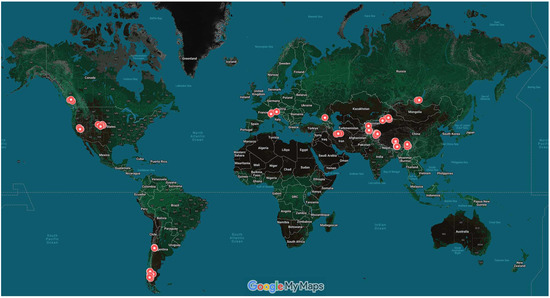
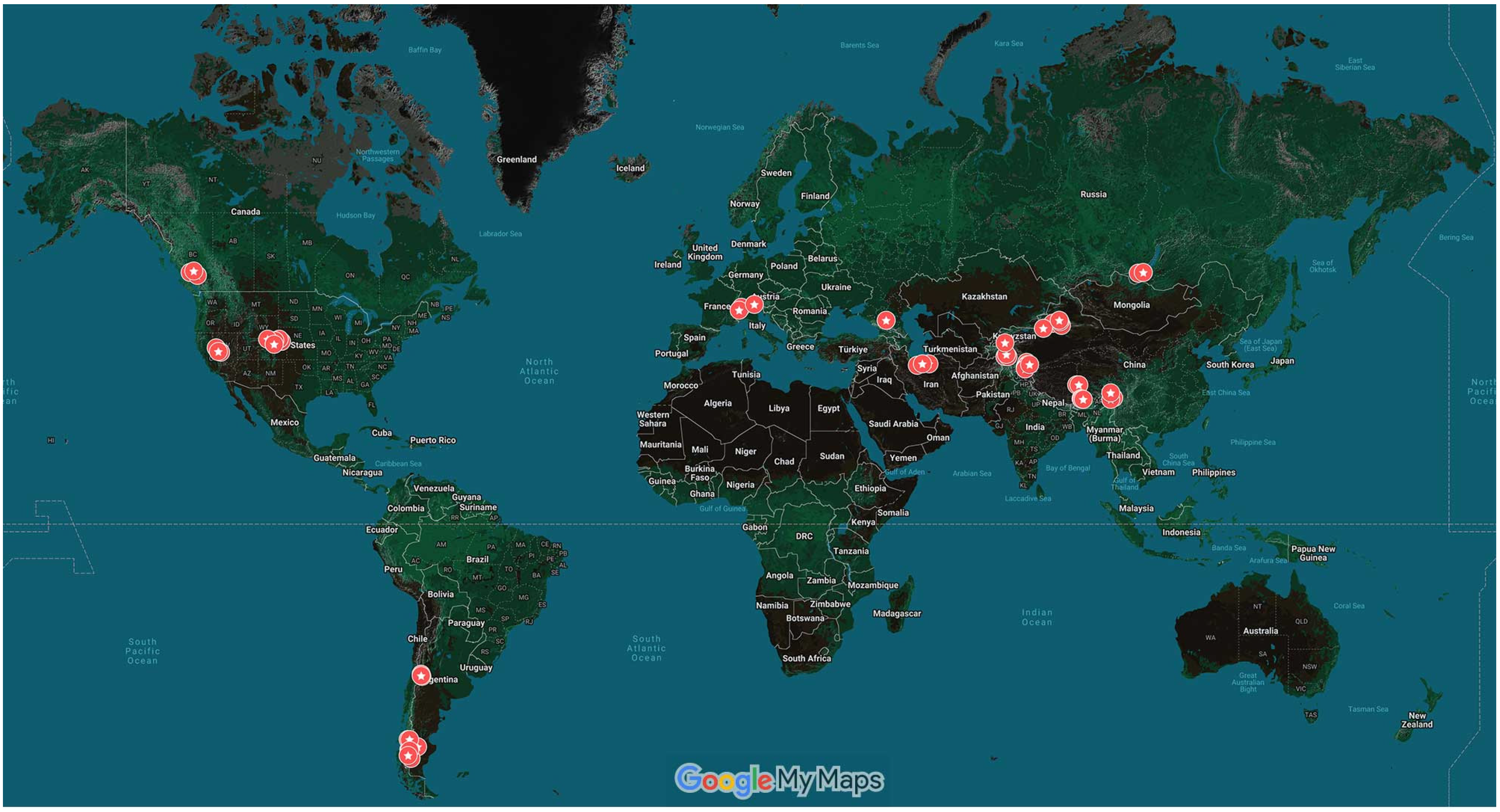
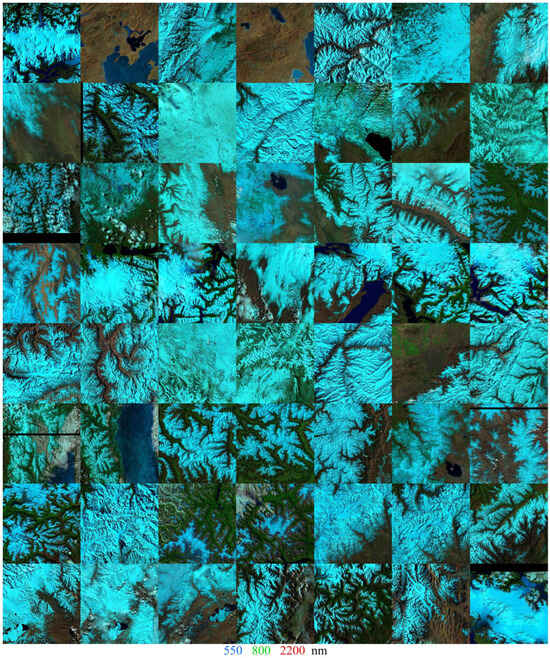
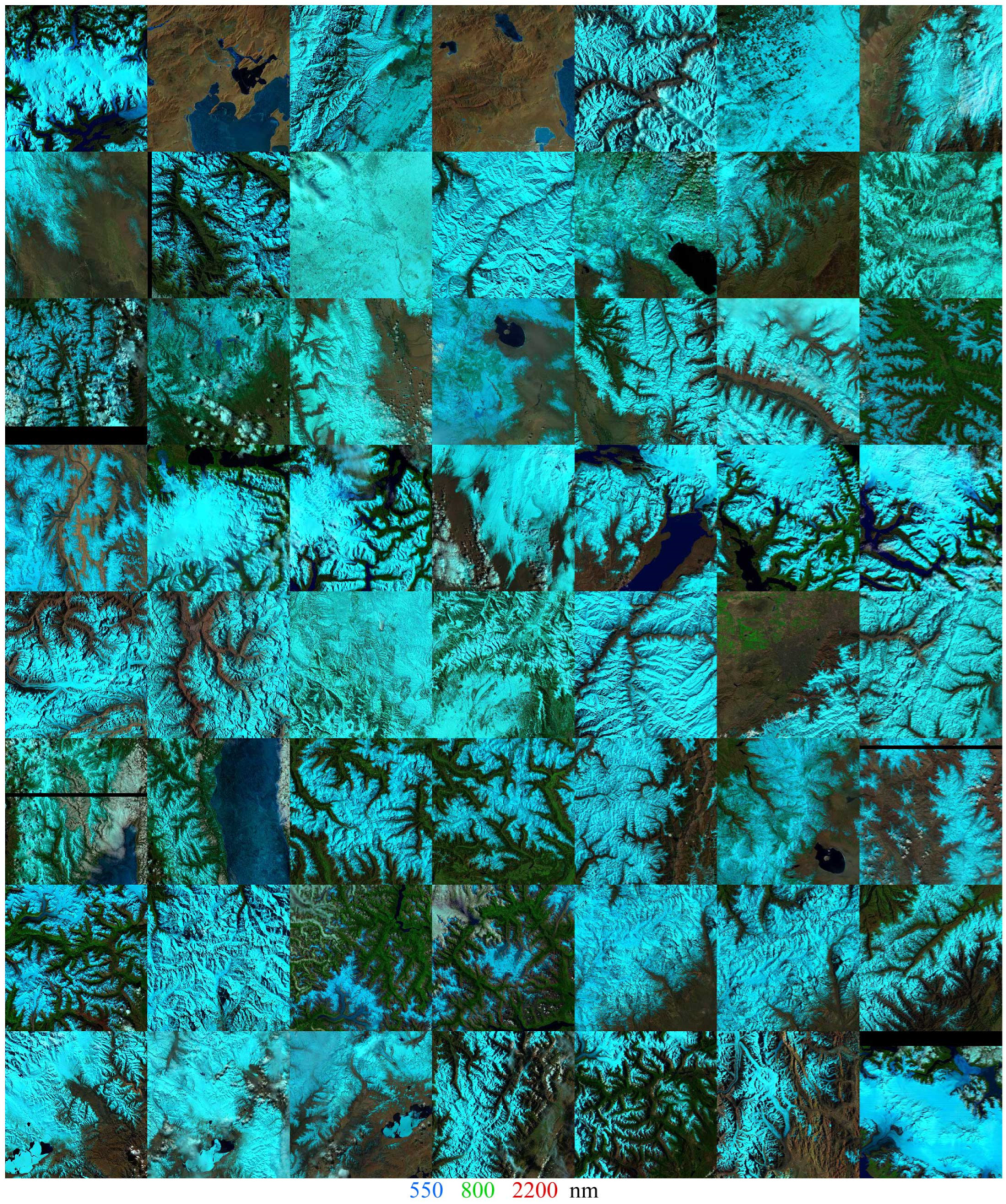
Because the ISS orbit is limited to ±52° latitude, polar cryosphere environments could not be included in the EMIT analysis (Figure 1). As a result, almost all of the granules used are from mountainous environments at lower latitudes and contain specular reflections from slopes facing the sensor. The ISS orbit also provided for a wider range of view geometries and overpass times than would a comparable satellite in low Earth orbit. In addition to seasonal snow of varying ages, the sample contains several granules from the Patagonian Ice Field and granules containing mountain glaciers from the Karakoram, Himalaya and Canadian Rockies. Three examples of exposed lake ice are included from Lake Selinquo on the Tibetan Plateau and Lake Baikal in the Siberian Taiga. The EMIT granules are combined in a single mosaic (Figure 2) for analysis of the composite spectral feature space. The EMIT granule IDs are given for all 56 sites in Appendix A.6.
Figure 1.
Index map for 56 EMIT granules used in this analysis. Red symbols show locations of the granules used for this analysis. The ISS orbit precludes acquisitions from latitudes higher than ±52 °. Several overlapping image pairs are included for comparisons of change through time.
Figure 2.
EMIT cryosphere mosaic false color composite. Identical [0, 1] stretch applied to all channels. Each granule is ~75 × 77 km. Granules are ordered sequentially by ID date (see Table A1) across rows from top left to bottom right.
3. Methods
The workflow of this analysis follows the now well-established process for spectral feature space characterization of dimensionality and topology to quantify the information content of EMIT spectra for cryospheric land cover. Characterization of the feature space for the entire 56-granule EMIT mosaic provides an approximation of the global feature space for a diversity of cryospheric landscapes. This composite feature space provides a backdrop against which a diversity of individual granule feature spaces can be compared. This comparison takes the form of contrasting pairs of granules from similar types of landscape, chosen to illustrate differences in feature space characteristics for different types of snow and ice. Following this illustrative comparison, an index optimization is used to derive a single normalized difference index capable of distinguishing the full continuum of ice and snow revealed by the composite spectral feature space of the full EMIT mosaic.
Principal Components (PCs) are used to characterize the statistical dimensionality and topology of the spectral feature space of the EMIT cryospheric mosaic. The dimensions are spatial (pixel geographic location by fractional degrees) and spectral (reflectance by wavelength). The Singular Value Decomposition [25] is used to quantify the variance partition of the orthonormal dimensions of the spectral+spatial matrix of reflectances [26] as given by the normalized singular values. The resulting variance partition yields a separation of the low-order PCs representing the spatial distribution of the eigenvectors spanning the spectral continuum and the higher-order dimensions representing noise and natural variability of the population of spectra. The variance partition of the singular values distinguishes a hierarchy of low-order dimensions representing the majority of coherent spectral variance and a continuum of higher-order dimensions of gradually diminishing incoherent variance. The topology of the low-dimensional PC space gives an indication of the linearity of spectral mixing within the population of spectra, while simultaneously facilitating identification of any spectral endmembers that may be present [21]. These endmembers are identified as the topological apexes of the low-dimensional PC distribution as inferred from the singular values. Linearity of mixing can be inferred from the linearity (or inward concavity) of the periphery between the apexes of the distribution. The PC transformation was accomplished using the Singular Value Decomposition approach as implemented by ENVI image processing package (v5.4). A detailed explanation of the processing procedure is given by: https://www.nv5geospatialsoftware.com/docs/PrincipalComponentAnalysis.html (accessed on 5 May 2026).
In this study, the now-standard approach described above is supplemented by a successive PC transformation of a subset of interest. Specifically, the snow and ice spectra. If the topology of the initial PC transform’s low-order space distinguishes between the snow–ice continuum and the feature space of any exposed land surface in the data, the latter can be masked to eliminate its influence on a subsequent PC transformation, thereby potentially revealing the topology of the snow–ice continuum more clearly. This distinction is made possible by the characteristic tetrahedral structure of the Substrate, Vegetation and Dark (SVD) mixing space that is pervasive throughout terrestrial landscapes [27]. This SVD mixing space has been characterized by Small and Sousa [28] using a spectrally diverse collection of snow and ice-free landscapes imaged by the EMIT spectrometer. In addition to masking non-cryosphere spectra, additional spectral bands adjacent to the SWIR liquid water absorption features are also omitted from the subsequent PC transform to eliminate the effects of high amplitude overcorrection of the water absorptions on the covariance structure of the cryosphere spectra. Analysis of the dimensionality and topology of the successive PC transform space follows the same procedure as that of the initially transformed space.
The presence of clearly defined apexes on either of the EMIT cryosphere PC spaces suggests the presence of physically meaningful spectral endmembers. Such endmembers may allow the snow–ice continuum to be represented with a linear spectral mixture model. In the case of the EMIT cryosphere mosaic, the snow–ice continuum would not necessarily represent true subpixel spectral mixing, as in the case of other land cover types (e.g., SVD), but rather a continuum of spectral long wavelength continua and short wavelength absorption features. In such a continuum, adjacent spectra may come from different geographic locations at different times, but share common features along a continuum spanning any spectral endmembers that may be present. Inversion of a linear spectral mixture model bounded by such cryospheric endmembers would quantify degrees of spectral similarity rather than subpixel area fractions of different physical and chemical compositions, as in the case of a traditional spectral mixture model. However, the same feasibility constraints [19,26] would apply to the crysopheric mixture model. Specifically, the requirement that fraction estimates from the inversion be bounded [0, 1] and sum to ~1 within each individual spectrum. As in the case of a traditional spectral mixture model, statistical measures of misfit (e.g., Root Mean Square (RMS)) between the observed and modeled spectra can quantify how well the linear model can replicate each observed spectrum.
In addition to the characterization of the cryospheric feature space and its representation with a linear mixture model, the snow–ice continuum can also be represented with spectral indices. The most widely adopted index for snow cover is the aforementioned Normalized Difference Snow Index (NDSI). Despite the fact that the non-associative property of normalized difference indices for area measurements makes them sensitive to sensor resolution [29], normalized difference indices do offer the benefit of minimizing BRDF effects related to view and illumination geometry. The latter is an important benefit in the case of commonly occurring specular reflectances of snow in mountainous areas. For this reason, an optimized normalized difference index is considered for both snow and ice in this study. The objective of the optimization is to identify spectral wavebands that effectively map the spectral continuum of snow and ice onto a one-dimensional index that can quantify the full range of snow and ice reflectances observed in the composite feature space. The strategy for the optimization is to identify wavebands for which the variation in reflectance as a function of composition changes independently (i.e., uncorrelated) for the numerator and denominator of the index. This optimization criterion also has the benefit of maximizing the dynamic range of the normalization. The optimization is achieved by comparing the numerator (Vis − SWIR) and denominator (Vis + SWIR) using spectral decay plots for all channel wavebands in EMIT’s 350–2500 nm spectral range. The optimization seeks to maximize the difference in spectral decay curvature with increasing wavelength. Maximizing this difference has the benefit of maximizing the dynamic range of the resulting index over the continuum from dry to wet snow to white and blue ice, as described in greater detail below.
4. Results
4.1. The Cryospheric Spectral Feature Space
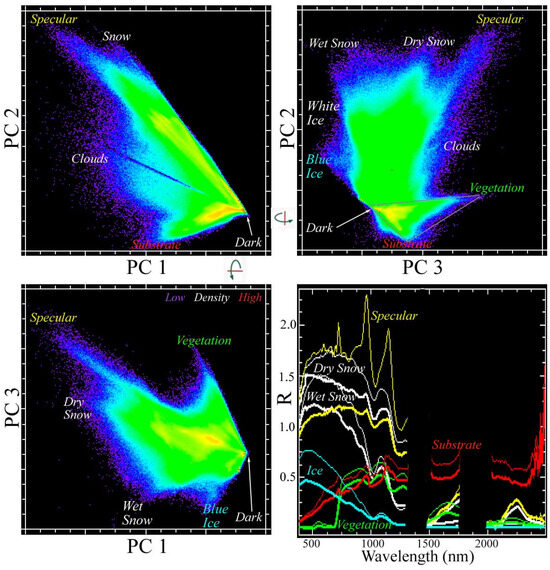
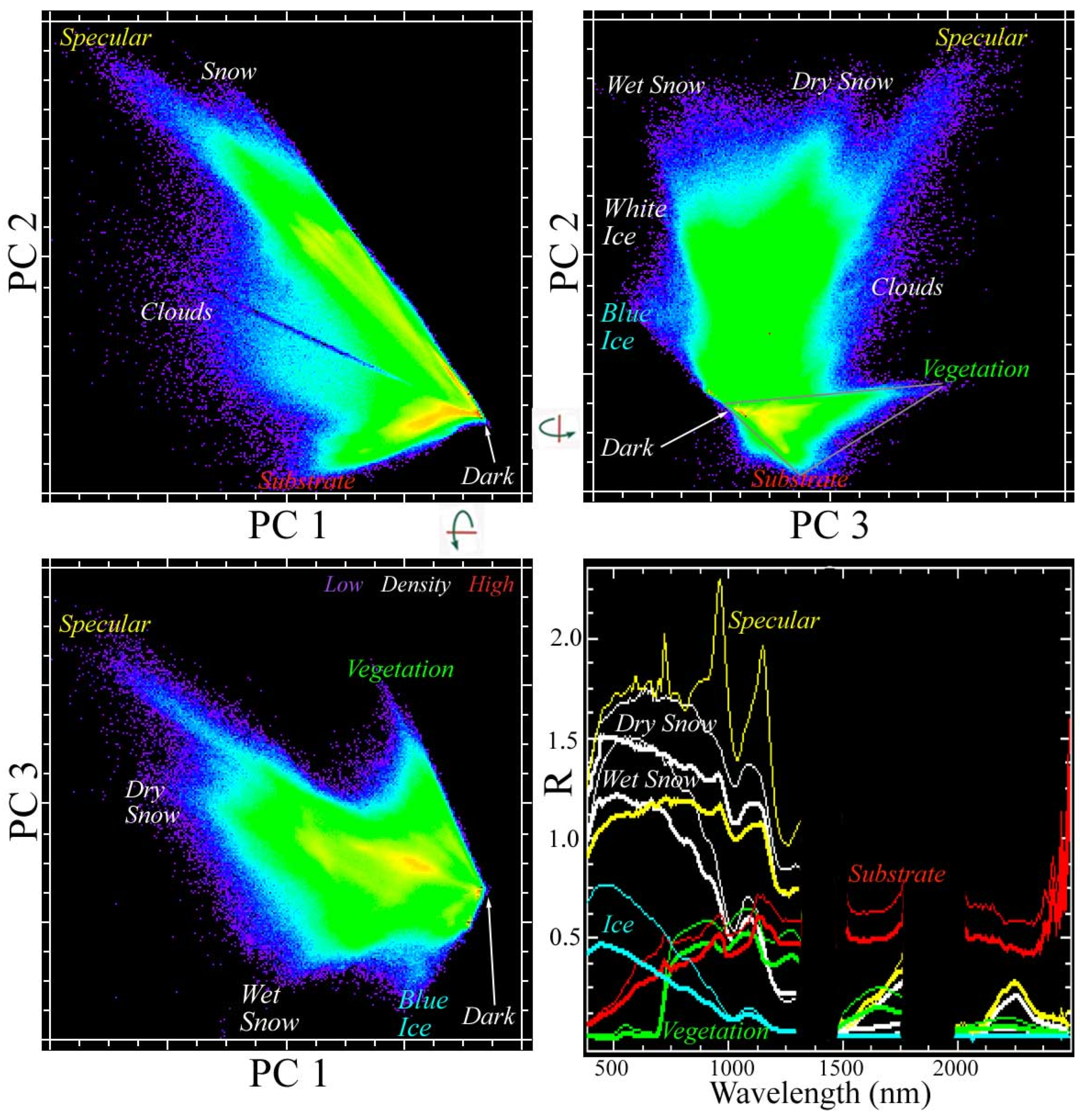
The variance partition of the EMIT cryospheric mosaic given by the singular values of the PC transformation indicates that the spectral feature space is effectively 2D, with the low-order dimensions representing 85% and 12% of total spectral variance, with all higher dimensions accounting for <3%. The variance partition for the successive PC space is somewhat more equant at 74% and 20%, but is still effectively 2D. Figure 3 shows the 3D topology of the EMIT cryospheric feature space from the three low-order PCs. In addition to the familiar SVD topology associated with substrates and vegetation, the crysopheric feature plane is bounded by apexes corresponding to specular snow reflectances (>1), wet snow, blue ice and an inflection corresponding to a Dark endmember. Blue ice, found on some glaciers, appears as a small spur on the binary feature line between wet snow and the Dark endmember. Similarly, the specular snow endmember forms a feature plane with the substrate and vegetation feature continua on the adjacent feature tetrahedron. As illustrated in Figure 3, the specular snow endmember shows prominent atmospheric overcorrection of liquid water absorption features. Convergence and stability of this feature space topology are discussed in Appendix A.1. Directly adjacent to the specular snow apex, a conspicuously distinct apex corresponds to dry snow.
Figure 3.
Spectral feature space for the 56-granule cryosphere mosaic. Orthogonal projections of 3 low-order PCs reveal 7 distinct apexes corresponding to spectral endmembers, as well as strongly linear binary feature continua from each to the Dark endmember. Spectra of interior (thick) and peripheral (thin) endmembers contrast the BRDF effects of steep topography in the mountainous granules. The 3 endmember SVD model plane is superimposed on the PC3/2 projection for reference.
The interpretations of the dry and wet snow apices are based on the amplitude and curvature of the spectra associated with them in comparison to spectral features discussed by [1] and studies cited within. Finally, Figure 3 clearly shows a distinct continuum associated with the diversity of low clouds and fog often associated with cryospheric environments. The limb associated with clouds diverges from the planar continuum spanning snow and ice and forms a distinct bulge between this planar continuum and the SVD continuum near the bottom of the PC 1-2 space. Despite the fact that snow and clouds are often difficult to distinguish in natural color composites, they are conspicuously distinct in spectral feature space due to the contrast between the high SWIR reflectance of most clouds and the deep SWIR absorptions associated with snow.
Because it was not possible to field validate the EMIT granules retroactively, and because snow composition can change quickly with time and temperature, these interpretations and, therefore, names are necessarily tentative and based on assumptions. A similar caveat holds for the white and blue ice interpretations, although these can also be inferred from their locations on the lower flanks of the glaciers where they are observed.
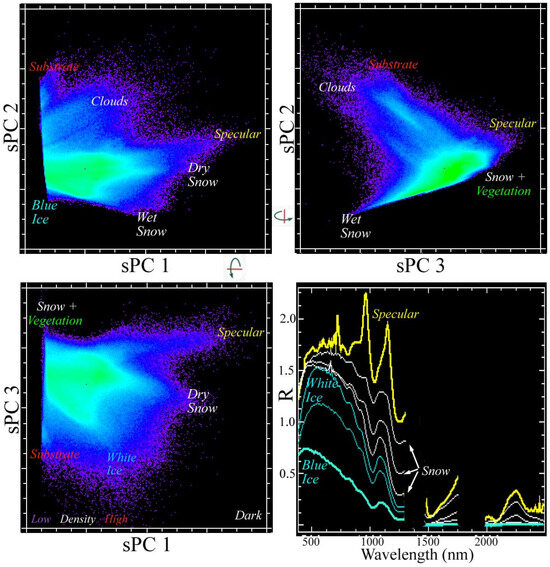
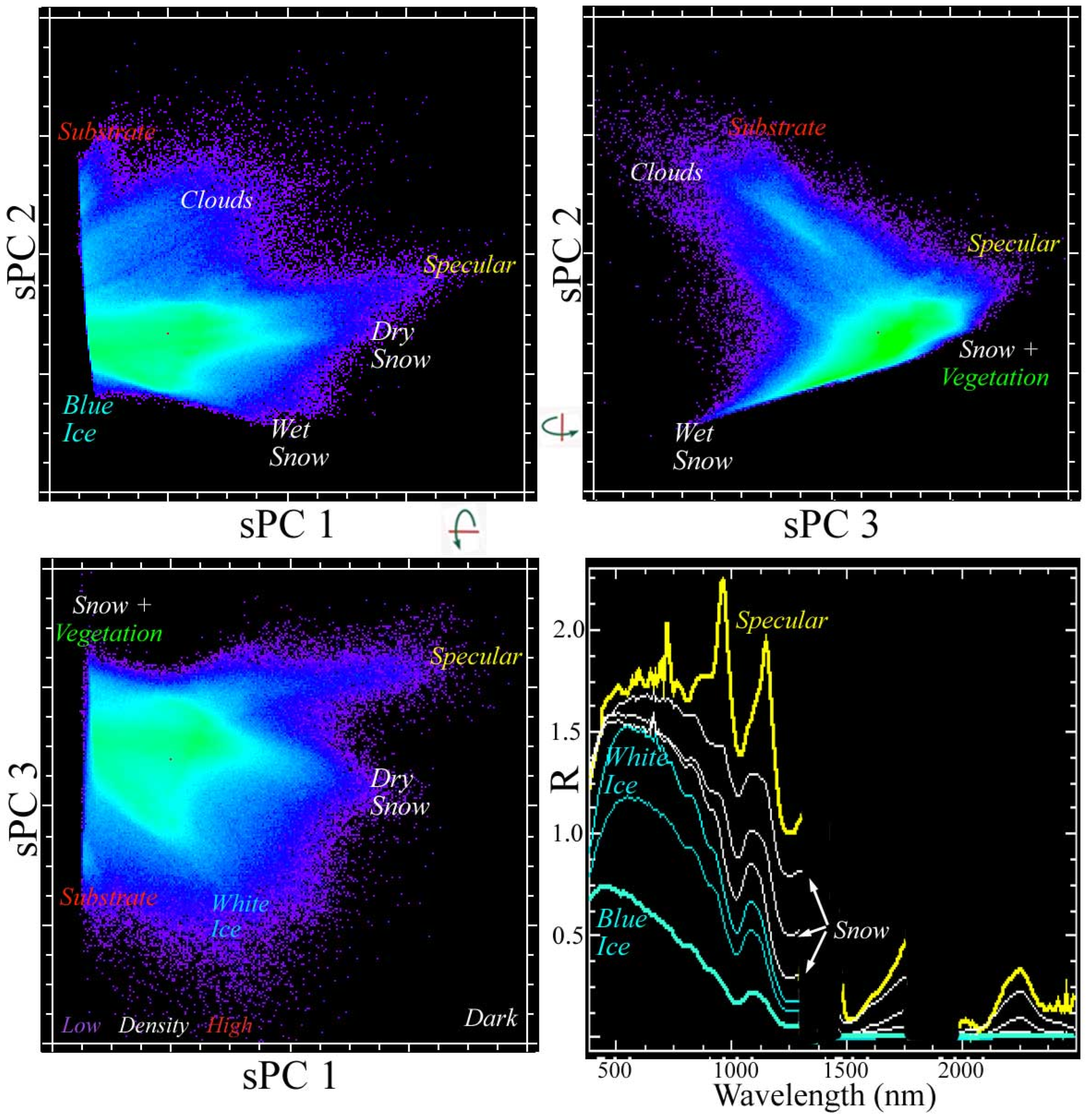
The distinction of the crysopheric feature plane from the SVD tetrahedron in the 3D PC space allows for masking of the SVD space on the basis of PC ranges. Additional spectral bands adjacent to the SWIR liquid water absorption bands are also masked in the subsequent PC (sPC) transformation. The low-order sPC space is also statistically 2D with similar spectral endmembers as the PC space (Figure 4). For this reason, subsequent analysis will use the space based on the original PC transformation.
Figure 4.
Successive spectral feature space for the SVD-masked cryosphere mosaic. Successive PC transformation of the original mosaic with the SVD feature plane masked and overcorrected SWIR spectral bands omitted better reveals the 3D structure of the cryospheric feature space. Orthogonal projections of 3 low-order sPCs are consistent with the unmasked PC space of Figure 3, but show a more concave inward feature continuum between the snow and ice endmembers. The 4 distinct apexes correspond to 3 cryospheric spectral endmembers, a cloud continuum, a pseudo-endmember corresponding to snow+vegetation mixture and some unmasked substrate.
While the composite feature space of the EMIT mosaic does indeed reveal a continuum of snow and ice reflectances, it conceals specific instances of spectral features in its constituent geographies. For this reason, five pairwise comparisons of individual EMIT granule feature continua are given in Figure 5, Figure 6, Figure 7, Figure 8 and Figure 9. In each comparison, specific characteristics of the snow–ice continuum are illustrated, as well as feature continua with the SVD tetrahedron. All individual granules are rotated using the covariance statistics of the full mosaic and projected onto the silhouettes of the corresponding projections of the full mosaic to show their location within the larger continuum.
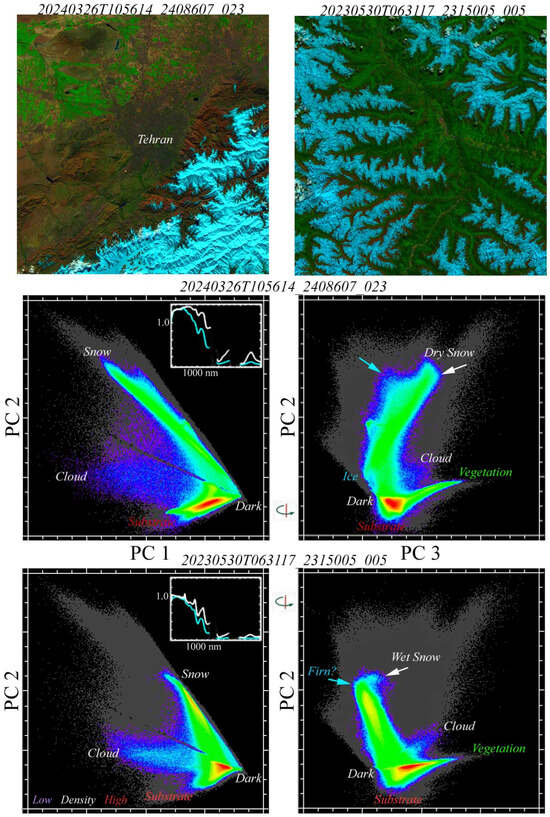
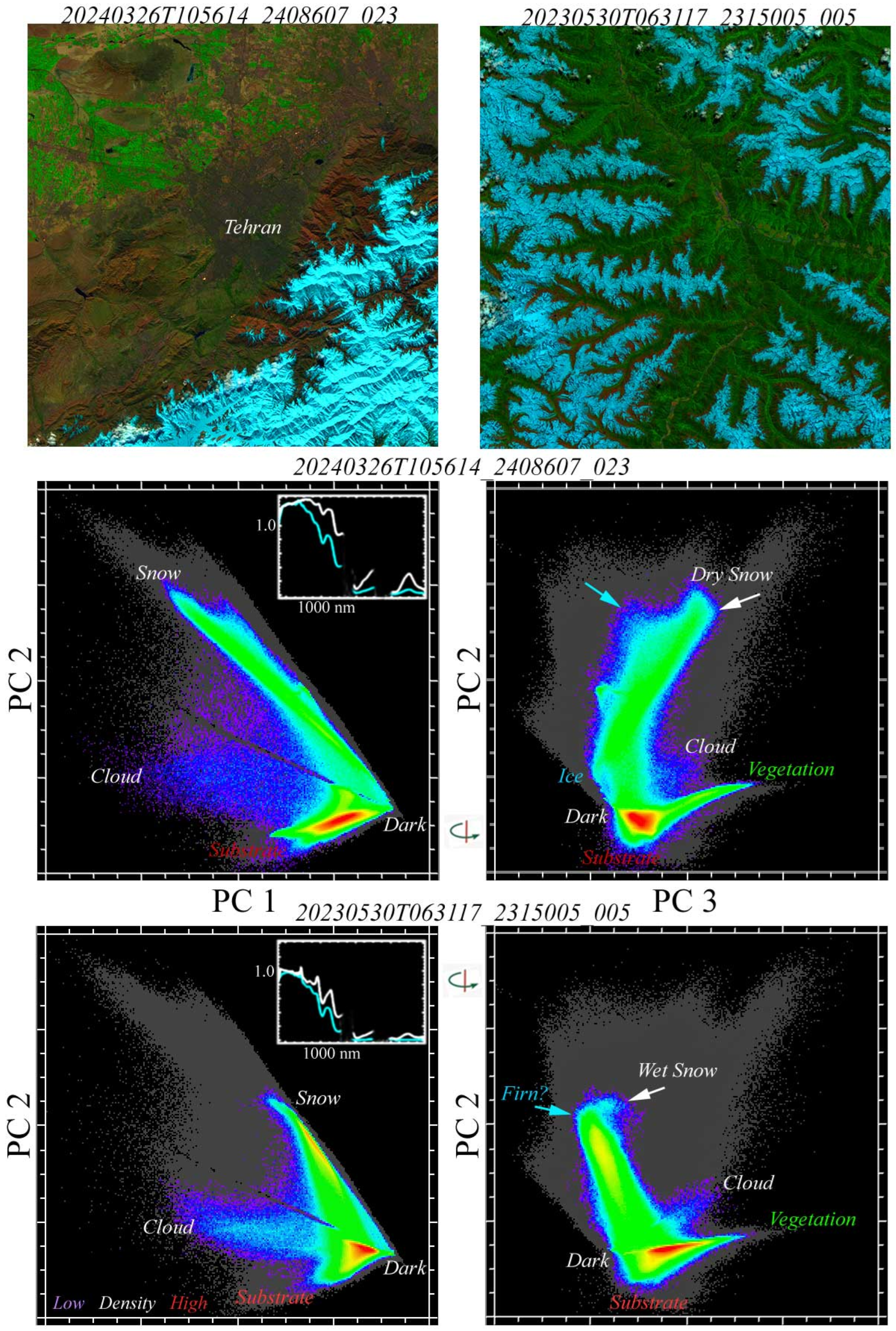
Figure 5.
Spectral feature space comparison for individual EMIT granules with snow and ice continua superimposed on SVD land cover mosaics. As the individual PC projections (color) reveal, both granule spaces occupy distinct subspaces of the full 56-granule mosaic from Figure 3 (gray silhouette). The high-density clusters (red) in the spaces are the SVD subspace. Tehran (26 March 2024) is surrounded by agricultural mosaic and dry snow on the Elburz mountains. The Hengduan mountains (30 May 2023) in Yunnan have wet snow on substrate range tops with forests at lower elevations. Locations of inset spectra contrasting snow reflectance are shown by arrows.
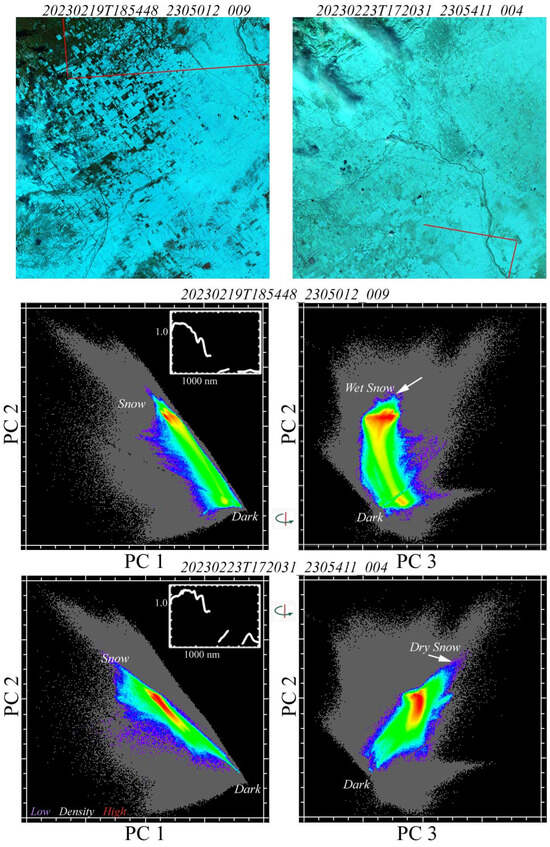
Figure 6.
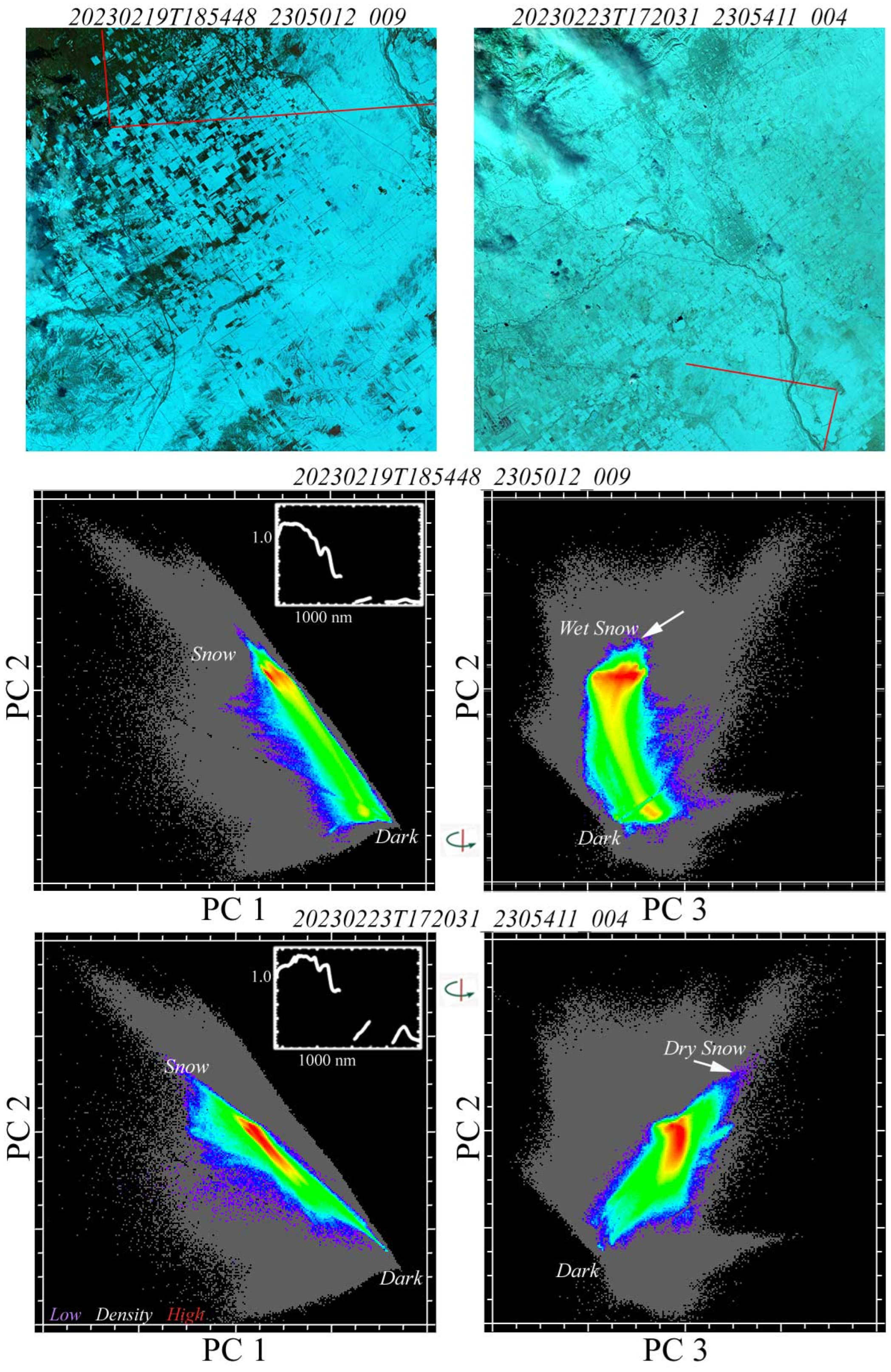
Spectral feature space comparison for partially overlapping EMIT granules on the Great Plains adjacent to the Colorado Front Range. The earlier acquisition (02.19) was 4 days after a light snowfall, while the later acquisition (02.23) was just hours after a significantly heavier snowfall. Both PC projections and inset spectra show differences between partially metamorphosed 4-day-old snow and the fresh snow on the later date. Arrows show locations of inset spectra. Red borders show granule overlap.
Figure 7.
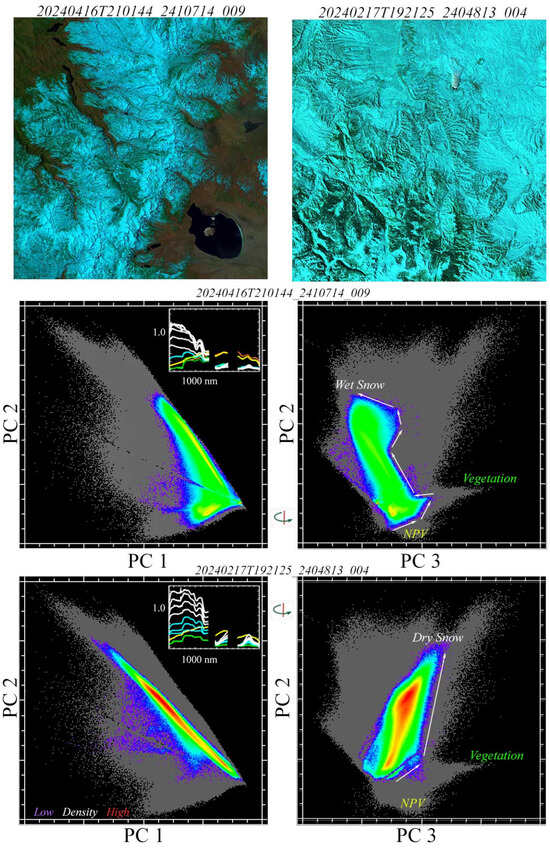
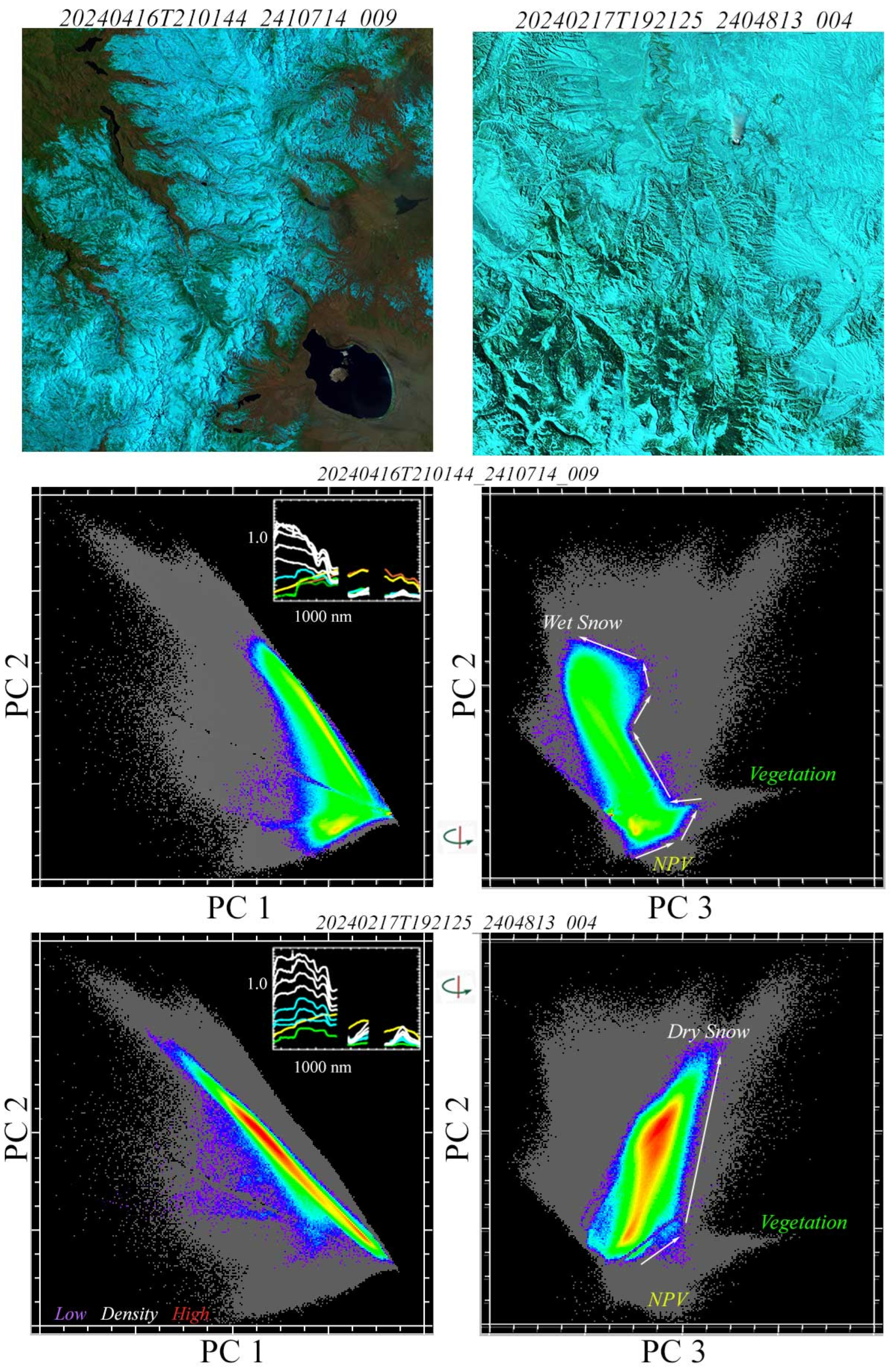
Spectral feature space comparison for individual EMIT granules on the Sierra Nevada (04.16) and Rocky (02.17) mountain ranges. The contrast between fresh (<6 h) snow in the Rocky Mountain granule and the older (1 day) snow in the Sierra Nevada granule are manifest by different continuum trends in the feature space and spectral characteristics analogous to the different snow types in Figure 6. Lower slopes of both ranges are sparsely forested in the areas of the granules, so they illustrate spectral mixing between non-photosynthetic (NPV) and evergreen vegetation with fresh (<6 h) dry snow (02.17) and with wet snow (04.16) at least one day old. Arrows show locations of inset spectra continua contrasting snow reflectance. Spectra show slope and aspect BRDF gradients with the dark endmember.
Figure 8.
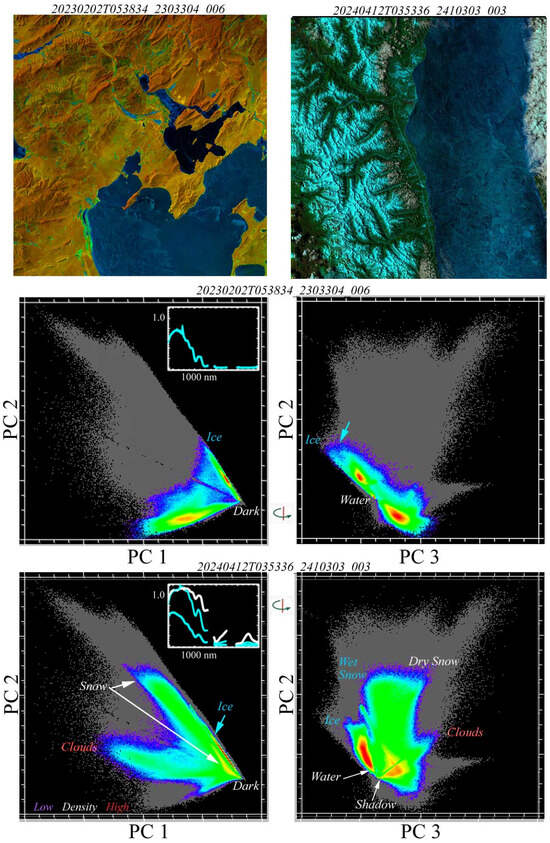
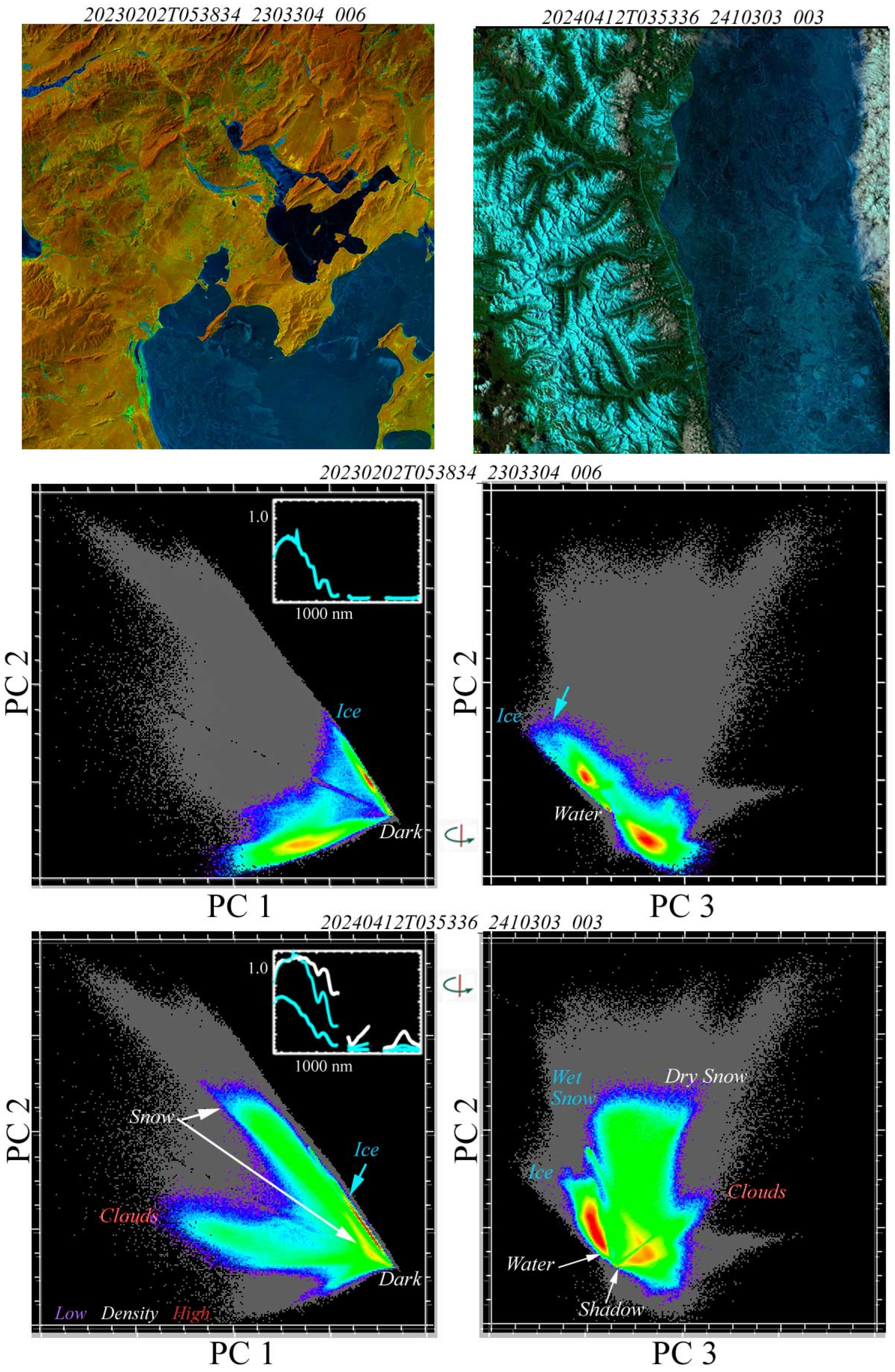
Spectral feature space comparison for individual EMIT granules containing lake ice. The arid setting of Lake Selinquo (2 February 2023) on the Tibetan Plateau contrasts with the forested taiga around Lake Baikal (12 April 2024) in Siberia. The 2 February 2023 space shows dual binary feature trends between the dark endmember (water/shadow) with ice and substrate. The 12 April 2024 space shows distinct feature continua for ice and a range of snow. Arrows show locations of inset spectra contrasting snow and ice reflectance.
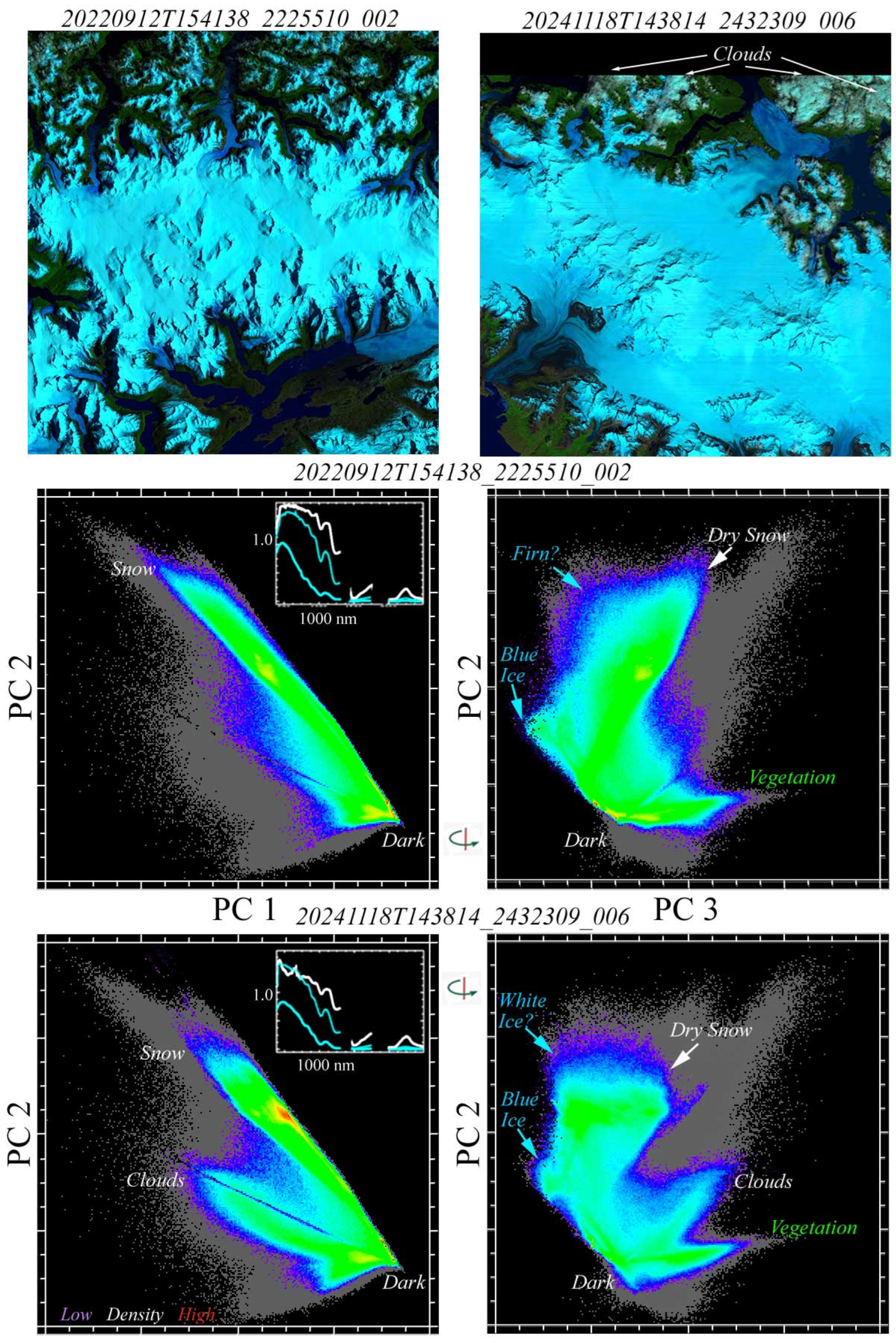
Figure 9.
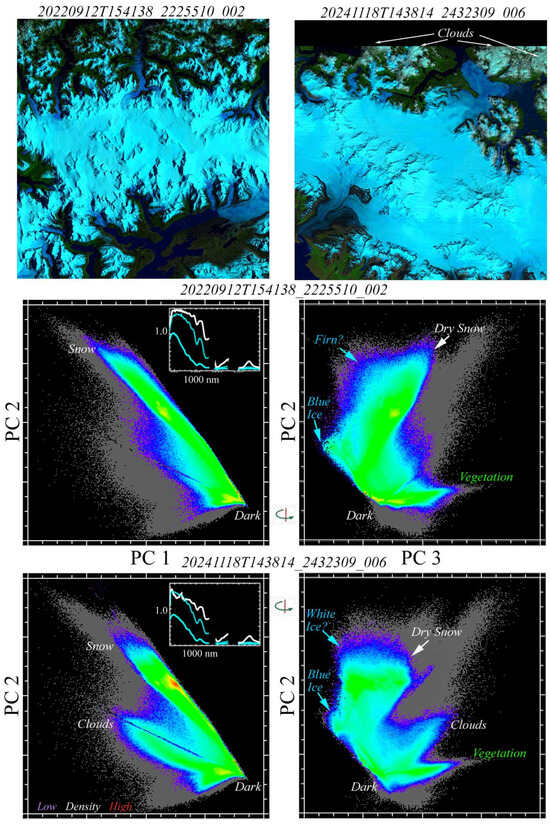
Spectral feature space comparison for individual EMIT granules on the Patagonian ice field. The areas imaged are adjacent, but the acquisitions are 26 months apart. As the PC3/2 projections reveal, both granule spaces largely fill the space of the full 56 granule mosaic (gray silhouettes) and both contain continua of vegetation, water, white and blue glacier ice and snow. The primary differences are in the reflectance of the snow–ice continuum and the presence of cloud in the later acquisition. Arrows show locations of inset spectra contrasting ice and snow.
4.2. Example Comparisons
4.2.1. Seasonal Snow on Mountainous Landscapes
Figure 5 shows a comparison of the Elburz mountains and adjacent plain in northern Iran with the Hengduan mountains in the Yunnan province of southern China. In both examples, snow is limited to higher elevation mountain slopes. The narrow feature plane between snow and the SVD tetrahedron is apparent in the PC 1-2 projection of each granule. In contrast, the PC 3-2 projection shows distinct feature lines between the SVD tetrahedron and individual snow endmembers. The spectral characteristics of these snow endmembers are shown by the inset reflectance spectra.
4.2.2. Temporal Variation in Seasonal Snow Reflectance on Elevated Plains
Figure 6 shows a comparison of two adjacent overlapping granules imaged 4 days apart in February 2023 on the Great Plains near the Colorado Front Range north of Denver. The elevation is ~1600 m above sea level. The identically stretched [0, 1] false color composites clearly show a difference in VNIR reflectance indicative of snow composition. National Gridded Snowfall Analysis (https://www.nohrsc.noaa.gov/snowfall_v2/; accessed 5 March 2026) indicates the earlier (02.19) acquisition occurred 4 days after a light snowfall, while the later (02.23) acquisition occurred just hours after a significantly heavier snowfall. The difference in snow composition is apparent in both the orientation of the spectral feature trends in the PC 3-2 projections and in the inset example endmember spectra. The continuum of the older wet snow on 02.19 trends to the upper left (UL) apex of the feature space, whereas the continuum of the fresher dry snow on 02.23 trends to the UR apex. This difference is clearly indicated in the shapes of the inset spectra from the ends of the respective continua. The broader VNIR shoulder and more reflective SWIR of the dry snow contrasts with the narrower, more attenuated NIR and almost completely absorbed SWIR of the older, more metamorphosed wet snow.
4.2.3. Temporal Variation in Seasonal Snow Reflectance on Mountain Slopes
Figure 7 shows a comparison of seasonal snow on the central Sierra Nevada and the central Rocky Mountain ranges. Both ranges span at least 1000 m in elevation within the granule areas. National Gridded Snowfall Analysis (https://www.nohrsc.noaa.gov/snowfall_v2/; accessed 5 March 2026) indicates the Rocky Mountain acquisition (02.17) contains fresh (<6 h) snow, in contrast to the older (>1 day) snow in the Sierra Nevada (04.16) acquisition. As in previous examples, the orientations of the feature trends in the PC 3-2 space and the inset spectral endmembers clearly indicate different snow compositions in both VNIR and SWIR wavebands. The inset spectral continua also show gradations in spectral features between vegetation on lower slopes and full snow cover on range tops.
4.2.4. Variations in Lake Ice Reflectance
Figure 8 shows a comparison of seasonal lake ice on the Tibetan Plateau (02.02) and on the Siberian taiga (04.12). The PC 3-2 projection of the 02.02 granule’s feature space shows a single feature trend between a blue ice endmember and the dark endmember. In contrast, the PC 3-2 projection of the 04.12 granule’s feature space shows a continuum of snow reflectances on the shores surrounding the lake, with a distinct feature trend with a range of ice reflectances, which are clearly visible in the false color composite. In addition, the taiga surrounding Lake Baikal in the 04.12 acquisition shows both the presence of low cloud or fog, as well as the substrate vegetation continuum.
4.2.5. Snow–Ice Reflectance Continua on Mountain Glaciers
Figure 9 shows a comparison of seasonal snow cover and mountain glacier ice reflectances on adjacent sections of the Patagonian Ice Field in 2022 and 2024. As in the previous examples, differences in the spectral continua are most apparent in the PC 3-2 projection of the feature space. However, in both of these examples, much broader continua span both a range of snow reflectances and a continuum of white and blue ices. Inset endmember spectra illustrate the differences in the dry snow endmembers, particularly at VNIR wavelengths. Both examples also illustrate extensive spectral features between seasonal snow cover and exposed substrate and vegetation at lower elevations on the periphery of the ice field.
Taken together, these five example comparisons illustrate both cryospheric spectral continua and spectral mixing between snow and background land cover. The contrasts in the feature spaces and spectra of each pair are intended to illustrate how individual landscapes occupy distinct subspaces of the cryospheric limb of the aggregate feature space, while not even the diversity of the Patagonian ice field and surrounding forested mountains comes close to filling the aggregate feature space of the full mosaic. Given the unavoidable latitudinal limitations of the ISS orbit and the lack of polar landscapes in the EMIT mosaic, it is important to remember that this feature space is only an approximation of the full cryospheric feature space. Comparison to the topology and endmembers of the broadband feature space compiled by Small and Das (2018) [16], incorporating polar ice sheet and sea ice, suggests that it will be necessary to extend this spectroscopic feature space using polar landscapes when satellite-based spectrometers begin imaging higher latitudes.
4.2.6. Spectral Feature Space Topology
Both the PC and supplemental PC-derived feature spaces in Figure 3 and Figure 4 show a fan-shaped planar continuum for snow and ice. As mentioned in the Methods section above, this is merely a reflectance continuum and does not imply subpixel spectral mixing of different snow and ice compositions. Nonetheless, it does suggest that the continuum might be represented with a linear spectral mixture model. However, multiple three-endmember models containing different apex-proximal dry snow, wet snow and dark spectral endmembers were inverted and none produced feasible results. Specifically, all produced significantly negative (<−0.1) fractions for both snow endmembers. This instability in the inversion is a result of near-collinearity of the wet and dry snow endmembers, which is explained in the Discussion below.
The continuum of peripheral spectra in Figure 3 and Figure 4 varies in both shape and amplitude between dry snow and blue ice. The implicit assumption is that the gradients along the edges of the feature space represent a change in both spectral curvature and amplitude, while the internal gradients from the periphery to the Dark endmember represent diminishing amplitude for similar curvature. While this assumption is easily verified by sampling spectra from the interior of the space, it should be confirmed quantitatively. Contrasting effects of snow/ice composition on the periphery of the feature space, and BRDF along dark to endmember gradients within the space are discussed in detail in Appendix A.2.
4.2.7. The Continuous Crysophere Index
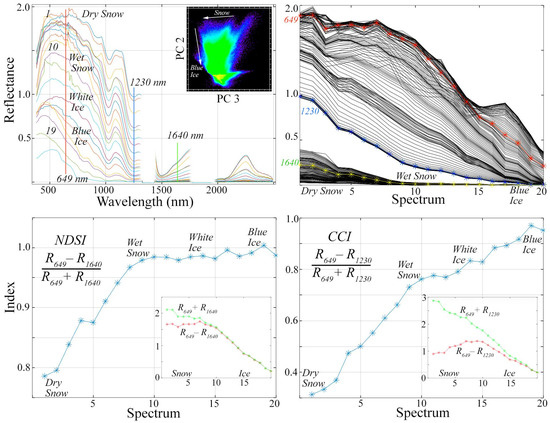
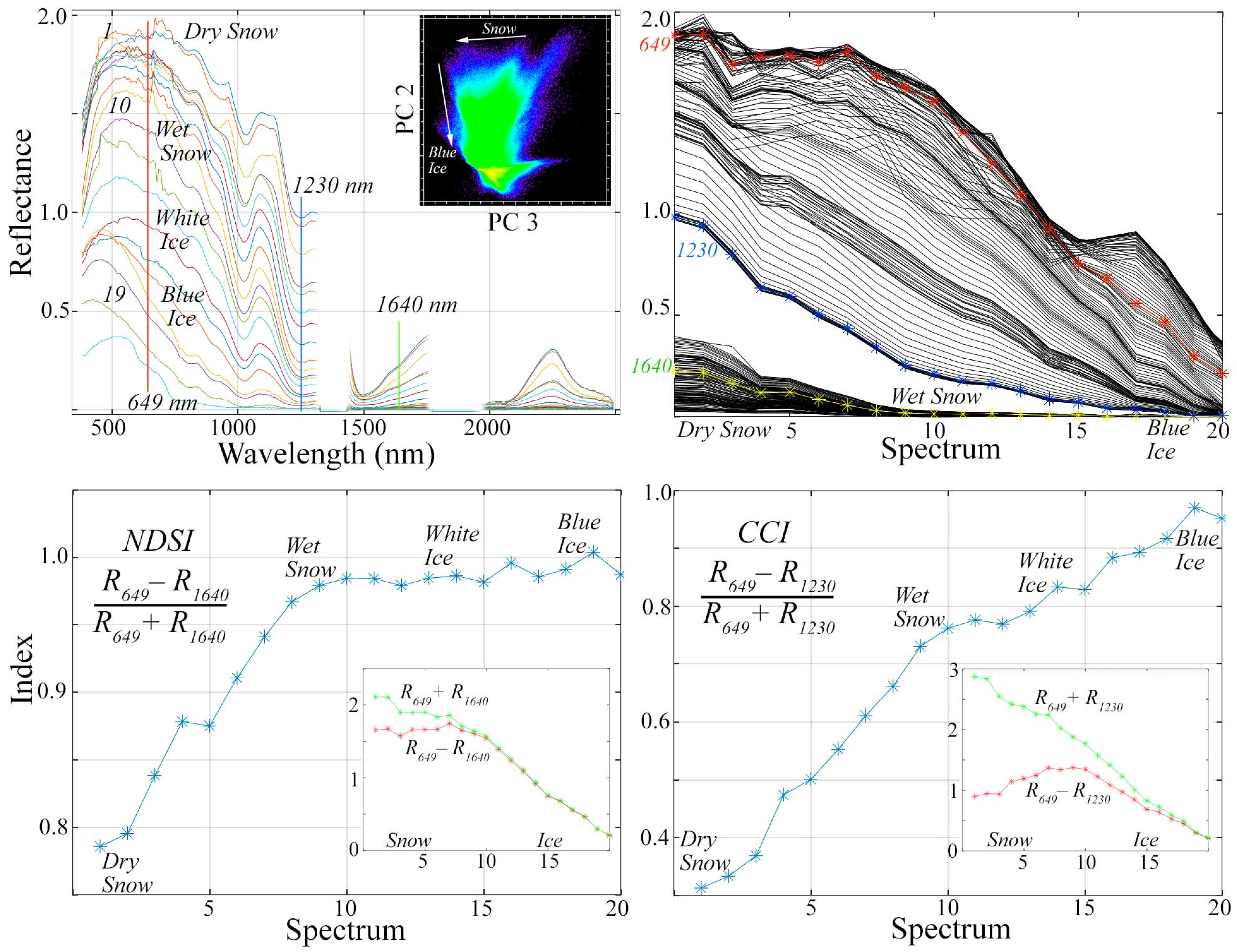
The continuity of the snow–ice continuum suggests that the variation in reflectance of the peripheral spectra may be quantified using a spectral index. For reasons given below, a normalized difference index was used. To test this assertion, a continuum of 20 spectra was sampled from the periphery of the continuum, spanning the range from dry snow through wet snow through white and blue ice to the Dark endmember as shown on the feature space in Figure 3. This continuum of cryospheric spectra is shown in Figure 10. The sensitivity and dynamic range of a normalized difference index can be optimized by minimizing the correlation of the numerator and denominator. This optimization can be achieved using a spectral decay plot, in which the spectral decay of all wavebands is compared along the target spectral continuum. The spectral decay plot of the 20 peripheral cryospheric spectra for all 285 EMIT channels is shown in Figure 10. The break between the VNIR and SWIR waveband continua is apparent. The VNIR spectral decay continuum is bounded by the visible and SWIR wavebands. The most reflective visible bands show a discontinuity in decay for the blue ice spectra (15–19), resulting from the shift in peak reflectance to shorter visible wavelengths. However, this discontinuity is not present at longer visible wavelengths (e.g., 649 nm) for which the decay plot is continuous and convex upward. The most distinct spectral decay to the 649 nm waveband occurs at the concave upward bottom of the VNIR decay envelope. Specifically, at the base of the 1230 nm absorption feature. While the SWIR wavebands also have a concave upward decay, they are completely attenuated for wet snow and all ice. For this reason, the 1230 nm band is chosen to maximize the dynamic range of the difference and sum ratio using the 649 nm waveband. The variations in both wavebands along the spectral continuum are shown in the inset lower right panel (LR) in Figure 10. The same panel shows the variation in the normalized difference index using these bands. The horizontal and vertical edges of the snow–ice continuum in the PC 3-2 projection of the mixing space are clearly distinguished by two distinct limbs of the normalized difference index. The lower limb (0.4–0.75) corresponds to the continuum of dry to wet snow on the upper periphery of the mixing space. The upper limb (0.75–0.95) corresponds to the continuum from wet snow to white and blue ice along the vertical periphery of the mixing space. Liquid water resides at the upper end of the index continuum. The normalized difference index for the snow ice continuum using the 649 and 1230 nm wavebands will be referred to as the Continuous Cryosphere Index (CCI).
Figure 10.
Snow–ice-Dark spectral continuum with normalized difference indices. A continuum of 20 non-specular spectra at the periphery of the cryospheric spectral mixing space (UL) spans the range from dry to wet snow to white to blue ice, with a dark endmember (#20) for comparison. Reflectance decay along the continuum at 649, 1230 and 1640 nm (* UR) contrast in curvature and slope. Normalized difference indices clearly distinguish snow from ice (LL) and dry from wet snow from white and blue ice (LR). Insets show differing rates of visible and SWIR amplitude decay from snow through ice in each index numerator and denominator. Note that saturation of NDSI (LL) fails to distinguish wet snow from ice.
In contrast to the CCI, the well-established Normalized Difference Snow Index (NDSI) is also shown in the lower left (LL) on Figure 10. Because NDSI also uses a visible band (649 nm), but in combination with a SWIR1 band (1640 nm), it has less dynamic range (0.75–1.0) than CCI (0.35–1.0), and saturates near 1.0 half of the spectral continuum. This is a result of the fact that the SWIR2 reflectance of wet snow, white and blue ice is effectively zero, so the ratio is effectively constant as it reflects only the decay in visible reflectance once the SWIR2 reflectance is attenuated. As a result, NDSI is indeed sensitive to the presence of snow; it cannot distinguish wet snow from either white or blue ice. In contrast, the CCI clearly distinguishes dry and wet snow from white and blue ice.
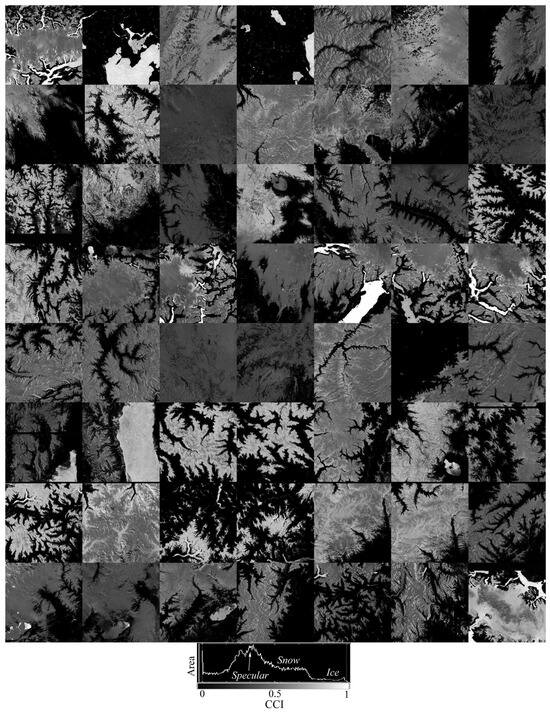
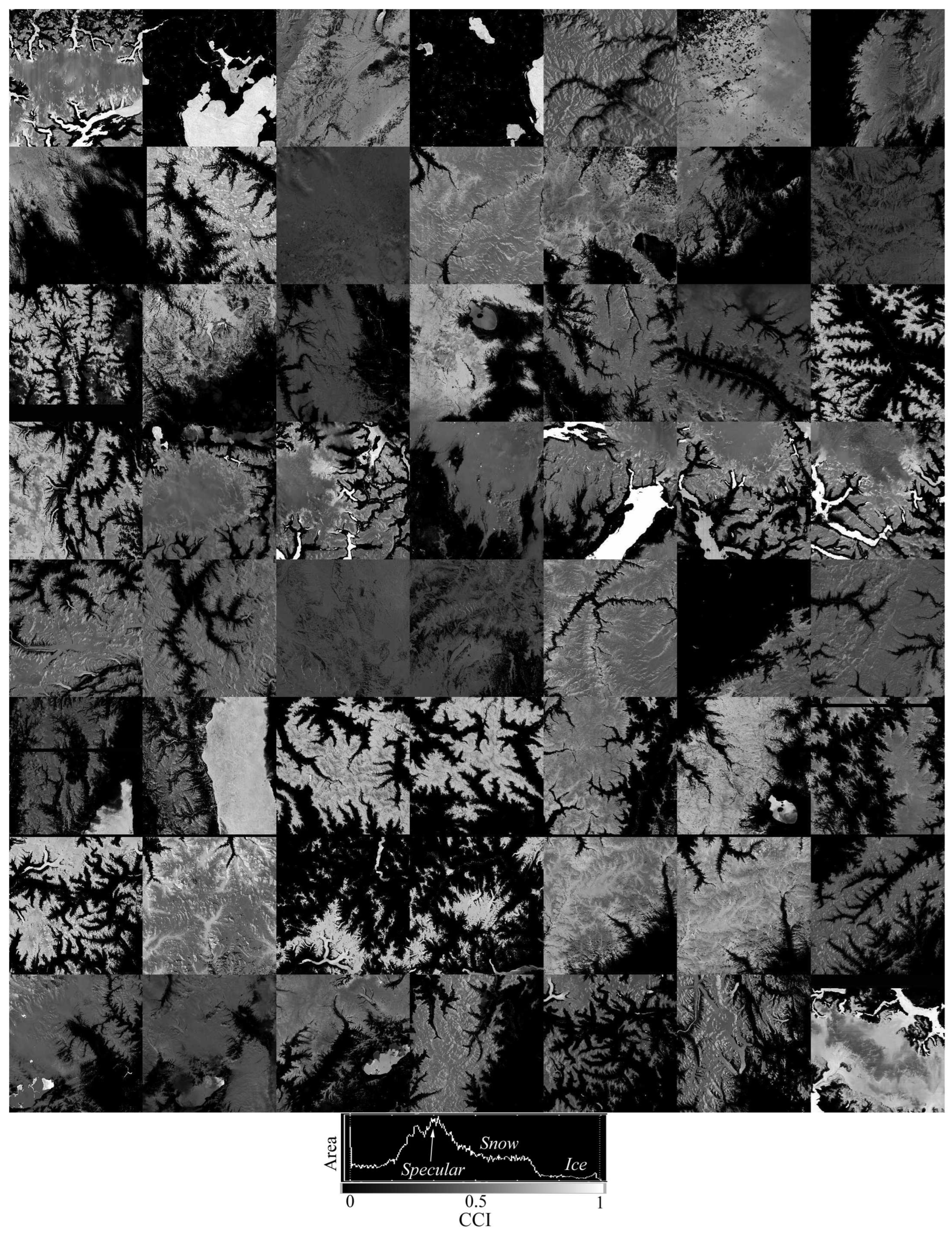
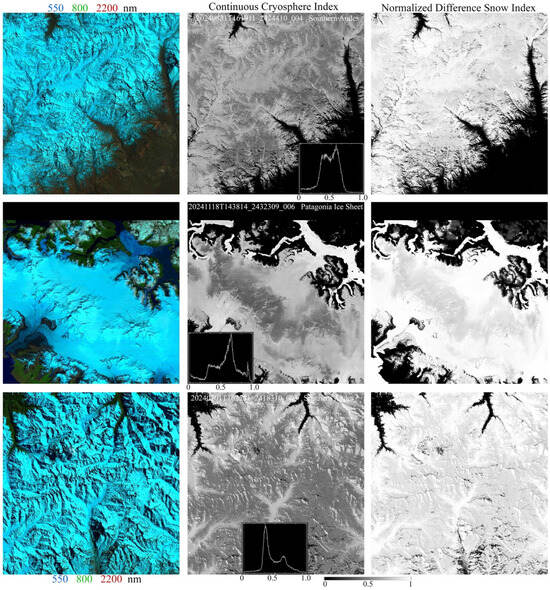
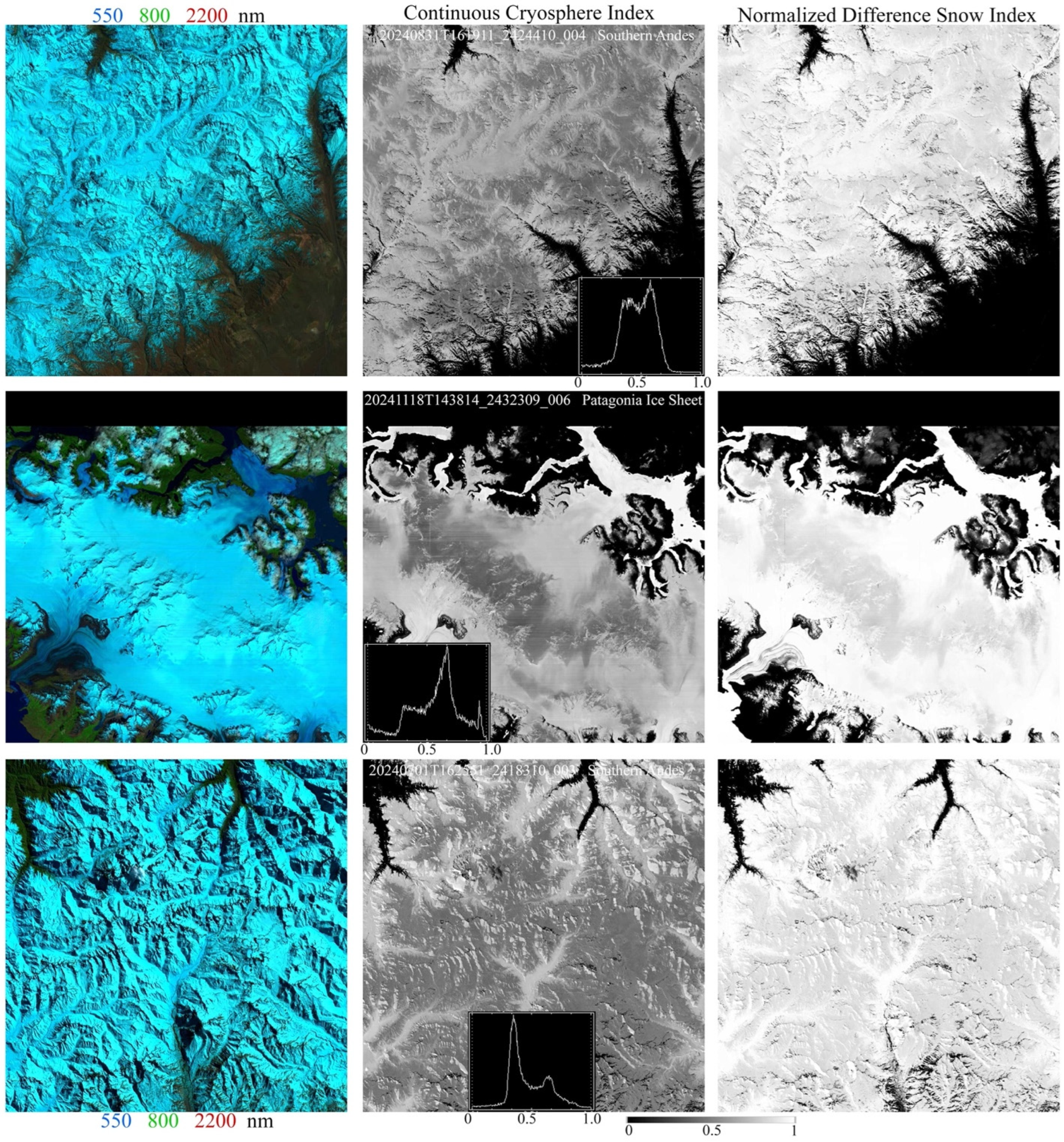
The CCI for the full 56 EMIT cryosphere mosaic is shown in Figure 11. The spectral diversity of the snow and ice content of the mosaic is immediately apparent in the variations within and among the EMIT tiles within the mosaic. Also shown is the histogram of the CCI distribution for the mosaic. While specular snow reflectances were not included in the spectral continuum on which the CCI was based, it is apparent that the specular reflectances form a mode in the CCI distribution centered around 0.35, so it is distinct from both non-specular snow and both white and blue ice. Note also that the CCI distribution for both non-specular snow and both types of ice is nearly uniform in area over each respective range. This is a further indication of the diversity of both snow and ice reflectance in the mosaic, as indicated by the fan-shaped continuum in the spectral feature space in Figure 3 and Figure 4. Figure 12 compares false color composites, CCI and NDSI for three example granules at an enlarged scale. The effectiveness of both normalized difference indices for minimizing topographic BRDF is immediately apparent. Minimization of the BRDF and projection of the spectral continuum onto the CCI range reveal the elevation-dependent gradients between dry and wet snow on all three granules, as well as the gradients between white and blue ice on the lower slopes of the glaciers on the Patagonian Ice Field. While some distinction in the latter can be seen in the NDSI, the reduced dynamic range and index saturation do not allow for distinction between wet snow and both ice types.
Figure 11.
Continuous Cryosphere Index (CCI) for the EMIT cryosphere mosaic. Liquid water is >0.95 while cloud, substrate and vegetation have values < 0. The distributions of non-specular snow and ice are nearly uniform over their ranges, but the transition around 0.75 is abrupt. Specular snow CCI varies between ~0.25 and 0.35. Note the variability in CCI values among and within individual granules. This likely results from varying snow composition and age, as well as the presence of exposed white and blue ice on glaciers.
Figure 12.
Spatial gradations in snow and ice reflectance. False color composites (Left) emphasize variations in BRDF from terrain slope and aspect relative to illumination. NDSI (Right) shows little variation within snow and ice cover. In contrast, CCI (center) shows much greater contrast over the continuum of snow and ice reflectance. In all 3 examples, CCI suggests that higher elevation range tops have received fresher snow than lower elevation valleys. Inset histograms show the Patagonian Ice Field (center) contains a wide range of snow reflectance (<0.75) with both white and blue ice (>0.75). Both Southern Andes granules have bimodal distributions of snow.
The operational constraints of the CCI for snow and ice mapping are similar to those of other spectral indices used with optical imagery. Specifically, the utility of the index depends on illumination conditions, atmospheric opacity and a robust atmospheric correction. The latter benefits from the full range coverage and excellent S/N of the EMIT sensor to constrain the primary atmospheric absorptions. As discussed above, the normalization modulates BRDF effects compounded by illumination conditions, while the use of the 1230 nm absorption feature provides excellent cloud discrimination.
5. Discussion
5.1. The Apparent Paradox of Cryospheric Spectral Mixing and Feature Space Reflectance Continua
The fan-shaped snow–ice-dark continuum shown in Figure 3 and Figure 4 is reminiscent of the sub-planar spectral mixing tetrahedron of the substrate–vegetation and dark (SVD) continuum. However, these continua differ at two spatial scales. The SVD continuum is a true spectral mixing space in which the interior gradation often reflects subpixel aggregates of discrete patches of physically and chemically distinct materials. In contrast, the snow–ice-dark continuum represents intimate mixtures of crystalline ice, liquid water and air in varying proportions. As shown in the five example comparisons, most individual EMIT granules are characterized by a single binary mixing trend between a narrow range of snow (or ice) compositions and an illumination-dependent dark component modulating reflectance amplitude. Even in glacial landscapes containing a wide range of snow and ice compositions, the continuum of reflectances occurs at macro scales and rarely includes compositionally mixed pixels at EMIT’s ~50 m IFOV scale. The aggregation that produces the fan-shaped snow–ice-dark continuum does not generally represent subpixel linear mixing of compositionally discrete materials, but rather a geographic aggregation of different snow and ice compositions that often do not occur within a single kilometer-scale EMIT granule. In principle, a linear spectral mixture model could represent this reflectance continuum, even though it rarely represents subpixel mixing of distinct ice or snow reflectances.
The reason the linear mixture model fails for the snow–ice-dark continuum is that the spectral endmembers at the apices of the continuum share very similar spectral continuum shapes. Specifically, relatively higher visible reflectance, diminishing rapidly through the NIR, with little or no SWIR reflectance. Even though the continuum of snow and ice is structurally variable within its endmember compositions, variations in its reflectance are relatively subtle—compared to the compositional differences between substrates and vegetation. As a result, the dry and wet snow, ice and dark endmembers are nearly collinear. This collinearity is analogous to the case of degenerate eigenvectors in the eigendecomposition of a Gram matrix [30]. For the 20 spectra in the snow–ice-dark continuum in Figure 10, 16 spectra between dry snow and white ice have pairwise correlations > 0.85. The correlations with the remaining 3 blue ice (and one dark) spectra are between 0.65 and 0.85. As a result, the inversion of the linear mixture model with correlated endmembers is ill-posed and therefore unstable, yielding physically implausible fraction estimates.
In contrast, SVD mixture models supplemented with a granule-specific snow endmember yield stable inversions for the four contrasting example granules shown in Figure 6 and Figure 7. This is a result of the near orthogonality (low correlation) of the SVD endmembers and the snow (SVD + snow) endmember spectra. SVD + snow 4 endmember correlations are (−0.11 ≤ σ ≤ 0.52) for dry snow and (−0.28 ≤ σ ≤ 0.56) for wet snow. The stability of these models and their inversions are discussed further in Appendix A.3. This model stability is consistent with the results of the aforementioned studies using linear spectral mixture models to estimate fractional snow cover area. However, while the similarity of snow, ice and dark spectral endmember reflectance continua destabilizes the linear mixture model for the snow–ice-dark reflectance continuum, this similarity in reflectance spectrum continuum shape does allow for the continuum of snow and ice reflectance to be quantified with a single normalized difference index.
5.2. Spectral Decay Optimization of Normalized Difference Indices; Why It Works
As explained in the Results section above, comparison of spectral decay curvature in narrow spectral wavebands allows for optimization of the normalized difference index. By minimizing the correlation in amplitude decay between wavebands, the variation along the continuum in the difference between terms can be maximized. This assures that the denominator of the index changes continuously over the full spectrum, while simultaneously maximizing the dynamic range of the resulting difference/sum ratio. Hence, the combination of the convex-upward decay of snow’s visible reflectance peak and the concave-upward reflectance of the 1230 nm absorption feature yields a ratio spanning almost the full range between 0 and 1, with a pronounced change in slope between the dry-wet snow continuum and the white-blue ice continuum. In contrast, the NDSI suffers from saturation of the ratio, rendering wet snow, white ice and blue ice indistinguishable because of the complete attenuation of SWIR1 reflectance (Figure 10).
It is noteworthy that the CCI also distinguishes specular snow reflectance from low incidence angle illumination and viewing geometries on mountain slopes. Despite the atmospheric overcorrection of the ISOFIT algorithm and the high-amplitude spikes that result, the placement of the 649 and 1230 nm band selection avoids these spikes and allows for discrimination of specular snow reflectances in addition to dry and wet snow.
Because this study was based solely on remotely sensed observations, with no opportunity to collect field validation, the designation of bounding endmembers to dry and wet snow with white and blue ice on the wet snow-dark continuum is based on the examples and reasoning given by [1] and the studies referenced within. The interpretation of white and blue ice is supplemented by the continua observed on multiple glacial tongues from the Patagonian Ice Field granules as well. In addition, snow grain size was estimated for the 20 spectra on the snow–ice-dark continuum in Figure 10 based on the 1030 nm absorption band area as proposed by Nolin and Dozier [31]. Details of this analysis are given in Appendix A.4.
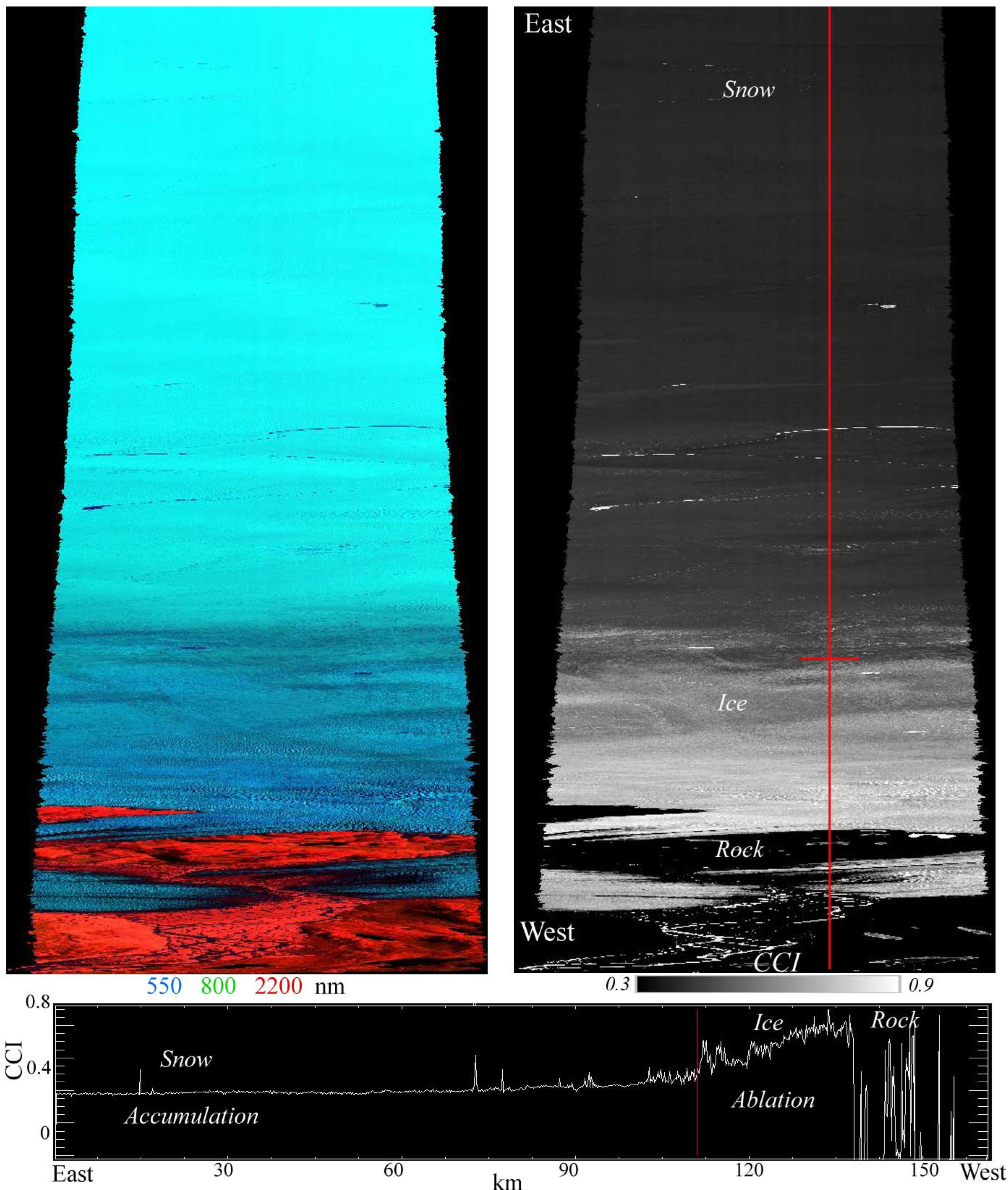
While the unavoidable latitude limitation of the ISS orbit precludes the use of EMIT data from polar environments, the CCI can be tested for ice sheet compositional gradients using AVIRIS airborne hyperspectral data from the Greenland Ice Sheet. Appendix A.5. shows that the diversity of snow and ice compositions observed along the Kangerlussuaq (K) transect spanning the transition from accumulation to ablation zones yields CCI values comparable to the EMIT granules for ice sheets and glaciers in Patagonia and British Columbia. This bodes well for the applicability of CCI to other polar environments as well.
5.3. Limitations
While the CCI is effective at differentiating dry and wet snow and white and blue ice, it does suffer from some limitations. CCI does effectively suppress BRDF effects of view and illumination geometry, but this normalization of albedo also complicates its use for the estimation of fractional snow cover. This is especially apparent in the case of forest cover, where partially snow-covered tree canopies cannot generally be distinguished from partially obscured snow on the ground between exposed tree canopies. In part, this is due to the fact that the CCI and NDSI both suffer from the non-associativity inherent to all normalized difference indices. As shown by Price [29], this non-associativity makes all normalized difference indices dependent on sensor resolution and therefore ill-suited to fractional cover estimation. However, both of these limitations are mitigated by the stability of the SVD + snow linear mixture model, which is well-suited to fractional area estimation. In this sense, the CCI and SVD + snow model are complementary. Despite the stability of the linear mixture model inversion, the accuracy of the subpixel snow fraction estimates remains to be independently confirmed over a range of snow types for the EMIT sensor.
Another limitation of the CCI is its dependence on the 1230 nm spectral band, which may be more sensitive to atmospheric correction of the 1390 nm water absorption than the 1640 nm band used by NDSI. While that does not seem to be the case for the ISOFIT correction applied to EMIT data, it may be for other corrections applied to other spectrometers. Also, neither Landsat nor Sentinel 2 multispectral sensors image in the 1230 nm band, precluding their use for CCI mapping. However, MODIS, VIIRS and WorldView-3 all have 1230 nm spectral bands, so they can be used for CCI mapping.
A third limitation of the CCI is its continuous gradation from blue ice to liquid water. For some cryosphere mapping applications, particularly on glaciers, this may require supplemental masking of liquid water using a water-specific index.
6. Future Work
Even using the latitudinally constrained cryospheric landscapes imaged by EMIT, a sufficiently spectrally diverse collection of 56 granules is more than sufficient to represent a broad continuum of snow and ice compositions. This bodes well for the ability of future hyperspectral missions using satellites in low Earth orbits (e.g., NASA’s Eagle VSWIR) to extend this coverage to a much greater diversity of polar environments. It is noteworthy that the Dyson spectrometer used by Planet Labs’ Tanager sensor adopts a similar design to that used by EMIT: https://earth.esa.int/eogateway/documents/d/earth-online/9_nhcastilla_planetlabs (accessed 5 March 2026).
7. Conclusions
The EMIT imaging spectrometer has sufficient spatial and spectral resolution, signal/noise and band uniformity, combined with the high quality atmospheric correction of the Level 2a products, to allow for characterization of the spectroscopic spectral feature space of ice and snow from a wide range of cryospheric landscapes. While the latitudinal limits of the ISS preclude the incorporation of polar areas in this analysis, the characterization of the snow and ice at a diversity of lower latitude settings does allow for some robust conclusions to be drawn. The composite feature space of all 56 EMIT granules clearly distinguishes a crysopheric limb spanning a range of ice and snow compositions from an SVD limb representing subpixel spectral mixing between Substrate, Vegetation and Dark (i.e., shadowed or absorptive) land covers. While the cryospheric limb shows distinct apices for specular, dry and wet snow, as well as white and blue ice, the continuum bound by these apices does not necessarily represent subpixel spectral mixing as is often the case in the SVD limb. Rather it represents a more general case of continuous gradations in snow and ice reflectance under a wide range of varying conditions. For this reason, the cryospheric limb is referred to here as a spectral continuum rather than a spectral mixing space. It is noteworthy that the instability of the snow+ice+dark linear mixture model (due to near collinearity of snow and ice endmembers) does not preclude the incorporation of snow into a SVD + snow mixture model—which is shown to be stable and physically meaningful in Appendix A.3. Despite the instability of the spectral mixture model, the continuum of ice and snow reflectance revealed by the composite spectral feature space of the EMIT mosaic does allow for the development of an optimized Continuous Crysophere Index (CCI) which is capable of distinguishing among dry and wet snow and white and blue ice. This optimized normalized difference index shares the familiar benefit of NDSI’s suppression of topographic BRDF effects, and ability to distinguish snow from cloud reliably, while providing greater dynamic range than NDSI and the ability to distinguish wet snow from white and blue ice. The benefits of using the 1230 nm SWIR band can accrue to MODIS, VIIRS and WorldView-3 for mapping snow and ice cover and condition.
Funding
This research was funded by the NASA EMIT Science and Applications Team Program (Grant # 80NSSC24K0861).
Data Availability Statement
All data used in this study are publicly available, free of charge, from the sources given in the Data section.
Conflicts of Interest
The author declares no conflicts of interest.
Appendix A
Appendix A.1. Spectral Feature Space Convergence
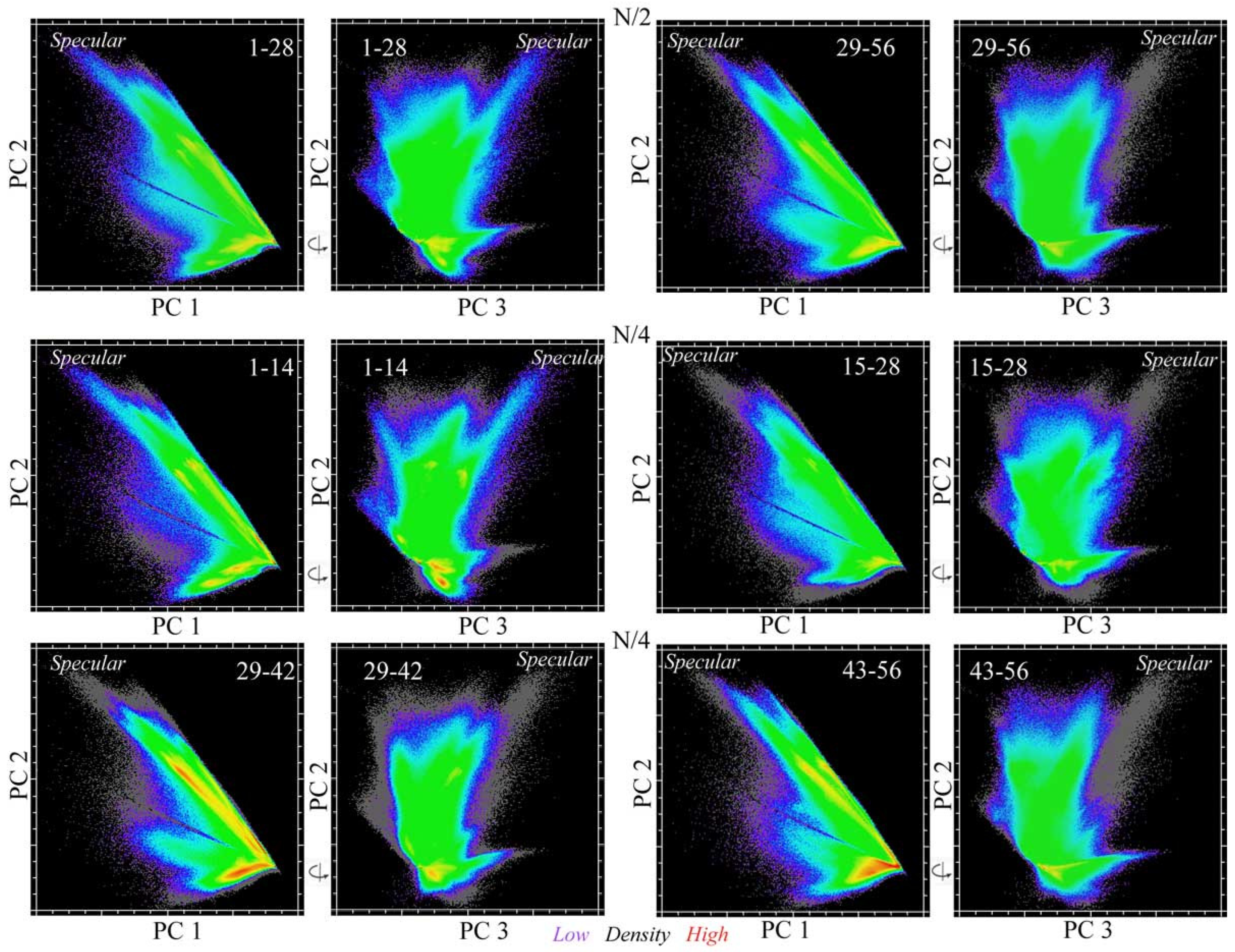
The robustness of the cryospheric spectral feature space topology is verified by segmentation of the EMIT mosaic to ensure stability of form. Specifically, by comparing varying-size subsets of the granules used in the full mosaic. Convergence of the topology of the feature space is apparent in Figure A1. Figure A1 compares the PC spectral feature spaces of two mutually exclusive 28-granule mosaics with the corresponding spaces of four mutually exclusive 14-granule mosaics. While some of the 14 granule mosaics lack some high-amplitude endmembers, all four do show the planar, fan-shaped continuum extending toward the endmembers. The pair of 28 granule mosaics fills out the full feature space more completely, although one does lack the specular mixing trend. The similarity of the two 28-granule subsets to the single 56-granule mosaic is also apparent in the contrast between the density-shaded subset and the gray silhouette of the full mosaic. Together, these comparisons confirm the stability of the cryospheric mixing continuum, even for a relatively small number of granules.
Figure A1.
Spectral mixing space convergence. Mixing spaces of varying subsets of the EMIT mosaic (color density) largely fills out the silhouettes of the full mosaic space (gray). While some of the endmembers do not attain full amplitude in some of the 14 granule subsets, all but the specular endmember attain full amplitude in the 28 granule subsets (top row). This indicates that even 14 granule subsets resolve the fundamental topology of the mixing space and that convergence is achieved with 28 granules. Note the diagonal linear density gap present in all the PC 1-2 projections, suggesting that it is a primary characteristic of the EMIT cryospheric mixing space. Note also that the distinct clusters (red) in the 14 granule spaces are mostly attenuated into the more dispersed continua in the 28 granule spaces.
Appendix A.2. BRDF Amplitude Continua Within the Spectral Feature Space
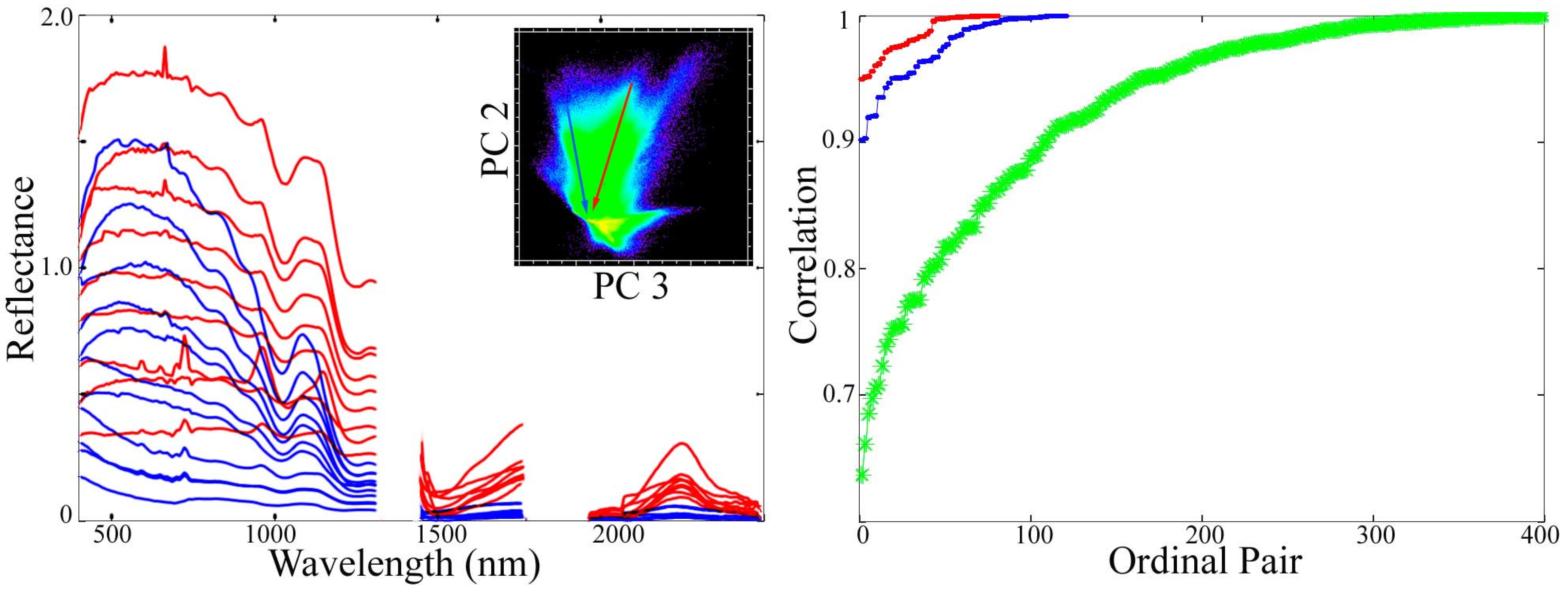
The continuum of peripheral spectra in Figure 10 varies in both shape and amplitude between dry snow and blue ice. The implicit assumption is that the gradients along the edges of the feature space represent a change in both spectral curvature and amplitude, while the internal gradients from the periphery to the Dark endmember represent diminishing amplitude for similar curvature. While this assumption is easily verified by sampling spectra from the interior of the space, it should be confirmed quantitatively. To do so, spectra are sampled along radial continua from the dark endmember to both the wet and dry snow apexes of the feature space. The implication is that changing snow composition is responsible for changing spectral shape (curvature + extrema) and amplitude along the periphery, while changing incidence angle (view + illumination), driving solar flux density variation (i.e., BRDF) is responsible for radial change in amplitude. Figure A2 (left) shows spectral continua sampled between both dry (red) and wet (blue) snow endmembers and the dark endmember. It is visually apparent that the two spectral continua correspond to two distinct shapes (curvatures), and that both continua vary primarily in amplitude with little variation in shape. This can be quantified by computing pairwise correlations among all spectra in each continuum (dry and wet snow) because similar spectral shapes of varying amplitude should maintain relatively high correlation, while changes in shape should result in lower correlations. Sorted correlations for each continuum are shown in the right panel of Figure A2. Both range between 0.9 and 1.0. The wet snow continuum distribution (blue) extends to somewhat lower correlations because of the shift in peak reflectance to shorter wavelengths between white and blue ice. In contrast, the distribution of pairwise correlations among the peripheral spectral continuum shown in Figure 10 is dispersed over a much wider range between 0.6 and 1.0 (green). Hence, the inference that the peripheral gradient in spectral amplitude and curvature is primarily compositional, while the radial gradients with the dark endmember represent BRDF effects related to view and illumination geometry is substantiated.
Figure A2.
BRDF continua for wet and dry snow spectra. Spectra sampled along amplitude gradients from the dry (red) and wet (blue) snow endmembers on the upper periphery of the PC 3-2 projection of the cryopheric feature space (Figure 3) toward the Dark endmember (left). Sorted pairwise correlations of each continuum (red and blue) are all > 0.9, indicating near collinearity within each continuum (right). In contrast, pairwise correlations among endmembers (green) on the peripheral continuum (Figure 10) are much lower, indicating a continuum of spectral shape and amplitude.
Appendix A.3. Stability of the SVD + Snow Linear Mixture Model
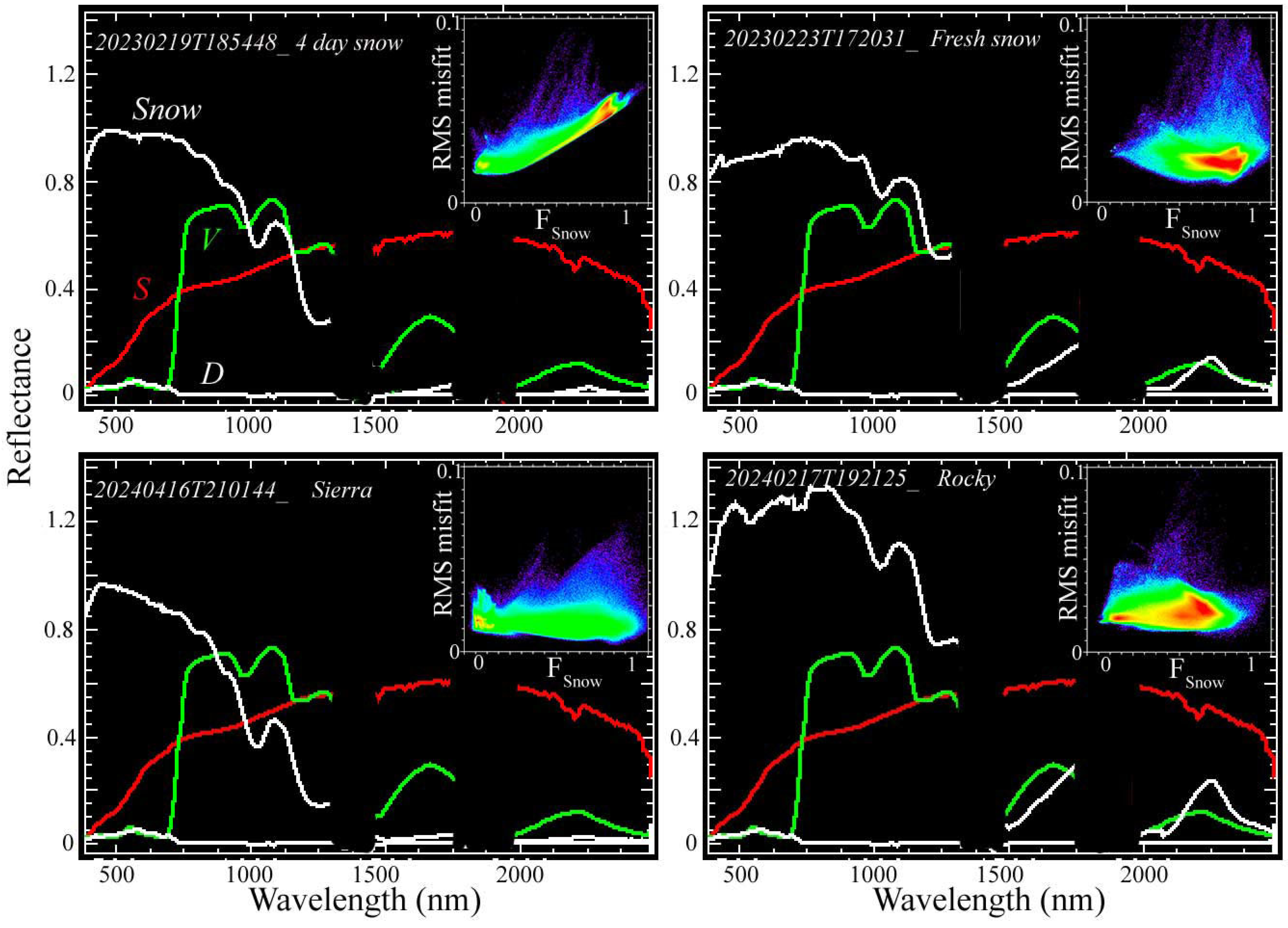
The stability of the SVD + snow linear mixture model is verified using granule-specific snow endmembers for the four granules shown in Figure 6 and Figure 7. Figure A3 shows the spectral endmembers used for each inversion with the bivariate distribution of RMS misfit versus snow fraction for each model (insets). It is apparent that the resulting snow fraction estimates are all well-bounded [0, 1], with model misfits generally < 0.05. These results are consistent with earlier studies (cited in Introduction) on the use of linear mixture models for estimating subpixel fractional snow cover in a variety of landscapes. However, these studies all used either laboratory or scene-specific endmembers. In contrast, this comparison confirms the stability of the standardized SVD endmembers of Small and Sousa [28] with granule-specific snow endmembers.
Figure A3.
Spectral endmembers and mixture model misfit vs. snow fraction (Fsnow) for the EMIT granules in Figure 6 and Figure 7. All four granules contain seasonal snow of varying ages. Each granule is modeled with a 4-endmember linear mixture model based on SVD endmembers from Small and Sousa [28] supplemented by a granule-specific snow endmember. The SVD + snow models all yield plausible fraction distributions [0, 1] with misfit distributions generally < 0.05. Hence, the SVD + snow model is generally stable for landscapes with seasonal snow that can be represented well with a single snow endmember. Such a model would not be expected to produce comparable results for landscapes with multi-year snow and ice (e.g., glacial) spanning a wider range of snow and ice reflectances. Inset scatter plot density scale same as previous figures.
Appendix A.4. Snow Grain Size Analysis for the Snow–Ice Continuum
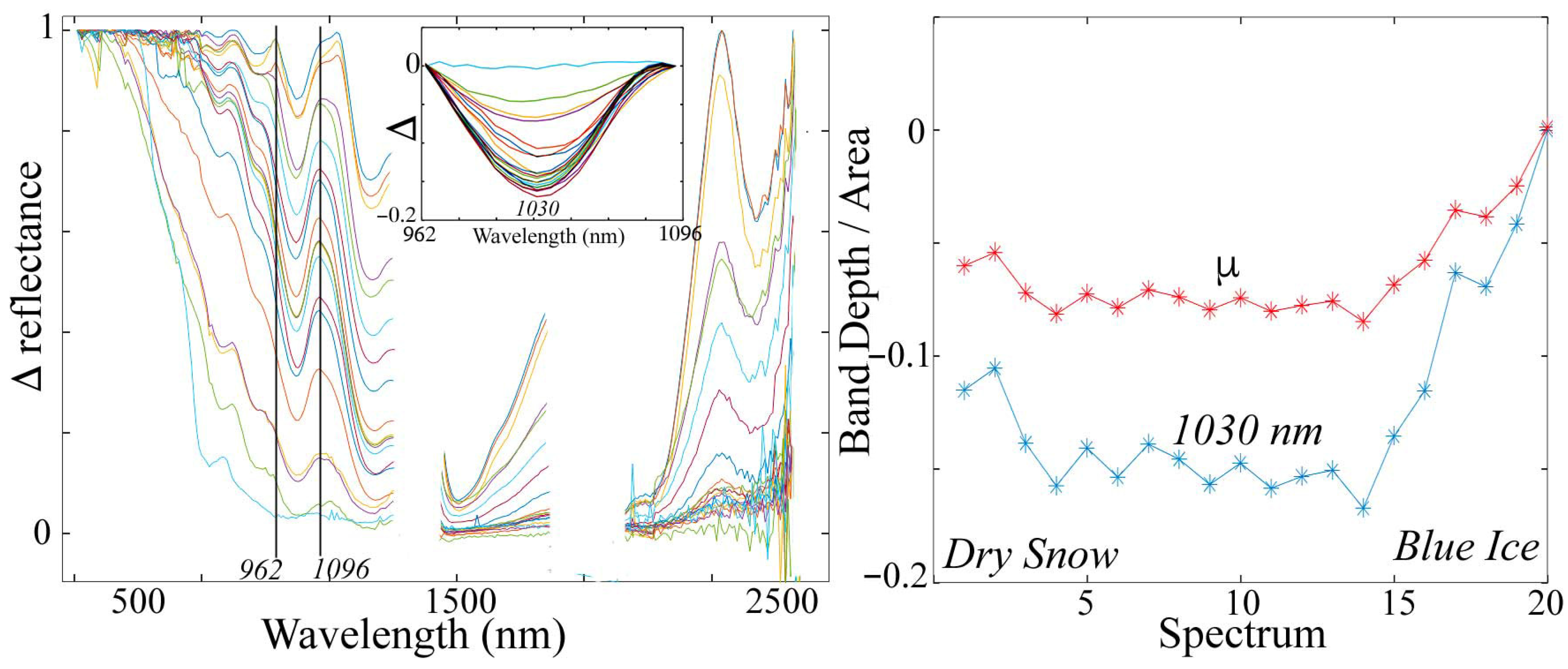
Nolin and Dozier [31] proposed the use of the 1030 nm absorption feature as a basis for estimating snow grain size. Although this analysis does not discuss snow grain size directly, the 1030 nm absorption band area is computed for the 20-spectrum snow–ice continuum used for the index optimization. Figure A4 shows the continuum-removed spectra with the 962–1096 nm slope-zeroed absorption features inset. Trapezoidal integration was used to compute absorption feature areas. Both mean area (Δ) and peak band depth at 1030 nm change relatively little for dry to wet snow and white ice, but are completely attenuated from blue ice to dark. Specular snow reflectances were not included in the continuum because atmospheric overcorrection distorts both shoulders of the 1030 nm absorption feature on specular reflectances.
Figure A4.
Grain size analysis for the non-specular snow–ice spectral continuum in Figure 10. Continuum removed spectra (L) with zeroed 1030 nm absorption feature (inset) show varying band depth along continuum. Both mean (μ) Δ and 1030 nm band depth (R) change little over snow range, but diminish rapidly from white to blue ice. Specular snow reflectances are excluded because atmospheric overcorrection distorts both shoulders of the 1030 absorption feature.
Appendix A.5. CCI Application to Greenland Ice Sheet AVIRIS
To illustrate the applicability of the CCI to polar ice sheet environments, an AVIRIS acquisition from the Greenland Ice Sheet is used. The Kangerlussuaq (K) transect in southwest Greenland spans the transition from the interior snow accumulation zone to the peripheral ice ablation zone. This transect is one of the most studied cryospheric environments on Earth. The spectroscopy of the low altitude AVIRIS acquisition from 2018 was used by Small and Sousa [18] as one of several AVIRIS transects from Greenland and the Himalaya used to characterize the cryospheric spectral mixing space. As such, the spectral diversity of ice and snow along the transect has been studied in the context of a diversity of other crysopheric environments. Figure A5 shows a false color composite of the K transect line subsampled by 0.5 and compressed along track for clarity. For comparison, the CCI for the line has been computed. The CCI profile extracted from the line (bottom) contrasts the relative spectral homogeneity of the snow in the accumulation zone with the gradient from white to blue ice in the ablation zone. The range of CCI values on this line is comparable to those from the EMIT mosaic, suggesting that the CCI is well-suited to polar ice sheet characterization as well.
Figure A5.
Greenland K transect AVIRIS line with CCI. Aside from supraglacial lakes and streams (white), the snow on the eastward section of the line is relatively spectrally homogeneous. In contrast, the exposed ice in the ablation zone to the west grades from white to blue ice as deeper, older ice is exposed at the surface. The variability of the CCI to the west is a result of crevasses and shadows in the ice. Red line shows location of CCI profile with cross bar showing snow–ice transition. The aspect ratio of the ~160 km line has been compressed along track for clarity.
Appendix A.6. EMIT Granules
Table A1.
EMIT granule IDs and geographies.
References
- Warren, S.G. Optical properties of ice and snow. Philos. Trans. R. Soc. A 2019, 377, 20180161. [Google Scholar] [CrossRef] [Scilit] [PubMed]
- Kyle, H.L.; Curran, R.J.; Barnes, W.L.; Escoe, D. A cloud physics radiometer. In Third Conference on Atmospheric Radiation; American Meteorological Society: Davis, CA, USA, 1978; p. 107. [Google Scholar]
- Crane, R.G.; Anderson, M.R. Satellite discrimination of snow/cloud surfaces. Int. J. Remote Sens. 1984, 5, 223. [Google Scholar] [CrossRef] [Scilit]
- Dozier, J. Spectral signature of alpine snow cover from the landsat thematic mapper. Remote Sens. Environ. 1989, 28, 9–22. [Google Scholar] [CrossRef] [Scilit]
- Rosenthal, W.; Dozier, J. Automated mapping of montane snow cover at subpixel resolution from the landsat thematic mapper. Water Resour. Res. 1996, 32, 115–130. [Google Scholar] [CrossRef] [Scilit]
- Hall, D.K.; Riggs, G.A.; Salomonson, V.V. Development of methods for mapping global snow cover using moderate resolution imaging spectroradiometer data. Remote Sens. Environ. 1995, 54, 127–140. [Google Scholar] [CrossRef] [Scilit]
- Riggs, G.; Hall, D.; Román, M.O. VIIRS Snow Cover Algorithm Theoretical Basis Document (ATBD); NASA Goddard Space Flight Center: Greenbelt, MD, USA, 2015; p. 38.
- Adams, J.B.; Smith, M.O.; Gillespie, A.R. Imaging Spectroscopy: Interpretation based on spectral mixture analysis. In Remote Geochemical Analysis: Elemental and Mineralogical Composition; Pieters, C.M., Englert, P., Eds.; Cambridge University Press: New York, NY, USA, 1993; pp. 145–166. [Google Scholar]
- Adams, J.B.; Smith, M.O.; Johnson, P.E. Spectral mixture modeling; A new analysis of rock and soil types at the Viking Lander 1 site. J. Geophys. Res. 1986, 91, 8098–8122. [Google Scholar] [CrossRef] [Scilit]
- Gillespie, A.R.; Smith, M.O.; Adams, J.B.; Willis, S.C.; Fischer, A.F.; Sabol, D.E. Interpretation of residual images: Spectral mixture analysis of AVIRIS images, Owens Valley, California. In Proceedings of the 2nd Airborne Visible/Infrared Imaging Spectrometer (AVIRIS) Workshop; Jet Propulsion Laboratory: Pasadena, CA, USA, 1990. [Google Scholar]
- Salomonson, V.V.; Appel, I. Estimating fractional snow cover from MODIS using the normalized difference snow index. Remote Sens. Environ. 2003, 89, 351–360. [Google Scholar] [CrossRef] [Scilit]
- Adams, J.B.; Gillespie, A.R. Remote Sensing of Landscapes with Spectral Images; Cambridge University Press: Cambridge, UK, 2006; p. 362. [Google Scholar]
- Boardman, J.W.; Green, R.O. Exploring the Spectral Variability of the Earth as Measured by AVIRIS in 1999. In NASA JPL AVIRIS Workshop; Green, R.O., Ed.; NASA Jet Propulsion Laboratory: Pasadena, CA, USA, 2000; pp. 1–10. [Google Scholar]
- Green, R.O.; Boardman, J. Exploration of the relationship between information content and signal/noise ratio and spatial resolution in AVIRIS spectral data. In Proceedings of the Ninth JPL Airborne Earth Science Workshop; NASA Jet Propulsion Laboratory: Pasadena, CA, USA, 2000. [Google Scholar]
- Thompson, D.R.; Boardman, J.W.; Eastwood, M.L.; Green, R.O. A large airborne survey of Earth’s visible-infrared spectral dimensionality. Opt. Express 2017, 25, 9186–9195. [Google Scholar] [CrossRef] [Scilit] [PubMed]
- Small, C.; Das, I. The cryospheric spectral mixing space. In American Geophysical Union Fall Meeting; American Geophysical Union: Washington, DC, USA, 2018. [Google Scholar]
- Small, C.; Milesi, C. Multi-scale Standardized Spectral Mixture Models. Remote Sens. Environ. 2013, 136, 442–454. [Google Scholar] [CrossRef] [Scilit]
- Small, C.; Sousa, D. Joint Characterization of the Cryospheric Spectral Feature Space. Front. Remote Sens. Image Anal. Classif. 2022, 2, 793228. [Google Scholar] [CrossRef] [Scilit]
- Boardman, J.W. Inversion of imaging spectrometry data using singular value decomposition. In Proceedings of the IGARSS’89 12th Canadian Symposium on Remote Sensing, Vancouver, BC, Canada, 10–14 July 1989. [Google Scholar]
- Boardman, J.W. Automating spectral unmixing of AVIRIS data using convex geometry concepts. In Fourth Airborne Visible/Infrared Imaging Spectrometer (AVIRIS) Airborne Geoscience Workshop; Jet Propulsion Laboratory: Pasadena, CA, USA, 1993. [Google Scholar]
- Boardman, J.W. Geometric mixture analysis of imaging spectrometery data. Proc. Int. Geosci. Remote Sens. Symp. 1994, 4, 2369–2371. [Google Scholar]
- Green, R.O.; Thompson, D.R.; EMIT Team. NASA’s Earth Surface Mineral Dust Source Investigation: An Earth Venture Imaging Spectrometer Science Mission. In Proceedings of the 2021 IEEE International Geoscience and Remote Sensing Symposium IGARSS, Brussels, Belgium, 11–16 July 2021. IEEE Transactions on Geoscience and Remote Sensing. [Google Scholar]
- Bradley, C.L.; Thingvold, E.; Moore, L.B.; Haag, J.M.; Raouf, N.A.; Mouroulis, P.; Green, R.O. Optical Design of the Earth Surface Mineral Dust Source Investigation (EMIT) Imaging Spectrometer. In Proceedings of the Imaging Spectrometry XXIV: Applications, Sensors, and Processing, Online, 24 August–4 September 2020; p. 1150402. [Google Scholar]
- Thompson, D.R.; Green, R.O.; Bradley, C.; Brodrick, P.G.; Mahowald, N.; Dor, E.B.; Bennett, M.; Bernas, M.; Carmon, N.; Chadwick, K.D.; et al. On-orbit calibration and performance of the EMIT imaging spectrometer. Remote Sens. Environ. 2024, 303, 113986. [Google Scholar] [CrossRef] [Scilit]
- Eckart, C.; Young, G. The approximation of one matrix by another of lower rank. Psychometrika 1936, 1, 211–218. [Google Scholar] [CrossRef] [Scilit]
- Boardman, J. Inversion of high spectral resolution data. In Imaging Spectroscopy of the Terrestrial Environment; SPIE: Bellingham, WA, USA, 1990; Volume 1298, pp. 222–233. [Google Scholar]
- Small, C. The landsat ETM plus spectral mixing space. Remote Sens. Environ. 2004, 93, 1–17. [Google Scholar] [CrossRef] [Scilit]
- Small, C.; Sousa, D. The Standardized Spectroscopic Mixture Model. Remote Sens. 2024, 16, 3768. [Google Scholar] [CrossRef] [Scilit]
- Price, J.C. Using spatial context in satellite data to infer regional scale evapotranspiration. IEEE Trans. Geosci. Remote Sens. 1990, 28, 940–948. [Google Scholar] [CrossRef] [Scilit]
- van der Meer, F.D.; Jia, L. Collinearity and orthogonality of endmembers in linear spectral unmixing. Int. J. Appl. Earth Obs. Geoinf. 2012, 18, 491–503. [Google Scholar] [CrossRef] [Scilit]
- Nolin, A.W.; Dozier, J. A hyperspectral method for remotely sensing the grain size of snow. Remote Sens. Environ. 2000, 74, 207–216. [Google Scholar] [CrossRef] [Scilit]
Disclaimer/Publisher’s Note: The statements, opinions and data contained in all publications are solely those of the individual author(s) and contributor(s) and not of MDPI and/or the editor(s). MDPI and/or the editor(s) disclaim responsibility for any injury to people or property resulting from any ideas, methods, instructions or products referred to in the content. |
© 2026 by the author. Licensee MDPI, Basel, Switzerland. This article is an open access article distributed under the terms and conditions of the Creative Commons Attribution (CC BY) license.