From Spectral Indices to Artificial Intelligence: A Review of Remote Sensing Methodologies for Glacier Mapping

Highlights
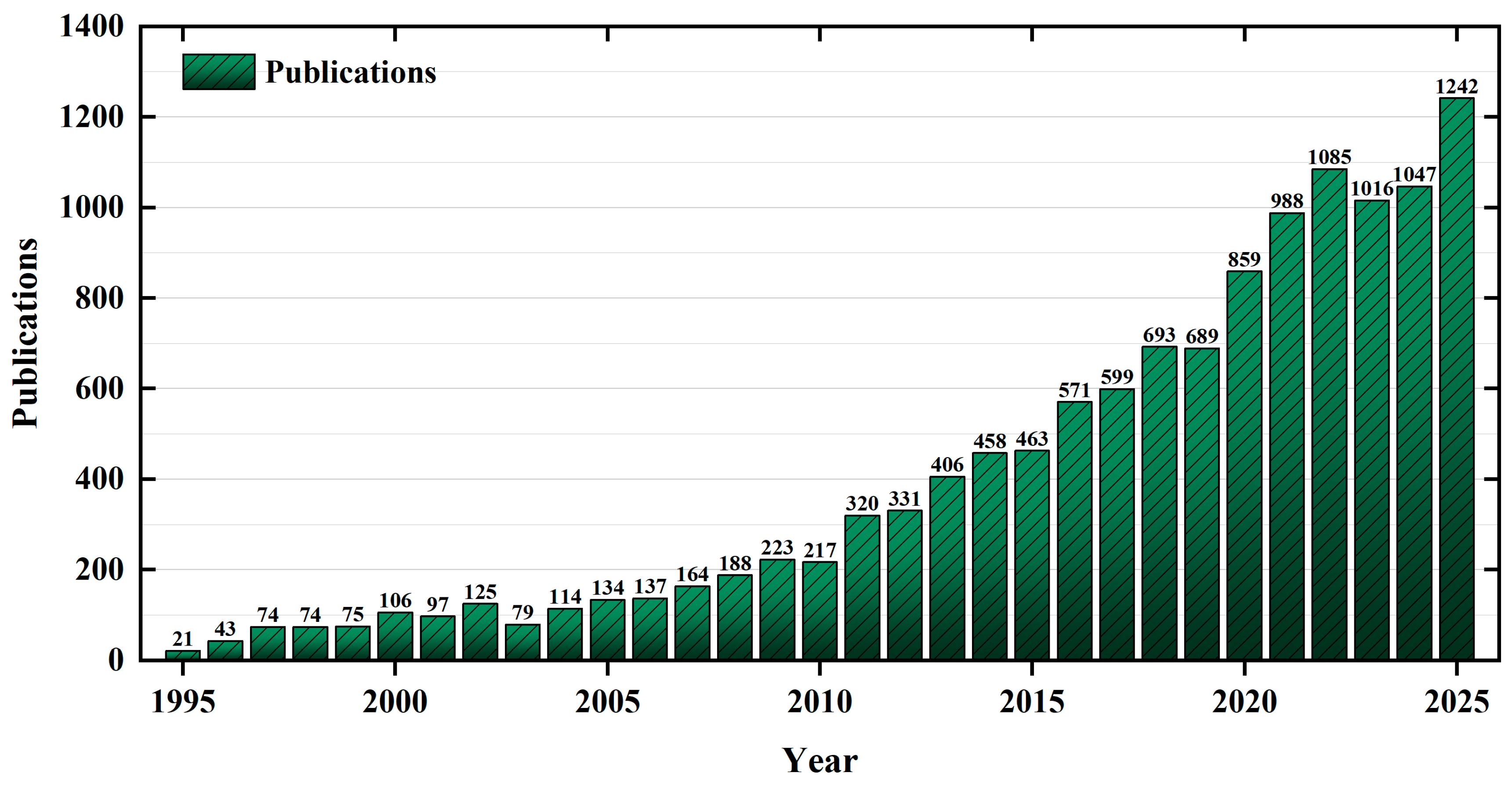
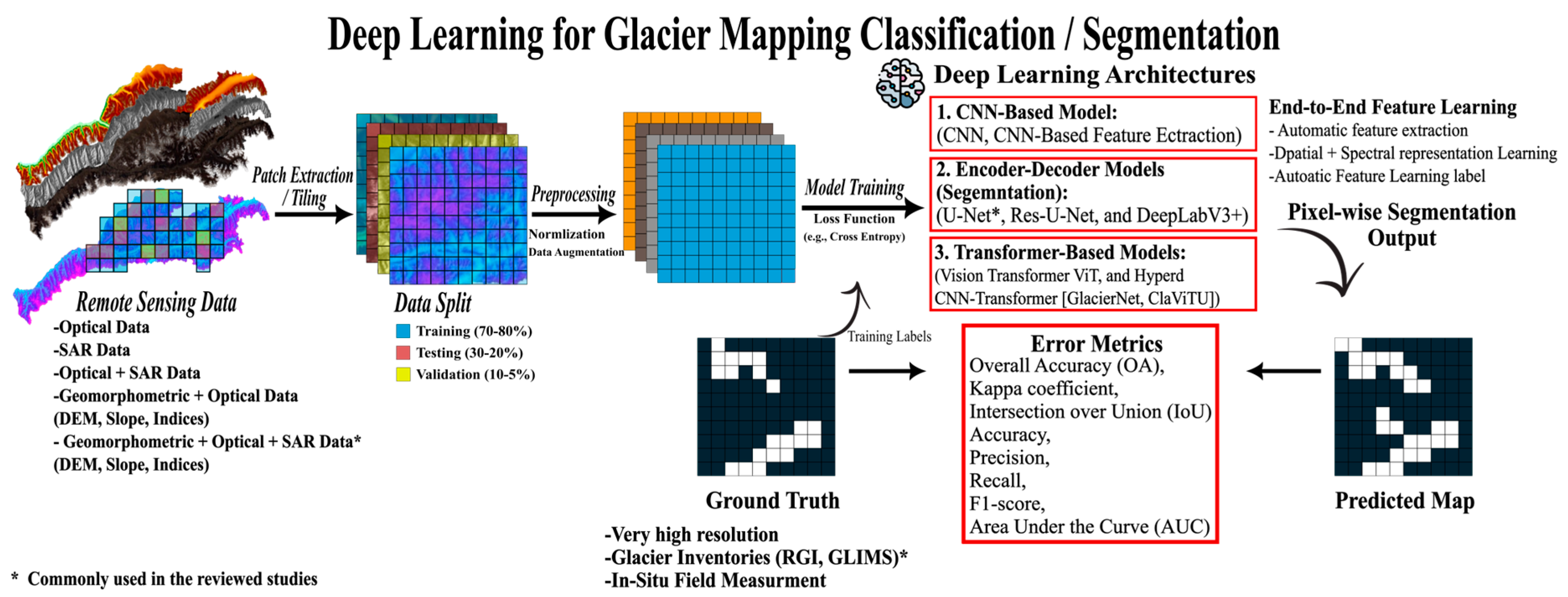
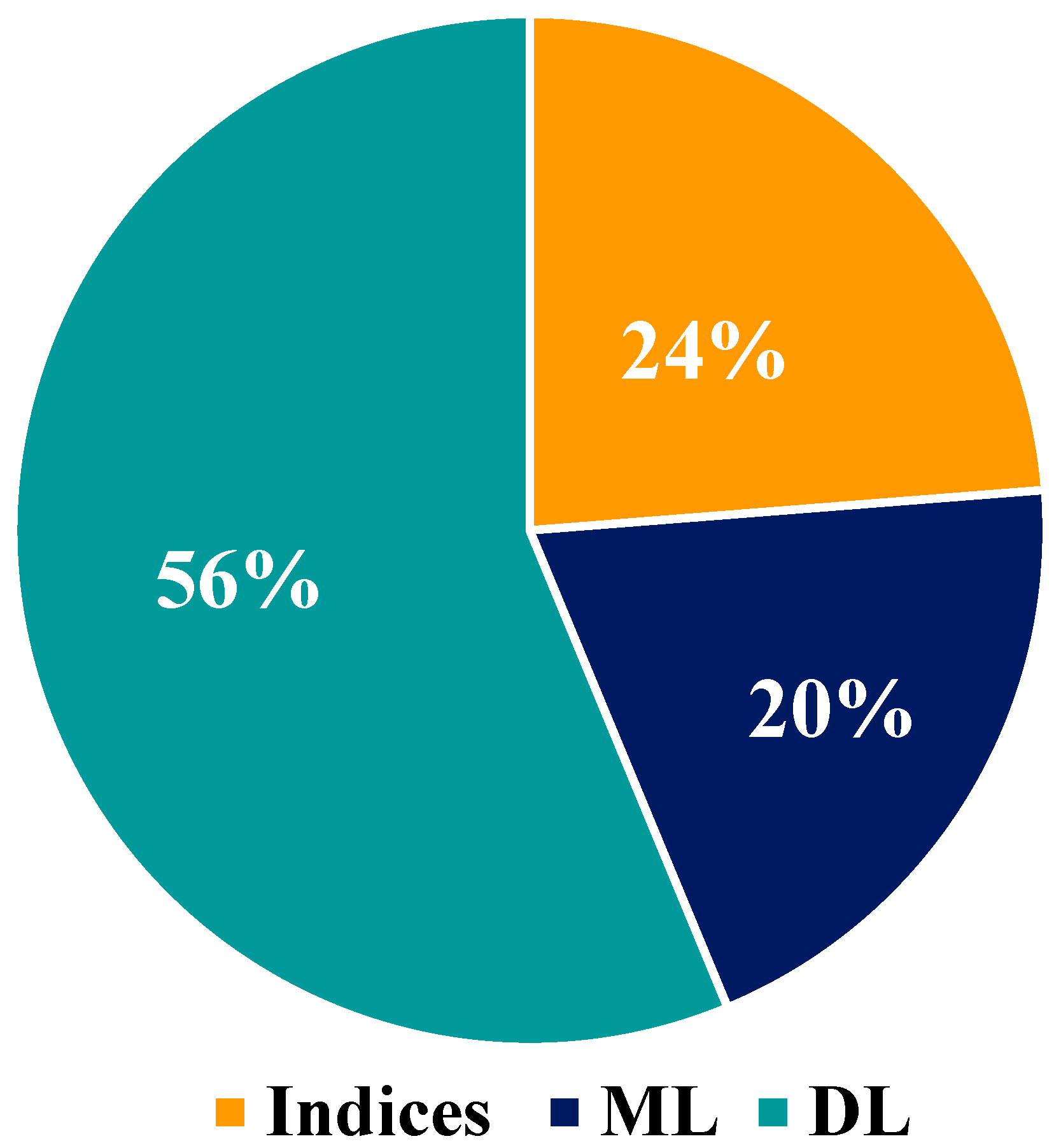
- The review emphasizes a significant transition in technology, moving from traditional spectral indices to more sophisticated Machine Learning (ML) and Deep Learning (DL) models. These methods now represent 20% and 56% of recent glacier mapping studies, respectively.
- Data fusion, especially combining optical, Synthetic Aperture Radar (SAR), and geomorphometric data, consistently achieves the highest glacier mapping accuracy compared to single sensor approaches.
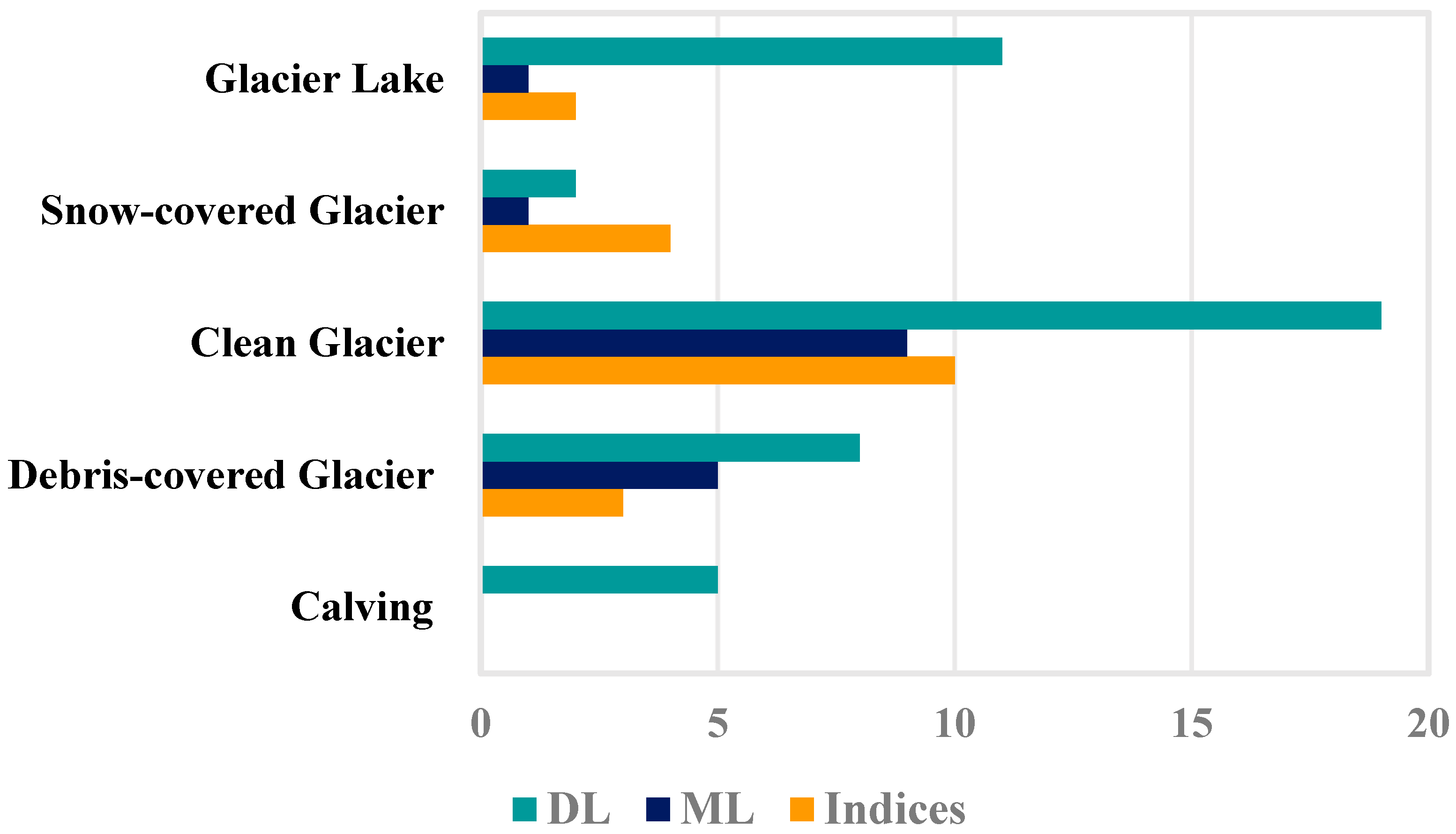
- The transition to automated, data-driven systems allows for precise, large-scale monitoring of complex features such as debris-covered glaciers and calving fronts that were previously difficult to characterize.
- Future progress relies on overcoming the “ground truth” bottleneck by fostering community-led efforts to develop standardized, high-resolution benchmark datasets and enhance model transferability across various geographic regions.
Abstract
1. Introduction
2. Methodology
2.1. Glacier Surfaces
2.1.1. Glaciological Classification of Ice-Related Landforms
2.1.2. Remote Sensing Characteristics of Glacier Surfaces
2.2. Satellite Data for Glacier Mapping
2.2.1. Optical Satellite Imagery
2.2.2. Synthetic Aperture Radar (SAR) Imagery
2.2.3. Geomorphometric Data
3. Glacier Mapping Techniques
3.1. Spectral Indices in Glacier Mapping
3.2. Machine Learning Models in Glacier Mapping
3.3. Deep Learning Models in Glacier Mapping
4. Discussion and Future Research Directions
4.1. Spectral Indices: Performance, Challenges, and Future Directions
4.2. Machine Learning: Performance, Challenges, and Future Directions
4.3. Deep Learning: Performance, Challenges, and Future Directions
4.4. The Geomorphology-Classification Conundrum
4.5. Automating Historical Glacier Inventories for Mapping
4.6. Limitations of Performance Metrics in Glacier Mapping
4.7. Impact of Data Fusion on Model Performance
- Optical Datasets:
- SAR Datasets:
- Geomorphometric and Optical Fusion:
- Optical and SAR Fusion:
- Integration of Geomorphometric, SAR, and Optical Fusion:
4.8. Key Challenges and Future Research Needs
4.9. Operational Readiness of Glacier Mapping Approaches
5. Opinions and Perspectives
- ▪
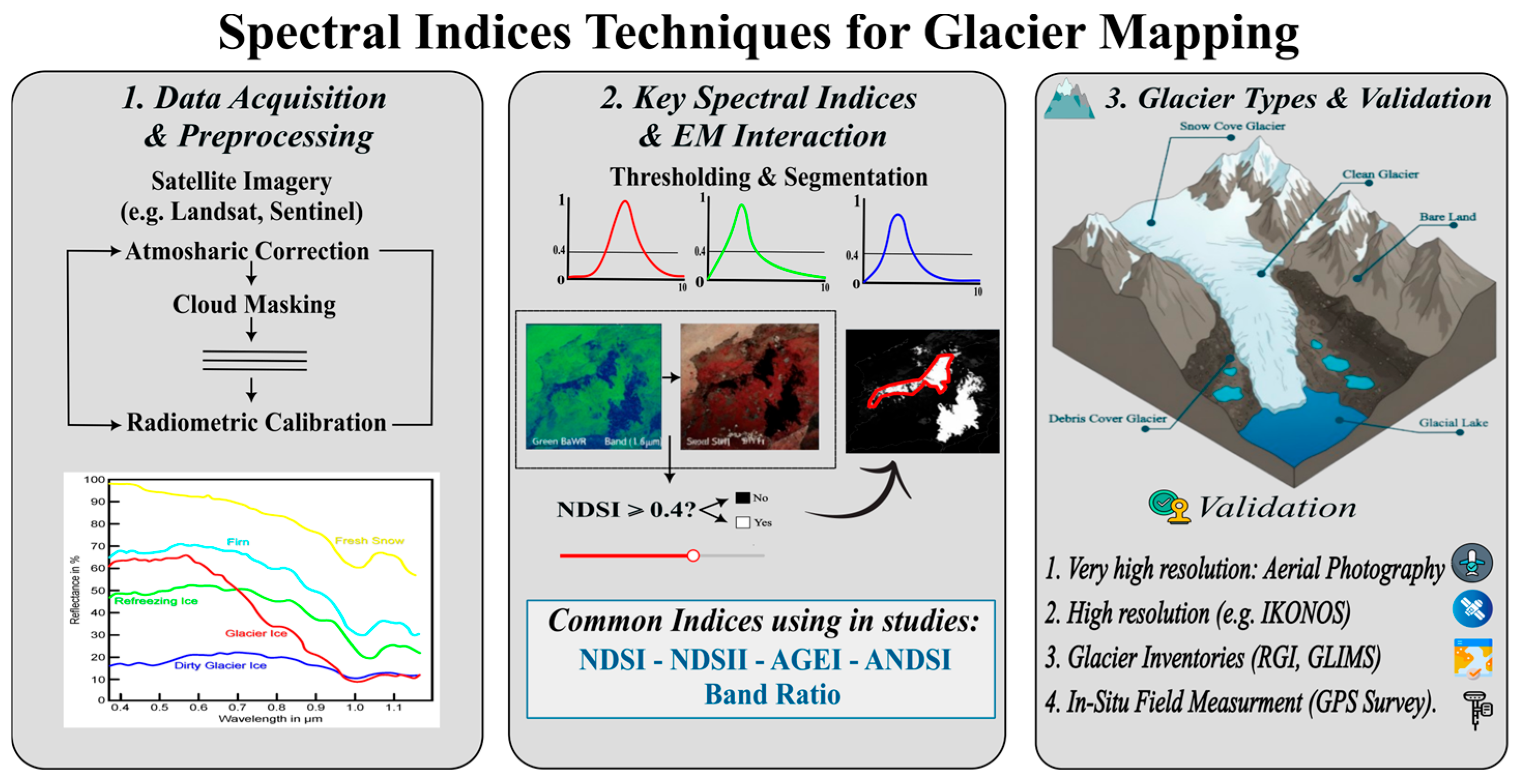
- While ML and DL now dominate the field, it is crucial not to dismiss the foundational role of spectral indices. For rapid, large-scale assessments, especially for clean ice and snow, indices like the NDSI remain computationally efficient and easy to implement. However, the literature clearly shows a move towards developing more robust indices, like the ANDSI, to tackle specific challenges like differentiating ice from water. The future of indices may not be as standalone tools, but as powerful input features for more complex ML and DL models, providing a baseline of spectral information that these models can then refine.
- ▪
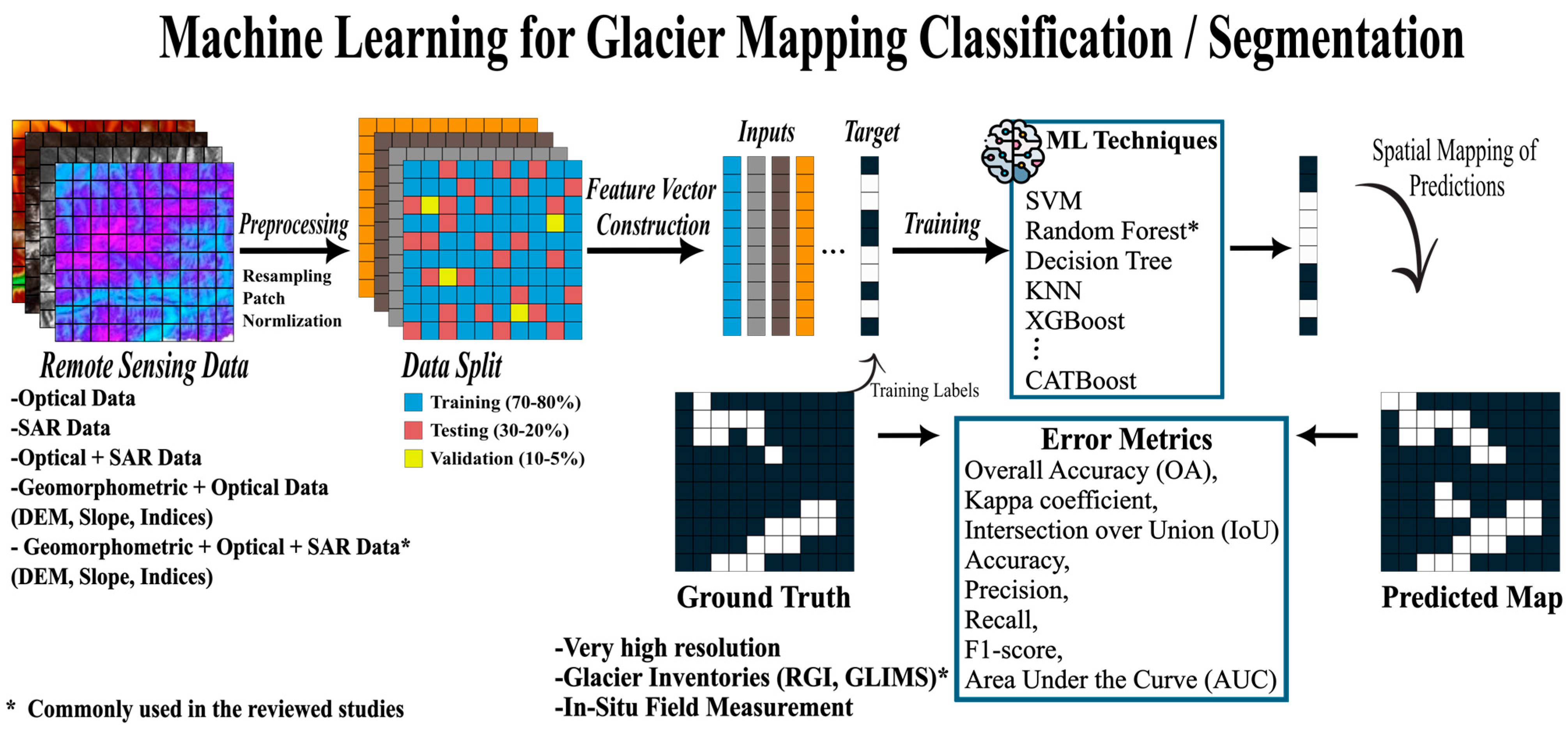
- The effectiveness of supervised ML and DL models for glacier mapping largely depends on the quality, consistency, and representativeness of the training data. Most research uses manually delineated glacier boundaries or existing inventories like the RGI and GLIMS as “ground truth.” However, these are not true ground truths, as they are based on semi-automated or expert methods with varying spatial resolutions, temporal consistency, and assumptions. A key issue is the systematic underrepresentation of debris-covered glaciers, which are hard to detect in optical imagery, leading to the omission or misclassification of glacier areas in training data. This creates bias, causing models to learn from inaccurate labels that do not reflect the true extent and state of glaciers. While in situ surveys provide more precise reference data, they are limited in scope and difficult to carry out. Consequently, current methods depend on imperfect reference datasets, which restrict reliable model comparison, regional generalization, and accurate glacier inventory development. Developing standardized, high-resolution, and physically consistent benchmark datasets that adhere to the FAIR principles is therefore a priority for the scientific community.
- ▪
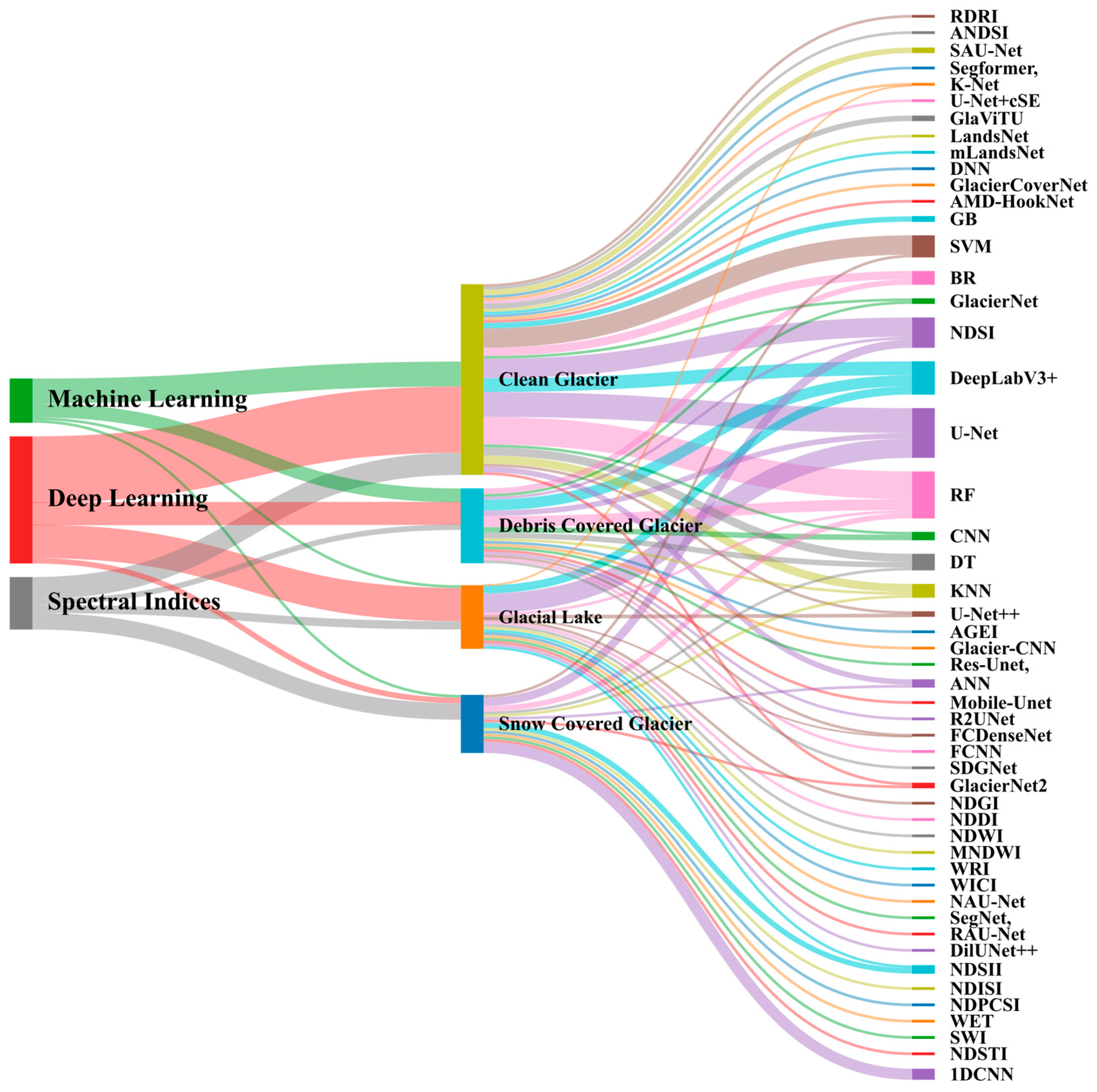
- The DL table shows a clear dominance of U-Net and its variants (e.g., Res-Unet, R2UNet, SAU-Net). While U-Net is a powerful architecture for image segmentation, the field would benefit from greater exploration of other model architectures. For instance, models that are more computationally efficient (like Mobile-Unet) could be crucial for large-scale, operational glacier monitoring systems. Furthermore, there is a need for more research into hyperparameter optimization and novel loss functions tailored to the specific challenges of glacier mapping, such as the imbalance between glacier and non-glacier pixels.
- ▪
- While many studies now incorporate multiple data sources, such as optical imagery, SAR, and DEMs, which is a positive trend for overcoming the individual limitations of each sensor type, there is still much to explore in this area. Future research should focus on how to best fuse data with different spatial and temporal resolutions, the potential of incorporating less commonly used data types like hyperspectral or thermal imagery within DL frameworks, and the development of more sophisticated data fusion techniques that go beyond simple data stacking. Most studies focus on developing models for a specific region. There is a need for more research on the transferability of these models to other geographic areas with different glacier types and environmental conditions. A model trained on Himalayan glaciers, for example, may not perform well on glaciers in the Andes or the Alps due to differences in glacier morphology, climate conditions, and training data distribution [102].
- ▪
- Debris-covered glaciers are among the most challenging to map due to their spectral similarity to surrounding terrain and their reliance on debris thickness, thermal insulation, and surface dynamics. Future studies should focus on physically based methods that combine thermal data, surface velocity, and geomorphological indicators to better detect active ice beneath debris.
- ▪
- While many studies demonstrate the potential of ML and DL for automated glacier mapping, there are few examples of these models being implemented in operational, near real-time monitoring systems. Bridging the gap between research and operational use is a key challenge for the future.
6. Bias and Uncertainty in Glacier Mapping
6.1. Defining Bias in Remote Sensing
6.2. Sources of Bias and Systematic Uncertainty
7. Conclusions
Supplementary Materials
Author Contributions
Funding
Data Availability Statement
Acknowledgments
Conflicts of Interest
Abbreviations
| AGEI | Automated Glacier Extraction Index |
| ANDSI | Adjusted Normalized Difference Snow Index |
| ASTER | Advanced Spaceborne Thermal Emission and Reflection Radiometer |
| BR | Band Ratio |
| CART | Classification & Regression Tree |
| CNN | Convolutional Neural Network |
| CSI | Char Soil Index |
| DEM | Digital Elevation Model |
| DT | Decision Tree |
| FCNN | Fully Convolutional Neural Network |
| GB | Gradient Boosting |
| GEE | Google Earth Engine |
| GLIMS | Global Land Ice Measurements from Space |
| GMM | Gaussian Mixture Models |
| GTB | Gradient Tree Boost |
| ILI | Icy Lakes Index |
| K-NET | k-space neural network |
| KNN | K-Nearest Neighbors |
| IPCC | Intergovernmental Panel on Climate Change |
| LST | Land Surface Temperature |
| MLC | Maximum Likelihood Classifier |
| MLP | Multi-Layer Perceptron |
| MNDWI | Modified Normalized Difference Water Index |
| MODIS | Moderate Resolution Imaging Spectroradiometer |
| NDPCSI | Normalized Difference Principal Component Snow Index |
| NDSI | Normalized Difference Snow Index |
| NDSII | Normalized Difference Snow Ice Index |
| NDWI | Normalized Difference Water Index |
| NIR | Near-Infrared |
| RCP | Representative Concentration Pathway |
| RF | Random Forest |
| RGI | Randolph Glacier Inventory |
| RGB | Red, Green, and Blue |
| SAR | Synthetic Aperture Radar |
| SAU-NET | Supervised Attention U-Net |
| SGDNet | Saliency-Guided Deep Neural Network |
| SPOT | Satellite pour l’Observation de la Terre |
| SVM | Support Vector Machine |
| SWI | Standardized Water-Level Index |
| SWIR | Shortwave Infrared |
| TIR | Thermal Infrared |
| VNIR | Visible/Near-Infrared |
| WICI | Water-Ice Classification Index |
| WRI | Water Ratio Index |
References
- Rounce, D.R.; Hock, R.; Maussion, F.; Hugonnet, R.; Kochtitzky, W.; Huss, M.; Berthier, E.; Brinkerhoff, D.; Compagno, L.; Copland, L. Global glacier change in the 21st century: Every increase in temperature matters. Science 2023, 379, 78–83. [Google Scholar] [CrossRef]
- Zemp, M.; Frey, H.; Gärtner-Roer, I.; Nussbaumer, S.U.; Hoelzle, M.; Paul, F.; Haeberli, W.; Denzinger, F.; Ahlstrøm, A.P.; Anderson, B. Historically unprecedented global glacier decline in the early 21st century. J. Glaciol. 2015, 61, 745–762. [Google Scholar] [CrossRef]
- Ding, Y.; Zhang, S.; Zhao, L.; Li, Z.; Kang, S. Global warming weakening the inherent stability of glaciers and permafrost. Sci. Bull. 2019, 64, 245–253. [Google Scholar] [CrossRef] [PubMed]
- Nabizada, M.J.; Rousta, I.; Elzein, A.; Olafsson, H. Evaluation of spatial distribution and temporal trend of nitrogen dioxide (NO2) pollution using Sentinel-5P satellite imagery over Afghanistan based on Google Earth Engine. Earth Sci. Inform. 2025, 18, 74. [Google Scholar] [CrossRef]
- Stocker, T. Climate Change 2013: The Physical Science Basis: Working Group I Contribution to the Fifth Assessment Report of the Intergovernmental Panel on Climate Change; Cambridge University Press: Cambridge, UK, 2014. [Google Scholar]
- ESA. Glacier Melt Intensifying Freshwater Loss and Accelerating Sea-Level Rise. 2025. Available online: https://www.esa.int/Applications/Observing_the_Earth/FutureEO/CryoSat/Glacier_melt_intensifying_freshwater_loss_and_accelerating_sea-level_rise (accessed on 5 May 2026).
- Kundzewicz, Z.W. Climate change impacts on the hydrological cycle. Ecohydrol. Hydrobiol. 2008, 8, 195–203. [Google Scholar] [CrossRef]
- Nie, Y.; Pritchard, H.D.; Liu, Q.; Hennig, T.; Wang, W.; Wang, X.; Liu, S.; Nepal, S.; Samyn, D.; Hewitt, K. Glacial change and hydrological implications in the Himalaya and Karakoram. Nat. Rev. Earth Environ. 2021, 2, 91–106. [Google Scholar] [CrossRef]
- Sadek, M.; Li, X.; Mostafa, E.; Freeshah, M.; Kamal, A.; Sidi Almouctar, M.A.; Zhao, F.; Mustafa, E.K. Low-cost solutions for assessment of flash flood impacts using sentinel-1/2 data fusion and hydrologic/hydraulic modeling: Wadi el-natrun region, egypt. Adv. Civ. Eng. 2020, 2020, 1039309. [Google Scholar] [CrossRef]
- Pörtner, H.-O.; Roberts, D.C.; Masson-Delmotte, V.; Zhai, P.; Tignor, M.; Poloczanska, E.; Weyer, N. The ocean and cryosphere in a changing climate. IPCC Spec. Rep. Ocean Cryosphere Chang. Clim. 2019, 1155, 10-1017. [Google Scholar]
- Cheng, J.; Zhang, X.; Zhu, F.; Hu, J.; Zhuo, D.; Freeshah, M. A tightly coupled integration of GNSS/IMU/LiDAR with parameterized semantic line and plane features to improve pose accuracy in complex environments. Measurement 2025, 247, 116843. [Google Scholar] [CrossRef]
- Maslov, K.A.; Schellenberger, T.; Persello, C.; Stein, A. Glacier Mapping from Sentinel-1 SAR Time Series with Deep Learning in Svalbard. In Proceedings of the IGARSS 2024—2024 IEEE International Geoscience and Remote Sensing Symposium, Athens, Greece, 7–12 July 2024; pp. 14–17. [Google Scholar]
- Stonevicius, E.; Uselis, G.; Grendaite, D. Ice Detection with Sentinel-1 SAR Backscatter Threshold in Long Sections of Temperate Climate Rivers. Remote Sens. 2022, 14, 1627. [Google Scholar] [CrossRef]
- Atasever, Ü.H.; Elzein, A.; Abbas, H.H. Unsupervised change detection in SAR images using a non-local mean filter and hyperbolic tangent sigmoid function. Remote Sens. Lett. 2025, 16, 483–493. [Google Scholar] [CrossRef]
- Abdalla, A.; ElZein, A. Validation of Google Earth-based DEM using leveling data. In Proceedings of the 2020 International Conference on Computer, Control, Electrical, and Electronics Engineering (ICCCEEE), Khartoum, Sudan, 26 February–1 March 2021; pp. 1–5. [Google Scholar]
- Osama, N.; Shao, Z.; Ma, Y.; Yan, J.; Fan, Y.; Magdy Habib, S.; Freeshah, M. The ATL08 as a height reference for the global digital elevation models. Geo-Spat. Inf. Sci. 2024, 27, 327–346. [Google Scholar] [CrossRef]
- Osama, N.; Shao, Z.; Freeshah, M. The FABDEM outperforms the global DEMs in representing bare terrain heights. Photogramm. Eng. Remote Sens. 2023, 89, 613–624. [Google Scholar] [CrossRef]
- Hattersley-Smith, G. The symposium on glacier mapping. Can. J. Earth Sci. 1966, 3, 737–741. [Google Scholar] [CrossRef]
- Muller, F. Perennial Ice and Snow Masses; A Guide for Compilation and Assemblage of Data for a World Inventory; Techllical Pap. Ill Hydrology. UNESCO/IASH Series 011 SIIOW Alld Ice; UNESCO: Paris, France, 1970. [Google Scholar]
- Müller, F.; Caflisch, T.; Müller, G. Instructions for Compilation and Assemblage of Data for a World Glacier Inventory; Department of Geography, Swiss Federal Institute of Technology (ETH) Zurich: Zurich, Switzerland, 1977. [Google Scholar]
- Mei, D.; Zhang, X.; Ren, X.; Le, X.; Liu, H.; Freeshah, M. Two-and three-dimensional propagation characteristics of co-volcanic ionospheric disturbances induced by the 2022 Tonga volcano eruption using dense GNSS network data. J. Geophys. Res. Space Phys. 2025, 130, e2024JA032488. [Google Scholar] [CrossRef]
- Liu, H.; Chen, P.; Ren, X.; Zhang, X.; Liang, X.; Freeshah, M. Performance of ionospheric scintillation index S 4c derived from geodetic GNSS observations at low latitudes: Strategies and validation. IEEE Geosci. Remote Sens. Lett. 2025, vol. 23. [Google Scholar] [CrossRef]
- Ostrem, G.; Selvig, K.; Tandberg, K. 1988: Atlas over Breer i SOr Norge; Norges Vassdrags-og Energiverk Vassdragsdirektoratet: Oslo, Norway, 1988. [Google Scholar]
- Rau, F.; Mauz, F.; Vogt, S.; Khalsa, S.J.S.; Raup, B. Illustrated GLIMS Glacier Classification Manual; Version 1; Institut für Physische Geographie: Freiburg, Germany, 2005; p. 755. [Google Scholar]
- Raup, B.; Racoviteanu, A.; Khalsa, S.J.S.; Helm, C.; Armstrong, R.; Arnaud, Y. The GLIMS geospatial glacier database: A new tool for studying glacier change. Glob. Planet. Change 2007, 56, 101–110. [Google Scholar] [CrossRef]
- Raup, B.; Khalsa, S.J.S. GLIMS Analysis Tutorial; Natl. Snow: Boulder, CO, USA, 2010. [Google Scholar]
- Paul, F.; Barrand, N.E.; Baumann, S.; Berthier, E.; Bolch, T.; Casey, K.; Frey, H.; Joshi, S.; Konovalov, V.; Le Bris, R. On the accuracy of glacier outlines derived from remote-sensing data. Ann. Glaciol. 2013, 54, 171–182. [Google Scholar] [CrossRef]
- Aniya, M.; Sato, H.; Naruse, R.; Skvarca, P.; Casassa, G. The use of satellite and airborne imagery to inventory outlet glaciers of the Southern Patagonia Icefield, South America. Photogramm. Eng. Remote Sens. 1996, 62, 1361–1369. [Google Scholar]
- Gao, J.; Liu, Y. Applications of remote sensing, GIS and GPS in glaciology: A review. Prog. Phys. Geogr. 2001, 25, 520–540. [Google Scholar] [CrossRef]
- König, M.; Winther, J.G.; Isaksson, E. Measuring snow and glacier ice properties from satellite. Rev. Geophys. 2001, 39, 1–27. [Google Scholar] [CrossRef]
- Massom, R. Satellite remote sensing of polar snow and ice: Present status and future directions. Polar Rec. 1995, 31, 99–114. [Google Scholar] [CrossRef]
- Kargel, J.S.; Abrams, M.J.; Bishop, M.P.; Bush, A.; Hamilton, G.; Jiskoot, H.; Kääb, A.; Kieffer, H.H.; Lee, E.M.; Paul, F. Multispectral imaging contributions to global land ice measurements from space. Remote Sens. Environ. 2005, 99, 187–219. [Google Scholar] [CrossRef]
- Raup, B.; Kääb, A.; Kargel, J.S.; Bishop, M.P.; Hamilton, G.; Lee, E.; Paul, F.; Rau, F.; Soltesz, D.; Khalsa, S.J.S. Remote sensing and GIS technology in the Global Land Ice Measurements from Space (GLIMS) project. Comput. Geosci. 2007, 33, 104–125. [Google Scholar] [CrossRef]
- Atasever, Ü.; Bozdağ, A. Carbon footprint mapping of urban areas in Türkiye using hyperparameter-optimized machine learning techniques. Int. J. Environ. Sci. Technol. 2025, 22, 10321–10344. [Google Scholar] [CrossRef]
- Bishop, M.P.; Shroder, J.F., Jr.; Ali, G.; Bush, A.B.; Haritashya, U.K.; Roohi, R.; Sarikaya, M.A.; Weihs, B.J. Remote sensing of glaciers in Afghanistan and Pakistan. In Global Land Ice Measurements from Space; Springer: Berlin/Heidelberg, Germany, 2014; pp. 509–548. [Google Scholar]
- Kääb, A.; Huggel, C.; Fischer, L.; Guex, S.; Paul, F.; Roer, I.; Salzmann, N.; Schlaefli, S.; Schmutz, K.; Schneider, D. Remote sensing of glacier-and permafrost-related hazards in high mountains: An overview. Nat. Hazards Earth Syst. Sci. 2005, 5, 527–554. [Google Scholar] [CrossRef]
- Kääb, A. Remote sensing of permafrost-related problems and hazards. Permafr. Periglac. Process. 2008, 19, 107–136. [Google Scholar] [CrossRef]
- Racoviteanu, A.E.; Williams, M.W.; Barry, R.G. Optical remote sensing of glacier characteristics: A review with focus on the Himalaya. Sensors 2008, 8, 3355–3383. [Google Scholar] [CrossRef] [PubMed]
- Nemutlu, Ö.F.; Özçelik, S.T.A.; Freeshah, M. A Machine Learning Framework for Regional Damage Assessment Using Multi-Station Seismic Parameters: Insights from the 2023 Kahramanmaraş Earthquakes. Buildings 2025, 15, 3326. [Google Scholar] [CrossRef]
- Thanh, P.T.; Freeshah, M.; Osama, N.; Chien, L.H.; Thom, T.T.; Elshewy, M.A. Soil Erosion Risk and Mitigation Strategies in Steep and Complex Forest Ecosystems. Civ. Eng. J. 2025, 11, 3358–3374. [Google Scholar] [CrossRef]
- Li, P.; Tariq, A.; Li, Q.; Ghaffar, B.; Farhan, M.; Jamil, A.; Soufan, W.; El Sabagh, A.; Freeshah, M. Soil erosion assessment by RUSLE model using remote sensing and GIS in an arid zone. Int. J. Digit. Earth 2023, 16, 3105–3124. [Google Scholar] [CrossRef]
- Mousa, B.; Shu, H.; Freeshah, M.; Tariq, A. A novel scheme for merging active and passive satellite soil moisture retrievals based on maximizing the signal to noise ratio. Remote Sens. 2020, 12, 3804. [Google Scholar] [CrossRef]
- Uyanik, H.; Kokum, M.; Senturk, E.; Freeshah, M.; Ozcelik, S.T.; Akpinar, M.H.; Celik, S.; Sengur, A. Seismic Foresight: A Novel Multi-Input 1D Convolutional Mixer Model for Earthquake Prediction Using Ionospheric Signals. IEEE Access 2025, 13, 116200–1162100. [Google Scholar] [CrossRef]
- Dozier, J. Spectral signature of alpine snow cover from the Landsat Thematic Mapper. Remote Sens. Environ. 1989, 28, 9–22. [Google Scholar] [CrossRef]
- Hall, D.K.; Riggs, G.A.; Salomonson, V.V. Development of methods for mapping global snow cover using moderate resolution imaging spectroradiometer data. Remote Sens. Environ. 1995, 54, 127–140. [Google Scholar] [CrossRef]
- Ji, W.; Hao, X.; Shao, D.; Yang, Q.; Wang, J.; Li, H.; Huang, G. A New Index for Snow/Ice/Ice-Snow Discrimination Based on BRDF Characteristic Observation Data. J. Geophys. Res. Atmos. 2022, 127, e2021JD035742. [Google Scholar] [CrossRef]
- Zhang, M.; Wang, X.; Shi, C.; Yan, D. Automated Glacier Extraction Index by Optimization of Red/SWIR and NIR /SWIR Ratio Index for Glacier Mapping Using Landsat Imagery. Water 2019, 11, 1223. [Google Scholar] [CrossRef]
- Dixit, A.; Goswami, A.; Jain, S. Development and Evaluation of a New “Snow Water Index (SWI)” for Accurate Snow Cover Delineation. Remote Sens. 2019, 11, 2774. [Google Scholar] [CrossRef]
- Barbieux, K.; Charitsi, A.; Merminod, B. Icy lakes extraction and water-ice classification using Landsat 8 OLI multispectral data. Int. J. Remote Sens. 2018, 39, 3646–3678. [Google Scholar] [CrossRef]
- Yan, D.; Huang, C.; Ma, N.; Zhang, Y. Improved Landsat-Based Water and Snow Indices for Extracting Lake and Snow Cover/Glacier in the Tibetan Plateau. Water 2020, 12, 1339. [Google Scholar] [CrossRef]
- Singh, D.K.; Thakur, P.K.; Naithani, B.P.; Kaushik, S. Quantifying the sensitivity of band ratio methods for clean glacier ice mapping. Spat. Inf. Res. 2020, 29, 281–295. [Google Scholar] [CrossRef]
- Mohammadi, B.; Pilesjö, P.; Duan, Z. The superiority of the Adjusted Normalized Difference Snow Index (ANDSI) for mapping glaciers using Sentinel-2 multispectral satellite imagery. GIScience Remote Sens. 2023, 60, 2257978. [Google Scholar] [CrossRef]
- Alifu, H.; Tateishi, R.; Johnson, B. A new band ratio technique for mapping debris-covered glaciers using Landsat imagery and a digital elevation model. Int. J. Remote Sens. 2015, 36, 2063–2075. [Google Scholar] [CrossRef]
- Xiao, X.; Shen, Z.; Qin, X. Assessing the potential of VEGETATION sensor data for mapping snow and ice cover: A Normalized Difference Snow and Ice Index. Int. J. Remote Sens. 2001, 22, 2479–2487. [Google Scholar] [CrossRef]
- Gjermundsen, E.F.; Mathieu, R.; Kääb, A.; Chinn, T.; Fitzharris, B.; Hagen, J.O. Assessment of multispectral glacier mapping methods and derivation of glacier area changes, 1978–2002, in the central Southern Alps, New Zealand, from ASTER satellite data, field survey and existing inventory data. J. Glaciol. 2017, 57, 667–683. [Google Scholar] [CrossRef]
- Pandey, A.; Parashar, D.; Baruah, B.; Palni, S.; Yadav, A.S.; Singh, A.P.; Bhatt, P.K.; Pundir, C. Assessment of snout analysis of Himalayan glaciers: Impact studies on Pindari, Kafni, Sundardhunga, and Baljuri base camp glaciers. Environ. Monit. Assess. 2022, 194, 338. [Google Scholar] [CrossRef]
- Keshri, A.K.; Shukla, A.; Gupta, R.P. ASTER ratio indices for supraglacial terrain mapping. Int. J. Remote Sens. 2008, 30, 519–524. [Google Scholar] [CrossRef]
- Mondal, S.K.; Patel, V.D.; Bharti, R.; Singh, R.P. Causes and effects of Shisper glacial lake outburst flood event in Karakoram in 2022. Geomat. Nat. Hazards Risk 2023, 14, 2264460. [Google Scholar] [CrossRef]
- Satir, O. Comparing the satellite image transformation techniques for detecting and monitoring the continuous snow cover and glacier in Cilo mountain chain Turkey. Ecol. Indic. 2016, 69, 261–268. [Google Scholar] [CrossRef]
- Haq, M.A.; Jain, K.; Menon, K. Development of new thermal ratio index for snow/ice identification. Int. J. Soft Comput. Eng. 2012, 1, 2231–2307. [Google Scholar]
- Paul, F.; Winsvold, S.; Kääb, A.; Nagler, T.; Schwaizer, G. Glacier Remote Sensing Using Sentinel-2. Part II: Mapping Glacier Extents and Surface Facies, and Comparison to Landsat 8. Remote Sens. 2016, 8, 575. [Google Scholar] [CrossRef]
- Li, H.; Li, H.; Wang, J.; Hao, X. Identifying river ice on the Tibetan Plateau based on the relative difference in spectral bands. J. Hydrol. 2021, 601, 126613. [Google Scholar] [CrossRef]
- Durán-Alarcón, C.; Gevaert, C.M.; Mattar, C.; Jiménez-Muñoz, J.C.; Pasapera-Gonzales, J.J.; Sobrino, J.A.; Silvia-Vidal, Y.; Fashé-Raymundo, O.; Chavez-Espiritu, T.W.; Santillan-Portilla, N. Recent trends on glacier area retreat over the group of Nevados Caullaraju-Pastoruri (Cordillera Blanca, Peru) using Landsat imagery. J. S. Am. Earth Sci. 2015, 59, 19–26. [Google Scholar] [CrossRef]
- Burns, P.; Nolin, A. Using atmospherically-corrected Landsat imagery to measure glacier area change in the Cordillera Blanca, Peru from 1987 to 2010. Remote Sens. Environ. 2014, 140, 165–178. [Google Scholar] [CrossRef]
- Haq, M.A.; Alshehri, M.; Rahaman, G.; Ghosh, A.; Baral, P.; Shekhar, C. Snow and glacial feature identification using Hyperion dataset and machine learning algorithms. Arab. J. Geosci. 2021, 14, 1525. [Google Scholar] [CrossRef]
- Ambinakudige, S.; Intsiful, A. Estimation of area and volume change in the glaciers of the Columbia Icefield, Canada using machine learning algorithms and Landsat images. Remote Sens. Appl. Soc. Environ. 2022, 26, 100732. [Google Scholar] [CrossRef]
- Zhuang, L.; Ke, C.; Cai, Y.; Nourani, V. Measuring glacier changes in the Tianshan Mountains over the past 20 years using Google Earth Engine and machine learning. J. Geogr. Sci. 2023, 33, 1939–1964. [Google Scholar] [CrossRef]
- Alifu, H.; Vuillaume, J.-F.; Johnson, B.A.; Hirabayashi, Y. Machine-learning classification of debris-covered glaciers using a combination of Sentinel-1/-2 (SAR/optical), Landsat 8 (thermal) and digital elevation data. Geomorphology 2020, 369, 107365. [Google Scholar] [CrossRef]
- Bueno, M.; Macera, B.; Montoya, N. A Comparative Analysis of Machine Learning Techniques for National Glacier Mapping: Evaluating Performance through Spatial Cross-Validation in Perú. Water 2023, 15, 4214. [Google Scholar] [CrossRef]
- Arkalı, M.; Atik, M.E.; Atik, Ş.Ö. Machine Learning-Based Supervised Classification of Sentinel-2 MSI and Landsat-8 OLI Imagery in Marguerite Bay of Antarctic Peninsula. Int. Arch. Photogramm. Remote Sens. Spat. Inf. Sci. 2025, 48, 45–52. [Google Scholar] [CrossRef]
- Pang, X.; Li, H.; Ren, H.; Yang, Y.; Zhao, Q.; Liu, Y.; Hao, X.; Niu, L. Machine Learning-Enhanced River Ice Identification in the Complex Tibetan Plateau. Remote Sens. 2025, 17, 1889. [Google Scholar] [CrossRef]
- Sharda, S.; Srivastava, M.; Gusain, H.S.; Sharma, N.K.; Bhatia, K.S.; Bajaj, M.; Kaur, H.; Zawbaa, H.M.; Kamel, S. A hybrid machine learning technique for feature optimization in object-based classification of debris-covered glaciers. Ain Shams Eng. J. 2022, 13, 101809. [Google Scholar] [CrossRef]
- Feroz, A.; Liang, S.; Li, G.; Li, X.; Rahman, Z.U.; Yang, B. Debris-covered glaciers mapping based on machine learning and multi-source satellite images over Eastern Pamir. Big Earth Data 2025, 9, 265–297. [Google Scholar] [CrossRef]
- Lu, Y.; Zhang, Z.; Huang, D. Glacier Mapping Based on Random Forest Algorithm: A Case Study over the Eastern Pamir. Water 2020, 12, 3231. [Google Scholar] [CrossRef]
- Dirscherl, M.; Dietz, A.J.; Kneisel, C.; Kuenzer, C. Automated Mapping of Antarctic Supraglacial Lakes Using a Machine Learning Approach. Remote Sens. 2020, 12, 1203. [Google Scholar] [CrossRef]
- Prieur, C.; Rabatel, A.; Thomas, J.-B.; Farup, I.; Chanussot, J. Machine Learning Approaches to Automatically Detect Glacier Snow Lines on Multi-Spectral Satellite Images. Remote Sens. 2022, 14, 3868. [Google Scholar] [CrossRef]
- Zhang, J.; Jia, L.; Menenti, M.; Hu, G. Glacier Facies Mapping Using a Machine-Learning Algorithm: The Parlung Zangbo Basin Case Study. Remote Sens. 2019, 11, 452. [Google Scholar] [CrossRef]
- Sharda, S.; Srivastava, M. Mapping of Debris-Covered Glaciers Using Object-Based Machine Learning Technique. J. Indian Soc. Remote Sens. 2024, 52, 399–411. [Google Scholar] [CrossRef]
- Yao, G.; Zhou, X.; Ke, C.; Drolma, L.; Li, H. The Potential of Sentinel-1A Data for Identification of Debris-Covered Alpine Glacier Based on Machine Learning Approach. Remote Sens. 2022, 14, 1980. [Google Scholar] [CrossRef]
- Aberle, R.; Enderlin, E.; O’Neel, S.; Florentine, C.; Sass, L.; Dickson, A.; Marshall, H.-P.; Flores, A. Automated snow cover detection on mountain glaciers using spaceborne imagery and machine learning. Cryosphere 2025, 19, 1675–1693. [Google Scholar] [CrossRef]
- Lu, Y.; Zhang, Z.; Shangguan, D.; Yang, J. Novel Machine Learning Method Integrating Ensemble Learning and Deep Learning for Mapping Debris-Covered Glaciers. Remote Sens. 2021, 13, 2595. [Google Scholar] [CrossRef]
- Thomas, D.J.; Robson, B.A.; Racoviteanu, A. An integrated deep learning and object-based image analysis approach for mapping debris-covered glaciers. Front. Remote Sens. 2023, 4, 1161530. [Google Scholar] [CrossRef]
- Vemuri, S.; Gautam, D.; Gandhi, S. Glacial retreat delineation using machine and deep learning: A case of a lower Himalayan region. J. Earth Syst. Sci. 2024, 133, 82. [Google Scholar] [CrossRef]
- Khan, A.A.; Jamil, A.; Hussain, D.; Ali, I.; Hameed, A.A. Deep learning-based framework for monitoring of debris-covered glacier from remotely sensed images. Adv. Space Res. 2023, 71, 2978–2989. [Google Scholar] [CrossRef]
- Marcer, M. Rock glaciers automatic mapping using optical imagery and convolutional neural networks. Permafr. Periglac. Process. 2020, 31, 561–566. [Google Scholar] [CrossRef]
- Xie, Z.; Asari, V.K.; Haritashya, U.K. Evaluating deep-learning models for debris-covered glacier mapping. Appl. Comput. Geosci. 2021, 12, 100071. [Google Scholar] [CrossRef]
- Yang, X.; Xie, F.; Liu, S.; Zhu, Y.; Fan, J.; Zhao, H.; Fu, Y.; Duan, Y.; Fu, R.; Guo, S. Mapping Debris-Covered Glaciers Using High-Resolution Imagery (GF-2) and Deep Learning Algorithms. Remote Sens. 2024, 16, 2062. [Google Scholar] [CrossRef]
- Baumhoer, C.A.; Dietz, A.J.; Kneisel, C.; Kuenzer, C. Automated Extraction of Antarctic Glacier and Ice Shelf Fronts from Sentinel-1 Imagery Using Deep Learning. Remote Sens. 2019, 11, 2529. [Google Scholar] [CrossRef]
- Chen, L.; Zhang, W.; Yi, Y.; Zhang, Z.; Chao, S. Long Time-Series Glacier Outlines in the Three-Rivers Headwater Region From 1986 to 2021 Based on Deep Learning. IEEE J. Sel. Top. Appl. Earth Obs. Remote Sens. 2022, 15, 5734–5752. [Google Scholar] [CrossRef]
- Rajat, S.; Rajeshwar Singh, B.; Prakash, C.; Anita, S. Glacier retreat in Himachal from 1994 to 2021 using deep learning. Remote Sens. Appl. Soc. Environ. 2022, 28, 100870. [Google Scholar] [CrossRef]
- Loebel, E.; Scheinert, M.; Horwath, M.; Heidler, K.; Christmann, J.; Phan, L.D.; Humbert, A.; Zhu, X.X. Extracting Glacier Calving Fronts by Deep Learning: The Benefit of Multispectral, Topographic, and Textural Input Features. IEEE Trans. Geosci. Remote Sens. 2022, 60, 1–12. [Google Scholar] [CrossRef]
- Peng, Y.; He, J.; Yuan, Q.; Wang, S.; Chu, X.; Zhang, L. Automated glacier extraction using a Transformer based deep learning approach from multi-sensor remote sensing imagery. ISPRS J. Photogramm. Remote Sens. 2023, 202, 303–313. [Google Scholar] [CrossRef]
- Lin, R.; Mei, G.; Xu, N. Accurate and automatic mapping of complex debris-covered glacier from remote sensing imagery using deep convolutional networks. Geol. J. 2022, 58, 2254–2267. [Google Scholar] [CrossRef]
- Tian, S.; Dong, Y.; Feng, R.; Liang, D.; Wang, L. Mapping mountain glaciers using an improved U-Net model with cSE. Int. J. Digit. Earth 2022, 15, 463–477. [Google Scholar] [CrossRef]
- Loebel, E.; Scheinert, M.; Horwath, M.; Humbert, A.; Sohn, J.; Heidler, K.; Liebezeit, C.; Zhu, X.X. Calving front monitoring at a subseasonal resolution: A deep learning application for Greenland glaciers. Cryosphere 2024, 18, 3315–3332. [Google Scholar] [CrossRef]
- Zheng, M.; Miao, X.; Sankaran, K. Interactive visualization and representation analysis applied to glacier segmentation. ISPRS Int. J. Geo-Inf. 2022, 11, 415. [Google Scholar] [CrossRef]
- Robbins, E.; Breininger, R.D.; Jiang, M.; Madera, M.; White, R.T.; Kachouie, N.N. Segmentation of Glacier Area Using U-Net through Landsat Satellite Imagery for Quantification of Glacier Recession and Its Impact on Marine Systems. J. Mar. Sci. Eng. 2024, 12, 1788. [Google Scholar] [CrossRef]
- Periyasamy, M.; Davari, A.; Seehaus, T.; Braun, M.; Maier, A.; Christlein, V. How to Get the Most Out of U-Net for Glacier Calving Front Segmentation. IEEE J. Sel. Top. Appl. Earth Obs. Remote Sens. 2022, 15, 1712–1723. [Google Scholar] [CrossRef]
- Xie, Z.; Haritashya, U.K.; Asari, V.K.; Young, B.W.; Bishop, M.P.; Kargel, J.S. GlacierNet: A Deep-Learning Approach for Debris-Covered Glacier Mapping. IEEE Access 2020, 8, 83495–83510. [Google Scholar] [CrossRef]
- Xie, Z.; Haritashya, U.K.; Asari, V.K.; Bishop, M.P.; Kargel, J.S.; Aspiras, T.H. GlacierNet2: A hybrid Multi-Model learning architecture for alpine glacier mapping. Int. J. Appl. Earth Obs. Geoinf. 2022, 112, 102921. [Google Scholar] [CrossRef]
- Maslov, K.A.; Persello, C.; Schellenberger, T.; Stein, A. Globally scalable glacier mapping by deep learning matches expert delineation accuracy. Nat. Commun. 2025, 16, 43. [Google Scholar] [CrossRef] [PubMed]
- Maslov, K.A.; Persello, C.; Schellenberger, T.; Stein, A. GLAVITU: A Hybrid CNN-Transformer for Multi-Regional Glacier Mapping from Multi-Source Data. In Proceedings of the IGARSS 2023—2023 IEEE International Geoscience and Remote Sensing Symposium, Pasadena, CA, USA, 16–21 July 2023; pp. 1233–1236. [Google Scholar]
- Wu, F.; Gourmelon, N.; Seehaus, T.; Zhang, J.; Braun, M.; Maier, A.; Christlein, V. AMD-HookNet for glacier front segmentation. IEEE Trans. Geosci. Remote Sens. 2023, 61, 1–12. [Google Scholar] [CrossRef]
- Zhang, Y.; Han, F.; Zhou, M.; Hou, Y.; Wang, S. Application of Deep Learning in Glacier Boundary Extraction: A Case Study of the Tomur Peak Region, Tianshan, Xinjiang. Sustainability 2025, 17, 3678. [Google Scholar] [CrossRef]
- Chen, L.; Xu, W.; Cao, Z.; Zhang, J.; Kang, Z. Regional Glacier Mapping and Change Analysis in the Gangshika Region of Qilian Mountain Based on Deep Learning and Satellite Data Time-Series. IEEE J. Sel. Top. Appl. Earth Obs. Remote Sens. 2025, 18, 12103–12115. [Google Scholar] [CrossRef]
- Xiang, Y.; Zhao, L.; Li, J.; Gao, F.; Bian, S.; Hou, M.; Luo, X.; Guo, C. SAU-Net: A Deep Learning Approach for Glacier Mapping Based on Multisource Remote Sensing Data. IEEE Access 2025, 13, 32087–32099. [Google Scholar] [CrossRef]
- Selbesoğlu, M.O.; Bakirman, T.; Vassilev, O.; Ozsoy, B. Mapping of Glaciers on Horseshoe Island, Antarctic Peninsula, with Deep Learning Based on High-Resolution Orthophoto. Drones 2023, 7, 72. [Google Scholar] [CrossRef]
- Kaushik, S.; Singh, T.; Bhardwaj, A.; Joshi, P.K.; Dietz, A.J. Automated Delineation of Supraglacial Debris Cover Using Deep Learning and Multisource Remote Sensing Data. Remote Sens. 2022, 14, 1352. [Google Scholar] [CrossRef]
- Chu, X.; Yao, X.; Duan, H.; Chen, C.; Li, J.; Pang, W. Glacier extraction based on high-spatial-resolution remote-sensing images using a deep-learning approach with attention mechanism. Cryosphere 2022, 16, 4273–4289. [Google Scholar] [CrossRef]
- Xu, X.; Liu, L.; Huang, L.; Hu, Y. Combined use of multi-source satellite imagery and deep learning for automated mapping of glacial lakes in the Bhutan Himalaya. Sci. Remote Sens. 2024, 10, 100157. [Google Scholar] [CrossRef]
- Zhang, E.; Liu, L.; Huang, L.; Ng, K.S. An automated, generalized, deep-learning-based method for delineating the calving fronts of Greenland glaciers from multi-sensor remote sensing imagery. Remote Sens. Environ. 2021, 254, 112265. [Google Scholar] [CrossRef]
- Roberts-Pierel, B.M.; Kirchner, P.B.; Kilbride, J.B.; Kennedy, R.E. Changes over the last 35 years in Alaska’s glaciated landscape: A novel deep learning approach to mapping glaciers at fine temporal granularity. Remote Sens. 2022, 14, 4582. [Google Scholar] [CrossRef]
- Hu, Y.; Liu, L.; Huang, L.; Zhao, L.; Wu, T.; Wang, X.; Cai, J. Mapping and Characterizing Rock Glaciers in the Arid Western Kunlun Mountains Supported by InSAR and Deep Learning. J. Geophys. Res. Earth Surf. 2023, 128, e2023JF007206. [Google Scholar] [CrossRef]
- Xie, Z.; Haritashya, U.K.; Asari, V.K. A progressive learning strategy for large-scale glacier mapping. IEEE Access 2022, 10, 72615–72627. [Google Scholar] [CrossRef]
- Erharter, G.H.; Wagner, T.; Winkler, G.; Marcher, T. Machine learning—An approach for consistent rock glacier mapping and inventorying—Example of Austria. Appl. Comput. Geosci. 2022, 16, 100093. [Google Scholar] [CrossRef]
- Singh, A.; Shrestha, D.; Ghimire, K.; Mishra, S.; Rana, D.; Acharya, S. Assessing machine learning models to generate permafrost distribution map in Solukhumbu, Nepal. Geod. Geodyn. 2025, 16, 275–287. [Google Scholar] [CrossRef]
- Wu, T.; Wang, X.; Yuan, H.; Kong, X.; Cai, J.; Guo, X.; Liu, G. Evaluating Machine Learning Models for Enhanced Permafrost Distribution Mapping Using Rock Glaciers: A Case Study in Shaluli Mountain, Southeast Tibetan Plateau. Remote Sens. Appl. Soc. Environ. 2025, 40, 101745. [Google Scholar] [CrossRef]
- Zhang, Y.; Lyu, X.; Liu, J.; Zhao, H.; Liu, S.; Wang, H.; Wang, X.; Jiang, Z.; Wei, J. Unraveling rock glaciers in the semi-arid Western Nyainqêntanglha Mountains: Insights from machine learning and Sentinel imagery for hydrological significance. J. Hydrol. Reg. Stud. 2025, 62, 102874. [Google Scholar] [CrossRef]
- Whalley, W.B. Remote sensing and landsystems in the mountain domain: FAIR data accessibility and landform identification in the digital earth. Remote Sens. 2024, 16, 3348. [Google Scholar] [CrossRef]
- Baraka, S.; Akera, B.; Aryal, B.; Sherpa, T.; Shresta, F.; Ortiz, A.; Sankaran, K.; Ferres, J.L.; Matin, M.; Bengio, Y. Machine learning for glacier monitoring in the Hindu Kush Himalaya. arXiv 2020, arXiv:2012.05013. [Google Scholar] [CrossRef]
- Bouchayer, C.; Aiken, J.; Thøgersen, K.; Renard, F.; Schuler, T. A machine learning framework to automate the classification of surge-type glaciers in svalbard. J. Geophys. Res. Earth Surf. 2022, 127, e2022JF006597. [Google Scholar] [CrossRef]
- Qiu, C.; Su, L.; Zou, Q.; Geng, X. A hybrid machine-learning model to map glacier-related debris flow susceptibility along Gyirong Zangbo watershed under the changing climate. Sci. Total Environ. 2022, 818, 151752. [Google Scholar] [CrossRef]
- Steidl, V.; Bamber, J.L.; Zhu, X.X. Physics-aware machine learning for glacier ice thickness estimation: A case study for Svalbard. Cryosphere 2025, 19, 645–661. [Google Scholar] [CrossRef]
- Dirscherl, M.; Dietz, A.J.; Kneisel, C.; Kuenzer, C. A Novel Method for Automated Supraglacial Lake Mapping in Antarctica Using Sentinel-1 SAR Imagery and Deep Learning. Remote Sens. 2021, 13, 197. [Google Scholar] [CrossRef]
- Wu, R.; Liu, G.; Zhang, R.; Wang, X.; Li, Y.; Zhang, B.; Cai, J.; Xiang, W. A Deep Learning Method for Mapping Glacial Lakes from the Combined Use of Synthetic-Aperture Radar and Optical Satellite Images. Remote Sens. 2020, 12, 4020. [Google Scholar] [CrossRef]
- Ali, S.; Ali, S.; Wang, L.; Hassan, S.R.U.; Khan, G.; Ali, S.; Hussain, T.; Ali, D. Deep learning model to detect glacial lakes using high-resolution optical and radar satellite images. Remote Sens. Appl. Soc. Environ. 2025, 38, 101579. [Google Scholar] [CrossRef]
- Sharma, A.; Prakash, C. Glacial lakes mapping using satellite images and deep learning algorithms in Northwestern Indian Himalayas. Model. Earth Syst. Environ. 2023, 10, 2063–2077. [Google Scholar] [CrossRef]
- Qayyum, N.; Ghuffar, S.; Ahmad, H.M.; Yousaf, A.; Shahid, I. Glacial Lakes Mapping Using Multi Satellite PlanetScope Imagery and Deep Learning. ISPRS Int. J. Geo-Inf. 2020, 9, 560. [Google Scholar] [CrossRef]
- Sharma, A.; Prakash, C.; Thakur, D. Glacier lakes detection utilizing remote sensing integration with satellite imagery and advanced deep learning method. Appl. Geomat. 2024, 16, 829–850. [Google Scholar] [CrossRef]
- Wang, J.; Chen, F.; Zhang, M.; Yu, B. NAU-Net: A New Deep Learning Framework in Glacial Lake Detection. IEEE Geosci. Remote. Sens. Lett. 2022, 19, 2000905. [Google Scholar] [CrossRef]
- Sharma, A.; Thakur, V.; Prakash, C.; Sharma, A.; Sharma, R. Deep Learning-Based Glacial Lakes Extraction and Mapping in the Chandra–Bhaga Basin. J. Indian Soc. Remote Sens. 2024, 52, 435–447. [Google Scholar] [CrossRef]
- Hu, J.; Zhang, T.; Zhou, X.; Yi, G.; Bie, X.; Li, J.; Chen, Y.; Lai, P. A Glacial Lake Mapping Framework in High Mountain Areas: A Case Study of the Southeastern Tibetan Plateau. IEEE Trans. Geosci. Remote. Sens. 2024, 62, 4300212. [Google Scholar] [CrossRef]
- Hardie, A.L.; Haritashya, U.K.; Hardie, R.C. Deep Learning and Semantic Segmentation for the Detection and Mapping of Glacial Lakes. In Proceedings of the NAECON 2024—IEEE National Aerospace and Electronics Conference; IEEE: Piscataway, NJ, USA, 2024; pp. 30–33. [Google Scholar]
- Thati, J.; Ari, S. Deep Learning Technique for Extraction of Glacial Lakes Using Satellite Imagery. In Proceedings of the 2024 IEEE Students Conference on Engineering and Systems (SCES); IEEE: Piscataway, NJ, USA, 2024. [Google Scholar]





| Satellite/Mission | Sensor | Type | Spatial Resolution | # Bands | Operational Period | Status |
|---|---|---|---|---|---|---|
| IKONOS | - | Optical | 1 m (Panchromatic), 4 m (Multispectral) | 5 | 1999–2015 | Discontinued |
| SPOT | Various | Optical | 1.5 m–20 m | 4–5 | 1986–Present | Partially Active |
| RASAT | - | Optical | 7.5 m (Panchromatic), 15 m | 4 | 2011–Present | Active |
| Sentinel-2 | MSI | Optical | 10 m, 20 m, 60 m | 13 | 2015–Present | Active |
| ASTER | - | Optical | 15 m (VNIR), 30 m (SWIR), 90 m (TIR) | 14 | 1999–Present | Active |
| Landsat-9 | OLI-2/TIRS-2 | Optical | 30 m (MS), 15 m (Pan) | 11 | 2021–Present | Active |
| Landsat-8 | OLI/TIRS | Optical | 30 m (MS), 15 m (Pan) | 11 | 2013–Present | Active |
| Landsat-7 | ETM+ | Optical | 30 m (MS), 15 m (Pan) | 8 | 1999–Present | Active (degraded) |
| Landsat-5 | TM | Optical | 30 m | 7 | 1984–2013 | Discontinued |
| MODIS | - | Optical | 250 m, 500 m, 1k m | 36 | 1999–Present | Active |
| Sentinel-1 | C-SAR | Radar | 10 m–40 m | 1 (C-Band) | 2014–Present | Active |
| TerraSAR-X | - | Radar | 1 m–16 m | 1 (X-Band) | 2007–Present | Active |
| Envisat | ASAR | Radar | 30 m–1k m | 1 (C-Band) | 2002–2012 | Discontinued |
| ALOS | PALSAR | Radar | 10 m–100 m | 1 (L-Band) | 2006–2011 | Discontinued |
| ERS-1/ERS-2 | AMI | Radar | ~30 m | 1 (C-Band) | 1991–2011 | Discontinued |
| SRTM | SIR-C/X-SAR | Radar | ~30 m | 2 (C & X-Band) | 2000 | Completed |
| Study | Study Area | Purpose of Study | Spectral Index | Threshold Rules | Satellite Data | Validation | Performance Metrics |
|---|---|---|---|---|---|---|---|
| [53] | Koxkar, Yengisogat, Karakoram, China | developed new BR using NIR, SWIR and TIR to extract debris covered glacier | BR = TIR/(NIR + SWIR_01) | Density slicing and slope < 12° |
| RGI_v04 | The method showed 0.34–2% difference compared to manual delineation. |
| [46] | Qinghai Lake, China | To develop a new index, differentiate between snow, ice and ice-snow | , band 1 (range: 1080–1120 nm) and band 2 (range: 1760–1800 nm) | NDISI for snow, 0.6 to 0.7, NDISI for ice-snow > 0.9 and NDISI for ice > 0.4 |
| Field data using multi angle tool and PSR-3500 field spectroradiometer | NDISI was validated with in situ spectral data from ALT, BBR, and CGL, showing differences below 0.08. |
| [54] | Qinghai-Xizang, China | To propose a new index for mapping of snow/ice cover using VGT sensor data on SPOT | NDSII_TM > 0.4 NDSII_VGT > 0.4 |
| Compared glaciered area of NDSI with NDSII_TM | The difference recorded was 0.1% | |
| [55] | The central Southern Alps, New Zealand | To measure glacier area changes between 1978 and 2002 | NDSI > 0.5 ASTER Ratio > 2 |
| GPS Boundary | Overall accuracy for ASTER Ratio 97%, NDSI = 96.74% and supervised classification = 91.64% | |
| [56] | Pindary, India | map the change in the frontal length or snout region of a glacier | NDSI > 0.85 for snow, NDSI −0.15 for rocky body |
| |||
| [57] | The Chenab basin in the Himalayas | discrimination and mapping of supraglacial cover types using ASTER data | NDSI > 0.61 NDSII > 0.025 |
| ASTER VNIR image was used as a reference for validation | Overall accuracy of 91% | |
| [47] | Tibet and Xinjiang in China | To develop new Index for debris-free glaciers in shadowed and water-affected areas | A = 0.5 | AGEI > 2 ± 0.5 |
| Inventory data, Google Earth image and a cross validation between Landsat and Sentinel | Across three regions’ AGEI with OA of 88.68% and Kappa of 0.75 AGEI was the best |
| [58] | Shisper Glacier, Indus Basin, Pakistan | To carry out a detailed analysis of the Shisper Lake breach of 7 May 2022 | Debris Cover | NDSI > 0.4 for snow; NDDI > 0.28 for snow features, <0.28 for dust; Debris Cover Index ≥ 1.8 for clean vs. debris-covered glaciers. |
| ||
| [59] | Cilo mountain, Turkey | To compare the effectiveness of different indices for Snow Cover Glacier mapping | WET_Ladsat8 = 0.1511 × OLI2 + 0.1973 × OLI3 + 0.3283 × OLI4 + 0.3407 × OLI5 − 0.7117 × OLI6 − 0.4559 × OLI7 | WET = 0.15 NDSII = 0.2 NDSI = 0.2 NDPCSI is not reliable for snow detection |
| RASAT image and ground truth | Kappa of 0.74, 0.76, 0.4, 0.77 for NDSI, NDSII, NDPCSI and WET, respectively. WET is the most accurate threshold |
| [48] | The Beas River basin, India | To develop a new spectral index to differentiate snow/ice from others | SWI > 0.21 |
| Ground truth data from field surveys using a spectroradiometer and DGPS were used for validation. | SWI achieved an overall accuracy of 93% and Kappa of 0.95 | |
| [60] | Gangotri Glacier, Himalayas India | To develop new index for differentiation of snow/ice from water bodies |
| ASTER Image of 2001 VNIR and thermal bands was used as reference | Overall accuracy of 93% | ||
| [61] | Aletschgletscher region in the Swiss Alps and the Jostedalsbreen Ice Cap in Norway | Extract glacier extents and surface facies from Sentinel-2 and compare with Landsat-8. | shaded ice | NDSI ≥ 0.20 0 ≤ Red/SWIR ≤ 2, Red/SWIR ≤ 1.2; 0 ≤ NIR/SWIR ≤ 1 |
| Cross comparison between OLI pan and OLI red, MSI and OLI red, and MSI and OLI pan | MSI4/MSI11 accurately extracted glaciers compared to others |
| [49] | Russia, Canada, Mongolia, China, Greenland | Methodology for extracting icy lakes and classifying water-ice using Landsat-8 OLI. | MNDWI > 0.75 WRI > 1.5 NDWIH < −0.1 ILI > 0.95 |
| Manual Digitization and Sentinel-1 | ILI with Kappa of 0.90 outperformed other three indices, moreover, they suggested WICI for separating shallow water from ice | |
| [62] | The Tibetan Plateau, China | To compare the result of NDSI and RDRI for river ice monitoring | RDRI ≥ 0.13 |
| Ground measurement | RDRI achieved 99.4% OA and 0.88 Kappa on the Tibetan Plateau; both RDRI and NDSI showed similar accuracy for river ice without snow. | |
| [50] | The Tibetan Plateau, China | To develop indices for the accurate extraction of water and snow cover from glaciers | a = 2 b = 0.05 | NDSI > 0.5 for clean glacier |
| Google Earth Image high-resolution image, Global Inland Water Dataset and the global snow cover product. | achieved 97% OA and 0.93 Kappa; reached 95% OA and 0.90 Kappa, outperforming traditional indices. |
| [51] | The Dhauliganga basin, India | Compare techniques for extracting open glaciers to evaluate sensor effectiveness. | Red/SWIR > 2.75 NIR/SWIR > 2.75 NDSI > 0.40 Slope for clean ice 20–40° |
| Sentinel-1 and Google Earth Images | NIR/SWIR outperformed other indices and Landsat-8 for open glacier extraction; per-pixel RMSE showed 1.12% uncertainty for Landsat and 0.3% for MSI. | |
| [63] | Nevados Caullaraju-Pastoruri, Peru | To explore the temporal variation of clean ice and total glacier area in Nevados | NDSI > 0.5 for clean ice, NDSI < 0.5, slope < 24°, LST < , NDSI < 0.1 (not vegetation) for debris covered glacier |
| Results compared to ground-truth glacier area data and RGIv7 | Average Area Error around 5% | |
| [52] | Canada, China, Sweden, Switzerland-Italy | To propose and evaluate a new index (ANDSI) for distinguishing glacier from water | NDSI ≥ 0.42 NDSI ≥ 0.42 and (−0.25 ≤ Ln (ANDSI) < 0) effectively distinguish glaciers from non-glacier areas and water. |
| Ground reference samples from Sentinel-2 (visual interpretation + expert knowledge). | ANDSI outperformed NDSI, achieving ~95% accuracy and 0.92 Kappa versus NDSI’s ~91% accuracy and 0.85 Kappa. | |
| [64] | Cordillera Blanca, Peru | To quantify glacier area and change and evaluate threshold sensitivity for glacier mapping. | NDSI threshold calibrated at 0.42 (SD 0.13, median 0.45) using high-resolution IKONOS and QuickBird imagery. |
| Validated using high-resolution IKONOS-2 and QuickBird imagery, with manual cross-checks on Google Earth. | Error analyzed using ±30 m buffer and ±20% uncertainty for debris-covered glaciers. |
| Study | Study Area | Purpose of Study | Input Dataset | Validation | ML Classifiers | Performance Metrics |
|---|---|---|---|---|---|---|
| [79] | Four glaciers in three climatic zones of the Tibetan Plateau | Debris-covered glacier identification |
| Manual delineation of glacier boundaries. | Boosted Trees, Subspace k-NN | OA: 41.70% to 99.94% |
| [78] | Eastern Pamir and Hunza Basin, Karakoram | Debris-covered glacier mapping |
| GAMDAM, GI_P_K, and GLIMS | DT | OA: 91.11–98.28% |
| [80] | Gulkana, Wolverine, Lemon Creek, Sperry, South Cascade, and Emmons Glaciers, America | Automated snow cover detection on mountain glaciers |
| Cloud-free PlanetScope imagery used to manually delineate snow lines at each USGS Benchmark Glacier | Nine supervised ML models were tested; the optimal models were Nearest Neighbors and Support Vector Machine. | SVM (OA > 95%) |
| [72] | Central Karakoram Range | Object-based classification of debris-covered glaciers |
| Two datasets were used: the Glacier inventory of the Pamir and Karakoram and the Global Land Ice Measurements Space Initiative (GLIMS) glacier database. | RF | RF average for 3 regions (OA: 99.81%, Kapp: 0.98) |
| [65] | North-western Himalayan, India | Snow and glacier feature identification |
| field data (GPS, Snow Fork, ASD Field Spectroradiometer) | SVM RF | OA (RF: 90.98%, SVM: 87.27), Kappa (0.88, 0.84, 0.76) |
| [73] | Eastern Pamir Plateau | Debris-covered glacier mapping |
| 1. CCI (Pamir Plateau and Karakoram Glacier Inventory) 2. CGI2 (Second Glacier Inventory of China) 3. RGI 6.0 4. GAMDAM (Glacier Area Mapping for Discharge from the Asian Mountains) | RF and DT | Hybrid performed better than individuals (OA: 87.13%, k: 0.80) |
| [66] | Columbia Icefield, Canada | Glacier area and volume change estimation |
| GLIMS Glacier Inventory, Manual Delineation, Supporting Data | SVM RF Maximum Likelihood Classifier (MLC) | RF (OA: 99.8%, Kappa: 0.99), SVM (OA: 99.7%, Kappa: 0.99), MLC (OA: 99.7%, Kappa: 0.99) |
| [74] | Eastern Pamir | Glacier mapping |
| Manual digitization and the use of existing glacier inventories, using RGI 6.0 | RF | RF (OA: 97.42–97.60%, Kappa: 0.95–0.96) |
| [67] | Tianshan Mountains | distribution and change mapping |
| Manual digitization and the use of existing glacier inventories. | RF SVM Gradient Tree Boost (GTB), Classification & Regression Tree (CART) | RF (OA: 99.4–99.7%) |
| [75] | Antarctica (14 training regions, 8 test regions) | Supraglacial lake mapping |
| manual interpretation and delineation of supraglacial lakes from Sentinel-2 satellite imagery. | RF | RF (Average F1: 86%, Average Kappa: 0.86 |
| [68] | Gilgit-Baltistan, Pakistan and Shaksgam valley, China | Hierarchical mapping of glacier surfaces |
| RGI 6.0 was used as a primary reference. | K-NN, SVM, Gradient Boosting (GB), DT, RF Multi-Layer Perceptron (MLP) | RF (OA: 97%, Kappa: 0.95) |
| [76] | Alps, French | Automatic detection of glacier snow lines |
| Manual annotation of glacier snow lines. | K-means clustering, Gaussian Mixture Models (GMM), RF, MLP | RF (OA: 99.8) |
| [69] | Peru | Glacier mapping |
| Manual digitization and the use of existing glacier inventories using RGI 6.0. | RF, SVM, K-NN. | K-NN (OA: 78–96%) |
| [81] | Eastern Pamir and Nyainqentanglha, China | Debris-covered glacier mapping |
| Manual digitization and the use of existing glacier inventories using RGI 6.0. | RF | RF (OA: 98.14%, Kappa: 0.97) |
| [77] | Parlung Zangbo basin, southeastern Tibetan Plateau | Glacier facies mapping |
| Manual interpretation and selection of training samples from high-resolution satellite imagery (Gao Fen-1 (GF-1)). | RF | RF (OA: 98.6%, Kappa: 0.98) |
| [70] | Marguerite Bay, Antarctic Peninsula | Land cover classification |
| Manual digitization and the use of existing glacier inventories. | RF, DT, SVM, K-NN. | SVM (pixel-based): OA: 97.31%, F1: 88.35; SVM (object-based): OA: 94.39%, F1: 81.43 |
| Study | Study Area | Purpose of Study | Input Dataset | Validation | DL Models | Performance Metrics |
|---|---|---|---|---|---|---|
| [86] | Central Karakoram | Debris-covered glacier Mapping |
| Manually modified GLIMS and GAMDAM glacier inventories. |
| DeepLabV3+ (IOU = 86.23%) |
| [100] | Central Karakoram | Alpine glacier mapping (clean, snow-covered, debris-covered) |
| RGI 6.0 and other manually delineated datasets. | GlacierNet2 | GlacierNet2 (IOU = 88.39%) |
| [99] | Karakoram and Nepal Himalaya | Debris-covered glacier (DCG) mapping |
| Modified glacier boundaries from the GLIMS database. | GlacierNet | Karakoram (IOU = 88.05%) Nepal (IOU = 77.96%) |
| [104] | Tomur Peak Region, Tianshan, Xinjiang | Alpine glacier mapping (clean, debris-covered, glacier lake) |
| The Second China Glacier Inventory was used as a reference for training and validation. | Deeplabv3+ | DeepLabV3+: Pure (IOU = 76%) Debris Covered (IOU = 48%) Glacier lake (F1 = 76.91%) |
| [105] | Gangshika region, Qilian Mountain | Regional glacier mapping and change analysis (2012–2023) | High-resolution satellite data:
| Manual visual interpretation was used to create and correct reference glacier boundaries. | Deeplabv3+ | DeepLabV3+ (F1 = 95%, 2012) |
| [106] | Himalayas and Karakoram | Automatic glacier Segmentation/mapping |
| RGI V6.0 dataset. | Supervised Attention U-Net (SAU-Net) | SAU-Net (Acc = 94.60%) |
| [107] | Horseshoe Island, Antarctic Peninsula | Glacier segmentation/mapping |
| A new glacier segmentation dataset was created from the UAV imagery. |
| Segformer (IOU = 98.73%) DeepLabv3+ (IOU = 99.09%) K-Net (IOU = 99.58%) |
| [87] | Hunza Valley, Karakoram | Debris-covered glacier (DCG) mapping |
| Manually digitized DCG boundaries from the GF-2 images. |
| FCNN (IOU = 71.70%) DeepLabv3+ (IOU = 71.40%) U-Net (IOU = 76.70%) |
| [108] | Chandra-Bhaga basin, Western Himalayas | Supraglacial debris cover delineation |
| Manual delineation of debris cover was performed to create the training and validation labels. |
| SGDNet (Acc = 99.00%) |
| [88] | Antarctica (Getz Ice Shelf and others) | Automated glacier & ice shelf front extraction |
| Not specified, but likely manual delineation of fronts for creating training labels. | U-Net | U-Net (F1 = 91.00%) |
| [89] | The THR, Tibetan Plateau | Long time-series glacier outline extraction (1986–2021) |
| Existing glacier inventory with manual adjustments |
| Scene1: M-LandsNet (OA = 98.16%) Scene2 Test1: U-Net + cSE (OA = 97.72%) Scene2 Test2: M-LandsNet (OA = 96.95%) Scene2 Test3: M-LandsNet (OA = 96.94%) |
| [82] | Central Himalayan and Karakoram ranges | Debris-covered glacier mapping |
| Comparison of a manually delineated glacier inventory. |
| F1 = 89.2–93.7% |
| [101] | Global | Global-scale glacier mapping |
| Utilized various global glacier inventories, including the RGI | GlaViTU | Most cases: IoU > 85% debris-rich areas: IoU > 75% clean ice regions: IoU > 90% |
| [102] | Multi-regional | Glacier mapping |
| - | GlaViTU | Mean of IoU = 87.5% |
| [83] | Lower Himalayan region (Sutlej basin) | Glacial retreat delineation |
| G + M25:M34lacier outlines from RGI were used as the basis for training data. | DNN | Acc = 95% AUC = 97% |
| [90] | Himachal Pradesh, India | Glacier identification and retreat mapping (1994–2021) |
| Not specified, likely manual delineation or use of existing inventories for training. | U-Net | F1 = 94.65% |
| [109] | Tanggula, Kunlun, and Qilian Mountains | Automatic glacier boundary extraction |
| Not specified, but likely manual visual interpretation to create ground truth labels. | Attention DeepLab V3+ with TTA | MioU = 98.21% |
| [91] | 23 Greenland and two Antarctic outlet glaciers | Glacier calving front extraction |
| Manual delineation of 728 calving front positions. | U-Net | F1 = 90% |
| [110] | Bhutan Himalaya (Poiqu, northern Bhutan) | Automated glacial lake mapping |
| Manual delineation of glacial lakes was used to create training and test datasets. | Deeplabv3+ | Sentinel-1 F1 = 80% and 74% Sentinel-2 (RGB) F1 = 92% and 77% Sentinel-2 (NDWI) F1 = 89% and 84% Landsat-8 F1 = 88% and 86% PlanetScope (RGB) F1 = 97% and 91% PlanetScope (NDWI) F1 = 87% and 87% |
| [84] | Hunza Valley, Pakistan | Debris-covered glacier monitoring |
| RGI 6.0 was used as the ground truth. | A new CNN-based architecture. | Sentinel-2 OA = 93.79% DEM OA = 88.50% |
| [92] | Qilian Mountain | Automated glacier extraction |
| The Second Chinese Glacier Inventory was used as the basis for the training dataset. | U-Net LGT + LGCB | OA = 97.20% |
| [111] | Greenland | Calving front delineation |
| Manual delineation of calving fronts. | Deeplabv3+ (ResNet) Deeplabv3+ (DRN) Deeplabv3+ (MobileNet) | Avg. Error (meter) 1. 61 m 2. 59 m 3. 154 m 4. 271 m |
| [112] | Alaska | Glacier mapping at fine temporal granularity |
| RGI 6.0 | GlacierCoverNet | OA = 97% |
| [113] | Western Kunlun Mountains | Rock glacier mapping and characterization |
| Manual annotation of rock glaciers. | Deeplabv3+ | - |
| [93] | Himalayas | Debris-covered glacier mapping |
| Manual delineation of debris-covered glaciers. |
| Acc = 96.70% Acc = 98.07% |
| [12] | Svalbard | Glacier mapping |
| RGI 6.0 |
| IoU = 96.40% IoU = 96.40% |
| [94] | Tianshan Mountains | Mountain glacier mapping |
| Based on the Second Glacier Inventory of China. |
| Acc = 97.74% |
| [85] | European Alps (Valtellina and Val Masino) | Automatic rock glacier mapping | Grayscale SPOT 6 | Manual interpretation of aerial orthophotos. | CNN | Acc = 88% |
| [95] | Greenland | Calving front monitoring |
| Manual delineation of calving fronts. | U-Net | mIoU = 94% |
| [114] | Nepal and China Himalaya (NCH), Karakoram and parts of western Himalaya (KWH) | Large-scale glacier mapping |
| RGI 6.0 | Modified version of GlacierNet2 | NCH IoU = 75.25% NCH Iou = 81.15% |
| [96] | Hindu Kush-Himalayan region | Glacier segmentation (model interpretation) |
| RGI. | U-Net | - |
| [97] | Siachen and South Lhonak Glaciers | Glacier segmentation and recession analysis |
| Manual delineation or use of existing inventories. | U-Net | Acc = 92% |
| [103] | Benchmark Data | Glacier front segmentation |
| Manual annotation of glacier imagery. | AMD-HookNet | IoU = 74.40% |
| [98] | Antarctic Peninsula | Glacier calving front segmentation |
| Not specified. | Optimized U-Net | IoU = 87.24% |
Disclaimer/Publisher’s Note: The statements, opinions and data contained in all publications are solely those of the individual author(s) and contributor(s) and not of MDPI and/or the editor(s). MDPI and/or the editor(s) disclaim responsibility for any injury to people or property resulting from any ideas, methods, instructions or products referred to in the content. |
© 2026 by the authors. Licensee MDPI, Basel, Switzerland. This article is an open access article distributed under the terms and conditions of the Creative Commons Attribution (CC BY) license.
Share and Cite
Elzein, A.; Nabizada, M.J.; Nabizada, A.F.; Freeshah, M. From Spectral Indices to Artificial Intelligence: A Review of Remote Sensing Methodologies for Glacier Mapping. Remote Sens. 2026, 18, 1496. https://doi.org/10.3390/rs18101496
Elzein A, Nabizada MJ, Nabizada AF, Freeshah M. From Spectral Indices to Artificial Intelligence: A Review of Remote Sensing Methodologies for Glacier Mapping. Remote Sensing. 2026; 18(10):1496. https://doi.org/10.3390/rs18101496
Chicago/Turabian StyleElzein, Ahmed, Mohammad Jawed Nabizada, Ahmad Farid Nabizada, and Mohamed Freeshah. 2026. "From Spectral Indices to Artificial Intelligence: A Review of Remote Sensing Methodologies for Glacier Mapping" Remote Sensing 18, no. 10: 1496. https://doi.org/10.3390/rs18101496
APA StyleElzein, A., Nabizada, M. J., Nabizada, A. F., & Freeshah, M. (2026). From Spectral Indices to Artificial Intelligence: A Review of Remote Sensing Methodologies for Glacier Mapping. Remote Sensing, 18(10), 1496. https://doi.org/10.3390/rs18101496