Article

Statistical Analysis of Ionospheric TEC Anomalies Prior to Ms ≥ 6.0 Earthquakes in Mainland China During 2012–2022


1
Geophysical Exploration Center, China Earthquake Administration, Zhengzhou 450002, China
2
Institute of Earthquake Forecasting, China Earthquake Administration, Beijing 100036, China
3
Electronic Information School, Wuhan University, Wuhan 430072, China
*
Author to whom correspondence should be addressed.
Remote Sens. 2026, 18(10), 1450; https://doi.org/10.3390/rs18101450
Submission received: 6 April 2026 / Revised: 3 May 2026 / Accepted: 4 May 2026 / Published: 7 May 2026

Highlights

What are the main findings?
  • Pre-earthquake TEC anomalies exhibit distinct temporal and polarity characteristics.
  • Earthquakes categorized by different magnitudes, focal depths, and epicenter azimuths show consistent temporal and polarity characteristics of TEC anomalies.
What are the implications of the main findings?
  • The temporal and polarity characteristics of TEC anomalies can improve the efficiency of identifying pre-earthquake ionospheric precursors.
  • The consistency of TEC anomaly characteristics provides a reliable observational basis for seismo-ionospheric coupling models.

Abstract

To explore the spatiotemporal evolution characteristics of pre-earthquake GPS TEC anomalies and their correlation with seismic activities, a statistical analysis was performed on pre-earthquake ionospheric GPS TEC anomalies associated with Ms ≥ 6.0 earthquakes in Mainland China from 2012 to 2022 using GPS TEC observational data. Two statistical metrics were adopted, namely average anomaly frequency and anomaly earthquake percentage. Classified statistical analyses were carried out from the perspectives of anomaly polarity, earthquake magnitude, focal depth, and different azimuths of the epicenter to systematically investigate the evolutionary characteristics of TEC anomalies from 30 days pre-earthquake to the earthquake day. The results show that the two core statistical indicators of pre-earthquake TEC anomalies present a significant increasing trend around the 25th, 15th, and 5th days before the earthquake and on the earthquake day. Moreover, the values of the two metrics corresponding to positive pre-earthquake TEC anomalies were higher than those corresponding to negative anomalies. Specifically, the values of the two metrics for pre-earthquake TEC anomalies of strong earthquakes with 6.8–7.6 were higher than those for 6.0–6.8 earthquakes. The spatial distribution of pre-earthquake TEC anomalies is characterized by inhomogeneity and time-dependent characteristics. Compared with earthquakes at a focal depth of 0–10 km, earthquakes at a focal depth of 10–20 km show more significant pre-earthquake TEC anomaly signals. Perturbation characteristics of pre-earthquake ionospheric GPS TEC were statistically analyzed, providing a reference for further elucidating the seismo-ionospheric coupling mechanism and identifying ionospheric precursors of earthquakes.

1. Introduction

Earthquakes are natural phenomena that are often accompanied by severe geological disasters, inflicting substantial losses on human lives and property. Their short-term and impending prediction has long been a major challenge in the field of Earth sciences. With the advancements of space observation technologies, the coupling relationship between the ionosphere and seismic activities has gradually become a research hotspot [1,2,3,4,5,6,7]. As one of the core parameters characterizing ionospheric conditions, the ionospheric Total Electron Content (TEC) has been proven to be closely correlated with the earthquake preparation process [8,9,10,11,12]. High-precision TEC can be derived from Global Positioning System (GPS) data [13]. The improvement and popularization of GPS technology have enabled high-precision, large-scale, and real-time monitoring of GPS TEC, making pre-earthquake TEC anomalies one of the most promising precursor indicators for short-term and impending earthquake prediction [13,14,15,16,17,18,19].
As a matter of fact, as early as the 1960s, Leonard and Barnes had already observed ionospheric perturbations before and after the Alaska earthquake, which consequently drew scholars’ attention to the phenomenon of pre-earthquake ionospheric anomalies [20]. Ground-based ionospheric detection instruments, such as ionosonde stations and very low frequency (VLF) stations, are expensive and have relatively limited applications, resulting in a limited number of such facilities worldwide. The GPS network boasts a global distribution and wide-ranging applications, enabling real-time observations with high spatiotemporal resolution [21]. Therefore, although the phenomenon of seismo-ionospheric anomalies was discovered quite early, research on this topic did not experience rapid development until the GPS was widely applied in ionospheric detection.
With decades of development, a large number of research cases regarding pre-earthquake ionospheric TEC anomaly perturbation phenomena have been accumulated to date [22,23,24,25,26,27,28,29,30]. Liu et al. found that TEC variations could effectively capture the characteristics of pre-earthquake ionospheric perturbations based on GPS data from the Taiwan region [31]. Subsequent studies conducted by scientists on strong earthquakes in multiple regions across the globe have further verified this finding. For instance, a significant TEC decrease was observed 1 and 3–4 days prior to the 1999 Chi-Chi Mw 7.7 earthquake in Taiwan [10]. Before the 2008 Wenchuan Mw 7.9 earthquake, GPS stations around the epicenter recorded a distinct spatial distribution of TEC anomalies [32,33]. A remarkable TEC enhancement was detected within 30 days before the 2011 Tohoku Mw 9.0 earthquake in Japan, and this extreme enhancement phenomenon was found to last for 16 h [34]. Pre-earthquake TEC anomalies prior to the 2012 Sumatra Ms 8.6 earthquake exhibited a pattern of initial decrease, subsequent enhancement, and then another decrease, with the anomaly enhancement persisting for 4 h [35]. Molina et al. analyzed ionospheric scintillation and its potential correlation with volcano-triggered earthquakes using three different GNSS methods [36]. The results indicated that the correlation between ionospheric scintillation and large-magnitude earthquakes may be more significant. Nayak et al. found alternating positive and negative TEC anomalies centered on the epicenter prior to the 2025 Mw 7.6 Cayman Islands earthquake [37]. Rajana et al. identified prominent regional negative TEC anomalies three days before the 2025 Mw 7.7 Myanmar earthquake under geomagnetically quiet conditions, with the anomalies concentrated in the fault rupture zone west of the epicenter [38]. In addition to investigating the perturbation characteristics of TEC prior to strong earthquakes, scientists have also conducted statistical analyses of earthquake cases. For example, Liu et al. studied 20 earthquakes with magnitudes ≥ 6.0 that occurred in the Taiwan region from September 1999 to December 2002, among which GPS TEC anomaly signals were detected 1–5 days before 16 earthquakes [12]. Singh et al. conducted a statistical analysis of earthquake cases based on GPS TEC data and found that among 43 earthquakes with magnitudes ≥ 5.0 that occurred in India from 1 September 2006 to 30 November 2007, 40 earthquakes (with no available data for 3 cases) exhibited a TEC decrease or enhancement 1–9 days prior to the seismic events [39]. Liu and Wan investigated pre-earthquake ionospheric TEC perturbations associated with earthquakes of Ms ≥ 6.0 in Mainland China from 1 November 1998 to 31 December 2010 [40]. The results indicated that the region with the most significant ionospheric anomalies shifted toward the magnetic equator; positive anomalies presented high-value areas to varying degrees in the southwest direction of the epicenter 14 and 10 days before the earthquakes, while negative anomalies were relatively obvious in the southeast direction of the epicenter 5 days prior to the earthquakes. Semlali et al. analyzed Swarm satellite magnetic field and TEC data associated with earthquakes of M ≥ 4.0 worldwide during 2014–2024 [41]. The results indicated a correlation between ionospheric anomalies and earthquakes. Chetia et al. reported significant positive ionospheric Total Electron Content (TEC) anomalies before 14 out of 17 earthquakes with Mw > 4.1 in Assam, India [42]. In addition, no obvious negative TEC anomalies appeared before any of these earthquakes. The above studies demonstrate that there is a significant correlation between pre-earthquake TEC anomalies and earthquakes.
In terms of research on the physical mechanisms underlying pre-earthquake ionospheric anomalies, scientists have also conducted extensive studies and proposed several seismo-ionospheric coupling models to explain pre-earthquake ionospheric anomalies [5,11,43,44]. Based on a synthesis of the currently proposed seismo-ionospheric coupling models, seismo-ionospheric coupling mainly occurs through three pathways: 1. an additional direct current electric field; 2. acoustic-gravity waves; and 3. electromagnetic waves [45]. During the earthquake preparation stage, crustal stress accumulation can trigger processes such as rock compression, rock fracturing, and the release of radioactive gases (e.g., radon). When rocks are compressed, they release highly mobile positive hole charge carriers, which can ionize the atmosphere upon reaching the ground surface, thereby generating localized abnormal electric fields [46,47,48]. Radioactive gases can also induce localized abnormal electric fields by ionizing the air [43]. These abnormal electric fields penetrate into the ionosphere, inducing the electric field drift of ionospheric charged particles, which ultimately manifests as TEC anomalies. Ion clusters generated by atmospheric ionization release latent heat, forming outgoing longwave radiation (OLR) thermal anomalies prior to earthquakes, and the ionosphere responds to these changes [49,50,51]. Acoustic–gravity waves are excited near the epicenter and propagate from the ground to the ionosphere, causing plasma motion in the Earth’s magnetic field, which generates electric currents and subsequently induces ionospheric anomalies [52]. During the earthquake preparation process, changes in tectonic stress, micro-fracturing, and micro-seismicity can all cause variations in the geoelectric and geomagnetic fields. The generated electromagnetic waves propagate vertically upward and may penetrate the ionosphere and even the magnetosphere, leading to ionospheric plasma perturbations [5].
Despite the considerable progress achieved in current research, the characteristics of pre-earthquake TEC anomalies vary across earthquakes in different regions and with different magnitudes. Moreover, existing coupling theories still have limitations, and more data are required to refine the coupling models. GPS TEC data derived from the Crustal Movement Observation Network of China (CMONOC) were adopted in the research. The reasons for not choosing Swarm satellite data and GIM TEC are as follows: Swarm satellites operate along fixed orbits with a constant revisit period, making it difficult to continuously and completely capture ionospheric TEC variations near the epicenter from the pre-seismic to the coseismic stage. GIM TEC products rely on very few GPS stations in Mainland China, resulting in insufficient spatial resolution and accuracy. In contrast, the GPS stations of CMONOC provide uniform coverage across Mainland China, real-time continuous observations, and high precision. Earthquakes of Ms ≥ 6.0 were selected because they are more destructive, tend to cause heavy casualties and property losses, and are the primary focus of earthquake monitoring, early warning, and related research. Against this backdrop, it is of great significance to summarize the perturbation information of GPS TEC in the ionosphere prior to earthquakes through statistical analysis of earthquake cases. Based on GPS data, a statistical analysis was performed on the GPS TEC anomaly information associated with the ionosphere before 34 earthquakes of Ms ≥ 6.0 that occurred in Mainland China from 2012 to 2022, and finally obtained the perturbation characteristics of pre-earthquake GPS TEC anomalies.
The structure of this paper is organized as follows. Section 2 details the data sources, screening criteria, and preprocessing workflows employed, alongside a rigorous description of the anomaly detection algorithm. Section 3 presents a comprehensive statistical analysis of TEC anomalies observed within the 30-day window prior to earthquakes. This analysis is conducted across multiple dimensions, including anomaly polarity, earthquake magnitude, focal depth, and epicentral azimuth. Section 4 interprets the derived results in the context of seismo-ionospheric coupling theory, elucidates the potential physical mechanisms underlying the observed TEC anomalies, and discusses the limitations to the current study. Section 5 synthesizes the key findings, summarizing the perturbation characteristics of pre-earthquake TEC anomalies and highlighting the scientific implications of this work.

2. Data and Method

2.1. Earthquake Catalog and GPS TEC

The earthquake catalog utilized was derived from the China Earthquake Networks Center (CENC; https://www.cenc.ac.cn/earthquake-manage-publish-web/search, accessed on 21 July 2024). For the statistical analysis of earthquake cases, earthquakes with Ms ≥ 6.0 that occurred in Mainland China during 2012–2022 were selected, and a total of 34 seismic events were identified. Detailed information is presented in Table 1.
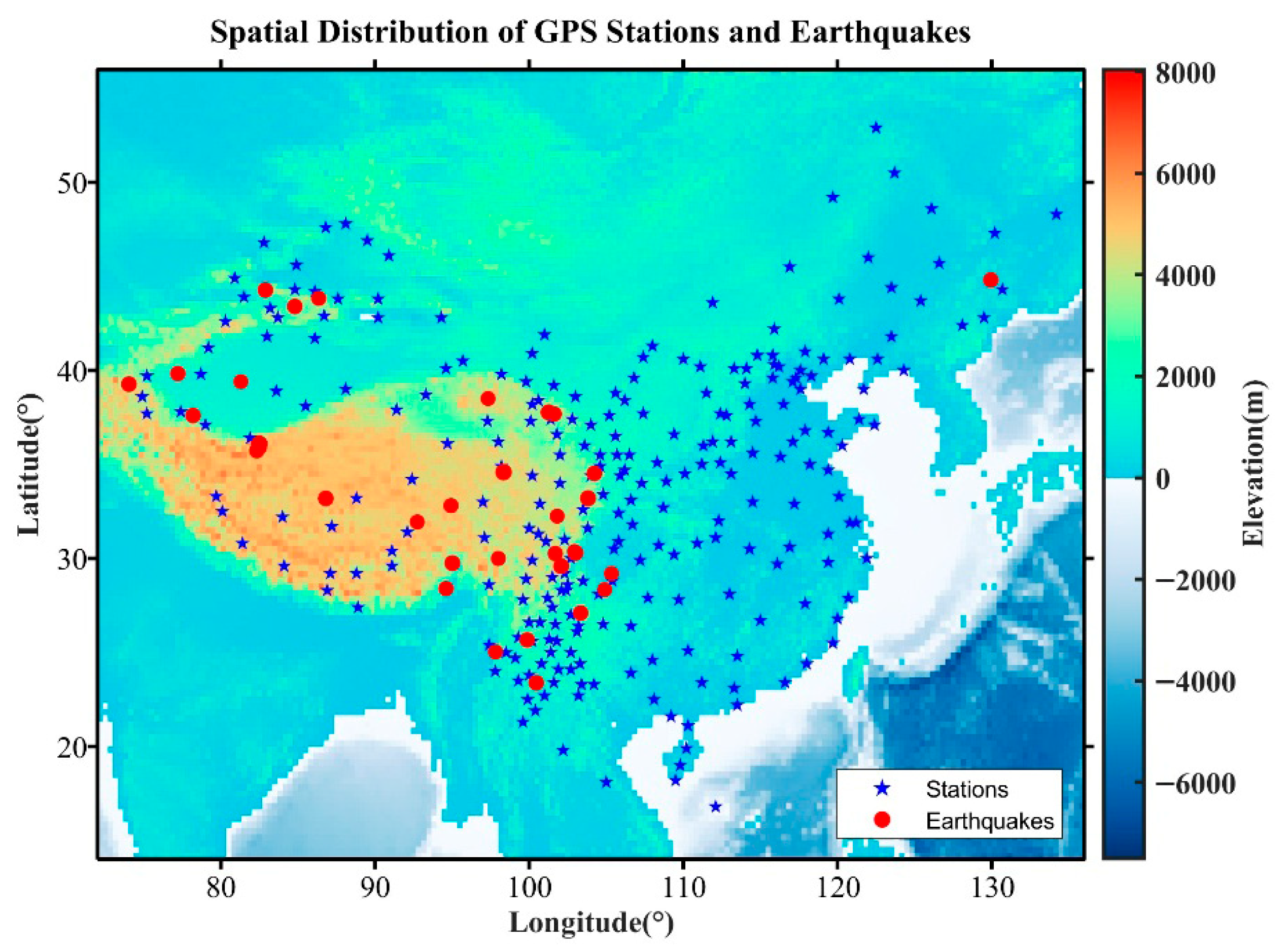
The CMONOC has established over 260 continuous GPS tracking stations across Mainland China, covering most areas of the region and accumulating abundant observational data. The Institute of Earthquake Forecasting, China Earthquake Administration (CEA) obtains GPS TEC data through inversion calculations based on the station data of this network [28]. The GPS TEC data provided by this institute were adopted, and Figure 1 presents the spatial distribution characteristics of GPS stations and earthquakes.

2.2. Solar Activity and Geomagnetic Activity Indices

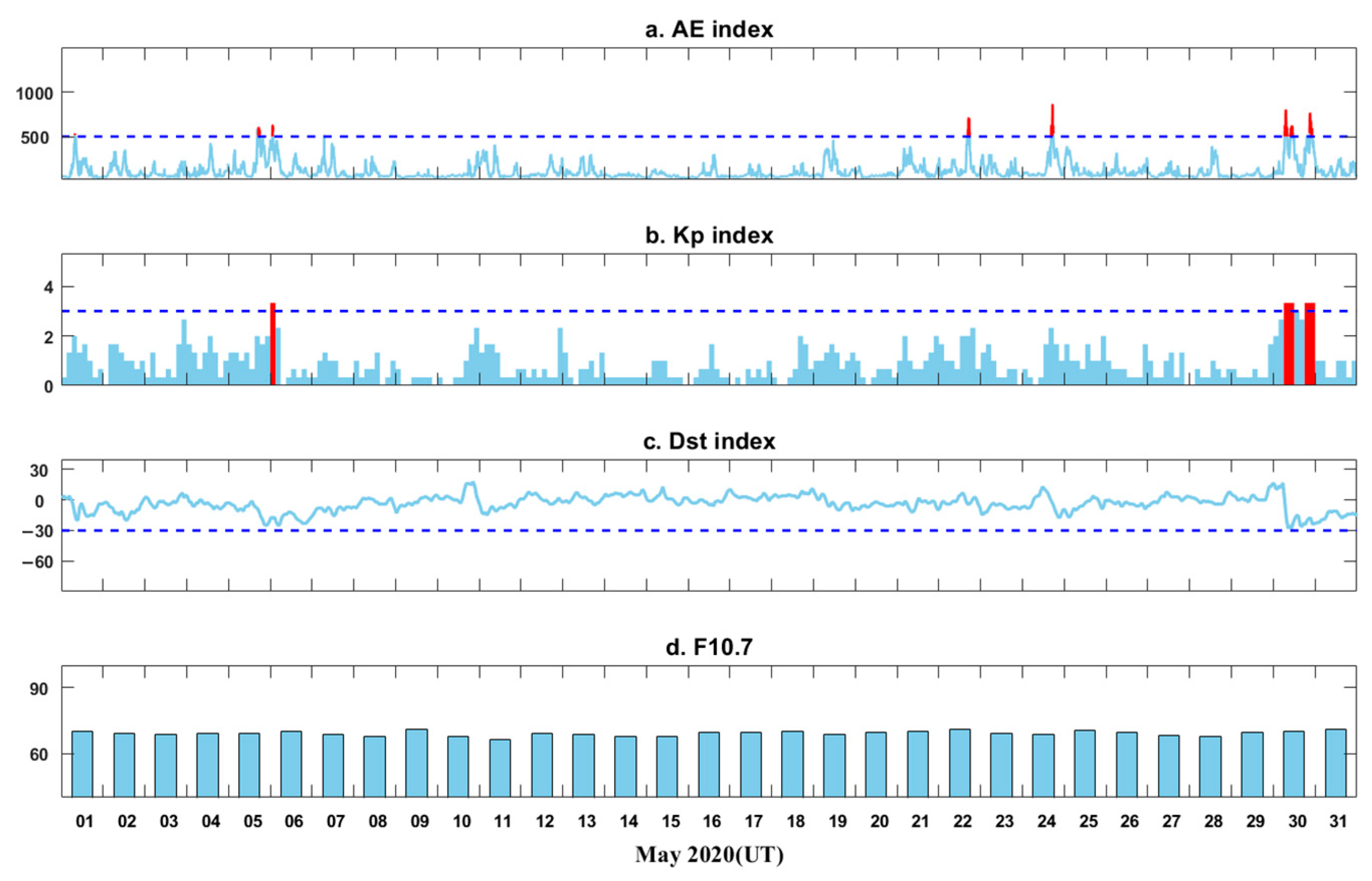
Solar activity and geomagnetic activity are the primary factors inducing ionospheric perturbations [53]. To ensure the reliability of the extracted anomaly signals, the solar activity index F10.7 and geomagnetic activity indices Dst, Kp, and AE were selected to screen out data affected by space environment interference. Among them, the F10.7 and Kp indices can be obtained from the German Research Centre for Geosciences (GFZ; https://www.gfz-potsdam.de/, accessed on 21 July 2024), while the Dst and AE indices are available from the World Data Center for Geomagnetism, Kyoto University (WDC-Kyoto; https://wdc.kugi.kyoto-u.ac.jp/wdc, accessed on 21 July 2024). Given that there is currently no mature technical methods to completely eliminate the impacts of the space environment, only data with relatively calm geomagnetic conditions (AE < 500 nT, Kp < 3, Dst > −30 nT) and no significant fluctuations in the solar activity level (F10.7 index) were chosen to maximize the exclusion of space environment interference—i.e., to directly remove data samples contaminated by such interference—thereby ensuring the purity of the extracted anomaly signals.
Figure 2 is an example showing the variation characteristics of solar activity and geomagnetic activity indices in May 2020. As shown in Figure 2, the F10.7 index had no obvious fluctuations in May 2020, indicating a relatively stable solar activity level during this period. Although the Dst index was within the set thresholds, the AE index exceeded the set thresholds on May 6, 7, 22, 24, and 30, while the Kp index exceeded the set thresholds on May 6 and 30. Since it is not possible to confirm whether there exists a correlation between the GPS TEC perturbations and geomagnetic disturbances on these geomagnetically disturbed days, the GPS TEC anomalies corresponding to these geomagnetically disturbed days are excluded from the statistical analysis of GPS TEC anomalies.

2.3. Anomaly Extraction Method

The moving quartile method was employed for GPS TEC anomaly detection. This method is based on statistical analysis and is commonly used for analyzing pre-earthquake GPS TEC perturbations [19]. It uses data from the previous 15 days as background data to identify anomalies in the 16th day’s data. First, the background data are divided into four equal parts; the first quartile (Q1) and third quartile (Q3) are used to calculate the interquartile range (IQR), and the second quartile serves as the background median (M). The upper bound (UB) for anomaly detection is defined as UB = M + 1.5IQR, and the lower bound (LB) as LB = M − 1.5IQR. The specific formulas are as follows:
T E C ( t ) = { T E C ( t )     U B ( t ) ,   U B ( t )   <   T E C ( t )   0 ,   L B ( t )   T E C ( t )     U B ( t ) T E C ( t )     L B ( t ) ,   L B ( t )   > T E C ( t )
where t denotes different time points on the 16th day, T E C ( t ) is the observed TEC value at time t on the 16th day, and T E C ( t ) is the TEC anomaly value at time t on the 16th day. L B ( t ) and U B ( t ) represent the lower and upper bounds for anomaly detection, which are calculated based on the background data at the corresponding time t from the previous 15 days. Under the assumption that the data follow a normal distribution with a mean of m and a standard deviation of STD, the mathematical expectations of the background median and interquartile range are M and 1.34 STD, respectively [54]. According to the definition of the lower and upper bounds for anomaly detection, the mathematical expectations of LB and UB correspond approximately to 2 STD, with a corresponding confidence level of 95% for anomaly detection.
Referring to the work of Liu and Wan [40], GPS TEC data with a 2 h temporal resolution was adopted. Using the same spatial interpolation method as Dong et al. [28], spatial grid data of GPS TEC at each moment was obtained. Then, the statistical analysis process of pre-earthquake GPS TEC anomalies was as follows: First, based on the seismogenic radius formula R = 10 0.43 m km for each earthquake (where m denotes the earthquake magnitude) [55], GPS TEC data located within the seismogenic zone of each earthquake were selected. Second, the moving quartile method was adopted to perform anomaly detection on the GPS TEC data of each moment. Finally, after excluding the anomaly data corresponding to geomagnetically disturbed days through the combination of solar activity indices and geomagnetic activity indices, the temporal and spatial distribution characteristics of GPS TEC anomalies were statistically analyzed (see Section 3 for details). All subsequent statistical analyses were performed based on the results after excluding the anomaly data corresponding to geomagnetically disturbed days.

3. Results and Analysis

3.1. Temporal Distribution Characteristics of Pre-Earthquake TEC Anomalies

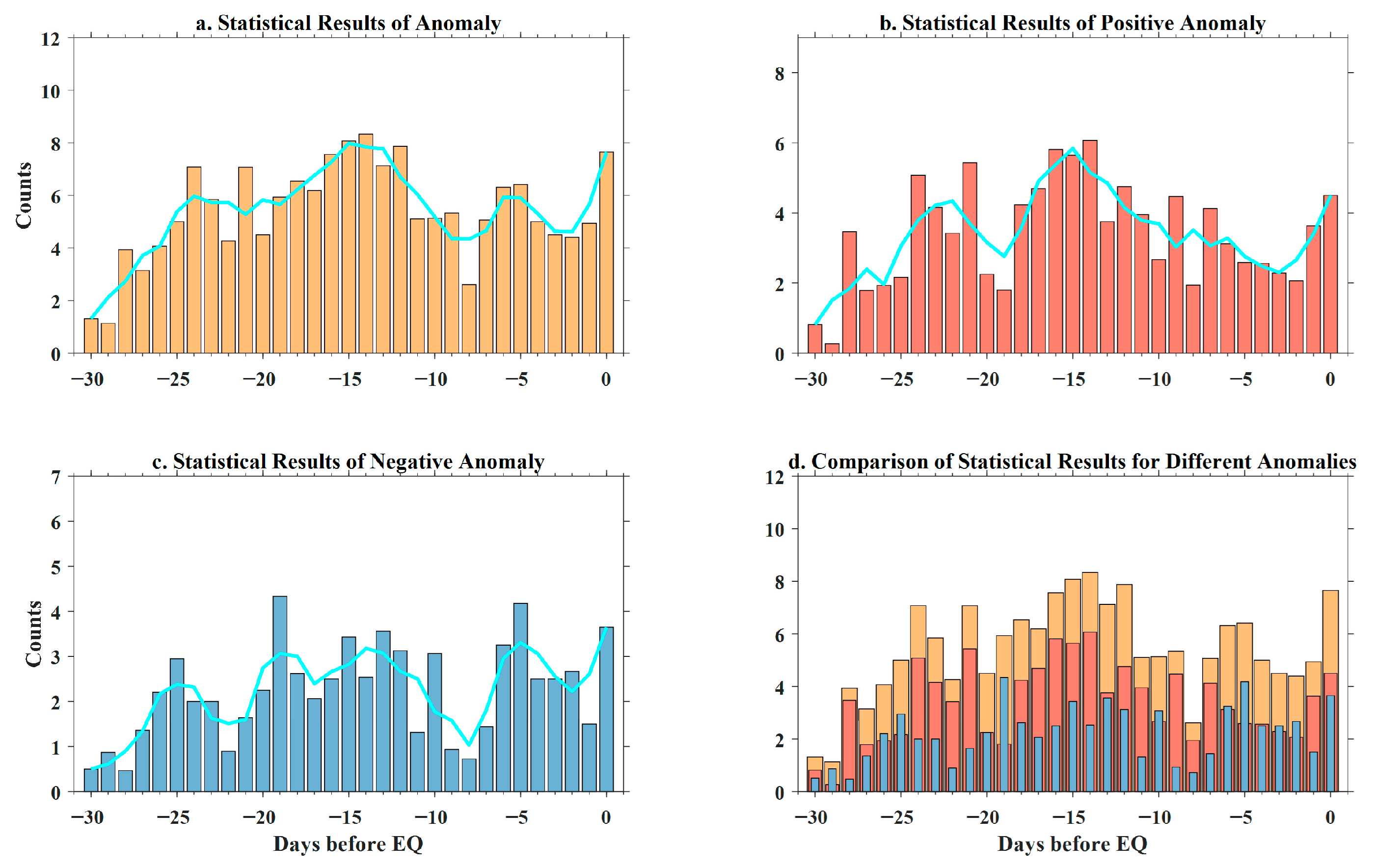
Based on GPS TEC observational data, the average anomaly frequency of GPS TEC for each earthquake was calculated from the 30th day prior to the earthquake to the earthquake day. The specific statistical process was as follows: The temporal resolution of GPS TEC anomaly detection is 2 h, meaning there are 12 moment per day; for a single earthquake, the anomaly frequency on a given day is defined as the number of time points with detected GPS TEC anomalies among the 12 time points of that day. If the day is a geomagnetically disturbed day, the anomaly frequency of the earthquake on that day is recorded as missing data (i.e., no valid data). During the statistical process, the anomaly frequencies of all earthquakes on the same pre-earthquake day were first accumulated; this total was then divided by the number of valid earthquakes (after excluding those corresponding to geomagnetically disturbed days on that day). Finally, the average total anomaly frequency (AAF), average positive anomaly frequency (PAAF), and average negative anomaly frequency (NAAF) of GPS TEC from the 30th day to day 0 before the earthquake are obtained, with the results shown in Figure 3.
Among them, AAF is the statistical result including positive and negative anomalies. Figure 3a, Figure 3b, and Figure 3c correspond to the statistical results of AAF, PAAF, and NAAF, respectively, and Figure 3d presents a comparative analysis of the three average anomaly frequencies. The results show that: AAF exhibits significantly high values around the 25th, 15th, and 5th days before the earthquake, as well as on the earthquake day; AAF reaches a peak value of 8 around the 15th day before the earthquake and rises rapidly to nearly 8 times on the earthquake day. The temporal distribution characteristics of PAAF are highly consistent with those of AAF, also peaking at around the 15th day before the earthquake (a peak value of 6); NAAF is lower than PAAF in all time periods, and its temporal evolution characteristics are similar to those of AAF and PAAF, but an additional peak (a peak value of 4) appears around the 20th day before the earthquake. Combined with the comparative results in Figure 3d, it can be further concluded that the PAAF of GPS TEC before the earthquake is consistently higher than NAAF, and the core time nodes of the three types of anomalies together constitute the main temporal evolution law of TEC anomalies before the earthquake.
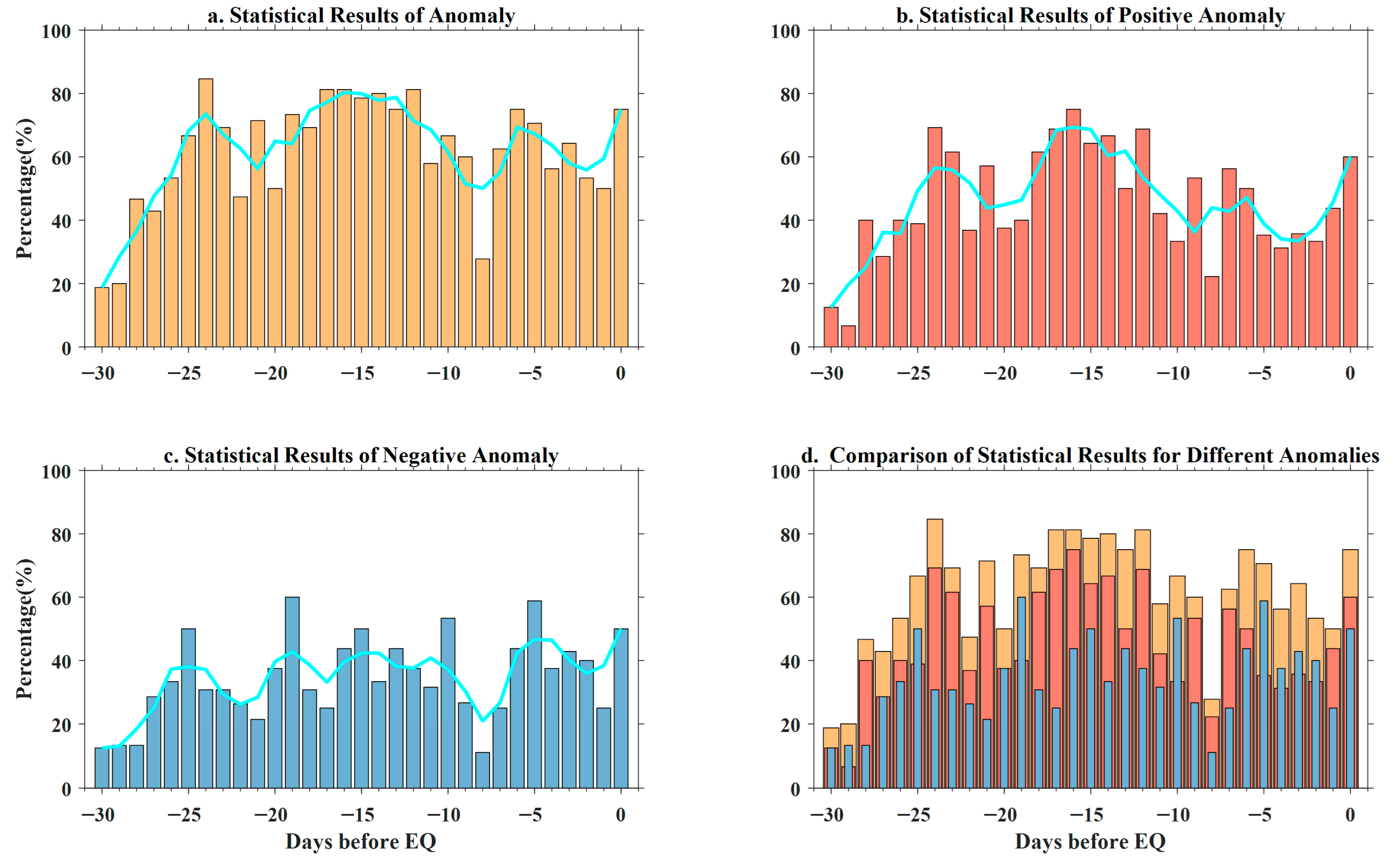
In addition, to quantify the correlation between GPS TEC anomalies before earthquakes and earthquakes, the percentage of earthquakes with detected GPS TEC anomalies was calculated for each day from the 30th day before the earthquake to the earthquake day. The calculation method is as follows: after excluding geomagnetically disturbed days, the percentage is calculated as the ratio of the number of earthquakes with detected GPS TEC anomalies on that day to the number of all available earthquakes (after excluding those corresponding to geomagnetically disturbed days on that day). The statistical results are shown in Figure 4.
Figure 4a, Figure 4b, and Figure 4c correspond to the statistical results of the GPS TEC total anomaly earthquake percentage (AEP), positive anomaly earthquake percentage (PAEP), and negative anomaly earthquake percentage (NAEP) from the 30th day before the earthquake to the earthquake day, respectively, and Figure 4d presents a comparison of the three statistical results. The results show that: the PAEP is consistently higher than the NAEP every day before the earthquake; the periods of high percentage for AEP and PAEP are highly coincident, concentrating around the 25th, 15th, and 5th days before the earthquake as well as on the earthquake day; the maximum AEP is over 80%, and the maximum PAEP is close to 80%; in addition to having similar temporal distribution characteristics to PAEP, NAEP also shows a unique pattern, with a significant peak in percentage appearing around the 20th day before the earthquake.
Figure 3 and Figure 4 show the perturbation characteristics of GPS TEC anomalies from the 30th day before the earthquake to the earthquake day. The results show that the PAAF and PAEP of GPS TEC pre-earthquake are higher than the NAAF and NAEP, respectively, with positive anomalies dominating pre-earthquake TEC disturbances. The high-value periods of AAF and PAAF are highly concentrated, all exhibiting significantly high values around the 25th, 15th, and 5th days pre-earthquake as well as on the earthquake day. Among them, AAF reaches a peak value of 8, and the AEP exceeds 80%; PAAF reaches a peak value of 6, and the PAEP is close to 80%. In addition to the similar temporal characteristics to positive anomalies, negative anomalies show a unique temporal distribution, with a significant peak appearing around the 20th day pre-earthquake (NAAF has a peak value of 4, and NAEP is close to 60%). The two statistical indicators are highly consistent, both showing temporal features of high values at multiple time points and a polarity characteristic that positive anomalies are more significant than negative anomalies.

3.2. Pre-Earthquake TEC Anomalies Characteristics with Different Magnitude Classification

To explore the pre-earthquake GPS TEC anomaly characteristics of earthquakes with different magnitudes, earthquakes of magnitude 6.0–6.8 were grouped at 0.2 magnitude intervals. Given the limited number of earthquakes above magnitude 6.8, events of magnitude 6.8–7.6 were combined into one group. All earthquakes were classified into five categories in total, and the specific classification scheme is shown in Table 2.
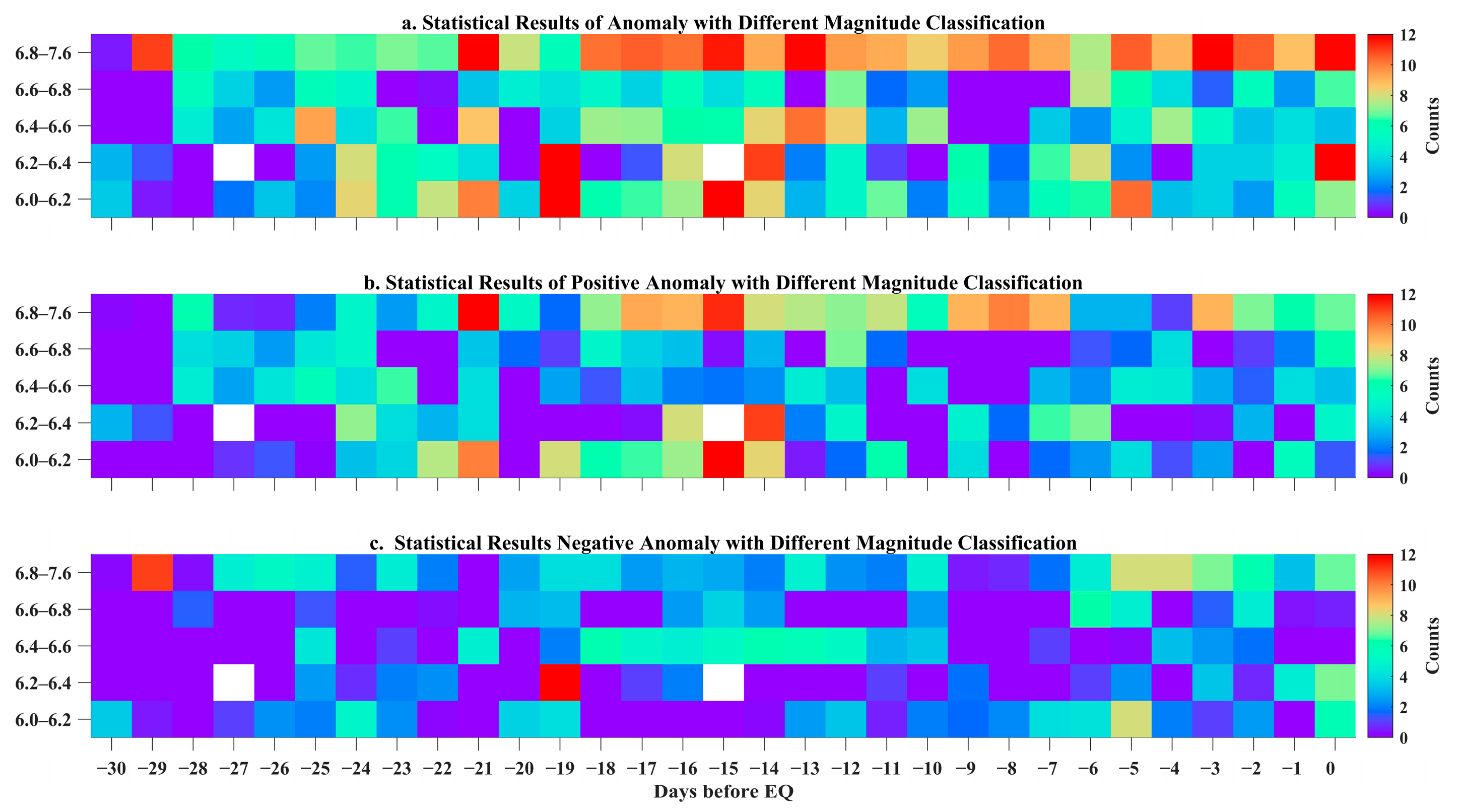
Adopting the statistical method used for Figure 3, statistical analyses of the GPS TEC anomaly frequency with different magnitude classifications were performed, and the results are shown in Figure 5. The blank cells in Figure 5 represent no available data. Figure 5a, Figure 5b, and Figure 5c correspond to the statistical results of the AAF, PAAF, and NAAF of pre-earthquake TEC for earthquakes with different magnitude classifications, respectively. It can be seen in Figure 5 that the statistical results of AAF, PAAF, and NAAF for earthquakes with different magnitude classifications are highly consistent with the overall law revealed in Figure 3. From the temporal perspective, the AAF, PAAF, and NAAF of earthquakes with different magnitude classifications all exhibit significantly high values around the 25th, 15th, and 5th days pre-earthquake, and the NAAF also shows an obvious disturbance peak around the 20th day pre-earthquake. The PAAF of all magnitude classifications is consistently higher than the NAAF. Compared with earthquakes of magnitude 6.0–6.8, the pre-earthquake TEC anomaly disturbances of earthquakes of magnitude 6.8–7.6 are more significant, with their PAAF being much higher than their NAAF. Among them, the AAF and PAAF maintain a continuous peak around the 15th day before the earthquake, and the anomaly frequency also rises rapidly on the earthquake day.
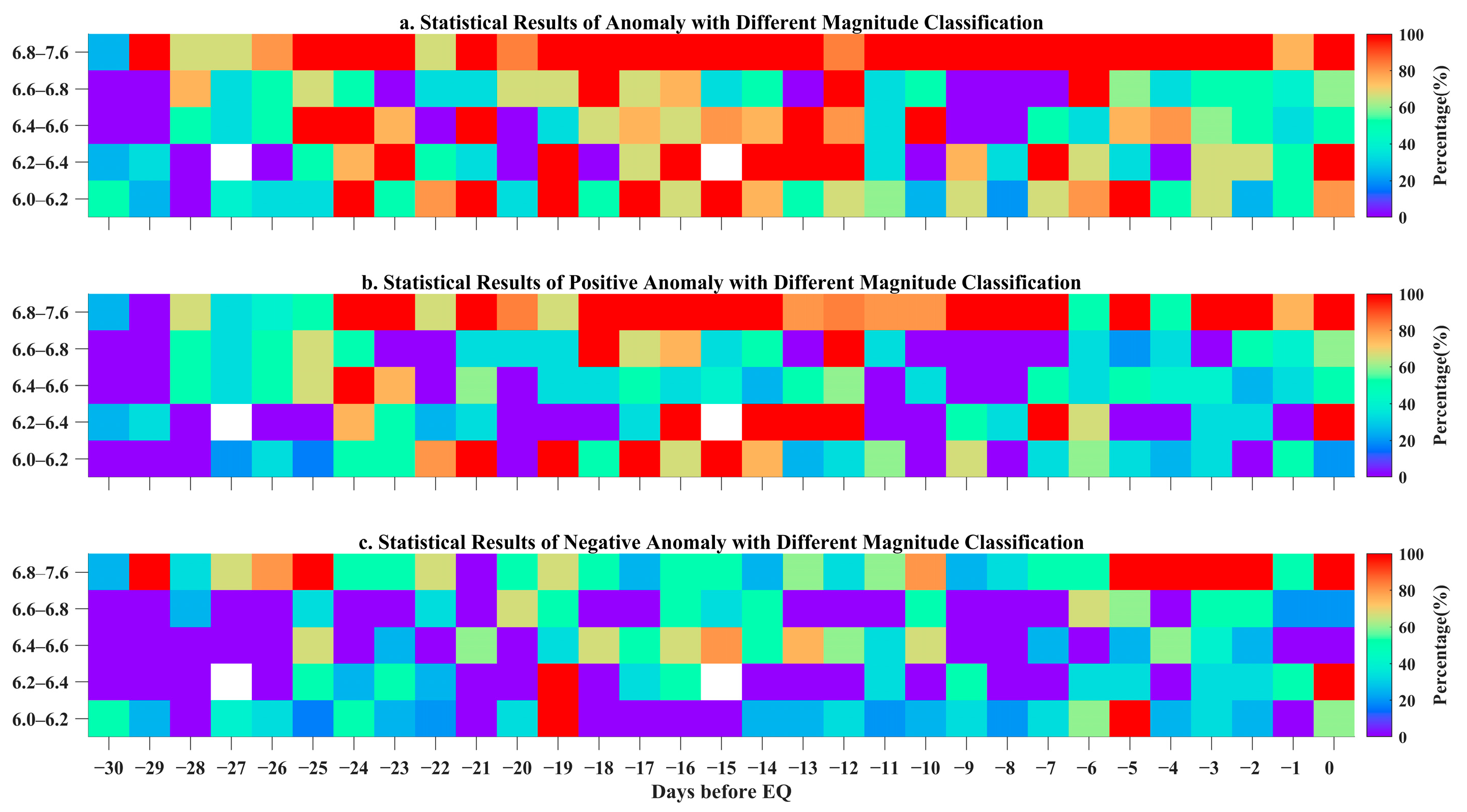
Adopting the statistical method used for Figure 4, statistics of the GPS TEC anomaly earthquake percentage for earthquakes with different magnitude classifications were calculated from the 30th day pre-earthquake to the earthquake day, including AEP, PAEP, and NAEP. For each magnitude classification, the calculation method is as follows: after excluding earthquakes on geomagnetically disturbed days, the percentage is calculated as the ratio of the number of earthquakes with detected GPS TEC anomalies in this magnitude classification to the total number of available earthquakes in the classification. The statistical results are shown in Figure 6.
The blank cells in Figure 6 indicate no valid data. Figure 6a, Figure 6b, and Figure 6c correspond to the statistical results of AEP, PAEP, and NAEP for different magnitude classifications, respectively. It can be seen in Figure 6 that the PAEP of each magnitude classification is higher than NAEP. For earthquakes of magnitude 6.0–6.8, their AEP, PAEP, and NAEP all show obvious peaks around the 25th, 15th, and 5th days before the earthquake and on the earthquake day, which is consistent with the results in Figure 5. Compared with earthquakes of magnitude 6.0–6.8, earthquakes of magnitude 6.8–7.6 are particularly prominent, with their AEP and PAEP maintaining a high level from 30 days before the earthquake to the earthquake day. This indicates that GPS TEC anomalies are more likely to be detected before earthquakes of magnitude 6.8–7.6. Combined with the results in Figure 5, this suggests that pre-earthquake GPS TEC anomalies may be correlated with earthquake magnitude.
Statistical results presented in Figure 5 and Figure 6 show that the PAAF and PAEP of earthquakes with different magnitudes are respectively higher than those of the NAAF and NAEP. This indicates the polarity characteristic that pre-earthquake TEC positive anomalies are higher than negative anomalies for earthquakes with different magnitudes, which is consistent with the previous results. The high-value periods of the two sets of statistical metrics (i.e., AAF/PAAF/NAAF and AEP/PAEP/NAEP) corresponding to the three statistical results are concentrated around the 25th, 15th, and 5th days before the earthquake and on the earthquake day. Among them, the NAAF and NAEP show a unique peak around the 20th day before the earthquake. Meanwhile, magnitude differences lead to significant differentiation in anomalous characteristics. Compared with earthquakes of magnitude 6.0–6.8, strong earthquakes of magnitude 6.8–7.6 show intense anomalous responses. Their AAF and PAAF maintain a continuous peak around the 15th day before the earthquake, and their AEP and PAEP remain at high levels from 30 days before the earthquake to the earthquake day. The above results summarize the temporal characteristics of pre-earthquake TEC anomalies and their correlation with earthquake magnitude, providing a reference for further interpreting the physical mechanism of seismo-ionospheric disturbances.

3.3. Pre-Earthquake TEC Anomalies Characteristics in Different Azimuths of Epicenters

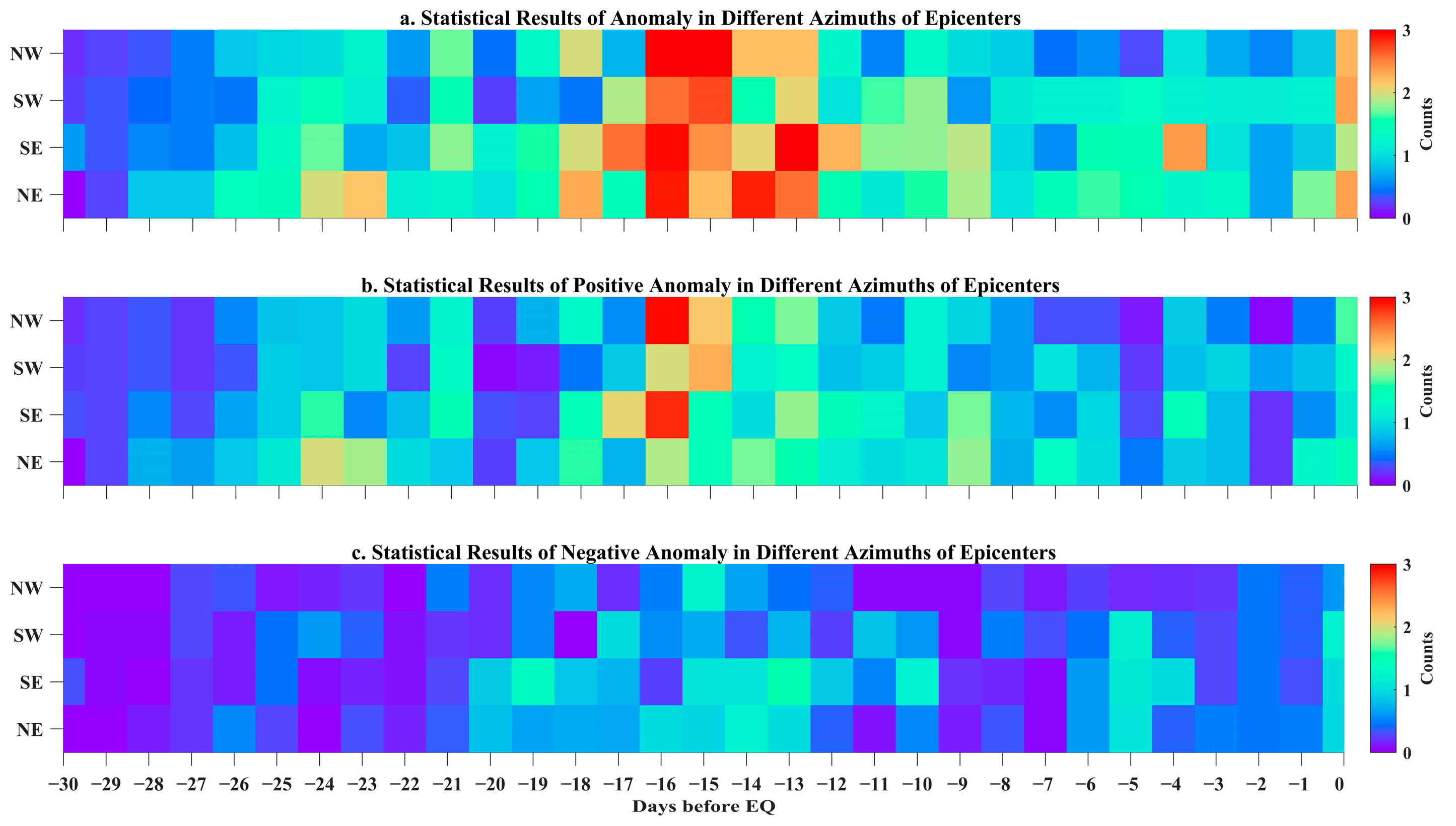
To explore the spatial distribution characteristics of GPS TEC disturbances, the epicenter was taken as the center and the seismogenic radius R as the radius of the circle, dividing the inside of the circle into 4 sectors. The four sectors are located in the northeast region (0–90°), southeast region (90–180°), southwest region (180–270°), and northwest region (270–360°) of the epicenter. For the GPS TEC anomalies in different azimuths of epicenters from the 30th day pre-earthquake to the earthquake day, a statistical analysis was performed using the average anomaly frequency statistical method for Figure 3, and the results are shown in Figure 7. Figure 7a, Figure 7b, and Figure 7c correspond to the statistical results of AAF, PAAF, and NAAF in different azimuths of epicenters, respectively. It can be seen in Figure 7 that the PAAF in different azimuths of epicenters is higher than NAAF, and the three statistical results all have the characteristics of increased anomaly frequency around the 25th, 15th, and 5th days before the earthquake and on the earthquake day. The NAAF additionally shows an increase in frequency around the 20th day before the earthquake. The AAF, PAAF, and NAAF in different azimuths of epicenters all have continuous peaks around the 15th day before the earthquake. Among the three statistical results in different azimuths of epicenters, the anomaly frequency in the southeast direction is relatively significant, while that in the northwest direction is relatively low.
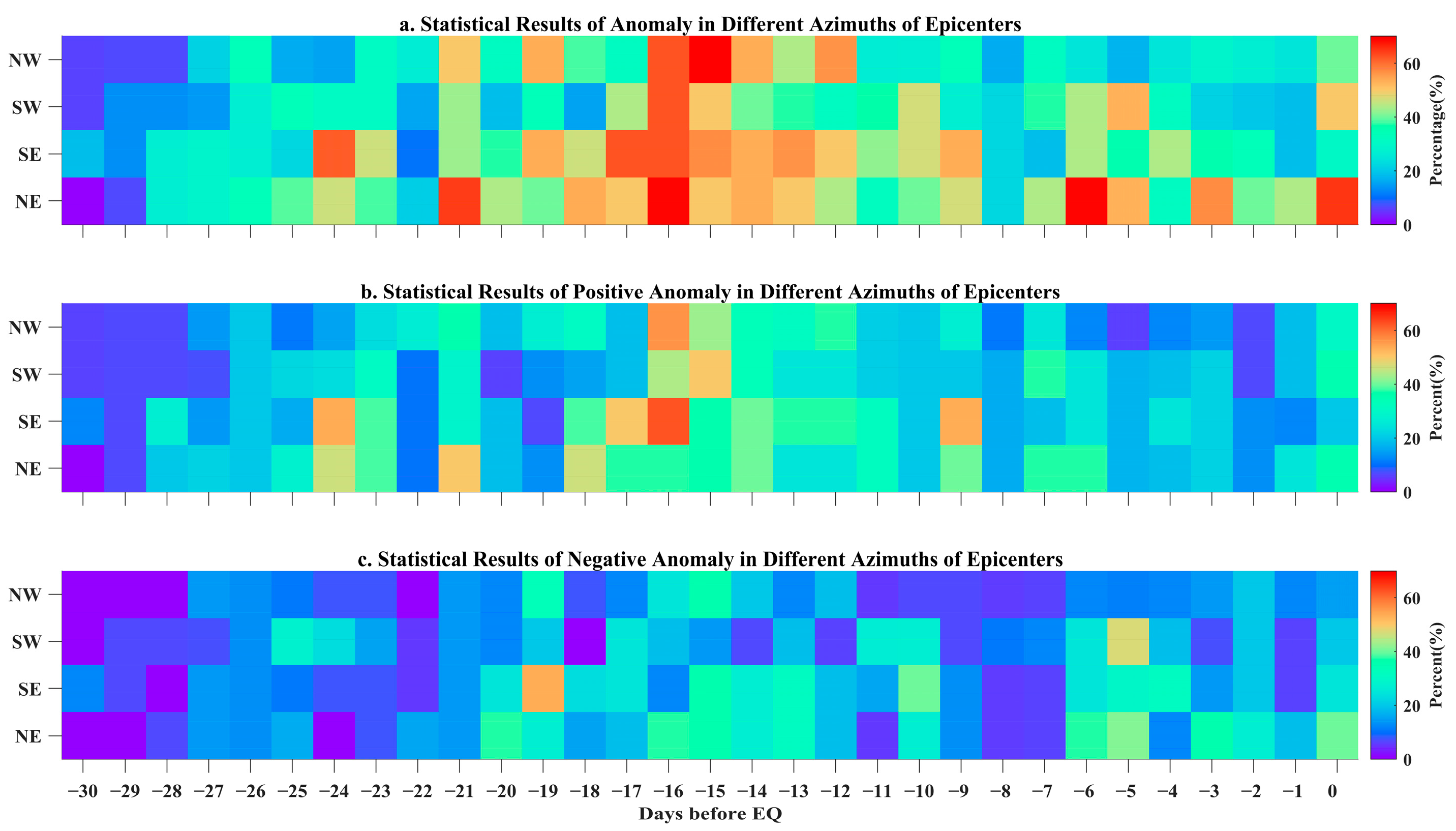
Using the same statistical method as that for Figure 4, the anomaly earthquake percentages in different azimuths of earthquakes were counted from the 30th day before the earthquake to the earthquake day, and the results are shown in Figure 8. Figure 8a, Figure 8b, and Figure 8c correspond to the statistical results of AEP, PAEP, and NAEP in different azimuths of epicenters, respectively. It can be seen in Figure 8 that the three statistical results all have the characteristics of increased anomaly earthquake percentage around the 25th, 15th, and 5th days before the earthquake and on the earthquake day. The NAEP additionally rises around the 20th day before the earthquake. Overall, the PAEP is higher than the NAEP. In addition, all three sets of statistical results show that the percentage of earthquakes with detected GPS TEC anomalies is relatively high around the 15th day before the earthquake, which again indicates that GPS TEC anomalies are more likely to be detected on the 15th day before the earthquake. Among the statistical results of NAEP, the percentage of earthquakes with detected anomalies in the northeast direction is relatively high overall. Among the statistical results of AEP and PAEP, the percentage of earthquakes with detected anomalies in the southeast direction is relatively high around the 15th day before the earthquake, and the percentage of earthquakes with detected anomalies in the northeast direction is relatively high around the 5th day before the earthquake and the earthquake day.
Statistical results presented in Figure 7 and Figure 8 show that the temporal characteristics of TEC anomalies in different azimuths of epicenters are basically consistent with the overall temporal regularity. The PAAF and PAEP are respectively higher than the NAAF and NAEP, which also present the polarity characteristics that positive anomalies are more significantthan negative anomalies. The AAF, PAAF, NAAF, AEP, PAEP, and NAEP all show a significant increase around the 25th, 15th, and 5th days before the earthquake and on the earthquake day. The NAAF and NAEP additionally have peaks around the 20th day before the earthquake. The period around the 15th day before the earthquake is a critical period for TEC anomaly responses in different azimuths of epicenters; during this period, the AAF, PAAF, NAAF, AEP, PAEP, and NAEP all maintain high levels, indicating that this time period is an important period for detecting pre-earthquake TEC anomalies. From the perspective of spatial distribution characteristics, pre-earthquake TEC anomalies show significant spatial inhomogeneity. Figure 7 shows that the AAF in the southeast direction is relatively significant overall, while that in the northeast direction is relatively low; Figure 8 reveals the temporal differences in spatial distribution: the NAEP is generally higher in the northeast direction, while the AEP and PAEP are more prominent in the southeast direction around the 15th day before the earthquake, and higher in the northeast direction around the 5th day before the earthquake and on the earthquake day. The above results indicate the evolutionary characteristics of pre-earthquake GPS TEC anomalies with consistent temporal regularity and uneven spatial distribution, providing important support for in-depth analysis of the spatiotemporal response mechanism of seismo-ionospheric disturbances.

3.4. Pre-Earthquake TEC Anomalies Characteristics of Earthquakes with Different Focal Depth Classifications

To explore the disturbance characteristics of pre-earthquake GPS TEC for earthquakes with different focal depths, the earthquakes were classified according to their focal depths. Given the small number of earthquakes deeper than 20 km, events with focal depths of 0–20 km were divided into two groups for analysis: 0–10 km and 10–20 km. The specific classification results are shown in Table 3.
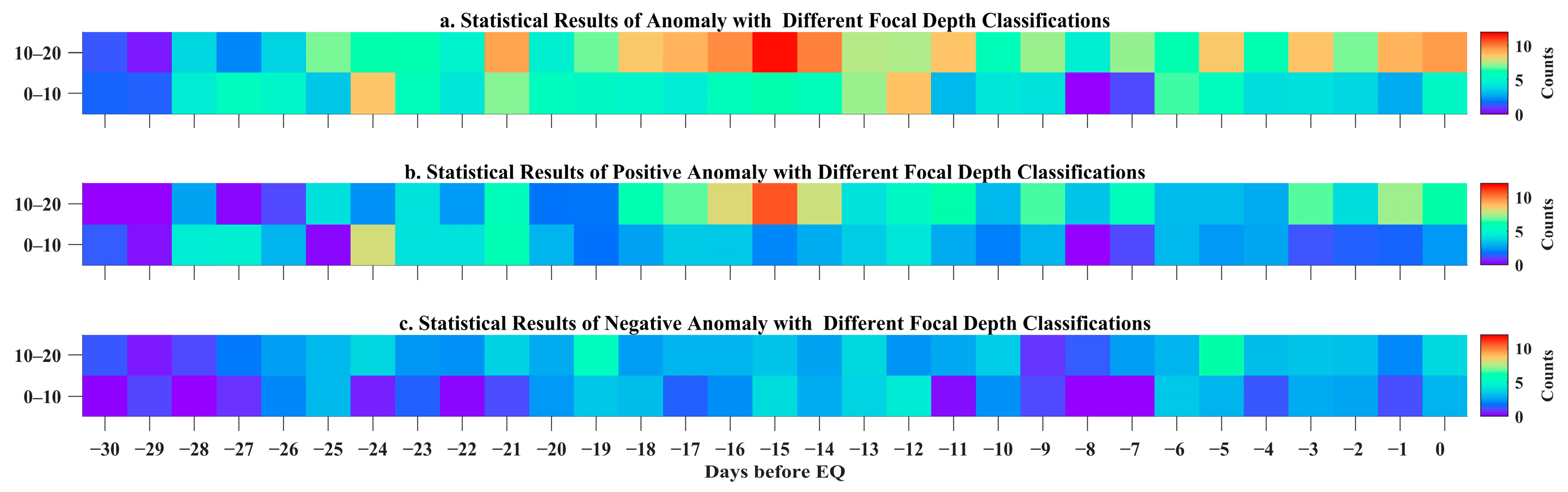
According to the method in Figure 3, the average anomaly frequency from the 30th day before the earthquake to the earthquake day was counted for different focal depths, and the results are shown in Figure 9. The blank cells in Figure 9 indicate no available data. Figure 9a, Figure 9b, and Figure 9c correspond to the statistical results of AAF, PAAF, and NAAF before earthquakes with different focal depth classifications, respectively. As shown in Figure 9, all three sets of statistical results indicate that earthquakes of different focal depths exhibit characteristics of increased average anomaly frequency around the 25th, 15th, and 5th days before the earthquake and on the earthquake day. The NAAF shows an increase in frequency around the 20th day before the earthquake. Earthquakes with a focal depth of 10–20 km exhibit higher anomaly frequencies than those with a focal depth of 0–10 km. In addition, it is noted that the average magnitude of earthquakes with a focal depth of 10–20 km is approximately 0.2 magnitudes higher than that of earthquakes with a focal depth of 0–10 km. Combined with the results in Figure 5, this suggests that pre-earthquake TEC anomalies may be related to both focal depth and earthquake magnitude. Overall, the disturbance frequency of GPS TEC positive anomalies is still higher than that of negative anomalies for earthquakes in different focal depth groups.
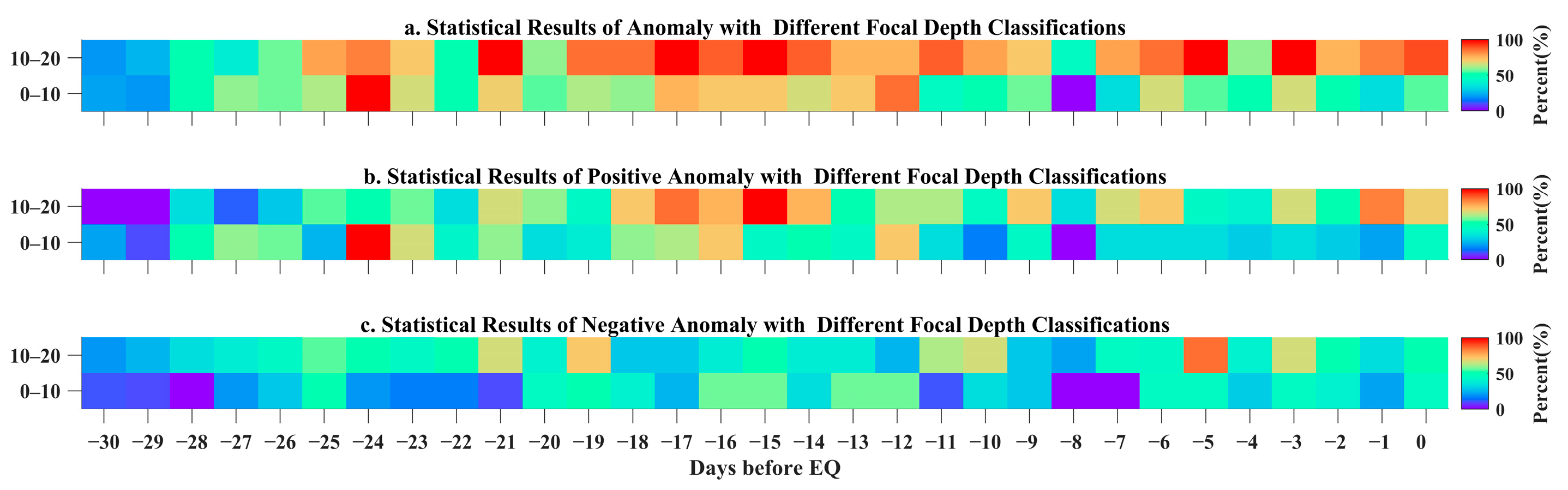
The method used for Figure 4 was adopted to determine the GPS TEC anomaly earthquake percentage from the 30th day before the earthquake to the earthquake day for different focal depths, and the results are shown in Figure 10. Figure 10a, Figure 10b, and Figure 10c correspond to the statistical results of AEP, PAEP, and NAEP before earthquakes with different focal depth classifications, respectively. As shown in Figure 10, all three sets of statistical results for earthquakes of different focal depths exhibit the characteristic of an increasing percentage of anomalous earthquakes around the 25th, 15th, and 5th days before the earthquake and on the earthquake day. The statistical results of negative anomalies show that the NAEP rises around the 20th day before the earthquake. The PAEP of earthquakes in different focal depth groups is consistently higher than the NAEP before the earthquake. The PAEP detected for earthquakes with a focal depth of 10–20 km is higher than that for earthquakes with a focal depth of 0–10 km. The statistical results of NAEP indicate that the percentage of earthquakes with a focal depth of 0–10 km is higher than that of earthquakes with a focal depth of 10–20 km around the 15th day before the earthquake. This may be attributed to the difference in magnitude.
As shown in the statistical results of Figure 9 and Figure 10, there may be a certain correlation between focal depth and pre-earthquake GPS TEC anomalies. On the whole, the pre-earthquake AAF, PAAF, NAAF, AEP, PAEP, and NAEP of earthquakes with a focal depth of 10–20 km are all higher than those of earthquakes with a focal depth of 0–10 km. However, the NAEP statistical results show that the percentage of earthquakes with a focal depth of 0–10 km is higher than that of earthquakes with a focal depth of 10–20 km around the 15th day before the earthquake. All three sets of statistical results for earthquakes of different focal depths show that AAF and AEP increase around the 25th, 15th, and 5th days before the earthquake and on the earthquake day, while NAAF additionally shows a peak around the 20th day before the earthquake. Meanwhile, earthquakes in all focal depth groups exhibit higher PAAF and PAEP than NAAF and NAEP, which is similar to the results in Figure 5 and Figure 6. In addition, compared with the AAF difference between earthquakes with a focal depth of 10–20 km and 0–10 km, the difference in AEP is narrowed, which may be attributed to the magnitude difference. Since the average magnitude of earthquakes with a focal depth of 10–20 km is approximately 0.2 magnitudes higher than that of earthquakes with a focal depth of 0–10 km, their anomalous responses are more significant. The above statistical results indicate that there is a certain correlation between focal depth and pre-earthquake GPS TEC anomalies, and they provide a reference for subsequent studies on pre-earthquake ionospheric disturbances.

4. Discussion

Statistical analysis was performed on the pre-earthquake ionospheric GPS TEC anomalies of earthquakes with magnitudes ≥ 6.0 in mainland China from 2012 to 2022. Adopting the two statistical metrics of average anomaly frequency and anomaly earthquake percentage, the TEC anomaly data were analyzed from the perspectives of anomaly polarity, magnitude, focal depth, and different azimuth angles of the epicenter. Through analysis, the anomalous characteristics of the pre-earthquake ionospheric TEC were obtained, and the obtained results are discussed and analyzed below.
It should be noted that, given the current lack of a mature method that can completely separate the ionospheric disturbance signals caused by space weather events, the GPS TEC disturbance data on magnetically disturbed days were excluded. Using geomagnetic indices to filter data on magnetically disturbed days may not completely eliminate the effects of all magnetic disturbances. As demonstrated in the study by Nayak et al., the ionospheric response to magnetic storms exhibits a time lag [56]. Le et al. adopted the empirical model NeQuick and the theoretical model TIME-IGGCAS to simulate TEC changes during solar activity so as to determine the correlation between TEC disturbances and seismic activity [34]. This is a beneficial attempt. However, it cannot be guaranteed that the impact of space weather events can be completely eliminated through this method. Therefore, the anomaly data on magnetically disturbed days were excluded, even though this filtering process may also remove anomalous signals caused by the superposition of earthquakes and space weather, which is also a commonly adopted method in current relevant research [57,58,59]. There exists an unbalanced distribution issue in the sample data of the magnitude classification and focal depth classification. For this reason, mean normalization was adopted in the anomaly frequency statistics stage to mitigate the interference of sample size discrepancies on the statistical outcomes and improve the universality of the conclusions. Nevertheless, the difference in sample size may still exert a certain influence on the stability of the statistical trends, which constitutes one of research limitations. It is believed that with the continuous increase in the number of earthquake samples in the future, the relevant statistical results will become more stable and reliable.
The overall statistical results (Figure 3 and Figure 4) show that the TEC average anomaly frequency and anomaly earthquake percentage increase significantly around the 25th, 15th, and 5th days pre-earthquake, as well as on the earthquake day. In addition to the above characteristics, negative anomalies also show relatively high values around the 20th day pre-earthquake. Based on the observation data of the CSES satellite, Nie et al. analyzed earthquakes with magnitudes ≥ 6.0 in China and its surrounding areas from 2019 to 2021 and obtained similar temporal characteristics [60]. The additional direct current electric field mechanism is adopted to explain the above statistical results: during the earthquake preparation stage, stress accumulation will promote the continuous release of radioactive gases such as radon from the crust; these gases can induce air ionization, leading to changes in atmospheric conductivity, and then induce the generation of additional direct current electric fields [43]. The accumulation or migration of these gases in the release area causes temporal changes in atmospheric conductivity in that area [61]. Therefore, combined with the earthquake preparation process, this suggests that the temporal characteristics of TEC anomalies may be related to the phased response of crustal activities during the pre-earthquake and co-seismic stages.
In addition, the results show that pre-earthquake TEC anomalies are dominated by positive responses rather than negative ones. Existing studies have indicated that the polarity characteristics of pre-earthquake TEC anomalies vary by region [62]. Similarly, based on the analysis of the additional direct current electric field mechanism and the simulation results of Kuo et al., the increase (positive anomaly) or decrease (negative anomaly) in TEC is related to the direction of the additional direct current electric field and the geomagnetic latitude of its location [63]. This means that the additional direct current electric field induced during the pre-earthquake to co-seismic stages of earthquakes in mainland China is more likely to trigger positive TEC anomalies. Yan et al. statistically analyzed the pre-earthquake TEC anomalies of magnitude 6.0 and above earthquakes in mainland China from 2000 to 2010, and their results also showed that positive anomalies were more prevalent than negative ones [64]. The statistical results regarding the pre-earthquake TEC anomaly characteristics of earthquakes with different magnitude classifications (Figure 5 and Figure 6), those in different azimuths of epicenters (Figure 7 and Figure 8), and those with different focal depths (Figure 9 and Figure 10) all exhibit consistent temporal characteristics and anomaly polarities. The above results suggest that this temporal evolution law is universal, which will facilitate the identification of pre-earthquake ionospheric anomaly signals in the future.
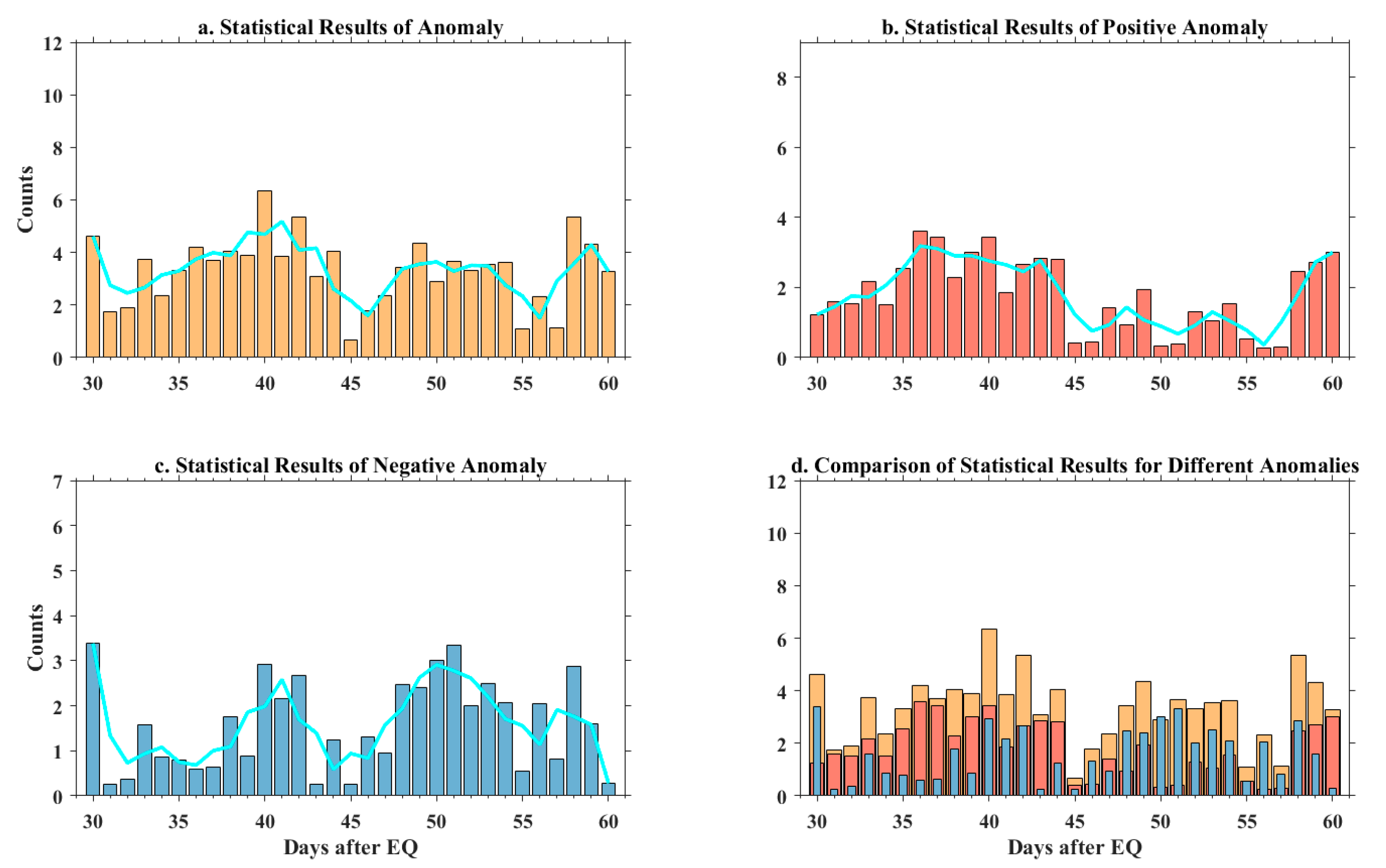
To verify the results, TEC anomalies from 30 to 60 days after the earthquakes were calculated following the method shown in Figure 5, as illustrated in Figure 11. Compared with Figure 5, the AAF, PAAF, and NAAF of TEC before the earthquakes are all higher than those in the post-earthquake period, and the temporal characteristics of post-earthquake TEC anomalies are significantly different from those of pre-earthquake anomalies. In terms of anomaly polarity, the PAAF of pre-earthquake TEC is consistently higher than the NAAF, whereas post-earthquake TEC shows inconsistent behavior, with PAAF being higher than NAAF in some periods and NAAF being higher than PAAF in others. The differences between pre-earthquake and post-earthquake TEC anomalies indicate a potential correlation between seismic activity and TEC anomalies.
Statistical results of pre-earthquake TEC anomalies across different magnitude classifications show that the two statistical indicators (average TEC anomaly frequency and percentage of anomalous earthquakes) of pre-earthquake TEC anomalies for strong earthquakes of magnitude 6.8–7.6 are higher than those for earthquakes of magnitude 6.0–6.8. Statistical results by Le et al. also indicated that the intensity of TEC anomaly responses for earthquakes above 7.0 magnitude is higher than that for 6.0–7.0 magnitude earthquakes [23]. Earthquakes of magnitude 6.8–7.6 feature more intense crustal activity and greater energy release, which can induce sufficiently strong ionospheric disturbances through seismo-ionospheric coupling. In contrast, earthquakes of magnitude 6.0–6.8 have relatively weak crustal activity and low energy release, making it more difficult to trigger strong ionospheric disturbances.
Statistical results of pre-earthquake TEC anomaly frequencies in different azimuths of epicenters show that around the 25th day pre-earthquake, the anomaly frequency in the northeast direction is the most significant; overall, the anomaly frequency in the southeast direction is the highest, while that in the northwest direction is relatively low. The statistical results of the anomaly earthquake percentage show that around the 15th day pre-earthquake, the anomaly earthquake percentage in the southeast direction is relatively high; however, around the 5th day pre-earthquake and on the earthquake day, the anomaly earthquake percentage in the northeast direction is more significant, and that in the southwest direction is the lowest. Existing studies have shown that ionospheric anomalies are not necessarily located above the epicenter [1]. Different earthquakes have different seismotectonic environments. From the perspective of the additional direct current electric field mechanism, the radioactive gases released during the pre-earthquake preparation stage may be distributed anywhere in the earthquake preparation area, which in turn leads to differences in the azimuthal distribution of ionospheric disturbances among different earthquakes. Furthermore, Pulinets et al. used the pre-earthquake TEC anomaly characteristics of the 2008 Wenchuan Earthquake in China as a case study to explain the correlation between the azimuthal distribution of TEC anomalies and the direction of the additional direct current electric field [65].
Compared with earthquakes with a focal depth of 10–20 km, earthquakes with a focal depth of 0–10 km are closer to the surface, and the rock fracturing efficiency during the seismogenic process is higher, which is more conducive to the formation of the seismo-ionospheric coupling process. Statistical results of the average pre-earthquake TEC anomaly frequency for earthquakes of different focal depths show that, overall, the pre-earthquake AAF, PAAF, NAAF, AEP, PAEP, and NAEP of earthquakes with a focal depth of 10–20 km are higher than those of earthquakes with a focal depth of 0–10 km. The NAEP statistical results show that the percentage of earthquakes with a focal depth of 0–10 km is higher than that of earthquakes with a focal depth of 10–20 km around the 15th day before the earthquake. Compared with the AAF difference between earthquakes with a focal depth of 10–20 km and 0–10 km, the difference in AEP is narrowed. It is noted that the average magnitude of earthquakes with a focal depth of 10–20 km is approximately 0.2 magnitudes higher than that of earthquakes with a focal depth of 0–10 km. Magnitude difference may be one of the reasons for this phenomenon. In addition, the seismogenic environment of earthquakes may also be a contributing factor.
Based on GPS TEC observation data, a statistical analysis was performed on the pre-earthquake TEC anomaly characteristics of earthquakes with magnitudes ≥ 6.0 in mainland China from 2012 to 2022, and the results were interpreted by employing the additional direct current electric field mechanism in the seismo-ionospheric coupling model. However, the specific coupling pathway of this process cannot be further clarified. To elucidate the complete coupling chain of seismo-ionospheric interactions, it is crucial to carry out multi-parameter joint analysis. The research by Zhang et al. provides a useful example for this—the team integrated over ten observational parameters to analyze the pre-earthquake anomaly signals of the 2021 Luding Earthquake in China, and proposed a clear seismo-ionospheric coupling chain [66]. With the innovation of detection technologies and continuous optimization of analysis methods, model improvement and data fusion need to complement each other, thereby jointly promoting the in-depth development of the seismo-ionospheric coupling model.

5. Conclusions

Based on GPS TEC observation data, this research systematically calculated and analyzed the average anomaly frequency and anomaly earthquake percentage of ionospheric TEC from the 30th day pre-earthquake to the earthquake day for earthquakes with magnitudes ≥ 6.0 in mainland China from 2012 to 2022. The statistical analysis was carried out by classifying data based on anomaly polarities, and the spatiotemporal evolution characteristics of pre-earthquake GPS TEC anomalies were systematically investigated by associating the statistical results with different magnitude classifications, different focal depth classifications, and different azimuths relative to epicenters. The obtained results were interpreted by employing the additional direct current electric field mechanism in the seismo-ionospheric coupling model. The main conclusions are as follows:
  • Pre-earthquake GPS TEC anomalies exhibit significant temporal characteristics. The two statistical metrics of pre-earthquake TEC anomalies increase significantly around the 25th, 15th, and 5th days before the earthquake, as well as on the earthquake day. In addition, the negative anomalies show relatively high values around the 20th day before the earthquake.
  • The pre-earthquake GPS TEC anomalies are characterized by a distinct polarity feature where positive anomalies outnumber negative ones. The two statistical metrics of positive pre-earthquake TEC anomalies are higher than those of negative anomalies.
  • The statistical results of earthquakes with different magnitude classifications, different epicenter azimuths, and different focal depths all show the same temporal characteristics and polarity characteristics.
  • The intensity of pre-earthquake TEC anomaly responses is closely related to earthquake magnitude. The two statistical indicators of pre-earthquake TEC anomalies for strong earthquakes of magnitude 6.8–7.6 are higher than those for earthquakes of magnitude 6.0–6.8.
  • The spatial distribution of pre-earthquake TEC anomalies is characterized by inhomogeneity and time-dependent characteristics. Around the 25th day pre-earthquake, the anomaly frequency in the northeast direction is the most significant. Overall, the anomaly frequency in the southeast direction is the highest, while that in the northwest direction is relatively low. Around the 15th day pre-earthquake, the anomaly earthquake percentage in the southeast direction is relatively high. However, around the 5th day pre-earthquake and on the earthquake day, the anomaly earthquake percentage in the northeast direction is more significant, and that in the southwest direction is the lowest.
  • The pre-earthquake GPS TEC anomalies of earthquakes with different focal depths show significant differentiation. Overall, the pre-earthquake AAF, PAAF, NAAF, AEP, PAEP, and NAEP values for earthquakes with focal depths of 10–20 km are higher than those for earthquakes with focal depths of 0–10 km.
In summary, statistical analyses were conducted on the characteristics of pre-earthquake TEC anomalies for different magnitude classifications, different focal depth classifications, and different azimuths of epicenters. The results of this study provide valuable data support for further elucidating the seismo-ionospheric coupling mechanism and offers a reference for the identification and extraction of pre-earthquake ionospheric anomalies.

Author Contributions

Conceptualization, X.Z.; Data curation, L.D. and G.C.; investigation, X.Z. and L.D.; methodology, X.Z. and L.D.; writing—original draft, L.D., G.C., X.D., H.L., S.W. and C.Z.; writing—review and editing, X.Z., L.D. and X.D.; supervision, X.Z. All authors have read and agreed to the published version of the manuscript.

Funding

This research is supported by the Youth Fund Project of the Geophysical Exploration Center, China Earthquake Administration (YFGEC2025008), the Special Fund of China Seismic Experimental Site (No. CEAIEF2025030103, CEAIEF2025030102), NSFC project (42361144794), and Dragon-6 project (No. 95407, 95456).

Data Availability Statement

Data supporting the findings of this research are available from the corresponding author on reasonable request.

Acknowledgments

The authors wish to express their gratitude to the CENC, CMONOC and JPL for the provision of earthquake data, GPS data and GIM TEC data, respectively. Acknowledgement is also extended to the German Research Centre for Geosciences and Kyoto University for supplying the solar activity index and geomagnetic activity index.

Conflicts of Interest

The authors declare no conflict of interest.

References

  1. Pulinets, S.A. Seismic activity as a source of the ionospheric variability. In Iri 1997 Symposium: New Developments in Ionospheric Modelling and Prediction; Rawer, K., Bradley, P.A., Eds.; Elsevier: Amsterdam, The Netherlands, 1998; Volume 22, pp. 903–906. [Google Scholar]
  2. Freund, F. Time-Resolved study of charge generation and propagation in igneous rocks. J. Geophys. Res. Solid Earth 2000, 105, 11001–11019. [Google Scholar] [CrossRef]
  3. Freund, F. Charge generation and propagation in igneous rocks. J. Geodyn. 2002, 33, 543–570. [Google Scholar] [CrossRef]
  4. Grimalsky, V.V.; Hayakawa, M.; Ivchenko, V.N.; Rapoport, Y.G.; Zadorozhnii, V.I. Penetration of an electrostatic field from the lithosphere into the ionosphere and its effect on the D-region before earthquakes. J. Atmos. Sol.-Terr. Phys. 2003, 65, 391–407. [Google Scholar] [CrossRef]
  5. Hayakawa, M. Electromagnetic phenomena associated with earthquakes: A frontier in terrestrial electromagnetic noise environment. Recent Res. Dev. Geophys. 2004, 6, 81–112. [Google Scholar]
  6. Pulinets, S.A.; Legen’ka, A.D. Spatial-temporal characteristics of large scale disturbances of electron density observed in the ionospheric F-region before strong earthquakes. Cosm. Res. 2003, 41, 221–230. [Google Scholar] [CrossRef]
  7. Molchanov, O.; Fedorov, E.; Schekotov, A.; Gordeev, E.; Chebrov, V.; Surkov, V.; Rozhnoi, A.; Andreevsky, S.; Iudin, D.; Yunga, S.; et al. Lithosphere-atmosphere-ionosphere coupling as governing mechanism for preseismic short-term events in atmosphere and ionosphere. Nat. Hazards Earth Syst. Sci. 2004, 4, 757–767. [Google Scholar] [CrossRef]
  8. Saito, A.; Fukao, S.; Miyazaki, S. High resolution mapping of TEC perturbations with the GSI GPS Network over Japan. Geophys. Res. Lett. 1998, 25, 3079–3082. [Google Scholar] [CrossRef]
  9. Zaslavski, Y.; Parrot, M.; Blanc, E. Analysis of TEC measurements above active seismic regions. Phys. Earth Planet. Inter. 1998, 105, 219–228. [Google Scholar] [CrossRef]
  10. Liu, J.Y.; Chen, Y.I.; Chuo, Y.J.; Tsai, H.F. Variations of ionospheric total electron content during the Chi-Chi earthquake. Geophys. Res. Lett. 2001, 28, 1383–1386. [Google Scholar] [CrossRef]
  11. Pulinets, S.A.; Gaivoronska, T.B.; Contreras, A.L.; Ciraolo, L. Correlation analysis technique revealing ionospheric precursors of earthquakes. Nat. Hazards Earth Syst. Sci. 2004, 4, 697–702. [Google Scholar] [CrossRef]
  12. Liu, J.Y.; Chen, Y.I.; Jhuang, H.K.; Lin, Y.H. Ionospheric foF2 and TEC anomalous days associated with M≥5.0 earthquakes in Taiwan during 1997–1999. Terr. Atmos. Ocean. Sci. 2004, 15, 371–384. [Google Scholar] [CrossRef]
  13. Liu, J.Y.; Chuo, Y.J.; Shan, S.J.; Tsai, Y.B.; Chen, Y.I.; Pulinets, S.A.; Yu, S.B. Pre-earthquake ionospheric anomalies registered by continuous GPS TEC measurements. Ann. Geophys. 2004, 22, 1585–1593. [Google Scholar] [CrossRef]
  14. Devi, M.; Barbara, A.K.; Depueva, A. Association of Total Electron Content (TEC) and f(0)F2 variations with earthquake events at the anomaly crest region. Ann. Geophys. 2004, 47, 83–91. [Google Scholar]
  15. Liu, J.-Y.; Tsai, Y.-B.; Ma, K.-F.; Chen, Y.-I.; Tsai, H.-F.; Lin, C.-H.; Kamogawa, M.; Lee, C.-P. Ionospheric GPS total electron content (TEC) disturbances triggered by the 26 December 2004 Indian Ocean tsunami. J. Geophys. Res.-Space Phys. 2006, 111, A05303. [Google Scholar] [CrossRef]
  16. Li, F.; Parrot, M. Study of the TEC data obtained from the DORIS stations in relation to seismic activity. Ann. Geophys. 2007, 50, 39–50. [Google Scholar] [CrossRef]
  17. Nishihashi, M.; Hattori, K.; Jhuang, H.-K.; Liu, J.-Y. Possible Spatial Extent of Ionospheric GPS-TEC and NmF2 Anomalies Related to the 1999 Chi-Chi and Chia-Yi Earthquakes in Taiwan. Terr. Atmos. Ocean. Sci. 2009, 20, 779–789. [Google Scholar] [CrossRef]
  18. Lin, J.-W. Two-dimensional ionospheric total electron content map (TEC) seismo-ionospheric anomalies through image processing using principal component analysis. Adv. Space Res. 2010, 45, 1301–1310. [Google Scholar] [CrossRef]
  19. Liu, J.Y.; Chen, C.H.; Chen, V.I.; Yang, W.H.; Oyama, K.I.; Kuo, K.W. A statistical study of ionospheric earthquake precursors monitored by using equatorial ionization anomaly of GPS TEC in Taiwan during 2001–2007. J. Asian Earth Sci. 2010, 39, 76–80. [Google Scholar] [CrossRef]
  20. Leonard, R.S.; Barnes, R.A. Observation of ionospheric disturbances following the Alaska earthquake. J. Geophys. Res. 1965, 70, 1250–1253. [Google Scholar] [CrossRef]
  21. Pulinets, S.; Krankowski, A.; Hernandez-Pajares, M.; Marra, S.; Cherniak, I.; Zakharenkova, I.; Rothkaehl, H.; Kotulak, K.; Davidenko, D.; Blaszkiewicz, L.; et al. Ionosphere Sounding for Pre-seismic Anomalies Identification (INSPIRE): Results of the Project and Perspectives for the Short-Term Earthquake Forecast. Front. Earth Sci. 2021, 9, 610193. [Google Scholar] [CrossRef]
  22. Liu, J.Y.; Chen, Y.I.; Chen, C.H.; Hattori, K. Temporal and spatial precursors in the ionospheric global positioning system (GPS) total electron content observed before the 26 December 2004 M9.3 Sumatra-Andaman Earthquake. J. Geophys. Res.-Space Phys. 2010, 115, A09312. [Google Scholar] [CrossRef]
  23. Le, H.; Liu, J.Y.; Liu, L. A statistical analysis of ionospheric anomalies before 736 M6.0+ earthquakes during 2002–2010. J. Geophys. Res.-Space Phys. 2011, 116, A02303. [Google Scholar] [CrossRef]
  24. Liu, J.-Y.; Chen, C.-H.; Lin, C.-H.; Tsai, H.-F.; Chen, C.-H.; Kamogawa, M. Ionospheric disturbances triggered by the 11 March 2011 M9.0 Tohoku earthquake. J. Geophys. Res.-Space Phys. 2011, 116, A06319. [Google Scholar] [CrossRef]
  25. Shah, M.; Jin, S. Statistical characteristics of seismo-ionospheric GPS TEC disturbances prior to global Mw ≥ 5.0 earthquakes (1998–2014). J. Geodyn. 2015, 92, 42–49. [Google Scholar] [CrossRef]
  26. Oikonomou, C.; Haralambous, H.; Muslim, B. Investigation of ionospheric TEC precursors related to the M7.8 Nepal and M8.3 Chile earthquakes in 2015 based on spectral and statistical analysis. Nat. Hazards 2016, 83, 97–116. [Google Scholar] [CrossRef]
  27. Pundhir, D.; Singh, B.; Singh, O.P.; Gupta, S.K.; Karia, S.P.; Pathak, K.N. Study of ionospheric precursors using GPS and GIM-TEC data related to earthquakes occurred on 16 April and 24 September, 2013 in Pakistan region. Adv. Space Res. 2017, 60, 1978–1987. [Google Scholar] [CrossRef]
  28. Dong, L.; Zhang, X.; Du, X. Analysis of Ionospheric Perturbations Possibly Related to Yangbi Ms6.4 and Maduo Ms7.4 Earthquakes on 21 May 2021 in China Using GPS TEC and GIM TEC Data. Atmosphere 2022, 13, 1725. [Google Scholar] [CrossRef]
  29. Wang, F.; Zhang, X.; Dong, L.; Liu, J.; Mao, Z.; Lin, K.; Chen, C.-H. Monitoring Seismo-TEC Perturbations Utilizing the Beidou Geostationary Satellites. Remote Sens. 2023, 15, 2608. [Google Scholar] [CrossRef]
  30. Zhang, X.; Liu, J.; De Santis, A.; Perrone, L.; Xiong, P.; Zhang, X.; Du, X. Lithosphere-atmosphere-ionosphere coupling associated with four Yutian earthquakes in China from GPS TEC and electromagnetic observations onboard satellites. J. Geodyn. 2023, 155, 101943. [Google Scholar] [CrossRef]
  31. Liu, J.Y.; Tsai, H.F.; Jung, T.K. Total Electron Content Obtained by Using the Global Positioning System. Terr. Atmos. Ocean. Sci. 1996, 7, 107–117. [Google Scholar] [CrossRef]
  32. Liu, J.Y.; Chen, Y.I.; Chen, C.H.; Liu, C.Y.; Chen, C.Y.; Nishihashi, M.; Li, J.Z.; Xia, Y.Q.; Oyama, K.I.; Hattori, K.; et al. Seismoionospheric GPS total electron content anomalies observed before the 12 May 2008 Mw7.9 Wenchuan earthquake. J. Geophys. Res.-Space Phys. 2009, 114, A04320. [Google Scholar] [CrossRef]
  33. Klimenko, M.V.; Klimenko, V.V.; Zakharenkova, I.E.; Pulinets, S.A.; Zhao, B.; Tsidilina, M.N. Formation mechanism of great positive TEC disturbances prior to Wenchuan earthquake on May 12, 2008. Adv. Space Res. 2011, 48, 488–499. [Google Scholar] [CrossRef]
  34. Le, H.; Liu, L.; Liu, J.-Y.; Zhao, B.; Chen, Y.; Wan, W. The ionospheric anomalies prior to the M9.0 Tohoku-Oki earthquake. J. Asian Earth Sci. 2013, 62, 476–484. [Google Scholar] [CrossRef]
  35. Zhu, F.; Zhou, Y.; Wu, Y. Anomalous variation in GPS TEC prior to the 11 April 2012 Sumatra earthquake. Astrophys. Space Sci. 2013, 345, 231–237. [Google Scholar] [CrossRef]
  36. Molina, C.; Boudriki Semlali, B.-E.; González-Casado, G.; Park, H.; Camps, A. The 2021 La Palma volcanic eruption and its impact on ionospheric scintillation as measured from GNSS reference stations, GNSS-R and GNSS-RO. Nat. Hazards Earth Syst. Sci. 2023, 23, 3671–3684. [Google Scholar] [CrossRef]
  37. Nayak, K.; Urias, C.L.; Sharma, G.; Tachema, A.; Romero-Andrade, R.; Soto, M.E.T. Investigation of the statistical and spatiotemporal pre-seismic ionospheric disturbances associated with the 2023 Mindanao earthquake (Mw 7.6), Philippines. Nat. Hazards 2025, 121, 19651–19679. [Google Scholar] [CrossRef]
  38. Rajana, S.S.K.; Naik, S.P.; Panda, S.K.; Vivek, C.G.; Jade, S. Seismo-ionospheric anomalies associated with the 2025 Mw 7.7 Myanmar earthquake: A case study. Adv. Space Res. 2026, 77, 3367–3385. [Google Scholar] [CrossRef]
  39. Singh, O.P.; Chauhan, V.; Singh, V.; Singh, B. Anomalous variation in total electron content (TEC) associated with earthquakes in India during September 2006–November 2007. Phys. Chem. Earth 2009, 34, 479–484. [Google Scholar] [CrossRef]
  40. Liu, J.; Wan, W.-X. Spatial-temporal distribution of the ionospheric perturbations prior to MS≥6.0 earthquakes in China main land. Chin. J. Geophys. 2014, 57, 2181–2189. (In Chinese) [Google Scholar] [CrossRef]
  41. Semlali, B.-E.B.; Molina, C.; Park, H.; Camps, A. Global correlation of Swarm satellites magnetic field and TEC data with M4+ earthquakes between 2014 and 2024. Adv. Space Res. 2025, 75, 7589–7609. [Google Scholar] [CrossRef]
  42. Chetia, T.; Baruah, S.; Baruah, S.; Gogoi, A. Statistical analysis of TEC anomalies as earthquake precursors using GPS data for the case study of Assam, India. Adv. Space Res. 2025, 75, 3743–3760. [Google Scholar] [CrossRef]
  43. Pulinets, S.; Ouzounov, D. Lithosphere–Atmosphere–Ionosphere Coupling (LAIC) model—An unified concept for earthquake precursors validation. J. Asian Earth Sci. 2011, 41, 371–382. [Google Scholar] [CrossRef]
  44. Wu, L.X.; Qin, K.; Liu, S.J. GEOSS-Based Thermal Parameters Analysis for Earthquake Anomaly Recognition. Proc. IEEE 2012, 100, 2891–2907. [Google Scholar] [CrossRef]
  45. Zhang, X.M.; Shen, X.H. The development in seismo-ionospheric coupling mechanism. Prog. Earthq. Sci. 2022, 52, 193–202. [Google Scholar] [CrossRef]
  46. Freund, F. Toward a unified solid state theory for pre-earthquake signals. Acta Geophys. 2010, 58, 719–766. [Google Scholar] [CrossRef]
  47. Freund, F. Pre-earthquake signals: Underlying physical processes. J. Asian Earth Sci. 2011, 41, 383–400. [Google Scholar] [CrossRef]
  48. Freund, F. Earthquake forewarning—A multidisciplinary challenge from the ground up to space. Acta Geophys. 2013, 61, 775–807. [Google Scholar] [CrossRef]
  49. Ouzounov, D.; Pulinets, S.; Romanov, A.; Romanov, A.; Tsybulya, K.; Davidenko, D.; Kafatos, M.; Taylor, P. Atmosphere-ionosphere response to the M9 Tohoku earthquake revealed by multi-instrument space-borne and ground observations: Preliminary results. Earthq. Sci. 2011, 24, 557–564. [Google Scholar] [CrossRef]
  50. Ouzounov, D.; Pulinets, S.; Davidenko, D.; Rozhnoi, A.; Solovieva, M.; Fedun, V.; Dwivedi, B.; Rybin, A.; Kafatos, M.; Taylor, P. Transient effects in atmosphere and ionosphere preceding the 2015 M7.8 and M7.3 Gorkha–Nepal earthquakes. Front. Earth Sci. 2021, 9, 757358. [Google Scholar] [CrossRef]
  51. Ouzounov, D.; Pulinets, S.; Davidenko, D.; Ouzounov, D. Revealing pre-earthquake signatures in atmosphere and ionosphere associated with 2015 M7.8 and M7.3 events in Nepal. arXiv 2015, arXiv:1508.01805. [Google Scholar] [CrossRef]
  52. Mao, Z.; Chen, C.-H.; Yen, H.-Y.; Chen, Y.-C.; Zhang, P.; Zhang, S.; Sun, Y.-Y.; Han, P.; Wu, C.-F.; Gao, Y.; et al. Near-field temporal electric current after the 2024 Mw 7.4 Hualien earthquake. Geomat. Nat. Hazards Risk 2025, 16, 2595695. [Google Scholar] [CrossRef]
  53. Afraimovich, E.L.; Astafyeva, E.I.; Oinats, A.V.; Yasukevich, Y.V.; Zhivetiev, I.V. Global electron content: A new conception to track solar activity. Ann. Geophys. 2008, 26, 335–344. [Google Scholar] [CrossRef]
  54. Nayak, K.; López-Urías, C.; Romero-Andrade, R.; Sharma, G.; Guzmán-Acevedo, G.M.; Trejo-Soto, M.E. Ionospheric Total Electron Content (TEC) Anomalies as Earthquake Precursors: Unveiling the Geophysical Connection Leading to the 2023 Moroccan 6.8 Mw Earthquake. Geosciences 2023, 13, 319. [Google Scholar] [CrossRef]
  55. Dobrovolsky, I.; Zubkov, S.; Miachkin, V. Estimation of the size of earthquake preparation zones. Pure Appl. Geophys. 1979, 117, 1025–1044. [Google Scholar] [CrossRef]
  56. Nayak, K.; Carrillo-Vargas, A.; Urias, C.L.; Romero-Andrade, R.; Nava, G.C.; Caccavari-Garza, A. Regional variability and multiscale dynamics of ionospheric total electron content during the intense geomagnetic storm of May 10, 2024, in central Mexico. Adv. Space Res. 2025, 76, 7412–7432. [Google Scholar] [CrossRef]
  57. Depueva, A. Peculiarities of low-latitude and equatorial ionosphere prior to strong earthquakes. Geomat. Nat. Hazards Risk 2012, 3, 207–224. [Google Scholar] [CrossRef]
  58. Ulukavak, M.; Yalçınkaya, M.; Kayıkçı, E.T.; Öztürk, S.; Kandemir, R.; Karslı, H. Analysis of ionospheric TEC anomalies for global earthquakes during 2000–2019 with respect to earthquake magnitude (Mw≥6.0). J. Geodyn. 2020, 135, 101721. [Google Scholar] [CrossRef]
  59. Zulhamidi, N.F.I.; Abdullah, M.; Abdul Hamid, N.S.; Yusof, K.A.; Bahari, S.A.; Perwitasari, S. A comprehensive study of geomagnetic and TEC disturbances in relation to M≥5.0 earthquakes. Adv. Space Res. 2025, 76, 2837–2849. [Google Scholar] [CrossRef]
  60. Nie, L.; Zhang, X.; Liu, H.; Wang, S. Ionospheric Statistical Study of the ULF Band Electric Field and Electron Density Variations Before Strong Earthquakes Based on CSES Data. Remote Sens. 2025, 17, 2677. [Google Scholar] [CrossRef]
  61. Pulinets, S.; Herrera, V.M. Earthquake Precursors: The Physics, Identification, and Application. Geosciences 2024, 14, 209. [Google Scholar] [CrossRef]
  62. Liu, J.Y.; Chang, F.Y.; Chen, Y.I.; Chang, L.C.; Wen, Y.C.; Wu, T.Y.; Chao, C.K. Pre-earthquake Ionospheric Anomalies and Ionospheric Storms Observed by FORMOSAT-5/AIP and GIM TEC. Surv. Geophys. 2024, 45, 577–602. [Google Scholar] [CrossRef]
  63. Kuo, C.L.; Lee, L.C.; Huba, J.D. An improved coupling model for the lithosphere-atmosphere-ionosphere system. J. Geophys. Res.-Space Phys. 2014, 119, 3189–3205. [Google Scholar] [CrossRef]
  64. Yan, X.; Yu, T.; Shan, X.; Xia, C. Ionospheric TEC disturbance study over seismically region in China. Adv. Space Res. 2017, 60, 2822–2835. [Google Scholar] [CrossRef]
  65. Pulinets, S.A.; Davidenko, D.V.; Budnikov, P.A. Method for Cognitive Identification of Ionospheric Precursors of Earthquakes. Geomagn. Aeron. 2021, 61, 14–24. [Google Scholar] [CrossRef]
  66. Zhang, X.; De Santis, A.; Liu, J.; Campuzano, S.A.; Yang, N.; Cianchini, G.; Ouyang, X.; D’Arcangelo, S.; Yang, M.; De Caro, M.; et al. Pre-Earthquake Oscillating and Accelerating Patterns in the Lithosphere–Atmosphere–Ionosphere Coupling (LAIC) before the 2022 Luding (China) Ms6.8 Earthquake. Remote Sens. 2024, 16, 2381. [Google Scholar] [CrossRef]
Figure 1. Spatial Distribution of GPS Stations and Earthquakes. Red circles represent earthquakes, and blue pentagrams represent GPS stations.
Remotesensing 18 01450 g001
Figure 2. Solar and Geomagnetic Activity Indices: Subplots (ad) correspond to the variation characteristics of the AE, Kp, Dst, and F10.7 indices in May 2020, respectively. The blue dashed line in the figure denotes the threshold we set, and the red colors represent values exceeding the threshold.
Remotesensing 18 01450 g002
Figure 3. Statistical results of GPS TEC average anomaly frequency from the 30th day before the earthquake to the earthquake day. Subplots (ac) represent the statistical results of AAF, PAAF, and NAAF, respectively. The cyan curve is the moving average of anomaly frequency. Subplot (d) represents the comparison of the three statistical results.
Remotesensing 18 01450 g003
Figure 4. Statistical results of GPS TEC anomaly earthquake percentage from the 30th day before the earthquake to the earthquake day. Subplots (ac) represent the statistical results of AEP, PAEP, and NAEP, respectively. The cyan curve is the moving average of anomaly earthquake percentage. Subplot (d) represents the comparison of the three statistical results.
Remotesensing 18 01450 g004
Figure 5. Statistical results of GPS TEC average anomaly frequency for earthquakes with different magnitude classifications from the 30th day before the earthquake to the earthquake day. The blank cells in the figure indicate no valid data. Subplots (ac) represent the statistical results of AAF, PAAF, and NAAF, respectively.
Remotesensing 18 01450 g005
Figure 6. Statistical results of GPS TEC anomaly earthquake percentage for earthquakes with different magnitude classifications from the 30th day before the earthquake to the earthquake day. The blank cells in the figure indicate no valid data. Subplots (ac) represent the statistical results of AEP, PAEP, and NAEP, respectively.
Remotesensing 18 01450 g006
Figure 7. Statistical results of GPS TEC average anomaly frequency in different azimuths of epicenters from the 30th day before the earthquake to the earthquake day. The blank cells in the figure indicate no valid data. Subplots (ac) represent the statistical results of AAF, PAAF, and NAAF, respectively.
Remotesensing 18 01450 g007
Figure 8. Statistical results of GPS TEC anomaly earthquake percentage in different azimuths of earthquakes from the 30th day before the earthquake to the earthquake day. The blank cells in the figure indicate no valid data. Subplots (ac) represent the statistical results of AEP, PAEP, and NAEP, respectively.
Remotesensing 18 01450 g008
Figure 9. Statistical results of GPS TEC average anomaly frequency from the 30th day before the earthquake to the earthquake day for earthquakes with different focal depth Classifications. The blank cells in the figure indicate no valid data. Subplots (ac) represent the statistical results of AAF, PAAF, and NAAF, respectively.
Remotesensing 18 01450 g009
Figure 10. Statistical results of GPS TEC anomaly earthquake percentage from the 30th day before the earthquake to the earthquake day for earthquakes with different focal depth classifications. The blank cells in the figure indicate no valid data. Subplots (ac) represent the statistical results of AEP, PAEP, and NAEP, respectively.
Remotesensing 18 01450 g010
Figure 11. Statistical results of GPS TEC AAF from the 30th to 60th day after the earthquake. Subplots (ac) represent the statistical results of AAF, PAAF, and NAAF, respectively. The cyan curve is the moving average of anomaly frequency. Subplot (d) represents the comparison of the three statistical results.
Remotesensing 18 01450 g011
Table 1. Details of Earthquakes.
Sr. No.Time (UT)Longitude
(°)
Latitude
(°)
Depth
(km)
MagnitudeDepth
(km)
Regions
12012-03-08 22:50:0981.339.430630Luopu
22012-06-29 21:07:3184.843.476.67Xinyuan-Hejing
32012-08-12 10:47:1282.535.9306.230Yutian
42013-04-20 00:02:4610330.313713Lushan
52013-07-21 23:45:55104.2334.52206.620Dingxi
62013-08-11 21:23:409830106.110Changdu
72014-02-12 09:19:5082.536.1127.312Yutian
82014-05-30 01:20:1297.8225.03126.112Yingjiang
92014-08-03 08:30:10103.3427.1126.512Ludian
102014-10-07 13:49:39100.4623.3956.65Puer
112014-11-22 08:55:25101.6930.26186.318Kangding
122015-07-03 01:07:4678.237.6106.510Pishan
132016-01-02 04:22:19129.9544.815806.4580Linkou
142016-01-20 17:13:13101.6237.68106.410Menyuan
152016-10-17 07:14:4994.9332.8196.29Zaduo
162016-11-25 14:24:3074.0439.27106.710Aktaw
172016-12-08 05:15:0386.3543.8366.26Hutubi
182017-08-08 13:19:46103.8233.220720Jiuzhaigou
192017-08-08 23:27:5282.8944.27116.611Jinghe
202017-11-17 22:34:1995.0229.75106.910Milin
212019-04-23 20:15:4894.6128.4106.310Motuo
222019-06-17 14:55:43104.928.3416616Changning
232020-01-19 13:27:5577.2139.83166.416Jiashi
242020-06-25 21:05:2082.3335.73106.410Yutian
252020-07-22 20:07:2086.8133.19106.610Nima
262021-03-19 06:11:2692.7431.94106.110Biru
272021-05-21 13:48:3499.8725.6786.48Yangbi
282021-05-21 18:04:1198.3434.59177.417Maduo
292021-09-15 20:33:31105.3429.210610Luxian
302022-01-07 17:45:27101.2637.77106.910Menyuan
312022-03-25 16:21:0297.3338.510610Delingha
322022-06-01 09:00:08102.9430.37176.117Lushan
332022-06-09 17:28:34101.8232.2513613Maerkang
342022-09-05 04:52:18102.0829.59166.816Luding
Table 2. Magnitude Classification of Earthquakes.
Magnitude6.0–6.26.2–6.46.4–6.66.6–6.86.8–7.6
Count95767
Table 3. Focal Depth Classification.
Focal Depth (km)0–1010–20
Count1714
Disclaimer/Publisher’s Note: The statements, opinions and data contained in all publications are solely those of the individual author(s) and contributor(s) and not of MDPI and/or the editor(s). MDPI and/or the editor(s) disclaim responsibility for any injury to people or property resulting from any ideas, methods, instructions or products referred to in the content.