1. Introduction
Synthetic aperture radar (SAR) has the capability of all-weather, all-day, and long-range imaging and has been widely used in both civil and military fields [
1,
2,
3,
4]. Modern SAR systems are usually equipped with the operation mode of ground moving target indication (GMTI) and can indicate ground/maritime moving targets while simultaneously obtaining a high-resolution image of the observed scene. SAR-GMTI systems can play an important role in the fields of ground/maritime traffic monitoring, military reconnaissance, and so on [
5,
6,
7,
8,
9,
10].
Unlike ground moving targets, due to the influence of the ocean’s motion, maritime moving targets may have rotational motion, including the yaw, pitch, and roll, in addition to the conventional translational motion [
11,
12]. The rotational motion will make maritime moving targets’ range equation and signal characteristics become very complex and, thus, will significantly increase the difficulty of the design of moving target indication methods.
Ship targets are usually high-value targets; thus, SAR moving ship indication has become a research hotspot in recent years. Specifically, the indication of moving ships with only translational motion has been extensively studied [
13,
14,
15,
16]. For instance, ref. [
13] proposed an efficient maritime moving target detection and imaging method for spaceborne SAR, based on the constant false alarm detection technique and inverse SAR (ISAR) imaging technique. In [
14], a maritime moving target detection method based on complex interferometric dissimilarity was proposed for dual-channel SAR. In addition, ref. [
15] presented a study on the detection and motion parameter estimation of ships for spaceborne polarimetric SAR-GMTI systems.
For the ships with rotational motion, the existing studies are mainly focused on the analysis of the target defocusing characteristics and the refocusing of rotating ships [
17,
18,
19,
20,
21,
22]. For instance, in [
17], the defocusing caused by the rotational motion was intensively investigated through numerical simulations. Ref. [
18] further studied the defocusing caused by the six-dimensional oscillations of ships. In [
19], the space/time-varying characteristics of the defocusing caused by the rotational motion were analyzed in detail. By combining the range Doppler algorithm with ISAR technique, ref. [
20] proposed a rotating ship imaging method for squint SAR. In addition, an imaging method based on the motion state estimation and ISAR technique was proposed for rotating ships in [
21]. However, the study on the effect of rotational motion on moving target indication is rare.
SAR moving target indication is usually performed in the image domain. In addition, the azimuth position shift and along-track interferometric (ATI) phase of the target are key parameters for moving target indication. In addition, the azimuth defocusing and sidelobe asymmetry of the target will lead to significant signal-to-noise ratio (SNR) loss and deterioration of the image and, thus, will deteriorate the performance of moving target indication. Therefore, this paper investigates the effect of rotational motion on the ship’s signal characteristics in the SAR image domain, including the azimuth position shift, azimuth defocusing, azimuth sidelobe asymmetry, and ATI phase.
In the paper, firstly, the range equation of an arbitrary scatterer on the ship with both rotational and translational motions is developed for multichannel SAR. Then, the influences of each rotation motion on the coefficients of the range equation and the scatterer’s ATI phase are figured out. Finally, the scatterer’s azimuth position shift, azimuth defocusing, azimuth sidelobe asymmetry, and ATI phase variation introduced by each rotation motion and their dependence on the scatterer’s position relative to the gravity center of the ship are analyzed.
The rest of the paper is organized as follows. In
Section 2, the range equation model of the scatterer is developed. In
Section 3, the variations in the coefficients of the range equation caused by each rotation motion are figured out.
Section 4 presents an analysis on the influence of each rotation on the scatterer’s ATI phase. In
Section 5, the effect of rotation motions on the ship’s signal characteristics in the image domain is analyzed via numerical experiments. Finally,
Section 6 concludes the paper.
2. Range Equation Modeling
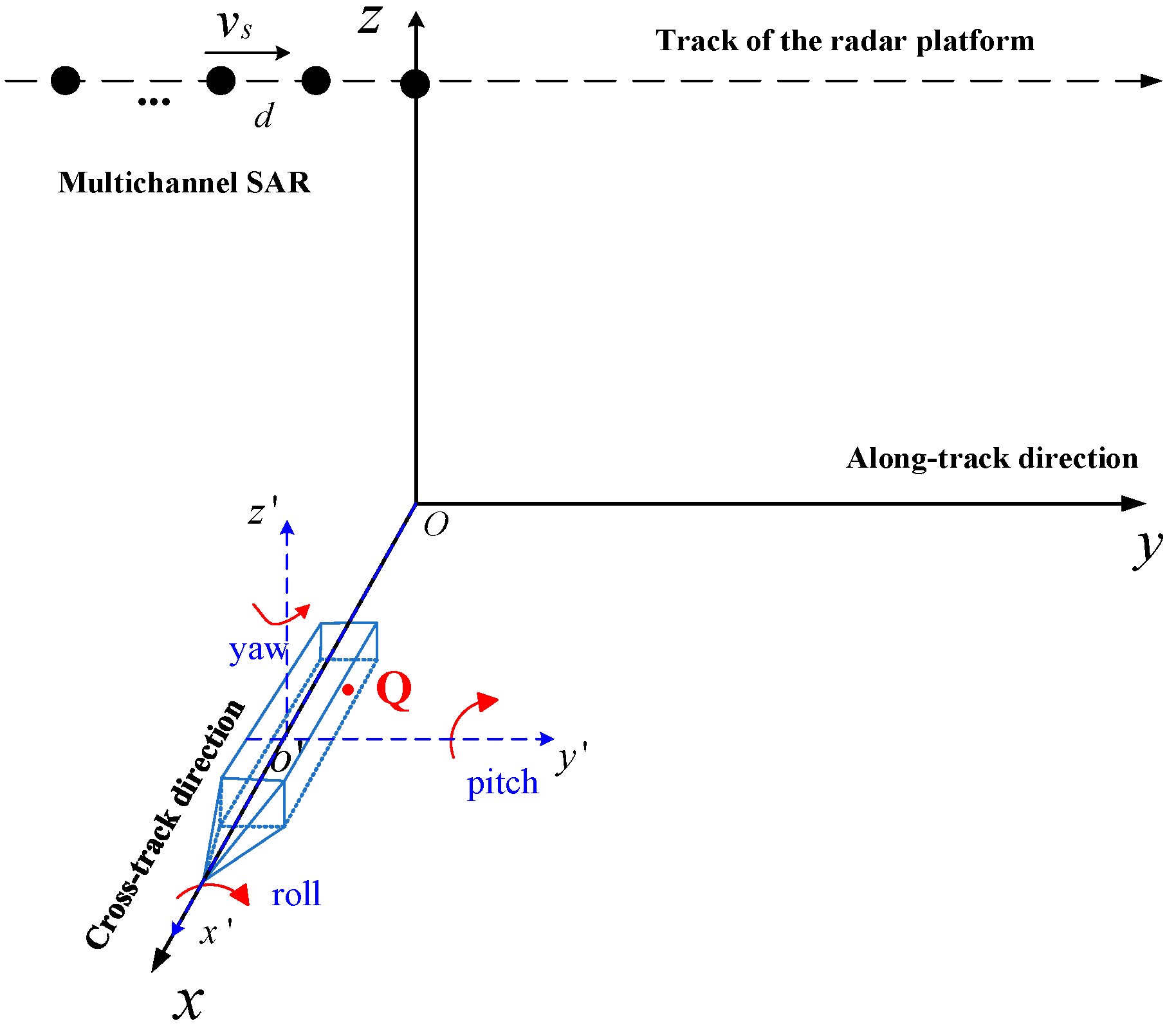
The geometric relationship between the radar and rotating ship is shown in
Figure 1. The radar platform moves parallel to the
y-axis, with a velocity of
vs and a height of
h. The radar has
N channels in azimuth, and the distance between the equivalent phase centers of adjacent channels is
d. At the azimuth time
ta = 0, the coordinate of the
nth channel radar in the
o-xyz coordinate system is (0, −(
n − 1)
d,
h), and the coordinate of the ship’s center of gravity in the
o-xyz coordinate system is (
x0, 0, 0). In addition, at
ta = 0, the ship’s velocity and acceleration along the
x-axis are
vx and
ax, respectively; the velocity and acceleration along the
y-axis are
vy and
ay, respectively.
o′
-x′
y′
z′ is the ship’s coordinate system with its origin at the ship’s center of gravity. The
x′-axis is transverse to the hull, the
y′-axis is longitudinal to the hull, and the
z′-axis is perpendicular to the hull. Q is an arbitrary scatterer of the ship, and its position at
ta = 0 in the
o′
-x′
y′
z′ coordinate system is
. The ship rotates under the action of wave thrust, including yaw, pitch, and roll, where the yaw-axis is perpendicular to the hull, the pitch-axis runs longitudinally through the bow and stern of the ship, and the roll-axis runs transversely through the hull. In other words, in the ship’s coordinate system
o′
-x′
y′
z′ shown in
Figure 1, roll rotates about the
x′-axis, pitch rotates about the
y′-axis, and yaw rotates about the
z′-axis.
According to
Figure 1, the position vector of the scatterer Q in the
o-xyz coordinate system can be expressed as
with
where
rc(
ta) is the position vector of the ship’s center of gravity in
o-xyz, and
is the position vector of the scatterer Q in
o′-
x′
y′
z′.
xc(
ta) and
yc(
ta) represent the instantaneous position components of the ship’s center of gravity along the
x-axis and
y-axis, respectively, in the
o-
xyz coordinate system.
Trot is the rotation matrix of the ship, and it can be expressed as
with
where
θr,
θp, and
θy are the three-dimensional rotation angles,
Ar,
Ap, and
Ay are the three-dimensional rotation amplitudes, and
ωr,
ωp, and
ωy are three-dimensional rotation angle frequencies, with the subscripts
r,
p, and
y representing the parameters corresponding to roll, pitch, and yaw, respectively.
Based on Equation (1), the instantaneous range between the scatterer Q and the
nth channel, i.e., the range equation of the scatterer Q, can be expressed as
To facilitate analysis of the effect of rotation on the scatterer’s signal characteristics, the range equation in Equation (8) is expanded using a third-order Taylor series expansion at the time
ta = 0, yielding the following result:
where
Note that due to the expression for the cubic coefficient, l3 is too complex and lengthy which is hence not given in the paper for simplicity of presentation.
3. Influence of Each Rotation Motion on the Coefficients of Range Equation
From Equations (9)–(15), it can be seen that the rotational motion has a significant impact on the coefficients of the range equation. In this section, without loss of generality, the reference channel (the first channel) is taken as an example to investigate the influence of each rotation motion on the coefficients of range equation of the scatterer Q.
According to Equations (11)–(15), when only translational motion exists, the coefficients of range equation can be expressed as follows:
where
Rt(
ta) is the range equation when only translational motion exists, and the subscript
t corresponds to the case where only translational motion exists.
By comparing Equations (11) and (16), (13) and (17), and (15) and (19), the changes in the coefficients of range equation caused by the rotational motion are given by
The changes in the coefficients of the linear and quadratic terms of the range equation will result in variations in the Doppler center frequency and Doppler chirp rate of a target. The relationships between them are as follows:
where
and
denote the variations in the Doppler center frequency and Doppler chirp rate, respectively, and
λ is the wavelength.
According to the principle of SAR imaging, the variation in the Doppler center frequency will result in an azimuth position shift of the target in the SAR image, while the variation in the Doppler chirp rate will cause azimuth defocusing. In addition, variations in the coefficients of the cubic term of the range equation will cause residual azimuth modulation, which leads to azimuth sidelobes asymmetry when it is small and azimuth defocusing when it is large [
23].
In the following, the influences of roll, pitch, and yaw on each coefficient of the range equation are analyzed.
3.1. Influence of Roll
When only roll exists, according to Equation (20), the variation in the coefficient of the range equation’s linear term can be expressed as
One can see that the variation depends only on the y′-axis coordinate of the scatterer, and it is linearly related to , i.e., the farther away from the ship’s center of gravity along the y′-axis (the along-track direction), the greater the variation in the coefficient of linear term.
Similarly, according to Equations (13) and (17), the variation in the coefficient of the range equation’s quadratic term due to roll can be written as
From Equation (26), it can be seen that depends only on the z′-axis (the height direction) coordinate of the scatterer and is linearly related to .
Since the variation in the coefficient of the range equation’s cubic term caused by roll, i.e.,
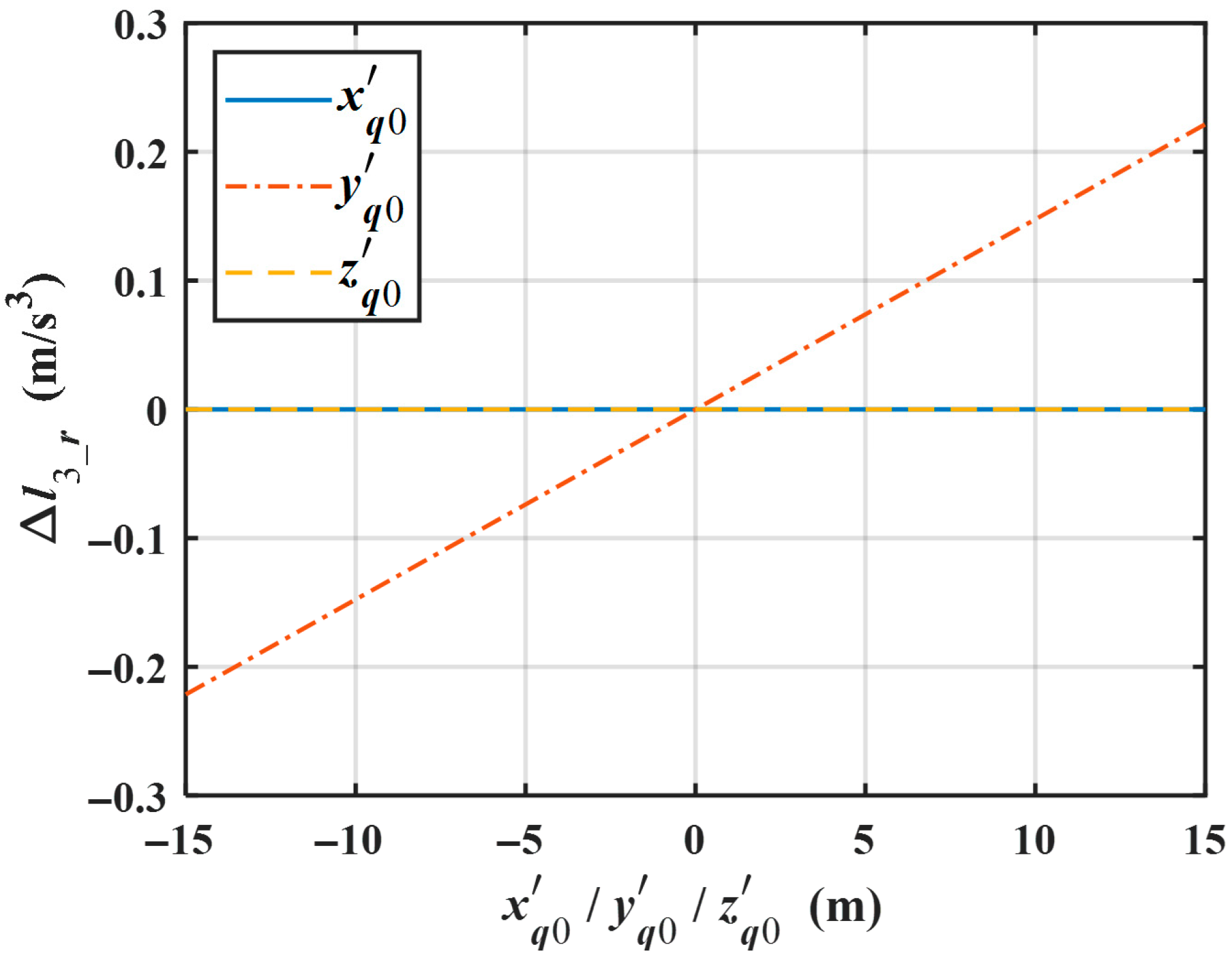
, is very complex, the numerical analysis is used to clarify its dependence on the coordinates of the scatterer. The parameters for numerical simulations are shown in
Table 1 and
Table 2. The numerical results are shown in
Figure 2. One can see that
depends only on the
y′-axis coordinate of the scatterer and is proportional to
.
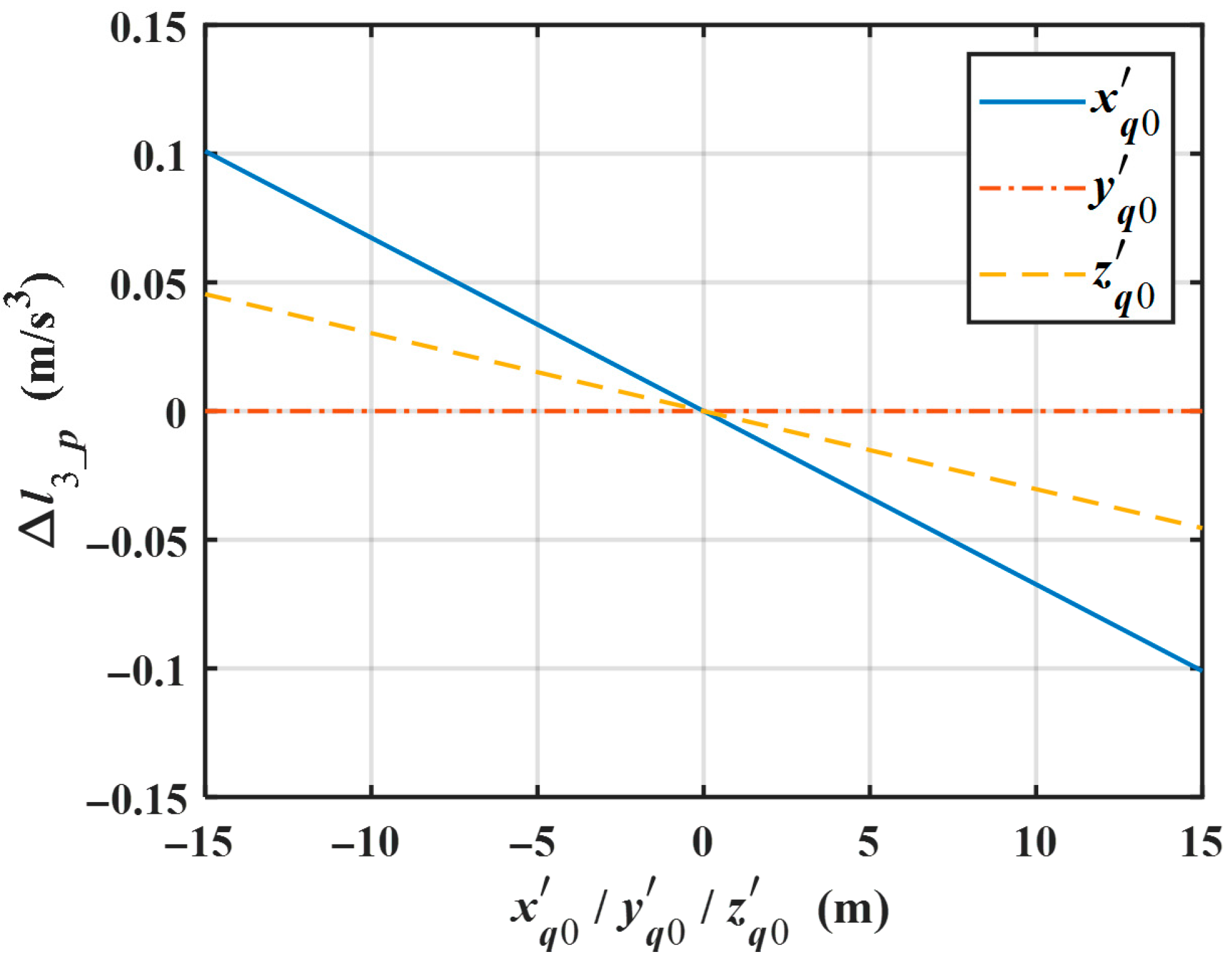
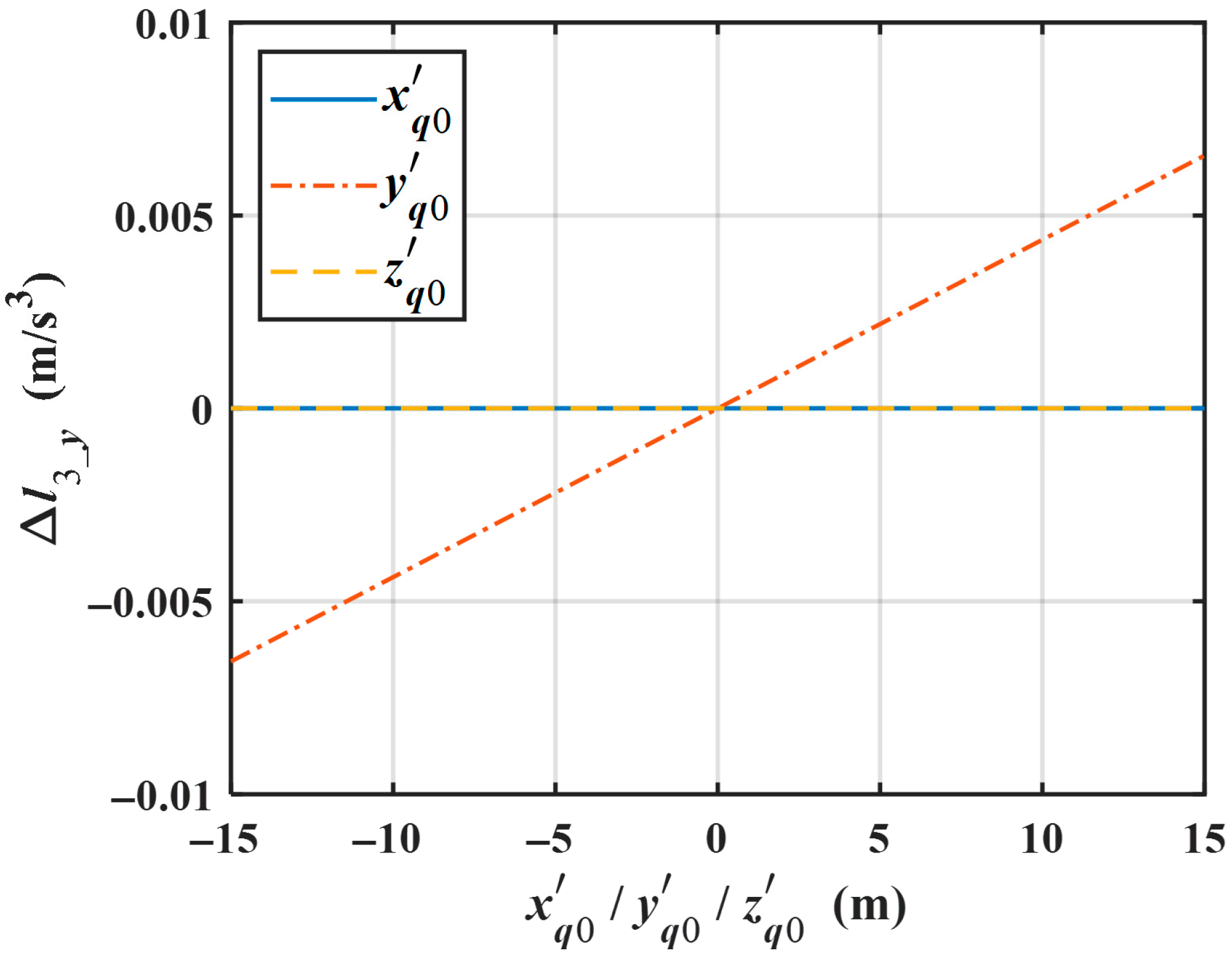
In
Figure 2,
Figure 3 and
Figure 4, “
” corresponds to the three lines in the legend, representing the influence of coordinate component
on the cubic term coefficient when considering roll/pitch/yaw, respectively.
Based on the above analysis and the relationship between the Doppler parameters and the coefficients of range equation, the following conclusions can be obtained: (1) The farther away the scatterer is from the ship’s center of gravity along the along-track direction, the greater the variation in the coefficients of linear and cubic terms;, thus, the greater the azimuth position shift and azimuth sidelobes asymmetry of this scatterer in the SAR image. (2) The farther the scatterer is away from the ship’s center of gravity along the height direction, the greater the variation in the coefficient of the quadratic term, thus resulting in the more severe the azimuth defocusing.
3.2. Influence of Pitch
When only pitch exists, the variation in the coefficient of the range equation’s linear term can be expressed as
It can be seen that the variation in the coefficient of the linear term due to pitch depends only on the x′-axis (the cross-track direction) and z′-axis coordinates of the scatterer and is linearly related to and .
Similarly, according to Equations (13) and (17), the variation in the coefficient of the range equation’s quadratic term caused by pitch is given by
From Equation (28) one can see that is also linearly related to and .
The variation in the coefficient of the range equation’s cubic term due to pitch (i.e.,
) is figured out via numerical analysis, with results being presented in
Figure 3. One can see that
depends on the
x′-axis and
z′-axis coordinate of the scatterer and is linearly related to
and
.
From the above analysis, it can be seen that the variations in the coefficients of the three terms are all linearly to and . Therefore, it could be concluded that the farther the scatterer is away from the ship’s center of gravity along the cross-track direction or height direction, the greater the azimuth position shift, azimuth defocusing, and azimuth sidelobes asymmetry of this scatterer in the SAR image.
3.3. Influence of Yaw
When only yaw exists, the variation in the coefficient of the range equation’s linear term can be expressed as
It can be seen that depends only on the y′-axis coordinate of the scatterer and is linearly related to .
Similarly, the variation in the coefficient of the range equation’s quadratic term caused by the yawing motion can be expressed as
It can be seen that mainly depends only on the x′-axis coordinate of the scatterer and is approximately linearly related to . Note that the approximation in Equation (30) is due to the fact that vx and vy are much less than x0 and vs.
The variation in the coefficient of the range equation’s cubic term due to the yaw (i.e.,
) is figured out via numerical analysis, and the results are shown in
Figure 4. It can be seen that
depends only on the
y′-axis coordinate of the scatterer and is proportional to
.
Based on the above analysis, the following conclusions can be obtained: (1) The farther away the scatterer is from the ship’s center of gravity along the along-track direction, the greater the variation in the coefficient of the linear and cubic terms; thus, the greater the azimuth position shift and the azimuth sidelobe asymmetry of this scatterer in the SAR image. (2) The farther the scatterer is from the ship’s center of gravity along the cross-track direction, the greater the variation in the coefficient of the quadratic term; thus, the more severe the azimuth defocusing.
4. Influence of Each Rotation Motion on ATI Phase
For SAR-GMTI, the ATI phase of a target is a very important parameter because it can be used for target detection and motion parameter estimation. Therefore, in this section, the impact of each rotation motion on the ATI phase is analyzed.
The ATI phase of target between adjacent channels can be expressed as follows [
24]:
Thus, the variations in ATI phase caused by each rotation motion can be expressed as
where
,
, and
are the variations introduced by roll, pitch, and yaw, respectively.
From Equations (32)–(34), it can be seen that each rotation motion has an impact on the ATI phase. Moreover, the following points can be noted: (1) The variations in ATI phase caused by roll and yaw are mainly related to the y′-axis coordinate of the scatterer and are approximately linearly related to . (2) The variations in ATI phase caused by pitch is mainly related to the y′-axis and z′-axis coordinates of the scatterer and is approximately linearly related to and .
5. Experimental Results
In this section, numerical experiments are conducted to analyze the effect of rotation motions on the ship’s characteristics in the SAR image domain, including the azimuth position shift, azimuth defocusing, azimuth sidelobe asymmetry, and ATI phase and their dependences on scatterers’ positions relative to the gravity center of the ship. The parameters of the radar used in the simulations are presented in
Table 1. The size of the simulated ship is 135 m in length, 30 m in width, and 30 m in height. The velocity of the ship is 5 m/s. The rotational parameters of the ship are given in
Table 2 [
25].
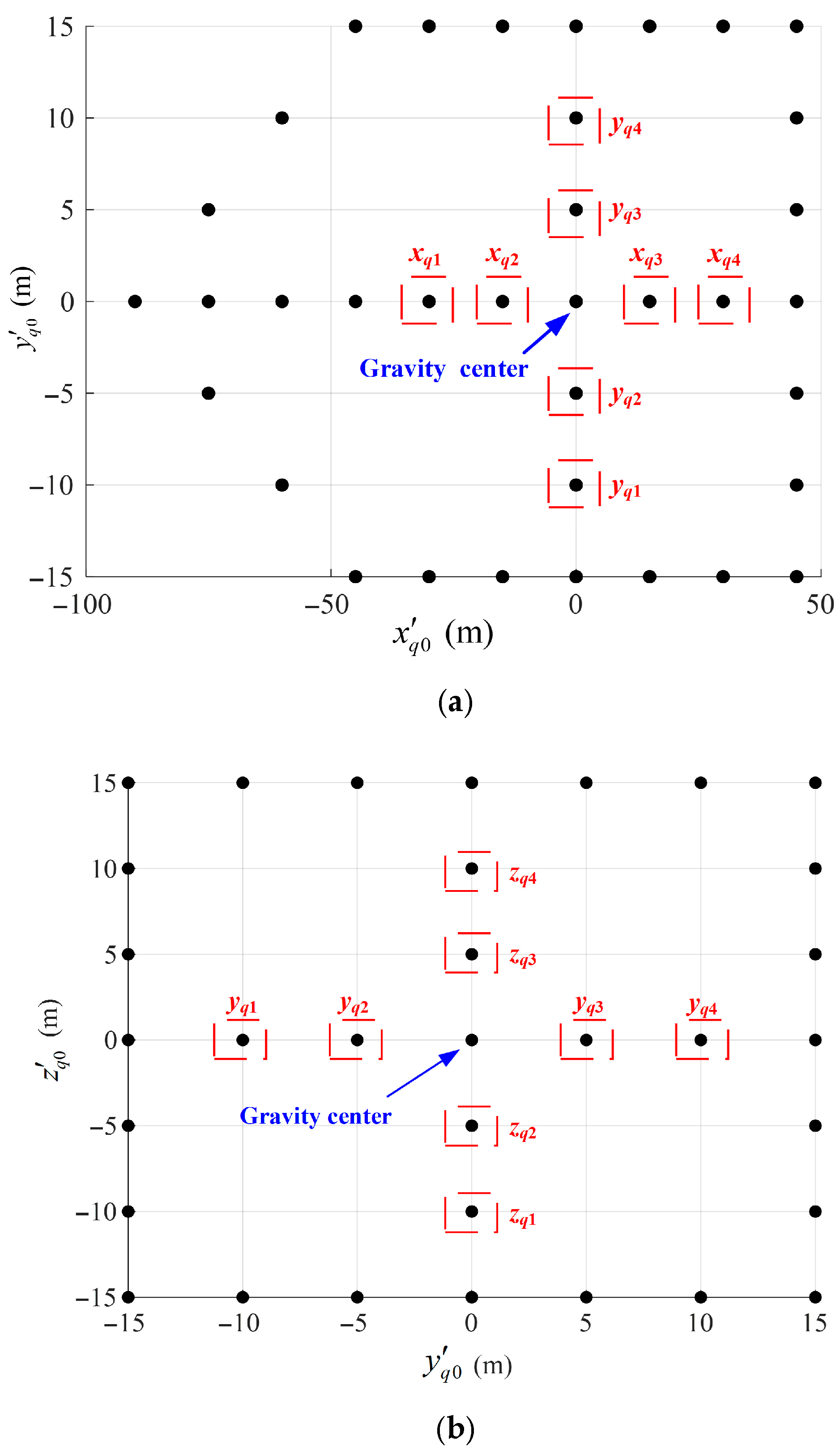
To clearly reveal the dependence of the rotation motions’ effect on the scatterer’s positions, the ship’s horizontal and vertical slices passing through the gravity center are considered in the following analysis, as illustrated in
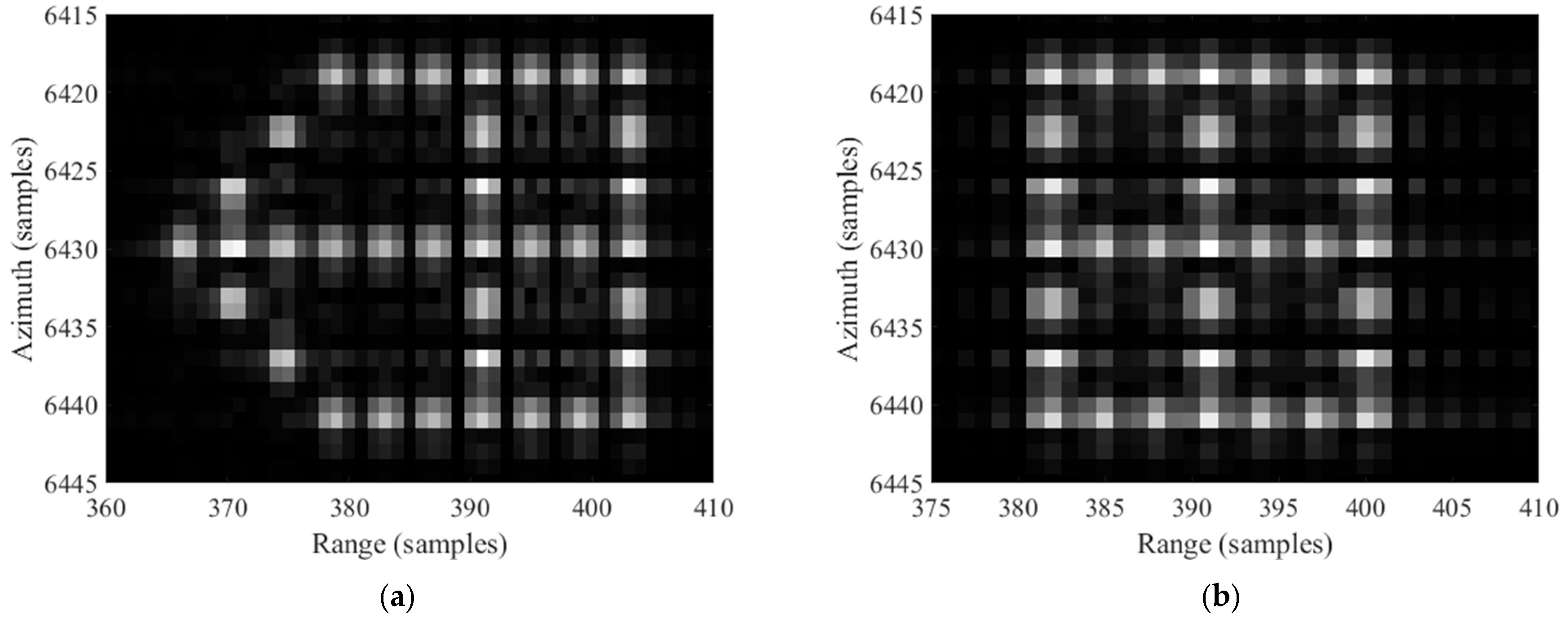
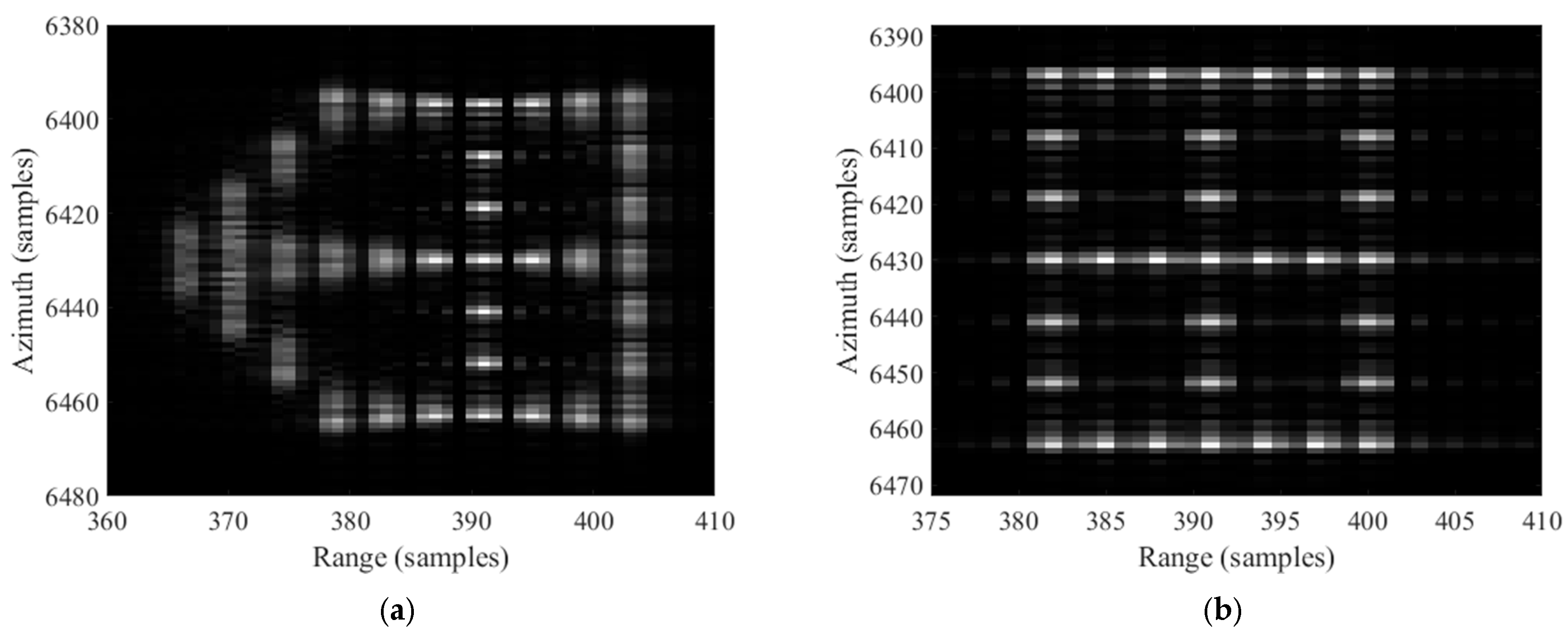
Figure 5. The imaging results of these two slices when only translational motion exists are shown in
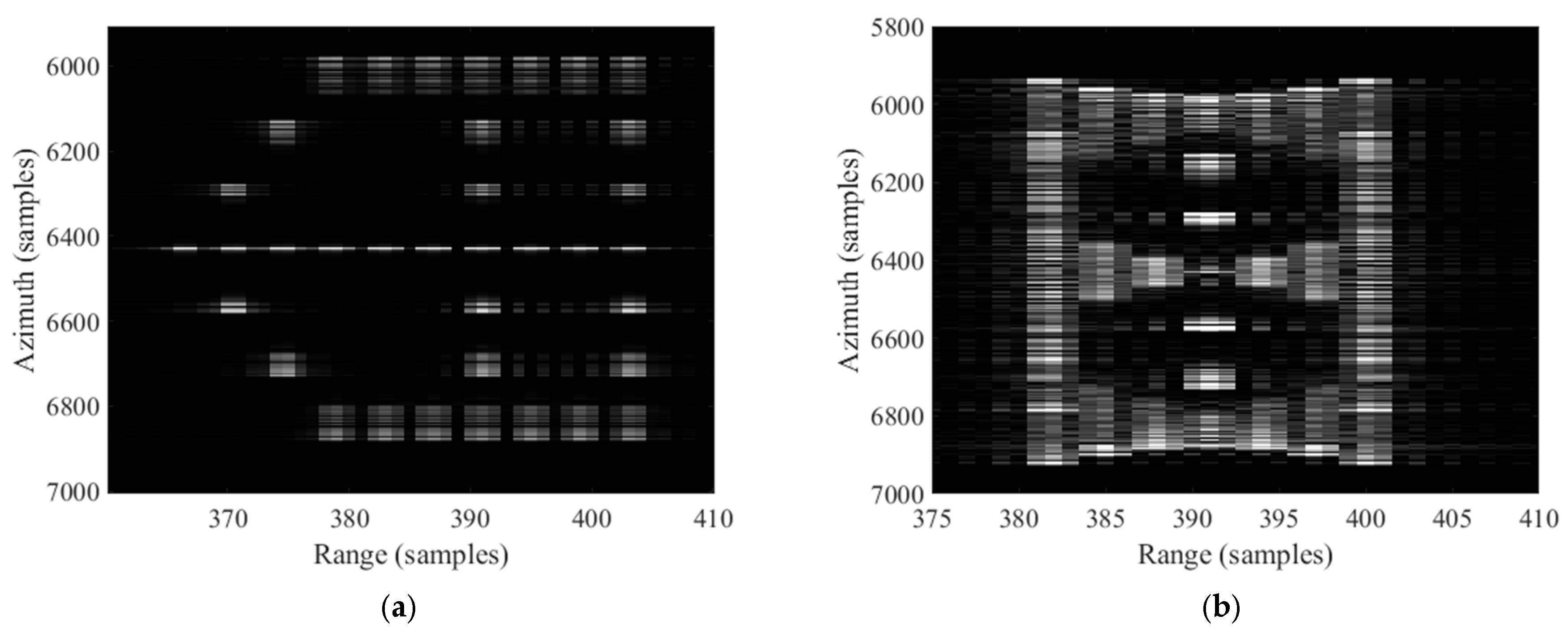
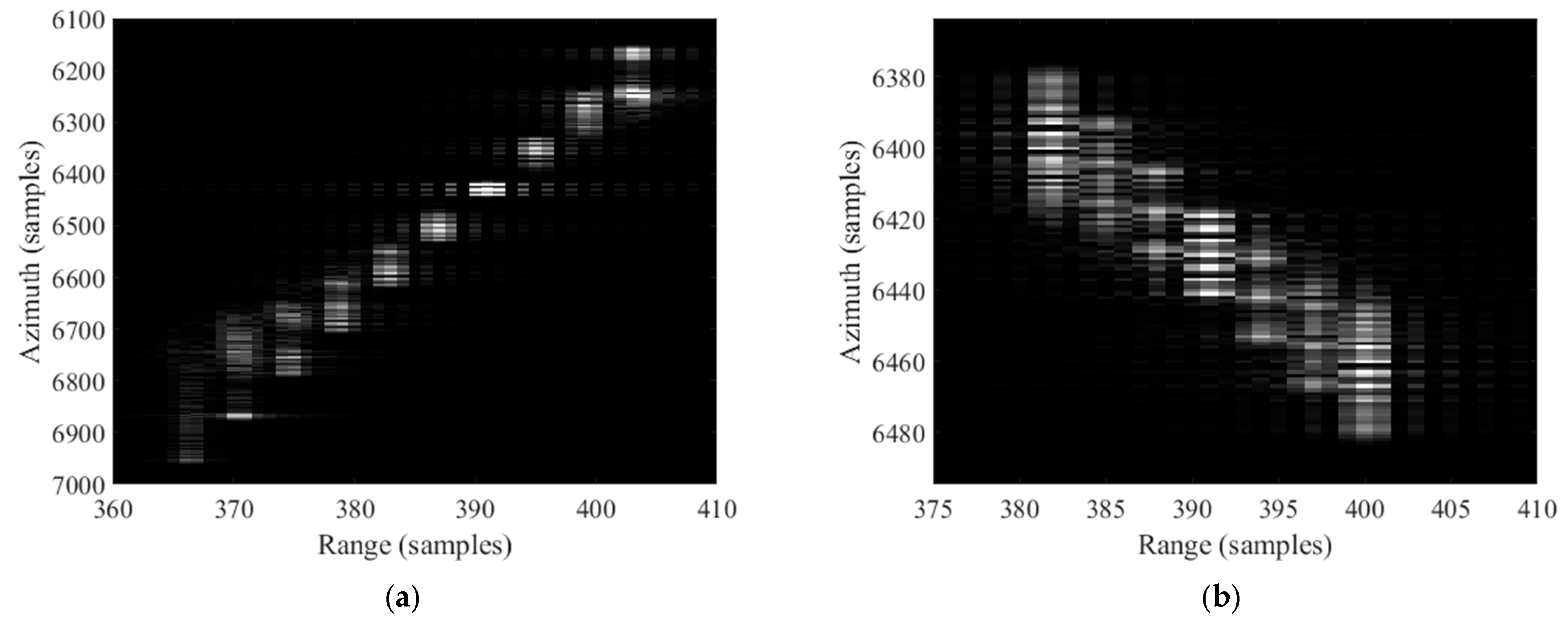
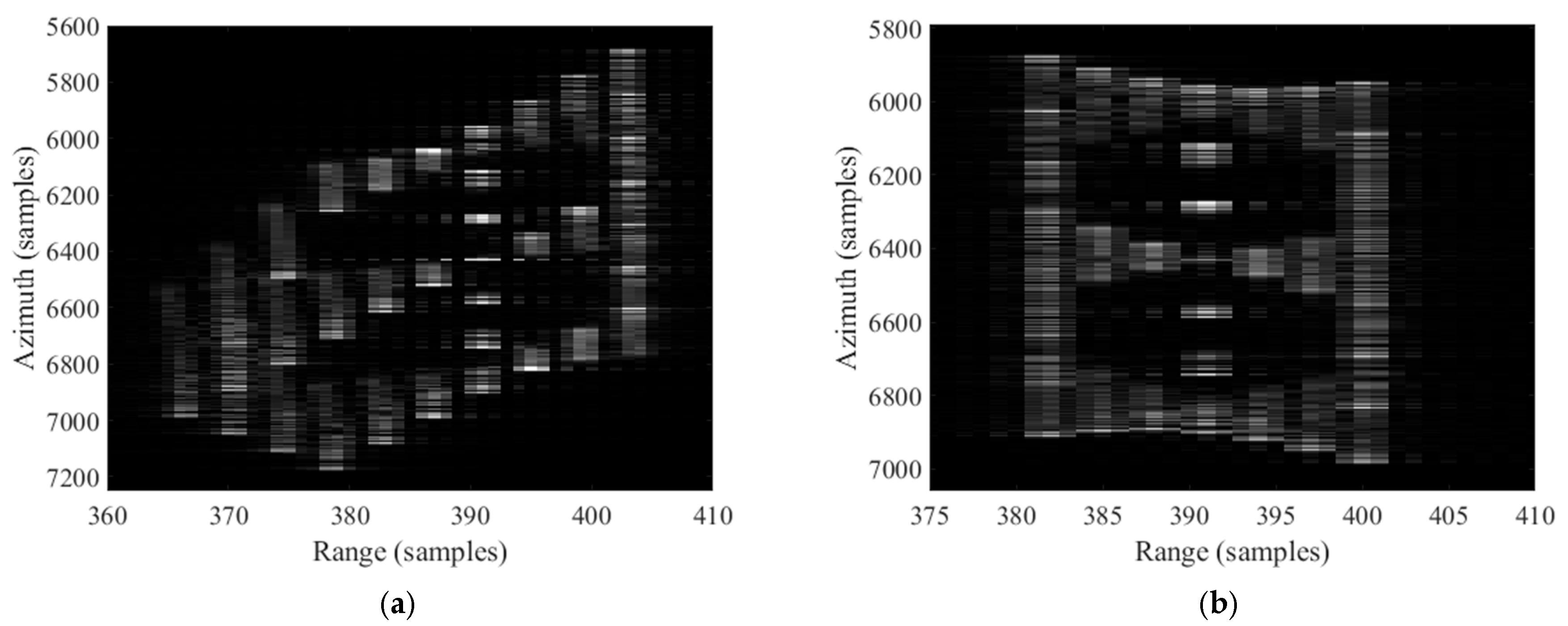
Figure 6. In addition, the imaging results in the presence of roll, pitch, yaw, and three-dimensional rotation motions are presented in
Figure 7,
Figure 8,
Figure 9 and
Figure 10, respectively. Note that the classic range-Doppler algorithm is used in imaging, and only the parameters of the ship’s translational motion are used when performing range migration correction and azimuth compression.
Comparing
Figure 6 with
Figure 7,
Figure 8,
Figure 9 and
Figure 10, it can be seen that the rotation motions have a significant effect on the imaging results. Specifically, from
Figure 7 one can see that in the case of roll, the horizontal slice is significantly stretched and defocused along the azimuth direction, and the vertical slice suffers significant azimuth defocusing. As can be seen from
Figure 8, both the horizontal and vertical slices suffer severe deformation when pitch exists, and they look like an oblique ridge. According to
Figure 9, in the presence of yaw, the horizontal slice is significantly stretched and defocused along the azimuth direction. In addition, from
Figure 10 one can see that when the three types of rotational motion all exist, there is severe stretching, azimuth defocusing, and deformation.
In the following, the twelve scatterers in the red box of
Figure 5 are selected to further quantitatively analyze the azimuth position shift (ΔP), azimuth defocusing (ΔD), azimuth sidelobe asymmetry (ΔS), and ATI phase variation (ΔATI) introduced by each rotation motion, as well as their relationship with the coordinates of these scatterers. The measured results are given in
Table 3,
Table 4 and
Table 5. Note that the degree of azimuth defocusing is characterized by the multiple of the broadening of the azimuth impulse response width, and the sidelobe asymmetry is indicated by the difference in peak values of left and right sidelobes.
5.1. Effect of Ship’s Roll Motion
The measured results are given in
Table 3, and the following points can be noted.
Roll has no effect on the scatterers on the x′-axis (i.e., qx1, qx2, qx3, qx4). This is because the x′-axis is its axis of rotation.
For the scatterers with non-zero
z′-axis coordinates, roll only causes them to suffer severe azimuth defocusing, and the defocusing width increases with the distance between these scatterers and the ship’s gravity center. This is consistent with the analyses presented in
Section 3.1, which reveal that only
is related to
[see Equation (26)]. Note that the measurements of azimuth sidelobe asymmetry are not presented in
Table 3 because the azimuth defocusing is too severe to observe the sidelobe.
Roll has a significant effect on the scatterers with non-zero
y′-axis coordinates. It introduces significant azimuth position shift, azimuth defocusing, azimuth sidelobe asymmetry, and ATI phase variation, and they become greater as the distance from these scatterers to the gravity center increases. Moreover, one can see that the azimuth position shift and ATI phase variation are approximately linear to the scatterers’
y′-axis coordinates. This is consistent with the analyses presented in
Section 3.1 and
Section 4, which reveal that
and
are approximately linear to
[see Equations (25) and (32)]. It should be noted that the azimuth defocusing is due to the variation in the coefficient of the range equation’s cubic term which is very large.
Since the azimuth position shift is directly proportional to the scatterer’s coordinate of the y′-axis (the along-track direction), the ship is significantly stretched along the azimuth direction in the SAR image, which will result in severe SNR loss just like azimuth defocusing.
5.2. Effect of Ship’s Pitch Motion
According to the measured results presented in
Table 4, the following points can be noted.
Pitch has no effect on the scatterers on the y′-axis (i.e., qy1, qy2, qy3, qy4). This is because the y′-axis is its axis of rotation.
For the scatterers with non-zero
x′-axis or
z′-axis coordinates, pitch brings significant effects. It introduces significant azimuth position shift, azimuth defocusing, azimuth sidelobe asymmetry, and ATI phase variation, and they become greater as the distance from these scatterers to the ship’s gravity center increases. Moreover, it can be seen that the azimuth position shift and ATI phase variation are approximately linear to the scatterers’
x′-axis and
z′-axis coordinates. This is consistent with the analyses presented in
Section 3.1 and
Section 4, which reveal that
and
are linearly related to
and
[see Equations (27) and (33)].
Since the azimuth position shift is approximately linear to the scatterer’s coordinates of the x′-axis (the cross-track direction) and z′-axis (the height direction), the ship suffers severe deformation and is pulled into a widened oblique line in the SAR image.
5.3. Effect of Ship’s Yaw Motion
The measured results are given in
Table 5, and the following points can be noted.
For the scatterers on the z′-axis (i.e., qz1, qz2, qz3, qz4), yaw has no effect on them. This is because the z′-axis is its axis of rotation.
For the scatterers with non-zero
x′-axis coordinates, yaw only causes them to suffer azimuth defocusing, and the defocusing width increases with the distance between these scatterers and the ship’s gravity center. This is consistent with the analyses presented in
Section 3.3, which reveal that
is approximately linearly related to
[see Equation (30)].
For the scatterers with non-zero
y′-axis coordinates, yaw introduces significant azimuth position shift and azimuth sidelobe asymmetry and minor ATI phase variation, which become greater as the distance from these scatterers to the center of gravity increases. This is consistent with the analyses presented in
Section 3.3 and
Section 4 [see Equations (29) and (34)].
Since the azimuth position shift is directly proportional to the scatterer’s coordinate of the y′-axis (the along-track direction), the ship will be significantly stretched along the azimuth direction after SAR imaging.
5.4. Summary of the Effect of Each Rotation Motion
Based on the measured results and above analyses, the effect of each rotation motion is summarized in
Table 6. It could be seen that the effect of yaw is minimal and the effect of pitch is the greatest.