Combining In Situ and Remote-Sensing Data to Assess the Spatial Pattern and Changes of Major Grassland Types in Xinjiang, China, Under Climate Change Scenarios

 , ,
, ,  and
and
Highlights
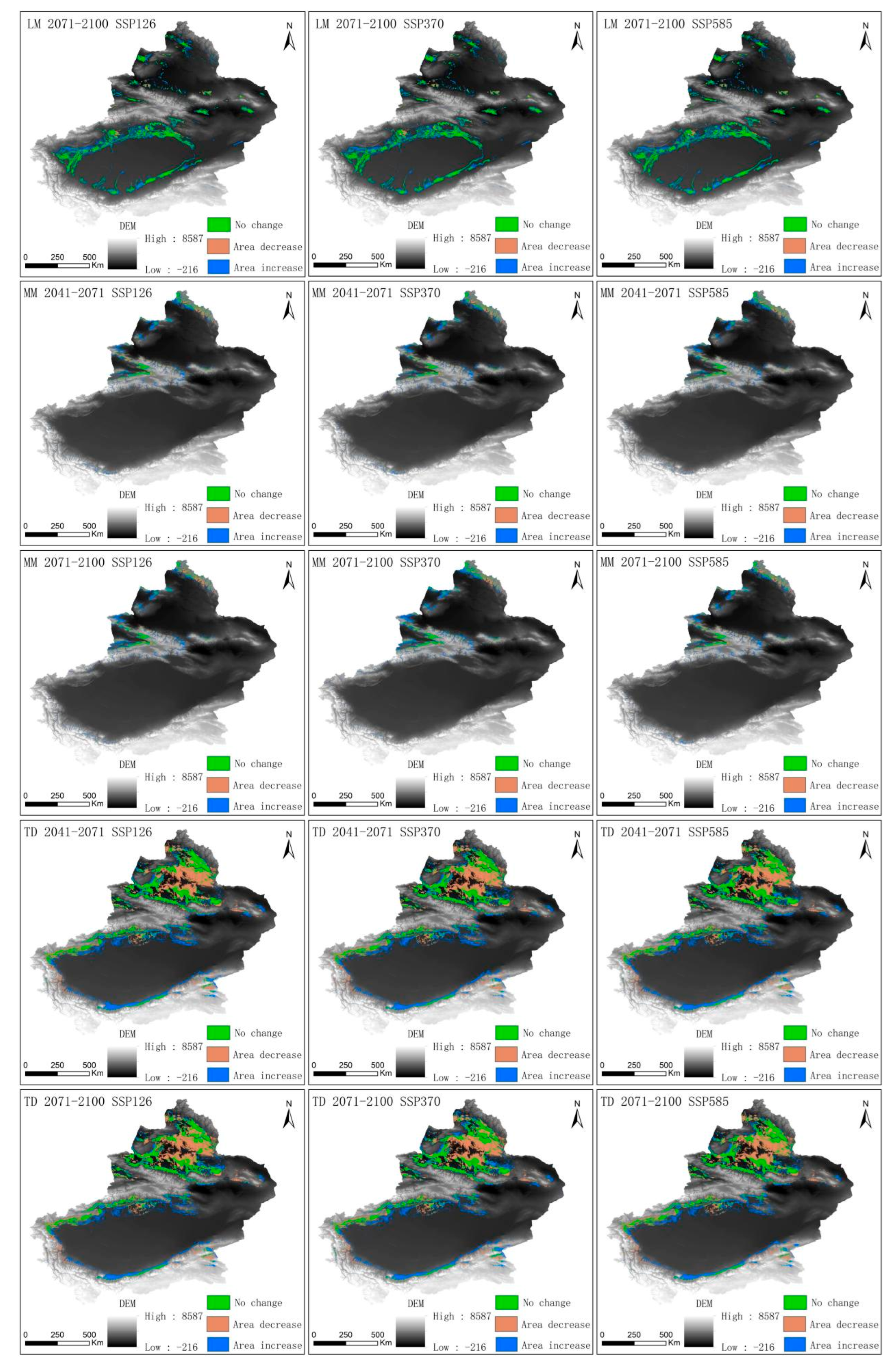
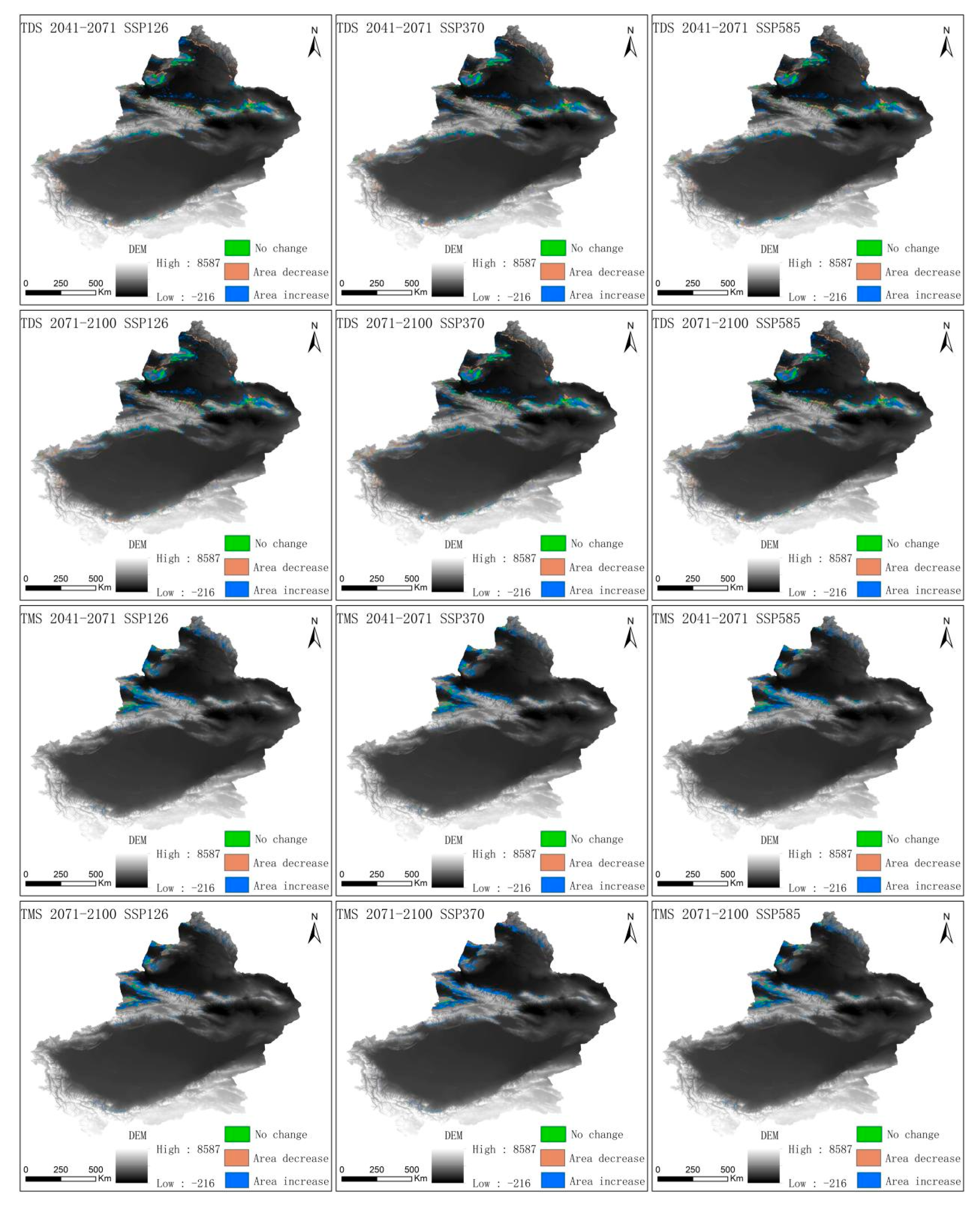
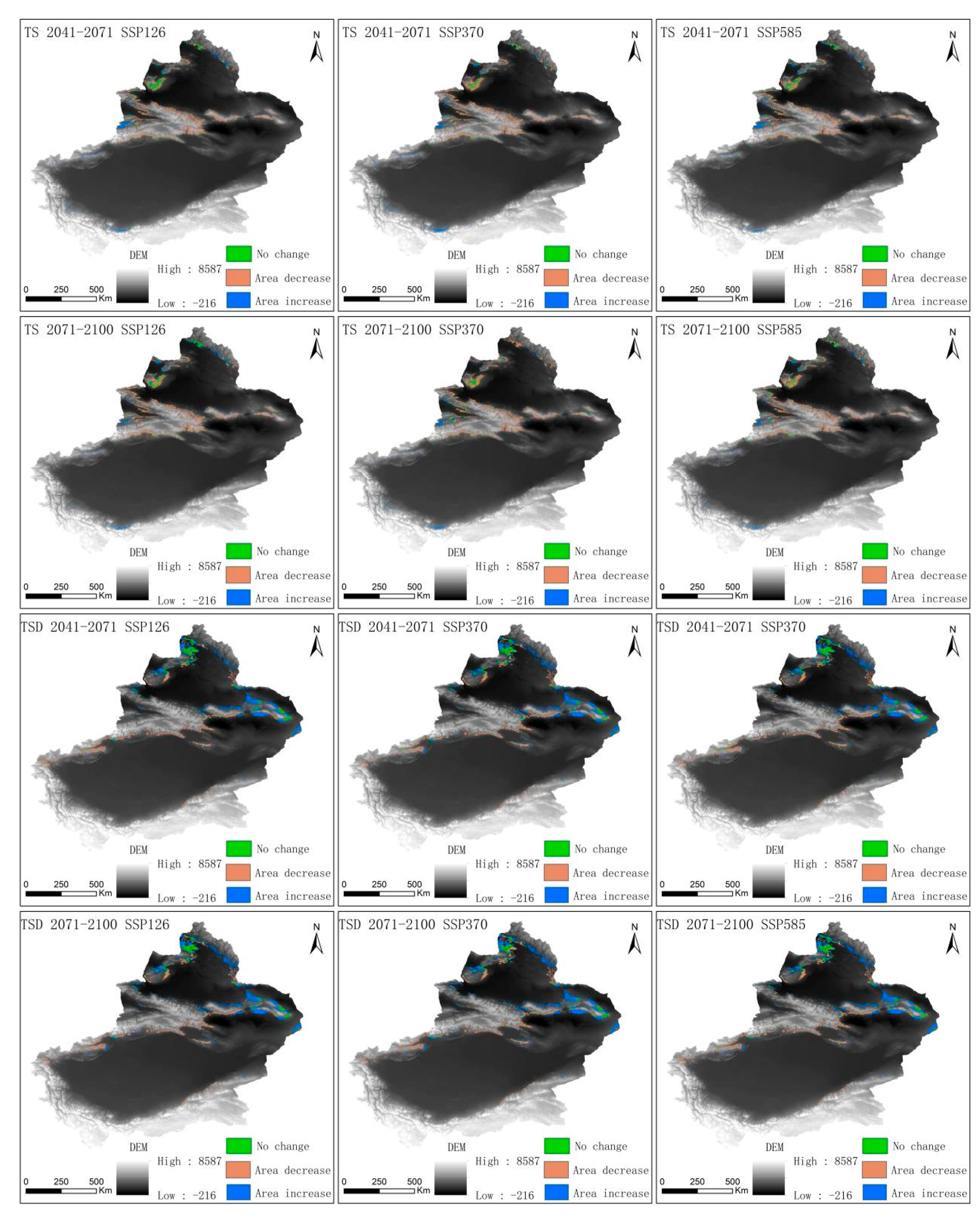
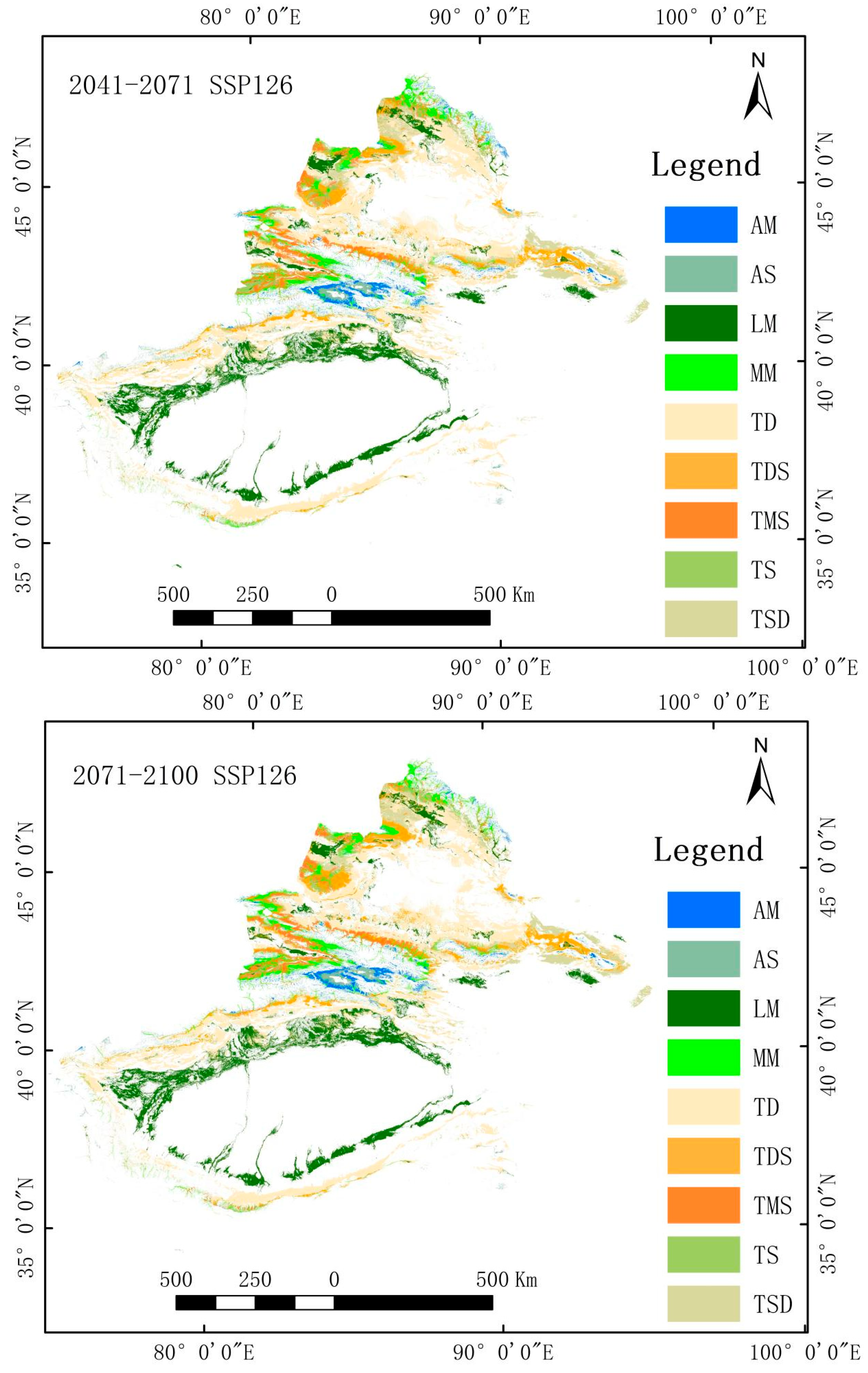
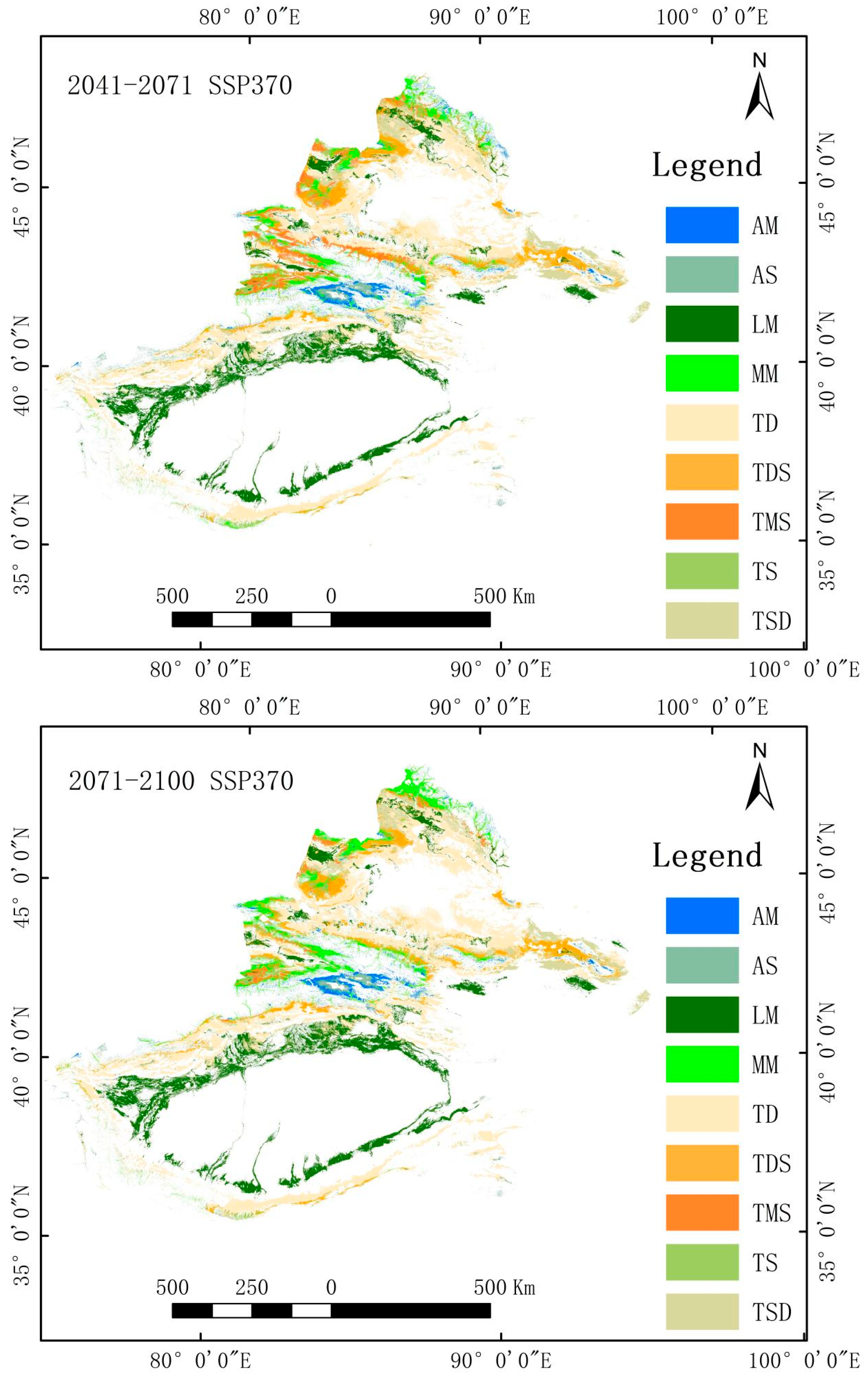
- The total area of these nine grassland types showed a declining trend from 2041 to 2100. Among them, the areas of Alpine Meadow (AM), Alpine Steppe (AS), Temperate Steppe (TS), and Temperate Desert (TD) experienced the most significant decrease.
- Grassland types in China are defined by precipitation, humidity, and community composition. This study showed that temperature and environmental variables play a crucial role and significantly contribute to the predicted distribution of grassland types.
- The decline in grassland areas in high-altitude mountainous regions, such as AM, AS, and TS, indicates that climate change has a significant impact on grasslands in the mid-to high-altitude areas of Xinjiang.
- The existing classification system for grassland types in China should take more fac-tors into account, such as temperature and other relevant parameters.
Abstract
1. Introduction
2. Materials and Methods
2.1. Study Area
2.2. Field Sites
2.3. Factors
2.4. Future Climate Factor Data
2.5. MaxEnt Model
3. Results
3.1. Prediction Accuracy and Threshold
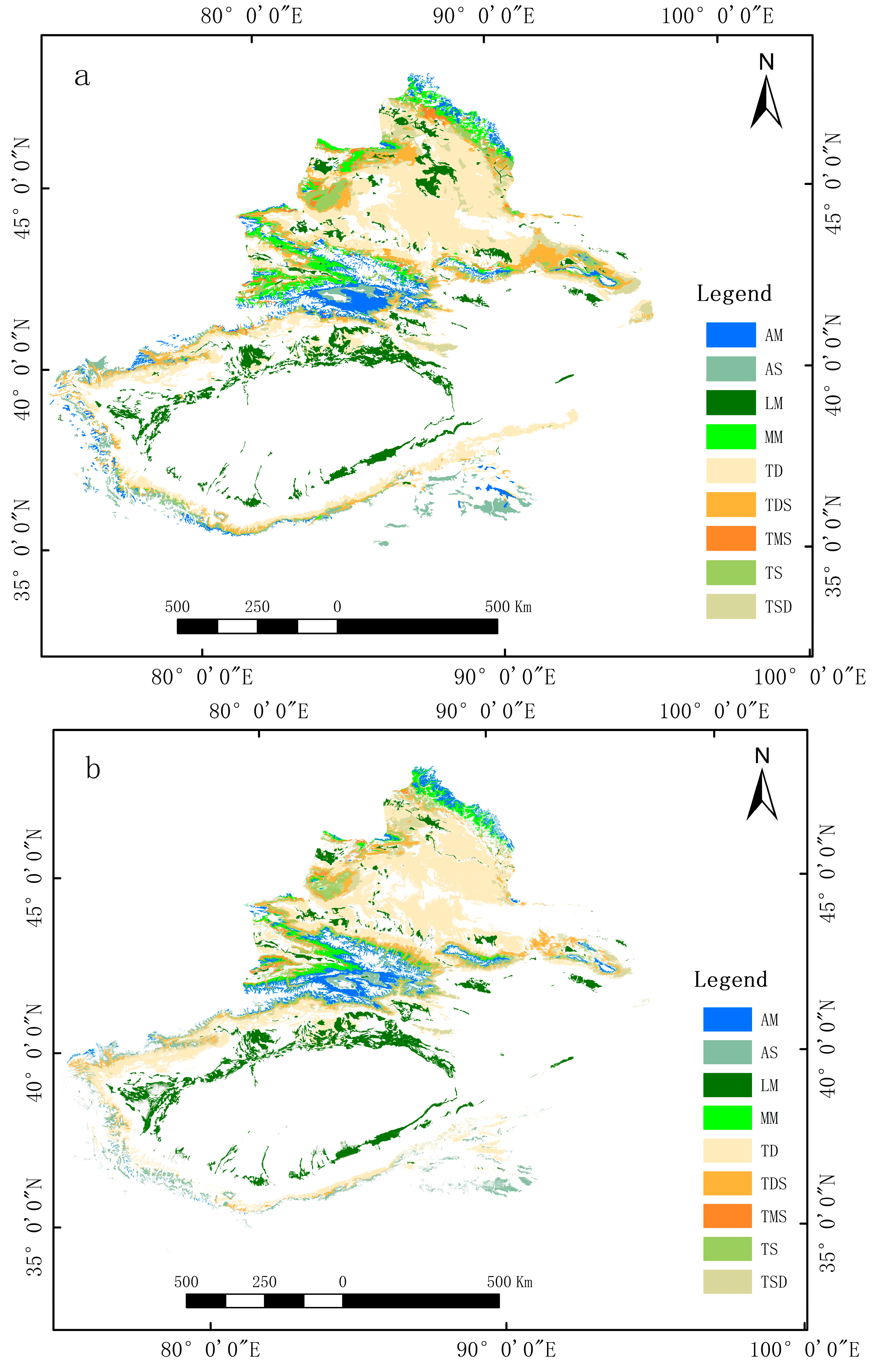
3.2. Comparison of the Actual and Predicted Grassland Area in the 1980s
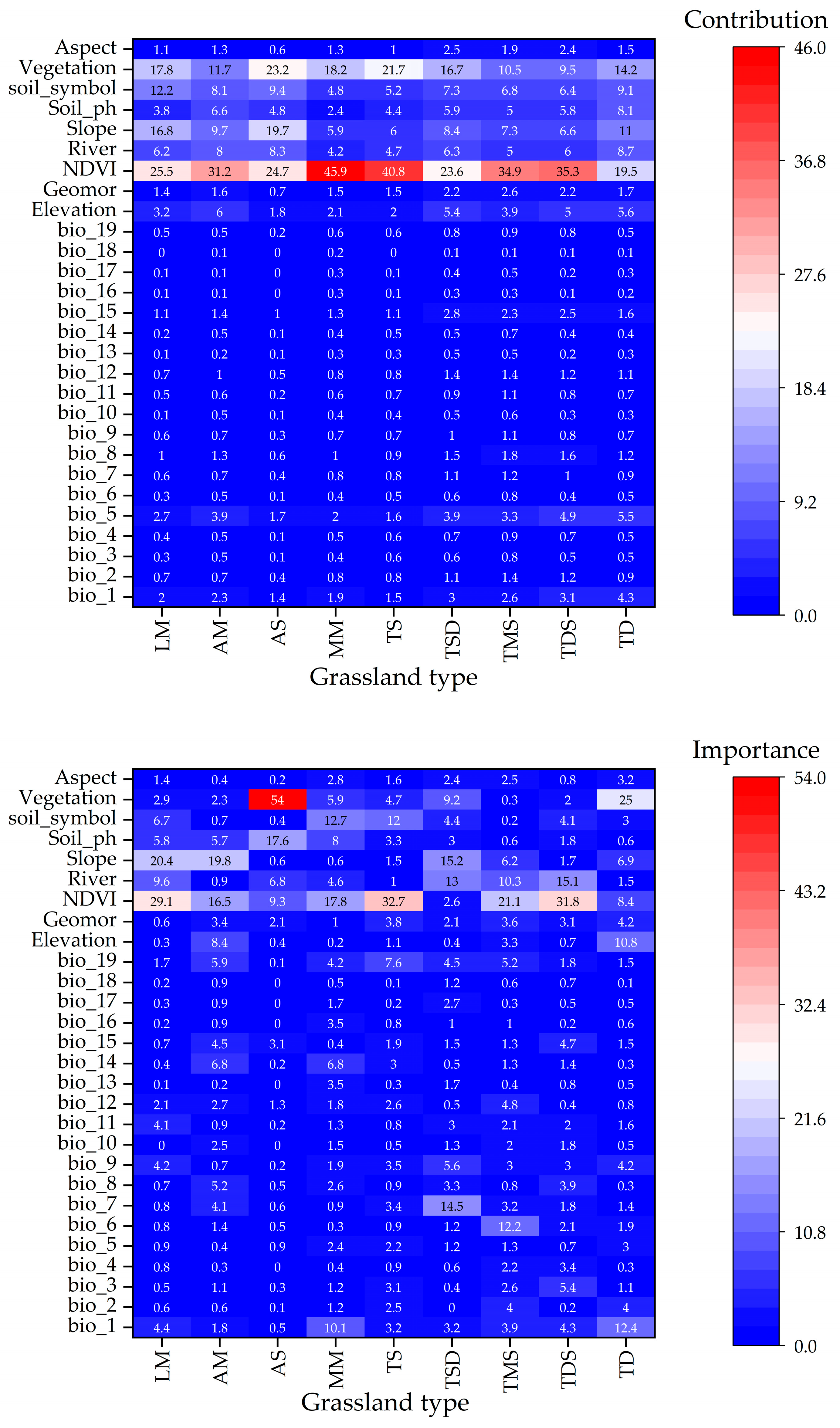
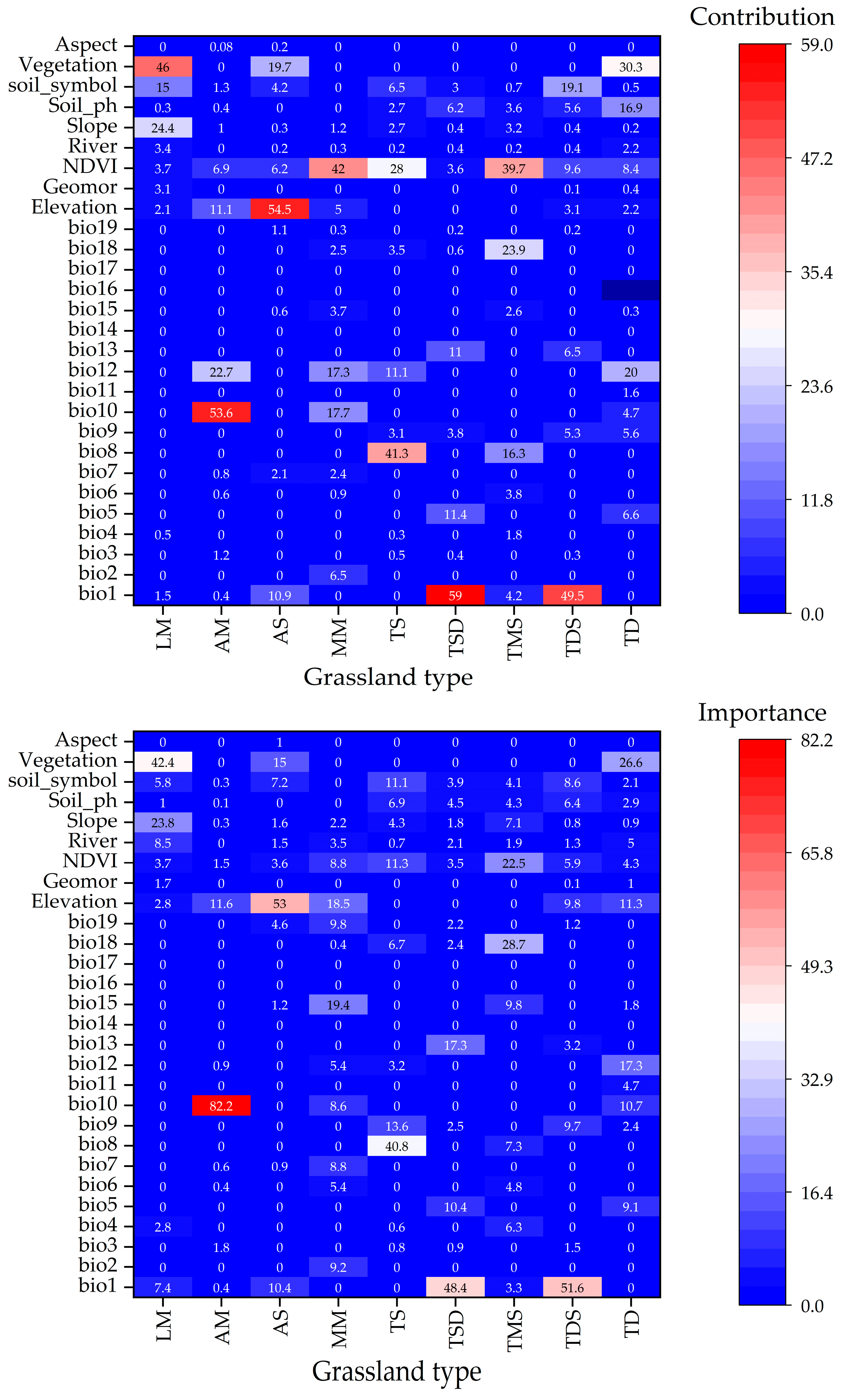
3.3. Importance of Various Factors
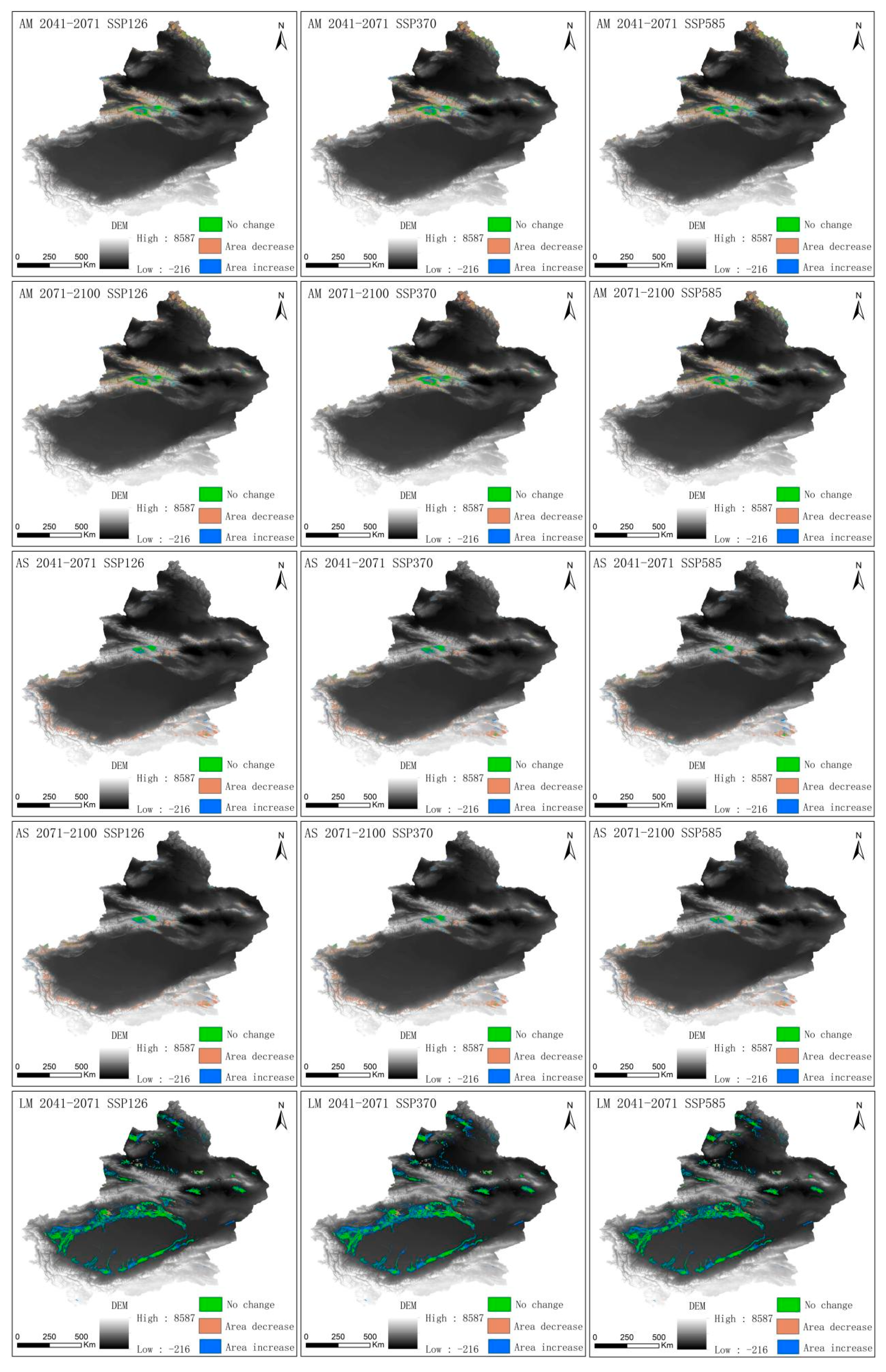
3.4. Future Changes of Grassland
4. Discussion
4.1. Accuracy and Importance of Factors
4.1.1. Accuracy
4.1.2. Various Factors
4.2. Future Spatial Distribution and Changes of Grassland
5. Conclusions
Author Contributions
Funding
Data Availability Statement
Conflicts of Interest
References
- Lŭ, L.; Zhao, Y.; Chu, L.; Wang, Y.; Zhou, Q. Grassland coverage change and its humanity effect factors quantitative assessment in Zhejiang province, China, 1980–2018. Sci. Rep. 2022, 12, 18288. [Google Scholar] [CrossRef] [PubMed]
- Tong, L.; Liu, Y.; Wang, Q.; Zhang, Z.; Li, J.; Sun, Z.; Khalifa, M. Relative effects of climate variation and human activities on grassland dynamics in Africa from 2000 to 2015. Ecol. Inform. 2019, 53, 100979. [Google Scholar] [CrossRef]
- Lu, L.; Sun, Z.; Qimuge, E.; Ye, H.; Huang, W.; Nie, C.; Wang, K.; Zhou, Y. Using remote sensing data and species-environmental matching model to predict the potential distribution of grassland rodents in the northern china. Remote Sens. 2022, 14, 2168. [Google Scholar] [CrossRef]
- Bi, X.; Li, B.; Zhang, L.; Nan, B.; Zhang, X.; Yang, Z. Response of grassland productivity to climate change and anthropogenic activities in arid regions of Central Asia. PeerJ 2020, 8, e9797. [Google Scholar] [CrossRef]
- Bonari, G.; Fajmon, K.; Malenovský, I.; Zeleny, D.; Holusa, J.; Jongepierová, I.; Kocárek, P.; Konvicka, O.; Uricár, J.; Chytry, M. Management of semi-natural grasslands benefiting both plant and insect diversity: The importance of heterogeneity and tradition. Agric. Ecosyst. Environ. 2017, 246, 243–252. [Google Scholar] [CrossRef]
- Czarniecka-Wiera, M.; Szymura, T.H.; Kącki, Z. Understanding the importance of spatial scale in the patterns of grassland invasions. Sci. Total Environ. 2020, 727, 138669. [Google Scholar] [CrossRef]
- Zhang, N.; Li, Z.; Feng, Y.; Li, X.; Tang, J. Development and application of a vegetation degradation classification approach for the temperate grasslands of northern China. Ecol. Indic. 2023, 154, 110857. [Google Scholar] [CrossRef]
- Bocksberger, G.; Schnitzler, J.; Chatelain, C.; Daget, P.; Janssen, T.; Schmidt, M.; Thiombiano, A.; Zizka, G. Climate and the distribution of grasses in West Africa. J. Veg. Sci. 2016, 27, 306–317. [Google Scholar] [CrossRef]
- Zoungrana, B.; Ouedraogo, B.; Yanogo, I. Potential impact of future climate change on grassland cover in Burkina Faso. Environ. Sci. Pollut. Res. 2024, 31, 57229–57241. [Google Scholar] [CrossRef]
- Schils, R.L.; Bufe, C.; Rhymer, C.M.; Francksen, R.M.; Klaus, V.H.; Abdalla, M.; Milazzo, F.; Lellei-Kovacs, E.; Berge, H.; Bertora, C.; et al. Permanent grasslands in Europe: Land use change and intensification decrease their multifunctionality. Agric. Ecosyst. Environ. 2022, 330, 107891. [Google Scholar] [CrossRef]
- He, P.; Shi, Y.; Ding, H.; Yang, F. Classification and Transition of Grassland in Qinghai, China, from 1986 to 2020 with Landsat Archives on Google Earth Engine. Land 2023, 12, 1686. [Google Scholar] [CrossRef]
- Zhang, R.; Liang, T.; Guo, J.; Xie, H.; Feng, Q.; Aimaiti, Y. Grassland dynamics in response to climate change and human activities in Xinjiang from 2000 to 2014. Sci. Rep. 2018, 8, 2888. [Google Scholar] [CrossRef]
- Tian, L.; Tao, Y.; Fu, W.; Li, T.; Ren, F.; Li, M. Dynamic Simulation of Land Use/Cover Change and Assessment of Forest Ecosystem Carbon Storage under Climate Change Scenarios in Guangdong Province, China. Remote Sens. 2022, 14, 2330. [Google Scholar] [CrossRef]
- Xu, D.; Chen, B.; Shen, B.; Wang, X.; Yan, Y.; Xu, L.; Xin, X. The classification of grassland types based on object-based image analysis with multisource data. Rangel. Ecol. Manag. 2019, 72, 318–326. [Google Scholar] [CrossRef]
- Xu, G.; Zhang, H.; Chen, B.; Zhang, H.; Innes, J.L.; Wang, G.; Yan, J.; Zheng, Y.; Zhu, Z.; Myneni, R.B. Changes in vegetation growth dynamics and relations with climate over China’s landmass from 1982 to 2011. Remote Sens. 2014, 6, 3263–3283. [Google Scholar] [CrossRef]
- Li, H.Q.; Li, F.; Xiao, J.F.; Chen, J.Q.; Lin, K.J.; Bao, G.; Liu, A.J.; Wei, G. machine learning scheme for estimating fine-resolution grassland aboveground biomass over China with Sentinel-1/2 satellite images. Remote Sens. Environ. 2024, 311, 114317. [Google Scholar] [CrossRef]
- Zhang, M.; Chen, A.; Xing, X.Y.; Yang, D.; Wang, Z.C.; Yang, X.C. Changes in grassland types caused by climate change and anthropogenic activities have increased carbon storage in alpine grassland ecosystem. Glob. Planet. Chang. 2025, 250, 104803. [Google Scholar] [CrossRef]
- Boonman, C.C.; Huijbregts, M.A.; Benitez-Lopez, A.; Schipper, A.M.; Thuiller, W.; Santini, L. Trait-based projections of climate change effects on global biome distributions. Divers. Distrib. 2022, 28, 25–37. [Google Scholar] [CrossRef]
- Luo, Y.; Gong, Y. Diversity of desert shrub communities and its relationship with climatic factors in Xinjiang. Forests 2023, 14, 178. [Google Scholar] [CrossRef]
- Parra-Tabla, V.; Albor-Pinto, C.; Tun-Garrido, J.; Angulo-Perez, D.; Barajas, C.; Silveira, R.; Ortiz-Diaz, J.J.; Arceo-Gomez, G. Spatial patterns of species diversity in sand dune plant communities in Yucatan, Mexico: Importance of invasive species for species dominance patterns. Plant Ecol. Divers. 2018, 11, 157–172. [Google Scholar] [CrossRef]
- Meng, N.; Yang, Y.Z.; Zheng, H.; Li, R.N. Climate change indirectly enhances sandstorm prevention services by altering ecosystem patterns on the Qinghai-Tibet Plateau. J. Mt. Sci. 2021, 18, 1711–1724. [Google Scholar] [CrossRef]
- Yao, H.B.; Wen, Z.M.; Zhang, T.Y.; Li, X.Y.; Wang, L.L.; Li, Z.W. Spatiotemporal pattern of GPP of grassland ecosystem in Northern China based on CMIP6. Res. Soil. Water Conserv. 2024, 31, 266–274. [Google Scholar]
- Yao, T.; Wu, C.H.; Yeh, P.J.-F.; Hu, B.X.; Jiao, Y.F.; Li, Q.F.; Niu, J. Widespread global enhancement of vegetation resistance to compound dry-hot events due to anthropogenic climate change. Ecol. Indic. 2025, 178, 113880. [Google Scholar] [CrossRef]
- Liu, Y.; Zhang, Z.; Tong, L.; Khalifa, M.; Wang, Q.; Gang, C.; Wang, Z.; Li, J.; Sun, Z. Assessing the effects of climate variation and human activities on grassland degradation and restoration across the globe. Ecol. Indic. 2019, 106, 105504. [Google Scholar] [CrossRef]
- Chen, C.; Li, G.; Peng, J. Spatio-temporal characteristics of Xinjiang grassland NDVI and its response to climate change from 1981 to 2018. Acta Ecol. Sin. 2023, 43, 1537–1552. [Google Scholar] [CrossRef]
- Xu, H.; Cheng, W.; Wang, B.; Song, K.; Zhang, Y.; Wang, R.; Bao, A. Effects of Geomorphic Spatial Differentiation on Vegetation Distribution Based on Remote Sensing and Geomorphic Regionalization. Remote Sens. 2024, 16, 1062. [Google Scholar] [CrossRef]
- Carpenter, G.; Gillison, A.N.; Winter, J. DOMAIN: A flexible modelling procedure for mapping potential distributions of plants and animals. Biodivers. Conserv. 1993, 2, 667–680. [Google Scholar] [CrossRef]
- Elith, J.; Leathwick, J.R.; Hastie, T. A Working Guide to Boosted Regression Trees. J. Anim. Ecol. 2008, 77, 802–813. [Google Scholar] [CrossRef]
- Xie, C.; Liu, C.; Wang, H.; Liu, D.; Jim, C.Y. Distribution pattern of large old Ginkgobiloba in China under climate change scenarios. Ecol. Evol. 2024, 14, e11367. [Google Scholar] [CrossRef]
- Booth, T.H.; Nix, H.A.; Busby, J.R.; Hutchinson, M.F. BIOCLIM: The first species distribution modelling package, its early applications and relevance to most current MAXENT studies. Divers. Distrib. 2014, 20, 1–9. [Google Scholar] [CrossRef]
- Wainwright, B.J.; Leon, J.; Vilela, E.; Hickman, K.J.E.; Caldwell, J.; Aimone, B.; Bischoff, P.; Ohran, M.; Morelli, M.W.; Arlyza, I.S.; et al. Wallace’s line structures seagrass microbiota and is a potential barrier to the dispersal of marine bacteria. Environ. Microbiome 2024, 18, 23. [Google Scholar] [CrossRef] [PubMed]
- Phillips, S.J.; Anderson, R.P.; Dudík, M.; Schapire, R.E.; Blair, M.E. Opening the Black Box: An Open-Source Release of Maxent. Ecography 2017, 40, 887–893. [Google Scholar] [CrossRef]
- González-Miguéns, R.; Cano, E.; Guillén-Oterino, A.; Quesada, A.; Lahr, D.J.G.; Tenorio-Rodríguez, D.; de Salvador-Velasco, D.; Velázquez, D.; Carrasco-Braganza, M.I.; Patterson, R.T.; et al. A needle in a haystack: A new metabarcoding approach to survey diversity at the species level of Arcellinida (Amoebozoa: Tubulinea). Mol. Ecol. Resour. 2023, 23, 1034–1049. [Google Scholar] [CrossRef] [PubMed]
- Sillero, N.; Campos, J.C.; Arenas-Castro, S.; Barbosa, A.M. A curated list of R packages for ecological niche modelling. Ecol. Model 2023, 476, 110242. [Google Scholar] [CrossRef]
- Breiman, L. Random Forests. In Machine Learning; Schapire, R.E., Ed.; Kluwer Academic Publishers: Dordrecht, The Netherlands, 2001; Volume 45, pp. 5–32. [Google Scholar]
- Elith, J.; Leathwick, J. Predicting Species Distributions from Museum and Herbarium Records Using Multiresponse Models Fitted with Multivariate Adaptive Regression Splines. Divers. Distrib. 2007, 13, 265–275. [Google Scholar] [CrossRef]
- Akpoti, K.; Kabo-bah, A.T.; Dossou-Yovo, E.R.; Groen, T.A.; Zwart, S.J. Mapping suitability for rice production in inland valley landscapes in Benin and Togo using environmental niche modeling. Sci. Total Environ. 2020, 709, 136165. [Google Scholar] [CrossRef]
- Akpoti, K.; Dossou-Yovo, E.R.; Zwart, S.J.; Kiepe, P. The potential for expansion of irrigated rice under alternate wetting and drying in Burkina Faso. Agric. Water. Manag. 2021, 247, 106758. [Google Scholar] [CrossRef]
- Mondanaro, A.; DiFebbraro, M.; Castiglione, S.; Melchionna, M.; Serio, C.; Girardi, G.; Belfiore, A.M.; Raia, P. ENphylo: A new method to model the distribution of extremely rare species. Methods Ecol. Evol. 2023, 14, 911–922. [Google Scholar] [CrossRef]
- Drake, J.M.; Randin, C.; Guisan, A. Modelling ecological niches with support vector machines. J. Appl. Ecol. 2006, 43, 424–432. [Google Scholar] [CrossRef]
- Elango, A.; Raju, H.K.; Shriram, A.N. Predicting ixodid tick distribution in Tamil Nadu domestic mammals using ensemble species distribution models. Ecol. Process 2025, 14, 13. [Google Scholar] [CrossRef]
- Phillips, S.J.; Anderson, R.P.; Schapire, R.E. Maximum entropy modeling of species geographic distributions. Ecol. Model 2006, 190, 231–259. [Google Scholar] [CrossRef]
- Guga, S.; Xu, J.; Riao, D.; Li, K.W.; Han, A.; Zhang, J.Q. Combining MaxEnt model and landscape pattern theory for analyzing interdecadal variation of sugarcane climate suitability in Guangxi, China. Ecol. Indic. 2021, 131, 1872–7034. [Google Scholar] [CrossRef]
- He, Y.T.; Wang, G.; Ren, Y.; Gao, S.; McKirdy, S.J.; Chu, D. Maxent modelling combined with fuzzy logic provides new insights into Predicting the distribution of potato cyst nematodes with limited data. Comput. Electron. Agric. 2024, 222, 109035. [Google Scholar] [CrossRef]
- Pang, D.; Wan, Y.; Chen, Y.; Li, Y.D.; Wang, L.R.; Chen, G.T.; Pu, F.G.; Ding, J.; Li, J.Q.; Dai, Q.; et al. Climate change and conservation strategies for the Anhui musk deer: Habitat suitability and climate refuges in the Dabie Mountains. Landsc. Ecol. 2025, 40, 94. [Google Scholar] [CrossRef]
- Jiang, F.; Song, P.; Zhang, J.; Wang, D.; Li, R.; Liang, C.; Zhang, T. Assessment approach for conservation effectiveness and gaps for endangered species based on habitat suitability: A case study of alpine musk deer in western China. Ecol. Indic. 2025, 170, 113080. [Google Scholar] [CrossRef]
- Zhao, K.; Wang, N.; Xu, J.; Tian, S.; Zhang, Y. Habitat use and spatial distribution patterns of endangered pheasants on the southern slopes of the Himalayas. Glob. Ecol. Conserv. 2025, 57, e03414. [Google Scholar] [CrossRef]
- Liu, R.; Kong, H.; Wang, Q.; Li, Y. Identify priority protected areas for biodiversity conservation adapting to future climate and land cover changes. Ecol. Indic. 2025, 170, 113068. [Google Scholar] [CrossRef]
- Luo, X.; Yang, M.; Khan, M.S.; Huang, W.; Liu, S.; Liao, F.; Li, Y. Climate and topographic drivers of species and functional diversity in subtropical shrublands of Guangdong, China. Ecol. Indic. 2025, 176, 113641. [Google Scholar] [CrossRef]
- Wu, F.; Wang, Y.; Zheng, M.; Wang, J.; Pan, J.; Liu, L. Prediction and quality zoning of potentially suitable areas for Panax notoginseng cultivation using MaxEnt and random forest algorithms in Yunnan Province, China. Ind. Crop. Prod. 2025, 229, 120960. [Google Scholar] [CrossRef]
- Wang, C.; Shi, X.; Liu, J.; Zhao, J.; Bo, X.; Chen, F.; Chu, Q. Interdecadal variation of potato climate suitability in China. Agric. Ecosyst. Environ. 2021, 310, 107293. [Google Scholar] [CrossRef]
- Adhikari, P.; Lee, Y.H.; Adhikari, P.; Poudel, A.; Seo, C.; Lee, D.H.; Park, Y.S.; Hong, S.H. Global assessment of invasion risk: Ardisia elliptica, one of the most noxious tropical shrubs in the world. Ecol. Process 2025, 14, 55. [Google Scholar] [CrossRef]
- Jin, L.; Zhao, J.; Shao, Q.Y.; Ji, B.; Sui, X.; Gong, Y. Simulation of Potential Distribution Patterns of Common Plant Species in Xinjiang Grassland under Climate Change Scenarios. Acta Agrestia Sin. 2025, 33, 2973–2991. [Google Scholar]
- Li, M.; Wang, J.B.; Zhang, X.J.; Zhang, Y.; Wang, Z.R.; Yang, Y.S. Distribution of potential suitable areas of dominant species in alpine grasslands and alpine meadows in the Tibetan Plateau under future climate scenarios. Acta Ecol. Sin. 2024, 44, 10162–10177. [Google Scholar]
- Choudhury, M.; Deb, P.; Singha, H.; Chakdar, B.; Medhi, M. Predicting the probable distribution and threat of invasive Mimosa diplotricha Suavalle and Mikania micrantha Kunth in a protected tropical grassland. Ecol. Eng. 2016, 97, 23–31. [Google Scholar] [CrossRef]
- Yang, X.Q.; Kushwaha, S.P.S.; Saran, S.; Xuc, J.; Roy, P.S. Maxent modeling for predicting the potential distribution of medicinal plant, Justicia adhatoda L. inlesser Himalayan foothills. Ecol. Eng. 2013, 51, 83–87. [Google Scholar] [CrossRef]
- Gu, C.; Tu, Y.; Liu, L.; Wei, B.; Zhang, Y.; Yu, H.; Wang, X.; Yangjin, Z.; Zhang, B.; Cui, B. Predicting the potential global distribution of ageratina adenophora under current and future climate change scenarios. Ecol. Evol. 2021, 11, 12092–12113. [Google Scholar] [CrossRef]
- Zhang, L.; Liu, H.; Zhang, H.; Chen, Y.; Zhang, L.; Kudusi, K.; Taxmamat, D.; Zhang, Y. Potential distribution of three types of ephemeral plants under climate changes. Front. Plant Sci. 2022, 13, 1035684. [Google Scholar] [CrossRef]
- Yang, L.; Wei, W.; Wang, T.; Li, L. Temporal-Spatial Variations of Vegetation Cover and Surface Soil Moisture in the Growing Season across the Mountain-Oasis-Desert System in Xinjiang, China. Geocarto Int. 2022, 37, 3912–3940. [Google Scholar] [CrossRef]
- Jim’enez-Valverde, A.; Peterson, A.T.; Sober’on, J.; Overton, J.M.; Arag’on, P.; Lobo, J.M. Use of niche models in invasive species risk assessments. Biol. Invasions 2011, 13, 2785–2797. [Google Scholar] [CrossRef]
- Jayasinghe, S.L.; Kumar, L. Modeling the climate suitability of tea [Camellia sinensis (L.) O. Kuntze] in Sri Lanka in response to current and future climate change scenarios. Agr. For. Meteorol. 2019, 272–273, 102–117. [Google Scholar] [CrossRef]
- Cobos, M.E.; Peterson, A.T.; Barve, N.; Osorio-Olvera, L. Kuenm: An R package for detailed development of ecological niche models using Maxent. PeerJ 2019, 7, e6281. [Google Scholar] [CrossRef]
- Zhang, K.; Yao, L.; Meng, J.; Tao, J. Maxent modeling for predicting the potential geographical distribution of two peony species under climate change. Sci. Total Environ. 2018, 634, 1326–1334. [Google Scholar] [CrossRef]
- Warren, D.L.; Seifert, S.N. Ecological niche modeling in MaxEnt: The importance of model complexity. Ecol. Appl. 2011, 21, 1113–1121. [Google Scholar] [CrossRef]
- Elith, J.; Hsu, S.H.; Phillips, S.J. Spatial predictions of species distributions: An evaluation of different techniques for modeling the geographic distributions of species using presence-only data. Ecography 2019, 42, 380–392. [Google Scholar]
- Radosavljevic, A.; Anderson, R.P. Making better MAXENT models of species distributions: Complexity, overfitting, and evaluation. J. Biogeogr. 2014, 41, 629–643. [Google Scholar] [CrossRef]
- Naimi, B.; Araújo, M.B. Future challenges in ecological niche modeling: Evaluating new methods for species distribution models. Glob. Ecol. Biogeogr. 2021, 30, 1–9. [Google Scholar]





| Model | Advantages | Disadvantages |
|---|---|---|
| BRT | High predictive accuracy; handles complex nonlinear relationships and interactions; robust to outliers | Computationally intensive; slower training; complex parameter tuning; “black-box” nature |
| DOMAIN | Simple, robust; requires only presence data; suitable for rare species; derives simple niche characteristics | Lower predictive accuracy; cannot handle categorical environmental variables; sensitive to sampling bias |
| BIOCLIM | Algorithm simple, easy to use | Results are binary; sensitive to outliers; climate variables are treated equally; lower accuracy |
| GLM | Good model interpretability; shows relationship between environmental factors and target via regression equation | Cannot handle qualitative environmental factors; accuracy depends on sample size |
| MaxEnt | High prediction accuracy; performs well with relatively small sample sizes; can use only presence data | Limited model adjustability; |
| RF | High accuracy; handles nonlinear relationships; robust to outliers and noise; provides variable importance | Requires large data volume for accuracy; |
| K-NN | Simple implementation; strong performance; model-free classification | Impractical to use a fixed k value for all test samples; time-consuming to determine optimal k for each sample |
| ENphylo | Fast and accurate for rare species (even <20 occurrences); good evaluation scores | Specifically designed for rare species; performance with common species less explored |
| ENFA | Derives simple niche characteristics; can identify main limiting factors | Lower accuracy; cannot handle categorical environmental variables |
| SVM | High accuracy; simulates complex relationships | Accuracy requires large data volume; poor transferability; high computational cost |
| Grassland Type | Defination | ||
|---|---|---|---|
| Humidity | Precipitation | Composition | |
| AS | 0.3–0.6 | 200–350 | Cold-tolerant perennial, xerophytic bunchgrasses, or xerophytic small shrubs. |
| AM | >= 1.0 | >400 | Cold-tolerant perennial mesophytic herbaceous plants, and may include mesophytic alpine shrubs. |
| MM | >= 1.0 | >500 | Perennial mesophytic herbaceous plants. |
| TMS | 0.6–1.0 | 350–500 | Perennial, drought-tolerant herbaceous plants dominant, mixed with a significant amount of mesophytic plants. |
| TD | <0.1 | <100 | Super-xerophytic shrubs and semi-shrubs. |
| TSD | 0.10–0.13 | 100–150 | Drought-tolerant semi-shrubs and desert shrub components dominant, containing a certain proportion of xerophytic herbaceous or semi-shrubby steppe components. |
| TS | 0.3–0.6 | 250–400 | Perennial xerophytic herbaceous plants in semi-arid area. |
| TDS | 0.13–0.3 | 150–300 | Perennial xerophytic bunchgrasses dominant, with a certain amounts of xerophytic and drought-resistant small shrubs and shrub desert species. |
| LM | Temperate, subtropical, and tropical river floodplains, coastal mudflats, lake basin edges, inter-hill lowlands, valley floors, and alluvial fan edges with groundwater levels below 0.5 m. | Perennial hygrophytic or mesophytic herbaceous plants. | |
| Variable Type | Variable Name | Variable Descriptions | Unit |
|---|---|---|---|
| T (temperature) | Bio1 | Mean annual air temperature | °C |
| Bio2 | Mean diurnal air temperature range | °C | |
| Bio3 | Isothermality | °C | |
| Bio4 | Temperature seasonality | °C/100 | |
| Bio5 | Mean daily maximum air temperature of the warmest month | °C | |
| Bio6 | Mean daily minimum air temperature of the coldest month | °C | |
| Bio7 | Annual range of air temperature | °C | |
| Bio8 | Mean daily mean air temperatures of the wettest quarter | °C | |
| Bio9 | Mean daily mean air temperatures of the driest quarter | °C | |
| Bio10 | Mean daily mean air temperatures of the warmest quarter | °C | |
| Bio11 | Mean daily mean air temperatures of the coldest quarter | °C | |
| P (precipitation) | Bio12 | Annual precipitation amount | kg m−2month−1 |
| Bio13 | Precipitation amount of the wettest month | kg m−2month−1 | |
| Bio14 | Precipitation amount of the driest month | kg m−2month−1 | |
| Bio15 | Precipitation seasonality | kg m−2 | |
| Bio16 | Mean monthly precipitation amount of the wettest quarter | kg m−2month−1 | |
| Bio17 | Mean monthly precipitation amount of the driest quarter | kg m−2month−1 | |
| Bio18 | Mean monthly precipitation amount of the warmest quarter | kg m−2month−1 | |
| Bio19 | Mean monthly precipitation amount of the coldest quarter | kg m−2month−1 | |
| E (Environment) | Elevation | Topographic elevation | m |
| Slope | The degree of steepness of the surface element | ° | |
| Aspect | The direction of the slope | ° | |
| Geomor | landform type | - | |
| NDVI | Vegetation index | - | |
| River | Distance from the river | km | |
| Soil_ph | Soil pH value | - | |
| Soil_symbol | Soil symbol | - | |
| Vegetation | Vegetation symbol | - |
| Grassland Type | Site Number (in the1980s) | AUC (in the1980s) | Threhold | Site Number (2023) | AUC (2041–2100) |
|---|---|---|---|---|---|
| LM | 969 | 0.915 | 0.5 | 487 | 0.93–0.939 |
| AM | 778 | 0.956 | 0.66 | 218 | 0.951–0.958 |
| AS | 403 | 0.975 | 0.67 | 146 | 0.97–0.976 |
| MM | 591 | 0.952 | 0.66 | 453 | 0.934–0.96 |
| TMS | 215 | 0.934 | 0.74 | 200 | 0.92–0.93 |
| TSD | 363 | 0.909 | 0.61 | 428 | 0.933–0.938 |
| TS | 665 | 0.934 | 0.6 | 582 | 0.944–0.951 |
| TDS | 637 | 0.889 | 0.55 | 668 | 0.903–0.922 |
| TD | 1392 | 0.854 | 0.5 | 1203 | 0.873–0.876 |
| Total | 6013 | 4385 |
| Contribution | LM | AM | AS | MM | TMS | TS | TSD | TD | TDS |
| T | 2 | 56.6 | 13 | 27.5 | 26.1 | 45.2 | 74.6 | 18.5 | 55.1 |
| P | 0 | 22.7 | 1.7 | 23.8 | 26.5 | 14.6 | 11.8 | 20.4 | 6.7 |
| E | 98 | 20.7 | 85.3 | 48.7 | 47.4 | 40.2 | 13.6 | 61.1 | 38.3 |
| Importance | LM | AM | AS | MM | TMS | TS | TSD | TD | TDS |
| T | 10.2 | 85.4 | 11.3 | 32 | 21.7 | 55.8 | 62.2 | 26.9 | 62.8 |
| P | 0 | 0.9 | 5.8 | 35 | 38.5 | 9.9 | 21.9 | 19.1 | 4.4 |
| E | 89.7 | 13.8 | 82.9 | 33 | 39.9 | 34.3 | 15.8 | 54.1 | 32.9 |
| Grassland Type | 2041–2071 SSP126 | Change Rate | 2041–2071 SSP370 | Change Rate | 2041–2071 SSP585 | Change Rate |
| LM | 88,765.45 | 15.36 | 91,324.41 | 18.69 | 86,993.24 | 13.06 |
| AM | 13,134.43 | −66.99 | 12,539.25 | −68.49 | 12,468.04 | −68.67 |
| AS | 7596.53 | −74.88 | 8716.06 | −71.18 | 9528.82 | −68.49 |
| MM | 29,250.26 | 30.36 | 29,324.79 | 30.7 | 29,148.26 | 29.91 |
| TMS | 28,319.49 | 148.01 | 29,861.75 | 161.52 | 28,755.66 | 151.83 |
| TS | 13,596.02 | −60.51 | 12,395.62 | −64 | 13,119.34 | −61.9 |
| TSD | 35,168.52 | 2.73 | 35,582.5 | 3.94 | 34,818.95 | 1.71 |
| TDS | 39,183.38 | 18.77 | 39,719.89 | 20.4 | 40,855.96 | 23.84 |
| TD | 146,627.75 | −21.84 | 145,396.56 | −22.5 | 145,259.36 | −22.57 |
| Total | 401,641.82 | −17.29 | 404,860.84 | −16.63 | 400,947.62 | −17.44 |
| Grassland Type | 2071–2100 SSP126 | Change Rate | 2071–2100 SSP370 | Change Rate | 2071–2100 SSP585 | Change Rate |
| LM | 86,152.11 | 11.97 | 89,755.91 | 16.65 | 89,670.65 | 16.54 |
| AM | 12,363.8 | −68.93 | 11,468.13 | −71.18 | 11,886.33 | −70.13 |
| AS | 8203.83 | −72.87 | 8262.18 | −72.68 | 8358.49 | −72.36 |
| MM | 31,682.32 | 41.2 | 35,916.35 | 60.07 | 29,231.83 | 30.28 |
| TMS | 26,499.92 | 132.08 | 26,499.92 | 132.08 | 28,000.21 | 145.22 |
| TS | 12,379.45 | −64.04 | 10,911.65 | −68.31 | 11,871.54 | −65.52 |
| TSD | 32,462.78 | −5.17 | 33,590.62 | −1.88 | 37,059.88 | 8.26 |
| TDS | 40,801.99 | 23.68 | 42,899.98 | 30.04 | 40,929.57 | 24.06 |
| TD | 140,736.54 | −24.98 | 149,606.22 | −20.25 | 141,123.88 | −24.77 |
| Total | 391,282.75 | −19.43 | 393,887.59 | −18.89 | 398,132.37 | −18.02 |
Disclaimer/Publisher’s Note: The statements, opinions and data contained in all publications are solely those of the individual author(s) and contributor(s) and not of MDPI and/or the editor(s). MDPI and/or the editor(s) disclaim responsibility for any injury to people or property resulting from any ideas, methods, instructions or products referred to in the content. |
© 2026 by the authors. Licensee MDPI, Basel, Switzerland. This article is an open access article distributed under the terms and conditions of the Creative Commons Attribution (CC BY) license.
Share and Cite
Zhao, J.; Li, K.; Shao, Q.; Bai, J.; Gong, Y.; Liu, Y. Combining In Situ and Remote-Sensing Data to Assess the Spatial Pattern and Changes of Major Grassland Types in Xinjiang, China, Under Climate Change Scenarios. Remote Sens. 2026, 18, 152. https://doi.org/10.3390/rs18010152
Zhao J, Li K, Shao Q, Bai J, Gong Y, Liu Y. Combining In Situ and Remote-Sensing Data to Assess the Spatial Pattern and Changes of Major Grassland Types in Xinjiang, China, Under Climate Change Scenarios. Remote Sensing. 2026; 18(1):152. https://doi.org/10.3390/rs18010152
Chicago/Turabian StyleZhao, Jin, Kaihui Li, Qianying Shao, Jie Bai, Yanming Gong, and Yanyan Liu. 2026. "Combining In Situ and Remote-Sensing Data to Assess the Spatial Pattern and Changes of Major Grassland Types in Xinjiang, China, Under Climate Change Scenarios" Remote Sensing 18, no. 1: 152. https://doi.org/10.3390/rs18010152
APA StyleZhao, J., Li, K., Shao, Q., Bai, J., Gong, Y., & Liu, Y. (2026). Combining In Situ and Remote-Sensing Data to Assess the Spatial Pattern and Changes of Major Grassland Types in Xinjiang, China, Under Climate Change Scenarios. Remote Sensing, 18(1), 152. https://doi.org/10.3390/rs18010152