Article

Exploring How Soil Moisture Varies with Soil Depth in the Root Zone and Its Rainfall Lag Effect in the Ecotone from the Qinghai–Tibetan Plateau to the Loess Plateau


1
School of Soil and Water Conservation, Beijing Forestry University, Beijing 100083, China
2
Key Laboratory of Soil and Water Conservation and Desertification Prevention, Beijing Forestry University, Beijing 100083, China
3
Department of Forestry & Wildlife Management, The University of Haripur, Haripur 22620, Pakistan
4
School of Geology and Geomatics, Tianjin Chengjian University, Tianjin 300384, China
*
Author to whom correspondence should be addressed.
Current affiliation: Beijing North-Star Technology Development Co., Ltd., Beijing 100044, China.
Remote Sens. 2026, 18(1), 120; https://doi.org/10.3390/rs18010120
Submission received: 16 November 2025 / Revised: 22 December 2025 / Accepted: 26 December 2025 / Published: 29 December 2025
(This article belongs to the Special Issue Multi-Sensor Remote Sensing for Soil Moisture Monitoring)

Highlights

What are the main findings?
  • Data fusion and assimilation technology were employed for the retrieval of soil moisture at various soil depths.
  • The depth-dependent variations, stability differences, and lagged rainfall responses of soil moisture from shallow to root-zone layers are revealed.
What is the implication of the main finding?
  • A reliable data foundation for layered soil moisture monitoring is provided.
  • The understanding of soil moisture dynamics and rainfall-driven regulation processes in the ecotone from the Qinghai–Tibetan Plateau to the Loess Plateau is enhanced.

Abstract

Focusing on the ecotone from the Qinghai–Tibetan Plateau to the Loess Plateau (QPtoLP), this study firstly constructs a retrieval model of soil moisture in various depth layers based on multi-source remote sensing data by using the two-source energy balance (TSEB) model and soil–vegetation–atmosphere transfer (SVAT) model. And then, it uncovers how the soil moisture changes across various depths in the root zone and discusses the lagging effect of rainfall. This research indicated that the correlation between the retrieved soil moisture and field-monitored values in various depth layers ranged from 0.720 to 0.8414, demonstrating that it is suitable for the retrieval of soil moisture at various depths in the study area. During the growing season, soil moisture experienced a slight decrease from mid-May to mid-June, followed by a partial recovery in mid-June. After a dry spell in July, the soil moisture reached its lowest point, but surface and deep soil moisture levels rebounded to above 0.2 and 0.1 cm3/cm3, respectively, by mid-August. Spatially, the soil moisture was higher in the southern region, characterized by dense human activities, and lower in the northern region, which is dominated by alpine grasslands. Comparing different depths, the soil moisture at a 0–5 cm depth was generally the highest most of the time, except in July, when the 35–50 cm depth had the highest value. Additionally, the surface soil moisture at a 0–5 cm depth indicated frequent fluctuations at elevations above 4000 m. As the soil depth increases, the rainfall lag effect becomes more pronounced, and the lag effect in the 35–50 cm soil layer is three days.

1. Introduction

Soil moisture plays a pivotal role in the global hydrological process, influencing the water and energy balance within ecosystems. It serves as a primary driving force for the migration and transformation of matter and energy in the critical zones [1,2,3,4]. Therefore, the dynamic monitoring of soil moisture has always been a crucial aspect of ecosystem observation [5,6,7]. The ecotone from the Qinghai–Tibetan Plateau to the Loess Plateau (QPtoLP), serving as a transition area from cold high-altitude regions in the Qinghai–Tibetan Plateau to dry regions in the Loess Plateau, is a sensitive area for climate change and has special ecological functions; it is also the birthplace of China’s Yellow River and an important recharge site for China’s freshwater resources [8]. Exploring the evolution of soil moisture across distinct depths of the root zone in the ecotone from the QPtoLP has significant practical implications for protecting ecological safety and ensuring the sustainable utilization of water resources regionally, nationally, and even throughout Asia [9,10].
Soil moisture significantly varies with changes in the soil layer depth [11,12]. At present, the methods for estimating deep soil moisture mainly include statistical methods, modeling, and the application of artificial intelligence tools [13,14,15]. Among the statistical methods, the most widely used is the Biswas soil moisture estimation formula proposed by Biswas et al. in 1979 [16]. This method directly measures the deep soil moisture concentration in the soil layers. Artificial intelligence tools are based on analyzing the research system and data features, constructing nonlinear functions to estimate deep soil moisture [17,18,19]. However, this method provides limited physical descriptions of natural processes and generalizes poorly under extreme alpine conditions. The model method is based on rigorous physical processes to estimate deep soil moisture. Among them, the soil–vegetation–atmosphere transfer (SVAT) model is widely used, as it applies biophysical characteristics to simulate the moisture and energy transport on the land surface as well as in the root zone [20]. It includes two types: RS-SVAT and WEB-SVAT. The main inputs to the SVAT model involve surface soil moisture. Therefore, soil moisture precision is significant for the SVAT model [21,22,23].
Data assimilation is an effective method for soil moisture estimation in the root zone, which continuously integrates new observational data during the dynamic operation of numerical models to reduce model errors [24,25,26]. Previous studies have shown that integrating thermal infrared remote sensing data or some products of RS-SVAT through data assimilation to constrain the model can significantly reduce the prediction error of soil moisture in WEB-SVAT [27,28]. Baldwin et al. [29] applied field measurement data to assimilate the estimated surface soil moisture by using remote sensing data, thereby estimating deep soil moisture. Lei et al. [30] assimilated thermal infrared data and SAR data into the WEB-SVAT model to improve the accuracy of soil moisture estimation with 30 m spatial resolution in the surface and root zone, providing optimized irrigation management strategies for vineyards. Huerta-Bátiz et al. [31] assimilated field-collected soil moisture measurements in soil layers of different depths and simulated soil moisture by using microwave remote sensing data in the WEB-SVAT model, estimating deep soil moisture in the agricultural areas of central Mexico, and their results showed that the assimilated results are closer to the measured values. However, these studies were mainly conducted in agricultural or relatively homogeneous landscapes, and few works have examined multi-depth soil moisture dynamics in complex alpine–semi-arid transition zones with strong topographic and hydrothermal gradients. This region features the co-existence of permafrost-affected alpine soils and semi-arid loess soils, making multi-layer soil moisture estimation particularly challenging.
To address these challenges, this study proposes an active–passive data fusion and data assimilation framework for retrieving soil moisture at multiple root-zone depths (0–5 cm, 5–20 cm, 20–35 cm, and 35–50 cm) within the QPtoLP ecotone. The workflow integrates (1) the TSEB model to estimate surface latent heat flux, (2) Sentinel-1 and SMAP data fusion to generate accurate, high-resolution surface soil moisture data, and (3) the WEB–SVAT model coupled with the ensemble Kalman filter to simulate and assimilate subsurface moisture dynamics. The inversion process proposed in this study establishes a physical linkage between surface energy fluxes and vertical soil moisture redistribution, enabling physically consistent retrievals across the entire soil profile. The results show that the proposed framework achieves reliable agreement with in situ measurements across different soil depths, captures clear depth-dependent soil moisture dynamics, and reveals increasingly pronounced rainfall-induced lag effects with soil depth, offering new insights into the temporal coupling between precipitation and soil moisture processes in high-elevation transition zones.

2. Materials and Methods

2.1. Study Area

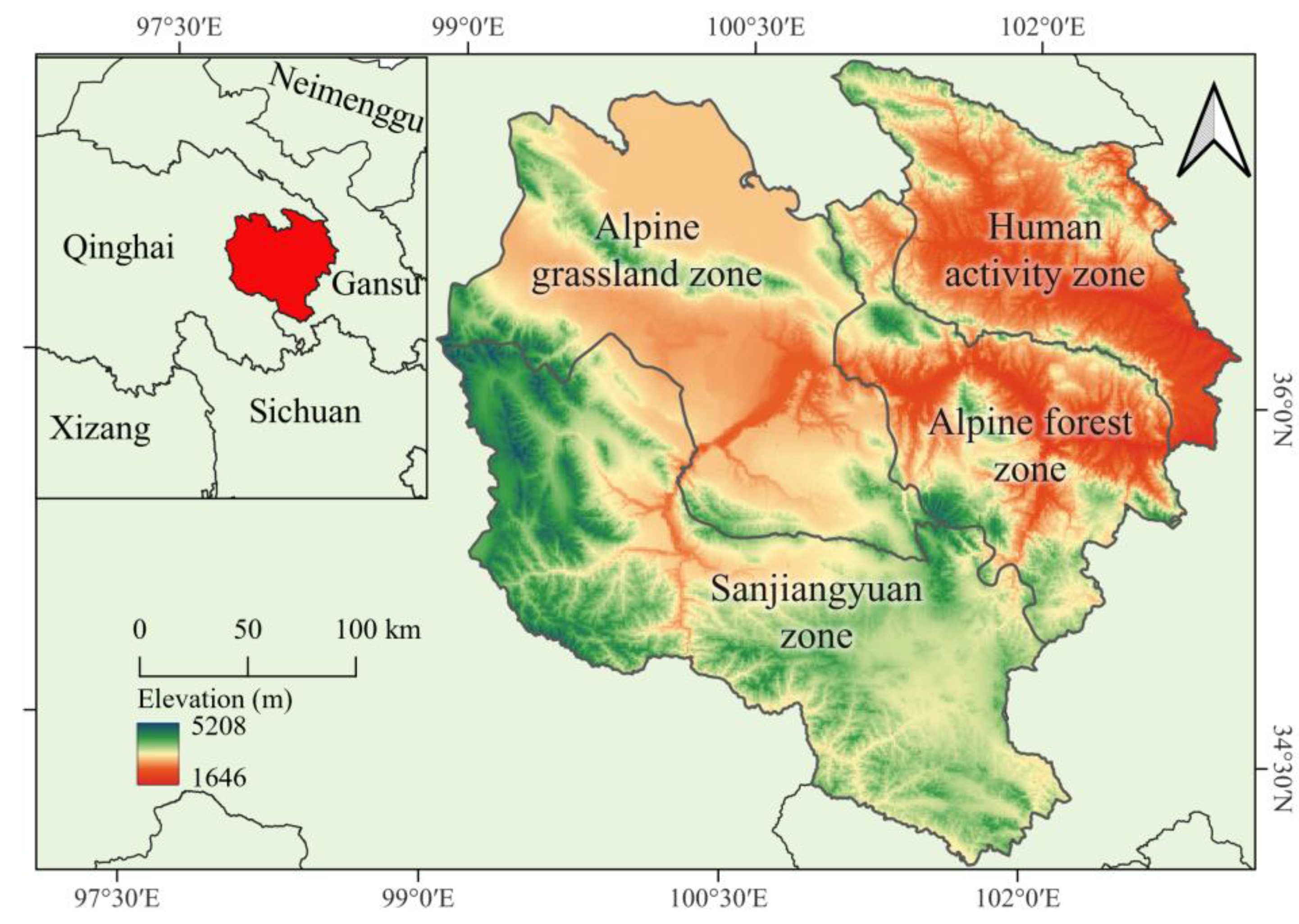
The ecotone spanning from the Qinghai–Tibetan Plateau to the Loess Plateau (34°4′–37°24′17″N, 98°55′54″–103°4′16″E) marks a shift from the high-altitude alpine areas of the Qinghai–Tibetan Plateau to the semi-arid regions of the Loess Plateau (Figure 1). It is also a significant region for ecological functions of water conservation and in China, covering an area of 84,014 km2 [32]. The elevation ranges from 1646 to 5208 m, with a predominantly mountainous landscape. The western and southern regions are located at higher elevations, whereas the northern region is characterized by more complex and heterogeneous terrain. The climate in the Qinghai–Tibetan Plateau section is characterized by a plateau continental climate, whereas the Loess Plateau section has a semi-arid continental climate. The region experiences long periods of sunlight and intense solar radiation. Its average annual rainfall is approximately 400 mm, and the evaporation rate is 1400 mm. The substantial vertical elevation changes lead to diverse climatic conditions. There are large daily temperature fluctuations, with relatively minor differences between the winter and summer. The average annual temperature is below 10 °C, and ground temperatures drop to below 0 °C from October to April, leading to seasonal permafrost. Qinghai Lake is the largest lake in China, covering an area of 4604 km2. Grassland dominates the vegetation, covering approximately 70% of the total area, while forest accounts for approximately 10% of the total area. The ecological environment is highly vulnerable and sensitive, with poor ability to recover from external disturbances [33,34].

2.2. Data Sources and Processing

2.2.1. Remote Sensing Data

In this research, we utilized a variety of remote sensing data, including land surface temperature (LST), downward surface radiation, vegetation indices, and active microwave and passive microwave measurements.
LST data were obtained from the Sea and Land Surface Temperature Radiometer (SLSTR) aboard the Sentinel-3 satellite (developed by Airbus Defence and Space, Toulouse, France), with a daily temporal resolution, accessed via the Copernicus Open Access Hub. The downward surface radiation data were sourced from the global dataset of the geostationary Himawari-8 satellite, which is also updated daily. The data used in this study correspond to 19–31 August 2020, synchronizing with the field sampling period.
The Normalized Difference Vegetation Index (NDVI) and Leaf Area Index (LAI) were obtained using the MOD13A1 and MOD15A2 products of the MODIS sensor (developed by the National Aeronautics and Space Administration, NASA, Washington, DC, USA), respectively. These products provide 8-day or 16-day composite data at a 500 m resolution. The vegetation data used correspond to the closest composite periods to the field sampling dates, ensuring temporal alignment.
The active microwave backscatter data were obtained from Sentinel-1A Level-1 GRD imagery (https://search.asf.alaska.edu/), with a 12-day revisit cycle and a spatial resolution of 10 m, including both VV and VH polarization modes. Considering that the cross-polarized (VH) backscatter is much weaker and more susceptible to vegetation effects, VV polarization was selected because it can better penetrate vegetation canopies and provide richer information about soil backscattering characteristics. From May to September 2020, a total of 96 Sentinel-1A images were used. All images underwent orbit correction, radiometric calibration, speckle filtering, multi-look processing, and terrain correction to minimize system errors and speckle noise caused by satellite motion and surface relief. The image acquired on 19 August 2020 was used for algorithm validation through comparison with in situ soil moisture measurements.
The passive microwave brightness temperature data were obtained from the SMAP Level-1C product (https://nsidc.org/data/smap/smap-data.html (accessed on 12 December 2021)), with a spatial resolution of 9 km and a temporal resolution of 1–3 days, including both H-polarized and V-polarized channels. A total of 12 SMAP scenes acquired between May and September 2020 were used for regional-scale soil moisture retrieval, while the 19 August 2020 dataset was specifically used for algorithm validation.
To ensure spatial consistency among datasets, Sentinel-1 backscatter was resampled to a 1 km grid, while SMAP Level-1C brightness temperature was resampled from its native 9 km posting resolution to a 5 km grid for subsequent fusion.

2.2.2. Auxiliary Data Sources

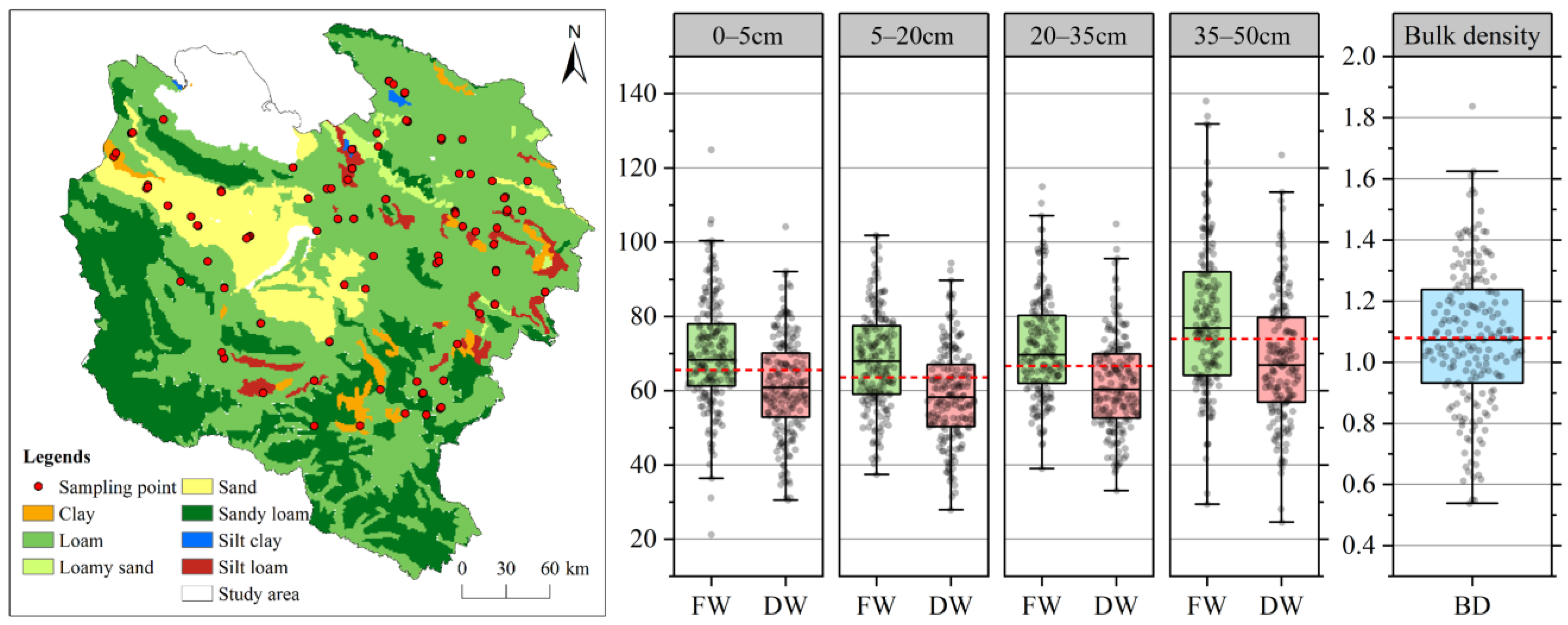
This research used meteorological data, including air temperature, wind speed, and relative humidity, all obtained from the China Meteorological Data Service Center. To generate continuous spatial datasets across the study area, the ANUSPLIN interpolation technique was applied. All meteorological data, together with land surface temperature (LST) and downward radiation, were synchronized to 3:00 GMT. Land use information was downloaded from the Resource and Environment Science and Data Center. These data provide the distribution of different land cover types within the study area and were used to support the modeling of soil moisture and energy balance. Soil type information was derived from the Harmonized World Soil Database (HWSD) version 1.1, provided by the Cold and Arid Regions Sciences Data Sharing and Operation Center. This database was used to extract the proportions of various soil types in the study area, including sand, clay, and silt (Figure 2). The main input variables and their corresponding data sources used in this study are summarized in Table 1.
Field measurements of soil volumetric water content were conducted from 19 to 31 August 2020, using a systematic sampling approach based on designated plot points. To minimize potential errors caused by asynchronous sampling across the study area, the sampling was conducted in batches over multiple days, taking into account weather and environmental conditions to avoid rainfall or extreme events. A total of 63 distinct 1 km ×1 km plots were established across the study area (Figure 2), designed to encompass all representative soil types to the greatest extent possible (Table 2).
Sampling sites were evenly distributed across the QPtoLP ecotone and selected to represent the major ecological zones and elevation gradients. All accessible altitude ranges were surveyed, with only extremely high mountain ridges excluded due to physical inaccessibility. Within each 1 km × 1 km plot, in situ soil samples were collected at four depth layers (0–5 cm, 5–20 cm, 20–35 cm, and 35–50 cm) using the ring-knife method. At intervals of approximately 200–300 m within each plot, four to five sampling points were selected, resulting in a spatially averaged representation of soil moisture for that 1 km × 1 km grid cell. The samples were then transported to the laboratory and oven-dried at 105 °C for 10 h, and the fresh weight, dry weight, and bulk density of each sample were measured (Figure 2). This method allows the determination of soil moisture content by mass, which is then converted to volumetric water content.

2.3. Methodology

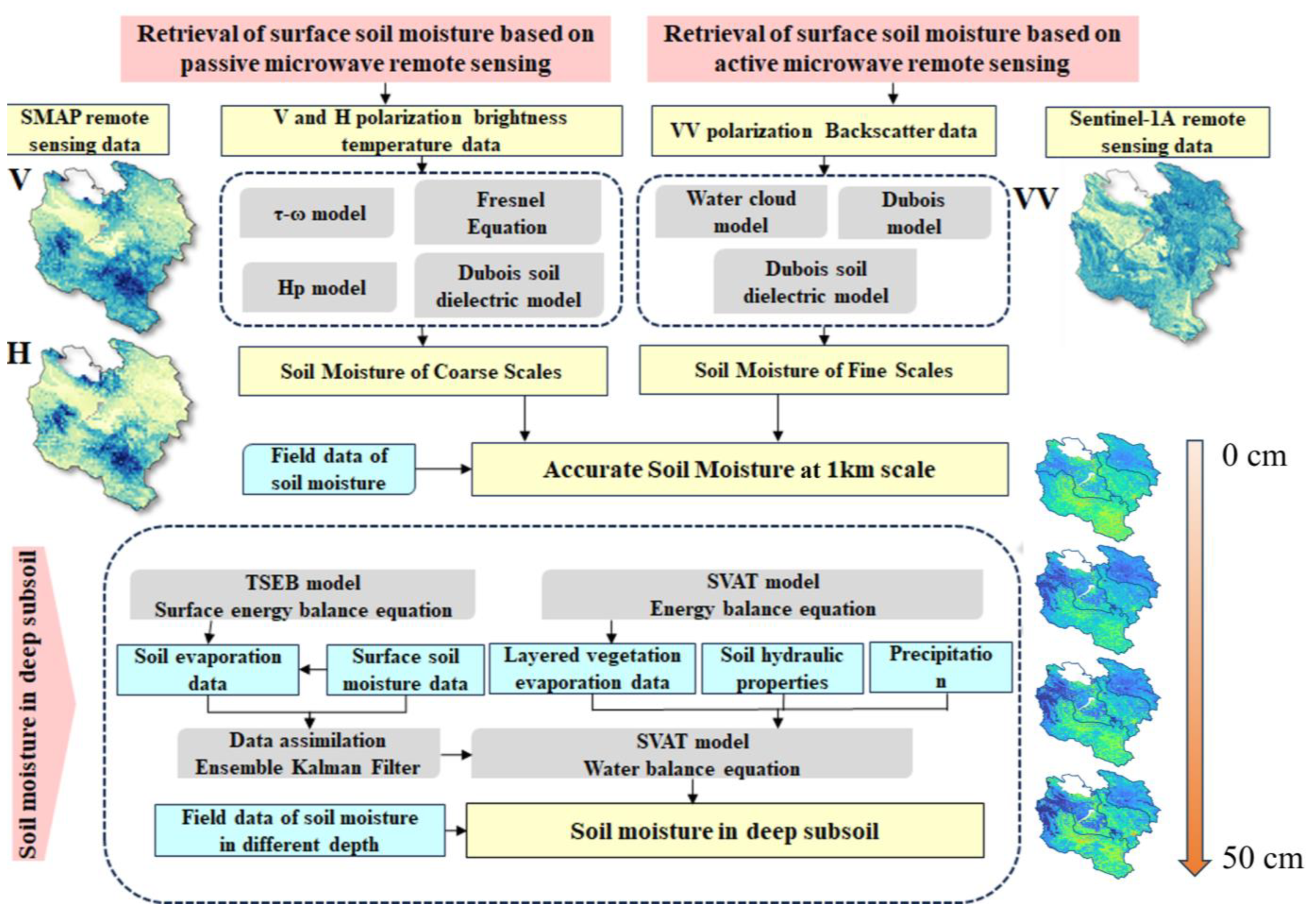
To enhance the precision of soil moisture estimation at various depths within the root zone, this study initially employed data fusion technology. This method combined V,H dual-polarization passive microwave data with a 5 km resolution and VV single-polarization active microwave data with a 1 km resolution, to obtain the more accurate soil moisture estimations at a finer scale. During the fusion and subsequent modeling processes, all relevant variables were harmonized and resampled to a common spatial resolution of 1 km, which served as the target grid for analysis. Next, a surface energy balance process was constructed to estimate the surface evaporation using the TSEB model. Subsequently, ensemble Kalman filtering was utilized to assimilate the estimated surface evaporation and the surface soil moisture into the SVAT model. This assimilation facilitated the creation of a retrieval model for soil moisture at different depths, which was then validated for accuracy. Ultimately, the soil moisture in various depth layers of the root zone in the ecological transition area was estimated during the vegetation growth period (Figure 3). All data processing and modeling procedures were implemented in QGIS 3.16 and Python 3.9.

2.3.1. Estimating Evaporation with TSEB Model

High-resolution surface evaporation measurements were derived through the TSEB model [35,36]. The TSEB model calculates the energy balance equations by separately analyzing the canopy ( C ) and soil ( S ), distributing net radiation into sensible heat flux ( H ), latent heat flux ( L E ), and soil heat flux ( G ).
R N , C = H C + L E C
R N , S = H S + L E S + G
R N , S and R N , C are the net radiation components of soil and vegetation, respectively. The total flux at the surface is obtained by adding the components of the canopy and soil layers:
R N = R N , C + R N , S
H = H C + H S
L E = L E C + L E S
R N , S and R N , C are calculated using the radiative transfer model with the downward shortwave ( S ) and longwave ( L ) radiation:
R N , C = 1 τ l o n g w a v e L + ε S σ T S 4 2 ε C σ T S 4 + 1 τ s o l a r 1 a l c S
R N , S = τ l o n g w a v e L + 1 τ l o n g w a v e ε c σ T C 4 ε S σ T S 4 + τ l o n g w a v e 1 a l S S
G = α g × R N , S
where ε is the emissivity; al is the albedo; T refers to air temperature; σ refers to the Stefan–Boltzmann constant; τ represents canopy transmittance; and α g   refers to the thermal conductivity coefficient from the surface to the deep soil.
H C = ρ C P T C T A R A
H S = ρ C P T S T A R A + R A , S
where ρ refers to air density; C P represents the specific air heat capacity; R A is aerodynamic resistance above the canopy; and R A , S refers to aerodynamic resistance inside the canopy towards soil.
L E S = ρ C P γ 1 e S T S e a R A , S + R A + R S
L E C = ρ C P γ 1 e S T C e a R A + R C
where e S represents saturated vapor pressure; e a refers to actual vapor pressure; γ refers to the saturated vapor pressure curve slope with respect to temperature; and R S and R C are the soil resistance and canopy resistance, respectively.

2.3.2. Estimating Surface Soil Moisture Using Data Fusion of Sentinel-1 and SMAP Data

Surface Soil Moisture Retrieval from Active and Passive Microwave Data
In this study, surface soil moisture was retrieved using an integrated active–passive microwave inversion framework. For the passive component, SMAP Level-1C brightness temperature data (H and V polarizations) were used as input. Vegetation attenuation was corrected using the τ–ω radiative transfer model, and the vegetation-corrected brightness temperature was converted into surface reflectivity [37]. Surface roughness effects were then adjusted with the Hp model [38], and the resulting smooth-surface reflectivity was related to the real part of the soil dielectric constant through Fresnel equations [39]. Finally, the Dobson dielectric-mixing model was applied to convert the dielectric constant into volumetric soil moisture [40].
For the active component, surface soil moisture was derived from Sentinel-1 VV-polarized backscatter. Vegetation effects on the radar signal were first removed using the water cloud model, which separates canopy and soil contributions and yields vegetation-corrected bare-soil backscatter [41]. The bare-soil backscatter was then inverted using the semi-empirical Dubois model to estimate the soil dielectric constant [42], which was subsequently converted into volumetric soil moisture using the Dobson mixing model, producing 1 km resolution surface soil moisture fields. The detailed computation steps are described in Wang et al. [43].
Overall, the combined use of passive and active microwave data provides surface soil moisture estimates that are both physically consistent and spatially detailed. These products serve as essential boundary conditions for the subsequent fusion procedures and multi-depth data assimilation in this study.
Soil Moisture Fusion Algorithm
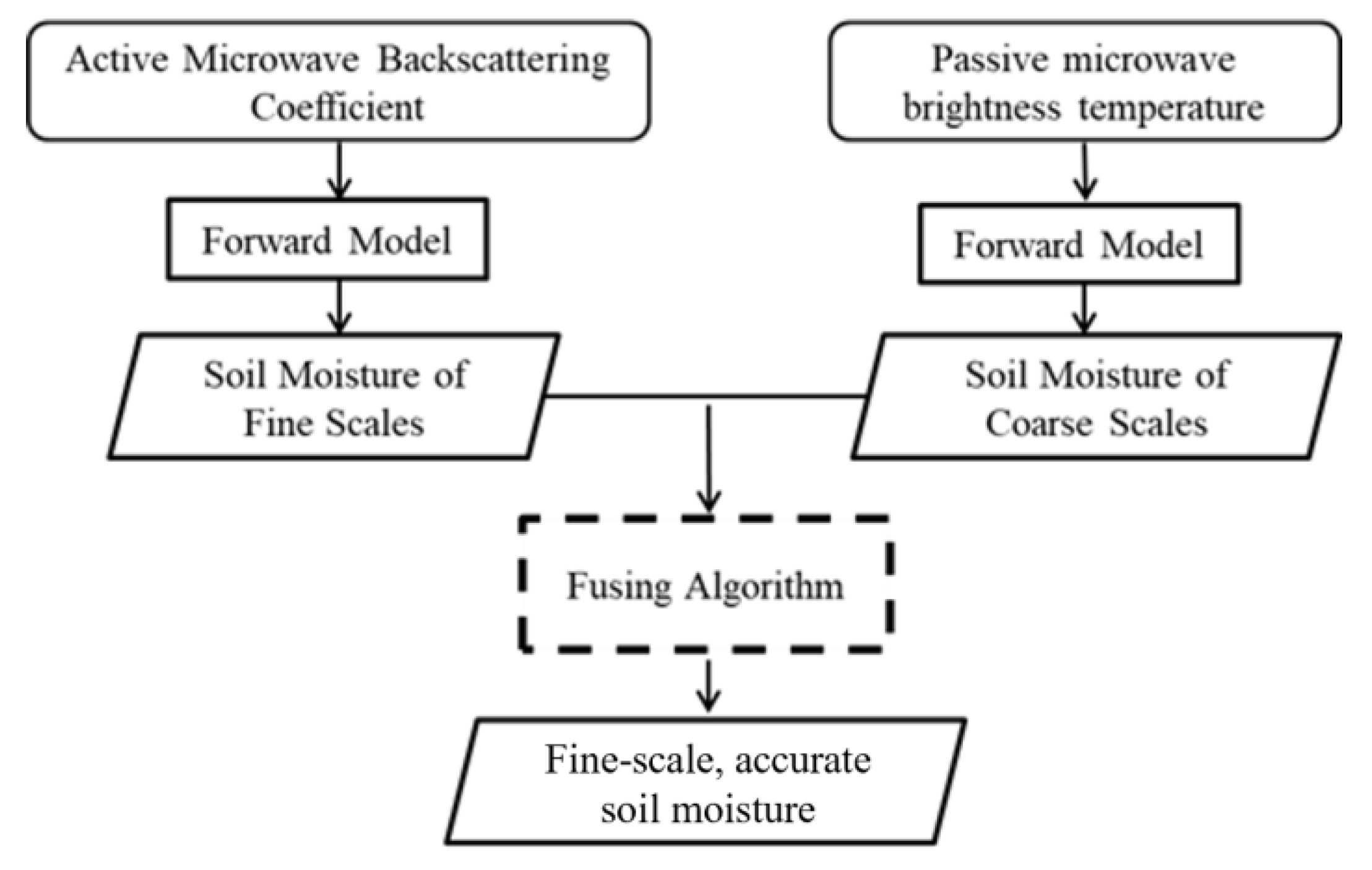
Fine-scale soil moisture retrieved from Sentinel-1 was fused with SMAP-derived passive microwave soil moisture to integrate the complementary strengths of both sensors (Figure 4). Sentinel-1 provides high spatial detail, whereas SMAP contributes radiometric stability and large-scale consistency. The fusion process maintained the spatial resolution of the active data while adjusting its bias toward the passive baseline [43].
First of all, the grid size of passive microwave soil moisture was defined as A scale (5 km), and later, the grid size of active microwave soil moisture was defined as a scale (1 km).
The conversion algorithm for the A scale and a scale of active microwave soil moisture is
S m ( σ ,     A ) = S m ( σ ,   a ) = 1 A S m ( σ ,   a ) d a
In the formula, S m ( σ ,   A ) represents the active microwave soil moisture at the A scale; 〈〉 represents the mean; and   S m ( σ ,   a ) refers to the active microwave soil moisture at the a scale.
Then, the absolute difference between the active microwave soil moisture at the a scale and its soil moisture within the corresponding A scale was calculated. The expression is as follows:
S m ( σ ,       a ) = S m ( σ ,   a ) S m ( σ ,   A )
Next, the relative difference between the active microwave soil moisture at the a scale and that at the A scale, represented by the slope, was calculated. The expression is as follows:
β ( σ ,   a ) = S m ( σ ,   a ) S m ( σ ,   A )
This study assumed that there are the same spatial differences at the scale of a 1 km pixel in the active microwave soil moisture and the passive microwave soil moisture. The spatial difference slope of the active microwave soil moisture was applied to the passive microwave soil moisture for the purpose of fusing the two types of soil moisture. The expression is as follows:
S m = S m ( T B ,   A ) + β ( σ ,   a ) · S m ( T B ,   A )
In the formula,   S m represents the soil moisture at the a scale after fusion, and S m ( T B ,   A ) indicates the passive microwave soil moisture at the A scale.
A prior Sobol’ global sensitivity assessment demonstrated that passive microwave retrievals are primarily controlled by brightness temperature (~67%), while active retrievals are dominated by surface roughness and backscatter coefficients (>40% each). Other parameters contributed minimally. These validated sensitivity results support the parameter choices and model stability used in this study [43].

2.3.3. Estimation Method of Deep Soil Moisture Based on Root Water Absorption Model and WEB-SVAT Model

WEB-SVAT is a model explored to simulate the soil–vegetation–atmosphere water transport process, including energy balance and water balance equations. The deep soil moisture in the root zone is estimated based on Darcy’s law of unsaturated water flow [44], and the balance equations for surface and root-zone soil water changes are as follows:
d θ s z d t = 1 d s z [ P g L E s ρ a μ 1 q 1 2 ]
d θ r z , n d t = 1 d n [ q n 1 n L E c , n ρ a μ 1 q n n + 1 ]
q n n + 1 = K θ , n Φ m , n Φ m , n + 1 0.5 d n + d n + 1 + K θ , n
In the equations, θ s z signifies the surface soil moisture, d s z represents the depth of this surface soil layer, P g indicates precipitation, L E S refers to the latent heat flux of the soil, ρ a stands for the air’s mass per unit volume, μ represents the energy required for water evaporation, q n n + 1 symbolizes the movement of water from one soil layer (n) to the next (n + 1), θ r z , n measures the moisture in the nth soil layer, d n expresses the thickness of the nth soil layer, L E c , n represents the latent heat associated with plant cover in the nth soil layer, K θ is the rate of water flow through soil with a specific moisture, and Φ m refers to the flux due to the matrix potential. Here, n denotes the discretized root-zone soil layers (0–5, 5–20, 20–35, and 35–50 cm).
In the WEB-SVAT model, the stomatal resistance formulation is used to parameterize vegetation transpiration, which associates the effectiveness of soil moisture in the root zone with canopy conductance based on atmospheric demand. The depth and density of the root system determine the efficiency of vegetation in extracting deep soil water, which plays an important role in estimating deep vegetation evaporation. Therefore, in order to more accurately describe the movement of soil moisture, the exponential root water uptake module was used to simulate the change in the vertical vegetation root system, so as to estimate the evaporation of root-zone vegetation [45].
L E C = i = 1 n L E C , i
L E C , i = α i 2 F i λ i = 1 n α i F i λ L E C , m a x
L E C , m a x = ρ C P γ 1 e S T C e a R A + R C , m i n
where α is the effective soil moisture, F is the root length density fraction, λ controls the distribution of moisture absorption, and L E C , m a x is the maximum transpiration of the canopy.
F i = ln 1 + exp b Z i 1 + exp b Z i + 1 + 0.5 [ exp b Z i exp b Z i + 1 ] ln 2 1 + exp b Z r + 0.5 [ 1 exp b Z r ]
where Z i refers to the depth of soil layer i, Z r   signifies the root depth, and b is the empirical coefficient for root distribution.
In WEB-SVAT, the calculation of soil evaporation aligns with the TSEB. By assimilating the surface evaporation from the TSEB into SVAT, the instantaneous evapotranspiration is then extrapolated over a 24 h period using an integration technique to derive the daily evapotranspiration [46].
λ E d a y L e = 2 N E π sin π t N E
where L e refers to the immediate latent heat flux, λ is the latent heat coefficient for evapotranspiration, N E represents the daily duration of evaporation, and t indicates the time span from sunrise until the satellite captures the remote sensing data.

2.3.4. Data Assimilation Method

This research utilized the ensemble Kalman filter (EnKF) technique to integrate surface soil moisture and soil evaporation data [47]. The observations were derived from the TSEB model for soil evaporation and the downscaled soil moisture from SMAP. The SVAT model’s evaporation data is refreshed daily, while surface soil moisture is integrated every 12 days.
The EnKF process consists of two primary stages. The initial stage involves forecasting. By applying the model transition function F(·), the state variable X t 1 at time t − 1 is advanced to the subsequent time step t, generating a prior state. In this work, the WEB-SVAT model was employed with surface soil moisture and surface evaporation values at time t − 1 to predict the prior surface soil moisture and evaporation at time t. This prediction is computed using the following formula:
x t = F ( x t 1 , μ t , ξ )   +   ω t ,   ω t ~ N ( 0 , Q t )
where x t 1 refers to the state at previous time t − 1; x t denotes the current state; μ t stands for the atmospheric influence factor; ξ indicates the nonlinear coefficient; and ω t is the discrepancy in the model’s forecast, which follows a Gaussian distribution with zero mean and covariance matrix Q t .
The subsequent stage involves the update process, which links the state variables with observed data to derive the updated state estimates.
y t = H ( x t , ξ ) + v t ,   v t ~ N ( 0 , R t )
x t + = x t + K t [ y t + v t H ( x t ) ]
K t = p t H T ( H p t H T + R t ) 1
where the observed variable at time t is represented as   y t ; H(·) denotes the nonlinear function that links the state variables with the observed ones;   v t   represents the model’s error term; x t + stands for the state variable after it has been updated at time t; K t refers to the Kalman gain; p t represents the covariance of the prior model state variable error; and  R t refers to the covariance of the observed variable error.

2.3.5. Methodology for Stability Analysis of Soil Moisture Changes

The variability in soil moisture was quantified using standard deviation, which helps assess the consistency of soil moisture levels at the grid scale over time [46]. This revealed the changing characteristics during the vegetation growth stage, as expressed in the following equation:
S t d = i = 1 t S m i S m ¯ 2 t 1
In the equation, Std is the standard deviation; S m i   refers to the soil moisture data for the ith period; S m ¯   represents the mean soil moisture during the vegetation growth season in 2020; and t represents time.

3. Results

3.1. Accuracy Verification for Simulated Soil Moisture in Root Zone Across Various Depths

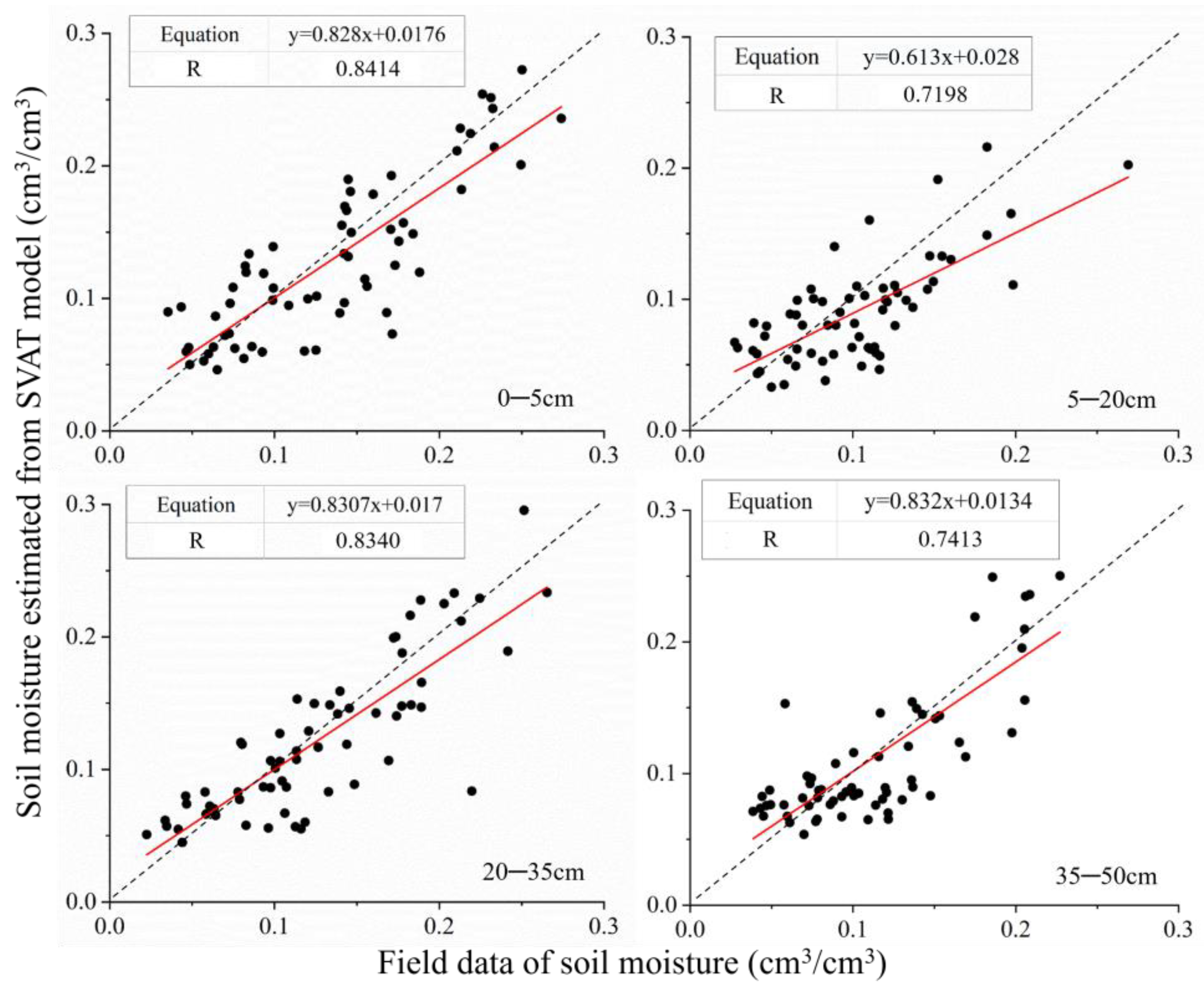
Figure 5 presents the validation results for soil moisture at all four depth layers. The scatter plots compare field-measured volumetric soil moisture with model-simulated values at 0–5 cm, 5–20 cm, 20–35 cm, and 35–50 cm. The correlation coefficients (R) between observed and predicted soil moisture range from 0.720 to 0.8414 across the four depths, indicating strong consistency between the inverted soil moisture and the in situ measurements. Among them, the highest correlation was found in the soil surface layer of 0–5 cm, reaching 0.8414, while the lowest correlation was at a depth of 5–20 cm, with a coefficient of 0.720. The root mean square errors (RMSEs) for soil moisture predictions at different depths are all relatively low, with the smallest RMSE of 0.034 at a depth of 20–35 cm and the largest of 0.038 at a depth of 35–50 cm. Both 0–5 cm and 5–20 cm depths showed the same RMSE of 0.035. This suggests that the predicted values of soil moisture are close to the field-measured values with a high level of accuracy. However, the model tends to slightly underestimate soil moisture at various depths, particularly in the 5–20 cm layer, where the slope of the scatter plot is only 0.613. As the actual soil moisture increases, this underestimation becomes more pronounced.

3.2. Dynamics of Soil Moisture in the Root Zone Across Various Depths

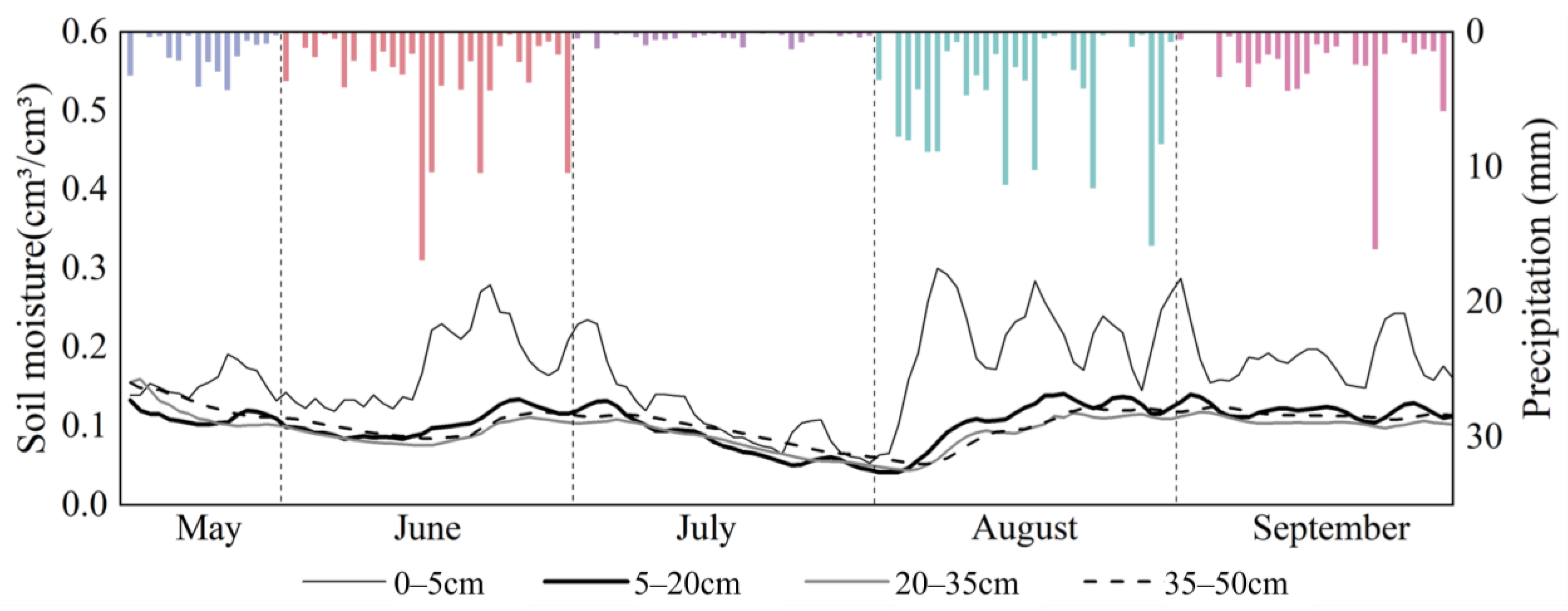
This research assesses the soil moisture level at various depths, including 0–5 cm, 5–20 cm, 20–35 cm, 35–50 cm, in the ecotone from the Qinghai-Tibet Plateau to the Loess Plateau during the growing season from 16 May to 29 September 2020 (Figure 6). The top 0–5 cm layer was highly responsive to precipitation, exhibiting pronounced fluctuations. Between mid-May and mid-June, the daily rainfall was below 5 mm, and the soil moisture in this layer fluctuated around 0.15 cm3/cm3. By late June, four significant rain events exceeding 10 mm slightly increased the soil moisture, peaking at 0.28 cm3/cm3, which settled back to 0.15 cm3/cm3 by early July. Throughout July, with less than 1 mm of daily rainfall most of the time and ongoing plant transpiration, the soil moisture in the 0–5 cm layer exhibited a continuous declining trend, reaching a low of 0.05 cm3/cm3 by the end of the month. In August, there was frequent and substantial rainfall which continued into September, replenishing the soil moisture, which peaked at 0.3 cm3/cm3 on 7 August and then fluctuated around 0.2 cm3/cm3 until the end of September. The deeper soil layers followed a similar trend but with more gradual variations. From mid-May to mid-June, the deep soil moisture decreased from 0.15 cm3/cm3 to around 0.08 cm3/cm3, primarily due to root-zone water uptake, and further declined to 0.04 cm3/cm3 in July. Starting in August, the deep soil moisture gradually recovered, stabilizing around 0.11 cm3/cm3 by mid-August and remaining steady until the end of September.
A comparative analysis of soil moisture at a depth of 0–50 cm revealed that the 0–5 cm soil layer had a higher moisture level compared to deeper layers for the majority of the growing season. However, from mid-May to mid-June, during the initial phase of the plant growth season, the 35–50 cm soil layer exhibited the highest moisture content. This could be attributed to the predominant vegetation in the area being grassland, with roots mainly concentrated in the 0–35 cm layer, leading to greater utilization of surface soil moisture. In late June and throughout July and August, the 5–20 cm soil layer showed the highest moisture levels among the deeper layers. This is likely due to the fact that rainfall was more effective in replenishing the upper 20 cm of soil, resulting in a more significant increase in the upper-layer soil moisture. In July, the 35–50 cm layer had the highest soil moisture, while the 5–20 cm layer had the lowest. This pattern can be explained by the drought conditions, where deep soil moisture remained relatively stable, while surface soil experienced intense evaporation, leading to lower soil moisture content.

3.3. Spatial Variation in Soil Moisture at Various Depths Within the Root Zone

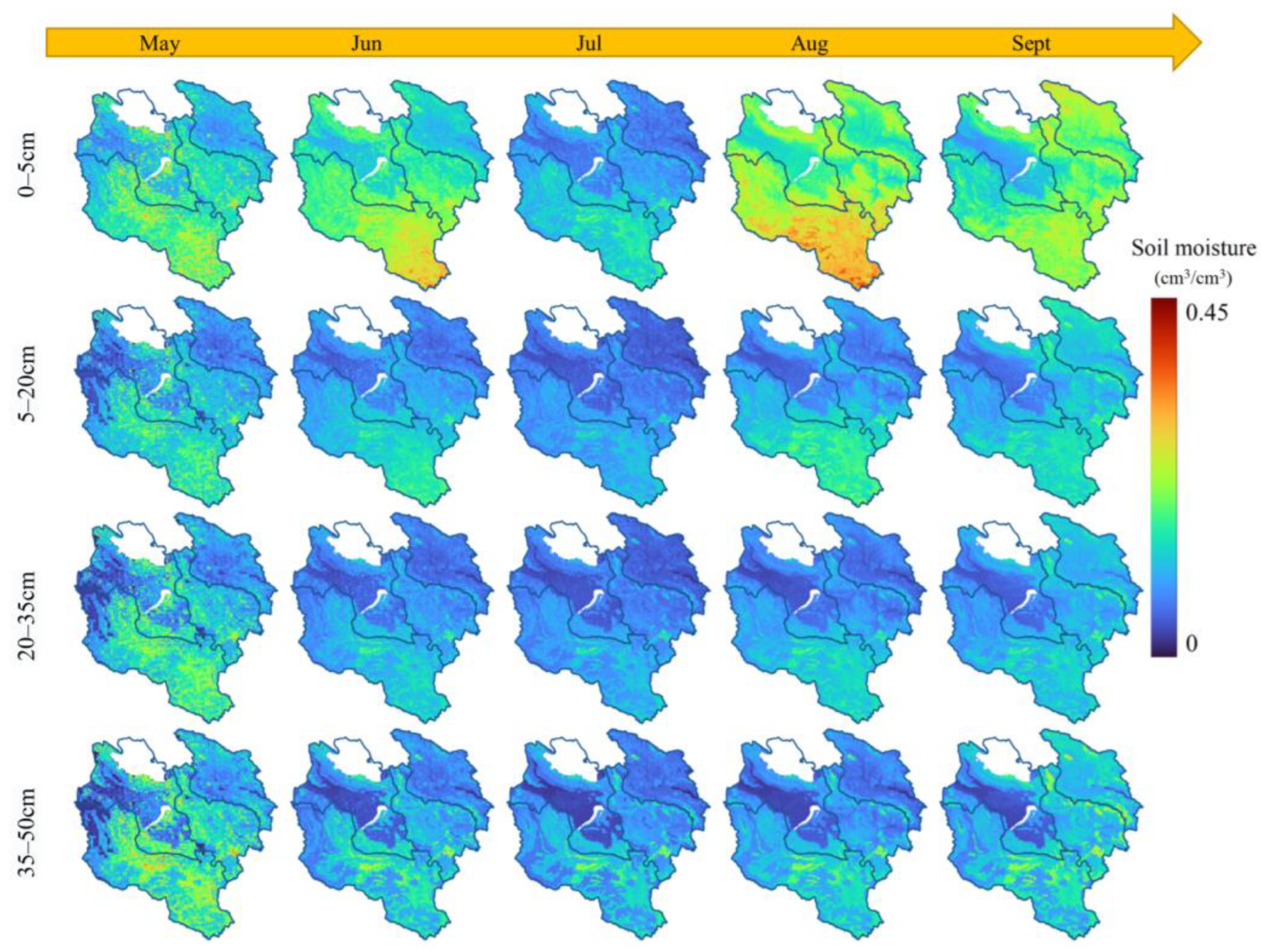
This investigation also calculated the monthly mean soil moisture at the grid level by averaging the daily data from 16 May to 29 September 2020 (Figure 7). The findings pointed out that the spatial distribution of soil moisture at various depths generally aligns, showing a trend of higher moisture levels in the southern part and lower levels in the northern part. This pattern may be attributed to the elevated terrain (3500–4000 m) in the south, which results in cooler temperatures, reduced evaporation, and relatively greater precipitation.
In the 0–5 cm layer, during May, the soil moisture levels in regions with significant human activity and alpine grasslands were notably low, measuring 0.11 cm3/cm3 and 0.14 cm3/cm3, respectively. The Sanjiangyuan Reserve recorded the highest soil moisture at 0.18 cm3/cm3. By June, the overall soil moisture had increased, with the most substantial rise in the Sanjiangyuan Reserve, where it rose by 0.02 cm3/cm3. In the southern part of the Sanjiangyuan area, the soil moisture surpassed 0.3 cm3/cm3, marking the highest level. In July, there was a marked decrease in soil moisture. In the northern areas with low values, the soil moisture content dropped below 0.05 cm3/cm3, and even in the southern areas, which generally had higher soil moisture, it fell below 0.15 cm3/cm3. The subalpine forest region maintained soil moisture of around 0.11 cm3/cm3. In August, the soil moisture saw a significant rebound, with the Sanjiangyuan Reserve experiencing the largest increase. The two low-value areas of soil moisture with significant human activity and alpine grassland were around 0.17 cm3/cm3, while the Sanjiangyuan Reserve averaged 0.25 cm3/cm3. The southern part of study area had the highest soil moisture, exceeding 0.35 cm3/cm3. In September, the soil moisture distribution in the areas of intense human activity, subalpine forest, and the Sanjiangyuan Reserve was relatively consistent, averaging around 0.2 cm3/cm3. The alpine grassland area, however, had a lower soil moisture content of 0.15 cm3/cm3.
In the elevated region of the west, the soil moisture at 5–50 cm depths was significantly lower than in other areas in May. For the 5–20 cm layer, the area with the highest soil moisture content in May was still the Sanjiangyuan Reserve, followed by the subalpine forest and shrub area. In June, the overall soil moisture was slightly lower than in May, with a decrease of about 0.01 cm3/cm3. The area with the highest soil moisture content was the southern region of the Sanjiangyuan Reserve. In July, the soil moisture dropped significantly, with a decrease of more than 0.025 cm3/cm3. The areas with the lowest soil moisture content were areas with intense human activity and some regions of alpine grassland. The soil moisture content in other areas was relatively uniform. In August, the overall soil moisture in the study area increased, with the most substantial rise at around 0.18 cm3/cm3, in the southern Sanjiangyuan Reserve. By September, the Sanjiangyuan Reserve experienced a marked decrease in soil moisture, while the other three regions saw varying degrees of increases. The temporal pattern of soil moisture distribution in the 20–50 cm layer mirrored that of the 5–20 cm layer.
In general, the top 0–5 cm soil layer soil exhibits a markedly higher moisture content compared to the deeper layers, with only minor variations observed among the deeper layers. During May and July, the disparity in soil moisture across different depths is minimal, with a difference of approximately 0.01 cm3/cm3 between each layer. In August, the contrast in soil moisture between the 0–5 cm layer and the 5–50 cm subsurface layer reached its peak. The average soil moisture in the 0–5 cm layer exceeds that of deeper layers by more than 0.1 cm3/cm3. This indicates that as soil depth increases, the influence of soil type on soil moisture content becomes more pronounced. The spatial distribution of soil moisture in the 35–50 cm layer closely aligns with soil type. The majority of the alpine grassland area is characterized by sandy soil, whereas sandy loam is predominant in the southwestern part of the Sanjiangyuan Reserve. These areas are sharply delineated from their surroundings. Both soil types tend to have lower soil moisture content levels due to their larger particle sizes and poor water retention.

3.4. Stability Analysis of Soil Moisture Changes

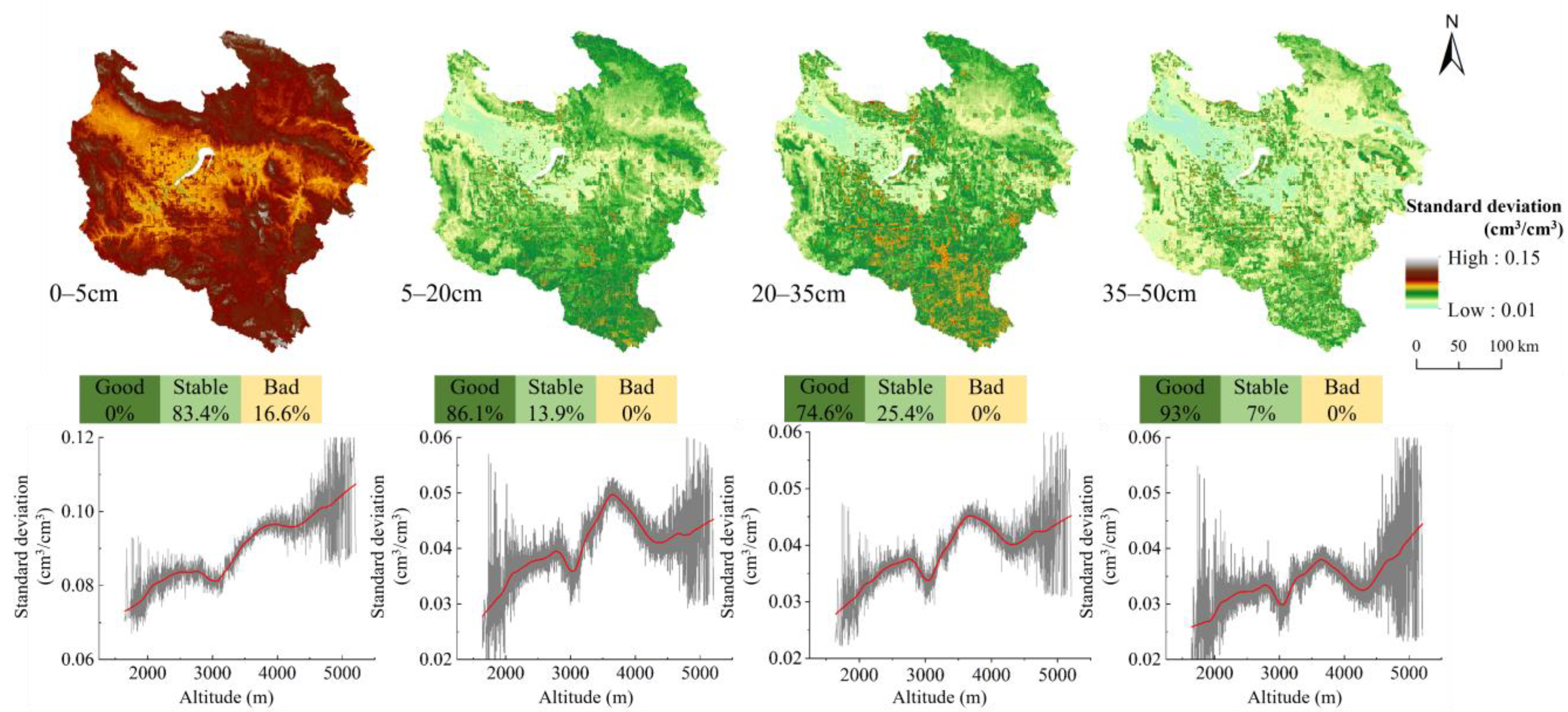
This research emphasized the evaluation of soil moisture stability by calculating the standard deviation of grid-level soil moisture values from 16 May to 29 September 2020 and categorized the results into three tiers, i.e., optimal (<0.05 cm3/cm3), steady (0.05–0.10 cm3/cm3), and poor (>0.10 cm3/cm3) (Figure 8). In Figure 8, the red line represents the mean value of soil moisture standard deviation aggregated by altitude classes, while the gray shaded area indicates the corresponding confidence interval. The findings revealed that the soil moisture in the study area was predominantly kept at a steady or higher level. Surface soil moisture levels tend to be more closely tied to the upper boundary conditions, resulting in more pronounced fluctuation and thus lower stability compared to deeper soil layers. In contrast, deep soil moisture exhibits less sensitivity and maintains a consistently steady or higher level of stability. As shown in Figure 8, the regions with the highest stability for root-zone soil moisture are primarily located in the northwestern part. This area is characterized by sandy soil, which has limited water retention capacity, facilitating rapid infiltration of rainfall. The sparse grassland vegetation in this region has a minimal impact on the absorption, retention, and movement of soil moisture. Consequently, the soil moisture in this area remains relatively low over extended periods, leading to minimal variations.

3.5. Analysis of Differences in Root-Zone Soil Moisture Across Various Soil Types

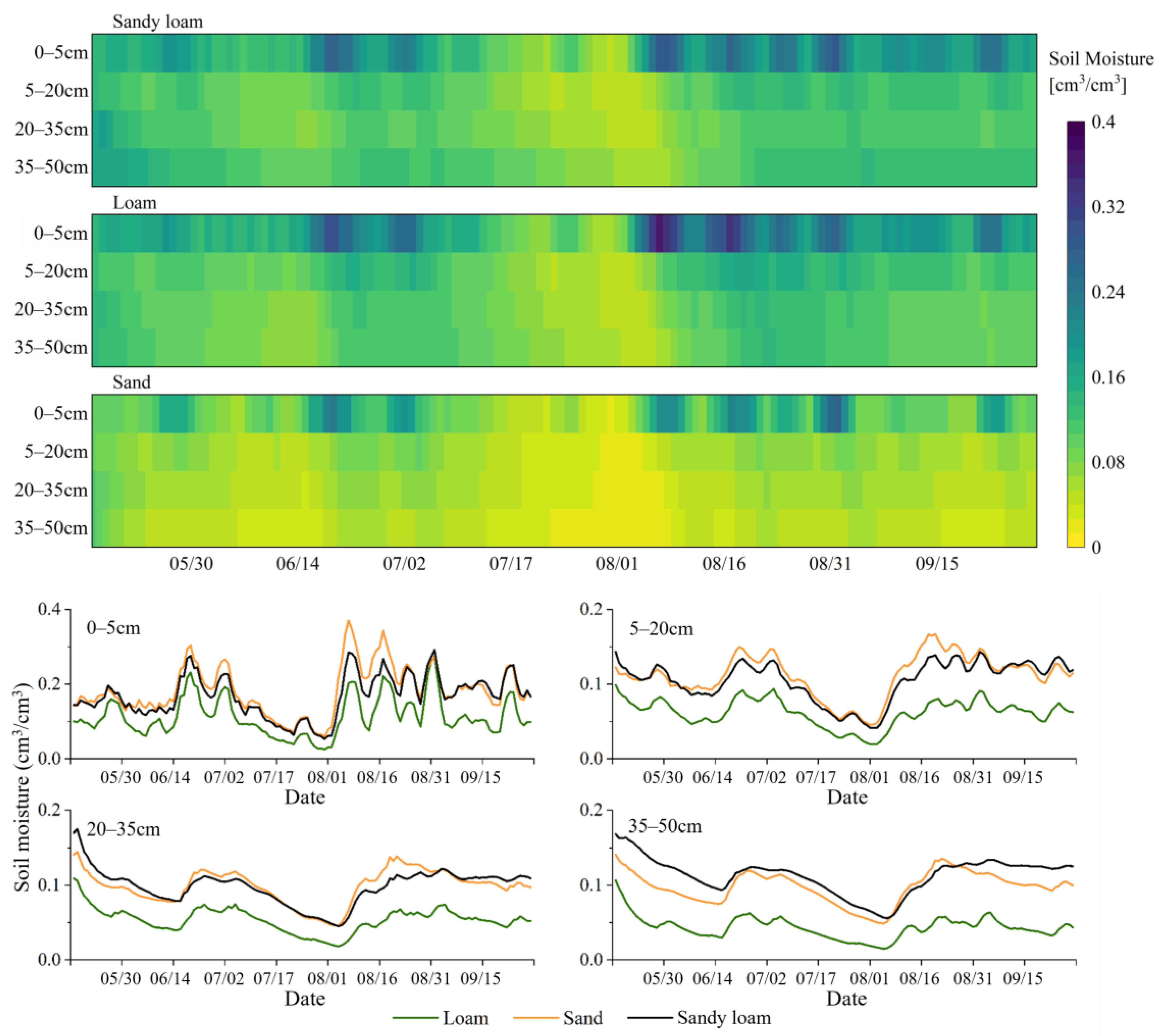
The soils of the study area were categorized into seven types according to their texture: clay, loam, sandy loam, sand, sandy clay loam, silty clay, and silty loam. Notably, loam, sand, and sandy loam accounted for 93% of the total area. The variations in the soil moisture content for these three dominant soil types are depicted in Figure 9.
During the growing season, the 0–5 cm layer consistently showed the highest soil moisture in sandy loam, followed closely by loam. From mid-May to mid-June, sandy loam and loam exhibited similar moisture values, both approximately 0.05 cm3/cm3 higher than that of sand. By late June, the soil moisture content increased but then decreased throughout July. At this point, the soil moisture content in sandy loam and loam was nearly identical, about 0.03 cm3/cm3 more than in sand. In early August, there was a significant increase in soil moisture, with sandy loam experiencing the greatest increase, peaking at 0.37 cm3/cm3, while sandy loam and sand reached 0.28 cm3/cm3 and 0.2 cm3/cm3, respectively. The differences between the three soil types were particularly pronounced in August. By early September, the maximum soil moisture levels in loam and sand were around 0.28 cm3/cm3, and the soil moisture content in all three soil types became quite similar. Afterwards, the soil moisture in loam and sandy loam fluctuated around 0.18 cm3/cm3, whereas the soil moisture in sand dropped significantly, hovering around 0.1 cm3/cm3.
In late May, the highest soil moisture levels within the 5–20 cm layer were observed in loam. From June to August, sandy loam had the highest soil moisture content. There was a slight rise in soil moisture by the end of June, followed by a significant drop in July, with the largest pronounced change seen in sandy loam. By the end of July, the soil moisture levels in sandy loam and loam had become nearly identical. In early August, sandy loam again showed the greatest increase, peaking at approximately 0.17 cm3/cm3. By the end of September, the soil moisture levels exhibited a consistent decline, with the soil moisture in sandy loam falling below that of loam by early September. The second-highest increase in moisture from late August to early August was in loam, which then fluctuated around 0.13 cm3/cm3 until the end of September. In contrast, the soil moisture content in sand remained consistently lower (~0.06 cm3/cm3 in early August) and exhibited minimal fluctuation through late September.
Between mid-May and mid-June, the 20–35 cm soil layer with the highest soil moisture content was loam, followed closely by sandy loam. By late June, the soil moisture levels in sandy loam exceeded those in loam, with a marginal difference of less than 0.01 cm3/cm3, and both types of soil had approximately 0.05 cm3/cm3 higher soil moisture than sand. In July, as the soil moisture decreased, the most significant drop occurred in sandy loam. By the end of July, its moisture level was slightly below that of loam. At the start of August, sandy loam saw the largest increase, reaching a soil moisture content of 0.13 cm3/cm3, which then began to decline. The soil moisture content in loam saw a substantial rise from the end of July to the beginning of August, after which it remained relatively stable, eventually surpassing sandy loam in early September. After a notable increase at the beginning of August, the soil moisture content in sand experienced a slight decrease in September, remaining the lowest among the three soil types.
Typically, the 35–50 cm soil layer retained the most moisture in loam, which showed a significant disparity from sandy loam and sand between mid-May and mid-June, with differences of approximately 0.03 cm3/cm3 and 0.07 cm3/cm3, respectively. By late June, the gap between loam and sandy loam diminished. From late July through August, the soil moisture levels in sandy loam exceeded those in loam by less than 0.01 cm3/cm3, before slightly declining. Following a notable increase in early August, the soil moisture content in loam stabilized and overtook that of sandy loam by the end of August. In September, the difference between the two was roughly 0.02 cm3/cm3. The variation in soil moisture for sand was less pronounced compared to that for loam and sandy loam. During September, the moisture difference between sand and loam widened to about 0.06 cm3/cm3.

4. Discussion

4.1. Evaluation of Surface Soil Moisture Estimation Against Alternative Remote Sensing Data

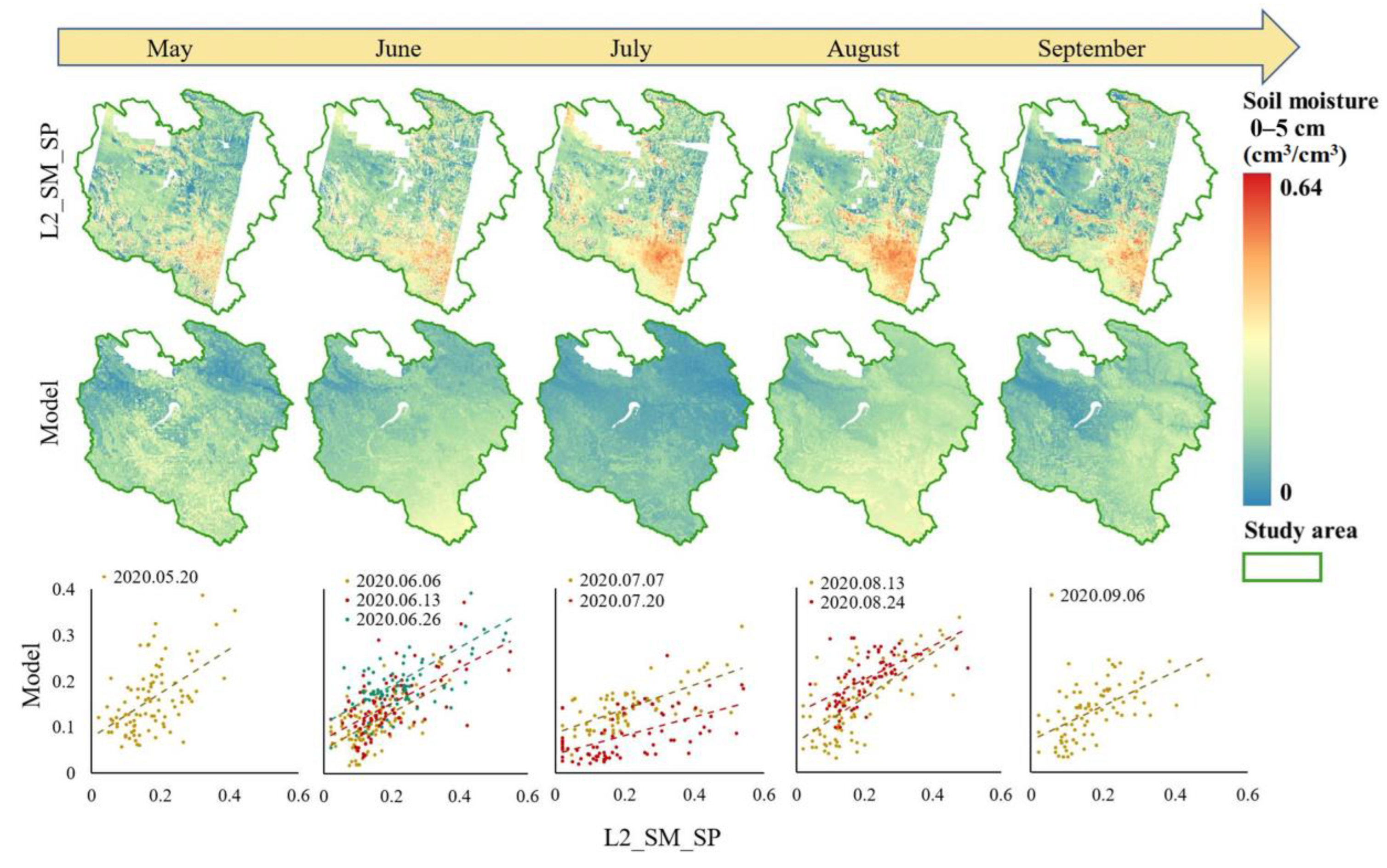
Surface soil moisture serves as a bridge between surface soil water and subsurface soil water. In this research, remote sensing data was employed to invert surface soil moisture, which was then assimilated into the SVAT model to enhance its accuracy and minimize estimation errors. A significant challenge in using active microwave remote sensing for soil moisture retrieval is the interference of surface roughness and vegetation with radar signals. In contrast, passive microwave remote sensing is less affected by surface conditions, making it more reliable for accurate soil moisture measurement, albeit with a lower spatial resolution. This study initially utilized Sentinel-1 to obtain surface soil moisture data at a km resolution, which was subsequently fused with SMAP soil moisture data. By merging the strengths of both datasets, the approach maintained the high spatial resolution of active microwave remote sensing while improving the accuracy of the surface soil moisture estimates. The estimated surface soil moisture from the SVAT model was compared with the same-day SMAP L2_SM_SP downscaling product (Figure 10).
The analysis revealed that the spatial distribution of soil moisture estimated by the SVAT model generally aligns with the L2_SM_SP product, showing a pattern of higher moisture in the south and lower in the north. However, the estimation from this study was consistently lower, particularly in July. Rao et al. [48] also noted biases in the L2_SM_SP product. The correlation coefficient R2 between the 0–5 cm soil moisture estimates and the L2_SM_SP product ranged from 0.5425 to 0.7162, with the highest agreement in August and a relatively large discrepancy in July. The field-collected samples in this study showed better agreement with the estimated data, suggesting potential inaccuracies in the L2_SM_SP product for the ecotone from the QPtoLP possibly due to inversion parameter issues. The variance in the L2_SM_SP product was between 0.0791 and 0.1382, while the variance in this study’s results was between 0.0463 and 0.0778, indicating that the L2_SM_SP data was more variable and exhibited greater fluctuations.

4.2. The Lag Effect of Rainfall on Soil Moisture Changes at Varying Depths

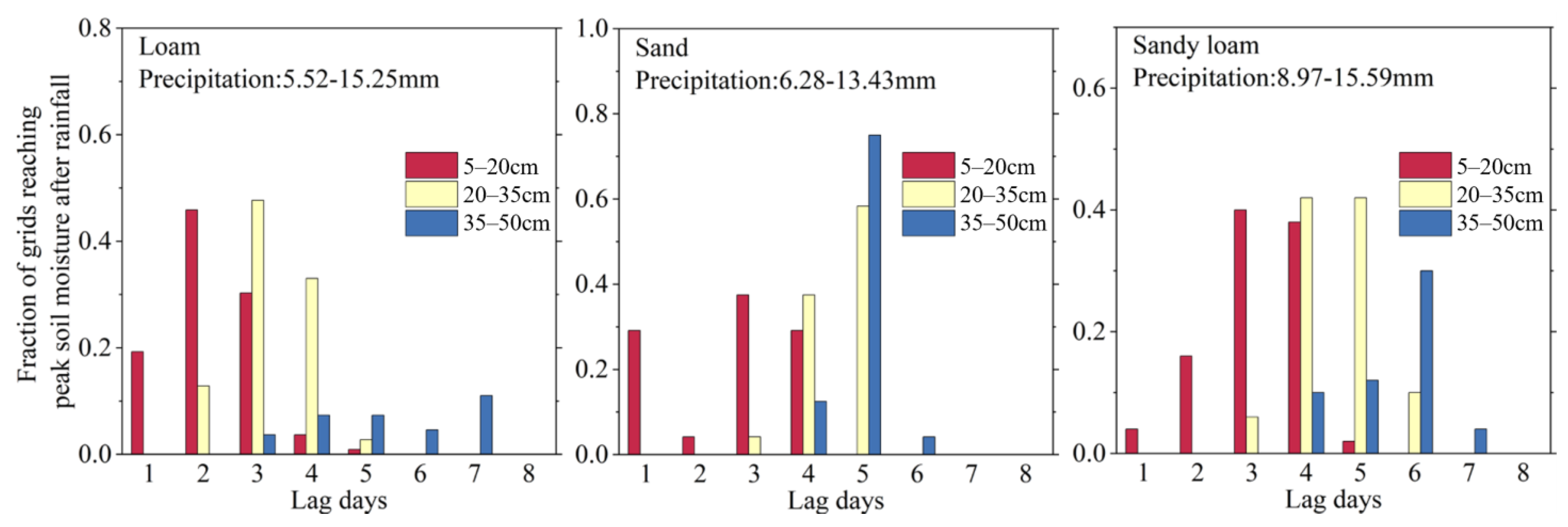
This investigation statistically examined the alterations in soil moisture at various depths following rainfall on 30 June 2020 (with no significant rainfall events exceeding 5 mm occurring within a week before or after this date). The most pronounced effect on the 0–5 cm soil layer was observed on the day of rainfall (Figure 11). For the 5–20 cm soil layer, the influence became noticeable 1 to 3 days post rainfall; for the 20–35 cm soil layer, the effect was most evident 2 to 4 days after rainfall; and for the 35–50 cm soil layer soil, the influence began to appear three days after rainfall. In general, as rainfall increased, the time it took for soil moisture to respond decreased.
This research delved into the soil moisture response to rainfall across various soil types. In loamy soil, the impact of varying rainfall on the 5–20 cm layer was generally observed 1 to 3 days post rainfall. With increasing rainfall, the probability of peak soil moisture occurring 24 h after rainfall increased. For rainfall under 12.37 mm, the 20–35 cm soil layer typically reached the highest moisture content 3–4 days after rainfall, but with more substantial rainfall, this peak was achieved within 2–3 days. Rainfall in the range of 5.52–15.25 mm leads to changes in the soil moisture of the 35–50 cm layer of loam with a probability of around one-third, primarily 4 days after rain.
In sandy soil, for rainfall between 6.28 mm and 10.87 mm, the soil moisture of the 5–20 cm layer peaked 3–4 days after rain. When the rainfall was 10.87–13.43 mm, this peak could occur as early as 24 h post rain. The 20–50 cm layer reached its maximum moisture 4–5 days after rain. For sandy loam, with rainfall below 13.5 mm, the soil moisture of the 5–20 cm layer peaked 1–3 days after rain, while the 20–35 cm layer took 3–5 days. The 35–50 cm layer gradually reached its peak 3 days after rainfall. For rainfall between 13.6 and 15.6 mm, the 5–20 cm layer responds within 24 h, with the peak occurring 2–3 days later. The 20–35 cm and 35–50 cm layers reached their peaks 3–4 days and 3–5 days after rain, respectively.

4.3. Uncertainty in the Retrieval Process of Soil Moisture in the Root Zone

Owing to the absence of a high-resolution vertical profile for soil moisture, only the surface soil moisture was assimilated into the model. Although this approach had diminished accuracy compared to assimilating entire soil moisture profile data, it significantly improved the estimation of profile soil moisture with high resolution, outperforming both model and satellite products. The SVAT model utilized a stomatal resistance formula to parameterize vegetation transpiration. Root parameters are crucial for estimating deep soil moisture depletion through transpiration, influencing how vegetation extracts water from the soil. In this research, an exponential root water uptake model with water stress compensation was employed to parameterize root density and distribution. Root length, a parameter observed in the field, was then extrapolated to broader areas based on vegetation types. The SVAT model also relies heavily on physical properties such as soil water suction to describe water movement. Although the Qinghai–Tibet Plateau and the Loess Plateau exhibit substantial differences in soil structure, these differences are accounted for through soil-texture-dependent parameterization and data assimilation and therefore do not introduce significant bias in the regional-scale soil moisture inversion. Despite sampling all soil types in this study area, regions above 4000 m were not investigated due to extreme conditions, leading to uncertainties when extending root length and soil parameters from point data to larger data. As a result, there may be discrepancies in soil moisture estimates in some regions.

4.4. Limitation Analysis of the Root-Zone Soil Moisture Inversion Method

This study proposes a physically integrated active–passive microwave fusion and data assimilation framework for estimating root-zone soil moisture at multiple depths across the QPtoLP ecotone. The approach links surface energy fluxes and subsurface soil water redistribution through a unified physical inversion process, representing a substantial methodological advance beyond conventional single-source retrievals. Although the retrieval results are satisfactory, there is room for enhancement. The extensive study area necessitated the integration of Sentinel-1 data from orbital passes, with a 2–5 day interval between each, which can introduce inconsistencies due to meteorological and anthropogenic factors. Additionally, data from regions above 4500 m altitude, which make up 3% of the total area, were not collected, affecting the accuracy of soil moisture estimates in permafrost-influenced zones. The study period was limited to the period from May to September to mitigate permafrost limitations, but early May still includes some frozen ground, which was accurately represented. As future work, we propose focusing on monitoring surface freeze–thaw dynamics in high-elevation areas, given that limited high-altitude observations represent an important source of uncertainty in this study.

5. Conclusions

This research developed and validated an innovative multi-depth soil moisture inversion framework that combines surface energy balance modeling, active–passive microwave data fusion, and physically constrained data assimilation. The TSEB model was first used to establish the surface energy balance and estimate daily surface evaporation, followed by the fusion of Sentinel-1 active and SMAP passive microwave data to obtain surface soil moisture. These datasets were then assimilated into the WEB-SVAT model using the ensemble Kalman filter, producing soil moisture retrievals that were validated against on-site measurements, with RMSE values ranging from 0.034 to 0.038, demonstrating high accuracy across different soil depths. The analysis of temporal dynamics revealed substantial seasonal fluctuations driven by precipitation, with the 0–5 cm layer showing the most rapid changes and the 35–50 cm layer maintaining the highest moisture levels and greatest stability. Spatially, the moisture content was generally highest in the southern regions and lowest in the northern areas, while surface moisture was consistently higher than that in deeper layers. Areas above 4000 m and locations with significant elevation differences exhibited lower surface moisture stability, likely influenced by permafrost, whereas deeper soil layers, particularly in the northwest, showed greater consistency across all layers. Soil type also affected moisture distribution, with sandy soils retaining the least water and loamy sandy soils showing higher moisture levels. Compared with existing methods that rely solely on remote sensing images, this approach provides more accurate soil moisture estimates across multiple depths in the root zone rather than only at the surface. Moreover, by integrating active and passive microwave data with energy balance modeling and data assimilation, it achieves spatially and temporally continuous retrievals, overcoming limitations of conventional single-source remote sensing approaches.

Author Contributions

Conceptualization, Y.Q. and K.L.; software, K.L.; validation, J.M.; formal analysis, S.W. and C.Z.; investigation, K.L. and S.W.; resources, Q.J.; data curation, Y.Q.; writing—original draft preparation, Y.Q. and S.M.N.; writing—review and editing, Q.J. and S.M.N.; visualization, J.M. and J.H.; supervision, Q.J., J.H. and Y.Q.; project administration, Q.J.; funding acquisition, Q.J. All authors have read and agreed to the published version of the manuscript.

Funding

This research is supported by the National Natural Science Foundation of China (No. 42371291 and No. 41901234), the National Key R&D Program of China (2023YFF1304204), and the Geological Survey Project of China Geological Survey “Remote Sensing Monitoring and Evaluation of Human Activities in National Nature Reserves” (No. DD20230488). Data support from projects of the National Natural Science Foundation of China (No. 71225005) and the Exploratory Forefront Project for the Strategic Science Plan in IGSNRR, CAS, is also appreciated.

Data Availability Statement

LST is from the SLSTR product of Sentinel-3 (https://dataspace.copernicus.eu/explore-data/data-collections/sentinel-data/sentinel-3 (accessed on 12 December 2021)). The surface downward radiation comes from the global dataset of the geostationary satellite Himawari-8 from Japan (https://www.eorc.jaxa.jp/ptree/index.html (accessed on 12 December 2021)). The vegetation data includes the Leaf Area Index (LAI) and Normalized Difference Vegetation Index (NDVI), obtained from the MOD15A2 and MOD13A1 datasets of MODIS, respectively (https://ladsweb.modaps.eosdis.nasa.gov/ (accessed on 12 December 2021)). Active microwave remote sensing data is from the L1 level GRD data of the Sentinel-1A satellite, available from the Earth Data Center (https://search.asf.alaska.edu/). The passive microwave remote sensing data is from the L1C level brightness temperature data of the SMAP satellite, available from the National Snow and Ice Data Center (https://nsidc.org/data/smap/smap-data.html (accessed on 12 December 2021)).

Conflicts of Interest

The authors declare no conflicts of interest.

References

  1. Widanagamage, N.; Santos, E.; Rice, C.W.; Patrignani, A. Study of soil heterotrophic respiration as a function of soil moisture under different land covers. Soil Biol. Biochem. 2025, 200, 109593. [Google Scholar] [CrossRef]
  2. Hao, L.; Chen, J.; Wei, Z.; Miao, L.; Zhao, T.; Peng, J. Validation of Satellite Soil Moisture Products by Sparsification of Ground Observations. IEEE J. Sel. Top. Appl. Earth Obs. Remote Sens. 2024, 17, 5970–5985. [Google Scholar] [CrossRef]
  3. Song, C.; Hu, G.; Wang, Y.; Qu, X. Downscaling ESA CCI Soil Moisture Based on Soil and Vegetation Component Temperatures Derived From MODIS Data. IEEE J. Sel. Top. Appl. Earth Obs. Remote Sens. 2022, 15, 2175–2184. [Google Scholar] [CrossRef]
  4. Holden, S.R.; Berhe, A.A.; Treseder, K.K. Decreases in soil moisture and organic matter quality suppress microbial decomposition following a boreal forest fire. Soil Biol. Biochem. 2015, 87, 1–9. [Google Scholar] [CrossRef]
  5. Baumberger, M.; Haas, B.; Sivakumar, S.; Ludwig, M.; Meyer, N.; Meyer, H. High-resolution soil temperature and soil moisture patterns in space, depth and time: An interpretable machine learning modelling approach. Geoderma 2024, 451, 117049. [Google Scholar] [CrossRef]
  6. Schmidt, T.; Schrön, M.; Li, Z.; Francke, T.; Zacharias, S.; Hildebrandt, A.; Peng, J. Comprehensive quality assessment of satellite- and model-based soil moisture products against the COSMOS network in Germany. Remote Sens. Environ. 2024, 301, 113930. [Google Scholar] [CrossRef]
  7. Yi, C.; Li, X.; Zeng, J.; Fan, L.; Xie, Z.; Gao, L.; Xing, Z.; Ma, H.; Boudah, A.; Zhou, H.; et al. Assessment of five SMAP soil moisture products using ISMN ground-based measurements over varied environmental conditions. J. Hydrol. 2023, 619, 129325. [Google Scholar] [CrossRef]
  8. Lu, Q.; Zhao, D.; Wu, S. Simulated responses of permafrost distribution to climate change on the Qinghai–Tibet Plateau. Sci. Rep. 2017, 7, 3845. [Google Scholar] [CrossRef]
  9. Huang, S.; Zhang, X.; Wang, C.; Chen, N. Two-step fusion method for generating 1 km seamless multi-layer soil moisture with high accuracy in the Qinghai-Tibet plateau. ISPRS J. Photogramm. Remote Sens. 2023, 197, 346–363. [Google Scholar] [CrossRef]
  10. Qu, Y.; Zhu, Z.; Montzka, C.; Chai, L.; Liu, S.; Ge, Y.; Liu, J.; Lu, Z.; He, X.; Zheng, J.; et al. Inter-comparison of several soil moisture downscaling methods over the Qinghai-Tibet Plateau, China. J. Hydrol. 2021, 592, 125616. [Google Scholar] [CrossRef]
  11. Qi, Y.; Fan, B.; Zhang, Y.; Jiang, Y.; Huang, Y.; Boyer, E.; Mello, C.; Guo, L.; Li, H. Estimating root zone soil moisture using the SMAR model and regression method at a headwater catchment with complex terrain. Geoderma 2025, 453, 117144. [Google Scholar] [CrossRef]
  12. Huang, X.; Shi, Z.H.; Zhu, H.D.; Zhang, H.Y.; Ai, L.; Yin, W. Soil moisture dynamics within soil profiles and associated environmental controls. CATENA 2016, 136, 189–196. [Google Scholar] [CrossRef]
  13. Babaeian, E.; Paheding, S.; Siddique, N.; Devabhaktuni, V.K.; Tuller, M. Estimation of root zone soil moisture from ground and remotely sensed soil information with multisensor data fusion and automated machine learning. Remote Sens. Environ. 2021, 260, 112434. [Google Scholar] [CrossRef]
  14. Kolassa, J.; Reichle, R.H.; Liu, Q.; Alemohammad, S.H.; Gentine, P.; Aida, K.; Asanuma, J.; Bircher, S.; Caldwell, T.; Colliander, A.; et al. Estimating surface soil moisture from SMAP observations using a Neural Network technique. Remote Sens. Environ. 2018, 204, 43–59. [Google Scholar] [CrossRef]
  15. Wang, A.; Hu, G.; Lai, P.; Xue, X.; Fang, B. Root-zone soil moisture estimation based on remote sensing data and deep learning. Environ. Res. 2022, 212, 113278. [Google Scholar] [CrossRef]
  16. Biswas, B.C.; Dasgupta, S.K. Estimation of soil moisture at deeper depth from surface layer data. MAUSAM 1979, 30, 511–516. [Google Scholar] [CrossRef]
  17. Santi, E.; Paloscia, S.; Pettinato, S.; Fontanelli, G. Application of artificial neural networks for the soil moisture retrieval from active and passive microwave spaceborne sensors. Int. J. Appl. Earth Obs. Geoinf 2016, 48, 61–73. [Google Scholar] [CrossRef]
  18. Kara, A.; Pekel, E.; Ozcetin, E.; Yıldız, G.B. Genetic algorithm optimized a deep learning method with attention mechanism for soil moisture prediction. Neural Comput. Appl. 2024, 36, 1761–1772. [Google Scholar] [CrossRef]
  19. Karthikeyan, L.; Mishra, A.K. Multi-layer high-resolution soil moisture estimation using machine learning over the United States. Remote Sens. Environ. 2021, 266, 112706. [Google Scholar] [CrossRef]
  20. Arora, V. Modeling Vegetation as a Dynamic Component in Soil-Vegetation-Atmosphere Transfer Schemes and Hydrological Models. Rev. Geophys. 2002, 40, 3–26. [Google Scholar] [CrossRef]
  21. Chen, F.; Lei, F.; Knipper, K.; Gao, F.; McKee, L.; del Mar Alsina, M.; Alfieri, J.; Anderson, M.; Bambach, N.; Castro, S.J.; et al. Application of the vineyard data assimilation (VIDA) system to vineyard root-zone soil moisture monitoring in the California Central Valley. Irrig. Sci. 2022, 40, 779–799. [Google Scholar] [CrossRef]
  22. Heidary, P.; Farhadi, L.; Altaf, M.U. Estimation of Root Zone Soil Moisture Profile by Reduced-Order Variational Data Assimilation Using Near Surface Soil Moisture Observations. IEEE J. Sel. Top. Appl. Earth Obs. Remote Sens. 2022, 15, 2394–2409. [Google Scholar] [CrossRef]
  23. Meusburger, K.; Trotsiuk, V.; Schmidt-Walter, P.; Baltensweiler, A.; Brun, P.; Bernhard, F.; Gharun, M.; Habel, R.; Hagedorn, F.; Köchli, R.; et al. Soil–plant interactions modulated water availability of Swiss forests during the 2015 and 2018 droughts. Glob. Change Biol. 2022, 28, 5928–5944. [Google Scholar] [CrossRef] [PubMed]
  24. Abbes, A.B.; Jarray, N.; Farah, I.R. Advances in remote sensing based soil moisture retrieval: Applications, techniques, scales and challenges for combining machine learning and physical models. Artif. Intell. Rev. 2024, 57, 224. [Google Scholar] [CrossRef]
  25. Li, P.; Zha, Y.; Shi, L.; Tso, C.-H.M.; Zhang, Y.; Zeng, W. Comparison of the use of a physical-based model with data assimilation and machine learning methods for simulating soil water dynamics. J. Hydrol. 2020, 584, 124692. [Google Scholar] [CrossRef]
  26. Noory, H.; Khoshsima, M.; Tsunekawa, A.; Tsubo, M.; Haregeweyn, N.; Pashapour, S. Developing a method for root-zone soil moisture monitoring at the field scale using remote sensing and simulation modeling. Agric. Water Manag. 2025, 308, 109263. [Google Scholar] [CrossRef]
  27. Coudert, B.; Ottlé, C. An improved SVAT model calibration strategy based on the optimisation of surface temperature temporal dynamics. Geophys. Res. Lett. 2007, 34, L04402. [Google Scholar] [CrossRef]
  28. Crow, W.T.; Kustas, W.P.; Prueger, J.H. Monitoring root-zone soil moisture through the assimilation of a thermal remote sensing-based soil moisture proxy into a water balance model. Remote Sens. Environ. 2008, 112, 1268–1281. [Google Scholar] [CrossRef]
  29. Baldwin, D.; Manfreda, S.; Keller, K.; Smithwick, E.A.H. Predicting root zone soil moisture with soil properties and satellite near-surface moisture data across the conterminous United States. J. Hydrol. 2017, 546, 393–404. [Google Scholar] [CrossRef]
  30. Lei, F.; Crow, W.T.; Kustas, W.P.; Dong, J.; Yang, Y.; Knipper, K.R.; Anderson, M.C.; Gao, F.; Notarnicola, C.; Greifeneder, F.; et al. Data assimilation of high-resolution thermal and radar remote sensing retrievals for soil moisture monitoring in a drip-irrigated vineyard. Remote Sens. Environ. 2020, 239, 111622. [Google Scholar] [CrossRef]
  31. Huerta-Bátiz, H.E.; Constantino-Recillas, D.E.; Monsiváis-Huertero, A.; Hernández-Sánchez, J.C.; Judge, J.; Aparicio-García, R.S. Understanding root-zone soil moisture in agricultural regions of Central Mexico using the ensemble Kalman filter, satellite-derived information, and the THEXMEX-18 dataset. Int. J. Digit. Earth 2022, 15, 52–78. [Google Scholar] [CrossRef]
  32. Ying, L.; Wang, L.; Huang, X.; Rao, E.; Xiao, Y.; Zheng, H.; Shen, Z.; Ouyang, Z. Climate change impairs the effects of vegetation improvement on soil erosion control in the Qinghai-Tibetan Plateau. CATENA 2024, 241, 108062. [Google Scholar] [CrossRef]
  33. Wei, Y.; Lu, H.; Wang, J.; Wang, X.; Sun, J. Dual Influence of Climate Change and Anthropogenic Activities on the Spatiotemporal Vegetation Dynamics over the Qinghai-Tibetan Plateau from 1981 to 2015. Earth’s Future 2022, 10, e2021EF002566. [Google Scholar] [CrossRef]
  34. Zhang, Y.; Ohata, T.; Kadota, T. Land-surface hydrological processes in the permafrost region of the eastern Tibetan Plateau. J. Hydrol. 2003, 283, 41–56. [Google Scholar] [CrossRef]
  35. Anderson, M.C.; Kustas, W.P.; Norman, J.M.; Diak, G.T.; Hain, C.R.; Gao, F.; Yang Yun Knipper, K.R.; Xue, J.; Yang Yang Crow, W.T.; Holmes, T.R.H.; et al. A brief history of the thermal IR-based Two-Source Energy Balance (TSEB) model–diagnosing evapotranspiration from plant to global scales. Agric. For. Meteorol. 2024, 350, 109951. [Google Scholar] [CrossRef]
  36. Peng, J.; Nieto, H.; Neumann Andersen, M.; Kørup, K.; Larsen, R.; Morel, J.; Parsons, D.; Zhou, Z.; Manevski, K. Accurate estimates of land surface energy fluxes and irrigation requirements from UAV-based thermal and multispectral sensors. ISPRS J. Photogramm. Remote Sens. 2023, 198, 238–254. [Google Scholar] [CrossRef]
  37. Das, N.N.; Entekhabi, D.; Njoku, E.G.; Shi, J.J.C.; Johnson, J.T.; Colliander, A. Tests of the SMAP Combined Radar and Radiometer Algorithm Using Airborne Field Campaign Observations and Simulated Data. IEEE Trans. Geosci. Remote Sens. 2014, 52, 2018–2028. [Google Scholar] [CrossRef]
  38. Zhao, T.; Hu, L.; Shi, J.; Lü, H.; Li, S.; Fan, D.; Wang, P.; Geng, D.; Kang, C.S.; Zhang, Z. Soil moisture retrievals using L-band radiometry from variable angular ground-based and airborne observations. Remote Sens. Environ. 2020, 248, 111958. [Google Scholar] [CrossRef]
  39. Calabia, A.; Molina, I.; Jin, S. Soil Moisture Content from GNSS Reflectometry Using Dielectric Permittivity from Fresnel Reflection Coefficients. Remote Sens. 2020, 12, 122. [Google Scholar] [CrossRef]
  40. Dobson, M.; Ulaby, F.; Hallikainen, M.; El-rayes, M. Microwave Dielectric Behavior of Wet Soil-Part II: Dielectric Mixing Models. IEEE Trans. Geosci. Remote Sensing 1985, GE-23, 35–46. [Google Scholar] [CrossRef]
  41. Attema, E.P.W.; Ulaby, F.T. Vegetation modeled as a water cloud. Radio Sci. 1978, 13, 357–364. [Google Scholar] [CrossRef]
  42. Bell, D.; Menges, C.; Ahmad, W.; van Zyl, J.J. The Application of Dielectric Retrieval Algorithms for Mapping Soil Salinity in a Tropical Coastal Environment Using Airborne Polarimetric SAR. Remote Sens. Environ. 2001, 75, 375–384. [Google Scholar] [CrossRef]
  43. Wang, S.; Lv, K.; Ma, J.; Jiang, Q.; Ren, Y.; Gao, F.; Moazzam, N.S. A multi-source data fusion method to retrieve soil moisture dynamics and its influencing factors analysis in the ecological zone of the eastern margin of the Tibetan Plateau. Ecol. Indic. 2024, 169, 112877. [Google Scholar] [CrossRef]
  44. Lei, F.; Crow, W.T.; Holmes, T.R.H.; Hain, C.; Anderson, M.C. Global Investigation of Soil Moisture and Latent Heat Flux Coupling Strength. Water Resour. Res. 2018, 54, 8196–8215. [Google Scholar] [CrossRef] [PubMed]
  45. Hashemian, M.; Ryu, D.; Crow, W.T.; Kustas, W.P. Improving root-zone soil moisture estimations using dynamic root growth and crop phenology. Adv. Water Resour. 2015, 86, 170–183. [Google Scholar] [CrossRef]
  46. Chen, Y.; Wen, J.; Liu, Y.; Gao, L.; Chen, J. Spatio-temporal changes of evapotranspiration over the Zoige Wetland Basin in China using TSEB and GF satellites. Int. J. Remote Sens. 2023, 44, 2936–2958. [Google Scholar] [CrossRef]
  47. Strebel, L.; Bogena, H.; Vereecken, H.; Andreasen, M.; Aranda-Barranco, S.; Hendricks Franssen, H.-J. Evapotranspiration prediction for European forest sites does not improve with assimilation of in situ soil water content data. Hydrol. Earth Syst. Sci. 2024, 28, 1001–1026. [Google Scholar] [CrossRef]
  48. Rao, P.; Wang, Y.; Wang, F.; Liu, Y.; Wang, X.; Wang, Z. Daily soil moisture mapping at 1km resolution based on SMAP data for desertification areas in northern China. Earth Syst. Sci. Data 2022, 14, 3053–3073. [Google Scholar] [CrossRef]
Figure 1. Location of the study area.
Remotesensing 18 00120 g001
Figure 2. Spatial distribution of soil types and weights of samples at sampling points of study area. Note: FW represents the weight of fresh soil (g), DW represents the weight of drought soil (g), and BD represents soil bulk density (g/cm3), the red dotted line represents the average value of the data in the subfigure.
Remotesensing 18 00120 g002
Figure 3. Retrieval flowchart of soil moisture at different depths.
Remotesensing 18 00120 g003
Figure 4. Fusion process for soil moisture.
Remotesensing 18 00120 g004
Figure 5. Scatter plot of field-measured data and predicted results of SVAT model.
Remotesensing 18 00120 g005
Figure 6. Time series graph of rainfall and average soil moisture at different depths.
Remotesensing 18 00120 g006
Figure 7. Spatial variation in soil moisture from May to September in study area.
Remotesensing 18 00120 g007
Figure 8. Stability of soil moisture at depths of 0–5 cm, 5–20 cm, 20–35 cm, and 35–50 cm.
Remotesensing 18 00120 g008
Figure 9. Comparative analysis of soil moisture at different depths in different soil types.
Remotesensing 18 00120 g009
Figure 10. Comparison of model-estimated 0–5 cm soil moisture with L2_SM_SP product.
Remotesensing 18 00120 g010
Figure 11. Distribution of lag times between rainfall and peak soil moisture for different soil types.
Remotesensing 18 00120 g011
Table 1. Summary of input variables and their data sources.
VariableDescriptionData Source
LSTLand surface temperatureSentinel-3 SLSTR
RDownward shortwave radiationHimawari-8
TAir temperatureChina Meteorological Data Service Center
WSWind speedChina Meteorological Data Service Center
RHRelative humidityChina Meteorological Data Service Center
LAILeaf Area IndexMODIS MOD15A2
NDVIVegetation indexMODIS MOD13A1
Soil typeSoil texture fractionsHWSD v1.1
Root parametersRoot depth and densityField measurements
Table 2. Summary of soil sampling points across different soil types in the study area.
Soil TypeNumber of Sampling Points
Clay2
Loam43
Loamy sand2
Sand11
Sandy loam1
Silt clay1
Silt loam4
Disclaimer/Publisher’s Note: The statements, opinions and data contained in all publications are solely those of the individual author(s) and contributor(s) and not of MDPI and/or the editor(s). MDPI and/or the editor(s) disclaim responsibility for any injury to people or property resulting from any ideas, methods, instructions or products referred to in the content.