Article

Pansharpened WorldView-3 Imagery and Machine Learning for Detecting Mal secco Disease in a Citrus Orchard


1
Council for Agricultural Research and Economics (CREA), Centre for Engineering and Agro-Food Processing, 00015 Monterotondo, Italy
2
Council for Agricultural Research and Economics (CREA), Centre for Plant Protection and Certification, 00156 Roma, Italy
3
Council for Agricultural Research and Economics (CREA), Centre for Olive, Fruit and Citrus Crops, 95024 Acireale, Italy
*
Author to whom correspondence should be addressed.
Remote Sens. 2026, 18(1), 110; https://doi.org/10.3390/rs18010110
Submission received: 7 November 2025 / Revised: 17 December 2025 / Accepted: 26 December 2025 / Published: 28 December 2025
(This article belongs to the Section Remote Sensing in Agriculture and Vegetation)

Highlights

What are the main findings?
  • Early citrus disease stages exhibit detectable identifiable spectral signatures associated with early stages of citrus disease.
  • A feature-optimized machine learning approach results in classification robustness under field conditions.
What is the implication of the main findings?
  • Early detection enhances timely management and reduces the risk of disease spread.
  • The proposed workflow offers a transferable framework for remote sensing-based plant health monitoring.

Abstract

Mal secco disease (MSD), caused by Plenodomus tracheiphilus, poses a serious threat to Citrus limon production across the Mediterranean Basin. This study investigates the potential of high-resolution WorldView-3 imagery for detecting early-stage MSD symptoms in lemon orchards through the integration of three pansharpening algorithms(Gram–Schmidt, NNDiffuse, and Brovey) with two machine learning classifiers (Random Forest and Support Vector Machine). The Brovey-based fusion combined with Random Forest yielded the best results, achieving 80% overall accuracy, 90% precision, and 84% recall, with high spatial reliability confirmed by 10-fold cross-validation. Spectral analysis revealed that Brovey introduced the largest radiometric deviation, particularly in the NIR band, which nonetheless enhanced class separability between healthy and symptomatic crowns. These findings demonstrate that moderate spectral distortion can be tolerated, or even beneficial, for vegetation disease detection. The proposed workflow—efficient, transferable, and based solely on visible and NIR bands—offers a practical foundation for satellite-driven disease monitoring and precision management in Mediterranean citrus systems.

1. Introduction

Citrus cultivation is a cornerstone of Mediterranean agriculture [1], with Sicily (Italy) representing one of Europe’s leading lemon (Citrus limon) production areas [2]. Accounting for about 85% of national production and more than 23,000 ha of orchards [3], Sicilian citriculture sustains both regional economies and traditional landscapes. However, production is increasingly threatened by vascular, viral, and bacterial diseases that compromise yield, fruit quality, and orchard longevity. Among these, mal secco disease (MSD), caused by Plenodomus tracheiphilus (Petri) Gruyter, Aveskamp & Verkley, remains the most destructive pathogen of lemons and other citrus species [4,5,6]. The disease spreads through pruning wounds or frost injuries, colonizing the xylem and causing progressive twig dieback, internal necrosis, and canopy desiccation [7]. Because initial symptoms are subtle and visually detectable only after significant physiological damage, early diagnosis remains a major challenge. In the absence of curative treatments, management relies on preventive practices and removal of infected tissues [5].
Beyond MSD, Mediterranean citrus orchards are increasingly exposed to a complex phytosanitary scenario that includes viral and bacterial diseases such as Citrus tristeza virus (CTV) and Huanglongbing (HLB). CTV, already established in major citrus-growing regions of southern Italy including Sicily and Calabria, is subject to ongoing surveillance and vector control programs [8]. HLB, although not yet detected in mainland Italy, has caused devastating yield losses worldwide and remains a major concern for the Mediterranean Basin [9,10]. Both diseases highlight the growing vulnerability of citrus production systems to pathogen spread and underscore the urgent need for early, non-invasive monitoring tools.
Recent research has explored molecular diagnostics [11,12], resistant genotypes [7,13], and spatial modeling of infection risk [6,14], yet operational remote sensing approaches for MSD detection are still lacking. Advances in multispectral and hyperspectral imaging have already proven successful for identifying other citrus diseases such as HLB and citrus canker [15,16]. At fine spatial scales, both proximal and airborne sensors have enabled early detection of vascular pathogens in diverse crops [17,18]. High-resolution satellite sensors such as WorldView-3 now provide the capability to merge panchromatic and multispectral data through pansharpening, enhancing spatial detail while retaining spectral information [19]. However, the radiometric integrity of pansharpened products remains debated [20,21], since spatial enhancement may introduce spectral distortions that affect downstream analyses [22,23].
Building on this context, the present study proposes a remote sensing framework for MSD detection in lemon orchards using pansharpened WorldView-3 imagery combined with supervised machine learning. Three pansharpening algorithms—Gram–Schmidt, NNDiffuse, and Brovey—are evaluated alongside two binary classifiers, Random Forest (RF) and Support Vector Machine (SVM). The approach allows the assessment of how fusion techniques influence spectral fidelity, classification accuracy, and spatial reliability. Specifically, the study aims to (i) assess the capacity of different pansharpened products to discriminate between healthy and symptomatic crowns, (ii) compare the performance of RF and SVM in MSD detection, and (iii) evaluate classification consistency through cross-validation. The outcomes are intended to support the development of operational, scalable monitoring tools for early disease detection and precision management in Mediterranean citrus systems.

2. Materials and Methods

2.1. Study Area

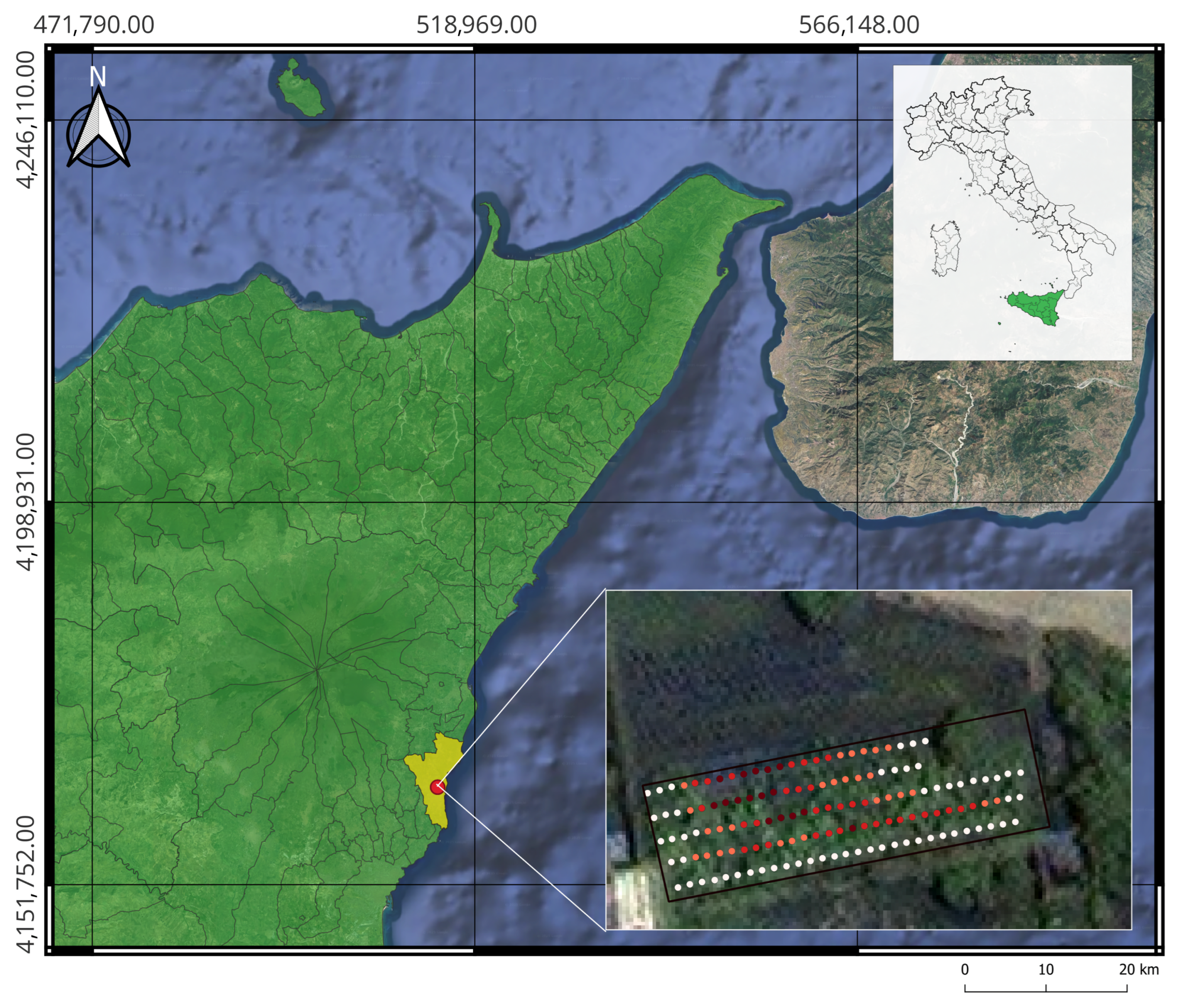
The study area has been part of an ongoing hybrid lemon phenotyping program since 2021. It is located at the San Salvatore experimental farm of the Council for Agricultural Research and Economics (CREA) in Acireale, Sicily, Italy (37°37′16″N, 15°09′47″E) [13], Figure 1.
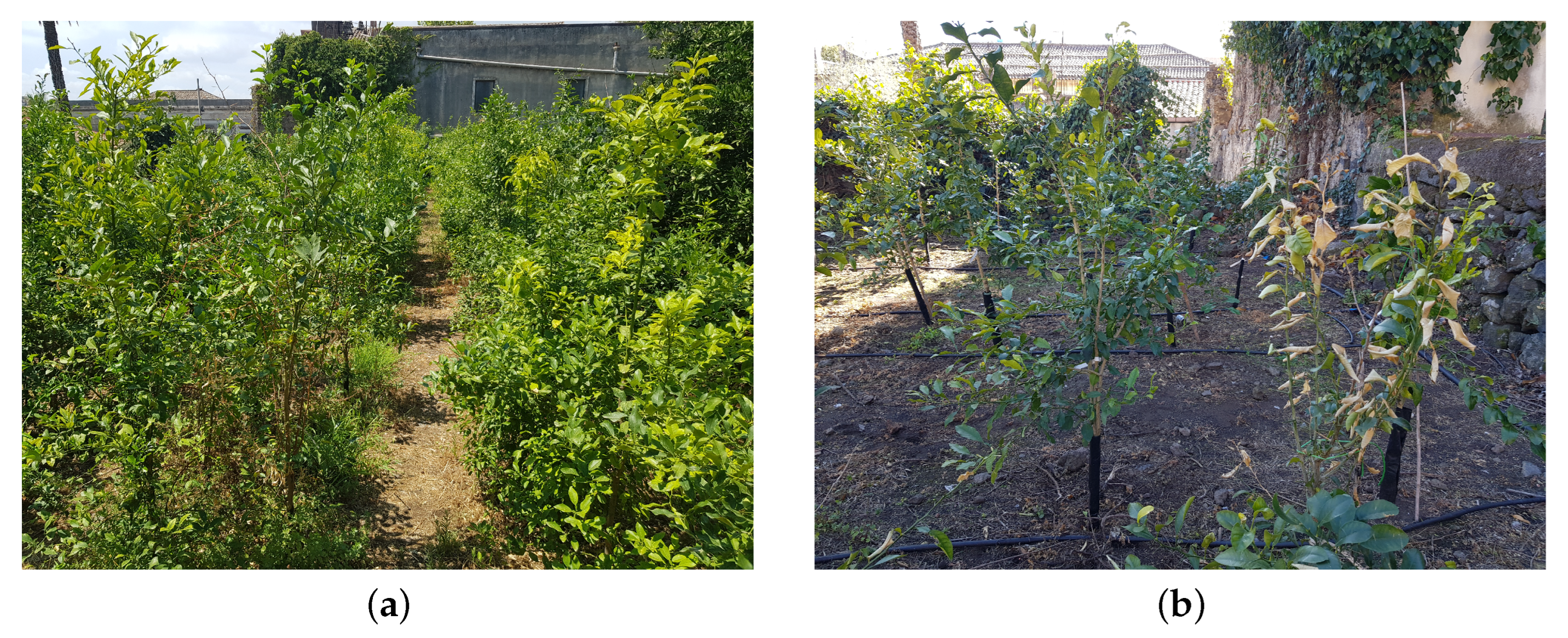
Covering 285 m2, the orchard hosts 270 plants (Figure 2a) derived from 148 hybrids obtained by crossing Citrus latipes (Swingle) Tanaka (resistant to MSD) with Citrus limon “Femminello Siracusano 2KR” (susceptible to MSD). Trees are planted in twin rows with 1.0 m between plants, 0.5 m between adjacent rows, and 1.5 m between twin rows. Agronomic practices included fertilization by 25N-10P inorganic fertilizer, drip irrigation and neither fungicide nor pesticide use. The cultivation layout and management practices adopted here correspond on average to those commonly used in Italian lemon orchards, ensuring the experimental conditions reflect typical commercial systems.
Phenotyping was conducted through visual scoring on an ordinal scale from 0 (no symptoms) to 4 (dead trees) [13], twice in 2023 (late May and early August), aligning with the seasonal pattern of MSD symptom expression and accounting for xylem colonization constraints due to winter and summer temperatures [4]. For the purpose of binary classification, levels 0–2 (no symptoms or chlorosis of leaf veins) were labeled as Healthy, while levels 3–4 (desiccation of part or whole tree, e.g., Figure 2b) were labeled as Symptomatic. Satellite-based detection focused on 2023 imagery, when tree canopies had reached approximately 1.5 m in width and their density sufficiently suppressed understory contributions to the multispectral signal ensuring that reflectance primarily originated from the tree crowns.

2.2. MSD Symptoms Dataset

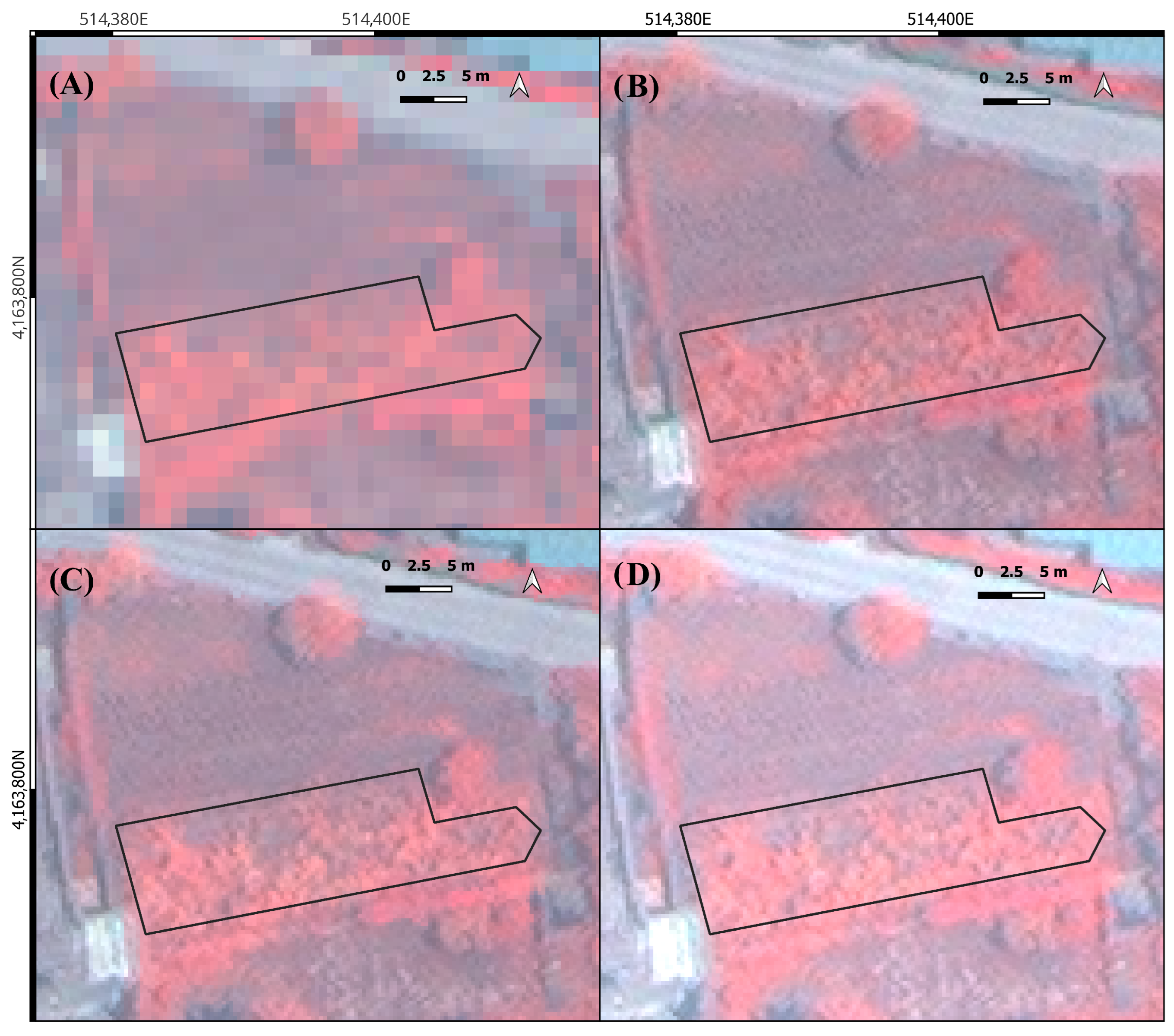
A WorldView-3 image pack was acquired on 13 June 2023 on the experimental orchard and used to build a detection dataset of MSD symptoms (Figure 3). May and June months fall in the temporal period when MSD is highly active and its symptoms visible. The imagery was provided at the “Ortho-Ready-Standard” (OR2A) processing level. This designation indicates that the images are map-projected, radiometrically and sensor-corrected, and resampled to a constant base elevation (rather than a full terrain Digital Elevation Model—DEM) to facilitate orthorectification. According to vendor specifications, OR2A products are suitable for feature extraction and classification workflows with high geometric accuracy and consistent spatial referencing. Use of this level ensured that our analysis began with data that were already corrected for major sensor and geometric distortions, thereby reducing pre-processing time and potential positional errors.
The WorldView-3 image pack included a multispectral (ms) image (red, green, blue, and near-infrared bands, 1.20 × 1.20 m spatial resolution) and a panchromatic image (one band, 0.30 × 0.30 m). The image pack was orthorectified using TINITALY DEM 1.1 [24] and manually co-registered with a set of known ground control points. The multispectral image was pansharpened to preserve spatial detail (0.30 × 0.30 m) while minimizing spectral distortion [25] using the panchromatic image.
A set of 3 pansharpened images (pan) were collected after using Gram–Schmidt [26], NNDiffuse [27], and Brovey [28] algorithms. The latter algorithm was executed in QGIS 3.40 (QGIS Geographic Information System. QGIS Association), while the other ones were executed in ENVI® 6.0 (a registered trademark of NV5 Global, Inc., Broomfield, CO, USA).
A regular grid of 137 sampling points containing ground-truth spatial information on MSD infection severity [13] was co-registered with the satellite imagery. The grid was overlaid on each of the three pan images to extract reflectance values from the visible (blue, green, red) and near-infrared bands. The resulting MSD dataset consisted of 137 points, 4 spectral features, and 3 pansharpened images (Gram–Schmidt, NNDiffuse, and Brovey).

2.3. Classification

A binary classification approach was implemented in ENVI® to discriminate between healthy and symptomatic pixels within the MSD dataset. The four spectral reflectance values from the pan imagery, visible (blue, green, red) and near-infrared, were used as input features. Two supervised machine learning algorithms, Random Forest (RF) and Support Vector Machine (SVM), were applied. The classification process was independently repeated for each of the three pan images, resulting in six classification models in total.
The Random Forest (RF) model was constructed with 100 trees, setting the maximum number of features considered at each split to the square root of the total number of input features (default setting in scikit-learn). To handle class imbalance, the parameter class weight was set to “balanced”. The minimum number of samples per leaf was set to 5 to avoid overfitting and ensure better generalization.
The SVM classifier was implemented using a radial basis function (RBF) kernel, which is widely adopted in remote sensing applications due to its capability to model complex non-linear relationships in multispectral and hyperspectral data [29,30].
To ensure robust and unbiased performance evaluation, a stratified k-fold cross-validation procedure ( k = 10 ) was applied to both classifiers. This method preserves the class proportions in each fold, providing a more reliable estimation of model performance and mitigating bias associated with random sampling [31].
Model performance was assessed using standard accuracy metrics, including Cohen’s K statistic, overall accuracy, precision, and recall, averaged across folds to provide a consistent measure of classification reliability [32]. Accuracy measures the overall correctness of the classification and is defined as the proportion of correctly classified pixels among all pixels. Precision (also known as positive predictive value) quantifies the reliability of positive predictions, i.e., the proportion of correctly identified symptomatic pixels among all predicted symptomatic pixels. Recall (also referred to as sensitivity) measures the ability of the classifier to detect all relevant symptomatic pixels.

2.4. Background Noise Assessment

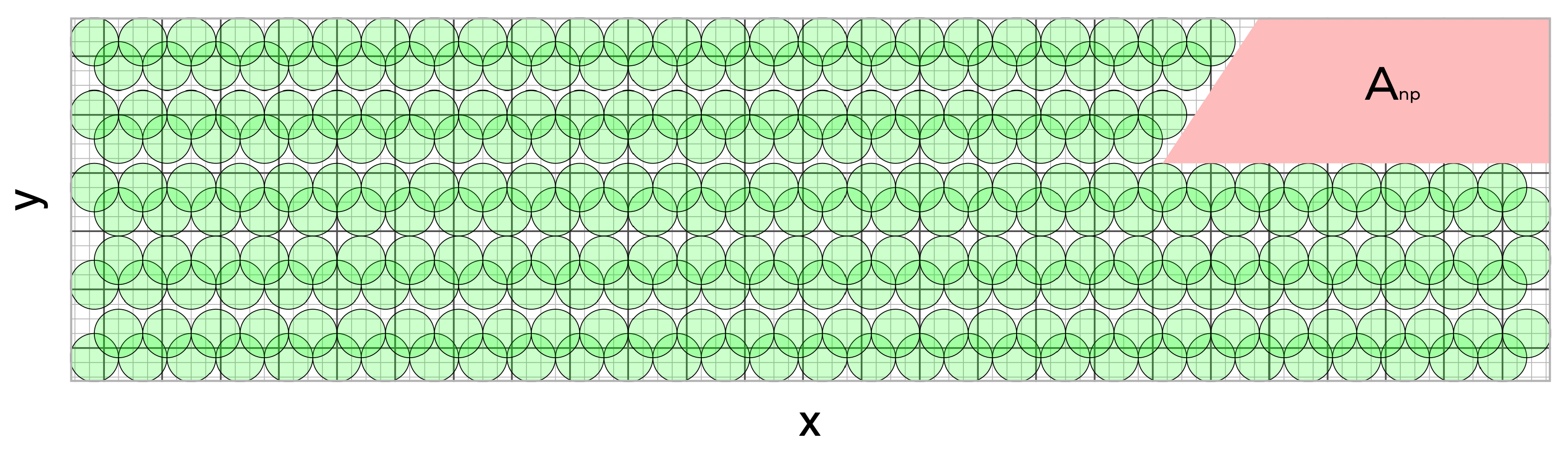
The uncertainty hindering MSD symptom detection due to spectral mixing of soil and vegetation signals was geometrically estimated on the experimental orchard from the plantation schema and the crown width of trees in 2023 (Figure 4). Tree crowns were modeled as 1.0 m diameter circles, regularly placed on the plantation grid.
The average area of bare soil in the experimental orchard was computed by the difference of the net area of the orchard and the area covered by tree crowns:
A b = A o A n p A c
where A o denotes the total orchard area, A n p represents the area of the non-planted zone (Figure 4), and A c indicates the net crown area, calculated as the total area occupied by the 272 tree crowns, with the exclusion of overlapping areas between adjacent crowns within rows ( A i r ) and between crowns on twin rows ( A i t ).
A c = 272 π r 2 272 A i r + A i t
A i r and A i t are computed using a simplified version of the circle–circle intersection area (A) in the case when circles (i.e., tree crowns) share equal radiuses:
A = 2 r 2 · arccos x r 0.5 d · d + 2 r · d + 2 r
where r is the crown radius in 2023 (0.50 m), x is the distance from tree stem to the point of intersection of the crowns:
x = d 2 2 d
and d denotes the spacing between trees, 1.0 m between adjacent trees within the same row ( A i r ) and 0.71 m between trees on twin rows ( A i t ). Consequently, the crowns of trees within the same row do not overlap ( A i r 0 m2), whereas the crowns of trees on twin rows overlap by approximately A i t 0.14 m2.

2.5. Spectral Fidelity of Pansharpened Image

The spectral quality—defined as the fidelity of the pan image bands relative to those of the original multispectral image—was evaluated by quantifying the distortion introduced by pansharpening on reflectance values. Any substantial difference in classification performance can be due to specific spectral distortions entered by the pansharpening process. To this end, a reflectance dataset was constructed by sampling band-specific reflectance values on a regular grid of 137 points across the red, green, blue, and NIR bands for the three high-resolution pan images and the ms image, resulting in a total of 4384 data points. A one-way ANOVA followed by Tukey’s HSD post hoc test (p < 0.05) was used to evaluate inter-image differences in reflectance across the four spectral bands.
To assess the spectral diagnostics of healthy versus symptomatic citrus crowns, we used the Mann–Whitney U test to evaluate band-wise differences in reflectance distributions for each pansharpening method. Because multiple statistical comparisons were performed across spectral bands and products, p-values were adjusted using the Benjamini–Hochberg procedure to control the false discovery rate (FDR). All reported p-values are therefore FDR-corrected, ensuring that the expected proportion of false positives among statistically significant results remains limited.
Spectral similarity among the three pansharpened images was assessed using the Spectral Angle Mapper (SAM) index [33]. The Spectral Angle Mapper (SAM) computes the angular difference between two spectral vectors in n-dimensional band space (n = 4), thereby quantifying spectral similarity independently of vector magnitude. Following the Wald protocol [20], all datasets were spatially degraded to enable a consistent comparison with the original ms image. The protocol simulates pansharpening at lower resolution by downscaling both pan and ms data before comparing the fused product with the reference ms image.

3. Results

3.1. Background Noise

In order to accurately assess background noise, the planting layout of the experimental lemon orchard was replicated. That configuration was characterized by an exceptionally high canopy density, with bare soil accounting for only approximately 7.5% of the total surface area (Figure 4).
With the planting layout used, background reflectance from bare soil was effectively reduced, making the soil contribution to canopy signals negligible. Under these conditions, raw spectral bands could be used directly for analysis without requiring vegetation indices tailored to compensate for soil effects. It should be noted, however, that the validity of this detection approach depends on the minimal presence of exposed soil. Consequently, the method is applicable primarily in settings with low background noise, as represented by the experimental orchard used in this study. This controlled background environment thus provided a robust basis for the subsequent spectral and classification analyses.

3.2. Classification Accuracy

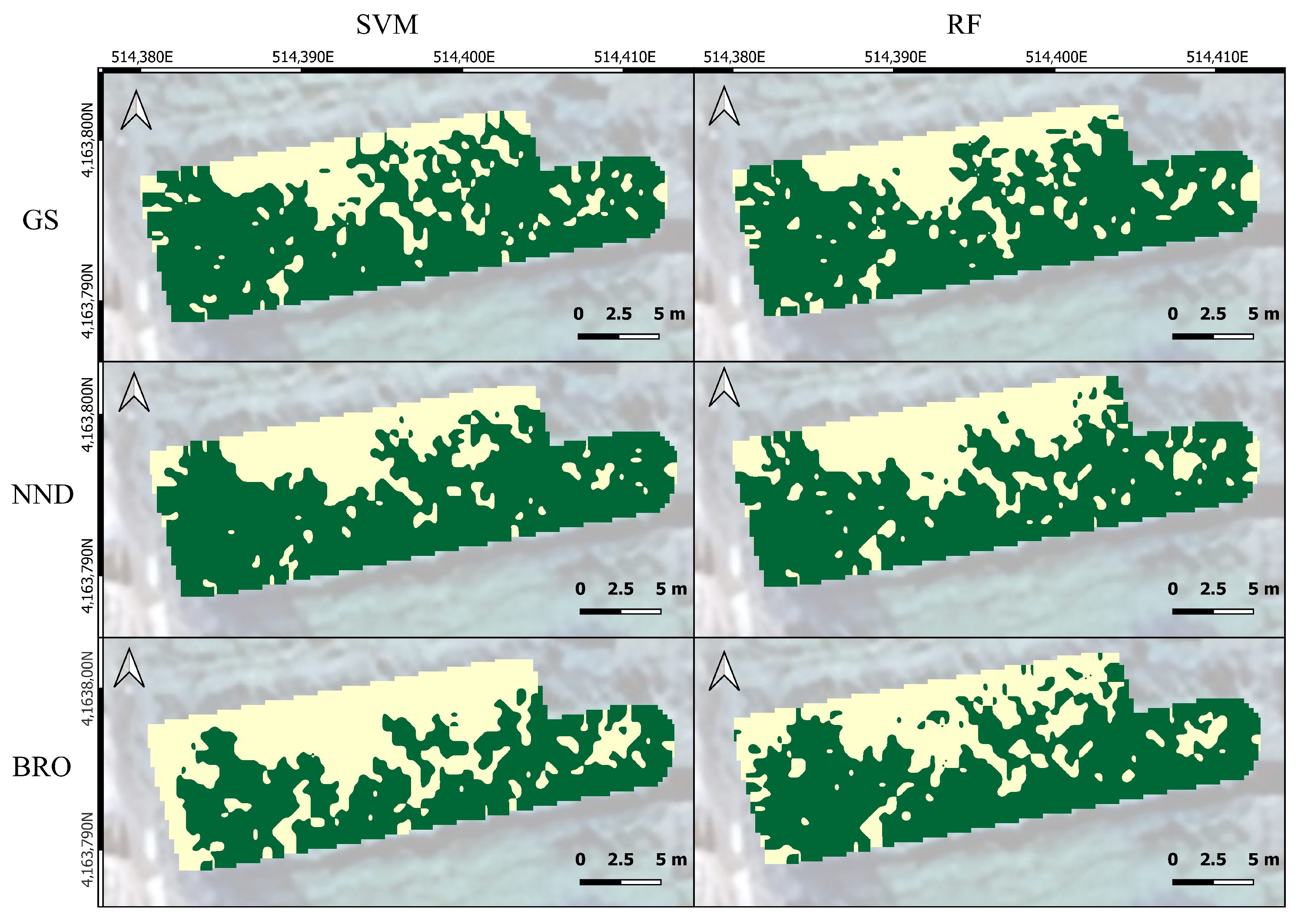
The SVM and RF binary classifiers applied to the three pan images yielded six models and spatial maps of MSD detection status (healthy, symptomatic). All models detected symptomatic tree crowns predominantly located in the middle-upper section of the experimental orchard whereas more healthy pixels were located closer to the southern border. The visual binary representations (Figure 5) simplified the 0–4 phenotyping data sampled on the ground [13] by matching the model’s symptomatic class to the highest levels of infection severity (3–4).
The performance metrics of the two binary classifiers, Support Vector Machine (SVM) and Random Forest (RF), applied to the three pan datasets (Gram–Schmidt, NNDiffuse, and Brovey) are summarized in Table 1. Overall, the RF classifier achieved superior results compared to SVM, exhibiting higher overall accuracy (Acc) and Cohen’s κ values across all pan images. The highest performance was obtained for the Brovey pan image, where RF reached κ = 0.50 , accuracy = 0.80, precision = 0.90, and recall = 0.84. These values indicate a strong agreement with the reference data and an effective ability to correctly identify mal secco disease (MSD) symptomatic pixels while limiting false detections. In contrast, SVM produced slightly lower and more uniform results among the three datasets ( κ = 0.34 0.39 ; accuracy = 0.69–0.75), characterized by higher precision but notably lower recall, particularly for the Brovey image (precision = 0.91; recall = 0.65).
To further investigate the classification behavior, the confusion matrix of the RF classifier on the Brovey dataset is reported in Table 2. The limited number of false negatives (10) indicates that the RF classifier successfully captured most of the symptomatic individuals, whereas the moderate number of false positives (17) reflects a slightly conservative classification threshold that favors recall over strict specificity.
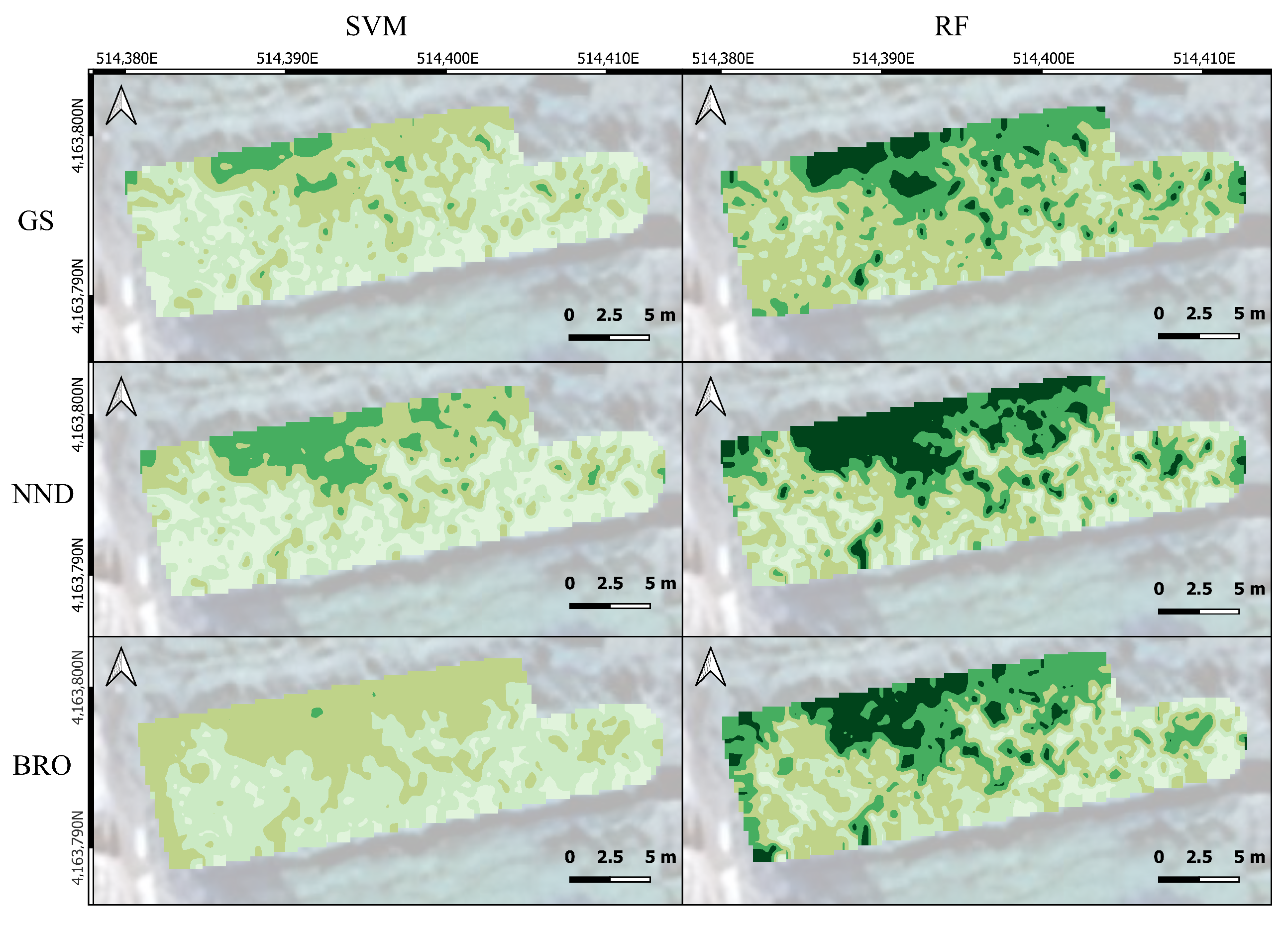
Figure 6 provide a spatially explicit measure of classification confidence obtained from the 10-fold cross-validation of the SVM and RF classifiers applied to the three pan WorldView-3 datasets (Gram–Schmidt, NNDiffuse, and Brovey). The degree of confidence represents the proportion of folds in which each pixel was consistently classified as either healthy or symptomatic. Although affected by high intermixing of small patches, the RF classifier produced more spatially homogeneous confidence patterns than SVM, particularly for the Brovey and NNDiffuse images. In contrast, SVM exhibited several low-confidence regions, especially along those areas where symptoms of MSD were detected. These results corroborate the quantitative metrics reported in Table 1, where the RF–Brovey configuration achieved the highest accuracy and Cohen’s κ values. Our focused dataset allowed for a detailed analysis of disease detection within a specific orchard environment. This targeted approach generated robust preliminary results and provides a critical starting point for broader investigations incorporating diverse orchard characteristics and increasing model robustness.

3.3. Spectral Fidelity of Pansharpened Image

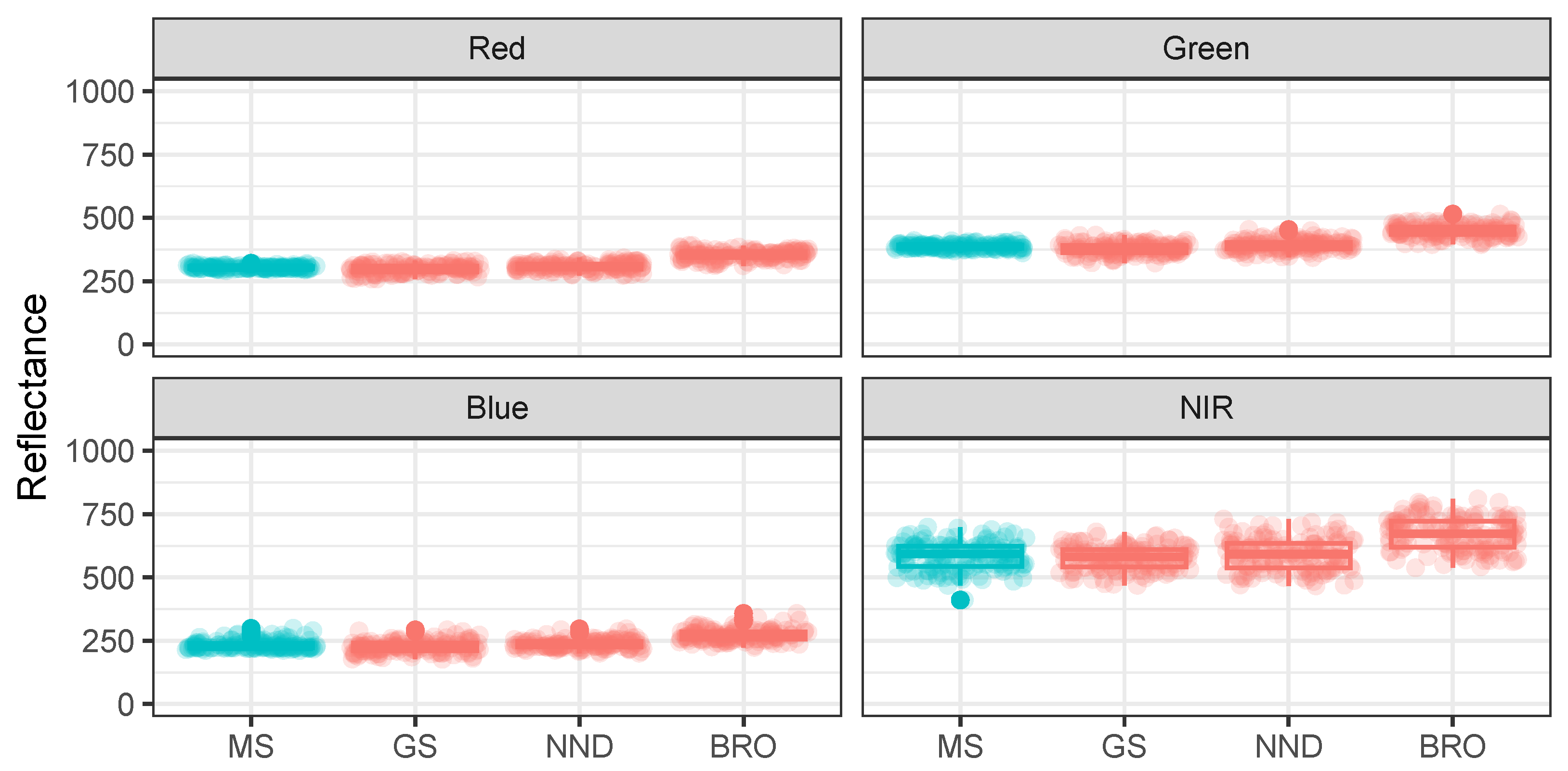
Spectral reflectance was sampled at 137 points across the ms and pan images. The pansharpening process induced distortions in the reflectance characteristics of some of the pan images (Figure 7). Table 3 summarizes the mean reflectance values for the multispectral and pansharpened WorldView-3 images. The Tukey HSD test (p > 0.05) showed no significant differences between the multispectral and NNDiffuse images, indicating good radiometric preservation. Gram–Schmidt yielded slightly lower and Brovey markedly higher reflectance values across bands, especially in the NIR. Overall, NNDiffuse provided the best spectral fidelity to the original data.
In healthy vegetation, efficient photosynthetic and transpiration processes lead to high NIR reflectance, primarily due to multiple scattering within the spongy mesophyll and plant cell walls. Stress-induced alterations in internal leaf structure reduce this reflectance by limiting light scattering. The spectral differences observed in the NIR band among pansharpened products (Table 3) suggest that fusion-induced radiometric shifts may influence the performance of binary classifiers distinguishing healthy from symptomatic vegetation. Depending on the nature and direction of such spectral modifications, these effects could either enhance or reduce classification accuracy, by amplifying disease-related spectral contrast in some cases or introducing radiometric noise in others. Consequently, while pansharpening improves spatial detail, its radiometric implications in the NIR domain warrant careful evaluation in disease detection workflows.
According to the Spectral Angle Mapper (SAM) index, which quantifies the mean angular deviation between corresponding spectral signatures, the NNDiffuse method achieved the highest spectral fidelity (SAM = 1.4°), followed by the Gram–Schmidt algorithm (2.3°), while the Brovey fusion exhibited the largest spectral distortion (2.8°) (Table 4). Overall, the relatively low SAM values across all methods indicate a good level of spectral preservation, consistent with or slightly improving upon results reported in previous comparative analyses [34,35].
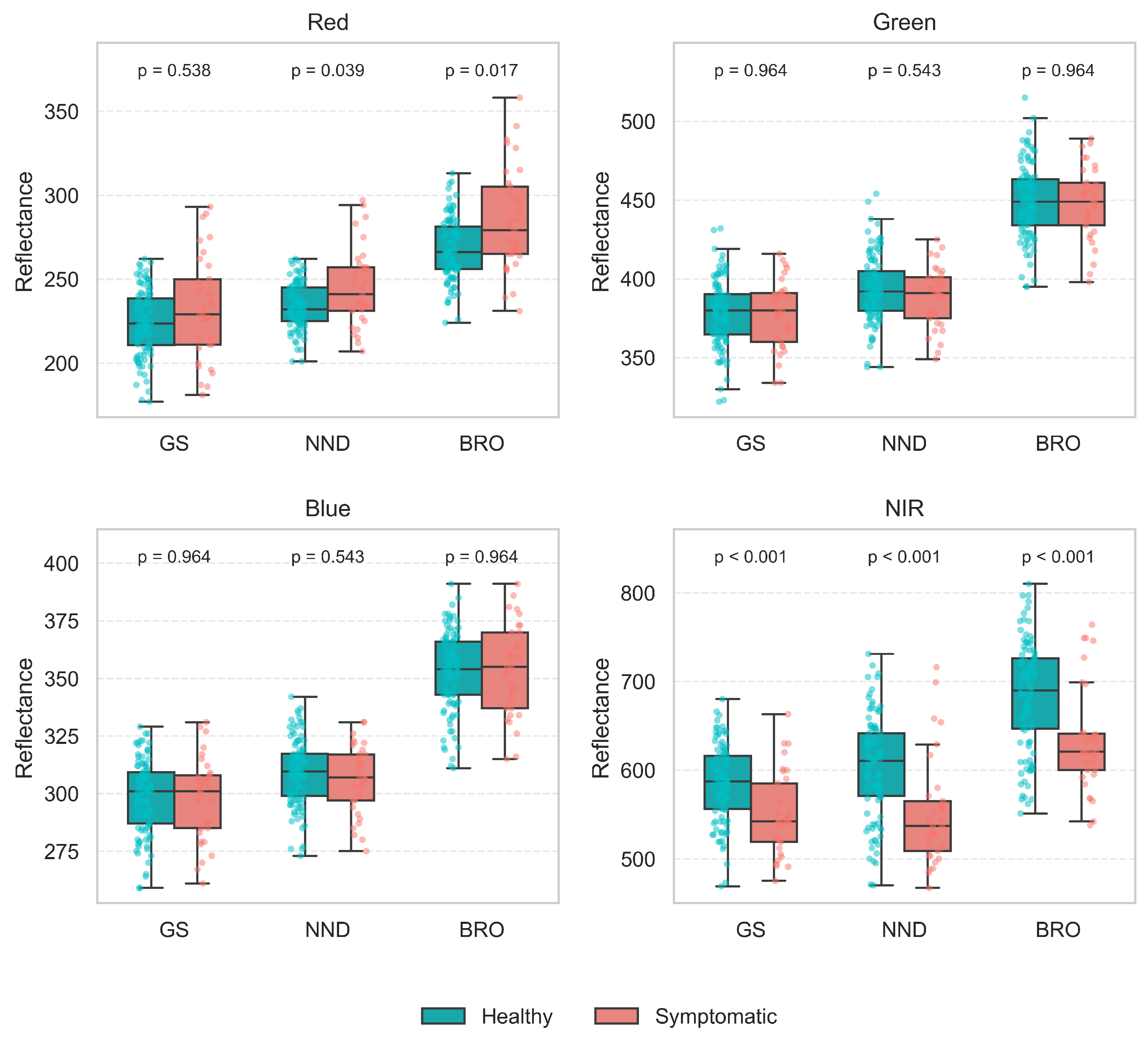
No significant differences were detected in the blue and green reflectance distributions for any product between healthy and symptomatic classes (Figure 8). In the red band, separation between healthy and symptomatic vegetation was observed for the NNDiffuse and Brovey products, whereas no separation emerged for the Gram–Schmidt method. By contrast, clear and consistent separation was observed in the near-infrared (NIR) band across all pansharpening methods.

4. Discussion

4.1. Evaluation of Pansharpening Methods and Classifier Performance

The detection and spatial mapping of mal secco (MSD) symptoms in citrus orchards is crucial for mitigating the economic impact of this disease on Mediterranean citrus growers. This study demonstrates the feasibility of detecting early-stage MSD symptoms in lemon (Citrus limon) canopies using multispectral WorldView-3 imagery pansharpened to 0.3 m spatial resolution and classified with machine learning algorithms. By applying three pansharpening techniques, Gram–Schmidt, NNDiffuse, and Brovey, the analysis provided a comprehensive evaluation of how image fusion influences disease detection accuracy and spatial coherence. Among these, the Brovey fusion achieved the highest classification performance, with the Random Forest (RF) classifier reaching κ = 0.50 , Acc = 0.80, Prec = 0.90, and Rec = 0.84, showing strong agreement with ground-truth data. These results confirm that properly optimized pansharpened imagery can preserve diagnostically relevant spectral features for canopy-level symptom detection. However, consistent with Chen et al. [36], pixel-based classifications remain susceptible to the “salt-and-pepper” effect—extensive class intermixing and isolated misclassified pixels—especially where pixel mixing occurs, blurring the spectral identity of individual crowns [37]. Consequently, despite high overall accuracy, spatial coherence may be partially degraded by scattered misclassifications.
When comparing the two classifiers, RF consistently outperformed the Support Vector Machine (SVM) across all pansharpened datasets, particularly in recall and Cohen’s κ . RF’s ensemble design offers robustness to noise and non-linear spectral relationships, widely recognized in vegetation and disease classification studies [38]. Conversely, SVM showed higher precision but lower recall, reflecting greater conservativeness in symptomatic pixel detection and sensitivity to illumination variability. These differences underline the importance of selecting classifiers based on operational objectives—favoring higher recall when early detection is prioritized.
The cost per km2 of WorldView-3 imagery may range between EUR 10–20, based on factors such as area covered, licensing agreements, and bundled services. A significant barrier to individual grower adoption could lie in the need for specialized training and technical expertise to effectively utilize the imagery. However, regional stakeholders such as grower associations or public bodies are likely to encounter fewer obstacles in accessing and leveraging this technology due to economies of scale and the availability of dedicated resources.

4.2. Spatial Reliability and Operational Implications

The 10-fold cross-validation revealed that RF achieved greater spatial consistency than SVM across all datasets, with Brovey again producing the most coherent and stable detection patterns. This reinforces the operational potential of the RF–Brovey configuration for orchard-scale surveillance. Areas of lower confidence, mainly at canopy edges and shadowed zones, coincided with mixed spectral responses, where sub-pixel variability reduces classification reliability. Nevertheless, the strong consistency in central crown regions demonstrates that early-stage MSD symptoms can be identified before widespread canopy desiccation [4]. For growers and consultants, these findings suggest that a single high-resolution WorldView-3 acquisition can effectively support early-season scouting and targeted field inspections, improving timeliness and cost efficiency in disease management.
From an operational perspective, the workflow is compatible with standard high-resolution imagery and can be easily adapted to UAV or airborne platforms. Its minimal calibration requirements and strong cross-site portability make it suitable for integration into precision agriculture systems for continuous monitoring. Similar data-driven frameworks have proven effective for phyto-pathological surveillance in other high-value crops [39,40]. In Mediterranean citrus systems, where pruning and irrigation practices strongly influence disease dynamics, mapping symptomatic crowns early provides a key decision-support layer for sustainable orchard management.

4.3. Spectral Distortion and Soil Influence

Pansharpening inevitably alters spectral properties, as evidenced by the distortions observed in the NIR band, consistent with previous studies [41,42]. Both the ANOVA–Tukey test and SAM index identified the Brovey method as producing the largest deviation from the original multispectral signal. Notably, this same product achieved highest classification accuracy with both RF and SVM, suggesting that moderate NIR spectral shifts may enhance class separability between healthy and symptomatic vegetation rather than degrade it.
The magnitude of the spectral differences between healthy and symptomatic vegetation was therefore influenced by the pansharpening strategy. Brovey fusion primarily amplified band-wise contrasts leading to improved classification performance and highlighting a clear dependence of class separability on the image fusion method. Nevertheless, consistent band-dependent patterns were observed across all pansharpened products, with the main exception of the red band in the Gram–Schmidt image, where class contrast was reduced. This cross-method consistency indicates that the detected spectral differences are not artefacts of a specific fusion technique but instead reflect underlying canopy conditions, supporting the robustness of the spectral information used for classification.
Although spectral distortions are generally expected to reduce classification accuracy by altering true reflectance signatures, the Brovey method appears to represent a notable exception. The spectral distortion introduced by the mismatch between substituted and original spatial components [43], coupled with enhanced spatial resolution [44], may improve the spatial delineation of canopy features relevant to disease detection. Previous work has shown that such spatial enhancement effects can be moderated when vegetation indices are computed [45], as index formulations reduce the direct influence of panchromatic injection. In this context, it is plausible that the combined effect of spatial sharpening and altered spectral signatures enhances class separability more effectively than relying on vegetation indices alone, warranting further investigation.
Hence, while spectral fidelity is generally preferred, a limited degree of distortion may be acceptable, or even beneficial, when targeting disease detection in citrus orchards.
The spectral signal in high-resolution imagery is also influenced by bare soil fraction. While soil reflectance can add noise to red and NIR wavelengths [46,47,48], depending on its moisture, organic matter, and mineral composition [49,50], the high-density orchard studied here exhibited 92.5% vegetation coverage. Consequently, the contribution of soil reflectance to the overall spectral signal was deemed negligible. In commercial orchards with wider spacing (e.g., 4 × 5 m) [51], higher soil-to-vegetation ratios could reduce detection sensitivity unless sub-pixel or object-based segmentation is employed.

4.4. Environmental Factors and Disease Dynamics

MSD distribution and severity are strongly driven by climatic variability, particularly rainfall and temperature. Heavy precipitation and frost facilitate pathogen entry through tissue micro-lesions [4,5,52], while regional prevalence correlates with precipitation during the wettest months [6]. As Plenodomus tracheiphilus impairs xylem function, the resulting water stress produces spectral responses similar to drought, complicating discrimination based solely on reflectance [53]. Integrating climatic variables—rainfall, humidity, and wind—into future remote-sensing frameworks could improve disease-risk modeling and enable preventive management strategies.

4.5. Transferability to Other Citrus Orchards and Diseases

These results rely on a relatively small and spatially constrained ground-truth dataset, which is concentrated in a limited geographic area. Such restricted sampling may not fully represent the spatial variability and phenological diversity typically observed under operational conditions, particularly considering differences in distance, site characteristics, and citrus genotype. Local heterogeneity in canopy structure, illumination geometry, and background reflectance can further affect classification performance, potentially leading to optimistic accuracy estimates when models are validated under controlled or homogeneous conditions. Expanding ground-truth data across orchards, disease stages, and spatial conditions would enhance robustness [54], mitigate overfitting and class imbalance, and improve model generalization, although potentially requiring new validation.
The genetic variability within our study population, comprising citrus hybrids with varying susceptibility to MSD, together with physiological and phenological seasonal orchard dynamics [55], introduced a complex factor influencing spectral signatures. As noted by [56], inherent differences in leaf morphology and photosynthetic traits—characteristics partially governed by genotype—can significantly alter spectral reflectance patterns. This underscores the need to also account for genetic background when interpreting spectral data and developing accurate disease detection models.
The spectral and temporal characteristics of MSD (e.g., vascular blockage, canopy desiccation) differ substantially from those of other citrus diseases such as Huanglongbing (HLB) or Citrus Tristeza Virus (CTV), which alter reflectance and canopy structure differently [57]. Although the pansharpened satellite data and classification pipeline remain applicable, retraining may be necessary to adapt feature spaces to each disease type.

4.6. Prospects for Future Studies

Future research should validate the RF–Brovey workflow across orchards differing in cultivar, canopy density, and management, as suggested by recent reviews [58]. Mixed pixels, especially at canopy edges, remain a challenge in high-resolution imagery; integrating sub-pixel vegetation fraction estimation [59], spectral unmixing [60] or object-based image analysis (OBIA) [61] could mitigate this issue. Incorporating LiDAR or UAV-based crown segmentation [62] would further isolate canopy reflectance, improving precision. Multi-temporal imagery (e.g., PlanetScope, SkySat, Sentinel-2) may capture MSD progression and enable early warning. Finally, combining climatic variables, pruning schedules, and field-reported infection data into predictive models could transform this reactive framework into a proactive, data-driven decision-support system for Mediterranean citrus management.

5. Conclusions

This study provided a proof of concept for the remote sensing-based detection of mal secco disease (MSD) in citrus orchards using high-resolution multispectral WorldView-3 imagery. By integrating three pansharpening algorithms with machine learning classification, we demonstrated that pansharpened data could effectively capture subtle canopy reflectance changes associated with early disease symptoms. Among the tested configurations, the Brovey-based fusion combined with Random Forest delivered the most accurate and spatially consistent results, confirming the potential of optimized image fusion for operational plant health monitoring.
Beyond MSD detection, this framework illustrates how high-resolution satellite data and robust classifiers can support precision agriculture and disease surveillance across Mediterranean citrus systems. The approach is computationally efficient, transferable to UAV or airborne imagery, and provides a scalable foundation for early warning and sustainable orchard management. Future studies should validate its transferability across different cultivars, stress conditions, and sensor types to strengthen its applicability for broader plant health assessment.

Author Contributions

Conceptualization: M.B.; methodology: A.P. and M.B.; software: A.P.; formal analysis: A.P. and M.B.; writing—original draft preparation: M.B.; writing—review and editing: A.P., A.T., S.D.S., and M.B.; resources: M.C. and S.D.S., funding acquisition: M.B. All authors have read and agreed to the published version of the manuscript.

Funding

This research was funded by Ministero dell’agricoltura, della sovranità alimentare e delle foreste (MASAF) under project Agrivita “Difesa degli Agrumeti Italiani dal Malsecco” grant number 689142 (15 December 2023).

Data Availability Statement

The raw data supporting the conclusions of this article will be made available by the authors on request.

Acknowledgments

The authors would like to thank Emma Mastrogregori and Loredana Oreti for their contributions and helpful comments on an earlier version of this manuscript.

Conflicts of Interest

The authors declare no conflicts of interest.

References

  1. Lacirignola, C.; D’Onghia, A. The Mediterranean citriculture: Productions and perspectives. In Citrus Tristeza Virus and Toxoptera Citricidus: A Serious Threat to the Mediterranean Citrus Industry; D’Onghia, A., Djelouah, K., Roistacher, C., Eds.; Options Méditerranéennes: Série B. Etudes et Recherches; CIHEAM: Bari, Italy, 2009; Volume 65, pp. 13–17. [Google Scholar]
  2. Giudice, A.L.; Mbohwa, C.; Clasadonte, M.T.; Ingrao, C. Environmental assessment of the citrus fruit production in Sicily using LCA. Ital. J. Food Sci. 2013, 25, 202–212. [Google Scholar]
  3. Greenhalgh, P. Lemon. Citrus lemon (L.) Burm. F, Familiy: Rutaceae; IFEAT Socio-Economic Report; IFEAT: Thannhausen, Germany, 2021. [Google Scholar]
  4. Migheli, Q.; Cacciola, S.O.; Balmas, V.; Pane, A.; Ezra, D.; Di San Lio, G.M. Mal Secco Disease Caused by Phoma Tracheiphila: A Potential Threat Lemon Production Worldwide. Plant Dis. 2009, 93, 852–867. [Google Scholar] [CrossRef]
  5. Nigro, F.; Ippolito, A.; Salerno, M.G. Mal secco disease of citrus: A journey through a century of research. J. Plant Pathol. 2011, 93, 523–560. [Google Scholar]
  6. Krasnov, H.; Ezra, D.; Bahri, B.A.; Cacciola, S.O.; Meparishvili, G.; Migheli, Q.; Blank, L. Potential distribution of the citrus Mal Secco disease in the Mediterranean basin under current and future climate conditions. Plant Pathol. 2023, 72, 765–773. [Google Scholar] [CrossRef]
  7. Abbate, L.; Mercati, F.; Fatta Del Bosco, S. An Overview on Citrus Mal Secco Disease: Approaches and Strategies to Select Tolerant Genotypes in C. limon. Crop Breeding, Genet. Genom. 2019, 1, e190018. [Google Scholar] [CrossRef]
  8. Davino, S.; Willemsen, A.; Panno, S.; Davino, M.; Catara, A.; Elena, S.F.; Rubio, L. Emergence and Phylodynamics of Citrus tristeza virus in Sicily, Italy. PLoS ONE 2013, 8, e66700. [Google Scholar] [CrossRef] [PubMed]
  9. Boa, E. Citrus Huanglongbing (Greening) Disease. Plant Health Cases 2023, 12 p. [Google Scholar] [CrossRef]
  10. Galvañ, A.; Bassanezi, R.B.; Luo, W.; Vanaclocha, P.; Vicent, A.; Lázaro, E. Risk-based regionalization approach for area-wide management of HLB vectors in the Mediterranean Basin. Front. Plant Sci. 2023, 14, 1256935. [Google Scholar] [CrossRef]
  11. Licciardello, G.; Grasso, F.M.; Bella, P.; Cirvilleri, G.; Grimaldi, V.; Catara, V. Identification and Detection of Phoma Tracheiphila Causal Agent Citrus Mal Secco Disease, Real-Time Polymerase Chain Reaction. Plant Dis. 2006, 90, 1523–1530. [Google Scholar] [CrossRef]
  12. Rovetto, E.I.; Garbelotto, M.; Moricca, S.; Amato, M.; La Spada, F.; Cacciola, S.O. A portable fluorescence-based recombinase polymerase amplification assay for the detection of mal secco disease by Plenodomus tracheiphilus. Crop Prot. 2024, 184, 106825. [Google Scholar] [CrossRef]
  13. Arlotta, C.; Cortese, M.; Ciacciulli, A.; Paolo, D.P.; Russo, R.; Catalano, C.; Licciardello, G.; Licciardello, C.; Gentile, A.; Di Silvestro, S.; et al. Phenotypic Evaluation of a Lemon Hybrid Population to Identify Sources of Resistance to Plenodomus tracheiphilus. HortScience 2024, 59, 658–665. [Google Scholar] [CrossRef]
  14. Ben-Hamo, M.; Ezra, D.; Krasnov, H.; Blank, L. Spatial and Temporal Dynamics of Mal Secco Disease Spread in Lemon Orchards in Israel. Phytopathology 2020, 110, 863–872. [Google Scholar] [CrossRef] [PubMed]
  15. Abdulridha, J.; Batuman, O.; Ampatzidis, Y. UAV-Based Remote Sensing Technique to Detect Citrus Canker Disease Utilizing Hyperspectral Imaging and Machine Learning. Remote Sens. 2019, 11, 1373. [Google Scholar] [CrossRef]
  16. Yang, C.; Suh, C.P.C. Applying machine learning classifiers to Sentinel-2 imagery for early identification of cotton fields to advance boll weevil eradication. Comput. Electron. Agric. 2023, 213, 108268. [Google Scholar] [CrossRef]
  17. Perroy, R.L.; Hughes, M.; Keith, L.M.; Collier, E.; Sullivan, T.; Low, G. Examining the Utility of Visible Near-Infrared and Optical Remote Sensing for the Early Detection of Rapid ‘Ōhi‘a Death. Remote Sens. 2020, 12, 1846. [Google Scholar] [CrossRef]
  18. Li, X.; Liang, Z.; Yang, G.; Lin, T.; Liu, B. Assessing the Severity of Verticillium Wilt in Cotton Fields and Constructing Pesticide Application Prescription Maps Using Unmanned Aerial Vehicle (UAV) Multispectral Images. Drones 2024, 8, 176. [Google Scholar] [CrossRef]
  19. Maglione, P. Very High Resolution Optical Satellites: An Overview of the Most Commonly used. Am. J. Appl. Sci. 2016, 13, 91–99. [Google Scholar] [CrossRef]
  20. Wald, L.; Ranchin, T.; Mangolini, M. Fusion of satellite images of different spatial resolutions: Assessing the quality of resulting images. Photogramm. Eng. Remote Sens. 1997, 63, 691–699. [Google Scholar]
  21. Alparone, L.; Aiazzi, B.; Baronti, S.; Garzelli, A.; Nencini, F.; Selva, M. Multispectral and Panchromatic Data Fusion Assessment Without Reference. Photogramm. Eng. Remote Sens. 2008, 74, 193–200. [Google Scholar] [CrossRef]
  22. Aiazzi, B.; Alparone, L.; Baronti, S.; Garzelli, A. Quality assessment of pansharpening methods and products. IEEE Geosci. Remote Sens. Soc. Newsl. 2011, 1, 10–18. [Google Scholar]
  23. Jones, E.G.; Wong, S.; Milton, A.; Sclauzero, J.; Whittenbury, H.; McDonnell, M.D. The Impact of Pan-Sharpening and Spectral Resolution on Vineyard Segmentation through Machine Learning. Remote Sens. 2020, 12, 934. [Google Scholar] [CrossRef]
  24. Tarquini, S.; Isola, I.; Favalli, M.; Battistini, A.; Dotta, G. TINITALY, a Digital Elevation Model of Italy with a 10 Meters Cell Size; (Version 1.1); Istituto Nazionale di Geofisica e Vulcanologia: Rome, Italy, 2023. [Google Scholar] [CrossRef]
  25. Maurer, T. How To Pan-Sharpen Images Using The Gram-Schmidt Pan-Sharpen Method—A Recipe. Int. Arch. Photogramm. Remote Sens. Spat. Inf. Sci. 2013, XL-1/W1, 239–244. [Google Scholar] [CrossRef]
  26. Laben, C.A.; Brower, B.V. Process for Enhancing the Spatial Resolution of Multispectral Imagery Using Pan-Sharpening. US US6011875A, 4 January 2000. [Google Scholar]
  27. Sun, W.; Chen, B.; Messinger, D. Nearest-neighbor diffusion-based pan-sharpening algorithm for spectral images. Opt. Eng. 2014, 53, 013107. [Google Scholar] [CrossRef]
  28. Hallada, W.A.; Cox, S. Image sharpening for mixed spatial and spectral resolution satellite systems. In Proceedings of the 17th International Symposium on Remote Sensing of Environment, Ann Arbor, MI, USA, 9–13 May 1983. [Google Scholar]
  29. Adugna, T.; Xu, W.; Fan, J. Comparison of Random Forest and Support Vector Machine Classifiers for Regional Land Cover Mapping Using Coarse Resolution FY-3C Images. Remote Sens. 2022, 14, 574. [Google Scholar] [CrossRef]
  30. Zaka, M.M.; Samat, A. Advances in Remote Sensing and Machine Learning Methods for Invasive Plants Study: A Comprehensive Review. Remote Sens. 2024, 16, 3781. [Google Scholar] [CrossRef]
  31. Szeghalmy, S.; Fazekas, A. A Comparative Study of the Use of Stratified Cross-Validation and Distribution-Balanced Stratified Cross-Validation in Imbalanced Learning. Sensors 2023, 23, 2333. [Google Scholar] [CrossRef]
  32. Rainio, O.; Teuho, J.; Klén, R. Evaluation metrics and statistical tests for machine learning. Sci. Rep. 2024, 14, 6086. [Google Scholar] [CrossRef]
  33. Kruse, F.A.; Lefkoff, A.B.; Boardman, J.W.; Heidebrecht, K.B.; Shapiro, A.T.; Barloon, P.J.; Goetz, A.F.H. The spectral image processing system (SIPS)—Interactive visualization and analysis of imaging spectrometer data. Remote Sens. Environ. 1993, 44, 145–163. [Google Scholar] [CrossRef]
  34. Vivone, G.; Alparone, L.; Chanussot, J.; Dalla Mura, M.; Garzelli, A.; Licciardi, G.; Restaino, R.; Wald, L. A critical comparison of pansharpening algorithms. In Proceedings of the 2014 IEEE Geoscience and Remote Sensing Symposium, Quebec City, QC, Canada, 13–18 July 2014; pp. 191–194. [Google Scholar] [CrossRef]
  35. Guan, X.; Li, F.; Zhang, X.; Ma, M.; Mei, S. Assessing Full-Resolution Pansharpening Quality: A Comparative Study of Methods and Measurements. IEEE J. Sel. Top. Appl. Earth Obs. Remote Sens. 2023, 16, 6860–6875. [Google Scholar] [CrossRef]
  36. Chen, Y.; Zhou, Y.; Ge, Y.; An, R.; Chen, Y. Enhancing Land Cover Mapping through Integration of Pixel-Based and Object-Based Classifications from Remotely Sensed Imagery. Remote Sens. 2018, 10, 77. [Google Scholar] [CrossRef]
  37. Hsieh, P.F.; Lee, L.; Chen, N.Y. Effect of spatial resolution on classification errors of pure and mixed pixels in remote sensing. IEEE Trans. Geosci. Remote Sens. 2001, 19, 2657–2663. [Google Scholar] [CrossRef]
  38. Belgiu, M.; Drăguţ, L. Random forest in remote sensing: A review of applications and future directions. ISPRS J. Photogramm. Remote Sens. 2016, 114, 24–31. [Google Scholar] [CrossRef]
  39. Zarco-Tejada, P.J.; Camino, C.; Beck, P.S.A.; Calderon, R.; Hornero, A.; Hernández-Clemente, R.; Kattenborn, T.; Montes-Borrego, M.; Susca, L.; Morelli, M.; et al. Previsual symptoms of Xylella fastidiosa infection revealed in spectral plant-trait alterations. Nat. Plants 2018, 4, 432–439. [Google Scholar] [CrossRef] [PubMed]
  40. Singh, A.; Jones, S.; Ganapathysubramanian, B.; Sarkar, S.; Mueller, D.; Sandhu, K.; Nagasubramanian, K. Challenges and Opportunities in Machine-Augmented Plant Stress Phenotyping. Trends Plant Sci. 2021, 26, 53–69. [Google Scholar] [CrossRef] [PubMed]
  41. Beene, D.; Zhang, S.; Lippitt, C.D.; Bogus, S.M. Performance evaluation of multiple pan-sharpening techniques on NDVI: A statistical framework. Geographies 2022, 2, 435–452. [Google Scholar] [CrossRef]
  42. Rahaman, K.R.; Hassan, Q.K.; Ahmed, M.R. Pan-sharpening of Landsat-8 images and its application in calculating vegetation greenness and canopy water contents. ISPRS Int. J. Geo-Inf. 2017, 6, 168. [Google Scholar] [CrossRef]
  43. Tsukamoto, N.; Sugaya, Y.; Omachi, S. Spectrum Correction Using Modeled Panchromatic Image for Pansharpening. J. Imaging 2020, 6, 20. [Google Scholar] [CrossRef]
  44. A.B, A.A.; Rahim, A.B.A. Spectral Fidelity and Spatial Enhancement: An Assessment and Cascading of Pan-Sharpening Techniques for Satellite Imagery. arXiv 2024, arXiv:2405.18900. [Google Scholar] [CrossRef]
  45. Johnson, B. Effects of Pansharpening on Vegetation Indices. ISPRS Int. J. Geo-Inf. 2014, 3, 507–522. [Google Scholar] [CrossRef]
  46. Weidong, L.; Baret, F.; Xingfa, G.; Qingxi, T.; Lanfen, Z.; Bing, Z. Relating soil surface moisture to reflectance. Remote Sens. Environ. 2002, 81, 238–246. [Google Scholar] [CrossRef]
  47. Bartholomeus, H.; Schaepman, M.; Kooistra, L.; Stevens, A.; Hoogmoed, W.; Spaargaren, O. Spectral reflectance based indices for soil organic carbon quantification. Geoderma 2008, 145, 28–36. [Google Scholar] [CrossRef]
  48. Bascietto, M.; Santangelo, E.; Beni, C. Spatial Variations of Vegetation Index from Remote Sensing Linked to Soil Colloidal Status. Land 2021, 10, 80. [Google Scholar] [CrossRef]
  49. Gao, X.; Huete, A.; Ni, W.; Miura, T. Optical-Biophysical Relationships of Vegetation Spectra without Background Contamination. Remote Sens. Environ. 2000, 74, 609–620. [Google Scholar] [CrossRef]
  50. Huete, A.; Jackson, R.; Post, D. Spectral response of a plant canopy with different soil backgrounds. Remote Sens. Environ. 1985, 17, 37–53. [Google Scholar] [CrossRef]
  51. Pergola, M.; D’Amico, M.; Celano, G.; Palese, A.; Scuderi, A.; Di Vita, G.; Pappalardo, G.; Inglese, P. Sustainability evaluation of Sicily’s lemon and orange production: An energy, economic and environmental analysis. J. Environ. Manag. 2013, 128, 674–682. [Google Scholar] [CrossRef] [PubMed]
  52. Ezra, D.; Kroitor, T.; Sadowsky, A. Molecular characterization of Phoma tracheiphila, causal agent of Mal secco disease of citrus, in Israel. Eur. J. Plant Pathol. 2007, 118, 183–191. [Google Scholar] [CrossRef]
  53. Zarco-Tejada, P.J.; Poblete, T.; Camino, C.; Gonzalez-Dugo, V.; Calderon, R.; Hornero, A.; Hernandez-Clemente, R.; Román-Écija, M.; Velasco-Amo, M.P.; Landa, B.B.; et al. Divergent abiotic spectral pathways unravel pathogen stress signals across species. Nat. Commun. 2021, 12, 6088. [Google Scholar] [CrossRef] [PubMed]
  54. Li, X.; Lee, W.S.; Li, M.; Ehsani, R.; Mishra, A.R.; Yang, C.; Mangan, R.L. Feasibility study on Huanglongbing (citrus greening) detection based on WorldView-2 satellite imagery. Biosyst. Eng. 2015, 132, 28–38. [Google Scholar] [CrossRef]
  55. Stuckens, J.; Dzikiti, S.; Verstraeten, W.W.; Verreynne, S.; Swennen, R.; Coppin, P. Physiological interpretation of a hyperspectral time series in a citrus orchard. Agric. For. Meteorol. 2011, 151, 1002–1015. [Google Scholar] [CrossRef]
  56. Kothari, S.; Beauchamp-Rioux, R.; Blanchard, F.; Crofts, A.L.; Girard, A.; Guilbeault-Mayers, X.; Hacker, P.W.; Pardo, J.; Schweiger, A.K.; Demers-Thibeault, S.; et al. Predicting leaf traits across functional groups using reflectance spectroscopy. New Phytol. 2023, 238, 549–566. [Google Scholar] [CrossRef]
  57. Sankaran, S.; Maja, J.; Buchanon, S.; Ehsani, R. Huanglongbing (Citrus Greening) Detection Using Visible, Near Infrared and Thermal Imaging Techniques. Sensors 2013, 13, 2117–2130. [Google Scholar] [CrossRef]
  58. Terentev, A.; Dolzhenko, V.; Fedotov, A.; Eremenko, D. Current State of Hyperspectral Remote Sensing for Early Plant Disease Detection: A Review. Sensors 2022, 22, 757. [Google Scholar] [CrossRef]
  59. Torres-Sánchez, J.; Pena, J.M.; de Castro, A.I.; López-Granados, F. Multi-temporal mapping of the vegetation fraction in early-season wheat fields using images from UAV. Comput. Electron. Agric. 2014, 103, 104–113. [Google Scholar] [CrossRef]
  60. Shi, C.; Wang, L. Incorporating spatial information in spectral unmixing: A review. Remote Sens. Environ. 2014, 149, 70–87. [Google Scholar] [CrossRef]
  61. Blaschke, T. Object based image analysis for remote sensing. ISPRS J. Photogramm. Remote Sens. 2010, 65, 2–16. [Google Scholar] [CrossRef]
  62. Yang, J.; Jones, T.; Caspersen, J.; He, Y. Object-based canopy gap segmentation and classification: Quantifying the pros and cons of integrating optical and LiDAR data. Remote Sens. 2015, 7, 15917–15932. [Google Scholar] [CrossRef]
Figure 1. Geographical location of the experimental orchard (Sicily region, Italy, in green color; Acireale township in yellow color). Inset shows the experimental orchard and the regular grid of 137 data points, color-coded by their MSD symptomatic level, from white (no symptoms) to red (dead trees). Coordinate Reference System: WGS84/UTM zone 33N.
Remotesensing 18 00110 g001
Figure 2. Two representative views of the experimental lemon orchard: (a) lemon hybrid plot in August 2023, showing separation between twin rows and partial canopy overlap within each pair; (b) lemon hybrids displaying contrasting phenotypes under natural infection by Plenodomus tracheiphilus in February 2022; the plant on the left is healthy, whereas the one on the right shows typical twig desiccation symptoms.
Remotesensing 18 00110 g002
Figure 3. False–color WoldView-3 composite of the experimental orchard, with the near-infrared band assigned to the red channel to enhance vegetation contrast. Panel (A): multispectral image at 1.20 m spatial resolution; the data point grid of MSD infection severity level is overlaid. Panel (BD) pansharpened images at 0.30 m resolution ((B): Gram–Schmidt, (C): NNDiffuse, (D): Brovey), combining high spatial detail with full spectral information. Coordinate Reference System: WGS84/UTM Zone 33N.
Remotesensing 18 00110 g003
Figure 4. Spatial layout of trees in the experimental orchard showing separation between twin rows and partial canopy overlap within each pair. Each basic grid cell corresponds to 0.30 × 0.30 m (the spatial resolution of the pan image); major grid lines are spaced at 1.20 m intervals in both horizontal and vertical directions. Individual trees are shown as green circles of 1.0 m diameter (each tree covers approximately 8.8 grid cells or pixels). The no-planting zone ( A n p ) in the upper-right corner is shaded in pink.
Remotesensing 18 00110 g004
Figure 5. Spatial detection maps of MSD distribution in the experimental orchard, resampled using a cubic spline. Green-color denotes healthy pixels, yellow-color denotes detection of MSD symptoms. Columns: the classifiers (Support Vector Machine—SVM and Random Forest—RF); rows: the pansharpened images (Gram–Schmidt –GS–, NNDiffuse –NN–, Brovey –BRO–). Coordinate Reference System: WGS84/UTM Zone 33N.
Remotesensing 18 00110 g005
Figure 6. Spatial reliability maps obtained from 10-fold cross-validation of the Support Vector Machine (SVM) and Random Forest (RF) classifiers applied to the three pan WorldView-3 images (Gram–Schmidt, NNDiffuse, and Brovey), resampled using a cubic spline. Pixel color intensity represents the proportion of folds in which each pixel was consistently classified as either healthy or symptomatic. Darkest and lightest green tones denote higher classification confidence and stronger model agreement between cross-validation folds, whereas yellow tones highlight areas of uncertainty, where predictions alternated between healthy and symptomatic classes.
Remotesensing 18 00110 g006
Figure 7. Distribution of reflectance values extracted at ground reference points in the experimental orchard for three visible bands (blue, green, red) and the near-infrared (NIR), for the original multispectral (MS) image and the corresponding pansharpened products (GS, NND, BRO).
Remotesensing 18 00110 g007
Figure 8. Reflectance distributions for healthy and symptomatic crowns across spectral bands and pansharpening methods. Boxplots and individual points represent crown-level reflectance values. False discovery rate-corrected p-values from Mann–Whitney U tests are reported above each healthy–symptomatic comparison.
Remotesensing 18 00110 g008
Table 1. Performance metrics of the SVM and RF classifiers applied to the three pansharpened WorldView-3 images (Gram–Schmidt, NNDiffuse, and Brovey) for the detection of mal secco symptomatic pixels. Metrics were computed on the validation subset. The best-performing value for each metric is highlighted with green background color.
MetricSVMRF
Gram–SchmidtNNDiffuseBroveyGram–SchmidtNNDiffuseBrovey
κ 0.380.390.340.400.480.50
Acc0.750.750.690.760.790.80
Prec0.880.860.910.870.900.90
Rec0.780.790.650.800.810.84
FDR0.120.140.090.130.100.10
Table 2. Confusion matrix from RF classifier on Brovey dataset showing matching results between actual and predicted symptomatic and healthy crown pixels.
Actual/PredictedPredicted HealthyPredicted Symptomatic
Healthy8717
Symptomatic1023
Table 3. Mean reflectance values (±1 SD) and coefficients of variation for the multispectral (MS) and pansharpened WorldView-3 images. Means sharing the same letter are not significantly different (Tukey HSD, p > 0.05).
ImageRedGreenBlueNIR
MS305 ± 5.54 a388 ± 9.35 a234 ± 15.9 a583 ± 56.2 a
Gram–Schmidt298 ± 16.3 b378 ± 21.3 b226 ± 22.9 b576 ± 46.4 a
NNDiffuse308 ± 14.5 a392 ± 20.1 a236 ± 17.1 a591 ± 61.6 a
Brovey353 ± 17.6 c449 ± 23.1 c272 ± 23.0 c671 ± 64.2 b
Table 4. Spectral Angle Mapper (SAM) values (in degrees) computed for each pansharpening algorithm. Lower SAM values indicate higher spectral similarity with the reference multispectral image.
AlgorithmSAM
Gram–Schmidt2. 3
NNDiffuse1. 4
Brovey2. 8
Disclaimer/Publisher’s Note: The statements, opinions and data contained in all publications are solely those of the individual author(s) and contributor(s) and not of MDPI and/or the editor(s). MDPI and/or the editor(s) disclaim responsibility for any injury to people or property resulting from any ideas, methods, instructions or products referred to in the content.