1. Introduction
The escalating frequency of global space activities has led to a congested orbital environment. This environment is populated by numerous space objects, including non-functional spacecraft, rocket upper stages, and debris from collisions and fragmentations [
1,
2]. According to statistics from NASA’s Orbital Debris Program Office, the number of cataloged objects in medium and geosynchronous orbits with diameters greater than 10 cm had exceeded 42,000 by 2023 [
3]. This congestion results in a target density in the Geosynchronous Orbit (GEO) belt as high as 1.8 objects per square degree, with an annual collision probability of approximately 2.3 × 10
−4 [
4]. This situation poses a significant threat to operational spacecraft safety. Therefore, the continuous and precise monitoring of space objects has become an urgent requirement for ensuring the security and sustainability of space operations.
Current space situational awareness (SSA) primarily relies on ground-based and space-based surveillance systems [
5]. Ground-based systems are technologically mature but suffer from limitations such as atmospheric turbulence, weather dependence, and geographical distribution. These constraints lead to substantial coverage gaps and poor timeliness. For instance, daily observational blind spots for GEO targets can extend up to 6.8 h, making ground-based systems unsuitable for real-time perception. To overcome these limitations, space-based surveillance systems have emerged. Initiatives like the US Midcourse Space Experiment (MSX), the Space-Based Space Surveillance (SBSS) system [
6], and the Geosynchronous Space Situational Awareness Program (GSSAP) have progressively established robust space-based monitoring capabilities [
7].
However, a critical and widening gap persists in the full-dimensional assessment of space objects. Existing space-based methods focus predominantly on detecting physical characteristics, such as orbits and morphology. In contrast, the dimension of the electromagnetic (EM) spectrum remains markedly under-sensed [
8,
9]. The EM signals radiated or reflected by space objects during communication, telemetry, and operation contain vital information about their function, status, and intent. Consequently, EM spectrum sensing is not merely complementary but an indispensable pillar of comprehensive SSA. Current spectrum sensing methods, whether ground-based or airborne, are severely limited by detection range, coverage area, and platform stability, making it fundamentally challenging to achieve persistent, wide-area spatial EM situation awareness [
10].
In this context, Low-Earth Orbit (LEO) satellite constellations demonstrate significant potential for wide-area spectrum sensing. Their advantages include global coverage, short revisit cycles, and multi-satellite collaboration. These features provide an ideal platform for constructing a comprehensive space EM monitoring network [
11]. By employing constellation configurations optimized for space object observation, collaborative capture and measurement of EM signals from medium- and high-orbit targets can be achieved. This approach effectively mitigates the limitations of single-satellite sensing capability [
12].
Despite this promise, a fundamental challenge stems from the intrinsic nature of LEO constellation observations. On-orbit data are inherently sparse, discontinuous, and non-uniformly distributed in both space and time-a direct consequence of satellite orbital dynamics and discrete sensing windows. This extreme sparsity defines the core problem targeted in this paper: the reconstruction of a high-fidelity, continuous, full-spatiotemporal electromagnetic spectrum map from such limited and fragmented measurements. Consequently, the development of highly efficient and robust algorithms for spectrum map completion and reconstruction becomes essential [
13].
Existing reconstruction techniques, largely developed for urban radio map construction, are often inadequate for this new domain. Traditional interpolation methods (e.g., Kriging [
14]) fail in non-stationary space environments. Discriminative deep learning models (e.g., RadioUNet [
15]) often produce overly smooth outputs and lack a native mechanism for fusing extremely sparse, dynamic observations. Generative models like Generative Adversarial Networks (GANs) [
16] and Denoising Diffusion Probability Models (DDPMs) [
17] offer improved detail but suffer from training instability and computationally intensive sampling, respectively [
18]. The recently introduced Flow Matching framework [
19,
20] provides a compelling alternative, enabling efficient simulation-free training and fast, deterministic sampling. However, its application to the novel and demanding domain of space-based EM spectrum reconstruction for space targets remains entirely unexplored.
To bridge this gap, this paper presents a comprehensive study on wide-area EM spectrum sensing for space targets based on LEO constellations. Our work makes the following key contributions:
- 1.
We formulate the space EM spectrum map reconstruction as a conditional generative modeling problem. We propose, to the best of our knowledge, the first flow-matching-based model, SRFlow, specifically designed for this task. SRFlow ingeniously integrates multi-source priors and an iterative measurement injection mechanism.
- 2.
We establish a high-fidelity, multi-scenario simulation system via co-simulation of STK 12.2 and MATLAB 2020b. This system generates a benchmark dataset encompassing various space target densities and orbital types. A dense traversal sampling strategy is implemented to create full-coverage ground truth maps for supervised learning.
- 3.
We conduct extensive experiments demonstrating that SRFlow significantly outperforms state-of-the-art models adapted from related fields. It achieves superior performance in both reconstruction accuracy (NMSE, SSIM) and computational efficiency, even under the challenging condition of unknown target positions.
- 4.
This work establishes the first performance benchmark for this novel problem. It provides a robust and efficient solution that paves the way for next-generation, space-based, full-dimensional SSA systems.
The rest of this paper is organized as follows:
Section 2 reviews the methodological evolution from traditional interpolation to modern generative models and clarifies the research gap.
Section 3 details the problem formulation, dataset construction, the proposed SRFlow model, and the experimental setup.
Section 4 presents performance comparisons under both known and unknown target-position conditions, along with ablation studies.
Section 5 provides an in-depth analysis of the results, discussing the advantages, mechanisms, and limitations of SRFlow. Finally,
Section 6 summarizes the work and suggests future research directions.
2. Related Work
The core objective of electromagnetic spectrum map reconstruction is to accurately recover the full-domain spectrum distribution from sparse and incomplete observation data. This represents a classic inverse problem. Although research on electromagnetic spectrum sensing for space targets is still scarce, significant methodological progress in related fields such as terrestrial wireless communications offers valuable technical insights. The evolution of these techniques generally follows a trajectory from traditional interpolation to data-driven approaches, and more recently, to generative models [
21].
Traditional interpolation-based methods form the early technical foundation. Approaches like Kriging interpolation estimate values at unsampled locations by constructing a spatial variogram. They offer advantages such as computational efficiency and no requirement for complex prior knowledge. However, their core assumption of spatial stationarity often fails in complex environments like urban canyons or dynamic space settings. This leads to significantly degraded reconstruction accuracy when handling complex shadowing, reflections, and multipath effects [
22].
Beyond Kriging, a suite of classical geospatial interpolation techniques, such as Inverse Distance Weighting (IDW) and spline interpolation, have been explored for signal prediction in terrestrial environments. While computationally efficient and requiring no training data, their efficacy hinges on the assumption of spatial homogeneity and smoothness. In the dynamic space environment, characterized by rapid variations in geometry and the presence of distinct point sources (targets), these methods struggle to capture discontinuous and high-gradient features, often leading to significant smoothing artifacts and poor accuracy near target boundaries [
23,
24].
Discriminative deep learning methods overcome key bottlenecks of traditional approaches by learning the implicit rules of propagation models in a data-driven manner. For instance, RadioUNet introduced the U-Net architecture for radio map construction, enabling end-to-end path loss prediction. Subsequent studies enhanced the modeling of long-range dependencies by incorporating components like dilated convolutions and attention mechanisms. Nevertheless, most such methods frame the reconstruction task as a supervised image-to-image translation problem. They employ pixel-wise regression losses (e.g., MSE) that tend to produce overly smooth outputs, struggling to recover high-frequency details such as obstacle edges. More critically, they typically lack an inherent, flexible mechanism for integrating extremely sparse or dynamically changing observation data.
Generative reconstruction methods offer a promising solution to these challenges. Generative Adversarial Networks (GANs) have been used to learn complex data distributions. For example, RME-GAN [
25] employed a conditional GAN framework to improve the visual quality of reconstructed maps. However, the inherent training instability and mode collapse problems of GANs limit their reliability. Denoising Diffusion Probabilistic Models (DDPMs) generate data through a controlled iterative denoising process and excel at detail preservation. For instance, RadioDiff [
26] significantly enhanced the reconstruction quality of high-frequency information by incorporating adaptive Fourier transforms. However, diffusion models typically require hundreds or even thousands of iterative sampling steps, and their high computational cost hinders application in real-time scenarios.
Subsequent advances aimed to enhance these discriminative models. For instance, architectures incorporating attention mechanisms [
27,
28] or graph neural networks [
29,
30] were proposed to better model long-range dependencies in complex environments. However, a fundamental limitation persists: these models are predominantly designed for scenarios with relatively dense or uniformly distributed measurements. They lack an inherent, flexible mechanism to ingest and strictly adhere to extremely sparse, irregular, and dynamically changing observation masks as hard constraints. This often results in them “hallucinating” signal structures in completely unobserved regions or failing to preserve the precise values at the few known sample points.
Within this technical landscape, flow matching models emerge as a novel generative framework with distinct advantages. Unlike the stochastic process of diffusion models, flow matching learns a deterministic vector field directly from the noise distribution to the data distribution, enabling highly efficient sampling [
31]. Our preliminary exploratory work has confirmed that a flow matching-based generative framework, when applied to terrestrial radio map reconstruction tasks, can achieve reconstruction accuracy comparable to diffusion models while improving training and inference efficiency by nearly an order of magnitude. The key to its success lies in its conditional generation mechanism and iterative information injection strategy, enabling it to fully leverage sparse measurements and static environmental features as strong constraints.
In summary, a clear gap exists in the current research: the application of advanced generative reconstruction techniques, particularly the efficient and stable flow matching framework, to the entirely new domain of electromagnetic spectrum sensing for space targets. The space environment presents unprecedented challenges, including the high-speed motion of LEO platforms, the spatial distribution characteristics of medium and high-orbit targets, the extreme sparsity of space-borne observation data, and the pressing need to infer the full-domain electromagnetic situation from limited data.
The discussion above reveals a clear methodological evolution yet also a persistent adaptation gap. The unique challenges of space-based EM spectrum sensing—combining the extreme sparsity of LEO observations, the need to infer high-orbit target distributions, the incorporation of orbital mechanics priors, and the demand for physically plausible outputs—create a problem domain distinct from urban radio mapping. While flow matching offers a promising framework of efficiency and stability, its potential remains untapped for this specific challenge. Therefore, a dedicated effort is required not merely to apply an existing model, but to innovatively adapt and extend the flow matching paradigm, customizing its conditioning and generation process to meet the stringent requirements of space situational awareness. This work is positioned to address this exact gap.
Therefore, the core innovation of this work lies in being the first to systematically introduce the flow matching generative model into the field of spatial electromagnetic spectrum sensing. We adapt and extend the conditional flow matching concept, validated as effective in terrestrial environments, to deeply customize and innovate for the specific challenges of the space sensing task. Our aim is to establish a novel, efficient, and reliable solution for reconstructing wide-area spectrum maps of space targets based on sparse space-borne observations.
3. Materials and Methods
This section presents our complete methodology for reconstructing wide-area electromagnetic spectrum maps from sparse LEO observations. First, we formalize the reconstruction task as a conditional generation problem (
Section 3.1). Next, we construct a high-fidelity simulation dataset to support model training and evaluation (
Section 3.2). Building upon this foundation, we introduce SRFlow, a flow-matching-based generative model designed specifically for this task, with its core innovations in multi-source prior fusion and iterative measurement injection (
Section 3.3). Finally, we detail the experimental setup for comprehensive evaluation (
Section 3.4).
3.1. Problem Formulation of Electromagnetic Spectrum Map Reconstruction
We discretize the electromagnetic spectrum map scenario into an N × M grid and assume that the signal received by the receiver, after antenna amplification, is constant within each grid cell. Consequently, the electromagnetic spectrum map can be represented as a matrix . In a scenario involving an electromagnetic spectrum map constructed by a Low-Earth Orbit (LEO) satellite constellation, there exist multiple transmitting space targets. The coordinates of these space targets are denoted as (L, B, H), where L and B represent the longitude and latitude of the target’s sub-satellite point at different times, and H represents the orbital altitude of the target at those times. The spatial target position matrix is discretized into an N × M matrix , where the value at grid location indicates the presence of a space target at that grid and its orbital altitude .
Sampling point information is stored in a matrix , where each element if a sample exists at , and otherwise. Here, corresponds to the signal received power at the -th element in the complete spectrum data. The objective of this work is to use a neural network to estimate the electromagnetic spectrum matrix from the sampling information matrix and the space target position matrix , aiming to minimize the discrepancy between the predicted spectrum map and the true spectrum map . This discrepancy is measured by a loss function .
We formulate the electromagnetic spectrum map construction as a conditional generation problem:
where the predicted electromagnetic spectrum map
is generated given the condition
, defined as:
Here, represents the Equivalent Isotropically Radiated Power (EIRP), where if a sample exists at point . This formulation addresses the fundamental challenges of constructing large-scale electromagnetic spectrum maps based on LEO satellite constellations from both data and training perspectives. From the data perspective, the electromagnetic spectrum matrix must be generated from the sparse measurements and the spatial target position matrix , rather than being explicitly present in the input matrix. The continuity of the electromagnetic spectrum map further complicates the problem, making generative regression crucial, as opposed to discrete classification. From the training perspective, we adopt a self-supervised learning paradigm where provides direct supervision at the sampled locations. Thus, the model must learn to reconstruct the complete electromagnetic spectrum map from partial information, effectively solving an inverse problem with multiple constraints.
This generative formulation requires precise conditioning on the unified feature tensor , which aligns naturally with the capabilities of conditional flow matching models. The need to generate physically consistent electromagnetic spectrum distributions under varying sampling conditions and different spatial target positions motivates our use of the flow model framework. This framework leverages flow matching to efficiently learn the complex mapping from the conditional feature tensor to the electromagnetic spectrum distribution map.
3.2. Dataset Construction for Spectrum Sensing
A high-quality simulated dataset is crucial for training and evaluating spectrum map reconstruction models. We constructed a high-fidelity, multi-scenario dataset through co-simulation of STK 12.2 and MATLAB 2020b. The construction pipeline involves three key steps: optimized constellation design, dynamic scenario simulation, and standardized data preprocessing.
3.2.1. Space Target Sensing Constellation Design
The optimization of high-performance satellite constellations is essential for achieving wide-area, continuous surveillance of space targets. Traditional constellations with fixed configurations lack the flexibility to adapt to diverse monitoring scenarios, often resulting in resource redundancy or inadequate coverage.
To enable precise and efficient coverage of specific space target clusters, this study employs a rapid optimization design framework established in our prior work [
32]. This framework uses a Radial Basis Function (RBF)-based surrogate model [
33] combined with Optimal Latin Hypercube Sampling (OLHS) [
34] to achieve rapid global optimization of Walker constellation parameters. Its core capability is to automatically generate an optimal constellation configuration with the minimum number of satellites for any given set of space targets, while satisfying constraints for continuous coverage and multiple observations.
In this paper, we systematically apply this “scenario-configuration” mapping methodology. Customized Walker constellation parameters are generated for each of the six typical monitoring scenarios established in this research, which contain 3, 6, 9, 12, 15, and 18 space targets, respectively. These tailor-made constellations, optimized for the specific characteristics of each scenario, form an adaptive observation platform for subsequent electromagnetic spectrum sensing research. This ensures that the data acquisition foundation is based on a cost-performance optimal benchmark.
Consequently, the prior work provides the core capability for rapid constellation construction in this study. This allows our present work to focus on the upper-layer application built upon this dynamic optimization platform—namely, the sensing and reconstruction algorithms for wide-area Spectrum Sensing.
3.2.2. Simulation Framework and Scenario Configuration
To effectively train and validate algorithms for wide-area electromagnetic spectrum sensing and large-scale spectrum map construction, we developed a dedicated simulation dataset. This dataset was generated through a high-fidelity co-simulation environment, covering diverse space target scenarios, and designed to simulate the challenges of real-world space target electromagnetic sensing tasks.
We constructed a co-simulation platform integrating STK (Systems Tool Kit) and MATLAB. This platform leverages STK’s capabilities in high-precision orbit prediction, multi-object visibility computation, and complex space scenario modeling. It combines these with MATLAB’s strengths in large-scale numerical processing, signal analysis, and algorithm integration. Together, they support the full-chain simulation and reconstruction of the spatial electromagnetic situation.
The orbital elements for all space targets were sourced from the public Celestrak [
35] ephemeris library. These elements cover various typical orbit types, including Geosynchronous Orbit (GEO) and Medium Earth Orbit (MEO), ensuring authenticity and diversity in target spatial distribution. To systematically evaluate the impact of target density and composition on sensing performance, we designed six typical scenarios containing 3, 6, 9, 12, 15, and 18 space targets, respectively. Their specific orbital parameters are listed in
Table 1, and the target composition for each scenario is shown in
Table 2. The selected targets encompass different functional types, such as communication and navigation satellites, ensuring the dataset’s representativeness and generalization capability.
The simulation time for all scenarios was uniformly set to a continuous 36 h period, from 04:00 on 22 May 2025, to 16:00 on 23 May 2025, with a sampling interval of 60 s. This setup captures the dynamic observation geometry changes caused by the relative motion between LEO satellites and medium/high-orbit targets. It thereby generates electromagnetically dynamic spectrum data with spatiotemporal evolution characteristics, providing sufficient dynamic context for model training.
To construct the “Ground Truth” for supervised learning—a full-space, full-time coverage electromagnetic spectrum map—this paper proposes a dense traversal sampling strategy. For each scenario, this strategy is not limited to a single constellation configuration. Instead, it systematically traverses the orbital inclination of the optimized constellation from 0° to 90° in 0.5° intervals. This process constructs a total of 180 LEO satellite constellations with different orbital inclinations to perform collaborative spectrum sensing for the same set of space targets. At each sampling time instant, the observation data from all 180 constellations are fused into a single, complete spatial electromagnetic spectrum map. This fused map serves as the benchmark reference for subsequent model training and performance evaluation. This method effectively simulates the observation process under idealized full-domain coverage conditions, providing high-integrity, high-resolution electromagnetic environment samples for algorithm learning.
Each data point in the dataset comprises the three-dimensional positional coordinates (longitude, latitude, altitude) of the LEO satellites, the processed signal power, and the Equivalent Isotropically Radiated Power (EIRP) data. EIRP is a key metric for evaluating the radiative efficacy of a transmission system in a specific direction. It is calculated as follows:
where
denotes the transmit power,
represents the antenna gain, and
signifies the feeder loss. EIRP characterizes the radiative capability of the transmitter in a given direction.
Regarding system parameter configuration, consistent device and link settings were maintained across all scenarios. The LEO satellite terminals are equipped with a 31 × 31-element rectangular phased array antenna capable of beamforming and electronic reconfiguration. To compensate for long-distance transmission path loss, the space target terminals are configured with a high-gain parabolic directional antenna with a 1 m radius. The system operates in the Ku-band with a center frequency of 14.5 GHz. The element spacing is half-wavelength, the signal bandwidth is 96 MHz, and Quadrature Phase Shift Keying (QPSK) is employed as the modulation scheme. The integration time for the receiver is set to 100 ms, a value chosen to be sufficiently long to achieve a high signal-to-noise ratio for reliable detection, yet short enough to be considered an instantaneous snapshot relative to the orbital motion dynamics and the 60 s sampling interval.
The communication link modeling strictly adheres to the propagation model specified in the International Telecommunication Union (ITU-R) P.618 Recommendation [
36]. To ensure the simulation results align with realistic space communication environments, a physically grounded noise model is integrated into the system. The dominant source of noise, receiver thermal noise, is modeled as additive white Gaussian noise (AWGN) with its power calculated according to the standard formula
, where
is the Boltzmann constant,
is the system bandwidth, and the system noise temperature
is set to 290 K, a standard reference value. This AWGN is inherently present in the raw signal observations from every satellite in the constellation. Consequently, both the sparse observation inputs to the models and the dense ‘ground truth’ maps, which are generated by fusing these noisy observations, contain this physically consistent noise. This approach provides a fair and realistic benchmark for evaluating reconstruction algorithms.
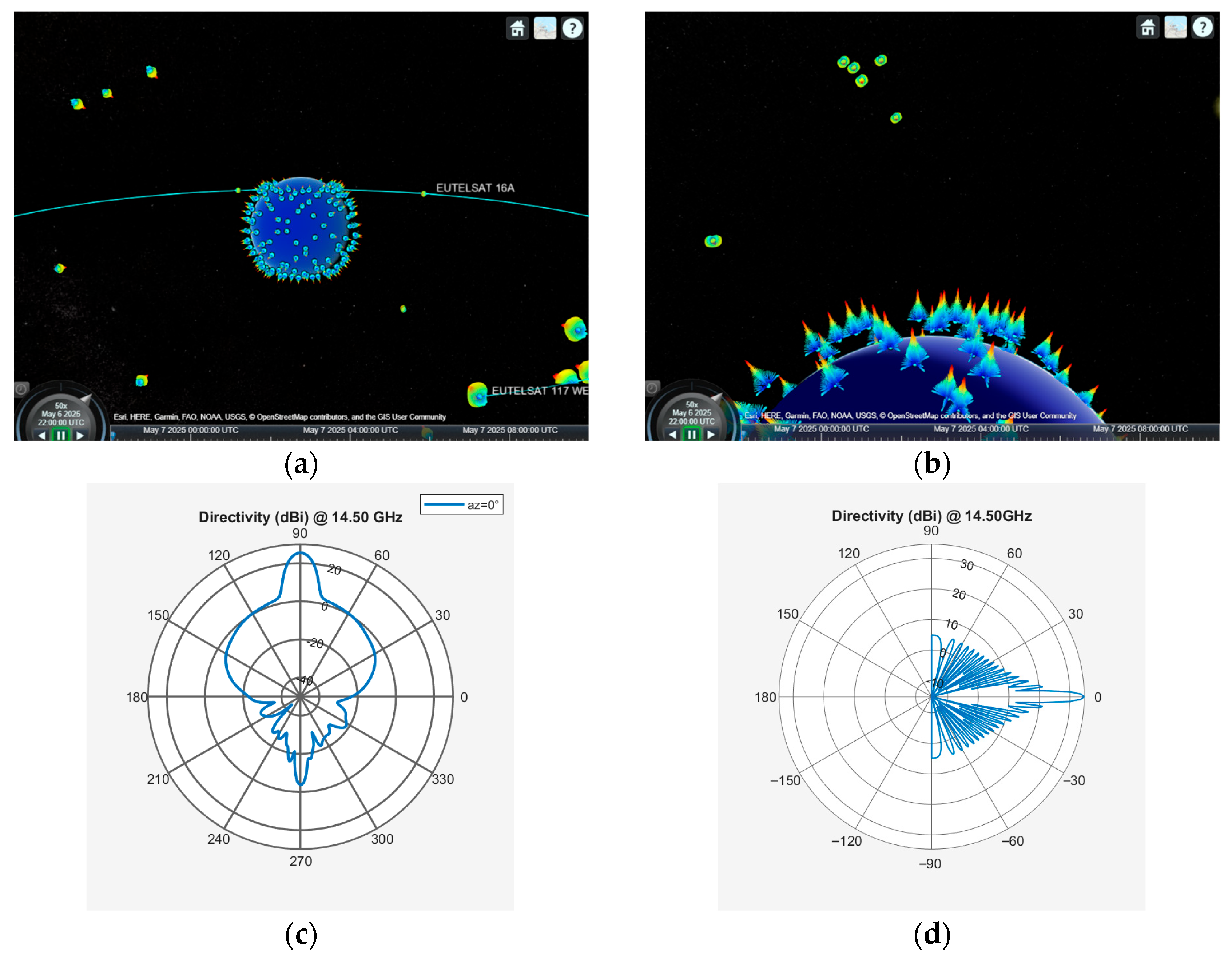
A schematic of the simulation scenario is depicted in
Table 1, where
Figure 1a and
Figure 1b illustrate the geometric configuration of the LEO satellites and space targets, while
Figure 1c and
Figure 1d depict the gain patterns of the transmitter and receiver antennas, respectively.
3.2.3. Data Preprocessing
To build a uniformly formatted dataset suitable for deep learning model training, we systematically preprocessed and standardized the raw simulation data. The core input data consists of electromagnetic observation data (received signal power and EIRP) collected by satellites in different LEO constellations at the same sampling time instant. These data are spatially irregular, corresponding to the instantaneous observation positions of the respective satellites.
To achieve a regular gridded representation for model training, we executed the following preprocessing pipeline:
Gridding Interpolation: Using cubic spline interpolation, the irregularly distributed received signal power and EIRP observation data are resampled onto a regular longitude-latitude grid covering the globe. This grid has a resolution of 512 × 1024, corresponding to the geographical range of longitude −180° to 180° and latitude −90° to 90°.
Continuous Data Normalization: Considering the differing value ranges and units of different physical quantities (e.g., signal power, EIRP, orbital altitude), we normalized all continuous data by linearly scaling them to the [0, 1] interval. This step aims to unify the numerical characteristics of each feature, accelerating model training convergence and enhancing its numerical stability.
Orbital Altitude Field Construction: In the free-space propagation model, link loss is primarily dominated by the transmission distance, which is directly influenced by the satellite orbital altitude. To accurately characterize this physical relationship, we treat the dynamically changing satellite orbital altitude (its variation constrained by orbital eccentricity) as an independent physical field. This is also mapped via interpolation and normalization onto the aforementioned 512 × 1024 grid, forming a height information matrix spatially aligned with the signal data.
Spatial Target Position Encoding: Unlike continuous data, spatial target position information is encoded into a matrix . An element in the matrix indicates the presence of a space target at grid with an altitude of h; otherwise, it is 0. This matrix serves as crucial prior knowledge and, after normalization, is directly used in subsequent reconstruction algorithms to identify the precise spatial distribution of targets.
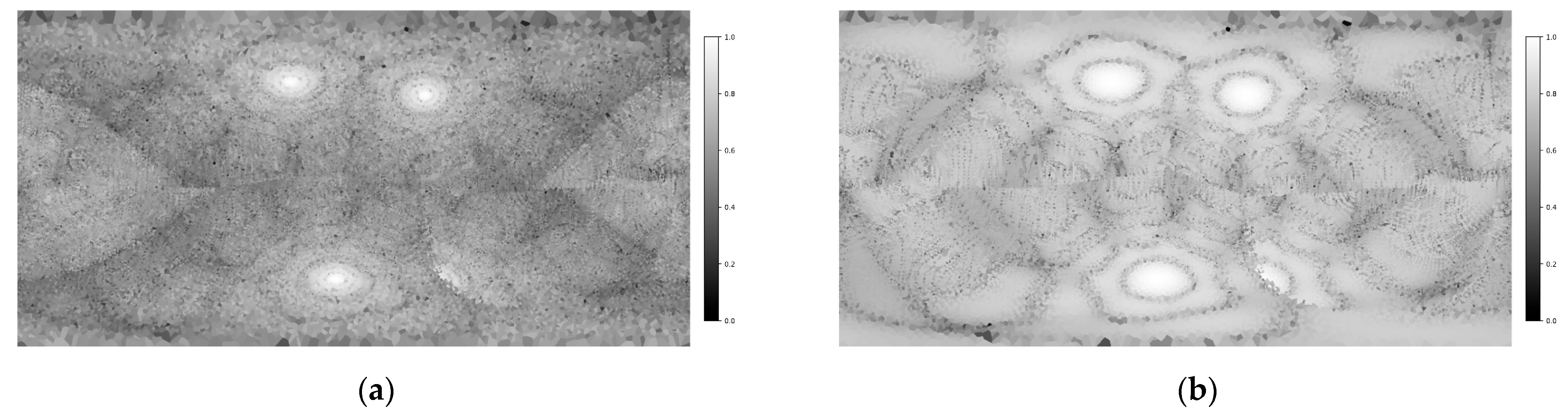
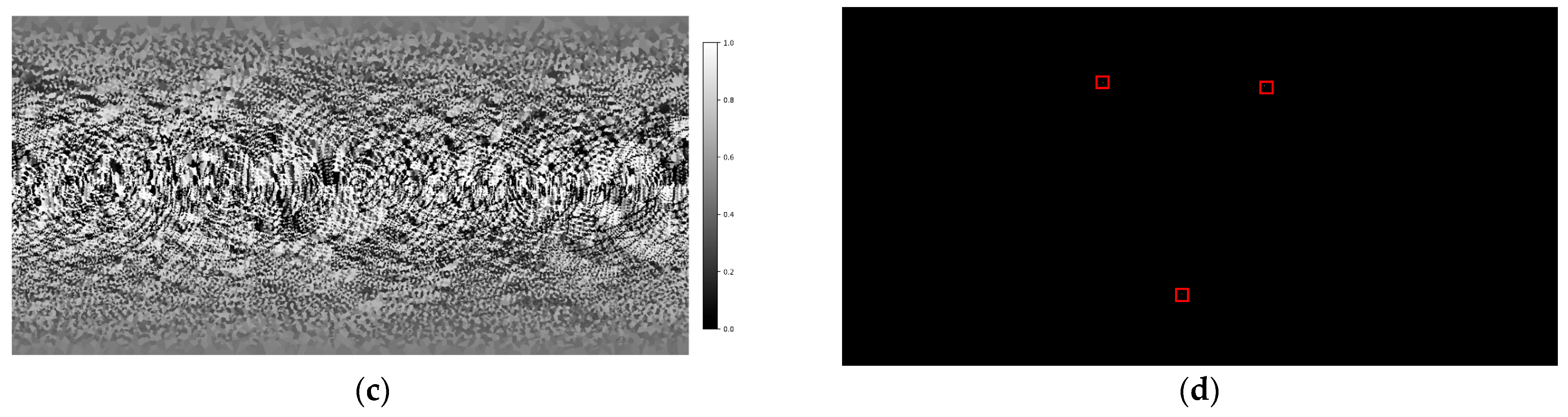
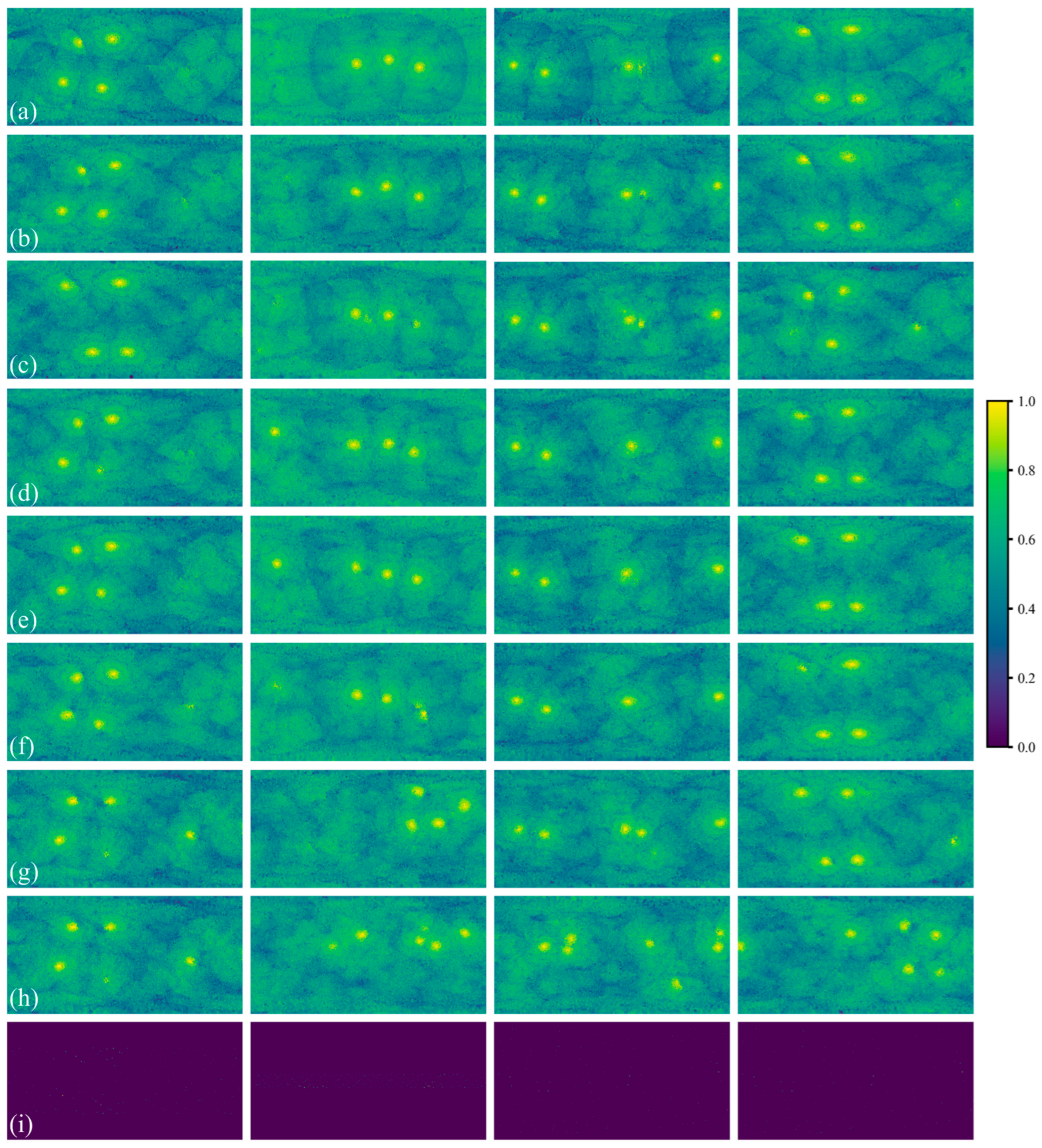
The data processed according to the aforementioned steps is shown in
Figure 2.
3.3. SRFlow-Based Reconstruction Approach
To address the aforementioned sparse reconstruction problem, we propose the SRFlow model. Its core idea is: utilizing the Flow Matching framework to learn a deterministic mapping from a simple noise distribution to the complex electromagnetic spectrum distribution, guided by multi-source conditional information (observations, target positions, EIRP), and ensuring the reconstruction strictly adheres to physical observations through an iterative measurement injection mechanism.
3.3.1. Theoretical Foundation of Flow Matching
Flow matching is a generative modeling framework based on continuous normalizing flows [
37], which trains a model by directly matching a generative vector field to a target probability path. Unlike diffusion models that rely on stochastic processes, flow matching learns a deterministic transformation from a noise distribution to the data distribution, offering more stable training, faster sampling, and potentially superior sample quality.
The core of flow matching involves a probability density path , which connects a prior noise distribution (e.g., a Gaussian) to the target data distribution, and corresponds to a generative vector field . A neural network is used to parameterize a vector field to match this target. A key innovation is the conditional flow matching (CFM) objective. CFM utilizes a conditional probability path and a conditional vector field , both based on a single data sample This formulation leads to an unbiased training objective that is easy to sample from and computationally efficient. The CFM objective is equivalent to directly matching the marginal vector field in terms of gradients, thereby enabling simulation-free training.
Let
denote the initial data distribution and
the target data distribution. Let
represent a random process from
to
governed by the following ordinary differential equation (ODE):
This induces a corresponding evolution of probability distributions. According to the Reynolds transport theorem [
38], the probability density
satisfies:
Our goal is to model
using a neural network
with parameters
by minimizing the flow matching objective:
Let
be a latent variable and
the marginal distribution such that:
then,
substituting into the transport equation yields:
furthermore, since
we can directly derive:
where
Following the above derivation, now assume
, and at
,
. A flow can then be defined as:
The corresponding velocity field is:
where the symbols
and
denote the first-order derivatives of
and
with respect to time
. Let the latent variable be the linear interpolation between the data sample
and the target sample
,
. The conditional probability distribution is then:
substituting into the expression for the conditional velocity field yields:
Consequently, the optimal transport path optimization objective becomes:
3.3.2. Architecture of the SRFlow Model
As outlined in
Section 3.1, electromagnetic spectrum map construction is inherently a generative modeling task. While Variational Autoencoders (VAEs) [
18], Generative Adversarial Networks (GANs), and Diffusion Models have been widely adopted, they exhibit certain limitations compared to flow-based approaches. VAEs often produce blurry or biased outputs, GANs suffer from training instability and mode collapse, and diffusion models require computationally intensive iterative sampling, limiting their applicability in real-time scenarios.
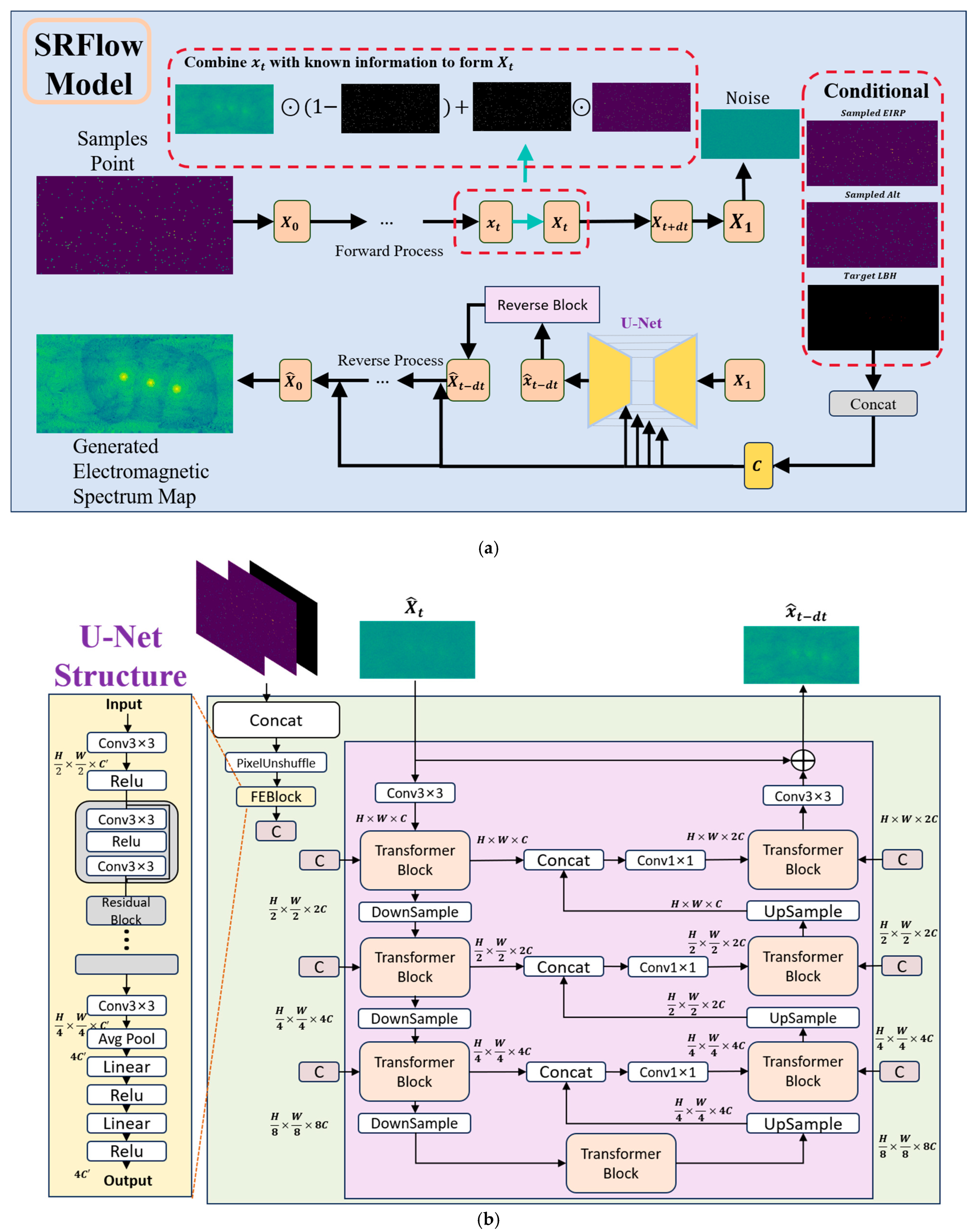
In contrast, flow-based generative models offer distinct advantages, including reversible architecture and exact likelihood computation. Consequently, we adopt a flow-based method as the backbone of our framework for efficient electromagnetic spectrum map construction. This approach ensures training stability, high computational efficiency, and enhanced interpretability during the generation process. The model architecture is depicted in
Figure 3.
The Spatial Electromagnetic Spectrum Flow model is built upon the flow matching framework, providing a more efficient alternative to diffusion-based methods while maintaining strong generative capabilities. Unlike diffusion models that rely on an iterative denoising process, flow matching learns a deterministic path from a noise distribution to the data distribution, enabling faster training and inference.
The SRFlow algorithm follows a forward process similar to that of diffusion models. At time , the target distribution is denoted as . Unlike diffusion models where is typically a standard Gaussian distribution, flow−based models allow to take a more general form, provided holds, where represents an arbitrary distribution.
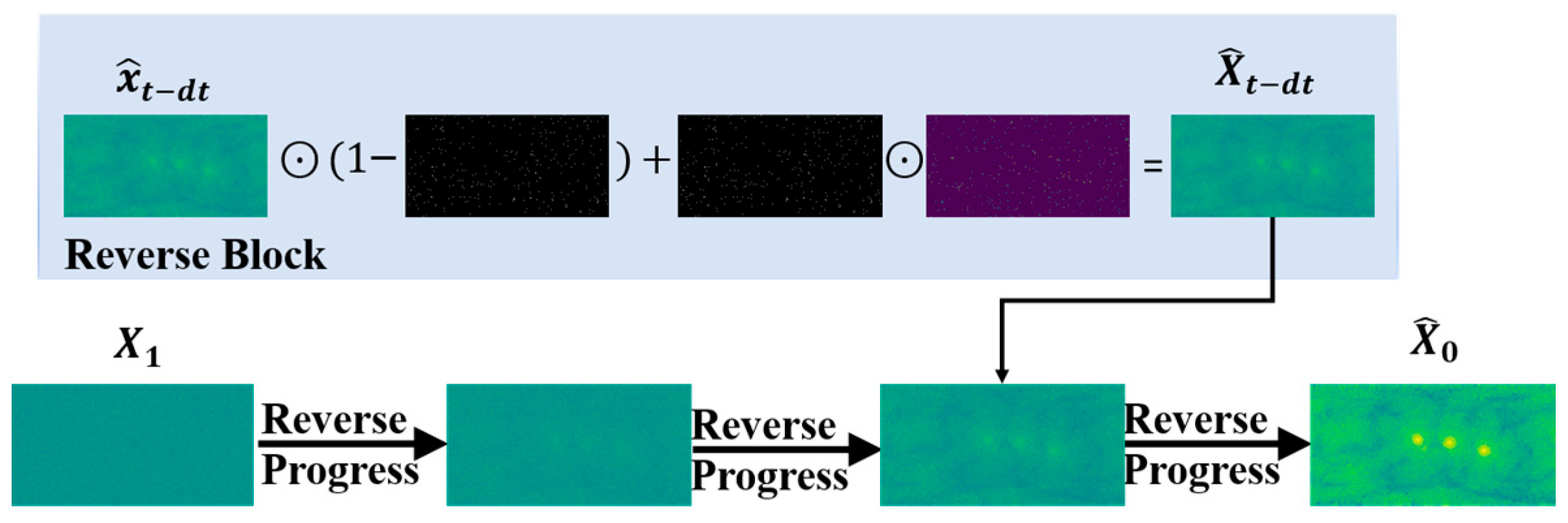
A key innovation of our method is the utilization of the sampling matrix
to reinject sampling information at each step of both the forward and reverse processes, integrating all available environmental information. This matrix acts as a relatively comprehensive priority, guiding the generation process. We define a matrix:
Inspired by the Repaint method but adapted for electromagnetic spectrum map construction [
39,
40], our approach must account for the significant influence of space target positions on signal propagation. As mentioned in
Section 1, signal characteristics in regions containing space targets possess specific physical significance. This introduces high-frequency components and signal variations near target boundaries, which may adversely affect the generative model. To mitigate this, noise is added only to unknown regions during the forward process. The forward process at step
is expressed as:
where
,
is the standard Gaussian distribution,
denotes a matrix of all ones, and as the timestep increases,
is given by:
The target vector field is defined as:
In the flow process, a neural network approximates the “flow velocity” from the initial distribution to the target distribution. In this method, the objective is to minimize the difference between and . When the posterior distribution is , it follows that .
In the reverse process:
and
, ensuring that known sampling information is injected into the model at each step of the reverse process. This procedure is illustrated in
Figure 4.
The forward and reverse processes establish the fundamental flow matching framework. To address the conditional electromagnetic spectrum map construction problem formulated in
Section 3.1, we incorporate conditioning by integrating all known information into a condition tensor
. An innovation of our model is the use of an attention-based mechanism to guide the reverse process with the conditional information
. Specifically, at each reverse step, the intermediate state of the U-Net interacts with a projected representation of
via a cross-attention operation. The detailed architecture of this attention module is elaborated in the following paragraphs [
41].
Since the standard attention architecture is not designed to directly handle tensor data, an extractor
is required to project the tensor
into an embedded representation. This embedding is then injected into the intermediate layers of the U-Net through an attention operation:
where the query
, key
, and value
are defined as:
where
is a flattening operator applied to the U-Net output, and
,
, and
are trainable projection matrices.
3.4. Experimental Setup
To comprehensively evaluate the performance of SRFlow, we established detailed experiments including evaluation metrics, implementation details, comparisons with state-of-the-art methods, and ablation studies. All experiments were conducted on the same simulated dataset to ensure a fair comparison.
3.4.1. Evaluation Metrics
To comprehensively evaluate the quality of radio map construction, we adopt evaluation metrics commonly used in prior work: Normalized Mean Square Error (NMSE) and Root Mean Square Error (RMSE). Since accurately reconstructing structural information and details is crucial in radio map estimation, and MSE-based metrics may not adequately capture these aspects, we also introduce the Structural Similarity Index (SSIM) and Peak Signal-to-Noise Ratio (PSNR). SSIM assesses structural consistency and the accuracy of detail reconstruction, while PSNR measures the signal-to-noise ratio and evaluates reconstruction fidelity—particularly at signal edges.
- 1.
Mean Square Error:
MSE calculates the average squared difference between pixel values of the original and predicted images:
where
and
represent the true and predicted electromagnetic spectrum values at grid point
, respectively, and
and
are the height and width of the grid, respectively.
where
is the predicted electromagnetic spectrum map and
is the ground truth map.
The Root Mean Square Error is defined as:
- 2.
Structural Similarity Index:
The Structural Similarity Index (SSIM) is a perceptual quality metric inspired by the human visual system. Its sensitivity to high-frequency details and structural texture makes it suitable for assessing electromagnetic spectrum map reconstruction quality. SSIM evaluates three aspects: luminance, contrast, and structure.
Structure comparison:
where
and
are the predicted and ground truth electromagnetic spectrum maps, respectively,
and
are their local means,
and
are their variances, and
is their covariance.
are constants to avoid division by zero, defined as:
where
is the dynamic range of the pixel values. The overall SSIM is expressed as:
An SSIM value closer to 1 indicates higher similarity between the images.
- 3.
Peak Signal-to-Noise Ratio:
PSNR measures the ratio between the maximum possible signal power and the corrupting noise power, expressed in decibels. It approximates the perceptual quality of an image, where a higher PSNR value indicates better reconstruction quality. For electromagnetic spectrum map estimation, high-fidelity reconstruction of edge signals is crucial, making PSNR particularly useful for evaluating overall quality and edge detail preservation.
where
is the maximum possible pixel value in the image. A higher PSNR indicates better image quality with less noise.
3.4.2. Implementation Details
We implemented our model framework using Python 3.9 and PyTorch 1.12.1. The model was trained on an NVIDIA GeForce RTX 3090 Ti GPU. For all experiments, the entire simulated dataset was divided into training, validation, and test sets with a ratio of 7:2:1. The division was performed at the scenario level to ensure that each set contains independent target configurations and observation geometries, thereby preventing data leakage and enabling a robust evaluation of model generalization. All compared models were trained and evaluated using the same data splits to ensure a fair comparison. The training was conducted for 200 epochs with a batch size of 4, which took approximately 48 h in total. We employed an early-stopping strategy based on the validation loss with a patience of 20 epochs.
The corresponding conditional vector field target is , which is time independent. Our model is trained to regress this target vector field using a simple L2 loss (equivalent to the CFM-OT objective in Equation (16)), with uniform weighting across all time steps and data samples. The noise schedule is implicitly defined by the linear OT path, resulting in a signal-to-noise ratio that linearly evolves with time.
The input grid size was set to 512 × 1024. The total number of flow matching time steps T for sampling during inference was set to 1000. We used the AdamW optimizer with an initial learning rate of 10−4, betas of (0.9, 0.999), and a weight decay of 10−2. The learning rate followed a cosine annealing schedule, gradually decaying to a minimum of 10−6 over the course of training.
To ensure a fair comparison, all baseline models (RMDM, RadioDiff, RME-GAN, RadioUNet, etc.) were trained under identical conditions: they used the same training and validation dataset splits, received the same number of training epochs, and were fed with identical input representations.
3.4.3. Comparison with Other Methods
Model performance was evaluated under two key scenarios: one where the spatial positions of space targets are known as prior information, and another where target positions are completely unknown. In both settings, the experiments simulated the sparsity of real on-orbit observations, using only the sampling data from a single LEO constellation at a single time instant as input. Extensive comparative experiments were conducted against current mainstream generative and discriminative models, including Convolutional Neural Networks (CNNs), Generative Adversarial Networks (GANs), Latent Diffusion Models, Deep Autoencoders, and a U-Net with an architecture identical to the flow field fitting network in our model. It is important to note that current academic research on space-based electromagnetic spectrum construction for space targets remains largely unexplored. Therefore, we adapted state-of-the-art algorithms from the methodologically related and well-established field of “urban radio map construction” as our baselines. This comparison strategy not only ensures a fair and challenging evaluation but also highlights our model’s unique advantages and effectiveness in tackling novel and more complex space scenarios.
The first category comprises discriminative models based on supervised learning, primarily including: RadioUNet, which uses a classical encoder–decoder structure to directly learn the mapping from spatial features to path loss in an end-to-end manner. We also include the standard U-Net architecture as a significant baseline to verify the performance improvement of our specialized design over a general-purpose image reconstruction network.
The second category comprises emerging methods based on generative models, which have demonstrated notable advantages in detail generation and uncertainty modeling. The compared methods include: RME-GAN, which employs a two-stage conditional GAN framework to enhance reconstruction quality by integrating physical model interpolation with data-driven optimization; RadioDiff, based on Denoising Diffusion Probabilistic Models (DDPMs), which innovatively incorporates adaptive Fourier transform operators to significantly improve the preservation of high-frequency details; and RMDM [
42], a diffusion model that integrates physics-informed neural networks, embedding explicit electromagnetic propagation constraints through the Helmholtz equation within a dual U-Net architecture. Additionally, we include a Deep Autoencoder (DeepAE) as a representative of unsupervised feature learning to evaluate its baseline performance in feature extraction and reconstruction tasks.
This systematic comparison framework not only encompasses the technical evolution from traditional deep learning to the latest generative models but also, through comprehensive testing under various sampling densities and scenario complexities, thoroughly validates the comprehensive advantages of our SRFlow model in terms of reconstruction accuracy, detail preservation, and generalization capability.
4. Results
4.1. Results with Known Space Target Coordinates
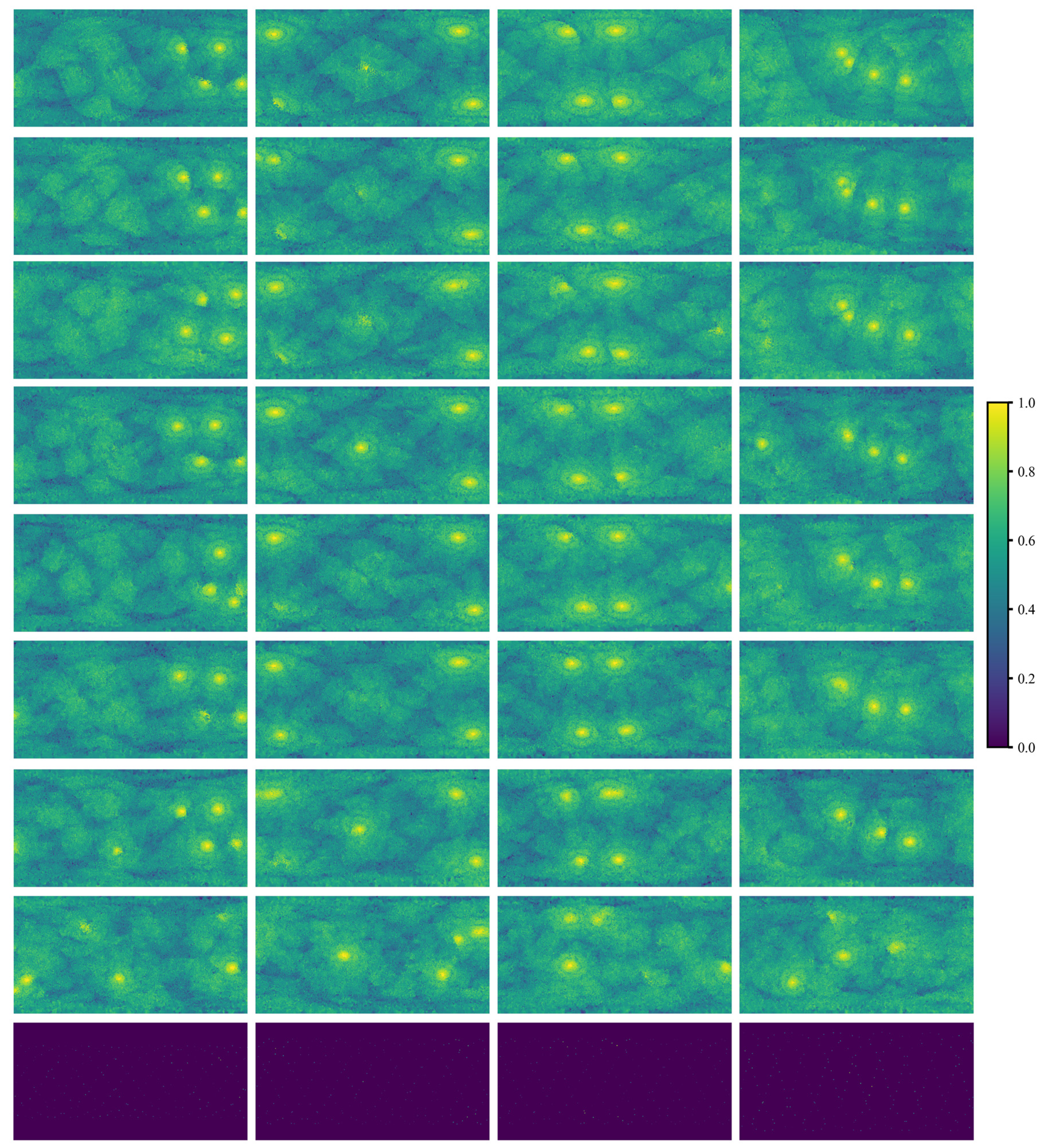
This study conducted a systematic quantitative and qualitative evaluation of various electromagnetic spectrum map reconstruction methods based on sparse sampling data from a single satellite constellation at the same time instant. The results, summarized in
Table 3 and
Figure 5, reveal clear performance distinctions among different reconstruction paradigms.
Our proposed SRFlow model achieved the best performance across all evaluation metrics, attaining an NMSE of 0.0235, RMSE of 0.153, PSNR of 26.3 dB, and SSIM of 0.802. The confidence interval analysis in
Table 4 further confirms the statistical stability of these results: at a 95% confidence level, SRFlow’s NMSE, RMSE, PSNR, and SSIM consistently fall within the intervals [0.0221, 0.0249], [0.148, 0.158], [25.9, 26.7] dB, and [0.794, 0.810], respectively.
Compared to the second-best performing physics-informed diffusion model RMDM (NMSE 0.0258, SSIM 0.772), SRFlow reduced NMSE by 8.9% and improved SSIM by 3.9%. Furthermore, the comparison of model complexity and inference efficiency (
Table 5) shows that SRFlow requires only 6.23 M parameters and 8.1 G FLOPs, which are significantly lower than those of RMDM (84.88 M/142.8 G) and RadioDiff (32.12 M/59.8 G). Although its inference time (133.2 ms) is higher than that of single-pass models due to the iterative flow-matching process, SRFlow remains approximately 13.6 times faster than RMDM and 3.9 times faster than RadioDiff, achieving the best trade-off between generation quality and computational efficiency. Among generative methods, SRFlow’s performance surpassed that of diffusion-based models (RMDM and RadioDiff) and the GAN-based RMEGAN; all generative methods significantly outperformed the discriminative models, including RadioUNet and the standard U-Net. Qualitative comparisons in
Figure 5 further demonstrate that SRFlow’s reconstruction results are closest to the true spectrum distribution in terms of detail restoration and structural consistency, particularly in maintaining sharper edges in regions containing space targets. Notably, the basic U-Net and DeepAE methods exhibited spurious source reconstruction in areas originally devoid of radiation sources, whereas SRFlow effectively avoided such artifacts.
4.2. Results with Unknown Space Target Coordinates
Under the more challenging condition where spatial target position prior information is unavailable, the reconstruction performance of all algorithms degraded significantly, while the performance ranking remained stable. As shown in
Table 6 and FigWe have added the citation for
Figure 6 in the text.ure 6, the SRFlow model maintained a comprehensive lead across all four core metrics, achieving an NMSE of 0.0255, RMSE of 0.183, PSNR of 24.6 dB, and SSIM of 0.723.
The confidence interval analysis provided in
Table 7 further confirms the statistical stability of these results: at a 95% confidence level, SRFlow’s NMSE, RMSE, PSNR, and SSIM are consistently within the intervals [0.0241, 0.0269], [0.178, 0.188], [23.9, 25.3] dB, and [0.715, 0.731], respectively.
Compared to the second-best performing physics-informed diffusion model RMDM, SRFlow reduced NMSE by approximately 8.3% and improved SSIM by about 3.1%. Relative to the diffusion model RadioDiff, SRFlow achieved a reduction in NMSE of 22.3% and an improvement in SSIM of 11.2%, demonstrating its stronger robustness when critical prior information is missing.
The efficiency comparison (
Table 8) shows that, under this setting, SRFlow still requires only 6.23 M parameters and 7.9 G FLOPs, which remain substantially lower than those of RMDM (84.84 M/142.5 G) and RadioDiff (32.12 M/59.2 G). Its inference speed (130.5 ms) is approximately 13.7 times faster than RMDM and 3.9 times faster than RadioDiff, highlighting a significant efficiency advantage. Among generative methods, SRFlow showed clear advantages over RMDM, RadioDiff, and the GAN-based RMEGAN, with the gap in structural preservation capability being particularly prominent. It is noteworthy that under this condition, the performance degradation of discriminative models was more severe, indicating a higher dependency on complete prior information for these methods. Comprehensive analysis shows that the flow matching framework adopted by SRFlow, by establishing a deterministic transformation path from noise to data, maintains relatively stable reconstruction performance and excellent computational efficiency even in the absence of strong target location constraints, which is of great importance for practical space applications where prior information is incomplete.
4.3. Ablation Study
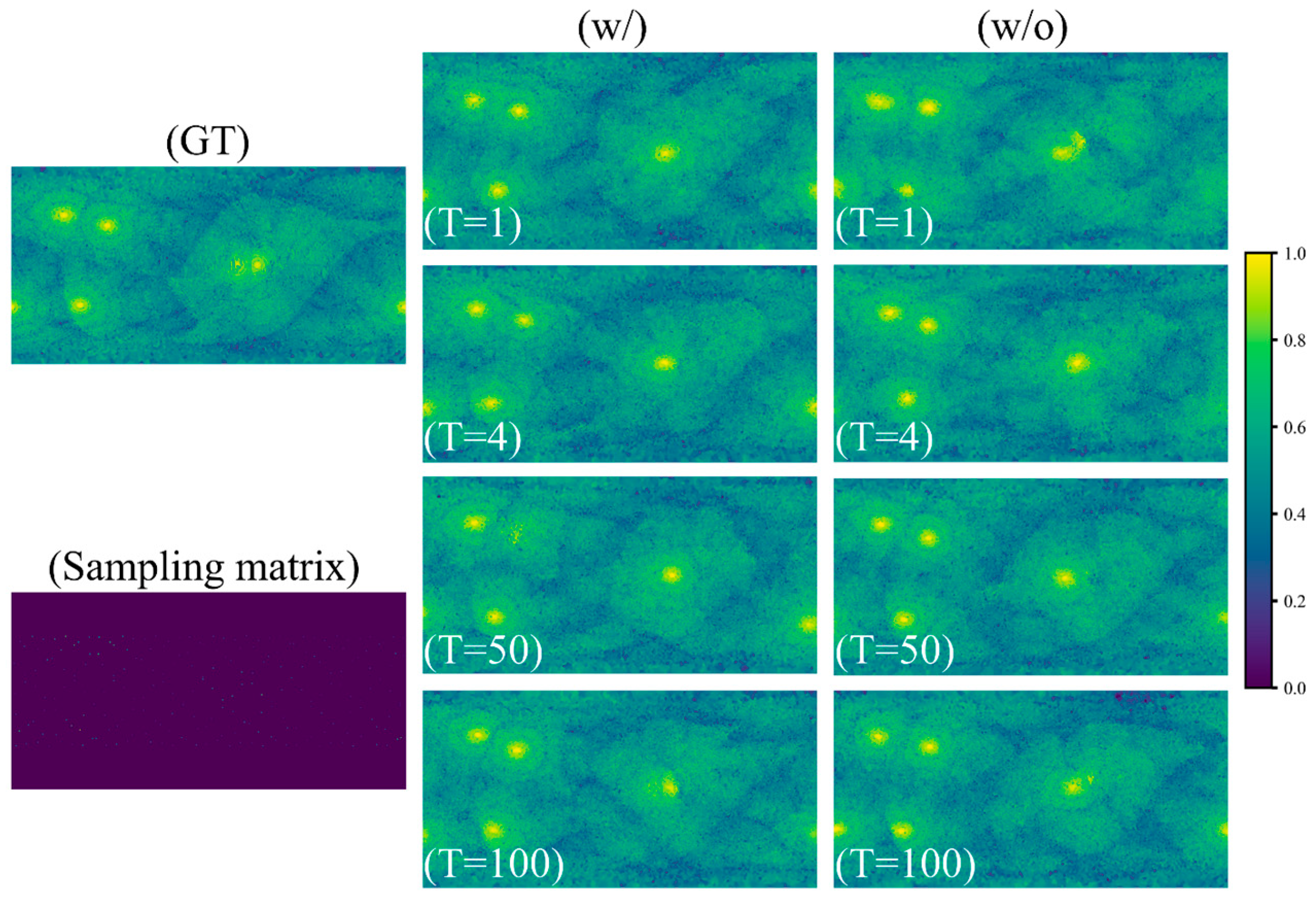
In this section, we systematically evaluate the impact of different settings for the total number of timesteps T and the proposed known information injection mechanism on the model’s reconstruction performance through ablation experiments, under the same sampling conditions and with known spatial target coordinates. We conducted ablation experiments with T set to 1, 4, 50, and 100, each under conditions with and without known information injection during the forward and reverse processes. The quantitative results of the experiments on the same test set, along with qualitative results, are presented in
Table 9 and
Figure 7, respectively.
The quantitative results of the ablation study are shown in
Table 9.
Figure 7 illustrates the impact of different timesteps and known information injection conditions on the performance of the SRFlow model.
This paper systematically evaluated the impact of the number of timesteps T and the proposed known information injection mechanism on the performance of the SRFlow model. Experiments show that the performance improvement brought by increasing the number of timesteps exhibits a significant marginal effect: NMSE improved by approximately 9.9% from T = 1 to T = 4, while the performance saturated from T = 50 to T = 100. More importantly, the known information injection mechanism consistently produced a stable positive effect across all timestep settings, further reducing NMSE by 1.7% and improving SSIM by 0.002 at T = 100, demonstrating the effectiveness and robustness of this constraint.
This result highlights the core advantage of the flow matching framework: the model primarily achieves reconstruction by learning the physical laws within the data, rather than relying heavily on strong priors. The known information injection serves as an auxiliary mechanism, ensuring a deterministic performance improvement while maintaining the model’s strong performance in the absence of prior information. This design philosophy of “data-driven primary, prior-constrained auxiliary” makes the method both reliable and adaptable in practical applications.
5. Discussion
This study has systematically validated the effectiveness of the SRFlow model in addressing the challenge of reconstructing space electromagnetic spectrum maps from sparse LEO observations. The experimental results confirm that SRFlow achieves the best current trade-off between reconstruction accuracy and computational efficiency. It demonstrates significant and stable advantages under both ideal conditions with known target positions and the severe challenge of lacking such critical prior information.
The performance advantage of SRFlow over advanced diffusion-based models fundamentally stems from the efficiency of the flow matching generative paradigm. Unlike diffusion models that require simulating lengthy stochastic denoising processes, flow matching learns a deterministic mapping from noise to data. This allows it to achieve comparable or superior reconstruction quality with far fewer iterative steps, a trend evidenced by the performance saturation after T = 50. Consequently, SRFlow attains substantially lower parameter counts, computational costs, and an order-of-magnitude faster inference than diffusion models, which is crucial for future deployment on resource-constrained onboard platforms. Compared to discriminative models, SRFlow’s generative framework enables reasoning from the global data distribution, which reduces the “hallucination” of signals in completely unobserved regions. Furthermore, its training process is more stable than Generative Adversarial Networks, and its deterministic flow enhances the interpretability of the results.
The ablation study confirms the iterative measurement injection mechanism as a key to the model’s success. This mechanism seamlessly integrates sparse observations as hard constraints by correcting the values at known sampling points during each step of the reverse process. This ensures the model output strictly adheres to all physical measurements, thereby significantly improving reconstruction fidelity, particularly near the observation locations. The mechanism provides stable performance gains across different timestep settings, and the experiments reveal a law of diminishing marginal returns with increasing T, offering practical guidance for balancing accuracy and speed in real-world deployment.
Although SRFlow excels on simulated data, several limitations must be addressed for practical application. Validation with real measured data is an essential next step, as unmodeled interference, system biases, and complex noise characteristics present in real space environments could challenge the model. For real-time onboard processing, the current inference time and computational load necessitate further optimization through model lightweighting and hardware acceleration. Finally, extending the model to capture spatiotemporal dynamics, thereby moving beyond static snapshots to reconstruct and predict continuous four-dimensional fields, represents a vital future direction.
Existing spectrum reconstruction techniques are predominantly designed for scenarios with relatively dense observations and are ill-suited for the extreme sparsity characteristic of space-based measurements. The core innovation of this work lies in being the first to systematically introduce and adapt the efficient flow matching framework to this novel domain. By constructing a high-fidelity simulation dataset, proposing the SRFlow model, and establishing a rigorous performance benchmark, this work provides a complete and reproducible technical baseline. This foundation is expected to accelerate subsequent research in model optimization and real-data integration, thereby contributing to the development of next-generation, full-dimensional space situational awareness systems.
6. Conclusions
This research proposed a comprehensive solution for reconstructing the wide-area electromagnetic spectrum maps of space targets from the extremely sparse and discontinuous measurements provided by Low-Earth Orbit satellite constellations. To address this novel challenge, we first established a high-fidelity, multi-scenario simulation dataset, creating the first open benchmark for the field. Building upon this foundation, we introduced SRFlow, an innovative flow-matching generative model specifically designed for this task. SRFlow uniquely integrates multi-source prior knowledge with a robust iterative measurement injection mechanism, enabling high-fidelity reconstruction from sparse inputs. Extensive experimental evaluations demonstrate that SRFlow achieves state-of-the-art performance in both reconstruction accuracy and computational efficiency under both ideal (known target positions) and highly challenging (unknown positions) conditions, significantly outperforming adapted models from related domains.
Collectively, this work delivers a complete technical pathway from data simulation to high-performance reconstruction. It provides not only an effective algorithmic tool but also a rigorous and reproducible benchmark, thereby establishing a foundational reference for future research in space-based electromagnetic situational awareness. Moving forward, critical steps toward practical application include validating the model with real on-orbit measurements, optimizing it for efficient onboard inference, and extending its capability to model spatiotemporal dynamics for continuous 4D field reconstruction.