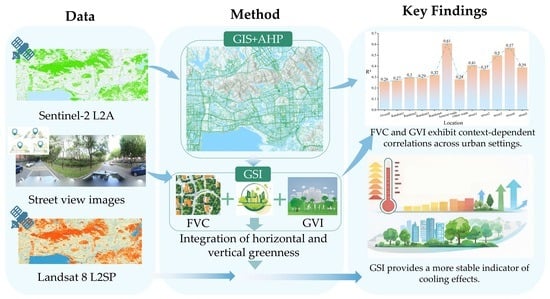
A Green Synergy Index for Urban Green Space Assessment Based on Multi-Source Data Integration

Highlights
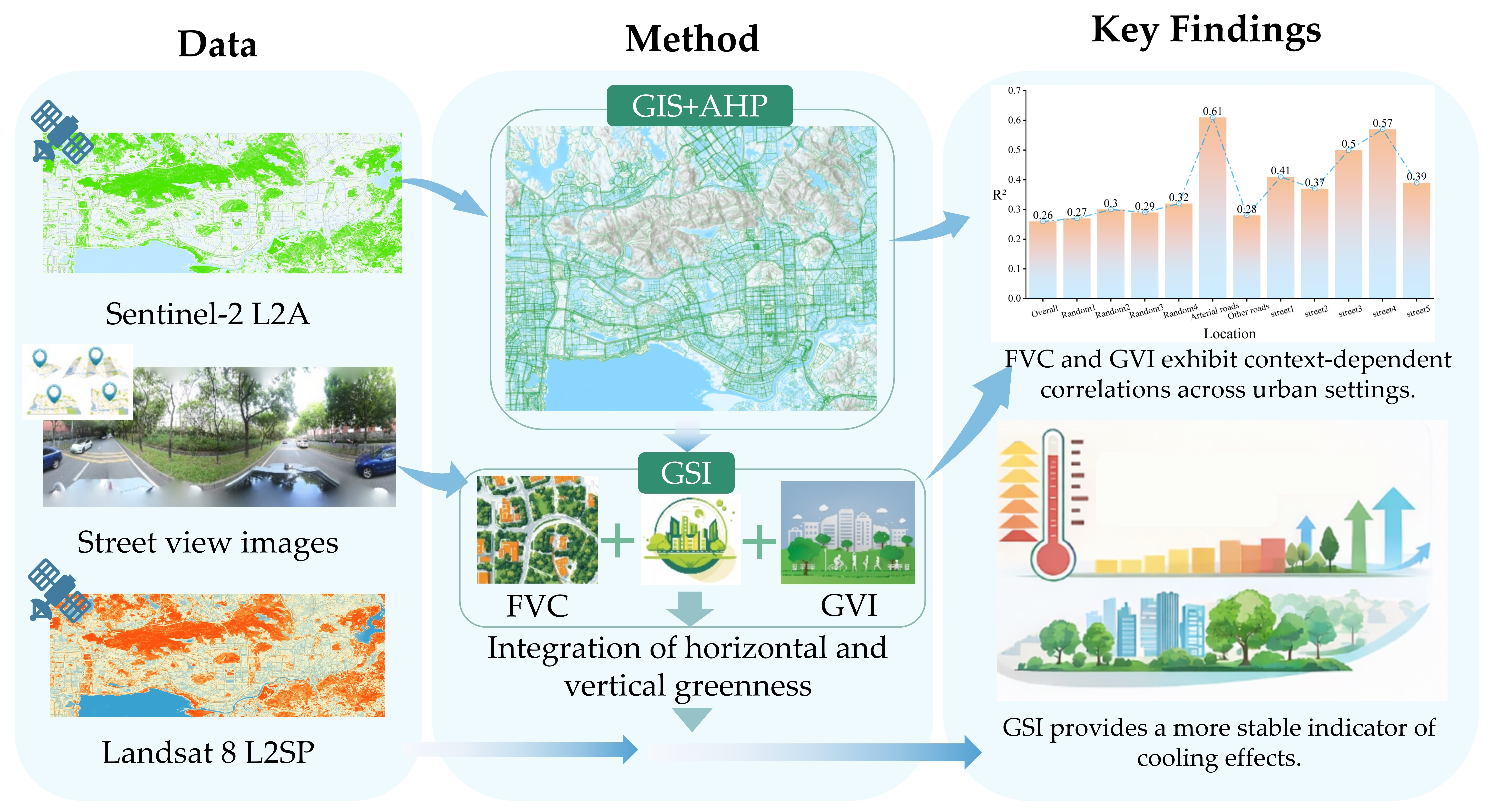
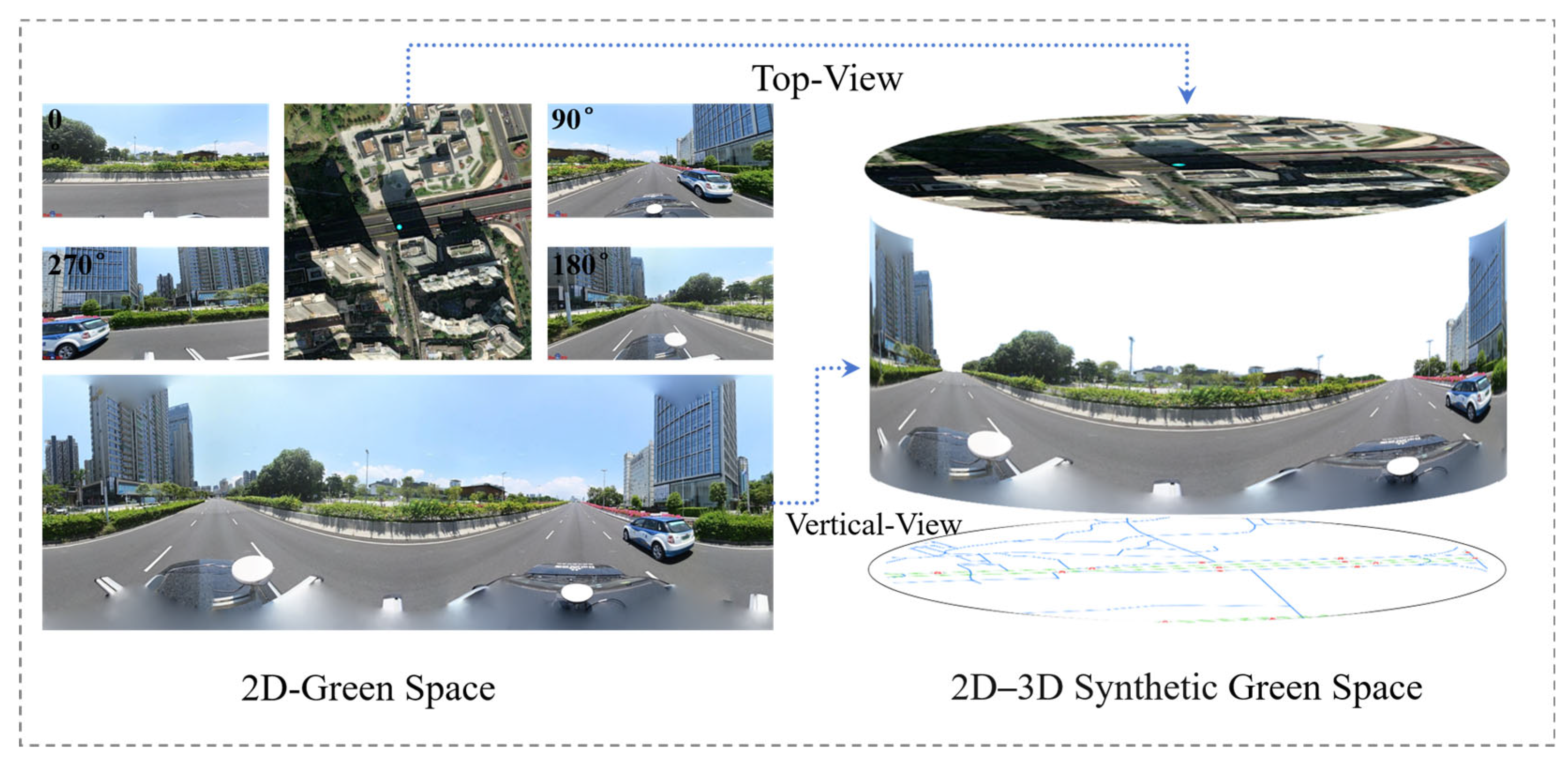
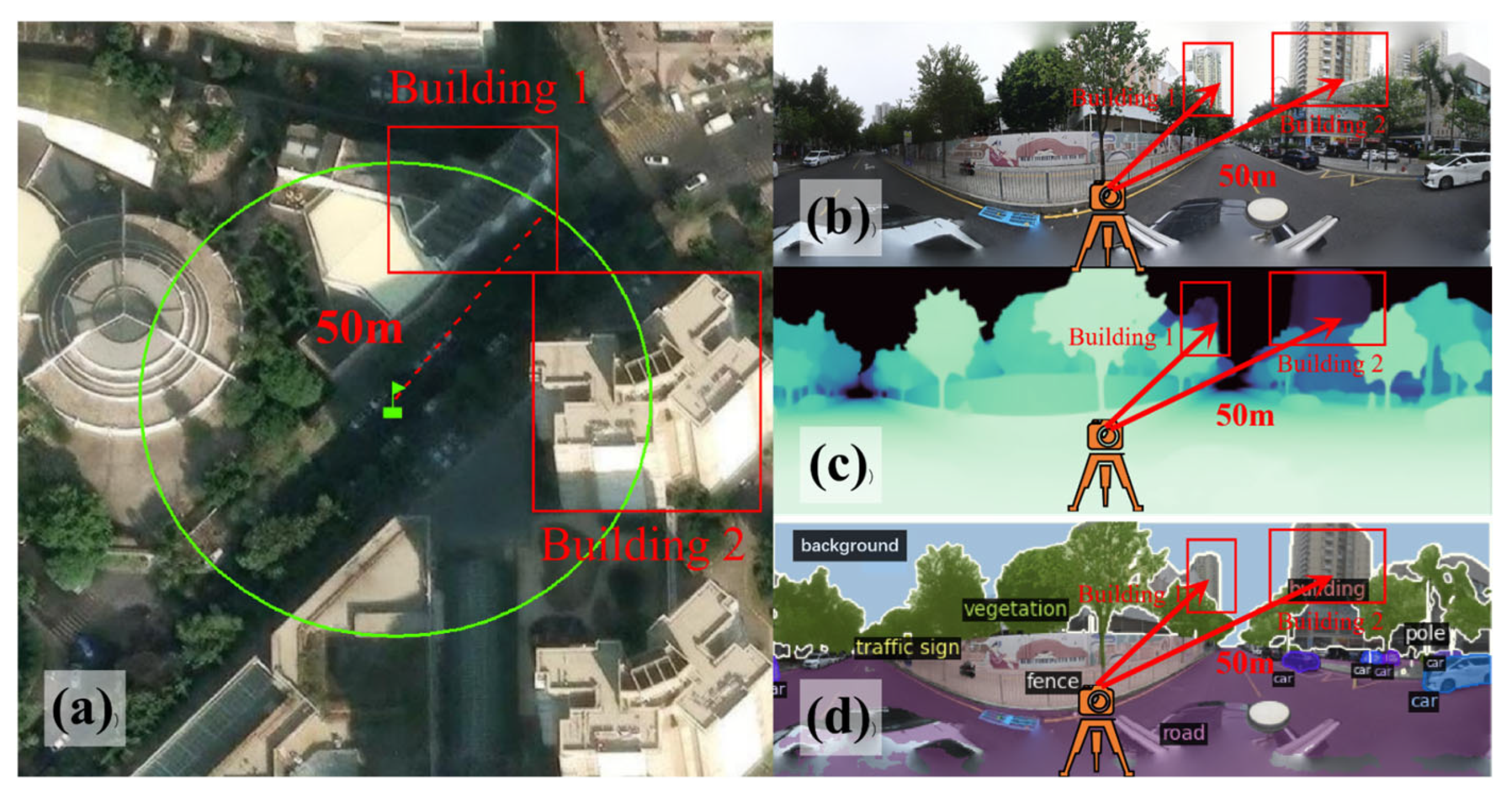
- A depth-constrained 2D–3D integration framework aligns nadir-based FVC with pedestrian-level GVI within a consistent volumetric neighborhood.
- A novel Green Synergy Index integrates FVC and GVI using nonlinear power-law exponents and an interaction term to capture three-dimensional greenness.
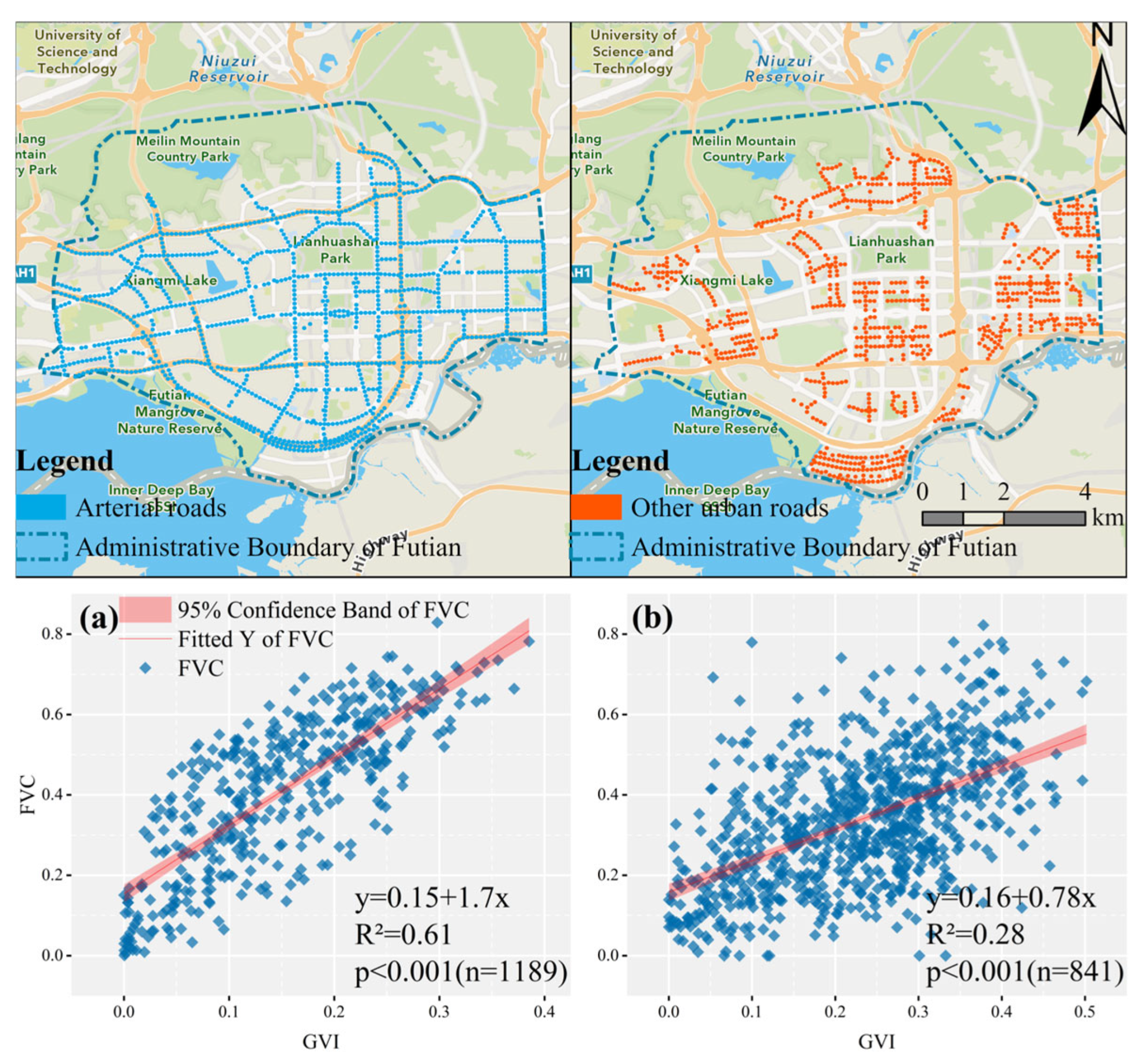
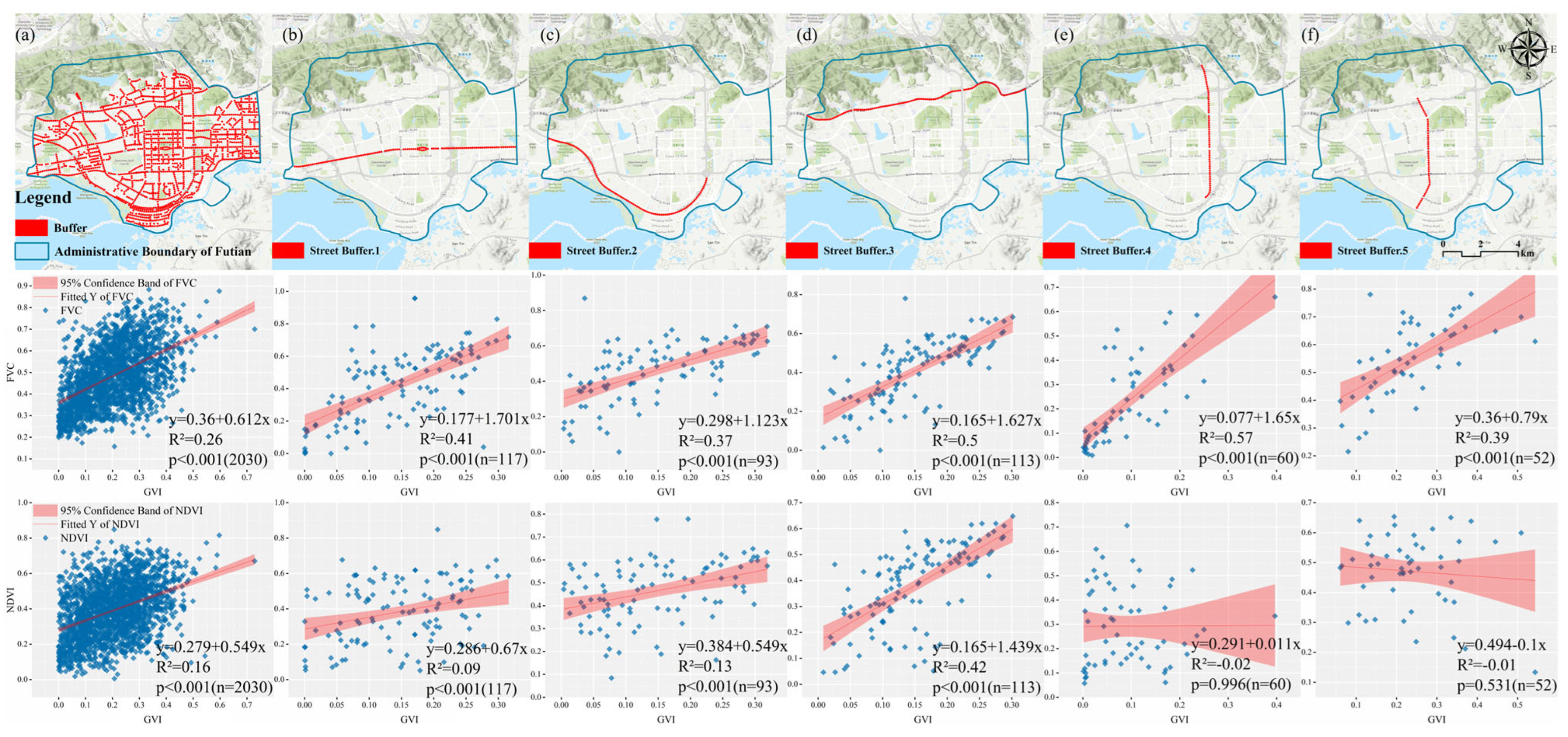
- Global and local correlation analyses reveal strong context-dependent relationships between FVC and GVI across different road classes and urban functions.
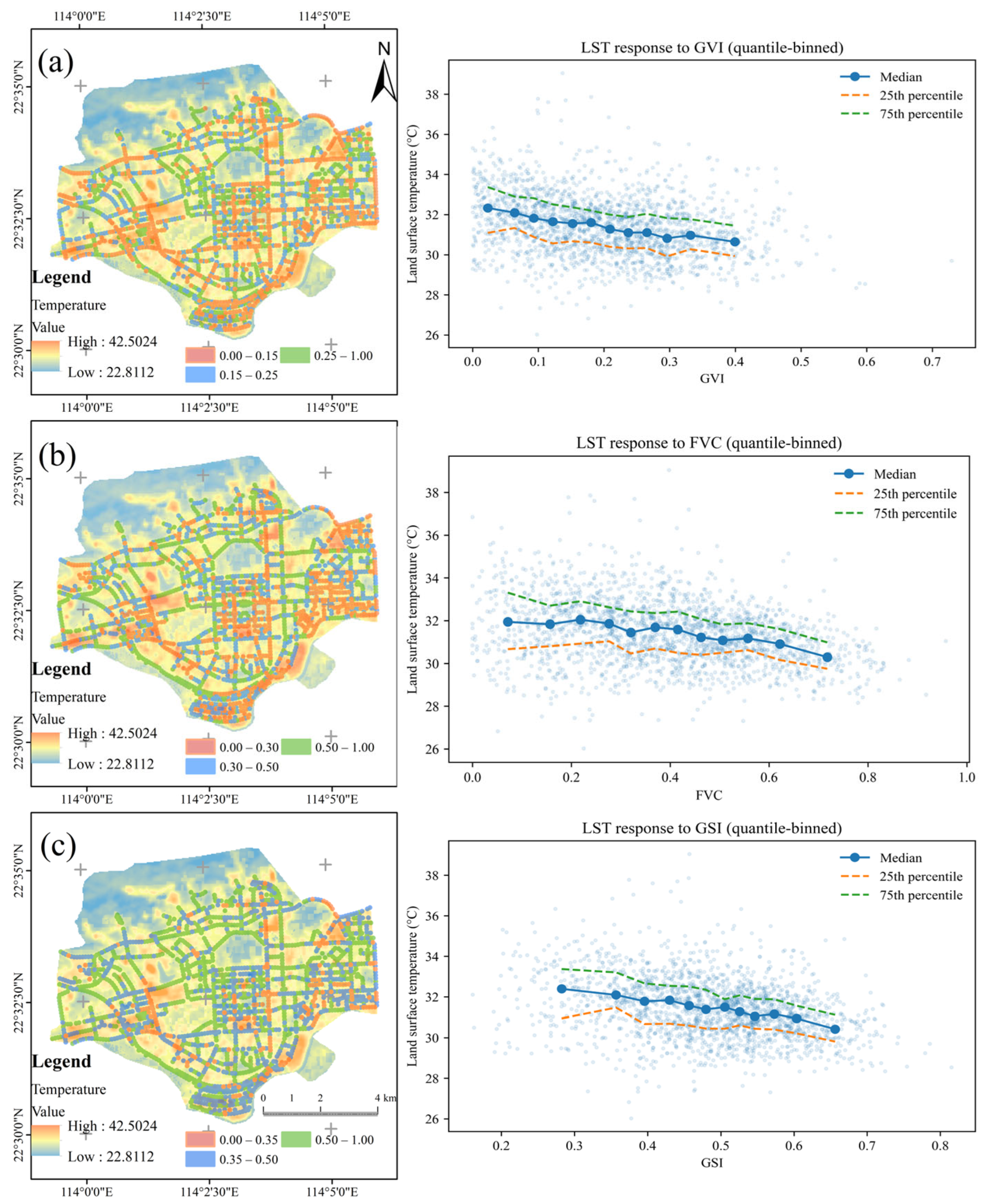
- The proposed GSI shows higher stability and stronger cooling relevance with land surface temperature than conventional single greenness indicators.
Abstract
1. Introduction
2. Materials and Methods
2.1. Data Source
2.1.1. Remote Sensing Data
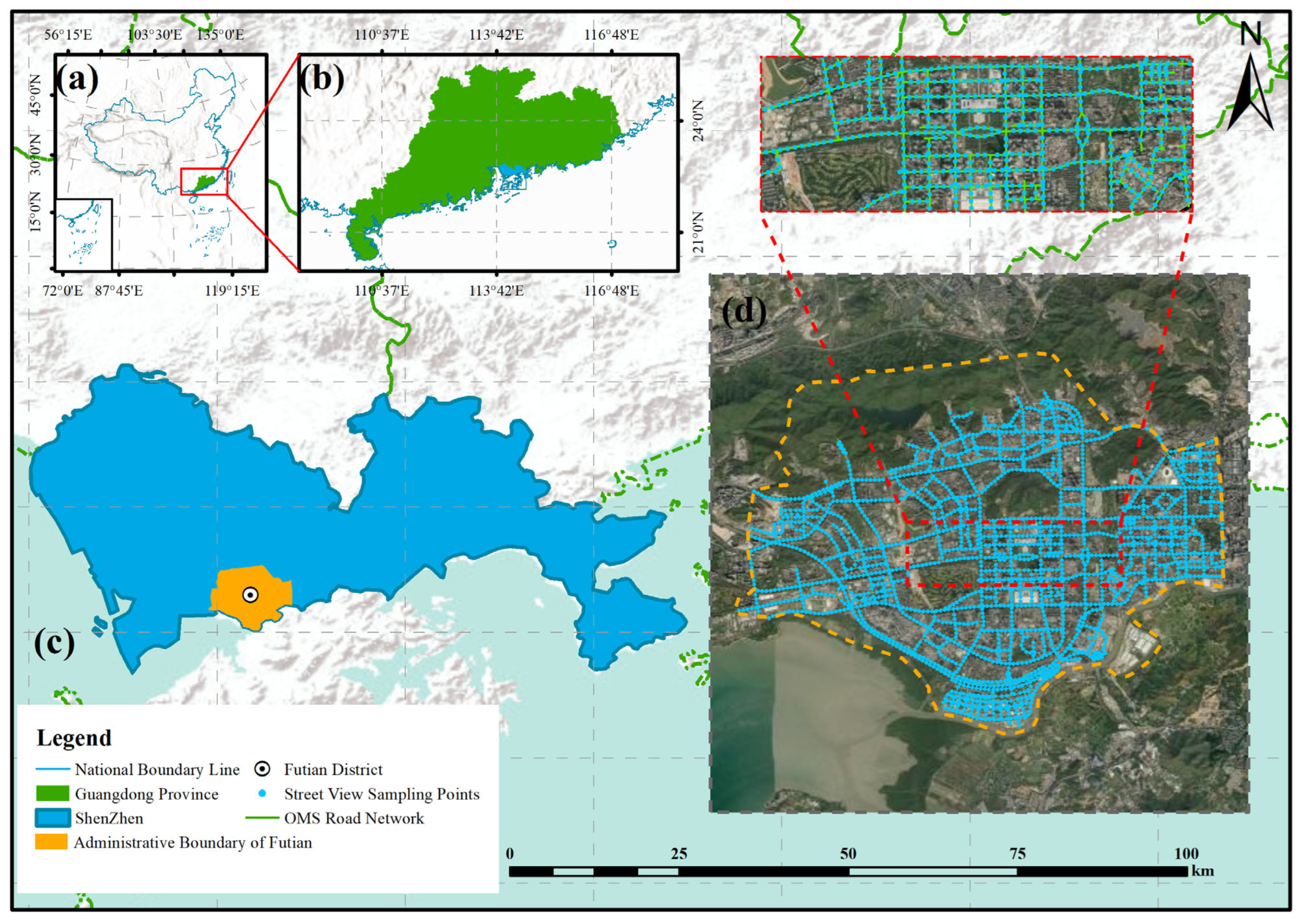
2.1.2. Administrative Boundary Data
2.1.3. Road Network Data
2.1.4. Street-View Imagery
2.2. Methods
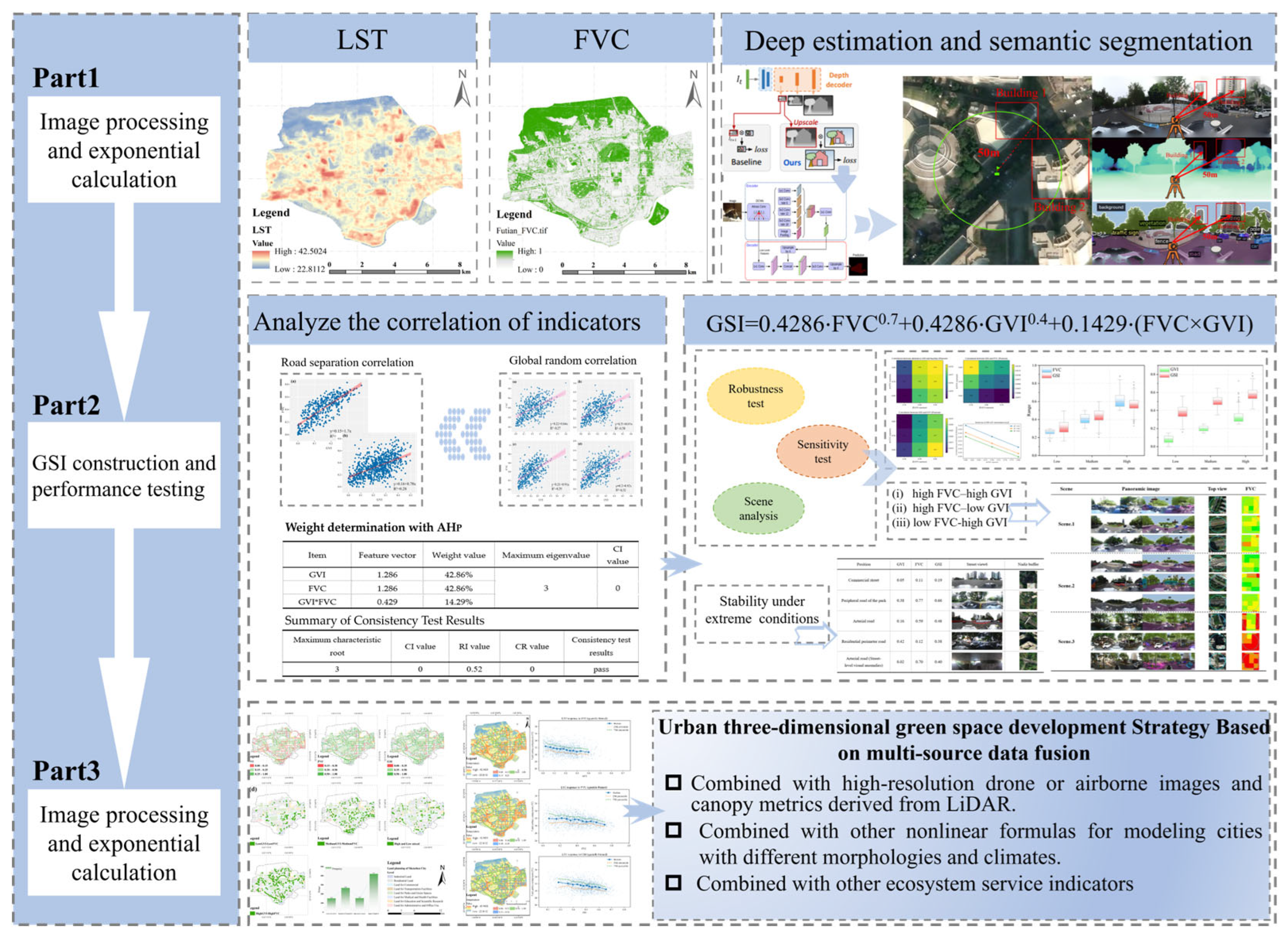
2.2.1. Framework
2.2.2. Scale Alignment and Green Index Derivation
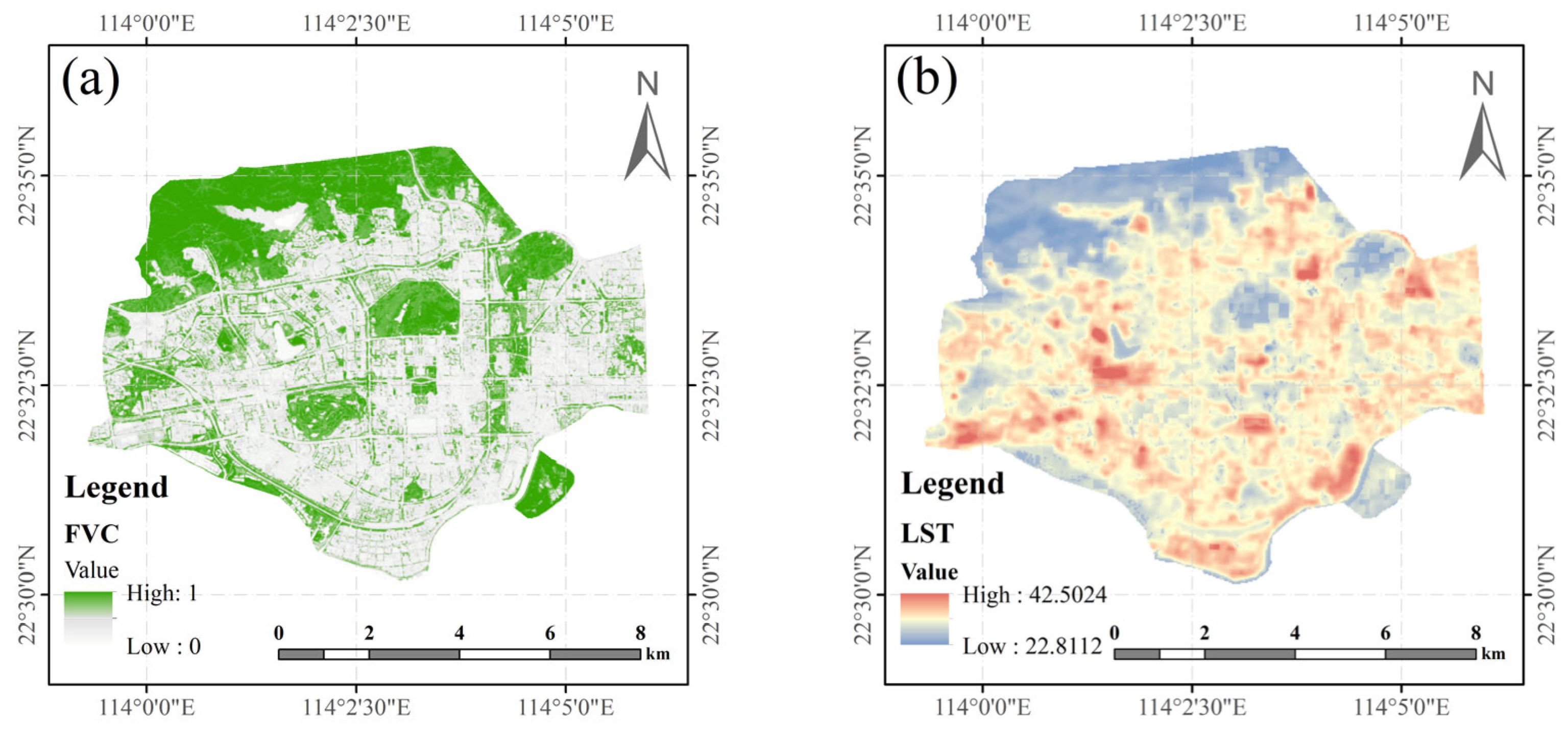
2.2.3. Retrieval of Remote Sensing Parameters
2.2.4. Correlation Verification Method
2.2.5. The Design of GSI
3. Results
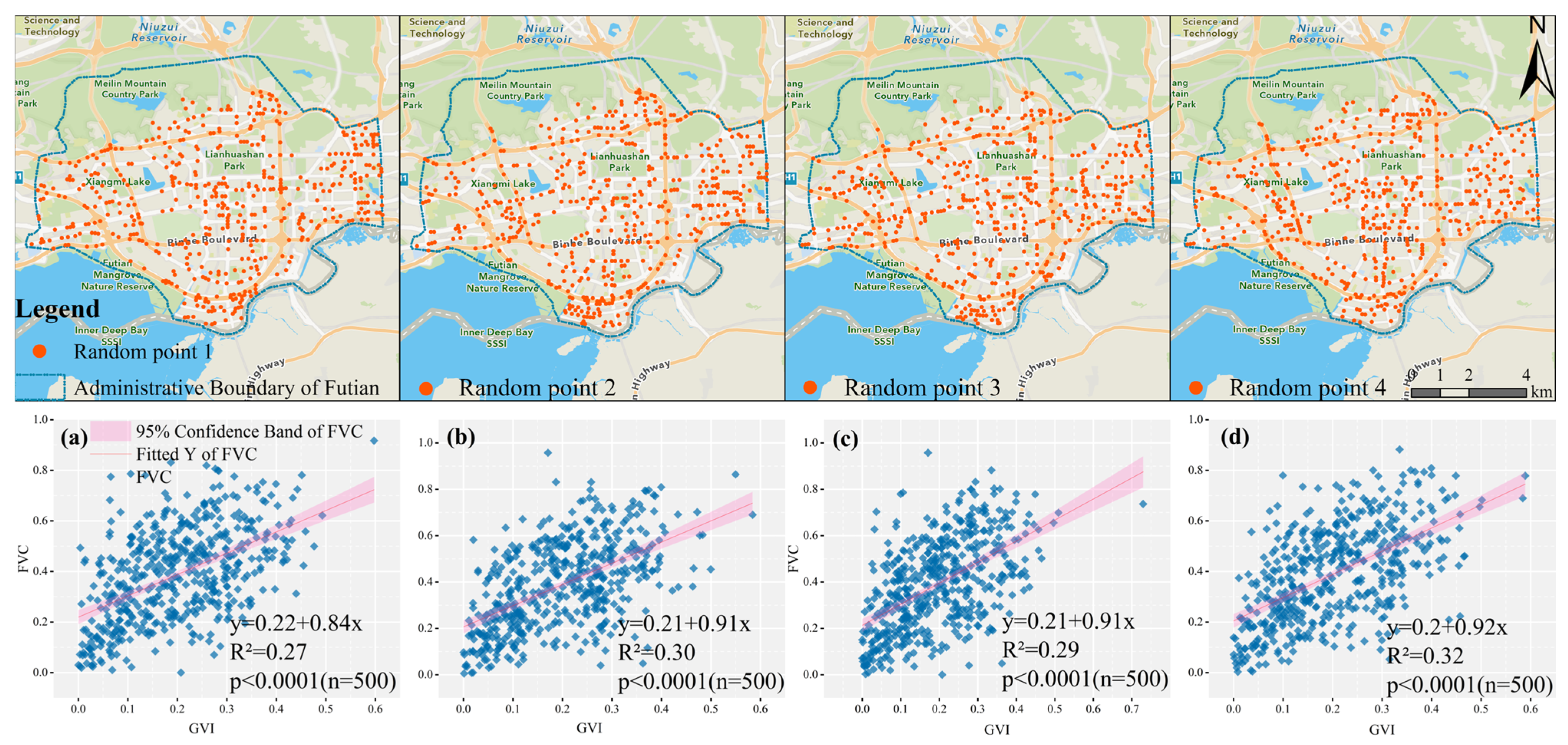
3.1. Correlation Verification of GVI and FVC
3.1.1. Global Correlation Verification
3.1.2. Local-Scale Correlation Verification
3.2. Robustness Analyses of GSI
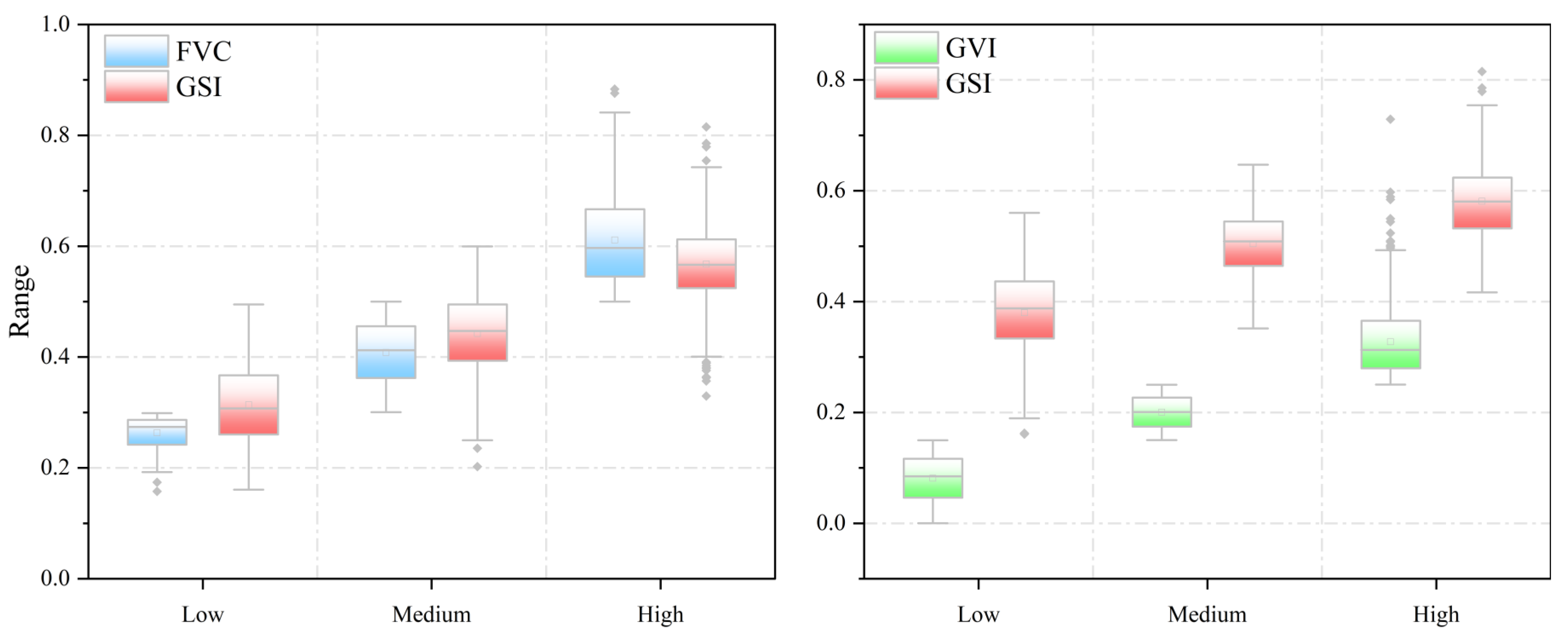
3.2.1. Numerical Stability Across Greening Levels
3.2.2. Scenario-Based Validation of GSI Robustness
3.2.3. Stability Under Extreme or Mismatched Conditions
3.2.4. Comparative Microclimatic Response of LST to GVI, FVC and GSI
3.3. Ablation Experiment
3.3.1. Justification for Substituting NDVI with FVC
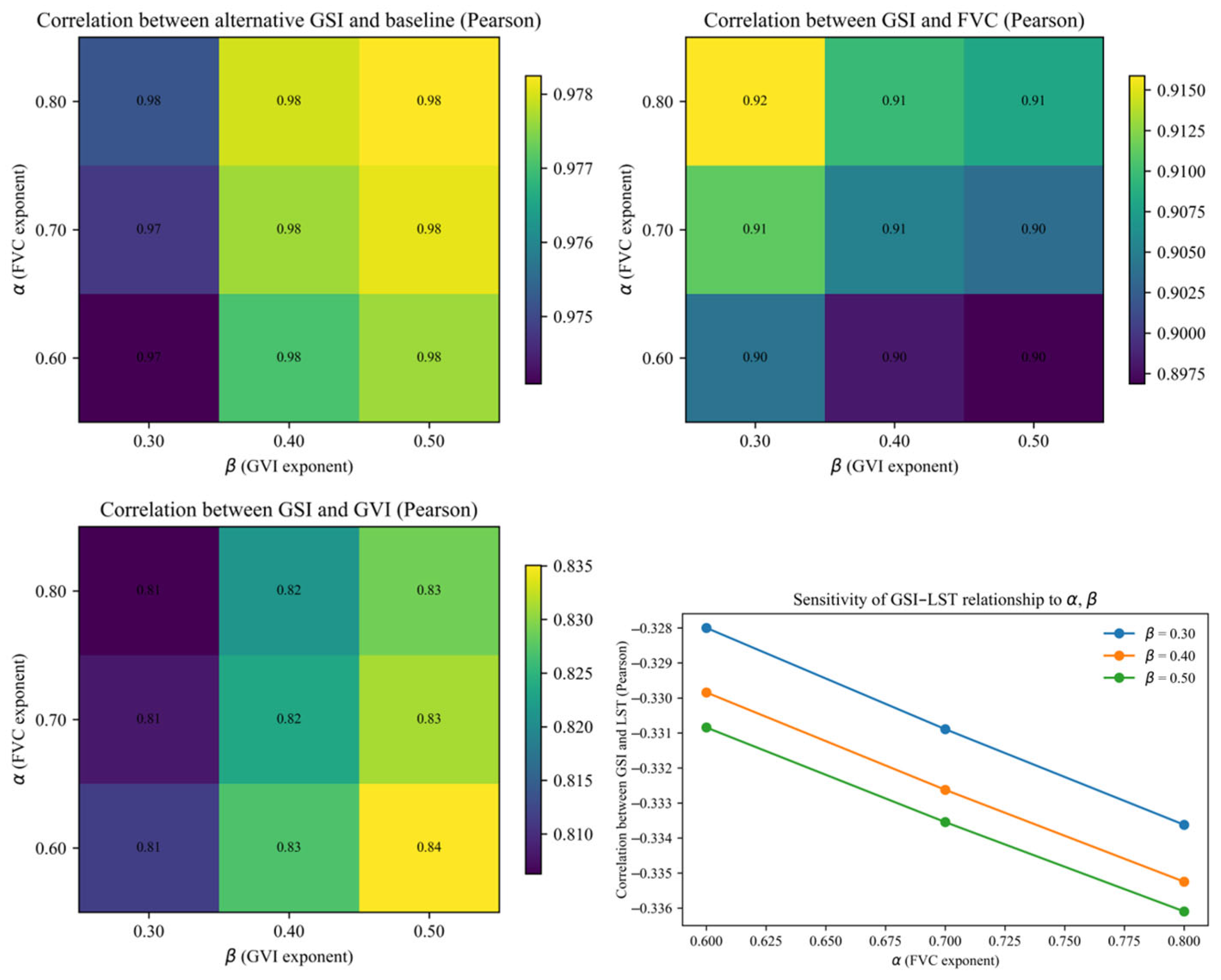
3.3.2. Sensitivity and Robustness of GSI to the FVC and GVI Exponent Parameters
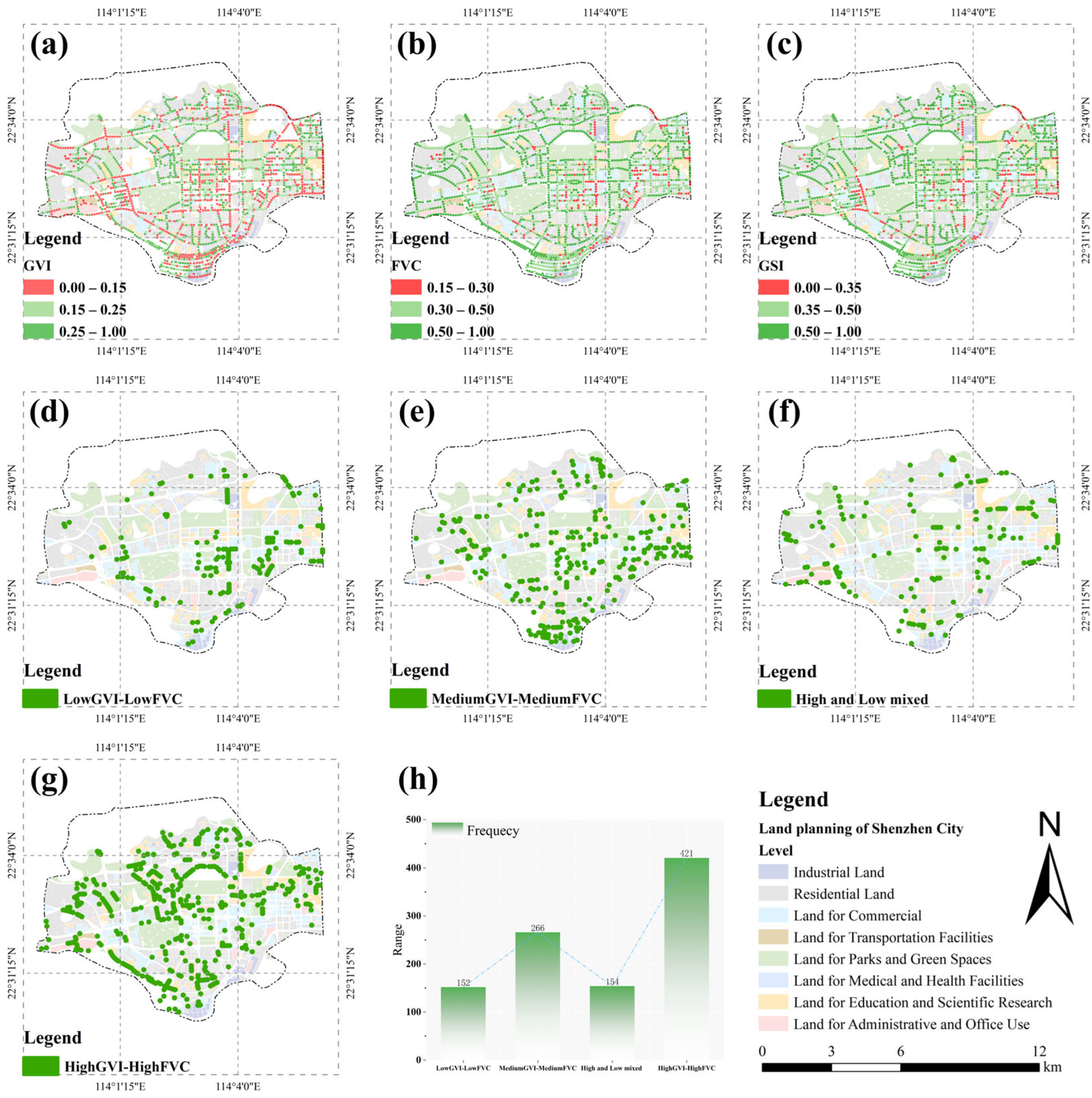
3.4. Urban-Scale Application and Comparative Utility of GSI
4. Discussion
4.1. Potential Applications and Comparison with Traditional Indicators
4.2. Limitations and Challenges
5. Conclusions
Author Contributions
Funding
Data Availability Statement
Conflicts of Interest
References
- Ding, A.; Cenci, J.; Zhang, J. Links between the pandemic and urban green spaces, a perspective on spatial indices of landscape garden cities in China. Sustain. Cities Soc. 2022, 85, 104046. [Google Scholar] [CrossRef]
- Liu, O.Y.; Russo, A. Assessing the contribution of urban green spaces in green infrastructure strategy planning for urban ecosystem conditions and services. Sustain. Cities Soc. 2021, 68, 102772. [Google Scholar] [CrossRef]
- Song, L.; Tang, Z.; Zhang, X.; Wang, Z.; Hong, B. Assessing effects of seasonal variations in 3D canopy structure characteristics on thermal comfort in urban parks. Urban For. Urban Green. 2025, 112, 128901. [Google Scholar] [CrossRef]
- Xu, J.; Jin, Y.; Ling, Y.; Sun, Y.; Wang, Y. Exploring the seasonal impacts of morphological spatial pattern of green spaces on the urban heat island. Sustain. Cities Soc. 2025, 125, 106352. [Google Scholar] [CrossRef]
- Zhong, Q.; Li, Z.; Zhu, J.; Yuan, C. Revealing multiscale and nonlinear effects of urban green spaces on heat islands in high-density cities: Insights from MSPA and machine learning. Sustain. Cities Soc. 2025, 120, 106173. [Google Scholar] [CrossRef]
- Wu, S.; Chen, B.; Webster, C.; Xu, B.; Gong, P. Improved human greenspace exposure equality during 21st century urbanization. Nat. Commun. 2023, 14, 6460. [Google Scholar] [CrossRef]
- Zhang, X.; Brandt, M.; Tong, X.; Tong, X.; Zhang, W.; Reiner, F.; Li, S.; Tian, F.; Yue, Y.; Zhou, W.; et al. A strong but uneven increase in urban tree cover in China over the recent decade. Nat. Cities 2025, 2, 460–469. [Google Scholar] [CrossRef]
- Chen, J.; Zhou, C.; Li, F. Quantifying the green view indicator for assessing urban greening quality: An analysis based on Internet-crawling street view data. Ecol. Indic. 2020, 113, 106192. [Google Scholar] [CrossRef]
- Gupta, K.; Kumar, P.; Pathan, S.K.; Sharma, K.P. Urban Neighborhood Green Index—A measure of green spaces in urban areas. Landsc. Urban Plan. 2012, 105, 325–335. [Google Scholar] [CrossRef]
- Xia, Y.; Yabuki, N.; Fukuda, T. Development of a system for assessing the quality of urban street-level greenery using street view images and deep learning. Urban For. Urban Green. 2021, 59, 126995. [Google Scholar] [CrossRef]
- Barbierato, E.; Bernetti, I.; Capecchi, I.; Saragosa, C. Integrating remote sensing and street view images to quantify urban forest ecosystem services. Remote Sens. 2020, 12, 329. [Google Scholar] [CrossRef]
- Huang, Z.; Duan, L.; Xu, Y.; Yang, S.; Lin, Z.; Yue, H.; Yang, J. Exploring the influence of urban green space and urban morphology on urban heat Islands using street view and satellite imagery. Sci. Rep. 2025, 15, 23759. [Google Scholar] [CrossRef]
- Wang, H.; Che, X.; Yang, X. Investigating Green View Perception in Non-Street Areas by Combining Baidu Street View and Sentinel-2 Images. Sustainability 2025, 17, 7485. [Google Scholar] [CrossRef]
- Liang, H.; Li, W.; Zhang, Q.; Zhu, W.; Chen, D.; Liu, J.; Shu, T. Using unmanned aerial vehicle data to assess the three-dimension green quantity of urban green space: A case study in Shanghai, China. Landsc. Urban Plan. 2017, 164, 81–90. [Google Scholar] [CrossRef]
- Yu, S.; Yu, B.; Song, W.; Wu, B.; Zhou, J.; Huang, Y.; Wu, J.; Zhao, F.; Mao, W. View-based greenery: A three-dimensional assessment of city buildings’ green visibility using Floor Green View Index. Landsc. Urban Plan. 2016, 152, 13–26. [Google Scholar] [CrossRef]
- Li, M.; Yao, W. 3d Map System for Tree Monitoring in Hong Kong Using Google Street View Imagery and Deep Learning. ISPRS Ann. Photogramm. Remote Sens. Spat. Inf. Sci. 2020, V-3-2020, 765–772. [Google Scholar] [CrossRef]
- Ki, D.; Park, K.; Chen, Z. Bridging the gap between pedestrian and street views for human-centric environment measurement: A GIS-based 3D virtual environment. Landsc. Urban Plan. 2023, 240, 104873. [Google Scholar] [CrossRef]
- Chen, B.; Wu, S.; Song, Y.; Webster, C.; Xu, B.; Gong, P. Contrasting inequality in human exposure to greenspace between cities of Global North and Global South. Nat. Commun. 2022, 13, 4636. [Google Scholar] [CrossRef]
- Huang, Y.; Sanatani, R.P.; Liu, C.; Kang, Y.; Zhang, F.; Liu, Y.; Duarte, F.; Ratti, C. No “true” greenery: Deciphering the bias of satellite and street view imagery in urban greenery measurement. Build. Environ. 2025, 269, 112395. [Google Scholar] [CrossRef]
- Bai, Z.; Wang, Z.; Li, D.; Wang, X.; Jian, Y. The relationships between 2D and 3D green index altered by spatial attributes at high spatial resolution. Urban For. Urban Green. 2024, 101, 128540. [Google Scholar] [CrossRef]
- Sun, Y.; Wang, X.; Zhu, J.; Chen, L.; Jia, Y.; Lawrence, J.M.; Jiang, L.-h.; Xie, X.; Wu, J. Using machine learning to examine street green space types at a high spatial resolution: Application in Los Angeles County on socioeconomic disparities in exposure. Sci. Total Environ. 2021, 787, 147653. [Google Scholar] [CrossRef]
- Donovan, G.H.; Gatziolis, D.; Derrien, M.; Michael, Y.L.; Prestemon, J.P.; Douwes, J. Shortcomings of the normalized difference vegetation index as an exposure metric. Nat. Plants 2022, 8, 617–622. [Google Scholar] [CrossRef] [PubMed]
- Sun, L.; Wang, J.; Xie, Z.; Li, R.; Wu, X.; Wu, Y.; Kalantar, B. Evaluating the Street Greening with the Multiview Data Fusion. J. Sens. 2021, 2021, 2793474. [Google Scholar] [CrossRef]
- Li, T.; Zheng, X.; Wu, J.; Zhang, Y.; Fu, X.; Deng, H. Spatial relationship between green view index and normalized differential vegetation index within the Sixth Ring Road of Beijing. Urban For. Urban Green. 2021, 62, 127153. [Google Scholar] [CrossRef]
- Hong, Z.; Liu, Y.; Xu, W.; Wang, L.; Lu, N.; Ou, G.; Kou, W. A new method of three-dimensional green volume retrieval and its applications in urban greenery evaluation. Ecol. Indic. 2025, 176, 113629. [Google Scholar] [CrossRef]
- Duan, W.; Jin, A.; Liu, X.; Li, H. Seasonal variations and spatial mechanisms of 2D and 3D green indices in the central urban area. Ecol. Indic. 2025, 178, 113828. [Google Scholar] [CrossRef]
- Hu, M.; Yin, W.; Zhang, C.; Cai, Z.; Long, X.; Chen, H.; Wang, K.; Yu, G.; Shen, C.; Shen, S. Metric3d v2: A versatile monocular geometric foundation model for zero-shot metric depth and surface normal estimation. IEEE Trans. Pattern Anal. Mach. Intell. 2024, 46, 10579–10596. [Google Scholar] [CrossRef] [PubMed]
- Chen, L.-C.; Zhu, Y.; Papandreou, G.; Schroff, F.; Adam, H. Encoder-decoder with atrous separable convolution for semantic image segmentation. In Proceedings of the European Conference on Computer Vision (ECCV), Munich, Germany, 8–14 September 2018; pp. 801–818. [Google Scholar]
- Carlson, T.N.; Ripley, D.A. On the relation between NDVI, fractional vegetation cover, and leaf area index. Remote Sens. Environ. 1997, 62, 241–252. [Google Scholar] [CrossRef]
- Mu, X.; Yang, Y.; Xu, H.; Guo, Y.; Lai, Y.; McVicar, T.R.; Xie, D.; Yan, G. Improvement of NDVI mixture model for fractional vegetation cover estimation with consideration of shaded vegetation and soil components. Remote Sens. Environ. 2024, 314, 114409. [Google Scholar] [CrossRef]
- Saeedavi, Z.; Khalili, M.B.; Bagheri, B.M.; Rangzan, N. Land Suitability Assessment for Urban Green Space Using AHP and GIS: A Case Study of Ahvaz Parks, Iran. 2017. Available online: https://jdesert.ut.ac.ir/article_62174.html (accessed on 5 December 2021).
- Li, Z.; Fan, Z.; Shen, S. Urban green space suitability evaluation based on the AHP-CV combined weight method: A case study of Fuping county, China. Sustainability 2018, 10, 2656. [Google Scholar] [CrossRef]
- Li, N.; Zhao, F.; Chen, S.; Li, C.; Wang, Y.; Ma, Y.; Chen, L. Indirect non-linear effects of landscape patterns on vegetation growth in Kunming City. npj Urban Sustain. 2024, 4, 30. [Google Scholar] [CrossRef]
- Al-Saadi, L.M.; Jaber, S.H.; Al-Jiboori, M.H. Variation of urban vegetation cover and its impact on minimum and maximum heat islands. Urban Clim. 2020, 34, 100707. [Google Scholar] [CrossRef]
- Xiao, J.; Moody, A. A comparison of methods for estimating fractional green vegetation cover within a desert-to-upland transition zone in central New Mexico, USA. Remote Sens. Environ. 2005, 98, 237–250. [Google Scholar] [CrossRef]
- Yang, J.; Shi, Q.; Menenti, M.; Xie, Y.; Wu, Z.; Xu, Y.; Abbas, S. Characterizing the thermal effects of vegetation on urban surface temperature. Urban Clim. 2022, 44, 101204. [Google Scholar] [CrossRef]
- Gao, S.; Zhong, R.; Yan, K.; Ma, X.; Chen, X.; Pu, J.; Gao, S.; Qi, J.; Yin, G.; Myneni, R.B. Evaluating the saturation effect of vegetation indices in forests using 3D radiative transfer simulations and satellite observations. Remote Sens. Environ. 2023, 295, 113665. [Google Scholar] [CrossRef]
- Mutanga, O.; Masenyama, A.; Sibanda, M. Spectral saturation in the remote sensing of high-density vegetation traits: A systematic review of progress, challenges, and prospects. ISPRS J. Photogramm. Remote Sens. 2023, 198, 297–309. [Google Scholar] [CrossRef]
- Aikoh, T.; Homma, R.; Abe, Y. Comparing conventional manual measurement of the green view index with modern automatic methods using google street view and semantic segmentation. Urban For. Urban Green. 2023, 80, 127845. [Google Scholar] [CrossRef]
- Chen, C.; Wang, J.; Li, D.; Sun, X.; Zhang, J.; Yang, C.; Zhang, B. Unraveling nonlinear effects of environment features on green view index using multiple data sources and explainable machine learning. Sci. Rep. 2024, 14, 30189. [Google Scholar] [CrossRef] [PubMed]
- Rieves, E.S.; Reid, C.E.; Carlson, K.; Li, X. Do environmental attitudes and personal characteristics influence how people perceive their exposure to green spaces? Landsc. Urban Plan. 2024, 248, 105080. [Google Scholar] [CrossRef] [PubMed]
- Shao, H.; Liu, Y.; Ren, H.; Li, Z. Research on healing-oriented street design based on quantitative emotional electroencephalography and eye-tracking technology. Front. Hum. Neurosci. 2025, 19, 1546933. [Google Scholar] [CrossRef] [PubMed]
- Technical Criterion for Ecosystem Status Evaluation (HJ 192—2015). 2015. Available online: https://english.mee.gov.cn/Resources/standards/Eco_Environment/201605/t20160512_337614.shtml (accessed on 5 December 2021).
- Wu, S.; Song, Y.; An, J.; Lin, C.; Chen, B. High-resolution greenspace dynamic data cube from Sentinel-2 satellites over 1028 global major cities. Sci. Data 2024, 11, 909. [Google Scholar] [CrossRef]
- Gao, L.; Wang, X.; Johnson, B.A.; Tian, Q.; Wang, Y.; Verrelst, J.; Mu, X.; Gu, X. Remote sensing algorithms for estimation of fractional vegetation cover using pure vegetation index values: A review. ISPRS J. Photogramm. Remote Sens. 2020, 159, 364–377. [Google Scholar] [CrossRef] [PubMed]
- Han, Z.; Tian, Q.; Tian, J.; Zhao, T.; Xu, C.; Zhou, Q. Estimation of fractional cover based on NDVI-VISI response space using visible-near infrared satellite imagery. Int. J. Appl. Earth Obs. Geoinf. 2025, 137, 104432. [Google Scholar] [CrossRef]
- Shah, A.; Garg, A.; Mishra, V. Quantifying the local cooling effects of urban green spaces: Evidence from Bengaluru, India. Landsc. Urban Plan. 2021, 209, 104043. [Google Scholar] [CrossRef]
- Aram, F.; García, E.H.; Solgi, E.; Mansournia, S. Urban green space cooling effect in cities. Heliyon 2019, 5, e01339. [Google Scholar] [CrossRef]
- Zhang, J.; Wang, P.; Jin, A. Multidimensional characteristics of urban green space and its impact in mitigating urban heat Island effects: A case study of Guangzhou. Sci. Rep. 2025, 15, 39959. [Google Scholar] [CrossRef]
- Ludwig, C.; Hecht, R.; Lautenbach, S.; Schorcht, M.; Zipf, A. Mapping public urban green spaces based on openstreetmap and sentinel-2 imagery using belief functions. ISPRS Int. J. Geo-Inf. 2021, 10, 251. [Google Scholar] [CrossRef]
- Upreti, M.; Kumar, A. Evaluating functional traits of urban green spaces in mitigating land surface temperature in megacities. Discov. Cities 2025, 2, 31. [Google Scholar] [CrossRef]
- Wang, Y.; Li, M. Annually urban fractional vegetation cover dynamic mapping in Hefei, China (1999–2018). Remote Sens. 2021, 13, 2126. [Google Scholar] [CrossRef]
- Buyantuyev, A.; Wu, J.; Gries, C. Estimating vegetation cover in an urban environment based on Landsat ETM+ imagery: A case study in Phoenix, USA. Int. J. Remote Sens. 2007, 28, 269–291. [Google Scholar] [CrossRef]
- Bobo Merga, B.; Tabor, K.W.; Melka, G.A. Analysis of the cooling effects of urban green spaces in mitigating micro-climate change using geospatial techniques in Adama City, Ethiopia. Sustain. Environ. 2024, 10, 2350806. [Google Scholar] [CrossRef]
- Song, D.-X.; Zhong, D.; Chen, Z.; Qi, S.; Wang, C.; Yao, J.; He, T. A satellite perspective of interannual and seasonal variations in greenspace and human exposure over urban and peri-urban areas in Chinese cities from 2000 to 2020. Landsc. Urban Plan. 2025, 259, 105354. [Google Scholar] [CrossRef]
- Lotfi, W.; Abbasi, N.; Cheshmehzangi, A.; Khodakarami, L.; Nouri, H. Evaluating the Greenness of Sanandaj City Using Sentinel Imagery in Google Earth Engine. Sustainability 2025, 17, 3471. [Google Scholar] [CrossRef]
- Gülçin, D. Spatial distribution of urban vegetation: A case study of a Canadian University Campus using LiDAR-based metrics. Forestist 2021, 71, 1–14. [Google Scholar] [CrossRef]
- Smith, I.A.; Fabian, M.P.; Hutyra, L.R. Urban green space and albedo impacts on surface temperature across seven United States cities. Sci. Total Environ. 2023, 857, 159663. [Google Scholar] [CrossRef] [PubMed]
- Tang, L.; Zhan, Q.; Fan, Y.; Liu, H.; Fan, Z. Exploring the impacts of greenspace spatial patterns on land surface temperature across different urban functional zones: A case study in Wuhan metropolitan area, China. Ecol. Indic. 2023, 146, 109787. [Google Scholar] [CrossRef]
- Zhao, X.; Tan, S.; Li, Y.; Wu, H.; Wu, R. Quantitative analysis of fractional vegetation cover in southern Sichuan urban agglomeration using optimal parameter geographic detector model, China. Ecol. Indic. 2024, 158, 111529. [Google Scholar] [CrossRef]









| Data Name | Acquisition Method | Basic Attributes | For the Purpose of This Study |
|---|---|---|---|
| Sentinel-2 L2A | Copernicus Data Space Ecosystem (https://dataspace.copernicus.eu/) accessed on 5 October 2021 | Resolution: 10 m × 10 m Cloud cover: 5% Time: 22 October 2017 | Calculation of NDVI and FVC |
| Landsat 8 L2SP | Geospatial Data Cloud (https://www.gscloud.cn/sources) accessed on 5 October 2021 | Resolution: 30 m × 30 m Cloud cover: 5% Time: 23 October 2017 | Land surface temperature inversion |
| Administrative boundary vector data | Geospatial Data Cloud (https://www.gscloud.cn/sources) accessed on 3 October 2021 | Time: 2018 Element: Surface element Coordinate: GCS_WGS_1984 | Remote sensing image cropping in the study area |
| Urban road network data | Open Street Map (OSM) accessed on 3 October 2021 | Element: Line element Coordinate: GCS_WGS_1984 | Create buffer zones and street scene collection points |
| Street view images | BaiDu Map Street View API accessed on 5 December 2021 | Time: 2016–2018 Resolution: 1024 × 512 | Calculate GVI, extract depth values, and perform binarization segmentation |
| GVI | FVC | GVI × FVC | |
|---|---|---|---|
| GVI | 1 | 1 | 3 |
| FVC | 1 | 1 | 3 |
| GVI × FVC | 0.333 | 0.333 | 1 |
| Order n | 3 | 4 | 5 | 6 | 7 | 8 | 9 | 10 | 11 | 12 |
|---|---|---|---|---|---|---|---|---|---|---|
| RI value | 0.520 | 0.890 | 1.120 | 1.260 | 1.360 | 1.410 | 1.460 | 1.490 | 1.520 | 1.540 |
| Order n | 13 | 14 | 15 | 16 | 17 | 18 | 19 | 20 | 21 | 22 |
| RI value | 1.560 | 1.580 | 1.590 | 1.594 | 1.606 | 1.613 | 1.621 | 1.629 | 1.636 | 1.640 |
| Order n | 23 | 24 | 25 | 26 | 27 | 28 | 29 | 30 | ||
| RI value | 1.646 | 1.650 | 1.656 | 1.659 | 1.663 | 1.667 | 1.669 | 1.672 |
| Maximum Characteristic Root | CI Value | RI Value | CR Value | Consistency Test Results |
|---|---|---|---|---|
| 3 | 0 | 0.52 | 0 | pass |
| Item | Feature Vector | Weight Value | Maximum Eigenvalue | CI Value |
|---|---|---|---|---|
| GVI | 1.286 | 42.86% | 3 | 0 |
| FVC | 1.286 | 42.86% | ||
| GVI × FVC | 0.429 | 14.29% |
| Level | GVI Range | FVC Range | GSI Range |
|---|---|---|---|
| Low | 0.00–0.15 | 0.00–0.30 | 0.00–0.35 |
| Medium | 0.15–0.25 | 0.30–0.50 | 0.35–0.5 |
| High | 0.25–1.00 | 0.50–10 | 0.5–1.00 |
| Metric | Low (L) Mean ± IQR (CV) | Medium (M) Mean ± IQR (CV) | High (H) Mean ± IQR (CV) |
|---|---|---|---|
| GVI | 0.08 ± 0.07 (0.52) | 0.20 ± 0.05 (0.15) | 0.33 ± 0.09 (0.19) |
| FVC | 0.26 ± 0.04 (0.11) | 0.41 ± 0.09 (0.14) | 0.61 ± 0.12 (0.13) |
| GSI | 0.29 ± 0.07 (0.15) | 0.43 ± 0.07 (0.09) | 0.57 ± 0.08 (0.09) |
| Scene | Panoramic Image | GVI | Nadir Buffer | FVC | GSI |
|---|---|---|---|---|---|
| Scene 1: Arterial corridors with continuous vegetation |  | 0.40 |   | 0.66 | 0.63 |
 | 0.23 |   | 0.64 | 0.54 | |
 | 0.27 |   | 0.56 | 0.53 | |
| Scene 2: Open road sections with internal greenery |  | 0.09 |   | 0.72 | 0.58 |
 | 0.17 |   | 0.67 | 0.52 | |
 | 0.15 |   | 0.63 | 0.49 | |
| Scene 3: Compact built-up areas with vertical greening |  | 0.50 |   | 0.44 | 0.58 |
 | 0.33 |   | 0.17 | 0.38 | |
 | 0.31 |   | 0.15 | 0.36 |
| Position | GVI | FVC | GSI | Street View6 | Nadir Buffer |
|---|---|---|---|---|---|
| Commercial street | 0.05 | 0.11 | 0.19 |  |  |
| Peripheral road of the park | 0.38 | 0.77 | 0.66 |  |  |
| Arterial road | 0.16 | 0.59 | 0.48 |  |  |
| Residential perimeter road | 0.42 | 0.12 | 0.38 |  |  |
| Arterial road (Street-level visual anomalies) | 0.02 | 0.70 | 0.40 |  |  |
Disclaimer/Publisher’s Note: The statements, opinions and data contained in all publications are solely those of the individual author(s) and contributor(s) and not of MDPI and/or the editor(s). MDPI and/or the editor(s) disclaim responsibility for any injury to people or property resulting from any ideas, methods, instructions or products referred to in the content. |
© 2025 by the authors. Licensee MDPI, Basel, Switzerland. This article is an open access article distributed under the terms and conditions of the Creative Commons Attribution (CC BY) license.
Share and Cite
Wang, Y.; Gan, D.; Jiao, W.; Xie, J. A Green Synergy Index for Urban Green Space Assessment Based on Multi-Source Data Integration. Remote Sens. 2026, 18, 9. https://doi.org/10.3390/rs18010009
Wang Y, Gan D, Jiao W, Xie J. A Green Synergy Index for Urban Green Space Assessment Based on Multi-Source Data Integration. Remote Sensing. 2026; 18(1):9. https://doi.org/10.3390/rs18010009
Chicago/Turabian StyleWang, Yuefeng, Deyuan Gan, Wei Jiao, and Jiali Xie. 2026. "A Green Synergy Index for Urban Green Space Assessment Based on Multi-Source Data Integration" Remote Sensing 18, no. 1: 9. https://doi.org/10.3390/rs18010009
APA StyleWang, Y., Gan, D., Jiao, W., & Xie, J. (2026). A Green Synergy Index for Urban Green Space Assessment Based on Multi-Source Data Integration. Remote Sensing, 18(1), 9. https://doi.org/10.3390/rs18010009