Spatial Distribution and Characteristics of Debris-Covered Glaciers in Xinjiang Based on CGI-XJ2020


Highlights
- We employed high-resolution satellite imagery together with field measurements from 18 debris-covered glaciers to systematically identify and map debris-covered glaciers across Xinjiang.
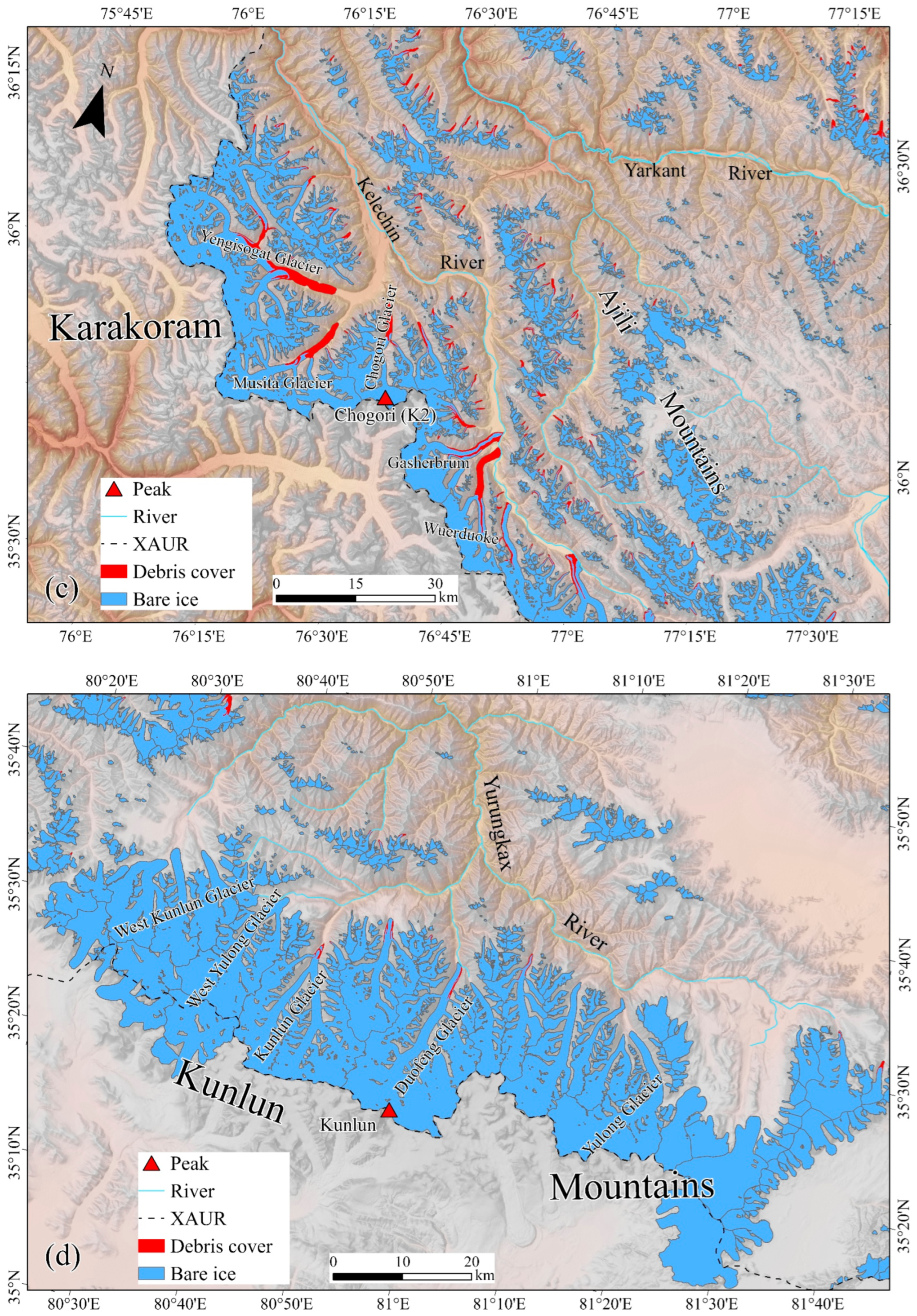
- Using this high-resolution dataset, we identified 1612 debris-covered glaciers (10,922.06 km2), with 10.65% of their total area mantled by debris.
- Compared with previous glacier inventories and studies, this high-resolution dataset significantly improves the accuracy of debris-cover delineation and quantification, providing a more reliable basis for debris-covered glacier monitoring.
- The results provide a high-resolution dataset for subsequent investigations of glacier mass balance, surface energy processes, and debris-cover dynamics in arid mountain regions.
Abstract
1. Introduction
2. Study Region
3. Data and Methodology
3.1. Data
3.2. Methodology
3.2.1. Extraction and Spatial Distribution Analysis of Debris-Covered Glaciers
3.2.2. Uncertainty Assessment
4. Main Results
4.1. Overall Distribution of Debris-Covered Glaciers in Xinjiang
4.2. Spatial Distribution of Debris Cover Across Mountain Ranges
4.3. Spatial Distribution of Debris Cover Among Drainage Basins
5. Discussion
5.1. Analysis of Factors Influencing Glacier Debris Coverage
5.2. Comparison with Previous Studies
6. Conclusions
Author Contributions
Funding
Data Availability Statement
Acknowledgments
Conflicts of Interest
Abbreviations
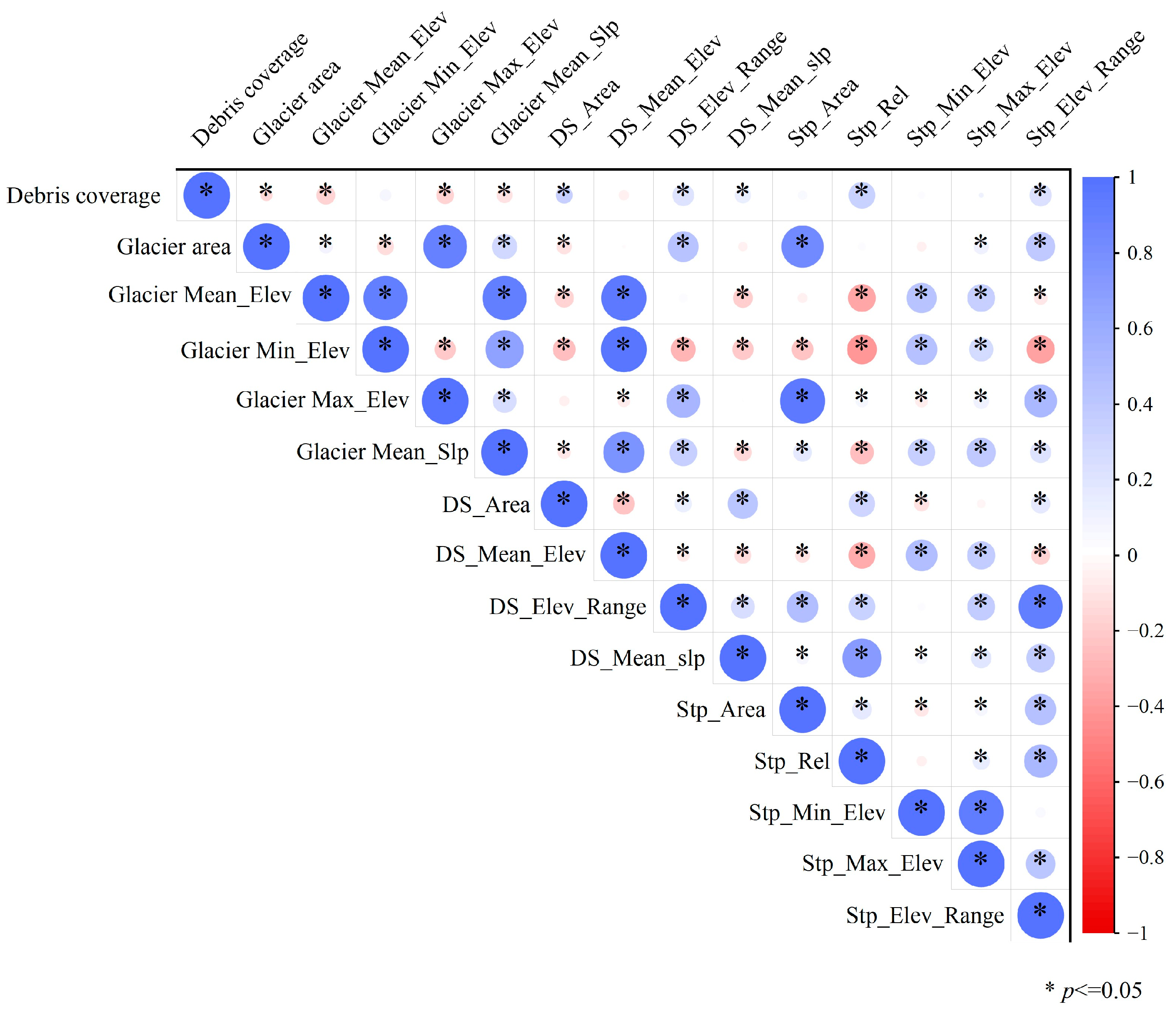
| Glacier_Mean_Elev | mean glacier elevation (m) |
| Glacier_Min_Elev | minimum glacier elevation (m) |
| Glacier_Max_Elev | maximum glacier elevation (m) |
| Glacier_Mean_Slp | mean glacier slope (°) |
| DS_Area | area of debris-supply zone (km2) |
| DS_Mean_Elev | mean elevation of debris-supply zone (m) |
| DS_Elev_Range | elevation range of debris-supply zone (m) |
| UAV | unmanned aerial vehicle |
| DS_Mean_Slp | mean slope of debris-supply zone (°) |
| Stp_Area | area of steeper debris-supply zone (km2) |
| Stp_Rel | relative proportion of the steeper debris-supply zone (areas with slope > 45°) (%) |
| Stp_Min_Elev | minimum elevation of the steeper debris-supply zone (m) |
| Stp_Max_Elev | maximum elevation of the steeper debris-supply zone (m) |
| Stp_Elev_Range | elevation range of the steeper debris-supply zone (m) |
Appendix A

| No. | Glacier Name | GLIMS_ID * | Mountain | Area | No. of GPS Points | Debris Cover (m) | Bare Ice (m) | ||
|---|---|---|---|---|---|---|---|---|---|
| (km2) | Mean | Std. | Mean | Std. | |||||
| 1 | Kanas Glacier | G087802E49107N | Altay | 24.31 | 10 | 9.20 | 1.51 | — | — |
| 2 | Heigou Glacier No. 8 | G088356E43783N | Tianshan | 6.82 | 15 | — | — | 2.85 | 0.78 |
| 3 | Urumqi Glacier No. 2 | G086823E43100N | Tianshan | 0.69 | 22 | 5.46 | 1.79 | — | — |
| 4 | Lujiaowan Glacier | G085162E43876N | Tianshan | 1.16 | 16 | 7.80 | 1.47 | — | — |
| 5 | Alchalter Glacier | G080950E42402N | Tianshan | 43.47 | 9 | 12.30 | 2.03 | 3.21 | 0.53 |
| 6 | Muzart Glacier | G080921E42304N | Tianshan | 163.18 | 12 | 10.80 | 2.57 | — | — |
| 7 | Keqikekuzibayi Glacier | G080548E41955N | Tianshan | 27.95 | 14 | 10.25 | 2.00 | — | — |
| 8 | Koxkar Baxi Glacier | G080106E41803N | Tianshan | 85.95 | 11 | 8.60 | 1.28 | — | — |
| 9 | Qiongkuermu Glacier | G079957E41784N | Tianshan | 8.33 | 10 | — | — | 2.30 | 0.81 |
| 10 | Qingbingtan Glacier No. 74 | G079920E41785N | Tianshan | 8.34 | 12 | 8.40 | 1.19 | — | — |
| 11 | Qingbingtan Glacier No. 72 | G079894E41780N | Tianshan | 6.55 | 17 | 9.50 | 1.53 | — | — |
| 12 | East branch of Kumalak River Glacier No. 79 | G079944E41725N | Tianshan | 0.58 | 14 | 7.20 | 1.23 | — | — |
| 13 | West branch of Kumalak River Glacier No. 79 | G079936E41723N | Tianshan | 0.76 | 11 | 7.80 | 1.68 | — | — |
| 14 | Kumalak River Glacier No. 80 | G079926E41723N | Tianshan | 0.59 | 11 | 8.94 | 1.80 | — | — |
| 15 | Tomor Glacier | G079999E41932N | Tianshan | 330.64 | 12 | 10.69 | 2.80 | — | — |
| 16 | Oitabe Glacier | G075148E38872N | Pamir | 19.48 | 12 | 8.70 | 1.94 | — | — |
| 17 | Karayaylak Glacier | G075252E38643N | Pamir | 103.89 | 10 | 9.74 | 2.10 | — | — |
| 18 | Karachon Glacier | G075081E38251N | Pamir | 18.71 | 14 | 9.40 | 1.50 | — | — |
References
- Kirkbride, M.P. Debris-Covered Glaciers. In Encyclopedia of Snow, Ice and Glaciers; Singh, V.P., Singh, P., Haritashya, U.K., Eds.; Springer: Dordrecht, The Netherlands, 2011; pp. 180–182. [Google Scholar]
- Kirkbride, M.P.; Sherriff, S.C.; Rowan, A.V.; Egholm, D.L.; Quincey, D.J.; Miles, E.; Hubbard, B.; Miles, K. Provenance and transport of supraglacial debris revealed by variations in debris geochemistry on Khumbu Glacier, Nepal Himalaya. Earth Surf. Process. Landf. 2023, 48, 2737–2753. [Google Scholar] [CrossRef]
- Benn, D.; Evans, D.J. Glaciers and Glaciation; Routledge: London, UK, 2014. [Google Scholar]
- van Woerkom, T.; Steiner, J.F.; Kraaijenbrink, P.D.A.; Miles, E.S.; Immerzeel, W.W. Sediment supply from lateral moraines to a debris-covered glacier in the Himalaya. Earth Surf. Dynam. 2019, 7, 411–427. [Google Scholar] [CrossRef]
- Reid, T.D.; Brock, B.W. An energy-balance model for debris-covered glaciers including heat conduction through the debris layer. J. Glaciol. 2010, 56, 903–916. [Google Scholar] [CrossRef]
- Scherler, D.; Bookhagen, B.; Strecker, M.R. Spatially variable response of Himalayan glaciers to climate change affected by debris cover. Nat. Geosci. 2011, 4, 156–159. [Google Scholar] [CrossRef]
- Rounce, D.R.; King, O.; McCarthy, M.; Shean, D.E.; Salerno, F. Quantifying Debris Thickness of Debris-Covered Glaciers in the Everest Region of Nepal Through Inversion of a Subdebris Melt Model. J. Geophys. Res. Earth Surf. 2018, 123, 1094–1115. [Google Scholar] [CrossRef]
- Østrem, G. Ice melting under a thin layer of moraine, and the existence of ice cores in moraine ridges. Geogr. Ann. 1959, 41, 228–230. [Google Scholar] [CrossRef]
- Nakawo, M.; Young, G.J. Field Experiments to Determine the Effect of a Debris Layer on Ablation of Glacier Ice. Ann. Glaciol. 1981, 2, 85–91. [Google Scholar] [CrossRef]
- Nicholson, L.; Benn, D.I. Calculating ice melt beneath a debris layer using meteorological data. J. Glaciol. 2006, 52, 463–470. [Google Scholar] [CrossRef]
- Tang, Z.; Deng, G.; Hu, G.; Zhang, H.; Pan, H.; Sang, G. Satellite observed spatiotemporal variability of snow cover and snow phenology over high mountain Asia from 2002 to 2021. J. Hydrol. 2022, 613, 128438. [Google Scholar] [CrossRef]
- Anderson, L.; Scherler, D.; McCoy, S.; McGrath, D.; Kirkbride, M.; Zeller, L.; Anderson, R. Debris cover controls glacial thinning, lakes, and hazards in High Mountain Asia. Res. Sq. 2023, preprint (version 1). [Google Scholar] [CrossRef]
- Thakuri, S.; Salerno, F.; Smiraglia, C.; Bolch, T.; D’Agata, C.; Viviano, G.; Tartari, G. Tracing glacier changes since the 1960s on the south slope of Mt. Everest (central Southern Himalaya) using optical satellite imagery. Cryosphere 2014, 8, 1297–1315. [Google Scholar] [CrossRef]
- Dobreva, I.D.; Bishop, M.P.; Bush, A.B.G. Climate–Glacier Dynamics and Topographic Forcing in the Karakoram Himalaya: Concepts, Issues and Research Directions. Water 2017, 9, 405. [Google Scholar] [CrossRef]
- Anderson, R.S.; Anderson, L.S.; Armstrong, W.H.; Rossi, M.W.; Crump, S.E. Glaciation of alpine valleys: The glacier–debris-covered glacier–rock glacier continuum. Geomorphology 2018, 311, 127–142. [Google Scholar] [CrossRef]
- Racoviteanu, A.E.; Nicholson, L.; Glasser, N.F.; Miles, E.; Harrison, S.; Reynolds, J.M. Debris-covered glacier systems and associated glacial lake outburst flood hazards: Challenges and prospects. J. Geol. Soc. 2022, 179, jgs2021-084. [Google Scholar] [CrossRef]
- Scherler, D.; Wulf, H.; Gorelick, N. Global Assessment of Supraglacial Debris-Cover Extents. Geophys. Res. Lett. 2018, 45, 11798–11805. [Google Scholar] [CrossRef]
- Herreid, S.; Pellicciotti, F. The state of rock debris covering Earth’s glaciers. Nat. Geosci. 2020, 13, 621–627. [Google Scholar] [CrossRef]
- Brun, F.; Berthier, E.; Wagnon, P.; Kääb, A.; Treichler, D. A spatially resolved estimate of High Mountain Asia glacier mass balances from 2000 to 2016. Nat. Geosci. 2017, 10, 668–673. [Google Scholar] [CrossRef]
- Kraaijenbrink, P.D.A.; Bierkens, M.F.P.; Lutz, A.F.; Immerzeel, W.W. Impact of a global temperature rise of 1.5 degrees Celsius on Asia’s glaciers. Nature 2017, 549, 257–260. [Google Scholar] [CrossRef]
- Compagno, L.; Huss, M.; Miles, E.S.; McCarthy, M.J.; Zekollari, H.; Dehecq, A.; Pellicciotti, F.; Farinotti, D. Modelling supraglacial debris-cover evolution from the single-glacier to the regional scale: An application to High Mountain Asia. Cryosphere 2022, 16, 1697–1718. [Google Scholar] [CrossRef]
- Scherler, D.; Bookhagen, B.; Strecker, M.R. Hillslope-glacier coupling: The interplay of topography and glacial dynamics in High Asia. J. Geophys. Res. Earth Surf. 2011, 116, F02019. [Google Scholar] [CrossRef]
- Anderson, L.S.; Anderson, R.S. Modeling debris-covered glaciers: Response to steady debris deposition. Cryosphere 2016, 10, 1105–1124. [Google Scholar] [CrossRef]
- Pieczonka, T.; Bolch, T.; KrÖHnert, M.; Peters, J.; Liu, S. Glacier branch lines and glacier ice thickness estimation for debris-covered glaciers in the Central Tien Shan. J. Glaciol. 2018, 64, 835–849. [Google Scholar] [CrossRef]
- Racoviteanu, A.E.; Nicholson, L.; Glasser, N.F. Surface composition of debris-covered glaciers across the Himalaya using linear spectral unmixing of Landsat 8 OLI imagery. Cryosphere 2021, 15, 4557–4588. [Google Scholar] [CrossRef]
- McCarthy, M.; Miles, E.; Kneib, M.; Buri, P.; Fugger, S.; Pellicciotti, F. Supraglacial debris thickness and supply rate in High-Mountain Asia. Commun. Earth Environ. 2022, 3, 269. [Google Scholar] [CrossRef]
- Zhang, Y.; Gu, J.; Liu, S.; Wang, X.; Jiang, Z.; Wei, J.; Zheng, Y. Spatial pattern of the debris-cover effect and its role in the Hindu Kush-Pamir-Karakoram-Himalaya glaciers. J. Hydrol. 2022, 615, 128613. [Google Scholar] [CrossRef]
- Collier, E.; Maussion, F.; Nicholson, L.I.; Mölg, T.; Immerzeel, W.W.; Bush, A.B.G. Impact of debris cover on glacier ablation and atmosphere–glacier feedbacks in the Karakoram. Cryosphere 2015, 9, 1617–1632. [Google Scholar] [CrossRef]
- Fan, Y.; Ke, C.-Q.; Zhou, X.; Shen, X.; Yu, X.; Lhakpa, D. Glacier mass-balance estimates over High Mountain Asia from 2000 to 2021 based on ICESat-2 and NASADEM. J. Glaciol. 2023, 69, 500–512. [Google Scholar] [CrossRef]
- Guo, W.; Liu, S.; Xu, J.; Wu, L.; Shangguan, D.; Yao, X.; Wei, J.; Bao, W.; Yu, P.; Liu, Q.; et al. The second Chinese glacier inventory: Data, methods and results. J. Glaciol. 2015, 61, 357–372. [Google Scholar] [CrossRef]
- Mölg, N.; Bolch, T.; Rastner, P.; Strozzi, T.; Paul, F. A consistent glacier inventory for Karakoram and Pamir derived from Landsat data: Distribution of debris cover and mapping challenges. Earth Syst. Sci. Data 2018, 10, 1807–1827. [Google Scholar] [CrossRef]
- Xie, F.; Liu, S.; Gao, Y.; Zhu, Y.; Bolch, T.; Kääb, A.; Duan, S.; Miao, W.; Kang, J.; Zhang, Y.; et al. Interdecadal glacier inventories in the Karakoram since the 1990s. Earth Syst. Sci. Data 2023, 15, 847–867. [Google Scholar] [CrossRef]
- Shukla, A.; Ali, I. A hierarchical knowledge-based classification for glacier terrain mapping: A case study from Kolahoi Glacier, Kashmir Himalaya. Ann. Glaciol. 2016, 57, 1–10. [Google Scholar] [CrossRef]
- Mitkari, K.V.; Arora, M.K.; Tiwari, R.K.; Sofat, S.; Gusain, H.S.; Tiwari, S.P. Large-Scale Debris Cover Glacier Mapping Using Multisource Object-Based Image Analysis Approach. Remote Sens. 2022, 14, 3202. [Google Scholar] [CrossRef]
- Herreid, S.; Pellicciotti, F.; Ayala, A.; Chesnokova, A.; Kienholz, C.; Shea, J.; Shrestha, A. Satellite observations show no net change in the percentage of supraglacial debris-covered area in northern Pakistan from 1977 to 2014. J. Glaciol. 2015, 61, 524–536. [Google Scholar] [CrossRef]
- Li, Z.; Zhan, Z.; Yang, Y.; Liang, Q.; Mu, J.; Wang, F.; Li, H. The Chinese Glacier inventory of Xinjiang in 2020 (CGI-XJ2020): Compilation, features and primary results. Res. Cold Arid Reg. 2025, 17, 269–280. [Google Scholar] [CrossRef]
- Wang, P.; Li, Z.; Li, H.; Zhang, Z.; Xu, L.; Yue, X. Glaciers in Xinjiang, China: Past Changes and Current Status. Water 2020, 12, 2367. [Google Scholar] [CrossRef]
- Buslov, M.M.; Kokh, D.A.; De Grave, J. Mesozoic-Cenozoic tectonics and geodynamics of Altai, Tien Shan, and Northern Kazakhstan, from apatite fission-track data. Russ. Geol. Geophys. 2008, 49, 648–654. [Google Scholar] [CrossRef]
- Cai, K.; Sun, M.; Yuan, C.; Long, X.; Xiao, W. Geological framework and Paleozoic tectonic history of the Chinese Altai, NW China: A review. Russ. Geol. Geophys. 2011, 52, 1619–1633. [Google Scholar] [CrossRef]
- Windley, B.F.; Allen, M.B.; Zhang, C. Palaeozoic collisional tectonics and magmatism of the Chinese Tien Shan, central Asia. Tectonophysics 1993, 220, 89–115. [Google Scholar] [CrossRef]
- Liang, Q.; Li, Z.; Zhan, Z.; Mu, J.; Ma, H.; Wang, F.; Jia, Y.; Wang, Q.; Chen, W.; Yang, Y.; et al. Glacier distribution, changes and the influence of debris in the Aksu River Basin, Tianshan central Asia. Res. Cold Arid Reg. 2025, 17, 306–316. [Google Scholar] [CrossRef]
- Ma, H.; Li, Z.; Jia, Y.; Zhan, Z.; Mu, J.; Wang, F.; Zhou, P.; Liang, Q.; Wang, Q.; Chen, W.; et al. Glacier distribution, changes, and water resource impacts in the Turpan−Hami Basin, Xinjiang, China. Res. Cold Arid Reg. 2025, 17, 294–305. [Google Scholar] [CrossRef]
- Tapponnier, P.; Molnar, P. Active faulting and tectonics in China. J. Geophys. Res. 1977, 82, 2905–2930. [Google Scholar] [CrossRef]
- Fan, G.; Ni, J.F.; Wallace, T.C. Active tectonics of the Pamirs and Karakorum. J. Geophys. Res. Solid Earth 1994, 99, 7131–7160. [Google Scholar] [CrossRef]
- Paul, F.; Barry, R.G.; Cogley, J.G.; Frey, H.; Haeberli, W.; Ohmura, A.; Ommanney, C.S.L.; Raup, B.; Rivera, A.; Zemp, M. Recommendations for the compilation of glacier inventory data from digital sources. Ann. Glaciol. 2009, 50, 119–126. [Google Scholar] [CrossRef]
- Frey, H.; Paul, F.; Strozzi, T. Compilation of a glacier inventory for the western Himalayas from satellite data: Methods, challenges, and results. Remote Sens. Environ. 2012, 124, 832–843. [Google Scholar] [CrossRef]
- Aguilar, M.A.; Saldaña, M.d.M.; Aguilar, F.J. Assessing geometric accuracy of the orthorectification process from GeoEye-1 and WorldView-2 panchromatic images. Int. J. Appl. Earth Obs. Geoinf. 2013, 21, 427–435. [Google Scholar] [CrossRef]
- Yang, X.; Xie, F.; Liu, S.; Zhu, Y.; Fan, J.; Zhao, H.; Fu, Y.; Duan, Y.; Fu, R.; Guo, S. Mapping Debris-Covered Glaciers Using High-Resolution Imagery (GF-2) and Deep Learning Algorithms. Remote Sens. 2024, 16, 2062. [Google Scholar] [CrossRef]
- Sun, W.; Chen, B.; Messinger, D.W. Nearest-neighbor diffusion-based pan-sharpening algorithm for spectral images. Opt. Eng. 2014, 53, 013107. [Google Scholar] [CrossRef]
- Bhambri, R.; Bolch, T.; Chaujar, R.K.; Kulshreshtha, S.C. Glacier changes in the Garhwal Himalaya, India, from 1968 to 2006 based on remote sensing. J. Glaciol. 2011, 57, 543–556. [Google Scholar] [CrossRef]
- Linsbauer, A.; Huss, M.; Hodel, E.; Bauder, A.; Fischer, M.; Weidmann, Y.; Bärtschi, H.; Schmassmann, E. The New Swiss Glacier Inventory SGI2016: From a Topographical to a Glaciological Dataset. Front. Earth Sci. 2021, 9, 2021. [Google Scholar] [CrossRef]
- Mishra, A.; Nainwal, H.C.; Bolch, T.; Shah, S.S.; Shankar, R. Glacier inventory and glacier changes (1994–2020) in the Upper Alaknanda Basin, Central Himalaya. J. Glaciol. 2023, 69, 591–606. [Google Scholar] [CrossRef]
- Li, H.; Zhao, J.; Yan, B.; Yue, L.; Wang, L. Global DEMs vary from one to another: An evaluation of newly released Copernicus, NASA and AW3D30 DEM on selected terrains of China using ICESat-2 altimetry data. Int. J. Digit. Earth 2022, 15, 1149–1168. [Google Scholar] [CrossRef]
- Shi, Y.; Liu, S.; Ye, B. Concise Glacier Inventory of China; Shanghai Popular Science Press: Shanghai, China, 2008. [Google Scholar]
- Fleischer, F.; Otto, J.-C.; Junker, R.R.; Hölbling, D. Evolution of debris cover on glaciers of the Eastern Alps, Austria, between 1996 and 2015. Earth Surf. Process. Landf. 2021, 46, 1673–1691. [Google Scholar] [CrossRef]
- Raup, B.; Kääb, A.; Kargel, J.S.; Bishop, M.P.; Hamilton, G.; Lee, E.; Paul, F.; Rau, F.; Soltesz, D.; Khalsa, S.J.S.; et al. Remote sensing and GIS technology in the Global Land Ice Measurements from Space (GLIMS) Project. Comput. Geosci. 2007, 33, 104–125. [Google Scholar] [CrossRef]
- Paul, F.; Andreassen, L.M. A new glacier inventory for the Svartisen region, Norway, from Landsat ETM+ data: Challenges and change assessment. J. Glaciol. 2009, 55, 607–618. [Google Scholar] [CrossRef]
- Bolch, T.; Menounos, B.; Wheate, R. Landsat-based inventory of glaciers in western Canada, 1985–2005. Remote Sens. Environ. 2010, 114, 127–137. [Google Scholar] [CrossRef]
- Bhambri, R.; Bolch, T.; Kawishwar, P.; Dobhal, D.P.; Srivastava, D.; Pratap, B. Heterogeneity in glacier response in the upper Shyok valley, northeast Karakoram. Cryosphere 2013, 7, 1385–1398. [Google Scholar] [CrossRef]
- Paul, F.; Rastner, P.; Azzoni, R.S.; Diolaiuti, G.; Fugazza, D.; Le Bris, R.; Nemec, J.; Rabatel, A.; Ramusovic, M.; Schwaizer, G.; et al. Glacier shrinkage in the Alps continues unabated as revealed by a new glacier inventory from Sentinel-2. Earth Syst. Sci. Data 2020, 12, 1805–1821. [Google Scholar] [CrossRef]
- Paul, F.; Barrand, N.E.; Baumann, S.; Berthier, E.; Bolch, T.; Casey, K.; Frey, H.; Joshi, S.P.; Konovalov, V.; Le Bris, R.; et al. On the accuracy of glacier outlines derived from remote-sensing data. Ann. Glaciol. 2013, 54, 171–182. [Google Scholar] [CrossRef]
- Racoviteanu, A.E.; Paul, F.; Raup, B.; Khalsa, S.J.S.; Armstrong, R. Challenges and recommendations in mapping of glacier parameters from space: Results of the 2008 Global Land Ice Measurements from Space (GLIMS) workshop, Boulder, Colorado, USA. Ann. Glaciol. 2009, 50, 53–69. [Google Scholar] [CrossRef]
- Consortium, R. Randolph Glacier Inventory—A Dataset of Global Glacier Outlines, version 7; National Snow and Ice Data Center: Boulder, CO, USA, 2023. [Google Scholar] [CrossRef]
- Braithwaite, R.J.; Raper, S.C.B. Estimating equilibrium-line altitude (ELA) from glacier inventory data. Ann. Glaciol. 2009, 50, 127–132. [Google Scholar] [CrossRef]
- Tang, Z.; Wang, X.; Deng, G.; Wang, X.; Jiang, Z.; Sang, G. Spatiotemporal variation of snowline altitude at the end of melting season across High Mountain Asia, using MODIS snow cover product. Adv. Space Res. 2020, 66, 2629–2645. [Google Scholar] [CrossRef]
- Wang, J.; Tang, Z.; Deng, G.; Hu, G.; You, Y.; Zhao, Y. Landsat Satellites Observed Dynamics of Snowline Altitude at the End of the Melting Season, Himalayas, 1991–2022. Remote Sens. 2023, 15, 2534. [Google Scholar] [CrossRef]
- Hambrey, M.J.; Quincey, D.J.; Glasser, N.F.; Reynolds, J.M.; Richardson, S.J.; Clemmens, S. Sedimentological, geomorphological and dynamic context of debris-mantled glaciers, Mount Everest (Sagarmatha) region, Nepal. Quat. Sci. Rev. 2008, 27, 2361–2389. [Google Scholar] [CrossRef]
- Hewitt, K. Rock avalanches that travel onto glaciers and related developments, Karakoram Himalaya, Inner Asia. Geomorphology 2009, 103, 66–79. [Google Scholar] [CrossRef]
- Kirkbride, M.P.; Deline, P. The formation of supraglacial debris covers by primary dispersal from transverse englacial debris bands. Earth Surf. Process. Landf. 2013, 38, 1779–1792. [Google Scholar] [CrossRef]
- Mölg, N.; Ferguson, J.; Bolch, T.; Vieli, A. On the influence of debris cover on glacier morphology: How high-relief structures evolve from smooth surfaces. Geomorphology 2020, 357, 107092. [Google Scholar] [CrossRef]
- Haeberli, W.; Hallet, B.; Arenson, L.; Elconin, R.; Humlum, O.; Kääb, A.; Kaufmann, V.; Ladanyi, B.; Matsuoka, N.; Springman, S.; et al. Permafrost creep and rock glacier dynamics. Permafr. Periglac. Process. 2006, 17, 189–214. [Google Scholar] [CrossRef]
- Hales, T.C.; Roering, J.J. Climatic controls on frost cracking and implications for the evolution of bedrock landscapes. J. Geophys. Res. Earth Surf. 2007, 112, F02033. [Google Scholar] [CrossRef]
- Reid, T.D.; Brock, B.W. Assessing ice-cliff backwasting and its contribution to total ablation of debris-covered Miage glacier, Mont Blanc massif, Italy. J. Glaciol. 2014, 60, 3–13. [Google Scholar] [CrossRef]
- Moore, J.R.; Sanders, J.W.; Dietrich, W.E.; Glaser, S.D. Influence of rock mass strength on the erosion rate of alpine cliffs. Earth Surf. Process. Landf. 2009, 34, 1339–1352. [Google Scholar] [CrossRef]
- Liu, H.; Zhang, Z.; Liu, S.; Xie, F.; Ding, J.; Li, G.; Su, H. Quantifying Spatiotemporal Changes in Supraglacial Debris Cover in Eastern Pamir from 1994 to 2024 Based on the Google Earth Engine. Remote Sens. 2025, 17, 144. [Google Scholar] [CrossRef]
- Feroz, A.; Liang, S.; Li, G.; Li, X.; Rahman, Z.U.; Yang, B. Debris-covered glaciers mapping based on machine learning and multi-source satellite images over Eastern Pamir. Big Earth Data 2025, 9, 265–297. [Google Scholar] [CrossRef]
- Lu, Y.; Zhang, Z.; Shangguan, D.; Yang, J. Novel Machine Learning Method Integrating Ensemble Learning and Deep Learning for Mapping Debris-Covered Glaciers. Remote Sens. 2021, 13, 2595. [Google Scholar] [CrossRef]




| Mountain Range | Count | Area (km2) | Uncertainty (km2) | Average Size (km2) | Volume (km3) | Debris Cover (km2) | Uncertainty (km2) | Debris Cover Area Ratio (%) | Min_DC * (%) | Max_DC (%) | Mean_DC (%) |
|---|---|---|---|---|---|---|---|---|---|---|---|
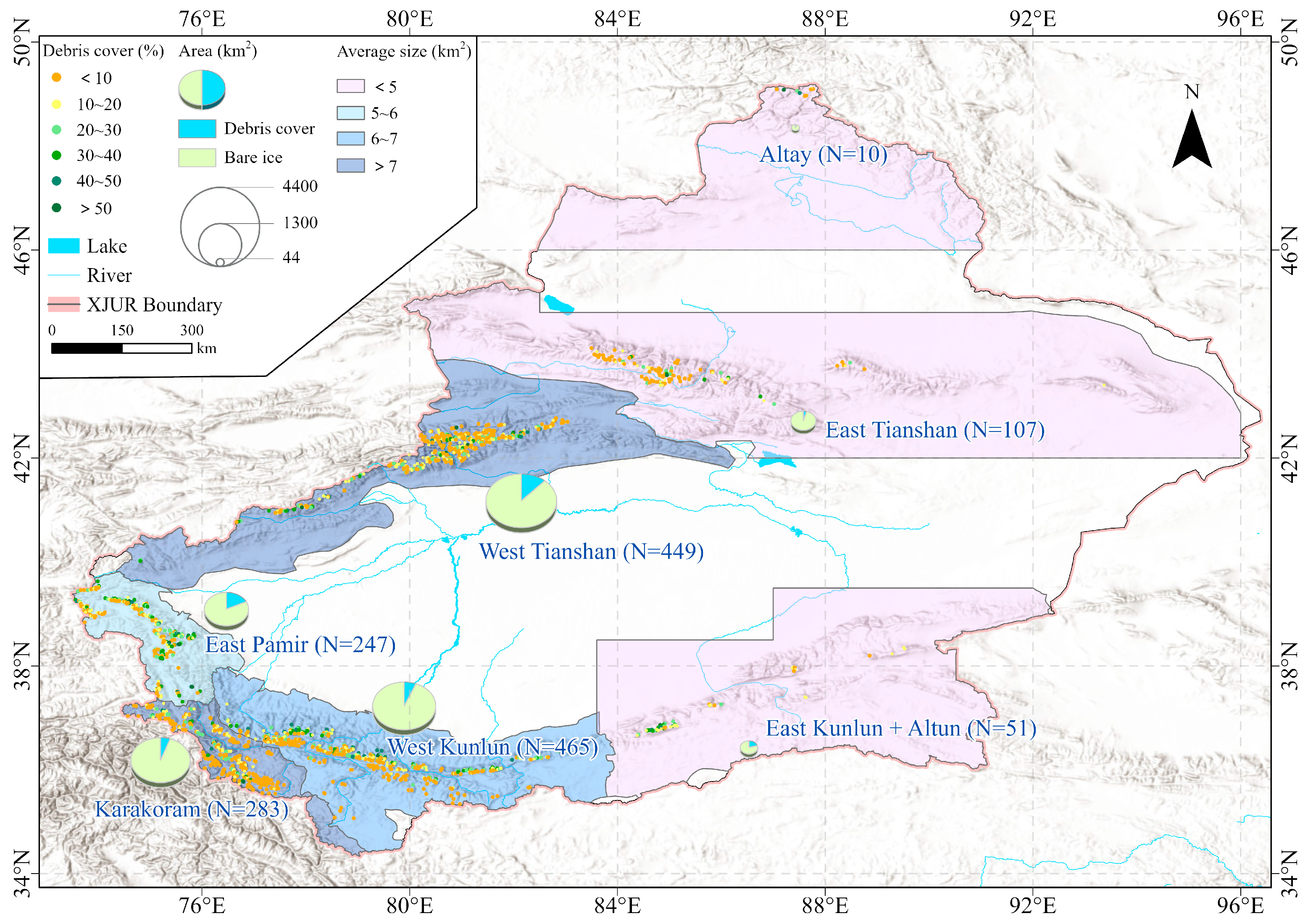
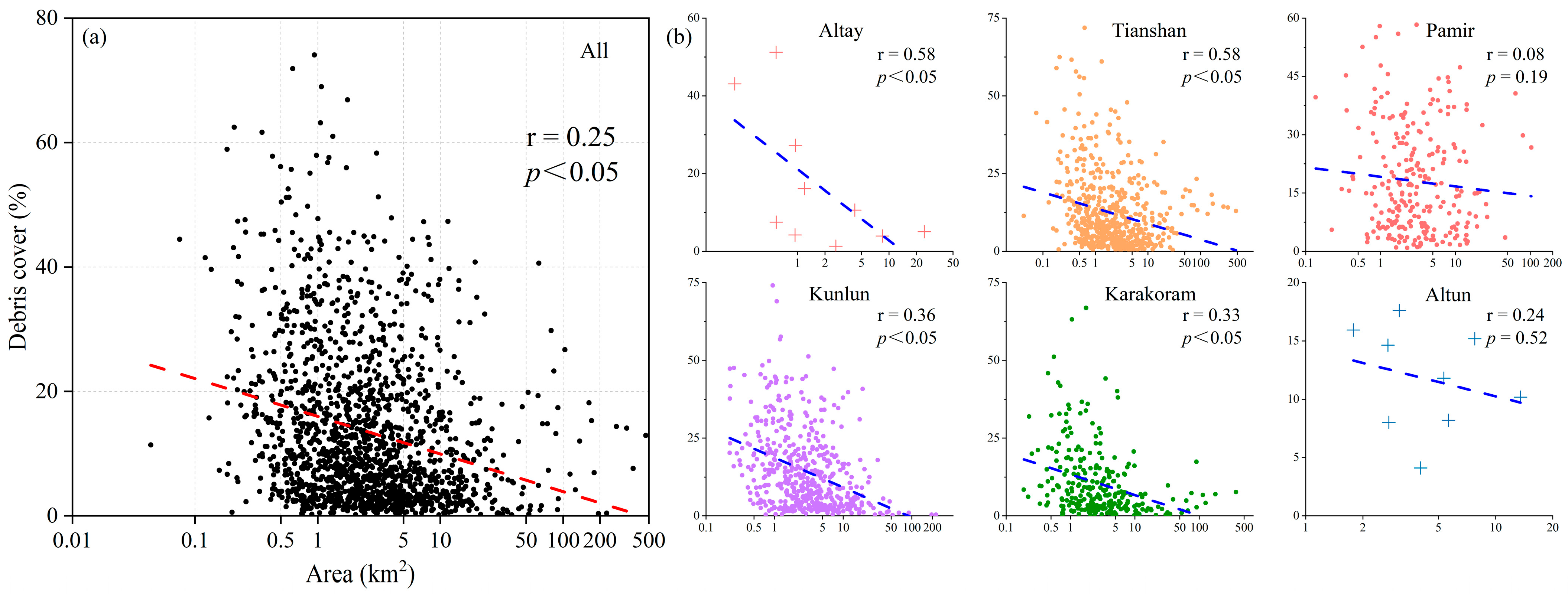
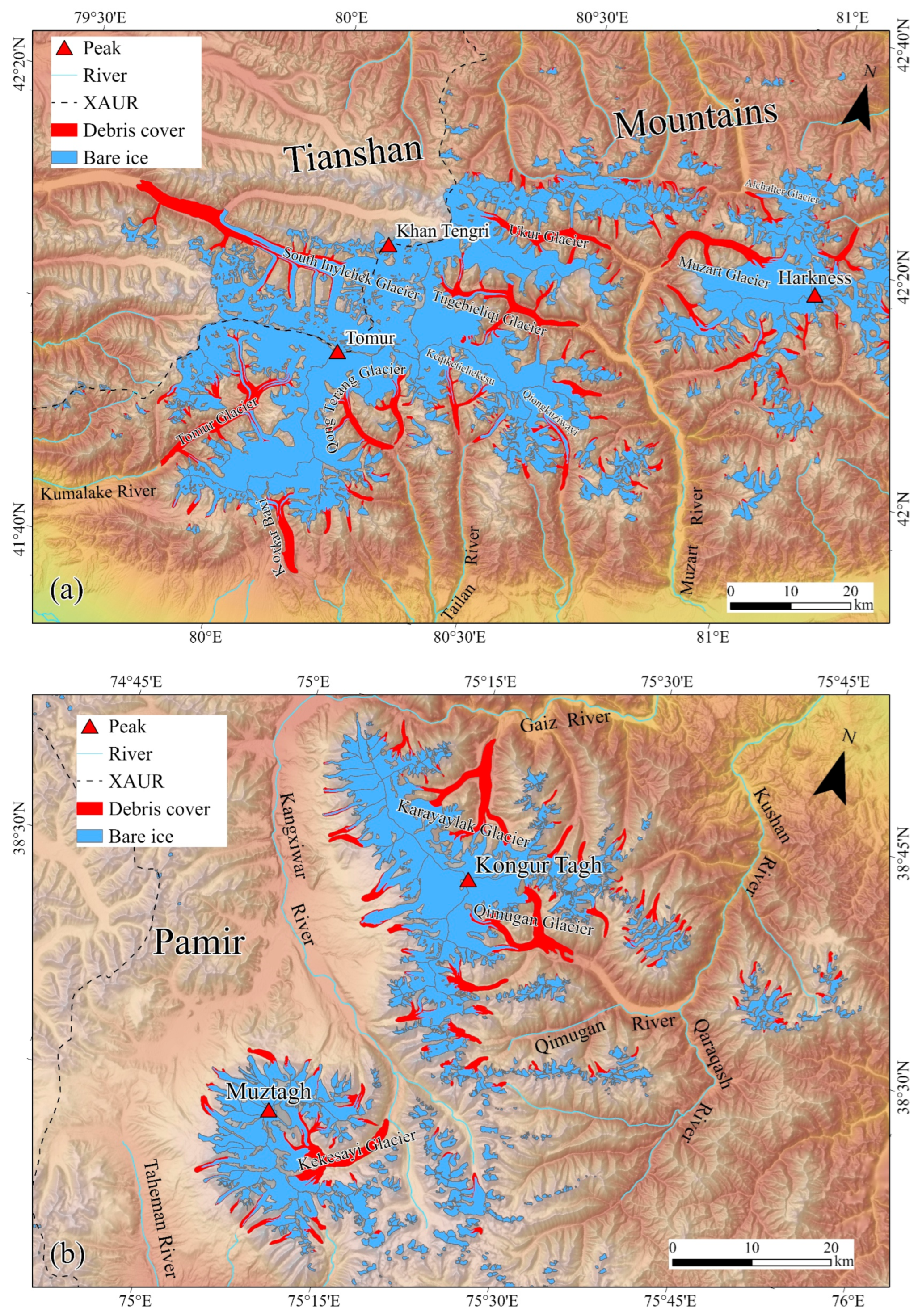
| Altay | 10 | 44.06 | 1.43 | 4.41 | 2.94 | 2.96 | 0.59 | 6.72 | 1.33 | 51.20 | 17.03 |
| Tianshan | 556 | 3987.31 | 90.54 | 7.17 | 410.00 | 489.63 | 37.93 | 12.28 | 0.13 | 71.87 | 12.35 |
| Pamir | 247 | 1381.13 | 43.90 | 5.59 | 96.12 | 260.42 | 21.19 | 18.86 | 0.90 | 58.29 | 18.00 |
| Kunlun | 507 | 2981.26 | 74.51 | 5.88 | 229.00 | 245.87 | 27.55 | 8.25 | 0.16 | 74.08 | 14.50 |
| Karakoram | 283 | 2481.66 | 54.10 | 8.77 | 244.08 | 159.18 | 17.97 | 6.41 | 0.14 | 66.86 | 10.37 |
| Altun | 9 | 46.64 | 1.79 | 5.18 | 2.64 | 5.26 | 0.81 | 11.28 | 4.12 | 17.61 | 11.74 |
| Total | 1612 | 10,922.06 | 266.27 | 6.78 | 984.77 | 1163.32 | 106.04 | 10.65 | 0.13 | 74.08 | 13.57 |
| Drainage Basin | Drainage Code * | Count | Area (km2) | Uncertainty (km2) | Volume (km3) | Debris Cover (km2) | Uncertainty (km2) | Debris Cover Area Ratio (%) | Min_DC (%) | Max_DC (%) | Mean_DC (%) |
|---|---|---|---|---|---|---|---|---|---|---|---|
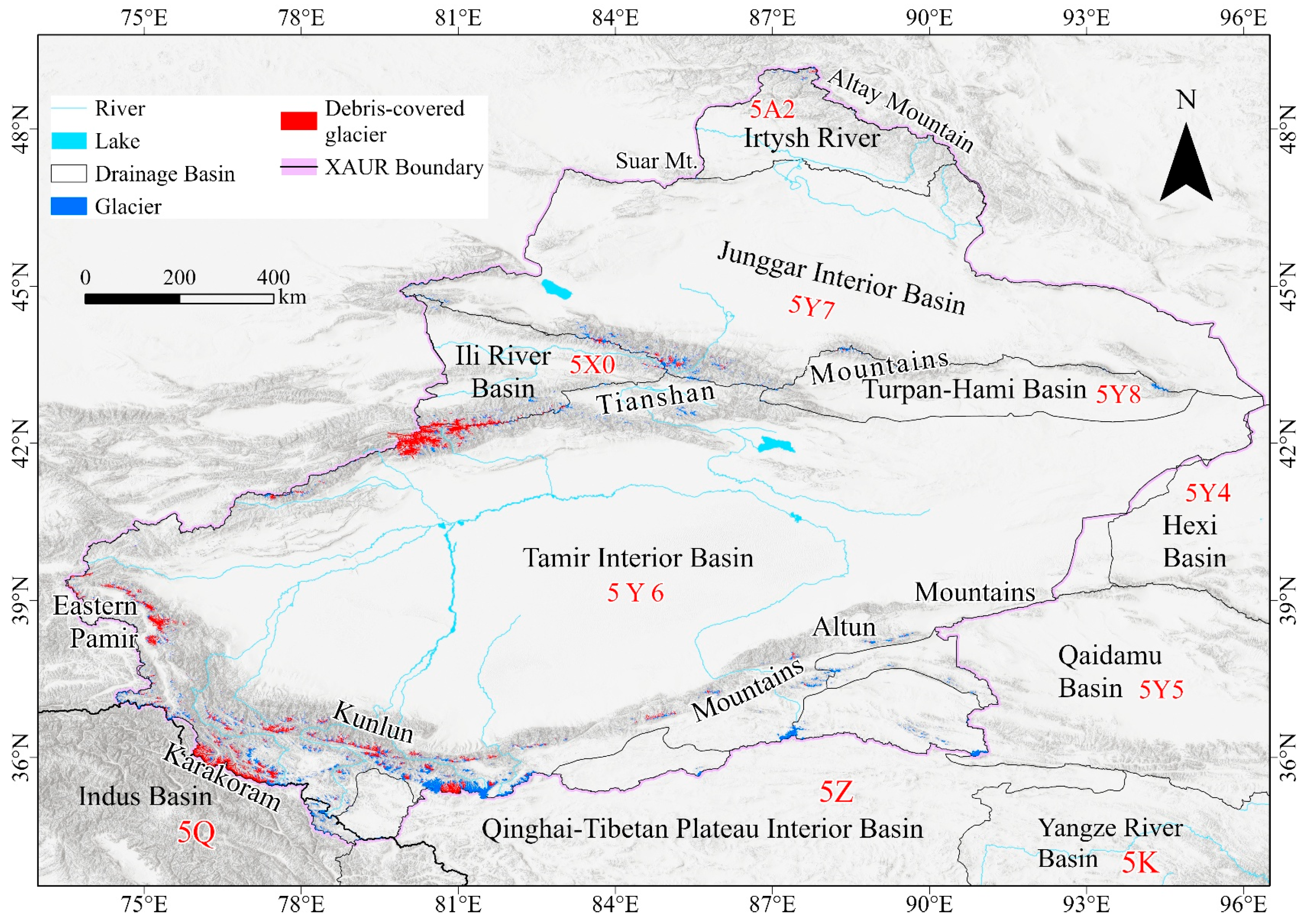
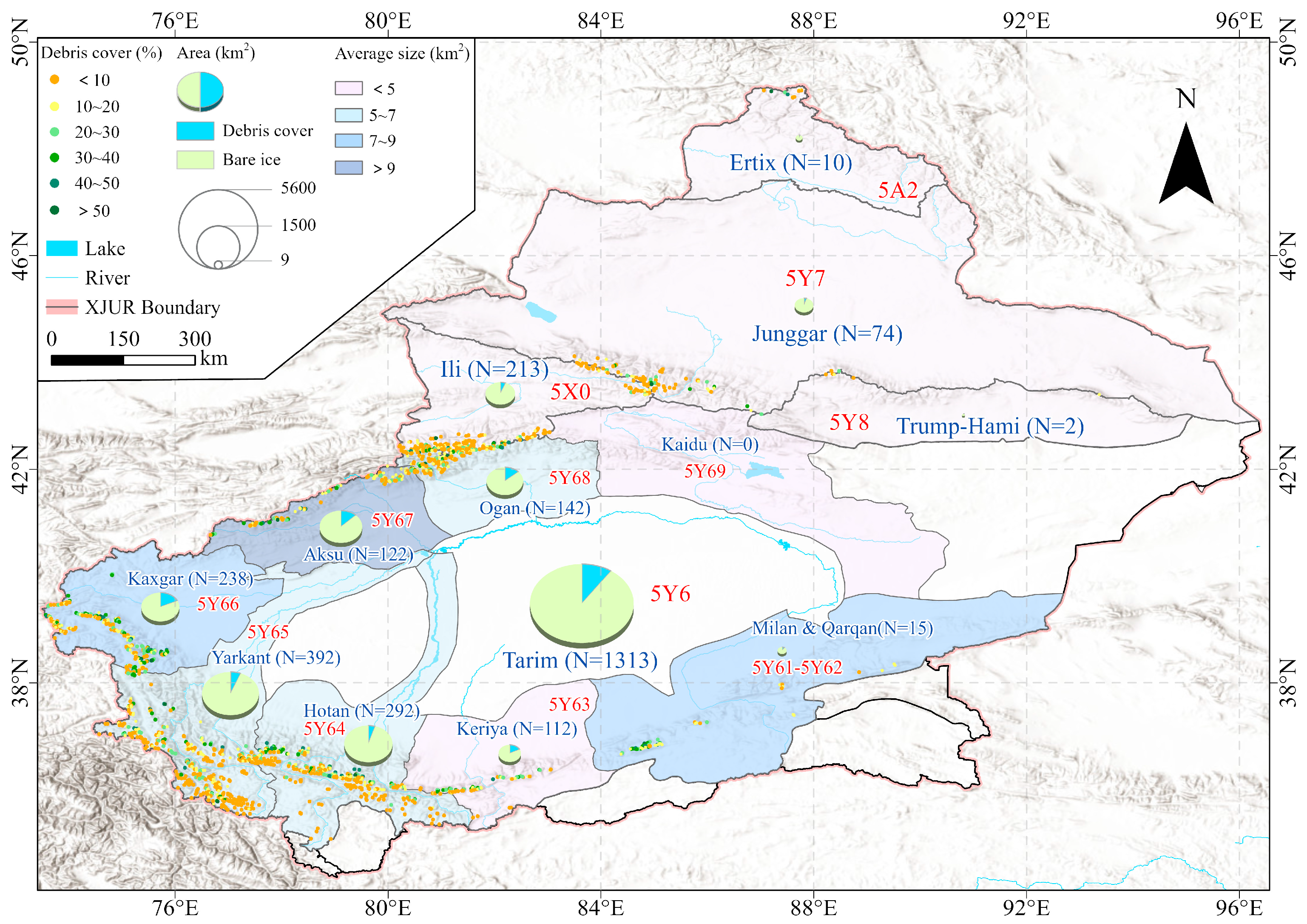
| Ertix river | 5A2 | 10 | 44.06 | 1.43 | 2.94 | 2.96 | 0.59 | 6.72 | 1.33 | 51.20 | 17.03 |
| Ili river | 5X0 | 213 | 793.03 | 22.48 | 50.87 | 57.42 | 8.68 | 7.24 | 0.44 | 62.45 | 9.8 |
| Tarim | 5Y6 | 1313 | 9756.51 | 231.91 | 910.51 | 1083.47 | 93.02 | 11.11 | 0.13 | 74.08 | 14.26 |
| Junggar | 5Y7 | 74 | 319.45 | 10.00 | 19.97 | 18.73 | 3.58 | 5.86 | 0.48 | 55.68 | 11.52 |
| Turpan-Hami | 5Y8 | 2 | 9.02 | 0.44 | 0.48 | 0.74 | 0.18 | 8.19 | 5.99 | 15.01 | 10.5 |
| Total | 1612 | 10,922.06 | 266.27 | 984.77 | 1163.32 | 106.04 | 10.65 | 0.13 | 74.08 | 13.57 | |
| Region | Glacier Inventory | Data Source | Period | Resolution | Research Methods | Debris-Covered Glacier Counts | Debris Cover (km2) | Source |
|---|---|---|---|---|---|---|---|---|
| Xinjiang | CGI-XJ2020 | GF/ZY scenes | 2020 | 2 m | Manual + revise | 1611 | 1102.097 | This study |
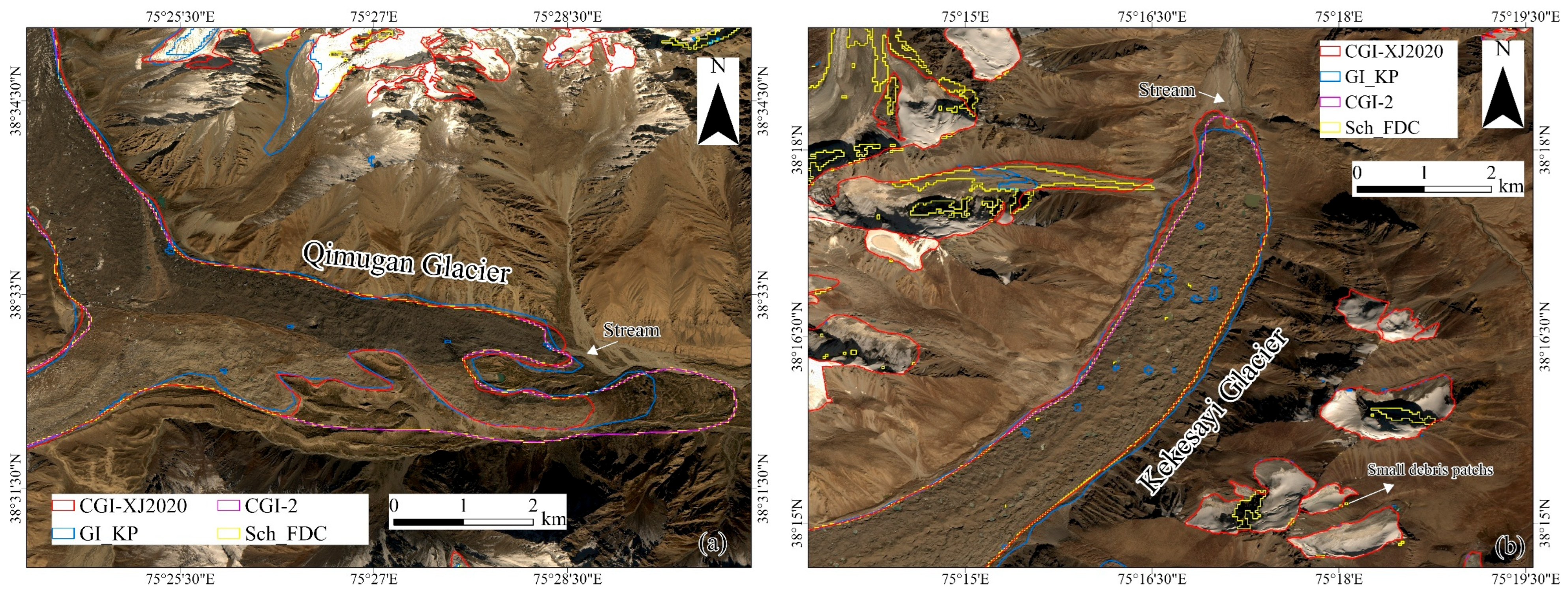
| Xinjiang | CGI-2 | Landsat TM/ETM + scenes | 2004~2010 | 30 m | Manual + revise | 1339 | 1042.86 | [30] |
| Xinjiang | RGI 6.0 | Landsat-8 OLI scenes | 2004~2010 | 30 m | Automatic methods | 10,532 | 1338.23 | [17] |
| Karakoram + Pamir | CGI-XJ2020 | GF/ZY scenes | 2020 | 2 m | Manual + revise | 530 | 419.6 | This study |
| Karakoram + Pamir | GI_KP | Landsat TM/ETM+, ALOS-1 and PALSAR-1 scenes | 1998~2022 | 30/10 m | Automatic methods | 4426 | 541.87 | [31] |
| Pamir | — | Landsa-8 OLI scenes | 2024 | 30 m | Automatic methods | — | 258.08 | [75] |
| Kongur Tagh | CGI-XJ2020 | GF/ZY scenes | 2020 | 2 m | Manual + revise | 31 | 81.82 | This study |
| Kongur Tagh | — | SDGSAT-1 scenes | 2022 | 30/10 m | Automatic methods | — | 89.83 | [76] |
| Kongur Tagh | — | Landsa-8 OLI scenes | 2017 | 30 m | Automatic methods | — | 85.4 | [77] |
Disclaimer/Publisher’s Note: The statements, opinions and data contained in all publications are solely those of the individual author(s) and contributor(s) and not of MDPI and/or the editor(s). MDPI and/or the editor(s) disclaim responsibility for any injury to people or property resulting from any ideas, methods, instructions or products referred to in the content. |
© 2025 by the authors. Licensee MDPI, Basel, Switzerland. This article is an open access article distributed under the terms and conditions of the Creative Commons Attribution (CC BY) license.
Share and Cite
Zhan, Z.; Li, Z.; Mu, J.; Wang, F.; Liang, Q.; Wang, Q.; Chen, W.; Yang, Y.; Zhao, W. Spatial Distribution and Characteristics of Debris-Covered Glaciers in Xinjiang Based on CGI-XJ2020. Remote Sens. 2026, 18, 106. https://doi.org/10.3390/rs18010106
Zhan Z, Li Z, Mu J, Wang F, Liang Q, Wang Q, Chen W, Yang Y, Zhao W. Spatial Distribution and Characteristics of Debris-Covered Glaciers in Xinjiang Based on CGI-XJ2020. Remote Sensing. 2026; 18(1):106. https://doi.org/10.3390/rs18010106
Chicago/Turabian StyleZhan, Zexin, Zhongqin Li, Jianxin Mu, Feiteng Wang, Qibin Liang, Qian Wang, Wei Chen, Yefei Yang, and Weibo Zhao. 2026. "Spatial Distribution and Characteristics of Debris-Covered Glaciers in Xinjiang Based on CGI-XJ2020" Remote Sensing 18, no. 1: 106. https://doi.org/10.3390/rs18010106
APA StyleZhan, Z., Li, Z., Mu, J., Wang, F., Liang, Q., Wang, Q., Chen, W., Yang, Y., & Zhao, W. (2026). Spatial Distribution and Characteristics of Debris-Covered Glaciers in Xinjiang Based on CGI-XJ2020. Remote Sensing, 18(1), 106. https://doi.org/10.3390/rs18010106