Article

Robust ISAR Autofocus for Maneuvering Ships Using Centerline-Driven Adaptive Partitioning and Resampling


1
Aerospace Information Research Institute, Chinese Academy of Sciences, Beijing 100049, China
2
School of Electronic, Electrical and Communication Engineering, University of Chinese Academy of Sciences, Beijing 100049, China
*
Author to whom correspondence should be addressed.
Remote Sens. 2026, 18(1), 105; https://doi.org/10.3390/rs18010105 (registering DOI)
Submission received: 5 November 2025 / Revised: 23 December 2025 / Accepted: 24 December 2025 / Published: 27 December 2025

Highlights

What are the main findings?
  • Centerline-driven adaptive partitioning maximizes rotational center separation for accurate phase error estimation under complex 3D ship attitudes.
  • Novel Rotational Uniformity Coefficient β provides a physically meaningful convergence criterion directly aligned with actual image focus quality.
What are the implications of the main findings?
  • Effectively addresses defocusing caused by non-uniform ship rotation, significantly enhancing ship recognition performance in maritime surveillance.
  • Maintains identical computational complexity to conventional IPGRA while ensuring robust convergence across various motion scenarios for real-time operational capability.

Abstract

Synthetic aperture radar (SAR) is a critical enabling technology for maritime surveillance. However, maneuvering ships often appear defocused in SAR images, posing significant challenges for subsequent ship detection and recognition. To address this problem, this study proposes an improved iteration phase gradient resampling autofocus (IIPGRA) method. First, we extract the defocused ships from SAR images, followed by azimuth decompression and translational motion compensation. Subsequently, a centerline-driven adaptive azimuth partitioning strategy is proposed: the geometric centerline of the vessel is extracted from coarsely focused images using an enhanced RANSAC algorithm, and the target is partitioned into upper and lower sub-blocks along the azimuth direction to maximize the separation of rotational centers between sub-blocks, establishing a foundation for the accurate estimation of spatially variant phase errors. Next, phase gradient autofocus (PGA) is employed to estimate the phase errors of each sub-block and compute their differential. Then, resampling the original echoes based on this differential phase error linearizes non-uniform rotational motion. Furthermore, this study introduces the Rotational Uniformity Coefficient (β) as the convergence criterion. This coefficient can stably and reliably quantify the linearity of the rotational phase, thereby ensuring robust termination of the iterative process. Simulation and real airborne SAR data validate the effectiveness of the proposed algorithm.

1. Introduction

Synthetic aperture radar (SAR) is a vital enabler of maritime surveillance, providing all-weather, day-and-night imaging capability for ship detection and identification [1,2,3] However, maneuvering ships often appear severely defocused in SAR images due to their complex six-degree-of-freedom motion under high sea states [4,5,6,7]. To address this, a hybrid SAR–ISAR processing strategy is commonly employed: following ship detection and extraction from the SAR image, an inverse SAR (ISAR) refocusing module is applied as a post-processing stage to compensate for residual motion-induced phase errors [8,9,10]. This study adopts a hybrid SAR-ISAR processing strategy: SAR serves as the data acquisition platform for wide-area maritime surveillance, while the proposed algorithm provides ISAR-based autofocus capability as a post-processing module specifically for maneuvering ship targets.
The first step of ISAR processing—translational motion compensation (TMC)—is now well established and typically consists of two sub-steps: range envelope alignment [11] and translational phase error compensation [12,13,14,15]. Nevertheless, rotational motion compensation remains a critical challenge. The conventional range-Doppler (RD) algorithm assumes uniform rotation within the coherent processing interval (CPI), which is frequently violated for ships in rough seas, leading to severe defocusing [16]. To achieve well-focused ISAR imagery, precise compensation of spatially variant phase errors induced by non-uniform rotation is essential [17].
To address non-uniform rotation, range–instantaneous Doppler (RID) imaging methods have been developed, which reconstruct azimuth scatterer positions by estimating instantaneous Doppler frequencies. RID algorithms are broadly categorized into parametric and non-parametric approaches. Non-parametric methods employ time–frequency analysis, such as the Wigner–Ville distribution (WVD) and smoothed pseudo-WVD (SPWVD), to estimate Doppler histories, but they suffer from cross-term interference and the time–frequency resolution trade-off [18,19,20,21,22]. To mitigate these drawbacks, high-resolution spectral estimation techniques have been explored. In particular, the iterative adaptive approach (IAA) leverages the full coherent aperture through an iterative reweighting strategy to achieve significantly improved time–frequency resolution. Nevertheless, IAA entails substantial computational complexity and may yield biased amplitude estimates under a low signal-to-noise ratio (SNR) or highly non-stationary conditions [23,24,25]. Parametric approaches typically model the target azimuth signal as a polynomial phase signal (PPS) [26,27,28,29,30,31], where phase compensation is achieved by estimating time-varying parameters via optimization algorithms. However, the nonlinear transformations used to reduce the PPS order often introduce cross-terms in multicomponent scenarios, degrading parameter estimation robustness. These methods also exhibit high computational complexity due to iterative optimization, poor noise resilience under low-SNR conditions, difficulty in selecting the optimal polynomial order, which can cause underfitting or overfitting, and limited adaptability to the highly non-stationary and coupled rotational motions typical of maneuvering ships. These combined limitations make parametric approaches less suitable for practical maritime surveillance applications requiring computational efficiency and robustness to complex ship dynamics.
In parallel, data-driven paradigms have emerged to circumvent explicit motion modeling. Compressed sensing-based ISAR imaging leverages the inherent sparsity of ship targets to reconstruct focused images from non-uniformly rotated or limited-aperture data [32]. Deep learning-enhanced RID frameworks further bypass traditional estimation by learning direct mappings from defocused or noisy time–frequency representations to high-fidelity ISAR images [33,34]. While promising, these approaches often rely on strong sparsity priors or large labeled datasets, limiting robustness in unseen maritime scenarios.
Recently, resampling-based autofocus methods have emerged as a promising alternative for full-aperture, non-sparse refocusing [9,35,36,37]. The Iteration Phase Gradient Resample Autofocus (IPGRA) [35] extends PGA to rotational compensation by estimating differential phase errors between two range-partitioned sub-blocks and iteratively resampling the raw echoes. This enables full-aperture, non-sparse, real-time-capable refocusing to estimate phase errors and iteratively resamples echoes to compensate for spatially variant phase errors. However, IPGRA’s fixed range-domain segmentation critically relies on the assumption of a high aspect ratio and a strong linear correlation between range and azimuth scatterer coordinates—a condition that is not always satisfied in practical scenarios. This results in insufficient azimuthal separation of effective rotation centers, leading to inaccurate differential phase estimation and degraded focusing performance.
To address this limitation, we propose an Improved IPGRA (IIPGRA) framework that replaces the fixed range-domain segmentation with an adaptive azimuth partitioning strategy. The key idea is to perform block division in the coarsely focused image domain, where the ship’s geometric structure is partially revealed. First, extract the defocused ship chip from the SAR image and perform azimuth decompression followed by translational motion compensation. Second, generate a coarsely focused ISAR image and extract the ship’s geometric centerline using an enhanced RANSAC [38] algorithm. Third, partition the image into upper and lower sub-blocks along the azimuth direction using the extracted centerline as a reference; then, reconstruct the corresponding sub-signals via inverse Fourier transform. Fourth, apply PGA to each sub-signal to estimate their respective phase errors, and compute the differential rotational phase error. Then, resample the original echo signal based on this differential phase to linearize the non-uniform rotation. Finally, evaluate convergence using the Rotational Uniformity Coefficient β . If β is below a threshold, terminate the iteration; otherwise, feed the resampled signal back to the first step for the next iteration. By enabling accurate compensation of time-varying rotational motion, IIPGRA effectively extends the usable CPI, thereby enhancing azimuth resolution and SNR without introducing image distortion.
The remainder of this paper is organized as follows. Section 2 presents the geometric and signal models for ISAR imaging of maneuvering ships. Section 3 details the IPGRA algorithm and analyzes its limitations. Section 4 proposes the IIPGRA framework, including the centerline-driven adaptive azimuth partitioning strategy, the Rotational Uniformity Coefficient β for convergence control, and the complete processing flow. Section 5 validates the method using simulated and real airborne SAR data. Finally, Section 6 concludes this study and outlines future research directions.

2. ISAR Imaging Mode and Signal Models

This section establishes the geometric model for ISAR imaging and derives the echo signal model for moving ships. In ISAR imaging, a target’s three-dimensional structure is generally projected onto a two-dimensional imaging projection plane (IPP), defined by the radar line of sight (RLOS) and the ERV. Assuming that translational motion compensation has been completed, the ISAR imaging model can be simplified as a turntable mode.
As illustrated in Figure 1, the target coordinate system O X Y is established in the IPP, where the origin O coincides with the target’s rotation center after translational compensation; O X and O Y correspond to the range direction and the azimuth direction, respectively. Point P is a scattering point of the ship, characterized by Cartesian initial coordinates x 0 , y 0 and the polar coordinate representation r , θ 0 .
The ISAR system transmits a chirp signal, mathematically expressed as:
s τ = rect τ T p exp j 2 π f c τ + 1 2 γ τ 2 ,
where T p is the pulse width, τ denotes fast time, f c is the carrier frequency, and γ is the frequency modulation slope. The rectangular window function rect is defined as:
rect u = 1 , u 1 / 2 0 , u > 1 / 2
The echo signal emitted by scattering point P can be formulated as:
s P t , τ = σ p rect τ 2 R p t c T p exp j 2 π f c τ 2 R p t c + 1 2 γ τ 2 R p t c 2
where c is the speed of light, t is the slow time, R p t denotes the distance between the radar and point P at slow time t , and σ p is the scattering coefficient.
After range compression, the signal can be expressed as:
s t , τ = sin c B τ 2 R p t c exp j ϕ t
with phase term ϕ t given by:
ϕ t = 2 π f c 2 R p t c
where B is the signal bandwidth.
Under completed translational motion compensation, R p t accounts only for rotational contributions and approximates as:
R p t R o + r cos θ t = R o + x t
where R O is the distance from the radar to reference point O , and x t is the coordinate of point P at slow time t . θ t can be expressed as:
θ t = θ 0 + Δ θ t
Δ θ t = ʃ 0 t ω ( t ) d t
where ω t is the instantaneous rotation speed. Generally, the required rotation angle Δ θ t for imaging is smaller than 5° [39]. Substitute the trigonometric function approximation ( cos Δ θ t 1 , sin Δ θ t Δ θ t ) into it, leading to:
R p t R o + r cos θ 0 + Δ θ t = R o + x 0 y 0 Δ θ t
The range-compressed signal becomes:
s t , τ = sin c B τ 2 R o + 2 x 0 2 y 0 Δ θ t c exp j ϕ t
Performing the Fourier transform over τ :
s t , f τ = rect f τ B exp j 4 π f τ + f c c R o + x 0 exp j 4 π f τ + f c c y 0 Δ θ t
where f τ is the range frequency.
A severe coupling between the frequency f τ and t causes image defocusing. To mitigate this, the Keystone transform [40] is applied:
t = f τ + f c f c t
where t is the transformed slow time to eliminate range-cell migration. The post-transform signal is:
s t , τ = sin c B τ 2 ( R O + x 0 ) c exp j ϕ t
with phase term:
ϕ t = 4 π f c c y 0 Δ θ t
Differentiating Equation (14) yields the Doppler frequency:
f d t = 1 2 π d ϕ t d t = 2 f c c y 0 ω t
Combining Equations (13) and (15), at time t , the imaging position of the point x 0 , y 0 is 2 x 0 c , 2 f c y 0 ω - c .
However, the time-varying ω t introduces nonlinear phase variations in ϕ t , leading to image defocusing. Since the ship is a rigid body, all scatterers share the same ω t . Therefore, the defocusing degree of different scatterers within the same range cell varies; the larger y 0 , the more severe the defocus. The defocusing phase of different scatterers is proportional to their azimuth position y 0 .
In practical processing, these continuous variables are discretized into sequences. The azimuth slow time is sampled as t = 0 ,   PRI ,   2 PRI ,   ,   N a 1 PRI , where PRI is the pulse repetition interval and N a is the number of azimuth pulses. Similarly, the range fast time is expressed as τ = τ 0 ,   τ 0 + d τ ,   τ 0 + 2 d τ ,   ,   τ 0 + N r 1 d τ , where d τ is the sampling interval and N r is the number of range sampling points.

3. The IPGRA Algorithm and Its Limitation

3.1. Principle and Implementation of IPGRA

The IPGRA algorithm extends the conventional PGA technique, which primarily compensates for spatially invariant phase errors induced by translational motion, to address spatially variant phase errors caused by rotational motion. Its theoretical foundation rests on four key principles:
1.
Phase Characteristics of Rotational Motion
Non-uniform rotation introduces linear spatial phase variations along the azimuth direction. For a scatterer at azimuth coordinate y 0 , the phase error is derived from (14):
ϕ p t ; x 0 , y 0 = 4 π f c c y 0 Δ θ t .
2.
Block-wise Estimation and Global Compensation
The signal s 1 t , τ is divided into two sub-blocks along the range direction, corresponding to local rotational centers O 1 x 0 , 1 , y 0 , 1 and O 2 x 0 , 2 , y 0 , 2 . The phase error φ err , i ( t ) of each sub-block estimated by PGA satisfies:
ϕ err , i t = 4 π f c y 0 , i c Δ θ t .
The rotational phase error is calculated as:
ϕ err , rot t   = ϕ err , 1 t ϕ err , 2 t   = 4 π f c y 0 , 1 c Δ θ t 4 π f c y 0 , 2 c Δ θ t   = 4 π f c y 0 , 1 y 0 , 2 c Δ θ t   = k Δ θ t ,
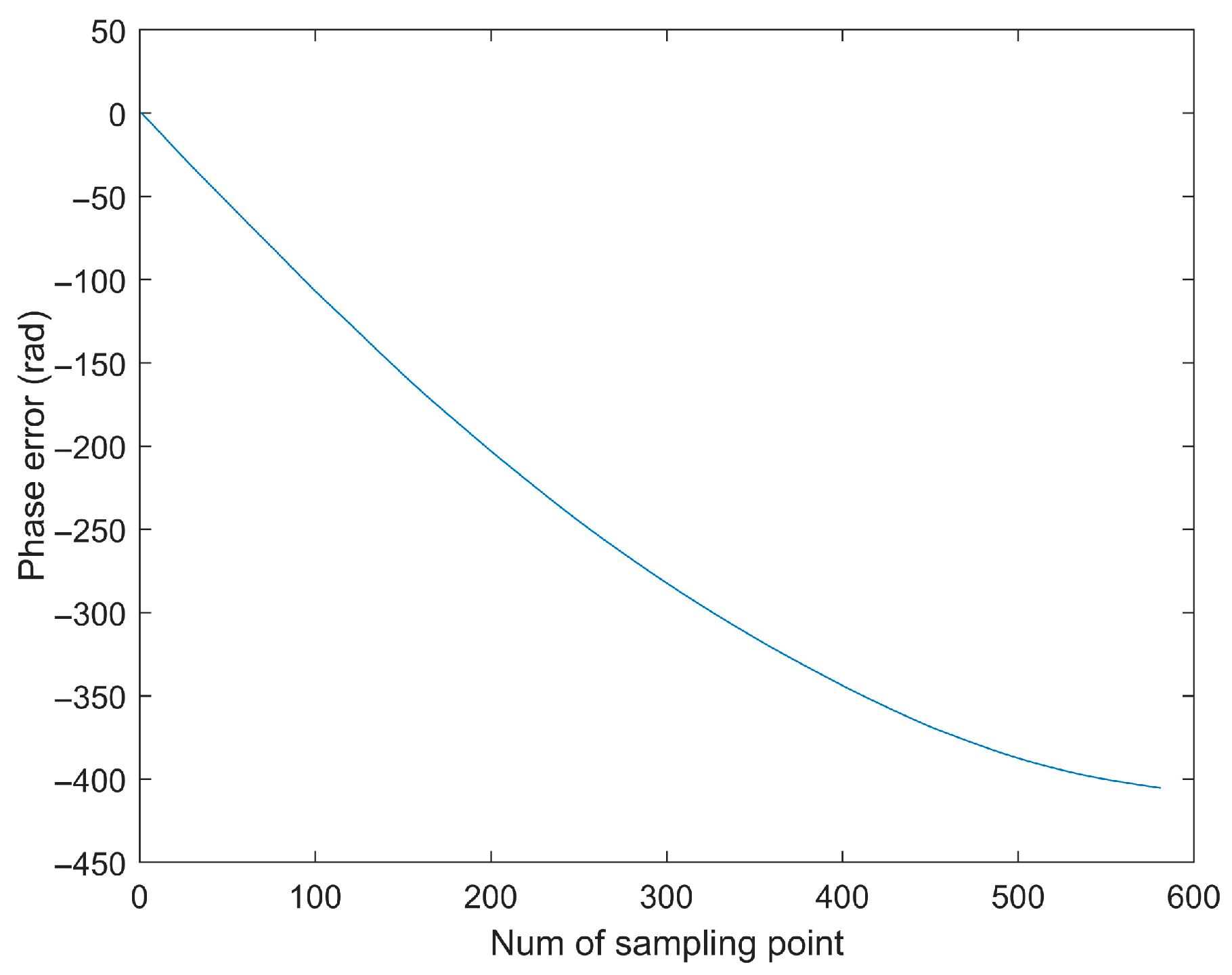
where k = 4 π f c y 0 , 1 y 0 , 2 c is a constant. This linear relationship enables subsequent resampling to linearize the phase. Figure 2 illustrates the phase error caused by non-uniform rotation.
3.
Resample for Phase Correction
The signal s 1 t , τ is resampled using ϕ err , rot t :
s 2 m P R I , τ = s 1 ϕ r o t 1 m Δ ϕ , τ ,
where ϕ r o t 1 is the inverse function of the rotational phase error ϕ err , rot , and Δ ϕ is denoted as:
Δ ϕ = φ err , rot N a 1 φ err , rot 0 N a 1 .
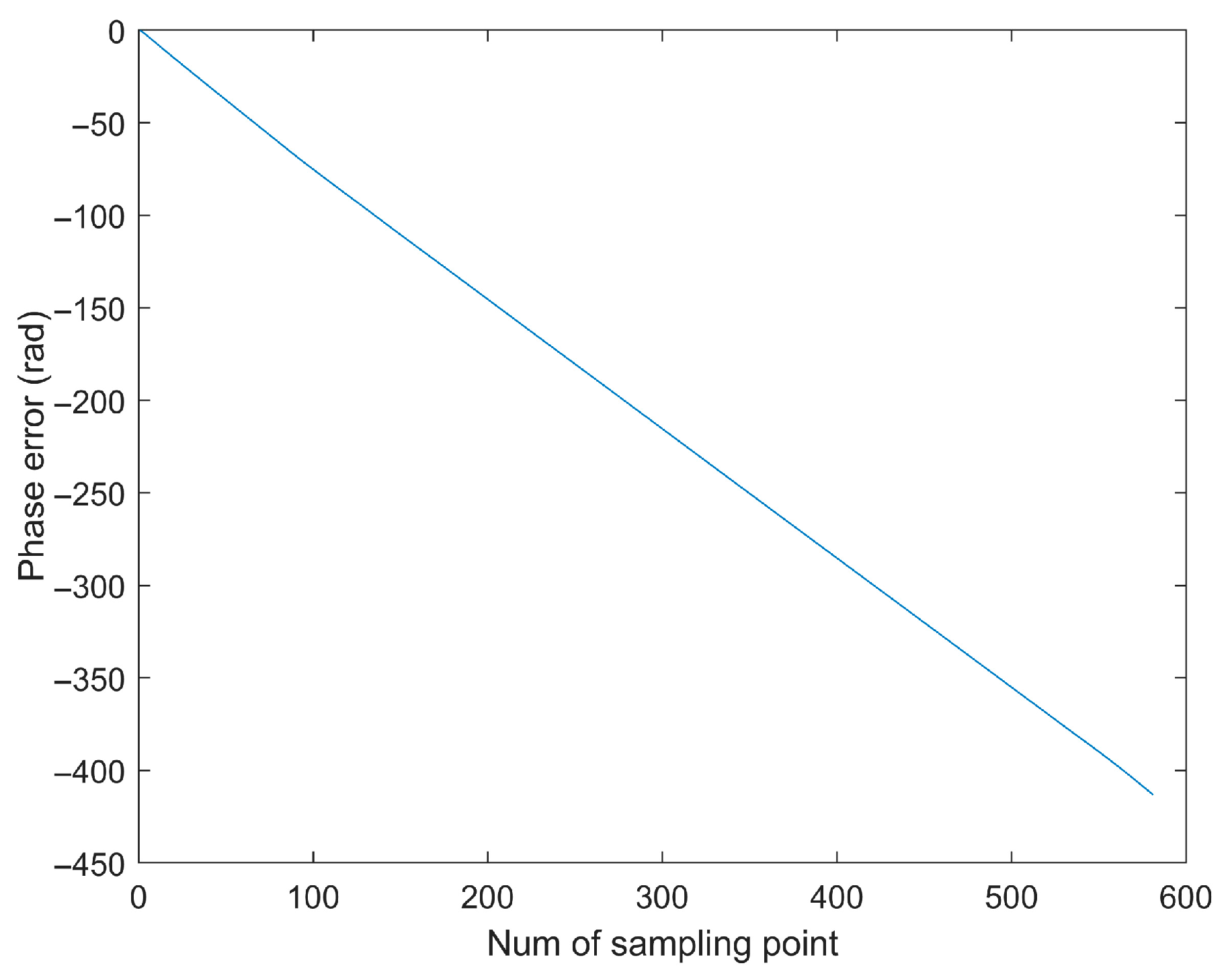
This transforms nonlinear Doppler histories into linear functions, enabling azimuth focusing via Fourier transform. Figure 3 shows the compensated phase via resampling.
4.
Convergence Quantification
The Defocusing coefficient α is defined to evaluate focusing quality:
α = max f d i f t min f d i f t mean f d i f t ,
where f d i f t = 1 2 π d φ err,rot t d t , mean f d i f t is the mean difference between the rotational centers. Iteration terminates when α < 0.04 .
The IPGRA algorithm proceeds through the following main steps:
1.
Preprocessing
Extract defocused ship targets from the SAR image. Perform azimuth decompression and translational motion compensation, transforming the signal into a rotational model around a fixed center.
2.
Block-wise Phase Error Extraction
Partition s 1 t , τ into two sub-blocks along the range direction:
s 1 , 1 t , τ = s 1 t , τ , τ τ 0 , τ 0 + N r / 2 1 Δ τ s 1 , 2 t , τ = s 1 t , τ ,   τ τ 0 + N r / 2 Δ τ , τ 0 + N r 1 Δ τ .
Estimate phase errors ϕ err , 1 t and ϕ err , 2 t via PGA as (16), then compute ϕ err , rot t using (17).
3.
Resample
Resample s 1 t , τ based on φ err,rot t using (18), (19).
4.
Iteration
Calculate the Defocusing coefficient α via (20). Iterate Steps 2–3 until α < 0.04 or focusing quality stabilizes.

3.2. Limitations of IPGRA

This section analyzes the two fundamental limitations of the traditional IPGRA algorithm—insufficient azimuthal isolation and Defocusing coefficient α convergence instability.
According to Equation (17), the phase error term φ err , rot t is proportional to the coefficient k , which in turn directly depends on the azimuth coordinate difference y 0 , 1 y 0 , 2 between the rotational centers of the two sub-blocks. Therefore, to accurately extract the phase difference, the sub-blocks must maintain sufficient azimuthal spacing. IPGRA’s fixed range-domain partitioning can only ensure the spacing constraint in the range dimension, while the effectiveness of azimuthal spacing relies on the linear coupling characteristic between the range and azimuth coordinates of ship targets. Additionally, the Defocusing coefficient α exhibits convergence instability; its extremal functions max f d i f t and min f d i f t are susceptible to outlier interference. Moreover, α may paradoxically increase when image quality improves, indicating a deviation from image evaluation metrics.
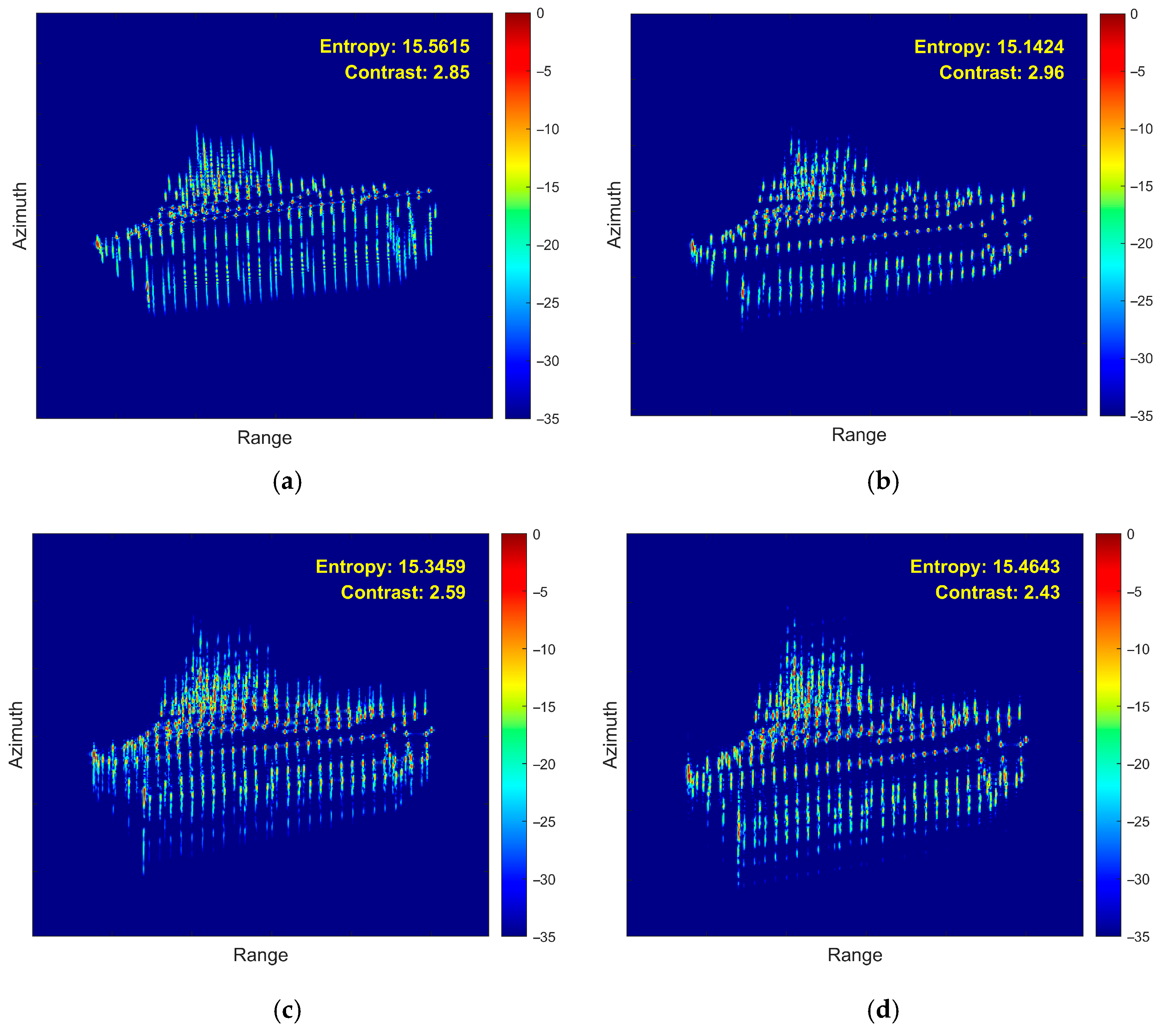
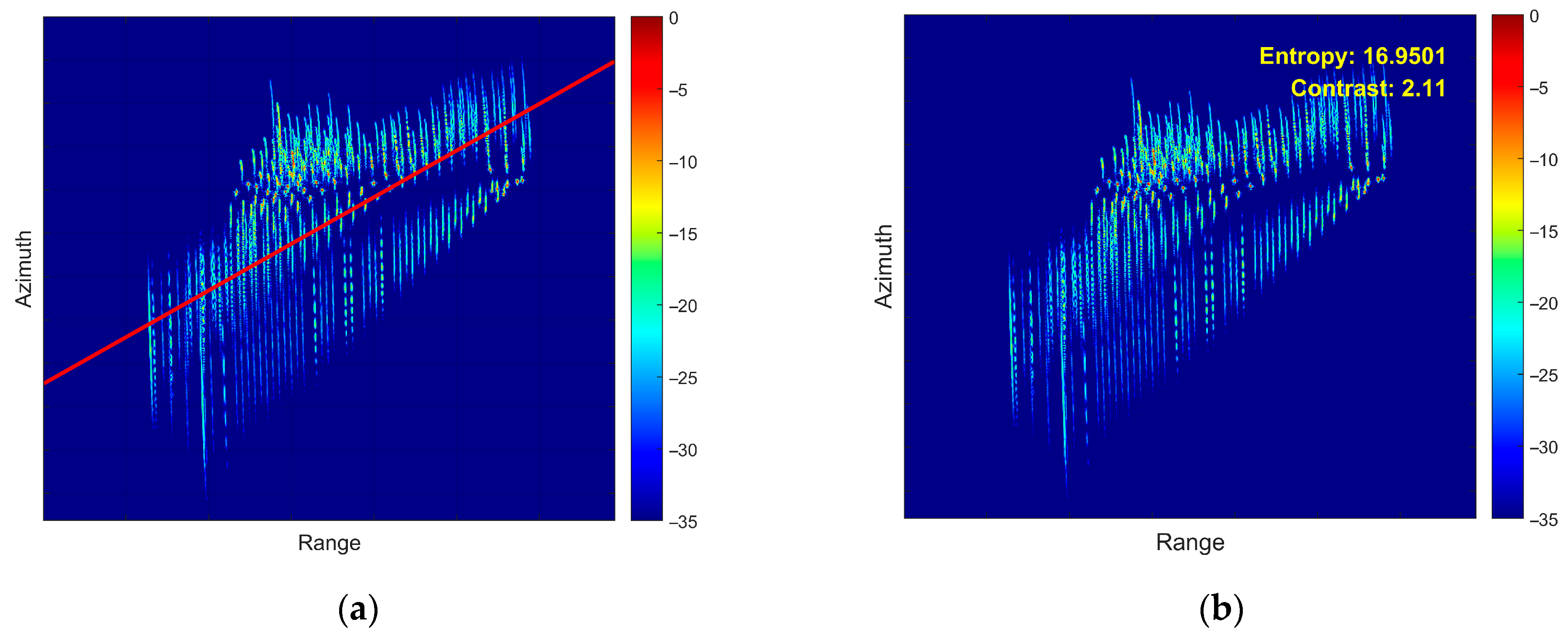
Here, an experiment is designed to illustrate the aforementioned issues. In this experiment, we simulated the scenario where the ship is in a roll condition. The simulation parameters of the synthetic aperture radar (SAR) system are presented in Table 1, while Table 2 lists the specific motion parameters of the ship. Figure 4 compares the imaging results of the Iterative Phase Gradient Resample Autofocus (IPGRA) algorithm for the ship under roll rotation: Figure 4a shows the result of the traditional Range-Doppler (RD) algorithm (iteration count = 0), with significant azimuthal defocusing; Figure 4b presents the result after the first iteration of the IPGRA algorithm, where the defocusing phenomenon is partially mitigated; Figure 4c displays the result after the second iteration, with more severe defocusing; Figure 4d shows the result after the third iteration, with no further improvement in focusing performance. Overall, the ship target remains in a state of severe defocusing, which indicates that in the ship roll scenario of this experiment, the IPGRA algorithm fails to effectively compensate for the rotational motion induced by roll.
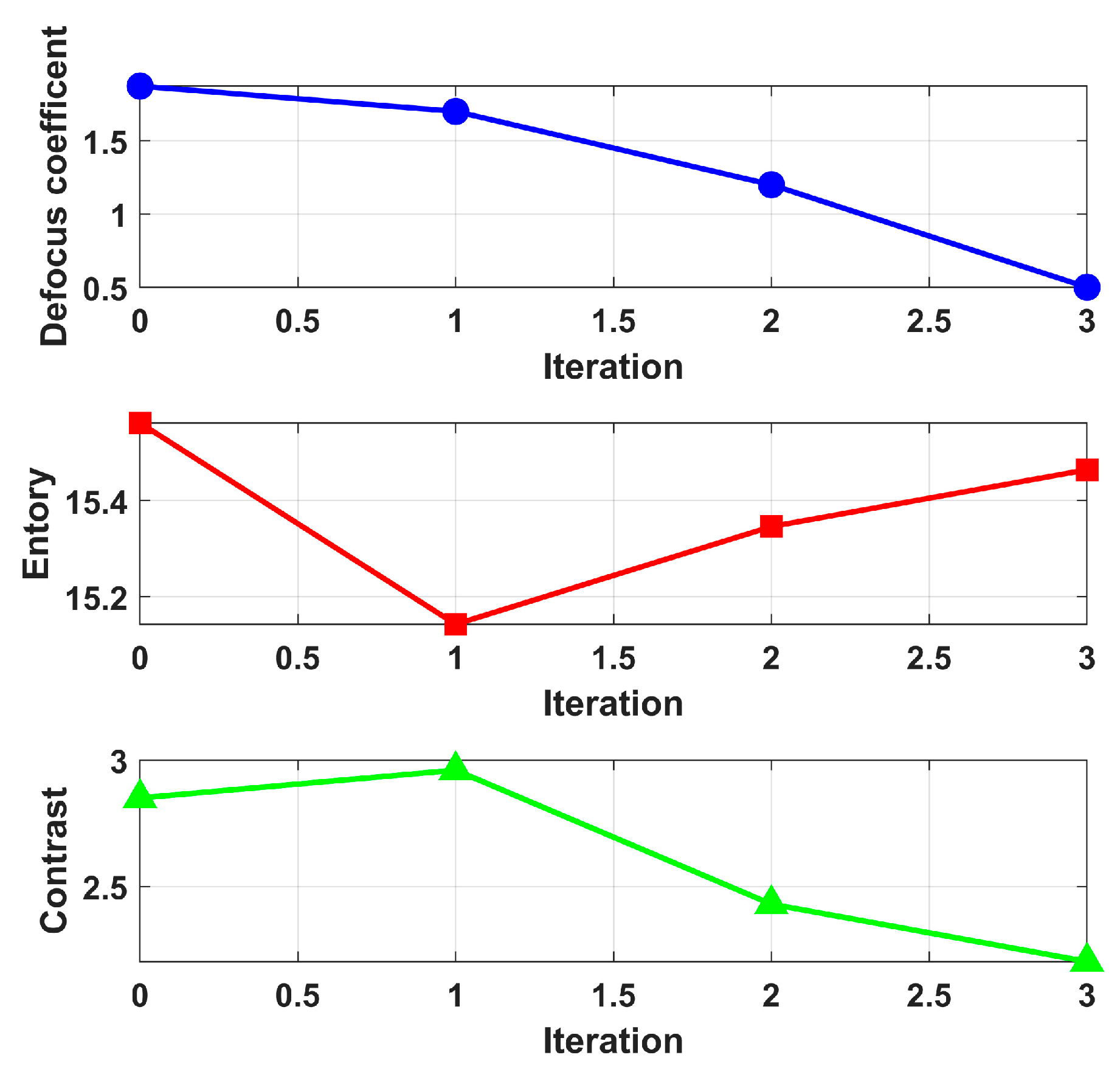
Figure 5 presents the contradictory variations in the Defocus coefficient α, image entropy, and contrast with iteration; while α decreases continuously, image entropy first decreases then increases, and contrast first increases then decreases. This intuitively demonstrates that α cannot reliably reflect the actual focusing performance, highlighting its limitation in assessment.

4. Proposed Improved IPGRA

This section presents an Improved IPGRA, termed IIPGRA, which addresses two practical shortcomings of the original method: inadequate scatterer isolation from fixed range-domain segmentation and unstable iteration control due to the Defocusing coefficient α .

4.1. Centerline-Driven Azimuth Adaptive Partitioning

Conventional IPGRA partitions the range-compressed signal s 1 t , τ into two sub-blocks along the range direction. While this strategy is computationally convenient, it assumes a strong linear correlation between range and azimuth coordinates of ship scatterers. Under complex ship attitudes or for vessels with low aspect ratios, this assumption fails, resulting in small azimuth coordinate differences y 0 , 1 y 0 , 2 between the effective rotational centers of the two sub-blocks. Consequently, the estimated differential phase error ϕ err , rot t exhibits low dynamic range and is highly sensitive to estimation noise, degrading focusing accuracy.
To overcome this, we propose to perform partitioning in the coarsely focused image domain, where the ship’s geometric structure is partially revealed. The procedure is as follows:
1.
Coarse Image Formation
Apply azimuth Fourier transform to the translation-compensated signal s 1 t , τ to generate the coarsely focused image I 1 f d , τ .
2.
Centerline Extraction
The ship’s centerline y = k * x + b * is extracted from the coarsely focused image I 1 using the enhanced RANSAC algorithm proposed in [38]. This method incorporates a ship-width-adaptive distance threshold and an amplitude-weighted cost function, which together ensure robust centerline estimation under a low signal-to-noise ratio (SNR) and in the presence of complex superstructures.
Optimal Distance Threshold Estimation:
Initialize candidate thresholds d w w = 1 W based on estimated ship width. For each d w , perform L RANSAC trials and compute inlier amplitude sums:
S I ( w , l ) = ( x t , y t ) X i n d t d w I ( x t , y t ) ,
where χ i n denotes the inlier set satisfying the distance threshold d w in RANSAC iterations, and d t is the perpendicular distance from pixel x t , y t to the candidate line.
Select the optimal threshold D opt by maximizing variance in top- L 0 amplitude sums:
D opt = arg   max d w   Var ( { S ~ I top ( d w ) } L 0 ) ,
where s ˜ I top denotes top L 0 amplitude sums.
Centerline Model Fitting:
Solve for optimal line parameters using amplitude-weighted inliers:
( k * , b * ) = arg   max k , b ( x t , y t ) X i n d t D opt I ( x t , y t ) ,
3.
Adaptive Partitioning
Using the extracted centerline as a geometric reference, the image is partitioned into two sub-blocks along the azimuth direction:
upper   section :   I 1 , 1 = x , y y y c
lower   section :   I 1 , 2 = x , y y < y c
where x c , y c is the centroid along the centerline, computed as x c = min x t + max x t 2 , y c = k * x c + b * .
4.
Signal Reconstruction
The sub-images are zero-padded and transformed back to the signal domain via an inverse Fourier transform, yielding two sub-signals s 1 , 1 t , τ and s 1 , 2 t , τ .

4.2. Rotational Uniformity Coefficient β for Stable Convergence

To address the limitations of the Defocus coefficient α in capturing non-uniform rotational phase errors, we propose a Rotational Uniformity Coefficient β that directly quantifies the linearity of the rotational phase error φ err , rot t . The coefficient is defined as:
β = t = 1 N a | φ err,rot ( t ) φ linear ( t ) | | φ err,rot ( N a ) φ err,rot ( 1 ) | N a ,
φ linear t = φ err , rot 0 + m Δ ϕ , m = 0 , 1 , 2 , , N a 1
where φ linear t denotes the linear fit of φ err , rot t .
The numerator measures the total absolute deviation between the actual phase error and its linear approximation, while the denominator normalizes this deviation by the average phase change rate to ensure scale invariance. This definition carries practical significance: β directly reflects the degree of non-uniformity in rotational motion, with a smaller β indicating that φ err , rot t approaches linearity for uniform rotation and optimal focusing. Additionally, by dividing by the average phase change rate, β becomes independent of the total rotation angle, enabling consistent evaluation across different coherent processing intervals (CPIs).
For iteration termination, the process halts when β falls below a threshold typically set to 0.015. The threshold of 0.015 was empirically determined through extensive validation across multiple motion scenarios. This value balances two competing requirements: sufficient strictness to ensure phase linearity (optimal focusing) and sufficient leniency to avoid over-iteration (computational efficiency). This criterion offers two key advantages: unlike the Defocusing coefficient α , which relies on extremal functions sensitive to phase estimation noise, β quantifies phase linearity via a normalized deviation metric and convergence stability. In addition, the β is independent of the target’s azimuth dimension, enabling consistent performance across vessels of varying sizes.

4.3. IIPGRA Processing Flow

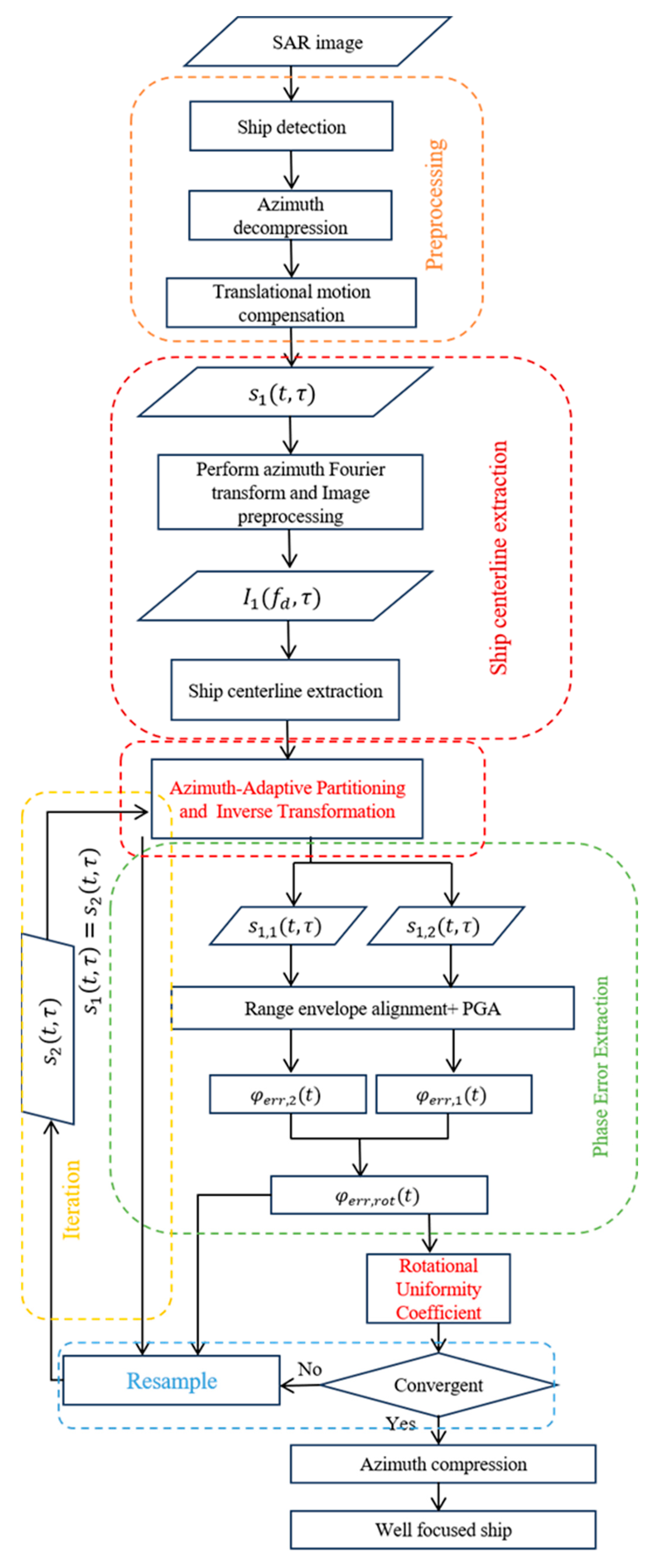
Integrating the two key enhancements presented above the centerline-driven adaptive azimuth partitioning and the Rotational Uniformity Coefficient β for convergence control, we now delineate the complete workflow of the proposed Improved IPGRA (IIPGRA) algorithm. The overall processing flow, illustrated in Figure 6, seamlessly incorporates these components into an iterative framework suitable for ship targets with complex motions. The following six steps detail the procedure.
1.
Translational Motion Compensation
Perform range alignment and phase correction following conventional IPGRA procedures. Apply azimuth Fourier transform to s 1 t , τ to yield a coarsely focused image I 1 f d , τ .
2.
Ship Centerline Extraction via enhanced RANSAC
Extract the ship centerline y = k * x + b * using the enhanced RANSAC, which is described in Section 4.1.
3.
Azimuth-Adaptive Partitioning
The centroid x c , y c is computed as:
x c = min x t + max x t 2 ,   y c = k * x c + b *
The image is partitioned into upper sub-image I 1 , 1 = { x , y | y y c } and lower sub-image I 1 , 2 = { x , y | y < y c } . Then, I 1 , 1 and I 1 , 2 are zero-padded and inverse Fourier transformed to range-compressed as:
s 1 , 1 t , τ = F y 1 Z y N a I 1 , 1 x , y
s 1 , 2 t , τ = F y 1 Z y N a I 1 , 2 x , y
where Z y N a denotes azimuth zero-padding and F y 1 denotes the inverse Fourier transform along the azimuth direction.
4.
Phase Error Extraction
Following the IPGRA algorithm, the phase errors φ err , 1 t and φ err , 2 t are estimated via PGA for the range-partitioned signals s 1 , 1 t , τ and s 1 , 2 t , τ . The rotational phase differential is:
φ err , rot t = φ err , 1 t φ err , 2 t = k Δ θ t
5.
Resample
As described in the IPGRA algorithm, s 1 t , τ is resampled using φ err , rot t to linearize θ t :
s 2 m PRI , τ = s 1 ϕ rot 1 m Δ ϕ , τ
6.
Iteration
Repeat Steps 2–5 until the Rotational Uniformity Coefficient β drops below 0.015 or the focusing quality no longer improves significantly.

4.4. Sensitivity and Robustness Analysis of Centerline Deviation

A valid concern regarding the centerline-driven partitioning strategy is its sensitivity to initial centerline extraction errors in coarsely focused images. This section analyzes the algorithm’s robustness to such deviations from theoretical and implementation perspectives.
Theoretical Robustness from Relative Shift Principle: The fundamental robustness of IIPGRA stems from the principle of phase gradient autofocus; accurate rotational motion compensation depends on the relative azimuthal separation between equivalent rotation centers of sub-blocks, rather than their absolute geometric positions. This property ensures that differential phase estimation remains reliable even when the partitioning boundary deviates slightly from the ideal geometric centerline. Specifically, the differential rotational phase error in Equation (17) depends on the coefficient k = 4 π f c y 0 , 1 y 0 , 2 c , which is determined by the separation distance y 0 , 1 y 0 , 2 rather than absolute coordinates. As long as sufficient separation is maintained, the algorithm achieves effective phase estimation regardless of minor centerline deviations.
Iterative Self-Correction Mechanism: The iterative nature of IIPGRA provides inherent error correction capability, as minor deviations in the initial centerline extraction from a coarsely focused image are progressively refined through successive iterations. Each iteration improves image focus quality through rotational phase compensation, which in turn enables more accurate centerline detection in subsequent iterations, gradually converging toward optimal partitioning that maximizes the separation between rotational centers of sub-blocks.
In summary, the combination of the relative shift principle and iterative self-correction mechanism ensures that IIPGRA maintains reliable performance under realistic maritime conditions, where perfect initial segmentation is often unattainable. This theoretical robustness is validated by the consistent experimental results presented in Section 5 across diverse ship geometries and motion scenarios.

4.5. Computational Complexity Analysis

The proposed IIPGRA algorithm builds upon the IPGRA framework while introducing two key enhancements: (i) centerline-driven adaptive azimuth partitioning and (ii) convergence monitoring via the Rotational Uniformity Coefficient β . To assess its practical feasibility, particularly for real-time maritime surveillance, we analyze its computational complexity in detail.
Let N r and N a denote the number of range and azimuth samples, respectively. The dominant operations include the following:
  • Coarse image formation:
A single 1D FFT per range cell, costing O N r N a log N a .
  • Centerline extraction:
The enhanced RANSAC algorithm operates on T scatterers (after OTSU thresholding) over L iterations, with complexity O L T . In practice, T N r N a and L 50 –100, making this step negligible compared to FFTs.
  • Adaptive partitioning and signal reconstruction:
Two inverse FFTs after zero-padding, contributing O 2 N r N a log N a .
  • PGA-based phase error estimation:
Block-wise PGA is applied to dominant scatterers or averaged blocks, approximately O N r N a log N a .
  • Resampling:
Interpolation over all N r N a samples, costing O k interp N r N a , where k interp is a small constant.
Assuming N iter iterations (typically 3–5), the total complexity is:
O N iter N r N a log N a + k interp N r N a + L T O N iter N r N a log N a ,
Thus, the dominant computational complexity of IIPGRA matches that of the original IPGRA, making it equally suitable for real-time applications.

5. Simulation and Real-Measured ISAR Data Processing Results

To validate the effectiveness of the proposed algorithm, we conduct experiments using both simulated and real-measured data. Image entropy and contrast are introduced as quantitative evaluation metrics to assess focusing performance.

5.1. Simulated Data Verification

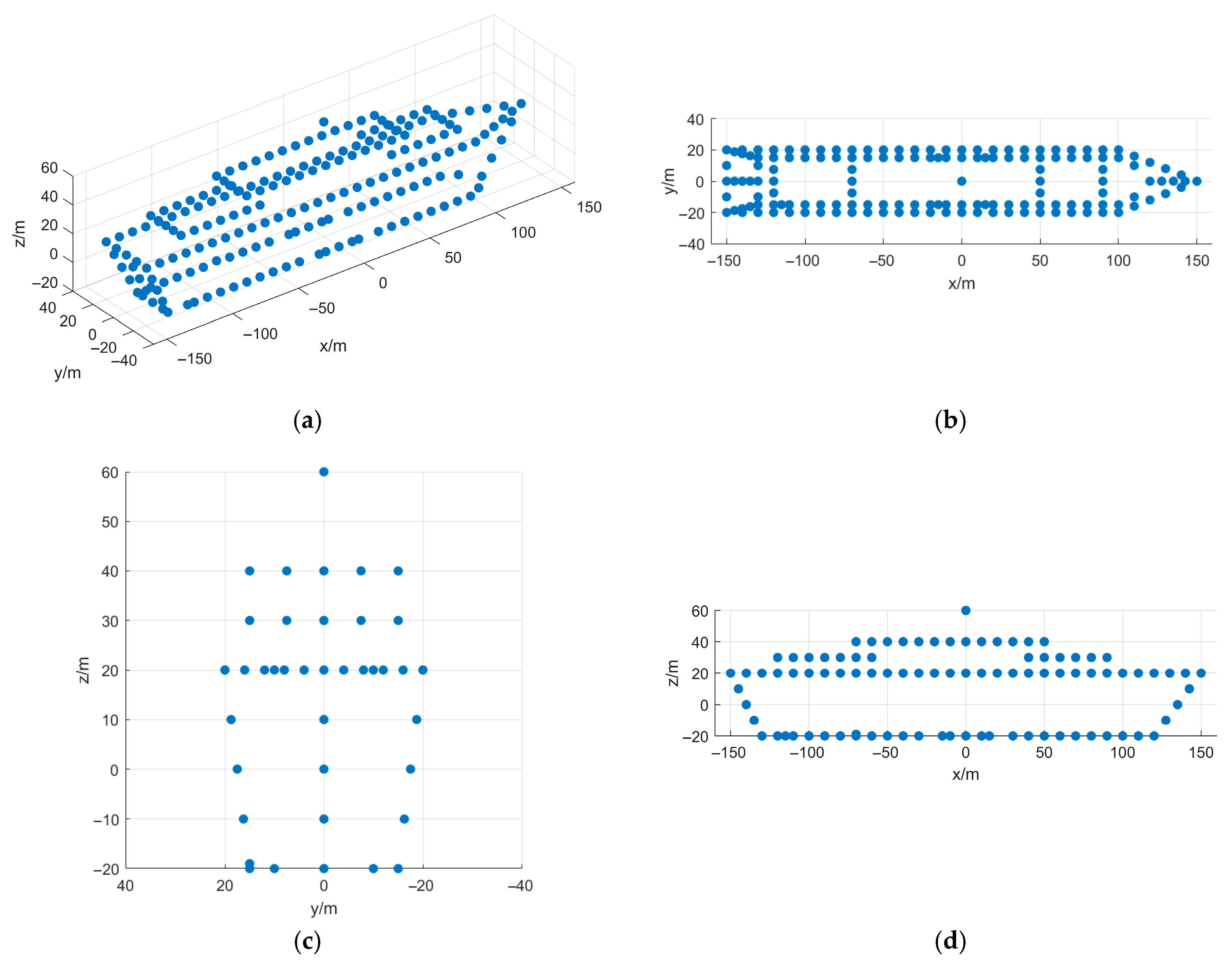
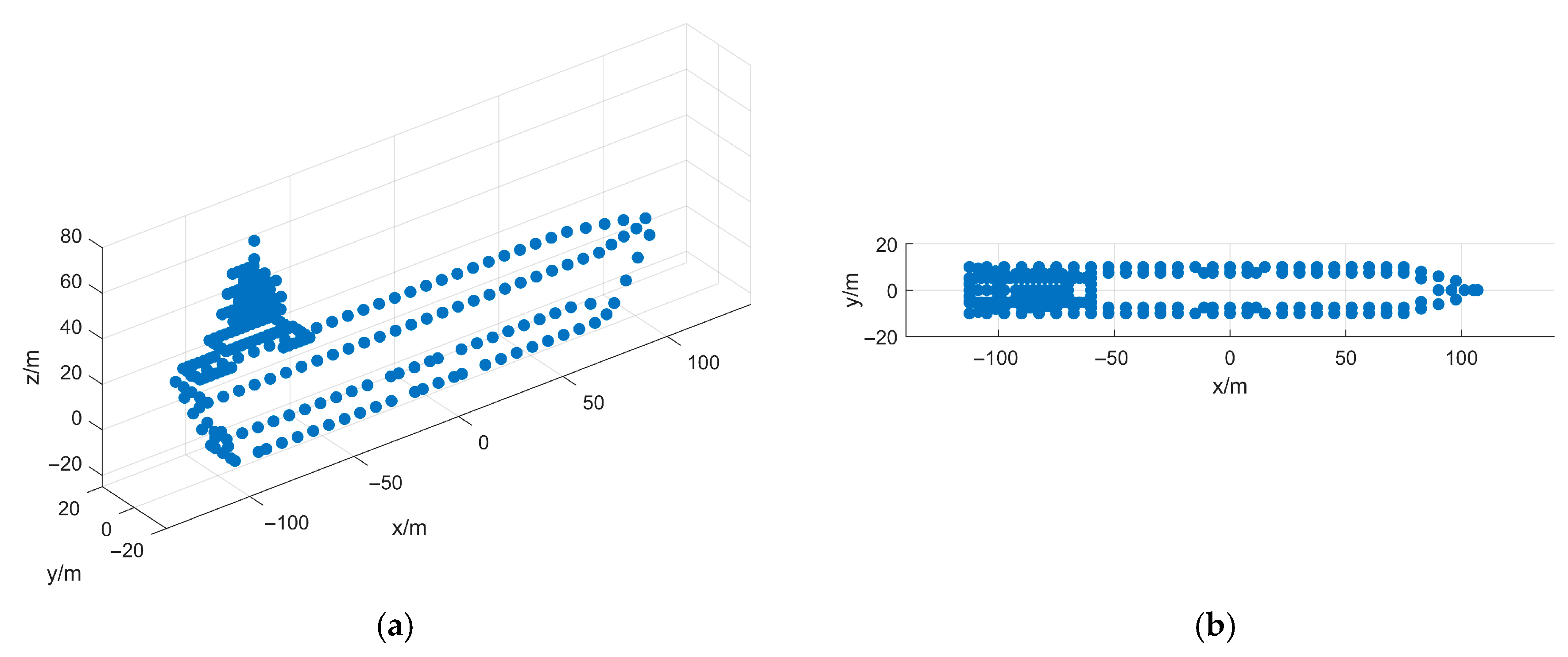
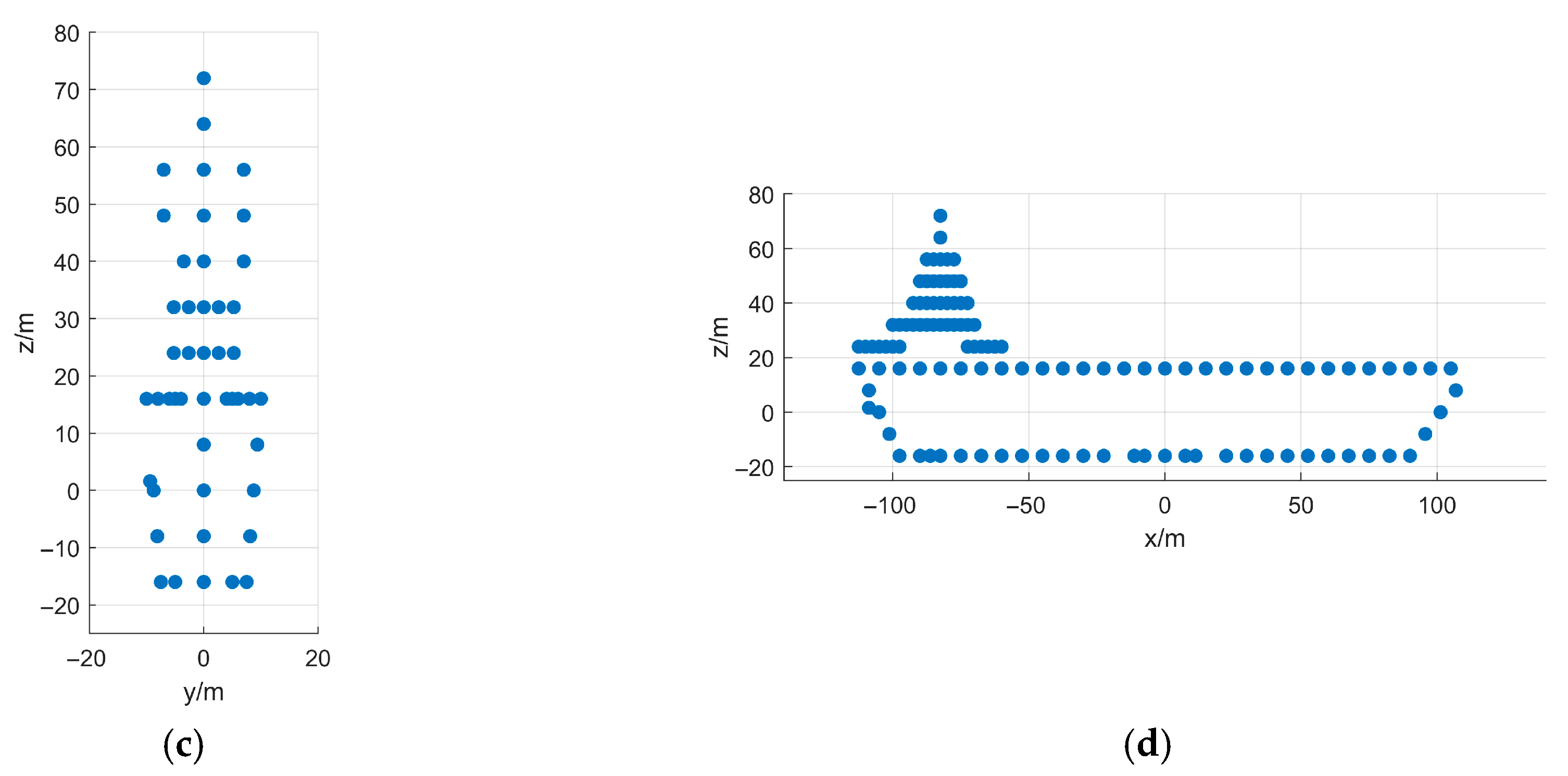
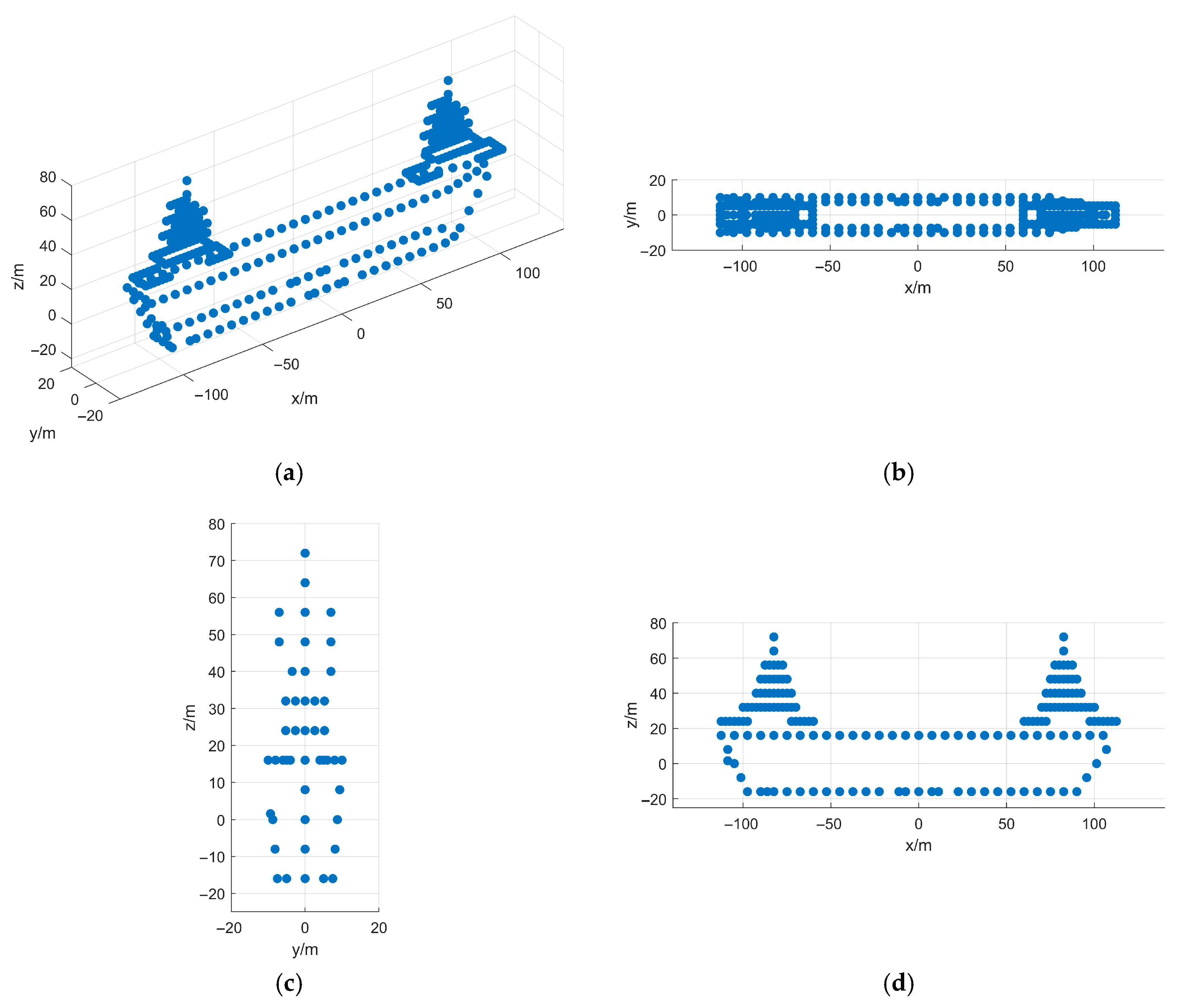
To comprehensively validate the robustness and generalizability of the proposed algorithm across diverse maritime targets, this section presents experimental results using three distinct ship models with varying superstructure distributions: (1) central superstructure, (2) unilateral superstructure (concentrated on one side), and (3) bilateral superstructure (symmetrically arranged on both sides). This geometric diversity directly impacts the effectiveness of rotational center separation during motion compensation—a critical factor for autofocus performance. The three ship models used in our simulations are illustrated in Figure 7, Figure 8 and Figure 9. Model A in Figure 7 features a central superstructure configuration, Model B in Figure 8 exhibits a unilateral superstructure layout, and Model C in Figure 9 demonstrates a bilateral superstructure arrangement. The motion parameters for complex sea states are listed in Table 3, with SAR system simulation parameters provided in Table 1.
(1)
First Experiment: Roll Motion Scenario
This experiment evaluates the algorithm’s focusing capability under ship roll motion.
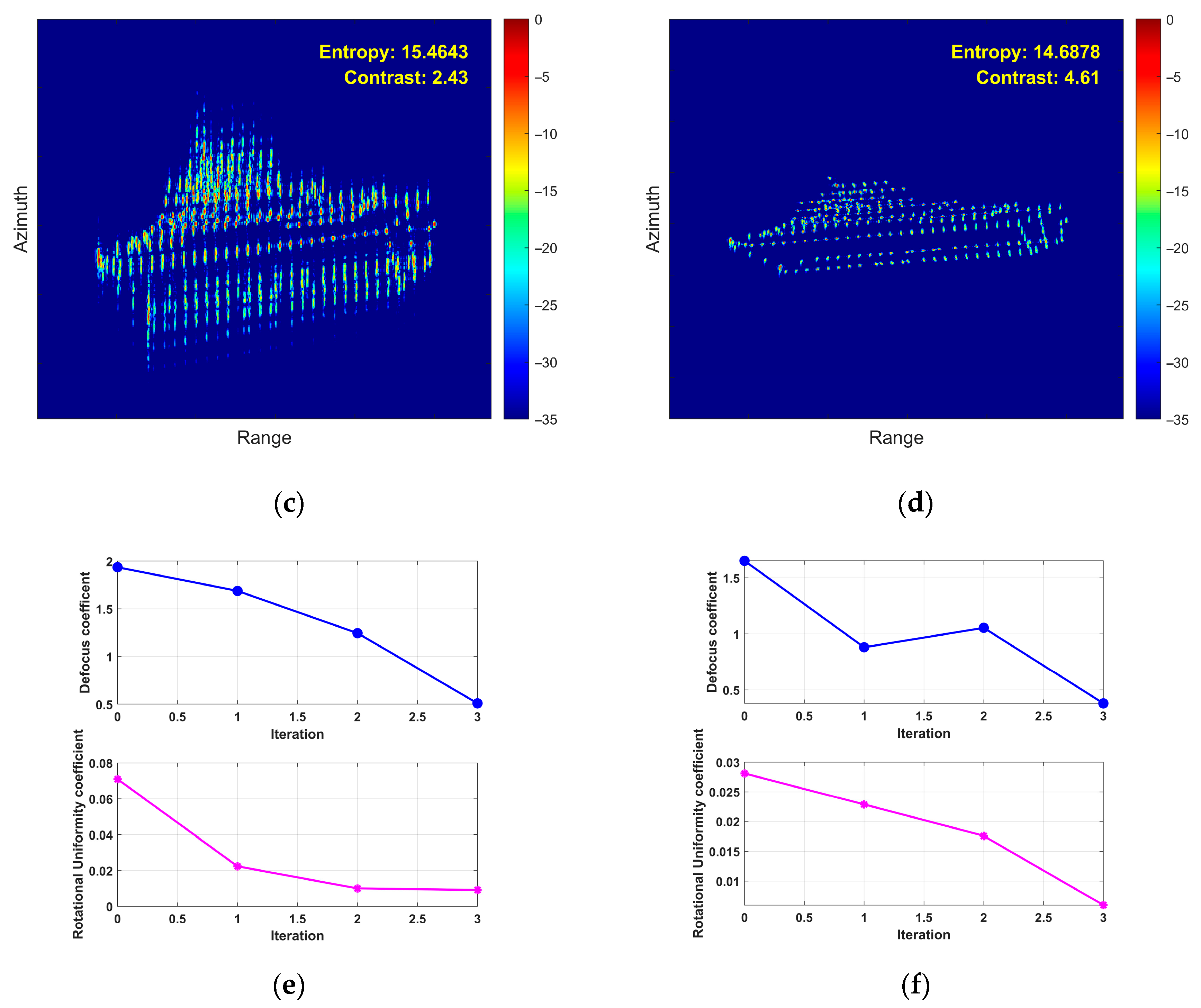
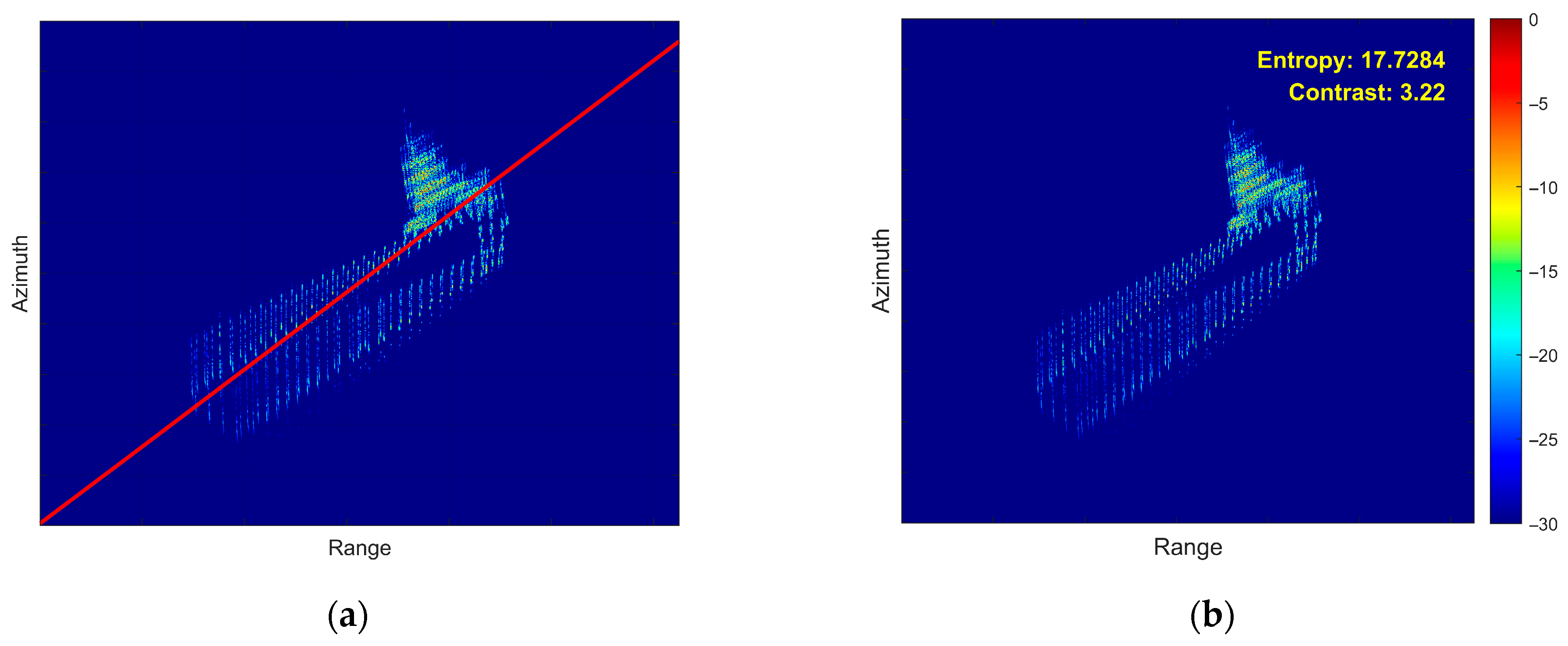
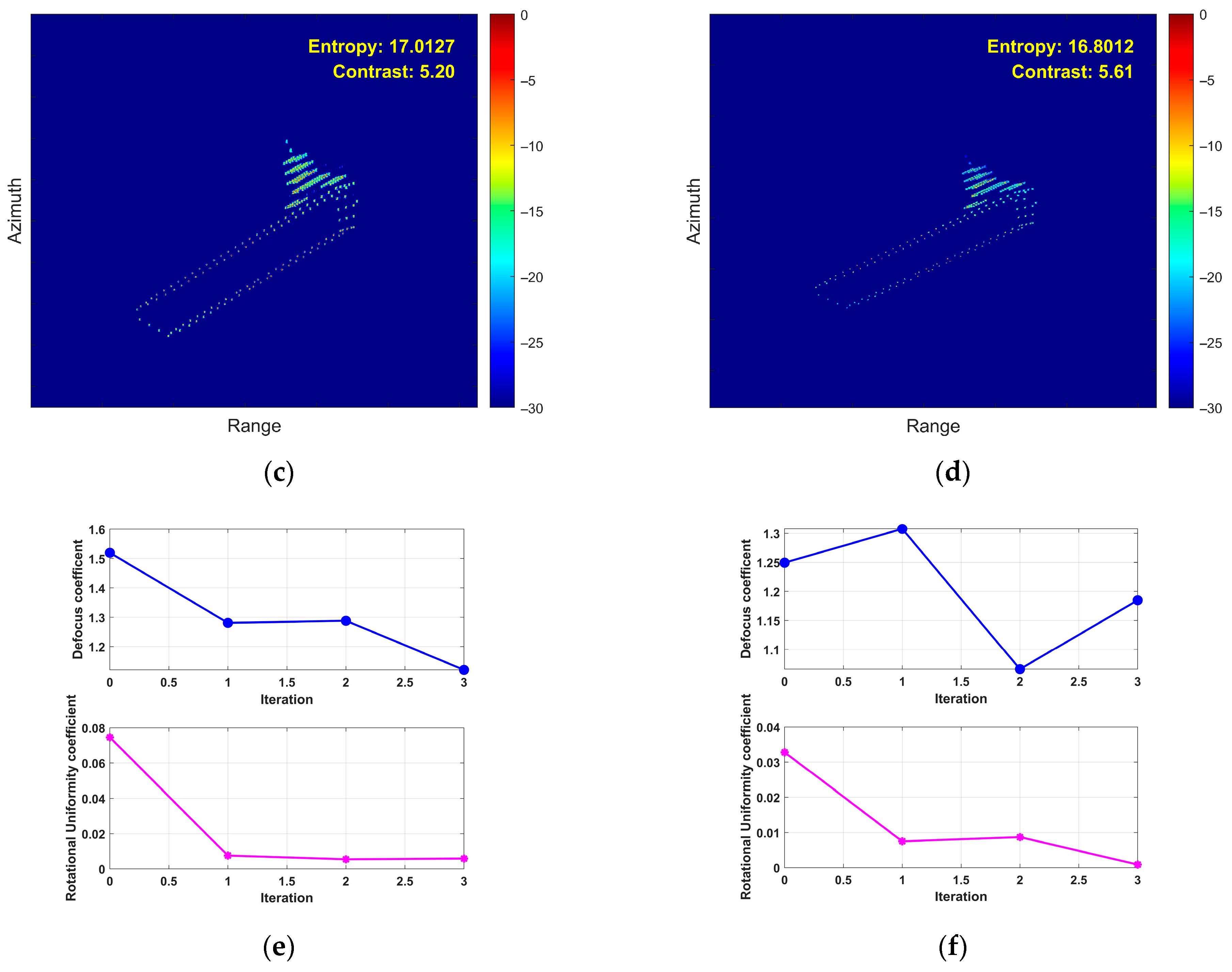
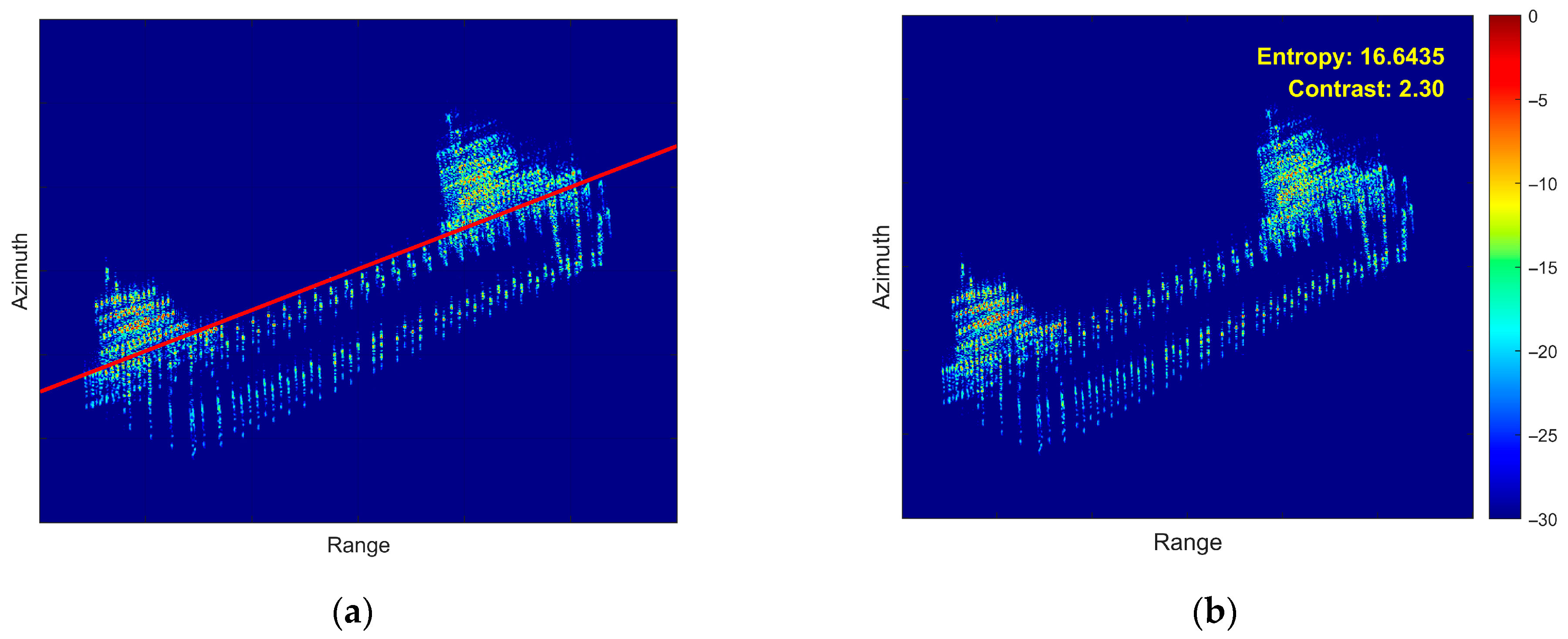
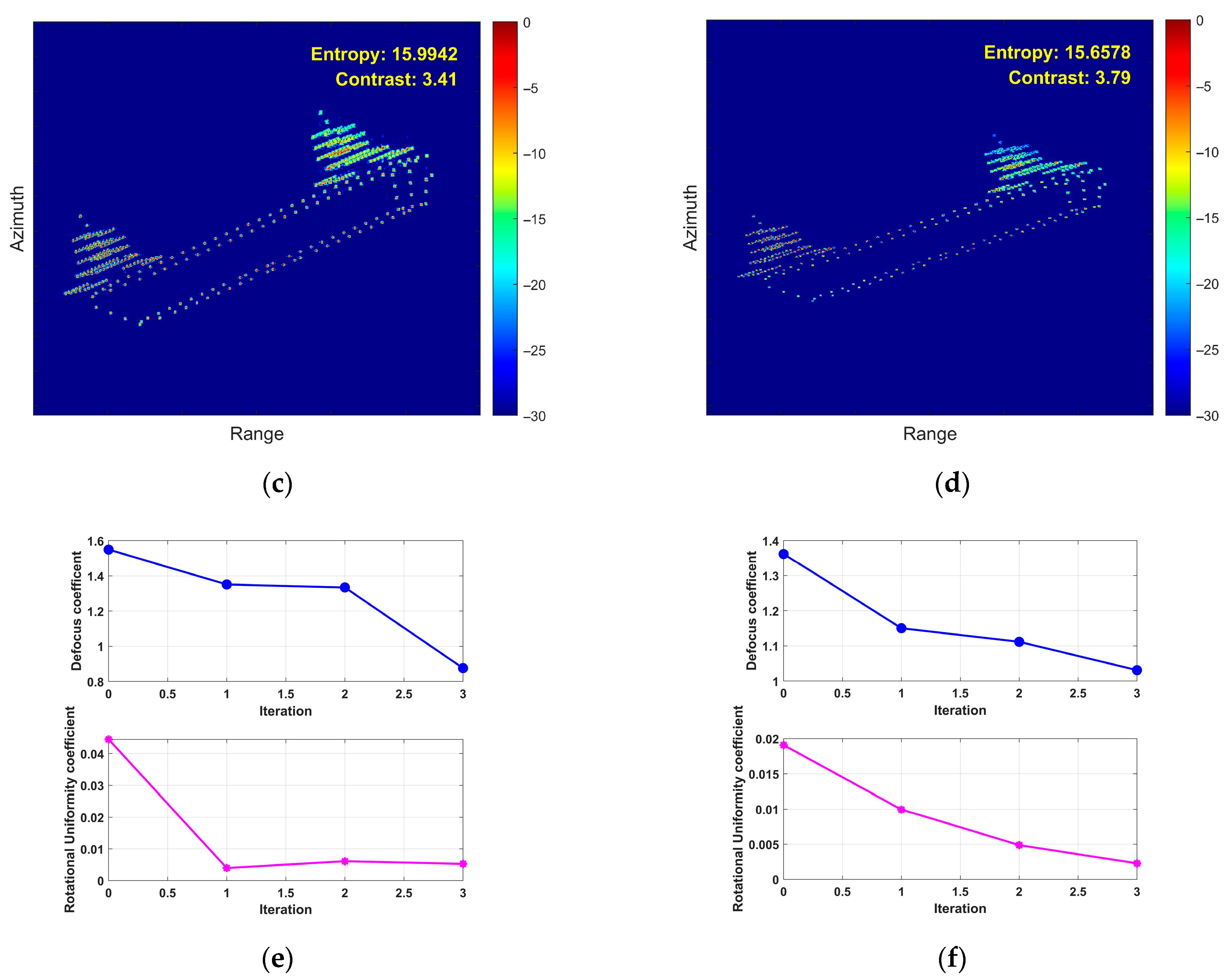
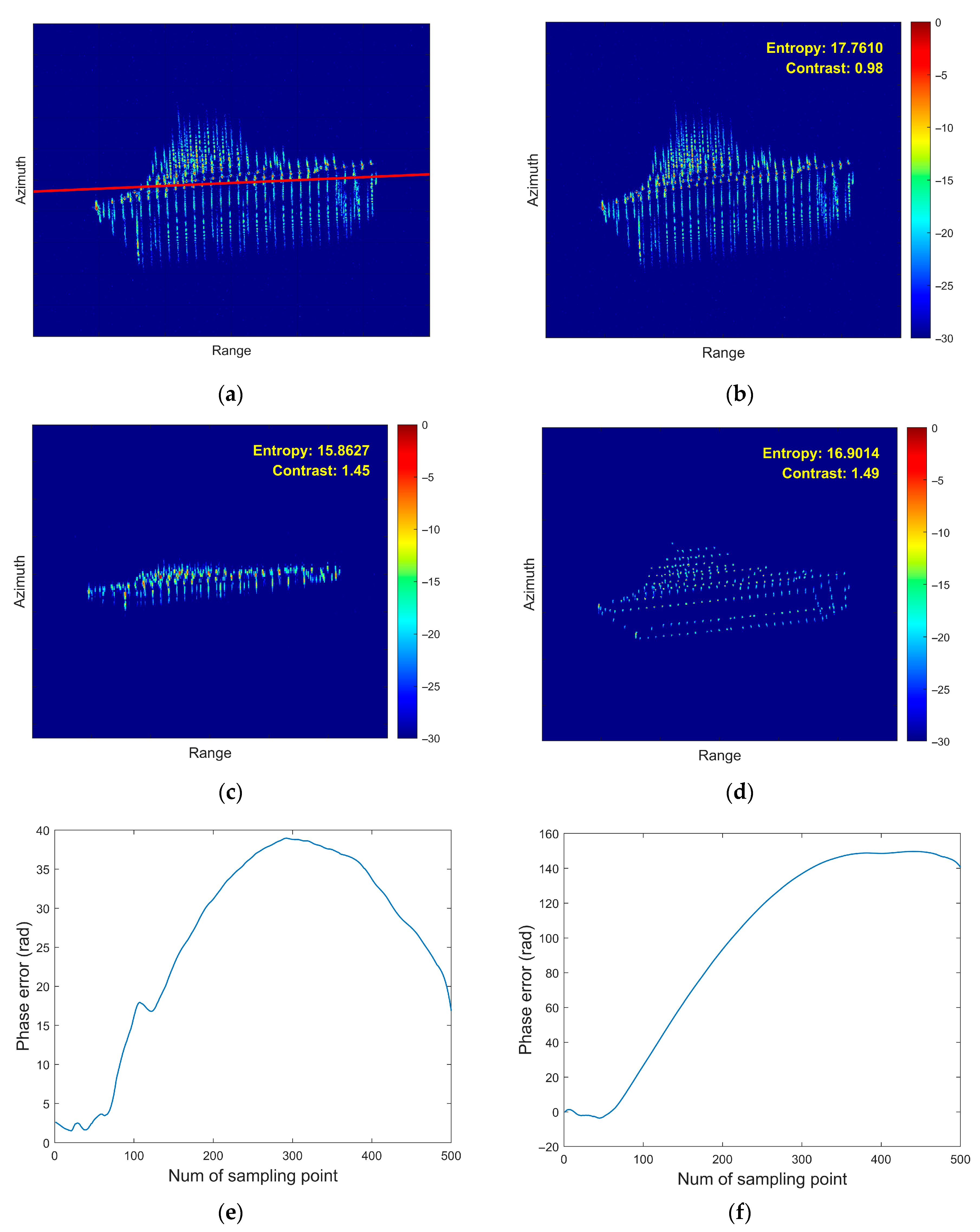
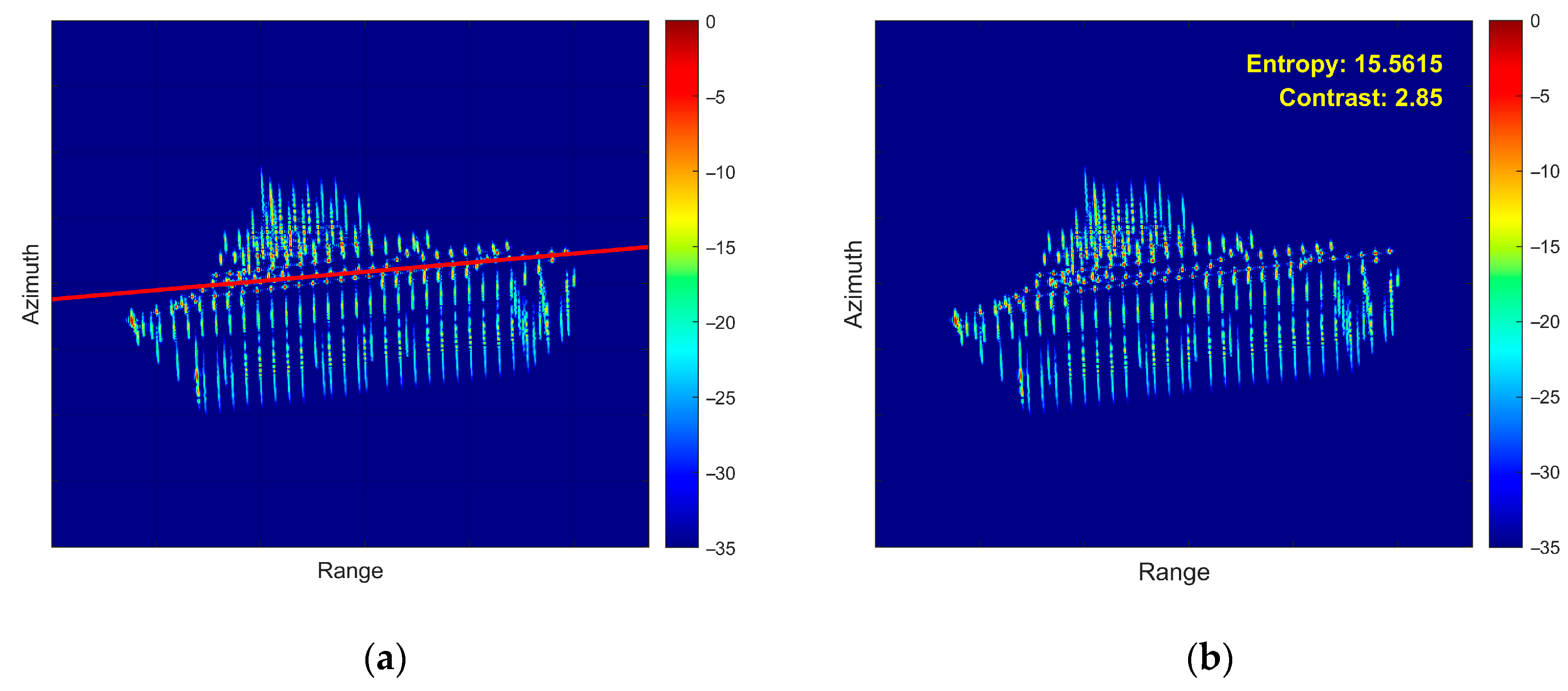
Under roll motion conditions, the focusing performance varies significantly across the three ship configurations. Although initial defocusing may cause minor deviations in the extracted centerline, effective partitioning is still achieved. Figure 10, Figure 11 and Figure 12 present the imaging results for the central superstructure configuration, unilateral superstructure configuration, and bilateral superstructure configuration, respectively.
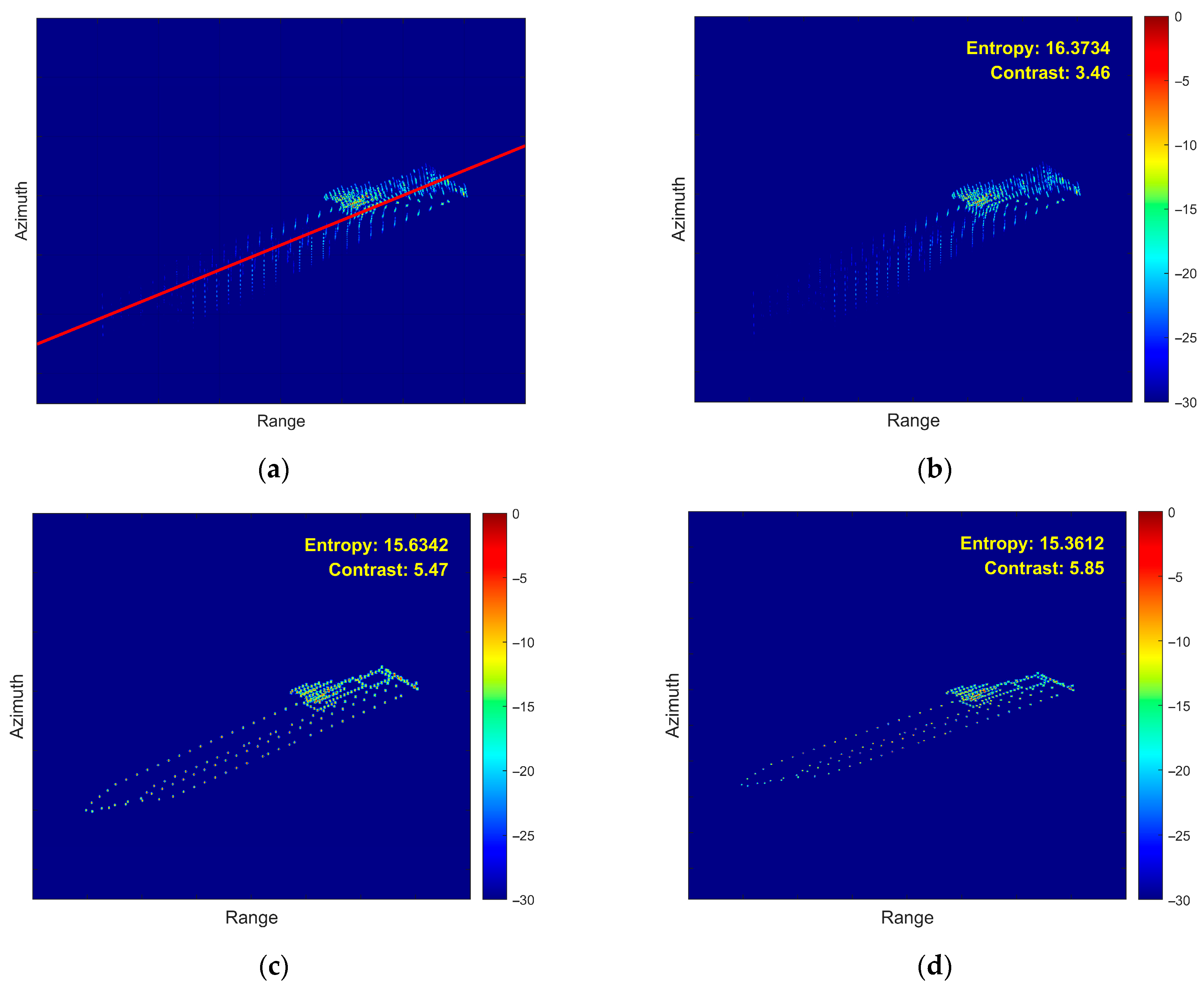
For the central superstructure configuration, the traditional RD algorithm produces severe defocusing, and the IPGRA algorithm also fails to substantially improve imaging quality. The ship image remains severely defocused in both cases. In contrast, the proposed method successfully achieves precise compensation of rotational phase errors through centerline-driven adaptive partitioning, resulting in the lowest image entropy and highest contrast.
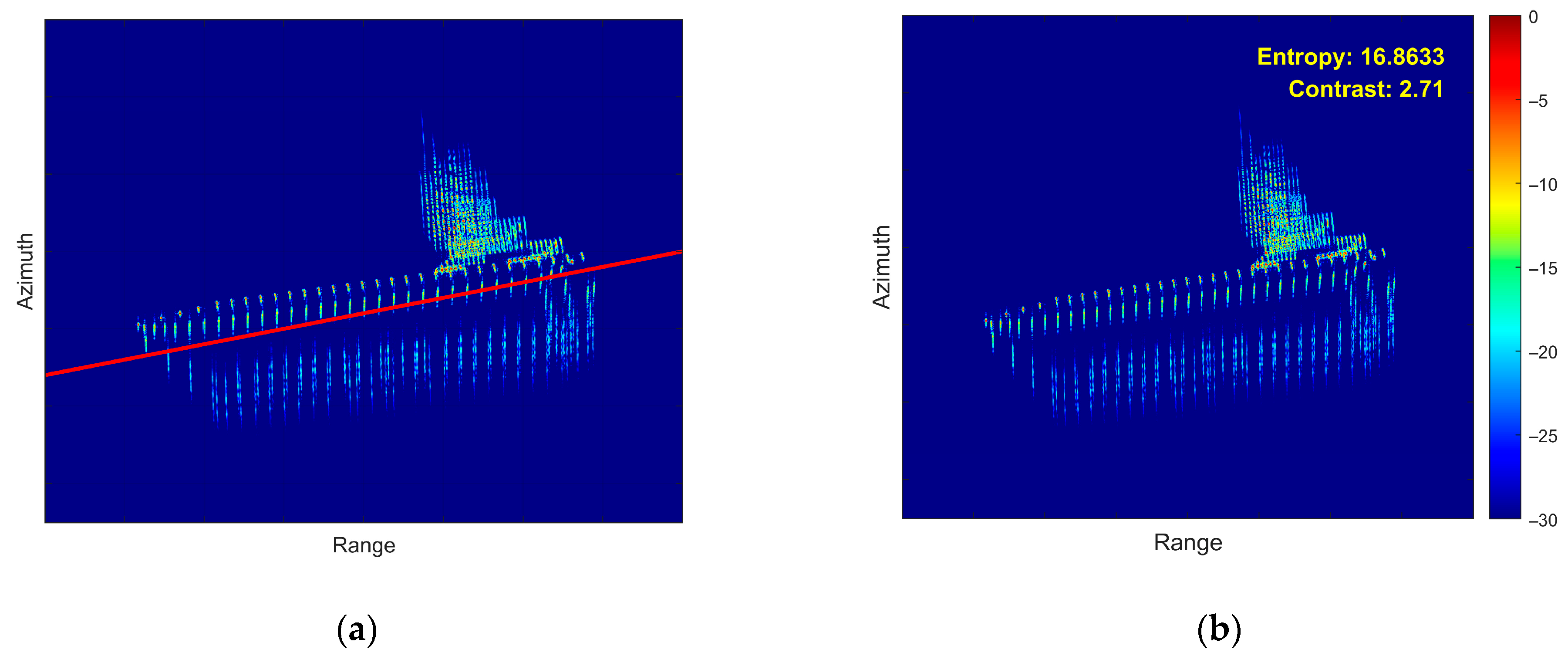
For the unilateral superstructure configuration, where ship superstructure concentrates on one side of the hull, both the IPGRA method and the proposed approach achieve acceptable focusing results. Nevertheless, our algorithm maintains a distinct advantage in image quality metrics, demonstrating lower entropy and higher contrast values.
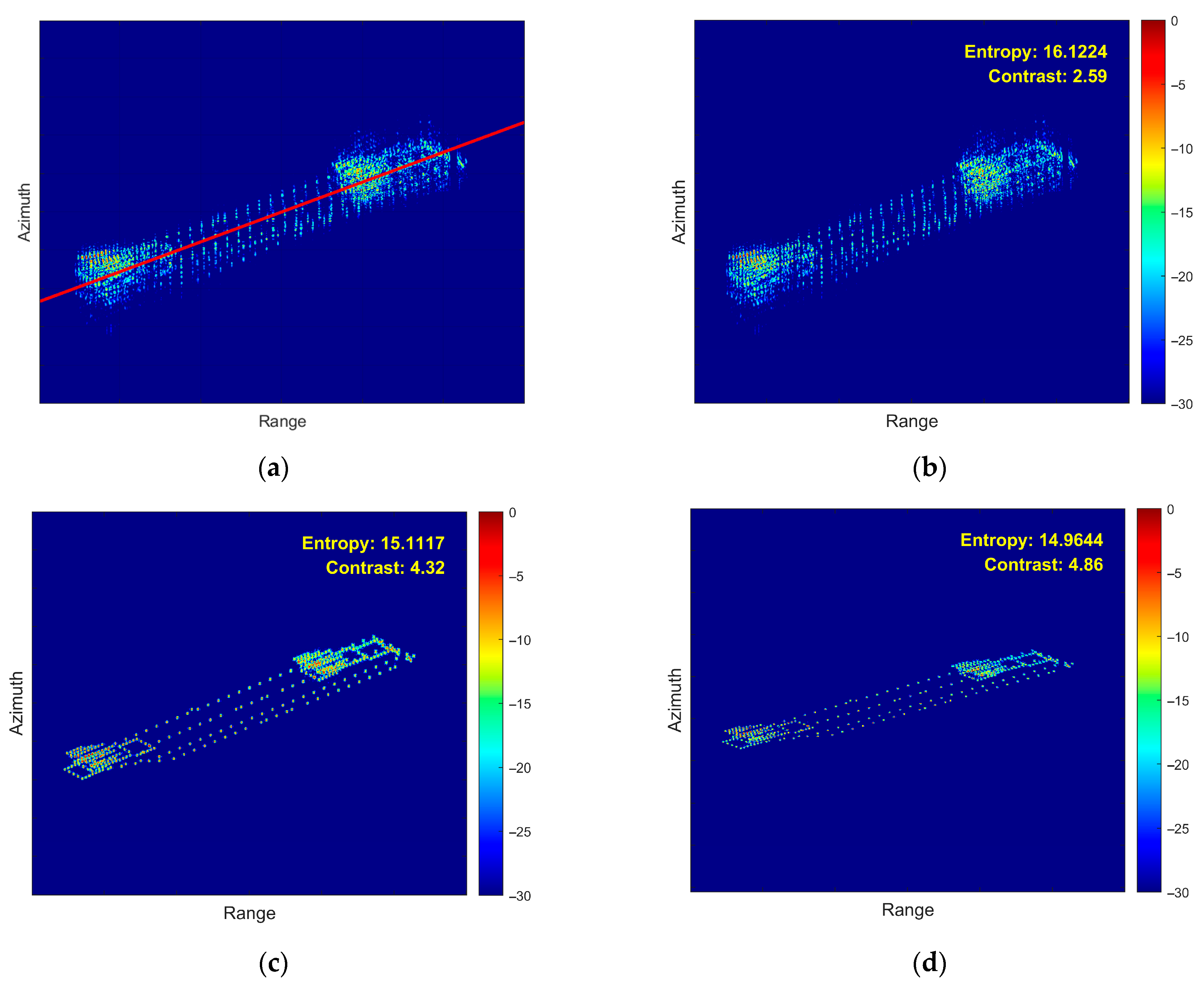
For the bilateral superstructure configuration, the IPGRA algorithm likewise fails to effectively improve imaging quality, with the ship image remaining severely defocused. Conversely, the proposed method, through its adaptive strategy that maximizes rotational center separation, successfully achieves precise estimation and compensation of rotational phase errors. This substantially enhances image focusing quality and fully demonstrates the adaptability and robustness of our approach across diverse ship geometric configurations.
(a) Model A
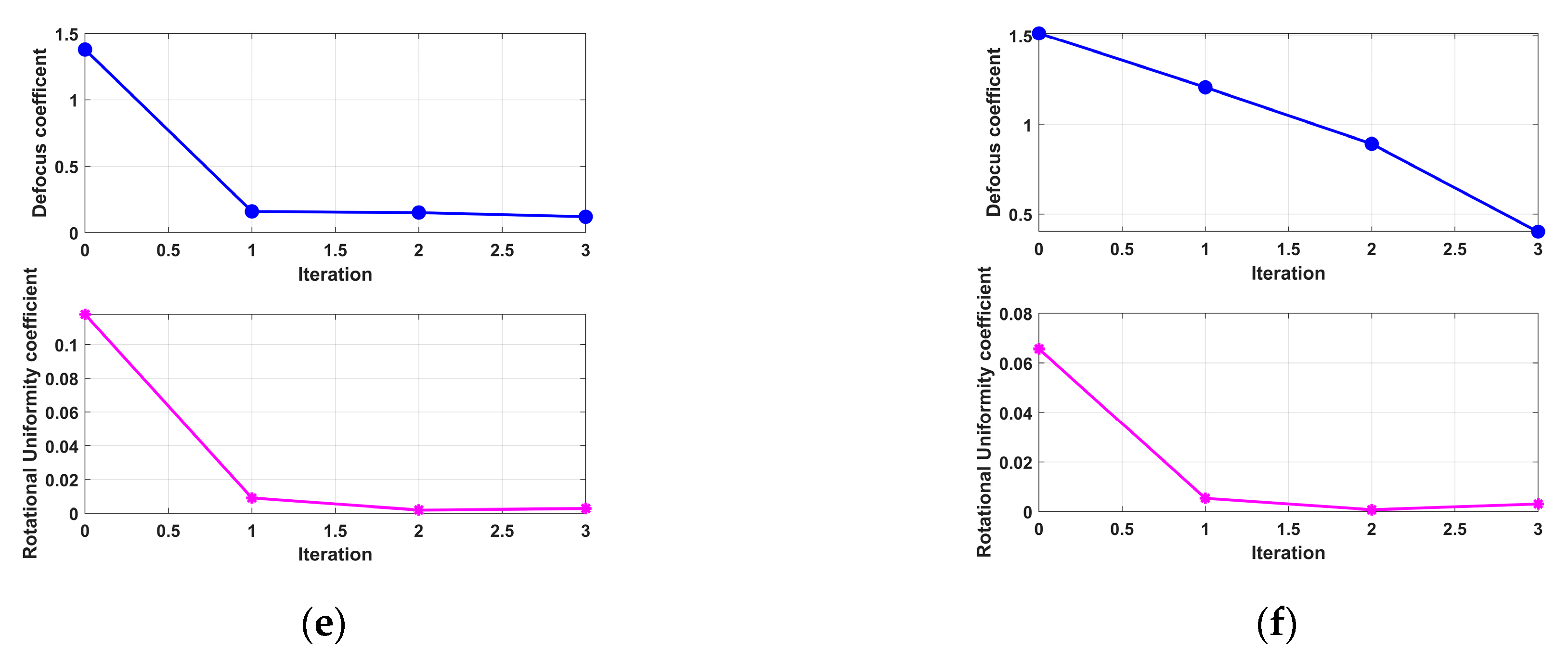
Figure 10. Model A: Ship Centerline Extraction and Imaging Performance Analysis under Roll Condition with the Proposed Algorithm. (a) Ship Centerline Extraction result. (b) Imaging result of the traditional RD algorithm. (c) Imaging result of the IPGRA algorithm. (d) Imaging result of the proposed algorithm. (e,f) Changes in Defocusing coefficient and Rotational Uniformity Coefficient for each iteration of the IPGRA and proposed algorithm. The image entropy and contrast of each image are annotated in the figure.
Remotesensing 18 00105 g010aRemotesensing 18 00105 g010b
(b) Model B
Figure 11. Model B: Ship Centerline Extraction and Imaging Performance Analysis under Roll Condition with the Proposed Algorithm. (a) Ship Centerline Extraction result. (b) Imaging result of the traditional RD algorithm. (c) Imaging result of the IPGRA algorithm. (d) Imaging result of the proposed algorithm. (e,f) Changes in Defocusing coefficient and Rotational Uniformity Coefficient for each iteration of the IPGRA and proposed algorithm. The image entropy and contrast of each image are annotated in the figure.
Remotesensing 18 00105 g011aRemotesensing 18 00105 g011b
(c) Model C
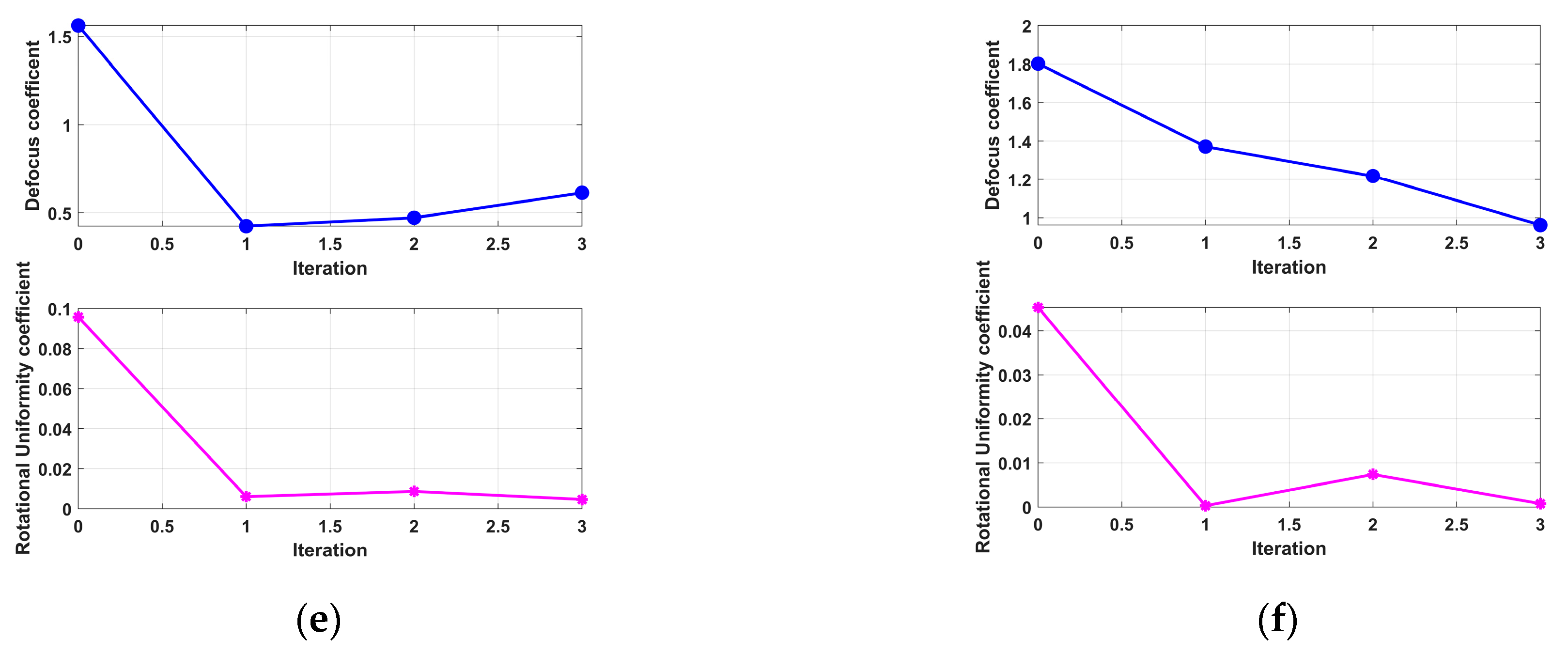
Figure 12. Model C: Ship Centerline Extraction and Imaging Performance Analysis under Roll Condition with the Proposed Algorithm. (a) Ship Centerline Extraction result. (b) Imaging result of the traditional RD algorithm. (c) Imaging result of the IPGRA algorithm. (d) Imaging result of the proposed algorithm. (e,f) Changes in Defocusing coefficient and Rotational Uniformity Coefficient for each iteration of the IPGRA and proposed algorithm. The image entropy and contrast of each image are annotated in the figure.
Remotesensing 18 00105 g012aRemotesensing 18 00105 g012b
(2)
Second Experiment: Pitch Motion Scenario
This experiment validates focusing performance under pitch motion and compares coefficient stability between IPGRA and the proposed method.
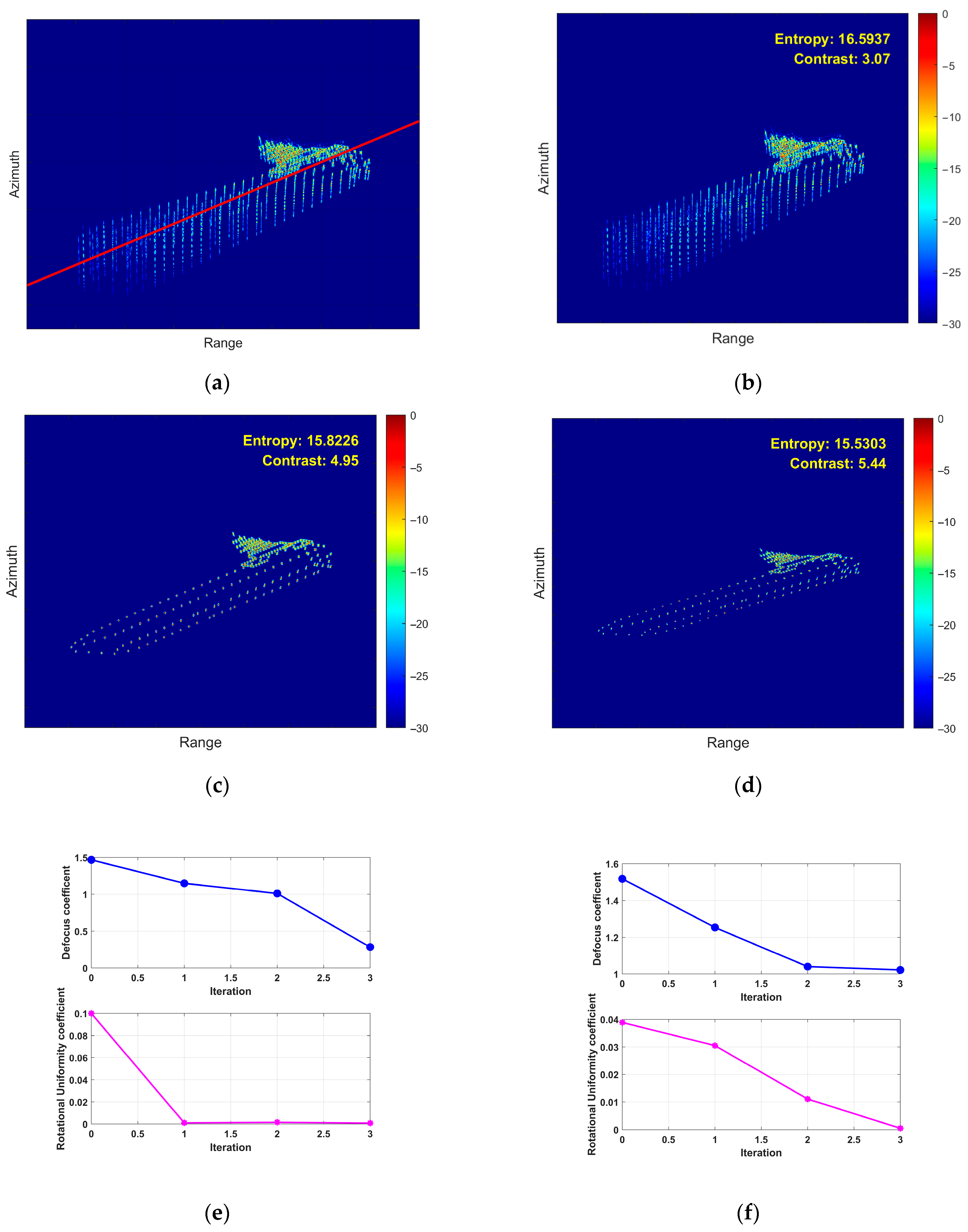
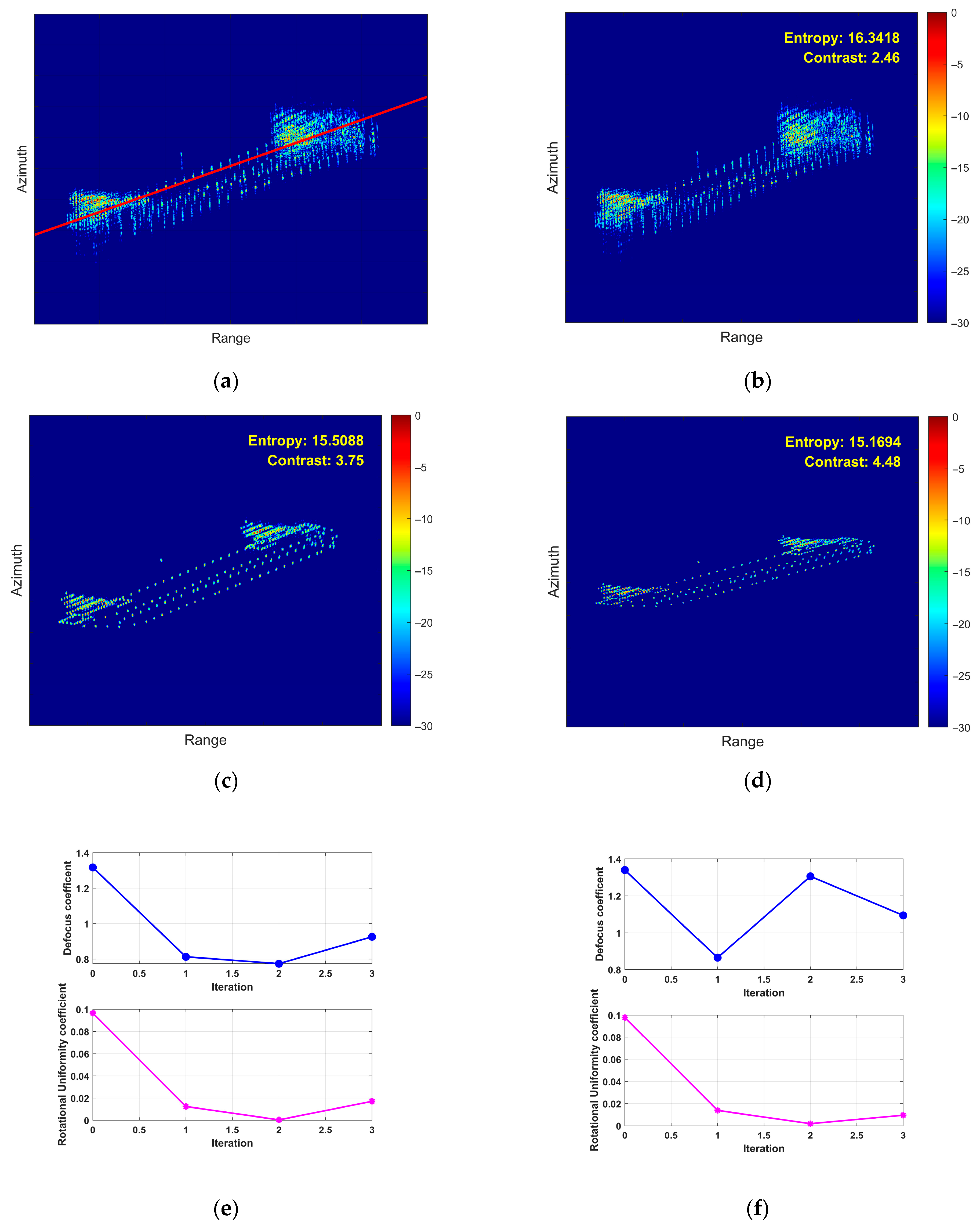
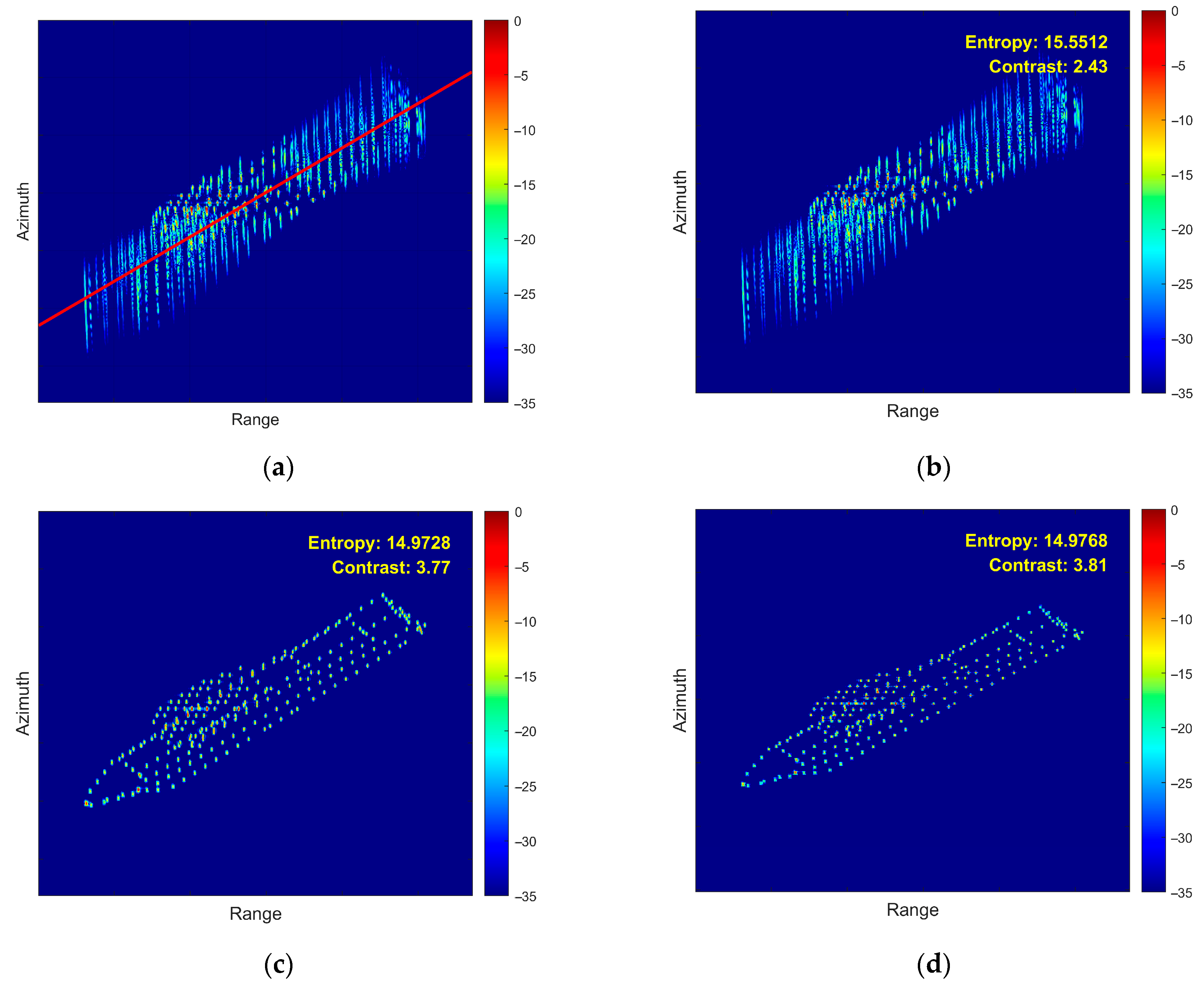
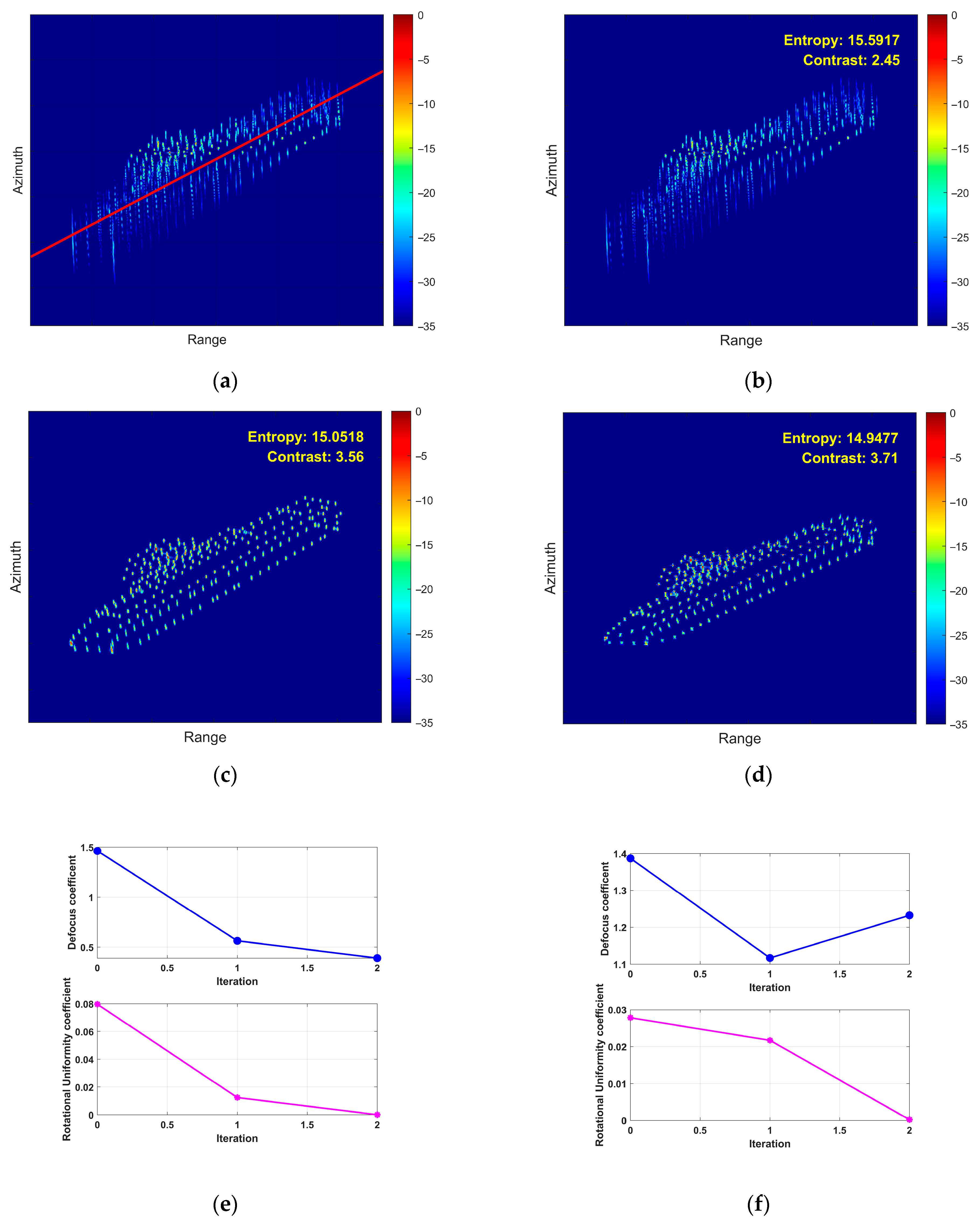
Under pitch motion conditions, Figure 13, Figure 14 and Figure 15 present comprehensive imaging results for ships with central, unilateral, and bilateral superstructure configurations. Both the IPGRA method and the proposed approach achieve satisfactory focusing performance across all three ship geometries, with ship structures clearly visible in the resulting imagery. Nevertheless, quantitative analysis consistently reveals the superiority of the proposed algorithm, which maintains lower image entropy and higher contrast values regardless of superstructure distribution. The convergence characteristics illustrated in the coefficient plots further validate the effectiveness of our approach: the rotational uniformity coefficient β demonstrates stable convergence behavior below the 0.015 threshold, whereas the traditional Defocusing coefficient α exhibits oscillatory patterns that do not reliably correlate with actual image quality. This consistent performance advantage stems from the centerline-driven adaptive partitioning strategy, which optimizes rotational center separation independent of ship geometry, thereby enabling more accurate estimation and compensation of spatially variant phase errors across diverse maritime targets.
(a) Model A
Figure 13. Model A: Ship Centerline Extraction and Imaging Performance Analysis under pitch Condition with the Proposed Algorithm (a) Ship Centerline Extraction result. (b) Imaging result of the traditional RD algorithm (c) Imaging result of the IPGRA algorithm. (d) Imaging result of the proposed algorithm. (e,f) Changes in Defocusing coefficient and Rotational Uniformity Coefficient for each iteration of the IPGRA and proposed algorithm. The image entropy and contrast of each image are annotated in the figure.
Remotesensing 18 00105 g013
(b) Model B
Figure 14. Model B: Ship Centerline Extraction and Imaging Performance Analysis under pitch Condition with the Proposed Algorithm (a) Ship Centerline Extraction result. (b) Imaging result of the traditional RD algorithm (c) Imaging result of the IPGRA algorithm. (d) Imaging result of the proposed algorithm. (e,f) Changes in Defocusing coefficient and Rotational Uniformity Coefficient for each iteration of the IPGRA and proposed algorithm. The image entropy and contrast of each image are annotated in the figure.
Remotesensing 18 00105 g014
(c) Model C
Figure 15. Model C: Ship Centerline Extraction and Imaging Performance Analysis under pitch Condition with the Proposed Algorithm (a) Ship Centerline Extraction result. (b) Imaging result of the traditional RD algorithm (c) Imaging result of the IPGRA algorithm. (d) Imaging result of the proposed algorithm. (e,f) Changes in Defocusing coefficient and Rotational Uniformity Coefficient for each iteration of the IPGRA and proposed algorithm. The image entropy and contrast of each image are annotated in the figure.
Remotesensing 18 00105 g015
(3)
Third Experiment: Yaw Motion Scenario
This experiment evaluates the algorithm’s ability to compensate for yaw-induced rotational defocusing.
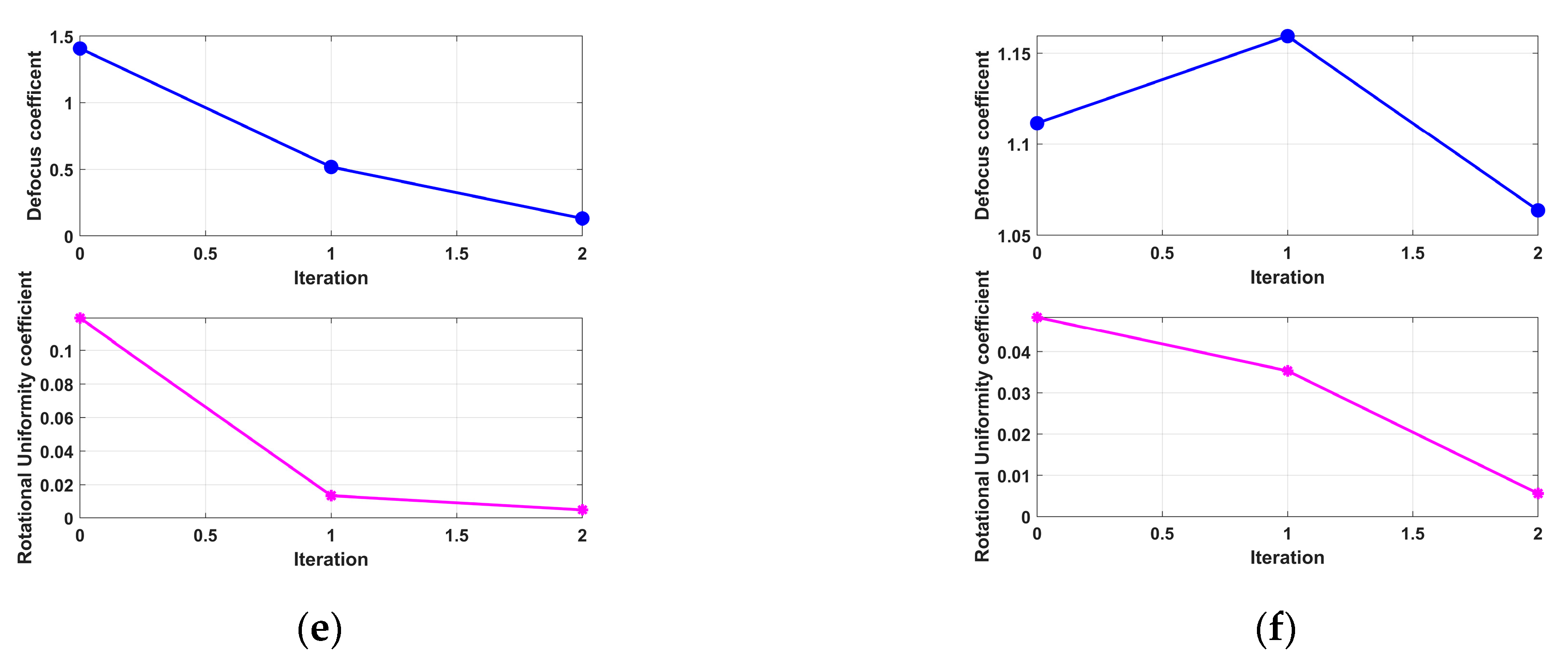
Under yaw motion conditions, Figure 16, Figure 17 and Figure 18 present the imaging results for ships with central, unilateral, and bilateral superstructure configurations. Both the IPGRA algorithm and the proposed method achieve effective focusing across all three configurations, substantially outperforming the traditional RD approach. However, quantitative analysis consistently demonstrates the superiority of the proposed algorithm, which achieves lower image entropy and higher contrast values regardless of ship geometry. The convergence characteristics further validate this advantage, as the Rotational Uniformity Coefficient β exhibits stable monotonic convergence below the 0.015 threshold, while the traditional Defocusing coefficient α shows inconsistent oscillatory patterns. This consistent performance enhancement stems from the centerline-driven adaptive partitioning strategy, which optimizes the azimuthal separation between equivalent rotation centers independent of ship aspect ratio or superstructure layout, thereby enabling more precise estimation and compensation of rotational phase errors under complex yaw motion scenarios.
(a) Model A
Figure 16. Model A: Ship Centerline Extraction and Imaging Performance Analysis under yaw Condition with the Proposed Algorithm (a) Ship Centerline Extraction result. (b) Imaging result of the traditional RD algorithm (c) Imaging result of the IPGRA algorithm. (d) Imaging result of the proposed algorithm. (e,f) Changes in Defocusing coefficient and Rotational Uniformity Coefficient for each iteration of the IPGRA and proposed algorithm. The image entropy and contrast of each image are annotated in the figure.
Remotesensing 18 00105 g016aRemotesensing 18 00105 g016b
(b) Model B
Figure 17. Model B: Ship Centerline Extraction and Imaging Performance Analysis under yaw Condition with the Proposed Algorithm (a) Ship Centerline Extraction result. (b) Imaging result of the traditional RD algorithm (c) Imaging result of the IPGRA algorithm. (d) Imaging result of the proposed algorithm. (e,f) Changes in Defocusing coefficient and Rotational Uniformity Coefficient for each iteration of the IPGRA and proposed algorithm. The image entropy and contrast of each image are annotated in the figure.
Remotesensing 18 00105 g017aRemotesensing 18 00105 g017b
(c) Model C
Figure 18. Model C: Ship Centerline Extraction and Imaging Performance Analysis under yaw Condition with the Proposed Algorithm (a) Ship Centerline Extraction result. (b) Imaging result of the traditional RD algorithm (c) Imaging result of the IPGRA algorithm. (d) Imaging result of the proposed algorithm. (e,f) Changes in Defocusing coefficient and Rotational Uniformity Coefficient for each iteration of the IPGRA and proposed algorithm. The image entropy and contrast of each image are annotated in the figure.
Remotesensing 18 00105 g018aRemotesensing 18 00105 g018b
(4)
Fourth Experiment: Coupled 3D Rotation
This experiment validates the algorithm’s robustness under complex coupled 3D rotational motion.
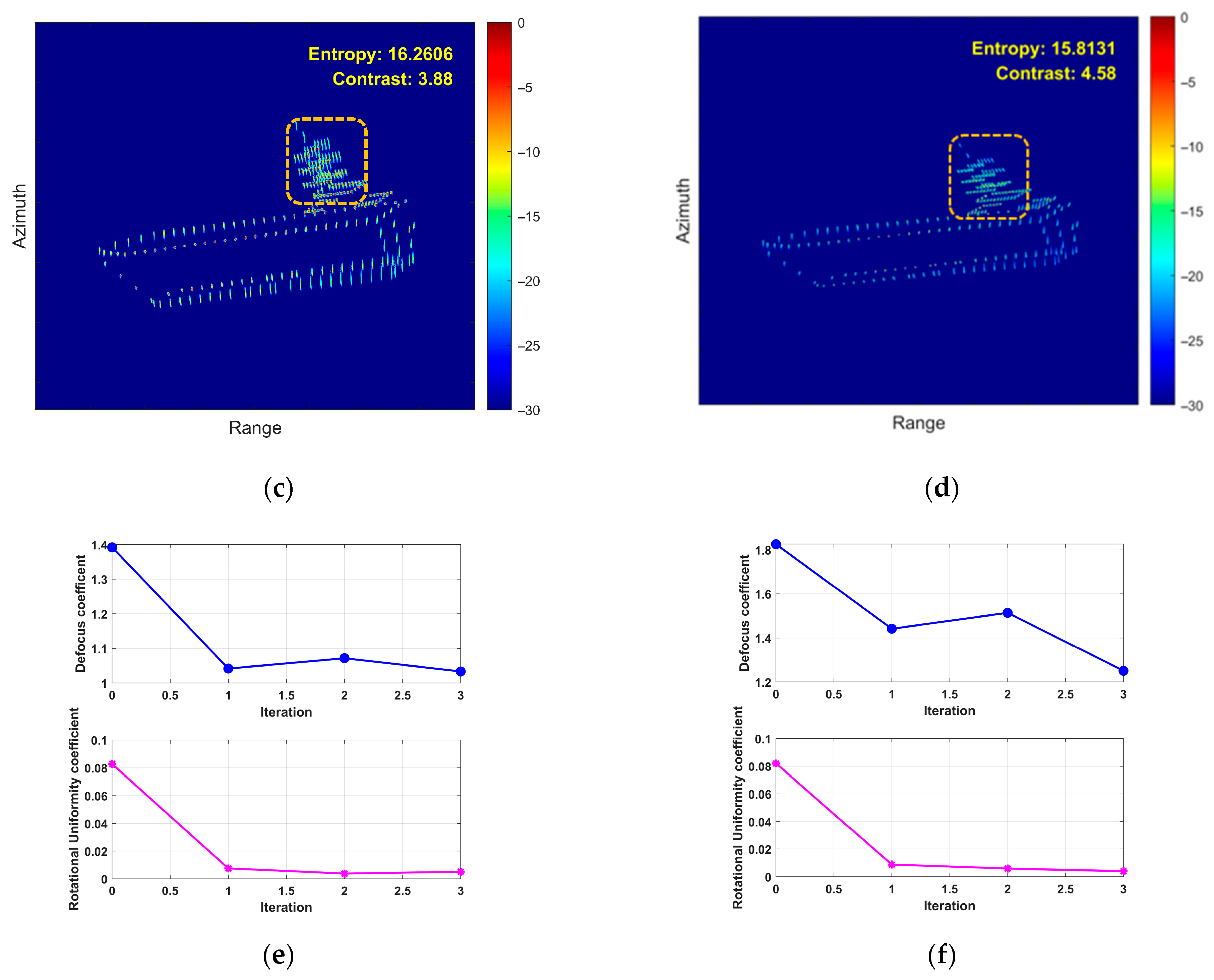
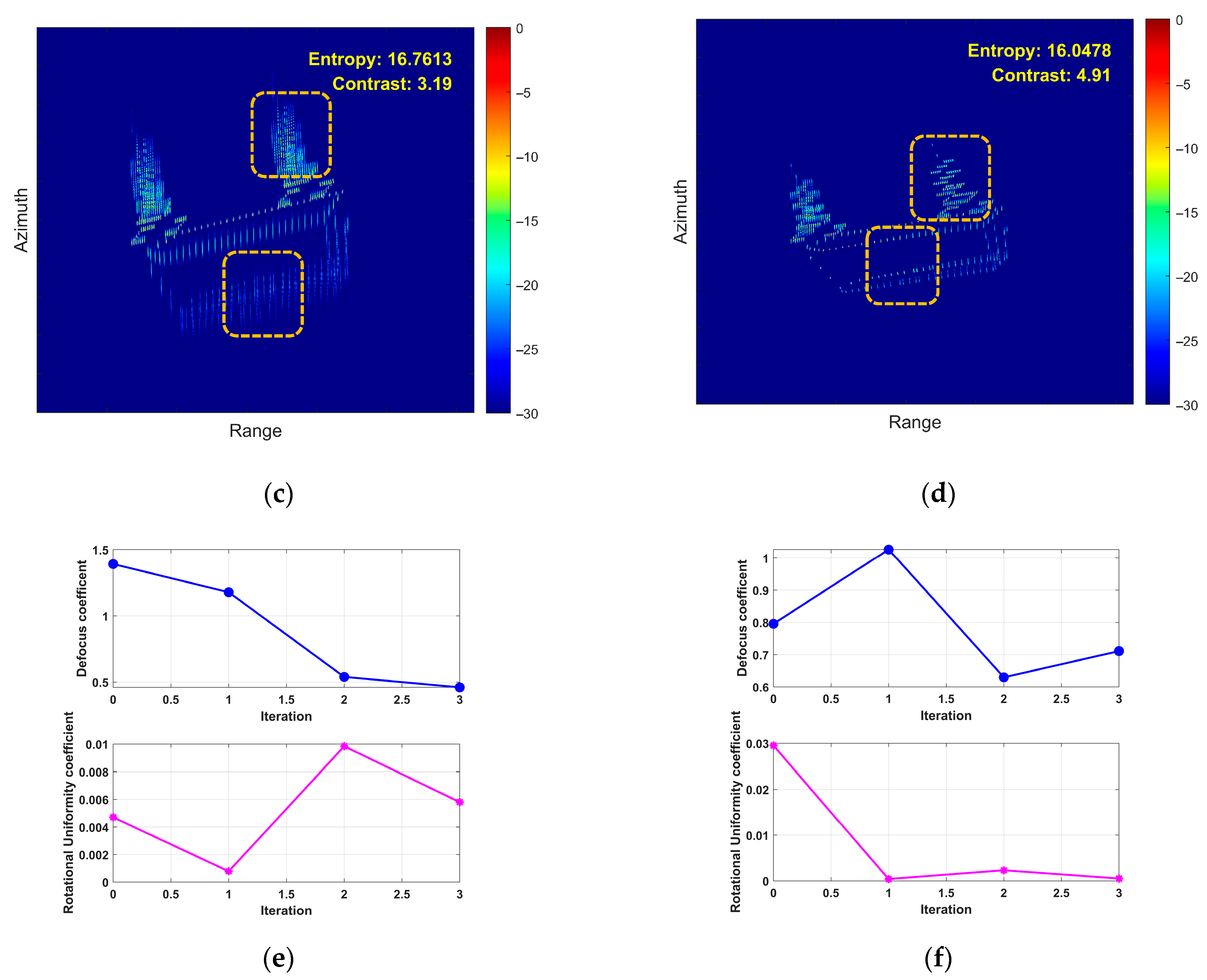
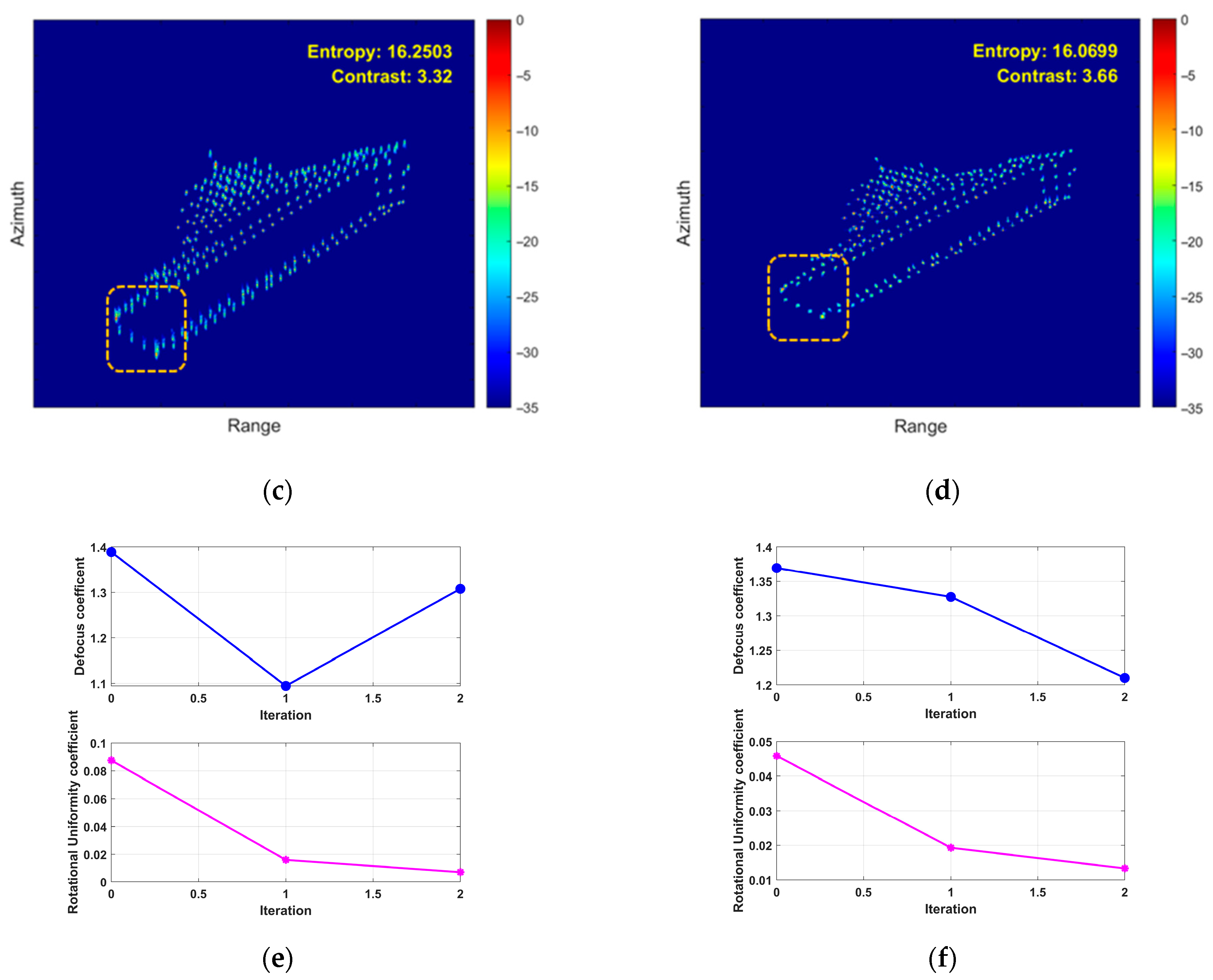
Under coupled 3D rotational motion conditions, Figure 19, Figure 20 and Figure 21 present the imaging results for ships with central, unilateral, and bilateral superstructure configurations. Both the IPGRA algorithm and the proposed method achieve significant improvements over the traditional RD approach across all three ship geometries. However, IPGRA exhibits localized defocusing in structurally complex regions. In contrast, the proposed algorithm achieves effective focusing for all scattering points regardless of ship geometry, as evidenced by uniformly sharp structural details throughout the entire image domain. Quantitative results further confirm this performance advantage—the proposed method consistently demonstrates lower entropy and higher contrast values across all configurations.
(a) Model A
Figure 19. Model A: Ship Centerline Extraction and Imaging Performance Analysis under Combined Rotational Conditions (a) Ship Centerline Extraction result. (b) Imaging result of the traditional RD algorithm (c) Imaging result of the IPGRA algorithm. (d) Imaging result of the proposed algorithm. (e,f) Changes in Defocusing coefficient and Rotational Uniformity Coefficient for each iteration of the IPGRA and proposed algorithm. The orange box highlights areas with marked focus quality discrepancy between IPGRA and the proposed algorithm, which are concentrated at the image edges. The image entropy and contrast of each image are annotated in the figure.
Remotesensing 18 00105 g019aRemotesensing 18 00105 g019b
(b) Model B
Figure 20. Model B: Ship Centerline Extraction and Imaging Performance Analysis under Combined Rotational Conditions (a) Ship Centerline Extraction result. (b) Imaging result of the traditional RD algorithm (c) Imaging result of the IPGRA algorithm. (d) Imaging result of the proposed algorithm. (e,f) Changes in Defocusing coefficient and Rotational Uniformity Coefficient for each iteration of the IPGRA and proposed algorithm. The orange box highlights areas with marked focus quality discrepancy between IPGRA and the proposed algorithm, which are concentrated at the image edges. The image entropy and contrast of each image are annotated in the figure.
Remotesensing 18 00105 g020aRemotesensing 18 00105 g020b
(c) Model C
Figure 21. Model C: Ship Centerline Extraction and Imaging Performance Analysis under Combined Rotational Conditions (a) Ship Centerline Extraction result. (b) Imaging result of the traditional RD algorithm (c) Imaging result of the IPGRA algorithm. (d) Imaging result of the proposed algorithm. (e,f) Changes in Defocusing coefficient and Rotational Uniformity Coefficient for each iteration of the IPGRA and proposed algorithm. The orange box highlights areas with marked focus quality discrepancy between IPGRA and the proposed algorithm, which are concentrated at the image edges. The image entropy and contrast of each image are annotated in the figure.
Remotesensing 18 00105 g021aRemotesensing 18 00105 g021b
(5)
Fifth Experiment: Roll Motion Scenario in 0 dB SCR Environment
This experiment evaluates the robustness of the proposed algorithm under realistic maritime conditions with significant sea clutter interference. The Model A and same motion parameters as in the first experiment are used, with simulated sea clutter added to achieve 0 dB SCR. This challenging scenario simulates real-world maritime surveillance where ship echoes are contaminated by strong sea clutter.
As shown in Figure 22a, despite significant sea clutter interference, the enhanced RANSAC algorithm successfully extracts the ship’s centerline, demonstrating its robustness in practical maritime environments. From Figure 22b, the traditional RD algorithm fails completely to generate a usable image due to the combined effects of non-uniform rotation and sea clutter. The IPGRA algorithm (Figure 22c) fails to achieve effective focusing. Combined with the phase error curve in Figure 22e, sea clutter causes significant deviations in its phase error estimation, with severe fluctuations that prevent accurate capture of the ship’s rotational dynamics. Consequently, the CPI is drastically shortened, resulting in a blurred imaging result that cannot reflect the true ship structure. In contrast, even in this complex cluttered environment, the proposed algorithm (Figure 22d) achieves significantly superior focusing performance. Although the image quality is inevitably reduced compared to the clutter-free scenario (Figure 10d), and the CPI is slightly shortened due to sea clutter interference, Figure 22f clearly shows that the phase error curve of the proposed algorithm remains overall smooth and stable.
Simulation results demonstrate that the conventional IPGRA algorithm achieves acceptable focusing performance primarily for ships with high aspect ratios, while the proposed method consistently delivers sharp imaging in all tested cases. To ensure a fair comparison, both algorithms were configured with identical iteration counts. The convergence behavior of evaluation metrics reveals critical differences: while the traditional Defocusing coefficient α shows oscillatory behavior that does not correlate with actual image quality, the Rotational Uniformity Coefficient β consistently decreases and stabilizes below 0.015, providing a reliable indicator of successful phase linearization.

5.2. Airborne SAR Measured Data Verification

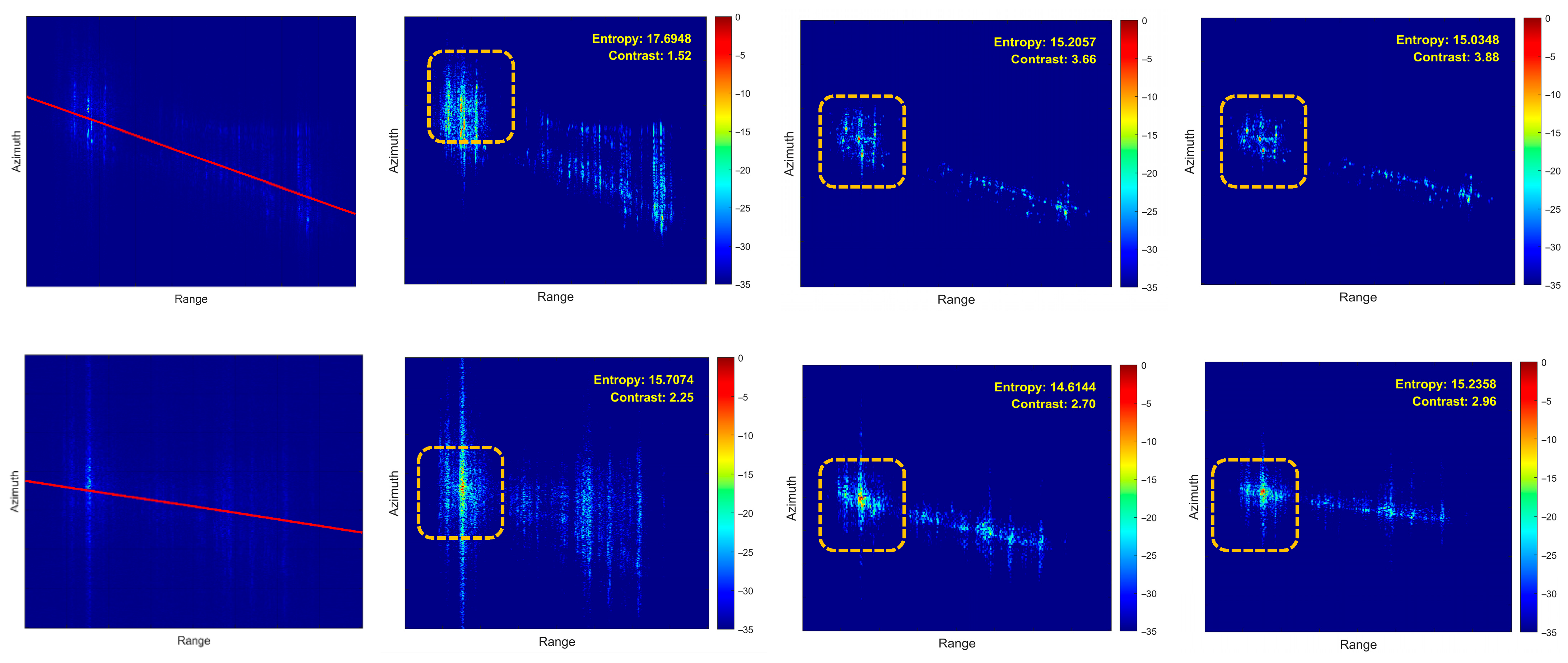
The airborne synthetic aperture radar (SAR) dataset utilized in this section is provided by our research institution in a preprocessed and anonymized format, with imaging scenarios focusing on commercial vessels under moderate sea states (Beaufort scale 3–4). Comprehensive experimental verification of the proposed algorithm is conducted using two sets of airborne SAR echo data. Details of the radar system parameters are listed in Table 4 and Table 5. To establish comprehensive performance benchmarks, the algorithm is compared against the traditional RD algorithm and IPGRA.
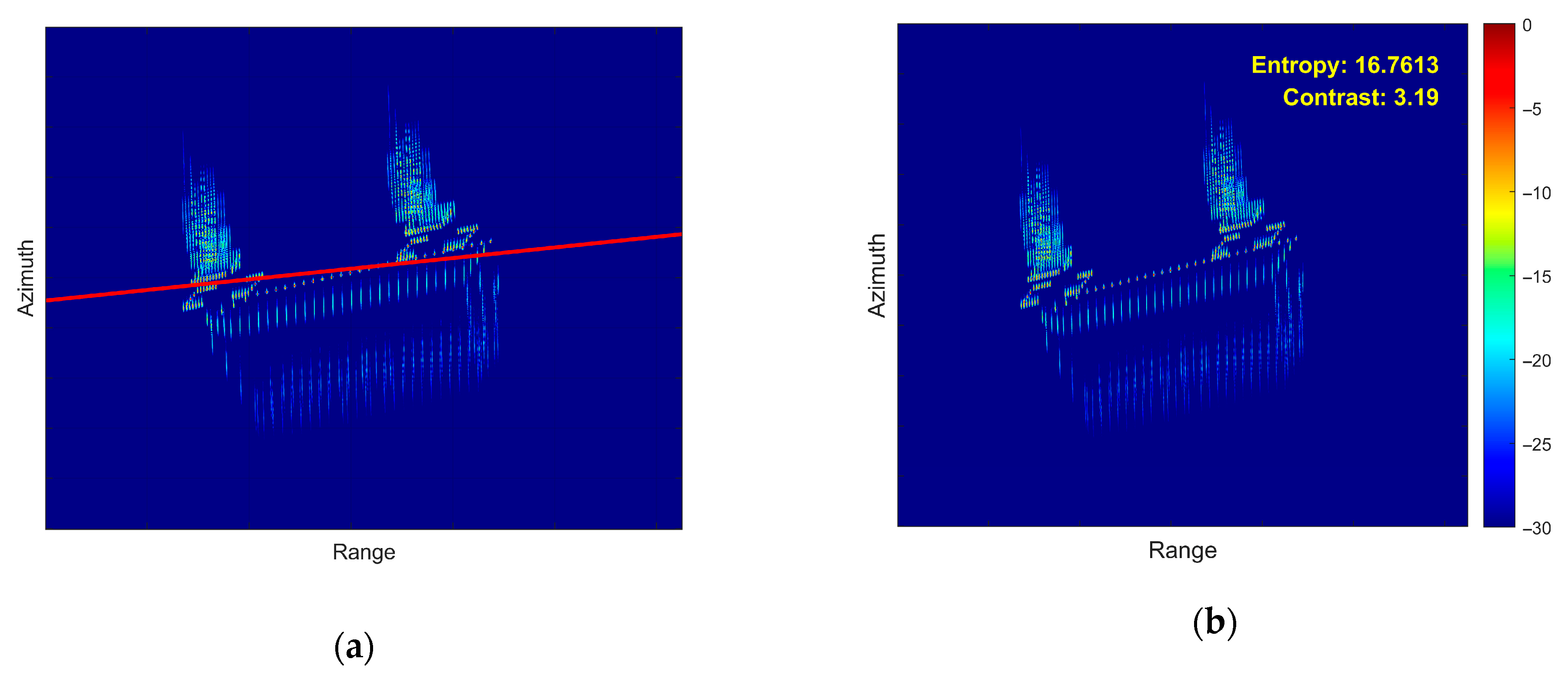
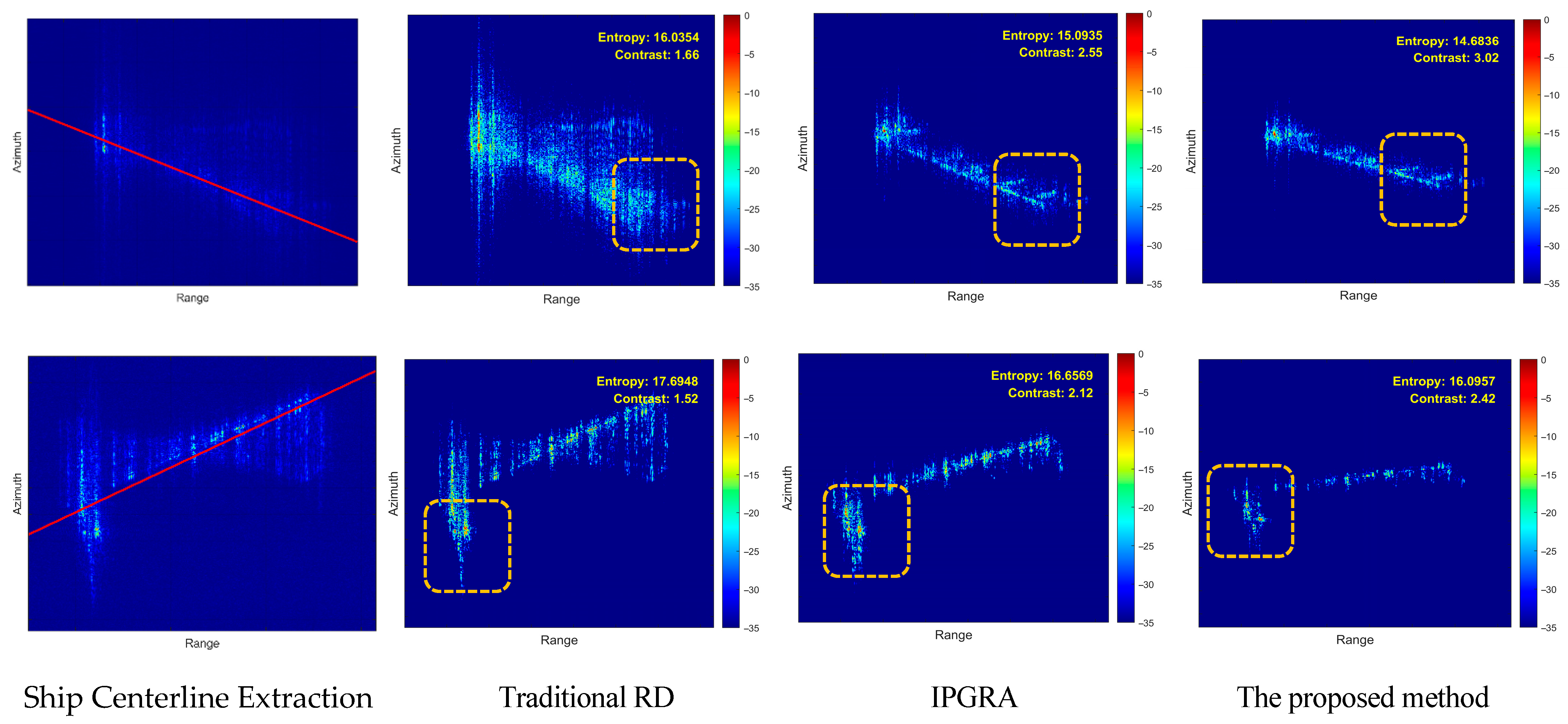
Figure 23 presents the ship centerline extraction results and a comprehensive comparison of imaging results across multiple datasets. The proposed algorithm’s performance is evaluated against the traditional RD algorithm and the IPGRA method. Each image is annotated with quantitative indicators of image entropy and contrast, which directly reflect the imaging quality through numerical values. The orange box highlights areas with remarkable focus quality discrepancies among the three imaging algorithms, which are concentrated at the image edges. By analyzing these areas, the proposed method demonstrates superior edge detail preservation and robustness in handling spatially variant phase errors. Experimental results confirm that the proposed algorithm significantly outperforms the RD and IPGRA in terms of focusing performance. The imaging results of the proposed algorithm exhibit the minimum entropy and maximum contrast. This makes the difference between ship targets and the background more prominent, improves the visual recognizability of the images, and provides high-quality data for subsequent ship target detection and recognition tasks based on SAR images.

5.3. Processing Time Comparison

Table 6 compares the processing times of IPGRA and IIPGRA on a standard computing platform for typical ISAR images of size 512 × 512 pixels. While IIPGRA requires approximately 1.9-times longer processing time than IPGRA on CPU implementation due to the additional centerline extraction and adaptive segmentation steps, both algorithms maintain polynomial time complexity suitable for hardware acceleration.

6. Conclusions

This study addresses the critical challenge of non-uniform rotational motion compensation in ISAR imaging of maneuvering ships, aiming to overcome the limitations of the conventional IPGRA algorithm.
To tackle the insufficient azimuthal separation of sub-blocks and inaccurate differential phase error estimation caused by IPGRA’s fixed range-domain segmentation, we propose an Improved IPGRA framework. A key enhancement of IIPGRA is the adoption of a centerline-driven adaptive azimuth partitioning strategy: we leverage the mature enhanced RANSAC algorithm to extract the ship’s centerline from a coarsely focused image and use this centerline as a geometric reference to split the target into upper and lower sub-blocks along the azimuth direction. This partitioning approach maximizes the separation of effective rotational centers between sub-blocks, fundamentally resolving the phase estimation deviation of IPGRA’s fixed range-domain segmentation under complex ship attitudes or compact geometries.
To address the instability of IPGRA’s Defocusing coefficient α in iteration termination, we further introduce the Rotational Uniformity Coefficient β —a metric that directly quantifies the linearity of the estimated rotational phase error. As a more reliable iteration termination criterion, β avoids the interference of outliers and paradoxical increases in α when image quality improves, ensuring stable convergence of the algorithm.
The complete IIPGRA processing flow remains fully compatible with the original IPGRA framework, preserving potential real-time performance for maritime surveillance applications. Extensive experimental validations, including simulations of ship roll, pitch, yaw, and coupled 3D rotational motions, as well as tests using real airborne SAR data, confirm that IIPGRA consistently outperforms conventional IPGRA and the traditional RD algorithm. Specifically, IIPGRA yields ISAR images with lower entropy, higher contrast, and sharper structural details.
Future work will focus on ISAR imaging under strong sea clutter scenarios, specifically addressing the robustness of imaging performance in low signal-to-clutter ratio (SCR) conditions. Given that phase estimation in PGA-based methods is sensitive to noise and sea clutter, subsequent research will prioritize the development of interference-resilient phase compensation strategies to ensure effective imaging of maneuvering ships in complex maritime environments. Furthermore, we will develop GPU-accelerated processing pipelines to enable real-time ISAR imaging and continuous monitoring of multiple maneuvering ships simultaneously.

Author Contributions

Conceptualization, W.R.; methodology, W.R.; software, W.R.; validation, W.R.; formal analysis, W.R.; investigation, W.R. and C.L.; resources, C.L.; data curation, W.R.; writing—original draft, W.R. and D.W.; writing—review and editing, W.R., D.W. and C.L.; visualization, W.R., D.W. and C.L.; supervision, C.L.; project administration, C.L.; funding acquisition, C.L. All authors have read and agreed to the published version of the manuscript.

Funding

This research received no external funding.

Data Availability Statement

The raw data supporting the conclusions of this article will be made available by the authors on request.

Acknowledgments

We sincerely acknowledge the invaluable contributions of the anonymous reviewers, supporting institutions, and foundational research that significantly enhanced this work.

Conflicts of Interest

The authors declare no conflicts of interest.

References

  1. Xu, W.; Guo, Z.; Huang, P.; Tan, W.; Gao, Z. Towards efficient SAR ship detection: Multi-level feature fusion and lightweight network design. Remote Sens. 2025, 17, 2588. [Google Scholar] [CrossRef]
  2. Tan, X.; Li, Y.; Zhang, L.; Liu, Z.; Wang, Y. An efficient range-Doppler domain ISAR imaging approach for rapidly spinning targets. IEEE Trans. Geosci. Remote Sens. 2020, 58, 2670–2681. [Google Scholar] [CrossRef]
  3. Tello, M.; Lopez-Martinez, C.; Mallorqui, J.J. Automatic Vessel Monitoring with Single and Multidimensional SAR Images in the Wavelet Domain. ISPRS J. Photogramm. Remote Sens. 2006, 61, 260–278. [Google Scholar] [CrossRef]
  4. Zhou, B.; Qi, X.; Zhang, J.; Zhang, H. Effect of 6-DOF oscillation of ship target on SAR imaging. Remote Sens. 2021, 13, 1821. [Google Scholar] [CrossRef]
  5. Liu, W.; Sun, G.-C.; Xia, X.-G.; Fu, J.; Xing, M.; Bao, Z. Focusing challenges of ships with oscillatory motions and long coherent processing interval. IEEE Trans. Geosci. Remote Sens. 2021, 59, 6562–6572. [Google Scholar] [CrossRef]
  6. Liu, P.; Jin, Y.-Q. A study of ship rotation effects on SAR image. IEEE Trans. Geosci. Remote Sens. 2017, 55, 3132–3144. [Google Scholar] [CrossRef]
  7. Fasih, A.R.; Rigling, B.D.; Moses, R.L. Analysis of target rotation and translation in SAR imagery. In Proceedings of the SPIE Defense, Security, and Sensing, Orlando, FL, USA, 11–15 May 2009; Zelnio, E.G., Garber, F.D., Eds.; SPIE: Bellingham, WA, USA, 2009; p. 73370F. [Google Scholar] [CrossRef]
  8. Jia, X.; Song, H.; He, W. A novel method for refocusing moving ships in SAR images via ISAR technique. Remote Sens. 2021, 13, 2738. [Google Scholar] [CrossRef]
  9. Shi, S.; Zhang, H.; Deng, Y.; Ai, Z.; Du, J. Increase the coherent processing interval for SAR focusing of maneuvering ships by data resampling. IEEE Trans. Geosci. Remote Sens. 2024, 62, 5210322. [Google Scholar] [CrossRef]
  10. Wu, Q.; Wang, Y.; Liu, X.; Gu, Z.; Xu, Z.; Xiao, S. ISAR Image Transform via Joint Intrapulse and Interpulse Periodic-Coded Phase Modulation. Remote Sens. 2025, 25, 28788–28799. [Google Scholar] [CrossRef]
  11. Zhu, D.Y.; Wang, L.; Yu, Y.S.; Wu, R. Robust ISAR range alignment via minimizing the entropy of the average range profile. IEEE Geosci. Remote Sens. Lett. 2009, 6, 204–208. [Google Scholar] [CrossRef]
  12. Wahl, D.G.; Eichel, P.H.; Ghiglia, D.C.; Jakowatz, C.V., Jr. Phase gradient autofocus—A robust tool for high-resolution SAR phase correction. IEEE Trans. Aerosp. Electron. Syst. 1994, 30, 827–835. [Google Scholar] [CrossRef]
  13. Samec, P.; Kulpa, Z.S. Coherent MapDrift technique. IEEE Trans. Geosci. Remote Sens. 2010, 48, 1505–1517. [Google Scholar] [CrossRef]
  14. Zeng, H.C.; Yang, W.; Wang, P.B.; Li, Z.F.; Li, Y. A modified PGA for spaceborne SAR scintillation compensation based on the weighted maximum likelihood estimator and data division. IEEE J. Sel. Top. Appl. Earth Obs. Remote Sens. 2022, 15, 3938–3947. [Google Scholar] [CrossRef]
  15. Yan, Z.; Zhang, Y.; Zhang, H. A Hybrid SAR/ISAR Approach for Refocusing Maritime Moving Targets with the GF-3 SAR Satellite. Sensors 2020, 20, 2037. [Google Scholar] [CrossRef] [PubMed]
  16. Walker, J.L. Range-Doppler imaging of rotating objects. IEEE Trans. Aerosp. Electron. Syst. 1980, 16, 23–52. [Google Scholar] [CrossRef]
  17. Wang, Y.; Lin, Y. ISAR imaging of non-uniformly rotating target via range-instantaneous-Doppler-derivatives algorithm. IEEE J. Sel. Top. Appl. Earth Obs. Remote Sens. 2014, 7, 167–176. [Google Scholar] [CrossRef]
  18. Jeong, J.C.; Williams, W.J. Kernel design for reduced interference distributions. IEEE Trans. Signal Process. 1992, 40, 402–412. [Google Scholar] [CrossRef]
  19. Choi, H.I.; Williams, W.J. Improved time-frequency representation of multicomponent signals using exponential kernels. IEEE Trans. Acoust. Speech Signal Process. 1989, 37, 862–871. [Google Scholar] [CrossRef]
  20. Zibulski, M.; Zeevi, Y.Y. Oversampling in the Gabor scheme. IEEE Trans. Signal Process. 1993, 41, 2679–2687. [Google Scholar] [CrossRef]
  21. Xing, M.; Wu, R.; Li, Y.; Bao, Z. New ISAR imaging algorithm based on modified Wigner-Ville distribution. IET Radar Sonar Navig. 2009, 3, 70–80. [Google Scholar] [CrossRef]
  22. Wang, Y.; Huang, X.; Zhang, Q. Rotation parameters estimation and cross-range scaling research for range instantaneous Doppler ISAR images. IEEE Sens. J. 2020, 20, 7010–7020. [Google Scholar] [CrossRef]
  23. Moghaddar, A.; Ogawa, Y.; Walton, E.K. Estimating the time delay and frequency decay parameter of scattering components using a modified MUSIC algorithm. IEEE Trans. Antennas Propag. 1994, 42, 1412–1418. [Google Scholar] [CrossRef]
  24. Liu, Z.-S.; Wu, R.; Li, J. Complex ISAR imaging of maneuvering targets via the Capon estimator. IEEE Trans. Signal Process. 1999, 47, 1262–1271. [Google Scholar] [CrossRef]
  25. Yardibi, T.; Li, J.; Stoica, P.; Xue, M.; Baggeroer, A.B. Source localization and sensing: A nonparametric iterative adaptive approach based on weighted least squares. IEEE Trans. Aerosp. Electron. Syst. 2010, 46, 425–443. [Google Scholar] [CrossRef]
  26. Wang, Y.; Jiang, Y.C. ISAR imaging for three-dimensional rotation targets based on adaptive Chirplet decomposition. Multidimens. Syst. Signal Process. 2010, 21, 59–71. [Google Scholar] [CrossRef]
  27. Li, D.; Zhan, M.; Su, J.; Liu, H.; Zhang, X.; Liao, G. Performances analysis of coherently integrated CPF for LFM signal under low SNR and its application to ground moving target imaging. IEEE Trans. Geosci. Remote Sens. 2017, 55, 6402–6419. [Google Scholar] [CrossRef]
  28. Du, Y.; Jiang, Y.; Wang, Y.; Zhou, W.; Liu, Z. ISAR imaging for low-Earth-orbit target based on coherent integrated smoothed generalized cubic phase function. IEEE Trans. Geosci. Remote Sens. 2020, 58, 1205–1220. [Google Scholar] [CrossRef]
  29. Li, L.; Yan, L.; Li, D.; Liu, H.; Zhang, C. A novel ISAR imaging method for maneuvering target based on AM-QFM model under low SNR environment. IEEE Access 2019, 7, 140499–140512. [Google Scholar] [CrossRef]
  30. Wang, Y.; Cao, R.; Huang, X. ISAR imaging of maneuvering target based on the estimation of time varying amplitude with Gaussian window. IEEE Sens. J. 2019, 19, 11180–11191. [Google Scholar] [CrossRef]
  31. Wang, P.; Li, H.; Djurovic, I.; Himed, B. Integrated cubic phase function for linear FM signal analysis. IEEE Trans. Aerosp. Electron. Syst. 2010, 46, 963–977. [Google Scholar] [CrossRef]
  32. Bai, X.; Feng, Y.; Zhao, J. A novel ISAR imaging algorithm for nonuniformly rotating target. In Proceedings of the 2020 IEEE International Geoscience and Remote Sensing Symposium (IGARSS), Waikoloa, HI, USA, 26 September–2 October 2020; IEEE: Piscataway, NJ, USA, 2020; pp. 4562–4565. [Google Scholar] [CrossRef]
  33. Wang, X.; Li, Y.; Chen, Z.; Liu, H.; Zhang, Q. Deep learning-based enhanced ISAR-RID imaging method. Remote Sens. 2023, 15, 4422. [Google Scholar] [CrossRef]
  34. Wang, H.; Liu, Y.; Zhang, L.; Chen, X.; Li, J. High-resolution ISAR imaging method for maneuvering targets based on hybrid transformer network. IEEE Trans. Aerosp. Electron. Syst. 2023, 59, 5123–5137. [Google Scholar] [CrossRef]
  35. Shi, S.; Zhang, H.; Deng, Y.; Dong, S. Iteration phase gradient resample autofocus: A real-time and robust algorithm for focusing maneuvering ships in SAR images. IEEE Trans. Aerosp. Electron. Syst. 2025, 61, 14082–14099. [Google Scholar] [CrossRef]
  36. Ruan, W.; Liu, C. Long coherent processing intervals for ISAR imaging: Combined complex signal kurtosis and data resampling. Remote Sens. 2024, 16, 4758. [Google Scholar] [CrossRef]
  37. Shi, S.; Zhang, H.; Deng, Y.; Dong, S. Azimuth envelope alignment for focusing maneuvering ships in SAR images. IEEE Trans. Geosci. Remote Sens. 2025, 63, 5207815. [Google Scholar] [CrossRef]
  38. Cao, R.; Wang, Y.; Zhang, Y.; Jian, M. Optimal time selection for ISAR imaging of ship target via novel approach of centerline extraction with RANSAC algorithm. IEEE J. Sel. Top. Appl. Earth Obs. Remote Sens. 2022, 15, 9987–10005. [Google Scholar] [CrossRef]
  39. Vehmas, R.; Jylhä, J.; Välilä, M.; Vihonen, J.; Visa, A. Data-driven motion compensation techniques for noncooperative ISAR imaging. IEEE Trans. Aerosp. Electron. Syst. 2018, 54, 295–314. [Google Scholar] [CrossRef]
  40. Perry, R.P.; DiPietro, R.C.; Fante, R.L. SAR imaging of moving targets. IEEE Trans. Aerosp. Electron. Syst. 1999, 35, 188–200. [Google Scholar] [CrossRef]
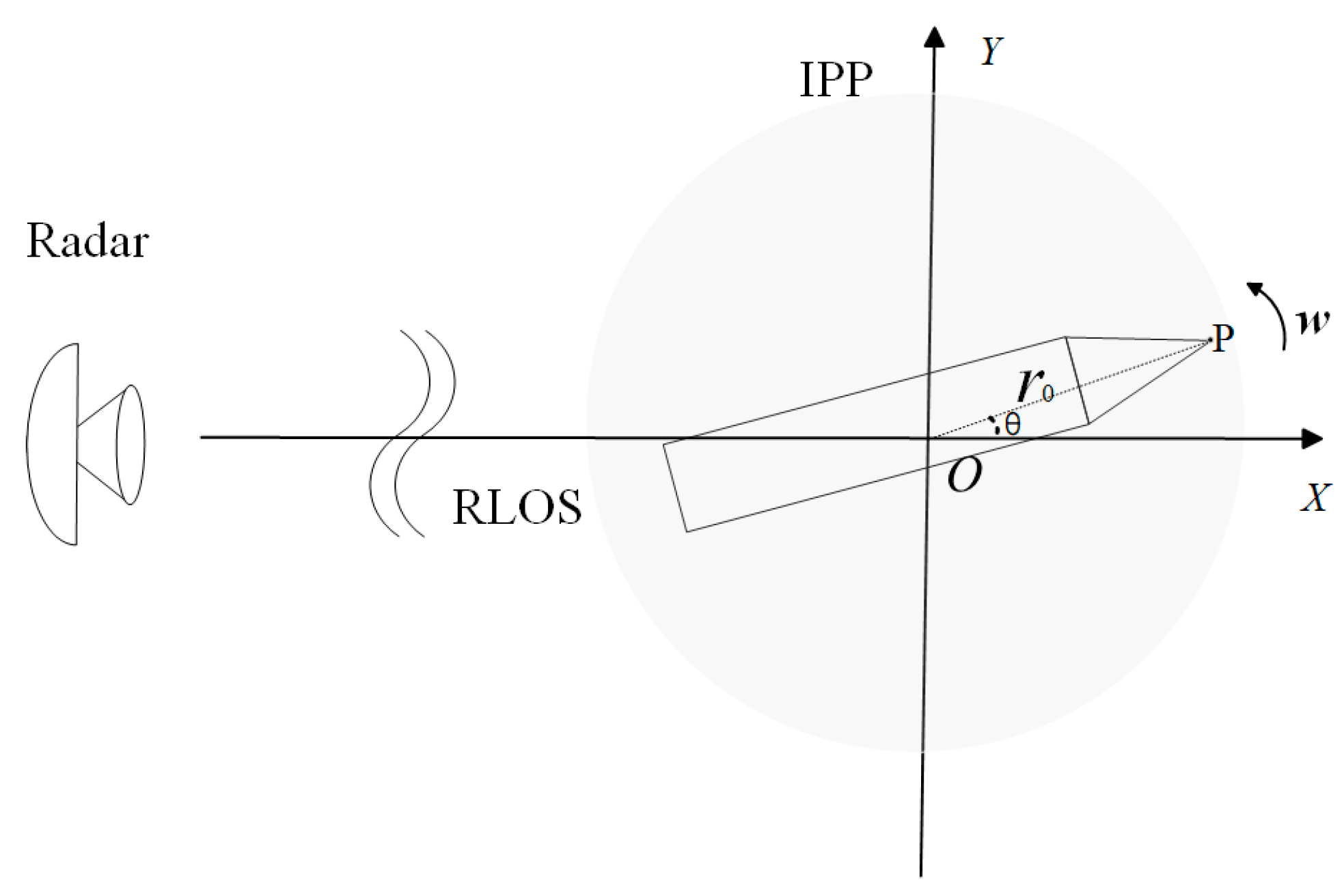
Figure 1. ISAR turntable model.
Remotesensing 18 00105 g001
Figure 2. Phase error caused by non-uniform rotation.
Remotesensing 18 00105 g002
Figure 3. The compensated phase via resampling.
Remotesensing 18 00105 g003
Figure 4. Imaging Performance Analysis under roll condition with the IPGRA algorithm. (a) Imaging result of the traditional RD algorithm. (b) Imaging result after the first iteration. (c) Imaging result after the second iteration. (d) Imaging result after the third iteration.
Remotesensing 18 00105 g004
Figure 5. Changes in Defocus coefficient, image entropy, and image contrast for each iteration of the IPGRA.
Remotesensing 18 00105 g005
Figure 6. The proposed method flowchart. The six boxes indicate the six main steps.
Remotesensing 18 00105 g006
Figure 7. The ship model A. (a) Three-dimensional view of the ship model; (b) top view; (c) side view; (d) main view.
Remotesensing 18 00105 g007
Figure 8. The ship model B. (a) Three-dimensional view of the ship model; (b) top view; (c) side view; (d) main view.
Remotesensing 18 00105 g008aRemotesensing 18 00105 g008b
Figure 9. The ship model C. (a) Three-dimensional view of the ship model; (b) top view; (c) side view; (d) main view.
Remotesensing 18 00105 g009
Figure 22. Ship Centerline Extraction and Imaging Performance Analysis under Roll Condition with Sea Clutter at 0 dB SCR. (a) Ship Centerline Extraction result from the clutter-contaminated image. (b) Imaging result of the traditional RD algorithm. (c) Imaging result of the IPGRA algorithm. (d) Imaging result of the proposed algorithm. (e,f) The estimated rotational phase error curve of the IPGRA and proposed algorithm. The image entropy and contrast of each image are annotated in the figure.
Remotesensing 18 00105 g022
Figure 23. Ship Centerline Extraction and imaging results of airborne SAR echo data. The first column presents the precise extraction results of the ship’s centerline. The second to the fourth columns sequentially display the imaging results of the traditional RD algorithm, the IPGRA, and the proposed method.
Remotesensing 18 00105 g023aRemotesensing 18 00105 g023b
Table 1. Simulated parameters of airborne SAR system.
ParameterValue
Carrier frequency9.6 GHz
Signal bandwidth300 MHz
Range sampling frequency600 MHz
Pulse repetition frequency600 Hz
CPIAbout 1.5 s
Platform Altitude6000 m
Platform Speed60 m/s
Table 2. Motion parameters of the ship in roll condition.
Ship Motion ParameterValue
Orientation45°
Roll period8 s
Pitch period-
Yaw period-
Roll amplitude
Pitch amplitude-
Yaw amplitude-
Table 3. Motion parameters of a ship under complex sea state.
ParameterValue
Orientation 45
Roll period8 s
Pitch period10 s
Yaw period12 s
Roll amplitude 6
Pitch amplitude 3
Yaw amplitude 4
Table 4. Parameters of airborne radar system for the first measured dataset.
ParameterValue
Carrier frequencyX
Range sampling frequency500 MHz
Range resolution0.5 m
Pulse repetition frequency1200 Hz
Platform speed50 m/s
CPIAbout 2.5 s
Table 5. Parameters of airborne radar system for the second measured dataset.
ParameterValue
Carrier frequencyKu
Range sampling frequency500 MHz
Range resolution0.5 m
Pulse repetition frequency1500 Hz
Platform Speed65 m/s
CPIAbout 2 s
Table 6. Processing time comparison for 512 × 512-pixel ISAR images.
Method NameProcessing Time (ms)
IPGRA1009
IIPGRA1900
Disclaimer/Publisher’s Note: The statements, opinions and data contained in all publications are solely those of the individual author(s) and contributor(s) and not of MDPI and/or the editor(s). MDPI and/or the editor(s) disclaim responsibility for any injury to people or property resulting from any ideas, methods, instructions or products referred to in the content.