Article

Spatio-Temporal Evolution of Ecosystem Water Use Efficiency and the Impacts of Drought Legacy on the Loess Plateau, China, Since the Onset of the Grain for Green Project


1
School of Computer Science and Artificial Intelligence, Wuhan University of Technology, Wuhan 430070, China
2
Key Laboratory of Middle Atmospheric and Global Environment Observation, Institute of Atmospheric Physics, Chinese Academy of Sciences, Beijing 100038, China
3
State Key Laboratory of Water Resources Engineering and Management, Wuhan University, Wuhan 430070, China
4
School of National Safety and Emergency Management, Beijing Normal University, Beijing 100038, China
5
College of Architecture and Landscape, Peking University, Beijing 100038, China
6
Yinshanbeilu Grassland Eco-Hydrology National Observation and Research Station, China Institute of Water Resources and Hydropower Research, Beijing 100038, China
7
Institute of Water Resources of Pastoral Area Ministry of Water Resources, Hohhot 010020, China
*
Author to whom correspondence should be addressed.
Remote Sens. 2025, 17(24), 3980; https://doi.org/10.3390/rs17243980
Submission received: 16 October 2025 / Revised: 22 November 2025 / Accepted: 2 December 2025 / Published: 9 December 2025

Highlights

What are the main findings?
  • Ecosystem water use efficiency (eWUE) exhibits a pronounced two-year legacy effect; the correlation with the lagged drought index two years prior is stronger than the correlation with the current year’s index.
  • A widespread positive correlation between eWUE and the drought index across the LP suggests a robust ecosystem adaptation strategy that enhances water use efficiency under high moisture limitation.
What is the implication of the main finding?
  • The pronounced drought legacy necessitates a paradigm shift toward multi-year strategic water resource planning in semiarid land management to buffer the effects of future persistent droughts.
  • The diverse eWUE responses across vegetation types require adopting “right tree, right place” policies to optimize ecological restoration, preventing the exacerbation of soil drying and water resource pressure.

Abstract

Reforestation efforts, notably the massive Grain for Green Project (GFGP), have significantly greened China’s Loess Plateau (LP) but intensified regional water limitations. This study aims to systematically characterize the spatio-temporal dynamics and the critical legacy effects of moisture stress on eWUE to evaluate ecosystem sustainability under accelerated climate change. Using 2001–2020 MODIS GPP and ET data and the comprehensive Temperature–Vegetation–Precipitation Drought Index (TVPDI), we analyzed the trends, spatial patterns, and lagged correlations on the LP. We find the LP’s mean eWUE was 1.302 g C kg−1 H2O, exhibiting a robust increasing trend of 0.001 g C kg−1 H2O a−1 (p < 0.05), primarily driven by a faster increase in gross primary productivity (GPP) than evapotranspiration (ET). Spatially, areas with significant increases in eWUE concentrated in the afforested south and central LP. Concurrently, the region experienced a mild drought state (mean TVPDI: 0.557) with a concerning drying trend of 0.003 yeyr−1, highlighting persistent water stress. Crucially, eWUE exhibited high and spatially divergent sensitivity to drought. A striking 69.64% of the region showed a positive correlation between eWUE and the TVPDI, suggesting that vegetation may adjust its physiological functions to adapt to drought. However, this correlation varied across vegetation types, with grasslands showing the highest positive correlation (0.415) while woody vegetation types largely showed a negative correlation. Most importantly, our analysis reveals a pronounced drought legacy effect: the correlation between eWUE and drought in the previous two years was stronger than in the current year, indicating multi-year cumulative moisture deficit rather than immediate climatic forcing (precipitation and temperature). These findings offer a critical scientific foundation for optimizing water resource management and developing resilient “right tree, right place” ecological restoration strategies on the LP, mitigating the ecological risks posed by prolonged drought legacy.

1. Introduction

Against the background of global climate change, if affected by rising temperatures and decreasing precipitation, the duration and severity of drought will be prolonged. Increased drought levels can limit the carbon balance of terrestrial ecosystems to a greater extent, causing plant water stress that not only results in lower photosynthetic rates and leaf area but also leads to lower total predominant productivity of the ecosystem [1,2,3,4]. In recent years, not only have large-scale droughts occurred in North America, Africa, Europe, the Amazonian plains, and Australia [5,6,7,8], but most regions of China have also experienced severe and frequent droughts [9], which have impacted many aspects of the water supply, agricultural production, ecology, energy, and the economy, with extreme autumn droughts in southwestern China alone in 2016 causing 174,000 people to be affected and direct economic losses of more than CNY 14 million [10,11,12]. Therefore, exploring the conditions under which terrestrial ecosystems do not fully recover under drought stress and the mechanisms driving them provides a theoretical basis for predicting future changes in land surface–atmosphere interactions and terrestrial ecosystem dynamics.
Ecosystem water use efficiency (eWUE) serves as a critical metric that quantifies how effectively an ecosystem uses water for production, reflecting the complex exchanges of carbon, water, and energy between the land surface and the atmosphere. eWUE not only provides insight into the alteration of patterns occurring in the ecosystem but also accounts for the ecosystem’s response to alterations in climate attributes and water resources. The eWUE varies according to different scales [13,14,15]. At the leaf scale, it refers to the number of photosynthetic products that can be assimilated when unit water is dissipated by leaf transpiration. At the scale of individual plants, it refers to the ratio of dry matter mass to water consumption during long-term plant growth. At the scale of an ecosystem or a region, it can be determined by the ratio of dry matter fixed to evapotranspiration (ET) by the whole region or system [16]. Large-scale studies will not only lead to the exploration of regional and even global eWUE adaptations to changes in environmental factor gradients but also to the development of a larger network of experimental research on ecological and environmental observations. Since vorticity-related technology and remote sensing have advanced and provide several application areas, eWUE research at the ecosystem level has made breakthrough progress. Long-term studies of vegetation ecosystem eWUE on the Loess Plateau (LP) utilizing datasets obtained by remote sensing show that vegetation eWUE has a powerful positive correlation with the leaf area index (LAI), different climate factors affect eWUE by affecting GPP and ET, and distinct vegetation eWUEs have diverse sensitivities to climate factors. The authors of [17] analyzed the intraday and seasonal variation attributes of eWUE based on site flux data and meteorological data and analyzed the effects of related abiotic attributes such as temperature, precipitation and relative moisture, and leaf area index on eWUE at different time scales. The authors of [18] examined the changes and distribution characteristics of the eWUEs in different vegetation ecosystems in Central Asia from the two aspects of altitude and latitude based on MODIS product data from 2000 to 2014. Tang et al. (2016) [19] studied the eWUE of temperate deciduous forests distributed in eight different climatic zones in the Northern Hemisphere and found that temperature, solar radiation, and water pressure deficit were the primary climatic attributes affecting eWUE alterations on an 8-day scale. Research shows that eWUE is not only controlled by vegetation type, community structure, altitude, and latitude [20,21,22] but is also closely related to external environmental conditions [23,24,25,26] and is affected by their interaction [27,28]. However, against the background of climate change, water availability has been the primary factor affecting eWUE [29]. Greater water supply elevates photosynthetic capacity and GPP while increasing transpiration plus soil and canopy evaporation. In addition, the transpiration of vegetation will increase air humidity; that is, relative humidity can reflect the transpiration capacity of vegetation [30]. A deeper study of the response of eWUE to key environmental variables could aid in enhancing the comprehension of coupled water–carbon processes in the context of climate change or the ability to alleviate the adverse impacts of climate change on ecosystems.
At present, drought monitoring mainly quantifies drought characteristics through the drought index. However, most models and methods still have limitations in characterizing the complexity and objectivity of the drought process. For example, a single remote sensing drought index is relatively singular in characterizing drought characteristics. It also has limited ability to explain the drought process: part of the comprehensive remote sensing drought index is limited by the weight acquisition method in the construction process, which will lead to artificial bias, information loss, and other problems. However, compared with common remote sensing drought indexes such as the VCI, TCI, PCI, Scale Drought Condition Index (SDCI), Drought Stress Index (DSI), and Temperature Vegetation Drought Index (TVDI), the new comprehensive remote sensing drought index (TVPDI) based on vegetation, temperature, and precipitation shows stronger correlation and higher consistency in drought monitoring ability [31]. The advantages of TVPDI are mainly reflected in the following aspects: it can more effectively integrate multi-source data, thereby enhancing sensitivity to wet and dry conditions; it reduces subjective interference through optimized weight allocation, improving the objectivity and stability of monitoring results; and it possesses superior continuous monitoring capability across spatial and temporal scales, enabling high-precision quantitative diagnosis of ecosystem-level drought conditions.
The ecological consequences of drought are highly heterogeneous; for a given severity, responses can diverge markedly with ecosystem type and prevailing climate, as vegetation structure, dominant functional groups, soils, and regional regimes jointly shape impacts on productivity, water use efficiency, mortality risk, and post-drought recovery trajectories. Guo, et al. [32] analyzed and found that during drought, eWUE increased in northeastern China, northeastern Inner Mongolia, and parts of forest-rich areas of southern China and decreased in northwestern and central China. Li, et al. [33] reported the 2009–2010 Southwest China drought curtailed vegetation growth, lowering productivity and carbon sequestration. Reichstein, et al. [34] graded droughts in their study of the eWUE response to drought in the United States and found that eWUE was positively correlated with mild–moderate drought and negatively correlated with severe and extreme droughts. Yang, et al. [35] established a global link between eWUE and humidity, demonstrating that ecosystems respond differently to drought; it led to higher eWUE in arid zones but lower eWUE in semiarid and subhumid ones, highlighting their unique hydroclimatic sensitivities. However, Huang, et al. [36], based on the Spearman correlation between eWUE and SPEI, suggested that the global eWUE in 2000–2014 had a negative effect on drought in arid regions and both positive and negative effects in humid regions, and they also pointed out that there was a lag effect of drought on eWUE.
The Loess Plateau (LP) is recognized as a fragile ecological environment highly sensitive to climate change. Water resource shortage is a substantial factor limiting local ecological and economic development. Since 1999, the implementation of large-scale ecological restoration projects, particularly the Grain for Green Project (GFGP), has significantly improved vegetation cover [37,38]. However, these intensive revegetation efforts pose a hazard by altering the water and carbon balance, potentially causing a sharp increase in evapotranspiration that seriously affects the regional carbon–water cycle. Currently, research is lacking regarding the eWUE differences among distinct vegetation types since the GFGP, and the explicit reaction relationship and mechanism, particularly the legacy effects, between eWUE and drought remain largely unexplored on the LP. To address these critical research gaps, this study estimates the eWUE and TVPDI of the LP from 2001 to 2020 by utilizing MODIS GPP, ET, and other datasets. The following three objectives are discussed emphatically: (1) to analyze the spatio-temporal patterns of gross primary productivity, evapotranspiration, eWUE, and drought, as well as their trends; (2) to clarify the pattern of variation in the correlation between eWUE and drought in distinct climatic zones and vegetation types; and (3) to quantitatively analyze the legacy effect of eWUE on drought. This study provides a scientific theoretical foundation to sustainably maintain vegetation systems and manage water resources on the LP.

2. Materials and Methods

2.1. Research Field

The LP is a distinctive ecological region located primarily in Northwest China, with its eastern edge extending into the North China region (Figure 1a). The main vegetation types are deciduous coniferous forests, mixed forests, shrub forests, forested grasslands, savannas, grasslands, and farmlands (Figure 1b). The altitude is between 86 and 4885 m (Figure 1c). Except for a few areas of alpine bare rocks, the region consists of fine loess and clay particles, with loose soil that has poor anti-impact and anti-erosion ability, making it easily dispersed and transported. At the same time, the terrain in this area is broken, with vertical and horizontal gullies and steep slopes and deep gullies, which make the soil erosion on the LP very serious. There are various climate types. According to the classification system of dry and wet regions in the world, the LP is divided into four different dry and wet regions spanning arid, semiarid, semihumid, and humid dry and humid climate areas (Figure 1d). Vegetation distribution is affected by topography and climate.

2.2. Data Sources

Vegetation gross primary productivity (GPP) was extracted from the MOD17A2H product from 2001 to 2020 provided by the NASA website, which provides 500 m and 8 d spatial and temporal resolutions, respectively. Evapotranspiration data (ET) were derived from MOD16A2 products provided by the NASA website between 2001 and 2020, with 500 m and 8 d spatial and temporal resolutions, respectively. The NDVI was extracted from MOD13A2 products provided by the NASA website from 2001 to 2020, which provides 1 km and 16-day spatial and temporal resolutions, respectively. The surface temperature data (LST) were derived from MOD11A2 products provided by the NASA website from 2001 to 2020, which provide 1 km and 8-day spatial and temporal resolutions, respectively. The dataset was terrain-corrected. Precipitation data came from TRMM_3B43 V7 data products provided by the NASA website from 2001 to 2020, with 0.25 and 1-month spatial and temporal resolutions, respectively. The DEM dataset was supplied by the Resource Environment Data and Platform website (http://www.resdc.cn, accessed on 1 June 2025) with a 1 km resolution. Land cover type data were extracted from the MCD12Q1 product provided by the NASA website from 2001 to 2020, with a 500 m spatial resolution. To account for land cover dynamics over the two decades, the annual MCD12Q1 data for the entire 2001–2020 period were processed and analyzed. Seventeen land use types were included, and combined with the actual analysis needs, the classification schemes of the International Geosphere–Biosphere Program in MCD12Q1 were merged to yield deciduous coniferous forests (3.25%), mixed forests (1.09%), shrub forests (0.07%), forested grasslands (0.51%), savannas (1.15%), grasslands (58.10%), farmlands (18.9%), others (3.89%), and changing areas (13.04%). To prepare the remote sensing data for analysis, a workflow involving projection, clipping, fusion, and calculation was implemented using HEG software (v 2.15). This process yielded the necessary monthly and annual data for the LP, which was then resampled or downscaled to a consistent 1 km resolution.

2.3. eWUE

eWUE is defined as the quantity of dry matter, represented by gross primary productivity (GPP), that is produced for each unit of water lost through evapotranspiration (ET) from the plant canopy and soil. The relationship is expressed mathematically as follows [39]:
eWUE   =   GPP / ET
In this equation, eWUE stands for ecological water use efficiency (measured in g C mm−1 m−2), GPP is the gross primary productivity (g C m−2), and ET signifies evapotranspiration (mm).

2.4. Temperature–Vegetation–Precipitation Drought Index (TVPDI)

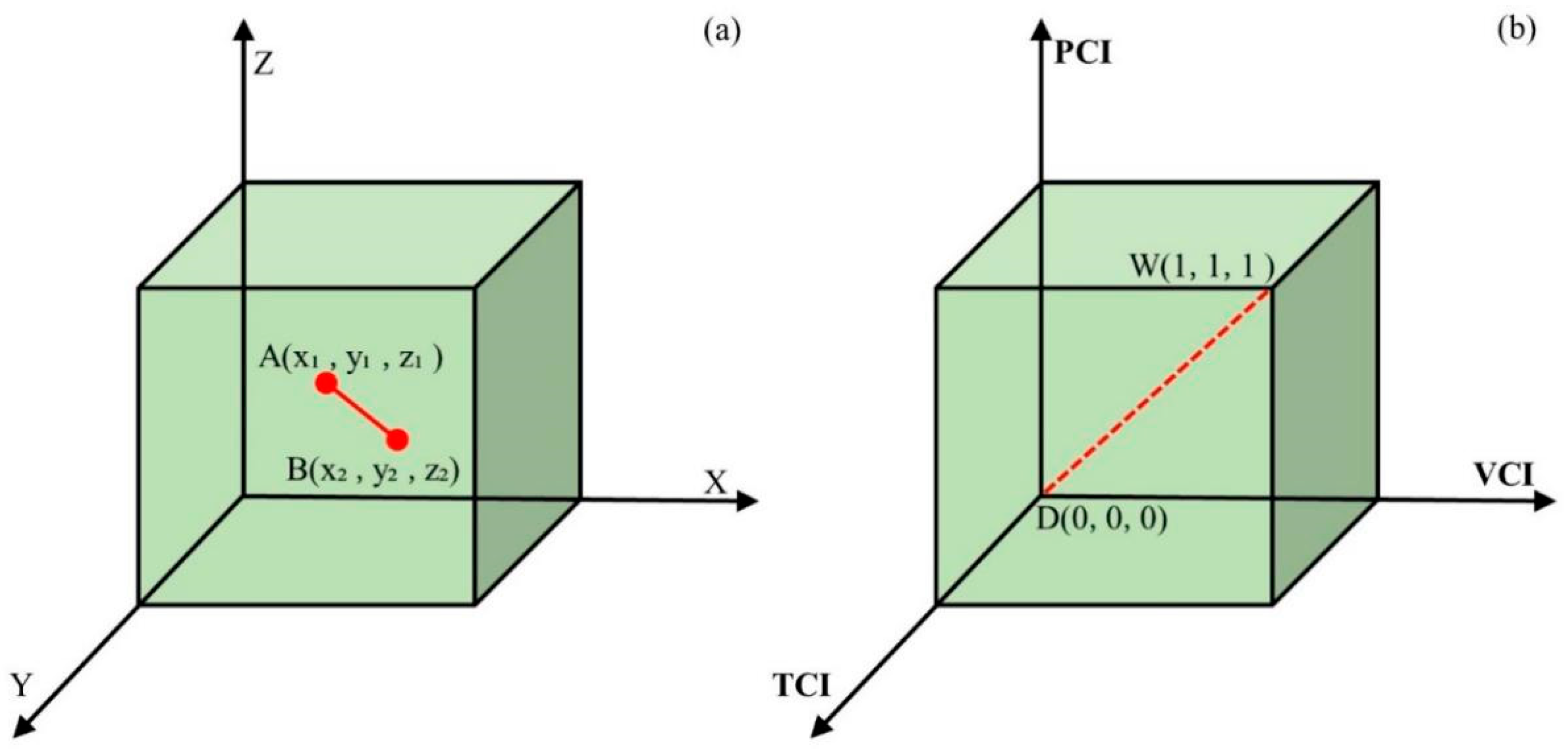
Spatial distance models are used to calculate the distance between each image element and each source (Figure 2a) and to then calculate the Euclidean distance between each image element and each source to output and apply it to the construction of ecological composite evaluation indices, multivariate drought indexes, and so on [40,41].
The spatial distance expression is
D X , Y , Z = x 1 x 2 2 + y 1 y 2 2 + z 1 z 2 2
where D(X, Y, Z) is the absolute distance between A(x1, y1, z1) and B(x2, y2, z2).
Drought is an abnormal climate event in a long time series rather than a normal climate. Combined with the analysis of factors that influence drought, the precipitation that characterized the precipitation deficit, soil water deficit, and vegetation growth in the study period was selected [42]. The time series single remote sensing drought indexes (PCI, TCI, and VCI) were calculated, and the three-dimensional space of VCI-TCI-PCI was established, that is,
V C I = N D V I i N D V I m i n N D V I m a x N D V I m i n
T C I = L S T i L S T m i n L S T m a x L S T m i n
P C I = P i P m i n P m a x P m i n
T V P D I = 3 3 V C I V C I m 2 + T C I T C I m 2 + P C I P C I m 2
In the formula, NDVIi, LSTi, and Pi are the values of a certain month in the corresponding time series. NDVImin, LSTmin, and Pmin are the minimum values of a month in the corresponding time series. NDVImax, LSTmax, and Pmax are the maximum values of a certain month in the corresponding time series. VCIm, TCIm, and PCIm are the respective values of VCI, TCI, and PCI under the wettest condition, and the TVPDI results were graded (Table 1).

2.5. Legacy Effects of Early Drought on eWUE

To examine the legacy impacts of drought on eWUE [43], equations were developed to relate eWUE to TVPDI for the current, prior, and prior 2 years as follows:
e W U E c u r r e n t = a × T V P D I c u r r e n t + b
e W U E c u r r e n t = a × T V P D I c u r r e n t + b × T V P D I p r e v i o u s   o n e   y e a r + c
e W U E c u r r e n t = a × T V P D I c u r r e n t + b × T V P D I p r e v i o u s   o n e   y e a r + c × T V P D I p r e v i o u s   t w o   y e a r + d
where eWUEcurrent can be represented as TVPDIcurrent or TVPDIcurrent and TVPDIprevious one year or TVPDIcurrent and TVPDIprevious one year and TPVDIprevious two years in Equations (7)–(9), respectively.

2.6. Trend Analysis

The annual trends of GPP, ET, eWUE, and TVPDI from 2001 to 2020 were determined by applying a univariate linear regression model to the time series data. The change rate (slope) was calculated using the following formula:
S l o p e = n i = 1 n i × Y i i = 1 n ( i × Y i ) n i = 1 n ( i 2 ) ( i = 1 n ( i ) ) 2
where Slope represents the annual rate of change, n is the number of years (20), and Yi is the value of the variable in year i.

3. Results

3.1. GPP/ET/eWUE

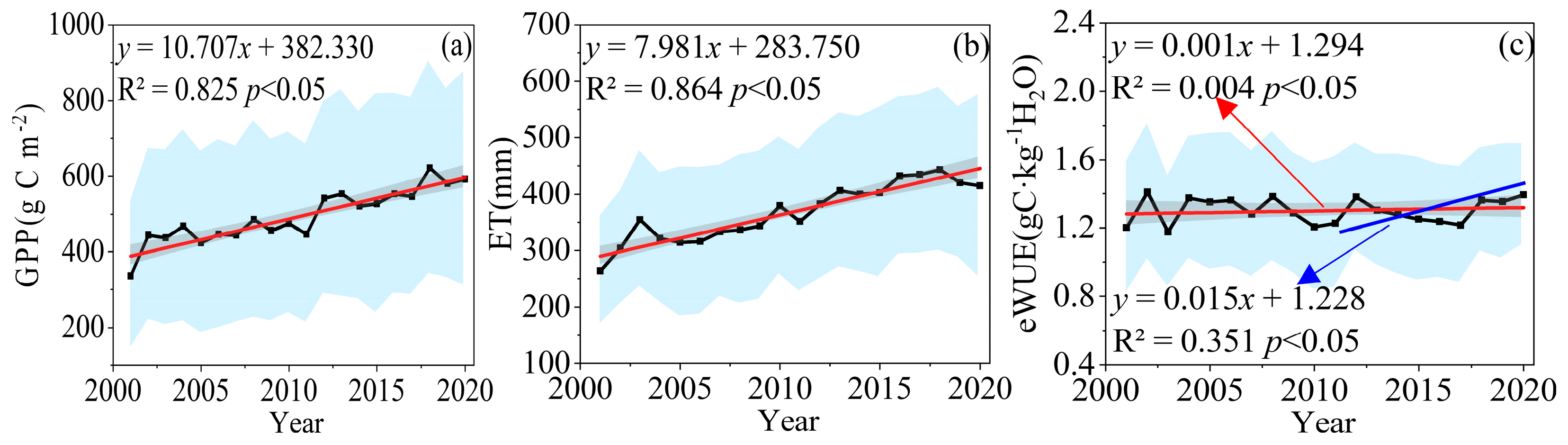
During the 2001–2020 period on the LP, following widespread farmland conversion, the mean annual GPP, ET, and eWUE were 495.332 g C m−2, 366.399 mm, and 1.302 g C kg−1 H2O, respectively. Interannual analysis revealed a significant increasing trend for all three variables (Figure 3). Crucially, the rise in eWUE was predominantly driven by a more rapid increase in GPP relative to ET. Despite this positive trajectory, annual eWUE experienced distinct troughs in 2003 and 2010. After 2012, the eWUE trend accelerated, which is likely attributable to a significant increase in precipitation that subsequently enhanced GPP.
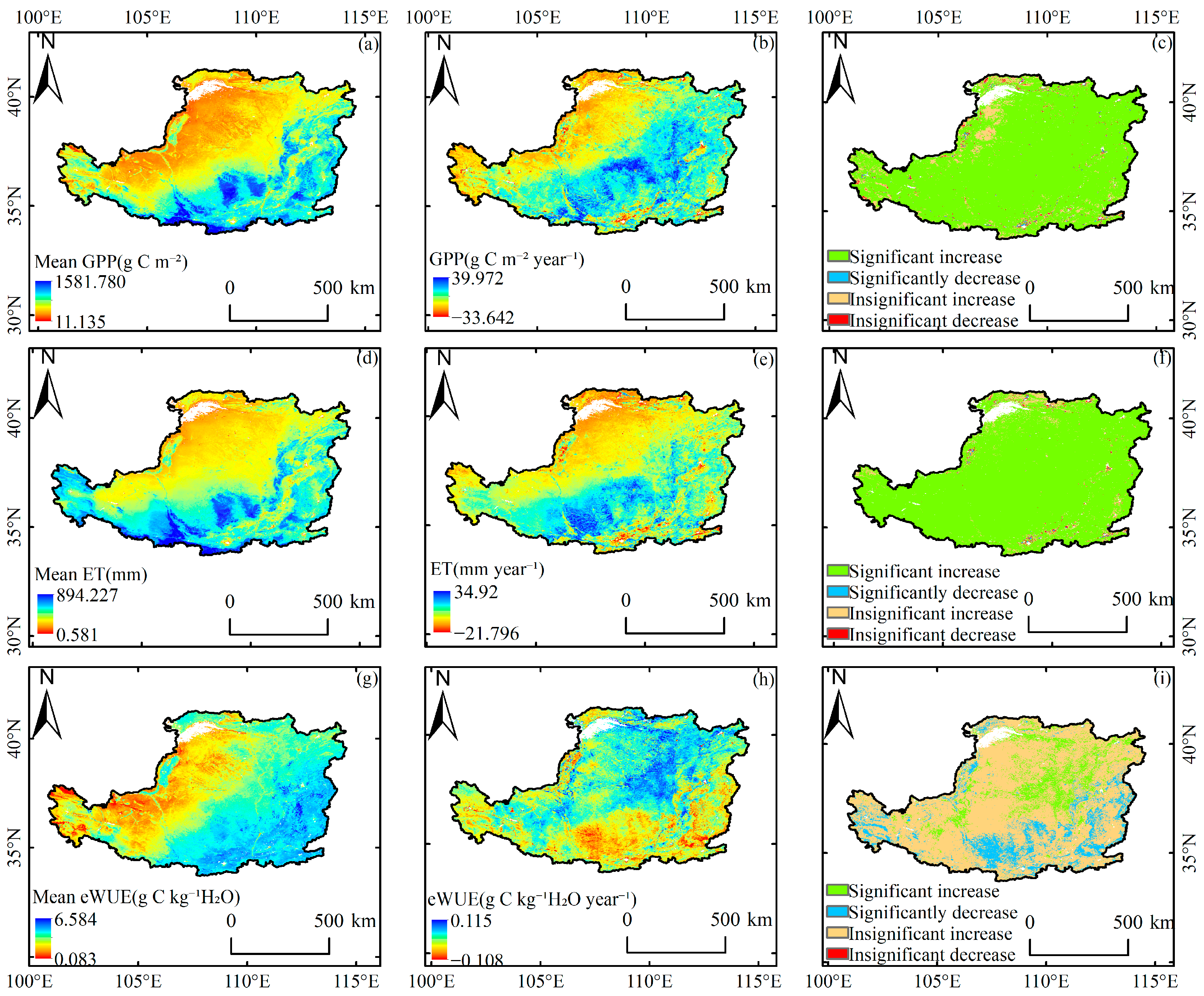
The spatial distribution of GPP was highest in the Yellow River Diversion Irrigation Area of northern Ningxia, a direct result of its well-developed irrigated croplands (Figure 4a). Analysis of change over time revealed a strong spatial polarization in GPP trends, with increases in the southeast and decreases in the northwest (Figure 4b). This increasing trend was especially pronounced in areas such as northwestern Shaanxi, the Luliang Mountains, and eastern Gansu (Figure 4c). Overall, 74.51% of the study area saw an increase in GPP (of which 58.14% was significant), while only 16.18% showed a decline. The remaining 9.31% of the area experienced no notable change over the study period.
ET values across the study area ranged from 0.581 to 894.277 mm. Spatially, the highest values were concentrated in the western and southeastern regions, whereas the lowest values were primarily found in the central and northern parts (Figure 4d). An analysis of temporal trends showed that the rate of ET change varied from −21.796 to 30.311 mm yr−1 (Figure 4e). Overall, an increasing trend was observed across 62.18% of the region, while a decreasing trend was found in 27.59%. This pattern of change correlated strongly with the spatial distribution of mean ET; areas with high evapotranspiration in the west and southeast also experienced the most rapid increases. A more detailed breakdown reveals that 46.28% of the study area underwent a significant increase and 7.61% a significant decrease, while 10.13% of the region showed no notable change (Figure 4f).
eWUE showed a distinct spatial gradient across the Loess Plateau, decreasing from southeast to northwest (Figure 4g). The highest values, exceeding 0.8 g C kg−1 H2O, were found in the cultivated lands and woodlands of the southeast—areas characterized by high productivity. In contrast, the lowest eWUE values (below 0.4 g C kg−1 H2O) were typical of the northwestern grasslands and deserts, where both GPP and ET were low. This spatial heterogeneity is primarily driven by the different water consumption patterns and photosynthetic capacities among the various ecosystems. Regarding the temporal trends from 2001 to 2020, the rate of eWUE change ranged from −0.108 to 0.115 g C kg−1 H2O yr−1 (Figure 4h). An increasing trend was observed in the majority (72.68%) of the study area. However, statistically significant changes occurred in only 11.26% of the region, and these were mostly concentrated in the middle and southern parts of the Loess Plateau (Figure 4i).
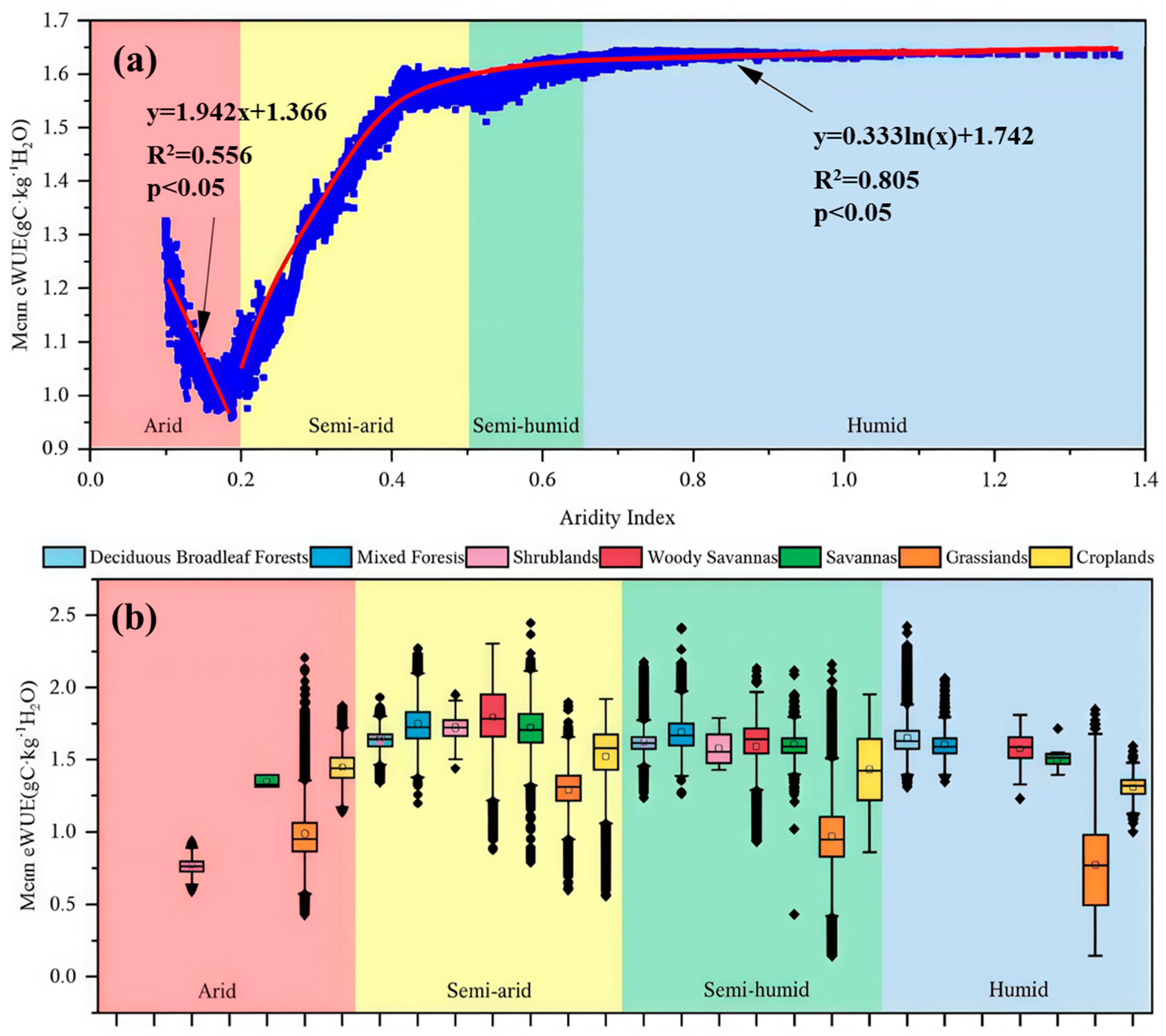
eWUE varied significantly across the different climatic regions (Figure 5a). The highest eWUE was found in the humid region, followed in descending order by the semihumid, semiarid, and arid regions. This pattern was closely linked to the aridity index (AI), though the relationship differed by zone. In arid areas, eWUE showed a linear negative relationship with AI, whereas a logarithmic function better described the association in semiarid to humid regions. Notably, as conditions became wetter (i.e., AI increased), semiarid ecosystems exhibited the highest rate of eWUE growth, surpassing that of semihumid and humid areas. When analyzed by vegetation type, woody savannas had the highest eWUE, followed by mixed forests, savannas, deciduous broadleaf forests, croplands, and finally shrublands. A universal trend was observed across all ecosystems: eWUE declined substantially as the drought index increased. Among all vegetation types, grasslands showed the most rapid rate of this decline (Figure 5b).

3.2. Temporal and Spatial Evolution of TVPDI

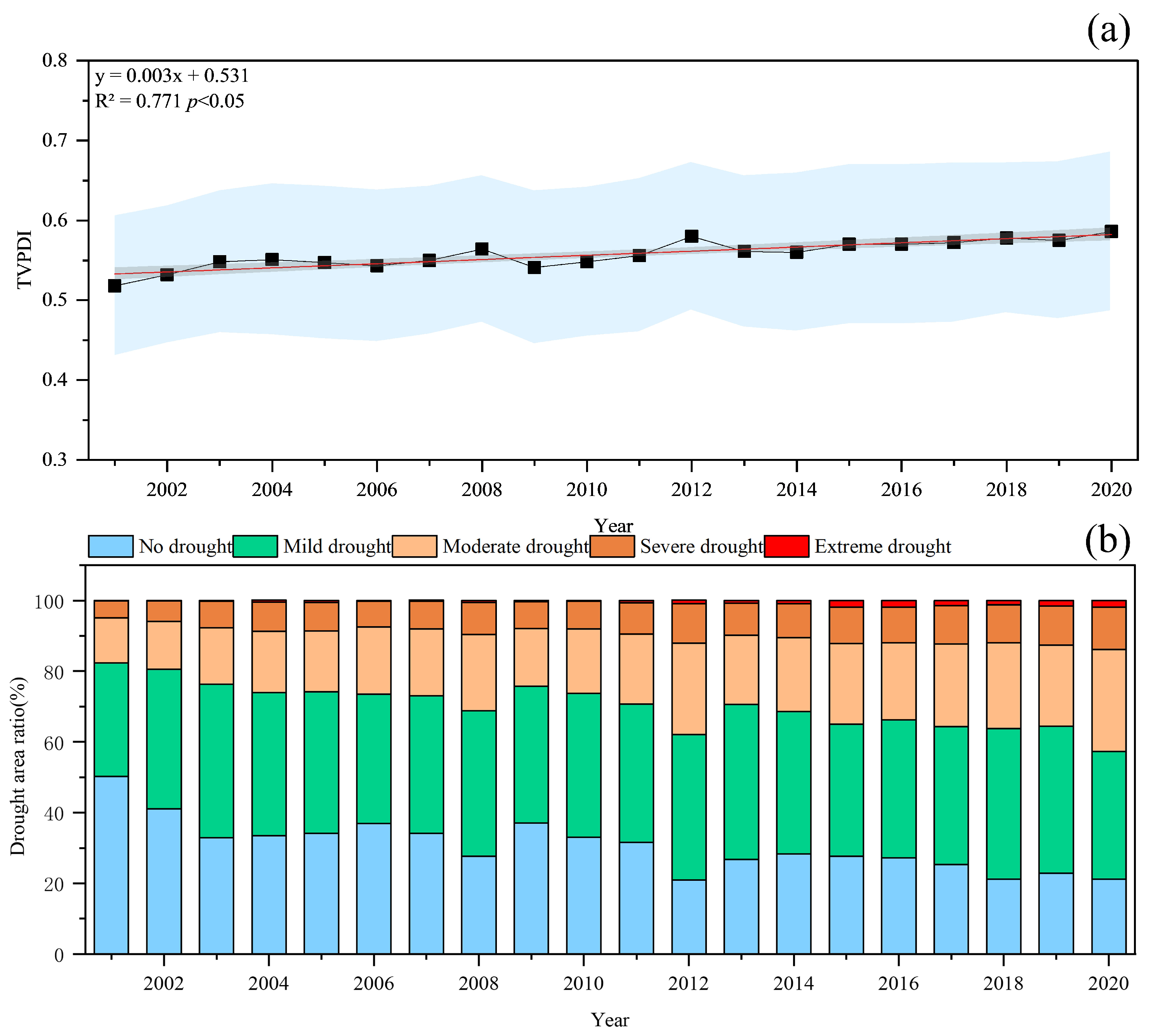
From 2001 to 2020, following the “Grain for Green” initiative, the LP was in a state of mild drought (Figure 6). This is evidenced by an average annual TVPDI of 0.557. Over the study period, the drought situation showed a statistically significant drying trend (p < 0.05), with the TVPDI increasing by 13.127%. The severity of the drought fluctuated considerably, reaching peak levels in 2008 and 2012, with periods of relative relief in 2005, 2009, 2013, and 2014. Spatially, areas classified with “light drought” constituted the largest proportion, followed by areas with “no drought”. However, this pattern shifted in 2012, when light and moderate drought areas became dominant before receding slightly in the subsequent years. A clear inverse relationship was observed between drought severity and eWUE. From 2001 to 2012, as the drought worsened, eWUE decreased. Conversely, from 2013 to 2020, a slight easing of drought conditions corresponded with a slight increase in eWUE. Based on this distinct temporal pattern, the study divides the analysis into two periods to better understand the eWUE–drought correlation: the primary drought period (2001–2012) and the post-drought recovery period (2013–2020).
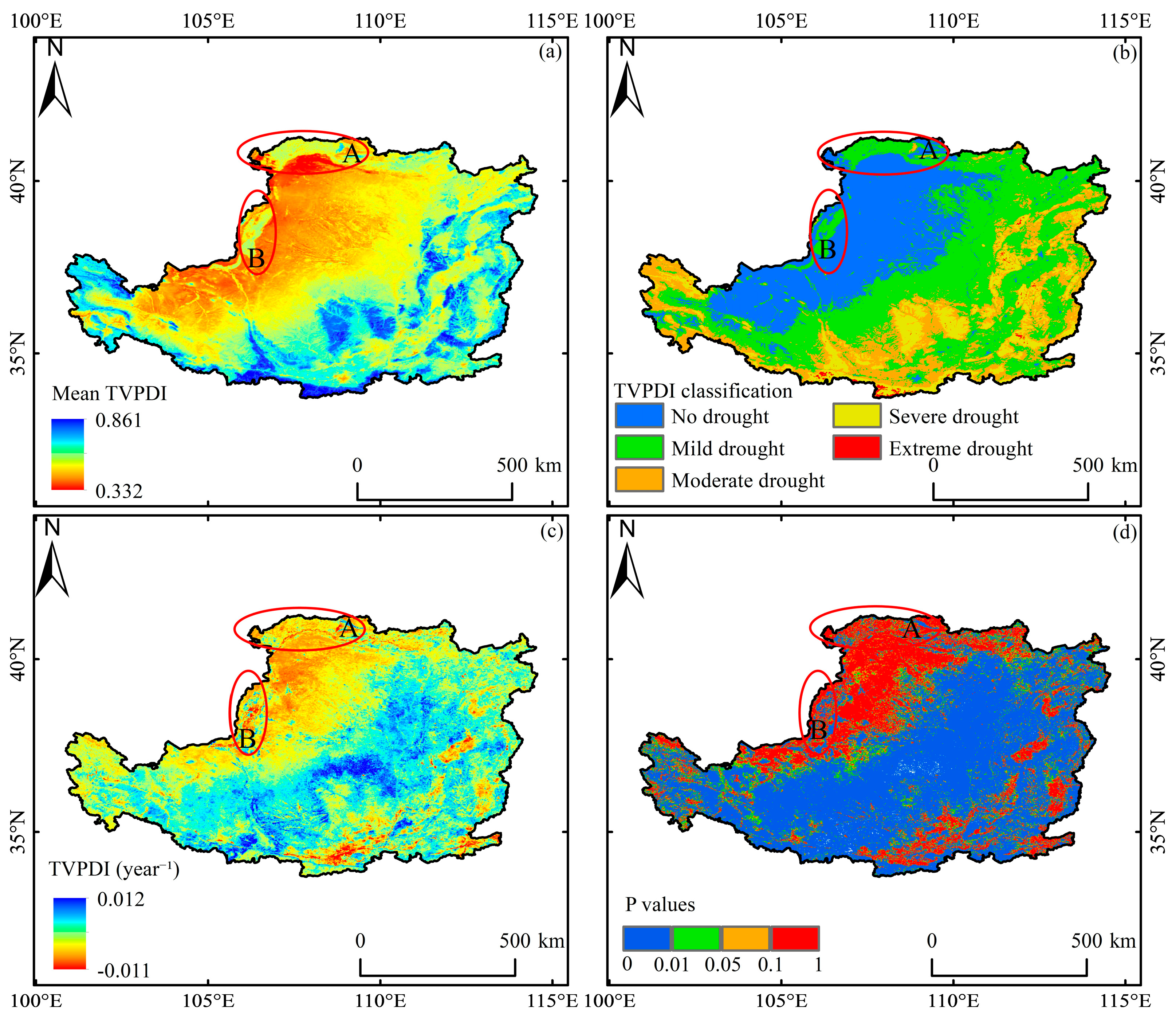
Most areas of the LP were subjected to no or light drought, and the spatial distribution of the TVPDI varied (Figure 7a). The spatial distribution of TVPDI increased gradually from northwest to southeast; that is, the drought degree increased gradually. The maximum value of TVPDI was sporadically distributed in the south, basically above 0.8. The minimum value of TVPDI was concentrated around the Hetao Irrigation Area in Inner Mongolia (A) and the Yellow River Irrigation Area in Ningxia (B), and TVPDI was basically less than 0.5 (Figure 7b). From the changing trend, the fitting slope of TVPDI was −0.011~0.012 year−1 (Figure 7c), and the areas where TVPDI showed a drying (upward) and wetting (downward) trend accounted for 69.31% and 30.69%, respectively. In some areas of central and southern China, ET increased significantly, while in some areas of northern China, TVPDI decreased. The increase in the TVPDI tendency rate had a certain corresponding relationship with the distribution of the TVPDI average value, among which the fields where TVPDI exhibited a substantial upward and downward trend explained 41.36% and 23.17%, respectively (Figure 7d).

3.3. Response of eWUE to TVPDI Changes

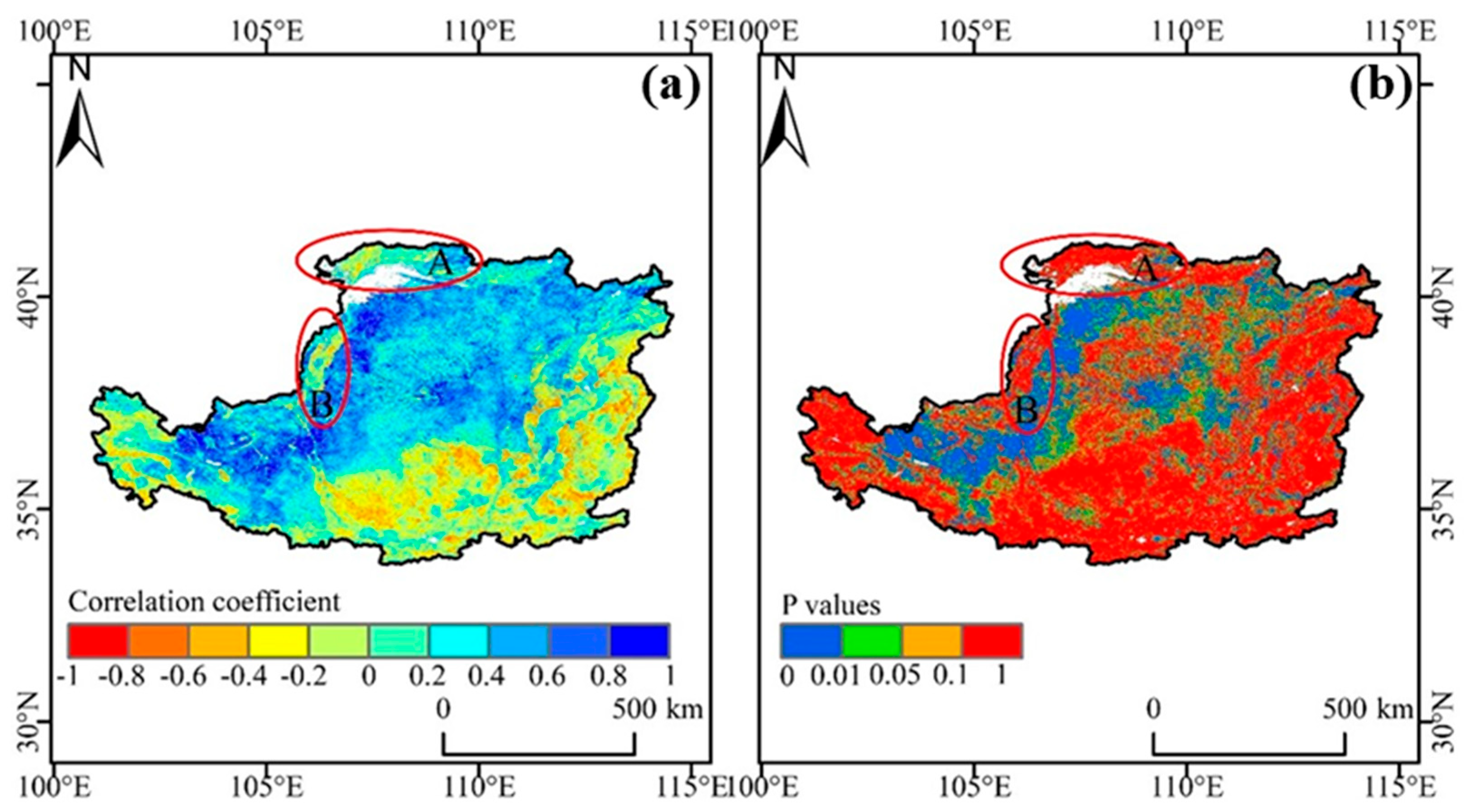
The response of eWUE to TVPDI on the LP was high, and 69.636% of the regional correlations were positive, primarily distributed in the north-central part of the research field. The average value of the positive correlation coefficients was 0.405, among which 29.5% of the regions exhibited significantly positive correlations(Figure 8). The negative correlation area was small, primarily distributed in the south-central section of the research field, the Ningxia Yellow River Irrigation Area and the Inner Mongolia Hetao Irrigation Area, accounting for only 30.364% of the total area, of which 4.5% showed a significant negative correlation.
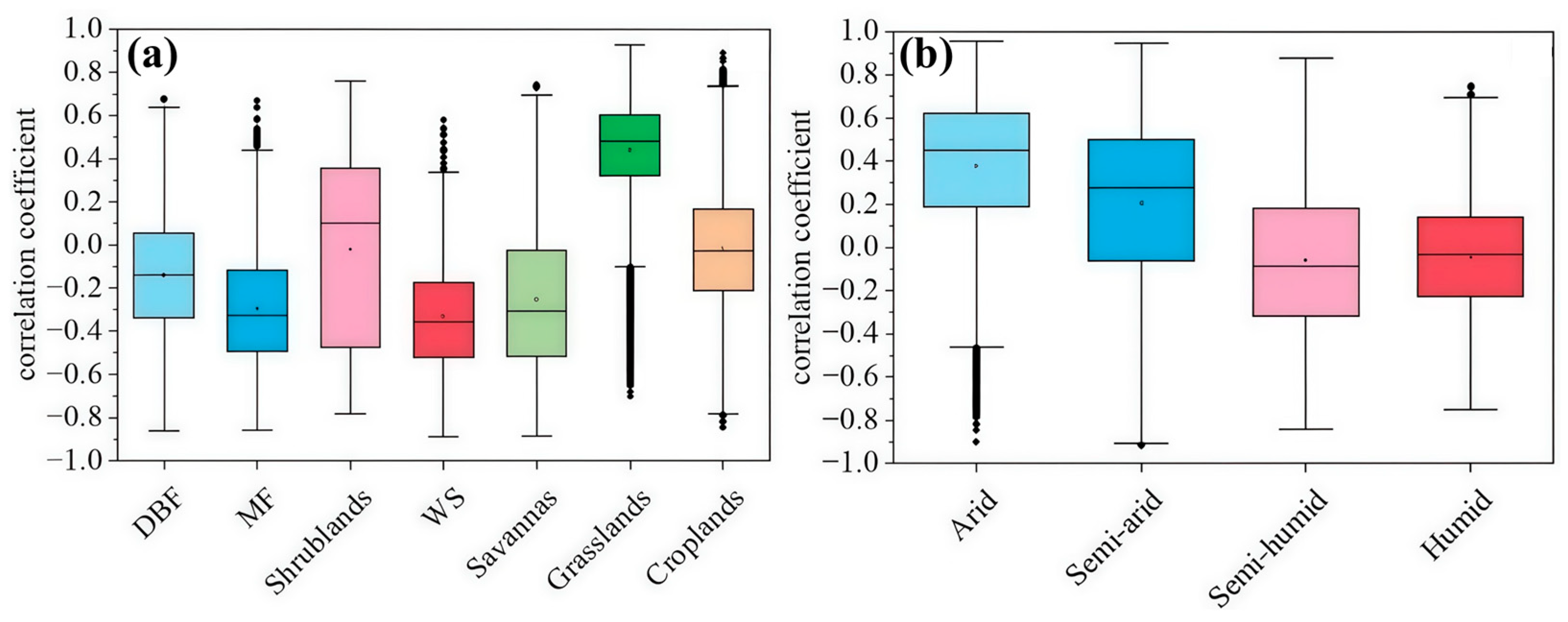
The analysis of vegetation-specific correlations revealed a general inverse relationship between eWUE and TVPDI across most vegetation types(Figure 9). A notable exception was observed for shrublands and grasslands, which exhibited a positive correlation. Specifically, grassland showed the strongest positive correlation (0.415), whereas woody savannas displayed the most negative correlation (−0.301). Furthermore, an analysis across climatic regions indicated that the correlation strength decreased consistently with increasing aridity index (AI).

3.4. Hysteresis Effect of Drought on eWUE

3.4.1. Correlation Between eWUE and TVPDI and Legacy Effects of Drought from 2001 to 2012

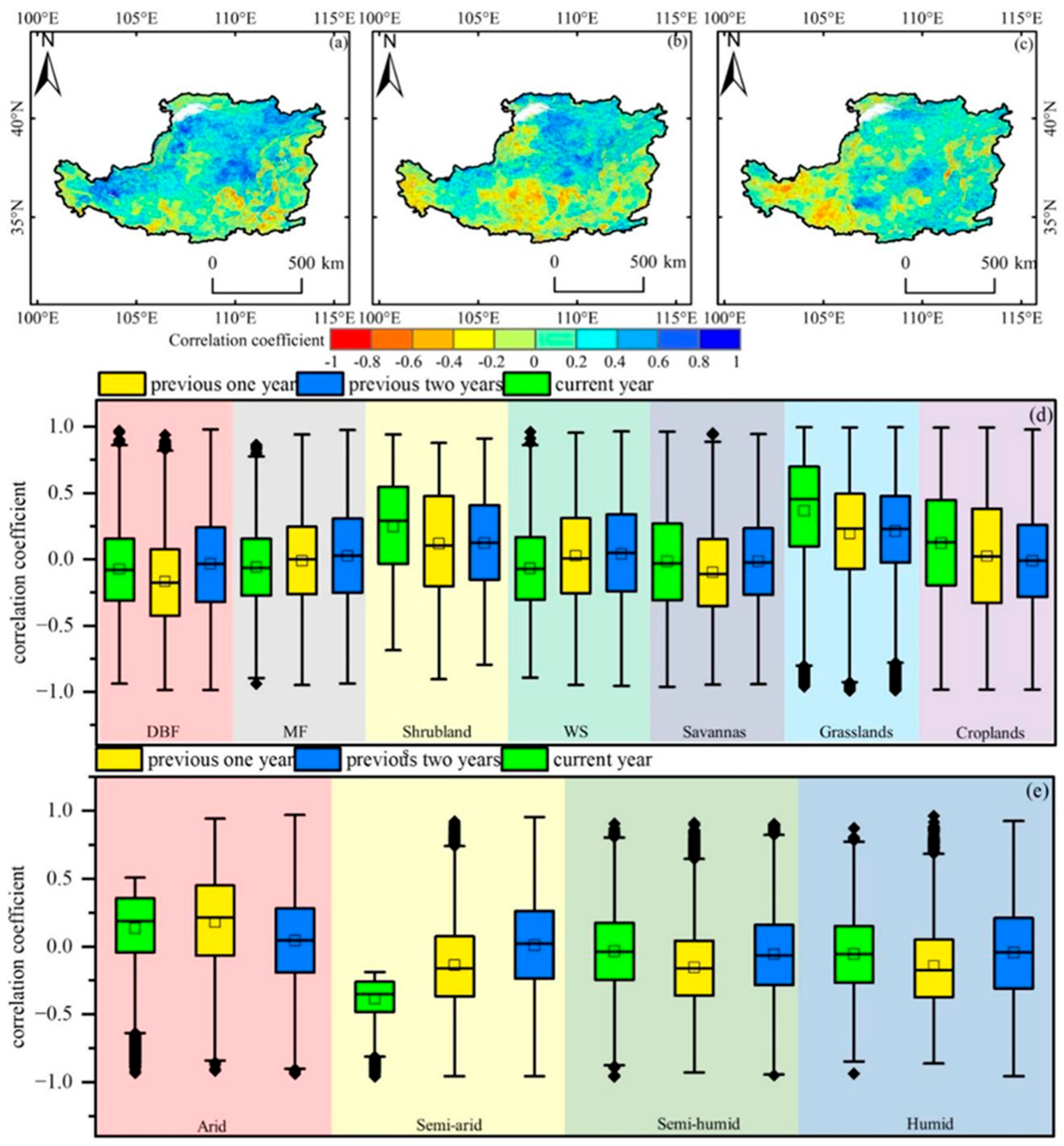
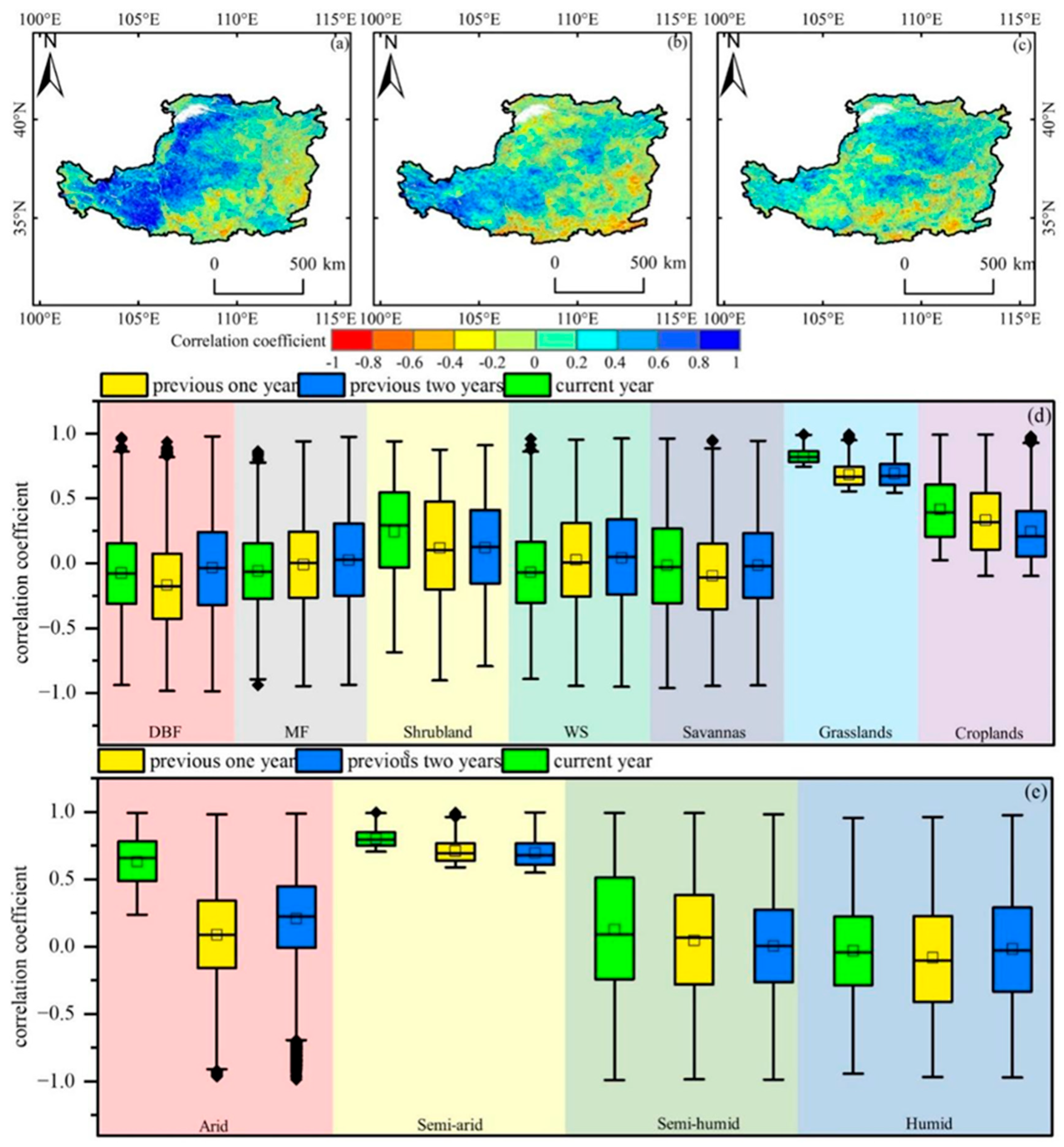
Spatially, the correlation between eWUE and drought during the 2001–2012 period showed clear geographic divisions. A consistent negative correlation was observed in contiguous belts across eastern Shanxi, most of Shaanxi, and southwestern Ordos, a pattern that held for current and lagged drought conditions. In contrast, areas including Lanzhou, northern Ordos, and Yulin in Shaanxi exhibited a positive correlation(Figure 10). The legacy of drought was also spatially variable, with some regions shifting from a positive to a negative correlation when the drought lag was extended to two years.
The response to drought varied significantly among different vegetation types, revealing complex, system-specific patterns. Shrublands and grasslands consistently showed a positive eWUE–drought relationship across current and lagged timeframes, indicating strong carbon–water coupling in these open-canopy systems. Conversely, savannas displayed a persistent negative correlation across all periods, suggesting a high sensitivity to moisture deficits. Forested ecosystems and croplands demonstrated notable lag-dependent responses: deciduous broadleaf forests (DBF), mixed forests (MF), and woody savannas (WS) shifted from a negative correlation with recent drought to a positive one with two-year lagged drought. Croplands, however, transitioned from a positive to a negative correlation when assessed against a two-year lag, likely reflecting management practices.
Analysis by climatic zones reinforced these trends and highlighted a gradient in ecosystem response times. In arid regions, eWUE was positively correlated with drought across all three time windows. In semiarid zones, the strongest correlation occurred with a two-year drought lag, implying a pronounced multi-year memory in the ecosystem’s response. In contrast, semihumid and humid zones showed the highest correlation with current-year drought, indicating a more immediate, short-lag response to water stress in wetter environments.

3.4.2. Correlation Between eWUE and TVPDI and Legacy Effects of Drought Between 2013 and 2020

Spatially, the analysis reveals a consistent pattern of negative correlation between eWUE and drought, concentrated across most of Shanxi, southern Shaanxi, and the major irrigation districts of Hetao (Inner Mongolia) and the Yellow River (Ningxia). This negative relationship held true not only for drought in the current year but also for droughts lagged by one and two years(Figure 11). In direct contrast, the northwestern part of the study area exhibited positive correlations with current and one-year lagged droughts. Intriguingly, some subregions demonstrated evolving legacy effects, shifting from a negative to a positive correlation when the drought lag increased from one to two years.
When stratified by vegetation type, the eWUE–drought relationship showed significant divergence. Shrublands, grasslands, and croplands consistently displayed a positive correlation across all time lags (current, previous 1, and previous 2 years). Conversely, DBF and savannas maintained a stable inverse relationship for all three periods. MF and WS exhibited a clear lag-dependent sensitivity; they were negatively correlated with current-year drought but shifted to a positive correlation with droughts from the preceding one and two years.
The response also varied clearly across climatic zones. In arid and semiarid regions, eWUE was consistently and positively correlated with drought across all three time windows. In humid regions, the opposite was true, with a consistently negative correlation observed for all lags. Semihumid areas presented a mixed pattern, showing positive correlations for current and one-year lagged drought, which then became negative for the two-year lag. Collectively, these results highlight the strong spatial heterogeneity and pronounced, multi-year legacy effects that govern the coupling of eWUE and drought across the region’s diverse ecosystems and climates.

4. Discussion

4.1. The Rationality of the Drought Level Thresholds of TVPDI

As a drought monitoring indicator that integrates temperature and vegetation phenological characteristics, the threshold setting of TVPDI needs to comprehensively consider regional climatic background, vegetation response traits, and the statistical patterns of historical drought events. Similar classification logic has been widely adopted in classical drought indices such as SPEI and PDSI [44]. Existing studies have shown that the Loess Plateau, located in the transitional zone from semiarid to semihumid climates, is highly sensitive to water stress. The rationality of the TVPDI classification is primarily reflected in its strong consistency with actual drought conditions in the region. For example, Wei, et al. [45] found that when the TVPDI value is below 0.5, vegetation growth aligns well with water availability, indicating a non-drought state. Once the value exceeds 0.5, vegetation phenology begins to show delays or growth limitations, consistent with mild drought-related water deficits. In addition, Zhang, et al. [46] compared the responses of the Standardized Precipitation Evapotranspiration Index and TVPDI and reported that a TVPDI range of 0.6–0.7 corresponds to moderate water stress, during which crop yields may decline significantly. When the TVPDI rises above 0.7, vegetation cover and ecosystem functioning experience intensified degradation, closely matching the frequency of historical severe drought events [47]. The extreme-drought category above 0.8 reflects conditions of extreme water scarcity, under which vegetation degradation and land productivity loss become markedly more likely; similar responses were observed during the prolonged drought around the year 2000 [48]. This classification scheme effectively captures the full progression of drought on the Loess Plateau—from seasonal water shortages to extreme drought—ensuring practical and reliable monitoring and assessment outcomes.

4.2. Temporal and Spatial Heterogeneity of eWUE

Since farmland was returned to forest (grassland), large-scale vegetation restoration has led to changes in hydrological characteristics and carbon–water coupling relationships on the LP, which have been fed back to the ecosystem. However, after comprehensively considering the “consumption” and “utilization” of water resources, it was found that the vegetation restoration project has significantly improved the vegetation coverage [49] and effectively improved the eWUE of the vegetation [50]. Complex geomorphological features and differences in water and heat have created the attributes of high vegetation types in the south and low vegetation types in the north. Region-specific vegetation composition, structure, and functional traits largely govern the observed southeast-to-northwest decline in eWUE across the study domain; this biogeographic control is consistent with patterns driven by climate, soils, and land-use mosaics documented by Yu, et al. [51], Wang, et al. [52] and Yang, et al. [53]. The interannual variation in eWUE showed a fluctuating trend, with a significant declining period from 2001 to 2012 and a significant increasing period from 2013 to 2020. The mean value of eWUE for several years was 1.302 g m−2 mm−1, which was primarily related to the control influence of evapotranspiration ET, the development of transforming-farmland-to-forest projects, and the change in surface wetness [54]. Specifically, from 2000 to 2003, it was in the initial application stage of the project in which farmland was transformed into forest, the vegetation coverage was relatively low, and GPP changed little, but ET increased most obviously, so the vegetation eWUE decreased significantly. After more than 10 years of forest (grass) restoration, the vegetation coverage increased significantly from 2013 to 2020. In addition, during this period, the precipitation was high, the temperature was low, the water availability increased [55,56], and the GPP of the vegetation increased more than the ET, so the eWUE of the vegetation showed an obvious increasing trend.
Woody savannas had the highest eWUE on the LP, followed by mixed forests, savannas, deciduous broadleaf forests, croplands, shrublands, and grasslands. The main reason is that the forests are mostly tall arbor vegetation, with high leaf area index and canopy coverage, intense photosynthesis of leaves, and developed arbor roots, which enables access to deep soil moisture, sustaining adequate water supply for tree-dominated stands, while promoting greater accumulation of organic matter through enhanced productivity and litter inputs; together, these processes strengthen water–carbon coupling and canopy assimilation capacity, constituting a primary mechanistic driver of elevated GPP in such ecosystems [57, 58, 59]. Good vegetation development conditions enhance the water consumption needed for photosynthesis and transpiration, which is a necessary condition for high ET, and this mechanistic explanation further underpins the greater eWUE observed in forests compared with other vegetation formations, as their higher leaf area, deeper rooting, and sustained photosynthesis confer superior water–carbon coupling under variable moisture regimes [60]. Shrub vegetation is the main vegetation type for ecological restoration and management in arid/semiarid fields and is mostly distributed in regions with poor site conditions. The local soil moisture shortage leads to its low coverage and leaf area index, and the ecosystem water consumption is mostly utilized for soil evaporation rather than vegetation photosynthesis, so eWUE was at a low level [61,62]. Although there exists a slight distinction between grassland and shrub eWUE, their ET and GPP are different. Grassland has low vegetation coverage and ecosystem productivity, but more importantly, vegetation coverage plays an important role in regulating ET, and soil evaporation contributes more to evapotranspiration and is the direct cause of low GPP and the main driver of low ET, so eWUE is the lowest [63,64,65]. However, this study determined that the eWUE of evergreen shrubs was the highest, and the eWUE of grasslands was the lowest because the growth of vegetation is impacted by local climatic conditions, distinct areas, and diverse climatic conditions, and the same physiological and ecological vegetation types will be different.
The spatial distribution of eWUE is coherent with the distribution pattern in dry and wet areas. This pattern arises in humid regions where precipitation is abundant, supporting a larger leaf area index and vigorous photosynthetic activity; together, these factors enhance canopy assimilation capacity and thus elevate GPP relative to drier climates. However, the shielding effect of higher vegetation coverage on soil can lead to a decrease in ET, so eWUE is higher [66]. In arid areas, there is little rainfall, sparse vegetation, and high soil evapotranspiration, so little water infiltrates into soil for the growth of vegetation and eWUE decreases [67]. With the decrease in drought (expressed by AI), eWUE first decreased and then increased, and semiarid zones exhibited a faster increase in eWUE relative to semihumid and humid counterparts, indicating stronger gains under water-limited conditions, possibly driven by physiological acclimation, resource reallocation, and community shifts.

4.3. eWUE Response to Drought

The eWUE response to drought is an incredibly complicated process that is impacted by many biological and environmental factors. There was a positive correlation between eWUE and TVPDI since the LP has less yearly precipitation and has an uneven spatial and temporal distribution. The growth of vegetation is always limited by precipitation, which indicates that vegetation growth is highly sensitive to shifts in drought intensity, with measurable impacts on physiological functioning and productivity across seasons, phenological stages, and ecological settings. There are great distinctions in the sensitivity of diverse vegetation types to changes in drought and their ability to resist drought, which depends on the different sensitivities of the GPP and evapotranspiration of ecosystems to drought. Not only does it reduce the soil water content, but it also decreases GPP and ET under drought [68]. In Inner Mongolia, analyses of grassland ecosystems show that eWUE responds negatively to standardized drought indices, indicating that sustained moisture deficits suppress, to a measurable extent, vegetation water use efficiency, with effect sizes varying across seasons, subregions, and classes of drought intensity, mainly because grassland plants have shallow roots and a weak water storage capacity during rainfall, resulting in a strong response of grassland eWUE to drought, and its sensitivity to short-term drought is stronger than that to long-term drought. Although there was a high correlation between eWUE and TVPDI in the LP grassland and eWUE increased in most areas of the whole region under the condition of drought, it cannot be proven that the deepening of the drought degree is the driving factor that decreases GPP more than ET in the LP grassland. Therefore, the effects of drought on eWUE warrant in-depth investigation, with attention to mechanisms, temporal lags, spatial heterogeneity, and cross-biome comparability.
Across the LP, the eWUE–drought relationship varied markedly among climatic zones. Systems occupying arid environments generally displayed greater sensitivity to drought intensity than landscapes classified as semiarid, semihumid, or humid, indicating stronger evaporative control, tighter moisture constraints, and reduced buffering capacity against water deficits in the driest portions of the region. In general, the drought that affected eWUE had an impact on the productivity of the ecosystem and evapotranspiration to different extents. Nevertheless, under diverse hydrothermal restrictions, the productivity and evapotranspiration of different biological types show different sensitivities to drought [69]. Continuous drought leads to a slight impact on the growth of vegetation in arid regions since the vegetation in such areas has a more flexible response to drought and can adapt well to drought [70]. Alternatively, reduced vegetation cover in arid regions increases bare-soil exposure, weakens shading and litter insulation, and lowers aerodynamic resistance, thereby amplifying soil evaporation. As a result, evapotranspiration becomes more sensitive to shifts in water availability and atmospheric drivers, responding more sharply to hydrological and climatic variability across space and time. In contrast, in regions characterized by semiaridity and semihumidity, the functions and activities of ecosystems rely on a large water supply. Therefore, variability in eWUE within drylands is, in most cases, constrained primarily by evaporative losses, with limited moisture supply and strong atmospheric demand imposing a dominant control on the magnitude and direction of observed fluctuations, while the regions characterized by semiaridity and semihumidity are primarily governed by assimilation (GPP). Different alterations in GPP and evapotranspiration cause the diverse sensitivities of eWUE to drought in distinct climatic areas.
Persistent water deficits across both dry and humid climates alter how strongly eWUE responds to drought. In xeric ecosystems, plant communities frequently possess adaptive traits—rapid stomatal regulation, plastic rooting depth, osmotic adjustment, and flexible carbon allocation—that facilitate swift adjustment to fluctuating water supply, thereby enabling prompt functional responses when moisture conditions shift. By contrast, mesic systems typically show dampened or delayed sensitivity because prior selection pressure for acute drought response is weaker, although prolonged scarcity can still reshape physiological behavior and productivity. Overall, sustained shortages modulate eWUE sensitivity, with arid-zone vegetation exhibiting inherently quicker reaction capacities to changing hydrological regimes. When water resources are below the benchmark for a short duration, vegetation will adapt quickly. In humid regions, vegetation is generally not subjected to water stress, and its reaction to drought differs from the physiological mechanism of an arid biological community in response to a short-duration scale [71]. In contrast, the response of biological communities in areas characterized by aridity and semihumidity to drought occurs on a long-duration scale since plants can be water-limited [72]. Additionally, multiple studies have identified a complex, often non-linear linkage between vegetation activity and drought within water-surplus landscapes. In mesic environments, plant responses to deficit conditions are readily modulated by phenological state, including evaporative stress, the timing and duration of active leaf flushing, and associated developmental transitions, which together can mask or accentuate observed sensitivities [73]. In addition, the plant tissue structure in damp areas can be destroyed by drought. Nevertheless, when the dry period ends, the vegetation in damp areas can be quickly restored to its prior condition. Therefore, plant communities occupying dry climates display heightened sensitivity to water deficits compared with those situated in humid, moisture-rich regions, where abundant precipitation buffers stress and dampens the magnitude of drought-induced impacts on physiological functioning and productivity.

4.4. Drought Legacy Effect of eWUE

Studies have shown that when vegetation is stressed by drought, the root length and stomatal conductance of leaves will change to some extent, which makes the photosynthetic rate, transpiration rate, and respiration of vegetation decline [74]. This study found that the period from 2008 to 2012 was a continuous drought period, which represented a long duration, a large influence range, and a heavy drought degree. Then, the drought trend eased somewhat in 2013, but eWUE remained low in 2013 and 2014. The reason for the low eWUE is the legacy effect of drought, which has been found in many prior investigations and is related to the drought’s influence on eWUE. Nevertheless, most of these investigations employed a comparison framework to account for the association between eWUE and drought in the previous year. In this study, relationships between eWUE and drought were evaluated for the present year and for lag periods of one and two years; across the study region, the resulting correlation maps displayed broadly consistent spatial patterns, indicating temporally persistent, similarly distributed linkages across these windows. The drought in the previous 2 years had a higher correlation when compared with the drought-pertinent association in the current year, and the response direction of eWUE was coherent across most vegetation types. The outcome indicated that eWUE in most vegetation regions under drought was impacted by drought that occurred 1 or 2 years ago. Prior studies have shown that arid plants can cope with an environment with limited water sources by decreasing aboveground biomass and even becoming dormant in consecutive years with no extra water sources, and the biomass will increase quickly once water is adequate. Nevertheless, declining soil moisture seriously leads to consecutive drought years, and one-year reclamation is insufficient to supply adequate water to satisfy the fundamental physiological uptake to grow vegetation.
In the study, water use efficiency decreased during the drought period, which indicated that the drought ecosystem had a poor resistance to drought, which may also be the plants’ survival strategy when drought exists. After drought lessened, the ecosystem was very sensitive to sudden alterations, and the observed rise in eWUE across multiple vegetation functional groups further implies that ecosystems dominated by arid conditions retain a measure of resilience, with physiological acclimation, resource reallocation, and community composition shifts jointly buffering stress and supporting partial recovery following drought episodes, which is consistent with the results of a prior investigation. eWUE plays a connecting role between biological communities and ecosystems, and they adapt to changing hydrological and climatic conditions by adjusting their eWUE. In arid areas, as long as the water conditions are suitable, the ecosystem can adjust itself to revert to the pre-drought conditions after harsh and persistent drought.

4.5. Understanding and Limitations

In water-limited ecosystems, the TVPDI is widely regarded as an effective proxy for characterizing soil moisture dynamics due to its intrinsic linkage to regional moisture availability. On the Loess Plateau, precipitation serves as the primary source of soil water recharge; thus, the precipitation component embedded in TVPDI can reasonably represent the cumulative moisture inputs that shape long-term soil water conditions. The strong correlation observed between TVPDI and eWUE in this study further indicates that the index effectively captures the moisture signals that regulate variations in ecosystem water use efficiency [75]. Although direct soil moisture observations would undoubtedly provide higher spatio-temporal precision, TVPDI remains advantageous within the framework of regional-scale and long-term analyses due to its high degree of standardization, data continuity, and broad applicability. Nevertheless, several limitations should be acknowledged regarding the use of TVPDI in drought identification. First, the index integrates multiple variables—temperature, vegetation indices, and precipitation—whose relative contributions to drought formation vary across climatic regions. As a result, a fixed combination scheme may not fully accommodate regional heterogeneity. Second, vegetation indices generally exhibit a lagged response to water stress, which may hinder TVPDI’s capability to detect the onset of flash droughts in a timely manner. Third, vegetation conditions are often influenced by irrigation, fertilization, and land-use change, potentially weakening the index’s ability to distinguish meteorological drought from human-induced ecological changes. In addition, inconsistencies arising from differences in remote sensing resolution, cloud contamination, and data gaps may further affect the stability and comparability of TVPDI. Therefore, when applying TVPDI to assess regional drought or moisture conditions, it is advisable to integrate this index with other drought indicators, in situ soil moisture observations, and region-specific environmental information to enhance the scientific rigor and reliability of drought monitoring and interpretation.
Although the enhanced GPP and ET products newly marketed by MODIS were adopted in the research, some uncertainties accompany them. For example, the highest light energy usage ratio in the GPP estimation formula has a fixed value, while the actual highest light energy ratio of each vegetation type will differ [76], and the inputting of climate attributes will also cause certain errors. The uncertainty of ET products is primarily caused by the inversion algorithm, climate data, and other input attributes. In addition, owing to the limitations of MODIS product data, data analysis and the calculation time of this study only started in 2001, and the short time series limited the comprehensive analysis of the ecosystem carbohydrate cycling mechanism. However, the outcomes of the research still mirror the generic variation attributes of water use efficiency on the LP, but more precise inferences require comprehensive datasets and approaches to execute multifaceted integrated investigations and then comprehensively analyze the distribution law and basic trend of large-scale eWUE.
Seen through the lens of the broader hydrological cycle, researching vegetation eWUE is highly important for identifying drought-tolerant tree species for afforestation and for advancing ecological restoration as well as long-term sustainable development. Specifically, although the project restoring ecology has substantially improved the vegetation coverage of the LP and significantly reduced the sediment content of the Yellow River [77], the pressure caused by the large-scale return of the farmland-to-forest (grass) project on water resources on the LP continues to increase and is gradually approaching the critical threshold of regional water resource security. The resulting soil dryness problem may bring potential hidden dangers to regional ecological restoration, inhibit the further development of vegetation restoration, and then affect regional water resource security. Therefore, it is worth further study to carry out ecological restoration projects reasonably and screen suitable plants according to site conditions and niche characteristics.
Note that the long-term series of eWUE changes is a complex process. Due to the geographical particularity of the LP, eWUE is not only closely related to water and heat conditions such as temperature, precipitation, and radiation but may also be affected by human activities, the carbon dioxide concentration, nitrogen deposition, and soil moisture changes. These attributes need to be considered to examine their impacts on eWUE more comprehensively and to ensure a solid understanding to respond better to the issue of global climate change regionally.

5. Conclusions

The Loess Plateau (LP) has undergone China’s most dramatic vegetation changes in recent decades, fundamentally altering its hydrological characteristics and feedback mechanisms on ecosystem sustainability. This study successfully utilized MODIS products (GPP and ET) and the comprehensive TVPDI to diagnose the spatio-temporal dynamics and the critical drought legacy effects on eWUE across the LP. The massive “farmland-to-forest” project significantly enhanced eWUE (slope = 0.001). This improvement was driven by a greater increase in GPP compared to ET, though eWUE values were heterogeneously distributed, peaking in the wetter southeast and dipping in the northwest. Concurrently, the LP exhibited persistent moderate drought (mean TVPDI = 0.557), highlighting a core tension between greening and water scarcity. The eWUE response to drought disturbance varied fundamentally by vegetation and climatic type. High eWUE was found in arid vegetation areas, such as woody savannas. Notably, a negative correlation between eWUE and TVPDI was dominant across most vegetation types except shrublands and grasslands. Crucially, the system exhibits a pronounced legacy impact of drought, whereby eWUE is markedly influenced by moisture deficits in the current year, the immediately preceding year, and even events that occurred two years earlier. This multi-year lagged effect, evidenced by regional correlation shifts, underscores the vulnerability of the ecosystem’s long-term water budget. The demonstrated drought legacy effect necessitates a multi-year approach to water resource management, moving beyond annual planning to buffer the long-term impact of severe drought. Furthermore, the observed eWUE differences underscore the need for targeted, “right tree, right place” ecological restoration policies to optimize water usage strategies for specific plant functional types in the ecosystem.

Author Contributions

X.B. and W.W.; methodology, W.W. and S.W.; writing—review and editing, H.W.; formal analysis, X.B. and C.B.; investigation, W.W. and X.L.; resources, X.L. and Z.L.; data curation, X.B.; visualization, C.B.; supervision, S.W. and H.W.; project administration, S.W.; funding acquisition, S.W. All authors have read and agreed to the published version of the manuscript.

Funding

Special Funds for the Cultivation of Guangdong College Students’ Scientific and Technological Innovation (“Climbing Program” Special Funds, No. pdjh2025bg245); Natural Science Foundation of Inner Mongolia Autonomous Region of China (2023QN05003); Inner Mongolia Autonomous Region’s Talent Introduction and Research Support Project.

Data Availability Statement

Data are contained within the article.

Conflicts of Interest

The authors declare no conflicts of interest.

References

  1. Lavergne, A.; Graven, H.; De Kauwe, M.G.; Keenan, T.F.; Medlyn, B.E.; Prentice, I.C. Observed and modelled historical trends in the water-use efficiency of plants and ecosystems. Glob. Change Biol. 2019, 25, 2242–2257. [Google Scholar] [CrossRef]
  2. Pei, T.; Hou, Q.; Chen, Y.; Ji, Z.; Wu, H.; Xie, B.; Qi, P.; Zhang, J. Vegetation in Arid Areas of the Loess Plateau Showed More Sensitivity of Water-Use Efficiency to Seasonal Drought. Forests 2022, 13, 634. [Google Scholar] [CrossRef]
  3. Liu, Y.; Zhou, Y.; Wang, T.; Pan, J.; Zhou, B.; Muhammad, T.; Zhou, C.; Li, Y. Micro-Nano bubble water oxygation: Synergistically improving irrigation water use efficiency, crop yield and quality. J. Clean. Prod. 2019, 222, 835–843. [Google Scholar] [CrossRef]
  4. Zhao, H.; Wang, X.; Wu, C. Ecosystem water use efficiency was enhanced by the implementation of forest conservation and restoration programs in China. J. Hydrol. 2023, 617, 128979. [Google Scholar] [CrossRef]
  5. Xu, H.-J.; Wang, X.-P.; Zhao, C.-Y.; Zhang, X.-X. Responses of ecosystem water use efficiency to meteorological drought under different biomes and drought magnitudes in northern China. Agric. For. Meteorol. 2019, 278, 107660. [Google Scholar] [CrossRef]
  6. Ge, C.; Sun, S.; Yao, R.; Sun, P.; Li, M.; Bian, Y. Long-Term vegetation phenology changes and response to multi-scale meteorological drought on the Loess Plateau, China. J. Hydrol. 2022, 614, 128605. [Google Scholar] [CrossRef]
  7. Afshar, M.H.; Bulut, B.; Duzenli, E.; Amjad, M.; Yilmaz, M.T. Global spatiotemporal consistency between meteorological and soil moisture drought indices. Agric. For. Meteorol. 2022, 316, 108848. [Google Scholar] [CrossRef]
  8. Zarei, A.R.; Mahmoudi, M.R.; Moghimi, M.M. Determining the most appropriate drought index using the random forest algorithm with an emphasis on agricultural drought. Nat. Hazards 2022, 115, 923–946. [Google Scholar] [CrossRef]
  9. Faiz, M.A.; Zhang, Y.; Zhang, X.; Ma, N.; Aryal, S.K.; Ha, T.T.V.; Baig, F.; Naz, F. A composite drought index developed for detecting large-scale drought characteristics. J. Hydrol. 2022, 605, 127308. [Google Scholar] [CrossRef]
  10. Faiz, M.A.; Zhang, Y.; Tian, X.; Tian, J.; Zhang, X.; Ma, N.; Aryal, S. Drought index revisited to assess its response to vegetation in different agro-climatic zones. J. Hydrol. 2022, 614, 128543. [Google Scholar] [CrossRef]
  11. Samantaray, A.K.; Ramadas, M.; Panda, R.K. Changes in drought characteristics based on rainfall pattern drought index and the CMIP6 multi-model ensemble. Agric. Water Manag. 2022, 266, 107568. [Google Scholar] [CrossRef]
  12. Chang, X.; Wang, Z.; Wei, F.; Xiao, P.; Shen, Z.; Lv, X.; Shi, Y. Determining the Contributions of Vegetation and Climate Change to Ecosystem WUE Variation over the Last Two Decades on the Loess Plateau, China. Forests 2021, 12, 1442. [Google Scholar] [CrossRef]
  13. Vadez, V.; Pilloni, R.; Grondin, A.; Hajjarpoor, A.; Belhouchette, H.; Brouziyne, Y.; Chehbouni, G.; Kharrou, M.H.; Zitouna-Chebbi, R.; Mekki, I. Water Use Efficiency (WUE) across scales: From genes to landscape. J. Exp. Bot. 2023, 74, 4770–4788. erad052. [Google Scholar] [CrossRef]
  14. Zhang, Q.; Wang, S.; Sun, Y.; Zhang, Y.; Li, H.; Liu, P.; Wang, X.; Wang, R.; Li, J. Conservation tillage improves soil water storage, spring maize (Zea mays L.) yield and WUE in two types of seasonal rainfall distributions. Soil Tillage Res. 2022, 215, 105237. [Google Scholar] [CrossRef]
  15. Liu, Y.; Zhou, R.; Wen, Z.; Khalifa, M.; Zheng, C.; Ren, H.; Zhang, Z.; Wang, Z. Assessing the impacts of drought on net primary productivity of global land biomes in different climate zones. Ecol. Indic. 2021, 130, 108146. [Google Scholar] [CrossRef]
  16. Guo, L.; Shan, N.; Zhang, Y.; Sun, F.; Liu, W.; Shi, Z.; Zhang, Q. Separating the effects of climate change and human activity on water use efficiency over the Beijing-Tianjin Sand Source Region of China. Sci. Total Environ. 2019, 690, 584–595. [Google Scholar] [CrossRef] [PubMed]
  17. Zhang, F.; Ju, W.; Shen, S.; Wang, S.; Yu, G.; Han, S. How recent climate change influences water use efficiency in East Asia. Theor. Appl. Climatol. 2014, 116, 359–370. [Google Scholar] [CrossRef]
  18. Zou, J.; Ding, J.; Welp, M.; Huang, S.; Liu, B. Assessing the Response of Ecosystem Water Use Efficiency to Drought During and after Drought Events across Central Asia. Sensors 2020, 20, 581. [Google Scholar] [CrossRef]
  19. Tang, X.; Li, H.; Xu, X.; Luo, J.; Li, X.; Ding, Z.; Xie, J. Potential of MODIS data to track the variability in ecosystem water-use efficiency of temperate deciduous forests. Ecol. Eng. 2016, 91, 381–391. [Google Scholar] [CrossRef]
  20. Ito, A.; Inatomi, M. Water-Use Efficiency of the Terrestrial Biosphere: A Model Analysis Focusing on Interactions between the Global Carbon and Water Cycles. J. Hydrometeorol. 2012, 13, 681–694. [Google Scholar] [CrossRef]
  21. Wang, F.; Jiang, H.; Zhang, X. Spatial–Temporal dynamics of gross primary productivity, evapotranspiration, and water-use efficiency in the terrestrial ecosystems of the Yangtze River Delta region and their relations to climatic variables. Int. J. Remote Sens. 2015, 36, 2654–2673. [Google Scholar] [CrossRef]
  22. Huo, A.; Yang, L.; Peng, J.; Cheng, Y.; Jiang, C. Spatial characteristics of the rainfall induced landslides in the Chinese Loess Plateau. Hum. Ecol. Risk Assess. Int. J. 2020, 26, 2462–2477. [Google Scholar] [CrossRef]
  23. Cao, S.; Zhang, L.; He, Y.; Zhang, Y.; Chen, Y.; Yao, S.; Yang, W.; Sun, Q. Effects and contributions of meteorological drought on agricultural drought under different climatic zones and vegetation types in Northwest China. Sci. Total Environ. 2022, 821, 153270. [Google Scholar] [CrossRef]
  24. Ma, N.; Zhang, Y. Contrasting trends in water use efficiency of the alpine grassland in Tibetan Plateau. J. Geophys. Res. Atmos. 2022, 127, e2022JD036919. [Google Scholar] [CrossRef]
  25. Wang, T.; Tang, X.; Zheng, C.; Gu, Q.; Wei, J.; Ma, M. Differences in ecosystem water-use efficiency among the typical croplands. Agric. Water Manag. 2018, 209, 142–150. [Google Scholar] [CrossRef]
  26. Zhao, Y.; Du, J.; Tian, Z.; Xu, W.; Deng, J.; Han, G. Study on the Application of Seismic-Based Casing Deformation Prediction Technology in Xinjiang Oil Field. In Proceedings of the 2021 China-Europe International Conference on Pipelines and Trenchless Technology, Tianjin, China, 17–19 December 2021; Springer: Singapore, 2022; pp. 59–68. [Google Scholar]
  27. Xu, P.; Zhou, T.; Zhao, X.; Luo, H.; Gao, S.; Li, Z.; Cao, L. Diverse responses of different structured forest to drought in Southwest China through remotely sensed data. Int. J. Appl. Earth Obs. Geoinf. 2018, 69, 217–225. [Google Scholar] [CrossRef]
  28. Wang, S.; Li, R.; Wu, Y.; Zhao, S. Effects of Multi-Temporal Scale Drought on Vegetation Dynamics in Inner Mongolia from 1982 to 2015, China. Ecol. Indic. 2022, 136, 108666. [Google Scholar] [CrossRef]
  29. Qin, G.; Meng, Z.; Fu, Y. Drought and water-use efficiency are dominant environmental factors affecting greenness in the Yellow River Basin, China. Sci. Total Environ. 2022, 834, 155479. [Google Scholar] [CrossRef] [PubMed]
  30. Feng, H.; Wang, S.; Zou, B.; Nie, Y.; Ye, S.; Ding, Y.; Zhu, S. Land use and cover change (LUCC) impacts on Earth’s eco-environments: Research progress and prospects. Adv. Space Res. 2022, 71, 1418–1435. [Google Scholar] [CrossRef]
  31. Jin, Q.; Zhang, J.; Shi, M.; Huang, J. Estimating loess plateau average annual precipitation with multiple linear regression kriging and geographically weighted regression kriging. Water 2016, 8, 266. [Google Scholar] [CrossRef]
  32. Guo, L.; Sun, F.; Liu, W.; Zhang, Y.; Wang, H.; Cui, H.; Wang, H.; Zhang, J.; Du, B. Response of Ecosystem Water Use Efficiency to Drought over China during 1982–2015: Spatiotemporal Variability and Resilience. Forests 2019, 10, 598. [Google Scholar] [CrossRef]
  33. Li, X.; Li, Y.; Chen, A.; Gao, M.; Slette, I.J.; Piao, S. The impact of the 2009/2010 drought on vegetation growth and terrestrial carbon balance in Southwest China. Agric. For. Meteorol. 2019, 269, 239–248. [Google Scholar] [CrossRef]
  34. Reichstein, M.; Ciais, P.; Papale, D.; Valentini, R.; Running, S.; Viovy, N.; Cramer, W.; Granier, A.; Ogée, J.; Allard, V. Reduction of ecosystem productivity and respiration during the European summer 2003 climate anomaly: A joint flux tower, remote sensing and modelling analysis. Glob. Change Biol. 2007, 13, 634–651. [Google Scholar] [CrossRef]
  35. Yang, S.; Zhang, J.; Zhang, S.; Wang, J.; Bai, Y.; Yao, F.; Guo, H. The potential of remote sensing-based models on global water-use efficiency estimation: An evaluation and intercomparison of an ecosystem model (BESS) and algorithm (MODIS) using site level and upscaled eddy covariance data. Agric. For. Meteorol. 2020, 287, 107959. [Google Scholar] [CrossRef]
  36. Huang, L.; He, B.; Han, L.; Liu, J.; Wang, H.; Chen, Z. A global examination of the response of ecosystem water-use efficiency to drought based on MODIS data. Sci. Total Environ. 2017, 601–602, 1097–1107. [Google Scholar] [CrossRef]
  37. Ma, R.; Wang, D.; Cui, X.; Yao, X.; Li, S.; Wang, H.; Liu, B. Distribution and Driving Force of Water Use Efficiency under Vegetation Restoration on the Loess Plateau. Remote Sens. 2022, 14, 4513. [Google Scholar] [CrossRef]
  38. Gong, F.; Du, L.; Meng, C.; Dan, Y.; Wang, L.; Zheng, Q.; Ma, L. Characteristics of water use efficiency in terrestrial ecosystems and its influence factors in Ningxia Province. Acta Ecol. Sin 2019, 39, 9068–9078. [Google Scholar]
  39. Wang, W.; Wu, Y.; Wang, S.; Yin, H.; Li, W.; Zhao, S. Seasonal Variations of Ecosystem Water Use Efficiency and Their Responses to Climate Factors in Inner Mongolia of China. Atmosphere 2022, 13, 2085. [Google Scholar] [CrossRef]
  40. Yang, Y.; Feng, Z.; Wu, K.; Lin, Q. How to construct a coordinated ecological network at different levels: A case from Ningbo city, China. Ecol. Inform. 2022, 70, 101742. [Google Scholar] [CrossRef]
  41. Wei, W.; Shi, S.; Zhang, X.; Zhou, L.; Xie, B.; Zhou, J.; Li, C. Regional-scale assessment of environmental vulnerability in an arid inland basin. Ecol. Indic. 2020, 109, 105792. [Google Scholar] [CrossRef]
  42. Tian, Q.; Lu, J.; Chen, X. A novel comprehensive agricultural drought index reflecting time lag of soil moisture to meteorology: A case study in the Yangtze River basin, China. Catena 2022, 209, 105804. [Google Scholar] [CrossRef]
  43. Wu, Y.; Wang, W.; Li, W.; Zhao, S.; Wang, S.; Liu, T. Assessment of the spatiotemporal characteristics of vegetation water use efficiency in response to drought in Inner Mongolia, China. Environ. Sci. Pollut. Res. 2022, 30, 6345–6357. [Google Scholar] [CrossRef] [PubMed]
  44. Vicente-Serrano, S.M.; Beguería, S.; López-Moreno, J.I. A multiscalar drought index sensitive to global warming: The standardized precipitation evapotranspiration index. J. Clim. 2010, 23, 1696–1718. [Google Scholar] [CrossRef]
  45. Wei, W.; Zhang, J.; Zhou, L.; Xie, B.; Zhou, J.; Li, C. Comparative evaluation of drought indices for monitoring drought based on remote sensing data. Environ. Sci. Pollut. Res. 2021, 28, 20408–20425. [Google Scholar] [CrossRef] [PubMed]
  46. Zhang, X.; Wei, W.; Liu, T.; Lu, D.; Wang, J.; Yan, P.; Xie, B.; Zhou, L.; Zhou, J.; Zhang, H. Construction of Temperature-Vegetation-Precipitation Dryness Index (TVPDI) and Dry–Wet Condition Monitoring Across China. Int. J. Climatol. 2025, 45, e70025. [Google Scholar] [CrossRef]
  47. Wei, W.; Wang, J.; Wang, X.; Yan, P.; Xie, B.; Zhou, J.; Liu, T.; Lu, D. The response of global terrestrial water storage to drought based on multiple climate scenarios. Atmos. Res. 2024, 303, 107331. [Google Scholar] [CrossRef]
  48. Zhang, Y.; Liu, X.; Jiao, W.; Zeng, X.; Xing, X.; Zhang, L.; Yan, J.; Hong, Y. Drought monitoring based on a new combined remote sensing index across the transitional area between humid and arid regions in China. Atmos. Res. 2021, 264, 105850. [Google Scholar] [CrossRef]
  49. Xu, H.J.; Wang, X.P.; Zhao, C.Y.; Yang, X.M. Assessing the response of vegetation photosynthesis to meteorological drought across northern China. Land Degrad. Dev. 2020, 32, 20–34. [Google Scholar] [CrossRef]
  50. Cleverly, J.; Eamus, D.; Van Gorsel, E.; Chen, C.; Rumman, R.; Luo, Q.; Coupe, N.R.; Li, L.; Kljun, N.; Faux, R. Productivity and evapotranspiration of two contrasting semiarid ecosystems following the 2011 global carbon land sink anomaly. Agric. For. Meteorol. 2016, 220, 151–159. [Google Scholar] [CrossRef]
  51. Yu, X.; Yin, Q.; Zhao, T.; Chen, K.; Qian, L.; Wang, W.; Hu, X.; Zhang, B. Detecting ecosystem water use efficiency responses to drought from long-term remote sensing data. Ecol. Indic. 2025, 177, 113734. [Google Scholar] [CrossRef]
  52. Wang, Y.; Gao, G.; Huang, Y.; Wang, Z.; Fu, B. Ecosystem water use efficiency and carbon use efficiency respond oppositely to vegetation greening in China’s Loess Plateau. Sci. Total Environ. 2025, 964, 178575. [Google Scholar] [CrossRef]
  53. Yang, S.; Zhang, J.; Han, J.; Bai, Y.; Xun, L.; Zhang, S.; Cao, D.; Wang, J. The ratio of transpiration to evapotranspiration dominates ecosystem water use efficiency response to drought. Agric. For. Meteorol. 2025, 363, 110423. [Google Scholar] [CrossRef]
  54. Han, P.; Yang, X.; Bai, L.; Sun, Q. The monitoring and analysis of the coastal lowland subsidence in the southern Hangzhou Bay with an advanced time-series InSAR method. Acta Oceanol. Sin. 2017, 36, 110–118. [Google Scholar] [CrossRef]
  55. Zhang, X.; Qiu, J.; Leng, G.; Yang, Y.; Gao, Q.; Fan, Y.; Luo, J. The potential utility of satellite soil moisture retrievals for detecting irrigation patterns in China. Water 2018, 10, 1505. [Google Scholar] [CrossRef]
  56. Wang, C.; Zhang, G. Spatial variation in sediment connectivity of small watershed along a regional transect on the Loess Plateau. Catena 2022, 217, 106473. [Google Scholar] [CrossRef]
  57. Zhang, X.; Liu, K.; Li, X.; Wang, S.; Wang, J. Vulnerability assessment and its driving forces in terms of NDVI and GPP over the Loess Plateau, China. Phys. Chem. Earth Parts A/B/C 2022, 125, 103106. [Google Scholar] [CrossRef]
  58. Tong, S.; Lai, Q.; Zhang, J.; Bao, Y.; Lusi, A.; Ma, Q.; Li, X.; Zhang, F. Spatiotemporal drought variability on the Mongolian Plateau from 1980–2014 based on the SPEI-PM, intensity analysis and Hurst exponent. Sci. Total Environ. 2018, 615, 1557–1565. [Google Scholar] [CrossRef]
  59. Liu, K.; Li, X.; Wang, S.; Zhang, X. Unrevealing past and future vegetation restoration on the Loess Plateau and its impact on terrestrial water storage. J. Hydrol. 2023, 617, 129021. [Google Scholar] [CrossRef]
  60. Cao, R.; Hu, Z.; Jiang, Z.; Yang, Y.; Zhao, W.; Wu, G.; Feng, X.; Chen, R.; Hao, G. Shifts in ecosystem water use efficiency on China’s loess plateau caused by the interaction of climatic and biotic factors over 1985–2015. Agric. For. Meteorol. 2020, 291, 108100. [Google Scholar] [CrossRef]
  61. Gao, X.; Gu, F.; Mei, X.; Hao, W.; Li, H.; Gong, D.; Li, X. Light and water use efficiency as influenced by clouds and/or aerosols in a rainfed spring maize cropland on the loess plateau. Crop Sci. 2018, 58, 853–862. [Google Scholar] [CrossRef]
  62. Yang, J.; Duan, Y.; Wang, L.; Kang, D.; Awasthi, M.K.; Li, H.; Zhang, L. Seasonal variation of net ecosystem CO2 exchange and its influencing factors in an apple orchard in the Loess Plateau. Environ. Sci. Pollut. Res. 2020, 27, 43452–43465. [Google Scholar] [CrossRef] [PubMed]
  63. Eamus, D.; Cleverly, J.; Boulain, N.; Grant, N.; Faux, R.; Villalobos-Vega, R. Carbon and water fluxes in an arid-zone Acacia savanna woodland: An analyses of seasonal patterns and responses to rainfall events. Agric. For. Meteorol. 2013, 182, 225–238. [Google Scholar] [CrossRef]
  64. Zhang, F.; Li, C.; Wang, Z.; Glidden, S.; Grogan, D.S.; Li, X.; Cheng, Y.; Frolking, S. Modeling impacts of management on farmland soil carbon dynamics along a climate gradient in Northwest China during 1981–2000. Ecol. Model. 2015, 312, 1–10. [Google Scholar] [CrossRef]
  65. de Oliveira, G.; Brunsell, N.A.; Moraes, E.C.; Shimabukuro, Y.E.; Bertani, G.; dos Santos, T.V.; Aragao, L.E.O.C. Evaluation of MODIS-based estimates of water-use efficiency in Amazonia. Int. J. Remote Sens. 2017, 38, 5291–5309. [Google Scholar] [CrossRef]
  66. Wang, T.; Zhang, H.; Jianjun, Z.; Guo, X.; Tong, S. Estimation of water-use efficiency based on satellite for the typical croplands. IEEE Access 2020, 8, 220533–220541. [Google Scholar] [CrossRef]
  67. He, B.; Wang, H.; Huang, L.; Liu, J.; Chen, Z. A new indicator of ecosystem water use efficiency based on surface soil moisture retrieved from remote sensing. Ecol. Indic. 2017, 75, 10–16. [Google Scholar] [CrossRef]
  68. Wang, M.; Ding, Z.; Wu, C.; Song, L.; Ma, M.; Yu, P.; Lu, B.; Tang, X. Divergent responses of ecosystem water-use efficiency to extreme seasonal droughts in Southwest China. Sci. Total Environ. 2021, 760, 143427. [Google Scholar] [CrossRef]
  69. Vicente-Serrano, S.M.; Cabello, D.; Tomás-Burguera, M.; Martín-Hernández, N.; Beguería, S.; Azorin-Molina, C.; El Kenawy, A. Drought variability and land degradation in semiarid regions: Assessment using remote sensing data and drought indices (1982–2011). Remote Sens. 2015, 7, 4391–4423. [Google Scholar] [CrossRef]
  70. Liu, Y.; Ding, Z.; Chen, Y.; Yan, F.; Yu, P.; Man, W.; Liu, M.; Li, H.; Tang, X. Restored vegetation is more resistant to extreme drought events than natural vegetation in Southwest China. Sci. Total Environ. 2023, 866, 161250. [Google Scholar] [CrossRef] [PubMed]
  71. Kwon, H.; Law, B.E.; Thomas, C.K.; Johnson, B.G. The influence of hydrological variability on inherent water use efficiency in forests of contrasting composition, age, and precipitation regimes in the Pacific Northwest. Agric. For. Meteorol. 2018, 249, 488–500. [Google Scholar] [CrossRef]
  72. Jiang, T.; Su, X.; Singh, V.P.; Zhang, G. A novel index for ecological drought monitoring based on ecological water deficit. Ecol. Indic. 2021, 129, 107804. [Google Scholar] [CrossRef]
  73. Horion, S.; Ivits, E.; De Keersmaecker, W.; Tagesson, T.; Vogt, J.; Fensholt, R. Mapping European ecosystem change types in response to land-use change, extreme climate events, and land degradation. Land Degrad. Dev. 2019, 30, 951–963. [Google Scholar] [CrossRef]
  74. Ji, Y.; Li, Y.; Yao, N.; Biswas, A.; Zou, Y.; Meng, Q.; Liu, F. The lagged effect and impact of soil moisture drought on terrestrial ecosystem water use efficiency. Ecol. Indic. 2021, 133, 108349. [Google Scholar] [CrossRef]
  75. Wang, Z.; Wang, Z.; Xiong, J.; He, W.; Yong, Z.; Wang, X. Responses of the Remote Sensing Drought Index with Soil Information to Meteorological and Agricultural Droughts in Southeastern Tibet. Remote Sens. 2022, 14, 6125. [Google Scholar] [CrossRef]
  76. Gong, X.Y.; Ma, W.T.; Yu, Y.Z.; Fang, K.; Yang, Y.; Tcherkez, G.; Adams, M.A. Overestimated gains in water-use efficiency by global forests. Glob. Change Biol. 2022, 28, 4923–4934. [Google Scholar] [CrossRef] [PubMed]
  77. Jia, L.; Yu, K.-X.; Li, Z.-B.; Li, P.; Zhang, J.-Z.; Wang, A.-N.; Ma, L.; Xu, G.-C.; Zhang, X. Temporal and spatial variation of rainfall erosivity in the Loess Plateau of China and its impact on sediment load. Catena 2022, 210, 105931. [Google Scholar] [CrossRef]
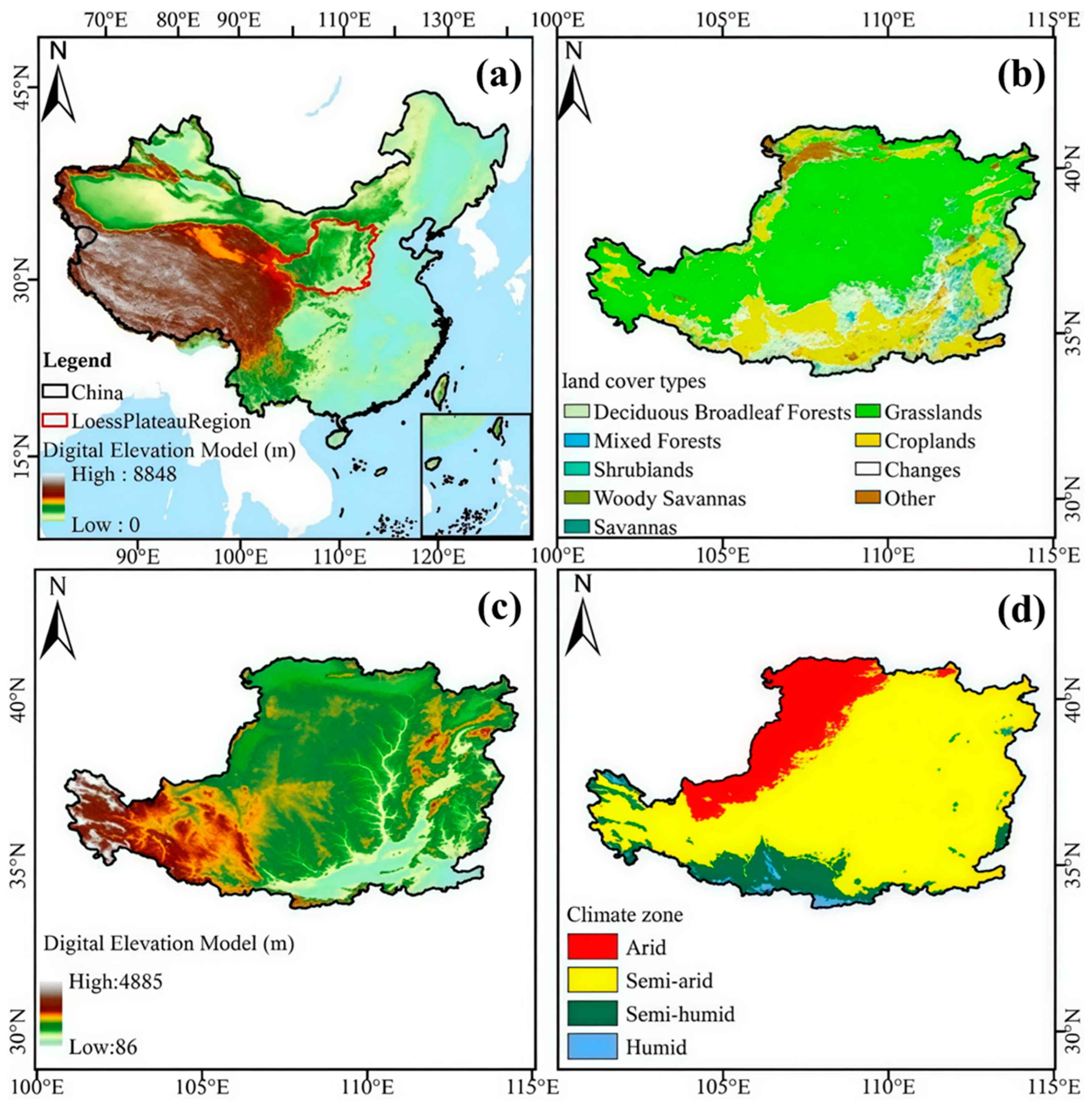
Figure 1. The research field’s general map. (a) The research field’s location; (b) no change in the spatial distribution of MCD12Q1 IGBP entry types in the China Loess Platform (LP) from 2001 to 2020; (c) topographic map; (d) climate zone. Note: Arid (AI ≤ 0.2), Semiarid (0.2 < AI ≤ 0.5), Subhumid (0.5 < AI ≤ 0.65), and Humid (AI > 0.65).
Remotesensing 17 03980 g001
Figure 2. Principle of the spatial distance index (a,b) the concept of the TVPDI. (AB is any point in space. Line DW represents dry and wet edges, point W is the wettest point and the lowest drought value (TVPDI = 0), indicating the lowest drought degree at this point, and point D is the driest point, indicating the highest drought degree (TVPDI = 1).)
Remotesensing 17 03980 g002
Figure 3. Interannual variation in total primary productivity (GPP) (a), evapotranspiration (ET) (b), and eWUE (c) on the LP during 2001–2020.
Remotesensing 17 03980 g003
Figure 4. Spatial distribution maps of GPP, ET, eWUE mean (a,d,g), change rate (b,e,h), and significance (c,f,i) from 2001 to 2020.
Remotesensing 17 03980 g004
Figure 5. The climate zone was attained from the clustered aridity index (PRE/PET, AI) from 1981 to 2010. The association between the yearly average eWUE and AI (a). The variation in the yearly average eWUE for distinct climate zones and land cover (b). Boxplot representations: box = 25th and 75th quantiles; Horizontal line = median; Dote = average; Whisker = ±SD.
Remotesensing 17 03980 g005
Figure 6. Interannual variation in TVPDI on the LP between 2001 and 2020 (a,b) variation in the drought degree classification area.
Remotesensing 17 03980 g006
Figure 7. Spatial distribution map of the TVPDI average change (a), drought degree classification (b), change rate (c), and (d) on the LP from 2001 to 2020. Note: A is Inner Mongolia Hetao Irrigation; B is Ningxia Yellow River Irrigation.
Remotesensing 17 03980 g007
Figure 8. Spatial distribution of correlations between eWUE and TVPDI on the LP between 2001 and 2020 (a,b) spatial distribution of significance. Note: A is Inner Mongolia Hetao Irrigation; B is Ningxia Yellow River Irrigation.
Remotesensing 17 03980 g008
Figure 9. Statistical results of correlation coefficients between eWUE and TVPDI in distinct vegetation types on the LP between 2001 and 2020 (a,b) statistical results in different climatic regions. Subfigure (a) compares correlations across various vegetation types, including deciduous broadleaf forests (DBF), mixed forests (MF), shrublands, wetlands (WS), savannas, grasslands, and croplands. Subfigure (b) presents the correlation distributions across four climatic regions: Arid, Semiarid, Semihumid, and Humid.
Remotesensing 17 03980 g009
Figure 10. Drought legacy effects on eWUE and TVPDI from 2001 to 2012. (a) The spatial distribution of correlations between eWUE and TVPDI of the current year, (b) eWUE and TVPDI of the previous year, (c) eWUE and TVPDI of the previous two years, (d) the correlation between distinct vegetation types, and (e) the correlation between different climatic regions.
Remotesensing 17 03980 g010
Figure 11. Drought legacy effects of eWUE and TVPDI from 2013 to 2020. (a) eWUE and TVPDI of the current year, (b) eWUE and TVPDI of the previous year, (c) eWUE and TVPDI spatial distribution of the previous two years, (d) the correlation between different vegetation types, (e) the correlation between different climatic zones.
Remotesensing 17 03980 g011
Table 1. TVPDI classification.
TVPDI ValuesType
0–0.5No Drought
0.5–0.6Mild Drought
0.6–0.7Moderate Drought
0.7–0.8Severe Drought
0.8–1Extreme Drought
Disclaimer/Publisher’s Note: The statements, opinions and data contained in all publications are solely those of the individual author(s) and contributor(s) and not of MDPI and/or the editor(s). MDPI and/or the editor(s) disclaim responsibility for any injury to people or property resulting from any ideas, methods, instructions or products referred to in the content.