Article

Morphometric Analysis and Emplacement Dynamics of Folded Terrains at Avernus Colles, Mars

1
Center of Research and Exploration in Space Science and Technology II, University of Maryland, College Park, MD 20742, USA
2
NASA Goddard Space Flight Center, Greenbelt, MD 20771, USA
3
USRA/Lunar and Planetary Institute, Houston, TX 77058, USA
*
Author to whom correspondence should be addressed.
Remote Sens. 2025, 17(24), 3946; https://doi.org/10.3390/rs17243946 (registering DOI)
Submission received: 3 November 2025 / Revised: 4 December 2025 / Accepted: 5 December 2025 / Published: 6 December 2025
(This article belongs to the Special Issue Planetary Geologic Mapping and Remote Sensing (Third Edition))

Highlights

What are the main findings?
  • Nineteen distinct folded terrains with arcuate morphologies have been analyzed via remote sensing to determine strain rates and emplacement duration.
  • Calculated driving stress using a simple two-layer model.
What are the implications of the main findings?
  • The derived model shows strain rates approximately 10−7 s−1.
  • Duration estimates of these terrains ranged from 16–38 days, consistent with surrounding Martian geology.

Abstract

Folded, arcuate terrains on the surface of Mars provide insight into the volcanic properties of surface materials and emplacement dynamics. This research focused on the analysis of folded terrains in the chaotic-terrain Avernus Colles region, located near Elysium Planitia, using images from the Mars Odyssey Orbiter and altimetry data from the Mars Orbiter Laser Altimeter (MOLA). The combined data revealed areas of deformation, which is inferred to be the result of compressions and possibly collapse from the late Amazonian period. We identified and measured 19 distinct folds, with morphometric wavelengths ranging from 0.7 to 1.75 km. These measurements were applied to a simple two-layer regolith model to better understand the folding patterns observed. The model suggests that these folds could have formed with an upper viscous boundary layer less than 0.55 km thick and strain rates approximately 10−7 s−1. These strain rates indicate that the deformation of the terrains likely occurred over a relatively short period of time, ranging from 16 to 38 days. By studying these deformation patterns, we can enhance our understanding of the volcanic history and surface processes on Mars, offering insight into the planet’s geologic evolution and material properties.

1. Introduction

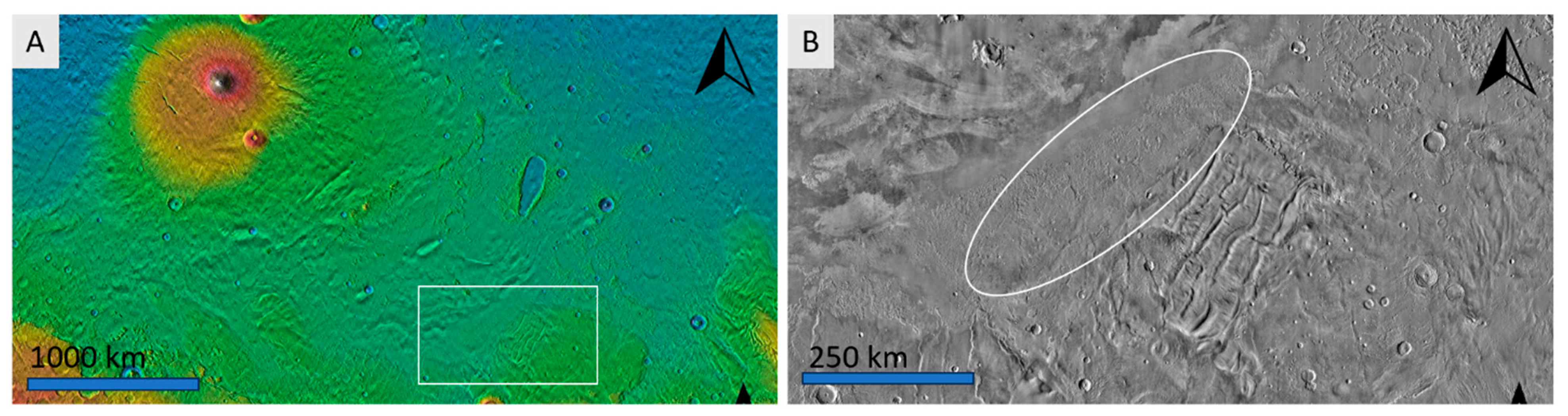
Elysium Planitia (Figure 1A), approximately 3000 km in diameter, is considered one of the youngest units on Mars [1,2]. This relatively young age is specifically due to volcanic flows resurfacing the area during the late Amazonian period (<100 Myr) [3,4]. This period includes substantial coverage of low-relief parts east of the Elysium rise that erupted from Cerberus and Medusa Fossae [2,5,6,7,8]. The southeastern part of this region is Avernus Colles, a region of fractured terrain, smaller hills (“colles”), ridges, and knobs [6]. During candidate landing site discussions for the Mars Science Laboratory (MSL) rover, South Elysium Basin—Avernus Colles had been nominated, citing an area of complex ancient and young volcano-tectonic interactions and high iron abundance from potential hydrological interactions [9]. Our specific region of study in Avernus Colles is centered at latitude −0.066°N, longitude 175.848°E, and is 482 km in length (within white oval marked region in Figure 1B).
Chaotic terrain refers to jumbled, down-dropped complexes of tilted, irregular crustal blocks and intervening depressions produced by subsidence and internal disaggregation of the upper crust [10,11,12,13,14,15]. On Mars, chaos provinces are concentrated near the northern lowlands–southern highlands dichotomy and within parts of the southern highlands, where blocks range from kilometers to tens of kilometers across and commonly exhibit vertical relief on the order of 1–2 km, locally approaching ~3 km [12,16,17]. Many blocks retain surface textures and stratigraphy comparable to adjacent uplands, implying that chaotic basins formed largely by collapse of overlying rock with concomitant evacuation or redistribution of volatile-rich substrates at depth [11,17,18]. Systematic mapping with modern orbital datasets (e.g., Mars Reconnaissance Orbiter’s Context Camera) has revealed over 400 chaos and chaos-like occurrences, underscoring their areal extent and diversity [14,16]. Despite this growth in the inventory, a unified, formation process based global taxonomy has not yet been established, and careful geomorphic–geologic analyses remain essential at the scale of individual basins [14,16,18].
Multiple, not mutually exclusive mechanisms, have been suggested to account for collapse and the characteristic fracture architectures (graben, orthogonal meshes, radial/concentric sets) observed in Martian chaos. In many systems, association with outflow channels points to destabilization of ground ice and/or clathrates, hydrofracture of a cryospheric cap, and transient water release that undermined roof rocks and drove catastrophic drainage [13,17,19,20,21]. Elsewhere, intrusion of dikes/sills and attendant heating likely disrupted the local cryosphere, melted pore ice, and triggered subsidence [11,12,20]. A volcano-tectonic endmember, inflation deflation of shallow magma reservoirs, and piecemeal caldera-style collapse can generate graben, radial and concentric faulting, pit chains, and associated lava effusion with little or no liquid water involvement [10,14,15]. Taken together, these observations show that Martian chaos terrains are intrinsically polygenetic, overprinting signals of volatile release, magmatic forcing, and tectonism, and thus their formation is fundamentally complex [12,14,17,18].
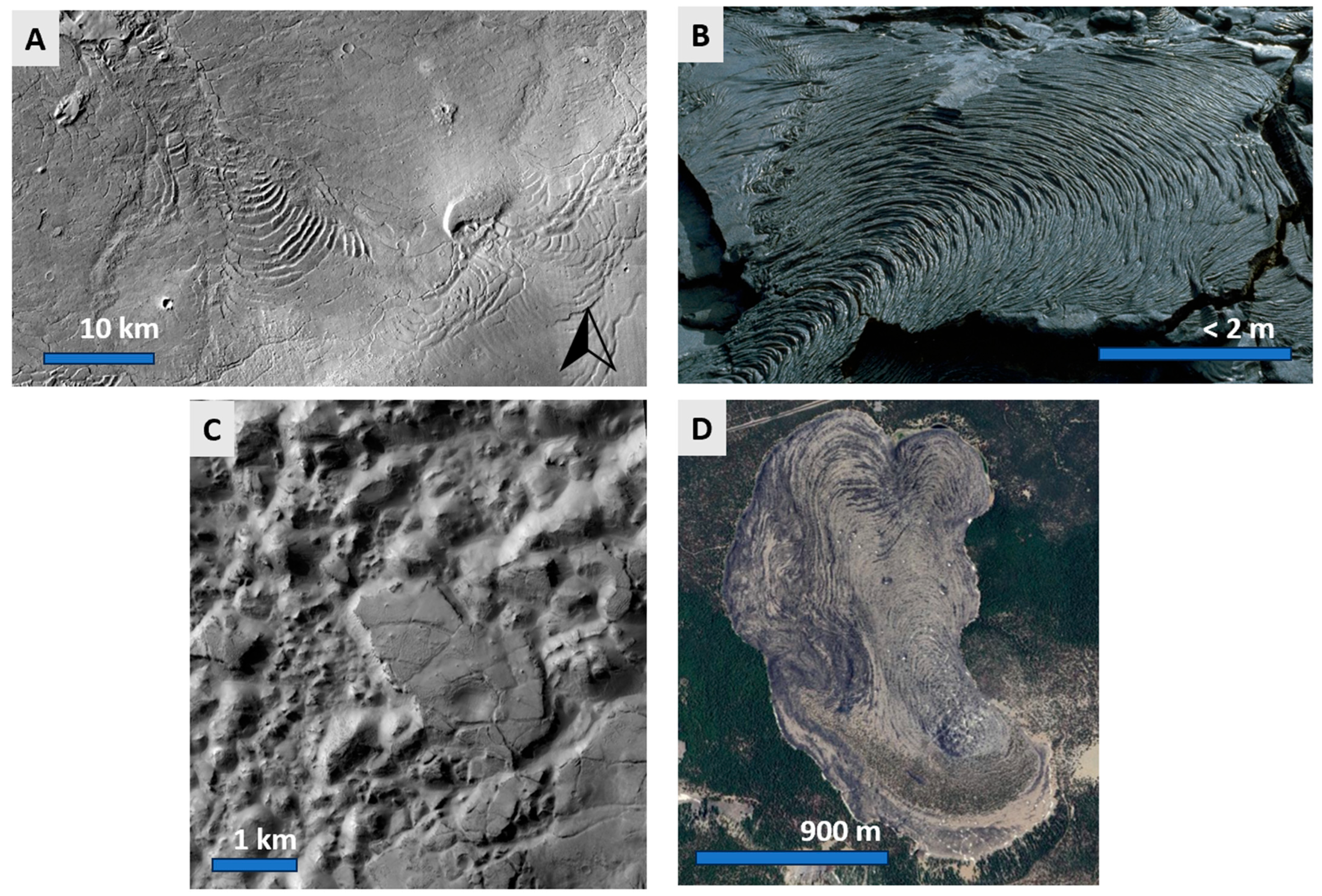
On Mars, there are different types of lava flow morphologies [22] (and references therein), but these compressional arcuate folds within Avernus Colles are our focus (Figure 2A). Thermal Emission Imaging System (THEMIS) images have shown this specific region to be lobate arcuate features that we consider to be compressional folded terrain [8,23]. This fold-type lava flow can be comparable to arcuate, pahoehoe features found in several terrestrial lava flows and plains, such as the Santiago shield volcano in the Galapagos Islands (Figure 2B) or ridged ogive structures in Oregon (Figure 2D). Previous studies by Theilig and Greeley [23] have observed flow lobes west of Arsia Mons, also dominated by ropey ridges, and compared to terrestrial Icelandic analogs. These folds and chaotic folding have also been observed in other areas of Mars (Figure 2C) [23], Europa [24] and other planetary bodies throughout the solar system, such as Earth [25,26] and Enceladus [27].
Growth of the arcuate ridges perpendicular to the flow direction were observed to relate the movement and morphology [8,26,28]. However, it was also observed that terrestrial Icelandic basaltic flows had larger wavelengths, suggesting that the viscosity constraints for the Martian folds would differ for viscosity and morphology [23,29]. We suspect the origin of the Avernus Colles folds are comparable to compressional-type lava flows by: (i) collision and (ii) horizontal stress between two materials or crusts [28,30]. Elysium Mons lava flow rheological properties are not well known [31], though there have been several studies of this area [1,32,33,34]. Here, we focus on 19 folds in this region, measuring morphometric wavelengths to input into a simple two-layer fold model. The two-layer model calculates the driving stress and strain rates, and emplacement times, given an estimated thickness and viscosity of the basalt.

2. Methods

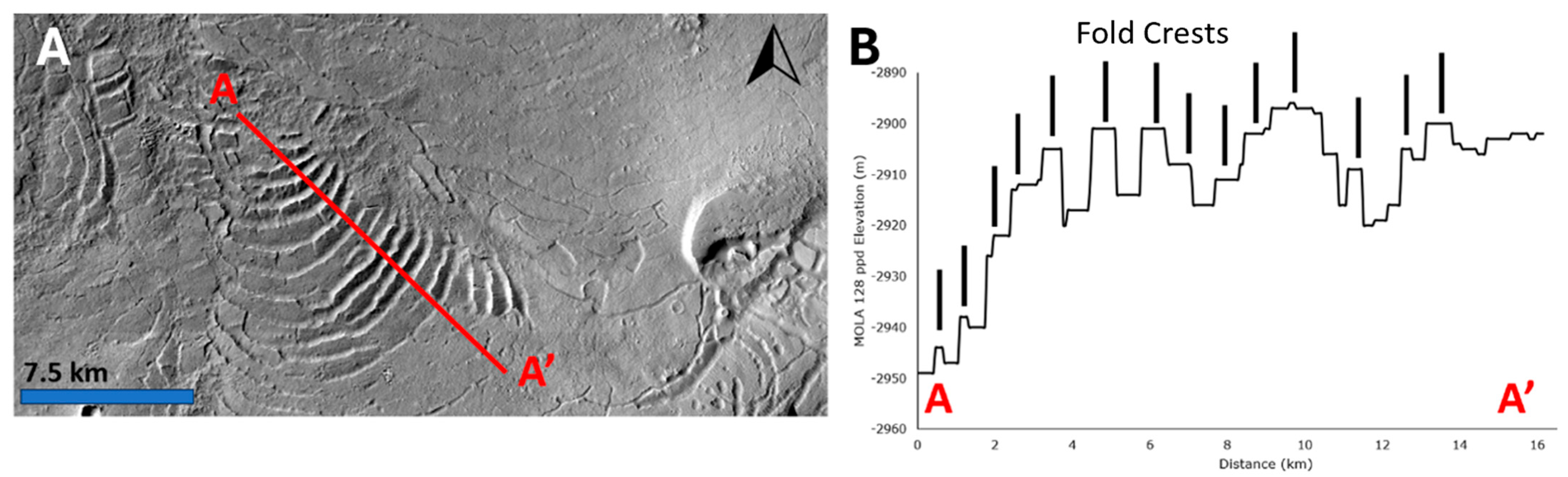
Images from CTX (Context Camera; ~6 m/px) [35,36] and THEMIS (Thermal Emission Imaging System; 12.5–50 m/px) [35] onboard the Mars Reconnaissance Orbiter (MRO) were analyzed for broader Avernus Colles and Elysium regional contexts, and digital elevation models (DEMs) by the Mars’s Orbiter Laser Altimeter (MOLA) onboard the Mars Global Surveyor (MGS) spacecraft (~128 px/deg resolution) [35] were used to map the orientations of the folds. Topographic profiles were drawn through each flow site (e.g., A to A’ in Figure 3) using JMARS (Java Mission-planning and Analysis for Remote Sensing v5.4.4.2). These topographic profiles were used to create DEMs of the fold profiles (Figure 3B as an example). These DEMs would then be used to approximate the strain rate at each fold site. Additional compositional information, namely olivine abundance, were observed for discussion-specific context using the Compact Reconnaissance Imaging Spectrometer for Mars (CRISM) olivine map (256 pix/deg global mosaic in JMARS) [37].
The 2-layer folding model [38,39] is structured with differing temperature between the 2-layers formation with the amount of driving stress and strain rate to relate to the tightness of the folds. The bottom layer is a low-viscosity component relative to constant viscosity. The viscosity of both layers is assumed to be Newtonian, so viscosity is independent of stress [28]. Such a structure would be hypothesized to be consistent with the formation from a weak, thin crustal layer [29,40,41]. We adopt the wavelength-selection approach to lava folding, in which the observed fold spacing reflects the fastest-growing mode of instability under compressional and gravitational loading [27,41]. In this framework, Fink [38] provided the foundational scaling for dominant wavelength, and despite its age remains the standard first-order model that subsequent laboratory, theoretical, and planetary applications have repeatedly validated and extended. In particular, studies have adapted the Fink framework to different rheologies and boundary conditions, incorporated temperature-dependent viscosity and layer-thickness effects, and applied the same scaling logic to terrestrial and planetary surfaces [23,24,25,27]. We therefore use Fink [37] as the base model and draw on these later works where additional parameters or contexts are required. This approach is consistent with similar evaluations of fold spacing used to infer fold mechanics on Earth and other worlds [23,25,27]. Finally, we note that multiple wavelength bands can arise on a single flow when compressional forcing is episodic or cyclic (e.g., during pulsed eruption or post-emplacement shortening), yielding superposed fold families [4]. This dominant wavelength was measured using DEMs from MOLA at each site studied at Avernus Colles to characterize the strain and formation emplacement time [23,25,27].
The dominant folding wavelength has been measured on similar formations involving two main layers, with the upper layer susceptible to folding [28,38]. In a volcanic case, the viscous lava would bend more readily to form arcuate ridge textures. In a tectonic setting, the upper layer is more conducive to folding by weaker mineralogy or strain to form folding. The dominant wavelength and the folding model will infer properties of these folds, including driving stress and emplacement time.
The model starts with parameterizing the trough-crest upper layer with some thickness H, in which the viscosity decreases with depth as
η z = η 0 e x p ( γ z )
where z is the depth, η0 is the surface viscosity, and γ describes the exponential decrease in viscosity. We assume both layers are Newtonian in nature and that viscosity is independent of stress [27].
The viscosity ratio (R) between the surface viscosity layer (η0) and the base layer (Martian surface; ηi) is defined by
R = η 0 / η i
The thickness H is therefore defined as
H = ( 1 / γ ) l n ( R )
Fold values for R ~ 104 [27,38]. Despite differing temperature scales, R should be roughly similar to the cooling lava flow on the surface of Mars [42]. For comparison, the surface and interior temperatures for a terrestrial rhyodacite flow are estimated to be Ts = 970 K and Ti = 1200 K [38], giving ln(R) = 9.6 or R ~ 104.
R is estimated to be ≤104 from the viscosity models of Martian-relevant lava flows from Chevrel et al. [43]. At this current time, exact viscosity values for silicic and basaltic melt mixtures at Martian conditions are not constrained. According to Fink [38], folding occurs at the dominant wavelength LD when LD × γ > 28 (as a dimensionless unit).
Using viscosities from [43,44] estimating the basal layer of the basaltic layer to be ηi = 103 Pa s and the upper folded lava layer η0 = 107 Pa s. Folding occurs when the viscous driving stress must exceed the gravitational stress exerted by the weight of the surficial layer to bend [38]. The relationship between the gravitational and driving stresses (S) is expressed as
S = ρ g ( 1 / γ ) / ( 4 ε ˙ η 0 )
where for folding to occur, S ≤ 0.02. For Martian basalt density, we used ρ = 2500 kg m−3 as a lower density estimate of Martian lavas [45,46], and g = 3.721 m s−2. ε ˙ is the strain rate.

3. Results

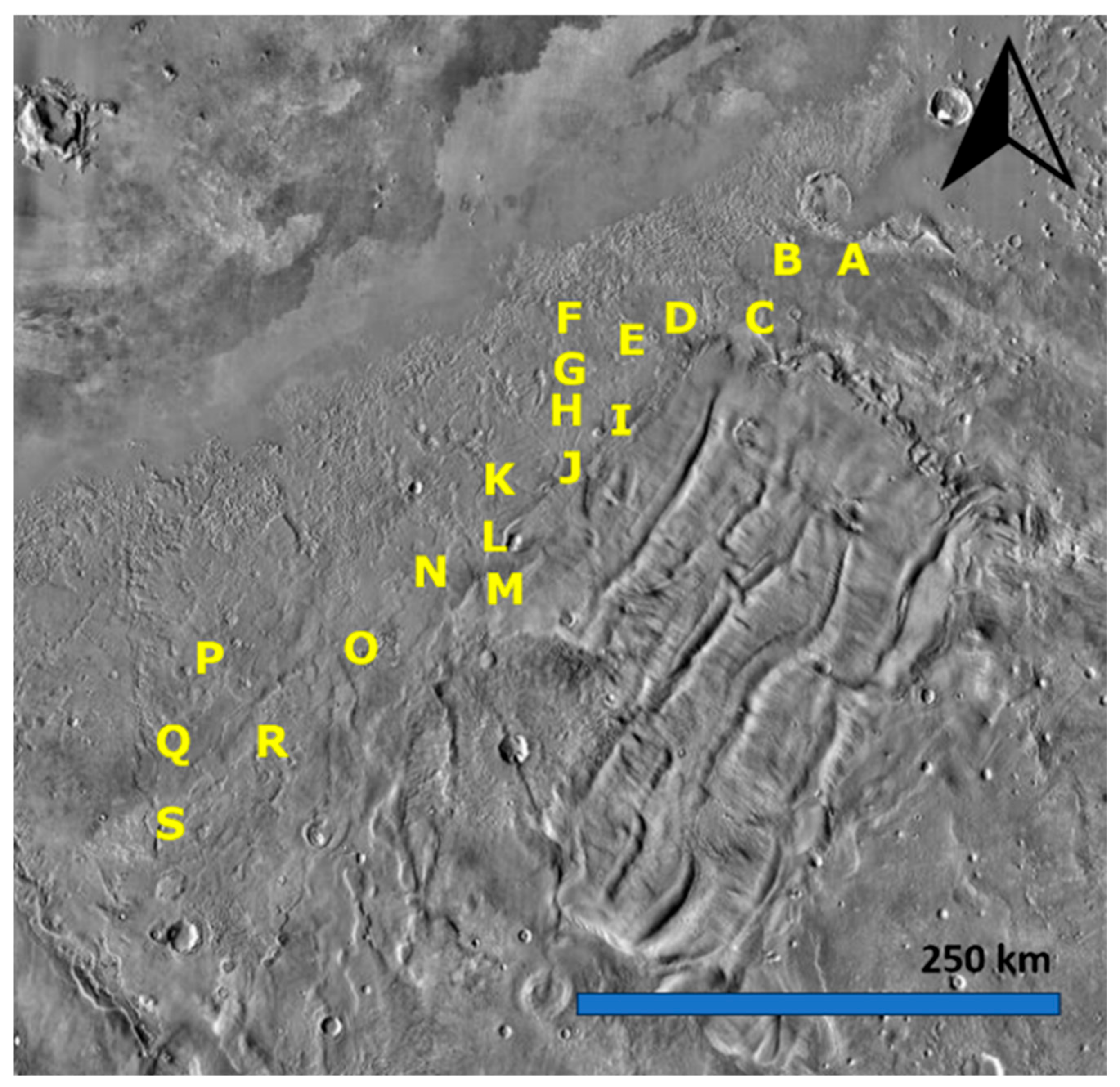
We identified 19 distinct arcuate flows (Figure 4), which were measured in two ways: fold direction and wavelength. The Avernus Colles folds are on average ~9 km wide and 15 km long in various directions, though predominantly trending in the south-southeast orientation. We acknowledge that there are additional disrupted or incomplete flows found that were not considered in this study. Wavelength was calculated as a simple technique to describe the “ropiness” of the terrain relating to strain rate.
The dominant wavelength was measured for each fold site (Table 1). For the maximum dominant wavelength of LD = 1.75 km, (1/γ) < 0.06 km. This makes H = 0.55 km as the maximum thickness of the regolith in this study area. Lava flows on Mars have been observed to flow in laminar fashion, according to observations from Pasckert et al. [31] and Peters et al. [47]. The equations for yield strength and viscosity are therefore valid for laminar flows.
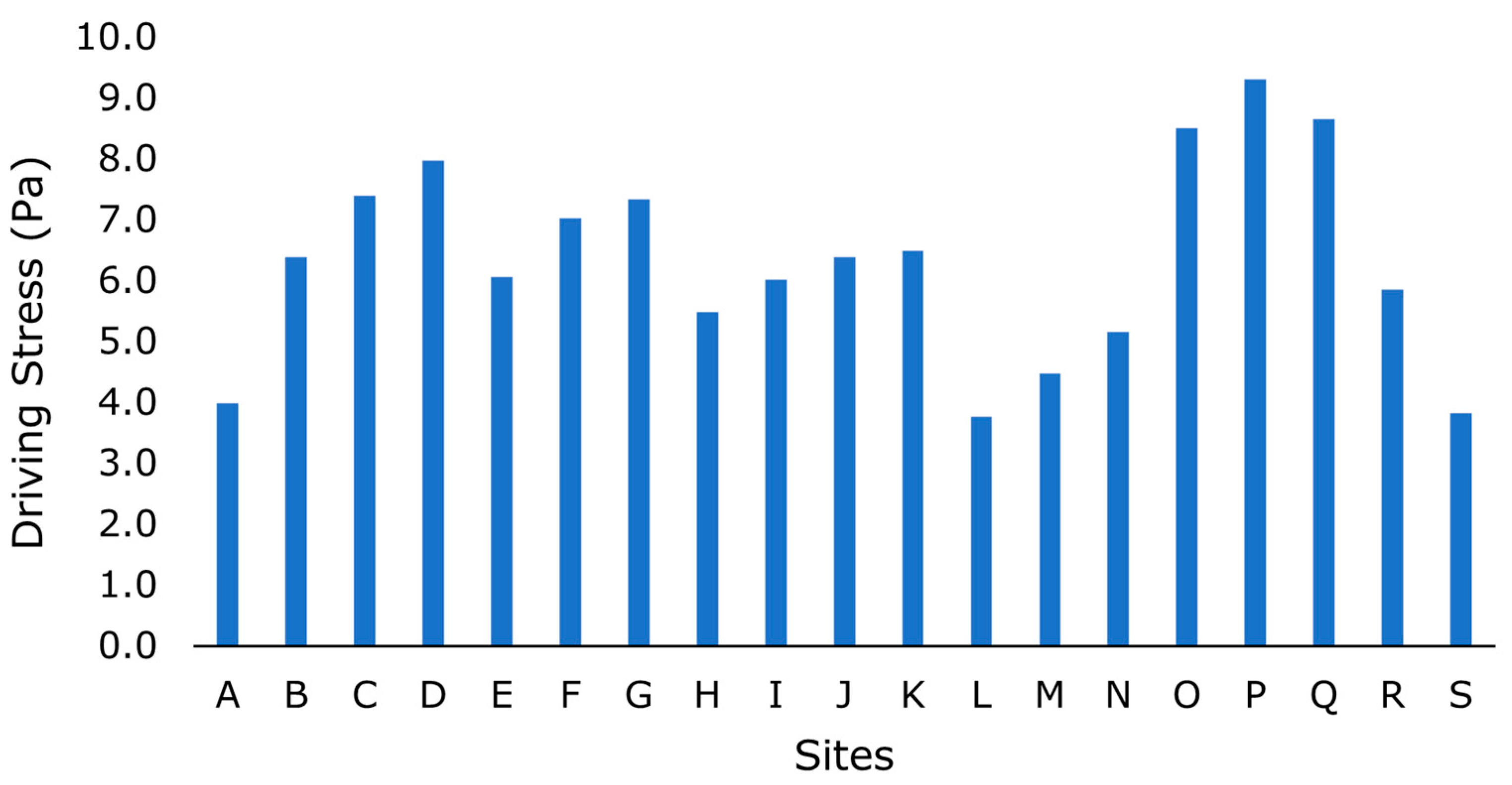
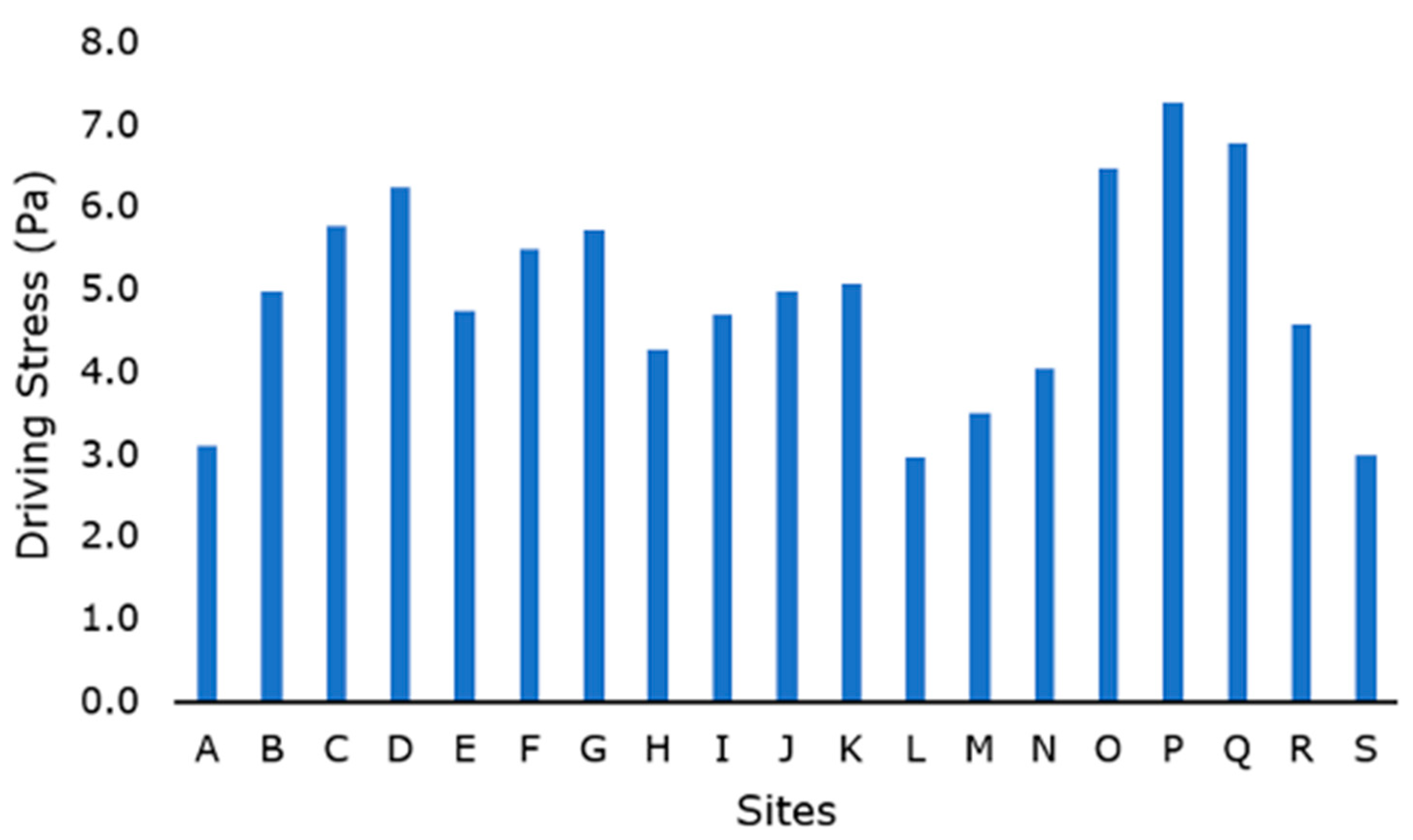
From Equation (3), (1/γ) = 0.06 km (from the maximum wavelength) gives an estimate for ε ˙ η0 = σ (the driving stress from Equation (4)). For folding, the viscous driving stress exceeds the gravitational stress exerted by the weight [38,48]. Across the 19 locations examined, driving stresses range from σ = 2.9 to 7.3 Pa (Figure 5), with 79% of sites > 4.0 Pa. Because driving stress scales with fold wavelength, these values are consistent with expectations for low-viscosity lava flows and fall within the range previously documented for such systems [41].
Using a surface viscosity of η0 = 107 Pa s implies a strain rate range of ε ˙ = σ/η0 = 2.9 × 10⁻⁷–7.3 × 10⁻⁷ s−1. This is agreeable to the range of strain rates and cooling rates of multi-folded lava flow surfaces on the range of 10−3–10−7 s−1 as observed by Gregg et al. [26] for terrestrial basalt flows and Warner and Gregg [44] at Arsia Mons.
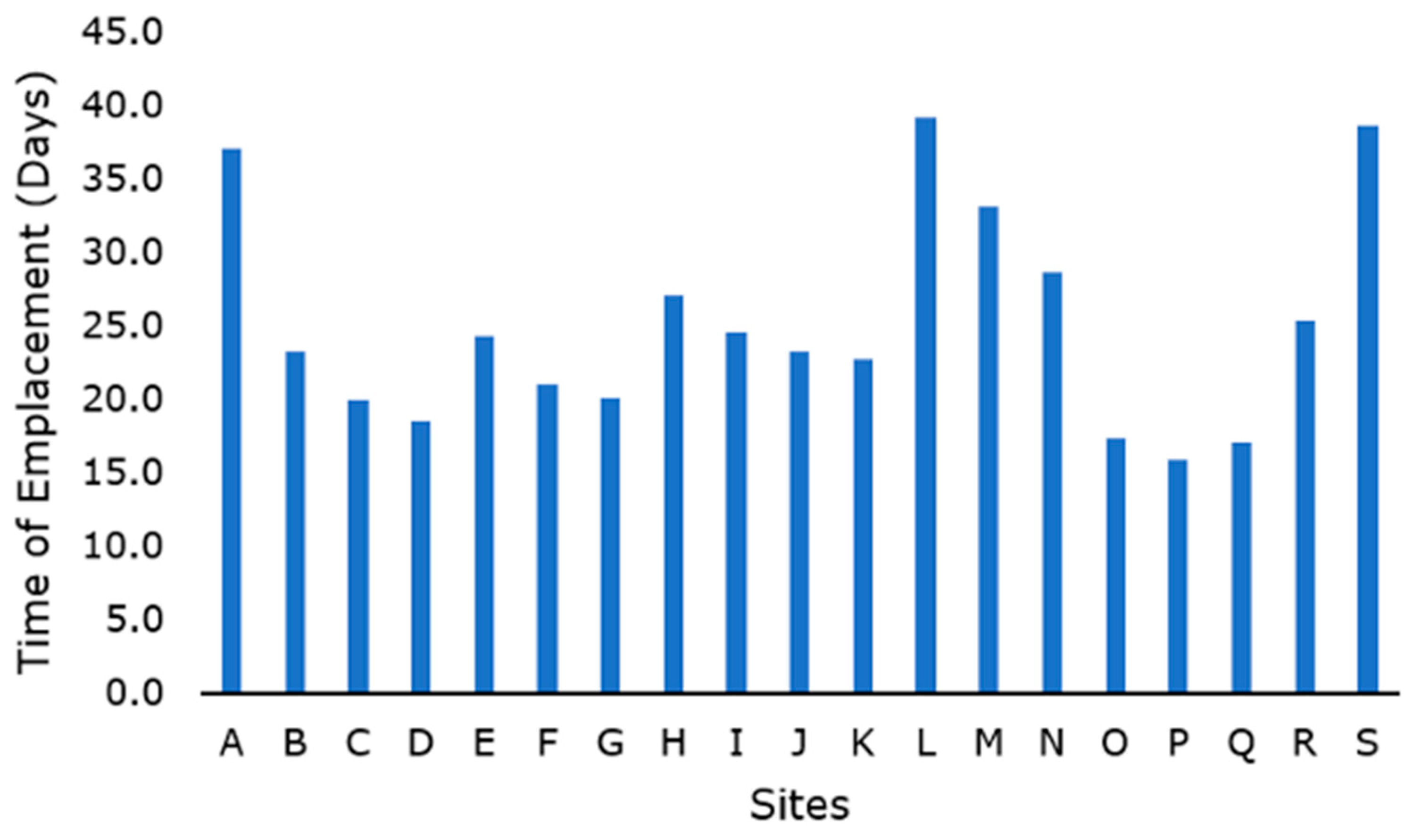
The time scales to fold and resurface this area of Avernus Colles T = 1/ ε ˙ is approximated to be in the range of 16–39 days (Figure 6). Sites A, L, and S had the highest emplacement duration time and inversely lower driving stress rates (Figure 5 and Figure 6). Sites O, P, and Q with the highest stress rates and inversely the lowest emplacement duration (Figure 5 and Figure 6). Note that this is not the determined age of Avernus Colles in its entirety but a relative emplacement of the folding that had occurred.
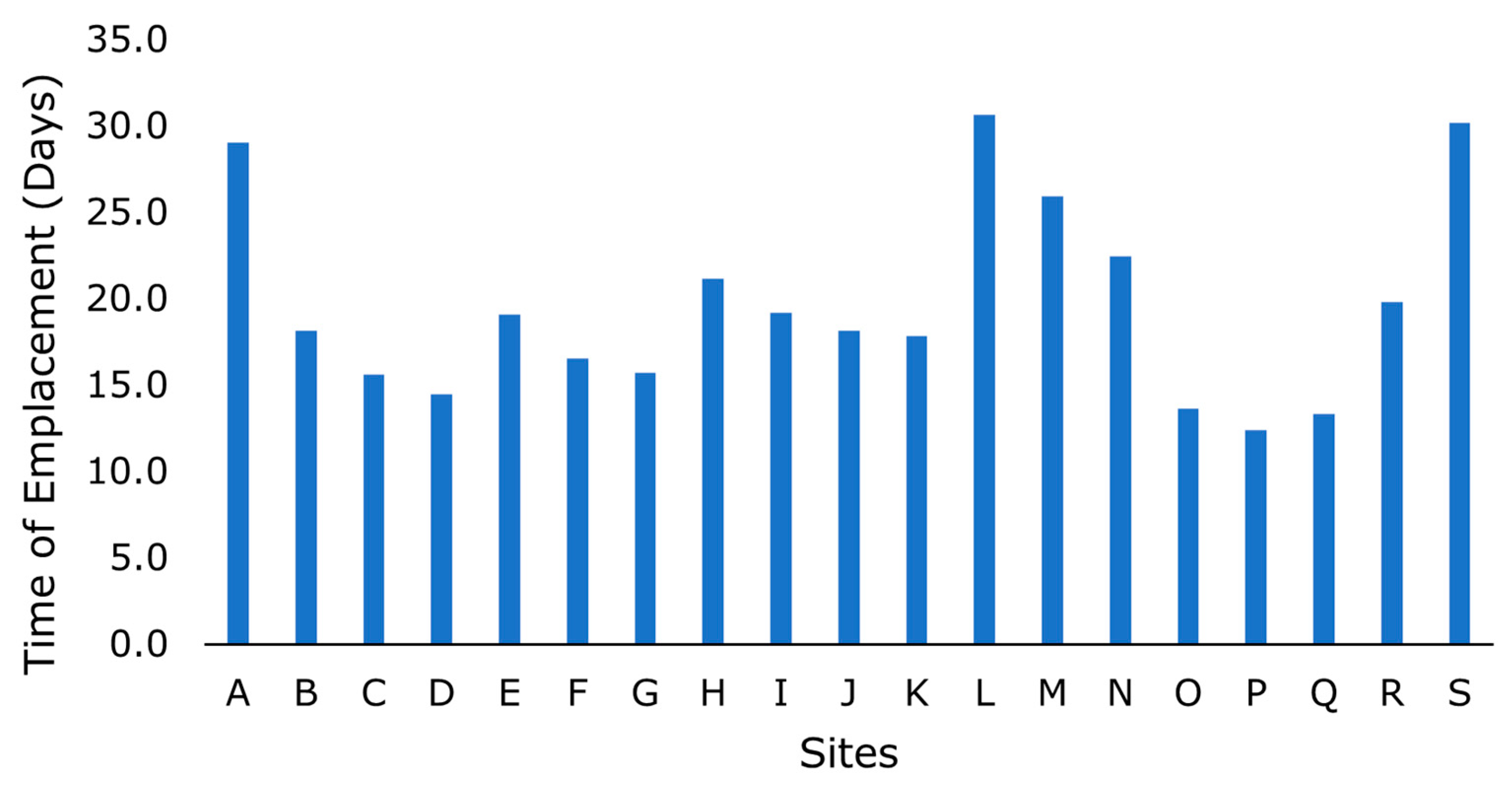
By changing the basaltic density of the folds to the estimated maximum Martian basaltic density ~3200 kg m−3 [47] instead of the minimum basaltic density we originally calculated, and keeping with the maximum wavelength of 1.75 km, the driving stress range then becomes <9.3 Pa (Figure 7). The emplacement time becomes <30 days (Figure 8), a decrease by ~9 days compared to using the minimum density value of 2500 kg m−3. This observation agrees with the model that for more dense material to form, 1.75 km-scale wavelengths require more driving stress and shorter formation time.
The density range of 2500–3200 kg m−3 used in the driving-stress calculations reflects realistic values for Martian basaltic lavas. The lower bound (~2500 kg m−3) corresponds to vesicular or fractured upper crusts observed in Amazonian lava plains [49,50]. The upper bound (~3200 kg m−3) reflects the dense, olivine-rich basalt compositions measured in SNC meteorites and inferred for Elysium and Apollinaris volcanic units [50,51]. Because the true subsurface structure likely includes both a vesicular upper crust and a denser coherent interior, this range provides an appropriate set of bounding values for estimating the lithostatic stresses that drive fold formation.
Emplacement times from Tharsis lava flow studies have been modeled to be from 8 h to 11 years [47]. Elysium Mons lava flows have been measured to have emplacement times between 1 and 155 days, with an average of 32 days [31]. At Aram Chaos on Mars, it has been modeled that the collapse to create this chaos terrain was on the order of tens of days due to a single catastrophic outflow event [13]. Our findings of <40-day emplacement times for the Avernus Colles folds are consistent with all of these previous works studied elsewhere on Mars.

4. Discussion

4.1. Overview of Key Observations

The folded terrains of Avernus Colles exhibit systematic ridge–trough morphologies, consistent north–south (N-S) variations in driving stresses, and localized chaos-like margins, all of which imply that deformation did not arise from a single uniform process. Instead, several plausible mechanisms, even potentially acting in combination, could have produced the observed cyclicity and spatial complexity.
First, episodic volcanic activity distributed along N-S-oriented vents or dike systems may have imposed alternating periods of uplift, compression, and relaxation as magma was emplaced and withdrawn. Such pulses could naturally generate a spatially repeating stress pattern [51,52]. Second, interaction between regional contractional wrinkle ridges and intrusive or extensional stresses may have produced alternating domains of compression, flexure, and subsidence, superimposing a N-S oscillation on the local stress field. Third, localized collapse and chaos-terrain formation could have lowered driving stresses within discrete zones while preserving higher stresses between them, creating a cyclic pattern if collapse segments were arranged along a north–south corridor. Finally, heterogeneity in volatile-rich or mechanically distinct subsurface layers could cause spatial variations in density, rheology, and elastic thickness that likewise modulate driving stresses in a repeating fashion.
Together, these mechanisms frame the subsequent sections of this Discussion. Each provides a plausible means of producing the observed N-S stress cyclicity and morphological segmentation, and none are mutually exclusive. The following subsections assess their feasibility in detail and examine how they may have interacted to shape the deformation history of Avernus Colles.

4.2. Possible Folding Mechanisms and Diagnostic Criteria

To evaluate the origin of the folded terrains, we compare our observations with diagnostic criteria for (1) inflation-driven folding, (2) collapse- or chaos-related folding, and (3) tectonically influenced folding. This comparative approach establishes a rigorous basis for identifying the most plausible deformation mechanism before exploring each process in detail.
Inflation-driven folding occurs when pressurization of a molten or ductile subsurface layer causes the overlying crust to buckle. Such terrains typically exhibit smooth, coherent ridges, uniform ridge spacing, and volcanic inflation textures such as pāhoehoe-like surfaces and lobate flow fronts (e.g., [38,53]). These ridges tend to be broad and continuous, with minimal evidence for collapse or disruption.
In our study area, the folds display platy surface textures, arcuate ridge geometries, and well-defined edges, with measurable but not perfectly uniform fold wavelengths. These attributes show partial alignment with inflation criteria, particularly the coherent ridge continuity and consistent curvature, but differ from the classic inflation signature in their sharper margins and more segmented appearance.
Deformation associated with chaos formation is produced by localized subsidence, removal of lithostatic support, or collapse of volatile-rich substrates. Diagnostic features include blocky or irregular margins, disrupted or scalloped perimeters, pit complexes, tilted slabs, and evidence of localized downward displacement [54]. These textures typically reflect mechanical weakening of the crust rather than smooth, coherent buckling.
Moreover, Mars analog studies show that some chaos terrains lacking clear outflow channels are better explained by volcano–tectonic processes, including sill and dike intrusion, magma chamber inflation and withdrawal, and associated caldera or pit-chain collapse [14]. Such processes can generate fracturing, block faulting, and chaotic terrain without requiring massive groundwater release. This broader volcano–tectonic collapse framework aligns well with several geomorphic indicators observed here.
The folds in Avernus Colles exhibit a generally consistent orientation and arc-shaped morphology, suggesting at least partial tectonic influence. The N-S periodicity in our modeled driving stresses is compatible with stress modulation by nearby interaction with regional contraction/extension at Elysium (and potentially Apollinaris) Montes. However, the localized, chaos-like degradation at many fold margins implies that purely tectonic folding does not fully explain the observed morphology. Instead, tectonics may have shaped the broad orientation and spacing pattern while other processes modified the finer-scale textures.

4.3. Integration of Regional Tectono-Volcanic Context

The proximity of Avernus Colles to Elysium Mons, Apollinaris Mons, and nearby fossae provinces connects the area to a history of episodic effusive and explosive volcanism [55]. These provinces are marked by N-S–oriented vent chains, feeder dikes, and volcanic fissures, many of which demonstrate repeated magma ascent along structurally controlled corridors [56]. Such alignments provide a plausible source for cyclic stress fluctuations, as dike propagation, sill emplacement, and magma chamber inflation/deflation can locally increase or decrease compressional stresses.
It is also possible that pre-existing structural heterogeneities, potentially inherited from early episodes of chaos terrain formation or other crustal weakening processes, acted as mechanical boundaries that disrupted the smooth transmission of stress across Avernus Colles. Such heterogeneities could create localized stress-transfer zones, where deformation in one fold cluster either inhibits or redirects strain accumulation in adjacent areas. Comparable segmentation is well documented in terrestrial fold-and-thrust belts and rift zones, including the Zagros–Makran system and the Albertine Rift [57,58], and similar processes may apply to Martian crustal deformation where lithologic contrasts or subsurface layering are present.
Within this framework, the interplay between regional tectonic forces (e.g., intrusion-related stresses from Elysium–Apollinaris magmatism) and local mechanical variability could have generated the cyclic stress pattern inferred from the modeled emplacement durations. This interpretation is consistent with both the clustered distribution of fold groups and the morphological distinctiveness among them, suggesting that the driving stresses were not spatially uniform but were instead modulated by temporal variability or by differences in lithospheric properties across the region. This interpretation is supported by the clustered distribution and morphological distinctiveness of the fold groups, which indicate that the deformation was driven by a spatially and temporally non-uniform mechanism rather than by a region-wide stress field. Such localized, episodic deformation is consistent with pulses of volcanic or magmatic activity, which are known to have occurred in the Elysium–Apollinaris region during the late Amazonian. This link suggests that the observed folding may record cycles of volcanic loading or subsurface intrusion during this period.
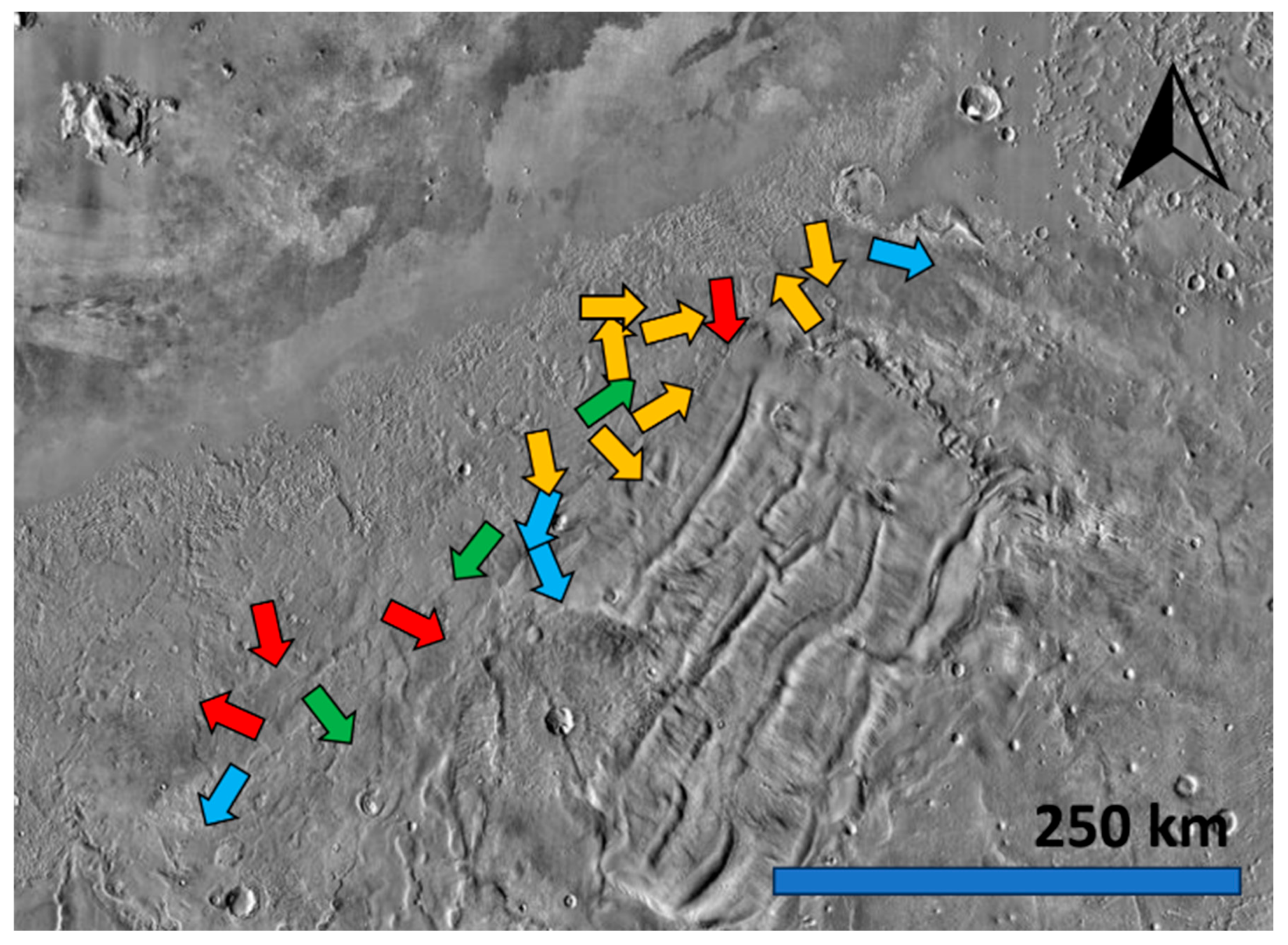
Figure 9 presents the modeled emplacement durations across Avernus Colles, depicted as arrows colored by formation time. Blue arrows, representing longer emplacement durations and lower driving stresses, are concentrated along the inner margins of Avernus Colles. In contrast, red arrows, indicating shorter durations and higher driving stresses, occur along the outer edges of the terrain. This spatial pattern suggests that the interior of the valley may have experienced reduced or moderated stress conditions relative to the periphery, consistent with either localized collapse, subsurface weakening, or stress shielding by surrounding structural elements. Of particular note is the cluster of intermediate-duration vectors (20–25 days; yellow arrows in Figure 9) in the north-central portion of the valley. This grouping stands out from the surrounding distribution and may point to recurrent or cyclic volcanic activity during the late Amazonian period [59,60]. Whether this cluster reflects repeated magma intrusion, fluctuating pressurization, or temporally variable tectonic loading, it provides an additional temporal dimension to the spatial stress variations inferred for the area.
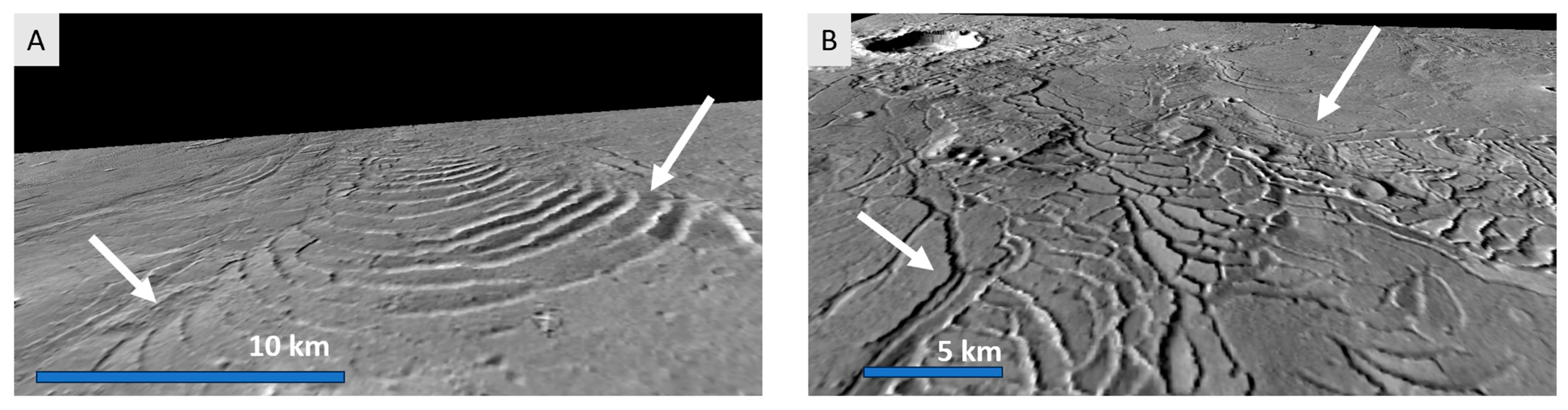
Fold orientations mapped from Figure 9 show a dominant southeast (SE) trend, with oblique views (Figure 10) highlighting the morphological coherence of these ridges and the complexity of their margins. These oblique images emphasize the platy ridge textures, sharp boundary transitions, and irregular perimeter geometries, all features compatible with a mixture of folding styles, including potential chaos-related or collapse-related processes superimposed on broader tectonic or volcanic structuring.
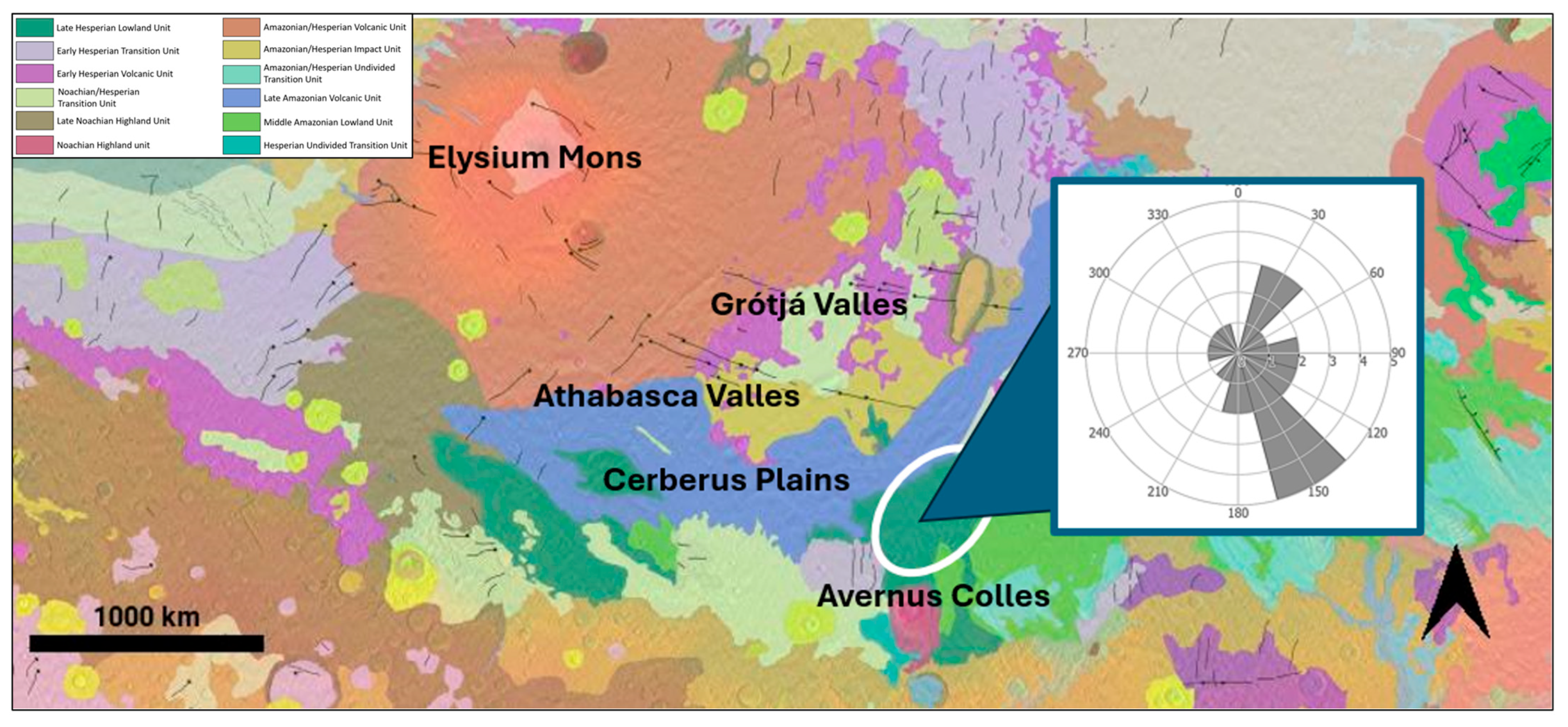
Comparison with regional volcanic and tectonic features (Figure 11) shows that the SE orientations at Avernus Colles are broadly similar to structural trends associated with activity near Elysium Mons, particularly in the southern Athabasca Valles lava flows and the Cerberus Fossae graben system [61,62]. Rose-diagram analysis shows that most Avernus Colles folds cluster around an orientation of ~150°, while nearby fossae in the Cerberus Plains and Grótjá Valles trend closer to ~120°. This distinction suggests that, although Avernus Colles shares some alignment tendencies with regional volcanic lineaments, its folding direction reflects local stress conditions that are not simply inherited from major nearby graben or lava-flow systems. We note that disrupted or incomplete folds are present within Avernus Colles but were not included in the orientation analysis due to their ambiguous geometry. Their exclusion ensures that the mapped directional statistics are derived from clearly defined ridge segments, although these disrupted structures may hold additional clues regarding collapse, fragmentation, or later modification.

4.4. Substrate Structure and Heterogeneity

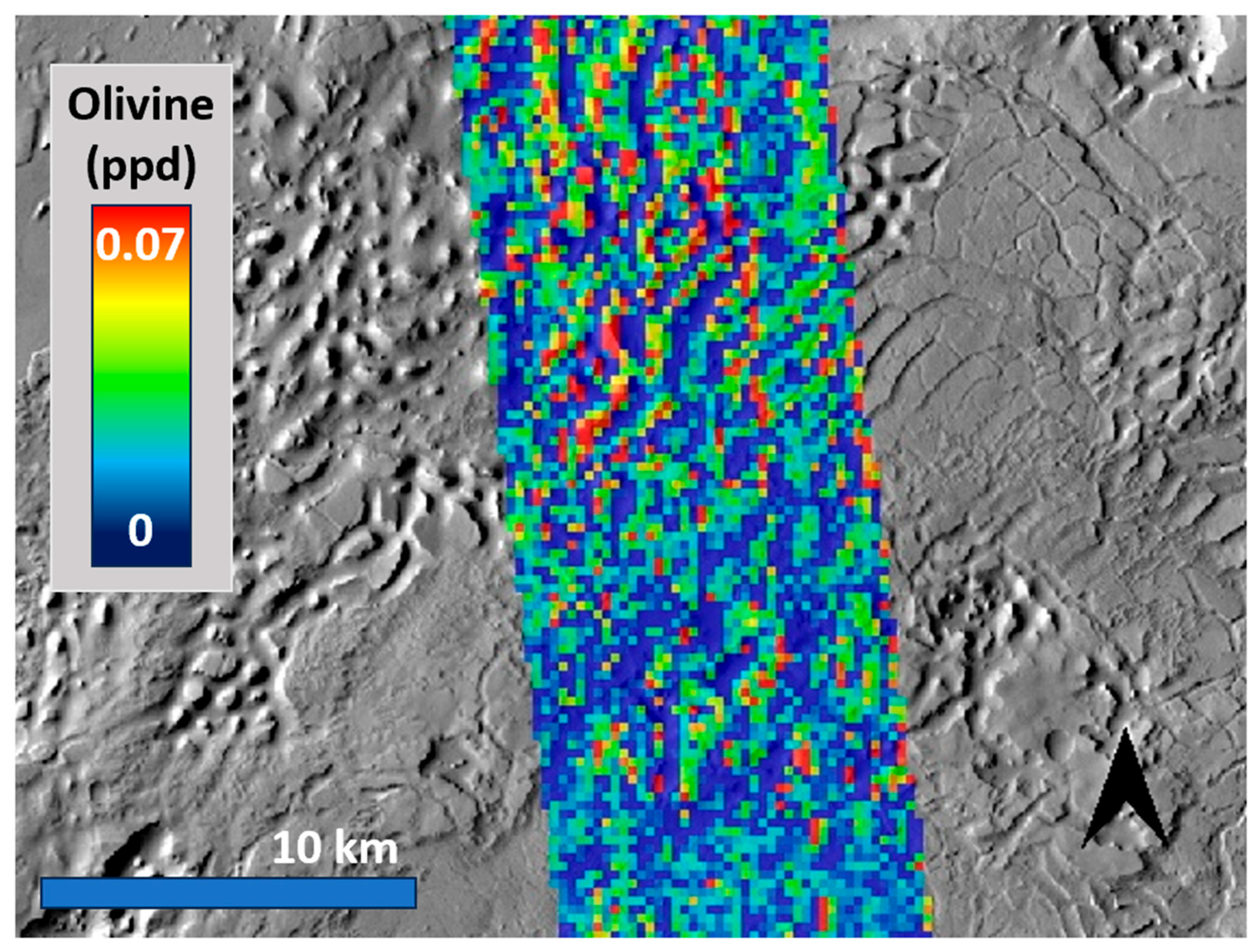
Previous work by Theilig and Greeley [23] demonstrates that large volcanic structures on Mars can exhibit distinct cooling histories and interior viscosities, with basaltic flows reaching values on the order of >108 Pa·s. Such variations in viscosity affect not only lava rheology but also the style and wavelength of associated surface folding. More silicic compositions, as suggested in studies of Mars’ potential evolved volcanic materials [4,26,38], would further modify the temperature–viscosity relationship, potentially producing stiffer upper crustal layers capable of brittle deformation [63]. The slightly higher olivine abundances observed at fold crests (from CRISM data; Figure 12) indicate compositional heterogeneity within the folded terrain, suggesting that variations in magma chemistry (including potentially more mafic versus silicic fractions) may have influenced local crustal viscosity and mechanical strength, thereby affecting how stress was transmitted and folds developed across Avernus Colles.
In modeling the deformation and stress distribution of Avernus Colles, we employed Newtonian rheological assumptions for basaltic materials, which assume a linear relationship between stress and strain rate. Such approximations are generally valid for warm, ductile, basaltic flows over long timescales. While late Amazonian basalts may have experienced lower emplacement temperatures, partial crystallization, or volatile depletion, potentially enhancing non-Newtonian, shear-thinning behavior, prior studies indicate that first-order folding geometries and stress cyclicity remain reasonably well captured under Newtonian assumptions [23,64,65].
To complement these rheological assumptions, we modeled a basalt density range of 2500–3200 kg m−3, reflecting natural variability in Martian basalts due to vesicularity, porosity, crystallinity, and compositional differences. Lower-density basalts (~2500 kg m−3) may represent more vesicular or partially degassed flows, while higher-density basalts (~3200 kg m−3) approximate massive, fully crystallized units. This range allows the model to account for realistic variations in lithostatic pressure, driving stress, and fold amplitude, and provides a sensitivity check on how local density contrasts could influence stress distribution and observed cyclicity.
In this context, the ridges at Avernus Colles may represent pressure ridges or fracture-bounded structures, similar to those documented in terrestrial silicic lava fields (e.g., Andrews et al. [63]). These features form on emplacement timescales of months or less and depend strongly on volatile content, vent distribution, silicic fractionation, and the thickness/strength of the brittle upper crust. However, the specific composition and volatile state of the Avernus substrate remain poorly constrained, limiting direct analog application.
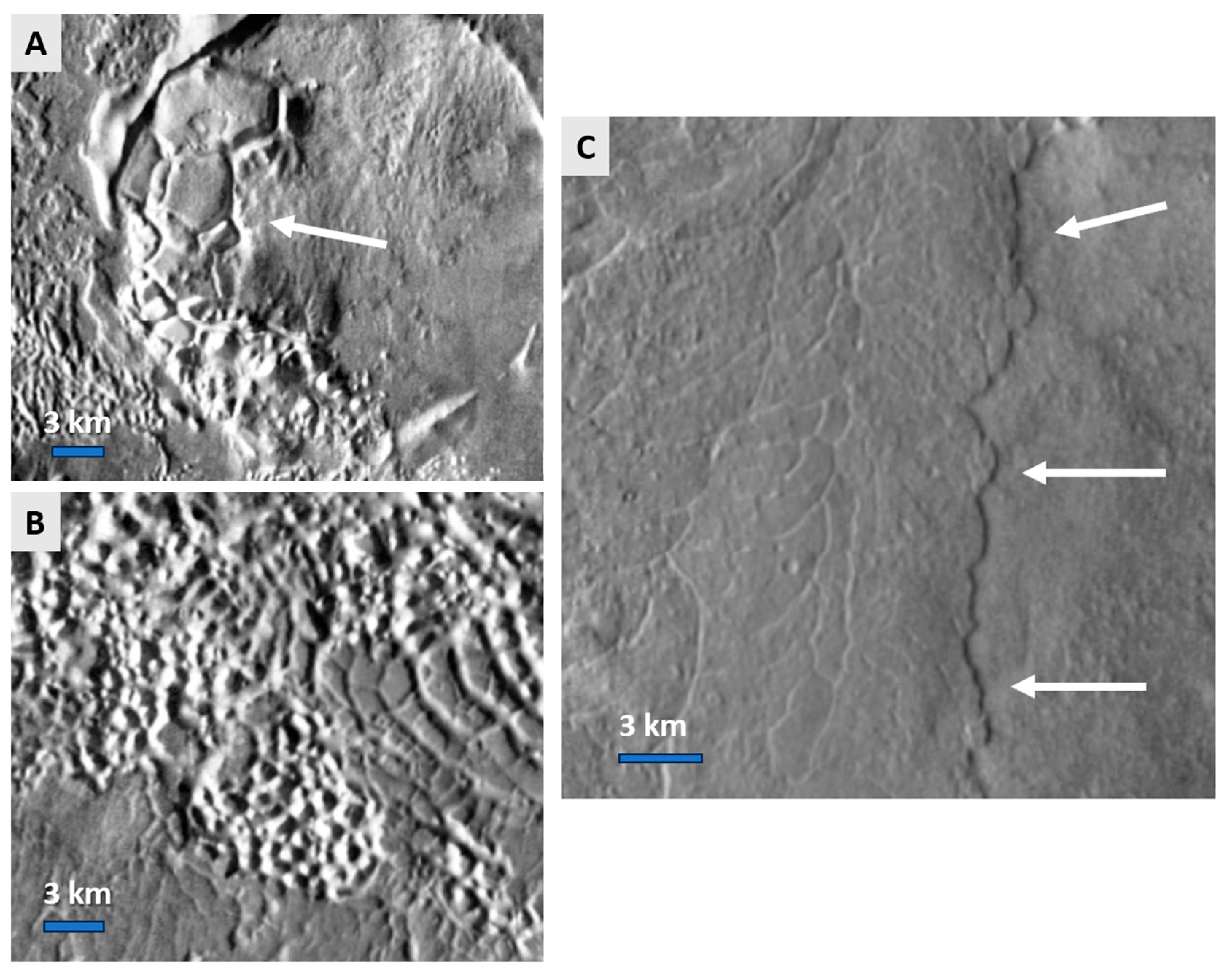
The presence of chaos-like textures along the fold perimeters indicates that deformation did not occur within a uniform or stable substrate. Chaos terrains on Mars typically arise where volatile-rich or mechanically weak layers undergo destabilization, whether through sublimation, cryospheric breaching, intrusive magmatic heating, or localized subsidence. This association suggests that folding may have taken place within a dynamically evolving crust, wherein subsurface volatile loss or magmatic activity simultaneously modified local rheology. Such environments are prone to developing mechanical boundaries that impede smooth stress transmission and create localized stress minima and maxima, consistent with the emplacement-duration variations mapped in Figure 9.
In addition to primary lava folding, parts of Avernus Colles may record modest chaos-like subsidence superposed on preexisting fold geometries. The arcuate, downslope-verging ridge packages observed here could be produced either by lava folding or by minor collapse-driven deformation, as both mechanisms generate arcuate, blocky, and fracture-bounded morphologies. Similar hybrid signatures are documented in Galaxias Chaos, Aram Chaos, and other Martian terrains where folding, collapse, and intrusive activity interact [12,14,17,18].
Given the proximity of Avernus Colles to chaos-like depressions (Figure 13) and to the Elysium–Cerberus fissure and lava systems (Figure 11), mild subsurface weakening, via intrusive heating, magma–cryosphere interaction, or volatile depletion, could have produced localized sagging or arcuate slump blocks trending toward collapse foci [11,62,66,67]. These processes would naturally reinforce the spatial segmentation and stress cyclicity observed in the modeled deformation.

4.5. Interpretation of the North–South Cyclic Pattern

The cyclic nature of these folds from north to south brings an interesting view of the nature of volcanic and tectonic interactions near the Elysium region. In clusters (for example, Sites A–D, E–G, H–K, etc., from Figure 7 and Figure 8) show a spatial variation in driving stress (and thus emplacement times) across a sequence of sites, with alternating increases and decreases. The observed variation in driving stress across the Avernus Colles fold sites suggests that deformation in this region may have occurred in a spatially cyclic or segmented manner, rather than under a continuous, monotonic stress field. From Site A to Site D, a progressive increase in driving stress is apparent, followed by a local minimum at Site E and a renewed increase toward Site G and so on repeating this cycle. This alternating pattern may reflect episodic loading and deformation phases, potentially tied to pulses of volcanic resurfacing or relaxation of prior tectonic stresses.
To place the N-S cyclicity in driving stress into a broader geologic context, we compared the spatial distribution of stress maxima and minima at our study site with mapped tectono-volcanic elements near the Avernus Colles region (see Figure 11). This sector of eastern Elysium Planitia lies between two major volcanic centers, Elysium Mons and Apollinaris Mons, both of which experienced multiple late Amazonian eruptive phases. Such conduits are known on Mars to generate alternating zones of uplift and subsidence during successive intrusive episodes, which can impart a spatially cyclic stress signature [8,22,56]. Finally, localized collapse and chaos-like terrains within Avernus Colles introduce zones of reduced lithospheric support, producing stress minima that alternate with intact, mechanically stronger sectors. When integrated, these regional structural trends and volcanic alignments provide a quantitative tectono-volcanic framework that is consistent with the observed cyclic behavior of driving stresses across the study area.

5. Conclusions

High resolution images captured by the Context Camera (CTX) and Thermal Emission Imaging System (THEMIS) in the southeastern region of Elysium Planitia, near Avernus Colles, reveal distinct areas of folded arcuate terrain with directional folding. These formations provide valuable insight into the volcanic and tectonic processes on Mars. By integrating Mars Orbiter Laser Altimeter (MOLA) data, we were able to measure the fold wavelengths, which were 0.7–1.75 km. These measurements were then incorporated into a two-layer model, using a range of basalt densities derived from previous literature on Martian volcanic landforms.
The results of our model indicate that the emplacement times for these lava folds were on the scale of <40 days, aligning with the predictions of earlier lava flow models applied to other Martian volcanic flows and chaos terrain collapse timescales. Taken together, the diagnostic comparisons show that no single mechanism uniquely satisfies all observed criteria. Instead, the folded terrains exhibit a hybrid signature where some characteristics resemble inflation-driven buckling, others align with collapse- or chaos-related disruption, and still others are consistent with regional tectonic influences. This overlap underscores the likelihood of multi-stage or multi-process deformation, where different mechanisms operated sequentially or concurrently.
The morphology and orientation of these flows share notable similarities with volcanic activity specific to the Elysium region during the late Amazonian period. Additionally, this study highlights the broader significance of Elysium-specific volcanic activity and its potential influence on the geological history of Mars at nearby regions. By investigating these folded terrain features, we can gain deeper insights into the behavior and evolution of Martian volcanism, particularly in relation to the extensive volcanic activity in the Elysium Planitia region or potential ground ice interactions at chaos terrains.

Author Contributions

Conceptualization, C.A. and R.A.S.; methodology, C.A.; validation, C.A. and R.A.S.; investigation, C.A. and R.A.S.; resources, C.A.; writing—original draft preparation, C.A. and R.A.S.; writing—review and editing, C.A. and R.A.S.; visualization, C.A. All authors have read and agreed to the published version of the manuscript.

Funding

This research received no external funding.

Data Availability Statement

All data used in this article are openly accessible through the JMARS software and the Planetary Data System (PDS).

Acknowledgments

The authors would like to thank JMARS for the organization and accessibility of THEMIS and MOLA data. The authors would also like to thank the editor and two anonymous reviewers for helpful edits and comments. The material is partially based upon work supported by CRESST-II cooperative agreement with NASA under award number 80GSFC24M0006 and LPI Contribution No. 3157. LPI is operated by the Universities Space Research Association.

Conflicts of Interest

The authors declare no conflicts of interest.

Abbreviations

The following abbreviations are used in this manuscript:
JMARSJava Mission-planning Analysis for Remote Sensing
MOLAMars Orbiter Laser Altimeter
THEMISThermal Emission Imaging System
CTXContext Camera
MROMars Reconnaissance Orbiter
MGSMars Global Surveyor
DEMDigital Elevation Models
CRISMCompact Reconnaissance Imaging Spectrometer for Mars

References

  1. Mouginis-Mark, P.J.; Wilson, L.; Head, J.W.; Brown, S.H.; Hall, J.L.; Sullivan, K.D. Elysium Planitia, Mars: Regional geology, volcanology, and evidence for volcano-ground ice interactions. Earth Moon Planets 1984, 30, 149–173. [Google Scholar] [CrossRef]
  2. Dohm, J.M.; Anderson, R.C.; Barlow, N.G.; Miyamoto, H.; Davies, A.G.; Taylor, G.J.; Baker, V.R.; Boynton, W.V.; Keller, J.; Kerry, K.; et al. Recent geological and hydrological activity on Mars: The Tharsis/Elysium corridor. Planet. Space Sci. 2008, 56, 985–1013. [Google Scholar] [CrossRef]
  3. Mangold, N.; Loizeau, D.; Poulet, F.; Ansan, V.; Baratoux, D.; LeMouelic, S.; Bardintzeff, J.; Platevoet, B.; Toplis, M.; Pinet, P.; et al. Mineralogy of recent volcanic plains in the Tharsis region, Mars, and implications for platy-ridged flow composition. Earth Planet. Sci. Lett. 2010, 294, 440–450. [Google Scholar] [CrossRef]
  4. Crown, D.A.; Ramsey, M.S. Morphologic and thermophysical characteristics of lava flows southwest of Arsia Mons, Mars. J. Volcanol. Geotherm. Res. 2017, 342, 13–28. [Google Scholar] [CrossRef]
  5. Fuller, E.R.; Head, J.W., III. Amazonis Planitia: The role of geologically recent volcanism and sedimentation in the formation of the smoothest plains on Mars. J. Geophys. Res. Planets 2002, 107, 11-1–11-25. [Google Scholar] [CrossRef]
  6. Hamilton, C.W.; Fagents, S.A.; Wilson, L. Explosive lava-water interactions in Elysium Planitia, Mars: Geologic and thermodynamic constraints on the formation of the Tartarus Colles cone groups. J. Geophys. Res. Planets 2010, 115, 6. [Google Scholar] [CrossRef]
  7. Platz, T.; Michael, G. Eruption history of the Elysium volcanic province, Mars. Earth Planet. Sci. Lett. 2011, 312, 140–151. [Google Scholar] [CrossRef]
  8. Kerber, L.; Dickson, J.L.; Head, J.W.; Grosfils, E.B. Polygonal ridge networks on Mars: Diversity of morphologies and the special case of the Eastern Medusae Fossae Formation. Icarus 2017, 281, 200–219. [Google Scholar] [CrossRef]
  9. Crumpler, L. Sites of Potential Long Term Sub-surface Water, Mineral-rich Environments, and Deposition in South Elysium Planitia, Hellas-Dao Vallis, Isidis Basin, and Xanthe-Hypanis Vallis: Candidate Mars Science Laboratory Landing Sites. In Proceedings of the First Landing Site Workshop for the 2009 Mars Science Laboratory, Pasadena, CA, USA, 31 May–2 June 2006. [Google Scholar]
  10. Sharp, R.P. Mars: Fretted and chaotic terrains. J. Geophys. Res. 1973, 78, 4073–4083. [Google Scholar] [CrossRef]
  11. Leask, H.J.; Wilson, L.; Mitchell, K.L. Formation of Aromatum Chaos, Mars: Morphological development as a result of volcano-ice interactions. J. Geophys. Res. Planets 2006, 111, 71. [Google Scholar] [CrossRef]
  12. Meresse, S.; Costard, F.; Mangold, N.; Masson, P.; Neukum, G. Formation and evolution of the chaotic terrains by subsidence and magmatism: Hydraotes Chaos, Mars. Icarus 2008, 194, 487–500. [Google Scholar] [CrossRef]
  13. Roda, M.; Kleinhans, M.G.; Zegers, T.E.; Oosthoek, J.H. Catastrophic ice lake collapse in Aram Chaos, Mars. Icarus 2014, 236, 104–121. [Google Scholar] [CrossRef]
  14. Luzzi, E.; Rossi, A.P.; Carli, C.; Altieri, F. Tectono-magmatic, sedimentary, and hydrothermal history of Arsinoes and Pyrrhae Chaos, Mars. J. Geophys. Res. Planets 2020, 125, e2019JE006341. [Google Scholar] [CrossRef]
  15. Luzzi, E.; Rossi, A.P.; Massironi, M.; Pozzobon, R.; Corti, G.; Maestrelli, D. Caldera collapse as the trigger of Chaos and fractured craters on the Moon and Mars. Geophys. Res. Lett. 2021, 48, e2021GL092436. [Google Scholar] [CrossRef]
  16. Pedersen, G.B.M. Chaotic Terrain (Mars). In Encyclopedia of Planetary Landforms; Springer: New York, NY, USA, 2014; pp. 1–6. [Google Scholar] [CrossRef]
  17. Warner, N.H.; Gupta, S.; Kim, J.-R.; Muller, J.-P.; Le Corre, L.; Morley, J.; Lin, S.-Y.; McGonigle, C. Constraints on the origin and evolution of Iani Chaos, Mars. J. Geophys. Res. Planets 2011, 116, 3. [Google Scholar] [CrossRef]
  18. Chapman, M.G.; Tanaka, K.L. Related magma–ice interactions: Possible origins of chasmata, chaos, and surface materials in Xanthe, Margaritifer, and Meridiani Terrae, Mars. Icarus 2002, 155, 324–339. [Google Scholar] [CrossRef]
  19. Rodriguez, J.; Sasaki, S.; Kuzmin, R.; Dohm, J.; Tanaka, K.; Miyamoto, H.; Kurita, K.; Komatsu, G.; Fairen, A.; Ferris, J. Outflow channel sources, reactivation, and chaos formation, Xanthe Terra, Mars. Icarus 2005, 175, 36–57. [Google Scholar] [CrossRef]
  20. Coleman, N.M. Martian megaflood-triggered chaos formation, revealing groundwater depth, cryosphere thickness, and crustal heat flux. J. Geophys. Res. Planets 2005, 110, S20. [Google Scholar] [CrossRef]
  21. Kargel, J.S.; Furfaro, R.; Prieto-Ballesteros, O.; Rodriguez, J.A.P.; Montgomery, D.R.; Gillespie, A.R.; Marion, G.M.; Wood, S.E. Martian hydrogeology sustained by thermally insulating gas and salt hydrates. Geology 2007, 35, 975–978. [Google Scholar] [CrossRef]
  22. Ahrens, C.; Cataldo, V.; Leone, G. Volcanic Eruptions on Mars, Lava Flow Morphology, and Thermodynamics. In Mars: A Volcanic World; Springer: Cham, Switzerland, 2021; pp. 71–94. [Google Scholar] [CrossRef]
  23. Theilig, E.; Greeley, R. Lava flows on Mars: Analysis of small surface features and comparisons with terrestrial analogs. J. Geophys. Res. Solid Earth 1986, 91, E193–E206. [Google Scholar] [CrossRef]
  24. Gerekos, C.; Grima, C.; Steinbrügge, G.; Thakur, S.; Scanlan, K.M.; Young, D.A.; Bruzzone, L.; Blankenship, D.D. Martian roughness analogues of Europan terrains for radar sounder investigations. Icarus 2021, 358, 114197. [Google Scholar] [CrossRef]
  25. Griffiths, R.W.; Fink, J.H. The morphology of lava flows in planetary environments: Predictions from analog experiments. J. Geophys. Res. Solid Earth 1992, 97, 19739–19748. [Google Scholar] [CrossRef]
  26. Gregg, T.K.; Fink, J.H.; Griffiths, R.W. Formation of multiple fold generations on lava flow surfaces: Influence of strain rate, cooling rate, and lava composition. J. Volcanol. Geotherm. Res. 1998, 80, 281–292. [Google Scholar] [CrossRef]
  27. Barr, A.C.; Preuss, L.J. On the origin of south polar folds on Enceladus. Icarus 2010, 208, 499–503. [Google Scholar] [CrossRef]
  28. Fink, J.H.; Fletcher, R.C. Ropy pahoehoe: Surface folding of a viscous fluid. J. Volcanol. Geotherm. Res. 1978, 4, 151–170. [Google Scholar] [CrossRef]
  29. Zimbelman, J.R. Emplacement of long lava flows on planetary surfaces. J. Geophys. Res. Solid Earth 1998, 103, 27503–27516. [Google Scholar] [CrossRef]
  30. Twidale, C.R.; Bourne, J.A. Fractures as planes of dislocation and two-way translocation: Their significance in landform development. Phys. Geogr. 2007, 28, 193–217. [Google Scholar] [CrossRef]
  31. Pasckert, J.H.; Hiesinger, H.; Reiss, D. Rheologies and ages of lava flows on Elysium Mons, Mars. Icarus 2012, 219, 443–457. [Google Scholar] [CrossRef]
  32. Plescia, J.B. Recent flood lavas in the Elysium region of Mars. Icarus 1990, 88, 465–490. [Google Scholar] [CrossRef]
  33. Baloga, S.M.; Mouginis-Mark, P.J.; Glaze, L.S. Rheology of a long lava flow at Pavonis Mons, Mars. J. Geophys. Res. Planets 2003, 108, 5066. [Google Scholar] [CrossRef]
  34. Hurwitz, D.M.; Fassett, C.I.; Head, J.W.; Wilson, L. Formation of an eroded lava channel within an Elysium Planitia impact crater: Distinguishing between a mechanical and thermal origin. Icarus 2010, 210, 626–634. [Google Scholar] [CrossRef]
  35. Kukkonen, S.; Kostama, V.P. Modification history of the Harmakhis Vallis outflow channel, Mars, based on CTX-scale photogeologic mapping and crater count dating. Icarus 2018, 299, 46–67. [Google Scholar] [CrossRef]
  36. Viviano, C.E.; Murchie, S.L.; Daubar, I.J.; Morgan, M.F.; Seelos, F.P.; Plescia, J.B. Composition of Amazonian volcanic materials in Tharsis and Elysium, Mars, from MRO/CRISM reflectance spectra. Icarus 2019, 328, 274–286. [Google Scholar] [CrossRef]
  37. Pelkey, S.M.; Mustard, J.F.; Murchie, S.; Clancy, R.T.; Wolff, M.; Smith, M.; Milliken, R.; Bibring, J.; Gendrin, A.; Poulet, F.; et al. CRISM multispectral summary products: Parameterizing mineral diversity on Mars from reflectance. J. Geophys. Res. Planets 2007, 112, S14. [Google Scholar] [CrossRef]
  38. Fink, J. Surface folding and viscosity of rhyolite flows. Geology 1980, 8, 250–254. [Google Scholar] [CrossRef]
  39. Wollkind, D.J.; Alexander, J.I.D. A Newtonian fluid model of the onset of plane folding in a single rock layer with surface tension effects. Math. Model. 1981, 2, 319–348. [Google Scholar] [CrossRef]
  40. Anderson, S.W.; Fink, J.H. Crease structures: Indicators of emplacement rates and surface stress regimes of lava flows. Geol. Soc. Am. Bull. 1992, 104, 615–625. [Google Scholar] [CrossRef]
  41. Griffiths, R.W. The dynamics of lava flows. Annu. Rev. Fluid Mech. 2000, 32, 477–518. [Google Scholar] [CrossRef]
  42. Greeley, R.; Foing, B.H.; McSween, H.Y., Jr.; Neukum, G.; Pinet, P.; van Kan, M.; Werner, S.C.; Williams, D.A.; Zegers, T.E. Fluid lava flows in Gusev crater, Mars. J. Geophys. Res. Planets 2005, 110, 8. [Google Scholar] [CrossRef]
  43. Chevrel, M.O.; Baratoux, D.; Hess, K.U.; Dingwell, D.B. Viscous flow behavior of tholeiitic and alkaline Fe-rich martian basalts. Geochim. Cosmochim. Acta 2014, 124, 348–365. [Google Scholar] [CrossRef]
  44. Warner, N.H.; Gregg, T.K. Evolved lavas on Mars? Observations from southwest Arsia mons and Sabancaya volcano, Peru. J. Geophys. Res. Planets 2003, 108, 5112. [Google Scholar] [CrossRef]
  45. Basilevskaya, E.A.; Neukum, G.; HRSC Co-Investigator Team. The Olympus volcano on Mars: Geometry and characteristics of lava flows. Sol. Syst. Res. 2006, 40, 375–383. [Google Scholar] [CrossRef]
  46. Thiriet, M.; Michaut, C.; Breuer, D.; Plesa, A.C. Hemispheric dichotomy in lithosphere thickness on Mars caused by differences in crustal structure and composition. J. Geophys. Res. Planets 2018, 123, 823–848. [Google Scholar] [CrossRef]
  47. Peters, S.I.; Christensen, P.R.; Clarke, A.B. Lava flow eruption conditions in the Tharsis volcanic province on Mars. J. Geophys. Res. Planets 2021, 126, e2020JE006791. [Google Scholar] [CrossRef]
  48. MacKay, M.E.; Rowland, S.K.; Mouginis-Mark, P.J.; Garbeil, H. Thick lava flows of Karisimbi Volcano, Rwanda: Insights from SIR-C interferometric topography. Bull. Volcanol. 1998, 60, 239–251. [Google Scholar] [CrossRef]
  49. Hauber, E.; Brož, P.; Jagert, F.; Jodłowski, P.; Platz, T. Very recent and wide-spread basaltic volcanism on Mars. Geophys. Res. Lett. 2011, 38, 201. [Google Scholar] [CrossRef]
  50. Pauer, M.; Breuer, D. Constraints on the maximum crustal density from gravity–topography modeling: Applications to the southern highlands of Mars. Earth Planet. Sci. Lett. 2008, 276, 253–261. [Google Scholar] [CrossRef]
  51. Tarnas, J.; Mustard, J.; Lollar, B.S.; Stamenković, V.; Cannon, K.; Lorand, J.-P.; Onstott, T.; Michalski, J.; Warr, O.; Palumbo, A.; et al. Earth-like habitable environments in the subsurface of Mars. Astrobiology 2021, 21, 741–756. [Google Scholar] [CrossRef]
  52. McGovern, P.J.; Solomon, S.C. State of stress, faulting, and eruption characteristics of large volcanoes on Mars. J. Geophys. Res. Planets 1993, 98, 23553–23579. [Google Scholar] [CrossRef]
  53. Hon, K.E.N.; Kauahikaua, J.I.M.; Denlinger, R.; Mackay, K. Emplacement and inflation of pahoehoe sheet flows: Observations and measurements of active lava flows on Kilauea Volcano, Hawaii. Geol. Soc. Am. Bull. 1994, 106, 351–370. [Google Scholar] [CrossRef]
  54. Pedersen, G.B.M.; Head III, J.W. Chaos formation by sublimation of volatile-rich substrate: Evidence from Galaxias Chaos, Mars. Icarus 2011, 211, 316–329. [Google Scholar] [CrossRef]
  55. Kerber, L.; Head, J.W.; Madeleine, J.-B.; Forget, F.; Wilson, L. The dispersal of pyroclasts from Apollinaris Patera, Mars: Implications for the origin of the Medusae Fossae Formation. Icarus 2011, 216, 212–220. [Google Scholar] [CrossRef]
  56. Lang, N.P.; Ahrens, C.; Farrell, A.K. The Origin and Evolution of Volcanism at Martian Highland Paterae: A Review of the Current State of Knowledge. In Mars: A Volcanic World; Springer: Cham, Switzerland, 2021; pp. 231–266. [Google Scholar] [CrossRef]
  57. Zamani, B. Geodynamics and tectonic stress model for the Zagros fold–thrust belt and classification of tectonic stress regimes. Mar. Pet. Geol. 2023, 155, 106340. [Google Scholar] [CrossRef]
  58. Koehn, D.; Lindenfeld, M.; Rümpker, G.; Aanyu, K.; Haines, S.; Passchier, C.W.; Sachau, T. Active transsection faults in rift transfer zones: Evidence for complex stress fields and implications for crustal fragmentation processes in the western branch of the East African Rift. Int. J. Earth Sci. 2010, 99, 1633–1642. [Google Scholar] [CrossRef]
  59. Bleacher, J.E.; Greeley, R.; Williams, D.A.; Werner, S.C.; Hauber, E.; Neukum, G. Olympus Mons, Mars: Inferred changes in late Amazonian aged effusive activity from lava flow mapping of Mars Express High Resolution Stereo Camera data. J. Geophys. Res. Planets 2007, 112, 3. [Google Scholar] [CrossRef]
  60. Horvath, D.G.; Moitra, P.; Hamilton, C.W.; Craddock, R.A.; Andrews-Hanna, J.C. Evidence for geologically recent explosive volcanism in Elysium Planitia, Mars. Icarus 2021, 365, 114499. [Google Scholar] [CrossRef]
  61. Vetterlein, J.; Roberts, G.P. Postdating of flow in Athabasca Valles by faulting of the Cerberus Fossae, Elysium Planitia, Mars. J. Geophys. Res. Planets 2009, 114, 3. [Google Scholar] [CrossRef]
  62. Tanaka, K.L.; Skinner, J.A., Jr.; Dohm, J.M.; Irwin, R.P.; Kolb, E.J.; Fortezzo, C.M.; Platz, T.; Michael, G.G.; Hare, T.M. Geologic Map of Mars; USGS: Reston, VA, USA, 2014.
  63. Andrews, G.D.; Kenderes, S.M.; Whittington, A.G.; Isom, S.L.; Brown, S.R.; Pettus, H.D.; Cole, B.G.; Gokey, K.J. The fold illusion: The origins and implications of ogives on silicic lavas. Earth Planet. Sci. Lett. 2021, 553, 116643. [Google Scholar] [CrossRef]
  64. Glaze, L.S.; Baloga, S.M. Dimensions of Pu’u O’o lava flows on Mars. J. Geophys. Res. Planets 1998, 103, 13659–13666. [Google Scholar] [CrossRef]
  65. Glaze, L.S.; Baloga, S.M. Rheologic inferences from the levees of lava flows on Mars. J. Geophys. Res. Planets 2006, 111, 6. [Google Scholar] [CrossRef]
  66. Burr, D.M.; Grier, J.A.; McEwen, A.S.; Keszthelyi, L.P. Repeated aqueous flooding from the Cerberus Fossae: Evidence for very recently extant, deep groundwater on Mars. Icarus 2002, 159, 53–73. [Google Scholar] [CrossRef]
  67. Head, J.W.; Wilson, L.; Mitchell, K.L. Generation of recent massive water floods at Cerberus Fossae, Mars by dike emplacement, cryospheric cracking, and confined aquifer groundwater release. Geophys. Res. Lett. 2003, 30, 1577. [Google Scholar] [CrossRef]
Figure 1. Study area west of Avernus Colles, near Elysium Planitia. (A): Colorized topographic map of Elysium Planitia and Avernus Colles (white box indicates study area). Scale bar 1000 km; (B): THEMIS image of study area (from white box). The lava flows under investigation are within the white circle. Scale bar 250 km.
Remotesensing 17 03946 g001
Figure 2. Examples of ropey, arcuate lava textures. (A): An example location in our research site in Avernus Colles (Site K). Scale bar 10 km; (B): relatively smaller (<2 m) scale ropey pahoehoe from the Santiago shield volcano in the Galapagos Islands (photo by Lee Siebert, Smithsonian Institution; Image made available under Public Domain Dedication CC0). (C): Gorgonum Chaos on Mars from HIRISE ID: ESP-016004-1425; (D): Silicic lava folds moving downslope (toward top of image) at Big Obsidian Flow Trailhead in Bend, Oregon (Google Earth).
Remotesensing 17 03946 g002
Figure 3. (A): Topographic profile on one of the site locations using JMARS. This topographic profile was used to create a DEM profile of the lava flow. (B): DEM topographic profile depicted in Figure 2A, with corresponding A–A’ traverse. Scale bar at 7.5 km. Arrow points north.
Remotesensing 17 03946 g003
Figure 4. THEMIS image of Avernus Colles with labeled sites (A–S) of individual flows used in this study. Scale bar 250 km. Arrow points north.
Remotesensing 17 03946 g004
Figure 5. Driving stress (in Pa) measurements from each folded study site using the density value of 2500 kg m−3.
Remotesensing 17 03946 g005
Figure 6. Time of emplacement (in days) calculated from each study site.
Remotesensing 17 03946 g006
Figure 7. Driving stress measurements from each lava flow study site, as calculated from Equation (4), but with density at 3200 kg m−3.
Remotesensing 17 03946 g007
Figure 8. Time of emplacement calculated from each lava flow study site, with density at 3200 kg m−3.
Remotesensing 17 03946 g008
Figure 9. Relative ogive direction at Avernus Colles, as indicated by arrows. The color of the arrows indicates the time of emplacement measured in this study: >30 days (blue); 25–30 days (green); 20–25 days (yellow); <20 days (red).
Remotesensing 17 03946 g009
Figure 10. Oblique views of the Avernus Colles folded terrains, using the JMARS software. (A): 1× exaggeration at Site L; (B): 7× exaggeration at Site K. White arrows demarcate perimeters of the terrains to exemplify the complexity of the folds and possible connections to chaos terrain mechanisms.
Remotesensing 17 03946 g010
Figure 11. Geologic structure map (from Tanaka et al. [62]) of the Elysium Mons and surrounding area, including Avernus Colles study area. The rose diagram indicates that the orientation of the folds at Avernus Colles (this study; from Figure 9) is dominant in the ~150° orientation, compared to the nearby Cerberus Plains, Athabasca Valles, and Grótjá Valles. Arrow points north. Scale bar 1000 km.
Remotesensing 17 03946 g011
Figure 12. CRISM olivine (in pix/deg–ppd) near Site F. We observe that lower olivine abundances are between folds, with relatively higher abundances at the fold crests.
Remotesensing 17 03946 g012
Figure 13. Chaos terrain textures within the Avernus Colles study site. (A): chaos terrain (white arrow) cracking and knobs within a buried crater, near Site A; (B): chaos terrain near fractured folds north of Site P; (C): edges of fractured folds near the southern rim of the study site. White arrows mark elevated and scalloped fold edges on top of a smoother lava field.
Remotesensing 17 03946 g013
Table 1. Average wavelengths (in km) measured at each lava flow site, as designated in Figure 4.
SiteLatitude (°N)Longitude (°E)Average Wavelength [km]
A2.22178.690.75
B2.124178.371.2
C1.73177.801.39
D1.716177.461.5
E1.6177.2261.14
F1.606176.391.32
G1.312176.361.38
H1.004176.4981.03
I1.032176.9681.13
J0.672176.541.2
K0.087175.9111.22
L−0.2887175.7320.71
M−0.697175.940.84
N−0.258175.380.97
O−1.261174.641.6
P−1.368173.2111.75
Q−2.293173.0461.63
R−2.238173.6061.1
S−3.013172.9390.72
Disclaimer/Publisher’s Note: The statements, opinions and data contained in all publications are solely those of the individual author(s) and contributor(s) and not of MDPI and/or the editor(s). MDPI and/or the editor(s) disclaim responsibility for any injury to people or property resulting from any ideas, methods, instructions or products referred to in the content.