Analysis of the Statistical Relationship Between Vertical Ground Displacements and Selected Explanatory Factors: A Case Study of the Underground Gas Storage Area, Kosakowo, Poland

Highlights
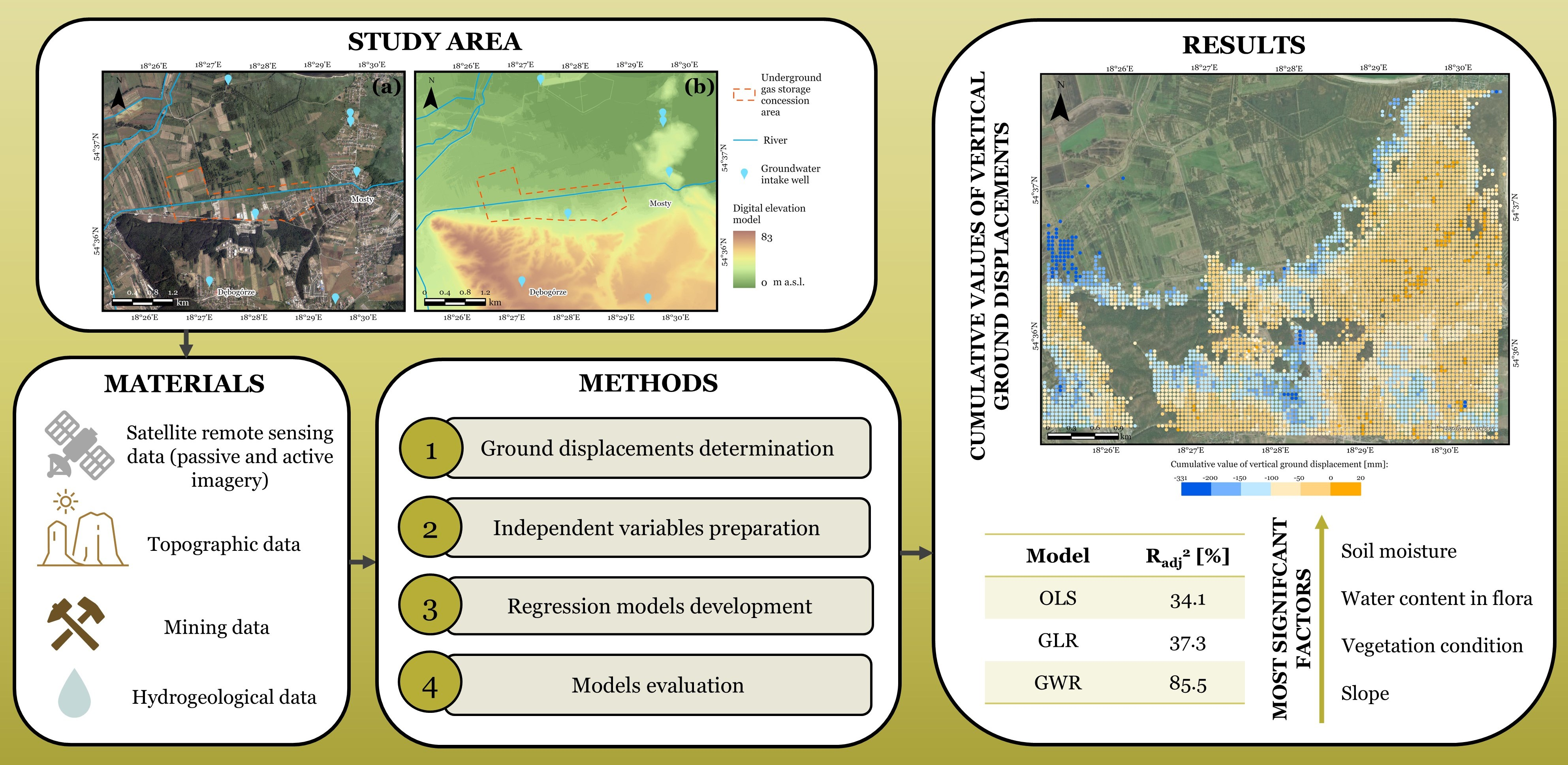
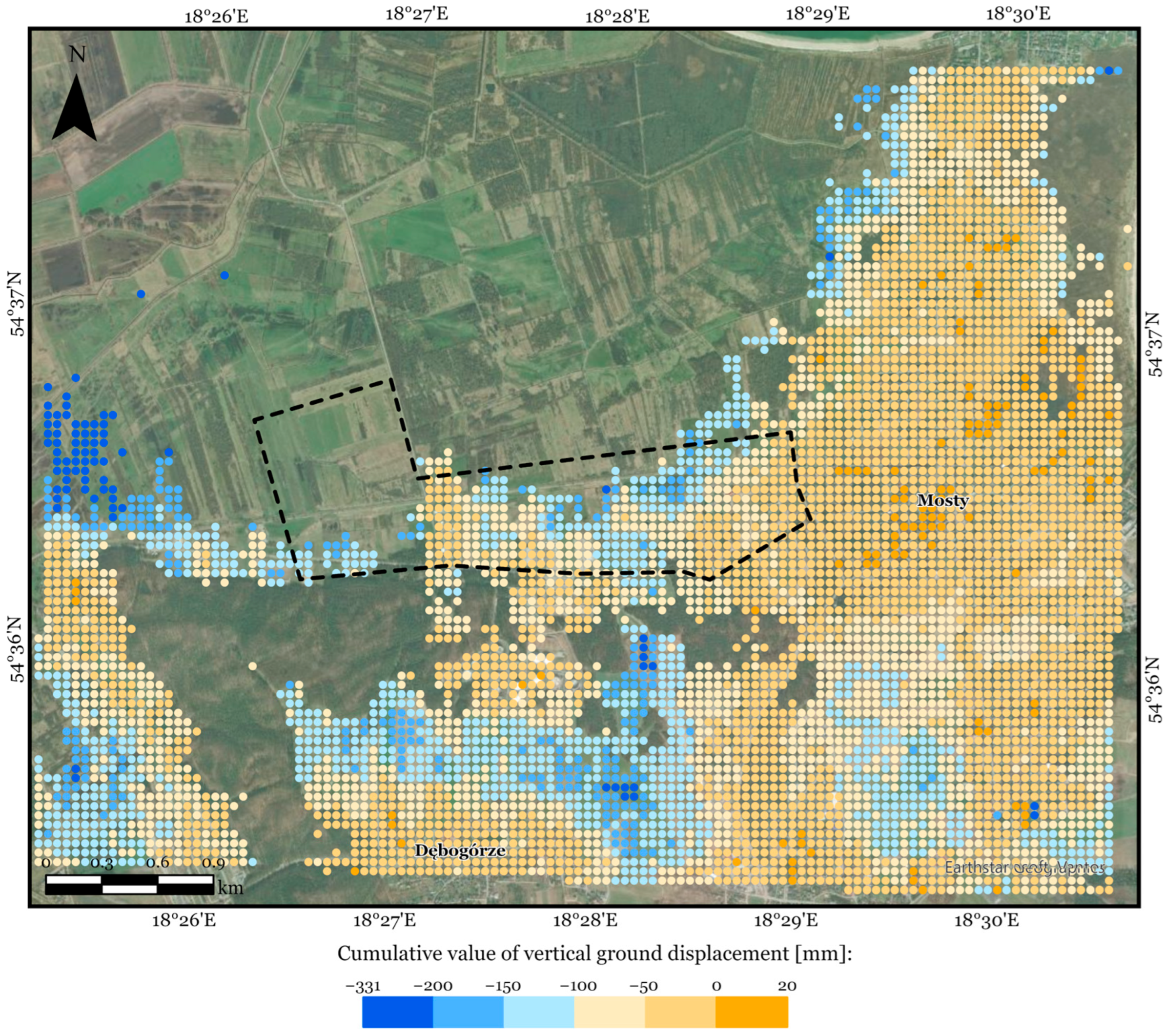
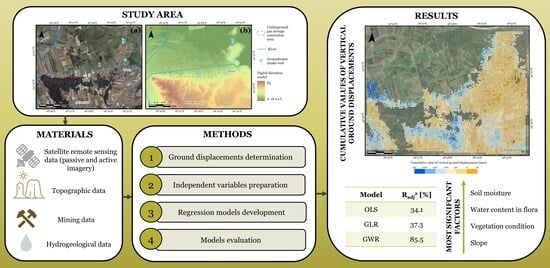
- The cumulative values of vertical ground displacements over the study area ranged from −331 mm to +20 mm.
- The highest subsidence values were mainly observed outside the location of a UGS facility.
- The UGS facility was not the significant driving factor of the observed vertical ground displacements, but such factors included soil moisture, water concentration in vegetation, and flora condition.
- Regression models enabled the explanation of ground displacements over a UGS facility.
Abstract
1. Introduction
1.1. Ground Displacements in Underground Gas Storage (UGS) Areas
1.2. Data and Methods Used to Monitor Ground Displacements in Underground Gas Storage (UGS) Areas
1.3. Research Aim and Its Scientific Significance
- The number of published studies, which integrate passive and active satellite imagery to monitor ground displacements in underground gas storage (UGS) areas, is relatively small;
- Spatial statistics methods, including spatial regression models, were not used to analyze ground displacements over UGS areas;
- Remote sensing data and spatial regression models have not yet been applied to study ground displacements within the UGS areas in Poland;
2. Study Area
2.1. Location of the Study Area
2.2. Underground Gas Storage
3. Materials and Methods
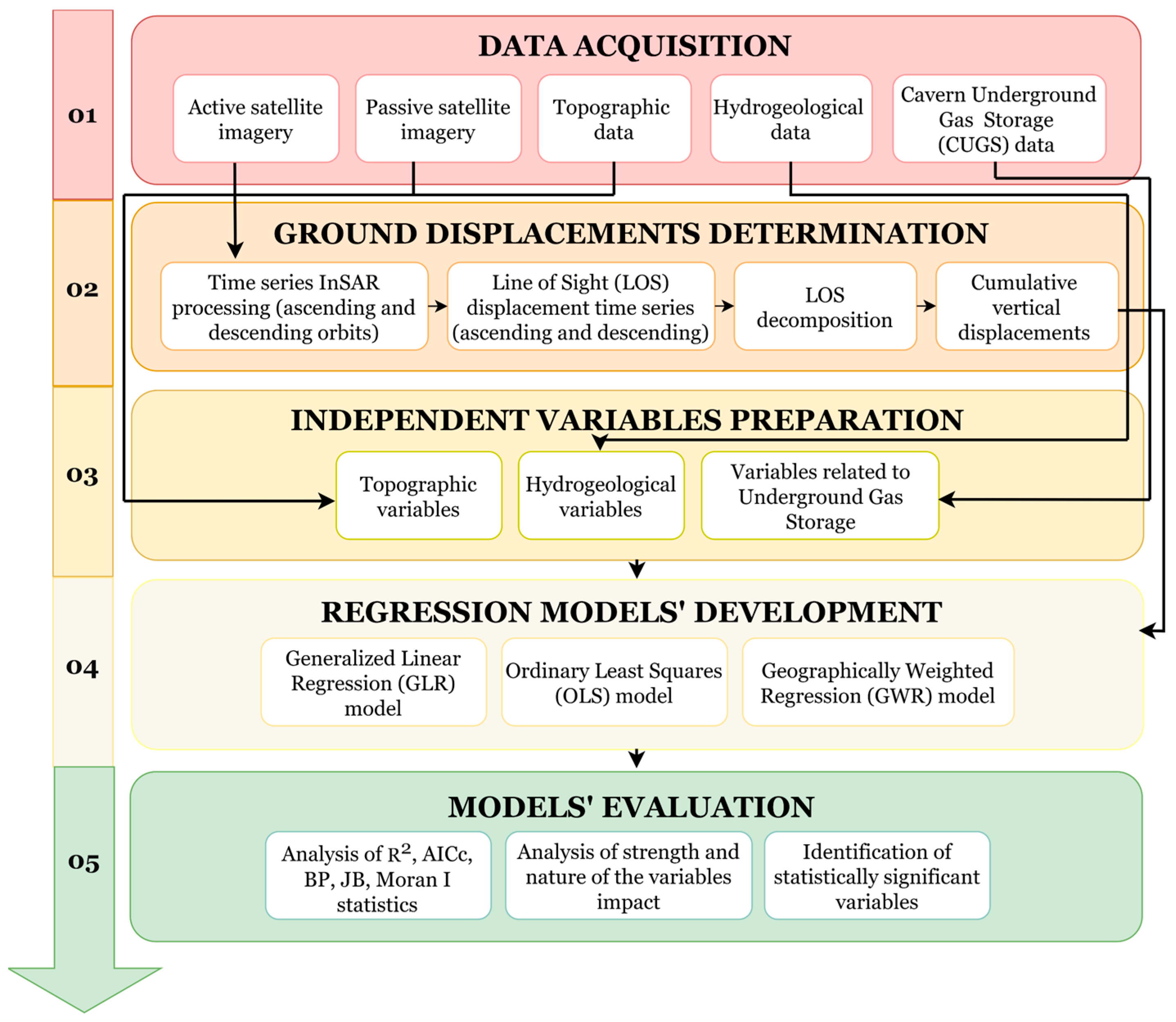
3.1. Data Acquisition
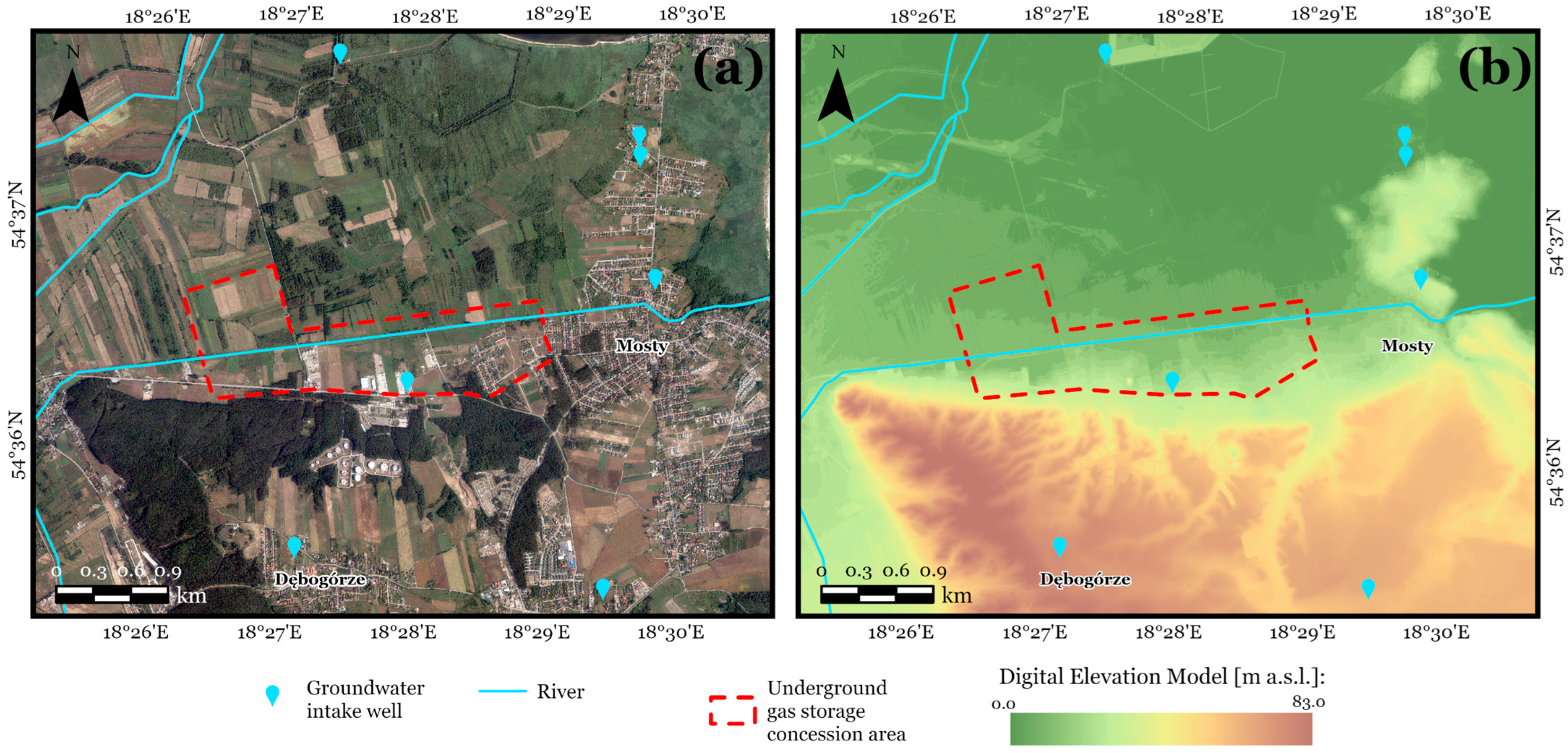
- Digital Elevation Model (DEM) with a spatial resolution of 5 m obtained from aerial laser scanning performed in 2020 and available in [36];
- Vector data from the Database of Topographical Objects (scale 1:10,000), presenting the location of watercourses in the research area and available in [39];
- Vector data from the National Border Register, presenting the Baltic Sea shoreline and available in [40];
- Vector data from the Central Geological Database, presenting the location of boreholes and geological engineering boreholes and the borehole cards, available in [43];
- Central Hydrogeological Database presenting the information on groundwater intake points [44];
3.2. Development of Dependent Variable—Cumulative Vertical Ground Displacements
3.3. Development of Independent Variables
3.4. Development of Regression Models
- Maximum number of factors explaining the dependent variable: 16;
- Minimum number of factors explaining the dependent variable: 1;
- Minimum value of the adjusted coefficient of determination (RAdj2): 0.3;
- Maximum value of the Variance Inflation Factor (VIF): 7.5;
- Minimum value of the Jarque–Bera (JB) test and spatial autocorrelation (SA): 0.1;
- Required confidence level for all β coefficients assigned to independent variables: 0.05.
3.5. Assessment of Regression Models
4. Results
4.1. Exploratory Regression
4.2. Analysis of Global Regression Models
4.2.1. Evaluation of Models
4.2.2. Influence of Independent Variables on the Dependent Variable
4.3. Analysis of a Local Regression Model
4.3.1. Evaluation of Model
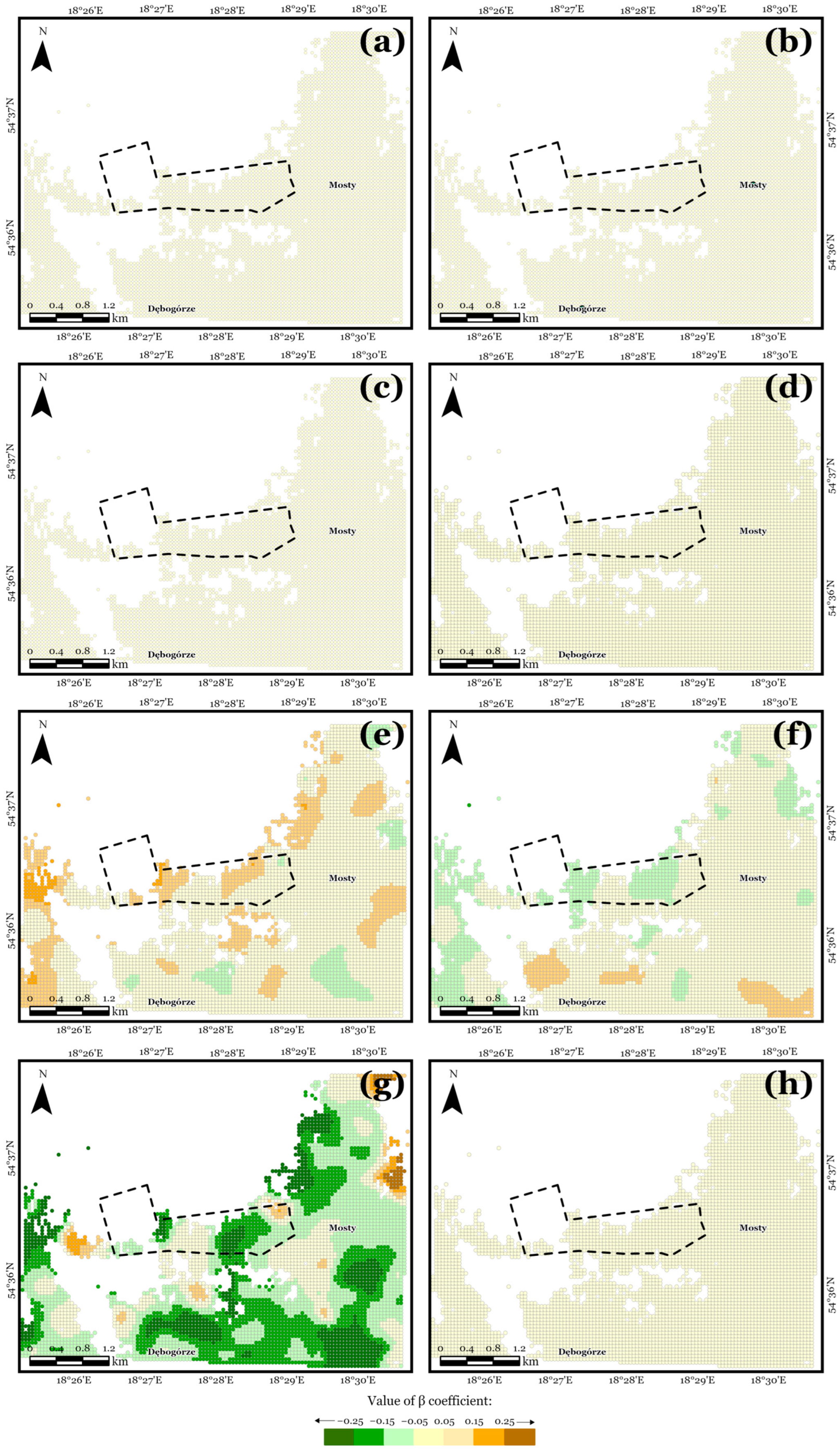
4.3.2. Influence of Independent Variables on the Dependent Variable
5. Discussion
6. Conclusions
- The cumulative values of vertical ground displacements over the Kosakowo UGS facility between 2014 and 2024, determined using Sentinel-1 SAR imagery and the SBAS InSAR method, ranged from −331 mm to +20 mm (the mean value of determined ground displacement velocities was equal to −4.3 mm/year). The highest subsidence values were noted in the north-western, south-western, and southern parts of the analyzed area. The cumulative values of subsidence greater than 150 mm were also observed within the locations of caverns;
- To explain the vertical ground displacements, both at the global and local scales, three spatial regression models (OLS, GLR, and GWR models) and as many as 16 independent variables, developed using the Sentinel-2 images and open geospatial datasets, were utilized;
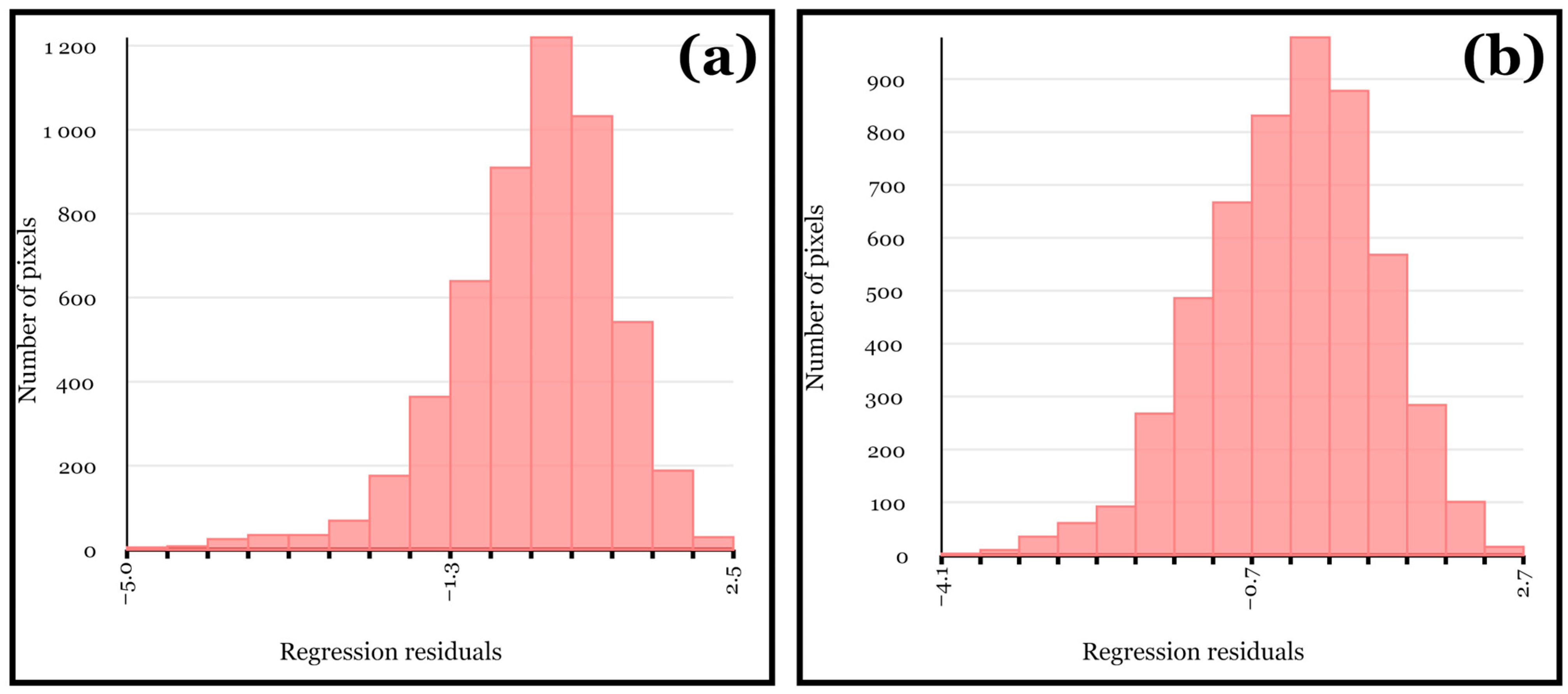
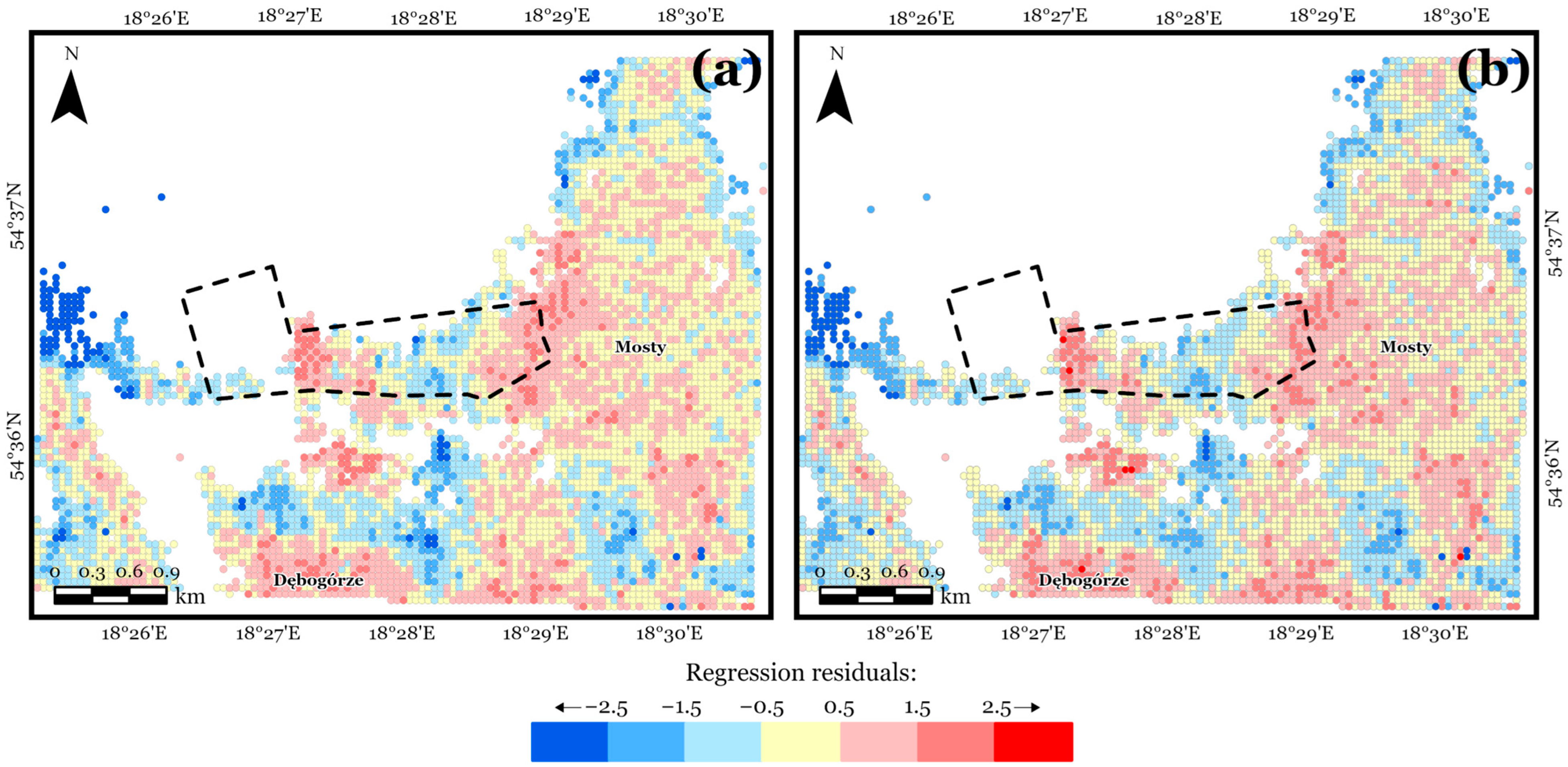
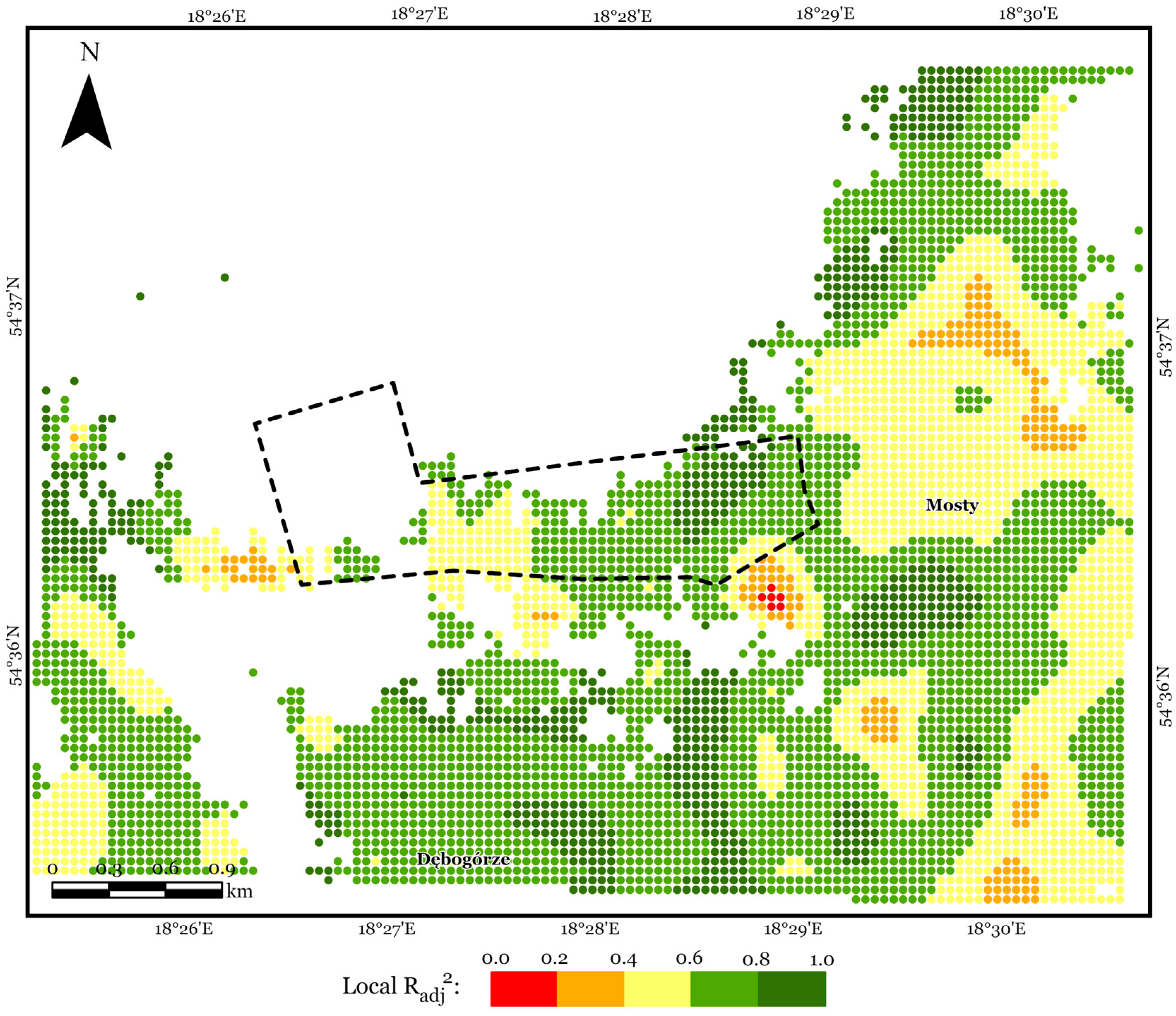
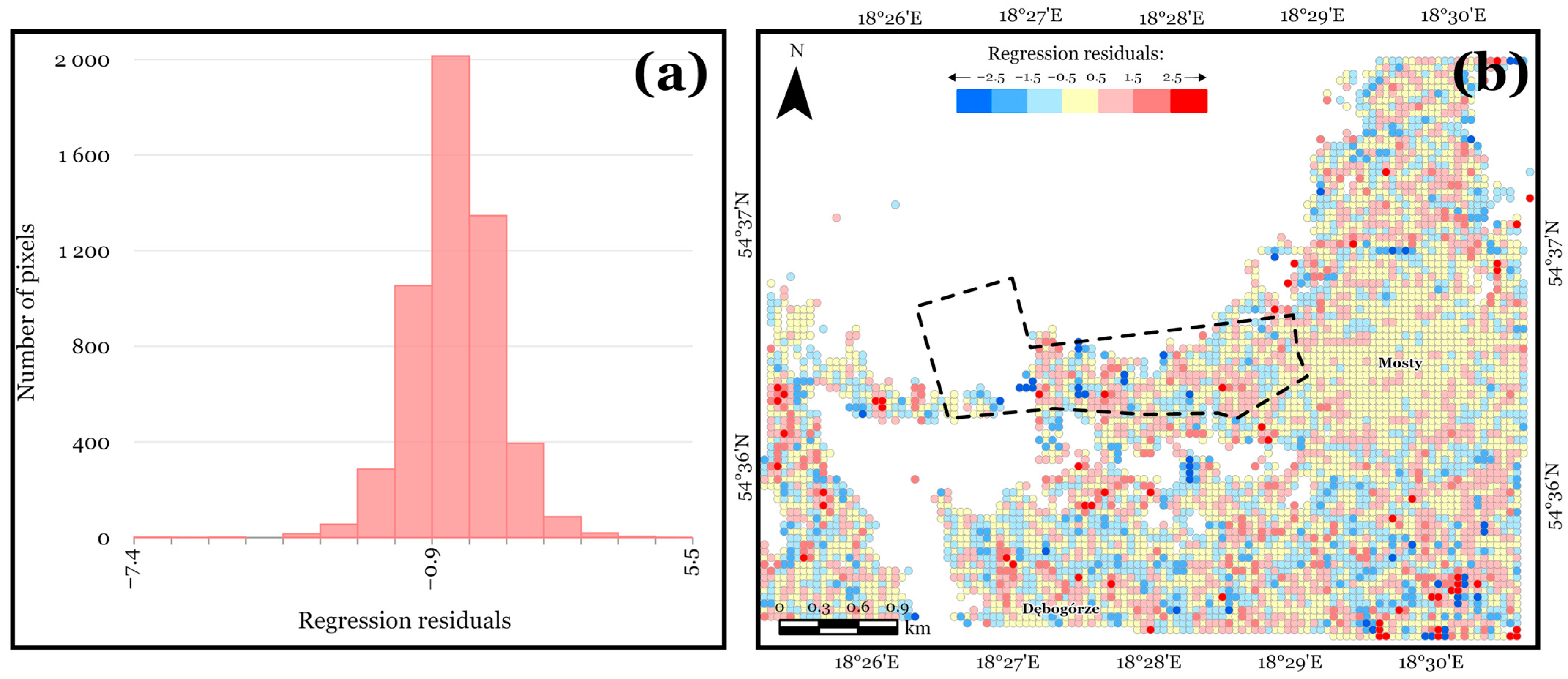
- The developed global regression models (OLS and GLR models) were characterized by relatively low accuracy, as none of them explained more than 40.0% of the variance in the dependent variable. The adjusted coefficient of determination for the GWR model was equal to 85.5%, with the values of local Radj2 lower than 40.0% only for several pixels in the eastern and central parts of the study area;
- Both global and local regression models demonstrated that soil moisture, flora condition, and vegetation water content had the greatest impact on the observed values of vertical ground displacements. The distance from the Kanał Ściekowy watercourse, the distance from groundwater intakes, and the distance from Cluster A at the cavernous UGS facility had the least significant impact on the dependent variable;
- The developed regression models confirmed that underground gas storage was not the main driving factor in the context of the observed ground displacements over the study area. In addition, these studies indicated that the presence of peats can be a significant obstacle in satellite monitoring of ground movements above UGS facilities in an early operational state;
- The results presented in this article constitute a basis for further analysis. Potential future research directions include the following: (1) application of models which consider the nonlinear relationships between variables (e.g., Random Forest), (2) modeling of vertical ground displacements determined for shorter intervals (e.g., annual) or using other methods (e.g., integration of SBAS and PSInSAR methods), and (3) analysis of relationships with additional geological and mining factors.
Author Contributions
Funding
Data Availability Statement
Acknowledgments
Conflicts of Interest
Appendix A

| Method | Maximum Value of DV [mm/year] | Minimum Value of DV [mm/year] | Mean Value of DV [mm/year] | Standard Deviation of DV [mm/year] | Number of Points |
|---|---|---|---|---|---|
| SBAS | −20.9 | 0.4 | −4.3 | 3.56 | 288 |
| EGMS | −9.8 | 1.9 | −1.2 | 1.41 | 290 |
References
- Struhár, J.; Rapant, P.; Kačmařík, M.; Hlaváčová, I.; Lazecký, M. Monitoring Non-Linear Ground Motion above Underground Gas Storage Using GNSS and PSInSAR Based on Sentinel-1 Data. Remote Sens. 2022, 14, 4898. [Google Scholar] [CrossRef]
- Wang, Y.; Feng, G.; Li, Z.; Xu, W.; Zhu, J.; He, L.; Xiong, Z.; Qiao, X. Retrieving the Displacements of the Hutubi (China) Underground Gas Storage during 2003–2020 from Multi-Track InSAR. Remote Sens. Environ. 2022, 268, 112768. [Google Scholar] [CrossRef]
- Wei, X.; Shi, X.; Li, Y.; Li, P.; Ban, S.; Zhao, K.; Ma, H.; Liu, H.; Yang, C. A Comprehensive Feasibility Evaluation of Salt Cavern Oil Energy Storage System in China. Appl. Energy 2023, 351, 121807. [Google Scholar] [CrossRef]
- Tarkowski, R.; Lankof, L.; Luboń, K.; Michalski, J. Hydrogen Storage Capacity of Salt Caverns and Deep Aquifers versus Demand for Hydrogen Storage: A Case Study of Poland. Appl. Energy 2024, 355, 122268. [Google Scholar] [CrossRef]
- Neeft, E.; Bartol, J.; Vuorio, M.; Vis, G.-J. Geological Disposal of Radioactive Waste. In Geology of the Netherlands; Amsterdam University Press: Amsterdam, The Netherlands, 2025; pp. 769–791. [Google Scholar]
- Bandilla, K.W. 31—Carbon Capture and Storage. In Future Energy, 3rd ed.; Letcher, T.M., Ed.; Elsevier: Amsterdam, The Netherlands, 2020; pp. 669–692. ISBN 978-0-08-102886-5. [Google Scholar]
- Liu, H.; Yang, C.; Liu, J.; Hou, Z.; Xie, Y.; Shi, X. An Overview of Underground Energy Storage in Porous Media and Development in China. Gas Sci. Eng. 2023, 117, 205079. [Google Scholar] [CrossRef]
- Babaryka, A.; Benndorf, J. Ground Subsidence above Salt Caverns for Energy Storage: A Comparison of Prediction Methods with Emphasis on Convergence and Asymmetry. Mining 2023, 3, 334–346. [Google Scholar] [CrossRef]
- Misa, R.; Sroka, A.; Dudek, M.; Tajduś, K.; Meyer, S. Determination of Convergence of Underground Gas Storage Caverns Using Non-Invasive Methodology Based on Land Surface Subsidence Measurement. J. Rock Mech. Geotech. Eng. 2023, 15, 1944–1950. [Google Scholar] [CrossRef]
- CEDIGAZ Underground Gas Storage: Pillar of Global Energy Security. Available online: https://www.cedigaz.org/underground-gas-storage-pillar-of-global-energy-security/ (accessed on 6 November 2024).
- Statista Working Gas Volume in Underground Storage Facilities in Europe in 2021, by Select Country. Available online: https://www.statista.com/statistics/688149/underground-gas-storage-volume-by-country-europe/ (accessed on 6 November 2024).
- Derakhshani, R.; Lankof, L.; GhasemiNejad, A.; Zaresefat, M. Artificial Intelligence-Driven Assessment of Salt Caverns for Underground Hydrogen Storage in Poland. Sci. Rep. 2024, 14, 14246. [Google Scholar] [CrossRef]
- Tajduś, K.; Sroka, A.; Misa, R.; Tajduś, A.; Meyer, S. Surface Deformations Caused by the Convergence of Large Underground Gas Storage Facilities. Energies 2021, 14, 402. [Google Scholar] [CrossRef]
- Zhang, G.; Liu, Y.; Wang, T.; Zhang, H.; Wang, Z. Ground Subsidence Prediction Model and Parameter Analysis for Underground Gas Storage in Horizontal Salt Caverns. Math. Probl. Eng. 2021, 2021, 9504289. [Google Scholar] [CrossRef]
- Zhang, G.; Wu, Y.; Wang, L.; Zhang, K.; Daemen, J.J.K.; Liu, W. Time-Dependent Subsidence Prediction Model and Influence Factor Analysis for Underground Gas Storages in Bedded Salt Formations. Eng. Geol. 2015, 187, 156–169. [Google Scholar] [CrossRef]
- Bekebrok, H.; Langnickel, H.; Pluta, A.; Zobel, M.; Dyck, A. Underground Storage of Green Hydrogen—Boundary Conditions for Compressor Systems. Energies 2022, 15, 5972. [Google Scholar] [CrossRef]
- Codegone, G.; Benetatos, C.; Uttini, A.; Rucci, A.; Fiaschi, S.; Mantegazzi, A.; Coti, C. Defining the Influence Area of Uplift and Subsidence from Underground Gas Storage in Anticline Structural Traps: Insights from InSAR Cross-Correlation. Gondwana Res. 2025, 143, 185–198. [Google Scholar] [CrossRef]
- Rapant, P.; Struhár, J.; Lazecký, M. Radar Interferometry as a Comprehensive Tool for Monitoring the Fault Activity in the Vicinity of Underground Gas Storage Facilities. Remote Sens. 2020, 12, 271. [Google Scholar] [CrossRef]
- Even, M.; Westerhaus, M.; Simon, V. Complex Surface Displacements above the Storage Cavern Field at Epe, NW-Germany, Observed by Multi-Temporal SAR-Interferometry. Remote Sens. 2020, 12, 3348. [Google Scholar] [CrossRef]
- Fibbi, G.; Novellino, A.; Bateson, L.; Fanti, R.; Del Soldato, M. Multidisciplinary Assessment of Seasonal Ground Displacements at the Hatfield Moors Gas Storage Site in a Peat Bog Landscape. Sci. Rep. 2024, 14, 22521. [Google Scholar] [CrossRef]
- Hrysiewicz, A.; Holohan, E.P.; Donohue, S.; Cushnan, H. SAR and InSAR Data Linked to Soil Moisture Changes on a Temperate Raised Peatland Subjected to a Wildfire. Remote Sens. Environ. 2023, 291, 113516. [Google Scholar] [CrossRef]
- van Asselen, S.; Erkens, G.; Stouthamer, E.; Woolderink, H.A.G.; Geeraert, R.E.E.; Hefting, M.M. The Relative Contribution of Peat Compaction and Oxidation to Subsidence in Built-up Areas in the Rhine-Meuse Delta, The Netherlands. Sci. Total Environ. 2018, 636, 177–191. [Google Scholar] [CrossRef]
- Izumi, Y.; Takeuchi, W.; Sulaiman, A.; Widodo, J.; Awaluddin, A.; Kozan, O.; Zahro, Q. Sentinel-1 Time-Series SAR Interferometry for Understanding Tropical Peat Surface Oscillation. Remote Sens. Appl. Soc. Environ. 2025, 38, 101541. [Google Scholar] [CrossRef]
- Benetatos, C.; Codegone, G.; Ferraro, C.; Mantegazzi, A.; Rocca, V.; Tango, G.; Trillo, F. Multidisciplinary Analysis of Ground Movements: An Underground Gas Storage Case Study. Remote Sens. 2020, 12, 3487. [Google Scholar] [CrossRef]
- Fais, S.; Ligas, P.; Cuccuru, F.; Maggio, E.; Plaisant, A.; Pettinau, A.; Casula, G.; Bianchi, M.G. Detailed Petrophysical and Geophysical Characterization of Core Samples from the Potential Caprock-Reservoir System in the Sulcis Coal Basin (Southwestern Sardinia–Italy). Energy Procedia 2015, 76, 503–511. [Google Scholar] [CrossRef]
- Fibbi, G.; Landini, N.; Intrieri, E.; Ventisette, C.D.; Soldato, M.D. Open-Source InSAR Data to Detect Ground Displacement Induced by Underground Gas Storage Reservoirs. Earth Syst. Environ. 2025, 9, 3083–3100. [Google Scholar] [CrossRef]
- Fibbi, G.; Montalti, R.; Soldato, M.D.; Cespa, S.; Ferretti, A.; Fanti, R. Unlocking the InSAR Potential for Managing Underground Gas Storage in Salt Caverns. Int. J. Appl. Earth Obs. Geoinf. 2025, 141, 104656. [Google Scholar] [CrossRef]
- Priolo, E.; Zinno, I.; Guidarelli, M.; Romanelli, M.; Lanari, R.; Sandron, D.; Garbin, M.; Peruzza, L.; Romano, M.A.; Zuliani, D.; et al. The Birth of an Underground Gas Storage in a Depleted Gas Reservoir—Results From Integrated Seismic and Ground Deformation Monitoring. Earth Space Sci. 2024, 11, e2023EA003275. [Google Scholar] [CrossRef]
- Li, Y.; Acosta, M.; Sirorattanakul, K.; Bourne, S.; Avouac, J.-P. Geodetic Monitoring of Elastic and Inelastic Deformation in Compacting Reservoirs Due To Subsurface Operations. J. Geophys. Res. Solid Earth 2025, 130, e2024JB030794. [Google Scholar] [CrossRef]
- Zhang, T.; Zhang, W.; Yang, R.; Cao, D.; Chen, L.; Li, D.; Meng, L. CO2 Injection Deformation Monitoring Based on UAV and InSAR Technology: A Case Study of Shizhuang Town, Shanxi Province, China. Remote Sens. 2022, 14, 237. [Google Scholar] [CrossRef]
- Jayabal, R. AI-Driven Revolution in Subsurface Gas Storage: Addressing Operational and Environmental Challenges. Int. J. Hydrogen Energy 2025, 140, 298–314. [Google Scholar] [CrossRef]
- Garcia Navarro, A.M.; Rocca, V.; Capozzoli, A.; Chiosa, R.; Verga, F. Investigation of Ground Movements Induced by Underground Gas Storages via Unsupervised ML Methodology Applied to InSAR Data. Gas Sci. Eng. 2024, 125, 205293. [Google Scholar] [CrossRef]
- Solon, J.; Borzyszkowski, J.; Bidłasik, M.; Richling, A.; Badora, K.; Balon, J.; Brzezińska-Wójcik, T.; Chabudziński, Ł.; Dobrowolski, R.; Grzegorczyk, I.; et al. Physico-Geographical Mesoregions of Poland: Verification and Adjustment of Boundaries on the Basis of Contemporary Spatial Data. Geogr. Pol. 2018, 91, 143–170. [Google Scholar] [CrossRef]
- Marcinkowska, A.; Ochtyra, A.; Olędzki, J.R.; Wołk-Musiał, E.; Zagajewski, B. Mapa geomorfologiczna województw pomorskiego i warmińsko-mazurskiego z wykorzystaniem metod geoinformatycznych. Teledetekcja Sr. 2013, 49, 43–79. [Google Scholar]
- The Polish Central Office of Geodesy and Cartography. Orthofotomap. Available online: https://mapy.geoportal.gov.pl/imap/Imgp_2.html?gpmap=gp0 (accessed on 3 February 2025).
- The Polish Central Office of Geodesy and Cartography. Digital Elevation Model. Available online: https://mapy.geoportal.gov.pl/imap/Imgp_2.html?gpmap=gp0 (accessed on 5 December 2024).
- Cała, M.; Cyran, K.; Kowalski, M.; Wilkosz, P. Influence of the Anhydrite Interbeds on a Stability of the Storage Caverns in the Mechelinki Salt Deposit (Northern Poland). Arch. Min. Sci. 2018, 63, 1007–1025. [Google Scholar] [CrossRef]
- Gas Storage Poland Technical Characteristics-Underground Gas Storage Facilities in Poland. Available online: https://ipi.gasstoragepoland.pl/en/menu-en/transparency-template/?page=services-and-facilities/technical-characteristics/ (accessed on 8 October 2025).
- The Polish Central Office of Geodesy and Cartography. Integrated Copies of Databases of Topographic Objects BDOT10k. Available online: https://www.geoportal.gov.pl/pl/dane/baza-danych-obiektow-topograficznych-bdot10k/ (accessed on 8 December 2024).
- The Polish Central Office of Geodesy and Cartography. National Register of Boundaries and Areas of Territorial Divisions of the Country. Available online: https://dane.gov.pl/pl/dataset/726,panstwowy-rejestr-granic-i-powierzchni-jednostek-podziaow-terytorialnych-kraju/resource/29506/table (accessed on 29 July 2024).
- Pasierowska, B. Hydrogeological Map of Poland 1: 50 000, First Aquifer, Occurrence and Hydrodynamics, Sheet 16 (Gdynia); Polish Geological Institute—National Research Institute: Warsaw, Poland, 2006.
- Pasierowska, B. Hydrogeological Map of Poland 1: 50 000, First Aquifer, Occurrence and Hydrodynamics, Sheet 15 (Rumia); Polish Geological Institute—National Research Institute: Warsaw, Poland, 2006.
- The Polish Geological Institute—National Research Institute. CBDG Download Manager. Available online: https://dm.pgi.gov.pl/ (accessed on 22 January 2025).
- The Polish Geological Institute—National Research Institute. Data Processing System. Available online: https://spd.pgi.gov.pl/PSH/ (accessed on 2 December 2024).
- Rozporządzenie Nr 4/2016 Dyrektora Regionalnego Zarządu Gospodarki Wodnej w Gdańsku z Dnia 24 Maja 2016 Roku w Sprawie Strefy Ochronnej Ujęcia Wód Podziemnych “Rumia” w Gminie Rumia, Kosakowo i Mieście Gdynia, Województwo Pomorskie [Dz. Urzędowy Województwa Pomorskiego Rok 2016 Poz. 2165]; 2016.
- Rozporządzenie Dyrektora Regionalnego Zarządu Gospodarki Wodnej w Gdańsku z Dnia 8 Sierpnia 2017 Roku w Sprawie Strefy Ochronnej Ujęcia Wód Podziemnych “Reda”, Woj. Pomorskie [Dz. Urzędowy Województwa Pomorskiego Rok 2017 Poz. 3098]; 2017.
- Gas Storage Poland KPMG Kosakowo. Available online: https://ipi.gasstoragepoland.pl/pl/menu/uslugi-inzynieryjne/#kpmg-kosakowo (accessed on 2 July 2025).
- Gmina Kosakowo Uciążliwe Dla Mieszkańców Hałasy z Magazynu Gazu w Dębogórzu. Available online: https://gminakosakowo.pl/aktualnosci/uciazliwe-dla-mieszkancow-halasy-z-magazynu-gazu-w-debogorzu/ (accessed on 7 February 2025).
- BiznesAlert Marszałkowski: Czy Kawerny w Kosakowie Staną Się Cichym Bohaterem Nadchodzącej Zimy? (ANALIZA). Available online: https://biznesalert.pl/marszalkowski-czy-kawerny-w-kosakowie-stana-sie-cichym-bohaterem-nadchodzacej-zimy/ (accessed on 7 February 2025).
- Chen, C.W.; Zebker, H.A. Network Approaches to Two-Dimensional Phase Unwrapping: Intractability and Two New Algorithms. J. Opt. Soc. Am. A JOSAA 2000, 17, 401–414. [Google Scholar] [CrossRef]
- Yunjun, Z.; Fattahi, H.; Amelung, F. Small Baseline InSAR Time Series Analysis: Unwrapping Error Correction and Noise Reduction. Comput. Geosci. 2019, 133, 104331. [Google Scholar] [CrossRef]
- Samieie-Esfahany, S.; Hanssen, R.F.; van Thienen-Visser, K.; Muntendam-Bos, A. On the Effect of Horizontal Deformation on InSAR Subsidence Estimates; ESA: Frascati, Italy, 2010; Volume SP-677. [Google Scholar]
- Wright, T.J.; Parsons, B.E.; Lu, Z. Toward Mapping Surface Deformation in Three Dimensions Using InSAR. Geophys. Res. Lett. 2004, 31, 1–5. [Google Scholar] [CrossRef]
- Gao, B. NDWI—A Normalized Difference Water Index for Remote Sensing of Vegetation Liquid Water from Space. Remote Sens. Environ. 1996, 58, 257–266. [Google Scholar] [CrossRef]
- Kriegler, F.J.; Malila, W.A.; Nalepka, R.F.; Richardson, W. Preprocessing Transformations and Their Effects on Multispectral Recognition. Remote Sens. Environ. 1969, VI, 97–132. [Google Scholar]
- Natsagdorj, E.; Renchin, T.; De Maeyer, P.; Tseveen, B.; Dari, C.; Dashdondog, E. Soil Moisture Analysis Using Multispectral Data in North Central Part of Mongolia. ISPRS Ann. Photogramm. Remote Sens. Spat. Inf. Sci. 2019, IV-2/W5, 485–491. [Google Scholar] [CrossRef]
- Lv, J.; Jiang, W.; Wang, W.; Wu, Z.; Liu, Y.; Wang, X.; Li, Z. Wetland Loss Identification and Evaluation Based on Landscape and Remote Sensing Indices in Xiong’an New Area. Remote Sens. 2019, 11, 2834. [Google Scholar] [CrossRef]
- ESRI How Exploratory Regression Works. Available online: https://pro.arcgis.com/en/pro-app/3.4/tool-reference/spatial-statistics/how-exploratory-regression-works.htm (accessed on 5 August 2025).
- Pimpler, E. Spatial Analytics with ArcGIS, 1st ed.; Packt Publishing: Birmingham, UK, 2017; ISBN 978-1-78712-258-1. [Google Scholar]
- Kisiała, W. Modele Regresji Przestrzennej w Badaniach Czynników Korzystania Ze Świadczeń Ratownictwa Medycznego. In Gospodarka Przestrzenna. Udział Poznańskiego Uniwersytetu Ekonomicznego w Kształtowaniu Współczesnego Paradygmatu; Bogucki Wydawnictwo Naukowe: Poznań, Poland, 2016; Volume II, pp. 239–263. ISBN 978-83-7986-097-5. [Google Scholar]
- Montgomery, D.C.; Peck, E.A.; Vining, G.G. Introduction to Linear Regression Analysis; John Wiley & Sons: Hoboken, NJ, USA, 2021; ISBN 978-1-119-57875-8. [Google Scholar]
- ESRI Analiza Regresji—ArcGIS Insights|Dokumentacja. Available online: https://doc.arcgis.com/pl/insights/latest/analyze/regression-analysis.htm (accessed on 5 August 2025).
- Zdaniuk, B. Ordinary Least-Squares (OLS) Model. In Encyclopedia of Quality of Life and Well-Being Research; Michalos, A.C., Ed.; Springer: Dordrecht, The Netherlands, 2014; pp. 4515–4517. ISBN 978-94-007-0753-5. [Google Scholar]
- Nelder, J.A.; Wedderburn, W.M. Generalized Linear Models. J. R. Stat. Soc. 1972, 135, 370–384. [Google Scholar] [CrossRef]
- McCullagh, P.; Nelder, J.A. Generalized Linear Models, 2nd ed.; Monographs on Statistics and Applied Probability; Chapman and Hall: London, UK, 1989. [Google Scholar]
- ESRI How Generalized Linear Regression Works. Available online: https://pro.arcgis.com/en/pro-app/3.4/tool-reference/spatial-statistics/how-glr-works.htm (accessed on 5 August 2025).
- Box, G.E.P.; Cox, D.R. An Analysis of Transformations. J. R. Stat. Soc. 1964, 26, 211–252. [Google Scholar] [CrossRef]
- Brundson, C.; Charlton, M.; Fotheringham, S. Geographically Weighted Regression: A Method for Exploring Spatial Nonstationarity. Geogr. Anal. 1996, 28, 281–298. [Google Scholar] [CrossRef]
- Fotheringham, S.; Brundson, C.; Charlton, M. Geographically Weighted Regression: The Analysis of Spatially Varying Relationships; Wiley: Hoboken, NJ, USA, 2002; ISBN 978-0-471-49616-8. [Google Scholar]
- Charlton, M.; Fotheringham, A.S. Geographically Weighted Regression. White Paper; National Centre for Geocomputation, National University of Ireland Maynooth: Maynooth, Ireland, 2009. [Google Scholar]
- Szymanowski, M.; Kryza, M. Zastosowanie regresji wagowanej geograficznie do modelowania miejskiej wyspy ciepła we Wrocławiu. Arch. Fotogram. Kartogr. Teledetekcji 2009, 20, 407–419. [Google Scholar]
- How Geographically Weighted Regression (GWR) Works—ArcGIS Pro|Documentation. Available online: https://pro.arcgis.com/en/pro-app/2.7/tool-reference/spatial-statistics/how-geographicallyweightedregression-works.htm (accessed on 26 February 2022).
- ESRI Generalized Linear Regression (GLR) (Spatial Statistics)—ArcGIS Pro|Documentation. Available online: https://pro.arcgis.com/en/pro-app/2.8/tool-reference/spatial-statistics/generalized-linear-regression.htm (accessed on 15 September 2022).
- Fotheringham, A.S.; Rogerson, P.A. The SAGE Handbook of Spatial Analysis; SAGE: Newcastle upon Tyne, UK, 2008; ISBN 978-1-4462-0650-8. [Google Scholar]
- Moran, P.A.P. A Test for the Serial Independence of Residuals. Biometrika 1950, 37, 178–181. [Google Scholar] [CrossRef]
- Emmert-Streib, F.; Dehmer, M. Evaluation of Regression Models: Model Assessment, Model Selection and Generalization Error. Mach. Learn. Knowl. Extr. 2019, 1, 521–551. [Google Scholar] [CrossRef]
- Zhao, D.; Chen, B.; Gong, H.; Lei, K.; Zhou, C.; Hu, J. Unraveling the Deformation and Water Storage Characteristics of Different Aquifer Groups by Integrating PS-InSAR Technology and a Spatial Correlation Model. IEEE J. Sel. Top. Appl. Earth Obs. Remote Sens. 2024, 17, 2501–2515. [Google Scholar] [CrossRef]
- Zhang, L.; Li, Y.; Li, R. Driving Forces Analysis of Urban Ground Deformation Using Satellite Monitoring and Multiscale Geographically Weighted Regression. Measurement 2023, 214, 112778. [Google Scholar] [CrossRef]
- Tian, Y.; Wang, Z.; Xiao, B. Multi-Scale Ground Deformation Analysis and Investigation of Driver Factors Based on Remote Sensing Data: A Case Study of Zhuhai City. Remote Sens. 2023, 15, 5155. [Google Scholar] [CrossRef]
- Hussain, S.; Pan, B.; Hussain, W.; Sajjad, M.M.; Ali, M.; Afzal, Z.; Abdullah-Al-Wadud, M.; Tariq, A. Integrated PSInSAR and SBAS-InSAR Analysis for Landslide Detection and Monitoring. Phys. Chem. Earth Parts A/B/C 2025, 139, 103956. [Google Scholar] [CrossRef]
- Chrzanowski, A.; Szostak-Chrzanowski, A.; Bastin, G.; Lutes, J. Monitoring and Modelling of Ground Subsidence in Mining Areas—Case Studies. Geomatica 2000, 54, 405–413. [Google Scholar] [CrossRef]
- Maj, A.; Kortas, G. Deformations of the Protection Shelf in the “Wapno” Salt Mine, Based on Model Studies. Arch. Min. Sci. 2014, 59, 869–886. [Google Scholar] [CrossRef]
- Hejmanowski, R.; Malinowska, A.A. Land subsidence inversion method application for salt mining-induced rock mass movement. Gospod. Surowcami Miner.–Miner. Resour. Manag. 2017, 33, 179–200. [Google Scholar] [CrossRef][Green Version]
- Buczyńska, A.; Blachowski, J.; Bugajska-Jędraszek, N. Analysis of Post-Mining Vegetation Development Using Remote Sensing and Spatial Regression Approach: A Case Study of Former Babina Mine (Western Poland). Remote Sens. 2023, 15, 719. [Google Scholar] [CrossRef]


| No. | Variable Name 1 | Description of Variable Development | Range of Variable Values [Unit] |
|---|---|---|---|
| 1. | cluster_A | Variable representing the Euclidean distance from Cluster A at the cavern underground gas storage (CUGS) facility | 0.0–4370.9 [m] |
| 2. | cluster_B | Variable representing the Euclidean distance from Cluster B at the CUGS facility | 0.0–3653.1 [m] |
| 3. | Reda | Variable presenting the Euclidean distance from the Reda groundwater intake | 250.0–6488.4 [m] |
| 4. | Rumia | Variable presenting the Euclidean distance from the Rumia groundwater intake | 2079.7–8549.4 [m] |
| 5. | water_intakes | Variable presenting the Euclidean distance from all groundwater intakes | 0.0–1820.0 [m] |
| 6. | groundwater_table | Variable describing the minimum depth of the groundwater table in the study area. The explanatory factor was developed by digitizing the hydrogeological maps obtained from the National Geological Institute and then converting the vector data to raster form (Polygon to Raster tool). The final variable was obtained by subtracting the aforementioned raster from the nmt variable | −18.9–57.7 [m] |
| 7. | shoreline | Variable presenting the Euclidean distance from the Baltic Sea shoreline | 100.0–5731.7 [m] |
| 8. | kanal_sciekowy | Variable presenting the Euclidean distance from a watercourse named Kanał Ściekowy | 0.0–2404.2 [m] |
| 9. | zagorska_struga | Variable presenting the Euclidean distance from a watercourse named Zagórska Struga | 0.0–5836.3 [m] |
| 10. | peat | Variable defining the thickness of peats in the study area, determined based on the attribute “thickness” assigned to vector data (with the geometry type of a point) obtained from the Central Geological Database of the National Geological Institute. The continuous distribution of the variable was obtained by interpolation using the Kriging method | 0.0–5.0 [m] |
| 11. | ndmi | A variable describing the water content of vegetation, determined by the Normalized Difference Moisture Index (NDMI) [54]. It shows the mean NDMI values from 2015–2024, calculated from Sentinel-2 imagery | −0.31–0.48 [-] |
| 12. | ndvi | A variable describing the overall condition of vegetation, determined based on the Normalized Difference Vegetation Index (NDVI) [55]. It shows the mean NDVI values from 2015–2024, calculated from Sentinel-2 imagery | 0.00–0.90 [-] |
| 13. | smi | A variable defining the soil moisture, determined based on the Soil Moisture Index (SMI) [56]. It shows the mean SMI values from 2015–2024, calculated from Sentinel-2 imagery | 0.00–0.12 [-] |
| 14. | smmi | A variable defining the soil moisture, determined based on the Soil Moisture Monitoring Index (SMMI) [57]. It shows the mean SMMI values from 2015–2024, calculated from Sentinel-2 imagery | 0.17–0.58 [-] |
| 15. | nmt | Variable presenting ground elevation, determined based on a point cloud of XYZ coordinates (as part of airborne laser scanning), obtained from the Polish General Office of Geodesy and Cartography | 0.4–77.2 [m a.s.l.] |
| 16. | slope | A variable presenting the slope of the terrain, determined based on the Digital Elevation Model mentioned in the point above | 0.0–21.2 [°] |
| Independent Variable 1 | Significance [%] 2 | VIF [-] | Correlated Variables |
|---|---|---|---|
| smmi (*) | 100.00 | 1.16 | not applicable |
| smi (*) | 99.95 | 5.23 | not applicable |
| ndmi (*) | 99.86 | 4.64 | not applicable |
| slope (*) | 99.71 | 1.46 | not applicable |
| water_intakes (*) | 99.49 | 1.69 | not applicable |
| Reda (*) | 99.46 | 41.67 | shoreline, Rumia, zagorska_struga, cluster_A, cluster_B, nmt |
| kanal_sciekowy (*) | 99.25 | 4.65 | not applicable |
| Rumia (*) | 89.50 | 88.26 | shoreline, Reda, zagorska_struga, cluster_A, cluster_B, nmt |
| shoreline (*) | 88.10 | 99.57 | Reda, Rumia, zagorska_struga, cluster_A, cluster_B, nmt |
| nmt (*) | 87.17 | 7.62 | cluster_A, cluster_B, Reda, Rumia, shoreline, zagorska_struga |
| zagorska_struga (*) | 86.98 | 12.82 | Reda, Rumia, shoreline, cluster_A, cluster_B, nmt |
| groundwater_table (*) | 83.91 | 4.64 | not applicable |
| cluster_A (*) | 78.44 | 35.72 | cluster_B, Reda, shoreline, Rumia, zagorska_struga, nmt |
| ndvi (*) | 77.25 | 6.15 | not applicable |
| cluster_B (*) | 73.22 | 18.50 | cluster_A, Reda, shoreline, Rumia, zagorska_struga, nmt |
| peat | 61.52 | 1.90 | not applicable |
| Parameter | Model 1 | |
|---|---|---|
| OLS | GLR | |
| Radj2 [%] | 34.1 | 37.3 |
| JB [-] | 1453.5 (*) | 128.4 (*) |
| BP [-] | 319.0 (*) | 263.9 (*) |
| global Moran I | 276.9 (*) | 260.1 (*) |
| Independent Variable | Absolute Value of β Coefficient | Character of the Relationship | |
|---|---|---|---|
| OLS | GLR | ||
| smmi | 0.436054 | 0.316721 | negative |
| ndvi | 0.096906 | 0.070757 | negative |
| ndmi | 0.082713 | 0.058452 | positive |
| slope | 0.003409 | 0.002364 | positive |
| groundwater_table | 0.000265 | 0.000152 | negative |
| water_intakes | 0.000024 | 0.000019 | negative |
| cluster_A | 0.000021 | 0.000016 | positive |
| kanal_sciekowy | 0.000017 | 0.000013 | negative |
| Independent Variable | Value of β Coefficient | |||
|---|---|---|---|---|
| Minimum | Maximum | Mean | Standard Deviation | |
| smmi | −0.6108 | 0.4354 | −0.1264 | 0.1277 |
| ndmi | −0.1419 | 0.2211 | 0.0206 | 0.0493 |
| ndvi | −0.1714 | 0.1208 | −0.0188 | 0.0384 |
| slope | −0.0144 | 0.0171 | 0.0006 | 0.0038 |
| groundwater_table | −0.0068 | 0.0116 | 0.0001 | 0.0018 |
| cluster_A | −0.0008 | 0.0004 | 0.0000 | 0.0001 |
| kanal_sciekowy | −0.0003 | 0.0008 | 0.0000 | 0.0001 |
| water_intakes | −0.0003 | 0.0005 | 0.0000 | 0.0001 |
Disclaimer/Publisher’s Note: The statements, opinions and data contained in all publications are solely those of the individual author(s) and contributor(s) and not of MDPI and/or the editor(s). MDPI and/or the editor(s) disclaim responsibility for any injury to people or property resulting from any ideas, methods, instructions or products referred to in the content. |
© 2025 by the authors. Licensee MDPI, Basel, Switzerland. This article is an open access article distributed under the terms and conditions of the Creative Commons Attribution (CC BY) license (https://creativecommons.org/licenses/by/4.0/).
Share and Cite
Buczyńska, A.; Kaczmarek, A.; Głąbicki, D.; Blachowski, J. Analysis of the Statistical Relationship Between Vertical Ground Displacements and Selected Explanatory Factors: A Case Study of the Underground Gas Storage Area, Kosakowo, Poland. Remote Sens. 2025, 17, 3912. https://doi.org/10.3390/rs17233912
Buczyńska A, Kaczmarek A, Głąbicki D, Blachowski J. Analysis of the Statistical Relationship Between Vertical Ground Displacements and Selected Explanatory Factors: A Case Study of the Underground Gas Storage Area, Kosakowo, Poland. Remote Sensing. 2025; 17(23):3912. https://doi.org/10.3390/rs17233912
Chicago/Turabian StyleBuczyńska, Anna, Aleksandra Kaczmarek, Dariusz Głąbicki, and Jan Blachowski. 2025. "Analysis of the Statistical Relationship Between Vertical Ground Displacements and Selected Explanatory Factors: A Case Study of the Underground Gas Storage Area, Kosakowo, Poland" Remote Sensing 17, no. 23: 3912. https://doi.org/10.3390/rs17233912
APA StyleBuczyńska, A., Kaczmarek, A., Głąbicki, D., & Blachowski, J. (2025). Analysis of the Statistical Relationship Between Vertical Ground Displacements and Selected Explanatory Factors: A Case Study of the Underground Gas Storage Area, Kosakowo, Poland. Remote Sensing, 17(23), 3912. https://doi.org/10.3390/rs17233912