Article

Analysis of the Statistical Relationship Between Vertical Ground Displacements and Selected Explanatory Factors: A Case Study of the Underground Gas Storage Area, Kosakowo, Poland

Department of Geodesy and Geoinformatics, Faculty of Geoengineering, Mining and Geology, Wrocław University of Science and Technology, Wybrzeże Stanisława Wyspiańskiego 27, 50-370 Wrocław, Poland
*
Author to whom correspondence should be addressed.
Remote Sens. 2025, 17(23), 3912; https://doi.org/10.3390/rs17233912
Submission received: 17 October 2025 / Revised: 20 November 2025 / Accepted: 29 November 2025 / Published: 2 December 2025

Highlights

What are the main findings?
  • The cumulative values of vertical ground displacements over the study area ranged from −331 mm to +20 mm.
  • The highest subsidence values were mainly observed outside the location of a UGS facility.
What is the implication of the main finding?
  • The UGS facility was not the significant driving factor of the observed vertical ground displacements, but such factors included soil moisture, water concentration in vegetation, and flora condition.
  • Regression models enabled the explanation of ground displacements over a UGS facility.

Abstract
Underground gas storage (UGS) facilities may cause ground displacements as a result of the cavern convergence or regular gas injection (alternate ground uplift and subsidence). The occurrence and scale of displacements are strongly dependent on the storage time and cavern capacity. At an early stage of facility operation, displacements can be difficult to detect in the presence of wetlands. The main objective of this study was to describe the global and local relationships between vertical ground displacements observed over a small and relatively new Kosakowo UGS facility (Poland) from 2014 to 2024 (dependent variable) and selected topographic, hydrological, and mining factors (independent variables). The dependent variable was determined through SBAS-InSAR analysis of Sentinel-1 SAR data, while the independent variables were developed using passive Sentinel-2 imagery and open geospatial data. The global relationships between variables were described using Ordinary Least Squares (OLS) and Generalized Linear Regression (GLR) models, while the Geographically Weighted Regression (GWR) model was utilized to analyze local relations. The results obtained indicate that ground displacements were characterized by seasonal fluctuations between 4 mm and 10 mm. The factors that had, both globally and locally, the strongest influence were soil moisture, vegetation water content, and the flora condition, indicating that the environmental hydrogeology had the greatest impact on the phenomenon under study. None of the considered models identified underground gas storage as a significant contributing factor to the observed ground displacements. The results confirm that the presence of wetlands can be a significant obstacle to an accurate description of the impact of gas storage on the ground movements, especially in UGS areas at an early stage of operation.

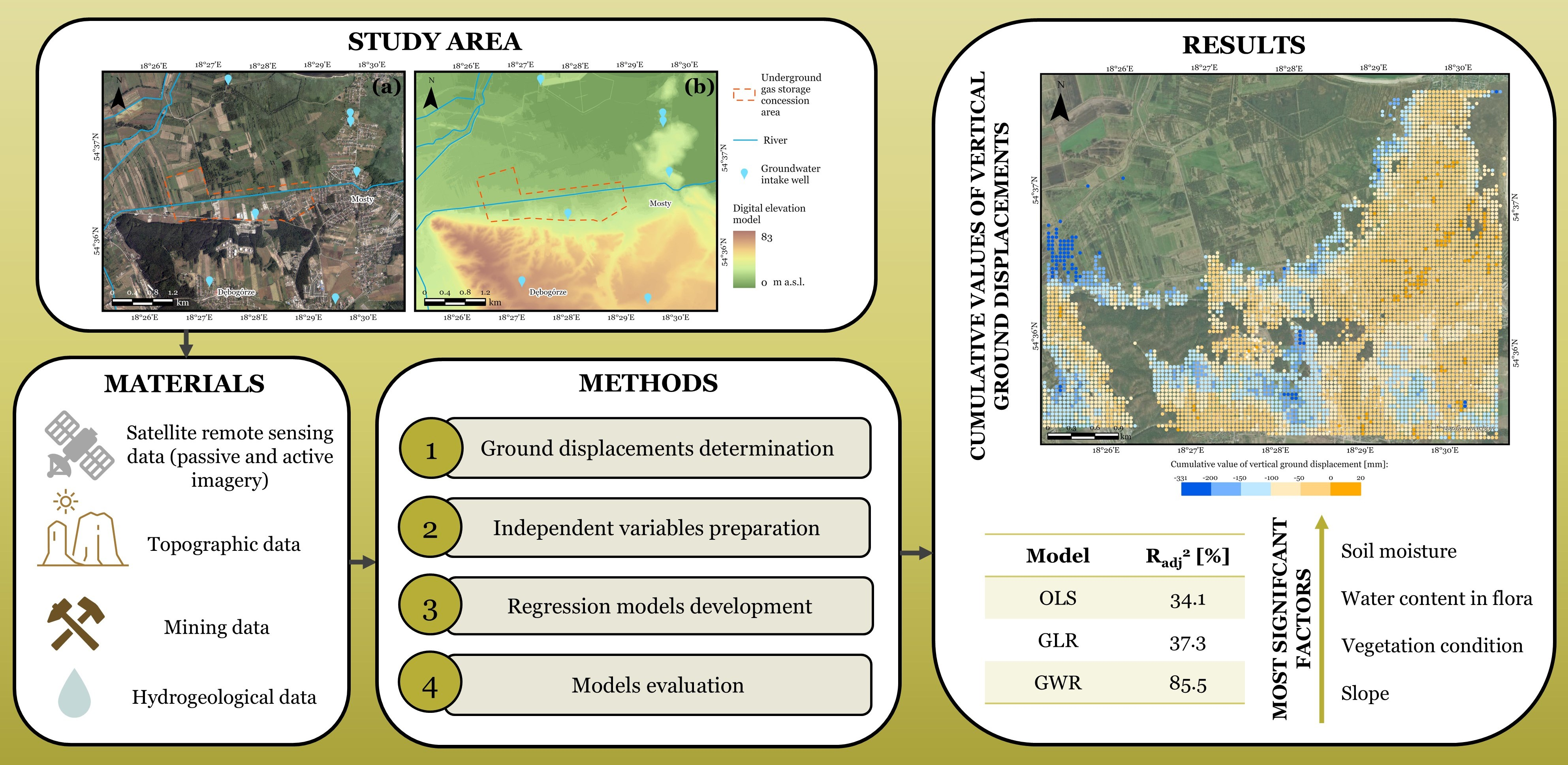
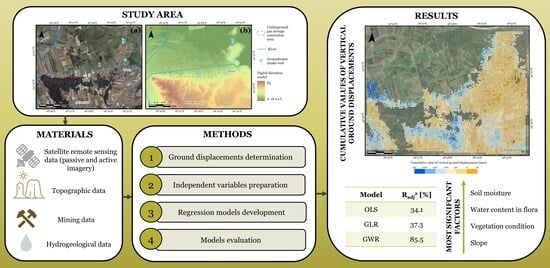
Graphical Abstract

1. Introduction

Underground gas storage (UGS) is one of the realizations of the concept of geological storage of energy sources. It involves trapping of specific materials in underground geological formations that ensure safe, long-term, and sealed storage capacities. It is used for the storage of energy sources and carriers, such as natural gas [1,2], oil [3], hydrogen [4], but also disposal of radioactive waste [5], and carbon capture and storage (CCS) [6]. The most common types of underground storage facilities, as determined by geology, are depleted oil and gas reservoirs [2], porous media and aquifers [7], and rock caverns, with a particular emphasis on caverns in rock salt [8,9]. Due to the physical and chemical properties of salt caverns, they are especially suitable for this purpose [7]. According to the authors of [10], depleted reservoirs hold more than 80% of working gas volume worldwide. Salt caverns account for only 5% of the volume but are responsible for 25% of the global deliverability. The majority of UGS facilities are concentrated in the USA, Russia, Ukraine, Canada, China, and Germany [10]. In Europe, the countries with the largest share of working gas volume are Germany, Italy, and the Netherlands [11]. Poland has nine UGS facilities, most of which were developed in depleted gas reservoirs. Two of these facilities were created in salt—Mogilno in central Poland and Kosakowo in the northern part of the country. While all the facilities are currently used for storage of natural gas, the potential for hydrogen storage has recently been the subject of research [4,12]. The facilities are operated by Gas Storage Poland Sp. z o.o., which is responsible for the maintenance of natural gas reserves in geological storage sites in Poland. Compared to other European countries, the UGS sector in Poland is relatively small and still in its early stage, as the caverns in Kosakowo, the focus of this study, were commissioned in 2014 and 2021.

1.1. Ground Displacements in Underground Gas Storage (UGS) Areas

UGS facilities, as a specific type of mining activity, interact with the environment, but the nature and type of impacts differ from those of traditional mining operations. The main impact on the surface is the subsidence. The downward movement of the ground is caused by cavern convergence, resulting from the pressure of the surrounding rocks on the cavern walls, which causes the caverns to shrink [8,9,13,14]. Volume loss occurs when the pressure inside a cavern is lower than the lithostatic stress [15]. As most of the cavern UGS facilities operate cyclically with regular injection and withdrawal phases, causing periodic pressure changes, the surface above the caverns is expected to experience alternating uplift and subsidence [1,2,16,17,18]. Therefore, it is important to distinguish between the different components of the observed movement and identify the respective causative factors. Numerous UGS facilities across Europe are located in wetland regions in close proximity to the sea, e.g., Kosakowo in Poland, Etzel in Germany, Inčukalns in Latvia, or Hatfield Moors in the UK [19,20]. The presence of peat may also affect the time series of ground movements, since peat moisture and water content vary throughout the year, thereby changing the peat layer’s thickness [19,20,21,22]. Ground subsidence is also observed in areas of peat degradation due to drainage and oxidation [23].

1.2. Data and Methods Used to Monitor Ground Displacements in Underground Gas Storage (UGS) Areas

Ground movements in mining regions, including UGS facilities, are primarily observed using geodetic monitoring techniques, which offer the greatest accuracy. However, these measurements are sparse in terms of both space and time domains, as they are limited to regular surveys carried out within geodetic frameworks. As the measurement campaigns are infrequent (performed annually or at multi-year intervals), studies mainly focus on subsidence [9]. Thus, it is impossible to capture any short-term fluctuations or seasonal contributions to the ground movement vector.
Recent research contributions present monitoring approaches that incorporate various techniques. Traditional methods, such as geodetic surveys, are complemented by satellite interferometric synthetic aperture radar (InSAR), which provides data over large areas at a high acquisition frequency (6 or 12 days in the case of Sentinel-1). InSAR is typically used alongside global navigation satellite system (GNSS) measurements [1,24,25,26,27,28] or leveling [19,29], since they serve as reference and validation. In ref. [25], the persistent scatterer InSAR (PSI) was used to determine the surface strain above a carbon capture and storage (CCS) facility in Sardinia. The results were validated using measurements from a permanent GNSS network. The area was found to be stable, as the displacements did not exceed 1 mm/year. Another study employed the small baseline subset (SBAB) InSAR processing on Radarsat-1/2 and Sentinel-1 imagery to investigate cyclical ground movements above a UGS facility in Italy, as well as their correlation with reservoir pressure changes [24]. In ref. [28], ground displacements before and shortly after the start of the UGS operation were analyzed using InSAR, GNSS, and seismic monitoring in order to determine the natural behavior of the region and the impact of UGS construction and operation. Minor uplift of 0.5–1 mm/year was observed during the first years of storage activities. Similarly, in ref. [30], the SBAS approach was adopted to investigate the ground movement behavior 1 year prior to and following the initial injection of CO2 into a CCS field in a coal-gas mine. In ref. [2], TerraSAR-X and Sentinel-1 images were used to create a time series of displacements above a depleted gas reservoir undergoing conversion to a UGS facility. An uplift of up to 13 mm/year was observed during the initial injection. The SqueeSAR® method, based on the PSI approach, was implemented in [27] to identify areas affected by the operation of UGS in salt caverns. This method used surface data only, as operational data and in situ measurements are often confidential. SqueeSAR® was also applied to Sentinel-1 data in three UGS fields in Italy, with the aim of identifying the areas influenced by storage operations [17]. In ref. [20], the challenge of distinguishing the different contributions to the derived ground movements is discussed, with particular emphasis on the impact of moisture level changes. On the other hand, the issue related to the breakdown of motion vectors into vertical and horizontal components derived from SAR data was addressed [1]. The periodic horizontal (E-W) and vertical components of the movements were analyzed using the PSI approach. Notably, the products from the European Ground Movement System (EGMS) have recently gained importance in studies on monitoring ground displacements above UGS, as they offer analysis-ready, processed data [20,26].
InSAR-derived ground displacements are often used as a variable in modeling the reservoir behavior. Surface displacements can be modeled using methods originally developed for mining or seismology and adapted to the characteristics of UGS [3,8,9,19]. Ground movement models based on, e.g., the Mogi model allow us to separate the different contributions to total movement, including pressure changes or groundwater level changes in peat [19]. Another study reports the analysis of a PSI-derived time series of ground displacements using independent component analysis (ICA) to extract the signal component attributed to changes in fluid pressure in subsurface reservoirs, since the method has been proven to be efficient in decomposing GNSS and remote sensing signals [29]. However, the isolation of individual contributions poses many challenges since there are various overlapping seasonal factors connected to the operation of UGS, atmospheric noise, and local hydrology. In ref. [20], a regression model consisting of a third-order polynomial combined with a sinusoidal seasonal component was developed. This model was then applied to a time series of EGMS data, UGS operational records, and precipitation, in order to separate seasonal patterns from long-term ground displacement trends. Recent contributions have focused on applying machine learning algorithms to analyze ground movements in mining regions, as these algorithms provide advanced analytical tools that are well suited to large datasets, including satellite imagery. However, in underground gas storage, machine learning (ML)-based approaches are mainly used for reservoir modeling, with limited focus on ground movements [31]. In ref. [32], unsupervised clustering and time-series decomposition were performed to extract the UGS-induced movements.

1.3. Research Aim and Its Scientific Significance

The literature review revealed the following:
  • The number of published studies, which integrate passive and active satellite imagery to monitor ground displacements in underground gas storage (UGS) areas, is relatively small;
  • Spatial statistics methods, including spatial regression models, were not used to analyze ground displacements over UGS areas;
  • Remote sensing data and spatial regression models have not yet been applied to study ground displacements within the UGS areas in Poland;
  • The UGS areas analyzed in the literature (except for the works of refs. [19,20]) were not located in the vicinity of wetlands, which may affect the values of vertical ground displacements determined by remote sensing methods.
The research gaps identified have been addressed in this publication, the main objective of which was to analyze the statistical relationships between vertical ground displacements in the UGS area and selected topographic, hydrogeological, and mining factors. The specific objectives of this research include (1) determination of ground displacements in the area of the cavern underground gas storage using satellite remote sensing data, (2) analysis of the influence of potential variables (explanatory factors) on the vertical displacements of the research site, and (3) identification of statistically significant factors of ground movements in the study area. The aim of this research, expressed by these specific objectives, is to investigate the region of UGS in a broader context. While existing research reports the application of InSAR in monitoring vertical displacements above storage facilities, there is a paucity of research incorporating various data sources, such as multispectral imagery or topographical variables. Furthermore, ground movements have been analyzed in terms of their connection to UGS operation, neglecting other contributions. Therefore, the question stated in this research is to identify the causes for observed ground movements above UGS.
This study was carried out in an area of cavern underground gas storage in the northern part of Poland, with immediate vicinity to a wetland area. To determine the vertical displacements of the ground (dependent variable), this study utilized the Small Baseline Subset (SBAS) method, applied to a collection of Sentinel-1 satellite imagery captured between 2014 and 2024. Simultaneously, passive data of the Sentinel-2 mission spanning 2015–2024, as well as topographic, hydrogeological, and mining data, were used to represent the potential explanatory variables. Factors that have a statistically significant influence on vertical ground displacements in the study area were identified using global (Ordinary Least Squares (OLS), Generalized Linear Regression (GLR), and local (Geographically Weighted Regression (GWR)) models. These models were also used to identify the strength and nature of the relationship between the dependent variable and the defined explanatory factors.

2. Study Area

2.1. Location of the Study Area

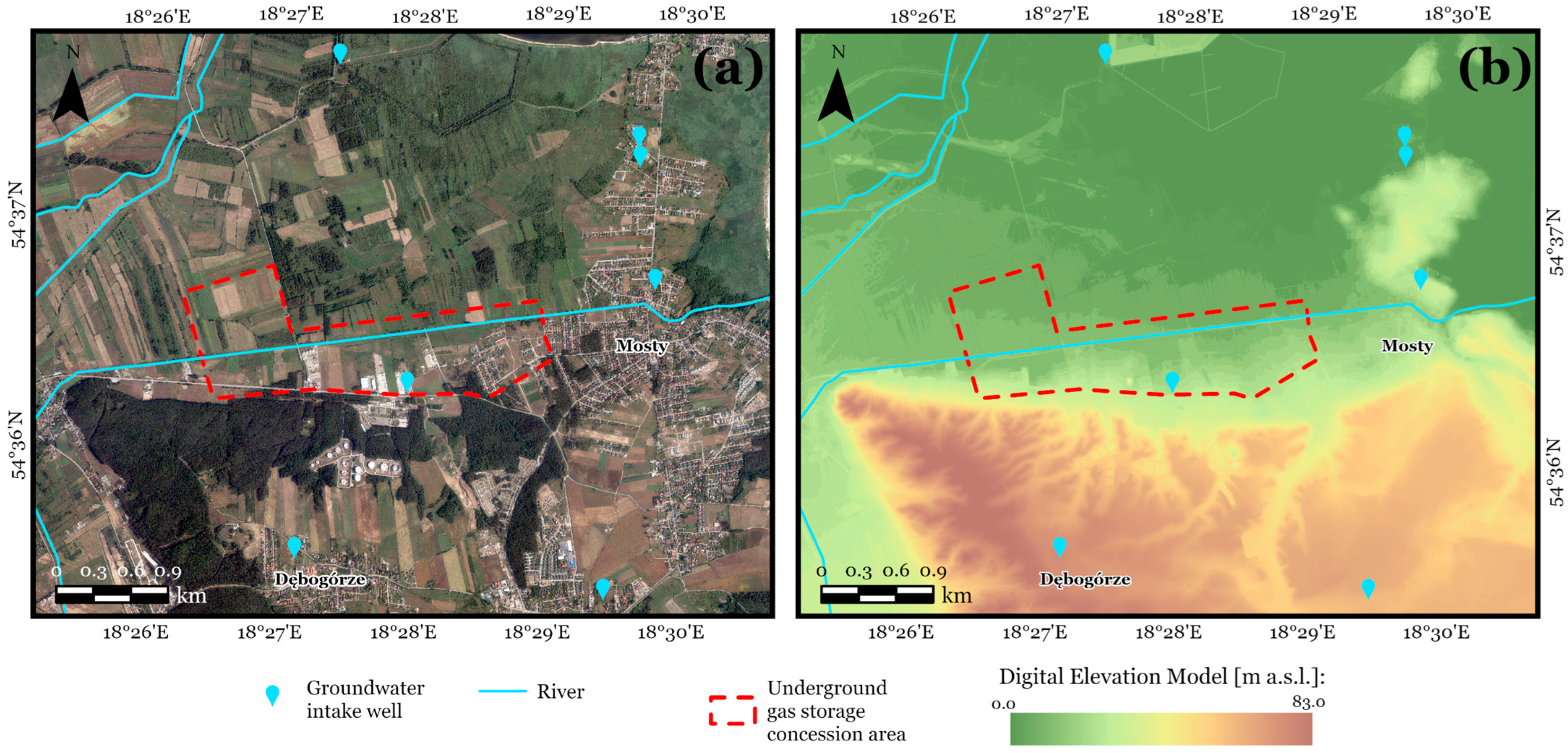
The study area represents an underground gas storage facility in northern Poland at 18°27′17″E and 54°36′23″N (Figure 1a). The Kosakowo UGS is located close to the cities of Gdynia and Gdańsk, in the Pomeranian Voivodeship. It is part of the Kashubian coast region [33]. The UGS facility and the surrounding terrain in the north comprise Holocene compound peat–marine and peat–river accumulation plains with a shallow layer of peat reaching depths of up to 6 m below the surface. The southern part of the area of interest dates back to the Vistulian glaciation and consists of a flat morainic plateau [34]. There are two intakes of underground water reservoirs that supply the region with fresh water—Rumia in the south and Reda in the west.
The average elevation of the region is 16 m above sea level, with the morainic upland reaching over 70 m above sea level (Figure 1b). It is located south of the facility. The elevation of the facility and terrains in the northern part of the area of interest oscillate between 1 and 10 m above sea level (majority at approx. 2 m). The land cover in the area is diverse, with urban areas, pastures, and meadows being the most common. Industrial areas represent the UGS facility and a fuel base. Due to the low elevation, geomorphology, land cover, geology, and agricultural drainage fields, the area is prone to waterlogging and flooding.

2.2. Underground Gas Storage

The Mechelinki rock salt deposit, where the caverns were constructed, was created in the Permian and is part of the Perybaltic syncline. It lies at a depth of 970 m below the surface. The average thickness is 170–200 m. The overburden includes mainly Cenozoic and Mesozoic rocks [37]. The leaching of storage caverns began in 2009. The first five caverns located in cluster A were commissioned in 2014, while cluster B was completed in 2021. Currently, there are ten caverns in operation (in two clusters of five caverns each), with a further five caverns being in the planning stage. The total active capacity is 293.4 mln m3, equivalent to over 3200 GWh of energy [38]. The caverns are of cylindrical shape with a radius of 20–30 m.

3. Materials and Methods

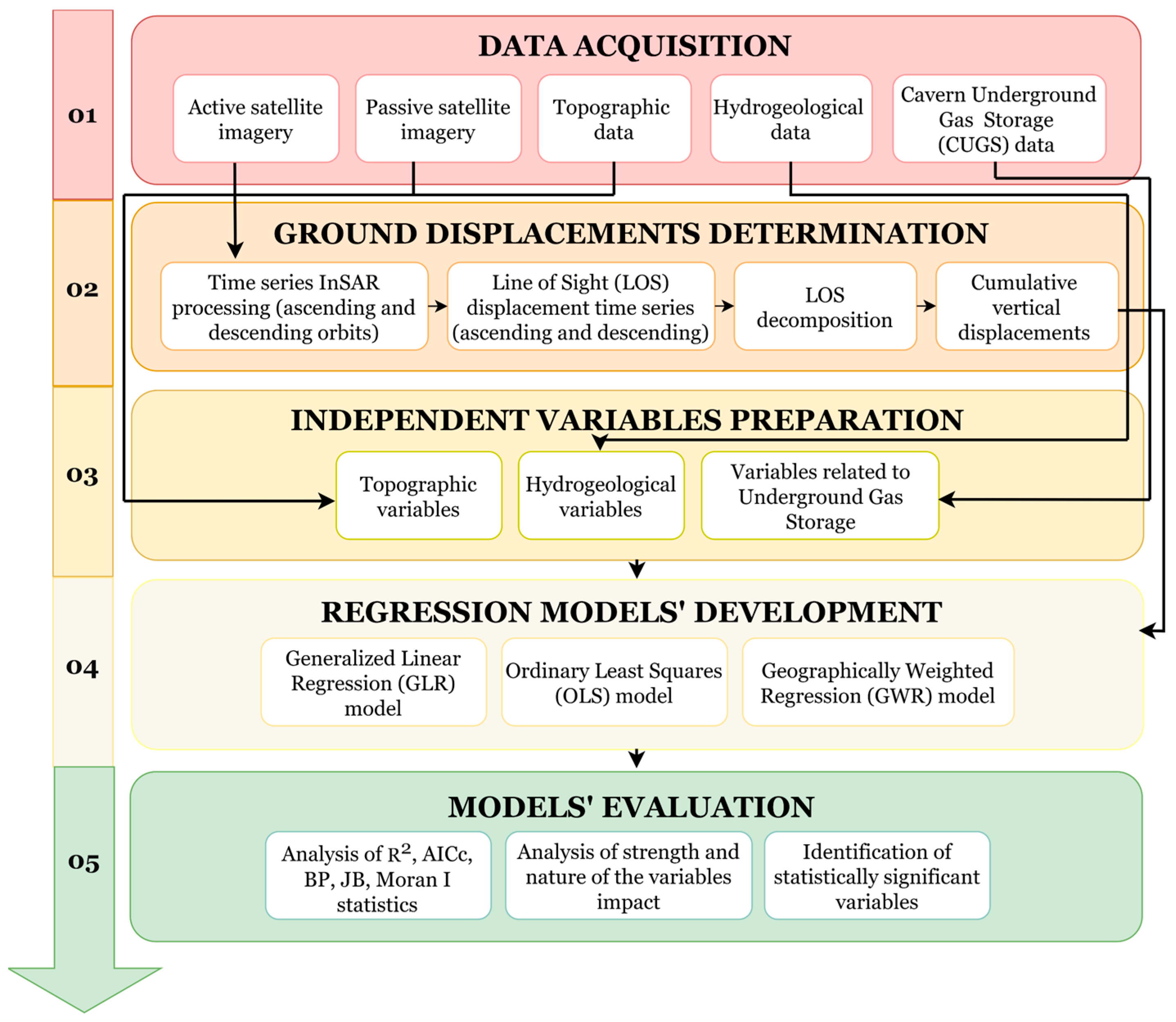
The methodology used in this study, illustrated graphically in Figure 2, involved 5 stages, including the following: (1) acquisition of active (Sentinel-1 mission) and passive (Sentinel-2 mission) satellite imagery for the period 2014–2024, as well as materials describing topographic and hydrogeological conditions, and underground gas storage in the study area, (2) determination of cumulative vertical ground displacements using the Small Baseline Subset (SBAS) method, (3) preparation of sixteen data layers representing candidate independent variables to explain the observed ground movements, (4) development of (global and local) spatial regression models, and (5) evaluation and analysis of the models. Detailed information on each phase can be found in Section 3.1, Section 3.2, Section 3.3, Section 3.4, Section 3.5.

3.1. Data Acquisition

The Sentinel-1 Synthetic Aperture Radar (SAR) imagery was acquired from the Alaska Satellite Facility (ASF) Data Portal (https://asf.alaska.edu/ (accessed on 1 March 2025)). SAR images in the Single Look Complex (SLC) format were downloaded for two orbit paths: ascending no. 175 and descending no. 22. An SAR imagery dataset was created, containing 356 images from the period of 9 May 2015 to 23 December 2024, and 424 images were acquired between 11 May 2015 and 25 December 2024. Multispectral imagery was acquired from the Copernicus Data Space Ecosystem (https://dataspace.copernicus.eu/ (accessed on 1 March 2025)). Surface reflectance product (Level 2A) with cloud coverage not exceeding 30% was selected for the analysis to ensure data comparability over time. Since the study area is relatively small, the data were manually inspected for the presence of clouds or shadows above the area of interest (AOI) and further excluded from the analysis. A collection of 80 images (tile 34UCF) was created for the vegetation period (May–September) in the years 2015–2024.
In addition to Copernicus satellite imagery, the following geospatial datasets were used in this study:
  • Digital Elevation Model (DEM) with a spatial resolution of 5 m obtained from aerial laser scanning performed in 2020 and available in [36];
  • Vector data from the Database of Topographical Objects (scale 1:10,000), presenting the location of watercourses in the research area and available in [39];
  • Vector data from the National Border Register, presenting the Baltic Sea shoreline and available in [40];
  • Hydrogeological maps of Poland from the year 2006 and drawn at a scale of 1:50,000 [41,42];
  • Vector data from the Central Geological Database, presenting the location of boreholes and geological engineering boreholes and the borehole cards, available in [43];
  • Central Hydrogeological Database presenting the information on groundwater intake points [44];
  • Point data defining the spatial extent of the protection zones of underground water intakes of Rumia and Reda, as specified in respective legal regulations [45,46];
  • As the precise location of the storage caverns is restricted, the centroid of the cavern clusters was identified based on the manual inspection of the orthophotomap, available in [35,47,48,49] for press information.

3.2. Development of Dependent Variable—Cumulative Vertical Ground Displacements

Ground surface displacements in the study area were examined through Synthetic Aperture Radar Time Series Interferometry (TSInSAR) processing of Sentinel-1 SLC data. SLC images from respective orbits (ascending and descending) were coregistered to a reference image (separate for the ascending and descending orbits) and used to create stacks of differential interferograms. Interferometric pairs with small temporal and perpendicular baselines were selected to ensure minimal decorrelation, with the temporal baseline threshold set at a maximum of 50 days and the perpendicular baseline set at a maximum of 150 m. The baseline values were selected as an optimal compromise to ensure high coherence and data redundancy (no gaps in the baseline network) for the subsequent time series inversion. Topographic phase removal was performed using the SRTM 1-arc-second Digital Elevation Model. Interferograms were multilooked and filtered to reduce phase decorrelation and facilitate the phase unwrapping process. Phase unwrapping was conducted using the Minimum Cost Flow (MCF) algorithm in the SNAPHU software (2.0) [50].
Displacement time series were obtained through time series analysis of unwrapped interferograms, using the Small Baseline Subset (SBAS) method. A modified SBAS approach with error mitigation was applied, including correction of atmospheric delay, DEM errors, and unwrapping errors, implemented in the MintPy software version 1.6.1 [51]. The SBAS results were masked using a minimum temporal coherence threshold of 0.7, a value optimized to mask out highly decorrelated pixels (e.g., forests and periodically flooded areas), while also ensuring the best possible coverage with high-quality time series data. The resulting line-of-sight (LOS) displacement time series from two acquisition orbits was geocoded and exported to NetCDF format for further processing.
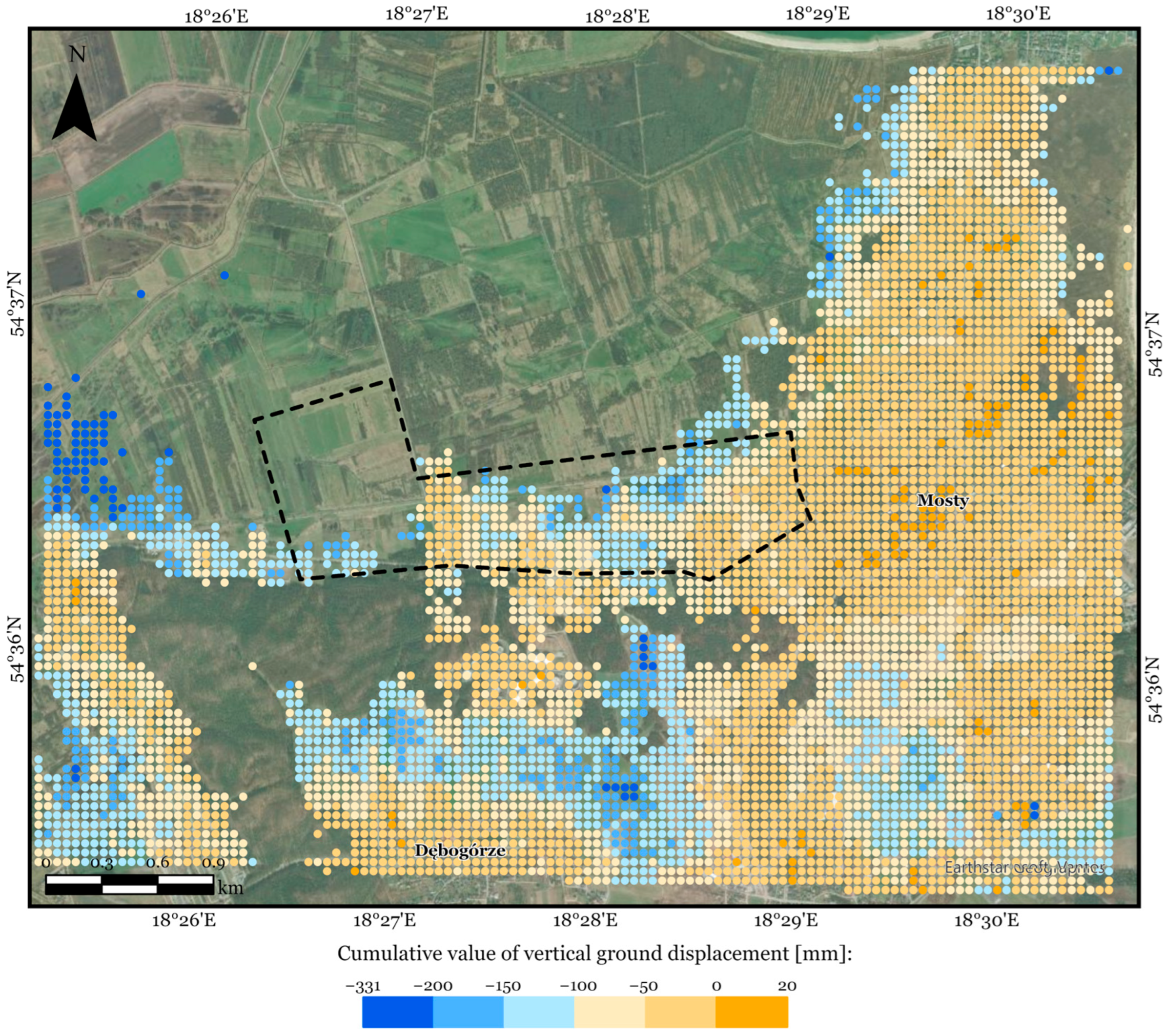
Vertical displacements were calculated by decomposition of LOS measurements to vertical and horizontal through solving a linear system of equations, based on geometric relationships between the ascending and descending LOS directions [52,53]. Prior to decomposition, displacement time series from the ascending and descending orbits were resampled to a common grid with a 30 m spatial resolution. The total (cumulative) vertical displacement for the 2015–2024 period was obtained from the estimated time series, presented in Figure 3.
The majority of the study area exhibits minimal ground surface displacements, with no significant subsidence and uplift in the Mosty and Dębogórze towns (Figure 3). Subsidence signals were detected north and northeast of the Dębogórze town, as well as in the western part of the study area. Subsidence was also observed in parts of the UGS facility, mainly over rural and agricultural areas. The northwest part of the study area showed no detectable measurement points due to low temporal coherence resulting from decorrelation and unwrapping errors. The maximum subsidence observed with the SBAS method over the UGS area was approximately −150 mm, while over the entire study area, subsidence values reached up to −330 mm (western part of the study area). Parts of the displacement time series recorded over the UGS area exhibit some annual seasonal patterns.

3.3. Development of Independent Variables

Candidate driving factors included sixteen independent variables describing the underground gas storage area, as well as its hydrogeological and topographical conditions. All explanatory factors were collected as vector data with a point geometry type. Each vector layer had the same spatial reference (WGS84 UTM Zone 34N) and spatial extent (N 6,056,650.6 m, S 6,052,000.6 m, W 333,371.9 m, E 339,271.9 m) and contained 11,186 points, distributed in a 50 m × 50 m grid. Points for which the values of cumulative ground displacements were not determined by the SBAS method were removed from this grid. Table 1 provides background information on the independent variables developed in ArcGIS Pro 3.2.2 software.

3.4. Development of Regression Models

In this study, the modeling process was initiated by performing Exploratory Regression (ER) in ArcGIS Pro 3.2.2 software to identify the combination of independent variables that would most accurately explain the total vertical ground displacement values in the Kosakowo UGS area between 2014 and 2024. This process was also designed to detect potential global collinearities in the set of explanatory factors [58,59]. The following values of input parameters were adopted in ER:
  • Maximum number of factors explaining the dependent variable: 16;
  • Minimum number of factors explaining the dependent variable: 1;
  • Minimum value of the adjusted coefficient of determination (RAdj2): 0.3;
  • Maximum value of the Variance Inflation Factor (VIF): 7.5;
  • Minimum value of the Jarque–Bera (JB) test and spatial autocorrelation (SA): 0.1;
  • Required confidence level for all β coefficients assigned to independent variables: 0.05.
The results of the Exploratory Regression, i.e., potential combinations of independent variables explaining the dependent variable and a summary of the significance of explanatory factors and multicollinearity in the set of independent variables, were considered to define the input data for the Ordinary Least Squares (OLS) model. This global multiple regression is described by expression (1):
y = β 0 + β 1 × x 1 + β 2 × x 2 + + β n × x n + ε
where
y —dependent variable;
β 0 —intercept of the regression equation;
β 1 , β 2 , … , β n —coefficients assigned to the independent variables x 1 , x 2 , … , x n , providing information about the strength and character of the relationship between them and the dependent variable;
ε —random component [60,61].
The OLS is a parametric model based on minimizing the sum of squared errors, which should meet the following assumptions: (a) the distribution of regression residuals is normal, (b) there is no collinearity in the set of independent variables, (c) the residuals from the regression are randomly distributed in the analyzed area, and (d) the studied phenomenon is characterized by homoscedasticity (the regression residuals have constant variance across the entire study area) [62,63].
This study also utilized a Generalized Linear Model (GLR), the mathematical basis of which was first presented in [64]. This model, which is an extension of the classic OLS method, is designed to analyze phenomena that do not meet the assumptions described in the previous paragraph. Each GLR model consists of three elements: (a) a defined distribution from the exponential family that is used to model the dependent variable y, (b) a linear predictor η, and (c) a link function g. The Generalized Linear Model is given by formula (2):
y = g 1 ( η )
where
η —linear predictor, defined as follows: η = x 1 × β 1 [65].
The input data for the GLR model were independent variables used in the OLS method [66], and the Gaussian model was selected as the regression model type. Due to the fact that the dependent variable did not have a normal distribution, it was transformed using the Box–Cox method [67] before modeling.
The analysis of local relationships between the independent variables and the cumulative vertical ground displacements between 2014 and 2024 was performed using the Geographically Weighted Regression (GWR) model, described in detail in [68,69]. Contrary to the models described above, GWR regression assumes heteroscedasticity of the examined phenomenon, and it is a nonparametric model, given by formula (3):
y i ( u ) = β 0 i ( u ) + β 1 i ( u ) × x 1 + β 2 i ( u ) × x 2 + + β n i ( u ) × x n + ε i
where
y i ( u ) —dependent variable at location u;
β 0 i ( u ) —intercept of regression equation at location u;
β 1 i ( u ) , β 2 i ( u ) , … , β n i ( u ) —coefficients describing the relationships between the dependent variable y and explanatory factors x 1 , x 2 , … , x n at location u;
ε i —random error at location u [70].
The GWR method relies on fitting a series of local models using a neighborhood matrix, which is developed with the use of weight functions [71]. In this study, the following were utilized in the local modeling process: (a) the same set of independent variables as in OLS and GLR methods; (b) dependent variable after application of the Box–Cox transformation; (c) normal model as a type of regression model with a Gaussian weighting scheme; (d) division of the study area into neighborhoods using the Golden Search method [72].

3.5. Assessment of Regression Models

The accuracy of the global OLS and GLR models developed was assessed based on the adjusted coefficient of determination (Radj2), which describes what percentage of the dependent variable was explained by the set of independent variables. Additionally, Koenker statistics (BP) were used to verify whether the analyzed phenomenon (total vertical ground displacements between 2015 and 2024 over the UGS area) is stationary in space. In turn, the Jarque–Bera (JB) statistics were utilized to verify the normality of the regression residuals distribution [59,73]. The OLS and GLR models were also analyzed using Moran’s I global statistics to determine whether the regression residuals exhibited spatial autocorrelation in the analyzed area [74,75]. The accuracy assessment of the local GWR model was based on the adjusted coefficient of determination, Radj2, and the Akaike Information Criterion (AICc), which describes the complexity of the model [72,76]. For all regression models developed, both global and local, histograms of regression residuals were prepared.
The strength and nature of the impact of independent variables on the dependent variable were described with β coefficients assigned to explanatory factors, in particular, OLS, GLR, and GWR models. The β coefficient sign indicates the nature of the relationship, with the “-” sign indicating a negative relationship (inverse proportional relationship between variables) and the “+” sign indicating a positive relationship (direct proportional relationship between variables). The absolute value of the β coefficient, on the other hand, indicates the strength of the relationship between the variables. This strength is greater the higher the absolute value of the coefficient.

4. Results

4.1. Exploratory Regression

A major objective of the Exploratory Regression (ER) was to examine all possible combinations of independent variables explaining the total vertical ground displacements observed in the Kosakowo UGS area in 2014–2024. The results obtained indicate that the greatest percentage of variance in the dependent variable (in the global OLS model) could be explained by a set of 12 explanatory factors. These include the following: cluster_A, cluster_B, Reda, Rumia, water_intakes, kanal_sciekowy, zagorska_struga, ndmi, ndvi, smi, smmi, and slope. For this combination of independent variables, the highest value of Radj2 (46.0%) and the lowest value of AICc (−19,527.02) were obtained.
The ER method also allowed the detection of explanatory factors that are potentially significant in the context of the studied phenomenon. As demonstrated by the results presented in Table 2, the variables smmi, smi, ndmi, and slope were expected to be the factors with the highest absolute values of β coefficients in the global OLS model. In contrast, cluster_A, cluster_B, and peat were identified as the least significant variables. It should also be highlighted that the variable peat was not considered statistically significant in any of the tested combinations of explanatory factors.
Table 2 also shows the Variance Inflation Factor (VIF) parameter, which describes global collinearity in the set of independent variables. The values obtained for this measure exceeded 7.5 for as many as seven explanatory factors, confirming the presence of a significant correlation between each of them and one or more variables. Additionally, the information contained in the last column of the table indicates that all these factors, i.e., cluster_A, cluster_B, Reda, shoreline, Rumia, zagorska_struga, and nmt, are strongly correlated with each other.
The analysis of all the above-mentioned ER results allowed the definition of an input dataset (subset of independent variables) for the OLS model. In this study, the global modeling process included all statistically significant and linearly uncorrelated independent variables (independent variables with VIF values less than 7.5), i.e., cluster_A, water_intakes, kanal_sciekowy, groundwater_table, ndmi, ndvi, smmi, and slope.

4.2. Analysis of Global Regression Models

The evaluation of the developed OLS and GLR regression models included an analysis of diagnostic measures, defined in Section 3.5, as well as an assessment of β coefficients determined for independent variables.

4.2.1. Evaluation of Models

The performance of the developed parametric regression models (OLS and GLR) was assessed through the analysis of statistical measures, such as Radj2, JB, BP, and global Moran’s I, which were summarized in Table 3.
The diagnostic measures presented in Table 3 indicate that the OLS and GLR models explained less than 40.0% of the variance in the dependent variable, with the GLR model characterized by a slightly higher value of adjusted determination coefficient (the Radj2 value for the GLR model was about 3.2% greater than for the OLS model). Additionally, the obtained JB, BP, and global Moran’s I values are statistically significant, which may suggest that (a) one or more key independent variables were not included in the modeling process, (b) the regression residuals are not normally distributed and can be spatially autocorrelated, and (c) the studied phenomenon is not stationary in space. However, it should be noted that the values of JB, BP, and global Moran’s I statistics obtained for the GLR model, similar to the Radj2 value, indicate that this model was more accurate than the OLS regression.
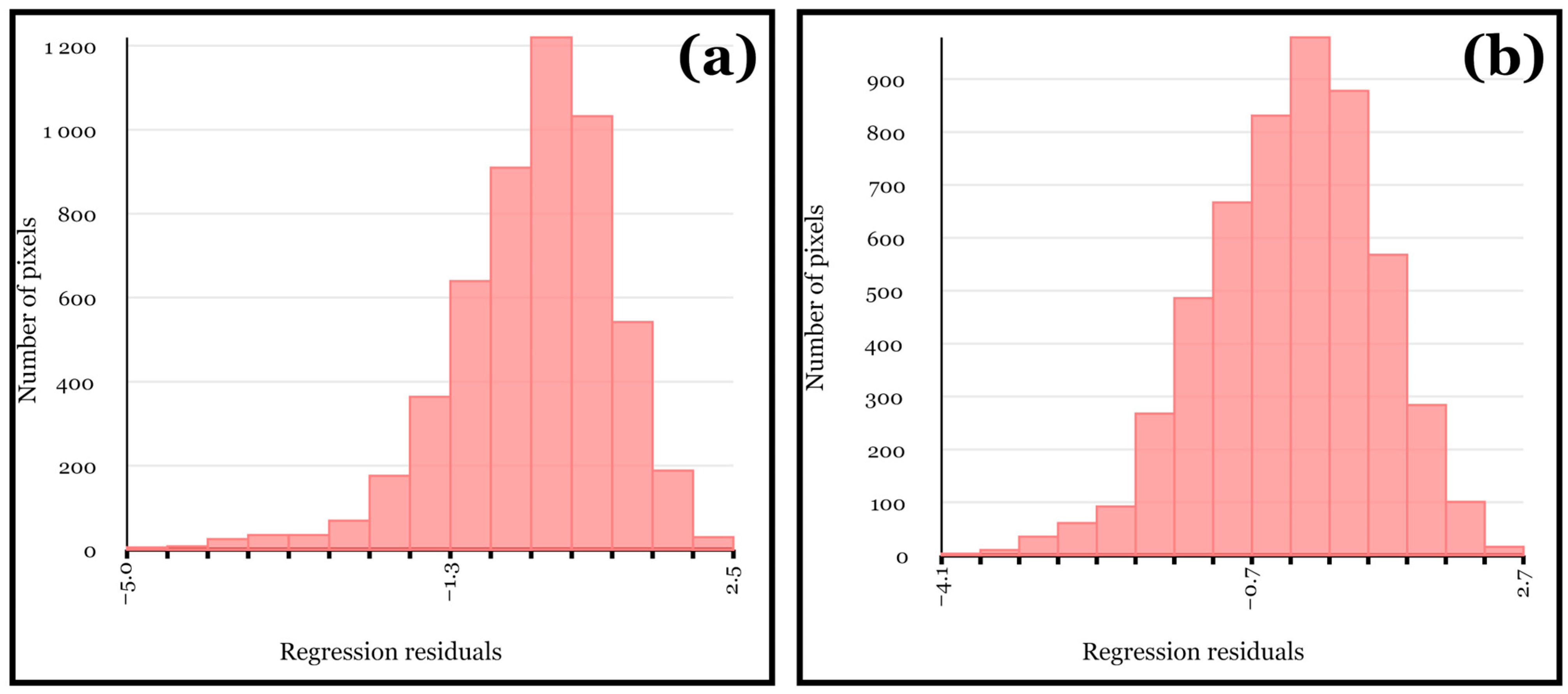
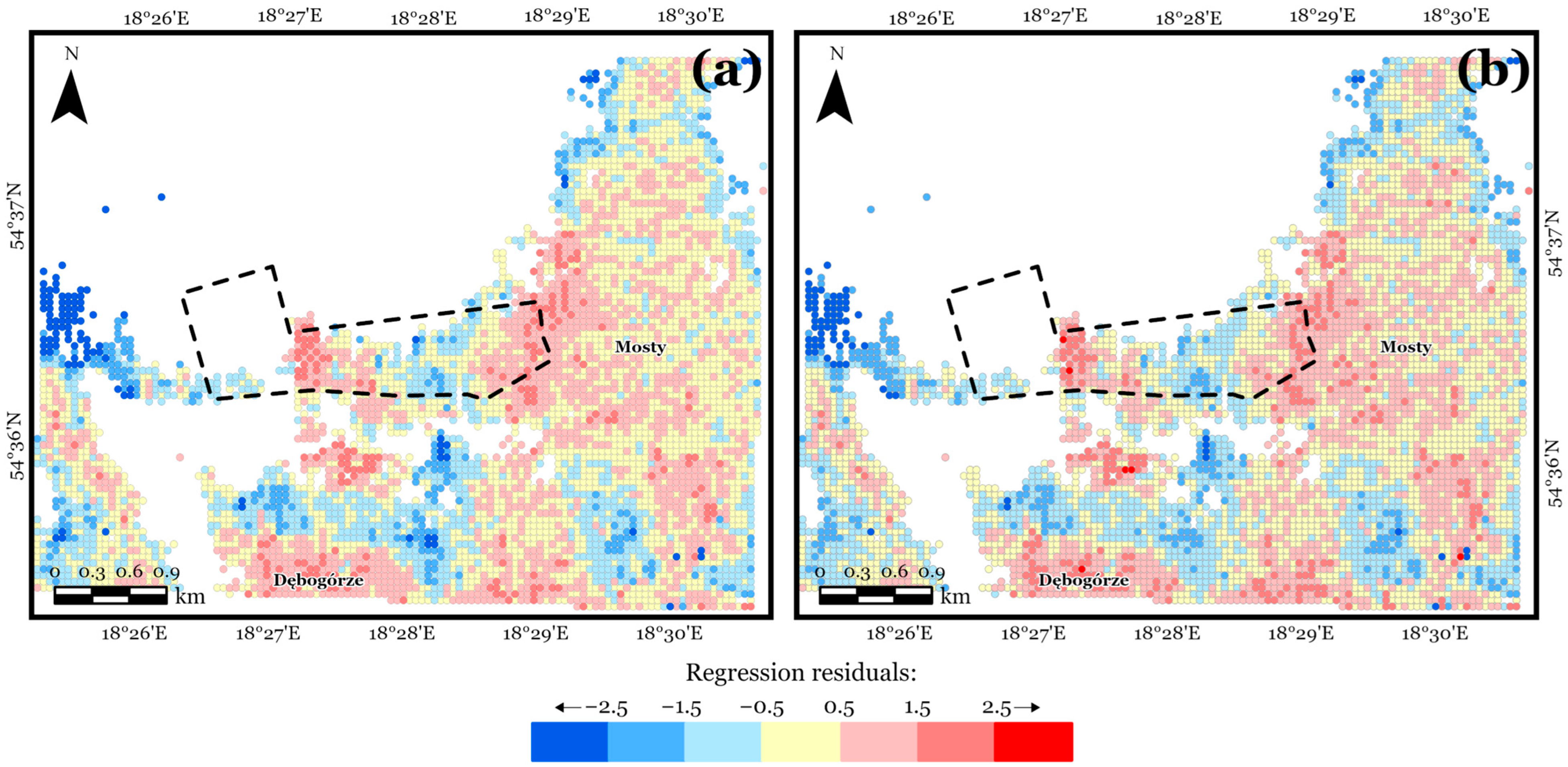
Statistically significant values of the JB statistic confirm the left-skewed distributions of regression residuals presented in Figure 4. The spatial autocorrelation of residuals from OLS and GLR models, demonstrated by statistically significant values of BP and global Moran’s I statistics, was further confirmed by Figure 5, which shows the evident clusters of low and high values of regression residuals in the study area.

4.2.2. Influence of Independent Variables on the Dependent Variable

The strength of the impact of independent variables on the dependent variable in a global context was defined based on the absolute values of the β coefficients, assigned to individual explanatory factors in the OLS and GLR models, which are summarized in Table 4.
The analysis of the values presented in Table 4 indicates that the strongest influence on the cumulative values of vertical ground displacements in the Kosakowo UGS area between 2014 and 2024 was observed for soil moisture (smmi variable), vegetation condition (ndvi variable), and water content in flora (ndmi variable). The highest β coefficients (higher than 0.08) were determined for these variables in both the OLS and GLR models. The least significant impact on the dependent variable was noted for the distance from the watercourse known as the Kanał Ściekowy (kanal_sciekowy variable), the distance from Cluster A in the UGS facility (cluster_A variable), and the distance from groundwater intakes (water_intakes variable), to which the assigned β coefficient values were lower than 0.0001. Therefore, parametric OLS and GLR regression models indicated that underground gas storage in the Kosakowo area did not have a significant impact on the vertical ground displacements observed in this area.
Table 4 also contains information on the character of the relationships between explanatory factors and the dependent variable. This information indicates that the relation between the majority of the independent variables developed and the observed values of vertical ground displacements was inversely proportional. A positive relationship (an increase or decrease in the value of the independent variable causes a corresponding change in the value of the dependent variable) with the dependent variable was only observed for factors cluster_A, slope, and ndmi.

4.3. Analysis of a Local Regression Model

The influence of the explanatory factors on the dependent variable at the local scale was characterized based on a Geographically Weighted Regression (GWR) model. The following subsections briefly describe the model’s performance based on the diagnostic metrics defined in Section 3.5, as well as summarize the spatial distribution of β coefficients determined for each independent variable.

4.3.1. Evaluation of Model

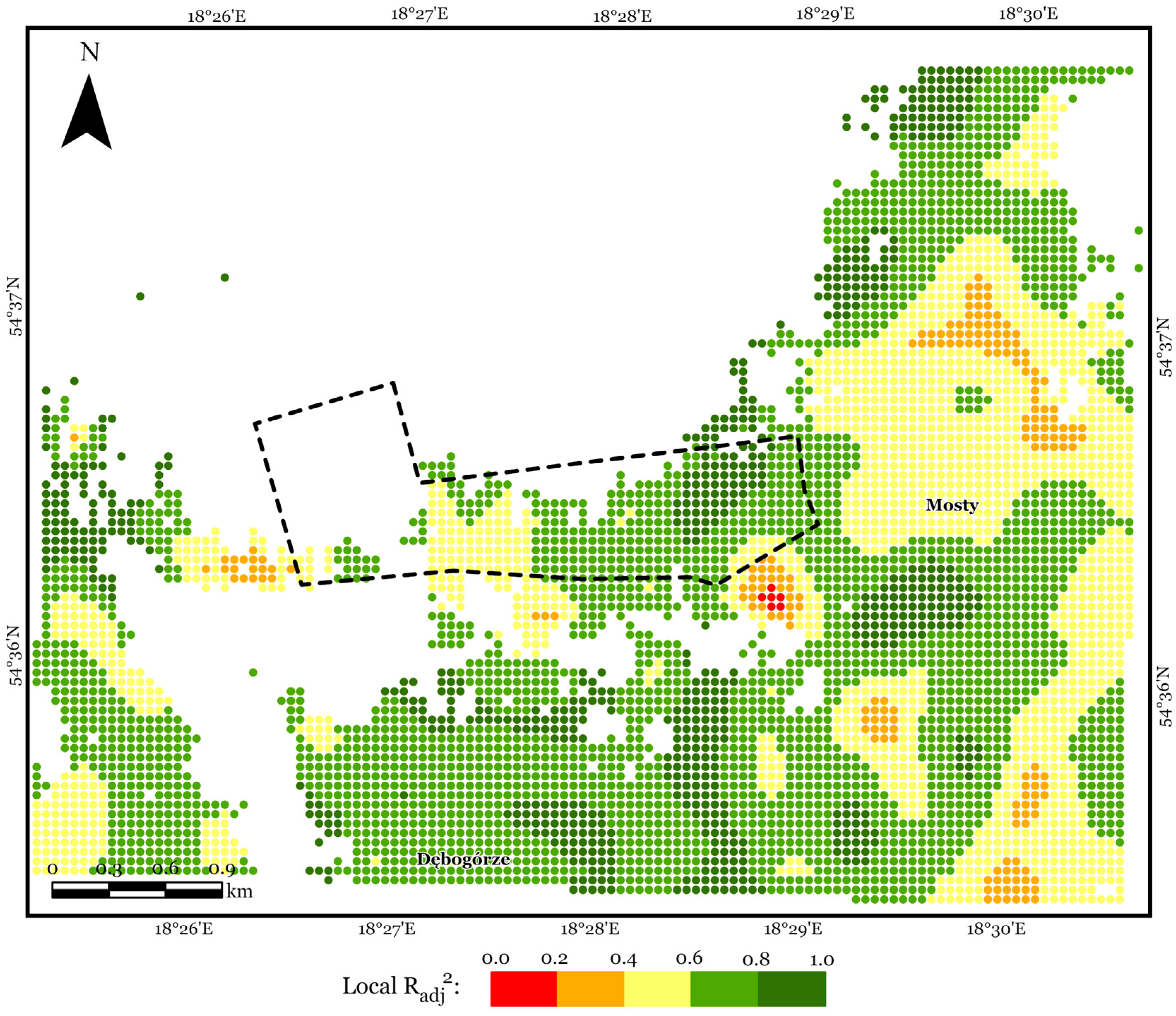
The adjusted determination coefficient (Radj2), equal to 85.5%, indicates that over 85% of the variance in the dependent variable was explained by the combination of independent variables and the GWR method. Therefore, the developed local model defined the spatial relationships between the underground gas storage, topographical and hydrogeological conditions, and the vertical ground displacements observed in 2014–2024 significantly better than global regression models (OLS and GLR). The distribution of local determination coefficients is presented in Figure 6. Its analysis demonstrates that, for the majority of pixels in the research area, the Radj2 values were higher than 0.6. Regions of low model accuracy were observed only in the eastern and central parts of the Kosakowo UGS facility (Radj2 < 0.4). However, it should also be noted that the GWR model was characterized by relatively high complexity, as confirmed by the AICc, equal to −29,825.57.
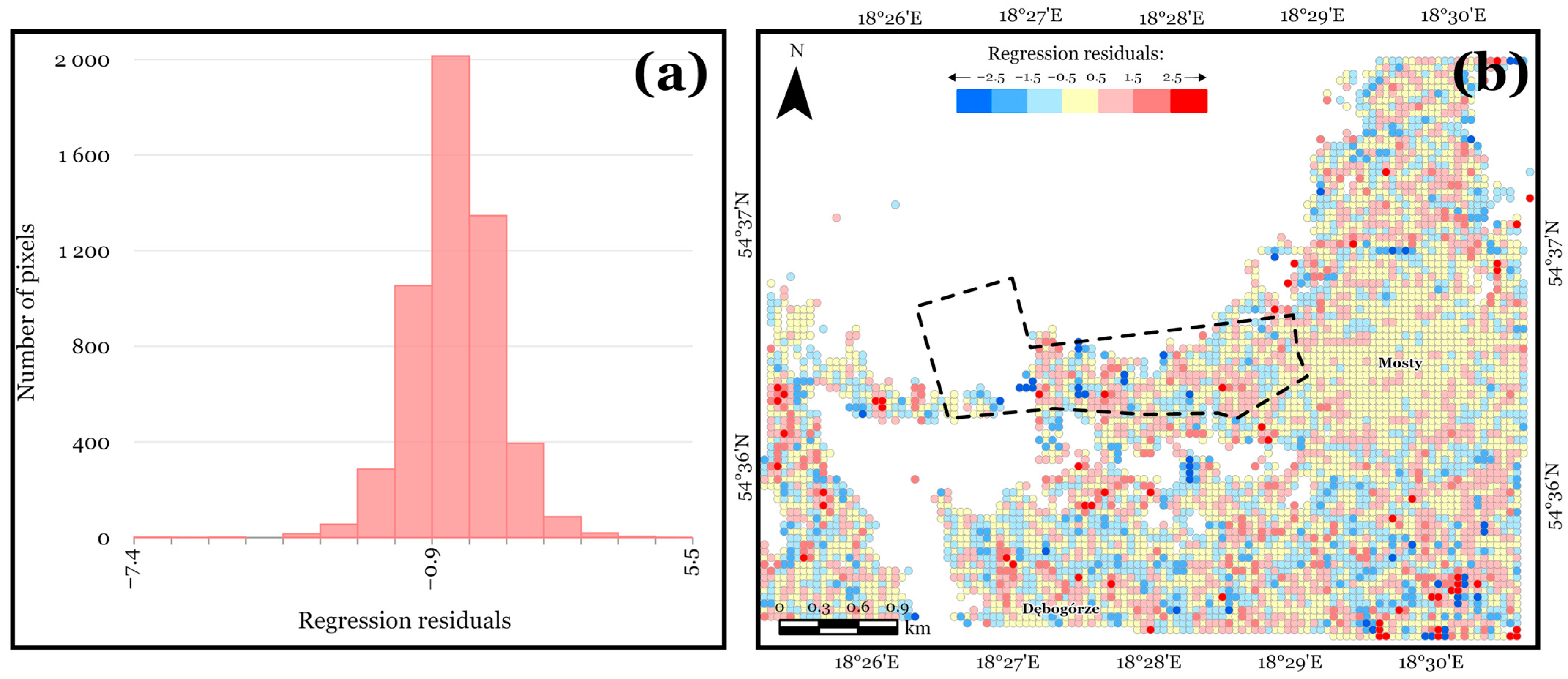
Similar to the global OLS and GLR models, the diagnostic evaluation of the GWR model included an analysis of regression residuals distribution, including a spatial distribution analysis. As shown in Figure 7a, despite the high value of Radj2, the residuals from the local model did not follow an ideal Gaussian distribution, although the skewness of this distribution is significantly lower compared to the distributions of residuals from the OLS and GLR models, presented in Figure 4. Furthermore, Figure 7b demonstrates that clusters of low or high values of the GWR regression residuals were not observed in the study area, indicating a random spatial distribution of regression residuals. Moreover, the differences between the values of vertical ground displacements determined using the SBAS method and the values predicted by the model were minor. In fact, the residual values between −1.5 and 1.5 were assigned to the majority of pixels.

4.3.2. Influence of Independent Variables on the Dependent Variable

The strength and nature of the impact of independent variables on the dependent variable at the local scale were defined based on the magnitudes and directions of β coefficients attributed to explanatory factors in the GWR model, similar to OLS and GLR models. The basic information on the determined β coefficients in the local regression is provided in Table 5.
A detailed analysis of data in Table 5 confirmed that the smmi, ndvi, and ndmi variables had the strongest local impact on the cumulative vertical ground displacement values over the study area in 2014–2024. On the other hand, factors such as cluster_A, kanal_sciekowy, and water_intakes had almost no influence on the dependent variable. Therefore, it has been confirmed that, both globally and locally, the same variables had the strongest and weakest impact on the studied phenomenon. The underground gas storage location was not indicated as a significant factor influencing the observed ground displacements by any of the considered models. It should also be emphasized that local modeling demonstrated a slightly stronger influence of water content on vegetation (ndmi variable) and a weaker impact of flora condition (ndvi variable) on the dependent variable compared to the results of OLS and GLR regression.
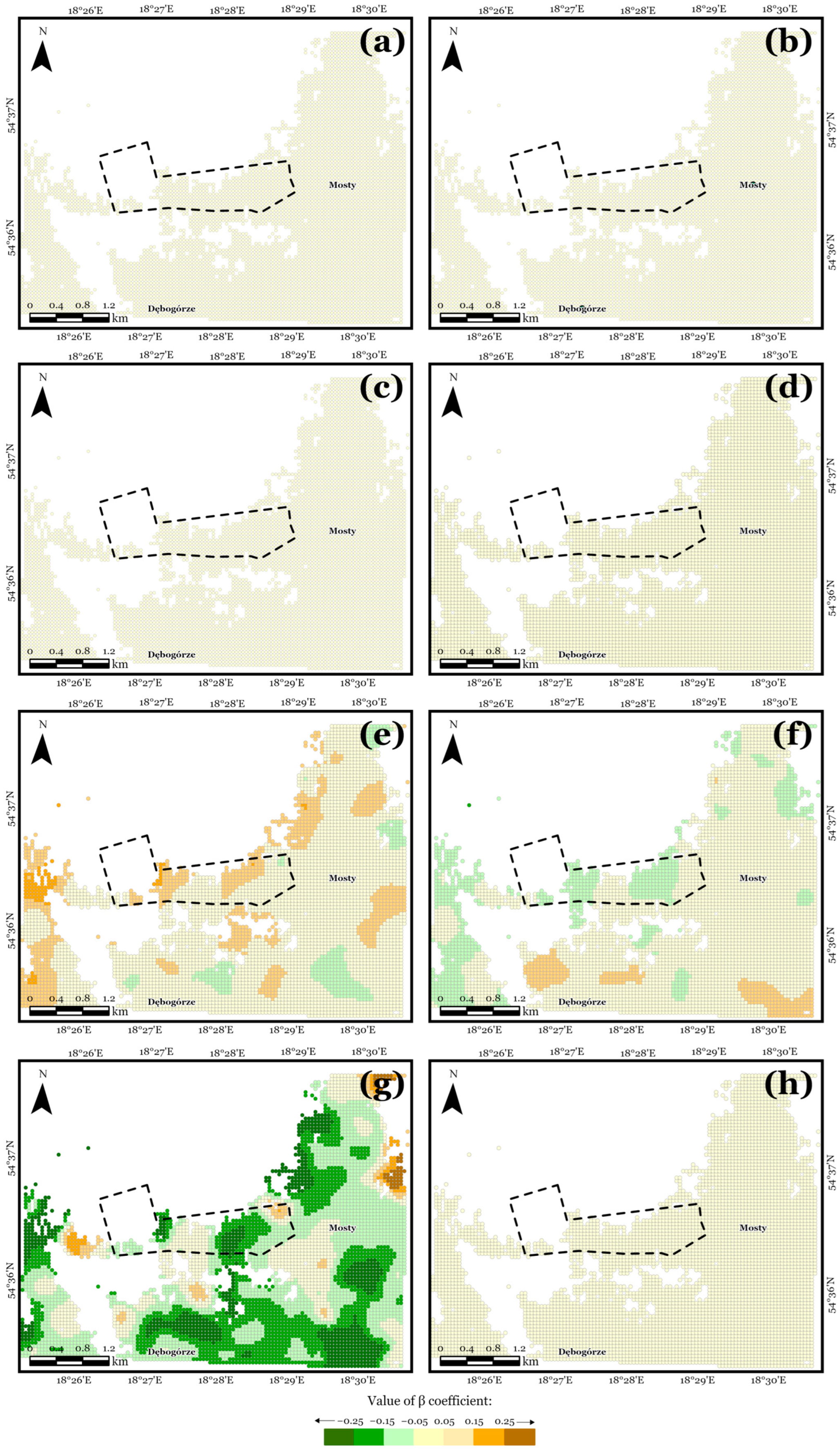
Figure 8 presents the spatial distribution of β coefficients determined for individual independent variables in the developed GWR model. It can be observed that the lowest values of β coefficients, which did not exceed −0.25, indicating a strong negative relationship between the independent variable and dependent variable, were noted for the smmi factor in the eastern, central, south-eastern, and north-eastern regions of the study area (Figure 8g). The highest β coefficients in this study, with values greater than 0.25, were also assigned to the smmi factor in the north-eastern part of the study area, indicating a strong positive relationship with the dependent variable.
The impact of the ndmi and ndvi factors on the dependent variable was significantly weaker than smmi, as confirmed by Figure 8e,f, respectively. The water content in vegetation had a stronger influence on the dependent variable only in the eastern part of the study area, where the values of β coefficients assigned to the variable ranged from 0.15 to 0.25 (the sign of the coefficients indicating a positive relationship between the variables). The relationship between the ndvi factor, representing the vegetation condition of the analyzed area, and the dependent variable was moderately strong (the values of β coefficients greater than |0.15| were not observed) and, depending on the region, had a positive or negative character.
Finally, it is worth noting that the results presented in Figure 8a–d,h do not indicate significant local relationships between the variables cluster_A, water_intakes, kanal_sciekowy, groundwater_table, and slope and the observed values of cumulative vertical ground displacements. The values of the β coefficients assigned to these factors ranged from −0.05 to 0.05 throughout the entire study area.

5. Discussion

The main objective of this section is to give a more in-depth discussion on the aspects related to the applied methodology and the obtained results, which have not been addressed in the previous chapters and which constitute an important complement to the presented research.
A literature review demonstrated that advanced spatial regression models and a set of various explanatory factors were used to explain ground displacements determined from SAR imagery [77,78,79]. However, these methods have not yet been applied to the description of ground movements in underground gas storage areas. In this study, as many as 16 independent variables were used to explain the cumulative values of vertical ground displacements observed between 2014 and 2024 in the Kosakowo UGS area. Their selection was a consequence of a literature review, the availability of geospatial data, and the specific location of the research area. As indicated in Section 1.1, both ground subsidence and uplift are observed in UGS areas, resulting from the cavern convergence and periods of gas injection and withdrawal [8,13,16]. Research by the authors of [19,20] suggests that wetlands may also contribute to ground displacements in these regions. For these reasons, the set of independent variables included distance from caverns, peat thickness, and spectral indices describing soil moisture, water content in vegetation, and the flora condition. Additionally, the analyzed study area is characterized by a specific location, including areas at sea level, the presence of watercourses and groundwater intakes, and relative proximity to the Baltic Sea shoreline. Therefore, the set of independent variables was further expanded with topographic and hydrogeological factors. However, it should be emphasized that inclusion of additional geological variables (e.g., type and permeability of Quaternary formations) or factors describing underground gas storage in the Kosakowo region in more detail (e.g., cavern depth) could improve the accuracy of regression models. It is noteworthy that, contrary to the authors’ original hypothesis, the analysis showed no correlation between the ground displacements observed and the independent variable referring to peat thickness. The information on peat was interpolated from external data, whose quantity and sampling density were independent of the authors. Nevertheless, the study confirmed the statistical significance of the spectral indices that are used as proxies of vegetation vigor and soil moisture. The latter is connected to water content and thus the condition of the peat.
Another aspect that should be considered is the fact that, while the presented study focused on the analysis of long-term ground displacements in the Kosakowo UGS area, it also aimed to identify the factors that have the strongest impact on them. In the authors’ opinion, a significant contribution to this research would be the modeling of ground displacements that occur at shorter intervals (e.g., annually). This would allow a more precise description of the impact of seasonality on wetlands and underground gas storage operation on the ground movements.
The cumulative values of vertical ground displacements from 2014 to 2024 over the Kosakowo UGS facility were determined using the SBAS method. The selection of this technique was motivated by the dominant types of land cover in the analyzed area, which are meadows and pastures. In contrast to the commonly used Persistent Scatterer Interferometric Synthetic Aperture Radar (PSInSAR) method, which is more dependent on the number of scatterers in the region under study, the SBAS method provides a higher pixel density [80]. Additionally, the EGMS, which is based on the PSInSAR processing approach, provides vertical displacement data resampled to a 100 m grid, whereas the approach applied in this study enabled the generation of a 50 m grid. EGMS datasets require no preprocessing or computation and thus are widely implemented in monitoring ground movements in UGS regions [20,26]. However, the products are released in four-year intervals, currently covering the period of 2019–2023. In contrast, the approach adopted in this study spans the years 2014–2024, offering a more comprehensive overview of the observed phenomenon. Nevertheless, modeling the dependent variable presenting vertical ground displacements, calculated using the PSInSAR method or determined by integration of the SBAS and PSInSAR techniques, should be the future research direction.
The cumulative values of vertical displacements over the Kosakowo UGS facility during 2014–2024 ranged from −331 mm to +20 mm, whereby only for a few pixels, the highest subsidence values were noted within the salt caverns locations. Considering the mean value of determined ground displacement velocities of −4.3 mm/year, this is comparable to ground displacements observed over salt dome workings (salt mines) even in shallower formations with values ranging from −2 to −7 mm/year [81,82,83]. Due to the relatively short period of UGS operation, the obtained ground displacement values probably do not yet indicate surface subsidence caused by the propagation of deformations resulting from cavern convergence. In salt mining, due to the visco-plastic behavior of rock salt, the process of propagation to the surface is attenuated and considerably prolonged. Effects on the surface may appear years or even decades after the construction of caverns. The relatively low displacement values also result from the low capacity of the caverns in the study area compared to other UGS facilities around the world [2,26]. In Hutubi UGS [2], surface uplift of 77 mm/year between 2013 and 2015 and 13 mm/year between 2015 and 2020 was attributed to the closure of a gas field and its conversion to a UGS facility. The amount of gas injected exceeded the extraction, which caused the increase in internal pressure, and thus led to ground uplift. EGMS-derived ground movements above different geological sites in Germany were compared in [26]. The Rehden UGS, formed in a depleted gas field, did not experience any significant deformation with an average subsidence velocity of −1.4 mm/year. Similarly, in the case of an aquifer storage in Uelsen, the ground displacement velocities span from −2.4 to 1.8 mm/year during withdrawal and injection phases, respectively. On the contrary, the region of Etzel, comprising 75 salt caverns, experienced ground movements with a velocity of −7.7 mm/year (injection) and −12.4 mm/year (withdrawal). In another study [27], the ground movement above storage facilities in Jengum and Nuettermoor, Germany, reached −15.6 mm/year. Furthermore, as demonstrated by the results of these analyses, the presence of peats had a significant impact on the observed ground movements. Their cyclical changes could have substantially affected the analysis of the potential impact of underground gas storage on the surface. It should also be emphasized that the accuracy of the SBAS method for the determination of vertical ground displacements may have been affected by the permanent damage to the Sentinel-1B satellite in December 2021, which resulted in the longer revisit time over the study area until December 5, 2024, when the Sentinel-1C satellite was launched (the commissioning phase of Sentinel-1C was ended in early May 2025).
An issue that is worth highlighting is the lack of verification of vertical ground displacement values determined using the SBAS method with the results of in situ measurements. Unfortunately, due to restrictions, it was not possible to use the results of field measurements carried out by Gas Storage Poland Sp. z o.o., which are not publicly available (common research problem for this kind of study site). An additional obstacle that prevents the verification of the SBAS results with field data is the fact that in situ measurements are conducted in the study area once every five years (with the last measurement conducted in 2021). Therefore, the accuracy of the SBAS results was assessed using the European Ground Motion Service (EGMS) portal, which provides information on the long-term ground movements across Europe (Table A1). A comparative analysis between the data published on the EGMS website and the velocity displacement values determined in this study demonstrated minor differences between them, which were about 3 mm/year (difference in the mean values of velocity displacements). Although field data are required for reliable validation of the obtained results, the similarity of the ground displacements’ values determined by two independent (SBAS and PSInSAR) methods provides proof of the correct approach adopted in the manuscript.
The accuracy of the global and local regression models developed in this study was significantly dependent on the preprocessing of the acquired geospatial data, i.e., the digitalization of raster data, georeferencing, reprojecting, and resampling. The interpolation of point data describing peat thickness, as well as the cloud masking of Sentinel-2 imagery, were also key aspects for the accuracy of the developed regression models. Additionally, despite the Box–Cox transformation, the distribution of the dependent variable was slightly different from the Gaussian, which may have affected both the values and the spatial distribution of GLR and GWR regression residuals. For this reason, the transformation of the dependent variable to another distribution (e.g., binary) should be considered in future studies to improve the accuracy of the models (a similar approach has been adopted in a lignite mining area [84]).
Finally, the regression models considered in this study explain only linear relationships between the dependent variable and the set of explanatory factors in the spatial domain (due to the character of UGS operation, a linear trend in the time domain was assumed). This is because the presented research is the first attempt to define the relationships between ground displacements, Kosakowo UGS facility, and environmental variables; thus, only the simpler linear models were considered. A significant number of nonlinear methods developed to date also confirms the need for more in-depth and separate research on this issue. Therefore, analyses conducted with the use of the machine learning approaches, such as Random Forest or Extreme Gradient Boosting models, are the proposed directions of future research. The application of these models may contribute to a better explanation of the studied phenomenon and potentially indicate a greater impact of UGS activity on the observed ground movements.

6. Conclusions

The main conclusions from the research presented in this article are summarized in the following points:
  • The cumulative values of vertical ground displacements over the Kosakowo UGS facility between 2014 and 2024, determined using Sentinel-1 SAR imagery and the SBAS InSAR method, ranged from −331 mm to +20 mm (the mean value of determined ground displacement velocities was equal to −4.3 mm/year). The highest subsidence values were noted in the north-western, south-western, and southern parts of the analyzed area. The cumulative values of subsidence greater than 150 mm were also observed within the locations of caverns;
  • To explain the vertical ground displacements, both at the global and local scales, three spatial regression models (OLS, GLR, and GWR models) and as many as 16 independent variables, developed using the Sentinel-2 images and open geospatial datasets, were utilized;
  • The developed global regression models (OLS and GLR models) were characterized by relatively low accuracy, as none of them explained more than 40.0% of the variance in the dependent variable. The adjusted coefficient of determination for the GWR model was equal to 85.5%, with the values of local Radj2 lower than 40.0% only for several pixels in the eastern and central parts of the study area;
  • Both global and local regression models demonstrated that soil moisture, flora condition, and vegetation water content had the greatest impact on the observed values of vertical ground displacements. The distance from the Kanał Ściekowy watercourse, the distance from groundwater intakes, and the distance from Cluster A at the cavernous UGS facility had the least significant impact on the dependent variable;
  • The developed regression models confirmed that underground gas storage was not the main driving factor in the context of the observed ground displacements over the study area. In addition, these studies indicated that the presence of peats can be a significant obstacle in satellite monitoring of ground movements above UGS facilities in an early operational state;
  • The results presented in this article constitute a basis for further analysis. Potential future research directions include the following: (1) application of models which consider the nonlinear relationships between variables (e.g., Random Forest), (2) modeling of vertical ground displacements determined for shorter intervals (e.g., annual) or using other methods (e.g., integration of SBAS and PSInSAR methods), and (3) analysis of relationships with additional geological and mining factors.

Author Contributions

Conceptualization, J.B. and A.B.; methodology, A.B., A.K., D.G. and J.B.; software, A.B., D.G. and A.K.; validation, A.B., J.B., A.K. and D.G.; formal analysis, A.B.; investigation, A.B., A.K. and D.G.; resources, A.B., A.K. and D.G.; data curation, A.B., D.G. and A.K.; writing—original draft preparation, A.B., A.K., D.G. and J.B.; writing—review and editing, A.B., A.K., D.G. and J.B.; visualization, A.B. and A.K.; supervision, A.B.; project administration, J.B.; funding acquisition, J.B. All authors have read and agreed to the published version of the manuscript.

Funding

This research was supported by the Polish National Centre for Research and Development (grant number WPN/4/67/CLEAR/2022), as part of bilateral project Closed-Loop Impact Monitoring for Environmentally and Socially Acceptable Energy Transition in Rural Regions (acronym: CLEAR).

Data Availability Statement

The original contributions presented in this study are included in the article. Further inquiries can be directed to the corresponding author.

Acknowledgments

We acknowledge the support of the CUGS Kosakowo industrial partner in the research.

Conflicts of Interest

The authors declare no conflicts of interest.

Appendix A

Table A1. Summary of the displacement velocities (DVs) for the SBAS method and from the EGMS.
MethodMaximum Value of DV
[mm/year]
Minimum Value of DV
[mm/year]
Mean Value of DV
[mm/year]
Standard Deviation of DV
[mm/year]
Number of Points
SBAS−20.90.4−4.33.56288
EGMS−9.81.9−1.21.41290

References

  1. Struhár, J.; Rapant, P.; Kačmařík, M.; Hlaváčová, I.; Lazecký, M. Monitoring Non-Linear Ground Motion above Underground Gas Storage Using GNSS and PSInSAR Based on Sentinel-1 Data. Remote Sens. 2022, 14, 4898. [Google Scholar] [CrossRef]
  2. Wang, Y.; Feng, G.; Li, Z.; Xu, W.; Zhu, J.; He, L.; Xiong, Z.; Qiao, X. Retrieving the Displacements of the Hutubi (China) Underground Gas Storage during 2003–2020 from Multi-Track InSAR. Remote Sens. Environ. 2022, 268, 112768. [Google Scholar] [CrossRef]
  3. Wei, X.; Shi, X.; Li, Y.; Li, P.; Ban, S.; Zhao, K.; Ma, H.; Liu, H.; Yang, C. A Comprehensive Feasibility Evaluation of Salt Cavern Oil Energy Storage System in China. Appl. Energy 2023, 351, 121807. [Google Scholar] [CrossRef]
  4. Tarkowski, R.; Lankof, L.; Luboń, K.; Michalski, J. Hydrogen Storage Capacity of Salt Caverns and Deep Aquifers versus Demand for Hydrogen Storage: A Case Study of Poland. Appl. Energy 2024, 355, 122268. [Google Scholar] [CrossRef]
  5. Neeft, E.; Bartol, J.; Vuorio, M.; Vis, G.-J. Geological Disposal of Radioactive Waste. In Geology of the Netherlands; Amsterdam University Press: Amsterdam, The Netherlands, 2025; pp. 769–791. [Google Scholar]
  6. Bandilla, K.W. 31—Carbon Capture and Storage. In Future Energy, 3rd ed.; Letcher, T.M., Ed.; Elsevier: Amsterdam, The Netherlands, 2020; pp. 669–692. ISBN 978-0-08-102886-5. [Google Scholar]
  7. Liu, H.; Yang, C.; Liu, J.; Hou, Z.; Xie, Y.; Shi, X. An Overview of Underground Energy Storage in Porous Media and Development in China. Gas Sci. Eng. 2023, 117, 205079. [Google Scholar] [CrossRef]
  8. Babaryka, A.; Benndorf, J. Ground Subsidence above Salt Caverns for Energy Storage: A Comparison of Prediction Methods with Emphasis on Convergence and Asymmetry. Mining 2023, 3, 334–346. [Google Scholar] [CrossRef]
  9. Misa, R.; Sroka, A.; Dudek, M.; Tajduś, K.; Meyer, S. Determination of Convergence of Underground Gas Storage Caverns Using Non-Invasive Methodology Based on Land Surface Subsidence Measurement. J. Rock Mech. Geotech. Eng. 2023, 15, 1944–1950. [Google Scholar] [CrossRef]
  10. CEDIGAZ Underground Gas Storage: Pillar of Global Energy Security. Available online: https://www.cedigaz.org/underground-gas-storage-pillar-of-global-energy-security/ (accessed on 6 November 2024).
  11. Statista Working Gas Volume in Underground Storage Facilities in Europe in 2021, by Select Country. Available online: https://www.statista.com/statistics/688149/underground-gas-storage-volume-by-country-europe/ (accessed on 6 November 2024).
  12. Derakhshani, R.; Lankof, L.; GhasemiNejad, A.; Zaresefat, M. Artificial Intelligence-Driven Assessment of Salt Caverns for Underground Hydrogen Storage in Poland. Sci. Rep. 2024, 14, 14246. [Google Scholar] [CrossRef]
  13. Tajduś, K.; Sroka, A.; Misa, R.; Tajduś, A.; Meyer, S. Surface Deformations Caused by the Convergence of Large Underground Gas Storage Facilities. Energies 2021, 14, 402. [Google Scholar] [CrossRef]
  14. Zhang, G.; Liu, Y.; Wang, T.; Zhang, H.; Wang, Z. Ground Subsidence Prediction Model and Parameter Analysis for Underground Gas Storage in Horizontal Salt Caverns. Math. Probl. Eng. 2021, 2021, 9504289. [Google Scholar] [CrossRef]
  15. Zhang, G.; Wu, Y.; Wang, L.; Zhang, K.; Daemen, J.J.K.; Liu, W. Time-Dependent Subsidence Prediction Model and Influence Factor Analysis for Underground Gas Storages in Bedded Salt Formations. Eng. Geol. 2015, 187, 156–169. [Google Scholar] [CrossRef]
  16. Bekebrok, H.; Langnickel, H.; Pluta, A.; Zobel, M.; Dyck, A. Underground Storage of Green Hydrogen—Boundary Conditions for Compressor Systems. Energies 2022, 15, 5972. [Google Scholar] [CrossRef]
  17. Codegone, G.; Benetatos, C.; Uttini, A.; Rucci, A.; Fiaschi, S.; Mantegazzi, A.; Coti, C. Defining the Influence Area of Uplift and Subsidence from Underground Gas Storage in Anticline Structural Traps: Insights from InSAR Cross-Correlation. Gondwana Res. 2025, 143, 185–198. [Google Scholar] [CrossRef]
  18. Rapant, P.; Struhár, J.; Lazecký, M. Radar Interferometry as a Comprehensive Tool for Monitoring the Fault Activity in the Vicinity of Underground Gas Storage Facilities. Remote Sens. 2020, 12, 271. [Google Scholar] [CrossRef]
  19. Even, M.; Westerhaus, M.; Simon, V. Complex Surface Displacements above the Storage Cavern Field at Epe, NW-Germany, Observed by Multi-Temporal SAR-Interferometry. Remote Sens. 2020, 12, 3348. [Google Scholar] [CrossRef]
  20. Fibbi, G.; Novellino, A.; Bateson, L.; Fanti, R.; Del Soldato, M. Multidisciplinary Assessment of Seasonal Ground Displacements at the Hatfield Moors Gas Storage Site in a Peat Bog Landscape. Sci. Rep. 2024, 14, 22521. [Google Scholar] [CrossRef]
  21. Hrysiewicz, A.; Holohan, E.P.; Donohue, S.; Cushnan, H. SAR and InSAR Data Linked to Soil Moisture Changes on a Temperate Raised Peatland Subjected to a Wildfire. Remote Sens. Environ. 2023, 291, 113516. [Google Scholar] [CrossRef]
  22. van Asselen, S.; Erkens, G.; Stouthamer, E.; Woolderink, H.A.G.; Geeraert, R.E.E.; Hefting, M.M. The Relative Contribution of Peat Compaction and Oxidation to Subsidence in Built-up Areas in the Rhine-Meuse Delta, The Netherlands. Sci. Total Environ. 2018, 636, 177–191. [Google Scholar] [CrossRef]
  23. Izumi, Y.; Takeuchi, W.; Sulaiman, A.; Widodo, J.; Awaluddin, A.; Kozan, O.; Zahro, Q. Sentinel-1 Time-Series SAR Interferometry for Understanding Tropical Peat Surface Oscillation. Remote Sens. Appl. Soc. Environ. 2025, 38, 101541. [Google Scholar] [CrossRef]
  24. Benetatos, C.; Codegone, G.; Ferraro, C.; Mantegazzi, A.; Rocca, V.; Tango, G.; Trillo, F. Multidisciplinary Analysis of Ground Movements: An Underground Gas Storage Case Study. Remote Sens. 2020, 12, 3487. [Google Scholar] [CrossRef]
  25. Fais, S.; Ligas, P.; Cuccuru, F.; Maggio, E.; Plaisant, A.; Pettinau, A.; Casula, G.; Bianchi, M.G. Detailed Petrophysical and Geophysical Characterization of Core Samples from the Potential Caprock-Reservoir System in the Sulcis Coal Basin (Southwestern Sardinia–Italy). Energy Procedia 2015, 76, 503–511. [Google Scholar] [CrossRef]
  26. Fibbi, G.; Landini, N.; Intrieri, E.; Ventisette, C.D.; Soldato, M.D. Open-Source InSAR Data to Detect Ground Displacement Induced by Underground Gas Storage Reservoirs. Earth Syst. Environ. 2025, 9, 3083–3100. [Google Scholar] [CrossRef]
  27. Fibbi, G.; Montalti, R.; Soldato, M.D.; Cespa, S.; Ferretti, A.; Fanti, R. Unlocking the InSAR Potential for Managing Underground Gas Storage in Salt Caverns. Int. J. Appl. Earth Obs. Geoinf. 2025, 141, 104656. [Google Scholar] [CrossRef]
  28. Priolo, E.; Zinno, I.; Guidarelli, M.; Romanelli, M.; Lanari, R.; Sandron, D.; Garbin, M.; Peruzza, L.; Romano, M.A.; Zuliani, D.; et al. The Birth of an Underground Gas Storage in a Depleted Gas Reservoir—Results From Integrated Seismic and Ground Deformation Monitoring. Earth Space Sci. 2024, 11, e2023EA003275. [Google Scholar] [CrossRef]
  29. Li, Y.; Acosta, M.; Sirorattanakul, K.; Bourne, S.; Avouac, J.-P. Geodetic Monitoring of Elastic and Inelastic Deformation in Compacting Reservoirs Due To Subsurface Operations. J. Geophys. Res. Solid Earth 2025, 130, e2024JB030794. [Google Scholar] [CrossRef]
  30. Zhang, T.; Zhang, W.; Yang, R.; Cao, D.; Chen, L.; Li, D.; Meng, L. CO2 Injection Deformation Monitoring Based on UAV and InSAR Technology: A Case Study of Shizhuang Town, Shanxi Province, China. Remote Sens. 2022, 14, 237. [Google Scholar] [CrossRef]
  31. Jayabal, R. AI-Driven Revolution in Subsurface Gas Storage: Addressing Operational and Environmental Challenges. Int. J. Hydrogen Energy 2025, 140, 298–314. [Google Scholar] [CrossRef]
  32. Garcia Navarro, A.M.; Rocca, V.; Capozzoli, A.; Chiosa, R.; Verga, F. Investigation of Ground Movements Induced by Underground Gas Storages via Unsupervised ML Methodology Applied to InSAR Data. Gas Sci. Eng. 2024, 125, 205293. [Google Scholar] [CrossRef]
  33. Solon, J.; Borzyszkowski, J.; Bidłasik, M.; Richling, A.; Badora, K.; Balon, J.; Brzezińska-Wójcik, T.; Chabudziński, Ł.; Dobrowolski, R.; Grzegorczyk, I.; et al. Physico-Geographical Mesoregions of Poland: Verification and Adjustment of Boundaries on the Basis of Contemporary Spatial Data. Geogr. Pol. 2018, 91, 143–170. [Google Scholar] [CrossRef]
  34. Marcinkowska, A.; Ochtyra, A.; Olędzki, J.R.; Wołk-Musiał, E.; Zagajewski, B. Mapa geomorfologiczna województw pomorskiego i warmińsko-mazurskiego z wykorzystaniem metod geoinformatycznych. Teledetekcja Sr. 2013, 49, 43–79. [Google Scholar]
  35. The Polish Central Office of Geodesy and Cartography. Orthofotomap. Available online: https://mapy.geoportal.gov.pl/imap/Imgp_2.html?gpmap=gp0 (accessed on 3 February 2025).
  36. The Polish Central Office of Geodesy and Cartography. Digital Elevation Model. Available online: https://mapy.geoportal.gov.pl/imap/Imgp_2.html?gpmap=gp0 (accessed on 5 December 2024).
  37. Cała, M.; Cyran, K.; Kowalski, M.; Wilkosz, P. Influence of the Anhydrite Interbeds on a Stability of the Storage Caverns in the Mechelinki Salt Deposit (Northern Poland). Arch. Min. Sci. 2018, 63, 1007–1025. [Google Scholar] [CrossRef]
  38. Gas Storage Poland Technical Characteristics-Underground Gas Storage Facilities in Poland. Available online: https://ipi.gasstoragepoland.pl/en/menu-en/transparency-template/?page=services-and-facilities/technical-characteristics/ (accessed on 8 October 2025).
  39. The Polish Central Office of Geodesy and Cartography. Integrated Copies of Databases of Topographic Objects BDOT10k. Available online: https://www.geoportal.gov.pl/pl/dane/baza-danych-obiektow-topograficznych-bdot10k/ (accessed on 8 December 2024).
  40. The Polish Central Office of Geodesy and Cartography. National Register of Boundaries and Areas of Territorial Divisions of the Country. Available online: https://dane.gov.pl/pl/dataset/726,panstwowy-rejestr-granic-i-powierzchni-jednostek-podziaow-terytorialnych-kraju/resource/29506/table (accessed on 29 July 2024).
  41. Pasierowska, B. Hydrogeological Map of Poland 1: 50 000, First Aquifer, Occurrence and Hydrodynamics, Sheet 16 (Gdynia); Polish Geological Institute—National Research Institute: Warsaw, Poland, 2006.
  42. Pasierowska, B. Hydrogeological Map of Poland 1: 50 000, First Aquifer, Occurrence and Hydrodynamics, Sheet 15 (Rumia); Polish Geological Institute—National Research Institute: Warsaw, Poland, 2006.
  43. The Polish Geological Institute—National Research Institute. CBDG Download Manager. Available online: https://dm.pgi.gov.pl/ (accessed on 22 January 2025).
  44. The Polish Geological Institute—National Research Institute. Data Processing System. Available online: https://spd.pgi.gov.pl/PSH/ (accessed on 2 December 2024).
  45. Rozporządzenie Nr 4/2016 Dyrektora Regionalnego Zarządu Gospodarki Wodnej w Gdańsku z Dnia 24 Maja 2016 Roku w Sprawie Strefy Ochronnej Ujęcia Wód Podziemnych “Rumia” w Gminie Rumia, Kosakowo i Mieście Gdynia, Województwo Pomorskie [Dz. Urzędowy Województwa Pomorskiego Rok 2016 Poz. 2165]; 2016.
  46. Rozporządzenie Dyrektora Regionalnego Zarządu Gospodarki Wodnej w Gdańsku z Dnia 8 Sierpnia 2017 Roku w Sprawie Strefy Ochronnej Ujęcia Wód Podziemnych “Reda”, Woj. Pomorskie [Dz. Urzędowy Województwa Pomorskiego Rok 2017 Poz. 3098]; 2017.
  47. Gas Storage Poland KPMG Kosakowo. Available online: https://ipi.gasstoragepoland.pl/pl/menu/uslugi-inzynieryjne/#kpmg-kosakowo (accessed on 2 July 2025).
  48. Gmina Kosakowo Uciążliwe Dla Mieszkańców Hałasy z Magazynu Gazu w Dębogórzu. Available online: https://gminakosakowo.pl/aktualnosci/uciazliwe-dla-mieszkancow-halasy-z-magazynu-gazu-w-debogorzu/ (accessed on 7 February 2025).
  49. BiznesAlert Marszałkowski: Czy Kawerny w Kosakowie Staną Się Cichym Bohaterem Nadchodzącej Zimy? (ANALIZA). Available online: https://biznesalert.pl/marszalkowski-czy-kawerny-w-kosakowie-stana-sie-cichym-bohaterem-nadchodzacej-zimy/ (accessed on 7 February 2025).
  50. Chen, C.W.; Zebker, H.A. Network Approaches to Two-Dimensional Phase Unwrapping: Intractability and Two New Algorithms. J. Opt. Soc. Am. A JOSAA 2000, 17, 401–414. [Google Scholar] [CrossRef]
  51. Yunjun, Z.; Fattahi, H.; Amelung, F. Small Baseline InSAR Time Series Analysis: Unwrapping Error Correction and Noise Reduction. Comput. Geosci. 2019, 133, 104331. [Google Scholar] [CrossRef]
  52. Samieie-Esfahany, S.; Hanssen, R.F.; van Thienen-Visser, K.; Muntendam-Bos, A. On the Effect of Horizontal Deformation on InSAR Subsidence Estimates; ESA: Frascati, Italy, 2010; Volume SP-677. [Google Scholar]
  53. Wright, T.J.; Parsons, B.E.; Lu, Z. Toward Mapping Surface Deformation in Three Dimensions Using InSAR. Geophys. Res. Lett. 2004, 31, 1–5. [Google Scholar] [CrossRef]
  54. Gao, B. NDWI—A Normalized Difference Water Index for Remote Sensing of Vegetation Liquid Water from Space. Remote Sens. Environ. 1996, 58, 257–266. [Google Scholar] [CrossRef]
  55. Kriegler, F.J.; Malila, W.A.; Nalepka, R.F.; Richardson, W. Preprocessing Transformations and Their Effects on Multispectral Recognition. Remote Sens. Environ. 1969, VI, 97–132. [Google Scholar]
  56. Natsagdorj, E.; Renchin, T.; De Maeyer, P.; Tseveen, B.; Dari, C.; Dashdondog, E. Soil Moisture Analysis Using Multispectral Data in North Central Part of Mongolia. ISPRS Ann. Photogramm. Remote Sens. Spat. Inf. Sci. 2019, IV-2/W5, 485–491. [Google Scholar] [CrossRef]
  57. Lv, J.; Jiang, W.; Wang, W.; Wu, Z.; Liu, Y.; Wang, X.; Li, Z. Wetland Loss Identification and Evaluation Based on Landscape and Remote Sensing Indices in Xiong’an New Area. Remote Sens. 2019, 11, 2834. [Google Scholar] [CrossRef]
  58. ESRI How Exploratory Regression Works. Available online: https://pro.arcgis.com/en/pro-app/3.4/tool-reference/spatial-statistics/how-exploratory-regression-works.htm (accessed on 5 August 2025).
  59. Pimpler, E. Spatial Analytics with ArcGIS, 1st ed.; Packt Publishing: Birmingham, UK, 2017; ISBN 978-1-78712-258-1. [Google Scholar]
  60. Kisiała, W. Modele Regresji Przestrzennej w Badaniach Czynników Korzystania Ze Świadczeń Ratownictwa Medycznego. In Gospodarka Przestrzenna. Udział Poznańskiego Uniwersytetu Ekonomicznego w Kształtowaniu Współczesnego Paradygmatu; Bogucki Wydawnictwo Naukowe: Poznań, Poland, 2016; Volume II, pp. 239–263. ISBN 978-83-7986-097-5. [Google Scholar]
  61. Montgomery, D.C.; Peck, E.A.; Vining, G.G. Introduction to Linear Regression Analysis; John Wiley & Sons: Hoboken, NJ, USA, 2021; ISBN 978-1-119-57875-8. [Google Scholar]
  62. ESRI Analiza Regresji—ArcGIS Insights|Dokumentacja. Available online: https://doc.arcgis.com/pl/insights/latest/analyze/regression-analysis.htm (accessed on 5 August 2025).
  63. Zdaniuk, B. Ordinary Least-Squares (OLS) Model. In Encyclopedia of Quality of Life and Well-Being Research; Michalos, A.C., Ed.; Springer: Dordrecht, The Netherlands, 2014; pp. 4515–4517. ISBN 978-94-007-0753-5. [Google Scholar]
  64. Nelder, J.A.; Wedderburn, W.M. Generalized Linear Models. J. R. Stat. Soc. 1972, 135, 370–384. [Google Scholar] [CrossRef]
  65. McCullagh, P.; Nelder, J.A. Generalized Linear Models, 2nd ed.; Monographs on Statistics and Applied Probability; Chapman and Hall: London, UK, 1989. [Google Scholar]
  66. ESRI How Generalized Linear Regression Works. Available online: https://pro.arcgis.com/en/pro-app/3.4/tool-reference/spatial-statistics/how-glr-works.htm (accessed on 5 August 2025).
  67. Box, G.E.P.; Cox, D.R. An Analysis of Transformations. J. R. Stat. Soc. 1964, 26, 211–252. [Google Scholar] [CrossRef]
  68. Brundson, C.; Charlton, M.; Fotheringham, S. Geographically Weighted Regression: A Method for Exploring Spatial Nonstationarity. Geogr. Anal. 1996, 28, 281–298. [Google Scholar] [CrossRef]
  69. Fotheringham, S.; Brundson, C.; Charlton, M. Geographically Weighted Regression: The Analysis of Spatially Varying Relationships; Wiley: Hoboken, NJ, USA, 2002; ISBN 978-0-471-49616-8. [Google Scholar]
  70. Charlton, M.; Fotheringham, A.S. Geographically Weighted Regression. White Paper; National Centre for Geocomputation, National University of Ireland Maynooth: Maynooth, Ireland, 2009. [Google Scholar]
  71. Szymanowski, M.; Kryza, M. Zastosowanie regresji wagowanej geograficznie do modelowania miejskiej wyspy ciepła we Wrocławiu. Arch. Fotogram. Kartogr. Teledetekcji 2009, 20, 407–419. [Google Scholar]
  72. How Geographically Weighted Regression (GWR) Works—ArcGIS Pro|Documentation. Available online: https://pro.arcgis.com/en/pro-app/2.7/tool-reference/spatial-statistics/how-geographicallyweightedregression-works.htm (accessed on 26 February 2022).
  73. ESRI Generalized Linear Regression (GLR) (Spatial Statistics)—ArcGIS Pro|Documentation. Available online: https://pro.arcgis.com/en/pro-app/2.8/tool-reference/spatial-statistics/generalized-linear-regression.htm (accessed on 15 September 2022).
  74. Fotheringham, A.S.; Rogerson, P.A. The SAGE Handbook of Spatial Analysis; SAGE: Newcastle upon Tyne, UK, 2008; ISBN 978-1-4462-0650-8. [Google Scholar]
  75. Moran, P.A.P. A Test for the Serial Independence of Residuals. Biometrika 1950, 37, 178–181. [Google Scholar] [CrossRef]
  76. Emmert-Streib, F.; Dehmer, M. Evaluation of Regression Models: Model Assessment, Model Selection and Generalization Error. Mach. Learn. Knowl. Extr. 2019, 1, 521–551. [Google Scholar] [CrossRef]
  77. Zhao, D.; Chen, B.; Gong, H.; Lei, K.; Zhou, C.; Hu, J. Unraveling the Deformation and Water Storage Characteristics of Different Aquifer Groups by Integrating PS-InSAR Technology and a Spatial Correlation Model. IEEE J. Sel. Top. Appl. Earth Obs. Remote Sens. 2024, 17, 2501–2515. [Google Scholar] [CrossRef]
  78. Zhang, L.; Li, Y.; Li, R. Driving Forces Analysis of Urban Ground Deformation Using Satellite Monitoring and Multiscale Geographically Weighted Regression. Measurement 2023, 214, 112778. [Google Scholar] [CrossRef]
  79. Tian, Y.; Wang, Z.; Xiao, B. Multi-Scale Ground Deformation Analysis and Investigation of Driver Factors Based on Remote Sensing Data: A Case Study of Zhuhai City. Remote Sens. 2023, 15, 5155. [Google Scholar] [CrossRef]
  80. Hussain, S.; Pan, B.; Hussain, W.; Sajjad, M.M.; Ali, M.; Afzal, Z.; Abdullah-Al-Wadud, M.; Tariq, A. Integrated PSInSAR and SBAS-InSAR Analysis for Landslide Detection and Monitoring. Phys. Chem. Earth Parts A/B/C 2025, 139, 103956. [Google Scholar] [CrossRef]
  81. Chrzanowski, A.; Szostak-Chrzanowski, A.; Bastin, G.; Lutes, J. Monitoring and Modelling of Ground Subsidence in Mining Areas—Case Studies. Geomatica 2000, 54, 405–413. [Google Scholar] [CrossRef]
  82. Maj, A.; Kortas, G. Deformations of the Protection Shelf in the “Wapno” Salt Mine, Based on Model Studies. Arch. Min. Sci. 2014, 59, 869–886. [Google Scholar] [CrossRef]
  83. Hejmanowski, R.; Malinowska, A.A. Land subsidence inversion method application for salt mining-induced rock mass movement. Gospod. Surowcami Miner.–Miner. Resour. Manag. 2017, 33, 179–200. [Google Scholar] [CrossRef][Green Version]
  84. Buczyńska, A.; Blachowski, J.; Bugajska-Jędraszek, N. Analysis of Post-Mining Vegetation Development Using Remote Sensing and Spatial Regression Approach: A Case Study of Former Babina Mine (Western Poland). Remote Sens. 2023, 15, 719. [Google Scholar] [CrossRef]
Figure 1. Location of the USG facility on the background of (a) land use and land cover types (source: [35]); (b) Digital Elevation Model (source: [36]).
Remotesensing 17 03912 g001
Figure 2. Scheme of research methodology.
Remotesensing 17 03912 g002
Figure 3. Cumulative values of vertical ground displacements observed over the study area between 2015 and 2024 (source of the orthophotomap: ESRI World Imagery [basemap]).
Remotesensing 17 03912 g003
Figure 4. The distribution of regression residuals from parametric global models: (a) OLS model; (b) GLR model.
Remotesensing 17 03912 g004
Figure 5. The spatial distribution of residuals from parametric regression models over the study area: (a) OLS model; (b) GLR model.
Remotesensing 17 03912 g005
Figure 6. The distribution of local determination coefficients in the research area.
Remotesensing 17 03912 g006
Figure 7. The regression residuals from nonparametric GWR model: (a) histogram of regression residuals; (b) spatial distribution of residuals over the study area.
Remotesensing 17 03912 g007
Figure 8. Spatial distribution of β coefficient values assigned to independent variables in the GWR model: (a) cluster_A; (b) water_intakes; (c) kanal_sciekowy; (d) groundwater_table; (e) ndmi; (f) ndvi; (g) smmi; (h) slope.
Remotesensing 17 03912 g008
Table 1. Summary of the independent variables developed.
No.Variable Name 1Description of Variable DevelopmentRange of Variable
Values [Unit]
1.cluster_AVariable representing the Euclidean distance from Cluster A at the cavern underground gas storage (CUGS) facility0.0–4370.9 [m]
2.cluster_BVariable representing the Euclidean distance from Cluster B at the CUGS facility0.0–3653.1 [m]
3.RedaVariable presenting the Euclidean distance from the Reda groundwater intake250.0–6488.4 [m]
4.RumiaVariable presenting the Euclidean distance from the Rumia groundwater intake2079.7–8549.4 [m]
5.water_intakesVariable presenting the Euclidean distance from all groundwater intakes0.0–1820.0 [m]
6.groundwater_tableVariable describing the minimum depth of the groundwater table in the study area. The explanatory factor was developed by digitizing the hydrogeological maps obtained from the National Geological Institute and then converting the vector data to raster form (Polygon to Raster tool). The final variable was obtained by subtracting the aforementioned raster from the nmt variable−18.9–57.7 [m]
7.shorelineVariable presenting the Euclidean distance from the Baltic Sea shoreline100.0–5731.7 [m]
8.kanal_sciekowyVariable presenting the Euclidean distance from a watercourse named Kanał Ściekowy0.0–2404.2 [m]
9.zagorska_strugaVariable presenting the Euclidean distance from a watercourse named Zagórska Struga0.0–5836.3 [m]
10.peatVariable defining the thickness of peats in the study area, determined based on the attribute “thickness” assigned to vector data (with the geometry type of a point) obtained from the Central Geological Database of the National Geological Institute. The continuous distribution of the variable was obtained by interpolation using the Kriging method0.0–5.0 [m]
11.ndmiA variable describing the water content of vegetation, determined by the Normalized Difference Moisture Index (NDMI) [54]. It shows the mean NDMI values from 2015–2024, calculated from Sentinel-2 imagery−0.31–0.48 [-]
12.ndviA variable describing the overall condition of vegetation, determined based on the Normalized Difference Vegetation Index (NDVI) [55]. It shows the mean NDVI values from 2015–2024, calculated from Sentinel-2 imagery0.00–0.90 [-]
13.smiA variable defining the soil moisture, determined based on the Soil Moisture Index (SMI) [56]. It shows the mean SMI values from 2015–2024, calculated from Sentinel-2 imagery0.00–0.12 [-]
14.smmiA variable defining the soil moisture, determined based on the Soil Moisture Monitoring
Index (SMMI) [57]. It shows the mean SMMI values from 2015–2024, calculated from Sentinel-2 imagery
0.17–0.58 [-]
15.nmtVariable presenting ground elevation, determined based on a point cloud of XYZ coordinates (as part of airborne laser scanning), obtained from the Polish General Office of Geodesy and Cartography0.4–77.2 [m a.s.l.]
16.slopeA variable presenting the slope of the terrain, determined based on the Digital Elevation Model mentioned in the point above0.0–21.2 [°]
1 The brown color represents the independent variables describing the underground gas storage in the analyzed region, while the blue and green colors define hydrogeological and topographical factors, respectively.
Table 2. The statistical significance of independent variables and Variance Inflation Factor values derived from the Exploratory Regression.
Independent Variable 1Significance [%] 2VIF [-]Correlated Variables
smmi (*)100.001.16not applicable
smi (*)99.955.23not applicable
ndmi (*)99.864.64not applicable
slope (*)99.711.46not applicable
water_intakes (*)99.491.69not applicable
Reda (*)99.4641.67shoreline, Rumia, zagorska_struga, cluster_A, cluster_B, nmt
kanal_sciekowy (*)99.254.65not applicable
Rumia (*)89.5088.26shoreline, Reda, zagorska_struga, cluster_A, cluster_B, nmt
shoreline (*)88.1099.57Reda, Rumia, zagorska_struga, cluster_A, cluster_B, nmt
nmt (*)87.177.62cluster_A, cluster_B, Reda, Rumia, shoreline, zagorska_struga
zagorska_struga (*)86.9812.82Reda, Rumia, shoreline, cluster_A, cluster_B, nmt
groundwater_table (*)83.914.64not applicable
cluster_A (*)78.4435.72cluster_B, Reda, shoreline, Rumia, zagorska_struga, nmt
ndvi (*)77.256.15not applicable
cluster_B (*)73.2218.50cluster_A, Reda, shoreline, Rumia, zagorska_struga, nmt
peat61.521.90not applicable
1 The asterisk (*) represents the explanatory factors with statistically significant influence on the dependent variable. 2 The red color indicates the positive influence of the explanatory factor on the dependent variable, while the blue color reflects the negative relationship between variables. The explanatory factors, which can impact the dependent variable positively or negatively, are marked in orange color.
Table 3. Accuracy assessment of the developed OLS and GLR models.
ParameterModel 1
OLSGLR
Radj2 [%]34.137.3
JB [-]1453.5 (*)128.4 (*)
BP [-]319.0 (*)263.9 (*)
global Moran I276.9 (*)260.1 (*)
1 The asterisk (*) represents a statistically significant value of a measure.
Table 4. The strength and character of influence of independent variables on the dependent variable based on the developed OLS and GLR models.
Independent VariableAbsolute Value of β CoefficientCharacter of the Relationship
OLSGLR
smmi0.4360540.316721negative
ndvi0.0969060.070757negative
ndmi0.0827130.058452positive
slope0.0034090.002364positive
groundwater_table0.0002650.000152negative
water_intakes0.0000240.000019negative
cluster_A0.0000210.000016positive
kanal_sciekowy0.0000170.000013negative
Table 5. Summary of β coefficients determined for the explanatory factors in the GWR model.
Independent VariableValue of β Coefficient
MinimumMaximumMeanStandard Deviation
smmi−0.61080.4354−0.12640.1277
ndmi−0.14190.22110.02060.0493
ndvi−0.17140.1208−0.01880.0384
slope−0.01440.01710.00060.0038
groundwater_table−0.00680.01160.00010.0018
cluster_A−0.00080.00040.00000.0001
kanal_sciekowy−0.00030.00080.00000.0001
water_intakes−0.00030.00050.00000.0001
Disclaimer/Publisher’s Note: The statements, opinions and data contained in all publications are solely those of the individual author(s) and contributor(s) and not of MDPI and/or the editor(s). MDPI and/or the editor(s) disclaim responsibility for any injury to people or property resulting from any ideas, methods, instructions or products referred to in the content.