Versatile Fourier Transform Spectrometer Model for Earth Observation Missions Validated with In-Flight Systems Measurements
 , ,
, ,
Highlights
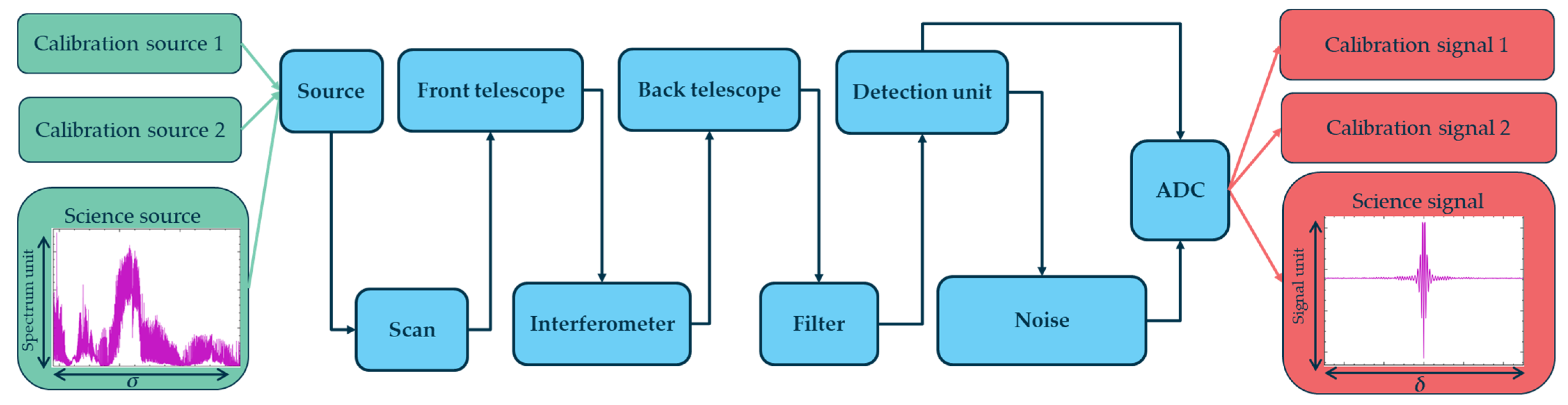
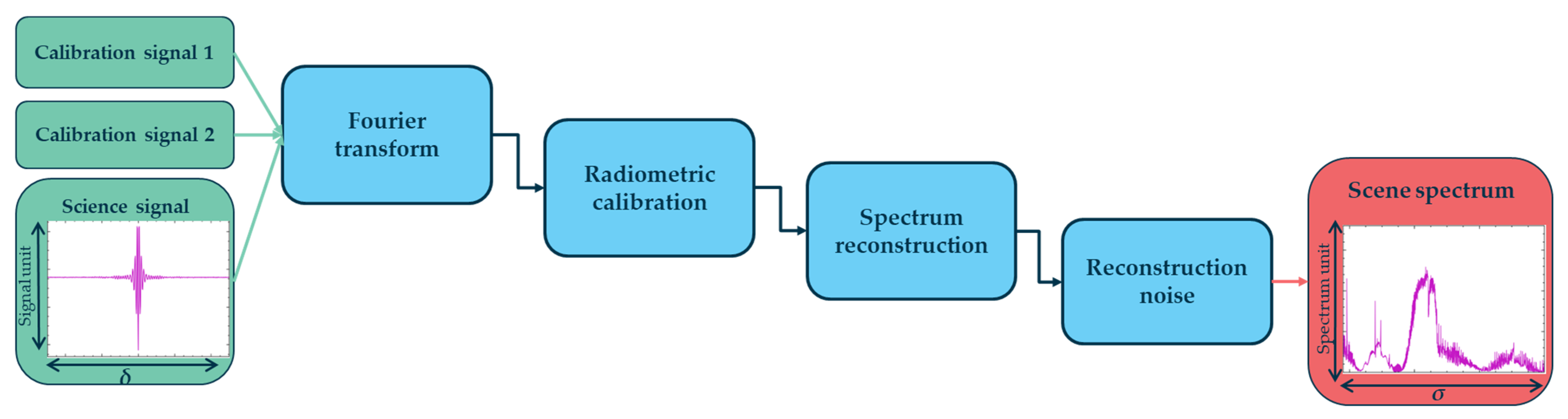
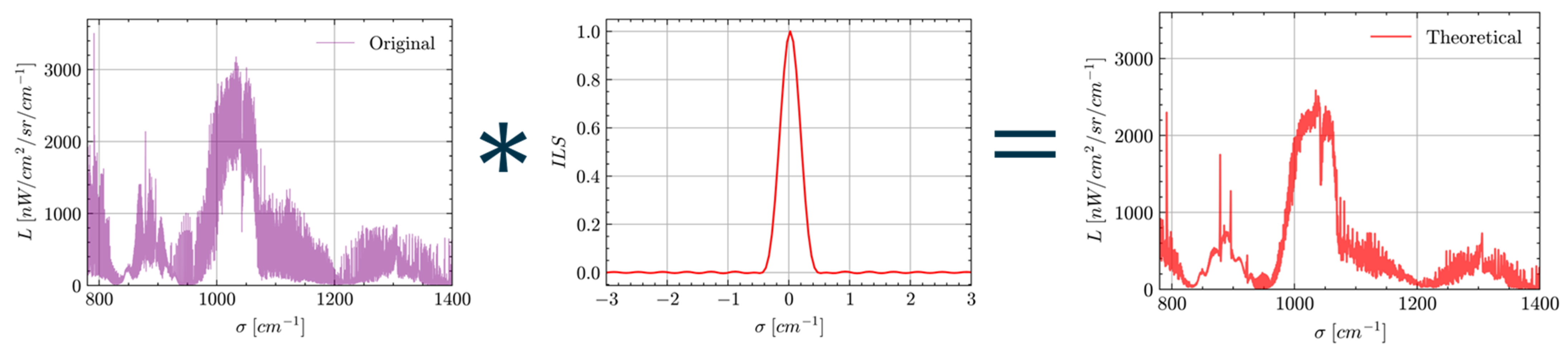
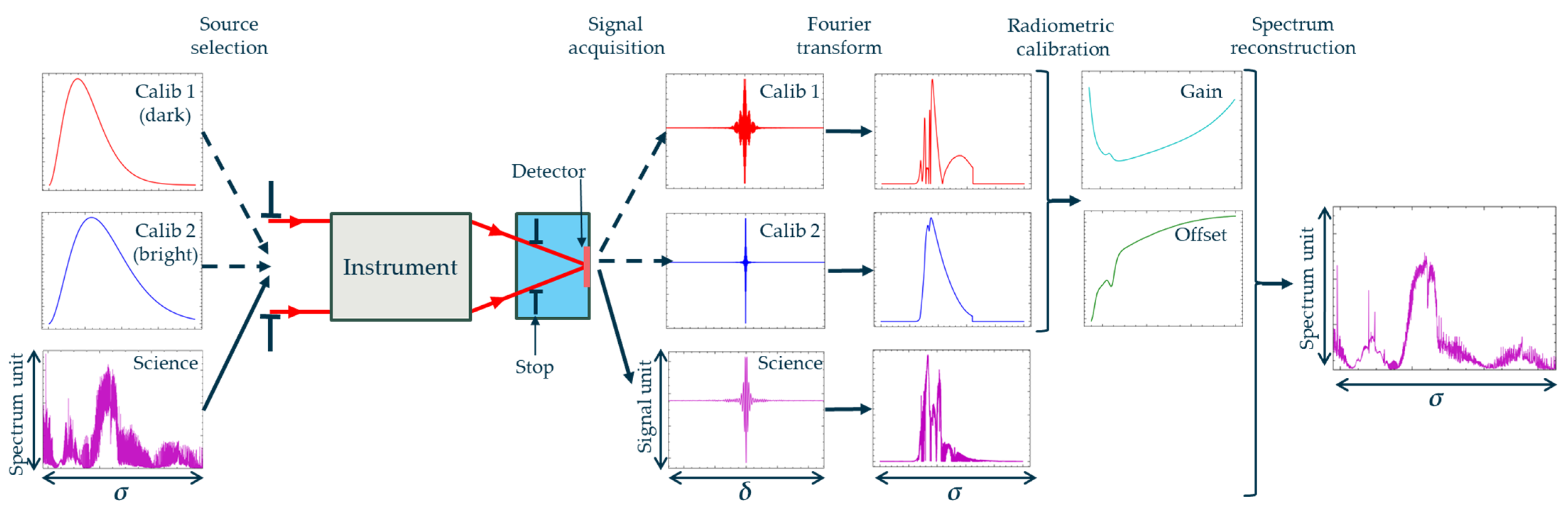
- We developed a unique and flexible Fourier transform spectrometer model that (i) simulates the instrument’s signal and radiometric calibration and reconstructs the measured spectrum; (ii) estimates the radiometric performance; and (iii) predicts the instrument spectral response.
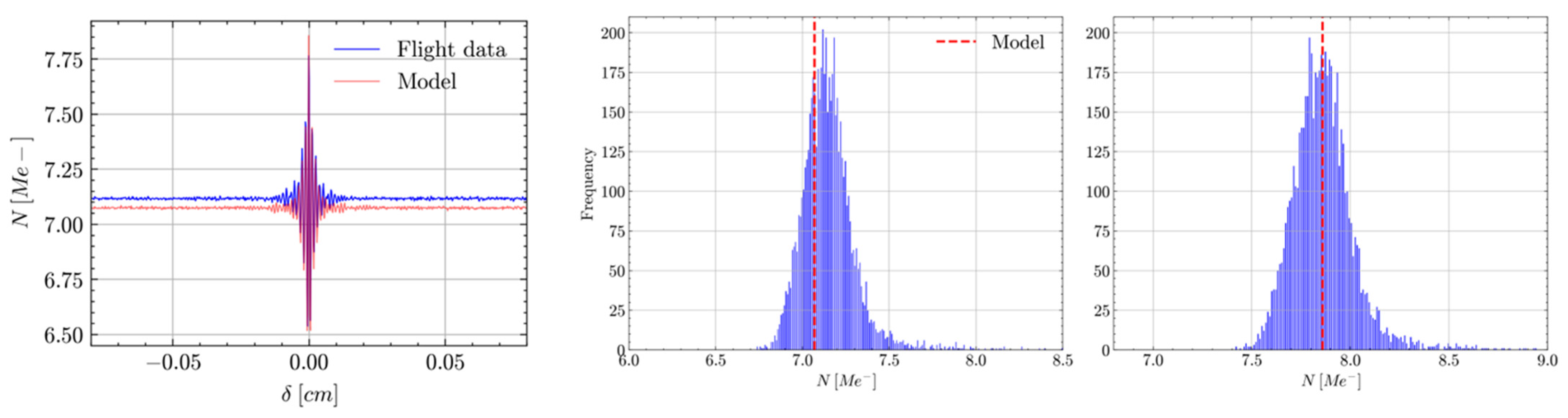
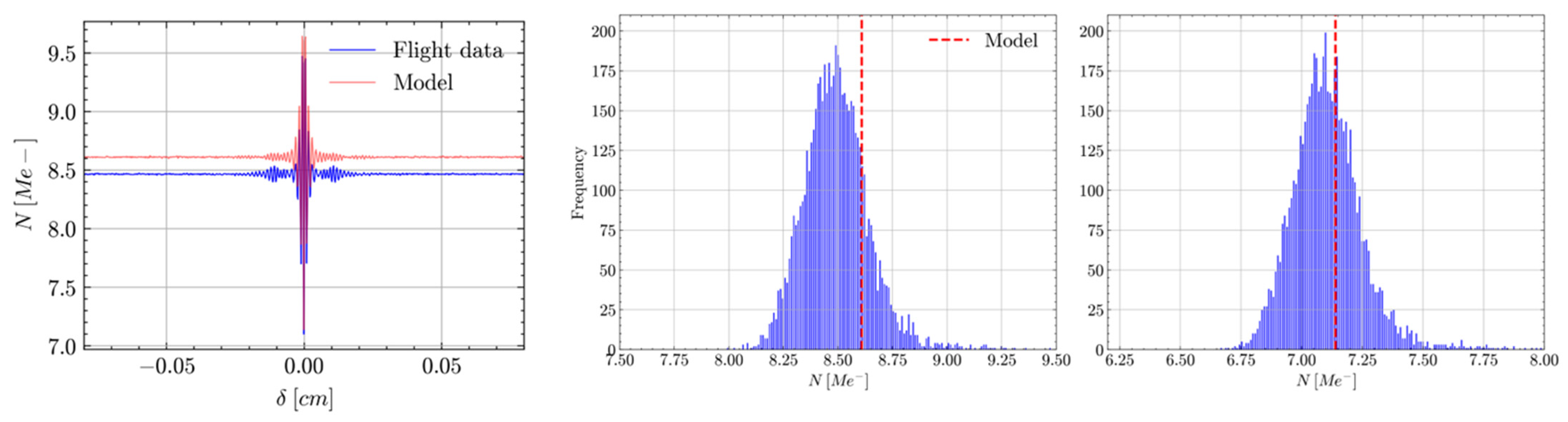
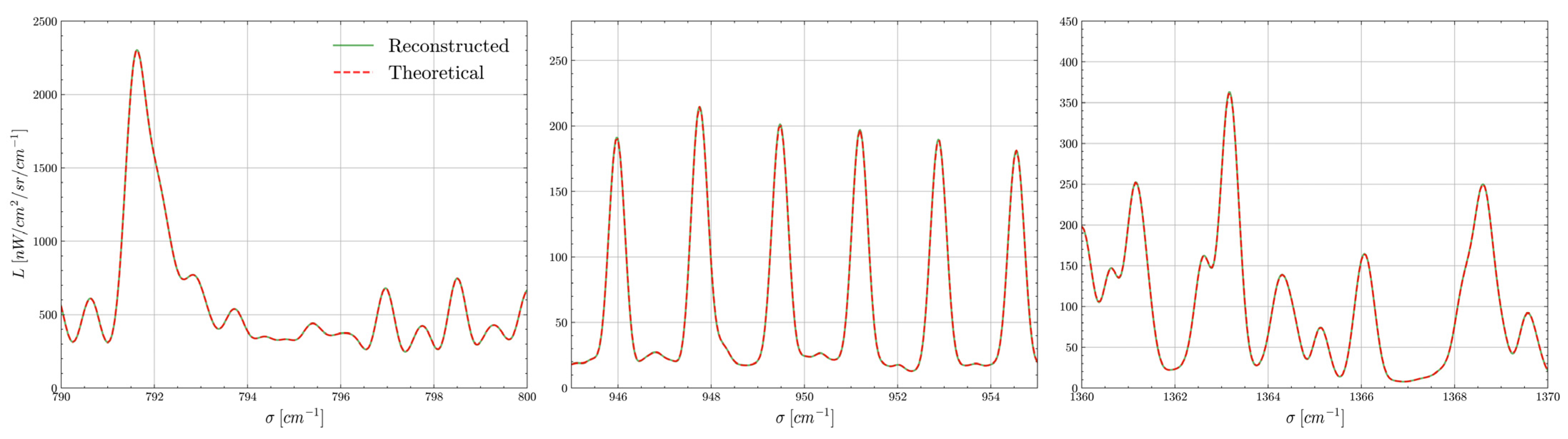
- The model has been successfully validated using the in-flight balloon-borne instrument GLORIA-Lite with a maximum deviation between the signal predictions and the measurements lower than 2%.
- We have successfully developed and validated an innovative model that accurately predicts the performance of future instruments based on Fourier transform spectrometers.
- This model will be used to optimise the design and analyse the performance of upcoming Fourier transform spectrometer-based payloads.
Abstract
1. Introduction
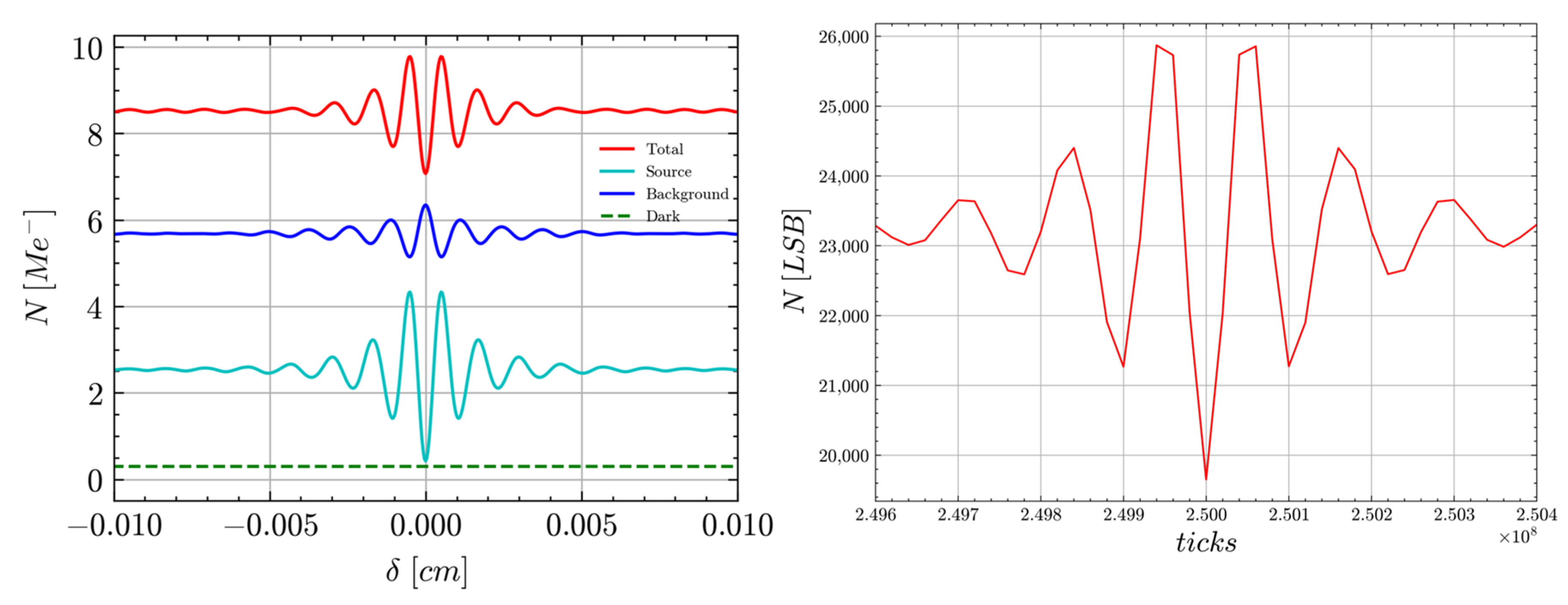
- Predict the detected signal including the correct level of thermal background, dark current, and noise using a set of instrumental parameters as input;
- Evaluate the instrument’s radiometric performance;
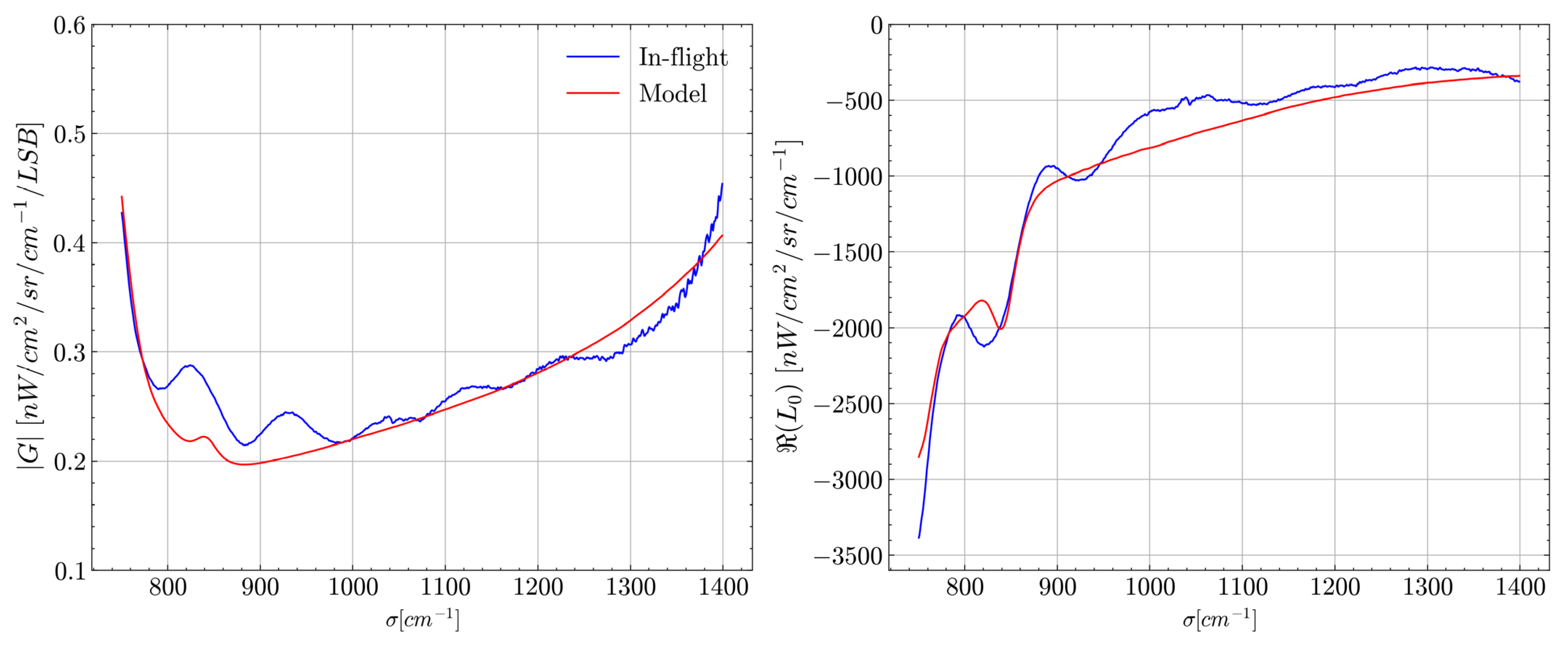
- Simulate the instrument radiometric calibration;
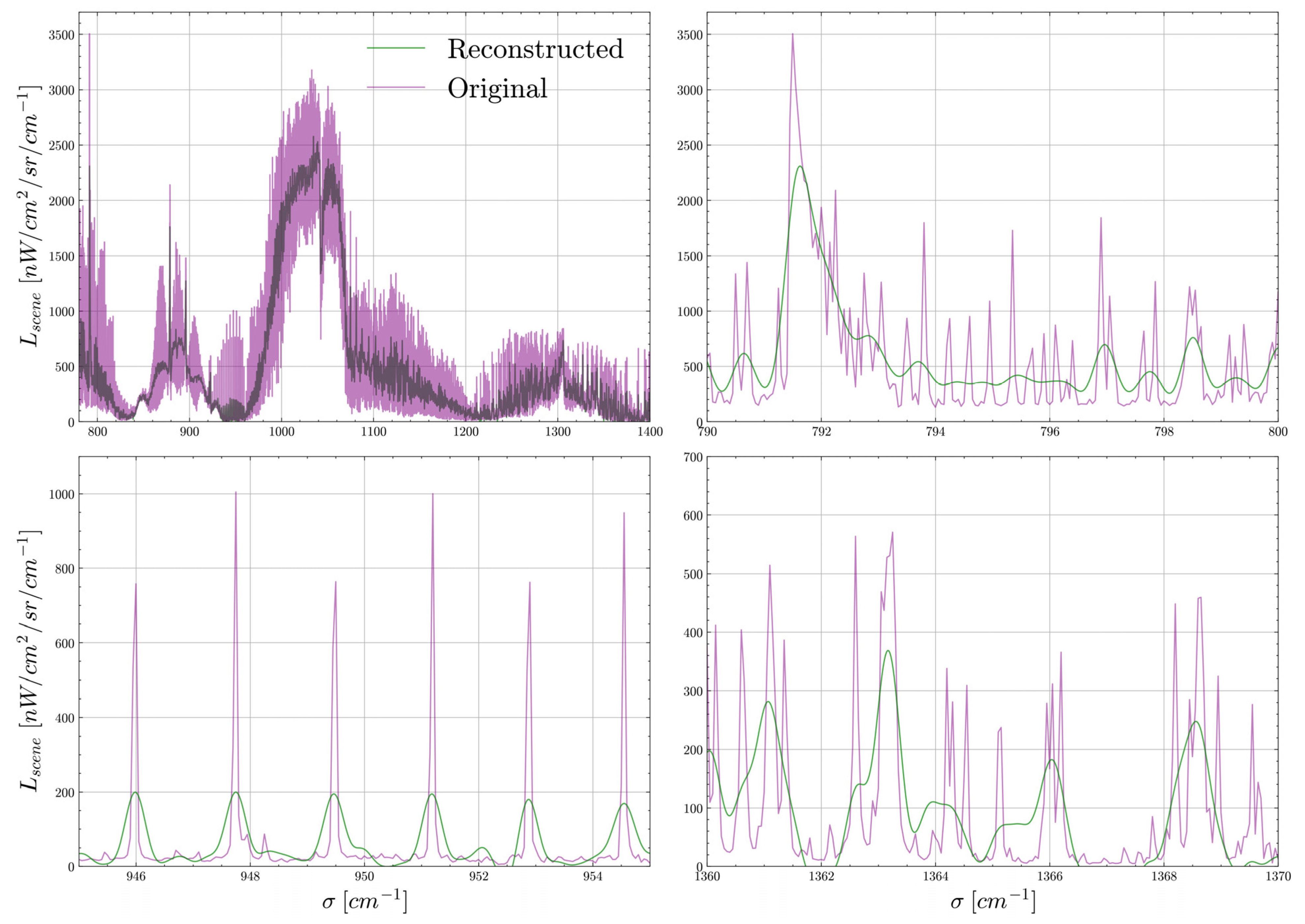
- Reconstruct a scientific scene spectrum.
2. FTS Models State-of-the-Art
- Design flexibility: The model is suited for studying different instrumental designs and is not adapted to only one specific design. The optics architecture, performance, and temperature in the instrument can be modified without a source code update.
- Photodetector: The model can provide signals assuming a photodetector and relying on a flux-to-signal conversion model [25].
- Thermal detector: The model can provide signals assuming a thermal detector and relying on a flux-to-signal conversion model [25].
- Interferogram simulation: The model can generate an interferogram sampled on an analogue or digitised axis.
- Radiometric calibration: The model implements the observation of calibration sources, calculating calibration interferograms used to estimate the instrument gain and offset [26].
- Spectrum reconstruction: The science scene spectrum is obtained from the science interferogram and the instrument radiometric gain and offset [26].
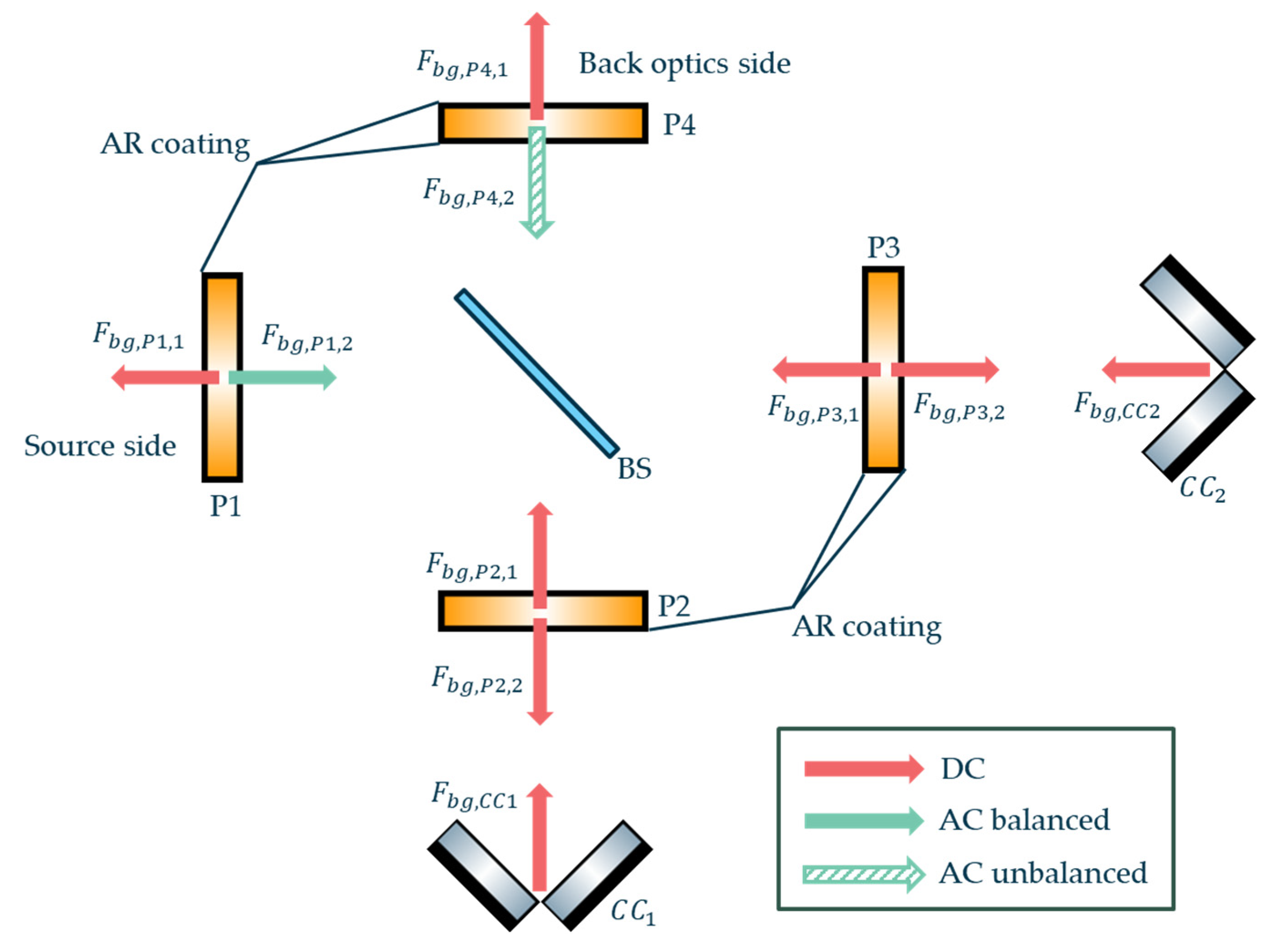
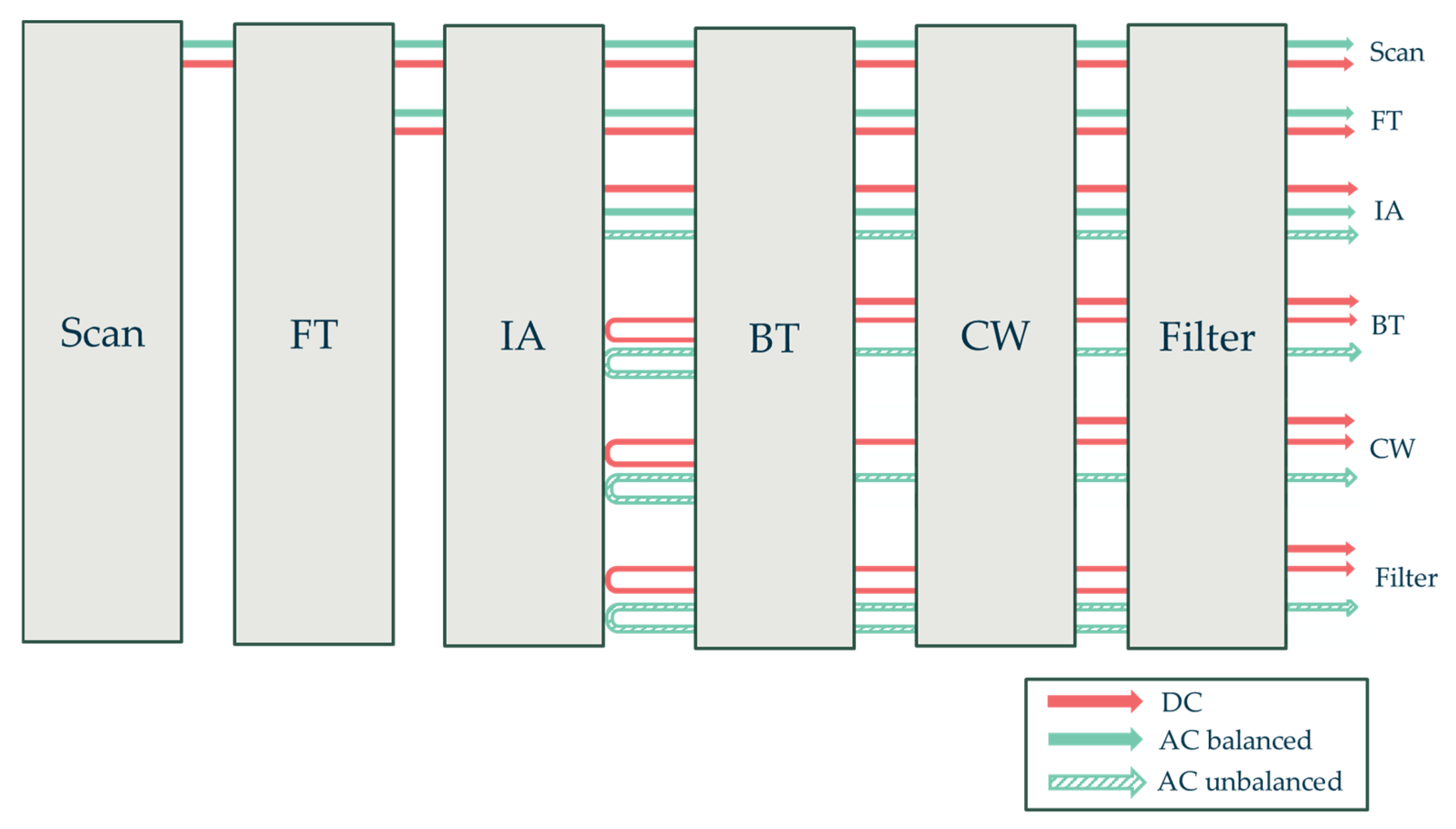
- Instrument thermal background: The thermal self-emission of the instrument is considered to calculate the output signal and/or the noise levels.
- Interferometer modulation losses: The wavefront error (WFE), tilt, and shear between the wavefront recombined in the interferometer are considered to calculate the performance [27].
- Self-apodisation: The self-apodisation induced by the optical path difference in-field variation is considered to assess the performance and to calculate the output signal [28].
- Detector non-linearity: The non-linearity of the detector response is considered to calculate the output signal [29].
- PRNU: The pixel response non-uniformity (PRNU) [30] is considered to calculate the output signal.
- Integration time effect: The impact of the integration time on the interferogram contrast effect due to the flux temporal integration is considered to calculate the output signal and the radiometric performance [31].
- LOS jitter error: Jitter due to fluctuation of the line of sight (LOS) during the observation of an inhomogeneous scene is considered to estimate the output signal and the radiometric performance [32].
- Sampling error: The non-regular sampling induced by the dynamic mirror displacement velocity variations is considered to calculate the output signal and the radiometric performance [33].
3. Instrument Model
3.1. Instrument Model Overview and Assumptions
3.2. Beam-Splitting Unit Model
3.3. Detector Model
3.3.1. Photodetector Signal
3.3.2. Pyroelectric Detector Signal
3.3.3. Signal Digitisation and Sampling
3.3.4. Non-Linearity
3.3.5. Noise Budget
4. Flux Incident on the Detector
4.1. Source Flux
4.2. Thermal Background Flux
4.2.1. Unmodulated Thermal Background Flux
4.2.2. Balanced Modulated Thermal Background Flux
4.2.3. Unbalanced Modulated Thermal Background Flux
4.2.4. Detection Unit Thermal Background Flux
5. Instrumental Degradations and Spectral Response
5.1. Modulation Efficiency
5.2. Self-Apodisation and Spectral Response
6. Radiometric Performance Budget
7. Inverse Model
7.1. Inverse Model Overview
7.2. Radiometric Calibration and Spectrum Reconstruction
7.3. Noise Propagation in Spectrum Reconstruction
8. Instrument Model Validation
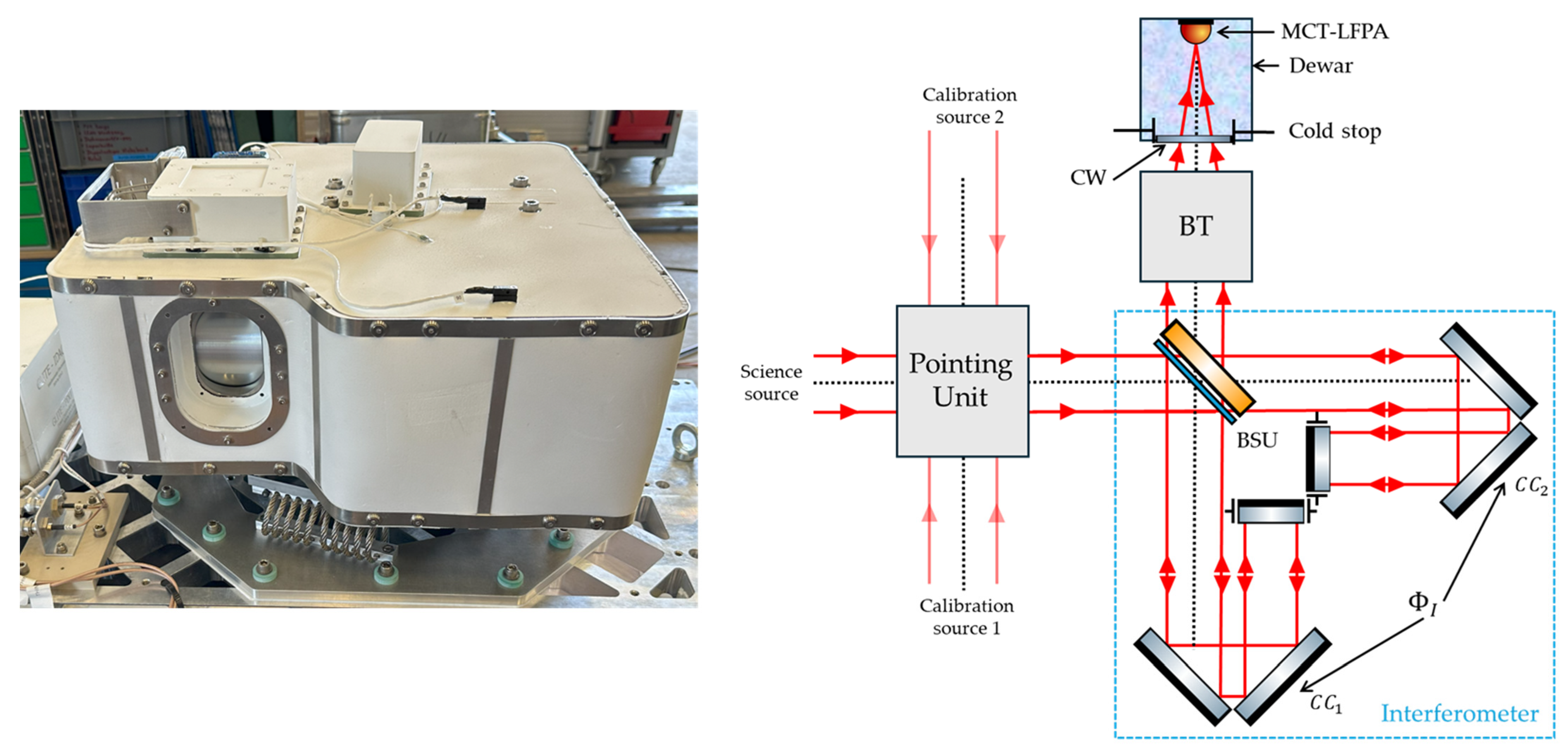
8.1. The GLORIA-Lite Instrument
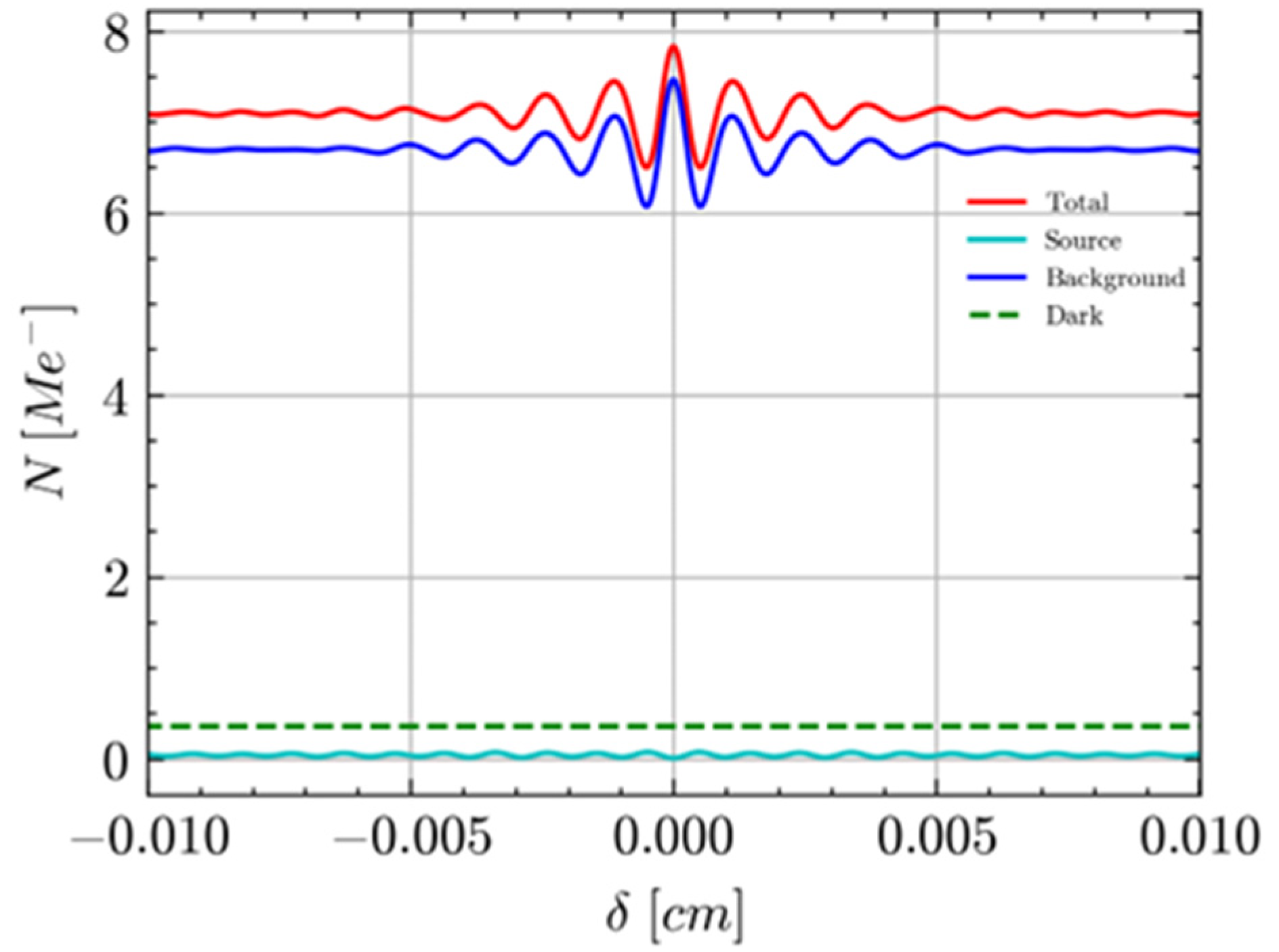
8.2. Validation with GLORIA-Lite In-Flight Signals
- The error on the temperature of the elements located between the scan mirror to the CW, which is estimated to be equal to 0.5 K.
- The error on the dark current density associated with the in-flight detector measured temperature uncertainty of 0.03 K. The consequent dark current drift is deduced from the “Rule07” associated to MCT infrared photodetectors [55] and is equal to 2.16 mA/m2.
- The detector PRNU, which we assume to be equal to 2%.
- The error on the blackbody emissivity, which is estimated to be equal to 0.003 based on the GLORIA calibration source stability requirement [52].
- The error on the blackbody temperature, which is estimated to be equal to 0.03 K based on the in-flight temperature measurements precision.
- The error on the mirrors coating reflectivity, which is estimated to be equal to 0.0005. There is one mirror in the front optics, seven per CC assembly, and four in the back optics.
- The error on the BS substrate transmission, which is estimated to be equal to 0.005.
- The error on the BP thickness, which is estimated to be equal to 0.05 mm.
- The error on the BP AR coating reflectivity, which is estimated to be equal to 0.0005.
9. Radiometric Calibration Model Validation
10. FTS Model Consistency Assessment
11. Conclusions and Discussion
Author Contributions
Funding
Data Availability Statement
Acknowledgments
Conflicts of Interest
Abbreviations and Symbols
| FTS | Fourier Transform Spectrometer |
| EO | Earth Observation |
| ESA | European Space Agency |
| MIPAS | Michelson Interferometer for Passive Atmospheric Sounding |
| IASI-(NG) | Infrared Atmospheric Sounding Interferometer—(New Generation) |
| EUMETSAT | European Organisation for the Exploitation of Meteorological Satellites |
| CNES | Centre national d’études spatiales |
| MTG-S | Meteosat Third Generation—Sounding |
| EE | Earth Explorer |
| FORUM | Far-infrared Outgoing Radiation Understanding and Monitoring |
| CAIRT | Changing Atmosphere Infrared Tomography |
| FOV | Field Of View |
| GLORIA | Gimballed Limb Observer for Radiance Imaging of the Atmosphere |
| DIRSIG | Digital Imaging and Remote Sensing Image Generation |
| GIIRS | Geostationary Interferometric Infrared Sounder |
| FTIR-SIS | Fourier Transform InfraRed Scientific Instrument Simulator |
| FIRI | Far Infra-Red Interferometer |
| SHIFTS | Simulator for the Herschel Imaging Fourier Transform Spectrometer |
| SPIRE | Spectral and Photometric Imaging Receiver |
| WFE | Wavefront Error |
| PRNU | Pixel Response Non-Uniformity |
| LOS | Line of Sight |
| ILS | Instrument Line Shape |
| UV | Ultraviolet |
| FT | Front Telescope |
| IA | Interferometer Assembly |
| BT | Back Telescope |
| CW | Cryostat Window |
| DU | Detection Unit |
| ADC | Analogue-to-Digital Converter |
| BSU | Beam Splitter Unit |
| CC | Cube Corner |
| OPD | Optical Path Difference |
| ZPD | Zero-Path Difference |
| BS | Beam-splitting Surface |
| BP | Beam-splitting Plate |
| CP | Compensating Plate |
| AR | Anti-Reflective |
| QE | Quantum Efficiency |
| CHC | Charge-Handling Capacity |
| LSB | Least Significant Bit |
| DC | Unmodulated |
| AC | Modulated |
| MOPD | Maximum Optical Path Difference |
| FWHM | Full Width at Half Maximum |
| NESR | Noise-Equivalent Spectral Radiance |
| NEDT | Noise-Equivalent Differential Temperature |
| KIT | Karlsruher Institut für Technologie |
| FZJ | Forschungszentrum Jülich |
| MCT | Mercury Cadmium Telluride |
| LFPA | Large Focal Plane Array |
| PTB | Physikalisch-Technische Bundesanstalt |
| VLWIR | Very Long-Wave Infrared |
| SF6 | Sulphur Hexafluoride |
| O3 | Ozone |
| SO2 | Sulphur dioxide |
| σ | Wavenumber |
| α | Bulk absorption coefficient |
| β | Material bulk absorption rate |
| h | Optical thickness |
| d | Mechanical thickness |
| ϕ | Beam incidence angle |
| n | Optical index |
| N | Signal |
| ρ | Pixel fill-factor |
| τint | Integration time |
| η | Quantum efficiency |
| hcσ | Photon energy |
| F | Spectral flux |
| δ | Optical path difference |
| O | Instrument function |
| M | Modulation efficiency |
| R{.} | Real part operator |
| FT{.} | Fourier Transform operator |
| Idark | Pixel dark current density |
| px | Horizontal pixel pitch |
| py | Vertical pixel pitch |
| RV | Voltage response |
| fel | Electric frequency |
| vopt | Optical speed |
| facq | Acquisition frequency |
| ξ | Noise standard deviation |
| b | Binning factor |
| L | Spectral radiance |
| G | Optical etendue |
| K | Optical transmission |
| R | Reflectivity |
| ε | Emissivity |
| T | Temperature |
| ADU | Studied active detection area |
| J1() | Bessel function of first kind |
| γtilt | Angular tilt between interfering wavefronts |
| Rstop | Aperture stop equivalent radius |
| γshear | Shear between interfering wavefronts |
| Ω | Beam solid angle |
| ⟨.⟩ | Average operator |
| Δδ2 | Differential wavefront error between interfering wavefronts |
| θ0 | Beam off-axis angle with respect to field of view centre |
| MOPD | Maximum optical path difference |
| ILS | Instrument line shape |
| Mifg | Interferogram number of samples |
| dσ | Spectral sampling |
| NESR | Noise-equivalent spectral radiance |
| NEDT | Noise-equivalent differential temperature |
| G | Radiometric gain |
| L0 | Radiometric offset |
Appendix A. Interferometer Self-Emission

Appendix B. Radiometric Gain and Offset Noise
References
- Davis, S.P.; Abrams, M.C.; Brault, J.W. Why choose a Fourier transform spectrometer? In Fourier Transform Spectrometry; Academic Press: Cambridge, MA, USA, 2001. [Google Scholar]
- Peter, G.; James, H. Fourier Transform Infrared Spectrometry, 2nd ed.; John Wiley & Sons, Inc.: Hoboken, NJ, USA, 2006. [Google Scholar]
- Fischer, H.; Birk, M.; Blom, C.; Carli, B.; Carlotti, M.; von Clarmann, L.; Delbouille, A.; Dudhia, D.; Ehhalt, M.; Endemann, J.M.F.; et al. MIPAS: An Instrument for Atmospheric and Climate Research. Atmos. Chem. Phys. 2008, 8, 2151–2188. [Google Scholar] [CrossRef]
- Clerbaux, C.; Boynard, A.; Clarisse, L.; George, M.; HadjiLazaro, J.; Herbin, H.; Hurtmans, D.; Pommier, M.; Razavi, A.; Turquety, S.; et al. Monitoring of Atmospheric Composition Using the Thermal Infrared IASI/MetOp Sounder. Atmos. Chem. Phys. 2009, 9, 6041–6054. [Google Scholar] [CrossRef]
- Abdon, S.; Riegger, L.; Pedone, G.; Finella, E.; Sheard, B.; Giraud, J.; Guggenmoser, T.; Lamarre, D.; Den, V.; Fowler, G.; et al. Meteosat Third-Generation IRS Sounding Mission Development Status and Test Results. In Proceedings of the International Conference on Space Optics—ICSO 2024, Antibes Juan-les-Pins, France, 21–25 October 2024; SPIE: Bellingham, WA, USA, 2025; Volume 13699, p. 136990B. [Google Scholar]
- Bernard, F.; Calvel, B.; Pasternak, F.; Davancens, R.; Buil, C.; Baldit, E.; Luitot, C.; Penquer, A. Overview of IASI-NG the New Generation of Infrared Atmospheric Sounder. In Proceedings of the International Conference on Space Optics—ICSO 2014, Canary Islands, Spain, 6–10 October 2014; SPIE: Bellingham, WA, USA, 2017; Volume 10563, p. 105633H. [Google Scholar]
- The European Space Agency. Earth Explorer 9 Candidate Mission FORUM—Report for Mission Selection. 2019. Available online: https://esamultimedia.esa.int/docs/EarthObservation/EE9-FORUM-RfMS-ESA-v1.0-FINAL.pdf (accessed on 23 June 2025).
- The European Space Agency. EARTH EXPLORER 11 Candidate Mission NITROSAT Report for Assessment. 2023. Available online: https://esamultimedia.esa.int/docs/EarthObservation/EE11_Nitrosat_Report_for_Assessment_v1.0_15Sept23.pdf (accessed on 23 June 2025).
- The European Space Agency. EARTH EXPLORER 11 Candidate Mission CAIRT Report for Assessment. 2023. Available online: https://esamultimedia.esa.int/docs/EarthObservation/EE11_CAIRT_Report_for_Assessment_v1.0_15Sept23.pdf (accessed on 23 June 2025).
- The European Space Agency. ESA Graduate Trainees. Available online: https://www.esa.int/About_Us/Careers_at_ESA/Graduates_ESA_Graduate_Trainees?ci_id=599&client_id=43&college=6&grad_trainingDir=DESC&grad_trainingOrder=Sorter_description&jobholder_id=448&lang_coursesDir=DESC&lang_coursesOrder=Sorter_college_id&lang_coursesPage=10§or_id=32 (accessed on 13 May 2025).
- Friedl-Vallon, F.; Gulde, T.; Hase, F.; Kleinert, A.; Kulessa, T.; Maucher, G.; Neubert, T.; Olschewski, F.; Piesch, C.; Preusse, P.; et al. Instrument Concept of the Imaging Fourier Transform Spectrometer GLORIA. Atmos. Meas. Tech. 2014, 7, 3565–3577. [Google Scholar] [CrossRef]
- Alain, F. Simulation of Imaging Fourier Transform Spectrometers Using DIRSIG. 1999. Available online: https://dirsig.cis.rit.edu/docs/alain.pdf (accessed on 23 June 2025).
- Weiner, A.M.; Messinger, D.W. An end-to-end Airborne FTS Simulation for Evaluating the Performance Trade Space in Fugitive Gas Identification. In Proceedings of the Imaging Spectrometry XV, San Diego, CA, USA, 1–5 August 2010; SPIE: Bellingham, WA, USA; Volume 7812, p. 78120T. [Google Scholar]
- Zhang, W.; Zhang, B.; Gao, L.; Zhang, W. Image Simulator for Spatially Imaging Fourier Transform Spectrometer “HJ1A-HSI”. In Proceedings of the Sensors, Systems, and Next-Generation Satellites XIV, Toulouse, France, 20–23 September 2010; SPIE: Bellingham, WA, USA, 2010; Volume 7826, p. 78262P. [Google Scholar]
- Erik, K. Modelling of the Instrument Spectral Response of Conventional and Imaging Fourier Transform Spectrometers, Laval. 2014. Available online: https://corpus.ulaval.ca/entities/publication/14d279a4-25e2-4418-922a-6003aae3d8f2 (accessed on 23 June 2025).
- Ni, Z.; Lu, Q.; Xu, Y.; Huo, H. Intensity Simulation of a Fourier Transform Infrared Spectrometer. Sensors 2020, 20, 1833. [Google Scholar] [CrossRef]
- Sermania, B.; VanFossen, N.; Steen, R.; Stewart, M.; Raston, P.L. FTIR-SIS: A Fourier Transform Infrared Scientific Instrument Simulator. J. Chem. Educ. 2024, 101, 1711–1717. [Google Scholar] [CrossRef]
- Juanola-Parramon, R.; Savini, G.; Fenech, D.; Walsh, C. An end-to-end Far-infrared Interferometer Instrument Simulator (FIInS). In Proceedings of the Space Telescopes and Instrumentation 2014: Optical, Infrared, and Millimeter Wave, Montréal, QB, USA, 22–27 June 2014; SPIE: Bellingham, WA, USA, 2014; Volume 9143, p. 91434I. [Google Scholar]
- Lindner, J.V.; Naylor, D.A.; Swinyard, B.M. SHIFTS: Simulator for the Herschel imaging Fourier transform spectrometer. In Proceedings of the Space Telescopes and Instrumentation I: Optical, Infrared, and Millimeter, Orlando, FL, USA, 24–31 May 2006; SPIE: Bellingham, WA, USA, 2006; Volume 6265, p. 62652Y. [Google Scholar]
- Perron, G.P.; Moreau, L.M.; Miras, D.; Chetrite, B. IASI Simulation Model. In Proceedings of the Sensors, Systems, and Next-Generation Satellites VI, Toronto, ON, Canada, 24–28 June 2002; SPIE: Bellingham, WA, USA, 2003; Volume 4881. [Google Scholar]
- Vicent, J.; Verrelst, J.; Sabater, N.; Alonso, L.; Rivera-Caicedo, J.P.; Martino, L.; Muñoz-Marí, J.; Moreno, J. Comparative analysis of atmospheric radiative transfer models using the Atmospheric Look-up table Generator (ALG) toolbox (version 2.0). Geosci. Model Dev. 2020, 13, 1945–1957. [Google Scholar] [CrossRef]
- Clough, S.A.; Shephard, M.W.; Mlawer, E.J.; Delamere, J.S.; Iacono, M.J.; CadyPereira, K.; Boukabara, S.; Brown, P.D. Atmospheric Radiative Transfer Modeling: A Summary of the AER Codes. J. Quant. Spectrosc. Radiat. Transf. 2005, 91, 233–244. [Google Scholar] [CrossRef]
- Mitchell, H.J.; Hemmer, T.H.; Lewis, P.E.; Salvaggio, C. Effects of Temporally Changing Sources on Fourier Transform Spectrometers. In Proceedings of the Aerospace/Defense Sensing, Simulation, and Controls, Orlando, FL, USA, 16–20 April 2001; SPIE: Bellingham, WA, USA, 2001; Volume 4381, pp. 516–526. [Google Scholar]
- Kyle, T.G.; Blatherwick, R. Smearing of Interferograms in Fourier Transform Spectroscopy. Appl. Opt. 1984, 23, 261–263. [Google Scholar] [CrossRef] [PubMed]
- Daniels, A. Field Guide to Infrared Systems, Detectors, and FPAs; SPIE: Bellingham, WA, USA, 2018. [Google Scholar]
- Revercomb, H.E.; Buijs, H.; Howell, H.B.; LaPorte, D.D.; Smith, W.L.; Sromovsky, L.A. Radiometric Calibration of IR Fourier Transform Spectrometers: Solution to a Problem with the High-Resolution Interferometer Sounder. Appl. Opt. 1988, 27, 3210–3218. [Google Scholar] [CrossRef]
- Hearn, D.R. Fourier Transform Interferometry; MIT: Cambridge, MA, USA, 1999; Available online: https://apps.dtic.mil/sti/pdfs/ADA370423.pdf (accessed on 28 June 2025).
- Davis, S.P.; Abrams, M.C.; Brault, J.W. Nonideal (real-world) interferograms. In Fourier Transform Spectrometry; Academic Press: Cambridge, MA, USA, 2001. [Google Scholar]
- Chase, D.B. Nonlinear Detector Response in FT-IR. Appl. Spectrosc. 1984, 38, 491–494. [Google Scholar] [CrossRef]
- Teledyne, Pattern Noise: DSNU and PRNU. Available online: https://www.teledynevisionsolutions.com/learn/learning-center/imaging-fundamentals/pattern-noise-dsnu-and-prnu/ (accessed on 7 May 2025).
- Chen, X.; Tan, Z.; Zhao, N.; Wang, J.; Liu, Y.; Tang, Y.; He, P.; Li, W.; Sun, J.; Si, J.; et al. Suitable Integral Sampling for Bandpass-Sampling Time-Modulated Fourier Transform Spectroscopy. Appl. Sci. 2024, 14, 1009. [Google Scholar] [CrossRef]
- Bennett, C.L. Effect of Jitter on an Imaging FTIR Spectrometer. In Proceedings of the Infrared Imaging Systems: Design, Analysis, Modeling, and Testing VIII, Orlando, FL, USA, 21–25 April 1997; SPIE: Bellingham, WA, USA, 1997; Volume 3063, pp. 174–184. [Google Scholar]
- Bell, E.; Sanderson, R. Spectral Errors Resulting from Random Sampling-Position Errors in Fourier Transform Spectroscopy. Appl. Opt. 1972, 11, 688–689. [Google Scholar] [CrossRef]
- Flunger, J.; Buisset, C.; Friedl-Vallon, F.; Hoffmann, A.; Kleinert, A.; Malavart, A.; Mazeau, V.; Piekarski, T. Independent Performance Validation of the Instrument Simulator Model of CAIRT’s End to End Performance Simulator. In Proceedings of the Living Planet Symposium, Vienna, Austria, 23–27 June 2025; Available online: https://lps25.esa.int/lps25-presentations/poster/Independent%20Performance%20Validation%20of%20the%20Instrument%20Simulator%20Model%20of%20CAIRT%e2%80%99s%20End%20to%20End%20Performance%20Simulator.pdf (accessed on 23 June 2025).
- Piekarski, T.; Buisset, C.; Friedl-Vallon, F.; Kleinert, A.; Heliere, A.; Hofmann, J.; Babic, L.; Dias Miranda, M.; Guggenmoser, T.; Lamarre, D.; et al. A versatile Fourier transform spectrometer model for future Earth observation missions. In Proceedings of the Living Planet Symposium, Vienna, Austria, 23–27 June 2025; Available online: https://lps25.esa.int/lps25-presentations/presentations/203/Piekarski_update.pdf (accessed on 26 November 2025).
- Taylor, J.K.; Revercomb, H.E.; Best, F.A.; Tobin, D.C.; Gero, P.J. The Infrared Absolute Radiance Interferometer (ARI) for CLARREO. Remote Sens. 2020, 12, 1915. [Google Scholar] [CrossRef]
- Larson, W.J.; Wertz, J.R. Space Mission Analysis and Design, 3rd ed.; Space Technology Library: Berlin/Heidelberg, Germany, 1999. [Google Scholar]
- Hecht, E. Optics, 5th ed.; Pearson Deutschland GmbH: Munich, Germany, 2016. [Google Scholar]
- Buss, D.D.; Kansy, R.J.; Barton, J.B. KTC Noise on Direct Injection from IR Diodes. IEEE Trans. Electron. Dev. 1980, 27, 998–1000. [Google Scholar] [CrossRef]
- Rogalski, A. Pyroelectric detectors. In Infrared Detectors, 2nd ed.; Taylor and Francis Group and CRC Press: Boca Raton, FL, USA, 2010. [Google Scholar]
- Redd, J.D. Alternative Beam Splitter/Compensator Configurations for Reduction of Multiple Reflections in Imaging Fourier Transform Spectrometers; University of Utah: Salt Lake City, UT, USA, 1998; Available online: https://digitalcommons.usu.edu/spacegrant/1998/Session2/1/ (accessed on 5 June 2025).
- Smith, D.; Hunt, S.E.; Etxaluze, M.; Peters, D.; Nightingale, T.; Mittaz, J.; Woolliams, E.R.; Polehampton, E. Traceability of the Sentinel-3 SLSTR Level-1 Infrared Radiometric Processing. Remote Sens. 2021, 13, 374. [Google Scholar] [CrossRef]
- Yang, S.; Vayyshenker, I.; Li, X.; Scott, T.R. Accurate Measurement of Optical Detector Nonlinearity. Natl. Inst. Stand. Technol., Tech. Note 1376, Boulder, CO, USA. 1995. Available online: https://nvlpubs.nist.gov/nistpubs/Legacy/TN/nbstechnicalnote1376.pdf (accessed on 5 July 2025).
- Schott, J.R. Magic π. In Remote Sensing: The Image Chain Approach; Oxford University Press: Oxford, NY, USA, 2007. [Google Scholar]
- Davis, S.P.; Abrams, M.C.; Brault, J.W. Theory of the ideal instrument. In Fourier Transform Spectrometry; Academic Press: San Diego, CA, USA, 2001. [Google Scholar]
- Martino, A.J.; Hagopian, J.G. Effects of Shear, Defocus, and Wavefront Error on the Theoretical Performance of the Composite Infrared Spectrometer for Cassini. In Proceedings of the International Symposium on Optical Science, Engineering, and Instrumentation, San Diego, CA, USA, 19–24 July 1998; SPIE: Bellingham, WA, USA, 1998; Volume 3435, pp. 52–60. [Google Scholar]
- Davis, S.P.; Abrams, M.C.; Brault, J.W. Effects of noise in its various forms. In Fourier Transform Spectrometry; Academic Press: San Diego, CA, USA, 2001. [Google Scholar]
- Kruse, P.W. Noise equivalent temperature difference. In Uncooled Thermal Imaging: Arrays, Systems, and Applications; SPIE: Bellingham, WA, USA, 2002. [Google Scholar]
- Kleinert, A.; Friedl-Vallon, F.; Guggenmoser, T.; Höpfner, M.; Neubert, T.; Ribalda, R.; Sha, M.K.; Ungermann, J.; Blank, J.; Ebersoldt, A.; et al. Level 0 to 1 processing of the imaging Fourier transform spectrometer GLORIA: Generation of radiometrically and spectrally calibrated spectra. Atmos. Meas. Tech. 2014, 7, 4167–4184. [Google Scholar] [CrossRef]
- Sromovsky, L.A. Radiometric Errors in Complex Fourier Transform Spectrometry. Appl. Opt. 2003, 42, 1779–1787. [Google Scholar] [CrossRef]
- Friedl-Vallon, F.; Kretschmer, E.; Neuber, T.; Ungermann, J.; Hopfner, M.; Gulde, T.; Johansson, S.; Kleinert, A.; Maucher, G.; Piesch, C.; et al. First Flight—First Light: The Novel Limb-Imaging FTIR Sounder GLORIA-Lite Crossing the Atlantic. In Proceedings of the Living Planet Symposium, Vienna, Austria, 23–27 June 2025; Available online: https://lps25.esa.int/lps25-presentations/presentations/200/_200.pdf (accessed on 26 November 2025).
- Kleinert, A.; Krisch, I.; Ungermann, J.; Adibekyan, A.; Gutschwager, B.; Monte, C. Characterization of Blackbody Inhomogeneity and Its Effect on the Retrieval Results of the GLORIA Instrument. Atmos. Meas. Tech. 2018, 11, 3871–3882. [Google Scholar] [CrossRef]
- Ungermann, J.; Kleinert, A.; Maucher, G.; Bartolomé, I.; Friedl-Vallon, F.; Johansson, S.; Krasauskas, L.; Neubert, T. Quantification and mitigation of the instrument effects and uncertainties of the airborne limb imaging FTIR GLORIA. Atmos. Meas. Tech. 2022, 15, 2503–2530. [Google Scholar] [CrossRef]
- Hanna, S.; Bitterlich, H.; Breiter, R.; Eich, D.; Epping, A.; Figgemeier, H.; Lutz, H.; Mahlein, K.M.; Ullrich, M.; Sieck, A. HOT all the way from SWIR to VLWIR at AIM: Present status of MCT-based small pitch infrared detector arrays for higher operating temperatures and the shape of things to come. In Proceedings of the Infrared Technology and Applications L, National Harbor, ML, USA, 21–25 April 2024; SPIE: Bellingham, WA, USA, 2024; Volume 13046, p. 130460F. [Google Scholar]
- Rogalski, A.; Hu, W.; Wang, F.; Martyniuk, P. Performance of Low-Dimensional Solid Room-Temperature Photodetectors—Critical View. Materials 2024, 17, 4522. [Google Scholar] [CrossRef] [PubMed]
- Hirschfeld, T. Multiple Order Spectra in Fourier Transform Infrared Spectroscopy. Appl. Opt. 1977, 16, 1905–1907. [Google Scholar] [CrossRef] [PubMed]
- Blumenstock, T.; Hase, F.; Keens, A.; Czurlok, D.; Colebatch, O.; Garcia, O.; Griffith, D.W.T.; Grutter, M.; Heikkinen, J.W.; Jeseck, P.; et al. Characterization and Potential for Reducing Optical Resonances in Fourier Transform Infrared Spectrometers of the Network for the Detection of Atmospheric Composition Change (NDACC). Atmos. Meas. Tech. 2021, 14, 1239–1252. [Google Scholar] [CrossRef]
- Moazzami, K.; Phillips, J.; Lee, D.; Krishnamurthy, S.; Benoit, G.; Fink, Y.; Tiwald, T. Detailed Study of above Bandgap Optical Absorption in HgCdTe. J. Electron. Mater. 2005, 34, 773–778. [Google Scholar] [CrossRef]
- Forschungszentrum Jülich, F. Infrared Reference Spectra. Available online: https://datapub.fz-juelich.de/slcs/spectra/html/view_limb_20km_day_C2H2.html (accessed on 2 July 2025).
- Wetzel, G.; Kleinert, A.; Johansson, S.; Friedl-Vallon, F.; Höpfner, M.; Ungermann, J.; Neubert, T.; Catoire, V.; Crevoisier, C.; Engel, A.; et al. Intercomparison and validation of first GLORIA-B measurements of stratospheric and upper tropospheric long-lived tracers and photochemically active species. EGUsphere 2025, 18, 5873–5894. [Google Scholar] [CrossRef]
- Norton, R.H.; Beer, R. Errata: New Apodizing Functions for Fourier Spectrometry. J. Opt. Soc. Am. 1977, 67, 419. [Google Scholar] [CrossRef]
- Pachot, C.; Dominguez, B.C.; Oetjen, H.; Sierk, B.; Mariani, F.; Riel, S.; Rodrigues, G.; Copano, M.; Carou, A.M.; Palchetti, L.; et al. The Infrared Fourier Transform Spectrometer and the Infrared Imager Instrument Concepts for the FORUM Mission, ESA’s 9th Earth Explorer. In Proceedings of the Sensors, Systems, and Next-Generation Satellites XXIV, Online, 21–25 September 2020; SPIE: Bellingham, WA, USA, 2020; Volume 11530, p. 115300D. [Google Scholar]








| Model | ESA | [12] | [13] | [14] | [20] | [15] | [16] | [17] | [18] | [19] |
|---|---|---|---|---|---|---|---|---|---|---|
| Design flexibility |  |  | | | | |  | | | |
| Scene generation | | | | | | | | | | |
| Scene temporal variation | | | | | | | | | | |
| Photodetector | | | | | | | | | | |
| Thermal detector | | | | | | | | | | |
| Interferogram simulation | | | | | | | | | | |
| Radiometric calibration | | | | | | | | | | |
| Spectrum reconstruction | | | | | | | | | | |
| Model | ESA | [12] | [13] | [14] | [20] | [15] | [16] | [17] | [18] | [19] |
|---|---|---|---|---|---|---|---|---|---|---|
| Instrument thermal background | | | | | | | | | | |
| Interferometer modulation losses | | | | | | | | | | |
| Self-apodisation | | | | | | | | | | |
| Detector non-linearity | | | | | | | | | | |
| Detector noise | | | | | | | | | | |
| PRNU | | | | | | | | | | |
| Integration time effect | | | | | | | | | | |
| LOS jitter error | | | | | | | | | | |
| Sampling error | | | | | | | | | | |
| Property | Value |
|---|---|
| Mass | 35 kg |
| Power consumption | 80 W |
| Spatial sampling at horizon | 300 m × 14 km |
| Spectral sampling | 0.2 cm−1 |
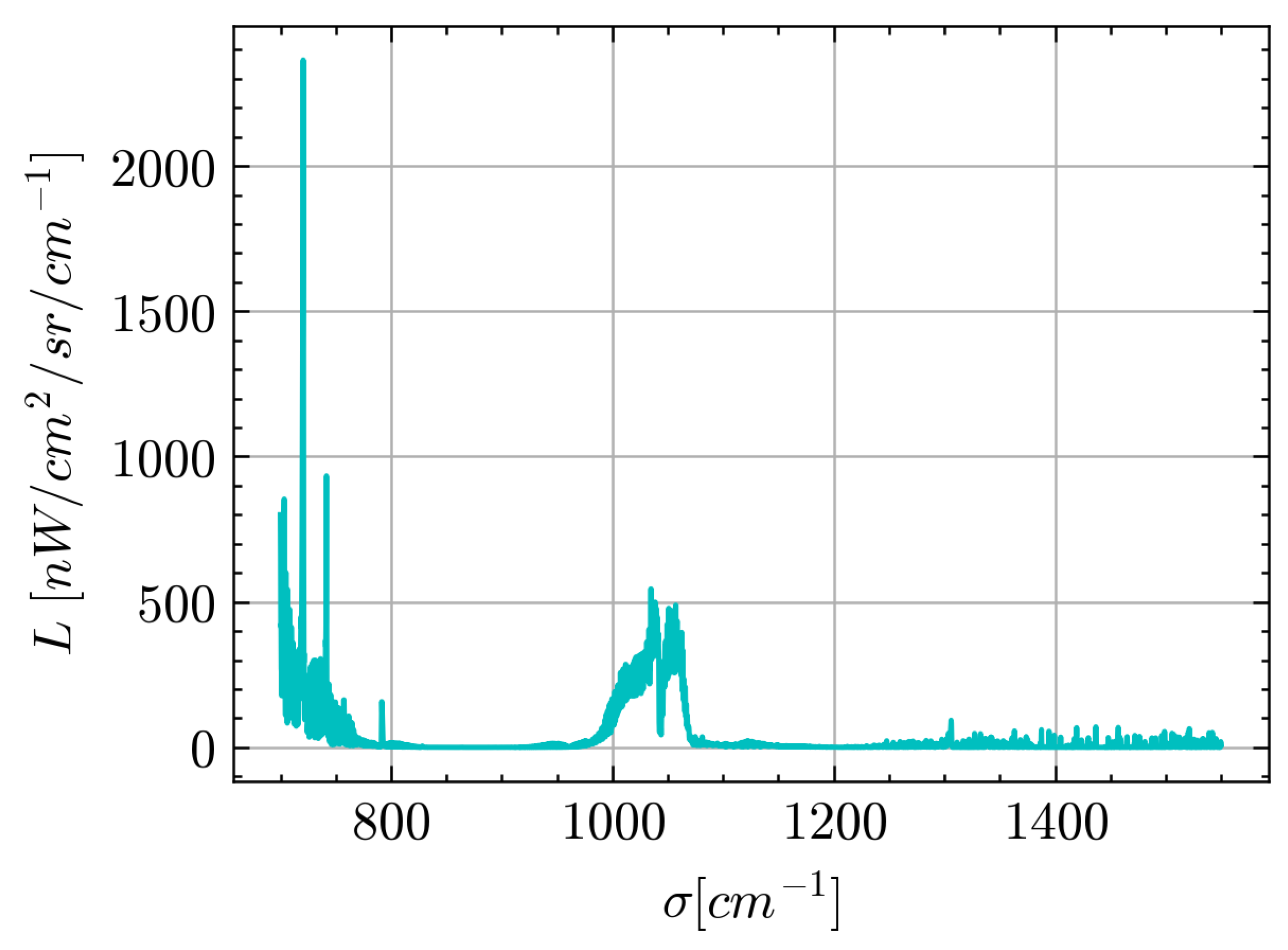
| Spectral coverage | 750–1390 cm−1 |
| Sensitivity | ~10 nW/(cm2 sr cm−1) |
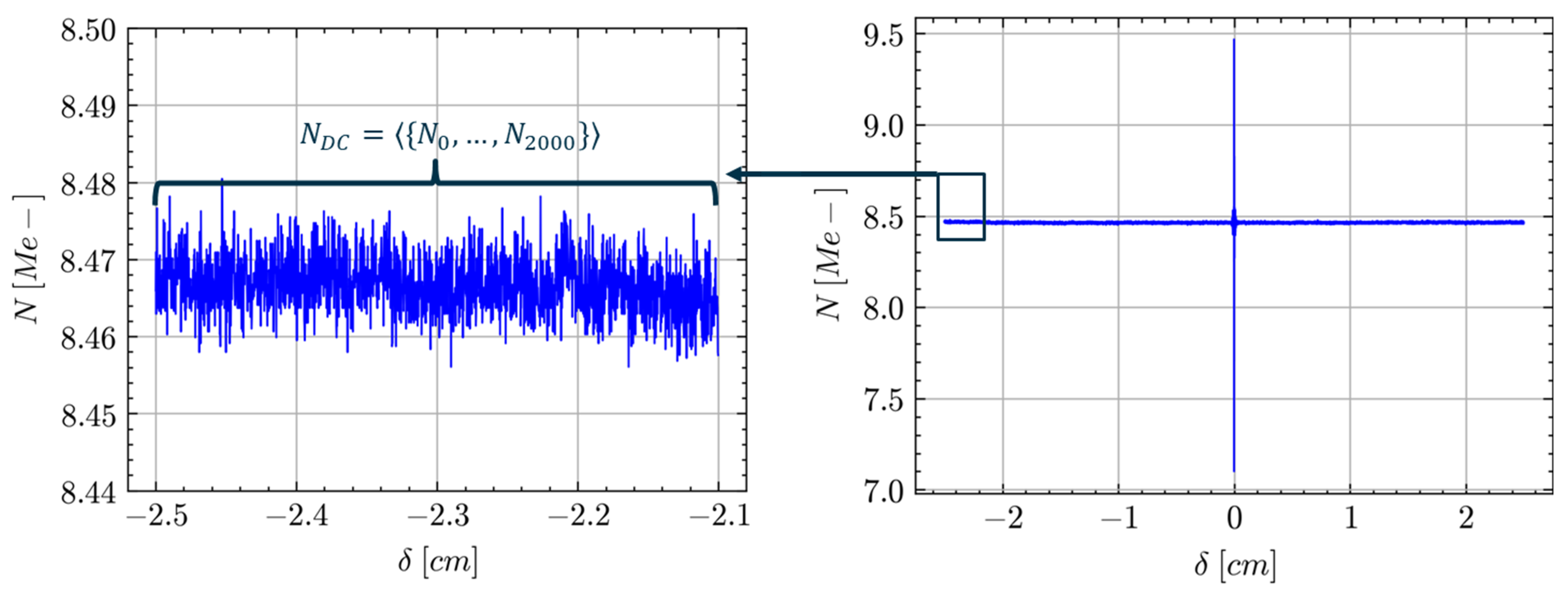
| Contributors | ΔNDC/NDC % | ΔNZPD/NZPD % | Precision |
|---|---|---|---|
| Optics temperature | 0.67% | 0.90% | 0.5 K |
| Dark current | 0.02% | 0.03% | 2.16 mA/m2 |
| PRNU | 1.95% | 1.94% | 2% |
| Blackbody emissivity | 0.09% | 0.17% | 0.003 |
| Blackbody temperature | 0.02% | <0.01% | 0.03 K |
| Mirror reflectivity | 0.64% | 1.00% | 0.0005 |
| BS transmission | <0.01% | 0.01% | 0.005 |
| BP optical thickness | 0.05% | 0.14% | 0.05 mm |
| BP AR coating reflectivity | 0.21% | 0.16% | 0.0005 |
| Total | 2.17% | 2.37% | - |
Disclaimer/Publisher’s Note: The statements, opinions and data contained in all publications are solely those of the individual author(s) and contributor(s) and not of MDPI and/or the editor(s). MDPI and/or the editor(s) disclaim responsibility for any injury to people or property resulting from any ideas, methods, instructions or products referred to in the content. |
© 2025 by the authors. Licensee MDPI, Basel, Switzerland. This article is an open access article distributed under the terms and conditions of the Creative Commons Attribution (CC BY) license (https://creativecommons.org/licenses/by/4.0/).
Share and Cite
Piekarski, T.; Buisset, C.; Kleinert, A.; Friedl-Vallon, F.; Heliere, A.; Hofmann, J.; Babić, L.; Miranda, M.D.; Guggenmoser, T.; Lamarre, D.; et al. Versatile Fourier Transform Spectrometer Model for Earth Observation Missions Validated with In-Flight Systems Measurements. Remote Sens. 2025, 17, 3903. https://doi.org/10.3390/rs17233903
Piekarski T, Buisset C, Kleinert A, Friedl-Vallon F, Heliere A, Hofmann J, Babić L, Miranda MD, Guggenmoser T, Lamarre D, et al. Versatile Fourier Transform Spectrometer Model for Earth Observation Missions Validated with In-Flight Systems Measurements. Remote Sensing. 2025; 17(23):3903. https://doi.org/10.3390/rs17233903
Chicago/Turabian StylePiekarski, Tom, Christophe Buisset, Anne Kleinert, Felix Friedl-Vallon, Arnaud Heliere, Julian Hofmann, Ljubiša Babić, Micael Dias Miranda, Tobias Guggenmoser, Daniel Lamarre, and et al. 2025. "Versatile Fourier Transform Spectrometer Model for Earth Observation Missions Validated with In-Flight Systems Measurements" Remote Sensing 17, no. 23: 3903. https://doi.org/10.3390/rs17233903
APA StylePiekarski, T., Buisset, C., Kleinert, A., Friedl-Vallon, F., Heliere, A., Hofmann, J., Babić, L., Miranda, M. D., Guggenmoser, T., Lamarre, D., Mariani, F., Vanin, F., & Veihelmann, B. (2025). Versatile Fourier Transform Spectrometer Model for Earth Observation Missions Validated with In-Flight Systems Measurements. Remote Sensing, 17(23), 3903. https://doi.org/10.3390/rs17233903