1. Introduction
Ports are complex systems made up of extensive maritime infrastructures, storage facilities, transport networks, industrial zones, and various buildings [
1,
2]. Their coastal location exposes them to harsh marine environments that accelerate degradation compared to inland facilities [
3,
4]. The ground supporting these infrastructures is often sedimentary or reclaimed land, which heightens vulnerability and demands constant monitoring [
5]. The preservation and maintenance of such extensive and diverse assets is both technically challenging and economically demanding [
6,
7]. A considerable share of failures in port infrastructures are tied to their geometric evolution: deformation of the breakwaters [
8], vertical displacement of storage yards or silos, and berthing structure distortion are common symptoms. Traditional design often assumes no geometric evolution [
9,
10], so measurable deformation is typically treated as a warning sign.
Previous studies have evaluated traditional ground-based methods alongside terrestrial, airborne, and satellite techniques to detect infrastructure deformations [
11,
12,
13,
14,
15,
16]. Each method has its strengths, but satellite-based InSAR stands out for large-scale deformation monitoring. It can map vast areas with millimeter precision, acquire images on a fixed schedule regardless of weather, and tap into archives for retrospective studies [
17,
18]. Over the last twenty years, InSAR has progressed from basic interferometry to advanced persistent scatterer (PSI) and Small Baseline Subset (SBAS) methods. These multi-temporal techniques now detect even minute deformations reliably [
19,
20,
21,
22,
23].
A broad range of InSAR-based case studies underscores this versatility across different asset classes. Levee and breakwater movements have been quantified through time-series interferometry to reveal sub-seasonal and seasonal trends [
24,
25,
26]. Bridge decks and supports have been analyzed for long-term deflection and vibration responses [
27,
28,
29], while dike surveillance has tracked differential sinking rates with millimeter-level precision [
30]. Land reclamation zones and container terminals have likewise been assessed using Sentinel-1 data to map gradual subsidence patterns [
31], and ground-settlement anomalies tied to industrial-waste disposal within port facilities have been detected [
32].
Despite these advances and several InSAR-based studies in port environments [
31,
32], key practical factors that condition the successful application of InSAR in ports have not yet been addressed in a unified, uncertainty-aware way. In other words, InSAR is promising for ports, but its routine use has not been fully adapted to the structural diversity and operational dynamics of port environments. We explicitly target two critical factor groups that strongly influence InSAR performance in port settings:
Infrastructure and material characteristics. Breakwaters, quay walls, pavements, and buildings interact differently with radar signals depending on geometry, composition, and orientation. Commonly used low-resolution DEMs (e.g., 30 m SRTM or Copernicus DEM) often fail to adequately represent port structures. This limitation complicates geocoding and shadow handling and hinders the reliable association of scatterers with specific assets. Previous attempts to link scatterers with LiDAR data underscore the importance of improved spatial attribution [
33,
34,
35].
Environmental and operational factors. Rapidly changing weather (precipitation and atmospheric stratification), marine conditions (tides and waves), and daily operations (cargo handling, vessel traffic, and heavy equipment) induce phase artefacts, temporal decorrelation, and variable coherence [
31,
32]. These effects vary across port sub-areas, demanding spatially explicit diagnostics of amplitude and coherence to distinguish true deformation from noise.
Addressing these critical factors requires both (i) the careful selection and application of state-of-the-art InSAR processing workflows and (ii) dedicated post-processing methods that connect scatterers to three-dimensional infrastructure geometry under realistic uncertainty assumptions. In our previous work [
36,
37], we focused on the first aspect: the selection and optimization of InSAR processing workflows for ports, including the choice of radar band, PS/DS configuration, and the implementation of ETAD/SETAP-like corrections to improve phase stability and deformation estimates at the scatterer level.
In this study we build on that processing foundation but shift the focus to the post-processing layer. We assume a high-quality dual-geometry Sentinel-1 PS/DS product as input and introduce three port-oriented post-processing components: (i) LiDAR-based, look-specific shadow and layover masking to define which LiDAR points are visible in each geometry; (ii) a whitening-based nearest-neighbour association that links PS/DS scatterers to LiDAR points in an explicit range–azimuth–cross-range (RAC) uncertainty space using a prior ellipsoid and the whitened distance as a link quality measure; and (iii) dual-geometry red–green (RG) 3D composites rendered on the LiDAR point cloud, combined with class-wise amplitude and coherence diagnostics, to interpret visibility and deformation patterns for different port asset types.
Infrastructure and Material Characteristics. Breakwaters, quay walls, pavements, and buildings interact differently with radar signals depending on geometry, composition, and orientation. Commonly used low-resolution DEM (e.g., 30 m SRTM or Copernicus DEM) often fails to adequately represent port structures. This limitation complicates geocoding and shadow handling and hinders the reliable association of scatterers with specific assets. Previous attempts to link scatterers with LiDAR data underscore the importance of improved spatial attribution [
33,
34,
35].
Environmental and Operational Factors. Rapidly changing weather (precipitation and atmospheric stratification), marine conditions (tides and waves) and daily operations (cargo handling, vessel traffic, and heavy equipment) induce phase artifacts, temporal decorrelation, and variable coherence [
31,
32]. These effects vary across port sub-areas, demanding spatially explicit diagnostics of amplitude and coherence to distinguish true deformation from noise.
Addressing these critical factors requires the careful selection and application of state-of-the-art InSAR processing workflows and techniques, which are essential to maximize both information density and data quality. In our previous work [
36,
37], we examined this aspect in more depth, including the implementation of ETAD/SETAP corrections in a persistent and distributed scatterer (PS/DS) workflow.
In this study, we go beyond the optimal selection of InSAR processing workflows for port environments (addressed in our previous work) by proposing a set of post-processing methods tailored to the critical factors identified in ports. Our aim is twofold: (i) to refine the interpretation of radar signatures in complex, mixed-material settings and (ii) to attribute radar scatterers to specific structural elements via tight integration with high-resolution LiDAR point clouds. We validate the approach in the Port of Bahía de Algeciras (Spain).
Our workflow consists of three main steps:
LiDAR-based shadow and layover masking:High-resolution airborne LiDAR is used to derive look-specific visibility masks (shadow and layover) for ascending and descending passes [
38,
39]. We excluded LiDAR points that are not visible in a given look before any association, which improves interpretability and prevents spurious links in occluded zones.
Structure-specific scatterer association: We employ a whitened nearest-neighbor (NN) approach to link PS/DS points to LiDAR-derived structures, explicitly accounting for Sentinel-1’s range/azimuth uncertainties [
33,
34,
40,
41,
42].
Dual-geometry red–green (RG) 3D composites: We generate 3D red (R), green (G), and blue (B) composites from co-registered ascending and descending InSAR results linked to the LiDAR points using per-point metrics (mean amplitude and temporal coherence) computed for PS/DS. Ascending is mapped to and descending to (with ), under a shared normalization, so intensities are comparable between geometries.
To focus the scope of this work beyond workflow selection and toward port-specific post-processing, we frame this study around two practical questions. First, we ask whether whitening-based NN linking—performed on LiDAR points after look-specific shadow/layover masking—improves geolocation fidelity and structural attribution. Second, we ask whether dual-geometry red–green composites rendered on the LiDAR point clouds, together with zone-based coherence/amplitude diagnostics, provide interpretable and transferable products for large ports using only open Sentinel-1 and standard airborne LiDAR.
2. Materials and Methods
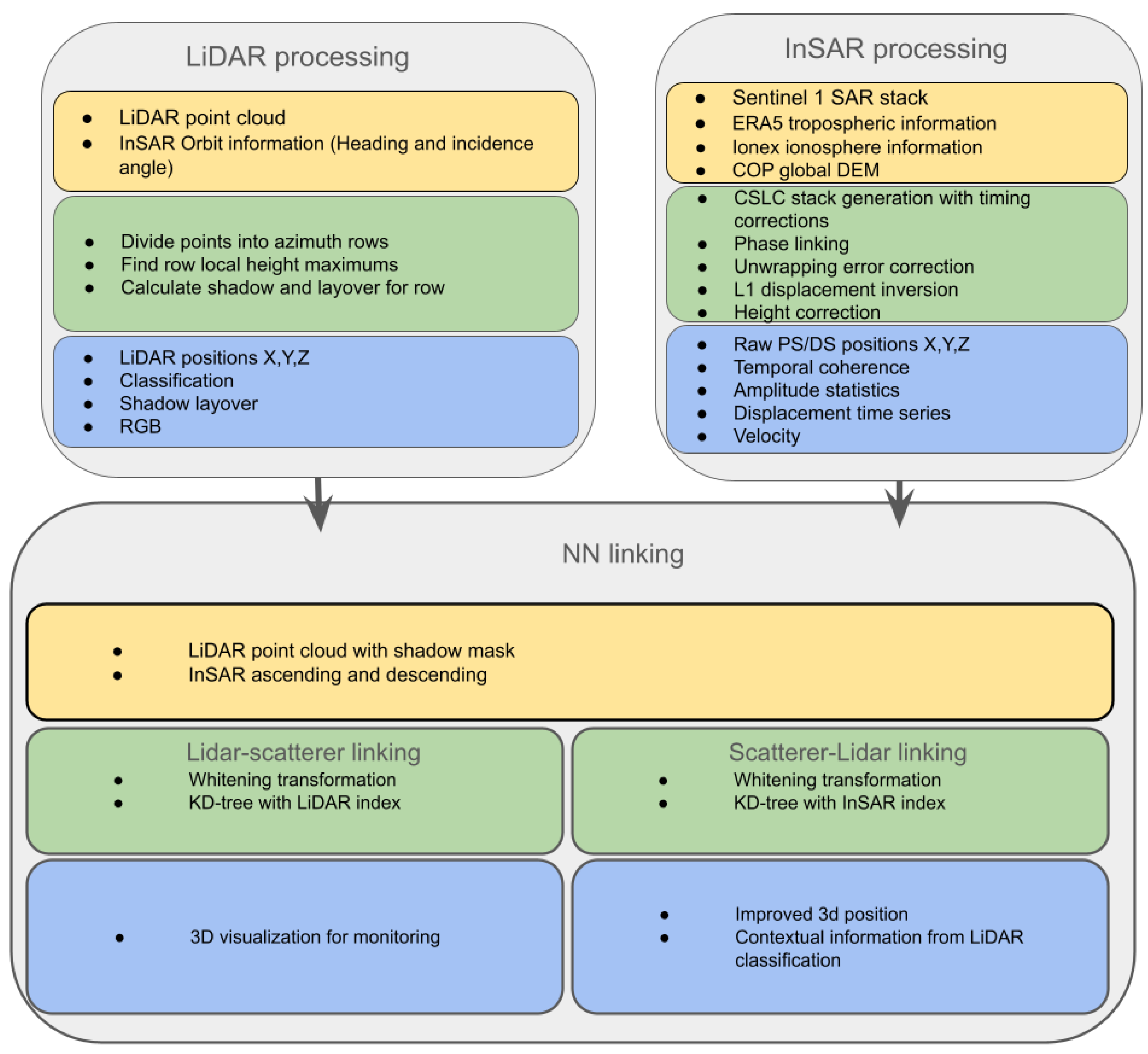
Figure 1 summarizes the end-to-end workflow. We begin with co-registered ascending and descending Sentinel-1 L2-CSLC stacks and run a PS/DS chain (phase linking, interferogram formation, and inversion) to obtain LOS time series and per-point attributes (mean amplitude, amplitude dispersion, and temporal coherence). A whitening-based LiDAR–InSAR linking block then maps scatterers into a geometry-aware space (using the East–North–Up (ENU) covariance derived from the range–azimuth–cross-range (RAC) error model) and performs NN searches in two directions: LS (LiDAR → scatterer) and SL (scatterer → LiDAR). Mutual agreement yields high-confidence links and precise 3D localization of PS/DS over the LiDAR mesh. Finally, we render red–green composites in 3D dual geometry (ascending = red, descending = green; blue unused) in the LiDAR point cloud, so analysts can examine the same content consistently in plan view and in true 3D over the LiDAR geometry. The linked products (time series, velocities, and attributes) are carried forward to the results for quantitative analysis.
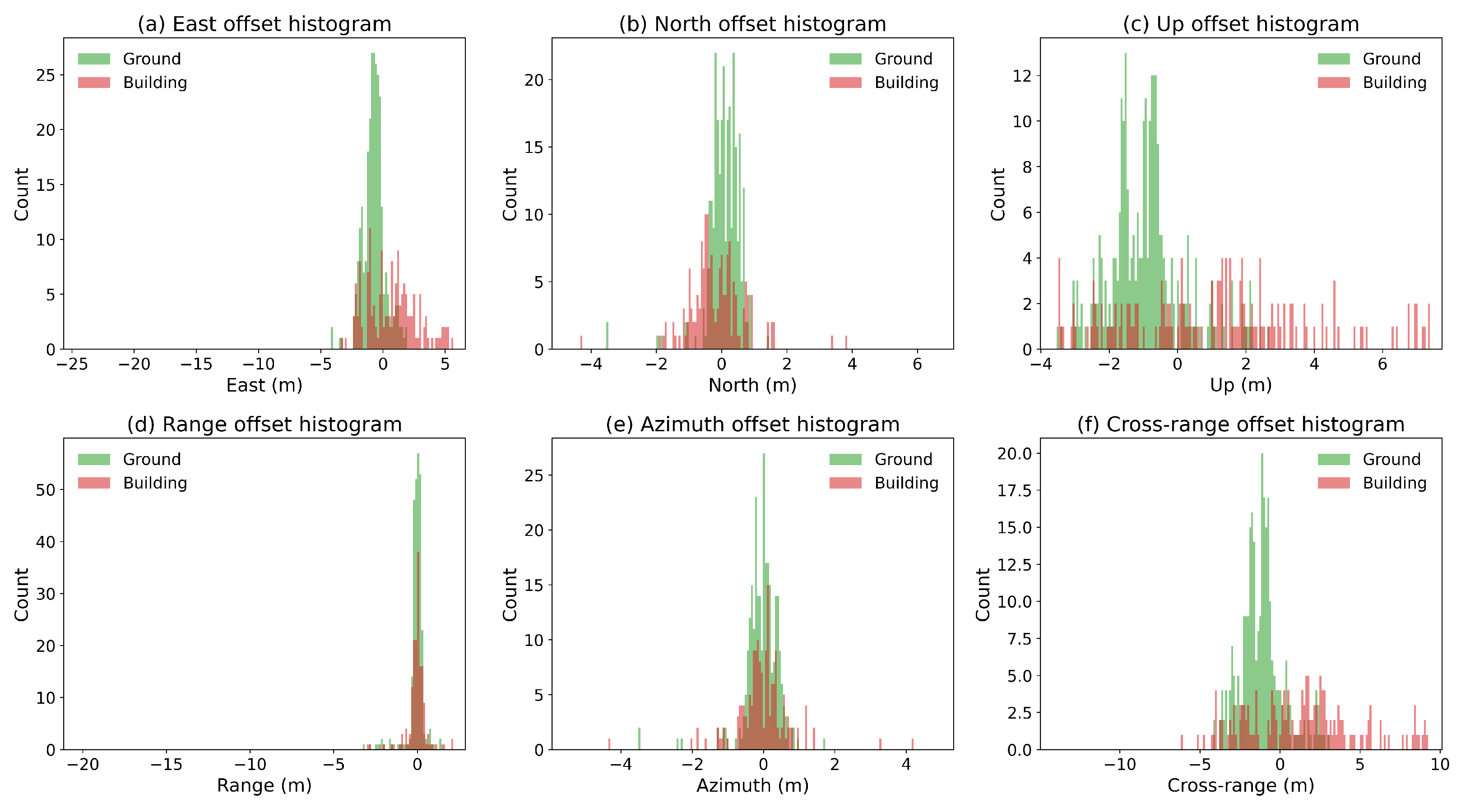
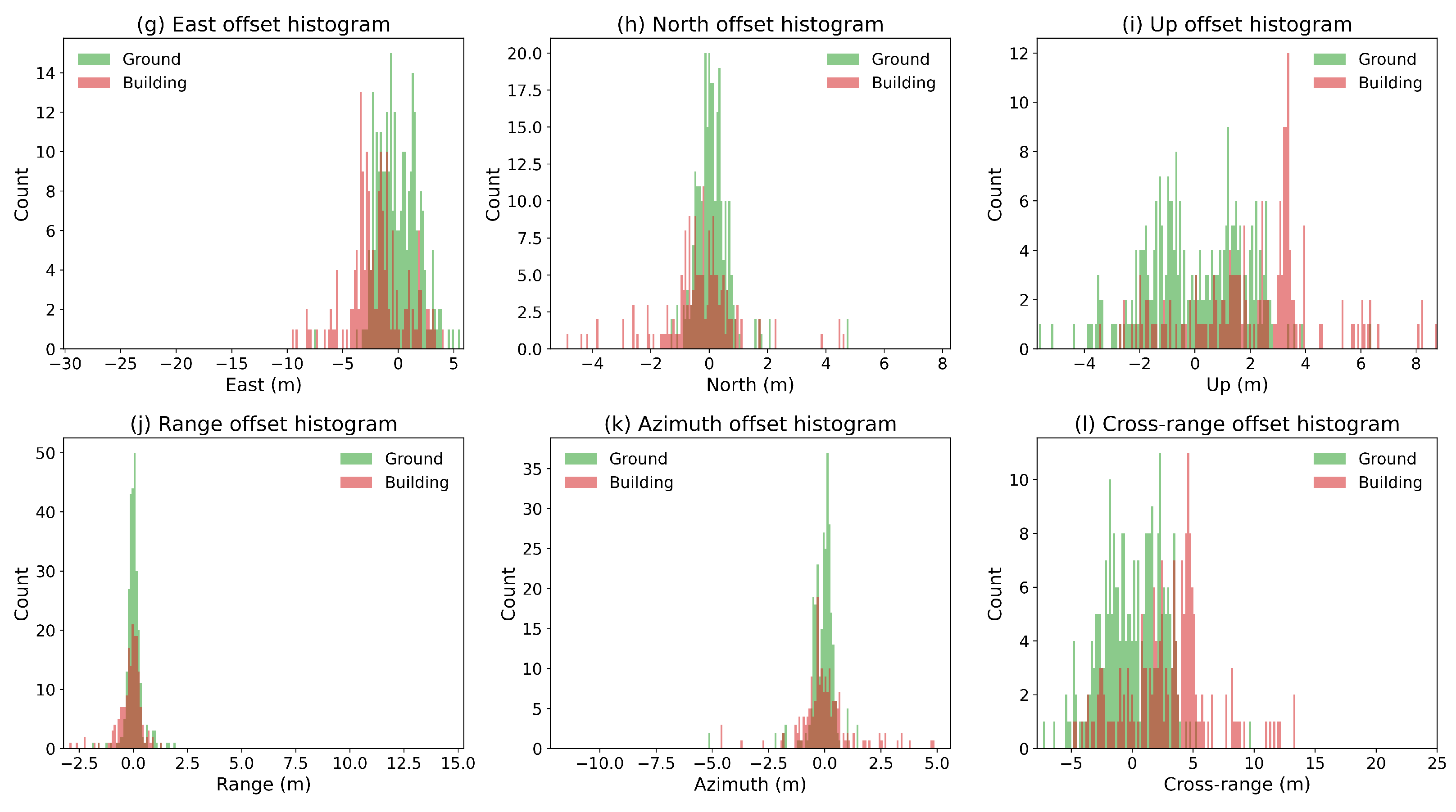
Linking is performed in a whitened space where Euclidean distances equal Mahalanobis distances under the InSAR positioning covariance. We assume diagonal covariance on the radar RAC basis , rotate it to ENU via the look-geometry matrix R to obtain , and whiten it with W so that . Before any NN search, we compute look-dependent visibility from the LiDAR surface and mask LiDAR points that fall in radar shadow or layover; for each geometry (ascending/descending), only the visible LiDAR points are retained as candidates. The NNs in the whitened space are found using a K-dimensional tree (KD tree) and all distances are reported as (dimensionless “units “””). We use both linking directions: SL (scatterer→LiDAR) yields exactly associations and is our basis for significance reporting (e.g., ), whereas LS (LiDAR→scatterer) yields associations and is preferred for visualization and DS coverage (denser sampling and 3D coloring of the LiDAR cloud). In detailed analyses (tanks, berths, and containers) we also report axis-resolved offsets in both ENU and RAC to diagnose directionality.
For visualization, we compute dual-geometry composites on the LS-linked set: descending metrics map to red R and ascending to green G (with blue ) using a shared normalization range so that intensities are comparable between geometries; a logarithmic amplitude variant is used where noted. Finally, the linked points are stratified by a simplified LiDAR classification (ground and building/structure) to evaluate class-dependent behavior.
2.1. Study Area: Port of Bahía de Algeciras
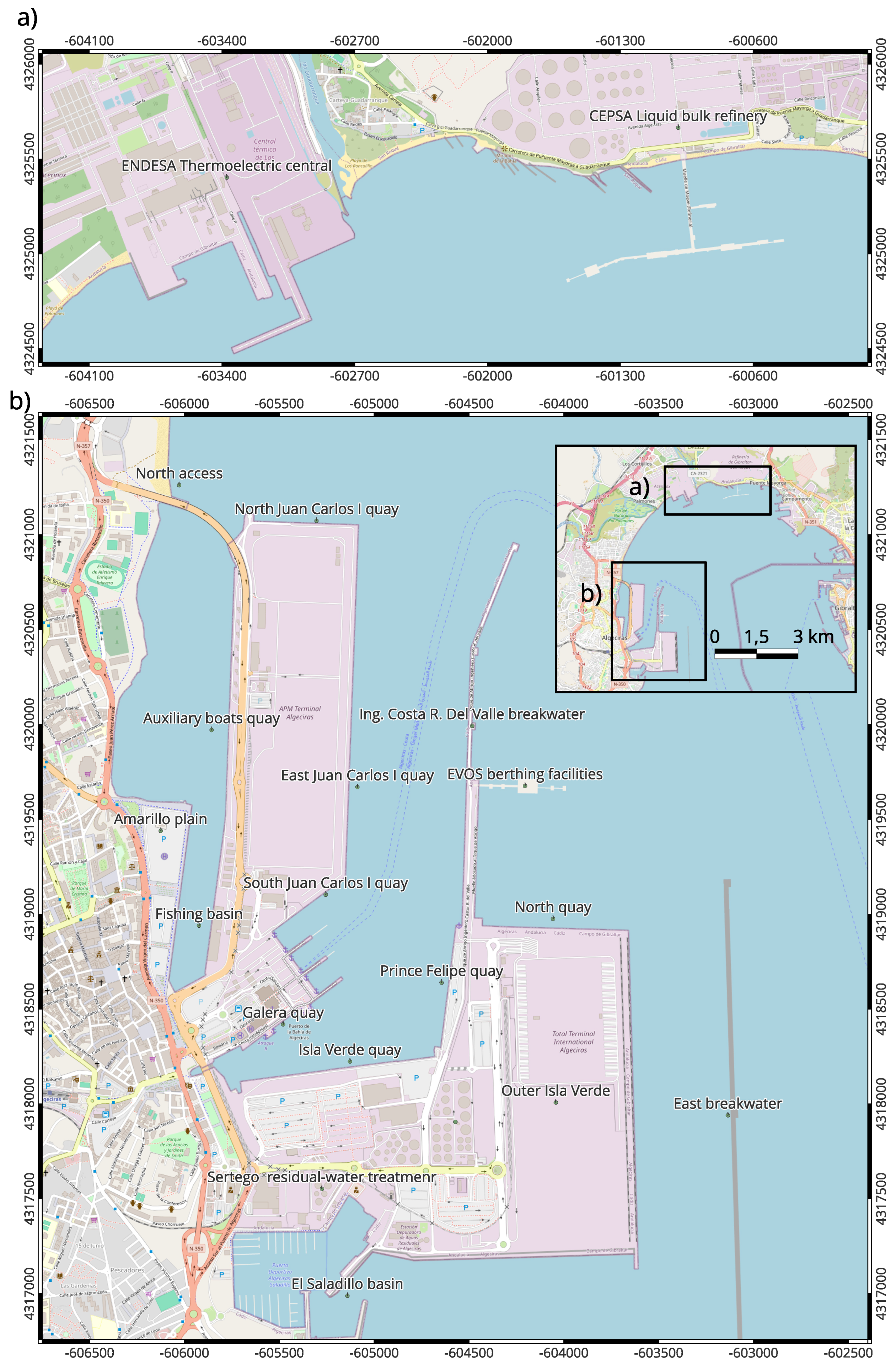
Algeciras’ bay port, located in southern Spain at the junction of the Mediterranean Sea and the Atlantic Ocean, is one of the busiest hubs in Europe and an ideal case study for InSAR-based infrastructure monitoring. It occupies ∼5 km
2 of reclaimed and natural land distributed around a naturally deep embayment (
Figure 2).
2.1.1. Geological Setting
The bedrock beneath the bay belongs to the Campo de Gibraltar Flysch complex, specifically the Algeciras unit, a Paleocene–Miocene turbidite succession of interbedded sandstones and marls [
43]. This layered but tectonically sheared flysch dips gently below Quaternary marine terraces and Holocene estuarine deposits mapped on the 1:50,000 MAGNA geological sheet 1073 [
44]. Along the bay axis, the Algeciras submarine canyon incises the shelf, funneling sediment offshore and attesting to the vigorous dynamics of late Quaternary sediment [
45]. Much of the present port platform (e.g., Isla Verde Exterior, 122 ha) was reclaimed behind rock-armed dikes using dredged sand and clayey hydraulic fill [
46]. The early fills in Juan Carlos I quay were saturated, loose clays that required large-scale dynamic consolidation with a 140 kN drop hammer in 2002 to mitigate liquefaction and long-term settlement hazards [
47]. Consequently, the subsurface now comprises heterogeneous layers of densified fill over soft Holocene mud and competent flysch, with key berths and terminals (including liquid bulk facilities and container yards) located on reclaimed platforms and older quays resting closer to bedrock or terrace deposits. This spatial variability in the foundation conditions is a key motivation for InSAR monitoring.
2.1.2. Environmental Loads
The Strait of Gibraltar imposes a mixed Atlantic–Mediterranean regime: a moderate tidal range (≈1 m), strong easterly “Levante” winds that periodically exceed 100 km/h−1, and tidally modulated currents that interact with the canyon head. These factors generate cyclic and extreme loads on breakwaters, quay walls, and reclaimed platforms.
2.1.3. Monitored Infrastructure
This study focuses on three groups of assets (
Figure 2):
Breakwaters and protective structures—particularly the East Exempt Breakwater (2060 m of caissons) and the Ingeniero Costa R. del Valle masonry/concrete dyke (originally built 1919–1932, extended multiple times to protect the La Galera and Juan Carlos I quays).
Berthing structures—gravity quays (North Quay, Prince Felipe Quay), pile-supported wharves, and isolated mooring dolphins.
Terminal areas—container terminals: APM and Total Terminal International Algeciras (TTIA), bulk cargo berths, and the EVOS liquid bulk facility, all situated on ground with different reclamation histories and therefore different settlement potentials.
The combination of layered flysch bedrock, soft marine sediments, heterogeneous hydraulic fill, and ongoing expansion makes Algeciras an exemplary test bed for evaluating how geological and operational factors modulate InSAR-derived deformation signals.
2.2. Data Acquisition
2.2.1. SAR Data
The data used include Synthetic Aperture Radar (SAR) images from the Sentinel-1A and Sentinel-1B satellites. A total of 123 images were processed, covering the period from 10 January 2020 to 27 December 2022. All images are single-look complex (SLC) terrain observation by progressive scanning (TOPS) data acquired in Interferometric Wide (IW) swath mode with VV polarization.
Sentinel-1 data were selected for this study due to their widespread availability, 6-day repeat cycle (using both satellites), C-band wavelength characteristics suitable for infrastructure monitoring, and open data policy enabling reproducible research. The dataset includes the following.
At the port location, the dataset comprises 64 ascending-orbit images (relative orbit 74) with an incidence angle of approximately 35.43 degrees and 59 descending-orbit images (relative orbit 81) with an incidence angle of approximately 44.98 degrees.
All Sentinel-1 Level 1 SLC scenes were accessed through the ASF DAAC Vertex portal and processed using ESA precise orbit files (POE-ORB).
Several auxiliary datasets were employed to improve processing accuracy and interpretation: The Copernicus Digital Elevation Model (DEM) Cop-GLO30, derived from WorldDEM, was used throughout the InSAR processing for topographic phase removal and geocoding. This DEM offers a 30 m spatial resolution with a typical vertical accuracy of approximately 4 m, and we used the 2023 global release. Atmospheric and ionospheric auxiliary datasets: ERA5 reanalysis fields [
48] were used for the tropospheric state, and NASA IONEX products [
49] were used for the total ionospheric electron content.
2.2.2. LiDAR Data
PNOA acquired LiDAR data for the port area in 2021, with a point density of approximately 4 points per square meter and a nominal vertical precision of 10 cm [
50]. These high-resolution PNOA LiDAR returns provide a detailed point cloud that serves to improve the assignment of individual scatterers to their corresponding structural elements. By matching InSAR scatterer locations to the LiDAR point cloud, we can more reliably link each persistent or distributed scatterer to specific port infrastructure (for example, bulk storage tanks, silos, and berthing terminals), thereby enhancing both the contextual interpretation and the structural attribution of the InSAR time series.
2.3. InSAR Processing
2.3.1. CSLC Generation from SLC
Sentinel-1 Level 1 SLC scenes in the Port of Algeciras were first ingested and converted to Level 2 CSLC outputs in ETRS89 UTM zone 30N (EPSG 25830) on a 10 m by 5 m grid using the COMPASS [
51,
52,
53] version 0.5.5 workflow alongside ISCE3 [
54] version 0.22.1.
Cop-GLO30 was used during geocoding to remove topographic phase contributions. We did not use the ETAD auxiliary product; instead, we calculated an equivalent set of timing and geolocation corrections within COMPASS and ISCE3 following the formulations and terminology of Gisinger et al. [
37].
The components of the tropospheric and ionospheric phases were modeled with RAiDER v0.5.5 software [
55], driven by the ERA5 reanalysis fields and the NASA IONEX products specified in the Data Acquisition Section.
We then applied gridded ETAD-like corrections [
37] on a per-burst basis, covering the following:
Doppler-induced range shifts, compensating for geometry-dependent frequency modulation;
Bistatic azimuth delays, reversing the stop-and-go approximation applied in the SLC focusing;
Azimuth FM mismatch, correcting block processing velocity errors;
Solid Earth tides (via PySolid [
56,
57]), removing plus or minus 25 cm vertical and about 6 cm horizontal crustal movements;
Ionospheric Total Electron Content ramps, estimated using NASA IONEX within the RAiDER workflow;
Wet and dry line-of-sight tropospheric delays, estimated with RAiDER from ERA5 fields, accounting for hourly variations in humidity and pressure.
From one stack of CSLC, we can calculate the amplitude dispersion index (ADI) for a given pixel as .
2.3.2. PS/DS InSAR Processing
The corrected CSLC stack was phase-linked using MiaPLpy [
58]. For each pixel
x, we form the complex
vector
Then we identify a
patch of statistically homogeneous pixels (SHPs) by using a Kolmogorov–Smirnov test [
22]. The sample covariance matrix
is computed on these SHPs:
and from it we derive the coherence matrix
by normalizing each
by its corresponding amplitudes. The wrapped phases are then estimated via the combined eigenvalue MLE (CPL) [
59], solving
where ∘ is the Hadamard product. If
is not semidefinite positive, we return to the smallest eigenvalue eigenvector of
.
Persistent scatterers (PSs) are flagged when an amplitude dispersion
in SHP patches of fewer than ten pixels, while distributed scatterers (DSs) require mean coherence
over at least 25 interferograms and ≥70% of total eigenvalue energy in the principal eigenvector [
58]. To reduce computational load, a sequential estimator [
60,
61] builds virtual ministacks (diagonal blocks of
) of size
l and pairs them with up to
new acquisitions, generating artificial interferograms for long-term filtering without forming the full
matrix.
The wrapped phases are unwrapped with the SNAPHU minimum cost flow solver on 50 m tiles, weighted by coherence. We then construct a redundant interferogram network via Delaunay triangulation (temporal baseline days, perpendicular baseline m), pruning interferograms that create excessive disconnected pixels to ensure multiple overlapping links per acquisition.
2.3.3. Displacement Inversion
After phase unwrapping and resolving any inconsistencies via phase closure routines, we proceed to displacement inversion, the final step for transforming unwrapped phase measurements into accurate deformation time series over the study area. Inversion is carried out through a regularized least squares framework with an L1 norm, which mitigates outliers and provides robust solutions in noisy or decorrelated regions [
58].
During inversion, we weight each observation by its temporal coherence, as obtained during phase linking [
58]. By assigning greater influence to pixels with higher coherence, this weighting scheme improves inversion fidelity and reduces the effect of noise in temporally unstable areas.
2.4. Linking with LiDAR Data
To align and compare measurements obtained through InSAR with LiDAR data, a nearest-neighbor matching method was implemented based on coordinate transformations and KD-tree structures. This procedure ensures an accurate correspondence between observations from both sensors, allowing a detailed evaluation of spatial coherence and accuracy.
2.4.1. Shadow and Layover Masking
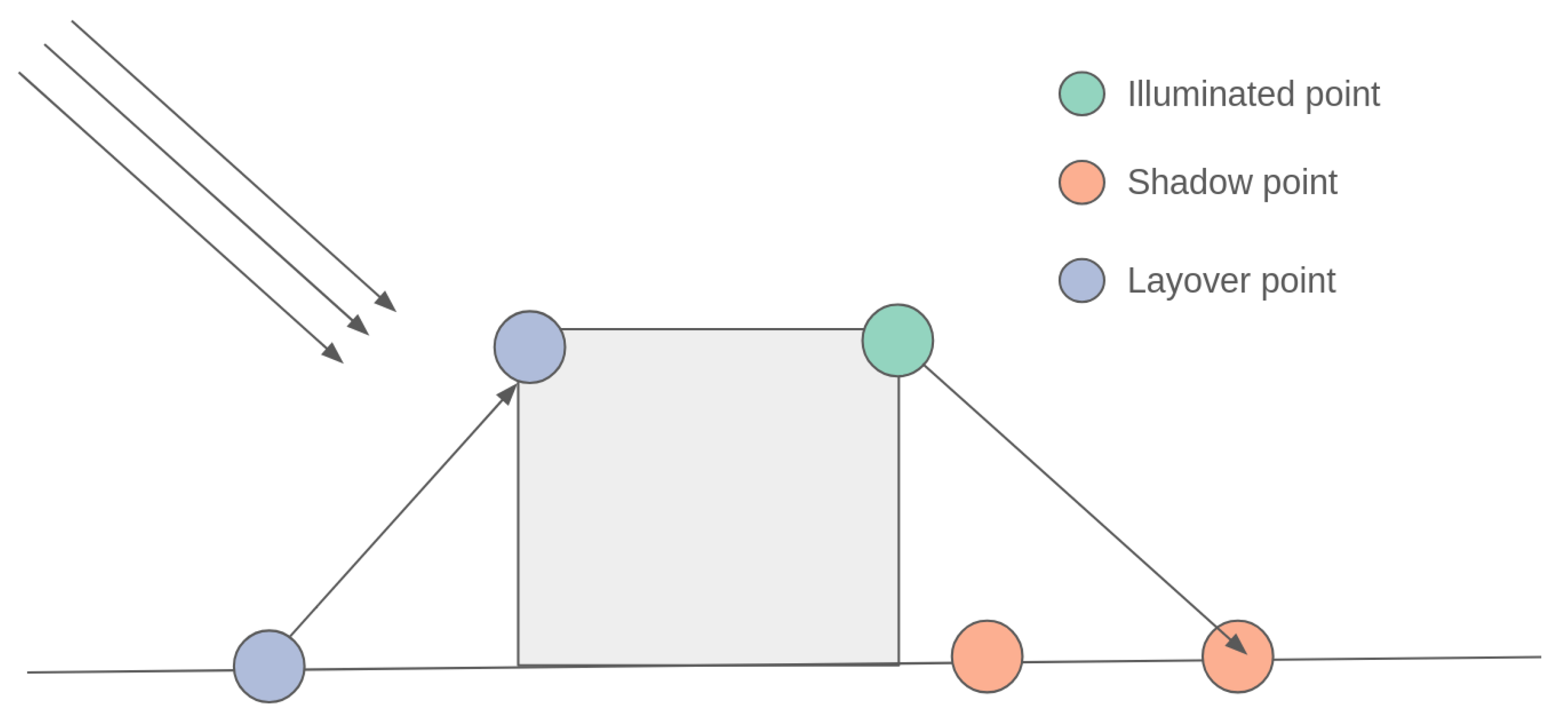
Based on the geometric configuration of the radar beam and the LiDAR points, the latter will be classified into three categories: illuminated, for those exposed to the radar beam; shadowed, for those blocked from the radar beam by other LiDAR points; and layover, for those at the same distance from the satellite, i.e., points that lie along a line perpendicular to the radar beam (
Figure 3).
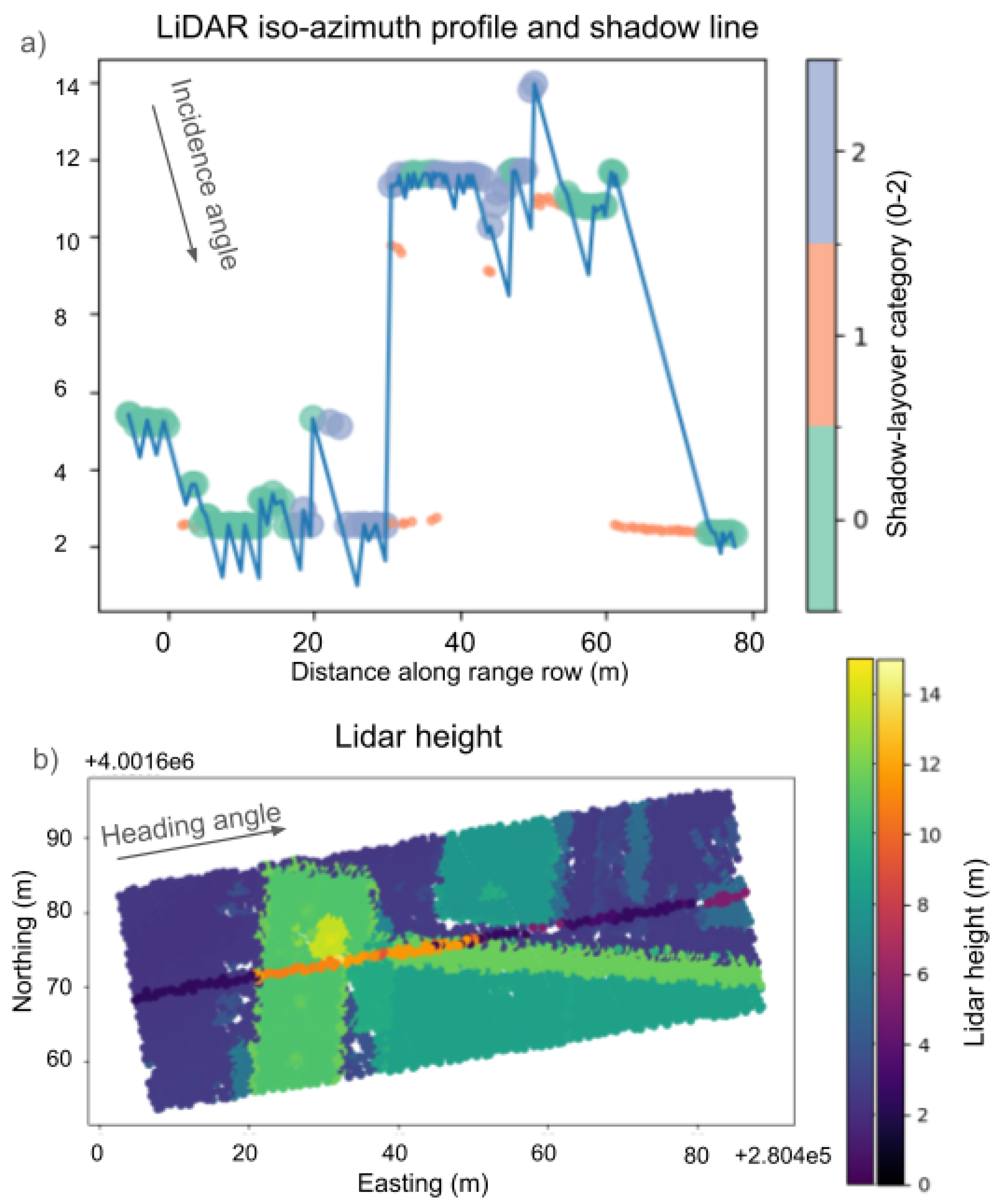
Before matching LiDAR and InSAR points, we remove any LiDAR returns that fall into radar shadow or layover using the following 1D ‘row’ method (
Figure 4).
Rotate into range–azimuth frame: In this rotated frame,
increases approximately along the radar
range direction (near→far for the chosen look) and
aligns with the
azimuth; thus, each fixed-
bin can be treated as an
iso-azimuth strip for the visibility tests below:
Bin and sort: Group points into 10 m wide bins in ; within each bin, sort by .
Shadow test: In each bin, let
be the local maximum of
Z. The shadow boundary is
Flag as shadow any point with .
Layover test: Excluding shadow points, for each
project a line perpendicular to the radar line of sight and along the azimuth line, approximating an iso-range contour. If this line intersects another point within
m in
Z, mark both as a layover (see
Figure 3).
The results obtained for an iso-azimuth line are shown in
Figure 4; shadowed points are then omitted from the KD-tree nearest-neighbor search, and point layovers are flagged for later inspection.
Given
N LiDAR points inside the selected polygon and
U azimuth “rows” (integer bins of the rotated
x), the row-wise workflow runs in
time and peaks at
memory; in the worst case it is
time and memory. Using sort/group by for binning and single-pass horizon/prefix scans for the shadow/layover tests reduces the practical cost to near
time and
memory.
2.4.2. Whitening Transformation
A whitening transformation converts a vector of random variables—whose covariance matrix is known—into a new set of variables whose covariance is the identity matrix. In other words, the transformed variables are uncorrelated and each has unit variance. By applying this process (accounting for range, azimuth, and cross-range errors), we can map both LiDAR and InSAR points into a coordinate system where InSAR positions are uncorrelated and have variance 1. In this normalized space, a simple NN search is all that is needed to link the two point clouds [
33].
Let
be a zero-mean random vector with covariance
. A whitening map
yields
. In our case, the native error model is diagonal in the RAC frame of the radar,
The Sentinel-1 orbit/swath geometry provides the rotation
R from
to
, giving the ENU covariance.
An eigendecomposition
with
produces the PCA whitening matrix.
For a set of points
with a mean row
, the whitened coordinates are
In this space, simple Euclidean NN searches inherently respect anisotropic ENU uncertainties.
Mahalanobis Distance and “ Units”
For two points
, the squared Mahalanobis distance under
is
Thus, the Euclidean distance in the whitened space is exactly the Mahalanobis distance in the original space. Throughout, we report
which is a
dimensionless distance in “
units.” Our
significance threshold corresponds to
.
Equivalent “Project and Scale” View in RAC
Let
be an ENU offset. If
holds the unit RAC axes as columns, then
so that
. When
is diagonal, this “project and scale” is numerically equivalent to PCA whitening by
W.
2.4.3. Nearest-Neighbor Search
We perform all matching in the whitened space using a KD-tree (pykdtree). Building a tree on N points yields an average per-query cost of , so M queries in 3D cost . Distances returned by the KD-tree are Euclidean in the whitened space and therefore equal to .
In the scatterer→LiDAR direction (SL), we index the (visible) LiDAR points and, for each scatterer , retrieve its nearest neighbor . This produces exactly pairs with . In the LiDAR→scatterer direction (LS), we index the scatterers and, for each LiDAR point , retrieve , yielding pairs with .
In terms of computing requirements, building a KD-tree in 3D over M reference points costs time and memory, and performing Q 1-NN queries costs time (more generally for k-NN with small k). Processing by AOI subregions (tiles) yields a total ; a single global index gives but increases peak memory and allows cross-subregion matches, whereas per-subregion indexing bounds memory by and constrains associations. Let and denote the numbers of LiDAR points and InSAR scatterers, with . SL produces exactly pairs (one best LiDAR match per scatterer), whereas LS produces pairs (one best scatterer per LiDAR point). Because SL samples only the ‘best’ associations , its histograms are less populated and typically more concentrated near zero. LS, on the contrary, includes many additional LiDAR points from dense neighborhoods around the same scatterers, which broadens the distribution and yields heavier right tails. Only mutual nearest neighbors (MNNs) appear in both sets; NN relations are not symmetric, in general.
Following Chang et al. [
42], we treat links with
as being linked with a level of significance of
and report the corresponding percentage of points
. Unless stated otherwise, the percentages are reported on the
SL (scatterer → LiDAR) links because we found no other reports in the literature using
LS links;
LS results are still shown in the 3D dual-geometry composites.
2.4.4. Dimensions of the -Ellipsoid (RAC)
We set . The (range × azimuth) axes match the effective CSLC impulse responses used in our InSAR processing (IW single-look range , azimuth ). The cross-range axis reflects the elevation sensitivity of the stack rather than the image resolution.
Following Zhu and Bamler [
62] Equation (2), the width of the TomoSAR elevation point response (aperture-limited resolution) is
with wavelength
, slant range
r, baseline aperture
, and incidence angle
. For our geometry (
,
, and
so
), this yields an elevation point response width of order
.
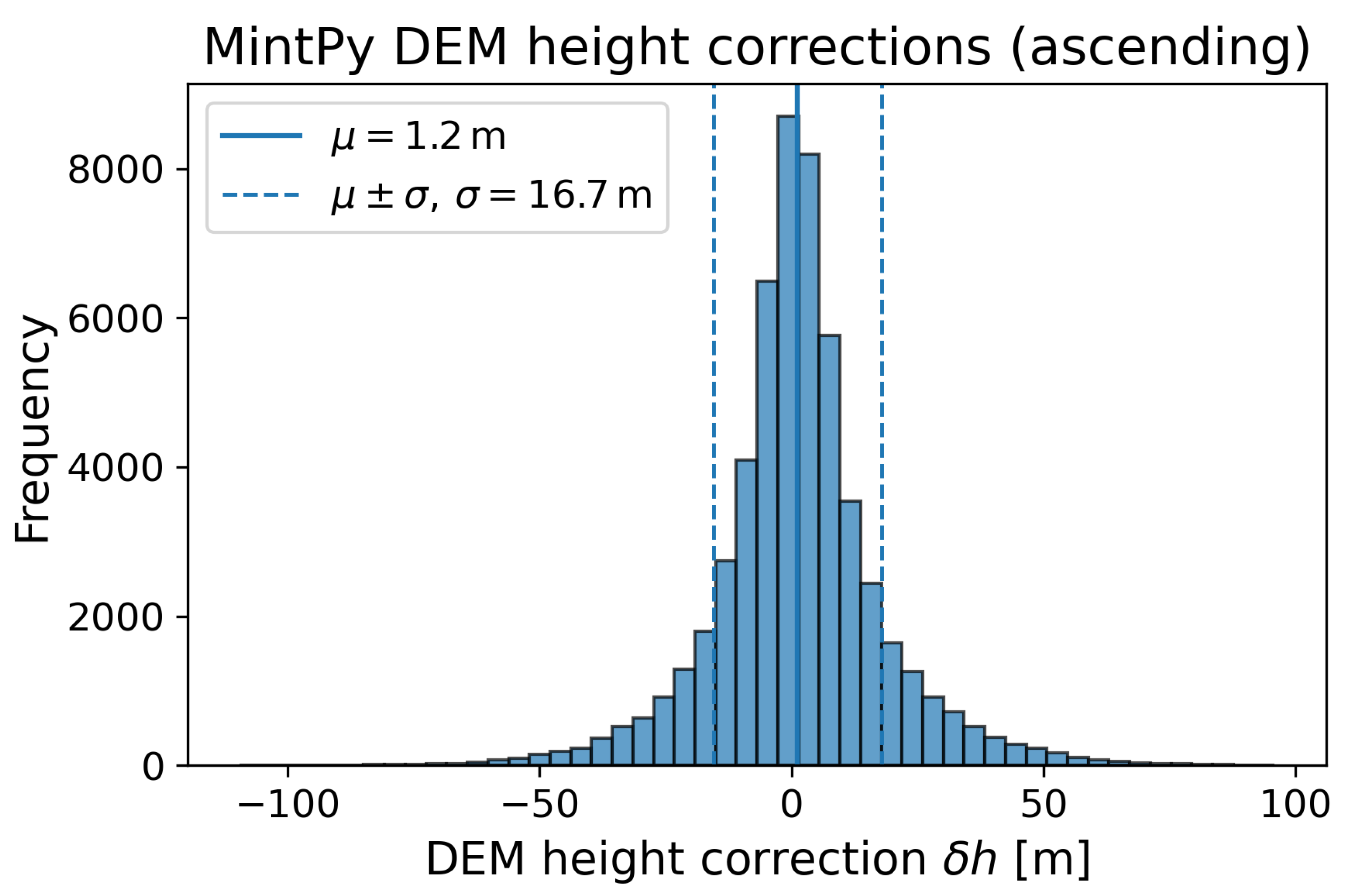
In addition to this geometry-based estimate, we introduce an empirical cross-range uncertainty based on the distribution of MintPy height corrections
. Let
denote the standard deviation of
in the AOI. Interpreting
as the vertical projection of a displacement along the cross-range direction
, with
being the local incidence angle measured from the vertical, we have
so that the corresponding cross-range standard deviation is
with
for the ascending stack and
for the descending stack at the port location. As shown in
Section 3.1, the resulting values of
are substantially lower than our nominal choice
, which we therefore retain as a conservative, geometry- and data-informed cross-range standard deviation for NN linking.
2.5. Dual-Geometry Red–Green (RG) Encoding and Rendering
To compare ascending and descending measurements in a single view, we encode the descending metric as red and the ascending metric as green (blue is unused). For each LiDAR point in planimetric coordinates , we use its LiDAR color triplet (16-bit radiometry scaled to ) as a base and attach two SAR metrics sampled or linked at that point. Let denote the chosen metric, with values (descending) and (ascending).
We first establish a display range shared for both geometries using robust percentiles of the pooled values,
or a fixed
when continuity across figures is desired. Each geometry is then min–max normalized and clipped to
,
Optionally, a monotonic tone mapping
(simple brightness, contrast, gamma, and saturation adjustment in RGB/HSV) can be applied to improve legibility while preserving order; we require
and
so that endpoints are unchanged. The two-channel red–green overlay (blue fixed to 0) at the point
i is then
.
Finally, we render an additive blend of the overlay with the LiDAR base and clip to
,
Because
when
or
equals
, the overlay contributes
and
equals the LiDAR base at those points; i.e., values at
are visually
transparent. In contrast, values near
produce the strongest red/green contributions. Using
same for both channels makes red/green intensities numerically comparable between geometries. Two single-hue color scales (black→red and black→green) are displayed with this shared normalization.
We use three dual-geometry red–green (RG) encodings, always with a shared normalization between geometries:
Mean amplitude (A):. For the log-amplitude variant, apply to prior to normalization.
Dispersion index (D):.
Coherence (C):.
Yellow indicates high values in both geometries; red emphasizes ascending; and green emphasizes descending.
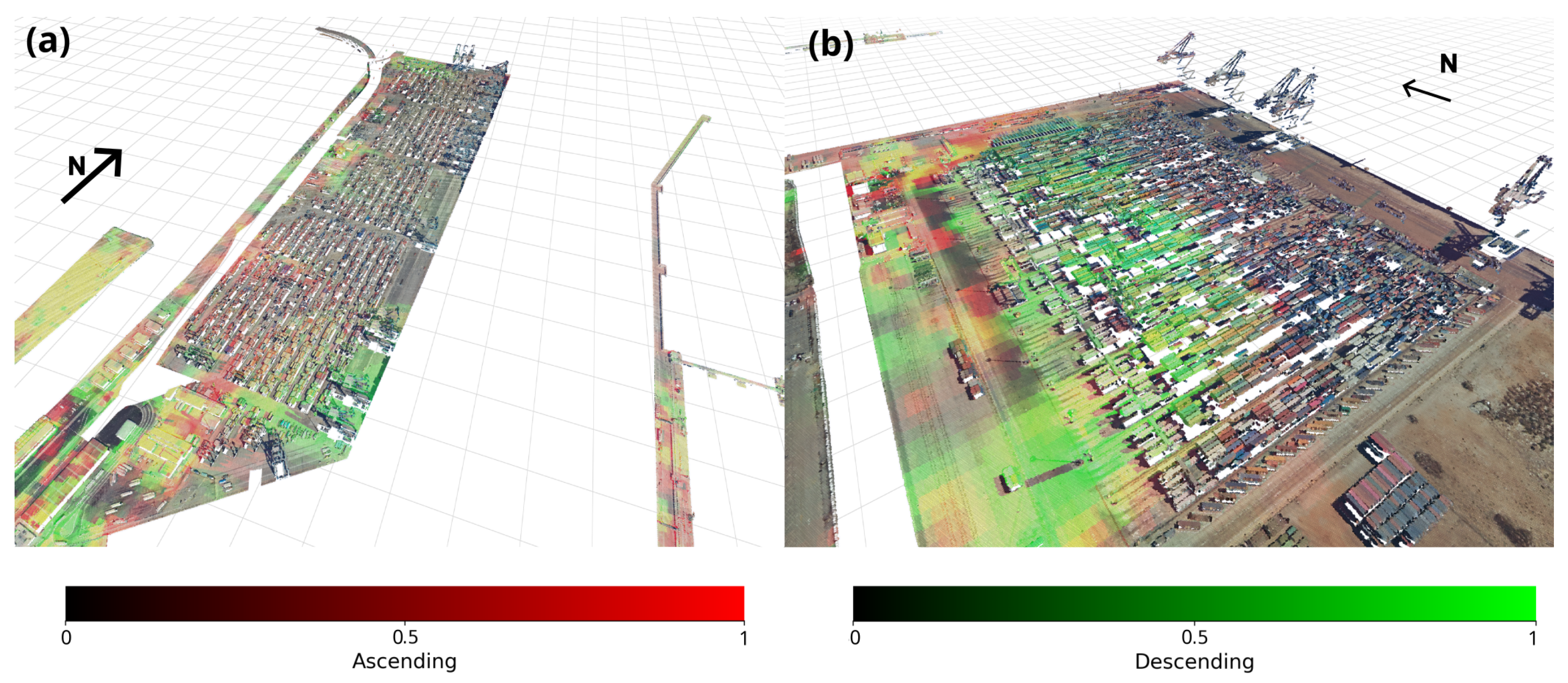
We visualize the LS-linked LiDAR cloud in three dimensions, plotting each point at its location in LiDAR . For color, we reuse the dual-geometry mapping defined above (descending→red, ascending→green, and blue unused) and add this two-channel assignment to the native LiDAR RGB radiometry of the same point. Points that are shadowed/unlinked—or whose metric falls at the lower bound of the shared display range—carry a zero overlay and therefore appear as the original LiDAR color (i.e., the SAR layer is visually transparent there). High metric values produce saturated red/green/yellow tones according to geometry dominance, so highly reflective structures tend to appear yellow when illuminated by both looks, while sidewalls show red/green where one look is shadowed.
3. Results
This section first provides an overview of the AOI that includes the following: (i) whitened-distance histograms
and their cumulative distributions for both
LS and
SL link directions, (ii) the mean amplitude map of the AOI, and (iii) an empirical cross-range uncertainty diagnostic based on DEM height corrections obtained from InSAR processing. We then analyze three types of infrastructure: (i) liquid bulk tanks, (ii) berthing terminals, and (iii) other infrastructure. For each type we present a common set of products: axis-resolved offset distributions in ENU
and RAC
; class-wise statistics of ln mean VV amplitude and ADI; the
significance percentage of points
(reported on
SL links); the mutual nearest-neighbor (MNN) percentage
, computed from a spatial vicinity check and reported separately for each geometry and class (ASC building, ASC ground, DSC building, and DSC ground); and dual-geometry red–green 3D composites (amplitude and coherence) rendered on
LS-linked LiDAR points. In this paper we use LOS deformation rates, as derived by the CSLC-based time-series processing chain described in Sanchez-Fernandez et al. [
36], where the same workflow over the Port of Bahía de Algeciras was quantitatively compared against the European Ground Motion Service (EGMS) and analyzed for internal consistency between ascending and descending stacks. Here, velocities are used primarily to illustrate the spatial attribution and visualization of deformation signals enabled by the LiDAR–InSAR fusion, rather than to develop or re-evaluate a trend modeling methodology. Throughout, ENU and RAC offsets are measured with respect to the airborne LiDAR point cloud, which we treat as the geometric reference surface for evaluating post-linking localization residuals.
3.1. Empirical MintPy Height Corrections and Cross-Range Uncertainty
Figure 5 shows the distribution of height corrections
applied during InSAR processing for the ascending geometry. The histogram is close to Gaussian, with a sample standard deviation
. The corresponding descending-geometry distribution has
. Using Equation (
1) and the local incidence angles
and
, we obtain the following:
Both empirical cross-range standard deviations are significantly smaller than our nominal choice
from
Section 2.4.4, confirming that the adopted
is conservative with respect to both InSAR geometry and the observed InSAR height correction spread.
3.2. AOI-Wide Linking Results
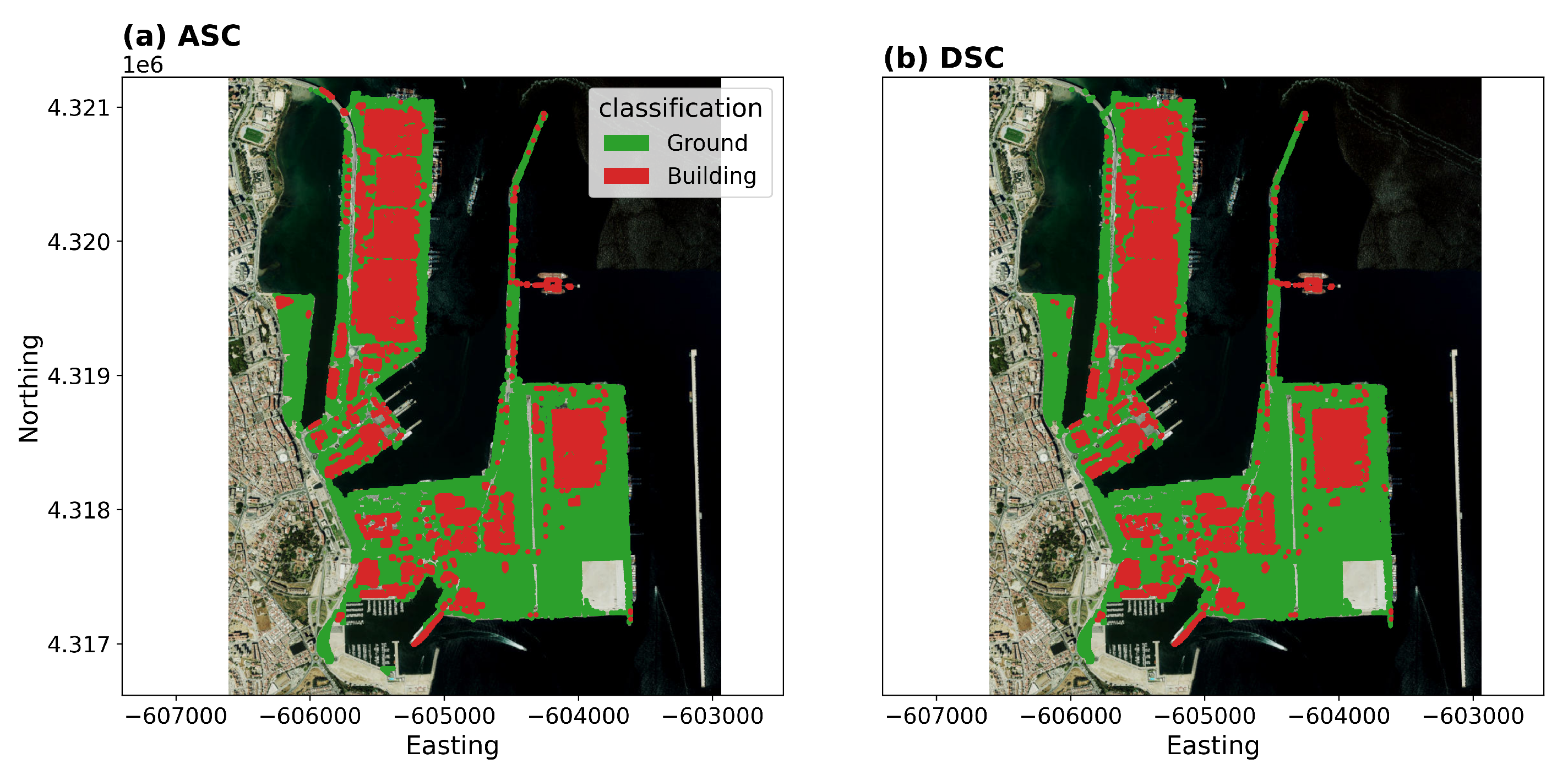
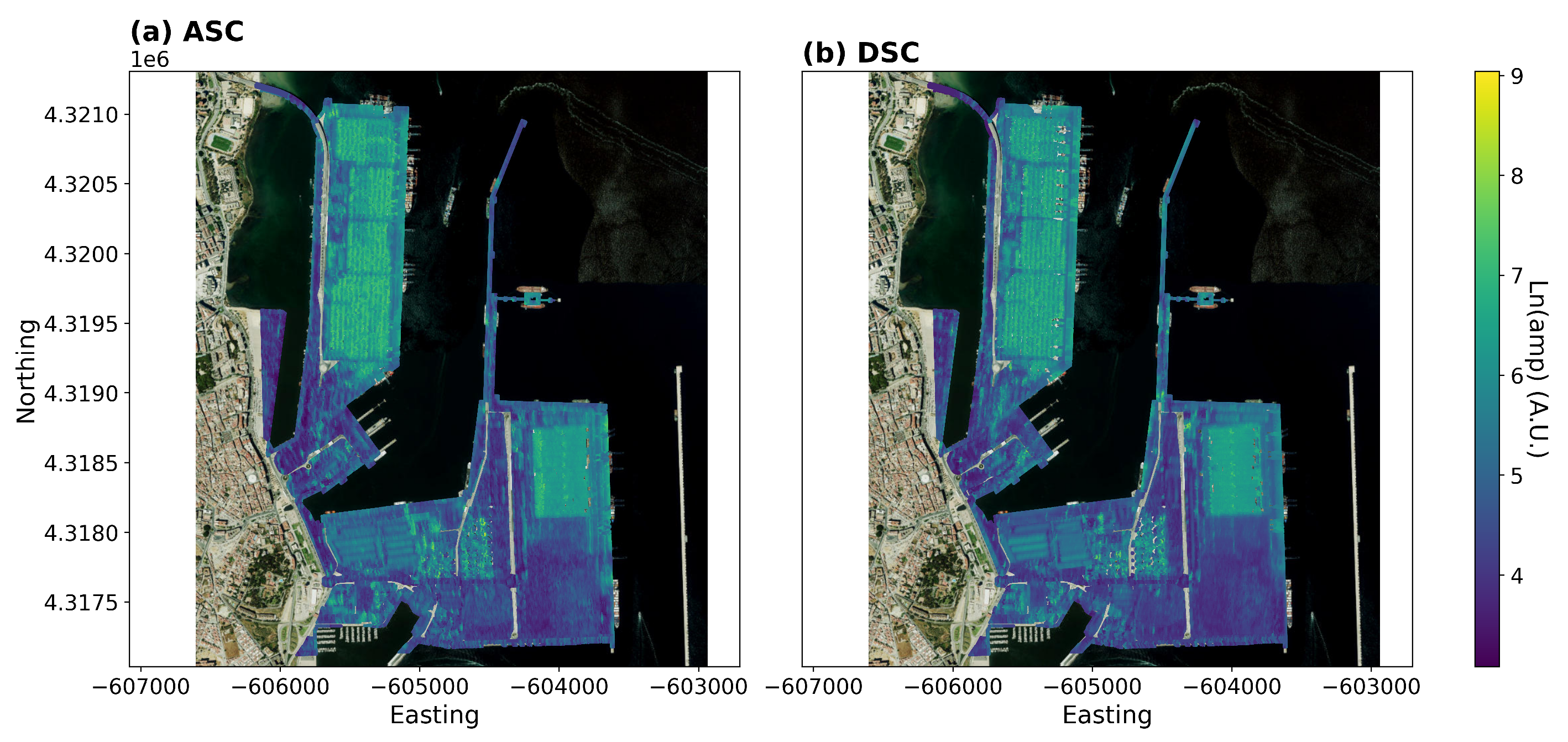
Figure 6 maps scatterer classes inherited from their LiDAR nearest neighbors, while
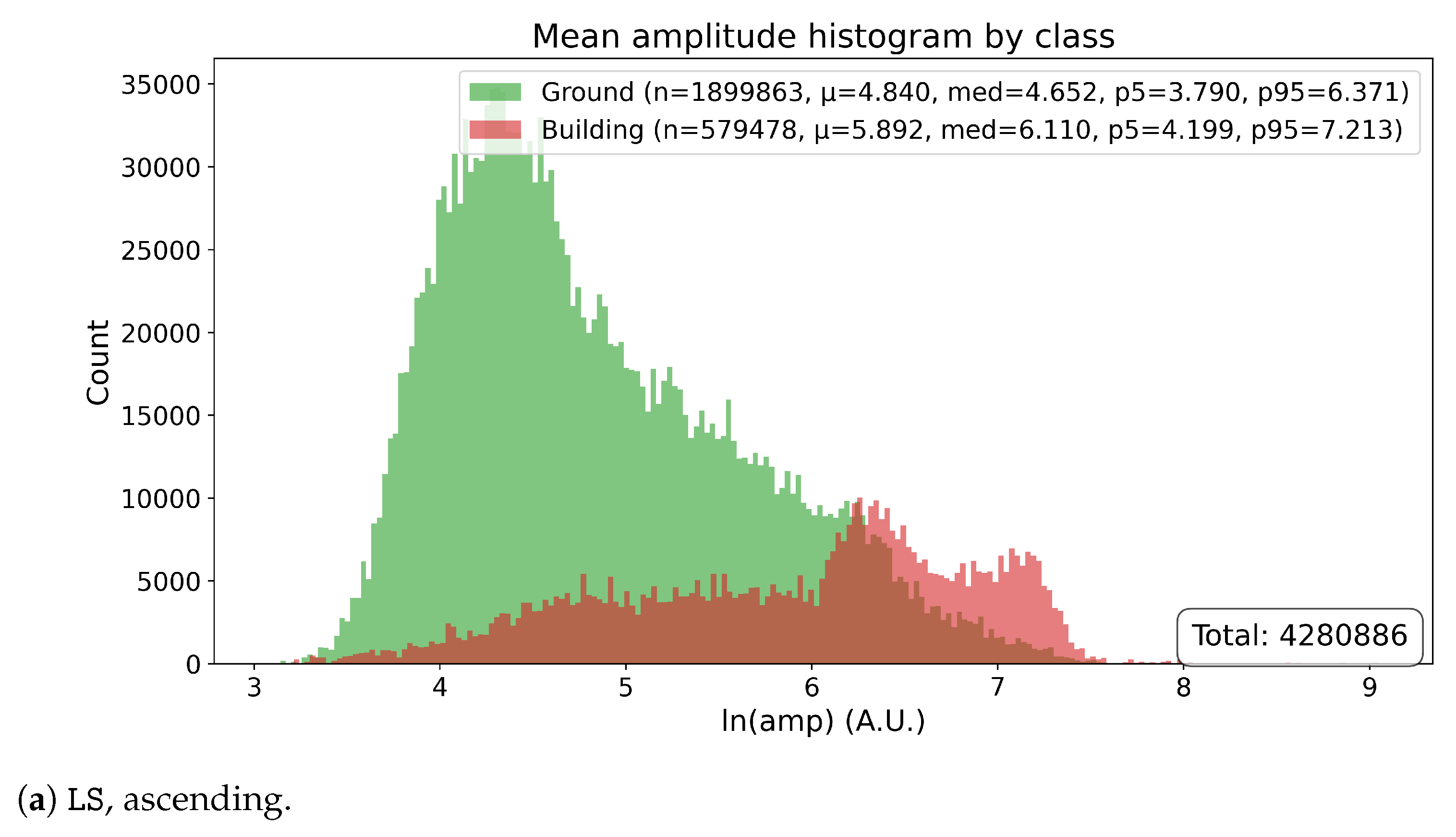
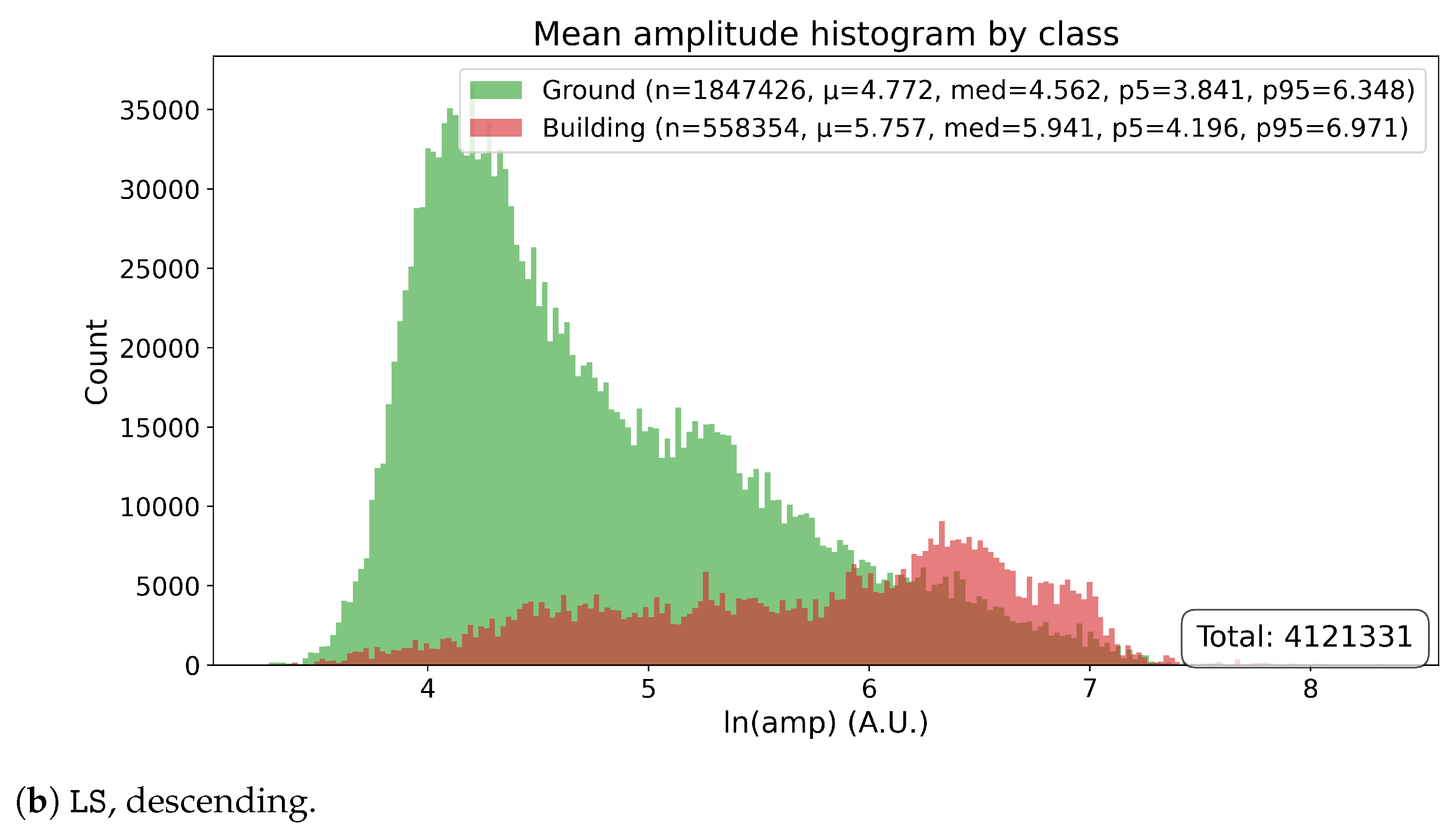
Figure 7 shows the log-mean amplitude per scatterer. Regions of higher mean amplitude align closely with areas dominated by the building/structure class (see
Figure 8). The amplitude fields and the corresponding
LS histogram shapes are consistent between ascending and descending passes, indicating that large-scale backscatter–class relationships are stable across orbits. To avoid redundancy and prioritize the larger LiDAR sample, we present the amplitude histogram only for
LS.
AOI-wide
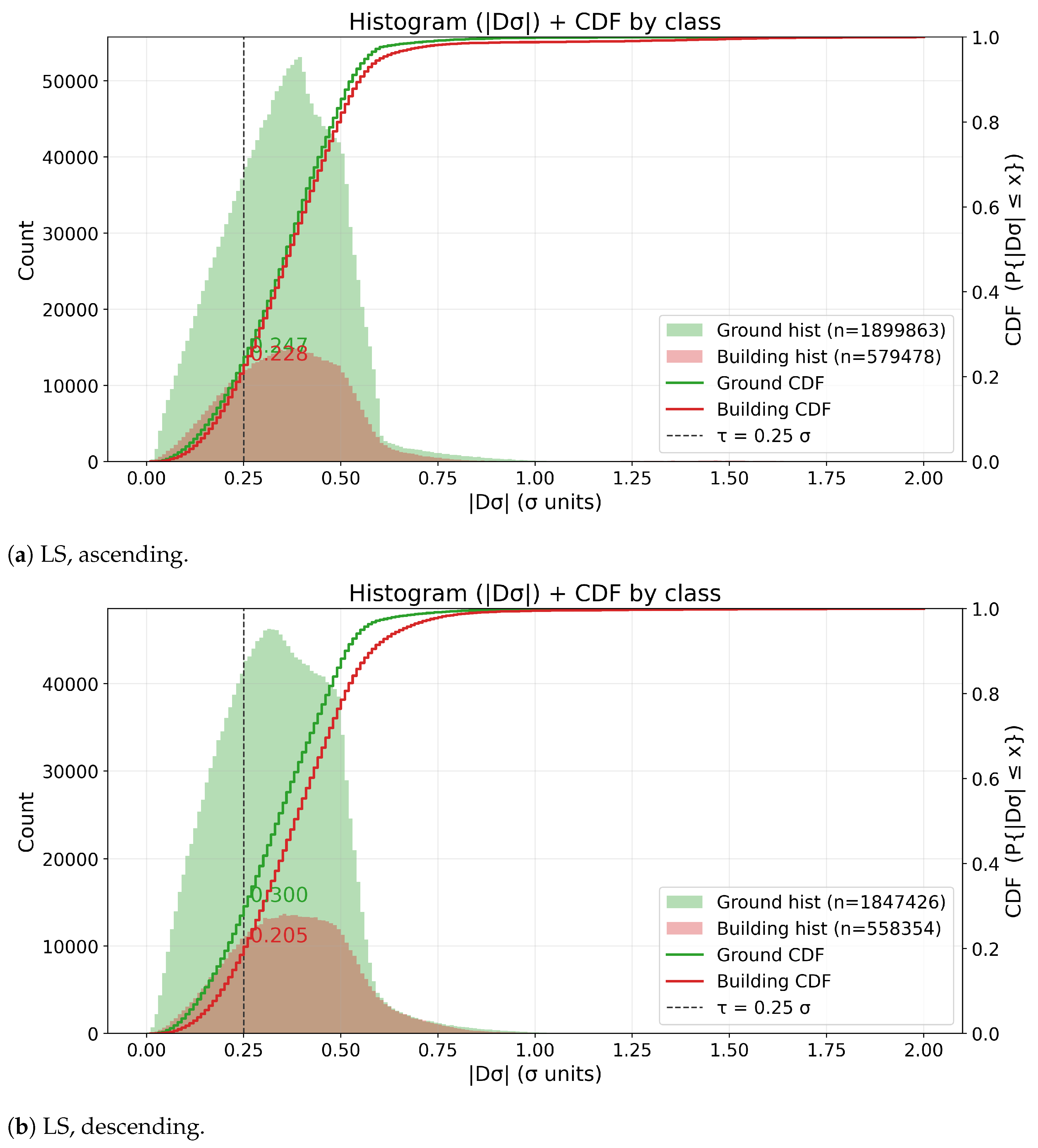
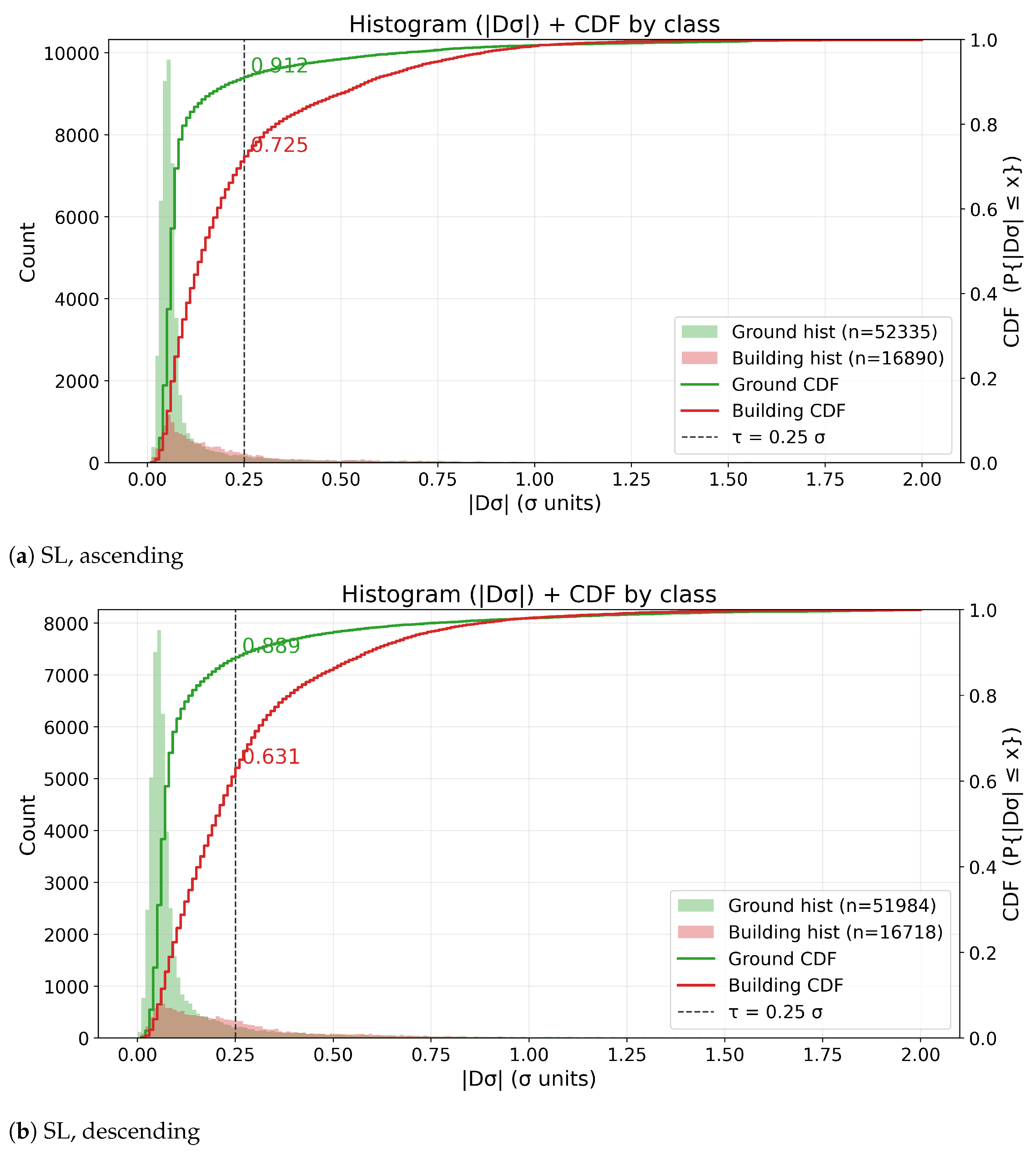
distributions for both link directions (
Figure 9 and
Figure 10) show the expected
LS/
SL contrast. Because
,
SL forms exactly the
best pairs (one LiDAR point per scatterer) and therefore concentrates closer to
. In contrast,
LS forms pairs
(one scatterer per LiDAR point) and includes many additional links within dense LiDAR clusters, which broadens the right tail. In addition to the histograms,
Figure 9 and
Figure 10 also show the corresponding cumulative distributions, i.e.,
, which effectively integrate the histogram from
up to a given threshold.
Despite their higher mean amplitude, the building/structure areas exhibit larger
(shifted to the right, heavier tails) in both
LS and
SL. This indicates that stronger backscatter does not translate into smaller Mahalanobis offsets at the AOI scale; geometric factors (e.g., dihedrals and curved steel shells) drive cross-range-dominated mismatches that outweigh any amplitude advantage. Following Chang et al. [
42], our whitening-based nearest-neighbor strategy adopts a significance threshold of
, and therefore we report
the SL association rates at
to avoid the cardinality bias inherent in
LS when
. From the AOI-wide
SL CDFs, we obtain
(ASC ground),
(ASC building),
(DSC ground), and
(DSC building).
To further quantify the robustness of the associations, we compute a spatial mutual nearest-neighbor (MNN) diagnosis using a buffer in planimetry of and the height around each location linked to the LiDAR. On the SL side, approximately of all scatterers have a LiDAR neighbor within this buffer whose reciprocal link points back to the same scatterer (ASC: 0.789, DSC: 0.792). Expressed on the LS side, only a small fraction of LiDAR points participate in such mutual links, reflecting : for classification 2 (ground), the MNN fraction is about (ASC) and (DSC), and for classification 6 (building/structure) it is about (ASC) and (DSC). These MNN percentages across the AOI confirm that most PS scatterers admit a geometrically consistent LiDAR counterpart, while only a small subset of LiDAR points are actually “used” in the final links, as expected in a highly oversampled LiDAR cloud.
3.3. Liquid Bulk Deposits
Isla Verde (EVOS-CLH Tank Farm)
From
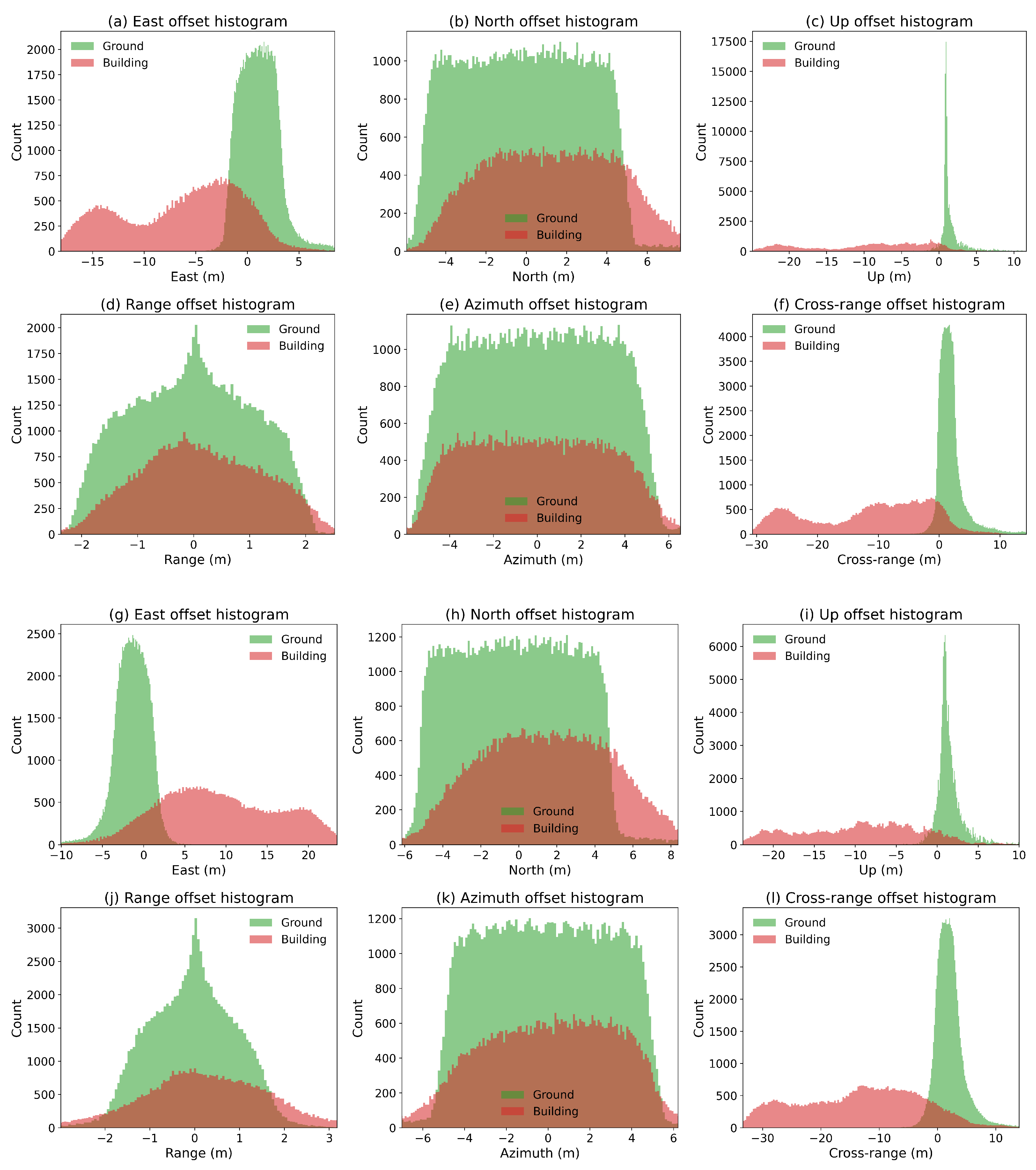
Table 1, the mean offsets in range and azimuth are small compared with the cross-range—i.e.,
—with the azimuth mean
the most centered (near zero). For building,
(ascending) and
(descending), while ground shows much smaller cross-range magnitudes (about 2–
). The standard deviations increase from range to azimuth to cross-range in all cases: for building,
,
–
, and
–
; for ground,
,
, and
–
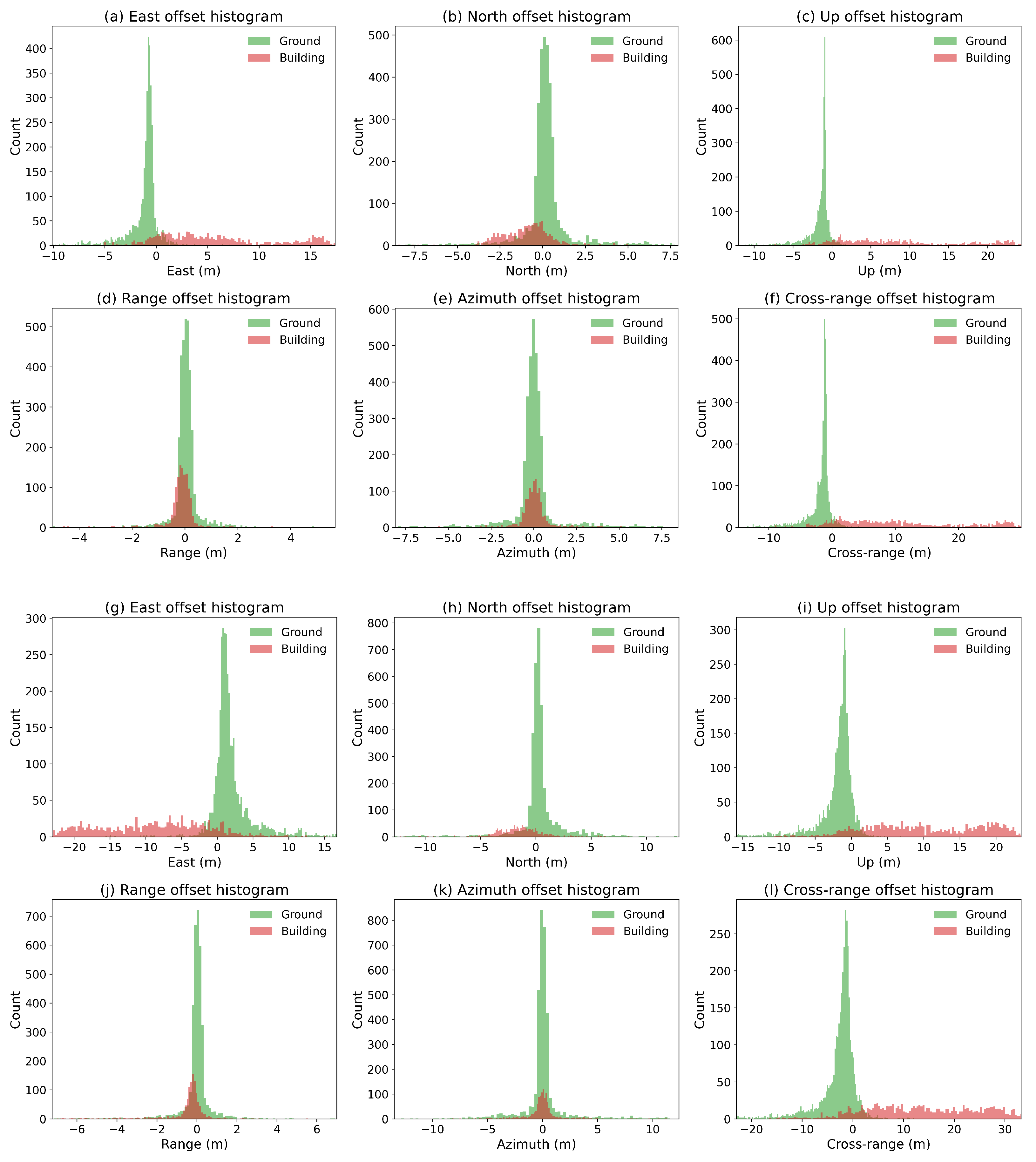
. The offset histograms in
Figure 11 and
Figure 12 summarize these patterns: panels (a)–(f) show ascending
E,
N,
U, range, azimuth, and cross-range offsets, respectively; panels (g)–(l) show the corresponding descending results.
The mean amplitude (natural-log units) is higher for building than for ground (
Table 1), consistent with
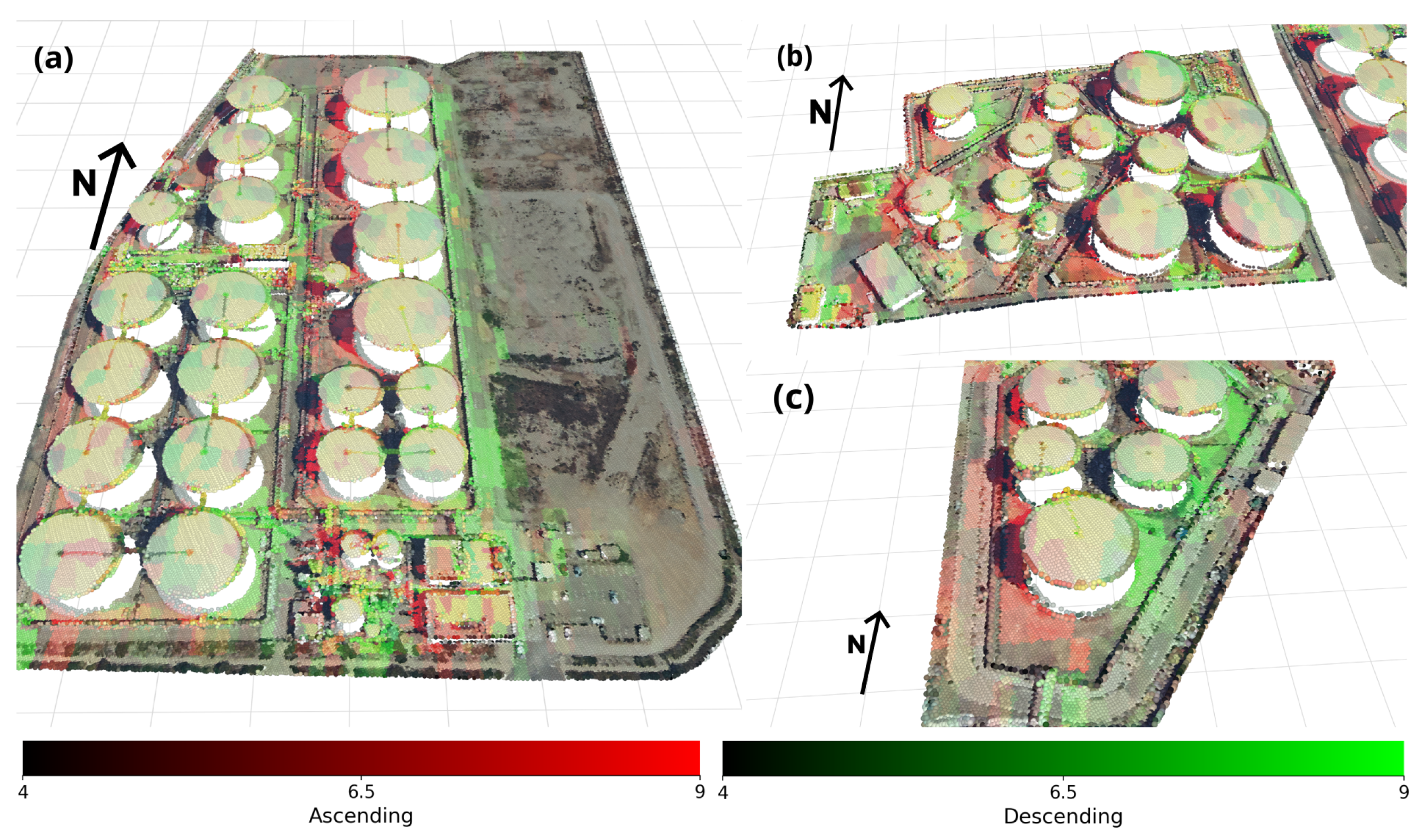
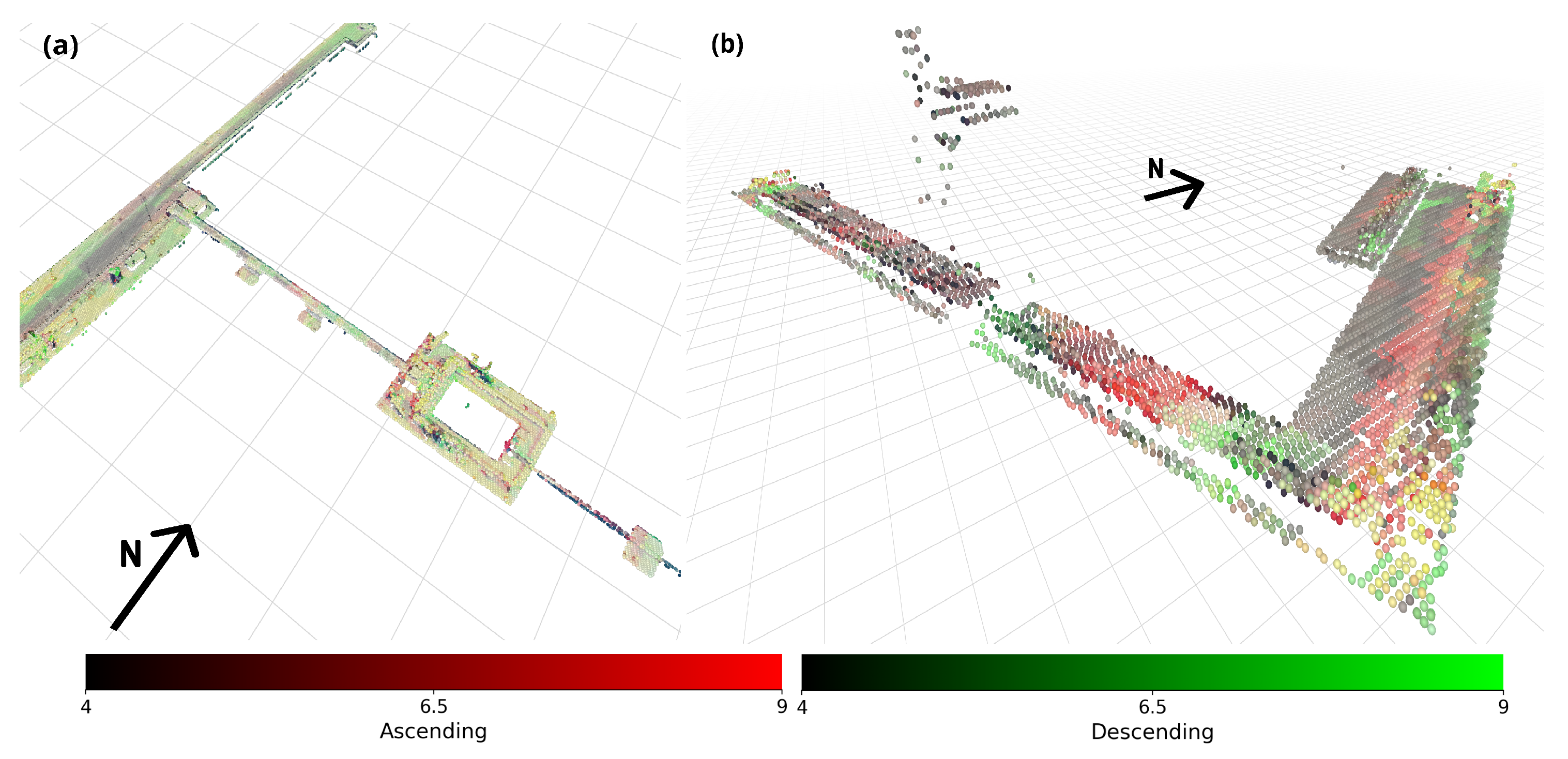
Figure 7. In the 3D dual-geometry amplitude overlay (
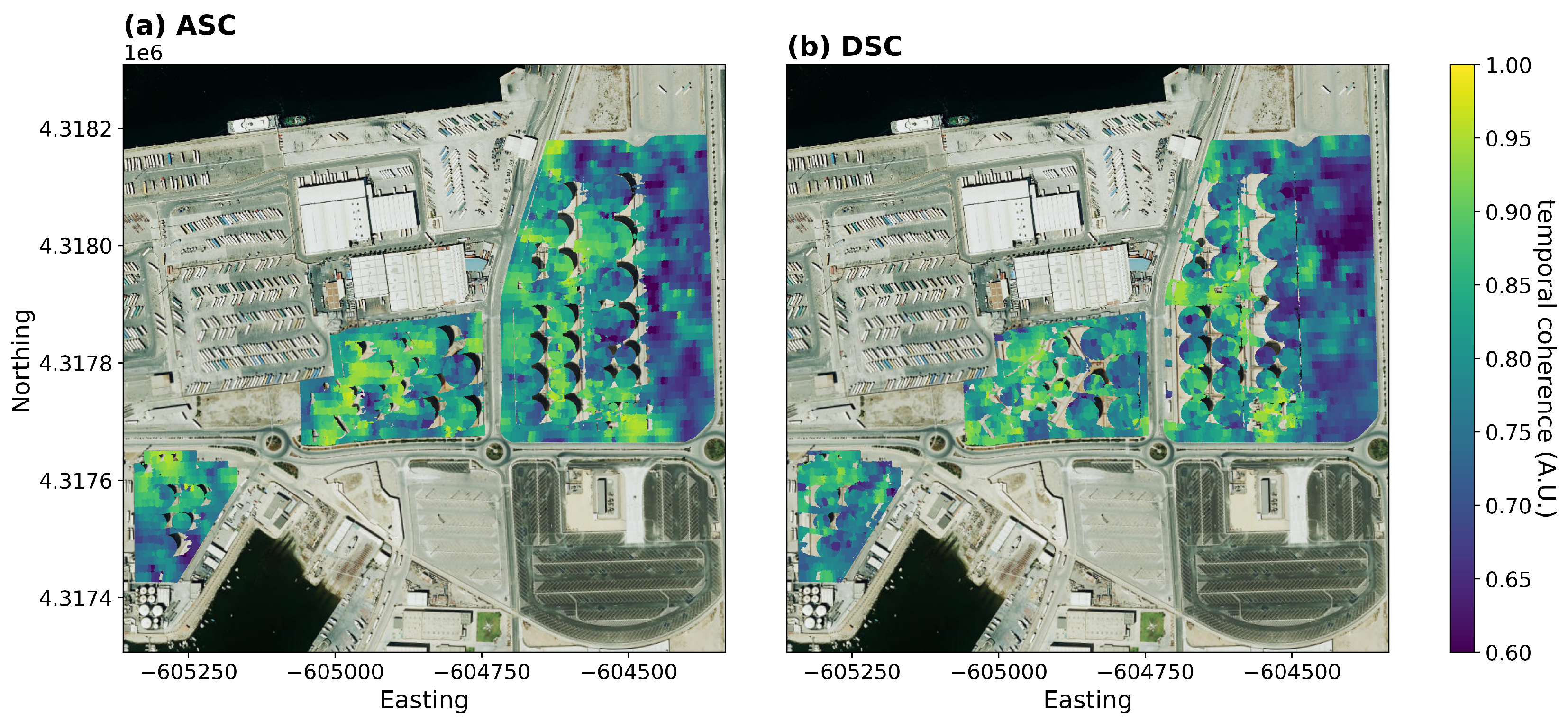
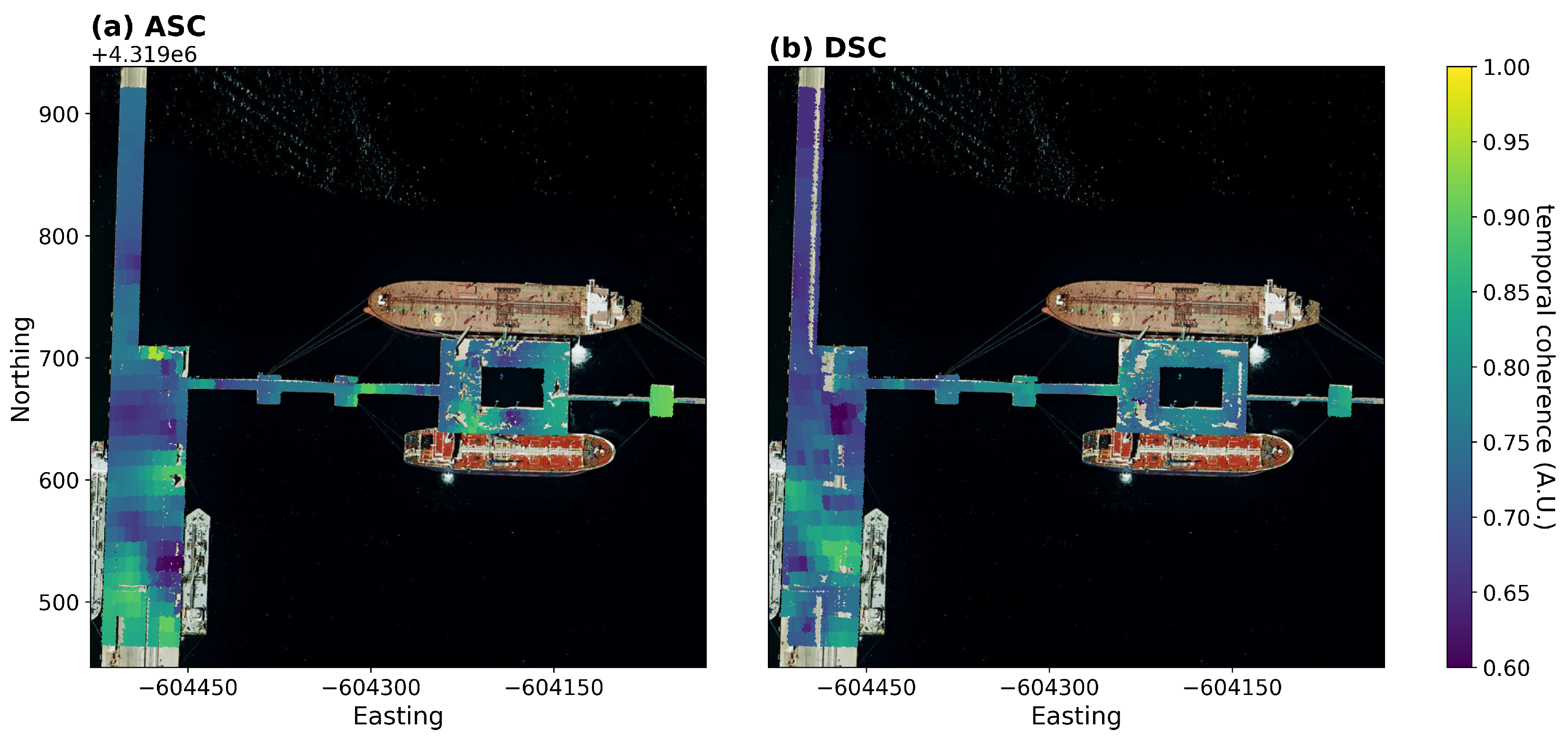
Figure 13a), the tank roofs are predominantly yellow (both looks), while the cylindrical shells exhibit red/green bands where one geometry is partially shadowed—matching the residuals dominated by the cross-range. The coherence maps (
Figure 14) show stable returns in the steelwork and less stability in the adjacent ground.
3.4. Berthing Terminals
3.4.1. EVOS Liquid Bulk Jetty and Ing. Castor Breakwater
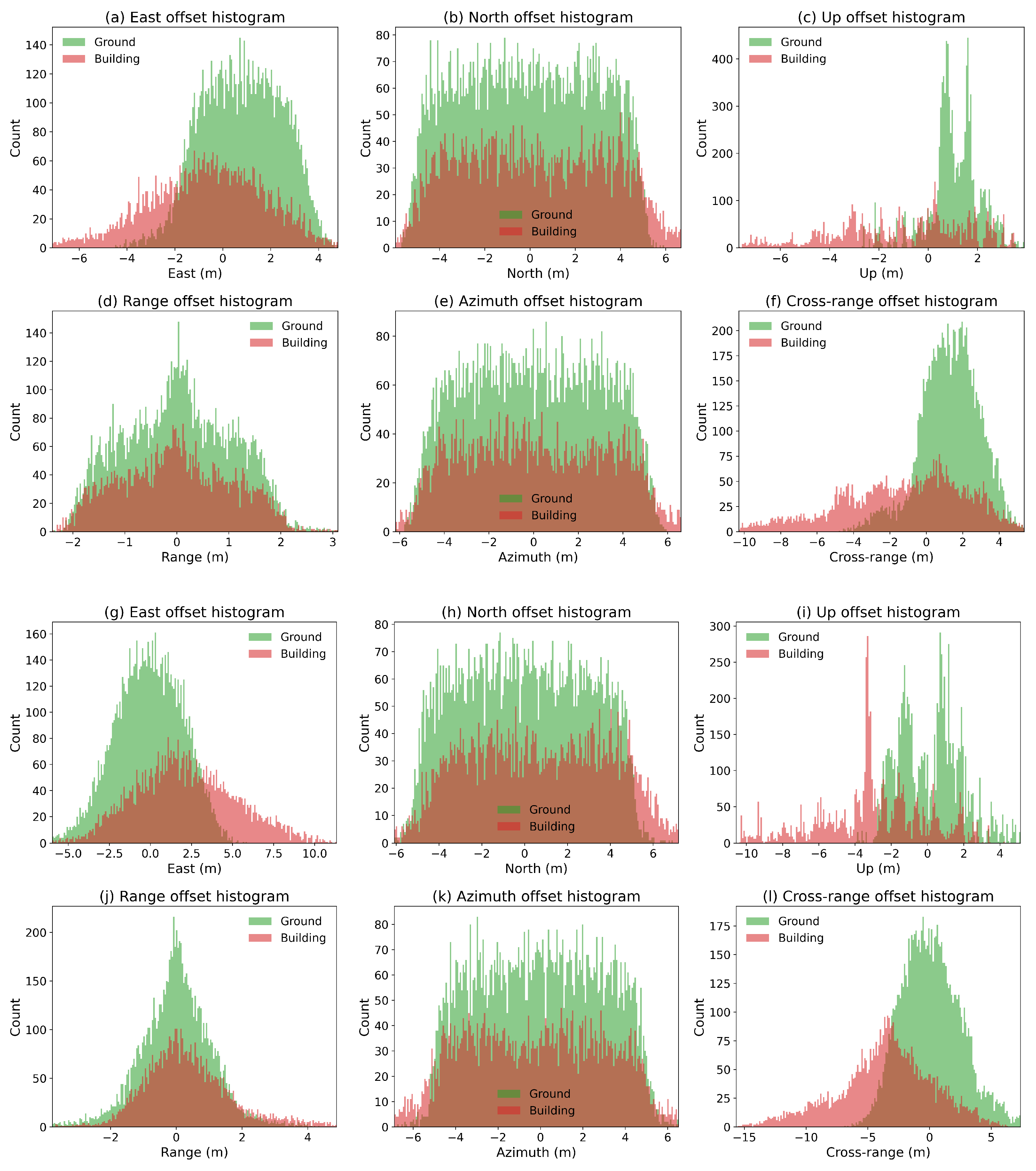
RAC offsets are compact over the pile-supported access trestle, the jetty head (loading platform), and ancillary buildings (
Figure 15 and
Figure 16). The dual-geometry red–green (RG) amplitude composite (
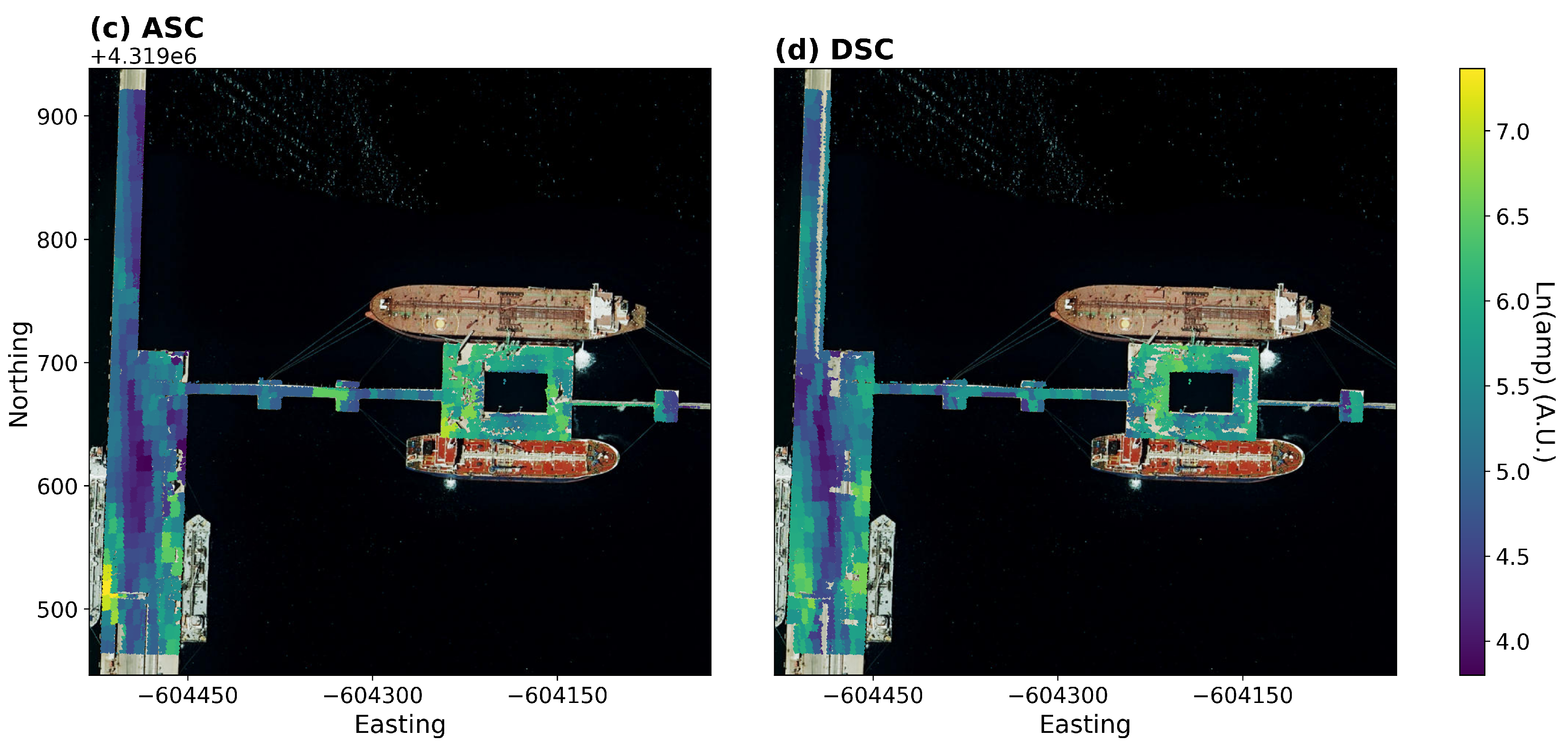
Figure 17a) highlights the deck edges of the jetty head and the access trestle in yellow (bright in both looks), while catwalks, pipe racks, and other secondary appurtenances exhibit look-dependent red (ascending)/green (descending). The coherence and mean amplitude map (
Figure 18) confirms high phase stability over the structural elements, supporting the reliability of the derived offsets. Line-of-sight (LOS) velocities (
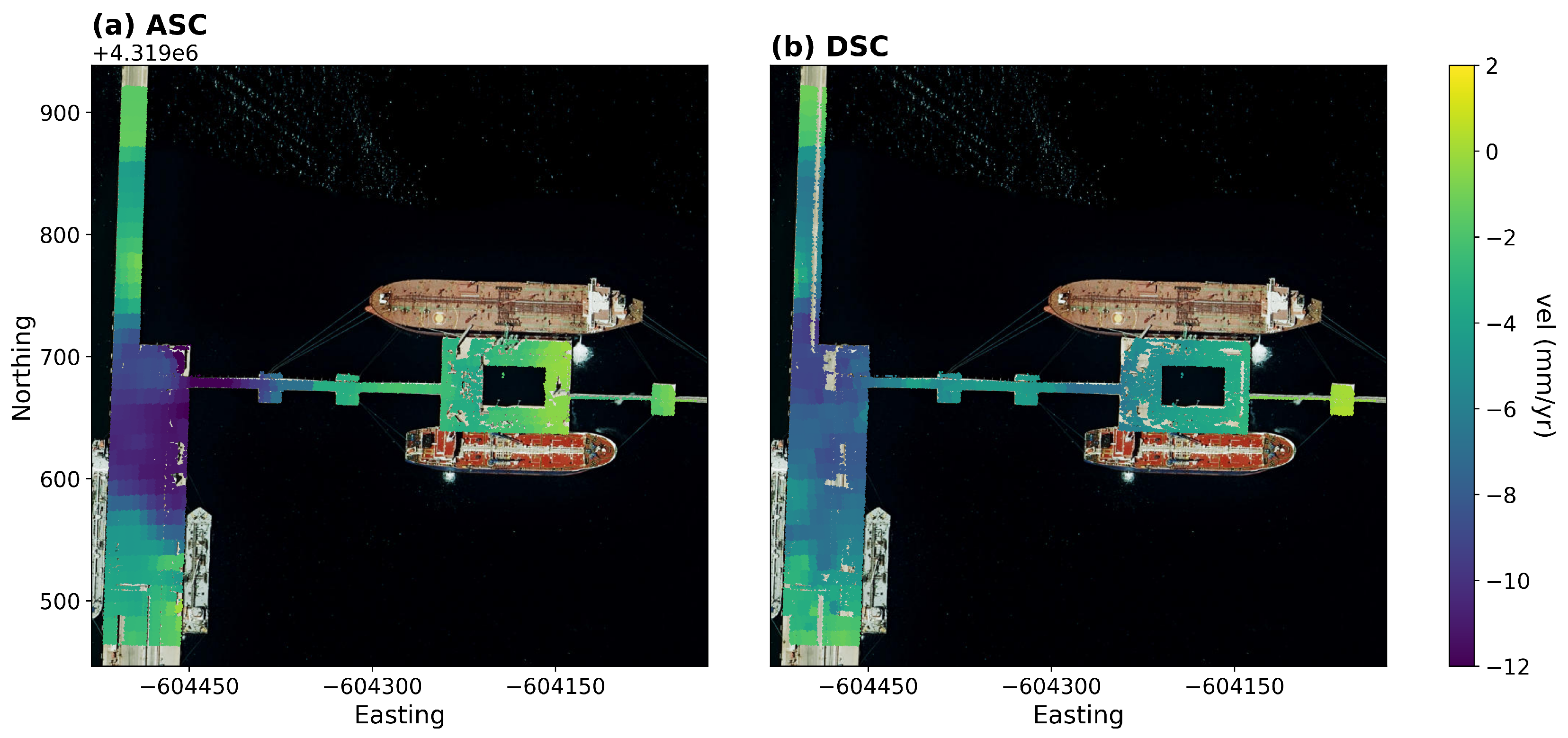
Figure 19) indicate a deformation hotspot at the jetty–breakwater interface, with a gradient toward the jetty head. In the context of the geological setting, this hotspot lies on reclaimed ground founded over soft Holocene marine deposits, where residual consolidation and load transfer at the jetty–breakwater connection are plausible contributors to the observed subsidence. However, in the absence of an AOI-wide geotechnical model or detailed consolidation records, this remains a qualitative interpretation rather than a fully constrained geotechnical back-analysis.
SL accuracies
are high across classes (
Table 2): building (
ascending;
descending) and ground (
ascending;
descending). Cross-range means are near zero on ground (∼0 to
) and modestly positive on building (∼1.3 m ↑,
). Standard deviations remain sub-2 m in range and azimuth and are largest in cross-range (
Table 2), consistent with geometry-driven residuals across the pile-supported jetty and flanking berthing/mooring dolphins.
3.4.2. Los Barrios Thermal Powerplant Berthing Pier
Six-axis offsets remain compact along the quay faces;
histograms have narrow cores with small right tails where LiDAR thins near roundheads. The composite in
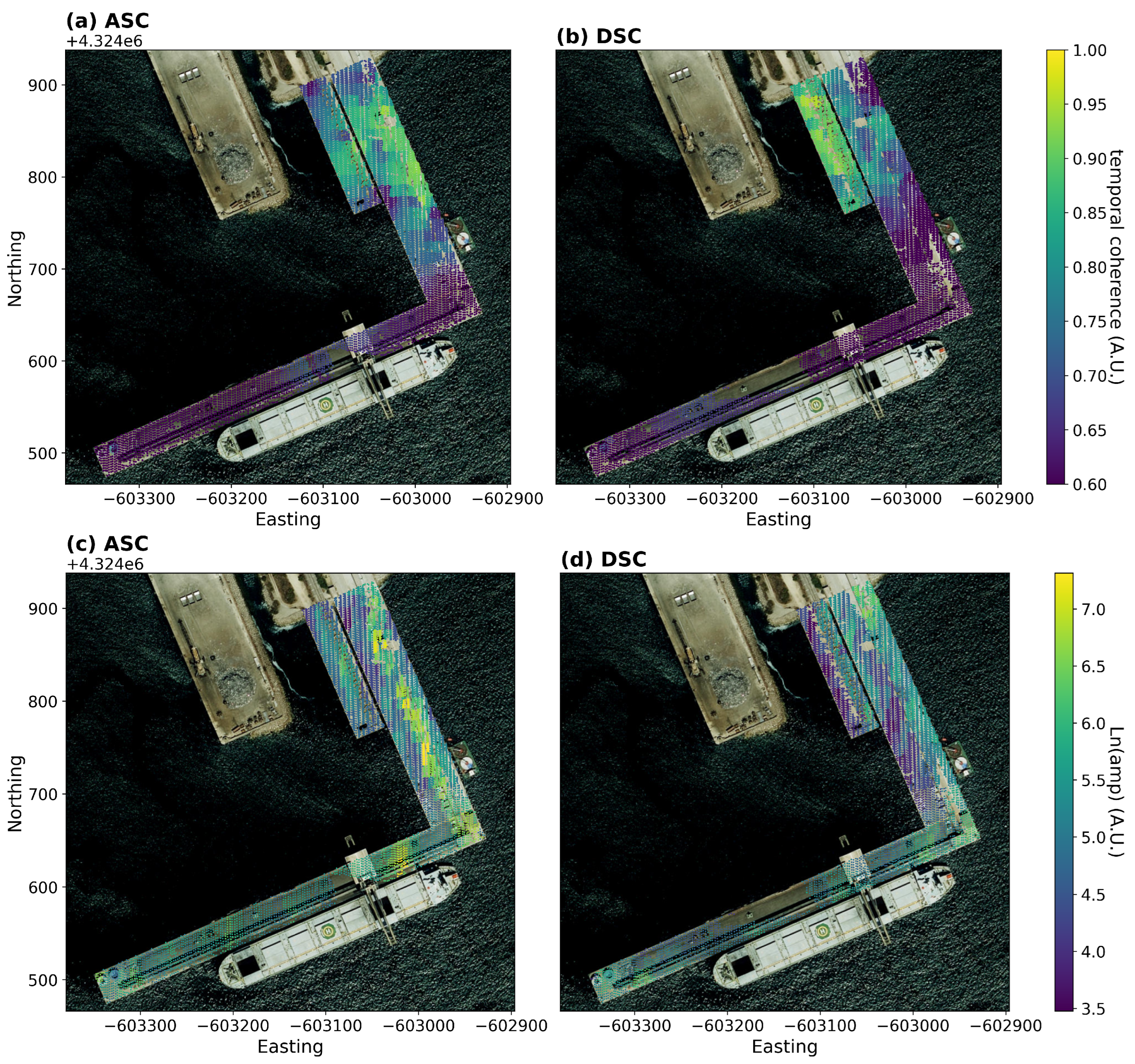
Figure 17b emphasizes crown walls, conveyor trestles, and shiploader towers; look-dependent wall responses are prominent. The coherence and mean amplitude results (
Figure 20) demonstrate consistent scattering characteristics across the quay structures.
SL is again high (
Table 3): building (81.8% ascending, 82.2% descending); ground (96.8%, 95.9% descending). Cross-range means are
–
(building) and ≈0.6 m in magnitude for ground. Building shows a higher amplitude and higher dispersion than ground.
3.5. Other Infrastructure: Container Yards, Docked Vessels, Singular Elements
Dynamic container stacks drive high dispersion indices and lower
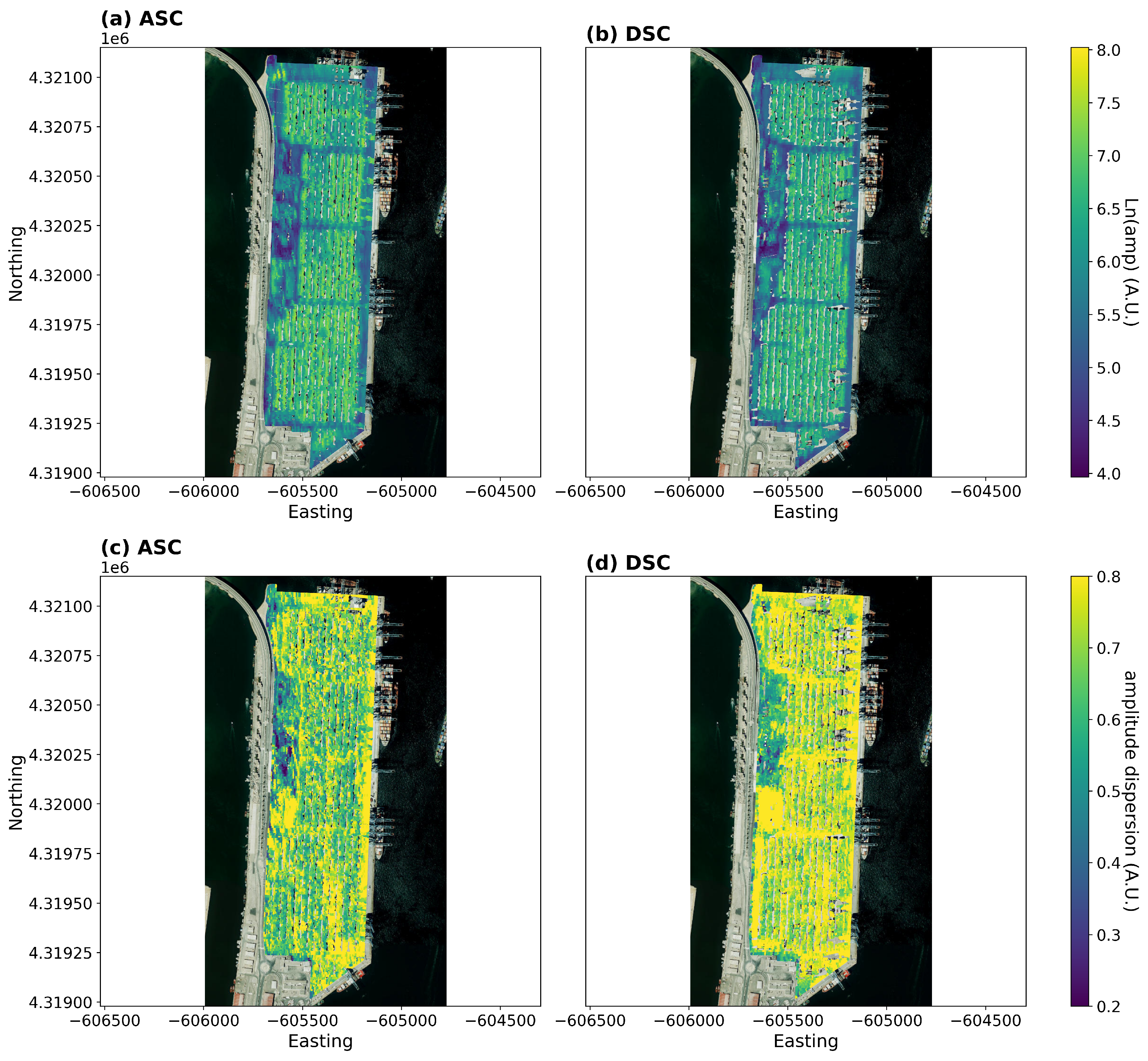
than fixed infrastructure. For APM (
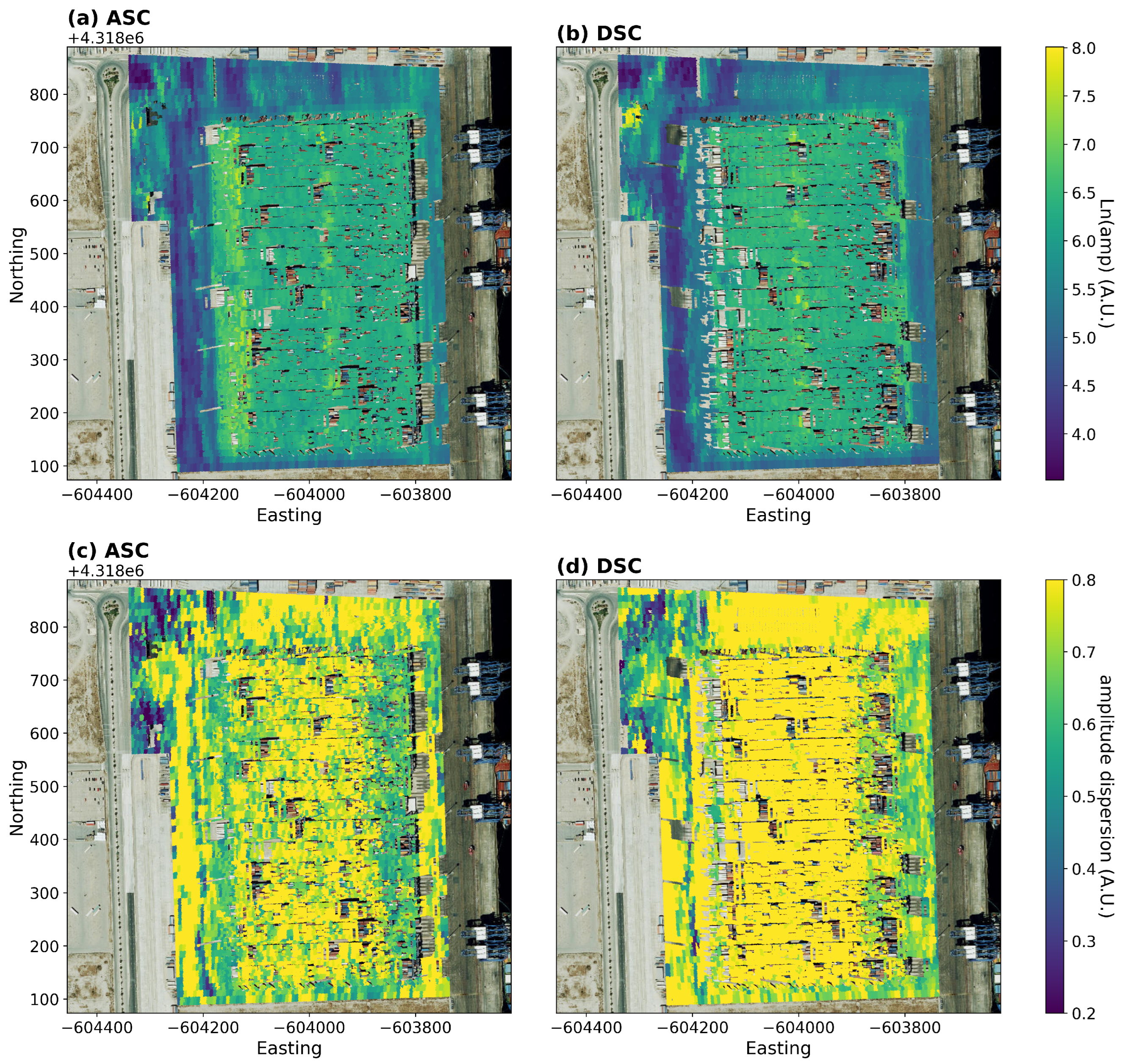
Table 4, also see mean logarithmic amplitude and amplitude dispersion index in
Figure 21), building
is 63.5% for ascending and 60.4% for descending versus ground, which is 81.3% for ascending and 79.7% descending; for TTI (
Table 5, also see mean logarithmic amplitude and amplitude dispersion index in
Figure 22), building is 58.7% for ascending and 57.5% descending versus ground, which is 76.0% for ascending and 75.4% descending. The amplitude dispersion indices are highest for building (APM:
–
; TTI:
–
), which is qualitatively consistent with frequent re-stacking and changing container configurations, while ground is lower (APM:
–
; TTI:
–
). Mean amplitudes are bright overall (log-units
for building), with coherence concentrating along crane rails and block edges. The dual-geometry red–green (RG) coherence overlay (
Figure 23) shows yellow seams along block perimeters and crane corridors at APM (both looks), with sparser clusters at TTI. In the absence of detailed terminal operation logs (e.g., crane activity or yard management records), we cannot directly correlate specific dispersion patterns with individual cargo-handling episodes, so the operational interpretation remains qualitative.
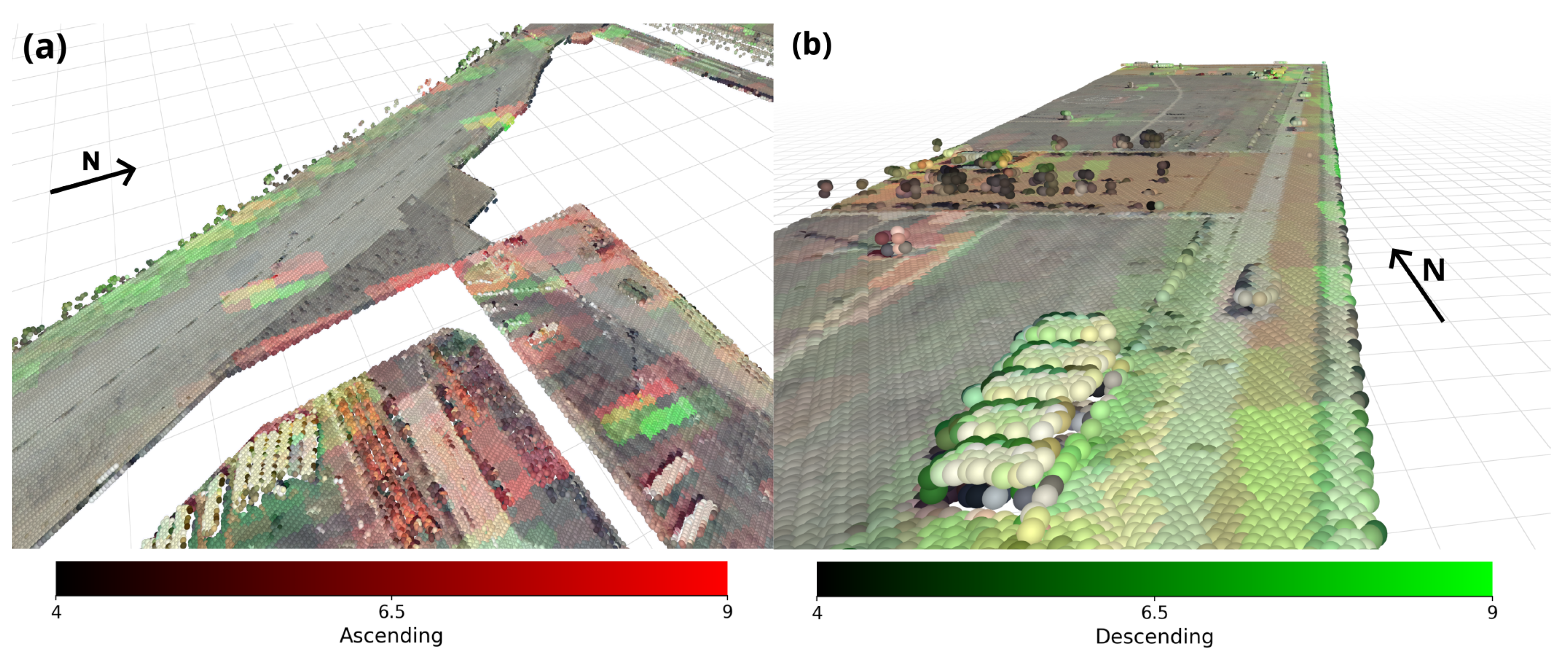
Streetlights appear as regular chains of bright points; look orientation yields red/green dominance with
yellow, where both geometries illuminate the fixture. At Llano Amarillo, the east-facing vertical quay wall is green-dominant in the dual-geometry composite (red = ascending, green = descending), forming a continuous bright rim in descending. Superimposed on this rim are regularly spaced green maxima (
Figure 24). Their spacing and position along the wall are consistent with scattering from hull protection fenders and/or other protruding structural elements (e.g., bullnoses, beams, and joints), whose geometry favors strong returns toward the descending look. However, alternative explanations such as local changes in wall geometry or material properties cannot be ruled out. Confirming the dominant scattering mechanism would require high-resolution optical imagery or site inspection in collaboration with the port authority.
4. Discussion
AOI-wide, the buildings/structure areas are systematically brighter in mean amplitude than the ground, yet exhibit larger whitened distances
(
Figure 9 and
Figure 10). This decoupling between backscatter strength and geolocation offset indicates that, in our case study, geometric factors likely play a dominant role in limiting linking accuracy for complex steel assets. The observed residuals are compatible with a cross-range-dominated behavior, where dihedral/curvature effects displace the SAR scattering centre and DEM–structure height mismatches can further increase the apparent offset.
Beyond height and curvature, the orientation of port structures relative to the satellite look direction is a critical factor. Quay faces and trestles aligned approximately parallel to the LOS generate stronger, more compact returns in a given geometry, whereas walls oriented obliquely or facing away from the sensor exhibit reduced visibility, stronger look dependence, and larger cross-range residuals. This is clearly seen in the dual-geometry red–green (RG) 3D composites, where east-facing quay walls or tank shells appear green- or red-dominant depending on whether the descending or ascending look illuminates them more directly. Thus, satellite orbit direction and local incidence angle, when combined with the layout of the port, strongly condition which assets are well constrained in each stack.
The contrast between asset types is sharp. The berthing structures (access ramps, platform rims, and dolphins) produce very high
in
SL (e.g., EVOS: building
,
; ground
,
;
Table 2) with modest cross-range means (1–3 m). By comparison, liquid bulk tanks at Isla Verde show much lower
for building (about 47–
) and large cross-range magnitudes (∼10–14 m;
Table 1), while showing about 10 % more brightness than the ground class. Container terminals are in between: the percentage of points drops relative to fixed infrastructure (APM building
,
; TTI building
,
;
Table 4 and
Table 5) as the ADI increases due to restacking dynamics, but coherent seams persist along crane rails and block edges (
Figure 23).
The tank results point to height and shape as first-order drivers of the residuals. The Copernicus DEM used during DInSAR geocoding does not resolve true tank heights and roof geometries; the DEM height error projects mainly into the cross-range component in our RAC basis, compounding the scattering center/centroid separation produced by curved shells and strong dihedrals. The dual-geometry red/green overlays reinforce this interpretation: yellow on the roofs (both look illuminated) and alternating red/green bands on the sidewalls where one look is partially shadowed (
Figure 13a). In contrast, lower-relief rectilinear berthing decks are better represented by the DEM and produce shorter layover paths, explaining their tighter
distributions. For container yards, large ADI values reflect temporal variability rather than geometric mismodeling; where geometry is repeatable (crane corridors), coherence and
improve. These dual-geometry red–green (RG) 3D composites are used as qualitative diagnostics that complement the quantitative RAC offset analysis, helping to visualize look-dependent illumination, shadowing, and residual mismatches on the LiDAR geometry.
Our whitening and significance tests operate on a radar-datum covariance expressed in the RAC basis and rotated to ENU for Mahalanobis distances. In the literature, several strategies construct this covariance per scatterer. Chang et al. [
42] first remove systematic/second-order positioning errors and then refine the cross-range through histogram matching; the improved
with
defines a diagonal
that rotates to
, with typical axis ratios ≈ 1:5:43 (cross-range-dominant, also for Sentinel 1). Dheenathayalan et al. [
63] derive
from the variances of the timing/orbit parameters and estimate
from the interferometric look angle using a BLUE solution across the stack, again producing
. For consistent high-SNR targets, Van Natijne et al. [
33] report a representative ratio 1:2:22 (range–azimuth–cross-range) and absolute spreads of the order of decimeters (TerraSAR-X), underscoring sensor/stack dependence. In this study, we adopt a fixed diagonal
with
(
Section 2.4.4):
matches CSLC impulse responses;
follows from the vertical wavenumber span of the stack as a conservative proxy of elevation sensitivity. This simple and reproducible model preserves the ordering seen in previous work (range ≪ azimuth ≪ cross-range), downweights the cross-range in
, and still leads to low
at tall tanks, thus reinforcing that height/curvature and DEM fidelity, rather than SNR, are the dominant constraints.
After their corrections, Chang et al. [
42] focused primarily on the railway infrastructure (track beds, cut/fill slopes, and platforms) with relatively few slender and highly curved steel elements, and they report
of points within their significance threshold. In our AOI,
depends strongly on asset type and class: over engineered trestles and platforms (EVOS berth;
Table 2) we obtain high rates for ground (95–
) and building (90–
); along the Los Barrios pier (
Table 3) ground remains 96–
while building is 82–
; at tank farms (Isla Verde;
Table 1) ground is 84–
but building drops to 47–
; and at the container terminal (TTI;
Table 5) rates are lower overall (75–
for ground and 57–
for building). The contrast with the ∼98% railway result is consistent with the increased prevalence of slender/vertical or curved steel in ports (tanks, cranes, and dolphins), which amplifies cross-range residuals and DEM height mismatches.
At the EVOS jetty, the ascending/descending LOS maps place a deformation hotspot at the jetty–breakwater junction, with a gradient towards the apron (
Figure 19). In this work, we use this feature primarily as an illustration of how the LiDAR–InSAR fusion and whitening-based linking help localize and visualize infrastructure-scale signals at the interface between different structural elements, rather than as a detailed case study in deformation modeling or geotechnical back-analysis. A more comprehensive analysis of deformation rates for the Port of Bahía de Algeciras, including an external comparison of the same Sentinel-1 processing chain with the European Ground Motion Service (EGMS), is provided in Sanchez-Fernandez et al. [
36].
Three practical takeaways follow. (i) Linking geometry matters: The SL percentage with provides a reproducible quality filter for association, while LS adds the dense three-dimensional view needed for asset-scale inspection. (ii) Asset geometry dictates feasibility: Rectilinear decks and quay faces support high acceptance rates and reliable time series, whereas tall curved tanks require improved geocoding models (e.g., LiDAR-based DSMs) and potentially higher-frequency SAR to better localize the dominant scattering centers. (iii) Operations drive dispersion: Container yards remain challenging unless acquisition windows are selected for relatively quiescent periods, while cranes, block edges, and other rigid features persist as useful stable scatterers.
The DEM used in DInSAR geocoding is a bottleneck around tall assets; substituting a LiDAR-derived DSM should reduce cross-range residuals. For slender vertical elements such as streetlights, the main constraint is LiDAR representation (undersampling, occlusion, or filtering of thin poles in standard Aerial Laser Scan classification), even though they appear clearly as pole/dihedral reflectors in InSAR. Medium-resolution C-band geometry limits cross-range localization around tall/curved steel, and the covariance is assumed diagonal in the RAC frame (no cross-terms), which simplifies whitening but may underrepresent correlations in specific layouts. Dynamic zones (container stacks and vessel presence) reduce coherence and increase amplitude dispersion; acquisition timing remains an operational constraint.
In addition, short vertical elements at the waterline (e.g., bollards and low piles) often act as double-bounce pairs with the sea surface: they are bright in amplitude but tide- and sea-state-sensitive in phase, and we therefore do not use them as deformation indicators unless independently supported by high coherence and stable time series. A further limitation is the lack of an AOI-wide network of GNSS, leveling, or total station benchmarks with temporal overlap with the Sentinel-1 stacks; as a result, our localization and velocity assessments are referenced to the airborne LiDAR geometry and to the previously published EGMS comparison, and full external geodetic validation at the asset scale remains a task for future work.
The method transfers well to ports and industrial sites with large engineered structures, repeatable geometry, and adequate PS density (quays, trestles, cranes, and dolphins), enabling consistent plan-view and 3D inspection on the LiDAR cloud. In this sense, the proposed LiDAR–InSAR fusion is best viewed as a post-processing complement to existing InSAR workflows: it can be applied both to newly processed stacks and to external products such as EGMS or national PS catalogs, where the underlying DEM choice is fixed and reprocessing is not feasible. Performance degrades in settings dominated by tall curved tanks without DSM refinement, highly dynamic container yards, vegetated or rapidly reconfigured areas, or sparse PS coverage. In such areas, the effective positional accuracy remains limited by cross-range geometry and height model quality, and improving the DEM with LiDAR-derived DSMs, tailoring acquisition windows, or leveraging higher-frequency SAR can be especially impactful.
5. Conclusions
This study demonstrates that combining InSAR time series with high-resolution LiDAR data provides a robust framework for monitoring port infrastructures under complex environmental and operational conditions. The whitening-based nearest-neighbor approach proved effective in reducing positional uncertainties and assigning radar scatterers to specific structural elements, thus overcoming one of the main limitations of conventional InSAR analysis in ports. The integration of visibility masks and 3D dual-geometry red–green (RG) 3D composites further enhances interpretability, allowing the differentiation between stable, rigid structures and more dynamic or transient elements.
Our results confirm that rigid infrastructures such as trestles, dolphins, tank shells, and quay walls sustain high coherence and reliable associations, while transient areas such as container yards or vessels remain challenging due to decorrelation and variability. This highlights both the potential and the limitations of C-band InSAR in highly dynamic port environments.
Beyond the specific case of the Port of Algeciras, the methodology presented here provides a transferable basis for large-scale monitoring of ports worldwide, using open access Sentinel-1 data in combination with widely available national LiDAR datasets. The proposed framework supports structure-specific deformation attribution and paves the way for integration with risk assessment and asset management tools. Future work should explore the use of higher-resolution SAR missions and the exploitation of partially coherent scatterers to further enhance deformation retrieval in operationally active zones. Our results show that the technique improves the monitoring of rigid port assets, while curved tanks and dynamic areas such as container yards remain limited by decorrelation and cross-range offsets, defining an asset-dependent effective resolution. Importantly, the framework developed here demonstrates that LiDAR–InSAR fusion is not only a monitoring tool, but also a foundation for informed decision-making in port management. By attributing deformation signals to specific structural typologies and quantifying their geometric evolution over time, the methodology enables characterization of vulnerability at both structural and operational scales. This vulnerability analysis, understood as the measurable geometric response of different port assets, directly supports risk assessment, maintenance prioritization, and asset management strategies. As such, the results of this study provide a transferable basis for integrating deformation monitoring into decision support systems, thus fostering more resilient and proactive port governance.



 ,
,