Article

Investigating an Earthquake Surface Rupture Along the Kumysh Fault (Eastern Tianshan, Central Asia) from High-Resolution Topographic Data


1
State Key Laboratory of Earthquake Dynamics and Forecasting, Institute of Geology, China Earthquake Administration, Beijing 100029, China
2
Guangdong Provincial Key Laboratory of Geodynamics and Geohazards, School of Earth Sciences and Engineering, Sun Yat-sen University, Guangzhou 510275, China
*
Author to whom correspondence should be addressed.
Remote Sens. 2025, 17(23), 3847; https://doi.org/10.3390/rs17233847
Submission received: 1 October 2025 / Revised: 23 November 2025 / Accepted: 24 November 2025 / Published: 27 November 2025
(This article belongs to the Section Remote Sensing in Geology, Geomorphology and Hydrology)

Highlights

What are the main findings?
  • The surface rupture zone of the Kumysh Fault extends for ~25 km, with an average displacement of 0.9–1.1 m and a maximum displacement of 2.8–3.2 m.
  • The magnitude of the most recent earthquake on the Kumysh Fault is estimated to be Mw 6.6–6.7.
What are the implications of the main findings?
  • The middle segment is the most delayed in its propagation towards the basin on the Kumysh Fault.
  • The Kumysh Fault has the potential to generate major earthquakes.

Abstract

As direct geomorphic evidence and records of earthquakes on the surface, coseismic surface ruptures have long been a key focus in earthquake research. However, compared with strike-slip and normal faults, studies on reverse-fault surface ruptures remain relatively scarce. In this study, surface rupture characteristics of the most recent earthquake on the Kumysh thrust fault in eastern Tianshan were investigated using high-resolution topographic data, including 0.5 m- and 5 cm-resolution Digital Elevation Models (DEMs) generated from the WorldView-2 satellite stereo image pairs and Unmanned Aerial Vehicle (UAV) images, respectively. We carefully mapped the spatial geometry of the surface rupture and measured 120 vertical displacements along the rupture strike. Using the moving-window method and statistical analysis, both moving-mean and moving-maximum coseismic displacement curves were obtained for the entire rupture zone. Results show that the most recent rupture on the Kumysh Fault extends ~25 km with an overall NWW strike, exhibits complex spatial geometry, and can be subdivided into five secondary segments, which are discontinuously distributed in arcuate shapes across both piedmont alluvial fans and mountain fronts. Reverse fault scarps dominate the rupture pattern. The along-strike coseismic displacements generally form three asymmetric triangles, with an average displacement of 0.9–1.1 m and a maximum displacement of 2.8–3.2 m, yielding an estimated earthquake magnitude of Mw 6.6–6.7. This study not only highlights the strong potential of high-resolution remote sensing data for investigating surface earthquake ruptures, but also provides an additional example to the relatively underexplored reverse-fault surface ruptures.

1. Introduction

Surface rupture zones are the direct geomorphic expressions of strong earthquakes, and their spatial geometric distribution and deformation characteristics reflect both the kinematic behavior of the causative fault and the surrounding stress field [1,2,3,4]. The coseismic displacement distribution of rupture can also reveal the patterns and magnitudes of surface deformation along the fault trace [5,6,7]. Therefore, investigations of coseismic surface ruptures allows reconstruction of the rupture process during earthquake, and for those historical earthquakes lacking instrumental records, such investigations can also be used to estimate their magnitudes [8,9,10]. For instance, DuRoss et al. [7] reconstructed the rupture process of the 2019 Ridgecrest earthquake based on field-measured displacement data, and further discussed the implications of cross-fault rupture propagation on displacement distribution. Middleton et al. [6] utilized the relationship between moment magnitude and rupture parameters such as rupture length, area and displacement, and suggested that the magnitude of the 1739 M 8.0 Yinchuan-Pingluo earthquake was likely overestimated. Thus, detailed investigations of coseismic surface rupture zones not only enhance our understanding of earthquake processes and fault behavior, but also provide crucial constraints for regional seismic hazard assessment and risk mitigation [11,12,13,14].
However, current research on surface rupture zones has primarily focused on strike-slip and normal faults, while studies of reverse fault surface ruptures remain relatively limited, mainly due to constraints in available cases and observational techniques [15,16]. On one hand, surface ruptures typically form in strong earthquakes with a magnitude greater than 6. But for thrust events, coseismic displacement attenuates rapidly during upward propagation from the hypocenter to the surface [4], making it more difficult for the seismogenic faults to break through to the surface, thus often requiring larger magnitudes to generate observable surface ruptures. As a result, documented examples of coseismic surface rupture zones associated with thrust earthquakes are relatively few worldwide [8]. On the other hand, reverse faults develop commonly in orogenic foreland and basin margins, where fault propagation often appears as imbricate fans in cross-section, resulting in complex geometric structures for surface ruptures, frequently expressed as multiple branching segments [16,17,18,19]. Moreover, thrust motion must overcome gravity, which usually limits the rupture scales, and the motion is often accommodated by folding or diffuse deformation within the thick sedimentary cover [4,16,20,21,22]. These factors make it difficult to accurately determine the coseismic displacement. Therefore, investigations of reverse-fault surface rupture zones require more refined observation techniques and more scientific approaches.
With the advancement of spatial measurement technologies such as Light Detection and Ranging (LiDAR) and photogrammetry, high-resolution topographic data has become increasingly accessible. This facilitates quantitative studies of active tectonics and provides essential technical support for detailed investigations of surface rupture zones [23,24,25,26]. In recent years, a series of high-resolution satellites has been launched, including GeoEye-1 (0.41 m), WorldView-1/2 (0.46 m), WorldView-3/4 (0.31 m), Pleiades (0.5 m), and Gaofen-7 (0.8 m), from which meter-scale DEMs can be derived using stereo image pairs. In addition, advancements in technologies like LiDAR and UAV photogrammetry enable rapid acquisition of centimeter-scale DEMs for study areas. For example, Gold et al. [15] used 0.5 m orthophotos and DEMs from WorldView-3 imagery to map the surface ruptures of the 2016 Mw 6.0 Petermann Ranges earthquake, and demonstrated that optical satellite imagery is capable of quantifying sub-meter deformation along thrust faults. Johnson et al. [27] used airborne LiDAR-derived 0.5 m DEMs to extract the along-strike vertical displacement distributions of the 36.5 km-long multiple rupture segments associated with the 1959 Hebgen Lake Mw 7.2 earthquake. Similarly, Yuan et al. [3] employed UAV photogrammetry to generate orthophotos with 3.5–10.3 cm resolution and DEMs with 14–77 cm resolution, thereby determining the rupture characteristics of the 2014 Ms 7.3 Yutian earthquake in Xinjiang. In summary, high-resolution topographic data provide powerful tools for conducting more detailed studies of coseismic surface rupture zones.
The Kumysh Fault is a thrust fault located along the southern margin of the Kumysh Basin in the eastern Tianshan. Previous studies have shown that this fault exhibits pure thrust motion without any strike-slip component, and has been significantly active since the late Quaternary [28,29]. Furthermore, apparent surface ruptures have been well preserved along some sections of the fault [28]; however, the spatial geometric distribution and displacement characteristics of the ruptures remain poorly constrained. In this study, we focused on the surface rupture zone produced by the most recent earthquake on the Kumysh Fault. Using approximately 53 km of high-resolution topographic data along the fault trace, including 0.5 m DEMs generated from WorldView-2 stereo image pairs and 5 cm DEMs derived from UAV imagery, we mapped the rupture geometry in great detail and also reconstructed the along-strike distribution of coseismic vertical displacements. Based on established empirical relationships between the rupture parameters and moment magnitude of reverse faults, we estimated the moment magnitude of this earthquake and further discussed its implications for the seismic hazard and fault growth process of the Kumysh Fault.

2. Tectonic Setting

The Tianshan Mountain, one of the world’s seven major mountain range, is located in the interior of the Eurasian continent and extends nearly E–W across China, Uzbekistan, Kazakhstan, and Kyrgyzstan. It stretches for ~2500 km and varies in width from 250 to 450 km, forming a spectacular inland mountain range far from plate boundaries (Figure 1a). The Tianshan has played a critical role as a Paleozoic subduction–collision zone in geological history. During the Mesozoic, it remained relatively stable and was generally in a state of erosion, with only localized tectonic activity [30,31,32]. Since the Cenozoic, however, it has experienced intense compression, uplift, and associated tectonic deformation as a result of the Indian–Eurasian plate collision and subsequent northward indentation processes, leading to the reactivation of the Tianshan as an intraplate orogenic belt within the Eurasia continent [33,34,35,36,37,38,39].
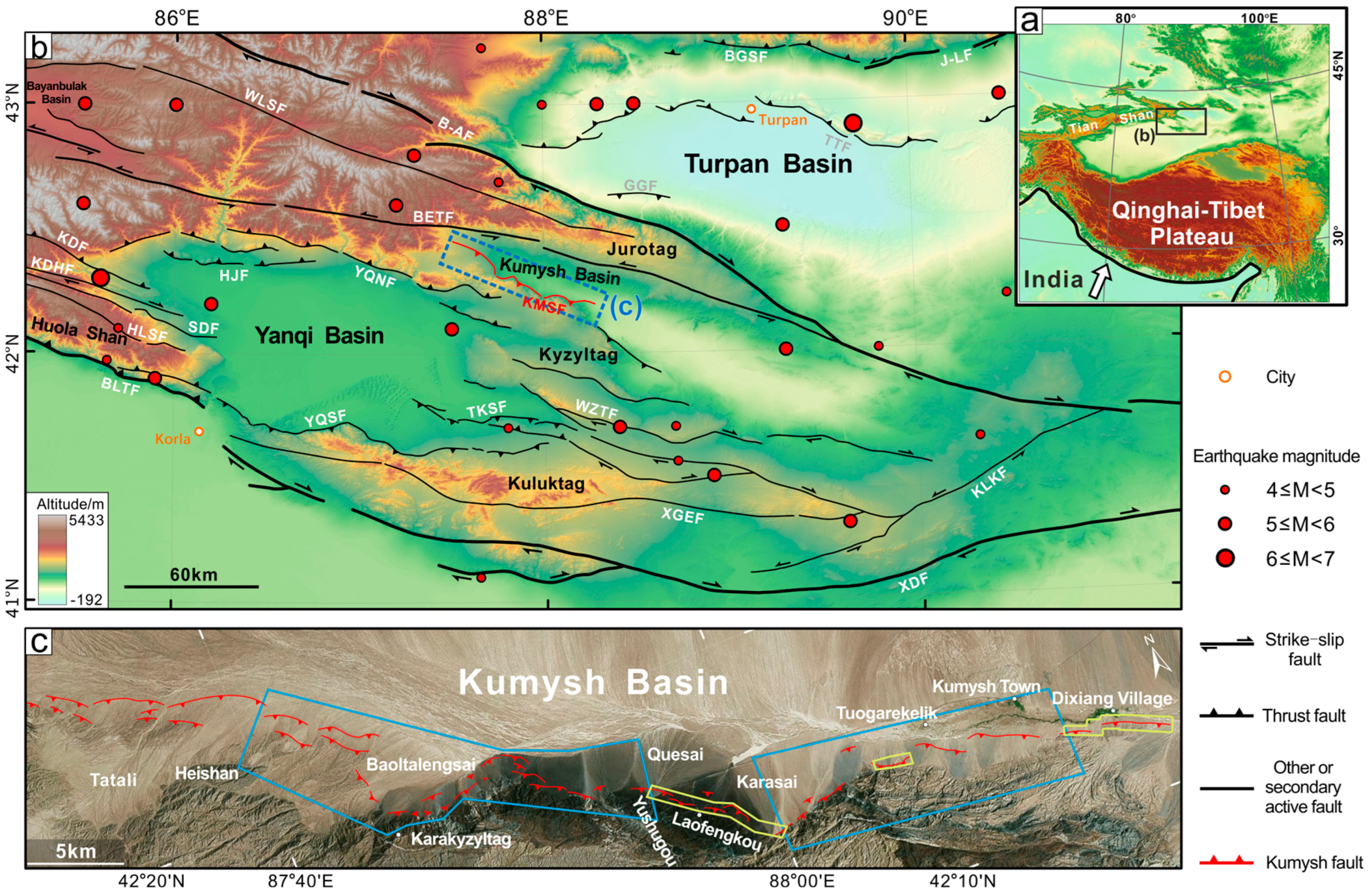
The Kumysh Basin, located in the southeastern Tianshan, is an intermontane basin with a NW–SE trending, bounded by the Jurotag to the north and the Kyzyltag to the south (Figure 1b). Its tectonic deformation is mainly controlled by two piedmont faults [28]. Along the northern margin, the Baoertu Fault is a long-term active, E–W–striking sinistral thrust fault zone that extends ~350 km from the southern margin of the Bayanbulak Basin to the northeastern margin of the Kumysh Basin, and intersects with the Bolokenu-Aqikekuduk Fault at its eastern end [41,42]. Based on high-resolution remote sensing imagery, Quaternary dating, and detailed field investigations, previous studies estimated a late Quaternary sinistral slip rate of 1.87 ± 0.29 mm/a for the Baoertu Fault [42]. Along the southern margin, the Kumysh Fault is a low-angle, south-dipping thrust fault without any strike-slip component, with a total length of ~100 km and an overall NWW orientation nearly parallel to the mountain range. This fault displays a complex geometry, characterized by multiple subparallel segments at the surface. Geometric discontinuities such as step-overs, gaps, and significant bends are present between these segments (Figure 1c). Previous studies demonstrated that the fault has been strongly active since the late Quaternary, displacing a series of late Pleistocene–Holocene alluvial fan surfaces in the piedmont. Using high-resolution topographic data combined with chronological data of displaced geomorphic surfaces, the vertical slip rates of the eastern and western segments of the fault were determined to be 0.13 (+0.04/−0.02) mm/a and 0.15 ± 0.01 mm/a, respectively [28,29]. In addition, during field investigations, Wang [28] has observed well-preserved free faces on sections of the fault scarp at some locations, suggesting that the Kumysh Fault still retains distinct surface earthquake ruptures.

3. Data and Methods

3.1. Acquisition of High-Resolution Topographic Data

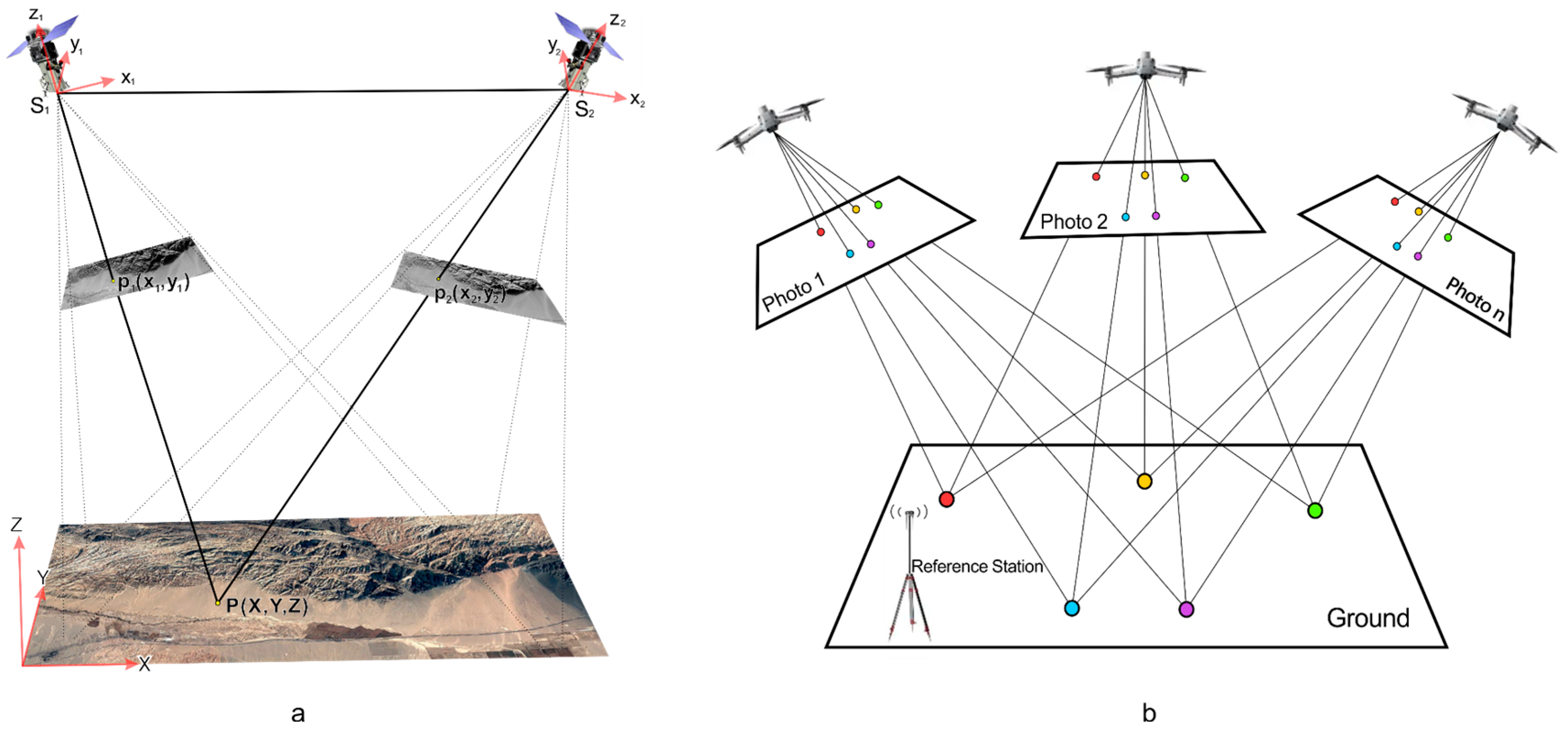
Extracting DEMs from stereo satellite imagery has become a relatively mature photogrammetric technique. The principle involves matching homologous points in the overlapping regions of stereo image pairs to establish their 2D correspondences. Using these matched points, triangulation is applied to calculate their 3D coordinates, ultimately constructing a three-dimensional topographic model of the observed area (Figure 2a) [43]. WorldView-2 is a high-resolution satellite launched on 8 October 2009, operating in a 770 km sun-synchronous orbit with an average revisit period of 1.1 days. Its sensor can acquire panchromatic images with a 0.46 m resolution and multispectral images with a 1.85 m resolution [29,40,44], which are commercially adjusted to 0.5 m and 2 m, respectively. To map the surface rupture zone and measure the coseismic displacement along the Kumysh Fault, three WorldView-2 panchromatic stereo image pairs acquired by Wang et al. [29] were employed in this study. The images were collected on 25 November 2013, with a 0.5 m resolution, a 90% overlap, and a cloud-free coverage area of approximately 212 km2. The WorldView-2 satellite images include RPC (Rational Polynomial Coefficients) files which describe the transformation between image (o-xy) and object (O-XYZ) coordinates, defined as follows:
x   =   P 1 X , Y , Z P 2 X , Y , Z
y = P 3 X , Y , Z P 4 X , Y , Z
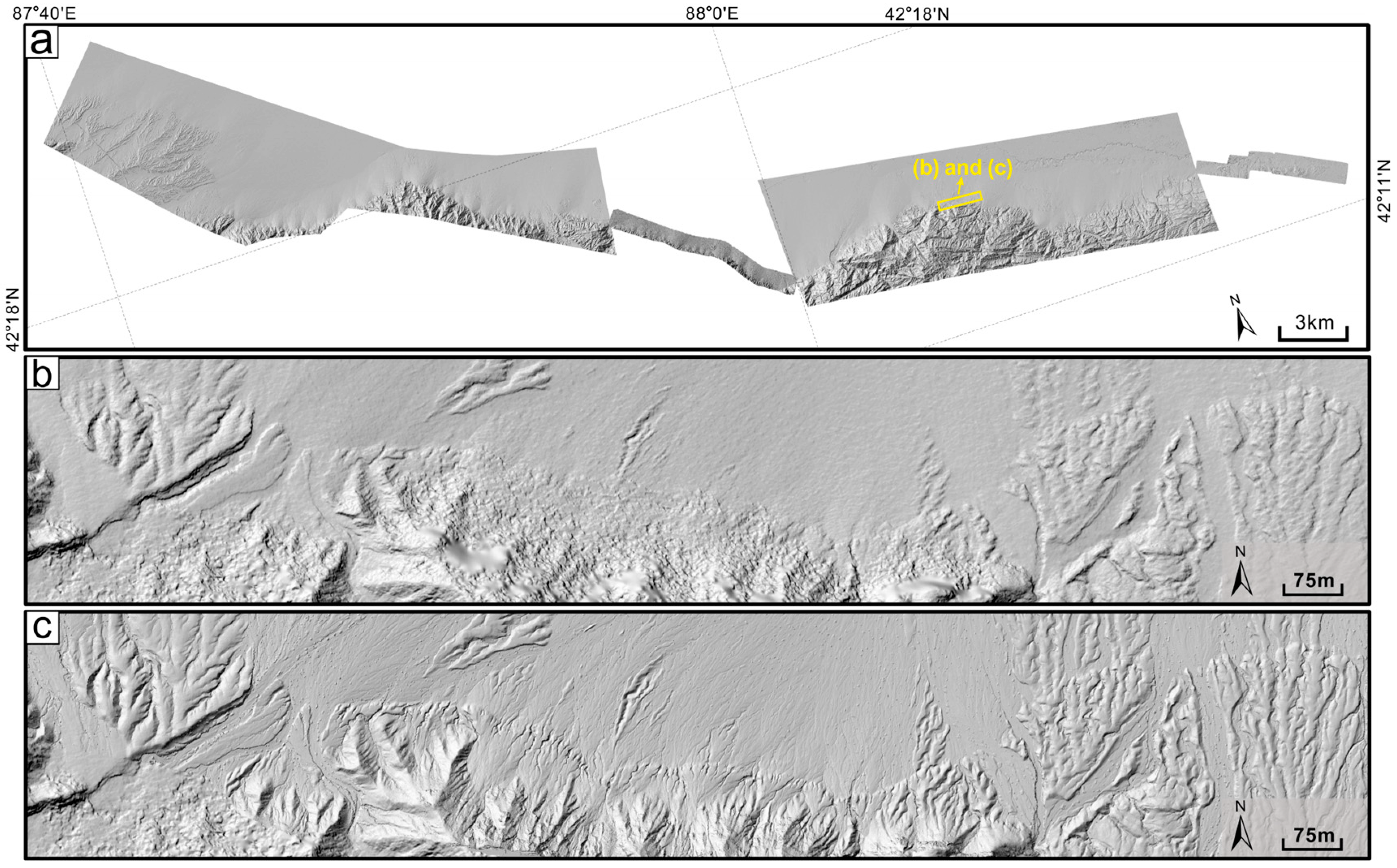
where Pi (i = 1, 2, 3, 4) are all third-order polynomial functions, with the independent variables being the normalized X, Y, and Z coordinates [40,45]. Based on this model, we processed the images using the PCI Geomatica 2016 (https://www.aeromapss.com/geomatica, accessed on 7 July 2025) and finally generated a 0.5 m-resolution DEM of the Kumysh Fault (Figure 3a).
However, the available satellite imagery in this area fails to fully cover the entire fault zone. Moreover, in regions affected by mountain shadows, DEMs derived from satellite stereo pairs were of poor quality, severely limiting rupture mapping and displacement measurement (Figure 3b). Therefore, for these areas, we used small quadrotor UAVs to perform supplementary photogrammetry via the Structure from Motion (SfM) method (Figure 2b). SfM is a computer vision technique for reconstructing 3D scene structures from a set of unordered 2D images [46,47,48,49]. With advancements in the UAV technology, most commercial UAVs are now equipped with RTK systems, which can achieve centimeter-level positioning accuracy through real-time communication with the reference station during the flight. Once communication with the reference station was established and the flight parameters were set, the flight missions could be executed automatically without the need for ground control points, greatly improving the survey efficiency. In this study, we conducted aerial surveys of three regions along the Kumysh Fault using the DJI Phantom 4 Pro and M4E UAVs (Shenzhen Dajiang Innovation Technology Co., Ltd, Shenzhen, China), flying at 100 m above the ground level, with an 80% forward overlap and a 70% side overlap, covering a total area of approximately 11.5 km2. After image acquisition, the data were processed using the Agisoft Metashape Pro v2.2.1 (https://metashape.cn/, accessed on 15 July 2025), resulting in DEMs with 5 cm resolution for the three regions (Figure 3a,c). The satellite and UAV DEMs were used separately in our study, and the main characteristics of the two DEM datasets were summarized in Table 1.
Figure 2. Basic principles of DEM extraction from satellite stereo image pairs (a) and UAV images (b) (Modified from Zhang et al. [43] and Bi et al. [49]).
Remotesensing 17 03847 g002
Figure 3. (a) DEM hillshade map of the Kumysh Fault generated from WorldView-2 stereo image pairs and UAV images; (b,c) Comparison of the DEM generated from WorldView-2 stereo image pairs (b) and UAV images (c) in the region affected by mountain shadows.
Remotesensing 17 03847 g003

3.2. Identification of Seismic Surface Rupture

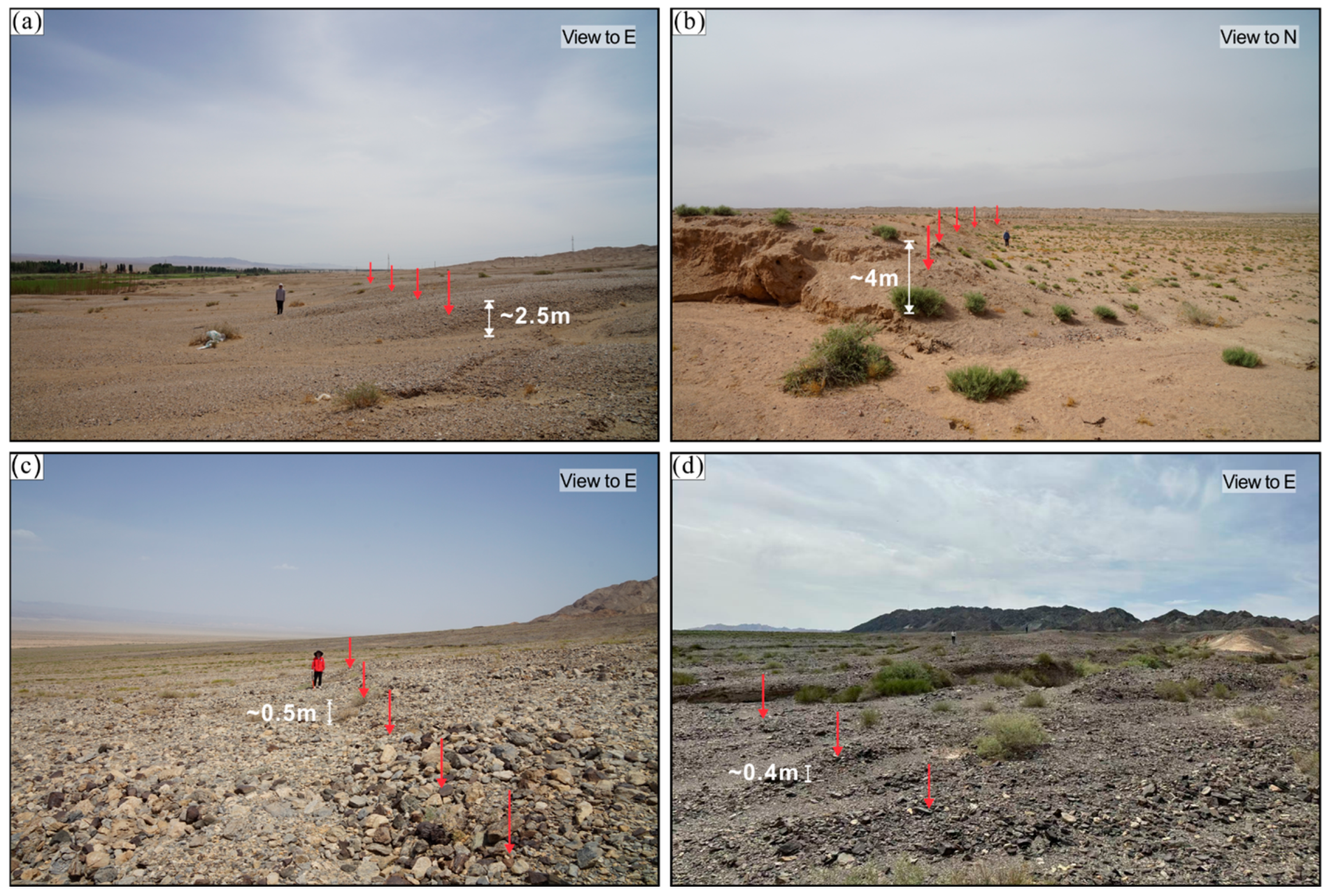
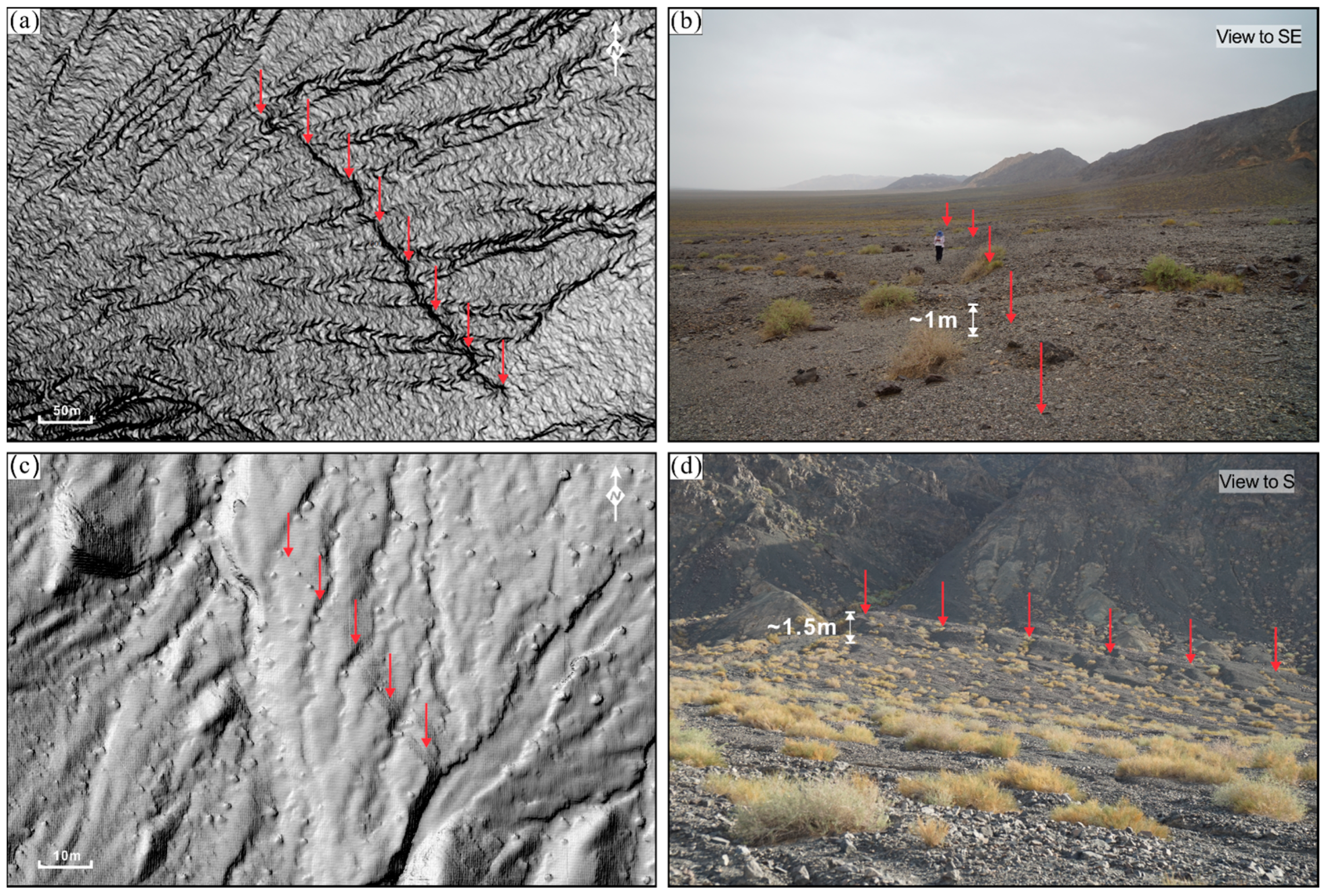
Based on the DEMs derived from multiple data sources, we used ESRI ArcGIS 10.8 (https://www.esri.com/en-us/arcgis/products/index, accessed on 18 July 2025) and Global Mapper v24.0 (https://www.bluemarblegeo.com/global-mapper/, accessed on 18 July 2025) software to generate both shaded relief and slope maps for rendering the regional topography. First, we carefully mapped the fault traces in ArcGIS based on shaded relief maps, slope maps, and orthophotos. After determining their general distribution, we conducted detailed field investigations at typical sites along the fault. Field observations revealed that reverse fault scarps dominate the surface rupture pattern on the Kumysh Fault, and clear morphological differences exist between the coseismic and cumulative fault scarps. Coseismic scarps are generally lower than 2 m in height, mostly distributed along mountain fronts or adjacent alluvial fans. Their upper surfaces are smooth and nearly uncut by drainage systems, and gravels on the scarp face generally remain in situ, except for some locations with large coseismic displacement where they collapse onto the lower surface. The scarps are relatively steep (typically >30°) and narrow (about 2–5 m wide), indicating limited erosion and degradation since their formation. In contrast, cumulative scarps are typically wider than 5 m and also gentler in slope (typically <20°) (Figure 4). In some areas with small coseismic displacements, clear height differences are difficult to observe in the field, but the deformation can be clearly detected on the slope map which is highly sensitive to subtle topographic variations on gently sloping alluvial fan surfaces. In this study, surface ruptures clearly observed in the field were first mapped, and additional coseismic ruptures were interpreted from slope maps where height differences were difficult to observe in the field.

3.3. Measurement of Vertical Displacement

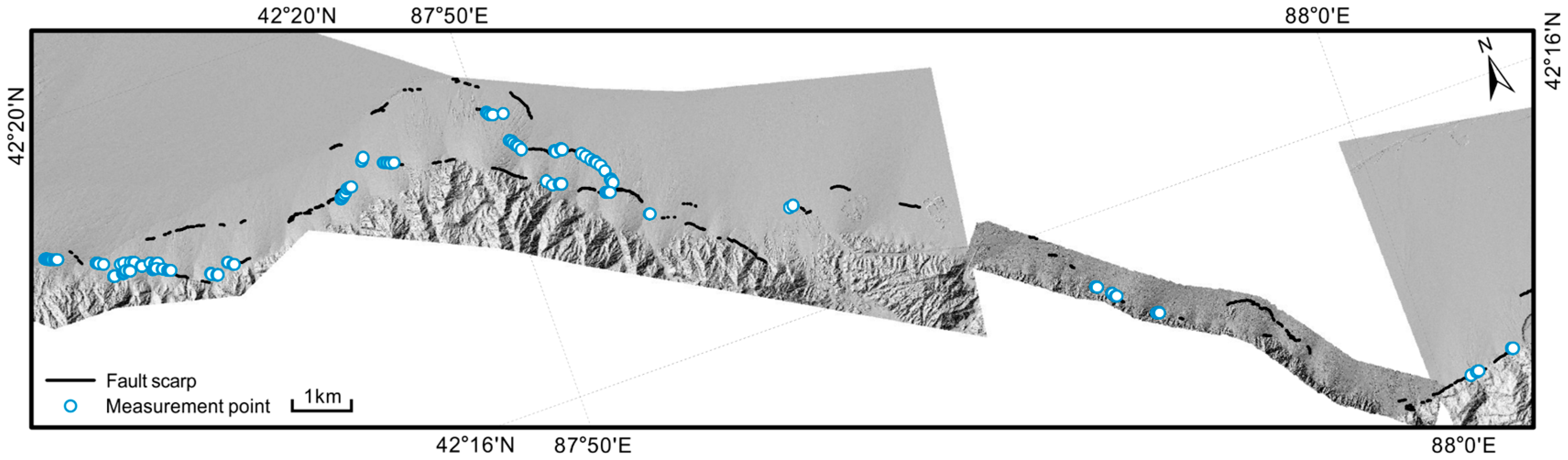
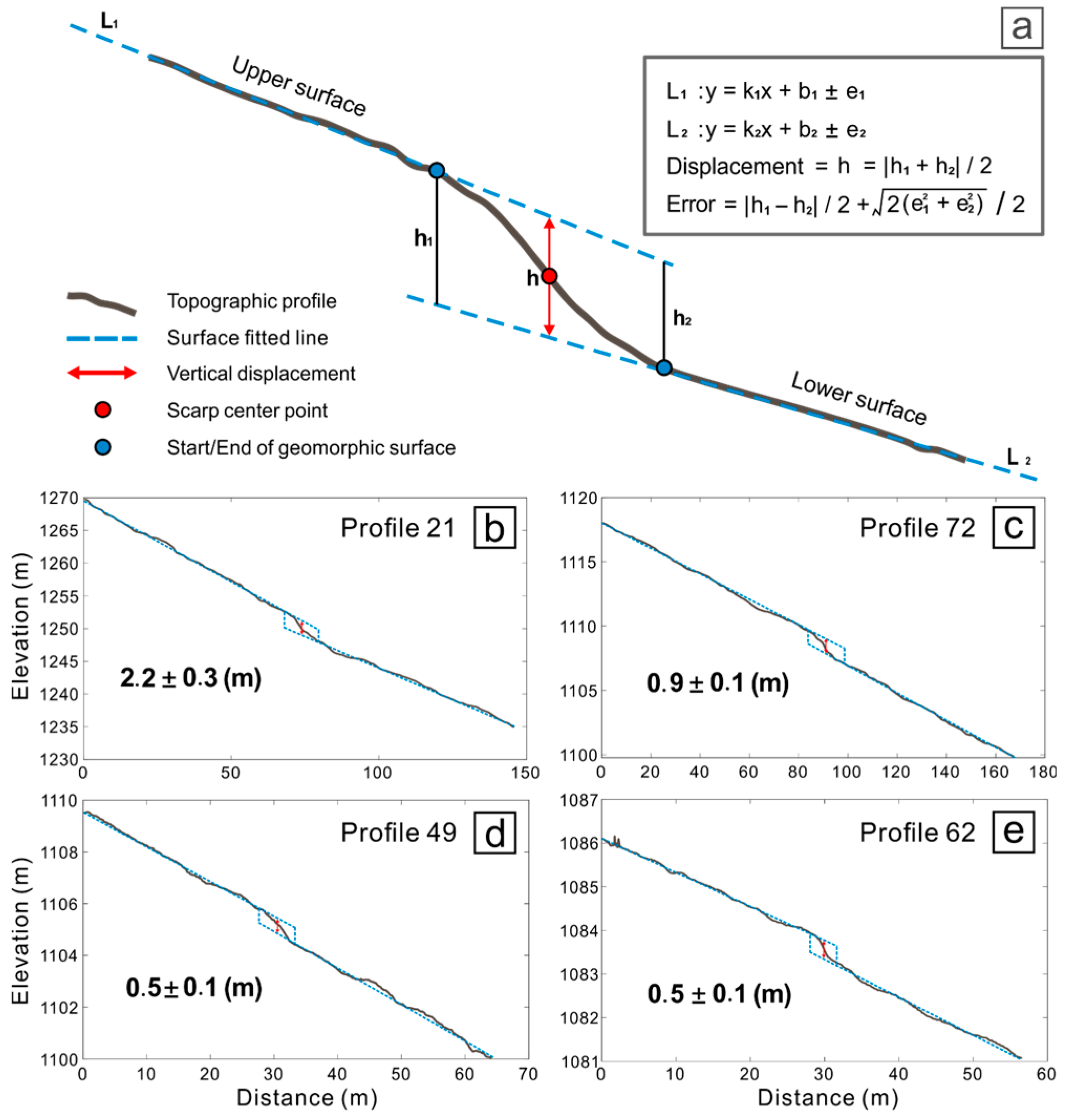
To obtain the distribution of coseismic vertical displacement along the rupture zone, we manually extracted 120 topographic profiles in Global Mapper based on the generated DEM (Figure 5), with lengths ranging from 10 to 460 m. The following principles are obeyed when extracting the profiles: (1) profiles should be oriented as perpendicular to the scarp as possible; (2) profiles should be as long as possible to identify potentially far-field deformation; (3) profiles should be positioned on surfaces with minimal erosion and degradation and away from gullies and river channels; (4) profiles should avoid locations where the slope difference between the upper and lower surfaces is large; (5) profiles should be deployed as densely as possible to reconstruct the along-strike variability of coseismic displacement. Then we exported the profiles as CSV files and used a semi-automated tool developed in Matlab R2024a (https://www.mathworks.com/products/matlab.html, accessed on 2 August 2025) to measure the vertical displacement. In this procedure, the user manually selects the start and end points on both the upper and lower surfaces, after which the software automatically fits the upper and lower surfaces with straight lines L1 and L2 using the least square method, and returns the fitting errors e1 and e2. Ideally, these two lines should be parallel, and their vertical separation corresponds to the measured displacement. However, in practice, slope differences between the upper and lower surfaces result in discrepancies between the vertical separation h1 and h2, with their difference positively correlated with the slope difference. In this study, the vertical displacement h was defined as the vertical separation of the two fitted lines at the scarp center (the mean of h1 and h2), and the measurement uncertainty e was calculated according to the law of error propagation (Figure 6).

4. Results

4.1. Geometry and Deformation Characteristics of the Surface Rupture

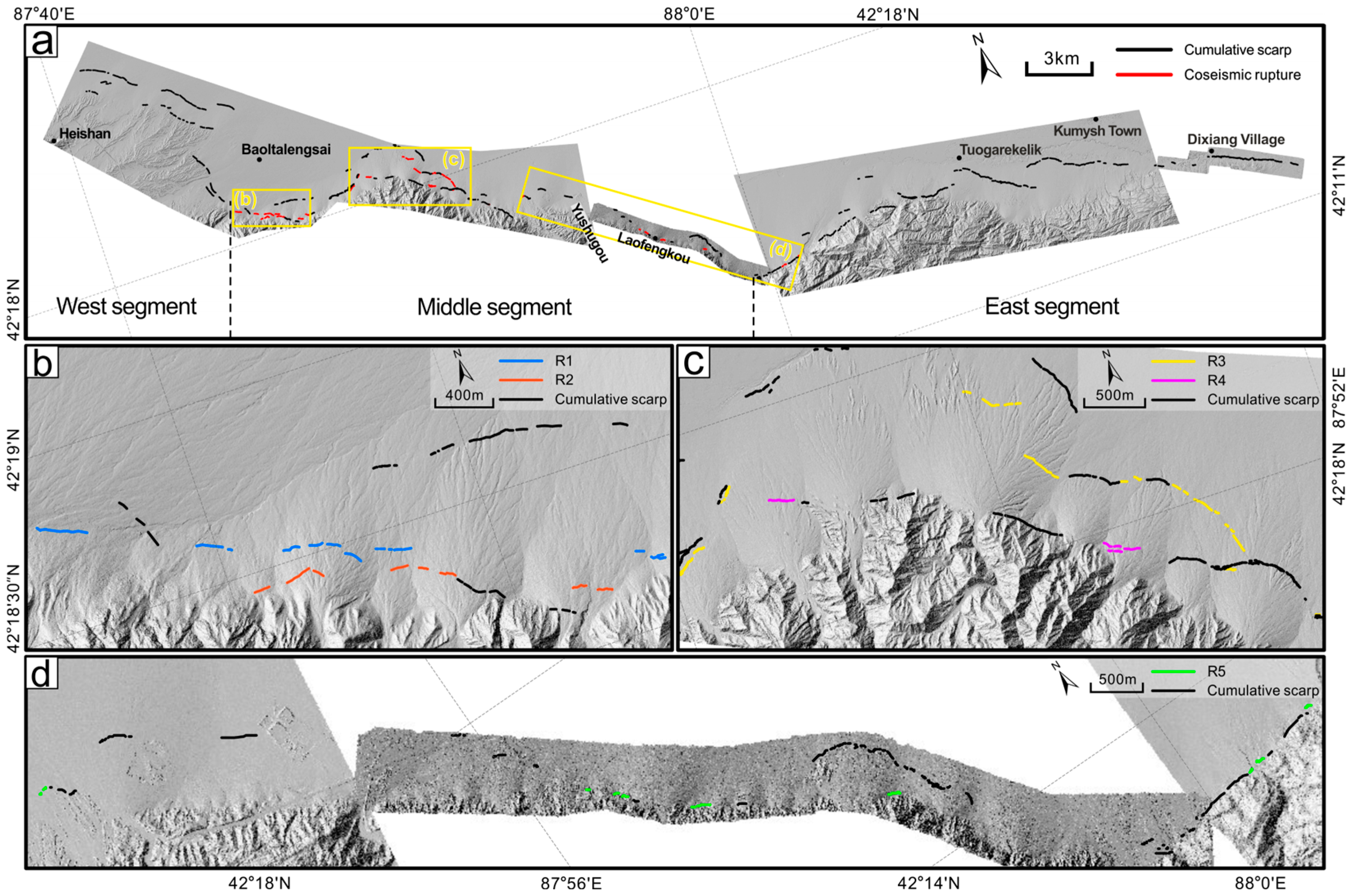
Based on high-resolution DEMs and orthophotos, combined with field investigations, we mapped both the coseismic surface ruptures and cumulative fault scarps along the Kumysh Fault (Figure 7a). The fault extends for ~53 km, starting from the margin of the alluvial fan at the piedmont of Heishan in the west and extending to the southeast of Dixiang Village in the east, with an overall NWW strike. It is mainly distributed across a series of alluvial fans developed along the mountain front, with some parts located adjacent to the piedmont. The fault shows poor continuity with many small sections separated by step-overs or gaps. Based on tectonic and geomorphic features, the Kumysh Fault was divided into the west, middle, and east segments, with two boundaries at the outlet of a paleochannel at Baoltalengsai and the southeast of Laofengkou, respectively. The west segment of the fault is characterized by high alluvial terraces and two nearly parallel fault scarps with minor strike variations. The middle segment exhibits discontinuous fault scarps with significant variations in strike, forming an arcuate, segmented pattern along the piedmont. In contrast, the east segment features relatively single, continuous fault scarps with a consistent strike (Figure 7a).
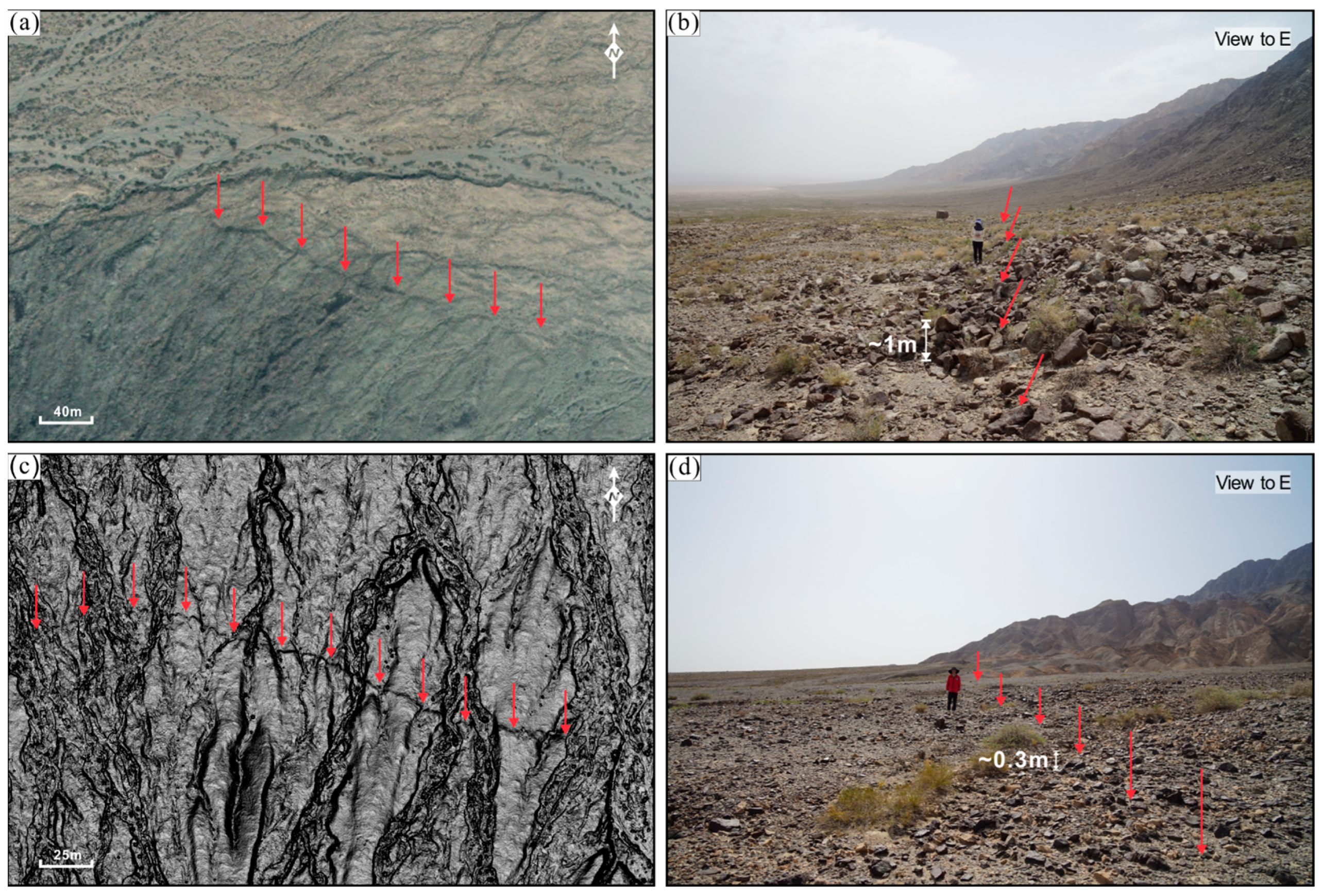
Based on a combination of high-resolution topographic data and field investigations, we found that the most recent earthquake ruptured the entire middle segment of the Kumysh Fault as well as the westernmost portion of its eastern segment (Figure 7a). The total length of the coseismic surface rupture zone is approximately 25 km, extending westward from the outlet of the paleochannel at Baoltalengsai and eastward to a dry riverbed at 88°01′E, consistent with the overall strike of the fault. The rupture is mainly characterized as reverse fault scarps, with generally poor continuity and multiple branching ruptures. Based on the geometric continuity of the rupture zone, we subdivided it into five secondary segments: R1–R5 (Figure 7b–d). At the west, the rupture is characterized by two nearly parallel branches, such as R1 and R2, and R3 and R4, whereas eastward it forms a single branch along the piedmont (R5). R1 is distributed on piedmont alluvial fan surfaces, striking nearly E–W, extending discontinuously for ~3.2 km. It offsets large fan gravels vertically by 0.5–1 m, with scarp widths of 2–3 m and slope angles of 30–35° (Figure 8b). R2, nearly parallel to R1 and closer to the mountain front, exhibits poorer continuity and an irregular trace with some strike variation, totaling ~1.8 km in length. Vertical displacements along R2 range from 0.4 to 2.2 m, with the measured maximum displacement of 2.2 m occurring ~0.3 km from the western end. Notably, cumulative fault scarps can be found at the eastern discontinuous section of R2, but no clear evidence of rupture from the most recent earthquake was observed on these scarps. R3 displays significant strike variation, trending NE at its western end and rapidly turning NW eastward, exhibiting a large arc-shaped distribution consistent with the orientation of both the cumulative scarps at the fan margin and the mountain front. The segment is ~4.3 km long, intermittently offsetting a series of piedmont alluvial fan surfaces with vertical displacements of 0.4–1.6 m. In situ gravels were well preserved at scarp faces and the scarp widths range from 2 to 5 m (Figure 3c and Figure 7b). R4 corresponds to the piedmont segment overlapping with R3, appearing as a straight linear trace in the hillshade image, trending NW, ~4 km long, with vertical displacements of 0.2–1.7 m. The western scarp of R4 is subtle, with gentle slopes and small displacements (Figure 8d). Although these subtle surface offsets are difficult to observe in the field, they are clearly visible in the slope maps (Figure 8c). R4 extends eastward along the piedmont and finally intersects with the eastern end of R3. R5 is a single-branch rupture located east of R3. It begins northwest of Yushugou, follows the piedmont through Yushugou and Laofengkou, and ends at the west bank of a dry riverbed at 88°01′E. This segment has a total length of ~12.5 km and an overall NW strike. It shows poor continuity with ruptures only sporadically distributed along the piedmont, with vertical displacements of ~0.2–1.6 m. The deformation patterns also vary significantly along this segment. Scarps at the western end are low and gentle (Figure 4d), whereas in the central portion both scarp height and slope become much larger (Figure 9d). The detailed geometric parameters of each rupture segment were summarized in Table 2.

4.2. Distribution of Coseismic Displacement Along the Rupture

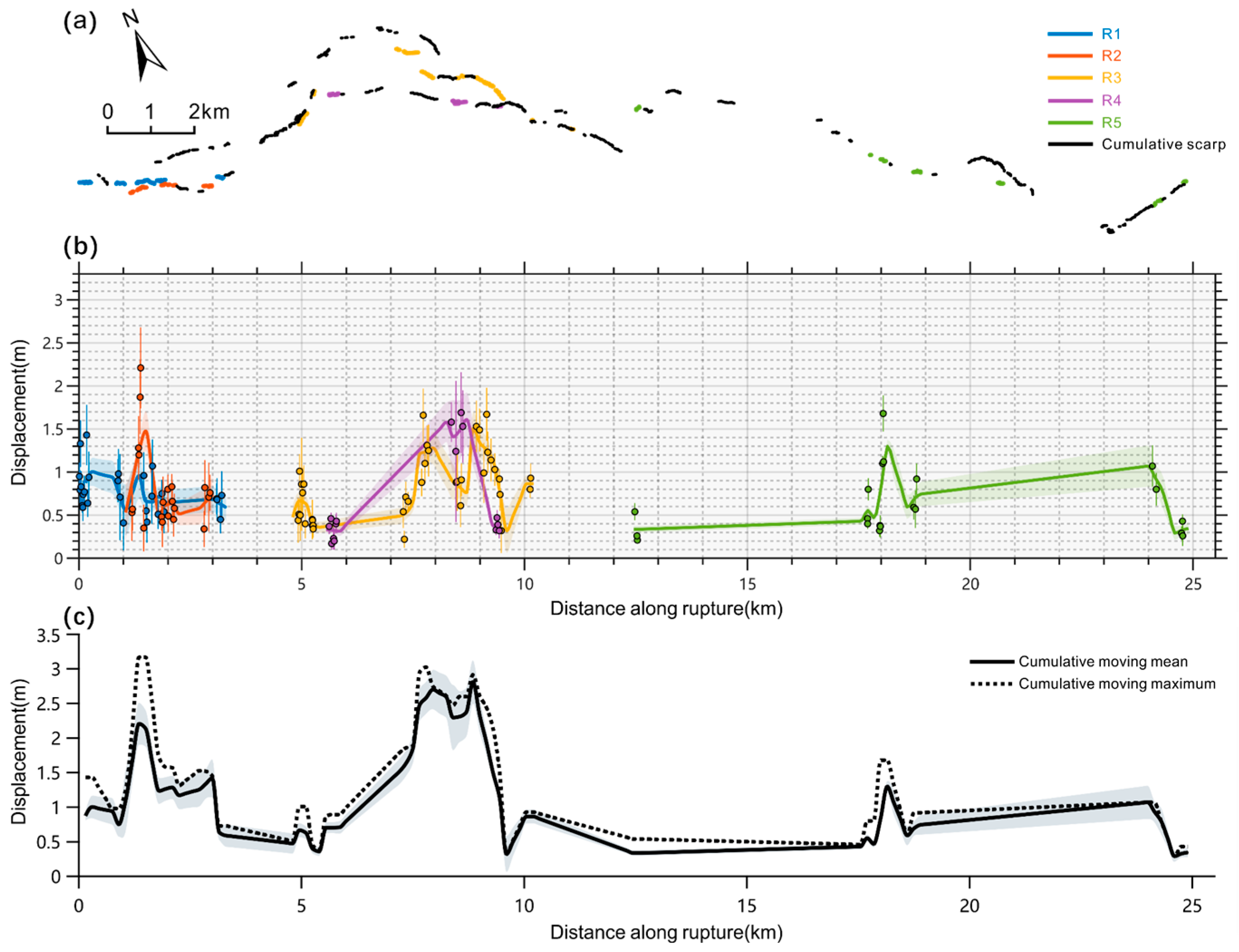
Based on the high-resolution DEMs, and applying the method described in Section 3.3, we measured a total of 120 vertical displacements (85 from the WorldView-2 DEM and 35 from the UAV DEM) along the ~25 km surface rupture zone of the Kumysh Fault. These measurements include both cosesimic and post-seismic components. However, as post-seismic displacements are generally much smaller than cosesimic displacements, the values reported here are approximated as the cosesimic displacements. All measurements can be found in Table S1 in the Supplementary Materials. Figure 10b shows all displacement measurements along the strike of the rupture. According to the segmentation defined in Section 4.1, the displacement measurements were categorized by segment using different colors. Our mapping results reveal that the rupture zone is composed of multiple nearly parallel, overlapping branching ruptures (such as R1 and R2, R3 and R4) which may have merged together at depth (Figure 7). It is thus inappropriate to observe displacement variation simply from the envelope of these scattered measurements. Instead, displacement values from overlapping branches should be summed to represent the true total displacement. For each rupture segment, we firstly showed displacement distributions using a moving-window approach with a 0.3 km window size and a 0.15 km step length. The window size and step length were determined according to the density of our vertical displacement measurements. The chosen values ensure that the displacement curve accurately reflects the overall trend without significant local fluctuations. Within each window, both the mean and maximum displacements were calculated, and for windows lacking displacement values, linear interpolation at a 0.15 km spacing was applied to ensure each window contains data. These values were then connected to construct the moving-mean and moving-maximum displacement curves for each rupture segment. The moving-mean displacement curve was accompanied by an uncertainty boundary (shaded area in Figure 10c), which was derived from the errors of all displacement measurements within each window based on error propagation theory. Finally, overlapping portions of different segments were summed to produce the cumulative moving-mean and moving-maximum displacement curves for the entire rupture zone. It should be noted that each curve type offers distinct advantages in depicting displacement distribution: the moving-mean curves reduce measurement uncertainties, whereas the moving-maximum curves better capture displacement signals potentially underestimated due to far-field deformation or scarp degradation [7].
Figure 10b displays both the coseismic displacement measurements and moving-mean curves for each rupture segment. The displacements along R1 exhibit little variation, generally ranging between 0.5 and 1 m, with the maximum value located near the westernmost end and gradually decreasing eastward, rather than forming an asymmetric triangular distribution as observed on other segments. Displacements along R2 display a steep gradient, increasing rapidly from 0.5 m at ~1 km to a peak of 1.5 m at ~1.5 km, and then decreasing sharply to ~0.6 m. R3 shows an asymmetric triangular pattern with the apex shifted eastward, yielding minimum values of 0.4 m and 0.3 m at its two ends and a maximum of 1.5 m at ~9 km. R4 exhibits a similar distribution pattern to R3, also forming a left-gentle, right-steep asymmetric triangular shape, with minimum values of 0.3 m at both ends and a maximum of 1.6 m at ~8.6 km. Unlike other segments, R5 contains two peaks of 1.3 m at ~18 km and 1.1 m at ~24 km. We interpret that this pattern could be caused by the lower density of displacement measurements on this segment. Nevertheless, the overall distribution resembles an asymmetric triangle that is gentler on the left and steeper on the right, with minimum values occurring at both ends.
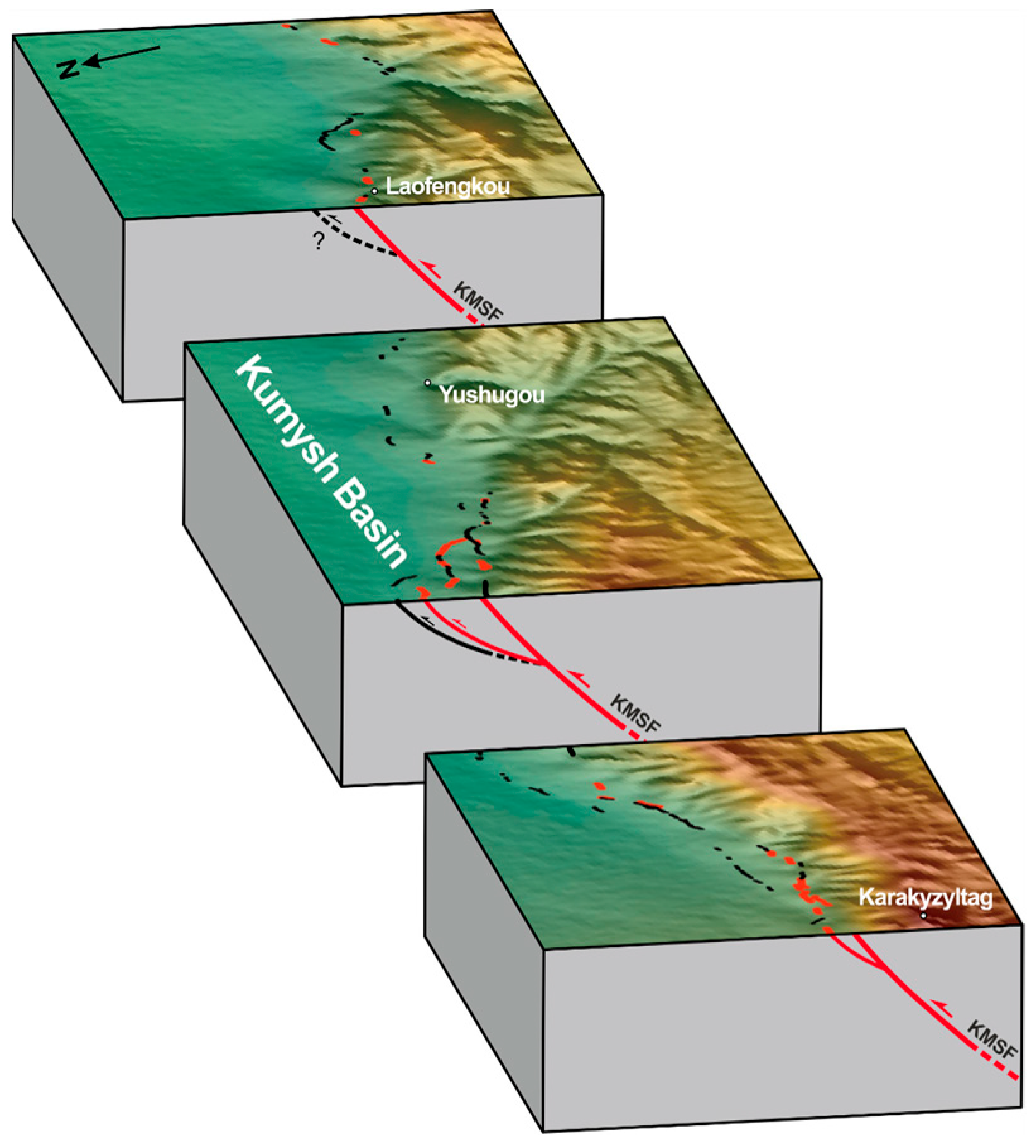
Figure 10c shows the coseismic displacement distribution curves (both moving mean and maximum) of the rupture by summing the displacement curves of overlapping segments. Peak values of 2.8 m (mean) at ~9 km and 3.2 m (maximum) at ~1.5 km indicate a maximum displacement of 2.8–3.2 m, while mean values of 0.9 m (mean) and 1.1 m (maximum) suggest an average displacement of 0.9–1.1 m. Both curves display similar patterns, with three asymmetric triangular peaks at 1–2 km, 7–9 km, and 17–19 km. The apex of the 0–5 km triangle is shifted westward, while those of the 5–10 km and 10–25 km triangles are shifted eastward. Reduced displacements between these peaks may indicate discontinuous subsurface structures [6,50]. Overall, the rupture exhibits strong along-strike displacement variability, with obvious displacement deficit zones at 3–7 km and 10–17 km dividing it into three asymmetric triangles (Figure 10c). The markedly lower displacements within these deficit zones could suggest that the five surface segments may merge into three discontinuous subsurface sections (Figure 11), which together accommodated the earthquake deformation.

5. Discussions

5.1. Length of the Surface Rupture Zone

The length is an important parameter of coseismic surface ruptures, directly reflecting the rupture area and closely linked to earthquake magnitude [8,10]. Based on high-resolution topographic data and field geomorphic investigations, we determined that the coseismic rupture zone of the Kumysh Fault is approximately 25 km long. However, we consider this length to be the lower bound of the actual surface rupture length, mainly for two reasons. First, there are no barriers at either end of the rupture zone to limit its continued propagation. At the western terminus, although located at the junction of the middle and west segments of the fault, there is no large geometric discontinuity, and the fault trace also shows little change in strike. Moreover, the displacement does not decrease to significant lower values at the western termination, where the mean displacement remains above 1 m (greater than the moving-mean average of 0.9 m), and the maximum displacement reaches nearly 1.5 m (exceeding the moving-maximum average of 1.1 m) (Figure 10). This is notable because numerous examples demonstrate that displacements at rupture zone tips typically decrease markedly [10,51,52]. Thus, we infer that the rupture zone likely extends farther west. At the eastern terminus, the rupture is only sporadically distributed along the mountain front, where steep slopes and strong hydrodynamic conditions have hindered its preservation, making the identification of surface ruptures in this area particularly challenging. In our mapping results, we mapped only those rupture traces that could be clearly identified, and how far east the rupture propagates remains difficult to constrain. Second, empirical relationships between rupture length and other rupture parameters provide additional reference [8]. Using the empirical relationship between rupture length and average displacement (Equation (3) in Table 3), the average displacement of 0.9–1.1 m corresponds to a rupture length of 27–29 km. Likewise, applying the maximum displacement relation (Equation (4)) with 2.8–3.2 m gives a rupture length of 33–34 km. Both estimates exceed 25 km. Taken together, these observations suggest that 25 km represents the minimum length of the coseismic surface rupture along the Kumysh Fault.

5.2. Seismic Potential of the Kumysh Fault

Researchers have compiled extensive global datasets of historical earthquakes and their rupture parameters, and established a series of empirical relationships between them [8,10,51,52]. These relationships serve as crucial references for estimating the magnitude of unknown earthquakes and predicting surface rupture parameters for known events, forming an important basis for seismic hazard assessments. In this study, we quantified the rupture length and displacement of the coseismic surface ruptures along the Kumysh Fault based on high-resolution topographic data and detailed field geomorphic surveys, thereby constraining the magnitude of the most recent earthquake. The interpreted rupture zone length is 25 km (Figure 7). Application of this value to the empirical relationship between moment magnitude and rupture length from Wells and Coppersmith [8] (Equation (5)) yields an Mw of 6.7. The same magnitude is obtained using the relation of Wesnousky et al. [10] (Equation (6)). Likewise, when we applied the average displacement of 0.9–1.1 m and the maximum displacement of 2.8–3.2 m (calculated in Section 4.2) to the relations (Equations (7) and (8)), we obtained magnitude of Mw 6.6 and Mw 6.7, respectively (Table 4). It is noteworthy that for each magnitude estimate derived from a specific set of rupture parameters, we have listed the corresponding standard deviations following [8,10] to assess its associated uncertainties (Table 4). We emphasize, however, that our rupture length represents a minimum value, as discussed in Section 5.1. In addition, folding deformation and scarp degradation may have reduced the measurable displacement, meaning our displacement values also likely represent minimum estimates. Consequently, the magnitude derived from empirical formulas may represent the minimum magnitude for this earthquake, with the possibility of exceeding Mw 6.7. As to the earthquake’s occurrence time, we have searched all modern instrumental earthquake records and did not find any earthquake event with its epicenter located on or near the Kumysh Fault. Considering that the coseismic fault scarps are not that fresh, we think they may be caused by an event occurred before the instrumental period (since 1970), maybe a historical event or an even earlier paleoearthquake. In the future, we may try to constrain the specific occurrence time of this earthquake through paleoseismic trench excavation on the fault.
Our mapping results of fault traces show that in the transition zones between the middle segment and the other segments, the fault trace shifts from the alluvial fan to the mountain front, linking with the adjacent segments (Figure 7a). We consider these areas likely pathways for rupture propagation across segments. This interpretation is supported by the latest earthquake event whose ruptures extended into the mountain-front section of the east segment. As Wesnousky et al. [10] noted, although examples of reverse faults are scarce globally, it is known that ruptures on reverse faults can propagate across larger geometric discontinuities compared to strike-slip faults. We therefore conclude that, although the latest earthquake ruptured mainly the middle segment, the Kumysh Fault retains the potential for multi-segment ruptures in the future. Such events could generate larger-magnitude earthquakes, confirming that the Kumysh Fault is fully capable of producing major earthquakes.

5.3. Implications for the Growth and Propagation of the Kumysh Fault

Previous studies have suggested that small-scale faults would undergo progressive lateral growth and linkage during their evolution process [50,53]. Lateral growth is initially expressed as the propagation of isolated small fault segments toward one another. This stage, in which segments influence each other without being obviously connected, is referred to as “soft linkage.” Once barriers are breached and a substantial connection is established, lateral growth of the fault is achieved [50,53,54,55,56]. Coseismic displacement distribution describes the spatial variation in surface displacement along strike during an earthquake and is closely related to the geometric complexity of the fault. When fault segments remain in a state of “soft linkage”, displacements often decrease markedly at segment junctions (such as step-overs or gaps), which will produce distinct troughs in the displacement distribution curve. With the progressive linkage of small segments, the displacement distribution curve tends to smooth out, and the fault trace becomes more continuous. This process also reflects an increase in fault maturity [40,50,57]. Mapping of the Kumysh Fault trace (Figure 7a) reveals a complex geometry, characterized by many small sections and multiple bends, step-over zones, and gaps existing among them. Furthermore, the mapped surface rupture zone also displays a discontinuous geometric structure along strike. In the central part (5–10 km), it distributes primarily across piedmont alluvial fans whereas at both ends it is restricted to the mountain front, forming obvious step-over zones between them. These zones correspond to the areas of distinct troughs in the displacement distribution (Figure 10), suggesting that the segments on the alluvial fan and those at the mountain front are not yet fully linked. The obvious low displacement values between them indicate that they may now be in a state of “soft linkage”, having previously moved independently, as also supported by their differing orientations. Based on segment length, geometric continuity and displacement distribution, it can be inferred that the Kumysh Fault is of low maturity and still at the stage of lateral growth and linkage between small segments.
Thrust faults are commonly located at the mountain–basin boundaries. In addition to lateral growth and linkage along strike, continued tectonic compression can drive the fault to extend along the detachment of the sedimentary basin and develop into a series of imbricate branching faults, generally expressed as multiple subparallel fault scarps at the surface [58,59,60]. Based on our mapped fault geometry and rupture model of the most recent event (Figure 11), the Kumysh Fault is currently undergoing this stage of expansion from the mountain front towards the basin. However, the expansion time and activity feature may differ among the three segments. The middle segment is generally distributed along the mountain front, with the most forward section only ~1 km away from the mountain front. During the most recent earthquake, most of the ruptures occurred along the mountain front, confirming that the middle segment was dominated by mountain-front activity with limited propagation towards the basin. In contrast, field investigations indicate that the mountain-front sections of the west segment are no longer active, and the current active portions have already migrated 5–6 km away from the mountain front into the basin where obvious fault scarps with heights of 6–8 m have developed. Similarly, in the east segment, except for a small mountain-front portion near the middle segment that still shows activity, most of the active sections have already propagated 3–4 km away from the mountain front onto the alluvial fans. Taking these pieces of evidence together, it is suggested that the propagation of the middle segment towards the basin lagged behind the other two segments. Its deformation has preferentially occurred at the mountain front over the past period, which also explains why the mountains in the middle segment are significantly steeper than those in the west and east segments.

6. Conclusions

In this study, WorldView stereo satellite imagery and UAV photogrammetry were employed to generate high-resolution DEMs and orthophotos covering an area of approximately 220 km2 around the Kumysh Fault in eastern Tianshan. Based on these datasets, combined with field investigations, we mapped the spatial geometry of the seismic rupture zone along the Kumysh Fault and measured coseismic displacements along the rupture. The main findings are as follows:
  • The surface rupture zone of the Kumysh Fault extends through the entire middle segment of the fault and into part of the east segment, with a total length of ~25 km, consistent with the overall strike of the fault. The rupture is generally discontinuous and divided into five secondary segments, with surface deformation mainly manifested as thrust fault scarps.
  • Coseismic displacement along the rupture shows significant variation along strike, with an average displacement of 0.9–1.1 m and a maximum displacement of 2.8–3.2 m. Combining this displacement data with a rupture length of 25 km, we estimated the earthquake magnitude to be Mw 6.6–6.7.
  • The along-strike displacement distribution is represented by three asymmetric triangles, with displacement deficits occurring in step-over zones where the rupture transitions from the alluvial fan to the mountain front. This suggests that the segments on the alluvial fan and those at the mountain front have not yet fully linked, indicating that the fault is still in the stage of lateral growth and linkage between small segments.
  • Different segments of the Kumysh Fault show distinct patterns of activity. The middle segment is dominated by mountain-front activity, with only limited signs of propagation towards the basin. In contrast, the east and west segments exhibit inactive mountain-front portions, with the latest activity having propagated into the basin. The middle segment is therefore the most delayed in its propagation towards the basin on the entire fault zone.
In summary, this study establishes a framework for analyzing surface ruptures on geometrically complex thrust faults, which can also be applied in other tectonic contexts, particularly in areas characterized by poorly documented reverse faults or complex morphologies. Several limitations remain, however. The timing of the earthquake remains undetermined, and the rupture termination points require better constraint. Future work will therefore employ paleoseismic trenching and chronological sampling to date the event, supplemented by numerical simulations to further restrict the rupture process of this event.

Supplementary Materials

The following supporting information can be downloaded at https://www.mdpi.com/article/10.3390/rs17233847/s1, Table S1: Vertical displacement data.

Author Contributions

Conceptualization, J.H., H.B. and W.Z.; methodology, J.H., H.B. and W.Z.; software, J.H. and H.Q.; validation, H.B. and W.Z.; formal analysis, J.H. and H.B.; investigation, J.H., H.B., W.Z., H.Q., F.Y., X.C. and J.Y.; data curation, J.H. and H.Q.; writing—original draft preparation, J.H.; writing—review and editing, H.B., H.Q. and W.Z.; supervision, H.B.; project administration, H.B.; funding acquisition, H.B. All authors have read and agreed to the published version of the manuscript.

Funding

This research was supported by the Second Tibetan Plateau Scientific Expedition and Research Program (STEP), grant number 2019QZKK0901.

Data Availability Statement

The original contributions presented in this study are included in the article/Supplementary Materials. Further inquiries can be directed to the corresponding author.

Conflicts of Interest

The authors declare no conflicts of interest.

References

  1. Ren, Z. Geometry and Deformation Features of the Most Recent Co-Seismic Surface Ruptures along the Xiaojiang Fault and Its Tectonic Implications for the Tibetan Plateau. J. Asian Earth Sci. 2013, 77, 21–30. [Google Scholar] [CrossRef]
  2. Lin, A.; Sano, M.; Yan, B.; Wang, M. Co-Seismic Surface Ruptures Produced by the 2014 Mw 6.2 Nagano Earthquake, along the Itoigawa–Shizuoka Tectonic Line, Central Japan. Tectonophysics 2015, 656, 142–153. [Google Scholar] [CrossRef]
  3. Yuan, Z.; Liu, J.; Li, X.; Xu, J.; Yao, W.; Han, L.; Li, T. Detailed mapping of the surface rupture of the 12 February 2014 Yutian Ms 7.3 earthquake, Altyn Tagh fault, Xinjiang, China. Sci. China Ser. D Earth Sci. 2021, 64, 127–147. (In Chinese) [Google Scholar] [CrossRef]
  4. He, H. Deformation Characteristics and Displacement Distribution of the Surface Rupture Zone of the 1985 Wuia Mw 6.9 Earthquake. Master’s Thesis, Institute of Geology, China Earthquake Administration, Beijing, China, 2023. (In Chinese). [Google Scholar]
  5. McGill, S.F.; Rubin, C.M. Surficial Slip Distribution on the Central Emerson Fault during the June 28, 1992, Landers Earthquake, California. J. Geophys. Res. Solid Earth 1999, 104, 4811–4833. [Google Scholar] [CrossRef]
  6. Middleton, T.A.; Walker, R.T.; Parsons, B.; Lei, Q.; Zhou, Y.; Ren, Z. A Major, Intraplate, Normal-faulting Earthquake: The 1739 Yinchuan Event in Northern China. J. Geophys. Res. Solid Earth 2016, 121, 293–320. [Google Scholar] [CrossRef]
  7. DuRoss, C.B.; Gold, R.D.; Dawson, T.E.; Scharer, K.M.; Kendrick, K.J.; Akciz, S.O.; Angster, S.J.; Bachhuber, J.; Bacon, S.; Bennett, S.E.K.; et al. Surface Displacement Distributions for the July 2019 Ridgecrest, California, Earthquake Ruptures. Bull. Seismol. Soc. Am. 2020, 110, 1400–1418. [Google Scholar] [CrossRef]
  8. Wells, D.L.; Coppersmith, K.J. New Empirical Relationships among Magnitude, Rupture Length, Rupture Width, Rupture Area, and Surface Displacement. Bull. Seismol. Soc. Am. 1994, 84, 974–1002. [Google Scholar] [CrossRef]
  9. Hanks, T.C. A Bilinear Source-Scaling Model for M-Log A Observations of Continental Earthquakes. Bull. Seismol. Soc. Am. 2002, 92, 1841–1846. [Google Scholar] [CrossRef]
  10. Wesnousky, S.G. Displacement and Geometrical Characteristics of Earthquake Surface Ruptures: Issues and Implications for Seismic-Hazard Analysis and the Process of Earthquake Rupture. Bull. Seismol. Soc. Am. 2008, 98, 1609–1632. [Google Scholar] [CrossRef]
  11. Meng, J.; Kusky, T.; Mooney, W.D.; Bozkurt, E.; Bodur, M.N.; Wang, L. Surface Deformations of the 6 February 2023 Earthquake Sequence, Eastern Türkiye. Science 2024, 383, 298–305. [Google Scholar] [CrossRef] [PubMed]
  12. Sun, H.; Yuan, D.; Su, R.; Li, S.; Wang, Y.; Wen, Y.; Chen, Y. The Seismic Surface Rupture Zone in the Western Segment of the Northern Margin Fault of the Hami Basin and Its Causal Interpretation, Eastern Tianshan. Remote Sens. 2024, 16, 4200. [Google Scholar] [CrossRef]
  13. Sun, X.; Zheng, W.; Zhang, D.; Zhou, H.; Bi, H.; Feng, Z.; Liu, B. Identifying the Latest Displacement and Long-Term Strong Earthquake Activity of the Haiyuan Fault Using High-Precision UAV Data, NE Tibetan Plateau. Remote Sens. 2025, 17, 1895. [Google Scholar] [CrossRef]
  14. Wen, Y.; Yuan, D.; Yu, J.; Shao, Y.; Li, S.; Wang, Y.; Xiao, Q. The Latest Surface Rupture along the Western Segment of the Qilian–Haiyuan Fault and Its Implications. J. Struct. Geol. 2025, 198, 105448. [Google Scholar] [CrossRef]
  15. Gold, R.D.; Clark, D.; Barnhart, W.D.; King, T.; Quigley, M.; Briggs, R.W. Surface Rupture and Distributed Deformation Revealed by Optical Satellite Imagery: The Intraplate 2016 Mw 6.0 Petermann Ranges Earthquake, Australia. Geophys. Res. Lett. 2019, 46, 10394–10403. [Google Scholar] [CrossRef]
  16. Li, Z.; Xu, X.; Ren, J.; Li, K.; Kang, W. Vertical Slip Distribution along Immature Active Thrust and Its Implications for Fault Evolution: A Case Study from Linze Thrust, Hexi Corridor. Earth Sci. 2022, 47, 831–843. (In Chinese) [Google Scholar]
  17. Philip, H.; Rogozhin, E.; Cisternas, A.; Bousquet, J.C.; Borisov, B.; Karakhanian, A. The Armenian Earthquake of 1988 December 7: Faulting and Folding, Neotectonics and Palaeoseismicity. Geophys. J. Int. 1992, 110, 141–158. [Google Scholar] [CrossRef]
  18. Jin, K.; Kim, Y. Review and New Interpretation for the Propagation Characteristics Associated with the 1999 Chi-Chi Earthquake Faulting Event. Isl. Arc 2010, 19, 659–675. [Google Scholar] [CrossRef]
  19. Xu, X.; Chen, G.; Yu, G.; Sun, X.; Tan, X.; Chen, L.; Sun, J.; Chen, Y.; Chen, W.; Zhang, S.; et al. Reevaluation of surface rupture parameters of the 5·12 Wenchuan earthquake and its tectonic implication for Tibetan uplift. Chin. J. Geophys. 2010, 53, 2321–2336. (In Chinese) [Google Scholar]
  20. Xu, X.; Yu, G.; Chen, G.; Ran, Y.; Li, C.; Chen, Y.; Chang, C. Parameters of Coseismic Reverse- and Oblique-Slip Surface Ruptures of the 2008 Wenchuan Earthquake, Eastern Tibetan Plateau. Acta Geol. Sin. Engl. Ed. 2009, 83, 673–684. [Google Scholar] [CrossRef]
  21. Cao, X.; Hu, X.; Pan, B.; Zhang, J.; Wang, W.; Mao, J.; Liu, X. A Fluvial Record of Fault-Propagation Folding along the Northern Qilian Shan Front, NE Tibetan Plateau. Tectonophysics 2019, 755, 35–46. [Google Scholar] [CrossRef]
  22. Tali, N.; Lashkaripour, G.R.; Hafezi Moghadas, N.; Ghalandarzadeh, A. Centrifuge Modeling of Reverse Fault Rupture Propagation through Single-Layered and Stratified Soil. Eng. Geol. 2019, 249, 273–289. [Google Scholar] [CrossRef]
  23. Zielke, O.; Arrowsmith, J.R.; Ludwig, L.G.; Akçiz, S.O. Slip in the 1857 and Earlier Large Earthquakes Along the Carrizo Plain, San Andreas Fault. Science 2010, 327, 1119–1122. [Google Scholar] [CrossRef] [PubMed]
  24. Klinger, Y.; Etchebes, M.; Tapponnier, P.; Narteau, C. Characteristic Slip for Five Great Earthquakes along the Fuyun Fault in China. Nat. Geosci. 2011, 4, 389–392. [Google Scholar] [CrossRef]
  25. Liu, J.; Chen, T.; Zhang, P.; Zhang, H.; Zheng, W.; Ren, Z.; Liang, S.; Sheng, C.; Gan, W. Illuminating the active Haiyuan fault, China by Airborne Light Detection and Ranging. Chin. Sci. Bull. Chin. Ver. 2013, 58, 41–45. (In Chinese) [Google Scholar]
  26. Bi, H.; Zheng, W.; Lei, Q.; Zeng, J.; Zhang, P.; Chen, G. Surface Slip Distribution Along the West Helanshan Fault, Northern China, and Its Implications for Fault Behavior. J. Geophys. Res. Solid Earth 2020, 125, e2020JB019983. [Google Scholar] [CrossRef]
  27. Johnson, K.L.; Nissen, E.; Lajoie, L. Surface Rupture Morphology and Vertical Slip Distribution of the 1959 Mw 7.2 Hebgen Lake (Montana) Earthquake From Airborne Lidar Topography. J. Geophys. Res. Solid Earth 2018, 123, 8229–8248. [Google Scholar] [CrossRef]
  28. Wang, S. Late Quaternary Kinematic Characteristics of the Kumysh Fault in the Eastern Tian Shan. Master’s Thesis, Institute of Geology, China Earthquake Administration, Beijing, China, 2019. (In Chinese). [Google Scholar]
  29. Wang, S.; Jiao, R.; Ren, Z.; Wu, C.; Ren, G.; Zhang, H.; Lei, Q. Active Thrusting in an Intermontane Basin: The Kumysh Fault, Eastern Tian Shan. Tectonics 2020, 39, e2019TC006029. [Google Scholar] [CrossRef]
  30. Deng, Q.; Zhang, P.; Ran, Y.; Yang, X.; Min, W.; Chu, Q. Basic characteristics of active tectonics in China. Sci. China Ser. D Earth Sci. 2002, 46, 1020–1030, 1057. (In Chinese) [Google Scholar] [CrossRef]
  31. Xiao, W.-J. Paleozoic Accretionary and Collisional Tectonics of the Eastern Tianshan (China): Implications for the Continental Growth of Central Asia. Am. J. Sci. 2004, 304, 370–395. [Google Scholar] [CrossRef]
  32. Yang, Z.; Zhang, X.; Zhao, R.; Zhou, W. Characteristics of shallow and deep structures of the middle segment of Tianshan Mountains, China. Seismol. Geol. 2005, 27, 11–19. (In Chinese) [Google Scholar]
  33. Molnar, P.; Tapponnier, P. Cenozoic Tectonics of Asia: Effects of a Continental Collision: Features of Recent Continental Tectonics in Asia Can Be Interpreted as Results of the India-Eurasia Collision. Science 1975, 189, 419–426. [Google Scholar] [CrossRef] [PubMed]
  34. Tapponnier, P.; Molnar, P. Active Faulting and Cenozoic Tectonics of the Tien Shan, Mongolia, and Baykal Regions. J. Geophys. Res. Solid Earth 1979, 84, 3425–3459. [Google Scholar] [CrossRef]
  35. Feng, X. Seismogoelogical characteristics of the Xinjiang area. Seismol. Geol. 1985, 7, 35–44. (In Chinese) [Google Scholar]
  36. Feng, X. Active fault and seism in Tianshan MT. Xinjiang Geol. 1986, 11, 100–106. (In Chinese) [Google Scholar]
  37. Avouac, J.P.; Tapponnier, P.; Bai, M.; You, H.; Wang, G. Active Thrusting and Folding along the Northern Tien Shan and Late Cenozoic Rotation of the Tarim Relative to Dzungaria and Kazakhstan. J. Geophys. Res. Solid Earth 1993, 98, 6755–6804. [Google Scholar] [CrossRef]
  38. Zhang, P.; Deng, Q.; Yang, X.; Peng, S.; Xu, X.; Feng, X. Late Cenozoic Tectonic Deformation and Mechanism along the Tianshan Mountain, Northwestern China. Earthq. Res. China 1996, 12, 23–36. (In Chinese) [Google Scholar]
  39. Wu, C.; Zhang, P.; Zhang, Z.; Zheng, W.; Xu, B.; Wang, W.; Yu, Z.; Dai, X.; Zhang, B.; Zang, K. Slip Partitioning and Crustal Deformation Patterns in the Tianshan Orogenic Belt Derived from GPS Measurements and Their Tectonic Implications. Earth-Sci. Rev. 2023, 238, 104362. [Google Scholar] [CrossRef]
  40. Qiu, H.; Bi, H.; Zheng, W.; Zeng, J.; Liu, B.; Wei, S. Seismic Activity Characteristics of the Tongkuang Shan Fault (Southeastern Tian Shan, China) Revealed by High-Resolution Topographic Data. J. Asian Earth Sci. 2025, 281, 106505. [Google Scholar] [CrossRef]
  41. Ren, G.; Li, C.; Wu, C.; Wang, S.; Zhang, H.; Ren, Z.; Li, X. The Late Quaternary activity and formation mechanism of the Baoertu Fault Zone, Eastern Tianshan segment. Seismol. Geol. 2019, 41, 856–871. (In Chinese) [Google Scholar]
  42. Wu, C.; Ren, G.; Wang, S.; Yang, X.; Chen, G.; Duan, L.; Zhang, Z.; Zheng, W.; Li, C.; Ren, Z.; et al. Late Quaternary Active Faulting on the Inherited Baoertu Basement Fault within the Eastern Tian Shan Orogenic Belt: Implications for Regional Tectonic Deformation and Slip Partitioning, NW China. GSA Bull. 2022, 134, 2085–2096. [Google Scholar] [CrossRef]
  43. Zhang, J.; Pan, L.; Wang, S. Photogrammetry, 2nd ed.; Wuhan University Press: Wuhan, China, 2009; pp. 46–72. (In Chinese) [Google Scholar]
  44. Jawak, S.D.; Luis, A.J. Applications of WorldView-2 Satellite Data for Extraction of Polar Spatial Information and DEM of Larsemann Hills, East Antarctica. In Proceedings of the International Conference on Fuzzy Systems and Neural Computing (FSNC 2011), Hong Kong, China, 27–30 June 2011. [Google Scholar] [CrossRef]
  45. Dolloff, J.T.; Theiss, H.J. Temporal Correlation of Metadata Errors for Commercial Satellite Images: Representation and Effects on Stereo Extraction Accuracy. Int. Arch. Photogramm. Remote Sens. Spat. Inf. Sci. 2012, XXXIX-B1, 215–223. [Google Scholar] [CrossRef]
  46. Fonstad, M.A.; Dietrich, J.T.; Courville, B.C.; Jensen, J.L.; Carbonneau, P.E. Topographic Structure from Motion: A New Development in Photogrammetric Measurement. Earth Surf. Process. Landf. 2013, 38, 421–430. [Google Scholar] [CrossRef]
  47. Snavely, N.; Seitz, S.M.; Szeliski, R. Modeling the World from Internet Photo Collections. Int. J. Comput. Vis. 2008, 80, 189–210. [Google Scholar] [CrossRef]
  48. Westoby, M.J.; Brasington, J.; Glasser, N.F.; Hambrey, M.J.; Reynolds, J.M. ‘Structure-from-Motion’ Photogrammetry: A Low-Cost, Effective Tool for Geoscience Applications. Geomorphology 2012, 179, 300–314. [Google Scholar] [CrossRef]
  49. Bi, H.; Zheng, W.; Zeng, J.; Yu, J.; Ren, Z. Application of SfM photogrammetry method to the quantitative study of active tectonics. Seismol. Geol. 2017, 39, 656–674. (In Chinese) [Google Scholar]
  50. Kim, Y.-S.; Sanderson, D.J. The Relationship between Displacement and Length of Faults: A Review. Earth-Sci. Rev. 2005, 68, 317–334. [Google Scholar] [CrossRef]
  51. Davis, K.; Burbank, D.W.; Fisher, D.; Wallace, S.; Nobes, D. Thrust-Fault Growth and Segment Linkage in the Active Ostler Fault Zone, New Zealand. J. Struct. Geol. 2005, 27, 1528–1546. [Google Scholar] [CrossRef]
  52. Manighetti, I.; Campillo, M.; Sammis, C.; Mai, P.M.; King, G. Evidence for Self-similar, Triangular Slip Distributions on Earthquakes: Implications for Earthquake and Fault Mechanics. J. Geophys. Res. Solid Earth 2005, 110, 2004JB003174. [Google Scholar] [CrossRef]
  53. Peacock, D.C.P.; Sanderson, D.J. Displacements, Segment Linkage and Relay Ramps in Normal Fault Zones. J. Struct. Geol. 1991, 13, 721–733. [Google Scholar] [CrossRef]
  54. Cartwright, J.A.; Trudgill, B.D.; Mansfield, C.S. Fault Growth by Segment Linkage: An Explanation for Scatter in Maximum Displacement and Trace Length Data from the Canyonlands Grabens of SE Utah. J. Struct. Geol. 1995, 17, 1319–1326. [Google Scholar] [CrossRef]
  55. Willemse, E.J.M.; Pollard, D.D.; Aydin, A. Three-Dimensional Analyses of Slip Distributions on Normal Fault Arrays with Consequences for Fault Scaling. J. Struct. Geol. 1996, 18, 295–309. [Google Scholar] [CrossRef]
  56. Peacock, D.C.P. Propagation, Interaction and Linkage in Normal Fault Systems. Earth-Sci. Rev. 2002, 58, 121–142. [Google Scholar] [CrossRef]
  57. Wei, Z.; He, H.; Su, P.; Zhuang, Q.; Sun, W. Investigating Paleoseismicity Using Fault Scarp Morphology of the Dushanzi Reverse Fault in the Northern Tian Shan, China. Geomorphology 2019, 327, 542–553. [Google Scholar] [CrossRef]
  58. Rich, J.L. Mechanics of Low-Angle Overthrust Faulting as Illustrated by Cumberland Thrust Block, Virginia, Kentucky, and Tennessee. AAPG Bull. 1934, 18, 1584–1596. [Google Scholar] [CrossRef]
  59. Boyer, S.E.; Elliott, D. Thrust Systems. Am. Assoc. Pet. Geol. Bull. 1982, 66, 1196–1230. [Google Scholar]
  60. Butler, R.W.H. Thrust Sequences. J. Geol. Soc. 1987, 144, 619–634. [Google Scholar] [CrossRef]
Figure 1. (a) Topographic map showing the tectonic setting of the southeastern Tianshan; (b) Distribution of major active faults and earthquakes (M ≥ 4) in the southeastern Tianshan (Fault data are from Deng et al. [30] and Qiu et al. [40]; seismic data are the instrumental earthquakes (M ≥ 4) recorded by the China Earthquake Networks Center (https://data.earthquake.cn/index.html, accessed on 23 November 2025) since 1970); B-AF: Bolokenu-Aqikekuduk Fault; BETF: Baoertu Fault; BGSF: South Bogda margin Fault; BLTF: Beiluntai Fault; GGF: Gangou Fault; HJF: Hejing fold-and-thrust Fault; HLSF: Huolashan Fault; J-LF: Jianquanzi–Luobaoquan Fault; KDF: Kekendaban Fault; KDHF: Kaiduhe Fault; KLKF: Kuluktag Fault; KMSF: Kumysh Fault; SDF: Songshudaban Fault; TKSF: Tongkuang Shan Fault; TTF: Turpan thrusting system; WLSF: Wulasitai Fault; WZTF: Wuzun Karatag Fault; XDF: Xingdi Fault; XGEF: Singer Fault; YQNF: Yanqi Basin north-edge Fault; YQSF: Yanqi Basin south-edge Fault; (c) Geometric distribution of the Kumysh Fault (Base map: Bing imagery; blue box shows the coverage of WorldView-2 stereo images acquire by Wang et al. [29]; yellow box shows the UAV photogrammetry area).
Remotesensing 17 03847 g001
Figure 4. Geomorphic features of cumulative (a,b) and coseismic (c,d) fault scarps along the Kumysh Fault (Red arrows indicate fault scarps, and white lines mark scarp heights).
Remotesensing 17 03847 g004
Figure 5. Spatial distribution of vertical displacement measurements along the Kumysh Fault.
Remotesensing 17 03847 g005
Figure 6. (a) Principle of vertical displacement measurement (Modified from Johnson et al. [27]). (be) Examples of profiles with different fitting qualities; gray solid lines show the topographic profiles.
Remotesensing 17 03847 g006
Figure 7. (a) Distribution of the coseismic surface ruptures and cumulative fault scarps along the Kumysh Fault (The base maps are DEMs generated from WorldView-2 stereo image pairs and UAV images). The surface ruptures were divided into five secondary segments: R1–R5; (b) Enlarged view of the R1 and R2 rupture segments; (c) Enlarged view of the R3 and R4 rupture segments; (d) Enlarged view of the R5 rupture segment.
Remotesensing 17 03847 g007
Figure 8. Coseismic surface ruptures at Site 1 (a,b) and Site 2 (c,d) (Red arrows indicate surface ruptures, and white lines mark scarp heights). (a) Google Earth image; (c) DEM slope map; (b,d) Field photographs.
Remotesensing 17 03847 g008
Figure 9. Coseismic surface ruptures at Site 3 (a,b) and Site 4 (c,d) (Red arrows indicate surface ruptures, and white lines mark scarp heights). (a) DEM slope map; (c) DEM hillshade map; (b,d) Field photographs.
Remotesensing 17 03847 g009
Figure 10. Distribution of coseismic displacements along the surface ruptures of Kumysh Fault. (a) Geometry of the five secondary segments of surface rupture zones (shown in different colors) and cumulative fault scarps; (b) Coseismic displacement measurements (scatter points) and moving-mean curves for each segment; (c) Coseismic displacement distribution curves by summing the displacement curves of overlapping segments (The solid and dashed lines denote cumulative moving-mean and moving-maximum displacement curves respectively, and the shaded area represents the uncertainty of the moving-mean displacement curve).
Remotesensing 17 03847 g010
Figure 11. Rupture model of the most recent event at the Kumysh Fault. (The black lines represent the fault traces and the red lines indicate the portions ruptured in the latest earthquake).
Remotesensing 17 03847 g011
Table 1. Main characteristics of the two DEM datasets.
Data SourceWorldView-2UAV
Spatial resolution0.5 m5 cm
Area covered212 km211.5 km2
Acquisition date25 November 20135–7 June 2025
Processing softwarePCI GeomaticaAgisoft Metashape Pro
Table 2. Detailed Geometric Parameters of Each Rupture Segment.
LengthMaximum DisplacementContinuity
R13.2 km1.4 mFair
R21.8 km2.2 mFair
R34.3 km1.7 mGood
R44 km1.7 mGood
R512.5 km1.7 mPoor
Table 3. Empirical relations between moment magnitude and rupture parameters.
ReferencesEquationsNo.
Wells and Coppersmith, 1994 [8]Log(SRL) = 1.45 + 0.26 × log(AD)(3)
Wells and Coppersmith, 1994 [8]Log(SRL) = 1.36 + 0.35 × log(MD)(4)
Wells and Coppersmith, 1994 [8]Mw = 5 + 1.22 × log(SRL)(5)
Wesnousky, 2008 [10]Mw = 4.11 + 1.88 × log(SRL)(6)
Wells and Coppersmith, 1994 [8]Mw = 6.64 + 0.13 × log(AD)(7)
Wells and Coppersmith, 1994 [8]Mw = 6.52 + 0.44 × log(MD)(8)
SRL: surface rupture length (km); AD: average displacement (m); MD: maximum displacement (m).
Table 4. Rupture parameters and magnitude estimates.
Rupture ParameterValueMagnitude EstimateStandard Deviation
SRL25 kmMw 6.7 a0.28
SRL25 kmMw 6.7 b0.24
AD-Lower Bound0.9 mMw 6.6 a0.50
AD-Upper Bound1.1 mMw 6.7 a0.50
MD-Lower Bound2.8 mMw 6.7 a0.52
MD-Upper Bound3.2 mMw 6.7 a0.52
a Scaling relationships from Wells and Coppersmith [8]. b Scaling relationships from Wesnousky [10].
Disclaimer/Publisher’s Note: The statements, opinions and data contained in all publications are solely those of the individual author(s) and contributor(s) and not of MDPI and/or the editor(s). MDPI and/or the editor(s) disclaim responsibility for any injury to people or property resulting from any ideas, methods, instructions or products referred to in the content.