
Next Article in Journal
Spatiotemporal Patterns of Climate-Vegetation Regulation of Soil Moisture with Phenological Feedback Effects Using Satellite Data
Previous Article in Journal
Balancing Accuracy and Efficiency: HWBENet for Water Body Extraction in Complex Rural Landscapes
error_outline You can access the new MDPI.com website here. Explore and share your feedback with us.
 
 
Article

High-Resolution GPR Surveys to Investigate the Internal Structure of Pillars Inside the Cathedral of San Giorgio in Ragusa Ibla (Sicily, Italy)


by
Gabriele Morreale
1,
Sabrina Grassi
1,*,
Carlos José Araque-Pérez
2,
Teresa Teixidó
2 and
Sebastiano Imposa
1
1
Department of Biological, Geological and Environmental Sciences, University of Catania, 95129 Catania, Italy
2
Andalusian Institute of Geophysics, University of Granada, 18071 Granada, Spain
*
Author to whom correspondence should be addressed.
Remote Sens. 2025, 17(22), 3710; https://doi.org/10.3390/rs17223710
Submission received: 9 October 2025 / Revised: 29 October 2025 / Accepted: 10 November 2025 / Published: 14 November 2025

Highlights

What are the main findings?
  • The high-resolution GPR approach has proven essential in reconstructing the internal layout of pillars in the Cathedral of San Giorgio (Ragusa Ibla, Sicily, Italy).
  • The applied approach enabled the identification of key construction elements and jointing methods, offering a non-invasive, high-resolution tool for understanding the structure and informing conservation strategies for heritage architecture.
What is the implication of the main finding?
  • The methodological workflow presented provides a reference framework for the non-invasive assessment of similar architectural elements in complex historical contexts.

Abstract
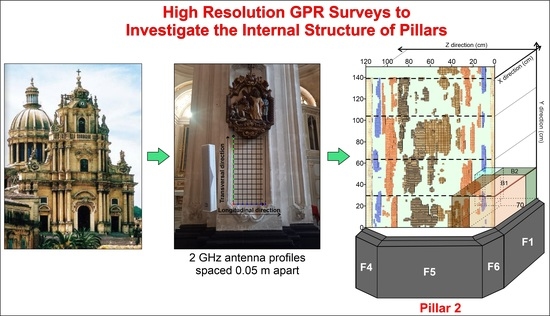
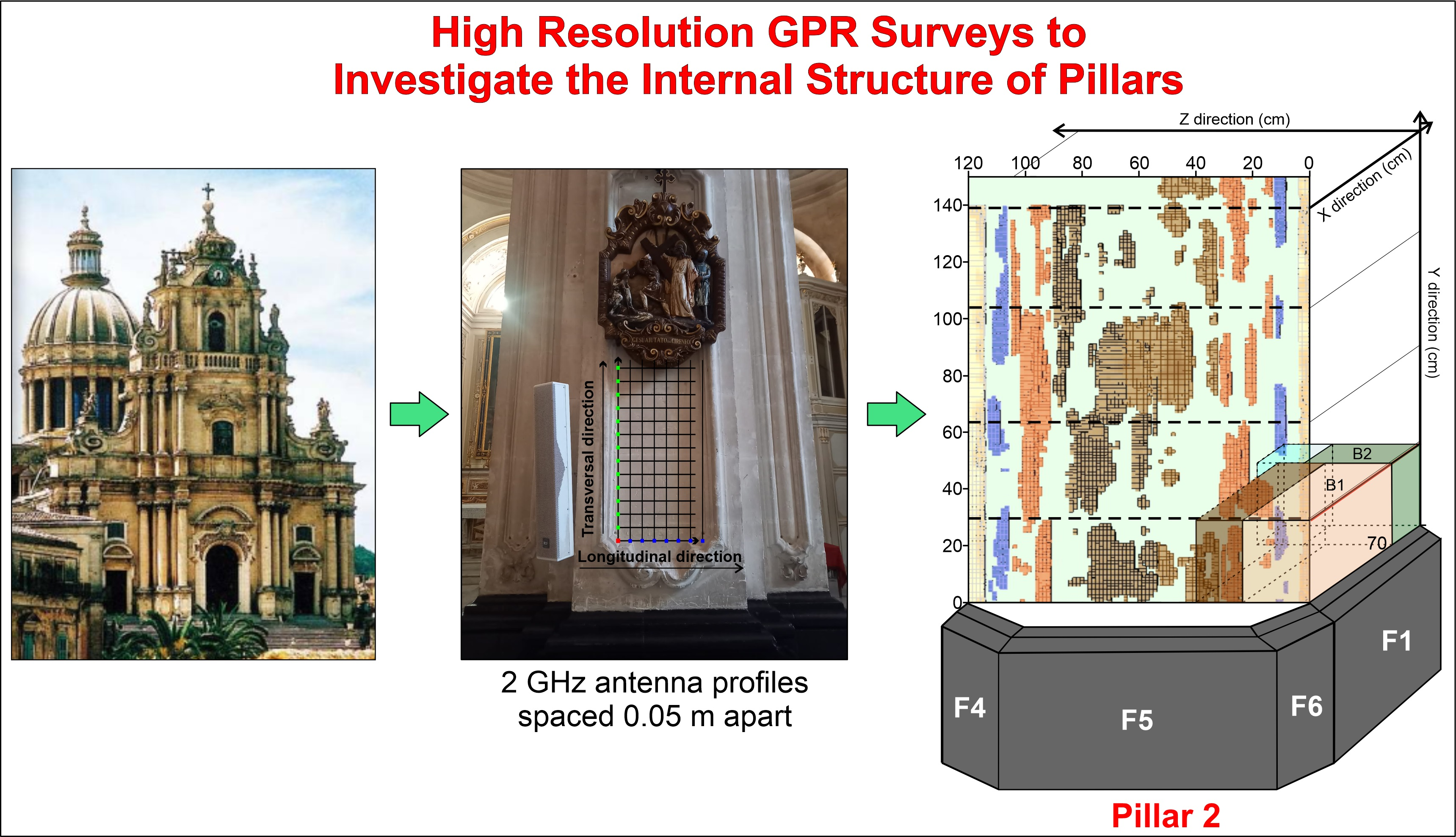
The Cathedral of San Giorgio, a chief example of Baroque architecture in Sicily (Italy), has been the focus of extensive geophysical investigations aimed at structural and subsoil characterization to support heritage conservation efforts. This study is among the few to apply a high-resolution Ground Penetrating Radar (GPR) survey to the pillars of a Baroque Church, revealing internal structural details not documented in any available historical sources. Using a 2 GHz antenna, parallel radar profiles, spaced 0.05 m apart in both directions, were collected to reconstruct a detailed 3D model of the internal structure. Depth-slice and 3D-view analyses revealed multiple reflector sets corresponding to the different masonry blocks forming the pillars. Distinct internal layers were identified at depths of 0.22–0.30 m and 0.40–0.55 m, indicating blocks approximately 0.20–0.30 m in height and the possible presence of vertical connectors. These results complement previous studies that defined the dynamic parameters of the structure and a 3D velocity model of the subsoil, which suggested anomalies linked to remnants of the ancient Byzantine church of San Nicola. Overall, the findings provide valuable insights into the construction techniques and current condition of the pillars, contributing essential data for the planning of conservation and restoration strategies.

Graphical Abstract

1. Introduction

Historical heritage conservation and restoration have become increasingly important in recent years. A comprehensive understanding of the building elements from a structural and dynamical point of view and their interaction with the subsoil is essential for effective conservation. Geophysical methods are part of the non-invasive investigation techniques that can characterize structural elements rapidly and with good accuracy without damaging, an essential feature in the field of cultural heritage [1,2,3,4].
Ground penetrating radar (GPR) has proven to be one of the most effective geophysical techniques for the analysis of structural elements in historical buildings. Its ability to provide high-resolution images makes it particularly suitable for the internal evaluation of structural elements such as pillars, columns, vaults, and beams. Furthermore, it enables the detection of features such as cracks, delamination, voids, and other discontinuities that may be indicative of ongoing degradation processes or hidden damage [5,6,7,8,9,10,11,12,13]. This knowledge is critical for assessing the current state of conservation, identifying potential structural vulnerabilities, and informing targeted restoration interventions.
Revealing internal discontinuities, masonry overlays, and hidden interfaces between different building materials contributes to reconstructing the building’s evolutive history and structural changes over time. This capability is especially valuable when dealing with the complex architectural layering typical of monumental buildings.
Moreover, GPR has also used to assess the condition of ornamental elements, such as mosaics, frescoes, and sculptures, identifying microfractures or degradation caused by moisture. In these cases, it is used to identify microcracks, moisture retention zones, and areas affected by detachment or loss of cohesion [14,15,16,17,18].
This study constitutes one of the phases of the geophysical project realized in the Cathedral of San Giorgio in Ragusa Ibla. The first phase involved the application of active and passive seismic methods to construct 3D models of the subsurface, which allowed the identification of areas with the presence of anomalies probably attributable to cavities and the possible remains of the ancient Byzantine church of San Nicola. In addition, an experimental dynamical characterization of the Cathedral was also carried out [19].
The main goal of this study is to investigate the internal structure of two representative pillars of the San Giorgio Cathedral in Ragusa Ibla (Sicily, Italy) through high-resolution GPR surveys. The novelty of this work lies not in the generic application of 3D GPR, but in its adaptation to address the unique architectural configuration and conservation challenges of the San Giorgio Cathedral pillars, which differ in material homogeneity, block arrangement, and accessibility from cases reported in other Italian and international heritage contexts. This work aims to increase the comprehension of the construction techniques and current state of conservation of specific structural elements. The survey was designed and performed to produce detailed volumetric reconstructions of the internal stratigraphy of the pillars. Furthermore, this research complements previous investigations of the cathedral’s subsoil by providing an in-depth structural analysis through high-resolution GPR imaging.

2. Study Site

The San Giorgio Cathedral is located in Ragusa Ibla, south-eastern sector of Sicily (Figure 1a). It represents one of the greatest expressions of Baroque architecture in Sicily and was recognized by the UNESCO World Heritage Site in 2002. In 1744, the Syracuse architect Rosario Gagliardi received a commission to build a new church to dedicated to the patron saint of the city (San Giorgio), which was partially destroyed during the “Val di Noto” earthquake in 1693. The new church is located in the city centre and stands on the ruins of the Byzantine church of San Nicola [19].
The Cathedral has an imposing structure, with a length of 70 m and a width of about 30 m, and the maximum height is 42 m at the dome (Figure 1b). The church has a Latin cross plant and consists of three naves separated from each other by two rows of pillars, each consisting of five pillars. The two side naves have numerous chapels decorated with precious frescoes. The majestic façade is divided into three parts by three blocks of columns, and on its left-hand side is the bell tower, while the magnificent dome is instead built in neo-classical style [20] (Figure 1c).

3. Materials and Methods

Ground penetrating radar (GPR) is a geophysical survey technique that consists of injecting short electromagnetic (EM) pulses into the subsoil and recording the reflected waves produced when these pulses encounter variations in the dielectric constant values due to discontinuities between the materials in which they travel [21].
The propagation of EM waves is governed by Maxwell’s equations, which describe the magnetic and electric fields as a function of the dielectric properties (electrical and magnetic combinations) of the materials. The GPR method works in “ondulatory mode”, where the EM waves have frequencies greater than 10 MHz [22]. In this regime, to simplify the modelling of waveform paths, the ray theory is considered valid and the parameter that has the most effect on wave transmission is the dielectric constant (ε), although migration algorithms are not based on this ray model but rather on diffraction tomography. GPR surveys make it possible to obtain images of the reflecting bodies buried in the subsoil, the depth at which they are located, the speed (m/ns) of wave travel through the different materials, attenuation zones (dB/m), etc. [23,24].

3.1. Data Acquisition

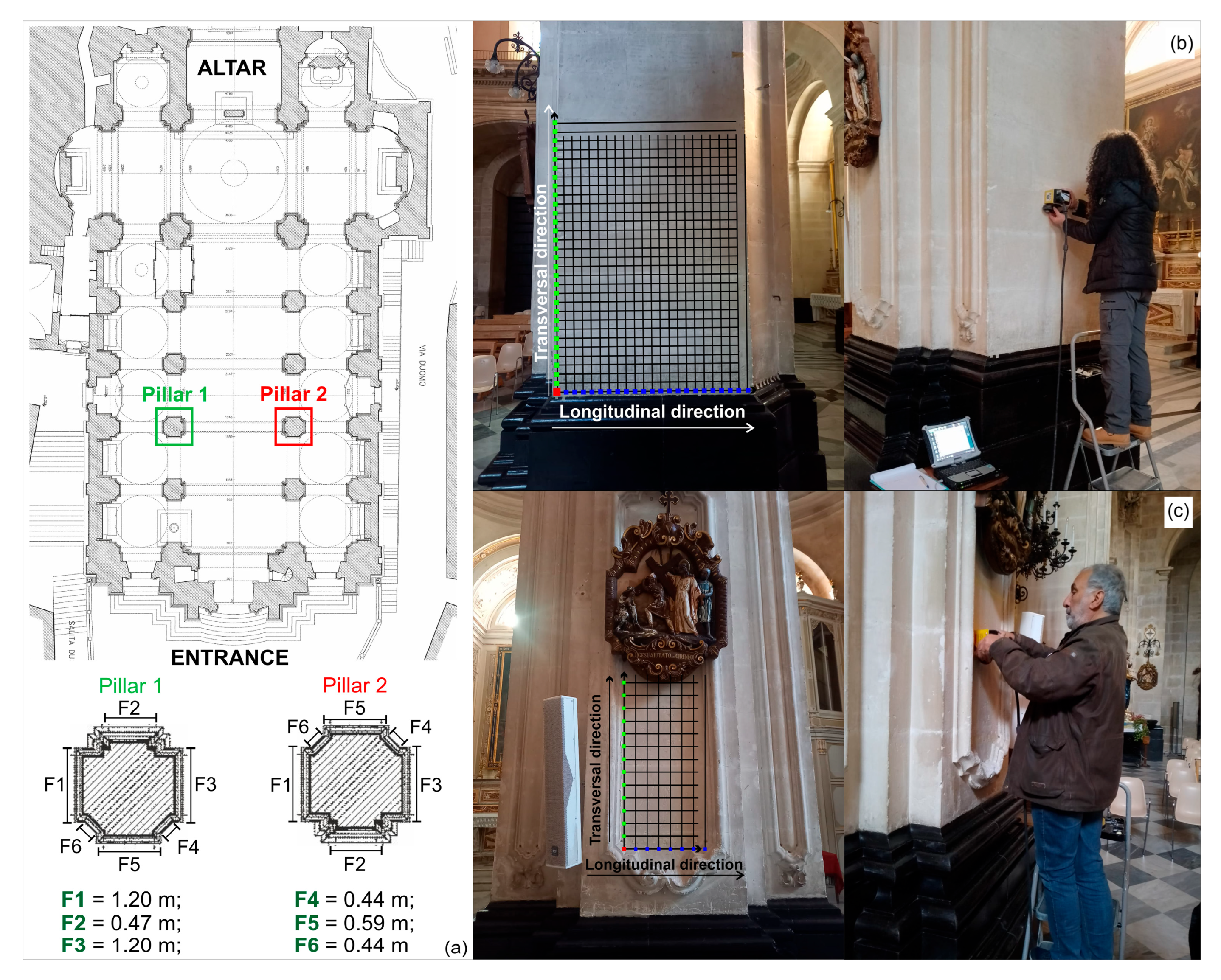
To verify the pillar conservation state of the Cathedral and to define their internal construction scheme, two pillar bases were chosen as representative samples, one for each row (Figure 2a). These pillars have a complex geometry, they consist of two faces (F1–F3) characterized by a width of 1.20 m and absence of decorative elements, faces F2–F5 have a width of about 0.50–0.60 m and faces F4–F6, have the smallest size, about 0.40 m (Figure 2a).
Each face of the selected pillars was investigated using a high-frequency GPR antenna, with a central frequency of 2 GHz (IDS GeoRadar s.r.l., Ospedaletto, Pisa, Italy). The scans were performed, according to a specially designed acquisition grid (Figure 2b,c), in longitudinal and transversal directions with 0.05 m spacing to obtain detailed, high-resolution images. In the faces without ornamentation, it was possible to detect a larger portion of the pillars (Figure 2b), unlike those in which, due to the presence of obstacles, the detection coverage was smaller (Figure 2c).
The main acquisition parameters are listed in Table 1.

3.2. Methodological Aspects: Resolution Ranges and Features Identification

The accuracy of detecting a particular target is influenced by many factors. The antenna detects the body as it moves closer to it, receives reflections while it is above the body, and detects information even at a certain distance beyond the target. The hyperbolic reflection pattern indicative of the target tracking arises from the modification in distance between the device and the target as the GPR moves.
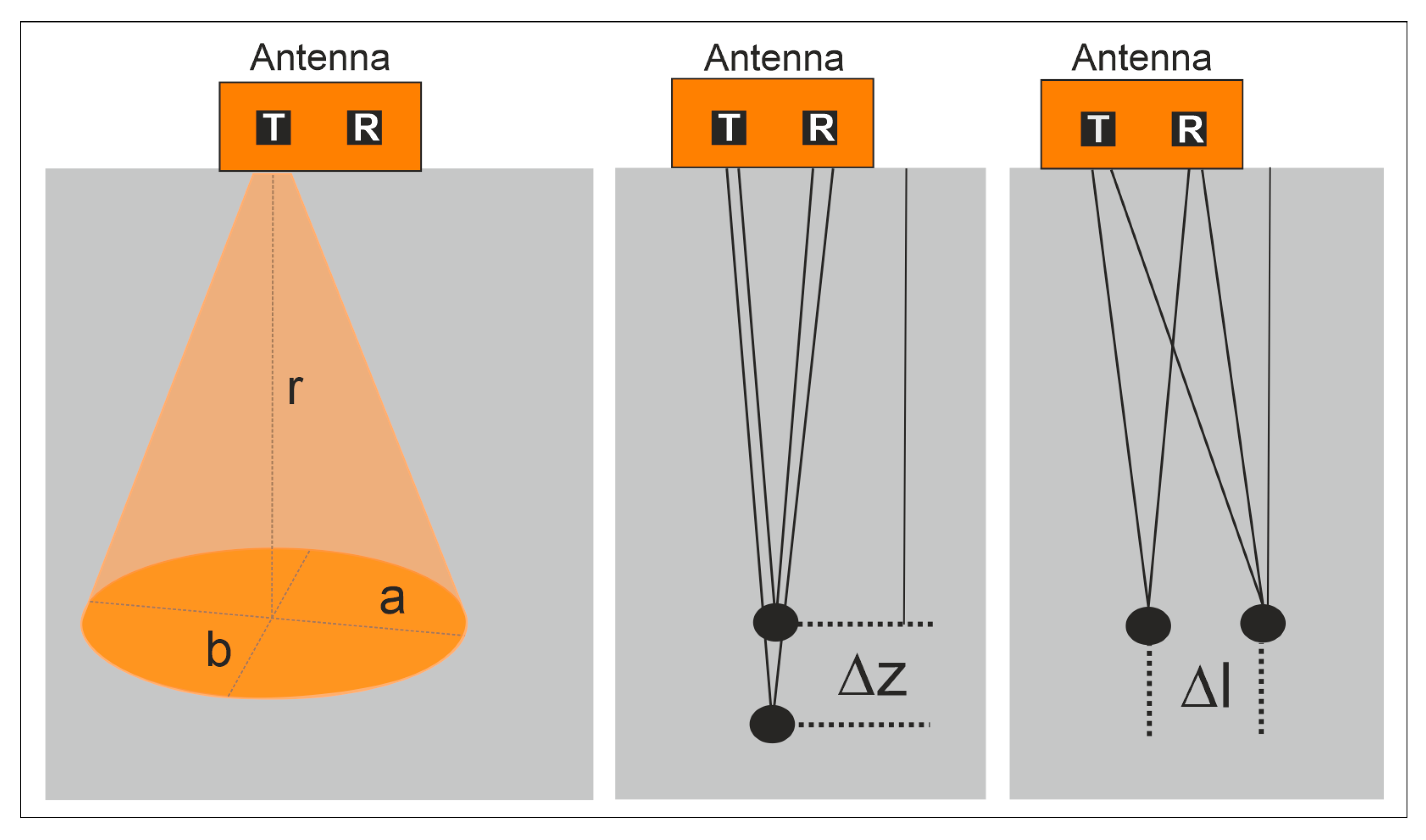
The resolution of the GPR device is governed by (1) the EM pulses emitted by the antenna specific frequency bandwidth and propagate within a conical beam exhibiting an aperture of about 60 degrees’ amplitude; (2) the longitudinal resolution length, Δz (depth) and the lateral resolution length Δl (sideways displacement) as depicted in Figure 3.
The lateral resolution is described by the Fresnel zone Equation (1):
Δ l d λ 2 = d v 2 f c
λ represents the central wavelength, v is the propagation velocity of the EM pulses within the material, fc denotes the central frequency and d indicates the depth.
The longitudinal resolution, according to the Rayleigh criterion, can be expressed by Equation (2):
Δ r λ 4 = v 4 f c
If we consider these expressions and apply them to the antenna used in this study, we obtain the values reported in Table 2, which are indicative of the initial resolution of the antenna, taking into account the propagation velocity of the medium under investigation (pillars).
But additionally, more factors also influence to the overall absolute precision:
  • The positioning accuracy is also influenced by the GPR signal sampling frequencies in both space and time. These values are calculated by the Nyquist-Shannon sampling theorem [26], which determines the lower limit of the frequency that can be measured without time aliasing
    F n t = 1 2 Δ t
    and the lower limit which can be considered as spatial aliasing
    F n s = 1 2 Δ x
    so means the maximum wave number (number of times a wave vibrates in a unit distance). Table 3 presents the values for the choice antenna. These results indicate that the choice of sampling parameters reported in Table 1 is appropriate for this study.
2.
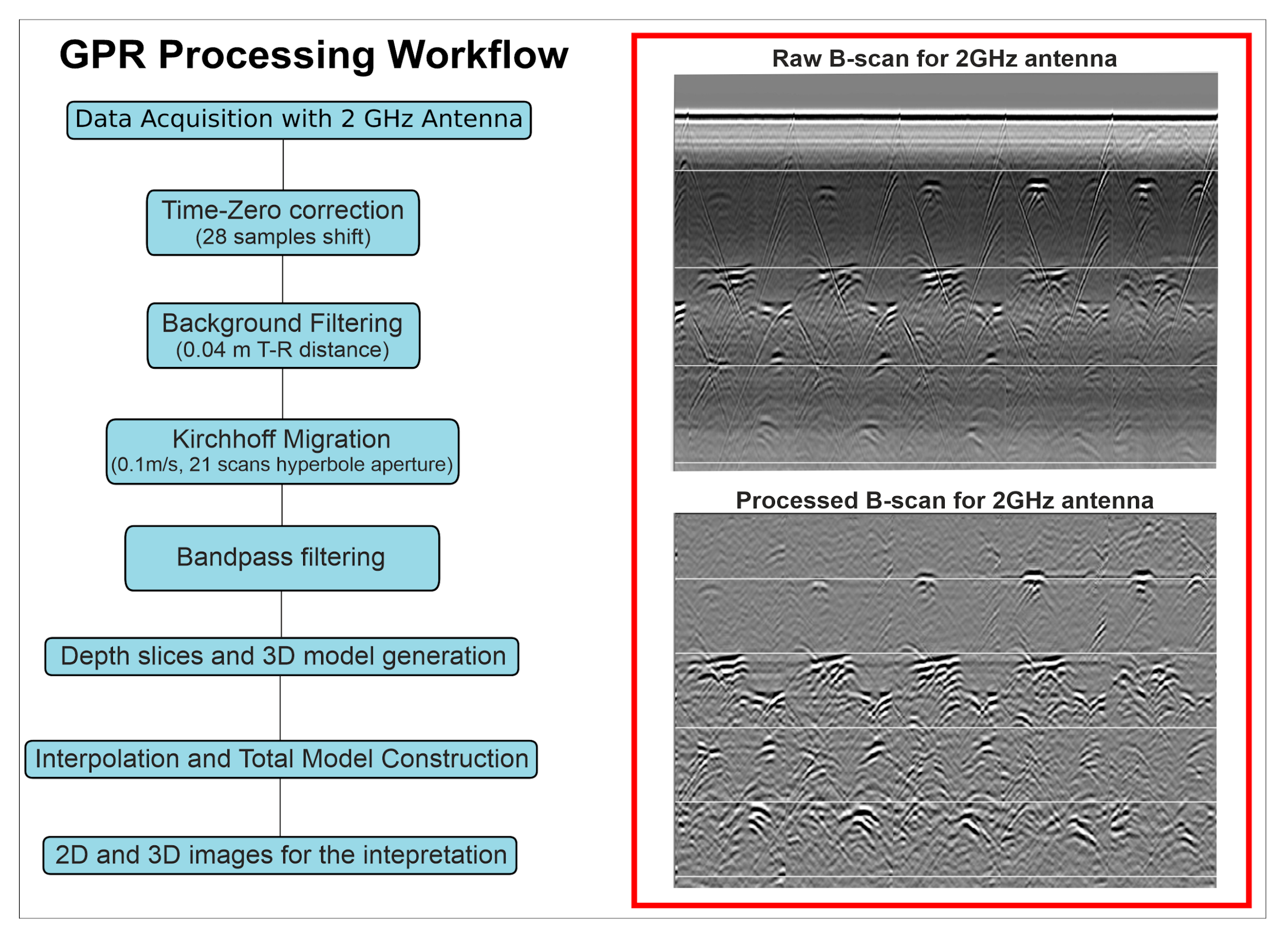
For the 2 GHz antenna, the transmitter (T) and receiver (R) sensors are spaced 5.8 cm apart (T-R offset). This T-R offset is significant for the investigated pillars and its value describes a higher “fuzzy” level in the raw data which can be refined in the processing flow if some signal characteristics are considered (Figure 4). The first signal in a 2D-GPR profile (or B-scan) is known as the “direct coupling” between T-R. In raw B-scans, direct coupling appears as straight horizontal bands on top of the data window (Figure 4). The signal reaches the receiver before penetrating the medium, in this case occurring after 0.4 ns or 0.04 m considering the velocities of the air-sandstone. This signal combines the air wave and surface reflection from the top of the medium (top of face pillars), so the direct coupling provides limited information about the upper part of the face. However, the amplitude is influenced by the dielectric constant and any variations in amplitude may indicate changes in material features (e.g., increased humidity). For an antenna with frequency of 2 GHz, direct coupling enables the detection of targets located about ~0.02 m beneath the surface, as well as the accurate determination of their depths.
All of these previous considerations have been established for the 2D-GPR profiles (X, Z), but in the 3D survey, the (X, Z, Y) profile spacing could also be considered. The orientation and number of profiles depend on the type and size of the structure, the distance control and the accuracy of the wheels. The general rules are as follows: (a) the survey lines should intersect he features of interest with a right angle; (b) for a total coverage a 5 cm spacing between profiles is required. This represents the highest feasible survey density for detailed 3D mapping because the 2 GHz antenna has a width of 8 cm. (c) Linear targets intersecting the survey lines at an angle of 45° to 90° can be accurately resolved. (d) A comprehensive investigation of the structure requires survey lines in both longitudinal and transverse directions.
Considering the theoretical and experimental factors that influence the GPR resolution, it is possible to determine the absolute final accuracy as shown in Table 4.
The lateral resolution was indirectly validated empirically through post-acquisition data processing. The successful focusing of the apex of the diffraction hyperbolas and the clear resolution of closely spaced features after migration confirm that the achieved field resolution is consistent with the reported theoretical values.

3.3. Data Processing Flow

The data processing was performed using GPR-SLICE v7 software (www.gpr-survey.com), and for some 2D and 3D images, were also used our design codes, such as COVER software v. 1.4 [27]. The quality of the signals acquired was high, so conservative flow processing was applied for the two data sets (see the charts in Figure 4), whose main purpose was to increase the signal amplitude (gain corrections) and more to improve both vertical and lateral resolutions (deconvolution operator) (Figure 4). To estimate the average dielectric permittivity, a detailed velocity analysis was conducted by fitting diffractions in the 2GHz antenna profiles (Table 5).
Depth conversion in GPR data is an indirect process, as it relies on assumptions or estimations of the electromagnetic wave velocity. Validation of this conversion can be approached through several indirect methods: (1) comparing estimated depths with known positions of buried objects, (2) using hyperbola fitting to estimate wave velocity and checking the internal consistency across multiple diffractions, and (3) cross-validating with other geophysical methods or direct measurements.
The dielectric constant of the material was determined through hyperbola fitting of diffraction patterns observed in the GPR radargrams. This method involves matching the shape of the recorded hyperbolas to theoretical curves generated for different wave velocities. Given the relationship between wave velocity and dielectric permittivity:
v = c ε
where v is the propagation velocity, c is the speed of light in vacuum, and ε is the relative dielectric constant, and the best fitting hyperbola provides an estimate of the permittivity. This approach, known as hyperbolic velocity analysis, is widely adopted for material characterization in GPR interpretation.
A dielectric constant value of 5 was defined based on the fitting performed on the scans relating to the first pillar investigated. Despite the potential internal heterogeneity of the historical structure, the basic masonry materials of all the pillars and their respective faces are similar (limestone). Therefore, this value, in accordance with the literature data for dry historical limestone masonry [28], was considered representative of both pillars. A potential range of error in the dielectric constant estimation must be considered, quantifiable as ε = 5 ± 1, which could cause a potential variation in the depth estimates within which significant reflections are visible. However, despite the inherent simplification adopted, the reported depth of 50 cm can be considered a realistic average value.
Although absolute validation is not always possible, consistency between different hyperbolas and alignment with expected stratigraphy can provide support for the chosen velocity model [29,30,31].
For the construction of the 3D GPR volumes, the longitudinal and transverse 2D profiles were integrated using the Inverse Distance Weighted (IDW) interpolation method [32], taking into account only the results achieved from diffraction hyperbolas ascribable to small target. The interpolation grid was defined with a cell size of 0.002 m in the inline direction, reflecting the high-density sampling rate along each measured profile, and 0.025 m in the crossline direction, a value chosen to create interpolated data points between the 0.05 m-spaced profiles. This integration, which also incorporated georeferenced diagonal profiles, enhanced coverage in areas where orthogonal directions alone provided limited resolution. An IDW power parameter of 2 was used to provide a balanced weighting that preserves local amplitude variations, a suitable choice for the dense spatial sampling used.
The two individual volumes showed inconsistent signals, interpreted as interpolation artefacts. To mitigate these artefacts, the final 3D model was generated using a Coherent Mean Stacking (CMS) procedure, rather than a simple sum. This stacking method is able to highlight coherent reflections in both volumes, from subsurface elements, which are then reinforced and preserved. Conversely, non-physical interpolation artefacts and random noise that are inconsistent or unrelated between volumes are then attenuated through the averaging process. This technique significantly improves the signal-to-noise ratio, resulting in a cleaner and more reliable final model that effectively suppresses interpolation-related artefacts present in individual inline and crossline volumes (the image showing the procedure is included in the Supplementary Materials).
Subsequently, the data were processed into horizontal time slices, with one grid generated every 0.5 ns. Each slice represents the maximum amplitude response within that time window, corresponding to an approximate vertical thickness of 2–3 cm (using an average GPR velocity of ~0.1 m/ns). Finally, these sequential time-slice grids were stacked to form a single 3D amplitude volume. This standard procedure, as implemented in the GPR-SLICE software [33], compiles the 2D grids into a 3D data matrix, allowing for volumetric rendering and analysis.

4. Results

4.1. General Modelling

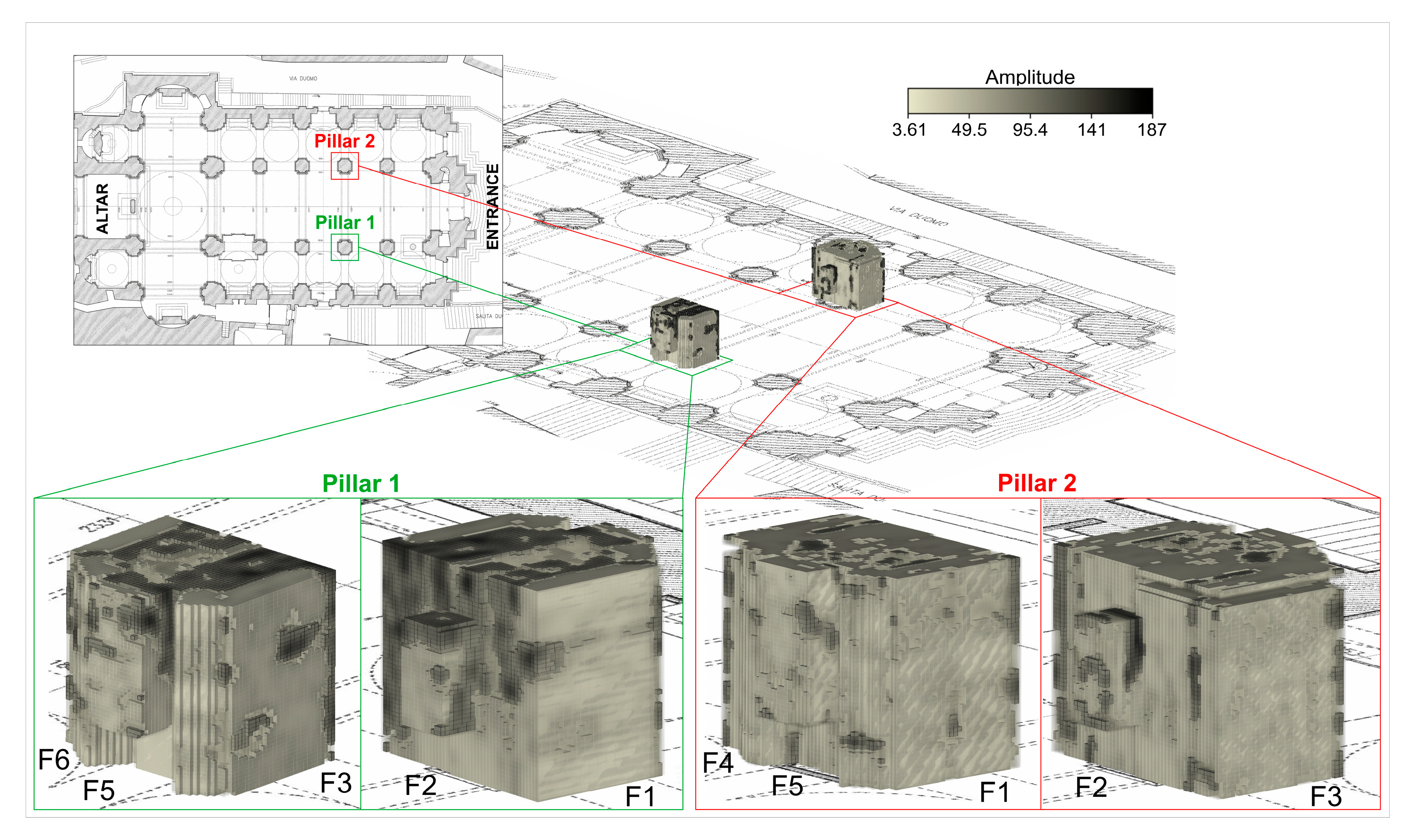
The 3D GPR models of the investigated pillars reveal several structural anomalies (Figure 5). The internal imaging disclosed not only the outermost masonry layer but also deeper structural features, including secondary interfaces and internal block arrangements, although the resolution decreases with depth. In Pillar 1 (green rectangle), the model highlights two main zones: an outer portion with lower amplitude values (light grey), and an inner, more reflective portion with high amplitude values (darker). Pillar 2 (red rectangle) displays a more widespread and less linear distribution of anomalies, with light grey blocks more prevalent.
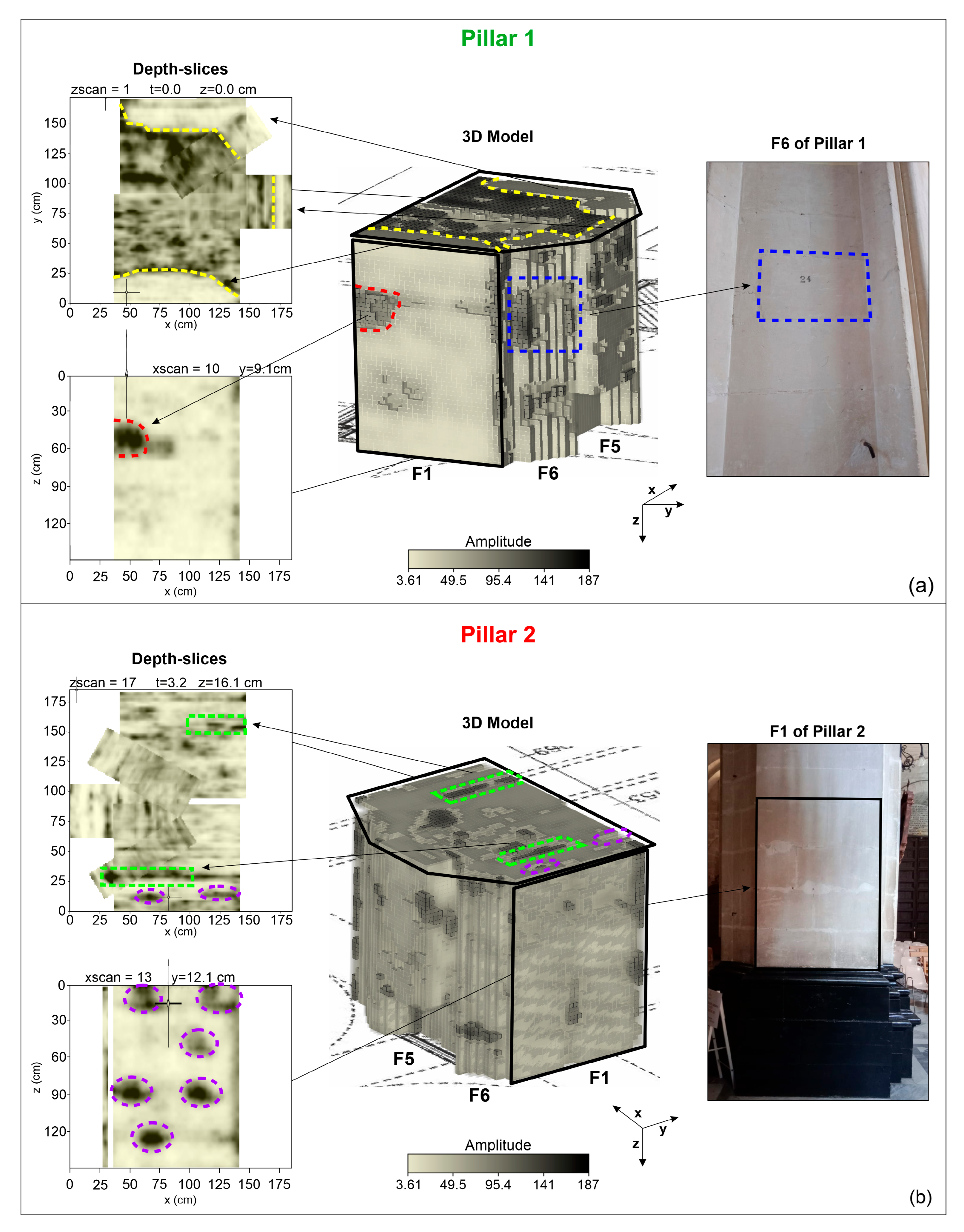
To better interpret the internal layout of these features, depth-slices sections were extracted from both models (Figure 6). The observed anomalies are briefly listed in Table 6 and described in detail below.
In Pillar 1 (Figure 6a), discontinuities connecting the inner and outer zones (dashed yellow lines) are evident. Minor shallow anomalies (dashed red lines), located near F1, are also observed in the x-slices.
Additionally, an anomaly at surface F6 (dashed blue rectangle) suggests a block removal and reinsertion (Figure 6a).
In Pillar 2 (Figure 6b) two elongated anomalies (dashed green rectangles) are visible near F1, measuring approximately 0.70 m and 0.30 m in length, respectively. Further smaller anomalies (dashed purple circles) are identified in both the depth and the x-slices (Figure 6b).

4.2. Detailed Reconstruction of the Inner Structure of the Pillars

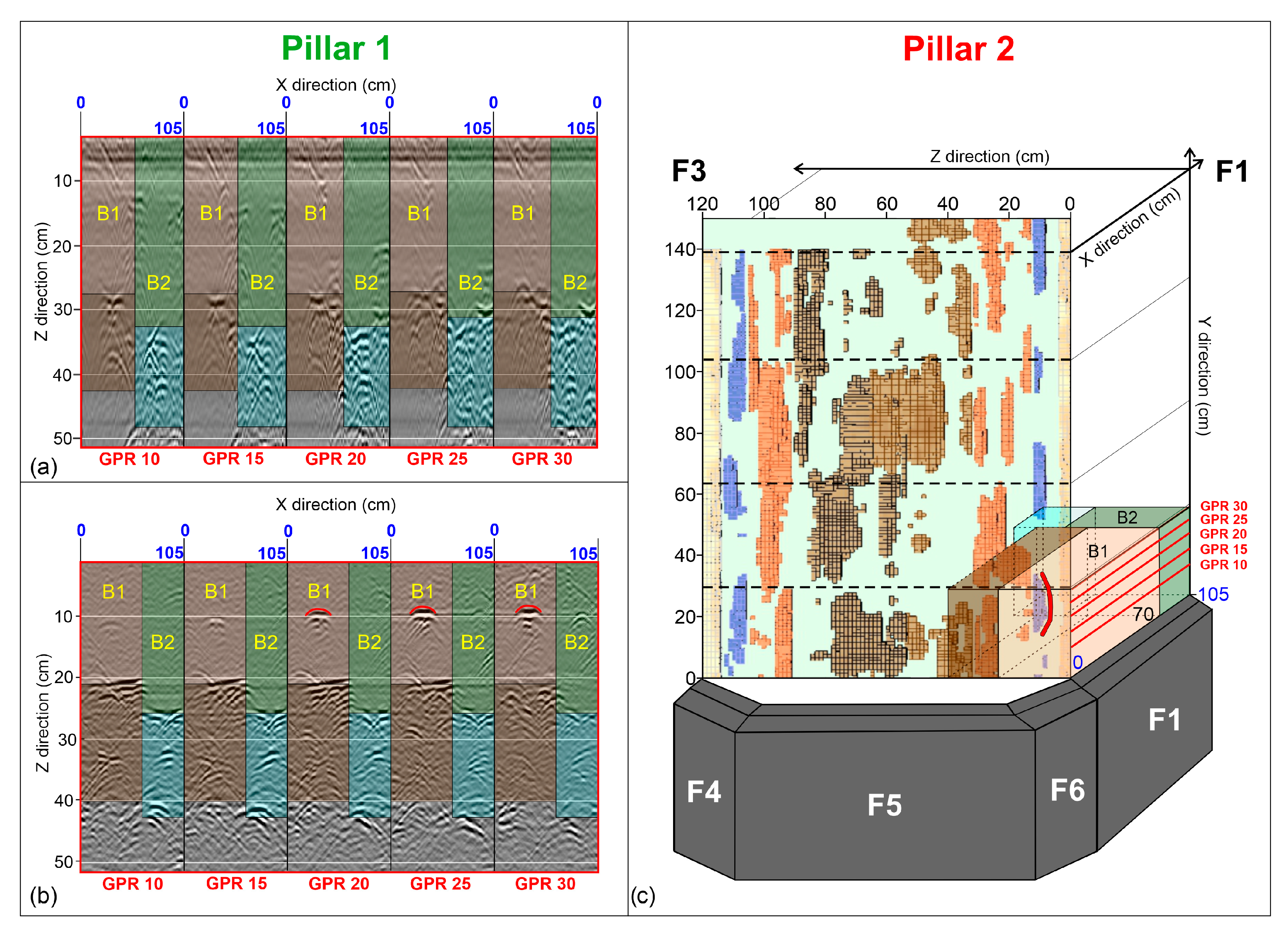
Based on the reflections observed on the radargrams of the two pillars, the internal layout of the investigated structural elements was reconstructed. The B-scans of the investigated pillars show the presence of different blocks (Figure 7a,b). In both cases, the B-scans highlight reflections attributable to contact between different blocks (indicated in Figure 7 with B1, B2). The only clear difference is represented by the hyperbolas highlighted in red in the radargrams relating to Pillar 2. Based on the information obtained from the B-scans, to define the shape and size of the reflections identified, we modelled the internal structure relating to Pillar 2.
Figure 7c shows the main anomalies identified within Pillar 2 (between F1 and F3). Looking at the model on the right, it becomes clear that the examined pillar has a symmetrical structure composed of several levels.
From the outside to the inside, on both faces (F1–F3), a first continuous reflective layer is visible, corresponding to the part of the blocks that form the external cladding of the pillar (whitish colour) (Figure 7c). Moving inside, a thin layer is observed with a thickness of a few centimetres, about 0.02–0.03 m (light blue colour), followed by an additional reflective layer highlighted in orange. The central portion of the model shows the presence of a thicker reflective layer, evident and in continuity from both F1 and F3 (Figure 7c). These reflection patterns may be interpreted as corresponding to masonry blocks, given their geometric coherence and repetition across both faces.
To better model the distribution of blocks within the pillar, a correlation was performed between some B-scans (2D-GPR profile or radargram) acquired in the longitudinal direction on F1 of Pillar 2, spaced 0.05 m apart (Figure 7b), and the model shown in Figure 7c, verifying and highlighting the main reflection hyperbolas attributable to the structural transitions. The B-scans show the presence of two shallow reflectors (B1 and B2) that could be associated with the presence of two blocks, reflector B1 can be observed in the y-direction for 0.30 m, in the x-direction for 0.70 m and for approximately 0.20 m in the z-direction, assuming the position schematically sketched in the model (Figure 7c), while the reflectors B2 is detectable in the y-direction for 0.30 m, in the x-direction for 0.35 m and approximately 0.25 m in the z-direction. In continuity with the reflectors just described, the B-scan shows other reflective discontinuities, probably linked to the presence of two further blocks that develop internally to the structure with similar dimensions to the previous blocks.
The B-scans GPR20, GPR25 and GPR30 show the presence of a reflection hyperbola at 0.10–0.12 m of depth (red hyperbola in the image). These hyperbolas give rise to the line highlighted in red in the model (Figure 7c). These anomalies, indicated by the blue levels in the model on the right, appear to be located at the contact between the blocks that make up the different overlapping rows of the Pillar, attributable to probable junction elements between the blocks.
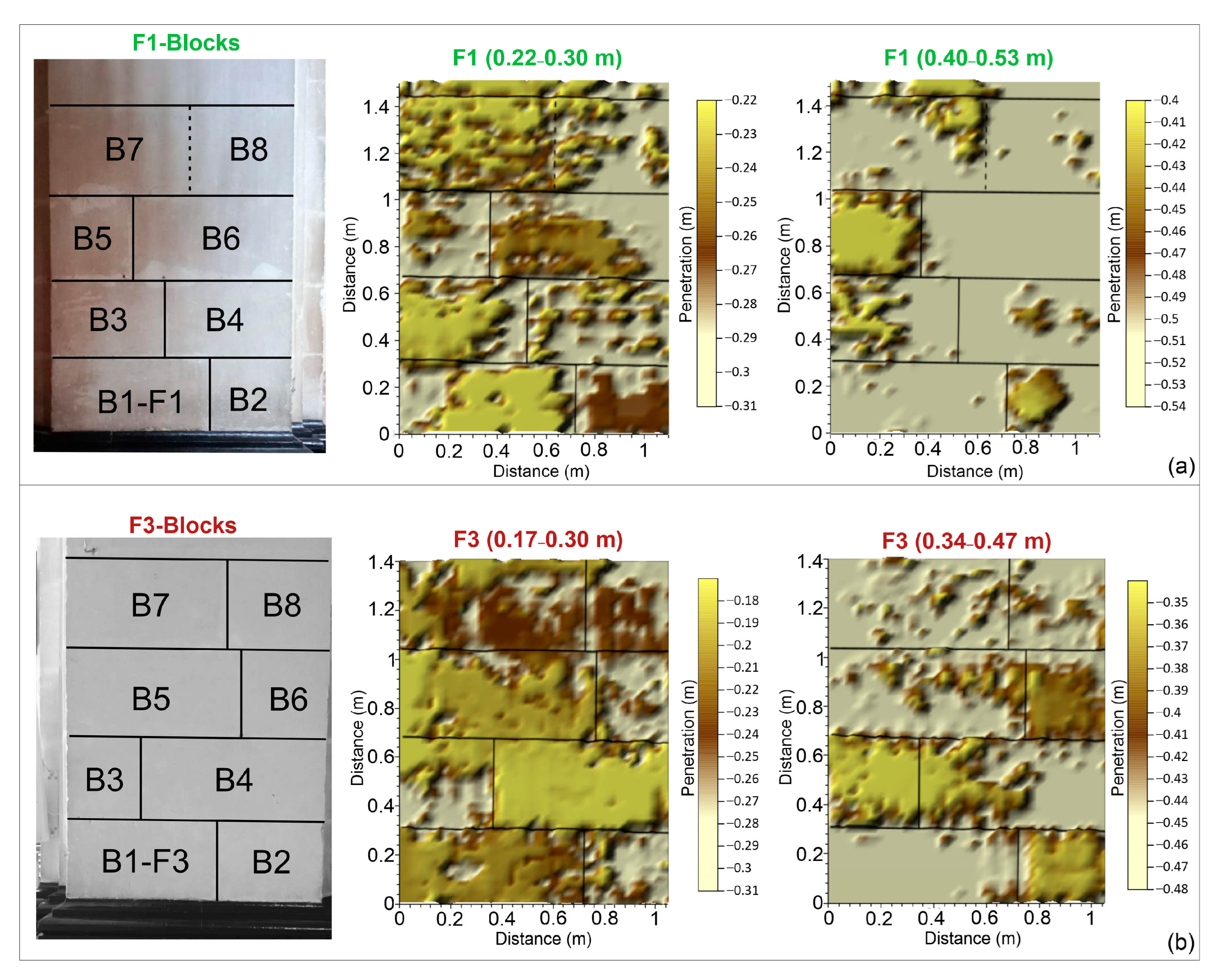
Subsequently, to confirm what has been described so far, maps were constructed showing the distribution of reflective surfaces as penetration depth varies for both faces of Pillar 2 (Figure 8a,b). For this purpose, we used software dedicated to 3D rendering of GPR data known as “3D-GPR Cover Surface” proposed by Peña and Teixidó [27], which allows summing the amplifications detected in the depth-slices extracted and calculated at different depths, to obtain a set of points representing the first maximum amplitude detected [34]. Figure 8a shows the summed amplification for F1 in the depth range of 0.22–0.30 m to 0.40–0.53 m. By analyzing Figure 8, it is possible to observe the reflector pattern at different penetration depths and thus reconstruct the internal distribution of the blocks. Figure 8b shows the same approach applied to F3, for the depth ranges 0.17–0.30 m and 0.34–0.47 m. As shown in F1, it is possible to observe the distribution of the blocks in depth and to reconstruct their internal structure in detail.

5. Discussion and Conclusions

Although GPR is a powerful non-invasive tool for characterizing masonry structures, it is important to consider the inherent limitations that may affect data quality and subsequent interpretation.
A major limitation in GPR investigations of masonry structures typically arises from signal attenuation within heterogeneous stone materials. Electromagnetic waves emitted by the GPR antenna are subject to absorption and scattering, influenced by material composition, porosity, moisture content, and internal variability. This attenuation reduces penetration depth and weakens the returned signal, potentially limiting the resolution of internal features, particularly in dense or moisture-saturated masonry. However, in our study, signal attenuation was minimal, as the construction materials used in the pillars are relatively homogeneous, allowing for improved wave propagation and deeper signal penetration.
Another critical factor that can affect data quality is the presence of near-surface blind zones caused by antenna coupling effects on rough or irregular surfaces. These blind zones may obscure shallow reflections, such as those from surface treatments or early-stage degradation. In our case, this limitation was negligible, since the surface over which the GPR was moved is smooth and sufficiently regular, minimizing coupling effects and allowing for reliable detection of features located just below the surface. Modern approaches, particularly those derived from inverse scattering and those that explicitly account for near-field antenna physics, provide a more comprehensive estimate of resolution across the entire depth range investigated [35]. However, the resolution values calculated from the equations applied in this study are suitable for characterizing the performance of the system in the far-field region where the main structural targets of interest are located.
Furthermore, the use of an approach that involves in the acquisition of profiles in longitudinal and transversal directions could cause other problems due to the creation of artefacts during the combined processing of the data acquired in both directions. Usually, the problem could be solved by measuring the change in polarization with different antenna geometries often called HH, VV and HV polarization [36] and solving for the Stokes–Mueller polarization matrices [37], or as in this case, summing the signals acquired in both directions performing a stacking in the areas where anomalies were highlighted.
Usually, the Side-swipe effect can occur when an object that is not directly beneath the GPR antenna but to the side of the survey line is detected. This off-profile object creates a hyperbolic reflection in the data, which can be mistakenly interpreted as an object directly below the antenna. Our surveyed lines offset aims to reduce this effect due the choice of close separation between the surveyed lines on pillars.
An additional challenge in GPR surveys of historic masonry lies in distinguishing original construction from later interventions or repairs. Subtle contrasts between original materials and restoration products can result in overlapping reflections and ambiguous data, making it difficult to assess structural homogeneity. Although GPR data alone may not always allow for definitive material differentiation, high-resolution three-dimensional acquisitions combined with advanced signal processing techniques can enhance diagnostic accuracy.
In this study, the GPR models reveal distinct contacts between the inner and outer blocks of the pillar. The inner portion, marked by darker reflections, contrasts with homogeneous and higher quality outer blocks (0.20 m thick) (Figure 6a).
In Pillar 1, certain anomalies, such as that marked in red near the top, are likely due to minor inter-block discontinuities (~0.02 m), while others (e.g., blue rectangle) suggest block removal and reinstallation, as observed in brick number 24 (as shown in the pillar picture in Figure 6a). One anomaly on the F1 face may correspond with a later repair (red polygon). This supposed internal structure is confirmed by the radargrams shown in Figure 7b, which show several reflections that could be from possible passages between different blocks.
In Pillar 2, the blocks surrounding the central core appear smaller, with tighter, less reflective joints (Figure 6b). Vertical reflectors marked in Figure 6b (purple circles) correspond to features in Figure 7b, can be interpreted as metallic or wooden joining elements between layers of bricks. The GPR response differs substantially for the two types of material: a strong, complete reflection followed by a shadow zone (or highly attenuated multiples, potentially due to metal degradation/corrosion) beneath the feature indicates a highly conductive material (metal), while a weaker reflection with significant energy transmission suggests a dielectric material (wood). Based on analysis of the scans showing that the returns are such that no multiples are seen below the feature/junction element, the use of metal can be assumed.
The interpretation of joining elements is favoured over alternatives, such as localized fractures, due to their regular periodic spacing and their consistency with construction techniques documented in similar heritage structures [38]. The consistent appearance of these anomalies in the B-scans, both in terms of their depth (identical across all scans) and their symmetrical distribution on opposite sides of the pillar, supports the hypothesis that they represent joints between blocks rather than simple fractures. While some anomalies are attributed to construction joints or later interventions, the possibility of alternative origins, such as differential material weathering or undocumented structural reinforcements, cannot be excluded. These uncertainties underline the need for integrating GPR data with complementary diagnostic methods and historical analysis.
The internal stratification is further confirmed by the cover surface renderings shown in Figure 8. On F1, the outer to second row interface lies at 0.22–0.30 m (±0.025 m), while the second to third row transition is at 0.40–0.55 m (±0.04 m). On F3 face, the corresponding layers appear between 0.47–0.34 m (±0.04 m).
Allowing for resolution tolerances, the structure consists of five blocks (~0.20 m wide, 0.30 m high) with minor thickness variations (~0.05 m) likely enabling lateral interlocks. Vertical connections appear to involve central iron fittings.
The high-resolution GPR approach has proven essential in reconstructing the internal layout of both pillars. The technique enabled the identification of key construction elements and jointing methods, offering a non-invasive, high-resolution tool for understanding the structure and informing conservation strategies for heritage architecture.
These findings underline the effectiveness of GPR as a valuable tool for investigating the internal configuration of complex masonry elements, provided that its technical limitations are well understood and properly addressed. In the specific case examined, signal attenuation and surface-related artefacts were minimal, owing to the homogeneity of the construction materials and the regularity of the surveyed surfaces. The integration of 3D GPR reconstruction with detailed slice analysis and radargram interpretation proved particularly effective in enhancing diagnostic accuracy. This combined approach enabled accurate spatial localization of structural components and discontinuities, thereby facilitating the differentiation between original construction features and later modifications, such as restorations or material reintegration. This capability provides valuable insights into the construction history and current condition of architectural heritage elements. As a broader implication, the methodological workflow presented here provides a reference framework for the non-invasive assessment of similar architectural elements in complex historical contexts. Specifically, the integration of multi-directional 2D profiles into a cohesive 3D volume using IDW interpolation, combined with detailed radargram analysis and cover surface rendering, demonstrates a replicable strategy for overcoming the limitations of standard surveys. This data-driven approach allows for a more targeted and effective design of conservation and restoration actions for architectural heritage. Nonetheless, the integration of GPR data with complementary non-destructive techniques and historical documentation remains essential to achieving a comprehensive and reliable structural assessment.

Supplementary Materials

The following supporting information can be downloaded at: https://www.mdpi.com/article/10.3390/rs17223710/s1, Figure S1: On the left longitudinal and transversal models obtained using the interpolation algorithm, Inverse Distance Weighting method (IDW). The reflectors highlighted by both models display particular geometries, which represent artefacts that are generally created during the interpolation of scans acquired in a single direction. On the right, final 3D model obtained by applying the Coherent Mean Stacking (CMS) procedure, showing how reflections attributable to elements below the surface are enhanced with respect to noise.

Author Contributions

Conceptualization, G.M., T.T. and S.I.; methodology, G.M., C.J.A.-P. and T.T.; validation, G.M., S.G., C.J.A.-P. and T.T.; formal analysis, G.M., C.J.A.-P. and T.T.; investigation, G.M., S.G. and S.I.; data curation, G.M.; writing—original draft preparation, G.M.; writing—review and editing, G.M., S.G., C.J.A.-P., T.T. and S.I.; visualization, G.M.; supervision, G.M., T.T. and S.I. All authors have read and agreed to the published version of the manuscript.

Funding

This research received no external funding.

Data Availability Statement

The raw data supporting the conclusions of this article will be made available by the authors on request.

Acknowledgments

The authors wish to thank Geocheck S.R.L. for the support provided during the surveys to Mons. Floridia, parish priest of the San Giorgio Cathedral, for allowing the surveys to be carried out.

Conflicts of Interest

The authors declare no conflicts of interest.

Abbreviations

The following abbreviations are used in this manuscript:
GPRGround Penetrating Radar
UNESCOUnited Nations Education, Scientific and Cultural Organization
EMElectromagnetic
IDWInverse Distance Weighted
CMSCoherent Mean Stacking

References

  1. Barone, P.M.; Ruffell, A.; Tsokas, G.N.; Rizzo, R. Geophysical Surveys for archaeology and Cultural Heritage Preservation. Heritage 2019, 2, 2814–2817. [Google Scholar] [CrossRef]
  2. Deiana, R.; Deidda, G.P.; Cusí, E.D.; van Dommelen, P.; Stiglitz, A. FDEM and ERT measurements for archaeological prospections at Nuraghe S’Urachi (West-Central Sardinia). Archaeol. Prospect. 2022, 29, 69–86. [Google Scholar] [CrossRef]
  3. Martorana, R.; Capizzi, P.; Pisciotta, A.; Scudero, S.; Bottari, C. An overview of geophysical techniques and their potential suitability for archaeological studies. Heritage 2023, 6, 2886–2927. [Google Scholar] [CrossRef]
  4. Imposa, S.; Grassi, S.; Morreale, G.; Pirrotta, C.; Cavalier, L.; Gilotti, A.; Giuliano, D.; Cayre, E.; Calio, L.M. New discovery of an ancient building in Akragas (Valley of Temples, Agrigento, Italy) through the integration of geophysical surveys. J. Archaeol. Sci. Rep. 2024, 53, 104368. [Google Scholar] [CrossRef]
  5. Hamrouche, R.; Klysz, G.; Balayssac, J.P.; Laurens, S.; Rhazi, J.; Ballivy, G.; Arliguie, G. Numerical modeling of ground-penetrating radar (GPR) for the investigation of jointing defects in brick masonry structures. In Proceedings of the NDTCE’09, Non-Destructive Testing in Civil Engineering, Nantes, France, 30 June–3 July 2009. [Google Scholar]
  6. Imposa, S.; Grassi, S.; Barone, I.; Censini, M.; Morreale, G. Combined GPR and seismic refraction tomography to study the subsoil in the Cathedral of S. Giorgio Ragusa-Ibla (Sicily). In Proceedings of the 11th International Workshop on Advanced Ground Penetrating Radar (IWAGPR), Valletta, Malta, 1–4 December 2021. [Google Scholar] [CrossRef]
  7. Işık, N. Investigation of structural problems on the ground and walls of Diyarbakir Historical Behram Pasha Mosque by the georadar (GPR) method. Dicle Üniversitesi Mühendislik Fakültesi Mühendislik Derg. 2021, 12, 689–698. Available online: https://dergipark.org.tr/en/download/article-file/2000333 (accessed on 20 June 2025). [CrossRef]
  8. Johnston, B.; Ruffell, A.; McKinley, J.; Warke, P. Detecting voids within a historical building façade: A comparative study of three high frequency GPR antenna. J. Cult. Herit. 2018, 32, 117–123. [Google Scholar] [CrossRef]
  9. Kanli, A.I.; Taller, G.; Nagy, P.; Tildy, P.; Pronay, Z.; Toros, E. GPR survey for reinforcement of historical heritage construction at fire tower of Sopron. J. Appl. Geophys. 2015, 112, 79–90. [Google Scholar] [CrossRef]
  10. Leucci, G.; Cataldo, R.; De Nunzio, G. Assessment of fractures in some columns inside the crypt of the Cattedrale di Otranto using integrated geophysical methods. J. Archaeol. Sci. 2007, 34, 222–232. [Google Scholar] [CrossRef]
  11. Lombardi, F.; Lualdi, M.; Garavaglia, E. Masonry texture reconstruction for building seismic assessment: Practical evaluation and potentials of Ground Penetrating Radar methodology. Constr. Build. Mater. 2021, 299, 124189. [Google Scholar] [CrossRef]
  12. Martini, R.; Carvalho, J.; Barraca, N.; Arêde, A.; Varum, H. Advances on the use of non-destructive techniques for mechanical characterization of stone masonry: GPR and sonic tests. Procedia Struct. Integr. 2017, 5, 1108–1115. [Google Scholar] [CrossRef]
  13. Perez-Gracia, V.; Santos-Assunçao, S.; Caselles, O.; Clapes, J.; Sossa, V. Combining ground penetrating radar and seismic surveys in the assessment of cultural heritage buildings: The study of roofs, columns, and ground of the gothic church S anta M aria del Mar, in B arcelona (S pain). Struct. Control Health Monit. 2019, 26, 2327. [Google Scholar] [CrossRef]
  14. Caldeira, B.; Oliveira, R.J.; Teixidó, T.; Borges, J.F.; Henriques, R.; Carneiro, A.; Peña, J.A. Studying the Construction of Floor Mosaics in the Roman Villa of Pisões (Portugal) Using Noninvasive Methods: High-Resolution 3D GPR and Photogrammetry. Remote Sens. 2019, 11, 1882. [Google Scholar] [CrossRef]
  15. Cozzolino, M.; Di Meo, A.; Gentile, V.; Mauriello, P.; Zullo, E. Combined use of 3D metric survey and GPR for the diagnosis of the trapezophoros with two griffins attacking a Doe of Ascoli Satriano (Foggia, Italy). Geosci. J. 2020, 10, 307. [Google Scholar] [CrossRef]
  16. Cozzolino, M.; De Simone, A.; Gentile, V.; Mauriello, P.; Piezzo, A. GPR and Digital Survey for the Diagnosis and the 3D Representation of the Battle of Issus Mosaic from the House of the Faun, Pompeii (Naples, Italy). Appl. Sci. 2022, 12, 6965. [Google Scholar] [CrossRef]
  17. Kadioglu, S.; Kadioglu, Y.K. Picturing internal fractures of historical statues using ground penetrating radar method. Adv. Geosci. 2010, 24, 23–34. [Google Scholar] [CrossRef]
  18. Martinho, E.; Dionisio, A. Nondestructive and micro-invasive techniques for stone cultural heritage diagnosis: An overview. In Advances in Materials Science Research; Nova Publishers: New York, NY, USA, 2016; Volume 22, pp. 1–30. ISBN 978-1-63483-759-0. [Google Scholar]
  19. Imposa, G.; Grassi, S.; Barontini, A.; Morreale, G.; Russo, S.; Lourenço, P.B.; Imposa, S. Extended tromograph surveys for a full experimental characterisation of the San Giorgio Cathedral in Ragusa (Italy). Sensors 2023, 23, 889. [Google Scholar] [CrossRef] [PubMed]
  20. Nifosi, P.; Leoni, G. Mastri e Maestri Nell’architettura Iblea; Silvana, Ed.; Cinisello Balsamo: Milano, Italy, 1998. [Google Scholar]
  21. Jol, H.M. Ground Penetrating Radar Theory and Applications; Elsevier: London, UK, 2008. [Google Scholar]
  22. Telford, W.M.; Geldart, L.P.; Sheriff, R.E. Applied Geophysics; Cambridge University Press: Cambridge, UK, 1990. [Google Scholar]
  23. Daniels, J.J. Ground penetrating radar fundamentals. In Prepared as an Appendix to a Report to the US EPA; EPA: Washington, DC, USA, 2000; pp. 1–21. [Google Scholar]
  24. Harry, J. Ground Penetrating Radar Theory and Applications, 1st ed.; Elsevier Science: Amsterdam, The Netherlands, 2009; p. 544. [Google Scholar]
  25. Oliveira, R.J.B. Prospeção Geofísica Aplicada à Arqueologia. Ph.D. Thesis, Universidade de Evora, Évora, Portugal, 2020. [Google Scholar]
  26. Yilmaz, Ö. Seismic Data Analysis: Processing, Inversion, and Interpretation of Seismic Data; Society of Exploration Geophysicists: Houston, TX, USA, 2001. [Google Scholar]
  27. Peña, J.A.; Teixidó Ullod, T. Cover surfaces as a new technique for 3D GPR image enhancement. Archaeol. Appl. 2013, 1–10. Available online: http://hdl.handle.net/10481/22949 (accessed on 15 May 2025).
  28. Martinez, A.; Byrnes, A.P. Modeling dielectric-constant values of geologic materials: An aid to ground-penetrating radar data collection and interpretation. Curr. Res. Earth Sci. 2001, 247 Pt 1, 1–16. [Google Scholar] [CrossRef]
  29. Dou, Q.; Wei, L.; Magee, D.R.; Cohn, A.G. Real-time hyperbola recognition and fitting in GPR data. IEEE Trans. Geosci. Remote Sens. 2016, 55, 51–62. [Google Scholar] [CrossRef]
  30. He, W.; Lai, W.W.L. Unified optimization-based analysis of GPR hyperbolic fitting models. Tunn. Undergr. Space Technol. 2024, 146, 105633. [Google Scholar] [CrossRef]
  31. Wunderlich, T.; Wilken, D.; Majchczack, B.S.; Segschneider, M.; Rabbel, W. Hyperbola detection with RetinaNet and comparison of hyperbola fitting methods in GPR data from an archaeological site. Remote Sens. 2022, 14, 3665. [Google Scholar] [CrossRef]
  32. Shepard, D. A two-dimensional interpolation function for irregularly-spaced data. In Proceedings of the 23rd ACM National Conference, Princeton, NJ, USA, 1 January 1968. [Google Scholar]
  33. Goodman, D. GPR Slice Version 7.0 Manual; GPR-Slice: Woodland Hills, CA, USA, 2013. [Google Scholar]
  34. Teixidó, T.; Peña, J.A.; Fernández, G.; Burillo, F.; Mostaza, T.; Zancajo, J. Ultradense Topographic Correction by 3D-Laser Scanning in Pseudo-3D Ground-penetrating Radar Data: Application to the Constructive Pattern of the Monumental Platform at the Segeda I Site (Spain). Archaeol. Prospect. 2014, 21, 113–123. [Google Scholar] [CrossRef]
  35. Persico, R. Introduction to Ground Penetrating Radar: Inverse Scattering and Data Processing; John Wiley & Sons: Hoboken, NJ, USA, 2014. [Google Scholar]
  36. van Zyl, J.J.; Ulaby, F.T. Scattering matrix representations for simple targets. In Radar Polarimetry for Geoscience Applications; Artech House: Norwood, MA, USA, 1990; pp. 17–52. [Google Scholar]
  37. Olhoeft, G.R. Maximizing the information return from ground penetrating radar. J. Appl. Geophys. 2000, 43, 175–187. [Google Scholar] [CrossRef]
  38. Xiang, Z.; Rashidi, A.; Ou, G.G. States of practice and research on applying GPR technology for labeling and scanning constructed facilities. J. Perform. Constr. Facil. 2019, 33, 03119001. [Google Scholar] [CrossRef]
Figure 1. (a) Location of the Ragusa municipality, (b) general view of the Cathedral of San Giorgio and (c) internal view of the church where rows of pillars are visible.
Remotesensing 17 03710 g001
Figure 2. (a) Location and dimensions of the surveyed pillars; (b) acquisition scheme and photo of face F1 of Pillar 1 (the red point marks the origin of the acquisition grid); (c) acquisition scheme and photo of face F2 of Pillar 1.
Remotesensing 17 03710 g002
Figure 3. Summary diagram illustrating the vertical (Δz) and lateral (Δl) resolution of the GPR device, modified from [25].
Remotesensing 17 03710 g003
Figure 4. Workflow implemented for the antenna (2 GHz) used in the pillar survey.
Remotesensing 17 03710 g004
Figure 5. 3D GPR models of Pillar 1 (green rectangle) and Pillar 2 (red rectangle), visualized from two different viewpoints. The insert in the top-right corner indicates the location of the surveyed pillars.
Remotesensing 17 03710 g005
Figure 6. Ground Penetrating Radar (GPR) results for Pillar 1 (a) and Pillar 2 (b). For each pillar, a depth slice, an x-slice, and the corresponding 3D GPR model are shown, highlighting detected anomalies and their spatial distribution. The orientation of the faces (F1–F6) is indicated in the 3D models. On the right, photographs of some investigated faces are presented: face F6 of Pillar 1 (top) and face F1 of Pillar 2 (bottom). Depth slices are extracted at specific z-scan indices, while x-slices provide cross-sectional views at selected depths.
Remotesensing 17 03710 g006
Figure 7. (a) Interpretation of selected B-scans (2D-GPR profile or radargram) acquired longitudinally on face F3 of Pillar 1. These scans enabled the schematic representation of the pillar’s internal structure; (b) B-scans acquired on face F1 of Pillar 2 and (c) 3D reconstruction of the inner part of Pillar 2, showing the distribution of the main reflection patterns (right). The red lines labelled GPR 10 to GPR 30, visible in the model, indicate longitudinal scans spaced 5 cm apart, which were used for the schematization. Detected anomalies are highlighted using different colours in the radargrams and are represented with the same colours in the 3D reconstruction.
Remotesensing 17 03710 g007
Figure 8. 3D GPR renderings of face F1 (a) and face F3 (b) of Pillar 2, obtained by summing depth-slices at different penetration depths. The images highlight the internal distribution of blocks.
Remotesensing 17 03710 g008
Table 1. Acquisition parameters for the high-frequency antenna (2 GHz) used for the pillar reconstruction.
Antenna2 GHz
Time range10 ns
Scans/m800
Samples/trace256
Bit sample32
Profile spacing (m)0.05
Table 2. Device resolution for the antenna type used in this study. Pulse duration and wavelength pulse are the instrument limitations. ε is the dielectric constant of the material, V denotes the velocity of the material, Δz and Δl are, respectively, the calculated longitudinal and lateral resolution.
AntennaPulse (ns)Wavelength Pulse (cm)ε (s)V (m/ns)Δz (cm)Δl (cm)
2 GHz0.51.550.11 (at 0.5 m depth)1.25
Table 3. Time and spatial aliasing using Nyquist criteria.
AntennaTime Sampling (ns)Nyquist Frequency (MHz)Time Spacing (m)Nyquist Wave Number (m−1)
2 GHz0.512.5 × 1031.25 × 10−3 400
Table 4. Absolute final accuracy for a 3D-GPR survey.
2 GHz Antenna
Lateral X resolution (cm)2–3
Lateral Y resolution (cm)2.5
Depth Z resolution
“Fuzzy” top level (cm)1.8
Maximum depth1 cm (at 4 cm depth)
4 cm (at 40 cm depth)
Table 5. Parameters applied during the GPR data processing routine.
2 GHz
Time 0 correction−7 ns
Gain correctionConstant in time window
Kirchhoff migrationV = 0.1 m/ns
Bandpass filter1200–2800 MHz
Dielectric constant5
Table 6. GPR anomalies observed in the pillars.
PillarAnomaly TypeLocationDepth (m)Description
Pillar 1Major
Discontinuity
F10.10–0.50 Separates outer and inner portions
Pillar 1Minor
Discontinuity
F60.05–0.20Possible repair indication
Pillar 2Elongated
Anomaly
F1, F30.16–0.70Major Structural
Discontinuities
Pillar 2Smaller
Void/Cavity
Various
Faces
0.10–0.30Minor voids or cavities not visible on the surface
Disclaimer/Publisher’s Note: The statements, opinions and data contained in all publications are solely those of the individual author(s) and contributor(s) and not of MDPI and/or the editor(s). MDPI and/or the editor(s) disclaim responsibility for any injury to people or property resulting from any ideas, methods, instructions or products referred to in the content.