Highlights
What are the main findings?
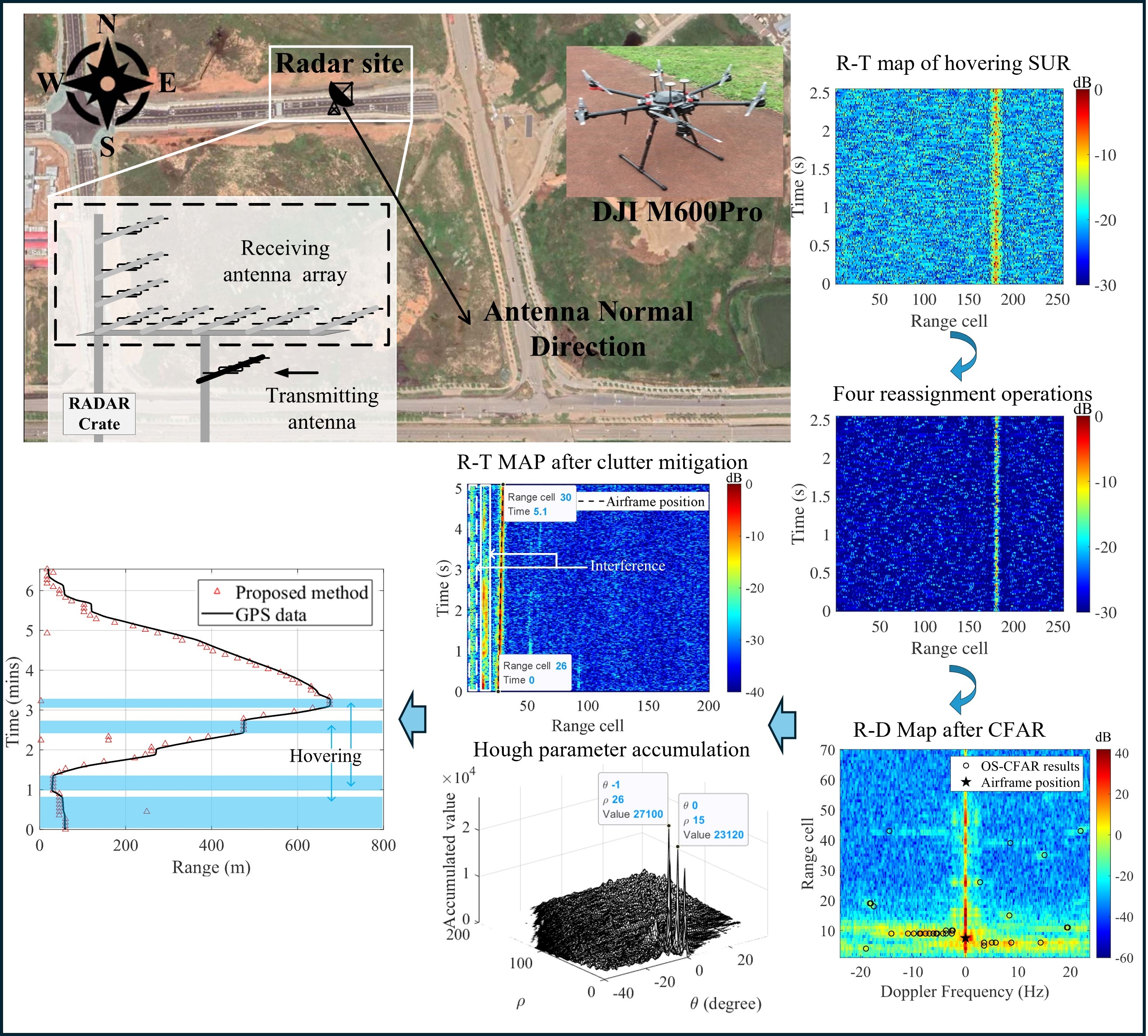
- A novel detection method is proposed to identify hovering small unmanned rotorcrafts (SURs) by enhancing rotor-induced micro-Doppler signatures.
- Multiple reassignment squeezing and Hough-based trajectory detection are combined to distinguish hovering SURs from stationary clutter.
What are the implications of the main finding?
- The method enables reliable drone detection in low-velocity scenarios using low-frequency (UHF-band) radar systems.
- The proposed approach provides a practical foundation for real-time airspace surveillance and security applications.
Abstract
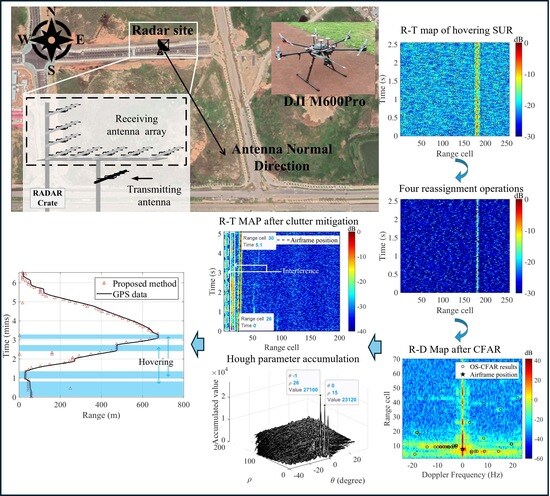
The rapid increase in production of small unmanned rotorcrafts (SURs) has made real-time drone surveillance critical for airspace security. Effective SUR detection is essential for maintaining aviation safety, protecting privacy, and ensuring public security. However, conventional radar systems struggle to detect hovering SURs due to their low velocity and small radar cross-section (RCS), which make them nearly indistinguishable from stationary clutter. To address this issue, this paper proposes a hovering SUR detection method through identifying the micro-Doppler signal (MDS). By applying the multiple reassignment squeeze processing and exhaustive Hough transform, the proposed approach effectively enhances the accumulation of micro-Doppler signal generated by the rotor blades, which enables the separation of hovering SUR signals from stationary clutter. Numerical simulations and field experiments validate the effectiveness of the proposed method, demonstrating its potential for micro-Doppler signal detection using a UHF-band horizontally co-polarized radar system.
1. Introduction
In recent years, small unmanned rotorcrafts (SURs) have been widely used in many fields, such as remote sensing monitoring, aerial photography, cargo transportation, military and illegal activity detection, by virtue of their low cost, high flexibility, and ease of operation [1,2,3,4]. However, the misuse and illegal operation of SURs pose potential threats to public safety, privacy protection, and airspace management, highlighting the critical need for a reliable regulatory system. There are two commonly used approaches for SUR detection: one is to detect the communication signals between the SURs and the remote control [5,6], but this method is ineffective when the SURs are in the autonomous mode and do not emit signals. The other method is to use acoustic sensors [7,8], but in this case the detection range is more limited, and at the same time, the acoustic characteristics of different SURs needs to be obtained. In addition, in urban environments, high background noise (e.g., wind noise) can significantly degrade detection performance. The combination of optical and other sensors can also be used for SUR detection [9], but it is easily limited by occlusion factors such as clouds, haze, rainfall, or dust.
Radar, with its all-day, all-weather detection capability, is better able to cope with SUR target detection in complex environments than the above methods [10]. However, the scattering cross-section corresponding to a small SUR compared with a conventional airplane is also smaller, resulting in increased detection difficulty. The current research for SUR detection is mainly based on the motion state SUR airframe [11,12,13,14,15,16,17,18], and the radar frequency band range used is mostly higher (S-band to W-band). Most of these works adopt radar cross-section (RCS) analysis, signal-to-noise ratio (SNR) enhancement techniques, or coherent integration to improve the detection and classification of moving SURs.
When the SUR is in a hovering state, because the body is at rest, the echo is easily overwhelmed by the ground stationary clutter, which makes the above detection methods ineffective. However, the rotation of the SUR rotor causes frequency modulation of the echoes, forming a series of sideband signals centered on the Doppler frequency of the airframe echoes, i.e., micro-Doppler signal (MDS) [19,20]. Therefore, the use of micro-Doppler signal to detect the echo signals of hovering SUR from the clutter background has a theoretical basis and feasibility in practical applications [21]. The related studies mainly focus on the following aspects: first, electromagnetic scattering characterization of rotor blades and measurement of micro-Doppler features [20,22,23,24,25,26]; second, accurate characterization of micro-Doppler features [27,28,29], e.g., methods based on time-frequency analysis; third, feature extraction and parameter estimation of micro-Doppler effect [30,31,32,33]; and fourth, identification and classification of micro-Doppler features [34,35,36,37,38]. Most of the above studies on micro-Doppler features have been conducted based on high radar carrier frequencies (e.g., millimeter wave), and the application of micro-Doppler features in hovering SUR detection is still relatively rare. Synthesizing the existing studies, the main challenges in detecting hovering SUR using the micro-Doppler effect are as follows:
- Most current studies on the micro-Doppler effect use high radar carrier frequencies (e.g., millimeter-wave bands) because higher frequencies capture the micro-Doppler effect more accurately. However, this is also accompanied by higher path loss, limiting long-range monitoring of SUR. In contrast, the lower frequency band may be more suitable for SUR monitoring, but the micro-Doppler effect signals may become blurred, degrading the detection performance. In addition, the low RCS of the rotor blades makes the detection of the micro-Doppler effect more difficult. SUN et al. [1] used a single-frequency continuous-wave radar to detect SURs by the micro-Doppler effect in the low-frequency band (UHF band) but the detection distance was limited to less than 10 m. Therefore, the selection of appropriate radar waveform is crucial to improve the detection performance especially at low frequency bands.
- Micro-Doppler Effect Signal Accumulation Problem: The RCS of the rotor blades varies with time, making the micro-Doppler effect manifest itself as a series of sideband signals (micro-Doppler effect) [20], which means that the micro-Doppler spectrum cannot be accumulated at the same frequency during the measurement period. In addition, the rotor speed may vary rapidly in order to maintain the stability of the SUR, which further leads to the frequency-domain spreading of the micro-Doppler signal. The long time accumulation processing is usually used for detecting low observable targets, which contributes to the improvement of Doppler resolution and facilitates the detection of low-speed targets, but also exacerbates the diffusion of micro-Doppler features [19]. For radars with linear frequency modulation (LFM) waveforms, the micro-Doppler effect may also fall into neighboring cells of the distance cell where the target is located due to the distance–Doppler coupling. This energy dispersion degrades the performance of conventional radar target detection techniques. Therefore, there is an urgent need for an efficient method to extract and detect the micro-Doppler effect.
To address the above two challenges in hovering SUR detection using the micro-Doppler effect, the main contributions of this work are summarized as follows:
- To overcome the micro-Doppler blurring and low-RCS issue at lower frequencies, we employ a horizontally co-polarized LFM waveform radar in the UHF band. This configuration provides low propagation loss and preserves rotor-induced micro-Doppler visibility [20]. Furthermore, the large time–bandwidth product and high Doppler tolerance of LFM waveforms ensure reliable detection of low-observable SURs [39].
- To mitigate the dispersion and accumulation difficulty of micro-Doppler energy, we propose a multiple reassignment squeezing (MRS) enhancement followed by an ergodic Hough transform (EHT) and mean-shift clustering. This processing chain effectively suppresses range–Doppler coupling, concentrates energy in the range–time domain, and enables robust extraction of rotor blade trajectories.
- Numerical simulations and field experiments are conducted to verify the effectiveness of the proposed method and demonstrate its performance gains in hovering SUR detection, particularly in terms of micro-Doppler feature enhancement and detection robustness.
2. Signal Model
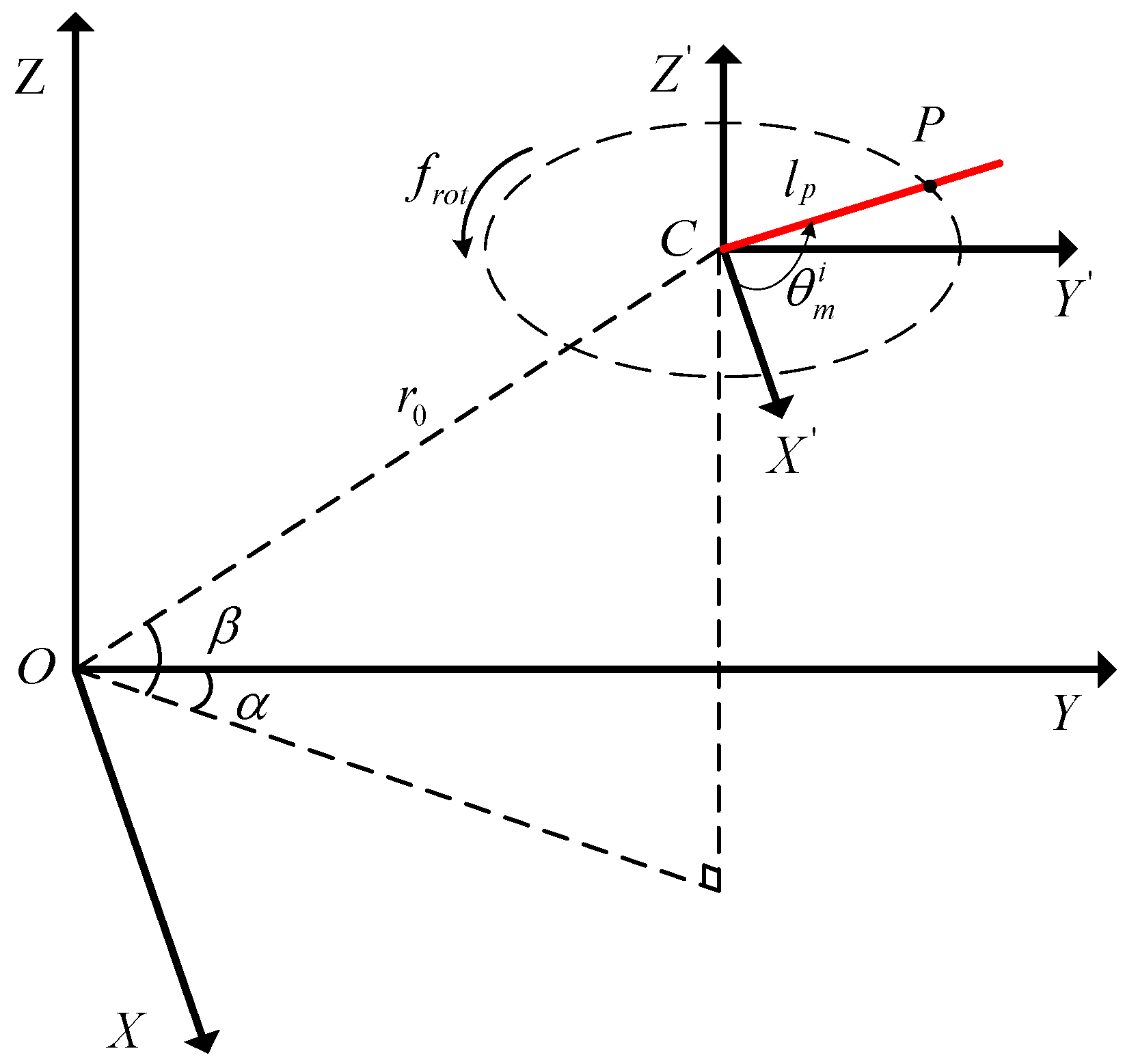
It is assumed that the SUR has I rotors, and each rotor consists of M equally spaced blades with the same length L. Figure 1 shows the simplified geometry of radar detection, where the red line denotes the mth blade of the ith rotor.
Figure 1.
The geometry of radar (Origin O) and rotating rotor (Origin C, one blade shown for illustration as marked by red).
The radar is located at Origin O of the coordinate system (X, Y, Z). The reference coordinate system is used to describe the rotation of rotor, and Origin C denotes the center of rotor. The rotation of rotor occurs within the plane, which is parallel to the (X, Y) plane. P is a point on the mth blade with an initial rotation angle , (), and the length of PC is , . For simplification, the azimuth angle is set as zero in the following derivation. The meanings of the remaining symbols used in the derivation are listed in Table 1.
Table 1.
Symbols and Meanings.
The distance between P and O can be expressed as
When the radar employs the LFM waveform, the transmitting signal of the (n + 1)th sweep frame is defined as
where c is the speed of light, f0 is the start frequency of the sweep signal, is the sweep slope, B is the bandwidth, and denotes the sweep duration. denotes the fast time, and corresponds to the slow time, where is the frame index and N is the number of frames for coherent integration. Hence, the full time is .
The echo of generated by the point P can be expressed as
where
The time-domain output of pulse compression via the stretch processing can be derived as [40]
where is backscattering coefficient of point P (as defined in Table 1), is the Doppler shift induced by the radial velocity v of SUR, is a constant, and represents the radar instantaneous frequency.
Assuming the far-field condition is satisfied, the echo signal accounting for multiple rotors can be obtained by integrating (5) over the blade length L, the blade number M, and the rotor number I as
It is seen that the rotation speed -dependent terms lead to the frequency modulation on the radar echo spectrum. To analyze the modulation effect, (6) can be simplified using the Bessel series
where denotes the Bessel function of the first kind of order q. By substituting (7) into (6), (6) can be rewritten as
where .
By taking the Fourier transformation along the fast time dimension for each frame, the range spectrum of the frame can be calculated as
where is determined by the rotor parameters and defined as the Bessel function [41,42]. is the delay-related frequency involving the radial range of SUR, i.e.,
and depends not only on the initial range but also the range–Doppler coupling term introduced by the target motion. While is generally much smaller than , the target range can be estimated from in absence of rotor rotation, i.e., .
However, when , the spectral energy of spreads around with an interval of ; then, the spectral shape is changed from a single peak to multiple spikes. If , signal coupling across neighboring range cells occurs, which makes it hard to accurately estimate the distance of SUR.
In addition, it can be seen from the phase item in (9) that also introduces a phase modulation along the slow time domain. By taking the derivative of phase in (9) with respect to slow time, the velocity-related Doppler shift can be expressed as
Similarly, the rotation of rotor also leads to the spectral spread in Doppler dimension as that in range dimension. The spectral spread in range and the Doppler domain is known as the micro-Doppler signature (MDS). Since , the effect of rotor rotation on the Doppler shift is more significant than that of the range shift. In addition, the rotating speed of rotors usually changes from moment to moment so as to maintain the balance of SUR under different wind conditions. A larger change rate of rotation speed leads to a more dispersive radar range–Doppler spectrum.
3. Micro-Doppler Signature Detection Method
Conventional micro-Doppler-based detection methods typically utilize short-time Fourier transform or standard Hough-transform techniques, which are limited by the range–Doppler coupling and spectral energy dispersion, particularly under low-frequency radar and low-RCS conditions. To address these limitations, the proposed method combines multiple reassignment squeezing (MRS) to enhance energy concentration and an ergodic Hough transform (EHT) with binary accumulation to robustly extract rotor trajectories, offering significantly improved robustness over traditional time–frequency or CFAR-based detection frameworks.
Although the MDS disturbs the detection of scattering signal of airframe, it enables the surveillance of hovering SUR when the airframe echo is submerged by the ground clutter and its multipath components. To accurately estimate the range and Doppler information of SUR, a method combining multiple reassignment squeezing (MRS) and ergodic Hough transform (EHT) is proposed.
3.1. Range Squeezing via Multiple Reassignment
First, the range–time (RT) spectrum in (9) is processed using the reassignment method [43] to reduce the spectral spread in range dimension. The reassignment operator is defined as the gravity center of the spectral envelop, which can be calculated as
where denotes the local neighborhood width around frequency f, used to compute the spectral centroid.
The reassignment of range–time spectrum is carried out by transforming to through the following relationship:
where is the delta function which is used to reallocate the spectral power around the gravity center .
Generally, one reassignment may not achieve a satisfactory squeezing result. Hence, multiple reassignments are required to further concentrate the dispersive MDS energy in a stepwise manner.
where is the range–time spectrum of the Kth reassignment, , and
3.2. Ergodic Hough Transform-Based Detection
After multiple reassignment processing, the detection of hovering SUR can be regarded as the line detection in RT spectrum. Since temporal coherent integration does not work, the detection probability is limited. To deal with this problem, a modified HT-based method [44] is applied, which is essentially a non-coherent integration method similar to the track-before-detection algorithm. The detailed procedure includes the following three steps.
3.2.1. Step 1: Primary Detection in Range–Time Spectrum
Instead of directly taking the Hough transform over the spectrum, the primary detection is initially carried out to reduce the time complexity. Through the order statistics (OS) constant false alarm rate (CFAR) processor, the resolution cells accounting for candidate targets are identified. At this stage, a low threshold is designed to ensure a high detection probability, while the resulting high false alarm rate is intended to be reduced subsequently. It is worth noting that OS-CFAR is chosen over the commonly used cell average (CA)-CFAR because the radar measurements contain non-homogeneous clutter and occasional strong outliers. Under such conditions, CA-CFAR may yield biased averages, whereas OS-CFAR, by selecting a ranked sample instead of the mean, can provide more robust background estimation and improve the reliability of weak micro-Doppler detection.
3.2.2. Step 2: Enumerating and Mapping
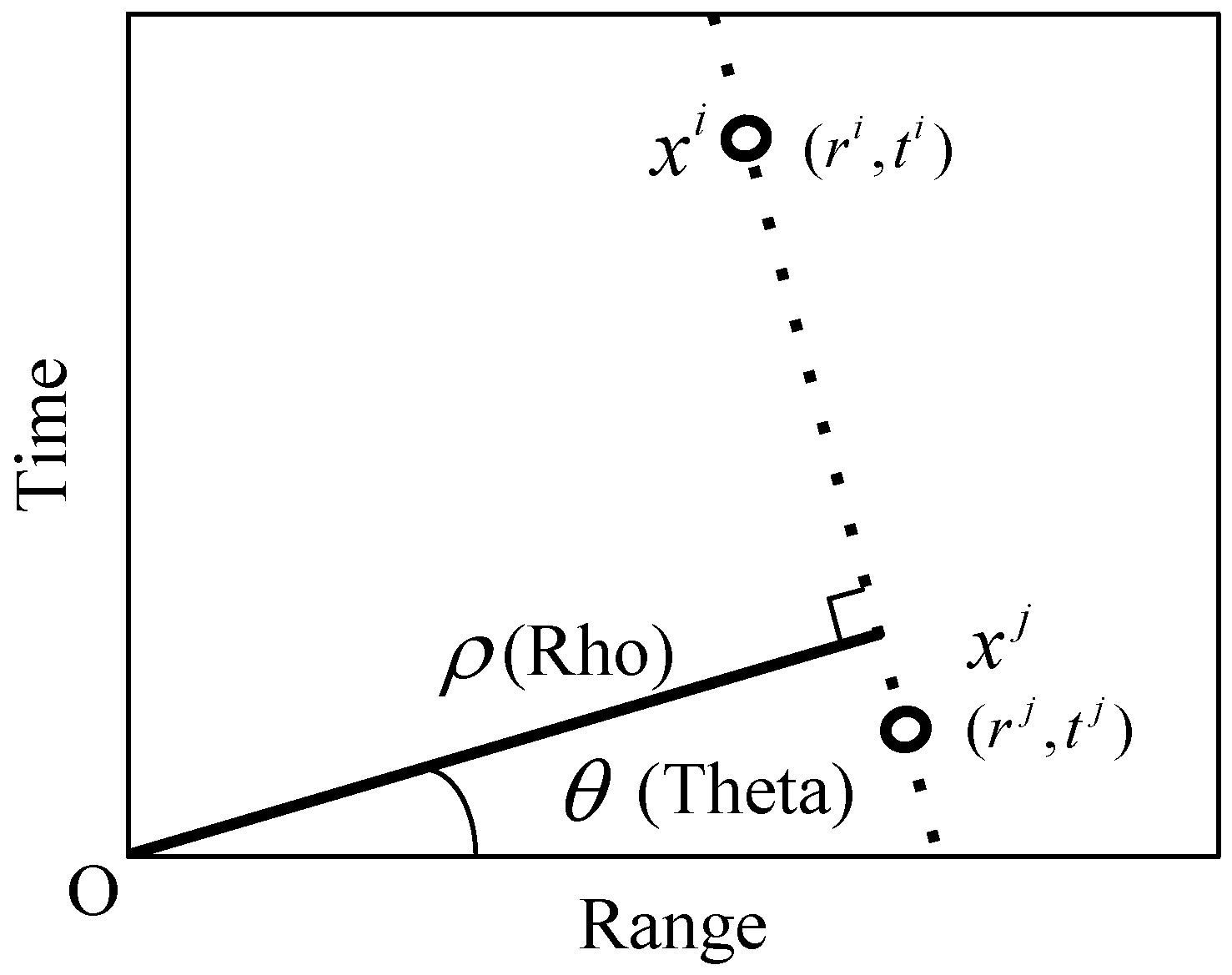
Assuming that the measurements after the primary detection are , , where Q is the number of measurements in total, r and t are range and time, respectively. If are associated with the same target called a measurement pair, then the line connecting can uniquely describe the target’s range–time relationship, as shown in Figure 2, and other observations of the target will also appear on this line.
Figure 2.
The sketch map of a measurement pair.
The above line can also be uniquely represented by the Hough parameters and . is defined as the perpendicular distance from Origin O to the dashed line. is the angle from the perpendicular to the range-axis and the clockwise direction is positive. Hence, the Hough parameters can be calculated by
which is equivalent to
For Q measurements, there are possible measurement pairs at most, all of which are enumerated and then mapped into the Hough parameter space by (17).
3.2.3. Step 3: Binary Accumulation and Threshold Detection
According to the signal model, all measurements of the same target should approximately appear on the same range–time line, i.e., corresponding to a roughly identical . Hence, binary accumulation can be used to highlight the difference between targets and clutters. For all measurement pairs, an accumulator is assigned to record the occurrence number of different . That is to say, each measurement pair mapped into the Hough parameter space is assigned an identical unit weight rather than the spectral power. This operation enables the targets with different powers to have a similar accumulation value, thus avoiding the small target being submerged by the large target.
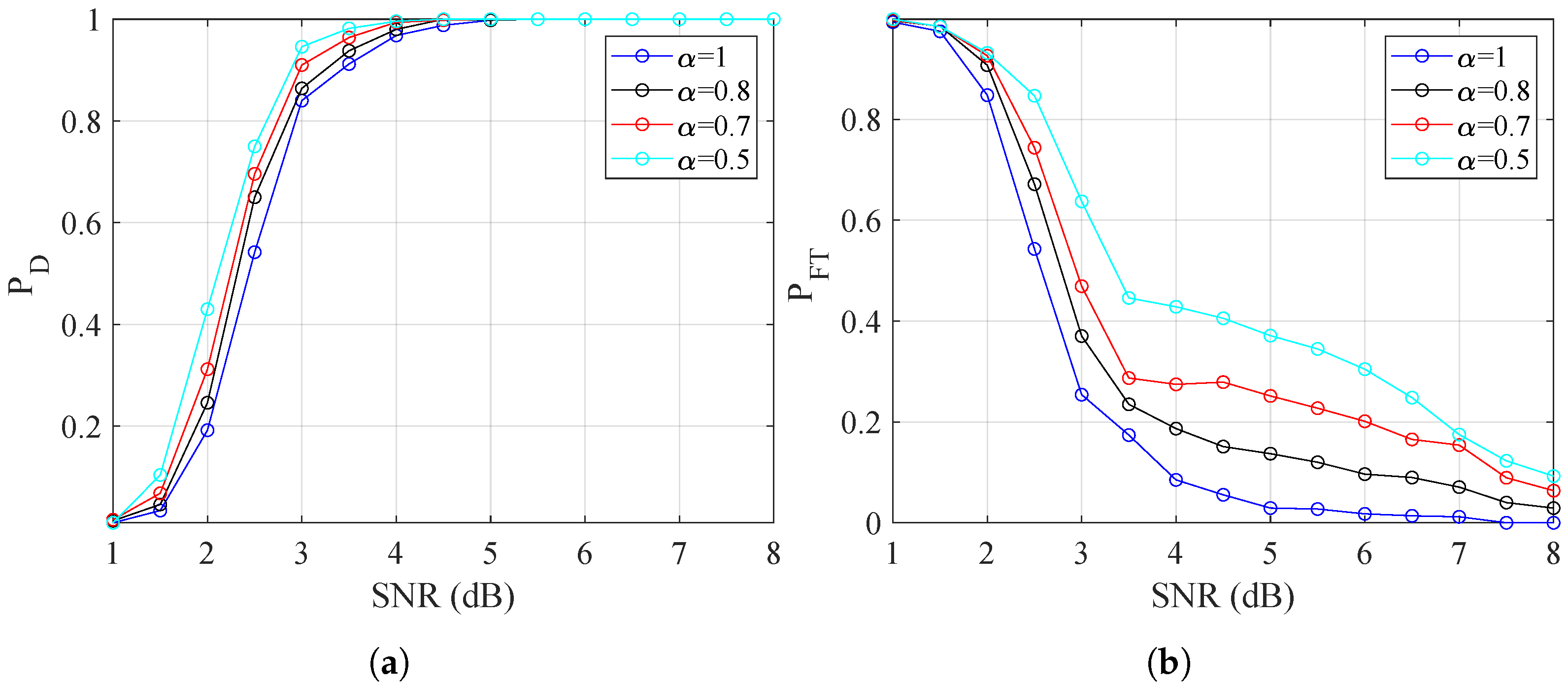
Based on the binary accumulation, the secondary threshold detection method can be employed to reduce the false alarm rate. Assuming the maximum accumulation value in the Hough parameter space is , the threshold is selected to distinguish targets from clutters, where is the threshold coefficient. The measurements associated with an accumulation value higher than are then processed by the mean shift clustering algorithm [45] to further reduce the false alarms, and the results are declared as final targets. A small means a high detection probability and a high false alarm rate, which is empirically set as 0.8 here. A more detailed investigation of the effect of is presented in the simulation and experiment results.
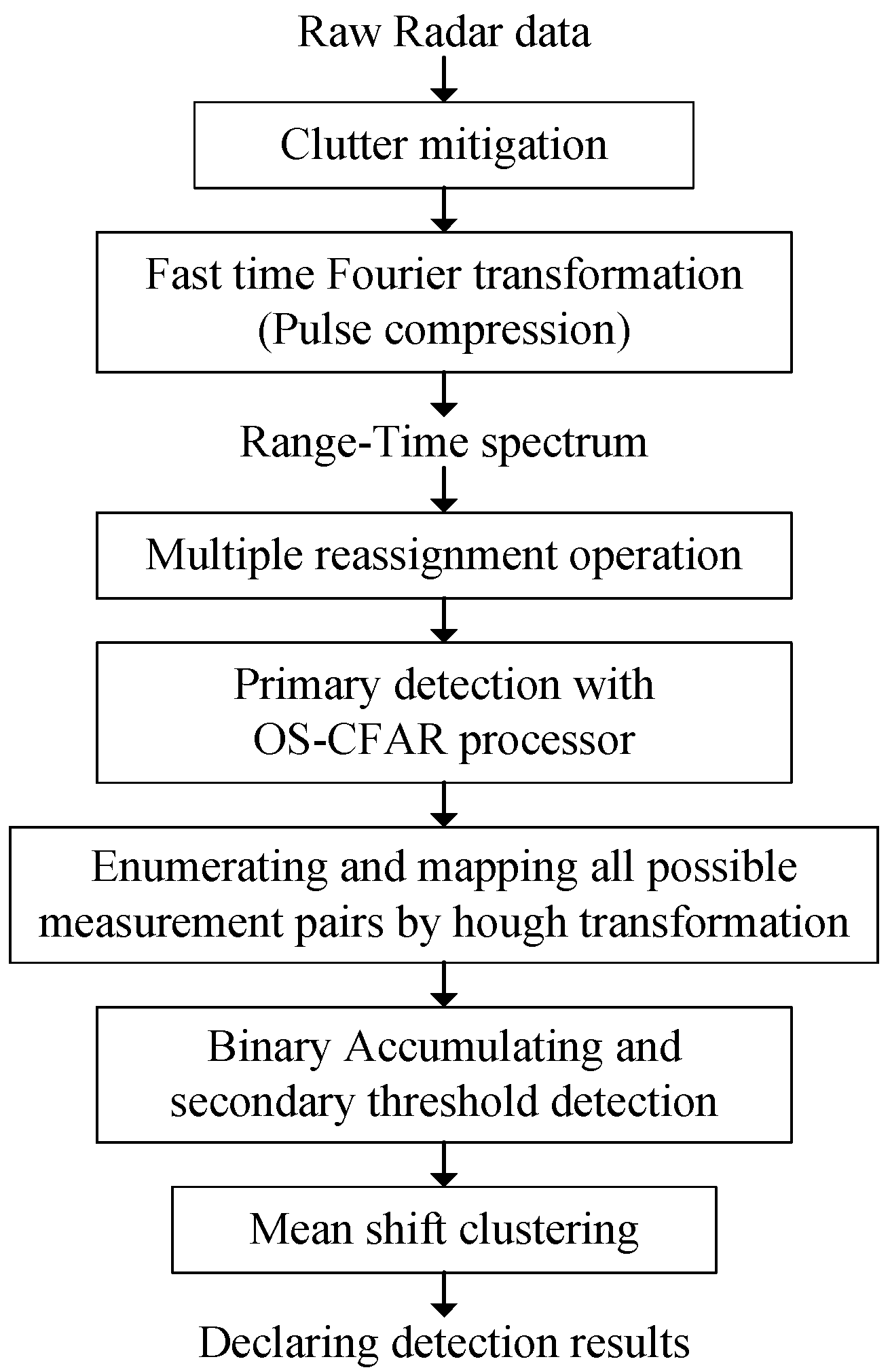
The block diagram of the proposed detection method is shown in Figure 3. In addition to the above processes, two other steps involving the clutter mitigation and mean shift clustering should also be included. Before the reassignment operation, a high-pass filter over slow time domain is applied to the range–time spectrum to remove the ground clutter and its multi-path signals.
Figure 3.
Block diagram of the proposed hovering SUR detection method.
3.3. Computational Complexity
The proposed method mainly consists of multiple reassignment squeezing (MRS) and the ergodic Hough transform (EHT).
MRS Stage: For an range–time matrix, each reassignment uses a local window of length R, resulting in a computational cost of
With K iterations ( in practice), the overall MRS cost is
which grows linearly with data size and remains practical since .
EHT Stage: After CFAR detection, only D candidate points remain (). The enumeration of all point pairs yields a computational complexity of
and subsequent clustering adds negligible overhead.
Since , the total complexity of the framework can be expressed as
To provide a fair evaluation, we further estimate the computational load under the parameters used in our experiments ( range bins, CPI frames, iterations, window length). The total number of operations for the MRS stage is approximately . In our MATLAB 2024a implementation, four MRS iterations require approximately 0.68 s per CPI for single-target data compared with 5.12 s for coherent integration.
After CFAR detection, the complexity of the proposed trajectory extraction stage remains with ergodic HT, as both rely on pairwise enumeration. Compared with the standard HT, our method incurs a slightly higher cost, but this overhead is offset by the significant gains in spectral concentration and detection robustness. Near-real-time performance can still be maintained, even in multi-target scenarios.
4. Numerical Simulation
Numerical study of the proposed method is carried out based on the signal model in Section 2. Table 2 lists the simulation parameters, and a quadrotor drone hovering at the range cell of 181 is considered. The rotor rotation is assumed to follow a Gaussian distribution, i.e., , where and are, respectively, the average and standard deviation of the rotation speed of the ith rotor during the measurement period . For four rotors, different rotation speed is configured.
Table 2.
Simulation configuration.
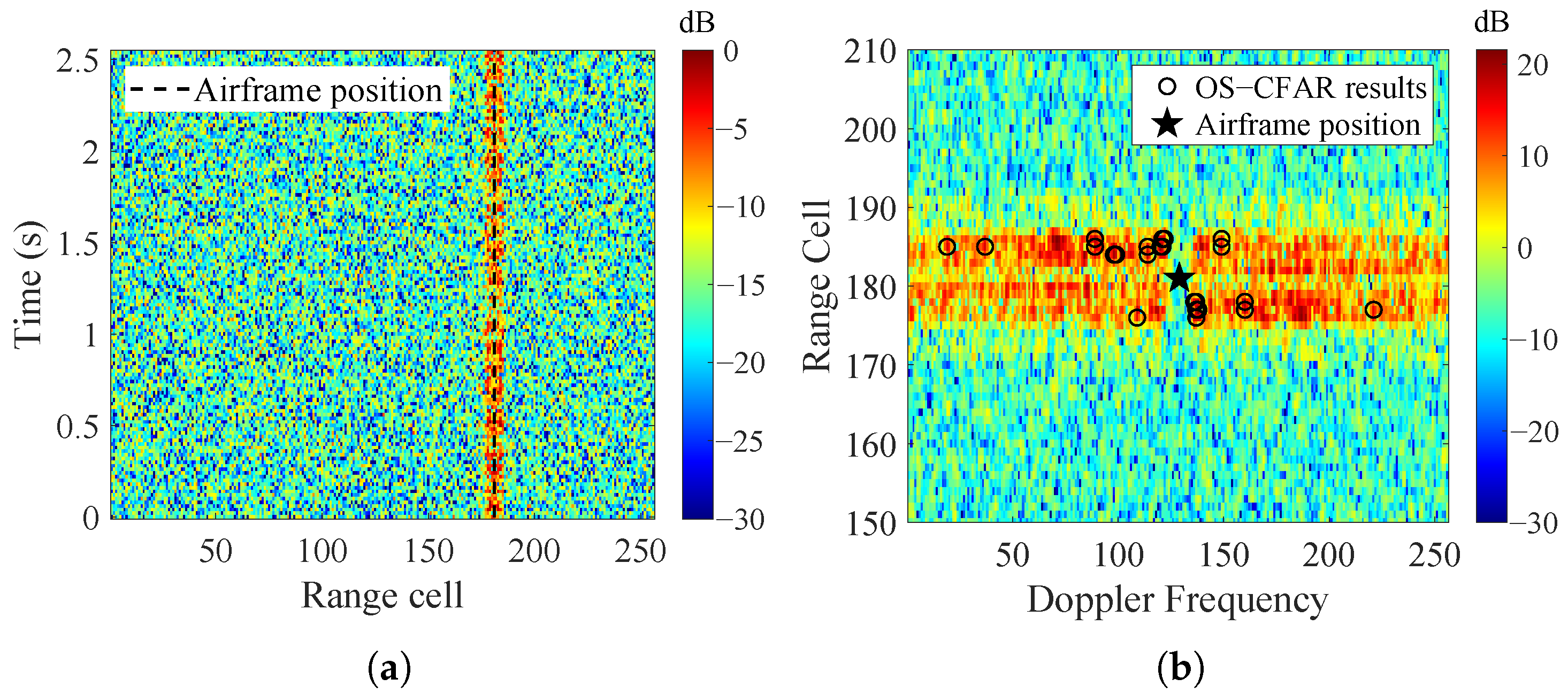
Figure 4a gives the simulated range–time spectrum accounting for the rotors without considering the airframe scattering. The SNR, defined as the ratio of average signal power to average noise power, is set to be 8 dB. It is observed that the spectrum is spread along range dimension. Figure 4b is the range–Doppler (RD) spectrum obtained by performing Fourier transformation of Figure 4a over the slow time dimension. In addition to the range coupling, the Doppler spread is also significant due to the changing rotation speed and RCS of rotors. With traditional order statistics constant false alarm rate (OS-CFAR) detection methods, the MDS originated from a single target is identified as multiple targets (as marked by the black circles in Figure 4b).
Figure 4.
The simulated (a) range–time spectrum and (b) range–Doppler spectrum of a hovering quadrotor drone.
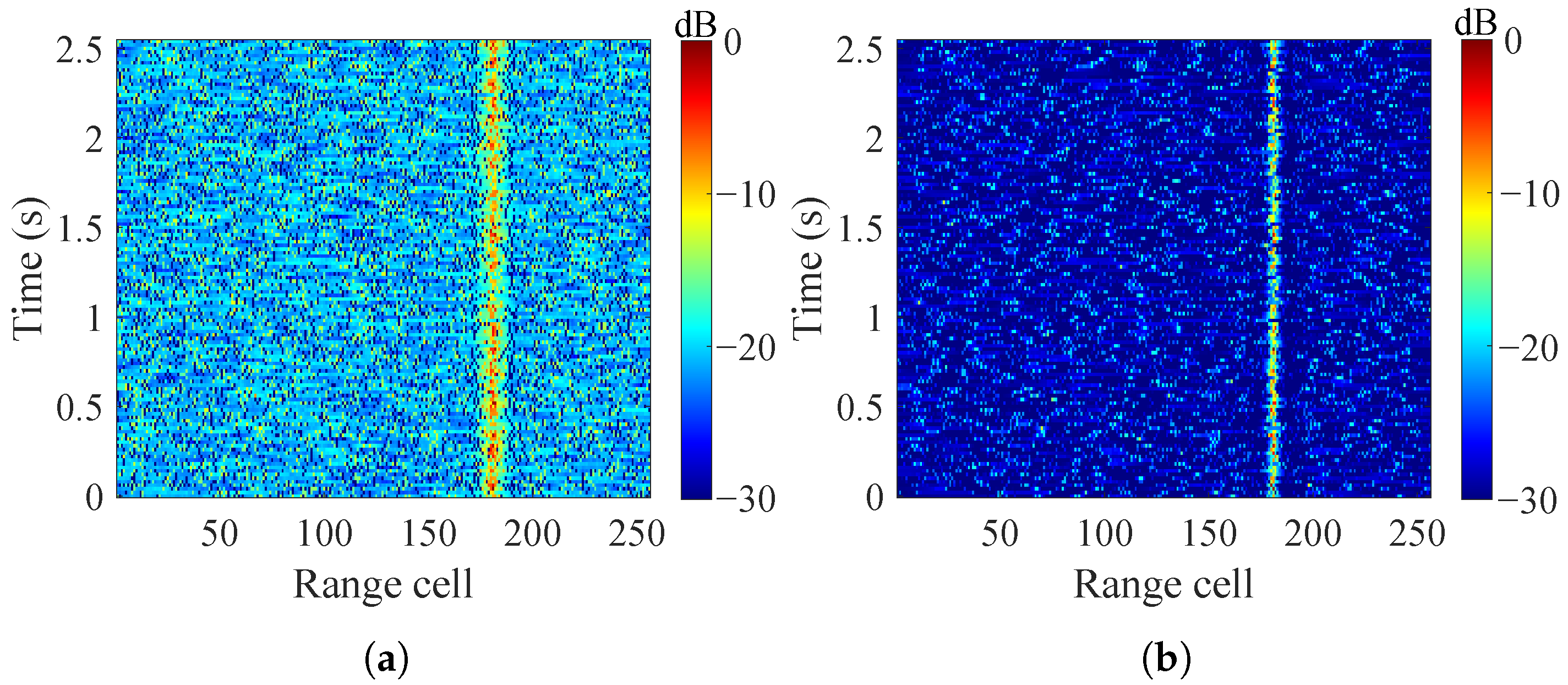
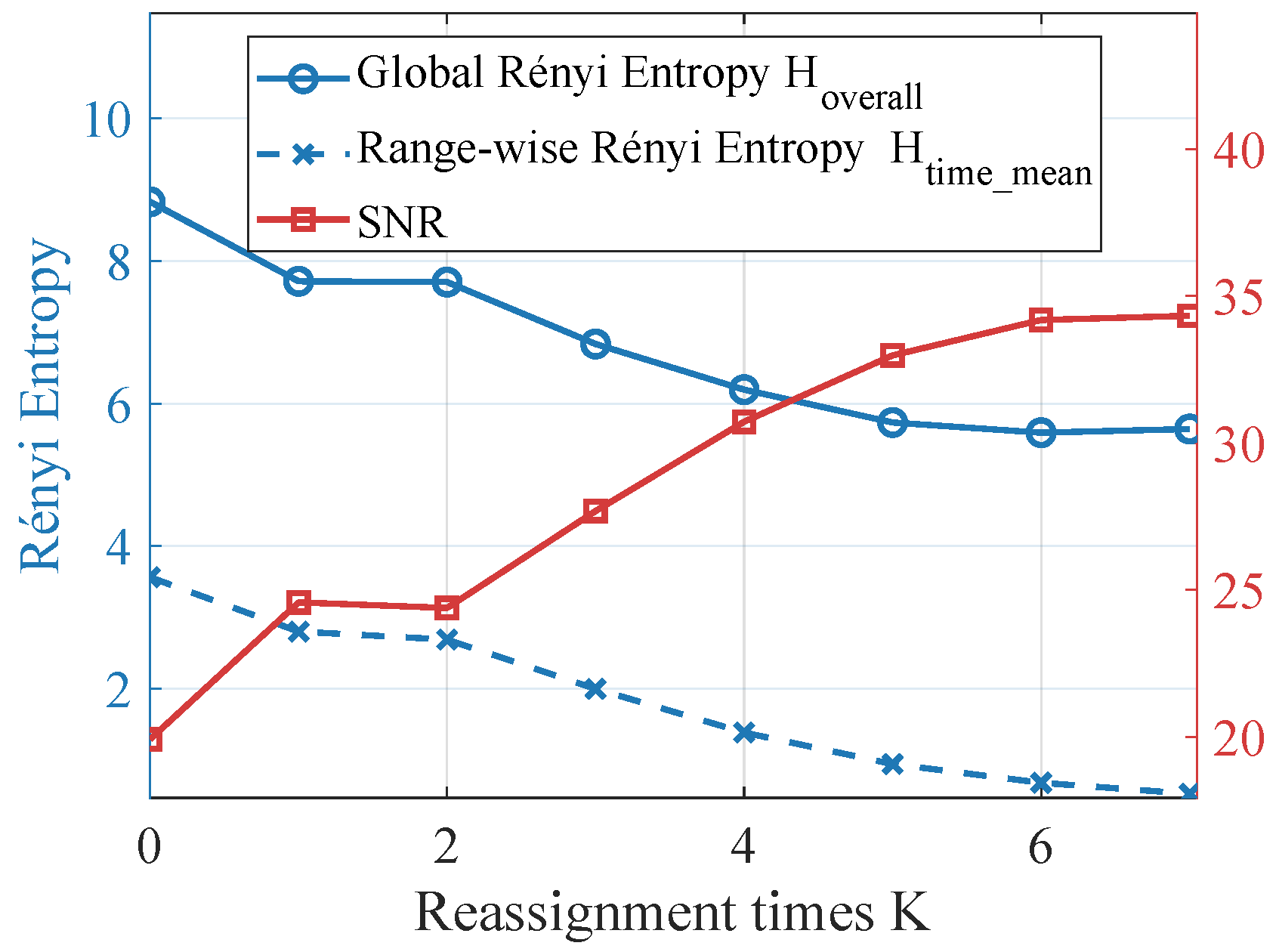
Figure 5 shows the range–time spectra after one and four iterations of reassignment, where a reduction in range–domain spreading with iteration number can be observed. Figure 6 presents the evolution of the second-order Rényi entropy and the signal-to-noise ratio (SNR) over 1 to 7 iterations, demonstrating how spectral concentration and detectability improve with increasing iteration number.
Figure 5.
The range–time spectra via range squeezing process using (a) one and (b) four reassignment operations, respectively.
Figure 6.
Evolution of Rényi entropy and SNR versus reassignment iterations K, illustrating joint improvement in spectral concentration and detection quality.
The Rényi entropy, defined in terms of the normalized R-T energy distribution, measures the overall concentration of spectral energy [46]. Its gradual decrease with increasing K indicates that MRS effectively suppresses the range spreading and helps concentrate the energy of the micro-Doppler signatures. In parallel, the SNR—computed as the ratio of the mean signal power within the target range bins over the average noise power outside them—also improves, demonstrating enhanced target detectability. However, both metrics exhibit diminishing gains beyond , suggesting that additional iterations provide limited benefit while incurring higher computational cost. Therefore, a practical trade-off of is adopted in this work.
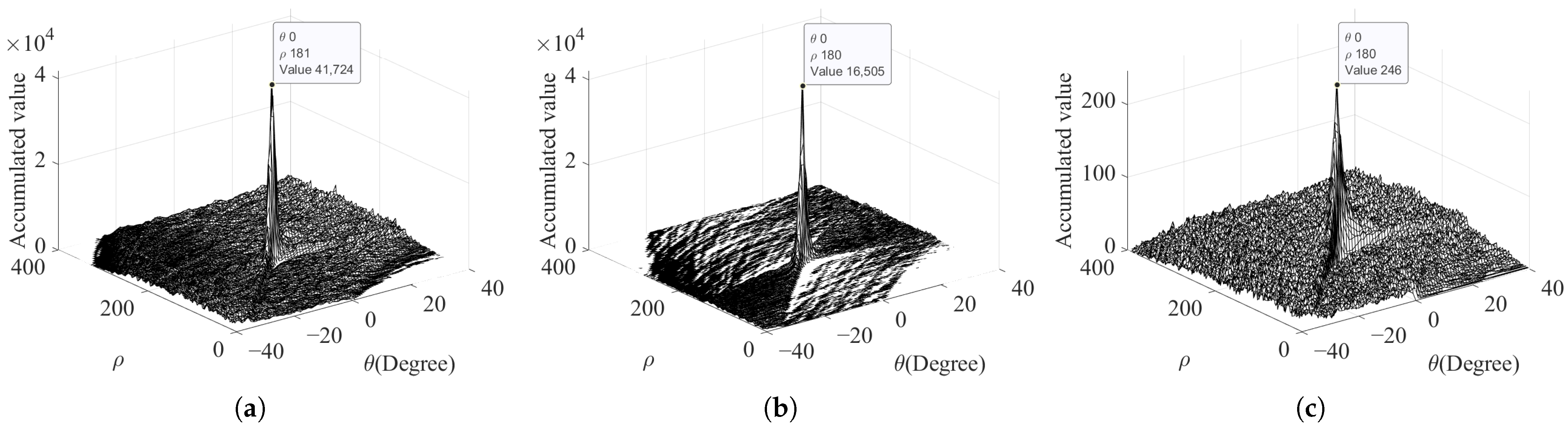
Figure 7 shows the Hough parameter accumulation results obtained by the proposed method, the previous ergodic Hough transform [47] and standard Hough transform [44], respectively.
Figure 7.
Accumulated Hough parameter space results obtained by (a) the proposed method, (b) ergodic HT, and (c) standard HT, respectively.
To make a relatively fair comparison, the latter two methods employ the same detection strategy in terms of range–time domain and Hough space, as well as the same mean shift clustering. The false alarm probability of the OS-CFAR processor is set as 0.05. For the three methods, the maximum accumulation values all appear at the location of , (range cell), which coincides with the target’s location. Nevertheless, the proposed method generates a larger accumulation value than the other two methods, which implies higher detection probability.
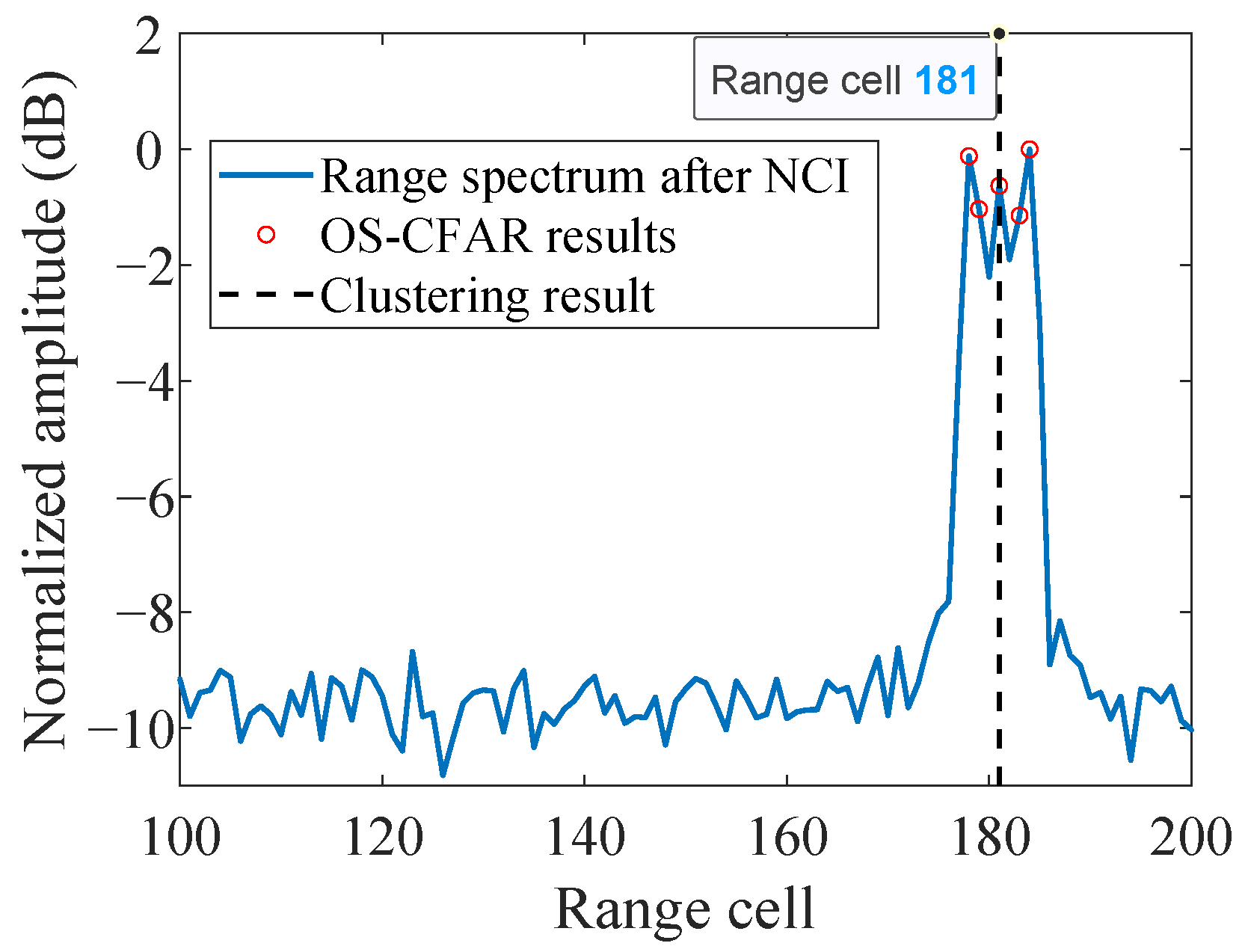
In addition, the traditional moving target detection (MTD) method is taken for comparison. Temporal non-coherent integration (NCI) (as (18)) and OS-CFAR are carried out successively to detect the signals in the range spectrum associated with an SUR target, as illustrated in Figure 8.
Figure 8.
OS-CFAR and clustering processed results of the incoherently accumulated range–time spectrum.
The false alarm rate is set the same as that of the aforementioned methods, and the OS-CFAR results are marked by red circles. It is seen that the micro-Doppler signature isn identified as multiple targets, which can be resolved via a clustering algorithm to obtain a single estimation (marked by the dotted black line).
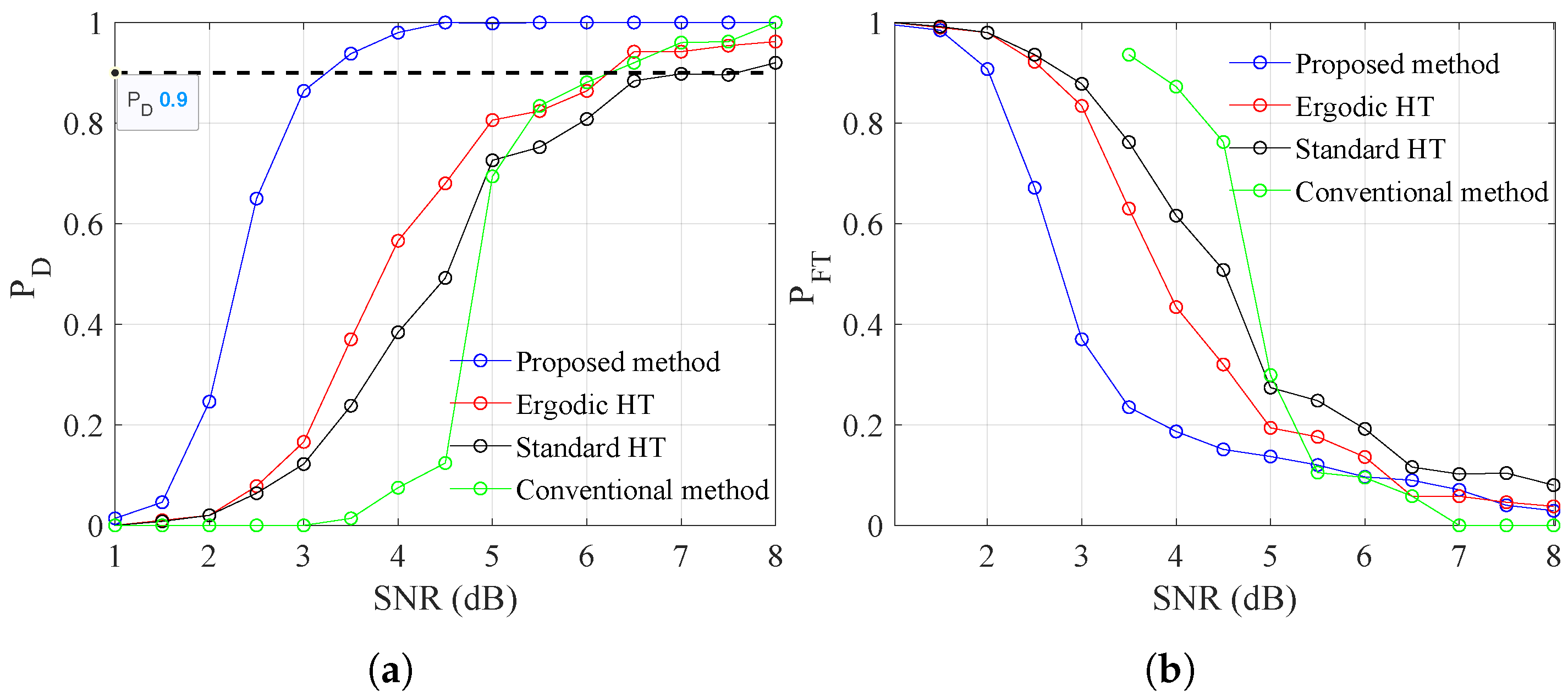
Further comparison of the methods’ performance is carried out by Monte Carlo trials under different SNR conditions. For each condition, 500 independent trials are taken. For all methods, the false alarm rate is set as 0.01 and the secondary threshold coefficient is set as 0.8. If the range difference between the detection and truth is less than one range cell, the detection is considered successful; otherwise, it is a false detection. The target detection probability is defined as the ratio of the number of successful detections to that of total target points. Similarly, the false alarm rate is defined as the ratio of the number of false detections to that of total detections.
Figure 9 compares the detection probability and false alarm rate of different methods under different SNR conditions. It is seen that for a given SNR, the proposed method achieves higher detection probability and lower false alarm rate than the other methods. Moreover, the performance difference increases as SNR drops. Namely, a lower-value SNR condition is required for the proposed method to achieve a considerable detection performance with the other methods. Moreover, the effect of the threshold coefficient is investigated in Figure 10. It is obvious that a lower leads to higher and . A compromise value of is empirically valid and selected here.
Figure 9.
Simulation comparison of different methods in terms of (a) detection probability and (b) false alarm rate versus SNR.
Figure 10.
Simulation results involving the effect of factor on (a) detection probability and (b) false alarm rate.
5. Experiment Results and Discussion
5.1. Experiment Description
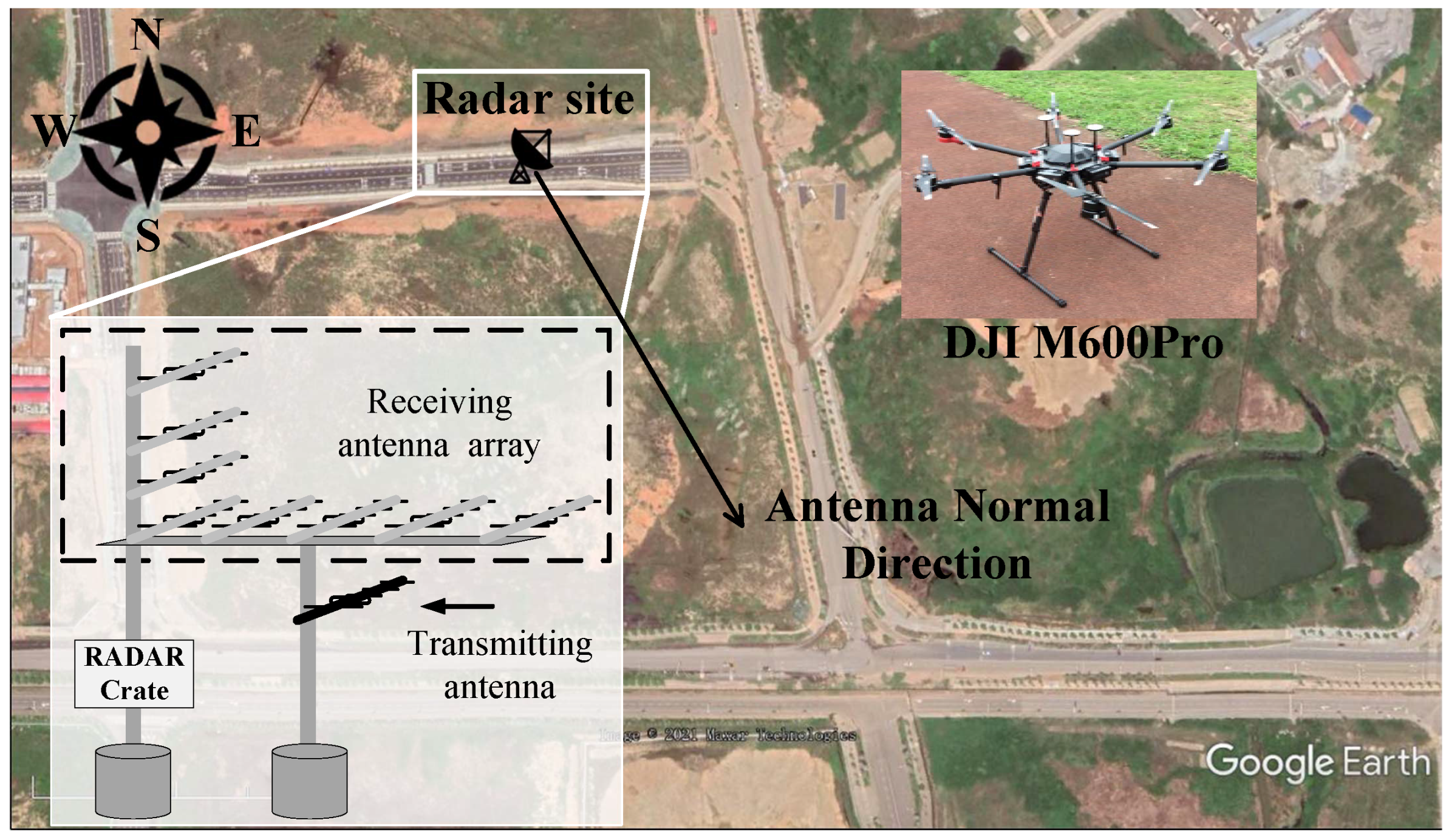
The experiment was carried out beside the suburban road using an UHF-band radar, as illustrated in Figure 11. The transmitting and receiving both were horizontal co-polarization Yagi-Uda antenna. The interrupted LFM waveform was used and the main parameters are listed in Table 3. The hexacopter drone M600Pro manufactured by DJI Technology Co., Ltd. (Shenzhen, China) [48] was selected as the cooperative target, the main materials of which include the glass fiber reinforced composite and carbon fiber. The location information of the drone was recorded once per second by a GPS with an accuracy of m.
Figure 11.
Experiment configuration map.
Table 3.
Experimental UHF radar parameters.
5.2. Detection Results of Hovering SUR
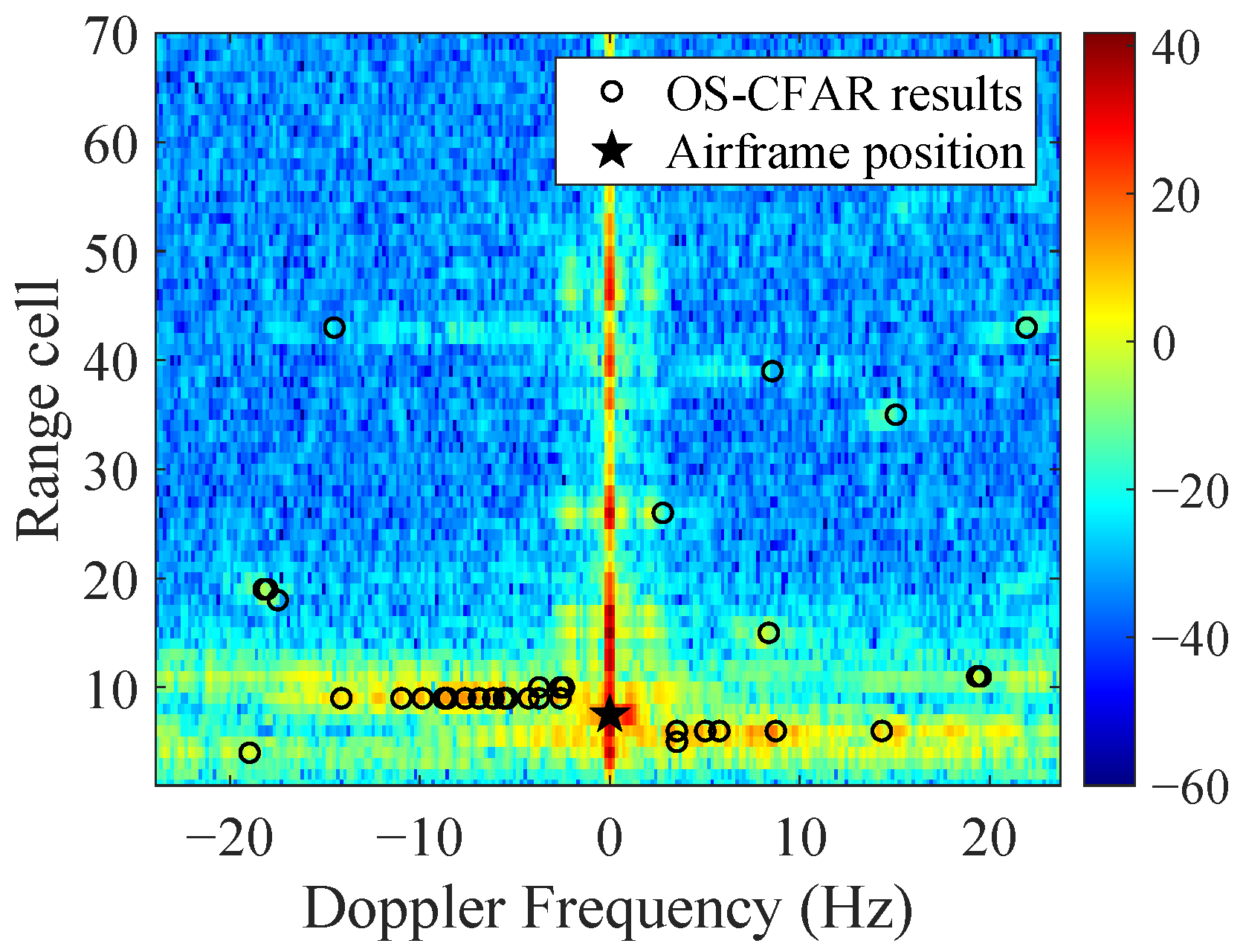
Figure 12 presents the radar measured range–Doppler spectrum, where the drone M600Pro was hovering at the distance of about 110 m (7∼8th range cell, marked by the black pentagram) away from radar. It is observed that the echo of drone airframe is submerged in the strong ground clutter with zero Doppler frequency, thus difficult to be identified. However, the micro-Doppler signals scattered from the drone rotors are much more weaker and distinguished from the airframe signal due to the spectral spread in range and Doppler dimensions. Using the OS-CFAR-based MTD method, multiple false targets are reported.
Figure 12.
Real radar range–Doppler spectrum of the hovering drone M600Pro. The airframe scattering is marked by the black pentagram.
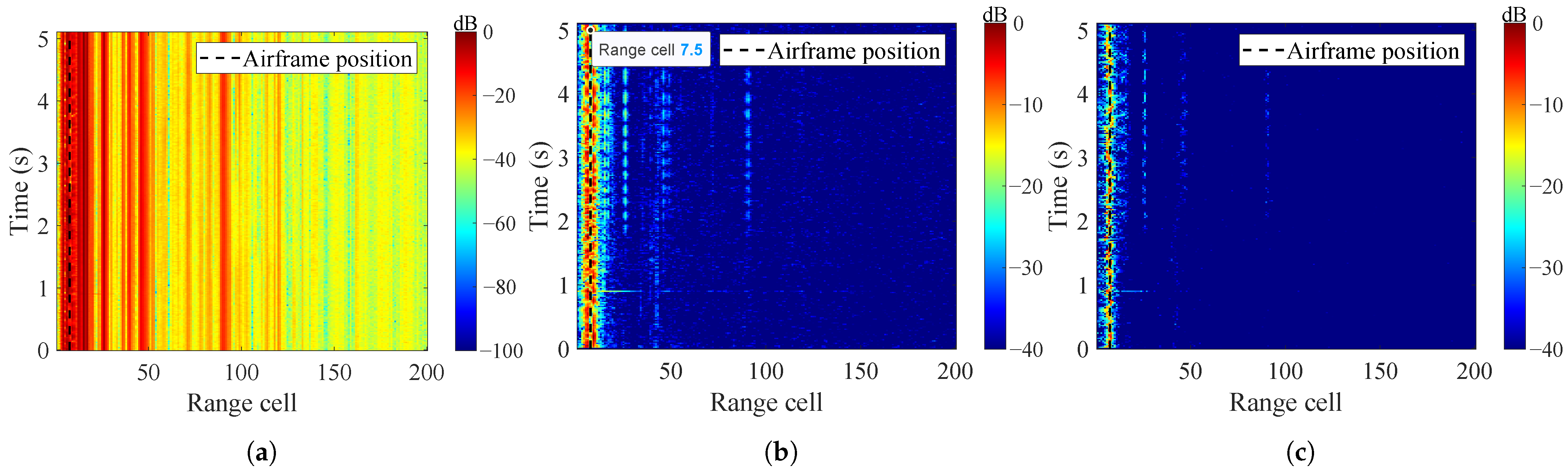
Figure 13a shows the range–time spectrum associated with Figure 12. Since the ground clutter occurs at multiple range cells over the whole observation period, it seriously contaminates the drone signals. Through the high-pass filter over the Doppler frequency domain, the ground clutter is significantly removed and the micro-Doppler signals of drone are highlighted (see Figure 13b). Furthermore, the range spread of micro-Doppler signals is reduced after the multiple reassignment squeezing operation (see Figure 13c), proving that the algorithm is effective for real experiment data.
Figure 13.
Range–time spectra associated with Figure 12, (a) the original spectrum, (b) after ground clutter mitigation, and (c) after multiple reassignment squeezing.
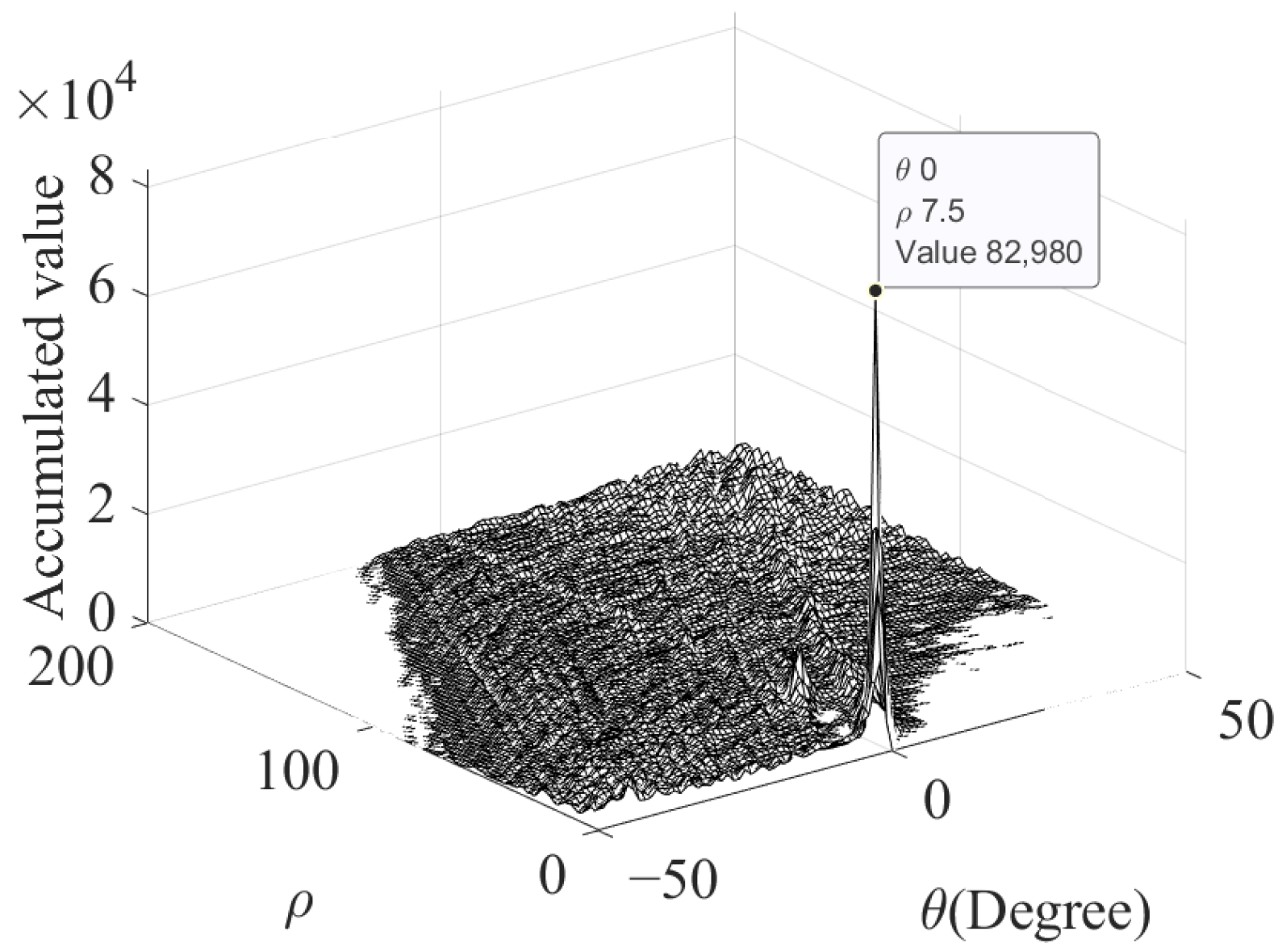
Figure 14 shows the Hough transform result of Figure 13 using the proposed method. The maximum accumulation value of 82,980 appears at the Hough space of and , which can be easily detected by the subsequent secondary detection and clustering algorithm. implies that the drone was hovering and indicates the distance between the drone and radar, which agrees well with the GPS record.
Figure 14.
Hough parameter accumulation result of Figure 13.
5.3. Detection Results of Moving SUR
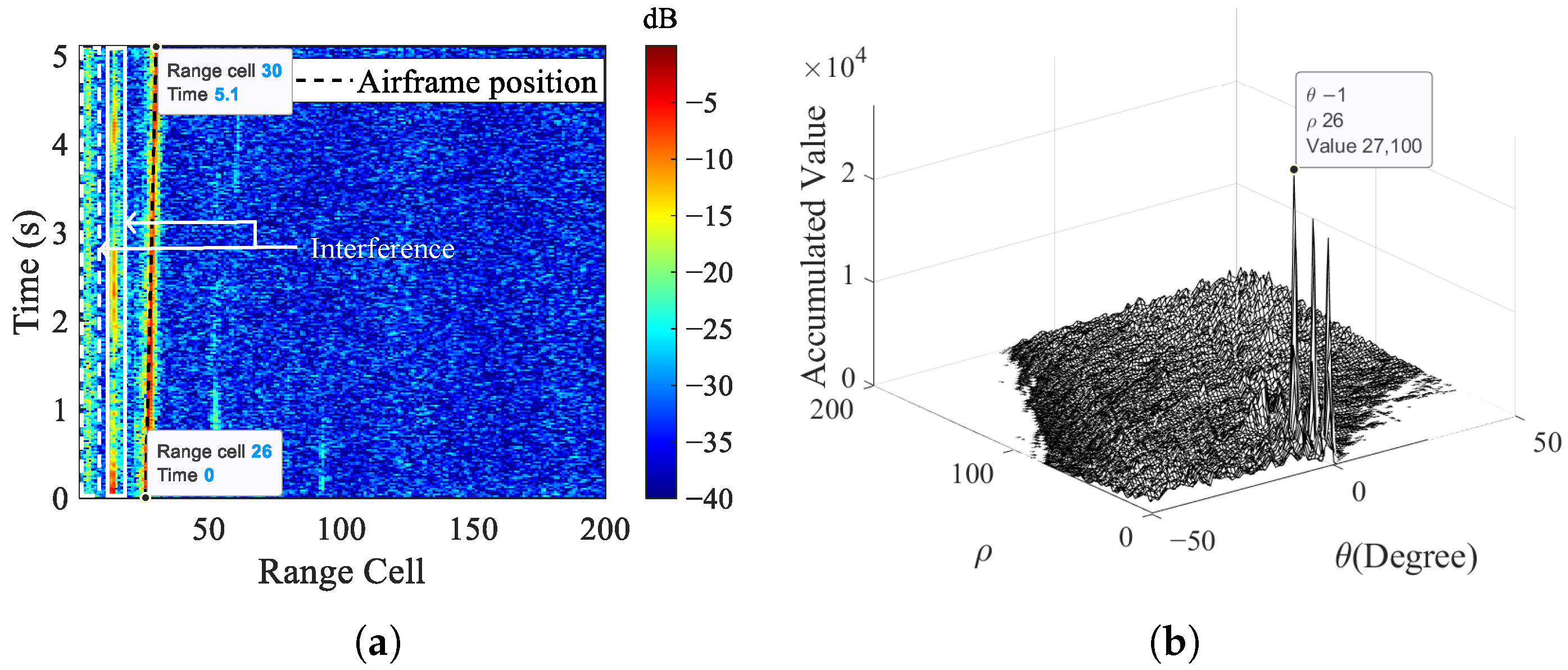
The proposed method can also be used for the detection of moving SUR. In this case, the airframe component can be separated from stationary clutter and it is reserved after clutter mitigation processing. The airframe component and MDS are both utilized and accumulated in the Hough parameter space. Figure 15a shows the measured RT spectrum after clutter mitigation, where the DJI M600Pro is moving from the range cell of 26 to the range cell of 30. As can be seen, the radar echo of the moving SUR in RT spectrum is no longer vertical lines since the radial velocity is not zero, at which point the corresponding Hough parameter is not zero. In addition, the data of two interference targets with lower SNR are also collected and can be clearly observed. The accumulated result in Hough parameter space with proposed method is given in Figure 15b. The MDS and airframe component are both accumulated to a very high value, i.e., , , power = 27,100, which suggest that the SUR is moving from the range cell of 26 to the range cell of 30.5. In addition, since the binary accumulation is adopted, the interference targets with lower SNR have also been accumulated to a high value.
Figure 15.
Results of the moving DJI M600Pro, (a) range–time spectrum after clutter mitigation and MRS process, (b) Hough parameter accumulation result.
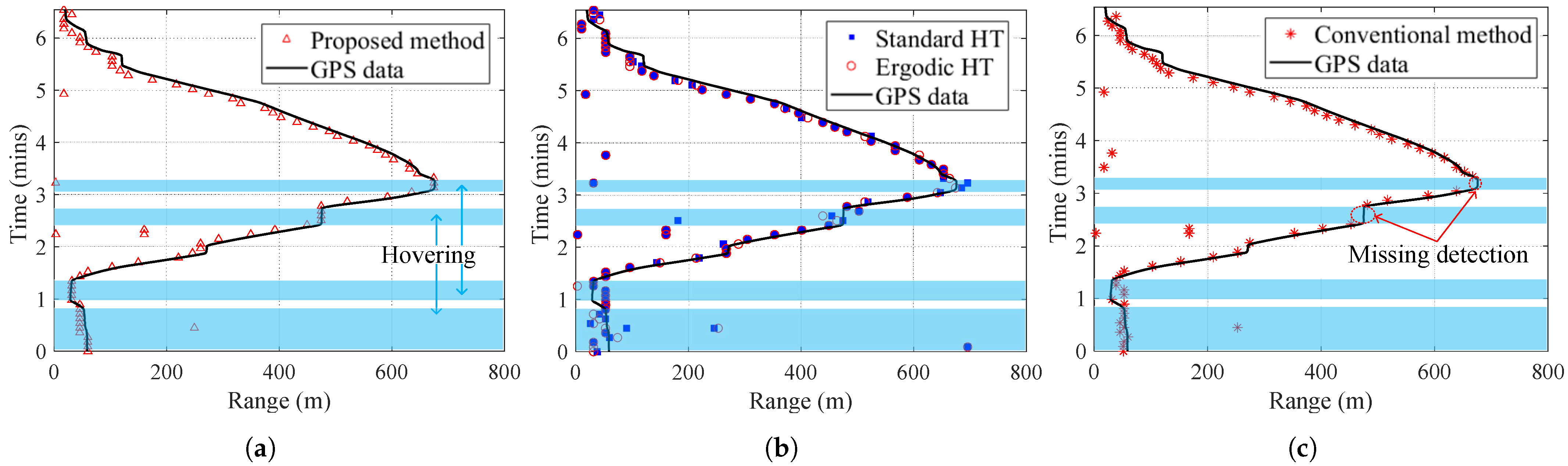
To compare the detection performance of different methods, the DJI M600Pro performs a forward and backward flight along the antenna normal direction and the SUR hovers occasionally. The ground truth of the radial range between the radar and the SUR during the flight is indicated by black line in Figure 16.
Figure 16.
Target’s range–time variation detected using (a) the proposed method, (b) the ergodic and standard HT methods, and (c) the conventional method.
The maximum radial range of the SUR is about 675 m. The blue transparent rectangle areas indicate that the SUR is mostly hovering. The results of proposed method are marked by a red triangle, shown in Figure 16a. It is clear that the detection results using the proposed method basically coincide with the GPS data despite some range errors. The results of ergodic HT and standard HT are presented in Figure 16b. As can be seen, the consistency between the two methods and GPS data is obviously worse than that if the proposed method, especially when the SUR is hovering, which may be caused by the dispersive nature of MDS. Figure 16c gives the results of the conventional method. As illustrated, since the non-coherent integration (NCI) processing does not achieve the accumulation of MDS, the conventional method fails to detect the hovering SUR when the range is about 475 m and 675 m, respectively.
If the range difference between the radar detected results and the GPS data is less than one range cell, the SUR is considered to be successfully detected. Table 4 presents the detection rate during the entire experiment and the hovering period (blue transparent rectangle areas) with different methods. The detection rate of proposed method during the entire period and the hovering period is more than and higher than that of the other methods, respectively. The experimental results confirm the effectiveness and performance gain of proposed method in the detection of hovering or moving SUR.
Table 4.
Comparison of detection performance.
5.4. Low SNR Condition’s Performance
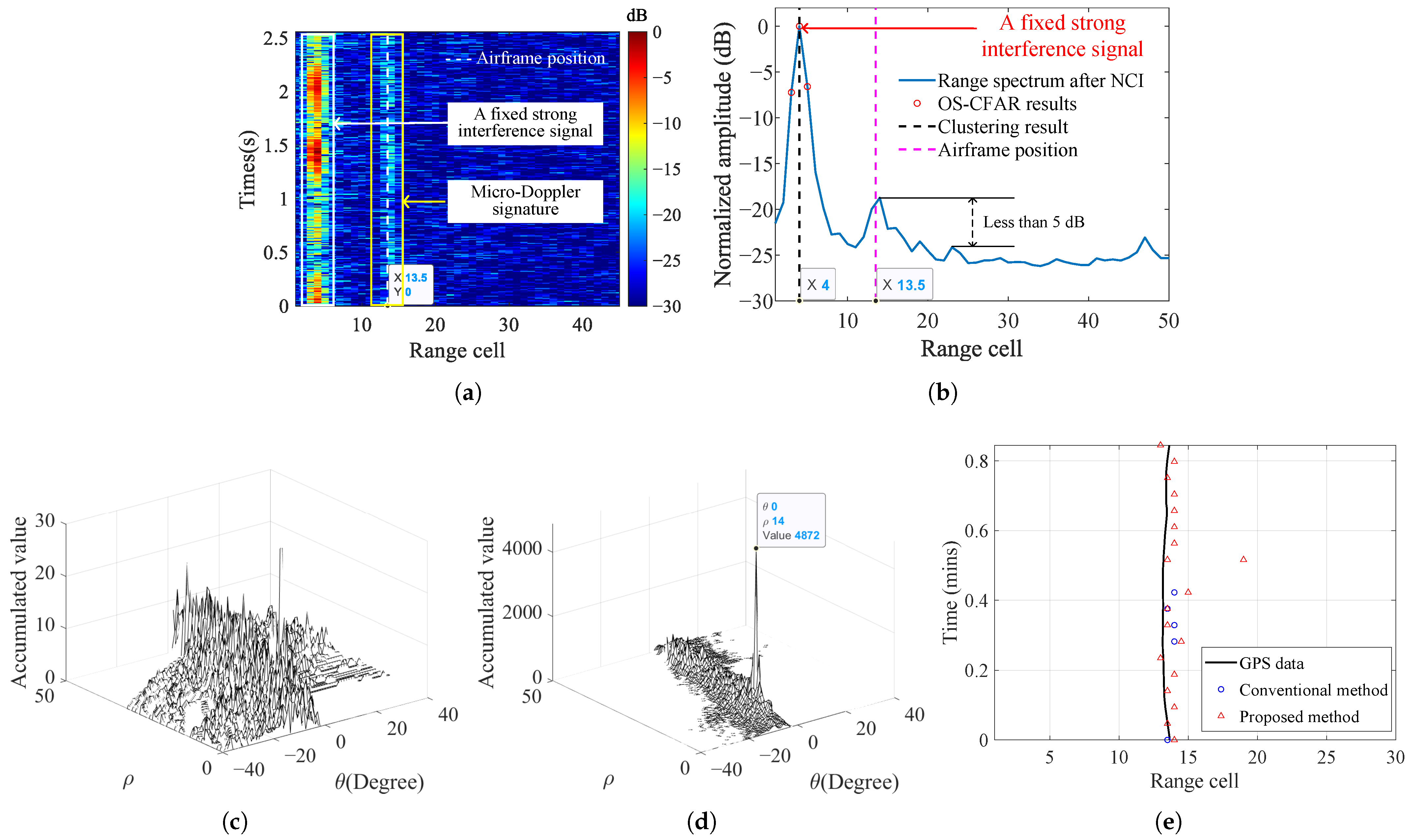
In order to further investigate the low SNR case, the SUR is made to hover outside the main lobe of antenna at the range cell between 13 and 14, and the dwell time is reduced from 5.12 s to 2.56 s. Figure 17a illustrates a measured RT spectrum during this period. As can be seen, a fixed strong interference target occurs at the range cell of four, which continuously exists during this period. In addition, the MDS is almost overwhelmed by the background noise and is difficult to be observed. The accumulated result in the Hough parameter space with standard HT method is given in Figure 17b, in which the the first seven range cells are not detected. It is seen that the MDS is still submerged in the noise. Figure 17c presents the range spectrum after non-coherent integration, in which the OS-CFAR results with a high false alarm probability of 0.05 are marked by red circles. Since the SNR of MDS after non-coherent integration is less than 5 dB, the conventional method also fails to detect the hovering SUR. The first seven range cells are not detected in the following experiment because the interference is fixed.
Figure 17.
Micro-Doppler signature detection in very-low-SNR condition. (a) Range–time spectrum after clutter mitigation, (b) conventional incoherent integration and clustering result, (c) standard Hough transform result, (d) result of the proposed method, (e) detection plot comparison.
As can be seen in Figure 17d, the proposed method concentrates and accumulates the energy of MDS to a high value in which , , value = 4602. Figure 17e presents the comparison of radar detected results over a period of time. The results of the proposed method () and the conventional method are marked by red triangle and blue circles, respectively. As can be seen, the agreement between the results of the proposed method and GPS data is clearly visible, while the conventional method has massive missing detections. The experimental results suggest that the proposed method has better detection performance in the case of low SNR, which agrees with the simulated results.
5.5. Discussion
The proposed method shows an excellent performance in the detection of hovering SUR compared with other methods but also exhibits limitations.
5.5.1. Effect of Strong Interference Target
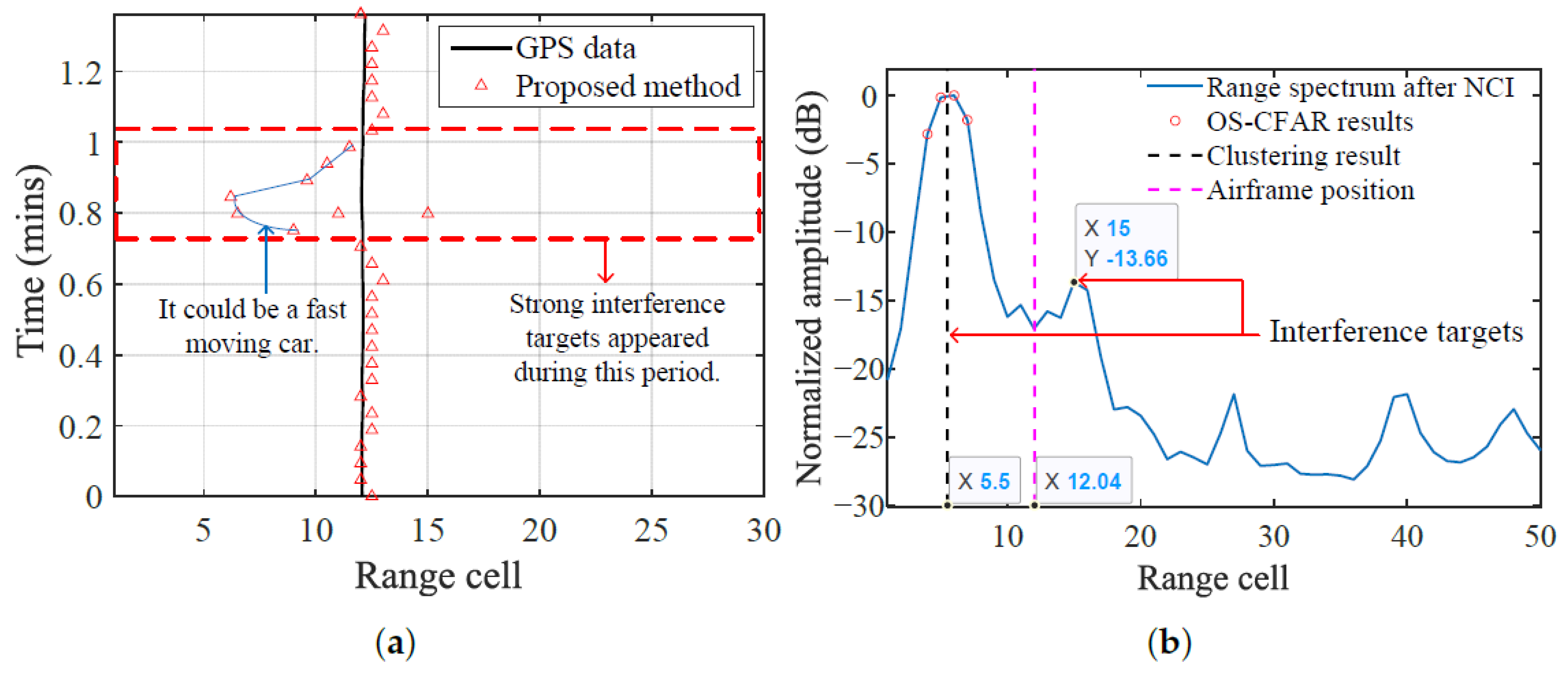
In the previous subsection, the fixed strong interference can be easily eliminated because its position and intensity are stable. The target detection is more susceptible to the dynamic interference, such as moving cars since the SUR can fly at low altitude. Figure 18a shows the detection results of the proposed method and GPS data over a period of time, where the SUR is about hovering at the range cell of 12.
Figure 18.
Effect of the strong interference signals on the detection performance. (a) Target’s range variation detection in presence of temporal interference signals. (b) Range spectrum contaminated by interference signals.
As can be seen, the proposed method fails to detect the hovering SUR in the red dashed rectangle. Instead, some interference targets are detected, some of which could be generated by a fast moving car since multiple roads are within the radar beam. Figure 18b gives a measured range spectrum processed by non-coherent integration during the interference period. It is clearly seen that the MDS is totally submerged in the sidelobe of the strong interference targets, which makes both the proposed method and conventional method fail to detect the hovering SUR.
5.5.2. Effect of Power Difference of Multiple Targets
When multiple targets with wide power ranges are measured at the same time, the sidelobe of the strong signal may directly submerge the weak signal, as mentioned in the previous subsection; in this case, the binary accumulation method also fails. If their direction of arrival are different, it is possible to separate them by subspace projection or beam-forming technology. This issue needs to be further investigated and addressed in the future.
5.5.3. Effect of Multiple Target Clustering
When multiple SURs hover with a similar radial range, their blurry energy of MDS easily overlaps in RT spectrum. In this case, the proposed method cannot distinguish but detects them as one target, which may cause missing detection. How to distinguish and detect them effectively is also important.
6. Conclusions
In this paper, a novel MDS-based method is proposed to deal with the detection of hovering SURs. Multiple radar signal processing techniques are combined to efficiently accumulate and detect the MDS of a hovering SUR, such as the multiple RO method, ergodic HT, and the mean shift clustering algorithm. The proposed method can also be applied for the detection of a moving SUR. Numerical simulation demonstrates the effectiveness of the proposed method, which has the highest and lowest in the hovering SUR detection compared with standard HT, ergodic HT, and the conventional method. A series of field experiments are conducted to verify the effectiveness of the proposed method. A lower frequency band, UHF-band, is adopted in the experiment to obtain a lower loss path. A hovering DJI M600pro is employed as the cooperation target. Field experiment results confirm that the proposed method has better performance compared with existing methods. The limitations of the proposed method are also discussed, including the effect of the interference target, power difference of multiple targets, and multiple target clustering.
- The proposed method is a non-coherent integration method which has accumulation loss. How to further improve the detection performance is significant and worth further study.
- The radar pattern employed in this paper ensures the measurement of MDS. Thus, the MDS can be used for SUR recognition after detection.
- The detection performance of the proposed method in the case of different types of SUR is not considered in the field experiment and should be investigated in the future.
- One may consider increasing the radar transmitting power, gaining the bandwidth product, using the beam forming method, etc., to further improve the detection performance.
- Integrating the proposed detection framework with UAV control and coordination strategies may be explored in the future, enabling closed-loop surveillance and guidance [49,50].
- Future work may extend the proposed framework to multi-target scenarios, evaluating its capability in separating and detecting multiple micro-Doppler signatures with different motion characteristics.
Author Contributions
Conceptualization, Y.T. and J.Z.; methodology, Y.T.; software, Y.T. and P.N.; validation, J.Z.; formal analysis, Y.T.; investigation, P.N. and J.Z.; resources, J.Z.; data curation, P.N.; writing—original draft preparation, Y.T.; writing—review and editing, Y.T. and W.H.; visualization, P.N.; supervision, Y.T.; project administration, Y.T.; funding acquisition, Y.T. All authors have read and agreed to the published version of the manuscript.
Funding
This research was funded by the National Natural Science Foundation of China (Grant No. 62301371), the Guangdong Basic and Applied Basic Research Foundation (Grant No. 2024A1515011961), and the National Key R&D Program of China (Grant No. 2022YFC2806300).
Data Availability Statement
The data presented in this study are available on request from the corresponding author due to the privacy.
Acknowledgments
The authors appreciate the support and efforts of laboratory and department.
Conflicts of Interest
The authors declare no conflicts of interest.
References
- Sun, Y.; Abeywickrama, S.; Jayasinghe, L.; Yuen, C.; Chen, J.; Zhang, M. Micro-Doppler Signature-Based Detection, Classification, and Localization of Small UAV with Long Short-Term Memory Neural Network. IEEE Trans. Geosci. Remote Sens. 2021, 59, 6285–6300. [Google Scholar] [CrossRef]
- Fan, B.; Li, Y.; Zhang, R.; Fu, Q. Review on the technological development and application of UAV systems. Chin. J. Electron. 2020, 29, 199–207. [Google Scholar] [CrossRef]
- Gargalakos, M. The role of unmanned aerial vehicles in military communications: Application scenarios, current trends, and beyond. J. Def. Model. Simul. 2024, 21, 313–321. [Google Scholar] [CrossRef]
- Guvenc, I.; Koohifar, F.; Singh, S.; Sichitiu, M.L.; Matolak, D. Detection, Tracking, and Interdiction for Amateur Drones. IEEE Commun. Mag. 2018, 56, 75–81. [Google Scholar] [CrossRef]
- Nguyen, P.; Ravindranatha, M.; Nguyen, A.; Han, R.; Vu, T. Investigating cost-effective RF-based detection of drones. In Proceedings of the 2nd Workshop on Micro Aerial Vehicle Networks, Systems, and Applications for Civilian Use, Singapore, 26 June 2016; pp. 17–22. [Google Scholar]
- Haluza, M.; Čechák, J. Analysis and decoding of radio signals for remote control of drones. In Proceedings of the 2016 New Trends in Signal Processing (NTSP), Demanovska dolina, Slovakia, 12–14 October 2016; pp. 1–5. [Google Scholar]
- Dumitrescu, C.; Minea, M.; Costea, I.M.; Cosmin Chiva, I.; Semenescu, A. Development of an acoustic system for UAV detection. Sensors 2020, 20, 4870. [Google Scholar] [CrossRef]
- Fang, J.; Li, Y.; Ji, P.N.; Wang, T. Drone detection and localization using enhanced fiber-optic acoustic sensor and distributed acoustic sensing technology. J. Light. Technol. 2022, 41, 822–831. [Google Scholar] [CrossRef]
- Svanström, F.; Alonso-Fernandez, F.; Englund, C. Drone detection and tracking in real-time by fusion of different sensing modalities. Drones 2022, 6, 317. [Google Scholar] [CrossRef]
- Xiaolong, C.; Weishi, C.; Yunhua, R.; Yong, H.; Jian, G.; Yunlong, D. Progress and prospects of radar target detection and recognition technology for flying birds and unmanned aerial vehicles. J. Radars 2020, 9, 803–827. [Google Scholar]
- Zuo, L.; Wang, J.; Wang, J.; Chen, G. UAV detection via long-time coherent integration for passive bistatic radar. Digit. Signal Process. 2021, 112, 102997. [Google Scholar] [CrossRef]
- Shao, S.; Zhu, W.; Li, Y. Radar Detection of Low-Slow-Small UAVs in Complex Environments. In Proceedings of the 2022 IEEE 10th Joint International Information Technology and Artificial Intelligence Conference (ITAIC), Chongqing, China, 17–19 June 2022; Volume 10, pp. 1153–1157. [Google Scholar] [CrossRef]
- Rudys, S.; Ragulis, P.; Laučys, A.; Bručas, D.; Pomarnacki, R.; Plonis, D. Investigation of UAV detection by different solid-state marine radars. Electronics 2022, 11, 2502. [Google Scholar] [CrossRef]
- Ezuma, M.; Anjinappa, C.K.; Semkin, V.; Guvenc, I. Comparative Analysis of Radar-Cross-Section- Based UAV Recognition Techniques. IEEE Sens. J. 2022, 22, 17932–17949. [Google Scholar] [CrossRef]
- de Quevedo, Á.D.; Urzaiz, F.I.; Menoyo, J.G.; López, A.A. Drone detection and radar-cross-section measurements by RAD-DAR. IET Radar Sonar Navig. 2019, 13, 1437–1447. [Google Scholar] [CrossRef]
- Kapoulas, I.K.; Hatziefremidis, A.; Baldoukas, A.; Valamontes, E.S.; Statharas, J. Small fixed-wing UAV radar cross-section signature investigation and detection and classification of distance estimation using realistic parameters of a commercial anti-drone system. Drones 2023, 7, 39. [Google Scholar] [CrossRef]
- Park, J.; Jung, D.H.; Bae, K.B.; Park, S.O. Range-Doppler Map Improvement in FMCW Radar for Small Moving Drone Detection Using the Stationary Point Concentration Technique. IEEE Trans. Microw. Theory Tech. 2020, 68, 1858–1871. [Google Scholar] [CrossRef]
- Gong, J.; Yan, J.; Hu, H.; Kong, D.; Li, D. Improved radar detection of small drones using doppler signal-to-clutter ratio (DSCR) detector. Drones 2023, 7, 316. [Google Scholar] [CrossRef]
- Chen, V.C. The Micro-Doppler Effect in Radar; Artech House: Norwood, MA, USA, 2019. [Google Scholar]
- Li, T.; Wen, B.; Tian, Y.; Li, Z.; Wang, S. Numerical Simulation and Experimental Analysis of Small Drone Rotor Blade Polarimetry Based on RCS and Micro-Doppler Signature. IEEE Antennas Wirel. Propag. Lett. 2019, 18, 187–191. [Google Scholar] [CrossRef]
- Sun, H.; Oh, B.S.; Guo, X.; Lin, Z. Improving the Doppler Resolution of Ground-Based Surveillance Radar for Drone Detection. IEEE Trans. Aerosp. Electron. Syst. 2019, 55, 3667–3673. [Google Scholar] [CrossRef]
- Kang, K.B.; Choi, J.H.; Cho, B.L.; Lee, J.S.; Kim, K.T. Analysis of Micro-Doppler Signatures of Small UAVs Based on Doppler Spectrum. IEEE Trans. Aerosp. Electron. Syst. 2021, 57, 3252–3267. [Google Scholar] [CrossRef]
- Kim, B.K.; Kang, H.S.; Park, S.O. Experimental Analysis of Small Drone Polarimetry Based on Micro-Doppler Signature. IEEE Geosci. Remote Sens. Lett. 2017, 14, 1670–1674. [Google Scholar] [CrossRef]
- Reddy, V.V.; Peter, S. UAV micro-Doppler signature analysis using FMCW radar. In Proceedings of the 2021 IEEE Radar Conference (RadarConf21), Atlanta, GA, USA, 8–14 May 2021; pp. 1–6. [Google Scholar] [CrossRef]
- Stasiak, K.; Ciesielski, M.; Samczyński, P.; Gromek, D.; Kulpa, K. Preliminary results of Drone’s propellers detection using K-band and mm-Wave FMCW radar. In Proceedings of the 2019 20th International Radar Symposium (IRS), Ulm, Germany, 26–28 June 2019; pp. 1–7. [Google Scholar]
- Zhao, Y.; Su, Y. Sparse Recovery on Intrinsic Mode Functions for the Micro-Doppler Parameters Estimation of Small UAVs. IEEE Trans. Geosci. Remote Sens. 2019, 57, 7182–7193. [Google Scholar] [CrossRef]
- Dai, T.; Xu, S.; Tian, B.; Hu, J.; Zhang, Y.; Chen, Z. Extraction of micro-doppler feature using LMD algorithm combined supplement feature for UAVs and birds classification. Remote Sens. 2022, 14, 2196. [Google Scholar] [CrossRef]
- Lam, I.; Pant, S.; Manning, M.; Kubanski, M.; Fox, P.; Rajan, S.; Patnaik, P.; Balaji, B. Time-Frequency Analysis using V-band Radar for Drone Detection and Classification. In Proceedings of the 2023 IEEE International Instrumentation and Measurement Technology Conference (I2MTC), Kuala Lumpur, Malaysia, 22–25 May 2023; pp. 1–6. [Google Scholar] [CrossRef]
- Zhang, Z. A Micro-Doppler Analysis for Radar-Based UAV Swarm Detection. In Proceedings of the 2024 IEEE 4th International Conference on Data Science and Computer Application (ICDSCA), Dalian, China, 22–24 November 2024; pp. 620–625. [Google Scholar] [CrossRef]
- He, W.; Sun, J.; Wang, X.; Zhang, X. Micro-motion feature extraction of micro-rotor UAV based on RSP-CFD method. J. Signal Process. 2021, 37, 399–408. [Google Scholar]
- Zhang, Y.D.; Xiang, X.; Li, Y.; Chen, G. Enhanced Micro-Doppler Feature Analysis for Drone Detection. In Proceedings of the 2021 IEEE Radar Conference (RadarConf21), Atlanta, GA, USA, 8–14 May 2021; pp. 1–4. [Google Scholar] [CrossRef]
- Fan, S.; Wu, Z.; Xu, W.; Zhu, J.; Tu, G. Micro-Doppler Signature Detection and Recognition of UAVs Based on OMP Algorithm. Sensors 2023, 23, 7922. [Google Scholar] [CrossRef] [PubMed]
- Hong, T.; Li, Y.; Fang, C.; Dong, W.; Chen, Z. Extracting Micro-Doppler Features from Multi-Rotor Unmanned Aerial Vehicles Using Time-Frequency Rotation Domain Concentration. Drones 2024, 8, 20. [Google Scholar] [CrossRef]
- Passafiume, M.; Rojhani, N.; Collodi, G.; Cidronali, A. Modeling small UAV micro-Doppler signature using millimeter-wave FMCW radar. Electronics 2021, 10, 747. [Google Scholar] [CrossRef]
- Yan, J.; Hu, H.; Gong, J.; Kong, D.; Li, D. Exploring radar micro-Doppler signatures for recognition of drone types. Drones 2023, 7, 280. [Google Scholar] [CrossRef]
- Leonardi, M.; Ligresti, G.; Piracci, E. Drones classification by the use of a multifunctional radar and micro-Doppler analysis. Drones 2022, 6, 124. [Google Scholar] [CrossRef]
- Hong, T.; Fang, C.; Hao, H.; Sun, W. Identification technology of UAV based on micro-Doppler effect. In Proceedings of the 2021 International Wireless Communications and Mobile Computing (IWCMC), Harbin, China, 28 June–2 July 2021; pp. 308–311. [Google Scholar]
- Narayanan, R.M.; Tsang, B.; Bharadwaj, R. Classification and discrimination of birds and small drones using radar micro-Doppler spectrogram images. Signals 2023, 4, 337–358. [Google Scholar] [CrossRef]
- Eaves, J.; Reedy, E. Principles of Modern Radar; Springer Science & Business Media: Berlin/Heidelberg, Germany, 2012. [Google Scholar]
- Caputi, W.J. Stretch: A Time-Transformation Technique. IEEE Trans. Aerosp. Electron. Syst. 1971, AES-7, 269–278. [Google Scholar] [CrossRef]
- Chen, V.C. Radar signatures of rotor blades. In Proceedings of the Wavelet Applications VIII. SPIE, Orlando, FL, USA, 18–20 April 2001; Volume 4391, pp. 63–70. [Google Scholar]
- Chen, V.; Li, F.; Ho, S.S.; Wechsler, H. Micro-Doppler effect in radar: Phenomenon, model, and simulation study. IEEE Trans. Aerosp. Electron. Syst. 2006, 42, 2–21. [Google Scholar] [CrossRef]
- Auger, F.; Flandrin, P. Improving the readability of time-frequency and time-scale representations by the reassignment method. IEEE Trans. Signal Process. 1995, 43, 1068–1089. [Google Scholar] [CrossRef]
- Carlson, B.; Evans, E.; Wilson, S. Search radar detection and track with the Hough transform. I. system concept. IEEE Trans. Aerosp. Electron. Syst. 1994, 30, 102–108. [Google Scholar] [CrossRef]
- Cheng, Y. Mean shift, mode seeking, and clustering. IEEE Trans. Pattern Anal. Mach. Intell. 1995, 17, 790–799. [Google Scholar] [CrossRef]
- Baraniuk, R.; Flandrin, P.; Janssen, A.; Michel, O. Measuring time-frequency information content using the Renyi entropies. IEEE Trans. Inf. Theory 2001, 47, 1391–1409. [Google Scholar] [CrossRef]
- Guo, Y.; Zheng, X.; Peng, D. Track Before Detect Algorithm for Weak Target Based on Ergodic Hough Transform. J. Syst. Simul. 2015, 27, 1316–1323. [Google Scholar]
- The DJI M600 Pro User Manual v1.0. 2018. Available online: https://dl.djicdn.com/downloads/m600%20pro/20180417/Matrice_600_Pro_User_Manual_v1.0_EN.pdf (accessed on 15 September 2025).
- Shao, X.; Zhang, F.; Liu, J.; Zhang, Q. Finite-Time Learning-Based Optimal Elliptical Encircling Control for UAVs with Prescribed Constraints. IEEE Trans. Intell. Transp. Syst. 2025, 26, 7065–7080. [Google Scholar] [CrossRef]
- Mei, Z.; Shao, X.; Xia, Y.; Liu, J. Enhanced Fixed-Time Collision-Free Elliptical Circumnavigation Coordination for UAVs. IEEE Trans. Aerosp. Electron. Syst. 2024, 60, 4257–4270. [Google Scholar] [CrossRef]
Disclaimer/Publisher’s Note: The statements, opinions and data contained in all publications are solely those of the individual author(s) and contributor(s) and not of MDPI and/or the editor(s). MDPI and/or the editor(s) disclaim responsibility for any injury to people or property resulting from any ideas, methods, instructions or products referred to in the content. |
© 2025 by the authors. Licensee MDPI, Basel, Switzerland. This article is an open access article distributed under the terms and conditions of the Creative Commons Attribution (CC BY) license (https://creativecommons.org/licenses/by/4.0/).