Article

Remote Monitoring of Ground Deformation in an Active Landslide Area, Upper Mapocho River Basin, Central Chile, Using DInSAR Technique with PAZ and Sentinel-1 Imagery


by
Paulina Vidal-Páez
1,2,3,*,
Jorge Clavero
4,
Valentina Ramírez
4,
Alfonso Fernández-Sarría
3,
Oliver Meseguer-Ruiz
5,6,
Miguel Aguilera
7,
Waldo Pérez-Martínez
1,2,3,
María José González Bonilla
8,
Juan Manuel Cuerda
8,
Nuria Casal
8 and
Francisco Mena
9,10
1
Hémera Centro de Observación de la Tierra, Escuela de Ingeniería Forestal, Facultad de Ciencias, Ingeniería y Tecnología, Universidad Mayor, Av. del Valle 512, Of. 303, Huechuraba 8580658, Chile
2
Magíster en Teledetección, Escuela de Ingeniería Forestal, Facultad de Ciencias, Ingeniería y Tecnología, Universidad Mayor, Camino La Pirámide 5750, Huechuraba 8580745, Chile
3
Department of Cartographic Engineering, Geodesy and Photogrammetry, Universitat Politècnica de València, 46022 Valencia, Spain
4
Amawta Geoconsultores, Almirante Pastene 185, Santiago 7500535, Chile
5
Departamento de Ciencias Históricas y Geográficas, Universidad de Tarapacá, Arica 1010069, Chile
6
Millennium Nucleus in Andean Peatlands (AndesPeat), Arica 1010069, Chile
7
Centro de Desarrollo del Secano Interior, Facultad de Ciencias Agrarias y Forestales, Universidad Católica del Maule, Avenida San Miguel 3605, Talca 3480112, Chile
8
INTA (National Institute of Aerospace Technology), Ajalvir Road, Km 4, Torrejón de Ardoz, 28850 Madrid, Spain
9
Department of Computer Science, University of Kaiserslautern-Landau (RPTU), Gottlieb-Daimler-Straße 48, 67663 Kaiserslautern, Germany
10
Smart Data & Knowledge Services, German Research Center for Artificial Intelligence (DFKI), 67663 Kaiserslautern, Germany
*
Author to whom correspondence should be addressed.
Remote Sens. 2025, 17(17), 2921; https://doi.org/10.3390/rs17172921
Submission received: 20 May 2025 / Revised: 25 July 2025 / Accepted: 1 August 2025 / Published: 22 August 2025

Abstract

The upper Mapocho River basin, located in central Chile, has been affected by numerous landslides in the past, which may become more frequent due to a projected increase in intense precipitation events in the context of climate change. Against this background, this study aimed to analyze the ground deformation associated with an active landslide area in the Yerba Loca basin using the SBAS–DInSAR technique with PAZ and Sentinel-1 images acquired during two time periods, 2019–2021 and 2018–2022, respectively. Using PAZ imagery, the estimated vertical displacement velocity (subsidence) was as high as 9.6 mm/year between 2019 and 2021 in the area affected by the Yerba Loca multirotational slide in August 2018. Analysis of Sentinel-1 images indicated a vertical displacement velocity reaching −94 mm/year between 2018 and 2022 in the Yerba Loca landslide, suggesting continued activity in this area. It, therefore, may collapse again soon, affecting tourism services and the local ecosystem. By focusing on a mountainous region, this study demonstrates the usefulness of radar imagery for investigating landslides in remote or hard-to-reach areas, such as the mountain sector of central Chile.

1. Introduction

Landslide processes represent the most frequent geological hazard in mountainous environments, including the Andes mountain range, significantly impacting infrastructure, natural resources, and people’s lives [1,2,3,4,5], with rainfall being the common triggering factor for these processes [6]. Highly intense rainfall events will likely increase in the context of climate change, especially in mountainous areas such as the central Andes mountains of Chile, where a significant increase in the frequency and intensity of rainfall is anticipated [7].
The frequency of these events in the mountainous area of the Metropolitan Region of Chile has an increasing projection in the future according to the variable-resolution modeling implemented in the Community Earth System Model using the RCP 8.5 scenario (representative concentration pathways), with events of up to 260 mm of rain in 24 h [8]. This region has been affected by different types of landslides in recent years [9,10]. Additionally, in the central Andes region of Chile and Argentina (32°S–34°S), prehistoric landslides corresponding to large-volume megaslides (>106 m3) have also been inventoried [10], which indicates that this area is geomorphologically active concerning this type of process.
In this context, one of the main applications of synthetic aperture radar (SAR) remote sensing is the monitoring of areas affected by land surface deformation using the differential interferometric synthetic aperture radar (DInSAR) technique [11,12,13,14,15,16,17]. This technique exploits information contained in the phase of at least two complex SAR images obtained at different times and from different orbital positions over the same area, forming an interferometric pair [12,18].
One tool used for monitoring the temporal evolution of ground deformation is the small baseline subset (SBAS) technique [19], which is a DInSAR algorithm. It is based on an appropriate combination of differential interferograms produced from data pairs characterized by a small orbital separation (baseline) to limit spatial decorrelation phenomena [20,21,22]. Furthermore, a key feature of this algorithm is its ability to reduce phase noise and filter atmospheric artifacts. Thus, the SBAS method is a robust algorithm that provides results regarding both large-scale deformation phenomena and more localized displacement effects [23], enabling the generation of displacement time series maps from a set of SAR data [16].
Various authors have used the DInSAR technique and Sentinel-1 C-band SAR images from satellites of the European Space Agency (ESA) in the Copernicus program framework to monitor landslide processes. In Chile, the authors of [24] analyzed the slide that occurred in 2018 in Yerba Loca, where the accumulated line-of-sight (LOS) displacement between July 2018 and April 2019 was up to 6 cm, with average velocities exceeding 3 cm/year, suggesting that the deformation continues. In [25], results indicated that the landslide remained active between March 2019 and 2021 with speeds above 14 cm/year and a secondary deformation toward the northeast. In [26], it was reported that between 2018 and 2022, subsidence of up to 28 cm occurred, with an average vertical displacement rate of 9.4 cm/year, indicating that the landslide is still active.
In the Precordillera of San Juan, Argentina, the authors of [27] monitored three active areas of mass removal using the DInSAR technique between October 2014 and December 2018 with S1 images. They reported that the average LOS deformation rate for the ascending orbit time series was between −0.76 and 2.29 cm/year, while for the descending orbit series, it was between −2.97 and −0.6 cm/year.
The authors of [2] analyzed surface displacement in the Blanca and Negra mountain ranges, near Carhuaz in Peru, detecting active landslide processes with the DInSAR technique and multiple SAR sensors between 1992 and 2017. The analysis results with S1 images between 2015 and 2017 indicated that the average movement rate was 0.46 mm/year for ascending S1 images and −0.69 mm/year for descending images.
In [28], the authors identified several active landslide sectors using the PSI and SBAS techniques with S1 images between 2015 and 2016 in the city of La Paz, Bolivia, detecting a surface movement rate of up to 158 mm/year to the west and 49 mm/year to the east of the study area.
In Spain, using images from the Spanish PAZ satellite operating in the X band, the authors of [5] analyzed an active slow-moving landslide in an urban area in Alcoy (Alicante) between September 2019 and February 2021. This landslide affected urban infrastructure and transportation in the study area. We observed a displacement rate of up to −31.08 mm/year in the satellite’s line of sight, with accumulated displacements of up to −50.3 mm. Other studies using PAZ and the DInSAR technique have focused on the identifying changes in groundwater levels due to agricultural activity in Turkey [29]; mapping the vertical and horizontal deformation of airport infrastructure in Hong Kong [30]; studying deformation in architectural heritage areas in Portugal [31]; evaluating land subsidence associated with anthropogenic and geological conditions in the eastern region of Recife, Brazil [32]; monitoring hydraulic infrastructure to analyze ground deformation using the European Ground Motion Service and multitemporal InSAR techniques with Sentinel-1, TerraSAR-X, and PAZ images between 2014 and 2021 [33]; and mapping ground movements through SAR co-polarimetric data from PAZ images [34].
Monitoring ground movement in this sector of the central Chilean Andes is essential, as it enables continuous observation of ground deformation and the early detection of potential landslides, particularly in a nearby nature sanctuary that attracts thousands of visitors annually. Furthermore, its proximity to Santiago, Chile’s capital and most populous city, highlights the critical importance of sustained and precise monitoring to mitigate potential risks to the population and the surrounding environment.
This research aimed to monitor the ground deformation associated with an active area of landslides using images from the Spanish PAZ radar and Sentinel-1 images. The analysis used the DInSAR technique to study two time periods (2018–2022 and 2019–2021) and compared the results from the two sensors.
The organization of this article is as follows: After the introduction, background, and definition of objectives, we present the study area and the image collections used. Then, the DInSAR processing algorithm, SBAS, is described. The results shown first correspond to the PAZ images; afterwards, the Sentinel-1 results. This report ends with a discussion and conclusions.

2. Materials and Methods

2.1. Study Area

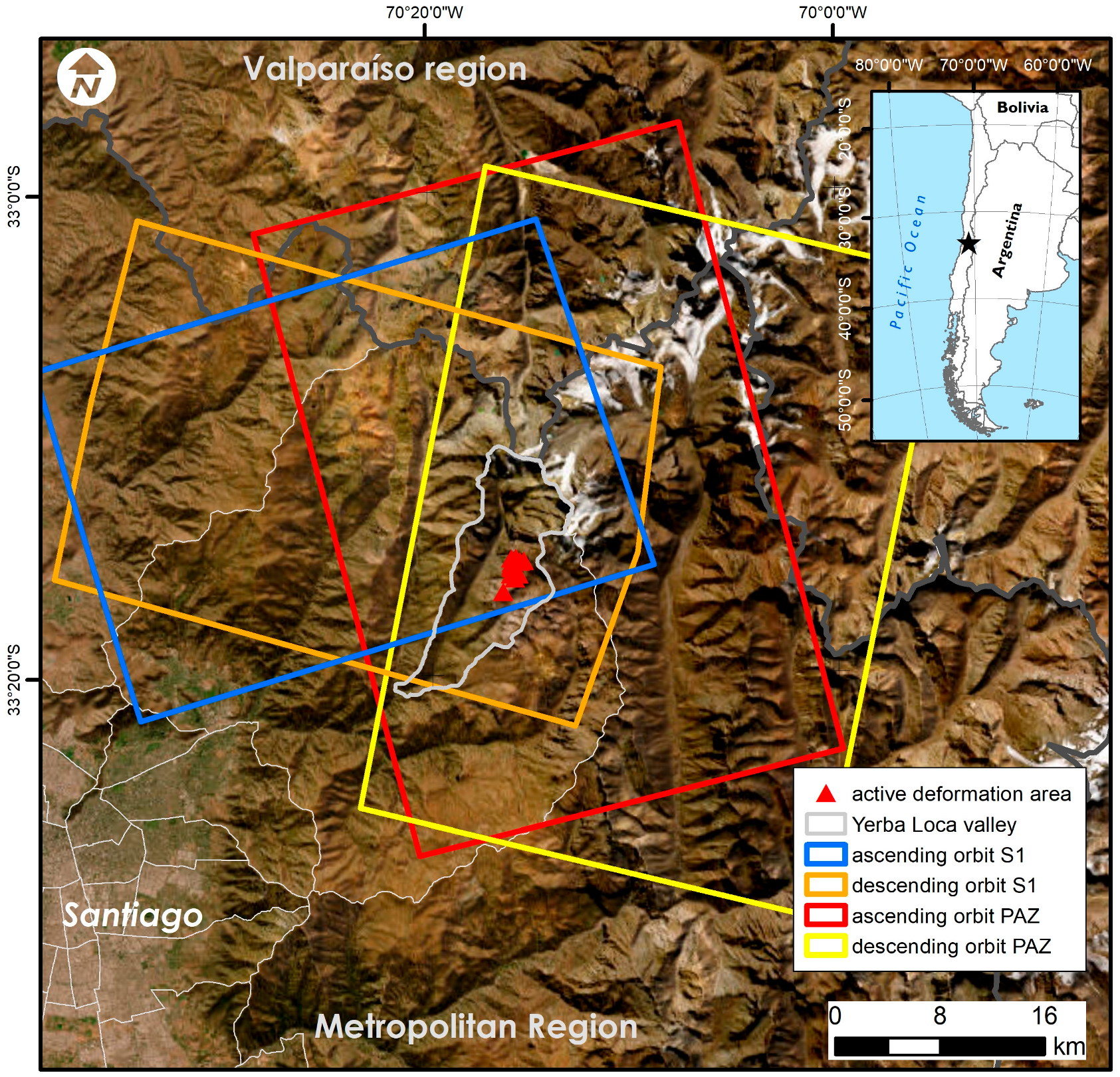
The study area corresponds to a mountainous sector of the Metropolitan Region of Chile in the Yerba Loca Nature Sanctuary, located at 33°15′15″ (south latitude) and 70°17′14″ (west longitude) (Figure 1). It has a Mediterranean climate [35], with an average rainfall of 335 mm in the past 10 years (Río San Francisco Station formerly Junta Estero Yerba Loca; Chilean Hydrological Agency—DGA), concentrated in winter, and with a prolonged dry season of 7 to 8 months. The annual snowfall recorded at Los Bronces Station was 735 cm in 2023. The relief of the study area is mountainous, with altitudes ranging from 1352 to 5403 m a.s.l., and 53% of the surface of the study area is above 3500 m a.s.l. In addition, 18% of the slopes are above 40°, and the exposure of the slopes is predominantly W- and NW-oriented (42% of the surface of the study area).
Various landslide processes have affected the Yerba Loca basin in recent years. In January 2012, due to heavy rainfall, 15 landslides (debris flows and rock falls) affected the study area [36]. In August 2018, a multirotational slide occurred in the upper part of the Yerba Loca basin, 1210 m above the main watercourse and 7.7 km from Villa Paulina (UTM coordinates: 381.940E and 6319.270N; zone 19, south) [37]. The estimation of the total displaced volume of the landslide was between 2,520,000 m3 and 2,850,000 m3. It occurred weeks after a series of winter precipitation events that generated heavy snowfall, followed by rapid melting conditions [24].
In January 2023, the Casa de Lata sector of the Yerba Loca Nature Sanctuary was affected by a small-volume debris flow estimated to be between ca. 10,000 and ca. 13,500 m3. Additionally, in the upper part of the Ortiga basin, in the Los Nogales Nature Sanctuary (neighboring basin), three rotational slides and two debris flows were recorded, one occurring in January 2023 [38].
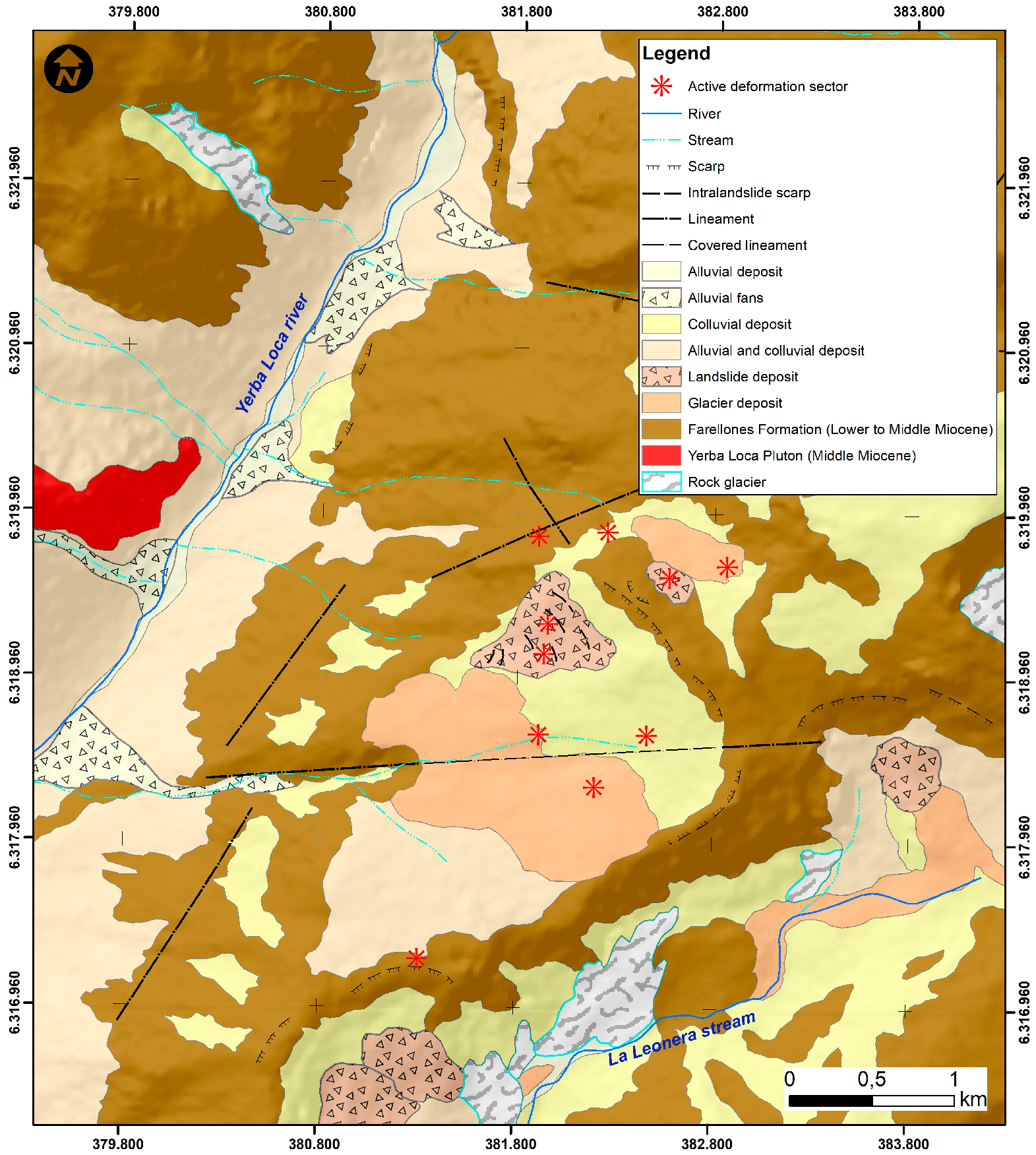
Most past landslides in the Yerba Loca basin have occurred in areas where gently to strongly deformed volcanic and volcaniclastic rocks of the Miocene Farellones Formation predominate (Figure 2), locally affected by hydrothermal alteration; other landslides have occurred in glacial, colluvial, and within older landslide deposits of Pleistocene–Holocene age [39,40,41].
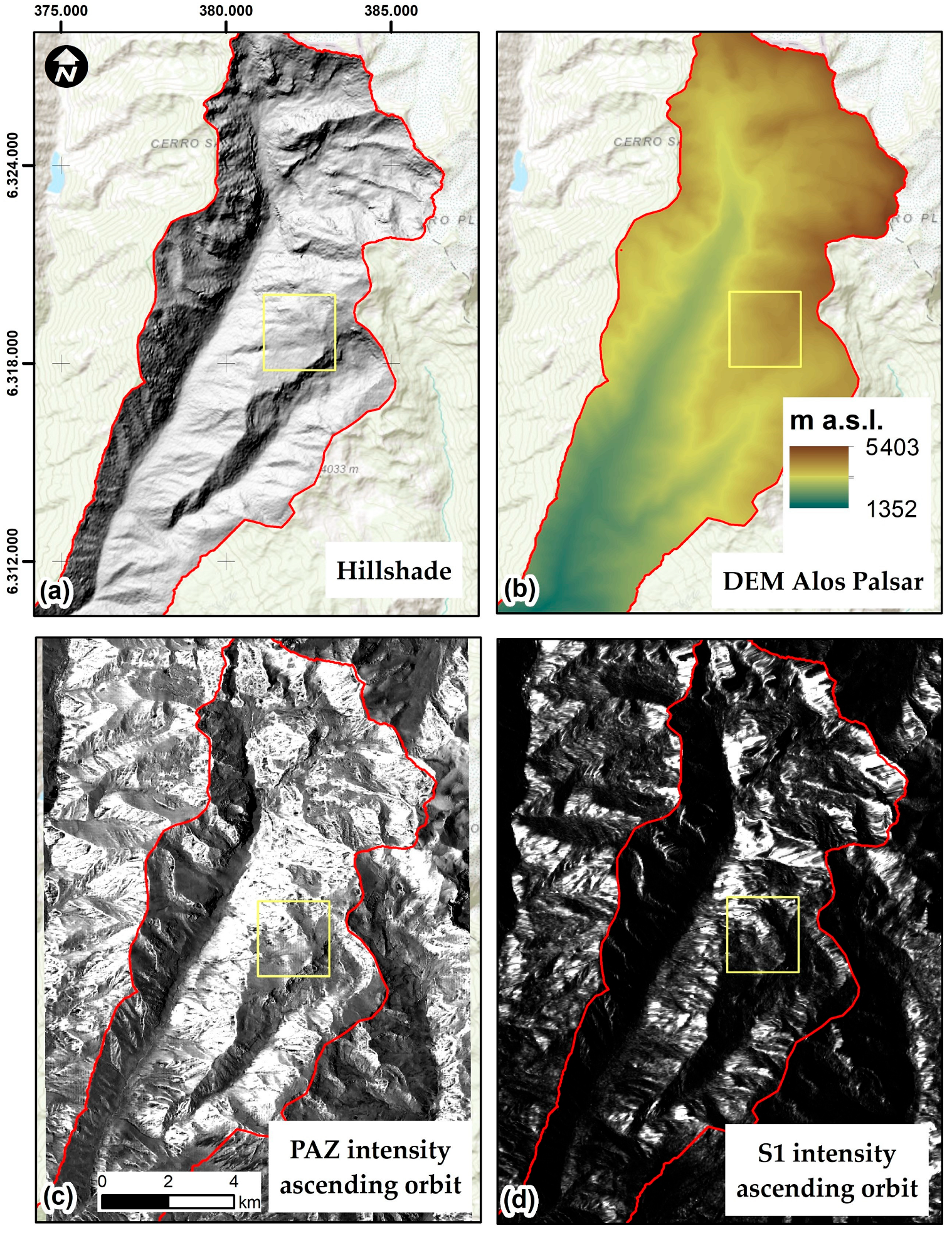
Figure 3a shows the hillshade of the Yerba Loca basin, revealing the rugged relief of the study area and demonstrating the geometric distortions, such as shadows and foreshortening, affecting these sectors. Figure 3b shows the ALOS PALSAR digital elevation model in meters above sea level. Figure 3c shows the intensity data from the PAZ image (ascending orbit), and Figure 3d shows the intensity data from the S1 image (ascending orbit). The west-facing slopes exhibit higher backscatter due to antenna illumination.

2.2. Data Collection

To monitor the active sectors of landslide processes in the Yerba Loca basin, two datasets were used from two different periods: images from the Spanish PAZ radar satellite between 2019 and 2021 and Sentinel-1 images from the European Space Agency (ESA) between 2018 and 2022. The analysis periods for the two image sets differed because the National Institute of Aerospace Technology (INTA) of Spain provided the PAZ images under announcement of opportunity AO-001-050 in 2019, which limited data collection to the 2019–2021 period. Figure 1 illustrates the coverage of the PAZ and Sentinel-1 images, and Table 1 presents the characteristics of both sensors.
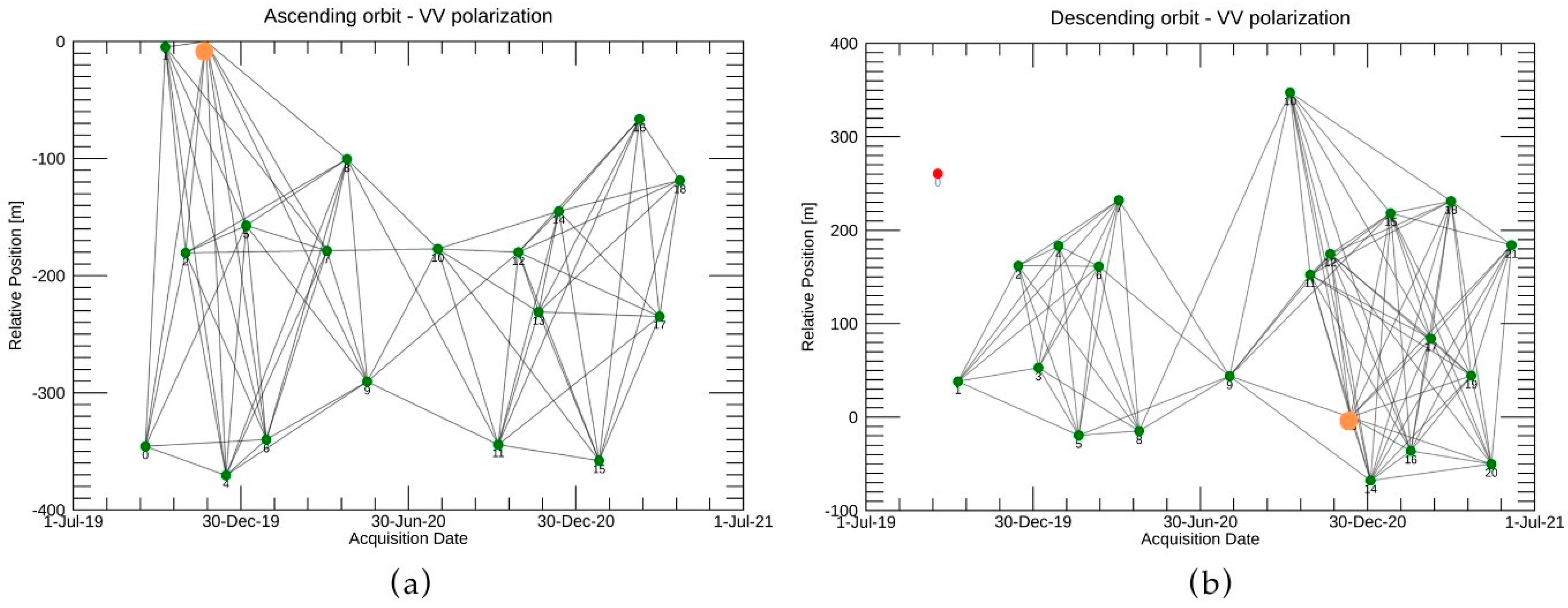
The connection graphs (Figure 4) of both ascending and descending orbit PAZ images show the connection between the super-master image (orange dot) and the slave images (green dots). The black lines represent the interferograms that met the minimum SBAS requirements, and the red dot indicates the image that did not meet the minimum requirement. The mean perpendicular baseline was 139 m and the maximum temporal baseline was 176 days for the ascending orbit. Seventy-seven pairs were analyzed in all combinations in the connection graph in Figure 4a. The super-master image corresponds to the image of 22 November 2019.
The mean perpendicular baseline was 144 m and the maximum temporal baseline was 176 days for the descending orbit. One hundred and four pairs were analyzed in all combinations in the connection graph in Figure 4b. The super-master image corresponded to 11 December 2020.
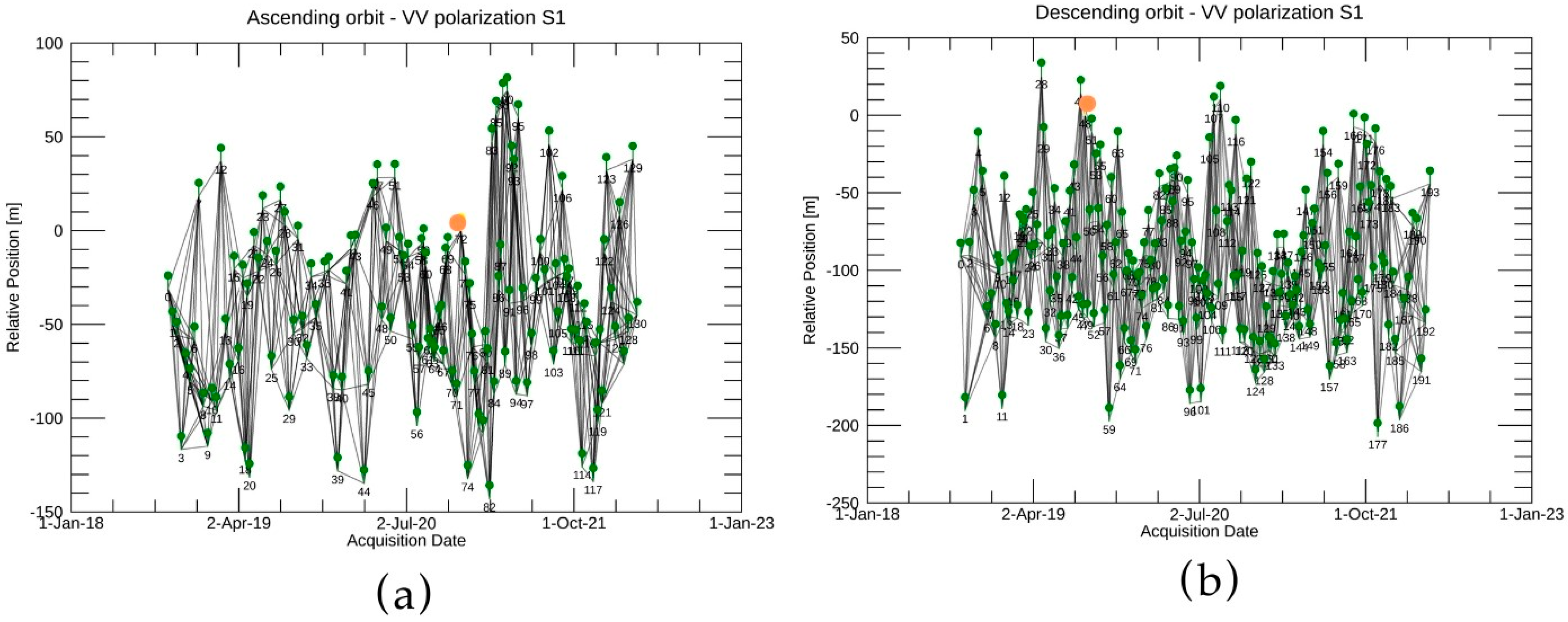
The connection graphs (Figure 5) of both ascending and descending orbit S1 images show the connection between the super-master image and the slave images. The mean perpendicular baseline was 51 m and the maximum temporal baseline was 120 days for the ascending orbit, and the connection graph in Figure 5a shows that 658 pairs were analyzed in all combinations. The super-master image corresponded to the date of 27 November 2020.
The mean perpendicular baseline was 51.7 m and the maximum temporal baseline was 108 days for the descending orbit, and the connection graphs in Figure 5b show that 977 pairs were analyzed in all combinations. The super-master image corresponded to 22 August 2019.
Combining both satellites leveraged the advantages of PAZ’s high spatial resolution and Sentinel-1’s high temporal coverage and atmospheric penetration capabilities, enabling robust and comprehensive characterization of ground deformation in the study area.

2.3. DInSAR–SBAS Processing

The study monitored the temporal evolution of ground deformation in active landslide areas using the small baseline subset (SBAS) technique [19] and differential SAR interferometry (DInSAR), implemented through the ENVI SARscape 5.7 software [42]. The analysis applied the DInSAR technique to generate interferograms, representing the phase difference between two images acquired at different times over the same area. Equation (1) illustrates the variation in interferometric phase [12,23,43,44,45].
∆φ = ∆ φdis + ∆ φtopo + ∆ φorb + ∆ φatm + ∆ φscatt + ∆ φnoise
Equation (1). Interferometric phase variation.
The variation in the interferometric phase ∆φ results from ∆ φdis corresponds to the change in distance between the satellite and the Earth’s surface along the direction of the wave pulse (line-of-sight, LOS); ∆ φtopo corresponds to the topographic phase due to non-perfect knowledge of the actual height profile; ∆ φorb corresponds to the orbital phase and explains the residual fringes caused by the use of inaccurate orbital information in the synthesis of the topographic phase; ∆ φatm corresponds to the phase contribution due to the variation in microwave propagation conditions (atmospheric conditions including ionospheric and tropospheric delays) between master and slave image acquisitions; ∆ φscatt corresponds to the phase components due to changes in backscatter behavior; and ∆ φnoise includes all phase noise contributions. The component of the interferometric phase associated with the displacement was eliminated from the contribution of the topographic phase ∆ φtopo using a reference digital elevation model [46].
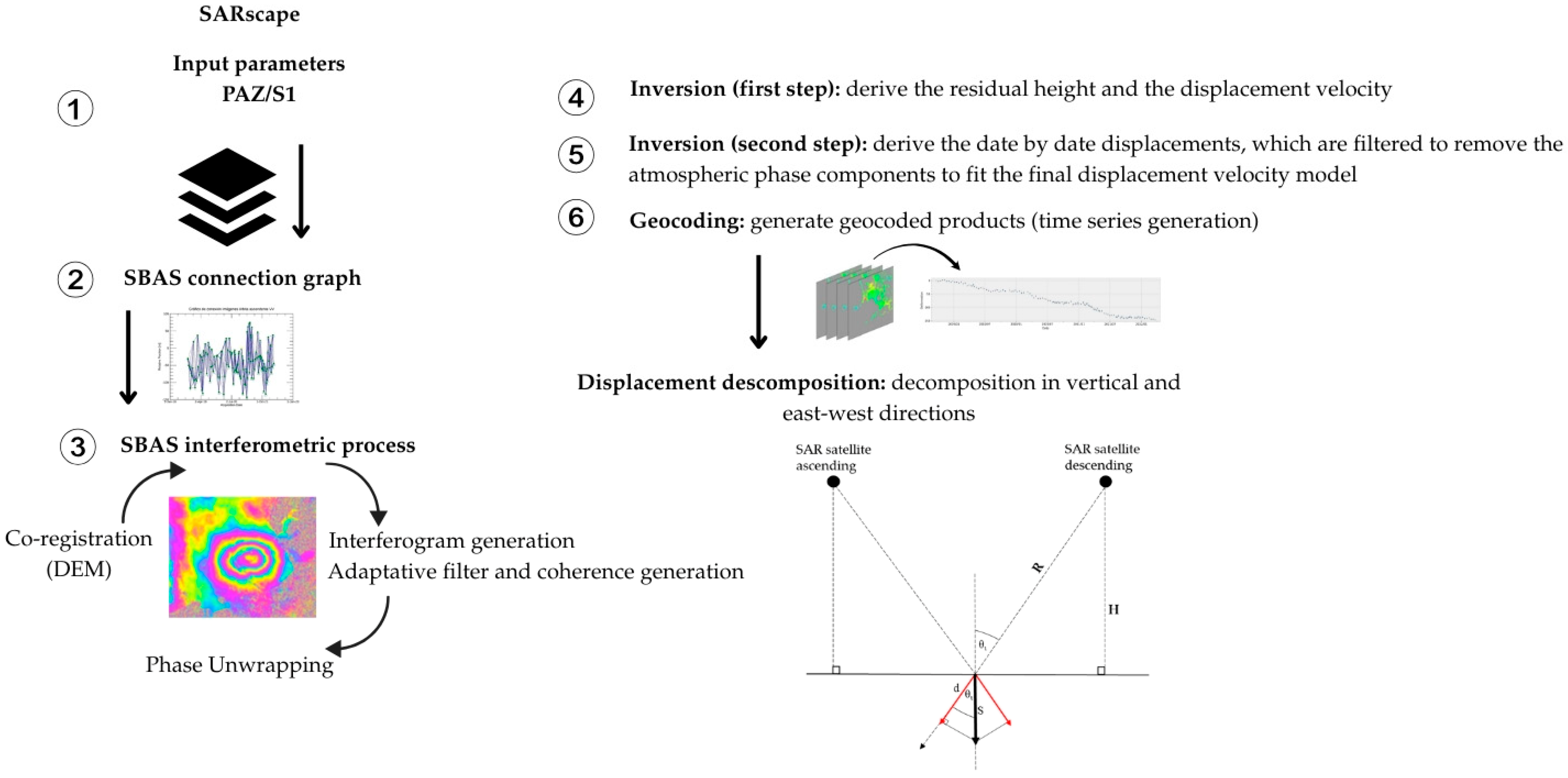
Figure 6 shows the workflow of the SBAS interferometric process and displacement decomposition in SARscape in 7 steps. First, once we imported the PAZ and Sentinel-1 images into the SARscape format (1), the SAR pair combination and the connection network were defined (2) for the generation of multiple differential interferograms with the temporal and spatial baseline values specified [42]. For both the ascending and descending orbits of the PAZ and S1 images, the maximum normal baseline (%) was used at 45%, corresponding to the maximum percentage of the critical baseline value considered acceptable in generating possible connections. Likewise, the maximum temporal baseline parameter used was 180 days, corresponding to the threshold of the maximum temporal distance between acquisitions, which is considered acceptable. Subsequently, the interferometric process (3) executes automatically the following processing sequence: (a) interferogram generation and flattening, (b) adaptive filter and coherence generation, and (c) phase unwrapping. For (a), we co-registered the images using the SRTM1 DEM and generated differential interferograms based on the connections established in the previous step. For the PAZ and Sentinel-1 images, a multilooking technique was applied with 9 and 4 looks in the range direction, and 7 and 1 looks in the azimuth direction, respectively, resulting in an approximate pixel size of 15 m.
To improve the quality of the interferograms, the Goldstein filter [47] was used (b), and for phase unwrapping (c), the SNAPHU minimum-cost flow (MCF) algorithm was used [48]. In the phase unwrapping, we used a coherence threshold of 0.2 for the PAZ images and 0.3 for the S1 images, so we eliminated all pixels with values lower than this threshold from the analysis. In addition, the precise orbits of the S1 images, which we downloaded from the Copernicus server, were used for processing.
Next, the first model inversion is applied (4) to derive the residual topographic height and the displacement velocity. We carried out the second model inversion (5) to estimate the displacement time series, which we filtered to remove atmospheric phase components to fit the final displacement velocity model. The final stage of the interferometric process (6) involves geocoding the time series data into geographic coordinates, ensuring that all pixels in the image are correctly positioned [42].
Finally, for the PAZ and S1 images, the vertical (up–down) and east–west (E–W) components of the displacement were calculated using the LOS measurements of the ascending and descending geometry using the displacement decomposition tool implemented in SARscape.

3. Results

The following section presents the results of the accumulated line-of-sight (LOS) displacement derived from PAZ images (2019–2021) and Sentinel-1 images (2018–2022), considering both ascending and descending orbits. In addition, we show the decomposition of the displacement into vertical (up–down) and east–west (E–W) components for both image sets within the study area, to analyze ground deformation associated with the active landslide zone.

3.1. LOS Displacement and Components of Movement Vertical (Up–Down) and E–W with PAZ Imagery (2019–2021)

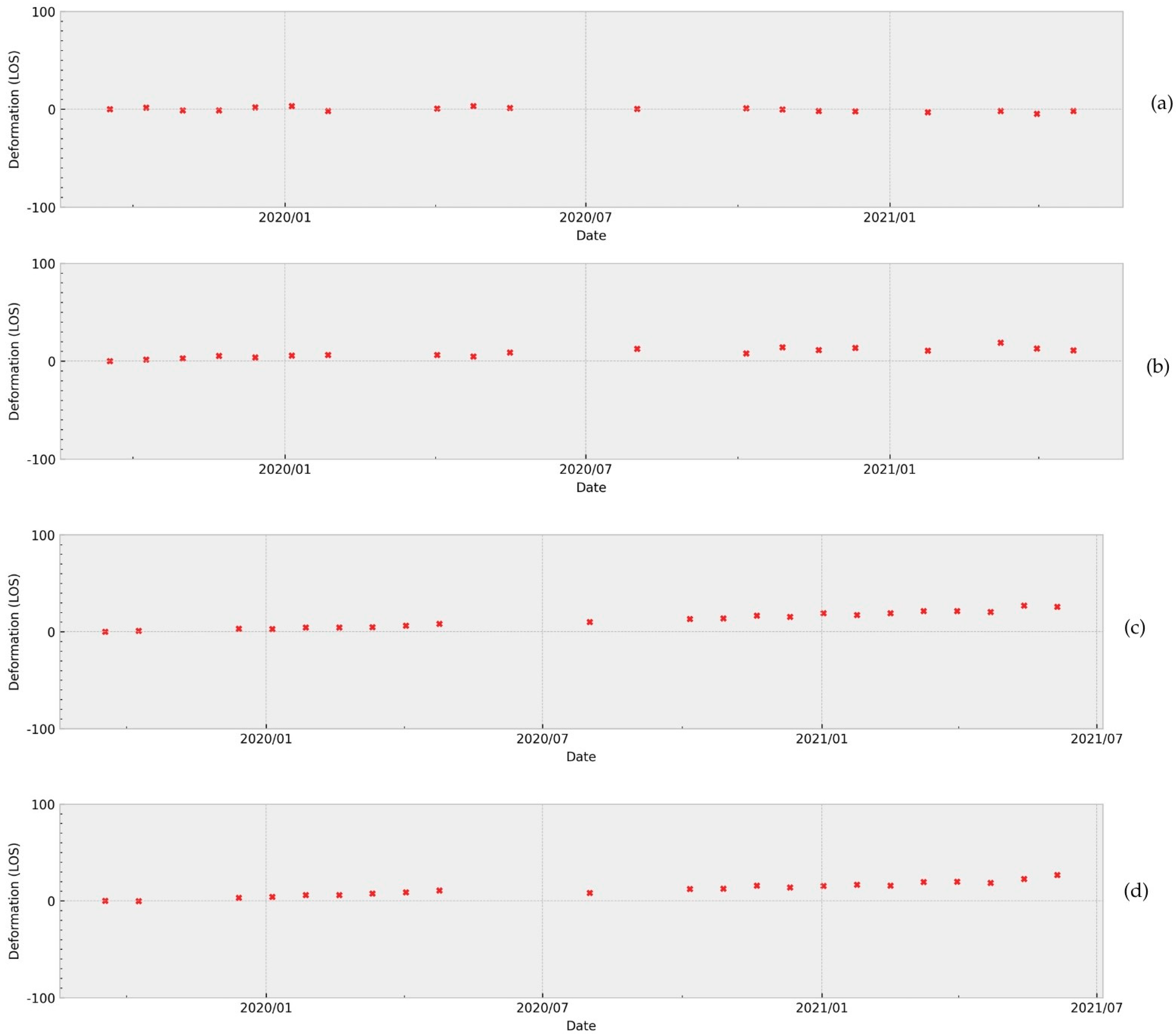
The following section presents the SBAS processing results for the PAZ images. Figure 7 shows a cumulative displacement of the Yerba Loca slide of −4.9 mm in the ascending pass (point a) and 25.8 mm in the descending pass (point c) between 2019 and 2021. Mean deformation velocity LOS displacement was −1.5 mm/year and 14.8 mm/year in ascending and descending orbits, respectively. For the secondary deformation associated with the Yerba Loca rotational slide, a cumulative displacement was 11 mm in the ascending orbit (point b) and 22.8 mm in the descending orbit (point d). The mean deformation velocity LOS displacement was 8 mm/year and 12.5 mm/year in the ascending and descending orbits, respectively. Points a and c in Figure 7 are located within the active Yerba Loca slide, while points b and d are in the secondary landslide. Due to differences in orbital configuration (ascending and descending), the points are not in the same position. However, we have selected them as closely as possible to enable consistent comparison between datasets.
Figure 8 shows the line-of-sight (LOS) displacement time series for points a, b, c, and d, as indicated in Figure 7.
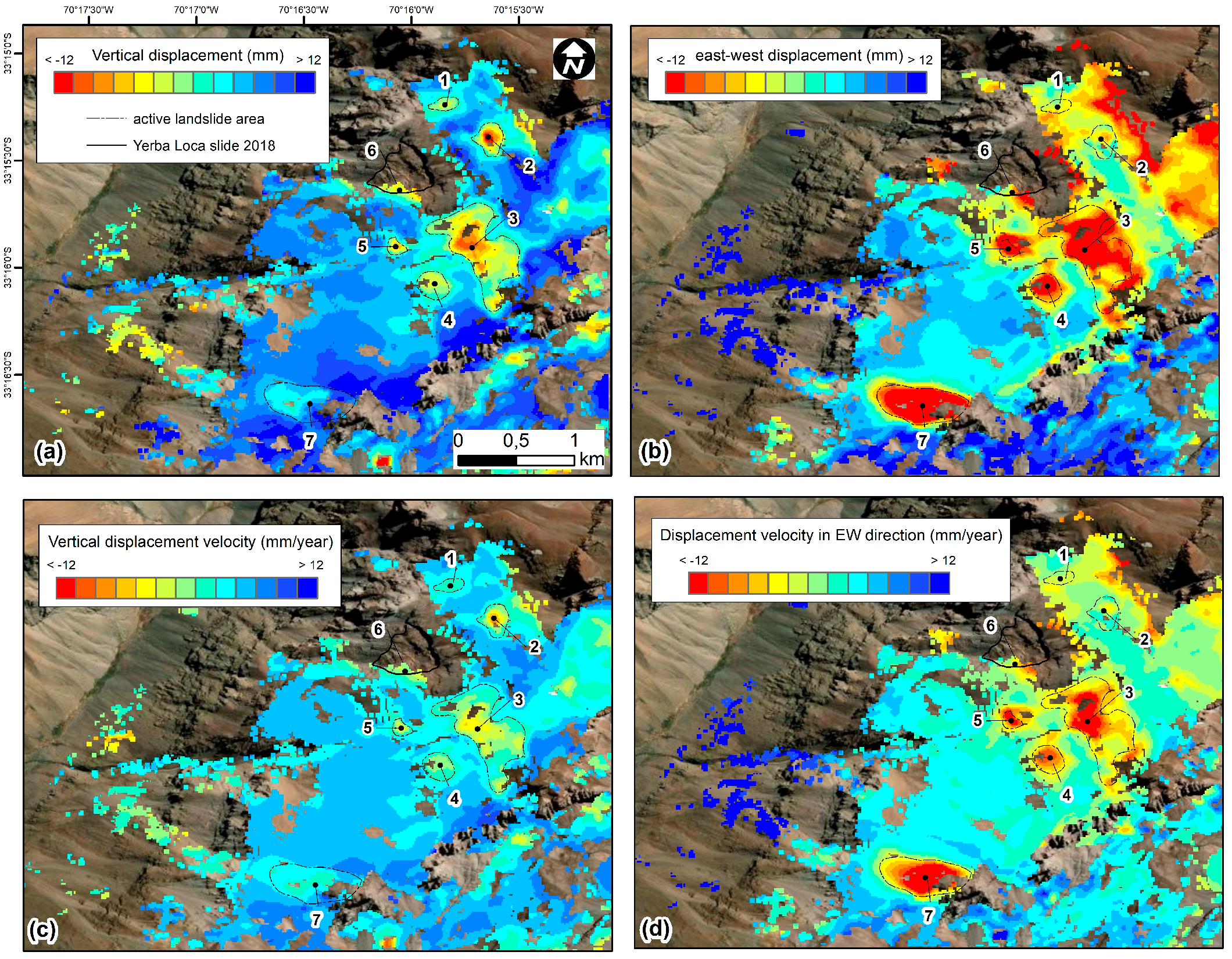
Figure 9 shows seven areas with active ground deformation identified using SBAS–DInSAR to process PAZ imagery. This area correlates with areas with active landslides, close to the Yerba Loca rotational slide that occurred in August 2018, and where a debris flow occurred in January 2023 (La Lata sector).
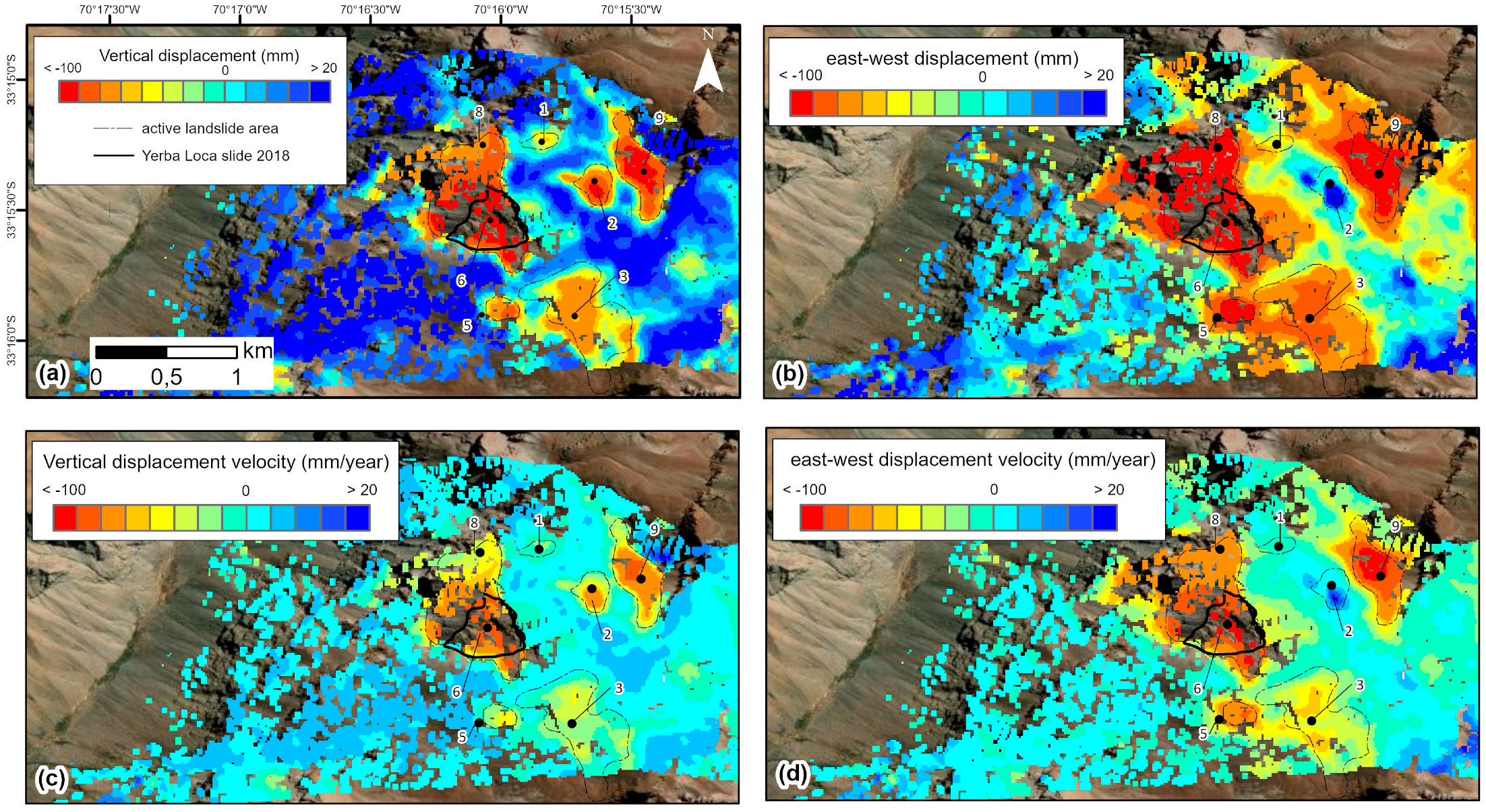
Figure 9a shows the accumulated vertical component of the movement (mm) in the seven sectors where we identified deformation using PAZ images. Figure 9b shows the E–W displacement in the same sectors, and Figure 9c and 9d show the vertical and E–W displacement velocities (mm/yr), respectively.
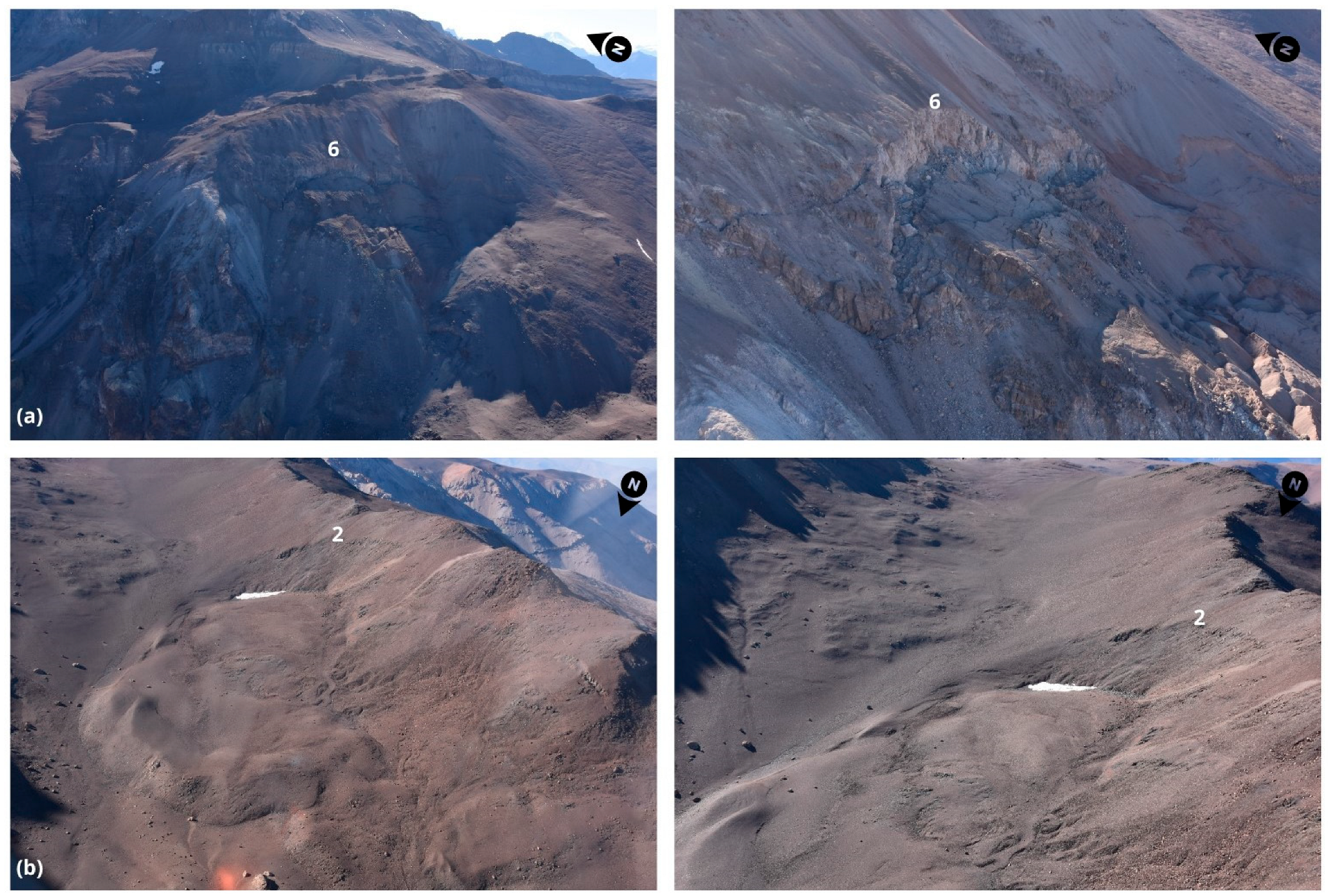
The graphs in Figure 10a,b show the vertical and E–W components of the movement detected between 2019 and 2021. In the vertical displacement component, points 2, 3, and 5 show movement acceleration since May 2020. The E–W component shows that points 2, 3, and 5 were moving toward the slope, so these sectors simultaneously show subsidence and displacement in the direction of the slope, which we can observe in the field photographs in Figure 11.

3.2. LOS Displacement and Components of Vertical Movement (Up–Down) and E–W (2012–2022) with S1 Imagery

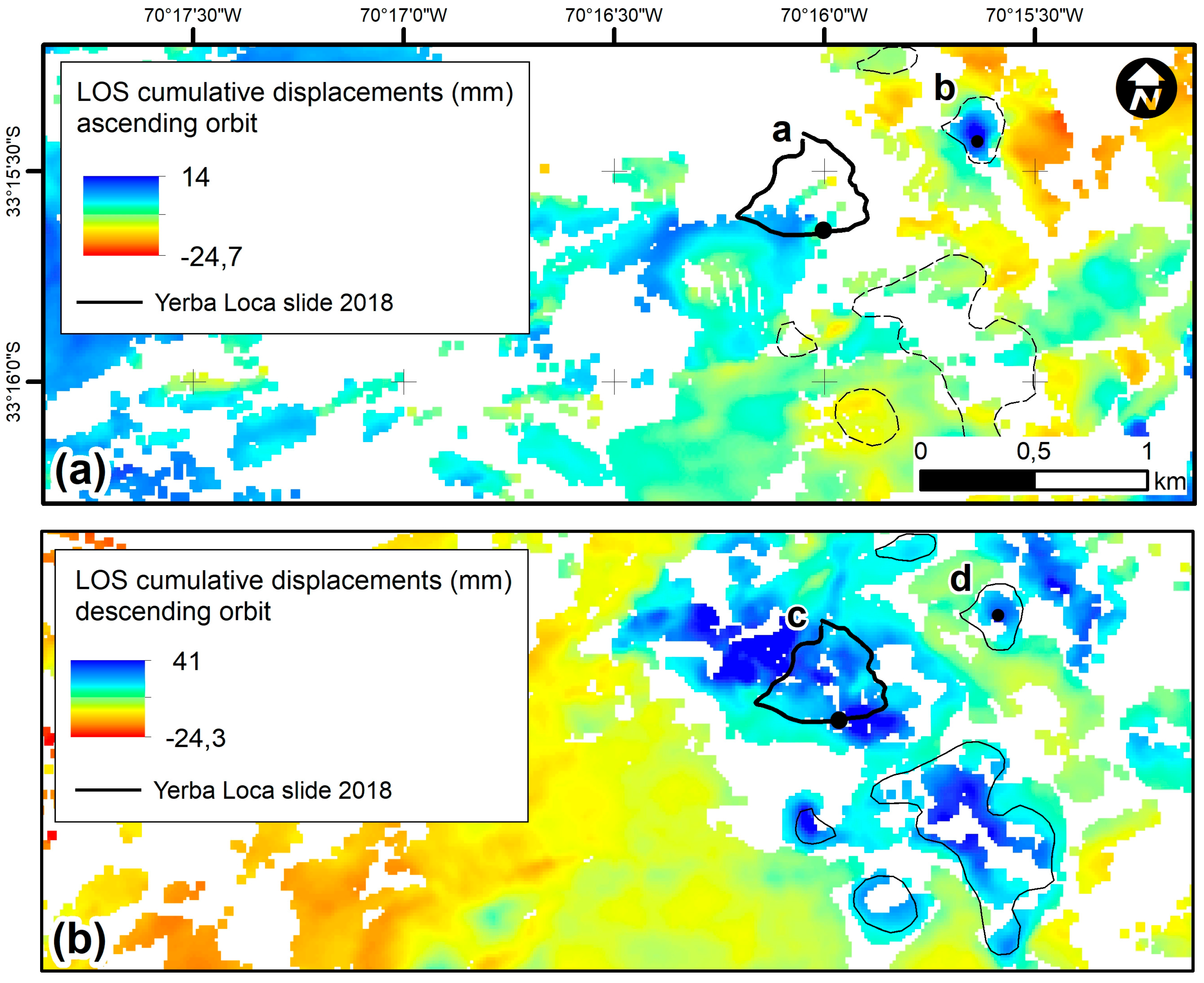
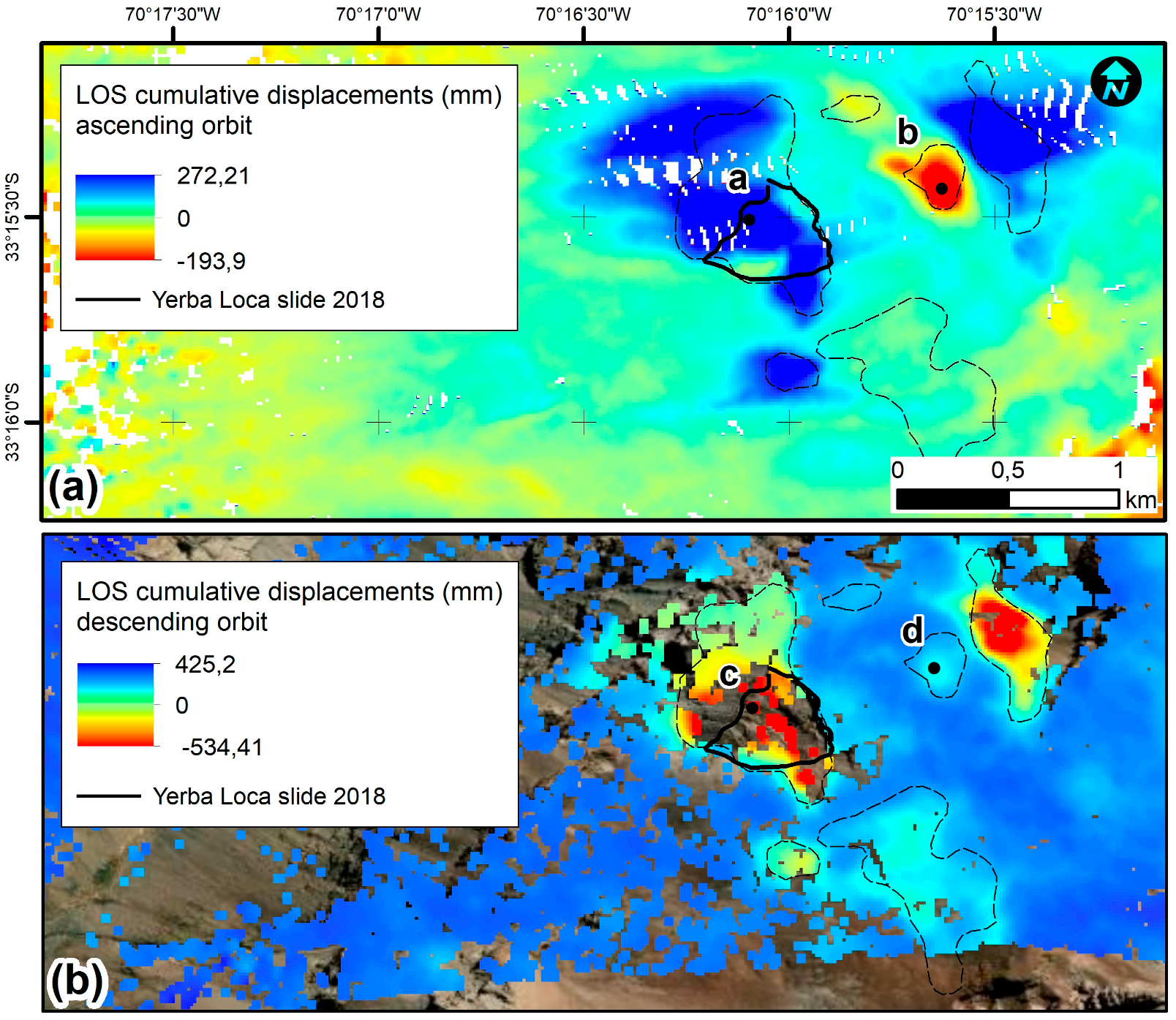
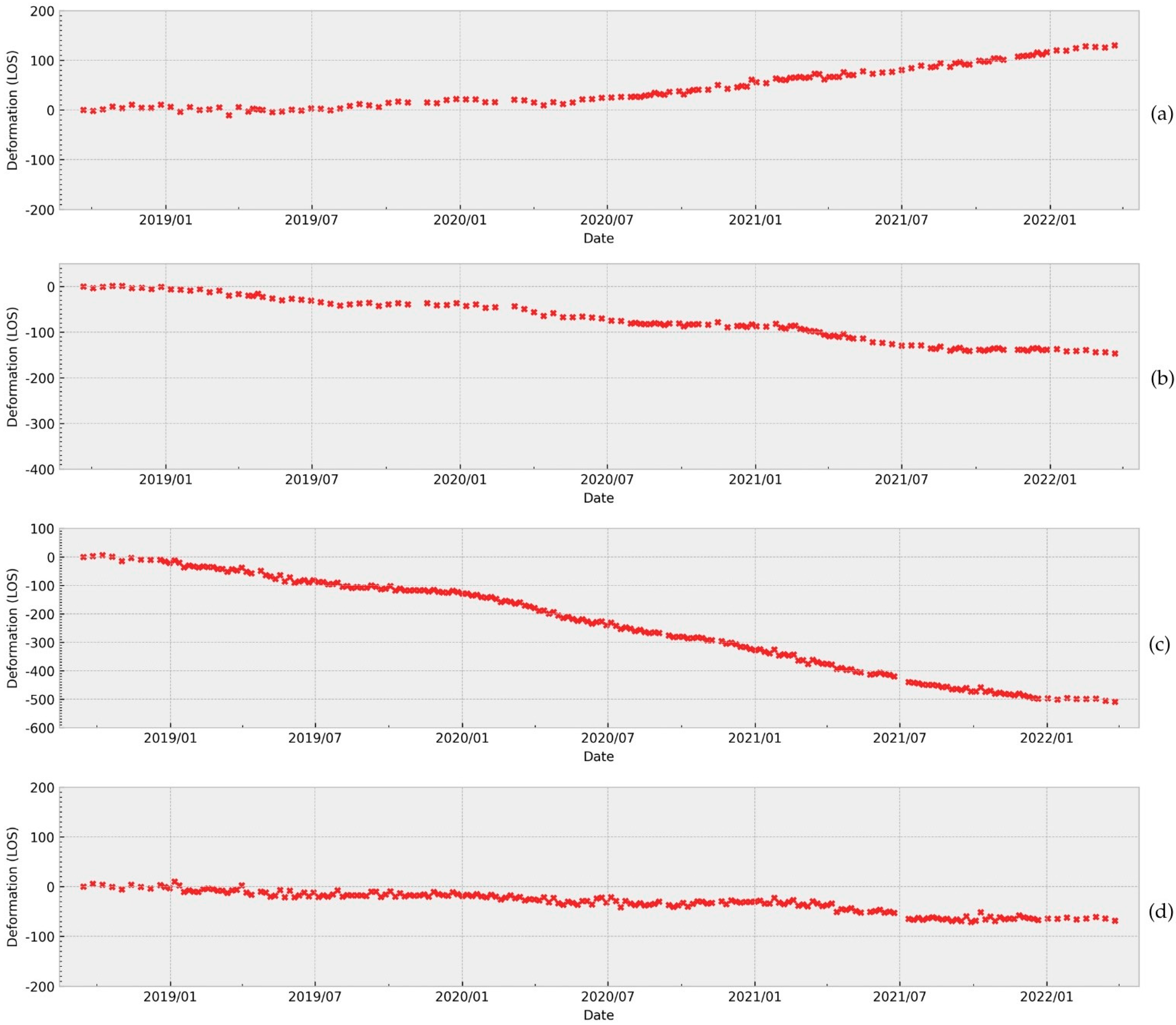
The following section reports the SBAS processing results for the S1 images. Figure 12 shows the cumulative displacement of the Yerba Loca landslide to be 130 mm in the ascending pass and −509.5 mm in the descending pass between 2018 and 2022. There was a mean deformation velocity LOS displacement of 37.7 mm/year and −164 mm/year in the ascending and descending passes, respectively. For the secondary deformation associated with the Yerba Loca rotational slide, there was a cumulative displacement of −146.8 mm in the ascending pass and −68.2 mm in the descending pass, with a mean deformation velocity LOS displacement of −45.4 mm/year and −19.9 mm/year in the ascending and descending passes, respectively. Figure 12a shows LOS cumulative displacements in the ascending orbit and Figure 12b shows LOS cumulative displacements in the descending orbit. Due to differences in orbital configuration (ascending and descending), the points are not in the same position. However, the selection placed them as close as possible to enable consistent dataset comparison.
Figure 13 shows the line-of-sight (LOS) displacement time series for points a, b, c, and d, as indicated in Figure 12.
Figure 14 shows seven sectors with active deformation, which the DInSAR processing of Sentinel-1 images also identified, some of which (points 1, 2, 3, 5, and 6) coincide with the sectors detected by PAZ. Some points do not coincide because the coverage of the PAZ images is not the same as that of the S1 images. Furthermore, the period analyzed with S1 is more extended (2018–2022), and the number of images used was greater.
Figure 14a shows the cumulative vertical displacement component (mm) in the seven sectors identified with the S1 images. Figure 14b shows the E–W displacement in these same sectors, and Figure 14c and Figure 14d show the vertical and E–W displacement rates (mm/year), respectively.
The graphs in Figure 15 show the vertical and E–W displacement components between 2018 and 2022. In the vertical displacement component, point 6 corresponds to the area where the maximum acceleration in the movement was detected, coinciding with the slide sector in 2018, and showing evidence of continued displacement. Points 2 and 9 reveal acceleration in the movement that began in March 2020. The E–W movement component shows that all points moved in the direction of the slope except for point 2, which corresponds to the secondary deformation. Hence, these sectors show subsidence and ground displacement in the direction of the slope, which the field photographs in Figure 11 also illustrate. Point 2 also depicts displacement in the E–W direction.
Points 1 and 2 correspond in the PAZ and S1 images to a secondary deformation associated with the rotational slide [24] in 2018. It has a lobular shape and a concentric vertical deformation pattern. The vertical movement component shows subsidence of up to −2.9 and −21.7 mm at point 1 and −17 and −42 mm at point 2 according to PAZ and S1, respectively. The length from the scarp to the base of the lobe is approximately 50 m in the deformation associated with point 2, and the displacement velocity is −10 and −43 mm/year according to PAZ and S1, respectively.
Point 3 corresponds to a gelifluction slope at approximately 4000 m a.s.l., with an average gradient of 25°. Gelifluction slopes may be susceptible to triggering landslide processes, so the vertical component of the displacement could indicate that this is a precursor to a landslide.
Point 3 shows maximum subsidence values of −11.7 mm and −46.4 mm for PAZ and S1, respectively. The E–W displacement component reaches up to −25.9 mm and −79.1 mm, indicating that the slope is shifting westward. This sector’s maximum vertical movement velocity is −6.2 mm/year and −15.9 mm/year for PAZ and S1, respectively.
Points 4 and 5 also lie in gelifluction slopes. The sector near point 5 has a maximum vertical movement component of −8.7 mm and −63.7 mm, with a velocity of −4.9 mm/year and −19.3 mm/year for PAZ and S1, respectively.
Point 6 is located where the 2018 Yerba Loca landslide occurred. In this area, the subsidence value reaches a maximum displacement of −288.8 mm, with a maximum velocity of −94.4 mm/year between 2018 and 2022.
Point 7 only provides deformation data based on the PAZ images due to image coverage limitations. This sector shows a lobe shape with high scarps, suggesting that it may have partially collapsed in the past and could also be an area where a new mass movement may develop. The main scarp is approximately 25 m high, while the frontal scarp is 30 m high, ending in a debris flow. This sector is moving downslope (average displacement of −20.5 mm in the E–W direction) and shows material accumulation, with a vertical movement component of up to 16.0 mm.
The S1 images only provide data for points 8 and 9. Point 8 is a rock outcrop close to the 2018 Yerba Loca rotational slide. The vertical displacement component reaches nearly −228 mm, with a maximum velocity of −68.5 mm/year. The E–W movement component indicates that this sector is shifting downslope by −385.8 mm, with a velocity of −117.5 mm/year.
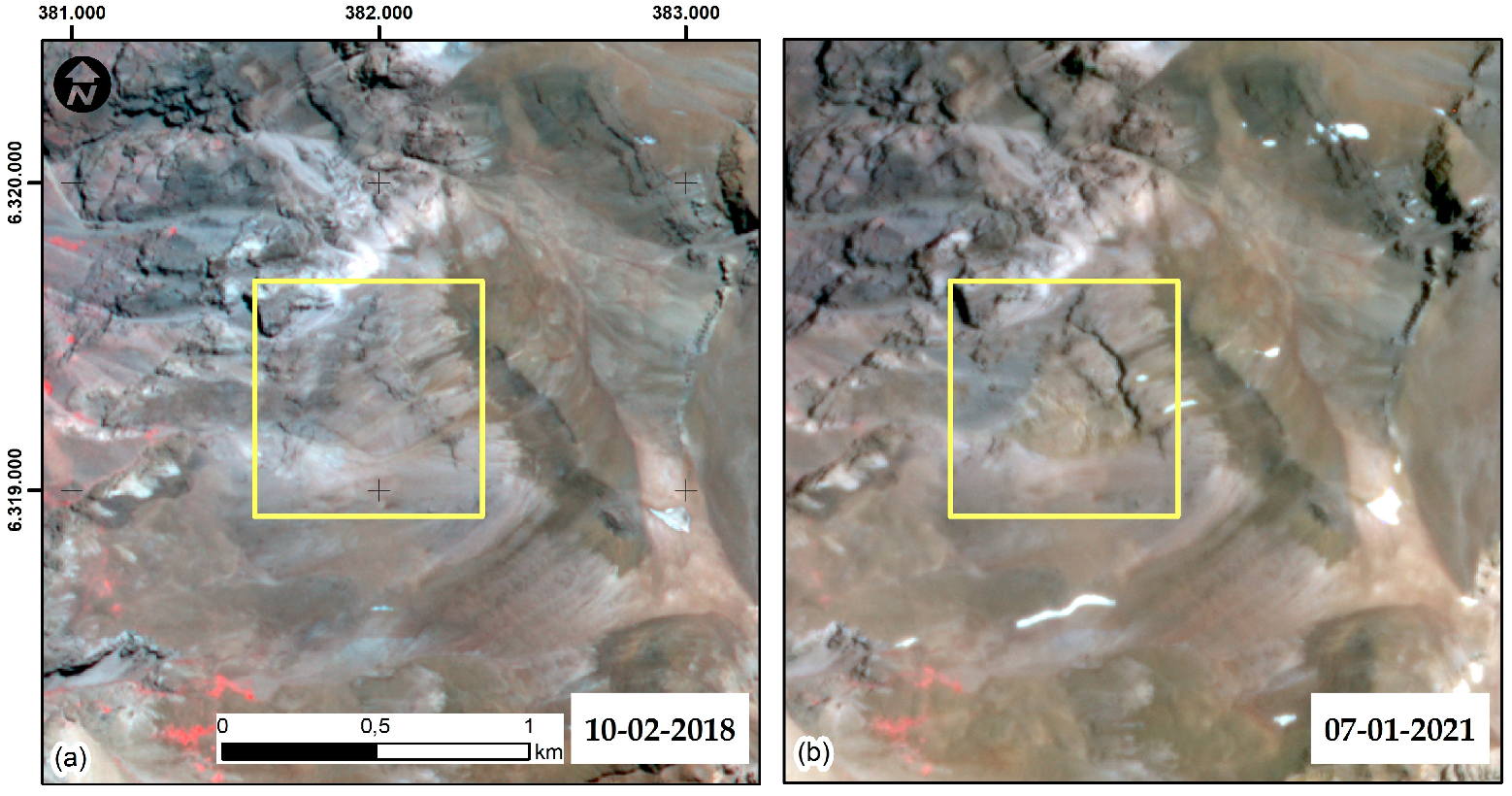
According to the authors of [49], in their hazard assessment using velocity measurements from the DInSAR technique, points 2, 6, 8, and 9, analyzed with S1 images, have a moderate hazard level (between 20 and 100 mm/year, classified as active). In contrast, the remaining sectors present a low hazard level (<20 mm/year). No high-hazard-level areas have been detected so far in the analyzed period. Figure 16 shows Planet images before and after the slide in Yerba Loca, which makes it possible to demonstrate the movement of the scarp in the area.

4. Discussion

The results obtained using the SBAS–DInSAR technique with the time series of PAZ (2019–2021) and S1 (2018–2022) images show that the study area underwent active deformation during the analyzed periods. These results agree with the geomorphological evidence observed in the field and the analyses carried out using SAR images, which also show that the Yerba Loca sector presents active geodynamic processes such as recent landslides, with the last large event occurring in 2018 [24].
The accumulated line-of-sight (LOS) displacement results obtained from PAZ and Sentinel-1 imagery indicate that the Yerba Loca rotational slide remains active. The change in sign of the LOS-projected displacement between descending and ascending orbits, as described in [27], indicates gravitational processes.
The analysis using PAZ images estimates up to −16.5 mm of subsidence in the secondary landslide sector associated with the 2018 rotational slide of Yerba Loca (point 2) and an average velocity of −9.6 mm/year. Concerning the analysis with the 2018–2022 S1 images, subsidence of up to −288 mm is observed, with an average velocity of 94 mm/year in the main 2018 Yerba Loca landslide area.
The results show active deformation between 2018 and 2022, mainly associated with the steep Andean region’s upper valley and gully heads. The deformation was concentrated primarily in places where previous Late Holocene landslides occurred or in areas covered by glacial and periglacial deposits [41]. Thus, it is likely that deformation and, therefore, the initiation of landslide areas in this region concentrates in glacial and previous landslide deposits where unstable permafrost may be present and subject to temperature fluctuations due to climate change, adding more instability to this high and steep mountain region.
Previous results reported in [24,25,50] point out that the pre-Andean sector of the Metropolitan Region presents active geodynamic processes and ground deformation associated with mass removal events. The authors of [24] analyzed the slide that occurred in 2018 in Yerba Loca, considering three deformation periods: (i) the first, between January and July 2018, with a cumulative LOS displacement of 30–70 mm and displacement velocity with an average of 100 mm/year and a maximum of 168 mm/year before the main movement; (ii) the second period, between July 2018 and April 2019, during which the cumulative LOS displacement was up to 60 mm, with average velocities greater than 30 mm/year, suggesting that the deformation continued; (iii) the third period, between May and August 2019, which showed that the deformation continued in both the primary and secondary landslides, with lower values compared to those in previous periods, ranging from 20 to 40 mm/year.
The deformation values estimated in this study with PAZ images were lower than those indicated in [24,25]. However, due to the loss of coherence in the images of the sector, we did not obtain information for a significant part of the Yerba Loca slide. In contrast, the vertical displacement velocity detected by S1 between 2018 and 2022 was similar to the one indicated by [25] between 2019 and 2021 in the 2018 Yerba Loca landslide, and both studies also detected the secondary landslide in the sector. It is important to note that the results obtained in this research do not correspond to absolute measurements, but instead refer to points in the SAR images considered stable or without movement [51] and to the study period analyzed using the PAZ and S1 images.
The DInSAR analysis periods for the PAZ and S1 images did not coincide because we obtained the PAZ images through an opportunity announcement, and the image acquisition was limited to that specific period (2019–2022). However, the PAZ and S1 images suggest active ground deformation in the 2018 Yerba Loca landslide sector. As suggested by [52], this could indicate that these areas remain unstable and deforming, and could be potential areas initiating landslide processes.
The DInSAR technique is important for monitoring active geodynamic processes in mountainous and inaccessible areas such as the Andes of central Chile, as it provides high-coverage images [53]. However, this technique also has some limitations, as the analyzed sectors are located on steep slopes and are affected by geometric distortions such as shadows and foreshortening due to the terrain. Additionally, we may observe low-coherence areas due to temporal decorrelation caused by vegetation changes, snow presence, or atmospheric conditions when the images were captured [54,55]. In this regard, the study area corresponds to a mountainous sector in central Chile at altitudes above 3000 m above sea level, which is a meteorologically unstable area where winter images may show snow coverage. Snow cover would similarly affect the radar signal’s interaction with the surface and the backscatter on different image acquisition dates. Although we did not perform atmospheric correction in the SBAS processing, such as implementing GACOS or ERA5 in the SARscape software, when processing time series with the SBAS technique, the atmospheric phase components were removed to prevent them from affecting the displacement velocity model [42].
The signal penetration is different for each band and is directly related to terrain characteristics such as scatterer distribution, terrain roughness, and the complex dielectric constant [46,51,55,56], in which the C band (S1 images; λ 5.6 cm) has greater penetration than the X band (PAZ images; λ 3.1 cm). In the case of this study, there was more information loss in the PAZ images than there was in the S1 images; however, the period analyzed with S1 (2018–2022) was longer, and the number of images used was also higher compared to that in the PAZ image set. Because of all these factors, different coherence thresholds were used during processing.

5. Conclusions

Finally, this type of research can contribute to developing future strategies for the prevention and mitigation of geohazards in mountainous areas. Considering that the Yerba Loca Nature Sanctuary is a popular destination in the Andes within the Metropolitan Region of Chile, and due to its proximity to the densely populated capital, Santiago, characterized as a recreational area for mountain sports (trekking) and wildlife watching, the occurrence of future landslides in the area may affect the ecosystem and biodiversity of the valley, as well as touristic and recreational activities, posing a significant risk to park visitors. Therefore, SAR image monitoring is an essential tool for detecting the initial formation of such events in remote areas at an early stage [49,52,57,58].
The precise identification of areas with active ground deformation facilitates the delineation of high-risk zones, enabling local authorities (such as the Municipality of Lo Barnechea) to implement timely measures, including real-time intensive monitoring, installing early warning systems, and developing specific evacuation protocols. Additionally, this information can be integrated into territorial planning instruments at both the municipal and regional levels, supporting decisions related to infrastructure development, land-use regulations, and sustainable tourism management. These actions can contribute to minimizing risk while assuring public safety and safeguarding the environmental integrity of the area.

Author Contributions

Conceptualization, P.V.-P., J.C., O.M.-R. and A.F.-S.; methodology, P.V.-P., A.F.-S., M.A., M.J.G.B., J.M.C. and N.C.; software, P.V.-P. and M.A.; formal analysis, P.V.-P., J.C., V.R. and A.F.-S.; investigation, P.V.-P., J.C., V.R. and W.P.-M.; resources, P.V.-P.; data curation, P.V.-P., J.C., V.R. and A.F.-S.; writing—original draft preparation, P.V.-P., A.F.-S., J.C. and O.M.-R.; writing—review and editing, P.V.-P., J.C., A.F.-S., O.M.-R., V.R., W.P.-M., M.J.G.B., J.M.C., N.C. and F.M.; visualization, P.V.-P.; supervision, J.C. and A.F.-S.; project administration, P.V.-P. All authors have read and agreed to the published version of the manuscript.

Funding

This research received no external funding.

Data Availability Statement

The Sentinel-1 dataset is available from https://dataspace.copernicus.eu/, which is an open ecosystem that provides free and instant access to a wide range of Copernicus Sentinel data and services. On the other hand, the PAZ data is subject to restrictions, as it was obtained through an opportunity announcement.

Acknowledgments

The authors thank National Institute of Aerospace Technology (INTA) as part of PAZ-Ciencia (Scientific Exploitation of PAZ, project nr. PAZ-AO-001–050) who provided all PAZ images and the Anglo American Company who sponsored the field data collection (photographs).

Conflicts of Interest

The authors declare no conflicts of interest.

Correction Statement

This article has been republished with a minor correction to the Data Availability Statement. This change does not affect the scientific content of the article.

References

  1. Stoffel, M.; Huggel, C. Effects of climate change on mass movements in mountain environments. Prog. Phys. Geogr. 2012, 36, 421–439. [Google Scholar] [CrossRef]
  2. Strozzi, T.; Klimeš, J.; Frey, H.; Caduff, R.; Huggel, C.; Wegmüller, U.; Cochachin, A. Satellite SAR interferometry for the improved assessment of the state of activity of landslides: A case study from the Cordilleras of Peru. Remote Sens. Environ. 2018, 217, 111–125. [Google Scholar] [CrossRef]
  3. Serey, A.; Piñero-Feliciangeli, L.; Sepúlveda, S.A.; Poblete, F.; Petley, D.N.; Murphy, W. Landslides induced by the 2010 Chile megathrust earthquake: A comprehensive inventory and correlations with geological and seismic factors. Landslides 2019, 16, 1153–1165. [Google Scholar] [CrossRef]
  4. Wood, J.L.; Harrison, S.; Reinhardt, L.; Taylor, F.E. Landslide databases for climate change detection and attribution. Geomorphology 2020, 355, 107061. [Google Scholar] [CrossRef]
  5. Tomás, R.; Díaz, E.; Szeibert, W.T.; Liu, X.; Lopez-Sanchez, J.M.; Zhao, C. Geomorphological characterization, remote sensing monitoring, and modeling of a slow-moving landslide in Alcoy (Southern Spain). Landslides 2023, 20, 1293–1301. [Google Scholar] [CrossRef]
  6. Chen, C.; Tung, Y.; Liou, J.; Li, H.; Cheng, C.; Chen, Y.; Oguchi, T. Assessing landslide characteristics in a changing climate in northern Taiwan. Catena 2019, 175, 263–277. [Google Scholar] [CrossRef]
  7. Gariano, S.L.; Guzzetti, F. Landslides in a changing climate. Earth Sci. 2016, 162, 227–252. [Google Scholar] [CrossRef]
  8. Clavero, J.; Droguett, B.; Bambach, N.; Pérez-Martínez, W.; Aguirre, I.; Ramírez, V.; Vidal-Páez, P.; Briceño-Urbaneja, I.; Tamayo, A. Remociones en masa asociadas a lluvias intensas (rainfall-induced) en escenarios de cambio climático en la cuenca del estero Yerba Loca, Chile central. In Ecosistemas de Montaña de la Cuenca Alta del Río Mapocho, 1st ed.; Ascanio, R., Orrego, F., Ginocchio, R., De La Fuente, L.M., Eds.; Alerce Talrreres Gráficos: Santiago, Chile, 2021; Volume 1, pp. 82–111. [Google Scholar]
  9. Huser, A. Remociones en masa en Chile. Servicio Nacional de Geología y Minería-Chile. Boletín 2000, 59, 9–89. [Google Scholar]
  10. Moreiras, S.M.; Sepúlveda, S.A. Megalandslides in the Andes of Central Chile and Argentina (32°–34° S) and potential hazards. Geol. Soc. Lond. 2015, 399, 329–344. [Google Scholar] [CrossRef]
  11. Nannini, M.; Prats-Iraola, P.; De Zan, F.; Geudtner, D. TOPS Time Series Performance Assessment with TerraSAR-X Data. IEEE J. Sel. Top. Appl. Earth Obs. Remote Sens. 2019, 9, 3832–3848. [Google Scholar] [CrossRef]
  12. Crosetto, M.; Crippa, B.; Biescas, E. Early detection and in-depth analysis of deformation phenomena by radar interferometry. Eng. Geol. 2005, 79, 81–91. [Google Scholar] [CrossRef]
  13. Biescas, E.; Agudo, M.; Monserrat, O.; Ibañez, C.; Crosetto, M. Aplicaciones de la interferometría SAR para la medida de deformaciones del terreno. In Proceedings of the International Society for Photogrammetry and Remote Sensing (ISPRS) 6ª Semana Geomática, Barcelona, Spain, 8–11 February 2005. [Google Scholar]
  14. Grebby, S.; Orynbassarova, E.; Sowter, A.; Gee, D.; Athab, A. Delineating ground deformation over the Tengiz oil field, Kazakhstan, using the Intermittent SBAS (ISBAS) DInSAR algorithm. Int. J. Appl. Earth Obs. Geoinf. 2019, 81, 37–46. [Google Scholar] [CrossRef]
  15. Kalia, A.C.; Frei, M.; Lege, T. A Copernicus downstream-service for the nationwide monitoring of surface displacements in Germany. Remote Sens. Environ. 2017, 202, 234–249. [Google Scholar] [CrossRef]
  16. Casu, F.; Manzo, M.; Lanari, R. A quantitative assessment of the SBAS algorithm performance for surface deformation retrieval from DInSAR data. Remote Sens. Environ. 2006, 102, 195–210. [Google Scholar] [CrossRef]
  17. Gama, F.F.; Paradella, W.R.; Mura, J.C.; de Oliveira, C.G. Advanced DINSAR analysis on dam stability monitoring: A case study in the Germano mining complex (Mariana, Brazil) with SBAS and PSI techniques. Remote Sens. Environ. 2019, 16, 2352–9385. [Google Scholar] [CrossRef]
  18. Massonnet, D.; Feigl, K.L. Radar Interferometry and Its Application to Changes in the Earth’s Surface. Rev. Geophys. 1998, 36, 441–500. [Google Scholar] [CrossRef]
  19. Berardino, P.; Fornaro, G.; Lanari, R.; Sansosti, E. A new algoritm for surface deformation monitoring based on small baseline differential SAR interfergrams. IEEE Trans. Geosci. Remote Sens. 2002, 40, 2375–2383. [Google Scholar] [CrossRef]
  20. Lanari, R.; Casu, F.; Manzo, M.; Zeni, G.; Berardino, P.; Manunta, M.; Pepe, A. An Overview of the Small BAseline Subset Algorithm: A DInSAR Technique for Surface Deformation Analysis. Pure Appl. Geophys. 2007, 164, 637–661. [Google Scholar] [CrossRef]
  21. Ma, S.; Xu, C.; Shao, X.; Xu, X.; Liu, A. A Large Old Landslide in Sichuan Province, China: Surface Displacement Monitoring and Potential Instability Assessment. J. Remote Sens. 2021, 13, 2552. [Google Scholar] [CrossRef]
  22. Yao, J.; Yao, X.; Liu, X. Landslide Detection and Mapping Based on SBAS-InSAR and PS-InSAR: A Case Study in Gongjue County, Tibet, China. J. Remote Sens. 2022, 14, 4728. [Google Scholar] [CrossRef]
  23. Yastika, P.E.; Shimizu, N.; Abidin, H.Z. Monitoring of long-term land subsidence from 2003 to 2017 in coastal area of Semarang, Indonesia by SBAS DInSAR analyses using Envisat-ASAR, ALOS-PALSAR, and Sentinel-1A SAR data. Adv. Space Res. 2019, 63, 1719–1736. [Google Scholar] [CrossRef]
  24. Sepúlveda, S.; Alfaro, A.; Lara, M.; Carrasco, J.; Olea-Encina, P.; Rebolledo, S.; Garcés, M. An active large rock slide in the Andean paraglacial environment: The Yerba Loca landslide, central Chile. Landslides 2021, 18, 697–705. [Google Scholar] [CrossRef]
  25. Carrasco, J. Aplicación de Interferometría Radar de Apertura Sintética (Insar) en Tres Eventos de Remoción en Masa en los Andes Chilenos. Bachelor’s Thesis, Universidad de Chile, Santiago, Chile, 2022. [Google Scholar]
  26. Vidal-Páez, P.; Clavero, J.; Droguett, B.; Peralta, M.; Pérez-Martínez, W.; Fernández-Sarría, A. DInSAR Monitoring ‘The Yerba Loca’ Landslide Using S1 Radar Images in the Chilean Central Andes. In Proceedings of the IGARSS 2023–2023 IEEE International Geoscience and Remote Sensing Symposium, Pasadena, CA, USA, 16–21 July 2023. [Google Scholar]
  27. Acosta, G.; Rodríguez, A.; Euillades, P.; Euillades, L.; Ruiz, F.; Rosell, P.; Sanchez, M.; Leiva, F.; Ariza, J.; García, H. Detection of active landslides by DInSAR in Andean Precordillera of San Juan, Argentina. J. S. Am. Earth Sci. 2021, 108, 103205. [Google Scholar] [CrossRef]
  28. Huang Lin, C.; Liu, D.; Liu, G. Landslide detection in La Paz City (Bolivia) based on time series analysis of InSAR data. Int. J. Remote Sens. 2019, 40, 6775–6795. [Google Scholar] [CrossRef]
  29. Abdikan, S.; Bayık, Ç.; Calo, F.; Pepe, A.; Arıkan, M.; Balık Şanlı, F. Land Subsidence Analysis Using PAZ and Sentinel-1 Data on the Karstic Region of Konya Basin, Turkey. In Proceedings of the Tenth International Symposium on Land Subsidence (TISOLS), Delft, The Netherlands, 17–21 April 2023. [Google Scholar]
  30. Ma, P.; Jiang, X. Mapping vertical and horizonal deformation of the newly reclaimed third runway at Hong Kong International Airport with PAZ, COSMO-SkyMed, and Sentinel-1 SAR images. Int. J. Appl. Earth Obs. Geoinf. 2024, 132, 104030. [Google Scholar] [CrossRef]
  31. Rodríguez-Antuñano, I.; Sousa, J.J.; Bakoň, M.; Ruiz-Armenteros, A.M.; Martínez-Sánchez, J.; Riveiro, B. Empowering intermediate cities: Cost-effective heritage preservation through satellite remote sensing and deep learning. Int. J. Remote Sens. 2024, 45, 4046–4074. [Google Scholar] [CrossRef]
  32. Souza, W.d.O.; de Moura Reis, L.G.; da Silva Pereira Cabral, J.J.; Ruiz-Armenteros, A.M.; Quental Coutinho, R.; da Penha Pacheco, A.; Ramos Aragão Junior, W. Analysis of Urbanization-Induced Land Subsidence in the City of Recife (Brazil) Using Persistent Scatterer SAR Interferometry. Remote Sens. 2024, 16, 2592. [Google Scholar] [CrossRef]
  33. Ruiz-Armenteros, A.M.; Marchamalo-Sacristán, M.; Lamas-Fernández, F.; Delgado-Blasco, J.M.; Jurado-Rodríguez, J.M.; Jurado-Rodríguez, D.; Bakon, M.; Lazecky, M.; Perissin, D.; Papco, J.; et al. Routine monitoring of hydraulic infrastructures using the European Ground Motion Service and other satellite radar sensors. Procedia Comput. Sci. 2024, 239, 2308–2315. [Google Scholar] [CrossRef]
  34. Chang, L.; Stein, A. Exploring PAZ co-polarimetric SAR data for surface movement mapping and scattering characterization. Int. J. Appl. Earth Obs. Geoinf. 2021, 96, 102280. [Google Scholar] [CrossRef]
  35. Sarricolea, P.; Herrera-Ossandon, M.; Meseguer-Ruiz, Ó. Climatic regionalisation of continental Chile. J. Maps 2016, 13, 66–73. [Google Scholar] [CrossRef]
  36. Servicio Nacional de Geología y Minería. Informe Técnico, Remociones en Masa Ocurridas el 15 de Enero de 2012 en el Camino Interior del Parque Cordillera Yerba Loca, Comuna de Lo Barnechea, Región Metropolitana de Santiago; Departamento de Geología Aplicada: Santiago, Chile, 2012. [Google Scholar]
  37. Servicio Nacional de Geología y Minería. Informe Técnico, Remoción en Masa en el Santuario de Yerba Loca; Subdirección Nacional de Geología, Unidad de Asistencias Técnicas y Emergencias Geológicas: Santiago, Chile, 2019. [Google Scholar]
  38. Vidal-Páez, P.; Ramírez, V.; Droguett, B.; Peralta, M.; Fernández-Sarría, A.; Pérez_Martínez, W.; Ortega, J.H.; Tamayo, A. Dinsar Monitoring at an Active Landslide Area in the High Andes of Chile Using S1 Radar Images. In Proceedings of the IGARSS 2024–2024 IEEE International Geoscience and Remote Sensing Symposium, Athens, Greece, 7–12 July 2024. [Google Scholar]
  39. Piquer, J. Structural Geology of the Andes of Central Chile: Controls on Magmatism and the Emplacement of Giant Ore Deposits. Ph.D. Thesis, The ARC Centre of Excellence in Ore Deposits (CODES), School of Physical Sciences, University of Tasmania, Tasmania, Australia, 2015; 278p. [Google Scholar]
  40. Charrier, R.; Pinto, L.; Rodriguez, M.P. Andean Tectonostratigraphy. In The Geology of Chile; Moreno, T., Gibbons, W., Eds.; The Geological Society: London, UK, 2007; pp. 21–114. [Google Scholar]
  41. Clavero, J.; Pérez-Martínez, W.; Ramírez, V.; Castro-Cancino, B.; Briceño-Urbaneja, I.; Vidal-Páez, P.; Tamayo, A. Geología y geomorfología de la cuenca del estero Yerba Loca. In Antecedentes Socio-Ecológicos del Santuario de la Naturaleza Yerba Loca: Pasado, Presente y Futuro; Orrego, F., Ginocchio, R., De La Fuente, L.M., Parra, D., CAPES, Eds.; Alerce Talleres Gráficos: Santiago, Chile, 2022; Chapter 2; pp. 42–63. ISBN 978-956-414-179-4. [Google Scholar]
  42. Sarmap 2023. Interferometry Tutorial. SARscape Version 5.7. Available online: https://www.sarmap.ch/tutorials/Interferometry_Displ_v570.pdf (accessed on 13 December 2024).
  43. Agudo, M.; Biescas, E.; Monserrat, O.; Martínez, J.; Crosetto, M.; Herrera, G. ¿Cómo medir las deformaciones del terreno con teledetección radar? In Proceedings of the International Society for Photogrammetry and Remote Sensing (ISPRS) 6ª Semana Geomática, Barcelona, Spain, 8–11 February 2005. [Google Scholar]
  44. Pepe, A.; Calo’, F. A review of interferometric synthetic apertura RADAR (InSAR) multi-track approaches for the retrieval of earth’s surface displacements. Appl. Sci. 2017, 7, 1264. [Google Scholar] [CrossRef]
  45. Krishnakumar, V.; Qiu, Z.; Monserrat, O.; Barra, A.; López-Vinielles, J.; Reyes-Carmona, C.; Gao, Q.; Cuevas-González, M.; Palamà, R.; Crippa, B. Sentinel-1 a DInSAR Approaches to Map and Monitor Ground Displacements. Remote Sens. 2021, 13, 1120. [Google Scholar] [CrossRef]
  46. Ferretti, A.; Monti-Guarnieri, A.; Prati, C.; Rocca, F.; Massonnet, D. InSAR Principles: Guidelines for SAR Interferometry Processing and Interpretation, 1st ed.; ESA Publications: Noordwijk, The Netherlands, 2007. [Google Scholar]
  47. Goldstein, R.M.; Werner, C.L. Radar interferogram filtering for geophysical applications. Geophys. Res. Lett. 1998, 25, 4035–4038. [Google Scholar] [CrossRef]
  48. Chen, C.W.; Zebker, H.A. Phase unwrapping for large SAR interferograms: Statistical segmentation and generalized network models. IEEE Trans. Geosci. Remote Sens. 2002, 40, 1709–1719. [Google Scholar] [CrossRef]
  49. Ambrosi, C.; Strozzi, T.; Scapozza, C.; Wegmüller, U. Landslide hazard assessment in the Himalayas (Nepal and Bhutan) based on earth-observation data. Eng. Geol. 2018, 237, 217–228. [Google Scholar] [CrossRef]
  50. Orellana, F.; Moreno, M.; Yáñez, G. High-Resolution Deformation Monitoring from DInSAR: Implications for Geohazards and Ground Stability in the Metropolitan Area of Santiago, Chile. Remote Sens. 2022, 14, 6115. [Google Scholar] [CrossRef]
  51. Bru, G.; Ezquerro, P.; López-Vinielles, J.; Reyez-Carmona, C.; Guardiola, A.; Béjar, P. Manual Básico Sobre el uso de Datos InSAR para Medir Desplazamientos de la Superficie del Terreno, 1st ed.; CSIC: Madrid, Spain, 2024. [Google Scholar]
  52. Zeng, P.; Feng, B.; Dai, K.; Li, T.; Fan, X.; Sun, X. Can satellite InSAR innovate the way of large landslide early warning? Eng. Geol. 2024, 342, 107771. [Google Scholar] [CrossRef]
  53. Villarroel, C.D.; Tamburini Beliveau, G.; Forte, A.P.; Monserrat, O.; Morvillo, M. DInSAR for a Regional Inventory of Active Rock Glaciers in the Dry Andes Mountains of Argentina and Chile with Sentinel-1 Data. Remote Sens. 2018, 10, 1588. [Google Scholar] [CrossRef]
  54. Hanssen, R. Radar Interferometry. Data Interpretation and Error Analysis, 1st ed.; Kluwer Academic Publishers: Dordrecht, The Netherlands, 2001. [Google Scholar]
  55. Braun, A. Retrieval of digital elevation models from Sentinel-1 radar data–open applications, techniques, and limitations. Open Geosci. 2021, 13, 532–569. [Google Scholar] [CrossRef]
  56. Meyer, F.J. Spaceborne Synthetic Aperture Radar: Principles, Data Access, and Basic Processing Techniques. In The Synthetic Aperture Radar (SAR) Handbook: Comprehensive Methodologies for Forest Monitoring and Biomass Estimation, 1st ed.; SERVIR Global Science Coordination Office: Huntsville, AL, USA, 2019; pp. 21–64. [Google Scholar]
  57. Moretto, S.; Bozzano, F.; Mazzanti, P. The Role of Satellite InSAR for Landslide forecasting: Limitations and Openings. Remote Sens. 2021, 13, 3735. [Google Scholar] [CrossRef]
  58. Carlà, T.; Intrieri, E.; Raspini, F.; Bardi, F.; Farina, P.; Ferretti, A.; Colombo, D.; Novali, F.; Casagli, N. Perspectives on the prediction of catastrophic slope failures from satellite InSAR. Sci. Rep. 2019, 9, 14137. [Google Scholar] [CrossRef] [PubMed]
Figure 1. The location of the study area in the Yerba Loca Nature Sanctuary, Metropolitan Region of Chile. The figure shows the coverage of ascending and descending orbits of S1 and PAZ images.
Remotesensing 17 02921 g001
Figure 2. A geological sketch map of the study area. The figure shows the main geological units, and the location of the main active landslide areas detected. Source: generated by the authors (own elaboration).
Remotesensing 17 02921 g002
Figure 3. Maps showing the main characteristics of the study area. (a) Hillshade, (b) digital elevation model of the Yerba Loca Nature Sanctuary; (c,d) Intensity data from PAZ and S1 imagery, respectively, both acquired in ascending orbit. The yellow box corresponds to the area of ground deformation in the Yerba Loca basin, associated with the active landslide zone.
Remotesensing 17 02921 g003
Figure 4. Connection graphs showing connections between the super-master image and slave PAZ images between 2019 and 2021. The X axes show the acquisition date and the Y axes show the perpendicular baseline of the image data. (a) The connection graph for ascending orbit. (b) The connection graph for descending orbit.
Remotesensing 17 02921 g004
Figure 5. Connection graphs showing connections between the super-master image and slave images S1 between 2018 and 2022. The X axes show the acquisition date and the Y axes show the perpendicular baseline of the image data. (a) The connection graph for ascending orbit. (b) The connection graph for descending orbit.
Remotesensing 17 02921 g005
Figure 6. Workflow of SBAS interferometric process and displacement decomposition in SARscape. Source: Modified from [42].
Remotesensing 17 02921 g006
Figure 7. (a) Cumulative LOS displacement (mm) in the active landslide area for the ascending orbit; (b) cumulative LOS displacement (mm) in the active landslide area for the descending orbit, based on PAZ imagery between 2019 and 2021.
Remotesensing 17 02921 g007
Figure 8. Graph showing the LOS displacement time series for points (ad), as shown in Figure 7.
Remotesensing 17 02921 g008
Figure 9. Areas where active deformation was observed within the PAZ images (2019–2021): (a) cumulative vertical displacement (mm); (b) cumulative E–W displacement (mm); (c) vertical displacement velocity (mm/year); (d) E–W displacement velocity (mm/year) between 2019 and 2021.
Remotesensing 17 02921 g009
Figure 10. Cumulative displacement (mm) graphs for the 7 points identified in the PAZ images between 2019 and 2021. (a) The cumulative vertical displacement (mm) graph in which the negative (−) sign indicates ground subsidence and the positive (+) sign indicates ground inflation. (b) The cumulative E–W displacement (mm) graph in which the negative (–) sign indicates that the land is moving to the W (in the direction of the slope) and the positive (+) sign indicates that the land is moving to the E.
Remotesensing 17 02921 g010
Figure 11. Photographs captured during a January 2023 overflight of the area. (a) Yerba Loca rotational slide. (b) Secondary deformation associated with the Yerba Loca rotational slide. In Figure 10, these correspond to points 6 and 2, respectively.
Remotesensing 17 02921 g011
Figure 12. (a) Cumulative LOS displacement (mm) in the active landslide area for the ascending orbit; (b) cumulative LOS displacement (mm) in the active landslide area for the descending orbit, based on S1 imagery between 2018 and 2022.
Remotesensing 17 02921 g012
Figure 13. Graph of the LOS displacement time series for points (ad), as shown in Figure 12.
Remotesensing 17 02921 g013
Figure 14. (a) Cumulative vertical displacement (mm). (b) Cumulative E–W displacement (mm) in the active landslide sector estimated with S1 images. (c) Vertical displacement velocity (mm/year). (d) E–W displacement velocity (mm/year). We determined all the displacements between 2018 and 2022.
Remotesensing 17 02921 g014
Figure 15. Cumulative displacement (mm) graphs for the 7 points identified in the S1 images between 2018 and 2022: (a) the accumulated vertical displacement (mm) graph where the negative (–) sign indicates ground subsidence and the positive (+) sign indicates ground inflation; (b) the cumulative E–W displacement (mm) graph where the negative (–) sign indicates that the land is moving to the W (in the direction of the slope) and the positive (+) sign indicates that the land is moving in an E direction.
Remotesensing 17 02921 g015
Figure 16. Planet images (3 m spatial resolution) in false color in the sector of Yerba Loca Slide (the yellow box); (a) corresponds to image before slide and (b) after slide (www.planet.com).
Remotesensing 17 02921 g016
Table 1. Characteristics of the PAZ and S1 images used in this study.
Main Characteristics of the ImagesPAZ ImagesS1 Images
WavelengthX-Band; λ 3.1 cm (9.65 GHz)C band; λ 5.6 cm (5.405 GHz)
Acquisition modeStripmap (SM)Interferometric wide swath
Processing levelSingle-look slant range complex (SSC)Single look complex (SLC)
Incidence near-angle~33°~33°
Incidence far-angle~36°~51°
Acquisition dates of the ascending orbit17 September 2019, and 24 April 202121 September 2018, and 22 March 2022
Acquisition dates of the descending orbit17 September 2019, and 5 June 202114 September 2018, and 27 March 2022
Pixel spacing1.7 × 1.9 m (in range and azimuth)2.3 × 14 m (in range and azimuth)
PolarizationVV vertical transmission–vertical receiptVV vertical transmission–vertical receipt
Total number of ascending orbit images19131
Total number of descending orbit images22194
Disclaimer/Publisher’s Note: The statements, opinions and data contained in all publications are solely those of the individual author(s) and contributor(s) and not of MDPI and/or the editor(s). MDPI and/or the editor(s) disclaim responsibility for any injury to people or property resulting from any ideas, methods, instructions or products referred to in the content.