Sampling Strategy for Detailed Urban Land Use Classification: A Systematic Analysis in Shenzhen


Abstract
1. Introduction
2. Study Site and Method
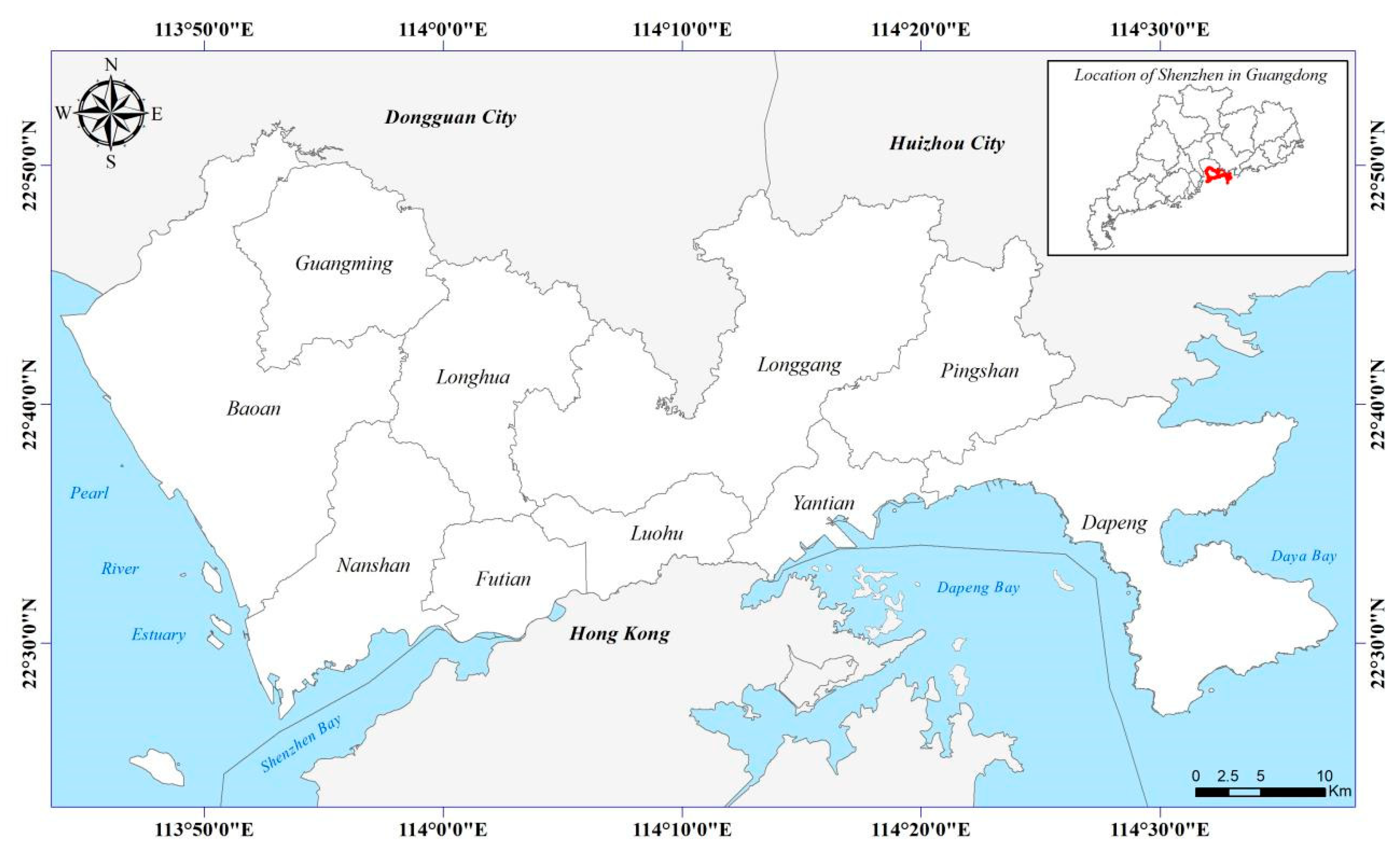
2.1. Study Area and Data
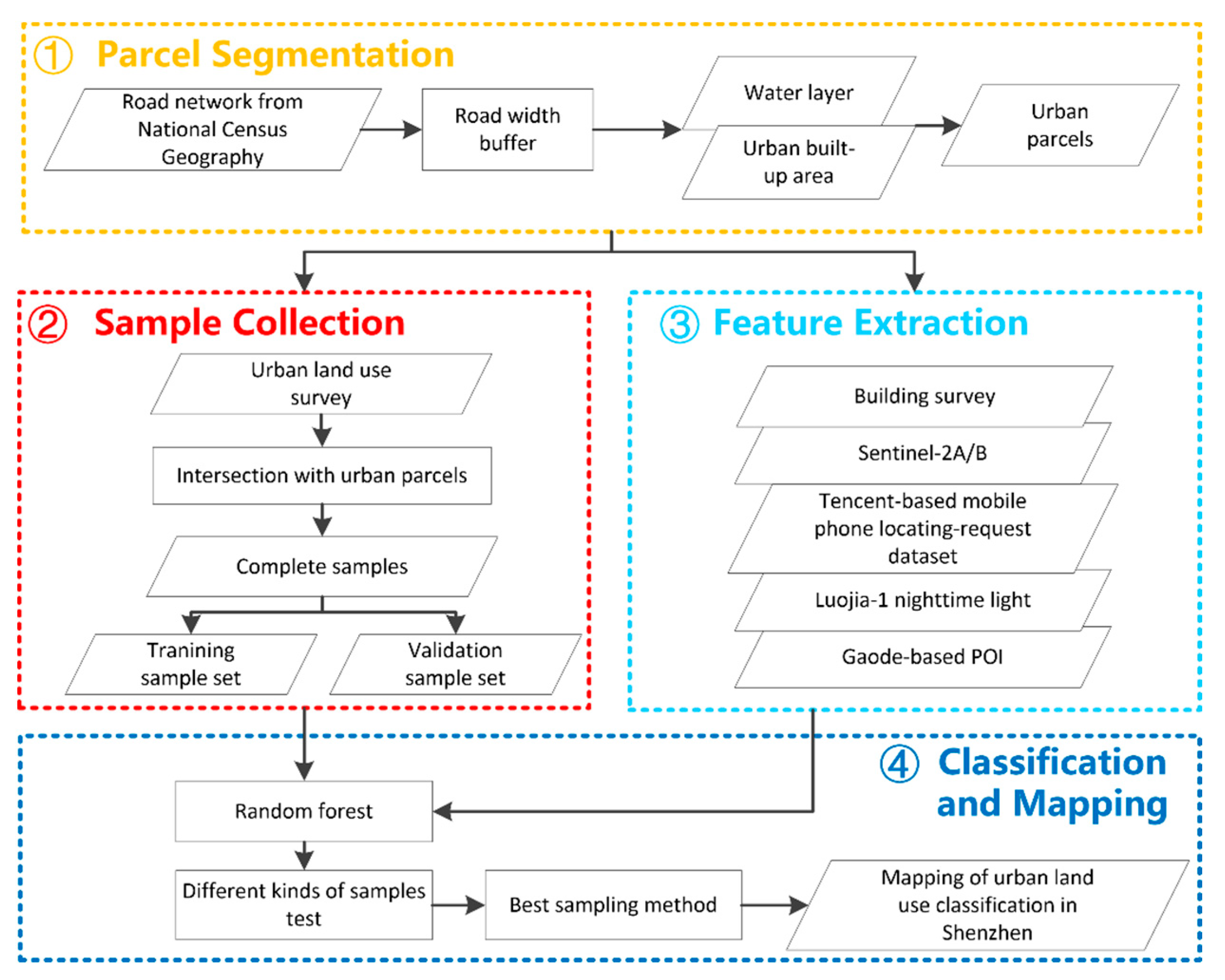
2.2. Technical Process
2.3. Detailed Urban Land Use Classification System
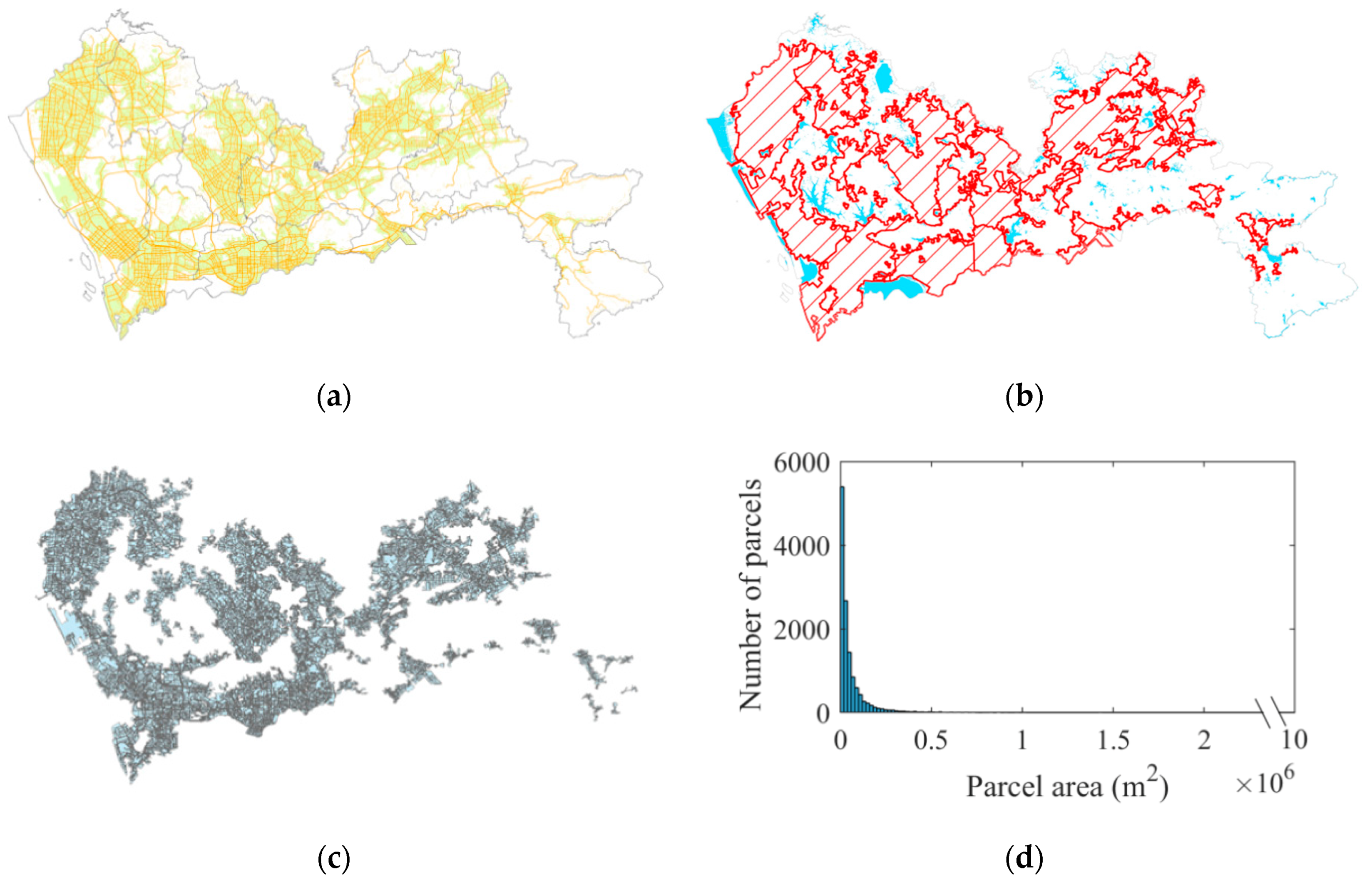
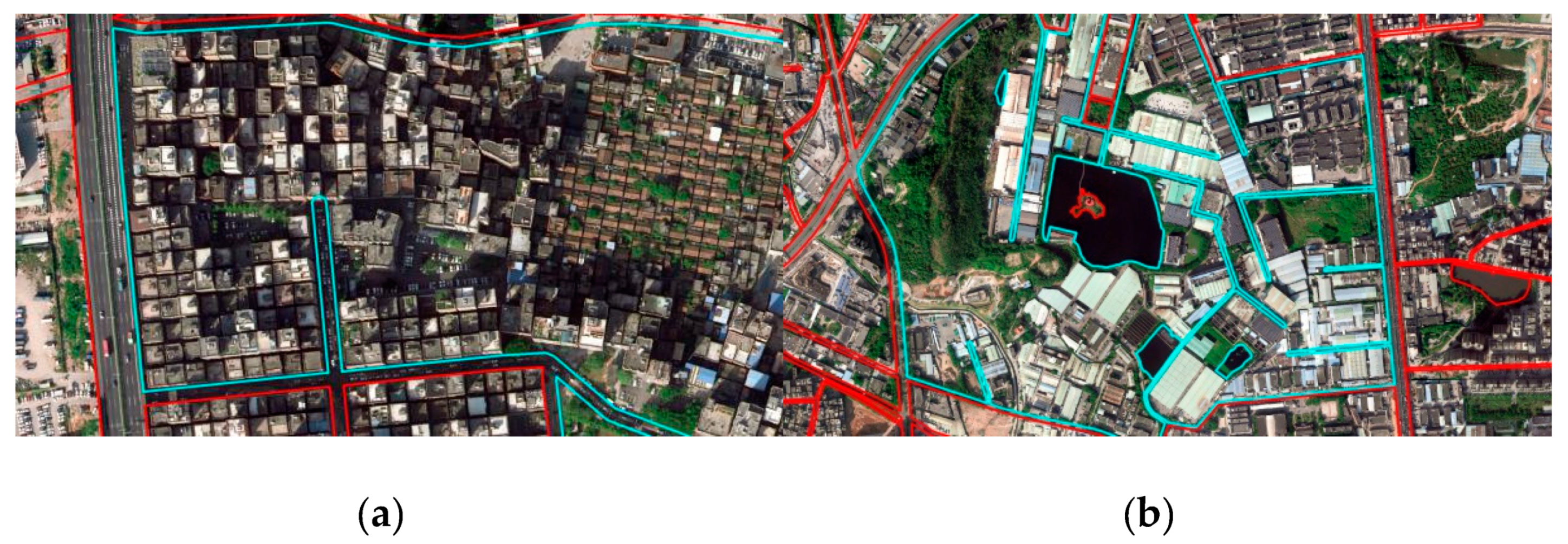
2.4. Parcel Segmentation
2.5. Feature Extraction
2.5.1. Multispectral Features from Sentinel-2A/B Imagery
2.5.2. Human Activity Features from Tencent MPL Data
2.5.3. Nighttime Light Features from Luojia-1 Nighttime Light Imagery
2.5.4. POI Features from Gaode
2.5.5. Building Features from Survey Data
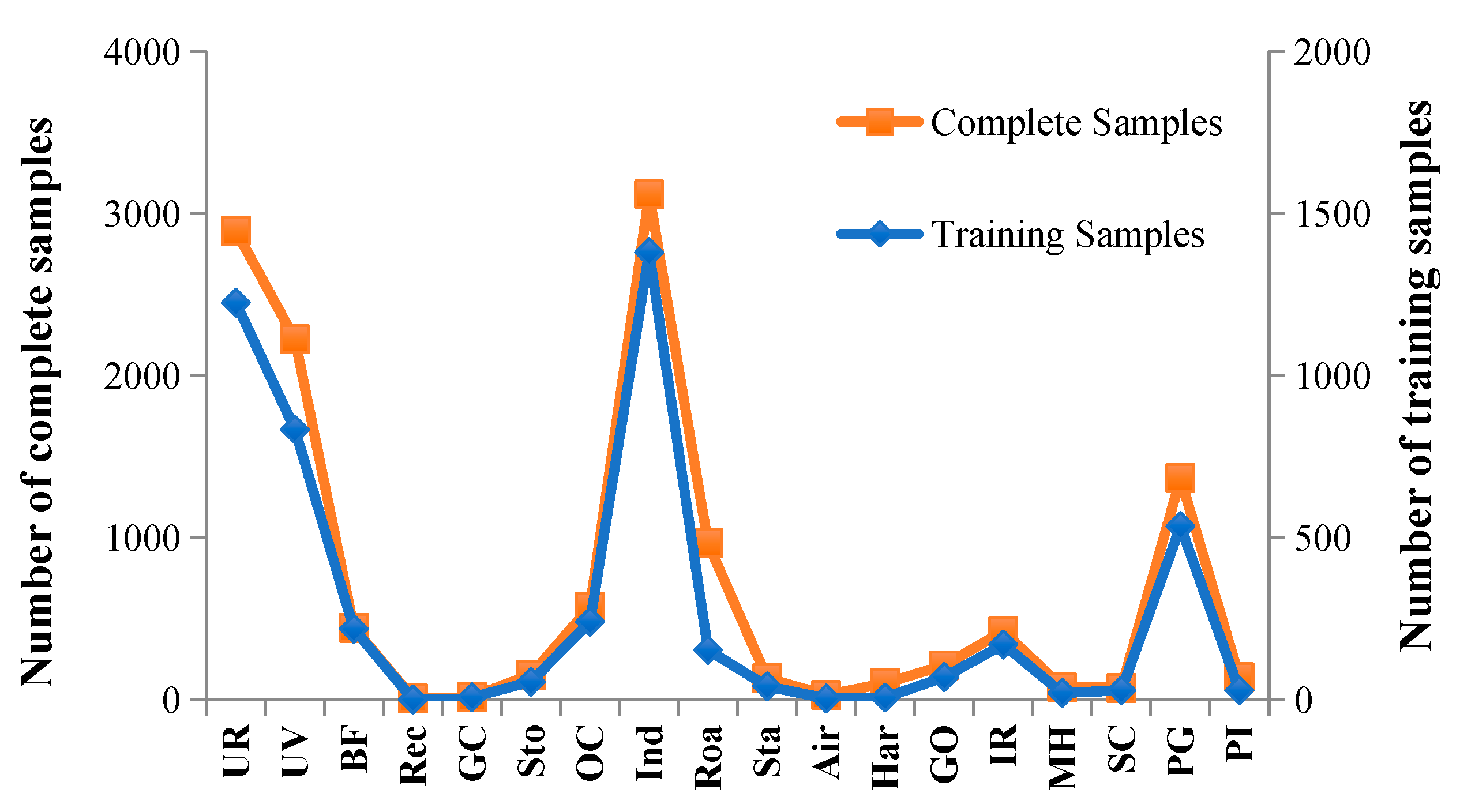
2.6. Training and Validation Samples
2.7. Classifier
3. Experimental Tests and Results
3.1. The Impact of the Sample Size
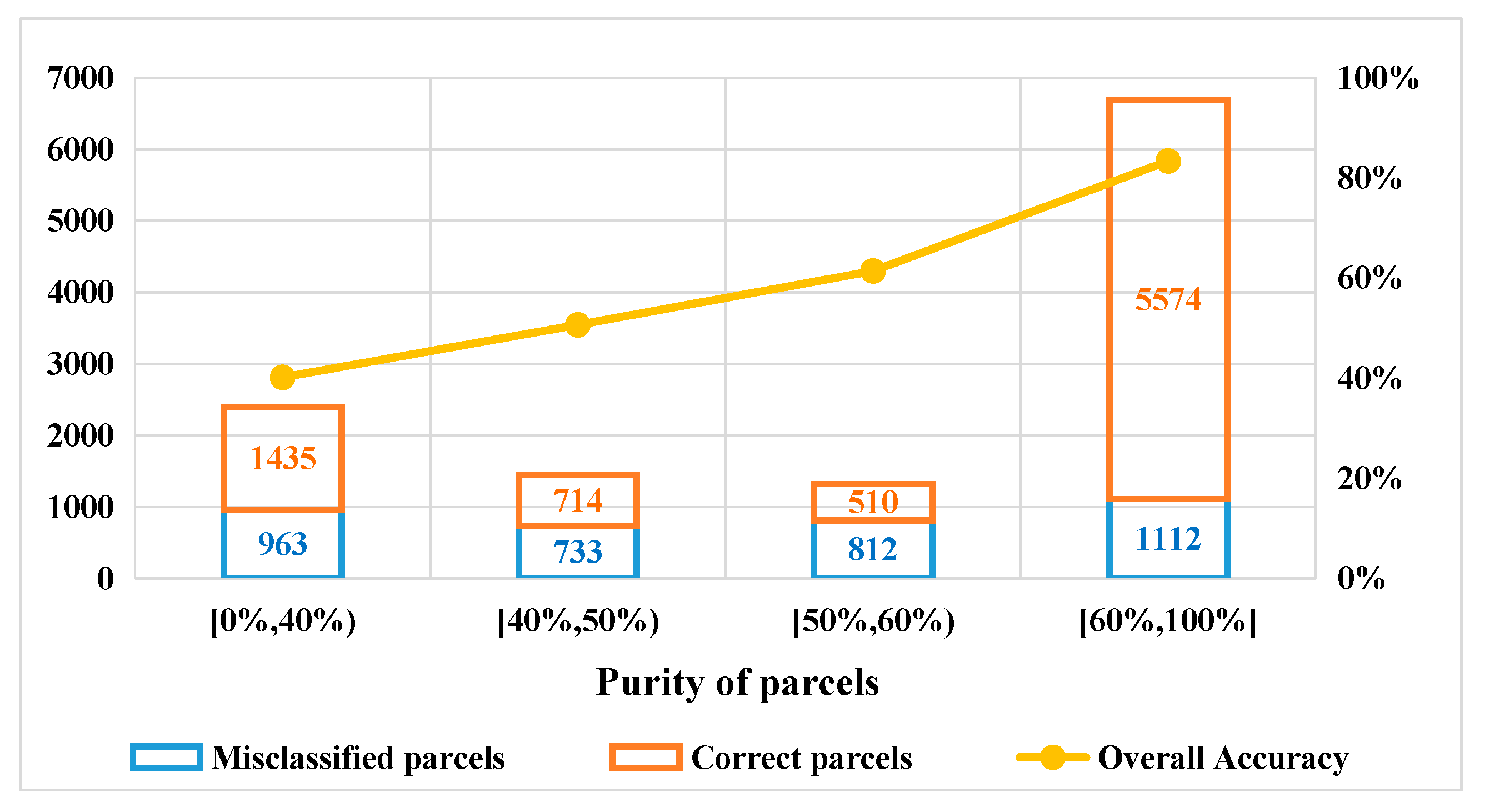
3.2. Impact of the Sample Purity
3.3. Impact of the Sample Spatial Distribution
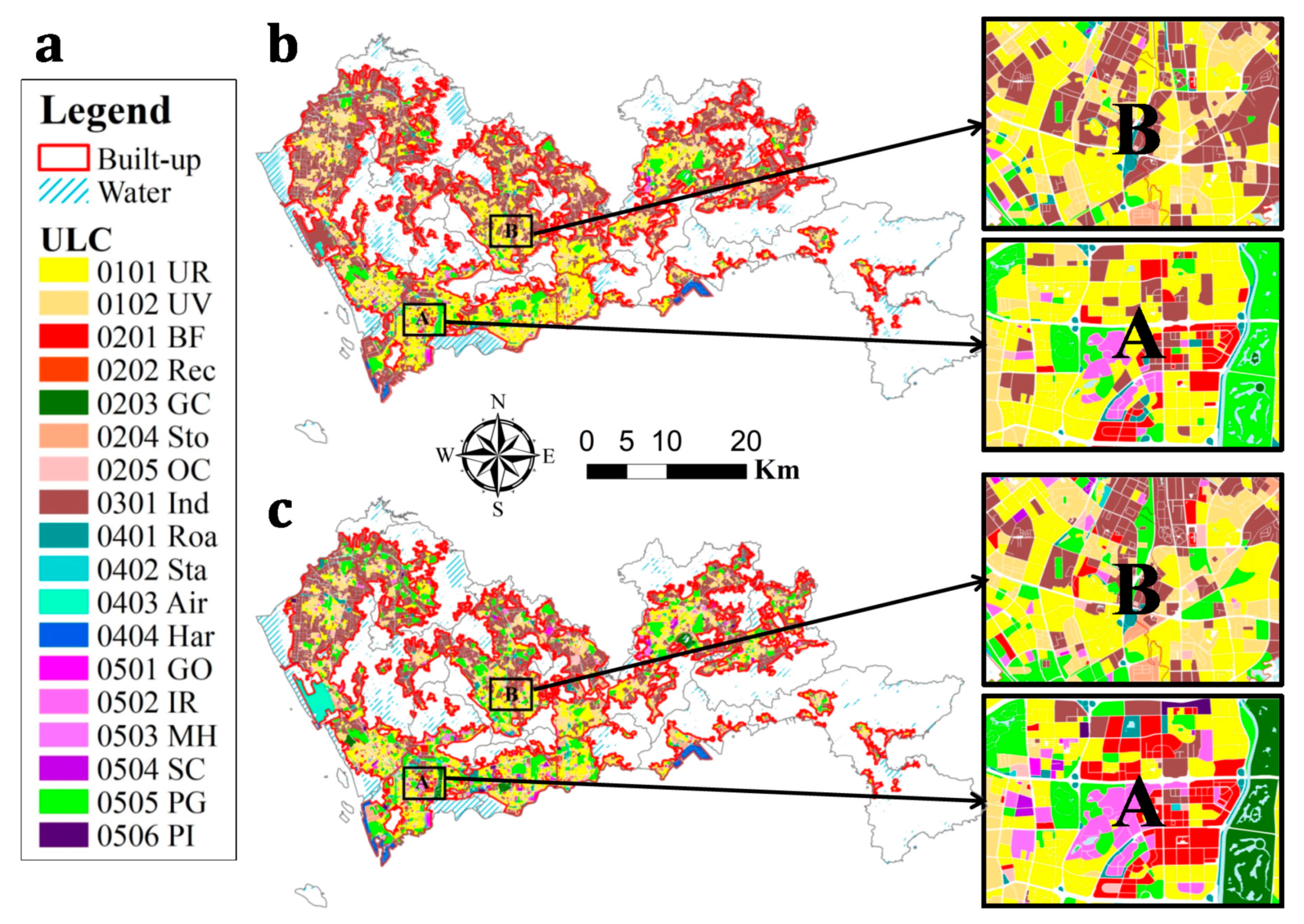
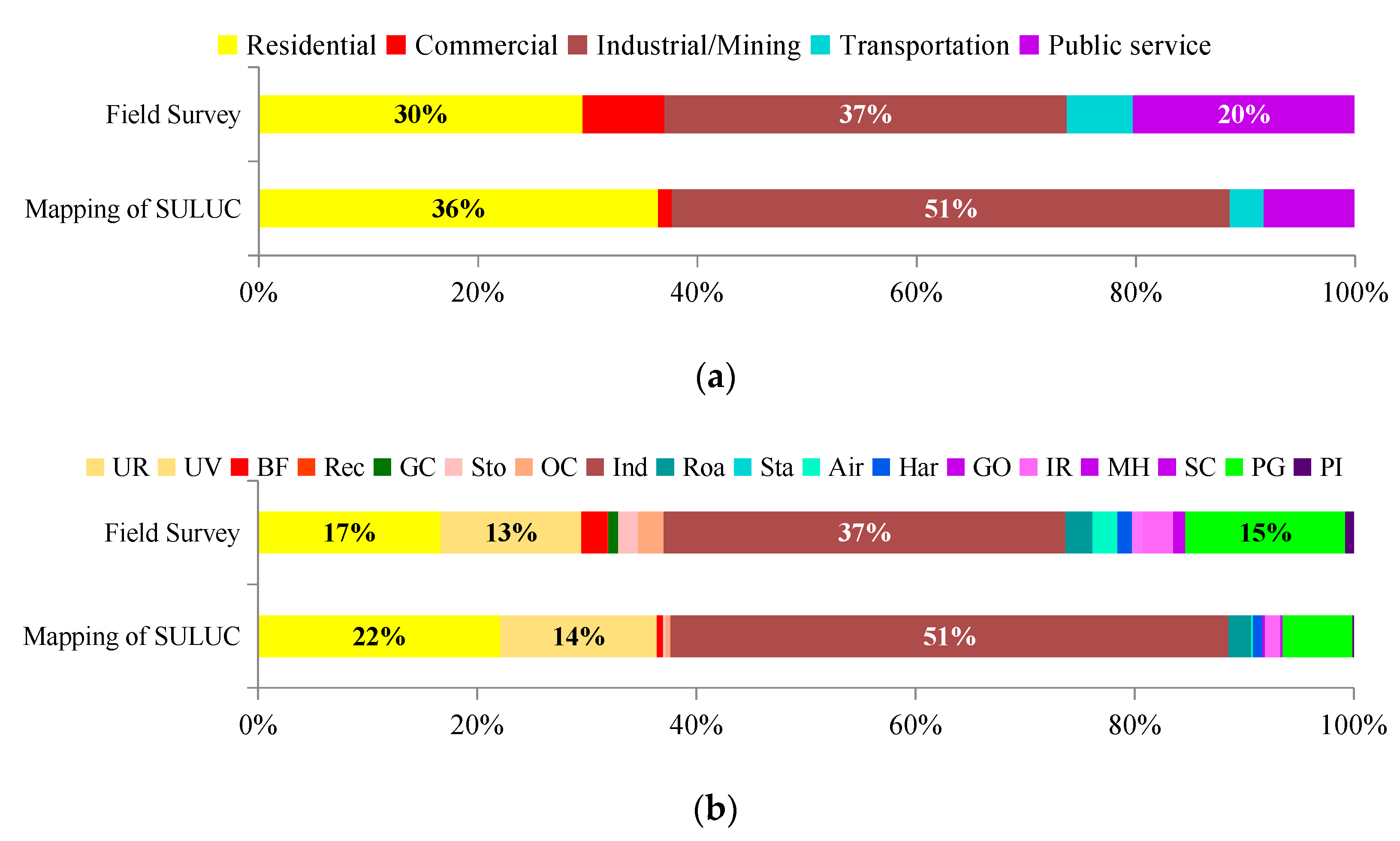
3.4. Mapping of SULUC in Shenzhen
4. Discussion
- Due to the high scarcity of land, commercial, transportation, and public facilities in high-density cities such as Shenzhen often exist in the form of nonindependent land occupation. In this case, the features mentioned above may not be sufficiently significant compared with those in other cities.
- There is more and more three-dimensional utilization of land use. For example, a business center generated by urban renewal could have a commercial center on its low floors and high-quality housing on the top floors; thus, this center is both commercial and urban residential. Additionally, government agencies could rent some commercial buildings for office space, and in this situation, the building is both for commercial use and public service use. In the above cases, it is unreasonable to assign only one category to a parcel. A possible solution is to assign multiple categories to a parcel through a probability method.
- The segmentation of parcels is not detailed enough. Because road segmentation technology is not suitable for the underdeveloped areas of the road network in the city, this results in superlarge parcels which contain multiple land use categories. In the future, image segmentation can be introduced to segment the superlarge parcels generated by road segmentation.
- The POI information collection from commercial companies is biased, resulting in unsatisfactory classification results. In the future, POI information from official electronic maps can be combined with POI information from commercial institutions to enhance the classification accuracy.
5. Conclusions
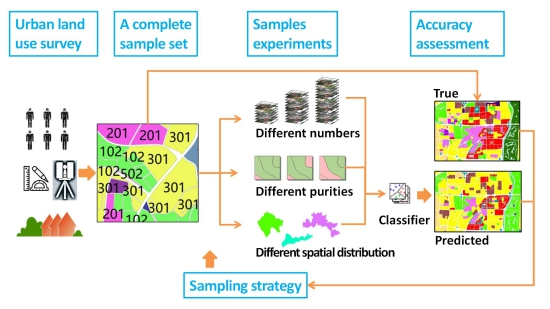
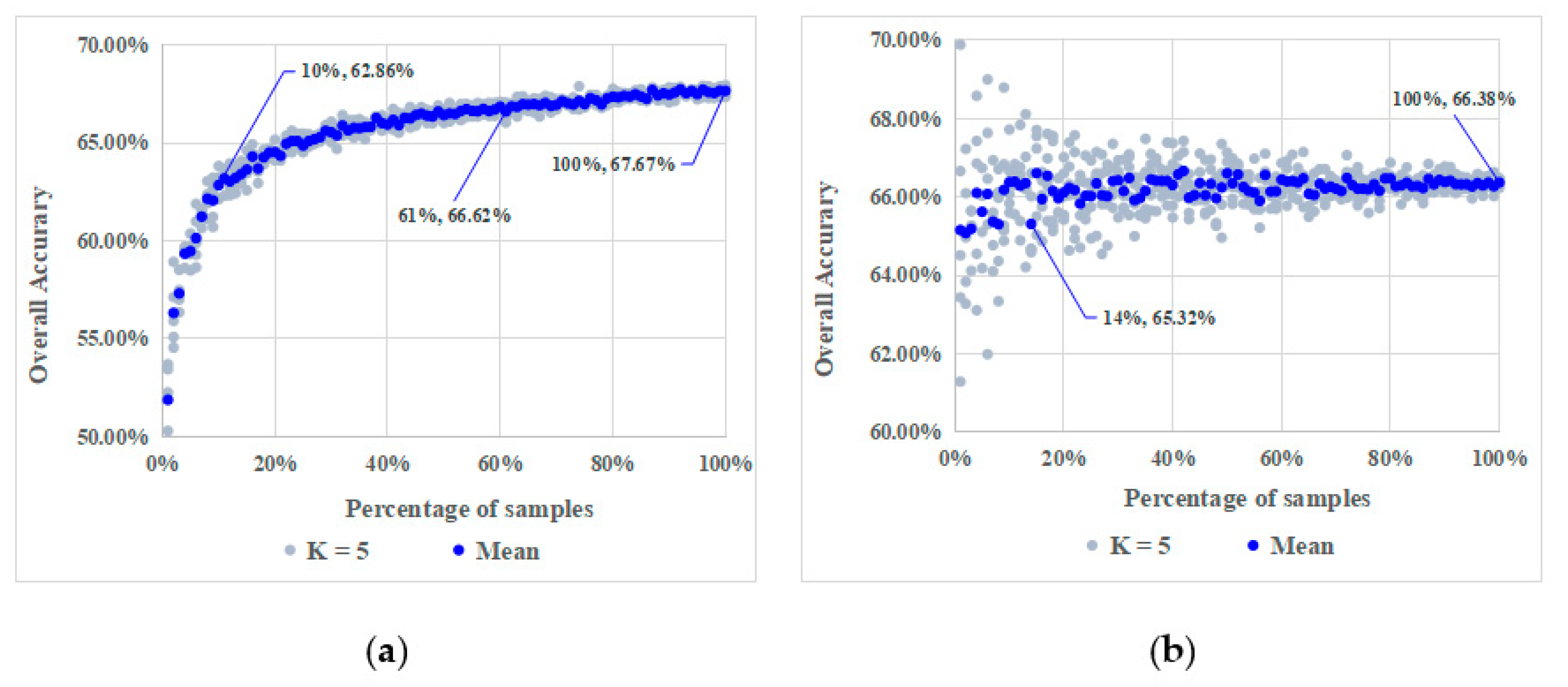
- Quantity strategy. To acquire the best classification accuracy in a single city, it is necessary to collect training samples of no less than 40% of the total number of urban parcels or no less than 5500 in number. If limited labor is available for sample selection, it is recommended to collect no less than 7% of the total parcels of training samples or no less than 900 samples. Further reduction in the number could cause a significant loss of accuracy. To ensure the stability and reliability of the accuracy evaluation results, it is necessary to collect no less than 10% of the total parcels of validation samples or no less than 1200. Notably, if the principle of stratified random sampling is followed, the impact of the number of validation samples on the accuracy evaluation is limited. Even if the number of validation samples is reduced to 1% of the total, the maximum accuracy evaluation loss is not greater than 8%.
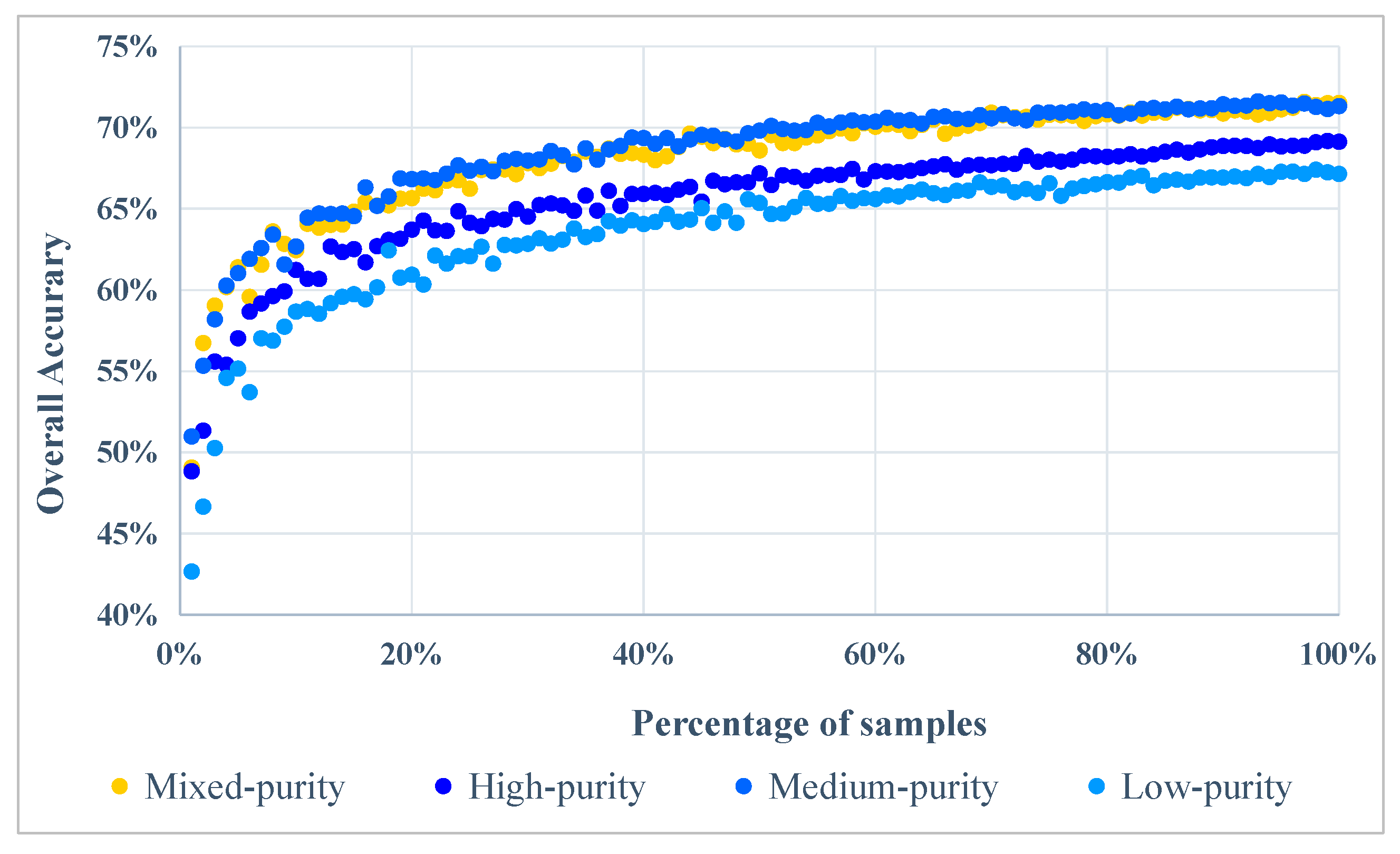
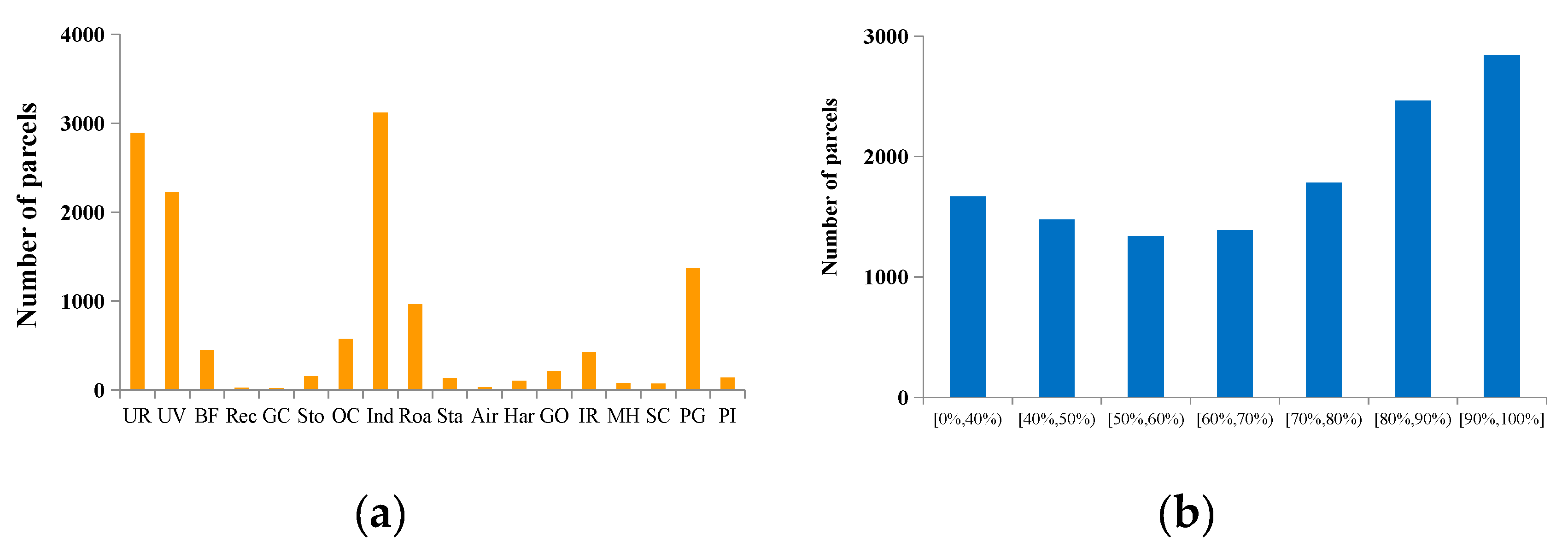
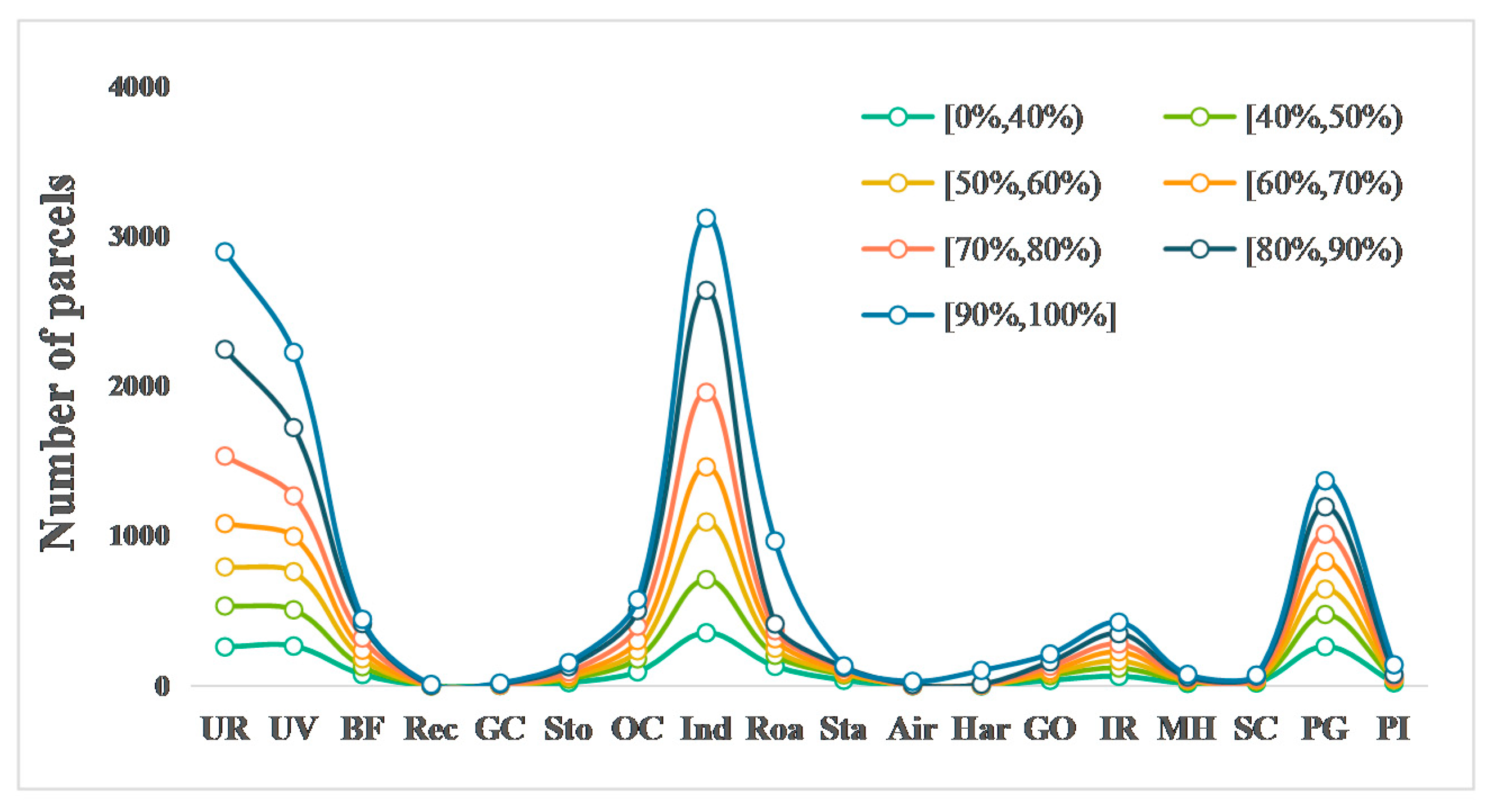
- Purity strategy. Using only high-purity samples could cause a certain loss of accuracy. It means that there is no need to collect only high-purity parcels as training samples. The better strategy is to prioritize using samples with a purity between 60% and 90%. It is worth noting that random sampling without considering purity can also obtain ideal accuracy results, but there are great difficulties in identifying low-purity mixed land, which could require more work.
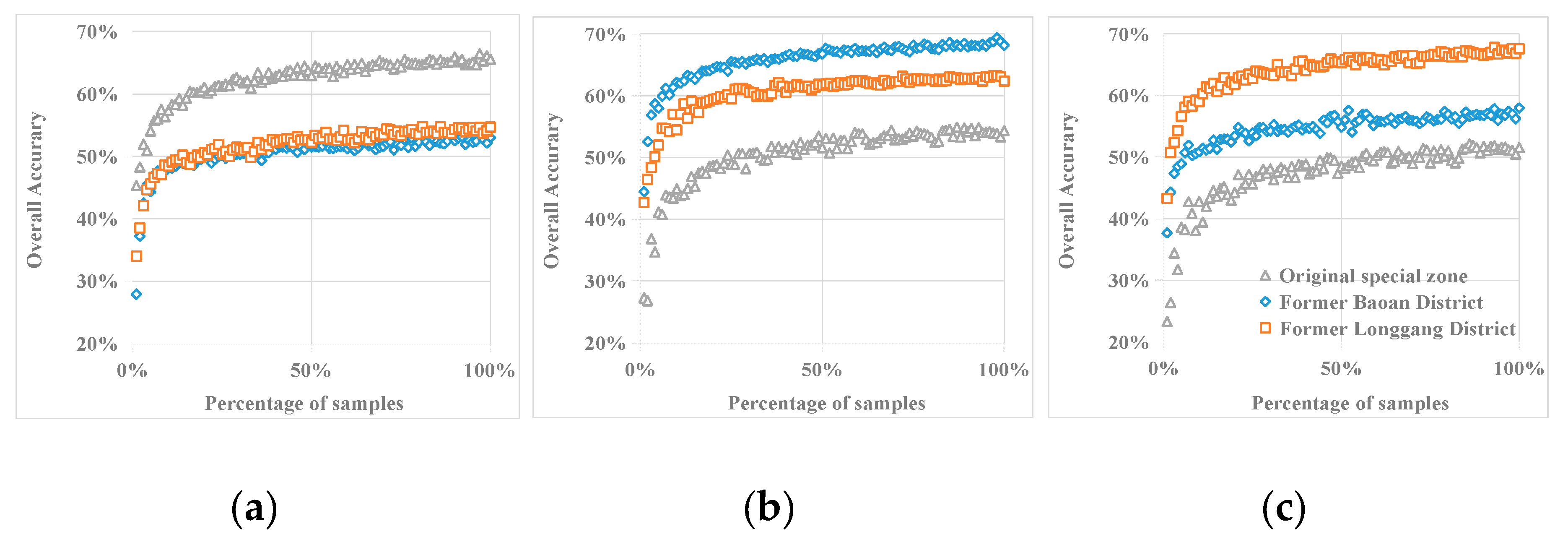
- Spatial distribution strategy. The spatial distribution of the samples should be as balanced as possible, as unbalanced sampling will cause a significant accuracy loss even if in a single city. The samples have the ability to migrate. When spatial equilibrium sampling is not allowed, priority should be given to areas with complex land use patterns, which can provide better classification results.
Author Contributions
Funding
Acknowledgments
Conflicts of Interest
References
- United Nations, Department of Economic and Social Affairs PD. World Urbanization Prospects: The 2018 Revision (ST/ESA/SER.A/420); United Nations: New York, NY, YSA, 2018. [Google Scholar]
- Gong, P.; Li, X.; Zhang, W. 40-Year (1978–2017) human settlement changes in China reflected by impervious surfaces from satellite remote sensing. Sci. Bull. 2019, 64, 756–763. [Google Scholar] [CrossRef]
- Cheng, J.; Turkstra, J.; Peng, M.; Du, N.; Ho, P. Urban land administration and planning in China: Opportunities and constraints of spatial data models. Land Use Policy. 2006, 23, 604–616. [Google Scholar] [CrossRef]
- Su, M.; Zhou, B.; Liao, Q.; Hu, W.; Hong, W. Thinking on the construction of the Whole Domain Digital Current Data. Urban Plan. 2018, 42, 97–104. [Google Scholar]
- Xiao, J. Remote sensing survey of urban land use in Chongqing. Remote Sens. Land Resour. 1995, 64, 7–14. [Google Scholar]
- Huang, A. Large scale urban land use survey based on Remote Sensing Information. Subtrop. Soil Water Conserv. 2009, 21, 59–63. [Google Scholar]
- Su, M.; Liao, Q.; Luo, G.; Wei, X. Design and implementation of land survey technology for planning and land data fusion. Sci. Technol. Manag. Land Resour. 2013, 30, 93–99. [Google Scholar]
- Technical Regulations for the Third Nationwide Land Survey; Ministry of Natural Resources of the People’s Republic of China, Ed.; Geological Press: Beijing, China, 2019; Volume TD/T 1055-2019. [Google Scholar]
- Anderson, J.R.; Hardy, E.E.; Roach, J.T.; Witmer, R.E. A Land Use and Land Cover Classification System for Use with Remote Sensing Data; United States Government Office: Washington, DC, USA, 1976; p. 964.
- Gong, P.; Howarth, P.J. Performance analyses of probabilistic relaxation methods for land-cover classification. Remote Sens. Environ. 1989, 30, 33–42. [Google Scholar] [CrossRef]
- Gong, P.; Howarth, P.J. Graphical approach for the evaluation of land-cover classification procedures. Int. J. Remote Sens. 1990, 11, 899–905. [Google Scholar] [CrossRef]
- Gong, P.; Howarth, P.J. Land-use classification of SPOT HRV data using a cover-frequency method. Int. J. Remote Sens. 1992, 13, 1459–1471. [Google Scholar] [CrossRef]
- Gong, P.; Marceau, D.J.; Howarth, P.J. A Comparison of spatial feature extraction algorithms for land-use classification with SPOT HRV data. Remote Sens. Environ. 1992, 40, 137–151. [Google Scholar] [CrossRef]
- Treitz, P.M.; Howarth, P.J.; Gong, P. Application of satellite and GIS technologies for land-cover and land-use mapping at the rural-urban fringe: A case study. Photogramm. Eng. Remote Sens. 1992, 58, 439–448. [Google Scholar]
- Gong, P. Reducing boundary effects in a kernel-based classifier. Int. J. Remote Sens. 1994, 15, 1131–1139. [Google Scholar] [CrossRef]
- Adams, J.B.; Sabol, D.E.; Kapos, V.; Filho, R.A.; Roberts, D.A.; Smith, M.O.; Gillespie, A.R. Classification of multispectral images based on fractions of endmembers: Application to land-cover change in the Brazilian Amazon. Remote Sens. Environ. 1995, 52, 137–154. [Google Scholar] [CrossRef]
- Ben-Dor, E.; Levin, N.; Saaroni, H. A Spectral Based Recognition of The Urban Environment Using The Visible And Near-Infrared Spectral Region (0.4-1.1 μM). A Case Study Over Tel-Aviv, Israel. Int. J. Remote Sens. 2001, 22, 2193–2218. [Google Scholar] [CrossRef]
- Gao, F.; de Colstoun, E.B.; Ma, R.; Weng, Q.; Masek, J.G.; Chen, J.; Pan, Y.; Song, C. Mapping impervious surface expansion using medium-resolution satellite image time series: a case study in the Yangtze River Delta, China. Int. J. Remote Sens. 2012, 33, 7609–7628. [Google Scholar] [CrossRef]
- Johnson, B.A. High-resolution urban land-cover classification using a competitive multi-scale object-based approach. Remote Sens. Lett. 2013, 4, 131–140. [Google Scholar] [CrossRef]
- Yu, L.; Liang, L.; Wang, J.; Zhao, Y.; Cheng, Q.; Hu, L.; Liu, S.; Yu, L.; Wang, X.; Zhu, P.; et al. Meta-discoveries from a synthesis of satellite-based land-cover mapping research. Int. J. Remote Sens. 2014, 35, 4573–4588. [Google Scholar] [CrossRef]
- Pesaresi, M.; Ehrlich, D.; Caravaggi, I.; Kauffmann, M.; Louvrier, C. Toward Global Automatic Built-Up Area Recognition Using Optical VHR Imagery. IEEE J. Sel. Top. Appl. Earth Obs. Remote Sens. 2011, 4, 923–934. [Google Scholar] [CrossRef]
- Zhan, Q.; Molenaar, M.; Gorte, B. Urban land use classes with fuzzy membership and classification based on integration of remote sensing and GIS. Int. Arch. Photogramm. Remote Sens. 2000, 33, 1751–1760. [Google Scholar]
- Goodchild, M.F. Citizens as sensors: the world of volunteered geography. GeoJournal 2007, 69, 211–221. [Google Scholar] [CrossRef]
- Soto, V.; Frías-Martínez, E. Automated land use identification using cell-phone records. In Proceedings of the 3rd ACM International Workshop on MobiArch, HotPlanet 11, Bethesda, MD, USA, 28 June 2011; pp. 17–22. [Google Scholar]
- Cranshaw, J.; Schwartz, R.; Hong, J.I.; Sadeh, N. The Livehoods Project: Utilizing Social Media to Understand the Dynamics of a City. In Proceedings of the 6th International AAAI Conference on Weblogs and Social Media, Dublin, Ireland, 4–7 June 2012. [Google Scholar]
- Yuan, J.; Zheng, Y.; Xie, X. Discovering regions of different functions in a city using human mobility and POI. In Proceedings of the 18th ACM SIGKDD International Conference on Knowledge Discovery and Data Mining, KDD 2012, Beijing, China, 12–16 August 2012; pp. 186–194. [Google Scholar]
- Long, Y.; Shen, Z. Discovering Functional Zones Using Bus Smart Card Data and Points of Interest in Beijing. In Geospatial Analysis to Support Urban Planning in Beijing; Springer: Berlin/Heidelberg, Germany, 2015; pp. 193–217. [Google Scholar]
- Song, X.; Pu, Y.; Liu, D.; Feng, Y. Mining the functional attributes of urban area by using pedestrian trajectory. J. Surv. Mapp. 2015, 44, 82–88. [Google Scholar]
- Chen, S.; Tao, H.; Li, X.; Zhuo, L. Identification of urban functional areas based on latent semantic information — GPS spatio-temporal data mining of Guangzhou floating car. J. Geogr. 2016, 71, 471–483. [Google Scholar]
- Liu, X.; Long, Y. Automated identification and characterization of parcels with OpenStreetMap and points of interest. Environ. Plan. B Urban Anal. City Sci. 2016, 43, 341–360. [Google Scholar]
- Hu, T.; Yang, J.; Li, X.; Gong, P. Mapping Urban Land Use by Using Landsat Images and Open Social Data. Remote Sens. 2016, 8, 151. [Google Scholar] [CrossRef]
- Schultz, M.; Voss, J.; Auer, M.; Carter, S.; Zipf, A. Open land cover from OpenStreetMap and remote sensing. Int. J. Appl. Earth Obs. Geoinf. 2017, 63, 206–213. [Google Scholar] [CrossRef]
- Zhang, W.; Li, W.; Zhang, C.; Hanink, D.M.; Li, X.; Wang, W. Parcel-based urban land use classification in megacity using airborne LiDAR, high resolution orthoimagery, and Google Street View. Comput. Environ. Urban Syst. 2017, 64, 215–228. [Google Scholar] [CrossRef]
- Zhang, Y.; Li, Q.; Huang, H.; Wu, W.; Du, X.; Wang, H. The Combined Use of Remote Sensing and Social Sensing Data in Fine-Grained Urban Land Use Mapping: A Case Study in Beijing, China. Remote Sens. 2017, 9, 865. [Google Scholar] [CrossRef]
- Cao, R.; Zhu, J.; Tu, W.; Li, Q.; Cao, J.; Liu, B.; Zhang, Q.; Qiu, G. Integrating aerial and street view images for urban land use classification. Remote Sens. 2018, 10, 1553. [Google Scholar] [CrossRef]
- Chen, W.; Huang, H.; Dong, J.; Zhang, Y.; Tian, Y.; Yang, Z. Social Functional Mapping Of Urban Green Space Using Remote Sensing And Social Sensing Data. ISPRS J. Photogramm. Remote Sens. 2018, 146, 436–452. [Google Scholar] [CrossRef]
- Grippa, T.; Georganos, S.; Zarougui, S.; Bognounou, P.; Diboulo, E.; Forget, Y.; Lennert, M.; Vanhuysse, S.; Mboga, N.; Wolff, E. Mapping Urban Land Use at Street Block Level Using OpenStreetMap, Remote Sensing Data, and Spatial Metrics. ISPRS Int. J. Geo-Inf. 2018, 7, 246. [Google Scholar] [CrossRef]
- Luo, N.X.; Wan, T.L.; Hao, H.X.; Lu, Q.K. Fusing High-Spatial-Resolution Remotely Sensed Imagery and OpenStreetMap Data for Land Cover Classification Over Urban Areas. Remote Sens. 2019, 11, 88. [Google Scholar] [CrossRef]
- Zhang, Y.; Li, Q.; Tu, W.; Mai, K.; Yao, Y.; Chen, Y. Functional urban land use recognition integrating multi-source geospatial data and cross-correlations. Comput. Environ. Urban Syst. 2019, 78, 1–11. [Google Scholar] [CrossRef]
- Gong, P.; Chen, B.; Li, X.; Liu, H.; Wang, J.; Bai, Y.; Chen, J.; Chen, X.; Fang, L.; Feng, S.; et al. Mapping essential urban land use categories in China (EULUC-China): preliminary results for 2018. Sci. Bull. 2020, 65, 182–187. [Google Scholar] [CrossRef]
- Van Niel, T.G.; McVicar, T.R.; Datt, B. On the relationship between training sample size and data dimensionality: Monte Carlo analysis of broadband multi-temporal classification. Remote Sens. Environ. 2005, 98, 468–480. [Google Scholar] [CrossRef]
- Demir, B.; Erturk, S. Increasing hyperspectral image classification accuracy for data sets with limited training samples by sample interpolation. In Proceedings of the 4th International Conference on Recent Advances in Space Technologies 2009, Istanbul, Turkey, 11–13 June 2009; pp. 367–369. [Google Scholar]
- Goncalves, L.M.S.; Fonte, C.C.; Carrao, H.; Caetano, M. Improving image classification accuracy: A method to incorporate uncertainty in the selection of training sample set. In Proceedings of the 9th International Symposium on Spatial Accuracy Assessment in Natural Resources and Environmental Sciences, Leicester, UK, 20–23 July 2010; pp. 261–264. [Google Scholar]
- Li, C.; Jie, W.; Lei, W.; Hu, L.; Peng, G. Comparison of Classification Algorithms and Training Sample Sizes in Urban Land Classification with Landsat Thematic Mapper Imagery. Remote Sens. 2014, 6, 964–983. [Google Scholar] [CrossRef]
- Gong, P.; Liu, H.; Zhang, M.N.; Li, C.C.; Wang, J.; Huang, H.B.; Clinton, N.; Ji, L.Y.; Li, W.Y.; Bai, Y.Q.; et al. Stable classification with limited sample: transferring a 30-m resolution sample set collected in 2015 to mapping 10-m resolution global land cover in 2017. Sci. Bull. 2019, 64, 370–373. [Google Scholar] [CrossRef]
- Georganos, S.; Grippa, T.; Vanhuysse, S.; Lennert, M.; Shimoni, M.; Wolff, E. Very High Resolution Object-Based Land Use-Land Cover Urban Classification Using Extreme Gradient Boosting. IEEE Geosci. Remote Sens. Lett. 2018, 15, 607–611. [Google Scholar] [CrossRef]
- Maxwell, A.E.; Warner, T.A.; Fang, F. Implementation of machine-learning classification in remote sensing: An applied review. Int. J Remote Sens. 2018, 39, 2784–2817. [Google Scholar] [CrossRef]
- Ruiz Hernandez, I.E.; Shi, W. A Random Forests classification method for urban land-use mapping integrating spatial metrics and texture analysis. Int. J. Remote Sens. 2018, 39, 1175–1198. [Google Scholar] [CrossRef]
- Statistics Bureau of Shenzhen Municipality; Survey Office of the National Bureau of Statistics in Shenzhen. Shenzhen Statistical Yearbook 2019; China Statistics Press: Beijing, China, 2019.
- Statistics Bureau of Beijing Municipality; Survey Office of the National Bureau of Statistics in Beijing. Beijing Statistical Yearbook 2019; China Statistics Press: Beijing, China, 2019.
- Statistics Bureau of Shanghai Municipality. The GDP of Shanghai in 2019. Available online: http://tjj.sh.gov.cn/html/sjfb/202001/1004392.html (accessed on 9 February 2020).
- Current Land Use Classification; General Administration of Quality Supervision, Inspection and Quarantine of the People’s Republic of China, China National Standardization Management Committee, Ed.; Standards Press of China: Beijing, China, 2017; Volume GB/T 21010-2017.
- Shenzhen Municipal Commission of Planning and Land Resources. Notice on Printing and Distributing the Code for Investigation of Land Change in Shenzhen (for Trial Implementation); Shenzhen Municipal Commission of Planning and Land Resources: Shenzhen, China, 2015.
- Chen, B.; Song, Y.M.; Jiang, T.T.; Chen, Z.Y.; Huang, B.; Xu, B. Real-Time Estimation of Population Exposure to PM2.5 Using Mobile- and Station-Based Big Data. Int. J. Environ. Res. Public Health. 2018, 15, 573. [Google Scholar] [CrossRef]
- Hansen, M.; Dubayah, R.; Defries, R. Classification trees: an alternative to traditional land cover classifiers. Int. J. Remote Sens. 1996, 17, 1075–1081. [Google Scholar] [CrossRef]
- Atkinson, P.M.; Tatnall, A.R.L. Introduction Neural networks in remote sensing. Int. J. Remote Sens. 1997, 18, 699–709. [Google Scholar] [CrossRef]
- Friedl, M.A.; Brodley, C.E. Decision tree classification of land cover from remotely sensed data. Remote Sens. Environ. 1997, 61, 399–409. [Google Scholar] [CrossRef]
- Giacinto, G.; Roli, F.; Bruzzone, L. Combination of neural and statistical algorithms for supervised classification of remote-sensing images. Pattern Recognit. Lett. 2000, 21, 385–397. [Google Scholar] [CrossRef]





| Data Type | Name | Year | Content | Resolution | Usage |
|---|---|---|---|---|---|
| Remote Sensing | Sentinel 2A/B | 2018 | Spectral data | 10 m | Feature extraction |
| Luojia 1 | 2018 | Night light | 130 m | Feature extraction | |
| VGI | OSM | 2018 | Centerline | Multiple-scale | Parcel segmentation |
| Gaode Map | 2018 | POI | Multiple-scale | Feature extraction | |
| Tencent social big data | 2018 | Tencent mobile-phone locating-request | 1000 m | Feature extraction | |
| Field Survey | Urban land use survey | 2018 | Urban land use parcel | Submeter | Sample collection |
| National geographical condition survey | 2015 | Centerline, road level, width, water area | Submeter | Parcel segmentation | |
| Road survey | 2018 | Centerline, width | Submeter | Parcel segmentation | |
| Building survey | 2018 | Building base map and height | Submeter | Feature extraction | |
| Extent of built-up area | 2016 | Built-up area | Submeter | Parcel segmentation |
| Level I | Level II | Descriptions | ||
|---|---|---|---|---|
| 01 | Residential | 0101 | Urban residential (UR) | Land used for residential housing and related facilities |
| 0102 | Urban village (UV) | Original rural resident housing currently mostly surrounded by city blocks | ||
| 02 | Commercial | 0201 | Business and finance (BF) | Commercial and service land used for business operations |
| 0202 | Recreational (Rec) | Cinema, recreational land, tourism land with less than 65% coverage of green space | ||
| 0203 | Golf course (GC) | Golf course and service housing and facilities | ||
| 0204 | Storage (Sto) | Land used for stockpiling and temporary storage for distribution | ||
| 0205 | Other commercial (OC) | Retail, wholesale, production and sales, services, and entertainment land | ||
| 03 | Industrial | 0301 | Industrial (Ind) | Land used for production, product processing, manufacturing, machine repair, and other related facilities |
| 04 | Transportation | 0401 | Road (Roa) | Transportation land |
| 0402 | Stations (Sta) | Land used for service facilities, such as stations, transfer stations, parking facilities | ||
| 0403 | Airports (Air) | Civil or military airports | ||
| 0404 | Harbor (Har) | Land used for harbors or related facilities | ||
| 05 | Public service | 0501 | Governmental office, media, and press (GO) | Land used for governmental offices, social organizations, broadcasting, film making, and publishing agencies |
| 0502 | Instructional and research (IR) | Land used for instruction, research, design, surveying, testing, environmental assessment, extension, etc. | ||
| 0503 | Medical, health, and social welfare (MH) | Land used for medical, healthcare, disease control, recovering, emergent saving facilities, philanthropic institution, etc. | ||
| 0504 | Sports and cultural facilities (SC) | Public stadiums and training facilities | ||
| 0505 | Parks and green space (PG) | Parks, zoos, gardens, squares, and other green space for recreation | ||
| 0506 | Public infrastructure (PI) | Land used for public infrastructure | ||
| Data Source | Features |
|---|---|
| Sentinel-2A/B | Mean and standard deviation of blue, green, red, near-infrared bands, NDVI, and NDWI |
| Tencent-based MPL | Mean of 8 h active population during weekdays and weekends |
| Luojia-1 nighttime light | Mean of digital number values |
| Gaode-based POI | Total number of all POI and total number and proportion of each type of POI within each parcel |
| Building survey | Number of stories, sum of building height, and averaged building height |
| UR | BF | Sto | OC | Ind | Roa | Sta | IR | PG | PI | Primary Land Use | ||
|---|---|---|---|---|---|---|---|---|---|---|---|---|
| Parcel Code | F00003 | 0% | 0% | 0% | 0% | 7% | 17% | 0% | 0% | 76% | 0% | PG |
| F00025 | 14% | 3% | 3% | 3% | 63% | 5% | 4% | 5% | 0% | 0% | Ind | |
| F00387 | 55% | 0% | 0% | 0% | 7% | 17% | 0% | 0% | 0% | 21% | UR | |
| Level I | Overall Accuracy = 75.94% | Kappa = 66.24% | ||||||
|---|---|---|---|---|---|---|---|---|
| Residential | Commercial | Industrial | Transportation | Public Service | Total | PA (%) | UA (%) | |
| Residential | 4748 | 23 | 259 | 40 | 48 | 5118 | 92.77% | 76.59% |
| Commercial | 376 | 415 | 326 | 28 | 58 | 1203 | 34.50% | 88.30% |
| Industrial | 459 | 10 | 2557 | 23 | 69 | 3118 | 82.01% | 72.48% |
| Transportation | 82 | 7 | 97 | 930 | 116 | 1232 | 75.49% | 72.54% |
| Public service | 534 | 15 | 289 | 261 | 1195 | 2294 | 52.09% | 80.42% |
| Total | 6199 | 470 | 3528 | 1282 | 1486 | 12965 | ||
| Level II | Overall Accuracy = 70.91% Kappa = 64.33% | |||||||||||||||||||||
|---|---|---|---|---|---|---|---|---|---|---|---|---|---|---|---|---|---|---|---|---|---|---|
| UR | UV | BF | Rec | GC | Sto | OC | Ind | Roa | Sta | Air | Har | GO | IR | MH | SC | PG | PI | Total | PA | UA | ||
| Residential | UR | 2469 | 155 | 7 | 0 | 0 | 0 | 4 | 204 | 33 | 0 | 0 | 1 | 0 | 4 | 0 | 0 | 17 | 0 | 2894 | 85.31% | 68.07% |
| UV | 173 | 1854 | 0 | 0 | 0 | 0 | 1 | 186 | 8 | 0 | 0 | 0 | 0 | 1 | 0 | 0 | 1 | 0 | 2224 | 83.36% | 77.31% | |
| Commercial | BF | 142 | 9 | 153 | 0 | 0 | 0 | 2 | 118 | 15 | 0 | 0 | 0 | 0 | 1 | 0 | 0 | 4 | 0 | 444 | 34.46% | 86.44% |
| Rec | 1 | 0 | 0 | 7 | 0 | 0 | 0 | 0 | 1 | 0 | 0 | 0 | 0 | 0 | 0 | 0 | 1 | 0 | 10 | 70.00% | 100.00% | |
| GC | 0 | 0 | 0 | 0 | 7 | 0 | 0 | 0 | 0 | 0 | 0 | 0 | 0 | 0 | 0 | 0 | 12 | 0 | 19 | 36.84% | 100.00% | |
| Sto | 4 | 2 | 0 | 0 | 0 | 43 | 0 | 101 | 4 | 0 | 0 | 0 | 0 | 0 | 0 | 0 | 1 | 0 | 155 | 27.74% | 97.73% | |
| OC | 120 | 58 | 6 | 0 | 0 | 1 | 160 | 210 | 14 | 0 | 0 | 0 | 0 | 1 | 0 | 0 | 5 | 0 | 575 | 27.83% | 90.40% | |
| Industrial | Ind | 149 | 212 | 4 | 0 | 0 | 0 | 3 | 2706 | 28 | 0 | 0 | 0 | 0 | 7 | 0 | 0 | 9 | 0 | 3118 | 86.79% | 65.82% |
| Transportation | Roa | 53 | 5 | 1 | 0 | 0 | 0 | 0 | 74 | 801 | 0 | 0 | 2 | 0 | 1 | 0 | 0 | 28 | 1 | 966 | 82.92% | 63.02% |
| Sta | 21 | 6 | 1 | 0 | 0 | 0 | 2 | 53 | 23 | 11 | 0 | 1 | 0 | 1 | 0 | 0 | 14 | 0 | 133 | 8.27% | 100.00% | |
| Air | 0 | 0 | 0 | 0 | 0 | 0 | 0 | 5 | 0 | 0 | 24 | 0 | 0 | 0 | 0 | 0 | 1 | 0 | 30 | 80.00% | 100.00% | |
| Har | 0 | 0 | 0 | 0 | 0 | 0 | 0 | 6 | 2 | 0 | 0 | 95 | 0 | 0 | 0 | 0 | 0 | 0 | 103 | 92.23% | 95.96% | |
| Public service | GO | 77 | 13 | 3 | 0 | 0 | 0 | 0 | 46 | 4 | 0 | 0 | 0 | 66 | 2 | 0 | 0 | 2 | 0 | 213 | 30.99% | 100.00% |
| IR | 117 | 32 | 1 | 0 | 0 | 0 | 1 | 70 | 11 | 0 | 0 | 0 | 0 | 188 | 0 | 0 | 4 | 0 | 424 | 44.34% | 81.74% | |
| MH | 26 | 6 | 1 | 0 | 0 | 0 | 0 | 14 | 4 | 0 | 0 | 0 | 0 | 2 | 24 | 0 | 0 | 0 | 77 | 31.17% | 100.00% | |
| SC | 17 | 3 | 0 | 0 | 0 | 0 | 1 | 24 | 6 | 0 | 0 | 0 | 0 | 6 | 0 | 12 | 3 | 0 | 72 | 16.67% | 100.00% | |
| PG | 237 | 42 | 0 | 0 | 0 | 0 | 3 | 259 | 309 | 0 | 0 | 0 | 0 | 15 | 0 | 0 | 502 | 0 | 1367 | 36.72% | 82.70% | |
| PI | 21 | 1 | 0 | 0 | 0 | 0 | 0 | 35 | 8 | 0 | 0 | 0 | 0 | 1 | 0 | 0 | 3 | 72 | 141 | 51.06% | 98.63% | |
| Total | 3627 | 2398 | 177 | 7 | 7 | 44 | 177 | 4111 | 1271 | 11 | 24 | 99 | 66 | 230 | 24 | 12 | 607 | 73 | 12965 | |||
© 2020 by the authors. Licensee MDPI, Basel, Switzerland. This article is an open access article distributed under the terms and conditions of the Creative Commons Attribution (CC BY) license (http://creativecommons.org/licenses/by/4.0/).
Share and Cite
Su, M.; Guo, R.; Chen, B.; Hong, W.; Wang, J.; Feng, Y.; Xu, B. Sampling Strategy for Detailed Urban Land Use Classification: A Systematic Analysis in Shenzhen. Remote Sens. 2020, 12, 1497. https://doi.org/10.3390/rs12091497
Su M, Guo R, Chen B, Hong W, Wang J, Feng Y, Xu B. Sampling Strategy for Detailed Urban Land Use Classification: A Systematic Analysis in Shenzhen. Remote Sensing. 2020; 12(9):1497. https://doi.org/10.3390/rs12091497
Chicago/Turabian StyleSu, Mo, Renzhong Guo, Bin Chen, Wuyang Hong, Jiaqi Wang, Yimei Feng, and Bing Xu. 2020. "Sampling Strategy for Detailed Urban Land Use Classification: A Systematic Analysis in Shenzhen" Remote Sensing 12, no. 9: 1497. https://doi.org/10.3390/rs12091497
APA StyleSu, M., Guo, R., Chen, B., Hong, W., Wang, J., Feng, Y., & Xu, B. (2020). Sampling Strategy for Detailed Urban Land Use Classification: A Systematic Analysis in Shenzhen. Remote Sensing, 12(9), 1497. https://doi.org/10.3390/rs12091497