Article

The VIIRS-Based RST-FLARE Configuration: The Val d’Agri Oil Center Gas Flaring Investigation in Between 2015–2019


1
Institute of Methodologies for Environmental Analysis—National Research Council, 85050 Tito Scalo, Italy
2
School of Engineering, University of Basilicata, 85100 Potenza, Italy
*
Author to whom correspondence should be addressed.
Remote Sens. 2020, 12(5), 819; https://doi.org/10.3390/rs12050819
Submission received: 5 February 2020 / Revised: 28 February 2020 / Accepted: 2 March 2020 / Published: 3 March 2020
(This article belongs to the Special Issue Satellite Remote Sensing of High-Temperature Thermal Anomalies)

Abstract

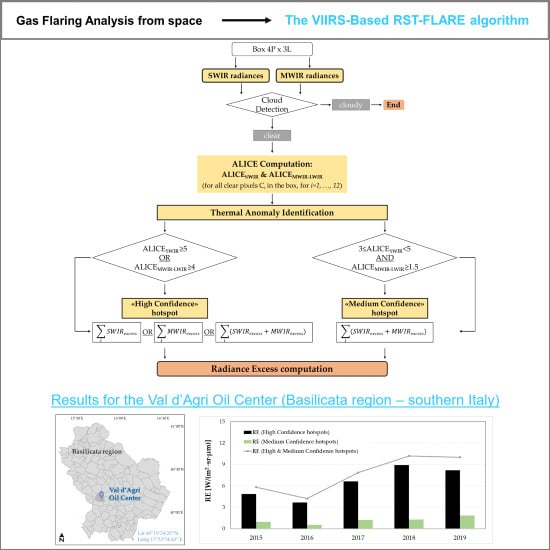
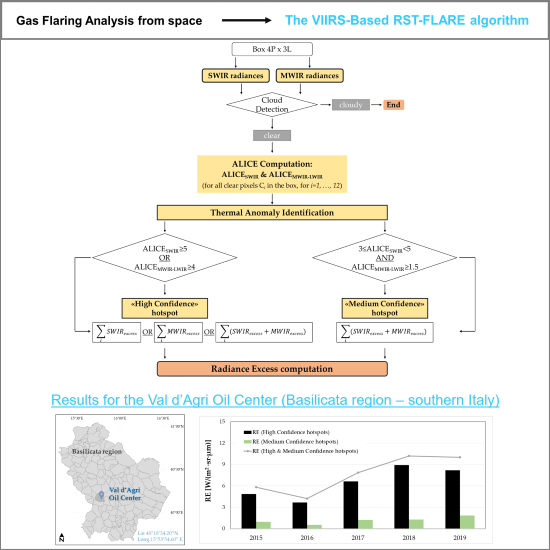
The RST (Robust Satellite Techniques)-FLARE algorithm is a satellite-based method using a multitemporal statistical analysis of nighttime infrared signals strictly related to industrial hotspots, such as gas flares. The algorithm was designed for both identifying and characterizing gas flares in terms of radiant/emissive power. The Val d’Agri Oil Center (COVA) is a gas and oil pre-treatment plant operating for about two decades within an anthropized area of Basilicata region (southern Italy) where it represents a significant potential source of social and environmental impacts. RST-FLARE, developed to study and monitor the gas flaring activity of this site by means of MODIS (Moderate Resolution Imaging Spectroradiometer) data, has exported VIIRS (Visible Infrared Imaging Radiometer Suite) records by exploiting the improved spatial and spectral properties offered by this sensor. In this paper, the VIIRS-based configuration of RST-FLARE is presented and its application on the recent (2015-2019) gas flaring activity at COVA is analyzed and discussed. Its performance in gas flaring characterization is in good agreement with VIIRS Nightfire outputs to which RST-FLARE seems to provide some add-ons. The great consistency of radiant heat estimates computed with both RST-FLARE developed configurations allows proposing a multi-sensor RST-FLARE strategy for a more accurate multi-year analysis of gas flaring.
Keywords: gas flaring; Robust Satellite Techniques; RST-FLARE; VIIRS; SWIR; MWIR; detection; characterization; Val d’Agri Oil Center gas flaring; Robust Satellite Techniques; RST-FLARE; VIIRS; SWIR; MWIR; detection; characterization; Val d’Agri Oil Center
Graphical Abstract