Article

Enhanced Delaunay Triangulation Sea Ice Tracking Algorithm with Combining Feature Tracking and Pattern Matching


1
Information Science and Technology College, Dalian Maritime University, Dalian 116026, China
2
Inner Mongolia Key Laboratory of Pattern Recognition and Intelligent Image Processing, Inner Mongolia University of Science and Technology, Baotou 014010, China
3
First Institute of Oceanography, Ministry of Natural Resources, Qingdao 266061, China
4
Inner Mongolia University of Technology, Hohhot 010051, China
*
Author to whom correspondence should be addressed.
Remote Sens. 2020, 12(3), 581; https://doi.org/10.3390/rs12030581
Submission received: 13 January 2020 / Revised: 7 February 2020 / Accepted: 7 February 2020 / Published: 10 February 2020

Abstract

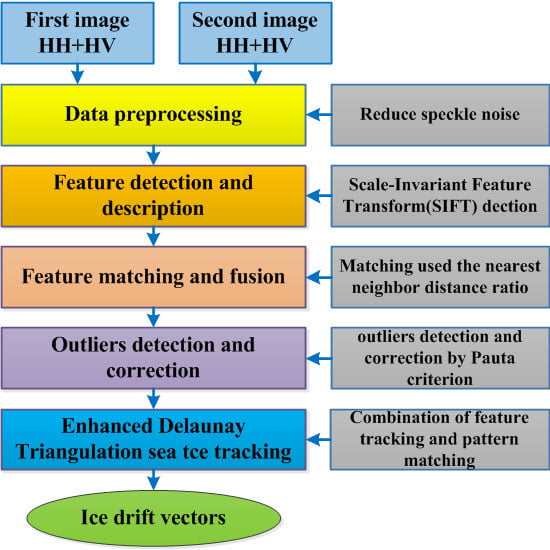
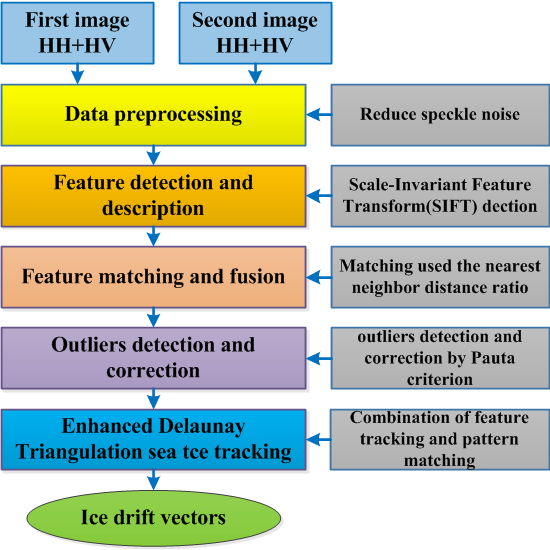
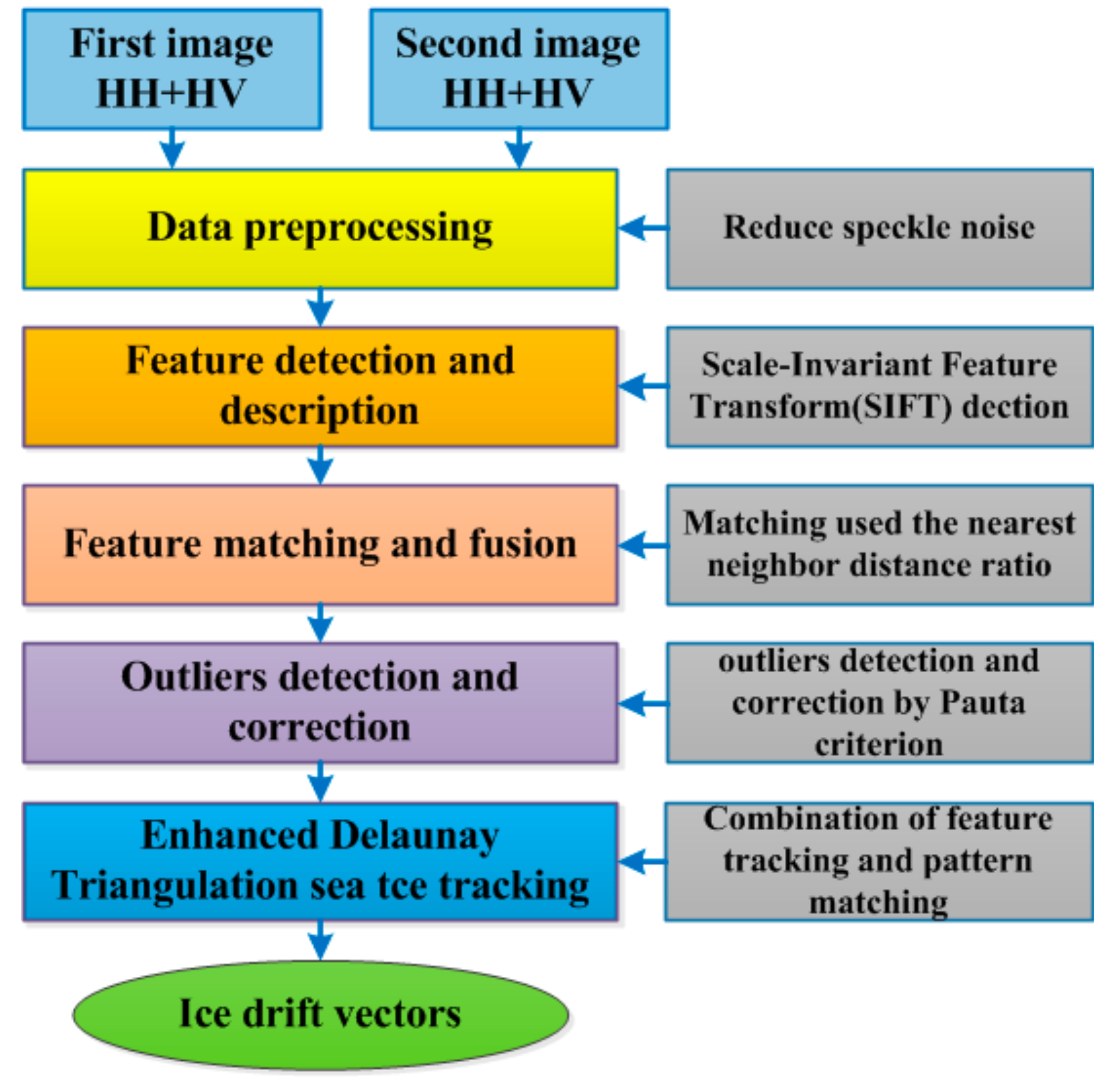
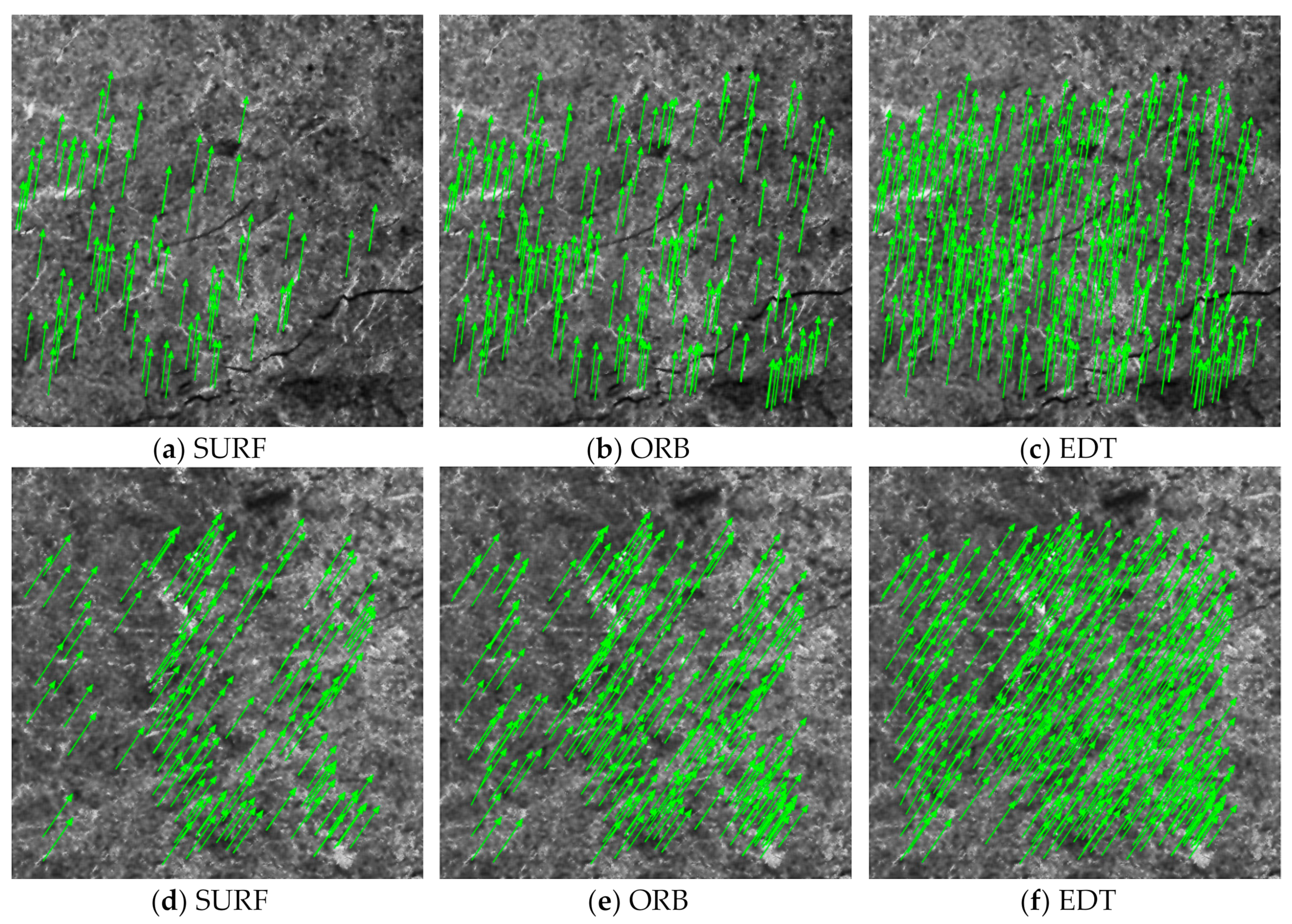
Sea ice drift detection has the key role of global climate analysis and waterway planning. The ability to detect sea ice drift in real-time also contributes to the safe navigation of ships and the prevention of offshore oil platform accidents. In this paper, an Enhanced Delaunay Triangulation (EDT) algorithm for sea ice tracking was proposed for dual-polarization sequential Synthetic Aperture Radar (SAR) images, which was implemented by combining feature tracking with pattern matching based on integrating HH and HV polarization feature information. A sea ice retrieval algorithm for feature detection, matching, fusion, and outlier detection was specifically developed to increase the system’s accuracy and robustness. In comparison with several state-of-the-art sea ice drift retrieval algorithms, including Speeded Up Robust Features (SURF) and the Oriented FAST and Rotated BRIEF (ORB) method, the results of the experiment provided compelling evidence that our algorithm had a higher accuracy than the SURF and ORB method. Furthermore, the results of our method were compared with the drift vector and direction of buoys data. The drift direction is consistent with buoys, and the velocity deviation was about 10 m. It was proved that this method can be applied effectively to the retrieval of sea ice drift.
Keywords: Delaunay Triangulation; dual-polarization; feature tracking; pattern matching; sea ice tracking; Sentinel-1; Synthetic Aperture Radar (SAR) Delaunay Triangulation; dual-polarization; feature tracking; pattern matching; sea ice tracking; Sentinel-1; Synthetic Aperture Radar (SAR)
Graphical Abstract